EP4576151A1 - Disjoncteur comportant des bornes fixes - Google Patents
Disjoncteur comportant des bornes fixes Download PDFInfo
- Publication number
- EP4576151A1 EP4576151A1 EP24222035.8A EP24222035A EP4576151A1 EP 4576151 A1 EP4576151 A1 EP 4576151A1 EP 24222035 A EP24222035 A EP 24222035A EP 4576151 A1 EP4576151 A1 EP 4576151A1
- Authority
- EP
- European Patent Office
- Prior art keywords
- tab
- circuit breaker
- fixed terminal
- housing
- terminal
- Prior art date
- Legal status (The legal status is an assumption and is not a legal conclusion. Google has not performed a legal analysis and makes no representation as to the accuracy of the status listed.)
- Granted
Links
Images





Classifications
-
- H—ELECTRICITY
- H01—ELECTRIC ELEMENTS
- H01H—ELECTRIC SWITCHES; RELAYS; SELECTORS; EMERGENCY PROTECTIVE DEVICES
- H01H71/00—Details of the protective switches or relays covered by groups H01H73/00 - H01H83/00
- H01H71/02—Housings; Casings; Bases; Mountings
- H01H71/0207—Mounting or assembling the different parts of the circuit breaker
- H01H71/0214—Housing or casing lateral walls containing guiding grooves or special mounting facilities
-
- H—ELECTRICITY
- H01—ELECTRIC ELEMENTS
- H01H—ELECTRIC SWITCHES; RELAYS; SELECTORS; EMERGENCY PROTECTIVE DEVICES
- H01H71/00—Details of the protective switches or relays covered by groups H01H73/00 - H01H83/00
- H01H71/08—Terminals; Connections
-
- H—ELECTRICITY
- H01—ELECTRIC ELEMENTS
- H01H—ELECTRIC SWITCHES; RELAYS; SELECTORS; EMERGENCY PROTECTIVE DEVICES
- H01H71/00—Details of the protective switches or relays covered by groups H01H73/00 - H01H83/00
- H01H71/10—Operating or release mechanisms
-
- H—ELECTRICITY
- H01—ELECTRIC ELEMENTS
- H01H—ELECTRIC SWITCHES; RELAYS; SELECTORS; EMERGENCY PROTECTIVE DEVICES
- H01H71/00—Details of the protective switches or relays covered by groups H01H73/00 - H01H83/00
- H01H71/10—Operating or release mechanisms
- H01H71/12—Automatic release mechanisms with or without manual release
-
- H—ELECTRICITY
- H01—ELECTRIC ELEMENTS
- H01H—ELECTRIC SWITCHES; RELAYS; SELECTORS; EMERGENCY PROTECTIVE DEVICES
- H01H71/00—Details of the protective switches or relays covered by groups H01H73/00 - H01H83/00
- H01H71/10—Operating or release mechanisms
- H01H71/12—Automatic release mechanisms with or without manual release
- H01H71/40—Combined electrothermal and electromagnetic mechanisms
-
- H—ELECTRICITY
- H01—ELECTRIC ELEMENTS
- H01H—ELECTRIC SWITCHES; RELAYS; SELECTORS; EMERGENCY PROTECTIVE DEVICES
- H01H73/00—Protective overload circuit-breaking switches in which excess current opens the contacts by automatic release of mechanical energy stored by previous operation of a hand reset mechanism
- H01H73/02—Details
- H01H73/04—Contacts
-
- H—ELECTRICITY
- H01—ELECTRIC ELEMENTS
- H01H—ELECTRIC SWITCHES; RELAYS; SELECTORS; EMERGENCY PROTECTIVE DEVICES
- H01H73/00—Protective overload circuit-breaking switches in which excess current opens the contacts by automatic release of mechanical energy stored by previous operation of a hand reset mechanism
- H01H73/02—Details
- H01H73/18—Means for extinguishing or suppressing arc
-
- H—ELECTRICITY
- H01—ELECTRIC ELEMENTS
- H01H—ELECTRIC SWITCHES; RELAYS; SELECTORS; EMERGENCY PROTECTIVE DEVICES
- H01H71/00—Details of the protective switches or relays covered by groups H01H73/00 - H01H83/00
- H01H71/02—Housings; Casings; Bases; Mountings
- H01H71/0207—Mounting or assembling the different parts of the circuit breaker
- H01H71/0221—Majority of parts mounted on central frame or wall
-
- H—ELECTRICITY
- H01—ELECTRIC ELEMENTS
- H01H—ELECTRIC SWITCHES; RELAYS; SELECTORS; EMERGENCY PROTECTIVE DEVICES
- H01H9/00—Details of switching devices, not covered by groups H01H1/00 - H01H7/00
- H01H9/02—Bases, casings, or covers
- H01H9/0264—Protective covers for terminals
Definitions
- the present invention pertains to the field of breakage switches with arc extinguishing or arc prevention means.
- the present invention also pertains to the field of circuit breaker terminals.
- the present invention relates to a circuit breaker, more specifically to a circuit breaker having, by convention, a front side (related to a thermomagnetic set) and a rear side (opposite to the first and normally related to a gas extinguishing and outlet chamber) comprising at least one fixed terminal comprising upper and rear tabs, a molded cover comprising fixing rods and a molded base comprising housings, in which this set of elements simultaneously prevents both rotation and translation of the terminal, giving it sufficient mechanical and positional resistance to withstand the screwing torque and the pullout force of conductors (wires or bars or the like) connected to it.
- molded case circuit breakers can have their working based on thermal, magnetic, thermomagnetic or even electronic principles, through the movement of electrical contacts, and can be used, above all, to protect electrical circuits subject to short-circuits and/or electrical overloads generated by electrical current levels that exceed a nominal limit previously established by connection of input and output terminals, connected to the electrical supply circuit to be protected.
- circuit breakers fundamentally work similarly to electrical switches, i.e., they work to change the electrical conduction state of an electrical circuit between the "on” and “off” states.
- conventional circuit breakers also comprise an operating handle that can be operated by a user.
- the current carrying capacity it is typical for the current carrying capacity to support relatively high values, for example, between 30A to 1600A or more.
- This type of electrical device requires a manual installation step by a user to enable the use of circuit breakers in their electrical circuit. Therefore, a solution that can optimize and facilitate the assembly of these circuit breakers would be able to optimize both the time and costs involved in installing circuit breakers, in addition to preventing accidents and damages involved in this type of operation by users.
- EP 2863410 did not present any type of surface tab for clamping these terminals, or even an internal configuration on its cover that presses these terminals in such a way as to simultaneously prevent both their rotation and their translation without the use of screws or pressing or other fixing elements. Therefore, this configuration makes the terminal more difficult to stabilize, in addition to increasing resistance to torque and reducing the maximum pullout force of the set, for example, when fixing wires or bars to the terminals and when they are already connected and subject to various forces.
- document US 6448876 despite presenting a circuit breaker terminal with arms that slide through an opening in the inner wall of the circuit breaker base, does not present a molded cover with a lower rod that presses these arms, or even a system that incorporates a bimetal in the terminals. Therefore, this configuration does not guarantee the stability of the terminal, in addition to reducing the maximum pullout force of the set, when the conductive wires are connected. Furthermore, this configuration is not capable of preventing unwanted rotation and translation of its internal terminals without the use of screws or pressing, or other clamping elements.
- the state of the art does not provide robust, simple, and low-cost solutions for a linking terminal clamping system that is capable of being firmly fixed to a circuit breaker without the use of screws or pressing and prevents both rotation and involuntary translation of this terminal without the use of screws or other clamping elements.
- One of the objectives of the invention is to provide a circuit breaker, according to the characteristics of claim 1 of the attached set of claims.
- Another objective of the invention is to provide a circuit breaker according to the characteristics of claim 2 of the attached set of claims.
- Another objective of the invention is to achieve high resistance to the pullout of terminals from their seats when connected to wires.
- Another objective of the present invention is to promote stability in the fixing of wires to the fixed terminals of circuit breakers.
- Another objective of the present invention is to reduce the deformation of the walls adjacent to the fixed terminals during a pullout test, based on the IEC 60947-1 Standard.
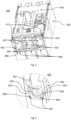
- Figure 1 shows, from an upper front perspective, a view of a circuit breaker (100), comprising a molded base (200), an operating mechanism (300), at least one fixed terminal (800), a molded cover (400), casing fixing means (403), and a cap (500).
- FIG 2 presents a front perspective view of the circuit breaker (100) of Figure 1 shown open, without its molded cover (400) or said cap (500), showing inside it at least one housing (220) of a thermomagnetic set (600) including at least one fixed terminal (800), at least one arc extinguishing chamber (230), an operating mechanism (300), a transverse trip bar (635), a handle (388), movable contacts (631), and conductor fasteners (601), said housing (220) of thermomagnetic set (600) being preferentially three, equally spaced from each other, where said handle (388) of said circuit breaker (100) is capable of a translational movement relative to the molded cover (400), so as to change the electrical conduction state of an electrical circuit between the "ON” and “OFF” states, or present another operating state, such as "tripped", for example.
- a thermomagnetic set 600
- said housing (220) of thermomagnetic set (600) being preferentially three, equally spaced from each other, where
- Figure 3 shows a longitudinal cross-sectional side view of the circuit breaker (100) in Figure 1 , showing part of the main internal components of said circuit breaker (100). More precisely, Figure 3 shows the molded base (200), the molded cover (400), the cap (500), a magnetic actuator(221), a thermomagnetic set (600) including a core of ferromagnetic material (602), at least one conductor fixer (601), a fixed contact (630) comprising an electrical connection terminal (632), a contact system (634) comprising at least one movable contact (631), movable contact arm (636) and a spring (633), a transverse trip bar (635), and electric arc extinguishing plates (650).
- a thermomagnetic set including a core of ferromagnetic material (602), at least one conductor fixer (601), a fixed contact (630) comprising an electrical connection terminal (632), a contact system (634) comprising at least one movable contact (631), movable contact arm (63
- Figure 3 shows said circuit breaker presented in its "OFF" state, i.e., with the said fixed and movable contacts (630, 631) spaced apart from each other. Furthermore, said Figure 3 shows said thermomagnetic set (600) and its ferromagnetic core (602) assembled inside said circuit breaker (100) and connected with its respective conductor fixer (601).
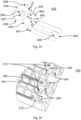
- Figure 4 presents a front exploded perspective view of the circuit breaker (100) of Figure 1 shown open, said molded base (200) comprising holes (210), said molded cover (400) and a plurality of holes (410, 411, 412), highlighting a stabilization system of at least one fixed terminal (800) formed between said molded base (200) and said molded cover (400), comprising in said molded base (200) at least one terminal housing (201), a tab housing (202), said molded cover (400) comprising at least a pair of lower rods (402) and a fixed terminal (800) (shown in detail in Figures 7 and 8 ), comprising a central hole (801), and at least one upper tab (802).
- the X, Y, Z (linear) degrees of freedom axes are also presented, in addition to the rotation axes (RX, RY, RZ).
- Figure 5 shows a front perspective view of said circuit breaker (100) of Figure 1 shown closed, without the cap (500), showing the molded cover (400) assembled on the molded base (200).
- Figure 5 also shows the holes (410, 412) of said molded cover (400), fixed terminals (800) and their respective central holes (801) positioned on the surface of said terminal housing (201) (seen in Figure 4 ) of said molded base (200) and pressed on its lateral parts by a pair of lower rods (402) and on the rear part by the wall (401) of said molded cover (400).
- Figure 6 presents an enlarged partial perspective view of said circuit breaker (100) of said Figure 1 closed, showing said molded cover (400) assembled on said molded base (200) and a conductor fixer (601) clamped to the fixed terminal (800).
- said molded base (200) additionally comprises locking chamfers (205), which can fit into the opposing surface (806) of said fixed terminal (800), in addition to retaining side walls (206).
- Figure 7 presents an upper front perspective view of said fixed terminal (800), showing the central hole (801), the upper tabs (802) of a surface (808), in addition to a first rear tab (803), a second rear tab (804) and a lower hole (805) comprised in said second rear tab (804).
- Preferentially one face (807) of said second rear tab (804) is preferentially directed positioned perpendicular to said upper face (808) of said fixed terminal (800). It can be observed that said second rear tab (804) additionally comprises a rough region around said lower hole (805).
- Figure 8 presents a lower front perspective view of the fixed terminal (800) of Figure 7 , showing the central hole (801), the upper tabs (802), said first tab (803) comprising a width (L1), said second rear tab (804) comprising a width (L2) and the lower hole (805) spaced from the lower part of said second rear tab (804) by a distance (d3), said first tab (803) and said second rear tab (804) being spaced from each other by a distance (d2).
- a first setback distance (d1) is also presented, wherein its smaller faces (sides) are also preferentially parallel and spaced, having a second distance (d2) between them.
- FIG 9 shows a front perspective view of said assembled thermomagnetic set (600), comprising a bimetal element (700) comprising a thermal adjustable actuator (721), heating resistance (710), two clamping means (740) preferentially rivets, connecting means, particularly a braided support (750), a tab support (730) comprising holes (731) and receiving the tabs (222) (seen in Figure 10 ) and a magnetic core (732), preferentially fixed in a deformation region (733) and a magnetic actuator (221) of an armature (223), in addition to said fixed terminal (800) comprising a central hole (801), the upper tabs (802) of the surface (808), the first tab (803), and the second rear tab (804).
- a bimetal element comprising a thermal adjustable actuator (721), heating resistance (710), two clamping means (740) preferentially rivets, connecting means, particularly a braided support (750), a tab support (730) comprising holes (731) and receiving the tabs (222) (
- FIG 10 shows a rear perspective view of the assembled thermomagnetic set (600), which comprises the bimetal element (700) comprising a thermal adjustable actuator (721), two support ends (701), braided support (750), heating resistor (710), a magnetic core (732), a tab support (730) of said magnetic core (732), said tab support (730) comprising holes (731) in each of its tabs for receiving bearing tabs (222) of an driver (221) of armature (223), at least two clamping means (740) and the fixed terminal (800) comprising the second visible rear tab (804) and said central hole (801), in addition to upper tabs (802) of the surface (808).
- the bimetal element (700) comprising a thermal adjustable actuator (721), two support ends (701), braided support (750), heating resistor (710), a magnetic core (732), a tab support (730) of said magnetic core (732), said tab support (730) comprising holes (731) in each of its tabs for receiving bearing tabs (222) of an
- Figure 11 presents a partial upper front perspective view of the molded base (200), showing at least two holes (210), at least two holes (212), spaces provided as terminal housings (201), the tab housings (202), at least two tab housings (203) of the first tab (803) and at least two housings of the second rear tab (204).
- Figure 14 presents an upper front perspective view of said fixed terminal (632), showing the central hole (637), the upper tabs (638) of an upper surface (639), in addition to a first rear tab (640) and a second rear tab (641) (best seen in Figure 15 ).
- Preferentially one face (642) of said first rear tab (640) and one said face (643) of said second rear tab (641) are preferentially constructed with an orientation perpendicular to said upper face (639) of said fixed terminal (632).
- Figure 14 also shows that said fixed terminal (632) has a second conductive end portion (644) connected to a support folded portion (645) for the fixed contact (630) of said fixed terminal (632).
- Figure 16 presents a partial upper front perspective view of the molded base (200), showing a hole (210), at least two holes (212), spaces provided as terminal housings (244), the tab housings (245), at least one housing (246) of the first rear tab (640) and at least one housing (247) of the second rear tab (641) (best seen in Figure 17 ).
- the molded base (200) comprises, in a preferred embodiment, a plurality of holes (210), a plurality of holes (212), a plurality of housings (220) of thermomagnetic set (600), at least one arc extinguishing chamber (230), a plurality of terminal housings (201), a plurality of tab housings (202), a plurality of tab housings (203) for accommodating a first tab (803) and a plurality of tab housings (204) for accommodating a second rear tab (804) of said fixed terminal (800), located in the front portion of the circuit breaker (100).
- the through holes (412) are suitable for receiving one or more types of casing fixing means (403), such as screws, rivets, among others, which pass through both said molded cover (400) and the holes (212) of said molded base (200) for fixing of said circuit breaker (100), for example, to a panel or DIN rail.
- the holes (410) are through holes that receive one or more types of clamping means, such as screws (403), rivets, among others, that pass through the molded cover (400) and are fixed in the holes (210) of the molded base (200), so as to keep both elements joined together, when the circuit breaker (100) is closed.
- thermomagnetic set (600) are chambers disposed within the molded base (200) in a current interruption path pole region seen in the "XY" Plane ( Figure 3 ) of the circuit breaker (100), preferentially having 3 poles, each receiving a thermomagnetic set (600) preferentially comprising a trip magnetic actuator (221) and a trip thermal adjustable actuator (721).
- the magnetic drivers (221) of a mobile core or the thermal trip adjustable actuators (721) have the function of regulating the actuating course of the thermomagnetic set (600) positioned on the front side of the circuit breaker (100), to actuate the transversal trip bar (635) in the operating mechanism (300) and disengage said circuit breaker (100).
- the arc extinguishing chambers (230) are chambers arranged inside the rear side of the molded base (200), in an inlet region and separate from the region of the housings (220) of the thermomagnetic set (600). Said arc extinguishing chambers (230) receive a fixed contact (630) and a movable contact (631) from a contact system (634).
- the terminal housing (201) is a housing positioned on the front side of the circuit breaker (100), with a shape and dimensions corresponding to the fixed terminal (800), so as to allow said terminal housing (201) to receive and house said fixed terminal (800).
- the terminal housing (244) is a housing positioned on the rear side of the circuit breaker (100), with a shape and dimensions corresponding to the fixed terminal (632), so as to allow said terminal housing (244) to receive and house said fixed terminal (632).
- Each housing of the first tab (203, 246) must correspond in dimensions, shape, quantity, and positioning with each of the first rear tabs (803, 640) of the fixed terminal (800, 632).
- the housings of the second rear tab (204, 247) are vertical cavities open at their upper part located inside the molded base (200), which receive and house a second rear tab (804, 641) of the fixed terminal (800, 632). Preferentially, there is at least one second rear tab housing (204, 247) for each fixed terminal (800, 632).
- Each housing of the second rear tab (204, 247) must correspond in dimensions, shape, quantity, and positioning with each of the second tabs (804, 641) of the fixed terminal (800, 632).
- the operating mechanism (300) is a unipolar, bipolar, tripolar, tetrapolar electrical trigger mechanism, among others, comprising known and usual elements of the prior art, such as: a plurality of side plates arranged on opposite sides.
- a handle mechanism (388) located in the upper region and responsible for the internal manual movement of the components of said operating mechanism (300); having a plurality of positioning engagements; at least one contact spring; at least one positioning shaft; at least one positioning hole; at least one return spring; at least one return shaft; and at least one return hole that accommodates said return shaft and said return spring, known to the person skilled in the art.
- said operating mechanism (300) additionally comprises at least one spring (633), a contact system (634) and at least one handle (388), which interact with each other to operate the opening and closing movement operations of the fixed and movable contacts (630, 631).
- the handle (388) is a switch capable of manually switching the handle mechanism of the circuit breaker (100) freely between the closed, open or turned on position upon an external driving force performed by a user after a trip due to a fault.
- this is commonly centered in relation to the molded cover (400) and/or in relation to the cap (500) of the circuit breaker (100).
- there are two or more handles (388) they are preferentially arranged side by side in a central position in relation to the molded cover (400) and/or in relation to the cap (500) of the circuit breaker (100) and can also be connected to each other.
- the molded cover (400) has dimensions corresponding to the molded base (200), so as to be able to generate a corresponding fit to each other, sealing and protecting the interior of the circuit breaker (100), wherein said molded cover (400) comprises at least one through hole (410) that receives one or more types of fixing means (403), at least one through hole (411) for the handle (388), at least one through hole (412), and at least one pair of lower rods (402).
- the lower rods (402) are vertical protrusions of the molded cover (400) that preferentially protrude perpendicularly from a lower surface of said molded cover (400) for insertion into the tab housings (242). Furthermore, when positioning said molded cover (400) on the molded base (200), each of the lower rods (402) slides housed in the corresponding tab housing (202, 245), being able to slide preferentially free throughout the entire path of said corresponding lower rods (402), at the same time as in their final position, they reinforce the assembly by providing a rotational jamming of said molded cover (400) in relation to said molded base (200) and at the same time to the fixed terminal (800, 638), blocking the upper tabs (802, 638).
- the lower rods (402) have a polygonal shape and a length equal to the height of the tab housings (202, 245) minus the thickness of said fixed terminals (800, 632), so that each of said lower rods (402) remains within its corresponding tab housing (202, 245), contacting and holding pressed its said corresponding upper tab (802, 638). It should be noted that each lower rods (402) corresponds in quantity, shape, dimensions and positioning to its corresponding tab housing (202, 245).
- circuit breaker (100) not to comprise the cap (500), so that the closing of the circuit breaker (100) results solely from the clamping of the molded cover (400) to the molded base (200).
- the circuit breaker (100) further comprises at least one thermomagnetic set (600), at least one fixed contact (630), at least one movable contact (631), at least one electrical connection terminal (632), at least one spring (633), at least one contact system (634), at least one transverse trip bar (635), at least one conductor fixer (601) and a plurality of electric arc extinguishing plates (650).
- Each thermomagnetic set (600) comprises at least one bimetal element (700), a heating resistor (710), at least one tab support (730), a fixed terminal (800), a thermal adjustable actuator (721), a magnetic actuator (221) and clamping means (740).
- the arc extinguishing chambers (230) comprise electric arc extinguishing plates (650), which together aim to prevent damage to equipment caused by the electric arc that forms when the electrical circuit is abruptly interrupted during a fault event, particularly when the currents are high, as occurs in a short circuit, and the operating mechanism (300) of the circuit breaker (100) is actuated through the thermomagnetic set (600) that acts on the transverse trip bar (635) in communication with said operating mechanism (300) to open said movable contacts (630, 631), turning off said circuit breaker (100) and protecting the electrical circuit connected thereto.
- the operating mechanism (300) of the circuit breaker (100) is actuated through the thermomagnetic set (600) that acts on the transverse trip bar (635) in communication with said operating mechanism (300) to open said movable contacts (630, 631), turning off said circuit breaker (100) and protecting the electrical circuit connected thereto.
- the contacts (630, 631) are internal switching elements that aim to (i) allow the passage of electrical energy when they are in contact with each other; or (ii) interrupt the passage of electrical energy when they are not in contact with each other.
- each fixed contact (630) remains fixed with the terminal (632) and receives a movable or permanent conductor fixer (601), which fixes one of the conductors of an electrical circuit to the circuit breaker (100).
- the contacts (630, 631) are designed to open from the thermal interaction of the bimetal (700) which, through an excessive electric current for the system, bends due to a differential in thermal expansion between two different materials, and pushes said bimetal element (700) through the thermal adjustable actuator (721) or even through a magnetic actuator (221), in a shift resulting from a large instantaneous electric current circulating through a magnetic core (732), also connected to a heating resistance (710) and to said bimetal (700), which attracts an armature (223) connected to said magnetic actuator (221), pushing a transverse trip bar (635), which acts on the operating mechanism (300) and disengages the circuit breaker (100), as a consequence, separating said contacts (630, 631) and interrupting the electric circuit.
- the circuit breaker (100) protects an electrical circuit, by at least one electric current interruption path, comprised of a front side, through a fixed terminal (800) receiving a conductor fixer (601), said fixed terminal (800) comprised in a thermomagnetic set (600) which can be electrically connected preferentially to a cable (not shown) or other optional connecting means, a contact system (634) comprising at least one movable contact (631) and a spring (633), a fixed contact (630) comprised in an electrical connection terminal (632) connecting the opposite side behind said circuit breaker (100), the power supply and/or load being made from either connection side, said circuit breaker (100) being positioned between them to protect said electrical circuit.
- the spring (633) is located internally in the contact system (634) and has the function of keeping the operating mechanism (300) in a "closed” or armed position, defined by driving the handle (388), until a fault trip occurs, from the thermomagnetic set (600) and said spring (633) is released. Otherwise, from an "open” or disarmed position, said spring (633) will be tensioned when said handle (388) is shifted to the "on” position engaging the operating mechanism (not shown) again to the "closed” or armed position of the circuit breaker (100), prepared to protect the electrical circuit in a new fault event.
- the conductor fixer (601) is preferentially a movable fixing means such as a screw, arranged at the ends of the circuit breaker (100), which aims to individually fix conductors of the electrical network to said circuit breaker (100).
- the electric arc extinguishing plates (650) are known from the prior art, being arranged individually stacked and spaced apart from each other, in each of the arc extinguishing chambers (230). More precisely, each of the electric arc extinguishing chambers (230) is individually located around each of said contacts (630, 631), so as to attract and prevent the propagation of electric sparks formed during the transition of the circuit breaker (100) from an "open position" to a "closed position", or vice versa.
- the bimetal element (700) preferentially comprises a plurality of support ends (701) and a thermal adjustable actuator (721). Furthermore, the bimetal element (700) allows the passage of an electric current that comes through the fixed terminal (800) and passes through the bimetal (700), subsequently being conducted preferentially by a cable (not shown) or another conductor to the mobile contact arm (636) of the contact system (634) of the circuit breaker (100).
- the ends of the bimetal (701) are preferentially arranged in pairs and in a bifurcated configuration, comprising at least one clamping through hole (not shown) at their ends, to receive the clamping means (740).
- the heating resistance (710) preferentially comprises a bifurcated shape and holes at the ends (not shown) for its fixing to the bimetal (700) and actuates at least one corresponding magnetic actuator (221) through the armature (223) which is sensitized by a current induced by a circulating current both in said bimetal (700) and in the heating resistance (710) connected to each other, of the thermomagnetic set (600), to actuate the operating mechanism (300) of the circuit breaker (100).
- one of the through holes (not shown) for clamping the ends (701) of said bimetal (700) and the heating resistance (710) is used to clamp them to the fixed terminal (800), while the other is used to clamp a cable support (750) (not shown) or other conductive means, which can be welded to it.
- the bimetal (700) is known in the state of the art and comprises two or more metal sheets with distinct properties between them, wherein the bimetal (700), upon application of a temperature and/or of an excessive electric current to the system, bends due to its thermal expansion and pushes the bimetal element (700) through the thermal adjustable actuator (721), pushing the transverse trip bar (635) and disengaging the circuit breaker (100), interrupting an electric circuit, as a consequence.
- the upper tabs (802) of the fixed terminal (800) are pressed by the lower rods (402) and optionally by the wall (401) of the molded cover (400).
- the upper tabs (802) remain housed within the tab housings (202) while being pressed downwards by the lower rods (402) and by the wall (401), touching said fixed terminal (800) and ensuring that it is prevented from rotating due to the upper tabs (802) and prevented from translating vertically due to the lower rods (402) and by the wall (401), whereas the molded base (200) and the molded cover (400) remained positioned and pressed against each other.
- said molded cover (400) comprises a wall (401, 423) that touches the surface (808) of said fixed terminal (800).
- the second rear tab (804) comprises a second length (c2) and a second width (L2) and is the longest wing of the fixed terminal (800), which, like the first tab (803), protrudes subsequently to an edge of the surface (808) of the fixed terminal (800) and in a direction preferentially perpendicular to the surface (808) of the fixed terminal (800), wherein the second rear tab (804) preferentially has a polygonal shape and roughness around the lower hole (805), which assist in fixing the clamping means (740) for the bimetal (700) and the heating resistance (710), on both sides of its thickness.
- the second length (c2) of the second rear tab (804) is between 2 and 5 times, preferentially at least 3 times greater than the first length (c1) of the first tab (803).
- the clamping means (740) are arranged at both support ends (701) of the bimetal element (700), at both ends of the heating resistance (710) and at the second rear tab (804) of the fixed terminal (800) and are intended to keep the bimetal element (700) and heating resistance (710) attached to said fixed terminal (800).
- the present invention embodies a stabilization system of at least one fixed terminal (632), formed between said molded base (200) and said molded cover (400), comprising in said molded base (200) at least one terminal housing (244), a tab housing (245), said molded cover (400) comprising at least one pair of lower rods (422).
- Said fixed terminal (632) comprises upper tabs (638) of an upper surface (639), a central hole (637), and at least one pair of upper tabs (638), in addition to a first rear tab (640) and a second rear tab (641); and a second conductive end portion (644) connected to a support folded portion (645) for the fixed contact (630).
- a face (642) of said first rear tab (640) and a face (643) of said second rear tab (641) are preferentially constructed perpendicular to said upper face (639) of said fixed terminal (632) and are inserted adjacent to the arc extinguishing chamber (230).
- thermomagnetic set (600) directly depends on the quantity of current paths or poles present in the circuit breaker (100).
- the object according to the present invention, exceeds the solutions provided for by the prior art, being an object, perfectly susceptible to industrial application, which presents novelty and non-obviousness.
Landscapes
- Physics & Mathematics (AREA)
- Electromagnetism (AREA)
- Breakers (AREA)
Applications Claiming Priority (1)
| Application Number | Priority Date | Filing Date | Title |
|---|---|---|---|
| BR102023027379-3A BR102023027379A2 (pt) | 2023-12-22 | Disjuntor compreendendo terminais fixos |
Publications (2)
| Publication Number | Publication Date |
|---|---|
| EP4576151A1 true EP4576151A1 (fr) | 2025-06-25 |
| EP4576151B1 EP4576151B1 (fr) | 2026-04-22 |
Family
ID=95857876
Family Applications (1)
| Application Number | Title | Priority Date | Filing Date |
|---|---|---|---|
| EP24222035.8A Active EP4576151B1 (fr) | 2023-12-22 | 2024-12-20 | Disjoncteur comportant des bornes fixes |
Country Status (2)
| Country | Link |
|---|---|
| EP (1) | EP4576151B1 (fr) |
| CN (1) | CN120199651A (fr) |
Citations (3)
| Publication number | Priority date | Publication date | Assignee | Title |
|---|---|---|---|---|
| US6262645B1 (en) * | 1999-08-27 | 2001-07-17 | Eaton Corporation | Circuit interrupter with a trip mechanism having a biased latch |
| US6448876B1 (en) | 2001-01-09 | 2002-09-10 | Eaton Corporation | Load terminal with conductive tang for use in a circuit breaker |
| EP2863410A1 (fr) | 2013-10-17 | 2015-04-22 | LSIS Co., Ltd. | Dispositif de déclenchement de disjoncteur |
-
2024
- 2024-12-20 EP EP24222035.8A patent/EP4576151B1/fr active Active
- 2024-12-20 CN CN202411885340.7A patent/CN120199651A/zh active Pending
Patent Citations (3)
| Publication number | Priority date | Publication date | Assignee | Title |
|---|---|---|---|---|
| US6262645B1 (en) * | 1999-08-27 | 2001-07-17 | Eaton Corporation | Circuit interrupter with a trip mechanism having a biased latch |
| US6448876B1 (en) | 2001-01-09 | 2002-09-10 | Eaton Corporation | Load terminal with conductive tang for use in a circuit breaker |
| EP2863410A1 (fr) | 2013-10-17 | 2015-04-22 | LSIS Co., Ltd. | Dispositif de déclenchement de disjoncteur |
Also Published As
| Publication number | Publication date |
|---|---|
| EP4576151B1 (fr) | 2026-04-22 |
| CN120199651A (zh) | 2025-06-24 |
Similar Documents
| Publication | Publication Date | Title |
|---|---|---|
| TWI376715B (en) | Fusible switching disconnect modules and devices | |
| JP6454036B2 (ja) | 直流配線用遮断器 | |
| US9224548B2 (en) | Disconnect switch including fusible switching disconnect modules | |
| US6172586B1 (en) | Terminal barrier system for molded case circuit breaker | |
| EP2315228B1 (fr) | Disjoncteur à boîtier moulé doté d'un mécanisme de déclenchement instantané | |
| US5416291A (en) | Current limiting circuit breaker operating mechanism including linkage | |
| JP2006032319A (ja) | 回路遮断器 | |
| US20110248815A1 (en) | Method For Expanding The Adjustment Range of Overload Protection Devices, Associated Overload Protection Devices, and Their Use | |
| EP1077458B1 (fr) | Disjoncteur avec une borne asymétrique en forme de collier | |
| US6274833B1 (en) | Plug-in trip unit joint for a molded case circuit breaker | |
| CN101079353B (zh) | 对地漏电断路器 | |
| EP4576151B1 (fr) | Disjoncteur comportant des bornes fixes | |
| KR101994444B1 (ko) | 직류 배선용 차단기 | |
| US20020050878A1 (en) | Stationary line bus assembly | |
| KR101890685B1 (ko) | 직류 배선용 차단기 | |
| CN1841616B (zh) | 漏电断路器 | |
| JP4147347B2 (ja) | 配線用遮断器 | |
| EP2472549A1 (fr) | Ensemble bimétallique pour disjoncteur | |
| JP3117075B2 (ja) | 回路遮断器 | |
| JP4856518B2 (ja) | 回路遮断器 | |
| JP4852380B2 (ja) | 回路遮断器 | |
| BR102023027379A2 (pt) | Disjuntor compreendendo terminais fixos | |
| KR20250163123A (ko) | 모터 보호용 차단기의 트립 장치 | |
| EP3751590B1 (fr) | Dispositif coupe-circuit électronique pour disjoncteur à boîtier moulé | |
| JP2002056763A (ja) | 回路遮断器 |
Legal Events
| Date | Code | Title | Description |
|---|---|---|---|
| PUAI | Public reference made under article 153(3) epc to a published international application that has entered the european phase |
Free format text: ORIGINAL CODE: 0009012 |
|
| STAA | Information on the status of an ep patent application or granted ep patent |
Free format text: STATUS: THE APPLICATION HAS BEEN PUBLISHED |
|
| AK | Designated contracting states |
Kind code of ref document: A1 Designated state(s): AL AT BE BG CH CY CZ DE DK EE ES FI FR GB GR HR HU IE IS IT LI LT LU LV MC ME MK MT NL NO PL PT RO RS SE SI SK SM TR |
|
| STAA | Information on the status of an ep patent application or granted ep patent |
Free format text: STATUS: REQUEST FOR EXAMINATION WAS MADE |
|
| 17P | Request for examination filed |
Effective date: 20250919 |
|
| GRAJ | Information related to disapproval of communication of intention to grant by the applicant or resumption of examination proceedings by the epo deleted |
Free format text: ORIGINAL CODE: EPIDOSDIGR1 |
|
| GRAP | Despatch of communication of intention to grant a patent |
Free format text: ORIGINAL CODE: EPIDOSNIGR1 |
|
| GRAP | Despatch of communication of intention to grant a patent |
Free format text: ORIGINAL CODE: EPIDOSNIGR1 |
|
| STAA | Information on the status of an ep patent application or granted ep patent |
Free format text: STATUS: GRANT OF PATENT IS INTENDED |
|
| RIC1 | Information provided on ipc code assigned before grant |
Ipc: H01H 71/02 20060101AFI20251126BHEP Ipc: H01H 71/08 20060101ALI20251126BHEP Ipc: H01H 9/02 20060101ALN20251126BHEP |
|
| RIC1 | Information provided on ipc code assigned before grant |
Ipc: H01H 71/02 20060101AFI20251203BHEP Ipc: H01H 71/08 20060101ALI20251203BHEP Ipc: H01H 9/02 20060101ALN20251203BHEP |
|
| INTG | Intention to grant announced |
Effective date: 20251211 |
|
| GRAS | Grant fee paid |
Free format text: ORIGINAL CODE: EPIDOSNIGR3 |
|
| GRAA | (expected) grant |
Free format text: ORIGINAL CODE: 0009210 |
|
| STAA | Information on the status of an ep patent application or granted ep patent |
Free format text: STATUS: THE PATENT HAS BEEN GRANTED |
|
| AK | Designated contracting states |
Kind code of ref document: B1 Designated state(s): AL AT BE BG CH CY CZ DE DK EE ES FI FR GB GR HR HU IE IS IT LI LT LU LV MC ME MK MT NL NO PL PT RO RS SE SI SK SM TR |
|
| REG | Reference to a national code |
Ref country code: CH Ref legal event code: F10 Free format text: ST27 STATUS EVENT CODE: U-0-0-F10-F00 (AS PROVIDED BY THE NATIONAL OFFICE) Effective date: 20260422 Ref country code: GB Ref legal event code: FG4D |