EP4576257A1 - Kathode für lithiumsekundärbatterie und lithiumsekundärbatterie damit - Google Patents
Kathode für lithiumsekundärbatterie und lithiumsekundärbatterie damit Download PDFInfo
- Publication number
- EP4576257A1 EP4576257A1 EP23865742.3A EP23865742A EP4576257A1 EP 4576257 A1 EP4576257 A1 EP 4576257A1 EP 23865742 A EP23865742 A EP 23865742A EP 4576257 A1 EP4576257 A1 EP 4576257A1
- Authority
- EP
- European Patent Office
- Prior art keywords
- cathode
- secondary battery
- lithium secondary
- lithium
- oxide particles
- Prior art date
- Legal status (The legal status is an assumption and is not a legal conclusion. Google has not performed a legal analysis and makes no representation as to the accuracy of the status listed.)
- Pending
Links
Images
Classifications
-
- H—ELECTRICITY
- H01—ELECTRIC ELEMENTS
- H01M—PROCESSES OR MEANS, e.g. BATTERIES, FOR THE DIRECT CONVERSION OF CHEMICAL ENERGY INTO ELECTRICAL ENERGY
- H01M4/00—Electrodes
- H01M4/02—Electrodes composed of, or comprising, active material
- H01M4/36—Selection of substances as active materials, active masses, active liquids
- H01M4/48—Selection of substances as active materials, active masses, active liquids of inorganic oxides or hydroxides
- H01M4/52—Selection of substances as active materials, active masses, active liquids of inorganic oxides or hydroxides of nickel, cobalt or iron
- H01M4/525—Selection of substances as active materials, active masses, active liquids of inorganic oxides or hydroxides of nickel, cobalt or iron of mixed oxides or hydroxides containing iron, cobalt or nickel for inserting or intercalating light metals, e.g. LiNiO2, LiCoO2 or LiCoOxFy
-
- H—ELECTRICITY
- H01—ELECTRIC ELEMENTS
- H01M—PROCESSES OR MEANS, e.g. BATTERIES, FOR THE DIRECT CONVERSION OF CHEMICAL ENERGY INTO ELECTRICAL ENERGY
- H01M10/00—Secondary cells; Manufacture thereof
- H01M10/05—Accumulators with non-aqueous electrolyte
-
- H—ELECTRICITY
- H01—ELECTRIC ELEMENTS
- H01M—PROCESSES OR MEANS, e.g. BATTERIES, FOR THE DIRECT CONVERSION OF CHEMICAL ENERGY INTO ELECTRICAL ENERGY
- H01M4/00—Electrodes
- H01M4/02—Electrodes composed of, or comprising, active material
- H01M4/13—Electrodes for accumulators with non-aqueous electrolyte, e.g. for lithium-accumulators; Processes of manufacture thereof
- H01M4/131—Electrodes based on mixed oxides or hydroxides, or on mixtures of oxides or hydroxides, e.g. LiCoOx
-
- H—ELECTRICITY
- H01—ELECTRIC ELEMENTS
- H01M—PROCESSES OR MEANS, e.g. BATTERIES, FOR THE DIRECT CONVERSION OF CHEMICAL ENERGY INTO ELECTRICAL ENERGY
- H01M4/00—Electrodes
- H01M4/02—Electrodes composed of, or comprising, active material
- H01M4/36—Selection of substances as active materials, active masses, active liquids
- H01M4/48—Selection of substances as active materials, active masses, active liquids of inorganic oxides or hydroxides
- H01M4/485—Selection of substances as active materials, active masses, active liquids of inorganic oxides or hydroxides of mixed oxides or hydroxides for inserting or intercalating light metals, e.g. LiTi2O4 or LiTi2OxFy
-
- H—ELECTRICITY
- H01—ELECTRIC ELEMENTS
- H01M—PROCESSES OR MEANS, e.g. BATTERIES, FOR THE DIRECT CONVERSION OF CHEMICAL ENERGY INTO ELECTRICAL ENERGY
- H01M4/00—Electrodes
- H01M4/02—Electrodes composed of, or comprising, active material
- H01M2004/021—Physical characteristics, e.g. porosity, surface area
-
- H—ELECTRICITY
- H01—ELECTRIC ELEMENTS
- H01M—PROCESSES OR MEANS, e.g. BATTERIES, FOR THE DIRECT CONVERSION OF CHEMICAL ENERGY INTO ELECTRICAL ENERGY
- H01M4/00—Electrodes
- H01M4/02—Electrodes composed of, or comprising, active material
- H01M2004/026—Electrodes composed of, or comprising, active material characterised by the polarity
- H01M2004/028—Positive electrodes
-
- Y—GENERAL TAGGING OF NEW TECHNOLOGICAL DEVELOPMENTS; GENERAL TAGGING OF CROSS-SECTIONAL TECHNOLOGIES SPANNING OVER SEVERAL SECTIONS OF THE IPC; TECHNICAL SUBJECTS COVERED BY FORMER USPC CROSS-REFERENCE ART COLLECTIONS [XRACs] AND DIGESTS
- Y02—TECHNOLOGIES OR APPLICATIONS FOR MITIGATION OR ADAPTATION AGAINST CLIMATE CHANGE
- Y02E—REDUCTION OF GREENHOUSE GAS [GHG] EMISSIONS, RELATED TO ENERGY GENERATION, TRANSMISSION OR DISTRIBUTION
- Y02E60/00—Enabling technologies; Technologies with a potential or indirect contribution to GHG emissions mitigation
- Y02E60/10—Energy storage using batteries
Definitions
- the present disclosure relates to a cathode for a lithium secondary battery, and a lithium secondary battery including the same. More specifically, the present disclosure relates to a cathode for a lithium secondary battery including over-lithiated oxide particles, and a lithium secondary battery including the cathode.
- a secondary battery is a battery which can be repeatedly charged and discharged, and has been widely applied to portable electronic devices such as a mobile phone, a laptop computer, etc. as a power source thereof.
- a lithium secondary battery has a high operating voltage and a high energy density per unit weight, making it advantageous in terms of charging speed and lightweight design.
- the lithium secondary battery has been actively developed and applied to various industrial fields.
- the lithium secondary battery may store an electric energy by a difference in chemical potential when lithium ions are intercalated and deintercalated between a cathode and an anode. Accordingly, the lithium secondary battery may use materials capable of reversibly intercalating and deintercalating the lithium ions as a cathode active material and an anode active material.
- lithium metal oxide particles having a layered crystal structure of ABO 2 e.g., lithium cobalt oxide (LiCoO 2 ), lithium nickel oxide (LiNiO 2 ), lithium manganese oxide (LiMnO 2 ), lithium nickel-cobalt-manganese oxide (NCM), lithium nickel-aluminum-manganese oxide (NCA), etc.
- the lithium metal oxide particles may realize a reversible capacity of about 100 mAh/g to 230 mAh/g.
- lithium metal oxide particles having a higher capacity than the lithium metal oxide particles are being researched and developed.
- the over-lithiated oxide particles are known to have a structure in which lithium is inserted into a transition metal site of lithium metal oxide particles having a layered crystal structure of ABO 2 . Accordingly, the over-lithiated oxide particles may be expressed as Li a M b O 2 (M is a transition metal such as Mn, Ni or Co, etc., and a and b satisfy a/b ⁇ 1.05).
- the over-lithiated oxide particles may include Li 2 MnO 3 domains (C2/m space group) and LiMO 2 domains (R3m space group, M is Mn, Ni or Co, etc.). Accordingly, the over-lithiated oxide particles may be expressed as xLi 2 MnO 3 ⁇ (1-x)LiMO 2 (0.05 ⁇ x ⁇ 1).
- the over-lithiated oxide particles may exhibit a reversible capacity of 250 mAh/g or more by an electrochemical reaction of Li 2 MnO 3 .
- Li 2 MnO 3 is electrochemically inactive, but may be converted into LiMnO 2 as shown in Scheme 1 below by an activation process (e.g., charging and discharging a lithium secondary battery using over-lithiated oxide particles at 4.4 V (vs Li/Li + ) or more).
- the LiMnO 2 may reversibly intercalate and deintercalate lithium ions as shown in Scheme 2 below.
- the over-lithiated oxide particles may exhibit a high reversible capacity according to the LiMO 2 domains and the Li 2 MnO 3 domains.
- the over-lithiated oxide particles may exhibit low operational stability (such as reduced lifespan characteristics, etc.).
- An object of the present disclosure is to provide a cathode for a lithium secondary battery having improved capacity and operational stability.
- Another object of the present disclosure is to provide a lithium secondary battery having improved capacity and operational stability.
- a cathode for a lithium secondary battery may include: a cathode current collector; and a cathode active material layer formed on the cathode current collector and including over-lithiated oxide particles represented by Formula 1 below.
- a D value of the cathode represented by Equation 1 below may be greater than 5.
- M is at least one of Co, Mg, V, Ti, Al, Fe, Ru, Zr, W, Sn, Nb, Mo, Cu, Zn, Cr, Ga, V and Bi, and x, y, z a and b satisfy 0 ⁇ x ⁇ 0.9, 0 ⁇ y ⁇ 0.9, 0.1 ⁇ z ⁇ 0.9, 1.8 ⁇ a+x+y+z ⁇ 2.2, 1.05 ⁇ a/(x+y+z) ⁇ 1.95, 1.8 ⁇ b ⁇ 2.2.
- D I 006 / I 003 / C ⁇ 100
- I 006 is an intensity of a 006 plane peak in an XRD pattern of the cathode active material layer measured after respectively performing charging and discharging twice within a voltage range of 2 V to 4.6 V in a coin half-cell including the cathode and a lithium counter electrode
- I 003 is an intensity of a 003 plane peak in the XRD pattern
- C is a molar fraction of nickel relative to all metal elements excluding lithium in the cathode active material layer.
- D of the cathode may be 6 to 12.
- a ratio of I 006 /I 003 may be 0.019 to 0.035.
- C may be 0.25 to 0.45.
- a molar fraction of manganese relative to all elements excluding lithium and oxygen in the over-lithiated oxide particles may be 0.5 to 0.75.
- a molar fraction of cobalt relative to all elements excluding lithium and oxygen in the over-lithiated oxide particles may be greater than 0 and 0.02 or less.
- the over-lithiated oxide particles may do not contain cobalt.
- a content of the over-lithiated oxide particles may be 80 wt% or more based on a total weight of the cathode active material layer.
- a lithium secondary battery may include: a cathode which includes a cathode current collector, and a cathode active material layer formed on the cathode current collector and including over-lithiated oxide particles represented by Formula 1 below, wherein a DA value represented by Equation 2 below is greater than 5; and an anode disposed to face the cathode: [Formula 1] Li a [M x Ni y Mn z ]O b
- M is at least one of Co, Mg, V, Ti, Al, Fe, Ru, Zr, W, Sn, Nb, Mo, Cu, Zn, Cr, Ga, V and Bi, and x, y, z a and b satisfy 0 ⁇ x ⁇ 0.9, 0 ⁇ y ⁇ 0.9, 0.1 ⁇ z ⁇ 0.9, 1.8 ⁇ a+x+y+z ⁇ 2.2, 1.05 ⁇ a/(x+y+z) ⁇ 1.95, 1.8 ⁇ b ⁇ 2.2.
- D A I 006 / I 003 / C ⁇ 100
- I 006 is an intensity of a 006 plane peak in an XRD pattern obtained by analyzing the cathode active material layer
- I 003 is an intensity of a 003 plane peak in the XRD pattern
- C is a molar fraction of nickel relative to all metal elements excluding lithium in the cathode active material layer.
- an upper limit of operating voltage may be 4.5 V or less relative to an oxidation-reduction potential of lithium.
- the over-lithiated oxide particle may include at least one of Li 2 MnO 3 domains and domains derived from Li 2 MnO 3 domains.
- the domain derived from the Li 2 MnO 3 domains may include at least one selected from the group consisting of MnO 2 , Mn 2 O 4 , LiMnO 2 , LiMn 2 O 4 and Li 2 Mn 2 O 4 .
- the cathode for a lithium secondary battery according to exemplary embodiments of the present disclosure may exhibit a high capacity by including over-lithiated oxide particles. In addition, it may exhibit improved lifespan characteristics by satisfying Equation 1 which will be described below.
- the lithium secondary battery according to exemplary embodiments of the present disclosure may exhibit improved lifespan characteristics by including the cathode.
- the lithium secondary battery according to some embodiments may exhibit further improved lifespan characteristics by having an upper limit of operating voltage of 4.5 V or less.
- a cathode for a lithium secondary battery which includes over-lithiated oxide (OLO) particles and exhibits improved capacity and lifespan characteristics, is provided.
- OLO over-lithiated oxide
- a lithium secondary battery including the cathode is provided.
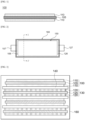
- FIG. 1 is a schematic cross-sectional view illustrating a cathode for a lithium secondary battery according to exemplary embodiments.
- a cathode 100 for a lithium secondary battery may include a cathode current collector 105 and a cathode active material layer 110 formed on the cathode current collector 105.
- the cathode active material layer 110 may be formed on one surface or both surfaces of the cathode current collector 105.
- the cathode current collector 105 may include stainless steel, nickel, aluminum, titanium, copper, or an alloy thereof.
- the cathode active material layer 110 may include cathode active material capable of reversibly intercalating and deintercalating lithium ions.
- the cathode active material may include lithium metal oxide particles.
- the cathode active material may include over-lithiated oxide particles.
- the over-lithiated oxide particles may include Li 2 MnO 3 domains (C2/m space group) and Li a M b O c domains (R3m space group, wherein M is at least one of Ni Mn, Co, Mg, V, Ti, Al, Fe, Ru, Zr, W, Sn, Nb, Mo, Cu, Zn, Cr, Ga, V and Bi, and a, b and c satisfy 1.8 ⁇ a+b ⁇ 2.2, 0.9 ⁇ a/b ⁇ 1.05 and 1.9 ⁇ c ⁇ 2.1).
- a molar ratio of the Li 2 MnO 3 domains and the LiMO 2 domains may be represented as w:1-w, wherein w may be 0.05 to 0.7, or 0.1 to 0.7.
- the over-lithiated oxide particles may be prepared by a co-precipitation method.
- metal salts for example, various types of of metal salts, a chelating agent (e.g., ammonia water, ammonium carbonate, etc.) and a co-precipitant (e.g., sodium hydroxide, sodium carbonate, etc.) may be mixed and subjected to a co-precipitation reaction to prepare metal hydroxide particles.
- a molar ratio between the various types of metal salts may be adjusted based on a predetermined formula of the intended over-lithiated oxide particles.
- the calcination may be performed at 400 to 1100°C.
- the calcination may be performed for 2 to 16 hours.
- the activated particles may include domains derived from Li 2 MnO 3 domains of the over-lithiated oxide particles.
- the activated particles may include domains derived from the Li a M b O c domains, and Li 2 MnO 3 domains and/or the Li 2 MnO 3 domains.
- the over-lithiated oxide particles and/or the activated particles may be represented by Formula 1 below.
- M may be at least one of Co, Mg, V, Ti, Al, Fe, Ru, Zr, W, Sn, Nb, Mo, Cu, Zn, Cr, Ga, V and Bi.
- x, y, z a and b may satisfy 0 ⁇ x ⁇ 0.9, 0 ⁇ y ⁇ 0.9, 0.1 ⁇ z ⁇ 0.9, 1.8 ⁇ a+x+y+z ⁇ 2.2, 1.05 ⁇ a/(x+y+z) ⁇ 1.95 and 1.8 ⁇ b ⁇ 2.2.
- x may be in a range of 0 ⁇ x ⁇ 0.9, 0.05 ⁇ x ⁇ 0.9, 0.1 ⁇ x ⁇ 0.9, 0 ⁇ x ⁇ 0.8, 0.05 ⁇ x ⁇ 0.8, or 0.1 ⁇ x ⁇ 0.8.
- y may be in a range of 0.05 ⁇ y ⁇ 0.9, 0.1 ⁇ y ⁇ 0.9, 0 ⁇ y ⁇ 0.8, 0.05 ⁇ y ⁇ 0.8, or 0.1 ⁇ y ⁇ 0.8.
- a, x, y and z may satisfy 1.1 ⁇ a/(x+y+z) ⁇ 1.95, 1.15 ⁇ a/(x+y+z) ⁇ 1.95, 1.2 ⁇ a/(x+y+z) ⁇ 1.95, or 1.3 ⁇ a/(x+y+z) ⁇ 1.95.
- a molar fraction of manganese relative to all elements excluding lithium and oxygen in the over-lithiated oxide particles may be 0.5 to 0.75.
- x, y and z may satisfy 0.5 ⁇ z/(x+y+z) ⁇ 0.75.
- x, y and z may satisfy 0.25 ⁇ (x+y)/(x+y+z) ⁇ 0.5.
- a molar fraction of cobalt to all elements excluding lithium and oxygen in the over-lithiated oxide particles may be 0 to 0.02. In some embodiments, the over-lithiated oxide particles may not contain cobalt.
- b may be in a range of 1.9 ⁇ b ⁇ 2.1, or 1.95 ⁇ b ⁇ 2.05.
- compositions of the over-lithiated oxide particles and the activated particles may be confirmed by inductively coupled plasma (ICP).
- ICP inductively coupled plasma
- the over-lithiated oxide particles and/or the activated particles may be analyzed by ICP, and the number of oxygen atoms may be normalized to 1.8 to 2.2 (e.g., 2), thus to obtain formulas of the over-lithiated oxide particles and/or the activated particles.
- the cathode active material layer 110 may further include a binder and a conductive material.
- the binder may include an organic binder such as polyvinylidene fluoride (PVDF), vinylidene fluoride-hexafluoropropylene copolymer, polyacrylonitrile, or polymethyl methacrylate, etc.; or an aqueous binder such as styrene-butadiene rubber (SBR).
- the binder may be used together with a thickener such as carboxymethyl cellulose (CMC).
- the conductive material may include a carbon-based conductive material such as graphite, carbon black, graphene, carbon nanotubes (CNTs), etc.; a metal-based conductive material such as tin, tin oxide, titanium oxide, or a perovskite material such as LaSrCoO 3 , and LaSrMnO 3 , etc.
- a carbon-based conductive material such as graphite, carbon black, graphene, carbon nanotubes (CNTs), etc.
- a metal-based conductive material such as tin, tin oxide, titanium oxide, or a perovskite material such as LaSrCoO 3 , and LaSrMnO 3 , etc.
- a content of the over-lithiated oxide particles may be 80% by weight ("wt%") or more, 85 wt% or more, or 90 wt% or more. In some embodiments, the content of the over-lithiated oxide particles may be 98 wt% or less, or 95 wt% or less based on the total weight of the cathode active material layer 110.
- a lithium secondary battery using the over-lithiated oxide particles may exhibit inferior lifespan characteristics due to the unique electrochemical reaction of the Li 2 MnO 3 domain among the over-lithiated oxide particles.
- I 006 is an intensity of a 006 plane peak in an X-ray diffraction pattern of the cathode active material layer 110 measured after respectively performing charging and discharging twice (e.g., after activation) within a voltage range of 2 V to 4.6 V in a coin half-cell including the cathode 100 and a lithium counter electrode (e.g., a coin half-cell having the configuration of Example 1)
- I 003 is an intensity of a 003 plane peak in the X-ray diffraction pattern.
- the charging and discharging conditions may be the same as those specified in (3) of Example 1, which will be described below.
- C is a molar fraction of nickel relative to all metal elements excluding lithium in the cathode active material layer 100 measured after the activation.
- C may be measured by inductively coupled plasma (ICP).
- D may represent a degree of disorder of the crystal structure in the cathode active material layer 100. For example, if D exceeds 5, the probability that transition metals, that have migrated from the transition metal layer to the lithium layer during charging of the lithium secondary battery, will return to the transition metal layer during discharge of the lithium secondary battery may increase. Accordingly, the lifespan characteristics of the lithium secondary battery may be improved.
- transition metals that have migrated from the transition metal layer to the lithium layer during charging of the lithium secondary battery may remain in the lithium layer.
- the migrated transition metals may be eluted into the electrolyte phase. Accordingly, the lifespan characteristics of the lithium secondary battery may be deteriorated.
- D may be 6 or more, 6.5 or more, or 7 or more. Within the above range, the lifespan characteristics of the lithium secondary battery may be further improved.
- D may be 10 or less, 9 or less, or 8 or less.
- a ratio of I 006 /I 003 may be 0.01 to 0.05, and in some embodiments, the ratio of I 006 /I 003 may be 0.015 to 0.04, or 0.019 to 0.035.
- C may be 0.25 to 0.5, 0.25 to 0.45, 0.3 to 0.45, or 0.4 to 0.45. Within the above range, the capacity and lifespan characteristics of the lithium secondary battery may be further improved.
- FIG. 2 is a schematic plan view illustrating a lithium secondary battery according to exemplary embodiments.
- FIG. 3 is a schematic cross-sectional view of the lithium secondary battery taken on line I-I' of FIG. 2 .
- the lithium secondary battery may include an electrode assembly 150 and a case 160 in which the electrode assembly 150 is housed.
- the electrode assembly 150 may include a cathode 100 and an anode 130 disposed to face the cathode 100. In one embodiment, the electrode assembly 150 may further include a separation membrane 140 interposed between the cathode 100 and the anode 130.
- the cathode 100 may be the above-described cathode for a lithium secondary battery.
- the anode 130 may include an anode current collector 125 and an anode active material layer 120 on the anode current collector 125.
- the anode active material layer 120 may be formed on one or both surfaces of the anode current collector 125.
- the anode active material layer 120 may include an anode active material, the binder and the conductive material.
- the anode current collector 125 may include gold, stainless steel, nickel, aluminum, titanium, copper or an alloy thereof.
- the anode active material may be a material capable of intercalating and deintercalating lithium ions.
- the anode active material may include a lithium alloy, a carbon-based active material, a silicon-based active material, etc.
- the lithium alloy may include aluminum, zinc, bismuth, cadmium, antimony, silicon, lead, tin, gallium, indium and the like.
- the carbon-based active material may include crystalline carbon, amorphous carbon, carbon composite, carbon fiber and the like.
- the amorphous carbon may include hard carbon, cokes, mesocarbon microbeads, mesophase pitch-based carbon fiber and the like.
- the crystalline carbon may include natural graphite, artificial graphite, graphite cokes, graphite MCMB, graphite MPCF and the like.
- the silicon-based active material may include Si, SiO x (0 ⁇ x ⁇ 2), Si/C, SiO/C, Si-Metal and the like.
- the anode 130 may have an area greater than that of the cathode 100.
- the cathode current collector 105 may include a cathode tab 106 protruding from one side of the cathode current collector 105.
- the cathode tab 106 may be formed integrally with the cathode current collector 105 or may be connected with the cathode current collector 105 by welding, etc.
- the cathode current collector 105 and the cathode lead 107 may be electrically connected with each other through the cathode tab 106.
- the anode current collector 125 may include an anode tab 126 protruding from one side of the anode current collector 125.
- the anode tab 126 may be formed integrally with the anode current collector 125, or may be electrically connected with the anode current collector 125 by welding, etc.
- the anode current collector 125 and the anode lead 127 may be electrically connected with each other through the anode tab 126.
- the separation membrane 140 may include a porous polymer film made of a polyolefin polymer such as polyethylene, polypropylene, ethylene-butene copolymer, ethylene-hexene copolymer, or ethylene-methacrylate copolymer.
- the separation membrane 140 may include a nonwoven fabric made glass fiber having a high melting point, polyethylene terephthalate fiber or the like.
- the electrolyte may include a lithium salt and an organic solvent.
- D A may be 10 or less, 9 or less, or 8 or less.
- the lower limit of operating voltage of the lithium secondary battery may be 1.8 V or more, 1.9 V or more, or 2.0 V or more relative to the lithium oxidation-reduction potential (vs Li/Li + ). In some embodiments, the lower limit of operating voltage limit may be 1.8 V to 2.2 V.
- the temperature of the calcination furnace was increased to 850°C at a rate of 2°C/min, and a second calcination was performed while maintaining the temperature at 850°C for 8 hours.
- the electrolyte used herein was prepared by dissolving 1M LiPF 6 solution in a mixed solvent of EC/EMC (30/70, v/v).
- the charging and discharging cycles were repeatedly performed twice to activate the over-lithiated oxide particles.
- the lithium secondary batteries of the examples and comparative examples were disassembled to obtain cathodes, and then the cathode active material layer was completely scraped off from the cathodes to prepare samples.
- the components of the sample were analyzed by inductively coupled plasma (ICP), then the molar fraction C of Ni relative to all metal elements (i.e., Ni and Mn, or Ni, Co and Mn) excluding lithium in the sample was calculated.
- ICP inductively coupled plasma
- the lithium secondary batteries of the examples and comparative examples were disassembled to obtain cathodes, and then the cathode active material layer was analyzed using X-ray diffraction (XRD).
- XRD X-ray diffraction
- XRD analysis equipment and conditions are as described in Table 1 below.
- Table 1 X-Ray Diffractometer (XRD) EMPYREAN Maker PANalytical Anode material Cu K-Alpha1 wavelength 1.540598 ⁇ Generator voltage 45 kV Tube current 40 mA Scan Range 10 - 120° Scan Step Size 0.006565° Divergence slit 1/4° Antiscatter slit 1°
- Lithium secondary batteries of the examples and comparative examples were subjected to CC/CV charging (1C constant current, 4.5 V and 0.05C CUT-OFF) and CC discharging (1C constant current, 2.0 V CUT-OFF) at 45°C.
- the charging and discharging were repeated 100 times, and the discharge capacity DC 2 at the 2nd cycle and the discharge capacity DC 100 at the 100th cycle were measured.
- Capacity retention rate % DC 100 / DC 2 ⁇ 100 % [TABLE 2] Initial performance Life characteristics (45°C, 100th cycle) C I 006 /I 003 D Capacity retention rate (%) Example 1 0.411 0.031 7.5 92.2 Example 2 0.275 0.019 6.9 90.0 Comparative Example 1 0.411 0.018 4.4 35.4 Comparative Example 2 0.381 0.018 4.8 27.3 Comparative Example 3 0.260 0.011 4.1 23.7
- the lithium secondary batteries of the examples exhibited improved lifespan characteristics compared to the lithium secondary batteries of the comparative examples.
Landscapes
- Chemical & Material Sciences (AREA)
- Chemical Kinetics & Catalysis (AREA)
- Electrochemistry (AREA)
- General Chemical & Material Sciences (AREA)
- Engineering & Computer Science (AREA)
- Inorganic Chemistry (AREA)
- Manufacturing & Machinery (AREA)
- Materials Engineering (AREA)
- Battery Electrode And Active Subsutance (AREA)
- Secondary Cells (AREA)
Applications Claiming Priority (3)
| Application Number | Priority Date | Filing Date | Title |
|---|---|---|---|
| KR20220116417 | 2022-09-15 | ||
| KR1020220123672A KR20240037784A (ko) | 2022-09-15 | 2022-09-28 | 리튬 이차 전지용 양극 및 이를 포함하는 리튬 이차 전지 |
| PCT/KR2023/012150 WO2024058442A1 (ko) | 2022-09-15 | 2023-08-17 | 리튬 이차 전지용 양극 및 이를 포함하는 리튬 이차 전지 |
Publications (1)
| Publication Number | Publication Date |
|---|---|
| EP4576257A1 true EP4576257A1 (de) | 2025-06-25 |
Family
ID=90275149
Family Applications (1)
| Application Number | Title | Priority Date | Filing Date |
|---|---|---|---|
| EP23865742.3A Pending EP4576257A1 (de) | 2022-09-15 | 2023-08-17 | Kathode für lithiumsekundärbatterie und lithiumsekundärbatterie damit |
Country Status (3)
| Country | Link |
|---|---|
| EP (1) | EP4576257A1 (de) |
| CN (1) | CN119866551A (de) |
| WO (1) | WO2024058442A1 (de) |
Cited By (1)
| Publication number | Priority date | Publication date | Assignee | Title |
|---|---|---|---|---|
| EP4696657A1 (de) * | 2024-07-29 | 2026-02-18 | SK On Co., Ltd. | Kathode für lithiumsekundärbatterie, lithiumsekundärbatterie damit und verfahren zur herstellung von kathodenaktivmaterial für lithiumsekundärbatterie |
Family Cites Families (5)
| Publication number | Priority date | Publication date | Assignee | Title |
|---|---|---|---|---|
| JP6089701B2 (ja) * | 2012-12-28 | 2017-03-08 | 旭硝子株式会社 | 正極活物質およびその製造方法 |
| WO2016106321A1 (en) * | 2014-12-23 | 2016-06-30 | Quantumscape Corporation | Lithium rich nickel manganese cobalt oxide (lr-nmc) |
| KR101826612B1 (ko) * | 2017-06-07 | 2018-02-07 | 주식회사 엘 앤 에프 | 양극 활물질, 및 이를 포함하는 리튬 이차 전지 |
| KR102293034B1 (ko) * | 2020-06-04 | 2021-08-24 | 에스케이이노베이션 주식회사 | 리튬 이차 전지용 양극 활물질 및 이를 포함하는 리튬 이차 전지 |
| CN111900343B (zh) * | 2020-06-18 | 2022-05-13 | 珠海冠宇电池股份有限公司 | 一种正极极片及其制备方法和用途 |
-
2023
- 2023-08-17 WO PCT/KR2023/012150 patent/WO2024058442A1/ko not_active Ceased
- 2023-08-17 CN CN202380066466.9A patent/CN119866551A/zh active Pending
- 2023-08-17 EP EP23865742.3A patent/EP4576257A1/de active Pending
Cited By (1)
| Publication number | Priority date | Publication date | Assignee | Title |
|---|---|---|---|---|
| EP4696657A1 (de) * | 2024-07-29 | 2026-02-18 | SK On Co., Ltd. | Kathode für lithiumsekundärbatterie, lithiumsekundärbatterie damit und verfahren zur herstellung von kathodenaktivmaterial für lithiumsekundärbatterie |
Also Published As
| Publication number | Publication date |
|---|---|
| CN119866551A (zh) | 2025-04-22 |
| WO2024058442A1 (ko) | 2024-03-21 |
Similar Documents
| Publication | Publication Date | Title |
|---|---|---|
| KR102379798B1 (ko) | 리튬 이차 전지용 정극 활물질, 리튬 이차 전지용 정극 및 리튬 이차 전지 | |
| CN109643798B (zh) | 锂二次电池用正极活性物质、锂二次电池用正极和锂二次电池 | |
| JP2003142101A (ja) | 二次電池用正極およびそれを用いた二次電池 | |
| EP4080606B1 (de) | Katodenaktivmaterial für eine lithiumsekundärbatterie sowie lithiumsekundärbatterie damit | |
| JP6937152B2 (ja) | リチウム複合金属酸化物の製造方法 | |
| EP4170751B1 (de) | Kathodenaktivmaterial für lithiumsekundärbatterie und lithiumsekundärbatterie damit | |
| CN106025257A (zh) | 锂复合金属氧化物、正极活性物质、正极及非水电解质二次电池 | |
| US12107256B2 (en) | Cathode active material for lithium secondary battery and lithium secondary battery including the same | |
| JP2005158737A (ja) | リチウム二次電池用正極およびリチウム二次電池 | |
| EP4576257A1 (de) | Kathode für lithiumsekundärbatterie und lithiumsekundärbatterie damit | |
| EP4576256A1 (de) | Lithiumsekundärbatterie und betriebsverfahren dafür | |
| KR102303213B1 (ko) | 리튬 이차 전지용 양극 활물질 및 이를 포함하는 리튬 이차 전지 | |
| CN103000872B (zh) | 活性材料、非水电解质电池及电池组 | |
| JP5626035B2 (ja) | リチウムイオン二次電池の前処理方法及び使用方法 | |
| EP4223702A1 (de) | Kathodenaktivmaterial für lithiumsekundärbatterie und lithiumsekundärbatterie damit | |
| EP4250420A1 (de) | Kathodenzusammensetzung für lithiumsekundärbatterie und damit hergestellte lithiumsekundärbatterie | |
| JP2012195126A (ja) | リチウムイオン二次電池の前処理方法 | |
| CN114792784B (zh) | 用于锂二次电池的正极活性物质和包括其的锂二次电池 | |
| EP4589688A1 (de) | Positivelektrode für lithiumsekundärbatterie und lithiumsekundärbatterie damit | |
| JP4632005B2 (ja) | リチウム二次電池 | |
| US12597594B2 (en) | Lithium manganese composite oxide for a lithium secondary battery cathode active material | |
| KR20220045651A (ko) | 리튬 이차 전지용 양극 활물질 및 이를 포함하는 리튬 이차 전지 | |
| US20240322122A1 (en) | Lithium manganese composite oxide for a lithium secondary battery cathode active material | |
| JP2005353330A (ja) | 非水電解質電気化学セル | |
| KR20240037784A (ko) | 리튬 이차 전지용 양극 및 이를 포함하는 리튬 이차 전지 |
Legal Events
| Date | Code | Title | Description |
|---|---|---|---|
| STAA | Information on the status of an ep patent application or granted ep patent |
Free format text: STATUS: THE INTERNATIONAL PUBLICATION HAS BEEN MADE |
|
| PUAI | Public reference made under article 153(3) epc to a published international application that has entered the european phase |
Free format text: ORIGINAL CODE: 0009012 |
|
| STAA | Information on the status of an ep patent application or granted ep patent |
Free format text: STATUS: REQUEST FOR EXAMINATION WAS MADE |
|
| 17P | Request for examination filed |
Effective date: 20250319 |
|
| AK | Designated contracting states |
Kind code of ref document: A1 Designated state(s): AL AT BE BG CH CY CZ DE DK EE ES FI FR GB GR HR HU IE IS IT LI LT LU LV MC ME MK MT NL NO PL PT RO RS SE SI SK SM TR |
|
| DAV | Request for validation of the european patent (deleted) | ||
| DAX | Request for extension of the european patent (deleted) |