EP4576258A1 - Électrode positive et batterie secondaire au lithium la comprenant - Google Patents
Électrode positive et batterie secondaire au lithium la comprenant Download PDFInfo
- Publication number
- EP4576258A1 EP4576258A1 EP23880206.0A EP23880206A EP4576258A1 EP 4576258 A1 EP4576258 A1 EP 4576258A1 EP 23880206 A EP23880206 A EP 23880206A EP 4576258 A1 EP4576258 A1 EP 4576258A1
- Authority
- EP
- European Patent Office
- Prior art keywords
- positive electrode
- manganese
- overlithiated
- lithium
- based oxide
- Prior art date
- Legal status (The legal status is an assumption and is not a legal conclusion. Google has not performed a legal analysis and makes no representation as to the accuracy of the status listed.)
- Pending
Links
Images


Classifications
-
- H—ELECTRICITY
- H01—ELECTRIC ELEMENTS
- H01M—PROCESSES OR MEANS, e.g. BATTERIES, FOR THE DIRECT CONVERSION OF CHEMICAL ENERGY INTO ELECTRICAL ENERGY
- H01M10/00—Secondary cells; Manufacture thereof
- H01M10/05—Accumulators with non-aqueous electrolyte
- H01M10/052—Li-accumulators
-
- H—ELECTRICITY
- H01—ELECTRIC ELEMENTS
- H01M—PROCESSES OR MEANS, e.g. BATTERIES, FOR THE DIRECT CONVERSION OF CHEMICAL ENERGY INTO ELECTRICAL ENERGY
- H01M10/00—Secondary cells; Manufacture thereof
- H01M10/05—Accumulators with non-aqueous electrolyte
- H01M10/052—Li-accumulators
- H01M10/0525—Rocking-chair batteries, i.e. batteries with lithium insertion or intercalation in both electrodes; Lithium-ion batteries
-
- H—ELECTRICITY
- H01—ELECTRIC ELEMENTS
- H01M—PROCESSES OR MEANS, e.g. BATTERIES, FOR THE DIRECT CONVERSION OF CHEMICAL ENERGY INTO ELECTRICAL ENERGY
- H01M4/00—Electrodes
- H01M4/02—Electrodes composed of, or comprising, active material
-
- H—ELECTRICITY
- H01—ELECTRIC ELEMENTS
- H01M—PROCESSES OR MEANS, e.g. BATTERIES, FOR THE DIRECT CONVERSION OF CHEMICAL ENERGY INTO ELECTRICAL ENERGY
- H01M4/00—Electrodes
- H01M4/02—Electrodes composed of, or comprising, active material
- H01M4/13—Electrodes for accumulators with non-aqueous electrolyte, e.g. for lithium-accumulators; Processes of manufacture thereof
- H01M4/131—Electrodes based on mixed oxides or hydroxides, or on mixtures of oxides or hydroxides, e.g. LiCoOx
-
- H—ELECTRICITY
- H01—ELECTRIC ELEMENTS
- H01M—PROCESSES OR MEANS, e.g. BATTERIES, FOR THE DIRECT CONVERSION OF CHEMICAL ENERGY INTO ELECTRICAL ENERGY
- H01M4/00—Electrodes
- H01M4/02—Electrodes composed of, or comprising, active material
- H01M4/36—Selection of substances as active materials, active masses, active liquids
- H01M4/48—Selection of substances as active materials, active masses, active liquids of inorganic oxides or hydroxides
- H01M4/50—Selection of substances as active materials, active masses, active liquids of inorganic oxides or hydroxides of manganese
- H01M4/505—Selection of substances as active materials, active masses, active liquids of inorganic oxides or hydroxides of manganese of mixed oxides or hydroxides containing manganese for inserting or intercalating light metals, e.g. LiMn2O4 or LiMn2OxFy
-
- H—ELECTRICITY
- H01—ELECTRIC ELEMENTS
- H01M—PROCESSES OR MEANS, e.g. BATTERIES, FOR THE DIRECT CONVERSION OF CHEMICAL ENERGY INTO ELECTRICAL ENERGY
- H01M4/00—Electrodes
- H01M4/02—Electrodes composed of, or comprising, active material
- H01M4/36—Selection of substances as active materials, active masses, active liquids
- H01M4/48—Selection of substances as active materials, active masses, active liquids of inorganic oxides or hydroxides
- H01M4/52—Selection of substances as active materials, active masses, active liquids of inorganic oxides or hydroxides of nickel, cobalt or iron
- H01M4/525—Selection of substances as active materials, active masses, active liquids of inorganic oxides or hydroxides of nickel, cobalt or iron of mixed oxides or hydroxides containing iron, cobalt or nickel for inserting or intercalating light metals, e.g. LiNiO2, LiCoO2 or LiCoOxFy
-
- H—ELECTRICITY
- H01—ELECTRIC ELEMENTS
- H01M—PROCESSES OR MEANS, e.g. BATTERIES, FOR THE DIRECT CONVERSION OF CHEMICAL ENERGY INTO ELECTRICAL ENERGY
- H01M4/00—Electrodes
- H01M4/02—Electrodes composed of, or comprising, active material
- H01M2004/021—Physical characteristics, e.g. porosity, surface area
-
- H—ELECTRICITY
- H01—ELECTRIC ELEMENTS
- H01M—PROCESSES OR MEANS, e.g. BATTERIES, FOR THE DIRECT CONVERSION OF CHEMICAL ENERGY INTO ELECTRICAL ENERGY
- H01M4/00—Electrodes
- H01M4/02—Electrodes composed of, or comprising, active material
- H01M2004/026—Electrodes composed of, or comprising, active material characterised by the polarity
- H01M2004/028—Positive electrodes
-
- Y—GENERAL TAGGING OF NEW TECHNOLOGICAL DEVELOPMENTS; GENERAL TAGGING OF CROSS-SECTIONAL TECHNOLOGIES SPANNING OVER SEVERAL SECTIONS OF THE IPC; TECHNICAL SUBJECTS COVERED BY FORMER USPC CROSS-REFERENCE ART COLLECTIONS [XRACs] AND DIGESTS
- Y02—TECHNOLOGIES OR APPLICATIONS FOR MITIGATION OR ADAPTATION AGAINST CLIMATE CHANGE
- Y02E—REDUCTION OF GREENHOUSE GAS [GHG] EMISSIONS, RELATED TO ENERGY GENERATION, TRANSMISSION OR DISTRIBUTION
- Y02E60/00—Enabling technologies; Technologies with a potential or indirect contribution to GHG emissions mitigation
- Y02E60/10—Energy storage using batteries
Definitions
- the present invention relates to a positive electrode and a lithium secondary battery, and more particularly, to a positive electrode including an overlithiated manganese-based oxide as a positive electrode active material and having excellent life characteristics and a lithium secondary battery including the same.
- NCM ternary lithium composite transition metal oxide containing nickel, cobalt, and manganese
- the overlithiated manganese-based oxide is a material which has a molar ratio of lithium to transition metals of greater than 1 and has an amount of manganese among the transition metals of 50 mol% or more, wherein it has a structure in which a Li 2 MnO 3 phase with a rock salt structure and a LiMO 2 phase (where M is nickel (Ni), cobalt (Co), and manganese (Mn))with a layered structure are mixed.
- the overlithiated manganese-based oxide achieves capacity through transition metal oxidation similar to the conventional NCM in a low voltage range and achieves capacity through oxygen redox in a high voltage range, higher capacity than that of the conventional high-nickel NCM may be achieved.
- an excessive amount of active oxygen is generated during the oxygen redox, there is a problem in that cell lifetime is low.
- An aspect of the present invention provides a positive electrode for a lithium secondary battery, which may achieve excellent life characteristics by using an overlithiated manganese-based oxide in which a ratio of lithium (Li) present in a transition metal layer to Li present in a lithium layer satisfies a specific condition, and a lithium secondary battery including the same.
- the present invention provides a positive electrode including an overlithiated manganese-based oxide, which has a molar ratio (Li/Me) of lithium to total metals excluding the lithium of greater than 1.1, has an amount of manganese among the total metals excluding the lithium of 50 mol% or more, and satisfies Equation (1),as a positive electrode active material.
- a positive electrode active material 0.05 ⁇ I TM / I Li ⁇ 0.13
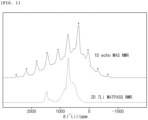
- I TM and I Li are a sum of areas of peaks appearing in a region of 1,000 ppm to 2,500 ppm and a sum of areas of peaks appearing in a region of 300 ppm to 900 ppm when performing peak deconvolution of a 1D nuclear magnetic resonance (NMR) centerband spectrum which is extracted from a 2D 7 Li MATPASS (Magic Angle Turning Phase Adjusted Spinning Sideband) NMR spectrum of the overlithiated manganese-based oxide, respectively.
- NMR nuclear magnetic resonance
- the overlithiated manganese-based oxide may satisfy Equation (1-1). 0.06 ⁇ I TM / I Li ⁇ 0.12
- Equation (1-1) I TM and I Li are the same as defined in Equation (1).
- the present invention provides a lithium secondary battery including a positive electrode; a negative electrode; a separator disposed between the positive electrode and the negative electrode; and an electrolyte, wherein the positive electrode is the above-described positive electrode according to the present invention.
- a positive electrode according to the present invention is characterized in that it includes an overlithiated manganese-based oxide having a molar ratio (Li/Me) of lithium to total metals excluding the lithium of greater than 1.1 and having an amount of manganese among the total metals excluding the lithium of 50 mol% or more as a positive electrode active material, but it uses a material in which I TM/ I Li obtained by peak deconvolution of a 1D NMR centerband spectrum, which is extracted by 2D 7 Li MATPASS (Magic Angle Turning Phase Adjusted Spinning Sideband) NMR analysis of the overlithiated manganese-based oxide, is within a specific range (i.e., greater than 0.05 to less than 0.13).
- the I TM is a sum of areas of peaks appearing in a region of 1,000 ppm to 2,500 ppm during the peak deconvolution, wherein it is a value representing a ratio of lithium located in a transition metal layer
- the I Li is a sum of areas of peaks appearing in a region of 300 ppm to 900 ppm during the peak deconvolution, wherein it is a value representing a ratio of lithium located in a lithium layer.
- the overlithiated manganese-based oxide in which the ratio of the Li present in the transition metal layer to the Li present in the lithium layer satisfies a specific condition (i.e., I TM/ I Li is in a range of greater than 0.05 to less than 0.13), is used as the positive electrode active material, an effect may be obtained in which life characteristics are significantly improved while high capacity characteristics are achieved.
- the present inventors have found that, in a case in which an overlithiated manganese-based oxide, in which a ratio of lithium (Li)present in a transition metal layer to Li present in a lithium layer satisfies a specific condition, is used as the positive electrode active material, life characteristics of a lithium secondary battery using the overlithiated manganese-based oxide are significantly improved, thereby leading to the completion of the present invention.
- a positive electrode according to the present invention is characterized in that it includes an overlithiated manganese-based oxide having a molar ratio (Li/Me) of lithium to total metals excluding the lithium of greater than 1.1 and having an amount of manganese among the total metals excluding the lithium of 50 mol% or more as a positive electrode active material, wherein the overlithiated manganese-based oxide satisfies Equation (1) below. 0 . 05 ⁇ I TM / I Li ⁇ 0.13
- I TM and I Li are a sum of areas of peaks appearing in a region of 1,000 ppm to 2,500 ppm and a sum of areas of peaks appearing in a region of 300 ppm to 900 ppm when performing peak deconvolution of a 1D nuclear magnetic resonance (NMR) centerband spectrum which is extracted froma 2D 7 Li MATPASS (Magic Angle Turning Phase Adjusted Spinning Sideband) NMR spectrum of the overlithiated manganese-based oxide, respectively.
- NMR nuclear magnetic resonance
- the peak deconvolution of the 1D NMR centerband spectrum extracted from the 2D 7 Li MATPASS (Magic Angle Turning Phase Adjusted Spinning Sideband) NMR spectrum may be performed using a DMFIT(64bit, release#20190125) NMR software. Specifically, after importing the 1D NMR centerband spectrum extracted from the 7 Li MATPASS NMR spectrum into a DMFIT program, the peak deconvolution may be performed by a method in which, after selecting Gaussian/Lorentzian as a fitting model for the peak deconvolution and setting appropriate initial values for peak amplitude, peak position, peak width, and Gaussian/Lorentzian fraction (xG/(1-x)L), fitting was repeated until an appropriate convergence value was reached.
- Gaussian/Lorentzian as a fitting model for the peak deconvolution and setting appropriate initial values for peak amplitude, peak position, peak width, and Gaussian/Lorentzian fraction (xG/(1-x)L
- the I TM/ I Li is a value representing a ratio of lithium located in a transition metal layer to lithium located in a lithium layer of a crystal structure of the overlithiated manganese-based oxide, wherein, in a case in which the I TM /I Li is in a range of greater than 0.05 to less than 0.13, since a degree of oxygen redox occurring in a charge/discharge process is appropriately controlled, high capacity and excellent life characteristics may be achieved.
- the molar ratio (Li/Me) of Li to the number of moles of total metallic elements excluding the Li may be in a range of 1.1 to 1.5, 1.2 to 1.5, 1.25 to 1.5, or 1.25 to 1.4.
- rate capability and capacity characteristics are excellent. If the Li/Me ratio is excessively high, electrical conductivity may be decreased and a rock salt phase (Li 2 MnO 3 ) may be increased to accelerate degradation rate, and, if the Li/Me ratio is excessively low, an energy density improvement effect is insignificant.
- the overlithiated manganese-based oxide may include nickel:manganese at a molar ratio of 30:70 to 45:55, preferably, 31:69 to 45:55.
- the molar ratio of nickel to manganese in the overlithiated manganese-based oxide satisfies the above range, both capacity characteristics and life characteristics are excellent.
- a nickel content is less than 30 mol%, since the rock salt phase (Li 2 MnO 3 ) is increased, there is a problem in that cell degradation is accelerated.
- the overlithiated manganese-based oxide may be represented by Formula 1.
- Formula 1 Li a Ni b Co c Mn d M e O 2
- M may be at least one selected from the group consisting of aluminum (A1), boron (B), cobalt (Co), tungsten (W), magnesium (Mg), vanadium (V), titanium (Ti), zinc (Zn), gallium (Ga), indium (In), ruthenium (Ru), niobium (Nb), tin (Sn), strontium (Sr), and zirconium (Zr).
- a is a molar ratio of Li in the overlithiated manganese-based oxide, wherein a may satisfy 1 ⁇ a, 1.1 ⁇ a ⁇ 1.5, or 1.1 ⁇ a ⁇ 1.3.When a satisfies the above range, irreversible capacity of a silicon (Si)-based negative electrode active material may be sufficiently compensated, and high capacity characteristics may be achieved.
- b is a molar ratio of nickel (Ni) in the overlithiated manganese-based oxide, wherein b may satisfy 0.1 ⁇ b ⁇ 0.5, 0.2 ⁇ b ⁇ 0.5, or 0.3 ⁇ b ⁇ 0.5.
- c is a molar ratio of Co in the overlithiated manganese-based oxide, wherein c may satisfy 0 ⁇ c ⁇ 0.1, 0 ⁇ c ⁇ 0.08, or 0 ⁇ c ⁇ 0.05. In a case in which c is 0.1 or more, since it is difficult to secure high capacity and gas generation and degradation of the positive electrode active material may be intensified, the life characteristics may be degraded.
- the overlithiated manganese-based oxide has a structure in which a rock salt phase (Li 2 MnO 3 ) and a layered phase (LiM'O 2 , where M' includes Ni and Mn) are mixed, and a composition thereof may also be represented by [Formula 2] below.
- [Formula 2] X Li 2 MnO 3 ⁇ (1-X)Li[Ni 1-y-z-w Mn y Co z M w ]O 2
- M may be at least one selected from the group consisting of Al, B, Co, W, Mg, V, Ti, Zn, Ga, In, Ru, Nb, Sn, Sr, and Zr.
- X represents a ratio of the Li 2 MnO 3 phase in the overlithiated manganese-based oxide, wherein X may satisfy 0.2 ⁇ X ⁇ 0.5, 0.25 ⁇ X ⁇ 0.5, or 0.25 ⁇ X ⁇ 0.4.
- the ratio of the Li 2 MnO 3 phase in the overlithiated manganese-based oxide satisfies the above range, irreversible capacity of a SiO x negative electrode active material may be sufficiently compensated, and high capacity characteristics may be achieved.
- y is a molar ratio of Mn in the LiM'O 2 layered phase, wherein y may satisfy 0.4 ⁇ y ⁇ 1, 0.4 ⁇ y ⁇ 0.8, or 0.4 ⁇ y ⁇ 0.7.
- z is a molar ratio of Co in the LiM'O 2 layered phase, wherein z may satisfy 0 ⁇ z ⁇ 0.1, 0 ⁇ z ⁇ 0.08, or 0 ⁇ z ⁇ 0.05. In a case in which z is greater than 0.1, since the gas generation and the degradation of the positive electrode active material may be intensified, the life characteristics may be degraded.
- w is a molar ratio of doping element M in the LiM'O 2 layered phase, wherein w may satisfy 0 ⁇ w ⁇ 0.1 or 0 ⁇ w ⁇ 0.05.
- the positive electrode active material according to the present invention may further include a coating layer on a surface of the overlithiated manganese-based oxide, if necessary.
- a coating layer on a surface of the overlithiated manganese-based oxide, if necessary.
- the coating layer may include a coating element M 1 , wherein the coating element M 1 , for example, may be at least one selected from the group consisting of Al, B, Co, W, Mg, V, Ti, Zn, Ga, In, Ru, Nb, Sn, Sr, and Zr, may be preferably Al, Co, Nb, W, and a combination thereof, and may be more preferably Al, Co, and a combination thereof.
- the coating element M 1 may be included, and, for example, Al and Co may be included.
- the coating element may be present in an oxide form, that is, M 1 Oz (1 ⁇ z ⁇ 4) in the coating layer.
- the coating layer may be formed through a method such as dry coating, wet coating, chemical vapor deposition (CVD), physical vapor deposition (PVD), and atomic layer deposition (ALD).
- CVD chemical vapor deposition
- PVD physical vapor deposition
- ALD atomic layer deposition
- the area of the coating layer formed may be in a range of 10% to 100%, preferably 30% to 100%, and more preferably 50% to 100% based on a total surface area of the overlithiated manganese-based oxide particle.
- the area of the coating layer formed satisfies the above range, the effect of improving life characteristics is excellent.
- the positive electrode active material according to the present invention may be in a form of a secondary particle in which a plurality of primary particles are aggregated, and an average particle diameter D 50 of the secondary particle may be in a range of 2 ⁇ m to 10 ⁇ m, preferably 2 ⁇ m to 8 ⁇ m, and more preferably 4 ⁇ m to 8 ⁇ m.
- an average particle diameter D 50 of the secondary particle may be in a range of 2 ⁇ m to 10 ⁇ m, preferably 2 ⁇ m to 8 ⁇ m, and more preferably 4 ⁇ m to 8 ⁇ m.
- the positive electrode active material may have a Brunauer-Emmett-Teller (BET) specific surface area of 1 m 2 /g to 10 m 2 /g, 3m 2 /g to 8m 2 /g, or 4 m 2 /g to 6m 2 /g.
- BET Brunauer-Emmett-Teller
- the overlithiated manganese-based oxide may be prepared by mixing a transition metal precursor and a lithium raw material and then sintering the mixture.
- the lithium raw material may include lithium-containing carbonates (e.g., lithium carbonate, etc.), hydrates (e.g., lithium hydroxide hydrate (LiOH ⁇ H 2 O), etc.), hydroxides (e.g., lithium hydroxide, etc.), nitrates (e.g., lithium nitrate (LiNO 3 ), etc.), or chlorides (e.g., lithium chloride (LiCl), etc.), and any one thereof or a mixture of two or more may be used.
- lithium-containing carbonates e.g., lithium carbonate, etc.
- hydrates e.g., lithium hydroxide hydrate (LiOH ⁇ H 2 O), etc.
- hydroxides e.g., lithium hydroxide, etc.
- nitrates e.g., lithium nitrate (LiNO 3 ), etc.
- chlorides e.g., lithium chloride (LiCl), etc.
- the transition metal precursor may be in a form of a hydroxide, oxide, or carbonate.
- the precursor in the form of a carbonate it is more preferable in that a positive electrode active material having a relatively high specific surface area may be prepared.
- the transition metal precursor may be prepared through a co-precipitation process. For example, after a metal solution is prepared by dissolving each transition metal-containing raw material in a solvent, the transition metal precursor may be prepared by a method of mixing the metal solution, an ammonium cationic complexing agent, and a basic compound and then performing a co-precipitation reaction. Also, an oxidizing agent or oxygen gas may be further added during the co-precipitation reaction, if necessary.
- the transition metal-containing raw material may be acetic acid salts, carbonates, nitrates, sulfates, halides, or sulfides of each transition metal.
- the transition metal-containing raw material may be NiO, NiCO 3 ⁇ 2Ni(OH) 2 ⁇ 4H 2 O, NiC 2 O 2 ⁇ 2H 2 O, Ni(NO 3 ) 2 ⁇ 6H 2 O, NiSO 4 , NiSO 4 ⁇ 6H 2 O,Mn 2 O 3 , MnO 2 , Mn 3 O 4 , MnCO 3 , Mn(NO 3 ) 2 , MnSO 4 ⁇ H 2 O, manganese acetate, manganese halide, Co 2 O 3 , cobalt sulfate, cobalt nitrate, cobalt carbonate, cobalt acetate, or cobalt halide.
- the ammonium cationic complexing agent may be at least one selected from the group consisting of NH 4 OH, (NH 4 ) 2 SO 4 , NH 4 NO 3 , NH 4 Cl, CH 3 COONH 4 , and NH 4 CO 3 .
- the basic compound may be at least one selected from the group consisting of NaOH, Na 2 CO 3 , KOH, and Ca(OH) 2 .
- the form of the precursor may vary depending on a type of the basic compound used. For example, in a case in which NaOH is used as the basic compound, a precursor in the form of a hydroxide may be obtained, and, in a case in which Na 2 CO 3 is used as the basic compound, a precursor in the form of a carbonate may be obtained. Also, in a case in which the basic compound and the oxidizing agent are used together, a precursor in the form of an oxide may be obtained.
- the transition metal precursor and the lithium raw material may be mixed in amounts such that a molar ratio of total transition metals (Ni+Co+Mn):Li is in a range of 1:1.05 to 1:2, preferably 1:1.1 to 1:1.8, and more preferably 1:1.25to 1:1.8.
- the sintering may be performed at a temperature of 600°C to 1,000°Cor 700°C to 950°C, and sintering time may be in a range of 5 hours to 30 hours or 5 hours to 20 hours.
- sintering atmosphere may be an air atmosphere or oxygen atmosphere, and, for example, may be an atmosphere containing 20 vol% to 100 vol% of oxygen.
- the positive electrode according to the present invention may further include a conductive agent and a binder in addition to the positive electrode active material, if necessary.
- the conductive agent may include spherical or flaky graphite; a carbon-based material such as carbon black, acetylene black, Ketjen black, channel black, furnace black, lamp black, thermal black, carbon fibers, single-walled carbon nanotubes, and multi-walled carbon nanotubes; powder or fibers of metal such as copper, nickel, aluminum, and silver; conductive whiskers such as zinc oxide whiskers and potassium titanate whiskers; conductive metal oxides such as titanium oxide; or conductive polymers such as polyphenylene derivatives, and any one thereof or a mixture of two or more thereof may be used.
- the conductive agent may be included in an amount of 0.1 wt% to 20 wt%, 1 wt% to 20 wt%, or 1 wt% to 10 wt% based on a total weight of the positive electrode active material layer.
- the binder may be polyvinylidene fluoride (PVDF), polyvinylidene fluoride-hexafluoropropylene copolymer (PVDF-co-HFP), polyvinyl alcohol, polyacrylonitrile, carboxymethyl cellulose (CMC), starch, hydroxypropyl cellulose, regenerated cellulose, polyvinylpyrrolidone, polytetrafluoroethylene, polyethylene, polypropylene, an ethylene-propylene-diene monomer rubber (EPDM rubber), a sulfonated EPDM, a styrene-butadiene rubber (SBR), a fluorine rubber, or various copolymers thereof, and any one thereof or a mixture of two or more thereof may be used.
- the binder may be included in an amount of 1 wt% to 20 wt%, 2 wt% to 20 wt%, or 2 wt% to 10 wt% based on the total weight of
- the positive electrode may be prepared according to a method of preparing a positive electrode which is known in the art.
- the positive electrode may be prepared by a method in which a positive electrode collector is coated with a positive electrode slurry, which is prepared by dissolving or dispersing the positive electrode active material as well as optionally the binder and the conductive agent in a solvent, rolled and dried, or may be prepared by casting the positive electrode slurry on a separate support and then laminating a film separated from the support on the positive electrode collector.
- the positive electrode collector is not particularly limited as long as it has conductivity without causing adverse chemical changes in the battery, and, for example, stainless steel, aluminum, nickel, titanium, fired carbon, or aluminum or stainless steel that is surface-treated with one of carbon, nickel, titanium, silver, or the like may be used. Also, the positive electrode collector may typically have a thickness of 3 ⁇ m to 500 ⁇ m, and microscopic irregularities may be formed on the surface of the collector to improve the adhesion of the positive electrode active material.
- the positive electrode collector for example, may be used in various shapes such as that of a film, a sheet, a foil, a net, a porous body, a foam body, a non-woven fabric body, and the like.
- the solvent may be a solvent normally used in the art, and may include dimethyl sulfoxide (DMSO), isopropyl alcohol, N-methylpyrrolidone (NMP), acetone, or water, and any one thereof or a mixture of two or more thereof may be used.
- An amount of the solvent used may be sufficient if the positive electrode slurry may be adjusted to have an appropriate viscosity in consideration of an application thickness of the positive electrode slurry, preparation yield, or workability, and is not particularly limited.
- the positive electrode which includes the overlithiated manganese-based oxide satisfying Equation (1) as the positive electrode active material, may be stably operated even if a charge end voltage is set as high as 4.3V to 4.5V, high capacity characteristics may be achieved and excellent life characteristics are exhibited at room temperature and high temperature.
- the lithium secondary battery according to the present invention includes a positive electrode; a negative electrode; a separator disposed between the positive electrode and the negative electrode; and an electrolyte.
- the positive electrode is the above-described positive electrode according to the present invention. Since the positive electrode has been described above, a detailed description thereof will be omitted.
- the negative electrode according to the present invention includes a negative electrode active material layer including a negative electrode active material, and the negative electrode active material layer may further include a conductive agent and/or a binder, if necessary.
- negative electrode active materials used in the art, for example, a silicon-based negative electrode active material, a carbon-based negative electrode active material, a metal alloy, or a combination thereof may be used as the negative electrode active material, and the negative electrode active material is not particularly limited.
- the negative electrode active material may include a silicon-based negative electrode active material.
- the silicon-based negative electrode active material may be selected from the group consisting of silicon (Si), SiO m (where, 0 ⁇ m ⁇ 2), a Si-C composite, a Si-M a alloy (M a is at least one selected from the group consisting of Al, Sn, Mg, copper (Cu), iron (Fe), lead (Pb), Zn, Mn, chromium (Cr), Ti, and Ni),and a combination thereof.
- the silicon-based negative electrode active material may be doped with M b metal, and, in this case, the M b metal may be a Group 1 alkali metal element and/or a Group 2 alkaline earth metal element, and, for example, may be Li or Mg.
- the silicon-based negative electrode active material may be Si, SiO m (where, 0 ⁇ m ⁇ 2), or a Si-C composite which is doped with the M b metal.
- the metal-doped silicon-based negative electrode active material since capacity of the active material is reduced due to the doping element, but it has high efficiency, high energy density may be achieved.
- the silicon-based negative electrode active material may further include a carbon coating layer on a surface of the particle.
- an amount of carbon coating may be 20 wt% or less, preferably, 0.1 wt% to 20 wt% based on a total weight of the silicon-based negative electrode active material.
- the carbon coating layer may be formed through a method such as dry coating, wet coating, chemical vapor deposition (CVD), physical vapor deposition (PVD), and atomic layer deposition (ALD).
- D 50 may be in a range of 3 ⁇ m to 8 ⁇ m, preferably,4 ⁇ m to 7 ⁇ m, and D min to D max may be in a range of 0.5 ⁇ m to 30 ⁇ m, preferably 0.5 ⁇ m to 20 ⁇ m, and more preferably 1 ⁇ m to 15 ⁇ m.
- the silicon-based negative electrode active material may be included in an amount of 1 wt% to 100 wt%, 1 wt% to 50 wt%, 1 wt% to 30 wt%, 1 wt% to 15 wt%, 10 wt% to 70 wt%, or 10 wt% to 50 wt% based on a total weight of the negative electrode active material included in the negative electrode.
- the negative electrode may include a carbon-based negative electrode active material.
- the carbon-based negative electrode active material may be artificial graphite, natural graphite, graphitized carbon fibers, amorphous carbon, soft carbon, or hard carbon, but is not limited thereto.
- the carbon-based negative electrode active material may be included in an amount of 1 wt% to 100 wt%, 50wt% to 99 wt%, 70 wt% to 99 wt%, 85wt% to 99 wt%, 30 wt% to 90 wt%, or 50 wt% to 90 wt% based on the total weight of the negative electrode active material included in the negative electrode.
- the negative electrode active material may be a mixture of the silicon-based negative electrode active material and the carbon-based negative electrode active material, wherein a mixing ratio of the silicon-based negative electrode active material: the carbon-based negative electrode active material may be in a range of 1:99 to 50:50, preferably, 3:97 to 30:70, as a weight ratio.
- a mixing ratio of the silicon-based negative electrode active material: the carbon-based negative electrode active material may be in a range of 1:99 to 50:50, preferably, 3:97 to 30:70, as a weight ratio.
- the negative electrode active material may be included in an amount of 80 wt% to 99 wt% based on a total weight of the negative electrode active material layer. In a case in which the amount of the negative electrode active material satisfies the above range, excellent capacity characteristics and electrochemical properties may be obtained.
- the conductive agent may include spherical or flaky graphite; a carbon-based material such as carbon black, acetylene black, Ketjen black, channel black, furnace black, lamp black, thermal black, carbon fibers, single-walled carbon nanotubes, and multi-walled carbon nanotubes; powder or fibers of metal such as copper, nickel, aluminum, and silver; conductive whiskers such as zinc oxide whiskers and potassium titanate whiskers; conductive metal oxides such as titanium oxide; or conductive polymers such as polyphenylene derivatives, and any one thereof or a mixture of two or more thereof may be used.
- the conductive agent may be included in an amount of 0.1 wt% to 30 wt%, 1 wt% to 20 wt%, or 1 wt% to 10 wt% based on the total weight of the negative electrode active material layer.
- single-walled carbon nanotubes may be used as the conductive agent.
- the single-walled carbon nanotubes are used as the conductive agent, a conductive path is evenly formed on the surface of the negative electrode active material, and, as a result, an effect of improving cycle characteristics may be obtained.
- the binder may include polyvinylidene fluoride (PVDF), polyvinylidene fluoride-hexafluoropropylene copolymer (PVDF-co-HFP), polyvinyl alcohol, polyacrylic acid, polyacrylamide, polyacrylonitrile, carboxymethyl cellulose (CMC), starch, hydroxypropyl cellulose, regenerated cellulose, polyvinylpyrrolidone, polytetrafluoroethylene, polyethylene, polypropylene, an ethylene-propylene-diene monomer rubber (EPDM rubber), a sulfonated EPDM, a styrene-butadiene rubber (SBR), a fluorine rubber, or various copolymers thereof, and any one thereof or a mixture of two or more thereof may be used.
- the binder may be included in an amount of 1 wt% to 20 wt%, 2 wt% to 20 wt%, or 2 wt% to 10 wt%
- the negative electrode active material layer may be a single layer or may have a multilayer structure composed of two or more layers.
- each layer may have different types and/or amounts of the negative electrode active material, the binder, and/or the conductive agent.
- a lower layer may be formed such that the amount of the carbon-based negative electrode active material is higher than that of an upper layer
- the upper layer may be formed such that the amount of the silicon-based negative electrode active material is high, and, in this case, an effect of improving the rapid charging performance may be obtained in comparison to a case where the negative electrode active material layer is formed as a single layer.
- an N/P ratio which is a ratio of negative electrode capacity to positive electrode capacity, differently according to a type of the negative electrode active material used.
- a type of the negative electrode active material used For example, in a case in which 100% of Si is used as the negative electrode active material, it is desirable for the N/P ratio to be in a range of about 150% to about 300%, and, in a case in which a mixture of SiO m and the carbon-based negative electrode active material is used as the negative electrode active material, it is desirable for the N/P ratio to be in a range of about 100% to about 150%.
- the negative electrode may be prepared according to a method of preparing a negative electrode which is known in the art.
- the negative electrode may be prepared by a method in which a negative electrode collector is coated with a negative electrode slurry, which is prepared by dissolving or dispersing the negative electrode active material as well as optionally the binder and the conductive agent in a solvent, rolled and dried, or may be prepared by casting the negative electrode slurry on a separate support and then laminating a film separated from the support on the negative electrode collector.
- the negative electrode collector is not particularly limited as long as it has high conductivity without causing adverse chemical changes in the battery, and, for example, copper, stainless steel, aluminum, nickel, titanium, fired carbon, copper or stainless steel that is surface-treated with one of carbon, nickel, titanium, silver, or the like, and an aluminum-cadmium alloy may be used.
- the negative electrode collector may typically have a thickness of 3 ⁇ m to 500um, and, similar to the positive electrode collector, microscopic irregularities may be formed on the surface of the collector to improve the adhesion of a negative electrode active material.
- the negative electrode collector for example, may be used in various shapes such as that of a film, a sheet, a foil, a net, a porous body, a foam body, a non-woven fabric body, and the like.
- the solvent may be a solvent normally used in the art, and may include dimethyl sulfoxide (DMSO), isopropyl alcohol, N-methylpyrrolidone (NMP), acetone, or water, and any one thereof or a mixture of two or more thereof may be used.
- An amount of the solvent used may be sufficient if the negative electrode slurry may be adjusted to have an appropriate viscosity in consideration of an application thickness of the negative electrode material mixture, manufacturing yield, and workability, and is not particularly limited.
- the separator in the lithium secondary battery of the present invention separates the negative electrode and the positive electrode and provides a movement path of lithium ions, wherein any separator may be used as the separator without particular limitation as long as it is typically used in a lithium secondary battery, and particularly, a separator having high moisture-retention ability for an electrolyte as well as low resistance to the transfer of electrolyte ions may be used.
- a porous polymer film for example, a porous polymer film prepared from a polyolefin-based polymer, such as an ethylene homopolymer, a propylene homopolymer, an ethylene/butene copolymer, an ethylene/hexene copolymer, and an ethylene/methacrylate copolymer, or a laminated structure having two or more layers thereof may be used.
- a typical porous nonwoven fabric for example, a nonwoven fabric formed of high melting point glass fibers or polyethylene terephthalate fibers may be used.
- a coated separator including a ceramic component or a polymer material may be used to secure heat resistance or mechanical strength, and the separator having a single layer or multilayer structure may be optionally used.
- the electrolyte used in the present invention may include an organic liquid electrolyte, an inorganic liquid electrolyte, a solid polymer electrolyte, a gel-type polymer electrolyte, a solid inorganic electrolyte, or a molten-type inorganic electrolyte which may be used in the preparation of the lithium secondary battery, but the present invention is not limited thereto.
- the electrolyte may include an organic solvent and a lithium salt.
- any organic solvent may be used as the organic solvent without particular limitation so long as it may function as a medium through which ions involved in an electrochemical reaction of the battery may move.
- an ester-based solvent such as methyl acetate, ethyl acetate, ⁇ -butyrolactone, and ⁇ -caprolactone
- an ether-based solvent such as dibutyl ether or tetrahydrofuran
- a ketone-based solvent such as cyclohexanone
- an aromatic hydrocarbon-based solvent such as benzene and fluorobenzene
- a carbonate-based solvent such as dimethyl carbonate (DMC), diethyl carbonate (DEC), methylethyl carbonate (MEC), ethylmethyl carbonate (EMC), ethylene carbonate (EC), and propylene carbonate (PC)
- an alcohol-based solvent such as ethyl alcohol and isopropyl alcohol
- nitriles such as R-CN (where R is
- the lithium salt may be used without particular limitation as long as it is a compound capable of providing lithium ions used in the lithium secondary battery.
- an anion of the lithium salt may be at least one selected from the group consisting of F - , Cl - , Br - , I - , NO 3 - , N(CN) 2 - , BF 4 - , CF 3 CF 2 SO 3 - , (CF 3 SO 2 ) 2 N - , (FSO 2 ) 2 N - , CF 3 CF 2 (CF 3 ) 2 CO - , (CF 3 SO 2 ) 2 CH - , (SF 5 ) 3 C - , (CF 3 SO 2 ) 3 C - , CF 3 (CF 2 ) 7 SO 3 - , CF 3 CO 2 - , CH 3 CO 2 - , SCN - , and (CF 3 CF 2 SO 2 ) 2 N - , and LiPF 6 , LiN(FSO 2 ) 2
- an additive may be included in the electrolyte.
- various additives used in the art for example, fluoroethylene carbonate (FEC), vinylene carbonate (VC), vinylethylene carbonate (VEC), ethylene sulfate (ESa), lithium difluorophosphate (LiPO 2 F 2 ), lithium bisoxalato borate (LiBOB), lithium tetrafluoro borate (LiBF 4 ), lithium difluorooxalato borate (LiDFOB), lithium difluorobisoxalatophosphate (LiDFBP), lithium tetrafluorooxalato phosphate (LiTFOP), lithium methyl sulfate (LiMS), lithium ethyl sulfate (LiES) propanesultone (PS), propensultone (PRS), succinonitrile (SN), adiponitrile (FEC), vinylene carbonate (VC), vinylethylene carbonate (VEC), ethylene sulfate (
- n and n are each independently an integer of 1 to 100.
- R 16 is a linear or non-linear alkylene group having 1 to 3 carbon atoms
- R 17 to R 19 are each independently at least one selected from the group consisting of hydrogen, an alkyl group having 1 to 3 carbon atoms, and - CN
- D is CH, or N.
- R 1 , R 2 , R 3 , and R 4 may each independently include hydrogen; or an alkyl group having 1 to 5 carbon atoms, a cyano group (CN), an allyl group, a propargyl group, an amine group, a phosphate group, an ether group, a benzene group, a cyclohexyl group, a silyl group, an isocyanate group (-NCO), or a fluorine group (-F).
- CN cyano group
- R 4 may each independently include hydrogen; or an alkyl group having 1 to 5 carbon atoms, a cyano group (CN), an allyl group, a propargyl group, an amine group, a phosphate group, an ether group, a benzene group, a cyclohexyl group, a silyl group, an isocyanate group (-NCO), or a fluorine group (-F).
- compounds acting as an oxygen scavenger may be used as the additive.
- Materials with a phosphite-based structure such as tristri(methylsilyl)phosphite (TMSPi), tristrimethylphosphite (TMPi), and tris(2,2,2-trifluoroethyl)phosphite (TTFP);tristri(methylsilyl)phosphate (TMSPa); polyphosphoric acid trimethylsilyl ester (PPSE); tris(pentafluorophenyl)borane (TPFPB); compounds including a coumarin structure(see Formula F) such as coumarin-3-carbonitrile (CMCN), 7-ethynylcoumarin (ECM), 3-acetylcoumarin (AcCM), and 3-(trimethylsilyl)coumarin (TMSCM); 3-[(trimethylsilyl)oxyl]-2H-1-benzopyran-2-one (TMSOCM), 3-(2-propyn-1
- CMCN
- the lithium secondary battery according to the present invention as described above may be suitably used in portable devices, such as mobile phones, notebook computers, and digital cameras, and electric cars such as hybrid electric vehicles (HEVs).
- portable devices such as mobile phones, notebook computers, and digital cameras
- electric cars such as hybrid electric vehicles (HEVs).
- HEVs hybrid electric vehicles
- a battery module including the lithium secondary battery as a unit cell and a battery pack including the battery module are provided.
- the battery module or the battery pack may be used as a power source of at least one medium and large sized device of a power tool; electric cars including an electric vehicle (EV), a hybrid electric vehicle, and a plug-in hybrid electric vehicle (PHEV); or a power storage system.
- electric cars including an electric vehicle (EV), a hybrid electric vehicle, and a plug-in hybrid electric vehicle (PHEV); or a power storage system.
- EV electric vehicle
- PHEV plug-in hybrid electric vehicle
- a shape of the lithium secondary battery of the present invention is not particularly limited, but a cylindrical type using a can, a prismatic type, a pouch type, or a coin type may be used.
- the lithium secondary battery according to the present invention may not only be used in a battery cell that is used as a power source of a small device, but may also be used as a unit cell in a medium and large sized battery module including a plurality of battery cells.
- overlithiated manganese-based oxides A to F Six types of commercially available overlithiated manganese-based oxides A to F were prepared, a metal component ratio of each of the overlithiated manganese-based oxides was measured through ICP analysis, and measurement results are presented in Table 1 below.
- mol% of Ni, Co, and Mn is a percentage of the number of moles of each metallic element relative to the total number of moles of remaining metals excluding lithium.
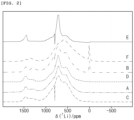
- FIG. 2 illustrates the 1D NMR centerband spectra which were extracted from the 2D 7 Li MATPASS (Magic Angle Turning Phase Adjusted Spinning Sideband) NMR spectra of the overlithiated manganese-based oxides A to F.
- I TM was a sum of areas of peaks appearing in a region of 1,000 ppm to 2,500 ppm during the peak deconvolution
- I Li was a sum of areas of peaks appearing in a region of 300 ppm to 900 ppm during the peak deconvolution
- the measurement of the 2D 7 Li MATPASS NMR spectrum, the extraction of the 1D NMR centerband spectrum, and the peak deconvolution were performed under the same conditions as described above.
- the overlithiated manganese-based oxide A, a conductive agent (Super C65), and a PVDF binder were mixed in N-methylpyrrolidone in a weight ratio of 96.5:1.5:2 to prepare a positive electrode slurry.
- One surface of an aluminum current collector was coated with the positive electrode slurry, dried, and then rolled to prepare a positive electrode.
- a lithium secondary battery was prepared by preparing an electrode assembly by disposing a separator between the positive electrode and a lithium metal electrode, disposing the electrode assembly in a battery case, and then injecting an electrolyte solution into the case.
- the electrolyte solution was prepared by dissolving 1 M LiPF 6 in a mixed organic solvent, in which ethylene carbonate/dimethyl carbonate/diethyl carbonate were mixed in a volume ratio of 1:2:1, and adding 2 wt% of vinylene carbonate (VC).
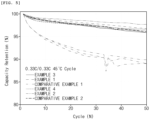
- the lithium secondary battery prepared as described above was charged at 0.1 C to 4.65 V at 45°C and then discharged at 0.1 C to 2.0 V to perform an activation process.
- a positive electrode and a lithium secondary battery were prepared in the same manner as in Example 1 except that the overlithiated manganese-based oxide B was used instead of the overlithiated manganese-based oxide A.
- a positive electrode and a lithium secondary battery were prepared in the same manner as in Example 1 except that the overlithiated manganese-based oxide C was used instead of the overlithiated manganese-based oxide A.
- a positive electrode and a lithium secondary battery were prepared in the same manner as in Example 1 except that the overlithiated manganese-based oxide D was used instead of the overlithiated manganese-based oxide A.
- a positive electrode and a lithium secondary battery were prepared in the same manner as in Example 1 except that the overlithiated manganese-based oxide E was used instead of the overlithiated manganese-based oxide A.
Landscapes
- Chemical & Material Sciences (AREA)
- Chemical Kinetics & Catalysis (AREA)
- Electrochemistry (AREA)
- General Chemical & Material Sciences (AREA)
- Engineering & Computer Science (AREA)
- Inorganic Chemistry (AREA)
- Manufacturing & Machinery (AREA)
- Materials Engineering (AREA)
- Battery Electrode And Active Subsutance (AREA)
- Secondary Cells (AREA)
Applications Claiming Priority (2)
| Application Number | Priority Date | Filing Date | Title |
|---|---|---|---|
| KR20220134434 | 2022-10-18 | ||
| PCT/KR2023/016101 WO2024085629A1 (fr) | 2022-10-18 | 2023-10-18 | Électrode positive et batterie secondaire au lithium la comprenant |
Publications (2)
| Publication Number | Publication Date |
|---|---|
| EP4576258A1 true EP4576258A1 (fr) | 2025-06-25 |
| EP4576258A4 EP4576258A4 (fr) | 2026-01-07 |
Family
ID=90738222
Family Applications (1)
| Application Number | Title | Priority Date | Filing Date |
|---|---|---|---|
| EP23880206.0A Pending EP4576258A4 (fr) | 2022-10-18 | 2023-10-18 | Électrode positive et batterie secondaire au lithium la comprenant |
Country Status (5)
| Country | Link |
|---|---|
| EP (1) | EP4576258A4 (fr) |
| JP (1) | JP2025536119A (fr) |
| KR (1) | KR20240054198A (fr) |
| CN (1) | CN119948645A (fr) |
| WO (1) | WO2024085629A1 (fr) |
Family Cites Families (9)
| Publication number | Priority date | Publication date | Assignee | Title |
|---|---|---|---|---|
| US20150372299A1 (en) * | 2014-06-18 | 2015-12-24 | Wildcat Discovery Technologies, Inc. | Compositions for high energy electrodes and methods of making and use |
| WO2016137287A1 (fr) * | 2015-02-27 | 2016-09-01 | 주식회사 엘지화학 | Matériau actif de cathode, cathode le comprenant et batterie secondaire au lithium |
| KR102500085B1 (ko) * | 2017-10-26 | 2023-02-15 | 주식회사 엘지에너지솔루션 | 리튬-결핍 전이금속 산화물을 포함하는 코팅층이 형성된 리튬 과잉의 리튬 망간계 산화물을 포함하는 양극 활물질 및 이를 포함하는 리튬 이차전지용 양극 |
| GB2569387B (en) * | 2017-12-18 | 2022-02-02 | Dyson Technology Ltd | Electrode |
| KR102116005B1 (ko) * | 2017-12-29 | 2020-05-28 | 포항공과대학교 산학협력단 | 리튬 이차 전지용 양극 활물질의 제조방법 및 리튬 이차 전지용 양극 활물질 |
| WO2019177394A1 (fr) * | 2018-03-15 | 2019-09-19 | 포항공과대학교 산학협력단 | Matériau actif d'électrode positive d'une batterie secondaire au lithium et sa méthode de fabrication |
| KR102732449B1 (ko) * | 2018-11-23 | 2024-11-21 | 삼성전자주식회사 | 복합양극활물질, 그 제조방법, 이를 포함하는 양극 및 리튬전지 |
| US20210376448A1 (en) | 2021-03-26 | 2021-12-02 | Intel Corporation | Via coupling structures to reduce crosstalk effects |
| CN114824267B (zh) * | 2022-03-29 | 2024-02-13 | 蜂巢能源科技股份有限公司 | 一种层状镍锰酸锂正极材料及其制备方法和应用 |
-
2023
- 2023-10-18 EP EP23880206.0A patent/EP4576258A4/fr active Pending
- 2023-10-18 JP JP2025517998A patent/JP2025536119A/ja active Pending
- 2023-10-18 WO PCT/KR2023/016101 patent/WO2024085629A1/fr not_active Ceased
- 2023-10-18 CN CN202380068657.9A patent/CN119948645A/zh active Pending
- 2023-10-18 KR KR1020230139218A patent/KR20240054198A/ko active Pending
Also Published As
| Publication number | Publication date |
|---|---|
| EP4576258A4 (fr) | 2026-01-07 |
| KR20240054198A (ko) | 2024-04-25 |
| JP2025536119A (ja) | 2025-10-31 |
| WO2024085629A1 (fr) | 2024-04-25 |
| CN119948645A (zh) | 2025-05-06 |
Similar Documents
| Publication | Publication Date | Title |
|---|---|---|
| EP4339164B1 (fr) | Matériau actif d'électrode positive pour batterie secondaire, son procédé de préparation et batterie secondaire au lithium le comprenant | |
| EP3715333B1 (fr) | Matériau actif d'électrode positive pour batterie secondaire, sa méthode de préparation, et batterie secondaire au lithium le comprenant | |
| US20210309537A1 (en) | Lithium composite oxide, positive electrode active material and lithium secondary battery comprising the same | |
| US11973179B2 (en) | Cathode active material for lithium secondary battery and method of manufacturing the same | |
| EP3840089A1 (fr) | Matériau actif d'électrode positive pour batterie secondaire au lithium, son procédé de fabrication et batterie secondaire au lithium le comprenant | |
| EP3939939B1 (fr) | Matériau actif d'électrode positive pour batterie secondaire, sa méthode de préparation et batterie secondaire au lithium le comprenant | |
| EP4276952B1 (fr) | Batterie secondaire au lithium | |
| EP4366018A1 (fr) | Batterie secondaire au lithium | |
| EP3780174B1 (fr) | Matériau actif de cathode pour batterie rechargeable au lithium, son procédé de fabrication, cathode comprenant celui-ci et destinée à une batterie rechargeable au lithium, et batterie rechargeable au lithium | |
| EP4398361A1 (fr) | Batterie secondaire au lithium | |
| EP4432396A1 (fr) | Poudre de matériau actif d'électrode positive, ainsi qu'électrode positive et batterie secondaire au lithium la comprenant | |
| KR20170024490A (ko) | 복합 양극 활물질, 이를 포함하는 양극 및 리튬 전지 | |
| EP3506411A1 (fr) | Solution d'électrolyte organique et batterie au lithium l'incluant | |
| KR20200090661A (ko) | 이차전지용 양극 활물질의 제조 방법 | |
| EP4340095B1 (fr) | Batterie secondaire au lithium | |
| EP4138153A2 (fr) | Matériau actif positif pour batterie au lithium rechargeable, son procédé de préparation et batterie au lithium rechargeable le comprenant | |
| EP4462508A1 (fr) | Poudre de matériau d'électrode positive, et électrode positive et batterie secondaire au lithium la comprenant | |
| US20250118743A1 (en) | Lithium Secondary Battery | |
| EP3883036A1 (fr) | Électrolyte pour batterie secondaire au lithium et batterie secondaire au lithium le comprenant | |
| KR101602419B1 (ko) | 양극활물질, 이를 포함하는 양극 및 상기 양극을 채용한 리튬전지 | |
| US20250079458A1 (en) | Positive Electrode Active Material Powder, and Positive Electrode and Lithium Secondary Battery Which Include the Same | |
| US20250223192A1 (en) | Positive Electrode Active Material, and Positive Electrode and Lithium Secondary Battery Including the Same | |
| EP4576258A1 (fr) | Électrode positive et batterie secondaire au lithium la comprenant | |
| US11962006B2 (en) | Cathode active material for lithium secondary battery and lithium secondary battery including the same | |
| EP4044290A1 (fr) | Matériau actif de cathode pour batterie secondaire au lithium et son procédé de fabrication |
Legal Events
| Date | Code | Title | Description |
|---|---|---|---|
| STAA | Information on the status of an ep patent application or granted ep patent |
Free format text: STATUS: THE INTERNATIONAL PUBLICATION HAS BEEN MADE |
|
| PUAI | Public reference made under article 153(3) epc to a published international application that has entered the european phase |
Free format text: ORIGINAL CODE: 0009012 |
|
| STAA | Information on the status of an ep patent application or granted ep patent |
Free format text: STATUS: REQUEST FOR EXAMINATION WAS MADE |
|
| 17P | Request for examination filed |
Effective date: 20250319 |
|
| AK | Designated contracting states |
Kind code of ref document: A1 Designated state(s): AL AT BE BG CH CY CZ DE DK EE ES FI FR GB GR HR HU IE IS IT LI LT LU LV MC ME MK MT NL NO PL PT RO RS SE SI SK SM TR |
|
| A4 | Supplementary search report drawn up and despatched |
Effective date: 20251209 |
|
| RIC1 | Information provided on ipc code assigned before grant |
Ipc: H01M 4/505 20100101AFI20251203BHEP Ipc: H01M 4/525 20100101ALI20251203BHEP Ipc: H01M 4/131 20100101ALI20251203BHEP Ipc: H01M 10/0525 20100101ALI20251203BHEP Ipc: H01M 4/02 20060101ALI20251203BHEP |
|
| DAV | Request for validation of the european patent (deleted) | ||
| DAX | Request for extension of the european patent (deleted) |