EP4576265A1 - Polymère, feuille d'électrode et élément de batterie, batterie et appareil électrique associés - Google Patents
Polymère, feuille d'électrode et élément de batterie, batterie et appareil électrique associés Download PDFInfo
- Publication number
- EP4576265A1 EP4576265A1 EP23921968.6A EP23921968A EP4576265A1 EP 4576265 A1 EP4576265 A1 EP 4576265A1 EP 23921968 A EP23921968 A EP 23921968A EP 4576265 A1 EP4576265 A1 EP 4576265A1
- Authority
- EP
- European Patent Office
- Prior art keywords
- polymer
- positive electrode
- electrode plate
- negative electrode
- active substance
- Prior art date
- Legal status (The legal status is an assumption and is not a legal conclusion. Google has not performed a legal analysis and makes no representation as to the accuracy of the status listed.)
- Pending
Links
Images


Classifications
-
- H—ELECTRICITY
- H01—ELECTRIC ELEMENTS
- H01M—PROCESSES OR MEANS, e.g. BATTERIES, FOR THE DIRECT CONVERSION OF CHEMICAL ENERGY INTO ELECTRICAL ENERGY
- H01M4/00—Electrodes
- H01M4/02—Electrodes composed of, or comprising, active material
- H01M4/62—Selection of inactive substances as ingredients for active masses, e.g. binders, fillers
-
- C—CHEMISTRY; METALLURGY
- C08—ORGANIC MACROMOLECULAR COMPOUNDS; THEIR PREPARATION OR CHEMICAL WORKING-UP; COMPOSITIONS BASED THEREON
- C08G—MACROMOLECULAR COMPOUNDS OBTAINED OTHERWISE THAN BY REACTIONS ONLY INVOLVING UNSATURATED CARBON-TO-CARBON BONDS
- C08G63/00—Macromolecular compounds obtained by reactions forming a carboxylic ester link in the main chain of the macromolecule
- C08G63/02—Polyesters derived from hydroxycarboxylic acids or from polycarboxylic acids and polyhydroxy compounds
- C08G63/06—Polyesters derived from hydroxycarboxylic acids or from polycarboxylic acids and polyhydroxy compounds derived from hydroxycarboxylic acids
- C08G63/08—Lactones or lactides
-
- C—CHEMISTRY; METALLURGY
- C08—ORGANIC MACROMOLECULAR COMPOUNDS; THEIR PREPARATION OR CHEMICAL WORKING-UP; COMPOSITIONS BASED THEREON
- C08F—MACROMOLECULAR COMPOUNDS OBTAINED BY REACTIONS ONLY INVOLVING CARBON-TO-CARBON UNSATURATED BONDS
- C08F120/00—Homopolymers of compounds having one or more unsaturated aliphatic radicals, each having only one carbon-to-carbon double bond, and only one being terminated by only one carboxyl radical or a salt, anhydride, ester, amide, imide or nitrile thereof
- C08F120/02—Monocarboxylic acids having less than ten carbon atoms; Derivatives thereof
-
- C—CHEMISTRY; METALLURGY
- C08—ORGANIC MACROMOLECULAR COMPOUNDS; THEIR PREPARATION OR CHEMICAL WORKING-UP; COMPOSITIONS BASED THEREON
- C08F—MACROMOLECULAR COMPOUNDS OBTAINED BY REACTIONS ONLY INVOLVING CARBON-TO-CARBON UNSATURATED BONDS
- C08F120/00—Homopolymers of compounds having one or more unsaturated aliphatic radicals, each having only one carbon-to-carbon double bond, and only one being terminated by only one carboxyl radical or a salt, anhydride, ester, amide, imide or nitrile thereof
- C08F120/02—Monocarboxylic acids having less than ten carbon atoms; Derivatives thereof
- C08F120/10—Esters
- C08F120/12—Esters of monohydric alcohols or phenols
- C08F120/16—Esters of monohydric alcohols or phenols of phenols or of alcohols containing two or more carbon atoms
- C08F120/18—Esters of monohydric alcohols or phenols of phenols or of alcohols containing two or more carbon atoms with acrylic or methacrylic acids
-
- C—CHEMISTRY; METALLURGY
- C08—ORGANIC MACROMOLECULAR COMPOUNDS; THEIR PREPARATION OR CHEMICAL WORKING-UP; COMPOSITIONS BASED THEREON
- C08F—MACROMOLECULAR COMPOUNDS OBTAINED BY REACTIONS ONLY INVOLVING CARBON-TO-CARBON UNSATURATED BONDS
- C08F18/00—Homopolymers and copolymers of compounds having one or more unsaturated aliphatic radicals, each having only one carbon-to-carbon double bond, and at least one being terminated by an acyloxy radical of a saturated carboxylic acid, of carbonic acid or of a haloformic acid
- C08F18/02—Esters of monocarboxylic acids
- C08F18/04—Vinyl esters
- C08F18/08—Vinyl acetate
-
- C—CHEMISTRY; METALLURGY
- C08—ORGANIC MACROMOLECULAR COMPOUNDS; THEIR PREPARATION OR CHEMICAL WORKING-UP; COMPOSITIONS BASED THEREON
- C08F—MACROMOLECULAR COMPOUNDS OBTAINED BY REACTIONS ONLY INVOLVING CARBON-TO-CARBON UNSATURATED BONDS
- C08F20/00—Homopolymers and copolymers of compounds having one or more unsaturated aliphatic radicals, each having only one carbon-to-carbon double bond, and only one being terminated by only one carboxyl radical or a salt, anhydride, ester, amide, imide or nitrile thereof
- C08F20/02—Monocarboxylic acids having less than ten carbon atoms, Derivatives thereof
- C08F20/10—Esters
- C08F20/12—Esters of monohydric alcohols or phenols
- C08F20/14—Methyl esters, e.g. methyl (meth)acrylate
-
- C—CHEMISTRY; METALLURGY
- C08—ORGANIC MACROMOLECULAR COMPOUNDS; THEIR PREPARATION OR CHEMICAL WORKING-UP; COMPOSITIONS BASED THEREON
- C08F—MACROMOLECULAR COMPOUNDS OBTAINED BY REACTIONS ONLY INVOLVING CARBON-TO-CARBON UNSATURATED BONDS
- C08F20/00—Homopolymers and copolymers of compounds having one or more unsaturated aliphatic radicals, each having only one carbon-to-carbon double bond, and only one being terminated by only one carboxyl radical or a salt, anhydride, ester, amide, imide or nitrile thereof
- C08F20/02—Monocarboxylic acids having less than ten carbon atoms, Derivatives thereof
- C08F20/10—Esters
- C08F20/12—Esters of monohydric alcohols or phenols
- C08F20/16—Esters of monohydric alcohols or phenols of phenols or of alcohols containing two or more carbon atoms
- C08F20/18—Esters of monohydric alcohols or phenols of phenols or of alcohols containing two or more carbon atoms with acrylic or methacrylic acids
-
- C—CHEMISTRY; METALLURGY
- C08—ORGANIC MACROMOLECULAR COMPOUNDS; THEIR PREPARATION OR CHEMICAL WORKING-UP; COMPOSITIONS BASED THEREON
- C08F—MACROMOLECULAR COMPOUNDS OBTAINED BY REACTIONS ONLY INVOLVING CARBON-TO-CARBON UNSATURATED BONDS
- C08F210/00—Copolymers of unsaturated aliphatic hydrocarbons having only one carbon-to-carbon double bond
- C08F210/02—Ethene
-
- C—CHEMISTRY; METALLURGY
- C08—ORGANIC MACROMOLECULAR COMPOUNDS; THEIR PREPARATION OR CHEMICAL WORKING-UP; COMPOSITIONS BASED THEREON
- C08F—MACROMOLECULAR COMPOUNDS OBTAINED BY REACTIONS ONLY INVOLVING CARBON-TO-CARBON UNSATURATED BONDS
- C08F218/00—Copolymers of compounds having one or more unsaturated aliphatic radicals, each having only one carbon-to-carbon double bond, and at least one being terminated by an acyloxy radical of a saturated carboxylic acid, of carbonic acid or of a haloformic acid
- C08F218/02—Esters of monocarboxylic acids
- C08F218/04—Vinyl esters
- C08F218/08—Vinyl acetate
-
- C—CHEMISTRY; METALLURGY
- C08—ORGANIC MACROMOLECULAR COMPOUNDS; THEIR PREPARATION OR CHEMICAL WORKING-UP; COMPOSITIONS BASED THEREON
- C08F—MACROMOLECULAR COMPOUNDS OBTAINED BY REACTIONS ONLY INVOLVING CARBON-TO-CARBON UNSATURATED BONDS
- C08F220/00—Copolymers of compounds having one or more unsaturated aliphatic radicals, each having only one carbon-to-carbon double bond, and only one being terminated by only one carboxyl radical or a salt, anhydride ester, amide, imide or nitrile thereof
- C08F220/02—Monocarboxylic acids having less than ten carbon atoms; Derivatives thereof
- C08F220/10—Esters
- C08F220/12—Esters of monohydric alcohols or phenols
- C08F220/14—Methyl esters, e.g. methyl (meth)acrylate
-
- C—CHEMISTRY; METALLURGY
- C08—ORGANIC MACROMOLECULAR COMPOUNDS; THEIR PREPARATION OR CHEMICAL WORKING-UP; COMPOSITIONS BASED THEREON
- C08F—MACROMOLECULAR COMPOUNDS OBTAINED BY REACTIONS ONLY INVOLVING CARBON-TO-CARBON UNSATURATED BONDS
- C08F220/00—Copolymers of compounds having one or more unsaturated aliphatic radicals, each having only one carbon-to-carbon double bond, and only one being terminated by only one carboxyl radical or a salt, anhydride ester, amide, imide or nitrile thereof
- C08F220/02—Monocarboxylic acids having less than ten carbon atoms; Derivatives thereof
- C08F220/10—Esters
- C08F220/12—Esters of monohydric alcohols or phenols
- C08F220/16—Esters of monohydric alcohols or phenols of phenols or of alcohols containing two or more carbon atoms
- C08F220/18—Esters of monohydric alcohols or phenols of phenols or of alcohols containing two or more carbon atoms with acrylic or methacrylic acids
- C08F220/1804—C4-(meth)acrylate, e.g. butyl (meth)acrylate, isobutyl (meth)acrylate or tert-butyl (meth)acrylate
-
- C—CHEMISTRY; METALLURGY
- C08—ORGANIC MACROMOLECULAR COMPOUNDS; THEIR PREPARATION OR CHEMICAL WORKING-UP; COMPOSITIONS BASED THEREON
- C08F—MACROMOLECULAR COMPOUNDS OBTAINED BY REACTIONS ONLY INVOLVING CARBON-TO-CARBON UNSATURATED BONDS
- C08F220/00—Copolymers of compounds having one or more unsaturated aliphatic radicals, each having only one carbon-to-carbon double bond, and only one being terminated by only one carboxyl radical or a salt, anhydride ester, amide, imide or nitrile thereof
- C08F220/02—Monocarboxylic acids having less than ten carbon atoms; Derivatives thereof
- C08F220/42—Nitriles
- C08F220/44—Acrylonitrile
-
- C—CHEMISTRY; METALLURGY
- C09—DYES; PAINTS; POLISHES; NATURAL RESINS; ADHESIVES; COMPOSITIONS NOT OTHERWISE PROVIDED FOR; APPLICATIONS OF MATERIALS NOT OTHERWISE PROVIDED FOR
- C09D—COATING COMPOSITIONS, e.g. PAINTS, VARNISHES OR LACQUERS; FILLING PASTES; CHEMICAL PAINT OR INK REMOVERS; INKS; CORRECTING FLUIDS; WOODSTAINS; PASTES OR SOLIDS FOR COLOURING OR PRINTING; USE OF MATERIALS THEREFOR
- C09D133/00—Coating compositions based on homopolymers or copolymers of compounds having one or more unsaturated aliphatic radicals, each having only one carbon-to-carbon double bond, and at least one being terminated by only one carboxyl radical, or of salts, anhydrides, esters, amides, imides, or nitriles thereof; Coating compositions based on derivatives of such polymers
- C09D133/04—Homopolymers or copolymers of esters
- C09D133/06—Homopolymers or copolymers of esters of esters containing only carbon, hydrogen and oxygen, the oxygen atom being present only as part of the carboxyl radical
- C09D133/08—Homopolymers or copolymers of acrylic acid esters
-
- C—CHEMISTRY; METALLURGY
- C09—DYES; PAINTS; POLISHES; NATURAL RESINS; ADHESIVES; COMPOSITIONS NOT OTHERWISE PROVIDED FOR; APPLICATIONS OF MATERIALS NOT OTHERWISE PROVIDED FOR
- C09D—COATING COMPOSITIONS, e.g. PAINTS, VARNISHES OR LACQUERS; FILLING PASTES; CHEMICAL PAINT OR INK REMOVERS; INKS; CORRECTING FLUIDS; WOODSTAINS; PASTES OR SOLIDS FOR COLOURING OR PRINTING; USE OF MATERIALS THEREFOR
- C09D133/00—Coating compositions based on homopolymers or copolymers of compounds having one or more unsaturated aliphatic radicals, each having only one carbon-to-carbon double bond, and at least one being terminated by only one carboxyl radical, or of salts, anhydrides, esters, amides, imides, or nitriles thereof; Coating compositions based on derivatives of such polymers
- C09D133/04—Homopolymers or copolymers of esters
- C09D133/06—Homopolymers or copolymers of esters of esters containing only carbon, hydrogen and oxygen, the oxygen atom being present only as part of the carboxyl radical
- C09D133/10—Homopolymers or copolymers of methacrylic acid esters
- C09D133/12—Homopolymers or copolymers of methyl methacrylate
-
- H—ELECTRICITY
- H01—ELECTRIC ELEMENTS
- H01M—PROCESSES OR MEANS, e.g. BATTERIES, FOR THE DIRECT CONVERSION OF CHEMICAL ENERGY INTO ELECTRICAL ENERGY
- H01M10/00—Secondary cells; Manufacture thereof
- H01M10/05—Accumulators with non-aqueous electrolyte
- H01M10/052—Li-accumulators
- H01M10/0525—Rocking-chair batteries, i.e. batteries with lithium insertion or intercalation in both electrodes; Lithium-ion batteries
-
- H—ELECTRICITY
- H01—ELECTRIC ELEMENTS
- H01M—PROCESSES OR MEANS, e.g. BATTERIES, FOR THE DIRECT CONVERSION OF CHEMICAL ENERGY INTO ELECTRICAL ENERGY
- H01M10/00—Secondary cells; Manufacture thereof
- H01M10/05—Accumulators with non-aqueous electrolyte
- H01M10/056—Accumulators with non-aqueous electrolyte characterised by the materials used as electrolytes, e.g. mixed inorganic/organic electrolytes
- H01M10/0564—Accumulators with non-aqueous electrolyte characterised by the materials used as electrolytes, e.g. mixed inorganic/organic electrolytes the electrolyte being constituted of organic materials only
- H01M10/0565—Polymeric materials, e.g. gel-type or solid-type
-
- H—ELECTRICITY
- H01—ELECTRIC ELEMENTS
- H01M—PROCESSES OR MEANS, e.g. BATTERIES, FOR THE DIRECT CONVERSION OF CHEMICAL ENERGY INTO ELECTRICAL ENERGY
- H01M10/00—Secondary cells; Manufacture thereof
- H01M10/42—Methods or arrangements for servicing or maintenance of secondary cells or secondary half-cells
- H01M10/4235—Safety or regulating additives or arrangements in electrodes, separators or electrolyte
-
- H—ELECTRICITY
- H01—ELECTRIC ELEMENTS
- H01M—PROCESSES OR MEANS, e.g. BATTERIES, FOR THE DIRECT CONVERSION OF CHEMICAL ENERGY INTO ELECTRICAL ENERGY
- H01M4/00—Electrodes
- H01M4/02—Electrodes composed of, or comprising, active material
- H01M4/13—Electrodes for accumulators with non-aqueous electrolyte, e.g. for lithium-accumulators; Processes of manufacture thereof
-
- H—ELECTRICITY
- H01—ELECTRIC ELEMENTS
- H01M—PROCESSES OR MEANS, e.g. BATTERIES, FOR THE DIRECT CONVERSION OF CHEMICAL ENERGY INTO ELECTRICAL ENERGY
- H01M4/00—Electrodes
- H01M4/02—Electrodes composed of, or comprising, active material
- H01M4/62—Selection of inactive substances as ingredients for active masses, e.g. binders, fillers
- H01M4/628—Inhibitors, e.g. gassing inhibitors, corrosion inhibitors
-
- C—CHEMISTRY; METALLURGY
- C08—ORGANIC MACROMOLECULAR COMPOUNDS; THEIR PREPARATION OR CHEMICAL WORKING-UP; COMPOSITIONS BASED THEREON
- C08F—MACROMOLECULAR COMPOUNDS OBTAINED BY REACTIONS ONLY INVOLVING CARBON-TO-CARBON UNSATURATED BONDS
- C08F114/00—Homopolymers of compounds having one or more unsaturated aliphatic radicals, each having only one carbon-to-carbon double bond, and at least one being terminated by a halogen
- C08F114/18—Monomers containing fluorine
- C08F114/22—Vinylidene fluoride
-
- H—ELECTRICITY
- H01—ELECTRIC ELEMENTS
- H01M—PROCESSES OR MEANS, e.g. BATTERIES, FOR THE DIRECT CONVERSION OF CHEMICAL ENERGY INTO ELECTRICAL ENERGY
- H01M4/00—Electrodes
- H01M4/02—Electrodes composed of, or comprising, active material
- H01M2004/026—Electrodes composed of, or comprising, active material characterised by the polarity
- H01M2004/027—Negative electrodes
-
- H—ELECTRICITY
- H01—ELECTRIC ELEMENTS
- H01M—PROCESSES OR MEANS, e.g. BATTERIES, FOR THE DIRECT CONVERSION OF CHEMICAL ENERGY INTO ELECTRICAL ENERGY
- H01M4/00—Electrodes
- H01M4/02—Electrodes composed of, or comprising, active material
- H01M2004/026—Electrodes composed of, or comprising, active material characterised by the polarity
- H01M2004/028—Positive electrodes
-
- Y—GENERAL TAGGING OF NEW TECHNOLOGICAL DEVELOPMENTS; GENERAL TAGGING OF CROSS-SECTIONAL TECHNOLOGIES SPANNING OVER SEVERAL SECTIONS OF THE IPC; TECHNICAL SUBJECTS COVERED BY FORMER USPC CROSS-REFERENCE ART COLLECTIONS [XRACs] AND DIGESTS
- Y02—TECHNOLOGIES OR APPLICATIONS FOR MITIGATION OR ADAPTATION AGAINST CLIMATE CHANGE
- Y02E—REDUCTION OF GREENHOUSE GAS [GHG] EMISSIONS, RELATED TO ENERGY GENERATION, TRANSMISSION OR DISTRIBUTION
- Y02E60/00—Enabling technologies; Technologies with a potential or indirect contribution to GHG emissions mitigation
- Y02E60/10—Energy storage using batteries
Definitions
- This application relates to the field of batteries, and specifically, to a polymer, an electrode plate, and a battery cell, battery, and electric apparatus related thereto.
- Battery cells have characteristics such as high capacity and long service life, and thus are widely used in electronic devices such as mobile phones, laptop computers, electric bicycles, electric vehicles, electric airplanes, electric ships, electric toy cars, electric toy ships, electric toy airplanes, and electric tools.
- the requirements on the performance of battery cells are increasingly stringent.
- the performance of electrode plates in the battery cells is typically optimized and improved.
- the interface performance of active substances in the electrode plates is poor at present, resulting in poor cycling performance and storage performance of the battery cells when the electrode plates are used in the battery cells.
- This application has been made in view of the foregoing issues, with an objective to provide a polymer, an electrode plate, and a battery cell, battery, and electric apparatus related thereto.
- a polymer is provided.
- the polymer is applied to battery cells, and the polymer includes an ester polymer, where the ester polymer is made into a sheet structure; and the sheet structure undergoes dynamic frequency scanning testing at (T m +20)°C to obtain an elastic modulus G'-energy loss modulus G" curve, where a slope of the elastic modulus G'-energy loss modulus G" curve is K, 1 ⁇ K ⁇ , and T m °C represents a melting temperature of the ester polymer.
- a molecular chain entanglement state can be further reduced, facilitating the diffusion of solvent molecules in an electrolyte between molecular chains.
- the polymer still maintains a certain molecular chain entanglement state, so that the solvent molecules can be locked in situ in the polymer, the risk of dissolution of the polymer in the electrolyte can be reduced, and the performance stability of the polymer can be improved.
- this helps the polymer to form a protective layer on the surface of an active substance, improving the solid-liquid interface performance, thereby reducing side reactions between the active substance and the electrolyte, and improving the cycling performance and storage performance of the battery cell.
- 1 ⁇ K ⁇ 100 optionally 1 ⁇ K ⁇ 10.
- a glass transition temperature of the ester polymer is Tg, in °C, where -100 ⁇ Tg ⁇ 50, optionally -80 ⁇ Tg ⁇ 30.
- the glass transition temperature of the polymer is relatively low, the chain segment flexibility of the molecular chains is higher, and adjacent molecular chains are opened more easily.
- the ester polymer includes a structural unit shown in formula (I), where in the formula (I), R 1 , R 2 , and R 3 each independently include a hydrogen atom or a substituted or unsubstituted C1-C8 alkyl group; and R 4 includes a substituted or unsubstituted C1-C8 alkyl group or a substituted or unsubstituted C1-C8 hydroxyalkyl group; optionally, R 1 includes a hydrogen atom or a substituted or unsubstituted methyl group; R 2 and R 3 each independently include a hydrogen atom; and R 4 includes a substituted or unsubstituted C1-C6 alkyl group or a substituted or unsubstituted C1-C6 hydroxyalkyl group; and optionally, R 4 includes a substituted or unsubstituted C1-C4 alkyl group or a substituted or unsubstituted C1-C4 hydroxyalkyl
- the ester polymer includes at least one of structural units shown in formula (I-1) to formula (I-15): and
- the ester polymer includes at least one of structural units shown in formula (II-1) to formula (II-5):
- the polymer is added into a first solvent at 45°C to form a polymer system; the polymer system is left standing at 45°C for 8 h; and after left standing at 25°C for 24 h or more, the polymer system is filtered through a 200-mesh filter to obtain a residual first substance; where a mass of the polymer is n, in g; a mass of the first substance is m, in g; and the polymer and the first substance satisfy: 5 ⁇ m/n ⁇ 1000.
- this application can achieve the extension of the molecular chains of the polymer in a safe working temperature range of the battery cell by increasing the temperature, thereby facilitating the mutual attraction and physical bonding between the molecular chains of the polymer and the solvent.
- the activity of polymer molecular chain segments decreases, so that the polymer remains adhered to the surface of the active substance, the electrolyte is locked in a spatial environment where the polymer is located, and a state similar to in-situ gel is formed. This maintains normal transmission of lithium ions while protecting an active substance interface, thereby establishing interface protection, reducing surface side reactions, and improving the cycling performance and storage performance.
- a positive electrode plate includes a positive electrode current collector and a positive electrode active substance layer disposed on the positive electrode current collector, where the positive electrode active substance layer includes a positive electrode active substance and a polymer, and the polymer includes the polymer according to any one of the embodiments of the first aspect of this application.
- a negative electrode plate includes a negative electrode current collector and a negative electrode active substance layer disposed on the negative electrode current collector, where the negative electrode active substance layer includes a negative electrode active substance and a polymer, and the polymer includes the polymer according to any one of the embodiments of the first aspect of this application.
- a battery cell includes a positive electrode plate and a negative electrode plate, where the positive electrode plate includes the positive electrode plate according to any one of the embodiments of the second aspect; and/or the negative electrode plate includes the negative electrode plate according to any one of the embodiments of the third aspect of this application.
- a battery including the battery cell according to the fourth aspect of this application.
- an electric apparatus including the battery according to the fifth aspect of this application.
- a method including steps (a) and (b) indicates that the method may include steps (a) and (b) performed in order or may include steps (b) and (a) performed in order.
- the above-mentioned method may further include step (c), which indicates that step (c) may be added to the method in any ordinal position, for example, the method may include steps (a), (b), and (c), steps (a), (c), and (b), steps (c), (a), and (b), or the like.
- the term "or” is inclusive.
- the phrase “A or B” means “A, B, or both A and B”. More specifically, any one of the following conditions satisfies the condition "A or B” : A is true (or present) and B is false (or not present); A is false (or not present) and B is true (or present); or both A and B are true (or present).
- a plurality of means two or more than two
- a plurality of types means two types or more than two types
- alkyl group covers linear and branched alkyl groups.
- the alkyl group may be a C1-C85 alkyl group, a C1-C5 alkyl group, a C1-C4 alkyl group, a C1-C3 alkyl group, or a C1-C2 alkyl group.
- the alkyl group includes a methyl group, an ethyl group, a propyl group, an isopropyl group, a butyl group, an isobutyl group, and the like.
- the alkyl group may be arbitrarily substituted. When the alkyl group is substituted, a substituent group includes a fluorine atom.
- alkoxy group refers to a group in which an alkyl group is connected to an oxygen atom through a single bond.
- the alkoxy group may be a C1-C5 alkoxy group, a C1-C3 alkoxy group, or a C1-C2 alkoxy group.
- the alkoxy group may include a methoxy group, an ethoxy group, and a propoxy group.
- the alkoxy group may be arbitrarily substituted.
- hydroxyalkyl group refers to a group in which a hydroxy group is connected to an alkyl group through a single bond.
- the hydroxyalkyl group may be a C1-C8 hydroxyalkyl group, a C1-C5 hydroxyalkyl group, a C1-C3 hydroxyalkyl group, or a C1-C2 hydroxyalkyl group.
- the hydroxyalkyl group may include a hydroxymethyl group, a hydroxyethyl group, a hydroxypropyl group, a hydroxybutyl group, and the like.
- the hydroxyalkyl group may be arbitrarily substituted.
- halogen atom refers to a fluorine atom, a chlorine atom, a bromine atom, or the like.
- this application proposes a polymer.
- the polymer is applied to battery cells.
- the polymer includes an ester polymer.
- the ester polymer is made into a sheet structure.
- the sheet structure undergoes dynamic frequency scanning testing at (T m +20)°C to obtain an elastic modulus G'-energy loss modulus G" curve, where a slope of the elastic modulus G'-energy loss modulus G" curve is K, 1 ⁇ K ⁇ , and Tm°C represents a melting temperature of the ester polymer.
- a preparation process of the sheet structure is as follows: The polymer undergoes vacuum drying at 80°C for 12 h. The dried polymer is hot-pressed into a sheet using a flat vulcanizing machine, where a hot-pressing temperature is (Tm+20)°C, a calendering thickness is 1-2 min, a calendering time is 2 min, and a pressure is 8 MPa. After calendering for 2 min, a sample is taken out and placed on another vulcanizing machine of the same model for cold pressing, with a cold pressing pressure of 10 MPa. A circular mold with a diameter of 25 mm is used to obtain a polymer disc (sheet structure) with fixed dimensions. For example, the sheet structure may be a disc with a thickness of 1-2 mm and a diameter of 25 mm. Alternatively, the sample can be prepared according to the sample standard required by a testing device.
- a polymer melt exhibits a liquid-like behavior (liquid-like behavior), that is, there are fewer intermolecular entanglements, and chain segment movement is likely to occur under shear forces. If the slope is greater than 1, the polymer melt exhibits a solid-like behavior (liquid-like behavior), that is, there are more intermolecular entanglements, and chain segment movement is less likely to occur under shear forces.
- Dynamic frequency scanning testing is conducted using a TA-AR2000EX rotational rheometer (TAinstruments, USA), where a parallel plate has a diameter of 25 mm and a thickness of 0.9 mm. To ensure testing within a linear viscoelastic region, the strain during dynamic frequency scanning testing is 2%, a testing temperature is Tm+20°C, and a frequency scanning range for testing is 500 rad/s ⁇ w 2 ⁇ 0.05 rad/s, so that data of a region with the lowest possible frequency can be obtained.
- Dynamic frequency scanning testing can characterize a molecular chain entanglement degree in a solid-phase melting state (melt state). Compared with a linear structure or a short branched structure, a long branched structure, a network structure, or a low cross-linked structure has a higher entanglement degree, exhibiting a behavior deviating from a linear terminal; and the polymer exhibits a solid-phase behavior.
- a molecular chain entanglement state can be further reduced, facilitating the diffusion of solvent molecules in an electrolyte between molecular chains.
- the polymer still maintains a certain molecular chain entanglement state, so that the solvent molecules can be locked in situ in the polymer, the risk of dissolution of the polymer in the electrolyte can be reduced, and the performance stability of the polymer can be improved. Furthermore, this helps the polymer to form a protective layer on the surface of an active substance, improving the solid-liquid interface performance, thereby reducing side reactions between the active substance and the electrolyte, and improving the cycling performance and storage performance of the battery cell.
- 1 ⁇ K ⁇ 100 optionally 1 ⁇ K ⁇ 10.
- K may be 1.01, 1.1, 1.2, 1.5, 2, 5, 10, 15, 20, 30, 50, 100, 200, 500, 1000, 5000, or 10000, or falls within a range defined by any two of the foregoing values.
- a glass transition temperature of the ester polymer is Tg, in °C, where -100 ⁇ Tg ⁇ 50, optionally -80 ⁇ Tg ⁇ 30.
- the glass transition temperature is a transition temperature at which chain segments of the polymer change from a frozen state to a motion state.
- the glass transition temperature has a certain influence on the flexibility of the molecular chains of the polymer.
- a lower glass transition temperature leads to a higher flexibility of the molecular chains of the polymer at room temperature.
- a higher glass transition temperature leads to a lower flexibility of the molecular chains at room temperature.
- the glass transition temperature can be measured using differential scanning calorimetry DSC.
- testing steps include: taking 0.5 g to 0.8 g of sample; placing the sample into a sample crucible; increasing and reducing the temperature of the sample under a nitrogen atmosphere in a manner of increasing the temperature at a temperature rise speed of 10°C/min from an initial temperature being 20°C lower than the intrinsic Tg of a material to a cutoff temperature of a process where the temperature is 20°C higher than the intrinsic Tm of the material; and determining an actual glass transition temperature Tg and melting temperature Tm of the material based on endothermic and exothermic peak values or transition points of the material during the process.
- ester polymer includes at least one of structural units shown in formula (I-1) to formula (I-15), and
- the ester polymer includes a structural unit shown in formula (II), where in the formula (II), R 5 includes a substituted or unsubstituted C2-C6 methylene group; and optionally, R 5 independently includes a substituted or unsubstituted C2-C4 methylene group.
- ester polymer includes at least one of structural units shown in formula (II-1) to formula (II-5), and
- the ester polymer has a low molecular chain entanglement degree, helping to improve the flexibility of the molecular chains.
- the molecular chains can be fully extended in the electrolyte, so that the interface performance of the active substance can be further improved.
- Types of monomers of the polymer in this application can be tested using pyrolysis-gas chromatography-mass spectrometry.
- Specific testing steps include: accurately weighing 0.5 mg of sample and placing the sample into a sample cup; fixing the sample cup on a sample injection rod, and placing the sample injection rod into a pyrolyzer installed near a GC (gas chromatography) sample injection port; pressing a sample injection button after a temperature of the pyrolyzer reaches a given temperature and allowing the sample cup to quickly drop into the center of the pyrolyzer by free fall; allowing volatile constituents to instantly vaporize in an inert gas atmosphere of N 2 , and carrying the vaporized constituents into a gas chromatography column by a carrier gas for separation; and ultimately detecting the resulting product using a flame ionization detector FID or a mass spectrometer MS to obtain a gas chromatogram or a total ion chromatogram.
- substituent groups may include one or more of a nitrile group, a nitryl group, a sulfonyl group, a carboxyl group, an ester group, a chlorine atom, a fluorine atom, and a bromine atom.
- the substituent groups are high-pressure-resistant substituent groups, which is more conducive to stabilizing the structure of the polymer.
- n is selected from positive integers from 800 to 20000.
- a molecular weight of the polymer is 1.2 ⁇ 10 5 g/mol to 1.0 ⁇ 10 6 g/mol.
- a multi-angle laser light scatterer MALLS can be used for testing.
- an instrument (WyattTechnologyCorporation, USA) is used, where a GPC, a DawnHeleos II multi-angle laser light scattering apparatus, an OptilabT-rEX refractive index (RI) detector, and a ViscoStar II viscometer are used in combination. Testing is conducted at 30°. Tetrahydrofuran is used as a mobile phase for testing at a flow rate of 1.0 ml/min.
- Commercial software ASTRA6 is used to process SEC-SAMLL data to obtain molecular weight parameters.
- the cycling performance and storage performance of the battery cell can be further improved.
- the polymer is added into a first solvent at 45°C to form a polymer system; the polymer system is left standing at 45°C for 8 h; and after left standing at 25°C for 24 h or more, the polymer system undergoes two stages of left standing treatment; and then part of the polymer system is transformed in situ into a gel-state substance, and then the polymer system is filtered through a 200-mesh filter to obtain a residual first substance.
- a mass of the polymer is n, in g; a mass of the first substance is m, in g; and the polymer and the first substance satisfy: 5 ⁇ m/n ⁇ 1000; optionally, 10 ⁇ m/n ⁇ 1000; and further optionally, 10 ⁇ m/n ⁇ 50.
- the value of m/n may be 5, 10, 20, 25, 28, 30, 32, 35, 40, 50, 80, 100, 200, 500, or 1000, or falls within a range defined by any two of the foregoing values.
- Formula (2) can characterize a speed at which one point of the electrode plate almost fully absorbs the liquid (for example, the electrolyte) in the capillary tube per unit time.
- one point of the electrode plate refers to a region with a specified area in the electrode plate, and the area corresponds to a cross-sectional area of the capillary tube.
- the capillary tube has capillary channels so that the capillary tube can directly absorb the electrolyte through the capillary action, without needing an external driving unit to provide electrolyte absorption power.
- an absorption amount can be more precisely controlled.
- the electrode plate absorbs the electrolyte through its own capillary action, when the capillary tube is in contact with the electrode plate under test, the electrode plate absorbs the electrolyte from the capillary tube.
- the electrolyte in the capillary tube no longer flows out, so the amount of the absorbed electrolyte in the capillary tube can precisely reflect the corresponding volume of the electrolyte absorbed by the electrode plate, thereby further improving the accuracy of testing results and achieving quantitative calculation of the electrolyte absorption velocity of the electrode plate.
- a standard electrolyte is used as a test sample for testing, and a specific formulation of the electrolyte may refer to electrolyte formulations in examples.
- Formula (3) represents the electrolyte absorption velocity of the electrode plate with the porosity ⁇ and can be used to characterize the electrolyte absorption speed of the electrode plate.
- the polymer of this application is introduced during preparation of the active substance layer, and can form uniform high-infiltration points in the active substance layer and uniformly enhance the infiltration performance of the active substance layer, thereby increasing the overall electrolyte absorption speed of the active substance layer, and improving the cycling performance of the battery cell using the electrode plate.
- v/k 1.00 ⁇ v/k ⁇ 4.00; optionally, 1.20 ⁇ v/k ⁇ 3.80; and further optionally, 1.4 ⁇ v/k ⁇ 3.6.
- the value of v/ ⁇ may be 1.20, 1.40, 1.80, 2.00, 2.50, 3.00, 3.50, 3.60, 3.80, or 3.90, or falls within a range defined by any two of the foregoing values.
- a mass percentage of the polymer is A%, where 0.1 ⁇ A ⁇ 1.5.
- the interface performance of the positive electrode active substance layer can be significantly improved.
- the mass percentage of the polymer may be 0.1%, 0.2%, 0.5%, 0.8%, 1.0%, 1.2%, or 1.5%, or falls within a range defined by any two of the foregoing values.
- the positive electrode active substance layer includes a positive electrode active substance.
- the positive electrode active substance may be a positive electrode active substance for battery cells well known in the art.
- the positive electrode active substance may include at least one of the following materials: a layered positive electrode active substance (for example, a ternary, lithium nickel oxide/sodium, lithium cobalt oxide/sodium, lithium manganese oxide/sodium, lithium-rich/sodium layered material, or a rock salt phase layered material), an olivine-type phosphate active substance, and a spinel-structured positive electrode active substance (for example, spinel lithium manganese oxide, spinel lithium nickel manganese oxide, lithium-rich spinel lithium manganese oxide, or lithium nickel manganese oxide).
- a layered positive electrode active substance for example, a ternary, lithium nickel oxide/sodium, lithium cobalt oxide/sodium, lithium manganese oxide/sodium, lithium-rich/sodium layered material, or a rock salt phase layered material
- the general formula of the layered positive electrode active substance is as follows: Li x A y Ni a Co b Mn c M (1-a-b-c) Y z , where 0 ⁇ x ⁇ 2.1, 0 ⁇ y ⁇ 2.1, and 0.9 ⁇ x+y ⁇ 2.1; 0 ⁇ a ⁇ 1, 0 ⁇ b ⁇ 1, 0 ⁇ c ⁇ 1, and 0.1 ⁇ a+b+c ⁇ 1; 1.8 ⁇ z ⁇ 3.5;
- A is selected from one or more of Na, K, and Mg;
- M is selected from one or more of B, Mg, Al, Si, P, S, Ca, Sc, Ti, V, Cr, Fe, Cu, Zn, Sr, Y, Zr, Nb, Mo, Cd, Sn, Sb, Te, Ba, Ta, W, Yb, La, and Ce; and Y is selected from one or more of O and F.
- the layered positive electrode active substance may include one or more of lithium cobalt oxide LCO, lithium nickel oxide LNO, lithium manganese oxide LMO, LiNi 1/3 Co 1/3 Mn 1/3 O 2 (NCM333), LiNi 0.8 Co 0.1 Mn 0.1 O 2 (NCM811), and LiNi 0.5 Co 0.2 Mn 0.3 O 2 (NCM523).
- the general formula of the olivine-type phosphate active substance is as follows: Li x A y Me a M b P 1-c X c Y z , where 0 ⁇ x ⁇ 1.3, 0 ⁇ y ⁇ 1.3, and 0.9 ⁇ x+y ⁇ 1.3; 0.9 ⁇ a ⁇ 1.5, 0 ⁇ b ⁇ 0.5, and 0.9 ⁇ a+b ⁇ 1.5; 0 ⁇ c ⁇ 0.5; 3 ⁇ z ⁇ 5;
- A is selected from one or more of Na, K, and Mg;
- Me is selected from one or more of Mn, Fe, Co, and Ni;
- M is selected from one or more of B, Mg, Al, Si, P, S, Ca, Sc, Ti, V, Cr, Cu, Zn, Sr, Y, Zr, Nb, Mo, Cd, Sn, Sb, Te, Ba, Ta, W, Yb, La, and Ce;
- X is selected from one or more of S, Si, Cl, B, C, and N; and Y is selected from one or
- the general formula of the spinel-structured positive electrode active substance is as follows: Li x A y Mn a M 2-a Y z , where 0 ⁇ x ⁇ 2, 0 ⁇ y ⁇ 1, and 0.9 ⁇ x+y ⁇ 2; 0.5 ⁇ a ⁇ 2; 3 ⁇ z ⁇ 5; A is selected from one or more of Na, K, and Mg; M is selected from one or more of Ni, Co, B, Mg, Al, Si, P, S, Ca, Sc, Ti, V, Cr, Fe, Cu, Zn, Sr, Y, Zr, Nb, Mo, Cd, Sn, Sb, Te, Ba, Ta, W, Yb, La, and Ce; and Y is selected from one or more of O and F.
- the negative electrode current collector includes two opposite surfaces in its thickness direction, and the negative electrode active substance layer is disposed on either or both of the two opposite surfaces of the negative electrode current collector.
- 3.00 ⁇ v/ ⁇ 50.00 optionally 3.40 ⁇ v/ ⁇ 30.00.
- the value of v/ ⁇ may be 3.20, 3.40, 3.50, 4.00, 4.50, 5.00, 5.50, 6.00, 6.50, 7.00, 8.00, 9.00, 9.50, 10.00, 10.50, 11.00, 12.00, 13.00, or 14.00, or falls within a range defined by any two of the foregoing values.
- a mass percentage of the polymer is B%, where 0.2 ⁇ B ⁇ 5.0.
- the mass percentage of the polymer falls within the above range, the interface performance of the negative electrode active substance layer can be significantly improved.
- the mass percentage of the polymer may be 0.2%, 0.5%, 0.8%, 1.0%, 1.2%, 1.5%, 2.0%, 2.5%, 3.0%, 3.5%, 4.0%, 4.5%, or 5.0%, or falls within a range defined by any two of the foregoing values.
- the negative electrode active substance may be a negative electrode active substance for batteries well known in the art.
- the negative electrode active substance may include at least one of the following materials: artificial graphite, natural graphite, soft carbon, hard carbon, a silicon-based material, a tin-based material, and lithium titanate.
- the silicon-based material may be selected from at least one of elemental silicon, silicon-oxygen compound, silicon-carbon composite, silicon-nitrogen composite, and silicon alloy.
- the tin-based material may be selected from at least one of elemental tin, tin-oxygen compound, and tin alloy.
- this application is not limited to these materials, but may use other conventional materials that can be used as negative electrode active substances for batteries instead.
- One of these negative electrode active substances may be used alone, or two or more of them may be used in combination.
- the negative electrode active substance layer further optionally includes a negative electrode binder.
- the negative electrode binder may be selected from at least one of styrene-butadiene rubber (SBR), polyacrylic acid (PAA), polyacrylic acid sodium (PAAS), polyacrylamide (PAM), polyvinyl alcohol (PVA), sodium alginate (SA), polymethacrylic acid (PMAA), and carboxymethyl chitosan (CMCS).
- the negative electrode active substance layer further optionally includes a conductive agent.
- the conductive agent may be selected from at least one of superconducting carbon, acetylene black, carbon black, Ketjen black, carbon dots, carbon nanotubes, graphene, and carbon nanofiber.
- the positive electrode plate may be the positive electrode plate according to any one of the embodiments of the second aspect of this application.
- the negative electrode plate may be a conventional negative electrode plate.
- the negative electrode plate may be the negative electrode plate according to any one of the embodiments of the third aspect of this application.
- the positive electrode plate may be a conventional positive electrode plate.
- the positive electrode plate may be the positive electrode plate according to any one of the embodiments of the second aspect of this application.
- the negative electrode plate may be the negative electrode plate according to any one of the embodiments of the third aspect of this application.
- the battery cell further includes an electrolyte.
- the electrolyte conducts ions between the positive electrode plate and the negative electrode plate.
- the electrolyte is not limited to any specific type in this application and may be selected based on needs.
- the electrolyte may be in a liquid state, a gel state, or an all-solid-state.
- the electrolyte is a liquid electrolyte.
- the liquid electrolyte includes an electrolytic salt and a solvent.
- a lithium salt may include one or a combination of several selected from lithium hexafluorophosphate (LiPF 6 ), lithium tetrafluoroborate (LiBF 4 ), lithium perchlorate (LiClO 4 ), lithium hexafluoroarsenate (LiAsF 6 ), lithium bis(fluorosulfonyl)imide (LiFSI), lithium bistrifluoromethanesulfonimide (LiTFSI), lithium trifluoromethanesulfonate (LiTFS), lithium difluoro(oxalato)borate (LiDFOB), lithium bis(oxalato)borate (LiBOB), lithium difluorophosphate (LiPO 2 F 2 ), lithium difluoro(dioxalato)phosphate (LiDFOP), and lithium tetrafluoro(oxalato)phosphate (LiTFOP).
- LiPF 6 lithium hexafluorophosphat
- the liquid electrolyte further optionally includes an additive.
- the additive may include a negative electrode film-forming additive and a positive electrode film-forming additive, or may further include an additive capable of improving some performance of the battery, for example, an additive for improving overcharge performance of the battery, and an additive for improving high-temperature performance or low-temperature performance of the battery.
- the battery cell further includes a separator.
- the separator is not limited to any particular type in this application, and may be any well-known porous separator with good chemical stability and mechanical stability.
- a material of the separator may include one or a combination of several selected from glass fiber, non-woven fabrics, polyethylene, polypropylene, and poly(vinylidene difluoride).
- the separator may be a single-layer film or a multi-layer composite film. When the separator is a multi-layer composite film, all layers may be made of the same or different materials.
- the positive electrode plate, the separator, and the negative electrode plate may be made into an electrode assembly through winding or stacking.
- the battery cell is not limited to any particular shape in this application and may be cylindrical, rectangular, or of any other shapes.
- FIG. 1 shows a battery cell 5 with a rectangular structure as an example.
- an outer package may include a housing 51 and a cover plate 53.
- the housing 51 may include a base plate and side plates connected onto the base plate, where the base plate and the side plates enclose an accommodating cavity.
- the housing 51 has an opening in communication with the accommodating cavity, and the cover plate 53 is configured to cover the opening to seal the accommodating cavity.
- a positive electrode plate, a negative electrode plate, and a separator may be made into an electrode assembly 52 through winding or stacking.
- the electrode assembly 52 is packaged in the accommodating cavity.
- An electrolyte infiltrates into the electrode assembly 52.
- the positive electrode plate, the separator, the negative electrode plate, and the electrolyte may be assembled to form a battery cell.
- the positive electrode plate, the separator, and the negative electrode plate may be made into an electrode assembly through winding or stacking; and the electrode assembly is placed into the outer package, and electrolyte injection is performed after drying, followed by processes such as vacuum packaging, standing, formation, and shaping, to obtain a battery cell.
- the battery cell in this application may be assembled into a battery module.
- the battery module may include a plurality of battery cells, and a specific quantity may be adjusted based on application and capacity of the battery module.
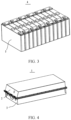
- FIG. 3 is a schematic diagram of a battery module 4 as an example.
- a plurality of battery cells 5 may be sequentially arranged in a length direction of the battery module 4.
- the battery cells may alternatively be arranged in any other manners.
- the plurality of battery cells 5 may be fastened through fasteners.
- the battery module 4 may further include an enclosure with an accommodating space, and the plurality of battery cells 5 are accommodated in the accommodating space.
- the battery module may be further assembled into a battery pack, and a quantity of battery modules included in the battery pack may be adjusted based on application and capacity of the battery pack.
- the battery module 4 and the battery pack may both be specific examples of the battery of this application.
- FIGs. 4 and 5 are schematic diagrams of a battery pack 1 as an example.
- the battery pack 1 may include a battery box and a plurality of battery modules 4 arranged in the battery box.
- the battery box includes an upper box body 2 and a lower box body 3.
- the upper box body 2 is configured to cover the lower box body 3 to form an enclosed space for accommodating the battery modules 4.
- the plurality of battery modules 4 may be arranged in the battery box in any manner.
- this application provides an electric apparatus.
- the electric apparatus includes at least one of the battery cell, the battery module, and the battery pack in this application.
- the battery cell, the battery module, and the battery pack may each be used as a power source of the electric apparatus or an energy storage unit of the electric apparatus.
- the electric apparatus may be but is not limited to a mobile device (for example, a mobile phone or a laptop computer), an electric vehicle (for example, a battery electric vehicle, a hybrid electric vehicle, a plug-in hybrid electric vehicle, an electric bicycle, an electric scooter, an electric golf vehicle, or an electric truck), an electric train, a ship, a satellite, and an energy storage system.
- FIG. 6 is schematic diagram of an electric apparatus as an example.
- This electric apparatus 6 is a battery electric vehicle, a hybrid electric vehicle, a plug-in hybrid electric vehicle, or the like.
- the battery pack 1 or the battery module may be used.
- the electric apparatus may be a mobile phone, a tablet computer, a laptop computer, or the like.
- the electric apparatus is typically required to be light and thin and may use a battery cell as its power source.
- An aluminum foil with a thickness of 12 ⁇ m was used as a positive electrode current collector.
- An ester polymer, positive electrode active substance LiFePO 4 , conductive agent carbon black, a binder such as poly(vinylidene difluoride), and N-methylpyrrolidone (NMP) were prepared into a positive electrode slurry.
- a mass ratio of the ester polymer, LiFePO 4 , the conductive carbon black, PVDF, and N-methylpyrrolidone (NMP) in the positive electrode slurry was 0.5:96.8:2:0.7:29.
- the positive electrode slurry was applied on the current collector aluminum foil. After drying at 85°C, cold pressing was performed. Then, after trimming, cutting, and slitting, vacuum drying was performed at 85°C for 4 h to obtain a positive electrode plate.
- a copper foil with a thickness of 8 ⁇ m was used as a negative electrode current collector.
- An ester polymer, negative electrode active substance artificial graphite, conductive agent carbon black, binder styrene-butadiene rubber (SBR), thickener sodium carboxymethyl cellulose (CMC), and deionized water were mixed well at a weight ratio of 2.5:94:0.5:2:1:100 to obtain a negative electrode slurry.
- the negative electrode slurry was applied on the current collector copper foil. After drying at 85°C, cold pressing, trimming, cutting, and slitting were performed. Then, vacuum drying was performed at 120°C for 12 h to obtain a negative electrode plate.
- non-aqueous organic solvents ethylene carbonate EC and ethyl methyl carbonate (EMC) were mixed at a volume ratio of 3:7 to obtain an electrolyte solvent.
- EMC ethyl methyl carbonate
- a lithium salt LiPF 6 was mixed with the mixed solvent to prepare an electrolyte with a lithium salt concentration of 1 mol/L.
- a polyethylene film (PE) with a thickness of 16 ⁇ m was used as a separator.
- the positive electrode plate, the separator, and the negative electrode plate were sequentially stacked so that the separator was located between the positive electrode plate and the negative electrode plate for separation. Then, the resulting stack was wound to obtain an electrode assembly.
- the electrode assembly was placed into an outer package shell. After drying, electrolyte injection was performed, and processes such as vacuum packaging, standing, formation, and shaping were performed to obtain a lithium-ion battery.
- a lithium-ion battery was prepared using a method similar to that in Example 1.
- Comparative example 1 differed from Example 1 in that no ester polymer was added into a positive electrode plate in Comparative example 1, and no ester polymer was added into a negative electrode plate in Comparative example 1.
- a lithium-ion battery was prepared using a method similar to that in Example 1.
- Comparative example 2 differed from Example 1 in that materials of ester polymers in a positive electrode plate and negative electrode plate in Comparative example 2 were changed.
- Lithium-ion batteries were prepared using a method similar to that in Example 1.
- Examples 2 to 4 differed from Example 1 in that materials of ester polymers in positive electrode plates and negative electrode plates in Examples 2 to 4 were changed.
- Example 5 differed from Example 1 in that an ester polymer was added into a positive electrode plate in Example 5, and no ester polymer was added into a negative electrode plate in Example 5.
- Example 6 differed from Example 1 in that an ester polymer was added into a negative electrode plate in Example 6, and no ester polymer was added into a positive electrode plate in Example 6.
- the lithium-ion battery prepared in each of the examples and comparative examples was charged to 4.25 V at a constant current of 1/3C at room temperature, then charged to a current of 0.05C at a constant voltage of 4.25 V, left standing for 5 min, and then discharged to 2.8 V at 1/3C.
- a capacity obtained was recorded as an initial capacity C0.
- the battery was adjusted to a state of 97% soc and stored in an environment at 60°C. The above steps were repeated on the same battery, and a discharge capacity Cn of the battery every 30 D was recorded, so that a battery capacity retention rate Pn after every 30 D was equal to Cn/C0 ⁇ 100%.
- a scatter plot of battery capacity retention rates versus storage days was obtained by plotting values of 5 points P1, P2, ..., and P5 as the vertical axis and plotting the corresponding storage times as the horizontal axis.
- Battery capacity retention rate data in Table 1 was data measured after storage for 150 D under the above test conditions, that is, the value of P5.
- the lithium-ion battery prepared in each of the examples and comparative examples was charged to 4.25 V at a constant current of 1/3C at 25°C, then charged to a current of 0.05C at a constant voltage of 4.25 V, and left standing for 5 min. Then, a voltage V1 was recorded. Then, the battery was discharged at 1/3C for 30s, and a voltage V2 was recorded. An internal resistance DCR1 of the battery after the first cycle was obtained by calculation through (V2-V1)/1/3C. The battery was charged to 4.25 V at a constant current of 1/3C at room temperature, then charged to a current of 0.05C at a constant voltage of 4.25 V, left standing for 5 min, and then discharged to 2.8 V at 1/3C.
- DCRn an internal resistance of the battery at the n-th cycle.
- a curve graph of battery discharge DCIR over storage days was obtained by plotting values of 5 points DCR1, DCR2, DCR3, ..., and DCR5 as the vertical axis and plotting the corresponding number of cycles as the horizontal axis.
- a battery internal resistance increase ratio in Table 1 was equal to (DCRn-DCR1)/DCR1 ⁇ 100%. Data in Table 1 was data measured after storage for 150 D under the above test conditions.
- 100% methyl methacrylate means that based on a total mass of the monomer 1, the monomer 2, and the monomer 3, a mass percentage of methyl methacrylate is 100%.
- 85% vinyl acetate means that based on the total mass of the monomer 1, the monomer 2, and the monomer 3, a mass percentage of vinyl acetate is 85%.
- 15% ethylene means that based on the total mass of the monomer 1, the monomer, and the monomer 3, a mass percentage of ethylene is 15%.
Landscapes
- Chemical & Material Sciences (AREA)
- Chemical Kinetics & Catalysis (AREA)
- Organic Chemistry (AREA)
- Health & Medical Sciences (AREA)
- Medicinal Chemistry (AREA)
- Polymers & Plastics (AREA)
- Engineering & Computer Science (AREA)
- General Chemical & Material Sciences (AREA)
- Electrochemistry (AREA)
- Materials Engineering (AREA)
- Manufacturing & Machinery (AREA)
- Wood Science & Technology (AREA)
- Life Sciences & Earth Sciences (AREA)
- Condensed Matter Physics & Semiconductors (AREA)
- Dispersion Chemistry (AREA)
- General Physics & Mathematics (AREA)
- Inorganic Chemistry (AREA)
- Physics & Mathematics (AREA)
- Secondary Cells (AREA)
- Battery Electrode And Active Subsutance (AREA)
Applications Claiming Priority (1)
| Application Number | Priority Date | Filing Date | Title |
|---|---|---|---|
| PCT/CN2023/076809 WO2024168818A1 (fr) | 2023-02-17 | 2023-02-17 | Polymère, feuille d'électrode et élément de batterie, batterie et appareil électrique associés |
Publications (2)
| Publication Number | Publication Date |
|---|---|
| EP4576265A1 true EP4576265A1 (fr) | 2025-06-25 |
| EP4576265A4 EP4576265A4 (fr) | 2026-04-29 |
Family
ID=92421869
Family Applications (1)
| Application Number | Title | Priority Date | Filing Date |
|---|---|---|---|
| EP23921968.6A Pending EP4576265A4 (fr) | 2023-02-17 | 2023-02-17 | Polymère, feuille d'électrode et élément de batterie, batterie et appareil électrique associés |
Country Status (6)
| Country | Link |
|---|---|
| US (1) | US20250210669A1 (fr) |
| EP (1) | EP4576265A4 (fr) |
| JP (1) | JP2025532568A (fr) |
| KR (1) | KR20250047818A (fr) |
| CN (1) | CN119604995B (fr) |
| WO (1) | WO2024168818A1 (fr) |
Family Cites Families (16)
| Publication number | Priority date | Publication date | Assignee | Title |
|---|---|---|---|---|
| JP2002511179A (ja) * | 1996-10-11 | 2002-04-09 | マサチューセッツ・インスティテュート・オブ・テクノロジー | 電池のための固体電解質、インターカレーション化合物及び電極 |
| JP4824302B2 (ja) * | 2004-12-17 | 2011-11-30 | パナソニック株式会社 | 電極用結着剤を含む水性分散体、水素吸蔵合金電極およびその製造法、アルカリ蓄電池、ならびにリチウムイオン二次電池 |
| CN102453186B (zh) * | 2010-10-29 | 2016-04-27 | 中国石油化工股份有限公司 | 一种丙烯乙烯无规共聚物的制备方法 |
| JP5617725B2 (ja) * | 2011-03-28 | 2014-11-05 | 日本ゼオン株式会社 | 二次電池用電極、二次電池電極用バインダー、製造方法及び二次電池 |
| PL2908364T3 (pl) * | 2012-10-10 | 2018-08-31 | Zeon Corporation | Sposób wytwarzania elektrody dodatniej dla akumulatora elektrycznego, akumulator elektryczny i sposób wytwarzania zespołu w postaci stosu dla akumulatora elektrycznego |
| CN102924704A (zh) * | 2012-10-31 | 2013-02-13 | 深圳新宙邦科技股份有限公司 | 共聚酯与其制备方法及聚合物电解质 |
| CN107735472B (zh) * | 2015-08-28 | 2019-12-20 | Jsr株式会社 | 粘合剂用组合物和粘合膜、蓄电设备用组合物、蓄电设备电极用浆料、蓄电设备电极、保护膜用浆料以及蓄电设备 |
| CN109119631B (zh) * | 2017-06-26 | 2021-09-21 | 宁德时代新能源科技股份有限公司 | 一种二次电池 |
| CN109309230B (zh) * | 2017-07-28 | 2021-11-02 | 宁德时代新能源科技股份有限公司 | 一种二次电池极片,其制备方法及使用该极片的二次电池 |
| CN113745454A (zh) * | 2020-05-27 | 2021-12-03 | 北京卫蓝新能源科技有限公司 | 一种正极片、其制备方法和在半固态电池中的应用 |
| EP4203108A4 (fr) * | 2020-08-20 | 2024-08-28 | ENEOS Materials Corporation | Composition de liant de dispositif accumulateur de puissance, suspension d'électrode de dispositif accumulateur de puissance, électrode de dispositif accumulateur de puissance, et dispositif accumulateur de puissance |
| CN114267815A (zh) * | 2020-09-16 | 2022-04-01 | 郑州宇通集团有限公司 | 一种固态电池用复合正极及其制备方法、固态锂电池 |
| CN112175134B (zh) * | 2020-09-30 | 2023-03-24 | 珠海冠宇电池股份有限公司 | 一种粘结剂及含有该粘结剂的锂离子电池 |
| WO2022220169A1 (fr) * | 2021-04-15 | 2022-10-20 | 株式会社Eneosマテリアル | Composition de liant pour dispositifs de stockage d'énergie, suspension pour électrodes de dispositif de stockage d'énergie, électrode de dispositif de stockage d'énergie et dispositif de stockage d'énergie |
| CN115706296B (zh) * | 2021-08-06 | 2025-02-18 | 宁德时代新能源科技股份有限公司 | 二次电池、电池模块、电池包和用电装置 |
| CN114583173B (zh) * | 2022-03-15 | 2024-06-11 | 湖北亿纬动力有限公司 | 一种负极浆料组合物和应用 |
-
2023
- 2023-02-17 EP EP23921968.6A patent/EP4576265A4/fr active Pending
- 2023-02-17 JP JP2025515547A patent/JP2025532568A/ja active Pending
- 2023-02-17 KR KR1020257008348A patent/KR20250047818A/ko active Pending
- 2023-02-17 WO PCT/CN2023/076809 patent/WO2024168818A1/fr not_active Ceased
- 2023-02-17 CN CN202380056581.8A patent/CN119604995B/zh active Active
-
2025
- 2025-03-11 US US19/076,147 patent/US20250210669A1/en active Pending
Also Published As
| Publication number | Publication date |
|---|---|
| JP2025532568A (ja) | 2025-10-01 |
| CN119604995B (zh) | 2026-01-13 |
| US20250210669A1 (en) | 2025-06-26 |
| EP4576265A4 (fr) | 2026-04-29 |
| CN119604995A (zh) | 2025-03-11 |
| WO2024168818A1 (fr) | 2024-08-22 |
| KR20250047818A (ko) | 2025-04-04 |
Similar Documents
| Publication | Publication Date | Title |
|---|---|---|
| EP4576265A1 (fr) | Polymère, feuille d'électrode et élément de batterie, batterie et appareil électrique associés | |
| EP4570846A1 (fr) | Polymère, feuille d'électrode et cellule de batterie, batterie et appareil électrique associés | |
| EP4617294A1 (fr) | Polymère d'ester, feuille d'électrode, et cellule de batterie, batterie et dispositif électrique associés | |
| EP4571894A1 (fr) | Feuille d'électrode et élément de batterie associé, batterie et dispositif électrique | |
| EP4588954A1 (fr) | Polymère d'éther, feuille d'électrode, et élément de batterie, batterie et dispositif électrique y associés | |
| CN119678261B (zh) | 极片及其相关的锂离子二次电池、电池和用电装置 | |
| US20250343244A1 (en) | Electrode plate, and battery cell, battery, and electrical device related thereto | |
| CN119631199B (zh) | 极片及其相关的锂离子二次电池、电池和用电装置 | |
| US20250391907A1 (en) | Aldehyde-ketone polymer, electrode plate and related battery cell, battery and electrical device | |
| EP4567055A1 (fr) | Polymère, feuille d'électrode et cellule de batterie associée, batterie et dispositif électrique |
Legal Events
| Date | Code | Title | Description |
|---|---|---|---|
| STAA | Information on the status of an ep patent application or granted ep patent |
Free format text: STATUS: THE INTERNATIONAL PUBLICATION HAS BEEN MADE |
|
| PUAI | Public reference made under article 153(3) epc to a published international application that has entered the european phase |
Free format text: ORIGINAL CODE: 0009012 |
|
| STAA | Information on the status of an ep patent application or granted ep patent |
Free format text: STATUS: REQUEST FOR EXAMINATION WAS MADE |
|
| 17P | Request for examination filed |
Effective date: 20250317 |
|
| AK | Designated contracting states |
Kind code of ref document: A1 Designated state(s): AL AT BE BG CH CY CZ DE DK EE ES FI FR GB GR HR HU IE IS IT LI LT LU LV MC ME MK MT NL NO PL PT RO RS SE SI SK SM TR |
|
| REG | Reference to a national code |
Ref country code: DE Ref legal event code: R079 Free format text: PREVIOUS MAIN CLASS: H01M0004600000 Ipc: C08F0218080000 |
|
| A4 | Supplementary search report drawn up and despatched |
Effective date: 20260326 |
|
| RIC1 | Information provided on ipc code assigned before grant |
Ipc: C08F 218/08 20060101AFI20260320BHEP Ipc: H01M 4/62 20060101ALI20260320BHEP Ipc: H01M 4/13 20100101ALI20260320BHEP Ipc: H01M 10/0565 20100101ALI20260320BHEP Ipc: H01M 10/0525 20100101ALI20260320BHEP Ipc: C08F 120/02 20060101ALI20260320BHEP Ipc: C08F 120/18 20060101ALI20260320BHEP Ipc: C08F 220/14 20060101ALI20260320BHEP Ipc: C08G 63/08 20060101ALI20260320BHEP Ipc: C09D 133/08 20060101ALI20260320BHEP Ipc: C09D 133/12 20060101ALI20260320BHEP Ipc: C08F 114/22 20060101ALN20260320BHEP |