EP4576314A1 - Batteriesteuereinheit und hochspannungsstromversorgungssystem - Google Patents
Batteriesteuereinheit und hochspannungsstromversorgungssystem Download PDFInfo
- Publication number
- EP4576314A1 EP4576314A1 EP23219425.8A EP23219425A EP4576314A1 EP 4576314 A1 EP4576314 A1 EP 4576314A1 EP 23219425 A EP23219425 A EP 23219425A EP 4576314 A1 EP4576314 A1 EP 4576314A1
- Authority
- EP
- European Patent Office
- Prior art keywords
- bus bar
- switch device
- control unit
- detection
- battery control
- Prior art date
- Legal status (The legal status is an assumption and is not a legal conclusion. Google has not performed a legal analysis and makes no representation as to the accuracy of the status listed.)
- Pending
Links
Images




Classifications
-
- H—ELECTRICITY
- H01—ELECTRIC ELEMENTS
- H01M—PROCESSES OR MEANS, e.g. BATTERIES, FOR THE DIRECT CONVERSION OF CHEMICAL ENERGY INTO ELECTRICAL ENERGY
- H01M10/00—Secondary cells; Manufacture thereof
- H01M10/42—Methods or arrangements for servicing or maintenance of secondary cells or secondary half-cells
- H01M10/425—Structural combination with electronic components, e.g. electronic circuits integrated to the outside of the casing
-
- G—PHYSICS
- G01—MEASURING; TESTING
- G01R—MEASURING ELECTRIC VARIABLES; MEASURING MAGNETIC VARIABLES
- G01R31/00—Arrangements for testing electric properties; Arrangements for locating electric faults; Arrangements for electrical testing characterised by what is being tested not provided for elsewhere
- G01R31/36—Arrangements for testing, measuring or monitoring the electrical condition of accumulators or electric batteries, e.g. capacity or state of charge [SoC]
- G01R31/364—Battery terminal connectors with integrated measuring arrangements
-
- G—PHYSICS
- G01—MEASURING; TESTING
- G01R—MEASURING ELECTRIC VARIABLES; MEASURING MAGNETIC VARIABLES
- G01R31/00—Arrangements for testing electric properties; Arrangements for locating electric faults; Arrangements for electrical testing characterised by what is being tested not provided for elsewhere
- G01R31/36—Arrangements for testing, measuring or monitoring the electrical condition of accumulators or electric batteries, e.g. capacity or state of charge [SoC]
- G01R31/3644—Constructional arrangements
-
- H—ELECTRICITY
- H01—ELECTRIC ELEMENTS
- H01M—PROCESSES OR MEANS, e.g. BATTERIES, FOR THE DIRECT CONVERSION OF CHEMICAL ENERGY INTO ELECTRICAL ENERGY
- H01M50/00—Constructional details or processes of manufacture of the non-active parts of electrochemical cells other than fuel cells, e.g. hybrid cells
- H01M50/50—Current conducting connections for cells or batteries
- H01M50/502—Interconnectors for connecting terminals of adjacent batteries; Interconnectors for connecting cells outside a battery casing
- H01M50/519—Interconnectors for connecting terminals of adjacent batteries; Interconnectors for connecting cells outside a battery casing comprising printed circuit boards [PCB]
-
- H—ELECTRICITY
- H01—ELECTRIC ELEMENTS
- H01M—PROCESSES OR MEANS, e.g. BATTERIES, FOR THE DIRECT CONVERSION OF CHEMICAL ENERGY INTO ELECTRICAL ENERGY
- H01M50/00—Constructional details or processes of manufacture of the non-active parts of electrochemical cells other than fuel cells, e.g. hybrid cells
- H01M50/50—Current conducting connections for cells or batteries
- H01M50/569—Constructional details of current conducting connections for detecting conditions inside cells or batteries, e.g. details of voltage sensing terminals
-
- H—ELECTRICITY
- H02—GENERATION; CONVERSION OR DISTRIBUTION OF ELECTRIC POWER
- H02J—ELECTRIC POWER NETWORKS; CIRCUIT ARRANGEMENTS OR SYSTEMS FOR SUPPLYING OR DISTRIBUTING ELECTRIC POWER; SYSTEMS FOR STORING ELECTRIC ENERGY
- H02J7/00—Circuit arrangements for charging or discharging batteries or for supplying loads from batteries
- H02J7/60—Circuit arrangements for charging or discharging batteries or for supplying loads from batteries including safety or protection arrangements
- H02J7/62—Circuit arrangements for charging or discharging batteries or for supplying loads from batteries including safety or protection arrangements against overcurrent
-
- H—ELECTRICITY
- H02—GENERATION; CONVERSION OR DISTRIBUTION OF ELECTRIC POWER
- H02J—ELECTRIC POWER NETWORKS; CIRCUIT ARRANGEMENTS OR SYSTEMS FOR SUPPLYING OR DISTRIBUTING ELECTRIC POWER; SYSTEMS FOR STORING ELECTRIC ENERGY
- H02J7/00—Circuit arrangements for charging or discharging batteries or for supplying loads from batteries
- H02J7/60—Circuit arrangements for charging or discharging batteries or for supplying loads from batteries including safety or protection arrangements
- H02J7/65—Circuit arrangements for charging or discharging batteries or for supplying loads from batteries including safety or protection arrangements against overtemperature
-
- H—ELECTRICITY
- H02—GENERATION; CONVERSION OR DISTRIBUTION OF ELECTRIC POWER
- H02J—ELECTRIC POWER NETWORKS; CIRCUIT ARRANGEMENTS OR SYSTEMS FOR SUPPLYING OR DISTRIBUTING ELECTRIC POWER; SYSTEMS FOR STORING ELECTRIC ENERGY
- H02J7/00—Circuit arrangements for charging or discharging batteries or for supplying loads from batteries
- H02J7/80—Circuit arrangements for charging or discharging batteries or for supplying loads from batteries including monitoring or indicating arrangements
-
- G—PHYSICS
- G01—MEASURING; TESTING
- G01R—MEASURING ELECTRIC VARIABLES; MEASURING MAGNETIC VARIABLES
- G01R1/00—Details of instruments or arrangements of the types included in groups G01R5/00 - G01R13/00 and G01R31/00
- G01R1/20—Modifications of basic electric elements for use in electric measuring instruments; Structural combinations of such elements with such instruments
-
- G—PHYSICS
- G01—MEASURING; TESTING
- G01R—MEASURING ELECTRIC VARIABLES; MEASURING MAGNETIC VARIABLES
- G01R31/00—Arrangements for testing electric properties; Arrangements for locating electric faults; Arrangements for electrical testing characterised by what is being tested not provided for elsewhere
- G01R31/36—Arrangements for testing, measuring or monitoring the electrical condition of accumulators or electric batteries, e.g. capacity or state of charge [SoC]
- G01R31/382—Arrangements for monitoring battery or accumulator variables, e.g. SoC
-
- H—ELECTRICITY
- H01—ELECTRIC ELEMENTS
- H01M—PROCESSES OR MEANS, e.g. BATTERIES, FOR THE DIRECT CONVERSION OF CHEMICAL ENERGY INTO ELECTRICAL ENERGY
- H01M10/00—Secondary cells; Manufacture thereof
- H01M10/42—Methods or arrangements for servicing or maintenance of secondary cells or secondary half-cells
- H01M10/48—Accumulators combined with arrangements for measuring, testing or indicating the condition of cells, e.g. the level or density of the electrolyte
-
- H—ELECTRICITY
- H01—ELECTRIC ELEMENTS
- H01M—PROCESSES OR MEANS, e.g. BATTERIES, FOR THE DIRECT CONVERSION OF CHEMICAL ENERGY INTO ELECTRICAL ENERGY
- H01M10/00—Secondary cells; Manufacture thereof
- H01M10/42—Methods or arrangements for servicing or maintenance of secondary cells or secondary half-cells
- H01M10/48—Accumulators combined with arrangements for measuring, testing or indicating the condition of cells, e.g. the level or density of the electrolyte
- H01M10/486—Accumulators combined with arrangements for measuring, testing or indicating the condition of cells, e.g. the level or density of the electrolyte for measuring temperature
-
- H—ELECTRICITY
- H01—ELECTRIC ELEMENTS
- H01M—PROCESSES OR MEANS, e.g. BATTERIES, FOR THE DIRECT CONVERSION OF CHEMICAL ENERGY INTO ELECTRICAL ENERGY
- H01M10/00—Secondary cells; Manufacture thereof
- H01M10/42—Methods or arrangements for servicing or maintenance of secondary cells or secondary half-cells
- H01M10/425—Structural combination with electronic components, e.g. electronic circuits integrated to the outside of the casing
- H01M2010/4271—Battery management systems including electronic circuits, e.g. control of current or voltage to keep battery in healthy state, cell balancing
-
- H—ELECTRICITY
- H01—ELECTRIC ELEMENTS
- H01M—PROCESSES OR MEANS, e.g. BATTERIES, FOR THE DIRECT CONVERSION OF CHEMICAL ENERGY INTO ELECTRICAL ENERGY
- H01M2200/00—Safety devices for primary or secondary batteries
- H01M2200/10—Temperature sensitive devices
- H01M2200/103—Fuse
-
- H—ELECTRICITY
- H01—ELECTRIC ELEMENTS
- H01M—PROCESSES OR MEANS, e.g. BATTERIES, FOR THE DIRECT CONVERSION OF CHEMICAL ENERGY INTO ELECTRICAL ENERGY
- H01M2220/00—Batteries for particular applications
- H01M2220/20—Batteries in motive systems, e.g. vehicle, ship, plane
-
- H—ELECTRICITY
- H01—ELECTRIC ELEMENTS
- H01M—PROCESSES OR MEANS, e.g. BATTERIES, FOR THE DIRECT CONVERSION OF CHEMICAL ENERGY INTO ELECTRICAL ENERGY
- H01M50/00—Constructional details or processes of manufacture of the non-active parts of electrochemical cells other than fuel cells, e.g. hybrid cells
- H01M50/50—Current conducting connections for cells or batteries
- H01M50/572—Means for preventing undesired use or discharge
- H01M50/574—Devices or arrangements for the interruption of current
- H01M50/581—Devices or arrangements for the interruption of current in response to temperature
-
- H—ELECTRICITY
- H01—ELECTRIC ELEMENTS
- H01M—PROCESSES OR MEANS, e.g. BATTERIES, FOR THE DIRECT CONVERSION OF CHEMICAL ENERGY INTO ELECTRICAL ENERGY
- H01M50/00—Constructional details or processes of manufacture of the non-active parts of electrochemical cells other than fuel cells, e.g. hybrid cells
- H01M50/50—Current conducting connections for cells or batteries
- H01M50/572—Means for preventing undesired use or discharge
- H01M50/574—Devices or arrangements for the interruption of current
- H01M50/583—Devices or arrangements for the interruption of current in response to current, e.g. fuses
-
- H—ELECTRICITY
- H02—GENERATION; CONVERSION OR DISTRIBUTION OF ELECTRIC POWER
- H02J—ELECTRIC POWER NETWORKS; CIRCUIT ARRANGEMENTS OR SYSTEMS FOR SUPPLYING OR DISTRIBUTING ELECTRIC POWER; SYSTEMS FOR STORING ELECTRIC ENERGY
- H02J2105/00—Networks for supplying or distributing electric power characterised by their spatial reach or by the load
- H02J2105/30—Networks for supplying or distributing electric power characterised by their spatial reach or by the load the load networks being external to vehicles, i.e. exchanging power with vehicles
- H02J2105/33—Networks for supplying or distributing electric power characterised by their spatial reach or by the load the load networks being external to vehicles, i.e. exchanging power with vehicles exchanging power with road vehicles
- H02J2105/37—Networks for supplying or distributing electric power characterised by their spatial reach or by the load the load networks being external to vehicles, i.e. exchanging power with vehicles exchanging power with road vehicles exchanging power with electric vehicles [EV] or with hybrid electric vehicles [HEV]
-
- H—ELECTRICITY
- H02—GENERATION; CONVERSION OR DISTRIBUTION OF ELECTRIC POWER
- H02J—ELECTRIC POWER NETWORKS; CIRCUIT ARRANGEMENTS OR SYSTEMS FOR SUPPLYING OR DISTRIBUTING ELECTRIC POWER; SYSTEMS FOR STORING ELECTRIC ENERGY
- H02J7/00—Circuit arrangements for charging or discharging batteries or for supplying loads from batteries
- H02J7/855—Circuit arrangements for charging or discharging batteries or for supplying loads from batteries with circuits adapted for supplying loads from the battery
-
- Y—GENERAL TAGGING OF NEW TECHNOLOGICAL DEVELOPMENTS; GENERAL TAGGING OF CROSS-SECTIONAL TECHNOLOGIES SPANNING OVER SEVERAL SECTIONS OF THE IPC; TECHNICAL SUBJECTS COVERED BY FORMER USPC CROSS-REFERENCE ART COLLECTIONS [XRACs] AND DIGESTS
- Y02—TECHNOLOGIES OR APPLICATIONS FOR MITIGATION OR ADAPTATION AGAINST CLIMATE CHANGE
- Y02E—REDUCTION OF GREENHOUSE GAS [GHG] EMISSIONS, RELATED TO ENERGY GENERATION, TRANSMISSION OR DISTRIBUTION
- Y02E60/00—Enabling technologies; Technologies with a potential or indirect contribution to GHG emissions mitigation
- Y02E60/10—Energy storage using batteries
Definitions
- the present disclosure relates to a battery control unit and a high voltage power supply system comprising the battery control unit.
- high voltage batteries become more and more common in vehicles like buses, trucks or passenger cars.
- high voltage batteries used in electric vehicles are formed of one or more battery pack and comprise 80 to 300 battery cells ("cells") connected in series and/or in parallel, to be capable of supplying high voltages in a range between 400 V and 1000 V. In future applications, even more battery cells may be used and higher voltages may be supplied by the high voltage batteries.
- High voltage batteries require a battery management system (BMS) in order to detect cell voltages, perform cell balancing, and monitor the cell temperature for improving the available capacity of the battery pack and increase the individual longevity of each cell.
- BMS battery management system
- the BMS connects and disconnects the battery pack to and from a DC bus that connects the HV battery to external loads (or to a charger) by controlling the operation of contactors, which are electrically connected in series with the positive and negative terminals of the HV battery.
- the external loads include high voltage components, like motor inverters (DCAC converters), DCDC converters, or chargers (ACDC converters), heaters, auxiliary loads or other high voltage components.
- the BMS monitors the voltages dropping across each of the contactors.
- the BMS is usually connected by cable connections to voltage measuring contact pairs, which allow for detecting the respective voltages.
- the BMS needs to monitor a battery current provided by the battery.
- the BMS usually is connected by cable connections to at least one current sensor, which is electrically connected in series with the HV battery, and is often provided in form of a dedicated shunt resistor.
- the overcurrent should be interruptible immediately and permanently.
- an additional overcurrent protection devices like a circuit breaker, a fuse or a pyro-fuse in series to the HV battery.
- the activation and functioning of the overcurrent protection device is also controlled by the BMS.
- the inventors of the present invention have recognized that there is still room for improvement in connecting the detection contacts of the battery management system to the detection contacts of the HV battery power supply system. Accordingly, it is an object of the present invention to provide an improved battery control unit, and a power supply system, which can provide a higher level of functional integration and/or can lower the necessary interconnection efforts between the dedicated electric components. Furthermore, it is an object of the present invention to provide a space-saving and economic solution.
- the present disclosure provides a battery control unit, which comprises a switch device, and an assembled circuit, which is mounted on a circuit board.
- the assembled circuit includes detection circuitry, which is configured to detect at least one operational parameter of the switch device, processing circuitry, which is configured to control the operation of the switch device in accordance with the at least one operational parameter detected by the detection circuitry, and a plurality of detection contacts for detecting the at least one operational parameter of the switch device.
- the battery control unit further comprises a bus bar arrangement, which comprises an input bus bar, which is conductively coupled to an input terminal of the switch device, and an output bus bar, which is conductively coupled to an output terminal of the switch device, wherein the circuit board is disposed with respect to the bus bar arrangement such that the plurality of detection contacts abut against corresponding contact surfaces being provided on the input bus bar and on the output bus bar.
- a bus bar arrangement which comprises an input bus bar, which is conductively coupled to an input terminal of the switch device, and an output bus bar, which is conductively coupled to an output terminal of the switch device, wherein the circuit board is disposed with respect to the bus bar arrangement such that the plurality of detection contacts abut against corresponding contact surfaces being provided on the input bus bar and on the output bus bar.
- the present disclosure is based on the idea of abolishing the need for providing cable connections between a battery control unit of a battery management system, which sometimes is signified as a (smart) battery sensor, and the detection contacts of a power supply system, by integrating a part of the bus bars of the power supply system into a battery control unit, and by providing detections contact for the control circuitry of the BMS, which can be pressed onto the bus bars of the battery control unit to make contact.
- the present disclosure allows for substantially reducing the interconnection efforts between the control circuits (detection and processing circuits) of the BMS and the bus bars (or leads) of the power supply system, and also allows for providing a device, which reduces the required installation space.
- the input bus bar and the output bus bar each comprise a main body portion, which extends substantially parallel to the circuit board, wherein an end region of the input bus bar, which is conductively coupled with the input terminal of the switch device is bent with respect to the main body portion of the input bus bar, and wherein an end region of the output bus bar, which is conductively coupled with the output terminal of the switch device is bent with respect to the main body portion of the output bus bar.
- a bending angle between the main body portion and the end region of the input bus bar and of the output bus bar lies preferably between 70° and 110°, more preferably between 80° and 100°, and most preferably is approximately 90°.
- the circuit board is disposed between the switch device and a plane, which is spanned by the main body portions of the input bus bar and of the output bus bar.
- the bus bars of the bus bar arrangement, the circuit board, which carries the assembled circuit and the switch device are advantageously stacked above each other in a direction from the bottom to the top of the battery control unit, so that a base area of the battery control unit can be reduced.
- the battery control unit further comprises a bus bar housing element, which houses the input bar and the output bus bar, wherein the bus bar housing element isolates the input bus bar and the output bus bar from the assembled circuit and exposes the contact surfaces of the input bus bar and of the output bus bar to the plurality of detection contacts.
- the bus bar housing element carries the main body portions of the input bus bar and of the output bus bar in a constant distance to the circuit board of the assembled circuit, while the bus bar housing element holds and isolates the bus bars of the bus bar arrangement from the assembled circuit. Furthermore, the bus bar housing element can also provide a support surface for the circuit board and stabilize the circuit board against impacts, like vibrations and shocks, from the outside.
- the bus bars of the bus bar arrangement is overmolded with a thermosetting polymer to form the bus bar housing element.
- an injection molding process can be applied for fabricating the bus bar housing element.
- a bottom surface of the bus bar housing element which faces away from the assembled circuit, is covered with an insulating bottom cover, which is formed of an insulating heat conducting material, and an external surface of the insulating bottom cover forms a cooling surface for cooling the input bus bar and the output bus bar.
- an efficient thermal management of the battery control unit can be achieved and the heat generated in the bus bars is directed towards the cooling surface, instead of heating up the electronic components of the assembled circuit.
- the plurality of detection contacts are formed of compressible contact elements, wherein the plurality of detection contacts in particular are each formed of a strap-shaped metal band, which is filled with an insulating foam.
- the corresponding contact surfaces of the input bus bar and of the output bus bar are integrally formed with the top surfaces of the input bus bar and of the output bus bar, which face towards the assembled circuit.
- This aspect advantageously contributes in providing a compact design of the battery control unit.
- the bus bars of the bus bar arrangement comprise projecting holding arms, which each may carry a contact surfaces contacting the corresponding detection contact of the assembled circuit.
- a first one of the plurality of detection contacts abuts against a corresponding contact surfaces being provided on the input bus bar and a second one of the plurality of detection contacts abuts against a corresponding contact surface being provided on the output bus bar.
- the detection circuitry comprises a first detection circuit, which is configured to detect a voltage dropping between the first one of the plurality of detection contacts and the second one of the plurality of detection contacts, and the processing circuitry is configured to determine a voltage value of the voltage dropping across the switch device as an operational parameter of the switch device.
- the processing circuitry of the battery control unit can directly determine the voltage dropping across the switch device, without the need of contacting the detection points of the bus bars by cable, and, by using integrated internal control functions, control opening and closing of the switch device based on the determined voltage drop for ensuring safe operation of the switch device.
- the bus bar arrangement comprises at least one resistor element having a predefined resistance.
- a third one of the plurality of detection contacts and a fourth one of the plurality of detection contacts abut against corresponding contact surfaces of the bus bar arrangement, which are arranged for detecting a resistor voltage dropping across the resistor element
- the detection circuitry comprises a second detection circuit, which is configured to detect the resistor voltage dropping across the resistor element between the third one of the plurality of detection contacts and the fourth one of the plurality of detection contacts
- the processing circuitry is configured to determine a current value of a current flowing through the switch device as the at least one operational parameter based on the detected resistor voltage.
- the battery control unit detection can directly determine the current flowing through the switch device, which corresponds to a battery current of a battery electrically connected with the battery control unit, without the need of contacting the detection points of a dedicated shunt resistor by a cable. Further, by using integrated internal control functions, the battery control unit can control opening and closing of the switch device based on the determined current value for ensuring safe operation of the battery and of the switch device.
- the assembled circuit comprises a temperature sensor, which is thermally coupled with at least one of the input bus bar and of the output bus bar by at least one of the plurality of detection contacts, and the processing circuitry is configured to determine a temperature of the temperature sensor as an operational parameter of the switch device.
- the battery control unit detection can directly determine the temperature of at least one of the bus bars without the need of contacting the detection points of the bus bar by a cable. Further, by using integrated internal control functions, the battery control unit can control opening and closing of the switch device based on the determined temperature for ensuring safe operation for ensuring safe operation of the battery and of the switch device.
- the bus bar arrangement further comprises a ground terminal, which is electrically isolated from the input bus bar and from the output bus bar, for electrically connecting a ground potential.
- a fifth one of the plurality of detection contacts abuts against a corresponding contact surface of the ground terminal
- the detection circuitry comprises a third detection circuit, which is configured to detect a third detection voltage, which is indicative of a leakage path resistance between the ground terminal and one of the input bus bar and of the output bus bar
- the processing circuitry is configured to determine the leakage path resistance as an operational parameter of the switch device.
- the battery control unit detection can directly determine a leakage path resistance between one or more of the bus bars of the bus bar arrangement and the ground terminal, which is for example connected to a chassis of a vehicle to define the ground potential of the battery control unit, without the need of contacting the ground terminal by a cable. Further, by using integrated internal control functions, the battery control unit can control opening and closing of the switch device based on the determined leakage path resistance for ensuring safe operation of the battery and of the switch device.
- the assembled circuit comprises a first communication interface for performing communication with at least one cell monitoring device, which monitors battery parameters of a high voltage battery, and the processing circuitry is configured to control the operation of the switch device in accordance with at least one of the battery parameters, which is received by the first communication interface from the cell monitoring device.
- the assembled circuit comprises a second communication interface for performing communication with an external controller, which is configured to control a high voltage battery, and the processing circuitry is configured to control the operation of the switch device in accordance with a control command, which is received by the second communication interface from the external controller.
- the battery control unit detection can receive battery parameters, like cell voltages and cell temperatures from the cell monitoring device and/or control commands from an external controller, like an electronic control unit (ECU) of a vehicle and can control opening and closing of the switch device based on the received battery parameters and/or based on the received control commands.
- an external controller like an electronic control unit (ECU) of a vehicle
- ECU electronice control unit
- the switch device is configured to switch between an open state and a closed state, wherein in the open state current flow through the switch device is interrupted, and in the closed state current flow through the switch device is allowed, and the processing circuitry is configured to switch the switch device in accordance with the at least one operational parameter detected by the detection circuitry.
- the battery control unit further comprises at least one overcurrent protection device, which is configured to prevent overcurrent to flow through the switch device, and the processing circuitry is configured to control the operation of the at least one overcurrent protection device in accordance with the at least one operational parameter detected by the detection circuitry.
- the overcurrent protection device can for example be a circuit breaker, a fuse or a pyrofuse. But also other suitable devices, which allow for immediately breaking an excessive overcurrent in a high voltage power supply system are suitable. In an optional implementation of the thirteenth aspect, the overcurrent protection device is integrated into the switch device to form an integral part of the switching device.
- a fourteenth aspect there is also provided a power supply system, which comprises at least one battery and the battery control unit according to one of the first to thirteenth aspects, wherein the at least one battery is conductively coupled to the switch device.
- a method for assembling a battery control unit comprises the step of mounting an assembled circuit on a circuit board, wherein the assembled circuit includes detection circuitry, which is configured to detect at least one operational parameter of a switch device, and processing circuitry, which is configured to control the operation of the switch device in accordance with the at least one operational parameter detected by the detection circuitry, and a plurality of detection contact surfaces for detecting the at least one operational parameter of the switch device.
- the method comprises the step of conductively coupling the assembled circuit to a bus bar arrangement, which comprises an input bus bar and an output bus bar, wherein the plurality of detection contacts are pressed to corresponding contact surfaces being provided on the input bus bar and on the output bus bar, so as to abut against the corresponding contact surfaces, and conductively coupling the input bus bar to a first terminal of the switch device and the output bus bar to a second terminal of the switch device.
- a bus bar arrangement which comprises an input bus bar and an output bus bar, wherein the plurality of detection contacts are pressed to corresponding contact surfaces being provided on the input bus bar and on the output bus bar, so as to abut against the corresponding contact surfaces, and conductively coupling the input bus bar to a first terminal of the switch device and the output bus bar to a second terminal of the switch device.
- terminal is meant to describe a point at which a conductor from an electric device, an electric circuit or an electric component ends, and where a point is provided for electrically connecting an external electric device, an external electric circuit or an external electric component to this conductor.
- electrically connected and conductively coupled describe the establishing of an electrical connection between at least two electric devices, electric components or electric conductors, which allows the flow of electric current.
- the electrical connection should not be restricted to a direct coupling of the terminals of the at least two electric devices, electric components or electric conductors, but other electric devices, electric components or electrical conductors may be coupled in between.
- Figs. 1 and 2 show schematic perspective views of an exemplary battery control unit 100.
- the battery control unit 100 is an apparatus, which by its specific design allows for abolishing the need for providing cable connections between a battery control unit of a battery management system, which sometimes is signified as a (smart) battery sensor and controls operation of a (HV) battery, and the detection contacts of a power supply system, which is supplied by the (HV) battery.
- a battery control unit of a battery management system which sometimes is signified as a (smart) battery sensor and controls operation of a (HV) battery
- HV power supply system
- the battery control unit 100 is used in a power supply system of an electric vehicle for controlling the power supply of electric loads like a drivetrain of the electric vehicle, which are supplied at a predetermined high voltage in a range between 400 V and 1000 V or at an even higher voltage.
- the battery control unit 100 may also be used in other application scenarios, like the storage and/or supply of high voltage energy in one or a plurality of high voltage batteries, like an energy storage system used in an electrical power grid, or in application scenarios that require lower voltages than 400 V.
- the battery control unit 100 comprises a switch device 102, which in the illustrated example is a contactor device, having the function of a two-pole contactor.
- a pair of input bus bars 104 and 106 is conductively coupled at respective end regions 108 and 110 (see Fig. 3 ) of the input bus bars 104 and 106 to first and second input terminals of the switch device 102.
- the input bus bars 104 and 106 respectively comprise input connection terminals 112 and 114 for connecting the high potential side and the low potential side of a high voltage battery (not shown).
- a pair of output bus bars 116 and 118 is conductively coupled at respective end regions 120 and 122 (see Fig. 3 ) of the output bus bars 116 and 118 to first and second output terminals of the switch device 102.
- the output bus bars 116 and 118 respectively comprise output connection terminals 117 and 119 for connecting the high potential side and the low potential side of a high voltage DC link (not shown), which is connected to the electric loads of the power supply system or to a charger.
- the bus bars 104, 106 116 and 118 of the battery control unit 100 are formed of an electrically conductive material with a high specific electrical conductivity, like copper or aluminum.
- the switch device 102 is configured to electrically connect or disconnect the HV battery, which is electrically connected to the input connection terminals 112 and 114, to and from the HV DC link, which is electrically connected to the output connection terminals 117 and 119.
- the switch device 102 switches between an open state and a closed state. In the closed state, the current-carrying contacts of the switch device 102 are in contact, so that current flow through the switch device 102 from the HV battery to the HV DC link (or vice versa) is allowed. In the open state, the current-carrying contacts of the switch device 102 are isolated from each other, so that current flow through the switch device 102 from the HV battery to the HV DC link (or vice versa) is interrupted.
- the switch device 102 of the illustrated example is a contactor, which is capable of switching high DC voltages up to 900 V and DC currents up to 25 kA, depending on application requirements other switch devices, like other circuit breakers for high voltage applications or semiconductor switches for low voltage applications, may be implemented instead.
- the number of input bus bars and output bus bars may vary from the illustrated number of two input bus bars and two output bus bars depending on the configuration requirements of the switch device 102.
- the battery control unit 100 may comprise a single-pole switch (or contactor) as the switch device 102, so that only one input bus bar and one output bus bar are installed for connecting the terminals of the single-pole switch (or contactor) to the respective input connection terminal and the respective output connection terminal.
- the bus bar arrangement of the battery control unit 100 comprises a plurality of input bus bars and output bus bars to connect all the terminals of the one or more switch device(s) 102 to input connection terminals and output connection terminals of the battery control unit 100.
- the internal structure of the battery control unit 100 is illustrated by the schematic exploded view of Fig. 3 .
- a surface, which faces in the same direction as the arrow 123 is signified as the "top surface” of an element
- a surface, which faces in a direction opposite to the arrow 123 is signified as the "bottom surface” of the element. It should be kept in mind that these terms are only used for the purpose of facilitating the description of the respective features and their relative orientation within the battery control unit 100 and should not be construed as limiting the claimed invention or any of its components to a particular spatial orientation.
- the bus bar arrangement which is formed by the pair of input bus bars 104 and 106 and the pair of output bus bars 116 and 118 is overmolded with an insulating plastic, in particular a thermosetting polymer, such that the insulating plastic forms a bus bar housing element 124, which houses and carries the bus bars of the bus bar arrangement in bus bar holding portions.
- the bus bar housing element 124 provides, besides the bus bar housing portions, which hold the bus bars of the bus bar arrangement, on its top surface 126, i.e. the surface adverse to the bus bar housing portions, a supporting surface for a circuit board 128, on which the control circuitry of the battery control unit 100 is installed as an assembled circuit 130 (described later).
- the bus bar housing element 124 is disposed between the bus bars of the bus bar arrangement and the circuit board 128 and isolates the assembled circuit 130 from the input bus bars 104 and 106 and from the output bus bars 116 and 118. Only areas where detection contacts of the assembled circuit 130 are provided and are pressed against corresponding contact surfaces of the input bus bars 104 and 106 and of the output bus bars 116 and 118 are exposed, so as to allow to press the detection contacts of the assembled circuit 130 onto the corresponding detection surfaces for making an electric connection.
- the bus bar housing element 124 serves as a spacer, which holds the circuit board 128 with a constant distance to main body portions 132 (see Fig.
- Positioning posts can be disposed to protrude from the top surface of the bus bar housing element 124 to simplify positioning and holding of the circuit board 128. The positioning posts can be inserted into corresponding positioning holes of the circuit board 128.
- the bottom surface of the input bus bars 104 and 106 and of the output bus bars 116 and 118 is covered with an isolating bottom cover plate 134, which is fixed to the bus bar housing element 124, for example by injection molding or other suitable techniques known in the art.
- the bottom cover plate 134 is formed of an insulating material with a good thermal conductivity.
- the bottom surface of the bottom cover plate 134 forms a cooling surface 136, which acts as a thermal interface of the battery control unit 100, for example with a cooling system of a vehicle.
- the bottom cover plate 134 can correspond to the complete bottom surface of the battery control unit 100.
- the circuit board 128 and the assembled circuit 130 are encapsulated in a top cover 138.
- the top cover 138 is designed to hold the circuit board 130 on the supporting surface of the bus bar housing element 124.
- the top cover 138 is fixed to the bus bar housing element 124 by first attachment members 140, here exemplified as screws, such that the circuit board 130 is sandwiched between the bus bar housing element 124 and the top cover 138.
- the top cover 138 comprises a first connector 142, which houses a first communication interface 144.
- the control circuitry of the battery control unit 100 can receive battery parameters, like cell voltages and cell temperatures of the individual battery cells of the HV battery, from the at least one cell monitoring device or can control balancing of the voltages of the battery cells of the HV battery by activating active or passive cell balancing circuits of the at least one cell monitoring device.
- the first communication interface 144 is an isoSPI (isolated Serial Port Interface) interface and allows the control circuitry of the battery control unit 100 to perform communication with the at least one cell monitoring device by using an isoSPI protocol.
- the first communication interface 144 may be an interface of a CAN (Controller Area Network) bus, or may be an Ethernet interface.
- CAN Controller Area Network
- the first communication interface 144 may be a wireless interface and may be configured to perform wireless communication with the at least one cell monitoring unit instead of performing communication via cable connection.
- the top cover 138 For allowing the control circuitry of the battery control unit 100 to communicate with an external controller, such as a vehicle ECU or a superordinate controller of a power grid, which supervises the operation of battery control unit 100 and of the connected HV battery, the top cover 138 comprises a second connector 146, which houses a second communication interface 148.
- the control circuitry of the battery control unit 100 can, for example, receive control commands for controlling the operation of the switch device 102 from the external controller.
- the second communication interface 148 is, for example, an interface to a CAN (Controller Area Network) bus allowing the control circuitry of the battery control unit 100 to perform communication with the external controller by a CAN protocol (like CAN, CANFD or CAN Extended).
- a CAN protocol like CAN, CANFD or CAN Extended
- the second communication interface 148 can be a LIN (Local Interconnect Network) interface, a FlexRay interface, an isoSPI (isolated Serial Port Interface) interface or an Ethernet interface, thus allowing communicating with the external controller via the respective communication protocol.
- LIN Local Interconnect Network
- FlexRay FlexRay interface
- isoSPI isolated Serial Port Interface
- Ethernet Ethernet interface
- the switch device 102 is installed on top of the top cover 138 of the assembled circuit 130, such that the assembled circuit 130, which is encapsulated between the bus bar housing element 124 and the top cover 138, is disposed between the switch device 102 and the main body portions 132 of the bus bars of the bus bar arrangement. Accordingly, the circuit board 128 and the switch device 102 are disposed on a same base area, which is spanned by the main body portions 132 of the bus bars of the bus bar arrangement, in the illustrated example the input bus bars 104 and 106 and by the output bus bars 116 and 118, so that the space requirements of the battery control unit 100 can be reduced.
- mounting portions 150 of the switch device are fixed by second attachment members 152 to mounting studs 154, which are formed, in particularly integrally formed, with the bus bar housing element 124, and which extend upwards from a base plane of the bus bar housing element 124.
- the end regions 108 and 110 of the input bus bars 104 and 106 and the end regions 120 and 122 of the output bus bars 116 and 118 comprise cut-outs, which are screwed to the corresponding input terminals and the output terminals of the switch device 102 to conductively couple the bus bars of the bus bar arrangement to the switch device 102.
- the bus bars of the bus bar arrangement to the switch device 102 can be conductively coupled with the corresponding terminals by welding, soldering or any other suitable connection method known in the art.
- a protection plate 156 is mounted on the outside parts of the end regions 108 and 110 of the input bus bars 104 and 106 and on the outside parts of the end regions 120 and 122 of the output bus bars 116 and 118, which are exposed by the bus bar housing element 124. Accordingly, after completely mounting the battery control unit 100, only the input connection terminals 112 and 114 and the output connection terminals 117 and 119 are accessible to connect the HV carrying parts to external electric components.
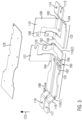
- Figs. 5 and 6 show schematic perspective views of the circuit board 128, on which the assembled circuit 130, is mounted, and of the bus bar arrangement of the battery control unit 100, before the circuit board is attached to the bus bars of the bus bar arrangement.
- Fig. 7 shows a schematic perspective views of the circuit board 128 and of the bus bar arrangement of the battery control unit 100, after attaching the circuit board 128 to the to the bus bars of the bus bar arrangement. In Fig. 7 , the parts of the circuit board 128, which would hide the detection contacts of the assembled circuit 130 are not shown.
- each of the bus bars of the bus bar arrangement comprises a bending between the main body portion and the end region.
- the input bus bar 104 comprises a bending 158 between the main body portion 132 and the end region 108
- the input bus bar 106 comprises a bending 160 between the main body portion 132 and the end region 110
- the output bus bar 116 comprises a bending 162 between the main body portion 132 and the end region 120
- the output bus bar 118 comprises a bending 164 between the main body portion 132 and the end region 122.
- the end regions of the input bus bars and of the output bus bars extend in a plane that is substantially orthogonal to the plane, in which the main body portions 132 of the input bus bars and of the output bus bars extend, which means that a bending angle between the main body portions and the end regions is approximately 90° for each of the input bus bars 104 and 106 and for each of the output bus bars 116 and 118.
- the specific bending angle can however be selected depending on application needs and any bending angle in a range between 45° and 135°, or preferably in a range between 70° and 110° may be selected.
- the switch device 102 may be disposed at the side of the circuit board 128 instead of on top of the circuit board 128. In this alterative implementation it is also possible that the end regions of the bus bars extend in the same plane like the main body portions of the bus bars and the bus bars of the bus bar arrangement, and do not comprise the bending.
- the input connection terminals 112 and 114 and the output connection terminals 117 and 119 may be elevated above the plane, in which the main body portions 132 of the bus bars of the bus bar arrangement extend.
- the input connection terminals 112 and 114 and the output connection terminals 117 and 119 may extend in the same plane as the main body portions, or may be bend up in a similar manner as the end regions of the bus bars.
- the assembled circuit 130 comprises a plurality of detection contacts 166, 168, 170, 172, 174, 176, 178, 180 and 182 which are pressed against corresponding contact surfaces of the bus bars of the bus bar arrangement (see Figs. 6 and 7 ).
- the plurality of detection contacts 166, 168, 170, 172, 174, 176, 178, 180 and 182 are formed of spring-loaded contacts, which abut against the corresponding contact surfaces when making contact between the bus bars of the bus bar arrangement and the assembled circuit 130.
- the elasticity of the spring-loaded contacts allows to compress the plurality of detection contacts 166, 168, 170, 172, 174, 176, 178, 180 and 182 and helps in compensating fabrication tolerances between the bus bars of the bus bar arrangement. Accordingly, a reliable contact between each of the bus bars of the bus bar arrangement and the assembled circuit 130 can be guaranteed even if the contact surfaces of the bus bars are arranged at slightly deviating heights.
- the plurality of detection contacts 166, 168, 170, 172, 174, 176, 178, 180 and 182 are formed of so called "gaskets", by a strap-shaped metal band, which is filled with an insulating foam, so that the insulating foam is compressed, when the plurality of detection contacts 166, 168, 170, 172, 174, 176, 178, 180 and 182 are pressed onto the bus bars of the bus bar arrangement.
- the corresponding contact surfaces are provided on the top sides of the input bus bars 104 and 106 and the top surfaces of the output bus bars 116 and 118, which means that the corresponding contact surfaces are integrally formed with the top surfaces of the input bus bars 104 and 106 and the top surfaces of the output bus bars 116 and 118, which face towards the assembled circuit 130.
- the input bus bars 104 and 106 and the output bus bars 116 and 118 may be formed with protruding extension arms, which each carry one of the contact surfaces.
- Fig.8 shows a schematic block diagram of the assembled circuit 130, which is mounted on the circuit board 128.
- the assembled circuit 130 comprises a processing circuitry 184, which controls the operation of the switch device 102 as part of the control circuitry of the battery control unit 100 in order to allow or to interrupt current flow through the switch device 102.
- the switch device 102 and in particular an internal controller of the switch device 102, is for example connected to the assembled circuit 130 by a wired connection, such as an "Y wire" harness, so that the processing circuitry 184 can control the operation of the switch device 102.
- the processing circuitry 184 controls the operation of the switch device 102 in accordance with one or more operational parameters, which are detected by a detection circuitry 186 of the assembled circuit 130 or in accordance with control commands received by the processing circuitry from an external controller through the second communication interface 148.
- the operational parameter may be at least one of a plurality of battery parameters received by the processing circuitry 184 through the first communication interface 144.
- the operational parameter can be at least one of a voltage dropping across the contacts of the switch device 102, which corresponds to a voltage dropping between the input bus bar 104 and the output bus bar 116 or a voltage dropping between the input bus bar 106 and the output bus bar 118, a battery current, which corresponds to a current flowing through the switch device 102, a temperature of a temperature sensor of the assembled circuit 130, or a leakage path resistance, which exists between a ground terminal (or voltage reference terminal) 188 and at least one of the bus bars of the battery control unit.
- the detection contact 166 which abuts against a corresponding contact surface of the input bus bar 104
- the detection contact 168 which abuts against a corresponding contact surface of the output bus bar 116
- the detection circuitry 186 comprises a first detection circuit, which is configured to detect a voltage between the first pair of voltage detection contacts 166 and 168 being indicative of the voltage dropping across the switch device 102 between the input bus bar 104 and the output bus bar 116 as one of the operational parameters of the switch device 102.
- the processing circuitry 184 is configured to determine the voltage dropping across the contacts of the switch device 102, and to control the opening and closing of the switch device 102 based on the determined voltage(s) dropping across the contacts of the switch device 102. For example, due to possible current peaks, which may harm components electrically connected to the HV DC bus, like a DC link capacitor, the processing circuitry 184 may only switch the switch device 102 to the closed state, if the determined contactor voltage is equal or smaller than a predetermined voltage threshold, but will prohibit switching the switch device 102 to the closed state, if the determined contactor voltage is larger than the predetermined voltage threshold. As an optional implementation, the processing circuitry 184 may control a pre-charging circuit to pre-charge the DC link capacitor, before switching the switch device 102 to the close state.
- the first resistance element 192 is formed of the same material as the first electrically conductive connection element and the intermediate connection element with a specific geometrical shape, which allows to define the resistance value of the first resistance element 192.
- the first resistance element 192 can be designed to have a predefined resistance below 50 ⁇ Ohm, while preferably the resistance is below 10 ⁇ Ohm in order to reduce the heating losses in the first resistance element 192.
- the second resistance element 194 is formed of a first resistance material, such as a manganin alloy, wherein in particular CuMn10Ni4 and CuMn12Ni2 and CuMn14Ni2 and CuZn15Mn150AI can be named as examples, or a similar suitable resistance material known in the art, which has a lower specific electrical conductivity than the conductive material of the first electrically conductive connection element and the second electrically conductive connection element.
- the second resistance element 194 typically is designed to have a predefined resistance in the range of 10 - 50 ⁇ Ohm.
- the battery current can be redundantly determined by means of the second resistance element 194.
- the detection contact 168 which abuts against a corresponding contact surface of the second electrically conductive connection element of the resistor arrangement 190 (or alternatively against a corresponding contact surface of the second half 116(2) of the input bus bar 116), and the detection contact 174, which abuts against a corresponding contact surface of the intermediate connection element of the resistor arrangement 190, form a second pair of current detection contacts 168 and 174.
- the second detection circuit is configured to detect a voltage between the second pair of current detection contacts 168 and 174, which is indicative of the voltage dropping across the second resistance element 194.
- the design of the resistor arrangement 190 is not limited to the above described double shunt sensor geometry.
- double shunt sensors with two resistance elements being formed of manganese or a similar resistance material may be used.
- double-shunt sensor it is also possible to use a single shunt sensor with a single resistance element or a plurality of single shunt sensors.
- the second example is not limited to connecting the resistor arrangement 190 on the output bus bar 116, but the resistor arrangement 190 may be connected to one of the other input bus bars 104 and 106 or the output bus bar 118 instead.
- separate individual resistor arrangement are connected to more than one of the bus bars of the bus bar arrangement.
- the configuration of the detection contacts which serve as current detection contacts, is adapted according to the geometry of the resistor arrangement(s), such as to enable a detection and determination of the battery current through the resistor arrangement(s).
- the assembled circuit 130 comprises a temperature sensor, such as an NTC thermistor or other suitable temperature sensor, which is thermally coupled by one of the plurality of detection contacts with at least one of the bus bars of the bus bar arrangement.
- a temperature sensor such as an NTC thermistor or other suitable temperature sensor, which is thermally coupled by one of the plurality of detection contacts with at least one of the bus bars of the bus bar arrangement.
- the detection contact 182 which abuts against a corresponding contact surface of the intermediate connection element of the resistor arrangement 190 forms a temperature detection contact, which enables the temperature sensor to sense the temperature of the resistor arrangement 190.
- another one of the plurality of detection contacts 166, 168, 170, 172, 174, 176, 178, 180 and 182 can function as temperature detection contact, which is thermally coupled to the temperature sensor, so that the temperature sensor senses the temperature at another location of the bus bar arrangement.
- the processing circuitry 184 can additionally perform a TCR (temperature coefficient ratio) correction of the resistance of the first resistance element 192 and of the second resistor element 194 and can accordingly enhance the accuracy of the battery current determination.
- the processing circuitry 184 determines the temperature of the temperature sensor and controls the state of the switch device based on the sensed temperature. For example, if the processing circuitry 184 determines that the temperature of the temperature sensor exceeds a temperature threshold, which indicates an overheating of the bus bars of the bus bar arrangement by high currents, the processing circuitry 184 brings the switch device 102 in the open state to interrupt the current.
- the processing circuitry 184 may in addition control the activation of an overcurrent protection device being integrated into the switch device 102, if the processing circuitry 184 determines that the temperature of the temperature sensor exceeds the temperature threshold for longer than a predetermined time.
- the plurality of detection contacts 166, 168, 170, 172, 174, 176, 178, 180 and 182 are fitted through the openings of the bus bar housing element 124, which expose the corresponding contact surfaces of the bus bars 104, 106, 116 and 118 and the ground terminal 188, and are pressed against the corresponding contact surfaces until the plurality of detection contacts 166, 168, 170, 172, 174, 176, 178, 180 and 182 abut against the corresponding contact surfaces.
- the top cover 138 of the assembled circuit is fixed to the bus bar housing element 124 by the first attachment members 140.
- the present disclosure also relates to a power supply system, which comprises the battery control unit 100 and a battery being electrically connected to the input connection terminals 112 and 114.
- the battery control unit 100 can be integrated into a battery pack, and the assembled circuit 130 can directly monitor the operational parameters of the battery of the battery pack and of the switch device 102 and can control opening and closing of the switch device 102 accordingly.
Landscapes
- Engineering & Computer Science (AREA)
- Power Engineering (AREA)
- Chemical & Material Sciences (AREA)
- Chemical Kinetics & Catalysis (AREA)
- Electrochemistry (AREA)
- General Chemical & Material Sciences (AREA)
- Physics & Mathematics (AREA)
- General Physics & Mathematics (AREA)
- Microelectronics & Electronic Packaging (AREA)
- Manufacturing & Machinery (AREA)
- Battery Mounting, Suspending (AREA)
Priority Applications (2)
| Application Number | Priority Date | Filing Date | Title |
|---|---|---|---|
| EP23219425.8A EP4576314A1 (de) | 2023-12-21 | 2023-12-21 | Batteriesteuereinheit und hochspannungsstromversorgungssystem |
| PCT/EP2024/086707 WO2025132295A2 (en) | 2023-12-21 | 2024-12-17 | Battery control unit and high voltage power supply system |
Applications Claiming Priority (1)
| Application Number | Priority Date | Filing Date | Title |
|---|---|---|---|
| EP23219425.8A EP4576314A1 (de) | 2023-12-21 | 2023-12-21 | Batteriesteuereinheit und hochspannungsstromversorgungssystem |
Publications (1)
| Publication Number | Publication Date |
|---|---|
| EP4576314A1 true EP4576314A1 (de) | 2025-06-25 |
Family
ID=89321809
Family Applications (1)
| Application Number | Title | Priority Date | Filing Date |
|---|---|---|---|
| EP23219425.8A Pending EP4576314A1 (de) | 2023-12-21 | 2023-12-21 | Batteriesteuereinheit und hochspannungsstromversorgungssystem |
Country Status (2)
| Country | Link |
|---|---|
| EP (1) | EP4576314A1 (de) |
| WO (1) | WO2025132295A2 (de) |
Citations (3)
| Publication number | Priority date | Publication date | Assignee | Title |
|---|---|---|---|---|
| EP3651237A1 (de) * | 2017-11-06 | 2020-05-13 | LG Chem, Ltd. | Batteriepack mit verbesserter montagestruktur |
| EP3660520A1 (de) | 2018-11-30 | 2020-06-03 | Munich Electrification GmbH | Batterieverwaltungssystem für ein elektrofahrzeug mit leckwiderstandsbestimmung |
| US20220200214A1 (en) * | 2020-12-22 | 2022-06-23 | Lisa Dräxlmaier GmbH | Multifunctional carrier and high voltage contactor for a battery system of an electric vehicle |
-
2023
- 2023-12-21 EP EP23219425.8A patent/EP4576314A1/de active Pending
-
2024
- 2024-12-17 WO PCT/EP2024/086707 patent/WO2025132295A2/en active Pending
Patent Citations (3)
| Publication number | Priority date | Publication date | Assignee | Title |
|---|---|---|---|---|
| EP3651237A1 (de) * | 2017-11-06 | 2020-05-13 | LG Chem, Ltd. | Batteriepack mit verbesserter montagestruktur |
| EP3660520A1 (de) | 2018-11-30 | 2020-06-03 | Munich Electrification GmbH | Batterieverwaltungssystem für ein elektrofahrzeug mit leckwiderstandsbestimmung |
| US20220200214A1 (en) * | 2020-12-22 | 2022-06-23 | Lisa Dräxlmaier GmbH | Multifunctional carrier and high voltage contactor for a battery system of an electric vehicle |
Also Published As
| Publication number | Publication date |
|---|---|
| WO2025132295A2 (en) | 2025-06-26 |
| WO2025132295A3 (en) | 2025-08-07 |
Similar Documents
| Publication | Publication Date | Title |
|---|---|---|
| EP3748369B1 (de) | Integrierter stromsensor | |
| KR102146936B1 (ko) | 배터리 분배 유닛 | |
| US8808031B2 (en) | Battery connector system | |
| US20140141287A1 (en) | Battery pack and battery control module | |
| US11043721B2 (en) | Connection structure of conductor and conductive module | |
| KR20180099439A (ko) | 프레임 조립체 | |
| EP3279972B1 (de) | Batteriemodul | |
| KR20190051237A (ko) | 조립 구조가 향상된 배터리 팩 | |
| KR20240048525A (ko) | 전력 분배 장치, 배터리 팩 및 차량 | |
| KR20190108999A (ko) | 통합형 스위칭 장치 | |
| KR20170113362A (ko) | 셀 연결 유닛 및 이를 포함하는 전지 모듈 | |
| CN108092104A (zh) | 一种用于电接合和/或断开电池系统的开关装置 | |
| CN113972710B (zh) | 预充电单元和包括其的电池系统 | |
| EP3687026B1 (de) | Fahrzeugstromversorgungsvorrichtung | |
| WO2025132295A2 (en) | Battery control unit and high voltage power supply system | |
| EP4390999B1 (de) | Schützvorrichtung, hochspannungsstromversorgungssystem und verfahren zur steuerung einer schützvorrichtung | |
| CN113966564A (zh) | 具有壳体和桥式插接装置的蓄能器 | |
| EP3471172B1 (de) | Lösbare sammelschiene für ein batteriesystem und batteriesystem damit | |
| KR102784127B1 (ko) | 인터락 회로를 이용한 msd 대체 안전장치 | |
| EP4390998B1 (de) | Schützvorrichtung, hochspannungsstromversorgungssystem und verfahren zur steuerung einer schützvorrichtung | |
| CN106328876A (zh) | 棱柱形的蓄电池单池和蓄电池组 | |
| CN218386889U (zh) | 电源分配组件及电池组件 | |
| US20250336617A1 (en) | Arrangement with circuit breaker | |
| EP3944454A1 (de) | Vorladungseinheit zum laden eines zwischenkreiskondensators und batteriesystem damit | |
| CN117954239A (zh) | 开关单元 |
Legal Events
| Date | Code | Title | Description |
|---|---|---|---|
| PUAI | Public reference made under article 153(3) epc to a published international application that has entered the european phase |
Free format text: ORIGINAL CODE: 0009012 |
|
| STAA | Information on the status of an ep patent application or granted ep patent |
Free format text: STATUS: THE APPLICATION HAS BEEN PUBLISHED |
|
| AK | Designated contracting states |
Kind code of ref document: A1 Designated state(s): AL AT BE BG CH CY CZ DE DK EE ES FI FR GB GR HR HU IE IS IT LI LT LU LV MC ME MK MT NL NO PL PT RO RS SE SI SK SM TR |
|
| STAA | Information on the status of an ep patent application or granted ep patent |
Free format text: STATUS: REQUEST FOR EXAMINATION WAS MADE |
|
| 17P | Request for examination filed |
Effective date: 20251217 |
|
| GRAP | Despatch of communication of intention to grant a patent |
Free format text: ORIGINAL CODE: EPIDOSNIGR1 |
|
| STAA | Information on the status of an ep patent application or granted ep patent |
Free format text: STATUS: GRANT OF PATENT IS INTENDED |
|
| RIC1 | Information provided on ipc code assigned before grant |
Ipc: H01M 10/42 20060101AFI20260622BHEP Ipc: H01M 50/519 20210101ALI20260622BHEP Ipc: H01M 50/569 20210101ALI20260622BHEP Ipc: H02J 7/62 20260101ALI20260622BHEP Ipc: H02J 7/65 20260101ALI20260622BHEP Ipc: H02J 7/80 20260101ALI20260622BHEP Ipc: G01R 31/36 20200101ALI20260622BHEP Ipc: G01R 31/364 20190101ALI20260622BHEP Ipc: H01M 10/48 20060101ALN20260622BHEP Ipc: H01M 50/581 20210101ALN20260622BHEP Ipc: H01M 50/583 20210101ALN20260622BHEP Ipc: G01R 1/20 20060101ALN20260622BHEP Ipc: G01R 31/382 20190101ALN20260622BHEP Ipc: H02J 7/00 20060101ALN20260622BHEP |
|
| INTG | Intention to grant announced |
Effective date: 20260707 |