EP4576329A1 - Bloc-batterie et système d'outil électrique - Google Patents
Bloc-batterie et système d'outil électrique Download PDFInfo
- Publication number
- EP4576329A1 EP4576329A1 EP23879131.3A EP23879131A EP4576329A1 EP 4576329 A1 EP4576329 A1 EP 4576329A1 EP 23879131 A EP23879131 A EP 23879131A EP 4576329 A1 EP4576329 A1 EP 4576329A1
- Authority
- EP
- European Patent Office
- Prior art keywords
- heat
- heat absorber
- battery pack
- housing
- power tool
- Prior art date
- Legal status (The legal status is an assumption and is not a legal conclusion. Google has not performed a legal analysis and makes no representation as to the accuracy of the status listed.)
- Pending
Links
Images



Classifications
-
- H—ELECTRICITY
- H01—ELECTRIC ELEMENTS
- H01M—PROCESSES OR MEANS, e.g. BATTERIES, FOR THE DIRECT CONVERSION OF CHEMICAL ENERGY INTO ELECTRICAL ENERGY
- H01M10/00—Secondary cells; Manufacture thereof
- H01M10/60—Heating or cooling; Temperature control
- H01M10/65—Means for temperature control structurally associated with the cells
- H01M10/655—Solid structures for heat exchange or heat conduction
- H01M10/6554—Rods or plates
- H01M10/6555—Rods or plates arranged between the cells
-
- H—ELECTRICITY
- H01—ELECTRIC ELEMENTS
- H01M—PROCESSES OR MEANS, e.g. BATTERIES, FOR THE DIRECT CONVERSION OF CHEMICAL ENERGY INTO ELECTRICAL ENERGY
- H01M50/00—Constructional details or processes of manufacture of the non-active parts of electrochemical cells other than fuel cells, e.g. hybrid cells
- H01M50/20—Mountings; Secondary casings or frames; Racks, modules or packs; Suspension devices; Shock absorbers; Transport or carrying devices; Holders
- H01M50/204—Racks, modules or packs for multiple batteries or multiple cells
- H01M50/207—Racks, modules or packs for multiple batteries or multiple cells characterised by their shape
- H01M50/213—Racks, modules or packs for multiple batteries or multiple cells characterised by their shape adapted for cells having curved cross-section, e.g. round or elliptic
-
- H—ELECTRICITY
- H01—ELECTRIC ELEMENTS
- H01M—PROCESSES OR MEANS, e.g. BATTERIES, FOR THE DIRECT CONVERSION OF CHEMICAL ENERGY INTO ELECTRICAL ENERGY
- H01M10/00—Secondary cells; Manufacture thereof
- H01M10/60—Heating or cooling; Temperature control
- H01M10/61—Types of temperature control
- H01M10/613—Cooling or keeping cold
-
- H—ELECTRICITY
- H01—ELECTRIC ELEMENTS
- H01M—PROCESSES OR MEANS, e.g. BATTERIES, FOR THE DIRECT CONVERSION OF CHEMICAL ENERGY INTO ELECTRICAL ENERGY
- H01M10/00—Secondary cells; Manufacture thereof
- H01M10/60—Heating or cooling; Temperature control
- H01M10/62—Heating or cooling; Temperature control specially adapted for specific applications
- H01M10/623—Portable devices, e.g. mobile telephones, cameras or pacemakers
- H01M10/6235—Power tools
-
- H—ELECTRICITY
- H01—ELECTRIC ELEMENTS
- H01M—PROCESSES OR MEANS, e.g. BATTERIES, FOR THE DIRECT CONVERSION OF CHEMICAL ENERGY INTO ELECTRICAL ENERGY
- H01M10/00—Secondary cells; Manufacture thereof
- H01M10/60—Heating or cooling; Temperature control
- H01M10/64—Heating or cooling; Temperature control characterised by the shape of the cells
- H01M10/643—Cylindrical cells
-
- H—ELECTRICITY
- H01—ELECTRIC ELEMENTS
- H01M—PROCESSES OR MEANS, e.g. BATTERIES, FOR THE DIRECT CONVERSION OF CHEMICAL ENERGY INTO ELECTRICAL ENERGY
- H01M10/00—Secondary cells; Manufacture thereof
- H01M10/60—Heating or cooling; Temperature control
- H01M10/65—Means for temperature control structurally associated with the cells
- H01M10/656—Means for temperature control structurally associated with the cells characterised by the type of heat-exchange fluid
- H01M10/6561—Gases
- H01M10/6562—Gases with free flow by convection only
-
- H—ELECTRICITY
- H01—ELECTRIC ELEMENTS
- H01M—PROCESSES OR MEANS, e.g. BATTERIES, FOR THE DIRECT CONVERSION OF CHEMICAL ENERGY INTO ELECTRICAL ENERGY
- H01M10/00—Secondary cells; Manufacture thereof
- H01M10/60—Heating or cooling; Temperature control
- H01M10/65—Means for temperature control structurally associated with the cells
- H01M10/656—Means for temperature control structurally associated with the cells characterised by the type of heat-exchange fluid
- H01M10/6561—Gases
- H01M10/6563—Gases with forced flow, e.g. by blowers
-
- H—ELECTRICITY
- H01—ELECTRIC ELEMENTS
- H01M—PROCESSES OR MEANS, e.g. BATTERIES, FOR THE DIRECT CONVERSION OF CHEMICAL ENERGY INTO ELECTRICAL ENERGY
- H01M10/00—Secondary cells; Manufacture thereof
- H01M10/60—Heating or cooling; Temperature control
- H01M10/65—Means for temperature control structurally associated with the cells
- H01M10/659—Means for temperature control structurally associated with the cells by heat storage or buffering, e.g. heat capacity or liquid-solid phase changes or transition
-
- H—ELECTRICITY
- H01—ELECTRIC ELEMENTS
- H01M—PROCESSES OR MEANS, e.g. BATTERIES, FOR THE DIRECT CONVERSION OF CHEMICAL ENERGY INTO ELECTRICAL ENERGY
- H01M50/00—Constructional details or processes of manufacture of the non-active parts of electrochemical cells other than fuel cells, e.g. hybrid cells
- H01M50/20—Mountings; Secondary casings or frames; Racks, modules or packs; Suspension devices; Shock absorbers; Transport or carrying devices; Holders
- H01M50/247—Mountings; Secondary casings or frames; Racks, modules or packs; Suspension devices; Shock absorbers; Transport or carrying devices; Holders specially adapted for portable devices, e.g. mobile phones, computers, hand tools or pacemakers
-
- H—ELECTRICITY
- H01—ELECTRIC ELEMENTS
- H01M—PROCESSES OR MEANS, e.g. BATTERIES, FOR THE DIRECT CONVERSION OF CHEMICAL ENERGY INTO ELECTRICAL ENERGY
- H01M2220/00—Batteries for particular applications
- H01M2220/30—Batteries in portable systems, e.g. mobile phone, laptop
-
- Y—GENERAL TAGGING OF NEW TECHNOLOGICAL DEVELOPMENTS; GENERAL TAGGING OF CROSS-SECTIONAL TECHNOLOGIES SPANNING OVER SEVERAL SECTIONS OF THE IPC; TECHNICAL SUBJECTS COVERED BY FORMER USPC CROSS-REFERENCE ART COLLECTIONS [XRACs] AND DIGESTS
- Y02—TECHNOLOGIES OR APPLICATIONS FOR MITIGATION OR ADAPTATION AGAINST CLIMATE CHANGE
- Y02E—REDUCTION OF GREENHOUSE GAS [GHG] EMISSIONS, RELATED TO ENERGY GENERATION, TRANSMISSION OR DISTRIBUTION
- Y02E60/00—Enabling technologies; Technologies with a potential or indirect contribution to GHG emissions mitigation
- Y02E60/10—Energy storage using batteries
Definitions
- the present application relates to a heat dissipation structure, for example, a battery pack and a power tool system.
- the power tool in the related art is a tool that uses electrical energy as a power source and can output linear motion or rotational motion.
- Many types of power tools exist such as a sander, an impact drill, an electric wrench, and a mower. Power tools of different types are widely used in different usage scenarios and thus have a broad scope of usage.
- the controller is an indispensable part of the power tool.
- the compactness and lightweight of the power tool lead to a decrease in the heat dissipation rate of the controller and an increase in the temperature rise rate, causing the power tool to shut down due to over-temperature protection.
- An object of the present application is to solve or at least alleviate part or all of the preceding problems. Therefore, the first object of the present application is to provide a battery pack and a power tool system to improve the heat dissipation efficiency of the power tool.
- the present application provides a battery pack applicable to a power tool.
- the battery pack includes a housing; a cell assembly disposed in the housing and including at least one cell unit; and a heat absorber in thermal contact with at least part of the at least one cell unit, where the heat absorber is configured to absorb heat generated by the cell assembly during charging and discharging processes.
- the heat absorber includes a hydrogel.
- the cell assembly includes at least two cell units, and the heat absorber is at least partially disposed between the at least two cell units.
- the heat absorber includes at least one heat absorbing sheet
- the heat absorbing sheet is a sheet structure made of the hydrogel
- the heat absorbing sheet is disposed between two adjacent rows or columns of cell units.
- the heat absorber is disposed between the cell assembly and the housing.
- the heat absorber is sleeved on at least a part of the outer surface of the cell unit.
- the heat absorber covers at least the main heat-generating region of the cell unit, and the main heat-generating region is a region extending by a set value from the middle position on the outer surface of the cell unit toward the positive terminal of the cell unit.
- the cell unit is a cylindrical cell.
- the ratio of the volume of the heat absorber that is completely dehydrated to the volume of the heat absorber that is replenished with water is greater than or equal to 1 and less than or equal to 2.
- the thickness of the heat absorber is greater than or equal to 0.5 mm and less than or equal to 2 mm.
- the vent is formed on the housing, and at least part of the cooling airflow entering the housing from the vent is in contact with the heat absorber.
- the battery pack is configured to supply power to the power tool
- the power tool includes a handheld power tool, a table tool, or a wheeled power tool.
- the total energy of the battery pack is greater than or equal to 0.1 kW ⁇ h.
- the sweating temperature of the heat absorber is lower than the over-temperature protection temperature of the battery pack.
- the ratio of the volume of the heat absorber to the discharge power of the battery pack ranges from 25 mm 3 /W to 122 mm 3 /W.
- the temperature of the cell assembly is reduced by 12% to 24%.
- a power tool system includes a housing; a printed circuit board assembly disposed in the housing; and a heat absorber disposed in the housing.
- the heat absorber includes a hydrogel.
- the heat absorber is in thermal contact with at least part of the printed circuit board assembly.
- a heat dissipation structure is applied to a power tool system and includes a housing, a heat absorber at least partially disposed in the housing, and a moisture absorption device at least configured to transfer water to the heat absorber.
- the heat absorber includes a hydrogel.
- the housing is a thermally conductive silicone housing, a polyethylene terephthalate (PET) housing, a polyurethane (PU) housing, or an aluminum housing.
- PET polyethylene terephthalate
- PU polyurethane
- the power tool system includes a handheld power tool, a garden power tool, a charger, and a battery pack.
- the term "and/or” is a kind of association relationship describing the relationship between associated objects, which means that there can be three kinds of relationships.
- a and/or B can indicate that A exists alone, A and B exist simultaneously, and B exists alone.
- the character "/" in this application generally indicates that the contextual associated objects belong to an "and/or” relationship.
- connection may be direct connection, combination, coupling or installation, and may also be indirect connection, combination, coupling or installation.
- direct connection means that two members or assemblies are connected together without intermediaries
- indirect connection means that two members or assemblies are respectively connected with at least one intermediate members and the two members or assemblies are connected by the at least one intermediate members.
- connection and “coupling” are not limited to physical or mechanical connections or couplings, and may include electrical connections or couplings.
- a relative term (such as “about”, “approximately”, and “substantially) used in conjunction with quantity or condition includes a stated value and has a meaning dictated by the context.
- the relative term includes at least a degree of error associated with the measurement of a particular value, a tolerance caused by manufacturing, assembly, and use associated with the particular value, and the like.
- Such relative term should also be considered as disclosing the range defined by the absolute values of the two endpoints.
- the relative term may refer to plus or minus of a certain percentage (such as 1%, 5%, 10%, or more) of an indicated value. A value that did not use the relative term should also be disclosed as a particular value with a tolerance.
- “substantially” when expressing a relative angular position relationship may refer to adding or subtracting a certain degree (such as 1 degree, 5 degrees, 10 degrees or more) to the indicated angle.
- a function performed by an assembly may be performed by one assembly, multiple assemblies, one member, or multiple members.
- a function performed by a member may be performed by one member, an assembly, or a combination of members.
- controller In this application, the terms “controller”, “processor”, “central processor”, “CPU” and “MCU” are interchangeable. Where a unit “controller”, “processor”, “central processing”, “CPU”, or “MCU” is used to perform a specific function, the specific function may be implemented by a single aforementioned unit or a plurality of the aforementioned unit.
- the term "device”, “module” or “unit” may be implemented in the form of hardware or software to achieve specific functions.
- the terms “computing”, “judging”, “controlling”, “determining”, “recognizing” and the like refer to the operations and processes of a computer system or similar electronic computing device (e.g., controller, processor, etc.).
- FIG. 1 is a perspective view illustrating the structure of a power tool according to the present application.
- a power tool 10 may be an electric drill that can at least provide torque to assist a screw into a workpiece and provide an impact force to perform an impact operation to satisfy different usage requirements of a user.
- the technical solutions of the present application are applicable to handheld power tools such as an electric drill, an electric wrench, an electric screwdriver, an electric hammer drill, an electric circular saw, and a sander, table power tools such as a table saw, outdoor tools such as a string trimmer, electric shears, a hedge trimmer, and an electric saw, and wheeled power tools such as a manned mower, a snow thrower, an all-terrain vehicle, and an electric motorcycle.
- the following examples are part, not all, of examples of the present application.
- the power tool 10 includes a tool body 200 and a battery pack 100 configured to supply electrical energy to the tool body 200.
- the battery pack 100 is provided with a heat absorber 130 including a hydrogel to absorb the heat generated by the battery pack 100 during the discharging process, thereby achieving heat dissipation of the battery pack 100.
- the battery pack 100 is detachably connected to the tool body 200 to supply electrical energy to the power tool 10.
- the battery pack 100 is disposed in the tool body 200 to supply electrical energy to the power tool 10.
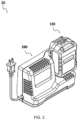
- FIG. 2 is a perspective view illustrating the structure of a charging combination according to the present application.
- a charging combination 20 includes the battery pack 100 and a charger 300 configured to charge the battery pack 100.
- the battery pack 100 is provided with the heat absorber 130 including the hydrogel to absorb the heat generated by the battery pack 100 during the charging process, thereby achieving heat dissipation of the battery pack 100.
- the battery pack 100 is a rechargeable lithium chemistry battery, such as a lithium-ion battery.
- the battery pack 100 may be a cylindrical lithium battery or a pouch battery.
- the rechargeable battery pack 100 may be configured to be another lithium chemistry battery with a lithium matrix or a rechargeable battery with another chemical matrix such as nickel cadmium and nickel metal hydride.
- the battery pack 100 may be in the shape of, for example, but not limited to, a square, a cylinder, or a tower. Further, the battery pack 100 may be a lithium iron phosphate battery.
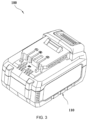
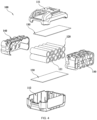
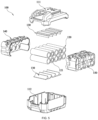
- the battery pack 100 includes a housing 110, a cell assembly 120, and the heat absorber 130.
- the housing 110 forms an accommodation cavity, and the cell assembly 120 and the heat absorber 130 are disposed in the accommodation cavity.
- the housing 110 includes an upper housing 111 and a lower housing 112.
- the upper housing 111 has an upper housing cavity opening downward
- the lower housing 112 has a lower housing cavity opening upward.
- the upper housing 111 and the lower housing 112 can be buckled together, and the upper housing cavity and the lower housing cavity can form a complete accommodation cavity.
- the housing 110 may be formed by splicing a left housing and a right housing.
- the housing 110 designed as separate parts is easy to assemble, machine, and manufacture.
- the cell assembly 120 includes at least one cell unit 121, and the cell unit 121 may be charged and discharged.
- the cell assembly 120 includes one cell unit 121 or multiple cell units 121, and the number of the cell units 121 depends on different rated nominal values of battery packs 100. Multiple rechargeable cell units 121 are connected in series so that battery packs 100 with different nominal values can be achieved.
- the heat absorber 130 is in thermal contact with at least part of the cell assembly 120. In some examples, the heat absorber 130 is in thermal contact with at least some cell units 121 to absorb the heat generated by the cell assembly 120 during the charging and discharging processes of the battery pack 100.
- the heat absorber 130 includes a hydrogel 133.
- the hydrogel 133 is a gel with water as the dispersion medium and is formed by introducing some hydrophobic groups and hydrophilic residues into the water-soluble polymer with a network crosslinked structure. The hydrophilic residues bind to water molecules and connect the water molecules such that the water molecules are inside the network. The hydrophobic residues are crosslinked polymers that swell when exposed to water.
- a vent is formed on the housing 110, and at least part of the cooling airflow entering the housing 110 from the vent is in contact with the heat absorber 130 so that the heat dissipation effect can be improved, and the hydrogel 133 serving as the heat absorber 130 can absorb water from the air.
- the thermal contact between the heat absorber 130 and the cell units 121 may be understood as that the heat absorber 130 is in direct contact with the surfaces of the cell units 121 to achieve heat conduction or may also be understood as that the heat absorber 130 is in contact with the surfaces of the cell units 121 via thermally conductive materials instead of being in direct contact, thereby achieving indirect heat conduction.
- the thermally conductive material may be a heat conductive member or air.
- the heat absorber 130 includes the hydrogel 133, which may be understood as that the heat absorber 130 is a monomeric heat-absorbing structure made solely of the hydrogel 133 or may also be understood as that the heat absorber 130 is a hybrid heat-absorbing structure made of the hydrogel 133 and other heat-absorbing materials.
- the cell assembly 120 Due to the existence of the internal resistance of the cell assembly 120, the cell assembly 120 generates a large amount of heat when the power tool 10 performs discharging at a large current.
- the heat dissipation by natural airflow alone cannot satisfy the discharging requirements of the battery pack 100. If the heat dissipation is not timely, a high temperature occurs in the battery pack 100 due to heat accumulation, seriously affecting the life and safety of the battery pack 100.
- the hydrogel 133 is used as the main component of the heat absorber 130, and the hydrogel 133 can absorb the heat generated by the cell assembly 120 during the charging and discharging processes and dissipate the heat by evaporating water.
- the hydrogel 133 does not undergo a phase change during the heat absorption process and shrinks only in volume.
- the hydrogel 133 can absorb water from the air, and the volume of the hydrogel 133 increases after the hydrogel 133 absorbs water. In this manner, through the repeated loss and absorption of water, repeated heat absorption and recycling can be achieved. Comparing the hydrogel 133 with a heat dissipation material that undergoes a phase change, no leakage or loss of materials occurs when the hydrogel 133 absorbs heat, thereby improving the user experience and the usage reliability of the battery pack 100.
- the sweating temperature of the heat absorber 130 is lower than an over-temperature protection value of the battery pack 100 so that before the over-temperature protection of the battery pack 100 occurs, the heat generated by the cell assembly 120 during the charging and discharging processes of the battery pack 100 and absorbed by the heat absorber 130 has caused the temperature of the heat absorber 130 to rise to the sweating temperature.
- water evaporation occurs in the heat absorber 130 to dissipate heat from the battery pack 100 so that the temperature of the battery pack 100 starts to drop, thereby avoiding the following: the temperature of the battery pack 100 rises to the over-temperature protection value, causing an overheating power-off operation.
- the heat absorber 130 when the temperature of at least a part of the heat absorber 130 is greater than 40°C, the heat absorber 130 starts to sweat and dissipate heat by evaporating water, that is, the sweating temperature is set to 40°C. In other examples, the sweating temperature may be set to another temperature, such as 45°C or 50°C.
- the ratio of the sweating volume of the heat absorber 130 to the capacity of the battery pack 100 is greater than or equal to 315 mm 3 /Ah and less than or equal to 630 mm 3 /Ah. In some examples, the ratio of the sweating volume of the heat absorber 130 to the capacity of the battery pack 100 may be 320 mm 3 /Ah, 400 mm 3 /Ah, 500 mm 3 /Ah, or 630 mm 3 /Ah.
- the ratio of the volume of the heat absorber 130 to the discharge power of the battery pack 100 is greater than or equal to 25 mm 3 /W and less than or equal to 122 mm 3 /W. In some examples, the ratio of the volume of the heat absorber 130 to the discharge power of the battery pack 100 may be 30 mm 3 /W, 60 mm 3 /W, 100 mm 3 /W, or 120 mm 3 /W.
- the temperature drop value of the heat absorber 130 is 5.5°C to 10.7°C, and the percentage of the reduction in temperature rise is 12% to 24%.
- the temperature of the cell assembly 120 is reduced by 12% to 24%.
- the temperature rate of the cell assembly 120 is 0.3°C/s to 0.9°C/s.
- Path 1 is that the cells absorb heat
- Path 2 is that the heat is transferred to the components in the battery pack 100 and the external environment.
- the cell assembly 120 includes multiple cell units 121, the cell units 121 are cylindrical lithium-ion cells, and the multiple cell units 121 are arranged in multiple rows and columns so that the whole cell assembly 120 is in a cubic shape, and a gap exists between adjacent cell units 121.
- the heat absorber 130 includes at least one heat absorbing sheet, the heat absorbing sheet is a sheet structure made of the hydrogel 133, and the heat absorbing sheet has a certain flexibility and is deformable at a position where the heat absorbing sheet is disposed.
- the flexible heat absorbing sheet can be disposed between two adjacent rows of cell units 121, disposed between two adjacent columns of cell units 121, or disposed on the outer end surface of the cell assembly 120.
- part of the multiple heat absorbing sheets may be disposed between two adjacent rows or columns of cell units 121 or disposed between the cell assembly 120 and the housing 110, thereby improving the heat absorption efficiency and the cooling effect on the cell assembly 120.
- the heat absorbing sheet is a corrugated sheet, and the cell units 121 are disposed in the indentations of the corrugated sheet. In this manner, the contact area between the heat absorbing sheet and the cell units 121 can be increased, thereby improving the heat absorption efficiency.
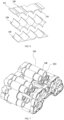
- the heat absorbing sheet may be in the shape of a flat plate or in the shape of a support plate as shown in FIGS. 5 and 6 .
- the heat absorber 130 in the shape of a support plate includes a plate-shaped body 131 and filling tips 132 protruding from the plate-shaped body 131.
- the filling tips 132 may be disposed on one end surface of the plate-shaped body 131 or disposed on two opposite end surfaces of the plate-shaped body 131.
- the surface between two filling tips 132 is a concave arc surface, and the cylindrical cell unit 121 can be disposed between the two filling tips 132.
- the filling tip 132 can be inserted into the gap formed between adjacent cell units 121, thereby improving the heat absorption efficiency while improving the support effect on the cell units 121.
- the cell assembly 120 includes multiple cell units 121, the cell units 121 are cylindrical lithium-ion cells, the multiple cell units 121 are stacked and arranged in the shape of a frustum, and two adjacent cell units 121 in the same row and the cell unit 121 that is opposite to the two adjacent cell units 121 and in an adjacent row are arranged in the shape of a triangle.
- the heat absorber 130 includes at least one heat absorbing sleeve, and the heat absorbing sleeve is an annular structure made of the hydrogel 133 and is sleeved on the cell unit 121.
- the number of heat absorbing sleeves may be the same as or different from the number of cell units 121.
- One or multiple heat absorbing sleeves may be sleeved on one cell unit 121.
- the number of heat absorbing sleeves may be set according to actual requirements.
- the heat absorbing sleeve may be configured to cover at least the main heat-generating region of the cell unit 121, where the main heat-generating region is defined as a region extending by a set value from the middle position on the outer surface of the cell unit 121 toward the positive terminal of the cell unit 121.
- the length of the cell unit 121 is about 65 mm and the diameter is about 18 mm
- the region where the temperature of the cell unit 121 rises fastest during charging and discharging is a region extending by 5 mm from the middle of the outer surface of the cell unit 121 toward the positive terminal. That is to say, the region defined by extending by 5 mm from the middle position A (about 32.5 mm from the negative terminal) toward the positive terminal to the position B (about 37.5 mm from the negative terminal) in the longitudinal direction of the cell unit 121 is the region where the temperature of the cell unit 121 rises most easily and fastest to the extreme protection temperature. Therefore, in some examples, this region is selected as the main heat-generating region of the cell unit 121, and the heat absorber 130 is sleeved on this region.
- the heat absorber 130 may be sleeved on a region defined by extending by a greater distance in the longitudinal direction of the cell unit 121 from the middle position A (about 32.5 mm from the negative terminal) toward the positive terminal to the position C (about 43.3 mm from the negative terminal), which is two-thirds of the longitudinal length of the entire cell unit 121 from the negative terminal or a region defined by extending by a greater distance in the longitudinal direction of the cell unit 121 from the middle position A (about 32.5 mm from the negative terminal) toward the positive terminal to the position D (about 48.75 mm from the negative terminal), which is three-quarters of the longitudinal length of the entire cell unit 121 from the negative terminal.
- one of these regions is selected as the main heat-generating region of the cell unit 121. That is to say, the ratio of the area of the main heat-generating region to the area of the cylindrical surface of the cell unit 121 is 1:13 to 1:4.
- the cell assembly 120 when the battery pack 100 is a pouch battery, the cell assembly 120 includes multiple cell units 121, the cell units 121 are sheet cells, and the multiple cell units 121 are stacked. After the multiple cell units 121 are stacked, the multiple cell units 121 are entirely coated with the sealant. After the sealant cures, a sealant layer 160 coating the entire cell assembly 120 is formed.
- the sheet heat absorbers 130 are attached to the sealant layer 160. In some examples, multiple heat absorbers 130 are provided and attached to different side surfaces of the sealant layer 160. In some specific examples, a thermal insulation layer 170 is disposed between two adjacent layers of cell units 121.
- the ratio of the volume of the heat absorber 130 that is completely dehydrated to the volume of the heat absorber 130 that is replenished with water is greater than or equal to 1 and less than or equal to 2.
- the heat absorber is completely dehydrated in a high-temperature baking method.
- the heat absorber 130 is left at room temperature for 24 hours and then baked at 45°C (in a high-temperature drying oven) for 8 hours. It is believed that the heat absorber 130 is completely dehydrated in this case.
- the thickness of the heat absorber 130 is greater than or equal to 0.5 mm and less than or equal to 2 mm.
- the density of the heat absorber 130 is 1.23 g/cm 3 .
- the water absorbing capacity of the heat absorber 130 is 35%.
- the thermal conductivity of the heat absorber 130 is 0.5 W/m ⁇ K.
- the total energy of the battery pack 100 is greater than or equal to 0.1 kW ⁇ h and less than or equal to 2 kW ⁇ h. In some examples, the total energy of the battery pack 100 is greater than or equal to 0.2 kW ⁇ h and less than or equal to 1 kW ⁇ h. In some examples, the total energy of the battery pack 100 is equal to 0.5 kW ⁇ h, 1 kW ⁇ h, 1.5 kW ⁇ h, or 2 kW ⁇ h.
- the battery pack 100 further includes a first limiting frame 140 and a second limiting frame 150.
- the first limiting frame 140 and the second limiting frame 150 are disposed in the accommodation cavity of the housing 110 and distributed at two ends of the cell units 121 and the cell assembly 120 formed thereby, respectively.
- Each of the first limiting frame 140 and the second limiting frame 150 is disposed in a plane extending perpendicular to the longitudinal direction of the multiple cell units 121.
- the first limiting frame 140 and the second limiting frame 150 are used for supporting the multiple cell units 121 and the cell assembly 120 formed thereby and forming the cell assembly 120 into a compact structure in a mechanical manner through fixing structures such as screws and snaps.
- the first limiting frame 140 and the second limiting frame 150 may be made of thermally conductive materials, such as aluminum or silicon carbide.
- the first limiting frame 140 and the second limiting frame 150 mate with each other and are fixed together in a mechanical manner such as screws, thereby encapsulating the cell assembly 120.
- the first limiting frame 140 and the second limiting frame 150 are in full contact with the heat absorber 130 and can well conduct the heat generated by the cell units 121, thereby achieving a good heat dissipation effect.
- the battery pack 100 further includes electronic devices configured to perform internal and external control and protection measures, battery pack terminals connected to an external charger or the power tool 10, and a cell unit connection mechanism.
- electronic devices configured to perform internal and external control and protection measures, battery pack terminals connected to an external charger or the power tool 10, and a cell unit connection mechanism.
- Internal configurations such as the electronic devices configured to perform internal and external control and protection measures, the battery pack terminals connected to the external charger or the power tool 10, and the cell unit connection mechanism are all common configurations. Therefore, the details are not repeated in the specification and drawings.
- the present application further provides the power tool 10.
- the power tool 10 includes the housing 110, a printed circuit board assembly, and the heat absorber 130.
- the printed circuit board assembly is disposed in the housing 110.
- the heat absorber 130 is in thermal contact with at least part of the printed circuit board assembly to absorb heat generated by the printed circuit board assembly.
- the heat absorber 130 includes the hydrogel 133.
- the heat absorber 130 is in thermal contact with the printed circuit board assembly.
- the hydrogel 133 included in the heat absorber 130 can absorb the heat generated during the operation of the printed circuit board assembly, and water evaporation occurs after the temperature reaches the sweating temperature, thereby achieving heat dissipation of the printed circuit board assembly with high heat dissipation efficiency and a good heat dissipation effect.
- the printed circuit board assembly includes a printed circuit board and a heat conductor, where the heat conductor is disposed between the printed circuit board and the heat absorber 130.
- the printed circuit board emits more heat due to the increase in power density, and the heat can be quickly transferred to the heat absorber 130 through the heat conductor and absorbed by the heat absorber 130.
- the heat absorber 130 including the hydrogel 133 has a good heat dissipation effect.
- the heat conductor has a layered structure, and the heat conductor includes at least one of a thermally conductive silicone layer, a PET layer, a PU layer, and an aluminum layer, where PET is commonly known as polyester resin, and PU is also known as polyurethane, which is the full name.
- the heat conductor is a single-layer structure, and the heat conductor may be any one of the thermally conductive silicone layer, the PET layer, the PU layer, and the aluminum layer.
- the heat conductor is a multi-layer structure, the materials of adjacent layers may be the same or different, and each layer may be the thermally conductive silicone layer, the PET layer, the PU layer, or the aluminum layer.
- the thickness of the heat absorber 130 is greater than or equal to 0.2 mm and less than or equal to 3 mm. In some examples, the thickness of the heat absorber 130 may be 0.6 mm, 1 mm, 1.5 mm, 2 mm, or 3 mm.
- the heat absorber 130 has a contact surface 135 and a sweating surface 134.
- the contact surface 135 is in thermal contact with the heat conductor.
- the sweating surface 134 dissipates heat through sweating.
- the sweating surface 134 absorbs water in the environment.
- the second target temperature is lower than the first target temperature.
- the first target temperature is the sweating temperature of the heat absorber 130.
- the sweating temperature is set to 40°C.
- the sweating temperature may be set to another temperature, such as 45°C, 50°C, or a higher temperature.
- the second target temperature is the moisture absorption temperature of the heat absorber 130. In an example, the moisture absorption temperature is set to 30°C or 25°C.
- the first target temperature and the second target temperature in the present application should be set based on the actual parameters of the battery pack 100 and the heat absorber 130.
- the heat absorber 130 further has a housing structure at least partially covering the sweating surface 134.
- the vent is formed on the housing 110, and at least part of the cooling airflow entering the housing 110 from the vent is in contact with the heat absorber 130.
- the vent and the heat absorber 130 are opposite to each other, that is, in a vertical plane, the projection of the vent and the projection of the heat absorber 130 at least partially overlap.
- the vent is a regular hole such as a rectangular hole or a circular hole or may be a more aesthetically pleasing irregular-shaped hole.
- Two heat absorbers 130 are provided, one of which is in thermal contact with the printed circuit board assembly and the other of which is in thermal contact with the electric motor of the power tool 10.
- the electric motor generates a large amount of heat during operation.
- the temperature of the housing of the electric motor is relatively high and the efficiency of heat dissipation to the external environment is low.
- heat absorber 130 is provided on the electric motor to absorb the heat dissipated from the electric motor, thereby enhancing the heat dissipation of the electric motor and avoiding overheating protection of the electric motor.
- multiple heat absorbers 130 may be provided.
- three or four heat absorbers 130 may be provided.
- the heat absorbers 130 may be in thermal contact with other heat-generating components in the power tool 10.
- the power tool 10 further includes a heat absorber water replenishment structure configured to provide water to the heat absorber 130.
- the heat absorber 130 inevitably loses water during the alternating process of sweating and moisture absorption.
- the power tool 10 further includes the heat absorber water replenishment structure that can provide water to the heat absorber 130.
- the heat absorber water replenishment structure is a water bladder filled with water connected to the heat absorber 130.
- the heat absorber water replenishment structure is a moisture absorption device at least configured to transfer water to the heat absorber 130.
- the moisture absorption device includes a capillary moisture absorption device, a bidirectional condensation control fiber layer, and a water collection structure disposed on the housing 110.
- the water collection structure is a conical through hole. The water absorbed by the moisture absorption device is the water droplets on the inner wall surface of the housing 110 into which water evaporating off of the heat absorber 130 condenses.
- the capillary moisture absorption device includes at least one capillary 180, an end of the capillary 180 is connected to the hydrogel 133, and the other end of the capillary 180 is disposed on the inner wall surface of the housing 110 so that water condensing on the inner wall surface of the housing 110 can be inputted into the hydrogel 133 through the capillary 180.
- the capillary moisture absorption device includes multiple capillaries 180 that are independent of each other, an end of each capillary 180 is connected to the hydrogel 133, and the other end of each capillary 180 is disposed on the inner wall surface of the housing 110.
- the capillary moisture absorption device includes multiple capillaries 180 that are interconnected to form a tree-like structure and include a main capillary and multiple branch capillaries, an end of the main capillary is connected to the hydrogel 133, an end of each of the multiple branch capillaries is connected to the other end of the main capillary, and the other end of each of the multiple branch capillaries is connected to the hydrogel 133.
- the bidirectional condensation control fiber layer such as the humidity condensation control fiber (HCCF) bidirectional condensation control fiber
- the moisture absorption and release processes of the bidirectional condensation control fiber are contrary to those of the hydrogel 133.
- the bidirectional condensation control fiber layer can absorb water when the water in the hydrogel 133 evaporates and can release water when the hydrogel 133 absorbs water and regenerates. That is to say, when the water in the hydrogel 133 starts to evaporate, the humidity around the hydrogel 133 increases, and the bidirectional condensation control fiber starts to absorb water; when the hydrogel 133 needs to absorb water and regenerate, the bidirectional condensation control fiber may release water, thereby always maintaining a constant humidity in the environment and reducing the water absorption and regeneration time of the hydrogel 133.
- the dimension of the through hole gradually decreases in a direction from the inner side of the housing 110 toward the housing 110, thereby forming a tapered small hole.
- the liquid on the surface of the housing 110 is discharged to the outside of the housing 110 and evaporated.
- This arrangement has two advantages: first, the impact of the liquid droplets in the battery pack 100 on the safety of the battery pack 100 is reduced; second, the secondary evaporation of the liquid droplets on the outside can further enhance the heat dissipation effect.
- multiple through holes are provided and arranged at intervals on the housing 110. The arrangement of the multiple through holes is conducive to further improving the moisture absorption efficiency.
- the present application further provides the power tool 10.
- the power tool 10 includes the housing 110, the printed circuit board assembly, and the heat absorber 130.
- the printed circuit board assembly is disposed in the housing 110
- the heat absorber 130 includes the hydrogel 133
- the housing 110 includes a grip
- the heat absorber 130 is at least partially disposed in the grip.
- the heat absorber 130 is disposed in the grip, and the hydrogel 133 included in the heat absorber 130 can absorb the heat at the grip, thereby reducing the temperature of the grip and improving the user's grip experience.
- the thickness of the heat absorber 130 is greater than or equal to 0.2 mm and less than or equal to 3 mm. In a specific example, the thickness of the heat absorber 130 is 0.6 mm. In a specific example, the thickness of the heat absorber 130 is 1 mm. In a specific example, the thickness of the heat absorber 130 is 2 mm. In a specific example, the thickness of the heat absorber 130 is 3 mm.
- the heat absorber 130 is disposed on the inner side of the housing 110.
- the heat absorber 130 is disposed on the inner side of the housing 110 so that while the heat absorber 130 is closer to the heat source and absorbs heat faster, aesthetics is ensured and the heat absorber 130 is less likely to fall off.
- the vent is formed on the housing 110, and at least part of the cooling airflow entering the housing 110 from the vent is in thermal contact with the heat absorber 130.
- the vent and the heat absorber 130 are opposite to each other, that is, in a vertical plane, the projection of the vent and the projection of the heat absorber 130 at least partially overlap.
- the vent is a regular hole such as a rectangular hole or a circular hole or may be a more aesthetically pleasing irregular-shaped hole.
- the shape of the heat absorber 130 is adapted to the shape of at least part of the grip. That is, the heat absorber 130 and the grip have similar shapes so that the heat absorber 130 can fit the grip more perfectly. In this manner, the temperature at parts of the grip is balanced, which is conducive to improving the user's grip experience.
- the present application further provides a charging device.
- the charging device is the charger 300 for charging the battery pack 100, or the charging device is an external charging device.
- the charging device includes the housing 110, the printed circuit board assembly, and the heat absorber 130.
- the printed circuit board assembly is disposed in the housing 110.
- the heat absorber 130 is disposed in the housing 110.
- the heat absorber 130 includes the hydrogel 133. In the power tool 10, the heat absorber 130 is disposed in the charging device.
- the hydrogel 133 included in the heat absorber 130 can quickly absorb the heat generated by the charging device during the charging process, thereby reducing the temperature inside the charging device and preventing the charging device from overheating.
- the heat absorber 130 is in thermal contact with at least part of the printed circuit board assembly. In the charging device, the heat absorber 130 is in thermal contact with the printed circuit board assembly.
- the hydrogel 133 included in the heat absorber 130 can absorb the heat generated during the operation of the printed circuit board assembly, and water evaporation occurs after the temperature reaches the sweating temperature, thereby achieving heat dissipation of the printed circuit board assembly with high heat dissipation efficiency and a good heat dissipation effect.
- the printed circuit board assembly includes a printed circuit board and a heat conductor, where the heat conductor is disposed between the printed circuit board and the heat absorber 130.
- the printed circuit board emits more heat due to the increase in power density, and the heat can be quickly transferred to the heat absorber 130 through the heat conductor and absorbed by the heat absorber 130.
- the heat absorber 130 including the hydrogel 133 has a good heat dissipation effect.
- the charging device further includes a rectifier, and the heat absorber 130 is at least partially in thermal contact with the rectifier.
- the heat absorber 130 is in thermal contact with the rectifier.
- the hydrogel 133 included in the heat absorber 130 can absorb the heat generated during the operation of the rectifier, and water evaporation occurs after the temperature reaches the sweating temperature, thereby achieving heat dissipation of the rectifier with high heat dissipation efficiency and a good heat dissipation effect.
- the heat conductor has a layered structure, and the heat conductor includes at least one of a thermally conductive silicone layer, a PET layer, a PU layer, and an aluminum layer.
- PET is commonly known as polyester resin
- PU is also known as polyurethane, which is the full name.
- the heat conductor is a single-layer structure, and the heat conductor may be the thermally conductive silicone layer, the PET layer, the PU layer, or the aluminum layer.
- the heat conductor is a multi-layer structure, the materials of adjacent layers may be the same or different, and each layer may be the thermally conductive silicone layer, the PET layer, the PU layer, or the aluminum layer.
- the thickness of the heat absorber 130 is greater than or equal to 0.2 mm and less than or equal to 3 mm. In a specific example, the thickness of the heat absorber 130 is 0.6 mm. In a specific example, the thickness of the heat absorber 130 is 1 mm. In a specific example, the thickness of the heat absorber 130 is 2 mm. In a specific example, the thickness of the heat absorber 130 is 3 mm.
- the charging device further includes a cooling fan, and the cooling airflow generated by the cooling fan at least partially passes through the heat absorber 130.
- the operation of the cooling fan can speed up the flow of gas in the charging device.
- the cooling fan can improve the heat dissipation effect of the heat absorber 130.
- the present application further provides a heat dissipation structure applied to a power tool system.
- the heat dissipation structure includes the housing 110 and the heat absorber 130.
- the heat absorber 130 is disposed in the housing 110.
- the heat absorber 130 includes the contact surface 135 and the sweating surface 134.
- the heat absorber 130 includes the hydrogel 133.
- the sweating surface 134 is selectively sealed by the housing 110.
- the housing 110 is a thermally conductive silicone housing, a PET housing, a PU housing, or an aluminum housing.
- the power tool 10 includes a handheld power tool 10, a garden power tool 10, a charger 300, and a battery pack 100.
- the housing 110 has a selectively openable cover.
- the present application further provides a heat dissipation structure applied to a power tool system.
- the heat dissipation structure includes the housing 110, the heat absorber 130, and the moisture absorption device.
- the heat absorber 130 is at least partially disposed in the housing 110.
- the moisture absorption device is at least configured to transfer water to the heat absorber 130.
- the heat absorber 130 includes the hydrogel 133.
- the moisture absorption device includes the capillary moisture absorption device
- the capillary moisture absorption device includes at least one capillary 180
- an end of the capillary 180 is connected to the hydrogel 133
- the other end of the capillary 180 is disposed on the inner wall surface of the housing 110 so that water condensing on the inner wall surface of the housing 110 can be inputted into the hydrogel 133 through the capillary 180.
- the capillary moisture absorption device includes multiple capillaries 180 that are independent of each other, an end of each capillary 180 is connected to the hydrogel 133, and the other end of each capillary 180 is disposed on the inner wall surface of the housing 110.
- the capillary moisture absorption device includes multiple capillaries 180 that are interconnected to form a tree-like structure and include a main capillary and multiple branch capillaries, an end of the main capillary is connected to the hydrogel 133, an end of each of the multiple branch capillaries is connected to the other end of the main capillary, and the other end of each of the multiple branch capillaries is connected to the hydrogel 133.
- the moisture absorption device includes multiple through holes formed on the housing 110, and the dimension of the through hole gradually decreases in a direction from the inner side of the housing 110 toward the housing 110.
- the liquid on the surface of the housing 110 is discharged to the outside of the housing 110 and evaporated.
- This arrangement has two advantages: first, the impact of the liquid droplets in the battery pack 100 on the safety of the battery pack 100 is reduced; second, the secondary evaporation of the liquid droplets on the outside can further enhance the heat dissipation effect.
- multiple through holes are provided and arranged at intervals on the housing 110. The arrangement of the multiple through holes is conducive to further improving the moisture absorption efficiency.
- the housing 110 is a thermally conductive silicone housing, a PET housing, a PU housing, or an aluminum housing.
- the housing 110 has a selectively openable cover.
Landscapes
- Chemical & Material Sciences (AREA)
- Chemical Kinetics & Catalysis (AREA)
- Electrochemistry (AREA)
- General Chemical & Material Sciences (AREA)
- Engineering & Computer Science (AREA)
- Manufacturing & Machinery (AREA)
- Life Sciences & Earth Sciences (AREA)
- Biophysics (AREA)
- Computer Hardware Design (AREA)
- Battery Mounting, Suspending (AREA)
- Secondary Cells (AREA)
Applications Claiming Priority (4)
| Application Number | Priority Date | Filing Date | Title |
|---|---|---|---|
| CN202211294707 | 2022-10-21 | ||
| CN202311123845 | 2023-08-31 | ||
| CN202322437140.2U CN221687602U (zh) | 2022-10-21 | 2023-09-07 | 电池包及电动工具 |
| PCT/CN2023/125159 WO2024083143A1 (fr) | 2022-10-21 | 2023-10-18 | Bloc-batterie et système d'outil électrique |
Publications (2)
| Publication Number | Publication Date |
|---|---|
| EP4576329A1 true EP4576329A1 (fr) | 2025-06-25 |
| EP4576329A4 EP4576329A4 (fr) | 2025-11-19 |
Family
ID=90736985
Family Applications (1)
| Application Number | Title | Priority Date | Filing Date |
|---|---|---|---|
| EP23879131.3A Pending EP4576329A4 (fr) | 2022-10-21 | 2023-10-18 | Bloc-batterie et système d'outil électrique |
Country Status (3)
| Country | Link |
|---|---|
| US (1) | US20250219191A1 (fr) |
| EP (1) | EP4576329A4 (fr) |
| WO (1) | WO2024083143A1 (fr) |
Families Citing this family (2)
| Publication number | Priority date | Publication date | Assignee | Title |
|---|---|---|---|---|
| CN118659084B (zh) * | 2024-08-19 | 2025-02-28 | 涿州市柯林电子产品有限公司 | 一种新型电池包及其制造方法 |
| CN119057839A (zh) * | 2024-11-01 | 2024-12-03 | 卧龙电气驱动集团股份有限公司 | 驱动装置、驱控方法以及机器人 |
Family Cites Families (6)
| Publication number | Priority date | Publication date | Assignee | Title |
|---|---|---|---|---|
| US7270910B2 (en) * | 2003-10-03 | 2007-09-18 | Black & Decker Inc. | Thermal management systems for battery packs |
| US20150101786A1 (en) * | 2013-10-10 | 2015-04-16 | Helamia LLC | Cooling Gel Pad |
| WO2015079840A1 (fr) * | 2013-11-26 | 2015-06-04 | 日立工機株式会社 | Bloc-batterie, outil électrique et chargeur de batterie |
| CN106257739A (zh) * | 2015-12-18 | 2016-12-28 | 上海卡耐新能源有限公司 | 一种蓄电池模块及其制作方法 |
| CN106953137B (zh) * | 2017-04-12 | 2019-04-05 | 厦门金龙联合汽车工业有限公司 | 一种利用水凝胶增强电池模组散热的方法 |
| CN114744331A (zh) * | 2022-04-08 | 2022-07-12 | 香港科技大学 | 一种用于锂离子电池的复合散热薄膜及其制备方法 |
-
2023
- 2023-10-18 EP EP23879131.3A patent/EP4576329A4/fr active Pending
- 2023-10-18 WO PCT/CN2023/125159 patent/WO2024083143A1/fr not_active Ceased
-
2025
- 2025-03-24 US US19/087,781 patent/US20250219191A1/en active Pending
Also Published As
| Publication number | Publication date |
|---|---|
| US20250219191A1 (en) | 2025-07-03 |
| WO2024083143A1 (fr) | 2024-04-25 |
| EP4576329A4 (fr) | 2025-11-19 |
Similar Documents
| Publication | Publication Date | Title |
|---|---|---|
| US20250219191A1 (en) | Battery pack and power tool system | |
| JP6293451B2 (ja) | 環境親和型車両のバッテリーモジュール間接冷却装置 | |
| CN206349470U (zh) | 电池模组及具有其无人机 | |
| CN104979602B (zh) | 一种电池箱及动态调节电池箱压紧力的方法 | |
| KR101108191B1 (ko) | 배터리 팩 | |
| KR101526667B1 (ko) | 친환경 차량의 배터리모듈 간접 냉각 및 가열 장치 | |
| CN102376997B (zh) | 具有温度调节装置的电池系统 | |
| CN114256535A (zh) | 基于相变材料和互嵌式肋片的锂离子电池热管理系统及方法 | |
| JP6708991B2 (ja) | 電池パック、電子機器、電動車両、電動工具および電力貯蔵システム | |
| CN110391479A (zh) | 一种新能源汽车及其电池热管理装置 | |
| JP2000067825A (ja) | 組電池 | |
| CN209804849U (zh) | 一种基于相变材料的双电池组散热装置 | |
| CN108987641A (zh) | 电池箱和车辆 | |
| CN203351712U (zh) | 一种基于烧结热管的动力电池热管理系统 | |
| CN207474625U (zh) | 锂电池模组散热结构及锂电池模组 | |
| CN108063199A (zh) | 一种具有减震和散热功能的蓄电池外壳 | |
| CN221687602U (zh) | 电池包及电动工具 | |
| CN205811009U (zh) | 一种动力电池系统 | |
| CN218448207U (zh) | 电池和用电设备 | |
| CN215451594U (zh) | 一种电池模组和两轮车 | |
| CN207690857U (zh) | 一种具有减震和散热功能的蓄电池外壳 | |
| WO2023093543A1 (fr) | Bloc-batterie et outil électrique | |
| CN215184282U (zh) | 一种安全耐腐蚀的锂离子电池 | |
| WO2023100642A1 (fr) | Bloc-batterie, outil électrique et véhicule électrique | |
| JP6863455B2 (ja) | 蓄電装置、電池パック、電動車両、電力貯蔵システム、電動工具および電子機器 |
Legal Events
| Date | Code | Title | Description |
|---|---|---|---|
| STAA | Information on the status of an ep patent application or granted ep patent |
Free format text: STATUS: THE INTERNATIONAL PUBLICATION HAS BEEN MADE |
|
| PUAI | Public reference made under article 153(3) epc to a published international application that has entered the european phase |
Free format text: ORIGINAL CODE: 0009012 |
|
| STAA | Information on the status of an ep patent application or granted ep patent |
Free format text: STATUS: REQUEST FOR EXAMINATION WAS MADE |
|
| 17P | Request for examination filed |
Effective date: 20250318 |
|
| AK | Designated contracting states |
Kind code of ref document: A1 Designated state(s): AL AT BE BG CH CY CZ DE DK EE ES FI FR GB GR HR HU IE IS IT LI LT LU LV MC ME MK MT NL NO PL PT RO RS SE SI SK SM TR |
|
| A4 | Supplementary search report drawn up and despatched |
Effective date: 20251020 |
|
| RIC1 | Information provided on ipc code assigned before grant |
Ipc: H01M 10/613 20140101AFI20251014BHEP Ipc: H01M 10/6235 20140101ALI20251014BHEP Ipc: H01M 10/643 20140101ALI20251014BHEP Ipc: H01M 10/6563 20140101ALI20251014BHEP Ipc: H01M 10/659 20140101ALI20251014BHEP Ipc: H01M 50/213 20210101ALI20251014BHEP Ipc: H01M 50/247 20210101ALI20251014BHEP |
|
| DAV | Request for validation of the european patent (deleted) | ||
| DAX | Request for extension of the european patent (deleted) |