EP4576377A1 - Bloc-batterie et véhicule le comprenant - Google Patents
Bloc-batterie et véhicule le comprenant Download PDFInfo
- Publication number
- EP4576377A1 EP4576377A1 EP23907570.8A EP23907570A EP4576377A1 EP 4576377 A1 EP4576377 A1 EP 4576377A1 EP 23907570 A EP23907570 A EP 23907570A EP 4576377 A1 EP4576377 A1 EP 4576377A1
- Authority
- EP
- European Patent Office
- Prior art keywords
- recess
- sealing member
- battery pack
- battery
- pack according
- Prior art date
- Legal status (The legal status is an assumption and is not a legal conclusion. Google has not performed a legal analysis and makes no representation as to the accuracy of the status listed.)
- Pending
Links
Images




Classifications
-
- H—ELECTRICITY
- H01—ELECTRIC ELEMENTS
- H01M—PROCESSES OR MEANS, e.g. BATTERIES, FOR THE DIRECT CONVERSION OF CHEMICAL ENERGY INTO ELECTRICAL ENERGY
- H01M50/00—Constructional details or processes of manufacture of the non-active parts of electrochemical cells other than fuel cells, e.g. hybrid cells
- H01M50/30—Arrangements for facilitating escape of gases
- H01M50/342—Non-re-sealable arrangements
- H01M50/3425—Non-re-sealable arrangements in the form of rupturable membranes or weakened parts, e.g. pierced with the aid of a sharp member
-
- B—PERFORMING OPERATIONS; TRANSPORTING
- B60—VEHICLES IN GENERAL
- B60L—PROPULSION OF ELECTRICALLY-PROPELLED VEHICLES; SUPPLYING ELECTRIC POWER FOR AUXILIARY EQUIPMENT OF ELECTRICALLY-PROPELLED VEHICLES; ELECTRODYNAMIC BRAKE SYSTEMS FOR VEHICLES IN GENERAL; MAGNETIC SUSPENSION OR LEVITATION FOR VEHICLES; MONITORING OPERATING VARIABLES OF ELECTRICALLY-PROPELLED VEHICLES; ELECTRIC SAFETY DEVICES FOR ELECTRICALLY-PROPELLED VEHICLES
- B60L3/00—Electric devices on electrically-propelled vehicles for safety purposes; Monitoring operating variables, e.g. speed, deceleration or energy consumption
- B60L3/0023—Detecting, eliminating, remedying or compensating for drive train abnormalities, e.g. failures within the drive train
- B60L3/0046—Detecting, eliminating, remedying or compensating for drive train abnormalities, e.g. failures within the drive train relating to electric energy storage systems, e.g. batteries or capacitors
-
- B—PERFORMING OPERATIONS; TRANSPORTING
- B60—VEHICLES IN GENERAL
- B60L—PROPULSION OF ELECTRICALLY-PROPELLED VEHICLES; SUPPLYING ELECTRIC POWER FOR AUXILIARY EQUIPMENT OF ELECTRICALLY-PROPELLED VEHICLES; ELECTRODYNAMIC BRAKE SYSTEMS FOR VEHICLES IN GENERAL; MAGNETIC SUSPENSION OR LEVITATION FOR VEHICLES; MONITORING OPERATING VARIABLES OF ELECTRICALLY-PROPELLED VEHICLES; ELECTRIC SAFETY DEVICES FOR ELECTRICALLY-PROPELLED VEHICLES
- B60L3/00—Electric devices on electrically-propelled vehicles for safety purposes; Monitoring operating variables, e.g. speed, deceleration or energy consumption
- B60L3/04—Cutting off the power supply under fault conditions
-
- B—PERFORMING OPERATIONS; TRANSPORTING
- B60—VEHICLES IN GENERAL
- B60L—PROPULSION OF ELECTRICALLY-PROPELLED VEHICLES; SUPPLYING ELECTRIC POWER FOR AUXILIARY EQUIPMENT OF ELECTRICALLY-PROPELLED VEHICLES; ELECTRODYNAMIC BRAKE SYSTEMS FOR VEHICLES IN GENERAL; MAGNETIC SUSPENSION OR LEVITATION FOR VEHICLES; MONITORING OPERATING VARIABLES OF ELECTRICALLY-PROPELLED VEHICLES; ELECTRIC SAFETY DEVICES FOR ELECTRICALLY-PROPELLED VEHICLES
- B60L3/00—Electric devices on electrically-propelled vehicles for safety purposes; Monitoring operating variables, e.g. speed, deceleration or energy consumption
- B60L3/12—Recording operating variables ; Monitoring of operating variables
-
- B—PERFORMING OPERATIONS; TRANSPORTING
- B60—VEHICLES IN GENERAL
- B60L—PROPULSION OF ELECTRICALLY-PROPELLED VEHICLES; SUPPLYING ELECTRIC POWER FOR AUXILIARY EQUIPMENT OF ELECTRICALLY-PROPELLED VEHICLES; ELECTRODYNAMIC BRAKE SYSTEMS FOR VEHICLES IN GENERAL; MAGNETIC SUSPENSION OR LEVITATION FOR VEHICLES; MONITORING OPERATING VARIABLES OF ELECTRICALLY-PROPELLED VEHICLES; ELECTRIC SAFETY DEVICES FOR ELECTRICALLY-PROPELLED VEHICLES
- B60L58/00—Methods or circuit arrangements for monitoring or controlling batteries or fuel cells, specially adapted for electric vehicles
- B60L58/10—Methods or circuit arrangements for monitoring or controlling batteries or fuel cells, specially adapted for electric vehicles for monitoring or controlling batteries
- B60L58/18—Methods or circuit arrangements for monitoring or controlling batteries or fuel cells, specially adapted for electric vehicles for monitoring or controlling batteries of two or more battery modules
- B60L58/21—Methods or circuit arrangements for monitoring or controlling batteries or fuel cells, specially adapted for electric vehicles for monitoring or controlling batteries of two or more battery modules having the same nominal voltage
-
- H—ELECTRICITY
- H01—ELECTRIC ELEMENTS
- H01M—PROCESSES OR MEANS, e.g. BATTERIES, FOR THE DIRECT CONVERSION OF CHEMICAL ENERGY INTO ELECTRICAL ENERGY
- H01M50/00—Constructional details or processes of manufacture of the non-active parts of electrochemical cells other than fuel cells, e.g. hybrid cells
- H01M50/20—Mountings; Secondary casings or frames; Racks, modules or packs; Suspension devices; Shock absorbers; Transport or carrying devices; Holders
- H01M50/204—Racks, modules or packs for multiple batteries or multiple cells
- H01M50/207—Racks, modules or packs for multiple batteries or multiple cells characterised by their shape
-
- H—ELECTRICITY
- H01—ELECTRIC ELEMENTS
- H01M—PROCESSES OR MEANS, e.g. BATTERIES, FOR THE DIRECT CONVERSION OF CHEMICAL ENERGY INTO ELECTRICAL ENERGY
- H01M50/00—Constructional details or processes of manufacture of the non-active parts of electrochemical cells other than fuel cells, e.g. hybrid cells
- H01M50/30—Arrangements for facilitating escape of gases
- H01M50/383—Flame arresting or ignition-preventing means
-
- B—PERFORMING OPERATIONS; TRANSPORTING
- B60—VEHICLES IN GENERAL
- B60L—PROPULSION OF ELECTRICALLY-PROPELLED VEHICLES; SUPPLYING ELECTRIC POWER FOR AUXILIARY EQUIPMENT OF ELECTRICALLY-PROPELLED VEHICLES; ELECTRODYNAMIC BRAKE SYSTEMS FOR VEHICLES IN GENERAL; MAGNETIC SUSPENSION OR LEVITATION FOR VEHICLES; MONITORING OPERATING VARIABLES OF ELECTRICALLY-PROPELLED VEHICLES; ELECTRIC SAFETY DEVICES FOR ELECTRICALLY-PROPELLED VEHICLES
- B60L2240/00—Control parameters of input or output; Target parameters
- B60L2240/40—Drive Train control parameters
- B60L2240/54—Drive Train control parameters related to batteries
- B60L2240/549—Current
-
- B—PERFORMING OPERATIONS; TRANSPORTING
- B60—VEHICLES IN GENERAL
- B60L—PROPULSION OF ELECTRICALLY-PROPELLED VEHICLES; SUPPLYING ELECTRIC POWER FOR AUXILIARY EQUIPMENT OF ELECTRICALLY-PROPELLED VEHICLES; ELECTRODYNAMIC BRAKE SYSTEMS FOR VEHICLES IN GENERAL; MAGNETIC SUSPENSION OR LEVITATION FOR VEHICLES; MONITORING OPERATING VARIABLES OF ELECTRICALLY-PROPELLED VEHICLES; ELECTRIC SAFETY DEVICES FOR ELECTRICALLY-PROPELLED VEHICLES
- B60L50/00—Electric propulsion with power supplied within the vehicle
- B60L50/50—Electric propulsion with power supplied within the vehicle using propulsion power supplied by batteries or fuel cells
- B60L50/60—Electric propulsion with power supplied within the vehicle using propulsion power supplied by batteries or fuel cells using power supplied by batteries
- B60L50/64—Constructional details of batteries specially adapted for electric vehicles
-
- H—ELECTRICITY
- H01—ELECTRIC ELEMENTS
- H01M—PROCESSES OR MEANS, e.g. BATTERIES, FOR THE DIRECT CONVERSION OF CHEMICAL ENERGY INTO ELECTRICAL ENERGY
- H01M50/00—Constructional details or processes of manufacture of the non-active parts of electrochemical cells other than fuel cells, e.g. hybrid cells
- H01M50/20—Mountings; Secondary casings or frames; Racks, modules or packs; Suspension devices; Shock absorbers; Transport or carrying devices; Holders
- H01M50/233—Mountings; Secondary casings or frames; Racks, modules or packs; Suspension devices; Shock absorbers; Transport or carrying devices; Holders characterised by physical properties of casings or racks, e.g. dimensions
- H01M50/24—Mountings; Secondary casings or frames; Racks, modules or packs; Suspension devices; Shock absorbers; Transport or carrying devices; Holders characterised by physical properties of casings or racks, e.g. dimensions adapted for protecting batteries from their environment, e.g. from corrosion
-
- H—ELECTRICITY
- H01—ELECTRIC ELEMENTS
- H01M—PROCESSES OR MEANS, e.g. BATTERIES, FOR THE DIRECT CONVERSION OF CHEMICAL ENERGY INTO ELECTRICAL ENERGY
- H01M50/00—Constructional details or processes of manufacture of the non-active parts of electrochemical cells other than fuel cells, e.g. hybrid cells
- H01M50/20—Mountings; Secondary casings or frames; Racks, modules or packs; Suspension devices; Shock absorbers; Transport or carrying devices; Holders
- H01M50/249—Mountings; Secondary casings or frames; Racks, modules or packs; Suspension devices; Shock absorbers; Transport or carrying devices; Holders specially adapted for aircraft or vehicles, e.g. cars or trains
-
- Y—GENERAL TAGGING OF NEW TECHNOLOGICAL DEVELOPMENTS; GENERAL TAGGING OF CROSS-SECTIONAL TECHNOLOGIES SPANNING OVER SEVERAL SECTIONS OF THE IPC; TECHNICAL SUBJECTS COVERED BY FORMER USPC CROSS-REFERENCE ART COLLECTIONS [XRACs] AND DIGESTS
- Y02—TECHNOLOGIES OR APPLICATIONS FOR MITIGATION OR ADAPTATION AGAINST CLIMATE CHANGE
- Y02E—REDUCTION OF GREENHOUSE GAS [GHG] EMISSIONS, RELATED TO ENERGY GENERATION, TRANSMISSION OR DISTRIBUTION
- Y02E60/00—Enabling technologies; Technologies with a potential or indirect contribution to GHG emissions mitigation
- Y02E60/10—Energy storage using batteries
Definitions
- the present disclosure relates to a battery pack and a vehicle including the same, and more specifically, it relates to a battery pack capable of directional venting of flame or gas and a vehicle including the same.
- secondary batteries refer to batteries capable of being repeatedly charged and discharged, such as lithium-ion batteries, lithium-polymer batteries, nickel-cadmium batteries, nickel-hydrogen batteries, nickel-zinc batteries, and the like.
- a battery cell which is the most fundamental secondary battery, may provide an output voltage of approximately 2.5V to 4.2V.
- the secondary batteries have been applied to devices that require high output voltage and a large amount of charging capacity, such as electric vehicles or ESSs (Energy Storage Systems), and accordingly, a battery pack, which is manufactured in a manner of configuring a battery module by connecting a plurality of battery cells in series, parallel, or a combination thereof and reconnecting these battery modules in series, parallel, or a combination thereof, has been widely used.
- ESSs Electronicgy Storage Systems
- lithium secondary batteries are currently in the spotlight due to their advantages such as high operation voltage and significantly high energy density, since lithium secondary batteries use organic electrolytes, overcharging of lithium secondary batteries may cause overcurrent and overheating, which may lead to explosion or fire in worse cases. That is, if a thermal event occurs inside the secondary battery, the internal pressure may rapidly increase to cause explosion or fire.
- the present disclosure has been designed to solve the problems of the related art, and therefore the present disclosure is directed to providing a battery pack capable of discharging flame or gas generated from ignition in a battery cell in a predetermined direction (directional venting) without a separate venting device, and a vehicle including the same.
- the present disclosure provides a battery pack capable of freely adjusting the discharge position of the flame or gas, and a vehicle including the same.
- the present disclosure provides a battery pack capable of adjusting the sizes and number of venting portions through which flame or gas is discharged, and a vehicle including the same.
- a battery pack including: a plurality of battery cells; a pack case configured to store the plurality of battery cells and having a venting portion formed thereon; and a sealing member installed to the pack case to seal the pack case and configured to close the venting portion, wherein the sealing member breaks by a pressure in a predetermined range so that flame or gas generated inside the pack case is discharged through the venting portion.
- the venting portion may be provided as a recess formed to be recessed on the pack case, and the sealing member may be disposed across the recess.
- the sealing member may cross the recess to divide the recess into an outer side and an inner side, and the outer side of the recess and the inner side of the recess may have different areas.
- the area of the inner side of the recess may be greater than the area of the outer side of the recess.
- the inner side of the recess may lead to a portion where flame or gas is expected to be generated, and the outer side of the recess may be open to the outside.
- the recess may be formed in a rectangular shape, and the sealing member may be disposed perpendicular to some edges of the recess.
- an insertion groove into which the sealing member is inserted may be formed on the pack case, and the insertion groove and the recess may communicate with each other.
- the insertion groove may be formed along the inner perimeter of the pack case, and the recess may be formed on at least one of the portions where the insertion groove is formed so as to communicate with the insertion groove.
- an easy-breaking portion may be formed on the sealing member to facilitate breakage when the flame or gas is generated.
- the easy-breaking portion may be provided as a notched portion formed to be thinner than other portions of the sealing member.
- the notched portion may be disposed inside the venting portion.
- the sealing member may be made of ethylene propylene diene monomer (EPDM).
- EPDM ethylene propylene diene monomer
- embodiments of the present disclosure have the effect of freely adjusting the discharge position of the flame or gas.
- embodiments of the present disclosure have the effect of adjusting the sizes and number of venting portions through which flame or gas is discharged.
- an element is 'coupled' or 'connected' to another element
- the elements may be directly coupled or connected to each other and that the elements may also be indirectly coupled or connected to each other through a connection member.
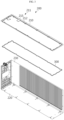
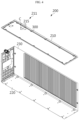
- FIG. 1 is a perspective view of a battery pack according to an embodiment of the present disclosure
- FIG. 2 is a diagram viewed in the direction of arrow B in FIG. 1
- FIG. 3 is a partially exploded perspective view of FIG. 1
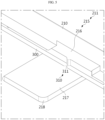
- FIG. 4 is a diagram illustrating a sealing member installed to the pack case in FIG. 3
- FIG. 5 is an enlarged view of portion C in FIG. 4
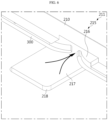
- FIG. 6 is a diagram illustrating the state where the sealing member is broken in FIG. 5
- FIG. 7 is a cross-sectional view taken along line A-A' in FIG. 1 .
- the battery cell 100 may be configured in various ways, and may include, for example, a cylindrical battery cell, a prismatic battery cell, or a pouch-type battery cell. However, for convenience of explanation, the following description will be made based on the case where cylindrical battery cells are stored inside the pack case 200 as shown in FIG. 7 . However, the battery cell 100 is not limited to the cylindrical battery cell. In addition, referring to FIG. 7 , a plurality of cylindrical battery cells is stored inside the pack case 200.
- the cylindrical battery cell may include an electrode assembly, a battery can, and a cap plate.
- the electrode assembly has a structure in which a positive electrode plate, a negative electrode plate, and a separator interposed between the positive electrode plate and the negative electrode plate are wound in one direction.
- the electrode assembly may be formed in a jelly-roll type with a center hole formed at the center thereof.
- the electrode assembly may be manufactured by winding a laminate formed by stacking, at least once, a negative electrode plate, a separator, a positive electrode plate, and a separator in sequence.
- the positive electrode plate and negative electrode plate may be configured in the form of a sheet.
- the electrode assembly applied to the present embodiment may be a wound-type electrode assembly.
- an additional separator may be provided on the outer circumferential surface of the electrode assembly to insulate the same from the battery can.
- the electrode assembly may have a winding structure well known in the related art without limitations.
- a positive electrode active material may be applied to one or both sides of the positive electrode plate, and a first non-coated portion may be formed at the end of the positive electrode plate to which no positive electrode active material is applied.
- the first non-coated portion may be exposed to the outside of the separator while forming a plurality of turns around the center of the electrode assembly, thereby functioning as an electrode tab. However, the first non-coated portion may not be formed on the positive electrode plate.
- a negative electrode active material may be applied to one or both sides of the negative electrode plate, and a second non-coated portion may be formed at the end of the negative electrode plate to which no negative electrode active material is applied.
- the second non-coated portion may be exposed to the outside of the separator while forming a plurality of turns around the center of the electrode assembly, thereby functioning as an electrode tab.
- the second non-coated portion may not be formed on the negative electrode plate.
- each of the positive electrode plate and the negative electrode plate includes a non-coated portion
- the first non-coated portion and the second non-coated portion may be configured to face in opposite directions.
- any active material known in the art may be used as the positive electrode active material coated on the positive electrode plate and the negative electrode active material coated on the negative electrode plate without limitations.
- the separator may be configured as a porous polymer film made of polyolefin polymers such as ethylene homopolymer, propylene homopolymer, ethylene/butene copolymer, ethylene/hexene copolymer, ethylene/methacrylate copolymer, or the like, or configured by laminating the porous polymer films above.
- polyolefin polymers such as ethylene homopolymer, propylene homopolymer, ethylene/butene copolymer, ethylene/hexene copolymer, ethylene/methacrylate copolymer, or the like, or configured by laminating the porous polymer films above.
- the separator may be configured as conventional porous nonwoven fabric such as high-melting point glass fiber, polyethylene terephthalate fiber, or the like
- At least one surface of the separator may include a coating layer of inorganic particles.
- the separator itself may also be configured as a coating layer of inorganic particles.
- the particles constituting the coating layer may have a structure in which the particles are combined with a binder to have an interstitial volume between adjacent particles.
- the center hole of the electrode assembly is also used for welding a cell terminal (positive electrode terminal) and a positive electrode collector. That is, the cell terminal and the positive electrode collector may be welded by radiating a laser beam through the center hole of the electrode assembly.
- the electrode assembly is stored in the battery can.
- the battery can may have a through-hole formed therein.
- the battery can may be formed in a cylindrical shape, and the electrode assembly may be stored inside the battery can such that the battery can is electrically connected to the negative electrode plate of the electrode assembly. Accordingly, the battery can may have the same polarity, that is, the negative electrode, as the negative electrode plate.
- the diameter of the battery can is configured to be greater than the diameter of the electrode assembly.
- the battery can and the positive electrode collector may have a predetermined gap therebetween, and an insulator may be provided in the gap.
- the size of the electrode assembly is increased in the state where the size of the battery can is fixed according to the standard, the total capacity of the battery cell 100 increases, but the gap between the battery can and the electrode assembly is reduced.
- the gap between the battery can and the electrode assembly is reduced. Therefore, in order to increase the capacity of the battery cell 100, the reduced gap between the battery can and the electrode assembly must be able to receive the insulator, and to this end, it is desirable that the insulator be as thin as possible.
- the positive electrode collector is electrically connected to the positive electrode plate, for example, at the top of the electrode assembly.
- the positive electrode collector may be made of a conductive metal material and electrically connected to the first non-coated portion of the positive electrode plate.
- the cell terminal is made of a conductive metal material and electrically connected to the positive electrode collector.
- the cell terminal is electrically connected to the positive electrode plate of the electrode assembly through the positive electrode collector, thereby providing positive polarity.
- the cell terminal may function as a positive electrode terminal.
- the battery can be electrically connected to the negative electrode plate of the electrode assembly as described above, and thus may have negative polarity.
- the negative electrode collector is electrically connected to the negative electrode plate, for example, at the bottom of the electrode assembly.
- the negative electrode collector may be made of a conductive metal material such as aluminum, steel, copper, nickel, or the like and electrically connected to the second non-coated portion of the negative electrode plate.
- the negative electrode collector may be electrically connected to the battery can. To this end, at least a portion of the edge of the negative electrode collector may be interposed between the inner surface of the battery can and a sealing gasket and fixed thereto.
- At least a portion of the edge of the negative electrode collector may be fixed to a beading portion formed at the bottom of the battery can by welding while being supported on the bottom surface of the beading portion.
- At least a portion of the remaining portion of the negative electrode collector, excluding the coupling portion of the beading portion, may be coupled to the curved surface of the second non-coated portion through welding, for example, laser welding.
- At least a portion of the edge of the negative electrode collector may be electrically coupled to one of the upper surface and lower surface of the beading portion, which is adjacent to the crimping portion.
- the cap plate is configured to seal the opening formed at the bottom of the battery can.
- the cap plate may be made of, for example, a metal material to ensure rigidity.
- the cap plate may be separated from the electrode assembly to not have polarity. That is, the cap plate may not have polarity even if it is made of a conductive metal material.
- cap plate does not have polarity indicates that the cap plate is electrically insulated from the battery can and the cell terminal. As described above, the cap plate does not need to have polarity and is not necessarily made of a conductive metal.
- the cap plate may be seated and supported on the beading portion formed on the battery can.
- the cap plate is fixed to a crimping portion described later.
- a sealing gasket may be interposed between the cap plate and the crimping portion of the battery can, thereby ensuring airtightness of the battery can. That is, the sealing gasket may be interposed between the edge of the cap plate and the opening of the battery can.
- a plurality of battery cells 100 are stored in the pack case 200.
- a venting portion 211 is formed on the pack case 200.
- the pack case 200 encloses the plurality of battery cells 100, thereby protecting the battery cells 100 from external vibration or impact.
- the pack case 200 may include, for example, an upper case 210, a lower case 220, and a side case 230.
- the venting portion 211 may be formed at various positions of the pack case 200, for example, at least one of the upper case 210, lower case 220, and side case 230.
- the position of the venting portion 211 may vary depending on the discharge direction of flame or gas. Referring to FIGS. 1 and 3 , the venting portion 211 may be formed on the upper case 210 to be directed to the lateral face. However, this is only an example.
- An insertion groove 212 (see FIG. 3 ) into which the sealing member 300 is inserted may be formed on the pack case 200, for example, on the upper case 210.
- the sealing member 300 is inserted into the insertion groove 212.
- the pack case 200 may be manufactured, for example, by bending a metal plate, so the pack case 200 may be manufactured as an integrated piece. In the case where the pack case 200 is manufactured as an integrated piece, there is the effect of simplifying the coupling process. Alternatively, the pack case 200 may be provided as separate pieces and then coupled to each other by welding or the like. However, the material of the pack case 200 is not limited to metal.
- the sealing member 300 is installed to the pack case 200 to prevent dust or moisture outside the pack case 200 from entering the pack case 200. Referring to FIGS. 4 and 5 , the sealing member 300 is installed in the upper case 210 of the pack case 200 to seal the pack case 200, and closes the venting portion 211.
- the sealing member 300 is broken by the pressure as shown in FIG. 6 .
- the closed venting portion 211 opens so that the flame or gas generated inside the pack case 200 flows to the outside of the pack case 200 through the open venting portion 211.
- the venting portion 211 may be formed in various ways.
- the venting portion 211 may be provided as a recess 215 formed to be recessed in the upper case 210 of the pack case 200.
- the number of recesses 215 may vary.
- the position of the recess 215 may be changed in various ways. That is, the positions and number of recesses 215 may be determined according to the designer's intention, providing the effect of enabling directional venting without a separate venting device.
- the sealing member 300 may be disposed across the recess 215 (see FIG. 5 ). As a result, the sealing member 300 may close the recess 215, which is the venting portion 211.
- the recess 215 may be formed in various shapes. For example, as shown in FIGS. 4 and 5 , the recess 215 may be formed in a rectangular shape. In this case, the recess 215 may have a round portion 218 formed therein. However, the recess 215 is not limited to the above shape, and may be formed in a polygonal or circular shape, or in other deformable shapes.
- the sealing member 300 may be disposed perpendicular to some edges of the recess 215, but is not limited thereto.
- the sealing member 300 may cross the recess 215 to divide the recess 215 into an outer side 216 and an inner side 217 such that the outer side 216 of the recess 215 and the inner side 217 of the recess 215 have different areas.
- the area of the inner side 217 of the recess 215 may be greater than the area of the outer side 216 of the recess 215.
- the inner side 217 of the recess 215 may lead to the portion where flame or gas is expected to be generated, and the outer side 216 of the recess 215 may be configured to be open to the outside (see FIGS. 1 and 2 ).
- the flame or gas generated by ignition in the battery cell 100 may be discharged in a predetermined direction (the venting portion 211) (directional venting) as intended by the designer, instead of being discharged in a random direction unexpected by the designer.
- the battery pack 10 has the effect of freely adjusting the discharge position of flame or gas and freely determining the sizes and number of the venting portions 211 through which the flame or gas is discharged.
- directional venting is enabled only by employing the sealing member 300 necessary to prevent dust or moisture outside the pack case 200 from entering the pack case 200 and the venting portion 211 formed as the recess 215 on the pack case 200 without adding a separate venting device in order to implement the directional venting, thereby reducing cost and enabling easy and convenient manufacturing.
- the sealing member 300 may be inserted into the insertion groove 212 (see FIG. 3 ) formed on the upper case 210 of the pack case 200.
- the insertion groove 212 and the recess 215 communicate with each other.
- the insertion groove 212 may be formed along the inner perimeter of the pack case 200, and the recess 215 may be formed on at least one of the portions where the insertion groove 212 is formed so as to communicate with the insertion groove 212. That is, if a plurality of recesses 215 is formed, the insertion groove 212 may communicate with the plurality of recesses 215 at various positions.
- the sealing member 300 is inserted into and supported by the insertion groove 212.
- the insertion groove 212 is not formed in the area where the recess 215 is formed, the sealing member 300 cannot be supported in the area where the recess 215 is formed. According to this, if the internal pressure of the battery pack 10 increases in a thermal event situation, the unsupported portion of the sealing member 300 may easily break.
- an easy-breaking portion 310 may be formed in the sealing member 300 to facilitate breakage when flame or gas is generated. That is, if the internal pressure of the battery pack 10 increases due to a thermal event, the easy-breaking portion 310 breaks.
- the easy-breaking portion 310 may be configured in various ways.
- the easy-breaking portion 310 may be provided as a notched portion 311 that is thinner than other portions of the sealing member 300.
- the notched portion 311 may be disposed inside the venting portion 211.
- the easy-breaking portion 310 may be configured as a cut portion (not shown) formed by pre-cutting the sealing member 300.
- sealing member 300 may be made of various materials such as ethylene propylene diene monomer (EPDM), the material is not limited thereto.
- EPDM ethylene propylene diene monomer
- the battery pack 10 may include various types of battery cells 100, for example, cylindrical battery cells 100, prismatic battery cells 100, or pouch-type battery cells 100.
- the battery pack 10 may further include various devices for controlling charging and discharging of the battery cell 100 provided in the battery pack 10, such as a BMS, a current sensor, a fuse, and the like.
- FIG. 8 is a diagram illustrating a vehicle including a battery pack according to respective embodiments of the present disclosure.
- a vehicle 20 may include one or more battery packs 10 according to the respective embodiments of the present disclosure described above.
- the vehicle 20 includes various vehicles designed to use electricity, such as an electric vehicle or a hybrid vehicle.
- the present disclosure relates to a battery pack and a vehicle including the same, and is especially available to industries related to secondary batteries.
Landscapes
- Engineering & Computer Science (AREA)
- Power Engineering (AREA)
- Mechanical Engineering (AREA)
- Sustainable Energy (AREA)
- Sustainable Development (AREA)
- Transportation (AREA)
- Life Sciences & Earth Sciences (AREA)
- Chemical & Material Sciences (AREA)
- Chemical Kinetics & Catalysis (AREA)
- Electrochemistry (AREA)
- General Chemical & Material Sciences (AREA)
- Battery Mounting, Suspending (AREA)
- Sealing Battery Cases Or Jackets (AREA)
- Gas Exhaust Devices For Batteries (AREA)
Applications Claiming Priority (3)
| Application Number | Priority Date | Filing Date | Title |
|---|---|---|---|
| KR20220181863 | 2022-12-22 | ||
| KR1020230177850A KR20240100241A (ko) | 2022-12-22 | 2023-12-08 | 배터리 팩 및 이를 포함하는 자동차 |
| PCT/KR2023/020571 WO2024136284A1 (fr) | 2022-12-22 | 2023-12-13 | Bloc-batterie et véhicule le comprenant |
Publications (2)
| Publication Number | Publication Date |
|---|---|
| EP4576377A1 true EP4576377A1 (fr) | 2025-06-25 |
| EP4576377A4 EP4576377A4 (fr) | 2026-03-25 |
Family
ID=91589451
Family Applications (1)
| Application Number | Title | Priority Date | Filing Date |
|---|---|---|---|
| EP23907570.8A Pending EP4576377A4 (fr) | 2022-12-22 | 2023-12-13 | Bloc-batterie et véhicule le comprenant |
Country Status (4)
| Country | Link |
|---|---|
| EP (1) | EP4576377A4 (fr) |
| JP (1) | JP2025530761A (fr) |
| CN (1) | CN119213620A (fr) |
| WO (1) | WO2024136284A1 (fr) |
Family Cites Families (12)
| Publication number | Priority date | Publication date | Assignee | Title |
|---|---|---|---|---|
| US8277965B2 (en) * | 2009-04-22 | 2012-10-02 | Tesla Motors, Inc. | Battery pack enclosure with controlled thermal runaway release system |
| JP5408438B2 (ja) * | 2010-01-15 | 2014-02-05 | 三菱自動車工業株式会社 | 車両用バッテリケース |
| JP5440790B2 (ja) * | 2010-03-18 | 2014-03-12 | 三菱自動車工業株式会社 | バッテリケース及び電池パック |
| KR101191660B1 (ko) * | 2010-11-08 | 2012-10-17 | 에스비리모티브 주식회사 | 전지 모듈 |
| KR101698770B1 (ko) * | 2012-03-23 | 2017-01-23 | 삼성에스디아이 주식회사 | 배터리 팩 |
| KR101669118B1 (ko) * | 2013-01-03 | 2016-10-25 | 삼성에스디아이 주식회사 | 배터리 팩 |
| JPWO2016076417A1 (ja) * | 2014-11-14 | 2017-08-31 | 日本電気株式会社 | 蓄電池ユニットおよび蓄電装置 |
| CN205122652U (zh) * | 2015-11-17 | 2016-03-30 | 南京东宇欧鹏巴赫新能源科技有限公司 | 一种可控压的全密封动力电池pack箱 |
| CN105552398A (zh) * | 2015-12-07 | 2016-05-04 | 上海空间电源研究所 | 提高锌银贮备电池比特性的电池组结构 |
| KR102743588B1 (ko) * | 2019-11-06 | 2024-12-17 | 주식회사 엘지에너지솔루션 | 벤팅 유도부가 형성된 파우치형 전지케이스 제조방법 및 상기 방법에 의해 제조된 파우치형 전지케이스 |
| KR102844872B1 (ko) * | 2020-04-17 | 2025-08-08 | 주식회사 엘지에너지솔루션 | 화염 배출 방지 구조를 갖는 배터리 모듈, 이를 포함하는 배터리 팩, 자동차 및 전력 저장 시스템 |
| CN114927808A (zh) * | 2022-06-29 | 2022-08-19 | 齐鲁中科光物理与工程技术研究院 | 一种软包电池及其制备方法 |
-
2023
- 2023-12-13 CN CN202380041181.XA patent/CN119213620A/zh active Pending
- 2023-12-13 JP JP2025512766A patent/JP2025530761A/ja active Pending
- 2023-12-13 EP EP23907570.8A patent/EP4576377A4/fr active Pending
- 2023-12-13 WO PCT/KR2023/020571 patent/WO2024136284A1/fr not_active Ceased
Also Published As
| Publication number | Publication date |
|---|---|
| WO2024136284A1 (fr) | 2024-06-27 |
| CN119213620A (zh) | 2024-12-27 |
| JP2025530761A (ja) | 2025-09-17 |
| EP4576377A4 (fr) | 2026-03-25 |
Similar Documents
| Publication | Publication Date | Title |
|---|---|---|
| US8486546B2 (en) | Cap assembly and secondary battery using the same with notched vent member | |
| EP2602840A2 (fr) | Poche de batterie secondaire à stabilité améliorée, batterie secondaire du type poche l'utilisant, et bloc-batterie de taille moyenne ou grande | |
| EP3518305B1 (fr) | Batterie secondaire | |
| KR102080903B1 (ko) | 전극 리드 및 이를 포함하는 이차 전지 | |
| EP4075562B1 (fr) | Cellule de batterie ayant une sécurité améliorée et son procédé de fabrication | |
| KR20240097710A (ko) | 원통형 배터리 셀 및, 이를 포함하는 배터리 팩 및 자동차 및, 원통형 배터리 셀 제조 방법 | |
| EP4113733B1 (fr) | Élément de batterie comprenant une languette d'électrode ayant une partie de relaxation de contrainte formée sur celle-ci | |
| EP4576377A1 (fr) | Bloc-batterie et véhicule le comprenant | |
| EP4432446B1 (fr) | Module de batterie, bloc-batterie et véhicule comprenant celui-ci | |
| EP4274017B1 (fr) | Élément de batterie de type poche comprenant un élément de détection, et module de batterie comprenant celui-ci | |
| EP4576408A1 (fr) | Plaque collectrice de courant, élément de batterie cylindrique la comprenant, et bloc-batterie et véhicule comprenant un élément de batterie cylindrique | |
| EP4664665A1 (fr) | Élément de batterie cylindrique, batterie et véhicule la comprenant, et plaque collectrice de courant | |
| KR102946352B1 (ko) | 캡 플레이트, 배터리 셀 및 이를 포함하는 배터리 팩 및 자동차 | |
| EP4564547A1 (fr) | Élément de batterie et module de batterie le comprenant | |
| KR20240100241A (ko) | 배터리 팩 및 이를 포함하는 자동차 | |
| EP4654364A1 (fr) | Bloc-batterie et véhicule le comprenant | |
| KR102891459B1 (ko) | 배터리 셀, 및 배터리 셀을 포함하는 배터리 팩 및 자동차 | |
| CA3289181A1 (fr) | Élément de batterie cylindrique, batterie et véhicule la comprenant, et plaque collectrice de courant | |
| US20250183682A1 (en) | Film cable and battery module including the same | |
| CA3276334A1 (fr) | Plaque collectrice de courant, élément de batterie cylindrique la comprenant, et bloc-batterie et véhicule comprenant un élément de batterie cylindrique | |
| EP4718619A1 (fr) | Bloc-batterie, bicyclette électrique et véhicule le comprenant | |
| EP4243194A1 (fr) | Élément de batterie de type poche à stabilité thermique améliorée | |
| EP4654375A1 (fr) | Élément de batterie cylindrique, ainsi que bloc-batterie et véhicule le comprenant | |
| US20250293385A1 (en) | Battery cell and battery module including the same | |
| EP4572078A1 (fr) | Dispositif de charge et de décharge d'élément de batterie et élément de batterie produit à l'aide de celui-ci, et bloc-batterie et véhicule comprenant des éléments de batterie |
Legal Events
| Date | Code | Title | Description |
|---|---|---|---|
| STAA | Information on the status of an ep patent application or granted ep patent |
Free format text: STATUS: THE INTERNATIONAL PUBLICATION HAS BEEN MADE |
|
| PUAI | Public reference made under article 153(3) epc to a published international application that has entered the european phase |
Free format text: ORIGINAL CODE: 0009012 |
|
| STAA | Information on the status of an ep patent application or granted ep patent |
Free format text: STATUS: REQUEST FOR EXAMINATION WAS MADE |
|
| 17P | Request for examination filed |
Effective date: 20250320 |
|
| AK | Designated contracting states |
Kind code of ref document: A1 Designated state(s): AL AT BE BG CH CY CZ DE DK EE ES FI FR GB GR HR HU IE IS IT LI LT LU LV MC ME MK MT NL NO PL PT RO RS SE SI SK SM TR |
|
| A4 | Supplementary search report drawn up and despatched |
Effective date: 20260224 |
|
| RIC1 | Information provided on ipc code assigned before grant |
Ipc: H01M 50/342 20210101AFI20260218BHEP Ipc: H01M 50/204 20210101ALI20260218BHEP |
|
| DAV | Request for validation of the european patent (deleted) | ||
| DAX | Request for extension of the european patent (deleted) |