EP4576776A1 - Codage/decodage de donnees video - Google Patents
Codage/decodage de donnees video Download PDFInfo
- Publication number
- EP4576776A1 EP4576776A1 EP23307259.4A EP23307259A EP4576776A1 EP 4576776 A1 EP4576776 A1 EP 4576776A1 EP 23307259 A EP23307259 A EP 23307259A EP 4576776 A1 EP4576776 A1 EP 4576776A1
- Authority
- EP
- European Patent Office
- Prior art keywords
- reference samples
- template
- samples
- block
- chroma
- Prior art date
- Legal status (The legal status is an assumption and is not a legal conclusion. Google has not performed a legal analysis and makes no representation as to the accuracy of the status listed.)
- Pending
Links
Images




Classifications
-
- H—ELECTRICITY
- H04—ELECTRIC COMMUNICATION TECHNIQUE
- H04N—PICTORIAL COMMUNICATION, e.g. TELEVISION
- H04N19/00—Methods or arrangements for coding, decoding, compressing or decompressing digital video signals
- H04N19/10—Methods or arrangements for coding, decoding, compressing or decompressing digital video signals using adaptive coding
- H04N19/169—Methods or arrangements for coding, decoding, compressing or decompressing digital video signals using adaptive coding characterised by the coding unit, i.e. the structural portion or semantic portion of the video signal being the object or the subject of the adaptive coding
- H04N19/182—Methods or arrangements for coding, decoding, compressing or decompressing digital video signals using adaptive coding characterised by the coding unit, i.e. the structural portion or semantic portion of the video signal being the object or the subject of the adaptive coding the unit being a pixel
-
- H—ELECTRICITY
- H04—ELECTRIC COMMUNICATION TECHNIQUE
- H04N—PICTORIAL COMMUNICATION, e.g. TELEVISION
- H04N19/00—Methods or arrangements for coding, decoding, compressing or decompressing digital video signals
- H04N19/10—Methods or arrangements for coding, decoding, compressing or decompressing digital video signals using adaptive coding
- H04N19/169—Methods or arrangements for coding, decoding, compressing or decompressing digital video signals using adaptive coding characterised by the coding unit, i.e. the structural portion or semantic portion of the video signal being the object or the subject of the adaptive coding
- H04N19/186—Methods or arrangements for coding, decoding, compressing or decompressing digital video signals using adaptive coding characterised by the coding unit, i.e. the structural portion or semantic portion of the video signal being the object or the subject of the adaptive coding the unit being a colour or a chrominance component
-
- H—ELECTRICITY
- H04—ELECTRIC COMMUNICATION TECHNIQUE
- H04N—PICTORIAL COMMUNICATION, e.g. TELEVISION
- H04N19/00—Methods or arrangements for coding, decoding, compressing or decompressing digital video signals
- H04N19/50—Methods or arrangements for coding, decoding, compressing or decompressing digital video signals using predictive coding
- H04N19/593—Methods or arrangements for coding, decoding, compressing or decompressing digital video signals using predictive coding involving spatial prediction techniques
Definitions
- the present application generally relates to video picture encoding and decoding. Particularly, but not exclusively, the technical field of the present application is related to cross-component prediction of chroma block of a video picture.
- Cross-component inconsistency refers to a phenomenon, in which a chroma prediction tool relies on a supposed correlation to luma component, on a pre-defined neighborhood of pixels (i.e. template). While on this neighborhood of pixels, the texture might locally vary such that the said correlation is weakened in some areas of the neighborhood. Hence, keep relying on those less-correlated areas for prediction causes coding inefficiency due to the cross-component inconsistency.
- Cross-component content inconsistencies may appear for example when either or both texture or lighting conditions change around the borders of the current block, or when sample outlier appear or over-sharpness, etc.
- cross-component content inconsistencies appear, blindness of the L-shaped template selection might introduce inefficiency to the cross-component prediction models, i.e. applying cross-component prediction model on samples of current block becomes sub-optimal.
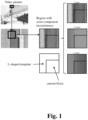
- Figure 1 shows an example of how an object border in a video picture may introduce cross-component content inconsistency.
- a current block of a video picture is zoomed and a region with cross-component content inconsistency appears in samples of the top-left and left parts of the L-shaped template of the current block.
- the samples of the luma (Y) and chroma (Cb,Cr) blocks have more content similarities to the top part of the L-shaped template, rather than the top-left and left parts of the L-shaped template, due to the fact that an object is occupying both current block and the samples at the top of current block.
- a method of cross-component predicting of a chroma block of a video picture comprising a luma component and at least one chroma component, the method comprising:
- a single cross-component prediction model is determined from all weighted reference samples or wherein a cross-component prediction model is determined for each subset based on weighted reference samples corresponding to reference samples of one single sub-set that belong to the model template.
- detecting the at least one variation of the reference samples of the analysis template comprises applying an edge detection filter on the reference samples of the analysis template, and a variation of the reference samples of the analysis template is detected when an edge is detected in the reference samples of the analysis template.
- detecting the at least one variation of the reference samples of the analysis template further comprises calculating edge strength for the at least one detected edge.
- detecting the at least one variation of the reference samples of the analysis samples further comprises partitioning of reference samples of the model template and/or reference samples of the analysis template.
- detecting the at least one variation of the reference samples of the analysis template further comprises block partitioning and filtering the reference samples of the model template.
- detecting at least one variation of the reference samples of the analysis template further comprises modifying the reference samples of the analysis template.
- detecting the at least one variation of the reference samples of the analysis template further comprises modifying the reconstructed chroma samples of the chroma block and/or of the chroma L-shaped template around the chroma block.
- the weighting values are obtained based on comparing the reconstructed luma samples in the model template to the reconstructed luma samples of the co-located luma block of the analysis template.
- the method further comprises signaling an enabling information indicating the at least one cross-component prediction model is determined based on weighted reference samples.
- determining whether determining the at least one cross-component prediction model is based on weighted reference samples is enabled or not is based on chroma or co-located block characteristics.
- a method of encoding video picture data comprising a method according to the first aspect of the present disclosure.
- an apparatus comprising means for performing one of the methods according to the first, second and/or third aspect of the present disclosure.
- At least one of the aspects generally relates to video picture encoding and decoding, one other aspect generally relates to transmitting a bitstream provided or encoded and one other aspect relates to receiving/accessing a decoded bitstream.
- At least one of the exemplary embodiments is described for encoding/decoding a video picture but extends to the encoding/decoding of video pictures (sequences of pictures) because each video picture is sequentially encoded/decoded as described below.
- the at least one exemplary embodiments are described in a context of MPEG standards but they are not limited to MPEG standards such as AVC (ISO/IEC 14496-10 Advanced Video Coding for generic audio-visual services, ITU-T Recommendation H.264, https://www.itu.int/rec/T-REC-H.264-202108-P/en), EVC (ISO/IEC 23094-1 Essential video coding), HEVC (ISO/IEC 23008-2 High Efficiency Video Coding, ITU-T Recommendation H.265, https://www.itu.int/rec/T-REC-H.265-202108-P/en, VVC (ISO/IEC 23090-3 Versatile Video Coding, ITU-T Recommendation H.266, https://www.itu.int/rec/T-REC-H.266-202008-I/en but may be applied to other standards and recommendations such as AV1 (AOMedia Video 1, http://aomedia.
- the at least one exemplary embodiments are not limited to the ongoing standardization activity at JVET, called Enhanced Compression Model (ECM, Algorithm description of Enhanced Compression Model).
- ECM Enhanced Compression Model
- the architecture of ECM is almost entirely based on VVC, except that it has several newly introduced tools integrated in it.
- the at least one exemplary embodiment may apply to pre-existing or futuredeveloped, and extensions of any such standards and recommendations.
- a pixel corresponds to the smallest display unit on a screen, which can be composed of one or more sources of light (1 for monochrome screen or 3 or more for colour screens).
- a video picture comprises at least one component usually expressed in the shape of an array of samples.
- a monochrome video picture comprises a single component and a color video picture may comprise three components.
- a color video picture may comprise a luminance component (Y) and two chrominance components (Cb, Cr) when the picture/video format is the well-known (Y,Cb,Cr) format or equivalently a luma component (Y') and two chrominance components (Cb,Cr).
- the luma component Y' may be derived by applying a gamma correction on the luminance component Y.
- a color picture may also comprise three color components (one for Red, one for Green and one for Blue) when the picture/video format is the well-known (R,G,B) format.
- Each component of a video picture may comprise a number of samples relative to a number of pixels of a screen on which the video picture is intended to be display.
- the number of samples comprised in a component may be a multiple (or fraction) of a number of samples comprised in another component of a same video picture.
- the chrominance component may contain half the number of samples in width and/or height, relative to the luminance component.
- the YCbCr color space is a family of color spaces used in digital photography and video systems. It is defined by a mathematical coordinate transformation from an associated RGB primaries and white point.
- the YCbCr color space is used to reduce the amount of data required to represent a video picture while maintaining a high level of visual quality. This is achieved by separating the luminance information (Y) from the chrominance information (Cb and Cr) and then applying different compression techniques to each component.
- chroma subsampling is a technique used to reduce the amount of data required to represent a video picture while maintaining a high level of visual quality. Chroma subsampling is achieved by separating the luma information (Y') from the chrominance information (Cb and Cr) and then applying different compression techniques to each component. The Y' component is usually compressed using lossless compression techniques, while the Cb and Cr components are compressed using lossy compression techniques. This approach is effective because the human eye is more sensitive to changes in luminance than to changes in chrominance. There are several chroma subsampling formats, including 4:4:4, 4:2:2, and 4:2:0.
- 4:4:4 In the 4:4:4 format, there is no subsampling, and all information of both luminance and chrominance data are represented entirely.
- 4:2:2 In a four by two array of pixels, 4:2:2 has half the chroma of 4:4:4, and 4:2:0 has a quarter of the color information available.
- the 4:2:2 signal will have half the sampling rate horizontally but will maintain full sampling vertically. 4:2:0, on the other hand, will only sample colors out of half the pixels on the first row and ignore the second row of the sample completely.
- the at least one exemplary embodiments are described by considering the YCbCr format 4:2:0 but the at least one exemplary embodiment is not limited to a particular picture/video format but
- a sample is the smallest visual information unit of a component composing a video picture.
- a sample may be, for example a luma or chrominance sample or a colour sample of a (R, G, B) format.
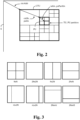
- the CTU size (CTU width and CTU height) of all the CTUs of a CTU grid equals a same default CTU size (default CTU width CTU DW and default CTU height CTU DH ).
- a default CTU size (height, width) is encoded into the bitstream, for example at a sequence level in the Sequence Parameter Set (SPS).
- SPS Sequence Parameter Set
- a coding tree is associated with each CTU to determine a tree-division of the CTU.
- the coding tree is a quad-tree division of a CTU, where each node is called a Coding Unit (CU).
- the spatial position of a CU in the video picture is defined by a CU index culdx indicating a spatial position from the top-left corner of the CTU.
- a CU is spatially partitioned into one or more Prediction Units (PU).
- the spatial position of a PU in the video picture VP is defined by a PU index puldx defining a spatial position from the top-left corner of the CTU and the spatial position of an element of a partitioned PU is defined by a PU partition index puPartldx defining a spatial position from the top-left corner of a PU.
- Each PU is assigned some intra or inter prediction data.
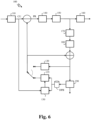
- Figures 6 and 7 provide an overview of video encoding/decoding methods used in current video standard compression systems like HEVC or VVC for example.
- the current block is usually encoded from a prediction residual block PR. More precisely, a prediction residual block PR is calculated, for example, by subtracting the best predicted block from the current block.
- the prediction residual block PR is then transformed (block 140) by using, for example, a DCT (discrete cosine transform) or DST (Discrete Sinus transform) type transform, or any other appropriate transform, and the obtained transformed coefficient block is quantized (block 150).
- DCT discrete cosine transform
- DST Discrete Sinus transform
- the reconstructed blocks or the filtered reconstructed blocks form a reference picture that may be stored into a decoded picture buffer (DPB) so that it can be used as a reference picture for the encoding of a next current block of the video picture VP, or of a next vide picture to encode.
- DPB decoded picture buffer
- Figure 7 shows a schematic block diagram of blocks of a method 200 of decoding a video picture VP in accordance with prior art.
- partitioning information data, prediction information data and quantized transform coefficient block (or quantized residual block) are obtained by entropy decoding a bitstream of encoded video picture data. For instance, this bitstream has been generated in accordance with the method 100.
- a reconstructed picture is divided into current blocks based on the partitioning information.
- Each current block is entropy decoded from the bitstream along a decoding loop also called "in loop".
- Each decoded current block is either a quantized transform coefficient block or quantized prediction residual block.
- the decoded prediction residual block and the predicted block are then combined, typically summed, which provides a reconstructed block.
- in-loop filters may apply to a reconstructed picture (comprising reconstructed blocks) and the reconstructed blocks, or the filtered reconstructed blocks form a reference picture that may be stored into a decoded picture buffer (DPB) as above discussed ( Figure 6 ).
- DPB decoded picture buffer
- an inter-predicted block is defined from inter-prediction data associated with the current block (CU or a PU of a CU) of a video picture.
- This inter-prediction data comprises motion information that may be represented (coded) according to the so-called whole-block-based AMVP mode (Adaptive Motion Vector Prediction) or the so-called whole-block-based merge mode.
- Cross-component prediction refers to the process of predicting one color component (such as chrominance component) based on the information from another color component (such as luminance or luma component).
- the philosophy behind cross-component prediction is to reduce redundancy in the video signal. Instead of independently coding each color component, the encoder predicts one component from another and encodes only the prediction error. Precisely, cross-component prediction perform, for each chrominance component (Cb or Cr) block, a prediction from co-located reconstructed luma samples.
- CCLM Cross-Component Linear Model
- CCLM current block
- the top part of the chroma L-shaped template, respectively of the luma L-shaped templates may be extended to (W+H) samples where W and H indicate the size of the luma respectively chroma block (CU).
- W and H indicate the size of the luma respectively chroma block (CU).
- MDLM_L_IDX mode the top part of the chroma L-shaped template and of the luma L-shaped templates is extended to (W+H) samples.
- the linear parameters ⁇ and ⁇ are derived with at most four chroma samples of the model template and their corresponding reference samples of the model template.
- the number of reference samples of the model template given by W'xH' may be set as follow:
- the positions of top reference samples of the model template may be denoted as S[0, -1 ]...S[ W' - 1, -1 ] and the positions of the left reference samples of the model template may be denoted as S[-1, 0 ]...S[ -1, H' - 1 ].
- the reference samples of the model template have positions S[.] defined as follow:
- the reference samples of the model template at the selected positions are downsampled and the downsampled reference samples of the model template are compared together to find two larger sample values: x 0 A and x 1 A , and two smaller samples values: x 0 B and x 1 B .
- Their corresponding reconstructed chroma sample values are denoted as y 0 A , y 1 A , y 0 B and y 1 B.
- the division operation to calculate parameter ⁇ is implemented with a look-up table.
- This parameter derivation is performed as part of both the encoding and the decoding of the current block. As a result, no syntax is used to convey the linear parameters ⁇ and ⁇ values to the decoder.
- rec L ′ rec L 2 i , 2 j ⁇ 1 + rec L 2 i ⁇ 1,2 j + 4 .
- rec L 2 i , 2 j + 1 + 4 ⁇ 3 wherein i and j are indices of pixels on the x- and y-axis.
- GLM Gradient Linear Model
- reference sample gradient G L (i, j) of the model template is computed for each reference sample (i,j) of the luma L-shaped template and the linear parameters ⁇ and ⁇ are derived by minimizing Least Mean Square (LMS) error between chroma samples of the model template and reference sample gradients of the model template.
- LMS Least Mean Square
- the linear parameters ⁇ 0 , ⁇ 1 and ⁇ of the three-parameters-based GLM are derived from 6 rows and 6 columns adjacent samples by the LDL decomposition based MSE minimization method as used in the CCCM as discussed below.
- LM_CHROMA_IDX mode treats all reference samples of the model template equally and obviously overlooks the existing cross-component content inconsistency and optimizes the linear model on all reference samples. This leads to compression inefficiency when the reference samples of the model template are not all consistent in terms of content with the corresponding chroma samples.
- MMLM_CHROMA_IDX For example, using multi-model mode, such as MMLM_CHROMA_IDX or MMLM_T_IDX leads to classify reference samples of the model template into different classes and to dedicate a dedicated cross-component model per class.
- MMLM_CHROMA_IDX MMLM_T_IDX modes can flexibly classify the reference samples of the model template, but it still incorporates inconsistent reference samples of the model template in one of the models.
- the multi-model modes are limited only to two objects.
- MMLM_CHROMA_IDX or MMLM_T_IDX requires additional signalling for selecting this mode. This prediction mode may lead to compression inefficiency.
- Embodiments of the present disclosure relate to the cross-component prediction method of a chroma block of a video picture comprising a luma component and at least one chroma component.
- the method derives parameters of cross-component prediction models based on weighted reference samples in a model template defined around a co-located luma block of the chroma block to be predicted.
- the model template comprises chroma samples in a chroma L-shaped template around the chroma block to be predicted and the reference samples are reconstructed luma samples in a luma L-shaped template defined around the co-located luma block.
- An analysis template is obtained.
- the analysis template comprises reconstructed luma samples of a co-located luma block of the chroma block and the reference samples of a model template.
- the reference samples of the model template are split into at least two sub-sets of reference samples of the analysis template based on at least one detected variation in the reference samples of the analysis template.
- the weighted reference samples in the model template are obtained by weighing the reference samples of sub-sets of the analysis template that belong to the model template by weighting values, each weighting value being determined based on the content consistency between the reference samples of a sub-set of reference samples of the analysis template belonging to the model template and the reconstructed samples of the co-located luma block of the analysis template.
- Weighting the reference samples of the sub-sets of the analysis template that belong to the model template based on the content consistency between the reference samples of sub-sets and the reconstructed samples of the co-located luma block may be a pre-processing of any method for deriving parameters of any existing cross-component prediction model that relies on reference samples of a model template around the co-located luma block.
- Embodiments of the present disclosure leads to a classification of the reference samples of the model template into at least two sub-sets and a cross-component prediction model may then be determined based on the weighted reference samples of each sub-set leading to better compression efficiency compared to cross-component prediction models based on reference samples comprising cross-component content inconsistencies.
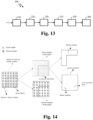
- Figure 13 shows a block diagram of a method 300 of cross-component prediction of a chroma block of a video in accordance with at least one exemplary embodiments of the present disclosure.
- method 300 may be performed by an encoder or a decoder.
- blocks 320-360 may represent components within the encoder or the decoder.
- blocks 320-360 may be sub-blocks of block 120 of method 100 or sub-blocks of block 250 of method 200.
- an analysis template is obtained.
- the analysis template comprises reference samples as being reconstructed luma samples of a co-located luma block of the chroma block and comprises reference samples of a model template.
- the model template comprises chroma samples in a chroma L-shaped template around the chroma block and corresponding reference samples as being reconstructed luma samples in a luma L-shaped template defined around the co-located luma block of the chroma block.
- At block 320 at least one variation of the reference samples of the analysis template is detected, each variation of reference samples indicating a content cross-component inconsistency that has been identified by analyzing the reference samples of the analysis template.
- the reference samples of the analysis template are split into at least two sub-sets of reference samples based on the at least one detected variation in the reference samples of the analysis template.
- weighted reference samples of the model template are obtained by weighing the reference samples of sub-sets of the analysis template that belong to the model template by weighting values, each weighting value indicating the content consistency between the reference samples of one of the at least one sub-set belonging to the model template and the reconstructed samples of the co-located luma block of the analysis template.
- At block 350 at least one cross-component prediction model is determined based on the weighted reference samples in the model template.
- the chroma block is predicted based on the at least one determined cross-component prediction model.
- a single cross-component prediction model may be determined (block 350) from all weighted reference samples.
- a cross-component prediction model may be determined (block 350) based on weighted reference samples corresponding to reference samples of one single sub-set that belong to the model template.
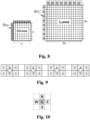
- Figure 14 shows an example of a set of reference samples corresponding to a chroma block of a YCbCr 4:2:0 video picture in accordance with at least one exemplary embodiments of the present disclosure.
- a region of luma and chroma samples is illustrated.
- the region comprises a 4x4 chroma block of 16 chroma samples and a chroma L-shaped template defined around the chroma block.
- the chroma L-shaped template comprises chroma samples of the two above lines and the two left columns of the chroma block.
- a 8x8 co-located luma block comprises reference samples as being the 64 reconstructed luma samples.
- a model template may be defined from the chroma L-shaped template and from a luma L-shaped template defined around the co-located luma block.
- the model template comprises the chroma samples in the chroma L-shaped template and reference samples as being defined as the reconstructed luma samples in the luma L-shaped template.
- the reference samples of the model template correspond to the chroma samples of the model template.
- the analysis template may comprise the reference samples of the model template and the 64 reconstructed luma samples of the 8x8 co-located luma block.
- Figure 15 shows an example of the method 300 in accordance with exemplary embodiments of the present disclosure.
- a cross-component prediction mode has to be determined for a chroma (Cb, Cr) block of a YCbCr video picture.
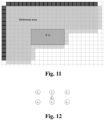
- Figure 16A shows an example of analysis and model templates. For example, an edge detection filter is applied on the reference samples of the analysis template to detect cross-component content inconsistencies in the analysis template. One vertical edge is detected ( Figure 16B ).
- the reference samples of the model template are then split into a first S1 and second S2 sub-sets of reference samples of the analysis template ( Figure 16C ).
- the reference samples of sub-set S1 are less correlated in terms of content with the reconstructed luma samples of the co-located luma block (reference samples of the analysis template) than the reference samples of sub-set S2 because no edge has been detected between the sub-set S2 and the reconstructed luma samples of the co-located luma block.
- the reference samples of sub-set S2 have better cross-component content consistency with respect to the reconstructed luma samples of the co-located luma block than the reference samples of sub-set S1 with respect to the reconstructed luma samples of the co-located luma block.
- Weighted reference samples are obtained for the sub-sets by weighing the reference samples of the sub-sets, i.e. the reconstructed luma samples of the analysis template that belong to the model template, by weighting values.
- the weighting value associated with a sub-set S1 (or S2) is determined based on the content consistency between the reference samples of the sub-set S1 (or S2) and the reconstructed samples of the co-located luma block of the analysis template.
- the weighting value assigned to the reference samples of the sub-set S2 is higher than the weighting value assigned to the reference samples of the sub-set S1.
- the edge detector filter is Sobel filter.
- the edge strength of a detected edge may be computed using luma samples statistics (e.g. mean, variance of the reference samples) on each side of the detected edge.
- the edge strength of a detected edge may be calculated by first splitting the reference samples of the analysis template into a two sub-sets according to the belonging of the reference samples of the analysis template to one or other side of the detected edge. Then, first average luma of the reference samples of the first sub-set is calculated and second average luma of the reference samples of the second sub-set is calculated. Then the difference between the first and second average luma is compared against a pre-defined threshold. If the difference is higher than the threshold, then the detected edge is considered as strong, i.e. is a variation of the reference samples of the analysis template.
- detecting (block 320) the at least one variation of the reference samples of the analysis samples may further comprise partitioning of reference samples of the model template and/or reference samples of the analysis template.
- This exemplary embodiment may be due to the fact that the reconstructed chroma samples and reference samples of the analysis template may not be yet filtered (e.g. Deblocking filter) at the stage of cross-component prediction. Therefore, it is quite likely that detected edges is rather due to the partitioning and not the objects borders. Consequently, this exemplary embodiment takes advantage of the partitioning information to further improve the determination of the cross-component chroma prediction model.
- Deblocking filter e.g. Deblocking filter
- detecting (block 320) the at least one variation of the reference samples of the analysis template may further comprise block partitioning and filtering the reference samples of the model template.
- detecting (block 320) the at least one variation of the reference samples of the analysis samples may further comprise block partitioning and filtering of the reconstructed chroma samples in the chroma L-shaped template.
- detecting (block 320) at least one variation of the reference samples of the analysis template may further comprise block partitioning and filtering the reference samples of the model template and block partitioning and filtering the reconstructed chroma samples in the chroma L-shaped template.
- detecting (block 320) at least one variation of the reference samples of the analysis template may further comprise modifying the reference samples of the analysis template.
- modifying the reference samples of the analysis template may comprise filtering the reference samples of the analysis template.
- a smoothing filter may be applied on the reference samples of the analysis template to remove detected edges in the reference samples of the analysis template.
- a deblocking filtering may be applied on the reference samples of the analysis template to deblock block boundaries in the reference samples of the analysis template.
- a denoising process may apply on the reference samples of the analysis template to remove noise from the reference samples of the analysis template.
- detecting (block 320) the at least one variation of the reference samples of the analysis template may further comprise modifying the reconstructed chroma samples of the chroma block and/or of the chroma L-shaped template around the chroma block.
- modifying the reconstructed chroma samples may comprise filtering the reconstructed chroma samples.
- a smoothing filter may be applied on the reconstructed chroma samples to remove edges detected in the reconstructed chroma samples.
- a deblocking filtering may be applied on the reconstructed chroma samples to deblock block boundaries in the reconstructed chroma samples.
- a denoising process may apply on the reconstructed chroma samples to remove noise from the reconstructed chroma samples.
- the weighting values may be obtained based on comparing the reconstructed luma samples in the model template to the reconstructed luma samples of the co-located luma block of the analysis template. For instance, one might compute the mean luma value on the analysis template. Then, the distance of luma samples in the model template from the computed mean value determines the weighting value associated with the reference samples of the model template.
- a cross-component prediction model is one of the existing cross-component prediction models as discussed above and determining (block 350) the cross-component prediction model may comprise determining parameters of the cross-component prediction model based on the weighted reference samples. The derivation of the parameters of the cross-component prediction model uses the weighted reference samples rather than the reference samples as in prior art.
- a single weighting value may be assigned to each subset and the single weighting value may be assigned to each reference sample of the sub-set.
- Figure 16 shows an example of a set of reference samples in which a variation (an edge) is detected.
- the reference samples of the analysis template is split into a first sub-set S1 and a second sub-set S2, i.e. each reference sample of the analysis template is assigned to either the sub-set S1 or sub-set S2.
- This is a sample-based splitting.
- a first single weighting value is assigned with the reference samples RS1 of the sub-set S1 that belongs to the model template and a second single weighting value is assigned with the reference samples RS2 of the sub-set S2 that belong to the model template.
- the second single weighting value may be bigger than the first single weighting value to indicate better content consistency between the reference samples RS2 of the sub-set S2 to the reconstructed luma samples of the co-located luma block.
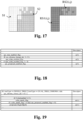
- Figure 17 illustrates an example of a set of reference samples in which a variation is detected.
- the reference samples of the analysis template is split into a first sub-set S1 and a second sub-set S2 based on a sample-based splitting
- a first single weighting value is assigned with the reference samples RS1 (i,j) of the sub-set S1 that belongs to the model template and a second single weighting value is assigned with the reference samples RS2(i,j) of the sub-set S2 that belongs to the model template.
- the second single weighting value may be bigger than the first single weighting value to indicate better content consistency between the reference samples RS2 of the sub-set S2 to the reconstructed luma samples of the co-located luma block.
- sub-sets of the analysis template may comprises non-adjacent reference samples of the analysis template.
- a weighting value may equal to 0 to indicate at least one reference sample of the model template is not considered for deriving the parameters of a cross-component prediction model.
- the MPM list may comprise at least one cross-component prediction model as determined based on weighted reference samples (method 300) and at least one cross-component prediction model determined as in prior art and the prediction mode p* for a chroma block is given by equation (1).
- method 300 may further comprise signaling an enabling information indicating the cross-component prediction model is determined based on weighted reference samples.
- the enabling information is signaled with High-Level Syntax (HLS) flags, such as Sequence Parameter Set (SPS), Picture Parameter Set (PPS), slice header etc.
- HLS High-Level Syntax
- the enabling information is signaled at the CU-level.
- Figure 18 shows an example of signalling the enabling information as a flag sps_proposed_enabled_flag in the Sequence parameter set (SPS) of the codec.
- SPS Sequence parameter set
- Figure 19 shows an example of signalling weighting values in the coding unit (CU) syntax of the codec when the enabling information (sps_proposed_enabled_flag) is active and indicates CCLM is enabled (cclm_mode_flag).
- enabling determining the at least one cross-component prediction model based on weighted reference samples is implicit (i.e. without signaling).
- determining whether determining the at least one cross-component prediction model is based on weighted reference samples is enabled or not may be determined based on chroma or co-located luma block characteristics such as size, neighboring CUs, etc.
- determining the at least one cross-component prediction model is based on weighted reference samples is enabled to some of cross-component prediction modes as defined in prior art.
- the cross-component prediction model based on weighted reference samples may be enabled for only CCLM.
- Figure 20 shows a schematic block diagram illustrating an example of a system 600 in which various aspects and exemplary embodiments are implemented.
- the input to the elements of system 600 may be provided through various input devices as indicated in block 690.
- Such input devices include, but are not limited to, (i) an RF portion that may receive an RF signal transmitted, for example, over the air by a broadcaster, (ii) a Composite input terminal, (iii) a USB input terminal, (iv) an HDMI input terminal, (v) a bus such as CAN (Controller Area Network), CAN FD (Controller Area Network Flexible Data-Rate), FlexRay (ISO 17458) or Ethernet (ISO/IEC 802-3) bus when the present invention is implemented in the automotive domain.
- CAN Controller Area Network
- CAN FD Controller Area Network Flexible Data-Rate
- FlexRay ISO 17458
- Ethernet ISO/IEC 802-3
Landscapes
- Engineering & Computer Science (AREA)
- Multimedia (AREA)
- Signal Processing (AREA)
- Compression Or Coding Systems Of Tv Signals (AREA)
Priority Applications (2)
| Application Number | Priority Date | Filing Date | Title |
|---|---|---|---|
| EP23307259.4A EP4576776A1 (fr) | 2023-12-19 | 2023-12-19 | Codage/decodage de donnees video |
| PCT/CN2024/072814 WO2025129786A1 (fr) | 2023-12-19 | 2024-01-17 | Codage/décodage de données d'image vidéo |
Applications Claiming Priority (1)
| Application Number | Priority Date | Filing Date | Title |
|---|---|---|---|
| EP23307259.4A EP4576776A1 (fr) | 2023-12-19 | 2023-12-19 | Codage/decodage de donnees video |
Publications (1)
| Publication Number | Publication Date |
|---|---|
| EP4576776A1 true EP4576776A1 (fr) | 2025-06-25 |
Family
ID=89722998
Family Applications (1)
| Application Number | Title | Priority Date | Filing Date |
|---|---|---|---|
| EP23307259.4A Pending EP4576776A1 (fr) | 2023-12-19 | 2023-12-19 | Codage/decodage de donnees video |
Country Status (2)
| Country | Link |
|---|---|
| EP (1) | EP4576776A1 (fr) |
| WO (1) | WO2025129786A1 (fr) |
Cited By (1)
| Publication number | Priority date | Publication date | Assignee | Title |
|---|---|---|---|---|
| US20260012573A1 (en) * | 2022-06-21 | 2026-01-08 | Interdigital Ce Patent Holdings, Sas | Methods and apparatuses for encoding and decoding an image or a video |
Citations (1)
| Publication number | Priority date | Publication date | Assignee | Title |
|---|---|---|---|---|
| WO2018053293A1 (fr) * | 2016-09-15 | 2018-03-22 | Qualcomm Incorporated | Prédiction intra de chrominance avec un ou des modèles linéaires pour le codage vidéo |
Family Cites Families (4)
| Publication number | Priority date | Publication date | Assignee | Title |
|---|---|---|---|---|
| WO2023125771A1 (fr) * | 2021-12-29 | 2023-07-06 | Mediatek Inc. | Prédiction de modèle linéaire à composante transversale |
| CN119213770A (zh) * | 2022-05-16 | 2024-12-27 | 北京达佳互联信息技术有限公司 | 改进的视频编解码的跨分量预测 |
| CN119256544A (zh) * | 2022-05-26 | 2025-01-03 | 北京达佳互联信息技术有限公司 | 用于视频编解码的跨分量预测的方法和装置 |
| CN115988206B (zh) * | 2023-03-21 | 2024-03-26 | 深圳传音控股股份有限公司 | 图像处理方法、处理设备及存储介质 |
-
2023
- 2023-12-19 EP EP23307259.4A patent/EP4576776A1/fr active Pending
-
2024
- 2024-01-17 WO PCT/CN2024/072814 patent/WO2025129786A1/fr active Pending
Patent Citations (1)
| Publication number | Priority date | Publication date | Assignee | Title |
|---|---|---|---|---|
| WO2018053293A1 (fr) * | 2016-09-15 | 2018-03-22 | Qualcomm Incorporated | Prédiction intra de chrominance avec un ou des modèles linéaires pour le codage vidéo |
Non-Patent Citations (2)
| Title |
|---|
| KAI ZHANG ET AL.: "Enhanced Cross-component Linear Model Intra-prediction", JVET, CHENGDU, CN, 15 October 2016 (2016-10-15) |
| ZHANG K ET AL: "Enhanced Cross-component Linear Model Intra-prediction", 4. JVET MEETING; 15-10-2016 - 21-10-2016; CHENGDU; (THE JOINT VIDEO EXPLORATION TEAM OF ISO/IEC JTC1/SC29/WG11 AND ITU-T SG.16 ); URL: HTTP://PHENIX.INT-EVRY.FR/JVET/,, no. JVET-D0110-v4, 17 October 2016 (2016-10-17), XP030150355 * |
Cited By (1)
| Publication number | Priority date | Publication date | Assignee | Title |
|---|---|---|---|---|
| US20260012573A1 (en) * | 2022-06-21 | 2026-01-08 | Interdigital Ce Patent Holdings, Sas | Methods and apparatuses for encoding and decoding an image or a video |
Also Published As
| Publication number | Publication date |
|---|---|
| WO2025129786A1 (fr) | 2025-06-26 |
Similar Documents
| Publication | Publication Date | Title |
|---|---|---|
| WO2024066320A9 (fr) | Codage/décodage de données d'image vidéo | |
| WO2024066321A1 (fr) | Codage/décodage de données d'image vidéo | |
| EP4576776A1 (fr) | Codage/decodage de donnees video | |
| WO2023246274A1 (fr) | Codage/décodage de données d'image vidéo | |
| US12604003B2 (en) | Encoding/decoding video picture partitioned in CTU grids | |
| US20250220172A1 (en) | Methods and apparatus of encoding/decoding video picture partitioned in ctu grids | |
| EP4447439A1 (fr) | Codage/decodage de donnees video | |
| EP4561061A1 (fr) | Codage/decodage de donnees video | |
| WO2025148127A1 (fr) | Codage/décodage de données d'image vidéo | |
| EP4447438A1 (fr) | Codage/decodage de donnees video | |
| WO2024001472A1 (fr) | Codage/décodage de données d'image vidéo | |
| EP4676045A1 (fr) | Codage/décodage de donnees d'image video | |
| EP4447437A1 (fr) | Codage de données vidéo | |
| EP4354870A1 (fr) | Codage/decodage de donnees video | |
| WO2025148128A1 (fr) | Codage/décodage de données d'image vidéo | |
| EP4254949A1 (fr) | Codage/décodage d'image vidéo partitionnée dans des grilles ctu | |
| OA22164A (en) | Encoding/Decoding Video Picture Data. |
Legal Events
| Date | Code | Title | Description |
|---|---|---|---|
| PUAI | Public reference made under article 153(3) epc to a published international application that has entered the european phase |
Free format text: ORIGINAL CODE: 0009012 |
|
| STAA | Information on the status of an ep patent application or granted ep patent |
Free format text: STATUS: REQUEST FOR EXAMINATION WAS MADE |
|
| 17P | Request for examination filed |
Effective date: 20231219 |
|
| AK | Designated contracting states |
Kind code of ref document: A1 Designated state(s): AL AT BE BG CH CY CZ DE DK EE ES FI FR GB GR HR HU IE IS IT LI LT LU LV MC ME MK MT NL NO PL PT RO RS SE SI SK SM TR |