EP4576789A1 - Anzeigevorrichtung und betriebsverfahren dafür - Google Patents
Anzeigevorrichtung und betriebsverfahren dafür Download PDFInfo
- Publication number
- EP4576789A1 EP4576789A1 EP23877591.0A EP23877591A EP4576789A1 EP 4576789 A1 EP4576789 A1 EP 4576789A1 EP 23877591 A EP23877591 A EP 23877591A EP 4576789 A1 EP4576789 A1 EP 4576789A1
- Authority
- EP
- European Patent Office
- Prior art keywords
- display
- area
- content
- display device
- external device
- Prior art date
- Legal status (The legal status is an assumption and is not a legal conclusion. Google has not performed a legal analysis and makes no representation as to the accuracy of the status listed.)
- Pending
Links
Images






Classifications
-
- H—ELECTRICITY
- H04—ELECTRIC COMMUNICATION TECHNIQUE
- H04N—PICTORIAL COMMUNICATION, e.g. TELEVISION
- H04N21/00—Selective content distribution, e.g. interactive television or video on demand [VOD]
- H04N21/40—Client devices specifically adapted for the reception of or interaction with content, e.g. set-top-box [STB]; Operations thereof
- H04N21/41—Structure of client; Structure of client peripherals
- H04N21/4104—Peripherals receiving signals from specially adapted client devices
- H04N21/4122—Peripherals receiving signals from specially adapted client devices additional display device, e.g. video projector
-
- H—ELECTRICITY
- H04—ELECTRIC COMMUNICATION TECHNIQUE
- H04N—PICTORIAL COMMUNICATION, e.g. TELEVISION
- H04N9/00—Details of colour television systems
- H04N9/12—Picture reproducers
- H04N9/31—Projection devices for colour picture display, e.g. using electronic spatial light modulators [ESLM]
- H04N9/3141—Constructional details thereof
- H04N9/3147—Multi-projection systems
-
- G—PHYSICS
- G06—COMPUTING OR CALCULATING; COUNTING
- G06F—ELECTRIC DIGITAL DATA PROCESSING
- G06F3/00—Input arrangements for transferring data to be processed into a form capable of being handled by the computer; Output arrangements for transferring data from processing unit to output unit, e.g. interface arrangements
- G06F3/14—Digital output to display device ; Cooperation and interconnection of the display device with other functional units
-
- H—ELECTRICITY
- H04—ELECTRIC COMMUNICATION TECHNIQUE
- H04N—PICTORIAL COMMUNICATION, e.g. TELEVISION
- H04N21/00—Selective content distribution, e.g. interactive television or video on demand [VOD]
- H04N21/40—Client devices specifically adapted for the reception of or interaction with content, e.g. set-top-box [STB]; Operations thereof
- H04N21/41—Structure of client; Structure of client peripherals
-
- H—ELECTRICITY
- H04—ELECTRIC COMMUNICATION TECHNIQUE
- H04N—PICTORIAL COMMUNICATION, e.g. TELEVISION
- H04N21/00—Selective content distribution, e.g. interactive television or video on demand [VOD]
- H04N21/40—Client devices specifically adapted for the reception of or interaction with content, e.g. set-top-box [STB]; Operations thereof
- H04N21/43—Processing of content or additional data, e.g. demultiplexing additional data from a digital video stream; Elementary client operations, e.g. monitoring of home network or synchronising decoder's clock; Client middleware
-
- H—ELECTRICITY
- H04—ELECTRIC COMMUNICATION TECHNIQUE
- H04N—PICTORIAL COMMUNICATION, e.g. TELEVISION
- H04N21/00—Selective content distribution, e.g. interactive television or video on demand [VOD]
- H04N21/40—Client devices specifically adapted for the reception of or interaction with content, e.g. set-top-box [STB]; Operations thereof
- H04N21/43—Processing of content or additional data, e.g. demultiplexing additional data from a digital video stream; Elementary client operations, e.g. monitoring of home network or synchronising decoder's clock; Client middleware
- H04N21/4302—Content synchronisation processes, e.g. decoder synchronisation
- H04N21/4307—Synchronising the rendering of multiple content streams or additional data on devices, e.g. synchronisation of audio on a mobile phone with the video output on the TV screen
- H04N21/43076—Synchronising the rendering of multiple content streams or additional data on devices, e.g. synchronisation of audio on a mobile phone with the video output on the TV screen of the same content streams on multiple devices, e.g. when family members are watching the same movie on different devices
-
- H—ELECTRICITY
- H04—ELECTRIC COMMUNICATION TECHNIQUE
- H04N—PICTORIAL COMMUNICATION, e.g. TELEVISION
- H04N21/00—Selective content distribution, e.g. interactive television or video on demand [VOD]
- H04N21/40—Client devices specifically adapted for the reception of or interaction with content, e.g. set-top-box [STB]; Operations thereof
- H04N21/43—Processing of content or additional data, e.g. demultiplexing additional data from a digital video stream; Elementary client operations, e.g. monitoring of home network or synchronising decoder's clock; Client middleware
- H04N21/431—Generation of visual interfaces for content selection or interaction; Content or additional data rendering
-
- H—ELECTRICITY
- H04—ELECTRIC COMMUNICATION TECHNIQUE
- H04N—PICTORIAL COMMUNICATION, e.g. TELEVISION
- H04N21/00—Selective content distribution, e.g. interactive television or video on demand [VOD]
- H04N21/40—Client devices specifically adapted for the reception of or interaction with content, e.g. set-top-box [STB]; Operations thereof
- H04N21/43—Processing of content or additional data, e.g. demultiplexing additional data from a digital video stream; Elementary client operations, e.g. monitoring of home network or synchronising decoder's clock; Client middleware
- H04N21/436—Interfacing a local distribution network, e.g. communicating with another STB or one or more peripheral devices inside the home
-
- H—ELECTRICITY
- H04—ELECTRIC COMMUNICATION TECHNIQUE
- H04N—PICTORIAL COMMUNICATION, e.g. TELEVISION
- H04N21/00—Selective content distribution, e.g. interactive television or video on demand [VOD]
- H04N21/40—Client devices specifically adapted for the reception of or interaction with content, e.g. set-top-box [STB]; Operations thereof
- H04N21/43—Processing of content or additional data, e.g. demultiplexing additional data from a digital video stream; Elementary client operations, e.g. monitoring of home network or synchronising decoder's clock; Client middleware
- H04N21/436—Interfacing a local distribution network, e.g. communicating with another STB or one or more peripheral devices inside the home
- H04N21/43615—Interfacing a Home Network, e.g. for connecting the client to a plurality of peripherals
-
- H—ELECTRICITY
- H04—ELECTRIC COMMUNICATION TECHNIQUE
- H04N—PICTORIAL COMMUNICATION, e.g. TELEVISION
- H04N21/00—Selective content distribution, e.g. interactive television or video on demand [VOD]
- H04N21/40—Client devices specifically adapted for the reception of or interaction with content, e.g. set-top-box [STB]; Operations thereof
- H04N21/47—End-user applications
- H04N21/485—End-user interface for client configuration
-
- H—ELECTRICITY
- H04—ELECTRIC COMMUNICATION TECHNIQUE
- H04N—PICTORIAL COMMUNICATION, e.g. TELEVISION
- H04N21/00—Selective content distribution, e.g. interactive television or video on demand [VOD]
- H04N21/40—Client devices specifically adapted for the reception of or interaction with content, e.g. set-top-box [STB]; Operations thereof
- H04N21/47—End-user applications
- H04N21/485—End-user interface for client configuration
- H04N21/4858—End-user interface for client configuration for modifying screen layout parameters, e.g. fonts, size of the windows
-
- H—ELECTRICITY
- H04—ELECTRIC COMMUNICATION TECHNIQUE
- H04N—PICTORIAL COMMUNICATION, e.g. TELEVISION
- H04N9/00—Details of colour television systems
- H04N9/12—Picture reproducers
- H04N9/31—Projection devices for colour picture display, e.g. using electronic spatial light modulators [ESLM]
- H04N9/3179—Video signal processing therefor
- H04N9/3185—Geometric adjustment, e.g. keystone or convergence
-
- H—ELECTRICITY
- H04—ELECTRIC COMMUNICATION TECHNIQUE
- H04N—PICTORIAL COMMUNICATION, e.g. TELEVISION
- H04N9/00—Details of colour television systems
- H04N9/12—Picture reproducers
- H04N9/31—Projection devices for colour picture display, e.g. using electronic spatial light modulators [ESLM]
- H04N9/3179—Video signal processing therefor
- H04N9/3188—Scale or resolution adjustment
-
- H—ELECTRICITY
- H04—ELECTRIC COMMUNICATION TECHNIQUE
- H04N—PICTORIAL COMMUNICATION, e.g. TELEVISION
- H04N9/00—Details of colour television systems
- H04N9/12—Picture reproducers
- H04N9/31—Projection devices for colour picture display, e.g. using electronic spatial light modulators [ESLM]
- H04N9/3191—Testing thereof
- H04N9/3194—Testing thereof including sensor feedback
-
- G—PHYSICS
- G09—EDUCATION; CRYPTOGRAPHY; DISPLAY; ADVERTISING; SEALS
- G09G—ARRANGEMENTS OR CIRCUITS FOR CONTROL OF INDICATING DEVICES USING STATIC MEANS TO PRESENT VARIABLE INFORMATION
- G09G2340/00—Aspects of display data processing
- G09G2340/04—Changes in size, position or resolution of an image
-
- G—PHYSICS
- G09—EDUCATION; CRYPTOGRAPHY; DISPLAY; ADVERTISING; SEALS
- G09G—ARRANGEMENTS OR CIRCUITS FOR CONTROL OF INDICATING DEVICES USING STATIC MEANS TO PRESENT VARIABLE INFORMATION
- G09G2340/00—Aspects of display data processing
- G09G2340/04—Changes in size, position or resolution of an image
- G09G2340/0407—Resolution change, inclusive of the use of different resolutions for different screen areas
-
- G—PHYSICS
- G09—EDUCATION; CRYPTOGRAPHY; DISPLAY; ADVERTISING; SEALS
- G09G—ARRANGEMENTS OR CIRCUITS FOR CONTROL OF INDICATING DEVICES USING STATIC MEANS TO PRESENT VARIABLE INFORMATION
- G09G2340/00—Aspects of display data processing
- G09G2340/04—Changes in size, position or resolution of an image
- G09G2340/0442—Handling or displaying different aspect ratios, or changing the aspect ratio
-
- G—PHYSICS
- G09—EDUCATION; CRYPTOGRAPHY; DISPLAY; ADVERTISING; SEALS
- G09G—ARRANGEMENTS OR CIRCUITS FOR CONTROL OF INDICATING DEVICES USING STATIC MEANS TO PRESENT VARIABLE INFORMATION
- G09G2340/00—Aspects of display data processing
- G09G2340/04—Changes in size, position or resolution of an image
- G09G2340/045—Zooming at least part of an image, i.e. enlarging it or shrinking it
Definitions
- Various embodiments relate to a display device and a method of operating the same. More specifically, the embodiments relate to a display device capable of extending a display in accordance with a display ratio of content and a display ratio of the display device by using an external device, and a method of operating the display device.
- All content has a display ratio set to allow viewers to view the content at its optimal image quality and size.
- Such display ratios may vary depending on the content, there may be instances where a display device displays content that has a different display ratio from that of the display device.
- the entire content may not be displayed, resulting in a portion of the content being cropped.
- the display device may display the content by connecting a plurality of display devices to change the size of the display, as in a dual-monitor configuration.
- a method of operating a display device may include recognizing a display ratio of content.
- the method of operating a display device may include generating, based on the recognized display ratio of the content and a display ratio of a display included in the display device, a first area of an image of the content to be displayed on the display, and a second area of the image of the content to be displayed, by an external device, on a surrounding area of the display.
- the method of operating a display device may include transmitting the second area to the external device such that the display device displays the first area on the display and simultaneously, the external device displays the second area on the surrounding area of the display to extend the display.
- a computer-readable recording medium may have recorded thereon a program for implementing the method of operating a display device, the method including transmitting the second area to the external device such that the display device displays the first area on the display and simultaneously, the external device displays the second area on the surrounding area of the display to extend the display.
- Some embodiments of the present disclosure may be represented by block components and various process operations. Some or all of the functional blocks may be implemented by any number of hardware and/or software elements that perform particular functions.
- the functional blocks of the present disclosure may be embodied by at least one microprocessor or by circuit components for a certain function.
- the functional blocks of the present disclosure may be implemented by using various programming or scripting languages.
- the functional blocks may be implemented by using various algorithms executable by one or more processors.
- the present disclosure may employ known technologies for electronic settings, signal processing, and/or data processing. Terms such as “mechanism”, “element”, “unit”, or “component” may be used in a broad sense and are not limited to mechanical or physical components.
- the terms such as “...er (or)”, “... unit”, “... module”, etc. denote a unit that performs at least one function or operation, which may be implemented as hardware or software or a combination thereof.
- the term "user” as used herein refers to a person who uses a display device to control functions or operations of the display device, and may include a viewer, an administrator, or an installation engineer.
- display ratio may refer to a display aspect ratio, i.e., an aspect ratio of width to height.
- content may have a unique display ratio depending on the method by which the content was filmed, and may be displayed according to the unique display ratio.
- a display device may include displays of various sizes and may reproduce an image according to the ratio of width to height of the included display, i.e., the display ratio.
- the term “display device” may refer to a display included in a display device.
- displaying content on a display device may mean displaying the content on a display included in the display device
- the display ratio of a display device may mean the display ratio of a display included in the display device.
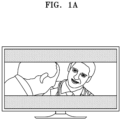
- FIG. 1A is a diagram illustrating an example of a display device operating, according to the related art.
- the display ratio of content being displayed in FIG. 1A may be different from the display ratio of a display included in the display device of FIG. 1A .
- the content of FIG. 1A may be content filmed to be viewed at a display ratio of 32:9
- the display device of FIG. 1A may be a display device having a display ratio of 16:9.
- Content filmed to be viewed at a display ratio of 32:9 may refer to content shot to have a ratio where the horizontal length is 32 and the vertical length is 9.
- the display device may not be able to display the content in 50 % of the vertical area of the display device, as illustrated in FIG. 1A .
- the display device may not be able to use a partial area of the display for displaying the content.
- FIG. 1B is a diagram illustrating an example of a display device operating, according to the related art.
- a display device having a plurality of displays may be used.
- the display device may display content by changing the display ratio of the display device in such a manner in which one device uses two displays connected to the device.
- the display ratio of the display device may be the sum of the ratios of width to height of the two displays, i.e., 32:9.
- the display device may display the entire content by using the entire display area.
- FIG. 2 is a diagram illustrating an example of a display device operating, according to an embodiment of the present disclosure.
- a display device 100 of the present disclosure may be a smart television (TV), but this is merely an embodiment, and the display device 100 may be implemented as various display devices.
- TV smart television
- the display device 100 may be implemented in various forms, such as a tablet personal computer (PC), a digital camera, a camcorder, a laptop computer, a netbook computer, a desktop computer, an electronic book terminal, a video phone, a digital broadcasting terminal, a personal digital assistant (PDA), a portable multimedia player (PMP), a navigation device, a wearable device, a smart refrigerator, or other home appliances.
- PC personal computer
- PDA personal digital assistant
- PMP portable multimedia player
- navigation device a wearable device
- smart refrigerator or other home appliances.
- the embodiments may be readily implemented in a display device including a large-sized video output unit such as a TV, but are not limited thereto.
- the display device 100 may be stationary or mobile, and may be a digital broadcast receiver capable of receiving a digital broadcast signal.
- the display device 100 may be implemented as a flat display device, a curved display device with a screen having a curvature, or a flexible display device having an adjustable curvature.
- the output resolution of the display device 100 may include, for example, high definition (HD), full HD, ultra HD, or a higher resolution than ultra HD.
- the display device 100 of the present disclosure may have a display ratio determined according to the ratio of the horizontal length to vertical length of a display.
- the display device 100 may communicate with an external device 200 in various manners by using a wired or wireless network, a communication medium, or the like.
- the display device 100 may be connected to the external device 200 by using various short-range communication methods such as infrared, Wi-Fi, Bluetooth, or Bluetooth Low Energy (BLE) communication.
- various short-range communication methods such as infrared, Wi-Fi, Bluetooth, or Bluetooth Low Energy (BLE) communication.
- the display device 100 may be connected to the external device 200 by using a wireless protocol such as Wi-Fi Direct.
- the external device 200 may refer to a device capable of communication, which is external to the display device 100.
- the external device 200 may be implemented in various forms such as a smart projector, a projector, a smart phone, a tablet PC, a digital camera, a camcorder, a laptop computer, a netbook computer, a PDA, or a wearable device.
- the embodiments may be easily implemented in a device that is convenient to carry and has a function of enlarging an image and projecting the enlarged image forward, such as a portable smart projector, but are not limited thereto.
- the external device 200 may be implemented in any electronic device that is capable of network connection and has a function of enlarging an image and projecting the enlarged image forward, in addition to the above-described examples.
- the display device 100 may extend an image being reproduced on the display of the display device 100, and display the extended image on a surrounding area of the display by using the external device 200.
- the external device 200 is illustrated as being positioned at the front of the display device 100, but the present disclosure is not limited thereto, and the external device 200 may be present at various locations, such as at a diagonal to the display device 100, below the display device 100, or above the display device 100.
- the size or shape of an area 210 extended by the external device 200 may vary depending on the display ratio of the content and the display ratio of the display device.
- the display device needs to display the content by using only a portion of the display area as illustrated in FIG. 1A , or display the content by using a multi-display configuration as illustrated in FIG. 1B .
- the display device 100 may display part of content filmed to be viewed at a display ratio of 32:9, at a display ratio unique to the display device 100, while displaying the other part of the content that cannot be displayed on the display device 100 by radiating an image as a beam toward the surrounding area 210 of the display by using the external device 200.
- the display device 100 may display the content with 50 % of the left and right sides of the content lost.
- the display device 100 may allow the external device 200 to display the lost 50 % of the content on the surrounding area 210 of the display.
- the lost 50 % of the content may be displayed on left and right areas extended from the display device 100, each for 25 %.
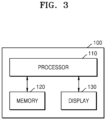
- FIG. 3 is a block diagram illustrating a configuration of a display device according to an embodiment of the present disclosure.
- the display device 100 may include a processor 110, a memory 120, and a display 130.
- the memory 120 may store programs for the processor 110 to perform processing and control. In addition, the memory 120 may store data input to or output from the display device 100.
- the internal memory may include, for example, at least one of a volatile memory (e.g., dynamic random-access memory (DRAM), static RAM (SRAM), synchronous DRAM (SDRAM), etc.), a non-volatile memory (e.g., one-time programmable read-only memory (OTPROM), programmable ROM (PROM), erasable programmable ROM (EPROM), electrically erasable programmable ROM (EEPROM), mask ROM, flash ROM, etc.), a hard disk drive (HDD), or solid-state drive (SSD).
- a volatile memory e.g., dynamic random-access memory (DRAM), static RAM (SRAM), synchronous DRAM (SDRAM), etc.
- a non-volatile memory e.g., one-time programmable read-only memory (OTPROM), programmable ROM (PROM), erasable programmable ROM (EPROM), electrically erasable programmable ROM (EEPROM), mask ROM, flash
- the processor 110 may load a command or data received from at least one of a non-volatile memory or other components into a volatile memory, and process the command or data.
- the processor 110 may store, in the non-volatile memory, data received from other components or generated by the processor 110.
- the TV may output an image to the display while causing the projector to output an image (S660).
- the TV may display an image of the content having a display ratio different from that of the TV, without reducing the size of the image, at the unique display ratio of the image.
- the method of operating a display device according to the embodiment of FIG. 6 may increase the user's sense of immersion by allowing the display device 100 to display an image having a size larger than the size of the display 130 equipped in the display device 100.
- the method of operating a display device enables the display device 100 having a display ratio different from that of the content to display the content with the unique display ratio of the content without modifying the content, such that the intention of the creator of the content is better conveyed to the user.
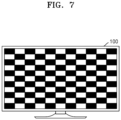
- the display device 100 may display a certain image on the display 130 to allow the external device 200 to detect the position and size of the display 130.
- the external device 200 may detect the position and size of the display 130 by detecting the certain image through a sensor, a camera, or the like.
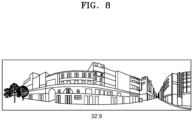
- FIG. 8 may be a diagram illustrating content filmed with a display ratio of 32:9.
- the display ratio of the display 130 included in the display device 100 may be 16:9.
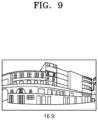
- the display device 100 having a display ratio of 16:9 displays the content of FIG. 8 , i.e., the content having a display ratio of 32:9, only a portion of the content may be displayed, as illustrated in FIG. 9 .
- the display device 100 may display only a portion of the content based on the center of the content, and areas of about 50 % of the left and right sides of the content may be lost.
- the partial area of the content displayed on the display device 100 may be a first area.
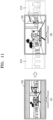
- FIG. 11 is a diagram illustrating an example of a display device extending a display by using an external device, according to an embodiment of the present disclosure.
- the display device 100 including the display 130 having a display ratio of 16:9 may display the content filmed to be viewed at a ratio of 32:9 as in (B) when executing the display extension mode.
- the display device 100 may be a TV
- the external device 200 may be a projector.
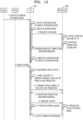
- the display device 100 may receive, from the user, an input for setting a display extension mode (1).
- the input for setting the display extension mode may be received in a menu or a configuration screen via a touch screen of the display device 100.
- the display device 100 may maintain the existing settings for the display extension mode until it receives an input for changing the settings from the user.
- the display device 100 may select one of the external devices 200 based on the availability of the external devices 200, the distances between the external devices 200 and the display device 100, the positions of the external devices 200, the usage history of the external devices 200, or the like.
- the display device 100 may display a partial area of content on the surrounding area 210 of the display device 100 by using the selected external device 200.
- the display device 100 may display a notification message that there is no available external device 200.
- the display device 100 may establish a network connection.
- the external device 200 that has received the display extension request from the display device 100 may detect the position and size of the display 130 included in the display device 100 (5).
- the external device 200 may obtain information about the image quality or resolution of the display 130 by detecting the certain image displayed on the display device 100.
- the obtained information may be used to determine a position on which the external device 200 is to display a second area of the content.
- the external device 200 may perform keystone correction and lens shift by using the information about the position and size of the display 130 (6).
- keystone correction may refer to an operation of determining and correcting the shape or position of display of an image to be displayed by the external device 200.
- lens shift may refer to an operation in which the external device 200 adjusts the focal point of a lens, etc. to adjust the image quality of the image to be displayed.
- the external device 200 may perform keystone correction and lens shift based on information obtained by detecting the certain image displayed on the display device 100.
- the display device 100 may omit the operation of receiving, from the external device 200, the response message that processing for the display extension request has been completed. In this case, when a preset period of time elapses after the display extension request is transmitted, the display device 100 may assume that processing for the display extension request has been completed.
- the display device 100 that has received the response message of operation 7 from the external device 200 may complete the configuration of the display extension mode (8).
- the display device 100 may control the external device 200 to perform operations 5 and 6.
- the display device 100 may obtain an image source from a set-top box (STB) (9).
- STB set-top box
- the display device 100 may obtain a content source of from an over-the-top (OTT) server, a broadcasting station, or other external devices.
- OTT over-the-top
- the display device 100 may obtain content stored in a storage medium.
- the display device 100 may recognize the display ratio of the obtained content (10).
- the recognizing of the display ratio of the content by the display device 100 may be the same as operation S510 of FIG. 5 or operation S630 of FIG. 6 . Thus, redundant descriptions provided above will be omitted.
- the display device 100 may divide the obtained content into a portion to be output by the display device 100 and a portion to be output by the external device 200, and generate respective images (11).
- the display device 100 may divide the obtained content into a first area to be output by the display device 100, and a second area to be output by the external device 200, based on the display ratio of the display device 100 and the display ratio of the content.
- the dividing of the content into the first area and the second area by the display device 100 may be the same as operation S520 of FIG. 5 or operation S640 of FIG. 6 . Thus, redundant descriptions provided above will be omitted.
- the display device 100 may transmit, to the external device 200, the second area, which is an area of the content to be displayed by the external device 200 (12).
- the display device 100 may receive, from the external device 200, a reception completion response message that reception of the second area has been completed (13).
- the display device 100 may omit the operation of receiving the reception completion response message from the external device 200. In this case, when the display device 100 completes transmission of the second area, the display device 100 may determine that the external device 200 has completed reception of the second area.
- the display device 100 may request the external device 200 to display the second area of the content (14).
- the display device 100 may display the first area of the content (15).
- the external device 200 may display the second area of the content (16).
- the display device 100 may control the external device 200 to display the second area of the content.
- Operation 15 in which the display device 100 displays the first area of the content, and operation 16 in which the external device 200 displays the second area of the content, may be performed simultaneously.
- the display device 100 may synchronize content reproduction by the display device 100 with content reproduction by the external device 200, to simultaneously display the same content with the external device 200.
- the external device 200 may display the second area of the content received from the display device 100.
- the external device 200 may display the second area of the content by optically magnifying the image and projecting the magnified image onto a surrounding area of the display device 100.
- the display device 100 may receive, from the external device 200, a display completion message for the second area (17).
- the external device 200 may transmit the display completion message to the display device 100.
- the display device 100 may omit operation 17 of receiving the display completion response message from the external device 200. In this case, when the display device 100 completes display of the first area, the display device 100 may determine that display of the second area by the external device 200 has been also completed.
- the display device 100 when the display device 100 receives the display completion response message from the external device 200, the display device 100 may perform operations 11 to 17 for the next image of the content. The display device 100 may repeatedly perform operations 11 to 17 until all images of the content are displayed.
- the display device 100 may perform operations 1 to 8 only once and then omit them when repeating the operations. In an embodiment, when repeating the operations, the display device 100 may apply the same details used in the previous execution.
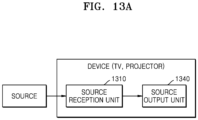
- FIG. 13A is a block diagram illustrating a configuration of a display device according to the related art
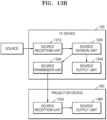
- FIG. 13B is a block diagram illustrating a configuration of a display device and an external device, according to an embodiment of the present disclosure.
- a related-art display device i.e., the display device of FIG. 13A , receives a content source through a source reception unit 1310 and outputs the received source through a source output unit 1340.
- the related-art display device outputs the received content source as is without performing any process on it.
- the display device 100 may receive a content source through the source reception unit 1310 and divide the received content source into a first area to be displayed by the display device 100, and a second area to be displayed, by the external device 200, through a source division unit 1320.
- the method by which the source division unit 1320 divides a source may be the same as operation S520 of FIG. 5 .
- the display device 100 may display, through the source output unit 1340, the first area obtained by the dividing by the source division unit 1320.
- the display device 100 may transmit the second area obtained by dividing by the source division unit 1320, to the external device 200 through a source transmission unit 1330.
- the external device 200 may receive the second area of the content generated by the display device 100, from the display device 100 through a source reception unit 1350.
- the external device 200 may display the received second area of the content, through a source output unit 1360.
- the source output unit 1360 may display the received second area of the content on the surrounding area 210 of the display device 100.
- the display device 100 may be a smart TV.
- the external device 200 may be a smart projector.
- FIG. 14 is a diagram illustrating an example of a display device extending a display by using an external device, according to an embodiment of the present disclosure.
- the display device 100 may display a screen with portions of the content image cropped at the top, bottom, left, and right because the display ratios and resolutions do not match.
- the display device 100 may execute the display extension mode to display IMAX content filmed with a ratio of 1.43:1, as illustrated in FIG. 14 .
- the display device 100 may display, on the display 130, a screen in which portions of the content are cropped at the top, bottom, left, and right in accordance with the display ratio and resolution of the display device 100, and transmit, to the external device 200, the other portions of the content, i.e., a second area of the content image corresponding to the cropped top, bottom, left, and right portions, to cause the external device 200 to display the second area on a surrounding area 1410 of the display device 100.
- the display device 100 may cause the external device 200 to seamlessly display an image of the content on the surrounding area 1410 of the display device for display extension.
- An image displayed on a surrounding area of the display device by the external device 200 for display extension may extend the display only to the left and right as in FIG. 11 , may extend the display upward, downward, leftward, and rightward as in FIG. 14 , or may extend the display only upward and downward.
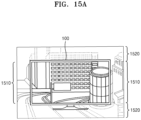
- FIG. 15A is a diagram illustrating an example of a display device extending a display leftward and rightward according to the display ratio of content by using an external device, and further extending the display upward and downward according to a user input, according to an embodiment of the present disclosure.
- an image with about 50 % of the left and right sides of the content cropped may be displayed on the display device 100.
- the display device 100 may divide an image of the content into a first area and a second area.
- the first area may be an area to be displayed on the display device 100
- the second area may be an area to be displayed, by the external device 200, on a surrounding area 1510 of the display device 100.
- the second area 1510 may correspond to 50 % of the left and right sides of the content that cannot be displayed on the display device 100 when displaying the content filmed with a display ratio of 32:9 on the display device 100 having a display ratio of 16:9.
- the user is able to view the content at a display ratio of 32:9, but may also want to view the image on a display extended upward and downward.
- the user may want to view, at a display ratio of 32:15, the content filmed with a display ratio of 32:9.
- the display device 100 needs to extend the display 130 upward and downward, in addition to leftward and rightward.
- a portion 1520 for additional upward and downward extension may require artificially increasing the upper and lower boundary portions of the original content.
- an upper or lower portion of the displayed content may be displayed as being stretched upward and downward, respectively.
- the portion 1520 for additional upward and downward extension may be displayed with a lower resolution, as being blurred, or with an effect such as glare.
- the display device 100 may increase immersion in content and enhance user satisfaction by providing an option to extend the display leftward and rightward according to the display ratio of the content by using the external device 200, and further extend the display upward and downward according to a user input.
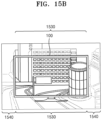
- FIG. 15B is a diagram illustrating an example of a display device extending a display upward and downward according to the display ratio of content by using an external device, and further extending the display leftward and rightward according to a user input, according to an embodiment of the present disclosure.
- an image with about 50 % of the upper and lower sides of the content cropped may be displayed on the display device 100.
- the display device 100 may divide an image of the content into a first area and a second area.
- the first area may be an area to be displayed on the display device 100
- the second area may be an area to be displayed, by the external device 200, on a surrounding area 1530 of the display device 100.
- the second area 1530 may correspond to 50 % of the upper and lower sides of the content that cannot be displayed on the display device 100 when displaying the content filmed with a display ratio of 16:18 on the display device 100 having a display ratio of 16:9.
- the user is able to view the content at a display ratio of 16:18, but may also want to view the image on a display extended leftward and rightward.
- the user may want to view, at a display ratio of 32:18, the content filmed with a display ratio of 16:18, on the display device 100 having a display ratio of 16:9.
- the display device 100 needs to extend the display 130 leftward and rightward, and additionally extend the display 130 upward and downward.
- a portion 1540 for additional leftward and rightward extension may require artificially increasing the left and right boundary portions of the original content.
- a left or right boundary portion of the displayed content may be displayed as being stretched leftward and rightward, respectively. That is, the portion 1540 for additional leftward and rightward extension may be displayed with a lower resolution, as being blurred, or with an effect such as glare.
- the display device 100 may increase immersion in content and enhance user satisfaction by providing an option to extend the display leftward and rightward according to the display ratio of the content by using an external device, and further extend the display upward and downward according to a user input.
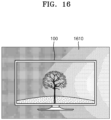
- FIG. 16 is a diagram illustrating an example of a display device displaying ambient light on a certain surrounding area of a display by using an external device, according to an embodiment of the present disclosure.
- the display device 100 may cause the external device 200 to display ambient light on a certain surrounding area 1610 of the display device 100.
- the display device 100 may omit an operation of dividing the content, that is, an operation of generating a first area to be displayed on the display device 100, and a second area to be displayed, by the external device 200, on a surrounding area of the display device 100.
- the display device 100 may generate ambient light and transmit the ambient light to the external device 200. In an embodiment, the display device 100 may transmit, to the external device 200, information about the shape and size of a certain area on which ambient light is to be displayed.
- the display device 100 may control the external device 200 to display ambient light on the certain surrounding area 1610 of the display device 100.
- ambient light may refer to light that is similar in color, brightness, or saturation to portions adjacent to the content displayed on the display device 100.
- ambient light may refer to light that artificially extends content, as in the embodiments of FIGS. 15A and 15B .
- a shape that resembles the upper, lower, left, and right ends of the displayed content being pulled and stretched upward, downward, leftward, and rightward, respectively, may be displayed on the extended area 1610.
- the certain area 1610 may be manually determined based on a user input, or may be automatically determined based on usage history, default settings, etc.
- the display device 100 may receive a user input regarding the certain area 1610 in the form of a display ratio.
- a method of operating a display device may be implemented as a computer-readable recording medium including computer-executable instructions such as a computer-executable program module.
- the computer-readable medium may be any available medium which is accessible by a computer, and may include a volatile or non-volatile medium and a removable or non-removable medium.
- the computer-readable medium may include program instructions, data files, data structures, or the like separately or in combinations.
- the program instructions to be recorded on the medium may be specially designed and configured for the present disclosure or may be well-known to and be usable by those skill in the art of computer software.
- Examples of the computer-readable recording medium include magnetic media such as hard disks, floppy disks, or magnetic tapes, optical media such as a compact disc ROM (CD-ROM) or a digital video disc (DVD), magneto-optical media such as a floptical disk, and hardware devices such as ROM, RAM, or flash memory, which are specially configured to store and execute program commands.
- Examples of program commands may include not only machine code, such as code made by a compiler, but also high-level language code that is executable by a computer by using an interpreter or the like.
- the at least one processor 110 may be further configured to execute the one or more instructions to transmit a display extension request to the external device 200, and receive, from the external device 200, a response to the display extension request.
- the at least one processor 110 may be further configured to execute the one or more instructions to transmit the display extension request to the external device 200 to allow the external device 200 to detect a position and a size of the display 130.
- the at least one processor 110 may be further configured to execute the one or more instructions to display a certain image on the display 130 to allow the external device 200 to detect the position and the size of the display 130.
- the at least one processor 110 may be further configured to execute the one or more instructions to, in response to receiving, from a user, an input for setting a display extension mode, transmit a display extension request to the external device 200.
- the at least one processor 110 may be further configured to execute the one or more instructions to, based on the recognized display ratio of the content and the display ratio of the display 130 being different from each other, determine the first area to be displayed on the display 130 according to the display ratio of the display 130, and determine another area that is not included in the first area, as the second area to be displayed, by the external device 200, on the surrounding area 210, 1410, 1510, or 1530 of the display 130.
- the at least one processor 110 may be further configured to execute the one or more instructions to transmit a display request for the second area to the external device 200, and adjust display of the first area according to a state of the external device 200 displaying the second area.
- the at least one processor 110 may be further configured to execute the one or more instructions to synchronize and display an image of the content displayed in the first area, with an image of the content displayed in the second area.
- the at least one processor 110 may be further configured to execute the one or more instructions to recognize the display ratio of the content by using at least one of pieces of metadata including a resolution or the display ratio of the content.
- the at least one processor 110 may be further configured to execute the one or more instructions to, based on the recognized display ratio of the content and the display ratio of the display 130 being equal to each other, cause the external device 200 to display ambient light on a certain portion of the surrounding area 210, 1410, 1510, or 1530 of the display 130.
- a method of operating a display device 100 includes recognizing a display ratio of content, generating, based on the recognized display ratio of the content and a display ratio of a display 130 included in the display device 100, a first area of an image of the content to be displayed on the display 130, and a second area of the image of the content to be displayed, by an external device 200, on a surrounding area 210, 1410, 1510, or 1530 of the display 130, and transmitting the second area to the external device 200 such that the display device 100 displays the first area on the display 130 and simultaneously, the external device 200 displays the second area on the surrounding area 210, 1410, 1510, or 1530 of the display 130 to extend the display 130.
- the method of operating the display device 100 may further include transmitting a display extension request to the external device 200, and receiving, from the external device 200, a response to the display extension request.
- the transmitting of the display extension request to the external device 200 and the receiving of the response to the display extension request from the external device 200 may include transmitting the display extension request to the external device 200 to allow the external device 200 to detect a position and a size of the display 130.
- the method of operating the display device 100 may further include displaying a certain image on the display 130 to allow the external device 200 to detect the position and the size of the display 130.
- the transmitting of the display extension request to the external device 200 and the receiving of the response to the display extension request from the external device 200 may include, in response to receiving, from a user, an input for setting a display extension mode, transmitting the display extension request to the external device 200.
- the method of operating the display device 100 may further include, based on the recognized display ratio of the content and the display ratio of the display 130 being different from each other, determining the first area to be displayed on the display 130 according to the display ratio of the display 130, and determining another area that is not included in the first area, as the second area to be displayed, by the external device 200, on the surrounding area 210, 1410, 1510, or 1530 of the display 130.
- the displaying of the first area on the display 130 while causing the external device 200 to display the second area on the surrounding area 210, 1410, 1510, or 1530 of the display 130 to extend the display 130, by transmitting the second area to the external device 200 may include synchronizing and displaying an image of the content displayed in the first area, with an image of the content displayed in the second area.
- the recognizing of the display ratio of the content may include recognizing the display ratio of the content by using at least one of pieces of metadata including a resolution or the display ratio of the content.
- the method of operating the display device 100 may further include, based on the recognized display ratio of the content and the display ratio of the display 130 being equal to each other, causing the external device 200 to display ambient light on a certain portion of the surrounding area 210, 1410, 1510, or 1530 of the display 130.
- a computer-readable recording medium may have recorded thereon a program for implementing a method of operating a display device 100, the method including recognizing a display ratio of content, generating, based on the recognized display ratio of the content and a display ratio of a display 130 included in the display device 100, a first area of an image of the content to be displayed on the display 130, and a second area of the image of the content to be displayed, by an external device 200, on a surrounding area 210, 1410, 1510, or 1530 of the display 130, and transmitting the second area to the external device 200 such that the display device 100 displays the first area on the display 130 and simultaneously, the external device 200 displays the second area on the surrounding area 210, 1410, 1510, or 1530 of the display 130 to extend the display 130.
- methods according to various embodiments disclosed herein may be included in a computer program product and then provided.
- the computer program product may be traded as commodities between sellers and buyers.
- the computer program product may be distributed in the form of a machine-readable storage medium (e.g., a CD-ROM), or may be distributed online (e.g., downloaded or uploaded) through an application store or directly between two user devices (e.g., smart phones).
- a portion of the computer program product e.g., a downloadable app
Landscapes
- Engineering & Computer Science (AREA)
- Multimedia (AREA)
- Signal Processing (AREA)
- Human Computer Interaction (AREA)
- Physics & Mathematics (AREA)
- Theoretical Computer Science (AREA)
- General Engineering & Computer Science (AREA)
- General Physics & Mathematics (AREA)
- Geometry (AREA)
- Controls And Circuits For Display Device (AREA)
- Control Of Indicators Other Than Cathode Ray Tubes (AREA)
Applications Claiming Priority (2)
| Application Number | Priority Date | Filing Date | Title |
|---|---|---|---|
| KR1020220129759A KR20240050054A (ko) | 2022-10-11 | 2022-10-11 | 디스플레이 장치 및 그 동작 방법 |
| PCT/KR2023/015326 WO2024080663A1 (ko) | 2022-10-11 | 2023-10-05 | 디스플레이 장치 및 그 동작 방법 |
Publications (2)
| Publication Number | Publication Date |
|---|---|
| EP4576789A1 true EP4576789A1 (de) | 2025-06-25 |
| EP4576789A4 EP4576789A4 (de) | 2025-09-10 |
Family
ID=90669915
Family Applications (1)
| Application Number | Title | Priority Date | Filing Date |
|---|---|---|---|
| EP23877591.0A Pending EP4576789A4 (de) | 2022-10-11 | 2023-10-05 | Anzeigevorrichtung und betriebsverfahren dafür |
Country Status (4)
| Country | Link |
|---|---|
| US (1) | US20250240474A1 (de) |
| EP (1) | EP4576789A4 (de) |
| KR (1) | KR20240050054A (de) |
| WO (1) | WO2024080663A1 (de) |
Family Cites Families (9)
| Publication number | Priority date | Publication date | Assignee | Title |
|---|---|---|---|---|
| KR101715937B1 (ko) * | 2010-01-20 | 2017-03-13 | 엘지전자 주식회사 | 프로젝터가 장착된 디스플레이 장치 및 그 제어 방법 |
| KR101429812B1 (ko) * | 2012-09-18 | 2014-08-12 | 한국과학기술원 | 외부 프로젝터를 활용한 텔레비전 화면의 확장 장치 및 방법 |
| US9826277B2 (en) * | 2015-01-23 | 2017-11-21 | TCL Research America Inc. | Method and system for collaborative and scalable information presentation |
| KR20170006576A (ko) * | 2015-07-08 | 2017-01-18 | 삼성전자주식회사 | 디스플레이장치, 무선통신장치 및 그들의 제어방법 |
| KR102341301B1 (ko) * | 2017-03-27 | 2021-12-20 | 삼성전자 주식회사 | 전자 장치 및 전자 장치의 화면 공유 방법 |
| EP3422707A1 (de) * | 2017-06-29 | 2019-01-02 | Vestel Elektronik Sanayi ve Ticaret A.S. | Anzeigesystem und -verfahren |
| KR102328121B1 (ko) * | 2018-02-12 | 2021-11-17 | 삼성전자주식회사 | 전자 장치 및 그 동작 방법 |
| KR102308927B1 (ko) * | 2018-12-27 | 2021-10-05 | 주식회사 엔씨소프트 | 화면 출력 방법 및 이를 수행하기 위한 디스플레이 장치 |
| KR20210090510A (ko) * | 2020-01-10 | 2021-07-20 | 주식회사 케이티 | 멀티 스크린을 사용하여 가상 모바일 인프라 서비스를 제공하는 방법 |
-
2022
- 2022-10-11 KR KR1020220129759A patent/KR20240050054A/ko active Pending
-
2023
- 2023-10-05 EP EP23877591.0A patent/EP4576789A4/de active Pending
- 2023-10-05 WO PCT/KR2023/015326 patent/WO2024080663A1/ko not_active Ceased
-
2025
- 2025-04-10 US US19/175,438 patent/US20250240474A1/en active Pending
Also Published As
| Publication number | Publication date |
|---|---|
| EP4576789A4 (de) | 2025-09-10 |
| US20250240474A1 (en) | 2025-07-24 |
| WO2024080663A1 (ko) | 2024-04-18 |
| KR20240050054A (ko) | 2024-04-18 |
Similar Documents
| Publication | Publication Date | Title |
|---|---|---|
| US11856322B2 (en) | Display apparatus for image processing and image processing method | |
| CN113475091B (zh) | 显示设备及其图像显示方法 | |
| US10306179B2 (en) | Image providing apparatus, control method thereof, and image providing system | |
| WO2021042655A1 (zh) | 一种音画同步处理方法及显示设备 | |
| KR20150027891A (ko) | 전자 장치들을 이용한 콘텐트 표현 방법 및 장치 | |
| KR20120116613A (ko) | 영상표시장치 및 이를 이용한 콘텐츠 관리방법 | |
| US20200326907A1 (en) | Method for outputting audio data of applications and display device | |
| KR20150027892A (ko) | 콘텐트 표현 방법 및 시스템 | |
| KR20240000330A (ko) | 영상을 투사하는 외부 전자 장치와 연동하여 영상 컨텐츠를 제공하는 전자 장치 및 이의 제어 방법 | |
| US20160191841A1 (en) | Display device and display method | |
| US20170230603A1 (en) | High resolution user interface | |
| US12450024B2 (en) | Display device and method for sharing screens of electronic devices | |
| US20150221078A1 (en) | Calibration device, display system and control method thereof | |
| US20250211719A1 (en) | Projection apparatus and operating method thereof | |
| CN111078926A (zh) | 一种人像缩略图像的确定方法及显示设备 | |
| EP4576789A1 (de) | Anzeigevorrichtung und betriebsverfahren dafür | |
| KR102824983B1 (ko) | 영상 처리 장치 및 방법 | |
| KR20160056165A (ko) | 영상 입력 장치, 디스플레이 장치 및 그 동작 방법 | |
| KR20220096699A (ko) | 전자 장치 및 그 동작 방법 | |
| US11699374B2 (en) | Display device and operating method of the same | |
| KR20230117988A (ko) | 전자 장치 및 그 동작 방법 | |
| CN114979773A (zh) | 显示设备、视频处理方法及存储介质 | |
| CN114339174A (zh) | 一种投影设备及其控制方法 | |
| US20250133184A1 (en) | Electronic device that provides image content in conjunction with external electronic device for projecting image, and control method therefor | |
| US12375762B2 (en) | Display device and operation method thereof |
Legal Events
| Date | Code | Title | Description |
|---|---|---|---|
| STAA | Information on the status of an ep patent application or granted ep patent |
Free format text: STATUS: THE INTERNATIONAL PUBLICATION HAS BEEN MADE |
|
| PUAI | Public reference made under article 153(3) epc to a published international application that has entered the european phase |
Free format text: ORIGINAL CODE: 0009012 |
|
| STAA | Information on the status of an ep patent application or granted ep patent |
Free format text: STATUS: REQUEST FOR EXAMINATION WAS MADE |
|
| 17P | Request for examination filed |
Effective date: 20250318 |
|
| AK | Designated contracting states |
Kind code of ref document: A1 Designated state(s): AL AT BE BG CH CY CZ DE DK EE ES FI FR GB GR HR HU IE IS IT LI LT LU LV MC ME MK MT NL NO PL PT RO RS SE SI SK SM TR |
|
| A4 | Supplementary search report drawn up and despatched |
Effective date: 20250811 |
|
| RIC1 | Information provided on ipc code assigned before grant |
Ipc: H04N 21/41 20110101AFI20250805BHEP Ipc: H04N 9/31 20060101ALI20250805BHEP Ipc: H04N 21/436 20110101ALI20250805BHEP Ipc: H04N 21/485 20110101ALI20250805BHEP Ipc: H04N 21/43 20110101ALI20250805BHEP Ipc: G06F 3/14 20060101ALI20250805BHEP |
|
| DAV | Request for validation of the european patent (deleted) | ||
| DAX | Request for extension of the european patent (deleted) |