EP4576807A1 - Entdeckung von optischen netzwerkeinheiten in einem passiven optischen netzwerk - Google Patents
Entdeckung von optischen netzwerkeinheiten in einem passiven optischen netzwerk Download PDFInfo
- Publication number
- EP4576807A1 EP4576807A1 EP23218183.4A EP23218183A EP4576807A1 EP 4576807 A1 EP4576807 A1 EP 4576807A1 EP 23218183 A EP23218183 A EP 23218183A EP 4576807 A1 EP4576807 A1 EP 4576807A1
- Authority
- EP
- European Patent Office
- Prior art keywords
- olt
- message
- onus
- onu
- condition
- Prior art date
- Legal status (The legal status is an assumption and is not a legal conclusion. Google has not performed a legal analysis and makes no representation as to the accuracy of the status listed.)
- Pending
Links
Images


Classifications
-
- H—ELECTRICITY
- H04—ELECTRIC COMMUNICATION TECHNIQUE
- H04Q—SELECTING
- H04Q11/00—Selecting arrangements for multiplex systems
- H04Q11/0001—Selecting arrangements for multiplex systems using optical switching
- H04Q11/0062—Network aspects
- H04Q11/0067—Provisions for optical access or distribution networks, e.g. Gigabit Ethernet Passive Optical Network (GE-PON), ATM-based Passive Optical Network (A-PON), PON-Ring
-
- H—ELECTRICITY
- H04—ELECTRIC COMMUNICATION TECHNIQUE
- H04Q—SELECTING
- H04Q11/00—Selecting arrangements for multiplex systems
- H04Q11/0001—Selecting arrangements for multiplex systems using optical switching
- H04Q11/0062—Network aspects
- H04Q2011/0064—Arbitration, scheduling or medium access control aspects
-
- H—ELECTRICITY
- H04—ELECTRIC COMMUNICATION TECHNIQUE
- H04Q—SELECTING
- H04Q11/00—Selecting arrangements for multiplex systems
- H04Q11/0001—Selecting arrangements for multiplex systems using optical switching
- H04Q11/0062—Network aspects
- H04Q2011/0079—Operation or maintenance aspects
-
- H—ELECTRICITY
- H04—ELECTRIC COMMUNICATION TECHNIQUE
- H04Q—SELECTING
- H04Q11/00—Selecting arrangements for multiplex systems
- H04Q11/0001—Selecting arrangements for multiplex systems using optical switching
- H04Q11/0062—Network aspects
- H04Q2011/0088—Signalling aspects
Definitions
- Various example embodiments relate to discovery of optical network units in a passive optical network.
- the OLT When a new ONU is added to the PON, the ONU is assisted by the OLT to become operational within the PON through a process referred to as ONU discovery.
- the OLT may detect new ONUs, communicate with new ONUs to determine a message travel time and exchange necessary communication information.
- the OLT may, for example, request a serial number of new ONUs for identification purposes.
- an optical line terminal, OLT for a passive optical network, PON, configured to provide discovery of optical network units, ONUs.
- the OLT is configured to perform a step of broadcasting at least one message.
- the at least one message comprises an indication of an availability of the OLT for discovering new ONUs.
- the at least one message also comprises a selecting condition limiting the new ONUs to a subset of ONUs located within a predetermined distance range from the OLT.
- the OLT is further configured to perform a step of listening, during a quiet window associated with the predetermined distance range, for messages in response to the broadcasting, sent by the subset of ONUs.
- ONU discovery refers to schemes, executed by an OLT, that allow new ONUs to join the PON. After becoming physically connected to the PON, a new ONU needs to be set-up to function according to communication rules enforced by the OLT. This configuring of a new ONU is performed by establishing communication between the new ONU and the OLT.
- a first step of establishing communication entails the OLT providing an indication of availability for discovery of new ONUs. The indication indicates that the OLT is ready to listen and undiscovered ONUs are allowed to publicise themselves. The indication thus implies a permission given to new ONUs to transmit an optical signal via the ODN.
- the quiet window is a timeslot during which an OLT transceiver is exclusively reserved for listening to responses potentially sent by prospective ONUs.
- the OLT may receive optical signals from prospective ONUs and the OLT optical transceiver cannot be used for other operations.
- the OLT covers a service area of ONUs that are located within a certain distance, e.g. between 5 kilometres, km, and 20 km from the OLT.
- the length of the quiet window is determined by the difference in distance between the farthest and the closest ONU with respect to the OLT, e.g. 15 km.
- the OLT knows a minimal time and a maximal time before a response from prospective ONUs may possibly arrive back at the OLT.
- the minimal time is the time it may take for a response of the closest ONU to arrive back at the OLT.
- the maximal time is the time it may take for a response of the farthest ONU to arrive back at the OLT.
- the minimal and maximal times define the boundaries of the quiet window. Additional margins are advantageously taken into account as well.
- the OLT enforces that only prospective ONUs within a predefined distance interval from the OLT may respond during the corresponding quiet window.
- a long quiet window of the OLT is divided into multiple shorter quiet windows that can be executed separately.
- the service area of the PON is divided into predetermined distance ranges defined by each of the quiet windows. Since during a quiet window, OLT resources are reserved for listening, other tasks may suffer as a result of having to wait too long for the OLT.
- the separate quiet windows can be applied in an isolated way instead of consecutively as one long quiet window. In other words, the OLT can execute other operations between the shorter quiet windows resulting from applying the selecting condition. This reduces the bottleneck time during which the OLT is blocked for performing the listening. As such, the worst case waiting time for other operations is greatly improved.
- the method is compatible with any protocol for PONs since it does not impose any protocol-related restrictions.
- an ONU may define one or more quiet windows during which it waits for signals sent by the OLT.
- the quiet window referred to herein is the quiet window from the perspective of the OLT.
- the OLT quiet window is the paramount bottleneck that is reduced by the first example aspect.
- the quiet window has a duration of at least a difference between a message travel time between the OLT and an ONU of the subset located furthest away from the OLT and a message travel time between the OLT to an ONU of the subset located closest to the OLT.
- the OLT listens for messages from ONUs in the corresponding distance range.
- the quiet window may start at the earliest possible time when a response from an ONU may arrive back at the OLT. This time is determined by a physical distance to the ONU closest to the OLT, since it has the shortest message travel time.
- the quiet window ends at the latest possible time when a response from an ONU may arrive back at the OLT. This time is determined by the ONU farthest away from the OLT, since it has the longest message travel time.
- the difference in message travel times corresponds to a message travel time from the closest ONU to the farthest ONU of the distance range. Additionally, margins may be included in the quiet window to ensure reception of unwanted delays of responses from ONUs.
- the OLT is configured to listen only to ONUs within the predetermined distance range. As such, the quiet window is kept short.
- the listening starts after a first time interval upon finishing the broadcasting, wherein the first time interval is at least two times the message travel time between the OLT and the ONU of the subset located closest to the OLT.
- the first time interval comprises the time it takes for the indication to travel from the OLT to the closest ONU added to the time it takes for a response to arrive back from to the OLT.
- the quiet window After sending the indication, it will take at least a message travel time to and from the closest ONU before any response can arrive to the OLT. During this initial time interval, no responses can arrive from ONUs, making listening needless. By excluding this message travel time from the quiet window, the quiet window is reduced in length without allowing the OLT to miss possible responses from ONUs in the range. The quiet window can be kept short even when the closest ONU of the range is relatively far away from the OLT.
- the steps are iteratively performed for a plurality of subsets of ONUs within a respective plurality of predetermined distance ranges.
- the predetermined distance ranges may be overlapping or may be nonoverlapping.
- a small overlap may be provided in order to include margins. Slightly stretching the quiet window allows receiving responses that have been delayed due to non-ideal optical effects.
- the at least one message further comprises condition-related information comprising information for evaluation of the selecting condition.
- the at least one message comprises a broadcasting message, comprising both the indication and the selecting condition.
- the at least one message further comprises an additional message comprising the condition-related information.
- the broadcasting message may further comprise the condition-related information.
- the discovery message or the condition message may comprise the condition-related information.
- ONUs may precompute a result of the selecting condition before receiving the indication. This may advantageously reduce the time of the discovery process.
- the at least one message comprises at least one Physical Layer Operation Administration and Maintenance, PLOAM, message.
- the discovery message comprises a bandwidth map, BWmap, message comprising a request for a serial number of prospective ONUs.
- the condition message may be a Physical Layer Operation Administration and Maintenance, PLOAM, message.
- a BWmap message comprises information defining the timeslots reserved for an ONU on a particular wavelength in upstream communication.
- the BWmap message addresses a particular ONU by allocating an identifier to each ONU beforehand.
- the BWmap message provides the option of requesting an ONU to provide its serial number.
- the OLT is configured to further broadcast a system profile message, a channel profile message and a burst profile message, providing properties of the PON and of the OLT to ONUs of the PON.
- System, channel and burst profile messages are PLOAM messages comprising system, channel and upstream communication properties of the PON respectively. They may be broadcasted regularly, thereby allowing new ONUs to participate in ONU discovery.
- the selecting condition defines a message travel time range corresponding to a range of travel times of messages exchanged between the OLT and ONUs within the predetermined distance range.
- the at least one message further comprises physical PON characteristics enabling an ONU to determine a distance to the OLT.
- PON topology information may include the length of optical cables, the number and locations of optical splitters and fibre optic connectors and other components.
- the physical PON characteristics may also include physical characteristics of the fibre optic, fibre optic connectors and other components, e.g. expected signal loss.
- the PON topology information is an example of condition-related information. From the topology characteristics, an ONU may derive its distance to the OLT. Accordingly, the selecting condition may be distance-based.
- the selecting condition may be based on message travel time and/or on dispersion characteristics and/or on other properties that vary throughout the PON and that are relatable to a distance range.
- an optical network unit configured to join a passive optical network, PON, by performing a step of receiving at least one message from an optical line terminal, OLT.
- the at least one message comprises: an indication of an availability of the OLT; and a selecting condition related to a predetermined distance range from the OLT.
- the ONU is further configured to perform a step of determining if the ONU fulfils the selecting condition and a step of, upon determining that the ONU fulfils the selecting condition, sending a response message to the OLT to join the PON.
- the ONU is compatible with the OLT according to the first example for ONU discovery.
- the at least one message comprises a bandwidth map, BWmap, message comprising a request for a serial number, and the response message comprises a serial number of the ONU.
- the ONU is further configured to receive a system profile message, a channel profile message and a burst profile message from the OLT and to therefrom derive properties of the PON and of the OLT for communicating with the OLT.
- the properties may include a system version number, upstream wavelength bands, time-division multiplexing information, an upstream line rate, preamble and delimiter patterns and so on.
- the selecting condition defines a message travel time range corresponding to a range of travel times of messages exchanged between the OLT and ONUs within the predetermined distance range; the selecting condition comprises a timestamp with respect to an internal clock of the OLT and a mapping between the internal clock and a common reference clock; and the determining if the ONU fulfils the selecting condition comprises calculating a message travel time based on the timestamp and the mapping.
- the selecting condition is based on dispersion characteristics corresponding with the predetermined distance range, and wherein the determining if the ONU fulfils the selecting condition further comprises detecting dispersion characteristics of the at least one message.
- the at least one message further comprises PON topology information
- the ONU is further configured to determine a distance to the OLT based on the PON topology information.
- a method for including prospective optical network units, ONU, in a passive optical network, PON, comprising an optical line terminal, OLT comprising an optical line terminal, OLT.
- the method comprises a step of, by the OLT, broadcasting at least one message.
- the at least one message comprises an indication of an availability of the OLT for discovering new ONUs; and a selecting condition limiting the new ONUs to a subset of ONUs located within a predetermined distance range from the OLT.
- the method further comprises a step of, by the OLT, listening, during a quiet window associated with the predetermined distance range, for messages in response to the broadcasting, sent by the subset of ONUs.
- the method further comprises a step of, by the prospective ONUs, receiving the at least one message.
- the method further comprises a step of, by the prospective ONUs, determining if the prospective ONUs fulfil the selecting condition.
- the method further comprises a step of, by the prospective ONUs, upon determining that the prospective ONUs fulfil the selecting condition, sending a response message to the OLT.
- a passive optical network 100 PON
- the PON 100 may operate according to any PON protocol, e.g. standard G.9804.2 defined for higher speed PONs, also referred to as HS-PON, gigabit ethernet PON, GPON, 10 gigabit ethernet PON, XG-PON, 10 gigabit symmetric PON, XGS-PON, next generation PON 2, NG-PON-2, and multi-source agreement 25 gigabit symmetric PON, MSA 25GPON.
- PON protocol e.g. standard G.9804.2 defined for higher speed PONs
- HS-PON gigabit ethernet PON
- GPON gigabit ethernet PON
- 10 gigabit ethernet PON XG-PON
- 10 gigabit symmetric PON XGS-PON
- next generation PON 2 next generation PON 2
- multi-source agreement 25 gigabit symmetric PON
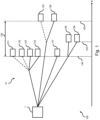
- the network 100 comprises an optical line terminal 1, OLT, and optical network units 131, 132, 133, 134, 135, 136, 137, 138, 139, ONUs.
- the ONUs are located between a distance 140, e.g. 5 kilometres, km, and a distance 150, e.g. 20 km, away from the OLT.
- the distance from the OLT is indicated by an axis denoted with the letter "d”.
- the ONUs are limited to reside within a distance range 120, e.g. 15 km, being the difference between distance 150 and distance 140.
- the ONUs 131, 132, 133, 134, 137 are located at the distance 140 from the OLT.
- the ONUs 138, 139 are located at a distance 142, e.g. 12 km, from the OLT.
- the ONUs 135, 136 are located at the distance 150 from the OLT.
- the distances 140, 142, 150 may be defined between an optical transmitter of the OLT and an optical receiver of an ONU.
- An optical distribution network 12 is illustrated and may comprise optical fibres, optical splitters and other optical elements.
- ONUs 131, 132 and 135 are connected to the ODN 12 by dashed lines to indicate that they are prospective ONUs wishing to join the PON 100.
- the OLT 1 may discover the ONUs 131, 132, 135.
- ONUs 131, 132, 135 are physically connected to the ODN 12, yet have do not yet been initialised to operate within the PON.
- the distance range 120 is divided into four subsets 31, 32, 33, 34 of ONUs that are located within a predetermined distance range 301, 302, 303, 302. More or less subsets may be provided.
- the distance ranges 301, 302, 303, 302 may combinedly cover the service area of the PON.
- an overlapping of the distance ranges not illustrated in Figure 2 , may be provided in order to provide safety margins.
- Distance range 301 extends between distance 140 and distance 143.
- Distance range 302 extends between distance 143 and distance 146.
- Distance range 303 extends between distance 146 and distance 149.
- Distance range 304 extends between distance 149 and distance 150.
- the distance ranges 301, 302, 303, 304 may have an equal length 200 as illustrated in Figure 2 , or may have a different length. It may, for example, be advantageous to provide the distance ranges in proportion to an expected number of prospective ONUs within that region.
- the OLT 1 provides ONU discovery for each of the distance ranges 301, 302, 303, 304 in a separate way.
- the OLT 1 may provide sequential servicing of the distance ranges. As an example, the OLT 1 may first provide ONU discovery within distance range 301, followed by performing a series of other tasks, e.g. downstream communication for already established ONUs. Then, the OLT 1 may provide discovery of ONUs within distance range 302 and subsequently perform another task that is unrelated to ONU discovery. This may again be followed by providing ONU discovery for distance range 303 and so on.
- the OLT 1 may provide ONU discovery over the distance ranges 301, 302, 303, 304 repeatedly over time, in order to continuously give new ONUs a chance to join the PON 100.
- a certain distance range may advantageously be serviced more frequently over time than others, for example based on a high number of previous discoveries that recently occurred in that region. Discovery of the distance ranges may be included in a sequence of tasks that is repeated during a certain time period.
- the selecting condition may be time-related, for example defining a message travel time range corresponding to a range of travel times of messages exchanged between the OLT and ONUs within the predetermined distance range 301.
- the parameter c may depend on the physical properties of the fibre optic used in the PON.
- the OLT may be configured to communicate a value of c as condition-related information to the ONUs to enable more accurate evaluation of a time-based or distance-based condition by the ONUs.
- a single identifier may correspond to each of the possible distance ranges, thereby identifying the distance range.
- the BWmap message can then give permission to ONUs within one distance range, e.g. distance range 301, to be discovered, by requesting serial numbers from those ONUs having an ID corresponding to said distance range 301 as allocated by the corresponding conditional PLOAM message. This may be executed using a contention-based function.
- the ONUs 131, 132 can attempt to respond to the OLT during the same time interval and channel as allocated by the contention-based function.
- the OLT may handle the next distance range 302.
- the ONUs 131, 132 may reply 403 to the message 300 with a message 400.
- the message 400 may, for example, comprise a serial number of the ONU 131, 132.
- the OLT 1 listens 202, during a quiet window 500 associated with the distance range 301, for messages in response to the broadcasting 201.
- the quiet window starts at a time 501 and ends at a time 502.
- the OLT 1 can proceed with joining 204 the ONUs 131, 132 to the PON 100.
Landscapes
- Engineering & Computer Science (AREA)
- Computer Networks & Wireless Communication (AREA)
- Small-Scale Networks (AREA)
Priority Applications (2)
| Application Number | Priority Date | Filing Date | Title |
|---|---|---|---|
| EP23218183.4A EP4576807A1 (de) | 2023-12-19 | 2023-12-19 | Entdeckung von optischen netzwerkeinheiten in einem passiven optischen netzwerk |
| US18/969,468 US20250203253A1 (en) | 2023-12-19 | 2024-12-05 | Discovery of optical network units in a passive optical network |
Applications Claiming Priority (1)
| Application Number | Priority Date | Filing Date | Title |
|---|---|---|---|
| EP23218183.4A EP4576807A1 (de) | 2023-12-19 | 2023-12-19 | Entdeckung von optischen netzwerkeinheiten in einem passiven optischen netzwerk |
Publications (1)
| Publication Number | Publication Date |
|---|---|
| EP4576807A1 true EP4576807A1 (de) | 2025-06-25 |
Family
ID=89224112
Family Applications (1)
| Application Number | Title | Priority Date | Filing Date |
|---|---|---|---|
| EP23218183.4A Pending EP4576807A1 (de) | 2023-12-19 | 2023-12-19 | Entdeckung von optischen netzwerkeinheiten in einem passiven optischen netzwerk |
Country Status (2)
| Country | Link |
|---|---|
| US (1) | US20250203253A1 (de) |
| EP (1) | EP4576807A1 (de) |
Citations (4)
| Publication number | Priority date | Publication date | Assignee | Title |
|---|---|---|---|---|
| EP2242213A1 (de) * | 2008-01-08 | 2010-10-20 | Mitsubishi Electric Corporation | Kommunikationssteuerverfahren, stationsseitige einrichtung, teilnehmerseitige einrichtung und kommunikationssystem |
| US20200260164A1 (en) * | 2017-09-13 | 2020-08-13 | Zte Corporation | Method for managing onu in passive optical network, olt and system |
| EP3860141A1 (de) * | 2018-09-25 | 2021-08-04 | ZTE Corporation | Entfernungsmessungsverfahren und kommunikationsverfahren für optisches netzwerk, olt, onu und optisches netzwerksystem |
| US20220123837A1 (en) * | 2020-10-19 | 2022-04-21 | Electronics And Telecommunications Research Institute | Multi-quiet zone-based optical network unit registration method for low-latency service |
-
2023
- 2023-12-19 EP EP23218183.4A patent/EP4576807A1/de active Pending
-
2024
- 2024-12-05 US US18/969,468 patent/US20250203253A1/en active Pending
Patent Citations (4)
| Publication number | Priority date | Publication date | Assignee | Title |
|---|---|---|---|---|
| EP2242213A1 (de) * | 2008-01-08 | 2010-10-20 | Mitsubishi Electric Corporation | Kommunikationssteuerverfahren, stationsseitige einrichtung, teilnehmerseitige einrichtung und kommunikationssystem |
| US20200260164A1 (en) * | 2017-09-13 | 2020-08-13 | Zte Corporation | Method for managing onu in passive optical network, olt and system |
| EP3860141A1 (de) * | 2018-09-25 | 2021-08-04 | ZTE Corporation | Entfernungsmessungsverfahren und kommunikationsverfahren für optisches netzwerk, olt, onu und optisches netzwerksystem |
| US20220123837A1 (en) * | 2020-10-19 | 2022-04-21 | Electronics And Telecommunications Research Institute | Multi-quiet zone-based optical network unit registration method for low-latency service |
Also Published As
| Publication number | Publication date |
|---|---|
| US20250203253A1 (en) | 2025-06-19 |
Similar Documents
| Publication | Publication Date | Title |
|---|---|---|
| CN101411099B (zh) | 将外围站引入到光学网络中的方法及外围站 | |
| EP3092736B1 (de) | Glasfaser-endgerätekommunikationsverfahren und -vorrichtung mit datenstruktur | |
| CN110073613B (zh) | 数据通信系统、光线路终端及基带单元 | |
| Nakayama et al. | Wavelength and bandwidth allocation for mobile fronthaul in TWDM-PON | |
| KR101310905B1 (ko) | 광 네트워크 단말, 그의 시간 동기화 방법, 광 회선 단말 및 그의 네트워크 관리 방법 | |
| EP3860141B1 (de) | Entfernungsmessungsverfahren und kommunikationsverfahren für optisches netzwerk, olt, onu und optisches netzwerksystem | |
| EP1380129B1 (de) | Zeiteinteilung von zeitschlitzen in kommunikationsnetzwerken mit gemeinsamem medium | |
| CN113365163A (zh) | 带宽分配的方法、光线路终端、光网络单元及系统 | |
| WO2016169406A1 (zh) | 一种实现注册的方法和装置 | |
| US20210409850A1 (en) | Ranging Method and Registration Method for Optical Network, OLT, ONU, and Optical Network System | |
| EP2901626B1 (de) | 10 gigabit pro sekunde fähiges passives optisches netzwerksystem mit flexibler nominaler upstream-bitrate | |
| CN109479022A (zh) | 光网络的光终端站装置和上行调度方式 | |
| EP3780424B1 (de) | Nachrichtenverarbeitungsverfahren und -vorrichtung | |
| EP3812888A1 (de) | Verfahren zur aktualisierung der firmware eines optischen sendeempfängers | |
| EP4576807A1 (de) | Entdeckung von optischen netzwerkeinheiten in einem passiven optischen netzwerk | |
| KR102274590B1 (ko) | 수동형 광 네트워크에서 서비스 품질 보장을 위한 장치 및 방법 | |
| KR0148584B1 (ko) | 거리 측정 방법 및 그 방법을 실행하는 송신 및 수신장치 | |
| JP4732632B2 (ja) | 通信システム | |
| CN102511133B (zh) | 一种发现光网络单元的方法及系统 | |
| CN115225195A (zh) | 一种通信方法及通信装置 | |
| US20250080884A1 (en) | PON out-of-band signaling | |
| WO2025054040A1 (en) | Pon out-of-band signaling | |
| CN119402078A (zh) | 一种时延指示信息分配方法、装置及系统 | |
| HK1210884B (en) | 10 gigabit per second capable passive optical network system with flexible nominal upstream bitrate |
Legal Events
| Date | Code | Title | Description |
|---|---|---|---|
| PUAI | Public reference made under article 153(3) epc to a published international application that has entered the european phase |
Free format text: ORIGINAL CODE: 0009012 |
|
| STAA | Information on the status of an ep patent application or granted ep patent |
Free format text: STATUS: THE APPLICATION HAS BEEN PUBLISHED |
|
| AK | Designated contracting states |
Kind code of ref document: A1 Designated state(s): AL AT BE BG CH CY CZ DE DK EE ES FI FR GB GR HR HU IE IS IT LI LT LU LV MC ME MK MT NL NO PL PT RO RS SE SI SK SM TR |
|
| STAA | Information on the status of an ep patent application or granted ep patent |
Free format text: STATUS: REQUEST FOR EXAMINATION WAS MADE |
|
| 17P | Request for examination filed |
Effective date: 20260102 |