EP4578657A1 - Procédé de production d'un support de données et support de données produit à partir de celui-ci - Google Patents
Procédé de production d'un support de données et support de données produit à partir de celui-ci Download PDFInfo
- Publication number
- EP4578657A1 EP4578657A1 EP23307408.7A EP23307408A EP4578657A1 EP 4578657 A1 EP4578657 A1 EP 4578657A1 EP 23307408 A EP23307408 A EP 23307408A EP 4578657 A1 EP4578657 A1 EP 4578657A1
- Authority
- EP
- European Patent Office
- Prior art keywords
- data carrier
- deformation
- layer
- security feature
- layers
- Prior art date
- Legal status (The legal status is an assumption and is not a legal conclusion. Google has not performed a legal analysis and makes no representation as to the accuracy of the status listed.)
- Pending
Links
Images



Classifications
-
- B—PERFORMING OPERATIONS; TRANSPORTING
- B42—BOOKBINDING; ALBUMS; FILES; SPECIAL PRINTED MATTER
- B42D—BOOKS; BOOK COVERS; LOOSE LEAVES; PRINTED MATTER CHARACTERISED BY IDENTIFICATION OR SECURITY FEATURES; PRINTED MATTER OF SPECIAL FORMAT OR STYLE NOT OTHERWISE PROVIDED FOR; DEVICES FOR USE THEREWITH AND NOT OTHERWISE PROVIDED FOR; MOVABLE-STRIP WRITING OR READING APPARATUS
- B42D25/00—Information-bearing cards or sheet-like structures characterised by identification or security features; Manufacture thereof
- B42D25/30—Identification or security features, e.g. for preventing forgery
- B42D25/324—Reliefs
-
- B—PERFORMING OPERATIONS; TRANSPORTING
- B42—BOOKBINDING; ALBUMS; FILES; SPECIAL PRINTED MATTER
- B42D—BOOKS; BOOK COVERS; LOOSE LEAVES; PRINTED MATTER CHARACTERISED BY IDENTIFICATION OR SECURITY FEATURES; PRINTED MATTER OF SPECIAL FORMAT OR STYLE NOT OTHERWISE PROVIDED FOR; DEVICES FOR USE THEREWITH AND NOT OTHERWISE PROVIDED FOR; MOVABLE-STRIP WRITING OR READING APPARATUS
- B42D25/00—Information-bearing cards or sheet-like structures characterised by identification or security features; Manufacture thereof
- B42D25/40—Manufacture
- B42D25/405—Marking
- B42D25/41—Marking using electromagnetic radiation
-
- B—PERFORMING OPERATIONS; TRANSPORTING
- B42—BOOKBINDING; ALBUMS; FILES; SPECIAL PRINTED MATTER
- B42D—BOOKS; BOOK COVERS; LOOSE LEAVES; PRINTED MATTER CHARACTERISED BY IDENTIFICATION OR SECURITY FEATURES; PRINTED MATTER OF SPECIAL FORMAT OR STYLE NOT OTHERWISE PROVIDED FOR; DEVICES FOR USE THEREWITH AND NOT OTHERWISE PROVIDED FOR; MOVABLE-STRIP WRITING OR READING APPARATUS
- B42D25/00—Information-bearing cards or sheet-like structures characterised by identification or security features; Manufacture thereof
- B42D25/40—Manufacture
- B42D25/45—Associating two or more layers
-
- B—PERFORMING OPERATIONS; TRANSPORTING
- B42—BOOKBINDING; ALBUMS; FILES; SPECIAL PRINTED MATTER
- B42D—BOOKS; BOOK COVERS; LOOSE LEAVES; PRINTED MATTER CHARACTERISED BY IDENTIFICATION OR SECURITY FEATURES; PRINTED MATTER OF SPECIAL FORMAT OR STYLE NOT OTHERWISE PROVIDED FOR; DEVICES FOR USE THEREWITH AND NOT OTHERWISE PROVIDED FOR; MOVABLE-STRIP WRITING OR READING APPARATUS
- B42D25/00—Information-bearing cards or sheet-like structures characterised by identification or security features; Manufacture thereof
- B42D25/40—Manufacture
- B42D25/45—Associating two or more layers
- B42D25/455—Associating two or more layers using heat
-
- B—PERFORMING OPERATIONS; TRANSPORTING
- B42—BOOKBINDING; ALBUMS; FILES; SPECIAL PRINTED MATTER
- B42D—BOOKS; BOOK COVERS; LOOSE LEAVES; PRINTED MATTER CHARACTERISED BY IDENTIFICATION OR SECURITY FEATURES; PRINTED MATTER OF SPECIAL FORMAT OR STYLE NOT OTHERWISE PROVIDED FOR; DEVICES FOR USE THEREWITH AND NOT OTHERWISE PROVIDED FOR; MOVABLE-STRIP WRITING OR READING APPARATUS
- B42D25/00—Information-bearing cards or sheet-like structures characterised by identification or security features; Manufacture thereof
- B42D25/40—Manufacture
- B42D25/45—Associating two or more layers
- B42D25/46—Associating two or more layers using pressure
Definitions
- the present invention relates to method of producing a data carrier, to a data carrier produced thereof and to a security document comprising or consisting of such a data carrier.
- Data carriers for security documents such as identity cards, passports or the like typically comprise at least one security element.
- Said security element can be provided on a top surface of the data carrier.
- Well-known method to protect data is surface embossing made by lamination plates. The weakness of such method is the fact that the security feature can be copied, removed and/or replaced. It is also possible to produce look-alike surface embossing by means of desktop printing, combination of glue & suitable particles, etc. Thus, such security elements are prone to forgery.
- the first outer layer and/or the second outer layer may be formed by different material adapted for their use in security documents and data carrier such as PVC, PETG, ABS and so on.
- the first outer layer and/or the second outer layer comprises thermoplastic material.
- the first outer layer and/or the second outer layer comprises polycarbonate.
- the data carrier according to the invention comprises a second security feature.
- Said second security feature can be formed by a modification of the surface of the data carrier.
- the second security feature can be of many types as a modification of the uppermost surface of the data carrier will not interfere with the first security feature as said first security feature is a so called interfacial feature at the interface between at least some of the layers of the data carrier.
- the second security feature is obtained by laser engraving. The laser engraving of the data carrier according to the invention allows forming a second security feature with high level of complexity and reliability while not interfering with the first security feature.
- the second security feature can also be an interfacial feature formed with the method according to the invention.
- the second security feature is at least partially overlapping the first security feature along the extension direction (E).
- the data carrier comprises a see-through portion or a window.
- the different layers of the data carrier are preferably at least partially translucent at the region of the see-through portion.
- said see-through portion is at least partially overlapping the first security feature along the extension direction (E).
- This overlapping allows forming particularly complex design which would be very difficult for a forger to reproduce and/or to selectively alter.
- the interaction between the see-through portion and the first security feature involves the strategic placement of the first deformation and/or the replicated deformation in alignment with the see-through portion.
- This configuration allows enhancing the security of the document by combining different security feature elements in a way that is challenging to replicate or counterfeit.
- the data carrier achieves a multilayered security approach. This makes it even more difficult for counterfeiters to reproduce all the security elements accurately.
- the see-through portion can be produced by forming a void in one or more layers of the data carrier, allowing visibility through the data carrier.
- the void can be formed by punching or cutting away some material from one or more layers of the data carrier.
- the see-through portion allows viewing at least part of the deformation and/or the replicated deformation of the security feature.
- the data carrier comprises a personalization element.
- Said personalization element can be formed by many different techniques well known from the state of the art, such as laser engraving.
- the personalization element can notably comprise a photograph of the holder of a security document comprising the data carrier.
- said personalization element is at least partially overlapping the first security feature along the extension direction (E). This overlapping allows forming particularly complex design which would be very difficult for a forger to reproduce and/or to selectively alter.
- the see-through portion and the personalization element are at least partially overlapping the first security feature along the extension direction (E).
- This overlapping allows forming an even more complex design which would be particularly difficult for a forger to reproduce and/or to selectively alter.
- the invention concerns a security document comprising or consisting of at least one data carrier as previously disclosed.
- the security document is preferably a smart card, an identity card, a passport, a credit card, a bank note or the like.
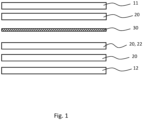
- Figure 1 depicts a first step of the method of forming a data carrier according to the invention in a cross section view.
- a first outer layer 11, a second outer layer 12 and several inner layers 20 are provided.
- the number of inner layers 20 can vary depending on the desired properties of the data carrier 1.
- One of those inner layers 20 is a so-called core layer 22.
- This core layer 22 is substantially at the center of the data carrier 1 according to the extension direction (E).
- E extension direction
- a revealing layer 30 is provided.
- the layers represented in these figures are not in scale. The revealing layer 30 is, in most of cases, much thinner than the other layers.
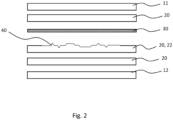
- a first deformation 40 of the core layer 22 is formed by laser marking. This first deformation 40 of the core layer 22 will form a first security feature 50 at the interface between the core layer 22, the revealing layer 30 and an upper inner layer 20 facing the revealing layer 30.
- a stacked structure is formed with the first outer layer 11, a first inner layer 20, the revealing layer 30, the core layer 22, a second inner layer 20 and the second outer layer 12.
- This stacked structure is formed by lamination.
- the parameters of the lamination process will depend on the nature of the layers of the data carrier, on their thickness and so on.
- heat and pressure in applied on the stack of layers some material of the layers adjacent to the core layer with the first deformation flow and follows the shape of the first deformation. Therefore, during said lamination, the first deformation 40 of the surface of the core layer 22 is replicated such that at least one replicated deformation 42 is formed inside the data carrier 1 at the interface between at least some of the layers.
- a replicated deformation 42 is located at the interface between the core layer 22 and the revealing layer 30 and another replicated deformation 42 is located at the interface between the revealing layer 30 and the above inner layer 20 facing the revealing layer 30.
- the replicated deformation 42 could be replicated to more adjacent layers. For example, for a stronger deformation with higher intensity, some replicated deformation could be also located at the interface between the upper inner layer 20 and the first outer layer 11.
- Figure 4 is another embodiment of a stacked structure formed according to the method described above.
- This structure further comprises a see-through portion 70.
- the first outer layer 11 and second outer layer 12 are opaque layers. This opacity is represented in figure 4 by a hatched pattern.
- the core layer 22 and the inner layers 20 are translucent or sensibly transparent. This illustration is for explanatory purposes only, it is obviously not excluded that the layers shown without a hatched pattern in the other figures could also be opaque layers.
- the opaque layers of the stacked structure comprise an opening, advantageously formed before the lamination step.
- the opaque layers of the stacked structure comprise translucent or sensibly transparent material, such as clear polycarbonate for example, at the area corresponding to the see-through portion.
- This clear portion of the opaque layers can be formed by removing a part of the opaque material before the lamination step. During lamination, the clear material of adjacent layers flows and fill the void in the opaque layer. In the embodiment shown in figure 4 , the clear polycarbonate of inner layers 20 flows during lamination and fill the void in the first outer layer 11 and second outer layer 12.
- the see through portion is represented by the area 70. At least part of the first security feature 50 overlaps the see through portion 70. In other words, the first security feature 50 is at least partially in alignment with the see-through portion 70.
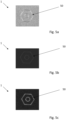
- Figures 5a to 5c depicts a top view of a data carrier 1 according to the invention comprising a first security feature 50.
- the first deformation 40 is a kiss cut formed by laser marking of a core layer made of polycarbonate.
- the first deformation and the corresponding first security feature forms a bolt like shape.
- the revealing layer 30 used in this data carrier 1 is a metallic ink layer.
- Figure 5a shows the data carrier with normal light.
- Figure 5b shows the data carrier with UV light.
- Figure 5c shows the data carrier with transmitted light.
- the first security feature 50 is visible to the naked eye and even more visible with specific lighting conditions.
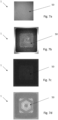
- Figures 6a to 6c depicts a top view of a data carrier 1 according to the invention comprising a first security feature 50.
- the first deformation 40 is a kiss cut formed by laser marking of a core layer made of polycarbonate.
- the first deformation and the corresponding first security feature form a pattern of lines forming the letters "UTO".
- the data carrier 1 of figures 6a and 6b does not comprise a revealing layer.
- Figure 6a shows the data carrier 1 with transmitted light.
- Figure 6b shows the same data carrier 1 with UV light.
- the first security feature 50 is barely visible to the naked eye and more visible with UV light.
- the data carrier 1 of figure 6c corresponds to a data carrier similar to the data carrier of figures 6a and 6b and that further comprises a revealing layer 30.
- the revealing layer 30 of the data carrier 1 of figure 6c is an ink layer.
- Figure 6c shows the data carrier 1 with transmitted light.
- the first security feature 50 in figure 6c is visible to the naked eye and particularly more visible than without the revealing layer as shown in figure 6a .
- Figures 7a to 7d depicts a top view of a data carrier 1 according to the invention comprising a first security feature 50.
- the first deformation 40 is a through cut formed by laser marking of a core layer made of polycarbonate.
- the first deformation and the corresponding first security feature form a pattern of lines forming series of hexagonal shapes.
- the data carrier 1 of figures 7a does not comprise a revealing layer.
- Figure 7a shows the data carrier 1 with transmitted light.
- the first security feature 50 is visible to the naked eye.
- the data carrier 1 of figure 7b, 7c and 7d correspond to a data carrier similar to the data carrier of figures 7a and that further comprises a revealing layer 30.
- the revealing layer 30 of the data carrier 1 of figures 7b to 7d is an ink layer.
- Figure 7b shows the data carrier 1 with transmitted light.
- the first security feature 50 in figure 7b is visible to the naked eye and notably more visible than without the revealing layer as shown in figure 7a .
- the revealing layer is not mandatory for the security to be visible but it improves its visibility.
- Figure 7c shows the data carrier 1 with UV light.
- Figure 7d shows the data carrier 1 with normal light.
- the first security feature 50 is visible both to the naked eye and with UV light.
Landscapes
- Engineering & Computer Science (AREA)
- Manufacturing & Machinery (AREA)
- Physics & Mathematics (AREA)
- Health & Medical Sciences (AREA)
- Electromagnetism (AREA)
- General Health & Medical Sciences (AREA)
- Toxicology (AREA)
- Credit Cards Or The Like (AREA)
Priority Applications (2)
| Application Number | Priority Date | Filing Date | Title |
|---|---|---|---|
| EP23307408.7A EP4578657A1 (fr) | 2023-12-28 | 2023-12-28 | Procédé de production d'un support de données et support de données produit à partir de celui-ci |
| PCT/EP2024/088480 WO2025141099A1 (fr) | 2023-12-28 | 2024-12-24 | Procédé de production de support de données et support de données produit à partir de celui-ci |
Applications Claiming Priority (1)
| Application Number | Priority Date | Filing Date | Title |
|---|---|---|---|
| EP23307408.7A EP4578657A1 (fr) | 2023-12-28 | 2023-12-28 | Procédé de production d'un support de données et support de données produit à partir de celui-ci |
Publications (1)
| Publication Number | Publication Date |
|---|---|
| EP4578657A1 true EP4578657A1 (fr) | 2025-07-02 |
Family
ID=90053910
Family Applications (1)
| Application Number | Title | Priority Date | Filing Date |
|---|---|---|---|
| EP23307408.7A Pending EP4578657A1 (fr) | 2023-12-28 | 2023-12-28 | Procédé de production d'un support de données et support de données produit à partir de celui-ci |
Country Status (2)
| Country | Link |
|---|---|
| EP (1) | EP4578657A1 (fr) |
| WO (1) | WO2025141099A1 (fr) |
Citations (5)
| Publication number | Priority date | Publication date | Assignee | Title |
|---|---|---|---|---|
| US20080094713A1 (en) * | 2004-08-30 | 2008-04-24 | Ovd Kinegram Ag | Metallised Security Element |
| US20090072526A1 (en) * | 2007-09-19 | 2009-03-19 | Ovd Kinegram Ag | Diffractive Security Element with Individualized Code |
| EP2951030B1 (fr) * | 2013-02-01 | 2017-02-01 | De La Rue International Limited | Dispositif de sécurité et procédés de fabrication de ceux-ci |
| AU2017251109A1 (en) * | 2016-04-15 | 2018-10-11 | Canadian Bank Note Company, Limited | Watermark and other security features for thermoplastic security documents |
| US10363768B2 (en) * | 2016-10-10 | 2019-07-30 | Morphotrust Usa, Llc | Identification document with contoured surface image |
-
2023
- 2023-12-28 EP EP23307408.7A patent/EP4578657A1/fr active Pending
-
2024
- 2024-12-24 WO PCT/EP2024/088480 patent/WO2025141099A1/fr active Pending
Patent Citations (5)
| Publication number | Priority date | Publication date | Assignee | Title |
|---|---|---|---|---|
| US20080094713A1 (en) * | 2004-08-30 | 2008-04-24 | Ovd Kinegram Ag | Metallised Security Element |
| US20090072526A1 (en) * | 2007-09-19 | 2009-03-19 | Ovd Kinegram Ag | Diffractive Security Element with Individualized Code |
| EP2951030B1 (fr) * | 2013-02-01 | 2017-02-01 | De La Rue International Limited | Dispositif de sécurité et procédés de fabrication de ceux-ci |
| AU2017251109A1 (en) * | 2016-04-15 | 2018-10-11 | Canadian Bank Note Company, Limited | Watermark and other security features for thermoplastic security documents |
| US10363768B2 (en) * | 2016-10-10 | 2019-07-30 | Morphotrust Usa, Llc | Identification document with contoured surface image |
Also Published As
| Publication number | Publication date |
|---|---|
| WO2025141099A1 (fr) | 2025-07-03 |
Similar Documents
| Publication | Publication Date | Title |
|---|---|---|
| CN102574413B (zh) | 具有窗口的数据载体 | |
| CA2878549C (fr) | Document d'identification securise ayant un element de feuille retire | |
| AU2018351875B2 (en) | Security devices, security articles, security documents and methods for their manufacture | |
| EP2373493B1 (fr) | Document d'identification ayant un élément d'anti-contrefaçon amélioré | |
| JP2019515810A (ja) | ポリマ基板を備える機密文書 | |
| EP1698485A2 (fr) | Document d'identité avec filigrane lenticulaire | |
| CN106064543A (zh) | 用于制造多层数据载体的方法以及通过所述方法制造的数据载体 | |
| CN104203589B (zh) | 具有穿孔窗的安全文件及其制造方法 | |
| US20230364935A1 (en) | Security devices and methods of manufacture thereof | |
| AU2017251109B2 (en) | Watermark and other security features for thermoplastic security documents | |
| EP2499002B1 (fr) | Document d'identification et procédé d'élaboration | |
| EP3127092B1 (fr) | Support de données | |
| EP4073576B1 (fr) | Image flottante pouvant être gravée au laser de stratifiés de sécurité | |
| GB2584552A (en) | Security devices, security articles, security documents and methods for their manufacture | |
| EP4578655A1 (fr) | Procédé de production d'un support de données et support de données produit à partir de celui-ci | |
| EP4578656A1 (fr) | Procédé de production d'un support de données et support de données produit à partir de celui-ci | |
| WO2025141099A1 (fr) | Procédé de production de support de données et support de données produit à partir de celui-ci | |
| EP4013623B1 (fr) | Image flottante intégrée pour documents de sécurité | |
| KR102456159B1 (ko) | 위변조 방지용 보안제품 |
Legal Events
| Date | Code | Title | Description |
|---|---|---|---|
| PUAI | Public reference made under article 153(3) epc to a published international application that has entered the european phase |
Free format text: ORIGINAL CODE: 0009012 |
|
| STAA | Information on the status of an ep patent application or granted ep patent |
Free format text: STATUS: THE APPLICATION HAS BEEN PUBLISHED |
|
| AK | Designated contracting states |
Kind code of ref document: A1 Designated state(s): AL AT BE BG CH CY CZ DE DK EE ES FI FR GB GR HR HU IE IS IT LI LT LU LV MC ME MK MT NL NO PL PT RO RS SE SI SK SM TR |
|
| STAA | Information on the status of an ep patent application or granted ep patent |
Free format text: STATUS: THE APPLICATION IS DEEMED TO BE WITHDRAWN |