EP4578998A2 - Feuille de cuivre, électrode la comprenant, batterie secondaire la comprenant et son procédé de fabrication - Google Patents
Feuille de cuivre, électrode la comprenant, batterie secondaire la comprenant et son procédé de fabrication Download PDFInfo
- Publication number
- EP4578998A2 EP4578998A2 EP24220065.7A EP24220065A EP4578998A2 EP 4578998 A2 EP4578998 A2 EP 4578998A2 EP 24220065 A EP24220065 A EP 24220065A EP 4578998 A2 EP4578998 A2 EP 4578998A2
- Authority
- EP
- European Patent Office
- Prior art keywords
- copper foil
- present disclosure
- room
- copper
- temperature thermal
- Prior art date
- Legal status (The legal status is an assumption and is not a legal conclusion. Google has not performed a legal analysis and makes no representation as to the accuracy of the status listed.)
- Pending
Links
Images

Classifications
-
- H—ELECTRICITY
- H01—ELECTRIC ELEMENTS
- H01M—PROCESSES OR MEANS, e.g. BATTERIES, FOR THE DIRECT CONVERSION OF CHEMICAL ENERGY INTO ELECTRICAL ENERGY
- H01M4/00—Electrodes
- H01M4/02—Electrodes composed of, or comprising, active material
- H01M4/64—Carriers or collectors
- H01M4/66—Selection of materials
- H01M4/665—Composites
- H01M4/667—Composites in the form of layers, e.g. coatings
-
- H—ELECTRICITY
- H01—ELECTRIC ELEMENTS
- H01M—PROCESSES OR MEANS, e.g. BATTERIES, FOR THE DIRECT CONVERSION OF CHEMICAL ENERGY INTO ELECTRICAL ENERGY
- H01M4/00—Electrodes
- H01M4/02—Electrodes composed of, or comprising, active material
- H01M4/13—Electrodes for accumulators with non-aqueous electrolyte, e.g. for lithium-accumulators; Processes of manufacture thereof
-
- C—CHEMISTRY; METALLURGY
- C25—ELECTROLYTIC OR ELECTROPHORETIC PROCESSES; APPARATUS THEREFOR
- C25D—PROCESSES FOR THE ELECTROLYTIC OR ELECTROPHORETIC PRODUCTION OF COATINGS; ELECTROFORMING; APPARATUS THEREFOR
- C25D1/00—Electroforming
- C25D1/04—Wires; Strips; Foils
-
- C—CHEMISTRY; METALLURGY
- C25—ELECTROLYTIC OR ELECTROPHORETIC PROCESSES; APPARATUS THEREFOR
- C25D—PROCESSES FOR THE ELECTROLYTIC OR ELECTROPHORETIC PRODUCTION OF COATINGS; ELECTROFORMING; APPARATUS THEREFOR
- C25D3/00—Electroplating: Baths therefor
- C25D3/02—Electroplating: Baths therefor from solutions
- C25D3/38—Electroplating: Baths therefor from solutions of copper
-
- C—CHEMISTRY; METALLURGY
- C25—ELECTROLYTIC OR ELECTROPHORETIC PROCESSES; APPARATUS THEREFOR
- C25D—PROCESSES FOR THE ELECTROLYTIC OR ELECTROPHORETIC PRODUCTION OF COATINGS; ELECTROFORMING; APPARATUS THEREFOR
- C25D9/00—Electrolytic coating other than with metals
- C25D9/04—Electrolytic coating other than with metals with inorganic materials
-
- H—ELECTRICITY
- H01—ELECTRIC ELEMENTS
- H01M—PROCESSES OR MEANS, e.g. BATTERIES, FOR THE DIRECT CONVERSION OF CHEMICAL ENERGY INTO ELECTRICAL ENERGY
- H01M10/00—Secondary cells; Manufacture thereof
- H01M10/05—Accumulators with non-aqueous electrolyte
- H01M10/052—Li-accumulators
- H01M10/0525—Rocking-chair batteries, i.e. batteries with lithium insertion or intercalation in both electrodes; Lithium-ion batteries
-
- H—ELECTRICITY
- H01—ELECTRIC ELEMENTS
- H01M—PROCESSES OR MEANS, e.g. BATTERIES, FOR THE DIRECT CONVERSION OF CHEMICAL ENERGY INTO ELECTRICAL ENERGY
- H01M4/00—Electrodes
- H01M4/02—Electrodes composed of, or comprising, active material
- H01M4/13—Electrodes for accumulators with non-aqueous electrolyte, e.g. for lithium-accumulators; Processes of manufacture thereof
- H01M4/139—Processes of manufacture
-
- H—ELECTRICITY
- H01—ELECTRIC ELEMENTS
- H01M—PROCESSES OR MEANS, e.g. BATTERIES, FOR THE DIRECT CONVERSION OF CHEMICAL ENERGY INTO ELECTRICAL ENERGY
- H01M10/00—Secondary cells; Manufacture thereof
- H01M10/05—Accumulators with non-aqueous electrolyte
- H01M10/052—Li-accumulators
-
- H—ELECTRICITY
- H01—ELECTRIC ELEMENTS
- H01M—PROCESSES OR MEANS, e.g. BATTERIES, FOR THE DIRECT CONVERSION OF CHEMICAL ENERGY INTO ELECTRICAL ENERGY
- H01M4/00—Electrodes
- H01M4/02—Electrodes composed of, or comprising, active material
- H01M2004/026—Electrodes composed of, or comprising, active material characterised by the polarity
- H01M2004/027—Negative electrodes
-
- H—ELECTRICITY
- H01—ELECTRIC ELEMENTS
- H01M—PROCESSES OR MEANS, e.g. BATTERIES, FOR THE DIRECT CONVERSION OF CHEMICAL ENERGY INTO ELECTRICAL ENERGY
- H01M4/00—Electrodes
- H01M4/02—Electrodes composed of, or comprising, active material
- H01M4/64—Carriers or collectors
- H01M4/66—Selection of materials
- H01M4/661—Metal or alloys, e.g. alloy coatings
Definitions
- the present disclosure relates to a copper foil, an electrode including the same, a secondary battery including the same, and a method for manufacturing the same. More particularly, the present disclosure relates to a copper foil with excellent adhesion to an active material, an electrode including the same, a secondary battery including the same, and a method for manufacturing the same.
- Secondary batteries are types of energy conversion devices that convert electrical energy into chemical energy, store the chemical energy therein, and then convert the chemical energy back into the electrical energy when electricity is needed, thereby generating electricity.
- the secondary batteries are used as energy sources for electric vehicles as well as portable electronic products such as mobile phones, laptop computers, and the like.
- the secondary batteries are rechargeable and thus are also referred to as rechargeable batteries.
- lithium secondary batteries may store a relatively large amount of energy relative to the size and weight thereof compared to other secondary batteries. Accordingly, in the field of information communication devices in which portability and mobility are important, the lithium secondary batteries are preferred, and an application range thereof is also expanding to energy storage devices for hybrid vehicles and electric vehicles.
- Lithium secondary batteries are repeatedly used in each cycle including charging and discharging.
- the lithium secondary battery should have a high charge/discharge capacity in order to increase an operating time of the device. Accordingly, research to satisfy ever-increasing expectations (needs) of consumers for charge/discharge capacity of a lithium secondary battery is continuously required.
- Such a secondary battery includes a negative electrode current collector made of a copper foil, and among copper foils, an electrolytic copper foil is widely used as a negative electrode current collector of a secondary battery.
- a negative electrode current collector made of a copper foil
- an electrolytic copper foil is widely used as a negative electrode current collector of a secondary battery.
- copper foils capable of improving characteristics of secondary batteries.
- electrolytic copper foils that can ensure high capacity of secondary batteries and enable secondary batteries to stably maintain capacity and performance.
- the present disclosure relates to a copper foil capable of preventing the problems caused by the limitations and disadvantages of the related art described above, an electrode including the same, a secondary battery including the same, and a method for manufacturing the same.
- a copper foil with excellent adhesion to an active material is provided, thereby ensuring a secondary battery with a high capacity retention rate.
- One embodiment of the present disclosure provides a copper foil including a copper film including 99.9 wt% or more of copper, and a protective layer disposed on the copper film, wherein the copper foil has a room-temperature thermal deformation index ranging from 15 to 50.
- the copper foil may have a high-temperature thermal deformation index ranging from 20 to 55.
- the high-temperature thermal expansion coefficient may refer to a thermal expansion coefficient measured after heat treatment at 190 °C for 1 hour.
- the high-temperature elongation may refer to an elongation measured after heat treatment at 190 °C for 1 hour.
- the protective layer may include at least one of a chromium compound, a silane compound, and a nitrogen compound.
- an electrode for a secondary battery including a copper foil and an active material layer disposed on at least one surface of the copper foil.
- the copper foil may be a copper foil according to any one of the embodiments described in this disclosure.
- a secondary battery including a cathode configured to provide lithium ions during charging, and an anode configured to provide electrons and lithium ions during discharging, an electrolyte disposed between the cathode and the anode to provide an environment in which the lithium ions are movable, and a separator configured to electrically insulate the cathode and the anode.
- spatially relative terms such as “below,” “beneath,” “lower,” “above,” “upper” and the like, may be used herein for ease of description to describe one element or component's relationship to another element(s) or component(s) as illustrated in the drawings. It will be understood that the spatially relative terms are intended to include different orientations of the element in use or operation in addition to the orientation illustrated in the drawings. For example, when an element in the drawings is turned over, an element described as being “above” or “upper” relative to another element will then be “below” or “lower” relative to the other element. Thus, the exemplary term “below” may include both above and below orientations. Likewise, the exemplary terms “above” or “upper” may include both above and below orientations.
- first In order to describe various components, terms such as “first,” “second,” and the like are used, but these components are not limited by these terms. These terms are only used to distinguish one component from another component. Therefore, a first component described below may be a second component within the technical idea of the present disclosure.
- At least one should be understood to include all possible combinations from one or more related items.
- the meaning of “at least one of first, second, and third items” may mean all combinations of two or more items of the first, second and third items as well as each of the first, second and third items.
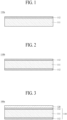
- FIG. 1 is a cross-sectional view of a copper foil 110a according to one embodiment of the present disclosure.
- the copper foil 110a of the present disclosure includes a copper film 111 including copper in an amount of 99.9% or more by weight.
- the copper foil 110a of the present disclosure includes the copper film 111 and a protective layer 112 disposed on the copper film 111.
- FIG. 1 illustrates a configuration in which the protective layers 112 are disposed on both surfaces of the copper film 111.
- protective layers 112 may be disposed on both sides of the copper film 111 (see FIG. 2 ).
- the copper foil 110 may have a room-temperature thermal deformation index ranging from 15 to 50.
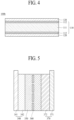
- the secondary battery includes a cathode 370, an anode 340, an electrolyte 350 disposed between the cathode 370 and the anode 340 to provide an environment in which ions are movable, and a separator 360 electrically insulating the cathode 370 and the anode 340.
- the ions moving between the cathode 370 and the anode 340 are, for example, lithium ions.
- the separator 360 separates the cathode 370 and the anode 340 in order to prevent charges generated in one electrode from being uselessly consumed by moving to another electrode through the inside of the secondary battery. Referring to FIG. 5 , the separator 360 is disposed in the electrolyte 350.
- the method of the present disclosure includes forming the copper film 111 on a rotating anode drum 40 by electrically conducting a cathode plate 30 and the rotating anode drum 40, which are disposed to be spaced apart from each other in an electrolyte 20 in an electrolytic cell 10.
- the cathode plate 30 may include first and second cathode plates 31 and 32 electrically insulated from each other.
- the forming of the copper film 111 may be performed by forming a seed layer through electrical conduction between the first cathode plate 31 and the rotating anode drum 40, and then growing the seed layer through electrical conduction between the second cathode plate 32 and the rotating anode drum 40.
- a current density provided by each of the first and second cathode plates 31 and 32 may be 30 to 130 ASD (A/dm2).
- the electrolyte 20 is maintained at a temperature of 40 °C to 60 °C. More specifically, the temperature of the electrolyte 20 may be maintained at 50 °C or higher. At this time, the physical, chemical, and electrical characteristics of the copper film 111 may be controlled by adjusting a composition of the electrolyte 20.
- the electrolyte 20 may include copper ions, sulfuric acid, chlorine (Cl), collagen, gelatin, and an organic additive.
- the concentration of the copper ions and the concentration of the sulfuric acid in the electrolyte 20 are adjusted in a range of 70 g/L to 150 g/L and a range of 80 g/L to 150 g/L, respectively.
- the concentration of the chlorine (Cl) in the electrolyte 20 is controlled in a range of 15 ppm to 25 ppm.
- collagen and gelatin are added to control values of the room-temperature and high-temperature thermal deformation indices of the copper foil according to the present disclosure.
- an electrolyte 20 needs to include 1 ppm to 15 ppm of collagen and 0.1 ppm to 5 ppm of gelatin.
- the collagen and gelatin included in the electrolyte 20 need to be added at a concentration ratio of 10:1 to 3:1.
- the collagen may have a molecular weight of 2,000 to 10,000
- the gelatin may have a molecular weight of 10,000 to 100,000.
- the electrolyte 20 may include an organic additive.
- At least one anode active material selected from the group consisting of carbon, a metal (Me) of Si, Ge, Sn, Li, Zn, Mg, Cd, Ce, Ni or Fe, an alloy including the metal (Me), an oxide (MeOx) of the metal (Me), and a complex of the metal (Me) and carbon is coated on one surface or both surfaces the copper foil 110 of the present disclosure prepared through the method as described above to prepare an electrode (i.e., anode) for a secondary battery of the present disclosure.
- the sample was heat-treated at 190 °C for 1 hour and cooled, and then the thermal expansion coefficient of the sample was measured in the same manner as the measurement method for the room-temperature thermal expansion coefficient.
- the process of cooling the sample was carried out by leaving the sample at room temperature.
- the room-temperature elongation may be measured using a UTM in accordance with the methods specified in the IPC-TM-650 Test Method Manual. Equipment from Instron Corporation may be used for the testing. At this time, the copper foil sample for elongation measurement had a width of 12.7 mm, a grip-to-grip distance of 50 mm, and a testing speed of 50 mm/min.
- the high-temperature elongation refers to an elongation measured after heat treating the copper foil at 190 °C for 1 hour.
- the high-temperature elongation may be measured using a UTM in accordance with the methods specified in the IPC-TM-650 Test Method Manual, using the sample heat-treated at 190 °C for 1 hour. Equipment from Instron Corporation may be used for the testing. At this time, the sample for elongation measurement had a width of 12.7 mm, a grip-to-grip distance of 50 mm, and a testing speed of 50 mm/min.
- the surface area ratios of the first and second surfaces were measured using VK-9710 from KEYENCE Corporation.
- the surface area ratios of the first and second surfaces refer to ratios of three-dimensional surface areas to two-dimensional surface areas of the first and second surfaces, respectively.
- the copper foil was cut into 1 cm x 1 cm pieces to prepare a specimen and a three-dimensional surface area was observed using the VK-9710 color 3D laser microscope from KEYENCE Corporation at 50x magnification.
- the "surface area ratio of each of the first and second surfaces” is calculated by dividing the three-dimensional surface area of the corresponding copper foil specimen, which is measured in three dimensions, by a two-dimensional planar area (1 cm 2 ) of the copper foil specimen.
- the three-dimensional surface area refers to an area obtained by adjusting the focus through the movement of the microscope lens in a Z-axis direction.
- the surface area ratio according to the embodiment of the present disclosure refers to an average value of the surface area ratios of the first and second surfaces. Specifically, the surface area ratio refers to a value obtained by adding the surface area ratios of the first and second surfaces and dividing the sum by 2.
- anode active material 2 parts by weight of styrene-butadiene rubber (SBR) and 2 parts by weight of carboxymethyl cellulose (CMC) were mixed with 100 parts by weight of commercially available carbon. Subsequently, a slurry was prepared by adding distilled water as a solvent to the mixture. An anode was prepared by applying the slurry to the surface of an electrolytic copper foil (width: 10 cm) at a thickness of approximately 60 ⁇ m using a doctor blade, drying the coated copper foil at 120 °C for 10 minutes, and then performing a pressing process (at a pressure of 1 ton/cm 2 ).
- SBR styrene-butadiene rubber
- CMC carboxymethyl cellulose
- a cathode active material was prepared by mixing lithium manganese oxide (Li 1.1 Mn 1.85 Al 0.05 O 4 ) and orthorhombic lithium manganese oxide (o-LiMnO 2 ) in a weight ratio of 90:10.
- a slurry was prepared by mixing the cathode active material, carbon black, and polyvinylidene fluoride (PVDF) in a weight ratio of 85:10:5 with NMP, which is an organic solvent.
- PVDF polyvinylidene fluoride
- a cathode was prepared by applying the slurry to both surfaces of an aluminum foil with a thickness of 20 ⁇ m and then drying the coated aluminum foil.
- an electrolyte was prepared by dissolving 1M of LiPF 6 as a solute in a non-aqueous organic solvent obtained by mixing ethylene carbonate (EC) and ethyl methyl carbonate (EMC) in a weight ratio of 1:2 to form a base electrolyte, and then mixing 99.5 wt% of the base electrolyte with 0.5 wt% of succinic anhydride.
- EC ethylene carbonate
- EMC ethyl methyl carbonate
- a secondary battery was manufactured using the anode, the cathode, and the electrolyte prepared as described above.
- a capacity per gram (g) of the cathode was measured for the secondary battery manufactured as described above under a charging operating voltage of 4.3 V and a discharging operating voltage of 3.4 V.
- the copper foils of Examples 1 to 4 satisfied the room-temperature thermal deformation index ranging from 15 to 50, exhibiting excellent adhesion between the copper foil and the active material, thereby achieving a capacity retention rate of 90% or higher for the secondary battery.
- the copper foils of Comparative Examples 1 to 4 did not satisfy the room-temperature thermal deformation index ranging from 15 to 50, exhibiting reduced adhesion between the copper foil and the active material, and the capacity retention rate of the secondary battery did not meet the industry-required capacity retention rate of 90%.
- a long-life secondary battery capable of maintaining a high capacity retention rate over a long period of time due to excellent adhesion to an active material. Accordingly, it is possible to minimize the inconvenience to consumers of electronic devices and waste of resources caused by frequent replacement of a secondary battery.
Landscapes
- Chemical & Material Sciences (AREA)
- Engineering & Computer Science (AREA)
- Chemical Kinetics & Catalysis (AREA)
- Electrochemistry (AREA)
- Materials Engineering (AREA)
- Metallurgy (AREA)
- Organic Chemistry (AREA)
- General Chemical & Material Sciences (AREA)
- Manufacturing & Machinery (AREA)
- Inorganic Chemistry (AREA)
- Composite Materials (AREA)
- Cell Electrode Carriers And Collectors (AREA)
- Laminated Bodies (AREA)
- Parts Printed On Printed Circuit Boards (AREA)
Applications Claiming Priority (1)
| Application Number | Priority Date | Filing Date | Title |
|---|---|---|---|
| KR1020230197785A KR20250104927A (ko) | 2023-12-29 | 2023-12-29 | 동박, 그것을 포함하는 전극, 그것을 포함하는 이차전지, 및 그것의 제조방법 |
Publications (2)
| Publication Number | Publication Date |
|---|---|
| EP4578998A2 true EP4578998A2 (fr) | 2025-07-02 |
| EP4578998A3 EP4578998A3 (fr) | 2025-09-10 |
Family
ID=93924417
Family Applications (1)
| Application Number | Title | Priority Date | Filing Date |
|---|---|---|---|
| EP24220065.7A Pending EP4578998A3 (fr) | 2023-12-29 | 2024-12-16 | Feuille de cuivre, électrode la comprenant, batterie secondaire la comprenant et son procédé de fabrication |
Country Status (7)
| Country | Link |
|---|---|
| US (1) | US20250219102A1 (fr) |
| EP (1) | EP4578998A3 (fr) |
| JP (1) | JP2025105540A (fr) |
| KR (1) | KR20250104927A (fr) |
| CN (1) | CN120231100A (fr) |
| CA (1) | CA3259158A1 (fr) |
| TW (1) | TW202533433A (fr) |
Family Cites Families (5)
| Publication number | Priority date | Publication date | Assignee | Title |
|---|---|---|---|---|
| KR102781999B1 (ko) * | 2016-10-12 | 2025-03-14 | 에스케이넥실리스 주식회사 | 핸들링이 용이한 전해동박, 그것을 포함하는 전극, 그것을 포함하는 이차전지, 및 그것의 제조방법 |
| KR102302184B1 (ko) * | 2018-02-01 | 2021-09-13 | 에스케이넥실리스 주식회사 | 고온 치수 안정성 및 집합조직 안정성을 갖는 전해동박 및 그 제조방법 |
| CN114232037B (zh) * | 2021-12-29 | 2023-03-28 | 中国科学院金属研究所 | 一种纳米孪晶铜箔及其制备方法、以及电路板和集电体 |
| CN116837426A (zh) * | 2023-07-24 | 2023-10-03 | 安徽华创新材料股份有限公司 | 一种超薄极高抗拉双面光锂电铜箔的生产方法 |
| CN116970994A (zh) * | 2023-08-01 | 2023-10-31 | 浙江花园新能源股份有限公司 | 一种超高抗拉锂电铜箔的制备方法及其产品 |
-
2023
- 2023-12-29 KR KR1020230197785A patent/KR20250104927A/ko active Pending
-
2024
- 2024-12-11 CA CA3259158A patent/CA3259158A1/fr active Pending
- 2024-12-16 EP EP24220065.7A patent/EP4578998A3/fr active Pending
- 2024-12-17 US US18/984,191 patent/US20250219102A1/en active Pending
- 2024-12-23 JP JP2024226642A patent/JP2025105540A/ja active Pending
- 2024-12-25 TW TW113150725A patent/TW202533433A/zh unknown
- 2024-12-27 CN CN202411948018.4A patent/CN120231100A/zh active Pending
Also Published As
| Publication number | Publication date |
|---|---|
| TW202533433A (zh) | 2025-08-16 |
| CA3259158A1 (fr) | 2025-11-29 |
| US20250219102A1 (en) | 2025-07-03 |
| JP2025105540A (ja) | 2025-07-10 |
| CN120231100A (zh) | 2025-07-01 |
| KR20250104927A (ko) | 2025-07-08 |
| EP4578998A3 (fr) | 2025-09-10 |
Similar Documents
| Publication | Publication Date | Title |
|---|---|---|
| CA3220490C (fr) | Feuille de cuivre, electrode la comprenant, batterie secondaire la comprenant et methode de fabrication | |
| US20240222640A1 (en) | Copper foil, electrode comprising the same, secondary battery comprising the same, and method for manufacturing the same | |
| US20240213490A1 (en) | Copper foil capable of preventing tear or wrinkle defects, electrode comprising the same, secondary battery comprising the same, and method for manufacturing the same | |
| CA3220499C (fr) | Feuille de cuivre, electrode la comprenant, batterie secondaire la comprenant et methode de fabrication | |
| US20240204167A1 (en) | Copper foil capable of preventing defects of tear or wrinkle thereof, electrode comprising the same, secondary battery comprising the same, and method for manufacturing the same | |
| US20240213493A1 (en) | Copper foil, electrode comprising the same, secondary battery comprising the same, and method for manufacturing the same | |
| EP4578998A2 (fr) | Feuille de cuivre, électrode la comprenant, batterie secondaire la comprenant et son procédé de fabrication | |
| EP4578999A2 (fr) | Feuille de cuivre à résistance à la corrosion améliorée, électrode la comprenant, batterie secondaire la comprenant et son procédé de fabrication | |
| EP4578997A2 (fr) | Feuille de cuivre, électrode la comprenant, batterie secondaire la comprenant et son procédé de fabrication | |
| EP4578996A2 (fr) | Feuille de cuivre, électrode la comprenant, batterie secondaire la comprenant et son procédé de fabrication | |
| US20250219100A1 (en) | Copper foil, electrode including the same, secondary battery including the same, and method of manufacturing the same | |
| EP4624633A1 (fr) | Feuille de cuivre apte à empêcher des défauts de déchirure ou de plissement, électrode la comprenant, batterie secondaire la comprenant, et son procédé de fabrication |
Legal Events
| Date | Code | Title | Description |
|---|---|---|---|
| PUAI | Public reference made under article 153(3) epc to a published international application that has entered the european phase |
Free format text: ORIGINAL CODE: 0009012 |
|
| STAA | Information on the status of an ep patent application or granted ep patent |
Free format text: STATUS: REQUEST FOR EXAMINATION WAS MADE |
|
| 17P | Request for examination filed |
Effective date: 20241216 |
|
| AK | Designated contracting states |
Kind code of ref document: A2 Designated state(s): AL AT BE BG CH CY CZ DE DK EE ES FI FR GB GR HR HU IE IS IT LI LT LU LV MC ME MK MT NL NO PL PT RO RS SE SI SK SM TR |
|
| PUAL | Search report despatched |
Free format text: ORIGINAL CODE: 0009013 |
|
| AK | Designated contracting states |
Kind code of ref document: A3 Designated state(s): AL AT BE BG CH CY CZ DE DK EE ES FI FR GB GR HR HU IE IS IT LI LT LU LV MC ME MK MT NL NO PL PT RO RS SE SI SK SM TR |
|
| RIC1 | Information provided on ipc code assigned before grant |
Ipc: C25D 1/04 20060101AFI20250804BHEP Ipc: C25D 3/38 20060101ALI20250804BHEP Ipc: H01M 4/66 20060101ALI20250804BHEP Ipc: H01M 10/052 20100101ALI20250804BHEP |