EP4579130A2 - Séparation de flux d'air à l'intérieur d'un moteur à turbine - Google Patents
Séparation de flux d'air à l'intérieur d'un moteur à turbine Download PDFInfo
- Publication number
- EP4579130A2 EP4579130A2 EP24223764.2A EP24223764A EP4579130A2 EP 4579130 A2 EP4579130 A2 EP 4579130A2 EP 24223764 A EP24223764 A EP 24223764A EP 4579130 A2 EP4579130 A2 EP 4579130A2
- Authority
- EP
- European Patent Office
- Prior art keywords
- diffuser
- separator
- combustor
- combustion chamber
- rotor
- Prior art date
- Legal status (The legal status is an assumption and is not a legal conclusion. Google has not performed a legal analysis and makes no representation as to the accuracy of the status listed.)
- Pending
Links
Images





Classifications
-
- F—MECHANICAL ENGINEERING; LIGHTING; HEATING; WEAPONS; BLASTING
- F01—MACHINES OR ENGINES IN GENERAL; ENGINE PLANTS IN GENERAL; STEAM ENGINES
- F01D—NON-POSITIVE DISPLACEMENT MACHINES OR ENGINES, e.g. STEAM TURBINES
- F01D25/00—Component parts, details, or accessories, not provided for in, or of interest apart from, other groups
- F01D25/32—Collecting of condensation water; Drainage ; Removing solid particles
-
- F—MECHANICAL ENGINEERING; LIGHTING; HEATING; WEAPONS; BLASTING
- F02—COMBUSTION ENGINES; HOT-GAS OR COMBUSTION-PRODUCT ENGINE PLANTS
- F02C—GAS-TURBINE PLANTS; AIR INTAKES FOR JET-PROPULSION PLANTS; CONTROLLING FUEL SUPPLY IN AIR-BREATHING JET-PROPULSION PLANTS
- F02C7/00—Features, components parts, details or accessories, not provided for in, or of interest apart form groups F02C1/00 - F02C6/00; Air intakes for jet-propulsion plants
- F02C7/04—Air intakes for gas-turbine plants or jet-propulsion plants
- F02C7/05—Air intakes for gas-turbine plants or jet-propulsion plants having provisions for obviating the penetration of damaging objects or particles
-
- F—MECHANICAL ENGINEERING; LIGHTING; HEATING; WEAPONS; BLASTING
- F02—COMBUSTION ENGINES; HOT-GAS OR COMBUSTION-PRODUCT ENGINE PLANTS
- F02C—GAS-TURBINE PLANTS; AIR INTAKES FOR JET-PROPULSION PLANTS; CONTROLLING FUEL SUPPLY IN AIR-BREATHING JET-PROPULSION PLANTS
- F02C7/00—Features, components parts, details or accessories, not provided for in, or of interest apart form groups F02C1/00 - F02C6/00; Air intakes for jet-propulsion plants
- F02C7/04—Air intakes for gas-turbine plants or jet-propulsion plants
- F02C7/05—Air intakes for gas-turbine plants or jet-propulsion plants having provisions for obviating the penetration of damaging objects or particles
- F02C7/052—Air intakes for gas-turbine plants or jet-propulsion plants having provisions for obviating the penetration of damaging objects or particles with dust-separation devices
-
- F—MECHANICAL ENGINEERING; LIGHTING; HEATING; WEAPONS; BLASTING
- F04—POSITIVE - DISPLACEMENT MACHINES FOR LIQUIDS; PUMPS FOR LIQUIDS OR ELASTIC FLUIDS
- F04D—NON-POSITIVE-DISPLACEMENT PUMPS
- F04D29/00—Details, component parts, or accessories
- F04D29/40—Casings; Connections of working fluid
- F04D29/52—Casings; Connections of working fluid for axial pumps
- F04D29/54—Fluid-guiding means, e.g. diffusers
- F04D29/541—Specially adapted for elastic fluid pumps
- F04D29/542—Bladed diffusers
-
- F—MECHANICAL ENGINEERING; LIGHTING; HEATING; WEAPONS; BLASTING
- F04—POSITIVE - DISPLACEMENT MACHINES FOR LIQUIDS; PUMPS FOR LIQUIDS OR ELASTIC FLUIDS
- F04D—NON-POSITIVE-DISPLACEMENT PUMPS
- F04D29/00—Details, component parts, or accessories
- F04D29/40—Casings; Connections of working fluid
- F04D29/52—Casings; Connections of working fluid for axial pumps
- F04D29/54—Fluid-guiding means, e.g. diffusers
- F04D29/541—Specially adapted for elastic fluid pumps
- F04D29/545—Ducts
- F04D29/547—Ducts having a special shape in order to influence fluid flow
-
- F—MECHANICAL ENGINEERING; LIGHTING; HEATING; WEAPONS; BLASTING
- F23—COMBUSTION APPARATUS; COMBUSTION PROCESSES
- F23R—GENERATING COMBUSTION PRODUCTS OF HIGH PRESSURE OR HIGH VELOCITY, e.g. GAS-TURBINE COMBUSTION CHAMBERS
- F23R3/00—Continuous combustion chambers using liquid or gaseous fuel
- F23R3/02—Continuous combustion chambers using liquid or gaseous fuel characterised by the air-flow or gas-flow configuration
- F23R3/04—Air inlet arrangements
-
- F—MECHANICAL ENGINEERING; LIGHTING; HEATING; WEAPONS; BLASTING
- F23—COMBUSTION APPARATUS; COMBUSTION PROCESSES
- F23R—GENERATING COMBUSTION PRODUCTS OF HIGH PRESSURE OR HIGH VELOCITY, e.g. GAS-TURBINE COMBUSTION CHAMBERS
- F23R3/00—Continuous combustion chambers using liquid or gaseous fuel
- F23R3/02—Continuous combustion chambers using liquid or gaseous fuel characterised by the air-flow or gas-flow configuration
- F23R3/04—Air inlet arrangements
- F23R3/06—Arrangement of apertures along the flame tube
-
- F—MECHANICAL ENGINEERING; LIGHTING; HEATING; WEAPONS; BLASTING
- F23—COMBUSTION APPARATUS; COMBUSTION PROCESSES
- F23R—GENERATING COMBUSTION PRODUCTS OF HIGH PRESSURE OR HIGH VELOCITY, e.g. GAS-TURBINE COMBUSTION CHAMBERS
- F23R3/00—Continuous combustion chambers using liquid or gaseous fuel
- F23R3/02—Continuous combustion chambers using liquid or gaseous fuel characterised by the air-flow or gas-flow configuration
- F23R3/04—Air inlet arrangements
- F23R3/10—Air inlet arrangements for primary air
-
- F—MECHANICAL ENGINEERING; LIGHTING; HEATING; WEAPONS; BLASTING
- F05—INDEXING SCHEMES RELATING TO ENGINES OR PUMPS IN VARIOUS SUBCLASSES OF CLASSES F01-F04
- F05D—INDEXING SCHEME FOR ASPECTS RELATING TO NON-POSITIVE-DISPLACEMENT MACHINES OR ENGINES, GAS-TURBINES OR JET-PROPULSION PLANTS
- F05D2220/00—Application
- F05D2220/30—Application in turbines
- F05D2220/32—Application in turbines in gas turbines
- F05D2220/321—Application in turbines in gas turbines for a special turbine stage
- F05D2220/3216—Application in turbines in gas turbines for a special turbine stage for a special compressor stage
- F05D2220/3219—Application in turbines in gas turbines for a special turbine stage for a special compressor stage for the last stage of a compressor or a high pressure compressor
-
- F—MECHANICAL ENGINEERING; LIGHTING; HEATING; WEAPONS; BLASTING
- F05—INDEXING SCHEMES RELATING TO ENGINES OR PUMPS IN VARIOUS SUBCLASSES OF CLASSES F01-F04
- F05D—INDEXING SCHEME FOR ASPECTS RELATING TO NON-POSITIVE-DISPLACEMENT MACHINES OR ENGINES, GAS-TURBINES OR JET-PROPULSION PLANTS
- F05D2240/00—Components
- F05D2240/35—Combustors or associated equipment
-
- F—MECHANICAL ENGINEERING; LIGHTING; HEATING; WEAPONS; BLASTING
- F05—INDEXING SCHEMES RELATING TO ENGINES OR PUMPS IN VARIOUS SUBCLASSES OF CLASSES F01-F04
- F05D—INDEXING SCHEME FOR ASPECTS RELATING TO NON-POSITIVE-DISPLACEMENT MACHINES OR ENGINES, GAS-TURBINES OR JET-PROPULSION PLANTS
- F05D2260/00—Function
- F05D2260/14—Preswirling
-
- F—MECHANICAL ENGINEERING; LIGHTING; HEATING; WEAPONS; BLASTING
- F05—INDEXING SCHEMES RELATING TO ENGINES OR PUMPS IN VARIOUS SUBCLASSES OF CLASSES F01-F04
- F05D—INDEXING SCHEME FOR ASPECTS RELATING TO NON-POSITIVE-DISPLACEMENT MACHINES OR ENGINES, GAS-TURBINES OR JET-PROPULSION PLANTS
- F05D2260/00—Function
- F05D2260/20—Heat transfer, e.g. cooling
- F05D2260/212—Heat transfer, e.g. cooling by water injection
-
- F—MECHANICAL ENGINEERING; LIGHTING; HEATING; WEAPONS; BLASTING
- F05—INDEXING SCHEMES RELATING TO ENGINES OR PUMPS IN VARIOUS SUBCLASSES OF CLASSES F01-F04
- F05D—INDEXING SCHEME FOR ASPECTS RELATING TO NON-POSITIVE-DISPLACEMENT MACHINES OR ENGINES, GAS-TURBINES OR JET-PROPULSION PLANTS
- F05D2260/00—Function
- F05D2260/60—Fluid transfer
- F05D2260/602—Drainage
-
- F—MECHANICAL ENGINEERING; LIGHTING; HEATING; WEAPONS; BLASTING
- F05—INDEXING SCHEMES RELATING TO ENGINES OR PUMPS IN VARIOUS SUBCLASSES OF CLASSES F01-F04
- F05D—INDEXING SCHEME FOR ASPECTS RELATING TO NON-POSITIVE-DISPLACEMENT MACHINES OR ENGINES, GAS-TURBINES OR JET-PROPULSION PLANTS
- F05D2260/00—Function
- F05D2260/60—Fluid transfer
- F05D2260/607—Preventing clogging or obstruction of flow paths by dirt, dust, or foreign particles
-
- F—MECHANICAL ENGINEERING; LIGHTING; HEATING; WEAPONS; BLASTING
- F23—COMBUSTION APPARATUS; COMBUSTION PROCESSES
- F23R—GENERATING COMBUSTION PRODUCTS OF HIGH PRESSURE OR HIGH VELOCITY, e.g. GAS-TURBINE COMBUSTION CHAMBERS
- F23R2900/00—Special features of, or arrangements for continuous combustion chambers; Combustion processes therefor
- F23R2900/00004—Preventing formation of deposits on surfaces of gas turbine components, e.g. coke deposits
Definitions
- an assembly for a turbine engine.
- This assembly includes an engine core extending axially along an axis.
- the engine core includes a compressor section, a combustor, a diffuser structure, a diffuser plenum and a plurality of separators.
- the combustor is arranged within the diffuser plenum.
- the combustor includes a combustion chamber and a combustor wall between the combustion chamber and the diffuser plenum.
- the diffuser structure includes a plurality of diffuser passages. Each of the diffuser passages fluidly couples the compressor section to a respective one of the separators.
- Each of the separators includes a first outlet into the diffuser plenum and a second outlet into the combustion chamber.
- the compressor section may be configured as or otherwise include a mixed flow compressor rotor upstream of and next to the diffuser structure.
- the air-debris separator may also include a clean airflow passage.
- the clean airflow passage may be fluidly coupled with the diffuser plenum.
- the air-debris separator may be arranged in the diffuser plenum radially next to the combustor wall.
- the compressor section may include a mixed flow compressor rotor.
- the mixed flow compressor rotor may be configured to output compressed air, along a trajectory with an axial component and a radial outward component, into the diffuser passages.
- the separators may include a first separator.
- the first separator may be arranged in the diffuser plenum radially outboard of the combustor.
- the first separator may also include one or more vanes connecting the center body to the outer tube.
- the combustor wall may include a plurality of dilution apertures extending through the combustor wall to the combustion chamber.
- Each of the separators may include an outlet tube mated with a respective one of the dilution apertures.
- the outlet tube may include the second outlet.
- the combustor may also include a bulkhead disposed axially between the compressor section and the combustion chamber.
- the combustor may also include a bulkhead with the combustion chamber disposed axially between the compressor section and the bulkhead.
- the assembly may also include a propulsor rotor operatively coupled to the engine core.
- the present disclosure may include any one or more of the individual features disclosed above and/or below alone or in any combination thereof.
- FIG. 1 illustrates a system 20 for an aircraft.
- the aircraft may be an airplane, a helicopter, a drone (e.g., an unmanned aerial vehicle (UAV)) or any other manned or unmanned aerial vehicle or system.
- the aircraft system 20 may be configured as, or otherwise included as part of, a propulsion system for the aircraft.
- the aircraft system 20 may also or alternatively be configured as, or otherwise included as part of, an electrical power system for the aircraft.
- the aircraft system 20 of FIG. 1 includes a mechanical load 22 and a core 24 of a turbine engine 26.
- the mechanical load 22 may be configured as or otherwise include a rotor 28 mechanically driven and/or otherwise powered by the engine core 24.
- This driven rotor 28 may be a bladed propulsor rotor 30 (e.g., an air mover) where the aircraft system 20 is (or is part of) the aircraft propulsion system.
- the propulsor rotor 30 includes a plurality of rotor blades arranged circumferentially around and connected to a rotor disk or hub.
- the propulsor rotor 30 may be an open (e.g., un-ducted) propulsor rotor or a ducted propulsor rotor.
- Examples of the open propulsor rotor include a propeller rotor for a turboprop propulsion system, a rotorcraft rotor (e.g., a main helicopter rotor) for a turboshaft propulsion system, a propfan rotor for a propfan propulsion system, and a pusher fan rotor for a pusher fan propulsion system.
- An example of the ducted propulsor rotor is a fan rotor for a turbofan propulsion system.
- the present disclosure is not limited to the foregoing exemplary propulsor rotor arrangements.
- the driven rotor 28 may alternatively be a generator rotor of an electric power generator where the aircraft system 20 is (or is part of) the aircraft power system; e.g., an auxiliary power unit (APU) for the aircraft.
- the mechanical load 22 may be generally described below as a propulsor section 32 of the turbine engine 26 and the driven rotor 28 may be generally described as the propulsor rotor 30 within the propulsor section 32.
- the engine core 24 extends axially along an axis 34 between an upstream, forward end of the engine core 24 and a downstream, aft end of the engine core 24.
- This axis 34 may be a centerline axis of the turbine engine 26 and/or its engine core 24.
- the axis 34 may also or alternatively be a rotational axis of one or more rotating assemblies (e.g., 36 and 38) of the turbine engine 26 and its engine core 24.
- the engine core 24 includes a compressor section 40, a combustor section 41, a turbine section 42 and a core flowpath 44.
- the compressor section 40 of FIG. 1 includes a low pressure compressor (LPC) section 40A and a high pressure compressor (HPC) section 40B.
- the core flowpath 44 extends sequentially through the LPC section 40A, the HPC section 40B, the combustor section 41, the HPT section 42A and the LPT section 42B from an airflow inlet 46 into the core flowpath 44 to a combustion products exhaust 48 from the core flowpath 44.
- the core inlet 46 may be disposed at (e.g., on, adjacent or proximate) the forward end of the engine core 24, and the core exhaust 48 may be disposed at the aft end of the engine core 24.
- the LPC section 40A includes a bladed low pressure compressor (LPC) rotor 50.
- the LPC rotor 50 includes one or more sets of compressor blades (schematically shown) arranged circumferentially around one or more rotor disks, where the compressor blades in each set are connected to and project out from a respective one of the rotor disks.
- the LPC rotor 50 and its multiple sets of the compressor blades provide the LPC section 40A with multiple compressor stages 52.
- Each of these compressor stages 52 may be configured as an axial flow compressor stage, and the LPC rotor 50 may be configured as an axial flow compressor rotor.
- axial flow may describe a rotor stage and/or a rotor which (A) receives an incoming flow along a trajectory with an axial component and without (or with a very small) radial component and (B) outputs an outgoing flow along a trajectory with an axial component and without a (or with a very small) radial component.
- the LPC rotor 50 of FIG. 1 is disposed in and arranged longitudinally along the core flowpath 44 between the core inlet 46 and the HPC section 40B.
- the compressor blades for example, are disposed in and extend across the core flowpath 44.
- Each rotor disk is disposed adjacent (e.g., radially below) the core flowpath 44.
- the present disclosure is not limited to such an exemplary LPC rotor configuration.
- the HPC section 40B includes a bladed high pressure compressor (HPC) rotor 54.
- the HPC rotor 54 includes one or more sets of compressor blades (schematically shown) arranged circumferentially around one or more rotor disks, where the compressor blades in each set are connected to and project out from a respective one of the rotor disks.
- the HPC rotor 54 and its multiple sets of the compressor blades provide the HPC section 40B with multiple compressor stages 56A and 56B (generally referred to as "56").
- One or more of these compressor stages 56A may each be configured as an axial flow compressor stage.
- a final (e.g., downstream-most) compressor stage 56B of the HPC rotor 54 may be configured as a mixed flow compressor stage; see also FIG. 2 .
- the term "mixed flow” may describe a compressor rotor stage and/or a compressor rotor which (A) receives an incoming flow along a trajectory with an axial component and without a (or with a very small) radial component and (B) outputs an outgoing flow along a trajectory with an axial component and with a radial component.
- a ratio of the axial component to the radial component may be between 2-to-1 and 1-to-2 (e.g., a 1-to-1 ratio).
- the present disclosure is not limited to such an exemplary relationship.
- the HPC rotor 54 is configured as a dual axial flow / mixed flow compressor rotor. However, it is contemplated one or more or all of the upstream axial flow compressor stages 56A may be omitted.
- the HPC rotor 54 may include the single mixed flow compressor stage 56B, and the HPC rotor 54 may be configured as a mixed flow compressor rotor.
- the mixed flow compressor stage 56B may be replaced by a radial flow compressor stage.
- radial flow may describe a compressor rotor stage and/or a compressor rotor which (A) receives an incoming flow along a trajectory with an axial component and without (or with a very small) radial component and (B) outputs an outgoing flow along a trajectory with a radial component and without a (or with a very small) axial component.
- the HPC rotor 54 is disposed in and arranged longitudinally along the core flowpath 44 between the LPC section 40A and the combustor section 41.
- the compressor blades for example, are disposed in and extend across the core flowpath 44.
- Each rotor disk is disposed adjacent (e.g., radially below) the core flowpath 44.
- the present disclosure is not limited to the foregoing exemplary HPC rotor configurations.
- the HPT section 42A includes a bladed high pressure turbine (HPT) rotor 58.
- the HPT rotor 58 includes one or more sets of turbine blades (schematically shown) arranged circumferentially around one or more rotor disks, where the turbine blades in each set are connected to and project out from a respective one of the rotor disks.
- the HPT rotor 58 and its multiple sets of the turbine blades provide the HPT section 42A with multiple turbine stages 60.
- Each of these turbine stages 60 may be configured as an axial flow turbine stage, and the HPT rotor 58 may be configured as an axial flow turbine rotor.
- the HPT rotor 58 is disposed in and arranged longitudinally along the core flowpath 44 between the combustor section 41 and the LPT section 42B.
- the turbine blades for example, are disposed in and extend across the core flowpath 44.
- Each rotor disk is disposed adjacent (e.g., radially below) the core flowpath 44.
- the present disclosure is not limited to such an exemplary HPT rotor configuration.
- the LPT section 42B includes a bladed low pressure turbine (LPT) rotor 62.
- the LPT rotor 62 includes one or more sets of turbine blades (schematically shown) arranged circumferentially around one or more rotor disks, where the turbine blades in each set are connected to and project out from a respective one of the rotor disks.
- the LPT rotor 62 and its multiple sets of the turbine blades provide the LPT section 42B with multiple turbine stages 64.
- Each of these turbine stages 64 may be configured as an axial flow turbine stage, and the LPT rotor 62 may be configured as an axial flow turbine rotor.
- the LPT rotor 62 is disposed in and arranged longitudinally along the core flowpath 44 between the HPT section 42A and the core exhaust 48.
- the turbine blades for example, are disposed in and extend across the core flowpath 44.
- Each rotor disk is disposed adjacent (e.g., radially below) the core flowpath 44.
- the present disclosure is not limited to such an exemplary LPT rotor configuration.
- the HPC rotor 54 is coupled to and rotatable with the HPT rotor 58.
- the HPC rotor 54 of FIG. 1 for example, is connected to the HPT rotor 58 by a high speed shaft 66.
- At least (or only) the HPC rotor 54, the HPT rotor 58 and the high speed shaft 66 collectively form the high speed rotating assembly 36; e.g., a high speed spool of the engine core 24.
- the LPC rotor 50 is coupled to and rotatable with the LPT rotor 62.
- the LPC rotor 50 of FIG. 1 for example, is connected to the LPT rotor 62 by a low speed shaft 68.
- the low speed rotating assembly 38 e.g., a low speed spool of the engine core 24.
- This low speed rotating assembly 38 is further coupled to the driven rotor 28 (e.g., the propulsor rotor 30) through a drivetrain 70.
- the drivetrain 70 may be configured as a geared drivetrain, where a geartrain 72 (e.g., a transmission, a speed change device, an epicyclic geartrain, etc.) is disposed between and operatively couples the driven rotor 28 to the low speed rotating assembly 38 and its LPT rotor 62.
- a geartrain 72 e.g., a transmission, a speed change device, an epicyclic geartrain, etc.
- the driven rotor 28 may rotate at a different (e.g., slower) rotational velocity than the low speed rotating assembly 38 and its LPT rotor 62.
- the drivetrain 70 may alternatively be configured as a direct drive drivetrain, where the geartrain 72 is omitted.
- the driven rotor 28 rotates at a common (the same) rotational velocity as the low speed rotating assembly 38 and its LPT rotor 62.
- each of the rotating assemblies 36, 38 and its members may be rotatable about the axis 34.
- air may be directed across the driven rotor 28 (e.g., the propulsor rotor 30) and into the engine core 24 through the core inlet 46.
- This air entering the core flowpath 44 may be referred to as "core air”.
- the core air is compressed by the LPC rotor 50 and the HPC rotor 54 and directed into a combustion chamber 74 (e.g., an annular combustion chamber) within a combustor 76 (e.g., an annular combustor) of the combustor section 41.
- Fuel is injected into the combustion chamber 74 by one or more fuel injectors 78 and mixed with the compressed core air to provide a fuel-air mixture.
- This fuel-air mixture is ignited and combustion products thereof flow through and sequentially drive rotation of the HPT rotor 58 and the LPT rotor 62 about the axis 34.
- the rotation of the HPT rotor 58 and the LPT rotor 62 respective drive rotation of the HPC rotor 54 and the LPC rotor 50 and, thus, the compression of the air received from the core inlet 46.
- the rotation of the LPT rotor 62 also drives rotation of the driven rotor 28.
- the driven rotor 28 is configured as the propulsor rotor 30
- the rotation of that propulsor rotor 30 may propel additional air (e.g., outside air, bypass air, etc.) outside of the engine core 24 to provide aircraft thrust and/or lift.
- the driven rotor 28 is configured as the generator rotor, the rotation of that generator rotor may facilitate generation of electricity.
- FIG. 2 illustrates a portion of the turbine engine 26 between (A) the compressor section 40 and its HPC section 40B and (B) the turbine section 42 and its HPT section 42A.
- the combustor 76 is disposed within a diffuser plenum 80 and an air system 82 fluidly couples the HPC section 40B to the combustor 76 and the surrounding diffuser plenum 80.
- This air system 82 of FIG. 2 includes a diffuser structure 84 and one or more air-debris separators 86.
- the combustor 76 of FIG. 2 includes an annular combustor bulkhead wall 88, a tubular inner combustor wall 90, and a tubular outer combustor wall 92.
- the bulkhead wall 88 of FIG. 2 extends radially between and to the inner combustor wall 90 and the outer combustor wall 92.
- the bulkhead wall 88 may be connected (e.g., mechanically fastened or otherwise attached) to the inner combustor wall 90 and/or the outer combustor wall 92.
- Each combustor wall 90, 92 projects axially along the axis 34 out from the bulkhead wall 88 towards the HPT section 42A.
- the combustion chamber 74 is thereby formed by and extends radially within the combustor 76 between and to the inner combustor wall 90 and the outer combustor wall 92.
- the combustion chamber 74 is formed by and extends axially (in an upstream direction along the core flowpath 44) into the combustor 76 from the stator vane array 96 to the bulkhead wall 88.
- the combustion chamber 74 also extends within the combustor 76 circumferentially about (e.g., completely around) the axis 34. With this arrangement, each wall 88, 90, 92 of the combustor 76 is disposed between, forms a peripheral boundary of and fluidly separates the combustion chamber 74 and the diffuser plenum 80.
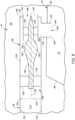
- each combustor wall 90, 92 may include one or more dilution apertures 100, 102 (e.g., quench apertures) arranged circumferentially about the axis 34 in an array; e.g., a circular array.
- each dilution aperture 100, 102 extends (e.g., radially) through the respective combustor wall 90, 92 to the combustion chamber 74.
- Each combustor wall 90, 92 may also include (or may not include) one or more cooling apertures (not shown for clarity of illustration); e.g., effusion aperture, cooling slots, etc.
- each cooling aperture may have a flow area (e.g., a cross-sectional area) which is significantly smaller than (e.g., 5x, 10x, 15x, 20x smaller than) a flow area (e.g., a cross-sectional area) of each dilution aperture 100, 102.
- the cooling apertures when provided are configured to facilitate cooling (e.g., film cooling) of a hot side of the respective combustor wall 90, 92
- the dilution apertures 100, 102 may be provided to tune combustion of the fuel-air mixture within the combustion chamber 74.
- the dilution apertures 100, 102 may direct compressed air into the combustion chamber 74 to stoichiometrically lean (e.g., quench) the combustion products.
- each of the combustor walls 90, 92 may be configured as a single layer combustor wall. Alternatively, any one or more of the combustor walls 90 and/or 92 may each be configured as a multi-layer combustor wall; e.g., a hollow, dual-walled structure.
- each combustor wall 90, 92 may include a combustor wall shell 104, a combustor wall heat shield 106 (e.g., a liner) and one or more combustor wall cooling cavities 108 (e.g., impingement cavities) formed by and (e.g., radially) between the shell 104 and the heat shield 106.
- Each cooling cavity 108 may be fluidly coupled with the diffuser plenum 80 through one or more shell cooling apertures 110 in the shell 104; e.g., impingement apertures. Each cooling cavity 108 may be fluidly coupled with the combustion chamber 74 through one or more heat shield cooling apertures 112 in the heat shield 106; e.g., effusion apertures.
- the dilution apertures 100, 102 are fluidly discrete from the cooling cavities 108, and each of the dilution apertures 100, 102 extends through the both the shell 104 and the heat shield 106; e.g., through an entire thickness of the respective combustor wall 90, 92.
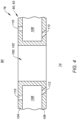
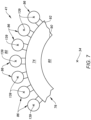
- the diffuser structure 84 includes one or more diffuser passages 114. These diffuser passages 114 are arranged circumferentially about the axis 34 in an array; e.g., a circular array. This array of diffuser passages 114 may axially overlap and circumscribe a downstream portion of the HPC rotor 54 and its final mixed flow compressor stage 56B. Each of the diffuser passages 114 extends longitudinally from an inlet 116 into the respective diffuser passage 114 to an outlet 118 from the respective diffuser passage 114.
- each of the diffuser passages 114 receives compressed core air from the HPC section 40B.
- this core air may include debris such as, but not limited to, dirt, sand or other foreign particulate matter ingesting into the turbine engine 26.
- the configuration of the HPC rotor 54 and its final mixed flow compressor stage 56B directs the compressed core air radially outward and circumferentially into each diffuser passage 114. Momentum of this compressed core air entering the respective diffuser passage 114 may cause that compressed core air to swirl as it moves through the respective diffuser passage 114 and into the respective air-debris separator 86. Referring to FIG.
- the air system 82 is generally described above paired with annular combustors and annular combustion chambers, it is contemplated the air system 82 may be configured for various other types of combustors such as a CAN-type combustor with a non-annular (e.g., cylindrical or frustoconical) combustion chamber.
- a CAN-type combustor with a non-annular (e.g., cylindrical or frustoconical) combustion chamber.
Landscapes
- Engineering & Computer Science (AREA)
- Chemical & Material Sciences (AREA)
- Combustion & Propulsion (AREA)
- Mechanical Engineering (AREA)
- General Engineering & Computer Science (AREA)
- Physics & Mathematics (AREA)
- Fluid Mechanics (AREA)
- Structures Of Non-Positive Displacement Pumps (AREA)
Applications Claiming Priority (1)
| Application Number | Priority Date | Filing Date | Title |
|---|---|---|---|
| US18/400,368 US12359615B1 (en) | 2023-12-29 | 2023-12-29 | Separating airflows within a turbine engine |
Publications (2)
| Publication Number | Publication Date |
|---|---|
| EP4579130A2 true EP4579130A2 (fr) | 2025-07-02 |
| EP4579130A3 EP4579130A3 (fr) | 2025-07-30 |
Family
ID=94128506
Family Applications (1)
| Application Number | Title | Priority Date | Filing Date |
|---|---|---|---|
| EP24223764.2A Pending EP4579130A3 (fr) | 2023-12-29 | 2024-12-30 | Séparation de flux d'air à l'intérieur d'un moteur à turbine |
Country Status (2)
| Country | Link |
|---|---|
| US (1) | US12359615B1 (fr) |
| EP (1) | EP4579130A3 (fr) |
Families Citing this family (1)
| Publication number | Priority date | Publication date | Assignee | Title |
|---|---|---|---|---|
| US20250216078A1 (en) * | 2023-12-29 | 2025-07-03 | Rtx Corporation | Separating airflows within a turbine engine |
Family Cites Families (11)
| Publication number | Priority date | Publication date | Assignee | Title |
|---|---|---|---|---|
| GB1075958A (en) * | 1966-04-29 | 1967-07-19 | Rolls Royce | Gas turbine engine |
| US3720045A (en) | 1970-11-16 | 1973-03-13 | Avco Corp | Dynamic blade particle separator |
| FR2711771B1 (fr) | 1993-10-27 | 1995-12-01 | Snecma | Diffuseur de chambre à alimentation circonférentielle variable. |
| DE19834376B4 (de) | 1998-07-30 | 2007-05-03 | Alstom | Verfahren, Einrichtung und Anwendung des Verfahrens zum Kühlen von Leitschaufeln in einer Gasturbinenanlage |
| GB9917957D0 (en) * | 1999-07-31 | 1999-09-29 | Rolls Royce Plc | A combustor arrangement |
| GB2390890B (en) * | 2002-07-17 | 2005-07-06 | Rolls Royce Plc | Diffuser for gas turbine engine |
| EP1508680A1 (fr) * | 2003-08-18 | 2005-02-23 | Siemens Aktiengesellschaft | Diffuseur situé entre le compresseur et la chambre de combustion d'une turbine à gaz |
| US9546603B2 (en) * | 2014-04-03 | 2017-01-17 | Honeywell International Inc. | Engine systems and methods for removing particles from turbine air |
| US10787920B2 (en) | 2016-10-12 | 2020-09-29 | General Electric Company | Turbine engine inducer assembly |
| US10724437B2 (en) | 2017-06-28 | 2020-07-28 | General Electric Company | Systems and methods for particle separator in a gas turbine engine |
| US11608782B2 (en) | 2020-04-15 | 2023-03-21 | Pratt & Whitney Canada Corp. | Axial inertial particle separator for turbine engine |
-
2023
- 2023-12-29 US US18/400,368 patent/US12359615B1/en active Active
-
2024
- 2024-12-30 EP EP24223764.2A patent/EP4579130A3/fr active Pending
Also Published As
| Publication number | Publication date |
|---|---|
| US12359615B1 (en) | 2025-07-15 |
| EP4579130A3 (fr) | 2025-07-30 |
Similar Documents
| Publication | Publication Date | Title |
|---|---|---|
| CN114941571B (zh) | 用于涡轮机械发动机的可变节距风扇 | |
| US20210310417A1 (en) | Gearbox for an engine | |
| CN114909215A (zh) | 推进系统配置及操作方法 | |
| US12392489B2 (en) | Turbine engine support structure with airflow ports | |
| EP4579130A2 (fr) | Séparation de flux d'air à l'intérieur d'un moteur à turbine | |
| EP4647665A2 (fr) | Séparation de flux d'air à l'intérieur d'un moteur à turbine | |
| EP4644678A2 (fr) | Séparation de flux d'air à l'intérieur d'une centrale électrique d'aéronef | |
| EP4582673A1 (fr) | Aubes de guidage de refroidissement d'une turbomachine | |
| US20250216078A1 (en) | Separating airflows within a turbine engine | |
| EP4343134A2 (fr) | Moteur à turbine à gaz avec conduit de dérivation intégré | |
| US20230383709A1 (en) | Thrust vectoring exhaust nozzle for aircraft propulsion system | |
| US11873758B1 (en) | Gas turbine engine component with integral heat exchanger | |
| EP4495383A1 (fr) | Structure de réseau d'aubes de moteur à turbine avec séparateur de particules d'air | |
| US12454911B2 (en) | Bleeding core air from a turbine engine core flowpath | |
| US12410712B1 (en) | Rotor blade with apertured cooling air deflector | |
| EP4488496A1 (fr) | Moteur de système de propulsion d'aéronef à multiples structures rotatives indépendantes | |
| US12421863B2 (en) | Turbine engine tip clearance control system with thrust bearing | |
| US12546227B2 (en) | Cooling nozzle vanes of a turbine engine | |
| US12140048B1 (en) | Integrated centrifugal compressor diffuser and high pressure turbine vane assembly | |
| US20260009334A1 (en) | Notched turbine vane baffle | |
| US12578092B2 (en) | Cooled variable area nozzle for an aircraft engine | |
| EP4667706A2 (fr) | Système de refroidissement par air pour plateforme externe de structure d'aube de stator | |
| EP4357619A2 (fr) | Agencement de passage de purge pour carénage de moteur à turbine à gaz | |
| US20260092556A1 (en) | Open rotor propulsion system with forward exhaust outlet(s) | |
| EP4310302A1 (fr) | Système d'aéronef avec compresseur alimenté par moteur à turbine à gaz |
Legal Events
| Date | Code | Title | Description |
|---|---|---|---|
| PUAI | Public reference made under article 153(3) epc to a published international application that has entered the european phase |
Free format text: ORIGINAL CODE: 0009012 |
|
| STAA | Information on the status of an ep patent application or granted ep patent |
Free format text: STATUS: THE APPLICATION HAS BEEN PUBLISHED |
|
| PUAL | Search report despatched |
Free format text: ORIGINAL CODE: 0009013 |
|
| AK | Designated contracting states |
Kind code of ref document: A2 Designated state(s): AL AT BE BG CH CY CZ DE DK EE ES FI FR GB GR HR HU IE IS IT LI LT LU LV MC ME MK MT NL NO PL PT RO RS SE SI SK SM TR |
|
| AK | Designated contracting states |
Kind code of ref document: A3 Designated state(s): AL AT BE BG CH CY CZ DE DK EE ES FI FR GB GR HR HU IE IS IT LI LT LU LV MC ME MK MT NL NO PL PT RO RS SE SI SK SM TR |
|
| RIC1 | Information provided on ipc code assigned before grant |
Ipc: F02C 7/052 20060101ALI20250623BHEP Ipc: F04D 29/54 20060101ALI20250623BHEP Ipc: F23R 3/04 20060101AFI20250623BHEP Ipc: F01D 25/32 20060101ALI20250623BHEP Ipc: F23R 3/06 20060101ALI20250623BHEP Ipc: F23R 3/10 20060101ALI20250623BHEP |
|
| STAA | Information on the status of an ep patent application or granted ep patent |
Free format text: STATUS: REQUEST FOR EXAMINATION WAS MADE |
|
| 17P | Request for examination filed |
Effective date: 20260130 |