EP4579160A2 - Porte pour appareil ménager, appareil ménager et son procédé de fabrication - Google Patents
Porte pour appareil ménager, appareil ménager et son procédé de fabrication Download PDFInfo
- Publication number
- EP4579160A2 EP4579160A2 EP25171166.9A EP25171166A EP4579160A2 EP 4579160 A2 EP4579160 A2 EP 4579160A2 EP 25171166 A EP25171166 A EP 25171166A EP 4579160 A2 EP4579160 A2 EP 4579160A2
- Authority
- EP
- European Patent Office
- Prior art keywords
- door
- frame
- foaming
- assembly
- injection hole
- Prior art date
- Legal status (The legal status is an assumption and is not a legal conclusion. Google has not performed a legal analysis and makes no representation as to the accuracy of the status listed.)
- Pending
Links
Images



Classifications
-
- A—HUMAN NECESSITIES
- A47—FURNITURE; DOMESTIC ARTICLES OR APPLIANCES; COFFEE MILLS; SPICE MILLS; SUCTION CLEANERS IN GENERAL
- A47F—SPECIAL FURNITURE, FITTINGS, OR ACCESSORIES FOR SHOPS, STOREHOUSES, BARS, RESTAURANTS OR THE LIKE; PAYING COUNTERS
- A47F3/00—Show cases or show cabinets
- A47F3/04—Show cases or show cabinets air-conditioned, refrigerated
- A47F3/0404—Cases or cabinets of the closed type
- A47F3/0426—Details
- A47F3/0434—Glass or transparent panels
-
- B—PERFORMING OPERATIONS; TRANSPORTING
- B29—WORKING OF PLASTICS; WORKING OF SUBSTANCES IN A PLASTIC STATE IN GENERAL
- B29C—SHAPING OR JOINING OF PLASTICS; SHAPING OF MATERIAL IN A PLASTIC STATE, NOT OTHERWISE PROVIDED FOR; AFTER-TREATMENT OF THE SHAPED PRODUCTS, e.g. REPAIRING
- B29C44/00—Shaping by internal pressure generated in the material, e.g. swelling or foaming ; Producing porous or cellular expanded plastics articles
- B29C44/34—Auxiliary operations
- B29C44/58—Moulds
- B29C44/588—Moulds with means for venting, e.g. releasing foaming gas
-
- F—MECHANICAL ENGINEERING; LIGHTING; HEATING; WEAPONS; BLASTING
- F25—REFRIGERATION OR COOLING; COMBINED HEATING AND REFRIGERATION SYSTEMS; HEAT PUMP SYSTEMS; MANUFACTURE OR STORAGE OF ICE; LIQUEFACTION SOLIDIFICATION OF GASES
- F25D—REFRIGERATORS; COLD ROOMS; ICE-BOXES; COOLING OR FREEZING APPARATUS NOT OTHERWISE PROVIDED FOR
- F25D23/00—General constructional features
- F25D23/02—Doors; Covers
-
- F—MECHANICAL ENGINEERING; LIGHTING; HEATING; WEAPONS; BLASTING
- F25—REFRIGERATION OR COOLING; COMBINED HEATING AND REFRIGERATION SYSTEMS; HEAT PUMP SYSTEMS; MANUFACTURE OR STORAGE OF ICE; LIQUEFACTION SOLIDIFICATION OF GASES
- F25D—REFRIGERATORS; COLD ROOMS; ICE-BOXES; COOLING OR FREEZING APPARATUS NOT OTHERWISE PROVIDED FOR
- F25D23/00—General constructional features
- F25D23/02—Doors; Covers
- F25D23/025—Secondary closures
-
- F—MECHANICAL ENGINEERING; LIGHTING; HEATING; WEAPONS; BLASTING
- F25—REFRIGERATION OR COOLING; COMBINED HEATING AND REFRIGERATION SYSTEMS; HEAT PUMP SYSTEMS; MANUFACTURE OR STORAGE OF ICE; LIQUEFACTION SOLIDIFICATION OF GASES
- F25D—REFRIGERATORS; COLD ROOMS; ICE-BOXES; COOLING OR FREEZING APPARATUS NOT OTHERWISE PROVIDED FOR
- F25D23/00—General constructional features
- F25D23/02—Doors; Covers
- F25D23/028—Details
-
- F—MECHANICAL ENGINEERING; LIGHTING; HEATING; WEAPONS; BLASTING
- F25—REFRIGERATION OR COOLING; COMBINED HEATING AND REFRIGERATION SYSTEMS; HEAT PUMP SYSTEMS; MANUFACTURE OR STORAGE OF ICE; LIQUEFACTION SOLIDIFICATION OF GASES
- F25D—REFRIGERATORS; COLD ROOMS; ICE-BOXES; COOLING OR FREEZING APPARATUS NOT OTHERWISE PROVIDED FOR
- F25D23/00—General constructional features
- F25D23/06—Walls
-
- F—MECHANICAL ENGINEERING; LIGHTING; HEATING; WEAPONS; BLASTING
- F25—REFRIGERATION OR COOLING; COMBINED HEATING AND REFRIGERATION SYSTEMS; HEAT PUMP SYSTEMS; MANUFACTURE OR STORAGE OF ICE; LIQUEFACTION SOLIDIFICATION OF GASES
- F25D—REFRIGERATORS; COLD ROOMS; ICE-BOXES; COOLING OR FREEZING APPARATUS NOT OTHERWISE PROVIDED FOR
- F25D23/00—General constructional features
- F25D23/06—Walls
- F25D23/065—Details
-
- B—PERFORMING OPERATIONS; TRANSPORTING
- B29—WORKING OF PLASTICS; WORKING OF SUBSTANCES IN A PLASTIC STATE IN GENERAL
- B29C—SHAPING OR JOINING OF PLASTICS; SHAPING OF MATERIAL IN A PLASTIC STATE, NOT OTHERWISE PROVIDED FOR; AFTER-TREATMENT OF THE SHAPED PRODUCTS, e.g. REPAIRING
- B29C44/00—Shaping by internal pressure generated in the material, e.g. swelling or foaming ; Producing porous or cellular expanded plastics articles
- B29C44/02—Shaping by internal pressure generated in the material, e.g. swelling or foaming ; Producing porous or cellular expanded plastics articles for articles of definite length, i.e. discrete articles
- B29C44/12—Incorporating or moulding on preformed parts, e.g. inserts or reinforcements
- B29C44/18—Filling preformed cavities
- B29C44/188—Sealing off parts of the cavities
-
- B—PERFORMING OPERATIONS; TRANSPORTING
- B29—WORKING OF PLASTICS; WORKING OF SUBSTANCES IN A PLASTIC STATE IN GENERAL
- B29K—INDEXING SCHEME ASSOCIATED WITH SUBCLASSES B29B, B29C OR B29D, RELATING TO MOULDING MATERIALS OR TO MATERIALS FOR MOULDS, REINFORCEMENTS, FILLERS OR PREFORMED PARTS, e.g. INSERTS
- B29K2075/00—Use of PU, i.e. polyureas or polyurethanes or derivatives thereof, as moulding material
-
- B—PERFORMING OPERATIONS; TRANSPORTING
- B29—WORKING OF PLASTICS; WORKING OF SUBSTANCES IN A PLASTIC STATE IN GENERAL
- B29L—INDEXING SCHEME ASSOCIATED WITH SUBCLASS B29C, RELATING TO PARTICULAR ARTICLES
- B29L2031/00—Other particular articles
- B29L2031/762—Household appliances
- B29L2031/7622—Refrigerators
-
- F—MECHANICAL ENGINEERING; LIGHTING; HEATING; WEAPONS; BLASTING
- F25—REFRIGERATION OR COOLING; COMBINED HEATING AND REFRIGERATION SYSTEMS; HEAT PUMP SYSTEMS; MANUFACTURE OR STORAGE OF ICE; LIQUEFACTION SOLIDIFICATION OF GASES
- F25D—REFRIGERATORS; COLD ROOMS; ICE-BOXES; COOLING OR FREEZING APPARATUS NOT OTHERWISE PROVIDED FOR
- F25D2201/00—Insulation
- F25D2201/10—Insulation with respect to heat
-
- F—MECHANICAL ENGINEERING; LIGHTING; HEATING; WEAPONS; BLASTING
- F25—REFRIGERATION OR COOLING; COMBINED HEATING AND REFRIGERATION SYSTEMS; HEAT PUMP SYSTEMS; MANUFACTURE OR STORAGE OF ICE; LIQUEFACTION SOLIDIFICATION OF GASES
- F25D—REFRIGERATORS; COLD ROOMS; ICE-BOXES; COOLING OR FREEZING APPARATUS NOT OTHERWISE PROVIDED FOR
- F25D2323/00—General constructional features not provided for in other groups of this subclass
- F25D2323/02—Details of doors or covers not otherwise covered
- F25D2323/023—Door in door constructions
-
- F—MECHANICAL ENGINEERING; LIGHTING; HEATING; WEAPONS; BLASTING
- F25—REFRIGERATION OR COOLING; COMBINED HEATING AND REFRIGERATION SYSTEMS; HEAT PUMP SYSTEMS; MANUFACTURE OR STORAGE OF ICE; LIQUEFACTION SOLIDIFICATION OF GASES
- F25D—REFRIGERATORS; COLD ROOMS; ICE-BOXES; COOLING OR FREEZING APPARATUS NOT OTHERWISE PROVIDED FOR
- F25D2400/00—General features of, or devices for refrigerators, cold rooms, ice-boxes, or for cooling or freezing apparatus not covered by any other subclass
- F25D2400/36—Visual displays
- F25D2400/361—Interactive visual displays
Definitions
- the present invention relates to a door for a home appliance, a home appliance, and a method for manufacturing the same.
- a refrigerator is an apparatus for freeze or refrigerate foods by maintaining a temperature of a storage area provided therein at a predetermined temperature by using a freezing cycle configured of a compressor, a condenser, an expansion valve and an evaporator. Therefore, the refrigerator includes a storage area, for example, a freezer compartment and a refrigerator compartment, and its type is classified in accordance with positions of the freezer compartment and the refrigerator compartment. For example, the refrigerator may be classified into a top mount type having a freezer compartment mounted on a top of a refrigerator compartment, a bottom freezer type having a freezer compartment mounted below a refrigerator compartment, and a side by side type having freezer and refrigerator compartments arranged side by side.
- the freezer compartment and the refrigerator compartment are provided inside a cabinet forming external appearance, and each of them may selectively be opened and closed by a freezer door and a refrigerator door.
- Some refrigerators include a user input panel provided on a door front surface. The panel may be provided to allow a user to apply a touch input thereto. This may be referred to as an interactive touch input panel. The user may select or change various functions of the refrigerator through the interactive touch input panel.
- Some refrigerators, particularly, a show case refrigerator used in a conveniences store may allow a user to see the inside of the refrigerator even without opening a door because the door is comprised of glass.
- a refrigerator for home use includes an opaque freezer door and an opaque refrigerator door, it is general that the user may see the inside of the refrigerator by opening the freezer door and the refrigerator door.
- a user may see the inside of the refrigerator even without opening a door of the refrigerator. Therefore, cool air loss caused by frequently opening or closing the door may be avoided.
- the door includes a panel assembly through which a user may see the inside of the refrigerator, and a frame assembly for supporting the panel assembly.
- the freezer compartment and the refrigerator compartment are provided inside a cabinet constituting external appearance of the refrigerator, and selectively opened or closed by a freezing door and a refrigerator door (hereinafter, referred to as "door for refrigerator” or “door” as a generic term. Since the refrigerator compartment or the freezer compartment are selectively sealed by the door for the refrigerator, the door should have predetermined insulation performance.
- a predetermined space is formed by a frame structure body constituting external appearance of the door to have a predetermined rigidity, the space is generally foamed and filled with a thermal insulator such as polyurethane to make a door.
- a foaming space determined by the frame structure body becomes a size of the door, that is, "upper and lower width of the door x left add right width of the door x depth of the door (front and rear direction of the door)", and this space becomes a foaming space and a foaming path, which should be filled with a thermal insulator.
- a foaming injection hole is arranged at a center, approximately, of a rear surface (exactly, frame structure body) of the door.
- the temporary assembly door is arranged horizontally to allow the front surface of the temporarily assembled door toward the ground surface during foaming of the thermal insulator, and then the foaming agent which is the thermal insulator is injected through the foaming injection hole provided at the center of the rear surface of the temporary assembly door.
- a refrigerator for allowing a user to see the inside thereof even without opening a door thereof has been suggested to reduce door opening or closing of thereof and thus avoid cool air loss caused by frequently opening or closing of the door.
- the door includes a panel assembly comprised of glass through which the user may see the inside of the refrigerator, and a frame assembly for supporting the panel assembly.
- the door includes a panel assembly having a touch input assembly and a frame assembly for supporting the panel assembly.
- the foaming space and the foaming path becomes a space defined by a portion except the panel assembly from the entire door, that is, an outer edge of the frame assembly and the panel assembly. Therefore, the door has a relatively smaller foaming space and foaming path than those of a general door, a problem may occur during foaming of the thermal insulator. That is, since foaming resistance is great during foaming of the thermal insulator, a problem may occur in that the foaming space may not be fully filled with the thermal insulator. Also, the foaming agent type thermal insulator may be swollen to leak into the foaming injection hole or the panel assembly or the foaming agent may flow backward to the foaming injection hole. Therefore, a solution for solving this problem is required.
- This problem of the door may occur equally or similarly to a door of a home appliance, which requires insulation, as well as a door of a refrigerator.
- the present invention is directed to a door for a refrigerator, a refrigerator and a method for manufacturing the same, which substantially obviate one or more problems due to limitations and disadvantages of the related art.
- An object of the present invention is to provide a door for a refrigerator, a refrigerator and a method for manufacturing the same, in which foaming performance of a thermal insulator can be improved during manufacture of the door.
- a door for a home appliance comprises a panel assembly; and a frame assembly defining a predetermined space having an opening connected with an edge of the panel assembly, and making a foaming space for receiving a thermal insulator by means of the predetermined space of the frame assembly and the edge of the panel assembly, wherein a foaming injection hole through which the thermal insulator is injected is provided on at least one of ends of an upper surface, a lower surface, a left side and a right side of the frame assembly.
- the frame assembly includes a rear frame located on a rear surface of the door, and a side frame forming the predetermined space connected with the rear frame.
- the panel assembly includes two or more thermal insulation glass panels and a spacer provided between edges of the two thermal insulation glass panels, and a heating element is provided near the spacer.
- the foaming injection hole is preferably provided on at least one of the ends of the upper surface and the lower surface of the frame assembly. More preferably, the foaming injection hole is provided at the end of the lower surface of the frame assembly. More preferably, the foaming injection hole is provided at both ends of the lower surface of the frame assembly. Meanwhile, the foaming injection hole is preferably provided in a long length direction of the frame assembly.
- a door for a refrigerator comprises a support portion surrounding an opened center portion, having a thermal insulation space therein, and a thermal insulator received in the thermal insulation space, wherein a foaming injection hole through which the thermal insulator is injected is provided on at least one of ends of an upper surface, a lower surface, a left side and a right side of the support potion.
- a method for manufacturing a door for a refrigerator comprises a temporary assembly step of temporarily assembling a support portion surrounding an opened center portion, having a thermal insulation space therein; and a foaming step of injecting the thermal insulator in a length direction of the support portion.
- the thermal insulator is injected in a long length direction of the support portion.
- the thermal insulator is foamed after the support portion is arranged vertically.
- the foaming injection hole through which the thermal insulator is injected may be provided on at least one of the upper surface, the lower surface, the left side and the right side of the frame assembly. Meanwhile, at the temporary assembly step, the panel assembly may temporarily be assembled in the center portion.
- a door for a refrigerator comprises a support portion surrounding an opened center portion, having a thermal insulator received in the support portion, wherein a foaming injection hole through which the thermal insulator is injected is provided to foam the thermal insulator in a long length direction of the support portion.
- the foaming injection hole is preferably provided on at least one of the upper surface, the lower surface, the left side and the right side of the support portion. More preferably, the support portion is respectively provided at both ends. Meanwhile, the panel assembly may be provided at the center portion.
- a door for a home appliance comprises a panel assembly; and a frame assembly having an opening connected with an edge of the panel assembly to support the panel assembly, and making a foaming space for receiving a thermal insulator between edges of the frame assembly and the panel assembly, wherein a foaming injection hole through which the thermal insulator is injected is provided on at least one of ends of an upper surface, a lower surface, a left side and a right side of the frame assembly.
- the frame assembly may have a depth substantially the same as that of the panel assembly.
- the foaming injection hole is preferably provided on at least one of the ends of the upper surface and the lower surface of the frame assembly.
- a width of the upper surface and the lower surface of the frame assembly is smaller than that of the left and right sides of the frame assembly. That is, in a state that the door is arranged vertically, the door may be formed in a rectangular shape having a height greater than a left and right width.
- the foaming injection hole is preferably provided at both ends of the lower surface of the frame assembly.
- the foaming injection hole is provided to inject a foaming agent in a longer length direction of a horizontal length or a vertical length of the frame assembly.
- the foaming injection hole is preferably formed such that a foaming direction of the foaming agent is substantially the same as a gravity direction.
- a door for a home appliance comprises a panel assembly including a front panel and a rear panel; a frame assembly including a rear frame connected with the rear panel, and a side frame connecting the rear frame with the front panel; a thermal insulation space formed between the frame assembly and the panel assembly, receiving a thermal insulator therein; and a foaming injection hole provided to foam the thermal insulator to at least one of ends of an upper surface, a lower surface, a left side and a right side of the frame assembly in a length direction of the frame assembly, wherein the rear frame is partially inserted into the side frame and coupled to the side frame to increase a coupling force between the rear frame and the side frame by means of an expansion pressure of the thermal insulator expanded in the foaming direction and a vertical direction.
- the side frame includes a heat bridge extended to an inner side of a radius direction along a rear surface of the front panel, the heat bridge being formed in parallel with the rear surface of the front panel.
- a hot wire is provided between the heat bridge and the rear surface of the front panel and is tightly adhered to the front panel.
- the hot wire is provided to be tightly adhered to the front panel through a metal sheet to block inflow of the thermal insulator to the hot wire, and its position is fixed by the pressure of the thermal insulator applied to the metal sheet.
- a center portion of the panel assembly corresponding to the inner side of the radius direction of the frame assembly may be a see-through area of the door or a touch area to which a touch input of a user is applied.
- a door for a home appliance and a home appliance including the same, the door comprising: a panel assembly of a rectangular shape having a height greater than a left and right width; a frame assembly surrounding an edge of the panel assembly to support the panel assembly, forming a foaming space with the panel assembly, and including an upper frame, a lower frame, and both side frames; and a foaming injection hole provided at each of left and right ends of the lower frame to inject a thermal insulator to the foaming space.
- the frame assembly surrounds the panel assembly along the edge of the panel assembly. Also, a foaming space filled with the foaming agent may be formed between the frame assembly and the panel assembly.
- the foaming injection hole may include a first injection hole provided at a direct lower portion of the side frame, and a second injection hole provided to be inclined toward an inner side of the door from the direct lower portion of the side frame.
- the first injection hole and the second injection hole are formed on the upper frame or the lower frame, which forms the upper surface or the lower surface of the frame assembly.
- injection since injection may be performed in one direction, an injection device may easily be manufactured and also injection may easily be performed.
- the first injection hole is provided to perform foaming in the same manner as a length direction of the first side frame of both side frames, the first side frame having a greater sectional area of the foaming space, and the second injection hole is provided to be inclined toward the inner side of the door in a length direction of the second side frame having a smaller sectional area of the foaming space to allow a foaming agent injected through the second injection hole to move to the foaming space formed by the lower frame and then move to the foaming space formed by the second side frame.
- the frame assembly supports the panel assembly at the rear of the panel assembly, includes a rear frame for forming the foaming space between the panel assembly and the upper frame, the lower frame and both side frames.
- the rear frame is preferably provided with vent holes formed to discharge out the air inside the foaming space during foaming.
- the rear frame is located vertically with respect to a moving direction of the foaming agent. That is, at the rear frame located at the rear of the panel assembly, the vent holes are preferably formed discharge the air out to the rear of the door. Therefore, the air not the foaming agent may be discharged out more actively.
- the rear frame may be provided with a gasket mounting groove on which a gasket is mounted, and the gasket mounting groove maybe provided with vent holes formed to discharge out the air inside the foaming space during foaming.
- the gasket is mounted on the gasket mounting groove, and thus the gasket mounting groove is covered by the gasket. Therefore, the vent holes formed in the gasket mounting groove are covered by the gasket. Therefore, since the vent holes are not exposed to the outside, esthetic appearance of the door is not damaged.
- the thermal insulator may be prevented from being less filled in the frame assembly.
- the thermal insulator which is a foaming agent may be prevented from being leaked to the foaming injection hole or the panel assembly while being swollen. Also, the thermal insulator which is the foaming agent may be prevented from flowing backward to the foaming injection hole.
- FIG. 1 a whole configuration of a preferred embodiment of a refrigerator according to the present invention will be described with reference to FIG. 1 .
- the number of doors, installation type, etc. are not main subjects of this embodiment, and thus will briefly be described within the range that assists understanding of the present invention.
- a refrigerator compartment is provided at an upper portion of a cabinet 1, and a freezer compartment is provided at a lower portion of the cabinet 1.
- Doors 3, 5, 9 and 11 are rotatably installed at upper and lower portions of the cabinet 1 to open or close the refrigerator compartment and the freezer compartment.
- two doors 3, 5, 9 and 11 for respectively opening or closing the refrigerator compartment and the freezer compartment are shown in this embodiment, one door may be used without limitation to this embodiment.
- a main door 5 and a sub door 7 are shown as right doors for the refrigerator compartment in this embodiment, one door may be used as a right door for the refrigerator compartment without limitation to this embodiment.
- the right door for the refrigerator compartment includes a main door 5 rotatably coupled to the cabinet 1, and a sub door 7 rotatably coupled to the main door 5. Since the main door 5 is provided with another side storage space such as a basket, a user may approach storage goods kept in the side storage space by opening the sub door 7 only without opening the main door 5.
- the sub door 7 includes a panel assembly 10 through which a user may see from the outside of the refrigerator, and a frame assembly 20 for supporting the panel assembly 10.
- the panel assembly 10 has predetermined insulation performance by using insulation glass, etc.
- the frame assembly 20 has predetermined insulation performance.
- a heating element 30 is provided at the connection portion between the panel assembly 10 and the frame assembly 20 (detailed structure of panel assembly, frame assembly and heating element will be described later).
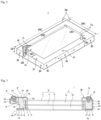
- FIG. 2 briefly illustrates the door 7 having the panel assembly 10 to describe the principle of the present invention. Also, the rear surface of the door 7 is shown as an upper portion.
- the door 7 includes a panel assembly 10, a frame assembly 20 for supporting the panel assembly 10, and a thermal insulator 60 defined by the frame assembly and foamed in a foaming space.
- the panel assembly 10 is, but not limited to, approximately rectangular shape to correspond to the shape of the door.
- the frame assembly 20 supports an edge 11a of the panel assembly 10.
- the frame assembly 20 defines a foaming space having an opening 21, and the panel assembly 10 is preferably connected to the opening 21 (see FIG. 3 ).
- a foaming space becomes a size of the door, that is, "left and right width DW2 of the door x upper and lower width DW2 of the door x depth DH of the door". Also, the foaming space briefly becomes a foaming path. However, in case of the door 7 having the panel assembly, a space substantially made by the frame assembly 10 becomes a foaming space. The foaming space becomes a space excluding the size of the panel assembly 10 from the size of the door 7. The size of the panel assembly 10 becomes "left and right width GW1 of the panel assembly x upper and lower width GW2 of the panel assembly x depth GH of the panel assembly".
- the size of the door 7 is previously determined in accordance with the refrigerator, and it is preferable that the size of the panel assembly 10 is great if possible. This is because that the user may easily see the inside of the refrigerator through the panel assembly 10 if the size of the panel assembly 10 is great. Therefore, if requirements of the door such as rigidity and insulation are within a satisfactory range, the size of the panel assembly 10, particularly the left and right width GW1 and the upper and lower width GW2 are close to the left and right width FW1 and the upper and lower width DW2 of the door, whereby it is preferable that the left and right width FW1 and the upper and lower width DW2 of the frame assembly 20 are small.
- the difference between the upper and lower width DW2 of the door 7 and the upper and low width GW2 of the panel assembly 10 and the difference between the left and right width DW1 of the door 7 and the left and right width GW1 of the panel assembly 10 are relatively small.
- an interval between the edge 11a of the panel assembly 10 and the edge 20a of the frame assembly 20, that is, the widths FW1 and FW2 of the frame assembly 20 are relatively narrow. If the size of the panel assembly 10 is maximized while another design condition of the door 7 is being satisfied, it is preferable that the widths FW1 and FW2 of the frame assembly 20 are minimized and the depth DH of the frame assembly 20 is minimized. This means that the foaming path becomes smaller than the width of the foaming path allowable in the thermal insulator foaming method of the related art. To this end, the depth DH and the widths FW1 and FW2 of the frame assembly 20 may be about 35mm or less, for example.
- the foaming space where the thermal insulator 60 is foamed becomes a space mainly made by the frame assembly 20.
- the widths FW1 and FW2 of the frame assembly 20 are relatively narrow in view of the properties of the frame assembly 20. Therefore, in case of the panel assembly door 7, the foaming space and the foaming path are relatively smaller than those of the door having no panel assembly. Therefore, in accordance with the related art, if the foaming injection hole (for example, A1) is provided on a rear surface of the frame assembly 20 and the thermal insulator 60 is injected through the foaming injection hole A1, a problem may occur in foaming performance. This is because that the foaming interval of the door 7 according to the present invention is narrower than the foaming interval allowable in the foaming method of the related art and thus foaming resistance may be increased to cause a problem in foaming performance.
- foaming injection holes B1, B2, B3, B4 and B5 are arranged at predetermined positions corresponding to at least one of a left side, a right side, an upper surface and a lower surface not front and rear surfaces of the frame assembly 20.
- the foaming injection holes B1, B3, B3, B4 and B5 are provided on at least one of the left side, the right side, the upper surface and the lower surface (hereinafter, comprehensively referred to as "side” except that the respective sides of the frame assembly 20 should be categorized specially from one another) of the frame assembly 20. (the foaming injection holes at the left side and the lower surface are shown in FIG. 2 ). Also, it is more preferable that the foaming injection holes B2, B3, B4 and B5 are provided on ends of the upper surface, the lower surface, the left side and the right side of the frame assembly 20.
- the foaming injection hole B1 is located at the center of the side of the frame assembly 20, the distance FW1 between the panel assembly 1 and the foaming injection hole B1 is short, and thus foaming is slowly performed in a length direction L (orthogonal direction of the foaming direction). Also, in this case, the foaming agent may be leaked along the direction of the panel assembly 10. Therefore, it is preferable that the foaming injection holes B2, B3, B4 and B5 are located toward the end of the frame assembly 20 instead of the center of the frame assembly 20.
- the foaming injection holes B2, B3, B4 and B5 may be located at the side of the frame assembly 20, that is, ends of the left side, the right side, the upper surface and the lower surface.
- the foaming injection holes B2 and B3 the foaming injection hole of the left side is only shown in FIG. 2
- the thermal insulator may be foamed without relative foaming resistance
- the foaming injection holes B2 and B3 are exposed after foaming, whereby it is not good in view of esthetic appearance.
- the right side and the left side of the frame assembly 20 constitute external appearance of the door 7, and the foaming injection holes B2 and B3 may be seen to a user when the door 7 is opened or closed.
- a hinge structure (not shown) for connecting the door 7 to the cabinet of the refrigerator to open or close the door 7 is coupled to upper and lower ends of the right side or the left side of the frame assembly 20. Therefore, if the foaming injection holes B2 and B3 are located at the ends of the right side and the left side of the frame assembly 20, the hinge structure may be foaming resistance during foaming of the thermal insulator. Therefore, it is more preferable that the foaming injection holes B4 and B5 (the foaming injection hole of the lower surface is only shown in FIG. 2 ) are provided at the ends of the upper surface and the lower surface instead of the ends of the left side and the right side of the frame assembly 20.
- the foaming injection holes B4 and B5 are located at the end of the lower surface of the frame assembly 20.
- one foaming injection hole B4 or B5 may be provided at one end of the lower surface of the frame assembly 20, or two foaming injection holes B4 and B5 may respectively be provided at both ends. If one foaming injection hole is provided, it is preferable that a position favorable for obtaining foaming quality is selected. For example, in the same manner as the embodiment shown in FIG. 3 , if an indentation 330 that serves as a handle is provided at one side of the frame assembly 20, it is preferable that the foaming injection hole B4 is selected at the end of an opposite portion. This is because that the foaming injection hole B5 may be partially overlapped with the edge of the frame assembly 20 if the foaming injection hole B5 at the portion where the indentation 330 serving as a handle is provided is selected.
- TPS thermal protection spacer
- a vacuum state may become between the rear panel 12 and the intermediate panel 14 and between the intermediate panel 14 and the front panel 16, or the air or Ar gas may be filled between the rear panel 12 and the intermediate panel 14 and between the intermediate panel 14 and the front panel 16.
- the Ar gas is an inert gas which has insulation performance more excellent than that of the air and can be prevented from being changed by a chemical action, it is preferable that the Ar gas is used instead of the air.
- the frame assembly 20 has predetermined insulation performance.
- the frame assembly 20 may include, but not limited to, a portion for supporting the door at a predetermined rigidity for supporting the panel assembly 10, and a portion substantially serving as a thermal insulation function.
- the frame assembly 20 defines a thermal insulation space for receiving a thermal insulator 60 having predetermined thermal insulation performance, and is preferably coupled to the panel assembly 10.
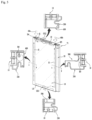
- the frame assembly 20 includes, but not limited to, a plurality of parts considering convenience of assembly of the door. First of all, the whole configuration of an example of the frame assembly 20 will be described with reference to FIG. 3 .
- the frame assembly 20 includes a rear frame 200 located at the rear of the door. Also, the frame assembly 20 includes side frames 300 and 400 located at left and right sides of the door, an upper frame 500 located on an upper end of the door, and a lower frame 600 located at a lower end of the door.
- the panel assembly 10 is transparent, and the rear frame 200, the side frames 300 and 400, the upper frame 500 and the lower frame 600 define a thermal insulation space together with the panel assembly 10. That is, these frames define the thermal insulation space along upper and lower and left and right corners of the panel assembly 10 together with the panel assembly 10.
- the thermal insulation space may receive the thermal insulator 60.
- the thermal insulator may include a thermal insulation foam or another material thermal insulator or a thermal insulation gas.
- the panel assembly 10 may be connected to an opening defined by inner corners of the rear frame 200, the side frames 300 and 400, the upper frame 500 and the lower frame 600.
- the panel assembly 10 is transparent, side corner portions of the panel assembly 10 and the space defined by the frames may be filled with the thermal insulator (see FIG. 3 ).
- the panel assembly is a touch panel, a space between the rear panel 12 and the intermediate panel 14 may be filled with the thermal insulator.
- the rear frame 200 is located at an inner side of the door, and serves to support the whole door.
- the frames 300, 400, 500 and 600 are located at upper and lower and left and right portions of the panel assembly 10, and may constitute a part of external appearance of the door.
- the frames 300, 400, 500 and 600 prevent distortion of the door from occurring, and preferably serve to prevent dew formation from occurring at the door together with the thermal insulator 60.
- the rear frame 200, the upper frame 500, and the lower frame 600 may have a similar structure.
- a basis structure of the rear frame 200 and the side frames 300 and 400 will be described herein, and a more detailed structure thereof will be described in the following embodiment, that is, the embodiment of a modified structure of the frame assembly.
- the rear frame 200 includes a first end 220 connected with the panel assembly 10, a second end 230 connected to the side frames 300 and 400, and a connecting portion 210 connecting the first end 220 with the second end 230.
- the first end 220 of the rear frame 200 is a portion connected to the rear panel 12 of the panel assembly 10, and the second end 230 is a portion connected to the side frame.
- the connecting portion 210 connecting the first end 220 with the second end 230 is approximately parallel with the front surface of the cabinet of the refrigerator.
- a gasket 40 is installed at a predetermined portion 235 of the rear frame 200 and its inner side is approximately parallel with the portion 210 for connecting both ends of the rear frame 200.
- the rear frame 200, the side frames 300 and 400, the upper frame 500 and the lower frame 600 may define a predetermined space, more particularly, edge portions of the frames 200, 300, 400, 500 and 600 and the panel assembly 10 may define a substantially sealed space.
- This space is foamed and filled with the thermal insulator 60, for example, polyurethane foam (PU foam), whereby the frame assembly 20 has predetermined insulation performance.
- the thermal insulator 60 for example, polyurethane foam (PU foam)
- PU foam polyurethane foam
- the panel assembly 10 is not transparent, for example, if the panel assembly 10 is a touch panel, this insulation space may be filled with thermal insulators filled in the inner space of the panel assembly 10.
- dew formation may occur at the connected portion 10a of the panel assembly 10 and the frame assembly 20 instead of the panel assembly 10 under a specific condition. Therefore, it is preferable that dew formation prevents from occurring at this connected portion than any other portions.
- FIGS. 4 and 5 A method for manufacturing a door according to the present invention will be described with reference to FIGS. 4 and 5 .
- the foaming agent is expanded while moving to a portion GS2 close to the foaming injection holes B4 and B5, and is also expanded when moving to a portion GS1 far away from the foaming injection holes B4 and B5.
- the foaming agent moves horizontally without being affected by gravity. Therefore, the foaming agent injected at the portion GS1 farthest away from the foaming injection holes B4 and B5 is finally expanded and coagulated, and a gas trap occurs there.
- the foaming agent injected even at the portion GS2 close to the foaming injection holes B4 and B5 is expanded and coagulated, whereby a gas trap occurs.
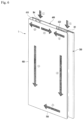
- foaming injection holes B4 and B5 are arranged on the upper surface or the lower surface of the temporary assembly door 71, if the foaming agent is injected in a state that the temporary assembly door 71 is arranged vertically, occurrence of the gas trap may be minimized and foaming quality may be improved.
- a foaming procedure corresponding to the case where the foaming agent is injected in a state that the temporary assembly door 71 is arranged vertically will be described as follows.
- the foaming agent injected to the two foaming injection holes B4 and B5 moves to a half of all of the foaming paths.
- the foaming agent 60a injected from the respective foaming injection holes B4 and B5 moves along gravity and is collected on the lower surface LS.
- the foaming agent collected on the lower surface LS is expanded while upwardly moving along a vertical path f1.
- the foaming agent moving to the upper portion is expanded while moving along a horizontal path f2 and finally is fully filled in the foaming space. If the foamed thermal insulator is coagulated, the manufacture of the door is finally completed.
- the gas trap may occur at only the portion GS2 where foaming is finally completed. As a result, one air vent hole is required, and incomplete filling of the foaming agent may be avoided effectively.
- the foaming agent is injected in a state that the temporary assembly door 71 is arranged vertically in the same manner as the embodiment according to the present invention, the following advantages are obtained. That is, if a left and right width FW1 of the frame assembly 20 is relatively small, for example, 35mm or less, the foaming agent injected to the foaming injection holes B4 and B5 stained in the inner side of the frame assembly 20 while moving to the lower portion, whereby it is predicted that there may be a problem in foaming quality. However, unlike the prediction, even though the injected foaming agent is partially stained in the inner side of the frame assembly 20, there is no problem in foaming quality.
- the foaming agent moving to the bottom of the frame assembly without being stained in the inner side of the frame assembly 20 and the foaming agent stained in the inner side of the frame assembly 20 are together foamed to enable uniform foaming. That is, if the foaming agent is foamed vertically, a part of the foaming agent is stained in the inner side of the frame assembly 20 using resistance caused by viscosity of the foaming agent, and the other of the foaming agent reaches the lower surface LS, whereby it is advantageous that foaming is simultaneously performed at the vertical portion and the lower portion to enable uniform foaming.
- the foaming path is substantially reduced to a half and the shape change of the foaming path is reduced to a half. Also, the filling time is reduced. Therefore, incomplete filling of the foaming agent may be avoided, and deviation of the material property value such as thermal insulation performance and coupling rigidity may be minimized.
- the foaming injection hole B4 is located at both ends of the lower surface of the frame assembly 20 in the aforementioned embodiment, the present invention is not limited to the aforementioned embodiment, and one foaming injection hole may be provided. If one foaming injection hole is provided, that is, if one foaming injection hole on the upper surface of the frame assembly 20 is provided, since the foaming path becomes the space formed by the frame assembly, the foaming path is relatively long and filling time is relatively long. Also, sides of the frame assembly 20, that is, left side, right side, upper surface and lower surface have similar sectional shapes, which are not completely the same as one another. This is because that the parts installed in the corresponding space are different from one another.
- the present invention is not limited to the aforementioned embodiment, and modifications can be made in the present invention by the person with ordinary skill in the art to which the present invention pertains, within the scope of the present invention.
- the present invention may be applied to the door having no panel assembly 10, for example, the main door (see 5 of FIG. 1 ).
- the door will be described with reference to FIG. 1 .
- the main door 5 there is no panel assembly 10.
- the substantial structure of the main door 5 is the same as the frame assembly 20 of the sub door 7.
- the main door 5 has a center portion 52 which is opened, and has an edge surrounding the center portion 52, that is, a support portion 54, and a thermal insulator is received in the space defined by the support portion 54.
- the support portion 54 has predetermined rigidity to allow the main door 5 to be rotatably connected with the cabinet 1 of the refrigerator, and has predetermined thermal insulation performance to allow the cool air inside the refrigerator not to leak out. Since the support portion 54 of the main door 5 is opened, the support portion 54 has a width which is relatively small. Therefore, the foaming path may be small and foaming resistance may be great.
- the foaming injection hole to which the thermal insulator is injected is provided on at least one of the ends of the upper surface, the lower surface, the left side and the right side of the main door 5, and it is preferable that the foaming agent is injected after the main door 5 is arranged vertically in a temporary assembly state. Since the foaming principle is the same as that of the sub door 7, its detailed description will be omitted.
- the size of the main door 5 is the same as that of the sub door 7 in the aforementioned embodiment, the present invention is not limited to the aforementioned embodiment.
- the present invention may be applied to even a case where the sub door 7 is smaller than the main door 5.
- the position of the foaming injection hole in this embodiment may be a little different from the position of the foaming injection hole of the aforementioned embodiment.
- the foaming agent is injected to the first injection hole B5 and the second injection hole B4.
- the pressure of the foaming agent injected to the first injection hole B5 may be different from the pressure of the foaming agent injected to the second injection hole B4. That is, the foaming agent injected to the first injection hole B5 through which the foaming agent moves to a relatively wide space may be injected at relatively high pressure.
- the moving path of the foaming agent will be described with reference to FIG. 7 .
- the foaming agent injected to the first injection hole B5 is injected to the foaming space formed by the side frame 300 and the panel assembly 10. Then, the foaming agent moves to the foaming space formed by the lower frame 600 and the panel assembly 10.
- the foaming agent injected to the second injection hole B4 is first injected to the foaming space formed by the lower frame 600 and the panel assembly 10 and then moves to the foaming space formed by the side frame 400 and the panel assembly 10.
- the foaming agents simultaneously injected to the first injection hole B5 and the second injection hole B4 come across each other at the foaming space formed by the upper frame 500 and the panel assembly 10 or the foaming space formed by the side frame 400 and the panel assembly 10.
- the foaming agent may finally be filled in the space formed by the lower frame 600 and the panel assembly 10.
- the foaming injection holes B4 and B5 may be blocked by a separate element such as an injection cover.
- the filling direction of the first injection hole B5 may be the same as a length direction of the side frame 300. It is preferable that the filling direction of the first injection hole B5 is the same as the length direction of the side frame 300. That is, the moving direction of the foaming agent injected through the first injection hole B5 is maintained in the same manner as the length direction of the side frame 300 without being changed. Of course, the moving direction of the foaming agent may be changed later.
- the filling direction of the second injection hole B4 is the same as that of the side frame 400.
- the first injection hole B5 is located at the direct upper portion or direct lower portion of the side frame 300, it is preferable that the second injection hole B is located at the position inclined to one side from the direct upper portion or direct lower portion of the side frame 400.
- the foaming agent injected through the second injection hole B4 does not first move to the side frame 400 and flows along the lower frame 600 located to be orthogonal to the side frame 400 and finally moves along a length direction of the side frame 400.
- a difference between the first injection hole and the second injection hole may be caused by a sectional difference of the foaming spaces of the side frames 300 and 400. That is, the injection hole is preferably provided at the direct upper portion or the direct lower portion of the length direction of the side frame 300 having a greater section, and the injection hole is preferably provided at one side (inclined toward the center of the door) inclined from the direct upper portion of the direct lower portion of the length direction of the side frame 400 having a smaller section.
- an injection pressure at the first injection hole B5 becomes greater, and more portion of the foaming space is filled with the foaming agent substantially injected through the first injection hole B5.
- the foaming agent injected to the first injection hole B5 may be 70%, and the foaming agent injected to the second injection hole B4 may be 30%.
- the rear frame 200 is preferably provided with vent holes 250 formed to discharge the air remaining at the inner side of the sub door 7 during injection of the foaming agent.
- the vent holes 250 may be formed at a gasket mounting groove 235 formed for mounting of the gasket 40 along the rear frame 200.
- the gasket mounting groove 235 may be formed to be recessed along the circumference of the rear frame 200, and the vent holes 250 may be formed on the gasket mounting groove 592 at certain intervals. After the foaming agent is fully filled, a sub door gasket 591 is mounted on the gasket mounting groove 235. Therefore, the vent holes 250 may be covered by the sub door gasket 591 and is not exposed to the outside.
- the vent holes 250 may be formed at some area of the gasket mounting groove 235.
- the vent holes 250 may be formed at certain intervals along areas A and B where the upper frame 500 and the side frame 400 are arranged as shown in FIG. 8.
- the vent holes 250 may be formed at certain intervals based on a corner where the upper frame 500 and the side frame 400 come across each other. Therefore, the air inside the sub door 50 may be discharged from an area adjacent to the point where the foaming agent injected to the first injection hole B5 and the foaming agent injected to the second injection hole B4 come across each other, and the air continues to be discharged out until the foaming agent is fully filled.
- vent holes 250 are formed at the corner portion of the side frame 400 and the upper frame 500 in a diagonal direction of the first injection hole B4 having the greater foaming pressure.
- the lower frame 600 may be provided with a hinge mounting portion 610. Therefore, the second injection hole B4 is provided to be more inclined toward the center portion of the door than the hinge mounting portion 610. That is, it is preferable that a foaming sectional area of the side frame 400 corresponding to the hinge mounting portion 610 is smaller than a foaming sectional area of the side frame 30 at the opposite position.
- the lower frame 600 may be provided with a sensor mounting portion 620.
- a sensor for sensing approach of a human body or a sensor for sensing a touch input of a user or knock input to the panel assembly 10 may be mounted on the sensor mounting portion 620. Therefore, it is preferable that the first injection hole B5 is provided to be more inclined toward the side of the door than the sensor mounting portion 620.
Landscapes
- Engineering & Computer Science (AREA)
- Physics & Mathematics (AREA)
- Thermal Sciences (AREA)
- Chemical & Material Sciences (AREA)
- Combustion & Propulsion (AREA)
- Mechanical Engineering (AREA)
- General Engineering & Computer Science (AREA)
- Refrigerator Housings (AREA)
- Securing Of Glass Panes Or The Like (AREA)
Applications Claiming Priority (5)
| Application Number | Priority Date | Filing Date | Title |
|---|---|---|---|
| KR20150100427 | 2015-07-15 | ||
| EP24181551.3A EP4421426A3 (fr) | 2015-07-15 | 2016-07-15 | Porte pour appareil ménager, appareil ménager et son procédé de fabrication |
| EP16794914.8A EP3147606B1 (fr) | 2015-07-15 | 2016-07-15 | Porte d'appareil ménager et un appareil ménager |
| PCT/KR2016/007764 WO2017010849A1 (fr) | 2015-07-15 | 2016-07-15 | Porte d'appareil ménager, appareil ménager et son procédé de fabrication |
| EP20214627.0A EP3827957B1 (fr) | 2015-07-15 | 2016-07-15 | Réfrigérateur |
Related Parent Applications (3)
| Application Number | Title | Priority Date | Filing Date |
|---|---|---|---|
| EP20214627.0A Division EP3827957B1 (fr) | 2015-07-15 | 2016-07-15 | Réfrigérateur |
| EP16794914.8A Division EP3147606B1 (fr) | 2015-07-15 | 2016-07-15 | Porte d'appareil ménager et un appareil ménager |
| EP24181551.3A Division EP4421426A3 (fr) | 2015-07-15 | 2016-07-15 | Porte pour appareil ménager, appareil ménager et son procédé de fabrication |
Publications (2)
| Publication Number | Publication Date |
|---|---|
| EP4579160A2 true EP4579160A2 (fr) | 2025-07-02 |
| EP4579160A3 EP4579160A3 (fr) | 2025-09-03 |
Family
ID=57758318
Family Applications (4)
| Application Number | Title | Priority Date | Filing Date |
|---|---|---|---|
| EP16794914.8A Active EP3147606B1 (fr) | 2015-07-15 | 2016-07-15 | Porte d'appareil ménager et un appareil ménager |
| EP25171166.9A Pending EP4579160A3 (fr) | 2015-07-15 | 2016-07-15 | Porte pour appareil ménager, appareil ménager et son procédé de fabrication |
| EP24181551.3A Pending EP4421426A3 (fr) | 2015-07-15 | 2016-07-15 | Porte pour appareil ménager, appareil ménager et son procédé de fabrication |
| EP20214627.0A Active EP3827957B1 (fr) | 2015-07-15 | 2016-07-15 | Réfrigérateur |
Family Applications Before (1)
| Application Number | Title | Priority Date | Filing Date |
|---|---|---|---|
| EP16794914.8A Active EP3147606B1 (fr) | 2015-07-15 | 2016-07-15 | Porte d'appareil ménager et un appareil ménager |
Family Applications After (2)
| Application Number | Title | Priority Date | Filing Date |
|---|---|---|---|
| EP24181551.3A Pending EP4421426A3 (fr) | 2015-07-15 | 2016-07-15 | Porte pour appareil ménager, appareil ménager et son procédé de fabrication |
| EP20214627.0A Active EP3827957B1 (fr) | 2015-07-15 | 2016-07-15 | Réfrigérateur |
Country Status (5)
| Country | Link |
|---|---|
| US (8) | US10228182B2 (fr) |
| EP (4) | EP3147606B1 (fr) |
| KR (2) | KR20170019341A (fr) |
| CN (2) | CN106605116B (fr) |
| WO (1) | WO2017010849A1 (fr) |
Families Citing this family (39)
| Publication number | Priority date | Publication date | Assignee | Title |
|---|---|---|---|---|
| KR102562149B1 (ko) * | 2015-07-14 | 2023-08-01 | 엘지전자 주식회사 | 냉장고용 도어 및 냉장고 |
| US10228182B2 (en) * | 2015-07-15 | 2019-03-12 | Lg Electronics Inc. | Door for home appliance, home appliance, and method for manufacturing the same |
| KR101892794B1 (ko) * | 2015-08-25 | 2018-08-28 | 엘지전자 주식회사 | 냉장고 |
| KR101862564B1 (ko) | 2016-01-05 | 2018-05-30 | 엘지전자 주식회사 | 냉장고 |
| KR102733673B1 (ko) * | 2017-01-23 | 2024-11-26 | 엘지전자 주식회사 | 냉장고 및 냉장고용 패널 어셈블리 |
| KR102445197B1 (ko) * | 2017-12-06 | 2022-09-20 | 엘지전자 주식회사 | 냉장고 |
| EP3378360B1 (fr) | 2017-03-24 | 2022-07-27 | LG Electronics Inc. | Réfrigérateur |
| KR102259753B1 (ko) | 2017-03-24 | 2021-06-02 | 엘지전자 주식회사 | 냉장고 |
| CN108662824A (zh) * | 2017-04-01 | 2018-10-16 | 博西华电器(江苏)有限公司 | 制冷器具及用于制冷器具的门 |
| CN106885433A (zh) * | 2017-04-26 | 2017-06-23 | 合肥美菱股份有限公司 | 一种具有触摸屏结构的透明冰箱门体 |
| CN106918188A (zh) * | 2017-04-26 | 2017-07-04 | 合肥美菱股份有限公司 | 一种电冰箱透明门门体发泡结构 |
| WO2019136350A1 (fr) * | 2018-01-05 | 2019-07-11 | Electrolux Home Products, Inc. | Unité de porte en verre, destinée à un réfrigérateur |
| US11650628B1 (en) * | 2018-10-03 | 2023-05-16 | Anthony, Inc. | Display case door with touch screen |
| EP3879212A4 (fr) * | 2018-11-08 | 2022-08-10 | LG Electronics Inc. | Ensemble panneau, réfrigérateur et appareils domestiques |
| KR102554593B1 (ko) * | 2018-12-03 | 2023-07-12 | 엘지전자 주식회사 | 가전기기 |
| KR102674400B1 (ko) * | 2018-12-03 | 2024-06-13 | 엘지전자 주식회사 | 냉장고 도어 및 냉장고 |
| KR102620275B1 (ko) | 2019-01-10 | 2023-12-29 | 엘지전자 주식회사 | 냉장고 |
| CN112747546B (zh) * | 2019-10-31 | 2024-08-02 | 佛山市云米电器科技有限公司 | 一种用于家电的发泡透明门、冰箱、装配方法 |
| KR102868813B1 (ko) | 2019-11-13 | 2025-10-02 | 엘지전자 주식회사 | 도어조립체 및 이를 포함하는 냉장고 |
| KR102869954B1 (ko) | 2019-11-13 | 2025-10-14 | 엘지전자 주식회사 | 도어조립체 및 이를 포함하는 냉장고 |
| CN112797711A (zh) | 2019-11-13 | 2021-05-14 | Lg电子株式会社 | 冰箱 |
| CN111421735B (zh) * | 2020-03-06 | 2022-04-29 | 青岛海尔电冰箱有限公司 | 冰箱箱体发泡方法 |
| US11692761B2 (en) * | 2020-06-30 | 2023-07-04 | Lg Electronics Inc. | Refrigerator |
| KR20220005218A (ko) * | 2020-07-06 | 2022-01-13 | 엘지전자 주식회사 | 냉장고 |
| EP3936799A1 (fr) | 2020-07-06 | 2022-01-12 | LG Electronics Inc. | Réfrigérateur |
| CN114102957A (zh) * | 2020-08-31 | 2022-03-01 | 青岛海尔特种制冷电器有限公司 | 箱体、箱体的制备方法及冰箱 |
| CN114183970B (zh) * | 2020-09-15 | 2025-11-07 | 青岛海尔电冰箱有限公司 | 冰箱及其玻璃门 |
| KR20220101524A (ko) | 2021-01-11 | 2022-07-19 | 엘지전자 주식회사 | 냉장고 |
| US12358039B2 (en) * | 2021-09-16 | 2025-07-15 | Amd Plastics, Llc | Method for manufacturing a bunk for a vehicle |
| US12607288B2 (en) | 2021-12-02 | 2026-04-21 | Whirlpool Corporation | Insulated structures and methods of making the same |
| US11906379B2 (en) | 2021-12-06 | 2024-02-20 | Whirlpool Corporation | Insulated structure for an appliance |
| US12038340B2 (en) | 2021-12-16 | 2024-07-16 | Whirlpool Corporation | Sensor assembly for vacuum insulated structure |
| CN114654650A (zh) * | 2022-01-26 | 2022-06-24 | 长虹美菱股份有限公司 | 一种冰箱柜箱内热灌注发泡工艺 |
| CH718260A1 (de) * | 2022-03-30 | 2022-07-15 | V Zug Ag | Kühlgerät, insbesondere Haushaltskühlschrank, mit einer Glastüre. |
| US12264872B2 (en) | 2022-10-24 | 2025-04-01 | Whirlpool Corporation | Insulation panel assembly for a refrigeration unit |
| US12247776B2 (en) * | 2022-11-10 | 2025-03-11 | Whirlpool Corporation | Vis door reinforcement bracket design |
| JP2025040040A (ja) * | 2023-09-11 | 2025-03-24 | 日立グローバルライフソリューションズ株式会社 | 真空断熱材、真空断熱材の製造方法、及び冷蔵庫 |
| KR20250080470A (ko) | 2023-11-28 | 2025-06-05 | 엘지전자 주식회사 | 냉장고 |
| CN117584349A (zh) * | 2023-12-31 | 2024-02-23 | 河南新飞智家科技有限公司 | 冰箱门体发泡零漏料的堵盖饰条配合结构及门体发泡方法 |
Family Cites Families (45)
| Publication number | Priority date | Publication date | Assignee | Title |
|---|---|---|---|---|
| US2131680A (en) * | 1934-02-05 | 1938-09-27 | Crosley Radio Corp | Refrigerator |
| US3137744A (en) * | 1961-09-19 | 1964-06-16 | Gen Motors Corp | Refrigerating apparatus |
| JPS5976981U (ja) * | 1982-11-15 | 1984-05-24 | 株式会社東芝 | 冷蔵庫の断熱扉 |
| JP2892781B2 (ja) * | 1990-06-20 | 1999-05-17 | 松下冷機株式会社 | 冷蔵庫の扉体 |
| JPH0473580A (ja) * | 1990-07-10 | 1992-03-09 | Matsushita Refrig Co Ltd | 冷蔵庫の扉体 |
| JPH0861837A (ja) * | 1994-08-26 | 1996-03-08 | Toshiba Corp | 断熱箱体 |
| US6047514A (en) * | 1998-09-04 | 2000-04-11 | Quanex Corporation | Window component and method of manufacture |
| CA2273476C (fr) * | 1999-05-27 | 2004-07-13 | Camco Inc. | Supports pour coins de portes de refrigerateurs |
| CA2287728A1 (fr) * | 1999-10-28 | 2001-04-28 | Murray Klaas | Dispositif d'aeration de porte de refrigerateur |
| KR100488074B1 (ko) * | 2003-03-22 | 2005-05-06 | 엘지전자 주식회사 | 냉장고의 도어구조 |
| JP4189363B2 (ja) * | 2004-08-26 | 2008-12-03 | ホシザキ電機株式会社 | 貯蔵庫の窓付き扉の構造 |
| JP4373880B2 (ja) * | 2004-08-26 | 2009-11-25 | ホシザキ電機株式会社 | 貯蔵庫 |
| NZ554581A (en) | 2004-09-20 | 2011-03-31 | Agc Flat Glass Na Inc | Anti-fog refrigeration door and method of making the same |
| US7886500B2 (en) * | 2005-05-27 | 2011-02-15 | Maytag Corporation | Refrigerator door with ratcheting end cap |
| CN101131294A (zh) * | 2006-08-22 | 2008-02-27 | 泰州乐金电子冷机有限公司 | 冰箱的门结构 |
| US20110010923A1 (en) * | 2009-07-17 | 2011-01-20 | Whirlpool Corporation | Method of making an appliance door |
| AU2010241227B2 (en) * | 2009-11-13 | 2012-03-01 | Fisher & Paykel Appliances Limited | Appliance Door |
| KR101691226B1 (ko) * | 2009-12-22 | 2016-12-29 | 엘지전자 주식회사 | 냉장고 |
| EP3205958B1 (fr) * | 2010-02-01 | 2019-11-13 | LG Electronics Inc. | Réfrigérateur |
| KR101325818B1 (ko) * | 2010-02-01 | 2013-11-05 | 엘지전자 주식회사 | 냉장고 |
| JP2011163639A (ja) * | 2010-02-09 | 2011-08-25 | Panasonic Corp | 断熱扉、及び断熱扉の製造方法、及び冷凍冷蔵庫 |
| CN101824953A (zh) | 2010-05-13 | 2010-09-08 | 佛山市顺德区安博基业电子器械有限公司 | 一种玻璃门体 |
| CN202164974U (zh) * | 2011-07-08 | 2012-03-14 | 中山市凯得电器有限公司 | 电子酒柜和电子冰箱的玻璃门 |
| KR101857654B1 (ko) * | 2011-07-14 | 2018-05-15 | 엘지전자 주식회사 | 냉장고 |
| KR101861831B1 (ko) * | 2011-11-02 | 2018-05-29 | 엘지전자 주식회사 | 진공 공간부를 구비하는 냉장고 |
| KR102028014B1 (ko) * | 2012-11-09 | 2019-10-02 | 삼성전자주식회사 | 냉장고 및 그 내부 도어의 제조 방법 |
| KR102025734B1 (ko) * | 2012-11-09 | 2019-09-27 | 삼성전자주식회사 | 냉장고 및 그 내부 도어의 제조 방법 |
| US9132592B2 (en) * | 2012-11-19 | 2015-09-15 | General Electric Company | Appliance with expanding foam material |
| KR102102642B1 (ko) | 2013-01-30 | 2020-04-21 | 엘지전자 주식회사 | 냉장고 도어, 냉장고 도어의 제조 방법 및 냉장고 |
| CN103148662A (zh) * | 2013-03-20 | 2013-06-12 | 海尔集团公司 | 透明冰箱门 |
| KR101728196B1 (ko) * | 2013-04-26 | 2017-04-18 | 엘지전자 주식회사 | 냉장고 |
| KR20140137108A (ko) * | 2013-05-22 | 2014-12-02 | 엘지전자 주식회사 | 냉장고 및 이의 제조방법 |
| KR102206179B1 (ko) * | 2014-03-11 | 2021-01-22 | 삼성전자주식회사 | 냉장고 |
| CN203857735U (zh) | 2014-04-25 | 2014-10-01 | 山东华晶家电玻璃有限公司 | 一种冰柜门 |
| KR20160045545A (ko) * | 2014-10-17 | 2016-04-27 | 엘지전자 주식회사 | 냉장고 |
| EP3169958B1 (fr) * | 2015-04-27 | 2019-07-31 | LG Electronics Inc. | Réfrigérateur pourvu d'une porte et procédé de fabrication d'une porte de réfrigérateur |
| KR102098689B1 (ko) * | 2015-07-08 | 2020-04-08 | 삼성전자주식회사 | 냉장고 |
| KR102562149B1 (ko) * | 2015-07-14 | 2023-08-01 | 엘지전자 주식회사 | 냉장고용 도어 및 냉장고 |
| US10228182B2 (en) * | 2015-07-15 | 2019-03-12 | Lg Electronics Inc. | Door for home appliance, home appliance, and method for manufacturing the same |
| KR102058456B1 (ko) * | 2015-08-31 | 2019-12-23 | 삼성전자주식회사 | 디스플레이 장치 및 이를 포함하는 가전기기 |
| KR101810760B1 (ko) * | 2016-01-05 | 2017-12-19 | 엘지전자 주식회사 | 냉장고 및 냉장고의 제어 방법 |
| KR101954874B1 (ko) * | 2016-01-05 | 2019-05-30 | 엘지전자 주식회사 | 냉장고 |
| AR103674A1 (es) * | 2016-02-12 | 2017-05-24 | Cerveceria Y Malteria Quilmes S A I C A Y G | Disposición de enfriamiento sectorizado para refrigeradores |
| KR102259753B1 (ko) * | 2017-03-24 | 2021-06-02 | 엘지전자 주식회사 | 냉장고 |
| EP3378360B1 (fr) * | 2017-03-24 | 2022-07-27 | LG Electronics Inc. | Réfrigérateur |
-
2016
- 2016-07-15 US US15/310,173 patent/US10228182B2/en active Active
- 2016-07-15 WO PCT/KR2016/007764 patent/WO2017010849A1/fr not_active Ceased
- 2016-07-15 EP EP16794914.8A patent/EP3147606B1/fr active Active
- 2016-07-15 CN CN201680002237.0A patent/CN106605116B/zh active Active
- 2016-07-15 EP EP25171166.9A patent/EP4579160A3/fr active Pending
- 2016-07-15 EP EP24181551.3A patent/EP4421426A3/fr active Pending
- 2016-07-15 EP EP20214627.0A patent/EP3827957B1/fr active Active
- 2016-07-15 CN CN202010017221.5A patent/CN111397287B/zh active Active
- 2016-07-15 KR KR1020167031417A patent/KR20170019341A/ko not_active Ceased
- 2016-07-15 KR KR1020187018463A patent/KR101909991B1/ko active Active
-
2019
- 2019-01-18 US US16/252,389 patent/US10502479B2/en active Active
- 2019-11-15 US US16/685,631 patent/US10941975B2/en active Active
-
2021
- 2021-02-03 US US17/166,421 patent/US11408665B2/en active Active
-
2022
- 2022-07-06 US US17/858,490 patent/US11698220B2/en active Active
-
2023
- 2023-05-23 US US18/200,731 patent/US12013172B2/en active Active
-
2024
- 2024-01-26 US US18/423,524 patent/US12298057B2/en active Active
-
2025
- 2025-02-10 US US19/049,254 patent/US20250180274A1/en active Pending
Also Published As
| Publication number | Publication date |
|---|---|
| US12013172B2 (en) | 2024-06-18 |
| US20180112909A1 (en) | 2018-04-26 |
| KR20170019341A (ko) | 2017-02-21 |
| US20190154326A1 (en) | 2019-05-23 |
| KR20180078334A (ko) | 2018-07-09 |
| WO2017010849A1 (fr) | 2017-01-19 |
| KR101909991B1 (ko) | 2018-12-19 |
| US11408665B2 (en) | 2022-08-09 |
| US20210164722A1 (en) | 2021-06-03 |
| US20220333848A1 (en) | 2022-10-20 |
| US20240159454A1 (en) | 2024-05-16 |
| US20250180274A1 (en) | 2025-06-05 |
| US11698220B2 (en) | 2023-07-11 |
| US20230288130A1 (en) | 2023-09-14 |
| EP3147606A1 (fr) | 2017-03-29 |
| US12298057B2 (en) | 2025-05-13 |
| EP3147606A4 (fr) | 2018-09-19 |
| US10941975B2 (en) | 2021-03-09 |
| CN106605116B (zh) | 2020-02-07 |
| CN111397287B (zh) | 2022-06-03 |
| CN111397287A (zh) | 2020-07-10 |
| EP4421426A3 (fr) | 2024-10-30 |
| US20200080766A1 (en) | 2020-03-12 |
| CN106605116A (zh) | 2017-04-26 |
| US10228182B2 (en) | 2019-03-12 |
| EP3827957B1 (fr) | 2024-09-04 |
| US10502479B2 (en) | 2019-12-10 |
| EP4421426A2 (fr) | 2024-08-28 |
| EP3827957A1 (fr) | 2021-06-02 |
| EP4579160A3 (fr) | 2025-09-03 |
| EP3147606B1 (fr) | 2021-02-24 |
Similar Documents
| Publication | Publication Date | Title |
|---|---|---|
| US12013172B2 (en) | Door for home appliance, home appliance, and method for manufacturing the same | |
| AU2022203939B2 (en) | Home appliance door and home appliance | |
| KR102775230B1 (ko) | 가전기기 | |
| KR20250004539A (ko) | 냉장고용 도어 및 냉장고 | |
| US20250044018A1 (en) | Refrigerator | |
| KR100796293B1 (ko) | 단열유리도어의 이슬 맺힘 방지구조 | |
| KR20250119845A (ko) | 냉장고 | |
| CN204594063U (zh) | 家用制冷器具构件以及具有这种构件的家用制冷器具 | |
| EP4700313A1 (fr) | Réfrigérateur |
Legal Events
| Date | Code | Title | Description |
|---|---|---|---|
| PUAI | Public reference made under article 153(3) epc to a published international application that has entered the european phase |
Free format text: ORIGINAL CODE: 0009012 |
|
| STAA | Information on the status of an ep patent application or granted ep patent |
Free format text: STATUS: THE APPLICATION HAS BEEN PUBLISHED |
|
| AC | Divisional application: reference to earlier application |
Ref document number: 3147606 Country of ref document: EP Kind code of ref document: P Ref document number: 3827957 Country of ref document: EP Kind code of ref document: P Ref document number: 4421426 Country of ref document: EP Kind code of ref document: P |
|
| AK | Designated contracting states |
Kind code of ref document: A2 Designated state(s): AL AT BE BG CH CY CZ DE DK EE ES FI FR GB GR HR HU IE IS IT LI LT LU LV MC MK MT NL NO PL PT RO RS SE SI SK SM TR |
|
| REG | Reference to a national code |
Ref country code: DE Ref legal event code: R079 Free format text: PREVIOUS MAIN CLASS: F25D0023020000 Ipc: B29C0044580000 |
|
| PUAL | Search report despatched |
Free format text: ORIGINAL CODE: 0009013 |
|
| AK | Designated contracting states |
Kind code of ref document: A3 Designated state(s): AL AT BE BG CH CY CZ DE DK EE ES FI FR GB GR HR HU IE IS IT LI LT LU LV MC MK MT NL NO PL PT RO RS SE SI SK SM TR |
|
| RIC1 | Information provided on ipc code assigned before grant |
Ipc: B29C 44/58 20060101AFI20250729BHEP Ipc: F25D 23/02 20060101ALI20250729BHEP |
|
| STAA | Information on the status of an ep patent application or granted ep patent |
Free format text: STATUS: REQUEST FOR EXAMINATION WAS MADE |
|
| 17P | Request for examination filed |
Effective date: 20260224 |