EP4579191A1 - Dispositif de calcul de distance de croisière, système de gestion de navigation et programme - Google Patents
Dispositif de calcul de distance de croisière, système de gestion de navigation et programme Download PDFInfo
- Publication number
- EP4579191A1 EP4579191A1 EP23857204.4A EP23857204A EP4579191A1 EP 4579191 A1 EP4579191 A1 EP 4579191A1 EP 23857204 A EP23857204 A EP 23857204A EP 4579191 A1 EP4579191 A1 EP 4579191A1
- Authority
- EP
- European Patent Office
- Prior art keywords
- power amount
- departure
- cruising distance
- cruising
- arrival
- Prior art date
- Legal status (The legal status is an assumption and is not a legal conclusion. Google has not performed a legal analysis and makes no representation as to the accuracy of the status listed.)
- Pending
Links
Images







Classifications
-
- G—PHYSICS
- G08—SIGNALLING
- G08G—TRAFFIC CONTROL SYSTEMS
- G08G5/00—Traffic control systems for aircraft
- G08G5/50—Navigation or guidance aids
- G08G5/53—Navigation or guidance aids for cruising
-
- B—PERFORMING OPERATIONS; TRANSPORTING
- B60—VEHICLES IN GENERAL
- B60L—PROPULSION OF ELECTRICALLY-PROPELLED VEHICLES; SUPPLYING ELECTRIC POWER FOR AUXILIARY EQUIPMENT OF ELECTRICALLY-PROPELLED VEHICLES; ELECTRODYNAMIC BRAKE SYSTEMS FOR VEHICLES IN GENERAL; MAGNETIC SUSPENSION OR LEVITATION FOR VEHICLES; MONITORING OPERATING VARIABLES OF ELECTRICALLY-PROPELLED VEHICLES; ELECTRIC SAFETY DEVICES FOR ELECTRICALLY-PROPELLED VEHICLES
- B60L58/00—Methods or circuit arrangements for monitoring or controlling batteries or fuel cells, specially adapted for electric vehicles
- B60L58/10—Methods or circuit arrangements for monitoring or controlling batteries or fuel cells, specially adapted for electric vehicles for monitoring or controlling batteries
- B60L58/12—Methods or circuit arrangements for monitoring or controlling batteries or fuel cells, specially adapted for electric vehicles for monitoring or controlling batteries responding to state of charge [SoC]
-
- B—PERFORMING OPERATIONS; TRANSPORTING
- B60—VEHICLES IN GENERAL
- B60L—PROPULSION OF ELECTRICALLY-PROPELLED VEHICLES; SUPPLYING ELECTRIC POWER FOR AUXILIARY EQUIPMENT OF ELECTRICALLY-PROPELLED VEHICLES; ELECTRODYNAMIC BRAKE SYSTEMS FOR VEHICLES IN GENERAL; MAGNETIC SUSPENSION OR LEVITATION FOR VEHICLES; MONITORING OPERATING VARIABLES OF ELECTRICALLY-PROPELLED VEHICLES; ELECTRIC SAFETY DEVICES FOR ELECTRICALLY-PROPELLED VEHICLES
- B60L15/00—Methods, circuits, or devices for controlling the traction-motor speed of electrically-propelled vehicles
- B60L15/20—Methods, circuits, or devices for controlling the traction-motor speed of electrically-propelled vehicles for control of the vehicle or its driving motor to achieve a desired performance, e.g. speed, torque, programmed variation of speed
- B60L15/2045—Methods, circuits, or devices for controlling the traction-motor speed of electrically-propelled vehicles for control of the vehicle or its driving motor to achieve a desired performance, e.g. speed, torque, programmed variation of speed for optimising the use of energy
-
- G—PHYSICS
- G08—SIGNALLING
- G08G—TRAFFIC CONTROL SYSTEMS
- G08G5/00—Traffic control systems for aircraft
- G08G5/20—Arrangements for acquiring, generating, sharing or displaying traffic information
-
- G—PHYSICS
- G08—SIGNALLING
- G08G—TRAFFIC CONTROL SYSTEMS
- G08G5/00—Traffic control systems for aircraft
- G08G5/20—Arrangements for acquiring, generating, sharing or displaying traffic information
- G08G5/21—Arrangements for acquiring, generating, sharing or displaying traffic information located onboard the aircraft
-
- G—PHYSICS
- G08—SIGNALLING
- G08G—TRAFFIC CONTROL SYSTEMS
- G08G5/00—Traffic control systems for aircraft
- G08G5/30—Flight plan management
- G08G5/32—Flight plan management for flight plan preparation
-
- G—PHYSICS
- G08—SIGNALLING
- G08G—TRAFFIC CONTROL SYSTEMS
- G08G5/00—Traffic control systems for aircraft
- G08G5/30—Flight plan management
- G08G5/34—Flight plan management for flight plan modification
-
- G—PHYSICS
- G08—SIGNALLING
- G08G—TRAFFIC CONTROL SYSTEMS
- G08G5/00—Traffic control systems for aircraft
- G08G5/50—Navigation or guidance aids
- G08G5/55—Navigation or guidance aids for a single aircraft
-
- G—PHYSICS
- G08—SIGNALLING
- G08G—TRAFFIC CONTROL SYSTEMS
- G08G5/00—Traffic control systems for aircraft
- G08G5/50—Navigation or guidance aids
- G08G5/57—Navigation or guidance aids for unmanned aircraft
-
- G—PHYSICS
- G08—SIGNALLING
- G08G—TRAFFIC CONTROL SYSTEMS
- G08G5/00—Traffic control systems for aircraft
- G08G5/70—Arrangements for monitoring traffic-related situations or conditions
- G08G5/76—Arrangements for monitoring traffic-related situations or conditions for monitoring atmospheric conditions
-
- B—PERFORMING OPERATIONS; TRANSPORTING
- B60—VEHICLES IN GENERAL
- B60L—PROPULSION OF ELECTRICALLY-PROPELLED VEHICLES; SUPPLYING ELECTRIC POWER FOR AUXILIARY EQUIPMENT OF ELECTRICALLY-PROPELLED VEHICLES; ELECTRODYNAMIC BRAKE SYSTEMS FOR VEHICLES IN GENERAL; MAGNETIC SUSPENSION OR LEVITATION FOR VEHICLES; MONITORING OPERATING VARIABLES OF ELECTRICALLY-PROPELLED VEHICLES; ELECTRIC SAFETY DEVICES FOR ELECTRICALLY-PROPELLED VEHICLES
- B60L2200/00—Type of vehicles
- B60L2200/10—Air crafts
-
- B—PERFORMING OPERATIONS; TRANSPORTING
- B60—VEHICLES IN GENERAL
- B60L—PROPULSION OF ELECTRICALLY-PROPELLED VEHICLES; SUPPLYING ELECTRIC POWER FOR AUXILIARY EQUIPMENT OF ELECTRICALLY-PROPELLED VEHICLES; ELECTRODYNAMIC BRAKE SYSTEMS FOR VEHICLES IN GENERAL; MAGNETIC SUSPENSION OR LEVITATION FOR VEHICLES; MONITORING OPERATING VARIABLES OF ELECTRICALLY-PROPELLED VEHICLES; ELECTRIC SAFETY DEVICES FOR ELECTRICALLY-PROPELLED VEHICLES
- B60L2240/00—Control parameters of input or output; Target parameters
- B60L2240/10—Vehicle control parameters
- B60L2240/12—Speed
-
- B—PERFORMING OPERATIONS; TRANSPORTING
- B60—VEHICLES IN GENERAL
- B60L—PROPULSION OF ELECTRICALLY-PROPELLED VEHICLES; SUPPLYING ELECTRIC POWER FOR AUXILIARY EQUIPMENT OF ELECTRICALLY-PROPELLED VEHICLES; ELECTRODYNAMIC BRAKE SYSTEMS FOR VEHICLES IN GENERAL; MAGNETIC SUSPENSION OR LEVITATION FOR VEHICLES; MONITORING OPERATING VARIABLES OF ELECTRICALLY-PROPELLED VEHICLES; ELECTRIC SAFETY DEVICES FOR ELECTRICALLY-PROPELLED VEHICLES
- B60L2240/00—Control parameters of input or output; Target parameters
- B60L2240/40—Drive Train control parameters
- B60L2240/54—Drive Train control parameters related to batteries
- B60L2240/545—Temperature
-
- B—PERFORMING OPERATIONS; TRANSPORTING
- B60—VEHICLES IN GENERAL
- B60L—PROPULSION OF ELECTRICALLY-PROPELLED VEHICLES; SUPPLYING ELECTRIC POWER FOR AUXILIARY EQUIPMENT OF ELECTRICALLY-PROPELLED VEHICLES; ELECTRODYNAMIC BRAKE SYSTEMS FOR VEHICLES IN GENERAL; MAGNETIC SUSPENSION OR LEVITATION FOR VEHICLES; MONITORING OPERATING VARIABLES OF ELECTRICALLY-PROPELLED VEHICLES; ELECTRIC SAFETY DEVICES FOR ELECTRICALLY-PROPELLED VEHICLES
- B60L2240/00—Control parameters of input or output; Target parameters
- B60L2240/60—Navigation input
- B60L2240/62—Vehicle position
-
- B—PERFORMING OPERATIONS; TRANSPORTING
- B60—VEHICLES IN GENERAL
- B60L—PROPULSION OF ELECTRICALLY-PROPELLED VEHICLES; SUPPLYING ELECTRIC POWER FOR AUXILIARY EQUIPMENT OF ELECTRICALLY-PROPELLED VEHICLES; ELECTRODYNAMIC BRAKE SYSTEMS FOR VEHICLES IN GENERAL; MAGNETIC SUSPENSION OR LEVITATION FOR VEHICLES; MONITORING OPERATING VARIABLES OF ELECTRICALLY-PROPELLED VEHICLES; ELECTRIC SAFETY DEVICES FOR ELECTRICALLY-PROPELLED VEHICLES
- B60L2240/00—Control parameters of input or output; Target parameters
- B60L2240/60—Navigation input
- B60L2240/62—Vehicle position
- B60L2240/622—Vehicle position by satellite navigation
-
- B—PERFORMING OPERATIONS; TRANSPORTING
- B60—VEHICLES IN GENERAL
- B60L—PROPULSION OF ELECTRICALLY-PROPELLED VEHICLES; SUPPLYING ELECTRIC POWER FOR AUXILIARY EQUIPMENT OF ELECTRICALLY-PROPELLED VEHICLES; ELECTRODYNAMIC BRAKE SYSTEMS FOR VEHICLES IN GENERAL; MAGNETIC SUSPENSION OR LEVITATION FOR VEHICLES; MONITORING OPERATING VARIABLES OF ELECTRICALLY-PROPELLED VEHICLES; ELECTRIC SAFETY DEVICES FOR ELECTRICALLY-PROPELLED VEHICLES
- B60L2240/00—Control parameters of input or output; Target parameters
- B60L2240/60—Navigation input
- B60L2240/66—Ambient conditions
-
- B—PERFORMING OPERATIONS; TRANSPORTING
- B60—VEHICLES IN GENERAL
- B60L—PROPULSION OF ELECTRICALLY-PROPELLED VEHICLES; SUPPLYING ELECTRIC POWER FOR AUXILIARY EQUIPMENT OF ELECTRICALLY-PROPELLED VEHICLES; ELECTRODYNAMIC BRAKE SYSTEMS FOR VEHICLES IN GENERAL; MAGNETIC SUSPENSION OR LEVITATION FOR VEHICLES; MONITORING OPERATING VARIABLES OF ELECTRICALLY-PROPELLED VEHICLES; ELECTRIC SAFETY DEVICES FOR ELECTRICALLY-PROPELLED VEHICLES
- B60L2250/00—Driver interactions
- B60L2250/16—Driver interactions by display
-
- B—PERFORMING OPERATIONS; TRANSPORTING
- B60—VEHICLES IN GENERAL
- B60L—PROPULSION OF ELECTRICALLY-PROPELLED VEHICLES; SUPPLYING ELECTRIC POWER FOR AUXILIARY EQUIPMENT OF ELECTRICALLY-PROPELLED VEHICLES; ELECTRODYNAMIC BRAKE SYSTEMS FOR VEHICLES IN GENERAL; MAGNETIC SUSPENSION OR LEVITATION FOR VEHICLES; MONITORING OPERATING VARIABLES OF ELECTRICALLY-PROPELLED VEHICLES; ELECTRIC SAFETY DEVICES FOR ELECTRICALLY-PROPELLED VEHICLES
- B60L2260/00—Operating Modes
- B60L2260/40—Control modes
- B60L2260/50—Control modes by future state prediction
-
- B—PERFORMING OPERATIONS; TRANSPORTING
- B60—VEHICLES IN GENERAL
- B60L—PROPULSION OF ELECTRICALLY-PROPELLED VEHICLES; SUPPLYING ELECTRIC POWER FOR AUXILIARY EQUIPMENT OF ELECTRICALLY-PROPELLED VEHICLES; ELECTRODYNAMIC BRAKE SYSTEMS FOR VEHICLES IN GENERAL; MAGNETIC SUSPENSION OR LEVITATION FOR VEHICLES; MONITORING OPERATING VARIABLES OF ELECTRICALLY-PROPELLED VEHICLES; ELECTRIC SAFETY DEVICES FOR ELECTRICALLY-PROPELLED VEHICLES
- B60L2260/00—Operating Modes
- B60L2260/40—Control modes
- B60L2260/50—Control modes by future state prediction
- B60L2260/52—Control modes by future state prediction drive range estimation, e.g. of estimation of available travel distance
-
- B—PERFORMING OPERATIONS; TRANSPORTING
- B60—VEHICLES IN GENERAL
- B60L—PROPULSION OF ELECTRICALLY-PROPELLED VEHICLES; SUPPLYING ELECTRIC POWER FOR AUXILIARY EQUIPMENT OF ELECTRICALLY-PROPELLED VEHICLES; ELECTRODYNAMIC BRAKE SYSTEMS FOR VEHICLES IN GENERAL; MAGNETIC SUSPENSION OR LEVITATION FOR VEHICLES; MONITORING OPERATING VARIABLES OF ELECTRICALLY-PROPELLED VEHICLES; ELECTRIC SAFETY DEVICES FOR ELECTRICALLY-PROPELLED VEHICLES
- B60L2260/00—Operating Modes
- B60L2260/40—Control modes
- B60L2260/50—Control modes by future state prediction
- B60L2260/54—Energy consumption estimation
Definitions
- the present disclosure relates to a cruising distance calculation device, a navigation management system, and a program.
- Patent Literature 1 discloses a cruising distance estimation device of an electric automobile. Contents of the description of the prior art literature are incorporated by reference as a description of technical elements in this description.
- An object of the present disclosure is to provide a cruising distance calculation device, a navigation management system, and a program capable of improving accuracy of a cruising distance for an electric moving object which moves in a horizontal direction and a vertical direction.
- An aspect of the present disclosure is a cruising distance calculation device for an electric moving object, which is configured to move in a horizontal direction and a vertical direction.
- the cruising distance calculation device comprises: a distance calculation unit configured to acquire a corrected remaining power amount, which is obtained by correcting a remaining power amount of a battery provided to the electric moving object, with a departure and arrival power amount, which is required during departure and/or arrival of the electric moving object, and calculate a cruising distance based on the corrected remaining power amount; and an output unit configured to output information related to a calculation result of the distance calculation unit.
- the electric moving object which moves in the horizontal direction and the vertical direction requires large power during the departure or the arrival.
- the corrected remaining power amount is used to calculate the cruising distance.
- the corrected remaining power amount is obtained by correcting the remaining power amount of the battery with the departure and arrival power amount required during the departure and/or the arrival of the electric moving object. As a result, accuracy of the cruising distance can be improved for the electric moving object which moves in the horizontal direction and the vertical direction.
- the navigation management system comprises: a cruising distance calculation device configured to calculate a cruising distance of the electric moving object and output information related to a calculation result; and a navigation management device configured to manage navigation of the electric moving object and perform predetermined processing based on the information.
- the cruising distance calculation device is configured to acquire a corrected remaining power amount, which is obtained by correcting a remaining power amount of a battery provided to the electric moving object, with a departure and arrival power amount, which is required during departure and/or arrival of the electric moving object, and calculate the cruising distance based on the corrected remaining power amount.
- the electric moving object which moves in the horizontal direction and the vertical direction requires large power during the departure or the arrival.
- the corrected remaining power amount is used to calculate the cruising distance.
- the corrected remaining power amount is obtained by correcting the remaining power amount of the battery with the departure and arrival power amount required during the departure and/or the arrival of the electric moving object. As a result, the accuracy of the cruising distance can be improved for the electric moving object which moves in the horizontal direction and the vertical direction.
- the electric moving object which moves in the horizontal direction and the vertical direction requires large power during the departure or the arrival.
- the corrected remaining power amount is used to calculate the cruising distance.
- the corrected remaining power amount is obtained by correcting the remaining power amount of the battery with the departure and arrival power amount required during the departure and/or the arrival of the electric moving object. As a result, the accuracy of the cruising distance can be improved for the electric moving object which moves in the horizontal direction and the vertical direction.
- the electric moving object may be any of a manned aircraft and an unmanned aircraft.
- the electric moving object is operated by a pilot as an operator.
- the electric moving object may be remotely operated by an operator or may be automatically and remotely operated by a control system.
- the description of A and/or B means at least one of A and B. That is, only A, only B, and both A and B can be included.
- FIG. 1 shows a power profile from take-off to landing of the eVTOL.
- a period P1 is referred to as a take-off period, a take-off time, a departure period, a departure time, or the like.
- a period P2 is referred to as a cruising period, a cruising time, or the like.
- a period P3 is referred to as a landing period, a landing time, an arrival period, an arrival time, or the like.
- required power that is, an output is constant in substantially an entire region of each of the periods P1 and P3.
- the ECU 101 includes a processor 102, a memory 103, a storage 104, and a communication circuit 105 for wireless communication.
- the processor 102 executes various processes by accessing the memory 103.
- the memory 103 is a rewritable volatile storage medium.
- the memory 103 is, for example, a RAM.
- the RAM is an abbreviation of a random access memory.
- the storage 104 is a rewritable nonvolatile storage medium.
- the storage 104 stores a program 106 to be executed by the processor 102.
- the program 106 constructs multiple functional units by causing the processor 102 to execute multiple instructions.
- the ECU 101 may include multiple processors 102.
- the server 111 includes a processor 112, a memory 113, a storage 114, and a communication circuit 115.
- the processor 112 executes various processes by accessing the memory 113.
- the memory 113 is a rewritable volatile storage medium, for example, a RAM.
- the storage 114 is a rewritable nonvolatile storage medium.
- the storage 114 stores a program 116 to be executed by the processor 112.
- the program 116 constructs multiple functional units by causing the processor 112 to execute multiple instructions.
- the server 111 may include multiple processors 112.
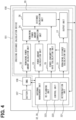
- a navigation management system 10 includes a cruising distance calculation device 20 and a navigation management device 30.
- the cruising distance calculation device 20 may be simply referred to as the distance calculation device 20.
- the navigation management system 10 is a system for planning a navigation schedule, monitoring a navigation status, collecting and managing information related to navigation, supporting the navigation, and the like.
- the distance calculation device 20 calculates a cruising distance in consideration of a power amount required during the take-off and/or landing of the eVTOL 100, and outputs information related to a calculation result.
- the distance calculation device 20 of the present embodiment is functionally disposed in the ECU 101 of the eVTOL 100. Details of the distance calculation device 20 will be described later.
- the navigation management device 30 of the present embodiment includes an external management unit 31 and an internal management unit 32.
- the external management unit 31 is functionally disposed in the server 111 of the ground station 110.
- the internal management unit 32 is functionally disposed in the ECU 101 of the eVTOL 100. In this way, a part of the functions of the navigation management device 30 is arranged in the server 111, and the other part of the functions is arranged in the ECU 101.
- the external management unit 31 and the internal management unit 32 can wirelessly communicate with each other.
- the internal management unit 32 can communicate with various devices arranged in the eVTOL 100 in a wired or wireless manner.
- the remaining distance calculation unit 21 calculates a remaining distance.
- the remaining distance is a scheduled cruising distance before take-off, and is a cruising distance remained during cruising, that is, a remaining cruising distance.
- the remaining distance calculation unit 21 acquires the navigation schedule from the navigation management device 30 and calculates the scheduled cruising distance.
- the remaining distance calculation unit 21 acquires data such as a cruising position and route information of the eVTOL 100 from the navigation management device 30, and calculates the remaining cruising distance.
- the remaining power amount calculation unit 22 calculates a remaining power amount of a battery 107 provided to the eVTOL 100.
- the remaining power amount may be referred to as a remaining battery level.
- the battery 107 is a rechargeable secondary battery capable of storing DC power.
- the secondary battery is, for example, a lithium-ion battery and a nickel-hydrogen battery.
- As the battery 107 a fuel cell, a generator, or the like may be used in addition to the secondary battery.
- the battery 107 supplies electric power to an electric propulsion unit (EPU) and an auxiliary machine which are not shown, the ECU 101, and the like.
- the EPU is an abbreviation of an electric propulsion unit.
- the EPU includes a motor and an inverter, and rotationally drives a propeller (not shown) which applies a propulsive force to the eVTOL 100.
- the remaining power amount calculation unit 22 acquires data related to the battery 107 and calculates the remaining power amount.
- the remaining power amount calculation unit 22 acquires data related to the battery 107 from a BMS 108 which monitors a state of the battery 107.
- the BMS 108 is an abbreviation of a battery management system.
- the remaining power amount calculation unit 22 may acquire data from a sensor (not shown) which detects the state of the battery 107.
- the remaining power amount calculation unit 22 may be configured to communicate with the BMS 108, and acquire data from a battery ECU (not shown) which controls the battery 107.
- the power amount calculation unit 23 calculates a departure and arrival power amount which is a power amount required during the departure and/or the arrival of the eVTOL 100.
- the power amount calculation unit 23 estimates, by calculation, the departure and arrival power amount required for a current flight (navigation).
- the departure and arrival power amount is a take-off power amount required in the period P1 and/or a landing power amount required in the period P3.
- the power amount calculation unit 23 calculates a power amount required for the multiple times of take-off and landing as the departure and arrival power amount.
- the power amount calculation unit 23 of the present embodiment calculates the departure and arrival power amount based on history information, that is, data related to a past departure and arrival power amount.
- the remaining power amount correction unit 24 acquires the remaining power amount and the departure and arrival power amount and calculates a corrected remaining power amount.
- the remaining power amount correction unit 24 acquires the remaining power amount from the remaining power amount calculation unit 22 and acquires the departure and arrival power amount from the power amount calculation unit 23.
- the corrected remaining power amount may be referred to as a corrected remaining amount.
- the corrected remaining power amount is a remaining power amount corrected by using the departure and arrival power amount.
- the remaining power amount correction unit 24 estimates the corrected remaining power amount, that is, a power amount that can be used during the cruising, by subtracting the departure and arrival power amount from the remaining power amount.
- the power consumption rate calculation unit 25 calculates the power consumption rate during the cruising of the eVTOL 100.
- the power consumption rate calculation unit 25 calculates the power consumption rate during the cruising, for example, based on a power consumption amount and a cruising distance during past cruising.
- the power consumption rate calculation unit 25 may calculate the power consumption rate of the cruising, for example, based on a remaining distance of the current flight and a power consumption amount in a past flight having the same route as the current flight, which corresponds to the remaining distance of the current flight. As described above, the remaining distance is the scheduled cruising distance before the take-off and the remaining cruising distance during the cruising.
- the power consumption rate calculation unit 25 acquires data related to the past power consumption amount from the navigation management device 30, for example.
- the distance calculation unit 26 acquires the corrected remaining power amount and calculates the cruising distance based on the corrected remaining power amount.
- the distance calculation unit 26 estimates the cruising distance by dividing the corrected remaining power amount by the power consumption rate during the cruising. As an example, the distance calculation unit 26 acquires the corrected remaining power amount from the remaining power amount correction unit 24, and acquires the power consumption rate during the cruising from the power consumption rate calculation unit 25.
- the output unit 27 acquires a calculation result from the distance calculation unit 26 and outputs information related to the calculation result to the outside of the distance calculation device 20.
- the output unit 27 outputs the cruising distance to an internal display unit of the eVTOL 100.
- the output unit 27 may output, together with the cruising distance, at least one of the remaining cruising distance, a difference between the cruising distance and the remaining cruising distance, and a surplus degree of the cruising distance with respect to the remaining cruising distance.
- the output unit 27 may output the information related to the calculation result to the navigation management device 30.
- the output unit 27 outputs an authentication result of the cruising distance for the navigation schedule to the navigation management device 30.
- the output unit 27 determines whether the cruising distance acquired from the distance calculation unit 26 satisfies the scheduled cruising distance which is based on the navigation schedule, that is, performs authentication.
- the distance calculation device 20 may include at least the distance calculation unit 26 and the output unit 27.
- the distance calculation device 20 may include at least the remaining power amount correction unit 24 and the distance calculation unit 26.
- the distance calculation device 20 may acquire the remaining power amount calculated by the outside, for example, the BMS 108.
- the distance calculation device 20 may include a remaining power amount acquisition unit instead of the remaining power amount calculation unit 22, or the remaining power amount correction unit 24 may acquire the calculated remaining power amount.
- the distance calculation device 20 may acquire the remaining distance (the scheduled cruising distance, the remaining cruising distance) calculated by the outside, for example, the navigation management device 30.
- the distance calculation device 20 may acquire the departure and arrival power amount (take-off and landing power amount) calculated by the outside, for example, the navigation management device 30.
- the distance calculation device 20 may include a power amount acquisition unit instead of the power amount calculation unit 23, or the remaining power amount correction unit 24 may acquire the calculated departure and arrival power amount.
- the distance calculation device 20 may acquire the corrected remaining power amount calculated by the outside, for example, the navigation management device 30.
- the distance calculation device 20 may acquire the power consumption rate during the cruising calculated by the outside, for example, the navigation management device 30.
- the distance calculation device 20 may include a power consumption rate acquisition unit instead of the power consumption rate calculation unit 25, or the distance calculation unit 26 may acquire the calculated power consumption rate.
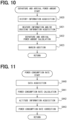
- the determination unit 321 compares the cruising distance with a threshold which is based on the remaining cruising distance, and determines whether the cruising distance is equal to or larger than the threshold.
- the navigation management device 30 performs a process corresponding to the determination result.
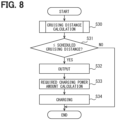
- the distance calculation device 20 determines whether the cruising distance satisfies the scheduled cruising distance, that is, performs authentication (step S11).
- the distance calculation device 20 functionally disposed in the BMS 108 uses the corrected remaining power amount to calculate the cruising distance. Accordingly, the accuracy of estimating the cruising distance can be improved for the electric moving object which moves in the horizontal direction and the vertical direction.
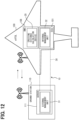
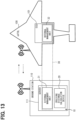
- the cruising distance calculation device 20 may be functionally disposed in the server 111 of the ground station 110.
- the cruising distance calculation device 20 and the external management unit 31 are disposed in the server 111.
- the internal management unit 32 is disposed in the ECU 101 of the eVTOL 100.
- the cruising distance calculation device 20 may be functionally disposed in an external computer (not shown) of a charger 120.
- the internal management unit 32 is disposed in the ECU 101
- the external management unit 31 is disposed in the server 111.
- the charger 120 is used to charge the battery 107 of the eVTOL 100.
- the charger 120 does not wirelessly communicate with the eVTOL 100 after the take-off. Accordingly, the distance calculation device 20 disposed in the charger 120 performs calculation during the flight planning, before the take-off, and during the charging.
- FIG. 15 shows the SOC dependence of the maximum output of the battery which can be output continuously for a predetermined time.
- min shown in FIG. 15 is a minimum SOC at which an output A required for the take-off and landing can be output continuously for a predetermined time, that is, a power amount required for the take-off and landing can be secured. For example, when min is 30%, the take-off and landing is possible at an SOC of 30% or more. The take-off and landing is not possible at an SOC of less than 30%.
- the distance calculation device 20 includes, for example, a map indicating the SOC dependence of the maximum output of the battery 107, the output A, and the predetermined time in advance, and estimates the minimum SOC, and hence the departure and arrival power amount by calculation.
- the map, the output A, and the time are set based on, for example, data acquired during a test. Other configurations are the same as those described in the preceding embodiment.
- the distance calculation device 20 calculates the departure and arrival power amount based on the SOC dependence of the maximum output of the battery 107. Accordingly, the departure and arrival power amount can be calculated by a simpler method than using the history information.
- a part or all of the functions of the processor 102 may be implemented as hardware.
- An aspect in which a certain function is implemented as hardware includes an aspect in which one or multiple ICs are used.
- the processor (arithmetic core), a CPU, an MPU, a GPU, a DFP, or the like can be adopted.
- the CPU is an abbreviation of a central processing unit.
- the MPU is an abbreviation of a micro-processing unit.
- the GPU is an abbreviation of a graphics processing unit.
- the DFP is an abbreviation of a data flow processor.
- the cruising distance calculation device further comprises: a departure and arrival power amount calculation unit (23) configured to calculate the departure and arrival power amount.
- the cruising distance calculation device is according to technical idea 4.
- the history information includes information related to a past departure and arrival power amount at a target departure point and/or a target arrival point.
- the cruising distance calculation device is according to technical idea 4 or 5.
- the history information includes information related to a past departure and arrival power amount in the same model as the electric moving object.
- the cruising distance calculation device is according to any one of technical ideas 4 to 6.
- the departure and arrival power amount calculation unit is configured to correct the departure and arrival power amount based on cruising information and/or weather information of a target departure point and/or a target arrival point.
- the cruising distance calculation device is according to any one of technical ideas 3 to 7.
- the departure and arrival power amount calculation unit is configured to calculate the departure and arrival power amount based on SOC dependence of a maximum output of the battery.
- the cruising distance calculation device is according to technical idea 8.
- the departure and arrival power amount calculation unit is configured to correct the departure and arrival power amount based on a battery temperature or battery degradation.
- a navigation management system is for an electric moving object (100), which is configured to move in a horizontal direction and a vertical direction.
- the navigation management system comprises: a cruising distance calculation device (20) configured to calculate a cruising distance of the electric moving object and output information related to a calculation result; and a navigation management device (30) configured to manage navigation of the electric moving object and perform predetermined processing based on the information.
- the cruising distance calculation device is configured to acquire a corrected remaining power amount, which is obtained by correcting a remaining power amount of a battery (107) provided to the electric moving object, with a departure and arrival power amount, which is required during departure and/or arrival of the electric moving object, and calculate the cruising distance based on the corrected remaining power amount.
- the navigation management system is according to technical idea 12.
- the navigation management device is configured to control power inside the electric moving object to reduce power consumption of the electric moving object, when the cruising distance falls below a second threshold, which is based on the remaining cruising distance and equal to or smaller than the first threshold.
- the navigation management system is according to any one of technical ideas 11 to 14.
- the cruising distance calculation device is configured to perform authentication on the cruising distance for a navigation schedule during planning of the navigation schedule or before departure of the electric moving object, and output an authentication result.
- the navigation management device is configured to approve the navigation schedule or permit the departure, when acquiring the authentication result in which the cruising distance satisfies the navigation schedule.
- the navigation management system is according to any one of technical ideas 11 to 15.
- the navigation management device is configured to manage charging of the electric moving object, such that the cruising distance satisfies a navigation schedule.
Landscapes
- Engineering & Computer Science (AREA)
- Aviation & Aerospace Engineering (AREA)
- Physics & Mathematics (AREA)
- General Physics & Mathematics (AREA)
- Mechanical Engineering (AREA)
- Power Engineering (AREA)
- Transportation (AREA)
- Sustainable Development (AREA)
- Sustainable Energy (AREA)
- Life Sciences & Earth Sciences (AREA)
- Navigation (AREA)
- Electric Propulsion And Braking For Vehicles (AREA)
- Traffic Control Systems (AREA)
Applications Claiming Priority (2)
| Application Number | Priority Date | Filing Date | Title |
|---|---|---|---|
| JP2022133584A JP2024030600A (ja) | 2022-08-24 | 2022-08-24 | 航続可能距離演算装置、運航管理システム、およびプログラム |
| PCT/JP2023/029054 WO2024043091A1 (fr) | 2022-08-24 | 2023-08-09 | Dispositif de calcul de distance de croisière, système de gestion de navigation et programme |
Publications (2)
| Publication Number | Publication Date |
|---|---|
| EP4579191A1 true EP4579191A1 (fr) | 2025-07-02 |
| EP4579191A4 EP4579191A4 (fr) | 2025-12-10 |
Family
ID=90013145
Family Applications (1)
| Application Number | Title | Priority Date | Filing Date |
|---|---|---|---|
| EP23857204.4A Pending EP4579191A4 (fr) | 2022-08-24 | 2023-08-09 | Dispositif de calcul de distance de croisière, système de gestion de navigation et programme |
Country Status (4)
| Country | Link |
|---|---|
| US (1) | US20250191476A1 (fr) |
| EP (1) | EP4579191A4 (fr) |
| JP (1) | JP2024030600A (fr) |
| WO (1) | WO2024043091A1 (fr) |
Family Cites Families (8)
| Publication number | Priority date | Publication date | Assignee | Title |
|---|---|---|---|---|
| US10068489B2 (en) * | 2016-08-31 | 2018-09-04 | Skycatch, Inc. | Managing energy during flight of unmanned aerial vehicles for safe return to ground |
| JP6790932B2 (ja) * | 2017-03-14 | 2020-11-25 | 富士通株式会社 | 飛行体運用システム、クレーン装置制御方法、及び制御プログラム |
| JP6954858B2 (ja) * | 2018-03-13 | 2021-10-27 | Kddi株式会社 | 飛行管理システム及び飛行装置 |
| CN120957052A (zh) * | 2019-07-08 | 2025-11-14 | 松下知识产权经营株式会社 | 麦克风以及麦克风的控制方法 |
| DE102020109854A1 (de) * | 2020-04-08 | 2021-10-14 | Audi Aktiengesellschaft | Verfahren zur Transportsteuerung und gemäß dem Verfahren steuerbares Transportsystem mit zumindest einem Luftfahrzeug |
| JP2021169988A (ja) * | 2020-04-17 | 2021-10-28 | 株式会社デンソー | 車両の制御装置 |
| JP7584122B2 (ja) * | 2020-09-29 | 2024-11-15 | 株式会社Spiral | 飛行体の制御システムおよび飛行体制御用マーカー |
| CN114720887B (zh) * | 2022-03-29 | 2025-11-25 | 上海沃兰特航空技术有限责任公司 | 一种飞机续航能力估算方法及装置、电子设备和存储介质 |
-
2022
- 2022-08-24 JP JP2022133584A patent/JP2024030600A/ja active Pending
-
2023
- 2023-08-09 EP EP23857204.4A patent/EP4579191A4/fr active Pending
- 2023-08-09 WO PCT/JP2023/029054 patent/WO2024043091A1/fr not_active Ceased
-
2025
- 2025-02-17 US US19/055,188 patent/US20250191476A1/en active Pending
Also Published As
| Publication number | Publication date |
|---|---|
| US20250191476A1 (en) | 2025-06-12 |
| EP4579191A4 (fr) | 2025-12-10 |
| JP2024030600A (ja) | 2024-03-07 |
| WO2024043091A1 (fr) | 2024-02-29 |
Similar Documents
| Publication | Publication Date | Title |
|---|---|---|
| US12071040B2 (en) | Supplying power to an electric vehicle | |
| KR102448525B1 (ko) | 차량 내 배터리의 희망 출발 온도 | |
| US20250191427A1 (en) | Abnormality sign diagnosis device, navigation management system, and computer readable medium | |
| US9846199B2 (en) | Health management of rechargeable batteries | |
| AU2019310228B2 (en) | Inter-module battery balancing using minimum cell voltages to select battery sub-modules to power loads | |
| US20230398906A1 (en) | Method for controlling a power assembly | |
| EP4579191A1 (fr) | Dispositif de calcul de distance de croisière, système de gestion de navigation et programme | |
| CN114137426B (zh) | 一种剩余电量估算方法、装置、设备及存储介质 | |
| EP4624334A1 (fr) | Système de batteries | |
| EP4624333A1 (fr) | Dispositif de surveillance, dispositif de commande, système de gestion de fonctionnement et programme | |
| EP4570581A1 (fr) | Système de batterie de stockage, véhicule ferroviaire, serveur de données et procédé de commande de système de batterie de stockage | |
| EP4679665A1 (fr) | Dispositif de commande, procédé de commande et programme | |
| US20230398907A1 (en) | Method for controlling a power assembly | |
| US20180375344A1 (en) | Situational battery charging | |
| US20230228584A1 (en) | Processing unit and method therein for managing energy consumption in a vehicle | |
| EP4603380A1 (fr) | Dispositif de commande, système de gestion de fonctionnement, et programme de commande | |
| US20260099160A1 (en) | Monitoring device, monitoring method, and non-transitory computer readable storage medium | |
| EP4579630A1 (fr) | Dispositif de prédiction, système de gestion de navigation et programme de prédiction | |
| EP4711278A1 (fr) | Dispositif de commande, procédé de commande et programme de commande | |
| EP4693798A1 (fr) | Dispositif et procédé de commande pour la détermination de puissance de sortie admissible d'une batterie |
Legal Events
| Date | Code | Title | Description |
|---|---|---|---|
| STAA | Information on the status of an ep patent application or granted ep patent |
Free format text: STATUS: THE INTERNATIONAL PUBLICATION HAS BEEN MADE |
|
| PUAI | Public reference made under article 153(3) epc to a published international application that has entered the european phase |
Free format text: ORIGINAL CODE: 0009012 |
|
| STAA | Information on the status of an ep patent application or granted ep patent |
Free format text: STATUS: REQUEST FOR EXAMINATION WAS MADE |
|
| 17P | Request for examination filed |
Effective date: 20241126 |
|
| AK | Designated contracting states |
Kind code of ref document: A1 Designated state(s): AL AT BE BG CH CY CZ DE DK EE ES FI FR GB GR HR HU IE IS IT LI LT LU LV MC ME MK MT NL NO PL PT RO RS SE SI SK SM TR |
|
| STAA | Information on the status of an ep patent application or granted ep patent |
Free format text: STATUS: EXAMINATION IS IN PROGRESS |
|
| DAV | Request for validation of the european patent (deleted) | ||
| DAX | Request for extension of the european patent (deleted) | ||
| A4 | Supplementary search report drawn up and despatched |
Effective date: 20251110 |
|
| RIC1 | Information provided on ipc code assigned before grant |
Ipc: G01C 21/20 20060101AFI20251104BHEP Ipc: G08G 5/00 20250101ALI20251104BHEP Ipc: G08G 5/32 20250101ALI20251104BHEP Ipc: B60L 15/20 20060101ALI20251104BHEP Ipc: B60L 58/12 20190101ALI20251104BHEP Ipc: G08G 5/21 20250101ALI20251104BHEP Ipc: G08G 5/55 20250101ALI20251104BHEP Ipc: G08G 5/57 20250101ALI20251104BHEP Ipc: G08G 5/76 20250101ALI20251104BHEP |
|
| 17Q | First examination report despatched |
Effective date: 20251121 |