EP4579341A2 - Substratvorrichtung - Google Patents
Substratvorrichtung Download PDFInfo
- Publication number
- EP4579341A2 EP4579341A2 EP25170404.5A EP25170404A EP4579341A2 EP 4579341 A2 EP4579341 A2 EP 4579341A2 EP 25170404 A EP25170404 A EP 25170404A EP 4579341 A2 EP4579341 A2 EP 4579341A2
- Authority
- EP
- European Patent Office
- Prior art keywords
- substrate
- gas
- substrate device
- nozzle holes
- clamp
- Prior art date
- Legal status (The legal status is an assumption and is not a legal conclusion. Google has not performed a legal analysis and makes no representation as to the accuracy of the status listed.)
- Pending
Links
Images


Classifications
-
- G—PHYSICS
- G03—PHOTOGRAPHY; CINEMATOGRAPHY; ANALOGOUS TECHNIQUES USING WAVES OTHER THAN OPTICAL WAVES; ELECTROGRAPHY; HOLOGRAPHY
- G03F—PHOTOMECHANICAL PRODUCTION OF TEXTURED OR PATTERNED SURFACES, e.g. FOR PRINTING, FOR PROCESSING OF SEMICONDUCTOR DEVICES; MATERIALS THEREFOR; ORIGINALS THEREFOR; APPARATUS SPECIALLY ADAPTED THEREFOR
- G03F7/00—Photomechanical, e.g. photolithographic, production of textured or patterned surfaces, e.g. printing surfaces; Materials therefor, e.g. comprising photoresists; Apparatus specially adapted therefor
- G03F7/70—Microphotolithographic exposure; Apparatus therefor
- G03F7/708—Construction of apparatus, e.g. environment aspects, hygiene aspects or materials
- G03F7/70908—Hygiene, e.g. preventing apparatus pollution, mitigating effect of pollution or removing pollutants from apparatus
- G03F7/70925—Cleaning, i.e. actively freeing apparatus from pollutants, e.g. using plasma cleaning
-
- G—PHYSICS
- G03—PHOTOGRAPHY; CINEMATOGRAPHY; ANALOGOUS TECHNIQUES USING WAVES OTHER THAN OPTICAL WAVES; ELECTROGRAPHY; HOLOGRAPHY
- G03F—PHOTOMECHANICAL PRODUCTION OF TEXTURED OR PATTERNED SURFACES, e.g. FOR PRINTING, FOR PROCESSING OF SEMICONDUCTOR DEVICES; MATERIALS THEREFOR; ORIGINALS THEREFOR; APPARATUS SPECIALLY ADAPTED THEREFOR
- G03F7/00—Photomechanical, e.g. photolithographic, production of textured or patterned surfaces, e.g. printing surfaces; Materials therefor, e.g. comprising photoresists; Apparatus specially adapted therefor
- G03F7/70—Microphotolithographic exposure; Apparatus therefor
- G03F7/70691—Handling of masks or workpieces
- G03F7/707—Chucks, e.g. chucking or un-chucking operations or structural details
Definitions
- the present invention relates to a substrate device for being held by an electrostatic substrate clamp and to a combination of the substrate device and the electrostatic substrate clamp.
- the present invention further relates to a lithographic apparatus comprising the combination.
- the present invention yet further relates to a method for cleaning a contaminated surface of a stage compartment of a lithographic apparatus.
- a lithographic apparatus is a machine constructed to apply a desired pattern onto a substrate.
- a lithographic apparatus can be used, for example, in the manufacture of integrated circuits (ICs).
- a lithographic apparatus may, for example, project a pattern at a patterning device (e.g., a mask) onto a layer of radiation-sensitive material (resist) provided on a substrate.
- a patterning device e.g., a mask
- resist radiation-sensitive material
- a combination of an electrostatic substrate clamp and a substrate device the substrate device being configured to be supported on the electrostatic substrate clamp during use.
- a method for cleaning a contaminated surface of a stage compartment of a lithographic apparatus comprising:
- Figure 1 shows a lithographic system comprising a radiation source SO and a lithographic apparatus LA.
- the radiation source SO is configured to generate an EUV radiation beam B and to supply the EUV radiation beam B to the lithographic apparatus LA.
- the lithographic apparatus LA comprises an illumination system IL, a support structure MT configured to support a patterning device MA (e.g., a mask), a projection system PS and a substrate table WT configured to support a substrate W.
- a patterning device MA e.g., a mask
- the illumination system IL is configured to condition the EUV radiation beam B before the EUV radiation beam B is incident upon the patterning device MA.
- the illumination system IL may include a facetted field mirror device 10 and a facetted pupil mirror device 11.
- the faceted field mirror device 10 and faceted pupil mirror device 11 together provide the EUV radiation beam B with a desired cross-sectional shape and a desired intensity distribution.
- the illumination system IL may include other mirrors or devices in addition to, or instead of, the faceted field mirror device 10 and faceted pupil mirror device 11.
- the EUV radiation beam B interacts with the patterning device MA. As a result of this interaction, a patterned EUV radiation beam B' is generated.
- the projection system PS is configured to project the patterned EUV radiation beam B' onto the substrate W.
- the projection system PS may comprise a plurality of mirrors 13,14 which are configured to project the patterned EUV radiation beam B' onto the substrate W held by the substrate table WT.
- the projection system PS may apply a reduction factor to the patterned EUV radiation beam B', thus forming an image with features that are smaller than corresponding features on the patterning device MA. For example, a reduction factor of 4 or 8 may be applied.
- the projection system PS is illustrated as having only two mirrors 13,14 in Figure 1 , the projection system PS may include a different number of mirrors (e.g. six or eight mirrors).
- the substrate W may include previously formed patterns. Where this is the case, the lithographic apparatus LA aligns the image, formed by the patterned EUV radiation beam B', with a pattern previously formed on the substrate W.
- a relative vacuum i.e. a small amount of gas (e.g. hydrogen) at a pressure well below atmospheric pressure, may be provided in the radiation source SO, in the illumination system IL, and/or in the projection system PS.
- gas e.g. hydrogen
- the radiation source SO may be a laser produced plasma (LPP) source, a discharge produced plasma (DPP) source, a free electron laser (FEL) or any other radiation source that is capable of generating EUV radiation.
- LPP laser produced plasma
- DPP discharge produced plasma
- FEL free electron laser
- FIG 2 an embodiment is shown of a combination 100 of an electrostatic substrate clamp 21 and an embodiment of a substrate device 20 that is being supported, and held, or clamped, by the electrostatic substrate clamp 21.
- the substrate device 20 has a bottom side 22 that faces a substrate support surface 26 of the substrate clamp 21.
- the combination 100 is part of a system further comprising a power source 49 configured to power the substrate device 20 by providing electrical power to one or more clamp conductors 50 of the electrostatic substrate clamp 21.
- the electrostatic substrate clamp 21 is part of the earlier mentioned substrate table WT.
- the substrate device 20 may be used on the same electrostatic substrate clamp 21 as to be manufactured substrates. It may also be possible to provide a separate electrostatic substrate clamp 21 that is dedicated only for the substrate device 20.
- the electrostatic substrate clamp 21 has a plurality of burls 51, e.g. located on an upper surface of the substrate clamp 21, for supporting a substrate during use, here the substrate device 20.
- the plurality of substrate clamp burls 51 form the substrate support surface 26 with respective top surfaces 52 thereof.
- Substrate clamp burls 51 are interconnected via conductive lines that may be referred to as 'Manhattan lines' (not shown) and which may be electrically connected to a power source at least for the purpose of the present disclosure.
- the substrate device 20 has a bottom side 22 with a bottom surface 23 and a top side 24 with a top surface 25.
- the bottom side 22 faces a substrate support surface 26 of the substrate clamp 21 in use.
- the substrate device 20 comprises one or more nozzle holes 27.
- the one or more nozzle holes 27 extend from the bottom surface 23 to the top surface 25.
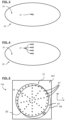
- Figure 3 shows an example, wherein the substrate device 20 has one nozzle hole.
- Figure 4 shows an example, wherein the substrate device 20 has four nozzle holes 27.
- Figure 5 shows an example, wherein the substrate device 20 has tens of nozzle holes 27.
- a space 40 is located between the substrate clamp burls 51 and below the substrate device 20 when supported on the substrate support surface 26.
- the one or more nozzle holes 27 are in fluid communication with the space 40 and the space 40 is in fluid communication with a gas supply 41.
- the gas travels through the one or more nozzle holes 27 and exits as a gas stream or gas jet 44 travelling towards a contaminated surface 42 located above the substrate device 20. Particles on the contaminated surface 42 are dislodged by the gas stream or gas jet 44, thereby cleaning the contaminated surface 42.
- the substrate device 20 is plate 29 shaped, or is a plate 29.
- the plate 29 may have a thickness, e.g. 0.5 mm or more.
- the thickness may be between 0.5 mm and 50 mm, preferably between 0.7 mm and 20 mm, more preferably between 0.7 mm and 15 mm.
- the thickness may e.g. correspond to the thickness of a standard semiconductor wafer.
- An upper limit of the thickness may be governed by limitations imposed by the transport system which is used to bring the substrate device 20 into the lithographic apparatus and onto the substrate support.
- An edge 28 of the plate 29 may at least partially be provided with a rim 30 projecting away from the bottom side 22.
- the edge 28 of the plate 29 is fully provided with the rim 30.
- the rim 30 is configured to extend around, or enclose the burls 51, as for example shown in the detail of figure 6(A). This may reduce gas leakage at the edge 28 of the substrate device 20, and may result in a higher pressure of one or more gas streams or one or more gas jets 44.
- One or more nozzle holes 27 may extend above the top surface 25. This way the exit location of the gas stream or gas jet may be closer to a contaminated surface 42 above the substrate device 20, while limiting the overall thickness of the substrate device 20. Providing the exit location closer to the contaminated target surface may reduce jet dissipation in vacuum, or near vacuum, and may allow higher-speed flow at the areas requiring cleaning.
- the one or more nozzle holes 27 have a central nozzle axis 31.
- the central nozzle axis 31 extends under an angle ⁇ with respect to the bottom surface 23 and/or with respect to the top surface 25.
- the angle ⁇ may be 90 degrees, as shown for the left nozzle hole 27 in figure 6(A) and the nozzle holes 27 in figure 7(A).
- the angle ⁇ may instead lie between 0 and 90 degrees, as for example shown for the right nozzle hole 27 in figure 6(A).
- With an angle ⁇ between 0 and 90 degrees the gas stream or gas jet exiting the nozzle hole 27 will have a higher shear force component on the contaminated surface 42 that is targeted when the contaminated surface 42 extends for example parallel to the substrate device 20.
- a higher shear force component may improve the likelihood of removing a particle from the contaminated surface 42 with the gas stream or gas jet.
- a substrate device 20 may be provided with a plurality of nozzle holes 27 with a plurality of angles ⁇ .
- Figures 6(A) and 7(A) show examples of the substrate device 20 comprising a detached particle collection device 35. These examples may be used solely, in combination 100, and/or together with a vacuum pump that is part of or connected to the stage compartment.
- FIG. 6(A) shows an example, wherein the detached particle collection device 35 comprises an insulating layer 37 provided on the bottom surface 23.
- the substrate device 20 By introducing, or applying an electrostatic charge gradient to the substrate device 20, e.g. by creating a small imbalance between the clamp conductors 50, in combination 100 with the insulating backside, particles detached from the contaminated surface 42 may adhere to the top surface 25 of the substrate device 20.
- top surface 25 can either comprise an insulation layer or a conductive layer.
- the top surface 25 comprises an insulation layer.
- neutral particles may be attracted to the top surface by means of an induced mirror charge force and held at the surface.
- Figure 7(a) shows an example, wherein the detached particle collection device 35 comprises an adhesive coating 36, e.g. comprising polyurethane, provided on the top surface 25. Particles that are dislodged, or detached from the contaminated surface 42 may fall on the top surface 25 of the substrate device 20, and thereby adhere to the adhesive coating 36.
- an adhesive coating 36 e.g. comprising polyurethane
- One or more nozzle holes 27 may be configured to be in communication with a control device 33 for controlling a gas flow 34 through the one or more nozzle holes 27.
- the nozzle holes 27 may for example be provided as active micronozzles, e.g. including microvalves, such that gas can be controllably delivered in pulses, or intermitted, rather than in a continuous, or unintermitted flow.
- selectable or programmable nozzles can be incorporated so that flow is directed only to regions needing cleaning at any given time, thus minimizing unwanted gas usage or disturbance of other surfaces.
- a contaminated surface 42 of a stage compartment of a lithographic apparatus may be cleaned by first providing and clamping a substrate device 20, e.g. as shown in figures 2 to 6 , onto a substrate support surface 26 of an electrostatic substrate clamp 21 arranged in the stage compartment.
- the substrate device 20 may be provided on the substrate support surface 26 in a similar or same way as a to be manufactured substrate.
- the contaminated surface 42 may for example be part of a heat shield 53, or screw holes of a dynamic gas lock 54.
- Figure 2 schematically shows the heat shield 53 and dynamic gas lock 54 associated with a wafer stage main frame 55.
- the contaminated surface 42 faces the electrostatic substrate clamp 21.
- gas is provided through the one or more nozzle holes 27 to generate one or more gas streams or one or more gas jets 44 flowing in an upward direction from the bottom side 22 to the top side 24.
- the gas may be hydrogen.
- hydrogen is often already used in a stage compartment, e.g. as backfill gas, few to no modifications are required.
- the gas may instead be nitrogen or extreme clean dry air. Such gases are heavier than hydrogen, and may improve particle removal.
- the substrate device 20 may be moved, or translated from a first location 47 to a second location 48 relative to the contaminated surface 42. This is schematically shown in figure 5 , wherein the dashed circle indicates the substrate device 20 being at the second location 48. Such movements, or translations are usually performed with a regular to be manufactured substrate located on the electrostatic substrate clamp 21.
- the one or more nozzle holes 27 can be positioned at desired locations relative to the contaminated surface 42 for removing particles with the one or more gas jets 44 or gas streams at a plurality of locations.
- the substrate device 20 may be moved around to a plurality of locations relative to the contaminated surface 42 for removing particles at said plurality of locations.
- lithographic apparatus in the manufacture of ICs, it should be understood that the lithographic apparatus described herein may have other applications. Possible other applications include the manufacture of integrated optical systems, guidance and detection patterns for magnetic domain memories, flat-panel displays, liquid-crystal displays (LCDs), thin-film magnetic heads, etc.
Landscapes
- Physics & Mathematics (AREA)
- General Physics & Mathematics (AREA)
- Engineering & Computer Science (AREA)
- Health & Medical Sciences (AREA)
- Epidemiology (AREA)
- Public Health (AREA)
- Plasma & Fusion (AREA)
- Life Sciences & Earth Sciences (AREA)
- Atmospheric Sciences (AREA)
- Environmental & Geological Engineering (AREA)
- Drying Of Semiconductors (AREA)
- Exposure And Positioning Against Photoresist Photosensitive Materials (AREA)
Priority Applications (1)
| Application Number | Priority Date | Filing Date | Title |
|---|---|---|---|
| EP25170404.5A EP4579341A3 (de) | 2025-04-14 | 2025-04-14 | Substratvorrichtung |
Applications Claiming Priority (1)
| Application Number | Priority Date | Filing Date | Title |
|---|---|---|---|
| EP25170404.5A EP4579341A3 (de) | 2025-04-14 | 2025-04-14 | Substratvorrichtung |
Publications (2)
| Publication Number | Publication Date |
|---|---|
| EP4579341A2 true EP4579341A2 (de) | 2025-07-02 |
| EP4579341A3 EP4579341A3 (de) | 2026-01-14 |
Family
ID=95309672
Family Applications (1)
| Application Number | Title | Priority Date | Filing Date |
|---|---|---|---|
| EP25170404.5A Pending EP4579341A3 (de) | 2025-04-14 | 2025-04-14 | Substratvorrichtung |
Country Status (1)
| Country | Link |
|---|---|
| EP (1) | EP4579341A3 (de) |
Family Cites Families (5)
| Publication number | Priority date | Publication date | Assignee | Title |
|---|---|---|---|---|
| US20070217119A1 (en) * | 2006-03-17 | 2007-09-20 | David Johnson | Apparatus and Method for Carrying Substrates |
| JP2010016315A (ja) * | 2008-07-07 | 2010-01-21 | Tokyo Electron Ltd | 回転塗布装置の洗浄用治具および洗浄方法 |
| DE102015204521A1 (de) * | 2015-03-12 | 2016-10-27 | Carl Zeiss Smt Gmbh | Reinigungsvorrichtung für ein EUV-Lithographiesystem, EUV-Lithographiesystem damit und Reinigungsverfahren |
| CN210253370U (zh) * | 2019-07-15 | 2020-04-07 | 长鑫存储技术有限公司 | 清洁装置以及晶圆处理设备 |
| US11520246B1 (en) * | 2021-08-30 | 2022-12-06 | Taiwan Semiconductor Manufacturing Company, Ltd. | Highly efficient automatic particle cleaner method for EUV systems |
-
2025
- 2025-04-14 EP EP25170404.5A patent/EP4579341A3/de active Pending
Also Published As
| Publication number | Publication date |
|---|---|
| EP4579341A3 (de) | 2026-01-14 |
Similar Documents
| Publication | Publication Date | Title |
|---|---|---|
| KR101027135B1 (ko) | 세정 장치 및 침지 리소그래피 장치 | |
| JP5535194B2 (ja) | リソグラフィ装置、デバイス製造方法、クリーニングシステム、およびパターニングデバイスをクリーニングする方法 | |
| US5998097A (en) | Fabrication method employing energy beam source | |
| US7456928B2 (en) | Systems and methods for controlling ambient pressure during processing of microfeature workpieces, including during immersion lithography | |
| KR102820966B1 (ko) | 리소그래피 장치에서의 인시튜 입자 제거를 위한 장치 및 방법 | |
| CN110709776B (zh) | 颗粒去除设备及相关系统 | |
| US11048175B2 (en) | Apparatus for and method cleaning a support inside a lithography apparatus | |
| US20120279519A1 (en) | Integrated Substrate Cleaning System and Method | |
| JP2004519012A (ja) | インサイチュリソグラフィマスククリーニング | |
| EP3129833B1 (de) | Vorrichtung zur reinigung eines gegenstands | |
| JP2022167939A (ja) | ラジカルを輸送するための装置および方法 | |
| EP4579341A2 (de) | Substratvorrichtung | |
| CN113227904B (zh) | 用于在光刻设备中原位去除粒子的设备和方法 | |
| CN114308959A (zh) | 用于极紫外线微影装置的腔室中处理晶圆的方法 | |
| KR101053450B1 (ko) | 마스크 리페어 장치 및 방법 | |
| NL1035623A1 (nl) | Lithographic apparatus, radiation system, device manufacturing method, and radiation generating method. | |
| JP4292389B2 (ja) | 異物除去方法及び異物除去装置 | |
| US11994805B2 (en) | Method of operating semiconductor apparatus | |
| EP4174576A1 (de) | Klammer zum halten eines gegenstandes und verfahren | |
| US12619166B2 (en) | Clamp for holding an object and method | |
| CN120457389A (zh) | 通过辐照控制聚酰亚胺薄膜的导电性以用于rtc应用 | |
| TW202437021A (zh) | 汙染控制 | |
| WO2026052394A1 (en) | Systems and methods of etching in light source | |
| KR20030039518A (ko) | 파티클 제거장치를 가진 반도체 제조용 노광장치 | |
| JP2004288860A (ja) | 基板処理装置 |
Legal Events
| Date | Code | Title | Description |
|---|---|---|---|
| PUAI | Public reference made under article 153(3) epc to a published international application that has entered the european phase |
Free format text: ORIGINAL CODE: 0009012 |
|
| STAA | Information on the status of an ep patent application or granted ep patent |
Free format text: STATUS: THE APPLICATION HAS BEEN PUBLISHED |
|
| AK | Designated contracting states |
Kind code of ref document: A2 Designated state(s): AL AT BE BG CH CY CZ DE DK EE ES FI FR GB GR HR HU IE IS IT LI LT LU LV MC ME MK MT NL NO PL PT RO RS SE SI SK SM TR |
|
| PUAL | Search report despatched |
Free format text: ORIGINAL CODE: 0009013 |
|
| AK | Designated contracting states |
Kind code of ref document: A3 Designated state(s): AL AT BE BG CH CY CZ DE DK EE ES FI FR GB GR HR HU IE IS IT LI LT LU LV MC ME MK MT NL NO PL PT RO RS SE SI SK SM TR |
|
| RIC1 | Information provided on ipc code assigned before grant |
Ipc: G03F 7/00 20060101AFI20251208BHEP |