EP4579451A1 - Terminal de communication, procédé de commande et support d'informations - Google Patents
Terminal de communication, procédé de commande et support d'informations Download PDFInfo
- Publication number
- EP4579451A1 EP4579451A1 EP24219277.1A EP24219277A EP4579451A1 EP 4579451 A1 EP4579451 A1 EP 4579451A1 EP 24219277 A EP24219277 A EP 24219277A EP 4579451 A1 EP4579451 A1 EP 4579451A1
- Authority
- EP
- European Patent Office
- Prior art keywords
- image
- unit
- information
- processing
- screen
- Prior art date
- Legal status (The legal status is an assumption and is not a legal conclusion. Google has not performed a legal analysis and makes no representation as to the accuracy of the status listed.)
- Pending
Links
Images






Classifications
-
- G—PHYSICS
- G06—COMPUTING OR CALCULATING; COUNTING
- G06F—ELECTRIC DIGITAL DATA PROCESSING
- G06F9/00—Arrangements for program control, e.g. control units
- G06F9/06—Arrangements for program control, e.g. control units using stored programs, i.e. using an internal store of processing equipment to receive or retain programs
- G06F9/44—Arrangements for executing specific programs
- G06F9/451—Execution arrangements for user interfaces
-
- G—PHYSICS
- G06—COMPUTING OR CALCULATING; COUNTING
- G06F—ELECTRIC DIGITAL DATA PROCESSING
- G06F3/00—Input arrangements for transferring data to be processed into a form capable of being handled by the computer; Output arrangements for transferring data from processing unit to output unit, e.g. interface arrangements
- G06F3/14—Digital output to display device ; Cooperation and interconnection of the display device with other functional units
-
- G—PHYSICS
- G06—COMPUTING OR CALCULATING; COUNTING
- G06F—ELECTRIC DIGITAL DATA PROCESSING
- G06F9/00—Arrangements for program control, e.g. control units
- G06F9/06—Arrangements for program control, e.g. control units using stored programs, i.e. using an internal store of processing equipment to receive or retain programs
- G06F9/44—Arrangements for executing specific programs
- G06F9/451—Execution arrangements for user interfaces
- G06F9/452—Remote windowing, e.g. X-Window System, desktop virtualisation
-
- G—PHYSICS
- G06—COMPUTING OR CALCULATING; COUNTING
- G06F—ELECTRIC DIGITAL DATA PROCESSING
- G06F11/00—Error detection; Error correction; Monitoring
- G06F11/07—Responding to the occurrence of a fault, e.g. fault tolerance
- G06F11/14—Error detection or correction of the data by redundancy in operations
- G06F11/1402—Saving, restoring, recovering or retrying
- G06F11/1415—Saving, restoring, recovering or retrying at system level
- G06F11/1438—Restarting or rejuvenating
-
- G—PHYSICS
- G06—COMPUTING OR CALCULATING; COUNTING
- G06F—ELECTRIC DIGITAL DATA PROCESSING
- G06F16/00—Information retrieval; Database structures therefor; File system structures therefor
- G06F16/50—Information retrieval; Database structures therefor; File system structures therefor of still image data
- G06F16/54—Browsing; Visualisation therefor
-
- G—PHYSICS
- G06—COMPUTING OR CALCULATING; COUNTING
- G06F—ELECTRIC DIGITAL DATA PROCESSING
- G06F16/00—Information retrieval; Database structures therefor; File system structures therefor
- G06F16/90—Details of database functions independent of the retrieved data types
- G06F16/95—Retrieval from the web
- G06F16/955—Retrieval from the web using information identifiers, e.g. uniform resource locators [URL]
-
- G—PHYSICS
- G06—COMPUTING OR CALCULATING; COUNTING
- G06F—ELECTRIC DIGITAL DATA PROCESSING
- G06F16/00—Information retrieval; Database structures therefor; File system structures therefor
- G06F16/90—Details of database functions independent of the retrieved data types
- G06F16/95—Retrieval from the web
- G06F16/958—Organisation or management of web site content, e.g. publishing, maintaining pages or automatic linking
-
- G—PHYSICS
- G06—COMPUTING OR CALCULATING; COUNTING
- G06F—ELECTRIC DIGITAL DATA PROCESSING
- G06F3/00—Input arrangements for transferring data to be processed into a form capable of being handled by the computer; Output arrangements for transferring data from processing unit to output unit, e.g. interface arrangements
- G06F3/01—Input arrangements or combined input and output arrangements for interaction between user and computer
- G06F3/048—Interaction techniques based on graphical user interfaces [GUI]
- G06F3/0484—Interaction techniques based on graphical user interfaces [GUI] for the control of specific functions or operations, e.g. selecting or manipulating an object, an image or a displayed text element, setting a parameter value or selecting a range
- G06F3/04845—Interaction techniques based on graphical user interfaces [GUI] for the control of specific functions or operations, e.g. selecting or manipulating an object, an image or a displayed text element, setting a parameter value or selecting a range for image manipulation, e.g. dragging, rotation, expansion or change of colour
-
- G—PHYSICS
- G06—COMPUTING OR CALCULATING; COUNTING
- G06F—ELECTRIC DIGITAL DATA PROCESSING
- G06F11/00—Error detection; Error correction; Monitoring
- G06F11/07—Responding to the occurrence of a fault, e.g. fault tolerance
- G06F11/14—Error detection or correction of the data by redundancy in operations
- G06F11/1402—Saving, restoring, recovering or retrying
- G06F11/1415—Saving, restoring, recovering or retrying at system level
-
- G—PHYSICS
- G06—COMPUTING OR CALCULATING; COUNTING
- G06F—ELECTRIC DIGITAL DATA PROCESSING
- G06F11/00—Error detection; Error correction; Monitoring
- G06F11/07—Responding to the occurrence of a fault, e.g. fault tolerance
- G06F11/14—Error detection or correction of the data by redundancy in operations
- G06F11/1446—Point-in-time backing up or restoration of persistent data
- G06F11/1458—Management of the backup or restore process
Definitions
- UI user interface
- the present invention is realized by the following configurations in order to achieve the above-described issue.
- a communication terminal as specified in claims 1 to 5.
- a control method as specified in claim 6.
- a storage medium as specified in claim 7.
- Fig. 1 illustrates a configuration of an information processing system 100 according to a first embodiment of the present invention.
- the information processing system 100 includes a communication apparatus 101 and an image generation system 103.
- the image generation system 103 includes a virtual machine 104 equipped with a browser engine 105 and a storage 106.
- the virtual machine 104 stores the image generated by imaging by the browser engine 105 in the storage 106.
- the virtual machine 104 is connected to the communication apparatus 101, a web server 102, the storage 106, and the like via a network.
- the web server 102 stores the web content.
- Examples of web contents include Hyper Text Markup Language (HTML), Cascading Style Sheets (CSS), JavaScript ® , an image file in a format such as Joint Photographic Experts Group (JPEG), Portable Network Graphic (PNG), or the like, and a moving image file in a format such as Moving Picture Experts Group (MPEG)-4 Part 14 (MP4), WebM, or the like.
- HTML Hyper Text Markup Language
- CSS Cascading Style Sheets
- JavaScript ® an image file in a format such as Joint Photographic Experts Group (JPEG), Portable Network Graphic (PNG), or the like
- JPEG Joint Photographic Experts Group
- PNG Portable Network Graphic
- MPEG Moving Picture Experts Group
- WebM or the like.
- the communication apparatus 101 is also connected to the virtual machine 104, the storage 106, and the like via the network.
- the network may be, for example, the Internet, a wide area network (WAN), a local area network (LAN), or a combination of these.
- a plurality of communication apparatuses 101 may also exist.
- the communication apparatus 101 transmits uniform resource locator (URL) information of a web page to the virtual machine 104 to request the virtual machine 104 to read the URL of the specified web page.
- URL uniform resource locator
- the virtual machine 104 When the virtual machine 104 receives the URL information of the web page transmitted from the communication apparatus 101, the virtual machine 104 requests the browser engine 105 to read the web page with the corresponding URL from the web server 102.
- the browser engine 105 reads the web page with the corresponding URL from the web server 102. In other words, the browser engine 105 acquires the web content from the web server 102.
- the browser engine 105 generates a rendering result acquired by rendering the web content and performs imaging the rendering result.
- the image after the imaging is then transmitted by the virtual machine 104 to the storage 106 and stored therein.
- the communication apparatus 101 acquires the stored image from the storage 106 and displays the acquired image, so that a screen of the communication apparatus 101 is generated.
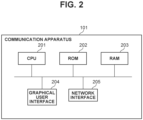
- Fig. 2 illustrates a hardware configuration of a computer apparatus that configures the communication apparatus 101 according to the first embodiment of the present invention.
- the communication apparatus 101 includes a central processing unit (CPU) 201, a read-only memory (ROM) 202, a random access memory (RAM) 203, a graphical user interface 204, and a network interface 205 as the hardware configuration.
- CPU central processing unit
- ROM read-only memory
- RAM random access memory
- graphical user interface 204 graphical user interface
- network interface 205 as the hardware configuration.
- the CPU 201 controls the communication apparatus 101.
- the ROM 202 stores a program and a parameter that do not require modification.
- the RAM 203 temporarily stores a program and data supplied from an external apparatus or the like.
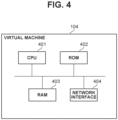
- the CPU 401 controls the virtual machine 104, the browser engine 105, and the like.
- the browser engine 105 includes a web content analysis unit 505, a web content rendering unit 506, and an image generation unit 507.
- the image generation unit 507 performs imaging of the rendering result rendered by the web content rendering unit 506.
- the image generation unit 507 is an example of an image generation unit according to the present invention.
- Fig. 6 illustrates an example of an image generated by the image generation unit 507 according to the first embodiment of the present invention by performing imaging of the rendering result of the web content.
- Figs. 7A and 7B illustrate examples of screens on the graphical user interface 204 generated by displaying the image on the graphical user interface 204 by the screen generation unit 304 according to the first embodiment of the present invention.
- Fig. 7A illustrates the screen on the graphical user interface 204 when the screen generation unit 304 displays a home image for a home screen on the graphical user interface 204, and the home screen is displayed in this case.
- Fig. 7B illustrates the screen on the graphical user interface 204 when the screen generation unit 304 displays the image stored in the storage unit 302, which is the image illustrated in Fig. 6 , on the graphical user interface 204.
- the screen illustrated in Fig. 7B includes a text input field 700.
- FIG. 7A illustrates a search screen that appears first at a time of normal startup
- Fig. 7B illustrates a different screen, other than the search screen, that is displayed, for example, as a result of a user operation.
- Fig. 8 is a flowchart illustrating the processing flow of the communication apparatus 101 according to the first embodiment of the present invention.
- the communication apparatus 101 has already started an application in the application unit 306. It is also assumed that the communication apparatus 101, the virtual machine 104, the storage 106, and the like are connected via the network, and the operation detection unit 303 receives the operation information.
- the abnormal termination flag in the storage unit 302 is ON.
- step S801 the status determination unit 307 determines whether the application has been abnormally terminated in a previous time based on the abnormal termination flag in the storage unit 302. As a result of the determination, if the abnormal termination flag is ON (YES in step S801), the processing proceeds to step S802. If the abnormal termination flag is OFF (NO in step S801), the processing proceeds to step S804. Here, it is assumed that it is started normally, the abnormal termination flag is OFF, and the processing proceeds to step S804.
- step S804 since the application has been normally terminated in the previous time, the screen generation unit 304 displays the image for the home screen illustrated in Fig. 7A on the graphical user interface 204 as usual. Thus, the home screen illustrated in Fig. 7A is generated.
- step S805 the communication unit 301 functions as the transmission unit and transmits the operation information to the virtual machine 104.
- the operation information includes, for example, a termination request to terminate a browser application, and transmission of the URL information of the web page.
- the URL information of the web page is transmitted as the operation information.
- the URL information of the web page as the operation information that is transmitted by the communication unit 301 as the transmission unit is also referred to as the operation information of the web page.
- step S806 the communication unit 301 functions as the reception unit and receives the operation information result from the virtual machine 104.
- the response analysis unit 305 functions as the response analysis unit and analyzes a content of the operation information result.
- the operation information result is information about a result corresponding to the operation information transmitted in step S805.
- the URL information of the web page is transmitted as the operation information, so that web page read information is received from the virtual machine 104 as the operation information result corresponding thereto.
- the web page read information which will be described below, is information regarding an image (hereinbelow, also referred to as image information) for notifying that the image acquired by rendering the web page is stored in the storage 106.
- image information information regarding an image for notifying that the image acquired by rendering the web page is stored in the storage 106.
- the operation information transmitted in step S805 is transmission of the termination request to terminate the browser application
- the operation information result corresponding thereto is information about the termination of the browser application from the virtual machine 104.
- step S807 the application unit 306 determines whether the received operation information result is the termination of the browser application.
- the web page read information is received from the virtual machine 104, so that the determination in step S807 is NO, and the processing proceeds to step S808.
- the application unit 306 functions as the application control unit and performs termination processing on the application running on the communication apparatus 101. The processing then proceeds to step S811.
- step S811 the application unit 306 determines whether the application is terminated. In a case where the determination in step S807 is YES and the processing proceeds to step S811, the determination in step S811 is also YES, and the present processing is terminated.
- step S808 the communication unit 301 acquires an image from the storage 106 based on the web page read information.
- the web page read information is the image information, and thus the communication unit 301 functions as the reception unit that acquires the image based on the image information from the storage 106.
- the screen generation unit 304 functions as the screen generation unit and generates a screen based on the image based on the image information received by the communication unit 301 as the reception unit in step S808. For example, it is assumed that the image illustrated in Fig. 6 is received from the storage 106 in step S808. In this case, the screen generation unit 304 displays the image illustrated in Fig. 6 , which is based on the image information, on the graphical user interface 204, and the screen on the graphical user interface 204 illustrated in Fig. 7B is generated.
- step S905 the communication unit 501 transmits the image illustrated in Fig. 6 acquired by rendering the web page stored in the storage unit 502 to the storage 106, and the image illustrated in Fig. 6 is stored in the storage 106.
- step S1002 it is determined whether the received operation information reflection processing request is the termination request instructing the termination of the browser application.
- the received operation information reflection processing request is not the termination request instructing the termination of the browser application, so that the determination is NO (NO in step S1002), and the processing proceeds to step S1003.
- the browser application unit 504 performs the termination processing on the browser application, and the processing proceeds to step S1006.
- step S1006 the browser application unit 504 determines whether the browser engine is terminated. In this case, it is determined as YES in step S1006, and the present processing is terminated.
- step S1004 the web content rendering unit 506 generates a rendering result of the web content, and the image generation unit 507 generates an image by performing imaging the rendering result. Specifically, the image generation unit 507 generates the image illustrated in Fig. 6 from the rendering result, and the generated image is stored in the storage unit 502.
- step S1005 the web content analysis unit 505 transmits the operation information result to the virtual machine 104.
- the web content analysis unit 505 transmits information about reading the web page with the corresponding URL (i.e., the web content) from the web server 102 performed in step S1003.
- the storage unit 502 already stores the image illustrated in Fig. 6 , which is the image generated by imaging the rendering result of the web content, that is, the image acquired by rendering the web page.
- the operation information result that the web content analysis unit 505 transmits to the virtual machine 104 is information about storing the image acquired by rendering the web page in the storage unit 502.
- step S1001 the processing in step S1001 and subsequent steps are repeated until it is determined as YES in step S1006.
- Performing the above-described processing has a following advantage because the application can be restarted from the screen that has been displayed at the time of the previous abnormal termination in a case where the application is abnormally terminated in the previous time.
- the processing is restarted from reading the URL page after the application of the communication apparatus 101 is restarted and the browser application is accessed again using the URL.
- the application can be restarted from the screen that was displayed at the time of the previous abnormal termination in a case where the application is abnormally terminated in the previous time, according to the present embodiment as described above.
- the processing can be restarted from the state before the abnormal termination rather than from reading the URL page.
- the processing can be restarted from continuation of input information or scroll information that has been performed before the previous abnormal termination.
- the communication apparatus 101 and the virtual machine 104 according to a second embodiment of the present invention will now be described with reference to Figs. 11 and 12 .
- the configuration of the information processing system 100 and the hardware and software configurations of the communication apparatus 101 are respectively the same as those in Figs. 1 to 3 .
- the hardware configuration of the virtual machine 104 and the software configuration of the virtual machine 104 and the browser engine 105 are respectively the same as those in Figs. 4 and 5
- the processing flow of the browser engine 105 is the same as that in Fig. 10 .
- the second embodiment is an embodiment that takes into account a case where an application is abnormally terminated after the operation information is transmitted in step S805 in Fig. 8 and before the image illustrated in Fig. 6 is stored in the storage unit 302 in step S810 according to the first embodiment.
- the image stored in the storage unit 302 is stored prior to the image illustrated in Fig. 6 . Accordingly, a discrepancy occurs between a screen generated by displaying the image stored in the storage unit 302 on the graphical user interface 204 and a state of the virtual machine 104 in the standby state. However, this issue is also improved according to the second embodiment.
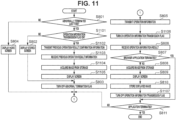
- Fig. 11 is a flowchart illustrating a processing flow of the communication apparatus 101 according to the second embodiment of the present invention.
- Fig. 11 is different from Fig. 8 in that items are added to a basic flow illustrated therein, so that the same items (steps S801 to S811) are denoted by the same step numbers, and the descriptions thereof may be omitted.
- the processing in the present flowchart is also started in a state where the communication apparatus 101 starts up an application in the application unit 306 and is connected to the virtual machine 104 and the storage 106 via the network, and the operation detection unit 303 receives the operation information.
- the abnormal termination flag is also turned ON in a case where the application unit 306 detects the abnormal termination of the application.
- step S801 in a case where the status determination unit 307 determines whether the application has been abnormally terminated in the previous time based on the abnormal termination flag in the storage unit 302, and the abnormal termination flag is ON (YES in step S801), the processing proceeds to step S1101.
- step S1101 the status determination unit 307 determines the operation information transmission flag in the storage unit 302. Firstly, the operation information transmission flag will be described.
- the operation information transmission flag is turned ON in step S1106.
- Step S1106 proceeds after the transmission of the operation information (e.g., transmission of the URL information of the web page in the example described above) is performed in step S805 in Fig. 11 . Further, the operation information transmission flag is turned OFF in step S1107.
- Step S1107 proceeds after the image, that is, the image illustrated in Fig. 6 , which is used to generate the screen on the graphical user interface 204 in step S808, is stored in the storage unit 302 in step S810.
- step S1101 determines whether the operation information transmission flag is OFF (NO in step S1101).
- the processing proceeds to step S802.
- step S802 the image illustrated in Fig. 6 stored in the storage unit 302 is displayed on the graphical user interface 204, and the screen illustrated in Fig. 7B before the abnormal termination is generated.
- step S1101 determines whether the image is stored in the storage unit 302 after the communication unit 301 serving as a transmission unit transmits the operation information in step S805.
- step S 1102 the communication unit 301 transmits previous operation result confirmation information to the virtual machine 104.
- the previous operation result confirmation information is a request to the virtual machine 104 to transmit the previous operation information result and is information determined in advance between the communication apparatus 101 and the virtual machine 104.
- the previous operation result confirmation information is a request for the operation information result (web page read information) corresponding to transmission of the previous operation information transmission (e.g., transmission of the URL information of the web page).
- the communication unit 301 functions as a confirmation information request transmission unit that transmits a confirmation information request as the previous operation result confirmation information.
- step S1103 the communication unit 301 receives previous operation result information (e.g., previous web page read information) from the virtual machine 104, and the response analysis unit 305 analyzes a content of the previous operation result information.
- previous operation result information e.g., previous web page read information
- step S 1104 the communication unit 301 acquires an image from the storage 106.
- the image stored in the storage 106 is the image illustrated in Fig. 6 that would be stored in the storage unit 302 if the abnormal termination does not occur, and the image illustrated in Fig. 6 is acquired.
- Step S 1104 is a newly added item and thus is denoted by a new step number, but a processing content to be performed is similar to that in step S808, so that a detailed description thereof will be omitted.
- step S1105 the screen generation unit 304 serving as the screen generation unit causes the graphical user interface 204 to display the image illustrated in Fig. 6 acquired in step S1104 and to generate the screen on the graphical user interface 204 illustrated in Fig. 7B .
- Step S1105 is a newly added item and thus is denoted by a new step number, but a processing content to be performed is similar to that in step S809, so that a detailed description thereof will be omitted.
- step S1106 the communication unit 301 turns ON the operation information transmission flag in the storage unit 302 as described above.
- step S1107 the communication unit 301 turns OFF the operation information transmission flag in the storage unit 302 as described above.
- the present processing repeats the processing in step S805 and subsequent steps until it is determined as YES in step S811.
- Fig. 12 is a flowchart illustrating a processing flow of the virtual machine 104 according to the second embodiment of the present invention.
- Fig. 12 is different from Fig. 9 in that items are added to the basic flow illustrated therein, so that the same items (steps S901 to S907) are denoted by the same step numbers, and the descriptions thereof may be omitted.
- the processing in the present flowchart is also started in a state where the virtual machine 104 starts up the browser application.
- the request determination unit 503 determines, in step S901, whether the communication unit 501 has received the operation information from the communication apparatus 101. As in the first embodiment, in a case where the communication unit 501 receives the operation information from the communication apparatus 101, the determination in step S901 is YES, and then the processing proceeds to steps S902, S903, S904, and S1201.
- the previous operation result confirmation information is received in some cases as described above with reference to the flowchart in Fig. 11 .
- the previous operation result confirmation information is confirmation information, and thus the determination in step S901 is NO, and the processing proceeds to step S1202.
- step S1201 the browser application unit 504 stores the operation information result received in step S904 in the storage unit 502, and then the processing proceeds to steps S905, S906, and S1202.
- the web page read information received in step S904 is stored in the storage unit 502.
- the web page read information to be received is information about storing the image illustrated in Fig. 6 , which is the image acquired by imaging the rendering result of the web content, in the storage unit 502.
- step S1202 the request determination unit 503 determines whether the communication unit 501 has received the previous operation result confirmation information.
- a case where the processing proceeds to step S1202 via step S1201 is a case where the determination result in step S901 is not the confirmation information but the operation information, so that the determination in step S1202 is NO, and the processing proceeds to step S907.
- the confirmation information is received and the determination result in step S901 is NO, whereby the processing proceeds to step S1202.
- the determination result in step S1202 is YES, and the processing proceeds to step S1203.
- step S1203 the browser application unit 504 reads the operation information result stored in the storage unit 502. Following the above-described example, it is assumed that the web page read information is read from the storage unit 502.
- step S1204 the communication unit 501 transmits the previous operation result information (previous web page read information) to the communication apparatus 101.
- the communication apparatus 101 receives the previous operation result information in step S1103 described above with reference to Fig. 11 and acquires an image, which is not stored in the storage unit 302 in step S1104, from the storage 106.
- startup can be reliably performed in a screen state generated by the image illustrated in Fig. 6 even if the abnormal termination occurs after the operation information is transmitted in step S805 and before the image illustrated in Fig. 6 is stored in the storage unit 302 in step S810.
- the screen illustrated in Fig. 7B is displayed at the time of resuming the application based on the image illustrated in Fig. 6 , which has been displayed on the graphical user interface 204 before the previous abnormal termination, even if the image illustrated in Fig. 6 is not stored in the storage unit 302.
- the operation information transmitted before the previous abnormal termination is not transmitted again.
- processing for acquiring the web content again does not occur to acquire the image illustrated in Fig. 6 that is not stored in the storage unit 302, so that the virtual machine 104 can avoid performing the same operation for a plurality of times.
- a third embodiment according to the present invention will now be described.
- a screen specific to a communication apparatus hereinbelow, also referred to as an apparatus specific screen
- the apparatus specific screen is generated by the communication apparatus 101 itself (e.g., a software keyboard).
- the software keyboard is an example of a user interface according to the present invention, and such an apparatus specific screen may be referred to as a "UI".
- Figs. 13A and 13B illustrate a state where a software keyboard serving as an apparatus specific screen according to the third embodiment of the present invention is displayed on the graphical user interface 204.
- Fig. 13A illustrates a screen on the graphical user interface 204 before an input is performed on the software keyboard.
- Fig. 13B illustrates a screen on the graphical user interface 204 after an alphabet "A" is input from the software keyboard.
- the screen on the graphical user interface 204 illustrated in Fig. 13A appears, for example, when a user touches the text input field 700 while the screen illustrated in Fig. 7B is displayed on the graphical user interface 204.
- the screens of the software keyboard illustrated in Figs. 13A and Fig. 13B are displayed superimposed on the image that configures the screen illustrated in Fig. 7B , so that the user can only see the software keyboard.
- the operation detection unit 303 determines that an operation is performed on the apparatus specific screen.
- the operation detection unit 303 determines that the operation is not performed on the apparatus specific screen.
- the screen generation unit 304 determines that it is necessary to generate a software keyboard as an apparatus specific screen.
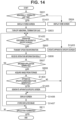
- Fig. 14 is a flowchart illustrating the processing flow of the communication apparatus 101 according to the third embodiment of the present invention.
- the configuration of the information processing system 100 and the hardware and software configurations of the communication apparatus 101 are respectively the same as those in Figs. 1 to 3 .
- the hardware configuration of the virtual machine 104 and the software configurations of the virtual machine 104 and the browser engine 105 are respectively the same as those in Figs. 4 and 5 .
- a processing flow of the virtual machine 104 is the same as that in Fig. 9
- a processing flow of the browser engine 105 is the same as that in Fig. 10 .
- steps S801, S803 to S808, and S811 in Fig. 14 are respectively the same as those in steps S801, S803 to S808, and S811 in Fig. 8 , so that the descriptions thereof may be omitted.
- the communication apparatus 101 has already started up an application in the application unit 306 and is connected to the virtual machine 104 and the storage 106 via the network as in the above-described cases.
- step S801 determination is performed based on the abnormal termination flag as in the above-described cases. However, the abnormal termination flag is ON in this case as described above, and thus the processing proceeds to step S1401.
- step S1401 the screen generation unit 304 displays the image illustrated in Fig. 6 stored in the storage unit 302 on the graphical user interface 204, so that the screen illustrated in Fig. 7B is generated.
- the storage unit 302 may store apparatus specific screen information, such as the software keyboard, in addition to the image (the image based on the web content as illustrated in Fig. 6 ) according to the present embodiment, as will be described below.
- the screen generation unit 304 generates the screen on the graphical user interface 204 based on the image stored in the storage unit 302 and the apparatus specific screen information.
- the apparatus specific screen information stored in the storage unit 302 is an identification (ID) of a screen to be used to generate the software keyboard illustrated in Fig. 13A .
- the screen generation unit 304 displays an image that is acquired by adding the software keyboard as a predetermined UI to the image stored in the storage unit 302 on the graphical user interface 204 to generate the screen on the graphical user interface 204.
- ID identification
- step S1402 the operation detection unit 303 determines whether an operation is performed on the apparatus specific screen.
- the current screen on the graphical user interface 204 is the screen illustrated in Fig. 7B .
- the operation detection unit 303 determines that the operation is not performed on the apparatus specific screen (NO in step S1402), and the processing sequentially proceeds to steps S805, S806, S807, S808, and S1404.
- step S806 a result that the text input field 700 is touched is received as the operation information result, which is a result of the operation information.
- an image corresponding to the operation of touching the text input field 700 may be generated by the processing of the virtual machine 104 and the browser engine 105 and stored in the storage 106. Since the browser application is not terminated, the determination in step S807 is NO, the processing proceeds to step S808. In step S808, the stored image is acquired from the storage 106, and the processing proceeds to step S1404.
- step S1404 the screen generation unit 304 determines whether the apparatus specific screen is to be generated.
- step S806 the result that the text input field 700 is touched is received as the operation information result, and as described above, the screen generation unit 304 determines that the apparatus specific screen is to be generated in a case where the operation of touching the text input field 700 is performed.
- the screen generation unit 304 determines as YES in step S1404 based on the operation information result received in step S806, and the processing proceeds to step S1405.
- step S1405 the screen generation unit 304 generates the apparatus specific screen.
- the screen generation unit 304 generates the software keyboard as the apparatus specific screen.
- the screen generation unit 304 generates the software keyboard based on the ID of the screen to be used to generate the software keyboard illustrated in Fig. 13A that is stored in the storage unit 302.
- step S1406 the screen generation unit 304 performs screen display to display the image acquired by adding the software keyboard (UI) generated in step S1405 to the image received in step S808 on the graphical user interface 204.
- the display on the graphical user interface 204 is not limited to the image acquired by adding the software keyboard (UI) to the image received in step S808 and may be either one of the software keyboard or the image received in step S808.
- the software keyboard (UI) is located at the top, and thus the screen on the graphical user interface 204 is the screen illustrated in Fig. 13A .
- step S1407 the storage unit 302 stores the image used to generate the screen in step S1406 and the apparatus specific screen information (e.g., the ID of the screen required to generate the software keyboard). If the determination result in step S811 is NO, the processing proceeds to step S1402 again. As described below, in a case where the determination result in step S1402 is YES and the processing proceeds to step S1407 via step S1403, the operation is performed on the apparatus specific screen information (e.g., software keyboard). In this case, the storage unit 302 may store the operation information that is the content of the operation.
- the apparatus specific screen information e.g., the ID of the screen required to generate the software keyboard.
- step S1403 A case where the processing proceeds to step S1403 will be specifically described. It is assumed that a user performs a touch operation for inputting characters by touching the software keyboard currently displayed on the graphical user interface 204. For example, if the user performs a touch operation of inputting a letter "A" as illustrated in Fig. 13B , the operation detection unit 303 determines YES in step S1402, and the processing proceeds to step S1403. As described above, the operation detection unit 303 functions as a UI operation determination unit that determines whether it is the operation performed on the software keyboard as the UI.
- step S1403 the screen generation unit 304 updates the apparatus specific screen. Thereafter, the screen generation unit 304 displays the generated screen on the graphical user interface 204.
- the screen on the graphical user interface 204 is similar to the screen illustrated in Fig. 13 .
- the processing then proceeds to steps S1406 and S1407 again.
- the storage unit 302 also stores the operation information of the touch operation of inputting the letter "A” in addition to the image used to generate the screen in step S1406 and the apparatus specific screen information (e.g., the ID of the screen used to generate the software keyboard).
- the storage unit 302 also functions as a UI operation storage unit for storing an operation performed on the software keyboard as the UI.
- step S1401 may be performed as follows.
- the screen generation unit 304 automatically executes processing based on the operation information of the touch operation of inputting "A" stored in the storage unit 302 so that the screen in the state after the operation appears.
- the screen generation unit 304 In a case where the screen generation unit 304 performs display after the abnormal termination in this way, the screen generation unit 304 also functions as a UI operation execution unit that executes the operation on the software keyboard serving as a UI stored in the UI operation storage unit.
- the communication apparatus 101 generates the apparatus specific screen, combines the apparatus specific screen with the image of the rendering result of the web content, and displays the result on the communication apparatus 101.
- Embodiment(s) of the present invention can also be realized by a computer of a system or apparatus that reads out and executes computer executable instructions (e.g., one or more programs) recorded on a storage medium (which may also be referred to more fully as a 'non-transitory computer-readable storage medium') to perform the functions of one or more of the above-described embodiment(s) and/or that includes one or more circuits (e.g., application specific integrated circuit (ASIC)) for performing the functions of one or more of the above-described embodiment(s), and by a method performed by the computer of the system or apparatus by, for example, reading out and executing the computer executable instructions from the storage medium to perform the functions of one or more of the above-described embodiment(s) and/or controlling the one or more circuits to perform the functions of one or more of the above-described embodiment(s).
- computer executable instructions e.g., one or more programs
- a storage medium which may also be referred to more fully as
- the computer may comprise one or more processors (e.g., central processing unit (CPU), micro processing unit (MPU)) and may include a network of separate computers or separate processors to read out and execute the computer executable instructions.
- the computer executable instructions may be provided to the computer, for example, from a network or the storage medium.
- the storage medium may include, for example, one or more of a hard disk, a random-access memory (RAM), a read only memory (ROM), a storage of distributed computing systems, an optical disk (such as a compact disc (CD), digital versatile disc (DVD), or Blu-ray Disc (BD) TM ), a flash memory device, a memory card, and the like.
Landscapes
- Engineering & Computer Science (AREA)
- Theoretical Computer Science (AREA)
- General Engineering & Computer Science (AREA)
- Physics & Mathematics (AREA)
- General Physics & Mathematics (AREA)
- Software Systems (AREA)
- Databases & Information Systems (AREA)
- Human Computer Interaction (AREA)
- Data Mining & Analysis (AREA)
- Quality & Reliability (AREA)
- Information Transfer Between Computers (AREA)
- User Interface Of Digital Computer (AREA)
- Facsimiles In General (AREA)
Applications Claiming Priority (2)
| Application Number | Priority Date | Filing Date | Title |
|---|---|---|---|
| JP2023219907 | 2023-12-26 | ||
| JP2024130202A JP2025102624A (ja) | 2023-12-26 | 2024-08-06 | 通信端末 |
Publications (1)
| Publication Number | Publication Date |
|---|---|
| EP4579451A1 true EP4579451A1 (fr) | 2025-07-02 |
Family
ID=93922971
Family Applications (1)
| Application Number | Title | Priority Date | Filing Date |
|---|---|---|---|
| EP24219277.1A Pending EP4579451A1 (fr) | 2023-12-26 | 2024-12-12 | Terminal de communication, procédé de commande et support d'informations |
Country Status (3)
| Country | Link |
|---|---|
| US (1) | US20250208809A1 (fr) |
| EP (1) | EP4579451A1 (fr) |
| CN (1) | CN120216064A (fr) |
Families Citing this family (1)
| Publication number | Priority date | Publication date | Assignee | Title |
|---|---|---|---|---|
| CN113642008B (zh) * | 2021-10-14 | 2021-12-28 | 飞天诚信科技股份有限公司 | 一种更换智能pos设备开机画面的实现方法及装置 |
Citations (4)
| Publication number | Priority date | Publication date | Assignee | Title |
|---|---|---|---|---|
| JP2010219792A (ja) | 2009-03-16 | 2010-09-30 | Canon Inc | サーバと、前記サーバを含む情報処理システムとその制御方法 |
| JP2014182793A (ja) | 2014-02-10 | 2014-09-29 | Ricoh Co Ltd | エンコーダ、映像処理サーバ、映像処理システム、エンコード方法およびそのプログラム |
| US9032199B1 (en) * | 2012-12-28 | 2015-05-12 | Google Inc. | Systems, devices, and methods for capturing information, creating loadable images, and providing for restarts in a computer system |
| CN108156013B (zh) * | 2016-12-02 | 2021-08-10 | 阿里巴巴集团控股有限公司 | 一种页面服务容灾方法、装置及电子设备 |
Family Cites Families (13)
| Publication number | Priority date | Publication date | Assignee | Title |
|---|---|---|---|---|
| US7603533B1 (en) * | 2003-07-22 | 2009-10-13 | Acronis Inc. | System and method for data protection on a storage medium |
| US7953948B1 (en) * | 2005-06-17 | 2011-05-31 | Acronis Inc. | System and method for data protection on a storage medium |
| JP5279516B2 (ja) * | 2009-01-09 | 2013-09-04 | キヤノン株式会社 | 情報処理装置、表示制御方法及びプログラム |
| US8340502B2 (en) * | 2009-12-01 | 2012-12-25 | Canon Kabushiki Kaisha | Movie reproducing apparatus and method |
| CN102789405A (zh) * | 2011-05-16 | 2012-11-21 | 鸿富锦精密工业(深圳)有限公司 | 主板自动化测试方法及系统 |
| JP2015173863A (ja) * | 2014-03-17 | 2015-10-05 | 株式会社東芝 | 医用画像表示装置及び医用画像表示方法 |
| JP6570282B2 (ja) * | 2014-03-31 | 2019-09-04 | キヤノン株式会社 | 放射線撮影システム、放射線撮像装置、制御装置、制御方法およびプログラム |
| US20220068154A1 (en) * | 2014-08-22 | 2022-03-03 | Intelligent Technologies International, Inc. | Secure Testing Device with Combiner |
| JP6429650B2 (ja) * | 2015-01-29 | 2018-11-28 | キヤノン株式会社 | 情報処理装置およびその制御方法、並びにプログラム |
| JP6573838B2 (ja) * | 2016-02-10 | 2019-09-11 | 株式会社神戸製鋼所 | 回転機の異常検知システム |
| JP7186541B2 (ja) * | 2018-05-17 | 2022-12-09 | キヤノン株式会社 | 画像処理装置、その制御方法、及びプログラム |
| CN114429614A (zh) * | 2020-10-29 | 2022-05-03 | 中国科学院微电子研究所 | 用于半导体制造设备停运时自动恢复其运行的方法及装置 |
| US12579131B2 (en) * | 2023-09-16 | 2026-03-17 | Oracle International Corporation | Transactionally consistent HNSW index |
-
2024
- 2024-12-12 EP EP24219277.1A patent/EP4579451A1/fr active Pending
- 2024-12-17 CN CN202411861623.8A patent/CN120216064A/zh active Pending
- 2024-12-19 US US18/988,514 patent/US20250208809A1/en active Pending
Patent Citations (4)
| Publication number | Priority date | Publication date | Assignee | Title |
|---|---|---|---|---|
| JP2010219792A (ja) | 2009-03-16 | 2010-09-30 | Canon Inc | サーバと、前記サーバを含む情報処理システムとその制御方法 |
| US9032199B1 (en) * | 2012-12-28 | 2015-05-12 | Google Inc. | Systems, devices, and methods for capturing information, creating loadable images, and providing for restarts in a computer system |
| JP2014182793A (ja) | 2014-02-10 | 2014-09-29 | Ricoh Co Ltd | エンコーダ、映像処理サーバ、映像処理システム、エンコード方法およびそのプログラム |
| CN108156013B (zh) * | 2016-12-02 | 2021-08-10 | 阿里巴巴集团控股有限公司 | 一种页面服务容灾方法、装置及电子设备 |
Also Published As
| Publication number | Publication date |
|---|---|
| CN120216064A (zh) | 2025-06-27 |
| US20250208809A1 (en) | 2025-06-26 |
Similar Documents
| Publication | Publication Date | Title |
|---|---|---|
| EP2580683B1 (fr) | Création et lancement d'une application web avec justificatifs d'identité | |
| RU2632144C1 (ru) | Компьютерный способ создания интерфейса рекомендации контента | |
| EP2580685B1 (fr) | Bouton de retour à l'accueil pour applications web | |
| US12254336B2 (en) | Information processing system and method of controlling information processing system | |
| EP2580684B1 (fr) | Création de sessions de tâches | |
| EP2580679B1 (fr) | Déplacement d'applications web et applications web transitoires | |
| US6874126B1 (en) | Method and apparatus for controlling content display by the cursor motion | |
| EP3518124A1 (fr) | Procédé de rendu de page web et dispositif associé | |
| US11675483B2 (en) | Client device, control method, and storage medium for smoothly exchanging the display of images on a device | |
| CN104346351B (zh) | 面向内容的页面之间的平滑导航 | |
| EP4579451A1 (fr) | Terminal de communication, procédé de commande et support d'informations | |
| US11314391B2 (en) | Navigation bar controlling method and terminal | |
| US20110035433A1 (en) | Webpage display method, computer system, and program | |
| CN108279942A (zh) | 展示智能终端应用启动页的方法及装置 | |
| US20250343865A1 (en) | Storage medium and information processing apparatus | |
| WO2026045460A1 (fr) | Procédé et appareil d'envoi de commentaire à l'écran | |
| US12306897B2 (en) | Information processing system, image generation system, communication terminal, information processing method, or storage medium | |
| GB2532822A (en) | Techniques for providing a user interface incorporating sign language | |
| JP2025102624A (ja) | 通信端末 | |
| US20050022109A1 (en) | Document display apparatus | |
| CN114296842A (zh) | 显示设备和滚动文本检测方法 | |
| US12518081B2 (en) | Information processing apparatus, method for controlling the same, and storage medium | |
| US12585722B2 (en) | Image generation system, communication apparatus, methods of operating image generation system and communication apparatus, and storage medium | |
| US20250238291A1 (en) | Information processing apparatus, control method of information processing apparatus, and storage medium | |
| EP4365756A1 (fr) | Système de génération d'image, appareil de communication, procédé de commande et support d'informations lisible par ordinateur non transitoire |
Legal Events
| Date | Code | Title | Description |
|---|---|---|---|
| PUAI | Public reference made under article 153(3) epc to a published international application that has entered the european phase |
Free format text: ORIGINAL CODE: 0009012 |
|
| STAA | Information on the status of an ep patent application or granted ep patent |
Free format text: STATUS: THE APPLICATION HAS BEEN PUBLISHED |
|
| AK | Designated contracting states |
Kind code of ref document: A1 Designated state(s): AL AT BE BG CH CY CZ DE DK EE ES FI FR GB GR HR HU IE IS IT LI LT LU LV MC ME MK MT NL NO PL PT RO RS SE SI SK SM TR |
|
| STAA | Information on the status of an ep patent application or granted ep patent |
Free format text: STATUS: REQUEST FOR EXAMINATION WAS MADE |
|
| 17P | Request for examination filed |
Effective date: 20260102 |
|
| STAA | Information on the status of an ep patent application or granted ep patent |
Free format text: STATUS: EXAMINATION IS IN PROGRESS |