EP4579497A1 - Croisement de bordures à efficacité temporelle - Google Patents
Croisement de bordures à efficacité temporelle Download PDFInfo
- Publication number
- EP4579497A1 EP4579497A1 EP23307392.3A EP23307392A EP4579497A1 EP 4579497 A1 EP4579497 A1 EP 4579497A1 EP 23307392 A EP23307392 A EP 23307392A EP 4579497 A1 EP4579497 A1 EP 4579497A1
- Authority
- EP
- European Patent Office
- Prior art keywords
- mobile device
- checkpoint
- information
- identity document
- biometric information
- Prior art date
- Legal status (The legal status is an assumption and is not a legal conclusion. Google has not performed a legal analysis and makes no representation as to the accuracy of the status listed.)
- Pending
Links
Images




Classifications
-
- H—ELECTRICITY
- H04—ELECTRIC COMMUNICATION TECHNIQUE
- H04L—TRANSMISSION OF DIGITAL INFORMATION, e.g. TELEGRAPHIC COMMUNICATION
- H04L63/00—Network architectures or network communication protocols for network security
- H04L63/08—Network architectures or network communication protocols for network security for authentication of entities
- H04L63/0861—Network architectures or network communication protocols for network security for authentication of entities using biometrical features, e.g. fingerprint, retina-scan
-
- G—PHYSICS
- G07—CHECKING-DEVICES
- G07C—TIME OR ATTENDANCE REGISTERS; REGISTERING OR INDICATING THE WORKING OF MACHINES; GENERATING RANDOM NUMBERS; VOTING OR LOTTERY APPARATUS; ARRANGEMENTS, SYSTEMS OR APPARATUS FOR CHECKING NOT PROVIDED FOR ELSEWHERE
- G07C9/00—Individual registration on entry or exit
- G07C9/20—Individual registration on entry or exit involving the use of a pass
- G07C9/22—Individual registration on entry or exit involving the use of a pass in combination with an identity check of the pass holder
- G07C9/25—Individual registration on entry or exit involving the use of a pass in combination with an identity check of the pass holder using biometric data, e.g. fingerprints, iris scans or voice recognition
-
- G—PHYSICS
- G06—COMPUTING OR CALCULATING; COUNTING
- G06F—ELECTRIC DIGITAL DATA PROCESSING
- G06F21/00—Security arrangements for protecting computers, components thereof, programs or data against unauthorised activity
- G06F21/30—Authentication, i.e. establishing the identity or authorisation of security principals
- G06F21/31—User authentication
- G06F21/32—User authentication using biometric data, e.g. fingerprints, iris scans or voiceprints
-
- H—ELECTRICITY
- H04—ELECTRIC COMMUNICATION TECHNIQUE
- H04L—TRANSMISSION OF DIGITAL INFORMATION, e.g. TELEGRAPHIC COMMUNICATION
- H04L9/00—Cryptographic mechanisms or cryptographic arrangements for secret or secure communications; Network security protocols
- H04L9/32—Cryptographic mechanisms or cryptographic arrangements for secret or secure communications; Network security protocols including means for verifying the identity or authority of a user of the system or for message authentication, e.g. authorization, entity authentication, data integrity or data verification, non-repudiation, key authentication or verification of credentials
- H04L9/3226—Cryptographic mechanisms or cryptographic arrangements for secret or secure communications; Network security protocols including means for verifying the identity or authority of a user of the system or for message authentication, e.g. authorization, entity authentication, data integrity or data verification, non-repudiation, key authentication or verification of credentials using a predetermined code, e.g. password, passphrase or PIN
- H04L9/3231—Biological data, e.g. fingerprint, voice or retina
-
- H—ELECTRICITY
- H04—ELECTRIC COMMUNICATION TECHNIQUE
- H04W—WIRELESS COMMUNICATION NETWORKS
- H04W12/00—Security arrangements; Authentication; Protecting privacy or anonymity
- H04W12/06—Authentication
Definitions
- the token may contain information to perform Basic Access Control (BAC) or Supplemental Access Control (SAC) to DTC and eMTRD (Machine Readable Travel Documents) and may even contain information for both kind of documents.
- the token may contain a Biometric Revokable Reference (BRR) that allows to retrieve the key for BAC or SAC to DTC and eMTRD.
- BBR Biometric Revokable Reference
- the mobile phone may transmit the token before or after the user checks in to their flight in country A.
- the mobile phone may transmit the token after the user arrives in country B but before the user reaches the checkpoint.
- the verifier system also receives information regarding the mobile device that transmitted the token.
- the mobile device information can include information about the manufacturer, model, operating system version, and/or related security applications, etc.
- the verifier system determines that the mobile device can be used as an authentication factor based on the mobile device information. For example, the verifier system can compare the mobile device information to a list of authentication factor requirements.
- the verifier system registers the mobile device as an authentication factor with the retrieved biometric information of the user.
- the registration may include control data (e.g., key, unique code) for identifying the mobile device.
- the registration may be stored in a database.
- the biometric information of the user may be linked with the control data of the mobile device in the database.
- the verifier system transmits the control data to the mobile device for the mobile device to store.
- the mobile device receives the control data before the user reaches the checkpoint in country B. If the verifier system could not verify that the mobile device can be used as an authentication factor or could not authenticate the digital travel document, the verifier system can send an alert to the mobile device indicating that online authentication has failed.
- the verifier system may transmit the registration of the mobile device to the checkpoint or a location accessible to the checkpoint.
- the registration may include the control data for the mobile device and the biometric information of the user as a database record.
- the registration may be stored at a storage location in a network (e.g., cloud storage), and the checkpoint may be provided authorization to access the storage location.
- the registration may be stored locally at the checkpoint with other registration records in a local database.
- the checkpoint may authenticate the mobile device based on the control data for the mobile device.
- the mobile device may transmit the control data stored therein that was received from the verifier system to the checkpoint using wireless communication techniques, as described in further detail below.
- the checkpoint may then compare the received control data to stored registration records to match the received control data.
- the checkpoint may verify the user based on biometric information.
- Biometric information e.g., picture, fingerprint
- a 1: 1 matching technique can be used based on the earlier match of the mobile device using the control data.
- the registration record of the mobile data is linked to the biometric information for the user in the database record; therefore, the checkpoint can retrieve the registration record based on the match of the control data and then compare the biometric information taken of the user at the checkpoint to the biometric information stored in the retrieved registration record.
- the 1:1 matching technique can provide further efficiencies and improve accuracy of biometric matching.
- the user is allowed to leave the checkpoint. If the checkpoint could not authenticate the mobile device or verify the user identity using the biometric information, the user may be routed to, for example, a border control agent for manual processing.
- FIG. 4 illustrates an example method as comprising sequential steps or a process as having a particular order of operations
- many of the steps or operations in the flowchart can be performed in parallel or concurrently, and the flowchart should be read in the context of the various embodiments of the present disclosure.
- the order of the method steps or process operations illustrated in FIG. 4 may be rearranged for some embodiments.
- the method illustrated in FIG. 4 could have additional steps or operations not included therein or fewer steps or operations than those shown.
- the control data transmitted to the mobile device can include biometric template information, such as a BRR.
- the biometric information is stored on the mobile device rather than in the verifier system or checkpoint.
- the mobile device transmits identify document information to the verifier system as described above.
- the verifier system can authenticate the mobile device (e.g., determine that mobile device can be used as an authentication factor) and retrieve biometric information (e.g., biometric template) associated with the user, as described above.
- the verifier system can generate a BRR based on the retrieved biometric information.
- the BRR may be include a unique key token encrypted using the biometric information.
- the BRR may be transmitted to the mobile device as part of the control data.
- the mobile device may then transmit the control data including the BRR to the checkpoint system.
- the mobile device can authenticate the mobile device as described above.
- the checkpoint may capture biometric information (e.g., picture, fingerprint) of the user present at the checkpoint and run the capture and the BRR through the matching engine at the checkpoint.
- the checkpoint can process the captured biometric information using the BRR to retrieve a "secret,” such as the unique key token.
- the "secret" is retrieved when the captured biometric information matches within a certain degree to the biometric information used to generate the BRR.
- the checkpoint can use error code correction to mitigate the effects of slight variations in biometric captured information.
- the checkpoint therefore can perform a biometric match without storing biometric information in a database associated with the verifier system or checkpoint.
- biometric information may not be stored in outside databases.
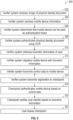
- FIG. 5 is a flow diagram for a method 500 for authenticating a user, for example, crossing a border with a physical identity document.
- the method 500 can be executed using components of authentication system 200 described above with reference to FIG. 2 .
- a user is traveling from country A (e.g., a first jurisdiction) to country B (e.g., a second jurisdiction) with a checkpoint in country B.
- a verifier system receives an image of a physical identity document (e.g., physical passport) transmitted over the internet from a mobile device before the user reaches the checkpoint in country B.
- a physical identity document e.g., physical passport
- the user may capture an image of the physical travel document using a camera integrated into the mobile device and may transmit the image of the physical travel document before the user reaches the checkpoint.
- the mobile phone may transmit the token before or after the user checks in to their flight in country A.
- the mobile phone may transmit the token after the user arrives in country B but before the user reaches the checkpoint.
- the verifier system also receives information regarding the mobile device that transmitted the token.
- the mobile device information can include information about the manufacturer, model, operating system version, and/or related security applications, etc.
- the verifier system determines that the mobile device can be used as an authentication factor based on the mobile device information. For example, the verifier system can compare the mobile device information to a list of authentication factor requirements.
- the verifier system authenticates the identity document.
- the verifier system may use optical character recognition (OCR) techniques to extract relevant information from the image to perform the authentication of the identity document.
- OCR optical character recognition
- the extracted text may be used to check over issuer information.
- the document can be analyzed to make sure the information is at the right place, in the right proportion and including specified physical security features.
- the verifier system retrieves biometric information (e.g., portrait, fingerprints) of the user based on the image of the identity document.
- the verifier system may extract the biometric information (e.g., portrait) of the user in the image of the identity document.
- the extracted biometric information may be low resolution and cannot be used to reliably perform a biometric check.
- the verifier system may communicate with an external system, such as the issuer of the identity document, and retrieve a higher resolution file of the biometric information (e.g., portrait). For example, when a picture of the identity document is not of sufficient quality, the verifier system can retrieve a better-quality picture of the identity document from the external system.
- the verifier system registers the mobile device as an authentication factor with the retrieved biometric information of the user.
- the registration may include control data (e.g., key, unique code) for identifying the mobile device.
- the registration may be stored in a database.
- the biometric information of the user may be linked with the control data of the mobile device in the database.
- the verifier system transmits the control data to the mobile device for the mobile device to store.
- the mobile device receives the control data before the user reaches the checkpoint in country B. If the verifier system could not verify that the mobile device can be used as an authentication factor or could not authenticate the digital travel document, the verifier system can send an alert to the mobile device indicating that online authentication has failed.
- the verifier system may transmit the registration of the mobile device to the checkpoint or a location accessible to the checkpoint.
- the registration may include the control data for the mobile device and the biometric information of the user as a database record.
- the registration may be stored at a storage location in a network (e.g., cloud storage), and the checkpoint may be provided authorization to access the storage location.
- the registration may be stored locally at the checkpoint with other registration records in a local database.
- the checkpoint may authenticate the mobile device based on the control data for the mobile device.
- the mobile device may transmit the control data stored therein that was received from the verifier system to the checkpoint using wireless communication techniques, as described in further detail below.
- the checkpoint may then compare the received control data to stored registration records to match the received control data.
- the checkpoint may verify the user based on biometric information.
- Biometric information e.g., picture, fingerprint
- a 1: 1 matching technique can be used based on the earlier match of the mobile device using the control data.
- the registration record of the mobile data is linked to the biometric information for the user in the database record; therefore, the checkpoint can retrieve the registration record based on the match of the control data and then compare the biometric information taken of the user at the checkpoint to the biometric information stored in the retrieved registration record.
- the 1:1 matching technique can provide further efficiencies and improve accuracy of biometric matching.
- the user is allowed to leave the checkpoint. If the checkpoint could not authenticate the mobile device or verify the user identity using the biometric information, the user may be routed to, for example, a border control agent for manual processing.
- FIG. 5 illustrates an example method as comprising sequential steps or a process as having a particular order of operations
- many of the steps or operations in the flowchart can be performed in parallel or concurrently, and the flowchart should be read in the context of the various embodiments of the present disclosure.
- the order of the method steps or process operations illustrated in FIG. 5 may be rearranged for some embodiments.
- the method illustrated in FIG. 5 could have additional steps or operations not included therein or fewer steps or operations than those shown.
- FIG. 6 illustrates example portions of a checkpoint system 600.
- the checkpoint system 600 may authenticate a mobile device and identity for respective users.
- the checkpoint system 600 may be communicatively coupled to a verifier system to receive registration records of respective users.
- the checkpoint system 600 may include a controller 602, a memory 604, a communication device 606, and a biometric sensor 608.
- the controller 602 may be provided as one or more microprocessors with single or multiple cores.
- the memory 604 may include ROM, RAM, SRAM, flash memory, and/or other suitable memory components. In some examples, the memory 604 may store a database of registration records to match mobile devices and users as users arrive at the checkpoint system 600.
- the communication device 606 may include radio frequency components such as baluns, amplifiers, upconverters, downconverters, etc., to transmit and receive wireless communication signals.
- the communication device 606 is configured to communicate with mobile devices.
- the communication device 606 is configured to operate near field communication (NFC) protocols to communicate with mobile devices.
- the communication device 606 is configured to operate short range communication protocols, such as Bluetooth, Wifi, etc., to communicate with mobile devices.
- the communication device 606 is configured to operate ultra-wideband (UWB) protocols to communicate with mobile devices.
- UWB protocols may allow the checkpoint to communicate with mobile devices to authenticate the mobile devices without the users having to stop at the checkpoint system 600.
- the biometric sensor 608 senses biometric features of users at the checkpoint system 600.
- the biometric sensor 608 may include a camera to capture an image of users to compare to stored portraits in registration records.
- the biometric sensor 608 may include other types of sensors, such as a fingerprint sensor.
- a single mobile device may be used for a plurality of users, e.g., a family.
- the mobile device can be used as an authentication factor for the plurality of specified users.
- Control data for the mobile device may be associated with the biometric information of the each of the different users in the respective registration records.
- the checkpoint may authenticate the mobile device first using the control data, and then retrieve the biometric information of the different users (e.g., family) associated with the control data for the mobile device. The checkpoint may then compare the collected biometric information of a given user to the plurality of biometric information samples. This technique still employs 1 : few matching technique as compared to a 1:many matching technique, leading to faster and more accurate processing.
- FIG. 7 illustrates a block diagram schematic of various example components of an example machine 700 that can be used as, for example, a verifier system 204 and checkpoint 208.
- Examples, as described herein, can include, or can operate by, logic or a number of components, modules, or mechanisms in machine 700. Modules may be hardware, software, or firmware communicatively coupled to one or more processors in order to carry out the operations described herein.
- circuitry e.g., processing circuitry
- Circuitry is a collection of circuits implemented in tangible entities of machine 700 that include hardware (e.g., simple circuits, gates, logic, etc.). Circuitry membership can be flexible over time. Circuitries include members that can, alone or in combination, perform specified operations when operating.
- hardware of the circuitry can be immutably designed to carry out a specific operation (e.g., hardwired).
- the hardware of the circuitry can include variably connected physical components (e.g., execution units, transistors, simple circuits, etc.) including a machine readable medium physically modified (e.g., magnetically, electrically, moveable placement of invariant massed particles, etc.) to encode instructions of the specific operation.
- variably connected physical components e.g., execution units, transistors, simple circuits, etc.
- a machine readable medium physically modified (e.g., magnetically, electrically, moveable placement of invariant massed particles, etc.) to encode instructions of the specific operation.
- the underlying electrical properties of a hardware constituent are changed, for example, from an insulator to a conductor or vice versa.
- the instructions permit embedded hardware (e.g., the execution units or a loading mechanism) to create members of the circuitry in hardware via the variable connections to carry out portions of the specific operation when in operation.
- the machine readable medium elements are part of the circuitry or are communicatively coupled to the other components of the circuitry when the device is operating.
- any of the physical components can be used in more than one member of more than one circuitry.
- execution units can be used in a first circuit of a first circuitry at one point in time and reused by a second circuit in the first circuitry, or by a third circuit in a second circuitry at a different time. Additional and/or more specific examples of components with respect to machine 700 follow.
- machine 700 can operate as a standalone device or can be connected (e.g., networked) to other machines. In a networked deployment, machine 700 can operate in the capacity of a server machine, a client machine, or both in server-client network environments. In some examples, machine 700 can act as a peer machine in a peer-to-peer (P2P) (or other distributed) network environment.
- Machine 700 can be or include a personal computer (PC), a tablet PC, a set-top box (STB), a personal digital assistant (PDA), a mobile telephone, a web appliance, a network router, switch or bridge, or any machine capable of executing instructions (sequential or otherwise) that specify actions to be taken by that machine.
- PC personal computer
- PDA personal digital assistant
- machine shall also be taken to include any collection of machines that individually or jointly execute a set (or multiple sets) of instructions to perform any one or more of the methodologies discussed herein, such as cloud computing, software as a service (SaaS), other computer cluster configurations.
- cloud computing software as a service
- SaaS software as a service
- Machine 700 can include a hardware processor 702 (e.g., a central processing unit (CPU), a graphics processing unit (GPU), a hardware processor core, or any combination thereof) and a main memory 704, a static memory (e.g., memory or storage for firmware, microcode, a basic-input-output (BIOS), unified extensible firmware interface (UEFI), etc.) 706, and/or mass storage 708 (e.g., hard drives, tape drives, flash storage, or other block devices) some or all of which can communicate with each other via an interlink (e.g., bus) 730.
- Machine 700 can further include a display device 710 and an input device 712 and/or a user interface (UI) navigation device 714.
- UI user interface
- Example input devices and UI navigation devices include, without limitation, one or more buttons, a keyboard, a touch-sensitive surface, a stylus, a camera, a microphone, etc.).
- one or more of the display device 710, input device 712, and UI navigation device 714 can be a combined unit, such as a touch screen display.
- Machine 700 can additionally include a signal generation device 718 (e.g., a speaker), a network interface device 720, and one or more sensors 716, such as a global positioning system (GPS) sensor, compass, accelerometer, or other sensor.
- GPS global positioning system
- Machine 700 can include an output controller 728, such as a serial (e.g., universal serial bus (USB), parallel, or other wired or wireless (e.g., infrared (IR), NFC, etc.) connection to communicate or control one or more peripheral devices (e.g., a printer, card reader, etc.).
- a serial e.g., universal serial bus (USB), parallel, or other wired or wireless (e.g., infrared (IR), NFC, etc.) connection to communicate or control one or more peripheral devices (e.g., a printer, card reader, etc.).
- USB universal serial bus
- IR infrared
- NFC NFC
- Processor 702 can correspond to one or more computer processing devices or resources.
- processor 702 can be provided as silicon, as a Field Programmable Gate Array (FPGA), an Application-Specific Integrated Circuit (ASIC), any other type of Integrated Circuit (IC) chip, a collection of IC chips, or the like.
- processor 702 can be provided as a microprocessor, Central Processing Unit (CPU), or plurality of microprocessors or CPUs that are configured to execute instructions sets stored in an internal memory 722 and/or memory 704, 706, 708.
- CPU Central Processing Unit
- Any of memory 704, 706, and 708 can be used in connection with the execution of application programming or instructions by processor 702 for performing any of the functionality or methods described herein, and for the temporary or long-term storage of program instructions or instruction sets 724 and/or other data for performing any of the functionality or methods described herein.
- Any of memory 704, 706, 708 can comprise a computer readable medium that can be any medium that can contain, store, communicate, or transport data, program code, or instructions 724 for use by or in connection with machine 700.
- the computer readable medium can be, for example but is not limited to, an electronic, magnetic, optical, electromagnetic, infrared, or semiconductor system, apparatus, or device.
- suitable computer readable medium include, but are not limited to, an electrical connection having one or more wires or a tangible storage medium such as a portable computer diskette, a hard disk, a random access memory (RAM), a read-only memory (ROM), an erasable programmable read-only memory (EPROM or EEPROM), Dynamic RAM (DRAM), a solid-state storage device, in general, a compact disc read-only memory (CD-ROM), or other optical or magnetic storage device.
- RAM random access memory
- ROM read-only memory
- EPROM or EEPROM erasable programmable read-only memory
- DRAM Dynamic RAM
- solid-state storage device in general, a compact disc read-only memory (CD-ROM), or other optical or magnetic storage device.
- computer-readable media includes, but is not to be confused with, computer-readable storage medium, which is intended to cover all physical, non-transitory, or similar embodiments of computer-readable media.
- Network interface device 720 includes hardware to facilitate communications with other devices over a communication network, such as the one or more networks described above, utilizing any one of a number of transfer protocols (e.g., frame relay, internet protocol (IP), transmission control protocol (TCP), user datagram protocol (UDP), hypertext transfer protocol (HTTP), etc.).
- transfer protocols e.g., frame relay, internet protocol (IP), transmission control protocol (TCP), user datagram protocol (UDP), hypertext transfer protocol (HTTP), etc.
- Example communication networks can include a local area network (LAN), a wide area network (WAN), a packet data network (e.g., the Internet), mobile telephone networks (e.g., cellular networks), Plain Old Telephone (POTS) networks, wireless data networks (e.g., networks based on the IEEE 802.11 family of standards known as Wi-Fi or the IEEE 802.16 family of standards known as WiMax), networks based on the IEEE 802.15.4 family of standards, and peer-to-peer (P2P) networks, among others.
- network interface device 720 can include an Ethernet port or other physical jack, a Wi-Fi card, a Network Interface Card (NIC), a cellular interface (e.g., antenna, filters, and associated circuitry), or the like.
- network interface device 720 can include one or more antennas to wirelessly communicate using at least one of single-input multiple-output (SIMO), multiple-input multiple-output (MIMO), or multiple-input single-output (MISO) techniques.
- SIMO single-input multiple-output
- MIMO multiple-input multiple-output
- MISO multiple-input single-output
- Example 1 A method comprising: receiving, from a mobile device, identity document information over a network before a user reaches a checkpoint; receiving, from the mobile device, mobile device information over the network; confirming authenticity of the identity document information; retrieving biometric information associated with the user based on the identity document information; registering the mobile device as an authentication factor; transmitting control data to the mobile device, wherein the mobile device is configured to store the control data; and making the registration record accessible to the checkpoint, wherein the checkpoint is configured to authenticate the mobile device based on the control data and verify identity of the user based on the biometric information.
- Example 2 The method of example 1, further comprising: receiving, by the checkpoint, the control data from the mobile device; authenticating the mobile device based on comparing the received control data from the mobile device and the stored control data in the registration record; collecting, by the checkpoint, biometric information from the user; and verifying identify of the user based on comparing the collected biometric information and stored biometric information.
- Example 3 The method of any of examples 1-2, wherein: the step of collecting comprises extracting, by the checkpoint, the stored biometric information from the registration record based on authenticating the mobile device; and the step of verifying comprises matching the extracted biometric information with the collected biometric information using a 1:1 matching technique.
- Example 4 The method of any of examples 1-3, wherein the identity document information includes a digital travel document.
- Example 5 The method of any of examples 1-4, wherein the identity document information includes a token and the token is used to retrieve an identity document from a network storage location.
- Example 6 The method of any of examples 1-5, wherein the identity document information includes an image of a physical identity document.
- Example 7 The method of any of examples 1-6, wherein the biometric information is retrieved from a network storage location based on information in the image of the physical identity document.
- Example 8 The method of any of examples 1-7, further comprising: generating a biometric revocable reference (BRR) based on the retrieved biometric information, wherein the control data includes the BRR.
- BRR biometric revocable reference
- Example 9 The method of any of examples 1-8, wherein the checkpoint is configured to perform a biometric match to verify identify of the user based on the BRR received from the mobile device.
- Example 10 A system comprising: one or more processors of a machine; and a memory storing instructions that, when executed by the one or more processors, cause the machine to perform operations implementing any one of example methods 1 to 9.
- Example 11 A machine-readable storage device embodying instructions that, when executed by a machine, cause the machine to perform operations implementing any one of example methods 1 to 9.
- embodiments of the present disclosure may be embodied as a method (including, for example, a computer-implemented process, a business process, and/or any other process), apparatus (including, for example, a system, machine, device, computer program product, and/or the like), or a combination of the foregoing. Accordingly, embodiments of the present disclosure or portions thereof may take the form of an entirely hardware embodiment, an entirely software embodiment (including firmware, middleware, microcode, hardware description languages, etc.), or an embodiment combining software and hardware aspects.
- embodiments of the present disclosure may take the form of a computer program product on a computer-readable medium or computer-readable storage medium, having computer-executable program code embodied in the medium, that define processes or methods described herein.
- a processor or processors may perform the necessary tasks defined by the computer-executable program code.
- a computer readable medium may be any medium that can contain, store, communicate, or transport the program for use by or in connection with the systems disclosed herein.
- the computer readable medium may be, for example but is not limited to, an electronic, magnetic, optical, electromagnetic, infrared, or semiconductor system, apparatus, or device.
- suitable computer readable medium include, but are not limited to, an electrical connection having one or more wires or a tangible storage medium such as a portable computer diskette, a hard disk, a random access memory (RAM), a read-only memory (ROM), an erasable programmable read-only memory (EPROM or EEPROM), a compact disc read-only memory (CD-ROM), or other optical, magnetic, or solid state storage device.
- a tangible storage medium such as a portable computer diskette, a hard disk, a random access memory (RAM), a read-only memory (ROM), an erasable programmable read-only memory (EPROM or EEPROM), a compact disc read-only memory (CD-ROM), or other optical, magnetic, or solid state storage device.
- RAM random access memory
- ROM read-only memory
- EPROM or EEPROM erasable programmable read-only memory
- CD-ROM compact disc read-only memory
- computer-readable media includes, but is not to be confused with, computer-readable storage medium, which
- the terms “substantially” or “generally” refer to the complete or nearly complete extent or degree of an action, characteristic, property, state, structure, item, or result.
- an object that is “substantially” or “generally” enclosed would mean that the object is either completely enclosed or nearly completely enclosed.
- the exact allowable degree of deviation from absolute completeness may in some cases depend on the specific context. However, generally speaking, the nearness of completion will be so as to have generally the same overall result as if absolute and total completion were obtained.
- the use of “substantially” or “generally” is equally applicable when used in a negative connotation to refer to the complete or near complete lack of an action, characteristic, property, state, structure, item, or result.
- an element, combination, embodiment, or composition that is "substantially free of” or “generally free of” an element may still actually contain such element as long as there is generally no significant effect thereof.
Landscapes
- Engineering & Computer Science (AREA)
- Computer Security & Cryptography (AREA)
- Signal Processing (AREA)
- Computer Networks & Wireless Communication (AREA)
- Physics & Mathematics (AREA)
- General Physics & Mathematics (AREA)
- Biomedical Technology (AREA)
- Theoretical Computer Science (AREA)
- General Engineering & Computer Science (AREA)
- Computer Hardware Design (AREA)
- Health & Medical Sciences (AREA)
- General Health & Medical Sciences (AREA)
- Human Computer Interaction (AREA)
- Software Systems (AREA)
- Biodiversity & Conservation Biology (AREA)
- Life Sciences & Earth Sciences (AREA)
- Computing Systems (AREA)
- Collating Specific Patterns (AREA)
Priority Applications (2)
| Application Number | Priority Date | Filing Date | Title |
|---|---|---|---|
| EP23307392.3A EP4579497A1 (fr) | 2023-12-26 | 2023-12-26 | Croisement de bordures à efficacité temporelle |
| US18/981,932 US20250209875A1 (en) | 2023-12-26 | 2024-12-16 | Time efficient border crossing |
Applications Claiming Priority (1)
| Application Number | Priority Date | Filing Date | Title |
|---|---|---|---|
| EP23307392.3A EP4579497A1 (fr) | 2023-12-26 | 2023-12-26 | Croisement de bordures à efficacité temporelle |
Publications (1)
| Publication Number | Publication Date |
|---|---|
| EP4579497A1 true EP4579497A1 (fr) | 2025-07-02 |
Family
ID=89940830
Family Applications (1)
| Application Number | Title | Priority Date | Filing Date |
|---|---|---|---|
| EP23307392.3A Pending EP4579497A1 (fr) | 2023-12-26 | 2023-12-26 | Croisement de bordures à efficacité temporelle |
Country Status (2)
| Country | Link |
|---|---|
| US (1) | US20250209875A1 (fr) |
| EP (1) | EP4579497A1 (fr) |
Citations (3)
| Publication number | Priority date | Publication date | Assignee | Title |
|---|---|---|---|---|
| CN107636662A (zh) * | 2015-02-13 | 2018-01-26 | 优替控股有限公司 | 网络内容认证 |
| US20230155812A1 (en) * | 2021-11-18 | 2023-05-18 | James E. Bennison | Systems and methods for trustworthy electronic authentication using a computing device |
| US20230290207A1 (en) * | 2022-03-09 | 2023-09-14 | Alclear, Llc | Providing digital identifications generated for checkpoint validation based on biometric identification |
-
2023
- 2023-12-26 EP EP23307392.3A patent/EP4579497A1/fr active Pending
-
2024
- 2024-12-16 US US18/981,932 patent/US20250209875A1/en active Pending
Patent Citations (3)
| Publication number | Priority date | Publication date | Assignee | Title |
|---|---|---|---|---|
| CN107636662A (zh) * | 2015-02-13 | 2018-01-26 | 优替控股有限公司 | 网络内容认证 |
| US20230155812A1 (en) * | 2021-11-18 | 2023-05-18 | James E. Bennison | Systems and methods for trustworthy electronic authentication using a computing device |
| US20230290207A1 (en) * | 2022-03-09 | 2023-09-14 | Alclear, Llc | Providing digital identifications generated for checkpoint validation based on biometric identification |
Also Published As
| Publication number | Publication date |
|---|---|
| US20250209875A1 (en) | 2025-06-26 |
Similar Documents
| Publication | Publication Date | Title |
|---|---|---|
| US20220207915A1 (en) | Acquiring a plurality of mobile credentials in a plurality of readers | |
| EP4007968B1 (fr) | Systèmes et procédés de vérification d'identification utilisant d'une manière hybride une communication en champ proche et une authentification optique | |
| CN105913132B (zh) | 一种酒店速住系统、方法 | |
| US12154404B2 (en) | Using facial recognition system to activate an automated verification protocol | |
| US12154403B2 (en) | Automated mass facial recognition enrollment | |
| US12332983B2 (en) | Embedded encrypted watermark in photograph or facial recognition template to ensure authenticity | |
| US9576194B2 (en) | Method and system for identity and age verification | |
| US12183143B2 (en) | Facial recognition template stored on mobile credential | |
| US12156033B2 (en) | Securely sharing private information | |
| US12131581B2 (en) | Storing facial recognition elements as layers to blend facial changes | |
| US12437580B2 (en) | Second factor authentication as compensation for biometric temporal changes | |
| US20220210153A1 (en) | Dynamic access control authentication confidence values based on multiauthentication modes | |
| US20220092879A1 (en) | Matching of face or facial image with a facial image comprised of a pattern of perforations | |
| US20200204531A1 (en) | Multi-layer user authentication with live interaction | |
| EP4579497A1 (fr) | Croisement de bordures à efficacité temporelle | |
| US12423397B2 (en) | Method for checking individuals with simplified authentication | |
| US11250254B2 (en) | Methods and systems for detecting photograph replacement in a photo identity document | |
| CN112613346A (zh) | 身份证明文件处理的方法和装置 | |
| US20250252433A1 (en) | Non-fungible token for automatic execution of aspects of an estate | |
| US12561417B2 (en) | Secure biometric algorithm provision | |
| US20250373603A1 (en) | Identity document authentication | |
| JP2008103949A (ja) | 署名認証端末及び署名認証システム及び署名確認システム及び署名認証プログラム及び署名確認プログラム及び署名認証方法及び署名確認方法 | |
| WO2026050046A1 (fr) | Système et procédé de transfert d'actif numérique authentifié | |
| Sri et al. | SECURED ELECTRONIC SMART VOTING MACHINE WITH RASPBERRY PI | |
| Kathirvelu et al. | E-VOTING SYSTEM FOR CITIZENS IN VALID OUTSTATION |
Legal Events
| Date | Code | Title | Description |
|---|---|---|---|
| PUAI | Public reference made under article 153(3) epc to a published international application that has entered the european phase |
Free format text: ORIGINAL CODE: 0009012 |
|
| STAA | Information on the status of an ep patent application or granted ep patent |
Free format text: STATUS: THE APPLICATION HAS BEEN PUBLISHED |
|
| AK | Designated contracting states |
Kind code of ref document: A1 Designated state(s): AL AT BE BG CH CY CZ DE DK EE ES FI FR GB GR HR HU IE IS IT LI LT LU LV MC ME MK MT NL NO PL PT RO RS SE SI SK SM TR |
|
| RAP3 | Party data changed (applicant data changed or rights of an application transferred) |
Owner name: TOPPAN SECURITY SAS |
|
| STAA | Information on the status of an ep patent application or granted ep patent |
Free format text: STATUS: REQUEST FOR EXAMINATION WAS MADE |
|
| 17P | Request for examination filed |
Effective date: 20251229 |