EP4579655A1 - Dispositif électronique et procédé de complémentation de notes omises - Google Patents
Dispositif électronique et procédé de complémentation de notes omises Download PDFInfo
- Publication number
- EP4579655A1 EP4579655A1 EP23888906.7A EP23888906A EP4579655A1 EP 4579655 A1 EP4579655 A1 EP 4579655A1 EP 23888906 A EP23888906 A EP 23888906A EP 4579655 A1 EP4579655 A1 EP 4579655A1
- Authority
- EP
- European Patent Office
- Prior art keywords
- text
- voice
- processor
- missing symbol
- electronic device
- Prior art date
- Legal status (The legal status is an assumption and is not a legal conclusion. Google has not performed a legal analysis and makes no representation as to the accuracy of the status listed.)
- Pending
Links
Images








Classifications
-
- G—PHYSICS
- G06—COMPUTING OR CALCULATING; COUNTING
- G06F—ELECTRIC DIGITAL DATA PROCESSING
- G06F3/00—Input arrangements for transferring data to be processed into a form capable of being handled by the computer; Output arrangements for transferring data from processing unit to output unit, e.g. interface arrangements
- G06F3/01—Input arrangements or combined input and output arrangements for interaction between user and computer
- G06F3/048—Interaction techniques based on graphical user interfaces [GUI]
- G06F3/0481—Interaction techniques based on graphical user interfaces [GUI] based on specific properties of the displayed interaction object or a metaphor-based environment, e.g. interaction with desktop elements like windows or icons, or assisted by a cursor's changing behaviour or appearance
- G06F3/04817—Interaction techniques based on graphical user interfaces [GUI] based on specific properties of the displayed interaction object or a metaphor-based environment, e.g. interaction with desktop elements like windows or icons, or assisted by a cursor's changing behaviour or appearance using icons
-
- G—PHYSICS
- G06—COMPUTING OR CALCULATING; COUNTING
- G06F—ELECTRIC DIGITAL DATA PROCESSING
- G06F3/00—Input arrangements for transferring data to be processed into a form capable of being handled by the computer; Output arrangements for transferring data from processing unit to output unit, e.g. interface arrangements
- G06F3/01—Input arrangements or combined input and output arrangements for interaction between user and computer
- G06F3/048—Interaction techniques based on graphical user interfaces [GUI]
- G06F3/0484—Interaction techniques based on graphical user interfaces [GUI] for the control of specific functions or operations, e.g. selecting or manipulating an object, an image or a displayed text element, setting a parameter value or selecting a range
- G06F3/04842—Selection of displayed objects or displayed text elements
-
- G—PHYSICS
- G06—COMPUTING OR CALCULATING; COUNTING
- G06F—ELECTRIC DIGITAL DATA PROCESSING
- G06F3/00—Input arrangements for transferring data to be processed into a form capable of being handled by the computer; Output arrangements for transferring data from processing unit to output unit, e.g. interface arrangements
- G06F3/01—Input arrangements or combined input and output arrangements for interaction between user and computer
- G06F3/048—Interaction techniques based on graphical user interfaces [GUI]
- G06F3/0487—Interaction techniques based on graphical user interfaces [GUI] using specific features provided by the input device, e.g. functions controlled by the rotation of a mouse with dual sensing arrangements, or of the nature of the input device, e.g. tap gestures based on pressure sensed by a digitiser
- G06F3/0488—Interaction techniques based on graphical user interfaces [GUI] using specific features provided by the input device, e.g. functions controlled by the rotation of a mouse with dual sensing arrangements, or of the nature of the input device, e.g. tap gestures based on pressure sensed by a digitiser using a touch-screen or digitiser, e.g. input of commands through traced gestures
- G06F3/04883—Interaction techniques based on graphical user interfaces [GUI] using specific features provided by the input device, e.g. functions controlled by the rotation of a mouse with dual sensing arrangements, or of the nature of the input device, e.g. tap gestures based on pressure sensed by a digitiser using a touch-screen or digitiser, e.g. input of commands through traced gestures for inputting data by handwriting, e.g. gesture or text
-
- G—PHYSICS
- G06—COMPUTING OR CALCULATING; COUNTING
- G06F—ELECTRIC DIGITAL DATA PROCESSING
- G06F3/00—Input arrangements for transferring data to be processed into a form capable of being handled by the computer; Output arrangements for transferring data from processing unit to output unit, e.g. interface arrangements
- G06F3/16—Sound input; Sound output
-
- G—PHYSICS
- G06—COMPUTING OR CALCULATING; COUNTING
- G06F—ELECTRIC DIGITAL DATA PROCESSING
- G06F3/00—Input arrangements for transferring data to be processed into a form capable of being handled by the computer; Output arrangements for transferring data from processing unit to output unit, e.g. interface arrangements
- G06F3/16—Sound input; Sound output
- G06F3/167—Audio in a user interface, e.g. using voice commands for navigating, audio feedback
-
- G—PHYSICS
- G06—COMPUTING OR CALCULATING; COUNTING
- G06F—ELECTRIC DIGITAL DATA PROCESSING
- G06F40/00—Handling natural language data
- G06F40/10—Text processing
- G06F40/166—Editing, e.g. inserting or deleting
-
- G—PHYSICS
- G06—COMPUTING OR CALCULATING; COUNTING
- G06F—ELECTRIC DIGITAL DATA PROCESSING
- G06F40/00—Handling natural language data
- G06F40/10—Text processing
- G06F40/166—Editing, e.g. inserting or deleting
- G06F40/171—Editing, e.g. inserting or deleting by use of digital ink
-
- G—PHYSICS
- G06—COMPUTING OR CALCULATING; COUNTING
- G06F—ELECTRIC DIGITAL DATA PROCESSING
- G06F40/00—Handling natural language data
- G06F40/20—Natural language analysis
- G06F40/274—Converting codes to words; Guess-ahead of partial word inputs
-
- G—PHYSICS
- G06—COMPUTING OR CALCULATING; COUNTING
- G06F—ELECTRIC DIGITAL DATA PROCESSING
- G06F40/00—Handling natural language data
- G06F40/20—Natural language analysis
- G06F40/279—Recognition of textual entities
-
- G—PHYSICS
- G06—COMPUTING OR CALCULATING; COUNTING
- G06N—COMPUTING ARRANGEMENTS BASED ON SPECIFIC COMPUTATIONAL MODELS
- G06N20/00—Machine learning
-
- G—PHYSICS
- G06—COMPUTING OR CALCULATING; COUNTING
- G06N—COMPUTING ARRANGEMENTS BASED ON SPECIFIC COMPUTATIONAL MODELS
- G06N3/00—Computing arrangements based on biological models
- G06N3/02—Neural networks
- G06N3/04—Architecture, e.g. interconnection topology
- G06N3/044—Recurrent networks, e.g. Hopfield networks
-
- G—PHYSICS
- G06—COMPUTING OR CALCULATING; COUNTING
- G06N—COMPUTING ARRANGEMENTS BASED ON SPECIFIC COMPUTATIONAL MODELS
- G06N3/00—Computing arrangements based on biological models
- G06N3/02—Neural networks
- G06N3/08—Learning methods
-
- G—PHYSICS
- G06—COMPUTING OR CALCULATING; COUNTING
- G06V—IMAGE OR VIDEO RECOGNITION OR UNDERSTANDING
- G06V30/00—Character recognition; Recognising digital ink; Document-oriented image-based pattern recognition
- G06V30/10—Character recognition
- G06V30/18—Extraction of features or characteristics of the image
- G06V30/1801—Detecting partial patterns, e.g. edges or contours, or configurations, e.g. loops, corners, strokes or intersections
-
- G—PHYSICS
- G06—COMPUTING OR CALCULATING; COUNTING
- G06V—IMAGE OR VIDEO RECOGNITION OR UNDERSTANDING
- G06V30/00—Character recognition; Recognising digital ink; Document-oriented image-based pattern recognition
- G06V30/10—Character recognition
- G06V30/19—Recognition using electronic means
- G06V30/191—Design or setup of recognition systems or techniques; Extraction of features in feature space; Clustering techniques; Blind source separation
-
- G—PHYSICS
- G06—COMPUTING OR CALCULATING; COUNTING
- G06V—IMAGE OR VIDEO RECOGNITION OR UNDERSTANDING
- G06V30/00—Character recognition; Recognising digital ink; Document-oriented image-based pattern recognition
- G06V30/10—Character recognition
- G06V30/32—Digital ink
-
- G—PHYSICS
- G10—MUSICAL INSTRUMENTS; ACOUSTICS
- G10L—SPEECH ANALYSIS TECHNIQUES OR SPEECH SYNTHESIS; SPEECH RECOGNITION; SPEECH OR VOICE PROCESSING TECHNIQUES; SPEECH OR AUDIO CODING OR DECODING
- G10L15/00—Speech recognition
- G10L15/04—Segmentation; Word boundary detection
-
- G—PHYSICS
- G10—MUSICAL INSTRUMENTS; ACOUSTICS
- G10L—SPEECH ANALYSIS TECHNIQUES OR SPEECH SYNTHESIS; SPEECH RECOGNITION; SPEECH OR VOICE PROCESSING TECHNIQUES; SPEECH OR AUDIO CODING OR DECODING
- G10L15/00—Speech recognition
- G10L15/26—Speech to text systems
-
- G—PHYSICS
- G11—INFORMATION STORAGE
- G11B—INFORMATION STORAGE BASED ON RELATIVE MOVEMENT BETWEEN RECORD CARRIER AND TRANSDUCER
- G11B20/00—Signal processing not specific to the method of recording or reproducing; Circuits therefor
- G11B20/10—Digital recording or reproducing
Definitions
- the present disclosure relates to an electronic device, and more particularly, to a method of correcting information missed while note taking using the electronic device.
- an electronic device may support a note taking function by receiving touch inputs to a display.
- the electronic device may be connected to an additional external device (e.g., a smart pen) for supporting the note taking function by using short-range wireless communication, and may support the note taking function by detecting an input by the external device to the display.
- an additional external device e.g., a smart pen
- the electronic device may not only simply support the note taking function but also correct information missed and skipped by the user in a note taking procedure. For example, the electronic device may infer information that the user was unable to write down because a lecture progresses too fast, and suggest recommended text. Even for illegible characters written by the user, recommended text may be suggested.
- an electronic device may include a display, a microphone, a memory storing at least one instruction, and at least one processor configured to execute the at least one instruction to use the microphone to record an external voice, recognize handwritten characters input based on an external input signal to the display, generate handwritten text by converting the handwritten characters to text, determine whether there is a missing symbol based on the handwritten text, in response to determining that there is the missing symbol, obtain a voice segment including a voice recorded for a certain period of time including time at which the missing symbol is input among the recorded external voice, generate target text by converting a voice included in the voice segment to text, determine recommended text corresponding to a location of the missing symbol based on the target text and the handwritten text, and change the missing symbol to the recommended text.
- the at least one processor may be configured to determine, among the handwritten text, a set number of characters among characters located before the missing symbol as preceding text, determine a set number of characters among characters located after the missing symbol as following text, and determine the recommended text suitable for the location of the missing symbol by comparing the preceding text and the following text with the target text.
- the at least one processor may be configured to, in response to detecting both the preceding text and the following text from the target text, determine characters between the preceding text and the following text as the recommended text, and change the missing symbol to at least part of the recommended text.
- the at least one processor may be configured to, in response to detecting only the preceding text but not the following text from the target text, determine characters from a character right after the preceding text to a last character of the target text as the recommended text, and change the missing symbol to the recommended text.
- the at least one processor may be configured to, in response to detecting only the following text but not the preceding text from the target text, determine characters from a starting character of the target text to a character right before the following text as recommended text, and change the missing symbol to the recommended text.
- the at least one processor may be configured to, in response to detecting neither the preceding text nor the following text from the target text, change the missing symbol to an icon indicating the voice segment, and replay the voice segment in response to a user input to the icon.
- the at least one processor may be configured to use a predetermined machine learning algorithm to convert handwritten characters to the handwritten text (handwriting recognition (HWR)).
- HWR handwriting recognition
- the machine learning algorithm may include at least one of CNN, RNN and CTC.
- the missing symbol may include a dash symbol or an icon.
- the at least one processor may be configured to identify at least one line segment among the handwritten characters, and determine the line segment as the dash symbol when a length of the line segment is larger than a set value.
- the at least one processor may be configured to determine an external voice recorded from time at which a handwritten character is input first after the missing symbol is input to time at which a next missing symbol is input.
- the at least one processor may be configured to start recording the external voice simultaneously with executing of a set application, and determine an external voice recorded from time at which the application is executed to time at which the missing symbol is input for the first time as the voice segment.
- the at least one processor may be configured to use the microphone to start recording the external voice, and in response to the external voice being not detected, stop recording the external voice when a period of time for which the external voice is not detected is longer than a set period of time.
- the electronic device may further include a communication module, and the at least one processor may be configured to use the communication module to establish communication connection with an external device to receive voice data collected by the external device, and determine the voice segment by using the voice data.
- the memory 140 may include a volatile memory and a non-volatile memory to temporarily or permanently store various data items.
- the processor 110 may stop recording the external voice when the external voice is not detected for a set period of time (e.g., 15 seconds). The processor 110 may resume recording when the external voice is detected again after the recording is stopped.
- the processor 110 may generate a recording file that minimizes a time for which no external voice is detected. For example, the processor 110 may record a first external voice during a first time, detect no external voice during a second time, and record a second external voice during a third time.
- the processor 110 may generate a recording file with a gap of a shorter time than an actual time for which no external voice is detected, by inserting the gap of a set time between the first external voice and the second external voice.
- the processor 110 may establish communication connection with an external device through the communication module 130, and receive voice data received through a microphone of the external device. For example, in a case of recording a lecture, a data file with a voice recorded through a microphone built into an electronic device of a lecturer may be received through the communication connection. As voice data received from an external device may be recorded with clearer sound quality, it may be advantageous to obtaining missing information.
- the processor 110 may recognize handwritten characters input based on an external input signal to the display 120.
- the processor 110 may recognize handwritten characters based on an external input signal received through a running application.
- the user may use a writing tool (e.g., a smart pen) to write down on the electronic device 100, and the processor 110 may recognize characters written by the user.
- a writing tool e.g., a smart pen
- the processor 110 may determine whether there is a missing symbol based on the handwritten text.
- the missing symbol (omission symbol) may be a symbol indicating that there is missing information at the corresponding location among the handwritten characters.
- the missing symbol may include an icon or a dash symbol having a length of a set value or more.
- the processor 110 may determine that the line segment is the dash symbol.
- the processor 110 may check with the user whether the character in question corresponds to the dash symbol to increase accuracy in decision of the dash symbol For example, the processor 110 may output a message checking with the user whether the handwriting corresponds to the dash symbol on the display 120, and based on a user input for the message, determine that the handwriting is the dash symbol.
- the processor 110 may determine that there is a missing symbol in the handwritten text.
- the set icon may be one or more icons, and the user may determine which one of the one or more icons will be used.
- the processor 110 may determine that there is no missing symbol in the handwritten text.
- the processor 110 may obtain a voice segment including a voice recorded for a certain period of time including the time at which the missing symbol is input among the recorded external voice. For example, when the missing symbol is input at first time, the processor 110 may obtain a voice segment including a voice recorded for a set period of time (e.g., 30 seconds) including the first time. As the processor 110 does not use the entire recording file to determine text corresponding to the missing symbol, it may determine missing information more efficiently.
- a set period of time e.g. 30 seconds
- the processor 110 may generate target text by converting the voice segment into the text.
- the processor 110 may use speech-to-text (STT) for converting voice to text to generate the target text.
- STT speech-to-text
- the processor 110 may determine recommended text corresponding to the location of the missing symbol based on the target text and the handwritten text.
- the processor 110 may determine the recommended text among the handwritten text based on text located near the missing symbol.
- the processor 110 may determine a set number (e.g., 7) of characters located before the missing symbol as preceding text, and determine the set number of characters located after the missing symbol as following text.
- the processor 110 may detect the preceding text and/or the following text from the target text, and determine recommended text based on the detection result.
- the processor 110 may detect only the preceding text but not the following text from the target text.
- the processor 110 may determine characters of the target text from a character right after the preceding text to a last character of the target text as recommended text.
- the recommended text including all to the last character may not be highly accurate, but the chances are high that information desired by the user may be included in the determined recommended text.
- the processor 110 may detect only the following text but not the preceding text from the target text.
- the processor 110 may determine characters of the target text from the first character of the target text to a character right before the following text as recommended text.
- the recommended text starting from the first character of the target text may not be highly accurate, but the chances are high that information desired by the user may be included in the determined recommended text.
- the processor 110 may fail to detect both the preceding text and the following text from the target text. In response to the fact that the processor 110 fails to detect both the preceding text and the following text, the processor 110 may not determine recommended text.
- the processor 110 may change the missing symbol to recommended text.
- the processor 110 may determine a different method of displaying the recommended text depending on the procedure for determining the recommended text. In an embodiment, when the processor 110 detects both the preceding text and the following text from the target text, the processor 110 may change the missing symbol to at least a portion of the determined recommended text. As the accuracy of the determined recommended text is high when both the preceding text and the following text are detected from the target text, there is little need for the user to reconfirm the recommended text.
- the processor 110 may display only some characters instead of displaying full recommended text on the display 120, and display the full recommended text based on a user input (e.g., smart pen hovering).
- the processor 110 when the processor 110 detects only the preceding text or the following text from the target text, the processor 110 may change the missing symbol to the determined full recommended text.
- the determined recommended text may not be highly accurate.
- the processor 110 may change the missing symbol to the full recommended text so as for the user to check and correct the full recommended text.
- the processor 110 when the processor 110 fails to detect both the preceding text and the following text from the target text, the processor 110 may change the missing symbol to an icon indicating a voice segment. The processor 110 may replay the voice segment in response to a touch input to the icon. In response to the fact that the processor 110 fails to detect both the preceding text and the following text from the target text, the processor 110 may not determine recommended text. Hence, a voice segment may be provided in order for the user to listen to the recorded voice segment again and identify the missing information.
- the processor 110 may provide information for the user by applying the same method even when it is hard to convert the handwritten characters to handwritten text. For example, when the handwriting is illegible because the user wrote them down hurriedly, making it scribbled, it may be difficult for the processor 110 to convert the handwritten characters into text. In the case of having difficulty in converting the handwritten characters into text, the processor 110 may change the characters in question to set text (or icon) (e.g., XXX), and generate recommended text for the characters by using the preceding text, the following text and the target text.
- text or icon
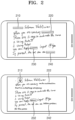
- FIG. 2 is a diagram for describing a method of correcting missing handwriting by an electronic device, according to an embodiment of the present disclosure.
- the processor may convert handwritten characters into handwritten text.
- the processor may use an Al algorithm to convert the handwritten characters into handwritten text.
- the processor may determine at least one missing symbol in the handwritten text. Although only dash symbols are shown in FIG. 2 , the missing symbols may include dash symbols or icons.
- the processor may determine some of the handwritten text as dash symbols according to a set standard. For example, the processor may determine a line segment as a dash symbol when the length of the line segment is longer than a set length. Referring to FIG. 2 , the processor may determine a first dash symbol 210, a second dash symbol 220, a third dash symbol 230 and a fourth dash symbol 240.
- the processor may determine recommended text based on preceding text and following text of the missing symbol.
- the processor may determine the recommended text in response to detecting at least one of the preceding text and the following text from the target text.
- the processor may determine characters from a character right after the preceding text to a character right before the following text as recommended text.
- the processor may change the missing symbol to some characters instead of the full recommended text.
- the processor may change the missing symbol to a portion 232 (e.g., 'upload') of the recommended text instead of the full recommended text (e.g., upload the file using attribute).
- a portion 232 e.g., 'upload'
- the processor may display only a portion instead of the full recommended text.
- the processor may change the missing symbol to the determined full recommended text. For example, the processor may not detect the preceding text but detect the following text of the second dash symbol 220. The processor may determine characters from the first character of the target text to a character right before the following text as recommended text. The processor may change the missing symbol to the full recommended text 222. For the fourth dash symbol 240, the processor may detect the preceding text but not the following text. The processor 110 may determine characters from a character right after the preceding text of the fourth dash symbol 240 to the last character of the target text as recommended text. The processor may change the missing symbol to the full recommended text 242. As the accuracy of the recommended text is more likely to be low when the processor detects only one of the preceding text and the following text, the processor may provide the full recommended text for the user to correct it immediately.
- the processor may change the missing symbol to an icon 212 indicating a voice segment. For example, the processor may not detect both the preceding text and the following text of the first dash symbol 210 from the target text. The processor may change the missing symbol to the icon 212 indicating the voice segment without determining recommended text. The processor may replay the voice segment in response to a touch input to the icon 212, and the user may listen to the replayed voice segment to obtain required information.
- FIG. 3 is a diagram for describing operations of an electronic device stopping and resuming recording based on detecting of an external voice, according to an embodiment of the present disclosure.
- the processor may use a microphone to record an external voice.
- the processor may activate a voice recording function simultaneously with executing of a set application (e.g., a handwriting application or a note application).
- the processor may detect an external voice after activating the voice recording function.
- the processor may keep recording the external voice when the external voice is detected within a set period of time.
- the processor may stop recording the external voice when the external voice is not detected within the set period of time.
- the processor may resume recording when the external voice is detected again while the recording of the external device is stopped.
- the processor may generate a recording file that minimizes a time for which recording is stopped.
- the processor may start voice recording at first time t a .
- the processor may stop the voice recording at second time t b at which a time for which no external voice is detected during the voice recording is longer than a set time interval. Afterward, voice recording may be resumed in response to an external voice being detected at third time t c .
- the processor may generate a recording file that minimizes a time between a first external voice recorded from the first time t a to the second time t b and a second external voice recorded from the third time t c .
- the processor may generate a recording file in which the second external voice is recorded from fourth time t c' after a set time gap from the second time t b , instead of the third time t c at which the second external voice is actually detected.
- FIG. 4 is a diagram for describing a missing symbol, according to an embodiment of the present disclosure.
- the processor may determine at least a portion of handwritten text converted from handwritten characters as a missing symbol.
- the processor may determine the at least a portion of the handwritten text as the missing symbol according to a set standard. For example, the processor may determine a line segment having a length loner than a set length or more among line segments as a dash symbol 410.
- the dash symbol 410 is a punctuation symbol that may be commonly used in sentences, in order to distinguish the dash symbol 410 that refers to the missing symbol rather than that used for common use, only a line segment equal to or longer than the set length may be determined as the missing symbol.
- the set length of line segment for the processor to identify the line segment as the dash symbol 410 may be determined according to the user's writing habit. Referring to FIG. 4 , the processor may convert a line segment drawn before 'Selenium' to handwritten text, and determine the converted line segment as the dash symbol 410.
- FIG. 5 is a diagram for describing an operation of an electronic device determining a voice segment based on a missing symbol, according to an embodiment of the present disclosure.
- the processor may determine a voice segment based on time at which a missing symbol is input. For example, the processor may determine the voice segment including a voice recorded during a time from right after one missing symbol is input to right after the next missing symbol is input.
- note taking and voice recording may start at T1, and missing symbols may be input at T2, T3 and T4.
- the processor may generate a first voice segment including a voice recorded during a time from T1 to T2, a second voice segment including a voice recorded during a time from T2 to T3, and a third voice segment including a voice recorded during a time from T3 to T4.
- the generated voice segments may have different lengths.
- the first voice segment, the second voice segment and the third voice segment may be voices recorded for 20 minutes, 30 minutes and 40 minutes and 31 seconds, respectively.
- the user may listen to the voice segments and obtain missing information.
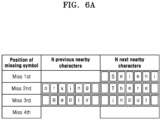
- FIGS. 6A , 6B , 6C and 6D are diagrams for describing an operation of an electronic device determining recommended text based on a preceding character string or a following character string, according to an embodiment of the present disclosure.
- FIG. 6A is a table that summarizes preceding text and following text of each missing symbol.
- the preceding text and the following text will be described as each having a length of 7 characters, the length of the preceding text and the following text is not limited thereto, and the length may increase for higher accuracy or decrease for quicker recommendation.
- the processor 110 may determine recommended text corresponding to the location of the missing symbol based on the preceding text and the following text. A method of determining the recommended text will now be described in detail.
- the first missing symbol is located in the first part of the handwritten text, there is no preceding text and the following text is 'seleni'.
- the preceding text of the second missing symbol is 'orking', and the following text is 'There'.
- the preceding text of the third missing symbol is 'Reply', and the following text is 'input'.
- FIG. 6B shows an embodiment of determining recommended text when both preceding text and following text are detected from target text.
- the processor may detect the following text 'input' of the third missing symbol from the target text, in 600.
- the processor may determine that the recommended text is included in 'reply u...attribute' located before 'input' in the target text.
- the processor may detect the preceding text 'Reply' of the third missing symbol from the target text, in 602.
- the processor may determine 'u...attribute' behind 'Reply' in the target text as recommended text.
- FIG. 6C shows an embodiment of determining recommended text when the preceding text is not detected and only the following text is detected from the target text.
- the processor may detect the following text 'There' of the second missing symbol from the target text, in 610.
- the processor may determine that the recommended text is included in 'then...choosing...company' located before 'There' in the target text.
- the processor may not detect the preceding text 'orking' of the second missing symbol from the target text, in 612.
- the processor may determine 'then...choosing...company' as recommended text. Even in a case that the processor does not detect the following text but detects only the preceding text from the target text, the recommended text may be determined in the same process.
- FIG. 6D shows an embodiment of an occasion when both the preceding text and the following text are not detected from the target text.
- the processor may not detect the following text 'seleni' of the first missing symbol from the target text in 620.
- the first missing symbol is input to a first part of the handwritten text, so the preceding text does not exist in 622.
- the processor may adjust the length of the preceding text or the following text. For example, it may reduce the length of the following text and determine 'sele' as the following text, or increase the length of the following text and determine 'selenium' as the following text.
- the processor may not determine the recommended text.
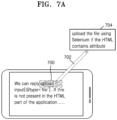
- FIGS. 7A , 7B and 7C are diagrams for describing an operation of an electronic device displaying recommended text on a display, according to an embodiment of the present disclosure.
- the processor may determine recommended text according to what are described in FIGS. 6A to 6D , and display the recommended text differently depending on the procedure in which the recommended text is determined.
- FIG. 7A shows an embodiment in which a processor displays recommended text when both preceding text and following text are found in the target text.
- the processor may change a missing symbol to a portion 700 (e.g., one word) of the recommended text.
- the processor may display full recommended text 704 on one side of the display based on a user input (e.g., hovering of a smart pen 702) to the recommended text.
- a user input e.g., hovering of a smart pen 702
- the processor may determine the recommended text 704 'upload the file using Selenium if the HTML contains attribute', and change the missing symbol to 'upload...' 700.
- the processor may display the full recommended text 704 on a side of the display.
- FIG. 7B shows an embodiment in which a processor displays recommended text when detecting only one of the preceding text and the following text from the target text.
- the processor may change the missing symbol to the full recommended text 710.
- the processor may display the recommended text in a different font from the handwritten text.
- the accuracy of the recommended text may be low, so the user may display the full text 710 on the display for the user to easily correct it.
- FIG. 7C shows an embodiment of an occasion when the processor does not find both the preceding text and the following text in the target text.
- the processor may change the missing symbol to an icon 720 that indicates a voice segment 724.
- the voice segment 724 which is an original voice file, may be provided directly for the user to guide the user to determine them.
- the processor may replay the voice segment 724 in response to a user input (e.g., hovering of the smart pen 722) to the icon 720 that indicates the voice segment 724.
- the user may obtain missing information by referring to the voice segment 724.
- an electronic device may include a display, a microphone, a memory storing at least one instruction, and at least one processor, wherein the at least one processor is configured to execute the at least one instruction to use the microphone to record an external voice, recognize handwritten characters input based on an external input signal to the display, generate handwritten text by converting the handwritten characters to text, determine whether there is a missing symbol based on the handwritten text, in response to determining that there is the missing symbol, obtain a voice segment including a voice recorded for a certain period of time including time at which the missing symbol is input among the recorded external voice, generate target text by converting the voice included in the voice segment to text, determine recommended text corresponding to a location of the missing symbol based on the target text and the handwritten text, and change the missing symbol to the recommended text.
- the at least one processor may be configured to determine, among the handwritten text, a set number of characters among characters located before the missing symbol as preceding text, determine a set number of characters among characters located after the missing symbol as following text, and determine recommended text suitable for the location of the missing symbol by comparing the preceding text and the following text with the target text.
- the at least one processor may be configured to, in response to detecting both the preceding text and the following text from the target text, determine characters between the preceding text and the following text as recommended text, and change the missing symbol to at least part of the recommended text.
- the at least one processor may be configured to, in response to detecting only the preceding text but not the following text from the target text, determine characters from a character right after the preceding text to a last character of the target text as recommended text, and change the missing symbol to the recommended text.
- the at least one processor may be configured to, in response to detecting only the following text but not the preceding text from the target text, determine characters from a starting character of the target text to a character right before the following text as recommended text, and change the missing symbol to the recommended text.
- the at least one processor may be configured to, in response to detecting neither the preceding text nor the following text from the target text, change the missing symbol to an icon indicating the voice segment, and replay the voice segment in response to a user input to the icon.
- the at least one processor may be configured to use a predetermined machine learning algorithm to convert handwritten characters to handwritten text (handwriting recognition (HWR)).
- HWR handwriting recognition
- the machine learning algorithm may include at least one of CNN, RNN and CTC.
- the missing symbol may be a dash symbol or an icon.
- the at least one processor may be configured to identify at least one line segment among the handwritten characters, and determine the line segment as a dash symbol when the line segment is longer than a set value.
- the at least one processor may be configured to determine an external voice recorded from time at which a first handwritten character is input after the missing symbol is input to time at which a next missing symbol is input.
- the at least one processor may be configured to start recording the external voice simultaneously with executing of a set application, and determine an external voice recorded from time at which the application is executed to time at which a first missing symbol is input as the voice segment.
- the at least one processor may be configured to use the microphone to start recording an external voice, and in response to the external voice not being detected, stop recording the external voice when a time for which the external voice is not detected is longer than a set time.
- the electronic device may further include a communication module, wherein the processor may be configured to use the communication module to establish communication connection with an external device to receive voice data collected by the external device, and determine a voice segment by using the voice data.
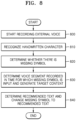
- FIG. 8 is a flowchart for describing a method of correcting missing handwriting by an electronic device, according to an embodiment of the present disclosure.
- the electronic device may start recording an external voice in operation 800.
- the electronic device may use a microphone to start recording the external voice.
- the electronic device may start recording the external voice along with execution of a set application.
- the electronic device may generate handwritten text by converting the handwritten characters to text.
- the electronic device may use an Al algorithm (e.g., CNN, RNN or CTC) to convert the handwritten characters to the handwritten text.
- Al algorithm e.g., CNN, RNN or CTC
- the electronic device may determine whether there is a missing symbol in operation 820.
- the electronic device may determine whether there is a dash symbol or an icon in the handwritten text.
- the electronic device may determine a line segment, which is equal to or longer than a set length, as the dash symbol.
- the electronic device may determine that there is a missing symbol when one of at least one set icon is detected.
- the electronic device may determine a voice segment recorded in a time for which the missing symbol is input, and generate target text.
- the electronic device may generate a voice segment including at least a portion of the recorded external voice.
- the electronic device may generate the voice segment including a voice with information corresponding to the missing symbol based on a time for which the missing symbol is input.
- the electronic device may generate the target text by using a voice recognition technology to convert the voice segment to the text.
- the electronic device may determine recommended text and change the missing symbol to the recommended text.
- the electronic device may determine preceding text and following text of the missing symbol, and determine the recommended text by comparing the preceding text and the following text with the target text.
- the electronic device may determine characters between the preceding text and the following text as recommended text.
- the electronic device may change the missing symbol to a portion of the recommended text.
- the recommended text may be determined from the first character of the target text to a character right after the following text or from a character right before the preceding text to the last character of the target text.
- the electronic device may change the missing symbol to the full recommended text.
- the electronic device fails to detect both the preceding text and the following text from the target text, the electronic device may not determine the recommended text.
- the electronic device may change the missing symbol to an icon indicating a voice segment.
- the electronic device may replay a recorded voice based on a user input to the icon indicating the voice segment.
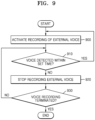
- FIG. 9 is a flowchart for describing a method of recording an external voice by an electronic device, according to an embodiment of the present disclosure.
- the electronic device may activate recording of an external voice in operation 900.
- the electronic device may use a microphone to start recording the external voice.
- the electronic device may determine whether the external voice is detected within a set period of time. When the external voice is detected within the set period of time, the electronic device may keep activating the recording of the external voice. When the external voice is not detected within the set period of time, the electronic device may stop recording the external voice in operation 920.
- the electronic device may determine whether to stop recording the external voice in operation 930. When the external voice is no longer detected, the electronic device may stop voice recording based on a user input. For example, when a lecture or a meeting is over, the electronic device may stop voice recording based on a user input. In another embodiment, the electronic device may stop voice recording even without an extra command, along with termination of a note taking application. When the voice recording is not stopped, the electronic device may detect an external voice again.
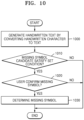
- FIG. 10 is a flowchart for describing a method of determining a missing symbol among handwritten characters by an electronic device, according to an embodiment of the present disclosure.
- the electronic device may generate handwritten text by converting the handwritten characters to text.
- the electronic device may use an Al algorithm to generate the handwritten text from the handwritten characters.
- the electronic device may determine whether a missing symbol candidate satisfies a set condition in operation 1010.
- the electronic device may determine at least one missing symbol candidate. For example, the electronic device may determine at least one line segment existing in the handwritten text as the missing symbol candidate.
- the electronic device may determine the candidates as the missing symbol when the missing symbol candidates are equal to or longer than a set length.
- the electronic device may determine whether it is a missing symbol based on a user input in operation 1020.
- the electronic device may receive confirmation from the user of a missing symbol candidate which satisfies a set condition, to increase accuracy in distinguishing the missing symbol. For example, the electronic device may output a message requesting confirmation about whether missing symbol candidates are missing symbols through the display.
- the electronic device may determine the missing symbol candidate as the missing symbol.
- FIG. 11 is a flowchart for describing a method of changing a missing symbol to recommended text or an audio file by an electronic device, according to an embodiment of the present disclosure.
- the electronic device may generate a voice segment, and generate target text by converting the voice segment to the text.
- the electronic device may generate the voice segment based on a time for which a missing symbol is input.
- the processor may generate the voice segment including a voice recorded from time when one missing symbol is input to time right after the next missing symbol is input.
- the electronic device may generate the target text by using a voice recognition technology to convert the voice segment to text.
- the electronic device may identify preceding text and following text of the missing symbol in operation 1110.
- the preceding text and the following text may refer to a set number of characters located before or after the missing symbol.
- the electronic device may identify whether the preceding text or the following text is included in the target text, in operation 1120. When the electronic device detects the preceding text and/or the following text from the target text, the electronic device may change the missing symbol to the recommended text in operation 1130. When the electronic device fails to detect both the preceding text and the following text from the target text, the electronic device may change the missing symbol to an icon indicating the voice segment, in operation 1140.
- a method of correcting missing handwriting by an electronic device including a microphone and a display includes using the microphone to record an external voice, recognizing handwritten characters input based on an external input signal to the display, generating handwritten text by converting the handwritten characters to text, determining whether there is a missing symbol based on the handwritten text, in response to determining that there is the missing symbol, obtaining a voice segment including a voice recorded for a certain period of time including time at which the missing symbol is input among the recorded external voice, generating target text by converting the voice included in the voice segment to text, determining recommended text corresponding to a location of the missing symbol based on the target text and the handwritten text, and changing the missing symbol to the recommended text.
- the determining of the recommended text may include determining a set number of characters among characters located before the missing symbol in the handwritten text as preceding text, determining a set number of characters among characters located after the missing symbol as following text, and determining recommended text suitable for a location of the missing symbol by comparing the preceding text and the following text with the target text.
- the generating of the handwritten text may include using a set machine learning algorithm to convert handwritten characters to handwritten text (handwriting recognition (HWR)), and the machine learning algorithm may include at least one of CNN, RNN and CTC.
- HWR handwriting recognition
- the determining of whether there is the missing symbol may include identifying at least one line segment among the handwritten characters, and determining the line segment as a missing symbol when the line segment is longer than a set value.
- the recording of the external voice may include using the microphone to start recording an external voice, and in response to the external voice not being detected, stopping recording the external voice when a time for which the external voice is not detected is longer than a set time.
- the electronic device may correct information missed by the user with high accuracy. Furthermore, as the missing information is determined by referring to only some voices recorded in a time including the information missing time rather than examining all the voices, the missing information may be determined within a short period of time.
Landscapes
- Engineering & Computer Science (AREA)
- Theoretical Computer Science (AREA)
- Physics & Mathematics (AREA)
- General Physics & Mathematics (AREA)
- General Engineering & Computer Science (AREA)
- Health & Medical Sciences (AREA)
- Audiology, Speech & Language Pathology (AREA)
- Computational Linguistics (AREA)
- Multimedia (AREA)
- Human Computer Interaction (AREA)
- General Health & Medical Sciences (AREA)
- Artificial Intelligence (AREA)
- Computer Vision & Pattern Recognition (AREA)
- Software Systems (AREA)
- Acoustics & Sound (AREA)
- Data Mining & Analysis (AREA)
- Evolutionary Computation (AREA)
- Computing Systems (AREA)
- Mathematical Physics (AREA)
- Medical Informatics (AREA)
- Life Sciences & Earth Sciences (AREA)
- Biomedical Technology (AREA)
- Biophysics (AREA)
- Molecular Biology (AREA)
- Signal Processing (AREA)
- User Interface Of Digital Computer (AREA)
Applications Claiming Priority (2)
| Application Number | Priority Date | Filing Date | Title |
|---|---|---|---|
| KR1020220148195A KR20240066878A (ko) | 2022-11-08 | 2022-11-08 | 전자 장치 및 누락된 필기 보완 방법 |
| PCT/KR2023/014077 WO2024101641A1 (fr) | 2022-11-08 | 2023-09-18 | Dispositif électronique et procédé de complémentation de notes omises |
Publications (2)
| Publication Number | Publication Date |
|---|---|
| EP4579655A1 true EP4579655A1 (fr) | 2025-07-02 |
| EP4579655A4 EP4579655A4 (fr) | 2025-12-17 |
Family
ID=91033189
Family Applications (1)
| Application Number | Title | Priority Date | Filing Date |
|---|---|---|---|
| EP23888906.7A Pending EP4579655A4 (fr) | 2022-11-08 | 2023-09-18 | Dispositif électronique et procédé de complémentation de notes omises |
Country Status (5)
| Country | Link |
|---|---|
| US (1) | US20250265407A1 (fr) |
| EP (1) | EP4579655A4 (fr) |
| KR (1) | KR20240066878A (fr) |
| CN (1) | CN120202505A (fr) |
| WO (1) | WO2024101641A1 (fr) |
Families Citing this family (1)
| Publication number | Priority date | Publication date | Assignee | Title |
|---|---|---|---|---|
| WO2026049333A1 (fr) * | 2024-09-02 | 2026-03-05 | 삼성전자주식회사 | Dispositif électronique pour compléter un contenu de note sur la base d'un texte identifié à partir d'une entrée d'écriture manuscrite et son procédé de fonctionnement |
Family Cites Families (7)
| Publication number | Priority date | Publication date | Assignee | Title |
|---|---|---|---|---|
| KR102070196B1 (ko) * | 2012-09-20 | 2020-01-30 | 삼성전자 주식회사 | 사용자 디바이스에서 상황 인식 서비스 제공 방법 및 장치 |
| US10528249B2 (en) * | 2014-05-23 | 2020-01-07 | Samsung Electronics Co., Ltd. | Method and device for reproducing partial handwritten content |
| US10650813B2 (en) * | 2017-05-25 | 2020-05-12 | International Business Machines Corporation | Analysis of content written on a board |
| CN109285548A (zh) * | 2017-07-19 | 2019-01-29 | 阿里巴巴集团控股有限公司 | 信息处理方法、系统、电子设备、和计算机存储介质 |
| KR20190049263A (ko) * | 2017-11-01 | 2019-05-09 | 이화여자대학교 산학협력단 | 순차통역 수업 학습자를 위한 수업 보조 방법 및 이를 수행하기 위한 기록매체 |
| KR20200024484A (ko) * | 2018-08-28 | 2020-03-09 | 주식회사 나무엔 | Stt 녹음 장치 및 이를 이용한 음성-텍스트 변환 시스템 |
| KR102060818B1 (ko) * | 2019-04-12 | 2020-02-17 | 최유준 | 수기 텍스트 및 수학식의 디지털 출력 방법 |
-
2022
- 2022-11-08 KR KR1020220148195A patent/KR20240066878A/ko active Pending
-
2023
- 2023-09-18 WO PCT/KR2023/014077 patent/WO2024101641A1/fr not_active Ceased
- 2023-09-18 CN CN202380077493.6A patent/CN120202505A/zh active Pending
- 2023-09-18 EP EP23888906.7A patent/EP4579655A4/fr active Pending
-
2025
- 2025-05-05 US US19/198,673 patent/US20250265407A1/en active Pending
Also Published As
| Publication number | Publication date |
|---|---|
| WO2024101641A1 (fr) | 2024-05-16 |
| KR20240066878A (ko) | 2024-05-16 |
| EP4579655A4 (fr) | 2025-12-17 |
| US20250265407A1 (en) | 2025-08-21 |
| CN120202505A (zh) | 2025-06-24 |
Similar Documents
| Publication | Publication Date | Title |
|---|---|---|
| US8610672B2 (en) | Device and method for stroke based graphic input | |
| US7358965B2 (en) | Tapping to create writing | |
| US9471219B2 (en) | Text recognition apparatus and method for a terminal | |
| US10114809B2 (en) | Method and apparatus for phonetically annotating text | |
| US20090251338A1 (en) | Ink Tags In A Smart Pen Computing System | |
| US20160124702A1 (en) | Audio Bookmarking | |
| CN111476209B (zh) | 手写输入的识别方法、设备及计算机存储介质 | |
| US10191716B2 (en) | Method and apparatus for recognizing voice in portable device | |
| CN103299254A (zh) | 用于重叠手写的方法、装置和计算机程序产品 | |
| EP2990921B1 (fr) | Dispositif électronique et procédé permettant de fournir une fonction de dessin pour celui-ci | |
| US20250265407A1 (en) | Electronic device and method for complementing omitted notes | |
| US10241751B2 (en) | Terminal and speech-recognized text edit method thereof | |
| US20150133197A1 (en) | Method and apparatus for processing an input of electronic device | |
| CN109189258A (zh) | 记录笔记的方法及装置 | |
| EP2650797A2 (fr) | Dispositif électronique et procédé d'annotation des données | |
| CN115048027B (zh) | 手写输入方法、装置、系统、电子设备和存储介质 | |
| JP2024500778A (ja) | オンデバイス文法チェック | |
| CN111339742B (zh) | 笔记区域划分方法、终端及计算机存储介质 | |
| US20170220538A1 (en) | Smart annotation of content on computing devices | |
| US12360660B2 (en) | Intent and target determination for digital handwriting input | |
| KR20130008278A (ko) | 수기로 작성된 메모 데이터 검색 방법 및 장치 | |
| US11030473B2 (en) | Information processing apparatus and non-transitory computer readable medium storing information processing program | |
| US20140359434A1 (en) | Providing out-of-dictionary indicators for shape writing | |
| CN119916962B (zh) | 墨水屏的手写显示方法、装置、电子设备和存储介质 | |
| US12111877B2 (en) | System and method for providing graphical user interface |
Legal Events
| Date | Code | Title | Description |
|---|---|---|---|
| STAA | Information on the status of an ep patent application or granted ep patent |
Free format text: STATUS: THE INTERNATIONAL PUBLICATION HAS BEEN MADE |
|
| PUAI | Public reference made under article 153(3) epc to a published international application that has entered the european phase |
Free format text: ORIGINAL CODE: 0009012 |
|
| STAA | Information on the status of an ep patent application or granted ep patent |
Free format text: STATUS: REQUEST FOR EXAMINATION WAS MADE |
|
| 17P | Request for examination filed |
Effective date: 20250325 |
|
| AK | Designated contracting states |
Kind code of ref document: A1 Designated state(s): AL AT BE BG CH CY CZ DE DK EE ES FI FR GB GR HR HU IE IS IT LI LT LU LV MC ME MK MT NL NO PL PT RO RS SE SI SK SM TR |
|
| REG | Reference to a national code |
Ref country code: DE Ref legal event code: R079 Free format text: PREVIOUS MAIN CLASS: G10L0015260000 Ipc: G06F0040274000 |
|
| A4 | Supplementary search report drawn up and despatched |
Effective date: 20251118 |
|
| RIC1 | Information provided on ipc code assigned before grant |
Ipc: G06F 40/274 20200101AFI20251112BHEP Ipc: G10L 15/26 20060101ALI20251112BHEP Ipc: G10L 15/04 20130101ALI20251112BHEP Ipc: G06F 3/04817 20220101ALI20251112BHEP Ipc: G06F 3/04842 20220101ALI20251112BHEP Ipc: G06F 3/16 20060101ALI20251112BHEP Ipc: G06N 20/00 20190101ALI20251112BHEP Ipc: G11B 20/10 20060101ALI20251112BHEP |
|
| DAV | Request for validation of the european patent (deleted) | ||
| DAX | Request for extension of the european patent (deleted) |