EP4579891A1 - Sekundärbatterie, herstellungsverfahren für dieselbe sekundärbatterie und pressvorrichtung für dieses herstellungsverfahren - Google Patents
Sekundärbatterie, herstellungsverfahren für dieselbe sekundärbatterie und pressvorrichtung für dieses herstellungsverfahren Download PDFInfo
- Publication number
- EP4579891A1 EP4579891A1 EP23875034.3A EP23875034A EP4579891A1 EP 4579891 A1 EP4579891 A1 EP 4579891A1 EP 23875034 A EP23875034 A EP 23875034A EP 4579891 A1 EP4579891 A1 EP 4579891A1
- Authority
- EP
- European Patent Office
- Prior art keywords
- pressing
- edge
- area
- attachment area
- secondary battery
- Prior art date
- Legal status (The legal status is an assumption and is not a legal conclusion. Google has not performed a legal analysis and makes no representation as to the accuracy of the status listed.)
- Pending
Links
Images




Classifications
-
- H—ELECTRICITY
- H01—ELECTRIC ELEMENTS
- H01M—PROCESSES OR MEANS, e.g. BATTERIES, FOR THE DIRECT CONVERSION OF CHEMICAL ENERGY INTO ELECTRICAL ENERGY
- H01M50/00—Constructional details or processes of manufacture of the non-active parts of electrochemical cells other than fuel cells, e.g. hybrid cells
- H01M50/10—Primary casings; Jackets or wrappings
- H01M50/102—Primary casings; Jackets or wrappings characterised by their shape or physical structure
- H01M50/105—Pouches or flexible bags
-
- H—ELECTRICITY
- H01—ELECTRIC ELEMENTS
- H01M—PROCESSES OR MEANS, e.g. BATTERIES, FOR THE DIRECT CONVERSION OF CHEMICAL ENERGY INTO ELECTRICAL ENERGY
- H01M10/00—Secondary cells; Manufacture thereof
- H01M10/05—Accumulators with non-aqueous electrolyte
- H01M10/058—Construction or manufacture
-
- H—ELECTRICITY
- H01—ELECTRIC ELEMENTS
- H01M—PROCESSES OR MEANS, e.g. BATTERIES, FOR THE DIRECT CONVERSION OF CHEMICAL ENERGY INTO ELECTRICAL ENERGY
- H01M50/00—Constructional details or processes of manufacture of the non-active parts of electrochemical cells other than fuel cells, e.g. hybrid cells
- H01M50/10—Primary casings; Jackets or wrappings
- H01M50/183—Sealing members
- H01M50/186—Sealing members characterised by the disposition of the sealing members
-
- H—ELECTRICITY
- H01—ELECTRIC ELEMENTS
- H01M—PROCESSES OR MEANS, e.g. BATTERIES, FOR THE DIRECT CONVERSION OF CHEMICAL ENERGY INTO ELECTRICAL ENERGY
- H01M10/00—Secondary cells; Manufacture thereof
- H01M10/04—Construction or manufacture in general
- H01M10/0436—Small-sized flat cells or batteries for portable equipment
-
- Y—GENERAL TAGGING OF NEW TECHNOLOGICAL DEVELOPMENTS; GENERAL TAGGING OF CROSS-SECTIONAL TECHNOLOGIES SPANNING OVER SEVERAL SECTIONS OF THE IPC; TECHNICAL SUBJECTS COVERED BY FORMER USPC CROSS-REFERENCE ART COLLECTIONS [XRACs] AND DIGESTS
- Y02—TECHNOLOGIES OR APPLICATIONS FOR MITIGATION OR ADAPTATION AGAINST CLIMATE CHANGE
- Y02E—REDUCTION OF GREENHOUSE GAS [GHG] EMISSIONS, RELATED TO ENERGY GENERATION, TRANSMISSION OR DISTRIBUTION
- Y02E60/00—Enabling technologies; Technologies with a potential or indirect contribution to GHG emissions mitigation
- Y02E60/10—Energy storage using batteries
-
- Y—GENERAL TAGGING OF NEW TECHNOLOGICAL DEVELOPMENTS; GENERAL TAGGING OF CROSS-SECTIONAL TECHNOLOGIES SPANNING OVER SEVERAL SECTIONS OF THE IPC; TECHNICAL SUBJECTS COVERED BY FORMER USPC CROSS-REFERENCE ART COLLECTIONS [XRACs] AND DIGESTS
- Y02—TECHNOLOGIES OR APPLICATIONS FOR MITIGATION OR ADAPTATION AGAINST CLIMATE CHANGE
- Y02P—CLIMATE CHANGE MITIGATION TECHNOLOGIES IN THE PRODUCTION OR PROCESSING OF GOODS
- Y02P70/00—Climate change mitigation technologies in the production process for final industrial or consumer products
- Y02P70/50—Manufacturing or production processes characterised by the final manufactured product
Definitions
- the present invention relates to a secondary battery, a method for manufacturing the secondary battery, and a pressing apparatus used for the method.
- the secondary batteries may be classified into a pouch type, a prismatic type, a cylindrical type, and the like, according to the shape of battery cases for accommodating electrode assemblies.
- a sealing part or degassing part formed on an edge occupies a space, and thus a double side folding (DSF) process of folding the sealing part or the degassing part may be performed for spatial efficiency.
- DSF double side folding
- folding is followed by taping when performing the DSF process.
- taping the entire surface of the edge is disadvantageous in the aspects of lead part flame propagation retardation.
- partially taping the edge may cause a difference in thickness between a non-attachment area, to which a tape is not attached, and a partially taped area, and the difference in thickness may be likely to cause a physical interference in a subsequent process.
- An object of the present invention for solving the above problems is to provide a secondary battery capable of minimizing a difference in thickness between a non-attachment area to which a tape is not attached, and an area to which a tape is attached, so as to prevent a physical interference, a method for manufacturing the secondary battery, and a pressing apparatus used for the method.
- a method for manufacturing a secondary battery may manufacture the secondary battery including an electrode assembly, and a battery case provided to accommodate the electrode assembly and having a sealed edge.
- the method for manufacturing the secondary battery may include a folding process of folding the edge, an attaching process of attaching an adhesive member to the folded edge, and a pressing process of pressing at least a partial area of a non-attachment area, to which the adhesive member is not attached, of the edge.
- a pressing apparatus may press a secondary battery including an electrode assembly, and a battery case provided to accommodate the electrode assembly and having a sealed edge, wherein an adhesive member is attached to a partial area of the edge.
- the pressing apparatus may include a body provided so that a distance from the edge varies, and a protrusion protruding from the body toward the edge so as to press at least a portion of a remaining area except for the partial area.
- a secondary battery may include an electrode assembly, a battery case provided to accommodate the electrode assembly and having a folded edge, and an adhesive member attached to a partial area of the folded edge, wherein at least a partial area of a non-attachment area, to which the adhesive member is not attached, of the edge is pressed.
- the difference in thickness between the areas of the secondary battery may be minimized.
- the edge of the secondary battery may be prevented from unnecessarily protruding.
- the occurrence of the physical interference caused by the protruding and the difference in thickness between the areas of the secondary battery may be minimized.
- the spatial efficiency may be improved when the secondary batteries are stacked.
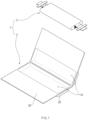
- FIG. 1 is an assembly view illustrating a secondary battery 1 according to embodiments of the present invention.
- the secondary battery 1 may include an electrode assembly 2.
- An electrode and a separator may be alternately stacked to provide the electrode assembly 2.
- the electrode assembly 2 may be provided by alternately stacking electrodes (e.g., a positive electrode and a negative electrode) with a separator therebetween.
- the electrode assembly 2 may include electrode tabs, and the electrode tabs may be connected to the positive electrode and the negative electrode, respectively.
- the electrode assembly 2 may include an electrode lead.
- the electrode lead may be connected to the electrode tabs and electrically connect the electrodes to the outside.
- the electrode assembly 2 is not limited to those described above, and may be described in the general context of the relevant technical field.
- the secondary battery 1 may include a battery case 3.
- the battery case 3 may accommodate the electrode assembly 2 therein.
- the battery case 3 may be a pouch type battery case.
- the electrode assembly 2 may be accommodated in the battery case 3, and an edge of the battery case 3 may be sealed.
- the battery case 3 may include an accommodation part 10.
- the accommodation part 10 may be a portion in which the electrode assembly 2 is accommodated and seated in the battery case 3.
- the accommodation part 10 may define an accommodation space in which the electrode assembly 2 may be accommodated.
- the battery case 3 may include a cup part 20.
- the cup part 20 may be provided to have a shape surrounding the accommodation part 10.
- the accommodation part 10 may be provided.
- the battery case 3 may include a degassing part 30.
- the degassing part 30 may be provided on a side portion of the cup part 20 and discharge a gas generated in the cup part 20 through a degassing hole.
- the battery case 3 may include an edge 40.
- a portion of the degassing part 30 may be cut from the battery case 3 after a degassing process is performed. As the portion of the degassing part 30 is cut, the degassing part 30 may be decreased in length, and the secondary battery 1 may be reduced in volume. A remaining portion of the degassing part 30 after the portion thereof is cut may be the edge 40.
- the edge 40 may be preferably folded.
- the method for manufacturing the secondary battery 1 may include a folding process of folding the edge 40 according to S100.
- the edge 40 may be folded multiple times.
- the edge 40 may be folded twice using a double side folding (DSF) process.
- the edge 40 may include a first folding part 41 and a second folding part 42.
- the first folding part 41 is a portion folded at a position that is relatively closer to an end of the edge 40
- the second folding part 42 is a portion folded at a position that is relatively closer to the cup part 20.
- the edge 40 may be primarily folded on the basis of the first folding part 41, and then the edge 40 may be secondarily folded on the basis of the second folding part 42.
- the adhesive member 100 may be attached to the secondary battery 1 through the attaching process.
- the adhesive member 100 may be attached while covering a portion of the edge 40 and a portion of the cup part 20.
- the adhesive member 100 may be attached to the edge 40 so that the edge 40 is fixed in a state of being folded toward the cup part 20.
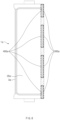
- the attaching process may include attaching a plurality of adhesive members 100 to the edge 40 so as to be spaced apart from each other.
- the adhesive member 100 may be provided in plurality, and the plurality of adhesive members 100 may be attached at intervals along the edge 40.
- the adhesive member 100 may be provided in three, and the three adhesive members 100 may be attached at intervals along the edge 40.
- the number of the adhesive members 100 is not limited to the foregoing example.
- the non-attachment area 300 may be formed.
- the non-attachment area 300 to which the adhesive member 100 is not attached may be formed between the plurality of adhesive members 100.
- the pressing apparatus 200 may press the non-attachment area 300 at a side of an edge 40 in a direction in which a thickness t of the non-attachment area 300 is decreased in a lateral direction of the secondary battery 1.
- the pressing apparatus 200 may include the protrusion 220.
- the protrusion 220 may protrude from the body 210 toward the edge 40 so as to press at least a portion of a remaining area (or non-attachment area 300) except a partial area (or attachment area) to which the adhesive member 100 is attached.
- the protrusion 220 may protrude from the body 210 to form a predetermined pattern.
- the predetermined pattern may be determined according to a pressing area (e.g., pressing area 400), which is pressed by the protrusion 220, of the non-attachment area 300.
- the pressing apparatus 200 may be provided to be capable of being heated.
- the protrusion 220 which is provided so as to press at least a portion of the non-attachment area 300, may be provided to be heated to at least a temperature exceeding room temperature.
- the protrusion 220 of the pressing apparatus 200 may protrude to form a pattern provided so that an area, which is disposed between the adhesive members 100, of the non-attachment area 300 is at least pressed.
- the protrusion 220 may protrude to form a pattern as in FIG. 5 , so that an area (or pressing area 400), which is disposed between the adhesive members 100, of the non-attachment area 300 of the edge 40 is mainly pressed.
- the protrusion 220 may protrude to formed a pattern provided so as to press the area between the adhesive members 100.
- the area (or pressing area 400) between the adhesive members 100 may be an area in which a difference in thickness between the non-attachment area 300 and the attachment area to which the adhesive member 100 is attached is greatest.
- a thickness of the non-attachment area 300 having the greatest thickness difference and a thickness of the attachment area, to which the adhesive member 100 is attached may be uniform.
- a partial area of the non-attachment area 300 may be thermo-compressed.
- at least a partial area (e.g., area between the adhesive members 100) of the non-attachment area 300, to which the adhesive members 100 are not attached, of the edge 40 may be thermo-compressed by being heated and pressed by the protrusion 220 protruding to form a predetermined pattern.
- a thickness of at least an area, which is disposed between the adhesive members 100, of the non-attachment area 300, to which the adhesive member 100 is not attached, of the folded edge 40 may correspond to or be less than the thickness of the attachment area to which the adhesive member 100 is attached.
- a protrusion 220a of the pressing apparatus 200a may protrude to form a pattern provided so that the non-attachment area 300a is at least pressed.
- the protrusion 220a may protrude to form a pattern as in FIG. 7 so that the entirety of the non-attachment area 300a of an edge 40a is pressed.
- the protrusion 220 may protrude to form a pattern corresponding to a shape of the non-attachment area 300a so that the entirety of the non-attachment area 300a is pressed.
- the pressing area 400a may be an area corresponding to the non-attachment area 300. As the protrusion 220a presses the pressing area 400a, a difference in thickness between the non-attachment area 300a and an attachment area to which an adhesive member 100a is attached may be minimized.
- the pressing apparatus 200a may press the pressing area 400a in a state in which at least the protrusion 220a is heated.
- the protrusion 220a performs the pressing in the heated state, the difference in thickness between the non-attachment area 300a and the attachment area to which the adhesive member 100a is attached may be reduced more effectively.
- the non-attachment area 300a may be thermo-compressed.
- the non-attachment area 300a, to which the adhesive member 100a is not attached, of the edge 40a may be thermo-compressed by being heated and pressed by the protrusion 220a protruding to form a predetermined pattern.
- the thickness of the non-attachment area 300a, to which the adhesive member 100a is not attached, of the folded edge 40a may correspond to or be less than the thickness of the attachment area to which the adhesive member 100a is attached.
- an occurrence of a physical interference caused by the difference in thickness between the areas of the secondary battery 1a may be minimized, and spatial efficiency may be improved when the secondary batteries 1a are stacked.
- a protrusion 220b of the pressing apparatus 200b may protrude to form a pattern provided so that the non-attachment area 300b is at least pressed, and is pressed with a gap from the attachment area to which the adhesive member 100b is attached.
- the protrusion 220b may protrude to form a pattern as in FIG. 9 so that a portion of the non-attachment area 300b of an edge 40b is pressed.
- the protrusion 220b may protrude to form a pattern provided so that a portion of the non-attachment area 300b is pressed, and a portion, which is adjacent to the adhesive member 100b, of the non-attachment area 300b is not pressed.
Landscapes
- Chemical & Material Sciences (AREA)
- Chemical Kinetics & Catalysis (AREA)
- Electrochemistry (AREA)
- General Chemical & Material Sciences (AREA)
- Engineering & Computer Science (AREA)
- Manufacturing & Machinery (AREA)
- Secondary Cells (AREA)
- Sealing Battery Cases Or Jackets (AREA)
Applications Claiming Priority (3)
| Application Number | Priority Date | Filing Date | Title |
|---|---|---|---|
| KR20220127431 | 2022-10-05 | ||
| KR1020230060696A KR20240047899A (ko) | 2022-10-05 | 2023-05-10 | 이차전지, 그 이차전지의 제조방법, 및 그 제조방법에 이용되는 가압장치 |
| PCT/KR2023/011615 WO2024075964A1 (ko) | 2022-10-05 | 2023-08-07 | 이차전지, 그 이차전지의 제조방법, 및 그 제조방법에 이용되는 가압장치 |
Publications (2)
| Publication Number | Publication Date |
|---|---|
| EP4579891A1 true EP4579891A1 (de) | 2025-07-02 |
| EP4579891A4 EP4579891A4 (de) | 2026-03-25 |
Family
ID=90608538
Family Applications (1)
| Application Number | Title | Priority Date | Filing Date |
|---|---|---|---|
| EP23875034.3A Pending EP4579891A4 (de) | 2022-10-05 | 2023-08-07 | Sekundärbatterie, herstellungsverfahren für dieselbe sekundärbatterie und pressvorrichtung für dieses herstellungsverfahren |
Country Status (4)
| Country | Link |
|---|---|
| EP (1) | EP4579891A4 (de) |
| JP (1) | JP2025533333A (de) |
| CN (1) | CN119948678A (de) |
| WO (1) | WO2024075964A1 (de) |
Family Cites Families (13)
| Publication number | Priority date | Publication date | Assignee | Title |
|---|---|---|---|---|
| JP3829502B2 (ja) * | 1998-10-30 | 2006-10-04 | ソニー株式会社 | 非水電解質電池 |
| US9498918B2 (en) * | 2012-09-18 | 2016-11-22 | Ev Group E. Thallner Gmbh | Method and device for embossing |
| KR102112670B1 (ko) * | 2015-10-28 | 2020-05-19 | 주식회사 엘지화학 | 테이핑을 이용하는 벤팅 구조의 전지셀 |
| CN205122651U (zh) * | 2015-11-02 | 2016-03-30 | 宁德新能源科技有限公司 | 软包装锂离子电池 |
| KR102143627B1 (ko) * | 2017-11-21 | 2020-08-11 | 삼성에스디아이 주식회사 | 파우치 타입 이차 전지 |
| CN112041744B (zh) * | 2018-05-04 | 2024-08-13 | Ev集团E·索尔纳有限责任公司 | 印模和用于压印的方法 |
| KR102148997B1 (ko) * | 2019-12-03 | 2020-08-28 | 주식회사 와이에이치티 | 이차전지 셀의 테라스를 폴딩하기 위한 폴딩 설비의 폴딩 장치 |
| KR20210156712A (ko) * | 2020-06-18 | 2021-12-27 | 김광열 | 배터리 셀 측면 폴딩방법 |
| WO2022039533A1 (ko) * | 2020-08-19 | 2022-02-24 | 주식회사 엘지에너지솔루션 | 파우치 형 전지 케이스 및 파우치 형 이차 전지 |
| KR102564839B1 (ko) * | 2020-08-19 | 2023-08-09 | 주식회사 엘지에너지솔루션 | 파우치 형 이차 전지 및 전지 모듈 |
| KR20220127145A (ko) * | 2021-03-10 | 2022-09-19 | 에스케이온 주식회사 | 배터리 셀 제조 장치 |
| KR20220127144A (ko) * | 2021-03-10 | 2022-09-19 | 에스케이온 주식회사 | 배터리 셀 제조 장치 |
| CN216084993U (zh) * | 2021-07-28 | 2022-03-18 | 惠州淏海能源有限公司 | 一种软包装锂电池的折边结构 |
-
2023
- 2023-08-07 EP EP23875034.3A patent/EP4579891A4/de active Pending
- 2023-08-07 WO PCT/KR2023/011615 patent/WO2024075964A1/ko not_active Ceased
- 2023-08-07 JP JP2025518521A patent/JP2025533333A/ja active Pending
- 2023-08-07 CN CN202380068557.6A patent/CN119948678A/zh active Pending
Also Published As
| Publication number | Publication date |
|---|---|
| EP4579891A4 (de) | 2026-03-25 |
| WO2024075964A1 (ko) | 2024-04-11 |
| CN119948678A (zh) | 2025-05-06 |
| JP2025533333A (ja) | 2025-10-06 |
Similar Documents
| Publication | Publication Date | Title |
|---|---|---|
| EP2388847B1 (de) | Sekundärbatterie mit ersten und zweiten Stromsammelplatten, die ineinander verstrickt sind | |
| US11316235B2 (en) | Prismatic secondary battery, assembled battery using the same and method of producing the same | |
| KR101702985B1 (ko) | 이차 전지 | |
| EP4243163A1 (de) | Sekundärbatterie | |
| EP4421942A2 (de) | Batteriepack | |
| EP4375004B1 (de) | Sekundärbatterie und herstellungsverfahren einer solchen sekundärbatterie | |
| KR20170024725A (ko) | 전지 모듈 | |
| US10522871B2 (en) | Secondary battery and current collector terminal | |
| EP4579891A1 (de) | Sekundärbatterie, herstellungsverfahren für dieselbe sekundärbatterie und pressvorrichtung für dieses herstellungsverfahren | |
| CN113258215A (zh) | 二次电池 | |
| KR20180029743A (ko) | 전극 조립체 및 이를 이용한 이차 전지 | |
| KR100277638B1 (ko) | 전극 조립체 제조방법과 전극 조립체 및 이 전극 조립체를 이용한 전지 | |
| US20210384593A1 (en) | Secondary battery | |
| EP4024546A1 (de) | Elektronische anordnung und verfahren zur herstellung davon | |
| US10535858B2 (en) | Secondary battery and current collector terminal | |
| US12592437B2 (en) | Square type battery and manufacturing method of square type battery | |
| KR102458418B1 (ko) | 포케팅 양극체의 제조방법, 포케팅 양극체 및 포케팅 양극체를 포함하는 전극조립체 | |
| KR102458417B1 (ko) | 포케팅 양극체의 제조방법, 포케팅 양극체 및 포케팅 양극체를 포함하는 전극조립체 | |
| US20230369690A1 (en) | Secondary Battery And Method For Manufacturing The Same | |
| EP4696451A1 (de) | Schweissmaskeneinspannvorrichtung | |
| KR20240047899A (ko) | 이차전지, 그 이차전지의 제조방법, 및 그 제조방법에 이용되는 가압장치 | |
| KR102588085B1 (ko) | 리튬이차전지용 전극조립체 | |
| US20250316745A1 (en) | Secondary battery | |
| EP4560823B1 (de) | Vorrichtung zur herstellung einer sekundärbatterie, verfahren zur herstellung einer sekundärbatterie damit und damit hergestellte sekundärbatterie | |
| US20260038978A1 (en) | Battery Module and Manufacturing Method of the Same |
Legal Events
| Date | Code | Title | Description |
|---|---|---|---|
| STAA | Information on the status of an ep patent application or granted ep patent |
Free format text: STATUS: THE INTERNATIONAL PUBLICATION HAS BEEN MADE |
|
| PUAI | Public reference made under article 153(3) epc to a published international application that has entered the european phase |
Free format text: ORIGINAL CODE: 0009012 |
|
| STAA | Information on the status of an ep patent application or granted ep patent |
Free format text: STATUS: REQUEST FOR EXAMINATION WAS MADE |
|
| 17P | Request for examination filed |
Effective date: 20250325 |
|
| AK | Designated contracting states |
Kind code of ref document: A1 Designated state(s): AL AT BE BG CH CY CZ DE DK EE ES FI FR GB GR HR HU IE IS IT LI LT LU LV MC ME MK MT NL NO PL PT RO RS SE SI SK SM TR |
|
| DAV | Request for validation of the european patent (deleted) | ||
| DAX | Request for extension of the european patent (deleted) | ||
| A4 | Supplementary search report drawn up and despatched |
Effective date: 20260223 |
|
| RIC1 | Information provided on ipc code assigned before grant |
Ipc: H01M 50/105 20210101AFI20260217BHEP Ipc: H01M 50/186 20210101ALI20260217BHEP Ipc: B29C 65/00 20060101ALI20260217BHEP Ipc: B29L 31/00 20060101ALI20260217BHEP |