EP4579894A1 - Sekundärbatterie und elektronische vorrichtung - Google Patents
Sekundärbatterie und elektronische vorrichtung Download PDFInfo
- Publication number
- EP4579894A1 EP4579894A1 EP23876822.0A EP23876822A EP4579894A1 EP 4579894 A1 EP4579894 A1 EP 4579894A1 EP 23876822 A EP23876822 A EP 23876822A EP 4579894 A1 EP4579894 A1 EP 4579894A1
- Authority
- EP
- European Patent Office
- Prior art keywords
- zone
- housing
- secondary battery
- thinned
- welding
- Prior art date
- Legal status (The legal status is an assumption and is not a legal conclusion. Google has not performed a legal analysis and makes no representation as to the accuracy of the status listed.)
- Pending
Links
Images


Classifications
-
- H—ELECTRICITY
- H01—ELECTRIC ELEMENTS
- H01M—PROCESSES OR MEANS, e.g. BATTERIES, FOR THE DIRECT CONVERSION OF CHEMICAL ENERGY INTO ELECTRICAL ENERGY
- H01M10/00—Secondary cells; Manufacture thereof
- H01M10/05—Accumulators with non-aqueous electrolyte
- H01M10/058—Construction or manufacture
- H01M10/0587—Construction or manufacture of accumulators having only wound construction elements, i.e. wound positive electrodes, wound negative electrodes and wound separators
-
- H—ELECTRICITY
- H01—ELECTRIC ELEMENTS
- H01M—PROCESSES OR MEANS, e.g. BATTERIES, FOR THE DIRECT CONVERSION OF CHEMICAL ENERGY INTO ELECTRICAL ENERGY
- H01M50/00—Constructional details or processes of manufacture of the non-active parts of electrochemical cells other than fuel cells, e.g. hybrid cells
- H01M50/10—Primary casings; Jackets or wrappings
- H01M50/102—Primary casings; Jackets or wrappings characterised by their shape or physical structure
- H01M50/107—Primary casings; Jackets or wrappings characterised by their shape or physical structure having curved cross-section, e.g. round or elliptic
-
- H—ELECTRICITY
- H01—ELECTRIC ELEMENTS
- H01M—PROCESSES OR MEANS, e.g. BATTERIES, FOR THE DIRECT CONVERSION OF CHEMICAL ENERGY INTO ELECTRICAL ENERGY
- H01M50/00—Constructional details or processes of manufacture of the non-active parts of electrochemical cells other than fuel cells, e.g. hybrid cells
- H01M50/10—Primary casings; Jackets or wrappings
- H01M50/131—Primary casings; Jackets or wrappings characterised by physical properties, e.g. gas permeability, size or heat resistance
- H01M50/133—Thickness
-
- H—ELECTRICITY
- H01—ELECTRIC ELEMENTS
- H01M—PROCESSES OR MEANS, e.g. BATTERIES, FOR THE DIRECT CONVERSION OF CHEMICAL ENERGY INTO ELECTRICAL ENERGY
- H01M50/00—Constructional details or processes of manufacture of the non-active parts of electrochemical cells other than fuel cells, e.g. hybrid cells
- H01M50/50—Current conducting connections for cells or batteries
- H01M50/531—Electrode connections inside a battery casing
- H01M50/533—Electrode connections inside a battery casing characterised by the shape of the leads or tabs
-
- H—ELECTRICITY
- H01—ELECTRIC ELEMENTS
- H01M—PROCESSES OR MEANS, e.g. BATTERIES, FOR THE DIRECT CONVERSION OF CHEMICAL ENERGY INTO ELECTRICAL ENERGY
- H01M50/00—Constructional details or processes of manufacture of the non-active parts of electrochemical cells other than fuel cells, e.g. hybrid cells
- H01M50/50—Current conducting connections for cells or batteries
- H01M50/531—Electrode connections inside a battery casing
- H01M50/536—Electrode connections inside a battery casing characterised by the method of fixing the leads to the electrodes, e.g. by welding
-
- H—ELECTRICITY
- H01—ELECTRIC ELEMENTS
- H01M—PROCESSES OR MEANS, e.g. BATTERIES, FOR THE DIRECT CONVERSION OF CHEMICAL ENERGY INTO ELECTRICAL ENERGY
- H01M50/00—Constructional details or processes of manufacture of the non-active parts of electrochemical cells other than fuel cells, e.g. hybrid cells
- H01M50/50—Current conducting connections for cells or batteries
- H01M50/531—Electrode connections inside a battery casing
- H01M50/538—Connection of several leads or tabs of wound or folded electrode stacks
-
- Y—GENERAL TAGGING OF NEW TECHNOLOGICAL DEVELOPMENTS; GENERAL TAGGING OF CROSS-SECTIONAL TECHNOLOGIES SPANNING OVER SEVERAL SECTIONS OF THE IPC; TECHNICAL SUBJECTS COVERED BY FORMER USPC CROSS-REFERENCE ART COLLECTIONS [XRACs] AND DIGESTS
- Y02—TECHNOLOGIES OR APPLICATIONS FOR MITIGATION OR ADAPTATION AGAINST CLIMATE CHANGE
- Y02E—REDUCTION OF GREENHOUSE GAS [GHG] EMISSIONS, RELATED TO ENERGY GENERATION, TRANSMISSION OR DISTRIBUTION
- Y02E60/00—Enabling technologies; Technologies with a potential or indirect contribution to GHG emissions mitigation
- Y02E60/10—Energy storage using batteries
Definitions
- a structure with tabs on two terminals is commonly used, where the tabs are welded to a current collector and then are connected to the bottom of a housing via resistance welding or laser welding.
- the battery housing is designed to be thick to ensure impact resistance of the battery.
- this results in the need for higher welding power when the laser passes through the steel shell to weld to the current collector plate or the tabs during the laser welding process at the bottom.
- the fluctuation of laser accuracy also increases, resulting in a small welding window.
- the problems such as deformation, cracks, and perforation frequently occur at the bottom of the battery, leading to low welding yield.
- Some embodiments of this application provide a secondary battery and an electronic device, which can solve problems such as deformation, cracks, and perforation at the bottom of the battery caused by an increase in welding power during laser welding, helping improve a welding yield at the bottom of the battery and also enhancing reliability welding of the bottom of the battery.
- this application provides a secondary battery.
- the secondary battery includes a housing, an electrode assembly, and a current collector plate.
- the current collector plate is electrically connected to the electrode assembly.
- the bottom of the housing includes a main body zone and a thinned zone connecting to the main body zone, that is, the thinned zone is provided at the bottom of the housing, where the thinned zone is electrically connected to the current collector plate, and area of the thinned zone accounts for 2% to 30% of total area of the bottom of the housing.
- the area of the thinned zone refers to a projection area of the thinned zone at the bottom of the housing in a direction perpendicular to the main body zone.
- the area of the thinned zone accounts for 4% to 15% of the total area of the bottom of the housing. Further controlling the proportion of the area of the thinned zone in the total area of the bottom of the housing within the range of 4% to 15% is conducive to further improving the welding yield and enhancing the welding reliability.
- a ratio of the thickness of the thinned zone to the thickness of the main body zone is 30% to 80%. Controlling the ratio of the thickness of the thinned zone to the thickness of the main body zone within an appropriate range is conducive to improving the welding yield. If the ratio of the thickness of the thinned zone to the thickness of the main body zone is excessively small, overall strength of the bottom of the housing is weakened, and gas generation in the battery after electrical connection may cause bulging or even deformation at the bottom of the housing. If the ratio of the thickness of the thinned zone to the thickness of the main body zone is excessively large, the welding power during welding at the bottom increases, and high welding power leads to cracks at the bottom of the housing.
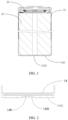
- An outer surface of the bottom 110 of the housing is recessed in a direction facing the negative electrode current collector plate 14 to form the thinned zone 1101.
- the distance shown as b in FIG. 3 indicates the thickness of the thinned zone 1101, and the distance shown as a indicates the thickness of the main body zone 1102.
- the outer surface of the bottom 110 of the housing is thinned, so that the outer surface is recessed to form the thinned zone 1101, where the thinned zone 1101 is integrally formed with the bottom 110 of the housing.
- the prepared cell assembly was placed in the prepared housing 11.
- the end surface of the convex end of the boss 140 concentrically fits to one side surface of the thinned zone 1101.
- the thinned zone 1101 was welded to the boss 140 via penetration welding, and the thinned zone 1101 was welded and connected to the negative electrode current collector plate 14.
- an electrolyte was injected, and the positive electrode current collector plate 13 at the other end of the jelly roll 12 was welded to a cap.
- the cap carries a positive charge.
- a cover plate and the housing were subjected to end cover sealing via laser welding or clamp sealing to form the secondary battery. Test results are shown in Table 2.
- Example 1 0.18% 0.00% 0.01% 0.00% 99.81%
- Example 2 0.00% 0.10% 0.01% 0.00% 99.89%
- Example 3 0.03% 0.01% 0.01% 0.00% 99.95%
- Example 4 0.00% 0.00% 0.01% 0.00% 99.99%
- Example 5 0.00% 0.05% 0.01% 0.00% 99.94%
- Example 6 0.00% 0.06% 0.01% 0.00% 99.93%
- Example 7 0.00% 0.00% 0.15% 0.00% 99.85%
- Example 8 0.00% 0.02% 0.01% 0.00% 99.97%
- Example 9 0.00% 0.00% 0.12% 0.00% 99.88%
- Example 10 0.00% 0.00% 0.01% 0.03% 99.96%
- Example 11 0.00% 0.00% 0.01% 0.01% 0.01% 99.98%
- Example 12 0.00% 0.00% 0.01% 0.03% 99.96%
- Example 13 0.00%
- Example 18 the crack rate is up to 0.4% during welding test at the bottom of the battery, resulting in a welding yield of only 99.60%, about 0.21% lower than the welding yield in Example 1. It can be seen that the ratio of the thickness of the thinned zone to the thickness of the main body zone being within an appropriate range is conducive to improving welding yield.
- Example 19 With reference to comparison between Comparative example 19 and Example 1, in Example 19, the ratio of the projection area of the convex end of the boss to the projection area of the thinned zone is only 0.5:1 (lower than the range of 0.6:1 to 0.98:1 disclosed in this application), and during welding test at the bottom, the perforation rate is 0.25%, resulting in a welding yield of only 99.75%. It can be seen that the ratio of the projection area of the convex end of the boss to the projection area of the thinned zone being within an appropriate range is conducive to improving the welding yield at the bottom of the battery.
- Example 20 With reference to comparison between Example 20 and Example 1, in Example 20, the ratio of the thickness of the boss to the difference between the thickness of the main body zone and the thickness of the thinned zone is only 0.8 (lower than the range of 1.0 to 1.3 disclosed in this application), and during welding test at the bottom, the perforation rate is 0.25% and the welding yield is only 99.74%. It can be seen that the ratio of the thickness of the boss to the difference between the thickness of the main body zone and the thickness of the thinned zone being within an appropriate range is conducive to improving the welding yield at the bottom of the battery.
- Examples 2 to 16 are parallel examples of Example 1.
- the welding yields in Examples 1 to 16 are all higher than 99.81%, with the highest welding yield up to 99.99%. It can be seen that optimizing the area of the thinned zone and the thickness of the thinned zone and providing an appropriate boss size can further improve the welding yield at the bottom of the battery.
Landscapes
- Chemical & Material Sciences (AREA)
- Chemical Kinetics & Catalysis (AREA)
- Electrochemistry (AREA)
- General Chemical & Material Sciences (AREA)
- Engineering & Computer Science (AREA)
- Manufacturing & Machinery (AREA)
- Sealing Battery Cases Or Jackets (AREA)
- Connection Of Batteries Or Terminals (AREA)
Applications Claiming Priority (2)
| Application Number | Priority Date | Filing Date | Title |
|---|---|---|---|
| CN202211257888.8A CN115332693B (zh) | 2022-10-14 | 2022-10-14 | 二次电池以及电子设备 |
| PCT/CN2023/124561 WO2024078623A1 (zh) | 2022-10-14 | 2023-10-13 | 二次电池以及电子设备 |
Publications (2)
| Publication Number | Publication Date |
|---|---|
| EP4579894A1 true EP4579894A1 (de) | 2025-07-02 |
| EP4579894A4 EP4579894A4 (de) | 2026-02-11 |
Family
ID=83914262
Family Applications (1)
| Application Number | Title | Priority Date | Filing Date |
|---|---|---|---|
| EP23876822.0A Pending EP4579894A4 (de) | 2022-10-14 | 2023-10-13 | Sekundärbatterie und elektronische vorrichtung |
Country Status (4)
| Country | Link |
|---|---|
| US (1) | US20250167355A1 (de) |
| EP (1) | EP4579894A4 (de) |
| CN (1) | CN115332693B (de) |
| WO (1) | WO2024078623A1 (de) |
Families Citing this family (5)
| Publication number | Priority date | Publication date | Assignee | Title |
|---|---|---|---|---|
| CN115332693B (zh) * | 2022-10-14 | 2023-06-09 | 宁德新能源科技有限公司 | 二次电池以及电子设备 |
| CN116487830A (zh) * | 2023-03-17 | 2023-07-25 | 蓝京新能源(嘉兴)有限公司 | 一种圆柱铝电池及其制备工艺 |
| CN118017164A (zh) * | 2023-07-12 | 2024-05-10 | 宁德新能源科技有限公司 | 电池、电子设备及极性引出方法 |
| DE102024113269A1 (de) * | 2024-05-13 | 2025-11-13 | Bayerische Motoren Werke Aktiengesellschaft | Verfahren zum herstellen einer batteriezelle |
| CN119674458A (zh) * | 2024-12-10 | 2025-03-21 | 惠州亿纬锂能股份有限公司 | 圆柱电池的负极连接方法 |
Family Cites Families (13)
| Publication number | Priority date | Publication date | Assignee | Title |
|---|---|---|---|---|
| CN2757344Y (zh) * | 2004-05-13 | 2006-02-08 | 深圳市比克电池有限公司 | 一种圆柱型锂二次电池 |
| CN102150299B (zh) * | 2009-05-25 | 2014-05-28 | 丰田自动车株式会社 | 电池组、搭载有该电池组的车辆和设备 |
| KR101281038B1 (ko) * | 2010-12-07 | 2013-07-09 | 주식회사 엘지화학 | 캡 조립체 및 이를 이용한 이차 전지 |
| FR3039709B1 (fr) * | 2015-07-28 | 2017-08-18 | Commissariat Energie Atomique | Accumulateur au lithium a surete de fonctionnement amelioree par un dispositif coupe-circuit integre |
| KR102604484B1 (ko) * | 2018-05-02 | 2023-11-22 | 삼성에스디아이 주식회사 | 이차 전지 |
| WO2022116909A1 (zh) * | 2020-12-04 | 2022-06-09 | 中澳储能电力科技(西安)有限公司 | 一种大容量锂离子电池 |
| CN213520071U (zh) * | 2020-12-05 | 2021-06-22 | 道克特斯(天津)新能源科技有限公司 | 无极耳焊接的电池 |
| CN214378624U (zh) * | 2021-03-31 | 2021-10-08 | 蜂巢能源科技(无锡)有限公司 | 电池连接片安装结构、电池模组和电池 |
| CN216213951U (zh) * | 2021-10-21 | 2022-04-05 | 宁德时代新能源科技股份有限公司 | 集流盘、电池单体、电池及用电装置 |
| CN216793949U (zh) * | 2022-02-24 | 2022-06-21 | 中创新航科技股份有限公司 | 电池及电池组 |
| CN114784464A (zh) * | 2022-03-18 | 2022-07-22 | 多氟多新能源科技有限公司 | 一种电芯及电池模组 |
| CN114937854B (zh) * | 2022-05-24 | 2025-12-09 | 微宏动力系统(湖州)有限公司 | 电池组件、电池及电动交通工具 |
| CN115332693B (zh) * | 2022-10-14 | 2023-06-09 | 宁德新能源科技有限公司 | 二次电池以及电子设备 |
-
2022
- 2022-10-14 CN CN202211257888.8A patent/CN115332693B/zh active Active
-
2023
- 2023-10-13 EP EP23876822.0A patent/EP4579894A4/de active Pending
- 2023-10-13 WO PCT/CN2023/124561 patent/WO2024078623A1/zh not_active Ceased
-
2025
- 2025-01-17 US US19/027,896 patent/US20250167355A1/en active Pending
Also Published As
| Publication number | Publication date |
|---|---|
| WO2024078623A1 (zh) | 2024-04-18 |
| US20250167355A1 (en) | 2025-05-22 |
| CN115332693B (zh) | 2023-06-09 |
| EP4579894A4 (de) | 2026-02-11 |
| CN115332693A (zh) | 2022-11-11 |
Similar Documents
| Publication | Publication Date | Title |
|---|---|---|
| US20250167355A1 (en) | Secondary battery and electronic device | |
| EP4024602A1 (de) | Batterie und angetriebenes gerät, das mit einer batterie versehen ist | |
| US11258143B2 (en) | Battery module, secondary battery and cap assembly thereof | |
| CN102347464A (zh) | 可再充电电池 | |
| US20250246775A1 (en) | Battery cell and assembling method thereof, battery, electrical apparatus, and assembling assembly | |
| CN114665233A (zh) | 电池 | |
| EP3926751A1 (de) | Stromabnehmerelement und herstellungsverfahren dafür, sekundärbatterie und herstellungsverfahren dafür, batteriemodul und vorrichtung | |
| JP2004103575A (ja) | 円筒型リチウム二次電池とその製造方法 | |
| JP2005332820A (ja) | 電極組立体を有する二次電池 | |
| US20250158180A1 (en) | Pole, top cover structure, battery, battery module and battery pack | |
| EP4579778A1 (de) | Zylindrische batteriezelle und zylindrische sekundärbatterie | |
| CN216213745U (zh) | 一种方形二次电池的顶盖及二次电池 | |
| EP4228049B1 (de) | Batterie und elektronische vorrichtung damit | |
| WO2018056483A1 (ko) | 이차 전지 | |
| EP3703160B1 (de) | Sekundärbatterie | |
| CN115224340A (zh) | 一种圆柱电池结构的装配工艺 | |
| US20040126648A1 (en) | Electrode unit and secondary battery using the same | |
| JP2004127541A (ja) | 電池用電極群およびそれを用いた非水電解液二次電池 | |
| JP2005085556A (ja) | リチウムイオン電池およびその製造方法 | |
| US20230369726A1 (en) | Connecting Member and Battery | |
| CN1577939A (zh) | 棱柱形电池及其制造方法 | |
| WO2024082112A1 (zh) | 电池单体、电池以及用电装置 | |
| JP2010123410A (ja) | 角形密閉型電池 | |
| EP4401182A1 (de) | Zylindrische sekundärbatterie und elektronische vorrichtung | |
| CN223713012U (zh) | 电池和用电装置 |
Legal Events
| Date | Code | Title | Description |
|---|---|---|---|
| STAA | Information on the status of an ep patent application or granted ep patent |
Free format text: STATUS: THE INTERNATIONAL PUBLICATION HAS BEEN MADE |
|
| PUAI | Public reference made under article 153(3) epc to a published international application that has entered the european phase |
Free format text: ORIGINAL CODE: 0009012 |
|
| STAA | Information on the status of an ep patent application or granted ep patent |
Free format text: STATUS: REQUEST FOR EXAMINATION WAS MADE |
|
| 17P | Request for examination filed |
Effective date: 20250326 |
|
| AK | Designated contracting states |
Kind code of ref document: A1 Designated state(s): AL AT BE BG CH CY CZ DE DK EE ES FI FR GB GR HR HU IE IS IT LI LT LU LV MC ME MK MT NL NO PL PT RO RS SE SI SK SM TR |
|
| REG | Reference to a national code |
Ref country code: DE Ref legal event code: R079 Free format text: PREVIOUS MAIN CLASS: H01M0050107000 Ipc: H01M0010058700 |
|
| DAV | Request for validation of the european patent (deleted) | ||
| DAX | Request for extension of the european patent (deleted) | ||
| A4 | Supplementary search report drawn up and despatched |
Effective date: 20260114 |
|
| RIC1 | Information provided on ipc code assigned before grant |
Ipc: H01M 10/0587 20100101AFI20260108BHEP Ipc: H01M 50/107 20210101ALI20260108BHEP Ipc: H01M 50/533 20210101ALI20260108BHEP Ipc: H01M 50/536 20210101ALI20260108BHEP Ipc: H01M 50/538 20210101ALI20260108BHEP |