EP4580084A1 - Procédé, appareil et système d'estimation de canal - Google Patents
Procédé, appareil et système d'estimation de canal Download PDFInfo
- Publication number
- EP4580084A1 EP4580084A1 EP22958983.3A EP22958983A EP4580084A1 EP 4580084 A1 EP4580084 A1 EP 4580084A1 EP 22958983 A EP22958983 A EP 22958983A EP 4580084 A1 EP4580084 A1 EP 4580084A1
- Authority
- EP
- European Patent Office
- Prior art keywords
- ris
- unit cells
- reference signals
- network device
- channel
- Prior art date
- Legal status (The legal status is an assumption and is not a legal conclusion. Google has not performed a legal analysis and makes no representation as to the accuracy of the status listed.)
- Pending
Links
Images


Classifications
-
- H—ELECTRICITY
- H04—ELECTRIC COMMUNICATION TECHNIQUE
- H04B—TRANSMISSION
- H04B7/00—Radio transmission systems, i.e. using radiation field
- H04B7/02—Diversity systems; Multi-antenna system, i.e. transmission or reception using multiple antennas
- H04B7/04—Diversity systems; Multi-antenna system, i.e. transmission or reception using multiple antennas using two or more spaced independent antennas
- H04B7/04013—Intelligent reflective surfaces
-
- H—ELECTRICITY
- H04—ELECTRIC COMMUNICATION TECHNIQUE
- H04B—TRANSMISSION
- H04B7/00—Radio transmission systems, i.e. using radiation field
- H04B7/02—Diversity systems; Multi-antenna system, i.e. transmission or reception using multiple antennas
- H04B7/04—Diversity systems; Multi-antenna system, i.e. transmission or reception using multiple antennas using two or more spaced independent antennas
- H04B7/0413—MIMO systems
- H04B7/0456—Selection of precoding matrices or codebooks, e.g. using matrices antenna weighting
-
- H—ELECTRICITY
- H04—ELECTRIC COMMUNICATION TECHNIQUE
- H04B—TRANSMISSION
- H04B7/00—Radio transmission systems, i.e. using radiation field
- H04B7/02—Diversity systems; Multi-antenna system, i.e. transmission or reception using multiple antennas
- H04B7/04—Diversity systems; Multi-antenna system, i.e. transmission or reception using multiple antennas using two or more spaced independent antennas
- H04B7/06—Diversity systems; Multi-antenna system, i.e. transmission or reception using multiple antennas using two or more spaced independent antennas at the transmitting station
- H04B7/0686—Hybrid systems, i.e. switching and simultaneous transmission
- H04B7/0695—Hybrid systems, i.e. switching and simultaneous transmission using beam selection
-
- H—ELECTRICITY
- H04—ELECTRIC COMMUNICATION TECHNIQUE
- H04L—TRANSMISSION OF DIGITAL INFORMATION, e.g. TELEGRAPHIC COMMUNICATION
- H04L25/00—Baseband systems
- H04L25/02—Details ; arrangements for supplying electrical power along data transmission lines
- H04L25/0202—Channel estimation
-
- H—ELECTRICITY
- H04—ELECTRIC COMMUNICATION TECHNIQUE
- H04L—TRANSMISSION OF DIGITAL INFORMATION, e.g. TELEGRAPHIC COMMUNICATION
- H04L5/00—Arrangements affording multiple use of the transmission path
- H04L5/003—Arrangements for allocating sub-channels of the transmission path
- H04L5/0048—Allocation of pilot signals, i.e. of signals known to the receiver
Definitions
- a RIS channel may include a channel between the base station and the RIS and a channel between the RIS and the UE.
- the RIS channel is estimated, so that the base station can perform processing such as downlink precoding.
- the RIS includes a plurality of unit cells.
- a quantity of reference signals sent by the UE needs to be greater than or equal to a quantity of unit cells included in the RIS.
- the RIS usually includes a large quantity of unit cells, for example, thousands of unit cells. As a result, it can be learned that overheads of the reference signal that are caused by estimating the RIS channel are large.
- Embodiments of this application provide a channel estimation method, an apparatus, and a system, to reduce overheads of a reference signal when a RIS channel is estimated.
- a first channel estimation method may be performed by a terminal device, may be performed by another device including a function of a terminal device, or performed by a chip system (or a chip) or another functional module.
- the chip system or the functional module can implement the corresponding function of the terminal device.
- the chip system or the functional module is disposed in the terminal device.
- the method includes: sending T 1 reference signals, where the T 1 reference signals are reflected to a network device through a RIS, T 1 is a positive integer less than M, and M is a quantity of unit cells included in the RIS; receiving first information from the network device, where the first information indicates a value of T 2 , and T 2 is a positive integer less than M; and sending T 2 reference signals, where the T 2 reference signals are reflected to the network device through the RIS, the T 2 reference signals are used to estimate a cascaded channel, and the cascaded channel includes a channel between the network device and the RIS and a channel between the RIS and the terminal device.
- a second channel estimation method may be performed by a network device, may be performed by another device including a function of a network device, or performed by a chip system (or a chip) or another functional module.
- the chip system or the functional module can implement the corresponding function of the network device.
- the chip system or the functional module is disposed in the network device.
- the method includes: receiving T 1 reference signals that are from a terminal device and that are reflected by a first subarray of a RIS, where the RIS includes M unit cells, the first subarray includes N unit cells in the M unit cells, M is a positive integer, N is a positive integer less than M, and T 1 is a positive integer greater than or equal to N and less than M; estimating a path of an angular domain of a cascaded channel based on the T 1 reference signals, and determining a first codebook based on the path of the angular domain, where the first codebook includes at least one weight, the at least one weight is weights of E unit cells in the M unit cells, the cascaded channel includes a channel between the network device and the RIS and a channel between the RIS and the terminal device, and E is a positive integer less than or equal to M; sending third information to the RIS, where the third information indicates the first codebook, and the first codebook is used by the RIS to reflect a reference signal; receiving T 2 reference
- a structure of the dictionary matrix of the angular domain and a structure of a DFT matrix are similar, and each column of the dictionary matrix is orthogonal to each other.
- a dimension of D r new is T 2 ⁇ R, and R represents a resolution of the angular domain.
- Span(A) column vector space Span(A) of the matrix A.
- b needs to belong to subspace of Span(A) (where b belongs to both the subspace and full space of Span(A)).
- Span( A sub ) the subspace of Span(A) to which b belongs.
- a sub includes one or more column vectors of the matrix A, and x corresponding to these column vectors is denoted as x sub . If A sub and x sub can be obtained, the following optimization problem can be solved: argmin x sub A sub x sub ⁇ b 2 2
- Steps of the OMP algorithm are as follows:
- a S A sub
- x S x sub .
- L t -1 ⁇ i represents an intersection of L t -1 and i.
- D r (:, i ) represents taking i column vectors of a matrix D r
- D r (:, i ) H represents a conjugate transpose matrix of D r (:, i ) .
- argmax f(x) represents a variable value that enables the target function f(x) to be a maximum value.
- Res represents a residual
- Res 0 represents an initialized residual (for example, b)
- Res t -1 represents a residual obtained in a (t-1) th cycle (or iteration) process
- Res t represents a residual obtained in a t th cycle (or iteration) process.
- L t -1 represents a set of indexes, in the dictionary matrix, of paths of the angular domain determined in the (t-1) th cycle (or iteration) process
- L t represents a set of indexes, in the dictionary matrix, of paths of the angular domain determined in the t th cycle (or iteration) process.
- the OMP algorithm selects one variable in each iteration process and puts the variable into the subspace, so that it can be ensured that an optimal solution is selected in each iteration.
- the two variables may not be two globally optimal solutions from a comprehensive perspective.
- Table 1 It can be learned that, in each iteration process, the OMP algorithm focuses on a current optimal solution, but does not focus on a globally optimal solution. As a result, a finally selected variable may not be a globally optimal variable. This causes a problem of local optimality in the OMP algorithm.
- "index" represents an index of a column vector in the matrix A.
- the multi-step-OMP algorithm may be used to determine the path L of the angular domain. Steps of the multi-step-OMP algorithm are as follows:
- a P represents a set of P column vectors that have a largest residual in column vectors included in the matrix A.
- r k represents a residual of a k th cycle (or iteration).
- an element that is in the set S and that has a small projection on the matrix b can be removed.
- the removed element may include an element that has a correlation in the set S.
- a side lobe may be generated on a variable corresponding to another index in the set S because energy of the plurality of paths is concentrated.
- the variable corresponding to the index is also a path, and the index is considered as a correlated element in the set S. Therefore, in this embodiment of this application, when the multi-step-OMP algorithm is used, a correlated element may be removed, which is equivalent to removing a mistakenly determined path, so that an obtained result is closer to a real path in the angular domain.
- processing manners such as selecting a large quantity of variables in each iteration process and removing the correlated element by using the multi-step-OMP algorithm can minimize a case of local optimality and improve the probability of obtaining the globally optimal solution.
- the network device may determine the first codebook based on the path of the angular domain.
- the first codebook may include at least one weight.
- one row vector in the first codebook is one weight, or one column vector in the first codebook is one weight.
- Each of the at least one weight is a weight of E unit cells included in the RIS, where E is a positive integer less than or equal to M.
- each weight may be a weight of the M unit cells included in the RIS, or may be a weight of some unit cells included in the RIS.
- E E unit cells
- the E unit cells and the N unit cells are different unit cells, or the E unit cells and the N unit cells may have an intersection but are not completely the same. In the two cases, E may be equal to or not equal to N.
- the RIS may weight the reference signal based on the weight included in the first codebook. For example, each time the RIS reflects one reference signal, the RIS weights the reference signal based on one weight included in the first codebook or weights a dictionary matrix of the angular domain, to obtain a new matrix after weighting. If the new matrix is not orthogonal to the path of the angular domain, a residual is generated. Consequently, accuracy of a channel estimation result is reduced. Therefore, in this embodiment of this application, the new matrix obtained based on each weight included in the first codebook may be enabled to be orthogonal to the path of the angular domain, to improve the accuracy of the channel estimation result.
- G angle represents an angular domain matrix of the cascaded channel, and a dimension of G angle is M ⁇ K.
- D r represents an original dictionary matrix of the angular domain, and D r H represents a conjugate transpose matrix of D r .
- X may be replaced with N
- ⁇ may be replaced with 2 ⁇ d ⁇ f ⁇ 0 , 2 ⁇ d ⁇ f ⁇ R , or the like. That is, a calculation manner of a formula such as a N 2 ⁇ d ⁇ f ⁇ 0 , ... , a N 2 ⁇ d ⁇ f ⁇ R in Formula 12 is provided herein.
- d represents a physical distance between adjacent unit cells included in the RIS
- ⁇ represents a wavelength of an operating frequency band of the RIS.
- ⁇ 0 represents a 1 st angle of the matrix D r
- ⁇ R represents an R th angle of the matrix D r .
- R represents the resolution of the angular domain.
- f ( ⁇ ) is sin( ⁇ ), cos( ⁇ ), cos( a )sin( ⁇ ), or sin( a )cos( ⁇ ). If f( ⁇ ) is cos( a )sin( ⁇ ) or sin( a )cos( ⁇ ), it indicates that a structure of the RIS is a two-dimensional planar structure. In this case, ⁇ may represent a horizontal angle, and a may represent a vertical angle. Alternatively, ⁇ may represent a vertical angle, and a may represent a horizontal angle.
- a dimension of D r may be related to the first subarray. For example, the first subarray is a linear array.
- the dimension of D r may be N ⁇ R.
- the dimension of D r may be pq ⁇ R 2 .
- D rH represents a row matrix
- D rV represents a column matrix
- a dimension of D rH is p ⁇ R
- a dimension of D rV is q ⁇ R
- p ⁇ q is a dimension of the first subarray. That is, p is a quantity of rows of the unit cells included in the first subarray, and q is a quantity of columns of the unit cells included in the first subarray.
- a ⁇ b represents solving for a Kronecker product of a and b.
- D r (:,L) represents taking L column vectors in D r , and a dimension of D r (:,L) is M ⁇ L.
- G ⁇ angle represents an estimated value of the angular domain of the cascaded channel, and a dimension of G ⁇ angle is L ⁇ K.
- L represents the path of the angular domain of the cascaded channel.
- D r in Formula 14 is replaced with W H D r , this may represent a new matrix obtained by performing weighting once.
- Formula 14 is transformed as follows: W H D r G angle ⁇ W H D r : , L G ⁇ angle : , L
- W Dr represents the first codebook
- D r new represents a new dictionary matrix that is of the angular domain and that is obtained based on the first codebook
- D r represents the original dictionary matrix of the angular domain
- L represents the path of the angular domain
- D r (:, L ) -1 represents an inverse of D r (:, L).
- each weight included in the first codebook may be the weight of the E unit cells included in the RIS, where E may be a positive integer less than or equal to M.
- a dimension of the first codebook represented by Formula 16 is M ⁇ T 2 , where T 2 is a quantity of reference signals reflected by the RIS based on the first codebook.
- E corresponding to the first codebook represented by Formula 16 is equal to M. If the RIS uses the first codebook, the RIS reflects the T 2 reference signals by using all unit cells.
- the weight included in the first codebook may alternatively be weights of some unit cells in the M unit cells.
- the RIS may alternatively use some unit cells to reflect the T 2 reference signals.
- W Dr_sub represents a first codebook corresponding to the E unit cells. It may be understood as that W Dr_sub includes one or more weights, and each weight is the weight of the E unit cells.
- D r new represents the new dictionary matrix that is of the angular domain and that is obtained based on the first codebook
- Dr_sub represents a dictionary matrix of an angular domain of the E unit cells
- a dimension of the dictionary matrix is E ⁇ L
- L represents the path of the angular domain
- Dr sub (: , L ) -1 represents an inverse of Dr sub (:, L).
- the network device sends third information to the RIS, and correspondingly the RIS receives the third information from the network device.
- the third information may indicate the first codebook.
- the third information may indicate the first codebook in different manners.
- the third information may include the first codebook.
- the RIS may directly obtain the first codebook without excessive processing. Implementation is simple.
- the third information may include L indexes (indexes).
- the L indexes are indexes of the path of the angular domain in the original dictionary matrix (for example, D r ) of the angular domain.
- the RIS may obtain the first codebook based on the L indexes and D r .
- the RIS stores one or more dictionary matrices. If L indexes are received, the RIS may determine, based on the L indexes, corresponding L column vectors in the one or more stored dictionary matrices, and then may determine the first codebook according to some algorithms, for example, Formula (17).
- a quantity of rows of the dictionary matrix may be greater than or equal to a total quantity M of the unit cells included in the RIS.
- an amount of information of the L indexes is small, and the first codebook is indicated by indicating the L indexes, so that transmission overheads of the third information can be reduced.
- the UE sends the T 2 reference signals.
- the UE sends the T 2 reference signals to the network device.
- the RIS is disposed between the UE and the network device, and receives the T 2 reference signals first.
- the UE sends a reference signal T 2 times.
- the reference signal sent each time may be considered as one reference signal.
- the UE may send the T 2 reference signals at T 2 pieces of time.
- One piece of time is, for example, one time point, one OFDM symbol, or one slot.
- T 2 is a positive integer greater than or equal to the path L of the angular domain.
- the path of the angular domain is determined by the network device. Therefore, the network device may indicate a value of T 2 to the UE.
- the network device may further send first information to the UE, where the first information may indicate the value of T 2 , so that the UE can determine the value of T 2 .
- the first information may indicate the path of the angular domain, so that the UE can select a positive integer greater than or equal to the path of the angular domain as T 2 .
- a first estimation procedure the path of the angular domain of the cascaded channel is estimated by using the first subarray and a few reference signals, and the network device uses the estimated path of the angular domain to design and transfer, to the RIS, a RIS weight used in a second estimation procedure.
- the cascaded channel is estimated by using the designed RIS weight.
- a quantity of paths of the angular domain is far less than a quantity of unit cells included in the RIS (for example, in a high frequency case, a current quantity of unit cells included in the RIS is generally about 1000, and paths of the angular domain are generally sparse and may be less than 20), and the designed weight included in the first codebook does not damage orthogonality of the angular domain of the cascaded channel. Therefore, according to the solution provided in this embodiment of this application, overheads of an uplink reference signal can be greatly reduced, and accuracy of channel estimation can be improved.
- the simulation process uses a 3 rd generation partnership project (3 rd generation partnership project, 3GPP) - cluster delay line type A model (cluster delay line type A model, CDL-A).
- 3 rd generation partnership project 3GPP
- 3GPP 3 rd generation partnership project
- CDL-A cluster delay line type A model
- Solution 5 Use a current channel estimation solution, where a UE sends T reference signals, and a RIS use a random Hadamard weight to estimate a channel based on a full array of the RIS and traditional OMP algorithm.
- Table 4 shows a comparison of NMSEs in different technical solutions when quantities of reference signals of the sparse channel are equal in Case 1 (refer to Table 2). Values (for example, 0.03 and 0.82) in Table 4 represent NMSEs.
- Table 5 shows a comparison of NMSEs in different technical solutions when quantities of reference signals of the sparse channel are equal in Case 2 (refer to Table 2). Values (for example, 0.083 and 0.41) in Table 5 represent NMSEs.
- Table 6 shows a comparison of quantities of required reference signals in different technical solutions when NMSEs of a sparse channel are equal in Case 1 (refer to Table 2). Values corresponding to T in Table 6 represent the quantities of reference signals.
- a quantity of T is a sum of T 1 and T 2 .
- Table 7 shows a comparison of quantities of required reference signals in different technical solutions when NMSEs of a sparse channel are equal in Case 2 (refer to Table 2). Values corresponding to T in Table 7 represent the quantities of reference signals.
- a quantity of T is a sum of T 1 and T 2 .
- an embodiment of this application further provides a communication apparatus.
- the communication apparatus may include a corresponding hardware structure and/or software module for performing each function.
- a person skilled in the art should be easily aware that, in this application, the units and method steps in the examples described with reference to embodiments disclosed in this application can be implemented by hardware or a combination of hardware and computer software. Whether a function is performed by hardware or hardware driven by computer software depends on particular application scenarios and design constraint conditions of the technical solutions.
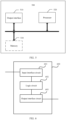
- FIG. 4 to FIG. 6 are diagrams of structures of possible communication apparatuses according to embodiments of this application.
- the communication apparatus may be configured to implement functions of the RIS, the network device, or the UE in the foregoing method embodiments. Therefore, beneficial effects of the foregoing method embodiments can also be implemented.
- the communication apparatus may be the network device or the UE shown in FIG. 1 or FIG. 2 , or may be the RIS shown in FIG. 2 , or may be a module (for example, a chip) used in the UE, the network device, or the RIS.
- a module for example, a chip
- a communication apparatus 400 includes a processing unit 410 and a communication unit 420.
- the communication unit 420 may be a transceiver unit, an input/output interface, or the like.
- the communication apparatus 400 may be configured to implement the function of the RIS, the network device, or the terminal device in the method embodiment shown in FIG. 3 .
- the communication unit 420 is configured to send T 1 reference signals reflected by a first subarray of the RIS to the network device, where the RIS includes M unit cells, the first subarray includes N unit cells in the M unit cells, M is a positive integer, N is a positive integer less than M, and T 1 is a positive integer greater than or equal to N and less than M.
- the communication unit 420 is further configured to receive third information from the network device, where the third information indicates a first codebook, the first codebook includes at least one weight, the at least one weight is weights of the plurality of unit cells, and the first codebook is determined based on the T 1 reference signals.
- the communication unit 420 is further configured to send T 2 reference signals reflected by E unit cells in the M unit cells to the network device, where the T 2 reference signals are used to estimate a cascaded channel, the T 2 reference signals are processed based on the first codebook, T 2 is a positive integer greater than or equal to a path of an angular domain of the cascaded channel and less than M, the cascaded channel includes a channel between the network device and the RIS and a channel between the RIS and the terminal device, and E is a positive integer less than or equal to M.
- the communication unit 420 is configured to receive T 1 reference signals that are from the UE and that are reflected by a first subarray of the RIS, where the RIS includes M unit cells, the first subarray includes N unit cells in the M unit cells, M is a positive integer, N is a positive integer less than M, and T 1 is a positive integer greater than or equal to N and less than M.
- the processing unit 410 is configured to: estimate a path of an angular domain of a cascaded channel based on the T 1 reference signals, and determine a first codebook based on the path of the angular domain, where the first codebook includes at least one weight, the at least one weight is weights of E unit cells in the M unit cells, the cascaded channel includes a channel between the network device and the RIS and a channel between the RIS and the UE, and E is a positive integer less than or equal to M.
- the communication unit 420 is further configured to send third information to the RIS, where the third information indicates the first codebook, and the first codebook is used by the RIS to reflect a reference signal.
- the communication unit 420 is further configured to receive T 2 reference signals that are from the UE and that are reflected by the E unit cells, where the T 2 reference signals are processed based on the first codebook, T 2 is a positive integer greater than or equal to the path of the angular domain and less than M.
- the processing unit 410 is further configured to estimate the cascaded channel based on the T 2 reference signals.
- the communication unit 420 is configured to send T 1 reference signals, where the T 1 reference signals are reflected to the network device through the RIS, T 1 is a positive integer less than M, and M is a quantity of unit cells included in the RIS.
- the communication unit 420 is further configured to receive first information from the network device, where the first information indicates a value of T 2 , and T 2 is a positive integer less than M.
- the communication unit 420 is further configured to send T 2 reference signals, where the T 2 reference signals are reflected to the network device through the RIS, the T 2 reference signals are used to estimate a cascaded channel, and the cascaded channel includes a channel between the network device and the RIS and a channel between the RIS and the UE.
- Division into the modules in embodiments of this application is an example, is merely division into logical functions, and may be other division during actual implementation.
- functional modules in embodiments of this application may be integrated into one processor, or each of the modules may exist alone physically, or two or more modules may be integrated into one module.
- the integrated module may be implemented in a form of hardware, or may be implemented in a form of software functional module.
- FIG. 5 shows a communication apparatus 500 according to an embodiment of this application.
- the communication apparatus 500 is configured to implement the channel estimation method provided in this application.
- the communication apparatus 500 may be a communication apparatus to which the channel estimation method is applied, may be a component in a communication apparatus, or may be an apparatus that can be used in a matching manner with a communication apparatus.
- the communication apparatus 500 may be a RIS, a network device, or a UE.
- the communication apparatus 500 may be a chip system or a chip. In this embodiment of this application, the chip system may include a chip, or may include a chip and another discrete component.
- the communication apparatus 500 includes at least one processor 520, configured to implement the channel estimation method provided in embodiments of this application.
- the communication apparatus 500 may further include an output interface 510, and the output interface may also be referred to as an input/output interface.
- the output interface 510 may be configured to communicate with another apparatus by using a transmission medium, and a function of the output interface 510 may include sending and/or receiving.
- the communication apparatus 500 is a chip
- the communication apparatus 500 performs transmission with another chip or component through the output interface 510.
- the processor 520 may be configured to implement the method described in the foregoing method embodiments.
- the processor 520 may be configured to perform an action performed by the processing unit 410, and the output interface 510 may be configured to perform an action performed by the communication unit 420. Details are not described again.
- These computer program instructions may alternatively be stored in a computer-readable memory that can indicate the computer or the another programmable data processing device to work in a specific manner, so that the instructions stored in the computer-readable memory generate an artifact that includes an instruction apparatus.
- the instruction apparatus implements a specific function in one or more processes in the flowcharts and/or in one or more blocks in the block diagrams.
Landscapes
- Engineering & Computer Science (AREA)
- Signal Processing (AREA)
- Computer Networks & Wireless Communication (AREA)
- Power Engineering (AREA)
- Mobile Radio Communication Systems (AREA)
Applications Claiming Priority (1)
| Application Number | Priority Date | Filing Date | Title |
|---|---|---|---|
| PCT/CN2022/119624 WO2024059969A1 (fr) | 2022-09-19 | 2022-09-19 | Procédé, appareil et système d'estimation de canal |
Publications (2)
| Publication Number | Publication Date |
|---|---|
| EP4580084A1 true EP4580084A1 (fr) | 2025-07-02 |
| EP4580084A4 EP4580084A4 (fr) | 2025-12-17 |
Family
ID=90453646
Family Applications (1)
| Application Number | Title | Priority Date | Filing Date |
|---|---|---|---|
| EP22958983.3A Pending EP4580084A4 (fr) | 2022-09-19 | 2022-09-19 | Procédé, appareil et système d'estimation de canal |
Country Status (4)
| Country | Link |
|---|---|
| US (1) | US20250240058A1 (fr) |
| EP (1) | EP4580084A4 (fr) |
| CN (2) | CN121441687A (fr) |
| WO (1) | WO2024059969A1 (fr) |
Families Citing this family (1)
| Publication number | Priority date | Publication date | Assignee | Title |
|---|---|---|---|---|
| CN119766601B (zh) * | 2025-03-10 | 2025-06-24 | 华东交通大学 | 一种智能超表面辅助高铁无线通信的信道估计方法 |
Family Cites Families (6)
| Publication number | Priority date | Publication date | Assignee | Title |
|---|---|---|---|---|
| US11570629B2 (en) * | 2020-07-10 | 2023-01-31 | Huawei Technologies Co., Ltd. | Systems and methods using configurable surfaces for wireless communication |
| CN114079596A (zh) * | 2020-08-18 | 2022-02-22 | 华为技术有限公司 | 信道估计方法、装置、设备及可读存储介质 |
| US11558102B2 (en) * | 2020-09-10 | 2023-01-17 | Qualcomm Incorporated | Techniques to use reference signals for intelligent reflecting surface systems |
| CN114257475A (zh) * | 2020-09-21 | 2022-03-29 | 索尼公司 | 电子设备、无线通信方法以及计算机可读存储介质 |
| CN116868521A (zh) * | 2021-02-25 | 2023-10-10 | 高通股份有限公司 | 用于使用可重配置表面进行通信的技术 |
| BR112023016787A2 (pt) * | 2021-03-01 | 2023-12-05 | Qualcomm Inc | Geração de livro-código para pré-codificar elementos de superfície inteligente reconfigurável (ris) |
-
2022
- 2022-09-19 CN CN202511486737.3A patent/CN121441687A/zh active Pending
- 2022-09-19 WO PCT/CN2022/119624 patent/WO2024059969A1/fr not_active Ceased
- 2022-09-19 EP EP22958983.3A patent/EP4580084A4/fr active Pending
- 2022-09-19 CN CN202280096661.1A patent/CN119343880B/zh active Active
-
2025
- 2025-03-19 US US19/083,866 patent/US20250240058A1/en active Pending
Also Published As
| Publication number | Publication date |
|---|---|
| EP4580084A4 (fr) | 2025-12-17 |
| US20250240058A1 (en) | 2025-07-24 |
| CN119343880B (zh) | 2025-11-11 |
| CN119343880A (zh) | 2025-01-21 |
| WO2024059969A1 (fr) | 2024-03-28 |
| CN121441687A (zh) | 2026-01-30 |
Similar Documents
| Publication | Publication Date | Title |
|---|---|---|
| US11304063B2 (en) | Deep learning-based beamforming communication system and method | |
| US20230097583A1 (en) | Apparatus and method for data communication based on intelligent reflecting surface in wireless communication system | |
| US12089064B2 (en) | Beamforming method and apparatus, radio access network device, and readable storage medium | |
| US10382230B2 (en) | System and method for channel estimation in mmWave communications exploiting joint AoD-AoA angular spread | |
| US9270022B2 (en) | Method, apparatus and system of antenna array dynamic configuration | |
| EP4535682A1 (fr) | Procédé de rapport d'informations d'état de canal et appareil de communication | |
| Morais et al. | Localization in digital twin MIMO networks: A case for massive fingerprinting | |
| EP2573954A1 (fr) | Procédé et dispositif de fourniture de données de service | |
| US20250167833A1 (en) | Communication method and apparatus | |
| US20250125837A1 (en) | Communication method and apparatus applying huygens equivalent surface | |
| US20250240058A1 (en) | Channel Estimation Method, Apparatus, and System | |
| Abdelreheem et al. | Millimeter wave location-based beamforming using compressive sensing | |
| US11962436B2 (en) | User detection technique, and method and apparatus for channel estimation in wireless communication system supporting massive multiple-input multiple-output | |
| CN113131979A (zh) | 一种传输方法及网络侧设备 | |
| US20250219688A1 (en) | Reciprocity-aided iterative beamspace interference suppression | |
| US20250055523A1 (en) | Array grouping–based communication method and communication apparatus | |
| EP4580134A1 (fr) | Procédé et appareil de communication | |
| Chen et al. | Performance evaluation of BER for an Massive-MIMO with M-ary PSK scheme over Three-Dimension correlated channel | |
| WO2023124818A1 (fr) | Procédé de traitement de données et dispositif de communication | |
| Sun | Channel modeling and multi-cell hybrid beamforming for fifth-generation millimeter-wave wireless communications | |
| KR102593994B1 (ko) | 위치 기반 핑거프린트를 이용한 최적빔 선택 시스템 및 방법 | |
| CN120751398B (zh) | 通感一体化波束优化方法及相关装置 | |
| US20260019179A1 (en) | Antenna ordering determining method and related apparatus | |
| EP4422093A1 (fr) | Procédé et appareil de communication basés sur l'inversion temporelle | |
| EP4557630A1 (fr) | Procédé de communication et appareil associé |
Legal Events
| Date | Code | Title | Description |
|---|---|---|---|
| STAA | Information on the status of an ep patent application or granted ep patent |
Free format text: STATUS: THE INTERNATIONAL PUBLICATION HAS BEEN MADE |
|
| PUAI | Public reference made under article 153(3) epc to a published international application that has entered the european phase |
Free format text: ORIGINAL CODE: 0009012 |
|
| STAA | Information on the status of an ep patent application or granted ep patent |
Free format text: STATUS: REQUEST FOR EXAMINATION WAS MADE |
|
| 17P | Request for examination filed |
Effective date: 20250328 |
|
| AK | Designated contracting states |
Kind code of ref document: A1 Designated state(s): AL AT BE BG CH CY CZ DE DK EE ES FI FR GB GR HR HU IE IS IT LI LT LU LV MC MK MT NL NO PL PT RO RS SE SI SK SM TR |
|
| RIC1 | Information provided on ipc code assigned before grant |
Ipc: H04B 7/145 20060101AFI20250806BHEP Ipc: H04B 7/04 20170101ALI20250806BHEP Ipc: H04B 7/0456 20170101ALI20250806BHEP Ipc: H04B 7/06 20060101ALI20250806BHEP Ipc: H04L 5/00 20060101ALI20250806BHEP |
|
| A4 | Supplementary search report drawn up and despatched |
Effective date: 20251113 |
|
| RIC1 | Information provided on ipc code assigned before grant |
Ipc: H04B 7/145 20060101AFI20251110BHEP Ipc: H04B 7/04 20170101ALI20251110BHEP Ipc: H04B 7/0456 20170101ALI20251110BHEP Ipc: H04B 7/06 20060101ALI20251110BHEP Ipc: H04L 5/00 20060101ALI20251110BHEP |
|
| DAV | Request for validation of the european patent (deleted) | ||
| DAX | Request for extension of the european patent (deleted) |