EP4580105A1 - Verfahren und vorrichtung zur drahtlosen kommunikation - Google Patents
Verfahren und vorrichtung zur drahtlosen kommunikation Download PDFInfo
- Publication number
- EP4580105A1 EP4580105A1 EP23851646.2A EP23851646A EP4580105A1 EP 4580105 A1 EP4580105 A1 EP 4580105A1 EP 23851646 A EP23851646 A EP 23851646A EP 4580105 A1 EP4580105 A1 EP 4580105A1
- Authority
- EP
- European Patent Office
- Prior art keywords
- information block
- cell
- information
- dci
- block
- Prior art date
- Legal status (The legal status is an assumption and is not a legal conclusion. Google has not performed a legal analysis and makes no representation as to the accuracy of the status listed.)
- Pending
Links
Images

Classifications
-
- H—ELECTRICITY
- H04—ELECTRIC COMMUNICATION TECHNIQUE
- H04W—WIRELESS COMMUNICATION NETWORKS
- H04W72/00—Local resource management
- H04W72/12—Wireless traffic scheduling
- H04W72/1263—Mapping of traffic onto schedule, e.g. scheduled allocation or multiplexing of flows
- H04W72/1273—Mapping of traffic onto schedule, e.g. scheduled allocation or multiplexing of flows of downlink data flows
-
- H—ELECTRICITY
- H04—ELECTRIC COMMUNICATION TECHNIQUE
- H04L—TRANSMISSION OF DIGITAL INFORMATION, e.g. TELEGRAPHIC COMMUNICATION
- H04L5/00—Arrangements affording multiple use of the transmission path
-
- H—ELECTRICITY
- H04—ELECTRIC COMMUNICATION TECHNIQUE
- H04L—TRANSMISSION OF DIGITAL INFORMATION, e.g. TELEGRAPHIC COMMUNICATION
- H04L5/00—Arrangements affording multiple use of the transmission path
- H04L5/003—Arrangements for allocating sub-channels of the transmission path
- H04L5/0053—Allocation of signalling, i.e. of overhead other than pilot signals
-
- H—ELECTRICITY
- H04—ELECTRIC COMMUNICATION TECHNIQUE
- H04L—TRANSMISSION OF DIGITAL INFORMATION, e.g. TELEGRAPHIC COMMUNICATION
- H04L5/00—Arrangements affording multiple use of the transmission path
- H04L5/0091—Signalling for the administration of the divided path, e.g. signalling of configuration information
- H04L5/0094—Indication of how sub-channels of the path are allocated
-
- H—ELECTRICITY
- H04—ELECTRIC COMMUNICATION TECHNIQUE
- H04W—WIRELESS COMMUNICATION NETWORKS
- H04W72/00—Local resource management
- H04W72/04—Wireless resource allocation
- H04W72/044—Wireless resource allocation based on the type of the allocated resource
- H04W72/0453—Resources in frequency domain, e.g. a carrier in FDMA
-
- H—ELECTRICITY
- H04—ELECTRIC COMMUNICATION TECHNIQUE
- H04W—WIRELESS COMMUNICATION NETWORKS
- H04W72/00—Local resource management
- H04W72/20—Control channels or signalling for resource management
- H04W72/23—Control channels or signalling for resource management in the downlink direction of a wireless link, i.e. towards a terminal
- H04W72/232—Control channels or signalling for resource management in the downlink direction of a wireless link, i.e. towards a terminal the control data signalling from the physical layer, e.g. DCI signalling
Definitions
- the multi-carrier (including Carrier Aggregation, abbreviated as CA, and Dual Connectivity, abbreviated as DC) techniques is an integral part of New Radio (NR) technology.
- NR New Radio
- the present application provides a method in a second node for wireless communications, comprising:
- the target information block is the first information block; when the number of the cell(s) included by the first cell set is equal to 1, the target information block is the second information block.
- M1 second-type information blocks are respectively used to configure the M1 cells, and the M1 first-type information blocks are in one-to-one correspondence with the M1 second-type information blocks, respectively; any second-type information block of the M1 second-type information blocks is cell-specific.
- the first information block is associated to a first DCI format
- the second information block is associated to a second DCI format, the first DCI format being different from the second DCI format.
- the first information set includes PDSCH-Config.
- the first information set includes at least one of PDSCH-ConfigCommon or PDSCH -ServingCellConfig.
- the present application provides a first node for wireless communications, comprising:
- the present application provides a second node for wireless communications, comprising:
- the benefits of the scheme in the present application are: simplifying the implementation of multiple serving cells being scheduled by a single DCI at the same time; reducing signaling overhead and improving system efficiency while ensuring scheduling flexibility.
- the first information set includes a first information block and a second information block, the first information block and the second information block being both configured to a first cell, the first cell being a cell among cell(s) included by the first cell set; the first DCI is used to schedule PDSCHs on the cell(s) included by the first cell set; an indication of a first field set in the first DCI depends on a target information block, the target information block being one of the first information block or the second information block; whether the target information block is the first information block or the second information block is related to a number of cell(s) included by the first cell set.
- the first information set comprises multiple RRC signalings.
- the RRC signaling in this application corresponds to an Information Element (IE) in TS 38.331.
- IE Information Element
- the first information set comprises multiple fields in one IE in TS 38.331.
- the first information set comprises multiple fields in multiple IEs in TS 38.331.
- both the first information block and the second information block are used to determine a maximum number of Code Block Groups (CBGs) per TB (i.e., Transport Block) of data scheduled by the first DCI.
- CBGs Code Block Groups
- a name corresponding to the first information block and a name corresponding to the second information block both include maxMIMO-Layers.
- both the first information block and the second information block are used to determine the number of Hybrid Automatic Repeat reQuest (HARQ) processes for a PDSCH scheduled by the first DCI.
- HARQ Hybrid Automatic Repeat reQuest
- a name corresponding to the first information block and a name corresponding to the second information block both include nrofHARQ-ProcessesForPDSCH.
- that the indication of the first field set in the first DCI depends on a target information block means that the first field set in the first DCI refers to configuration of the target information block.
- that the indication of the first field set in the first DCI depends on a target information block means that at least one field in the first field set in the first DCI is used to indicate one parameter out of multiple parameters configured in the target information block.
- that the indication of the first field set in the first DCI depends on a target information block means that the interpretation of at least one field in the first field set in the first DCI refers to the target information block.
- the first field set in the first DCI comprises a Time Domain Resource Assignment (TDRA) field in the first DCI.
- TDRA Time Domain Resource Assignment
- the first field set in the first DCI comprises a Frequency Domain Resource Assignment (FDRA) field in the first DCI.
- FDRA Frequency Domain Resource Assignment
- the first field set in the first DCI comprises a MSB bit of an FDRA field in the first DCI.
- the first field set in the first DCI comprises a Modulation and Coding Scheme (MCS) field in the first DCI.
- MCS Modulation and Coding Scheme
- the first field set in the first DCI comprises a New Data Indicator (NDI) field in the first DCI.
- NDI New Data Indicator
- the first field set in the first DCI comprises a Redundancy Version (RV) field in the first DCI.
- RV Redundancy Version
- the first field set in the first DCI comprises a HARQ process number field in the first DCI.
- the first field set in the first DCI comprises a Downlink Assignment Index (DAI) field in the first DCI.
- DAI Downlink Assignment Index
- the first field set in the first DCI comprises a Code Block Group Transmission Information (CBGTI) field in the first DCI.
- CBGTI Code Block Group Transmission Information
- the first field set in the first DCI comprises a Code Block Group Flash Out Information (CBGFI) field in the first DCI.
- CBGFI Code Block Group Flash Out Information
- the meaning of the first information block and the second information block being both configured to a first cell comprises that both the first information block and the second information block are used for scheduling in the first cell.
- the meaning of the first information block and the second information block being both configured to a first cell comprises that both the first information block and the second information block comprise an identifier corresponding to the first cell, the identifier being one of PCI, ServCellIndex, schedulingCellId, or CIF.
- the meaning of the first information block and the second information block being both configured to a first cell comprises that the first information block is configured to a second cell set, and the second information block is configured to the first cell, the second cell set comprising the first cell.
- a number of occupied bits of one field in the first field set in the first DCI is dependent on the target information block.
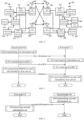
- Embodiment 2 illustrates a schematic diagram of a network architecture, as shown in FIG. 2 .
- Embodiment 2 illustrates a schematic diagram of a network architecture according to one embodiment of the present application, as shown in FIG. 2.
- FIG. 2 illustrates a V2X communication architecture of 5G New Radio (NR), Long-Term Evolution (LTE) and Long-Term Evolution Advanced (LTE-A) systems.
- the 5G NR or LTE network architecture may be called a 5G System/ Evolved Packet System (5GS/EPS) or other suitable terminology.
- 5GS/EPS 5G System/ Evolved Packet System
- the UE 201 corresponds to the first node in the present application
- the gNB203 corresponds to the second node in the present application.
- the first node is a terminal.
- the first node is a relay.
- the second node is a terminal.
- the second node is a relay.
- the second node is a base station.
- the second node is a Transmitter Receiver Point (TRP).
- TRP Transmitter Receiver Point
- the second node is used for managing multiple TRPs.
- the second node is used for managing multiple nodes of cells.
- the second node is used for managing multiple nodes of serving cells.
- Embodiment 4 illustrates a schematic diagram of a first communication device and a second communication device according to the present application, as shown in FIG. 4.
- FIG. 4 is a block diagram of a first communication device 450 and a second communication device 410 in communication with each other in an access network.
- the first communication device 450 comprises a controller/processor 459, a memory 460, a data source 467, a transmitting processor 468, a receiving processor 456, a multi-antenna transmitting processor 457, a multi-antenna receiving processor 458, a transmitter/receiver 454 and an antenna 452.
- the second communication device 410 comprises a controller/processor 475, a memory 476, a receiving processor 470, a transmitting processor 416, a multi-antenna receiving processor 472, a multi-antenna transmitting processor 471, a transmitter/receiver 418 and an antenna 420.
- a higher layer packet from a core network is provided to the controller/processor 475.
- the controller/processor 475 provides functions of the L2 layer.
- the controller/processor 475 provides header compression, encryption, packet segmentation and reordering, and multiplexing between a logical channel and a transport channel, and radio resource allocation of the first communication device 450 based on various priorities.
- the controller/processor 475 is also in charge of a retransmission of a lost packet and a signaling to the first communication device 450.
- the transmitting processor 416 and the multi-antenna transmitting processor 471 perform various signal processing functions used for the L1 layer (i.e., PHY).
- the transmitting processor 416 performs coding and interleaving so as to ensure a Forward Error Correction (FEC) at the second communication device 410 side and the mapping to signal clusters corresponding to each modulation scheme (i.e., BPSK, QPSK, M-PSK, and M-QAM, etc.).
- the multi-antenna transmitting processor 471 performs digital spatial precoding, which includes precoding based on codebook and precoding based on non-codebook, and beamforming processing on encoded and modulated signals to generate one or more spatial streams.
- the transmitting processor 416 maps each spatial stream into a subcarrier.
- the mapped symbols are multiplexed with a reference signal (i.e., pilot frequency) in time domain and/or frequency domain, and then they are assembled through Inverse Fast Fourier Transform (IFFT) to generate a physical channel carrying time-domain multicarrier symbol streams.
- IFFT Inverse Fast Fourier Transform
- the multi-antenna transmitting processor 471 performs transmission analog precoding/beamforming on the time-domain multicarrier symbol streams.
- Each transmitter 418 converts a baseband multicarrier symbol stream provided by the multi-antenna transmitting processor 471 into a radio frequency (RF) stream, which is later provided to different antennas 420.
- RF radio frequency
- each receiver 454 receives a signal via a corresponding antenna 452.
- Each receiver 454 recovers information modulated to the RF carrier, and converts the radio frequency stream into a baseband multicarrier symbol stream to be provided to the receiving processor 456.
- the receiving processor 456 and the multi-antenna receiving processor 458 perform signal processing functions of the L1 layer.
- the multi-antenna receiving processor 458 performs reception analog precoding/beamforming on a baseband multicarrier symbol stream provided by the receiver 454.
- the receiving processor 456 converts the processed baseband multicarrier symbol stream from time domain into frequency domain using FFT.
- a physical layer data signal and a reference signal are de-multiplexed by the receiving processor 456, wherein the reference signal is used for channel estimation, while the data signal is subjected to multi-antenna detection in the multi-antenna receiving processor 458 to recover any first communication device 450-targeted spatial stream. Symbols on each spatial stream are demodulated and recovered in the receiving processor 456 to generate a soft decision. Then the receiving processor 456 decodes and de-interleaves the soft decision to recover the higher-layer data and control signal transmitted by the second communication device 410 on the physical channel. Next, the higher-layer data and control signal are provided to the controller/processor 459.
- the controller/processor 459 provides functions of the L2 layer.
- the controller/processor 459 can be associated with the memory 460 that stores program code and data; the memory 460 may be called a computer readable medium.
- the controller/processor 459 provides demultiplexing between a transport channel and a logical channel, packet reassembling, decrypting, header decompression and control signal processing so as to recover a higher-layer packet from the core network.
- the higher-layer packet is later provided to all protocol layers above the L2 layer. Or various control signals can be provided to the L3 for processing.
- the data source 467 is configured to provide a higher-layer packet to the controller/processor 459.
- the data source 467 represents all protocol layers above the L2 layer.
- the controller/processor 459 Similar to a transmitting function of the second communication device 410 described in the transmission from the second communication node 410 to the first communication node 450, the controller/processor 459 performs header compression, encryption, packet segmentation and reordering, and multiplexing between a logical channel and a transport channel based on radio resource allocation so as to provide the L2 layer functions used for the user plane and the control plane.
- the controller/processor 459 is also responsible for a retransmission of a lost packet, and a signaling to the second communication device 410.
- the transmitting processor 468 performs modulation and mapping, as well as channel coding, and the multi-antenna transmitting processor 457 performs digital multi-antenna spatial precoding, including precoding based on codebook and precoding based on non-codebook, and beamforming.
- the transmitting processor 468 then modulates generated spatial streams into multicarrier/single-carrier symbol streams.
- the modulated symbol streams after being subjected to analog precoding/beamforming in the multi-antenna transmitting processor 457, are provided from the transmitter 454 to each antenna 452.
- Each transmitter 454 firstly converts a baseband symbol stream provided by the multi-antenna transmitting processor 457 into a radio frequency symbol stream, and then provides the radio frequency symbol stream to the antenna 452.
- the function of the second communication device 410 is similar to the receiving function of the first communication device 450 described in the transmission from the second communication device 410 to the first communication device 450.
- Each receiver 418 receives a radio frequency signal via a corresponding antenna 420, converts the received radio frequency signal into a baseband signal, and provides the baseband signal to the multi-antenna receiving processor 472 and the receiving processor 470.
- the receiving processor 470 and the multi-antenna receiving processor 472 jointly provide functions of the L1 layer.
- the controller/processor 475 provides functions of the L2 layer.
- the controller/processor 475 can be associated with the memory 476 that stores program code and data; the memory 476 may be called a computer readable medium.
- the controller/processor 475 provides de-multiplexing between a transport channel and a logical channel, packet reassembling, decrypting, header decompression, control signal processing so as to recover a higher-layer packet from the first communication device (UE) 450.
- the higher-layer packet coming from the controller/processor 475 may be provided to the core network.
- the first communication device 450 comprises at least one processor and at least one memory.
- the at least one memory comprises computer program codes; the at least one memory and the computer program codes are configured to be used in collaboration with the at least one processor.
- the first communication device 450 at least firstly receives a first information set, and then receives a first DCI, and receives a PDSCH on each cell included by a first cell set;
- the first information set includes a first information block and a second information block, the first information block and the second information block being both configured to a first cell, the first cell being a cell among cell(s) included by the first cell set;
- the first DCI is used to schedule PDSCHs on the cell(s) included by the first cell set; an indication of a first field set in the first DCI depends on a target information block, the target information block being one of the first information block or the second information block; whether the target information block is the first information block or the second information block is related to a number of cell(s) included by the first cell
- the first communication device 450 comprises a memory that stores a computer readable instruction program.
- the computer readable instruction program generates actions when executed by at least one processor. The actions include: firstly receiving a first information set, and then receiving a first DCI, and receiving a PDSCH on each cell included by a first cell set; the first information set includes a first information block and a second information block, the first information block and the second information block being both configured to a first cell, the first cell being a cell among cell(s) included by the first cell set; the first DCI is used to schedule PDSCHs on the cell(s) included by the first cell set; an indication of a first field set in the first DCI depends on a target information block, the target information block being one of the first information block or the second information block; whether the target information block is the first information block or the second information block is related to a number of cell(s) included by the first cell set.
- the first communication device 450 corresponds to the first node in the present application.
- the first information set comprises two IEs, the two IEs being PDSCH-ConfigCommon IE and PDSCH-ServingCellConfig IE.
- Embodiment 6 illustrates a flowchart of transmission of a second information set according to one embodiment of the present application, as shown in FIG. 6 .
- a first node U3 and a second node N4 are in communication via a radio link. It should be particularly noted that the sequence illustrated herein does not set any limit to the signal transmission order or implementation order in the present application.
- the first cell set comprises K1 cells.
- the M1 is greater than the K1.
- the M1 is equal to the K1.
- the M1 is no less than the K1.
- the first cell set is a subset of the second cell set.
- the first cell set is equivalent to the second cell set.
- the second information set comprises one RRC signaling.
- the second information set comprises multiple RRC signalings.
- the second information set comprises multiple fields in one IE in TS 38.331.
- the second information set comprises multiple fields in multiple IEs in TS 38.331.
- the second information set is used to indicate the second cell set.
- the above phrase that a parameter indicated by any first-type information block among the M1 first-type information blocks is expected to be the same as a parameter indicated by the first information block comprises that the parameter indicated by any of the M1 first-type information blocks is configured as the parameter indicated by the first information block.
- the above phrase that a parameter indicated by any first-type information block among the M1 first-type information blocks is expected to be the same as a parameter indicated by the first information block comprises that the parameter indicated by any of the M1 first-type information blocks is configured to be the same as the parameter indicated by the first information block.
- the above phrase that a parameter indicated by any first-type information block among the M1 first-type information blocks is expected to be the same as a parameter indicated by the first information block comprises that the parameter indicated by any of the M1 first-type information blocks is default, and the first node assumes that the parameter indicated by any of the M1 first-type information blocks is the same as the parameter indicated by the first information block.
- the above phrase that a parameter indicated by any first-type information block among the M1 first-type information blocks is expected to be the same as a parameter indicated by the first information block comprises that the parameter indicated by any of the M1 first-type information blocks is default, and the first node considers that the parameter indicated by any of the M1 first-type information blocks is the same as the parameter indicated by the first information block.
- a given first-type information block is any first-type information block among the M1 first-type information blocks, and the given first-type information block is used to configure a given cell among the M1 cells.
- the indication of part of fields included in the given DCI depends on the first-type information block; and when the given cell is only scheduled individually by a given DCI, the indication of part of the fields included in the given DCI does not depend on the first-type information block.
- any plurality of cells among the M1 cells included in the second cell set are capable of being simultaneously scheduled by a single DCI.
- At least two cells among the M1 cells included in the second cell set are capable of being simultaneously scheduled by a single DCI.
- M1 second-type information blocks are respectively used to configure the M1 cells, and the M1 first-type information blocks are in one-to-one correspondence with the M1 second-type information blocks, respectively; any second-type information block of the M1 second-type information blocks is cell-specific.
- any second-type information block among the M1 second-type information blocks corresponds to a field in an RRC signaling.
- any second-type information block among the M1 second-type information blocks corresponds to a field in one IE in TS 38.331.
- any first-type information block among the M1 first-type information blocks corresponds to a field in an RRC signaling.
- any first-type information block among the M1 first-type information blocks corresponds to a field in one IE in TS 38.331.
- a given first-type information block is any first-type information block among the M1 first-type information blocks, and the given first-type information block corresponds to a given second-type information block among the M1 second-type information blocks, the given first-type information block and the given second-type information block being both configured to a given cell among the M1 cells.
- the given first-type information block and the given second-type information block each correspond to a different Release.
- a name corresponding to the given first-type information block includes r-18.
- the name corresponding to the given first-type information block contains an extra r-18 compared to the name corresponding to the given second-type information block.
- the name corresponding to the given first-type information block contains an extra S-DCI compared to the name corresponding to the given second-type information block.
- the name corresponding to the given first-type information block contains an extra Multi-Cell compared to the name corresponding to the given second-type information block.
- the given first-type information block and the given second-type information block are both used to determine a RBG size.
- the name corresponding to the given first-type information block and the name corresponding to the given second-type information block both include rbg-size.
- both the given first-type information block and the given second-type information block are used to determine to a Maximum number of code words of a PDSCH scheduled by a DCI scheduling the given cell.
- the name corresponding to the given first-type information block and the name corresponding to the given second-type information block both include maxNrofCodeWordsScheduledByDCI.
- both the given first-type information block and the given second-type information block are used to determine the number of repetitions of data scheduled by the first DCI.
- the name corresponding to the given first-type information block and the name corresponding to the given second-type information block both include pdsch-AggregationFactor.
- both the given first-type information block and the given second-type information block are used to determine a maximum number of CBGs per TB for data scheduled by the first DCI.
- the name corresponding to the given first-type information block and the name corresponding to the given second-type information block both include maxCodeBlockGroupsPerTransportBlock.
- both the given first-type information block and the given second-type information block are used to determine a number of HARQ processes for a PDSCH scheduled by the first DCI.
- the name corresponding to the given first-type information block and the name corresponding to the given second-type information block both include nrofHARQ-ProcessesForPDSCH.
- the first information block is a first-type information block among the M1 first-type information blocks being configured to the first cell.
- the second information block is a second-type information block being configured to the first cell among the M1 second-type information blocks.
- the step S40 is located before the step S20 in Embodiment 5.
- Embodiment 7 illustrates a schematic diagram of a first information set according to one embodiment, as shown in FIG. 7 .
- the first information set is configured to the first cell, the first information set comprising a first information block, a second information block and a third information block; the indication of a first field set in the first DCI depends on one of the first information block or the second information block; the indication of a second field set in the first DCI depends on the third information block.
- the indication of the second field set in the first DCI is independent of the number of cell(s) included in the first cell set.
- the first field set in the first DCI comprises only a first field and the indication of the first field is dependent on one of the first information block or the second information block.
- the first field set in the first DCI comprises a plurality of fields, the indication of each of the plurality of fields being dependent on one of the first information block or the second information block.
- the second field set in the first DCI comprises a plurality of fields, the indication of each of the plurality of fields being dependent on the third information block.
- the third information block corresponds to a field other than the first information block and the second information block in a PDSCH-config IE.
- the third information block corresponds to a field other than the first information block and the second information block in a PDSCH-ConfigCommon IE.
- the third information block corresponds to a field other than the first information block and the second information block in a PDSCH-ServingCellConfig IE.
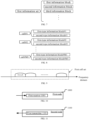
- Embodiment 8 illustrates a schematic diagram of M1 first-type information blocks according to one embodiment of the present application, as shown in FIG. 8 .
- the M1 first-type information blocks are configured to M1 cells, respectively, and the M1 first-type information blocks are associated to M1 second-type information blocks, the M1 second-type information blocks being respectively configured to the M1 cells;
- the first-type information block #1 to the first-type information block #M1 shown in this figure are configured to cell #1 to cell #M1, respectively;
- the second-type information block #1 to the second-type information block #M1 shown in this figure are configured to cell #1 to cell #M1, respectively;
- the first-type information block #1 to the first-type information block #M1 shown in this figure are considered to be the same, and the second-type information block #1 to the second-type information block #M1 shown in this figure are configured independently.
- Embodiment 9 illustrates a schematic diagram of a first cell set according to one embodiment of the present application, as shown in FIG. 9 .
- the first cell set includes K1 cells, the first cell being one of the K1 cells.
- the first cell is any one of the K1 cells.
- K1 is a positive integer greater than 1.
- the first DCI is used to indicate the K1 cells.
- the first DCI is used to indicate that K1 PDSCHs are transmitted in K1 cells included in the first cell set, the K1 PDSCHs being transmitted in the K1 cells, respectively.
- the K1 PDSCHs correspond to K1 TBs, respectively.
- the K1 PDSCHs correspond to K1 HARQ process numbers, respectively.
- the first DCI is used to indicate that K1 sub-signals are transmitted in K1 cells included in the first cell set, the K1 sub-signals being transmitted in the K1 cells, respectively.
- the K1 sub-signals correspond to 1 TB.
- the K1 sub-signals correspond to 1 HARQ process number.
- the K1 sub-signals correspond to 1 PDSCH.
- Embodiment 10 illustrates a structure block diagram of a processing device in a first node, as shown in FIG. 10 .
- a first node 1000 comprises a first receiver 1001.
- the first receiver 1001 receives a first information set, receives a first DCI (Downlink Control Information) and receives a PDSCH on each cell included by a first cell set.
- a first DCI Downlink Control Information
- the first information set includes a first information block and a second information block, the first information block and the second information block being both configured to a first cell, the first cell being a cell among cell(s) included by the first cell set; the first DCI is used to schedule PDSCHs on the cell(s) included by the first cell set; an indication of a first field set in the first DCI depends on a target information block, the target information block being one of the first information block or the second information block; whether the target information block is the first information block or the second information block is related to a number of cell(s) included by the first cell set.
- the target information block is the first information block; when the number of the cell(s) included by the first cell set is equal to 1, the target information block is the second information block.
- M1 second-type information blocks are respectively used to configure the M1 cells, and the M1 first-type information blocks are in one-to-one correspondence with the M1 second-type information blocks, respectively; any second-type information block of the M1 second-type information blocks is cell-specific.
- the first information block is associated to a first DCI format
- the second information block is associated to a second DCI format, the first DCI format being different from the second DCI format.
- the first information set includes PDSCH-Config.
- the first information set includes at least one of PDSCH-ConfigCommon or PDSCH-ServingCellConfig.
- the first receiver 1001 comprises at least the first four of the antenna 452, the receiver 454, the multi-antenna receiving processor 458, the receiving processor 456 and the controller/processor 459 in Embodiment 4.
- Embodiment 11 illustrates a structure block diagram of a processing device in a second node, as shown in FIG. 11 .
- a second node 1100 comprises a first transmitter 1101.
- the first transmitter 1101 transmits a first information set, transmits a first DCI and transmits a PDSCH on each cell included by a first cell set.
- the first information set includes a first information block and a second information block, the first information block and the second information block being both configured to a first cell, the first cell being a cell among cell(s) included by the first cell set; the first DCI is used to schedule PDSCHs on the cell(s) included by the first cell set; an indication of a first field set in the first DCI depends on a target information block, the target information block being one of the first information block or the second information block; whether the target information block is the first information block or the second information block is related to a number of cell(s) included by the first cell set.
- the target information block is the first information block; when the number of the cell(s) included by the first cell set is equal to 1, the target information block is the second information block.
- the first information block is associated to a first DCI format
- the second information block is associated to a second DCI format, the first DCI format being different from the second DCI format.
Landscapes
- Engineering & Computer Science (AREA)
- Signal Processing (AREA)
- Computer Networks & Wireless Communication (AREA)
- Mobile Radio Communication Systems (AREA)
Applications Claiming Priority (2)
| Application Number | Priority Date | Filing Date | Title |
|---|---|---|---|
| CN202210940835.XA CN117579237A (zh) | 2022-08-07 | 2022-08-07 | 一种用于无线通信的方法和装置 |
| PCT/CN2023/110512 WO2024032425A1 (zh) | 2022-08-07 | 2023-08-01 | 一种用于无线通信的方法和装置 |
Publications (1)
| Publication Number | Publication Date |
|---|---|
| EP4580105A1 true EP4580105A1 (de) | 2025-07-02 |
Family
ID=89808345
Family Applications (1)
| Application Number | Title | Priority Date | Filing Date |
|---|---|---|---|
| EP23851646.2A Pending EP4580105A1 (de) | 2022-08-07 | 2023-08-01 | Verfahren und vorrichtung zur drahtlosen kommunikation |
Country Status (4)
| Country | Link |
|---|---|
| US (1) | US20250185007A1 (de) |
| EP (1) | EP4580105A1 (de) |
| CN (2) | CN117579237A (de) |
| WO (1) | WO2024032425A1 (de) |
Family Cites Families (12)
| Publication number | Priority date | Publication date | Assignee | Title |
|---|---|---|---|---|
| AR112995A1 (es) * | 2017-09-07 | 2020-01-15 | Sharp Kk | Equipos de usuario, estaciones base y métodos |
| CA3077014A1 (en) * | 2019-03-25 | 2020-09-25 | Comcast Cable Communications, Llc | Power saving operations for communication systems |
| CN114026939B (zh) * | 2019-06-21 | 2025-07-25 | 夏普株式会社 | 用于下行链路控制信息(dci)格式的dci的用户设备、基站和方法 |
| WO2021162038A1 (ja) * | 2020-02-13 | 2021-08-19 | シャープ株式会社 | 端末装置、および、方法 |
| CN113285788B (zh) * | 2020-02-19 | 2023-12-29 | 维沃移动通信有限公司 | 一种确定反馈资源的方法和通信设备 |
| US11985643B2 (en) * | 2020-04-10 | 2024-05-14 | Qualcomm Incorporated | DCI design for multi-cross carrier scheduling |
| CN113839753A (zh) * | 2020-06-23 | 2021-12-24 | 中兴通讯股份有限公司 | 控制信息发送方法、动态反馈码本发送方法、基站及终端 |
| CN114070516A (zh) * | 2020-08-06 | 2022-02-18 | 北京紫光展锐通信技术有限公司 | 下行控制信息的处理方法及设备 |
| US20220086894A1 (en) * | 2020-09-14 | 2022-03-17 | Samsung Electronics Co., Ltd. | Multi-cell scheduling with reduced control overhead |
| CN114499779B (zh) * | 2020-10-23 | 2024-08-16 | 上海朗帛通信技术有限公司 | 一种被用于无线通信的节点中的方法和装置 |
| CN116456285A (zh) * | 2020-12-07 | 2023-07-18 | 上海朗帛通信技术有限公司 | 一种用于无线通信的节点中的方法和装置 |
| CN117335946A (zh) * | 2020-12-15 | 2024-01-02 | 上海朗帛通信技术有限公司 | 一种被用于无线通信的节点中的方法和装置 |
-
2022
- 2022-08-07 CN CN202210940835.XA patent/CN117579237A/zh active Pending
- 2022-08-07 CN CN202311559932.5A patent/CN117544288A/zh active Pending
-
2023
- 2023-08-01 WO PCT/CN2023/110512 patent/WO2024032425A1/zh not_active Ceased
- 2023-08-01 EP EP23851646.2A patent/EP4580105A1/de active Pending
-
2025
- 2025-02-06 US US19/046,542 patent/US20250185007A1/en active Pending
Also Published As
| Publication number | Publication date |
|---|---|
| US20250185007A1 (en) | 2025-06-05 |
| WO2024032425A1 (zh) | 2024-02-15 |
| CN117544288A (zh) | 2024-02-09 |
| CN117579237A (zh) | 2024-02-20 |
Similar Documents
| Publication | Publication Date | Title |
|---|---|---|
| US12574758B2 (en) | Method and system in wireless communication for determining QCL parameter to receive a refeence signal | |
| US12170987B2 (en) | Method and device in a node used for wireless communication | |
| US20240039674A1 (en) | Method and device in nodes used for wireless communication | |
| US11785618B2 (en) | Method and device in nodes used for wireless communication | |
| US12167373B2 (en) | Method and device in nodes used for wireless communication | |
| US20250008495A1 (en) | Method and device in nodes used for wireless communication | |
| US20240275554A1 (en) | Method and device in nodes used for wireless communication | |
| US20220166571A1 (en) | Method and device in nodes used for wireless communication | |
| US12402130B2 (en) | Method and device in nodes used for wireless communication | |
| US20230208567A1 (en) | Method and device in nodes used for wireless communication | |
| US12238778B2 (en) | Method and device for wireless communication | |
| US20250151060A1 (en) | Method and device for wireless communication | |
| US12588008B2 (en) | Method and device for transmission configuration indicator-based control channel candidate monitoring in wireless communication | |
| US20230217217A1 (en) | Method and device in nodes used for wireless communication | |
| US12224867B2 (en) | Method and device in nodes used for HARQ feedback in wireless communication | |
| US12381695B2 (en) | Method and device for configuring communication channel using sidelink in wireless communication between nodes | |
| EP4580105A1 (de) | Verfahren und vorrichtung zur drahtlosen kommunikation | |
| CN117560120A (zh) | 一种用于无线通信的方法和装置 | |
| US20250048386A1 (en) | Method and device in nodes used for wireless communication | |
| US12250686B2 (en) | Method and device in nodes used for wireless communication | |
| EP4601348A1 (de) | Verfahren und vorrichtung zur drahtlosen kommunikation | |
| US20240154769A1 (en) | Method and device in nodes used for wireless communication | |
| US12127203B2 (en) | Method and device in nodes used for wireless communication | |
| US20250202631A1 (en) | Method and device in nodes used for wireless communication | |
| CN113497686B (zh) | 一种被用于无线通信的节点中的方法和装置 |
Legal Events
| Date | Code | Title | Description |
|---|---|---|---|
| STAA | Information on the status of an ep patent application or granted ep patent |
Free format text: STATUS: THE INTERNATIONAL PUBLICATION HAS BEEN MADE |
|
| PUAI | Public reference made under article 153(3) epc to a published international application that has entered the european phase |
Free format text: ORIGINAL CODE: 0009012 |
|
| STAA | Information on the status of an ep patent application or granted ep patent |
Free format text: STATUS: REQUEST FOR EXAMINATION WAS MADE |
|
| 17P | Request for examination filed |
Effective date: 20250522 |
|
| AK | Designated contracting states |
Kind code of ref document: A1 Designated state(s): AL AT BE BG CH CY CZ DE DK EE ES FI FR GB GR HR HU IE IS IT LI LT LU LV MC ME MK MT NL NO PL PT RO RS SE SI SK SM TR |
|
| RAP1 | Party data changed (applicant data changed or rights of an application transferred) |
Owner name: APOGEE NETWORKS, LLC |
|
| DAV | Request for validation of the european patent (deleted) | ||
| DAX | Request for extension of the european patent (deleted) |