EP4580147A2 - Système et procédé de création et de gestion de sous-réseaux privés de stations de base lte - Google Patents
Système et procédé de création et de gestion de sous-réseaux privés de stations de base lte Download PDFInfo
- Publication number
- EP4580147A2 EP4580147A2 EP25168746.3A EP25168746A EP4580147A2 EP 4580147 A2 EP4580147 A2 EP 4580147A2 EP 25168746 A EP25168746 A EP 25168746A EP 4580147 A2 EP4580147 A2 EP 4580147A2
- Authority
- EP
- European Patent Office
- Prior art keywords
- internal
- enodeb
- message
- identifier
- baseband processor
- Prior art date
- Legal status (The legal status is an assumption and is not a legal conclusion. Google has not performed a legal analysis and makes no representation as to the accuracy of the status listed.)
- Pending
Links
Images





Classifications
-
- H—ELECTRICITY
- H04—ELECTRIC COMMUNICATION TECHNIQUE
- H04W—WIRELESS COMMUNICATION NETWORKS
- H04W24/00—Supervisory, monitoring or testing arrangements
- H04W24/02—Arrangements for optimising operational condition
-
- H—ELECTRICITY
- H04—ELECTRIC COMMUNICATION TECHNIQUE
- H04W—WIRELESS COMMUNICATION NETWORKS
- H04W16/00—Network planning, e.g. coverage or traffic planning tools; Network deployment, e.g. resource partitioning or cells structures
- H04W16/24—Cell structures
- H04W16/32—Hierarchical cell structures
-
- H—ELECTRICITY
- H04—ELECTRIC COMMUNICATION TECHNIQUE
- H04W—WIRELESS COMMUNICATION NETWORKS
- H04W36/00—Hand-off or reselection arrangements
- H04W36/04—Reselecting a cell layer in multi-layered cells
-
- H—ELECTRICITY
- H04—ELECTRIC COMMUNICATION TECHNIQUE
- H04W—WIRELESS COMMUNICATION NETWORKS
- H04W36/00—Hand-off or reselection arrangements
- H04W36/12—Reselecting a serving backbone network switching or routing node
-
- H—ELECTRICITY
- H04—ELECTRIC COMMUNICATION TECHNIQUE
- H04L—TRANSMISSION OF DIGITAL INFORMATION, e.g. TELEGRAPHIC COMMUNICATION
- H04L41/00—Arrangements for maintenance, administration or management of data switching networks, e.g. of packet switching networks
- H04L41/08—Configuration management of networks or network elements
- H04L41/0894—Policy-based network configuration management
-
- H—ELECTRICITY
- H04—ELECTRIC COMMUNICATION TECHNIQUE
- H04L—TRANSMISSION OF DIGITAL INFORMATION, e.g. TELEGRAPHIC COMMUNICATION
- H04L41/00—Arrangements for maintenance, administration or management of data switching networks, e.g. of packet switching networks
- H04L41/08—Configuration management of networks or network elements
- H04L41/0895—Configuration of virtualised networks or elements, e.g. virtualised network function or OpenFlow elements
-
- H—ELECTRICITY
- H04—ELECTRIC COMMUNICATION TECHNIQUE
- H04W—WIRELESS COMMUNICATION NETWORKS
- H04W84/00—Network topologies
- H04W84/02—Hierarchically pre-organised networks, e.g. paging networks, cellular networks, WLAN [Wireless Local Area Network] or WLL [Wireless Local Loop]
- H04W84/10—Small scale networks; Flat hierarchical networks
- H04W84/105—PBS [Private Base Station] network
Definitions
- a further disadvantage of the current state is as follows.
- a given eNodeB is identified by a 20bit identifier (eNB ID).
- eNB ID 20bit identifier
- Each eNodeB can support up to 256 cells, each of which is identified by a global cell identifier (E-CGI) that appends the 20bit eNB ID with a unique 8bit pattern.
- E-CGI global cell identifier
- each eNodeB may, in theory, support 256 cells, this is basically impossible due to computing constraints.
- each eNodeB typically supports a maximum of approximately twelve cells. This not only limits the potential usefulness of a given eNodeB, but it also leads to inefficient use of E-CGI address space.
- An aspect of the present invention involves a telecommunication system, which comprises a plurality of internal baseband processors, and a connection aggregator coupled to the plurality of internal baseband processors, wherein the connection aggregator maintains a plurality of internal identifiers, each corresponding to one of plurality of internal baseband processors.
- the connection aggregator is configured to intercept an outbound message from an internal baseband processor, replace the internal baseband procesor's internal identifier within the outbound message with a virtual subnetwork baseband processor identifier, and transmit the modified outbound message.
- connection aggregator is further configured to intercept an inbound message to a destination internal baseband processor, replace the virtual subnetwork baseband processor identifier within the inbound message with a destination internal identifier to create a modified inbound message, and transmit the modified inbound message to the destination internal baseband processor.
- Another aspect of the present invention involves a method for configuring a telecommunication subnetwork.
- the method comprises intercepting a plurality of PWS restart indication messages, each of the plurality of PWS restart messages coming from an internal eNodeB; extracting an internal eNodeB identifier and one or more cell IDs from each intercepted PWS restart indication message; assigning each internal eNodeB identifier and corresponding one or more cell IDs to a memory; and transmitting a subnetwork PWS restart indication message.
- the subnetwork PWS restart indication message includes a virtual subnetwork baseband processor identifier and the one or more cell IDs from the plurality of PWS restart indication messages.
- Another aspect of the present invention involves a method for configuring a telecommunication subnetwork.
- the method comprises intercepting a plurality of initiation messages from a corresponding plurality of internal baseband processors, wherein each initiation message includes an internal identifier and at least one cell ID for each cell corresponding to the internal baseband processor; extracting the internal identifier and the at least one cell ID from each initiation message; storing each internal identifier and each at least one cell ID in a memory; generating a virtual subnetwork baseband processor identifier; and transmitting a subnetwork initiation message, wherein the subnetwork initiation message includes the virtual subnetwork baseband processor identifier and each one or more cell IDs.
- Another aspect of the present invention involves a method for establishing a connection between a source internal baseband processor and a target internal baseband processor within a telecommunication subnetwork.
- the method comprises generating a source internal baseband processor identifier; generating a target internal baseband processor identifier; generating a source configuration transfer message, the source configuration transfer message including the source internal baseband processor identifier and the target internal baseband processor identifier; transmitting the source configuration transfer message to a mobility management entity; intercepting the source configuration transfer message to the mobility management entity; extracting the source internal baseband processor identifier and the target internal baseband identifier from the source configuration transfer message; generating a target configuration transfer message, the target configuration transfer message including the source internal baseband processor identifier and the target internal baseband processor identifier; and transmitting the target configuration transfer message to the target internal baseband processor.
- Another aspect of the present invention involves a method for determining a location of an event within a venue.
- the method comprises intercepting a first plurality of call establishment messages, each call establishment message coming from one of a plurality of UEs; determining if each call establishment message within the first plurality of call establishment messages corresponds to a voice call; determining a second plurality of call establishment messages, wherein each of the second plurality of call establishment messages corresponds to a voice call; retrieving a call establishment message time corresponding to each of the second plurality of call establishment messages; retrieving an internal baseband processor identifier from each of the second plurality of call establishment message; and identifying a cluster of call establishment messages within the second plurality of call establishment messages, wherein the cluster of call establishment messages correspond to a single eNodeB and wherein the call establishment time corresponding to each of the cluster of call establishment messages occur within a narrow window of time.
- S1-Conn 110 and operation and maintenance module 120 may be implemented in software that runs in a conventional server hardware that may be located in a single location (e.g., one or more racks) within or near the venue where subnetwork 100 is deployed, or otherwise distributed.
- a conventional server hardware e.g., one or more racks
- each internal eNodeB 125 implemented purely in software enables each internal eNodeB 125 to be instrumented with code to enable interaction with its corresponding supervisor module 130 and easier configuration and maintenance from operation and maintenance module 120.
- hardware-based internal eNodeBs 125 may be activated/deactivated in place of instantiation/de-instantiation of a virtual internal eNodeB 125.
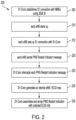
- FIG. 2 illustrates an exemplary process for configuring a subnetwork 100 according to the disclosure.
- S1-Conn 110 establishes an S1 interface with each of the MMEs 150.
- S1-Conn 110 issues an S1 SETUP REQUEST message to each of the MMEs 150, which includes its own 20bit eNB ID (the virtual subnetwork baseband processor identifier) and all of the E-CGIs corresponding to each of the constituent cells of all of the internal eNodeBs 125.
- each MME 150 may send a subsequent S1 SETUP RESPONSE message to S1-Conn 110, thereby establishing an external S1 Connection 155 between the S1-Conn 110 and each MME 150.
- each internal eNodeB 125 starts up according to its nominal function.
- Each internal eNodeB 125 has the same 20bit identifier, and a number of allocated 8bit subidentifiers for each possible cell 135 that might correspond to that particular internal eNodeB 125.
- This information may be stored in a configuration file within each internal eNodeB 125 and may be supplied by its corresponding supervisor module 130.
- configuration information for each internal eNodeB 125 may be stored in a distributed data source. Examples of such distributed data sources may include systems like consul and etcd.
- each internal eNodeB 125 sets up an S1 connection with S1-Conn 110, using its individual internal 28bit eNodeB identifier.
- An example of how the internal eNodeB 125 may establish an S1 connection with an MME 150 is described in 3GPP TS 36.413. In doing so, the given internal eNodeB 125 functions as if it is establishing an S1 connection with each MME 150.
- S1-Conn 110 intercepts each S1 SETUP REQUEST from each internal eNodeB.
- each internal eNodeB 125 sends an initiation message that would otherwise indicate to one or more MMEs 150 that it is functioning. This initiation message would include its own identity and the cell identities of its corresponding cells 135. In an exemplary embodiment of process 200, each internal eNodeB 125 sends a PWSRestartIndication message, which is intercepted by S1-Conn 110.
- the PWSRestartIndication message includes the following information: the E-CGI (Enhanced Cell Global ID) of each cell corresponding to the sending internal eNodeB 125, the Global eNB ID for the sending internal eNodeB 125 (which is its aforementioned internal 28bit eNodeB identifier), the TAI (Tracking Area Identifier) list for the internal eNodeB's 125 corresponding cells, and the Emergency Area ID list for the internal eNodeB's 125 corresponding cells.
- E-CGI Enhanced Cell Global ID
- the Global eNB ID for the sending internal eNodeB 125 which is its aforementioned internal 28bit eNodeB identifier
- TAI Track Area Identifier
- S1-Conn 110 assigns itself the 20bit eNodeB ID common to all of the internal eNodeBs 125, extracts the constituent cells IDs (E-CGIs) and further information gathered from each corresponding PWSRestartIndication message and populates this information in a new "repackaged" PWSRestartIndication Message.
- the 20bit eNodeB ID assigned to the S1-Conn 110 may be referred to as a virtual subnetwork baseband processor identifier.
- each MME 150 will behave as though it is interacting with a single "giant" eNodeB with a potentially large number of aggregated cells 135 (potentially as many as 256 cells), even though each MME 150 is interacting exclusively with S1-Conn 110.
- each internal eNodeB 125 will behave as though it is interacting with any of MMEs 150, even though it is interacting exclusively with S1-Conn 110.
- S1-Conn 110 intercepts each subsequent message, bidirectionally, between a given MME 150 and an internal eNodeB 125, and also between the MME 150 a given UE 170.
- S1-Conn 110 remaps the cell IDs and other required information using - for example - look up tables stored in memory allocated to S1-Conn 110, repackages the given message with the re-mapped information, and sends the repackaged message to its destination.
- the internal eNodeB 125 that is the destination of the incoming message from a given MME 150 may be referred to as a message destination baseband processor.
- the number of internal eNodeBs 125 may be dynamically adjusted according to traffic demand. This may be extremely useful for venues, such as stadiums, that may be filled to capacity one day a week and quiet the rest of the time.
- internal eNodeBs 125 each with a plurality of corresponding cells 135, may be created and allocated to handle changes in traffic demand, such that all of these changes are hidden to the outer network.
- S-Conn 110 is further describing a sequence of computer instructions stored on a machine readable memory allocated to or associated with the S1-Conn 110, and executed either by a dedicated processor or by a server processor or virtual machine spawned in a cloud computing environment running on server hardware located within the venue of subnetwork 100 or elsewhere.
- FIG. 3 illustrates an exemplary process 300 by which a UE 170 establishes connection with an internal eNodeB 125.
- the UE 170 and the given internal eNodeB 125 exchange appropriate conventional signals to establish a connection.
- UE 170 may transmit an RRC Connection Request to the internal eNodeB 125, which may in turn respond with an RRC Connection Setup message, etc.
- RRC Connection Request may be transmitted to the internal eNodeB 125 and that internal eNodeB 125 has established an internal identifier corresponding to that UE.
- subprocess 310 internal eNodeB 125 establishes a default bearer with an MME 150 via S1-Conn 110.
- subprocess 310 comprises several steps that are added to the default bearer establishment procedures specified in 3GPP TS 24.301, for example. steps 315, 320, and 325 describe modifications/enhancements to the conventional procedures described in the 3GPP technical specifications.
- step 315 S1-Conn 110 intercepts the default bearer establishment messages sent by internal eNodeB 125, which includes a UE ID generated by the internal eNodeB 125.
- the S1-Conn replaces the UE ID (generated by the internal eNodeB 125) and replaces it with a unique UE ID generated by the S1-Conn 110. This is necessary because each of the internal eNodeBs 125 generate UE IDs without any awareness of the UE IDs generated by any of the other internal eNodeBs 125. There is a significant chance of two eNodeBs 125 generating duplicate UE IDs. Given this possibility, S1-Conn replaces the UE ID generated by the internal eNodeB 125 with a unique value, repackages the message, and transmits the message to the appropriate MME 150.
- S1-Conn 110 intercepts default bearer establishment messages from the MME 150 to the internal eNodeB 125, remaps the UE ID, and transmits the repackaged message to the internal eNodeB 125.
- the objective is that the given internal eNodeB 125 is not aware that it is not interacting directly with MME 150, and that the MME 150 is not aware that it is not interacting directly with internal eNodeB 125.
- S1-Conn 110 is acting as the MME 150 for the internal eNodeB 125
- S1-Conn 110 is acting as the eNodeB that interacts with the MME 150 (and the UE 170).
- subprocess 330 internal eNodeB 125 establishes a dedicated bearer with an MME 150 via S1-Conn 110.
- subprocess 330 comprises several steps that are added to the default bearer establishment procedures specified in 3GPP TS 24.301.
- the steps required for establishing a dedicated bearer may be substantially identical to steps 320 and 325 described above.
- the result is that there is at least one dedicated bearer established between UE 170 and MME 150, whereby S1-Conn 110 is serving as an unseen intermediary between internal eNodeB 120 and MME 150.
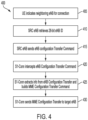
- FIG. 4 illustrates an exemplary process 400 for establishing an X2 connection between two internal eNodeBs 125.
- step 510 the source internal eNodeB 125 forwards any data packets (downlink and potentially uplink) corresponding to UE 170 to target internal eNodeB 125 over the X2 connection that was established in process 400.
- step 620 MME 150 sends a Handover Command to S1-Conn 110. It will be understood that MME 150 behaves as though it were interacting with a conventional eNodeB.
- step 645 the source internal eNodeB 125 sends a UE Context Release Complete message to the source MME 150.
- step 650 the S1-Conn 110 intercepts the UE Context Release Complete message, remaps the information to reflect the virtual subnetwork baseband processor identifier, repackages the message, and transmits it to the source MME 150.
- the S1-based handoff disclosed in process 600 involves a handoff between the "giant" eNodeB represented by S1-Conn 110 and external eNodeB 160.
- the inner workings of subnetwork 100 are hidden from the outer network.
- FIG. 7 illustrates an exemplary process 700 for reconfiguring subnetwork 100 based on an increase or decrease in traffic demand. This enables the subnetwork 100 to expand and contract based on demand while hiding the changes to the subnetwork from the outer network.
- the operation and maintenance module 120 may, in conjunction with the S1-Conn 110, make an assessment of current traffic usage and demand. This may involve analyzing historical usage data as well as extrapolating near future demand. For example, if subnetwork 100 is deployed in a stadium, operation and maintenance module 120 may have stored in accessible memory a calendar of upcoming events so that it can anticipate periods of high and low demands. For deployments such as in a dense urban setting, operation and maintenance module 120 may have accumulated historical data on demand based on time of day, day of week, holidays, and days with special events.
- operation and maintenance module 120 may be able to perform appropriate analytics to estimate current and near future demand, and take action accordingly to provide for the provisioning of cloud-based computing capacity for virtual internal eNodeBs 125, or to power up/down hardware-based internal eNodeBs 125.
- the virtual eNodeBs 125 may employ 3GPP-specified mechanisms for assessing (i.e., determining) demand, including setting a configurable threshold(s), and comparing actual demand to said threshold(s).
- the eNodeBs 125 can then send the results of the comparisions to the operation and maintenance module 120.
- the operation and maintanenace module 120 can then further determine whether demand has dropped below a low threshold (e.g., 5% of configured maximum capacity) or whether demand has gone above a high threshold (e.g., 95% of configured maximum capacity).
- each of the eNodeBs can make the above described further determinations and send an alarm signal, or the like, to the operation and maintenance module 120 if either of the thresholds has been exceeded.
- This mechanism may use the standard PM-Stat files (Performance Measurement) that are generated every 15 minutes and transmitted to the core network via a northbound interface (not shown) that is also specified by 3GPP. It will be understood that such variations are possible and within the scope of the disclosure.
- process 700 may either take no action (not shown in FIG. 7 ); it may take subprocess path 701, in which operation and maintenance module 120 may increase the capacity of subnetwork 100 by adding one or more internal eNodeBs 125; or it may take subprocess path 702, in which operation and maintenance module 120 may reduce capacity by removing one or more internal eNodeBs 125.
- operation and maintenance module 120 may proceed to step 710 and execute instructions to identify where within subnetwork 100 one or more additional internal eNodeBs 125 are needed. This may include determining the location of the internal eNodeBs 125 with the greatest demand and determining the availability of remote radio unit and antenna hardware in the vicinity, for example.
- operation and maintenance module 120 executes instructions to bring up one or more new internal eNodeBs 125.
- operation and maintenance module 120 may execute instructions to have local server hardware instantiate one or more software-based virtual baseband processors, and/or to power up one or more dormant hardware-based base stations.
- operation and maintenance module 120 may issue instructions to S1-Conn 110 to command the currently-running high-demand internal eNodeBs 125 to handoff UE connections to the recently-introduced new internal eNodeBs 125. This may be alternatively done whereby the operation and maintenance module 120 may issue instructions to the appropriate supervisor modules 130, via IP connection 145, to have the corresponding internal eNodeBs 125 execute UE connection handoffs.
- the newly online internal eNodeBs 125 may each issue a PWSRestartIndication message (or similar initiation message), indicating its internal eNodeB identifier and constituent cell IDs.
- S1-Conn 110 intercepts the one or more PWSRestartIndication messages, one from each newly online internal eNodeB 125, extracts the internal eNodeB identifier and corresponding cell IDs, and adds this information to the pre-existing mapping that S1-Conn 110 stores in its memory.
- S1-Conn may issue its own PWSRestartIndication to one or more MMEs 150, similarly to step 235 in process 200.
- the outer network is not aware of the addition of new internal eNodeBs 125. Instead, it is only aware of a single "giant" eNodeB that has one or more additional cells.
- operation and maintenance module 120 may proceed to step 750 and execute instructions to identify where within subnetwork 100 one or more additional internal eNodeBs 125 are to be shut down. This may include determining the location of the internal eNodeBs 125 with insufficient demand and the internal identifiers of neighboring eNodeBs 125 that might be available for handoff.
- operation and maintenance module 120 may execute instructions to command the internal eNodeBs 125 designated for shutdown to handoff UE connections to neighboring eNodeBs that are otherwise capable of servicing these UEs 170. As with step 720, this may happen one or more ways: whereby operation and maintenance module 120 issues instructions to S1-Conn 110 to command the handoffs, or operation and maintenance module 120 issues instructions to the relevant supervisor modules 130 to implement the handoffs. It will be understood that such variations are possible and within the scope of the disclosure.
- step 760 operation and maintenance module 120 may shutdown the internal eNodeBs 125 designated in step 750.
- this may involve terminating the corresponding virtual machine running on the subnetwork's server hardware. Alternatively (or additionally) this may involve powering down appropriate hardware-based base stations. Operation and maintenance module 120 may do this by issuing commands to the relevant supervisor modules 130.
- step 765 S1-Conn 110 executes instructions to remove the terminated internal eNodeB identifiers and corresponding cell IDs from its memory. Subprocess 702 then proceeds to step 735. In step 735, S1-Conn 110 issues a new PWSRestartIndication with the revised list of Cell IDs (minus the Cell IDs corresponding to the terminated internal eNodeBs 125).
- S1-Conn 110 may identify patterns in messages from the internal eNodeBs and derive position information from one or more of the UEs 170 connected to them.
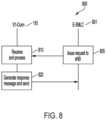
- FIG. 8 illustrates two exemplary processe 800 by which S1-Conn 110 handles position-related information in accordance with the LTE Positioning Protocol Annex (LPPa) between an E-SMLC (Evolved Serving Mobile Location Center) 801 and an internal eNodeB 125 and a UE 170, respectively.
- the E-SMLC 801 may be coupled to subnetwork 100 via one of the MMEs 150.
- the connection between MME 150 and E-SMLC 801 may be over an SLs interface, as specified in 3GPP TS 23.271. Details regarding LPPa may be found in 3GPP TS 36.455.
- the E-SMLC 801 interacts with eNodeB in accordance with LPPa procedures, with the exception of the intervention of the S1-Conn 110, which as described above, makes the E-SMLC function as though it is interacting with a single "giant" eNodeB that is actually the S1-Conn 110 acting as a proxy for the internal eNodeBs 125 within subnetwork 100.
- E-SMLC 801 issues a request/command to the eNodeB emulated by S1-Conn 110.
- the E-SMLC 801 is not aware of the internal eNodeBs 125 of subnetwork 100, and only interacts with the S1-Conn 110.
- the request/command may include, for example, E-CID (Enhanced Cell ID) MEASUREMENT INITIATION REQUEST, E-CID MEASUREMENT TERMINATION COMMAND, OTDOA (Observed Time Difference of Arrival) INFORMATION REQUEST, etc. Note that in these interactions, S1-Conn 110 will report a predetermined location that may or may not be the actual location of the instantiation of S1-Conn 110.
- the position reported by S1-Conn 100 may be the location of the venue's security office, or its main entrance, etc.
- S1-Conn 110 may return a list of locations, one for each cell 135 within subnetwork 100.
- step 810 S1-Conn 110 receives and processes the request/command, and in step 820, the S1-Conn 110 packages a response and transmits it to the E-SMLC 801.
- FIG. 9 illustrates an exemplary process 900 by which S1-Conn 110 may selectively intercept requests from multiple UEs 170 connecting to one or more eNodeBs 125 of subnetwork 100 and take actions to intervene and notify relevant people/entities related to the venue of anomalous behavior among connected or connecting UEs 170.
- a plurality of UEs 170 issue messages to initiate a call, either by VoIP or CS fallback to a 3G/2G cell (not shown). These calls may be initiated via one internal eNodeB 125, or two or more neighboring internal eNodeBs 125.
- S1-Conn 110 intercepts the call initiation messages.
- the S1-Conn 110 retrieves the QCI (QoS Class Identifier) from each message. If the QCI is equal to 1, the bearer to be established is identified as corresponding to a voice call. Alternatively, if the QCI is equal to 5, then the message corresponds to IMS (IP Multimedia Subsystem) signaling used to establish and release a VoIP connection.
- QCI QoS Class Identifier
- IMS IP Multimedia Subsystem
- S1-Conn 110 may execute instructions to log relevant information corresponding to the call initiation (e.g., UE identifier, internal eNodeB identifier, 28bit cell identifier (ECGI), S-TMSI (SAE-Temporary Mobile Subscriber Identity), time of receipt of message, etc.).
- relevant information corresponding to the call initiation e.g., UE identifier, internal eNodeB identifier, 28bit cell identifier (ECGI), S-TMSI (SAE-Temporary Mobile Subscriber Identity), time of receipt of message, etc.
- S1-Conn 110 stores information related to call establishment events in step 910. Further to step 915, S1-Conn 110 may execute instructions to identify patterns, including history of call patterns, as a function of time. If, in the course of executing these instructions, S1-Conn 110 might identify an anomaly in call establishment, such as a sudden surge in call establishment messages from UEs 170 connected to a given internal cell 135, or multiple adjacent cells 135 of a single eNodeB 125, or an isolated instance of numerous UEs 170 within a single cell 135 simultaneously initiating calls.
- an anomaly in call establishment such as a sudden surge in call establishment messages from UEs 170 connected to a given internal cell 135, or multiple adjacent cells 135 of a single eNodeB 125, or an isolated instance of numerous UEs 170 within a single cell 135 simultaneously initiating calls.
- S1-Conn 110 may store a plurality of identifiers, each corresponding to a UE 170 identified within the cluster.
- the S1-Conn 110 may command the relevant internal eNodeBs 125 to provide the most recent Timing Advance values corresponding to each UE identified in step 915. Subsequently, in step 925, the relevant internal eNodeBs 125 may provide the requested Timing Advance information corresponding to each UE 170 identified in step 915.
- step 930 once the S1-Conn 110 has received these values, it may execute instructions to determine if the Timing Advance values are sufficiently clustered to indicate whether the call establishment procedures executed by the relevant UEs may be in response to an event in their common location. It will be understood that, in doing so, S1-Conn 110 may execute instructions corresponding to one or more known clustering algorithms. If the clustering calculated in step 920 indicates a possible event, S1-Conn 110 may transmit instructions to neighboring internal eNodeBs 125 to determine Timing Advance values for each of the relevant UEs 170 and provide them to the S1-Conn 110. S1-Conn 110 may then determine the position of the cluster of UEs 170 based on triangulation.
- S1-Conn 110 may execute instructions to send a message to a predetermined entity within the venue of subnetwork 100.
- a predetermined entity may include a customer office, such as a security office.
Landscapes
- Engineering & Computer Science (AREA)
- Computer Networks & Wireless Communication (AREA)
- Signal Processing (AREA)
- Mobile Radio Communication Systems (AREA)
Applications Claiming Priority (3)
| Application Number | Priority Date | Filing Date | Title |
|---|---|---|---|
| US201862721963P | 2018-08-23 | 2018-08-23 | |
| EP19852921.6A EP3841838B8 (fr) | 2018-08-23 | 2019-08-22 | Système et procédé permettant de créer et de gérer des sous-réseaux privés de stations de base lte |
| PCT/US2019/047659 WO2020041566A1 (fr) | 2018-08-23 | 2019-08-22 | Système et procédé permettant de créer et de gérer des sous-réseaux privés de stations de base lte |
Related Parent Applications (2)
| Application Number | Title | Priority Date | Filing Date |
|---|---|---|---|
| EP19852921.6A Division EP3841838B8 (fr) | 2018-08-23 | 2019-08-22 | Système et procédé permettant de créer et de gérer des sous-réseaux privés de stations de base lte |
| EP19852921.6A Division-Into EP3841838B8 (fr) | 2018-08-23 | 2019-08-22 | Système et procédé permettant de créer et de gérer des sous-réseaux privés de stations de base lte |
Publications (2)
| Publication Number | Publication Date |
|---|---|
| EP4580147A2 true EP4580147A2 (fr) | 2025-07-02 |
| EP4580147A3 EP4580147A3 (fr) | 2025-10-15 |
Family
ID=69587212
Family Applications (2)
| Application Number | Title | Priority Date | Filing Date |
|---|---|---|---|
| EP25168746.3A Pending EP4580147A3 (fr) | 2018-08-23 | 2019-08-22 | Système et procédé de création et de gestion de sous-réseaux privés de stations de base lte |
| EP19852921.6A Active EP3841838B8 (fr) | 2018-08-23 | 2019-08-22 | Système et procédé permettant de créer et de gérer des sous-réseaux privés de stations de base lte |
Family Applications After (1)
| Application Number | Title | Priority Date | Filing Date |
|---|---|---|---|
| EP19852921.6A Active EP3841838B8 (fr) | 2018-08-23 | 2019-08-22 | Système et procédé permettant de créer et de gérer des sous-réseaux privés de stations de base lte |
Country Status (6)
| Country | Link |
|---|---|
| US (4) | US10750378B2 (fr) |
| EP (2) | EP4580147A3 (fr) |
| JP (3) | JP7467415B2 (fr) |
| CN (2) | CN112640571B (fr) |
| CA (1) | CA3109952A1 (fr) |
| WO (1) | WO2020041566A1 (fr) |
Families Citing this family (3)
| Publication number | Priority date | Publication date | Assignee | Title |
|---|---|---|---|---|
| EP4213525A4 (fr) * | 2020-11-02 | 2024-03-27 | Samsung Electronics Co., Ltd. | Procédé de commande d'une pluralité de cellules pour fournir des ressources sans fil à une pluralité de terminaux, et dispositif électronique mettant en oeuvre celui-ci |
| US12058040B2 (en) * | 2021-10-12 | 2024-08-06 | Hewlett Packard Enterprise Development Lp | Auto-grouping and routing platform |
| WO2025194104A1 (fr) * | 2024-03-15 | 2025-09-18 | Outdoor Wireless Networks LLC | Systèmes et procédés de prise en charge d'un déploiement d'hôte neutre avec agrégation s1 |
Family Cites Families (78)
| Publication number | Priority date | Publication date | Assignee | Title |
|---|---|---|---|---|
| US5740075A (en) * | 1994-09-12 | 1998-04-14 | Bell Atlantic Network Services, Inc. | Access subnetwork controller for video dial tone networks |
| US6058307A (en) * | 1995-11-30 | 2000-05-02 | Amsc Subsidiary Corporation | Priority and preemption service system for satellite related communication using central controller |
| US6151324A (en) * | 1996-06-03 | 2000-11-21 | Cabletron Systems, Inc. | Aggregation of mac data flows through pre-established path between ingress and egress switch to reduce number of number connections |
| US6700890B1 (en) * | 1997-12-22 | 2004-03-02 | Cisco Technology, Inc. | Method and apparatus for configuring permanent virtual connection (PVC) information stored on network devices in an ATM network logically configured with subnetworks |
| CA2228687A1 (fr) * | 1998-02-04 | 1999-08-04 | Brett Howard | Reseaux prives virtuels proteges |
| US5940756A (en) * | 1998-02-27 | 1999-08-17 | Motorola, Inc. | Method for transmitting paging communication on a cellular communication system |
| US6690939B1 (en) * | 2000-09-18 | 2004-02-10 | Telefonaktiebolaget Lm Ericsson (Publ) | Increased radio communication capacity using transmit power balancing |
| US8191136B2 (en) * | 2002-11-04 | 2012-05-29 | Riverbed Technology, Inc. | Connection based denial of service detection |
| US7584298B2 (en) * | 2002-12-13 | 2009-09-01 | Internap Network Services Corporation | Topology aware route control |
| US7912065B2 (en) * | 2002-12-31 | 2011-03-22 | Alcatel-Lucent Usa Inc. | Automated voice over IP device VLAN-association setup |
| US20150341812A1 (en) * | 2003-08-29 | 2015-11-26 | Ineoquest Technologies, Inc. | Video quality monitoring |
| US20050125511A1 (en) * | 2003-12-08 | 2005-06-09 | Hunt Preston J. | Intelligent local proxy for transparent network access from multiple physical locations |
| US7535856B2 (en) * | 2005-02-19 | 2009-05-19 | Cisco Technology, Inc. | Techniques for zero touch provisioning of edge nodes for a virtual private network |
| US7925756B1 (en) * | 2005-09-30 | 2011-04-12 | Packeteer, Inc. | Partition configuration and creation mechanisms for network traffic management devices |
| WO2007072254A1 (fr) * | 2005-12-21 | 2007-06-28 | Koninklijke Philips Electronics N.V. | Systeme comprenant une pluralite de sous-reseaux interconnectes |
| WO2008087518A2 (fr) * | 2007-01-18 | 2008-07-24 | Nokia Corporation | Services de domaine à commutation de circuit ayant accès à des systèmes présentant une architecture d'évolution à long terme |
| JP4897048B2 (ja) | 2007-08-10 | 2012-03-14 | 三菱電機株式会社 | 無線通信システムおよび基地局 |
| US8554231B2 (en) * | 2007-12-31 | 2013-10-08 | Airvana Llc | Adaptation of portable base stations into cellular networks |
| US8965338B2 (en) * | 2008-06-09 | 2015-02-24 | Apple Inc | Network access control methods and apparatus |
| US9929964B2 (en) * | 2008-11-12 | 2018-03-27 | Teloip Inc. | System, apparatus and method for providing aggregation of connections with a secure and trusted virtual network overlay |
| US8885500B2 (en) * | 2008-12-10 | 2014-11-11 | Telefonaktiebolaget L M Ericsson (Publ) | Interface setup for communications network with femtocells |
| EP2382827A4 (fr) * | 2009-01-23 | 2016-05-11 | Optis Cellular Technology Llc | Configuration des relations entre cellules dans différents réseaux d'accès radio |
| WO2010089408A1 (fr) * | 2009-02-09 | 2010-08-12 | Nokia Siemens Networks Oy | Procédé et appareil de fourniture de rapport d'état de canal |
| US8595479B2 (en) * | 2009-02-25 | 2013-11-26 | Cisco Technology, Inc. | Aggregation of cryptography engines |
| US8243602B2 (en) * | 2009-05-30 | 2012-08-14 | Telefonaktiebolaget L M Ericsson (Publ) | Dynamically configuring attributes of a parent circuit on a network element |
| WO2012034580A1 (fr) * | 2010-09-13 | 2012-03-22 | Nokia Siemens Networks Oy | Connectivité de gestions des ressources radio réduite |
| WO2012075059A2 (fr) * | 2010-12-02 | 2012-06-07 | Tenrehte Technologies, Inc. | Dispositif pour la connectivité de réseau d'un appareil |
| JP5964860B2 (ja) * | 2011-01-21 | 2016-08-03 | ブラックベリー リミテッド | (ローカル)オフロードのために用いられる接続のための接続コンテンツを決定するネットワーク装置およびプロセス |
| KR20120096703A (ko) * | 2011-02-23 | 2012-08-31 | 삼성전자주식회사 | 이동통신 시스템에서 피코 게이트웨이의 연결 관리를 위한 방법 및 장치 |
| US9287713B2 (en) * | 2011-08-04 | 2016-03-15 | Siemens Aktiengesellschaft | Topology identification in distribution network with limited measurements |
| US8982772B2 (en) * | 2011-08-17 | 2015-03-17 | CBF Networks, Inc. | Radio transceiver with improved radar detection |
| WO2013028128A1 (fr) * | 2011-08-25 | 2013-02-28 | Telefonaktiebolaget L M Ericsson (Publ) | Adaptation d'un seuil de déclenchement pour des mesures destinées à la resélection de cellule |
| US8982841B2 (en) * | 2011-10-27 | 2015-03-17 | Spidercloud Wireless, Inc. | Long term evolution architecture and mobility |
| EP2592865B1 (fr) * | 2011-11-14 | 2019-10-23 | Alcatel Lucent | Évitement de l'appel rompu pendant un échec de liaison radio |
| DE102011122807B3 (de) * | 2011-12-31 | 2013-04-18 | Elwe Technik Gmbh | Selbstaktivierendes adaptives Messnetz und Verfahren zur Registrierung schwacher elektromagnetischer Signale, insbesondere Spherics-Burstsignale |
| US20140051443A1 (en) * | 2012-02-29 | 2014-02-20 | Telefonaktiebolaget L M Ericsson (Publ) | Methods and Apparatus for Enhancing Circuit-Switched Call Fallback (CSFB) Service for a Shared Network Node |
| US8831019B2 (en) * | 2012-05-18 | 2014-09-09 | Renesys | Path reconstruction and interconnection modeling (PRIM) |
| WO2013113405A1 (fr) * | 2012-06-15 | 2013-08-08 | Nec Europe Ltd. | Procédé et système de transfert d'un équipement utilisateur dans des réseaux cellulaires |
| EP2680182B1 (fr) * | 2012-06-29 | 2016-03-16 | GSMK Gesellschaft für sichere Mobile Kommunikation mbH | Dispositif mobile et procédé pour surveiller un processeur de bande de base en relation avec les actions sur un processeur d'application |
| US20140018076A1 (en) * | 2012-07-16 | 2014-01-16 | Qualcomm Incorporated | Method and apparatus for blocking high mobility users in wireless networks |
| US9258335B1 (en) * | 2012-09-17 | 2016-02-09 | Amazon Technologies, Inc. | Connection-aggregation proxy service |
| EP2912890B1 (fr) | 2012-10-29 | 2020-01-08 | Zte Usa, Inc. | Support d'une station de base pour entrer en mode veille et en sortir dans un système de communication sans fil |
| US9277473B2 (en) * | 2012-12-31 | 2016-03-01 | Telefonaktiebolaget L M Ericsson (Publ) | Intelligent IRAT handover requests |
| CN105191413A (zh) | 2013-01-23 | 2015-12-23 | 惠普发展公司,有限责任合伙企业 | 平衡接入点工作负载 |
| US9973455B1 (en) * | 2016-03-31 | 2018-05-15 | HCA Holdings, Inc. | Message customization and routing |
| US9706522B2 (en) * | 2013-03-01 | 2017-07-11 | Intel IP Corporation | Wireless local area network (WLAN) traffic offloading |
| US9843624B1 (en) * | 2013-06-13 | 2017-12-12 | Pouya Taaghol | Distributed software defined networking |
| US10104561B2 (en) * | 2013-06-28 | 2018-10-16 | Netscout Systems Texas, Llc | Signaling message correlation in LTE access and core networks |
| US9232387B2 (en) * | 2013-10-22 | 2016-01-05 | At&T Intellectual Property I, L.P. | Architecture for radio access network virtualization |
| US9681342B2 (en) * | 2014-01-31 | 2017-06-13 | Intel IP Corporation | Assistance information for evolved node B (eNB) parameter tuning |
| CN104869063B (zh) * | 2014-02-21 | 2019-02-12 | 华为技术有限公司 | 虚拟子网中的主机路由处理方法及相关设备和通信系统 |
| WO2015134985A1 (fr) * | 2014-03-07 | 2015-09-11 | Parallel Wireless, Inc | Passerelle x2 fédérée |
| US10743217B2 (en) * | 2014-03-07 | 2020-08-11 | Parallel Wireless, Inc. | X2 brokering between inter-3GPP release eNodeB's |
| KR102244304B1 (ko) * | 2014-03-22 | 2021-04-23 | 원투씨엠 주식회사 | 선택적 모듈터치 제어 방법 |
| US9742664B2 (en) * | 2014-03-24 | 2017-08-22 | James A. Carson | System, method, and device for utilizing network connectivity by combining allocated bandwidth for optimized broadband access |
| US9713085B2 (en) | 2014-05-30 | 2017-07-18 | Verizon Patent And Licensing Inc. | Dynamic activation and deactivation of access points |
| US9712386B1 (en) * | 2015-02-18 | 2017-07-18 | Amazon Technologies, Inc. | Grouping routing resources for isolated virtual network traffic management |
| EP4017084B1 (fr) * | 2015-11-16 | 2026-04-22 | Huawei Technologies Co., Ltd. | Procédé de rapport de mesure de cellule et équipement utilisateur |
| WO2017114806A1 (fr) * | 2015-12-30 | 2017-07-06 | Deutsche Telekom Ag | Procédé d'attribution d'un sous-réseau à un terminal de télécommunication |
| US11665597B2 (en) * | 2016-03-18 | 2023-05-30 | Parallel Wireless, Inc. | UE mobility across super-cells |
| DE112017000018T5 (de) * | 2016-04-06 | 2017-12-21 | Sony Corporation | Basisstation, virtuelle zelle, benutzergerät |
| US10098004B2 (en) * | 2016-05-27 | 2018-10-09 | Spidercloud Wireless, Inc. | System and method for virtual radio cell |
| US11917480B2 (en) * | 2016-06-21 | 2024-02-27 | T-Mobile Usa, Inc. | Traffic management for wireless communication network |
| US10470097B2 (en) * | 2016-07-11 | 2019-11-05 | Lg Electronics Inc. | Method for performing a handover procedure in a communication system and device therefor |
| EP3501219A1 (fr) * | 2016-08-19 | 2019-06-26 | Telefonaktiebolaget LM Ericsson (publ) | Noeud de réseau d'accès radio et noeud de réseau central destinés à la radiomessagerie d'un dispositif sans fil dans un réseau de communication sans fil |
| US20200178048A1 (en) * | 2016-10-06 | 2020-06-04 | Lg Electronics Inc. | V2x communication support method in wireless communication system |
| ES3064167T3 (en) * | 2016-10-10 | 2026-04-22 | Ericsson Telefon Ab L M | Method and apparatus for adaptive bandwidth usage in a wireless communication network |
| EP3547769B1 (fr) * | 2016-11-27 | 2021-05-12 | LG Electronics Inc. | Procédé de désenregistrement dans un système de communication sans fil et dispositif correspondant |
| CN108462594B (zh) * | 2017-02-21 | 2022-03-04 | 阿里巴巴集团控股有限公司 | 虚拟专有网络及规则表生成方法、装置及路由方法 |
| US20200077253A1 (en) * | 2017-03-10 | 2020-03-05 | Lg Electronics Inc. | Method for transmitting and receiving data using relay in wireless communication system, and apparatus therefor |
| WO2018172943A1 (fr) * | 2017-03-20 | 2018-09-27 | Telefonaktiebolaget Lm Ericsson (Publ) | Reprise de connexion sécurisée à un réseau |
| CN110431859B (zh) * | 2017-03-20 | 2022-04-15 | Lg电子株式会社 | 用于无线通信系统中层之间交互的方法及其设备 |
| US10341184B2 (en) * | 2017-06-19 | 2019-07-02 | Cisco Technology, Inc. | Validation of layer 3 bridge domain subnets in in a network |
| US10673702B2 (en) * | 2017-06-19 | 2020-06-02 | Cisco Technology, Inc. | Validation of layer 3 using virtual routing forwarding containers in a network |
| US11288497B2 (en) * | 2017-06-30 | 2022-03-29 | Maxlinear, Inc. | Wireless network with awareness of human presence |
| WO2019023423A1 (fr) * | 2017-07-27 | 2019-01-31 | Intel IP Corporation | Brouillage du canal de diffusion physique (pbch) |
| US10743173B2 (en) * | 2017-08-01 | 2020-08-11 | Huawei Technologies Co., Ltd. | Virtual anchoring in anchorless mobile networks |
| US10681607B2 (en) * | 2018-06-22 | 2020-06-09 | Intel Corporation | Receive-side scaling for wireless communication devices |
-
2019
- 2019-08-22 EP EP25168746.3A patent/EP4580147A3/fr active Pending
- 2019-08-22 US US16/547,982 patent/US10750378B2/en active Active
- 2019-08-22 CA CA3109952A patent/CA3109952A1/fr active Pending
- 2019-08-22 EP EP19852921.6A patent/EP3841838B8/fr active Active
- 2019-08-22 WO PCT/US2019/047659 patent/WO2020041566A1/fr not_active Ceased
- 2019-08-22 JP JP2021508274A patent/JP7467415B2/ja active Active
- 2019-08-22 CN CN201980054385.0A patent/CN112640571B/zh active Active
- 2019-08-22 CN CN202510070090.XA patent/CN119967638A/zh active Pending
-
2020
- 2020-07-14 US US16/928,147 patent/US11178552B2/en active Active
-
2021
- 2021-10-15 US US17/502,760 patent/US11943637B2/en active Active
-
2023
- 2023-09-12 US US18/367,376 patent/US12212980B2/en active Active
-
2024
- 2024-04-03 JP JP2024060066A patent/JP7746445B2/ja active Active
-
2025
- 2025-08-06 JP JP2025131335A patent/JP2025163206A/ja active Pending
Also Published As
| Publication number | Publication date |
|---|---|
| US20200068418A1 (en) | 2020-02-27 |
| CA3109952A1 (fr) | 2020-02-27 |
| US12212980B2 (en) | 2025-01-28 |
| US20220038922A1 (en) | 2022-02-03 |
| US20230422052A1 (en) | 2023-12-28 |
| EP4580147A3 (fr) | 2025-10-15 |
| WO2020041566A1 (fr) | 2020-02-27 |
| JP2025163206A (ja) | 2025-10-28 |
| US11943637B2 (en) | 2024-03-26 |
| EP3841838A1 (fr) | 2021-06-30 |
| JP7746445B2 (ja) | 2025-09-30 |
| EP3841838B8 (fr) | 2025-08-06 |
| EP3841838A4 (fr) | 2022-05-18 |
| CN112640571A (zh) | 2021-04-09 |
| US20200344617A1 (en) | 2020-10-29 |
| JP2021534680A (ja) | 2021-12-09 |
| JP2024095736A (ja) | 2024-07-10 |
| JP7467415B2 (ja) | 2024-04-15 |
| EP3841838B1 (fr) | 2025-05-14 |
| US10750378B2 (en) | 2020-08-18 |
| CN119967638A (zh) | 2025-05-09 |
| US11178552B2 (en) | 2021-11-16 |
| CN112640571B (zh) | 2025-02-21 |
Similar Documents
| Publication | Publication Date | Title |
|---|---|---|
| US11968750B2 (en) | System and method for session relocation at edge networks | |
| US20230269715A1 (en) | Frequency or radio access technology (rat) selection based on slice availability | |
| US12212980B2 (en) | System and method for creating and managing private subnetworks of LTE base stations | |
| AU2019382463C1 (en) | Communications method and apparatus | |
| EP3403448B1 (fr) | Noeud de réseau radio, réseau de communication et procédés réalisés par ceux-ci | |
| US20200120580A1 (en) | Communication method, network device, terminal device, and system | |
| US10517123B2 (en) | Radio network node, network node and methods performed therein | |
| US10863560B2 (en) | First network node, receiving network node and methods performed therein | |
| CN109561434B (zh) | 用于保证通信服务的方法、设备以及计算机可读介质 | |
| US20230269634A1 (en) | Self organizing network report handling in mobile integrated access and backhaul scenarios | |
| US20260067760A1 (en) | Successful pscell report network signaling | |
| TWI477185B (zh) | 家用基站之間的切換控制系統及切換控制方法 | |
| CN109845329B (zh) | 一种通信方法、网络设备及应用管理单元 | |
| CN117882454A (zh) | 用于远程设备的网络发起的连接建立 | |
| KR20160016301A (ko) | 중계기 감시 시스템, 마스터 중계기 및 마스터 중계기에 의한 중계기 감시 방법 | |
| HK40003976A (en) | Multiple sctp associations per s1ap connection and moving s1ap signaling connection between sctp associations | |
| HK40003976B (en) | Multiple sctp associations per s1ap connection and moving s1ap signaling connection between sctp associations |
Legal Events
| Date | Code | Title | Description |
|---|---|---|---|
| PUAI | Public reference made under article 153(3) epc to a published international application that has entered the european phase |
Free format text: ORIGINAL CODE: 0009012 |
|
| STAA | Information on the status of an ep patent application or granted ep patent |
Free format text: STATUS: THE APPLICATION HAS BEEN PUBLISHED |
|
| REG | Reference to a national code |
Ref country code: DE Ref legal event code: R079 Free format text: PREVIOUS MAIN CLASS: H04L0041089300 Ipc: H04W0024020000 |
|
| AC | Divisional application: reference to earlier application |
Ref document number: 3841838 Country of ref document: EP Kind code of ref document: P |
|
| AK | Designated contracting states |
Kind code of ref document: A2 Designated state(s): AL AT BE BG CH CY CZ DE DK EE ES FI FR GB GR HR HU IE IS IT LI LT LU LV MC MK MT NL NO PL PT RO RS SE SI SK SM TR |
|
| RIC1 | Information provided on ipc code assigned before grant |
Ipc: H04W 24/02 20090101AFI20250630BHEP Ipc: H04W 76/11 20180101ALI20250630BHEP Ipc: H04L 41/0893 20220101ALI20250630BHEP Ipc: H04W 36/12 20090101ALI20250630BHEP Ipc: H04L 41/0894 20220101ALN20250630BHEP Ipc: H04L 41/0895 20220101ALN20250630BHEP Ipc: H04W 88/18 20090101ALN20250630BHEP |
|
| RIN1 | Information on inventor provided before grant (corrected) |
Inventor name: COURINGTON, JEFFREY, MICHAEL Inventor name: AGRAWAL, VISHAL Inventor name: ESWARAVAKA, SASI Inventor name: NOTARGIACOMO, MASSIMO Inventor name: TURNER, STEPHEN Inventor name: HENKLE, PATRICK, WILLIAM |
|
| PUAL | Search report despatched |
Free format text: ORIGINAL CODE: 0009013 |
|
| AK | Designated contracting states |
Kind code of ref document: A3 Designated state(s): AL AT BE BG CH CY CZ DE DK EE ES FI FR GB GR HR HU IE IS IT LI LT LU LV MC MK MT NL NO PL PT RO RS SE SI SK SM TR |
|
| RIC1 | Information provided on ipc code assigned before grant |
Ipc: H04W 24/02 20090101AFI20250910BHEP Ipc: H04W 76/11 20180101ALI20250910BHEP Ipc: H04L 41/0893 20220101ALI20250910BHEP Ipc: H04W 36/12 20090101ALI20250910BHEP Ipc: H04L 41/0894 20220101ALN20250910BHEP Ipc: H04L 41/0895 20220101ALN20250910BHEP Ipc: H04W 88/18 20090101ALN20250910BHEP |
|
| STAA | Information on the status of an ep patent application or granted ep patent |
Free format text: STATUS: REQUEST FOR EXAMINATION WAS MADE |