EP4580243A1 - Système d'apprentissage automatique pour la prédiction de l'utilisation de ressources par des tranches ou cellules de réseau 5g - Google Patents
Système d'apprentissage automatique pour la prédiction de l'utilisation de ressources par des tranches ou cellules de réseau 5g Download PDFInfo
- Publication number
- EP4580243A1 EP4580243A1 EP24210245.7A EP24210245A EP4580243A1 EP 4580243 A1 EP4580243 A1 EP 4580243A1 EP 24210245 A EP24210245 A EP 24210245A EP 4580243 A1 EP4580243 A1 EP 4580243A1
- Authority
- EP
- European Patent Office
- Prior art keywords
- datasets
- network
- cells
- ric
- dataset
- Prior art date
- Legal status (The legal status is an assumption and is not a legal conclusion. Google has not performed a legal analysis and makes no representation as to the accuracy of the status listed.)
- Pending
Links
Images



Classifications
-
- H—ELECTRICITY
- H04—ELECTRIC COMMUNICATION TECHNIQUE
- H04W—WIRELESS COMMUNICATION NETWORKS
- H04W24/00—Supervisory, monitoring or testing arrangements
- H04W24/02—Arrangements for optimising operational condition
-
- G—PHYSICS
- G06—COMPUTING OR CALCULATING; COUNTING
- G06N—COMPUTING ARRANGEMENTS BASED ON SPECIFIC COMPUTATIONAL MODELS
- G06N20/00—Machine learning
-
- H—ELECTRICITY
- H04—ELECTRIC COMMUNICATION TECHNIQUE
- H04L—TRANSMISSION OF DIGITAL INFORMATION, e.g. TELEGRAPHIC COMMUNICATION
- H04L41/00—Arrangements for maintenance, administration or management of data switching networks, e.g. of packet switching networks
- H04L41/14—Network analysis or design
- H04L41/147—Network analysis or design for predicting network behaviour
-
- H—ELECTRICITY
- H04—ELECTRIC COMMUNICATION TECHNIQUE
- H04L—TRANSMISSION OF DIGITAL INFORMATION, e.g. TELEGRAPHIC COMMUNICATION
- H04L41/00—Arrangements for maintenance, administration or management of data switching networks, e.g. of packet switching networks
- H04L41/16—Arrangements for maintenance, administration or management of data switching networks, e.g. of packet switching networks using machine learning or artificial intelligence
-
- H—ELECTRICITY
- H04—ELECTRIC COMMUNICATION TECHNIQUE
- H04W—WIRELESS COMMUNICATION NETWORKS
- H04W24/00—Supervisory, monitoring or testing arrangements
- H04W24/08—Testing, supervising or monitoring using real traffic
-
- H—ELECTRICITY
- H04—ELECTRIC COMMUNICATION TECHNIQUE
- H04W—WIRELESS COMMUNICATION NETWORKS
- H04W72/00—Local resource management
- H04W72/04—Wireless resource allocation
-
- H—ELECTRICITY
- H04—ELECTRIC COMMUNICATION TECHNIQUE
- H04L—TRANSMISSION OF DIGITAL INFORMATION, e.g. TELEGRAPHIC COMMUNICATION
- H04L41/00—Arrangements for maintenance, administration or management of data switching networks, e.g. of packet switching networks
- H04L41/50—Network service management, e.g. ensuring proper service fulfilment according to agreements
- H04L41/5003—Managing SLA; Interaction between SLA and QoS
- H04L41/5019—Ensuring fulfilment of SLA
-
- H—ELECTRICITY
- H04—ELECTRIC COMMUNICATION TECHNIQUE
- H04W—WIRELESS COMMUNICATION NETWORKS
- H04W24/00—Supervisory, monitoring or testing arrangements
- H04W24/04—Arrangements for maintaining operational condition
Definitions
- the disclosure generally relates to mobile networks, and to resource management of a mobile network by a controller.
- Networks have become ubiquitous, and the number of network applications, network-connected devices, and types of network-connected devices are rapidly expanding. Such devices now include computers, smartphones, Internet-of Things (IoT) devices, vehicles, medical devices factory equipment, etc.
- 5G mobile network architectures enhanced the ability to provide communication services using cloud-based network function virtualization (NFV).
- Specialized networks can be created using the Radio Access Network (RAN) of a mobile network operator combined with functions of a 5G core.
- RAN Radio Access Network
- networks can be created for a specific service level agreement (SLA), special use cases, or other specific requirements. Examples of such networks include private mobile networks, industrial networks, a dedicated network for connected vehicles, etc.
- SLA service level agreement
- the disclosure describes techniques for training a machine learning system to predict one or more metrics of a 5G network slice or 5G cell within a mobile network such as a 5G mobile network.
- the machine learning system is adaptable across the numerous different 5G network slices and/or cells that may number in the hundreds of thousands.
- a system as described herein collects a time-series dataset for each of a plurality of network slices or cells. The system performs clustering on time-series datasets to cluster the network slices or cells, then creates a training dataset for each cluster by selecting a sliding window of data from the time-series present in each cluster.
- the O-RAN architecture includes several interfaces, such as A1, O1, and O2 interfaces, that are each used to provide the functions and services by which the SMO and RIC can configure or direct other components of the RAN.
- the functions and services of a non-RT RIC may include policy management services and/or enrichment information services for a near-RT RIC that are provided over an A1 interface (collectively referred to herein as "A1 services” because they provided over the A1 interface); Operations, Administration, and Management (OAM) services, such as performance management services and configuration management services, for O-RAN management elements that are provided over an O1 interface (referred to herein as "O1 services” because they are provided over the O1 interface); infrastructure management services and deployment management services for resources of an O-RAN cloud that are provided over an O2 interface (referred to herein as "O2 services” because they are provided over the O2 interface), and/or other services, such as service management and exposure (SME) services (e.g., registration of a service, update of a service registration), data
- a system as described herein may enable a model-efficient framework, such as a common prediction model, that is trained for different slices or cells for one or more KPIs in the field of 5G networking.
- a system as described herein may use a common regression or classification model for multiple 5G use cases, such as slice SLA assurance, energy savings, etc.
- a system as described herein may possess the ability to handle the arrival of new slices or cells for one or more KPIs with reduced initial latency of forecasting, thereby bypassing the inevitable preliminary data analysis required by conventional approaches.
- a system using the techniques of the disclosure may use in-window standardization to off-load the overhead of storing data artifacts of each slice or cell and facilitate the inference on the arrival of new slices or cells and dynamic slices.
- a system in accordance with the techniques of the disclosure may possess the ability to generate a generalized training dataset by merging the data of multiple slices or cells to train the model efficient framework, even with data scarcity.
- the techniques of the disclosure may enable a system to use meta-modeling with fine-tuning for different slices or cells for one or more KPIs as an approach for model-efficient framework.
- a system as described herein may cluster slices or cells based on the characteristics of the historical PM data, geographical location and domain knowledge.
- a system using the techniques set forth herein may have numerous use cases.
- a system operating in accordance with the techniques of the disclosure may enable an automated deployment framework.
- the setup allows data collection, pre-processing, training, and inference, followed by a post-processing pipeline to function in an automated manner.
- a system operating in accordance with the techniques of the disclosure may enable scalable ML.
- the highly configurable architecture described herein may allow integration of multiple slices or cells into the inference pipeline based on the changes in the configuration.
- a system operating as described herein may further enable the handling of dynamic slices.
- the architecture described herein provides reduced latency predictions on dynamically created slices.
- a system operating in accordance with the techniques of the disclosure may enable the dynamic activation or deactivation of network slices or cells, and may provide reduced latency predictions on dynamically activated cells.
- FIG. 1A is a block diagram illustrating an example network system configured to predict future values of a performance metric for a cell or network slice, in accordance with one or more techniques of the disclosure.
- network system 100 includes Service and Management Orchestrator (SMO) 112, non-RT RIC 122, near-RT RIC 124, one or more radio access networks (RANs), e.g., RAN 109, and mobile core network (or simply "core") 105 that provide user equipment 104A-104N (collectively, "UEs 104”) with access to one or more applications or services provided by data network 140.
- SMO Service and Management Orchestrator
- RANs radio access networks
- RANs radio access networks
- UEs 104 mobile core network
- RAN 109 comprises a plurality of cell sites (or simply "cells") that each include radio equipment, such as base stations 106A-106M (collectively, "base stations 106"), also known as gNodeBs, to exchange packetized data within a data network to ultimately access one or more applications or services provided by data network 140.
- base stations 106 are divided into three functional components: radio unit (RU), distributed unit (DU), and central unit (CU), which can be deployed in various configurations.
- RU manages the radio frequency layer and has antenna arrays of various sizes and shapes.
- DU performs lower layer protocol processing.
- CU performs the upper layer protocol processing.
- base stations 106 can be deployed monolithically, e.g., RU, DU, and CU reside within a cell site, or these functionalities can be distributed across cell sites while the CU resides in an edge cloud site controlling a plurality of distributed DUs.
- O-RAN is, for example, an approach to networking in which disaggregated functions can be used to deploy mobile fronthaul and midhaul networks.
- the disaggregated functions can be cloud-based functions.
- Radio access networks 109 connect to core 105 to exchange packets with data network 140.
- Core 105 may be a 5G core network, and data network 140 may represent, for example, one or more service provider networks and services, the Internet, third party services, one or more IP-VPNs, an IP-multimedia subsystem, a combination thereof, or other network or combination of networks.
- resources associated with the service provided by a mobile network operator to the tenant may be provided by, or managed by, functions of core 105 and/or components of RAN 109.
- core 105 implements various discrete control plane and user plane functions for network system 100.
- Examples of 5G control plane functions that may be provided by core 105 include Access Mobility Management Function (AMF) that provides access mobility management services, Session Management Function (SMF) that provides session management services, Policy Control Function (PCF) that provides policy control services, User Data Management (UDM) that provides management of network user data, Network Repository Function (NRF) that provides a repository that can be used to register and discover services in a network operator's network, Authentication Server Function (AUSF) that provides authentication services, Network Slice Selection Function (NSSF), Network Slice Management Function (NSMF) that may be used to select an instance of an available network slice for use by any of UE devices 104, and Network Slice Subnet Management Function (NSSMF) that provides coordination, management, and orchestration of network slice subnet instances (NSSI).
- AMF Access Mobility Management Function
- SMF Session Management Function
- PCF Policy Control Function
- UDM User Data Management
- NRF Network Repository Function
- AUSF Authentication Server Function
- NSSF Network Slice Selection Function
- NSMF Network Slice
- Core 105 may also include User Plane Functions (UPF) that provides packet routing, forwarding and other network data processing functions (e.g., Quality of Service, packet inspection, traffic optimization etc.).
- UPF User Plane Functions
- aspects of RAN 109 and/or core 105 may be managed and/or monitored by SMO 112, non-RT RIC 122, and near-RT RIC 124.
- SMO 112, non-RT RIC 122, and near-RT RIC 124 may be operated by the mobile network operator providing 5G services to a tenant.
- SMO 112 can orchestrate and control management and automation aspects of RAN 109 (e.g., network slicing, management, and orchestration of O-Cloud, etc.). Further, SMO 112 may control aspects of non-RT RIC 122 and near-RT RIC 124.
- Non-RT RIC 122 may onboard one or more applications, e.g., applications 123 (e.g., rApps of FIG. 1B ) that manage non-real time events within non-RT RIC 122, such as applications that do not require response times of less than one second.
- Applications 123 may leverage the functionality exposed via the non-RT RIC framework of non-RT RIC 122.
- Applications 123 may be used to control and manage RAN elements and resources, such as near-RT RIC 124, RAN nodes, and/or resources in the O-RAN cloud.
- Applications 123 may also utilize network data, performance metrics, and subscriber data to provide recommendations for network optimization and operational guidance (e.g., policies) to one or more applications of near-RT RIC 124.
- any one or more of applications 123 may be executed by a third party, separate from non-RT RIC 122.
- Near-RT RIC 124 can provide near-real-time (e.g., milliseconds) control and optimization of RAN elements and resources, such as O-CU 146 and/or O-DU 148, via fine-grained data collection and actions performed via E2 interface 199.
- near-RT RIC 124 may onboard one or more applications 125 (e.g., xApps 125A-125N of FIG. 1C , collectively, "xApps 125”) that provide near-real time control of RAN elements and their resources.
- managers 191 perform logging, tracing, and metrics collection functions. Logging is to capture information needed to operate, troubleshoot and report on the performance of near-RT RIC 124 and its constituent components. Log records may be viewed and consumed directly by users and systems, indexed and loaded into a data storage, and used to compute metrics and generate reports. Near-RT RIC components log events according to a common logging format. Different logs can be generated (e.g., audit log, metrics log, error log and debug log). Tracing mechanisms are used to monitor the transactions or a workflow. An example subscription workflow can be broken into two traces namely, a subscription request trace followed by a response trace.
- Messaging infrastructure 193 enables near-RT RIC 124 with low-latency message delivery between Near-RT RIC internal endpoints.
- Messaging infrastructure 193 supports registration of endpoints, wherein endpoints register themselves to messaging infrastructure 193.
- Messaging infrastructure 193 further supports discovery of endpoints, wherein endpoints are discovered by messaging infrastructure 193 initially and registered to messaging infrastructure 193.
- Messaging infrastructure 193 also supports deletion of endpoints, wherein endpoints are deleted once they are not used anymore.
- Messaging infrastructure 193 may provide an API for sending messages to messaging infrastructure 193 and an API for receiving messages from messaging infrastructure 193.
- Messaging infrastructure 193 supports multiple messaging modes, e.g., point-to-point mode (e.g., message exchange among endpoints), publish/subscribe mode (e.g., real-time data dispatching from E2 termination 199 to multiple subscriber xApps 125).
- Messaging infrastructure 193 provides message routing, namely according to the message routing information, messages can be dispatched to different endpoints.
- Messaging infrastructure 193 supports message robustness to avoid data loss during a messaging infrastructure outage/restart or to release resources from the messaging infrastructure once a message is outdated.
- Near-RT RIC 124 includes security 195.
- Security 195 prevent malicious xApps 125 from abusing radio network information (e.g., exporting to unauthorized external systems) and/or control capabilities over RAN functions.
- Near-RT RIC 124 includes termination for various interfaces, including E2 termination 199, A1 termination 186, O1 termination 185, and Y1 termination 198.
- E2 termination 199 enables termination of an E2 interface.
- E2 termination 199 may terminate an SCTP connection from each E2 Node.
- E2 termination 199 may also route messages from xApps 125 through the SCTP connection to an E2 Node.
- E2 termination 199 may further decode the payload of an incoming ASN. 1 message enough to determine message type.
- E2 termination 199 handles incoming E2 messages related to E2 connectivity and receives and responds to an E2 Setup Request from an E2 Node.
- E2 termination 199 may notify xApps 125 of a list of RAN functions supported by an E2 Node based on information derived from the E2 Setup and RIC Service Update procedures, and may notify the newly connected E2 Node of the list of accepted functions.
- A1 termination 186 enables termination of the A1 interface.
- A1 termination 186 provides a generic API by means of which Near-RT RIC 124 can receive and send messages via an A1 interface. These include, e.g., A1 policies and enrichment information received from Non-RT RIC 122, or A1 policy feedback sent towards Non-RT RIC 122.
- A1 termination 186 may further send an A1 policy that is set or updated by Non-RT RIC 122 to suitable xApp(s) 125 based on a list of candidate xApps 125 provided by xApp Repository 196.
- O1 termination 185 enables termination of the O1 interface.
- Near-RT RIC 124 communicates with SMO 112 via O1 interface 166 and exposes O1-related management services from Near-RT RIC 124.
- O1 management services MnS
- near-RT RIC 124 is an MnS producer and SMO 112 is an MnS consumer.
- Near-RT RIC 124 exposes provisioning management services from Near-RT RIC 124 to an O1 provisioning management service consumer, translates O1 management services to internal APIs of near-RT RIC 124, exposing FM services to report faults and events from near-RT RIC 124 to an O1 FM service consumer, exposes PM services to report bulk and real-time PM data from near-RT RIC 124 to an O1 PM service consumer, exposes file management services to download ML files, software files, etc. and upload log/trace files to/from file MnS consumer, and exposes communication surveillance services to the O1 communication surveillance service consumer.
- Y1 termination 198 enables termination of the Y1 interface.
- Y1 termination 198 provides support for exposing RAN analytics information from Near-RT RIC 124 to Y1 consumers.
- Near-RT RIC 124 may include one or more managers to process the O1, A1, Y1, and E2 services, and other services. Near-RT RIC 124 may include other managers, such as an application manager and an application on-boarder, that are configured to manage the installation and deployment of applications 125.
- API enablement 197 provide APIS for near-RT RIC 124.
- the near-RT RIC APIs can be categorized based on the interaction with near-RT RIC 124 and can be related to E2-related services, A1-related services, Management related services, and SDL services. This functionality provides support for registration, discovery and consumption of near-RT RIC APIs within the near-RT RIC scope.
- API enablement 197 provides services including repository and registry services for near-RT RIC APIs, services that allow discovery of the registered near-RT RIC APIs, services to authenticate xApps 125 for use of the near-RT RIC APIs, services that enable generic subscription and event notification, and functionality to avoid compatibility clashes between xApps 125 and the services they access.
- API enablement 197 provides API enablement services that are accessed by xApps 125 via one or more enablement APIs.
- AI/ML models 190 enables near-RT RIC 124 with data pipelining, model management, training and inference, which constitute complete AI/ML workflow support for xApps 125 to implement AI/ML algorithms.
- xApps 125 may use none, part, or all of this functionality, depending on its design.
- AI/ML models 190 include data pipelining, which performs data ingestion and preparation for xApps 125.
- AI/ML models 190 may provide generic and use case-independent capabilities to AI/ML-based xApps 125 that may be useful to multiple use cases.
- the input data for training may come from an xApp-specific space (e.g., dedicated space in database).
- xApp Repository 196 maintaining a list of candidate xApp(s) to A1 Termination 186 for sending A1 policy or policy update to suitable xApp(s) 125 based on policy type and operator policies.
- xApp Repository 196 maintains the policy types supported in near-RT RIC 124. The supported policy types are based on policy types supported by the registered xApps 125 and operator policies. Further, xApp Repository 196 performs xApp access control to requested A1-EI type based on operator policies.
- applications 125 of near-RT RIC 124 include metrics prediction unit 160B.
- metrics prediction unit 160B is executed as an xApp (e.g., xApp 125A).
- Metrics prediction 160B receives respective datasets for cells or network slices of a mobile network that includes O-CUs 146 and O-DUs 148, which implement one or more cells or network slices for the mobile network. Each dataset comprises time steps and respective values for a performance metric of the corresponding one of the cells or network slices.
- Metrics prediction 160B groups, based on a clustering algorithm applied to at least one of (1) the datasets, or (2) the cells or network slices, the datasets into clusters of datasets.
- Metrics prediction 160B obtains a subset of most-recent time steps (e.g., a "sliding window" including 'N' most-recent steps, wherein N is an integer) and corresponding values of each dataset of the datasets of a first cluster of the clusters.
- Metrics prediction 160B applies, to the subset, a transformation to obtain a set of time steps and corresponding standardized values.
- Metrics prediction 160B trains, with the set of time steps and corresponding standardized values for each dataset of the datasets of the first cluster, a machine learning system (not depicted in FIG. 1B ) to generate predicted values at future time steps of the datasets of the first cluster.
- a naive baseline approach would be to train a forecasting model per-slice, per-cell, for each key performance indicator (KPI) to forecast the network demands.
- KPI key performance indicator
- this may be infeasible because there are very large number of slices and cells in the network, which as mentioned above, can be provisioned and deprovisioned dynamically. Therefore, designing a separate forecasting model per-slice or per-cell is infeasible due to scalability and maintainability issues, as the number of slices and cells are usually in range of hundreds of thousands. Further, dynamic activation or deactivation of slices may demand a new forecasting model whenever a new slice or cell is activated.
- FIG. 2 is a block diagram illustrating example data sets for training a machine learning system in accordance with the techniques of this disclosure.
- Chart 202 depicts a downlink throughput of N cells.
- Chart 206 depicts a scaled windowed training dataset.
- Algorithm 1 depicts an algorithm for training dataset curation for cluster-based models.
- Algorithm 1 may be applied to the data set of chart 202 of FIG. 2 to generate the scaled windowed training dataset of chart 206 of FIG. 2 .
- Algorithm 1 depicts pseudocode for training dataset curation for cluster-based models with M clusters. This pseudocode works for uni-model approaches (assuming the number of clusters to be 1) as well as for multi-model approaches.
- a uni-model approach attempts to forecast a future value of KPIs of multiple cells or slices using only one ML model.
- a multiple-model (or "multi-model") approach attempts to forecast future values of KPIs of multiple cells or slices, categorizing them in M clusters (wherein M is greater than 1), and training a model for each cluster.
- FIG. 3 is a block diagram illustrating example usage of a sliding window 300 for feature generation in accordance with the techniques of this disclosure.
- training data is required.
- a historical time series of different cell-level or slice-level PMs is used to create a common prediction model.
- geographical location data of the cell such as latitude, longitude, and azimuth, may optionally be used.
- the forecasting problem can be devised as a regression problem.
- n_steps time steps from the time series of a PM.
- location data encodes the location data using One-Hot/Binary/Frequency encoding.
- ACF autocorrelation function
- PEF partial autocorrelation function
- non-RT RIC 122 or near-RT RIC 124 performs the following training steps: create a feature space by segmenting the data into intervals of size ' n _steps' (e.g., a sliding window size); standardize the sliding window data; store data artifacts for post processing (which optionally may occur only during inference); and train a classical ML or DL model with the standardized sliding window data.
- Other features can even be added to the feature space such as location data (for cell), non-linear features such as fast Fourier transform (FFT), standard deviation, polynomial features, etc., and/or other PMs having high correlation to the desired PM.
- FFT fast Fourier transform
- a system as described herein may provide a scalable AI/ML solution that uses model-efficient framework (e.g., a common prediction model for slices or cells for one or more KPIs), which makes such a system highly scalable, maintainable, and lightweight.
- model-efficient framework e.g., a common prediction model for slices or cells for one or more KPIs
- a system as described herein may enable rapid experimentation by providing for the easy modification of pipelines for different networking related use cases, thereby allowing application development, rapid deployment and performance monitoring on a new use case.
- a system as described herein may additionally provide increased diversity and fidelity because such the model efficient framework described herein is customizable to manage different types of slices or cells, and the techniques described herein produce competitive results against naive individual prediction models.
- a system as described herein may implement dynamic slices and cells.
- non-RT RIC 122 or near-RT RIC 124 may support the introduction of dynamic slices with ML support.
- non-RT RIC 122 or near-RT RIC 124 may support the dynamic activation or deactivation of cells with ML support.
- non-RT RIC 122 or near-RT RIC 124 may reduce latency of system 100.
- the model-efficient architecture described herein may allow for immediate application of models to dynamic slices and newly activated cell at any instant, thereby reducing performance latency.
- non-RT RIC 122 or near-RT RIC 124 may increase scalability because the highly-configurable architecture described herein may allow for rapid experimentation for optimization of the algorithm for several other domains and for horizontal and vertical scale testing.
- non-RT RIC 122 or near-RT RIC 124 operating in accordance with the techniques of the disclosure, may greatly reduce model training and maintenance cost because, instead of training hundreds of thousands of models specific to each slice or cell, a system operating in accordance with the techniques of the disclosure may train only single model or a cluster of models for the whole network to handle multiple use cases.
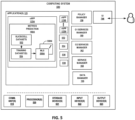
- FIG. 5 is a diagram illustrating example computing system 500 in detail, in accordance with techniques of this disclosure.
- computing system 500 may implement, for example, a non-real time RIC, such as non-RT RIC 122 of FIGS. 1A-1C .
- One or more of the devices, modules, storage areas, or other components of computing system 500 may be interconnected to enable inter-component communications (physically, communicatively, and/or operatively).
- such connectivity may be provided by communication channels, a system bus (e.g., message bus 151 of FIG. 1B ), a network connection, an inter-process communication data structure, or any other method for communicating data.
- Processing circuitry 520 of computing system 500 may implement functionality and/or execute instructions associated with a non-RT RIC or associated with one or more modules illustrated herein and/or described herein, including applications 123, policy manager 158, O1 services manager 160, O2 services manager 162, service manager 163, and data manager 155.
- Processing circuitry 520 may be, may be part of, and/or may include processing circuitry that performs operations in accordance with one or more aspects of the present disclosure. Examples of processing circuitry 520 include microprocessors, application processors, display controllers, auxiliary processors, one or more sensor hubs, and any other hardware configured to function as a processor, a processing unit, or a processing device.
- Computing system 500 may use processing circuitry 520 to perform operations in accordance with one or more aspects of the present disclosure using software, hardware, firmware, or a mixture of hardware, software, and firmware residing in and/or executing at computing system 500. Any one or more of applications 123, policy manager 158, 01 services manager 160, O2 services manager 162, service manager 163, and data manager 155 may be hosted by a cloud provider or other third-party.
- One or more communication units 519 of computing system 500 may communicate with devices external to computing system 500 by transmitting and/or receiving data, and may operate, in some respects, as both an input device and an output device.
- communication units 519 may communicate with other devices over a network.
- communication units 519 may send and/or receive radio signals on a radio network such as a cellular radio network.
- communication units 519 of computing system 500 may transmit and/or receive satellite signals on a satellite network such as a Global Positioning System (GPS) network.
- GPS Global Positioning System
- Examples of communication units 519 include a network interface card (e.g., an Ethernet card), an optical transceiver, a radio frequency transceiver, a GPS receiver, or any other type of device that can send and/or receive information.
- Other examples of communication units 519 may include devices capable of communicating over Bluetooth ® , GPS, NFC, ZigBee, and cellular networks (e.g., 3G, 4G, 5G), and Wi-Fi ® radios found in mobile devices as well as Universal Serial Bus (USB) controllers and the like.
- Such communications may adhere to, implement, or abide by appropriate protocols, including Transmission Control Protocol/Internet Protocol (TCP/IP), Ethernet, Bluetooth, NFC, or other technologies or protocols.
- One or more output devices 523 may represent any output devices of computing system 500 not otherwise separately described herein.
- One or more output devices 523 may generate, receive, and/or process input from any type of device capable of detecting input from a human or machine.
- one or more output devices 523 may generate, receive, and/or process output in the form of electrical and/or physical output (e.g., peripheral device, actuator).
- One or more storage device(s) 521 within computing system 500 may store information for processing during operation of computing system 500.
- Storage device(s) 521 may store program instructions and/or data associated with one or more of the modules described in accordance with one or more aspects of this disclosure.
- Processing circuitry 520 and one or more storage device(s) 521 may provide an operating environment or platform for such modules, which may be implemented as software, but may in some examples include any combination of hardware, firmware, and software.
- Processing circuitry 520 may execute instructions and one or more storage device(s) 521 may store instructions and/or data of one or more modules.
- the combination of processing circuitry 520 and storage device(s) 521 may retrieve, store, and/or execute the instructions and/or data of one or more applications, modules, or software.
- Processing circuitry 520 and/or storage device(s) 521 may also be operably coupled to one or more other software and/or hardware components, including, but not limited to, one or more of the components of computing system 500 and/or one or more devices or systems illustrated as being connected to computing system 500.
- one or more storage device(s) 521 are temporary memories, meaning that a primary purpose of the one or more storage devices is not long-term storage.
- Storage device(s) 521 of computing system 500 may be configured for short-term storage of information as volatile memory and therefore not retain stored contents if deactivated. Examples of volatile memories include random access memories (RAM), dynamic random-access memories (DRAM), static random-access memories (SRAM), and other forms of volatile memories known in the art.
- Storage device(s) 521 in some examples, also include one or more computer-readable storage media.
- Storage device(s) 521 may be configured to store larger amounts of information than volatile memory.
- Storage device(s) 521 may further be configured for long-term storage of information as non-volatile memory space and retain information after activate/off cycles. Examples of non-volatile memories include magnetic hard disks, optical discs, Flash memories, or forms of electrically programmable memories (EPROM) or electrically erasable and programmable (EEPROM) memories.
- EPROM electrically programm
- applications 123 may manage non-real time events within non-RT RIC 122, such as applications that do not require response times of less than one second. Applications 123 may leverage the functionality exposed via a non-RT RIC framework of computing device 500. Applications 123 may be used to control and manage RAN elements and resources, such as a near-RT RIC, RAN nodes, and/or resources in the O-RAN cloud. Applications 123 may provide one or more services that are performed using interfaces of computing system 500 (e.g., A1 interface, O1 interface, O2 interface, etc.). For example, applications 123 may include services such as policies 532 for a near-RT RIC, configuration instructions 534 for O-RAN managed elements, performance jobs 536 for O-RAN managed elements, services for managing the services and/or data 538, etc.
- Computing system 500 may include one or more modules or units configured to perform one or more services or functions of applications 123, such as policy manager 158, O1 services manager 160, O2 services manager 162, service manager 163, and data manager 155, as described above.
- applications 123 such as policy manager 158, O1 services manager 160, O2 services manager 162, service manager 163, and data manager 155, as described above.
- policy manager 158 is configured to control the deployment of policies (e.g., A1 services).
- policy manager 158 may receive requests for A1 services from applications 123 (e.g., via R1 interface 154 of FIG. 1B ), process the A1 services from applications 123, and perform the A1 services for a near-RT RIC using an A1 interface (e.g., A1 interface 164 of FIG. 1B ).
- the A1 interface may implement an A1AP application protocol based on the 3GPP framework.
- O1 services manager 160 is configured to control the deployment of O1 services for monitoring the performance of O-RAN managed elements (e.g., near-RT RIC 124, O-CU 146, O-DU 148 of FIG. 1B ).
- O1 services manager 160 may receive requests for O1 services for monitoring the performance of the near-RT RIC from applications 123 (e.g., via R1 interface 154 of FIG. 1B ), process the O1 services, and perform the O1 services for the O-RAN managed elements using an O1 interface (e.g., O1 interface 166 of FIG. 1B ).
- the O1 interface may implement REST/HTTPS APIs and/or NETCONF.
- O1 services manager 160 is additionally, or alternatively, configured to control the deployment of O1 services for the configuration of near-RT RIC 124 and/or RAN nodes.
- O1 services manager 160 may receive requests for O1 services for the configuration of O-RAN managed elements from applications 123 (e.g., via R1 interface 154 of FIG. 1B ), process the O1 services, and may perform the O1 services for the O-RAN managed elements using an O1 interface (e.g., O1 interface 166 of FIG. 1B ).
- O1 interface e.g., O1 interface 166 of FIG. 1B
- O2 services manager 162 may be configured to control the deployment of O2 services for monitoring the performance of resources of the O-RAN cloud. For example, O2 services manager 162 may receive requests for O2 services for monitoring the performance of resources within the O-RAN cloud (e.g., via R1 interface 154 of FIG. 1B ), process the O2 services, and may perform the O2 services for the resources of the O-RAN cloud using an O2 interface (e.g., O2 interface 167 of FIG. 1B ).
- O2 interface e.g., O2 interface 167 of FIG. 1B
- Data manager 155 is configured to manage the data of applications 123.
- data manager 155 may receive requests for DME services from applications 123 (e.g., via R1 interface 154 of FIG. 1B ), perform the DME services (e.g., sending data from application configured as a data producer to application configured as a data consumer) for one or more applications 123, and send a response to the one or more applications 123 using an R1 interface (e.g., R1 interface 154 of FIG. 1B ).
- R1 interface e.g., R1 interface 154 of FIG. 1B
- applications 123 include rApp 123A, which executes metrics prediction 160.
- Metrics prediction 160A predicts one or more metrics of a network slice or cell within RAN 109 and/or mobile core network 105 of FIGS. 1A-1C .
- the one or more metrics are for a network slice within RAN 109 and/or mobile core network 105.
- the one or more metrics are for a network cell within RAN 109 and/or mobile core network 105.
- Non-RT RIC 122 of FIG. 1B may use the prediction of metrics prediction 160A to adjust or modify the allocation of resources to each network slice or cell within RAN 109 and/or mobile core network 105.
- metrics prediction 160A obtains respective datasets 552 for a plurality of cells or network slices within RAN 109 and/or mobile core network 105.
- Each of datasets 552 comprises time steps and respective values for a performance metric of the corresponding one of the plurality of cells or network slices within RAN 109 and/or mobile core network 105.
- each dataset 522 includes one or more time steps and corresponding values of bandwidth downlink utilization by the corresponding one of the plurality of cells or network slices.
- each dataset 522 includes one or more time steps and corresponding values of a 5th Generation network Key Performance Indicator (5G KPI) for a corresponding one of the plurality of cells or network slices.
- 5G KPI 5th Generation network Key Performance Indicator
- metrics prediction 160A applies a clustering algorithm to group the plurality of cells or network slices into clusters based at least in part on a node identifier of each cell or network slice of the plurality of cells or network.
- Metrics prediction 160A applies, to a subset of most-recent time steps and corresponding values of each dataset of the datasets of a first cluster of the clusters, a transformation to obtain a set of time steps and corresponding standardized values for each cluster.
- Metrics prediction 160A uses the set of time steps and corresponding standardized values as training dataset(s) 554 for training machine learning systems 550A-550N (collectively, "machine learning systems 550"). Each machine learning system 550 is trained with respect to a specific cluster of datasets so as to predict future values of one or more metrics of a slice or cell within the cluster. For example, metrics prediction 160A trains, with the set of time steps and corresponding standardized values for each dataset of the training datasets 554 of the first cluster, machine learning system 550A to generate predicted values at future time steps of the datasets 554 of the first cluster.
- machine learning system 550A comprises a first machine learning system that is trained on a set of time steps and corresponding standardized values for a first cluster.
- metrics prediction 160A trains, for each different cluster of slices or cells, a different machine learning system with sets of time steps and corresponding standardized values generated from datasets of each respective cluster of the different clusters such that a different machine learning system is trained to generate predicted values at future time steps for the slices or cells of each different cluster.
- trained machine learning system 550A processes a first dataset for a first cell or network slice of the plurality of cells or network slices within RAN 109 and/or mobile core network 105 to generate a first predicted value at a first future time step of the first dataset.
- each dataset 552 for a plurality of cells or network slices within RAN 109 and/or mobile core network 105 comprises a uni-model dataset comprising of a dataset for each cell or network slice within RAN 109 and/or mobile core network 105.
- trained machine learning system 550A applies a uni-model approach to generate or predict a value for the future time step of the respective dataset.
- non-RT RIC 122 modifies, based at least in part on the first predicted value at the first future time step, an allocation of a resource of RAN 109 and/or mobile core network 105 for the first cell or network slice. For example, non-RT RIC 122 may modify a bandwidth allocated to the first cell or network slice.
- computing system 500 outputs, via output devices 523, the first predicted value at the first future time step to another network device, such as near-RT RIC 124, or a user, such as an administrator.
- a computing system obtains respective datasets for the cells or network slices. Each dataset comprises time steps and respective values for a performance metric of the corresponding one of the cells or network slices.
- the computing system groups, based on a clustering algorithm applied to (1) the datasets, or (2) the cells or network slices, the datasets into clusters of datasets.
- the computing system applies, to a subset of most-recent time steps and corresponding values of each dataset of a first cluster of the clusters, a transformation to obtain a set of time steps and corresponding standardized values with which a machine learning system is trained to generate predicted values at future time steps of the datasets of the first cluster.
- processors including one or more microprocessors, digital signal processors (DSPs), application specific integrated circuits (ASICs), field programmable gate arrays (FPGAs), or any other equivalent integrated or discrete logic circuitry, as well as any combinations of such components.
- DSPs digital signal processors
- ASICs application specific integrated circuits
- FPGAs field programmable gate arrays
- processors may generally refer to any of the foregoing logic circuitry, alone or in combination with other logic circuitry, or any other equivalent circuitry.
- a control unit comprising hardware may also perform one or more of the techniques of this disclosure.
- Such hardware, software, and firmware may be implemented within the same device or within separate devices to support the various operations and functions described in this disclosure.
- any of the described units, modules or components may be implemented together or separately as discrete but interoperable logic devices. Depiction of different features as modules or units is intended to highlight different functional aspects and does not necessarily imply that such modules or units must be realized by separate hardware or software components. Rather, functionality associated with one or more modules or units may be performed by separate hardware or software components or integrated within common or separate hardware or software components.
- Computer readable storage media which is tangible and non-transitory, may include random access memory (RAM), read only memory (ROM), programmable read only memory (PROM), erasable programmable read only memory (EPROM), electronically erasable programmable read only memory (EEPROM), flash memory, a hard disk, a CD-ROM, a floppy disk, a cassette, magnetic media, optical media, or other computer-readable storage media.
- RAM random access memory
- ROM read only memory
- PROM programmable read only memory
- EPROM erasable programmable read only memory
- EEPROM electronically erasable programmable read only memory
- flash memory a hard disk, a CD-ROM, a floppy disk, a cassette, magnetic media, optical media, or other computer-readable storage media.
- the term "computer-readable storage media” refers to physical storage media, and not signals, carrier waves, or other transient media. Additionally, or alternatively, a computer-readable medium can include transient media such as carrier waves and transmission
Landscapes
- Engineering & Computer Science (AREA)
- Signal Processing (AREA)
- Computer Networks & Wireless Communication (AREA)
- Software Systems (AREA)
- Evolutionary Computation (AREA)
- Medical Informatics (AREA)
- Computer Vision & Pattern Recognition (AREA)
- Artificial Intelligence (AREA)
- Databases & Information Systems (AREA)
- Theoretical Computer Science (AREA)
- Data Mining & Analysis (AREA)
- Physics & Mathematics (AREA)
- Computing Systems (AREA)
- General Engineering & Computer Science (AREA)
- General Physics & Mathematics (AREA)
- Mathematical Physics (AREA)
- Mobile Radio Communication Systems (AREA)
Applications Claiming Priority (1)
| Application Number | Priority Date | Filing Date | Title |
|---|---|---|---|
| US18/400,029 US12610260B2 (en) | 2023-12-29 | 2023-12-29 | Machine learning system for prediction of resource usage by 5G network slices or cells |
Publications (1)
| Publication Number | Publication Date |
|---|---|
| EP4580243A1 true EP4580243A1 (fr) | 2025-07-02 |
Family
ID=93376473
Family Applications (1)
| Application Number | Title | Priority Date | Filing Date |
|---|---|---|---|
| EP24210245.7A Pending EP4580243A1 (fr) | 2023-12-29 | 2024-10-31 | Système d'apprentissage automatique pour la prédiction de l'utilisation de ressources par des tranches ou cellules de réseau 5g |
Country Status (3)
| Country | Link |
|---|---|
| US (1) | US12610260B2 (fr) |
| EP (1) | EP4580243A1 (fr) |
| CN (1) | CN120238913A (fr) |
Families Citing this family (1)
| Publication number | Priority date | Publication date | Assignee | Title |
|---|---|---|---|---|
| US20250338164A1 (en) * | 2024-04-24 | 2025-10-30 | Rakuten Symphony, Inc. | Batch scheduling of radio node clusters for firmware scheduler |
Citations (2)
| Publication number | Priority date | Publication date | Assignee | Title |
|---|---|---|---|---|
| US11063842B1 (en) * | 2020-01-10 | 2021-07-13 | Cisco Technology, Inc. | Forecasting network KPIs |
| US20230105365A1 (en) * | 2021-10-01 | 2023-04-06 | At&T Intellectual Property I, L.P. | Data clustering for network traffic modeling |
Family Cites Families (4)
| Publication number | Priority date | Publication date | Assignee | Title |
|---|---|---|---|---|
| US20240296342A1 (en) * | 2021-06-10 | 2024-09-05 | Telefonaktiebolaget Lm Ericsson (Publ) | Selection of Global Machine Learning Models for Collaborative Machine Learning in a Communication Network |
| US12356220B2 (en) * | 2021-12-29 | 2025-07-08 | T-Mobile Innovations Llc | Telecommunications network predictions based on machine learning using aggregated network key performance indicators |
| WO2023147871A1 (fr) * | 2022-02-04 | 2023-08-10 | Telefonaktiebolaget Lm Ericsson (Publ) | Extraction de motifs temporels à partir de données collectées à partir d'un réseau de communication |
| US20250344233A1 (en) * | 2024-05-06 | 2025-11-06 | T-Mobile Innovations Llc | Resource allocation for provisioning systems in wireless communication networks |
-
2023
- 2023-12-29 US US18/400,029 patent/US12610260B2/en active Active
-
2024
- 2024-10-31 EP EP24210245.7A patent/EP4580243A1/fr active Pending
- 2024-10-31 CN CN202411543182.7A patent/CN120238913A/zh active Pending
Patent Citations (2)
| Publication number | Priority date | Publication date | Assignee | Title |
|---|---|---|---|---|
| US11063842B1 (en) * | 2020-01-10 | 2021-07-13 | Cisco Technology, Inc. | Forecasting network KPIs |
| US20230105365A1 (en) * | 2021-10-01 | 2023-04-06 | At&T Intellectual Property I, L.P. | Data clustering for network traffic modeling |
Non-Patent Citations (3)
| Title |
|---|
| O-RAN ARCHITECTURE DESCRIPTION, October 2022 (2022-10-01) |
| TS 23.501 V17.0.0, March 2021 (2021-03-01) |
| TS 23.501 V18.2.2, July 2023 (2023-07-01) |
Also Published As
| Publication number | Publication date |
|---|---|
| US20250220457A1 (en) | 2025-07-03 |
| CN120238913A (zh) | 2025-07-01 |
| US12610260B2 (en) | 2026-04-21 |
Similar Documents
| Publication | Publication Date | Title |
|---|---|---|
| KR102872754B1 (ko) | 무선 통신 네트워크에서 네트워크 분석 정보 제공 방법 및 장치 | |
| D’Oro et al. | OrchestRAN: Network automation through orchestrated intelligence in the open RAN | |
| US20240378506A1 (en) | Zero-Touch Deployment and Orchestration of Network Intelligence in Open RAN Systems | |
| CN112313906B (zh) | 用于数据分析管理的方法和相关设备 | |
| US12408058B2 (en) | Method and device for providing network analysis information for RFSP index selection in mobile communication network | |
| EP4099635A1 (fr) | Procédé et dispositif de sélection de service dans un système de communication sans fil | |
| US20240163649A1 (en) | Conflict management of functions and services | |
| US12177774B2 (en) | Provision of data analytics in a telecommunication network | |
| US20250158892A1 (en) | Enabling service api analytics in a wireless communications system | |
| EP4580243A1 (fr) | Système d'apprentissage automatique pour la prédiction de l'utilisation de ressources par des tranches ou cellules de réseau 5g | |
| US20250097778A1 (en) | Detecting presence of radio access network (ran) sharing and determining ran sharing type | |
| EP4625929A1 (fr) | Gestion et orchestration de services pour réseaux mobiles privés et publics | |
| US20250184278A1 (en) | Conflict management of functions and services in a radio intelligent controller user interface | |
| EP4716280A1 (fr) | Mise à l'échelle d'applications de réseau d'accès radio ouvert (o-ran) | |
| US20260089605A1 (en) | Scaling of open radio access network (o-ran) applications | |
| EP4718905A1 (fr) | Exécution en boucle ouverte d'applications de contrôleur intelligent de réseau d'accès radio | |
| US20260059280A1 (en) | Ran intelligent controller (ric) conflict management and mitigation framework | |
| US20260113645A1 (en) | Conflict management of non-realtime ran intelligent controller (ric) and other optimization systems | |
| EP4730735A1 (fr) | Gestion de conflit de contrôleur intelligent de ran (ric) en temps non réel et d'autres systèmes d'optimisation | |
| US20260006457A1 (en) | Digital twin enablers for open radio access networks | |
| US20260082272A1 (en) | Managing disaggregated radio access networks | |
| US20260107171A1 (en) | Closed-loop system framework for end-to-end (e2e) network observability and automation | |
| CN118042559A (zh) | 功能和服务的冲突管理 | |
| CN121002820A (zh) | 收集拓扑和清单数据的方法和使用该方法的系统 |
Legal Events
| Date | Code | Title | Description |
|---|---|---|---|
| PUAI | Public reference made under article 153(3) epc to a published international application that has entered the european phase |
Free format text: ORIGINAL CODE: 0009012 |
|
| STAA | Information on the status of an ep patent application or granted ep patent |
Free format text: STATUS: THE APPLICATION HAS BEEN PUBLISHED |
|
| AK | Designated contracting states |
Kind code of ref document: A1 Designated state(s): AL AT BE BG CH CY CZ DE DK EE ES FI FR GB GR HR HU IE IS IT LI LT LU LV MC ME MK MT NL NO PL PT RO RS SE SI SK SM TR |
|
| STAA | Information on the status of an ep patent application or granted ep patent |
Free format text: STATUS: REQUEST FOR EXAMINATION WAS MADE |
|
| 17P | Request for examination filed |
Effective date: 20260102 |