EP4580355A1 - Fotovoltaische zelle mit perowskitschicht - Google Patents
Fotovoltaische zelle mit perowskitschicht Download PDFInfo
- Publication number
- EP4580355A1 EP4580355A1 EP24223189.2A EP24223189A EP4580355A1 EP 4580355 A1 EP4580355 A1 EP 4580355A1 EP 24223189 A EP24223189 A EP 24223189A EP 4580355 A1 EP4580355 A1 EP 4580355A1
- Authority
- EP
- European Patent Office
- Prior art keywords
- photovoltaic cell
- protection
- halide perovskite
- perovskite layer
- lead halide
- Prior art date
- Legal status (The legal status is an assumption and is not a legal conclusion. Google has not performed a legal analysis and makes no representation as to the accuracy of the status listed.)
- Pending
Links
Images
Classifications
-
- H—ELECTRICITY
- H10—SEMICONDUCTOR DEVICES; ELECTRIC SOLID-STATE DEVICES NOT OTHERWISE PROVIDED FOR
- H10K—ORGANIC ELECTRIC SOLID-STATE DEVICES
- H10K85/00—Organic materials used in the body or electrodes of devices covered by this subclass
- H10K85/50—Organic perovskites; Hybrid organic-inorganic perovskites [HOIP], e.g. CH3NH3PbI3
-
- H—ELECTRICITY
- H10—SEMICONDUCTOR DEVICES; ELECTRIC SOLID-STATE DEVICES NOT OTHERWISE PROVIDED FOR
- H10K—ORGANIC ELECTRIC SOLID-STATE DEVICES
- H10K30/00—Organic devices sensitive to infrared radiation, light, electromagnetic radiation of shorter wavelength or corpuscular radiation
- H10K30/80—Constructional details
- H10K30/88—Passivation; Containers; Encapsulations
-
- H—ELECTRICITY
- H10—SEMICONDUCTOR DEVICES; ELECTRIC SOLID-STATE DEVICES NOT OTHERWISE PROVIDED FOR
- H10K—ORGANIC ELECTRIC SOLID-STATE DEVICES
- H10K30/00—Organic devices sensitive to infrared radiation, light, electromagnetic radiation of shorter wavelength or corpuscular radiation
- H10K30/40—Organic devices sensitive to infrared radiation, light, electromagnetic radiation of shorter wavelength or corpuscular radiation comprising a p-i-n structure, e.g. having a perovskite absorber between p-type and n-type charge transport layers
-
- H—ELECTRICITY
- H10—SEMICONDUCTOR DEVICES; ELECTRIC SOLID-STATE DEVICES NOT OTHERWISE PROVIDED FOR
- H10K—ORGANIC ELECTRIC SOLID-STATE DEVICES
- H10K30/00—Organic devices sensitive to infrared radiation, light, electromagnetic radiation of shorter wavelength or corpuscular radiation
- H10K30/50—Photovoltaic [PV] devices
- H10K30/57—Photovoltaic [PV] devices comprising multiple junctions, e.g. tandem PV cells
-
- Y—GENERAL TAGGING OF NEW TECHNOLOGICAL DEVELOPMENTS; GENERAL TAGGING OF CROSS-SECTIONAL TECHNOLOGIES SPANNING OVER SEVERAL SECTIONS OF THE IPC; TECHNICAL SUBJECTS COVERED BY FORMER USPC CROSS-REFERENCE ART COLLECTIONS [XRACs] AND DIGESTS
- Y02—TECHNOLOGIES OR APPLICATIONS FOR MITIGATION OR ADAPTATION AGAINST CLIMATE CHANGE
- Y02E—REDUCTION OF GREENHOUSE GAS [GHG] EMISSIONS, RELATED TO ENERGY GENERATION, TRANSMISSION OR DISTRIBUTION
- Y02E10/00—Energy generation through renewable energy sources
- Y02E10/50—Photovoltaic [PV] energy
- Y02E10/549—Organic PV cells
-
- Y—GENERAL TAGGING OF NEW TECHNOLOGICAL DEVELOPMENTS; GENERAL TAGGING OF CROSS-SECTIONAL TECHNOLOGIES SPANNING OVER SEVERAL SECTIONS OF THE IPC; TECHNICAL SUBJECTS COVERED BY FORMER USPC CROSS-REFERENCE ART COLLECTIONS [XRACs] AND DIGESTS
- Y02—TECHNOLOGIES OR APPLICATIONS FOR MITIGATION OR ADAPTATION AGAINST CLIMATE CHANGE
- Y02P—CLIMATE CHANGE MITIGATION TECHNOLOGIES IN THE PRODUCTION OR PROCESSING OF GOODS
- Y02P70/00—Climate change mitigation technologies in the production process for final industrial or consumer products
- Y02P70/50—Manufacturing or production processes characterised by the final manufactured product
Definitions
- the invention relates to a photovoltaic cell, whose photovoltaic absorber layer made of perovskite has an improved resistance to humidity.
- photovoltaic cells thanks to the continuous decrease in the costs of the energy produced by them, have played a key role in reducing CO 2 emissions.
- the development of high-efficiency photovoltaic technologies has led to a reduction in plant costs in terms of occupied area.
- the technology based on crystalline silicon cells dominates the market of photovoltaic modules thanks to the low costs for manufacturing the modules as well as the high reliability of the technology itself.
- the theoretical limit is approximately 290 and is due to factors such as, for example, the transparency of the absorber layer to below-bandgap photons and the losses due to thermalization in the case of high energy photons.
- a solution to overcome these limiting factors is to combine various absorber materials with different band gaps in multi-junction photovoltaic cells.
- the use of wide-bandgap materials permits a reduction in the losses due to thermalization, while the collection of the remaining part of the light can take place with narrow-bandgap absorber layers.
- Tandem photovoltaic cells which combine two component cells, represent the simplest multi-junction configuration.
- silicon is an excellent choice for the rear component cell thanks to the material band gap (1.1 eV), the open circuit voltage that can reach up to 750 mV and the possibility of using low-cost manufacturing processes.
- perovskite is one of the materials currently most studied and its use has made it possible to create a perovskite/silicon tandem cell with a record efficiency of 33.9%, a value that is already higher than the efficiency record of single-junction c-Si cells.
- the technology based on perovskite cells with organometallic halides has greatly attracted the interest of the scientific community thanks to important features, such as direct bandgap, high absorption coefficients, excellent properties in terms of electrical transport. These properties have made it possible to obtain photovoltaic cells in the laboratory with efficiencies greater than 200.
- perovskite is a mineral first found in 1839 in the Ural mountains and consisting of an oxide of Calcium and Titanium - CaTiO 3 .
- perovskite refers to all those compounds that have the same ABX3 crystallographic structure, in which A is an atomic or molecular cation at the centre of a cube, B are cations placed at the vertices of the cube and X are smaller negatively charged atoms placed on the faces of the cube and that compose octahedral structures in B on each vertex of the cube.
- materials with peculiar and very interesting characteristics can be obtained, such as superconductivity, photoluminescence, which allow them to be used in many fields.
- A is an organic cation e.g. of methylammonium, formamidinium or an inorganic cation e.g. cesium
- B is an inorganic cation generally lead (+2), tin or germanium
- X is the halide anion (chloride, iodide, bromide).
- photovoltaic modules are laminated between two glass sheets by means of polymer-based encapsulants.
- One of the main roles of encapsulation concerns the protection of solar cells from humidity, since, as it is known, when water interacts with solar cells, it reduces their efficiency and reliability.
- Solar cells usually consist of a stack of functional thin films with a thickness that can vary from a few nm to hundreds of um.
- the edges constitute the most vulnerable portion for the stability and electrical properties of the solar cell as a whole.
- the edges of the solar cells constitute one of the portions that first interacts with environmental stress factors, such as humidity and oxygen.
- environmental stress factors such as humidity and oxygen.
- halide perovskite layers discussed above due to their ionic nature, are particularly sensitive to humidity, to the point that standard encapsulation materials may not be able to guarantee the desired reliability.
- the inventors of this invention found a solution, whose technical features are such as to ensure that the aforesaid need is fulfilled through the presence of a particular protection edge portion in the area of the perovskite layer.
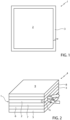
- the subject-matter of the present invention is a photovoltaic cell comprising at least one lead halide perovskite layer; said photovoltaic cell being characterized in that it comprises a protection edge arranged so as to peripherally at least partially surround said lead halide perovskite layer; said protection edge having a height equal to that of the lead halide perovskite layer and a width ranging from 0.02 mm to 2 mm, preferably ranging from 0.05 mm to 1 mm, and consisting of a protection material having a solubility in water at 25°C that is equal to or smaller than 5*10 -4 mol/kgH2O; said protection material being exclusively present in said protection edge.
- the inventors have identified the characteristic relating to solubility as an essential technical characteristic of the material useful for carrying out the invention.
- the protection material is exclusively found in the protection edge technically allows it to be used in significant quantities, without compromising the efficiency of the photovoltaic cell.
- the protection edge is made with the diffusion of the protection material also on the central surface of the perovskite layer, the amount of protection material itself cannot be too large so as not to compromise the passage of current and, therefore, the efficiency of the photovoltaic cell as a whole.
- the protection material is also present on the central surface of the perovskite layer, its quantity is limited by the effects on the efficiency of the photovoltaic cell, consequently limiting the protection of the edges of the perovskite layer, which, instead, constitute the portion most exposed to humidity; on the other hand, if the protection material is exclusively present on the edge of the perovskite layer, its quantity can be chosen based only on its effectiveness as protection, therefore without considering its effects on the efficiency of the photovoltaic cell.
- Said protection material preferably is an inorganic material comprising lead; more preferably, said protection material is a lead salt, more preferably it is chosen in the group consisting of PbSO4, Pb3(PO4)2, PbCO3, PbS, PbO or PbO2.
Landscapes
- Physics & Mathematics (AREA)
- Electromagnetism (AREA)
- Chemical & Material Sciences (AREA)
- Engineering & Computer Science (AREA)
- Materials Engineering (AREA)
- Photovoltaic Devices (AREA)
Applications Claiming Priority (1)
| Application Number | Priority Date | Filing Date | Title |
|---|---|---|---|
| IT202300028203 | 2023-12-28 |
Publications (1)
| Publication Number | Publication Date |
|---|---|
| EP4580355A1 true EP4580355A1 (de) | 2025-07-02 |
Family
ID=90363047
Family Applications (1)
| Application Number | Title | Priority Date | Filing Date |
|---|---|---|---|
| EP24223189.2A Pending EP4580355A1 (de) | 2023-12-28 | 2024-12-24 | Fotovoltaische zelle mit perowskitschicht |
Country Status (2)
| Country | Link |
|---|---|
| US (1) | US20250221140A1 (de) |
| EP (1) | EP4580355A1 (de) |
Citations (2)
| Publication number | Priority date | Publication date | Assignee | Title |
|---|---|---|---|---|
| US20200013974A1 (en) * | 2017-03-30 | 2020-01-09 | Sekisui Chemical Co., Ltd. | Solar cell and method for producing same |
| US20230403869A1 (en) * | 2022-05-11 | 2023-12-14 | Contemporary Amperex Technology Co., Limited | Perovskite solar cell and fabrication method thereof |
Family Cites Families (7)
| Publication number | Priority date | Publication date | Assignee | Title |
|---|---|---|---|---|
| CN105161623B (zh) * | 2015-08-07 | 2018-06-08 | 常州大学 | 一种钙钛矿太阳能电池及其制备方法 |
| US20180286998A1 (en) * | 2017-03-31 | 2018-10-04 | The Board Of Trustees Of The Leland Stanford Junio University | Mechanical Matrix for Enhancing the Thermomechanical and Chemical Reliability of Optoelectronic Device Technologies |
| EP3660927B1 (de) * | 2018-11-30 | 2021-11-10 | CSEM Centre Suisse D'electronique Et De Microtechnique SA | Fotovoltaisches modul |
| CN109713129B (zh) * | 2018-12-28 | 2021-02-26 | 无锡极电光能科技有限公司 | 钙钛矿薄膜太阳能组件及其制备方法 |
| US20220108847A1 (en) * | 2019-01-30 | 2022-04-07 | Nutech Ventures | Conversion of halide perovskite surfaces to insoluble, wide-bandgap lead oxysalts for enhanced solar cell stability |
| KR20220167085A (ko) * | 2021-06-11 | 2022-12-20 | 상라오 징코 솔라 테크놀러지 디벨롭먼트 컴퍼니, 리미티드 | 태양 전지, 그의 제조 방법 및 그를 포함하는 태양 전지 모듈 |
| US12598856B2 (en) * | 2023-08-30 | 2026-04-07 | Swift Solar Inc. | Mechanically strong connections for perovskite-silicon tandem solar cells |
-
2024
- 2024-12-24 EP EP24223189.2A patent/EP4580355A1/de active Pending
- 2024-12-30 US US19/004,534 patent/US20250221140A1/en active Pending
Patent Citations (2)
| Publication number | Priority date | Publication date | Assignee | Title |
|---|---|---|---|---|
| US20200013974A1 (en) * | 2017-03-30 | 2020-01-09 | Sekisui Chemical Co., Ltd. | Solar cell and method for producing same |
| US20230403869A1 (en) * | 2022-05-11 | 2023-12-14 | Contemporary Amperex Technology Co., Limited | Perovskite solar cell and fabrication method thereof |
Non-Patent Citations (6)
| Title |
|---|
| ANONYMOUS: "Aluminium oxide - Wikipedia", 1 January 2013 (2013-01-01), XP093275668, Retrieved from the Internet <URL:https://en.wikipedia.org/wiki/Aluminium_oxide> * |
| CHEN CHONG ET AL: "Efficient and stable perovskite solar cells thanks to dual functions of oleyl amine-coated PbSO4(PbO)4 quantum dots: Defect passivation and moisture/oxygen blocking", NANO ENERGY, vol. 68, 1 February 2020 (2020-02-01), NL, pages 104313, XP093181870, ISSN: 2211-2855, DOI: 10.1016/j.nanoen.2019.104313 * |
| KORE BHUSHAN P. ET AL: "Moisture tolerant solar cells by encapsulating 3D perovskite with long-chain alkylammonium cation-based 2D perovskite", vol. 2, no. 1, 23 September 2021 (2021-09-23), XP093081405, Retrieved from the Internet <URL:https://www.nature.com/articles/s43246-021-00200-8> DOI: 10.1038/s43246-021-00200-8 * |
| POPOV GEORGI ET AL: "Atomic Layer Deposition of PbS Thin Films at Low Temperatures", vol. 32, no. 19, 16 September 2020 (2020-09-16), US, pages 8216 - 8228, XP093181869, ISSN: 0897-4756, Retrieved from the Internet <URL:http://pubs.acs.org/doi/pdf/10.1021/acs.chemmater.0c01887> DOI: 10.1021/acs.chemmater.0c01887 * |
| QU WEI ET AL: "Self-powered ultraviolet-visible-near infrared perovskite/silicon hybrid photodetectors based on a novel Si/SnO 2 /MAPbI 3 /MoO 3 heterostructure", APPLIED PHYSICS EXPRESS, vol. 13, no. 12, 11 November 2020 (2020-11-11), JP, pages 121001, XP093275691, ISSN: 1882-0778, Retrieved from the Internet <URL:https://iopscience.iop.org/article/10.35848/1882-0786/abc5fa> DOI: 10.35848/1882-0786/abc5fa * |
| WENQIANG WU ET AL: "Flexible Photodetector Arrays Based on Patterned CH3NH3PbI3-xClx Perovskite Film for Real-Time Photosensing and Imaging", ADVANCED MATERIALS, VCH PUBLISHERS, DE, vol. 31, no. 3, 28 November 2018 (2018-11-28), pages n/a, XP071874928, ISSN: 0935-9648, DOI: 10.1002/ADMA.201805913 * |
Also Published As
| Publication number | Publication date |
|---|---|
| US20250221140A1 (en) | 2025-07-03 |
Similar Documents
| Publication | Publication Date | Title |
|---|---|---|
| Qin et al. | Towards operation‐stabilizing perovskite solar cells: fundamental materials, device designs, and commercial applications | |
| EP3482427B1 (de) | Barriereschicht für organische solarzellen in kontakt mit perovskit | |
| KR101909310B1 (ko) | 무기 다층 스택과 무기 다층 스택의 조성 및 방법 | |
| US8426728B2 (en) | Quantum dot solar cells | |
| CN113544872B (zh) | 太阳能电池模块 | |
| JP7068935B2 (ja) | 太陽電池 | |
| US20240204129A1 (en) | Passivation of photovoltaic devices | |
| KR20180047382A (ko) | 확산 방지막을 이용한 페로브스카이트 태양전지 및 이의 제조방법 | |
| CN216980609U (zh) | 钙钛矿太阳能电池 | |
| US20190103570A1 (en) | Systems and methods for organic semiconductor devices with sputtered contact layers | |
| JP2016541124A (ja) | 薄膜太陽電池用層系 | |
| KR20240113814A (ko) | 페로브스카이트 물질 층을 형성하는 방법 | |
| JP2013501382A (ja) | バリアがコートされた薄膜光電池 | |
| EP4580355A1 (de) | Fotovoltaische zelle mit perowskitschicht | |
| US11942575B2 (en) | Transparent electrode, method of producing transparent electrode, and electronic device | |
| CN212695179U (zh) | 一种钙钛矿光伏组件 | |
| CN114864821B (zh) | 一种新型钙钛矿光电组件及其制备方法 | |
| KR20190042533A (ko) | 확산 방지막을 이용한 페로브스카이트 태양전지 및 이의 제조방법 | |
| AU2019312457B2 (en) | Organometallic perovskite solar cell, tandem solar cell, and manufacturing process therefor | |
| CN103348488B (zh) | 具有金属硫氧化物窗口层的光伏装置 | |
| US20230167308A1 (en) | Lead-sequestration material for perovskite devices | |
| US20220077412A1 (en) | Solar cell module | |
| US20240261757A1 (en) | Highly efficient and durable on-device metal sequestering tapes for solar cells and modules | |
| US20230025098A1 (en) | Transparent electrode, method for producing the same, and electronic device using transparent electrode | |
| US20180308995A1 (en) | Photoelectric conversion element |
Legal Events
| Date | Code | Title | Description |
|---|---|---|---|
| PUAI | Public reference made under article 153(3) epc to a published international application that has entered the european phase |
Free format text: ORIGINAL CODE: 0009012 |
|
| STAA | Information on the status of an ep patent application or granted ep patent |
Free format text: STATUS: THE APPLICATION HAS BEEN PUBLISHED |
|
| AK | Designated contracting states |
Kind code of ref document: A1 Designated state(s): AL AT BE BG CH CY CZ DE DK EE ES FI FR GB GR HR HU IE IS IT LI LT LU LV MC ME MK MT NL NO PL PT RO RS SE SI SK SM TR |
|
| STAA | Information on the status of an ep patent application or granted ep patent |
Free format text: STATUS: REQUEST FOR EXAMINATION WAS MADE |
|
| 17P | Request for examination filed |
Effective date: 20250704 |