EP4582009A2 - Accessoire pour dispositif médical - Google Patents
Accessoire pour dispositif médical Download PDFInfo
- Publication number
- EP4582009A2 EP4582009A2 EP24221873.3A EP24221873A EP4582009A2 EP 4582009 A2 EP4582009 A2 EP 4582009A2 EP 24221873 A EP24221873 A EP 24221873A EP 4582009 A2 EP4582009 A2 EP 4582009A2
- Authority
- EP
- European Patent Office
- Prior art keywords
- tubular body
- cover
- slot
- axial
- shaft
- Prior art date
- Legal status (The legal status is an assumption and is not a legal conclusion. Google has not performed a legal analysis and makes no representation as to the accuracy of the status listed.)
- Pending
Links
Images





Classifications
-
- A—HUMAN NECESSITIES
- A61—MEDICAL OR VETERINARY SCIENCE; HYGIENE
- A61B—DIAGNOSIS; SURGERY; IDENTIFICATION
- A61B1/00—Instruments for performing medical examinations of the interior of cavities or tubes of the body by visual or photographical inspection, e.g. endoscopes; Illuminating arrangements therefor
- A61B1/00147—Holding or positioning arrangements
- A61B1/00148—Holding or positioning arrangements using anchoring means
-
- A—HUMAN NECESSITIES
- A61—MEDICAL OR VETERINARY SCIENCE; HYGIENE
- A61B—DIAGNOSIS; SURGERY; IDENTIFICATION
- A61B1/00—Instruments for performing medical examinations of the interior of cavities or tubes of the body by visual or photographical inspection, e.g. endoscopes; Illuminating arrangements therefor
- A61B1/00064—Constructional details of the endoscope body
- A61B1/00071—Insertion part of the endoscope body
- A61B1/0008—Insertion part of the endoscope body characterised by distal tip features
- A61B1/00087—Tools
-
- A—HUMAN NECESSITIES
- A61—MEDICAL OR VETERINARY SCIENCE; HYGIENE
- A61B—DIAGNOSIS; SURGERY; IDENTIFICATION
- A61B1/00—Instruments for performing medical examinations of the interior of cavities or tubes of the body by visual or photographical inspection, e.g. endoscopes; Illuminating arrangements therefor
- A61B1/00064—Constructional details of the endoscope body
- A61B1/00071—Insertion part of the endoscope body
- A61B1/0008—Insertion part of the endoscope body characterised by distal tip features
- A61B1/00089—Hoods
-
- A—HUMAN NECESSITIES
- A61—MEDICAL OR VETERINARY SCIENCE; HYGIENE
- A61B—DIAGNOSIS; SURGERY; IDENTIFICATION
- A61B1/00—Instruments for performing medical examinations of the interior of cavities or tubes of the body by visual or photographical inspection, e.g. endoscopes; Illuminating arrangements therefor
- A61B1/00064—Constructional details of the endoscope body
- A61B1/00071—Insertion part of the endoscope body
- A61B1/0008—Insertion part of the endoscope body characterised by distal tip features
- A61B1/00101—Insertion part of the endoscope body characterised by distal tip features the distal tip features being detachable
-
- A—HUMAN NECESSITIES
- A61—MEDICAL OR VETERINARY SCIENCE; HYGIENE
- A61B—DIAGNOSIS; SURGERY; IDENTIFICATION
- A61B1/00—Instruments for performing medical examinations of the interior of cavities or tubes of the body by visual or photographical inspection, e.g. endoscopes; Illuminating arrangements therefor
- A61B1/00112—Connection or coupling means
- A61B1/00121—Connectors, fasteners and adapters, e.g. on the endoscope handle
- A61B1/00128—Connectors, fasteners and adapters, e.g. on the endoscope handle mechanical, e.g. for tubes or pipes
-
- A—HUMAN NECESSITIES
- A61—MEDICAL OR VETERINARY SCIENCE; HYGIENE
- A61B—DIAGNOSIS; SURGERY; IDENTIFICATION
- A61B1/00—Instruments for performing medical examinations of the interior of cavities or tubes of the body by visual or photographical inspection, e.g. endoscopes; Illuminating arrangements therefor
- A61B1/00131—Accessories for endoscopes
-
- A—HUMAN NECESSITIES
- A61—MEDICAL OR VETERINARY SCIENCE; HYGIENE
- A61B—DIAGNOSIS; SURGERY; IDENTIFICATION
- A61B1/00—Instruments for performing medical examinations of the interior of cavities or tubes of the body by visual or photographical inspection, e.g. endoscopes; Illuminating arrangements therefor
- A61B1/00131—Accessories for endoscopes
- A61B1/00135—Oversleeves mounted on the endoscope prior to insertion
-
- A—HUMAN NECESSITIES
- A61—MEDICAL OR VETERINARY SCIENCE; HYGIENE
- A61B—DIAGNOSIS; SURGERY; IDENTIFICATION
- A61B1/00—Instruments for performing medical examinations of the interior of cavities or tubes of the body by visual or photographical inspection, e.g. endoscopes; Illuminating arrangements therefor
- A61B1/00131—Accessories for endoscopes
- A61B1/00137—End pieces at either end of the endoscope, e.g. caps, seals or forceps plugs
-
- A—HUMAN NECESSITIES
- A61—MEDICAL OR VETERINARY SCIENCE; HYGIENE
- A61B—DIAGNOSIS; SURGERY; IDENTIFICATION
- A61B1/00—Instruments for performing medical examinations of the interior of cavities or tubes of the body by visual or photographical inspection, e.g. endoscopes; Illuminating arrangements therefor
- A61B1/31—Instruments for performing medical examinations of the interior of cavities or tubes of the body by visual or photographical inspection, e.g. endoscopes; Illuminating arrangements therefor for the rectum, e.g. proctoscopes, sigmoidoscopes, colonoscopes
Definitions
- the present disclosure relates to an accessory for use with a medical device, such as an endoscope.
- US 2019/0183328 A1 describes a cover for the shaft of a medical device, in particular for fitting over the distal tip of an endoscope.
- the cover is a tubular member with proximal and distal ends and inner and outer circumferential surfaces. Axially extending ribs may be provided on the inner and outer circumferential surfaces.
- a plurality of projecting elements is provided on the outer surface of the cover which in use extend radially outwardly from the cover. These can pull back or flatten folds of body tissue to facilitate the inspection of a body cavity or carrying out other medical procedures with the medical device.
- US 2005/0234297 A1 discloses, according its abstract, devices and methods for detachably engaging an insertion section of an endoscope and selectively articulating an endoscopic surgical access channel.
- US 2022/0160213 A1 discloses, according to its abstract, an endoscopic device which includes at least an endoscope and one or more catheters, and a means for securing the endoscope to the catheter at a distal end of the endoscopic device.
- US 2014/0296629 A1 discloses, according to its abstract, systems, methods, and devices that include a releasable mount device that may be utilized to couple an operative element, such as an ablation device, with a therapeutic or diagnostic device, such as an endoscope.
- US 2023/0137851 A1 discloses, according to its abstract, an endoscopic retraction assist device which includes a body comprising opposite proximal and distal end portions and a central portion between the proximal and distal end portions, and a device channel defined in the body.
- US 6 569 085 B2 discloses, according to its abstract, methods and apparatus for delivering a medical instrument over the exterior of an endoscope while the endoscope is installed in the patient's body.
- a cover for fitting over the distal end of a shaft of a medical device comprises: a tubular body with a first end, a second end, inner and outer circumferential surfaces, an internal diameter and at least one projecting element extending outwardly; and an axial slot in the tubular body extending at least partially between the first end and the second end, wherein the tubular body is movable between a first position in which the slot has a first width and the tubular body has a first internal diameter, and a second position in which the width of the slot and the internal diameter of the tubular body are increased, wherein the tubular body is resiliently biased from the second position towards (or into) the first position.
- a cover can be readily fitted onto various medical device shafts.
- the axial slot may extend a full length of the tubular body between the first end and the second end. This can allow for a large amount of variation in the respective sizes between the two positions.
- the axial slot may be a partial axial slot. That is, the slot may not axially extend an entire axial length of the tubular body.
- the tubular body may comprise a hinge section aligned circumferentially with the partial axial slot. This allows a remaining portion of the tubular body to hinge between the two positions.
- the cover may comprise a plurality of axial slots. This can include the axial slot noted above. A plurality of axial slots can allow for more variation in the respective sizes between the two positions.
- the axial slots may be arranged with rotational symmetry about the tubular body. This can allow for equal deviation between parts of the tubular body separated by the axial slots.
- the tubular body may further comprise at least one biasing member.
- the biasing member can specifically be a spring member (or spring element) in any of the examples discussed herein.
- the biasing member can bias the tubular body towards the first position.
- the biasing member may comprise a resilient spring plate located between the inner and outer circumferential surfaces of the tubular body. Such a plate can effectively deliver the required bias.
- the spring plate may be perforated. This can reduce weight of the spring plate.
- the spring plate may comprise a plurality of circumferentially extending bands joined by at least one axially extending connecting bar. Again, this can help reduce the weight of the spring plate.
- the biasing member may comprise a plurality of separate circumferentially extending bands. This is a lightweight and effective way to bias the tubular body.
- the biasing member may be formed of metal. This can be advantageous as a metal will typically not behave viscoelastically (i.e. in a viscoelastic manner) - particularly when compared to a plastic which may form a coating of the tubular body. This helps ensure that the biasing member retains its tension over time.
- the cover may be pretensioned in its packaging.
- the biasing member may be embedded within a flexible coating material. This can protect the biasing member, and ensure that it does not contact a patient when the cover is used in vitro.
- the biasing member may be moulded in one piece with a flexible coating material. This is an effective way to manufacture the cover.
- the axial slot may be non-linear. This can help ensure the cover is aligned when installed.
- the axial slot may be angled with respect to a radial direction of the tubular body. This means that there is not a radial gap through the cover.
- the axial slot may increase in width towards the second end of the tubular body. This can allow for effective manipulation between the two positions, while maintaining a suitable grip to the shaft.
- the cover may further comprise a flexible bridging element spanning at least a portion of the axial slot. This bridging element may act as the biasing member discussed herein.
- the flexible bridging element may be axially discontinuous. This can reduce the weight of the cover.
- a holder for the cover as discussed herein comprises: a base and a side wall together defining an enclosure for receiving the cover; and a blocking member projecting into the enclosure and configured to fit within the axial slot in the tubular body when the tubular body is in the second position, to maintain the tubular body in the second position.
- This holder can allow for easy installation of the cover onto a shaft.
- the blocking member may comprise a main body with a nose portion, wherein the nose portion is narrower than the main body and is configured to fit into the axial slot in the tubular body. This holds the axial slot open, allowing the cover to be fitted easily.
- Such devices are elongate flexible probes which may be inserted into the body directly or via a cannula or other guide device.
- Medical devices can also include rigid surgical endoscopes or endotherapy devices such as biopsy forceps and polypectomy snares.
- the cover of the present disclosure may be used in conjunction with all of the aforementioned types of medical device.
- the medical device may specifically be a medical scoping device.
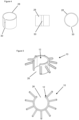
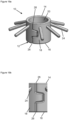
- the cover comprises a tubular body 12 with first and second ends 14, 16, an outer circumferential surface 18, an inner circumferential surface 20 and a longitudinal axis 22.
- the accessory 10 also includes one or more projecting elements 24 projecting radially outwardly, as described further below.
- the tubular body 12 is a (partial) hollow cylinder.
- the body 12 is referred to as a tubular body 12, as shown in Figures 1 to 3 , it does not form a full cylindrical surface. In other words, the accessory 10 and/or the tubular body 12 are discontinuous.
- the tubular body 12 is open at its first and second ends 14, 16.
- the tubular body 12 also comprises a slot 26 extending axially between the first end 14 and the second end 16.
- the slot 26 may be axially aligned in that it extends only in the axial direction. Alternatively, the slot 26 may simply have an axial extend and may also extend in a circumferential direction.
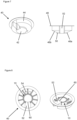
- the tubular body 12 is flexible and resilient such that it can be bent or deformed to open up the axial slot 26. This increases the width of the slot 26 and to increase the internal diameter of the tubular body 12, as shown in Figure 5 .
- the tubular body 12 preferably comprises a biasing member 28 which, when at rest and in an un-tensioned state, retains the tubular body 12 in a first, closed position as in Figures 1 to 3 , in which the tubular body 12 has a first internal diameter and the axial slot 26 has a first width.
- the biasing member 28 may specifically be a spring member 28 (also identified as a spring element 28). However, any reference to a spring member 28 in the present description is equally applicable to a general biasing member 28.
- the first width may be very small, or substantially zero with the sides of the slot 26 contacting each other. For example, in plan view the axial slot 26 may extend over no more than 90°, preferably no more than 60°, more preferably no more than 30°.
- the first internal diameter is sufficient to allow the tubular body 12 to encircle and grip a shaft 70.
- the tubular body 12 may be deformed into a second, open position by bending to open up the axial slot 26 in a circumferential direction to a second width, larger than the first width, as shown in Figure 5 .
- the spring member 28 biases the tubular body 12 towards the first, closed position.
- the spring member 28 may be configured in different ways if desired.
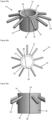
- Figure 4 shows a solid plate
- the spring member may be formed of a perforated sheet with one or more openings, in order to reduce weight.
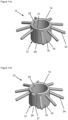
- Figures 10a to 10h Various examples are shown in Figures 10a to 10h , in which the spring member 28 comprises a number of circumferentially extending bands 28a, with gaps between them, joined by one or more axially extending connecting bars 28b.
- the spring plate 28 is provided with an array of perforations, such a circular or square/rectangular openings 28c.
- the spring member 28 may be completely encased within a coating material 32, such as a plastic or other polymer.
- This coating material my be a softer, flexible coating material 32, such as a plastic or other polymer.
- the spring member 28 may be embedded within the coating material 32.
- the spring member 28 and the coating material 32 may be moulded together in one piece.
- This softer coating material 32 forms the exterior surface of the tubular body 12, including the outer and inner circumferential surfaces 18, 20.
- the softer coating material 32 protects the shaft 70 and may enhance the grip of the tubular body 12 on the shaft 70.
- the coating material 32 may also be textured or shaped, for example with ribs on the outer and/or inner circumferential surfaces 18, 20.
- the projecting element 24 may be made of a resilient polymer material, such as a silicone.
- the projecting element 24 therefore has some stiffness and is self-supporting so that it maintains its shape, while allowing some flexing as it contacts body tissue when in use.
- the accessory 10 is fitted over the distal end of a shaft 70 of a medical device such as an endoscope, as shown in Figure 9d .
- the first end 14 is located at the distal-most end of the shaft 70.
- the second end 16 is located proximally on the shaft 70.
- the accessory 10 may be provided in a holder which facilitates fitting the accessory to a shaft 70 of a medical device.
- the holder may comprise a container 40 in which an accessory 10 may be stored prior to use.
- the container 40 may be generally cylindrical and comprises a flat circular base 42 and a perimeter wall 44, together defining an enclosure in which the cover can be located.
- An annular lip 48 may extend around the upper edge of the perimeter wall 44. In use, a peel-off cover (not shown) for the container 40 may be adhered to the lip 48.
- One or more additional walls may be provided between the base 42 and the perimeter wall 44.
- a short vertical wall 46a is provided around the flat base wall 42 and a sloping wall 46b is provided between the vertical wall 46a and the perimeter wall 44.
- the base 42 and the short vertical wall 46a together define a shallow recess 50 in the base of the container 40 for receiving the first end 14 of the accessory 10 in use.
- the sloping wall 46b supports the projecting elements 24 of the accessory 10 in use.
- the container 40 is further provided with features to locate the accessory 10 in the container 40 in its second, open position.
- a blocking element 52 is provided, which projects into the enclosure and at least part of which fits within the axial slot 26 of the tubular body 12 when it is in its second, open position. This prevents the accessory 10 springing back into its closed position under the action of the spring member 28.
- At least one locating member 54 may be arranged opposite to the blocking element 52, to help correctly position the accessory 10 against the blocking element 52.
- the (or each) locating member 54 may also be referred to as a locating element 54.
- the blocking element 52 comprises a main body in the form of a generally rectangular column projecting radially into the container 40 from the perimeter wall 44 and upwardly from the base of the container 40 (in this example including the base 42, and additional walls 46a, 46b).
- the main body of the blocking element 52 comprises a pair of side walls 56 joined by an upper surface 58.
- the blocking element 52 is formed with a narrowed nose portion 60 formed by side walls 66 which are joined to the side walls 56 of the main body by a shoulder 62.
- the end face 64 of the nose portion 60 which joins the side walls 66 and faces radially inwardly, has a concave arcuate form.
- the side walls 66 of the nose portion 60 may be parallel to each other and to the side walls 56 of the main body of the blocking element 52.
- the side walls 66 of the nose portion 60 may be non-parallel and may diverge away from each other in a radially inward direction from the shoulder 62 towards the end face 64. This may help to retain the nose portion 60 more securely within the slot 26 of the accessory 10 when the accessory 10 is fitted in the container 40 as discussed further below.
- Each locating member 54 comprises a raised projection protruding upwardly from the sloping wall 44b and base 42 and extending a small distance into the recess 50.
- the blocking element 52 projects upwardly to a first height, which is typically about the same as the axial length of an accessory 10 to be housed in the container 40.
- the locating member(s) 54 project upwardly to a second height, which is less than the first height of the blocking element 52, typically about half of the first height.
- an accessory 10 is deflected into its open position and fitted into the container 40.
- the tubular body 12 is fitted between the blocking element 52 and the locating members 54.
- the first end 14 of the tubular body 12 is received in the recess 50.
- the projecting elements 24 are supported on the sloping wall 46b.
- the nose portion 60 of the blocking element 52 is located in the slot 26.
- the curved end face 64 of the nose portion 62 follows the curvature of the inner circumferential surface 20 of the tubular body 12 in order to form a smooth circular opening into which the shaft 70 may be inserted.
- the locating members 54 fit either side of one of the projecting elements 24. Depending on the configuration of the projecting elements 24, the number, shape and position of the locating members 54 may be altered to suit. In this way, the accessory 10 is held securely in the container 40 in its open position, until it is required for use.
- the accessory 10 may be stored in a sterile condition in the container 40 with a cover (not shown) applied across the top of the container 40 and adhered to the lip 48 to seal the container 40. When the accessory 10 is required for use, the cover is removed. As shown in Figures 9a and 9b , the distal end of a shaft 70 of a medical device is inserted into the tubular body 12. Since the tubular body 12 is being held in the open position, the inside diameter of the accessory 10 is larger than the outside diameter of the shaft 70 and the shaft 70 can be easily inserted.
- the shaft 70 may then be tilted to one side as shown in Figure 9c , away from the blocking element 52 and towards the locating members 54, in order to remove the nose portion 60 of the blocking element 52 from the slot 26. Since the height of the locating members 54 is less than the height of the blocking element 52, this tilting movement is possible.
- the spring member 28 urges the tubular body 12 back into its first, closed position with a reduced internal diameter. In this state, the accessory 10 grips the shaft 70 and together they can be removed from the container 40, leaving the accessory 10 in position on the shaft 70 and ready for use as shown in Figure 9d .
- the container 40 can then be disposed of.
- the medical device When the accessory 10 is fitted on a shaft 70, the medical device may then be inserted into a patient's body. Normally when examining the colon, for example, the shaft 70 of the medical device is advanced relatively quickly to the furthest point requiring examination and then gradually withdrawn more slowly, with most of the visual examination carried out during the withdrawal. As the shaft 70 is gradually withdrawn, the projecting elements 24 act to gently pull back and flatten folds of tissue, to allow a clearer view of the body tissues through the device.
- the shaft 70 is completely withdrawn from the patient's body.
- the accessory 10 can then be removed from the shaft 70, for example by manually bending the tubular body 12 to open the axial slot 26 so that the accessory 10 can slide off the shaft 70.
- the accessory 10 can then be disposed of.
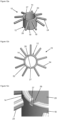
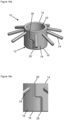
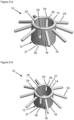
- FIGS 11a and 11b show a further example of an accessory 10.
- a bridging element 27 is provided to span at least a portion of the slot 26.
- the bridging element 27 may span the slot 26 in a circumferential direction. This may be between opposite edges of the tubular body 12 which define the slot 26.
- the tubular body 12, and particularly (where present) the spring member 28, do not extend into this slot 26.
- a slot 26 may still be defined.
- the bridging element 27 can extend along substantially an entire length of the slot 26, such as shown in Figures 11a and 11b . This may be at least 80%, 90% or even 95% of the length of the slot 26 - or 100% of the length of the slot 26.
- the bridging element 27 may be made of an elastic and/or flexible material. That is, specifically a material which is more elastic and/or flexible than the tubular body 12 and/or the spring member 28.
- the bridging element 27 may be resiliently deformable. This may be with a bias towards the first, closed position. In this sense, it is also possible for the bridging element 27 to be identified as the biasing member 28 - that is, there may be no separate biasing member 28 and the bridging element 27 may be the biasing member 28.
- the bridging element 27 spans the slot 26 in the circumferential direction.
- the bridging element 27 may be substantially un-stressed in this position.
- the tubular body 12 may then be opened to the second, open position. This opens up the axial slots 26 and stretches the bridging element 27.
- Figures 12a to 12c show that the bridging element 27 may be formed as a sheet.
- this could be formed as a sheet of the coating material 32 discussed above (with or without a spring member 28).
- the spring member 28 may stop before the slot 26, with the coating material 32 continuing to form the bridging element 27.
- this sheet could be formed of a separate material attached to the tubular body 12.
- the sheet may be formed of any flexible material.
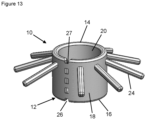
- FIG. 13 shows a further example accessory 10, with a sheet bridging element 27.
- This sheet bridging element includes one or more perforations. This means that in the axial direction the bridging element 27 may be discontinuous. In other words, the bridging element 27 is formed of a plurality of bridge sections.
- Such an accessory 10 may be formed by only forming the bridge sections in a manufacturing step.
- a continuous bridging element 27 may be formed, with the perforations then cut therefrom.
- Figure 13 shows this in relation to a thin sheet bridging element 27, this is equally applicable to any of the bridging elements 27 discussed herein.
- this bridging element 27 may be formed as the same material as a coating material 32, or from a separate material attached to the tubular body 12.
- the bridging element 27 substantially extends along a majority of the length of the slot 26. Specifically, this may be an axial length of the slot 26. For example, this could be at least 75% of the length of the slot 26, or at least 85%, or at least 90%. In examples with a discontinuous bridging element 27 this can be defined based on a sum of the lengths of the bridging sections (as a cumulative length), or as a measurement from the outermost end of the bridging section nearest the first end 14 to the outermost end of the bridging section nearest the second end 18.
- Such discontinuous bridging elements 27 may be formed as discussed above in relation to Figure 13 .
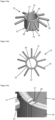
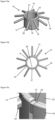
- Figures 18a and 18b show an example of an accessory 10 with a non-linear slot 26.
- This can also be defined as a serpentine slot 26, a tortuous slot 26, an offset slot 26, or a hybrid slot 26.
- a non-linear slot 26 includes at least a portion which is not solely in the axial direction.
Landscapes
- Life Sciences & Earth Sciences (AREA)
- Health & Medical Sciences (AREA)
- Surgery (AREA)
- Engineering & Computer Science (AREA)
- Biophysics (AREA)
- Medical Informatics (AREA)
- Nuclear Medicine, Radiotherapy & Molecular Imaging (AREA)
- Optics & Photonics (AREA)
- Pathology (AREA)
- Radiology & Medical Imaging (AREA)
- Veterinary Medicine (AREA)
- Biomedical Technology (AREA)
- Heart & Thoracic Surgery (AREA)
- Physics & Mathematics (AREA)
- Molecular Biology (AREA)
- Animal Behavior & Ethology (AREA)
- General Health & Medical Sciences (AREA)
- Public Health (AREA)
- Mechanical Engineering (AREA)
- Endoscopes (AREA)
- Surgical Instruments (AREA)
Priority Applications (3)
| Application Number | Priority Date | Filing Date | Title |
|---|---|---|---|
| AU2024287077A AU2024287077A1 (en) | 2024-01-02 | 2024-12-20 | Medical device accessory |
| JP2024230369A JP2025106165A (ja) | 2024-01-02 | 2024-12-26 | 医療機器付属品 |
| CN202411936897.9A CN120240930A (zh) | 2024-01-02 | 2024-12-26 | 医疗设备配件 |
Applications Claiming Priority (1)
| Application Number | Priority Date | Filing Date | Title |
|---|---|---|---|
| GB2400012.7A GB2636995A (en) | 2024-01-02 | 2024-01-02 | Medical device accessory |
Publications (2)
| Publication Number | Publication Date |
|---|---|
| EP4582009A2 true EP4582009A2 (fr) | 2025-07-09 |
| EP4582009A3 EP4582009A3 (fr) | 2025-09-03 |
Family
ID=89843855
Family Applications (1)
| Application Number | Title | Priority Date | Filing Date |
|---|---|---|---|
| EP24221873.3A Pending EP4582009A3 (fr) | 2024-01-02 | 2024-12-19 | Accessoire pour dispositif médical |
Country Status (5)
| Country | Link |
|---|---|
| EP (1) | EP4582009A3 (fr) |
| JP (1) | JP2025106165A (fr) |
| CN (1) | CN120240930A (fr) |
| AU (1) | AU2024287077A1 (fr) |
| GB (1) | GB2636995A (fr) |
Citations (6)
| Publication number | Priority date | Publication date | Assignee | Title |
|---|---|---|---|---|
| US6569085B2 (en) | 2001-08-16 | 2003-05-27 | Syntheon, Llc | Methods and apparatus for delivering a medical instrument over an endoscope while the endoscope is in a body lumen |
| US20050234297A1 (en) | 2004-04-15 | 2005-10-20 | Wilson-Cook Medical, Inc. | Endoscopic surgical access devices and methods of articulating an external accessory channel |
| US20140296629A1 (en) | 2011-09-13 | 2014-10-02 | Covidien Lp | Operative element support structure with closed tubular base |
| US20190183328A1 (en) | 2016-05-12 | 2019-06-20 | Arc Medical Design Limited | Medical Scope Accessory, Medical Scopes Comprising The Accessory, And Use Thereof |
| US20220160213A1 (en) | 2020-11-23 | 2022-05-26 | United States Endoscopy Group, Inc. | Endoscopic device with additional channel |
| US20230137851A1 (en) | 2021-10-29 | 2023-05-04 | Applied Endosolutions, Llc | Endoscopic Retraction Assist Devices and Related Systems and Methods |
Family Cites Families (8)
| Publication number | Priority date | Publication date | Assignee | Title |
|---|---|---|---|---|
| DE20209225U1 (de) * | 2002-06-13 | 2002-10-02 | Ulamo Beheer B.V., Ulft | Sicherungskappe |
| DE20301478U1 (de) * | 2003-01-30 | 2003-05-22 | Ulamo Beheer B.V., Ulft | Verschlusskappe für Seitenblende |
| DE202005018958U1 (de) * | 2005-12-02 | 2007-04-12 | Viega Gmbh & Co Kg | Zu- und Überlaufarmatur für Badewannen |
| ES2562264T5 (es) * | 2010-05-25 | 2019-06-24 | Arc Medical Design Ltd | Cubierta para dispositivo médico de exploración |
| DE202013101032U1 (de) * | 2013-03-08 | 2014-06-11 | Viega Gmbh & Co. Kg | Zu- und Überlaufarmatur für eine Badewanne |
| CN107820409A (zh) * | 2015-05-19 | 2018-03-20 | 恩多埃德有限公司 | 具有翼的内窥镜套管 |
| US20230172436A1 (en) * | 2020-05-13 | 2023-06-08 | 9393-2655 Quebec Inc. | Attachment system for endoscopes |
| EP4676300A1 (fr) * | 2023-03-08 | 2026-01-14 | KEYMED (Medical & Industrial Equipment) Limited | Accessoire d'endoscope médical |
-
2024
- 2024-01-02 GB GB2400012.7A patent/GB2636995A/en active Pending
- 2024-12-19 EP EP24221873.3A patent/EP4582009A3/fr active Pending
- 2024-12-20 AU AU2024287077A patent/AU2024287077A1/en active Pending
- 2024-12-26 CN CN202411936897.9A patent/CN120240930A/zh active Pending
- 2024-12-26 JP JP2024230369A patent/JP2025106165A/ja active Pending
Patent Citations (6)
| Publication number | Priority date | Publication date | Assignee | Title |
|---|---|---|---|---|
| US6569085B2 (en) | 2001-08-16 | 2003-05-27 | Syntheon, Llc | Methods and apparatus for delivering a medical instrument over an endoscope while the endoscope is in a body lumen |
| US20050234297A1 (en) | 2004-04-15 | 2005-10-20 | Wilson-Cook Medical, Inc. | Endoscopic surgical access devices and methods of articulating an external accessory channel |
| US20140296629A1 (en) | 2011-09-13 | 2014-10-02 | Covidien Lp | Operative element support structure with closed tubular base |
| US20190183328A1 (en) | 2016-05-12 | 2019-06-20 | Arc Medical Design Limited | Medical Scope Accessory, Medical Scopes Comprising The Accessory, And Use Thereof |
| US20220160213A1 (en) | 2020-11-23 | 2022-05-26 | United States Endoscopy Group, Inc. | Endoscopic device with additional channel |
| US20230137851A1 (en) | 2021-10-29 | 2023-05-04 | Applied Endosolutions, Llc | Endoscopic Retraction Assist Devices and Related Systems and Methods |
Also Published As
| Publication number | Publication date |
|---|---|
| AU2024287077A1 (en) | 2025-07-17 |
| CN120240930A (zh) | 2025-07-04 |
| GB202400012D0 (en) | 2024-02-14 |
| GB2636995A (en) | 2025-07-09 |
| JP2025106165A (ja) | 2025-07-14 |
| EP4582009A3 (fr) | 2025-09-03 |
Similar Documents
| Publication | Publication Date | Title |
|---|---|---|
| US7431694B2 (en) | Method of guiding medical devices | |
| JP5383999B2 (ja) | 内視鏡のための取付装置 | |
| US7815565B2 (en) | Endcap for use with an endoscope | |
| AU2010331924B2 (en) | Endoscope sheath | |
| US8480657B2 (en) | Detachable distal overtube section and methods for forming a sealable opening in the wall of an organ | |
| JPWO2018194146A1 (ja) | 内視鏡頂部の取り付け装置 | |
| US11944767B2 (en) | Wire lock assembly | |
| EP4582009A2 (fr) | Accessoire pour dispositif médical | |
| HK40128525A (en) | Medical device accessory | |
| WO2025133578A1 (fr) | Dispositif applicateur pour accessoire de dispositif médical | |
| GB2637738A (en) | Medical device accessory | |
| WO2025104413A1 (fr) | Accessoire d'endoscope médical | |
| MXPA06005502A (en) | Apparatus useful for positioning a device on an endoscope |
Legal Events
| Date | Code | Title | Description |
|---|---|---|---|
| PUAI | Public reference made under article 153(3) epc to a published international application that has entered the european phase |
Free format text: ORIGINAL CODE: 0009012 |
|
| STAA | Information on the status of an ep patent application or granted ep patent |
Free format text: STATUS: THE APPLICATION HAS BEEN PUBLISHED |
|
| AK | Designated contracting states |
Kind code of ref document: A2 Designated state(s): AL AT BE BG CH CY CZ DE DK EE ES FI FR GB GR HR HU IE IS IT LI LT LU LV MC ME MK MT NL NO PL PT RO RS SE SI SK SM TR |
|
| PUAL | Search report despatched |
Free format text: ORIGINAL CODE: 0009013 |
|
| AK | Designated contracting states |
Kind code of ref document: A3 Designated state(s): AL AT BE BG CH CY CZ DE DK EE ES FI FR GB GR HR HU IE IS IT LI LT LU LV MC ME MK MT NL NO PL PT RO RS SE SI SK SM TR |
|
| RIC1 | Information provided on ipc code assigned before grant |
Ipc: A61B 1/00 20060101AFI20250729BHEP Ipc: A61B 1/31 20060101ALI20250729BHEP |
|
| REG | Reference to a national code |
Ref country code: HK Ref legal event code: DE Ref document number: 40128525 Country of ref document: HK |
|
| STAA | Information on the status of an ep patent application or granted ep patent |
Free format text: STATUS: REQUEST FOR EXAMINATION WAS MADE |
|
| 17P | Request for examination filed |
Effective date: 20260227 |