EP4582064A2 - Eingeschränktes prothesenknie - Google Patents
Eingeschränktes prothesenknie Download PDFInfo
- Publication number
- EP4582064A2 EP4582064A2 EP25177112.7A EP25177112A EP4582064A2 EP 4582064 A2 EP4582064 A2 EP 4582064A2 EP 25177112 A EP25177112 A EP 25177112A EP 4582064 A2 EP4582064 A2 EP 4582064A2
- Authority
- EP
- European Patent Office
- Prior art keywords
- engagement feature
- edge
- tibial baseplate
- tibial
- recess
- Prior art date
- Legal status (The legal status is an assumption and is not a legal conclusion. Google has not performed a legal analysis and makes no representation as to the accuracy of the status listed.)
- Pending
Links
Images


Classifications
-
- A—HUMAN NECESSITIES
- A61—MEDICAL OR VETERINARY SCIENCE; HYGIENE
- A61F—FILTERS IMPLANTABLE INTO BLOOD VESSELS; PROSTHESES; DEVICES PROVIDING PATENCY TO, OR PREVENTING COLLAPSING OF, TUBULAR STRUCTURES OF THE BODY, e.g. STENTS; ORTHOPAEDIC, NURSING OR CONTRACEPTIVE DEVICES; FOMENTATION; TREATMENT OR PROTECTION OF EYES OR EARS; BANDAGES, DRESSINGS OR ABSORBENT PADS; FIRST-AID KITS
- A61F2/00—Filters implantable into blood vessels; Prostheses, i.e. artificial substitutes or replacements for parts of the body; Appliances for connecting them with the body; Devices providing patency to, or preventing collapsing of, tubular structures of the body, e.g. stents
- A61F2/02—Prostheses implantable into the body
- A61F2/30—Joints
- A61F2/38—Joints for elbows or knees
- A61F2/3836—Special connection between upper and lower leg, e.g. constrained
- A61F2/384—Special connection between upper and lower leg, e.g. constrained hinged, i.e. with transverse axle restricting the movement
- A61F2/3845—Special connection between upper and lower leg, e.g. constrained hinged, i.e. with transverse axle restricting the movement allowing only for single rotation
-
- A—HUMAN NECESSITIES
- A61—MEDICAL OR VETERINARY SCIENCE; HYGIENE
- A61F—FILTERS IMPLANTABLE INTO BLOOD VESSELS; PROSTHESES; DEVICES PROVIDING PATENCY TO, OR PREVENTING COLLAPSING OF, TUBULAR STRUCTURES OF THE BODY, e.g. STENTS; ORTHOPAEDIC, NURSING OR CONTRACEPTIVE DEVICES; FOMENTATION; TREATMENT OR PROTECTION OF EYES OR EARS; BANDAGES, DRESSINGS OR ABSORBENT PADS; FIRST-AID KITS
- A61F2/00—Filters implantable into blood vessels; Prostheses, i.e. artificial substitutes or replacements for parts of the body; Appliances for connecting them with the body; Devices providing patency to, or preventing collapsing of, tubular structures of the body, e.g. stents
- A61F2/02—Prostheses implantable into the body
- A61F2/30—Joints
- A61F2/38—Joints for elbows or knees
- A61F2/3836—Special connection between upper and lower leg, e.g. constrained
- A61F2/384—Special connection between upper and lower leg, e.g. constrained hinged, i.e. with transverse axle restricting the movement
-
- A—HUMAN NECESSITIES
- A61—MEDICAL OR VETERINARY SCIENCE; HYGIENE
- A61F—FILTERS IMPLANTABLE INTO BLOOD VESSELS; PROSTHESES; DEVICES PROVIDING PATENCY TO, OR PREVENTING COLLAPSING OF, TUBULAR STRUCTURES OF THE BODY, e.g. STENTS; ORTHOPAEDIC, NURSING OR CONTRACEPTIVE DEVICES; FOMENTATION; TREATMENT OR PROTECTION OF EYES OR EARS; BANDAGES, DRESSINGS OR ABSORBENT PADS; FIRST-AID KITS
- A61F2/00—Filters implantable into blood vessels; Prostheses, i.e. artificial substitutes or replacements for parts of the body; Appliances for connecting them with the body; Devices providing patency to, or preventing collapsing of, tubular structures of the body, e.g. stents
- A61F2/02—Prostheses implantable into the body
- A61F2/30—Joints
- A61F2/38—Joints for elbows or knees
- A61F2/3836—Special connection between upper and lower leg, e.g. constrained
-
- A—HUMAN NECESSITIES
- A61—MEDICAL OR VETERINARY SCIENCE; HYGIENE
- A61F—FILTERS IMPLANTABLE INTO BLOOD VESSELS; PROSTHESES; DEVICES PROVIDING PATENCY TO, OR PREVENTING COLLAPSING OF, TUBULAR STRUCTURES OF THE BODY, e.g. STENTS; ORTHOPAEDIC, NURSING OR CONTRACEPTIVE DEVICES; FOMENTATION; TREATMENT OR PROTECTION OF EYES OR EARS; BANDAGES, DRESSINGS OR ABSORBENT PADS; FIRST-AID KITS
- A61F2/00—Filters implantable into blood vessels; Prostheses, i.e. artificial substitutes or replacements for parts of the body; Appliances for connecting them with the body; Devices providing patency to, or preventing collapsing of, tubular structures of the body, e.g. stents
- A61F2/02—Prostheses implantable into the body
- A61F2/30—Joints
- A61F2/38—Joints for elbows or knees
- A61F2/3836—Special connection between upper and lower leg, e.g. constrained
- A61F2/384—Special connection between upper and lower leg, e.g. constrained hinged, i.e. with transverse axle restricting the movement
- A61F2/385—Special connection between upper and lower leg, e.g. constrained hinged, i.e. with transverse axle restricting the movement also provided with condylar bearing surfaces
-
- A—HUMAN NECESSITIES
- A61—MEDICAL OR VETERINARY SCIENCE; HYGIENE
- A61F—FILTERS IMPLANTABLE INTO BLOOD VESSELS; PROSTHESES; DEVICES PROVIDING PATENCY TO, OR PREVENTING COLLAPSING OF, TUBULAR STRUCTURES OF THE BODY, e.g. STENTS; ORTHOPAEDIC, NURSING OR CONTRACEPTIVE DEVICES; FOMENTATION; TREATMENT OR PROTECTION OF EYES OR EARS; BANDAGES, DRESSINGS OR ABSORBENT PADS; FIRST-AID KITS
- A61F2/00—Filters implantable into blood vessels; Prostheses, i.e. artificial substitutes or replacements for parts of the body; Appliances for connecting them with the body; Devices providing patency to, or preventing collapsing of, tubular structures of the body, e.g. stents
- A61F2/02—Prostheses implantable into the body
- A61F2/30—Joints
- A61F2/38—Joints for elbows or knees
- A61F2/3859—Femoral components
-
- A—HUMAN NECESSITIES
- A61—MEDICAL OR VETERINARY SCIENCE; HYGIENE
- A61F—FILTERS IMPLANTABLE INTO BLOOD VESSELS; PROSTHESES; DEVICES PROVIDING PATENCY TO, OR PREVENTING COLLAPSING OF, TUBULAR STRUCTURES OF THE BODY, e.g. STENTS; ORTHOPAEDIC, NURSING OR CONTRACEPTIVE DEVICES; FOMENTATION; TREATMENT OR PROTECTION OF EYES OR EARS; BANDAGES, DRESSINGS OR ABSORBENT PADS; FIRST-AID KITS
- A61F2/00—Filters implantable into blood vessels; Prostheses, i.e. artificial substitutes or replacements for parts of the body; Appliances for connecting them with the body; Devices providing patency to, or preventing collapsing of, tubular structures of the body, e.g. stents
- A61F2/02—Prostheses implantable into the body
- A61F2/30—Joints
- A61F2/38—Joints for elbows or knees
- A61F2/3877—Patellae or trochleae
-
- A—HUMAN NECESSITIES
- A61—MEDICAL OR VETERINARY SCIENCE; HYGIENE
- A61F—FILTERS IMPLANTABLE INTO BLOOD VESSELS; PROSTHESES; DEVICES PROVIDING PATENCY TO, OR PREVENTING COLLAPSING OF, TUBULAR STRUCTURES OF THE BODY, e.g. STENTS; ORTHOPAEDIC, NURSING OR CONTRACEPTIVE DEVICES; FOMENTATION; TREATMENT OR PROTECTION OF EYES OR EARS; BANDAGES, DRESSINGS OR ABSORBENT PADS; FIRST-AID KITS
- A61F2/00—Filters implantable into blood vessels; Prostheses, i.e. artificial substitutes or replacements for parts of the body; Appliances for connecting them with the body; Devices providing patency to, or preventing collapsing of, tubular structures of the body, e.g. stents
- A61F2/02—Prostheses implantable into the body
- A61F2/30—Joints
- A61F2/38—Joints for elbows or knees
- A61F2/389—Tibial components
-
- A—HUMAN NECESSITIES
- A61—MEDICAL OR VETERINARY SCIENCE; HYGIENE
- A61F—FILTERS IMPLANTABLE INTO BLOOD VESSELS; PROSTHESES; DEVICES PROVIDING PATENCY TO, OR PREVENTING COLLAPSING OF, TUBULAR STRUCTURES OF THE BODY, e.g. STENTS; ORTHOPAEDIC, NURSING OR CONTRACEPTIVE DEVICES; FOMENTATION; TREATMENT OR PROTECTION OF EYES OR EARS; BANDAGES, DRESSINGS OR ABSORBENT PADS; FIRST-AID KITS
- A61F2/00—Filters implantable into blood vessels; Prostheses, i.e. artificial substitutes or replacements for parts of the body; Appliances for connecting them with the body; Devices providing patency to, or preventing collapsing of, tubular structures of the body, e.g. stents
- A61F2/02—Prostheses implantable into the body
- A61F2/30—Joints
- A61F2002/30001—Additional features of subject-matter classified in A61F2/28, A61F2/30 and subgroups thereof
- A61F2002/30316—The prosthesis having different structural features at different locations within the same prosthesis; Connections between prosthetic parts; Special structural features of bone or joint prostheses not otherwise provided for
- A61F2002/30329—Connections or couplings between prosthetic parts, e.g. between modular parts; Connecting elements
- A61F2002/30331—Connections or couplings between prosthetic parts, e.g. between modular parts; Connecting elements made by longitudinally pushing a protrusion into a complementarily-shaped recess, e.g. held by friction fit
- A61F2002/30354—Cylindrically-shaped protrusion and recess, e.g. cylinder of circular basis
-
- A—HUMAN NECESSITIES
- A61—MEDICAL OR VETERINARY SCIENCE; HYGIENE
- A61F—FILTERS IMPLANTABLE INTO BLOOD VESSELS; PROSTHESES; DEVICES PROVIDING PATENCY TO, OR PREVENTING COLLAPSING OF, TUBULAR STRUCTURES OF THE BODY, e.g. STENTS; ORTHOPAEDIC, NURSING OR CONTRACEPTIVE DEVICES; FOMENTATION; TREATMENT OR PROTECTION OF EYES OR EARS; BANDAGES, DRESSINGS OR ABSORBENT PADS; FIRST-AID KITS
- A61F2/00—Filters implantable into blood vessels; Prostheses, i.e. artificial substitutes or replacements for parts of the body; Appliances for connecting them with the body; Devices providing patency to, or preventing collapsing of, tubular structures of the body, e.g. stents
- A61F2/02—Prostheses implantable into the body
- A61F2/30—Joints
- A61F2002/30001—Additional features of subject-matter classified in A61F2/28, A61F2/30 and subgroups thereof
- A61F2002/30316—The prosthesis having different structural features at different locations within the same prosthesis; Connections between prosthetic parts; Special structural features of bone or joint prostheses not otherwise provided for
- A61F2002/30329—Connections or couplings between prosthetic parts, e.g. between modular parts; Connecting elements
- A61F2002/30331—Connections or couplings between prosthetic parts, e.g. between modular parts; Connecting elements made by longitudinally pushing a protrusion into a complementarily-shaped recess, e.g. held by friction fit
- A61F2002/30362—Connections or couplings between prosthetic parts, e.g. between modular parts; Connecting elements made by longitudinally pushing a protrusion into a complementarily-shaped recess, e.g. held by friction fit with possibility of relative movement between the protrusion and the recess
- A61F2002/30364—Rotation about the common longitudinal axis
-
- A—HUMAN NECESSITIES
- A61—MEDICAL OR VETERINARY SCIENCE; HYGIENE
- A61F—FILTERS IMPLANTABLE INTO BLOOD VESSELS; PROSTHESES; DEVICES PROVIDING PATENCY TO, OR PREVENTING COLLAPSING OF, TUBULAR STRUCTURES OF THE BODY, e.g. STENTS; ORTHOPAEDIC, NURSING OR CONTRACEPTIVE DEVICES; FOMENTATION; TREATMENT OR PROTECTION OF EYES OR EARS; BANDAGES, DRESSINGS OR ABSORBENT PADS; FIRST-AID KITS
- A61F2/00—Filters implantable into blood vessels; Prostheses, i.e. artificial substitutes or replacements for parts of the body; Appliances for connecting them with the body; Devices providing patency to, or preventing collapsing of, tubular structures of the body, e.g. stents
- A61F2/02—Prostheses implantable into the body
- A61F2/30—Joints
- A61F2002/30001—Additional features of subject-matter classified in A61F2/28, A61F2/30 and subgroups thereof
- A61F2002/30316—The prosthesis having different structural features at different locations within the same prosthesis; Connections between prosthetic parts; Special structural features of bone or joint prostheses not otherwise provided for
- A61F2002/30329—Connections or couplings between prosthetic parts, e.g. between modular parts; Connecting elements
- A61F2002/30331—Connections or couplings between prosthetic parts, e.g. between modular parts; Connecting elements made by longitudinally pushing a protrusion into a complementarily-shaped recess, e.g. held by friction fit
- A61F2002/30362—Connections or couplings between prosthetic parts, e.g. between modular parts; Connecting elements made by longitudinally pushing a protrusion into a complementarily-shaped recess, e.g. held by friction fit with possibility of relative movement between the protrusion and the recess
- A61F2002/30369—Limited lateral translation of the protrusion within a larger recess
-
- A—HUMAN NECESSITIES
- A61—MEDICAL OR VETERINARY SCIENCE; HYGIENE
- A61F—FILTERS IMPLANTABLE INTO BLOOD VESSELS; PROSTHESES; DEVICES PROVIDING PATENCY TO, OR PREVENTING COLLAPSING OF, TUBULAR STRUCTURES OF THE BODY, e.g. STENTS; ORTHOPAEDIC, NURSING OR CONTRACEPTIVE DEVICES; FOMENTATION; TREATMENT OR PROTECTION OF EYES OR EARS; BANDAGES, DRESSINGS OR ABSORBENT PADS; FIRST-AID KITS
- A61F2/00—Filters implantable into blood vessels; Prostheses, i.e. artificial substitutes or replacements for parts of the body; Appliances for connecting them with the body; Devices providing patency to, or preventing collapsing of, tubular structures of the body, e.g. stents
- A61F2/02—Prostheses implantable into the body
- A61F2/30—Joints
- A61F2002/30001—Additional features of subject-matter classified in A61F2/28, A61F2/30 and subgroups thereof
- A61F2002/30316—The prosthesis having different structural features at different locations within the same prosthesis; Connections between prosthetic parts; Special structural features of bone or joint prostheses not otherwise provided for
- A61F2002/30329—Connections or couplings between prosthetic parts, e.g. between modular parts; Connecting elements
- A61F2002/30428—Connections or couplings between prosthetic parts, e.g. between modular parts; Connecting elements made by inserting a protrusion into a slot
-
- A—HUMAN NECESSITIES
- A61—MEDICAL OR VETERINARY SCIENCE; HYGIENE
- A61F—FILTERS IMPLANTABLE INTO BLOOD VESSELS; PROSTHESES; DEVICES PROVIDING PATENCY TO, OR PREVENTING COLLAPSING OF, TUBULAR STRUCTURES OF THE BODY, e.g. STENTS; ORTHOPAEDIC, NURSING OR CONTRACEPTIVE DEVICES; FOMENTATION; TREATMENT OR PROTECTION OF EYES OR EARS; BANDAGES, DRESSINGS OR ABSORBENT PADS; FIRST-AID KITS
- A61F2/00—Filters implantable into blood vessels; Prostheses, i.e. artificial substitutes or replacements for parts of the body; Appliances for connecting them with the body; Devices providing patency to, or preventing collapsing of, tubular structures of the body, e.g. stents
- A61F2/02—Prostheses implantable into the body
- A61F2/30—Joints
- A61F2002/30001—Additional features of subject-matter classified in A61F2/28, A61F2/30 and subgroups thereof
- A61F2002/30316—The prosthesis having different structural features at different locations within the same prosthesis; Connections between prosthetic parts; Special structural features of bone or joint prostheses not otherwise provided for
- A61F2002/30329—Connections or couplings between prosthetic parts, e.g. between modular parts; Connecting elements
- A61F2002/30471—Connections or couplings between prosthetic parts, e.g. between modular parts; Connecting elements connected by a hinged linkage mechanism, e.g. of the single-bar or multi-bar linkage type
-
- A—HUMAN NECESSITIES
- A61—MEDICAL OR VETERINARY SCIENCE; HYGIENE
- A61F—FILTERS IMPLANTABLE INTO BLOOD VESSELS; PROSTHESES; DEVICES PROVIDING PATENCY TO, OR PREVENTING COLLAPSING OF, TUBULAR STRUCTURES OF THE BODY, e.g. STENTS; ORTHOPAEDIC, NURSING OR CONTRACEPTIVE DEVICES; FOMENTATION; TREATMENT OR PROTECTION OF EYES OR EARS; BANDAGES, DRESSINGS OR ABSORBENT PADS; FIRST-AID KITS
- A61F2/00—Filters implantable into blood vessels; Prostheses, i.e. artificial substitutes or replacements for parts of the body; Appliances for connecting them with the body; Devices providing patency to, or preventing collapsing of, tubular structures of the body, e.g. stents
- A61F2/02—Prostheses implantable into the body
- A61F2/30—Joints
- A61F2002/30001—Additional features of subject-matter classified in A61F2/28, A61F2/30 and subgroups thereof
- A61F2002/30316—The prosthesis having different structural features at different locations within the same prosthesis; Connections between prosthetic parts; Special structural features of bone or joint prostheses not otherwise provided for
- A61F2002/30329—Connections or couplings between prosthetic parts, e.g. between modular parts; Connecting elements
- A61F2002/30518—Connections or couplings between prosthetic parts, e.g. between modular parts; Connecting elements with possibility of relative movement between the prosthetic parts
- A61F2002/30528—Means for limiting said movement
-
- A—HUMAN NECESSITIES
- A61—MEDICAL OR VETERINARY SCIENCE; HYGIENE
- A61F—FILTERS IMPLANTABLE INTO BLOOD VESSELS; PROSTHESES; DEVICES PROVIDING PATENCY TO, OR PREVENTING COLLAPSING OF, TUBULAR STRUCTURES OF THE BODY, e.g. STENTS; ORTHOPAEDIC, NURSING OR CONTRACEPTIVE DEVICES; FOMENTATION; TREATMENT OR PROTECTION OF EYES OR EARS; BANDAGES, DRESSINGS OR ABSORBENT PADS; FIRST-AID KITS
- A61F2/00—Filters implantable into blood vessels; Prostheses, i.e. artificial substitutes or replacements for parts of the body; Appliances for connecting them with the body; Devices providing patency to, or preventing collapsing of, tubular structures of the body, e.g. stents
- A61F2/02—Prostheses implantable into the body
- A61F2/30—Joints
- A61F2002/30001—Additional features of subject-matter classified in A61F2/28, A61F2/30 and subgroups thereof
- A61F2002/30316—The prosthesis having different structural features at different locations within the same prosthesis; Connections between prosthetic parts; Special structural features of bone or joint prostheses not otherwise provided for
- A61F2002/30535—Special structural features of bone or joint prostheses not otherwise provided for
- A61F2002/30604—Special structural features of bone or joint prostheses not otherwise provided for modular
-
- A—HUMAN NECESSITIES
- A61—MEDICAL OR VETERINARY SCIENCE; HYGIENE
- A61F—FILTERS IMPLANTABLE INTO BLOOD VESSELS; PROSTHESES; DEVICES PROVIDING PATENCY TO, OR PREVENTING COLLAPSING OF, TUBULAR STRUCTURES OF THE BODY, e.g. STENTS; ORTHOPAEDIC, NURSING OR CONTRACEPTIVE DEVICES; FOMENTATION; TREATMENT OR PROTECTION OF EYES OR EARS; BANDAGES, DRESSINGS OR ABSORBENT PADS; FIRST-AID KITS
- A61F2/00—Filters implantable into blood vessels; Prostheses, i.e. artificial substitutes or replacements for parts of the body; Appliances for connecting them with the body; Devices providing patency to, or preventing collapsing of, tubular structures of the body, e.g. stents
- A61F2/02—Prostheses implantable into the body
- A61F2/30—Joints
- A61F2002/30001—Additional features of subject-matter classified in A61F2/28, A61F2/30 and subgroups thereof
- A61F2002/30621—Features concerning the anatomical functioning or articulation of the prosthetic joint
- A61F2002/30624—Hinged joint, e.g. with transverse axle restricting the movement
- A61F2002/30632—Hinged joint, e.g. with transverse axle restricting the movement with rotation-limiting stops, e.g. projections or recesses
-
- A—HUMAN NECESSITIES
- A61—MEDICAL OR VETERINARY SCIENCE; HYGIENE
- A61F—FILTERS IMPLANTABLE INTO BLOOD VESSELS; PROSTHESES; DEVICES PROVIDING PATENCY TO, OR PREVENTING COLLAPSING OF, TUBULAR STRUCTURES OF THE BODY, e.g. STENTS; ORTHOPAEDIC, NURSING OR CONTRACEPTIVE DEVICES; FOMENTATION; TREATMENT OR PROTECTION OF EYES OR EARS; BANDAGES, DRESSINGS OR ABSORBENT PADS; FIRST-AID KITS
- A61F2/00—Filters implantable into blood vessels; Prostheses, i.e. artificial substitutes or replacements for parts of the body; Appliances for connecting them with the body; Devices providing patency to, or preventing collapsing of, tubular structures of the body, e.g. stents
- A61F2/02—Prostheses implantable into the body
- A61F2/30—Joints
- A61F2002/30001—Additional features of subject-matter classified in A61F2/28, A61F2/30 and subgroups thereof
- A61F2002/30621—Features concerning the anatomical functioning or articulation of the prosthetic joint
- A61F2002/30639—Features concerning the anatomical functioning or articulation of the prosthetic joint having rolling elements between both articulating surfaces
Definitions
- the knee is formed by the pair of condyles at the distal portion of the femur, the lower surfaces of which bear upon the correspondingly shaped proximal surface plateau of the tibia.
- the femur and tibia are connected by means of ligaments such as, the posterior cruciate ligament, the lateral collateral ligament, the medial collateral ligament, and the anterior cruciate ligament. These ligaments provide stability to the knee j oint.
- Prosthetic knee joints can be considered either constrained or unconstrained.
- Constrained prosthetic knee systems can include femoral and tibial prostheses, which are mechanically linked or constrained to each other to limit relative movement between the femoral and tibial prostheses. Common mechanisms for such mechanical linkage can include a hinge, band, or other linkage structure.
- An unconstrained prosthetic knee system includes femoral and tibial prostheses, which are not mechanically linked.
- An unconstrained knee utilizes the existing ligaments and other soft tissue of the patient to provide joint stability. Constrained prosthetic knees have particular applicability to cases where a patient has experienced ligament loss or the existing ligaments do not provide adequate support and stability to the knee.
- This disclosure pertains generally to improved constrained knee prostheses, particularly those utilizing a hinge post.
- Some constrained knee prostheses with hinge posts utilize a design where the femoral component (and hinge post) are free to move generally proximal/distal relative to the tibial baseplate and the tibial bearing component.
- the inventors of the present disclosure have recognized the need for a system that provides a prosthesis that can be reconfigured for either a mobile bearing system or a fixed bearing system.
- the system can include components that can be assembled to form a mobile bearing constrained-knee prosthesis and a fixed constrained-knee prosthesis.
- the present application relates to a system that includes a constrained knee prosthesis.
- the system can include a set of components, e.g., a tibial tray or baseplate, a shackle, a femoral component, a hinge post, a poly box, an axle bushing, or the like.
- the set of components can be configured to fit with a tibial bearing component.
- the system can include a mobile tibial bearing component or a fixed tibial bearing component, which can be substituted at surgeon discretion.
- the mobile tibial bearing component can be configured to limit rotation (or movement) about the at least one axis as compared with the mobile tibial bearing component by engaging with one or more engagement features of the tibial tray.
- the fixed bearing component can prevent or severely limit rotation (or movement) about at least one axis by contacting with one or more engagement features of the tibial tray.
- FIGS. 1 and 2 illustrate several features of knee joint structures and orientations.
- a frontal view of a lower limb 102 including a femur 104 and a tibia 106, illustrates various lower limb axes.
- the femur 104 has an anatomic axis 108 that coincides generally with its intramedullary canal.
- the femur 104 also has a mechanical axis 110, or load axis, running from the center of a femoral head 112 to the center of a knee joint 114.
- the angle 116 extending between these two axes varies among the patient population but is generally between 5-7 degrees, inclusive.
- the tibia 106 also has an anatomic axis coinciding generally with its intramedullary canal.
- the mechanical axis 118 of the tibia 106 runs from the center of the knee joint 114 to the center of an ankle region 120 and is generally collinear with its anatomic axis.
- Typical knees can move between an extended state, where a longitudinal axis of the femur 104 and a longitudinal axis of the tibia 106 are essentially parallel, and a flexed state, where the longitudinal axis of the femur 104 and the longitudinal axis of the tibia 106 are angled relative to each other around 140 degrees.
- the extended state can be restricted to +/- 10 degrees, and the flexed state can be much less than 140 degrees.
- the flexed state can include limits where the longitudinal axis of the femur 104 and the longitudinal axis of the tibia 106 are angled relative to each other around 90 to 140 degrees.
- FIG. 2 illustrates a closer view of the knee joint 114 and its coordinate system, in which a medial/lateral axis 202 corresponds approximately to the joint line 122 ( FIG. 1 ), a proximal/distal axis 204 corresponds approximately to the mechanical axes 110 and 118 ( FIG. 1 ), and an anterior/posterior axis 206 is approximately normal to the other two axes.
- the arrows can depict positions along each of these axes, representing the medial/lateral 208, anterior/posterior 210, and proximal/distal 212 positioning of inserted prosthesis components. Rotation about each of these axes can also be depicted by arrows.
- Rotation about the proximal/distal axis 204 can correspond anatomically to external rotation of a femoral component, while rotation about the anterior/posterior axis 206 and medial/lateral axis 202 can correspond to extension plane slope and varus/valgus angle of a component, respectively.
- a varus/valgus angle 214, extension plane angle 216, external rotation 218, or joint extension gap can be affected.
- a position of the distal femoral cut 128 ( FIG. 1 ) can affect the location of the joint line 122, the extension gap, the varus/valgus angle 214, or the extension plane angle 216.
- proximal and distal should be given their generally understood anatomical interpretation.
- proximal refers to a direction generally toward the torso of a patient
- distal refers to the opposite direction of proximal, i.e., away from the torso of a patient. It should be understood that the terms “proximal” and “distal” should be interpreted as though the patient were standing with the knee joint in extension. The intent is to differentiate the terms “proximal” and “distal” from the terms “anterior” and “posterior.” As used herein, the terms “anterior” and “posterior” should be given their generally understood anatomical interpretation.
- anterior refers to a rear of the patient, e.g., a back of the knee.
- anterior refers to a front of the patient, e.g., a front of the knee.
- lateral refers to the opposite direction of “medial.”
- medial/lateral means medial to lateral or lateral to medial.
- proximal/distal means proximal to distal or distal to proximal.
- anterior/posterior means anterior to posterior or posterior to anterior.
- the "periphery" of a tibial baseplate refers to any periphery as viewed in a top plan view, e.g., in a generally transverse anatomical plane.
- the periphery of a tibial baseplate may be any periphery as viewed in the bottom plan view, e.g., in a generally transverse plane and looking at the distal surface adapted to contact a resected proximal surface of a tibial bone.
- micromotion refers to the small motions that may exist between prosthesis components, such as between the tibial baseplate and capture element, respectively, upon application of force. Such small motions may occur as a result of material deformation in one or both of the interacting components, or may result from slight spaces or clearances therebetween, for example. Micromotion is distinguished from larger movements of components such as the proximal/distal movement of the femoral component relative to the tibial baseplate and the tibial bearing component.
- FIG. 3 shows a prosthesis assembly 300 for a constrained knee.
- the prosthesis assembly 300 can include a tibial baseplate 302, a tibial bearing component 304 (sometime called a meniscal component, poly, articular component or bearing), a femoral component 306 and a hinge post 308.
- the tibial bearing component 304 can be coupled to and can be positioned atop a proximal surface 310 of the tibial baseplate 302.
- the tibial bearing component 304 can be formed of polymer material such as Ultra-High-Molecular-Weight-Polyethylene ("UHMWPE"), or the like.
- UHMWPE Ultra-High-Molecular-Weight-Polyethylene
- the tibial bearing component 304 can be configured to articulate with the femoral component 306 through knee joint flexion and extension as known in the art.
- the prosthesis assembly 300 has the femoral component 306 and the tibial baseplate 302 mechanically linked to one another. This is accomplished by the hinge post 308 and other components further illustrated and discussed in FIG. 4 .
- the hinge post 308 is coupled to the femoral component 306 and is received within a recess 309 of the tibial bearing component 304 and a recess 322 ( FIG. 4 ) of the tibial base
- FIG. 4 shows an exploded view of the prosthesis assembly 300, the tibial baseplate 302, the tibial bearing component 304, the femoral component 306, the hinge post 308 and further illustrates a hinge axle 312, poly box 314, axle bushing 316, shackle 318 and a bushing.
- the hinge post 308 is connected to femoral component 306 via the shackle 318, the axle bushing 316, and the hinge axle 312. A distal portion of the shackle 318 is received in the recess 309 in the tibial bearing component 304 and the distal portion is threaded or otherwise connected to the hinge post 308.
- the hinge post 308 extends distally through the recess 309 of the tibial bearing component 304 and is received in a recess 322 of the tibial baseplate 302.
- the recess 322 of the tibial baseplate 302 that receives the hinge post 308 can at least partially be formed by a keel 324 of the tibial baseplate 302.
- the hinge post 308 can be moveable, e.g., rotatable or capable of distraction, relative to the tibial bearing component 304 or the tibial baseplate 302.
- the hinge post 308 can be rotatably connected to femoral component 306 via the hinge axle 312.
- a longitudinal axis LA that defines a centerline of the hinge post 308 can define an axis of rotation/articulation ARA for the knee joint as the femoral component 306 and the tibial baseplate 302 are mechanically linked.
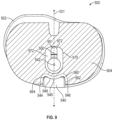
- FIG. 7 is a superior view of an example of a constrained knee prosthesis, e.g., the prosthesis assembly 500, including a mobile bearing 704 rotated to a first set limit, according to an example of the present application.
- the mobile bearing 704 similar to the tibial bearing component 504 ( FIG. 5 ), can be configured to couple with a tibial baseplate 502.
- the mobile bearing 704 can rotate about at least a first axis 542 that can be along the centerline of the hinge post 508. As shown in FIG. 7 , the mobile bearing 704 can rotate into orientation 772.
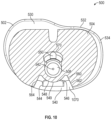
- the first engagement feature 540 can include a slot that extends from a periphery of the mobile bearing 704.
- the slot can receive the press fitting 1070 such that the press fitting 1070 slides within the slot and surrounds the first engagement feature 540.
- the press fitting 1070 is configured to fill the entire space between the first edge 544 of the first engagement feature 540 and the second internal wall 564 of the third engagement feature 560 and to fill the entire space between the second edge 546 of the first engagement feature 540 and the first internal wall 562 of the third engagement feature 560.
- Example 1 is a system including a prosthesis assembly for a constrained knee comprising: a set of components including: a femoral component; a shackle component extending between a first end portion and a second end portion; a hinge axle configured to secure the femoral component to the first end portion of the shackle component; a tibial baseplate having a distal surface, a proximal surface opposite the distal surface, a periphery extending between the proximal surface, the tibial baseplate including a first engagement feature; and a hinge post extending between a first end section and a second end section, the first end section configured to be attached to the second end portion of the shackle component, the second end section configured to be at least partially received by a recess in the tibial baseplate; a mobile bearing configured to couple with the tibial baseplate and to rotate about at least a first axis approximated by a centerline of the hinge post, the rotation about at least the
- Example 8 the subject matter of Examples 6-7 includes, wherein the third engagement feature is formed in an anterior portion of the mobile bearing.
- Example 9 the subject matter of Examples 5-8 includes, wherein the mobile bearing comprises a fourth engagement feature configured to engage with the second engagement feature of the tibial baseplate upon rotation of the mobile bearing about a second axis relative to the tibial baseplate, and wherein engagement of the fourth engagement feature with the second engagement feature limits the rotation of the mobile bearing about the second axis.
- Example 11 the subject matter of Example 10 includes, wherein the fourth engagement feature is posterior to the recess configured to receive the hinge post.
- Example 12 the subject matter of Examples 9-11 includes, wherein the rotation of the mobile bearing about the second axis includes adduction and abduction of the prosthesis assembly.
- Example 13 the subject matter of Examples 4-12 includes, wherein the fixed bearing is configured to engage with the first engagement feature of the tibial baseplate upon coupling of the fixed bearing with the tibial baseplate.
- Example 14 the subject matter of Example 13 includes, wherein the fixed bearing comprises a third engagement feature that contacts the first edge, the second edge, and the third edge of the first engagement feature to prevent rotation of the mobile bearing about at least the first axis.
- Example 15 the subject matter of Examples 13-14 includes, wherein the fixed bearing comprises a fourth engagement feature formed in a central portion of the fixed bearing, the fourth engagement feature contacts the second engagement feature of the tibial baseplate upon coupling of the fixed bearing with the tibial baseplate.
- Example 16 the subject matter of Example 15 includes, wherein the fourth engagement feature includes a pair of ribs that engage the second engagement feature on opposing sides thereof.
- Example 18 the subject matter of Example 17 includes, wherein the first engagement feature of the tibial baseplate includes a first protrusion extending from an anterior portion of the proximal surface away from the distal surface.
- Example 20 the subject matter of Example 19 includes, wherein the tibial baseplate further comprises a second engagement feature.
- Example 21 the subject matter of Example 20 includes, wherein the second engagement feature includes a second protrusion extending from a central portion of the proximal surface and away from the distal surface.
- Example 22 the subject matter of Example 21 includes, wherein the mobile bearing comprises a third engagement feature configured to contact the third edge of the first engagement feature upon coupling of the mobile bearing with the tibial baseplate, the third engagement feature is also configured to engage with the first edge or the second edge of the first engagement feature upon rotation of the mobile bearing about at least the first axis.
- Example 23 the subject matter of Example 22 includes, wherein engagement of the third engagement feature with the first edge and the second edge of the first engagement feature limits the rotation of the mobile bearing.
- Example 24 the subject matter of Examples 22-23 includes, wherein the third engagement feature is formed in an anterior portion of the mobile bearing.
- Example 25 the subject matter of Examples 21-24 includes, wherein the mobile bearing comprises a fourth engagement feature configured to engage with the second engagement feature of the tibial baseplate upon rotation of the mobile bearing about a second axis relative to the tibial baseplate, and wherein engagement of the fourth engagement feature with the second engagement feature limits the rotation of the mobile bearing about the second axis.
- Example 26 the subject matter of Example 25 includes, wherein the fourth engagement feature is formed in the mobile bearing adjacent to a recess configured to receive the hinge post.
- Example 27 the subject matter of Example 26 includes, wherein the fourth engagement feature is posterior to the recess configured to receive the hinge post.
- Example 28 the subject matter of Examples 25-27 includes, wherein the rotation of the mobile bearing about the second axis includes adduction and abduction of the prosthesis assembly.
- Example 29 the subject matter of Examples 20-28 includes, wherein the fixed bearing is configured to engage with the first engagement feature of the tibial baseplate upon coupling of the fixed bearing with the tibial baseplate.
- Example 35 is a method to implement of any of Examples 1-32.
Landscapes
- Health & Medical Sciences (AREA)
- Orthopedic Medicine & Surgery (AREA)
- Physical Education & Sports Medicine (AREA)
- Cardiology (AREA)
- Oral & Maxillofacial Surgery (AREA)
- Transplantation (AREA)
- Engineering & Computer Science (AREA)
- Biomedical Technology (AREA)
- Heart & Thoracic Surgery (AREA)
- Vascular Medicine (AREA)
- Life Sciences & Earth Sciences (AREA)
- Animal Behavior & Ethology (AREA)
- General Health & Medical Sciences (AREA)
- Public Health (AREA)
- Veterinary Medicine (AREA)
- Prostheses (AREA)
Applications Claiming Priority (3)
| Application Number | Priority Date | Filing Date | Title |
|---|---|---|---|
| US202263434590P | 2022-12-22 | 2022-12-22 | |
| US18/526,737 US20240207057A1 (en) | 2022-12-22 | 2023-12-01 | Constrained prosthetic knee |
| EP23218194.1A EP4389082A1 (de) | 2022-12-22 | 2023-12-19 | Eingeschränktes prothesenknie |
Related Parent Applications (1)
| Application Number | Title | Priority Date | Filing Date |
|---|---|---|---|
| EP23218194.1A Division EP4389082A1 (de) | 2022-12-22 | 2023-12-19 | Eingeschränktes prothesenknie |
Publications (2)
| Publication Number | Publication Date |
|---|---|
| EP4582064A2 true EP4582064A2 (de) | 2025-07-09 |
| EP4582064A3 EP4582064A3 (de) | 2025-09-24 |
Family
ID=89224527
Family Applications (2)
| Application Number | Title | Priority Date | Filing Date |
|---|---|---|---|
| EP23218194.1A Pending EP4389082A1 (de) | 2022-12-22 | 2023-12-19 | Eingeschränktes prothesenknie |
| EP25177112.7A Pending EP4582064A3 (de) | 2022-12-22 | 2023-12-19 | Eingeschränktes prothesenknie |
Family Applications Before (1)
| Application Number | Title | Priority Date | Filing Date |
|---|---|---|---|
| EP23218194.1A Pending EP4389082A1 (de) | 2022-12-22 | 2023-12-19 | Eingeschränktes prothesenknie |
Country Status (6)
| Country | Link |
|---|---|
| US (2) | US20240207057A1 (de) |
| EP (2) | EP4389082A1 (de) |
| JP (2) | JP7673169B2 (de) |
| CN (2) | CN119157670A (de) |
| AU (2) | AU2023285866B2 (de) |
| CA (1) | CA3222798A1 (de) |
Families Citing this family (1)
| Publication number | Priority date | Publication date | Assignee | Title |
|---|---|---|---|---|
| US12369930B2 (en) | 2022-06-20 | 2025-07-29 | Zimmer, Inc. | Systems for guided reaming of complex shapes |
Family Cites Families (7)
| Publication number | Priority date | Publication date | Assignee | Title |
|---|---|---|---|---|
| US6773461B2 (en) * | 2001-01-29 | 2004-08-10 | Zimmer Technology, Inc. | Constrained prosthetic knee with rotating bearing |
| DE10200263B4 (de) * | 2002-01-07 | 2007-01-25 | Plus Orthopedics Ag | Tibiakomponente einer Kniegelenkendoprothese |
| US20080091271A1 (en) * | 2006-10-13 | 2008-04-17 | Bonitati John A | Mobile/fixed prosthetic knee systems |
| US8328873B2 (en) * | 2007-01-10 | 2012-12-11 | Biomet Manufacturing Corp. | Knee joint prosthesis system and method for implantation |
| US20080281428A1 (en) * | 2007-05-07 | 2008-11-13 | Zimmer, Inc. | Methods and apparatuses for attaching soft tissue to orthopaedic implants |
| US10548735B2 (en) * | 2015-08-06 | 2020-02-04 | Howmedica Osteonics Corp. | Modular hinge knee prosthesis and improvements of same |
| US20230024863A1 (en) * | 2021-07-23 | 2023-01-26 | Microport Orthopedics Holdings Inc. | Endoprosthetic rotating hinge knee assemblies, subassemblies, and methods |
-
2023
- 2023-12-01 US US18/526,737 patent/US20240207057A1/en active Pending
- 2023-12-12 CA CA3222798A patent/CA3222798A1/en active Pending
- 2023-12-15 JP JP2023211924A patent/JP7673169B2/ja active Active
- 2023-12-19 EP EP23218194.1A patent/EP4389082A1/de active Pending
- 2023-12-19 EP EP25177112.7A patent/EP4582064A3/de active Pending
- 2023-12-21 AU AU2023285866A patent/AU2023285866B2/en active Active
- 2023-12-22 CN CN202311779317.5A patent/CN119157670A/zh active Pending
- 2023-12-22 CN CN202510648786.6A patent/CN120478007A/zh active Pending
-
2025
- 2025-04-18 US US19/182,921 patent/US20250241760A1/en active Pending
- 2025-04-23 JP JP2025071260A patent/JP2025100988A/ja active Pending
- 2025-05-06 AU AU2025203226A patent/AU2025203226A1/en active Pending
Also Published As
| Publication number | Publication date |
|---|---|
| CN120478007A (zh) | 2025-08-15 |
| AU2023285866A1 (en) | 2024-07-11 |
| US20240207057A1 (en) | 2024-06-27 |
| AU2023285866B2 (en) | 2025-06-05 |
| JP7673169B2 (ja) | 2025-05-08 |
| AU2025203226A1 (en) | 2025-05-29 |
| US20250241760A1 (en) | 2025-07-31 |
| JP2025100988A (ja) | 2025-07-04 |
| CN119157670A (zh) | 2024-12-20 |
| CA3222798A1 (en) | 2024-06-22 |
| EP4389082A1 (de) | 2024-06-26 |
| JP2024091533A (ja) | 2024-07-04 |
| EP4582064A3 (de) | 2025-09-24 |
Similar Documents
| Publication | Publication Date | Title |
|---|---|---|
| EP1433444B1 (de) | Bewegliches Talusteil für Totalknöchelprothese | |
| US6206926B1 (en) | Prosthetic knee joint with enhanced posterior stabilization and dislocation prevention features | |
| EP1604623B1 (de) | Posterior-stabilisierte Knieprothese mit beweglichem Lager | |
| CA2542619C (en) | High flexion articular insert | |
| AU2016210692B2 (en) | Modular hinge knee prosthesis and improvements of same | |
| EP2512380B1 (de) | Implantat zur wiederherstellung der normalen flexions- und bewegungsreichweite des knies | |
| EP2967883B1 (de) | Knieprothesenimplantat | |
| EP3556324B1 (de) | Totalknieimplantatprothesenanordnung | |
| EP3551136B1 (de) | Schienbeineinsatz | |
| CA2254218C (en) | Prosthetic knee joint with enhanced posterior stabilization and dislocation prevention features | |
| AU2011282685A1 (en) | Stabilized knee prosthesis | |
| US20250241760A1 (en) | Constrained prosthetic knee | |
| AU2023285872B2 (en) | Constrained prosthetic knee | |
| CN118236202A (zh) | 受约束的假体膝关节 |
Legal Events
| Date | Code | Title | Description |
|---|---|---|---|
| PUAI | Public reference made under article 153(3) epc to a published international application that has entered the european phase |
Free format text: ORIGINAL CODE: 0009012 |
|
| STAA | Information on the status of an ep patent application or granted ep patent |
Free format text: STATUS: THE APPLICATION HAS BEEN PUBLISHED |
|
| AC | Divisional application: reference to earlier application |
Ref document number: 4389082 Country of ref document: EP Kind code of ref document: P |
|
| AK | Designated contracting states |
Kind code of ref document: A2 Designated state(s): AL AT BE BG CH CY CZ DE DK EE ES FI FR GB GR HR HU IE IS IT LI LT LU LV MC ME MK MT NL NO PL PT RO RS SE SI SK SM TR |
|
| PUAL | Search report despatched |
Free format text: ORIGINAL CODE: 0009013 |
|
| AK | Designated contracting states |
Kind code of ref document: A3 Designated state(s): AL AT BE BG CH CY CZ DE DK EE ES FI FR GB GR HR HU IE IS IT LI LT LU LV MC ME MK MT NL NO PL PT RO RS SE SI SK SM TR |
|
| RIC1 | Information provided on ipc code assigned before grant |
Ipc: A61F 2/38 20060101AFI20250821BHEP |
|
| STAA | Information on the status of an ep patent application or granted ep patent |
Free format text: STATUS: REQUEST FOR EXAMINATION WAS MADE |
|
| 17P | Request for examination filed |
Effective date: 20260323 |