EP4582408A1 - Methanoladsorptionsmittel, verfahren zur herstellung von hochkonzentriertem methanol und methanolrückgewinnungsvorrichtung - Google Patents
Methanoladsorptionsmittel, verfahren zur herstellung von hochkonzentriertem methanol und methanolrückgewinnungsvorrichtung Download PDFInfo
- Publication number
- EP4582408A1 EP4582408A1 EP23860429.2A EP23860429A EP4582408A1 EP 4582408 A1 EP4582408 A1 EP 4582408A1 EP 23860429 A EP23860429 A EP 23860429A EP 4582408 A1 EP4582408 A1 EP 4582408A1
- Authority
- EP
- European Patent Office
- Prior art keywords
- methanol
- adsorbent
- water
- temperature
- concentration
- Prior art date
- Legal status (The legal status is an assumption and is not a legal conclusion. Google has not performed a legal analysis and makes no representation as to the accuracy of the status listed.)
- Pending
Links
Images





Classifications
-
- C—CHEMISTRY; METALLURGY
- C07—ORGANIC CHEMISTRY
- C07C—ACYCLIC OR CARBOCYCLIC COMPOUNDS
- C07C29/00—Preparation of compounds having hydroxy or O-metal groups bound to a carbon atom not belonging to a six-membered aromatic ring
- C07C29/74—Separation; Purification; Use of additives, e.g. for stabilisation
- C07C29/76—Separation; Purification; Use of additives, e.g. for stabilisation by physical treatment
-
- B—PERFORMING OPERATIONS; TRANSPORTING
- B01—PHYSICAL OR CHEMICAL PROCESSES OR APPARATUS IN GENERAL
- B01D—SEPARATION
- B01D53/00—Separation of gases or vapours; Recovering vapours of volatile solvents from gases; Chemical or biological purification of waste gases, e.g. engine exhaust gases, smoke, fumes, flue gases, aerosols
- B01D53/02—Separation of gases or vapours; Recovering vapours of volatile solvents from gases; Chemical or biological purification of waste gases, e.g. engine exhaust gases, smoke, fumes, flue gases, aerosols by adsorption, e.g. preparative gas chromatography
-
- B—PERFORMING OPERATIONS; TRANSPORTING
- B01—PHYSICAL OR CHEMICAL PROCESSES OR APPARATUS IN GENERAL
- B01J—CHEMICAL OR PHYSICAL PROCESSES, e.g. CATALYSIS OR COLLOID CHEMISTRY; THEIR RELEVANT APPARATUS
- B01J20/00—Solid sorbent compositions or filter aid compositions; Sorbents for chromatography; Processes for preparing, regenerating or reactivating thereof
- B01J20/02—Solid sorbent compositions or filter aid compositions; Sorbents for chromatography; Processes for preparing, regenerating or reactivating thereof comprising inorganic material
-
- B—PERFORMING OPERATIONS; TRANSPORTING
- B01—PHYSICAL OR CHEMICAL PROCESSES OR APPARATUS IN GENERAL
- B01J—CHEMICAL OR PHYSICAL PROCESSES, e.g. CATALYSIS OR COLLOID CHEMISTRY; THEIR RELEVANT APPARATUS
- B01J20/00—Solid sorbent compositions or filter aid compositions; Sorbents for chromatography; Processes for preparing, regenerating or reactivating thereof
- B01J20/02—Solid sorbent compositions or filter aid compositions; Sorbents for chromatography; Processes for preparing, regenerating or reactivating thereof comprising inorganic material
- B01J20/04—Solid sorbent compositions or filter aid compositions; Sorbents for chromatography; Processes for preparing, regenerating or reactivating thereof comprising inorganic material comprising compounds of alkali metals, alkaline earth metals or magnesium
-
- B—PERFORMING OPERATIONS; TRANSPORTING
- B01—PHYSICAL OR CHEMICAL PROCESSES OR APPARATUS IN GENERAL
- B01J—CHEMICAL OR PHYSICAL PROCESSES, e.g. CATALYSIS OR COLLOID CHEMISTRY; THEIR RELEVANT APPARATUS
- B01J20/00—Solid sorbent compositions or filter aid compositions; Sorbents for chromatography; Processes for preparing, regenerating or reactivating thereof
- B01J20/30—Processes for preparing, regenerating, or reactivating
- B01J20/34—Regenerating or reactivating
- B01J20/3433—Regenerating or reactivating of sorbents or filter aids other than those covered by B01J20/3408 - B01J20/3425
-
- B—PERFORMING OPERATIONS; TRANSPORTING
- B01—PHYSICAL OR CHEMICAL PROCESSES OR APPARATUS IN GENERAL
- B01J—CHEMICAL OR PHYSICAL PROCESSES, e.g. CATALYSIS OR COLLOID CHEMISTRY; THEIR RELEVANT APPARATUS
- B01J20/00—Solid sorbent compositions or filter aid compositions; Sorbents for chromatography; Processes for preparing, regenerating or reactivating thereof
- B01J20/30—Processes for preparing, regenerating, or reactivating
- B01J20/34—Regenerating or reactivating
- B01J20/3483—Regenerating or reactivating by thermal treatment not covered by groups B01J20/3441 - B01J20/3475, e.g. by heating or cooling
-
- C—CHEMISTRY; METALLURGY
- C02—TREATMENT OF WATER, WASTE WATER, SEWAGE, OR SLUDGE
- C02F—TREATMENT OF WATER, WASTE WATER, SEWAGE, OR SLUDGE
- C02F1/00—Treatment of water, waste water, or sewage
- C02F1/28—Treatment of water, waste water, or sewage by sorption
- C02F1/281—Treatment of water, waste water, or sewage by sorption using inorganic sorbents
-
- C—CHEMISTRY; METALLURGY
- C02—TREATMENT OF WATER, WASTE WATER, SEWAGE, OR SLUDGE
- C02F—TREATMENT OF WATER, WASTE WATER, SEWAGE, OR SLUDGE
- C02F2101/00—Nature of the contaminant
- C02F2101/30—Organic compounds
- C02F2101/34—Organic compounds containing oxygen
Definitions
- the present invention relates to a methanol adsorbent that adsorbs methanol from water or gas, as well as a method for producing high-concentration methanol and a methanol recovery device utilizing this methanol adsorbent.
- Methanol while harmful to humans, is also utilized as a resource. Its applications span a wide range, including as a synthetic raw material and solvent in the chemical industry, and as a fuel for direct combustion and fuel cells. Furthermore, methanol can be produced from raw materials such as biomass or CO 2 , enabling its use as a carbon-neutral substance, with demand steadily increasing. If methanol contained in exhaust gas or wastewater could be recovered at high concentrations, it could serve as a valuable resource. For example, methanol with a concentration of 54 wt% or higher can be used in commercially available direct methanol fuel cells.
- Non-Patent Literature 1 Prussian blue analogs, which are used as adsorbents for ammonia and cesium ions, are known to adsorb a large amount of methanol in environments without coexisting substances.
- Non-Patent Literature 1 M. Asai, et al., J. Phys. Chem. C 2018, 122, 22, 11918-11925
- Prussian blue analogs such as those described in Non-Patent Literature 1
- the present invention was made in view of such circumstances and aims to provide a methanol adsorbent capable of adsorbing methanol from liquids or gases containing water and methanol, as well as a method for producing high-concentration methanol and a methanol recovery device using this methanol adsorbent.
- the methanol adsorbent of the present invention contains a specific Prussian blue analog as an active component that adsorbs both water and methanol.
- This Prussian blue analog primarily desorbs water at a first temperature and primarily desorbs methanol at a second, higher temperature. Therefore, by subjecting the methanol adsorbent of the present invention, which has adsorbed water and methanol, to the first temperature to desorb water, followed by the second temperature to recover methanol, high-concentration methanol can be obtained.
- the methanol adsorbent of the present invention selectively adsorbs methanol over water within a specific temperature range. Therefore, according to the methanol adsorbent and the method for producing high-concentration methanol of the present invention, high-concentration methanol can be obtained by contacting the methanol adsorbent with water and methanol within the specified temperature range to allow methanol adsorption, and then recovering the methanol adsorbed on the methanol adsorbent at a higher temperature. Furthermore, according to the methanol recovery device utilizing the methanol adsorbent of the present invention, high-concentration methanol can be efficiently recovered.
- the methanol adsorbent is an adsorbent capable of adsorbing methanol contained in a liquid or gas comprising water and methanol.
- the methanol adsorbent can adsorb methanol contained in water or methanol present in a gas containing water vapor. It should be noted that the methanol adsorbent of this embodiment may adsorb water along with methanol.
- the methanol adsorbent of this embodiment comprises, as an active component, a Prussian blue analog represented by the following general formula (1) (hereinafter sometimes referred to as "the Prussian blue analog of the embodiment”): A x M[M'(CN) 6 ]y ⁇ zH 2 O (1)
- the Prussian blue analog of the embodiment a Prussian blue analog represented by the following general formula (1) (hereinafter sometimes referred to as "the Prussian blue analog of the embodiment”): A x M[M'(CN) 6 ]y ⁇ zH 2 O (1)
- M-M' analog a compound represented by A x M[M'(CN) 6 ] y ⁇ zH 2 O
- x, y, and z satisfy 0 ⁇ x ⁇ 3, 0.1 ⁇ y ⁇ 1.5, and 0 ⁇ z ⁇ 6 (the same applies hereinafter).
- A represents one or more of hydrogen ions, ammonium cations, alkali metal ions, and alkaline earth metal ions (the same applies hereinafter).
- M and M' are independent cations (the same applies hereinafter). However, M and M' are not hydrogen ions, ammonium cations, alkali metal ions, or alkaline earth metal ions (the same applies hereinafter).
- M examples include Mn 2+ , Co 2+ , Ga 2+ , Ni 2+ , Zn 2+ , In 2+ , Fe 2+ , and Cu 2+ .
- M is preferably Mn 2+ , Co 2+ , Ga 2+ , Ni 2+ , or Zn 2+ due to the robust cubic structure that can adsorb a large amount of adsorbates (e.g., methanol).
- the methanol adsorbent of this embodiment may include the above-described Prussian blue analog and a carrier supporting the Prussian blue analog.
- the carrier include zeolite, bentonite, and activated carbon.
- the methanol adsorbent may take the form of a powder of the Prussian blue analog of this embodiment or may be in the form of granules obtained by kneading the Prussian blue analog of this embodiment with a crosslinking agent.
- the methanol adsorbent may also take the form of the Prussian blue analog of this embodiment supported on a column.
- the inventors have discovered that the methanol adsorption properties of Prussian blue analogs are influenced not only by the type of coordination-unsaturated M but also by the valence of M'.
- the Prussian blue analog of this embodiment possesses adsorption sites where the adsorption energy with methanol is higher than that with water.
- the valence of M' is preferably +3 or higher. Examples of such M' include Co 3+ , Fe 3+ , Mn 3+ , and Cr 3+ . Among these, M' is preferably Co 3+ or Fe 3+ . From the perspective of high methanol adsorption capacity and clear separation of desorption temperatures between water and methanol, it is preferable that M is Mn 2+ .
- the method for producing high-concentration methanol according to the first embodiment comprises an adsorption step, a water desorption step, and a methanol desorption step.
- high-concentration methanol preferably has a "methanol mass / (methanol mass + water mass) ⁇ 100" of 40% or higher, more preferably 60% or higher, even more preferably 80% or higher, and particularly preferably 90% or higher.
- the second temperature is preferably 120°C or higher and 250°C or lower. It should be noted that maintaining the second temperature does not necessarily mean keeping the temperature fixed; the temperature may vary within the range where a large amount of methanol desorbs from the methanol adsorbent of this embodiment.
- the Prussian blue analog contained in the methanol adsorbent of this embodiment desorbs primarily water at the first temperature and primarily methanol at the second temperature, which is higher than the first temperature. Therefore, by desorbing water from the methanol adsorbent that has adsorbed both water and methanol at the first temperature, followed by desorbing methanol at the second temperature, high-concentration methanol can be recovered.
- recovering high-concentration methanol includes cooling a gas containing water vapor and methanol vapor to obtain a methanol aqueous solution with a high methanol content, as well as sending a gas containing water vapor and a greater amount of methanol vapor to the subsequent step following the methanol desorption process.
- the method for producing high-concentration methanol according to the first embodiment is typically carried out using the flow shown in Figure 1 .
- a Prussian blue analog that has adsorbed methanol and water is obtained.
- this Prussian blue analog is heated to a first temperature of 90°C for dehydration (water desorption step). Through heating at 90°C, water vapor is desorbed from the Prussian blue analog. The desorbed water vapor is then exhausted.
- the method for producing high-concentration methanol according to the second embodiment includes a methanol adsorption step and a methanol recovery step.
- explanations of aspects common to the method for producing high-concentration methanol in the first embodiment e.g., methods of contact, high-concentration methanol, and its recovery
- the inventors have discovered a novel finding that at a specific temperature (third temperature), when water and methanol are brought into contact with the methanol adsorbent of this embodiment, water is less likely to be adsorbed, while methanol is more easily adsorbed onto the methanol adsorbent.
- the second embodiment utilizes this finding.
- the methanol adsorbent of the above-described embodiment is brought into contact with a liquid or gas comprising water and methanol at a third temperature, selectively adsorbing methanol onto the methanol adsorbent over water.
- a liquid or gas comprising water and methanol include methanol aqueous solutions or gases containing water vapor and methanol vapor.
- the liquid or gas comprising water and methanol may contain other substances.
- "selectively adsorbing methanol onto the methanol adsorbent over water” refers to a condition where the ratio of the mass of methanol adsorbed onto the methanol adsorbent to the mass of water adsorbed onto the methanol adsorbent (hereinafter sometimes referred to as the "selectivity ratio") is 2 or higher.
- the ratio of the mass of methanol adsorbed onto the methanol adsorbent to the mass of water adsorbed onto the methanol adsorbent is preferably 3 or higher, more preferably 5 or higher, and even more preferably 10 or higher.
- the third temperature is the temperature at which methanol is adsorbed onto the methanol adsorbent of this embodiment with a high selectivity ratio. From the perspective of adsorbing methanol onto the methanol adsorbent with a high selectivity ratio, the third temperature is preferably 35°C or higher and less than 120°C. However, this lower temperature limit corresponds to the temperature required to produce a methanol aqueous solution with a concentration of 54 wt%, which is suitable for use as fuel for direct methanol fuel cells. If methanol aqueous solutions with a lower methanol concentration are available, the third temperature may be less than 35°C.
- the methanol adsorbent of this embodiment after undergoing the adsorption step, is maintained at a fourth temperature higher than the third temperature to desorb and recover high-concentration methanol from the methanol adsorbent.
- the fourth temperature is preferably 120°C or higher and 250°C or lower.
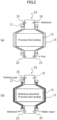
- Figure 2 schematically illustrates an embodiment of the methanol recovery device 10 of the present invention.
- Figure 2(a) shows the methanol recovery device 10 during methanol adsorption
- Figure 2(b) shows the methanol recovery device 10 during methanol desorption.
- the methanol recovery device 10 is merely an example, and its configuration can be appropriately modified as long as the functional components of the methanol recovery device 10 perform their intended functions.
- the holding part 16 has an internal void space in which the methanol adsorbent (Prussian blue analog) is retained. It is designed so that gases and liquids supplied to the holding part can pass through the methanol adsorbent (Prussian blue analog).
- the holding part 16 is configured to prevent the methanol adsorbent, as well as the passing gases and liquids, from leaking to the outside.
- the material of the holding part 16 is not particularly limited as long as it is corrosion-resistant to methanol and remains stable without degradation or deformation at the various temperatures involved in the production of high-concentration methanol. Examples of materials for the holding part 16 include stainless steel and heat-resistant fluororesins such as PTFE.
- the methanol adsorbent is the Prussian blue analog of this embodiment, and granular Prussian blue analog is placed inside the holding part 16, sandwiched between glass filters at the top and bottom.
- the form of the Prussian blue analog is not particularly limited as long as it allows for gas and liquid flow, does not undergo deformation, combustion, or degradation during the various processes for producing high-concentration methanol, and retains its methanol adsorption and desorption functionality.
- the Prussian blue analog may also be compounded with other materials.
- granular methanol adsorbents that include Prussian blue analog and other materials such as binders can effectively perform the function of adsorbing methanol.
- the Prussian blue analog can be supported on other substrates. Examples of such substrates include fibers, nonwoven fabrics, glass filters, and honeycomb structures.
- the methanol adsorbent may also take the form of a powder or slurry.
- the heating part 14 is provided around the holding part 16 to heat the methanol adsorbent (Prussian blue analog) inside the holding part 16 to a temperature of 35°C or higher and 250°C or lower.
- the heating part 14 also heats the housing 12, the methanol adsorbent, and the gas or liquid supplied to the housing 12.
- the shape of the heating part 14 or the heating mechanism of the heating part 14 is not particularly limited.
- the heating part 14 is arranged around the holding part 16, but it may also be installed inside the housing 12. Additionally, the heating part 14 may include a linear heating element wrapped around the housing 12.
- the material of the heating element is not particularly limited as long as it does not undergo degradation, dissolution, or deformation.
- a nichrome wire coated with rubber can be used as the heating element.
- materials such as stainless steel or heat-resistant rubber can be used for the liquid circulation pipes. These circulation pipes are made of materials that do not dissolve in the liquid flowing through them.
- the temperature control mechanism of the heating part 14 may adopt methods such as using electric heating wires, circulating heated steam or other gases, or circulating liquids, and it is not particularly limited. Additionally, if necessary, the heating part 14 may be equipped with a cooling mechanism.
- the heating part 14 may include a device capable of controlling the temperature of a liquid, such as a heat exchanger. In this case, a liquid at a predetermined temperature is circulated near the housing 12 to control the temperature of the housing 12, allowing both heating and cooling of the housing 12.
- the first supply part 18 supplies a methanol aqueous solution or a gas containing water vapor and methanol to the methanol adsorbent (Prussian blue analog) inside the holding part 16.
- the second supply part 20 supplies a gas that does not contain water vapor or methanol to the Prussian blue analog inside the holding part 16.
- the recovery part 22 recovers high-concentration methanol desorbed from the methanol adsorbent (Prussian blue analog) inside the holding part 16.
- the discharge part 24 discharges the liquid or gas remaining after water and methanol have been adsorbed onto the methanol adsorbent (Prussian blue analog).
- high-concentration methanol can be recovered using the methanol recovery device 10 by following the procedure below.
- the following describes an example where high-concentration methanol is recovered from a gas containing water vapor and methanol, but a similar procedure can also be applied to recover high-concentration methanol from a methanol aqueous solution.
- methanol adsorbent Prussian blue analog
- water may also be adsorbed onto the methanol adsorbent during this process.
- the methanol adsorbent Prussian blue analog
- the methanol adsorbent is at a third temperature of 70°C, water is minimally or hardly adsorbed onto the methanol adsorbent, and primarily methanol is adsorbed.
- the Prussian blue analog is heated to a first temperature (preferably 70°C or higher and less than 120°C) using the heating part 14.
- the first supply part 18 and the recovery part 22 are closed, while the second supply part 20 and the discharge part 24 are opened.
- a cleaning gas e.g., dry air
- the methanol adsorbent Prussian blue analog
- the cleaning gas containing water vapor is discharged through the discharge part 24.
- the temperature of the methanol adsorbent (Prussian blue analog) is increased using the heating part 14.
- the discharge part 24 is closed, and the recovery part 22 is opened. High-concentration methanol desorbed from the Prussian blue analog is then discharged from the recovery part 22 and collected.
- the methanol adsorbent is heated to a fourth temperature (preferably 120°C or higher and 250°C or lower) using the heating part 14.
- the first supply part 18 and the discharge part 24 are closed, while the second supply part 20 and the recovery part 22 are opened.
- a cleaning gas is supplied into the holding part 16, where the methanol adsorbent (Prussian blue analog) is installed, via the second supply part 20.
- High-concentration methanol desorbed from the methanol adsorbent (Prussian blue analog) is discharged from the recovery part 22 and collected.
- the methanol adsorbent Prussian blue analog
- the methanol recovery device 10 can be made smaller than a distillation apparatus used to distill and recover methanol from methanol aqueous solutions.
- the methanol adsorbent, the method for producing high-concentration methanol, and the methanol recovery device of the present invention are not limited to the embodiments described above.
- methanol adsorbent and the method for producing high-concentration methanol of the present invention are described below with reference to examples. However, the present invention is not limited to the following examples.
- a solution of 20 mL of 0.6 mol/L manganese chloride aqueous solution was mixed with 20 mL of 0.3 mol/L potassium hexacyanocobaltate aqueous solution, shaken for 1 hour, and a precipitate was obtained.
- the liquid containing the precipitate was subjected to solid-liquid separation by centrifugation at 16,000 G for 10 minutes, and the supernatant was removed.
- the container was sealed and shaken vertically to agitate the precipitate in ultrapure water. This series of steps-centrifugation, removal of the supernatant, addition of ultrapure water, and agitation-was repeated six more times.
- a Zn-Fe analog was obtained using the same method as in Production Example 1, except that the manganese chloride aqueous solution was replaced with a zinc sulfate aqueous solution, and the potassium hexacyanocobaltate aqueous solution was replaced with a potassium hexacyanoferrate aqueous solution.
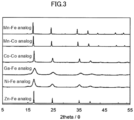
- the powder X-ray diffraction pattern of this Zn-Fe analog as shown in Figure 3 , was consistent with the diffraction pattern described in Reference A, confirming that the Zn-Fe analog was K x Zn[Fe(CN) 6 ] y ⁇ zH 2 O.
- An Mn-Fe analog was obtained using the same method as in Production Example 1, except that the potassium hexacyanocobaltate aqueous solution was replaced with a sodium hexacyanoferrate aqueous solution.
- the powder X-ray diffraction pattern of this Mn-Fe analog as shown in Figure 3 , was consistent with the diffraction pattern described in Reference A, confirming that the Mn-Fe analog was K 0.06 Mn[Fe(CN) 6 ] 0.69 ⁇ 4.5H 2 O.
- the methanol adsorption capacity was calculated by subtracting the cumulative amount of methanol detected by FTIR from the initial amount of methanol in the aluminum gas bag.
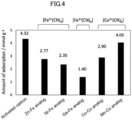
- the methanol adsorption capacities of each sample are shown in Figure 4 .
- Figure 4 all samples adsorbed methanol from the gas containing water.
- the methanol adsorption capacity of the Prussian blue analogs from Production Examples 1 to 5 was found to depend on the type and valence of M' bonded on the carbon side in the structure A x M[M'(CN) 6 ]y ⁇ zH 2 O of the Prussian blue analogs.
- Mn-Co analog or Co-Co analog Mn-Co analog or Co-Co analog
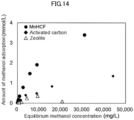
- methanol adsorption isotherms at 25°C and 40°C for activated carbon and Mn-Co analog, as well as water adsorption isotherms at 25°C and 40°C for Mn-Co analog were created.
- the methanol adsorption energy was calculated from the methanol adsorption isotherms at two temperatures using analysis software (BEL Japan, Inc., Belmaster) based on the Clausius-Clapeyron equation.
- the methanol differential adsorption heat curve for activated carbon is shown in Figure 5
- the methanol differential adsorption heat curve for Mn-Co analog is shown in Figure 6
- the water adsorption energy was calculated from the water adsorption isotherms at two temperatures.
- the water differential adsorption heat curve for Mn-Co analog is shown in Figure 7 .
- Air containing a water concentration of 15,000 ppmv and a methanol concentration of 5,000 ppmv was placed in five containers.
- each container one of five samples-activated carbon and the Prussian blue analogs from Production Examples 1 to 4-was placed.
- the containers were left undisturbed at approximately 20-30°C for three days to allow adsorption of water and methanol.
- TG-MS JEOL, JMS-Q1500GC
- Figure 8 shows the TG-MS curve of activated carbon.
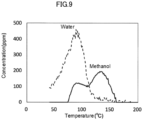
- Figure 9 shows the TG-MS curve of the Mn-Co analog.
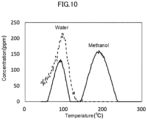
- Figure 10 shows the TG-MS curve of the Co-Co analog.
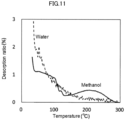
- Figure 11 shows the TG-MS curve of the Ga-Fe analog.
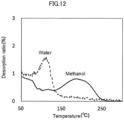
- Figure 12 shows the TG-MS curve of the Ni-Fe analog.
- the methanol adsorption capacity of activated carbon was 32.6 mg/g, whereas the methanol adsorption capacity of the Mn-Co analog was 69.4 mg/g. It was determined that the Mn-Co analog is effective for recovering methanol from water.
Landscapes
- Chemical & Material Sciences (AREA)
- Organic Chemistry (AREA)
- Analytical Chemistry (AREA)
- Chemical Kinetics & Catalysis (AREA)
- Inorganic Chemistry (AREA)
- Engineering & Computer Science (AREA)
- Thermal Sciences (AREA)
- Physics & Mathematics (AREA)
- Life Sciences & Earth Sciences (AREA)
- Hydrology & Water Resources (AREA)
- Environmental & Geological Engineering (AREA)
- Water Supply & Treatment (AREA)
- General Chemical & Material Sciences (AREA)
- Oil, Petroleum & Natural Gas (AREA)
- Solid-Sorbent Or Filter-Aiding Compositions (AREA)
Applications Claiming Priority (2)
| Application Number | Priority Date | Filing Date | Title |
|---|---|---|---|
| JP2022139813 | 2022-09-02 | ||
| PCT/JP2023/031589 WO2024048667A1 (ja) | 2022-09-02 | 2023-08-30 | メタノール吸着材、高濃度メタノールの製造方法およびメタノール回収装置 |
Publications (1)
| Publication Number | Publication Date |
|---|---|
| EP4582408A1 true EP4582408A1 (de) | 2025-07-09 |
Family
ID=90099780
Family Applications (1)
| Application Number | Title | Priority Date | Filing Date |
|---|---|---|---|
| EP23860429.2A Pending EP4582408A1 (de) | 2022-09-02 | 2023-08-30 | Methanoladsorptionsmittel, verfahren zur herstellung von hochkonzentriertem methanol und methanolrückgewinnungsvorrichtung |
Country Status (4)
| Country | Link |
|---|---|
| EP (1) | EP4582408A1 (de) |
| JP (1) | JPWO2024048667A1 (de) |
| CN (1) | CN119816365A (de) |
| WO (1) | WO2024048667A1 (de) |
Families Citing this family (1)
| Publication number | Priority date | Publication date | Assignee | Title |
|---|---|---|---|---|
| CN118276537B (zh) * | 2024-05-31 | 2024-08-13 | 浙江省白马湖实验室有限公司 | 一种面向绿色甲醇制备的系统协同优化调控方法 |
Family Cites Families (1)
| Publication number | Priority date | Publication date | Assignee | Title |
|---|---|---|---|---|
| JP6345774B2 (ja) * | 2014-06-06 | 2018-06-20 | 国立研究開発法人産業技術総合研究所 | アンモニア吸着材 |
-
2023
- 2023-08-30 CN CN202380063370.7A patent/CN119816365A/zh active Pending
- 2023-08-30 EP EP23860429.2A patent/EP4582408A1/de active Pending
- 2023-08-30 JP JP2024544341A patent/JPWO2024048667A1/ja active Pending
- 2023-08-30 WO PCT/JP2023/031589 patent/WO2024048667A1/ja not_active Ceased
Also Published As
| Publication number | Publication date |
|---|---|
| WO2024048667A1 (ja) | 2024-03-07 |
| CN119816365A (zh) | 2025-04-11 |
| JPWO2024048667A1 (de) | 2024-03-07 |
Similar Documents
| Publication | Publication Date | Title |
|---|---|---|
| Xiong et al. | A microporous metal–organic framework with commensurate adsorption and highly selective separation of xenon | |
| Wang et al. | Enhanced adsorption of dibenzothiophene with zinc/copper-based metal–organic frameworks | |
| Guo et al. | Scalable solvent-free preparation of [Ni3 (HCOO) 6] frameworks for highly efficient separation of CH4 from N2 | |
| Ye et al. | Post-combustion CO2 capture with the HKUST-1 and MIL-101 (Cr) metal–organic frameworks: Adsorption, separation and regeneration investigations | |
| US11344870B2 (en) | Highly stable Ni-M F6-NH2O/onpyrazine2(solvent)x metal organic frameworks and methods of use | |
| US8709134B2 (en) | Reversible ethylene oxide capture in porous frameworks | |
| Wu et al. | Adsorption of carbon dioxide, methane and nitrogen on an ultramicroporous copper metal–organic framework | |
| US8227375B2 (en) | Gas adsorption on metal-organic frameworks | |
| US9604849B2 (en) | Nucleophilic porous carbon materials for CO2 and H2S capture | |
| Ho et al. | Properties of a manganese oxide octahedral molecular sieve (OMS-2) for adsorptive desulfurization of fuel gas for fuel cell applications | |
| Li et al. | Trace SO 2 capture within the engineered pore space using a highly stable SnF 6 2−-pillared MOF | |
| WO2019183635A1 (en) | Metal-organic frameworks for molecular sieving and compositions and methods of use thereof | |
| EP4582408A1 (de) | Methanoladsorptionsmittel, verfahren zur herstellung von hochkonzentriertem methanol und methanolrückgewinnungsvorrichtung | |
| JP7093582B2 (ja) | 二酸化炭素を用いたアンモニア化学種脱離方法、アンモニア化学種供給剤、およびアンモニア化学種吸着・脱離装置 | |
| López-Cervantes et al. | MFM-300 (Sc): a chemically stable Sc (III)-based MOF material for multiple applications | |
| EP0145539A2 (de) | Kohlenstoff-Adsorptionsmittel für Quecksilber und Kohlenstoff-Molekularsiebe | |
| US5126466A (en) | Cyanocobaltate oxygen adducts | |
| KR890000514B1 (ko) | 전이금속 헥사시아노 화합물을 흡착제로서 이용하는 기류로 부터 산소의 흡착공정 | |
| Yan et al. | An amino-functionalized ultra-micropore metal–organic framework using for argon/oxygen adsorption separation | |
| KR20220138838A (ko) | 금속-유기 골격체 기반 에탄/에틸렌 분리용 흡착제 | |
| CN118788311A (zh) | 一种mof吸附剂的合成方法及其在c3h4/c3h6/c3h8混合物中纯化c3h6的应用 | |
| US5239098A (en) | Solid state cyanocobaltate complexes | |
| Assen | Mixed-metal approach towards assembling highly stable metal organic framework based adsorbent for simultaneous capture of CO2 and H2S | |
| Wu et al. | TiO (OH) 2 can exceed the critical limit of conventional CO 2 sorbents: modification needed for high capacity and selectivity | |
| US20260008800A1 (en) | Pyrazole cobalt-based metal-organic framework material with dynamic pore size, method for making the same, and use in sulfur hexafluoride capture |
Legal Events
| Date | Code | Title | Description |
|---|---|---|---|
| STAA | Information on the status of an ep patent application or granted ep patent |
Free format text: STATUS: THE INTERNATIONAL PUBLICATION HAS BEEN MADE |
|
| PUAI | Public reference made under article 153(3) epc to a published international application that has entered the european phase |
Free format text: ORIGINAL CODE: 0009012 |
|
| STAA | Information on the status of an ep patent application or granted ep patent |
Free format text: STATUS: REQUEST FOR EXAMINATION WAS MADE |
|
| 17P | Request for examination filed |
Effective date: 20250327 |
|
| AK | Designated contracting states |
Kind code of ref document: A1 Designated state(s): AL AT BE BG CH CY CZ DE DK EE ES FI FR GB GR HR HU IE IS IT LI LT LU LV MC ME MK MT NL NO PL PT RO RS SE SI SK SM TR |
|
| DAV | Request for validation of the european patent (deleted) | ||
| DAX | Request for extension of the european patent (deleted) |