EP4582548A1 - Procédé de production continue de biométhane à partir de biomasse avec séparation du co2 - Google Patents
Procédé de production continue de biométhane à partir de biomasse avec séparation du co2 Download PDFInfo
- Publication number
- EP4582548A1 EP4582548A1 EP24203932.9A EP24203932A EP4582548A1 EP 4582548 A1 EP4582548 A1 EP 4582548A1 EP 24203932 A EP24203932 A EP 24203932A EP 4582548 A1 EP4582548 A1 EP 4582548A1
- Authority
- EP
- European Patent Office
- Prior art keywords
- biomass
- biogas
- algal culture
- basic mixture
- digestate
- Prior art date
- Legal status (The legal status is an assumption and is not a legal conclusion. Google has not performed a legal analysis and makes no representation as to the accuracy of the status listed.)
- Pending
Links
Images
Classifications
-
- C—CHEMISTRY; METALLURGY
- C12—BIOCHEMISTRY; BEER; SPIRITS; WINE; VINEGAR; MICROBIOLOGY; ENZYMOLOGY; MUTATION OR GENETIC ENGINEERING
- C12P—FERMENTATION OR ENZYME-USING PROCESSES TO SYNTHESISE A DESIRED CHEMICAL COMPOUND OR COMPOSITION OR TO SEPARATE OPTICAL ISOMERS FROM A RACEMIC MIXTURE
- C12P5/00—Preparation of hydrocarbons or halogenated hydrocarbons
- C12P5/02—Preparation of hydrocarbons or halogenated hydrocarbons acyclic
- C12P5/023—Methane
-
- C—CHEMISTRY; METALLURGY
- C02—TREATMENT OF WATER, WASTE WATER, SEWAGE, OR SLUDGE
- C02F—TREATMENT OF WATER, WASTE WATER, SEWAGE, OR SLUDGE
- C02F11/00—Treatment of sludge; Devices therefor
- C02F11/02—Biological treatment
- C02F11/04—Anaerobic treatment; Production of methane by such processes
-
- C—CHEMISTRY; METALLURGY
- C12—BIOCHEMISTRY; BEER; SPIRITS; WINE; VINEGAR; MICROBIOLOGY; ENZYMOLOGY; MUTATION OR GENETIC ENGINEERING
- C12M—APPARATUS FOR ENZYMOLOGY OR MICROBIOLOGY; APPARATUS FOR CULTURING MICROORGANISMS FOR PRODUCING BIOMASS, FOR GROWING CELLS OR FOR OBTAINING FERMENTATION OR METABOLIC PRODUCTS, i.e. BIOREACTORS OR FERMENTERS
- C12M21/00—Bioreactors or fermenters specially adapted for specific uses
- C12M21/02—Photobioreactors
-
- C—CHEMISTRY; METALLURGY
- C12—BIOCHEMISTRY; BEER; SPIRITS; WINE; VINEGAR; MICROBIOLOGY; ENZYMOLOGY; MUTATION OR GENETIC ENGINEERING
- C12M—APPARATUS FOR ENZYMOLOGY OR MICROBIOLOGY; APPARATUS FOR CULTURING MICROORGANISMS FOR PRODUCING BIOMASS, FOR GROWING CELLS OR FOR OBTAINING FERMENTATION OR METABOLIC PRODUCTS, i.e. BIOREACTORS OR FERMENTERS
- C12M21/00—Bioreactors or fermenters specially adapted for specific uses
- C12M21/04—Bioreactors or fermenters specially adapted for specific uses for producing gas, e.g. biogas
-
- C—CHEMISTRY; METALLURGY
- C12—BIOCHEMISTRY; BEER; SPIRITS; WINE; VINEGAR; MICROBIOLOGY; ENZYMOLOGY; MUTATION OR GENETIC ENGINEERING
- C12M—APPARATUS FOR ENZYMOLOGY OR MICROBIOLOGY; APPARATUS FOR CULTURING MICROORGANISMS FOR PRODUCING BIOMASS, FOR GROWING CELLS OR FOR OBTAINING FERMENTATION OR METABOLIC PRODUCTS, i.e. BIOREACTORS OR FERMENTERS
- C12M23/00—Constructional details, e.g. recesses, hinges
- C12M23/58—Reaction vessels connected in series or in parallel
-
- C—CHEMISTRY; METALLURGY
- C12—BIOCHEMISTRY; BEER; SPIRITS; WINE; VINEGAR; MICROBIOLOGY; ENZYMOLOGY; MUTATION OR GENETIC ENGINEERING
- C12M—APPARATUS FOR ENZYMOLOGY OR MICROBIOLOGY; APPARATUS FOR CULTURING MICROORGANISMS FOR PRODUCING BIOMASS, FOR GROWING CELLS OR FOR OBTAINING FERMENTATION OR METABOLIC PRODUCTS, i.e. BIOREACTORS OR FERMENTERS
- C12M29/00—Means for introduction, extraction or recirculation of materials, e.g. pumps
-
- C—CHEMISTRY; METALLURGY
- C12—BIOCHEMISTRY; BEER; SPIRITS; WINE; VINEGAR; MICROBIOLOGY; ENZYMOLOGY; MUTATION OR GENETIC ENGINEERING
- C12M—APPARATUS FOR ENZYMOLOGY OR MICROBIOLOGY; APPARATUS FOR CULTURING MICROORGANISMS FOR PRODUCING BIOMASS, FOR GROWING CELLS OR FOR OBTAINING FERMENTATION OR METABOLIC PRODUCTS, i.e. BIOREACTORS OR FERMENTERS
- C12M47/00—Means for after-treatment of the produced biomass or of the fermentation or metabolic products, e.g. storage of biomass
- C12M47/18—Gas cleaning, e.g. scrubbers; Separation of different gases
Definitions
- the present invention relates to a process for the continuous production of biomethane from biomass, by anaerobic digestion.
- biomethane from biomass
- anaerobic digestion or stabilization
- a biological process that allows the degradation of the organic substance by particular anaerobic microorganisms.
- These microorganisms are able to survive and reproduce in anoxic environments, that is, in the absence of oxygen and are able to carry out methanogenesis, producing a combustible gas called biogas composed mainly of methane, CO 2 and H 2 S.
- Biomethane is considered one of the fuels of greatest interest, both for its ease of use in the transport sector and for its potential for dissemination on a geographic scale.
- biomethane is obtained by the purification (or "upgrading") of biogas obtained from the anaerobic fermentation of organic matrices.
- Biogas is, in fact, the final product of the anaerobic digestion of organic biomass, and consists of a mixture composed mainly of methane (CH 4 ), carbon dioxide (CO 2 ) and hydrogen sulphide (H 2 S).
- the purification (or “upgrading") of biogas into biomethane consists essentially in the removal of carbon dioxide (CO 2 ) and hydrogen sulphide (H 2 S), so as to obtain a gas composed mainly of methane, therefore suitable for being introduced into the transport and distribution networks, according to the criteria defined by the UNI/TR 11537 "Input of biomethane into the natural gas transport and distribution networks", and subsequent amendments, the main reference legislation.
- WO2017/216720 describes a process for the production of biomethane from biomass, characterized by a step of dilution, alkalization and hydrolysis of a biomass and the subsequent neutralization by reduction of the CO 2 present in a biogas obtained by anaerobic digestion, thus allowing the purification of said biogas to biomethane.
- nitrogen such as pollen, agricultural waste, Organic Fraction of Urban Solid Waste (FORSU), and/or civil and/or industrial sludge.
- the nitrogen present in the biomass used as a raw material tends to accumulate in the anaerobic digester in the form of ammoniacal nitrogen.
- the latter is a component capable of interfering with the action carried out by methanogenic bacteria and, beyond a certain concentration, of completely inhibiting anaerobic fermentation, as well as determining the possible formation of an effluent digestate rich in ammoniacal nitrogen, which can only be used as an agricultural fertilizer or as an additive for the production of compost.
- WO2017/216720 provides for a significant consumption of reagent used in the alkalization step to raise the pH; moreover, the residual digestate, being rich in bicarbonate ion and therefore being difficult to use for agronomic spreading, must be mainly disposed of in the sewer, with the need for purification to reach a concentration of ammoniacal nitrogen and other pollutants such as to be suitable for discharge into the sewer or other receiver, with certain energy and plant costs.
- Biomass means any material having a biodegradable fraction of biological origin, coming from forestry and/or agriculture, including plant and/or animal substances; any product, waste and residue of the wood and paper processing industry; and/or all products, waste and organic residues having a biodegradable fraction, derived from the biological activity of animals and humans, such as those contained in industrial and urban waste.
- Organic sludge means sludge produced from the water line of wastewater purification plants of urban and/or industrial origin, preferably characterized by a high moisture content, preferably a moisture content between 95 and 99%.
- Organic scraps means the wet waste of municipal solid waste, consisting of food scraps and other waste, having a biodegradable fraction, and/or agro-industrial by-products, such as those derived from meat processing, olive pressing, processing of agricultural products, and/or winemaking.
- Treated or untreated residual sludge coming from urban, domestic, agricultural, and/or industrial wastewater treatment plants means sludge produced by urban wastewater and/or domestic water purification processes; sludge coming from septic tanks; and/or sludge coming from agro-industrial wastewater treatment plants.
- Treated or untreated residual sludges coming from production processes are: sludges of agri-food origin, from the paper and wood industry, preferably sludges whose organic products and/or by-products are derived from composting plants, agricultural and forestry activities, livestock, horticulture and food preparation; sludges derived from civil processing; sludges coming from industrial wastewater treatment plants; sludges coming from the textile and leather industries; and/or sludges coming from the petroleum industry or derived from organic and inorganic chemical processes.
- Neutralized biomass means a biomass having a pH value between 6 and 8, preferably 7.0 or preferably 7.5 to 7.7.
- Chemical Oxygen Demand means the amount of oxygen (expressed in mg O 2 /l) necessary for the complete oxidation of organic and inorganic compounds present in a liquid sample.
- Algal culture refers to a cultivation of algae, carried out in dedicated circular nurseries ("raceway ponds") in the open air, or prepared in dedicated photobioreactors (PBRs).
- Solid or semi-solid digestate refers to the concentrated residue obtained by the static or dynamic separation of the digestate.
- the solid digestate has a dry matter concentration of from 20 to 90% (w/w), while the semi-solid digestate has a dry matter concentration of from 6 to 20% by weight (w/w).
- clarified digestate is meant the clarified liquid that is obtained following the static or dynamic separation of the digestate.
- Biomethane refers to the gas, mainly composed of methane, obtained from the purification of biogas.
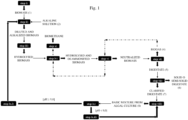
- an object of the present invention is a process for the continuous production of biomethane from biomass, comprising the steps described below.
- a biomass 1 is prepared.
- the biomass 1 is chosen from: biological sludge, algae, organic waste or by-products, organic scraps, preferably organic scraps coming from separate and undifferentiated collection, process waters, treated and untreated residual sludge, preferably coming from urban, domestic and/or industrial wastewater treatment plants, and/or treated and untreated residual sludge coming from production processes.
- the process of the invention enables the treatment of both wet biomasses and dry biomasses (or with low moisture), wherein: wet biomasses are understood to mean biomasses having a moisture content of between 70 and 99% by weight; dry biomasses are understood to mean spadable biomasses having a moisture content of less than 70% by weight.
- step ii) of the process performs the function of diluent and, at the same time, of alkalizing agent. Consequently, by contributing to raising the pH in step ii), it advantageously enables reduction in the requirement for alkaline solution 2 used for alkalization and, in particular, for the adjustment of the pH within the desired range of values.
- the alkaline solution 2 is an aqueous solution comprising a strong base, preferably an alkaline or alkaline-earth metal hydroxide, preferably sodium hydroxide, potassium hydroxide, or mixtures thereof, preferably at 20% by weight on the total volume of the alkaline solution 2 (w/v).
- a strong base preferably an alkaline or alkaline-earth metal hydroxide, preferably sodium hydroxide, potassium hydroxide, or mixtures thereof, preferably at 20% by weight on the total volume of the alkaline solution 2 (w/v).
- the biomass 1 is subjected to dilution and alkalization, up to a content of volatile solids comprised between 0.5 and 10.0%, preferably comprised between 0.7 and 8.0%, preferably comprised between 0.8 and 1.5, preferably equal to 1.0% by weight with respect to the volume of said biomass 1 (w/v).
- the alkaline hydrolysis step iii) is carried out for a time comprised between 30 and 120 minutes, preferably equal to 90 minutes.
- the hydrolysed biomass, coming from step iv) has a pH comprised between 9.0 and 13.0.
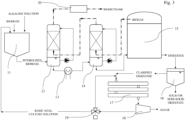
- steps ii) and iii) are conducted in a dedicated reactor 11, preferably a CSTR ("continuous stirred tank reactor") chemical reactor.
- step iv) of the process according to the present invention the hydrolysed biomass, coming from step iii), is subjected to stripping (or degassing) of the ammonia, by means of the diffusion of a biogas, to obtain a hydrolysed and deammonified biomass.
- the ammonia stripping step (iv) is conducted at a temperature between 55 and 90°C, preferably 80°C.
- the process step iv) is carried out in a drip column reactor 12, loaded with filler material, or in a spray or Venturi scrubber type reactor 12, said reactor 12 being equipped with a lower storage tank (or accumulator) with a recirculation system, configured to recirculate the hydrolysed biomass subjected to ammonia stripping at the head of the reactor 12 column.
- this recirculation system for the hydrolysed biomass subjected to ammonia stripping allows the ammonia stripping efficiency to be regulated.
- the filler material is pellets or spheres, Cascade Mini-Rings (CMR), IMTP Rings, Nutter rings, Raschig rings, Lessing rings, Pall rings, Bialecki rings, preferably said filler material being plastic or metal material.
- CMR Cascade Mini-Rings
- IMTP Rings Nutter rings
- Raschig rings Raschig rings
- Lessing rings Pall rings
- Bialecki rings preferably said filler material being plastic or metal material.
- the filler material has a porosity greater than 0.5, preferably comprised between 0.8 and 0.98, and preferably a specific surface comprised between 60 and 500 m 2 /m 3 .
- the diffusion of the CO 2 present in the biogas allows the solubilization of the CO 2 itself and its conversion into carbonic acid in solution in the hydrolysed and deammonified biomass.
- the acid-base neutralization reaction therefore takes place between the hydrolysed and deammonified biomass, which is in alkaline conditions, as a result of step ii), and the H + ions produced by the dissociation of carbonic acid in solution.
- the dissociation of the carbonic acid in solution enriches the neutralized biomass in bicarbonates, advantageously making this biomass suitable to be used in the subsequent steps of the process, in particular to feed a predisposed algal culture.
- step vi) of the process according to the present invention subjecting the neutralized biomass, coming from step v), to anaerobic digestion, to obtain a biogas 4 and a digestate 5, and recycling said biogas 4 in step v), and subsequently from step v) in step iv).
- step vi) the biogas 4 is recycled in step v), in which it is used to carry out the neutralization by diffusion of CO 2 ; consequently, from step v) a biogas purified from CO 2 is obtained, which is recycled in step iv) and then used to carry out the stripping of ammonia.
- the yield of biogas production 4 from step vi) of anaerobic digestion is particularly high, preferably with an average residence time between 1 and 20 days, preferably equal to 2 days or equal to 15 days and with a high energy yield.
- the anaerobic digestion in step vi) is carried out in a dedicated digester 15, equipped with a biogas recirculation system, configured to feed the biogas produced by the anaerobic digestion into the reactor 14, wherein said reactor 14 is, in turn, configured to feed the biogas exiting into the reactor 12.
- a dedicated digester 15 equipped with a biogas recirculation system, configured to feed the biogas produced by the anaerobic digestion into the reactor 14, wherein said reactor 14 is, in turn, configured to feed the biogas exiting into the reactor 12.
- a step vii) of the process according to the present invention the digestate 5 is subjected to a separation, to obtain a solid or semi-solid digestate 6 and a clarified digestate 7.
- step vii) of separating the digestate 5 is preferably carried out by static or dynamic thickening, or by mechanical separation, preferably by centrifugation, microfiltration or filter pressing.
- the step vii) of separating the digestate 5 is carried out in a dedicated separator 16, consisting of a static gravity thickener or a dynamic separator for centrifugation, microfiltration or filter pressing.
- steps iv) and v) respectively allow regulation of the concentration of ammoniacal nitrogen in solution within a specific range of values and to enrich the solution in bicarbonates, which are produced by the dissociation in solution of carbonic acid that is formed by diffusion of CO 2 ; consequently, the clarified digestate 7 has a concentration of ammoniacal nitrogen and bicarbonates such as to be suitable to be used as a medium for feeding an algal culture.
- clarified digestate 7 is fed into a prepared algal culture 17 to obtain a basic mixture 8 from the algal culture.
- said algal culture 17 comprises algae, preferably microalgae or cyanobacteria, preferably of the species Spirulina, Chlorella, Klamath, Neochloris, Asparagopsis.
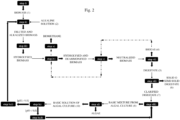
- step ix) of the process according to the present invention the basic mixture 8 is recycled from algal culture according to one of the following alternatives:
- the basic mixture 8 of algal culture is recycled in step ii); consequently, since the basic mixture 8 of algal culture comprises algae in suspension in basic solution, this alternative advantageously allows the reuse of the basic solution of algal culture and, at the same time, of the algae, which are recycled in step ii) as biomass 1.
- step ii) recycles the basic mixture 8 in step ii) reduces the need for the reagent, i.e. alkaline solution 2, required to carry out this step.
- alternative ix.ii) allows the basic mixture 8 to be re-introduced in step viii), thus allowing it to be reused as a means of feeding the algal culture in addition to the clarified digestate 7.
- step x) of the process according to the present invention the biogas coming from step vi) is subjected to purification, by removing gaseous ammonia and residual moisture, to obtain biomethane.
- the process according to the present invention makes it possible to obtain biomethane with a residual molar CO 2 concentration of less than 2.5%, preferably less than 0.2%.
- biogas coming from step vi) is biogas 4, produced by anaerobic digestion, after being recycled sequentially in steps v) and iv).
- the removal of the gaseous ammonia in step x) is carried out by acid scrubbing, preferably by washing the biogas stream with a sulfuric acid solution, preferably a 20 wt% aqueous sulfuric acid solution based on the total weight of the solution (w/w).
- a sulfuric acid solution preferably a 20 wt% aqueous sulfuric acid solution based on the total weight of the solution (w/w).
- the reduction of the residual moisture in step x) is carried out by condensation.
- the removal of the gaseous ammonia in step x) is carried out in a dedicated columnar reactor 20, loaded with filler material, or spray or Venturi scrubber, in which the flow of biogas to be purified is preferably circulated from the bottom upwards, while the sulfuric acid solution is percolated counter-currently from the top downwards.
- the reactor filler material 20 has a porosity greater than 0.2, preferably comprised between 0.5 and 0.9, and preferably has a specific surface area comprised between 20 and 600 m 2 /m 3 .
- the removal of the residual moisture in step x) is carried out by cold condensation of the gas exiting the reactor 20, preferably by cooling the gas to a temperature comprised between 6 and 8°C.
- the process according to the present invention comprises a further step xi), subsequent to step viii) and prior to step ix), of separation of the basic mixture 8 from algal culture, to obtain algae and a basic solution 10 from algal culture, said basic solution 10 from algal culture being fed in step ix) as an alternative to the basic mixture 8 from algal culture.
- the algae are separated and are therefore not recycled as biomass in step ii), while the basic solution 10 from algal culture is fed in step ix), to then be recycled according to one of the alternatives ix.i) and ix.ii) in place of the basic mixture 8 from algal culture.
- step xi) is carried out in a dedicated solid-liquid separator 18, preferably consisting of a dynamic separation system, configured for the separation of algae by centrifugation, microfiltration or filter pressing.
- a dedicated solid-liquid separator 18 preferably consisting of a dynamic separation system, configured for the separation of algae by centrifugation, microfiltration or filter pressing.
- the system for the implementation of the process of the invention comprises a heat exchanger 13, positioned between the reactor 12 and the reactor 14, configured to cool the hydrolysed and deammoniated biomass exiting the reactor 12.
- the system for implementing the process according to the present invention comprises a solid-liquid separator 18, preferably consisting of a dynamic separation system, configured to separate the algae from their culture solution.
- a solid-liquid separator 18 preferably consisting of a dynamic separation system, configured to separate the algae from their culture solution.
- Example 1 describes a process according to WO2017/216720 , and is reported below as a comparative example.
- the biomass is diluted by adding source water, up to a volatile solids content of 1% of the volume of the biomass.
- the diluted biomass is alkalized by the addition of a solution of sodium hydroxide at 20% by weight on the weight of the solution (w/w), up to a pH equal to 11.6.
- the diluted and alkalized biomass is subjected to hydrolysis at a temperature of 80°C, for a time equal to 90 minutes, under slight agitation, until the hydrolysed biomass is obtained.
- the hydrolysed biomass is subjected to neutralization, at a temperature of 40°C, by diffusion of a gaseous mixture composed of 20% by volume of CO 2 and 80% by volume of methane, until a neutralized biomass having a pH equal to 7.0 is obtained.
- the gas flow rate is adjusted so as to output a biomethane with a residual molar concentration of CO 2 of less than 2.5%.
- the neutralized biomass was found to have the following characteristics shown in Table 2.
- Table 2 characteristics of neutralized biomass.
- Neutralized biomass COD on the filtrate and centrifuge) 5.693 mg/L pH 7.0
- the neutralized biomass is added with a dose of lyophilized microbial inoculum to provide the necessary startup bacterial load and subjected to anaerobic fermentation for a duration of 15 days, at a temperature of 38°C, obtaining a biogas and a digestate with the characteristics set out in Table 3.
- Table 3 Characteristics of the digestate and biogas exiting the anaerobic fermentation.
- the flow rate of the biogas was adjusted to output a biomethane with a residual molar concentration of carbon dioxide of less than 2.5%, in analogy to Example 1.
- the digestate obtained from anaerobic digestion is subjected to separation by means of filtration using a filter with a porosity of 20 ⁇ m, obtaining a clarified digestate to be used as a cultivation broth, into which algae of the species Spirulina Platensis have been inserted.
- the algae are then separated from the basic solution by filtration using a filter with a porosity of 0.25 ⁇ m. Following the algal cultivation step, 60 g of algae (dry weight) were obtained.
- the filtered basic solution having a pH of 11.2, was recycled in the biomass dilution step, making the process continuous.
Landscapes
- Chemical & Material Sciences (AREA)
- Life Sciences & Earth Sciences (AREA)
- Engineering & Computer Science (AREA)
- Organic Chemistry (AREA)
- Zoology (AREA)
- General Chemical & Material Sciences (AREA)
- Chemical Kinetics & Catalysis (AREA)
- Wood Science & Technology (AREA)
- Health & Medical Sciences (AREA)
- Microbiology (AREA)
- Water Supply & Treatment (AREA)
- Environmental & Geological Engineering (AREA)
- Biotechnology (AREA)
- Hydrology & Water Resources (AREA)
- Molecular Biology (AREA)
- Oil, Petroleum & Natural Gas (AREA)
- Biochemistry (AREA)
- Bioinformatics & Cheminformatics (AREA)
- General Engineering & Computer Science (AREA)
- General Health & Medical Sciences (AREA)
- Genetics & Genomics (AREA)
- Preparation Of Compounds By Using Micro-Organisms (AREA)
Applications Claiming Priority (1)
| Application Number | Priority Date | Filing Date | Title |
|---|---|---|---|
| IT102024000000108A IT202400000108A1 (it) | 2024-01-04 | 2024-01-04 | Processo la produzione in continuo di biometano da biomasse con sequestro della co2 |
Publications (1)
| Publication Number | Publication Date |
|---|---|
| EP4582548A1 true EP4582548A1 (fr) | 2025-07-09 |
Family
ID=91247653
Family Applications (1)
| Application Number | Title | Priority Date | Filing Date |
|---|---|---|---|
| EP24203932.9A Pending EP4582548A1 (fr) | 2024-01-04 | 2024-10-01 | Procédé de production continue de biométhane à partir de biomasse avec séparation du co2 |
Country Status (2)
| Country | Link |
|---|---|
| EP (1) | EP4582548A1 (fr) |
| IT (1) | IT202400000108A1 (fr) |
Citations (4)
| Publication number | Priority date | Publication date | Assignee | Title |
|---|---|---|---|---|
| US20040025715A1 (en) * | 2000-08-22 | 2004-02-12 | Torben Bonde | Concept for slurry separation and biogas production |
| US20110091954A1 (en) * | 2009-10-16 | 2011-04-21 | Shulin Chen | Integration of anaerobic digestion in an algae-based biofuel system |
| US20160160239A1 (en) * | 2013-07-16 | 2016-06-09 | Advanced Substrate Technologies A/S | Method for cycling biomasses between mushroom cultivation and anaerobic biogas fermentation, and for separating and drying a degassed biomass |
| WO2017216720A2 (fr) | 2016-06-14 | 2017-12-21 | Geo Environmental Energy Technologies S.R.L. | Procédé de traitement et de production d'énergie à partir de biomasses |
-
2024
- 2024-01-04 IT IT102024000000108A patent/IT202400000108A1/it unknown
- 2024-10-01 EP EP24203932.9A patent/EP4582548A1/fr active Pending
Patent Citations (4)
| Publication number | Priority date | Publication date | Assignee | Title |
|---|---|---|---|---|
| US20040025715A1 (en) * | 2000-08-22 | 2004-02-12 | Torben Bonde | Concept for slurry separation and biogas production |
| US20110091954A1 (en) * | 2009-10-16 | 2011-04-21 | Shulin Chen | Integration of anaerobic digestion in an algae-based biofuel system |
| US20160160239A1 (en) * | 2013-07-16 | 2016-06-09 | Advanced Substrate Technologies A/S | Method for cycling biomasses between mushroom cultivation and anaerobic biogas fermentation, and for separating and drying a degassed biomass |
| WO2017216720A2 (fr) | 2016-06-14 | 2017-12-21 | Geo Environmental Energy Technologies S.R.L. | Procédé de traitement et de production d'énergie à partir de biomasses |
Non-Patent Citations (3)
| Title |
|---|
| GANESH SARATALE RIJUTA ET AL: "A critical review on anaerobic digestion of microalgae and macroalgae and co-digestion of biomass for enhanced methane generation", BIORESOURCE TECHNOLOGY, ELSEVIER, AMSTERDAM, NL, vol. 262, 9 March 2018 (2018-03-09), pages 319 - 332, XP085401295, ISSN: 0960-8524, DOI: 10.1016/J.BIORTECH.2018.03.030 * |
| LEONG YOONG KIT ET AL: "Integrated role of algae in the closed-loop circular economy of anaerobic digestion", BIORESOURCE TECHNOLOGY, ELSEVIER, AMSTERDAM, NL, vol. 360, 15 July 2022 (2022-07-15), XP087143644, ISSN: 0960-8524, [retrieved on 20220715], DOI: 10.1016/J.BIORTECH.2022.127618 * |
| WANG SHUANG ET AL: "Integrated microalgal biorefinery - Routes, energy, economic and environmental perspectives", JOURNAL OF CLEANER PRODUCTION, ELSEVIER, AMSTERDAM, NL, vol. 348, 12 March 2022 (2022-03-12), XP087014774, ISSN: 0959-6526, [retrieved on 20220312], DOI: 10.1016/J.JCLEPRO.2022.131245 * |
Also Published As
| Publication number | Publication date |
|---|---|
| IT202400000108A1 (it) | 2025-07-04 |
Similar Documents
| Publication | Publication Date | Title |
|---|---|---|
| Razzak et al. | Biological CO2 fixation with production of microalgae in wastewater–a review | |
| US7811455B2 (en) | Removal of ammonia from fermentation effluent and sequestration as ammonium bicarbonate and/or carbonate | |
| EP2670715B1 (fr) | Installation et procédé pour la conversion de biomasse en méthane | |
| DE102016014103B4 (de) | Verfahren zur stofflichen Verwertung von industrieller und agrarischer Biomasse und von biogenen Reststoffen | |
| Cantera et al. | Impact of the algal-bacterial community structure, physio-types and biological and environmental interactions on the performance of a high rate algal pond treating biogas and wastewater | |
| EP2707491A2 (fr) | Procédé de production de biogaz à partir d'excréments essentiellement animaux | |
| Ficara et al. | Growth of microalgal biomass on supernatant from biosolid dewatering | |
| CN101586074B (zh) | 利用生活污水培养藻类的养殖系统 | |
| Bedane et al. | Microalgae and co-culture for polishing pollutants of anaerobically treated agro-processing industry wastewater: the case of slaughterhouse | |
| US12060291B2 (en) | Method for treatment and resource utilization of acidic organic wastewater | |
| CN114605030B (zh) | 一种碳汇释氧型养殖污水资源化利用的方法 | |
| KR101565503B1 (ko) | 가축분뇨 액비화 방법 | |
| CN113149358A (zh) | 一种畜禽养殖沼液处理与资源化利用方法 | |
| DE102014001912A1 (de) | Verfahren zur stofflichen und energetischen Verwertung biogener Reststoffe von Anlagen zur Bioethanolgewinnung und Anordnung zur Durchführung des Verfahrens | |
| EP4582548A1 (fr) | Procédé de production continue de biométhane à partir de biomasse avec séparation du co2 | |
| KR101176149B1 (ko) | 잉여활성슬러지로부터 유래한 생물응집제를 이용하는 미세조류 회수방법 및 그 장치 | |
| Marques et al. | Co-digestion of Rhodosporidium toruloides biorefinery wastes for biogas production | |
| RU2463259C2 (ru) | Способ обработки, в том числе предварительной, жидкого навоза или отходов производства биогаза, обеспечивающий удаление вредных компонентов, в частности азота, фосфора и молекул пахучих веществ | |
| CN108774081A (zh) | 一种畜禽粪便的资源化利用方法 | |
| GB2594454A (en) | Method for producing biomass using hydrogen-oxidizing bacteria | |
| Adghim et al. | The applications of renewable natural gas in ammonia stripping and its impacts on microbial diversity to enhance biogas production | |
| DE102018009592A1 (de) | Verfahren zur Ressourcenoptimierung der Biologischen Abwasserreinigung | |
| CN201381258Y (zh) | 一种高浓度有机废水处理系统 | |
| EP3066205B1 (fr) | Procédé de production de biogaz comprenant une réduction de la concentration en ammonium en utilisant l'anammox | |
| DE102014001907A1 (de) | Verfahren zur stofflichen und energetischen Verwendung biogener Reststoffe von Braustätten und Anordnung zur Durchführung des Verfahrens |
Legal Events
| Date | Code | Title | Description |
|---|---|---|---|
| PUAI | Public reference made under article 153(3) epc to a published international application that has entered the european phase |
Free format text: ORIGINAL CODE: 0009012 |
|
| STAA | Information on the status of an ep patent application or granted ep patent |
Free format text: STATUS: THE APPLICATION HAS BEEN PUBLISHED |
|
| AK | Designated contracting states |
Kind code of ref document: A1 Designated state(s): AL AT BE BG CH CY CZ DE DK EE ES FI FR GB GR HR HU IE IS IT LI LT LU LV MC ME MK MT NL NO PL PT RO RS SE SI SK SM TR |
|
| STAA | Information on the status of an ep patent application or granted ep patent |
Free format text: STATUS: REQUEST FOR EXAMINATION WAS MADE |
|
| 17P | Request for examination filed |
Effective date: 20250902 |