EP4582926A1 - Dispositif électronique pour commander l'exécution d'une commande vocale, et procédé associé - Google Patents
Dispositif électronique pour commander l'exécution d'une commande vocale, et procédé associé Download PDFInfo
- Publication number
- EP4582926A1 EP4582926A1 EP23875178.8A EP23875178A EP4582926A1 EP 4582926 A1 EP4582926 A1 EP 4582926A1 EP 23875178 A EP23875178 A EP 23875178A EP 4582926 A1 EP4582926 A1 EP 4582926A1
- Authority
- EP
- European Patent Office
- Prior art keywords
- electronic device
- voice
- speech
- function
- engine
- Prior art date
- Legal status (The legal status is an assumption and is not a legal conclusion. Google has not performed a legal analysis and makes no representation as to the accuracy of the status listed.)
- Pending
Links
Images








Classifications
-
- G—PHYSICS
- G10—MUSICAL INSTRUMENTS; ACOUSTICS
- G10L—SPEECH ANALYSIS TECHNIQUES OR SPEECH SYNTHESIS; SPEECH RECOGNITION; SPEECH OR VOICE PROCESSING TECHNIQUES; SPEECH OR AUDIO CODING OR DECODING
- G10L15/00—Speech recognition
- G10L15/22—Procedures used during a speech recognition process, e.g. man-machine dialogue
-
- G—PHYSICS
- G06—COMPUTING OR CALCULATING; COUNTING
- G06F—ELECTRIC DIGITAL DATA PROCESSING
- G06F3/00—Input arrangements for transferring data to be processed into a form capable of being handled by the computer; Output arrangements for transferring data from processing unit to output unit, e.g. interface arrangements
- G06F3/16—Sound input; Sound output
- G06F3/167—Audio in a user interface, e.g. using voice commands for navigating, audio feedback
-
- G—PHYSICS
- G10—MUSICAL INSTRUMENTS; ACOUSTICS
- G10L—SPEECH ANALYSIS TECHNIQUES OR SPEECH SYNTHESIS; SPEECH RECOGNITION; SPEECH OR VOICE PROCESSING TECHNIQUES; SPEECH OR AUDIO CODING OR DECODING
- G10L25/00—Speech or voice analysis techniques not restricted to a single one of groups G10L15/00 - G10L21/00
- G10L25/78—Detection of presence or absence of voice signals
-
- G—PHYSICS
- G10—MUSICAL INSTRUMENTS; ACOUSTICS
- G10L—SPEECH ANALYSIS TECHNIQUES OR SPEECH SYNTHESIS; SPEECH RECOGNITION; SPEECH OR VOICE PROCESSING TECHNIQUES; SPEECH OR AUDIO CODING OR DECODING
- G10L15/00—Speech recognition
- G10L15/28—Constructional details of speech recognition systems
- G10L15/32—Multiple recognisers used in sequence or in parallel; Score combination systems therefor, e.g. voting systems
-
- G—PHYSICS
- G10—MUSICAL INSTRUMENTS; ACOUSTICS
- G10L—SPEECH ANALYSIS TECHNIQUES OR SPEECH SYNTHESIS; SPEECH RECOGNITION; SPEECH OR VOICE PROCESSING TECHNIQUES; SPEECH OR AUDIO CODING OR DECODING
- G10L15/00—Speech recognition
- G10L15/22—Procedures used during a speech recognition process, e.g. man-machine dialogue
- G10L2015/221—Announcement of recognition results
-
- G—PHYSICS
- G10—MUSICAL INSTRUMENTS; ACOUSTICS
- G10L—SPEECH ANALYSIS TECHNIQUES OR SPEECH SYNTHESIS; SPEECH RECOGNITION; SPEECH OR VOICE PROCESSING TECHNIQUES; SPEECH OR AUDIO CODING OR DECODING
- G10L15/00—Speech recognition
- G10L15/22—Procedures used during a speech recognition process, e.g. man-machine dialogue
- G10L2015/223—Execution procedure of a spoken command
Definitions
- the disclosure relates to an electronic device for controlling execution of a voice command and a method thereof.
- An interface between an electronic device and a user may include a keyboard and/or a mouse.
- the types of interfaces between the electronic device and the user may be expanded to more intuitively control the electronic device.
- the electronic device may use a microphone to identify a user's speech for controlling the electronic device.
- an electronic device may includes a communication circuitry, a microphone, a speaker, a memory storing at least one instruction, and at least one processor.
- the at least one processor may be configured to execute the at least one instruction to identify a first audio signal received through the microphone.
- the at least one processor may be configured to, based on identifying that the first audio signal may include a speech for sequentially executing a plurality of functions, perform at least one first function from among the plurality of functions.
- the at least one processor may be configured to, based on identifying that the first audio signal may include the speech, perform at least one second function from among the plurality of functions on an external electronic device through the communication circuitry.
- the at least one second function may be different from the at least one first function.
- the at least one processor may be configured to sequentially output, through the speaker, at least one second audio signal representing at least one result of performing the at least one first function and the at least one second function based on a sequence associated with the speech.
- a method of an electronic device may include identifying, based on receiving a first audio signal through a microphone of the electronic device, a speech in the first audio signal.
- the method may include obtaining, based on identifying a plurality of voice commands from the speech, a state of a first voice engine that is executed on the electronic device, and a state of a second voice engine that is executed on an external electronic device, the external electronic device being connected through communication circuitry of the electronic device.
- the method may include obtaining, based on the state of the first voice engine and the state of the second voice engine, information for dividing the plurality of voice commands into at least one first voice command to be performed by the first voice engine, and at least one second voice command to be performed by the second voice engine.
- the method may include performing a first function corresponding to the at least one first voice command using the first voice engine, and requesting the external electronic device to perform a second function corresponding to the at least one second voice command.
- the method may include outputting, through a speaker of the electronic device, at least one second audio signal representing at least one result of performing the first function and the second function based on a sequence of the plurality of voice commands indicated by the speech.
- a method of an electronic device may include identifying a first audio signal received through a microphone of the electronic device.
- the method may include, based on identifying that the first audio signal may include a speech for sequentially executing a plurality of functions, performing at least one first function from the plurality of functions.
- the method may include, based on identifying that the first audio signal may include the speech, performing at least one second function from the plurality of functions, on an external electronic device connected through communication circuitry of the electronic device, the at least one second function being different from the at least one first function.
- the method may include sequentially outputting, through a speaker of the electronic device, at least one second audio signal representing at least one result of performing the at least one first function and the at least one second function based on a sequence associated with the speech.
- an electronic device may comprise a communication circuitry, a microphone, a speaker, and a processor.
- the processor may be configured to identify a first audio signal through the microphone.
- the processor may be configured to execute, based on identifying a speech for sequentially executing a plurality of functions from the first audio signal, at least one first function among the plurality of functions.
- the processor may be configured to execute, based on identifying the speech, by using an external electronic device connected through the communication circuitry, at least one second function different from the at least one first function among the plurality of functions.
- the processor may be configured to sequentially output, through the speaker, second audio signals representing results of executing the at least one first function and the at least one second function according to a sequence associated with the speech.
- a method of an electronic device may comprise identifying a first audio signal through a microphone of the electronic device.
- the method may comprise executing, based on identifying a speech for sequentially executing a plurality of functions from the first audio signal, at least one first function among the plurality of functions.
- the method may comprise executing, based on identifying the speech, by using an external electronic device connected through a communication circuitry of the electronic device, at least one second function different from the at least one first function among the plurality of functions.
- the method may comprise sequentially outputting, through a speaker of the electronic device, second audio signals representing results of executing the at least one first function and the at least one second function according to a sequence associated with the speech.
- an electronic device may comprise a communication circuitry, a microphone, a speaker, and a processor.
- the processor may be configured to identify, based on receiving an audio signal through the microphone, a speech included in the first audio signal.
- the processor may be configured to obtain, based on identifying a plurality of voice commands from the speech, states of a first voice engine which is executed by the processor for processing a voice command, and a second voice engine executed by an external electronic device connected through the communication circuitry.
- the processor may be configured to obtain, based on the states, information for dividing the plurality of voice commands into first voice command corresponding to the first voice engine, and second voice corresponding to the second voice engine.
- the processor may be configured to executing first function corresponding to the first voice command by using the first voice engine, and requesting execution of second function corresponding to the second voice command to the external electronic device, based on the information.
- the processor may be configured to output, through the speaker, a second audio signal representing results of execution of the first function and the second function based on a sequence of the plurality of voice commands indicated by the speech.
- a method of an electronic device may comprise identifying, based on receiving a first audio signal through a microphone of the electronic device, a speech included in the first audio signal.
- the method may comprise obtaining, based on identifying a plurality of voice commands from the speech, states of a first voice engine which is executed by the processor for processing a voice command, and a second voice engine executed by an external electronic device connected through a communication circuitry of the electronic device.
- the method may comprise obtaining, based on the states, information for dividing the plurality of voice commands into first voice command corresponding to the first voice engine, and second voice corresponding to the second voice engine.
- the method may comprise, based on the information, executing first function corresponding to the first voice command by using the first voice engine, and requesting execution of second function corresponding to the second voice command to the external electronic device.
- the method may comprise outputting, through a speaker of the electronic device, a second audio signal representing results of execution of the first function and the second function based on a sequence of the plurality of voice commands indicated by the speech.
- each of such phrases as “A or B,” “at least one of A and B,” “at least one of A or B,” “A, B, or C,” “at least one of A, B, and C,” and “at least one of A, B, or C,” may include any one of, or all possible combinations of the items enumerated together in a corresponding one of the phrases.
- such terms as “1st” and “2nd,” or “first” and “second” may be used to simply distinguish a corresponding component from another, and does not limit the components in other aspect (e.g., importance or order).
- the electronic device 101 may select a voice engine to be used for the execution of each of the first voice command 230 and the second voice command 240 included in the speech 220 from the first voice engine and the second voice engine. In the example case of FIG. 2 , the electronic device 101 may match the first voice engine with the first voice command 230 and the second voice engine with the second voice command 240.
- FIG. 3 is a block diagram of an electronic device 101 and an external electronic device 210, according to an embodiment.
- the electronic device 101 of FIG. 3 may include the electronic device 101 of FIGS. 1 to 2 .
- the external electronic device 210 of FIG. 3 may include the external electronic device 210 of FIG. 2 .
- the processor 120 of the wearable device 101 may include a hardware component for processing data based on one or more instructions.
- hardware components for processing data may include an arithmetic and logic unit (ALU), a floating point unit (FPU), a field programmable gate array (FPGA), a central processing unit (CPU), and/or application processor (AP).
- the processor 120 may include a plurality of processors.
- the processor 120 may have a structure of a multi-core processor such as a dual core, a quad core, or a hexa core.
- the processor 120 of FIG. 3 may include the processor 120 of FIG. 1 .
- Nonvolatile memory may include, for example, at least one of a programmable ROM (PROM), an erasable PROM (EPROM), an electrically erasable PROM (EEPROM), a flash memory, a hard disk, a compact disk, a solid state drive (SSD), and an embedded multimedia card (eMMC).
- PROM programmable ROM
- EPROM erasable PROM
- EEPROM electrically erasable PROM
- flash memory a hard disk, a compact disk, a solid state drive (SSD), and an embedded multimedia card (eMMC).
- SSD solid state drive
- eMMC embedded multimedia card
- the display 260 of the electronic device 101 may output visualized information (e.g., at least one of the screens of FIGS. 8A and 8B ) to the user.
- the display 260 may be controlled by a controller such as a graphic processing unit (GPU) and/or a processor 120 to output visualized information to the user.
- the display 260 may include a flat panel display (FPD) and/or an electronic paper.
- the FPD may include a liquid crystal display (LCD), a plasma display panel (PDP), and/or one or more light emitting diodes (LEDs).
- the LED may include an organic LED (OLED).
- the display 260 of FIG. 3 may include the display module 160 of FIG. 1 .
- the display 260 of the electronic device 101 may include a sensor (e.g., a touch sensor panel (TSP)) for detecting an external object (e.g., a user's finger) on the display 260.
- a sensor e.g., a touch sensor panel (TSP)
- TSP touch sensor panel
- the electronic device 101 may detect an external object contacting with the display 260 or floating on the display 260.
- the electronic device 101 may execute a function related to a specific visual object corresponding to a position on the display 260 of the external object among visual objects displayed in the display 260.
- the microphone 320 of the electronic device 101 may output an electric signal indicating vibration of the atmosphere.
- the electronic device 101 may identify a user's speech (e.g., the speech 220 of FIG. 2 ) from an audio signal, which is an electric signal outputted from the microphone 320.
- the user's speech included in the audio signal may be converted into information in a format recognizable by the electronic device 101, based on speech recognition model and/or natural language understanding model, which are applications and/or processes executed by the processor 120.
- the electronic device 101 may execute one or more functions among a plurality of functions provided by the electronic device 101, by recognizing the user's speech.
- the speaker 310 and/or microphone 320 of FIG. 3 may include the sound output module 155 of FIG. 1 and/or the audio module 170.
- One or more instructions (or commands) indicating calculations and/or operations to be performed by the processor on data may be stored within the memory 130.
- a set of one or more instructions may be referred to as firmware, operating system (e.g., the operating system 142 of FIG. 1 ), program (e.g., the program 140 of FIG. 1 ), process, routine, sub-routine, and/or application (e.g., the application 146 in FIG. 1 ).
- the electronic device 101 and/or the processor 120 may perform at least one of operations of FIGS. 10 to 12 , when set of a plurality of instructions distributed in the form of an operating system, firmware, driver, and/or application is executed.
- the fact that the application is installed in the electronic device 101 indicates that one or more instructions provided in the form of the application are stored in the memory 130 of the electronic device 101, and mean that the one or more applications are stored in a format (e.g., a file with an extension specified by operating system of the electronic device 101) executable by the processor 120 of the electronic device 101.
- a format e.g., a file with an extension specified by operating system of the electronic device 101
- the external electronic device 210 may be connected to the electronic device 101 by wire or wirelessly to perform a function related to voice recognition.
- the external electronic device 210 may include a server.
- the server may include one or more PCs and/or workstations.
- the server is a service that executes one or more functions corresponding to a speech identified from the audio signal outputted from the microphone 320 of the electronic device 101, and may include, for example, a voice recognition service.
- the external electronic device 210 may include at least one of the processor 120, the memory 130, and the communication circuit 330.
- the processor 120, the memory 130, and the communication circuit 330 may be electrically and/or operably coupled through the communication bus 305 in the external electronic device 210.
- the processor 120, the memory 130, and the communication circuit 330 included in the external electronic device 210 may include a hardware component and/or a circuit corresponding to the processor 120, the memory 130, and the communication circuit 330 of the electronic device 101.
- descriptions of the processor 120, the memory 130, and the communication circuit 330 included in the external electronic device 210 may be omitted within a range of overlapping the processor 120, the memory 130, and the communication circuit 330 in the electronic device 101.
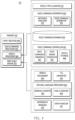
- an input receiver 340, a quick command processor 350, a speech processor 360, and/or a first voice engine 370 are illustrated as programs executed by the processor 120 of the electronic device 101.
- a set of a plurality of instructions stored in the memory 130 and/or processes executed by the processor 120 may be divided into the input receiver 340, the quick command processor 350, the speech processor 360, and/or the first voice engine 370.
- the input receiver 340, the quick command processor 350, the speech processor 360, and/or the first voice engine 370 may be included in one application installed in the electronic device 101.
- the application may be executed by the processor 120 of the electronic device 101 to control the electronic device 101 based on a speech including a natural language sentence.
- a second voice engine 380 is illustrated as a program executed by the processor 120 of the external electronic device 210.
- the second voice engine 380 may include a set (e.g., an application) of a plurality of applications stored in the memory 130.
- the second voice engine 380 may be executed by the processor 120 of the external electronic device 210 to execute a voice command requested from another electronic device (e.g., the electronic device 101) connected to the external electronic device 210.
- the electronic device 101 may establish a communication link with the external electronic device 210 by using the communication circuit 330, to execute at least one voice command identified by the electronic device 101 by using the second voice engine 380 executed by the external electronic device 210.
- the electronic device 101 may establish the communication link, based on identifying preset natural language to guide the utterance of natural language sentences corresponding to at least one voice command, from an audio signal outputted from the microphone 320.
- the electronic device 101 may identify a speech from an audio signal outputted from the microphone 320 based on the execution of the input receiver 340. In a state that the input receiver 340 is executed, the electronic device 101 may perform an operation to identify a speech included in the audio signal, based on receiving the audio signal through the microphone 320.
- the audio signal processed by the input receiver 340 may be transmitted to the second voice engine 380 of the external electronic device 210 by the processor 120 of the electronic device 101.
- the input receiver 340 may identify text corresponding to the user's speech from one or more characters inputted through a software keyboard displayed through the display 260 and/or a hardware keyboard connected to the electronic device 101, as well as an audio signal outputted from the microphone 320.
- the electronic device 101 may obtain a state of one or more voice engines (e.g., the first voice engine 370 and/or the second voice engine 380) executed to process the voice command, based on identifying a plurality of voice commands from the speech.
- the electronic device 101 may schedule execution of the one or more functions, based on the states.
- the electronic device 101 may input one or more voice commands in the group to the first voice engine 370, or transmit the one or more voice commands to the external electronic device 210 through the communication circuit 330 of the electronic device 101.
- the electronic device 101 may obtain information (e.g., the first information 235 and/or the second information 245 of FIG. 2 ) including a result of executing one or more functions corresponding to the one or more voice commands, from the first voice engine 370 and/or the second voice engine 380.
- the electronic device 101 may output the information obtained using the speech processor 360 through the speaker 310 and/or the display 260.
- the electronic device 101 may transmit an audio signal representing the information to the speaker 310.
- the electronic device 101 may display a visual object and/or a screen including the information, by controlling the display 260.
- the electronic device 101 may identify at least one voice command matched to the first voice engine 370 by the speech processor 360, based on the execution of the first voice engine 370.
- the electronic device 101 may execute at least one function corresponding to the at least one voice command.
- the at least one function may include at least one of a function for controlling hardware included in the electronic device 101 (e.g., a function to adjust the volume of the speaker 310), a function supported by an application installed in the memory 130 (e.g., alarm, play music), and a function to retrieve information from network through the communication circuit 330 (e.g., weather search).
- the electronic device 101 may store a result of executing at least one voice command by using the speech processor 360, or output the result to the user.
- the processor 120 of the external electronic device 210 may execute at least one function corresponding to at least one voice command requested from the electronic device 101, based on the execution of the second voice engine 380.
- the electronic device 101 may request the external electronic device 210 to execute at least one voice command, based on the speech processor 360.
- the processor 120 of the external electronic device 210 may execute at least one function corresponding to the at least one voice command included in the request.
- the processor 120 of the external electronic device 210 may transmit a result of executing the at least one function to the electronic device 101, by using the communication circuit 330.
- the results transmitted to the electronic device 101 may be outputted to the user, by the processor 120 of the electronic device 101 executing the speech processor 360.
- the electronic device 101 may schedule or control execution of at least one function to be executed by a plurality of voice engines (e.g., the first voice engine 370 and the second voice engine 380), based on application such as the speech processor 360. Based on the scheduling of a plurality of voice engines, the electronic device 101 may reduce resource of the electronic device 101 and/or the external electronic device 210 occupied for the execution of the plurality of voice engines while efficiently using the plurality of voice engines.
- a plurality of voice engines e.g., the first voice engine 370 and the second voice engine 380
- FIG. 4 is a block diagram of a program executed by an electronic device 101, according to an embodiment.
- the electronic device 101 of FIG. 4 may be an example of the electronic device 101 of FIG. 3 .
- the input receiver 340, the quick command processor 350, the speech processor 360, and the first voice engine 370 executed by the electronic device 101, the memory 130, and the processor 120 of FIG. 3 may include the electronic device 101, the memory 130, the input receiver 340, the quick command processor 350, the speech processor 360, and the first voice engine 370 of FIG. 4 .
- instructions and/or sub-routines of the first voice engine 370 to execute a function related to the user's speech may be divided into a speech recognizer 450, a text-to-speech converter 455, a natural language processor 460, a dependency manager 470, and/or an event handler 475.
- Instructions and/or sub-routines of the natural language processor 460 may be divided into a domain classifier 462 and/or a goal classifier 464.
- instructions and/or sub-routines of the speech processor 360 to identify one or more voice commands from the user's speech may be divided into a speech type classifier 410, a voice command interpreter 420, and/or a voice command controller 440.
- the electronic device 101 may manage a voice command database 430 in the memory 130.
- An example of information stored in the voice command database 430 will be described with reference to FIG. 5 .
- Instructions and/or sub-routines in the voice command interpreter 420 may be divided into a metadata analyzer 422 and/or a voice command generator 424.
- Instructions and/or sub-routines in the voice command controller 440 may be divided into a voice command manager 442, a voice engine scheduler 446, and a speech storage 448.
- the electronic device 101 may control execution of one or more voice commands matched to the user's intention included in the speech.
- the electronic device 101 may obtain attributes for each of the plurality of voice commands included in the group, based on the execution of the speech type classifier 410.
- the electronic device 101 may generate metadata of a voice command based on the attributes.
- the metadata may be stored in the memory 130 of the electronic device 101. Table 1 may include an example of attributes included in the metadata of the voice command.
- the name of Table 1 may be example names assigned to attributes.
- the attribute having the Prompt name may indicate whether an additional parameter is required to execute a function of a voice command, based on Boolean data type.
- the attribute having the Time name may indicate whether a result of execution of the function varies according to time.
- the attribute having the Location name may indicate whether a result of execution of the function varies according to a location of the electronic device 101.
- the attribute having the Device context name may indicate whether a result of execution of the function varies according to a state of the electronic device 101 based on Boolean data type.
- the attribute having the onDevice supported name may indicate whether the function is executable by the first voice engine 370 based on Boolean data type.
- Attributes e.g., attribute having name Prompt, Time, Location, Device context, onDevice supported
- included in meta data may include information (e.g., dependency map) managed by the dependency manager 470.
- an attribute having Event list name may include a list of one or more functions corresponding to a voice command.
- names of the one or more functions may be stored in an attribute having Event list name.
- the fact that text 'message' is stored in an attribute having Event list name may indicate that a voice command corresponding to meta data requests execution of a function of displaying a message.
- the fact that 'TTS_Response' text is stored in an attribute having Event list name may indicate that a voice command corresponding to meta data requests execution of a TTS function.
- the fact that 'appLaunch' text is stored in an attribute having Event list name may indicate that a voice command corresponding to meta data requests execution of at least one application installed in the electronic device 101.
- Obtaining metadata for a voice command by the electronic device 101 may be performed based on the first voice engine 370 executed with the speech type classifier 410. Based on execution of the natural language processor 460 in the first voice engine 370, the electronic device 101 may perform pre-processing on the natural language included in the voice command. For example, the electronic device 101 may identify whether the voice command may be processed by the first voice engine 370 based on execution of the domain classifier 462. Whether the voice command may be processed by the first voice engine 370 may be stored in an attribute having the onDevice supported name in Table 1. Based on execution of the goal classifier 464, the electronic device 101 may identify a goal of a function (or action) to be executed by the voice command.
- the electronic device 101 may perform post-processing on the pre-processed voice command. Based on execution of the dependency manager 470, the electronic device 101 may identify a device dependence of resource used to process the voice command. The device dependence may include, for example, whether a function corresponding to the voice command may be processed by the first voice engine 370 and/or the electronic device 101. Based on execution of the event handler 475, the electronic device 101 may obtain a list of functions corresponding to the voice command. The list obtained by the electronic device 101 may be stored in an attribute having Event list name in metadata.
- the electronic device 101 may obtain metadata corresponding to one or more voice commands grouped by a quick command.
- the obtained metadata may be stored in the memory 130 of the electronic device 101.
- the electronic device 101 may include an operation of storing the metadata in the memory 130.
- Registering a quick command by the electronic device 101 may include an operation of storing the metadata in the memory 130.
- the electronic device 101 may process the metadata obtained based on execution of the speech type classifier 410, based on the voice command interpreter 420. Based on execution of the voice command interpreter 420, the electronic device 101 may identify information to be stored in the voice command database 430 from the metadata. Based on execution of the metadata analyzer 422, the electronic device 101 may perform parsing the metadata stored in the memory 130, based on the speech type classifier 410. Based on execution of the voice command generator 424, the electronic device 101 may store information parsed by the metadata analyzer 422 in the voice command database 430. An example of a schema of the voice command database 430 will be described with reference to FIG. 5 .
- the electronic device 101 may obtain metadata corresponding to one or more voice commands matched a quick command, based on an input indicating to register the quick command.
- the electronic device 101 may store information corresponding to one or more voice commands in the voice command database 430.
- the electronic device 101 may identify one or more voice commands to be executed by the quick command, and attributes of the one or more voice commands, by using the stored metadata.
- the electronic device 101 may more quickly identify the one or more voice commands and the attributes. An operation performed by the electronic device 101 based on identifying the speech including the quick command will be described with reference to FIG. 6 .
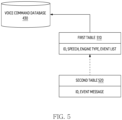
- FIG. 5 is a block diagram of a voice command database 430 included in an electronic device, according to an embodiment.
- the electronic device of FIG. 5 may be an example of the electronic device 101 of FIG. 3 and FIG. 4 .
- the voice command database 430 of FIG. 4 may include the voice command database 430 of FIG. 5 .
- the voice command database 430 of FIG. 5 may be managed based on the execution of the speech processor 360 of FIG. 3 to FIG. 4 .
- the electronic device may divide information included in the voice command database 430 into a first table 510 for storing parameters corresponding to the voice command and the second table 520 for storing parameters related to one or more events to be executed by the voice command, and store.
- the electronic device may update the voice command database 430 based on the one or more voice commands, in a state of registering a quick command including one or more voice commands.
- the electronic device may store parameters corresponding to the voice command.
- Table 2 may include an example of the parameters stored in the first table 510 of the voice command database 430.
- [Table 2] Name of parameter (or field) Description ID Identifier of a voice command in the first table 510 of the voice command database 430
- Command Natural language corresponding to a voice command Engine type A type of voice engine capable of executing a function corresponding to a voice command Static event list Variability of a function (or event) corresponding to a voice command
- Event list A list of events to be performed to display result of execution of one or more functions corresponding to a voice command
- a parameter having ID name may include an identifier (e.g., key value) uniquely assigned to records in the first table 510 of the voice command database 430.
- a parameter having Command name may include a natural language corresponding to a voice command.
- a parameter having Engine type name may include a value for identifying a voice engine capable of executing one or more functions corresponding to a voice command.
- a parameter having Engine type name may include a value indicating whether the one or more functions may be executed by each of a first voice engine (e.g., the first voice engine 370 of FIG. 3 ) executed by an electronic device and a second voice engine (e.g., the second voice engine 380 of FIG.
- the electronic device may execute one or more functions corresponding to one or more registered voice commands in response to a speech including the quick command.
- the electronic device may control scheduling and/or execution of one or more the functions based on execution of the voice command controller 440 of FIG. 4 .
- an example of an operation performed by an electronic device according to an embodiment based on identifying a quick command from an audio signal outputted from a microphone will be described with reference to FIG. 6 and FIG. 7 .
- instructions and/or sub-routines of the quick command processor 350 to identify whether the user's speech includes a quick command may be divided into a comparator 610, an executor 620, and a quick command generator 630.
- the electronic device 101 may manage a quick command database 640 including information on the quick command in the memory 130.
- the electronic device 101 may store a natural language corresponding to the quick command, a language type (e.g., English), an identifier uniquely assigned to the quick command, and a time when the quick command is registered, in the quick command database 640.
- the information stored in the quick command database 640 may be stored in an external electronic device connected to the electronic device 101 (e.g., the memory 130 of the external electronic device 210 of FIGS. 2 and 3 ).
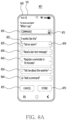
- the electronic device 101 may display a button 860 for adding one or more voice commands executed by a quick command, in the display 260.
- the electronic device 101 may obtain a voice command through text and/or audio signals.
- the electronic device 101 may display visual objects 820, 830, 840, and 850 corresponding to each of the four voice commands in the display 260.
- a sequence in which visual objects 820, 830, 840, and 850 are arranged in the display 260 may indicate a sequence of executing the fourth voice commands based on the quick command.
- the information may include metadata for the voice commands described with reference to Table 1 and/or attributes for the voice commands described with reference to Table 2.
- the electronic device 101 may obtain attributes for the voice commands.
- Table 3 Voice command Prompt Time Location Device Context OnDevice Supported event list Set an alarm O X X X O Message, Renderer, TtsResponse Read a last text message X X X O O Message, Renderer, TtsResponse Register a reminder in 10 minutes X O X X O Message, Renderer, TtsResponse Tell me about the weather NA NA NA NA NA X Message, Renderer, TtsResponse
- the attributes of Table 3 may be stored in metadata for voice commands corresponding to the visual objects 820, 830, 840, and 850.
- the first voice command corresponding to the visual object 820 may include a natural language sentence (e.g., "Set an alarm") related to an alarm. Since the natural language sentence does not include a parameter (e.g., time) for adjusting the alarm, additional input of the parameter may be required to process the first voice command.
- the electronic device 101 may assign a preset value indicating that additional input for processing the first voice command is required within an attribute having Prompt name.
- the second voice command corresponding to the visual object 830 may include a natural language sentence (e.g., "Read a last text message") related to a short message service (SMS).
- the second voice command may depend on a state of the electronic device 101 at the time of processing the second voice command (e.g., a state in which at least one text message is stored in the electronic device 101).
- the electronic device 101 may assign a preset value indicating that identifying a state of the electronic device 101 is required to process the second voice command within an attribute having Device context name.
- the third voice command corresponding to the visual object 840 may include a natural language sentence (e.g., "Register a reminder in 10 minutes ”) related to an alarm.
- the function executed by the third voice command may depend on a time point at which the third voice command is processed.
- the electronic device 101 may indicate that a current time point of the electronic device 101 is required to process the third voice command, by assigning a preset value to an attribute having Time name.
- the electronic device 101 may obtain attributes of four voice commands matched to a quick command by a user, while registering the quick command identified by the "command" speech. After the state 801 of FIG. 8A , the electronic device 101 may identify the quick command registered to execute the four voice commands, based on identifying "command" speech from audio signals outputted from the microphone. Referring to FIG. 8B , a state 802 in which the electronic device 101 identifies the speech ("command") for executing the quick command after the state 801 of FIG. 8A is illustrated.
- the electronic device 101 may obtain metadata described with reference to Table 3, for the four voice commands corresponding to a quick command. Based on the metadata, the electronic device 101 may match each of the voice commands with any one of different voice engines.
- the voice engines may include a first voice engine (e.g., the first voice engine 370 of FIG. 3 ) executed by an electronic device 101 and a second voice engine (e.g., the second voice engine 380 of FIG. 3 ) executed by an external electronic device different from the electronic device 101.
- the electronic device 101 may allocate the voice commands to the voice engines in order to minimize total duration in which the voice commands are processed based on the voice engines.
- An operation in which the electronic device 101 directly or indirectly processes the voice commands based on the voice engines after assigning the voice commands to the voice engines may be performed based on the operation described above with reference to FIGS. 6 and 7 .
- the electronic device 101 may sequentially output audio signals representing results of processing the voice commands according to a sequence of the voice commands. For example, the electronic device 101 may sequentially output the audio signals based on a sequence of visual objects 820, 830, 840, and 850 in the state 801 of FIG. 8A .
- the electronic device 101 may display information including the result of executing the third voice command.
- the electronic device 101 may display information including the result of executing the fourth voice command.
- the electronic device 101 may individually display results of executing the voice commands in parallel using different voice engines, by using visual objects 882, 884, 886, and 888. For example, the electronic device 101 may display result of processing the third voice command using the visual object 886, before the processing of the second voice command is completed.
- the electronic device 101 may quickly execute a plurality of voice commands matched to the quick command by using different voice engines.
- the electronic device 101 may output audio signals representing results of processing the plurality of voice commands by using a speaker.
- the electronic device 101 may display the results in parallel in the display 260.
- the embodiment is not limited thereto, and for example, the electronic device 101 may display sequentially the results in the display 260. Since the electronic device 101 displays the results in parallel through the display 260, the electronic device 101 may display result of processing another voice command to a user, independently of failure of processing of a specific voice command among the plurality of voice commands.
- FIG. 9 illustrates an operation in which an electronic device 101 executes a plurality of functions based on a speech 910, according to an embodiment.
- the electronic device 101 of FIG. 9 may be an example of the electronic device 101 of FIGS. 3 to 7 .
- the electronic device 101 of FIG. 3 and the display 260 may include the electronic device 101 of FIG. 9 and the display 260.
- the external electronic device 210 of FIG. 9 may include the external electronic device 210 of FIG. 2 and/or FIG. 7 .
- the electronic device 101 may identify the speech 910 including a plurality of voice commands.
- the speech 910 may be identified from an audio signal outputted through a microphone included in the electronic device 101.
- the electronic device 101 may identify a first voice command 920 corresponding to a function for reserving an alarm, from a first portion 912 (e.g., "Set an alarm at 7 o'clock") in the natural language sentence included in the speech 910.
- the electronic device 101 may identify a second voice command 930 corresponding to a function for outputting information collected from the network, from a second portion 914 (e.g., "Tell me the news") in the natural language sentence included in the speech 910.
- the electronic device 101 may identify the voice commands 920 and 930 from the speech 910, based on execution of the speech processor 360 of FIG. 4 .
- the electronic device 101 may input a plurality of voice commands to at least one of voice engines executed by different electronic devices.
- the voice engines may include a first voice engine (e.g., the first voice engine 370 in FIG. 3 ) executed by the electronic device 101 and a second voice engine (e.g., the second voice engine 380 in FIG. 3 ) executed by the external electronic device 210 connected to the electronic device 101.
- the electronic device 101 may obtain first information 925 including a result of processing the first voice command 920, by processing the first voice command 920 by using the first voice engine.
- the electronic device 101 may transmit a signal including the second voice command 930 to the external electronic device 210 to process the second voice command 930 by using the second voice engine.
- the electronic device 101 may receive another signal including second information 935, as a response to the signal from the external electronic device 210.
- the second information 935 included in the other signal may include a result of processing the second voice command 930 by the external electronic device 210 executing the second voice engine.
- the electronic device 101 may output a speech 940 including information (e.g., the first information 925 and the second information 935) including results of processing a plurality of voice commands (e.g., the first voice command 920 and the second voice command 930) identified from the speech 910, to a user.
- the electronic device 101 may output the speech 940 by using an audio signal transmitted to a speaker.
- the speech 940 may include a natural language sentence 942 (e.g., "The alarm will go off at 7 o'clock") based on the first information 925 which is the result of processing the first voice command 920 and a natural language sentence 944 (e.g., "news. Today, Company S is --) based on the second information 935 which is the result of processing the second voice command 930.
- FIG. 10 is a flowchart of an operation performed by an electronic device, according to an embodiment.
- the electronic device of FIG. 10 may include the electronic device 101 of FIGS. 1-9 . At least one of the operations of FIG. 10 may be executed by the electronic device 101 of FIG. 3 and/or the processor 120 in the electronic device 101 of FIG. 3 . In the following embodiment, each operation may be performed sequentially, but is not necessarily performed sequentially. For example, the sequence of each operation may be changed, and at least two operations may be performed in parallel.
- an electronic device may identify a first audio signal through a microphone.
- the first audio signal may indicate vibration of an external space including the microphone.
- the microphone of operation 1010 may include at least one of a microphone connected to the electronic device by wire, such as the microphone 320 and headphones of FIG. 3 , or a microphone connected wirelessly to the electronic device through the communication circuit 330 of FIG. 3 , such as wireless earphones.
- the electronic device may determine whether a speech for sequentially executing a plurality of functions is identified from the first audio signal.
- the speech may include a natural language registered in the electronic device to execute a quick command, such as the speech 220 of FIG. 2 .
- the speech may include natural language sentences representing a plurality of functions, such as the speech 910 of FIG. 9 .
- the electronic device may execute at least one first function among the plurality of functions based on the processor.
- the electronic device may execute at least one second function different from the at least one first function among the plurality of functions, by using an external electronic device (e.g., the external electronic device 210 of FIG. 3 ) connected through a communication circuit (e.g., the communication circuit 330 of the electronic device 101 of FIG. 3 ).
- the electronic device may divide the plurality of functions matched to the speech identified from the first audio signal into the at least one first function and the at least one second function to be executed by the processor of the electronic device.
- An operation in which the electronic device divides the plurality of functions into the at least one first function and the at least one second function may be performed based on the operation described above with reference to FIG. 6 and FIG. 7 .
- the electronic device may divide the plurality of functions into the at least one first function and the at least one second function, based on states of the first voice engine executed by the processor and the second voice engine executed by the external electronic device.
- the electronic device may process the at least one first function divided among the plurality of functions based on operation 1030 by using the first voice engine executed by the processor of the electronic device.
- the electronic device may transmit the at least one second function to the external electronic device based on operation 1040, and obtain a result of executing the at least one second function from the external electronic device.
- the electronic device may output second audio signals representing results of executing at least one first function and at least one second function through a speaker.
- the electronic device may output the second audio signals as a response to the speech identified through the first audio signal.
- Each of the second audio signals may include a natural language sentence representing results of processing each of a plurality of functions of operation 1020.
- a sequence of natural language sentences outputted from the electronic device by the second audio signals may correspond to a sequence of a plurality of functions indicated by the speech.
- the electronic device may execute a third function corresponding to the first audio signal by using any one a processor of the electronic device or an external electronic device.
- the electronic device may identify a state of the first voice engine executed by the processor and/or a state of the second voice engine executed by the external electronic device.
- the electronic device may execute the third function, by using a voice engine in the idle state among the first voice engine or the second voice engine.
- the electronic device may output a third audio signal representing the result of executing the third function.
- the electronic device may output second audio signals and/or third audio signals based on a speech included in the first audio signal.
- the embodiment is not limited thereto, and as described above with reference to FIG. 8B , the electronic device may visualize results of executing one or more functions corresponding to the speech identified by operation 1020, by using the display in the electronic device.
- FIG. 11 is a flowchart of an operation performed by an electronic device, according to an embodiment.
- the electronic device of FIG. 11 may include the electronic device 101 of FIGS. 1-9 . At least one of the operations of FIG. 11 may be executed by the processor 120 in the electronic device 101 of FIG. 3 and/or the electronic device 101 of FIG. 3 . At least one of the operations of FIG. 11 may be related to at least one of the operations of FIG. 10 . In the following embodiment, each operation may be performed sequentially, but is not necessarily performed sequentially. For example, a sequence of each operation may be changed, and at least two operations may be performed in parallel.
- the electronic device may identify a speech from an audio signal.
- the electronic device may identify a speech by using the first voice engine executed by the processor of the electronic device, or may identify the speech by using the second voice engine executed by the external electronic device connected to the electronic device. Identifying a speech by the electronic device may include obtaining text data corresponding to the speech.
- the electronic device may determine whether metadata corresponding to the speech is identified.
- the metadata may be identified by using a speech processor (e.g., the speech processor 360 in FIG. 3 ) executed by the electronic device.
- the electronic device may select a voice engine to process a speech based on the metadata identified by operation 1120.
- the electronic device may select a voice engine for executing one or more functions related to the speech from among the first voice engine or the second voice engine.
- the electronic device may perform independently operation 1130 for each of the plurality of voice commands. For example, based on operation 1130, a voice engine to which each of the plurality of voice commands is processed may be independently selected from among the first voice engine or the second voice engine.
- the electronic device may select a voice engine to process a speech from among the first voice engine and the second voice engine, based on attributes in the meta data. For example, when an attribute indicating that the speech is selectively executed by a specific voice engine is identified through the metadata, the electronic device may select a voice engine to process the speech based on the attribute. When metadata corresponding to the speech is not identified (1120-NO), a selection of a voice engine based on operation 1130 may be bypassed.
- the electronic device may determine whether a parameter required to execute a function corresponding to a speech is identified from the speech.
- the electronic device may request a parameter required to execute the function from the user.
- the electronic device may process the speech by using a voice engine.
- the electronic device may output a result of processing the speech (e.g., result of executing one or more voice commands included in the speech) by using a speaker and/or a display.
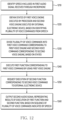
- FIG. 12 is a flowchart of an operation performed by an electronic device, according to an embodiment.
- the electronic device of FIG. 12 may include the electronic device 101 of FIGS. 1-9 . At least one of the operations of FIG. 12 may be executed by the electronic device 101 of FIG. 3 and/or the processor 120 in the electronic device 101 of FIG. 3 . At least one of the operations of FIG. 12 may be related to at least one of the operations of FIGS. 10 to 11 . In the following embodiment, each operation may be performed sequentially, but is not necessarily performed sequentially. For example, a sequence of each operation may be changed, and at least two operations may be performed in parallel.
- the electronic device may identify a speech included in the first audio signal received through the microphone.
- the electronic device may perform operation 1210 of FIG. 12 , similar to operation 1110 of FIG. 11 .
- the electronic device may obtain states of the first voice engine executed by the processor and the second voice engine executed by the external electronic device, based on identifying a plurality of voice commands from a speech. Based on identifying a quick command for executing a group of the plurality of voice commands within a speech, the electronic device may perform operation 1220.
- the states obtained by the electronic device based on operation 1220 may indicate whether the first voice engine and/or the second voice engine are in the idle state.
- the electronic device may divide a plurality of voice commands into a first voice command corresponding to the first voice engine and a second voice command corresponding to the second voice engine.
- the electronic device may divide, based on possibility of executing a function of each of the first voice engine or the second voice engine, the each of the plurality of functions into the at least one first function and the at least one second function, the possibility being indicated by the states.
- the electronic device may divide, based on feasibility, which is indicated by the states, of a function of each of the first voice engine or the second voice engine, the each of the plurality of functions into the at least one first function and the at least one second function, the possibility being indicated by the states.
- the electronic device may perform scheduling for the plurality of voice commands of operation 1220.
- the electronic device may store the first voice command and the second voice command in different areas (e.g., the first queue 710 and the second queue 720 of FIG. 7 ) in the memory of the electronic device.
- the electronic device may execute a first function corresponding to the first voice command by using the first voice engine. Since the first voice engine is executed by the processor of the electronic device, the electronic device may selectively process the first voice command among the plurality of voice commands, based on operation 1240.
- the electronic device may request execution of the second function corresponding to the second voice command to the external electronic device.
- the electronic device may request execution of the second function by transmitting information related to the second voice command to the external electronic device executing the second voice engine.
- the electronic device may receive a signal and/or information including a result of execution of the second function as a response to the request from the external electronic device.
- the sequence in which the electronic device executes operations 1240 and 1250 is not limited to an embodiment of FIG. 12 .
- the electronic device may perform operations 1240 and 1250 in parallel.
- the electronic device may output a second audio signal representing results of execution of the first function and the second function, based on a sequence of a plurality of voice commands indicated by a speech.
- a sound outputted by the electronic device through the second audio signal may include natural language sentences representing results of execution of the first function and the second function.
- a sequence in which the natural language sentences are outputted may depend on a sequence in which the plurality of voice commands are processed, set in a state of registering a quick command.
- FIG. 13 is a block diagram illustrating an artificial intelligence (AI) system according to an embodiment.
- AI artificial intelligence
- an artificial intelligence system 13 may include a user terminal 1300, an intelligent server 1400, and a service server 1500.
- the user terminal 1300 may be a terminal device (or electronic device) connectable to the Internet, and for example, it may be mobile phone, smartphone, personal digital assistant (PDA), laptop computer, TV, white goods, wearable device, HMD, or a smart speaker.
- a terminal device or electronic device connectable to the Internet
- PDA personal digital assistant
- TV white goods
- wearable device HMD
- smart speaker a smart speaker
- the user terminal 1300 may include a communication interface 1310, a microphone 1320, a speaker 1330, a display 1340, a memory 1350, and a processor 1360.
- the components listed above may be operably or electrically connected to each other.
- the communication interface 1310 may be configured to be connected to an external device to transmit and receive data.
- the microphone 1320 may receive sound (e.g., user speech) and convert it into an electrical signal.
- the speaker 1330 may output an electrical signal as sound (e.g., voice).
- the display 1340 may be configured to display an image or video.
- the display 1340 may display a graphic user interface (GUI) of an app (or application program) being executed.
- GUI graphic user interface
- the display 1340 may be configured to display an image or video.
- the display 1340 may also display the graphic user interface (GUI) of an app (or application program) being executed.
- GUI graphic user interface
- the display 1340 may receive a touch input through a touch sensor.
- the display 1340 may receive a text input through a touch sensor in image keyboard area displayed in the display 1340.
- the memory 1350 may store a client module 1351, a software development kit (SDK) 1353, and a plurality of apps 1355.
- the client module 1351 and the SDK 1353 may comprise a framework (or solution program) to perform general functions.
- the client module 1351 or the SDK 1353 may comprise a framework for processing user input (e.g., voice input, text input, touch input).
- the plurality of apps 1355 may be programs for performing a designated function.
- a plurality of apps 1355 may include a first app 1355_1 and a second app 1355_3.
- each of the plurality of apps 1355 may include a plurality of operations for performing a designated function.
- the plurality of apps 1355 may include at least one of alarm app, message app, and schedule app.
- the plurality of apps 1355 may be executed by the processor 1360 to sequentially execute at least portion of the plurality of operations.
- the processor 1360 may control overall operation of the user terminal 1300.
- the processor 1360 can be electrically connected to the communication interface 1310, the microphone 1320, the speaker 1330, the display 1340, and the memory 1350 to perform a designated operation.
- the client module 1351 may receive a user input.
- the client module 1351 may generate a voice signal corresponding to a user speech detected through the microphone 1320.
- the client module 1351 may receive a touch input detected through the display 1340.
- the client module 1351 may receive a text input detected through a keyboard or an image keyboard.
- the client module 1351 may receive various types of user input detected through an input module included in the user terminal 1300 or an input module connected to the user terminal 1300.
- the client module 1351 may transmit the received user input to the intelligent server 1400.
- the client module 1351 may transmit state information of the user terminal 1300 to the intelligent server 1400 together with the received user input.
- the state information may be execution state information of an app.
- the client module 1351 may receive a result corresponding to the received user input.
- the client module 1351 may receive a result corresponding to a user input from the intelligent server 1400.
- the client module 1351 may display the received result on the display 1340.
- the client module 1351 may output the received result as audio through the speaker 1330.
- the client module 1351 may receive a plan corresponding to the received user input.
- the client module 1351 may display a result of executing a plurality of operations of an app according to the plan on the display 1340.
- the client module 1351 may sequentially display the execution results of the plurality of operations on the display and output audio through the speaker 1330.
- the user terminal 1300 may display a portion of result (e.g., the result of the last operation) of executing the plurality of operations on the display, and output audio through the speaker 1330.
- the client module 1351 may receive a request for obtaining information necessary to calculate a result corresponding to a user input from the intelligent server 1400.
- information required to calculate the result may be state information of the user terminal 1300.
- the client module 1351 may transmit the necessary information to the intelligent server 1400 in response to the request.
- the client module 1351 may transmit result information executing a plurality of operations according to a plan to the intelligent server 1400.
- the intelligent server 1400 may identify that the user input received through the result information is correctly processed.
- the client module 1351 may include a voice recognition module. According to an embodiment, the client module 1351 may recognize a voice input performing a limited function through the voice recognition module. For example, the client module 1351 may perform an intelligent app to process voice input for performing organic operations through a designated input (e.g., wake up!).
- a voice recognition module may recognize a voice input performing a limited function through the voice recognition module. For example, the client module 1351 may perform an intelligent app to process voice input for performing organic operations through a designated input (e.g., wake up!).
- the intelligent server 1400 may receive information related to a user voice input from the user terminal 1300 through a communication network. According to an embodiment, the intelligent server 1400 may change data related to the received voice input into text data. According to an embodiment, the intelligent server 1400 may generate a plan for performing a task corresponding to a user voice input based on the text data.
- the plan may be generated by an artificial intelligence (AI) system.
- AI artificial intelligence
- the AI system may be a rule-based system, or a neural network-based system (e.g., feedforward neural network (FNN), or recurrent neural network (RNN)). Alternatively, it may be a combination of the described above or an artificial intelligence system different therefrom.
- a plan may be selected from a set of predefined plans or may be generated in real time in response to a user request. For example, the AI system may select at least one plan from a plurality of predefined plans.
- the intelligent server 1400 may transmit a result calculated according to the generated plan to the user terminal 1300 or transmit the generated plan to the user terminal 1300.
- the user terminal 1300 may display a result calculated according to a plan on a display.
- the user terminal 1300 may display a result of executing an operation according to a plan on a display.
- the front end 1410 may receive a user input received from the user terminal 1300.
- the front end 1410 may transmit a response corresponding to the user input.
- the natural language platform 1420 may include an automatic speech recognition module (ASR module) 1421, a natural language understanding module (NLU module) 1423, a planner module 1425, a natural language generator module (NLG module) 1427, and a text to speech module (TTS module) 1429.
- ASR module automatic speech recognition module
- NLU module natural language understanding module
- NLG module natural language generator module
- TTS module text to speech module
- the planner module 1425 may generate a plan by using intention and parameter determined by the natural language understanding module 1423. According to an embodiment, the planner module 1425 may determine a plurality of domains necessary to perform a task based on the determined intention. The planner module 1425 may determine a plurality of operations included in each of the plurality of domains determined based on the intention. According to an embodiment, the planner module 1425 may determine a parameter required to execute the plurality of determined operations or a result value outputted by the execution of the plurality of operations. The parameter and the result value may be defined as a concept related to a designated format (or class). Accordingly, the plan may include a plurality of operations and a plurality of concepts determined by the intention of the user.
- the planner module 1425 may determine a relationship between the plurality of operations and the plurality of concepts in stages (or hierarchical). For example, the planner module 1425 may determine execution order of a plurality of operations determined based on the user's intention, based on a plurality of concepts. In other words, the planner module 1425 may determine execution order of plurality of operations, based on a parameter required for the execution of the plurality of operations and a results outputted by the execution of the plurality of operations. Accordingly, the planner module 1425 may generate a plan including association information (e.g., ontology) between the plurality of operations and the plurality of concepts. The planner module 1425 may generate a plan by using information stored in the capsule database 1430 where a set of relationships between concept and operation is stored.
- association information e.g., ontology
- the capsule database 1430 may store information on a relationship between a plurality of concepts corresponding to a plurality of domains and operations.
- the capsule database 1430 may store a plurality of capsules including a plurality of action object (or action information) and concept object (or concept information) of the plan.
- the capsule database 1430 may store the plurality of capsules in a form of a concept action network (CAN).
- CAN concept action network
- a plurality of capsules may be stored in a function registry included in the capsule database 1430.
- the capsule database 1430 may include a strategy registry in which strategy information required when determining a plan corresponding to a voice input is stored.
- the strategy information may include reference information for determining one plan when a plurality of plans corresponding to a user input exist.
- the capsule database 1430 may include a follow-up registry in which information on a follow-up operation for proposing a follow-up operation to the user in a designated situation is stored.
- the follow-up may include, for example, follow-up speech.
- the capsule database 1430 may include a layout registry for storing layout information of information outputted through the user terminal 1300.
- the capsule database 1430 may include a vocabulary registry in which vocabulary information included in capsule information is stored.
- the capsule database 1430 may include a dialog registry in which dialog (or interaction) information with a user is stored.
- the capsule database 1430 may update an object stored through a developer tool.
- the developer tool may include a function editor for updating an action object or concept object.
- the developer tool may include a vocabulary editor for updating a vocabulary.
- the developer tool may include a strategy editor that generates and registers a strategy for determining a plan.
- the developer tool may include a dialog editor that generates a dialog with a user.
- the developer tool may include a follow-up editor activating subsequent goal and editing subsequent speech that provide hints. The subsequent goal may be determined based on a currently set goal, user preference, or environmental condition.
- the capsule database 1430 may also be implemented in the user terminal 1300.
- the user terminal 1300 may include a capsule database 1430 storing information for determining an operation corresponding to a voice input.
- the execution engine 1440 may calculate a result by using the generated plan.
- the end user interface 1450 may transmit the calculated result to the user terminal 1300.
- the user terminal 1300 may receive the result and provide the received result to the user.
- the management platform 1460 may manage information used in the intelligent server 1400.
- the big data platform 1470 may collect user data.
- the analysis platform 1480 may manage a quality of service (QoS) of the intelligent server 1400.
- QoS quality of service
- the analysis platform 1480 may manage components and processing speed (or efficiency) of the intelligent server 1400.
- the service server 1500 may provide a designated service (e.g., food order or hotel reservation) to the user terminal 1300.
- the service server 1500 may be a server operated by a third party.
- the service server 1500 may include a first service server 1501, a second service server 1503, and a third service server 1505 operated by different third parties.
- the service server 1500 may provide information for generating a plan corresponding to the received voice input to the intelligent server 1400.
- the provided information may be stored in the capsule database 1430.
- the service server 1500 may provide result information according to the plan to the intelligent server 1400.
- the user terminal 1300 may provide various intelligent services to the user in response to user input.
- the user input may include an input through a physical button, a touch input, or a voice input.
- the user terminal 1300 may provide a voice recognition service through an intelligent app (or a voice recognition app) stored therein.
- the user terminal 1300 may recognize the user's utterance or voice input received through the microphone and provide a service corresponding to the recognized voice input to the user.
- the user terminal 1300 may perform a designated operation alone or with the intelligent server and/or service server, based on the received voice input. For example, the user terminal 1300 may execute an app corresponding to the received voice input and perform a designated operation through the executed app.
- the user terminal 1300 when the user terminal 1300 provides a service together with the intelligent server 1400 and/or the service server, the user terminal may detect a user's utterance using the microphone 1320 and generate a signal (or voice data) corresponding to the detected user's utterance. The user terminal may transmit the voice data to the intelligent server 1400 by using the communication interface 1310.
- the intelligent server 1400 may generate a plan for performing a task corresponding to the voice input or a result of performing an operation according to the plan, in response to the voice input received from the user terminal 1300.
- the plan may include a plurality of operations for performing a task corresponding to the user's voice input and a plurality of concepts related to the plurality of operations.
- the concept may define a parameter to be inputted to the execution of the plurality of operations or result values to be outputted by the execution of the plurality of operations.
- the plan may include association information between the plurality of operations and the plurality of concepts.
- the user terminal 1300 may receive the response using the communication interface 1310.
- the user terminal 1300 may output a voice signal generated inside the user terminal 1300 to the outside by using the speaker 1330, or may output an image generated inside the user terminal 1300 to the outside by using the display 1340.
- FIG. 14 is a diagram illustrating a schema for storing relationship information between a concept and an action in a database, according to an embodiment.
- the capsule database (e.g., the capsule database 1430 of FIG. 13 ) of the intelligent server may store a plurality of capsules in a form of a concept action network (CAN) 1600.
- the capsule database may store an operation for processing a task corresponding to a user's voice input and a parameter necessary for the operation in a form of a concept action network (CAN).
- the CAN may represent an organic relationship between an action and a concept defining a parameter required to perform the action.
- the capsule database may store a plurality of capsules (e.g., Capsule A 1601, Capsule B 1604) corresponding to each of a plurality of domains (e.g., application).
- one capsule e.g., Capsule A 1601
- one capsule may correspond to one domain (e.g., application).
- one capsule may correspond to at least one service provider (e.g., CP 1 1602, CP 2 1603, CP 3 1606, or CP 4 1605) to perform a function of the domain related to the capsule.
- one capsule may include at least one operation 1610 and at least one concept 1620 for performing a designated function.
- a natural language platform may generate a plan for performing a task corresponding to the received voice input using a capsule stored in the capsule database.
- a planner module e.g., the planner module 1425 in FIG. 13
- a plan 1607 may be generated by using the operations 1711 and 1713 and concepts 1712 and 1714 of the Capsule A 1601, and operations 1741 and concepts 1742 of the Capsule B 1604.
- FIG. 15 is a diagram illustrating a user terminal that displays a screen for processing a voice input received through an intelligent app, according to an embodiment.
- the user terminal 1300 may execute an intelligent app for processing a user input through an intelligent server (e.g., the intelligent server 1400 of FIG. 16).
- an intelligent server e.g., the intelligent server 1400 of FIG. 16.
- the user terminal 1300 may execute an intelligent app for processing the voice input when recognizing a designated voice input (e.g., wake up! or receiving an input through a hardware key (e.g., a dedicated hardware key).
- the user terminal 1300 may execute an intelligent app in a state of executing a schedule app.
- the user terminal 1300 may display an object (e.g., icon) 1514 corresponding to an intelligent app on a display (e.g., the display 1340 of FIG. 13 ).
- the user terminal 1300 may receive a voice input by a user utterance.
- the user terminal 1300 may receive a voice input saying, "Tell me the schedule of this week!.
- the user terminal 1300 may display a user interface (UI) 1513 (e.g., an input window) of an intelligent app in which text data of the received voice input is displayed on the display.
- UI user interface
- the user terminal 1300 may display a result corresponding to the received voice input on the display.
- the user terminal 1300 may receive a plan corresponding to the received user input and display 'schedule of this week' on the display according to the plan.
- an electronic device identifies a preset speech for executing a plurality of functions, such as a quick command
- a method for more quickly executing the plurality of functions may be required.
- an electronic device e.g., the electronic device 101 of FIG. 3
- may comprise a communication circuitry e.g., the communication circuit 330 of FIG. 3
- a microphone e.g., the microphone 320 of FIG. 3
- a speaker e.g., the speaker 310 of FIG. 3
- the processor may be configured to identify a first audio signal through the microphone.
- the processor may be configured to execute, based on identifying a speech (e.g., the speech 220 of FIG. 2 ) for sequentially executing a plurality of functions from the first audio signal, at least one first function among the plurality of functions.
- the processor may be configured to execute, based on identifying the speech, by using an external electronic device (e.g., the external electronic device 210 of FIG. 3 ) connected through the communication circuitry, at least one second function different from the at least one first function among the plurality of functions.
- the processor may be configured to output sequentially, through the speaker, second audio signals representing results of executing the at least one first function and the at least one second function according to a sequence associated with the speech.
- the electronic device may more quickly execute the plurality of functions by using an electronic device and an external electronic device based on a speech for executing the plurality of functions.
- the processor may be configured to obtain states of a first voice engine (e.g., the first voice engine 370 of FIG. 3 ) executed by the processor and a second voice engine (e.g., the second voice engine 380 in FIG. 3 ) executed by the external electronic device.
- the processor may be configured to divide, based on the states, the plurality of functions into the at least one first function to be executed by the first voice engine and at least one second function to be executed by the second voice engine.
- the processor may be configured to divide the each of the plurality of functions into the at least one first function and the at least one second function, based on whether each of the first voice engine or the second voice engine is able to execute a function that is indicated by the states.
- the processor may be configured to assign at least one first voice command corresponding to the at least one first function to a first queue (e.g., the first queue 710 of FIG. 7 ) corresponding to the first voice engine.
- the processor may be configured to assign at least one second voice command corresponding to the at least one second function to a second queue (e.g., the second queue 720 of FIG. 7 ) corresponding to the second voice engine.
- the processor may be configured to execute the first voice engine based on the at least one first voice command accumulated in the first queue, among the voice commands.
- the processor may be configured to transmit, to the external electronic device, at least one signal including the at least one second voice command accumulated in the second queue, among the voice commands.
- the electronic device may further comprise a memory (e.g., the memory 130 of FIG. 3 ).
- the processor may be configured to store information including the results aligned according to the sequence in the memory.
- the information may comprise a queue where speeches included in the second audio signals are aligned according to the sequence.
- the electronic device may further comprise a display (e.g., display 260 of FIG. 3 ).
- the processor may be configured to display distinct visual objects (e.g., the visual objects 882, 884, 886, 888 of FIG. 8 ) including the results in a parallel in the display.
- a method of an electronic device may comprise identifying (e.g., operation 1210 of FIG. 12 ), based on receiving a first audio signal through a microphone of the electronic device, a speech included in the first audio signal.
- the method may comprise obtaining (e.g., operation 1220 of FIG. 12 ), based on identifying a plurality of voice commands from the speech, states of a first voice engine which is executed by the processor for processing a voice command, and a second voice engine executed by an external electronic device connected through a communication circuitry of the electronic device.
- the method may comprise obtaining (e.g., operation 1230 of FIG.
- the identifying the speech may comprise requesting, based on receiving the first audio signal, text data corresponding to the first audio signal to the external electronic device.
- the identifying the speech may comprise identifying the speech based on the text data received from the external electronic device.
- the requesting may comprise receiving, after requesting execution of the second function to the external electronic device, information including a result of execution of the second function from the external electronic device.
- the requesting may comprise storing, in the memory, the information received from the external electronic device based on the sequence.
- the obtaining the information may comprise obtaining, based on whether each of the first voice engine or the second voice engine is able to execute the plurality of voice commands based on the states, the information.
- the outputting may comprise displaying, in a display of the electronic device, visual objects respectively corresponding to results of execution of the first function and the second function.
- the dividing may comprise dividing, based on whether each of the first voice engine or the second voice engine is able to execute a function that is indicated by the states, the each of the plurality of functions into the at least one first function and the at least one second function.
- the processor may be configured to execute first function corresponding to the first voice command by using the first voice engine, and request execution of second function corresponding to the second voice command to the external electronic device, based on the information.
- the processor may be configured to output, through the speaker, a second audio signal representing results of execution of the first function and the second function based on a sequence of the plurality of voice commands indicated by the speech.
- the electronic device may further comprise a memory (e.g., the memory 130 of FIG. 3 ).
- the processor may be configured to identify, in the memory, a preset speech for triggering execution of the plurality of voice commands based on the sequence.
- the processor may be configured to identify, based on whether the speech included in the first audio signal is corresponding to the preset speech, the plurality of voice commands matched to the speech.
- the processor may be configured to receive, after requesting execution of the second function to the external electronic device, information including a result of execution of the second function from the external electronic device.
- the processor may be configured to store the information received from the external electronic device based on the sequence in the memory.
- the processor may be configured to request, in response to receiving the first audio signal, text data corresponding to the first audio signal to the external electronic device.
- the processor may be configured to identify the speech based on the text data received from the external electronic device.
- the at least one processor may be configured to execute the at least one instruction to obtain a state of a first voice engine that is executed on the electronic device, and a state of a second voice engine that is executed on the external electronic device.
- the at least one processor may be configured to, based on the state of the first voice engine and the state of the second voice engine, divide the plurality of functions into the at least one first function to be performed by the first voice engine and the at least one second function to be performed by the second voice engine.
- the state of the first voice engine may indicate whether the first voice engine is able to perform one of the plurality of functions
- the state of the second voice engine may indicate whether the second voice engine is able to perform one of the plurality of functions.
- the at least one processor may be configured to execute the at least one instruction to assign at least one first voice command corresponding to the at least one first function to a first queue corresponding to the first voice engine.
- the at least one processor may be configured to assign at least one second voice command corresponding to the at least one second function to a second queue corresponding to the second voice engine.
- the at least one processor may be configured to execute the at least one instruction to execute the first voice engine based on the at least one first voice command accumulated in the first queue.
- the at least one processor may be configured to execute the at least one instruction to transmit, to the external electronic device, at least one signal indicating that the at least one second voice command is accumulated in the second queue.
- the at least one processor may be configured to execute the at least one instruction to store information including the at least one result in the memory, based on the sequence.
- the information may include a queue where at least one speech in the at least one second audio signal is arranged based on the sequence.
- the electronic device may include a display.
- the at least one processor may be configured to execute the at least one instruction to control the display to display at least one distinct visual object showing the at least one result in a parallel.
- a method of an electronic device may include identifying, based on receiving a first audio signal through a microphone of the electronic device, a speech in the first audio signal.
- the method may include obtaining, based on identifying a plurality of voice commands from the speech, a state of a first voice engine that is executed on the electronic device, and a state of a second voice engine that is executed on an external electronic device, the external electronic device being connected through communication circuitry of the electronic device.
- the method may include obtaining, based on the state of the first voice engine and the state of the second voice engine, information for dividing the plurality of voice commands into at least one first voice command to be performed by the first voice engine, and at least one second voice command to be performed by the second voice engine.
- the method may include performing a first function corresponding to the at least one first voice command using the first voice engine, and requesting the external electronic device to perform a second function corresponding to the at least one second voice command.
- the method may include outputting, through a speaker of the electronic device, at least one second audio signal representing at least one result of performing the first function and the second function based on a sequence of the plurality of voice commands indicated by the speech.
- the identifying the speech in the first audio signal may include receiving, from the external electronic device, text data corresponding to the first audio signal.
- the identifying the speech in the first audio signal may includeidentifying the speech in the first audio signal based on the text data.
- the obtaining the state of the first voice engine and the state of the second voice engine may include identifying, in a memory of the electronic device, a preset speech for triggering performance of the plurality of voice commands based on the sequence.
- the obtaining the state of the first voice engine and the state of the second voice engine may include identifying the plurality of voice commands, based on whether the speech in the first audio signal corresponds to the preset speech.
- the requesting the external electronic device to perform the second function may include receiving, from the external electronic device, information including a result of performing the second function.
- the requesting the external electronic device to perform the second function may include storing the information in the memory of the electronic device based on the sequence.
- the state of the first voice engine may indicate whether the first voice engine is able to perform one of a plurality of functions
- the state of the second voice engine may indicate whether the second voice engine is able to perform one of the plurality of functions.
- the outputting the at least one second audio signal may include controlling a display of the electronic device to display at least one visual object showing a result of performing the first function and a result of performing the second function.
- a method of an electronic device may include identifying a first audio signal received through a microphone of the electronic device.
- the method may include, based on identifying that the first audio signal may include a speech for sequentially executing a plurality of functions, performing at least one first function from the plurality of functions.
- the method may include, based on identifying that the first audio signal may include the speech, performing at least one second function from the plurality of functions, on an external electronic device connected through communication circuitry of the electronic device, the at least one second function being different from the at least one first function.
- the method may include sequentially outputting, through a speaker of the electronic device, at least one second audio signal representing at least one result of performing the at least one first function and the at least one second function based on a sequence associated with the speech.
- the method may include obtaining a state of a first voice engine that is executed on the electronic device, and a state of a second voice engine that is executed on the external electronic device.
- the method may include, based on the state of the first voice engine and the state of the second voice engine, dividing the plurality of functions into the at least one first function to be performed by the first voice engine and the at least one second function to be performed by the second voice engine.
- the state of the first voice engine may indicate whether the first voice engine is able to perform one of the plurality of functions
- the state of the second voice engine may indicate whether the second voice engine is able to perform one of the plurality of functions.
- the dividing may include assigning at least one first voice command corresponding to the at least one first function to a first queue corresponding to the first voice engine.
- the dividing may include assigning at least one second voice command corresponding to the at least one second function to a second queue corresponding to the second voice engine.
- the outputting may include outputting, based on queue of at least one speech in the at least one second audio signal, the at least one speech representing the at least one result according to the sequence.
- the electronic device may be one of various types of electronic devices.
- the electronic devices may include, for example, a portable communication device (e.g., a smartphone), a computer device, a portable multimedia device, a portable medical device, a camera, a wearable device, or a home appliance. According to an embodiment of the disclosure, the electronic devices are not limited to those described above.
- each of such phrases as “A or B,” “at least one of A and B,” “at least one of A or B,” “A, B, or C,” “at least one of A, B, and C,” and “at least one of A, B, or C,” may include any one of, or all possible combinations of the items enumerated together in a corresponding one of the phrases.
- such terms as “1st” and “2nd,” or “first” and “second” may be used to simply distinguish a corresponding component from another, and does not limit the components in other aspect (e.g., importance or order).
- an element e.g., a first element
- the element may be coupled with the other element directly (e.g., wiredly), wirelessly, or via a third element.
- module may include a unit implemented in hardware, software, or firmware, and may interchangeably be used with other terms, for example, “logic,” “logic block,” “part,” or “circuitry”.
- a module may be a single integral component, or a minimum unit or part thereof, adapted to perform one or more functions.
- the module may be implemented in a form of an application-specific integrated circuit (ASIC).
- ASIC application-specific integrated circuit
- Various embodiments as set forth herein may be implemented as software (e.g., the program 140) including one or more instructions that are stored in a storage medium (e.g., internal memory 136 or external memory 138) that is readable by a machine (e.g., the electronic device 101).
- a processor e.g., the processor 120
- the machine e.g., the electronic device 101
- the one or more instructions may include a code generated by a complier or a code executable by an interpreter.
- the machine-readable storage medium may be provided in the form of a non-transitory storage medium.
- non-transitory simply means that the storage medium is a tangible device, and does not include a signal (e.g., an electromagnetic wave), but this term does not differentiate between where data is semi-permanently stored in the storage medium and where the data is temporarily stored in the storage medium.
- a method may be included and provided in a computer program product.
- the computer program product may be traded as a product between a seller and a buyer.
- the computer program product may be distributed in the form of a machine-readable storage medium (e.g., compact disc read only memory (CD-ROM)), or be distributed (e.g., downloaded or uploaded) online via an application store (e.g., PlayStore TM ), or between two user devices (e.g., smart phones) directly. If distributed online, at least part of the computer program product may be temporarily generated or at least temporarily stored in the machine-readable storage medium, such as memory of the manufacturer's server, a server of the application store, or a relay server.
- CD-ROM compact disc read only memory
- an application store e.g., PlayStore TM
- two user devices e.g., smart phones
- each component e.g., a module or a program of the above-described components may include a single entity or multiple entities, and some of the multiple entities may be separately disposed in different components. According to various embodiments, one or more of the above-described components may be omitted, or one or more other components may be added. Alternatively or additionally, a plurality of components (e.g., modules or programs) may be integrated into a single component. In such a case, according to various embodiments, the integrated component may still perform one or more functions of each of the plurality of components in the same or similar manner as they are performed by a corresponding one of the plurality of components before the integration.
- operations performed by the module, the program, or another component may be carried out sequentially, in parallel, repeatedly, or heuristically, or one or more of the operations may be executed in a different order or omitted, or one or more other operations may be added.
- the apparatus described above may be implemented as a combination of hardware components, software components, and/or hardware components and software components.
- the devices and components described in the embodiments may be implemented using one or more general purpose computers or special purpose computers such as processors, controllers, arithmetical logic unit(ALU), digital signal processor, microcomputers, field programmable gate array (FPGA), PLU(programmable logic unit), microprocessor, any other device capable of executing and responding to instructions.
- the processing device may perform an operating system OS and one or more software applications performed on the operating system.
- the processing device may access, store, manipulate, process, and generate data in response to execution of the software.
- the processing device may include a plurality of processing elements and/or a plurality of types of processing elements.
- the processing device may include a plurality of processors or one processor and one controller.
- other processing configurations such as a parallel processor, are also possible.
- the software may include a computer program, code, instruction, or a combination of one or more of them and configure the processing device to operate as desired or command the processing device independently or in combination.
- Software and/or data may be embodied in any type of machine, component, physical device, computer storage medium, or device to be interpreted by a processing device or to provide instructions or data to the processing device.
- the software may be distributed on a networked computer system and stored or executed in a distributed manner.
- Software and data may be stored in one or more computer-readable recording media.
- the method according to the embodiment may be implemented in the form of program instructions that may be performed through various computer means and recorded in a computer-readable medium.
- the medium may continuously store a computer-executable program or temporarily store the program for execution or download.
- the medium may be a variety of recording means or storage means in which a single or several hardware are combined and is not limited to media directly connected to any computer system and may be distributed on the network. Examples of media may include magnetic media such as hard disks, floppy disks and magnetic tapes, optical recording media such as CD-ROMs and DVDs, magneto-optical media such as floppy disks, ROMs, RAMs, flash memories, and the like to store program instructions. Examples of other media include app stores that distribute applications, sites that supply or distribute various software, and recording media or storage media managed by servers.
Landscapes
- Engineering & Computer Science (AREA)
- Physics & Mathematics (AREA)
- Health & Medical Sciences (AREA)
- Audiology, Speech & Language Pathology (AREA)
- Human Computer Interaction (AREA)
- Multimedia (AREA)
- Computational Linguistics (AREA)
- Acoustics & Sound (AREA)
- Theoretical Computer Science (AREA)
- Signal Processing (AREA)
- General Health & Medical Sciences (AREA)
- General Engineering & Computer Science (AREA)
- General Physics & Mathematics (AREA)
- Telephone Function (AREA)
Applications Claiming Priority (3)
| Application Number | Priority Date | Filing Date | Title |
|---|---|---|---|
| KR20220129140 | 2022-10-08 | ||
| KR1020220144807A KR20240049507A (ko) | 2022-10-08 | 2022-11-02 | 보이스 커맨드의 실행을 제어하기 위한 전자 장치 및 그 방법 |
| PCT/KR2023/015158 WO2024076114A1 (fr) | 2022-10-08 | 2023-09-27 | Dispositif électronique pour commander l'exécution d'une commande vocale, et procédé associé |
Publications (2)
| Publication Number | Publication Date |
|---|---|
| EP4582926A1 true EP4582926A1 (fr) | 2025-07-09 |
| EP4582926A4 EP4582926A4 (fr) | 2025-12-17 |
Family
ID=90608732
Family Applications (1)
| Application Number | Title | Priority Date | Filing Date |
|---|---|---|---|
| EP23875178.8A Pending EP4582926A4 (fr) | 2022-10-08 | 2023-09-27 | Dispositif électronique pour commander l'exécution d'une commande vocale, et procédé associé |
Country Status (4)
| Country | Link |
|---|---|
| US (1) | US20240127815A1 (fr) |
| EP (1) | EP4582926A4 (fr) |
| CN (1) | CN119895381A (fr) |
| WO (1) | WO2024076114A1 (fr) |
Family Cites Families (10)
| Publication number | Priority date | Publication date | Assignee | Title |
|---|---|---|---|---|
| KR102392113B1 (ko) * | 2016-01-20 | 2022-04-29 | 삼성전자주식회사 | 전자 장치 및 전자 장치의 음성 명령 처리 방법 |
| US10311856B2 (en) * | 2016-10-03 | 2019-06-04 | Google Llc | Synthesized voice selection for computational agents |
| KR102369083B1 (ko) * | 2017-04-17 | 2022-03-02 | 삼성전자주식회사 | 음성 데이터 처리 방법 및 이를 지원하는 전자 장치 |
| US10552204B2 (en) * | 2017-07-07 | 2020-02-04 | Google Llc | Invoking an automated assistant to perform multiple tasks through an individual command |
| KR102374910B1 (ko) * | 2017-08-22 | 2022-03-16 | 삼성전자주식회사 | 음성 데이터 처리 방법 및 이를 지원하는 전자 장치 |
| KR102549204B1 (ko) * | 2017-09-26 | 2023-06-30 | 주식회사 케이티 | 음성인식 서비스를 제공하는 단말, 서버 및 방법 |
| JP7170739B2 (ja) * | 2018-03-08 | 2022-11-14 | グーグル エルエルシー | リモートに生成された自動化アシスタントコンテンツのレンダリングにおけるクライアントデバイスレイテンシの軽減 |
| WO2019216873A1 (fr) * | 2018-05-07 | 2019-11-14 | Google Llc | Détermination d'un contenu de réponse pour une requête composée sur la base d'un ensemble de sous-requêtes générées |
| US11335333B2 (en) * | 2018-07-20 | 2022-05-17 | Google Llc | Speech recognition with sequence-to-sequence models |
| KR102026479B1 (ko) * | 2019-03-06 | 2019-09-30 | 주식회사 다이얼로그디자인에이전시 | 병렬처리 플랫폼 기반 인공지능 음성인식 서비스 제공 시스템 |
-
2023
- 2023-09-27 WO PCT/KR2023/015158 patent/WO2024076114A1/fr not_active Ceased
- 2023-09-27 CN CN202380069810.XA patent/CN119895381A/zh active Pending
- 2023-09-27 EP EP23875178.8A patent/EP4582926A4/fr active Pending
- 2023-12-11 US US18/535,568 patent/US20240127815A1/en active Pending
Also Published As
| Publication number | Publication date |
|---|---|
| WO2024076114A1 (fr) | 2024-04-11 |
| EP4582926A4 (fr) | 2025-12-17 |
| US20240127815A1 (en) | 2024-04-18 |
| CN119895381A (zh) | 2025-04-25 |
Similar Documents
| Publication | Publication Date | Title |
|---|---|---|
| KR102948925B1 (ko) | 복수의 지능형 에이전트를 관리하는 전자 장치 및 그의 동작 방법 | |
| KR102725783B1 (ko) | 복수 개의 엔드 포인트가 포함된 플랜들을 처리하는 방법 및 그 방법을 적용한 전자 장치 | |
| US11474780B2 (en) | Method of providing speech recognition service and electronic device for same | |
| US12027163B2 (en) | Electronic device and operation method thereof | |
| US12456461B2 (en) | Electronic apparatus for processing user utterance and controlling method thereof | |
| US11676580B2 (en) | Electronic device for processing user utterance and controlling method thereof | |
| US12340809B2 (en) | Electronic device configured to perform action using speech recognition function and method for providing notification related to action using same | |
| US20240233716A1 (en) | Electronic device and method of processing response to user of electronic device | |
| EP4582926A1 (fr) | Dispositif électronique pour commander l'exécution d'une commande vocale, et procédé associé | |
| US11756575B2 (en) | Electronic device and method for speech recognition processing of electronic device | |
| US20230115309A1 (en) | Electronic device and utterance processing method of the electronic device | |
| US20220383873A1 (en) | Apparatus for processing user commands and operation method thereof | |
| KR20240049507A (ko) | 보이스 커맨드의 실행을 제어하기 위한 전자 장치 및 그 방법 | |
| US12400082B2 (en) | Electronic device for providing voice recognition service using user data and operating method thereof | |
| US20240121206A1 (en) | Electronic device for identifying image combined with text in multimedia content and method thereof | |
| US12159619B2 (en) | Electronic device including personalized text to speech module and method for controlling the same | |
| US20250232770A1 (en) | Electronic device and method for processing user utterance in electronic device | |
| KR20250089353A (ko) | 캐싱을 이용하여 커맨드에 대응하는 기능을 실행하기 위한 전자 장치 및 그 방법 | |
| EP4738144A1 (fr) | Dispositif électronique, procédé et support de stockage lisible par ordinateur pour obtenir un texte à entrer dans un réseau neuronal | |
| KR20260007027A (ko) | 출력 데이터에 기반하여 입력 데이터를 생성하기 위한 전자 장치, 방법, 및 비-일시적 컴퓨터 판독가능 저장매체 | |
| KR20240160987A (ko) | 음성 입력에 대한 사용자 의도 분석 방법 및 그 전자 장치 | |
| KR20250000815A (ko) | 사용자 정보 획득 방법 및 상기 방법을 수행하는 전자 장치 | |
| KR20250027184A (ko) | 발화 로그를 기반으로 결정된 발화 카테고리를 제공하는 전자 장치 및 그 제어 방법 | |
| KR20250038107A (ko) | 전자 장치 및 사용자 발화 처리 방법 | |
| KR20240020137A (ko) | 전자 장치 및 음성 인식 방법 |
Legal Events
| Date | Code | Title | Description |
|---|---|---|---|
| STAA | Information on the status of an ep patent application or granted ep patent |
Free format text: STATUS: THE INTERNATIONAL PUBLICATION HAS BEEN MADE |
|
| PUAI | Public reference made under article 153(3) epc to a published international application that has entered the european phase |
Free format text: ORIGINAL CODE: 0009012 |
|
| STAA | Information on the status of an ep patent application or granted ep patent |
Free format text: STATUS: REQUEST FOR EXAMINATION WAS MADE |
|
| 17P | Request for examination filed |
Effective date: 20250402 |
|
| AK | Designated contracting states |
Kind code of ref document: A1 Designated state(s): AL AT BE BG CH CY CZ DE DK EE ES FI FR GB GR HR HU IE IS IT LI LT LU LV MC ME MK MT NL NO PL PT RO RS SE SI SK SM TR |
|
| A4 | Supplementary search report drawn up and despatched |
Effective date: 20251117 |
|
| RIC1 | Information provided on ipc code assigned before grant |
Ipc: G06F 3/16 20060101AFI20251111BHEP Ipc: G06F 3/0484 20220101ALI20251111BHEP Ipc: G06F 3/0481 20220101ALI20251111BHEP Ipc: G10L 15/32 20130101ALI20251111BHEP Ipc: G10L 15/02 20060101ALI20251111BHEP Ipc: G10L 15/22 20060101ALI20251111BHEP Ipc: G06F 3/048 20130101ALI20251111BHEP Ipc: G10L 15/26 20060101ALI20251111BHEP Ipc: G10L 25/51 20130101ALI20251111BHEP |
|
| DAV | Request for validation of the european patent (deleted) | ||
| DAX | Request for extension of the european patent (deleted) |