EP4583016A1 - Bestimmung eines maschinenlernmodells für gegebenen prädiktiven zweck in bezug auf ein kommunikationssystem - Google Patents
Bestimmung eines maschinenlernmodells für gegebenen prädiktiven zweck in bezug auf ein kommunikationssystem Download PDFInfo
- Publication number
- EP4583016A1 EP4583016A1 EP22957373.8A EP22957373A EP4583016A1 EP 4583016 A1 EP4583016 A1 EP 4583016A1 EP 22957373 A EP22957373 A EP 22957373A EP 4583016 A1 EP4583016 A1 EP 4583016A1
- Authority
- EP
- European Patent Office
- Prior art keywords
- performance index
- data
- index value
- machine learning
- communication system
- Prior art date
- Legal status (The legal status is an assumption and is not a legal conclusion. Google has not performed a legal analysis and makes no representation as to the accuracy of the status listed.)
- Pending
Links
Images






Classifications
-
- H—ELECTRICITY
- H04—ELECTRIC COMMUNICATION TECHNIQUE
- H04W—WIRELESS COMMUNICATION NETWORKS
- H04W16/00—Network planning, e.g. coverage or traffic planning tools; Network deployment, e.g. resource partitioning or cells structures
- H04W16/22—Traffic simulation tools or models
-
- G—PHYSICS
- G06—COMPUTING OR CALCULATING; COUNTING
- G06N—COMPUTING ARRANGEMENTS BASED ON SPECIFIC COMPUTATIONAL MODELS
- G06N20/00—Machine learning
-
- H—ELECTRICITY
- H04—ELECTRIC COMMUNICATION TECHNIQUE
- H04L—TRANSMISSION OF DIGITAL INFORMATION, e.g. TELEGRAPHIC COMMUNICATION
- H04L41/00—Arrangements for maintenance, administration or management of data switching networks, e.g. of packet switching networks
- H04L41/14—Network analysis or design
- H04L41/147—Network analysis or design for predicting network behaviour
-
- H—ELECTRICITY
- H04—ELECTRIC COMMUNICATION TECHNIQUE
- H04L—TRANSMISSION OF DIGITAL INFORMATION, e.g. TELEGRAPHIC COMMUNICATION
- H04L41/00—Arrangements for maintenance, administration or management of data switching networks, e.g. of packet switching networks
- H04L41/16—Arrangements for maintenance, administration or management of data switching networks, e.g. of packet switching networks using machine learning or artificial intelligence
-
- H—ELECTRICITY
- H04—ELECTRIC COMMUNICATION TECHNIQUE
- H04W—WIRELESS COMMUNICATION NETWORKS
- H04W24/00—Supervisory, monitoring or testing arrangements
- H04W24/02—Arrangements for optimising operational condition
-
- H—ELECTRICITY
- H04—ELECTRIC COMMUNICATION TECHNIQUE
- H04W—WIRELESS COMMUNICATION NETWORKS
- H04W24/00—Supervisory, monitoring or testing arrangements
- H04W24/08—Testing, supervising or monitoring using real traffic
Definitions
- the present invention relates to determination of a machine learning model to be used for a given prediction purpose related to a communication system.
- Patent Literature 1 there is described estimating throughput based on, for example, the number of terminals existing in a mesh "i" or the number of terminals that exist in the mesh "i" and that are performing communication.
- the types of performance index values that are monitored for actual result values vary depending on the situation, and hence, even among machine learning models used for the same prediction purpose, some of those machine learning models may be suitable for the communication system and others may not be suitable for the communication system.
- the present invention has been made in view of the above-mentioned circumstances, and has an object to enable accurate determination of a machine learning model which is to be used for predicting a performance index value of a communication system and which is suitable for the communication system.
- a model determination system including: monitoring means for monitoring at least one type of performance index value related to a communication system; additional performance index value type identification means for identifying, for each of a plurality of machine learning models to be used for a given prediction purpose related to the communication system, an additional performance index value type which is a type of performance index value required to be added to a target of the monitoring in order to use the each of the plurality of machine learning models; and model determination means for determining at least one machine learning model among the plurality of machine learning models based on the additional performance index value type identified for each of the plurality of machine learning models.
- a model determination method including: monitoring at least one type of performance index value related to a communication system; identifying, for each of a plurality of machine learning models to be used for a given prediction purpose related to the communication system, an additional performance index value type which is a type of performance index value required to be added to a target of the monitoring in order to use the each of the plurality of machine learning models; and determining at least one machine learning model among the plurality of machine learning models based on the additional performance index value type identified for each of the plurality of machine learning models.
- FIG. 1 and FIG. 2 are each a diagram for illustrating an example of a communication system 1 in the one embodiment of the present invention.
- FIG. 1 is an illustration drawn with attention being given to locations of a data center group included in the communication system 1.
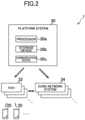
- FIG. 2 is an illustration drawn with attention being given to various computer systems implemented in the data center group included in the communication system 1.
- the data center group included in the communication system 1 is classified into central data centers 10, regional data centers 12, and edge data centers 14.
- central data centers 10 are dispersedly arranged in an area (for example, in Japan) covered by the communication system 1.
- tens of regional data centers 12 are dispersedly arranged in the area covered by the communication system 1.
- the area covered by the communication system 1 is the entire area of Japan, one or two regional data centers 12 may be arranged in each prefecture.
- each of the edge data centers 14 can communicate to and from a communication facility 18 provided with an antenna 16.
- the communication facility 18 may include a computer such as a server computer.
- the communication facility 18 in this embodiment performs radio communication to and from a user equipment (UE) 20 via the antenna 16.
- UE user equipment
- the communication facility 18 provided with the antenna 16 is provided with, for example, a radio unit (RU), which is described later.
- a plurality of servers are arranged in each of the central data centers 10, the regional data centers 12, and the edge data centers 14 in this embodiment.
- the central data centers 10, the regional data centers 12, and the edge data centers 14 can communicate to and from one another. Communication can also be performed between the central data centers 10, between the regional data centers 12, and between the edge data centers 14.
- the communication system 1 in this embodiment includes a platform system 30, a plurality of radio access networks (RANs) 32, a plurality of core network systems 34, and a plurality of UEs 20.
- the core network system 34, the RAN 32, and the UE 20 cooperate with each other to implement a mobile communication network.
- the RAN 32 is a computer system, which is provided with the antenna 16, and corresponds to an eNodeB (eNB) in a fourth generation mobile communication system (hereinafter referred to as "4G") and an NR base station (gNB) in a fifth generation mobile communication system (hereinafter referred to as "5G").
- the RANs 32 in this embodiment are implemented mainly by server groups arranged in the edge data centers 14 and the communication facilities 18.
- a part of the RAN 32 (for example, distributed unit (DU) or central unit (CU) or virtual distributed unit (vDU) or virtual central unit (vCU)) may be implemented by the central data center 10 or the regional data center 12 instead of the edge data center 14.
- the core network system 34 is a system corresponding to an evolved packet core (EPC) in 4G or a 5G core (5GC) in 5G.
- EPC evolved packet core
- 5GC 5G core
- the core network systems 34 in this embodiment are implemented mainly by server groups arranged in the central data centers 10 or the regional data centers 12.
- the platform system 30 in this embodiment is configured, for example, on a cloud platform and includes a processor 30a, a storage device 30b, and a communication device 30c, as illustrated in FIG. 2 .
- the processor 30a is a program control device such as a microprocessor which operates in accordance with a program installed in the platform system 30.
- the storage device 30b is, for example, a storage element such as a ROM or RAM, a solid state drive (SSD), a hard disk drive (HDD), or the like.
- the storage device 30b stores a program to be executed by the processor 30a, and the like.
- the communication device 30c is, for example, a communication interface such as a network interface controller (NIC) or a wireless local area network (LAN) module.
- Software-defined networking (SDN) may be implemented in the communication device 30c.
- the communication device 30c exchanges data with the RAN 32 and the core network system 34.
- the platform system 30 is implemented by a server group arranged in the central data center 10.
- the platform system 30 may be implemented by a server group arranged in the regional data center 12.
- the network service for which the purchase request has been made is constructed in the RAN 32 or the core network system 34. Then, the constructed network service is provided to the purchaser.
- NS network service
- a network service such as a voice communication service, a data communication service, or the like, is provided to the purchaser who is a mobile virtual network operator (MVNO).
- the voice communication service or the data communication service provided in this embodiment is eventually provided to a customer (end user) for the purchaser (MVNO in the above-mentioned example), who uses the UE 20 illustrated in FIG. 1 and FIG. 2 .
- the end user can perform voice communication or data communication to and from other users via the RAN 32 or the core network system 34.
- the UE 20 of the end user can also access a data network such as the Internet via the RAN 32 or the core network system 34.
- a container-type virtualized application execution environment such as Docker (trademark) is installed in the servers arranged in the central data center 10, the regional data center 12, and the edge data center 14, and containers can be deployed in those servers and operated.
- a cluster formed of one or more containers generated by such a virtualization technology may be constructed.
- a Kubernetes cluster managed by a container management tool such as Kubernetes (trademark) may be constructed.
- a processor on the constructed cluster may execute a container-type application.
- the network service provided to the purchaser in this embodiment is formed of one or a plurality of functional units (for example, network function (NF)).
- the functional unit is implemented by the NF implemented by the virtualization technology.
- the NF implemented by the virtualization technology is called “virtualized network function (VNF).”
- VNF virtualized network function
- CNF containerized network function
- This embodiment is described on the assumption that the network service is implemented by one or a plurality of CNFs.
- the functional unit in this embodiment may also correspond to a network node.
- the RUs 40, the DUs 42, the CU-CPs 44a, the AMFs 46, and the SMFs 48 correspond to elements of the control plane (C-plane)
- the RUs 40, the DUs 42, the CU-UPs 44b, and the UPFs 50 correspond to elements of the user plane (U-plane).
- the plurality of RUs 40, the plurality of DUs 42, the plurality of CU-UPs 44b, and the plurality of UPFs 50 which are illustrated in FIG. 3 , belong to one end-to-end network slice.
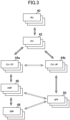
- FIG. 4 is a diagram for schematically illustrating an example of links between elements constructed in the communication system 1 in this embodiment.
- Symbols M and N indicated in FIG. 4 each represent any integer of 1 or more, and each indicate a relationship between the numbers of elements connected by a link.
- the link has a combination of M and N at both ends thereof, the elements connected by the link have a many-to-many relationship.
- the link has a combination of 1 and N or a combination of 1 and M at both ends thereof, the elements connected by the link have a one-to-many relationship.
- a network service (NS), a network function (NF), a containerized network function component (CNFC), a pod, and a container have a hierarchical structure.
- the CNFC corresponds to an element having a granularity, such as DU mgmt or DU processing.
- the CNFC may be a microservice deployed on a server as one or more containers.
- some CNFCs may be microservices that provide a part of the functions of the DU, the CU-CP, the CU-UP, and the like.
- Some CNFCs may be microservices that provide a part of the functions of the UPF, the AMF, the SMF, and the like.
- one NF includes one or a plurality of CNFCs. That is, one or a plurality of CNFCs are under the control of one NF.
- the pod refers to, for example, the minimum unit for managing a Docker container by Kubernetes.
- one CNFC includes one or a plurality of pods. That is, one or a plurality of pods are under the control of one CNFC.
- one pod includes one or a plurality of containers. That is, one or a plurality of containers are under the control of one pod.
- a network slice (NSI) and a network slice subnet instance (NSSI) have a hierarchical structure.
- the NSIs can be said to be end-to-end virtual circuits that span a plurality of domains (for example, from the RAN 32 to the core network system 34).
- Each NSI may be a slice for high-speed and high-capacity communication (for example, for enhanced mobile broadband (eMBB)), a slice for high-reliability and low-latency communication (for example, for ultra-reliable and low latency communications (URLLC)), or a slice for connecting a large quantity of terminals (for example, for massive machine type communication (mMTC)).
- the NSSIs can be said to be single domain virtual circuits dividing an NSI.
- Each NSSI may be a slice of a RAN domain, a slice of a transport domain such as a mobile back haul (MBH) domain, or a slice of a core network domain.
- MMH mobile back haul
- one NSI includes one or a plurality of NSSIs. That is, one or a plurality of NSSIs are under the control of one NSI. In this embodiment, a plurality of NSIs may share the same NSSI.
- the NSSI and the NS generally have a many-to-many relationship.
- one NF can belong to one or a plurality of network slices.
- network slice selection assistance information including one or a plurality of pieces of sub-network slice selection assist information (S-NSSAI) can be set for one NF.
- the S-NSSAI is information associated with the network slice.
- the NF is not required to belong to the network slice.
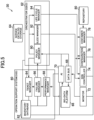
- FIG. 5 is a functional block diagram for illustrating an example of functions implemented by the platform system 30 in this embodiment.
- the platform system 30 in this embodiment is not required to implement all the functions illustrated in FIG. 5 , and may implement functions other than those illustrated in FIG. 5 .
- the platform system 30 in this embodiment functionally includes, for example, an operation support system (OSS) 60, an orchestrator (end-to-end-orchestrator (E2EO)) 62, a service catalog storage 64, a big-data platform 66, a data bus 68, an artificial intelligence (AI) 70, a monitor 72, an SDN controller 74, a configuration manager 76, a container manager 78, and a repository 80.
- the OSS 60 includes an inventory database 82, a ticket manager 84, a failure manager 86, and a performance manager 88.
- the E2EO 62 includes a policy manager 90, a slice manager 92, and a life cycle manager 94. Those elements are implemented mainly by the processor 30a, the storage device 30b and the communication device 30c.
- the functions illustrated in FIG. 5 may be implemented by executing, by the processor 30a, a program that is installed in the platform system 30, which is one or a plurality of computers, and that includes instructions corresponding to the functions.
- This program may be supplied to the platform system 30 via a computer-readable information storage medium, such as an optical disc, a magnetic disk, a magnetic tape, a magneto-optical disc, a flash memory, or the like, or via the Internet or the like.
- the functions illustrated in FIG. 5 may also be implemented by a circuit block, a memory, and other LSIs. Further, a person skilled in the art would understand that the functions illustrated in FIG. 5 can be implemented in various forms by only hardware, by only software, or by a combination of hardware and software.
- the container manager 78 executes life cycle management of a container.
- the life cycle management includes processes relating to the construction of the container such as the deployment and setting of the container.
- the platform system 30 in this embodiment may include a plurality of container managers 78.
- a container management tool such as Kubernetes
- a package manager such as Helm
- Each of the plurality of container managers 78 may execute the construction of a container such as the deployment of the container for a server group (for example, Kubernetes cluster) associated with the container manager 78.
- the container manager 78 is not required to be included in the platform system 30.
- the container manager 78 may be provided in, for example, a server (that is, the RAN 32 or the core network system 34) managed by the container manager 78, or another server that is annexed to the server managed by the container manager 78.
- the repository 80 stores, for example, a container image of a container included in a functional unit group (for example, NF group) that implements a network service.
- a functional unit group for example, NF group
- the inventory database 82 is a database in which inventory information is stored.
- the inventory information includes, for example, information on a server arranged in the RAN 32 or the core network system 34 and managed by the platform system 30.
- the inventory database 82 stores inventory data.
- the inventory data indicates the current statuses of the configuration of an element group included in the communication system 1 and the link between the elements.
- the inventory data indicates the status of resources managed by the platform system 30 (for example, resource usage status).
- the inventory data may be physical inventory data or may be logical inventory data. The physical inventory data and the logical inventory data are described later.
- FIG. 6 is a diagram for illustrating an example of the data structure of the physical inventory data.
- the physical inventory data illustrated in FIG. 6 is associated with one server.
- the physical inventory data illustrated in FIG. 6 includes, for example, a server ID, location data, building data, floor number data, rack data, specification data, network data, an operating container ID list, and a cluster ID.
- the server ID included in the physical inventory data is, for example, an identifier of the server associated with the physical inventory data.
- the location data included in the physical inventory data is, for example, data indicating the location of the server (for example, the address of the location) associated with the physical inventory data.
- the building data included in the physical inventory data is, for example, data indicating a building (for example, a building name) in which the server associated with the physical inventory data is arranged.
- the floor number data included in the physical inventory data is, for example, data indicating a floor number at which the server associated with the physical inventory data is arranged.
- the rack data included in the physical inventory data is, for example, an identifier of a rack in which the server associated with the physical inventory data is arranged.
- the specification data included in the physical inventory data is, for example, data indicating the specifications of the server associated with the physical inventory data.
- the specification data indicates, for example, the number of cores, the memory capacity, and the hard disk capacity.
- the network data included in the physical inventory data is, for example, data indicating information relating to a network of the server associated with the physical inventory data.
- the network data indicates, for example, an NIC included in the server, the number of ports included in the NIC, and a port ID of each of the ports.
- the operating container ID list included in the physical inventory data is, for example, data indicating information relating to one or a plurality of containers operating in the server associated with the physical inventory data.
- the operating container ID list indicates, for example, a list of identifiers (container IDs) of instances of the containers.
- the cluster ID included in the physical inventory data is, for example, an identifier of a cluster (for example, Kubernetes cluster) to which the server associated with the physical inventory data belongs.
- the inventory data may also include data indicated by the current status of, for example, a geographical relationship or a topological relationship between the elements included in the communication system 1.
- the inventory data includes location data indicating locations at which the elements included in the communication system 1 are operating, that is, the current locations of the elements included in the communication system 1. It can be said therefrom that the inventory data indicates the current status of the geographical relationship between the elements (for example, geographical closeness between the elements).
- the logical inventory data may also include NSI data indicating information relating to a network slice.
- the NSI data indicates, for example, attributes such as an identifier of an instance of the network slice and the type of the network slice.
- the logical inventory data may also include NSSI data indicating information relating to a network slice subnet.
- the NSSI data indicates, for example, attributes such as an identifier of an instance of the network slice subnet and the type of the network slice subnet.
- the logical inventory data may also include NS data indicating information relating to an NS.
- the NS data indicates, for example, attributes such as an identifier of an instance of the NS and the type of the NS.
- the logical inventory data may also include NF data indicating information relating to an NF.
- the NF data indicates, for example, attributes such as an identifier of an instance of the NF and the type of the NF.
- the logical inventory data may also include CNFC data indicating information relating to a CNFC.
- the CNFC data indicates, for example, attributes such as an identifier of an instance and the type of the CNFC.
- the logical inventory data may also include pod data indicating information relating to a pod included in the CNFC.
- data indicating various attributes such as the host name and the IP address may be included in the above-mentioned data included in the logical inventory data.
- the container data may include data indicating the IP address of a container corresponding to the container data.
- the NF data may include data indicating the IP address and the host name of an NF indicated by the NF data.
- the logical inventory data may also include data indicating NSSAI including one or a plurality of pieces of S-NSSAI, which is set for each NF.
- the inventory database 82 can appropriately grasp the resource status in cooperation with the container manager 78. Then, the inventory database 82 appropriately updates the inventory data stored in the inventory database 82 based on the latest resource status.
- the inventory database 82 updates the inventory data stored in the inventory database 82 in accordance with execution of an action, such as construction of a new element included in the communication system 1, a change of a configuration of the elements included in the communication system 1, scaling of the elements included in the communication system 1, or replacement of the elements included in the communication system 1.
- an action such as construction of a new element included in the communication system 1, a change of a configuration of the elements included in the communication system 1, scaling of the elements included in the communication system 1, or replacement of the elements included in the communication system 1.
- the service catalog storage 64 stores service catalog data.
- the service catalog data may include, for example, service template data indicating the logic to be used by the life cycle manager 94 or the like.
- This service template data includes information required for constructing the network service.
- the service template data includes information defining the NS, the NF, and the CNFC and information indicating an NS-NF-CNFC correspondence relationship.
- the service template data contains a workflow script for constructing the network service.
- An NS descriptor is an example of the service template data.
- the NSD is associated with a network service, and indicates, for example, the types of a plurality of functional units (for example, a plurality of CNFs) included in the network service.
- the NSD may indicate the number of CNFs or other functional units included in the network service for each type thereof.
- the NSD may also indicate a file name of a CNFD described later, which relates to the CNF included in the network service.
- a CNF descriptor is an example of the above-mentioned service template data.
- the CNFD may indicate computer resources (for example, CPU, memory, and hard disk drive) required by the CNF.
- the CNFD may also indicate, for each of a plurality of containers included in the CNF, computer resources (such as CPU, memory, and hard disk drive) required by the container.
- the service catalog data may also include information to be used by the policy manager 90, the information relating to a threshold value (for example, threshold value for abnormality detection) to be compared to the calculated performance index value.
- a threshold value for example, threshold value for abnormality detection
- the performance index value is described later.
- the service catalog data may also include, for example, slice template data.
- the slice template includes information required for executing instantiation of the network slice, and includes, for example, the logic to be used by the slice manager 92.
- the slice template data includes information on a "generic network slice template” defined by the GSM Association (GSMA) ("GSM" is a trademark) .
- the slice template data includes network slice template data (NST), network slice subnet template data (NSST), and network service template data.
- NST network slice template data
- NSST network slice subnet template data
- the slice template data also includes information indicating the hierarchical structure of those elements which is illustrated in FIG. 4 .
- the life cycle manager 94 constructs a new network service for which a purchase request has been made in response to the purchase request for the NS by the purchaser.
- the life cycle manager 94 may execute, for example, the workflow script associated with the network service to be purchased in response to the purchase request. Then, the life cycle manager 94 may execute this workflow script, to thereby instruct the container manager 78 to deploy the container included in the new network service to be purchased. Then, the container manager 78 may acquire the container image of the container from the repository 80 and deploy a container corresponding to the container image in the server.
- the life cycle manager 94 executes, for example, scaling or replacement of the element included in the communication system 1.
- the life cycle manager 94 may output a container deployment instruction or deletion instruction to the container manager 78.
- the container manager 78 may execute, for example, a process for deploying a container or a process for deleting a container in accordance with the instruction.
- the life cycle manager 94 can execute such scaling and replacement that cannot be handled by Kubernetes of the container manager 78 or other tools.
- the life cycle manager 94 may also output an instruction to create a communication route to the SDN controller 74.
- the life cycle manager 94 presents, to the SDN controller 74, two IP addresses at both ends of a communication route to be created, and the SDN controller 74 creates a communication route connecting those two IP addresses to each other.
- the created communication route may be managed so as to be linked to those two IP addresses.
- the life cycle manager 94 may also output to the SDN controller 74 an instruction to create a communication route between two IP addresses linked to the two IP addresses.
- the slice manager 92 executes, for example, instantiation of a network slice.
- the slice manager 92 executes, for example, instantiation of a network slice by executing the logic indicated by the slice template stored in the service catalog storage 64.
- the slice manager 92 includes, for example, a network slice management function (NSMF) and a network slice sub-network management function (NSSMF) described in the third generation partnership project (3GPP) (trademark) specification "TS28 533.”
- the NSMF is a function for generating and managing network slices, and provides an NSI management service.
- the NSSMF is a function for generating and managing network slice subnets forming a part of a network slice, and provides an NSSI management service.
- the slice manager 92 may output to the configuration manager 76 a configuration management instruction related to the instantiation of the network slice. Then, the configuration manager 76 may execute configuration management such as settings in accordance with the configuration management instruction.
- the slice manager 92 may also present, to the SDN controller 74, two IP addresses to output an instruction to create a communication route between those two IP addresses.
- the configuration manager 76 executes configuration management such as settings of the element group including the NFs in accordance with the configuration management instruction received from the life cycle manager 94 or the slice manager 92.
- the SDN controller 74 creates the communication route between the two IP addresses linked to the creation instruction in accordance with the instruction to create the communication route, which has been received from the life cycle manager 94 or the slice manager 92.
- the SDN controller 74 may create a communication route between two IP addresses through use of, for example, a publicly known path calculation method such as Flex Algo.
- the SDN controller 74 may use segment routing technology (for example, segment routing IPv6 (SRv6)) to construct an NSI and NSSI for the server or an aggregation router present between communication routes.
- the SDN controller 74 may also generate an NSI and NSSI extending over a plurality of NFs to be set by issuing, to the plurality of NFs to be set, a command to set a common virtual local area network (VLAN) and a command to assign a bandwidth and a priority indicated by the setting information to the VLAN.
- VLAN virtual local area network
- the SDN controller 74 may change the maximum value of the bandwidth that can be used for communication between two IP addresses without constructing a network slice.
- the platform system 30 in this embodiment may include a plurality of SDN controllers 74.
- Each of the plurality of SDN controllers 74 may execute a process such as the creation of a communication route for a network device group including the AGs associated with the SDN controller 74.
- the monitor 72 monitors, for example, the element group included in the communication system 1 based on a given management policy.
- the monitor 72 may monitor the element group based on a monitoring policy designated by the purchaser when the purchaser purchases the network service.
- the monitor 72 executes monitoring at various levels, such as a slice level, an NS level, an NF level, a CNFC level, and a level of hardware such as the server.
- the monitor 72 executes a process (enrichment) for aggregating metric data in predetermined units of aggregation to generate performance index value data indicating the performance index values of the elements included in the communication system 1 in the units of aggregation.
- the metric data indicating the metrics of the elements under control of the gNB is aggregated to generate the performance index value data of the gNB.
- performance index value data indicating a communication performance in the area covered by the gNB is generated.
- performance index value data indicating a plurality of types of communication performance such as traffic amount (throughput) and latency, may be generated in each gNB.
- the communication performance indicated by the performance index value data is not limited to traffic amount and latency.
- the monitor 72 outputs the performance index value data generated by the above-mentioned enrichment to the data bus 68.
- the data bus 68 receives the performance index value data output from the monitor 72. Based on the received one or a plurality of pieces of performance index value data, the data bus 68 generates a performance index value file including the one or a plurality of pieces of performance index value data. The data bus 68 then outputs the generated performance index value file to the big-data platform 66.
- the elements such as the network slice, the NS, the NF, the CNFC that are included in the communication system 1 and the hardware such as the server notify the monitor 72 of various alerts (for example, notify the monitor 72 of an alert with the occurrence of a failure as a trigger).
- the monitor 72 when the monitor 72 receives the above-mentioned notification of the alert, the monitor 72 outputs alert message data indicating the notification to the data bus 68. Then, the data bus 68 generates an alert file in which alert message data indicating one or a plurality of notifications are compiled into one file, and outputs the generated alert file to the big-data platform 66.
- the big-data platform 66 accumulates, for example, the performance index value file and the alert file that have been output from the data bus 68.
- a plurality of trained machine learning models are stored in the AI 70 in advance.
- the AI 70 uses various machine learning models stored in the AI 70 to execute an estimation process such as a future prediction process for a use status and quality of service of the communication system 1.
- the AI 70 may generate estimation result data indicating results of the estimation process.
- the AI 70 may execute the estimation process based on the files accumulated in the big-data platform 66 and the above-mentioned machine learning model. This estimation process is suitable when prediction of a long-term trend is performed infrequently.
- the AI 70 can acquire performance index value data stored in the data bus 68.
- the AI 70 may execute the estimation process based on the performance index value data stored in the data bus 68 and the above-mentioned machine learning model. This estimation process is suitable when short-term predictions are performed frequently.
- the performance manager 88 calculates, based on a plurality of pieces of metric data, a performance index value (for example, KPI) that is based on metrics indicated by those pieces of metric data.
- the performance manager 88 may calculate a performance index value (for example, performance index value related to an end-to-end network slice) which is a comprehensive evaluation of a plurality of types of metrics and cannot be calculated from a single piece of metric data.
- the performance manager 88 may generate comprehensive performance index value data indicating a performance index value being a comprehensive evaluation.
- the performance manager 88 may acquire the above-mentioned performance index value file from the big-data platform 66. Further, the performance manager 88 may acquire estimation result data from the AI 70. A performance index value such as a KPI may be calculated based on at least one of the performance index value file or the estimation result data. The performance manager 88 may directly acquire metric data from the monitor 72. Further, the performance index value such as a KPI may be calculated based on the metric data.
- the failure manager 86 detects the occurrence of a failure in the communication system 1 based on, for example, at least any one of the above-mentioned metric data, the above-mentioned notification of the alert, the above-mentioned estimation result data, or the above-mentioned comprehensive performance index value data.
- the failure manager 86 may detect, for example, the occurrence of a failure that cannot be detected from a single piece of metric data or a single notification of the alert, based on a predetermined logic.
- the failure manager 86 may also generate detection failure data indicating the detected failure.
- the failure manager 86 may directly acquire the metric data and the notification of the alert from the monitor 72.
- the failure manager 86 may also acquire the performance index value file and the alert file from the big-data platform 66. Further, the failure manager 86 may acquire the alert message data from data bus 68.
- the policy manager 90 executes a predetermined determination process based on, for example, at least any one of the above-mentioned metric data, the above-mentioned performance index value data, the above-mentioned alert message data, the above-mentioned performance index value file, the above-mentioned alert file, the above-mentioned estimation result data, the above-mentioned comprehensive performance index value data, or the above-mentioned detection failure data.
- the policy manager 90 may execute an action corresponding to a result of the determination process. For example, the policy manager 90 may output an instruction to construct a network slice to the slice manager 92. The policy manager 90 may also output an instruction for scaling or replacement of the elements to the life cycle manager 94 based on the result of the determination process.
- the policy manager 90 in this embodiment can acquire the performance index value data stored in the data bus 68.
- the policy manager 90 may then execute a predetermined determination process based on the performance index value data acquired from the data bus 68.
- the policy manager 90 may also execute a predetermined determination process based on the alert message data stored in the data bus 68.
- the ticket manager 84 generates, for example, a ticket indicating information to be notified to an administrator of the communication system 1.
- the ticket manager 84 may generate a ticket indicating details of the detection failure data.
- the ticket manager 84 may also generate a ticket indicating a value of the performance index value data or the metric data.
- the ticket manager 84 may also generate a ticket indicating a determination result obtained by the policy manager 90.
- the ticket manager 84 notifies the administrator of the communication system 1 of the generated ticket.
- the ticket manager 84 may send, for example, an email to which the generated ticket is attached to an email address of the administrator of the communication system 1.
- the generation of the performance index value file, the determination process based on the performance index value data stored in the data bus 68, and the estimation process based on the performance index value data stored in the data bus 68 are further described in the following.
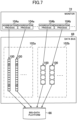
- FIG. 7 is a diagram for schematically illustrating an example of the data bus 68 in this embodiment.
- the data bus 68 in this embodiment includes, for example, a plurality of queues 100 that hold performance index value data in a first-in, first-out list structure.
- Each queue 100 belongs to any one of a first queue group 102a or a second queue group 102b.
- a plurality of aggregation processes 104 are operating in the monitor 72.
- the elements to be aggregated in the aggregation process 104 are preset.
- the gNBs to be aggregated in the aggregation process 104 are preset.
- Each aggregation process 104 acquires metric data from the NFs (for example, RUs 40, DUs 42, and CU-UPs 44b) under the control of the gNBs to be aggregated in the aggregation process 104. Further, the aggregation process 104 executes an enrichment process for generating performance index value data indicating the communication performance of the gNB based on the acquired metric data.
- the aggregation process 104 and the queue 100 are linked in advance.
- FIG. 7 a case in which the aggregation process 104 and the queue 100 are linked in a one-to-one relationship is illustrated, but the aggregation process 104 and the queue 100 may be linked in a many-to-many relationship.
- first group aggregation processes 104a The aggregation processes 104 linked to the queues 100 included in the first queue group 102a are hereinafter referred to as "first group aggregation processes 104a.” Further, the aggregation processes 104 linked to the queues 100 included in the second queue group 102b are hereinafter referred to as “second group aggregation processes 104b.”
- each first group aggregation process 104a At predetermined time intervals (for example, every minute), each first group aggregation process 104a generates performance index value data by aggregating the metric data associated with the first group aggregation process 104a from the previous aggregation to the present time.
- the first group aggregation process 104a acquires the metric data from one or a plurality of NFs associated with the first group aggregation process 104a at intervals of, for example, one minute. Then, the first group aggregation process 104a generates performance index value data for the aggregation period by aggregating the metric data for the same aggregation period.
- the first group aggregation process 104a Each time the first group aggregation process 104a generates performance index value data, the first group aggregation process 104a enqueues the performance index value data into one or a plurality of queues 100 linked to the first group aggregation process 104a.
- each second group aggregation process 104b At predetermined time intervals (for example, every fifteen minutes), each second group aggregation process 104b generates performance index value data by aggregating the metric data associated with the second group aggregation process 104b from the previous aggregation to the present time.
- the second group aggregation process 104b acquires the metric data from one or a plurality of NFs associated with the second group aggregation process 104b at intervals of, for example, fifteen minutes. Then, the second group aggregation process 104b generates performance index value data for the aggregation period by aggregating the metric data for the same aggregation period.
- the second group aggregation process 104b enqueues the performance index value data into one or a plurality of queues 100 linked to the second group aggregation process 104b.
- the maximum number of pieces of performance index value data that is storable in the queues 100 included in the first queue group 102a is determined in advance. In this case, for example, it is assumed that a maximum of 240 pieces of performance index value data is storable in the queues 100. That is, the maximum number is "240.”
- the maximum number of pieces of performance index value data that is storable in the queues 100 included in the second queue group 102b is determined in advance. In this case, for example, it is assumed that a maximum of four pieces of performance index value data is storable in the queues 100. That is, the maximum number is "4.”
- a plurality of determination processes 106 are operating in the policy manager 90. A part of those determination processes 106 execute determination processes based on the performance index value data stored in the data bus 68, and the rest of the determination processes 106 execute determination processes based on files stored in the big-data platform 66.
- the determination processes 106 in this embodiment include a process for acquiring performance index value data indicating an actual result value of the performance index value related to the communication system 1. For example, there is a determination process 106 for acquiring performance index value data in response to the performance index value data being enqueued in a queue 100 included in the first queue group 102a.
- the queues 100 included in the first queue group 102a are configured so that the performance index value data can be accessed (acquired) without dequeuing any of the performance index value data included in the queue 100.
- the determination process 106 determines the status of the communication system 1 based on the acquired performance index value data. In this case, for example, the status of the elements which are included in the communication system 1 and are associated with the determination process 106 may be determined. For example, the status of the elements to be aggregated in the first group aggregation process 104a which has generated the performance index value data to be acquired by the determination process 106 may be determined. Such a determination process 106 is hereinafter referred to as "actual result determination process 106a.”
- the actual result determination process 106a and the queue 100 are linked in advance.
- FIG. 8 and FIG. 9 a case in which the actual result determination process 106a and the queue 100 are linked in a one-to-one relationship is illustrated, but the actual result determination process 106a and the queue 100 may be linked in a many-to-many relationship.
- the data bus 68 may output a notification indicating that the performance index value data has been enqueued to one or a plurality of actual result determination processes 106a linked to the queue 100.
- the actual result determination process 106a which has received the notification may acquire, in response to the reception of the notification, the latest performance index value data stored in the queue 100.
- the determination processes 106 in this embodiment include a process for acquiring estimation result data indicating an estimation result obtained by an estimation process 108 (see FIG. 9 ) linked to the determination process 106.
- the determination process 106 determines the status of the communication system 1 based on the acquired estimation result data. In this case, for example, the status of the elements which are included in the communication system 1 and are associated with the determination process 106 may be determined. For example, the status of the elements to be aggregated in the first group aggregation process 104a which has generated the performance index value data to be acquired by the estimation process 108 may be determined.
- Such a determination process 106 is hereinafter referred to as "prediction determination process 106b.”
- a plurality of estimation processes 108 are operating in the AI 70. A part of those estimation processes 108 execute estimation processes based on the performance index value data stored in the data bus 68, and the rest of the estimation processes 108 execute estimation processes based on files stored in the big-data platform 66.
- the estimation process 108 and the queue 100 are linked in advance.
- FIG. 8 a case in which the estimation process 108 and the queue 100 are linked in a one-to-one relationship is illustrated, but the estimation process 108 and the queue 100 may be linked in a many-to-many relationship.
- each estimation process 108 acquires the performance index value data stored in the queue 100 which corresponds to the estimation process 108 and which is included in the first queue group 102a.
- the estimation processes execute the estimation process determined in advance for the relevant estimation process 108 based on the performance index value data.
- the estimation process 108 acquires a predetermined number of most recent pieces of the performance index value data or the performance index value data of a most recent predetermined period including at least the latest performance index value data among the performance index value data stored in the queue 100.
- the data bus 68 may output a notification indicating that the performance index value data has been enqueued to one or a plurality of estimation processes 108 linked to the queue 100.
- the estimation process 108 may acquire a predetermined number of most recent pieces of the performance index value data or the performance index value data of a most recent predetermined period including at least the latest performance index value data among the performance index value data stored in the queue 100.
- the estimation process 108 illustrated in FIG. 9 acquires 60 pieces of performance index value data, including the latest performance index value data. Those pieces of performance index value data correspond to the most recent 60 minutes of performance index value data, including the latest performance index value data. The estimation process 108 then executes the estimation process based on the acquired performance index value data.
- the first group aggregation process 104a associated with a certain specific gNB generates performance index value data related to the gNB by aggregating the metric data related to the elements included in the gNB (for example, elements under the control of the gNB).
- the estimation process 108 which acquires the performance index value data generated by the first group aggregation process 104a acquires 60 pieces of performance index value data including the latest performance index value data stored in the queue 100.
- the estimation process 108 uses a trained machine learning model stored in advance in the AI 70 to predict the level of the network load of the gNB from the current time to 20 minutes after the current time based on those 60 pieces of performance index value data.
- a prediction of the traffic amount (throughput) or latency may be executed as the level of the network load of the gNB.
- the machine learning model may be, for example, an existing prediction model. Further, for example, the machine learning model may be a trained machine learning model in which supervised learning using a plurality of training data elements has been executed in advance. In this case, each of those plurality of training data elements may include, for example, for given time points different from each other, learning input data indicating the traffic amount in the gNB for 60 minutes until the time point and teacher data indicating the level of the network load (for example, traffic amount or latency) of the gNB from the time point until 20 minutes after the time point.
- learning input data indicating the traffic amount in the gNB for 60 minutes until the time point
- teacher data indicating the level of the network load (for example, traffic amount or latency) of the gNB from the time point until 20 minutes after the time point.
- estimation process 108 acquires a part of the performance index value data stored in the queue 100 as described above, and the estimation process 108 may acquire all the performance index value data stored in the queue 100.
- the machine learning model in this embodiment may output a predicted value of at least one type of performance index value.
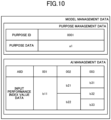
- the purpose data may indicate the type of the predicted performance index value.
- the purpose data may indicate the type of a performance index value which is the predicted value output by the machine learning model.
- the value of the purpose data may be "throughput,” “latency,” “number of registrations,” “number of completed connections,” “number of active users,” and the like.
- the AI ID included in the AI data is an identifier of the machine learning model to be used for the prediction purpose associated with the model management data.
- the AI IDs of the three machine learning models having the prediction purpose of "a1" are "001,” “002,” and "003.”
- the input performance index value data included in the AI data is data indicating the type of performance index value to be input to the machine learning model associated with the AI data.
- the AI data associated with the machine learning model includes the same number of pieces of input performance index value data as the number of performance index values to be input to the machine learning model.
- the number of types of performance index values to be input to the machine learning model may differ depending on the machine learning model. Further, in the example of FIG. 10 , there is illustrated a case in which the number of types of performance index values to be input to the machine learning model is 1 to 3, but the number of types of performance index values to be input to the machine learning model may be 4 or more.
- "a1" and "b11" may be the same type of performance index value.
- a case in which the actual result value of throughput at a certain point in time is input to a machine learning model and the throughput after that point in time is predicted based on the output of the machine learning model corresponds to a case in which the type of performance index value indicated by the input performance index value data and the type of performance index value indicated by the purpose data are the same.
- performance index values to be input include “throughput,” “latency,” “number of registrations,” “number of completed connections,” and “number of active users.”
- the AI 70 identifies an additional performance index value type, which is a type of performance index value that is required to be added as a target of the monitoring in order to use the machine learning model.
- the AI 70 may identify, for each of the plurality of machine learning models, a type of a performance index value not included in the target of the monitoring among the types of performance index values which are inputs to the machine learning model, as the additional performance index value type.
- the AI 70 may determine, for each of a plurality of pieces of AI data included in the model management data including purpose management data indicating a given prediction purpose, whether or not the type of performance index value indicated by the input performance index value data included in the AI data is indicated in the actual result determination target data described above.
- a type of performance index value not indicated in the above-mentioned actual result determination target data may be determined as an additional performance index value type for the machine learning model associated with the AI data.
- the AI 70 determines at least one machine learning model among the plurality of machine learning models based on the additional performance index value type identified for each machine learning model.
- the AI 70 may determine at least one machine learning model among the plurality of machine learning models based on the number of additional performance index value types. For example, the machine learning model associated with the AI data having the fewest identified additional performance index value types may be determined. As another example, a machine learning model associated with AI data in which the number of identified additional performance index value types is less than a predetermined number may be determined.
- the AI 70 may determine at least one machine learning model among the plurality of machine learning models based on a ratio of the number of additional performance index value types to the number of types of performance index values to be input to the machine learning model. For example, the machine learning model associated with the AI data having the smallest ratio of the number of identified additional performance index value types to the total number of pieces of input performance index value data may be determined. As another example, a machine learning model associated with AI data in which the ratio of the number of identified additional performance index value types to the total number of pieces of input performance index value data is smaller than a predetermined ratio may be determined.
- an estimation process 108 and a prediction determination process 106b linked to the actual result determination process 106a may be generated.
- the estimation process 108 and the prediction determination process 106b may be activated.
- a trained machine learning model determined in this way may then be instantiated.
- the estimation process 108 may then predict the performance index value of the communication system 1 by using the machine learning model determined in this way.
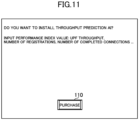
- the machine learning model determined in this way may be recommended to a user, for example, the purchaser.
- a recommendation screen illustrated in FIG. 11 may be displayed on a terminal used by the purchaser of the network service.
- the actual result determination process 106a, the estimation process 108, and the prediction determination process 106b may be generated, and the machine learning model may be instantiated.
- the estimation process 108 may then predict the performance index value of the communication system 1 by using the machine learning model determined in this way.
- the prediction purpose of the machine learning model to be determined is a given prediction purpose. Further, it is assumed that the model management data associated with the prediction purpose is stored in advance in the inventory database 82 or the AI 70.
- the ratio of the number of additional performance index value types to the number of types of performance index values to be input to the machine learning model may be identified.
- the machine learning model suitable for the network service may be determined based on the ratio identified in this way.
- the types of performance index values that are monitored for actual result values vary depending on the situation, and hence, even among machine learning models used for the same prediction purpose, some of those machine learning models may be suitable for the communication system 1 and some may not be suitable for the communication system 1.
- a machine learning model suitable for the communication system 1 is determined based on the additional performance index value types. For example, a machine learning model having a low additional monitoring burden is determined. In this way, in this embodiment, it becomes possible to accurately determine the machine learning model which is to be used for predicting a performance index value of the communication system 1 and which is suitable for the communication system 1.
- scale-out of the elements of the core network system 34 may be executed in place of the elements of the RAN 32 such as a gNB.
- scale-out may be executed on the AMFs 46, the SMFs 48, and the UPFs 50.
- performance index value data related to the elements of the core network system 34 may be used to determine whether or not to execute scale-out.
- performance index value data related to the elements of the RAN 32 and the elements of the core network system 34 may be used for the determination.
- scale-out of transport may be executed in the same way.
- the above-mentioned process for determining the machine learning model and the processes relating to the determination process may be executed by a functional module other than the AI 70.
- the functional unit in this embodiment is not required to be an NF in 5G.
- the functional unit in this embodiment may be an eNodeB, a vDU, a vCU, a packet data network gateway (P-GW), a serving gateway (S-GW), a mobility management entity (MME), a home subscriber server (HSS), or another network node in 4G.
- P-GW packet data network gateway
- S-GW serving gateway
- MME mobility management entity
- HSS home subscriber server
Landscapes
- Engineering & Computer Science (AREA)
- Computer Networks & Wireless Communication (AREA)
- Signal Processing (AREA)
- Software Systems (AREA)
- Computer Vision & Pattern Recognition (AREA)
- Evolutionary Computation (AREA)
- Medical Informatics (AREA)
- Artificial Intelligence (AREA)
- Theoretical Computer Science (AREA)
- Databases & Information Systems (AREA)
- Data Mining & Analysis (AREA)
- Physics & Mathematics (AREA)
- Computing Systems (AREA)
- General Engineering & Computer Science (AREA)
- General Physics & Mathematics (AREA)
- Mathematical Physics (AREA)
- Data Exchanges In Wide-Area Networks (AREA)
Applications Claiming Priority (1)
| Application Number | Priority Date | Filing Date | Title |
|---|---|---|---|
| PCT/JP2022/032681 WO2024047774A1 (ja) | 2022-08-30 | 2022-08-30 | 通信システムに係る所与の予測目的で用いられる機械学習モデルの決定 |
Publications (2)
| Publication Number | Publication Date |
|---|---|
| EP4583016A1 true EP4583016A1 (de) | 2025-07-09 |
| EP4583016A4 EP4583016A4 (de) | 2025-10-22 |
Family
ID=90098890
Family Applications (1)
| Application Number | Title | Priority Date | Filing Date |
|---|---|---|---|
| EP22957373.8A Pending EP4583016A4 (de) | 2022-08-30 | 2022-08-30 | Bestimmung eines maschinenlernmodells für gegebenen prädiktiven zweck in bezug auf ein kommunikationssystem |
Country Status (4)
| Country | Link |
|---|---|
| US (1) | US20250097722A1 (de) |
| EP (1) | EP4583016A4 (de) |
| JP (1) | JP7769135B2 (de) |
| WO (1) | WO2024047774A1 (de) |
Families Citing this family (3)
| Publication number | Priority date | Publication date | Assignee | Title |
|---|---|---|---|---|
| JP7820561B2 (ja) * | 2022-11-21 | 2026-02-25 | 楽天モバイル株式会社 | 通信システムに含まれる要素に対するアクションを実行するか否かを判定する判定処理の実行開始制御 |
| US12556943B2 (en) | 2022-11-30 | 2026-02-17 | Dell Products L.P. | Artificial intelligence radio function model management in a communication network |
| US12526653B2 (en) * | 2022-11-30 | 2026-01-13 | Dell Products L.P. | Artificial intelligence radio function model management in a communication network |
Family Cites Families (8)
| Publication number | Priority date | Publication date | Assignee | Title |
|---|---|---|---|---|
| JP6751069B2 (ja) | 2017-11-16 | 2020-09-02 | 日本電信電話株式会社 | 無線リソース設計装置、無線リソース設計方法、及びプログラム |
| US11227047B1 (en) * | 2018-06-29 | 2022-01-18 | Fireeye Security Holdings Us Llc | System and method for improved end-to-end cybersecurity machine learning and deployment |
| US20220417109A1 (en) * | 2019-11-28 | 2022-12-29 | Telefonaktiebolaget Lm Ericsson (Publ) | Methods for determining application of models in multi-vendor networks |
| WO2021171341A1 (ja) * | 2020-02-25 | 2021-09-02 | 日本電信電話株式会社 | 通信品質を予測するシステム、装置、方法及びプログラム |
| US11501190B2 (en) * | 2020-07-02 | 2022-11-15 | Juniper Networks, Inc. | Machine learning pipeline for predictions regarding a network |
| JP7662343B2 (ja) * | 2021-01-20 | 2025-04-15 | キヤノン株式会社 | 学習装置、画像処理装置、医用画像撮像装置、学習方法およびプログラム |
| US12547515B2 (en) * | 2022-01-13 | 2026-02-10 | Oracle International Corporation | Run-time modification of data monitoring platform metrics |
| US20230419130A1 (en) * | 2022-06-28 | 2023-12-28 | Oracle Financial Services Software Limited | Machine learning pipeline with data quality framework |
-
2022
- 2022-08-30 JP JP2024543674A patent/JP7769135B2/ja active Active
- 2022-08-30 WO PCT/JP2022/032681 patent/WO2024047774A1/ja not_active Ceased
- 2022-08-30 EP EP22957373.8A patent/EP4583016A4/de active Pending
- 2022-08-30 US US18/570,636 patent/US20250097722A1/en active Pending
Also Published As
| Publication number | Publication date |
|---|---|
| JPWO2024047774A1 (de) | 2024-03-07 |
| US20250097722A1 (en) | 2025-03-20 |
| JP7769135B2 (ja) | 2025-11-12 |
| EP4583016A4 (de) | 2025-10-22 |
| WO2024047774A1 (ja) | 2024-03-07 |
Similar Documents
| Publication | Publication Date | Title |
|---|---|---|
| EP4583016A1 (de) | Bestimmung eines maschinenlernmodells für gegebenen prädiktiven zweck in bezug auf ein kommunikationssystem | |
| US20250094304A1 (en) | Control of conditions for execution of actions on elements included in communication system | |
| US12531791B2 (en) | Validation system and validation method | |
| US20240248763A1 (en) | Arrangement system and arrangement method | |
| US20250094309A1 (en) | Display control of monitoring screens showing performance index values of elements included in communication system | |
| US20250097091A1 (en) | Execution initiation control of determination process to determine whether or not to execute action on element included in communication system | |
| US12255784B2 (en) | Controlling start timing of network load prediction | |
| EP4583017A1 (de) | Bestimmung eines maschinenlernmodells zur verwendung für gegebenen prädiktiven zweck für ein kommunikationssystem | |
| US20240281301A1 (en) | Execution platform determination system and execution platform determination method | |
| US12279124B2 (en) | Executing appropriate scale-out of an element included in a communication system | |
| US12520194B2 (en) | Executing appropriate scale-out of an element included in a communication system | |
| EP4564769A1 (de) | Steuerung des timings zur startvorhersage einer netzwerklast | |
| US20240414571A1 (en) | Status determination of a communication system based on performance index value data stored in a queue | |
| US20250103353A1 (en) | Replacement of unstable application | |
| US20250103376A1 (en) | Determining whether process included in communication system is unstable | |
| US20250103469A1 (en) | Estimating cause of application instability | |
| US20250094227A1 (en) | Management of hardware resources included in a communication system | |
| US20250094226A1 (en) | Management of hardware resources included in a communication system | |
| EP4694541A1 (de) | Schätzung eines routers, der stillen ausfall verursacht | |
| US20240272895A1 (en) | Replace system and replace method |
Legal Events
| Date | Code | Title | Description |
|---|---|---|---|
| STAA | Information on the status of an ep patent application or granted ep patent |
Free format text: STATUS: THE INTERNATIONAL PUBLICATION HAS BEEN MADE |
|
| PUAI | Public reference made under article 153(3) epc to a published international application that has entered the european phase |
Free format text: ORIGINAL CODE: 0009012 |
|
| STAA | Information on the status of an ep patent application or granted ep patent |
Free format text: STATUS: REQUEST FOR EXAMINATION WAS MADE |
|
| 17P | Request for examination filed |
Effective date: 20250331 |
|
| AK | Designated contracting states |
Kind code of ref document: A1 Designated state(s): AL AT BE BG CH CY CZ DE DK EE ES FI FR GB GR HR HU IE IS IT LI LT LU LV MC MK MT NL NO PL PT RO RS SE SI SK SM TR |
|
| A4 | Supplementary search report drawn up and despatched |
Effective date: 20250919 |
|
| RIC1 | Information provided on ipc code assigned before grant |
Ipc: G06N 20/00 20190101AFI20250915BHEP Ipc: H04W 24/02 20090101ALI20250915BHEP Ipc: H04L 41/147 20220101ALI20250915BHEP Ipc: H04L 41/16 20220101ALI20250915BHEP Ipc: H04W 16/22 20090101ALI20250915BHEP |
|
| DAV | Request for validation of the european patent (deleted) | ||
| DAX | Request for extension of the european patent (deleted) |