EP4583078A2 - Verfolgung von konzepten und darstellung von inhalt in einem lernsystem - Google Patents
Verfolgung von konzepten und darstellung von inhalt in einem lernsystem Download PDFInfo
- Publication number
- EP4583078A2 EP4583078A2 EP25177787.6A EP25177787A EP4583078A2 EP 4583078 A2 EP4583078 A2 EP 4583078A2 EP 25177787 A EP25177787 A EP 25177787A EP 4583078 A2 EP4583078 A2 EP 4583078A2
- Authority
- EP
- European Patent Office
- Prior art keywords
- user
- concept
- video
- concepts
- content item
- Prior art date
- Legal status (The legal status is an assumption and is not a legal conclusion. Google has not performed a legal analysis and makes no representation as to the accuracy of the status listed.)
- Pending
Links
Images






Classifications
-
- G—PHYSICS
- G09—EDUCATION; CRYPTOGRAPHY; DISPLAY; ADVERTISING; SEALS
- G09B—EDUCATIONAL OR DEMONSTRATION APPLIANCES; APPLIANCES FOR TEACHING, OR COMMUNICATING WITH, THE BLIND, DEAF OR MUTE; MODELS; PLANETARIA; GLOBES; MAPS; DIAGRAMS
- G09B7/00—Electrically-operated teaching apparatus or devices working with questions and answers
- G09B7/02—Electrically-operated teaching apparatus or devices working with questions and answers of the type wherein the student is expected to construct an answer to the question which is presented or wherein the machine gives an answer to the question presented by a student
- G09B7/04—Electrically-operated teaching apparatus or devices working with questions and answers of the type wherein the student is expected to construct an answer to the question which is presented or wherein the machine gives an answer to the question presented by a student characterised by modifying the teaching program in response to a wrong answer, e.g. repeating the question or supplying a further explanation
-
- G—PHYSICS
- G06—COMPUTING OR CALCULATING; COUNTING
- G06F—ELECTRIC DIGITAL DATA PROCESSING
- G06F3/00—Input arrangements for transferring data to be processed into a form capable of being handled by the computer; Output arrangements for transferring data from processing unit to output unit, e.g. interface arrangements
- G06F3/16—Sound input; Sound output
- G06F3/165—Management of the audio stream, e.g. setting of volume, audio stream path
-
- G—PHYSICS
- G09—EDUCATION; CRYPTOGRAPHY; DISPLAY; ADVERTISING; SEALS
- G09B—EDUCATIONAL OR DEMONSTRATION APPLIANCES; APPLIANCES FOR TEACHING, OR COMMUNICATING WITH, THE BLIND, DEAF OR MUTE; MODELS; PLANETARIA; GLOBES; MAPS; DIAGRAMS
- G09B5/00—Electrically-operated educational appliances
-
- G—PHYSICS
- G09—EDUCATION; CRYPTOGRAPHY; DISPLAY; ADVERTISING; SEALS
- G09B—EDUCATIONAL OR DEMONSTRATION APPLIANCES; APPLIANCES FOR TEACHING, OR COMMUNICATING WITH, THE BLIND, DEAF OR MUTE; MODELS; PLANETARIA; GLOBES; MAPS; DIAGRAMS
- G09B5/00—Electrically-operated educational appliances
- G09B5/06—Electrically-operated educational appliances with both visual and audible presentation of the material to be studied
- G09B5/065—Combinations of audio and video presentations, e.g. videotapes, videodiscs, television systems
-
- G—PHYSICS
- G09—EDUCATION; CRYPTOGRAPHY; DISPLAY; ADVERTISING; SEALS
- G09B—EDUCATIONAL OR DEMONSTRATION APPLIANCES; APPLIANCES FOR TEACHING, OR COMMUNICATING WITH, THE BLIND, DEAF OR MUTE; MODELS; PLANETARIA; GLOBES; MAPS; DIAGRAMS
- G09B7/00—Electrically-operated teaching apparatus or devices working with questions and answers
-
- G—PHYSICS
- G09—EDUCATION; CRYPTOGRAPHY; DISPLAY; ADVERTISING; SEALS
- G09B—EDUCATIONAL OR DEMONSTRATION APPLIANCES; APPLIANCES FOR TEACHING, OR COMMUNICATING WITH, THE BLIND, DEAF OR MUTE; MODELS; PLANETARIA; GLOBES; MAPS; DIAGRAMS
- G09B7/00—Electrically-operated teaching apparatus or devices working with questions and answers
- G09B7/02—Electrically-operated teaching apparatus or devices working with questions and answers of the type wherein the student is expected to construct an answer to the question which is presented or wherein the machine gives an answer to the question presented by a student
-
- G—PHYSICS
- G11—INFORMATION STORAGE
- G11B—INFORMATION STORAGE BASED ON RELATIVE MOVEMENT BETWEEN RECORD CARRIER AND TRANSDUCER
- G11B27/00—Editing; Indexing; Addressing; Timing or synchronising; Monitoring; Measuring tape travel
- G11B27/10—Indexing; Addressing; Timing or synchronising; Measuring tape travel
- G11B27/19—Indexing; Addressing; Timing or synchronising; Measuring tape travel by using information detectable on the record carrier
-
- G—PHYSICS
- G11—INFORMATION STORAGE
- G11B—INFORMATION STORAGE BASED ON RELATIVE MOVEMENT BETWEEN RECORD CARRIER AND TRANSDUCER
- G11B27/00—Editing; Indexing; Addressing; Timing or synchronising; Monitoring; Measuring tape travel
- G11B27/10—Indexing; Addressing; Timing or synchronising; Measuring tape travel
- G11B27/34—Indicating arrangements
Definitions
- the present disclosure relates generally to learning systems and examples of tracking concepts from a media and presenting content associated with a concept.
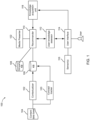
- a system for delivering content to a user includes: a concept tracker configured to access a content database including a plurality of content items and determine one or more concepts associated with each of the content items; a recommender in communication with the concept tracker and configured to recommend a concept; and a presenter in communication with the recommender and configured to display one or more segments of the plurality of content items that are associated with the concept.
- the system further comprises a user knowledge assessor in communication with the recommender and configured to receive one or more user assessment variables based on a user's response to a first content item of the content database.
- the recommender is configured to recommend the concept based on the one or more user assessment variables.
- At least a content item of the plurality of content items comprises transcripts of an audio/video media
- the one or more concepts associated with the content item each includes one or more time stamps.
- Each of the time stamps comprises a starting position and an ending position of the audio/video media.
- the presenter is further configured to adjust the starting and/or ending positions of at least a segment of the one or more segments.
- the presenter is further configured to, while the one or more segments of the plurality of contents are being displayed, display a plot comprising one or more regions representing the concept over a timeline, the regions are separated by the one or more time stamps associated with the concept.
- the presenter is further configured to display a second plot comprising one or more regions representing the concept over a timeline, the regions are separated by the one or more time stamps associated with the concept.
- the first plot corresponds to a first area of the segmented areas and the second plot corresponds to a second area of the segmented areas.
- FIG. 2 illustrates an example process of tracking concepts from a media according to various aspects of the present disclosure.
- a process 200 in FIG. 2 may be implemented in the concept tracker (120 in FIG. 1 ).
- the process 200 may include accessing media transcripts at 202.
- the media may include audio and/or video contents, and the transcripts may be obtained from transcribing an audio or an audio track in a video.
- the transcripts may also include text recognized in the video content. For example, text may be extracted from images frames in a video, e.g., text in road signs, and recognized (e.g., via optical character recognition (OCR)).
- OCR optical character recognition
- other assessment tools such as image segmentation, may be used to separate a video or video frame into multiple spatial areas based on which image recognition and concept tracking may be performed.
- a strategy of biasing the values on the main diagonal is used.
- the values to be biased are the positions on the main diagonal corresponding to the most relevant words, e.g., indices of vectors corresponding to those words as they appear in the word embedding vector space.
- various word embedding methods may be used. For example, GloVe word embedding may be used.
- AP may converge to a set of exemplars with order equal to (or very nearly equal to) the set of largest values on the main diagonal (e.g., for exemplars values having -2.0).
- the AP method may choose the words to bias based on a known model, e.g., a LDA model.
- a known model e.g., a LDA model.
- the system may choose the first words in each topic for the best known model in LDA, and give an intuitive bias based on topic probability and word probability.
- the system may choose biases two-three orders larger than the default values on the main diagonal. This means there will be a good interval to choose biases from.
- One or more selected corpuses will be used for the AP algorithm.
- a system for implement the concept tracking method may be configured to discover word synonyms by using a pretrained word embedding (e.g., GloVe) on a corpus by scanning for synonyms for words from the resulting vocabulary using a similarity distance.
- the system may use a cosine similarity to measure the distance between collection of words. This will result in distance values to be contained between [-1, 1].
- the cosine distance measures the angle between vectors which represent words. In a large corpus, similar words point in the same direction, while non-connected words are orthogonal or point in a different direction. By using the cosine similarity, it is expected that semantically close words have values close to 1.0.
- the system may determine distance metrics between equal collection of words using cosine similarity measures.
- the system may define that two sentences are aligned semantically if the orders of the grammatical parts in the two sentences are the same.
- the system may concatenate the corresponding vectors for two equal collection of words (referred to as sentences) and then use cosine similarity between them.
- the system may determine a square matrix of cosine distances by computing the closeness of each word vector in a sentence against all word vectors in another sentence.
- the system may choose the induced cosine norm (e.g., vectors of cosines similarities).
- the cosine similarity may be computed between the resulting vectors and each original line of the matrix. This metric may be able to capture similarity between sentences even when they are misaligned.
- cosine distances are described as an example, other distance metrics between vectors may also be used for synonymy.
- the system may also use alternative strategies. For example, the system may use the output of the last iteration or start a new AP with biased points on the similarity matrix but let it run until it terminates.
- the system may implement the iterative biasing AP by performing various operations comprising: 1) start with the default setup for the similarity matrix (e.g., main diagonal is based on the median method) and determine the number of iterations necessary to achieve convergence; 2) use a fraction of the number of iterations discovered at 1) to run the AP on the same setup; let the above fraction of iterations be f ; 3) use the resulting exemplars at 2) as points to be biased on the main diagonal of the similarity matrix; each discovered exemplar has an associated self-confidence value sc; set the value of the corresponding exemplar on the main diagonal of the similarity matrix to -
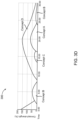
- the concepts associated with a video may dynamically change over time (as shown in FIG. 3D ), thus the word embedding based AP methods may be suitable for tracking concepts from short pieces in the transcripts of the video materials as opposed to the LDA, which is suitable for understanding a piece of materials as a whole.
- various affinity propagation methods are described, other methods may also be used to track the concepts from a video. For example, topic dominance scoring algorithm, as described by A. Gherega: in "Mallet topic modelling evaluation - An interpretation,” available at http://mallet.cs.umass.edu/diagnostics.php, can also be used.
- tracking concepts from the transcripts at 206 may use a concept model previously trained using a corpus.
- a trained concept model may be suitable for an application domain, for which the corpus used for training the concept model were also obtained from the same application domain.
- the process 200 may determine a suitable concept model to use at 204.
- Multiple concept models 210 may be pre-trained and stored. For example, some models may be trained using corpus(es) from scientific domain, some from sports, and some from media etc. If the user of the learning system is navigating through scientific learning materials (e.g., related to gene research), then properly trained concept model using the corpuses selected from scientific domain should be used.
- determining the model at 204 may be based on a subset of transcripts. For example, the process 204 may access samples of the words from the transcripts of the video materials and determine the domain in which the contents of the video are, and select the model suitable for the domain.
- the process may also access the concept models 210 and select samples of words from the corpuses used to build each concept model. The process may compare those samples of words from the corpuses associated with a respective model and samples of words from the transcript, to determine a suitable concept model to use.
- the system may select a concept model for the domain. For example, if the word embedding is used in tracking the concepts, the system may select the suitable word embedding model for the domain.
- the word embedding model is built based on corpus(es) obtained from a particular domain.
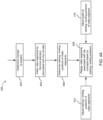
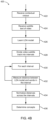
- FIG. 4A illustrates an example process of presenting video segments associated with a concept according to various aspects of the present disclosure.
- a process 400 in FIG. 4A may be implemented in the media presenter 122 (in FIG. 1 ).
- FIG. 4A is described in detail with reference to FIG. 1 by way of example.
- the process 400 may include determining concept to present at 402.
- the concept to present may be obtained from the recommender 110 (in FIG. 1 ), which will be further described with reference to FIG. 6 .
- the concepts may be tracked from the transcripts, by, for example, the concept tracker 120 (in FIG. 1 ). Examples of concepts tracked from the transcripts are illustrated in FIG. 3D .
- the process 400 may index video segments by the time stamp(s) associated with the concept at 404; determine starting and ending positions of the video segments at 406, and replay the video segments associated with the concepts based on the starting and ending positions, at 408.
- a time stamp of a video segment in a video may include a starting position and an ending position.
- each of the concepts extracted from the transcripts may be associated with one or more time stamps each including a time interval indicated by the starting and ending position in the video.
- determining the starting/ending positions of the video segments 406 may include accessing the time stamp(s) of the concept from the database (e.g., knowledge base 106 in FIG. 1 ).
- Replaying the video segments may include continuously playing each of the video segments from the respective starting position to the respective ending position of the video segment. This is further described with reference to FIGs. 5A and 5B .
- FIG. 4B illustrates an example process of determining concepts in a video according to various aspects of the present disclosure.
- a process 420 may be implemented in the concept tracker 120 ( FIG. 1 ), for example.
- the video may be stored in the content database 104 ( FIG. 1 ).
- Process 420 may include receiving contextual corpus at 422.
- the corpus may be 352 (in FIG. 3C ).
- the process may also include retrieving subtitle text from the video.
- Process 420 may further learn a LDA model from the corpus at 426 as previously described.
- the process may further divide the video subtitle track into intervals at 428. In a non-limiting example, the length of an interval may be approximately the length of a phrase.
- the process may measure the distance between the learned LDA model and the words in the interval at 432.
- the process 432 may measure the word-vector weighted Jaccard distance between the top-n words of the LDA model and the words in the interval.
- Word-vector weighted Jaccard distance is weighted Jaccard distance with the weighting function being the inner-product between the word vectors of the words being compared. This process may be repeated for each of the intervals.
- the process 420 may further normalize the distances across all of the intervals at 434, and determine the concepts based on the normalized distances at 436.
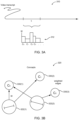
- FIG. 4C illustrates an example process of determining concept map in a video according to various aspects of the present disclosure.
- concept tracks represent concepts in a time domain
- concept map tracks extend concept tracks to space as well as time.
- a video content e.g., a VR video (360 video) may have an associated concept map track, which is a layer describing which areas of the video are about which concepts being learned at any one time.
- a process 450 for generating concept map tracks may be implemented in the concept tracker 120 ( FIG. 1 ), for example.
- Process 450 may receive video content at 452.
- the video content may be retrieved from the content database 104 (in FIG. 1 ).
- the process may further obtain the concept tracks at 454, for example, using the process in 420.
- the process may further segment the video at 356, and associate the segmentation result with the concept tracks at 458, and determine a concept map at 460.
- the process for segmenting the video at 456 may segment the video (or each frame of the video) into multiple areas in spatial domain. For example, a video frame may be segmented into a center area and other non-center areas.
- the process perform image segmentation over the video frames.
- the process may use a machine learning technique to provide initial semantic segmentation of the video.
- the process may use also a machine learning technique to learn which area is relevant to which concept.
- the system e.g., 100 in FIG. 1
- the system may use a VR video to enhance learning by tapping into innate spatial memory.
- the system may allow the students to navigate through a video and track the area nearest the center of the field of view the student moves the 360 degree video to (e.g., using a cursor device, a headset gyroscope, or gyroscope in mobile device).
- the system may prompt the student to focus on areas they think are relevant to what is being taught, and track which areas and therefore concepts the student is probably attending to. Based on the concept map, the system may know which areas are relevant to the flow of events, and thus can guide student's attention to those areas.
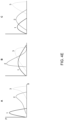
- FIG. 4D illustrates an example of a concept map according to various aspects of the present disclosure.
- a video frame may be segmented into several areas, such as areas A, B, and C.
- the concept map includes the associations of these areas with respective concepts.
- a student is learning a particularly intricate experiment, one that would be expensive or infeasible to do in real life due to unavailability of a particular facility, laboratory, or machinery, or due to travel restrictions.
- the system may record and play a 360 degree video of the experiment performed by an expert. As the students watch the video, the system may prompt the students to focus the view on the things in the video most pertinent to the context.
- the system may display the concept map track to the students and prompt them to click on sequences of areas to indicate what should happen next. In such way, the students will learn to associate the video's events with concepts. Additionally, the system may provide interactive virtual overlays with context-dependent 2D/3D tools, annotations and questions, multiple-choice assessments.
- FIG. 4E illustrates an example of a concept map graph according to various aspects of the present disclosure.
- the concept map graph concerns with time, space and dependencies between concepts in time and space.
- each concept area e.g., hotspot "A,” "B,” and “C” in FIG. 4D
- the concept map graph encodes dependencies between concepts in both time and space.
- the system can associate concepts with positions within a video, e.g., spatial distribution, such that certain videos may be divided into both time and spatial components and only relevant areas may be associated with a particular concept.
- data indicating the location within a video may be encoded along with each concept.
- image analysis such as computer vision
- concept tracking may be performed over the text in certain locations of the video. The user may learn these dependencies through interactive tools.
- a , B , & C are combinations of distributions of concepts 1,2 and 3, where S means specificity and P means probability.
- S means specificity
- P means probability.
- a "S” with a low value may indicate 'not much about' and an "S" with a high value may indicate 'very much about'.
- P indicates the probability for the level of specificity to be true (or a confidence in which the concept has that level of specificity). Then the three hotspots correspond with the combinations, A being mostly about concept 3 and not much about concept 1.
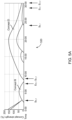
- FIG. 5A illustrates an example graphical user interface for displaying multiple concepts tracked from a video according to various aspects of the present disclosure.
- the concepts associated with a video 520 may be extracted from the transcripts which are also shown in FIG. 3D .
- Each concept may be represented by a region.
- the regions representing the concepts are separated by the one or more time stamps associated with the concept.
- the time stamps for the concepts in FIG. 3D are shown in FIG. 5A .
- concept B may have a first time stamp including a starting position S B_0 and an ending position E B_0 , and a second time stamp including a starting position S B_1 and an ending position E B_1 .
- concept D includes a time stamp including a starting position S D_0 and an ending position E D_0 .
- replaying the video segment 408 includes playing the video 520 from positions S B_0 to E B_0 , and from S B_1 to E B_1 .
- replaying the video segment 408 includes playing the video 520 from positions S D_0 to E D_0 .
Landscapes
- Engineering & Computer Science (AREA)
- Theoretical Computer Science (AREA)
- General Physics & Mathematics (AREA)
- Physics & Mathematics (AREA)
- Educational Administration (AREA)
- Educational Technology (AREA)
- Business, Economics & Management (AREA)
- Multimedia (AREA)
- Health & Medical Sciences (AREA)
- Audiology, Speech & Language Pathology (AREA)
- General Health & Medical Sciences (AREA)
- Human Computer Interaction (AREA)
- General Engineering & Computer Science (AREA)
- Information Retrieval, Db Structures And Fs Structures Therefor (AREA)
Applications Claiming Priority (2)
| Application Number | Priority Date | Filing Date | Title |
|---|---|---|---|
| US201962896458P | 2019-09-05 | 2019-09-05 | |
| EP20194736.3A EP3789987B1 (de) | 2019-09-05 | 2020-09-04 | Verfolgung von konzepten und darstellen von inhalt in einem lernsystem |
Related Parent Applications (1)
| Application Number | Title | Priority Date | Filing Date |
|---|---|---|---|
| EP20194736.3A Division EP3789987B1 (de) | 2019-09-05 | 2020-09-04 | Verfolgung von konzepten und darstellen von inhalt in einem lernsystem |
Publications (2)
| Publication Number | Publication Date |
|---|---|
| EP4583078A2 true EP4583078A2 (de) | 2025-07-09 |
| EP4583078A3 EP4583078A3 (de) | 2025-07-23 |
Family
ID=72422092
Family Applications (2)
| Application Number | Title | Priority Date | Filing Date |
|---|---|---|---|
| EP25177787.6A Pending EP4583078A3 (de) | 2019-09-05 | 2020-09-04 | Verfolgung von konzepten und darstellung von inhalt in einem lernsystem |
| EP20194736.3A Active EP3789987B1 (de) | 2019-09-05 | 2020-09-04 | Verfolgung von konzepten und darstellen von inhalt in einem lernsystem |
Family Applications After (1)
| Application Number | Title | Priority Date | Filing Date |
|---|---|---|---|
| EP20194736.3A Active EP3789987B1 (de) | 2019-09-05 | 2020-09-04 | Verfolgung von konzepten und darstellen von inhalt in einem lernsystem |
Country Status (2)
| Country | Link |
|---|---|
| US (3) | US11915614B2 (de) |
| EP (2) | EP4583078A3 (de) |
Families Citing this family (9)
| Publication number | Priority date | Publication date | Assignee | Title |
|---|---|---|---|---|
| EP4583078A3 (de) | 2019-09-05 | 2025-07-23 | Obrizum Group Ltd. | Verfolgung von konzepten und darstellung von inhalt in einem lernsystem |
| CN115349145A (zh) * | 2020-04-02 | 2022-11-15 | 松下知识产权经营株式会社 | 学习辅助装置及学习辅助系统 |
| US12547829B2 (en) * | 2022-01-21 | 2026-02-10 | Disney Enterprises, Inc. | Extended vocabulary including similarity-weighted vector representations |
| CA3153576A1 (en) * | 2022-03-28 | 2023-09-28 | Roselyne Hastreiter | Learning management system and method for creating and providing context-based personalized learning content |
| US11758233B1 (en) | 2022-06-08 | 2023-09-12 | Google Llc | Time marking chapters in media items at a platform using machine-learning |
| US20250217914A1 (en) * | 2023-12-28 | 2025-07-03 | AdaptivEdge Readiness Technologies, LLC | User readiness evaluation system |
| CN117998421B (zh) * | 2024-04-07 | 2024-05-31 | 西南科技大学 | 全局用户速率最优的跨层ap改进聚类方法、介质及装置 |
| US20250373913A1 (en) * | 2024-06-03 | 2025-12-04 | Roku, Inc. | Computing System with Personalized Educational Content Generation Feature |
| US12482498B1 (en) * | 2024-08-22 | 2025-11-25 | Paramount Global | System and method for AI-powered narrative analysis of video content |
Family Cites Families (85)
| Publication number | Priority date | Publication date | Assignee | Title |
|---|---|---|---|---|
| JP3691844B2 (ja) | 1990-05-21 | 2005-09-07 | 株式会社東芝 | 文書処理方法 |
| JP3504439B2 (ja) | 1996-07-25 | 2004-03-08 | 日本電信電話株式会社 | 映像検索方法 |
| US8554775B2 (en) | 1999-04-13 | 2013-10-08 | Semmx, Inc. | Orthogonal corpus index for ad buying and search engine optimization |
| US7228492B1 (en) | 1999-07-06 | 2007-06-05 | Ricoh Company, Ltd. | 2D graph displaying document locations of user-specified concept of interest |
| US7188064B2 (en) | 2001-04-13 | 2007-03-06 | University Of Texas System Board Of Regents | System and method for automatic semantic coding of free response data using Hidden Markov Model methodology |
| US8635531B2 (en) | 2002-02-21 | 2014-01-21 | Ricoh Company, Ltd. | Techniques for displaying information stored in multiple multimedia documents |
| US7284006B2 (en) | 2003-11-14 | 2007-10-16 | Microsoft Corporation | Method and apparatus for browsing document content |
| WO2006009999A2 (en) | 2004-06-22 | 2006-01-26 | Rex Fish | Electronic reference device |
| US7536408B2 (en) | 2004-07-26 | 2009-05-19 | Google Inc. | Phrase-based indexing in an information retrieval system |
| US20070074102A1 (en) | 2005-09-29 | 2007-03-29 | Reiner Kraft | Automatically determining topical regions in a document |
| WO2008109136A1 (en) | 2007-03-08 | 2008-09-12 | Stacy Harris | Method and system for constructing and deconstructing written text |
| US20090135134A1 (en) * | 2007-11-28 | 2009-05-28 | Iris Jane Prager | Education method and system including at least one user interface |
| US7809773B2 (en) | 2007-12-21 | 2010-10-05 | Yahoo! Inc. | Comment filters for real-time multimedia broadcast sessions |
| US20090198654A1 (en) | 2008-02-05 | 2009-08-06 | Microsoft Corporation | Detecting relevant content blocks in text |
| US8407217B1 (en) | 2010-01-29 | 2013-03-26 | Guangsheng Zhang | Automated topic discovery in documents |
| WO2012040621A2 (en) | 2010-09-23 | 2012-03-29 | Carnegie Mellon University | Media annotation visualization tools and techniques, and an aggregate-behavior visualization system utilizing such tools and techniques |
| US20120214147A1 (en) * | 2011-02-16 | 2012-08-23 | Knowledge Factor, Inc. | System and Method for Adaptive Knowledge Assessment And Learning |
| US20180121952A1 (en) | 2011-07-29 | 2018-05-03 | Google Inc. | Labeling Content |
| US20130129308A1 (en) | 2011-11-18 | 2013-05-23 | Keith Stoll Karn | Display device with adaptive fast navigation mode |
| US20140328570A1 (en) | 2013-01-09 | 2014-11-06 | Sri International | Identifying, describing, and sharing salient events in images and videos |
| WO2013160959A1 (ja) * | 2012-04-27 | 2013-10-31 | 三菱電機株式会社 | 熱交換器、その製造方法及び冷凍サイクル装置 |
| TWI501097B (zh) | 2012-12-22 | 2015-09-21 | Ind Tech Res Inst | 文字串流訊息分析系統和方法 |
| US20140258472A1 (en) | 2013-03-06 | 2014-09-11 | Cbs Interactive Inc. | Video Annotation Navigation |
| US9189968B2 (en) * | 2013-07-01 | 2015-11-17 | Pearson Education, Inc. | Network-probability recommendation system |
| US10108601B2 (en) * | 2013-09-19 | 2018-10-23 | Infosys Limited | Method and system for presenting personalized content |
| US9292625B2 (en) | 2013-09-23 | 2016-03-22 | Sap Se | Dynamic determination of pattern type and chart type for visual analytics |
| US9058374B2 (en) | 2013-09-26 | 2015-06-16 | International Business Machines Corporation | Concept driven automatic section identification |
| CN103761284B (zh) | 2014-01-13 | 2018-08-14 | 中国农业大学 | 一种视频检索方法和系统 |
| US20150243176A1 (en) * | 2014-02-24 | 2015-08-27 | Mindojo Ltd. | Virtual course boundaries in adaptive e-learning datagraph structures |
| US9892194B2 (en) | 2014-04-04 | 2018-02-13 | Fujitsu Limited | Topic identification in lecture videos |
| US10162882B2 (en) | 2014-07-14 | 2018-12-25 | Nternational Business Machines Corporation | Automatically linking text to concepts in a knowledge base |
| US20160180248A1 (en) * | 2014-08-21 | 2016-06-23 | Peder Regan | Context based learning |
| US20160063881A1 (en) | 2014-08-26 | 2016-03-03 | Zoomi, Inc. | Systems and methods to assist an instructor of a course |
| US20180366013A1 (en) | 2014-08-28 | 2018-12-20 | Ideaphora India Private Limited | System and method for providing an interactive visual learning environment for creation, presentation, sharing, organizing and analysis of knowledge on subject matter |
| US9348920B1 (en) | 2014-12-22 | 2016-05-24 | Palantir Technologies Inc. | Concept indexing among database of documents using machine learning techniques |
| WO2016112194A1 (en) * | 2015-01-07 | 2016-07-14 | Visyn Inc. | System and method for visual-based training |
| US10096342B2 (en) | 2015-04-30 | 2018-10-09 | Rodica Schileru | Method and sytem for segmenting videos |
| WO2016200359A1 (en) | 2015-06-06 | 2016-12-15 | Hewlett-Packard Development Company, L.P | Term scores |
| WO2017108850A1 (en) * | 2015-12-21 | 2017-06-29 | Koninklijke Philips N.V. | System and method for effectuating presentation of content based on complexity of content segments therein |
| US20180061256A1 (en) * | 2016-01-25 | 2018-03-01 | Wespeke, Inc. | Automated digital media content extraction for digital lesson generation |
| US10127824B2 (en) * | 2016-04-01 | 2018-11-13 | Yen4Ken, Inc. | System and methods to create multi-faceted index instructional videos |
| US20180011828A1 (en) * | 2016-07-08 | 2018-01-11 | Yen4Ken, Inc | Method and system for recommending multimedia segments in multimedia content for annotation |
| US11093557B2 (en) | 2016-08-29 | 2021-08-17 | Zoominfo Apollo Llc | Keyword and business tag extraction |
| US10558657B1 (en) | 2016-09-19 | 2020-02-11 | Amazon Technologies, Inc. | Document content analysis based on topic modeling |
| KR102703923B1 (ko) | 2016-12-29 | 2024-09-06 | 주식회사 엔씨소프트 | 문서의 내러티브 학습 장치 및 방법, 문서의 내러티브 생성 장치 및 방법 |
| US10861344B2 (en) * | 2017-01-31 | 2020-12-08 | Cerego, Llc. | Personalized learning system and method for the automated generation of structured learning assets based on user data |
| US11107363B2 (en) * | 2017-03-10 | 2021-08-31 | BrightMind Labs Inc. | Systems and methods for autonomous creation of personalized, self-updating curricula |
| US10713291B2 (en) | 2017-03-14 | 2020-07-14 | Accenture Global Solutions Limited | Electronic document generation using data from disparate sources |
| US11227230B2 (en) * | 2017-03-17 | 2022-01-18 | International Business Machines Corporation | Automated technical content conversion based on user understanding level |
| US10375456B2 (en) | 2017-04-14 | 2019-08-06 | Sony Corporation | Providing highlights of an event recording |
| US11080348B2 (en) * | 2017-06-07 | 2021-08-03 | Fujifilm Business Innovation Corp. | System and method for user-oriented topic selection and browsing |
| US11048870B2 (en) * | 2017-06-07 | 2021-06-29 | International Business Machines Corporation | Domain concept discovery and clustering using word embedding in dialogue design |
| US11227688B2 (en) | 2017-10-23 | 2022-01-18 | Google Llc | Interface for patient-provider conversation and auto-generation of note or summary |
| US20190121801A1 (en) * | 2017-10-24 | 2019-04-25 | Ge Inspection Technologies, Lp | Generating Recommendations Based on Semantic Knowledge Capture |
| US20190130185A1 (en) * | 2017-11-01 | 2019-05-02 | International Business Machines Corporation | Visualization of Tagging Relevance to Video |
| US10726061B2 (en) * | 2017-11-17 | 2020-07-28 | International Business Machines Corporation | Identifying text for labeling utilizing topic modeling-based text clustering |
| US10911553B2 (en) * | 2018-04-27 | 2021-02-02 | Adobe Inc. | Dynamic customization of structured interactive content on an interactive computing system |
| US11416534B2 (en) | 2018-12-03 | 2022-08-16 | Fujitsu Limited | Classification of electronic documents |
| US20200196028A1 (en) | 2018-12-13 | 2020-06-18 | FocusVision Worldwide, Inc. | Video highlight recognition and extraction tool |
| US20200250212A1 (en) | 2019-02-05 | 2020-08-06 | Agnes Intelligence Inc. | Methods and Systems for Searching, Reviewing and Organizing Data Using Hierarchical Agglomerative Clustering |
| CN109933733A (zh) | 2019-03-18 | 2019-06-25 | 智慧芽信息科技(苏州)有限公司 | 页面的展示方法和装置 |
| EP3761289A1 (de) | 2019-07-03 | 2021-01-06 | Obrizum Group Ltd. | System zur verwaltung von lern- und inhaltsempfehlungen |
| EP4583078A3 (de) | 2019-09-05 | 2025-07-23 | Obrizum Group Ltd. | Verfolgung von konzepten und darstellung von inhalt in einem lernsystem |
| US20240086452A1 (en) | 2022-09-08 | 2024-03-14 | Obrizum Group Ltd. | Tracking concepts within content in content management systems and adaptive learning systems |
| US10945040B1 (en) | 2019-10-15 | 2021-03-09 | Adobe Inc. | Generating and providing topic visual elements based on audio content and video content of a digital video |
| US11409963B1 (en) | 2019-11-08 | 2022-08-09 | Pivotal Software, Inc. | Generating concepts from text reports |
| US11222167B2 (en) | 2019-12-19 | 2022-01-11 | Adobe Inc. | Generating structured text summaries of digital documents using interactive collaboration |
| KR20210089340A (ko) | 2020-01-08 | 2021-07-16 | 삼성에스디에스 주식회사 | 문서 내 텍스트를 분류하는 방법 및 장치 |
| WO2021195130A1 (en) | 2020-03-23 | 2021-09-30 | Sorcero, Inc. | Cross-context natural language model generation |
| WO2022015730A1 (en) | 2020-07-13 | 2022-01-20 | Ai21 Labs | Controllable reading guides and natural language generation |
| US12050872B2 (en) | 2020-07-17 | 2024-07-30 | Spotify Ab | Dynamic word correlated topic machine learning model |
| US11232266B1 (en) | 2020-07-27 | 2022-01-25 | Verizon Patent And Licensing Inc. | Systems and methods for generating a summary of a multi-speaker conversation |
| US12282732B2 (en) | 2020-08-19 | 2025-04-22 | Nuveen Investments, Inc. | Automated review of communications |
| US11302360B1 (en) | 2020-10-08 | 2022-04-12 | Adobe Inc. | Enhancing review videos |
| US11783008B2 (en) | 2020-11-06 | 2023-10-10 | Adobe Inc. | Machine-learning tool for generating segmentation and topic metadata for documents |
| US11437038B2 (en) | 2020-12-11 | 2022-09-06 | International Business Machines Corporation | Recognition and restructuring of previously presented materials |
| CN113392273A (zh) | 2020-12-31 | 2021-09-14 | 腾讯科技(深圳)有限公司 | 视频播放方法、装置、计算机设备及存储介质 |
| US11734517B1 (en) | 2021-03-09 | 2023-08-22 | Yseop Sa | Systems and methods for measuring automatability of report generation using a natural language generation system |
| US20220308742A1 (en) | 2021-03-24 | 2022-09-29 | Microsoft Technology Licensing, Llc | User interface with metadata content elements for video navigation |
| CN112990388B (zh) | 2021-05-17 | 2021-08-24 | 成都数联铭品科技有限公司 | 基于概念词的文本聚类方法 |
| US11640418B2 (en) | 2021-06-25 | 2023-05-02 | Microsoft Technology Licensing, Llc | Providing responses to queries of transcripts using multiple indexes |
| CN114328983A (zh) | 2021-12-31 | 2022-04-12 | 北京索为系统技术股份有限公司 | 文档碎化方法、数据检索方法、装置及电子设备 |
| US12314667B2 (en) | 2022-01-20 | 2025-05-27 | Zoom Communications, Inc. | Intelligent topic segmentation within a communication session |
| US20230394854A1 (en) | 2022-06-04 | 2023-12-07 | Zoom Video Communications, Inc. | Video-based chapter generation for a communication session |
| US12154336B2 (en) | 2022-06-13 | 2024-11-26 | Motorola Solutions, Inc. | Indicating that captured data is associated with an uncompleted task of an incident |
-
2020
- 2020-09-04 EP EP25177787.6A patent/EP4583078A3/de active Pending
- 2020-09-04 EP EP20194736.3A patent/EP3789987B1/de active Active
- 2020-09-04 US US17/012,259 patent/US11915614B2/en active Active
-
2024
- 2024-01-17 US US18/415,148 patent/US12406591B2/en active Active
-
2025
- 2025-08-06 US US19/291,913 patent/US20250363901A1/en active Pending
Also Published As
| Publication number | Publication date |
|---|---|
| EP3789987A1 (de) | 2021-03-10 |
| US20240153395A1 (en) | 2024-05-09 |
| US12406591B2 (en) | 2025-09-02 |
| US20210074171A1 (en) | 2021-03-11 |
| US20250363901A1 (en) | 2025-11-27 |
| EP4583078A3 (de) | 2025-07-23 |
| EP3789987B1 (de) | 2025-05-21 |
| US11915614B2 (en) | 2024-02-27 |
Similar Documents
| Publication | Publication Date | Title |
|---|---|---|
| US12406591B2 (en) | Tracking concepts and presenting content in a learning system | |
| US12518648B2 (en) | Educational and content recommendation management system | |
| CN106548773B (zh) | 基于人工智能的儿童用户搜索方法及装置 | |
| Park et al. | Visual language navigation: A survey and open challenges | |
| Kim | Learnersourcing: improving learning with collective learner activity | |
| US10679626B2 (en) | Generating interactive audio-visual representations of individuals | |
| CN110750959A (zh) | 文本信息处理的方法、模型训练的方法以及相关装置 | |
| Sluÿters et al. | Consistent, continuous, and customizable mid-air gesture interaction for browsing multimedia objects on large displays | |
| WO2024235271A1 (zh) | 虚拟形象的动作生成方法、动作库的构建方法及装置 | |
| CN119088820A (zh) | 基于多模态大模型的智能问数大屏展示系统及方法 | |
| CN113157932A (zh) | 基于知识图谱表示学习的隐喻计算和装置 | |
| CN116910302B (zh) | 一种多模态视频内容有效性反馈可视分析方法与系统 | |
| CN121144611A (zh) | 基于深度学习的个性化学习资源推荐方法以及系统 | |
| Ghadami et al. | A transformer-based multi-stream approach for isolated iranian sign language recognition | |
| Zall et al. | Intelligent Agents with Emotional Intelligence: Current Trends, Challenges, and Future Prospects | |
| CN116719462A (zh) | 互动管理装置、互动管理方法及相关装置 | |
| US12493654B2 (en) | Context-based analysis for an extended reality environment | |
| Inbavalli et al. | Image generation using AI with effective audio playback system | |
| CN120580898A (zh) | 一种多模态英语学习互动系统及词汇记忆训练方法 | |
| KR20220091139A (ko) | 분산학습(Distributed Learning) 환경하에서 xAPI 템플릿을 활용한 교수 학습법 중심의 교육과정/콘텐츠 품질 분석 시스템 | |
| Bulathwela et al. | TrueReason: An Exemplar Personalised Learning System Integrating Reasoning with Foundational Models | |
| CN118828123A (zh) | 显示设备和界面显示方法 | |
| Angrave et al. | Creating TikToks, Memes, Accessible Content, and Books from Engineering Videos? First Solve the Scene Detection Problem | |
| Geng | Entertainment robots based on digital new media application in real-time error correction mode for Chinese English translation | |
| Kim et al. | A Novel Scheme for Managing Multiple Context Transitions While Ensuring Consistency in Text-to-Image Generative Artificial Intelligence |
Legal Events
| Date | Code | Title | Description |
|---|---|---|---|
| PUAI | Public reference made under article 153(3) epc to a published international application that has entered the european phase |
Free format text: ORIGINAL CODE: 0009012 |
|
| STAA | Information on the status of an ep patent application or granted ep patent |
Free format text: STATUS: THE APPLICATION HAS BEEN PUBLISHED |
|
| PUAL | Search report despatched |
Free format text: ORIGINAL CODE: 0009013 |
|
| AC | Divisional application: reference to earlier application |
Ref document number: 3789987 Country of ref document: EP Kind code of ref document: P |
|
| AK | Designated contracting states |
Kind code of ref document: A2 Designated state(s): AL AT BE BG CH CY CZ DE DK EE ES FI FR GB GR HR HU IE IS IT LI LT LU LV MC MK MT NL NO PL PT RO RS SE SI SK SM TR |
|
| AK | Designated contracting states |
Kind code of ref document: A3 Designated state(s): AL AT BE BG CH CY CZ DE DK EE ES FI FR GB GR HR HU IE IS IT LI LT LU LV MC MK MT NL NO PL PT RO RS SE SI SK SM TR |
|
| RIC1 | Information provided on ipc code assigned before grant |
Ipc: G09B 7/04 20060101AFI20250617BHEP Ipc: G09B 5/06 20060101ALI20250617BHEP |
|
| STAA | Information on the status of an ep patent application or granted ep patent |
Free format text: STATUS: REQUEST FOR EXAMINATION WAS MADE |
|
| 17P | Request for examination filed |
Effective date: 20260123 |