EP4583202A1 - Matériau actif d'anode pour batterie secondaire au lithium et batterie secondaire au lithium le comprenant - Google Patents
Matériau actif d'anode pour batterie secondaire au lithium et batterie secondaire au lithium le comprenant Download PDFInfo
- Publication number
- EP4583202A1 EP4583202A1 EP24219247.4A EP24219247A EP4583202A1 EP 4583202 A1 EP4583202 A1 EP 4583202A1 EP 24219247 A EP24219247 A EP 24219247A EP 4583202 A1 EP4583202 A1 EP 4583202A1
- Authority
- EP
- European Patent Office
- Prior art keywords
- magnesium
- composite oxide
- active material
- oxide particles
- secondary battery
- Prior art date
- Legal status (The legal status is an assumption and is not a legal conclusion. Google has not performed a legal analysis and makes no representation as to the accuracy of the status listed.)
- Pending
Links
Images

Classifications
-
- H—ELECTRICITY
- H01—ELECTRIC ELEMENTS
- H01M—PROCESSES OR MEANS, e.g. BATTERIES, FOR THE DIRECT CONVERSION OF CHEMICAL ENERGY INTO ELECTRICAL ENERGY
- H01M4/00—Electrodes
- H01M4/02—Electrodes composed of, or comprising, active material
- H01M4/36—Selection of substances as active materials, active masses, active liquids
- H01M4/362—Composites
-
- H—ELECTRICITY
- H01—ELECTRIC ELEMENTS
- H01M—PROCESSES OR MEANS, e.g. BATTERIES, FOR THE DIRECT CONVERSION OF CHEMICAL ENERGY INTO ELECTRICAL ENERGY
- H01M4/00—Electrodes
- H01M4/02—Electrodes composed of, or comprising, active material
- H01M4/36—Selection of substances as active materials, active masses, active liquids
- H01M4/58—Selection of substances as active materials, active masses, active liquids of inorganic compounds other than oxides or hydroxides, e.g. sulfides, selenides, tellurides, halogenides or LiCoFy; of polyanionic structures, e.g. phosphates, silicates or borates
- H01M4/5825—Oxygenated metallic salts or polyanionic structures, e.g. borates, phosphates, silicates, olivines
-
- H—ELECTRICITY
- H01—ELECTRIC ELEMENTS
- H01M—PROCESSES OR MEANS, e.g. BATTERIES, FOR THE DIRECT CONVERSION OF CHEMICAL ENERGY INTO ELECTRICAL ENERGY
- H01M10/00—Secondary cells; Manufacture thereof
- H01M10/05—Accumulators with non-aqueous electrolyte
- H01M10/052—Li-accumulators
-
- H—ELECTRICITY
- H01—ELECTRIC ELEMENTS
- H01M—PROCESSES OR MEANS, e.g. BATTERIES, FOR THE DIRECT CONVERSION OF CHEMICAL ENERGY INTO ELECTRICAL ENERGY
- H01M10/00—Secondary cells; Manufacture thereof
- H01M10/05—Accumulators with non-aqueous electrolyte
- H01M10/052—Li-accumulators
- H01M10/0525—Rocking-chair batteries, i.e. batteries with lithium insertion or intercalation in both electrodes; Lithium-ion batteries
-
- H—ELECTRICITY
- H01—ELECTRIC ELEMENTS
- H01M—PROCESSES OR MEANS, e.g. BATTERIES, FOR THE DIRECT CONVERSION OF CHEMICAL ENERGY INTO ELECTRICAL ENERGY
- H01M4/00—Electrodes
- H01M4/02—Electrodes composed of, or comprising, active material
- H01M4/36—Selection of substances as active materials, active masses, active liquids
- H01M4/362—Composites
- H01M4/364—Composites as mixtures
-
- H—ELECTRICITY
- H01—ELECTRIC ELEMENTS
- H01M—PROCESSES OR MEANS, e.g. BATTERIES, FOR THE DIRECT CONVERSION OF CHEMICAL ENERGY INTO ELECTRICAL ENERGY
- H01M4/00—Electrodes
- H01M4/02—Electrodes composed of, or comprising, active material
- H01M4/36—Selection of substances as active materials, active masses, active liquids
- H01M4/362—Composites
- H01M4/366—Composites as layered products
-
- H—ELECTRICITY
- H01—ELECTRIC ELEMENTS
- H01M—PROCESSES OR MEANS, e.g. BATTERIES, FOR THE DIRECT CONVERSION OF CHEMICAL ENERGY INTO ELECTRICAL ENERGY
- H01M4/00—Electrodes
- H01M4/02—Electrodes composed of, or comprising, active material
- H01M4/36—Selection of substances as active materials, active masses, active liquids
- H01M4/38—Selection of substances as active materials, active masses, active liquids of elements or alloys
- H01M4/386—Silicon or alloys based on silicon
-
- H—ELECTRICITY
- H01—ELECTRIC ELEMENTS
- H01M—PROCESSES OR MEANS, e.g. BATTERIES, FOR THE DIRECT CONVERSION OF CHEMICAL ENERGY INTO ELECTRICAL ENERGY
- H01M4/00—Electrodes
- H01M4/02—Electrodes composed of, or comprising, active material
- H01M4/36—Selection of substances as active materials, active masses, active liquids
- H01M4/48—Selection of substances as active materials, active masses, active liquids of inorganic oxides or hydroxides
-
- H—ELECTRICITY
- H01—ELECTRIC ELEMENTS
- H01M—PROCESSES OR MEANS, e.g. BATTERIES, FOR THE DIRECT CONVERSION OF CHEMICAL ENERGY INTO ELECTRICAL ENERGY
- H01M4/00—Electrodes
- H01M4/02—Electrodes composed of, or comprising, active material
- H01M4/36—Selection of substances as active materials, active masses, active liquids
- H01M4/48—Selection of substances as active materials, active masses, active liquids of inorganic oxides or hydroxides
- H01M4/483—Selection of substances as active materials, active masses, active liquids of inorganic oxides or hydroxides for non-aqueous cells
-
- H—ELECTRICITY
- H01—ELECTRIC ELEMENTS
- H01M—PROCESSES OR MEANS, e.g. BATTERIES, FOR THE DIRECT CONVERSION OF CHEMICAL ENERGY INTO ELECTRICAL ENERGY
- H01M4/00—Electrodes
- H01M4/02—Electrodes composed of, or comprising, active material
- H01M4/36—Selection of substances as active materials, active masses, active liquids
- H01M4/48—Selection of substances as active materials, active masses, active liquids of inorganic oxides or hydroxides
- H01M4/485—Selection of substances as active materials, active masses, active liquids of inorganic oxides or hydroxides of mixed oxides or hydroxides for inserting or intercalating light metals, e.g. LiTi2O4 or LiTi2OxFy
-
- H—ELECTRICITY
- H01—ELECTRIC ELEMENTS
- H01M—PROCESSES OR MEANS, e.g. BATTERIES, FOR THE DIRECT CONVERSION OF CHEMICAL ENERGY INTO ELECTRICAL ENERGY
- H01M4/00—Electrodes
- H01M4/02—Electrodes composed of, or comprising, active material
- H01M4/36—Selection of substances as active materials, active masses, active liquids
- H01M4/58—Selection of substances as active materials, active masses, active liquids of inorganic compounds other than oxides or hydroxides, e.g. sulfides, selenides, tellurides, halogenides or LiCoFy; of polyanionic structures, e.g. phosphates, silicates or borates
- H01M4/583—Carbonaceous material, e.g. graphite-intercalation compounds or CFx
- H01M4/587—Carbonaceous material, e.g. graphite-intercalation compounds or CFx for inserting or intercalating light metals
-
- H—ELECTRICITY
- H01—ELECTRIC ELEMENTS
- H01M—PROCESSES OR MEANS, e.g. BATTERIES, FOR THE DIRECT CONVERSION OF CHEMICAL ENERGY INTO ELECTRICAL ENERGY
- H01M4/00—Electrodes
- H01M4/02—Electrodes composed of, or comprising, active material
- H01M2004/026—Electrodes composed of, or comprising, active material characterised by the polarity
- H01M2004/027—Negative electrodes
-
- Y—GENERAL TAGGING OF NEW TECHNOLOGICAL DEVELOPMENTS; GENERAL TAGGING OF CROSS-SECTIONAL TECHNOLOGIES SPANNING OVER SEVERAL SECTIONS OF THE IPC; TECHNICAL SUBJECTS COVERED BY FORMER USPC CROSS-REFERENCE ART COLLECTIONS [XRACs] AND DIGESTS
- Y02—TECHNOLOGIES OR APPLICATIONS FOR MITIGATION OR ADAPTATION AGAINST CLIMATE CHANGE
- Y02E—REDUCTION OF GREENHOUSE GAS [GHG] EMISSIONS, RELATED TO ENERGY GENERATION, TRANSMISSION OR DISTRIBUTION
- Y02E60/00—Enabling technologies; Technologies with a potential or indirect contribution to GHG emissions mitigation
- Y02E60/10—Energy storage using batteries
Definitions
- the disclosure of the present application relates to an anode active material for a lithium secondary battery and a lithium secondary battery including the same.
- a secondary battery is a battery that can be repeatedly charged and discharged. With rapid progress of information and communication, and display industries, the secondary battery has been widely applied to various portable electronic telecommunication devices such as camcorders, mobile phones, and laptop computers as power sources. Recently, a battery pack including a secondary battery has also been developed and used in eco-friendly automobiles, such as electric vehicles, hybrid vehicles, etc., as a power source.
- Examples of secondary batteries include the lithium secondary battery, the nickelcadmium battery, the nickel-hydrogen battery and the like.
- the lithium secondary battery has a high operating voltage and a high energy density per unit weight and is advantageous in terms of a charging speed and light weight.
- a silicon-based material such as a silicon oxide with high capacity has been used as an anode active material.
- the calcined mixture may then be cooled, pulverized, and classified to yield magnesium-silicon composite oxide particles.
- the cathode active material may further include auxiliary elements that are added to components described herein, to enhance chemical stability of the cathode active material or the layered structure/crystal structure.
- the auxiliary elements may be incorporated into the layered structure/crystal structure together to form a bond, and it should be understood that this case is also included within the chemical structure range represented by Formula 1.
- M1 includes Co, Mn, and/or Al.
- M2 includes one or more of the auxiliary elements as described above.
- x, a, b, and z may be in a range of 0.9 ⁇ x ⁇ 1.2, 0.6 ⁇ a ⁇ 0.99, 0.01 ⁇ b1+b2 ⁇ 0.4, and -0.5 ⁇ z ⁇ 0.1, respectively.
- the coating element or the doping element may exist on the surface of the lithium-nickel metal oxide particles or may penetrate through the surface of the lithium-nickel metal oxide particles included in the bonding structure represented by the Formula 1 or Formula 1-1 above.
- the nickel content (mole fraction of nickel based on the total moles of nickel, cobalt, and manganese) in the NCM-based lithium oxide may be about 0.5 or more, about 0.6 or more, about 0.7 or more, or about 0.8 or more. In some embodiments, the Ni content may be about 0.8 to about 0.95, about 0.82 to about 0.95, about 0.83 to about 0.95, about 0.84 to about 0.95, about 0.85 to about 0.95, or about 0.88 to about 0.95.
- the cathode active material may include a lithium cobalt oxide-based active material, a lithium manganese oxide-based active material, a lithium nickel oxide-based active material, or a lithium iron phosphate (LFP)-based active material (e.g., LiFePO 4 ).
- the cathode active material may include a lithium (Li)-rich layered oxide (LLO)/over lithiated oxide (OLO)-based active material, a manganese (Mn)-rich active material, or a cobalt (Co)-less active material.
- LLO lithium-rich layered oxide
- OLO over lithiated oxide
- Mn manganese
- Co cobalt
- Conductive material may be included in the cathode active material layer to enhance the conductivity thereof and/or the mobility of lithium ions or electrons.
- suitable conductive materials include carbon-based conductive materials, such as graphite, carbon black, acetylene black, Ketjen black, graphene, carbon nanotubes (CNTs), vapor-grown carbon fibers (VGCFs), carbon fibers, and/or a metal-based conductive material including tin, tin oxide, titanium oxide, or a perovskite material such as LaSrCoO 3 , and LaSrMnO 3 . These may be used alone or in combination of two or more thereof.
- the anode active material as described herein may be deposited on at least one surface of an anode current collector of an anode.
- the anode active material may be prepared by mixing component materials in a solvent to prepare an anode slurry.
- the anode active material layer may further include a binder, and optionally further include a conductive material, a thickener, or the like.
- Non-limiting examples of suitable binders for use in the anode active material include an SBR-based binder, CMC, polyacrylic acid-based binder, poly(3,4-ethylenedioxythiophene, PEDOT)-based binder, and the like may be used as an anode binder. These may be used alone or in combination of two or more thereof.
- Non-limiting examples of suitable solvents for preparing the anode slurry include water, pure water, deionized water, distilled water, ethanol, isopropanol, methanol, acetone, n-propanol, t-butanol and the like. These may be used alone or in combination of two or more thereof.
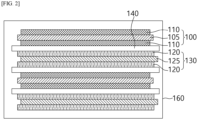
- a separation membrane 140 may be interposed between the cathode 100 and the anode 130.
- the separation membrane 140 may be configured to prevent an electrical short between the cathode 100 and the anode 130, and to allow a flow of ions to occur.
- the separation membrane may have a thickness of about 10 ⁇ m to about 20 ⁇ m.
- the separation membrane 140 may also include a ceramic-based material.
- inorganic particles may be applied to the polymer film or dispersed within the polymer film to improve heat resistance.
- an electrode cell is defined by the cathode 100, the anode 130, and the separation membrane 140.
- a plurality of electrode cells may then be stacked to form, for example, a jelly roll type electrode assembly 150 as shown in FIG. 1 .
- the electrode assembly 150 may be formed by winding, stacking, z-folding, stack-folding, etc. of the separation membrane 140 in FIG. 2 .
- the electrode assembly 150 may be housed in a case 160 together with an electrolyte to define a lithium secondary battery.
- a non-aqueous electrolyte may be used as the electrolyte.
- Suitable non-aqueous electrolyte may include, in certain embodiments, a lithium salt of an electrolyte and an organic solvent, wherein the lithium salt is represented by, for example, Li + X - , wherein X - is the anion of the lithium salt and may be, for example, F - , Cl - , Br - , I - , NO 3 - , N(CN) 2 - , BF 4 - , ClO 4 - , PF 6 - , (CF 3 ) 2 PF 4 - , (CF 3 ) 3 PF 3 - , (CF 3 ) 4 PF 2 - , (CF 3 ) 5 PF - , (CF 3 ) 6 P - , CF 3 SO 3
- Non-limiting examples of suitable organic solvents include propylene carbonate (PC), ethylene carbonate (EC), butylene carbonate, diethyl carbonate (DEC), dimethyl carbonate (DMC), ethyl methyl carbonate (EMC), methylpropyl carbonate, ethylpropyl carbonate, dipropyl carbonate, vinylene carbonate, methyl acetate (MA), ethyl acetate (EA), n-propylacetate (n-PA), 1,1-dimethylethyl acetate (DMEA), methyl propionate (MP), ethyl propionate (EP), fluoroethyl acetate (FEA), difluoroethyl acetate (DFEA), trifluoroethyl acetate (TFEA), dibutyl ether, tetraethylene glycol dimethyl ether (TEGDME), diethylene glycol dimethyl ether (DEGDME), dimethoxyethane,
- Examples of sultone compounds include 1,3-propane sultone, 1,3-propene sultone, 1,4-butane sultone, etc.
- Examples of cyclic sulfate compound include 1,2-ethylene sulfate, 1,2-propylene sulfate, etc.
- Examples of cyclic sulfite compounds include ethylene sulfite, butylene sulfite, etc.
- Examples of phosphate compounds include lithium difluoro bis-oxalato phosphate, lithium difluoro phosphate, etc.
- Examples of borate compounds include lithium bis(oxalate) borate, etc.
- a solid electrolyte may be used instead of a non-aqueous electrolyte.
- the lithium secondary battery may be manufactured in the form of an all-solid-state battery.
- a solid electrolyte layer may be disposed between the cathode and the anode instead of a separation membrane.
- the anode of such an all-solid-state battery may comprise an anode active layer as described according to any embodiment disclosed herein, e.g., comprising magnesium-silicon composite oxide particles having first element content ratio, second element content ratio and phase fraction ratio according to the ranges described herein.
- the solid electrolyte in an all-solid-state battery may include a sulfide-based electrolyte.
- sulfide-based electrolytes include Li 2 S-P 2 S 5 , Li 2 S-P 2 S 5 -LiCl, Li 2 S-P 2 S 5 -LiBr, Li 2 S-P 2 S 5 -LiCl-LiBr, Li 2 S-P 2 S 5 -Li2O, Li 2 S-P 2 S 5 -Li 2 O-LiI, Li 2 S-SiS 2 , Li 2 S-SiS 2 -LiI, Li 2 S-SiS 2 -LiBr, Li 2 S-SiS 2 -LiCl, Li 2 S-SiS 2 -B 2 S 3 -LiI, Li 2 S-SiS 2 -P 2 S 5 -LiI, Li 2 S-B 2 S 3 , Li 2 S-P 2 S 5 -Z
- the solid electrolyte includes an oxide-based amorphous solid electrolyte, such as, for example, Li 2 O-B 2 O 3 -P 2 O 5 , Li 2 O-SiO 2 , Li 2 O-B 2 O 3 , or Li 2 O-B 2 O 3 -ZnO, etc.
- oxide-based amorphous solid electrolyte such as, for example, Li 2 O-B 2 O 3 -P 2 O 5 , Li 2 O-SiO 2 , Li 2 O-B 2 O 3 , or Li 2 O-B 2 O 3 -ZnO, etc.
- the lithium secondary battery may be manufactured in any configuration, for example, in a cylindrical shape using a can, a square shape, a pouch type or a coin shape.
- Magnesium-silicon composite oxide particles, anodes and lithium half-cells were manufactured in the same manner as in Example 1, except for varying the weight ratio of the Si powder, SiO 2 powder, and Mg powder according to Table 2.
- the magnesium-silicon composite oxide particles were input into a thermal CVD chamber, and heat treatment was performed at less than 600 °C while supplying a mixed gas of ethylene gas and argon to prepare magnesium-silicon composite oxide particles having a carbon coating formed on the surface portion thereof.
- Magnesium-silicon composite oxide particles, an anode and a lithium half-cell were manufactured in the same manner as in Example 1, except for varying the weight ratio of the Si powder, SiO 2 powder, and Mg powder according to Table 2.
- the magnesium-silicon composite oxide particle sample, nitric acid, and a small amount of hydrofluoric acid were input into a polypropylene (PP) tube, and the tube was sealed by turning a stopper.
- the PP tube was shaken well and left at room temperature, followed by dissolving the sample. After the sample was dissolved, the PP tube was stored in a refrigerator to cool the sample. Saturated boric acid water was added to the cooled sample to neutralize the hydrofluoric acid, and then the sample was diluted with ultrapure water. The carbon component remaining in the sample was removed with a 0.45 ⁇ m syringe filter to obtain an injection solution.
- a high-temperature (approximately 10,000 K or lower) argon plasma was generated using an induced magnetic field (RF frequency) in the ICP analyzer.
- the injection solution was injected into the ICP analyzer in an aerosol state to acquire a mass ratio and a charge ratio of cations, and a signal intensity of each ratio was detected.
- the measurement conditions of the ICP analyzer were set as follows:
- the content of the oxygen element was measured by analyzing the gas generated by melting and oxidation/reduction reaction of the magnesium-silicon composite oxide particle sample at about 3000 °C in an electric furnace.
- Equations 1 and 2 The C Mg , C Si , and C O were substituted into Equations 1 and 2 to calculate a first element content ratio and a second element content ratio.
- XRD patterns of the MgSiO 3 phase, Mg 2 SiO 4 phase and Si phase were compared with the XRD patterns of the reference codes of MgSiO 3 , Mg 2 SiO 4 and Si (ICSD 98-000-5203, ICSD 98-000-9685 and ICSD 98-024-6975) registered in the online database (ICSD, https:Hicsd.products.fiz-karlsruhe.de/en/products/icsd-products) to determine the phase fractions of each of MgSiO 3 , Mg 2 SiO 4 and Si.
- Phase fraction ratio was calculated by substituting the sum of the phase fraction of MgSiO 3 and the phase fraction of Mg 2 SiO 4 (P(MS)), and the phase fraction of Si (P(Si)) into Equation 3.
- the initial efficiency was evaluated by a percentage obtained by dividing the initial discharge amount by the initial charge amount measured above.
- Example 15 in which the phase fraction ratio was less than 0.4, the initial capacity efficiency and lifespan characteristics were relatively decreased.
- Example 17 in which a carbon coating was formed on the surface of the magnesium-silicon composite oxide particles, the initial discharge capacity and initial capacity efficiency were relatively improved.
Landscapes
- Chemical & Material Sciences (AREA)
- Chemical Kinetics & Catalysis (AREA)
- Electrochemistry (AREA)
- General Chemical & Material Sciences (AREA)
- Composite Materials (AREA)
- Inorganic Chemistry (AREA)
- Engineering & Computer Science (AREA)
- Manufacturing & Machinery (AREA)
- Materials Engineering (AREA)
- Crystallography & Structural Chemistry (AREA)
- Battery Electrode And Active Subsutance (AREA)
Applications Claiming Priority (1)
| Application Number | Priority Date | Filing Date | Title |
|---|---|---|---|
| KR1020230178820A KR20250089181A (ko) | 2023-12-11 | 2023-12-11 | 리튬 이차 전지용 음극 활물질 및 이를 포함하는 리튬 이차 전지 |
Publications (1)
| Publication Number | Publication Date |
|---|---|
| EP4583202A1 true EP4583202A1 (fr) | 2025-07-09 |
Family
ID=93923125
Family Applications (1)
| Application Number | Title | Priority Date | Filing Date |
|---|---|---|---|
| EP24219247.4A Pending EP4583202A1 (fr) | 2023-12-11 | 2024-12-11 | Matériau actif d'anode pour batterie secondaire au lithium et batterie secondaire au lithium le comprenant |
Country Status (4)
| Country | Link |
|---|---|
| US (1) | US20250192174A1 (fr) |
| EP (1) | EP4583202A1 (fr) |
| KR (1) | KR20250089181A (fr) |
| CN (1) | CN120149351A (fr) |
Citations (2)
| Publication number | Priority date | Publication date | Assignee | Title |
|---|---|---|---|---|
| US20170149059A1 (en) * | 2011-05-04 | 2017-05-25 | Corning Incorporated | Porous silicon compositions and devices and methods thereof |
| CN116565170A (zh) * | 2023-05-26 | 2023-08-08 | 广东凯金新能源科技股份有限公司 | 硅基负极材料及其制备方法、及二次电池 |
-
2023
- 2023-12-11 KR KR1020230178820A patent/KR20250089181A/ko active Pending
-
2024
- 2024-12-03 US US18/966,425 patent/US20250192174A1/en active Pending
- 2024-12-05 CN CN202411775575.0A patent/CN120149351A/zh active Pending
- 2024-12-11 EP EP24219247.4A patent/EP4583202A1/fr active Pending
Patent Citations (2)
| Publication number | Priority date | Publication date | Assignee | Title |
|---|---|---|---|---|
| US20170149059A1 (en) * | 2011-05-04 | 2017-05-25 | Corning Incorporated | Porous silicon compositions and devices and methods thereof |
| CN116565170A (zh) * | 2023-05-26 | 2023-08-08 | 广东凯金新能源科技股份有限公司 | 硅基负极材料及其制备方法、及二次电池 |
Also Published As
| Publication number | Publication date |
|---|---|
| US20250192174A1 (en) | 2025-06-12 |
| KR20250089181A (ko) | 2025-06-18 |
| CN120149351A (zh) | 2025-06-13 |
Similar Documents
| Publication | Publication Date | Title |
|---|---|---|
| EP4431455A1 (fr) | Matériau actif d'anode pour batterie secondaire au lithium et batterie secondaire au lithium le comprenant | |
| EP3279148B1 (fr) | Oxyde composite à base de cobalt et de lithium pour batterie secondaire au lithium et batterie secondaire au lithium comportant une électrode positive le comprenant | |
| EP4553917A1 (fr) | Matériau actif d'anode pour batterie secondaire au lithium et batterie secondaire au lithium le comprenant | |
| EP4564455A2 (fr) | Anode pour batterie secondaire au lithium et batterie secondaire au lithium la comprenant | |
| US20250192174A1 (en) | Anode Active Material for Lithium Secondary Battery and Lithium Secondary Battery Including the Same | |
| US20240282962A1 (en) | Anode active material for lithium secondary battery and lithium secondary battery including the same | |
| US20250259989A1 (en) | Anode for lithium secondary battery and lithium secondary battery including the same | |
| EP4697405A1 (fr) | Matériau actif d'anode pour batterie secondaire et batterie secondaire le comprenant | |
| US20250226398A1 (en) | Anode active material for lithium secondary battery and lithium secondary battery including the same | |
| EP4564461A2 (fr) | Matériau actif d'anode pour batterie secondaire au lithium et batterie secondaire au lithium le comprenant | |
| EP4654274A1 (fr) | Matériau actif d'anode pour batterie secondaire au lithium, anode pour batterie secondaire au lithium et batterie secondaire au lithium | |
| US20250183303A1 (en) | Anode active material for lithium secondary battery and lithium secondary battery including the same | |
| EP4708393A1 (fr) | Matériau actif d'anode pour batterie secondaire et batterie secondaire comprenant ce qui suit | |
| US20240367985A1 (en) | Anode Active Material for Lithium Secondary Battery and Lithium Secondary Battery Including the Same | |
| US20250226394A1 (en) | Cathode for lithium secondary battery and lithium secondary battery including the same | |
| US20250219089A1 (en) | Cathode for lithium secondary battery and lithium secondary battery including the same | |
| EP4576252A1 (fr) | Batterie secondaire au lithium | |
| EP4579790A1 (fr) | Anode pour batterie secondaire au lithium et batterie secondaire au lithium la comprenant | |
| US20250300177A1 (en) | Anode active material for lithium secondary battery, method of preparing the same and lithium secondary battery including the same | |
| US20250183274A1 (en) | Anode for lithium secondary battery and lithium secondary battery including the same | |
| EP4564459A2 (fr) | Anode pour batterie secondaire au lithium et batterie secondaire au lithium la comprenant | |
| EP4648132A1 (fr) | Matériau actif d'anode pour batterie secondaire au lithium, son procédé de préparation et batterie secondaire au lithium le comprenant | |
| EP4603460A1 (fr) | Matériau actif de cathode pour batterie secondaire au lithium et batterie secondaire au lithium le comprenant | |
| CN121641843A (zh) | 锂二次电池用正极及包括该正极的锂二次电池 |
Legal Events
| Date | Code | Title | Description |
|---|---|---|---|
| PUAI | Public reference made under article 153(3) epc to a published international application that has entered the european phase |
Free format text: ORIGINAL CODE: 0009012 |
|
| STAA | Information on the status of an ep patent application or granted ep patent |
Free format text: STATUS: REQUEST FOR EXAMINATION WAS MADE |
|
| 17P | Request for examination filed |
Effective date: 20241211 |
|
| AK | Designated contracting states |
Kind code of ref document: A1 Designated state(s): AL AT BE BG CH CY CZ DE DK EE ES FI FR GB GR HR HU IE IS IT LI LT LU LV MC ME MK MT NL NO PL PT RO RS SE SI SK SM TR |