EP4583223A1 - Batterie secondaire au lithium et élément composite - Google Patents
Batterie secondaire au lithium et élément composite Download PDFInfo
- Publication number
- EP4583223A1 EP4583223A1 EP23859904.7A EP23859904A EP4583223A1 EP 4583223 A1 EP4583223 A1 EP 4583223A1 EP 23859904 A EP23859904 A EP 23859904A EP 4583223 A1 EP4583223 A1 EP 4583223A1
- Authority
- EP
- European Patent Office
- Prior art keywords
- spacer
- negative electrode
- lithium
- secondary battery
- composite material
- Prior art date
- Legal status (The legal status is an assumption and is not a legal conclusion. Google has not performed a legal analysis and makes no representation as to the accuracy of the status listed.)
- Pending
Links
Images


Classifications
-
- H—ELECTRICITY
- H01—ELECTRIC ELEMENTS
- H01M—PROCESSES OR MEANS, e.g. BATTERIES, FOR THE DIRECT CONVERSION OF CHEMICAL ENERGY INTO ELECTRICAL ENERGY
- H01M50/00—Constructional details or processes of manufacture of the non-active parts of electrochemical cells other than fuel cells, e.g. hybrid cells
- H01M50/40—Separators; Membranes; Diaphragms; Spacing elements inside cells
- H01M50/409—Separators, membranes or diaphragms characterised by the material
- H01M50/411—Organic material
- H01M50/414—Synthetic resins, e.g. thermoplastics or thermosetting resins
- H01M50/423—Polyamide resins
-
- H—ELECTRICITY
- H01—ELECTRIC ELEMENTS
- H01G—CAPACITORS; CAPACITORS, RECTIFIERS, DETECTORS, SWITCHING DEVICES, LIGHT-SENSITIVE OR TEMPERATURE-SENSITIVE DEVICES OF THE ELECTROLYTIC TYPE
- H01G11/00—Hybrid capacitors, i.e. capacitors having different positive and negative electrodes; Electric double-layer [EDL] capacitors; Processes for the manufacture thereof or of parts thereof
- H01G11/52—Separators
-
- H—ELECTRICITY
- H01—ELECTRIC ELEMENTS
- H01M—PROCESSES OR MEANS, e.g. BATTERIES, FOR THE DIRECT CONVERSION OF CHEMICAL ENERGY INTO ELECTRICAL ENERGY
- H01M10/00—Secondary cells; Manufacture thereof
- H01M10/05—Accumulators with non-aqueous electrolyte
- H01M10/052—Li-accumulators
-
- H—ELECTRICITY
- H01—ELECTRIC ELEMENTS
- H01M—PROCESSES OR MEANS, e.g. BATTERIES, FOR THE DIRECT CONVERSION OF CHEMICAL ENERGY INTO ELECTRICAL ENERGY
- H01M10/00—Secondary cells; Manufacture thereof
- H01M10/05—Accumulators with non-aqueous electrolyte
- H01M10/052—Li-accumulators
- H01M10/0525—Rocking-chair batteries, i.e. batteries with lithium insertion or intercalation in both electrodes; Lithium-ion batteries
-
- H—ELECTRICITY
- H01—ELECTRIC ELEMENTS
- H01M—PROCESSES OR MEANS, e.g. BATTERIES, FOR THE DIRECT CONVERSION OF CHEMICAL ENERGY INTO ELECTRICAL ENERGY
- H01M50/00—Constructional details or processes of manufacture of the non-active parts of electrochemical cells other than fuel cells, e.g. hybrid cells
- H01M50/40—Separators; Membranes; Diaphragms; Spacing elements inside cells
- H01M50/409—Separators, membranes or diaphragms characterised by the material
- H01M50/431—Inorganic material
- H01M50/434—Ceramics
-
- H—ELECTRICITY
- H01—ELECTRIC ELEMENTS
- H01M—PROCESSES OR MEANS, e.g. BATTERIES, FOR THE DIRECT CONVERSION OF CHEMICAL ENERGY INTO ELECTRICAL ENERGY
- H01M50/00—Constructional details or processes of manufacture of the non-active parts of electrochemical cells other than fuel cells, e.g. hybrid cells
- H01M50/40—Separators; Membranes; Diaphragms; Spacing elements inside cells
- H01M50/409—Separators, membranes or diaphragms characterised by the material
- H01M50/443—Particulate material
-
- H—ELECTRICITY
- H01—ELECTRIC ELEMENTS
- H01M—PROCESSES OR MEANS, e.g. BATTERIES, FOR THE DIRECT CONVERSION OF CHEMICAL ENERGY INTO ELECTRICAL ENERGY
- H01M50/00—Constructional details or processes of manufacture of the non-active parts of electrochemical cells other than fuel cells, e.g. hybrid cells
- H01M50/40—Separators; Membranes; Diaphragms; Spacing elements inside cells
- H01M50/409—Separators, membranes or diaphragms characterised by the material
- H01M50/446—Composite material consisting of a mixture of organic and inorganic materials
-
- H—ELECTRICITY
- H01—ELECTRIC ELEMENTS
- H01M—PROCESSES OR MEANS, e.g. BATTERIES, FOR THE DIRECT CONVERSION OF CHEMICAL ENERGY INTO ELECTRICAL ENERGY
- H01M50/00—Constructional details or processes of manufacture of the non-active parts of electrochemical cells other than fuel cells, e.g. hybrid cells
- H01M50/40—Separators; Membranes; Diaphragms; Spacing elements inside cells
- H01M50/409—Separators, membranes or diaphragms characterised by the material
- H01M50/449—Separators, membranes or diaphragms characterised by the material having a layered structure
-
- H—ELECTRICITY
- H01—ELECTRIC ELEMENTS
- H01M—PROCESSES OR MEANS, e.g. BATTERIES, FOR THE DIRECT CONVERSION OF CHEMICAL ENERGY INTO ELECTRICAL ENERGY
- H01M50/00—Constructional details or processes of manufacture of the non-active parts of electrochemical cells other than fuel cells, e.g. hybrid cells
- H01M50/40—Separators; Membranes; Diaphragms; Spacing elements inside cells
- H01M50/409—Separators, membranes or diaphragms characterised by the material
- H01M50/449—Separators, membranes or diaphragms characterised by the material having a layered structure
- H01M50/451—Separators, membranes or diaphragms characterised by the material having a layered structure comprising layers of only organic material and layers containing inorganic material
-
- H—ELECTRICITY
- H01—ELECTRIC ELEMENTS
- H01M—PROCESSES OR MEANS, e.g. BATTERIES, FOR THE DIRECT CONVERSION OF CHEMICAL ENERGY INTO ELECTRICAL ENERGY
- H01M50/00—Constructional details or processes of manufacture of the non-active parts of electrochemical cells other than fuel cells, e.g. hybrid cells
- H01M50/40—Separators; Membranes; Diaphragms; Spacing elements inside cells
- H01M50/46—Separators, membranes or diaphragms characterised by their combination with electrodes
-
- H—ELECTRICITY
- H01—ELECTRIC ELEMENTS
- H01M—PROCESSES OR MEANS, e.g. BATTERIES, FOR THE DIRECT CONVERSION OF CHEMICAL ENERGY INTO ELECTRICAL ENERGY
- H01M50/00—Constructional details or processes of manufacture of the non-active parts of electrochemical cells other than fuel cells, e.g. hybrid cells
- H01M50/40—Separators; Membranes; Diaphragms; Spacing elements inside cells
- H01M50/463—Separators, membranes or diaphragms characterised by their shape
-
- H—ELECTRICITY
- H01—ELECTRIC ELEMENTS
- H01M—PROCESSES OR MEANS, e.g. BATTERIES, FOR THE DIRECT CONVERSION OF CHEMICAL ENERGY INTO ELECTRICAL ENERGY
- H01M50/00—Constructional details or processes of manufacture of the non-active parts of electrochemical cells other than fuel cells, e.g. hybrid cells
- H01M50/40—Separators; Membranes; Diaphragms; Spacing elements inside cells
- H01M50/471—Spacing elements inside cells other than separators, membranes or diaphragms; Manufacturing processes thereof
- H01M50/474—Spacing elements inside cells other than separators, membranes or diaphragms; Manufacturing processes thereof characterised by their position inside the cells
-
- H—ELECTRICITY
- H01—ELECTRIC ELEMENTS
- H01M—PROCESSES OR MEANS, e.g. BATTERIES, FOR THE DIRECT CONVERSION OF CHEMICAL ENERGY INTO ELECTRICAL ENERGY
- H01M50/00—Constructional details or processes of manufacture of the non-active parts of electrochemical cells other than fuel cells, e.g. hybrid cells
- H01M50/40—Separators; Membranes; Diaphragms; Spacing elements inside cells
- H01M50/471—Spacing elements inside cells other than separators, membranes or diaphragms; Manufacturing processes thereof
- H01M50/477—Spacing elements inside cells other than separators, membranes or diaphragms; Manufacturing processes thereof characterised by their shape
-
- H—ELECTRICITY
- H01—ELECTRIC ELEMENTS
- H01M—PROCESSES OR MEANS, e.g. BATTERIES, FOR THE DIRECT CONVERSION OF CHEMICAL ENERGY INTO ELECTRICAL ENERGY
- H01M50/00—Constructional details or processes of manufacture of the non-active parts of electrochemical cells other than fuel cells, e.g. hybrid cells
- H01M50/40—Separators; Membranes; Diaphragms; Spacing elements inside cells
- H01M50/489—Separators, membranes, diaphragms or spacing elements inside the cells, characterised by their physical properties, e.g. swelling degree, hydrophilicity or shut down properties
- H01M50/491—Porosity
-
- H—ELECTRICITY
- H01—ELECTRIC ELEMENTS
- H01G—CAPACITORS; CAPACITORS, RECTIFIERS, DETECTORS, SWITCHING DEVICES, LIGHT-SENSITIVE OR TEMPERATURE-SENSITIVE DEVICES OF THE ELECTROLYTIC TYPE
- H01G9/00—Electrolytic capacitors, rectifiers, detectors, switching devices, light-sensitive or temperature-sensitive devices; Processes of their manufacture
- H01G9/004—Details
- H01G9/02—Diaphragms; Separators
-
- H—ELECTRICITY
- H01—ELECTRIC ELEMENTS
- H01M—PROCESSES OR MEANS, e.g. BATTERIES, FOR THE DIRECT CONVERSION OF CHEMICAL ENERGY INTO ELECTRICAL ENERGY
- H01M2200/00—Safety devices for primary or secondary batteries
-
- Y—GENERAL TAGGING OF NEW TECHNOLOGICAL DEVELOPMENTS; GENERAL TAGGING OF CROSS-SECTIONAL TECHNOLOGIES SPANNING OVER SEVERAL SECTIONS OF THE IPC; TECHNICAL SUBJECTS COVERED BY FORMER USPC CROSS-REFERENCE ART COLLECTIONS [XRACs] AND DIGESTS
- Y02—TECHNOLOGIES OR APPLICATIONS FOR MITIGATION OR ADAPTATION AGAINST CLIMATE CHANGE
- Y02E—REDUCTION OF GREENHOUSE GAS [GHG] EMISSIONS, RELATED TO ENERGY GENERATION, TRANSMISSION OR DISTRIBUTION
- Y02E60/00—Enabling technologies; Technologies with a potential or indirect contribution to GHG emissions mitigation
- Y02E60/10—Energy storage using batteries
Definitions
- the present disclosure relates to a lithium secondary battery and a composite member.
- Lithium secondary batteries are promising as non-aqueous electrolyte secondary batteries with high capacities that exceed those of lithium-ion batteries.
- lithium metal is deposited on the negative electrode during charging, and this lithium metal dissolves in the non-aqueous electrolyte during discharging.
- Various proposals have conventionally been made regarding lithium secondary batteries.
- PTL 1 ( WO 2020/066254 A1 ) describes "a lithium secondary battery including: a positive electrode including a positive electrode current collector and a positive electrode mixture layer including a positive electrode active material; a negative electrode including a negative electrode current collector facing the positive electrode; a separator disposed between the positive electrode and the negative electrode; and a non-aqueous electrolyte having lithium-ion conductivity, in which the positive electrode active material includes a composite oxide including lithium and a metal M other than lithium, the metal M including at least a transition metal, lithium metal is deposited on the negative electrode during charging and the lithium metal dissolves from the negative electrode during discharging, a first length in a first direction D1 of the positive electrode current collector is smaller than a second length in a second direction D2 intersecting with the first direction, a spacer is provided between the positive electrode and the separator such that a space for accommodating the lithium metal is formed between the positive electrode and the negative electrode, and a straight line SL can be drawn along the first direction D1 so as to pass through
- One object of the present disclosure is to provide a lithium secondary battery in which expansion of an electrode group during charging (e.g., expansion in the vicinity of the negative electrode) is small and a cycle characteristic is favorable.
- the lithium secondary battery includes: a positive electrode; a negative electrode; a separator disposed between the positive electrode and the negative electrode; a spacer disposed on the separator; and a non-aqueous electrolyte having lithium-ion conductivity, in which the negative electrode is an electrode onto which lithium metal is deposited during charging and from which the lithium metal dissolves during discharging, the separator includes a base layer and a composite material layer, in a plan view, the shortest distance from any point on the spacer to an outer edge of the spacer is less than 1.5 mm, and the spacer has a width of 0.01 mm or more, and the composite material layer contains a polymer and inorganic particles.
- the composite member includes: a separator having a base layer and a composite material layer; and a spacer, in which in a plan view, the shortest distance from any point on the spacer to an outer edge of the spacer is less than 1.5 mm, and the spacer has a width of 0.01 mm or more, and the composite material layer contains a polymer and inorganic particles.
- a lithium secondary battery can be obtained in which expansion of an electrode group during charging (e.g., expansion in the vicinity of the negative electrode) is small and a cycle characteristic is favorable.
- numeric value A to numeric value B includes numeric value A and numeric value B, and can be read as "numeric value A or more and numeric value B or less".
- any of the exemplified lower limits can be combined with any of the exemplified upper limits in any combination, as long as the lower limit is not greater than or equal to the upper limit.
- Plan view means viewing an object placed on a flat surface from a normal direction of the surface.
- a plan view of a spacer formed on a separator means that the separator is placed on a flat surface and the spacer is viewed from the normal direction of the surface.
- the resin material is, for example, a fluorine-containing resin such as polyvinylidene fluoride (PVdF) and polytetrafluoroethylene, a fluorine-containing rubber such as vinylidene fluoride-tetrafluoroethylene copolymer and ethylene-tetrafluoroethylene copolymer, styrene-butadiene copolymer or a hydrogenated product thereof, acrylonitrile-butadiene copolymer or a hydrogenated product thereof, methacrylic acid ester-acrylic acid ester copolymer, styrene-acrylic acid ester copolymer, acrylonitrile-acrylic acid ester copolymer, ethylene propylene rubber, polyvinyl alcohol, polyvinyl acetate, and other rubbers, cellulose derivatives such as ethyl cellulose, methyl cellulose, hydroxyethyl cellulose, and carboxymethyl cellulose, acrylic resins such as acrylic acid-me
- a polyimide, polyvinylidene fluoride, acrylonitrile-acrylic acid ester copolymer, and the like are preferable as materials through which lithium ions do not pass, and a polyimide may be used.
- a non-porous spacer constituted of these resin materials and having a certain height or more is a layer through which lithium ions do not pass.
- the average height of the spacer may be 3 times or more, 5 times or more, or 10 times or more the average thickness of the composite material layer, and may be 100 times or less, 30 times or less, or 20 times or less the average thickness of the composite material layer.
- the average particle diameter of the particles is not particularly limited, but may be 0.1 ⁇ m or more, or 0.5 ⁇ m or more, and may be 10 ⁇ m or less, 5 ⁇ m or less, or 2 ⁇ m or less.
- the average particle diameter can be measured using the following method. First, a cross section of the spacer in the thickness direction of the separator is imaged with an electron microscope to obtain an image of the cross section. Next, the image is subjected to image processing such as binarization to identify particle portions. Next, the diameter of a circle having the same area as the cross-sectional area of each particle (equivalent circle diameter) is determined, and the arithmetic average of the determined equivalent circle diameters can be regarded as the average particle diameter. The arithmetic average can be determined from, for example, 100 or more particles. Note that the average particle diameter of other particles contained in the electrode plates and the separator can also be determined using a similar method.
- the spacer contains a resin material and particles
- the content of the particles in the spacer is preferably 50 vol% or less. This makes it easier to ensure that the spacer has sufficient strength.
- a ratio D/Hs of the shortest distance D to the average height Hs may be 0.05 or more, 0.10 or more, 0.15 or more, 1.0 or more, or 5.0 or more, or may be 5.0 or less, 10 or less, 20 or less, or 50 or less.
- the average height Hs of the spacer may be greater than a sum Tw of an average thickness Tb of the base layer and an average thickness Tt of the composite material layer.
- a ratio Hs/Tw of the average height Hs to the sum Tw may be greater than 1, 1.5 or more, 2 or more, or 3 or more.
- the ratio Hs/Tw may be 10 or less, 8 or less, 5 or less, or 4 or less. By setting this ratio to 1.5 or more, expansion of the electrode group can be particularly suppressed.
- An average height Hs can be measured using the following method. First, a cross section of the separator in the thickness direction of the separator is imaged with an electron microscope to obtain an image of the cross section. Next, 20 arbitrary locations of the spacer are selected from the image, and the height of the spacer at those locations is measured. Next, the heights measured at the 20 locations are arithmetically averaged, and the obtained average value is set as the average height Hs. An average thickness Tb and an average thickness Tt can also be measured using a similar procedure.
- the average thickness Tb of the base layer may be 5 ⁇ m or more, or 10 ⁇ m or more, and may be 30 ⁇ m or less, or 20 ⁇ m or less.
- the average thickness Tt of the composite material layer may be 1 ⁇ m or more, or 2 ⁇ m or more, and may be 5 ⁇ m or less, or 3 ⁇ m or less.
- the average height Hs of the spacer may be 10 ⁇ m or more, or 20 ⁇ m or more, and may be 100 ⁇ m or less, 50 ⁇ m or less, 40 ⁇ m or less, or 30 ⁇ m or less. These heights and thicknesses vary depending on the configurations of the positive electrode and the negative electrode, and may be numeric values outside the ranges given as examples here. Note that in order to make the interval between the electrode plates formed by the spacer as constant as possible, the spacer is usually formed to have a height that is as constant as possible.
- the planar shapes of the linear protrusions may be a combination of polygons.
- mesh shapes include shapes obtained by combining polygons such that they share edges.
- Polygons include triangles, quadrilaterals, hexagons, and the like. Different types of polygons may also be combined.
- the linear protrusions may have a honeycomb shape in a plan view. As described above with respect to the mesh-shaped protrusions, the honeycomb-shaped protrusions can improve the effect of suppressing an excessive temperature rise in the electrode group.
- the linear protrusions may include a plurality of linear protrusions arranged in a stripe pattern.
- the separator includes at least one composite material layer.
- the composite material layer may be formed on one of the two main surfaces of the base layer that is on the positive electrode side, or one of the two main surfaces of the base layer that is on the negative electrode side, or on each of the two main surfaces.
- the arrangement of the positive electrode, the negative electrode, the base layer, the composite material layer, the separator, and the spacer is not particularly limited, except that the separator and the spacer are arranged between the positive electrode and the negative electrode.
- the separator may be disposed such that the composite material layer faces the positive electrode, or the separator may be disposed such that the composite material layer faces the negative electrode.
- the spacer is formed on the separator.
- the spacer may be formed on the composite material layer or on the base layer.
- the effect of suppressing thermal contraction of the base layer is particularly improved.
- By forming the spacer on the composite material layer it becomes easier to obtain the effects of ensuring the battery capacity, improving the circulation of the electrolyte, and improving productivity.
- Examples of preferred arrangements include the following arrangements: positive electrode/composite material layer/base layer/spacer/negative electrode; and positive electrode/base layer/composite material layer/spacer/negative electrode.
- the average particle diameter of the first particles may be in the range of 0.1 ⁇ m to 1.0 ⁇ m (e.g., in the range of 0.1 ⁇ m to 0.5 ⁇ m, in the range of 0.1 ⁇ m to 0.2 ⁇ m, or in the range of 0.1 ⁇ m to 0.19 ⁇ m).
- the first particles may have an average particle diameter of 0.1 ⁇ m or more, or 0.15 ⁇ m or more.
- the average particle diameter of the first particles may be 1.0 ⁇ m or less, 0.5 ⁇ m or less, 0.3 ⁇ m or less, or 0.2 ⁇ m or less. By setting the average particle diameter to 0.1 ⁇ m or more, sufficient pores necessary for the electrolyte to permeate can be ensured.
- An average particle diameter of 1.0 ⁇ m or less is preferable from the viewpoint of forming a high-density layer of the first particles.
- aromatic polyamides examples include polymers that are formed by condensation polymerization of monomers having an aromatic skeleton and contain amide bonds in repeating units.
- aromatic polyamides examples include meta-aromatic polyamides (e.g., meta-type wholly aromatic polyamides) and para-aromatic polyamides (e.g., para-type wholly aromatic polyamides).
- Wholly aromatic polyamides are also called aramids.
- a preferred example of the second particles is particles constituted of an insulating inorganic compound that does not melt or decompose when the battery generates abnormal heat.
- the second particles may be inorganic particles that are generally used as inorganic fillers. Examples of materials for the second particles include oxides, oxide hydrates, hydroxides, nitrides, carbides, and sulfides, and these may contain metallic elements.
- the second particles may have an average particle diameter of 0.2 ⁇ m or more and 2 ⁇ m or less.
- oxides and oxide hydrates include aluminum oxide, boehmite, magnesium oxide, titanium oxide, zirconium oxide, silicon oxide, yttrium oxide, and zinc oxide.
- nitrides include silicon nitride, aluminum nitride, boron nitride, and titanium nitride.
- carbides include silicon carbide, and boron carbide.
- sulfides include barium sulfate.
- hydroxides include aluminum hydroxide.
- the material of the second particles may be a porous aluminosilicate such as zeolite, a layered silicate such as talc, barium titanate (BaTiO 3 ), strontium titanate (SrTiO 3 ), or the like. From the viewpoint of insulation properties, heat resistance, and the like, the material of the second particles may be at least one selected from the group consisting of aluminum oxide, boehmite, talc, titanium oxide, and magnesium oxide.
- the average particle diameter of the second particles may be within the range given as an example for the average particle diameter of the first particles.
- the inorganic particles may include the above-mentioned first particles and second particles that are not a phosphate.
- the composite material layer may include a first layer including the first particles and a second layer including the second particles. This configuration can particularly improve the effect of suppressing an excessive temperature rise in the electrode group. Note that the composite material layer may also be constituted of only the first layer or only the second layer.
- the first layer and the second layer may be laminated on one of the two main surfaces of the base layer that is on the positive electrode side, on one of the two main surfaces of the base layer that is on the negative electrode side, or on different main surfaces.
- the separator and the spacer may have a laminated structure of base layer/first layer/second layer/spacer, base layer/second layer/first layer/spacer, first layer/second layer/base layer/spacer, or second layer/first layer/base layer/spacer.
- the first layer and the second layer may be arranged on different main surfaces of the base layer.
- the separator and the spacer may have a laminated structure of first layer/base layer/second layer/spacer, or second layer/base layer/first layer/spacer.
- the first layer may contain the first particles as a main component.
- the content of the first particles in the first layer may be in the range of 50 mass% to 99 mass%, 85 mass% to 99 mass%, or 90 mass% to 98 mass%.
- the content may be 50 mass% or more, 70 mass% or more, 85 mass% or more, or 90 mass% or more.
- the content may be 99 mass% or less, 98 mass% or less, or 95 mass% or less.
- the first particles have a sufficient surface area, making it easy to inactivate lithium at high temperatures.
- the first layer may contain a solid component other than the first particles.
- the first layer may contain a binder, an inorganic substance (e.g., inorganic particles) other than the first particles, a polymer (PL), and the like.
- an inorganic substance e.g., inorganic particles
- PL polymer
- the content of the binder in the first layer may be in the range of 1 mass% to 15 mass%, or in the range of 2 mass% to 10 mass%.
- the content of the binder in the first layer may be 1 mass% or more, or 2 mass% or more.
- the content of the binder in the first layer may be 15 mass% or less, or 10 mass% or less.
- the second layer contains second particles that are not the first particles (phosphate particles). Note that the second layer may or may not contain the first particles.
- the second layer preferably contains a polymer (PL).
- the content of the polymer (PL) in the second layer may be in the range of 50 mass% to 100 mass% (e.g., in the range of 80 mass% to 100 mass% or 90 mass% to 100 mass%).
- the second layer may consist of only the polymer (PL).
- the thicknesses of the first and second layers can each independently be in the range of 0.2 ⁇ m to 10 ⁇ m (e.g., in the range of 1 ⁇ m to 8 ⁇ m, in the range of 2 ⁇ m to 4 ⁇ m, or in the range of 4 ⁇ m to 10 ⁇ m).
- the first layer may have a thickness in the range of 0.2 ⁇ m to 10 ⁇ m and the second layer may have a thickness in the range of 0.2 ⁇ m to 10 ⁇ m.
- the first layer may have a thickness of 0.2 ⁇ m or more, 0.3 ⁇ m or more, or 0.5 ⁇ m or more, preferably 1 ⁇ m or more, more preferably 2 ⁇ m or more, more preferably 3 ⁇ m or more, and even more preferably 4 ⁇ m or more.
- the first layer may also have a thickness of 10 ⁇ m or less, 8 ⁇ m or less, 7 ⁇ m or less, or 5 ⁇ m or less.
- the second layer may have a thickness of 0.2 ⁇ m or more, 0.3 ⁇ m or more, or 0.5 ⁇ m or more, preferably 1 ⁇ m or more, more preferably 2 ⁇ m or more, more preferably 3 ⁇ m or more, and even more preferably 4 ⁇ m or more.
- the second layer may also have a thickness of 10 ⁇ m or less, 8 ⁇ m or less, 7 ⁇ m or less, or 5 ⁇ m or less. If at least one of the first layer and the second layer has a thickness of 0.2 ⁇ m or more, this is advantageous in terms of suppressing a rise in battery temperature in the event of an abnormality. If the thickness of at least one of the first layer and the second layer is 10 ⁇ m or less, this is advantageous in terms of the electrical characteristic of the battery.
- the composite material layer contains the first particles, the temperature rise of the battery in the event of an abnormality can be particularly suppressed.
- the mechanism for this is unclear at present.
- One possibility is that when the battery temperature rises abnormally, the first particles react with the lithium metal in the negative electrode, causing the reactivity of the surface of the lithium metal to decrease.
- the present disclosure provides another lithium secondary battery (Z).
- the other lithium secondary battery (Z) differs from the above-mentioned lithium secondary battery (L) in (1) and (2) below. Since the other lithium secondary battery (Z) is the same as the lithium secondary battery (L) except for (1) and (2) below, redundant description is omitted.
- the separator may be produced using the following method.
- the base layer is prepared.
- the base layer may be a commercially-available base layer.
- the composite material layer is formed on the base layer.
- each step in the forming of the composite material layer there is no particular limitation on each step in the forming of the composite material layer, and known methods can be applied.
- the slurry (or coating liquid) may be applied using a known method such as a method using a bar coater.
- the drying may be performed using a known method such as drying by heating or natural drying.
- Examples of the transition metal element contained in the lithium-containing transition metal oxide include Sc, Ti, V, Cr, Mn, Fe, Co, Ni, Cu, Y, Zr, and W.
- the lithium-containing transition metal oxide may contain one type of transition metal element or two or more types of transition metal elements.
- the transition metal element may be Co, Ni, and/or Mn.
- the lithium-containing transition metal oxide may contain one or more main group elements as necessary.
- Main group elements include Mg, Al, Ca, Zn, Ga, Ge, Sn, Sb, Pb, and Bi.
- the main group element may be Al or the like.
- the lithium-containing transition metal oxides composite oxides that contain Co, Ni, and/or Mn as transition metal elements, contain Al as an optional component in some cases, and have a layered rock-salt crystal structure are preferable in terms of obtaining high capacity.
- the molar ratio mLi /mM of the total amount mLi of lithium in the positive electrode and the negative electrode to the amount mM of a metal M other than lithium in the positive electrode may be set to, for example, 1.1 or less.
- the positive electrode current collector is only required to be a conductive sheet.
- the conductive sheet may be a foil, a film, or the like.
- the surface of the positive electrode current collector may be coated with a carbon material.
- Examples of the material for the positive electrode current collector include metal materials containing Al, Ti, Fe, and the like.
- the metal material may be Al, an Al alloy, Ti, a Ti alloy, an Fe alloy, or the like.
- the Fe alloy may be stainless steel (SUS).
- the thickness of the positive electrode current collector is not particularly limited and may be in the range of 5 to 300 ⁇ m.
- the liquid non-aqueous electrolyte is prepared by dissolving a lithium salt in a non-aqueous solvent.
- a lithium salt is dissolved in the non-aqueous solvent, lithium ions and anions are generated.
- the gel non-aqueous electrolyte contains a lithium salt and a matrix polymer, or a lithium salt, a non-aqueous solvent, and a matrix polymer.
- a matrix polymer for example, a polymer material that gels by absorbing a non-aqueous solvent is used. Examples of the polymer material include fluororesin, acrylic resin, and polyether resin.
- any known material used in the non-aqueous electrolyte of a lithium secondary battery can be used.
- BF 4 - , ClO 4 - , PF 6 - , CF 3 SO 3 - , CF 3 CO 2 - anions of imides, anions of oxalate complexes, and the like can be mentioned as examples.
- the anion of the oxalate complex may also contain boron and/or phosphorus.
- the anions of the oxalate complexes include bisoxalate borate anions, BF 2 (C 2 O 4 ) - , PF 4 (C 2 O 4 ) - , and PF 2 (C 2 O 4 ) 2 - .
- the non-aqueous electrolyte may contain one of these anions alone or two or more of them.
- the non-aqueous electrolyte preferably contains at least an anion of an oxalate complex.
- the interaction between the anion of the oxalate complex and lithium facilitates uniform deposition of the lithium metal in the form of fine particles. This makes it easier to suppress localized deposition of the lithium metal.
- the anions of the oxalate complex may be combined with other anions.
- the other anions may be PF 6 - and/or the anions of an imide.
- the non-aqueous electrolyte may contain LiBF 2 (C 2 O 4 ) (lithium difluorooxalatoborate) as the solute (lithium salt).
- non-aqueous solvent examples include esters, ethers, nitriles, amides, and halogen-substituted compounds of these.
- the non-aqueous electrolyte may contain one of these non-aqueous solvents alone or two or more of them.
- examples of the halogen-substituted compounds include fluorides.
- esters examples include carbonate esters and carboxylate esters.
- examples of cyclic carbonate esters include ethylene carbonate, propylene carbonate, and fluoroethylene carbonate (FEC).
- Examples of chain carbonate esters include dimethyl carbonate (DMC), ethyl methyl carbonate (EMC), and diethyl carbonate.
- Examples of cyclic carboxylates include ⁇ -butyrolactone and ⁇ -valerolactone.
- chain carboxylates examples include ethyl acetate, methyl propionate, and methyl fluoropropionate.
- Ethers include cyclic ethers and chain ethers.
- cyclic ethers include 1,3-dioxolane, 4-methyl-1,3-dioxolane, tetrahydrofuran, and 2-methyltetrahydrofuran.
- chain ethers include 1,2-dimethoxyethane, diethyl ether, ethyl vinyl ether, methyl phenyl ether, benzyl ethyl ether, diphenyl ether, dibenzyl ether, 1,2-diethoxyethane, and diethylene glycol dimethyl ether.
- the concentration of the lithium salt in the non-aqueous electrolyte is, for example, 0.5 mol/L or more and 3.5 mol/L or less.
- the concentration of the anions in the non-aqueous electrolyte may be 0.5 mol/L or more and 3.5 mol/L or less.
- the concentration of the anions of the oxalate complex in the non-aqueous electrolyte may be 0.05 mol/L or more and 1 mol/L or less.
- the non-aqueous electrolyte may contain an additive.
- the additive may form a coating on the negative electrode.
- the formation of the coating film derived from the additive on the negative electrode makes it easier to suppress the generation of dendrites.
- examples of such additives include vinylene carbonate, fluoroethylene carbonate (FEC), vinyl ethyl carbonate (VEC), and the like.
- the exterior body accommodates the positive electrode, the negative electrode, the separator, the spacer disposed on the separator, and the non-aqueous electrolyte.
- the exterior body is not particularly limited, and may be an exterior body used in a known lithium secondary battery.
- the present disclosure further discloses a composite member (C) for use in a battery.
- the composite member (C) includes the separator and the spacer, which were described as constituent elements of the lithium secondary battery (L). That is, the composite member (C) includes the separator and the spacer formed on the separator, which were described above. The separator and the spacer have been described above, and therefore redundant description will be omitted.
- the composite member (C) can be used as a separator for a lithium secondary battery.
- the composite member (C) includes a separator having a base layer and a composite material layer, and a spacer. The spacer can be formed on the base layer or on the composite material layer.
- the spacer of the composite member (C) has the above-mentioned predetermined size, it is possible to suppress the formation of wrinkles in the separator when the spacer is formed.
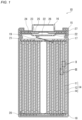
- the electrode group 14 includes a positive electrode 11, a negative electrode 12, separators 50, and spacers 53.
- the positive electrode 11, the negative electrode 12, and the separators 50 are all strip-shaped.
- the spacers 53 are formed on the separators 50 (composite material layers 52).
- the electrode group 14 is formed by winding the positive electrode 11, the negative electrode 12, and the separators 50 such that the separators 50 are disposed between the positive electrode and the negative electrode 12.
- the positive electrode 11 includes a positive electrode current collector 11a and positive electrode mixture layers 11b.
- the positive electrode current collector 11a is electrically connected via a positive electrode lead 19 to the cap 26, which functions as a positive electrode terminal.
- a negative electrode (negative electrode current collector) on which no lithium metal is deposited is shown as the negative electrode 12.
- the negative electrode 12 is electrically connected via a negative electrode lead 20 to the case body 15, which functions as a negative electrode terminal.
- FIGS. 5 to 7 are diagrams showing the separator 50 and the spacer 53 as viewed in a plan view.
- the spacer 53 in FIG. 5 includes a plurality of linear protrusions 53a spaced apart from one another. A gap P is present between the linear protrusions 53a. The region where the linear protrusions 53a are not formed constitutes the space 14s.
- the spacer 53 in FIG. 6 includes a plurality of linear protrusions 53a arranged in a stripe pattern.
- the spacer 53 in FIG. 7 includes a plurality of linear protrusions 53a arranged in a lattice pattern.
- a lithium secondary battery including:
- the lithium secondary battery according to technique 1 or 2 in which the polymer includes at least one selected from the group consisting of an aromatic polyamide, an aromatic polyimide, and an aromatic polyamide-imide.
- the lithium secondary battery according to any one of techniques 1 to 4, in which the spacer is formed on the composite material layer.
- the lithium secondary battery according to any one of techniques 1 to 5, in which the spacer includes linear protrusions.
- a planar shape of the linear protrusions is a shape obtained by combining polygons.
- the lithium secondary battery according to technique 6 in which a planar shape of the linear protrusions is a honeycomb shape.
- a composite member including:
- the composite member according to technique 14 in which the linear protrusions include a plurality of linear protrusions arranged in a stripe pattern.
- the lithium secondary battery (L) according to this embodiment will be specifically described below based on a working example.
- the present disclosure is not limited to the following working example.
- a lithium secondary battery A1 was produced using the following procedure.
- NCA lithium-containing transition metal oxide
- AB acetylene black
- PVdF polyvinylidene fluoride
- Batteries A3 to A5 and batteries C2 to C9 were produced in the same manner and under the same conditions as the battery A1, except that the pattern of the spacer, the width W of the linear protrusions, whether or not there is a composite material layer, and the electrode that the spacer faces (the direction of arrangement of the separators) were changed as shown in Table 1. Note that in all of the batteries, the average height of the spacer was the same as that of the battery A1 (30 ⁇ m). In the battery C7, a non-porous layer formed using only polymer was disposed at the position of the composite material layer.
- a battery C1 was produced in the same manner and under the same conditions as the battery A1, except that the composite material layer and the spacer were not formed.
- the separator of the battery C1 is constituted of only a base layer, and no spacer is formed on the base layer.
- the batteries produced in this manner were evaluated using the following method.
- a charging/discharging test was performed on each of the obtained batteries.
- the battery was charged under the following conditions in a thermostatic chamber at 25°C, then was allowed to rest for 20 minutes and was discharged under the following conditions.
- the battery was charged with a constant current of 2.15 mA per unit area (cm 2 ) of the electrode until the battery voltage reached 4.1 V, and then was charged with a constant voltage of 4.1 V until the current value per unit area of the electrode reached 0.54 mA.
- the battery was discharged with a constant current of 2.15 mA per unit area of the electrode until the battery voltage reached 3.75 V.
- Discharge capacity retention rate % 100 ⁇ C 50 / C 1
Landscapes
- Chemical & Material Sciences (AREA)
- Chemical Kinetics & Catalysis (AREA)
- Electrochemistry (AREA)
- General Chemical & Material Sciences (AREA)
- Engineering & Computer Science (AREA)
- Inorganic Chemistry (AREA)
- Materials Engineering (AREA)
- Composite Materials (AREA)
- Manufacturing & Machinery (AREA)
- Power Engineering (AREA)
- Microelectronics & Electronic Packaging (AREA)
- Ceramic Engineering (AREA)
- Cell Separators (AREA)
- Secondary Cells (AREA)
Applications Claiming Priority (2)
| Application Number | Priority Date | Filing Date | Title |
|---|---|---|---|
| JP2022137978 | 2022-08-31 | ||
| PCT/JP2023/027197 WO2024048135A1 (fr) | 2022-08-31 | 2023-07-25 | Batterie secondaire au lithium et élément composite |
Publications (2)
| Publication Number | Publication Date |
|---|---|
| EP4583223A1 true EP4583223A1 (fr) | 2025-07-09 |
| EP4583223A4 EP4583223A4 (fr) | 2026-04-01 |
Family
ID=90099150
Family Applications (1)
| Application Number | Title | Priority Date | Filing Date |
|---|---|---|---|
| EP23859904.7A Pending EP4583223A4 (fr) | 2022-08-31 | 2023-07-25 | Batterie secondaire au lithium et élément composite |
Country Status (5)
| Country | Link |
|---|---|
| US (1) | US20260058316A1 (fr) |
| EP (1) | EP4583223A4 (fr) |
| JP (1) | JPWO2024048135A1 (fr) |
| CN (1) | CN119816971A (fr) |
| WO (1) | WO2024048135A1 (fr) |
Families Citing this family (1)
| Publication number | Priority date | Publication date | Assignee | Title |
|---|---|---|---|---|
| WO2026048847A1 (fr) * | 2024-08-29 | 2026-03-05 | パナソニックIpマネジメント株式会社 | Batterie secondaire |
Family Cites Families (12)
| Publication number | Priority date | Publication date | Assignee | Title |
|---|---|---|---|---|
| JP5994354B2 (ja) * | 2011-09-05 | 2016-09-21 | ソニー株式会社 | セパレータおよび非水電解質電池、並びに、電池パック、電子機器、電動車両、蓄電装置および電力システム |
| JP6186783B2 (ja) * | 2013-03-19 | 2017-08-30 | ソニー株式会社 | セパレータ、電池、電池パック、電子機器、電動車両、蓄電装置および電力システム |
| JP5877213B2 (ja) * | 2014-01-24 | 2016-03-02 | 旭化成イーマテリアルズ株式会社 | 積層体、蓄電デバイス用セパレータ、蓄電デバイス、リチウムイオン二次電池および共重合体 |
| CN112673504B (zh) | 2018-09-28 | 2024-03-01 | 松下知识产权经营株式会社 | 锂二次电池 |
| JP7620832B2 (ja) * | 2019-12-27 | 2025-01-24 | パナソニックIpマネジメント株式会社 | リチウム二次電池 |
| WO2021131534A1 (fr) * | 2019-12-27 | 2021-07-01 | パナソニックIpマネジメント株式会社 | Batterie secondaire au lithium |
| JP2021174701A (ja) * | 2020-04-27 | 2021-11-01 | 京セラ株式会社 | 電池用セパレータおよび電気化学セル |
| JP7813987B2 (ja) * | 2020-08-31 | 2026-02-16 | パナソニックIpマネジメント株式会社 | リチウム二次電池 |
| WO2023054148A1 (fr) * | 2021-09-30 | 2023-04-06 | パナソニックIpマネジメント株式会社 | Batterie secondaire au lithium |
| CN118044022A (zh) * | 2021-09-30 | 2024-05-14 | 松下知识产权经营株式会社 | 锂二次电池 |
| WO2023054149A1 (fr) * | 2021-09-30 | 2023-04-06 | パナソニックIpマネジメント株式会社 | Batterie secondaire au lithium |
| WO2023054151A1 (fr) * | 2021-09-30 | 2023-04-06 | パナソニックIpマネジメント株式会社 | Batterie secondaire au lithium |
-
2023
- 2023-07-25 US US19/107,300 patent/US20260058316A1/en active Pending
- 2023-07-25 WO PCT/JP2023/027197 patent/WO2024048135A1/fr not_active Ceased
- 2023-07-25 CN CN202380062345.7A patent/CN119816971A/zh active Pending
- 2023-07-25 EP EP23859904.7A patent/EP4583223A4/fr active Pending
- 2023-07-25 JP JP2024544026A patent/JPWO2024048135A1/ja active Pending
Also Published As
| Publication number | Publication date |
|---|---|
| JPWO2024048135A1 (fr) | 2024-03-07 |
| EP4583223A4 (fr) | 2026-04-01 |
| WO2024048135A1 (fr) | 2024-03-07 |
| CN119816971A (zh) | 2025-04-11 |
| US20260058316A1 (en) | 2026-02-26 |
Similar Documents
| Publication | Publication Date | Title |
|---|---|---|
| EP4207413A1 (fr) | Batterie secondaire au lithium | |
| EP4411915A1 (fr) | Batterie secondaire au lithium | |
| EP4411964A1 (fr) | Batterie secondaire au lithium | |
| EP4300623A1 (fr) | Batterie secondaire au lithium | |
| EP3537523B1 (fr) | Batterie secondaire au lithium comprenant un électrolyte non aqueux conducteur au lithium-ion | |
| EP4411914A1 (fr) | Batterie secondaire au lithium | |
| EP3584875A1 (fr) | Batterie secondaire au lithium | |
| EP4645505A1 (fr) | Batterie secondaire au lithium et séparateur | |
| EP4583223A1 (fr) | Batterie secondaire au lithium et élément composite | |
| EP4583224A1 (fr) | Batterie secondaire au lithium et élément composite | |
| EP4411913A1 (fr) | Batterie secondaire au lithium | |
| EP4503244A1 (fr) | Batterie secondaire | |
| EP4661141A1 (fr) | Batterie secondaire à électrolyte non aqueux et séparateur pour des batteries secondaires à électrolyte non aqueux | |
| EP4675740A1 (fr) | Batterie secondaire au lithium | |
| EP4700964A1 (fr) | Batterie secondaire à électrolyte non aqueux et séparateur pour batterie secondaire à électrolyte non aqueux | |
| WO2025070578A1 (fr) | Batterie secondaire | |
| WO2025047908A1 (fr) | Batterie secondaire au lithium | |
| WO2025047688A1 (fr) | Batterie secondaire au lithium | |
| WO2025249437A1 (fr) | Batterie secondaire | |
| WO2024204545A1 (fr) | Batterie secondaire au lithium | |
| EP4734204A1 (fr) | Batterie secondaire au lithium et élément composite | |
| WO2025183020A1 (fr) | Batterie secondaire et séparateur pour batterie secondaire | |
| WO2025047687A1 (fr) | Batterie secondaire au lithium | |
| WO2026048847A1 (fr) | Batterie secondaire |
Legal Events
| Date | Code | Title | Description |
|---|---|---|---|
| STAA | Information on the status of an ep patent application or granted ep patent |
Free format text: STATUS: THE INTERNATIONAL PUBLICATION HAS BEEN MADE |
|
| PUAI | Public reference made under article 153(3) epc to a published international application that has entered the european phase |
Free format text: ORIGINAL CODE: 0009012 |
|
| STAA | Information on the status of an ep patent application or granted ep patent |
Free format text: STATUS: REQUEST FOR EXAMINATION WAS MADE |
|
| 17P | Request for examination filed |
Effective date: 20250310 |
|
| AK | Designated contracting states |
Kind code of ref document: A1 Designated state(s): AL AT BE BG CH CY CZ DE DK EE ES FI FR GB GR HR HU IE IS IT LI LT LU LV MC ME MK MT NL NO PL PT RO RS SE SI SK SM TR |
|
| DAV | Request for validation of the european patent (deleted) | ||
| DAX | Request for extension of the european patent (deleted) | ||
| REG | Reference to a national code |
Ref country code: DE Ref legal event code: R079 Free format text: PREVIOUS MAIN CLASS: H01M0010052000 Ipc: H01M0050446000 |
|
| A4 | Supplementary search report drawn up and despatched |
Effective date: 20260302 |
|
| RIC1 | Information provided on ipc code assigned before grant |
Ipc: H01M 50/446 20210101AFI20260224BHEP Ipc: H01M 50/423 20210101ALI20260224BHEP Ipc: H01M 50/434 20210101ALI20260224BHEP Ipc: H01M 50/443 20210101ALI20260224BHEP Ipc: H01M 50/474 20210101ALI20260224BHEP Ipc: H01M 50/477 20210101ALI20260224BHEP Ipc: H01M 50/451 20210101ALI20260224BHEP Ipc: H01M 50/46 20210101ALI20260224BHEP Ipc: H01M 50/491 20210101ALI20260224BHEP Ipc: H01M 50/463 20210101ALI20260224BHEP Ipc: H01M 4/134 20100101ALI20260224BHEP Ipc: H01M 10/052 20100101ALI20260224BHEP Ipc: H01G 11/52 20130101ALN20260224BHEP |