EP4583476A1 - Appareil et procédé pour améliorer la couverture dans un système de communication sans fil - Google Patents
Appareil et procédé pour améliorer la couverture dans un système de communication sans fil Download PDFInfo
- Publication number
- EP4583476A1 EP4583476A1 EP23872893.5A EP23872893A EP4583476A1 EP 4583476 A1 EP4583476 A1 EP 4583476A1 EP 23872893 A EP23872893 A EP 23872893A EP 4583476 A1 EP4583476 A1 EP 4583476A1
- Authority
- EP
- European Patent Office
- Prior art keywords
- prbs
- sequence
- dmrs
- processor
- length
- Prior art date
- Legal status (The legal status is an assumption and is not a legal conclusion. Google has not performed a legal analysis and makes no representation as to the accuracy of the status listed.)
- Pending
Links
Images

Classifications
-
- H—ELECTRICITY
- H04—ELECTRIC COMMUNICATION TECHNIQUE
- H04L—TRANSMISSION OF DIGITAL INFORMATION, e.g. TELEGRAPHIC COMMUNICATION
- H04L27/00—Modulated-carrier systems
- H04L27/26—Systems using multi-frequency codes
- H04L27/2601—Multicarrier modulation systems
- H04L27/2614—Peak power aspects
- H04L27/2618—Reduction thereof using auxiliary subcarriers
-
- H—ELECTRICITY
- H04—ELECTRIC COMMUNICATION TECHNIQUE
- H04L—TRANSMISSION OF DIGITAL INFORMATION, e.g. TELEGRAPHIC COMMUNICATION
- H04L27/00—Modulated-carrier systems
- H04L27/26—Systems using multi-frequency codes
- H04L27/2601—Multicarrier modulation systems
- H04L27/2626—Arrangements specific to the transmitter only
- H04L27/2627—Modulators
- H04L27/2634—Inverse fast Fourier transform [IFFT] or inverse discrete Fourier transform [IDFT] modulators in combination with other circuits for modulation
- H04L27/2636—Inverse fast Fourier transform [IFFT] or inverse discrete Fourier transform [IDFT] modulators in combination with other circuits for modulation with FFT or DFT modulators, e.g. standard single-carrier frequency-division multiple access [SC-FDMA] transmitter or DFT spread orthogonal frequency division multiplexing [DFT-SOFDM]
-
- H—ELECTRICITY
- H04—ELECTRIC COMMUNICATION TECHNIQUE
- H04J—MULTIPLEX COMMUNICATION
- H04J13/00—Code division multiplex systems
- H04J13/0007—Code type
- H04J13/0055—ZCZ [zero correlation zone]
- H04J13/0059—CAZAC [constant-amplitude and zero auto-correlation]
- H04J13/0062—Zadoff-Chu
-
- H—ELECTRICITY
- H04—ELECTRIC COMMUNICATION TECHNIQUE
- H04L—TRANSMISSION OF DIGITAL INFORMATION, e.g. TELEGRAPHIC COMMUNICATION
- H04L27/00—Modulated-carrier systems
- H04L27/26—Systems using multi-frequency codes
- H04L27/2601—Multicarrier modulation systems
- H04L27/2602—Signal structure
- H04L27/261—Details of reference signals
-
- H—ELECTRICITY
- H04—ELECTRIC COMMUNICATION TECHNIQUE
- H04L—TRANSMISSION OF DIGITAL INFORMATION, e.g. TELEGRAPHIC COMMUNICATION
- H04L27/00—Modulated-carrier systems
- H04L27/26—Systems using multi-frequency codes
- H04L27/2601—Multicarrier modulation systems
- H04L27/2602—Signal structure
- H04L27/261—Details of reference signals
- H04L27/2613—Structure of the reference signals
-
- H—ELECTRICITY
- H04—ELECTRIC COMMUNICATION TECHNIQUE
- H04L—TRANSMISSION OF DIGITAL INFORMATION, e.g. TELEGRAPHIC COMMUNICATION
- H04L27/00—Modulated-carrier systems
- H04L27/26—Systems using multi-frequency codes
- H04L27/2601—Multicarrier modulation systems
- H04L27/2614—Peak power aspects
-
- H—ELECTRICITY
- H04—ELECTRIC COMMUNICATION TECHNIQUE
- H04L—TRANSMISSION OF DIGITAL INFORMATION, e.g. TELEGRAPHIC COMMUNICATION
- H04L5/00—Arrangements affording multiple use of the transmission path
- H04L5/0001—Arrangements for dividing the transmission path
- H04L5/0003—Two-dimensional division
- H04L5/0005—Time-frequency
- H04L5/0007—Time-frequency the frequencies being orthogonal, e.g. OFDM(A) or DMT
-
- H—ELECTRICITY
- H04—ELECTRIC COMMUNICATION TECHNIQUE
- H04L—TRANSMISSION OF DIGITAL INFORMATION, e.g. TELEGRAPHIC COMMUNICATION
- H04L5/00—Arrangements affording multiple use of the transmission path
- H04L5/003—Arrangements for allocating sub-channels of the transmission path
- H04L5/0044—Allocation of payload; Allocation of data channels, e.g. PDSCH or PUSCH
-
- H—ELECTRICITY
- H04—ELECTRIC COMMUNICATION TECHNIQUE
- H04L—TRANSMISSION OF DIGITAL INFORMATION, e.g. TELEGRAPHIC COMMUNICATION
- H04L5/00—Arrangements affording multiple use of the transmission path
- H04L5/003—Arrangements for allocating sub-channels of the transmission path
- H04L5/0048—Allocation of pilot signals, i.e. of signals known to the receiver
- H04L5/0051—Allocation of pilot signals, i.e. of signals known to the receiver of dedicated pilots, i.e. pilots destined for a single user or terminal
-
- H—ELECTRICITY
- H04—ELECTRIC COMMUNICATION TECHNIQUE
- H04L—TRANSMISSION OF DIGITAL INFORMATION, e.g. TELEGRAPHIC COMMUNICATION
- H04L5/00—Arrangements affording multiple use of the transmission path
- H04L5/0091—Signalling for the administration of the divided path, e.g. signalling of configuration information
- H04L5/0092—Indication of how the channel is divided
-
- H—ELECTRICITY
- H04—ELECTRIC COMMUNICATION TECHNIQUE
- H04W—WIRELESS COMMUNICATION NETWORKS
- H04W72/00—Local resource management
- H04W72/04—Wireless resource allocation
- H04W72/044—Wireless resource allocation based on the type of the allocated resource
- H04W72/0453—Resources in frequency domain, e.g. a carrier in FDMA
Definitions
- next generation communications which provide various services anytime and anywhere by connecting many devices and objects are also one of the major issues to be considered in next-generation communications.
- MTC massive machine type communications
- URLLC ultra-reliable and low latency communication
- a method of operating a base station (BS) in a wireless communication system comprising transmitting, to a user equipment (UE), an indication for an uplink waveform of Discrete Fourier Transform-spread-Orthogonal Frequency Division Multiplexing (DFT-s-OFDM), wherein a demodulation reference signal (DMRS) sequence is determined from among a computer generated sequence (CGS) and a Zadoff-Chu (ZC) sequence, and wherein a length of the DMRS sequence is determined based on a number of all allocated physical resource blocks (PRBs) including first PRBs for a tone reservation and second PRBs not for the tone reservation; receiving a DMRS symbol using the DMRS sequence based on the determined length; and receiving a physical uplink shared channel (PUSCH) based on the DFT-s-OFDM using the second PRBs.
- DFT-s-OFDM Discrete Fourier Transform-spread-Orthogonal Frequency Division Multiplexing
- a control device controlling a user equipment (UE) in a wireless communication system
- the control device comprising at least one processor and at least one memory operably connectable to the at least one processor, wherein the at least one memory is configured to store instructions performing operations based on being executed by the at least one processor, and the operations comprise all steps of a method of operating the UE according to various embodiments of the present disclosure.
- a control device controlling a base station in a wireless communication system
- the control device comprising at least one processor and at least one memory operably connectable to the at least one processor, wherein the at least one memory is configured to store instructions performing operations based on being executed by the at least one processor, and the operations comprise all steps of a method of operating the base station according to various embodiments of the present disclosure.
- one or more non-transitory computer readable mediums storing one or more instructions, wherein the one or more instructions are configured to perform operations based on being executed by one or more processors, and the operations comprise all steps of a method of operating a user equipment (UE) according to various embodiments of the present disclosure.
- UE user equipment
- one or more non-transitory computer readable mediums storing one or more instructions, wherein the one or more instructions are configured to perform operations based on being executed by one or more processors, and the operations comprise all steps of a method of operating a base station according to various embodiments of the present disclosure.
- the present disclosure can provide a device and method for enhancing a coverage in a wireless communication system.
- a or B may mean “only A,” “only B” or “both A and B.” In other words, in various embodiments of the present disclosure, “A or B” may be interpreted as “A and/or B.” For example, in various embodiments of the present disclosure, “A, B or C” may mean “only A,” “only B,” “only C” or "any combination of A, B and C.”
- a slash (/) or comma used in various embodiments of the present disclosure may mean “and/or.”
- A/B may mean “A and/or B.”
- A/B may mean “only A,” “only B” or “both A and B.”
- A, B, C may mean “A, B, or C.”
- At least one of A and B may mean “only A,” “only B” or “both A and B.”
- the expression of "at least one of A or B” or “at least one of A and/or B” may be interpreted in the same meaning as "at least one of A and B.”
- At least one of A, B, and C may mean “only A,” “only B,” “only C” or “any combination of A, B and C.”
- at least one of A, B or C or “at least one of A, B and/or C” may mean “at least one of A, B, and C.”
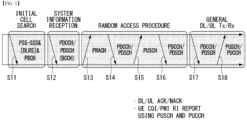
- a UE that is powered on again while being powered off or enters a new cell performs an initial cell search operation, such as synchronizing with a base station, in S11.
- the UE receives a primary synchronization channel (PSCH) and a secondary synchronization channel (SSCH) from the base station to synchronize with the base station and acquires information such as a cell identity (ID), etc.
- the UE may receive a physical broadcast channel (PBCH) from the base station and acquire in-cell broadcast information.
- PBCH physical broadcast channel
- the UE may receive a downlink reference signal (DL RS) in an initial cell search step to check a downlink channel state.
- DL RS downlink reference signal
- the UE that completes the initial cell search may receive a physical downlink control channel (PDCCH) and a physical downlink shared channel (PDSCH) corresponding to the PDCCH to acquire more detailed system information, in S12.
- a physical downlink control channel (PDCCH)
- a physical downlink shared channel (PDSCH)
- the UE may perform a random access procedure in order to complete an access to the base station, in S13 to S16. Specifically, the UE may transmit a preamble on a physical random access channel (PRACH) in S13, and receive a random access response (RAR) for the preamble on the PDCCH and the PDSCH corresponding to the PDCCH in S14. Thereafter, the UE may transmit a physical uplink shared channel (PUSCH) using scheduling information within the RAR in S15, and perform a contention resolution procedure such as the PDCCH and the PDSCH corresponding to the PDCCH in S16.
- PRACH physical random access channel
- RAR random access response
- PUSCH physical uplink shared channel
- the UCI is generally transmitted on the PUCCH, but if control information and data need to be transmitted at the same time, the UCI may be transmitted on the PUSCH.
- the UE may aperiodically transmit the UCI on the PUSCH based on a request/indication of the network.
- Orthogonal Frequency Division Multiplexing Numerology
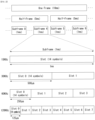
- FIG. 2 illustrates an example of a structure of a radio frame used in a system applicable to the present disclosure.
- uplink and downlink transmission consists of frames.
- a radio frame has a length of 10 ms and is defined as two 5 ms half-frames (HFs).
- the half-frame is defined as five 1 ms subframes (SFs).
- the subframe is split into one or more slots, and the number of slots in the subframe depends on a subcarrier spacing (SCS).
- SCS subcarrier spacing
- Each slot includes 12 or 14 OFDM(A) symbols depending on a cyclic prefix (CP). When a normal CP is used, each slot includes 14 symbols. When an extended CP is used, each slot includes 12 symbols.
- the symbol may include an OFDM symbol (or CP-OFDM symbol) and an SC-FDMA symbol (or DFT-s-OFDM symbol).
- Table 1 shows that when the normal CP is used, the number of symbols per slot, the number of slots per frame, and the number of slots per subframe vary depending on the SCS.
- N slot symb is the number of symbols in the slot.
- N frame,u slot is the number of slots in the frame.
- N subframe,u slot is the number of slots in the subframe.
- the NR supports multiple numerologies (or subcarrier spacing (SCS)) for supporting various 5G services. For example, when the SCS is 15 kHz, a wide area in traditional cellular bands is supported, when the SCS is 30 kHz/60 kHz, dense-urban, lower latency, and wider carrier bandwidth are supported, and when the SCS is 60 kHz or more, a bandwidth larger than 24.25 GHz is supported to overcome phase noise.
- SCS subcarrier spacing
- An NR frequency band may be defined as two types of frequency ranges (FR1 and FR2). Values of the frequency ranges may be changed, and, for example, the two types of frequency ranges (FR1 and FR2) may be as shown in Table 3 below.
- FR1 may denote “sub 6GHz range”
- FR2 may denote “above 6GHz range” and may be referred to as millimeter wave (mmW).
- mmW millimeter wave
- FR1 may include a frequency band from 410 MHz to 7125 MHz, as shown in Table 4 below. That is, FR1 may include a frequency band of 6 GHz (or 5850, 5900, 5925 MHz, etc.) or higher. For example, the frequency band of 6 GHz (or 5850, 5900, 5925 MHz, etc.) or higher included in FR1 mat include an unlicensed band. The unlicensed band may be used for diverse purposes, for example, used for communication for vehicles (e.g., self-driving). [Table 4] Frequency Range Designation Corresponding Frequency Range Subcarrier Spacing FR1 410MHz - 7125MHz 15, 30, 60kHz FR2 24250MHz - 52600MHz 60, 120, 240kHz
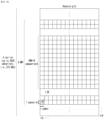
- FIG. 3 illustrates an example of a slot structure used in a system applicable to the present disclosure.
- a slot includes a plurality of symbols in a time domain. For example, one slot includes 7 symbols in a normal CP, while one slot includes 6 symbols in an extended CP.
- a carrier includes a plurality of subcarriers in a frequency domain.
- a resource block (RB) is defined as a plurality of (e.g., 12) consecutive subcarriers in the frequency domain.
- a bandwidth part (BWP) is defined as a plurality of consecutive (P)RBs in the frequency domain and may correspond to one numerology (e.g., SCS, CP length, etc.).
- the carrier may include up to N (e.g., 5) BWPs.
- the data communication may be performed through an activated BWP, and only one BWP may be activated in one UE.
- each element is referred to as a resource element (RE), and one complex symbol may be mapped to each RE.
- RE resource element
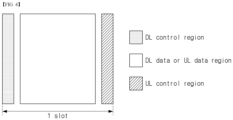
- FIG. 4 illustrates an example of a slot structure of a radio frame used in a system applicable to the present disclosure.
- FIG. 4 illustrates a slot structure of a frame of the NR system as an exemplary system.
- a frame structure of NR is characterized by a self-contained structure in which all of DL control channel, DL or UL data, UL control channel, etc. can be included in one slot.
- DL data scheduling information, UL data scheduling information, etc. may be transmitted on the DL control channel
- ACK/NACK information for DL data, CSI information (modulation and coding scheme information, MIMO transmission related information, etc.), scheduling request, etc. may be transmitted on the UL control channel.
- CSI information modulation and coding scheme information, MIMO transmission related information, etc.
- scheduling request, etc. may be transmitted on the UL control channel.
- a time gap for DL-to-UL or UL-to-DL switching may exist between a control region and a data region.
- a part of the DL control channel/DL data/UL data/UL control channel may not be configured within one slot.
- order of the channels constituting one slot may vary. (e.g., DL control/DL data/UL control/UL data or UL control/UL data/DL control/DL data, etc.)
- the base station indicates which waveform to be used among CP-OFDM and DFT-s-OFDM via RRC signaling (e.g., SIB1, UE specific RRC signaling, etc.).
- RRC signaling e.g., SIB1, UE specific RRC signaling, etc.
- waveforms of other UL channels e.g., normal PUSCH, configured PUSCH, etc.
- a PUSCH are defined to use DFT-s-OFDM if "transformPrecoder" is set to enable, and to use CP-OFDM if it is set to disable.
- the parameter "transformPrecoder” is not indicated separately, it is defined to follow the configuration of "msg3-transformPrecoder”.
- the expression that the base station configures/indicates the UL waveform to CP-OFDM means that values of "msg3-transformPrecoder” and/or “msgA-TransformPrecoder” and/or “transformPrecoder”, which are parameters transmitted via RRC signaling (e.g., SIB1, UE specific RRC signaling, etc.), have been set to disable, and also means that the "transformPrecoder" value, which can be newly defined in DCI format 0_0, 0_1, 0_2, etc. (or can be used by reinterpreting an existing field by the UE), has been set to disable.
- RRC signaling e.g., SIB1, UE specific RRC signaling, etc.
- a tone reservation method may be introduced to reduce maximum power reduction (MPR)/peak-to-average power ratio (PAR).
- MPR maximum power reduction
- PAR peak-to-average power ratio
- the present disclosure proposes UE/base station configuration methods that can be newly considered based on the tone reservation method.
- a UE may be configured to transmit UL signal/channel, such as PUSCH (and/or PUCCH), by filling data in tones other than reserved tones.
- PUSCH and/or PUCCH
- the base station needs to configure/indicate through PUSCH scheduling that the PUSCH to be transmitted using the DFT-s-OFDM occupies the number of PRBs that are multiples of 2 and/or 3 and/or 5, and therefore the number of PRBs to be configured/indicated for tone reservation needs to match this.
- the UE transmits PUSCH data using the DFT-s-OFDM in a region other than a tone reservation region configured/indicated by the base station, the number of consecutive PRBs allocated for data transmission needs to be multiples of 2 and/or 3 and/or 5, and the PRBs corresponding to a remaining region may be used as PRBs for tone reservation.
- an UL waveform configured/indicated by the base station is the DFT-s-OFDM
- the UE may be configured to sequentially select PRBs as many as the number of PRBs corresponding to the multiples of 2 and/or 3 and/or 5 that are less than or equal to the region for allocated data transmission, starting from the lowest PRB and perform the PUSCH transmission using the PRBs.
- the UE may determine that a corresponding UL grant is not a valid scheduling and may not perform PUSCH transmission, or the UE may not perform the PUSCH transmission scheduled with the corresponding UL grant and may request the base station to transmit a new UL grant through a scheduling request (SR).
- SR scheduling request
- a DMRS symbol to be transmitted together with a PUSCH symbol using the DFT-s-OFDM is transmitted using a computer generated sequence (CGS) or a Zadoff-Chu (ZC) sequence, and therefore a length of a DMRS sequence does not need to be the multiples of 2 and/or 3 and/or 5.
- CGS computer generated sequence
- ZC Zadoff-Chu
- the UE may be configured to determine the number of PRBs to transmit PUSCH data excluding the corresponding region and generate the length of the DMRS sequence based on the number of PRBs to transmit the PUSCH data. For example, if the ZC sequence is used as the DMRS sequence, when the number of REs occupied by the number of PRBs allocated to transmit the PUSCH data excluding the region for tone reservation is N, the UE may be configured to generate the ZC sequence that uses a prime number less than or equal to N as a base sequence index, and fill the sufficient number of samples through a cyclic shift until the sequence length is N.
- the UE may determine the length of the DMRS sequence without following the tone reservation configured/indicated by the base station (i.e., including the PRBs for tone reservation). That is, the PUSCH symbol using the DFT-s-OFDM may transmit data in a PRB region excluding the PRBs for tone reservation, but the DMRS symbol may generate and transmit the DMRS sequence of an appropriate length, including the PRBs for tone reservation. In this case, the UE may select a prime number and generate the sequences using the cyclic shift in the same manner as mentioned above.
- a value of N may be pre-configured/pre-defined by the base station via higher layer signaling (e.g., SIB, etc.), or pre-configured/pre-indicated to have a specific relationship based on an active UL BWP size.
- the value of N may be configured/indicated as 1/2 and/or 1/3 and/or 1/4, etc. of the number of PRBs constructing an active UL BWP.
- the proposed method can be configured/applied to other UL signals/channels such as MSG3 PUSCH, MSGA preamble/PUSCH and/or PUSCH/PUCCH.
- examples of the proposed method described above can also be included as one of the implementation methods of the present disclosure, it is obvious that they can be considered as a kind of proposed methods.
- the proposed methods described above can be implemented independently, but can also be implemented in the form of a combination (or merge) of some proposed methods.
- Information on whether the proposed methods are applied can be defined as a rule so that the base station notifies the UE of the information via a predefined signal (e.g., a physical layer signal or a higher layer signal).
- the higher layer may include one or more of functional layers such as MAC, RLC, PDCP, RRC, and SDAP.
- Methods, embodiments or descriptions for implementing the methods proposed in the present disclosure can be individually applied or applied in combinations of one or more methods (or embodiments or descriptions).
- FIG. 5 illustrates an example of an operation process of a UE in a system applicable to the present disclosure.
- a UE receives, from a base station (BS), an indication for an uplink waveform of Discrete Fourier Transform-spread-Orthogonal Frequency Division Multiplexing (DFT-s-OFDM).
- DFT-s-OFDM Discrete Fourier Transform-spread-Orthogonal Frequency Division Multiplexing
- step S520 the UE determines a demodulation reference signal (DMRS) sequence for DMRS symbol transmission among a computer generated sequence (CGS) and a Zadoff-Chu (ZC) sequence.
- DMRS demodulation reference signal
- step S550 the UE transmits a physical uplink shared channel (PUSCH) based on the DFT-s-OFDM using the second PRBs.
- PUSCH physical uplink shared channel
- the length of the DMRS sequence may be adjusted using a cyclic shift for the base sequence so that the length of the DMRS sequence is equal to the number of REs for all the allocated PRBs.
- the CGS and the ZC sequence may be sequences with a low peak-to-average power ratio (PAPR) among selectable sequences.
- PAPR peak-to-average power ratio
- the DMRS sequence may be related to all the PRBs.
- the PUSCH may be related to the second PRBs.
- the length of the DMRS sequence may be determined regardless of multiples of 2, 3, and 5.
- a user equipment in a wireless communication system.
- the UE may include a transceiver and at least one processor, and the at least one processor may be configured to perform the operation method of the UE based on FIG. 5 .
- a device controlling a user equipment (UE) in a wireless communication system may include at least one processor and at least one memory operably connected to the at least one processor.
- the at least one memory may be configured to store instructions performing the operation method of the UE based on FIG. 5 based on being executed by the at least one processor.
- one or more non-transitory computer readable mediums storing one or more instructions.
- the one or more instructions may be configured to perform operations based on being executed by one or more processors, and the operations may include the operation method of the UE based on FIG. 5 .
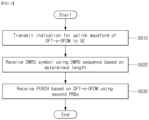
- FIG. 6 illustrates an example of an operation process of a base station in a system applicable to the present disclosure.
- a base station transmits, to a user equipment (UE), an indication for an uplink waveform of Discrete Fourier Transform-spread-Orthogonal Frequency Division Multiplexing (DFT-s-OFDM).
- DFT-s-OFDM Discrete Fourier Transform-spread-Orthogonal Frequency Division Multiplexing
- a demodulation reference signal (DMRS) sequence may be determined from among a computer generated sequence (CGS) and a Zadoff-Chu (ZC) sequence.
- a length of the DMRS sequence may be determined based on a number of all allocated physical resource blocks (PRBs) including first PRBs for tone reservation and second PRBs not for the tone reservation.
- PRBs physical resource blocks
- step S620 the base station receives a DMRS symbol using the DMRS sequence based on the determined length.
- step S630 the base station receives a physical uplink shared channel (PUSCH) based on the DFT-s-OFDM using the second PRBs.
- PUSCH physical uplink shared channel
- an embodiment of FIG. 6 may further include transmitting, to the UE, an indication message for a number of the first PRBs for the tone reservation and a location of the first PRBs.
- the DMRS sequence may be based on a base sequence that uses a largest prime number less than or equal to N as a base sequence index.
- the N may be a number of resource elements (REs) occupied by all the allocated PRBs.
Landscapes
- Engineering & Computer Science (AREA)
- Signal Processing (AREA)
- Computer Networks & Wireless Communication (AREA)
- Physics & Mathematics (AREA)
- Discrete Mathematics (AREA)
- General Physics & Mathematics (AREA)
- Mathematical Physics (AREA)
- Power Engineering (AREA)
- Mobile Radio Communication Systems (AREA)
Applications Claiming Priority (2)
| Application Number | Priority Date | Filing Date | Title |
|---|---|---|---|
| KR20220124735 | 2022-09-29 | ||
| PCT/KR2023/013957 WO2024071775A1 (fr) | 2022-09-29 | 2023-09-15 | Appareil et procédé pour améliorer la couverture dans un système de communication sans fil |
Publications (1)
| Publication Number | Publication Date |
|---|---|
| EP4583476A1 true EP4583476A1 (fr) | 2025-07-09 |
Family
ID=90478483
Family Applications (1)
| Application Number | Title | Priority Date | Filing Date |
|---|---|---|---|
| EP23872893.5A Pending EP4583476A1 (fr) | 2022-09-29 | 2023-09-15 | Appareil et procédé pour améliorer la couverture dans un système de communication sans fil |
Country Status (4)
| Country | Link |
|---|---|
| US (1) | US20260113227A1 (fr) |
| EP (1) | EP4583476A1 (fr) |
| KR (1) | KR20250081843A (fr) |
| WO (1) | WO2024071775A1 (fr) |
Family Cites Families (2)
| Publication number | Priority date | Publication date | Assignee | Title |
|---|---|---|---|---|
| JP6930713B2 (ja) * | 2016-06-08 | 2021-09-01 | ホアウェイ・テクノロジーズ・カンパニー・リミテッド | 参照信号伝送方法、並びに関連するデバイスおよびシステム |
| CN111327409B (zh) * | 2018-12-14 | 2021-08-03 | 大唐移动通信设备有限公司 | 一种数据传输方法及装置 |
-
2023
- 2023-09-15 WO PCT/KR2023/013957 patent/WO2024071775A1/fr not_active Ceased
- 2023-09-15 KR KR1020257000568A patent/KR20250081843A/ko active Pending
- 2023-09-15 EP EP23872893.5A patent/EP4583476A1/fr active Pending
- 2023-09-15 US US19/116,266 patent/US20260113227A1/en active Pending
Also Published As
| Publication number | Publication date |
|---|---|
| KR20250081843A (ko) | 2025-06-05 |
| US20260113227A1 (en) | 2026-04-23 |
| WO2024071775A1 (fr) | 2024-04-04 |
Similar Documents
| Publication | Publication Date | Title |
|---|---|---|
| US11497026B2 (en) | Channel reception or transmission in a coreset based on an RSRP threshold | |
| US11089626B2 (en) | Listen before talk and channel access priority class for PUCCH in new radio unlicensed | |
| CN111869294B (zh) | 终端装置、基站装置以及通信方法 | |
| US20190230499A1 (en) | Methods and Apparatus for Indicating and Implementing of New UE Category | |
| US12289740B2 (en) | Method for transmitting/receiving channel by using guard band in one carrier in wireless communication system, and device therefor | |
| US20210045133A1 (en) | Method and nb wireless device for determining whether or not to transmit sr | |
| EP4195831A1 (fr) | Dispositif terminal et procédé de communication | |
| JP2023078485A (ja) | 端末装置、および、通信方法 | |
| EP3855790A1 (fr) | Dispositif terminal, dispositif de station de base et procédé | |
| CN113424624A (zh) | 基站装置、终端装置以及通信方法 | |
| US11856612B2 (en) | Method and apparatus for performing random access in wireless communication system | |
| US20240236996A1 (en) | Terminal apparatus, base station apparatus, and communication method | |
| US20230068855A1 (en) | Terminal apparatus, base station apparatus, and communication method | |
| JP7427388B2 (ja) | 端末装置、および、方法 | |
| JP7492844B2 (ja) | 端末装置、基地局装置、及び方法 | |
| JP7479889B2 (ja) | 端末装置、基地局装置、および、通信方法 | |
| US20220150979A1 (en) | Channel access method for performing transmission in unlicensed band, and apparatus using same | |
| US20260025820A1 (en) | Method and device for uplink transmission and reception in wireless communication system | |
| EP4583476A1 (fr) | Appareil et procédé pour améliorer la couverture dans un système de communication sans fil | |
| JP7638950B2 (ja) | 端末装置、および、方法 | |
| WO2024019175A1 (fr) | Équipements d'utilisateur et procédés | |
| JP7644016B2 (ja) | 端末装置、および、方法 | |
| EP4694392A1 (fr) | Appareil et procédé pour régler la puissance de transmission répétée de prach dans un système de communication sans fil | |
| EP4598224A1 (fr) | Dispositif et procédé de commutation de forme d'onde dynamique dans un système de communication sans fil | |
| EP4665052A1 (fr) | Dispositif et procédé de configuration d'une ressource permettant une transmission répétitive d'un pucch dans un système de communication sans fil |
Legal Events
| Date | Code | Title | Description |
|---|---|---|---|
| STAA | Information on the status of an ep patent application or granted ep patent |
Free format text: STATUS: THE INTERNATIONAL PUBLICATION HAS BEEN MADE |
|
| PUAI | Public reference made under article 153(3) epc to a published international application that has entered the european phase |
Free format text: ORIGINAL CODE: 0009012 |
|
| STAA | Information on the status of an ep patent application or granted ep patent |
Free format text: STATUS: REQUEST FOR EXAMINATION WAS MADE |
|
| 17P | Request for examination filed |
Effective date: 20250404 |
|
| AK | Designated contracting states |
Kind code of ref document: A1 Designated state(s): AL AT BE BG CH CY CZ DE DK EE ES FI FR GB GR HR HU IE IS IT LI LT LU LV MC ME MK MT NL NO PL PT RO RS SE SI SK SM TR |
|
| DAV | Request for validation of the european patent (deleted) | ||
| DAX | Request for extension of the european patent (deleted) |