EP4583520A2 - Systeme und verfahren zur bereitstellung von medieninhalt für kontinuierliche überwachung - Google Patents
Systeme und verfahren zur bereitstellung von medieninhalt für kontinuierliche überwachung Download PDFInfo
- Publication number
- EP4583520A2 EP4583520A2 EP25157538.7A EP25157538A EP4583520A2 EP 4583520 A2 EP4583520 A2 EP 4583520A2 EP 25157538 A EP25157538 A EP 25157538A EP 4583520 A2 EP4583520 A2 EP 4583520A2
- Authority
- EP
- European Patent Office
- Prior art keywords
- episode
- series
- display
- control circuitry
- credits
- Prior art date
- Legal status (The legal status is an assumption and is not a legal conclusion. Google has not performed a legal analysis and makes no representation as to the accuracy of the status listed.)
- Pending
Links
Images




Classifications
-
- H—ELECTRICITY
- H04—ELECTRIC COMMUNICATION TECHNIQUE
- H04N—PICTORIAL COMMUNICATION, e.g. TELEVISION
- H04N21/00—Selective content distribution, e.g. interactive television or video on demand [VOD]
- H04N21/40—Client devices specifically adapted for the reception of or interaction with content, e.g. set-top-box [STB]; Operations thereof
- H04N21/43—Processing of content or additional data, e.g. demultiplexing additional data from a digital video stream; Elementary client operations, e.g. monitoring of home network or synchronising decoder's clock; Client middleware
- H04N21/44—Processing of video elementary streams, e.g. splicing a video clip retrieved from local storage with an incoming video stream or rendering scenes according to encoded video stream scene graphs
- H04N21/4402—Processing of video elementary streams, e.g. splicing a video clip retrieved from local storage with an incoming video stream or rendering scenes according to encoded video stream scene graphs involving reformatting operations of video signals for household redistribution, storage or real-time display
- H04N21/440281—Processing of video elementary streams, e.g. splicing a video clip retrieved from local storage with an incoming video stream or rendering scenes according to encoded video stream scene graphs involving reformatting operations of video signals for household redistribution, storage or real-time display by altering the temporal resolution, e.g. by frame skipping
-
- H—ELECTRICITY
- H04—ELECTRIC COMMUNICATION TECHNIQUE
- H04N—PICTORIAL COMMUNICATION, e.g. TELEVISION
- H04N21/00—Selective content distribution, e.g. interactive television or video on demand [VOD]
- H04N21/40—Client devices specifically adapted for the reception of or interaction with content, e.g. set-top-box [STB]; Operations thereof
- H04N21/47—End-user applications
- H04N21/472—End-user interface for requesting content, additional data or services; End-user interface for interacting with content, e.g. for content reservation or setting reminders, for requesting event notification, for manipulating displayed content
- H04N21/47217—End-user interface for requesting content, additional data or services; End-user interface for interacting with content, e.g. for content reservation or setting reminders, for requesting event notification, for manipulating displayed content for controlling playback functions for recorded or on-demand content, e.g. using progress bars, mode or play-point indicators or bookmarks
-
- H—ELECTRICITY
- H04—ELECTRIC COMMUNICATION TECHNIQUE
- H04N—PICTORIAL COMMUNICATION, e.g. TELEVISION
- H04N21/00—Selective content distribution, e.g. interactive television or video on demand [VOD]
- H04N21/80—Generation or processing of content or additional data by content creator independently of the distribution process; Content per se
- H04N21/83—Generation or processing of protective or descriptive data associated with content; Content structuring
- H04N21/845—Structuring of content, e.g. decomposing content into time segments
Definitions
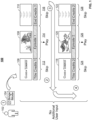
- FIG. 1 depicts an illustrative scenario for a media delivery application providing media content in a continuous watching mode.
- a continuous watching mode may refer to any mode of delivering media content (e.g., TV shows, movies, music, audio books, etc.) such that consecutive media content items (e.g., episodes of a TV show or tracks of an album) are delivered one after another without additional requests for content.
- continuous watching mode may refer a remote server streaming TV show episodes to a user device (e.g., over the Internet) one after another.
- continuous watching mode is synonymous with the term “binge mode” and both of these terms may be used interchangeably throughout the specification and the figures.
- Episode 1 may include title credits 106, content portion 108, and end credits 110.
- Title credits typically include information about the show and may include an opening sequence that is common to all episodes of the show.
- End credits can include cast information about actors who performed in the episode. Commonly, end credits are the same or very similar for all episodes of the same show.
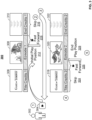
- FIG. 2 depicts a user rewinding through two episodes of the same show (e.g., through Episodes 1 and 2 of "Game of Thrones").
- Episode 1 may include title credits 206, content portion 208, and end credits 210.
- Episode 2 may include title credits 218, content portion 220, and end credits 222.
- user 202 requests rewind (e.g., by using user interface 204) when the media delivery application is playing back Episode 2 from initial play position 228.
- Initial play position 228 may be in the middle of content portion 220.
- the media delivery application When the rewind operation reaches title credits 218 portion of Episode 2, the media delivery application skips 224 title credits 218. At this point, the media delivery application smoothly continues to rewind through Episode 1 of the show. For example, the media delivery application may skip 216 end credits 210 and smoothly begin to rewind 216 content portions 208 of Episode 1.
- the user may request an end of rewind operation when the rewind operation reaches position 212.
- the media delivery application may then begin to play Episode 1 from position 212.
- the rewinding is performed as if portion 208 and portion 220 were one media content item.
- End credits and title credits are identified as described with respect to FIG. 1 .
- the media delivery application may refrain from generation for display of the identified frames during the rewind operation. For example, when the first frame of the portion 220 is shown in the rewind mode, the media delivery application may immediately show the last frame of portion 208. In some embodiments, the media delivery application may begin buffering frames of Episode 1 while Episode 2 is still being rewound to ensure a smooth transition.
- the media delivery application may buffer enough frames of portion 208 of Episode 1 to ensure a smooth transition to rewinding Episode 1, while sections 218 and 210 are skipped.
- the media delivery application may perform all of steps 226, 224, 216, and 214 without receiving any input from the user related to skipping through content (other than the initial rewind command). This allows the media delivery application to achieve the best bandwidth utilization (by automatically skipping needless portions of the episodes) while improving the user experience by not burdening the user with the need to provide more input or to request different episodes.
- FIG. 3 depicts user 302 (e.g., the same user as user 102 of FIG. 1 ) requesting a fast-forward operation using any kind of user interface 304 (e.g., using user interface depicted in FIG. 5 , below).
- User interface 304 may, for example, include a button labeled "Fast-forward.”
- user 302 continues to hold the fast-forward button to fast-forward media content.
- the media delivery application may perform a fast-forward operation until another input is received.
- FIG. 3 depicts a user rewinding through two episodes of the same show (e.g., through Episodes 1 and 2 of "Game of Thrones").
- Episode 1 may include title credits 306, content portion, 308, and end credits 310.
- Episode 2 may include title credits 318, content portion 320, and end credits 322.
- user 302 requests fast-forward (e.g., by using user interface 304) when the media delivery application is playing back Episode 1 from initial play position 312.
- Initial play position 312 may be in the middle of content portion 308.
- end credits and title credits are identified as described with respect to FIG. 1 .
- the media delivery application may refrain from generation for display the identified frames during the fast-forward operation. For example, when the last frame of the portion 308 is shown in the fast-forward mode, the media delivery application may immediately show the first frame of portion 320. In some embodiments, the media delivery application may begin buffering frames of Episode 2 while Episode 1 is still being fast-forwarded to ensure a smooth transition.
- the media delivery application may perform all of steps 314, 316, 324, and 326 without receiving any input from the user related to skipping through content (other than the initial fast-forward command). This allows the media delivery application to achieve the best bandwidth utilization (by automatically skipping needless portions of the episodes) while improving the user experience by not burdening the user with the need to provide more input or to separately request more episodes.
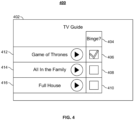
- display 400 depicts a list of several shows 412, 414, and 416 (each one containing multiple episodes). Each listing may include a user interface element (e.g., a play button) that is used to request playing of that show. For example, the user may request playback of show "Game of Thrones” by pressing a play button next to the text "Game of Thrones.”
- display 400 may depict binge mode selection interface 404.
- the binge mode selection interface may include checkboxes 406, 408, and 410 for each of the listed shows 412, 414, and 416. If the user checks the box 406, the media delivery application may always play the associated show (e.g., "Game of Thrones") in binge mode from that point on. For example, if the user clicks the play button next to listing 412, the media delivery application may begin playing episodes of the Game of Thrones show in a continuous watching mode as described in relation to FIG. 1 .
- the binge mode selection interface may include checkboxes 406, 408, and 410 for each of the listed shows 4
- the media delivery application may also provide user interface that includes a progress bar (that may include segments 504, 506, and 508).
- the media delivery application may display progress indicator 518 which shows the current play position.
- progress indicator 518 may be in the middle of segment 506 while the scene 502 is generated for display.
- media content source 704 and media guidance data source 706 may be integrated as one device.
- Media content source 704 may include one or more types of content distribution equipment including a television distribution facility, cable system headend, satellite distribution facility, programming sources (e.g., television broadcasters, such as NBC, ABC, HBO, etc.), intermediate distribution facilities and/or servers, Internet providers, on-demand media servers, and other content providers.
- programming sources e.g., television broadcasters, such as NBC, ABC, HBO, etc.
- intermediate distribution facilities and/or servers e.g., Internet providers, on-demand media servers, and other content providers.
- NBC is a trademark owned by the National Broadcasting Company, Inc.
- ABC is a trademark owned by the American Broadcasting Company, Inc.
- HBO is a trademark owned by the Home Box Office, Inc.
- Media content source 704 may be the originator of content (e.g., a television broadcaster, a Webcast provider, etc.) or may not be the originator of content (e.g., an on-demand content provider, an Internet provider of content of broadcast programs for downloading, etc.).
- Media content source 704 may include cable sources, satellite providers, on-demand providers, Internet providers, over-the-top content providers, or other providers of content.
- Media content source 704 may also include a remote media server used to store different types of content (e.g., including video content selected by a user) in a location remote from computing device 710.
- OTT content providers may also include any other OTT content provider.
- OTT content providers may additionally or alternatively provide media guidance data described above.
- providers of OTT content can distribute applications (e.g., web-based applications or cloud-based applications), or the content can be displayed by applications stored on computing device 710.
- Control circuitry 802 and/or 810 may be based on any suitable processing circuitry such as processing circuitry 806 and/or 814.
- processing circuitry should be understood to mean circuitry based on one or more microprocessors, microcontrollers, digital signal processors, programmable logic devices, field-programmable gate arrays (FPGAs), application-specific integrated circuits (ASICs), etc., and may include a multi-core processor (e.g., dual-core, quad-core, hexa-core, or any suitable number of cores).
- the phrase “electronic storage device” or “storage device” should be understood to mean any device for storing electronic data, computer software, or firmware, such as random-access memory, read-only memory, hard drives, optical drives, digital video disc (DVD) recorders, compact disc (CD) recorders, BLU-RAY disc (BD) recorders, BLU-RAY 3D disc recorders, digital video recorders (DVRs, sometimes called a personal video recorders, or PVRs), solid state devices, quantum storage devices, gaming consoles, gaming media, or any other suitable fixed or removable storage devices, and/or any combination of the same.
- DVD digital video disc
- CD compact disc
- DVRs digital video recorders
- PVRs personal video recorders, or PVRs
- solid state devices quantum storage devices
- gaming consoles gaming media
- gaming media or any other suitable fixed or removable storage devices, and/or any combination of the same.
- any action performed by control circuitry 802 and/or 810 may be based on instructions received from the media delivery application.
- the media delivery application may be implemented as software or a set of executable instructions that may be stored in storage 804 and/or 812 and executed by control circuitry 802 and/or 810.
- the media delivery application may be a client/server media delivery application where only a client media delivery application resides on computing device 860, and a server media delivery application resides on server 801.
- the media delivery application may be implemented using any suitable architecture. For example, it may be a stand-alone media delivery application wholly implemented on computing device 860. In such an approach, instructions for the media delivery application are stored locally (e.g., in storage 812), and data for use by the media delivery application is downloaded on a periodic basis (e.g., from an out-of-band feed, from an Internet resource, or using another suitable approach). Control circuitry 814 may retrieve instructions for the media delivery application from storage 812 and process the instructions to perform the functionality described herein. Based on the processed instructions, control circuitry 814 may determine what action to perform when input is received from user input interface 822.
- instructions for the media delivery application are stored locally (e.g., in storage 812), and data for use by the media delivery application is downloaded on a periodic basis (e.g., from an out-of-band feed, from an Internet resource, or using another suitable approach).
- Control circuitry 814 may retrieve instructions for the media delivery application from storage 812 and process the instructions to perform the functionality described herein
- control circuitry 810 may include communication circuitry suitable for communicating with a media delivery application server (e.g., server 801) or other networks or servers.
- the instructions for carrying out the functionality described herein may be stored on the application server.
- Communication circuitry may include a cable modem, an integrated services digital network (ISDN) modem, a digital subscriber line (DSL) modem, a telephone modem, an Ethernet card, a wireless modem for communication with other equipment, or any other suitable communication circuitry.
- ISDN integrated services digital network
- DSL digital subscriber line
- Such communication may involve the Internet or any other suitable communication networks or paths (e.g., communication network 858).
- communication network 858 may be the same as network 708.
- control circuitry 810 runs a web browser that interprets web pages provided by a remote server (e.g., server 801).
- the remote server may store the instructions for the application in a storage device.
- the remote server may process the stored instructions using circuitry (e.g., control circuitry 802) and generate the displays discussed above and below.
- Computing device 860 may receive the displays generated by the remote server and may display the content of the displays locally via display 820. This way, the processing of the instructions is performed remotely (e.g., by server 801) while the resulting displays, such as the display windows described elsewhere herein, are provided locally on computing device 860.
- Computing device 860 may receive inputs from the user via input interface 822 and transmit those inputs to the remote server for processing and generating the corresponding displays.
- a user may send instructions to control circuitry 802 and/or 810 using user input interface 822.
- User input interface 822 may be any suitable user interface, such as a remote control, trackball, keypad, keyboard, touchscreen, touchpad, stylus input, joystick, voice recognition interface, or other user input interfaces.
- User input interface 822 may be integrated with or combined with display 820, which may be a monitor, television, liquid crystal display (LCD), electronic ink display, or any other equipment suitable for displaying visual images.
- display 820 which may be a monitor, television, liquid crystal display (LCD), electronic ink display, or any other equipment suitable for displaying visual images.
- control circuitry 860 may begin generating for display a first episode of the series (e.g., Episode 1 of "Game of Thrones").
- the episode may be derived from media content source 854 (e.g., as on-demand show) or from server 801 (e.g., as OTT show delivered via network 858).
- the control circuitry 860 may generate the first episode on display 820.
- control circuitry 860 may automatically begin generating for display a second episode of the series (e.g., Episode 2 of "Game of Thrones"). For example, control circuitry 860 may request playback of the second episode of the series from media content source 854 or from server 801 without a user input requesting playback of Episode 2.
- control circuitry 860 may check whether binge mode is enabled. For example, the check may be performed in the same way as it was performed in step 908. If binge mode is enabled, process 900 proceeds to step 916. Otherwise, process 900 proceeds to step 918.
- control circuitry 860 may begin to generate for display the content portion of the second episode. For example, control circuitry 860 may generate for display frames of the second episode (e.g., stating from the first frame of the second episode) immediately after the last frame of the first episode is generated. In some embodiments, control circuitry 860 may begin buffering frames of the content portion of the second episode as the playing of the first episode is nearing the conclusion. For example, one minute before the end of Episode 1, control circuitry 860 may begin buffering (e.g., using buffer of storage 812) frames of Episode 2, by requesting such frames from one of server 801 or media content source 854.
- buffering e.g., using buffer of storage 812
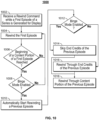
- FIG. 10 depicts an illustrative flowchart of process 1000 for providing rewind functionality in continuous watching mode that may be implemented by using systems 700 and 800 in accordance with some embodiments of the disclosure.
- individual steps of process 1000 may be implemented by one or more components of systems 700 and 800.
- steps of process 1000 may be executed by server 801 and/or by computing device 860 to provide a continuous watching mode.
- control circuitry 860 may receive a command to rewind content while the first episode of a series is being displayed.
- the command may be received via user interface input 822 (e.g., as depicted by FIG. 4 ).
- control circuitry 860 may receive a selection of a rewind request while Episode 2 of "Game of Thrones” is being shown.
- "Game of Thrones” may include multiple consecutive episodes (e.g., Episode 1, Episode 2, Episode 3, etc.).
- control circuitry 860 may begin rewinding the first episode of the series (e.g., Episode 2 of "Game of Thrones").
- the episode may be being received from media content source 854 (e.g., as on-demand show) or from server 801 (e.g., as OTT show delivered via network 858).
- the control circuitry 860 may rewind the episode by generating frames of the first episode on display 820 in reverse order at increased rate and/or with some frames being skipped.
- control circuitry 860 may check if the first episode (e.g., Episode 2) has been rewound to the beginning. For example, control circuitry 860 may check if the first frame of the content portion of Episode 2 was shown. If not, control circuitry 860 may proceed back to step 1004. If so, control circuitry 860 may proceed to step 1008. At 1008, control circuitry 860 may check whether binge mode is enabled. For example, control circuitry 860 may determine whether checkbox 510 of the user interface depicted in FIG. 5 is checked. If not, control circuitry 860 may proceed back to step 1004 and continue rewinding Episode 2. For example, control circuitry 860 may continue rewinding through title credits of Episode 1. If so, control circuitry 860 may proceed to 1010.
- the first episode e.g., Episode 2
- control circuitry 860 may check if the first frame of the content portion of Episode 2 was shown. If not, control circuitry 860 may proceed back to step 1004. If so, control circuitry 860 may proceed to step 1008.
- control circuitry 860 may automatically start rewinding a previous episode (e.g., Episode 1 of "Game of Thrones"). For example, title credits of the first episode may be skipped without any additional input requesting such a skip. Furthermore, control circuitry 860 may begin generating for display the stream of the previous episode without receiving any additional command requesting the previous episode from the user. For example, control circuitry 860 may avoid generating for display any frames determined to belong to end credits of the first episode and begin generating for display frames of the previous episode (starting from the end) in the rewind mode. That is, control circuitry 860 may begin generating for display frames of the previous episode (received from server 801 or from media content source 854) starting from the end, in reverse direction at increased speed and/or with some frames being skipped.
- control circuitry 860 may check whether binge mode is enabled. For example, the check may be performed in the same way as it was performed in step 1008. If binge mode is enabled, process 1000 proceeds to step 1014. Otherwise, process 1000 proceeds to step 1016.
- control circuitry 860 may receive a command to fast-forward content while first episode of a series is being displayed.
- the command may be received via user interface input 822 (e.g., as depicted by FIG. 4 ).
- control circuitry 860 may receive a selection of a fast-forward request while Episode 1 of "Game of Thrones” is being shown.
- "Game of Thrones” may include multiple consecutive episodes (e.g., Episode 1, Episode 2, Episode 3, etc.).
- control circuitry 860 may begin to fast-forward first episode of the series (e.g., Episode 1 of "Game of Thrones").
- the episode may be being received from media content source 854 (e.g., as on-demand show) or from server 801 (e.g., as OTT show delivered via network 858).
- the control circuitry 860 may fast-forward the episode by generating frames of the first episode on display 820 in forward order at increased rate and/or with some frames being skipped.
- control circuitry 860 may check if the first episode (e.g., Episode 1) has been fast-forwarded to the end. For example, control circuitry 860 may check if the last frame of content portion of Episode 1 was shown. If not, control circuitry 860 may proceed back to step 1104. If so, control circuitry 860 may proceed to step 1108. At 1108, control circuitry 860 may check whether binge mode is enabled. For example, control circuitry 860 may determine whether checkbox 510 of the user interface depicted in FIG. 5 is checked. If not, control circuitry 860 may proceed back to step 1104 and continue fast-forwarding Episode 1. For example, control circuitry 860 may continue fast-forwarding through the end credits of Episode 1. If so, control circuitry 860 may proceed to 1110.
- the first episode e.g., Episode 1
- control circuitry 860 may check if the last frame of content portion of Episode 1 was shown. If not, control circuitry 860 may proceed back to step 1104. If so, control circuitry 860 may proceed to step 1108.
- control circuitry 860 may check whether binge mode is enabled. For example, the check may be performed in the same way as it was performed in step 1108. If binge mode is enabled, process 1100 proceeds to step 1114. Otherwise, the process 1000 proceeds to step 1116.
- control circuitry 860 may skip title credits of the next episode. For example, credits may be skipped without any additional input requesting a skip being received from the user. For example, control circuitry 860 may avoid generating for display any frames determined to belong to title credits of the next episode. At 1016, control circuitry 860 may generate the title credits of Episode 2 for display, in fast-forward mode.
- control circuitry 860 may begin to fast-forward the content portion of the next episode. For example, control circuitry 860 may generate for display frames of the of the next episode immediately after the last frame of the first episode is generated. In some embodiments, control circuitry 860 may begin buffering frames of the content portion of the next episode as the fast-forward operation of the first episode is nearing the conclusion. For example, one minute before Episode 2 is fast-forwarded to its end, control circuitry 860 may begin buffering (e.g., using buffer of storage 812) frames of Episode 2, by requesting such frames from one of server 801 or media content source 854.
- buffering e.g., using buffer of storage 812
- FIG. 12 depicts an illustrative flowchart of process 1200 for a process for buffering of episodes of a show that may be implemented by using systems 700 and 800 in accordance with some embodiments of the disclosure.
- individual steps of process 1200 may be implemented by one or more components of systems 700 and 800.
- the present disclosure may describe certain steps of process 1200 (and of other processes described herein) as being implemented by certain components of systems 700 and 800, this is for purposes of illustration only, and it should be understood that other components of systems 700 and 800 may implement those steps instead.
- steps of process 1200 may be executed by server 801 and/or by computing device 860 to provide a continuous watching mode.
- steps of process 1200 may be performed as part of one or more of processes 900, 1000, 1100.
- control circuitry 860 may start buffering an episode other than the one that is currently being played based on the steps provided by process 1200.
- control circuitry 860 may detect that an episode that is currently being played (e.g., as part of step 904) will finish playing before a predetermined time period (e.g., before 1 minute or before 30 seconds).
- the predetermines time period may be static or dynamically calculated (e.g., based on latency of network 856). When such a detection is made, control circuitry 860 may proceed to step 1206.
- control circuitry 860 may detect that an episode that is currently being fast-forwarded (e.g., as part of step 1204) will finish being fast-forwarded before a predetermined time period (e.g., before one minute or before 30 seconds).
- the predetermined time period may be static or dynamically calculated (e.g., based on latency of network 856). When such a detection is made, control circuitry 860 may proceed to step 1206.
- control circuitry 860 may begin buffering frames of an episode that follows an episode that was being generated for display at step 1202 or 1204. For example, control circuitry 860 may begin requesting frames of the next episodes from one of server 801 or media content source 854, and place the frames in the buffer of storage 812. When the next episode is ready to be played or be fast-forwarded through, control circuitry 860 may use the buffer to generate for display the frames of the next episode, while a new connection to server 801 or media content source 854 is being established. The buffer will then be replenished from server 801 or media content source 854 as the next episode is played.
- control circuitry 860 may detect that an episode that is currently being rewound (e.g., as part of step 1004) will finish being rewound before a predetermined time period (e.g., before one minute or before 30 seconds).
- the predetermined time period may be static or dynamically calculated (e.g., based on latency of network 856). When such a detection is made, control circuitry 860 may proceed to step 1210.
Landscapes
- Engineering & Computer Science (AREA)
- Multimedia (AREA)
- Signal Processing (AREA)
- Databases & Information Systems (AREA)
- Human Computer Interaction (AREA)
- Two-Way Televisions, Distribution Of Moving Picture Or The Like (AREA)
- Television Signal Processing For Recording (AREA)
Applications Claiming Priority (4)
| Application Number | Priority Date | Filing Date | Title |
|---|---|---|---|
| US16/296,960 US10917674B2 (en) | 2019-03-08 | 2019-03-08 | Systems and methods for providing media content for continuous watching |
| US16/296,967 US10887652B2 (en) | 2019-03-08 | 2019-03-08 | Systems and methods for providing media content for continuous watching |
| EP20717019.2A EP3794835A1 (de) | 2019-03-08 | 2020-03-06 | Systeme und verfahren zur bereitstellung von medieninhalt für kontinuierliche überwachung |
| PCT/US2020/021537 WO2020185616A1 (en) | 2019-03-08 | 2020-03-06 | Systems and methods for providing media content for continuous watching |
Related Parent Applications (1)
| Application Number | Title | Priority Date | Filing Date |
|---|---|---|---|
| EP20717019.2A Division EP3794835A1 (de) | 2019-03-08 | 2020-03-06 | Systeme und verfahren zur bereitstellung von medieninhalt für kontinuierliche überwachung |
Publications (2)
| Publication Number | Publication Date |
|---|---|
| EP4583520A2 true EP4583520A2 (de) | 2025-07-09 |
| EP4583520A3 EP4583520A3 (de) | 2025-09-24 |
Family
ID=70166154
Family Applications (2)
| Application Number | Title | Priority Date | Filing Date |
|---|---|---|---|
| EP20717019.2A Ceased EP3794835A1 (de) | 2019-03-08 | 2020-03-06 | Systeme und verfahren zur bereitstellung von medieninhalt für kontinuierliche überwachung |
| EP25157538.7A Pending EP4583520A3 (de) | 2019-03-08 | 2020-03-06 | Systeme und verfahren zur bereitstellung von medieninhalt für kontinuierliche überwachung |
Family Applications Before (1)
| Application Number | Title | Priority Date | Filing Date |
|---|---|---|---|
| EP20717019.2A Ceased EP3794835A1 (de) | 2019-03-08 | 2020-03-06 | Systeme und verfahren zur bereitstellung von medieninhalt für kontinuierliche überwachung |
Country Status (3)
| Country | Link |
|---|---|
| EP (2) | EP3794835A1 (de) |
| CA (1) | CA3104700A1 (de) |
| WO (1) | WO2020185616A1 (de) |
Families Citing this family (2)
| Publication number | Priority date | Publication date | Assignee | Title |
|---|---|---|---|---|
| CN113613051B (zh) * | 2021-10-08 | 2021-12-24 | 飞狐信息技术(天津)有限公司 | 无缝续播方法、装置、服务器及计算机存储介质 |
| CN115002553A (zh) * | 2022-04-29 | 2022-09-02 | 当趣网络科技(杭州)有限公司 | 基于同一影视视频边看边聊的方法和系统 |
Citations (1)
| Publication number | Priority date | Publication date | Assignee | Title |
|---|---|---|---|---|
| US7761892B2 (en) | 1998-07-14 | 2010-07-20 | United Video Properties, Inc. | Client server based interactive television program guide system with remote server recording |
Family Cites Families (2)
| Publication number | Priority date | Publication date | Assignee | Title |
|---|---|---|---|---|
| KR100817374B1 (ko) * | 2006-07-24 | 2008-03-27 | 하나로미디어(주) | 그룹화된 복수의 독립된 컨텐츠를 연속 재생하는 시스템 및방법 |
| US9418296B1 (en) * | 2015-03-17 | 2016-08-16 | Netflix, Inc. | Detecting segments of a video program |
-
2020
- 2020-03-06 EP EP20717019.2A patent/EP3794835A1/de not_active Ceased
- 2020-03-06 EP EP25157538.7A patent/EP4583520A3/de active Pending
- 2020-03-06 CA CA3104700A patent/CA3104700A1/en active Pending
- 2020-03-06 WO PCT/US2020/021537 patent/WO2020185616A1/en not_active Ceased
Patent Citations (1)
| Publication number | Priority date | Publication date | Assignee | Title |
|---|---|---|---|---|
| US7761892B2 (en) | 1998-07-14 | 2010-07-20 | United Video Properties, Inc. | Client server based interactive television program guide system with remote server recording |
Also Published As
| Publication number | Publication date |
|---|---|
| EP3794835A1 (de) | 2021-03-24 |
| EP4583520A3 (de) | 2025-09-24 |
| CA3104700A1 (en) | 2020-09-17 |
| WO2020185616A1 (en) | 2020-09-17 |
Similar Documents
| Publication | Publication Date | Title |
|---|---|---|
| US10049702B2 (en) | Digital video recorder options for editing content | |
| US20250056085A1 (en) | Intelligent display of content based on event monitoring | |
| US20250133249A1 (en) | Systems and methods for providing media content for continuous watching | |
| US8923685B2 (en) | Methods and systems for dynamically balancing storage of recorded media content data between a local storage device and a network storage device | |
| US20230090777A1 (en) | Intelligent display of content based on event monitoring | |
| EP4583520A2 (de) | Systeme und verfahren zur bereitstellung von medieninhalt für kontinuierliche überwachung | |
| US20260039907A1 (en) | Systems and methods for providing media content | |
| US20250299486A1 (en) | Systems and methods for recording portion of sports game | |
| US20250126316A1 (en) | Methods and systems for operating a group watching session | |
| US12513371B2 (en) | Playback of media content during dual mode trick play operations | |
| US10887652B2 (en) | Systems and methods for providing media content for continuous watching | |
| CA3104545A1 (en) | Intelligent display of content based on event monitoring |
Legal Events
| Date | Code | Title | Description |
|---|---|---|---|
| PUAI | Public reference made under article 153(3) epc to a published international application that has entered the european phase |
Free format text: ORIGINAL CODE: 0009012 |
|
| STAA | Information on the status of an ep patent application or granted ep patent |
Free format text: STATUS: REQUEST FOR EXAMINATION WAS MADE |
|
| 17P | Request for examination filed |
Effective date: 20250520 |
|
| AC | Divisional application: reference to earlier application |
Ref document number: 3794835 Country of ref document: EP Kind code of ref document: P |
|
| AK | Designated contracting states |
Kind code of ref document: A2 Designated state(s): AL AT BE BG CH CY CZ DE DK EE ES FI FR GB GR HR HU IE IS IT LI LT LU LV MC MK MT NL NO PL PT RO RS SE SI SK SM TR |
|
| REG | Reference to a national code |
Ref country code: DE Ref legal event code: R079 Free format text: PREVIOUS MAIN CLASS: H04N0021845000 Ipc: H04N0021440200 |
|
| PUAL | Search report despatched |
Free format text: ORIGINAL CODE: 0009013 |
|
| AK | Designated contracting states |
Kind code of ref document: A3 Designated state(s): AL AT BE BG CH CY CZ DE DK EE ES FI FR GB GR HR HU IE IS IT LI LT LU LV MC MK MT NL NO PL PT RO RS SE SI SK SM TR |
|
| RIC1 | Information provided on ipc code assigned before grant |
Ipc: H04N 21/4402 20110101AFI20250820BHEP Ipc: H04N 21/472 20110101ALI20250820BHEP Ipc: H04N 21/845 20110101ALI20250820BHEP |