EP4583565A1 - Vérification d'empreintes digitales basée sur une validation et une surveillance de performance d'un modèle d'apprentissage automatique - Google Patents
Vérification d'empreintes digitales basée sur une validation et une surveillance de performance d'un modèle d'apprentissage automatique Download PDFInfo
- Publication number
- EP4583565A1 EP4583565A1 EP24150467.9A EP24150467A EP4583565A1 EP 4583565 A1 EP4583565 A1 EP 4583565A1 EP 24150467 A EP24150467 A EP 24150467A EP 4583565 A1 EP4583565 A1 EP 4583565A1
- Authority
- EP
- European Patent Office
- Prior art keywords
- model
- machine learning
- learning model
- network device
- threshold
- Prior art date
- Legal status (The legal status is an assumption and is not a legal conclusion. Google has not performed a legal analysis and makes no representation as to the accuracy of the status listed.)
- Pending
Links
Images


Classifications
-
- H—ELECTRICITY
- H04—ELECTRIC COMMUNICATION TECHNIQUE
- H04W—WIRELESS COMMUNICATION NETWORKS
- H04W24/00—Supervisory, monitoring or testing arrangements
- H04W24/02—Arrangements for optimising operational condition
-
- H—ELECTRICITY
- H04—ELECTRIC COMMUNICATION TECHNIQUE
- H04W—WIRELESS COMMUNICATION NETWORKS
- H04W36/00—Hand-off or reselection arrangements
- H04W36/0005—Control or signalling for completing the hand-off
- H04W36/0055—Transmission or use of information for re-establishing the radio link
Definitions
- Some example embodiments may generally relate to mobile or wireless telecommunication systems, such as Long Term Evolution (LTE) or fifth generation (5G) new radio (NR) access technology, or 5G beyond, or other communications systems.
- LTE Long Term Evolution
- 5G fifth generation new radio
- 5G beyond 5G beyond
- ML machine learning
- Examples of mobile or wireless telecommunication systems may include the Universal Mobile Telecommunications System (UMTS) Terrestrial Radio Access Network (UTRAN), Long Term Evolution (LTE) Evolved UTRAN (E-UTRAN), LTE-Advanced (LTE-A), MulteFire, LTE-A Pro, fifth generation (5G) radio access technology or new radio (NR) access technology, and/or sixth generation (6G) radio access technology.
- UMTS Universal Mobile Telecommunications System
- UTRAN Universal Mobile Telecommunications System
- LTE Long Term Evolution
- E-UTRAN Evolved UTRAN
- LTE-A LTE-Advanced
- MulteFire LTE-A Pro
- 5G and 6G wireless systems refer to the next generation (NG) of radio systems and network architecture.
- 5G and 6G network technology are mostly based on new radio (NR) technology, but the 5G (or NG) network can also build on E-UTRAN radio.
- NR may provide bitrates on the order of 10-20 Gbit/s or higher and may support at least enhanced mobile broadband (eMBB) and ultra-reliable low-latency communication (URLLC) as well as massive machine-type communication (mMTC).
- eMBB enhanced mobile broadband
- URLLC ultra-reliable low-latency communication
- mMTC massive machine-type communication
- NR is expected to deliver extreme broadband and ultra-robust, low-latency connectivity and massive networking to support the Internet of Things (IoT).
- IoT Internet of Things
- Various exemplary embodiments may provide an apparatus including at least one processor and at least one memory storing instructions that, when executed by the at least one processor, cause the apparatus at least to receive labelled data for a machine learning model from at least one network device and evaluate a performance of the machine learning model based on the labelled data.
- the apparatus may also be caused to determine, based on the evaluated performance of the machine learning model, validity of the machine learning model for the at least one network device and transmit, to a user device, information on the validity of the machine learning model.
- Certain exemplary embodiments may provide an apparatus including at least one processor and at least one memory storing instructions that, when executed by the at least one processor, cause the apparatus at least to receive, from a serving network device, information on a validity of a machine learning model for another network device and perform a model switching decision based on at least the information on the validity of the machine learning model.
- the model switching decision may determine to switch from the machine learning model of the serving network device to another machine learning model of the other network device.
- the apparatus may also be caused to transmit an indication of the model switching decision to the other network device.
- Various exemplary embodiments may provide an apparatus including means for receiving labelled data for a machine learning model from at least one network device and means for evaluating a performance of the machine learning model based on the labelled data.
- the apparatus may also include means for determining, based on the evaluated performance of the machine learning model, validity of the machine learning model for the at least one network device and means for transmitting, to a user device, information on the validity of the machine learning model.
- Some exemplary embodiments may provide an apparatus including means for receiving, from a serving network device, information on a validity of a machine learning model for another network device and means for performing a model switching decision based on at least the information on the validity of the machine learning model.
- the model switching decision may determine to switch from the machine learning model of the serving network device to another machine learning model of the other network device.
- the apparatus may also include means for transmitting an indication of the model switching decision to the other network device.
- Certain exemplary embodiments may provide a method including receiving, by an apparatus, labelled data for a machine learning model from at least one network device and evaluating, by the apparatus, a performance of the machine learning model based on the labelled data. The method may also include determining, by the apparatus, based on the evaluated performance of the machine learning model, validity of the machine learning model for the at least one network device and transmitting, by the apparatus to a user device, information on the validity of the machine learning model.
- Various exemplary embodiments may provide a method including receiving, by an apparatus from a serving network device, information on a validity of a machine learning model for another network device and performing, by the apparatus, a model switching decision based on at least the information on the validity of the machine learning model.
- the model switching decision may determine to switch from the machine learning model of the serving network device to another machine learning model of the other network device.
- the method may also include transmitting, by the apparatus, an indication of the model switching decision to the other network device.
- Some exemplary embodiments may provide a non-transitory computer readable medium including program instructions that, when executed by an apparatus, cause the apparatus at least to receive labelled data for a machine learning model from at least one network device and evaluate a performance of the machine learning model based on the labelled data.
- the apparatus may also be caused to determine, based on the evaluated performance of the machine learning model, validity of the machine learning model for the at least one network device and transmit, to a user device, information on the validity of the machine learning model.
- Certain exemplary embodiments may provide a non-transitory computer readable medium including program instructions that, when executed by an apparatus, cause the apparatus at least to receive, from a serving network device, information on a validity of a machine learning model for another network device and perform a model switching decision based on at least the information on the validity of the machine learning model.
- the model switching decision may determine to switch from the machine learning model of the serving network device to another machine learning model of the other network device.
- the apparatus may also be caused to transmit an indication of the model switching decision to the other network device.
- Certain exemplary embodiments may provide one or more computer programs including instructions stored thereon for performing one or more of the methods described herein. Some exemplary embodiments may also provide one or more apparatuses including one or more circuitry configured to perform one or more of the methods described herein.
- 3GPP may provide specifications for implementing artificial intelligence (AI)/machine learning (ML).
- Data collection may enable ML models in an NR air interface to be trained by generating a training dataset.
- Certain existing or legacy data collection procedures in the 6G/5G network may not be sufficient to validate an ML model once it is trained.
- the validation of the ML model may be performed at a UE or a network entity, such as a gNB, or both. However, there may be some concerns and/or uncertainties with validation procedures.
- Certain exemplary embodiments may provide one or more procedures to enable more advanced model performance monitoring and validation using radio frequency (RF) fingerprinting to evaluate the performance and the validity of the ML model outside of an initial identified area, e.g., the neighboring cells/coverage areas.
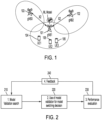
- RF fingerprinting information may allow to delimit the part of the coverage area of the gNB2 where the ML model of gNB1 101 is valid.
- These procedures may allow for alleviating for the UE to update/switch its ML model as soon as it is served by a new network entity (e.g., gNB) during its mobility.
- the UE may perform multiple processes to ensure ubiquitous service to the end user (e.g., during video streaming service with high QoS/QoE requirements).
- Certain exemplary embodiments may provide new model fingerprinting based performance monitoring and validation procedures to enable the validation with neighboring cells and the use of the validation output at the UE side for an informed model switching decision.
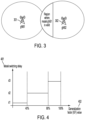
- FIG. 2 illustrates an example of a flow diagram for a validation procedure, according to certain exemplary embodiments.
- the model validation search procedure may be performed in which a serving network entity/base station may perform a model performance monitoring to determine whether a current ML model for a current, serving network entity (e.g., gNB), which is prepared and trained using its locally collected data, can perform with acceptable level in one or more other neighboring cells/coverage areas, either partially or entirely in the other neighboring cells/coverage areas.
- a validity may be determined based on a performance of the ML model in the one or more other neighboring cells/coverage areas, which is based on the model performance monitoring.
- the current serving gNB may request labelled data from other gNBs, such as gNB2 102 and/or gNB3 103 of FIG. 1 .
- the labelled data may be a set of inputs and corresponding outputs for the ML model. Using the inputs and expected outputs, the ML model can be trained. To improve the precision of the validation, the current serving gNB may request the labelled data with a specific configuration and/or RF fingerprinting information.
- the RF fingerprinting information may be reference signal received power (RSRP), reference signal received quality (RSRQ), signal to interference and noise ratio (SINR), timing advance (TA), and/or the like, measurements which allows to identify an approximate location from which the labeled data is taken within a neighboring cell coverage area.
- the current serving gNB may provide a more precise indication of a condition of the model validity, such as, for example, the ML model for gNB1 101 may be valid for a UE measured RSRP from gNB2 102 within a range -120 and -80 dBm.
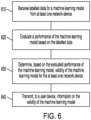
- FIG. 3 illustrates an example of a configuration for model validation, according to various exemplary embodiments.
- FIG. 3 shows a cell coverage area/region in gNB2 302 where the ML model of the gNB1 301 may be valid.
- the neighboring cell(s) e.g., gNB2 302
- the neighboring cell(s) may provide the current serving gNB (e.g., gNB1 301) with labeled dataset(s) and related RF fingerprinting information, defined as: ⁇ ⁇ ⁇ RSRP i , TA i ⁇ , in which the RF fingerprinting information may be indicated as ⁇ .
- current serving gNB may perform cross performance monitoring and validation using labeled data received from one or more neighboring cells (e.g., through an X2 and/or Xn interface upon request.
- the current serving gNB e.g., gNB1 301 may compute a generalization factor which indicates the extent to which ML model for current serving gNB can be applicable to other neighboring cells/coverage areas.
- GF 1,2 may refer to the generalization factor of a model for the current serving gNB (e.g., gNB1 301) related to a neighboring or target gNB (e.g., gNB2 302), f 1 may be the trained model of current serving gNB (e.g., gNB1 301), ( x 2, , y 2 ) may be the labeled dataset of the neighboring or target gNB (e.g., gNB2 302), and ⁇ may be a desired threshold model accuracy.
- the generalization factor may be an indicator of the model performance monitoring across different neighboring or target network entities (e.g., gNBs).
- Certain exemplary embodiments may assume the UE position availability.
- the RF fingerprinting information/attributes which may be provided as with the labeled dataset of the neighboring or target gNB (e.g., gNB2 302), may include a geographical position.
- the output of the validation search may be provided as a set of positions, such as: ⁇ X i ⁇ i ⁇ [1, N ] .
- the procedures of various exemplary embodiments may proceed with using the model validation of the procedure 210 for performing a model switching decision.
- the model validation procedure may use the performance monitoring and validation search output in order to perform the ML model switching decision at the UE side during mobility.
- the performance and validity of the ML model may be identified in the neighboring or target gNB (e.g., gNB2 302) using the RF fingerprinting attributes, such RSRP, RSRQ, SINR, TA, and the like.
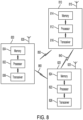
- FIG. 4 illustrates an example of a diagram showing a model switching delay (401) relative to a generalization factor (402), according to some exemplary embodiments.
- the model switching decision may be performed based on the generalization factor GF 1,2 (402) to set up a delay (401) to receive the new ML model (e.g., the ML model for the neighboring or target gNB (e.g., gNB2)).
- the new ML model e.g., the ML model for the neighboring or target gNB (e.g., gNB2)
- the new ML model e.g., the ML model for the neighboring or target gNB (e.g., gNB2)
- a lower generalization factor (402) may indicate that the ML model is not sufficiently generalized to be commonly used by both the current and neighboring or target gNBs, and the model switching decision should be performed with more rapidly to avoid risk of performance degradation, as compared to a higher generalization factor (402) which may have a longer delay.
- the performance and validity of the ML model may be identified in the neighboring or target gNB (e.g., gNB2) using a set of positions, such as: ⁇ X i ⁇ i ⁇ [1, N ] .
- the network may then select a maximum threshold distance d th which indicates that the ML model for the current serving gNB (e.g., gNB1) at the UE side may be valid under the following condition: min distance UE , X i i ⁇ 1 N ⁇ ⁇ d th
- the ML model for the current serving gNB (e.g., gNB1 101/301) may still be valid when the current position of the UE is within a threshold range (e.g., distance) to any position within the identified validation positions ⁇ X i ⁇ i ⁇ [1, N ] from procedure 210.
- a threshold range e.g., distance
- the procedures of various exemplary embodiments may provide for monitoring the performance of the ML model (before and after switching) without using ground truth.
- the monitoring of the performance of the ML model may be based on preselected performance KPI, such as UE throughput.
- a feedback loop may be provided so that the output of the performance monitoring can be provided to the model validation search in procedure 210 of FIG. 2 , to enhance the model validation search for subsequent iterations of procedures 210-240.
- the network may be more conservative and set up more stringent constraints on the validation conditions, such as lowering the threshold distance or the threshold values on the generalization factor.
- FIG. 5 illustrates an example of a signal diagram, according to certain exemplary embodiments.
- the signal diagram shows signaling between a UE 501, a current serving gNB 502, and neighboring or target gNBs 503/504.
- the UE 501 may have a radio resource control (RRC) connection established with the current serving gNB 502.
- RRC radio resource control
- the UE 501 may execute one or more operations using an ML model which was provided to the UE 501 by the current serving gNB 502.
- the model may be trained using local data by the current serving gNB 502.
- the one or more operations may include testing the ML model, executing the ML model, and the like.
- the current serving gNB 502 may provide a request to each of the neighboring or target gNBs 503/504.
- the requests may request that the neighboring or target gNBs 503/504 provide the current serving gNB 502 with labeled data for an ID of an ML model for the neighboring or target gNBs 503/504 and corresponding RF fingerprint information/attributes.
- the neighboring or target gNBs 503/504 may respond to the request by providing the current serving gNB 502 with the labeled data and the RF fingerprint information/attributes.
- the UE 501 may determine whether one or more conditions for validity of the current ML model is satisfied and perform a model switching decision.
- the UE 501 may request the ML model for the gNB 503 from the gNB 503.
- the gNB 503 may provide its ML model to the UE 501.
- the UE 501 may perform model switching to switch from using the ML model for gNB 502 to the ML model for gNB 503.
- FIG. 6 illustrates an example flow diagram of a method, according to certain exemplary embodiments.
- the method of FIG. 6 may be performed by a network element/entity, or a group of multiple network entities in a 3GPP system, such as LTE, 5G-NR, or 6G.
- the method of FIG. 6 may be performed by a network node or network entity, such as a gNB, similar to apparatus 810 illustrated in FIG. 8 .
- the method of FIG. 6 may include, at 610, receiving labelled data for a machine learning model from at least one network device, and at 620, evaluating a performance of the machine learning model based on the labelled data. At 630, the method may also include determining, based on the evaluated performance of the machine learning model, validity of the machine learning model for the at least one network device, and at 640, transmitting, to a user device, information on the validity of the machine learning model.
- the labelled data may include radio frequency fingerprinting information
- the radio frequency fingerprinting information may include at least one of reference signal received power measurements, reference signal received quality measurements, signal to interference and noise ratio measurements, or timing advance measurements.
- the validity of the machine learning model may be determined based on at least one of the radio frequency fingerprinting information being lower than a first threshold, the radio frequency fingerprinting information being higher than the first threshold, a model generalization factor of the machine learning model for the at least one network device being lower than a second threshold, the model generalization factor of the machine learning model for the at least one network device being higher than the second threshold, a distance between the apparatus and the user device being lower than a third threshold, or the distance between the apparatus and the user device being higher than the third threshold.
- Some exemplary embodiments may also provide the information on the validity of the machine learning model includes a model switching decision to determine to switch from the machine learning model to another machine learning model.
- the evaluation of the performance of the machine learning model may be based on at least a throughput of the user device.
- the model generalization factor may be based on a performance of the machine learning model of the apparatus which is based on the labelled data received from the at least one network device.
- FIG. 7 illustrates an example flow diagram of a method, according to certain exemplary embodiments.
- the method of FIG. 7 may be performed by a device or user equipment within a network in a 3GPP system, such as LTE, 5G-NR, or 6G.
- the method of FIG. 7 may be performed by a UE, similar to apparatus 820 illustrated in FIG. 8 .
- the method of FIG. 7 may include, at 710, receiving, from a serving network device, information on a validity of a machine learning model for another network device, and at 720, performing a model switching decision based on at least the information on the validity of the machine learning model.
- the model switching decision may determine to switch from the machine learning model of the serving network device to another machine learning model of the other network device.
- the method may also include transmitting an indication of the model switching decision to the other network device.
- Certain exemplary embodiments may provide that the information on the validity of the machine learning model is based on radio frequency fingerprinting information, and the radio frequency fingerprinting information may include at least one of reference signal received power measurements, reference signal received quality measurements, signal to interference and noise ratio measurements, or timing advance measurements.
- the validity of the machine learning model may be determined based on at least one of a radio frequency fingerprinting information being lower than a first threshold, the radio frequency fingerprinting information being higher than the first threshold, a model generalization factor of the other machine learning model of the other network device being lower than a second threshold, the model generalization factor of the other machine learning model of the other network device being higher than the second threshold, a distance between the apparatus and the serving network device being lower than a third threshold, or the distance between the apparatus and the serving network device being higher than the third threshold.
- the model generalization factor of the machine learning model of the serving network device may be based on a performance of the machine learning model, which is based on labelled data received from the other network device.
- the performance of the machine learning model may be based on at least a throughput of the apparatus.
- FIG. 8 illustrates a set of apparatuses 810, 820, and 830 according to various exemplary embodiments.
- the apparatus 810 may be an element in a network or associated with the network, or a network entity, such as a gNB.
- gNBs 101-103/301/502 may be an example of apparatus 810.
- apparatus 810 may include components or features not shown in FIG. 8 .
- apparatus 820 may be an element in a communications network or network entity, such as UE, RedCap UE, SL UE, mobile equipment (ME), mobile station, mobile device, stationary device, IoT device, or other device.
- apparatus 820 may include components or features not shown in FIG. 8 .
- apparatus 830 may be an element in a network or associated with the network, or a network entity, such as a gNB.
- gNBs 101-103/302/503/504 may be an example of apparatus 830.
- apparatus 830 may include components or features not shown in FIG. 8 .
- apparatuses 810, 820 and/or 830 may include one or more processors, one or more computer-readable storage medium (for example, memory, storage, or the like), one or more radio access components (for example, a modem, a transceiver, or the like), and/or a user interface.
- apparatuses 810, 820 and/or 830 may be configured to operate using one or more radio access technologies, such as GSM, LTE, LTE-A, NR, 5G, WLAN, WiFi, NB-IoT, Bluetooth, NFC, MulteFire, and/or any other radio access technologies.
- apparatuses 810, 820 and/or 830 may include or be coupled to processors 812, 822, and 832, respectively, for processing information and executing instructions or operations.
- processors 812, 822, and 832 may be any type of general or specific purpose processor.
- processors 812, 822, and 832 may include one or more of general-purpose computers, special purpose computers, microprocessors, digital signal processors (DSPs), field-programmable gate arrays (FPGAs), application-specific integrated circuits (ASICs), and processors based on a multi-core processor architecture, as examples.
- DSPs digital signal processors
- FPGAs field-programmable gate arrays
- ASICs application-specific integrated circuits
- apparatuses 810, 820 and/or 830 may include two or more processors that may form a multiprocessor system (for example, in this case processors 812, 822, and 832 may represent a multiprocessor) that may support multiprocessing.
- the multiprocessor system may be tightly coupled or loosely coupled to, for example, form a computer cluster.
- Processors 812, 822, and 832 may perform functions associated with the operation of apparatuses 810, 820 and/or 830, respectively, including, as some examples, precoding of antenna gain/phase parameters, encoding and decoding of individual bits forming a communication message, formatting of information, and overall control of the apparatuses 810, 820 and/or 830, including processes illustrated in FIGs. 1-7 .
- Apparatuses 810, 820 and/or 830 may further include or be coupled to memory 814, 824, and/or 834 (internal or external), respectively, which may be coupled to processors 812, 822, and 832, respectively, for storing information and instructions that may be executed by processors 812, 822, and 832.
- Memory 814 (and memory 824 and memory 834) may be one or more memories and of any type suitable to the local application environment, and may be implemented using any suitable volatile or nonvolatile data storage technology such as a semiconductor-based memory device, a magnetic memory device and system, an optical memory device and system, fixed memory, and/or removable memory.
- memory 814 can be comprised of any combination of random access memory (RAM), read only memory (ROM), static storage such as a magnetic or optical disk, hard disk drive (HDD), or any other type of non-transitory machine or computer readable media.
- RAM random access memory
- ROM read only memory
- HDD hard disk drive
- the instructions stored in memory 814, memory 824 and memory 834 may include program instructions or computer program code that, when executed by processors 812, 822, and 832, enable the apparatuses 810, 820 and/or 830 to perform tasks as described herein.
- apparatuses 810, 820 and/or 830 may further include or be coupled to (internal or external) a drive or port that is configured to accept and read an external computer readable storage medium, such as an optical disc, USB drive, flash drive, or any other storage medium.
- an external computer readable storage medium such as an optical disc, USB drive, flash drive, or any other storage medium.
- the external computer readable storage medium may store a computer program or software for execution by processors 812, 822, and 832 and/or apparatuses 810, 820 and/or 830 to perform any of the methods illustrated in FIGs. 1-7 .
- the apparatus 810 may include at least one processor 812, and at least one memory 814, as shown in FIG. 8 .
- the memory 814 may store instructions that, when executed by the processor 812, cause the apparatus 810 to receive labelled data for a machine learning model from at least one network device and evaluate a performance of the machine learning model based on the labelled data.
- the apparatus 810 may also be caused to determine, based on the evaluated performance of the machine learning model, validity of the machine learning model for the at least one network device, and transmit, to a user device, information on the validity of the machine learning model.
- the apparatus 820 may include at least one processor 822, and at least one memory 824, as shown in FIG. 8 .
- the memory 824 may store instructions that, when executed by the processor 822, cause the apparatus 820 to receive, from a serving network device, information on a validity of a machine learning model for another network device and perform a model switching decision based on at least the information on the validity of the machine learning model.
- the model switching decision may determine to switch from the machine learning model of the serving network device to another machine learning model of the other network device.
- the apparatus 820 may also be caused to transmit an indication of the model switching decision to the other network device.
- apparatuses 810, 820 and/or 830 may also include or be coupled to one or more antennas 815, 825, and 835 for receiving a downlink signal and for transmitting via an uplink from apparatuses 810, 820 and/or 830, respectively.
- Apparatuses 810, 820 and/or 830 may further include transceivers 816, 826, and 836, respectively, configured to transmit and receive information.
- the transceiver 816, 826, and 836 may also include a radio interface that may correspond to a plurality of radio access technologies including one or more of GSM, LTE, LTE-A, 5G, NR, WLAN, NB-IoT, Bluetooth, BT-LE, NFC, RFID, UWB, or the like.
- the radio interface may include other components, such as filters, converters (for example, digital-to-analog converters or the like), symbol demappers, signal shaping components, an Inverse Fast Fourier Transform (IFFT) module, or the like, to process symbols, such as OFDMA symbols, carried by a downlink or an uplink.
- IFFT Inverse Fast Fourier Transform
- transceivers 816, 826, and 836 may be respectively configured to modulate information on to a carrier waveform for transmission and demodulate received information for further processing by other elements of apparatuses 810, 820 and/or 830.
- transceivers 816, 826, and 836 may be capable of transmitting and receiving signals or data directly.
- apparatuses 810, 820 and/or 830 may include an input and/or output device (I/O device).
- apparatuses 810, 820 and/or 830 may further include a user interface, such as a graphical user interface or touchscreen.
- memory 814, 824, and 834 store software modules that provide functionality when executed by processors 812, 822, and 832, respectively.
- the modules may include, for example, an operating system that provides operating system functionality for apparatuses 810, 820 and/or 830.
- the memory may also store one or more functional modules, such as an application or program, to provide additional functionality for apparatuses 810, 820 and/or 830.
- the components of apparatuses 810, 820 and/or 830 may be implemented in hardware, or as any suitable combination of hardware and software.
- apparatuses 810, 820 and/or 830 may optionally be configured to communicate with each other via a wireless or wired communications links 840, 850, and 860 according to any radio access technology, such as NR.
- processors 812, 822 and/or 832, and memory 814, 824 and/or 834 may be included in or may form a part of processing circuitry or control circuitry.
- transceivers 816, 826, and 836 may be included in or may form a part of transceiving circuitry.
- an apparatus may include means for performing a method, a process, or any of the variants discussed herein.
- the means may include one or more processors, memory, controllers, transmitters, receivers, and/or computer program code for causing the performance of the operations.
- Certain exemplary embodiments may be directed to an apparatus 810 that includes means for receiving labelled data for a machine learning model from at least one network device and means for evaluating a performance of the machine learning model based on the labelled data.
- the apparatus 810 may also include means for determining, based on the evaluated performance of the machine learning model, validity of the machine learning model for the at least one network device, and means for transmitting, to a user device, information on the validity of the machine learning model.
- Some exemplary embodiments may be directed to an apparatus 820 that includes means for receiving, from a serving network device, information on a validity of a machine learning model for another network device and means for performing a model switching decision based on at least the information on the validity of the machine learning model.
- the model switching decision may determine to switch from the machine learning model of the serving network device to another machine learning model of the other network device.
- the apparatus 820 may also include means for transmitting an indication of the model switching decision to the other network device.
- circuitry may refer to hardware-only circuitry implementations (for example, analog and/or digital circuitry), combinations of hardware circuits and software, combinations of analog and/or digital hardware circuits with software/firmware, any portions of hardware processor(s) with software, including digital signal processors, that work together to cause an apparatus (for example, apparatus 810, 820 and/or 830) to perform various functions, and/or hardware circuit(s) and/or processor(s), or portions thereof, that use software for operation but where the software may not be present when it is not needed for operation.
- apparatus for example, apparatus 810, 820 and/or 830
- circuitry may also cover an implementation of merely a hardware circuit or processor or multiple processors, or portion of a hardware circuit or processor, and the accompanying software and/or firmware.
- circuitry may also cover, for example, a baseband integrated circuit in a server, cellular network node or device, or other computing or network device.
- a computer program product may include one or more computer-executable components which, when the program is run, are configured to carry out some example embodiments.
- the one or more computer-executable components may be at least one software code or portions of it. Modifications and configurations required for implementing functionality of certain example embodiments may be performed as routine(s), which may be implemented as added or updated software routine(s). Software routine(s) may be downloaded into the apparatus.
- software or a computer program code or portions of it may be in a source code form, object code form, or in some intermediate form, and it may be stored in some sort of carrier, distribution medium, or computer readable medium, which may be any entity or device capable of carrying the program.
- carrier may include a record medium, computer memory, read-only memory, photoelectrical and/or electrical carrier signal, telecommunications signal, and software distribution package, for example.
- the computer program may be executed in a single electronic digital computer or it may be distributed amongst a number of computers.
- the computer readable medium or computer readable storage medium may be a non-transitory medium.
- the functionality may be performed by hardware or circuitry included in an apparatus (for example, apparatuses 810, 820 and/or 830), for example through the use of an application specific integrated circuit (ASIC), a programmable gate array (PGA), a field programmable gate array (FPGA), or any other combination of hardware and software.
- ASIC application specific integrated circuit
- PGA programmable gate array
- FPGA field programmable gate array
- the functionality may be implemented as a signal, a non-tangible means that can be carried by an electromagnetic signal downloaded from the Internet or other network.
- an apparatus such as a node, device, or a corresponding component, may be configured as circuitry, a computer or a microprocessor, such as single-chip computer element, or as a chipset, including at least a memory for providing storage capacity used for arithmetic operation and an operation processor for executing the arithmetic operation.
Landscapes
- Engineering & Computer Science (AREA)
- Computer Networks & Wireless Communication (AREA)
- Signal Processing (AREA)
- Mobile Radio Communication Systems (AREA)
Priority Applications (2)
| Application Number | Priority Date | Filing Date | Title |
|---|---|---|---|
| EP24150467.9A EP4583565A1 (fr) | 2024-01-05 | 2024-01-05 | Vérification d'empreintes digitales basée sur une validation et une surveillance de performance d'un modèle d'apprentissage automatique |
| PCT/IB2024/063346 WO2025146621A1 (fr) | 2024-01-05 | 2024-12-31 | Validation et surveillance des performances basées sur une empreinte de modèle d'apprentissage automatique |
Applications Claiming Priority (1)
| Application Number | Priority Date | Filing Date | Title |
|---|---|---|---|
| EP24150467.9A EP4583565A1 (fr) | 2024-01-05 | 2024-01-05 | Vérification d'empreintes digitales basée sur une validation et une surveillance de performance d'un modèle d'apprentissage automatique |
Publications (1)
| Publication Number | Publication Date |
|---|---|
| EP4583565A1 true EP4583565A1 (fr) | 2025-07-09 |
Family
ID=89474328
Family Applications (1)
| Application Number | Title | Priority Date | Filing Date |
|---|---|---|---|
| EP24150467.9A Pending EP4583565A1 (fr) | 2024-01-05 | 2024-01-05 | Vérification d'empreintes digitales basée sur une validation et une surveillance de performance d'un modèle d'apprentissage automatique |
Country Status (2)
| Country | Link |
|---|---|
| EP (1) | EP4583565A1 (fr) |
| WO (1) | WO2025146621A1 (fr) |
Citations (4)
| Publication number | Priority date | Publication date | Assignee | Title |
|---|---|---|---|---|
| WO2023101303A1 (fr) * | 2021-11-30 | 2023-06-08 | 엘지전자 주식회사 | Procédé et dispositif d'exécution d'une communication dans un système de communication sans fil |
| CN116963037A (zh) * | 2022-04-27 | 2023-10-27 | 北京三星通信技术研究有限公司 | 用户设备、基站及其执行的方法 |
| WO2023212224A2 (fr) * | 2022-04-27 | 2023-11-02 | Interdigital Patent Holdings, Inc. | Détermination de position assistée par apprentissage automatique |
| US20230422126A1 (en) * | 2020-11-30 | 2023-12-28 | Nokia Technologies Oy | Make-before-break mobility of machine learning context |
-
2024
- 2024-01-05 EP EP24150467.9A patent/EP4583565A1/fr active Pending
- 2024-12-31 WO PCT/IB2024/063346 patent/WO2025146621A1/fr active Pending
Patent Citations (4)
| Publication number | Priority date | Publication date | Assignee | Title |
|---|---|---|---|---|
| US20230422126A1 (en) * | 2020-11-30 | 2023-12-28 | Nokia Technologies Oy | Make-before-break mobility of machine learning context |
| WO2023101303A1 (fr) * | 2021-11-30 | 2023-06-08 | 엘지전자 주식회사 | Procédé et dispositif d'exécution d'une communication dans un système de communication sans fil |
| CN116963037A (zh) * | 2022-04-27 | 2023-10-27 | 北京三星通信技术研究有限公司 | 用户设备、基站及其执行的方法 |
| WO2023212224A2 (fr) * | 2022-04-27 | 2023-11-02 | Interdigital Patent Holdings, Inc. | Détermination de position assistée par apprentissage automatique |
Non-Patent Citations (1)
| Title |
|---|
| YI GUO ET AL: "Functionality mapping and AI/ML algorithm locality", vol. 3GPP RAN 2, no. Xiamen, CN; 20231009 - 20231013, 29 September 2023 (2023-09-29), XP052529202, Retrieved from the Internet <URL:https://www.3gpp.org/ftp/TSG_RAN/WG2_RL2/TSGR2_123bis/Docs/R2-2310207.zip R2-2310207 mapping and locality.docx> [retrieved on 20230929] * |
Also Published As
| Publication number | Publication date |
|---|---|
| WO2025146621A1 (fr) | 2025-07-10 |
Similar Documents
| Publication | Publication Date | Title |
|---|---|---|
| US12520182B2 (en) | Methods and apparatuses for beam management reporting | |
| EP4147478B1 (fr) | Configuration de mesure pour la gestion de ressources radio utilisant un apprentissage automatique local | |
| US20220337361A1 (en) | Apparatuses and methods for prioritization between physical downlink shared channel and synchronization signal block reception | |
| EP3553969B1 (fr) | Configuration de signales de référence pour détection des erreurs | |
| US12401400B2 (en) | Early channel state information acquisition for target cell in layer one / layer two inter-cell mobility | |
| EP4008122B1 (fr) | Affinement de faisceau spécifique au positionnement destiné à une transmission de signal de référence de positionnement (prs) de cellule voisine | |
| WO2019161569A1 (fr) | Procédés et appareils pour une détermination d'exigence d'efficacité de mesure d'équipement utilisateur | |
| US12184578B2 (en) | Supporting a narrow serving beam in a hierarchical beam configuration | |
| US11902894B2 (en) | Determining radio frequency (RF) conditions using sensing information | |
| US20250056251A1 (en) | Triggering of artificial intelligence/machine learning training in network data analytics function | |
| EP4583565A1 (fr) | Vérification d'empreintes digitales basée sur une validation et une surveillance de performance d'un modèle d'apprentissage automatique | |
| US20240146485A1 (en) | Configuration and transmission of channel state information reference signal | |
| US11812322B2 (en) | Channel state information reference signal configuration for inter-cell mobility | |
| WO2022233838A1 (fr) | Protocole de positionnement amélioré de sélection de faisceau d'agrégation de porteuses | |
| US20250056482A1 (en) | Radio resource management measurement for low power high frequency accuracy positioning with a substantially extended discontinuous reception cycle | |
| US20250184021A1 (en) | Mobility enhancement for user equipment connected to non-terrestrial networks | |
| US20240236650A1 (en) | Event triggering based on explicit user equipment list assignment command events | |
| WO2025215425A1 (fr) | Établissement de rapport de faisceau amélioré basé sur un événement | |
| WO2025196643A1 (fr) | Adaptation de facteur de balayage de faisceau | |
| WO2024030136A1 (fr) | Changements de réglage de mobilité intelligents dans un environnement à changement rapide | |
| WO2025196642A1 (fr) | Adaptation de facteur de balayage de faisceau basée sur un événement | |
| WO2026073583A1 (fr) | Mesurages associés à un filtrage adaptatif et à un retard | |
| JP2026505867A (ja) | 測定ギャップの外側のためのキャリアアグリゲーションベースダウンリンク位置決め | |
| WO2026073584A1 (fr) | Mesures adaptatives de filtrage et de retard | |
| JP2019054319A (ja) | ネットワーク通信負荷推定方法、無線端末、通信システム、及び、プログラム |
Legal Events
| Date | Code | Title | Description |
|---|---|---|---|
| PUAI | Public reference made under article 153(3) epc to a published international application that has entered the european phase |
Free format text: ORIGINAL CODE: 0009012 |
|
| STAA | Information on the status of an ep patent application or granted ep patent |
Free format text: STATUS: THE APPLICATION HAS BEEN PUBLISHED |
|
| AK | Designated contracting states |
Kind code of ref document: A1 Designated state(s): AL AT BE BG CH CY CZ DE DK EE ES FI FR GB GR HR HU IE IS IT LI LT LU LV MC ME MK MT NL NO PL PT RO RS SE SI SK SM TR |
|
| STAA | Information on the status of an ep patent application or granted ep patent |
Free format text: STATUS: REQUEST FOR EXAMINATION WAS MADE |
|
| 17P | Request for examination filed |
Effective date: 20260109 |