ES2565521T5 - Dasatinib polymorphs and their preparation process - Google Patents
Dasatinib polymorphs and their preparation process Download PDFInfo
- Publication number
- ES2565521T5 ES2565521T5 ES11194987T ES11194987T ES2565521T5 ES 2565521 T5 ES2565521 T5 ES 2565521T5 ES 11194987 T ES11194987 T ES 11194987T ES 11194987 T ES11194987 T ES 11194987T ES 2565521 T5 ES2565521 T5 ES 2565521T5
- Authority
- ES
- Spain
- Prior art keywords
- dasatinib
- degrees
- theta
- peaks
- suspension
- Prior art date
- Legal status (The legal status is an assumption and is not a legal conclusion. Google has not performed a legal analysis and makes no representation as to the accuracy of the status listed.)
- Active
Links
- ZBNZXTGUTAYRHI-UHFFFAOYSA-N Dasatinib Chemical compound C=1C(N2CCN(CCO)CC2)=NC(C)=NC=1NC(S1)=NC=C1C(=O)NC1=C(C)C=CC=C1Cl ZBNZXTGUTAYRHI-UHFFFAOYSA-N 0.000 title claims description 754
- 229960002448 dasatinib Drugs 0.000 title claims description 614
- 239000002067 L01XE06 - Dasatinib Substances 0.000 title claims description 613
- 238000002360 preparation method Methods 0.000 title description 105
- 238000001144 powder X-ray diffraction data Methods 0.000 claims description 319
- 239000000725 suspension Substances 0.000 claims description 249
- IAZDPXIOMUYVGZ-UHFFFAOYSA-N Dimethylsulphoxide Chemical compound CS(C)=O IAZDPXIOMUYVGZ-UHFFFAOYSA-N 0.000 claims description 245
- 238000000034 method Methods 0.000 claims description 189
- 239000000203 mixture Substances 0.000 claims description 149
- OKKJLVBELUTLKV-UHFFFAOYSA-N Methanol Chemical compound OC OKKJLVBELUTLKV-UHFFFAOYSA-N 0.000 claims description 135
- WFCSWCVEJLETKA-UHFFFAOYSA-N 2-piperazin-1-ylethanol Chemical compound OCCN1CCNCC1 WFCSWCVEJLETKA-UHFFFAOYSA-N 0.000 claims description 98
- XLYOFNOQVPJJNP-UHFFFAOYSA-N water Substances O XLYOFNOQVPJJNP-UHFFFAOYSA-N 0.000 claims description 97
- JGFZNNIVVJXRND-UHFFFAOYSA-N N,N-Diisopropylethylamine (DIPEA) Chemical compound CCN(C(C)C)C(C)C JGFZNNIVVJXRND-UHFFFAOYSA-N 0.000 claims description 95
- 238000010438 heat treatment Methods 0.000 claims description 90
- LFQSCWFLJHTTHZ-UHFFFAOYSA-N Ethanol Chemical compound CCO LFQSCWFLJHTTHZ-UHFFFAOYSA-N 0.000 claims description 74
- 238000001816 cooling Methods 0.000 claims description 62
- 238000006243 chemical reaction Methods 0.000 claims description 56
- 101000843236 Homo sapiens Testis-specific H1 histone Proteins 0.000 claims description 30
- 102100031010 Testis-specific H1 histone Human genes 0.000 claims description 30
- 150000001875 compounds Chemical class 0.000 claims description 27
- 238000002425 crystallisation Methods 0.000 claims description 25
- 230000008025 crystallization Effects 0.000 claims description 25
- 238000001556 precipitation Methods 0.000 claims description 24
- 230000001376 precipitating effect Effects 0.000 claims description 23
- 239000008194 pharmaceutical composition Substances 0.000 claims description 18
- 239000000546 pharmaceutical excipient Substances 0.000 claims description 10
- 239000013078 crystal Substances 0.000 claims description 9
- 239000002244 precipitate Substances 0.000 claims description 7
- 208000006664 Precursor Cell Lymphoblastic Leukemia-Lymphoma Diseases 0.000 claims description 4
- 208000032791 BCR-ABL1 positive chronic myelogenous leukemia Diseases 0.000 claims description 3
- 238000009472 formulation Methods 0.000 claims description 3
- 230000001154 acute effect Effects 0.000 claims 1
- 210000000349 chromosome Anatomy 0.000 claims 1
- 239000013022 formulation composition Substances 0.000 claims 1
- 208000003747 lymphoid leukemia Diseases 0.000 claims 1
- 239000012453 solvate Substances 0.000 description 206
- 239000000243 solution Substances 0.000 description 136
- 239000002904 solvent Substances 0.000 description 108
- 230000000052 comparative effect Effects 0.000 description 94
- 229940125904 compound 1 Drugs 0.000 description 81
- BTANRVKWQNVYAZ-UHFFFAOYSA-N butan-2-ol Chemical compound CCC(C)O BTANRVKWQNVYAZ-UHFFFAOYSA-N 0.000 description 77
- 238000001035 drying Methods 0.000 description 73
- BDERNNFJNOPAEC-UHFFFAOYSA-N propan-1-ol Chemical compound CCCO BDERNNFJNOPAEC-UHFFFAOYSA-N 0.000 description 59
- 239000000047 product Substances 0.000 description 58
- 238000000634 powder X-ray diffraction Methods 0.000 description 53
- 238000004519 manufacturing process Methods 0.000 description 47
- XEKOWRVHYACXOJ-UHFFFAOYSA-N Ethyl acetate Chemical compound CCOC(C)=O XEKOWRVHYACXOJ-UHFFFAOYSA-N 0.000 description 45
- JUJWROOIHBZHMG-UHFFFAOYSA-N Pyridine Chemical compound C1=CC=NC=C1 JUJWROOIHBZHMG-UHFFFAOYSA-N 0.000 description 45
- 238000001914 filtration Methods 0.000 description 39
- CSCPPACGZOOCGX-UHFFFAOYSA-N Acetone Chemical compound CC(C)=O CSCPPACGZOOCGX-UHFFFAOYSA-N 0.000 description 38
- KFZMGEQAYNKOFK-UHFFFAOYSA-N Isopropanol Chemical compound CC(C)O KFZMGEQAYNKOFK-UHFFFAOYSA-N 0.000 description 37
- PEDCQBHIVMGVHV-UHFFFAOYSA-N Glycerine Chemical compound OCC(O)CO PEDCQBHIVMGVHV-UHFFFAOYSA-N 0.000 description 33
- 238000011084 recovery Methods 0.000 description 32
- 238000001757 thermogravimetry curve Methods 0.000 description 32
- YXFVVABEGXRONW-UHFFFAOYSA-N Toluene Chemical compound CC1=CC=CC=C1 YXFVVABEGXRONW-UHFFFAOYSA-N 0.000 description 30
- 238000001938 differential scanning calorimetry curve Methods 0.000 description 29
- 230000004580 weight loss Effects 0.000 description 28
- 238000001704 evaporation Methods 0.000 description 27
- LRHPLDYGYMQRHN-UHFFFAOYSA-N N-Butanol Chemical compound CCCCO LRHPLDYGYMQRHN-UHFFFAOYSA-N 0.000 description 23
- 238000010992 reflux Methods 0.000 description 23
- WYURNTSHIVDZCO-UHFFFAOYSA-N Tetrahydrofuran Chemical compound C1CCOC1 WYURNTSHIVDZCO-UHFFFAOYSA-N 0.000 description 22
- UMJSCPRVCHMLSP-UHFFFAOYSA-N pyridine Natural products COC1=CC=CN=C1 UMJSCPRVCHMLSP-UHFFFAOYSA-N 0.000 description 22
- SYBYTAAJFKOIEJ-UHFFFAOYSA-N 3-Methylbutan-2-one Chemical compound CC(C)C(C)=O SYBYTAAJFKOIEJ-UHFFFAOYSA-N 0.000 description 21
- LYCAIKOWRPUZTN-UHFFFAOYSA-N Ethylene glycol Chemical compound OCCO LYCAIKOWRPUZTN-UHFFFAOYSA-N 0.000 description 21
- 239000000843 powder Substances 0.000 description 20
- 238000003756 stirring Methods 0.000 description 20
- YMWUJEATGCHHMB-UHFFFAOYSA-N Dichloromethane Chemical compound ClCCl YMWUJEATGCHHMB-UHFFFAOYSA-N 0.000 description 18
- 239000000126 substance Substances 0.000 description 17
- 229940093499 ethyl acetate Drugs 0.000 description 15
- 235000019439 ethyl acetate Nutrition 0.000 description 15
- 239000007787 solid Substances 0.000 description 15
- DKGAVHZHDRPRBM-UHFFFAOYSA-N Tert-Butanol Chemical compound CC(C)(C)O DKGAVHZHDRPRBM-UHFFFAOYSA-N 0.000 description 14
- MVPPADPHJFYWMZ-UHFFFAOYSA-N chlorobenzene Chemical compound ClC1=CC=CC=C1 MVPPADPHJFYWMZ-UHFFFAOYSA-N 0.000 description 14
- IEJIGPNLZYLLBP-UHFFFAOYSA-N dimethyl carbonate Chemical compound COC(=O)OC IEJIGPNLZYLLBP-UHFFFAOYSA-N 0.000 description 13
- ARXJGSRGQADJSQ-UHFFFAOYSA-N 1-methoxypropan-2-ol Chemical compound COCC(C)O ARXJGSRGQADJSQ-UHFFFAOYSA-N 0.000 description 12
- ZWEHNKRNPOVVGH-UHFFFAOYSA-N 2-Butanone Chemical compound CCC(C)=O ZWEHNKRNPOVVGH-UHFFFAOYSA-N 0.000 description 12
- NTIZESTWPVYFNL-UHFFFAOYSA-N Methyl isobutyl ketone Chemical compound CC(C)CC(C)=O NTIZESTWPVYFNL-UHFFFAOYSA-N 0.000 description 12
- JYVLIDXNZAXMDK-UHFFFAOYSA-N pentan-2-ol Chemical compound CCCC(C)O JYVLIDXNZAXMDK-UHFFFAOYSA-N 0.000 description 12
- BZLVMXJERCGZMT-UHFFFAOYSA-N Methyl tert-butyl ether Chemical compound COC(C)(C)C BZLVMXJERCGZMT-UHFFFAOYSA-N 0.000 description 11
- RYHBNJHYFVUHQT-UHFFFAOYSA-N 1,4-Dioxane Chemical compound C1COCCO1 RYHBNJHYFVUHQT-UHFFFAOYSA-N 0.000 description 10
- 238000001460 carbon-13 nuclear magnetic resonance spectrum Methods 0.000 description 10
- 210000004027 cell Anatomy 0.000 description 10
- XTHFKEDIFFGKHM-UHFFFAOYSA-N Dimethoxyethane Chemical compound COCCOC XTHFKEDIFFGKHM-UHFFFAOYSA-N 0.000 description 9
- ZGHFDIIVVIFNPS-UHFFFAOYSA-N methyl alpha-methylvinyl ketone Natural products CC(=C)C(C)=O ZGHFDIIVVIFNPS-UHFFFAOYSA-N 0.000 description 9
- IJGRMHOSHXDMSA-UHFFFAOYSA-N Atomic nitrogen Chemical compound N#N IJGRMHOSHXDMSA-UHFFFAOYSA-N 0.000 description 8
- 238000004090 dissolution Methods 0.000 description 8
- TZIHFWKZFHZASV-UHFFFAOYSA-N methyl formate Chemical compound COC=O TZIHFWKZFHZASV-UHFFFAOYSA-N 0.000 description 8
- ZNQVEEAIQZEUHB-UHFFFAOYSA-N 2-ethoxyethanol Chemical compound CCOCCO ZNQVEEAIQZEUHB-UHFFFAOYSA-N 0.000 description 7
- RFFLAFLAYFXFSW-UHFFFAOYSA-N 1,2-dichlorobenzene Chemical compound ClC1=CC=CC=C1Cl RFFLAFLAYFXFSW-UHFFFAOYSA-N 0.000 description 6
- -1 2-chloro-6-methylphenyl Chemical group 0.000 description 6
- DNIAPMSPPWPWGF-UHFFFAOYSA-N Propylene glycol Chemical compound CC(O)CO DNIAPMSPPWPWGF-UHFFFAOYSA-N 0.000 description 6
- XUIMIQQOPSSXEZ-UHFFFAOYSA-N Silicon Chemical compound [Si] XUIMIQQOPSSXEZ-UHFFFAOYSA-N 0.000 description 6
- 239000003795 chemical substances by application Substances 0.000 description 6
- JMMWKPVZQRWMSS-UHFFFAOYSA-N isopropanol acetate Natural products CC(C)OC(C)=O JMMWKPVZQRWMSS-UHFFFAOYSA-N 0.000 description 6
- 229940011051 isopropyl acetate Drugs 0.000 description 6
- GWYFCOCPABKNJV-UHFFFAOYSA-N isovaleric acid Chemical compound CC(C)CC(O)=O GWYFCOCPABKNJV-UHFFFAOYSA-N 0.000 description 6
- SKTCDJAMAYNROS-UHFFFAOYSA-N methoxycyclopentane Chemical compound COC1CCCC1 SKTCDJAMAYNROS-UHFFFAOYSA-N 0.000 description 6
- 229910052710 silicon Inorganic materials 0.000 description 6
- 239000010703 silicon Substances 0.000 description 6
- AMQJEAYHLZJPGS-UHFFFAOYSA-N N-Pentanol Chemical compound CCCCCO AMQJEAYHLZJPGS-UHFFFAOYSA-N 0.000 description 4
- 238000002441 X-ray diffraction Methods 0.000 description 4
- 229910052757 nitrogen Inorganic materials 0.000 description 4
- 238000001644 13C nuclear magnetic resonance spectroscopy Methods 0.000 description 3
- 208000024893 Acute lymphoblastic leukemia Diseases 0.000 description 3
- 208000014697 Acute lymphocytic leukaemia Diseases 0.000 description 3
- WVDDGKGOMKODPV-UHFFFAOYSA-N Benzyl alcohol Chemical compound OCC1=CC=CC=C1 WVDDGKGOMKODPV-UHFFFAOYSA-N 0.000 description 3
- 241000282693 Cercopithecidae Species 0.000 description 3
- UIHCLUNTQKBZGK-UHFFFAOYSA-N Methyl isobutyl ketone Natural products CCC(C)C(C)=O UIHCLUNTQKBZGK-UHFFFAOYSA-N 0.000 description 3
- 238000005481 NMR spectroscopy Methods 0.000 description 3
- 229940079593 drug Drugs 0.000 description 3
- 239000003814 drug Substances 0.000 description 3
- 230000008020 evaporation Effects 0.000 description 3
- 239000000463 material Substances 0.000 description 3
- 238000005259 measurement Methods 0.000 description 3
- 238000002156 mixing Methods 0.000 description 3
- 210000004214 philadelphia chromosome Anatomy 0.000 description 3
- 230000000704 physical effect Effects 0.000 description 3
- XTUSEBKMEQERQV-UHFFFAOYSA-N propan-2-ol;hydrate Chemical compound O.CC(C)O XTUSEBKMEQERQV-UHFFFAOYSA-N 0.000 description 3
- 230000035484 reaction time Effects 0.000 description 3
- 239000013557 residual solvent Substances 0.000 description 3
- 238000001228 spectrum Methods 0.000 description 3
- 238000005406 washing Methods 0.000 description 3
- SECXISVLQFMRJM-UHFFFAOYSA-N N-Methylpyrrolidone Chemical compound CN1CCCC1=O SECXISVLQFMRJM-UHFFFAOYSA-N 0.000 description 2
- MCMNRKCIXSYSNV-UHFFFAOYSA-N Zirconium dioxide Chemical compound O=[Zr]=O MCMNRKCIXSYSNV-UHFFFAOYSA-N 0.000 description 2
- 238000010521 absorption reaction Methods 0.000 description 2
- ZIQPQYFSSSHQBP-UHFFFAOYSA-N acetyl 2,3-dihydroxypropanoate Chemical compound CC(=O)OC(=O)C(O)CO ZIQPQYFSSSHQBP-UHFFFAOYSA-N 0.000 description 2
- 238000002447 crystallographic data Methods 0.000 description 2
- 238000011067 equilibration Methods 0.000 description 2
- 238000002844 melting Methods 0.000 description 2
- 230000008018 melting Effects 0.000 description 2
- 238000001000 micrograph Methods 0.000 description 2
- LAGGBHKHDYAFRI-UHFFFAOYSA-N n,n-dimethylformamide;propan-1-ol Chemical compound CCCO.CN(C)C=O LAGGBHKHDYAFRI-UHFFFAOYSA-N 0.000 description 2
- 239000012071 phase Substances 0.000 description 2
- 238000005070 sampling Methods 0.000 description 2
- 239000007790 solid phase Substances 0.000 description 2
- 239000011877 solvent mixture Substances 0.000 description 2
- 239000012808 vapor phase Substances 0.000 description 2
- VCKSNYNNVSOWEE-UHFFFAOYSA-N 1,3-dioxan-5-ol Chemical compound OC1COCOC1 VCKSNYNNVSOWEE-UHFFFAOYSA-N 0.000 description 1
- BOHGAOWOIJMTPZ-UHFFFAOYSA-N 1,3-dioxolan-4-ylmethanol Chemical compound OCC1COCO1 BOHGAOWOIJMTPZ-UHFFFAOYSA-N 0.000 description 1
- JOLQKTGDSGKSKJ-UHFFFAOYSA-N 1-ethoxypropan-2-ol Chemical compound CCOCC(C)O JOLQKTGDSGKSKJ-UHFFFAOYSA-N 0.000 description 1
- 238000004922 13C solid-state nuclear magnetic resonance spectroscopy Methods 0.000 description 1
- 125000000954 2-hydroxyethyl group Chemical group [H]C([*])([H])C([H])([H])O[H] 0.000 description 1
- JWUJQDFVADABEY-UHFFFAOYSA-N 2-methyltetrahydrofuran Chemical compound CC1CCCO1 JWUJQDFVADABEY-UHFFFAOYSA-N 0.000 description 1
- 0 CC1=*(NC(S*(C(Nc(c(*)ccc2)c2[Cl+])=O)=C)=NC)N=CC(*)N=C1Cl Chemical compound CC1=*(NC(S*(C(Nc(c(*)ccc2)c2[Cl+])=O)=C)=NC)N=CC(*)N=C1Cl 0.000 description 1
- 208000010833 Chronic myeloid leukaemia Diseases 0.000 description 1
- 229910016523 CuKa Inorganic materials 0.000 description 1
- RTZKZFJDLAIYFH-UHFFFAOYSA-N Diethyl ether Chemical compound CCOCC RTZKZFJDLAIYFH-UHFFFAOYSA-N 0.000 description 1
- 239000005517 L01XE01 - Imatinib Substances 0.000 description 1
- 206010027480 Metastatic malignant melanoma Diseases 0.000 description 1
- 208000033761 Myelogenous Chronic BCR-ABL Positive Leukemia Diseases 0.000 description 1
- XBDQKXXYIPTUBI-UHFFFAOYSA-M Propionate Chemical compound CCC([O-])=O XBDQKXXYIPTUBI-UHFFFAOYSA-M 0.000 description 1
- CZPWVGJYEJSRLH-UHFFFAOYSA-N Pyrimidine Chemical compound C1=CN=CN=C1 CZPWVGJYEJSRLH-UHFFFAOYSA-N 0.000 description 1
- FZWLAAWBMGSTSO-UHFFFAOYSA-N Thiazole Chemical compound C1=CSC=N1 FZWLAAWBMGSTSO-UHFFFAOYSA-N 0.000 description 1
- KXKVLQRXCPHEJC-UHFFFAOYSA-N acetic acid trimethyl ester Natural products COC(C)=O KXKVLQRXCPHEJC-UHFFFAOYSA-N 0.000 description 1
- 125000003158 alcohol group Chemical group 0.000 description 1
- PNEYBMLMFCGWSK-UHFFFAOYSA-N aluminium oxide Inorganic materials [O-2].[O-2].[O-2].[Al+3].[Al+3] PNEYBMLMFCGWSK-UHFFFAOYSA-N 0.000 description 1
- 238000004458 analytical method Methods 0.000 description 1
- 239000007864 aqueous solution Substances 0.000 description 1
- 235000019445 benzyl alcohol Nutrition 0.000 description 1
- 239000001273 butane Substances 0.000 description 1
- 238000003776 cleavage reaction Methods 0.000 description 1
- 229940125782 compound 2 Drugs 0.000 description 1
- 238000005384 cross polarization magic-angle spinning Methods 0.000 description 1
- 238000005564 crystal structure determination Methods 0.000 description 1
- XHXFZZNHDVTMLI-UHFFFAOYSA-N dasatinib monohydrate Chemical compound O.C=1C(N2CCN(CCO)CC2)=NC(C)=NC=1NC(S1)=NC=C1C(=O)NC1=C(C)C=CC=C1Cl XHXFZZNHDVTMLI-UHFFFAOYSA-N 0.000 description 1
- 238000000113 differential scanning calorimetry Methods 0.000 description 1
- 239000002552 dosage form Substances 0.000 description 1
- 230000009977 dual effect Effects 0.000 description 1
- 230000000694 effects Effects 0.000 description 1
- 238000005516 engineering process Methods 0.000 description 1
- 239000007789 gas Substances 0.000 description 1
- 238000004817 gas chromatography Methods 0.000 description 1
- 210000004051 gastric juice Anatomy 0.000 description 1
- 210000001035 gastrointestinal tract Anatomy 0.000 description 1
- 239000011521 glass Substances 0.000 description 1
- 229940074076 glycerol formal Drugs 0.000 description 1
- KTUFNOKKBVMGRW-UHFFFAOYSA-N imatinib Chemical compound C1CN(C)CCN1CC1=CC=C(C(=O)NC=2C=C(NC=3N=C(C=CN=3)C=3C=NC=CC=3)C(C)=CC=2)C=C1 KTUFNOKKBVMGRW-UHFFFAOYSA-N 0.000 description 1
- 229960002411 imatinib Drugs 0.000 description 1
- 239000003112 inhibitor Substances 0.000 description 1
- 238000002347 injection Methods 0.000 description 1
- 239000007924 injection Substances 0.000 description 1
- 230000009878 intermolecular interaction Effects 0.000 description 1
- 210000000936 intestine Anatomy 0.000 description 1
- 208000021039 metastatic melanoma Diseases 0.000 description 1
- IQOBUEFOYSGXEK-UHFFFAOYSA-N methylsulfinylmethane;propan-1-ol Chemical compound CCCO.CS(C)=O IQOBUEFOYSGXEK-UHFFFAOYSA-N 0.000 description 1
- 150000004682 monohydrates Chemical class 0.000 description 1
- 239000004570 mortar (masonry) Substances 0.000 description 1
- 208000025113 myeloid leukemia Diseases 0.000 description 1
- PQOFOFMZHQDEGN-UHFFFAOYSA-N n-ethyl-n-propan-2-ylpropan-2-amine;2-piperazin-1-ylethanol Chemical compound CCN(C(C)C)C(C)C.OCCN1CCNCC1 PQOFOFMZHQDEGN-UHFFFAOYSA-N 0.000 description 1
- 239000003921 oil Substances 0.000 description 1
- 125000004430 oxygen atom Chemical group O* 0.000 description 1
- 239000000825 pharmaceutical preparation Substances 0.000 description 1
- 229940127557 pharmaceutical product Drugs 0.000 description 1
- 125000002924 primary amino group Chemical group [H]N([H])* 0.000 description 1
- 230000005855 radiation Effects 0.000 description 1
- 239000011541 reaction mixture Substances 0.000 description 1
- 230000007017 scission Effects 0.000 description 1
- 230000002269 spontaneous effect Effects 0.000 description 1
- 102000009076 src-Family Kinases Human genes 0.000 description 1
- 108010087686 src-Family Kinases Proteins 0.000 description 1
- 239000007858 starting material Substances 0.000 description 1
- 210000002784 stomach Anatomy 0.000 description 1
- 238000000859 sublimation Methods 0.000 description 1
- 230000008022 sublimation Effects 0.000 description 1
- 230000005469 synchrotron radiation Effects 0.000 description 1
- YLQBMQCUIZJEEH-UHFFFAOYSA-N tetrahydrofuran Natural products C=1C=COC=1 YLQBMQCUIZJEEH-UHFFFAOYSA-N 0.000 description 1
- 238000002411 thermogravimetry Methods 0.000 description 1
- 230000001131 transforming effect Effects 0.000 description 1
Classifications
-
- C—CHEMISTRY; METALLURGY
- C07—ORGANIC CHEMISTRY
- C07D—HETEROCYCLIC COMPOUNDS
- C07D417/00—Heterocyclic compounds containing two or more hetero rings, at least one ring having nitrogen and sulfur atoms as the only ring hetero atoms, not provided for by group C07D415/00
- C07D417/14—Heterocyclic compounds containing two or more hetero rings, at least one ring having nitrogen and sulfur atoms as the only ring hetero atoms, not provided for by group C07D415/00 containing three or more hetero rings
-
- C—CHEMISTRY; METALLURGY
- C07—ORGANIC CHEMISTRY
- C07D—HETEROCYCLIC COMPOUNDS
- C07D417/00—Heterocyclic compounds containing two or more hetero rings, at least one ring having nitrogen and sulfur atoms as the only ring hetero atoms, not provided for by group C07D415/00
- C07D417/02—Heterocyclic compounds containing two or more hetero rings, at least one ring having nitrogen and sulfur atoms as the only ring hetero atoms, not provided for by group C07D415/00 containing two hetero rings
- C07D417/12—Heterocyclic compounds containing two or more hetero rings, at least one ring having nitrogen and sulfur atoms as the only ring hetero atoms, not provided for by group C07D415/00 containing two hetero rings linked by a chain containing hetero atoms as chain links
-
- A—HUMAN NECESSITIES
- A61—MEDICAL OR VETERINARY SCIENCE; HYGIENE
- A61K—PREPARATIONS FOR MEDICAL, DENTAL OR TOILETRY PURPOSES
- A61K31/00—Medicinal preparations containing organic active ingredients
- A61K31/33—Heterocyclic compounds
- A61K31/395—Heterocyclic compounds having nitrogen as a ring hetero atom, e.g. guanethidine or rifamycins
- A61K31/495—Heterocyclic compounds having nitrogen as a ring hetero atom, e.g. guanethidine or rifamycins having six-membered rings with two or more nitrogen atoms as the only ring heteroatoms, e.g. piperazine or tetrazines
- A61K31/505—Pyrimidines; Hydrogenated pyrimidines, e.g. trimethoprim
- A61K31/506—Pyrimidines; Hydrogenated pyrimidines, e.g. trimethoprim not condensed and containing further heterocyclic rings
-
- A—HUMAN NECESSITIES
- A61—MEDICAL OR VETERINARY SCIENCE; HYGIENE
- A61P—SPECIFIC THERAPEUTIC ACTIVITY OF CHEMICAL COMPOUNDS OR MEDICINAL PREPARATIONS
- A61P35/00—Antineoplastic agents
-
- A—HUMAN NECESSITIES
- A61—MEDICAL OR VETERINARY SCIENCE; HYGIENE
- A61P—SPECIFIC THERAPEUTIC ACTIVITY OF CHEMICAL COMPOUNDS OR MEDICINAL PREPARATIONS
- A61P35/00—Antineoplastic agents
- A61P35/02—Antineoplastic agents specific for leukemia
-
- A—HUMAN NECESSITIES
- A61—MEDICAL OR VETERINARY SCIENCE; HYGIENE
- A61P—SPECIFIC THERAPEUTIC ACTIVITY OF CHEMICAL COMPOUNDS OR MEDICINAL PREPARATIONS
- A61P35/00—Antineoplastic agents
- A61P35/04—Antineoplastic agents specific for metastasis
-
- A—HUMAN NECESSITIES
- A61—MEDICAL OR VETERINARY SCIENCE; HYGIENE
- A61P—SPECIFIC THERAPEUTIC ACTIVITY OF CHEMICAL COMPOUNDS OR MEDICINAL PREPARATIONS
- A61P43/00—Drugs for specific purposes, not provided for in groups A61P1/00-A61P41/00
Landscapes
- Chemical & Material Sciences (AREA)
- Organic Chemistry (AREA)
- Health & Medical Sciences (AREA)
- Life Sciences & Earth Sciences (AREA)
- Veterinary Medicine (AREA)
- Public Health (AREA)
- General Health & Medical Sciences (AREA)
- Medicinal Chemistry (AREA)
- Animal Behavior & Ethology (AREA)
- Pharmacology & Pharmacy (AREA)
- General Chemical & Material Sciences (AREA)
- Nuclear Medicine, Radiotherapy & Molecular Imaging (AREA)
- Chemical Kinetics & Catalysis (AREA)
- Oncology (AREA)
- Engineering & Computer Science (AREA)
- Bioinformatics & Cheminformatics (AREA)
- Hematology (AREA)
- Epidemiology (AREA)
- Pharmaceuticals Containing Other Organic And Inorganic Compounds (AREA)
- Plural Heterocyclic Compounds (AREA)
Description
DESCRIPCIÓNDESCRIPTION
Polimorfos de dasatinib y proceso para la preparación de los mismosDasatinib polymorphs and their preparation process
Campo de la invenciónField of the Invention
La presente invención se refiere a una forma anhidra del dasatinib, un proceso para preparar dicha forma y composiciones farmacéuticas de la misma.The present invention relates to an anhydrous form of dasatinib, a process for preparing said form and pharmaceutical compositions thereof.
Antecedentes de la invenciónBackground of the invention
El dasatinib, carboxamida de W-(2-cloro-6-metilfenil)-2-[[6-[4-(2-hidroxietil)-1-piperazinil]-2-metil-4-pirimidinil]amino]-5-tiazol, un compuesto que tiene la siguiente estructura química:Dasatinib, W- (2-chloro-6-methylphenyl) -2 - [[6- [4- (2-hydroxyethyl) -1-piperazinyl] -2-methyl-4-pyrimidinyl] amino] -5- carboxamide thiazole, a compound that has the following chemical structure:

también conocido como BMS-354825, es un fármaco producido por Bristol-Myers Squibb y vendido bajo el nombre comercial Sprycel®. El dasatinib es un inhibidor oral dual de la familia de las tirosina quinasas BCR/ABL y Src aprobado para usar en pacientes con leucemia mielógena crónica (CML) después del tratamiento de imatinib y de leucemia linfoblástica aguda positiva al cromosoma de Filadelfia (Ph+ALL). También se está evaluando para usar en melanoma metastático.Also known as BMS-354825, it is a drug produced by Bristol-Myers Squibb and sold under the brand name Sprycel®. Dasatinib is a dual oral inhibitor of the BCR / ABL and Src tyrosine kinase family approved for use in patients with chronic myelogenous leukemia (CML) after treatment of imatinib and Philadelphia chromosome-positive acute lymphoblastic leukemia (Ph + ALL ). It is also being evaluated for use in metastatic melanoma.
Se describe una preparación de dasatinib en el documento US 6.596.746 B1; donde el proceso se realiza haciendo reaccionar el compuesto 1 de la siguiente fórmula:A preparation of dasatinib is described in US 6,596,746 B1; where the process is carried out by reacting compound 1 of the following formula:

Se describen en la bibliografía varias formas cristalinas, estas se designaron formas H1-7, BU-2, E2-1, N-6, T1H1-7 y T1E2-1. El monohidrato de dasatinib cristalino (H1-7) y el solvato de butanol (BU-2) junto con los procesos para su preparación se describen en el documento WO2005/077945A2. Además el documento US2006/0004067A1, que es continuación del documento WO 2005/077945 A2 también describe dos solvatos de etanol (E2-1; T1E2-1) y dos formas anhidro (N-6; T1H1-7).Several crystalline forms are described in the literature, these were designated forms H1-7, BU-2, E2-1, N-6, T1H1-7 and T1E2-1. Crystalline dasatinib monohydrate (H1-7) and butanol solvate (BU-2) together with the processes for their preparation are described in WO2005 / 077945A2. In addition, US2006 / 0004067A1, which is a continuation of WO 2005/077945 A2 also describes two ethanol solvates (E2-1; T1E2-1) and two anhydrous forms (N-6; T1H1-7).
La presente invención describe la preparación de una nueva forma anhidra de dasatinib.The present invention describes the preparation of a new anhydrous form of dasatinib.
El polimorfismo, la ocurrencia de diferentes formas cristalinas, es una propiedad de algunos compuestos y complejos de compuestos. Un compuesto único, como el dasatinib, puede dar lugar a una diversidad de formas cristalinas que tienen distintas estructuras cristalinas y características físicas como el punto de fusión, el patrón de difracción de rayos x, la huella digital de absorción de infrarrojos y el espectro de RMN en estado sólido. Una forma cristalina puede dar lugar a un comportamiento térmico diferente de esa otra forma cristalina. El comportamiento térmico puede medirse en el laboratorio por técnicas tales como punto de fusión capilar, análisis termogravimétrico (“TGA”) y calorimetría diferencial de barrido (“DSC”) así como el contenido de disolvente en la forma cristalina, que se ha usado para distinguir formas polimórficas.Polymorphism, the occurrence of different crystalline forms, is a property of some compounds and complexes of compounds. A unique compound, such as dasatinib, can give rise to a variety of crystalline forms that have different crystalline structures and physical characteristics such as the melting point, the x-ray diffraction pattern, the infrared absorption fingerprint and the spectrum of NMR in solid state. A crystalline form can lead to a different thermal behavior from that other crystalline form. The thermal behavior can be measured in the laboratory by techniques such as capillary melting point, thermogravimetric analysis ("TGA") and differential scanning calorimetry ("DSC") as well as the solvent content in the crystalline form, which has been used for distinguish polymorphic forms.
Las diferencias en las propiedades físicas de diferentes formas cristalinas resultan de la orientación y de las interacciones intermoleculares de moléculas o complejos adyacentes en sólido a granel. En consecuencia, los polimorfos son sólidos distintos que comparten la misma fórmula molecular aunque tienen distintas propiedades físicas ventajosas en comparación con otras formas cristalinas del mismo compuesto o complejo. The differences in the physical properties of different crystalline forms result from the orientation and intermolecular interactions of adjacent molecules or complexes in bulk solid. Consequently, polymorphs are distinct solids that share the same molecular formula although they have different advantageous physical properties compared to other crystalline forms of the same compound or complex.
Una de las propiedades físicas más importantes de los compuestos farmacéuticos es su solubilidad en una solución acuosa, particularmente su solubilidad en los jugos gástricos de un paciente. Por ejemplo, donde la absorción a través del tracto gastrointestinal es lenta, normalmente es deseable que un fármaco que es inestable a las condiciones del estómago o del intestino del paciente se disuelva lentamente de tal manera que no se acumule en un medio perjudicial. Las formas cristalinas o los polimorfos diferentes de los mismos compuestos farmacéuticos pueden tener según los informes diferentes solubilidades acuosas.One of the most important physical properties of pharmaceutical compounds is their solubility in an aqueous solution, particularly their solubility in a patient's gastric juices. For example, where absorption through the gastrointestinal tract is slow, it is usually desirable that a drug that is unstable to the conditions of the patient's stomach or intestine dissolves slowly so that it does not accumulate in a harmful medium. Different crystalline forms or polymorphs of the same pharmaceutical compounds may have different aqueous solubilities according to the reports.
El descubrimiento de nuevas formas polimórficas y solvatos de un compuesto farmacéuticamente útil proporciona una nueva oportunidad para mejorar las características de rendimiento de un producto farmacéutico. Amplía el repertorio de materiales que un científico de formulación tiene disponibles para diseñar, por ejemplo, una forma de dosificación farmacéutica de un fármaco con un perfil de liberación objetivo u otra característica deseada. Por lo tanto, existe una necesidad de formas en estado sólido adicionales de dasatinib.The discovery of new polymorphic and solvate forms of a pharmaceutically useful compound provides a new opportunity to improve the performance characteristics of a pharmaceutical product. Extends the repertoire of materials that a formulation scientist has available to design, for example, a pharmaceutical dosage form of a drug with an objective release profile or other desired characteristic. Therefore, there is a need for additional solid-state forms of dasatinib.
Compendio de la invenciónCompendium of the invention
En una realización la presente invención abarca un dasatinib anhidro caracterizado por un patrón de PXRD como se representa en la figura 2.In one embodiment the present invention encompasses an anhydrous dasatinib characterized by a PXRD pattern as depicted in Figure 2.
En otra realización la presente invención abarca un proceso para preparar el dasatinib anhidro caracterizado por un patrón de XRD en polvo como se representa en la figura 2 que comprende dasatinib que cristaliza a partir de una mezcla que comprende el compuesto 1, N-(2-hidroxietil) piperazin N-etildiisopropilamina y una mezcla de DMSO, metanol y agua.In another embodiment the present invention encompasses a process for preparing the anhydrous dasatinib characterized by a powder XRD pattern as depicted in Figure 2 comprising dasatinib that crystallizes from a mixture comprising compound 1, N- (2- hydroxyethyl) piperazin N-ethyldiisopropylamine and a mixture of DMSO, methanol and water.
En otra realización la presente invención abarca un proceso para preparar el dasatinib anhidro caracterizado por un patrón de XRD en polvo como se representa en la figura 2 que comprende dasatinib que cristaliza a partir de una mezcla que comprende etanol y agua.In another embodiment the present invention encompasses a process for preparing the anhydrous dasatinib characterized by a powder XRD pattern as depicted in Figure 2 comprising dasatinib that crystallizes from a mixture comprising ethanol and water.
En otra realización la presente invención abarca un proceso para preparar el dasatinib anhidro caracterizado por un patrón de XRD en polvo como se representa en la figura 2 que comprende una solución opalescente de dasatinib en metanol y precipitar dicha forma cristalina para obtener una suspensión.In another embodiment the present invention encompasses a process for preparing the anhydrous dasatinib characterized by a powder XRD pattern as depicted in Figure 2 comprising an opalescent solution of dasatinib in methanol and precipitating said crystalline form to obtain a suspension.
Todavía en otra realización, la invención abarca una composición farmacéutica que comprende dasatinib anhidro y al menos un excipiente farmacéuticamente aceptable.In yet another embodiment, the invention encompasses a pharmaceutical composition comprising anhydrous dasatinib and at least one pharmaceutically acceptable excipient.
En otra realización, la invención abarca un proceso para preparar una composición farmacéutica que comprende dasatinib anhidro y al menos un excipiente farmacéuticamente aceptable.In another embodiment, the invention encompasses a process for preparing a pharmaceutical composition comprising anhydrous dasatinib and at least one pharmaceutically acceptable excipient.
En otra realización, la invención abarca dasatinib anhidro para usar en el tratamiento de la leucemia mielógena y la leucemia linfoblástica aguda positiva al cromosoma de Filadelfia.In another embodiment, the invention encompasses anhydrous dasatinib for use in the treatment of myelogenous leukemia and Philadelphia chromosome-positive acute lymphoblastic leukemia.
Breve descripción de las figurasBrief description of the figures
La Figura 1 muestra un patrón de XRD en polvo de la forma cristalina K2 de dasatinib.Figure 1 shows a powder XRD pattern of the crystalline form K2 of dasatinib.
La Figura 2 muestra un patrón de XRD en polvo de la forma cristalina B de dasatinib.Figure 2 shows a powder XRD pattern of crystalline form B of dasatinib.
La Figura 3 muestra un patrón de XRD en polvo de la forma cristalina C de dasatinib.Figure 3 shows a powder XRD pattern of crystalline form C of dasatinib.
La Figura 4 muestra un patrón de XRD en polvo de la forma cristalina D de dasatinib.Figure 4 shows a powder XRD pattern of crystalline form D of dasatinib.
La Figura 5 muestra un patrón de XRD en polvo de la forma cristalina E de dasatinib.Figure 5 shows a powder XRD pattern of the crystalline form E of dasatinib.
La Figura 6 muestra un patrón de XRD en polvo de la forma cristalina F de dasatinib.Figure 6 shows a powder XRD pattern of the crystalline form F of dasatinib.
La Figura 7 muestra un patrón de XRD en polvo de la forma cristalina G de dasatinib.Figure 7 shows a powder XRD pattern of the crystalline form G of dasatinib.
La Figura 8 muestra un patrón de XRD en polvo de la forma cristalina H de dasatinib.Figure 8 shows a powder XRD pattern of the crystalline form H of dasatinib.
La Figura 9 muestra un patrón de XRD en polvo de la forma cristalina I de dasatinib.Figure 9 shows a powder XRD pattern of crystalline form I of dasatinib.
La Figura 10 muestra un patrón de XRD en polvo de la forma cristalina J de dasatinib.Figure 10 shows a powder XRD pattern of crystalline form J of dasatinib.
La Figura 11 muestra un patrón de XRD en polvo de la forma cristalina A2 de dasatinib.Figure 11 shows a powder XRD pattern of crystalline form A2 of dasatinib.
La Figura 12 muestra un patrón de XRD en polvo de la forma cristalina L2 de dasatinib.Figure 12 shows a powder XRD pattern of the crystalline form L2 of dasatinib.
La Figura 13 muestra un patrón de XRD en polvo de la forma cristalina G y M de dasatinib.Figure 13 shows a powder XRD pattern of the crystalline form G and M of dasatinib.
La Figura 14 muestra un patrón de XRD en polvo de la forma H1-7 de Dasatinib (monohidrato) obtenida en el ejemplo 21. Figure 14 shows a powder XRD pattern of the H1-7 form of Dasatinib (monohydrate) obtained in example 21.
La Figura 15 muestra un patrón de XRD en polvo de la forma T1E2-1 de Dasatinib (hemietanolato) obtenida en los ejemplos 24 y 25.Figure 15 shows a powder XRD pattern of the Dasatinib (hemietanolate) form T1E2-1 obtained in examples 24 and 25.
La Figura 16 muestra un patrón de XRD en polvo de Dasatinib amorfo.Figure 16 shows a powder XRD pattern of amorphous Dasatinib.
La Figura 17 muestra un patrón de XRD en polvo de la forma cristalina A1 de dasatinib.Figure 17 shows a powder XRD pattern of crystalline form A1 of dasatinib.
La Figura 18 muestra un patrón de XRD en polvo de la forma cristalina A3 de dasatinib.Figure 18 shows a powder XRD pattern of the crystalline form A3 of dasatinib.
La Figura 19 muestra un patrón de XRD en polvo de la forma cristalina K1 de dasatinib.Figure 19 shows a powder XRD pattern of the crystalline form K1 of dasatinib.
La Figura 20 muestra un patrón de XRD en polvo de la forma cristalina K3 de dasatinib.Figure 20 shows a powder XRD pattern of the crystalline form K3 of dasatinib.
La Figura 21 muestra un patrón de XRD en polvo de la forma cristalina L1 de dasatinib.Figure 21 shows a powder XRD pattern of the crystalline form L1 of dasatinib.
La Figura 22 muestra un patrón de XRD en polvo de la forma cristalina L3 de dasatinib.Figure 22 shows a powder XRD pattern of the crystalline form L3 of dasatinib.
La Figura 23 muestra un patrón de XRD en polvo de la forma cristalina N2 de dasatinib.Figure 23 shows a powder XRD pattern of the crystalline form N2 of dasatinib.
La Figura 24 muestra un patrón de XRD en polvo de la forma cristalina P de dasatinib.Figure 24 shows a powder XRD pattern of the crystalline form P of dasatinib.
La Figura 25 muestra un patrón de XRD en polvo de la forma cristalina Q de dasatinib.Figure 25 shows a powder XRD pattern of the crystalline form Q of dasatinib.
La Figura 26 muestra un patrón de XRD en polvo de la forma cristalina AA de dasatinib.Figure 26 shows a powder XRD pattern of the crystalline form AA of dasatinib.
La Figura 27 muestra un patrón de XRD en polvo de la forma cristalina AB de dasatinib.Figure 27 shows a powder XRD pattern of the crystalline form AB of dasatinib.
La Figura 28 muestra un patrón de XRD en polvo de la forma cristalina AC de dasatinib.Figure 28 shows a powder XRD pattern of the crystalline form AC of dasatinib.
La Figura 29 muestra un patrón de XRD en polvo de la forma cristalina AD de dasatinib.Figure 29 shows a powder XRD pattern of the crystalline form AD of dasatinib.
La Figura 30 muestra un patrón de XRD en polvo de la forma cristalina AE de dasatinib.Figure 30 shows a powder XRD pattern of the crystalline form AE of dasatinib.
La Figura 31 muestra un patrón de XRD en polvo de la forma cristalina AF de dasatinib.Figure 31 shows a powder XRD pattern of the crystalline form AF of dasatinib.
La Figura 32 muestra un patrón de XRD en polvo de la forma cristalina AG de dasatinib.Figure 32 shows a powder XRD pattern of the crystalline form AG of dasatinib.
La Figura 33 muestra un patrón de XRD en polvo de la forma cristalina AI de dasatinib.Figure 33 shows a powder XRD pattern of the crystalline form AI of dasatinib.
La Figura 34 muestra un patrón de XRD en polvo de la forma cristalina AJ de dasatinib.Figure 34 shows a powder XRD pattern of the crystalline form AJ of dasatinib.
La Figura 35 muestra un patrón de XRD en polvo de dasatinib amorfo.Figure 35 shows an XRD pattern of amorphous dasatinib powder.
La Figura 36 muestra un patrón de XRD en polvo de la forma cristalina AL de dasatinib.Figure 36 shows a powder XRD pattern of the crystalline form AL of dasatinib.
La Figura 37 muestra un patrón de XRD en polvo de la forma cristalina AM de dasatinibFigure 37 shows a powder XRD pattern of the crystalline form AM of dasatinib
La Figura 38 muestra un patrón de XRD en polvo de la forma cristalina AN de dasatinib.Figure 38 shows a powder XRD pattern of the crystalline form AN of dasatinib.
La Figura 39 muestra un patrón de XRD en polvo de la forma cristalina AP de dasatinib.Figure 39 shows a powder XRD pattern of the crystalline form AP of dasatinib.
La Figura 40 muestra un patrón de XRD en polvo de la forma cristalina AQ de dasatinib.Figure 40 shows a powder XRD pattern of the crystalline form AQ of dasatinib.
La Figura 41 muestra un patrón de XRD en polvo de la forma cristalina AR de dasatinib.Figure 41 shows a powder XRD pattern of the crystalline form AR of dasatinib.
La Figura 42 muestra un patrón de XRD en polvo de la forma cristalina AS de dasatinib.Figure 42 shows a powder XRD pattern of the crystalline form AS of dasatinib.
La Figura 43 muestra un patrón de XRD en polvo de dasatinib amorfo.Figure 43 shows an XRD pattern of amorphous dasatinib powder.
La Figura 44 muestra un patrón de XRD en polvo de la forma cristalina AU de dasatinib.Figure 44 shows a powder XRD pattern of the crystalline form AU of dasatinib.
La Figura 45 muestra un patrón de XRD en polvo de la forma cristalina AV de dasatinib.Figure 45 shows a powder XRD pattern of the crystalline form of dasatinib AV.
La Figura 46 muestra un patrón de XRD en polvo de la forma cristalina AH de dasatinib.Figure 46 shows a powder XRD pattern of the crystalline form AH of dasatinib.
La Figura 47 muestra un patrón de XRD en polvo de la forma cristalina AY de dasatinib.Figure 47 shows a powder XRD pattern of the crystalline form AY of dasatinib.
La Figura 48 muestra un patrón de XRD en polvo de la forma cristalina AW de dasatinibFigure 48 shows a powder XRD pattern of the crystalline form AW of dasatinib
La Figura 49 muestra un termograma de TGA de la forma cristalina AA de Dasatinib.Figure 49 shows a TGA thermogram of the crystalline form AA of Dasatinib.
La Figura 50 muestra un termograma de DSC de la forma cristalina AA de Dasatinib. Figure 50 shows a DSC thermogram of the crystalline form AA of Dasatinib.
La Figura muestra un termograma de TGA de la forma cristalina AB de Dasatinib. La Figura 52 muestra un termograma de DSC de la forma cristalina AB de Dasatinib. La Figura 53 muestra un termograma de TGA de la forma cristalina AC de Dasatinib. La Figura 54 muestra un termograma de DSC de la forma cristalina AC de Dasatinib. La Figura 55 muestra un termograma de TGA de la forma cristalina AD de Dasatinib. La Figura 56 muestra un termograma de DSC de la forma cristalina AD de Dasatinib. La Figura 57 muestra un termograma de TGA de la forma cristalina AE de Dasatinib. La Figura 58 muestra un termograma de TGA de la forma cristalina AF de Dasatinib. La Figura 59 muestra un termograma de DSC de la forma cristalina AF de Dasatinib. La Figura 60 muestra un termograma de TGA de la forma cristalina AG de Dasatinib. La Figura 61 muestra un termograma de DSC de la forma cristalina AG de Dasatinib. La Figura 62 muestra un termograma de TGA de la forma cristalina AI de Dasatinib. La Figura 63 muestra un termograma de DSC de la forma cristalina AI de Dasatinib. La Figura 64 muestra un termograma de TGA de la forma cristalina AJ de Dasatinib. La Figura 65 muestra un termograma de DSC de la forma cristalina AJ de Dasatinib. La Figura 66 muestra un termograma de TGA de la forma cristalina AK de Dasatinib. La Figura 67 muestra un termograma de DSC de la forma cristalina AK de Dasatinib. La Figura 68 muestra un termograma de TGA de la forma cristalina AL de Dasatinib. La Figura 69 muestra un termograma de DSC de la forma cristalina AL de Dasatinib. La Figura 70 muestra un termograma de TGA de la forma cristalina AM de Dasatinib. La Figura 71 muestra un termograma de DSC de la forma cristalina AM de Dasatinib. La Figura 72 muestra un termograma de TGA de la forma cristalina AN de Dasatinib. La Figura 73 muestra un termograma de DSC de la forma cristalina AN de Dasatinib. La Figura 74 muestra un termograma de TGA de la forma cristalina AP de Dasatinib. La Figura 75 muestra un termograma de DSC de la forma cristalina AP de Dasatinib. La Figura 76 muestra un termograma de TGA de la forma cristalina AQ de Dasatinib. La Figura 77 muestra un termograma de DSC de la forma cristalina AQ de Dasatinib. La Figura 78 muestra un termograma de TGA de la forma cristalina AR de Dasatinib. La Figura 79 muestra un termograma de DSC de la forma cristalina AR de Dasatinib. La Figura 80 muestra un termograma de TGA de la forma cristalina AS de Dasatinib. La Figura 81 muestra un termograma de DSC de la forma cristalina AS de Dasatinib. La Figura 82 muestra un termograma de TGA de la forma cristalina AT de Dasatinib. La Figura 83 muestra un termograma de DSC de la forma cristalina AT de Dasatinib. La Figura 84 muestra un termograma de TGA de la forma cristalina AU de Dasatinib. La Figura 85 muestra un termograma de DSC de la forma cristalina AU de Dasatinib. La Figura 86 muestra un termograma de TGA de la forma cristalina AV de Dasatinib. La Figura 87 muestra un termograma de DSC de la forma cristalina AV de Dasatinib. The Figure shows a TGA thermogram of the crystalline form AB of Dasatinib. Figure 52 shows a DSC thermogram of the crystalline form AB of Dasatinib. Figure 53 shows a TGA thermogram of the crystalline form AC of Dasatinib. Figure 54 shows a DSC thermogram of the crystalline form AC of Dasatinib. Figure 55 shows a TGA thermogram of the crystalline form AD of Dasatinib. Figure 56 shows a DSC thermogram of the crystalline form AD of Dasatinib. Figure 57 shows a TGA thermogram of the crystalline form AE of Dasatinib. Figure 58 shows a TGA thermogram of the crystalline form of Dasatinib AF. Figure 59 shows a DSC thermogram of the crystalline form AF of Dasatinib. Figure 60 shows a TGA thermogram of the crystalline form AG of Dasatinib. Figure 61 shows a DSC thermogram of the crystalline form AG of Dasatinib. Figure 62 shows a TGA thermogram of the crystalline form AI of Dasatinib. Figure 63 shows a DSC thermogram of the crystalline form AI of Dasatinib. Figure 64 shows a TGA thermogram of the crystalline form AJ of Dasatinib. Figure 65 shows a DSC thermogram of the crystalline form AJ of Dasatinib. Figure 66 shows a TGA thermogram of the crystalline form AK of Dasatinib. Figure 67 shows a DSC thermogram of the crystalline form AK of Dasatinib. Figure 68 shows a TGA thermogram of the crystalline form AL of Dasatinib. Figure 69 shows a DSC thermogram of the crystalline form AL of Dasatinib. Figure 70 shows a TGA thermogram of the crystalline form AM of Dasatinib. Figure 71 shows a DSC thermogram of the crystalline form AM of Dasatinib. Figure 72 shows a TGA thermogram of the crystalline form AN of Dasatinib. Figure 73 shows a DSC thermogram of the crystalline form AN of Dasatinib. Figure 74 shows a TGA thermogram of the Dasatinib AP crystalline form. Figure 75 shows a DSC thermogram of the Dasatinib AP crystalline form. Figure 76 shows a TGA thermogram of the crystalline form AQ of Dasatinib. Figure 77 shows a DSC thermogram of the crystalline form AQ of Dasatinib. Figure 78 shows a TGA thermogram of the crystalline form AR of Dasatinib. Figure 79 shows a DSC thermogram of the crystalline form AR of Dasatinib. Figure 80 shows a TGA thermogram of the Dasatinib AS crystalline form. Figure 81 shows a DSC thermogram of the Dasatinib AS crystalline form. Figure 82 shows a TGA thermogram of the Dasatinib AT crystalline form. Figure 83 shows a DSC thermogram of the crystalline form AT of Dasatinib. Figure 84 shows a TGA thermogram of the crystalline form AU of Dasatinib. Figure 85 shows a DSC thermogram of the crystalline form AU of Dasatinib. Figure 86 shows a TGA thermogram of the Dasatinib AV crystalline form. Figure 87 shows a DSC thermogram of the Dasatinib AV crystalline form.
La Figura 88 muestra un termograma de TGA de la forma cristalina AW de Dasatinib.Figure 88 shows a TGA thermogram of the Dasatinib AW crystalline form.
La Figura 89 muestra un termograma de DSC de la forma cristalina AW de Dasatinib.Figure 89 shows a DSC thermogram of the Dasatinib AW crystalline form.
La Figura 90 muestra un termograma de TGA de la forma cristalina AY de Dasatinib.Figure 90 shows a TGA thermogram of the AY crystalline form of Dasatinib.
La Figura 91 muestra un termograma de DSC de la forma cristalina AY de Dasatinib.Figure 91 shows a DSC thermogram of the crystalline form AY of Dasatinib.
La Figura 92 muestra un termograma de TGA de Dasatinib amorfo.Figure 92 shows an amorphous Dasatinib TGA thermogram.
La Figura 93 muestra un termograma de DSC de Dasatinib amorfo.Figure 93 shows an amorphous Dasatinib DSC thermogram.
La Figura 94 muestra un termograma de TGA de la forma cristalina AH de Dasatinib.Figure 94 shows a TGA thermogram of the crystalline form AH of Dasatinib.
La Figura 95 muestra un termograma de TGA de la forma cristalina AH de Dasatinib.Figure 95 shows a TGA thermogram of the crystalline form AH of Dasatinib.
La Figura 96 muestra una comparación de difractogramas de XRPD calculados y observados del solvato de Dasatinib IPA cristalino (Forma A3).Figure 96 shows a comparison of XRPD diffractograms calculated and observed from the crystalline Dasatinib IPA solvate (Form A3).
La Figura 97 muestra un patrón de XRD en polvo de la forma cristalina BA de dasatinib.Figure 97 shows a powder XRD pattern of the crystalline form BA of dasatinib.
La Figura 98 muestra un patrón de XRD en polvo de la forma cristalina BB de dasatinib.Figure 98 shows a powder XRD pattern of the crystalline form BB of dasatinib.
La Figura 99 muestra un patrón de XRD en polvo de dasatinib amorfo.Figure 99 shows an XRD pattern of amorphous dasatinib powder.
La Figura 100 muestra un termograma de TGA de la forma cristalina BA de Dasatinib.Figure 100 shows a TGA thermogram of the crystalline form BA of Dasatinib.
La Figura 101 muestra un termograma de DSC de la forma cristalina BA de Dasatinib.Figure 101 shows a DSC thermogram of the crystalline form BA of Dasatinib.
La Figura 102 muestra un termograma de TGA de la forma cristalina BB de Dasatinib.Figure 102 shows a TGA thermogram of Dasatinib's crystalline form BB.
La Figura 103 muestra un termograma de DSC de la forma cristalina BB de Dasatinib.Figure 103 shows a DSC thermogram of the crystalline form BB of Dasatinib.
La Figura 104 muestra un termograma de TGA de la forma cristalina BC de Dasatinib.Figure 104 shows a TGA thermogram of the crystalline form BC of Dasatinib.
La Figura 105 muestra un termograma de DSC de la forma cristalina BC de Dasatinib.Figure 105 shows a DSC thermogram of the crystalline form BC of Dasatinib.
La Figura 106 muestra un patrón de XRD en polvo de la forma cristalina pura T1E2-1 de Dasatinib como se obtiene en los ejemplos 64-71.Figure 106 shows a powder XRD pattern of Dasatinib pure crystalline form T1E2-1 as obtained in examples 64-71.
La Figura 107 muestra un patrón de XRD en polvo de la forma cristalina húmeda AJ de Dasatinib.Figure 107 shows a powder XRD pattern of Dasatinib wet crystalline form AJ.
La Figura 108 muestra un patrón de XRD en polvo de la forma cristalina húmeda AL de Dasatinib.Figure 108 shows a powder XRD pattern of the wet crystalline form AL of Dasatinib.
La Figura 109 muestra un patrón de XRD en polvo de la forma cristalina BD de Dasatinib.Figure 109 shows a powder XRD pattern of the Dasatinib BD crystalline form.
La Figura 110 muestra un patrón de XRD en polvo de la forma cristalina BG de Dasatinib.Figure 110 shows a powder XRD pattern of the crystalline form BG of Dasatinib.
La Figura 111 muestra un patrón de XRD en polvo de la forma cristalina BJ de Dasatinib.Figure 111 shows a powder XRD pattern of the crystalline form BJ of Dasatinib.
La Figura 112 muestra un termograma de TGA de la forma cristalina BD de Dasatinib.Figure 112 shows a TGA thermogram of the Dasatinib BD crystalline form.
La Figura 113 muestra un termograma de DSC de la forma cristalina BD de Dasatinib.Figure 113 shows a DSC thermogram of the Dasatinib BD crystalline form.
La Figura 114 muestra un termograma de TGA de la forma cristalina BG de Dasatinib.Figure 114 shows a TGA thermogram of the crystalline form BG of Dasatinib.
La Figura 115 muestra un termograma de DSC de la forma cristalina BG de Dasatinib.Figure 115 shows a DSC thermogram of the crystalline form BG of Dasatinib.
La Figura 116 muestra un termograma de TGA de la forma cristalina BJ de Dasatinib.Figure 116 shows a TGA thermogram of the crystalline form BJ of Dasatinib.
La Figura 117 muestra un termograma de DSC de la forma cristalina BJ de Dasatinib.Figure 117 shows a DSC thermogram of the crystalline form BJ of Dasatinib.
La Figura 118 muestra un patrón de XRD en polvo de la forma cristalina A21 de dasatinib.Figure 118 shows a powder XRD pattern of crystalline form A21 of dasatinib.
La Figura 119 muestra un espectro de RMN 13C en estado sólido de anchura completa de la forma cristalina C de dasatinibFigure 119 shows a full-width solid state 13C NMR spectrum of the crystalline form C of dasatinib
La Figura 120 muestra un espectro detallado de RMN 13C en estado sólido de la forma cristalina C de dasatinib La Figura 121 muestra un espectro de RMN 13C en estado sólido de anchura completa de la forma cristalina A3 de dasatinib Figure 120 shows a detailed spectrum of solid state 13C NMR of the crystalline form C of dasatinib Figure 121 shows a full width 13C NMR spectrum of the solid form of the crystalline form A3 of dasatinib
La Figura 122 muestra un espectro detallado de RMN 13C en estado sólido de la forma cristalina A3 de dasatinib La Figura 123 muestra un espectro de RMN 13C en estado sólido de anchura completa de la forma cristalina A21 de dasatinibFigure 122 shows a detailed spectrum of 13C solid state NMR of the crystalline form A3 of dasatinib Figure 123 shows a full width 13C NMR spectrum of the solid form of the crystalline form A21 of dasatinib
La Figura 124 muestra un espectro detallado de RMN 13C en estado sólido de la forma cristalina A21 de dasatinib.Figure 124 shows a detailed 13C NMR spectrum in solid state of the crystalline form A21 of dasatinib.
La Figura 125 muestra un patrón de XRD en polvo de la forma cristalina BL de dasatinib.Figure 125 shows a powder XRD pattern of the crystalline form BL of dasatinib.
La Figura 126 muestra un termograma de TGA de la forma cristalina BL de dasatinib.Figure 126 shows a TGA thermogram of the crystalline form BL of dasatinib.
La Figura 127 muestra un termograma de DSC de la forma cristalina BL de dasatinib.Figure 127 shows a DSC thermogram of the crystalline form BL of dasatinib.
La Figura 128 muestra una imagen de microscopio de la forma cristalina A3 de dasatinib.Figure 128 shows a microscope image of the crystalline form A3 of dasatinib.
La Figura 129 muestra una imagen de microscopio de la forma cristalina A21 de dasatinib.Figure 129 shows a microscope image of the crystalline form A21 of dasatinib.
La Figura 130 muestra un patrón de XRD en polvo de la forma cristalina N-6 de Dasatinib (anhidro).Figure 130 shows a powder XRD pattern of the crystalline form N-6 of Dasatinib (anhydrous).
La Figura 131 muestra un patrón de XRD en polvo de la forma cristalina BM de Dasatinib.Figure 131 shows a powder XRD pattern of the crystalline form BM of Dasatinib.
Descripción detallada de la invenciónDetailed description of the invention
La presente invención se refiere a una forma anhidra de dasatinib, un proceso para preparar dicha forma y las composiciones farmacéuticas de la misma.The present invention relates to an anhydrous form of dasatinib, a process for preparing said form and the pharmaceutical compositions thereof.
Como se usa en el presente documento, la frase “Temperatura ambiente” se refiere a una temperatura entre aproximadamente 20 °C y aproximadamente 30 °C, preferentemente aproximadamente 25 °C.As used herein, the phrase "Ambient temperature" refers to a temperature between about 20 ° C and about 30 ° C, preferably about 25 ° C.
Como se usa en el presente documento, la frase “durante toda la noche” se refiere a un periodo de entre aproximadamente 11 y aproximadamente 13 horas, preferentemente aproximadamente 12 horas.As used herein, the phrase "overnight" refers to a period of between about 11 and about 13 hours, preferably about 12 hours.
Como se usa en el presente documento, salvo que se defina de otra manera, el término “N-6” cuando se refiere a una forma cristalina de dasatinib significa La forma anhidra de dasatinib que muestra un patrón de difracción en polvo de rayos X que tiene picos característicos expresados en grados 2-theta a aproximadamente 6,9, 12,4, 13,2, 13.8, 16,8, 17,2, 21,1, 24,4, 24,9 y 27,8 ± 0,2 grados 2-theta.As used herein, unless otherwise defined, the term "N-6" when referring to a crystalline form of dasatinib means The anhydrous form of dasatinib which shows an X-ray powder diffraction pattern that It has characteristic peaks expressed in 2-theta grades at approximately 6.9, 12.4, 13.2, 13.8, 16.8, 17.2, 21.1, 24.4, 24.9 and 27.8 ± 0 , 2 degrees 2-theta.
Como se usa en el presente documento, salvo que se defina de otra manera, el término “H1-7” cuando se refiere a una forma cristalina de dasatinib significa la forma monohidrato de dasatinib que muestra un patrón de difracción en polvo de rayos X que tiene picos característicos expresados en grados 2-theta a aproximadamente 4,6, 9,2, 11,2, 13.8, 15,2, 17,9, 19,5, 23,1, 23,6, 25,9 y 28,0 ± 0,2 grados 2-theta.As used herein, unless otherwise defined, the term "H1-7" when referring to a crystalline form of dasatinib means the dasatinib monohydrate form that shows an X-ray powder diffraction pattern that It has characteristic peaks expressed in 2-theta grades at approximately 4.6, 9.2, 11.2, 13.8, 15.2, 17.9, 19.5, 23.1, 23.6, 25.9 and 28 , 0 ± 0.2 degrees 2-theta.
Como se usa en el presente documento, salvo que se defina de otra manera, el término “BU-2” cuando se refiere a una forma cristalina de dasatinib significa el solvato de dasatinib que muestra un patrón de difracción en polvo de rayos X que tiene picos característicos expresados en grados 2-theta a aproximadamente 5,9, 11,7, 12,0, 14,7, 17,6, 18,1, 18,6, 21,3, 24,1 y 24,6 ± 0,2 grados 2-theta.As used herein, unless otherwise defined, the term "BU-2" when referring to a crystalline form of dasatinib means the dasatinib solvate that shows an X-ray powder diffraction pattern that has characteristic peaks expressed in 2-theta grades at approximately 5.9, 11.7, 12.0, 14.7, 17.6, 18.1, 18.6, 21.3, 24.1 and 24.6 ± 0.2 degrees 2-theta.
Como se usa en el presente documento, salvo que se defina de otra manera, el término “T1E2-1” significa el solvato de dasatinib que muestra un patrón de difracción en polvo de rayos X que tiene picos característicos expresados en grados 2-theta a aproximadamente 7,2, 11,9, 14,3, 16,0, 18,7, 19,1,20,7, 21,5, 24,2 y 25,0 ± 0,2 grados 2-theta.As used herein, unless otherwise defined, the term "T1E2-1" means the dasatinib solvate that shows an X-ray powder diffraction pattern that has characteristic peaks expressed in grades 2-theta a approximately 7.2, 11.9, 14.3, 16.0, 18.7, 19,1,20.7, 21.5, 24.2 and 25.0 ± 0.2 degrees 2-theta.
Como se usa en el presente documento, la frase “solvato de glicerol formal” se refiere a una mezcla de 5-hidroxi-1,3-dioxano y 4-hidroximetil-1,3-dioxolano (60:40), ambos de los cuales son compuestos de éter cíclicos que tienen 2 átomos de oxígeno en la estructura del anillo y se sustituyen por un grupo alcohol.As used herein, the phrase "formal glycerol solvate" refers to a mixture of 5-hydroxy-1,3-dioxane and 4-hydroxymethyl-1,3-dioxolane (60:40), both of which which are cyclic ether compounds that have 2 oxygen atoms in the ring structure and are replaced by an alcohol group.
En el presente documento se describe un solvato de dasatinib seleccionado del grupo que consiste en: un solvato de n-propanol-dimetilsulfóxido (“DMSO”) de dasatinib, un solvato de DMSO de dasatinib, un solvato de hemi tetrahidrofurano (“THF”) de dasatinib, un solvato de 2-metil-tetrahidrofurano (“2-metil THF”) de dasatinib, un solvato de hemi 1,4-dioxano de dasatinib, un solvato de piridina de dasatinib, un solvato de tolueno de dasatinib, un solvato de metil isobutil cetona (“MIBK”) de dasatinib, un solvato de mono acetona de dasatinib, un solvato de iso-propanol (“ IPA”)-DMSO de dasatinib, un solvato de 2-butanol - DMSO de dasatinib, un solvato de IPA - DMF de dasatinib, un solvato de IPA de dasatinib, un solvato de n-propanol - DMF de dasatinib, un solvato de n-propanol de dasatinib, un solvato de 2-butanol - DMF de dasatinib, un solvato de 2-butanol de dasatinib, un solvato de n-butanol - DMSO de dasatinib, un solvato de DMR-agua de dasatinib, un solvato de DMF de dasatinib, un solvato de cetona de metil isopropilo (“MIPK”) de dasatinib, un solvato de dimetoxietano de dasatinib, un solvato de cellosolve de dasatinib, un solvato de etilacetato de dasatinib, un solvato de metanol de dasatinib, un solvato de etilacetato de dasatinib, un solvato de 2-pentanol de dasatinib, un solvato de carbonato de dimetilo de dasatinib, un solvato de isopropilacetato de dasatinib, un solvato de etilenglicol de dasatinib, un solvato de diclorometano de dasatinib, un solvato de metilformiato de dasatinib, un solvato de terc-butanol de dasatinib, un solvato de dimetoxietano de dasatinib, un solvato de metiletilcetona (“MEK”) de dasatinib, un solvato de monoclorobenceno de dasatinib, un solvato de éter de monoetilo de propilenglicol (“PGME”) de dasatinib, un solvato de glicerol de dasatinib, un solvato de éter de ciclopentil metilo de dasatinib, un solvato de éter de metil terc butilo (“MTBE”) de dasatinib, un solvato de amilalcohol de dasatinib y un solvato de glicerol formal de dasatinib.This document describes a dasatinib solvate selected from the group consisting of: a dasatinib n-propanol dimethyl sulfoxide ("DMSO") solvate, dasatinib DMSO solvate, a hemi tetrahydrofuran ("THF" solvate) dasatinib, a 2-methyl-tetrahydrofuran ("2-methyl THF") solvate from dasatinib, a 1,4-dioxane hemi solvate from dasatinib, a dasatinib pyridine solvate, a dasatinib toluene solvate, a solvate of methyl isobutyl ketone ("MIBK") of dasatinib, a solvate of dasatinib mono acetone, an isovane-propanol solvate ("IPA") - dasatinib DMSO, a 2-butanol solvate - dasatinib DMSO, a solvate of IPA - Dasatinib DMF, a dasatinib IPA solvate, an n-propanol solvate - dasatinib DMF, a dasatinib n-propanol solvate, a 2-butanol solvate - dasatinib DMF, a 2-butanol solvate of dasatinib, an n-butanol solvate - DMSO of dasatinib, a DMR-water solvate of dasatinib, a DMF solvate dasatinib, a methyl isopropyl ketone solvate (“MIPK”) from dasatinib, a dimethyloxethane solvate from dasatinib, a solvate from cellosolve from dasatinib, a solvate from ethylacetate from dasatinib, a solvate from methanol from dasatinib, a solvate from dasatinib, a solvate from dasatinib, a solvate from dasatinib, a solvate from dasatinib of dasatinib, a 2-pentanol solvate of dasatinib, a solvate of dimethyl carbonate of dasatinib, a solvate of isopropylacetate of dasatinib, a solvate of ethylene glycol of dasatinib, a solvate of dichloromethane of dasatinib, a solvate of methylatiamate of dasatinib, dasatinib tert-butanol solvate, a dasatinib dimethoxyethane solvate, a dasatinib methyl ethyl ketone solvate ("MEK"), dasatinib monochlorobenzene solvate, dasatinib monoethyl ether solvate ("PGME"), dasatinib glycerol solvate, dasatinib methyl cyclopentyl ether solvate , a methyl tert-butyl ether solvate ("MTBE") of dasatinib, a solvate of dasatinib amylo alcohol and a formal glycerol solvate of dasatinib.
También se describe en el presente documento un solvato de IPA de dasatinib caracterizado por los datos seleccionados del grupo que consiste en: un patrón de PXRD que tiene cualquiera de 3 picos seleccionados de la lista que consiste en: 6,0, 11,9, 12,0, 14,9, 17,9, 18,3, 18,8, 21,4, 22,9, 24,2 y 24,7 ± 0,2 grados 2-theta, un patrón de XRD en polvo como se representa en la Figura 18, un espectro de RMN 13C en estado sólido que tiene señales a aproximadamente 139,2 y 127,6 ± 0,2 ppm; un espectro de RMN 13C en estado sólido que tiene diferencias de desplazamientos químicos entre la señal que muestra el desplazamiento químico más bajo a 125 ± 1,0 ppm y otro en el intervalo del desplazamiento químico de 100 a 180 ppm de aproximadamente 14,2 y 2,6 ± 0,1 ppm; una celda unitaria con parámetros como se determinan por la determinación de la estructura cristalina usando datos de difracción en polvo de sincrotrón aproximadamente iguales a los siguientes:Also described herein is a dasatinib IPA solvate characterized by the data selected from the group consisting of: a PXRD pattern having any of 3 peaks selected from the list consisting of: 6.0, 11.9, 12.0, 14.9, 17.9, 18.3, 18.8, 21.4, 22.9, 24.2 and 24.7 ± 0.2 degrees 2-theta, a powder XRD pattern as depicted in Figure 18, a solid state 13C NMR spectrum that has signals at approximately 139.2 and 127.6 ± 0.2 ppm; a solid state 13C NMR spectrum that has differences in chemical shifts between the signal that shows the lowest chemical shift at 125 ± 1.0 ppm and another in the range of 100 to 180 ppm chemical shift of approximately 14.2 and 2.6 ± 0.1 ppm; a unit cell with parameters as determined by the determination of the crystalline structure using synchrotron powder diffraction data approximately equal to the following:
Dimensiones de celda:Cell dimensions:
Longitud a de la celda 14,9942(5) ACell length a 14,9942 (5) A
Longitud b de la celda 8,45434(22) ACell length b 8,45434 (22) A
Longitud c de la celda 22,6228(16) ACell length c 22.6228 (16) A
Ángulo alfa de la celda 90,0°90.0 ° alpha cell angle
Ángulo beta de la celda 95,890(4)°Beta angle of cell 95,890 (4) °
Ángulo gamma de la celda 90,0°90.0 ° gamma cell angle
Volumen de la celda 2852,67 (21) A3Cell volume 2852.67 (21) A3
Ajuste de simetría de la celda monoclínicoSymmetry adjustment of the monoclinic cell
Nombre del grupo de espacio de simetría P 2-i/cSymmetry space group name P 2-i / c
un patrón de PXRD y un patrón calculado de PXRD como se representa en la Figura 96 y una combinación de los mismos. La señal que muestra el desplazamiento químico más bajo en el intervalo de desplazamiento químico de 100 a 180 ppm está típicamente a aproximadamente 125 ± 1 ppm. Esta forma puede designarse como forma A3. Se describe adicionalmente un solvato de IPA de dasatinib designado Forma A3, caracterizado por un patrón de PXRD que tiene 5 picos seleccionados de la lista que consiste en: 6,0, 11,9, 12,0, 14,9, 17,9, 18,3, 18,8, 21,4, 22,9, 24,2 y 24,7 ± 0,2 grados 2-theta.a PXRD pattern and a calculated PXRD pattern as depicted in Figure 96 and a combination thereof. The signal showing the lowest chemical shift in the chemical shift range of 100 to 180 ppm is typically at approximately 125 ± 1 ppm. This form can be designated as A3 form. A dasatinib IPA solvate designated Form A3 is further described, characterized by a PXRD pattern having 5 peaks selected from the list consisting of: 6.0, 11.9, 12.0, 14.9, 17.9 , 18.3, 18.8, 21.4, 22.9, 24.2 and 24.7 ± 0.2 degrees 2-theta.
El solvato de IPA de dasatinib puede caracterizarse también por un patrón de PXRD que tiene picos a aproximadamente 6,0 y 17,9 ± 0,2 grados 2-theta y cualquiera de 3 picos en las posiciones seleccionadas del grupo que consiste en 11,9, 14,9, 21,4, 24,2 y 24,7 ± 0,2 grados 2-theta. Las posiciones de los picos se calibran por medio de un patrón interno de silicio.The dasatinib IPA solvate can also be characterized by a PXRD pattern that has peaks at approximately 6.0 and 17.9 ± 0.2 degrees 2-theta and any of 3 peaks at the selected positions of the group consisting of 11, 9, 14.9, 21.4, 24.2 and 24.7 ± 0.2 degrees 2-theta. The positions of the peaks are calibrated by means of an internal silicon pattern.
El anterior solvato de IPA de dasatinib designado Forma A3 puede caracterizarse adicionalmente por los datos seleccionados del grupo que consisten en: un patrón de XRD en polvo con picos a aproximadamente 6,0, 11,9, 12,0, 14,9, 17,9 y 18,3 ± 0,2 grados 2-theta; un patrón de XRD en polvo con picos a aproximadamente 11,9, 12,0, 21,4, 22,9 y 24,7 ± 0,2 grados 2-theta; un contenido de IPA de aproximadamente un 9 % a aproximadamente un 13 % en peso, como se mide por GC. Preferentemente, el contenido de IPA es de aproximadamente un 10 % a un 12 % en peso como se mide por GC. El contenido teórico de IPA en un solvato de IPA es típicamente aproximadamente un 11 % en peso.The previous dasatinib IPA solvate designated Form A3 can be further characterized by the data selected from the group consisting of: a powder XRD pattern with peaks at approximately 6.0, 11.9, 12.0, 14.9, 17 , 9 and 18.3 ± 0.2 degrees 2-theta; a powder XRD pattern with peaks at approximately 11.9, 12.0, 21.4, 22.9 and 24.7 ± 0.2 degrees 2-theta; an IPA content of about 9% to about 13% by weight, as measured by GC. Preferably, the IPA content is from about 10% to 12% by weight as measured by GC. The theoretical IPA content in an IPA solvate is typically about 11% by weight.
Además, la Forma A3 cristalina de Dasatinib tiene menos de aproximadamente un 15 % en peso, más preferentemente, menos de aproximadamente un 10 % en peso, más preferentemente, menos de aproximadamente un 5 % en peso de las formas cristalinas de Dasatinib: N-6 y H1-7 o cualquier otra forma.In addition, the crystalline Form A3 of Dasatinib has less than about 15% by weight, more preferably, less than about 10% by weight, more preferably, less than about 5% by weight of the crystalline forms of Dasatinib: N- 6 and H1-7 or any other form.
Típicamente, la cantidad de forma N-6 en la forma A3 se mide por PXRD usando cualquier pico seleccionado del grupo que consiste en picos a: 6,9, 13,2, 13,8 y 16,8 grados ± 0,2 grados 2-theta y la cantidad de forma H1-7 en la forma A3 se mide por PXRD usando cualquier pico seleccionado del grupo que consiste en picos a: 4,6, 9,2, 11,2, 15,2 y 19,5 grados ± 0,2 grados 2-theta.Typically, the amount of N-6 form in form A3 is measured by PXRD using any peak selected from the group consisting of peaks at: 6.9, 13.2, 13.8 and 16.8 degrees ± 0.2 degrees 2-theta and the amount of form H1-7 in form A3 is measured by PXRD using any peak selected from the group consisting of peaks at: 4.6, 9.2, 11.2, 15.2 and 19.5 degrees ± 0.2 degrees 2-theta.
La ventaja de la forma A3 es el tamaño y la forma de los cristales que permite un procesamiento más fácil tal como filtración o verter un material en masa. Los cristales son del tamaño de aproximadamente 50 |jm a aproximadamente 300 jm teniendo típicamente una forma de placa. Los cristales típicos se representan en la Figura 128. The advantage of the A3 shape is the size and shape of the crystals that allows for easier processing such as filtration or pouring a mass material. The crystals are about 50 µm to about 300 µm in size typically having a plate shape. Typical crystals are depicted in Figure 128.
La Forma A3 de dasatinib puede prepararse por un proceso que comprende cristalizar dasatinib a partir de una mezcla de IPA y agua.Dasatinib Form A3 can be prepared by a process comprising crystallizing dasatinib from a mixture of IPA and water.
La cristalización comprende proporcionar una solución de dasatinib en una mezcla de IPA y agua y precipitar dicha forma cristalina para obtener una suspensión.Crystallization comprises providing a solution of dasatinib in a mixture of IPA and water and precipitating said crystalline form to obtain a suspension.
Preferentemente, la solución se proporciona combinando dasatinib, IPA y agua y calentando la combinación. Preferentemente, el calentamiento es hasta aproximadamente temperatura a reflujo.Preferably, the solution is provided by combining dasatinib, IPA and water and heating the combination. Preferably, the heating is up to about reflux temperature.
Preferentemente, la precipitación se obtiene enfriando la solución. Preferentemente, el enfriamiento es hasta una temperatura de aproximadamente 20 °C a aproximadamente 0 °C, más preferentemente, de aproximadamente 5 °C a aproximadamente 0 °C.Preferably, precipitation is obtained by cooling the solution. Preferably, the cooling is up to a temperature of about 20 ° C to about 0 ° C, more preferably, about 5 ° C to about 0 ° C.
El proceso para preparar la forma A3 de dasatinib puede comprender adicionalmente recuperar dicha forma. La recuperación puede darse por ejemplo, filtrando la suspensión y secando.The process for preparing dasatinib form A3 may further comprise recovering said form. Recovery can occur, for example, by filtering the suspension and drying.
También se describe en el presente documento un solvato de IPA-DMSO de dasatinib caracterizado por los datos seleccionados del grupo que consiste en: un patrón de PXRD que tiene cualquiera 3 picos seleccionados de la lista que consiste en: 6,0, 12,0, 15,0, 18,0, 18,3, 18,9, 21,2, 21,5, 22,9, 24,1 y 24,6 ± 0,1 grados 2-theta, un patrón de XRD en polvo como se representa en la figura 11 y una combinación de los mismos. Las posiciones de los picos se calibran por medio de un patrón interno de silicio. Esta forma puede designarse como forma A2.Also described herein is a dasatinib IPA-DMSO solvate characterized by data selected from the group consisting of: a PXRD pattern having any 3 peaks selected from the list consisting of: 6.0, 12.0 , 15.0, 18.0, 18.3, 18.9, 21.2, 21.5, 22.9, 24.1 and 24.6 ± 0.1 degrees 2-theta, a pattern of XRD in powder as depicted in figure 11 and a combination thereof. The positions of the peaks are calibrated by means of an internal silicon pattern. This form can be designated as form A2.
Se describe adicionalmente en el presente documento un solvato de IPA-DMSO de dasatinib designado Forma A2 caracterizado por un patrón de PXRD que tiene cualesquiera 5 picos seleccionados de la lista que consiste en: 6,0, 12.0, 15,0, 18,0, 18,3, 18,9, 21,2, 21,5, 22,9, 24,1 y 24,6 ± 0,1 grados 2-theta.A dasatinib IPA-DMSO solvate designated Form A2 characterized by a PXRD pattern having any 5 peaks selected from the list consisting of: 6.0, 12.0, 15.0, 18.0 is further described herein. , 18.3, 18.9, 21.2, 21.5, 22.9, 24.1 and 24.6 ± 0.1 degrees 2-theta.
El solvato de IPA-DMSO de dasatinib anterior designado Forma A2 puede caracterizarse adicionalmente por los datos seleccionados del grupo que consiste en: un patrón de XRD en polvo con picos a aproximadamente 6,0, 12,0, 15.0, 21,2 y 24,6 ± 0,1 grados 2-theta, un contenido de IPA de aproximadamente un 6-9 % en peso como se mide por GC y un contenido de DMSO de aproximadamente un 3-5 % en peso como se mide por GC.The above dasatinib IPA-DMSO solvate designated Form A2 can be further characterized by the data selected from the group consisting of: a powder XRD pattern with peaks at approximately 6.0, 12.0, 15.0, 21.2 and 24 , 6 ± 0.1 degrees 2-theta, an IPA content of approximately 6-9% by weight as measured by GC and a DMSO content of approximately 3-5% by weight as measured by GC.
Además, la Forma A2 cristalina de Dasatinib tiene menos de aproximadamente un 15 % en peso, preferentemente, menos de aproximadamente un 10 % en peso, más preferentemente, menos de aproximadamente un 5 % en peso de la forma cristalina N-6 de Dasatinib.In addition, the crystalline Form A2 of Dasatinib has less than about 15% by weight, preferably, less than about 10% by weight, more preferably, less than about 5% by weight of the crystalline form N-6 of Dasatinib.
Típicamente, la cantidad de forma N-6 en la forma A2 se mide por PXRD usando cualquier pico seleccionado del grupo que consiste en: 6,9, 13,2, 13,8 y 16,8 grados ± 0,1 grados 2-theta.Typically, the amount of N-6 form in form A2 is measured by PXRD using any peak selected from the group consisting of: 6.9, 13.2, 13.8 and 16.8 degrees ± 0.1 degrees 2- theta
La forma A2 puede prepararse por un proceso que comprende cristalizar dasatinib a partir de una mezcla que comprende el compuesto 1 de la siguiente fórmulaForm A2 may be prepared by a process comprising crystallizing dasatinib from a mixture comprising compound 1 of the following formula

N-(2-hidroxietil) piperazina de la siguiente fórmula;N- (2-hydroxyethyl) piperazine of the following formula;

N-etil-diisopropilamina de la siguiente fórmula;N-ethyl diisopropylamine of the following formula;

y una mezcla de DMSO e IPA haciendo reaccionar el compuesto 1, N-(2-hidroxietil)piperazina y N etildiisopropilamina en DMSO a una temperatura de aproximadamente 76 °C a aproximadamente 85 °C para obtener una solución que comprende dasatinib y añadir IPA para obtener una suspensión que comprende dicha forma cristalina.and a mixture of DMSO and IPA by reacting compound 1, N- (2-hydroxyethyl) piperazine and N-ethyldiisopropylamine in DMSO at a temperature of about 76 ° C to about 85 ° C to obtain a solution comprising dasatinib and add IPA to obtain a suspension comprising said crystalline form.
Preferentemente, la reacción de una mezcla de compuesto 1, N-(2-hidroxietil)piperazina y N-etildiisopropilamina en DMSO se da a una temperatura de aproximadamente 76 °C a aproximadamente 85 °C, más preferentemente, a una temperatura de aproximadamente 80 °C a aproximadamente 85 °C, más preferentemente, a aproximadamente 80 °C. Preferentemente, la reacción se realiza con agitación. Preferentemente, la agitación se realiza durante aproximadamente 1 hora a aproximadamente 2 horas.Preferably, the reaction of a mixture of compound 1, N- (2-hydroxyethyl) piperazine and N-ethyldiisopropylamine in DMSO occurs at a temperature of about 76 ° C to about 85 ° C, more preferably, at a temperature of about 80 ° C to about 85 ° C, more preferably, to about 80 ° C. Preferably, the reaction is carried out with stirring. Preferably, stirring is performed for about 1 hour to about 2 hours.
Preferentemente, el IPA se añade a una temperatura de aproximadamente 80 °C, proporcionando la suspensión. Típicamente, la suspensión se enfría para aumentar el rendimiento de la forma cristalina precipitada. Preferentemente, el enfriamiento es de aproximadamente temperatura ambiente a aproximadamente 0 °C, más preferentemente, de aproximadamente 20 °C a aproximadamente 10 °C.Preferably, the IPA is added at a temperature of about 80 ° C, providing the suspension. Typically, the suspension is cooled to increase the yield of the precipitated crystalline form. Preferably, the cooling is from about room temperature to about 0 ° C, more preferably, from about 20 ° C to about 10 ° C.
El proceso para preparar la forma A2 de dasatinib puede comprender adicionalmente recuperar dicha forma cristalina. La recuperación se puede realizar por ejemplo, filtrando la suspensión y secando.The process for preparing dasatinib form A2 may further comprise recovering said crystalline form. Recovery can be carried out, for example, by filtering the suspension and drying.
Se describe adicionalmente en el presente documento un solvato de IPA-DMSO de dasatinib caracterizado por los datos seleccionados del grupo que consiste en: un patrón de PXRD que tiene cualquiera de 3 picos en posiciones seleccionadas del grupo que consiste en: 6,0, 11,8, 18,2, 20,8, 23,8, 24,3 y 25,5 ± 0,1 grados 2-theta, un patrón de XRD en polvo como se representa en la Figura 118, un espectro de RMN 13C en estado sólido que tiene señales a aproximadamente 139,5 y 127,9 ± 0,2 ppm; y un espectro de RMN 13C en estado sólido que tiene diferencias de desplazamientos químicos entre la señal que muestra el desplazamiento químico más bajo a 125 ± 1,0 ppm y otro en el intervalo del desplazamiento químico de 100 a 180 ppm de aproximadamente 14,4 y 2,8 ± 0,1 ppm; y una combinación de los mismos. La señal que muestra el desplazamiento químico más bajo en el intervalo de 100 a 180 ppm está típicamente a aproximadamente 125 ± 1 ppm. Las posiciones de los picos se calibran por medio de un patrón interno de silicio. Esta forma puede designarse como forma A21.Further described herein is a dasatinib IPA-DMSO solvate characterized by data selected from the group consisting of: a PXRD pattern having any of 3 peaks at positions selected from the group consisting of: 6.0, 11 , 8, 18.2, 20.8, 23.8, 24.3 and 25.5 ± 0.1 degrees 2-theta, a powder XRD pattern as depicted in Figure 118, a 13C NMR spectrum in solid state it has signals at approximately 139.5 and 127.9 ± 0.2 ppm; and a solid state 13C NMR spectrum that has differences in chemical shifts between the signal that shows the lowest chemical shift at 125 ± 1.0 ppm and another in the range of 100 to 180 ppm chemical shift of approximately 14.4 and 2.8 ± 0.1 ppm; and a combination thereof. The signal showing the lowest chemical shift in the range of 100 to 180 ppm is typically at approximately 125 ± 1 ppm. The positions of the peaks are calibrated by means of an internal silicon pattern. This form can be designated as form A21.
También se describe en el presente documento un solvato de IPA-DMSO de dasatinib designado Forma A21 caracterizado por un patrón de PXRD que tiene picos a aproximadamente 6,0 y 20,8 ± 0,1 grados 2-theta y cualquiera de 3 picos en las posiciones seleccionados del grupo que consiste en que consiste en: 11,8, 18,2, 23,8, 24,3 y 25,5 ± 0,2 grados 2-theta.Also described herein is a dasatinib IPA-DMSO solvate designated Form A21 characterized by a PXRD pattern having peaks at approximately 6.0 and 20.8 ± 0.1 degrees 2-theta and any of 3 peaks in the positions selected from the group consisting of: 11.8, 18.2, 23.8, 24.3 and 25.5 ± 0.2 degrees 2-theta.
El anterior solvato de IPA - DMSO de dasatinib designado Forma A21 puede caracterizarse adicionalmente por los datos seleccionados del grupo que consiste en: un patrón de XRD en polvo con picos a aproximadamente 6,0, 20,8, 23,9, 24,3 y 25,5 ± 0,2 grados 2-theta; un patrón de XRD en polvo con picos a aproximadamente 11,9, 18,2, 20,8, 23,9 y 24,3 ± 0,2 grados 2-theta; un contenido de IPA de aproximadamente un 5-7 % en peso como se mide por GC y un contenido de DMSO de aproximadamente un 5-7 % en peso como se mide por GC.The above dasatinib IPA-DMSO solvate designated Form A21 can be further characterized by the data selected from the group consisting of: a powder XRD pattern with peaks at approximately 6.0, 20.8, 23.9, 24.3 and 25.5 ± 0.2 degrees 2-theta; a powder XRD pattern with peaks at approximately 11.9, 18.2, 20.8, 23.9 and 24.3 ± 0.2 degrees 2-theta; an IPA content of approximately 5-7% by weight as measured by GC and a DMSO content of approximately 5-7% by weight as measured by GC.
Además, la Forma cristalina A21 de Dasatinib tiene menos de aproximadamente un 15 % en peso, preferentemente, menos de aproximadamente un 10 % en peso, más preferentemente, menos de aproximadamente un 5 % en peso de las formas cristalinas de Dasatinib: N-6 y H1-7 o cualquier otra forma.In addition, the crystalline form A21 of Dasatinib has less than about 15% by weight, preferably, less than about 10% by weight, more preferably, less than about 5% by weight of the crystalline forms of Dasatinib: N-6 and H1-7 or any other form.
Típicamente, la cantidad de forma N-6 en la forma A21 se mide por PXRD usando cualquier pico seleccionado del grupo que consiste en los picos a: 6,9, 13,2 y 16,8 grados ± 0,2 grados 2-theta y la cantidad de forma H1-7 en la forma A21 se mide por PXRD usando cualquier pico seleccionado del grupo que consiste en los picos a: 4,6, 9,2, 11,2, 15,2 y 19,5 grados ± 0,2 grados 2-theta.Typically, the amount of N-6 form in form A21 is measured by PXRD using any peak selected from the group consisting of peaks at: 6.9, 13.2 and 16.8 degrees ± 0.2 degrees 2-theta and the amount of form H1-7 in form A21 is measured by PXRD using any peak selected from the group consisting of peaks at: 4.6, 9.2, 11.2, 15.2 and 19.5 degrees ± 0.2 degrees 2-theta.
La ventaja de la forma A21 es el tamaño y la forma de sus cristales que permite un procesamiento más fácil tal como filtración o vertido de un material en masa. Los cristales son de un tamaño de aproximadamente 50 |jm a aproximadamente 200 jm teniendo típicamente una forma de placa oblonga. Los cristales típicos de A21 se representan en la Figura 129.The advantage of the A21 form is the size and shape of its crystals that allows easier processing such as filtration or pouring of a mass material. The crystals are of a size of about 50 µm to about 200 µm typically having an oblong plate shape. Typical crystals of A21 are depicted in Figure 129.
La Forma A21 puede prepararse por un proceso que comprende cristalizar dasatinib a partir de una mezcla que comprende el compuesto 1, N-(2-hidroxietil)piperazina, N-etildiisopropilamina y una mezcla de DMSO e IPA haciendo reaccionar el compuesto 1, N-(2-hidroxietil)piperazina y N-etildiisopropilamina en DMSO a una temperatura de aproximadamente 65 °C a aproximadamente 75 °C, para obtener una solución que comprende dasatinib y añadiendo IPA para obtener una suspensión que comprende dicha forma cristalina.Form A21 can be prepared by a process comprising crystallizing dasatinib from a mixture comprising compound 1, N- (2-hydroxyethyl) piperazine, N-ethyldiisopropylamine and a mixture of DMSO and IPA by reacting compound 1, N- (2-hydroxyethyl) piperazine and N-ethyldiisopropylamine in DMSO at a temperature of about 65 ° C to about 75 ° C, to obtain a solution comprising dasatinib and adding IPA to obtain a suspension comprising said crystalline form.
Preferentemente, la reacción de una mezcla de compuesto 1, N-(2-hidroxietil)piperazina y N-etildiisopropilamina en DMSO se realiza a una temperatura de aproximadamente 65 °C a aproximadamente 75 °C, más preferentemente, a aproximadamente 70 °C. Preferentemente, la reacción se realiza con agitación. Preferentemente, la agitación se realiza durante aproximadamente 3 horas.Preferably, the reaction of a mixture of compound 1, N- (2-hydroxyethyl) piperazine and N-ethyldiisopropylamine in DMSO is carried out at a temperature of about 65 ° C to about 75 ° C, more preferably, at about 70 ° C. Preferably, the reaction is carried out with stirring. Preferably, stirring is carried out for approximately 3 hours.
Preferentemente, se añade IPA a una temperatura de aproximadamente 70 °C a aproximadamente 75 °C, más preferentemente a aproximadamente 70 °C, proporcionando la suspensión. Típicamente, la suspensión se enfría para aumentar el rendimiento de la forma cristalina precipitada. Preferentemente, el enfriamiento es desde aproximadamente temperatura ambiente a aproximadamente 0 °C, más preferentemente, de aproximadamente 20 °C a aproximadamente 10 °C.Preferably, IPA is added at a temperature of about 70 ° C to about 75 ° C, more preferably at about 70 ° C, providing the suspension. Typically, the suspension is cooled to increase the yield of the precipitated crystalline form. Preferably, the cooling is from about room temperature at about 0 ° C, more preferably, about 20 ° C to about 10 ° C.
Preferentemente, la suspensión se agita antes de la etapa de recuperación. Preferentemente, se agita durante 0,5 horas a aproximadamente 2 horas, con preferencia aproximadamente 1 hora.Preferably, the suspension is stirred before the recovery step. Preferably, it is stirred for 0.5 hours to about 2 hours, preferably about 1 hour.
El proceso para preparar la forma A21 de dasatinib puede comprender adicionalmente recuperar dicha forma cristalina. La recuperación puede realizarse, por ejemplo, filtrando la suspensión y secando.The process for preparing dasatinib form A21 may further comprise recovering said crystalline form. Recovery can be done, for example, by filtering the suspension and drying.
En una realización, la presente invención abarca una forma anhidra de dasatinib caracterizada por un patrón de XRD en polvo como se representa en la figura 2. Esta forma puede designarse como forma B.In one embodiment, the present invention encompasses an anhydrous form of dasatinib characterized by a powder XRD pattern as depicted in Figure 2. This form may be designated as form B.
La posición de los picos se calibra por medio de un patrón interno de silicio.The position of the peaks is calibrated by means of an internal silicon pattern.
La forma anterior anhidra de dasatinib designada Forma B puede caracterizarse adicionalmente por un contenido de agua de aproximadamente un 0,5 % en peso como se mide por KF; y un contenido de disolventes residuales de aproximadamente un 0,5 % en peso como se mide por GC.The above anhydrous form of dasatinib designated Form B can be further characterized by a water content of about 0.5% by weight as measured by KF; and a residual solvent content of approximately 0.5% by weight as measured by GC.
Además, la Forma B cristalina de Dasatinib tiene menos de aproximadamente un 15 % en peso, preferentemente, menos de aproximadamente un 10 % en peso, más preferentemente, menos de aproximadamente un 5 % en peso de las formas cristalinas de Dasatinib N-6 y H1-7 o mezclas de las mismas.In addition, the crystalline Form B of Dasatinib has less than about 15% by weight, preferably, less than about 10% by weight, more preferably, less than about 5% by weight of the crystalline forms of Dasatinib N-6 and H1-7 or mixtures thereof.
Típicamente, la cantidad de forma N-6 en la forma B se mide por PXRD usando cualquier pico seleccionado del grupo que consiste en los picos a: 6,9, 12,4, 13,2, 13,8 y 24,4 grados ± 0,2 grados 2-theta, la cantidad de forma H1-7 en la forma B se mide por PXRD usando cualquier pico seleccionado del grupo que consiste en los picos a: 4,6, 9,2, 15,2 y 19,6 grados ± 0,2 grados 2-theta.Typically, the amount of N-6 form in form B is measured by PXRD using any peak selected from the group consisting of peaks at: 6.9, 12.4, 13.2, 13.8 and 24.4 degrees ± 0.2 degrees 2-theta, the amount of form H1-7 in form B is measured by PXRD using any peak selected from the group consisting of peaks at: 4.6, 9.2, 15.2 and 19 , 6 degrees ± 0.2 degrees 2-theta.
Además la forma B anhidro es relativamente estable a una temperatura de aproximadamente 20 °C y por debajo. Como se ejemplifica en el ejemplo 91 y 92, la forma N6 se convierte en la forma B cuando se suspende a una temperatura de aproximadamente 20 °C a aproximadamente 0 °C durante 2 días.In addition, the anhydrous Form B is relatively stable at a temperature of approximately 20 ° C and below. As exemplified in example 91 and 92, form N6 becomes form B when suspended at a temperature of about 20 ° C to about 0 ° C for 2 days.
La Forma B puede prepararse por un proceso que comprende cristalizar dasatinib a partir de una mezcla que comprende el compuesto 1, N-(2-hidroxietil)piperazina, N-etildiisopropilamina y una mezcla de DMSO, metanol y agua.Form B may be prepared by a process comprising crystallizing dasatinib from a mixture comprising compound 1, N- (2-hydroxyethyl) piperazine, N-ethyldiisopropylamine and a mixture of DMSO, methanol and water.
Típicamente, la cristalización comprende hacer reaccionar el compuesto 1, N-(2-hidroxietil)piperazina y N-etildiisopropilamina en DMSO para obtener una solución que comprende dasatinib, añadir metanol y después agua a dicha solución para obtener una segunda solución y precipitar dicha forma cristalina para obtener una suspensión. Preferentemente, la reacción del compuesto 1, N-(2-hidroxietil)piperazina y N-etildiisopropilamina en DMSO se realiza a una temperatura de aproximadamente 40 °C a aproximadamente 150 °C, más preferentemente, de aproximadamente 40 °C a aproximadamente 100 °C, más preferentemente, de aproximadamente 60 °C a aproximadamente 65 °C. Preferentemente, la reacción se realiza con agitación. Preferentemente, la agitación se realiza durante aproximadamente 2 horas.Typically, crystallization comprises reacting compound 1, N- (2-hydroxyethyl) piperazine and N-ethyldiisopropylamine in DMSO to obtain a solution comprising dasatinib, adding methanol and then water to said solution to obtain a second solution and precipitating said form. crystalline to obtain a suspension. Preferably, the reaction of compound 1, N- (2-hydroxyethyl) piperazine and N-ethyldiisopropylamine in DMSO is carried out at a temperature of about 40 ° C to about 150 ° C, more preferably, from about 40 ° C to about 100 ° C, more preferably, from about 60 ° C to about 65 ° C. Preferably, the reaction is carried out with stirring. Preferably, stirring is performed for approximately 2 hours.
Preferentemente, el metanol y el agua se añaden a una temperatura de aproximadamente 60 °C a aproximadamente 65 °C.Preferably, methanol and water are added at a temperature of about 60 ° C to about 65 ° C.
Preferentemente, la precipitación se realiza enfriando la suspensión. Preferentemente, el enfriamiento es a una temperatura de aproximadamente 5 °C a aproximadamente 0 °C.Preferably, precipitation is done by cooling the suspension. Preferably, the cooling is at a temperature of about 5 ° C to about 0 ° C.
El proceso para preparar la forma B de dasatinib puede comprender adicionalmente recuperar dicha forma cristalina. La recuperación puede realizarse, por ejemplo, filtrando la suspensión y secando.The process for preparing dasatinib form B may further comprise recovering said crystalline form. Recovery can be done, for example, by filtering the suspension and drying.
La forma B también puede prepararse por otro proceso que comprende cristalizar dasatinib a partir de una mezcla que comprende etanol y agua.Form B can also be prepared by another process that comprises crystallizing dasatinib from a mixture comprising ethanol and water.
Típicamente, la cristalización comprende proporcionar una solución de dasatinib en una mezcla de etanol y agua y precipitar dicha forma cristalina para obtener una suspensión.Typically, crystallization comprises providing a solution of dasatinib in a mixture of ethanol and water and precipitating said crystalline form to obtain a suspension.
Preferentemente, la solución se proporciona combinando dasatinib y una mezcla de etanol y agua y calentando la combinación. Preferentemente, el calentamiento es hasta una temperatura de aproximadamente 75 °C a aproximadamente 80 °C. Preferentemente, se añade una cantidad adicional de agua antes de precipitar la forma cristalina, proporcionando una solución. Preferentemente, la cantidad adicional de agua se añade a una temperatura de aproximadamente 75 °C a aproximadamente 80 °C para obtener una solución.Preferably, the solution is provided by combining dasatinib and a mixture of ethanol and water and heating the combination. Preferably, the heating is up to a temperature of about 75 ° C to about 80 ° C. Preferably, an additional amount of water is added before the crystalline form precipitates, providing a solution. Preferably, the additional amount of water is added at a temperature of about 75 ° C to about 80 ° C to obtain a solution.
Preferentemente, la solución puede mantenerse antes de precipitar la forma cristalina. Preferentemente, la solución se mantiene a una temperatura de aproximadamente 70 °C. Preferentemente, la solución se mantiene durante aproximadamente 1 hora. Preferably, the solution can be maintained before the crystalline form precipitates. Preferably, the solution is maintained at a temperature of about 70 ° C. Preferably, the solution is maintained for approximately 1 hour.
Preferentemente, la precipitación se realiza enfriando la segunda solución a una temperatura de aproximadamente 5°C a aproximadamente 0 °C. Preferentemente, el enfriamiento puede realizarse durante un periodo de aproximadamente 1,5 horas a aproximadamente 4 horas, más preferentemente, durante un periodo de aproximadamente 2 horas.Preferably, precipitation is performed by cooling the second solution at a temperature of about 5 ° C to about 0 ° C. Preferably, the cooling can be performed over a period of about 1.5 hours to about 4 hours, more preferably, over a period of about 2 hours.
Típicamente, la suspensión puede mantenerse adicionalmente para aumentar el rendimiento de la forma cristalina precipitada. Preferentemente, la suspensión puede mantenerse adicionalmente a una temperatura de aproximadamente 5°Ca aproximadamente 0 °C.Typically, the suspension can be further maintained to increase the yield of the precipitated crystalline form. Preferably, the suspension can be further maintained at a temperature of about 5 ° C to about 0 ° C.
La forma B también puede prepararse por otro proceso que comprende proporcionar una solución opalescente de dasatinib en metanol y precipitar dicha forma cristalina para obtener una suspensión.Form B can also be prepared by another process comprising providing an opalescent solution of dasatinib in methanol and precipitating said crystalline form to obtain a suspension.
Preferentemente, la solución opalescente se proporciona combinando dasatinib y metanol y calentando la combinación. Preferentemente, el calentamiento es hasta una temperatura de aproximadamente 65 °C.Preferably, the opalescent solution is provided by combining dasatinib and methanol and heating the combination. Preferably, the heating is up to a temperature of about 65 ° C.
Preferentemente, la solución opalescente se mantiene a una temperatura de aproximadamente 65 °C. Preferentemente, la solución se mantiene durante aproximadamente 1 hora.Preferably, the opalescent solution is maintained at a temperature of about 65 ° C. Preferably, the solution is maintained for approximately 1 hour.
Preferentemente, la precipitación se realiza enfriando la solución opalescente a una temperatura de aproximadamente 5°C a aproximadamente 0 °C. Preferentemente, el enfriamiento puede realizarse durante un periodo de aproximadamente 1,5 horas a aproximadamente 4 horas, más preferentemente, durante un periodo de aproximadamente 1 hora.Preferably, precipitation is performed by cooling the opalescent solution to a temperature of about 5 ° C to about 0 ° C. Preferably, the cooling can be performed over a period of about 1.5 hours to about 4 hours, more preferably, over a period of about 1 hour.
El proceso para preparar la forma B de dasatinib puede comprender adicionalmente recuperar dicha forma cristalina. La recuperación puede realizarse por ejemplo, filtrando la suspensión y secando.The process for preparing dasatinib form B may further comprise recovering said crystalline form. Recovery can be done, for example, by filtering the suspension and drying.
Se describe adicionalmente en el presente documento un solvato de n-propanol - DMSO de dasatinib caracterizado por los datos seleccionados del grupo que consiste en: un patrón de PXRD que tiene cualquiera de 3 picos seleccionados de la lista que consiste en: 6,0, 11,9, 12,0, 14,9, 17,8, 18,3, 18,7, 21,4, 22,9, 24,2 y 24,7 ± 0,2 grados 2-theta, un patrón de XRD en polvo como se representa en la figura 1 y una combinación de los mismos. Esta forma puede designarse como forma K2.In addition, a n-propanol-DMSO solvate of dasatinib characterized by the data selected from the group consisting of: a PXRD pattern having any of 3 peaks selected from the list consisting of: 6.0, is described, 11.9, 12.0, 14.9, 17.8, 18.3, 18.7, 21.4, 22.9, 24.2 and 24.7 ± 0.2 degrees 2-theta, a pattern of XRD powder as depicted in Figure 1 and a combination thereof. This form can be designated as form K2.
Se describe en el presente documento un solvato de n-propanol - DMSO de dasatinib designado Forma K2, caracterizado por un patrón de PXRD que tiene cualquiera de 5 picos seleccionados del grupo que consiste en: 6,0, 11,9, 12,0, 14,9, 17,8, 18,3, 18,7, 21,4, 22,9, 24,2 y 24,7 ± 0,2 grados 2-theta.A n-propanol-DMSO solvate of dasatinib designated Form K2 is described herein, characterized by a PXRD pattern having any of 5 peaks selected from the group consisting of: 6.0, 11.9, 12.0 , 14.9, 17.8, 18.3, 18.7, 21.4, 22.9, 24.2 and 24.7 ± 0.2 degrees 2-theta.
El solvato anterior de n-propanol - DMSO de dasatinib designado Forma K2, puede caracterizarse adicionalmente por los datos seleccionados del grupo que consiste en: un patrón de XRD en polvo con picos a aproximadamente 6.0, 12,0, 14,9, 17,8 y 18,3 ± 0,2 grados 2-theta; un patrón de XRD en polvo con picos a aproximadamente 11,9, 12.0, 21,4, 22,9 y 24,7 ± 0,2 grados 2-theta, un contenido de n-propanol de típicamente un 9 % en peso como se mide por GC y un contenido de DMSO de típicamente un 5 % en peso como se mide por GC.The previous n-propanol - dasatinib DMSO solvate designated Form K2, can be further characterized by the data selected from the group consisting of: a powder XRD pattern with peaks at approximately 6.0, 12.0, 14.9, 17, 8 and 18.3 ± 0.2 degrees 2-theta; a powder XRD pattern with peaks at approximately 11.9, 12.0, 21.4, 22.9 and 24.7 ± 0.2 degrees 2-theta, an n-propanol content of typically 9% by weight as It is measured by GC and a DMSO content of typically 5% by weight as measured by GC.
Además, la Forma K2 cristalina de Dasatinib tiene menos de aproximadamente un 15 % en peso, preferentemente, menos de aproximadamente un 10 % en peso, más preferentemente, menos de aproximadamente un 5 % en peso de la forma cristalina de Dasatinib N-6.In addition, the crystalline Form K2 of Dasatinib has less than about 15% by weight, preferably, less than about 10% by weight, more preferably, less than about 5% by weight of the crystalline form of Dasatinib N-6.
Típicamente, la cantidad de forma N-6 en la forma K2 se mide por PXRD usando cualquier pico seleccionado del grupo que consiste en: 6,9, 12,4, 13,8 y 16,8 grados ± 0,2 grados 2-theta.Typically, the amount of N-6 form in the K2 form is measured by PXRD using any peak selected from the group consisting of: 6.9, 12.4, 13.8 and 16.8 degrees ± 0.2 degrees 2- theta
La Forma K2 puede prepararse por un proceso que comprende cristalizar dasatinib a partir de una mezcla que comprende el compuesto 1 de la siguiente estructuraForm K2 can be prepared by a process comprising crystallizing dasatinib from a mixture comprising compound 1 of the following structure

N-(2-hidroxietil)piperazina, N-etildiisopropilamina y una mezcla de DMSO y n-propilalcohol.N- (2-hydroxyethyl) piperazine, N-ethyldiisopropylamine and a mixture of DMSO and n-propylalcohol.
Típicamente, la cristalización comprende hacer reaccionar el compuesto de fórmula 1, N-(2-hidroxietil)piperazina y N-etildiisopropilamina en DMSO para obtener una solución que comprende dasatinib y añadir alcohol n-propílico a dicha solución para obtener una suspensión que comprende dicha forma cristalina.Typically, crystallization comprises reacting the compound of formula 1, N- (2-hydroxyethyl) piperazine and N-ethyldiisopropylamine in DMSO to obtain a solution comprising dasatinib and adding n-propyl alcohol to said solution to obtain a suspension comprising said crystalline form
Preferentemente, la reacción de una mezcla del compuesto 1, N-(2-hidroxietil)piperazina y N-etildiisopropilamina en DMSO se realiza a una temperatura de aproximadamente 40 °C a aproximadamente 150 °C, más preferentemente, de aproximadamente 40 °C a aproximadamente 100 °C, más preferentemente, de aproximadamente 60 °C a aproximadamente 80 °C.Preferably, the reaction of a mixture of compound 1, N- (2-hydroxyethyl) piperazine and N-ethyldiisopropylamine in DMSO is carried out at a temperature of about 40 ° C to about 150 ° C, more preferably, from about 40 ° C to about 100 ° C, more preferably, from about 60 ° C to about 80 ° C.
Preferentemente, el tiempo de reacción es de aproximadamente 1 a aproximadamente 2 horas. Preferentemente, cuando la reacción se realiza a aproximadamente 60 °C el tiempo de reacción toma aproximadamente 2 h y cuando se realiza a aproximadamente 80 °C el tiempo de reacción toma aproximadamente 1 hora.Preferably, the reaction time is about 1 to about 2 hours. Preferably, when the reaction is carried out at approximately 60 ° C the reaction time takes approximately 2 h and when it is carried out at approximately 80 ° C the reaction time takes approximately 1 hour.
Preferentemente, la reacción se realiza con agitación. Preferentemente, la agitación se realiza durante aproximadamente 1 hora a aproximadamente 3 horas dependiendo de la temperatura de reacción, más preferentemente, durante aproximadamente 2,75 horas.Preferably, the reaction is carried out with stirring. Preferably, stirring is carried out for about 1 hour to about 3 hours depending on the reaction temperature, more preferably, for about 2.75 hours.
Preferentemente, el n-propanol se añade a una temperatura de aproximadamente 80 °C.Preferably, the n-propanol is added at a temperature of about 80 ° C.
Típicamente, la suspensión enfría para aumentar el rendimiento de la forma cristalina precipitada. Preferentemente, el enfriamiento es hasta aproximadamente temperatura ambiente.Typically, the suspension cools to increase the yield of the precipitated crystalline form. Preferably, the cooling is up to about room temperature.
Preferentemente, el enfriamiento puede llevarse a cabo lentamente, más preferentemente, durante un periodo de aproximadamente 90 minutos.Preferably, the cooling can be carried out slowly, more preferably, over a period of approximately 90 minutes.
El proceso para preparar la forma K2 de dasatinib puede comprender adicionalmente recuperar dicha forma cristalina. La recuperación puede realizarse, por ejemplo, filtrando la suspensión y secando.The process for preparing the K2 form of dasatinib may further comprise recovering said crystalline form. Recovery can be done, for example, by filtering the suspension and drying.
También se describe en el presente documento un solvato de DMSO de dasatinib caracterizado por los datos seleccionados del grupo que consiste en: un patrón de PXRD que tiene cualquiera de 3 picos seleccionados de la lista que consiste en: 6,1, 11,8, 15,1, 16,6, 18,2, 19,3, 20,8, 21,6, 23,0, 23,8, 24,3, 24,8 y 25,5 ± 0,2 grados 2-theta, un patrón de XRD en polvo como se representa en la figura 3; un espectro de RMN 13C en estado sólido que tiene señales a aproximadamente 139,1 y 128,1 ± 0,2 ppm; un espectro de RMN 13C en estado sólido que tiene diferencias de desplazamientos químicos entre la señal que muestra el desplazamiento químico más bajo a 125 ± 1,0 ppm y otro en el intervalo del desplazamiento químico de 100 a 180 ppm de aproximadamente 13,9 y 2,9 ± 0,1 ppm; y una combinación de los mismos. La señal que muestra el desplazamiento químico más bajo en el intervalo de 100 a 180 ppm está típicamente a aproximadamente 125 ± 1 ppm. Esta forma puede designarse como forma C. Se describe en el presente documento un solvato DMSO de dasatinib designado Forma C, caracterizado por un patrón de PXRD que tiene cualquiera de 5 picos seleccionados de la lista que consiste en: 6,1, 11,8, 15,1, 16,6, 18,2, 19,3, 20,8, 21,6, 23,0, 23,8, 24,3, 24,8 y 25,5 ± 0,2 grados 2-theta.Also described herein is a dasatinib DMSO solvate characterized by data selected from the group consisting of: a PXRD pattern having any of 3 peaks selected from the list consisting of: 6.1, 11.8, 15.1, 16.6, 18.2, 19.3, 20.8, 21.6, 23.0, 23.8, 24.3, 24.8 and 25.5 ± 0.2 degrees 2- theta, a powder XRD pattern as depicted in Figure 3; a solid state 13C NMR spectrum that has signals at approximately 139.1 and 128.1 ± 0.2 ppm; a solid state 13C NMR spectrum that has differences in chemical shifts between the signal that shows the lowest chemical shift at 125 ± 1.0 ppm and another in the range of 100 to 180 ppm chemical shift of approximately 13.9 and 2.9 ± 0.1 ppm; and a combination thereof. The signal showing the lowest chemical shift in the range of 100 to 180 ppm is typically at approximately 125 ± 1 ppm. This form may be designated as form C. A dasatinib DMSO solvate designated Form C is described herein, characterized by a PXRD pattern having any of 5 peaks selected from the list consisting of: 6.1, 11.8 , 15.1, 16.6, 18.2, 19.3, 20.8, 21.6, 23.0, 23.8, 24.3, 24.8 and 25.5 ± 0.2 degrees 2 -theta.
El solvato anterior de DMSO de dasatinib puede caracterizarse también por un patrón de PXRD que tiene picos a aproximadamente 6,1 y 20,8 ± 0,2 grados 2-theta y cualquiera de 3 picos en las posiciones seleccionadas del grupo que consiste en: 11,8, 15,1, 18,2, 19,3 y 23,8 ± 0,2 grados 2-theta. Las posiciones de los picos se calibran por medio de un patrón interno de silicio.Dasatinib DMSO anterior solvate can also be characterized by a PXRD pattern that has peaks at approximately 6.1 and 20.8 ± 0.2 degrees 2-theta and any of 3 peaks at the selected positions of the group consisting of: 11.8, 15.1, 18.2, 19.3 and 23.8 ± 0.2 degrees 2-theta. The positions of the peaks are calibrated by means of an internal silicon pattern.
El solvato anterior de DMSO de dasatinib designado Forma C, puede caracterizarse adicionalmente por los datos seleccionados del grupo que consiste en: un patrón de XRD en polvo con picos a aproximadamente 6,1, 11,8, 15,1, 18,2 y 24,3 ± 0,2 grados 2-theta; un patrón de XRD en polvo con picos a aproximadamente 6,1, 15,1, 18,2, 24,3 y 25,5 ± 0,2 grados 2-theta; un patrón de XRD en polvo con picos a aproximadamente 11,8, 15,1, 18,2, 19,3 y 24,3 ± 0,2 grados 2-theta; y un contenido de DMSO de aproximadamente un 11 a aproximadamente un 13 % en peso, con preferencia aproximadamente un 12 % en peso como se mide por GC; y un contenido de agua de aproximadamente un 1 % en peso como se mide por KF.The previous dasatinib DMSO solvate designated Form C can be further characterized by the data selected from the group consisting of: a powder XRD pattern with peaks at approximately 6.1, 11.8, 15.1, 18.2 and 24.3 ± 0.2 degrees 2-theta; a powder XRD pattern with peaks at approximately 6.1, 15.1, 18.2, 24.3 and 25.5 ± 0.2 degrees 2-theta; a powder XRD pattern with peaks at approximately 11.8, 15.1, 18.2, 19.3 and 24.3 ± 0.2 degrees 2-theta; and a DMSO content of about 11 to about 13% by weight, preferably about 12% by weight as measured by GC; and a water content of about 1% by weight as measured by KF.
Además, la Forma C cristalina de Dasatinib tiene menos de aproximadamente un 15 % en peso, preferentemente, menos de aproximadamente un 10 % en peso, más preferentemente, menos de aproximadamente un 5 % en peso de las formas cristalinas de Dasatinib N-6 y H1-7.In addition, the crystalline Form C of Dasatinib has less than about 15% by weight, preferably, less than about 10% by weight, more preferably, less than about 5% by weight of the crystalline forms of Dasatinib N-6 and H1-7.
Típicamente, la cantidad de forma N-6 en la forma C se mide por PXRD usando cualquier pico seleccionado del grupo que consiste en picos a: 6,9, 13,3 y 21,2 grados ± 0,2 grados 2-theta, la cantidad de forma H1-7 en la forma C se mide por PXRD usando cualquier pico seleccionado del grupo que consiste en picos a: 4,6, 9,2, 11,2, 13,8 y 19,6 grados ± 0,2 grados 2-theta.Typically, the amount of form N-6 in form C is measured by PXRD using any peak selected from the group consisting of peaks at: 6.9, 13.3 and 21.2 degrees ± 0.2 degrees 2-theta, the amount of form H1-7 in form C is measured by PXRD using any peak selected from the group consisting of peaks at: 4.6, 9.2, 11.2, 13.8 and 19.6 degrees ± 0, 2 degrees 2-theta.
La Forma C puede prepararse por un proceso que comprende cristalizar dasatinib a partir de una mezcla que comprende el compuesto de fórmula 1, N-(2-hidroxietil)piperazina, N-etildiisopropilamina y una mezcla de DMSO y agua.Form C can be prepared by a process comprising crystallizing dasatinib from a mixture comprising the compound of formula 1, N- (2-hydroxyethyl) piperazine, N-ethyldiisopropylamine and a mixture of DMSO and water.
Típicamente, la cristalización comprende hacer reaccionar el compuesto de fórmula 1, N-(2-hidroxietil)piperazina y N-etildiisopropilamina en DMSO para obtener una solución que comprende dasatinib, añadir agua y precipitar dicha forma cristalina para obtener una suspensión.Typically, crystallization comprises reacting the compound of formula 1, N- (2-hydroxyethyl) piperazine and N-ethyldiisopropylamine in DMSO to obtain a solution comprising dasatinib, adding water and precipitating said crystalline form to obtain a suspension.
Preferentemente, la reacción de una mezcla del compuesto 1, N-(2-hidroxietil)piperazina y N-etildiisopropilamina en DMSO se realiza a una temperatura de aproximadamente 40 °C a aproximadamente 150 °C, más preferentemente, de aproximadamente 40 °C a aproximadamente 100 °C, más preferentemente, de aproximadamente 40 °C a aproximadamente 60 °C. Preferentemente, la reacción se realiza con agitación. Preferentemente, la agitación se realiza durante aproximadamente 1 hora a aproximadamente 4 horas, preferentemente, de aproximadamente 2 horas a aproximadamente 3 horas.Preferably, the reaction of a mixture of compound 1, N- (2-hydroxyethyl) piperazine and N-ethyldiisopropylamine in DMSO is carried out at a temperature of about 40 ° C to about 150 ° C, more preferably, about 40 ° C to about 100 ° C, more preferably, about 40 ° C at approximately 60 ° C. Preferably, the reaction is carried out with stirring. Preferably, stirring is performed for about 1 hour to about 4 hours, preferably, about 2 hours to about 3 hours.
Preferentemente, se añade agua a una temperatura de aproximadamente 40 °C a aproximadamente 60 °C, proporcionando una segunda solución.Preferably, water is added at a temperature of about 40 ° C to about 60 ° C, providing a second solution.
Preferentemente, la precipitación se realiza enfriando la segunda solución. Preferentemente, el enfriamiento es hasta una temperatura de aproximadamente 5 °C a aproximadamente 0 °C.Preferably, precipitation is done by cooling the second solution. Preferably, the cooling is up to a temperature of about 5 ° C to about 0 ° C.
Opcionalmente, la segunda solución puede mantenerse adicionalmente antes de precipitar la forma cristalina. Preferentemente, la segunda solución se mantiene adicionalmente a una temperatura de aproximadamente 40 °C a aproximadamente 60 °C, preferentemente de aproximadamente 50 °C a aproximadamente 60 °C. Preferentemente, la segunda solución se mantiene adicionalmente durante aproximadamente 30 minutos.Optionally, the second solution can be further maintained before the crystalline form precipitates. Preferably, the second solution is further maintained at a temperature of about 40 ° C to about 60 ° C, preferably from about 50 ° C to about 60 ° C. Preferably, the second solution is further maintained for approximately 30 minutes.
El proceso para preparar la forma C de dasatinib puede comprender adicionalmente recuperar dicha forma cristalina. La recuperación puede realizarse, por ejemplo, filtrando la suspensión y secando.The process for preparing dasatinib form C may further comprise recovering said crystalline form. Recovery can be done, for example, by filtering the suspension and drying.
También se describe en el presente documento un solvato de THF de dasatinib caracterizado por los datos seleccionados del grupo que consiste en: un patrón de PXRD que tiene cualquiera de 3 picos seleccionados de la lista que consiste en: 5,9, 11,8, 12,2, 14,8, 18,3, 18,6, 21,5, 21,8, 24,5, 25,0 y 26,1 ± 0,2 grados 2-theta, un patrón de XRD en polvo como se representa en la figura 4 y una combinación de los mismos. Esta forma puede designarse como forma D.Also described herein is a dasatinib THF solvate characterized by data selected from the group consisting of: a PXRD pattern having any of 3 peaks selected from the list consisting of: 5.9, 11.8, 12.2, 14.8, 18.3, 18.6, 21.5, 21.8, 24.5, 25.0 and 26.1 ± 0.2 degrees 2-theta, a powder XRD pattern as depicted in figure 4 and a combination thereof. This form can be designated as form D.
Se describe en el presente documento un solvato de THF de dasatinib designado forma D, caracterizado por un patrón de PXRD que tiene cualquiera de 5 picos seleccionados de la lista que consiste en: 5,9, 11,8, 12,2, 14,8, 18,3, 18,6, 21,5, 21,8, 24,5, 25,0 y 26,1 ± 0,2 grados 2-theta.A dasatinib THF solvate designated form D is described herein, characterized by a PXRD pattern having any of 5 peaks selected from the list consisting of: 5.9, 11.8, 12.2, 14, 8, 18.3, 18.6, 21.5, 21.8, 24.5, 25.0 and 26.1 ± 0.2 degrees 2-theta.
El anterior THF de dasatinib designado Forma D puede caracterizarse adicionalmente por los datos seleccionados del grupo que consiste en: un patrón de XRD en polvo con picos a aproximadamente 5,9, 12,2, 14,8, 25,0 y 26,1 ± 0,2 grados 2-theta; un patrón de XRD en polvo con picos a aproximadamente 5,9, 18,3, 21,8, 24,5 y 26,1 ± 0,2 grados 2-theta y un contenido de THF de aproximadamente un 7 % a aproximadamente un 9 % en peso, con preferencia aproximadamente un 8 % en peso como se mide por GC.The above dasatinib THF designated Form D can be further characterized by the data selected from the group consisting of: a powder XRD pattern with peaks at approximately 5.9, 12.2, 14.8, 25.0 and 26.1 ± 0.2 degrees 2-theta; a powder XRD pattern with peaks at about 5.9, 18.3, 21.8, 24.5 and 26.1 ± 0.2 degrees 2-theta and a THF content of about 7% at about a 9% by weight, preferably about 8% by weight as measured by GC.
Además, la Forma D cristalina de Dasatinib tiene menos de aproximadamente un 15 % en peso, preferentemente, menos de aproximadamente un 10 % en peso, más preferentemente, menos de aproximadamente un 5 % en peso de la forma cristalina de Dasatinib N-6.In addition, the crystalline Form D of Dasatinib has less than about 15% by weight, preferably, less than about 10% by weight, more preferably, less than about 5% by weight of the crystalline form of Dasatinib N-6.
Típicamente, la cantidad de forma N-6 en la forma D se mide por PXRD usando cualquier pico seleccionado del grupo que consiste en picos a: 6,9, 13,2, 13,8, 16,8 y 21,1 grados ± 0,2 grados 2-theta.Typically, the amount of form N-6 in form D is measured by PXRD using any peak selected from the group consisting of peaks at: 6.9, 13.2, 13.8, 16.8 and 21.1 degrees ± 0.2 degrees 2-theta.
La Forma D puede prepararse por un proceso que comprende cristalizar dasatinib a partir de una mezcla que comprende el compuesto de fórmula 1, N-(2-hidroxietil)piperazina, N-etildiisopropilamina y THF.Form D can be prepared by a process comprising crystallizing dasatinib from a mixture comprising the compound of formula 1, N- (2-hydroxyethyl) piperazine, N-ethyldiisopropylamine and THF.
La cristalización comprende hacer reaccionar el compuesto de fórmula 1, N-(2-hidroxietil)piperazina y N-etildiisopropilamina en THF para obtener una solución que comprende dasatinib y precipitar dicha forma cristalina para obtener una suspensión.Crystallization comprises reacting the compound of formula 1, N- (2-hydroxyethyl) piperazine and N-ethyldiisopropylamine in THF to obtain a solution comprising dasatinib and precipitating said crystalline form to obtain a suspension.
Preferentemente, la reacción de una mezcla del compuesto 1, N-(2-hidroxietil)piperazina y N-etildiisopropilamina en THF se realiza a una temperatura de reflujo. Preferentemente, la reacción se realiza durante aproximadamente 8 horas.Preferably, the reaction of a mixture of compound 1, N- (2-hydroxyethyl) piperazine and N-ethyldiisopropylamine in THF is carried out at a reflux temperature. Preferably, the reaction is carried out for approximately 8 hours.
Preferentemente, la precipitación se realiza enfriando la solución. Preferentemente, el enfriamiento es hasta una temperatura de aproximadamente 5°Ca aproximadamente 0 °C.Preferably, precipitation is done by cooling the solution. Preferably, the cooling is up to a temperature of about 5 ° C about 0 ° C.
El proceso para preparar la forma D de dasatinib puede comprender adicionalmente recuperar dicha forma cristalina. La recuperación puede realizarse, por ejemplo, filtrando la suspensión y secando.The process for preparing dasatinib form D may further comprise recovering said crystalline form. Recovery can be done, for example, by filtering the suspension and drying.
Además, se describe en el presente documento un solvato de 2-metil-THF de dasatinib caracterizado por los datos seleccionados del grupo que consiste en: un patrón de PXRD que tiene cualquiera de 3 picos seleccionados de la lista que consiste en: 6,0, 11,7, 12,8, 13,2, 17,5, 18,0, 18,4, 20,2, 22,8, 26,3 y 27,0 ± 0,2 grados 2-theta, un patrón de XRD en polvo como se representa en la figura 5 y una combinación de los mismos. Esta forma puede designarse como forma E.In addition, a dasatinib 2-methyl-THF solvate characterized by the data selected from the group consisting of: a PXRD pattern having any of 3 peaks selected from the list consisting of: 6.0 is described herein. , 11.7, 12.8, 13.2, 17.5, 18.0, 18.4, 20.2, 22.8, 26.3 and 27.0 ± 0.2 degrees 2-theta, a XRD powder pattern as depicted in Figure 5 and a combination thereof. This form can be designated as form E.
Se describe en el presente documento un solvato de 2-metil-THF de dasatinib designado forma E caracterizado por un patrón de PXRD que tiene cualquiera de 5 picos seleccionados de la lista que consiste en: 6,0, 11,7, 12,8, 13,2, 17,5, 18,0, 18,4, 20,2, 22,8, 26,3 y 27,0 ± 0,2 grados 2-theta.A dasatinib 2-methyl-THF solvate designated form E characterized by a PXRD pattern having any of 5 peaks selected from the list consisting of: 6.0, 11.7, 12.8 is described herein. , 13.2, 17.5, 18.0, 18.4, 20.2, 22.8, 26.3 and 27.0 ± 0.2 degrees 2-theta.
El anterior solvato de 2-metil-THF de dasatinib designado Forma E puede caracterizarse adicionalmente por los datos seleccionados del grupo que consiste en: un patrón de XRD en polvo con picos a aproximadamente 6,0, 11,7, 17,5, 20,2 y 26,3 ± 0,2 grados 2-theta; un patrón de XRD en polvo con picos a aproximadamente 6,0, 11,7, 18,0, 20,2 y 22,8 ± 0,2 grados 2-theta y un contenido de 2-metil-THF de aproximadamente un 3 % a aproximadamente un 5 % en peso, con preferencia aproximadamente un 4 % en peso como se mide por GC.The above dasatinib 2-methyl-THF solvate designated Form E may be further characterized by data selected from the group consisting of: a powder XRD pattern with peaks at approximately 6.0, 11.7, 17.5, 20.2 and 26.3 ± 0.2 degrees 2-theta; a powder XRD pattern with peaks at approximately 6.0, 11.7, 18.0, 20.2 and 22.8 ± 0.2 degrees 2-theta and a 2-methyl-THF content of approximately 3 % to about 5% by weight, preferably about 4% by weight as measured by GC.
Además, la Forma E cristalina de Dasatinib tiene menos de aproximadamente un 15 % en peso, preferentemente, menos de aproximadamente un 10 % en peso, más preferentemente, menos de aproximadamente un 5 % en peso de la forma cristalina de Dasatinib N-6.In addition, the crystalline Form E of Dasatinib has less than about 15% by weight, preferably, less than about 10% by weight, more preferably, less than about 5% by weight of the crystalline form of Dasatinib N-6.
Típicamente, la cantidad de forma N-6 en la forma E se mide por PXRD usando cualquier pico seleccionado del grupo que consiste en picos a: 6,9, 12,4, 16,8, 21,1,24,4 y 24,9 grados ± 0,2 grados 2-theta.Typically, the amount of N-6 form in form E is measured by PXRD using any peak selected from the group consisting of peaks at: 6.9, 12.4, 16.8, 21,1,24.4 and 24 , 9 degrees ± 0.2 degrees 2-theta.
La Forma E puede prepararse por un proceso que comprende cristalizar dasatinib a partir de una mezcla que comprende el compuesto de fórmula 1, N-(2-hidroxietil)piperazina, N-etildiisopropilamina y 2-metil-THF.Form E may be prepared by a process comprising crystallizing dasatinib from a mixture comprising the compound of formula 1, N- (2-hydroxyethyl) piperazine, N-ethyldiisopropylamine and 2-methyl-THF.
La cristalización comprende hacer reaccionar el compuesto de fórmula 1, N-(2-hidroxietil)piperazina y N-etildiisopropilamina en 2-metil-THF para obtener una solución que comprende dasatinib y precipitar dicha forma cristalina para obtener una suspensión.Crystallization comprises reacting the compound of formula 1, N- (2-hydroxyethyl) piperazine and N-ethyldiisopropylamine in 2-methyl-THF to obtain a solution comprising dasatinib and precipitating said crystalline form to obtain a suspension.
Preferentemente, la reacción del compuesto 1, N-(2-hidroxietil)piperazina y N-etildiisopropilamina en 2-metil-THF se realiza a una temperatura de reflujo. Preferentemente, la reacción se realiza durante aproximadamente 2 horas a aproximadamente 4 horas, más preferentemente durante aproximadamente 3 horas.Preferably, the reaction of compound 1, N- (2-hydroxyethyl) piperazine and N-ethyldiisopropylamine in 2-methyl-THF is carried out at a reflux temperature. Preferably, the reaction is carried out for about 2 hours to about 4 hours, more preferably for about 3 hours.
Preferentemente, la precipitación se realiza enfriando la solución. Preferentemente, el enfriamiento es hasta una temperatura de aproximadamente 5 °C a aproximadamente 0 °C.Preferably, precipitation is done by cooling the solution. Preferably, the cooling is up to a temperature of about 5 ° C to about 0 ° C.
El proceso para preparar la forma E de dasatinib puede comprender adicionalmente recuperar dicha forma cristalina. La recuperación puede realizarse, por ejemplo, filtrando la suspensión y secando.The process for preparing dasatinib form E may further comprise recovering said crystalline form. Recovery can be done, for example, by filtering the suspension and drying.
Se describe adicionalmente en el presente documento un solvato de 1,4-dioxano de dasatinib caracterizado por los datos seleccionados del grupo que consiste en: un patrón de PXRD que tiene cualquiera de 3 picos seleccionados de la lista que consiste en: 6,0, 12,0, 14,9, 17,9, 18,2, 18,8, 20,8, 21,2, 22,8, 24,1, 24,1, 24,6 y 25,7 ± 0,2 grados 2-theta, un patrón de XRD en polvo como se representa en la figura 6 y una combinación de los mismos. Esta forma puede designarse como forma F.Further described herein is a dasatinib 1,4-dioxane solvate characterized by data selected from the group consisting of: a PXRD pattern having any of 3 peaks selected from the list consisting of: 6.0, 12.0, 14.9, 17.9, 18.2, 18.8, 20.8, 21.2, 22.8, 24.1, 24.1, 24.6 and 25.7 ± 0, 2 degrees 2-theta, a powder XRD pattern as depicted in Figure 6 and a combination thereof. This form can be designated as form F.
Se describe en el presente documento adicionalmente un solvato de 1,4-dioxano de dasatinib designado forma F caracterizado por un patrón de PXRD que tiene cualquiera de 5 picos seleccionados de la lista que consiste en: 6,0, 12,0, 14,9, 17,9, 18,2, 18,8, 20,8, 21,2, 22,8, 24,1, 24,1, 24,6 y 25,7 ± 0,2 grados 2-theta.Further described herein is a dasatinib 1,4-dioxane solvate designated Form F characterized by a PXRD pattern having any of 5 peaks selected from the list consisting of: 6.0, 12.0, 14, 9, 17.9, 18.2, 18.8, 20.8, 21.2, 22.8, 24.1, 24.1, 24.6 and 25.7 ± 0.2 degrees 2-theta.
El anterior solvato de 1,4-dioxano de dasatinib designado Forma F puede caracterizarse adicionalmente por los datos seleccionados del grupo que consiste en: un patrón de XRD en polvo con picos a aproximadamente 6,0, 12,0, 14,9, 24,1 y 24,6 ± 0,2 grados 2-theta; un patrón de XRD en polvo con picos a aproximadamente 6,0, 14,9, 17,9, 18,8, y 21,2 ± 0,2 grados 2-theta y un contenido de 1,4-dioxano de aproximadamente un 10 % a aproximadamente un 12 % en peso, con preferencia aproximadamente un 11 % en peso como se mide por GC.The above dasatinib 1,4-dioxane solvate designated Form F can be further characterized by data selected from the group consisting of: a powder XRD pattern with peaks at approximately 6.0, 12.0, 14.9, 24 , 1 and 24.6 ± 0.2 degrees 2-theta; a powder XRD pattern with peaks at approximately 6.0, 14.9, 17.9, 18.8, and 21.2 ± 0.2 degrees 2-theta and a 1,4-dioxane content of approximately one 10% to about 12% by weight, preferably about 11% by weight as measured by GC.
Además, la Forma F cristalina de Dasatinib tiene menos de aproximadamente un 15 % en peso, preferentemente, menos de aproximadamente un 10 % en peso, más preferentemente, menos de aproximadamente un 5 % en peso de la forma cristalina de Dasatinib N-6.In addition, the crystalline Form F of Dasatinib has less than about 15% by weight, preferably, less than about 10% by weight, more preferably, less than about 5% by weight of the crystalline form of Dasatinib N-6.
Típicamente, la cantidad de forma N-6 en la forma F se mide por PXRD usando cualquier pico seleccionado del grupo que consiste en picos a: 6,9, 12,4, 13,2, 13,8 y 16,8 grados ± 0,2 grados 2-theta.Typically, the amount of N-6 form in form F is measured by PXRD using any peak selected from the group consisting of peaks at: 6.9, 12.4, 13.2, 13.8 and 16.8 degrees ± 0.2 degrees 2-theta.
La Forma F puede prepararse por un proceso que comprende precipitar dasatinib a partir de una mezcla que comprende el compuesto de fórmula 1, N-(2-hidroxietil)piperazina, N-etildiisopropilamina y 1,4-dioxano.Form F can be prepared by a process comprising precipitating dasatinib from a mixture comprising the compound of formula 1, N- (2-hydroxyethyl) piperazine, N-ethyldiisopropylamine and 1,4-dioxane.
La precipitación comprende hacer reaccionar el compuesto de fórmula 1, N-(2-hidroxietil)piperazina y N-etildiisopropilamina en 1,4-dioxano para obtener una suspensión que comprende dicho dasatinib cristalino.Precipitation comprises reacting the compound of formula 1, N- (2-hydroxyethyl) piperazine and N-ethyldiisopropylamine in 1,4-dioxane to obtain a suspension comprising said crystalline dasatinib.
Preferentemente, la reacción de una mezcla del compuesto 1, N-(2-hidroxietil)piperazina y N-etildiisopropilamina en 1,4-dioxano se realiza a una temperatura de reflujo. Preferentemente, la reacción se realiza durante aproximadamente 2 horas a aproximadamente 4 horas, más preferentemente durante aproximadamente 3 horas. Típicamente, la suspensión puede enfriarse para aumentar el rendimiento de la forma cristalina precipitada. Preferentemente, la suspensión se enfría a una temperatura de aproximadamente 5 °C a aproximadamente 0 °C. El proceso para preparar la forma F de dasatinib puede comprender adicionalmente recuperar dicha forma cristalina. La recuperación puede realizarse, por ejemplo, filtrando la suspensión y secando.Preferably, the reaction of a mixture of compound 1, N- (2-hydroxyethyl) piperazine and N-ethyldiisopropylamine in 1,4-dioxane is carried out at a reflux temperature. Preferably, the reaction is carried out for about 2 hours to about 4 hours, more preferably for about 3 hours. Typically, the suspension can be cooled to increase the yield of the precipitated crystalline form. Preferably, the suspension is cooled to a temperature of about 5 ° C to about 0 ° C. The process for preparing dasatinib form F may further comprise recovering said crystalline form. Recovery can be done, for example, by filtering the suspension and drying.
Se describe adicionalmente en el presente documento un solvato de piridina de dasatinib caracterizado por los datos seleccionados del grupo que consiste en: un patrón de PXRD que tiene cualquiera de 3 picos seleccionados de la lista que consiste en: 5,9, 11,7, 12,3, 14,0, 18,3, 21,4, 22,0, 22,7, 24,7 y 25,2 ± 0,2 grados 2-theta, un patrón de XRD en polvo como se representa en la figura 7 y una combinación de los mismos. Esta forma puede designarse como forma G.A dasatinib pyridine solvate characterized by the data is further described herein. selected from the group consisting of: a PXRD pattern that has any of 3 peaks selected from the list consisting of: 5.9, 11.7, 12.3, 14.0, 18.3, 21.4, 22 , 0, 22.7, 24.7 and 25.2 ± 0.2 degrees 2-theta, a powder XRD pattern as depicted in Figure 7 and a combination thereof. This form can be designated as form G.
Se describe adicionalmente en el presente documento un solvato de piridina de dasatinib designado forma G caracterizado por un patrón de PXRD que tiene cualquiera de 5 picos seleccionados de la lista que consiste en: 5,9, 11,7, 12,3, 14,0, 18,3, 21,4, 22,0, 22,7, 24,7 y 25,2 ± 0,2 grados 2-theta.A dasatinib pyridine solvate designated form G characterized by a PXRD pattern having any of 5 peaks selected from the list consisting of: 5.9, 11.7, 12.3, 14, is further described herein. 0, 18.3, 21.4, 22.0, 22.7, 24.7 and 25.2 ± 0.2 degrees 2-theta.
El anterior solvato de piridina de dasatinib designado Forma G puede caracterizarse adicionalmente por los datos seleccionados del grupo que consiste en: un patrón de XRD en polvo con picos a aproximadamente 5,9, 12,3, 14,0, 24.7 y 25,2 ± 0,2 grados 2-theta; un patrón de XRD en polvo con picos a aproximadamente 5,9, 12,3, 14,0, 22,4 y 25,2 ± 0,2 grados 2-theta y un contenido de piridina de aproximadamente un 4 % a aproximadamente un 6 % en peso, con preferencia aproximadamente un 5 % en peso como se mide por GC.The above dasatinib pyridine solvate designated Form G can be further characterized by data selected from the group consisting of: a powder XRD pattern with peaks at approximately 5.9, 12.3, 14.0, 24.7 and 25.2 ± 0.2 degrees 2-theta; a powder XRD pattern with peaks at about 5.9, 12.3, 14.0, 22.4 and 25.2 ± 0.2 degrees 2-theta and a pyridine content of about 4% to about a 6% by weight, preferably about 5% by weight as measured by GC.
Además, la Forma G cristalina de Dasatinib tiene menos de aproximadamente un 15 % en peso, preferentemente, menos de aproximadamente un 10 % en peso, más preferentemente, menos de aproximadamente un 5 % en peso de la forma cristalina de Dasatinib N-6.In addition, the crystalline Form G of Dasatinib has less than about 15% by weight, preferably, less than about 10% by weight, more preferably, less than about 5% by weight of the crystalline form of Dasatinib N-6.
Típicamente, la cantidad de forma N-6 en la forma G se mide por PXRD usando cualquier pico seleccionado del grupo que consiste en picos a: 6,9, 13,2 y 16,8 grados ± 0,2 grados 2-theta.Typically, the amount of N-6 form in form G is measured by PXRD using any peak selected from the group consisting of peaks at: 6.9, 13.2 and 16.8 degrees ± 0.2 degrees 2-theta.
La Forma G puede prepararse por un proceso que comprende cristalizar dasatinib a partir de una mezcla que comprende el compuesto de fórmula 1, N-(2-hidroxietil)piperazina, N-etildiisopropilamina y un disolvente seleccionado del grupo que consiste en: una mezcla de piridina y acetona y una mezcla de piridina y etilacetato. La cristalización comprende hacer reaccionar el compuesto de fórmula 1, N-(2-hidroxietil)piperazina y N-etildiisopropilamina en piridina para obtener una solución que comprende dasatinib y añadir acetona o etilacetato para obtener una suspensión que comprende dicha forma cristalina.Form G may be prepared by a process comprising crystallizing dasatinib from a mixture comprising the compound of formula 1, N- (2-hydroxyethyl) piperazine, N-ethyldiisopropylamine and a solvent selected from the group consisting of: a mixture of pyridine and acetone and a mixture of pyridine and ethyl acetate. Crystallization comprises reacting the compound of formula 1, N- (2-hydroxyethyl) piperazine and N-ethyldiisopropylamine in pyridine to obtain a solution comprising dasatinib and adding acetone or ethyl acetate to obtain a suspension comprising said crystalline form.
Preferentemente, la reacción de una mezcla del compuesto 1, N-(2-hidroxietil)piperazina y N-etildiisopropilamina en piridina se realiza a una temperatura de aproximadamente 80 °C a aproximadamente 100 °C, más preferentemente, de aproximadamente 90 °C a aproximadamente 100 °C. Preferentemente, la reacción se realiza con agitación. Preferentemente, la agitación se realiza durante aproximadamente 2,5 a aproximadamente 5 horas, más preferentemente durante aproximadamente 2,5 a aproximadamente 3 horas.Preferably, the reaction of a mixture of compound 1, N- (2-hydroxyethyl) piperazine and N-ethyldiisopropylamine in pyridine is carried out at a temperature of about 80 ° C to about 100 ° C, more preferably, about 90 ° C at approximately 100 ° C. Preferably, the reaction is carried out with stirring. Preferably, stirring is performed for about 2.5 to about 5 hours, more preferably for about 2.5 to about 3 hours.
Preferentemente, la acetona o el etilacetato se añaden a una temperatura de aproximadamente 90 °C a aproximadamente 100 °C, proporcionando la suspensión.Preferably, acetone or ethylacetate are added at a temperature of about 90 ° C to about 100 ° C, providing the suspension.
Típicamente, la suspensión puede enfriarse para aumentar el rendimiento de la forma cristalina precipitada. Preferentemente, la suspensión se enfría a temperatura ambiente.Typically, the suspension can be cooled to increase the yield of the precipitated crystalline form. Preferably, the suspension is cooled to room temperature.
El proceso para preparar la forma G de dasatinib puede comprender adicionalmente recuperar dicha forma cristalina. La recuperación puede realizarse, por ejemplo, filtrando la suspensión y secando.The process for preparing dasatinib form G may further comprise recovering said crystalline form. Recovery can be done, for example, by filtering the suspension and drying.
Se describe adicionalmente en el presente documento un solvato de tolueno de dasatinib caracterizado por los datos seleccionados del grupo que consiste en: un patrón de PXRD que tiene cualquiera de 3 picos seleccionados de la lista que consiste en: 6,0, 12,0, 15,0, 15,4, 16,9, 19,3, 21,3, 21,7, 23,4, 24,1 y 24,8 ± 0,2 grados 2-theta, un patrón de XRD en polvo como se representa en la figura 8 y una combinación de los mismos. Esta forma puede designarse como forma H.A dasatinib toluene solvate characterized by the data selected from the group consisting of: a PXRD pattern having any of 3 peaks selected from the list consisting of: 6.0, 12.0, is further described herein. 15.0, 15.4, 16.9, 19.3, 21.3, 21.7, 23.4, 24.1 and 24.8 ± 0.2 degrees 2-theta, a powder XRD pattern as depicted in figure 8 and a combination thereof. This form can be designated as form H.
También se describe en el presente documento un solvato de tolueno de dasatinib designado forma H caracterizado por un patrón de PXRD que tiene cualquiera de 5 picos seleccionados de la lista que consiste en: 6,0, 12,0, 15,0, 15,4, 16,9, 19,3, 21,3,21,7, 23,4, 24,1 y 24,8 ± 0,2 grados 2-theta.Also described herein is a dasatinib toluene solvate designated Form H characterized by a PXRD pattern having any of 5 peaks selected from the list consisting of: 6.0, 12.0, 15.0, 15, 4, 16.9, 19.3, 21.3,21.7, 23.4, 24.1 and 24.8 ± 0.2 degrees 2-theta.
El anterior tolueno de dasatinib designado Forma H puede caracterizarse adicionalmente por los datos seleccionados del grupo que consiste en: un patrón de XRD en polvo con picos a aproximadamente 6,0, 12,0, 15,4, 21.7 y 24,8 ± 0,2 grados 2-theta; un patrón de XRD en polvo con picos a aproximadamente 6,0, 12,0, 15,4, 24,1 y 24.8 ± 0,2 grados 2-theta y un contenido de tolueno de aproximadamente un 5 % a aproximadamente un 7 % en peso, con preferencia aproximadamente un 6 % en peso como se mide por GC.The above dasatinib toluene designated Form H can be further characterized by data selected from the group consisting of: a powder XRD pattern with peaks at approximately 6.0, 12.0, 15.4, 21.7 and 24.8 ± 0 , 2 degrees 2-theta; a powder XRD pattern with peaks at about 6.0, 12.0, 15.4, 24.1 and 24.8 ± 0.2 degrees 2-theta and a toluene content of about 5% to about 7% by weight, preferably about 6% by weight as measured by GC.
Además, la Forma H cristalina de Dasatinib tiene menos de aproximadamente un 15 % en peso, preferentemente, menos de aproximadamente un 10 % en peso, más preferentemente, menos de aproximadamente un 5 % en peso de la forma cristalina de Dasatinib N-6.In addition, the crystalline Form H of Dasatinib has less than about 15% by weight, preferably, less than about 10% by weight, more preferably, less than about 5% by weight of the crystalline form of Dasatinib N-6.
Típicamente, la cantidad de forma N-6 en la forma H se mide por PXRD usando cualquier pico seleccionado del grupo que consiste en picos a: 6,9 y 13,8 grados ± 0,2 grados 2-theta.Typically, the amount of form N-6 in form H is measured by PXRD using any peak selected from the group consisting of peaks at: 6.9 and 13.8 degrees ± 0.2 degrees 2-theta.
La Forma H puede prepararse por un proceso que comprende precipitar dasatinib a partir de una mezcla que comprende el compuesto de fórmula 1, N-(2-hidroxietil)piperazina, N-etildiisopropilamina y tolueno.Form H can be prepared by a process comprising precipitating dasatinib from a mixture that it comprises the compound of formula 1, N- (2-hydroxyethyl) piperazine, N-ethyldiisopropylamine and toluene.
La precipitación comprende hacer reaccionar el compuesto de fórmula 1, N-(2-hidroxietil)piperazina y N-etildiisopropilamina en tolueno para obtener una suspensión que comprende dicho dasatinib cristalino.Precipitation comprises reacting the compound of formula 1, N- (2-hydroxyethyl) piperazine and N-ethyldiisopropylamine in toluene to obtain a suspension comprising said crystalline dasatinib.
Preferentemente, la reacción de una mezcla del compuesto 1, N-(2-hidroxietil)piperazina y N-etildiisopropilamina en tolueno se realiza a una temperatura de reflujo, preferentemente, la temperatura de reflujo es de aproximadamente 110 °C a aproximadamente 111 °C. Preferentemente, la reacción se realiza durante aproximadamente 8 horas a aproximadamente 12 horas, con preferencia aproximadamente 9 horas.Preferably, the reaction of a mixture of compound 1, N- (2-hydroxyethyl) piperazine and N-ethyldiisopropylamine in toluene is carried out at a reflux temperature, preferably, the reflux temperature is from about 110 ° C to about 111 ° C . Preferably, the reaction is carried out for about 8 hours to about 12 hours, preferably about 9 hours.
Típicamente, la suspensión puede enfriarse para aumentar el rendimiento de la forma cristalina precipitada. Preferentemente, la suspensión se enfría a una temperatura de aproximadamente 5 °C a aproximadamente 0 °C. El proceso para preparar la forma H de dasatinib puede comprender adicionalmente recuperar dicha forma cristalina. La recuperación puede realizarse, por ejemplo, filtrando la suspensión y secando.Typically, the suspension can be cooled to increase the yield of the precipitated crystalline form. Preferably, the suspension is cooled to a temperature of about 5 ° C to about 0 ° C. The process for preparing dasatinib H form may further comprise recovering said crystalline form. Recovery can be done, for example, by filtering the suspension and drying.
Se describe adicionalmente en el presente documento un solvato de MIBK de dasatinib caracterizado por los datos seleccionados del grupo que consiste en: un patrón de PXRD que tiene cualquiera de 3 picos seleccionados de la lista que consiste en: 5,8, 1o,2, 11,4, 12,5, 17,3, 17,8, 20,0, 21,9, 22,6, 25,8 y 26,2 ± 0,2 grados 2-theta, un patrón de XRD en polvo como se representa en la figura 9 y una combinación de los mismos. Esta forma puede designarse como forma I.A dasatinib MIBK solvate characterized by the data selected from the group consisting of: a PXRD pattern having any of 3 peaks selected from the list consisting of: 5,8, 1, 2, is further described herein. 11.4, 12.5, 17.3, 17.8, 20.0, 21.9, 22.6, 25.8 and 26.2 ± 0.2 degrees 2-theta, a powder XRD pattern as depicted in figure 9 and a combination thereof. This form can be designated as form I.
Se describe en el presente documento un solvato de MIBK de dasatinib designado Forma I caracterizado por un patrón de PXRD que tiene cualquiera de 5 picos seleccionados de la lista que consiste en: 5,8, 10,2, 11,4, 12,5, 17,3, 17,8, 20,0, 21,9, 22,6, 25,8 y 26,2 ± 0,2 grados 2-theta.A dasatinib MIBK solvate designated Form I is described herein characterized by a PXRD pattern having any of 5 peaks selected from the list consisting of: 5.8, 10.2, 11.4, 12.5 , 17.3, 17.8, 20.0, 21.9, 22.6, 25.8 and 26.2 ± 0.2 degrees 2-theta.
El anterior solvato de MIBK de dasatinib designado Forma I puede caracterizarse adicionalmente por los datos seleccionados del grupo que consiste en: un patrón de XRD en polvo con picos a aproximadamente 5,8, 10,2, 17,3, 20,0 y 25,8 ± 0,2 grados 2-theta; un patrón de XRD en polvo con picos a aproximadamente 5,8, 10,2, 20,0, 22,6 y 25,8 ± 0,2 grados 2-theta y un contenido de MIBK de aproximadamente un 8 % a aproximadamente un 10 % en peso, con preferencia aproximadamente un 9 % en peso como se mide por GC.The above dasatinib MIBK solvate designated Form I can be further characterized by data selected from the group consisting of: a powder XRD pattern with peaks at approximately 5.8, 10.2, 17.3, 20.0 and 25 , 8 ± 0.2 degrees 2-theta; a powder XRD pattern with peaks at about 5.8, 10.2, 20.0, 22.6 and 25.8 ± 0.2 degrees 2-theta and a MIBK content of about 8% to about a 10% by weight, preferably about 9% by weight as measured by GC.
Además, la Forma I cristalina de Dasatinib tiene menos de aproximadamente un 15 % en peso, preferentemente, menos de aproximadamente un 10 % en peso, más preferentemente, menos de aproximadamente un 5 % en peso de la forma cristalina de Dasatinib N-6.In addition, the crystalline Form I of Dasatinib has less than about 15% by weight, preferably, less than about 10% by weight, more preferably, less than about 5% by weight of the crystalline form of Dasatinib N-6.
Típicamente, la cantidad de forma N-6 en la forma I se mide por PXRD usando cualquier pico seleccionado del grupo que consiste en picos a: 6,9, 13,2, 13,8, 16,8, 21,1 y 24,4 grados ± 0,2 grados 2-theta.Typically, the amount of N-6 form in form I is measured by PXRD using any peak selected from the group consisting of peaks at: 6.9, 13.2, 13.8, 16.8, 21.1 and 24 , 4 degrees ± 0.2 degrees 2-theta.
La Forma I puede prepararse por un proceso que comprende cristalizar dasatinib a partir de una mezcla que comprende el compuesto de fórmula 1, N-(2-hidroxietil)piperazina, N-etildiisopropilamina y una mezcla de pirimidina y MIBK.Form I can be prepared by a process comprising crystallizing dasatinib from a mixture comprising the compound of formula 1, N- (2-hydroxyethyl) piperazine, N-ethyldiisopropylamine and a mixture of pyrimidine and MIBK.
La cristalización comprende hacer reaccionar el compuesto 1, N-(2-hidroxietil)piperazina y N-etildiisopropilamina en piridina para obtener una suspensión que comprende dasatinib y añadir MIBK para obtener una suspensión que comprende dicha forma cristalina.Crystallization comprises reacting compound 1, N- (2-hydroxyethyl) piperazine and N-ethyldiisopropylamine in pyridine to obtain a suspension comprising dasatinib and adding MIBK to obtain a suspension comprising said crystalline form.
Preferentemente, la reacción de una mezcla del compuesto 1, N-(2-hidroxietil)piperazina y N-etildiisopropilamina en piridina se realiza a una temperatura de aproximadamente 80 °C a aproximadamente 100 °C, más preferentemente, a aproximadamente 100 °C. Preferentemente, la reacción se realiza con agitación. Preferentemente, la agitación se realiza durante aproximadamente 2,5 horas a aproximadamente 5 horas, más preferentemente, durante aproximadamente 2,5 horas.Preferably, the reaction of a mixture of compound 1, N- (2-hydroxyethyl) piperazine and N-ethyldiisopropylamine in pyridine is carried out at a temperature of about 80 ° C to about 100 ° C, more preferably, at about 100 ° C. Preferably, the reaction is carried out with stirring. Preferably, the stirring is carried out for about 2.5 hours to about 5 hours, more preferably, for about 2.5 hours.
Preferentemente, el MIBK se añade a una temperatura de aproximadamente 100 °C, proporcionando la suspensión. Típicamente, la suspensión puede enfriarse para aumentar el rendimiento de la forma cristalina precipitada. Preferentemente, la suspensión se enfría hasta una temperatura de aproximadamente temperatura ambiente a aproximadamente 0 °C, más preferentemente, hasta aproximadamente temperatura ambiente.Preferably, the MIBK is added at a temperature of approximately 100 ° C, providing the suspension. Typically, the suspension can be cooled to increase the yield of the precipitated crystalline form. Preferably, the suspension is cooled to a temperature of about room temperature to about 0 ° C, more preferably, to about room temperature.
El proceso para preparar la forma I de dasatinib puede comprender adicionalmente recuperar dicha forma cristalina. La recuperación puede realizarse, por ejemplo, filtrando la suspensión y secando.The process for preparing dasatinib form I may further comprise recovering said crystalline form. Recovery can be done, for example, by filtering the suspension and drying.
Adicionalmente se describe en el presente documento un solvato de mono acetona de dasatinib caracterizado por los datos seleccionados del grupo que consiste en: un patrón de PXRD que tiene cualquiera de 3 picos seleccionados de la lista que consiste en: 5,9, 11,7, 12,3, 14,7, 17,6, 18,5, 21,4, 22,1, 22,8, 24,7 y 25,2 ± 0,2 grados 2-theta, un patrón de XRD en polvo como se representa en la figura 10 y una combinación de los mismos. Esta forma puede designarse como forma J.Additionally, a dasatinib monkey acetone solvate is described herein characterized by data selected from the group consisting of: a PXRD pattern having any of 3 peaks selected from the list consisting of: 5.9, 11.7 , 12.3, 14.7, 17.6, 18.5, 21.4, 22.1, 22.8, 24.7 and 25.2 ± 0.2 degrees 2-theta, a pattern of XRD in powder as depicted in figure 10 and a combination thereof. This form can be designated as form J.
Se describe en el presente documento un solvato de mono acetona de dasatinib designado Forma J caracterizado por un patrón de PXRD que tiene cualquiera de 5 picos seleccionados de la lista que consiste en: 5,9, 11,7, 12,3, 14,7, 17,6, 18,5, 21,4, 22,1, 22,8, 24,7 y 25,2 ± 0,2 grados 2-theta.A dasatinib acetone monkey solvate designated Form J characterized is described herein. by a PXRD pattern that has any of 5 peaks selected from the list consisting of: 5.9, 11.7, 12.3, 14.7, 17.6, 18.5, 21.4, 22.1 , 22.8, 24.7 and 25.2 ± 0.2 degrees 2-theta.
El anterior solvato de mono acetona de dasatinib designado Forma J puede caracterizarse adicionalmente por los datos seleccionados del grupo que consiste en: un patrón de XRD en polvo con picos a aproximadamente 5,9, 11,7, 12,3, 14,7 y 17,6 ± 0,2 grados 2-theta y un contenido de mono acetona de aproximadamente un 8 % a aproximadamente un 10 % en peso, con preferencia aproximadamente un 9 % en peso como se mide por GC; y un contenido de agua de hasta un 0,5 % en peso como se mide por Karl-Fischer.The above dasatinib acetone monkey solvate designated Form J can be further characterized by data selected from the group consisting of: a powder XRD pattern with peaks at approximately 5.9, 11.7, 12.3, 14.7 and 17.6 ± 0.2 degrees 2-theta and a mono acetone content of about 8% to about 10% by weight, preferably about 9% by weight as measured by GC; and a water content of up to 0.5% by weight as measured by Karl-Fischer.
Además, la Forma J cristalina de Dasatinib tiene menos de aproximadamente un 15 % en peso, preferentemente, menos de aproximadamente un 10 % en peso, más preferentemente, menos de aproximadamente un 5 % en peso de la forma cristalina de Dasatinib N-6.In addition, the crystalline Form J of Dasatinib has less than about 15% by weight, preferably, less than about 10% by weight, more preferably, less than about 5% by weight of the crystalline form of Dasatinib N-6.
Típicamente, la cantidad de forma N-6 en la forma J se mide por PXRD usando cualquier pico seleccionado del grupo que consiste en picos a: 6,9, 13,2, 13,8, 16,8 y 24,4 grados ± 0,2 grados 2-theta.Typically, the amount of N-6 form in form J is measured by PXRD using any peak selected from the group consisting of peaks at: 6.9, 13.2, 13.8, 16.8 and 24.4 degrees ± 0.2 degrees 2-theta.
La Forma J puede prepararse por un proceso que comprende cristalizar dasatinib a partir de una mezcla que comprende el compuesto 1, N-(2-hidroxietil)piperazina, N-etildiisopropilamina y una mezcla de DMF y acetona. La cristalización comprende hacer reaccionar el compuesto 1, N-(2-hidroxietil)piperazina y N-etildiisopropilamina en DMSO o en DMF para obtener una solución que comprende dasatinib y añadir acetona para obtener una suspensión que comprende dicha forma cristalina.Form J can be prepared by a process comprising crystallizing dasatinib from a mixture comprising compound 1, N- (2-hydroxyethyl) piperazine, N-ethyldiisopropylamine and a mixture of DMF and acetone. Crystallization comprises reacting compound 1, N- (2-hydroxyethyl) piperazine and N-ethyldiisopropylamine in DMSO or DMF to obtain a solution comprising dasatinib and adding acetone to obtain a suspension comprising said crystalline form.
Preferentemente, la reacción de una mezcla del compuesto 1, N-(2-hidroxietil)piperazina y N-etildiisopropilamina en DMSO o en DMF se realiza a una temperatura de aproximadamente 40 °C a aproximadamente 150 °C. Preferentemente, la reacción con DMSO se realiza a una temperatura de aproximadamente 40 °C a aproximadamente 150 °C, preferentemente de aproximadamente 40 °C a aproximadamente 100 °C, más preferentemente, de aproximadamente 60 °C a aproximadamente 80 °C. Preferentemente, la reacción con DMF se realiza a una temperatura de aproximadamente 90 °C a aproximadamente 100 °C. Preferentemente, la reacción se realiza con agitación. Preferentemente, la agitación se realiza durante aproximadamente 1 hora a aproximadamente 3 horas. Preferentemente, la reacción en DMSO, se agita durante aproximadamente 1 hora a aproximadamente 2 horas. Preferentemente, la reacción con DMF, se agita durante aproximadamente 2,5 horas a aproximadamente 3 horas.Preferably, the reaction of a mixture of compound 1, N- (2-hydroxyethyl) piperazine and N-ethyldiisopropylamine in DMSO or in DMF is carried out at a temperature of about 40 ° C to about 150 ° C. Preferably, the reaction with DMSO is carried out at a temperature of about 40 ° C to about 150 ° C, preferably from about 40 ° C to about 100 ° C, more preferably, from about 60 ° C to about 80 ° C. Preferably, the reaction with DMF is carried out at a temperature of about 90 ° C to about 100 ° C. Preferably, the reaction is carried out with stirring. Preferably, stirring is performed for about 1 hour to about 3 hours. Preferably, the reaction in DMSO is stirred for about 1 hour to about 2 hours. Preferably, the reaction with DMF is stirred for about 2.5 hours to about 3 hours.
Preferentemente, la acetona se añade a una temperatura de aproximadamente 60 °C a aproximadamente 100 °C, proporcionando la suspensión.Preferably, the acetone is added at a temperature of about 60 ° C to about 100 ° C, providing the suspension.
Típicamente, la suspensión se enfría para aumentar el rendimiento de la forma cristalina precipitada. Preferentemente, el enfriamiento es hasta aproximadamente temperatura ambiente.Typically, the suspension is cooled to increase the yield of the precipitated crystalline form. Preferably, the cooling is up to about room temperature.
Opcionalmente, cuando la mezcla disolvente es DMSO y acetona, puede añadirse agua a la suspensión proporcionando una segunda solución. Preferentemente, el agua se añade a una temperatura de aproximadamente 60 °C a aproximadamente 80 °C. Preferentemente, la segunda solución se enfría para obtener dicha suspensión. Preferentemente, el enfriamiento es hasta una temperatura de aproximadamente 5 °C a aproximadamente 0 °C. El proceso para preparar la forma J de dasatinib puede comprender adicionalmente recuperar dicha forma cristalina. La recuperación puede realizarse, por ejemplo, filtrando la suspensión y secando.Optionally, when the solvent mixture is DMSO and acetone, water can be added to the suspension providing a second solution. Preferably, the water is added at a temperature of about 60 ° C to about 80 ° C. Preferably, the second solution is cooled to obtain said suspension. Preferably, the cooling is up to a temperature of about 5 ° C to about 0 ° C. The process for preparing dasatinib form J may further comprise recovering said crystalline form. Recovery can be done, for example, by filtering the suspension and drying.
Adicionalmente se describe en el presente documento un solvato de 2-butanol - DMSO de dasatinib caracterizado por los datos seleccionados del grupo que consiste en: un patrón de PXRD que tiene cualquiera de 3 picos seleccionados de la lista que consiste en: 6,0, 12,0, 14,9, 17,9, 18,2, 18,9, 21,1, 22,8, 24,0, 24,5, 25,6 y 26,1 ± 0,2 grados 2-theta, un patrón de XRD en polvo como se representa en la figura 12 y una combinación de los mismos. Esta forma puede designarse como forma L2.Additionally, a dasatinib 2-butanol-DMSO solvate characterized by the data selected from the group consisting of: a PXRD pattern having any of 3 peaks selected from the list consisting of: 6.0, is described herein. 12.0, 14.9, 17.9, 18.2, 18.9, 21.1, 22.8, 24.0, 24.5, 25.6 and 26.1 ± 0.2 degrees 2- theta, a powder XRD pattern as depicted in Figure 12 and a combination thereof. This form can be designated as form L2.
Se describe en el presente documento un solvato de 2-butanol - DMSO de dasatinib designado Forma L2 caracterizado por un patrón de PXRD que tiene cualquiera de 5 picos seleccionados de la lista que consiste en: 6,0, 12.0, 14,9, 17,9, 18,2, 18,9, 21,1, 22,8, 24,0, 24,5, 25,6 y 26,1 ± 0,2 grados 2-theta.A 2-butanol - dasatinib DMSO solvate designated Form L2 is described herein characterized by a PXRD pattern having any of 5 peaks selected from the list consisting of: 6.0, 12.0, 14.9, 17 , 9, 18.2, 18.9, 21.1, 22.8, 24.0, 24.5, 25.6 and 26.1 ± 0.2 degrees 2-theta.
El anterior solvato de 2-butanol - DMSO de dasatinib designado Forma L2 puede caracterizarse adicionalmente por los datos seleccionados del grupo que consiste en: un patrón de XRD en polvo con picos a aproximadamente 6,0, 12.0, 14,9, 21,1 y 24,5 ± 0,2 grados 2-theta; un patrón de XRD en polvo con picos a aproximadamente 14,9, 17,9, 21.1, 24,0 y 24,9 ± 0,2 grados 2-theta, un contenido de 2-butanol de típicamente un 9 % a aproximadamente un 11 %, con preferencia aproximadamente un 10 % en peso como se mide por GC y un contenido de DMSO de aproximadamente un 4 % a aproximadamente un 6 %, con preferencia aproximadamente un 5 % en peso como se mide por GC.The above 2-butanol - dasatinib DMSO solvate designated Form L2 can be further characterized by the data selected from the group consisting of: a powder XRD pattern with peaks at approximately 6.0, 12.0, 14.9, 21.1 and 24.5 ± 0.2 degrees 2-theta; a powder XRD pattern with peaks at about 14.9, 17.9, 21.1, 24.0 and 24.9 ± 0.2 degrees 2-theta, a 2-butanol content of typically 9% to about a 11%, preferably about 10% by weight as measured by GC and a DMSO content of about 4% to about 6%, preferably about 5% by weight as measured by GC.
Además, la Forma L2 cristalina de Dasatinib tiene menos de aproximadamente un 15 % en peso, preferentemente, menos de aproximadamente un 10 % en peso, más preferentemente, menos de aproximadamente un 5 % en peso de la forma cristalina de Dasatinib N-6.In addition, the crystalline Form L2 of Dasatinib has less than about 15% by weight, preferably, less than about 10% by weight, more preferably, less than about 5% by weight of the crystalline form of Dasatinib N-6.
Típicamente, la cantidad de forma N-6 en la forma L2 se mide por PXRD usando cualquier pico seleccionado del grupo que consiste en picos a: 6,9, 13,2, 13,8 y 16,8 grados ± 0,2 grados 2-theta.Typically, the amount of N-6 form in the L2 form is measured by PXRD using any peak selected from the group consisting of peaks at: 6.9, 13.2, 13.8 and 16.8 degrees ± 0.2 degrees 2-theta.
La Forma L2 puede prepararse por un proceso que comprende cristalizar dasatinib a partir de una mezcla que comprende el compuesto 1, N-(2-hidroxietil)piperazina, N-etildiisopropilamina y una mezcla de DMSO y 2-butanol. La cristalización comprende hacer reaccionar el compuesto 1, N-(2-hidroxietil)piperazina y N-etildiisopropilamina en DMSO para obtener una solución que comprende dasatinib, añadir 2-butanol y precipitar dicha forma cristalina para obtener una suspensión que comprende dicha forma cristalina.Form L2 can be prepared by a process comprising crystallizing dasatinib from a mixture comprising compound 1, N- (2-hydroxyethyl) piperazine, N-ethyldiisopropylamine and a mixture of DMSO and 2-butanol. Crystallization comprises reacting compound 1, N- (2-hydroxyethyl) piperazine and N-ethyldiisopropylamine in DMSO to obtain a solution comprising dasatinib, adding 2-butanol and precipitating said crystalline form to obtain a suspension comprising said crystalline form.
Preferentemente, la reacción de una mezcla del compuesto 1, N-(2-hidroxietil)piperazina y N-etildiisopropilamina en DMSO se realiza a una temperatura de aproximadamente 40 °C a aproximadamente 150 °C, más preferentemente, de aproximadamente 40 °C a aproximadamente 100 °C, más preferentemente, de aproximadamente 60 °C a aproximadamente 80 °C, más preferentemente, de aproximadamente 80 °C a aproximadamente 85 °C. Preferentemente, la reacción se realiza durante aproximadamente 1 hora a aproximadamente 2 horas dependiendo de la temperatura de reacción.Preferably, the reaction of a mixture of compound 1, N- (2-hydroxyethyl) piperazine and N-ethyldiisopropylamine in DMSO is carried out at a temperature of about 40 ° C to about 150 ° C, more preferably, about 40 ° C to about 100 ° C, more preferably, from about 60 ° C to about 80 ° C, more preferably, from about 80 ° C to about 85 ° C. Preferably, the reaction is carried out for about 1 hour to about 2 hours depending on the reaction temperature.
Preferentemente, el 2-butanol se añade a una temperatura de aproximadamente 80 °C a aproximadamente 85 °C, proporcionando una segunda solución.Preferably, 2-butanol is added at a temperature of about 80 ° C to about 85 ° C, providing a second solution.
Preferentemente, se induce la precipitación enfriando la segunda solución. Preferentemente, el enfriamiento es hasta una temperatura de aproximadamente 5°Ca aproximadamente 0 °C.Preferably, precipitation is induced by cooling the second solution. Preferably, the cooling is up to a temperature of about 5 ° C about 0 ° C.
El proceso para preparar la forma L2 de dasatinib puede comprender adicionalmente recuperar dicha forma cristalina. La recuperación puede realizarse, por ejemplo, filtrando la suspensión y secando.The process for preparing dasatinib form L2 may further comprise recovering said crystalline form. Recovery can be done, for example, by filtering the suspension and drying.
También se describe una mezcla de una forma hidratada de dasatinib, designada forma M caracterizada por un patrón de PXRD que tiene cualquiera de 5 picos seleccionados de la lista que consiste en: 5,5, 10,8, 16,0, 22,3, 25,4 y 27,1 ± 0,2 grados 2-theta; y un solvato de piridina, designado forma G caracterizado por un patrón de PXRD que tiene cualquiera de 5 picos seleccionados de la lista que consiste en: 5,9, 11,7, 12,3, 14,0, 18,3, 21,4, 22,0, 22,7, 24,7 y 25,2 ± 0,2 grados 2-theta.A mixture of a hydrated form of dasatinib, designated form M characterized by a PXRD pattern having any of 5 peaks selected from the list consisting of: 5.5, 10.8, 16.0, 22.3, is also described. , 25.4 and 27.1 ± 0.2 degrees 2-theta; and a pyridine solvate, designated form G characterized by a PXRD pattern having any of 5 peaks selected from the list consisting of: 5.9, 11.7, 12.3, 14.0, 18.3, 21 , 4, 22.0, 22.7, 24.7 and 25.2 ± 0.2 degrees 2-theta.
Esta mezcla de forma hidratada de dasatinib, designada forma M, y un solvato de piridina, designado forma G se caracteriza por un patrón de XRD en polvo como se representa en la figura 13.This hydrated mixture of dasatinib, designated form M, and a pyridine solvate, designated form G is characterized by a powder XRD pattern as depicted in Figure 13.
La Forma M puede caracterizarse adicionalmente un patrón de XRD en polvo con picos a aproximadamente 5,5, 16,0, 22,3, 25,4 y 27,1 ± 0,2 grados 2-theta.Form M can further characterize a powder XRD pattern with peaks at approximately 5.5, 16.0, 22.3, 25.4 and 27.1 ± 0.2 degrees 2-theta.
La mezcla de forma hidratada de dasatinib, designada forma M, y un solvato de piridina, designado forma G puede caracterizarse adicionalmente por un contenido de agua de aproximadamente un 3 % como se mide por KF y un contenido de piridina de aproximadamente un 6 % a aproximadamente un 8 % en peso, con preferencia aproximadamente un 7 % en peso como se mide por GC.The hydrated mixture of dasatinib, designated form M, and a pyridine solvate, designated form G can be further characterized by a water content of approximately 3% as measured by KF and a pyridine content of approximately 6% at about 8% by weight, preferably about 7% by weight as measured by GC.
Además, la Forma M cristalina de Dasatinib tiene menos de aproximadamente un 15 % en peso, preferentemente, menos de aproximadamente un 10 % en peso, más preferentemente, menos de aproximadamente un 5 % en peso de las formas cristalinas de Dasatinib N-6 y H1-7.In addition, the crystalline Form M of Dasatinib has less than about 15% by weight, preferably, less than about 10% by weight, more preferably, less than about 5% by weight of the crystalline forms of Dasatinib N-6 and H1-7.
Típicamente, la cantidad de forma N-6 en la forma M se mide por PXRD usando cualquier pico seleccionado del grupo que consiste en picos a: 6,9, 13,2, 13,8 y 16,8 grados ± 0,2 grados 2-theta y la cantidad de forma H1-7 en la forma M se mide por PXRD usando cualquier pico seleccionado del grupo que consiste en picos a: 4,6, 11,2, 15,2, 18,0 y 19,5 grados ± 0,2 grados 2-theta.Typically, the amount of form N-6 in form M is measured by PXRD using any peak selected from the group consisting of peaks at: 6.9, 13.2, 13.8 and 16.8 degrees ± 0.2 degrees 2-theta and the amount of form H1-7 in form M is measured by PXRD using any peak selected from the group consisting of peaks at: 4.6, 11.2, 15.2, 18.0 and 19.5 degrees ± 0.2 degrees 2-theta.
La mezcla de Formas G y M puede prepararse por un proceso que comprende cristalizar dasatinib a partir de una mezcla que comprende el compuesto 1, N-(2-hidroxietil)piperazina, N-etildiisopropilamina y una mezcla de piridina y agua.The mixture of Forms G and M can be prepared by a process comprising crystallizing dasatinib from a mixture comprising the compound 1, N- (2-hydroxyethyl) piperazine, N-ethyldiisopropylamine and a mixture of pyridine and water.
La cristalización comprende hacer reaccionar el compuesto 1, N-(2-hidroxietil)piperazina y N-etildiisopropilamina en piridina para obtener una solución que comprende dasatinib, añadir agua para obtener una suspensión que comprende dicha mezcla de formas cristalinas.Crystallization comprises reacting compound 1, N- (2-hydroxyethyl) piperazine and N-ethyldiisopropylamine in pyridine to obtain a solution comprising dasatinib, adding water to obtain a suspension comprising said mixture of crystalline forms.
Preferentemente, la reacción de una mezcla del compuesto 1, N-(2-hidroxietil)piperazina y N-etildiisopropilamina en piridina se realiza a una temperatura de aproximadamente 80 °C a aproximadamente 100 °C, preferentemente, a una temperatura de aproximadamente 80 °C. Preferentemente, la reacción se realiza durante aproximadamente 2,5 horas a aproximadamente 5 horas, más preferentemente de aproximadamente 3 horas a aproximadamente 4 horas, dependiendo de la temperatura de reacción.Preferably, the reaction of a mixture of compound 1, N- (2-hydroxyethyl) piperazine and N-ethyldiisopropylamine in pyridine is carried out at a temperature of about 80 ° C to about 100 ° C, preferably, at a temperature of about 80 ° C. Preferably, the reaction is carried out for about 2.5 hours to about 5 hours, more preferably from about 3 hours to about 4 hours, depending on the reaction temperature.
Preferentemente, se añade agua a una temperatura de aproximadamente 80 °C, proporcionando la suspensión. Preferably, water is added at a temperature of about 80 ° C, providing the suspension.
Típicamente, la suspensión se enfría para aumentar el rendimiento de la mezcla precipitada de formas cristalinas. Preferentemente, el enfriamiento es hasta aproximadamente temperatura ambiente.Typically, the suspension is cooled to increase the yield of the precipitated mixture of crystalline forms. Preferably, the cooling is up to about room temperature.
El proceso para preparar la mezcla de formas cristalinas G y M de dasatinib puede comprender adicionalmente recuperar dicha mezcla de formas cristalinas. La recuperación puede realizarse por ejemplo, filtrando la suspensión y secando.The process for preparing the mixture of crystalline forms G and M of dasatinib may further comprise recovering said mixture of crystalline forms. Recovery can be done, for example, by filtering the suspension and drying.
Se describe en el presente documento un dasatinib amorfo.An amorphous dasatinib is described herein.
También se describe en el presente documento un dasatinib amorfo caracterizado por los datos seleccionados del grupo que consiste en: un patrón de XRD en polvo como se representa en la figura 16, un patrón de XRD en polvo como se representa en la figura 99, un patrón de XRD en polvo como se representa en la figura 35, un patrón de PXRD como se representa en la figura 43 y una combinación de los mismos.Also described herein is an amorphous dasatinib characterized by data selected from the group consisting of: a powder XRD pattern as depicted in Figure 16, a powder XRD pattern as depicted in Figure 99, a XRD powder pattern as depicted in Figure 35, a PXRD pattern as depicted in Figure 43 and a combination thereof.
Además, el Dasatinib amorfo cristalino tiene menos de aproximadamente un 15 % en peso, preferentemente, menos de aproximadamente un 10 % en peso, más preferentemente, menos de aproximadamente un 5 % en peso de las formas cristalinas de Dasatinib: N-6 y H1-7.In addition, the crystalline amorphous Dasatinib has less than about 15% by weight, preferably, less than about 10% by weight, more preferably, less than about 5% by weight of the crystalline forms of Dasatinib: N-6 and H1 -7.
Típicamente, la cantidad de forma N-6 en el amorfo se mide por PXRD usando cualquier pico seleccionado del grupo que consiste en picos a: 6,9, 12,4, 13,2, 13,8, 16,8, 21,1, 24,4 y 24,9 grados ± 0,2 grados 2-theta y la cantidad de forma H1-7 en el amorfo se mide por PXRD usando cualquier pico seleccionado del grupo que consiste en picos a: 4,6, 9,2, 11,2, 15,2, 18,0 y 19,5 grados ± 0,2 grados 2-theta.Typically, the amount of N-6 form in the amorphous is measured by PXRD using any peak selected from the group consisting of peaks at: 6.9, 12.4, 13.2, 13.8, 16.8, 21, 1, 24.4 and 24.9 degrees ± 0.2 degrees 2-theta and the amount of H1-7 form in the amorphous is measured by PXRD using any peak selected from the group consisting of peaks at: 4.6, 9 , 2, 11.2, 15.2, 18.0 and 19.5 degrees ± 0.2 degrees 2-theta.
La forma amorfa de dasatinib puede prepararse por un proceso que comprende hacer reaccionar el compuesto 1, N-(2-hidroxietil)piperazina y N-etildiisopropilamina en DMF para obtener una solución que comprende dasatinib, enfriar la solución y añadir agua para obtener una suspensión que comprende dicha forma amorfa.The amorphous form of dasatinib can be prepared by a process comprising reacting compound 1, N- (2-hydroxyethyl) piperazine and N-ethyldiisopropylamine in DMF to obtain a solution comprising dasatinib, cooling the solution and adding water to obtain a suspension. which includes said amorphous form.
Preferentemente, la reacción de una mezcla del compuesto 1, N-(2-hidroxietil)piperazina y N-etildiisopropilamina en DMF se realiza a una temperatura de aproximadamente 90 °C a aproximadamente 100 °C, preferentemente, a una temperatura de aproximadamente 90 °C. Preferentemente, la reacción se realiza durante aproximadamente 2,5 horas a aproximadamente 3 horas, más preferentemente, durante aproximadamente 2,5 horas.Preferably, the reaction of a mixture of compound 1, N- (2-hydroxyethyl) piperazine and N-ethyldiisopropylamine in DMF is carried out at a temperature of about 90 ° C to about 100 ° C, preferably, at a temperature of about 90 ° C. Preferably, the reaction is carried out for about 2.5 hours to about 3 hours, more preferably, for about 2.5 hours.
Preferentemente, el enfriamiento es hasta una temperatura de aproximadamente 0 °C.Preferably, the cooling is up to a temperature of about 0 ° C.
Preferentemente, se añade agua a una temperatura de aproximadamente 0 °C, proporcionando la suspensión. El proceso para preparar la forma amorfa de dasatinib puede comprender adicionalmente recuperar dicha forma. La recuperación puede realizarse, por ejemplo, filtrando la suspensión y secando.Preferably, water is added at a temperature of about 0 ° C, providing the suspension. The process for preparing the amorphous form of dasatinib may further comprise recovering said form. Recovery can be done, for example, by filtering the suspension and drying.
El dasatinib amorfo también puede prepararse por un proceso que comprende suspender la forma A21 de dasatinib en un disolvente seleccionado del grupo que consiste en 1,2-diclorobenceno, propilenglicol o mezclas de los mismos.Amorphous dasatinib can also be prepared by a process comprising suspending the A21 form of dasatinib in a solvent selected from the group consisting of 1,2-dichlorobenzene, propylene glycol or mixtures thereof.
Preferentemente, la suspensión se calienta a una temperatura de aproximadamente 50 °C. Preferentemente, la suspensión se mantiene a esta temperatura durante aproximadamente 6 horas.Preferably, the suspension is heated to a temperature of about 50 ° C. Preferably, the suspension is maintained at this temperature for approximately 6 hours.
La suspensión calentada se enfría después y se mantiene durante toda la noche. Preferentemente, la suspensión calentada se enfría y se mantiene a una temperatura de aproximadamente 25 °C.The heated suspension is then cooled and maintained overnight. Preferably, the heated suspension is cooled and maintained at a temperature of approximately 25 ° C.
La forma amorfa puede recuperarse después de la suspensión evaporando el disolvente. Preferentemente, el disolvente se retira a aproximadamente temperatura ambiente. Preferentemente, el disolvente se retira a presión atmosférica.The amorphous form can be recovered after the suspension by evaporating the solvent. Preferably, the solvent is removed at about room temperature. Preferably, the solvent is removed at atmospheric pressure.
Preferentemente, la forma amorfa se mantiene a presión atmosférica, preferentemente, a aproximadamente temperatura ambiente, preferentemente, durante un periodo de toda la noche.Preferably, the amorphous form is maintained at atmospheric pressure, preferably, at about room temperature, preferably, over a period of overnight.
El amorfo como se representa en la figura 35 puede prepararse por un proceso que comprende suspender la forma A21 de dasatinib en etilenglicol.The amorphous as depicted in Figure 35 can be prepared by a process comprising suspending the A21 form of dasatinib in ethylene glycol.
Preferentemente, la suspensión se calienta a una temperatura de aproximadamente 40 °C a aproximadamente 60 °C, preferentemente hasta aproximadamente 50 °C. Preferentemente, la suspensión se mantiene a esta temperatura durante aproximadamente 4 horas a aproximadamente 12 horas, preferentemente durante aproximadamente 6 horas.Preferably, the suspension is heated to a temperature of about 40 ° C to about 60 ° C, preferably to about 50 ° C. Preferably, the suspension is maintained at this temperature for about 4 hours to about 12 hours, preferably for about 6 hours.
La suspensión calentada se enfría después y se mantiene durante toda la noche. Preferentemente, la suspensión calentada se enfría y se mantiene a una temperatura de aproximadamente 15 °C a aproximadamente 30 °C, preferentemente de aproximadamente 25 °C.The heated suspension is then cooled and maintained overnight. Preferably, the heated suspension is cooled and maintained at a temperature of about 15 ° C to about 30 ° C, preferably about 25 ° C.
El amorfo puede recuperarse después de la suspensión evaporando el disolvente. Preferentemente, el disolvente se retira aproximadamente a temperatura ambiente. Preferentemente, el disolvente se retira a presión atmosférica. Preferentemente, el amorfo se mantiene a presión atmosférica, preferentemente, a aproximadamente temperatura ambiente, preferentemente, durante un periodo de toda la noche.The amorphous can be recovered after the suspension by evaporating the solvent. Preferably, the solvent is Remove approximately at room temperature. Preferably, the solvent is removed at atmospheric pressure. Preferably, the amorphous is maintained at atmospheric pressure, preferably, at about room temperature, preferably, over a period of overnight.
El amorfo como se representa en la figura 43 puede prepararse por un proceso que comprende suspender la forma A21 de dasatinib en glicerol.The amorphous as depicted in Figure 43 can be prepared by a process comprising suspending the A21 form of dasatinib in glycerol.
Preferentemente, el proceso comprende adicionalmente calentar la suspensión a una temperatura de aproximadamente 40 °C a aproximadamente 60 °C, preferentemente hasta aproximadamente 50 °C. Preferentemente, la suspensión se mantiene a esta temperatura durante aproximadamente 4 horas a aproximadamente 12 horas, preferentemente durante aproximadamente 6 horas.Preferably, the process further comprises heating the suspension at a temperature of about 40 ° C to about 60 ° C, preferably up to about 50 ° C. Preferably, the suspension is maintained at this temperature for about 4 hours to about 12 hours, preferably for about 6 hours.
La suspensión calentada se enfría después y se mantiene durante toda la noche. Preferentemente, la suspensión calentada se enfría y se mantiene a una temperatura de aproximadamente 15 °C a aproximadamente 30 °C, preferentemente de aproximadamente 25 °C.The heated suspension is then cooled and maintained overnight. Preferably, the heated suspension is cooled and maintained at a temperature of about 15 ° C to about 30 ° C, preferably about 25 ° C.
El amorfo puede recuperarse después de la suspensión evaporando el disolvente. Preferentemente, el disolvente se retira aproximadamente a temperatura ambiente. Preferentemente, el disolvente se retira a presión atmosférica. Preferentemente, la retirada del disolvente se realiza manteniendo el amorfo a presión atmosférica, preferentemente, a aproximadamente temperatura ambiente, preferentemente, durante un periodo de toda la noche.The amorphous can be recovered after the suspension by evaporating the solvent. Preferably, the solvent is removed at approximately room temperature. Preferably, the solvent is removed at atmospheric pressure. Preferably, the removal of the solvent is carried out by maintaining the amorphous at atmospheric pressure, preferably, at about room temperature, preferably, over a period of overnight.
También se describe en el presente documento un solvato de IPA - DMF de dasatinib caracterizado por los datos seleccionados del grupo que consiste en: un patrón de PXRD que tiene cualquiera de 3 picos seleccionados de la lista que consiste en: 5,9, 11,8, 12,0, 14,9, 17,8, 18,2, 18,7, 21,4, 22,8, 24,2 y 24,7± 0,2 grados 2-theta, un patrón de XRD en polvo como se representa en la figura 17 y una combinación de los mismos. Esta forma puede designarse como forma A1.Also described herein is an IPA-DMF solvate from dasatinib characterized by the data selected from the group consisting of: a PXRD pattern having any of 3 peaks selected from the list consisting of: 5,9, 11, 8, 12.0, 14.9, 17.8, 18.2, 18.7, 21.4, 22.8, 24.2 and 24.7 ± 0.2 degrees 2-theta, a pattern of XRD powder as depicted in Figure 17 and a combination thereof. This form can be designated as form A1.
Se describe en el presente documento también un solvato de IPA - DMF de dasatinib designado Forma A1, caracterizado por un patrón de PXRD que tiene cualquiera de 5 picos seleccionados de la lista que consiste en: 5,9, 11.8, 12,0, 14,9, 17,8, 18,2, 18,7, 21,4, 22,8, 24,2 y 24,7± 0,2 grados 2-theta.Also described herein is a dasatinib IPA-DMF solvate designated Form A1, characterized by a PXRD pattern having any of 5 peaks selected from the list consisting of: 5.9, 11.8, 12.0, 14 , 9, 17.8, 18.2, 18.7, 21.4, 22.8, 24.2 and 24.7 ± 0.2 degrees 2-theta.
El anterior solvato de IPA - DMF de dasatinib designado Forma A1 puede caracterizarse adicionalmente por los datos seleccionados del grupo que consiste en: un patrón de XRD en polvo con picos a aproximadamente 5,9, 11,8, 14.9, 17,8 y 18,2 ± 0,2 grados 2-theta; un patrón de XRD en polvo con picos a aproximadamente 11,8, 11,8, 21,4, 22,8 y 24,7± 0,2 grados 2-theta, un contenido de IPA de aproximadamente un 8 % a aproximadamente un 10 % en peso, con preferencia aproximadamente un 9 % en peso como se mide por GC y un contenido de DMF de aproximadamente un 2 % a aproximadamente un 4 % en peso, con preferencia aproximadamente un 3 % en peso como se mide por GC.The previous IPA-DMF solvate of dasatinib designated Form A1 can be further characterized by the data selected from the group consisting of: a powder XRD pattern with peaks at approximately 5.9, 11.8, 14.9, 17.8 and 18 , 2 ± 0.2 degrees 2-theta; a powder XRD pattern with peaks at approximately 11.8, 11.8, 21.4, 22.8 and 24.7 ± 0.2 degrees 2-theta, an IPA content of approximately 8% to approximately one 10% by weight, preferably about 9% by weight as measured by GC and a DMF content of about 2% to about 4% by weight, preferably about 3% by weight as measured by GC.
Además, la Forma A1 cristalina de Dasatinib tiene menos de aproximadamente un 15 % en peso, preferentemente, menos de aproximadamente un 10 % en peso, más preferentemente, menos de aproximadamente un 5 % en peso de la forma cristalina de Dasatinib N-6.In addition, the crystalline Form A1 of Dasatinib has less than about 15% by weight, preferably, less than about 10% by weight, more preferably, less than about 5% by weight of the crystalline form of Dasatinib N-6.
Típicamente, la cantidad de forma N-6 en la forma A1 se mide por PXRD usando cualquier pico seleccionado del grupo que consiste en picos a: 6,9, 13,2, 13,8 y 16,8 grados ± 0,2 grados 2-theta.Typically, the amount of N-6 form in form A1 is measured by PXRD using any peak selected from the group consisting of peaks at: 6.9, 13.2, 13.8 and 16.8 degrees ± 0.2 degrees 2-theta.
La Forma A1 de dasatinib puede prepararse por un proceso que comprende cristalizar dasatinib a partir de una mezcla que comprende el compuesto 1, N-(2-hidroxietil)piperazina, N-etildiisopropilamina y una mezcla de DMF e IPA.Dasatinib Form A1 may be prepared by a process comprising crystallizing dasatinib from a mixture comprising compound 1, N- (2-hydroxyethyl) piperazine, N-ethyldiisopropylamine and a mixture of DMF and IPA.
La cristalización comprende hacer reaccionar el compuesto 1, N-(2-hidroxietil)piperazina y N-etildiisopropilamina en DMF para obtener una solución que comprende dasatinib y añadir IPA para obtener una suspensión que comprende dicha forma cristalina.Crystallization comprises reacting compound 1, N- (2-hydroxyethyl) piperazine and N-ethyldiisopropylamine in DMF to obtain a solution comprising dasatinib and adding IPA to obtain a suspension comprising said crystalline form.
Preferentemente, la reacción de una mezcla del compuesto 1, N-(2-hidroxietil)piperazina y N-etildiisopropilamina en DMF se realiza a una temperatura de aproximadamente 90 °C a aproximadamente 100 °C, preferentemente, a una temperatura de aproximadamente 90 °C. Preferentemente, la reacción se realiza durante aproximadamente 2,5 horas a aproximadamente 4 horas, más preferentemente, durante aproximadamente 2,5 horas.Preferably, the reaction of a mixture of compound 1, N- (2-hydroxyethyl) piperazine and N-ethyldiisopropylamine in DMF is carried out at a temperature of about 90 ° C to about 100 ° C, preferably, at a temperature of about 90 ° C. Preferably, the reaction is carried out for about 2.5 hours to about 4 hours, more preferably, for about 2.5 hours.
Preferentemente, se añade IPA a una temperatura de aproximadamente 100 °C, proporcionando la suspensión. Típicamente, la suspensión se enfría para aumentar el rendimiento de la forma cristalina precipitada. Preferentemente, el enfriamiento es hasta una temperatura de aproximadamente temperatura ambiente a aproximadamente 0 °C, más preferentemente, de aproximadamente 20 °C a aproximadamente 0 °C.Preferably, IPA is added at a temperature of approximately 100 ° C, providing the suspension. Typically, the suspension is cooled to increase the yield of the precipitated crystalline form. Preferably, the cooling is to a temperature of about room temperature to about 0 ° C, more preferably, from about 20 ° C to about 0 ° C.
El proceso para preparar la forma A1 de dasatinib puede comprender adicionalmente recuperar dicha forma. La recuperación puede realizarse, por ejemplo, filtrando la suspensión y secando. The process for preparing the dasatinib form A1 may further comprise recovering said form. Recovery can be done, for example, by filtering the suspension and drying.
Se describe en el presente documento un solvato de n-propanol - DMF de dasatinib caracterizado por los datos seleccionados del grupo que consiste en: un patrón de PXRD que tiene cualquiera de 3 picos seleccionados de la lista que consiste en: 5,9, 11,8, 12,2, 14,9, 17,7, 18,3, 18,6, 21,4, 21,7, 24,4 y 24,9 ± 0,2 grados 2-theta, un patrón de XRD en polvo como se representa en la figura 19 y una combinación de los mismos. Esta forma puede designarse como forma K1.A n-propanol-DMF solvate of dasatinib characterized by the data selected from the group consisting of: a PXRD pattern having any of 3 peaks selected from the list consisting of: 5,9, 11 is described herein. , 8, 12.2, 14.9, 17.7, 18.3, 18.6, 21.4, 21.7, 24.4 and 24.9 ± 0.2 degrees 2-theta, a pattern of XRD powder as depicted in Figure 19 and a combination thereof. This form can be designated as form K1.
Se describe en el presente documento un solvato de n-propanol - DMF de dasatinib designado Forma K1, caracterizado por un patrón de PXRD que tiene cualquiera de 5 picos seleccionados de la lista que consiste en: 5,9, 11.8, 12,2, 14,9, 17,7, 18,3, 18,6, 21,4, 21,7, 24,4 y 24,9 ± 0,2 grados 2-theta.A n-propanol-DMF solvate of dasatinib designated Form K1 is described herein, characterized by a PXRD pattern having any of 5 peaks selected from the list consisting of: 5.9, 11.8, 12.2, 14.9, 17.7, 18.3, 18.6, 21.4, 21.7, 24.4 and 24.9 ± 0.2 degrees 2-theta.
El anterior solvato de n-propanol - DMF de dasatinib designado Forma K1 puede caracterizarse adicionalmente por los datos seleccionados del grupo que consiste en: un patrón de XRD en polvo con picos a aproximadamente 5,9, 11.8, 12,2, 14,9, 17,7 y 18,3 ± 0,2 grados 2-theta; un patrón de XRD en polvo con picos a aproximadamente 11,8, 12,2, 21,4, 22,7 y 24,9 ± 0,2 grados 2-theta, un contenido de n-propanol de aproximadamente un 8 % a aproximadamente un 10 % en peso, con preferencia aproximadamente un 9 % en peso como se mide por GC y un contenido de DMF de aproximadamente un 2 % a aproximadamente un 4 % en peso, con preferencia aproximadamente un 3 % en peso como se mide por GC.The above n-propanol solvate - DMF of dasatinib designated Form K1 can be further characterized by data selected from the group consisting of: a powder XRD pattern with peaks at approximately 5.9, 11.8, 12.2, 14.9 , 17.7 and 18.3 ± 0.2 degrees 2-theta; a powder XRD pattern with peaks at approximately 11.8, 12.2, 21.4, 22.7 and 24.9 ± 0.2 degrees 2-theta, an n-propanol content of approximately 8% at about 10% by weight, preferably about 9% by weight as measured by GC and a DMF content of about 2% to about 4% by weight, preferably about 3% by weight as measured by GC.
Además, la Forma K1 cristalina de Dasatinib tiene menos de aproximadamente un 15 % en peso, preferentemente, menos de aproximadamente un 10 % en peso, más preferentemente, menos de aproximadamente un 5 % en peso de la forma cristalina de Dasatinib N-6.In addition, the crystalline Form K1 of Dasatinib has less than about 15% by weight, preferably, less than about 10% by weight, more preferably, less than about 5% by weight of the crystalline form of Dasatinib N-6.
Típicamente, la cantidad de forma N-6 en la forma K1 se mide por PXRD usando cualquier pico seleccionado del grupo que consiste en picos a: 6,9, 13,8 y 21,1 grados ± 0,2 grados 2-theta.Typically, the amount of N-6 form in form K1 is measured by PXRD using any peak selected from the group consisting of peaks at: 6.9, 13.8 and 21.1 degrees ± 0.2 degrees 2-theta.
La Forma K1 de dasatinib puede prepararse por un proceso que comprende cristalizar dasatinib a partir de una mezcla que comprende el compuesto 1, N-(2-hidroxietil)piperazina, N-etildiisopropilamina y una mezcla de DMF y npropanol.Dasatinib Form K1 may be prepared by a process comprising crystallizing dasatinib from a mixture comprising compound 1, N- (2-hydroxyethyl) piperazine, N-ethyldiisopropylamine and a mixture of DMF and npropanol.
La cristalización comprende hacer reaccionar el compuesto 1, N-(2-hidroxietil)piperazina y N-etildiisopropilamina en DMF para obtener una solución que comprende dasatinib y añadir n-propanol para obtener una suspensión que comprende dicha forma cristalina.Crystallization comprises reacting compound 1, N- (2-hydroxyethyl) piperazine and N-ethyldiisopropylamine in DMF to obtain a solution comprising dasatinib and adding n-propanol to obtain a suspension comprising said crystalline form.
Preferentemente, la reacción de una mezcla del compuesto 1, N-(2-hidroxietil)piperazina y N-etildiisopropilamina en DMF se realiza a una temperatura de aproximadamente 90 °C a aproximadamente 100 °C, más preferentemente, a aproximadamente 100 °C. Preferentemente, la reacción se realiza durante aproximadamente 2,5 horas a aproximadamente 4 horas, más preferentemente, durante aproximadamente 2,5 horas.Preferably, the reaction of a mixture of compound 1, N- (2-hydroxyethyl) piperazine and N-ethyldiisopropylamine in DMF is carried out at a temperature of about 90 ° C to about 100 ° C, more preferably, at about 100 ° C. Preferably, the reaction is carried out for about 2.5 hours to about 4 hours, more preferably, for about 2.5 hours.
Preferentemente, se añade n-propanol a una temperatura de aproximadamente 100 °C, proporcionando la suspensión.Preferably, n-propanol is added at a temperature of about 100 ° C, providing the suspension.
Típicamente, la suspensión se enfría para aumentar el rendimiento de la forma cristalina precipitada. Preferentemente, el enfriamiento es hasta una temperatura de aproximadamente 20 °C a aproximadamente 0 °C, más preferentemente, a aproximadamente temperatura ambiente.Typically, the suspension is cooled to increase the yield of the precipitated crystalline form. Preferably, the cooling is up to a temperature of about 20 ° C to about 0 ° C, more preferably, at about room temperature.
El proceso para preparar la forma K1 de dasatinib puede comprender adicionalmente recuperar dicha forma cristalina. La recuperación puede realizarse, por ejemplo, filtrando la suspensión y secando.The process for preparing the K1 form of dasatinib may further comprise recovering said crystalline form. Recovery can be done, for example, by filtering the suspension and drying.
También se describe en el presente documento un solvato de n-propanol de dasatinib caracterizado por los datos seleccionados del grupo que consiste en: un patrón de PXRD que tiene cualquiera de 3 picos seleccionados de la lista que consiste en: 5,9, 11,8, 12,1, 14,9, 17,8, 18,3, 18,7, 21,5, 21,6, 22,8, 24,3 y 24,8 ± 0,2 grados 2-theta, un patrón de XRD en polvo como se representa en la figura 20 y una combinación de los mismos. Esta forma puede designarse como forma K3.Also described herein is a dasatinib n-propanol solvate characterized by data selected from the group consisting of: a PXRD pattern having any of 3 peaks selected from the list consisting of: 5,9, 11, 8, 12.1, 14.9, 17.8, 18.3, 18.7, 21.5, 21.6, 22.8, 24.3 and 24.8 ± 0.2 degrees 2-theta, a powder XRD pattern as depicted in Figure 20 and a combination thereof. This form can be designated as K3 form.
Se describe en el presente documento un solvato de n-propanol de dasatinib designado Forma K3, caracterizado por un patrón de PXRD que tiene cualquiera de 5 picos seleccionados de la lista que consiste en: 5,9, 11,8, 12,1, 14,9, 17.8, 18,3, 18,7, 21,5, 21,6, 22,8, 24,3 y 24,8 ± 0,2 grados 2-theta.A dasatinib n-propanol solvate designated Form K3 is described herein, characterized by a PXRD pattern having any of 5 peaks selected from the list consisting of: 5.9, 11.8, 12.1, 14.9, 17.8, 18.3, 18.7, 21.5, 21.6, 22.8, 24.3 and 24.8 ± 0.2 degrees 2-theta.
El anterior solvato de n-propanol de dasatinib designado Forma K3 puede caracterizarse adicionalmente por los datos seleccionados del grupo que consiste en: un patrón de XRD en polvo con picos a aproximadamente 5,9, 11,8, 12,1, 14,9, 17,8 y 18,3 ± 0,2 grados 2-theta; un patrón de XRD en polvo con picos a aproximadamente 11,8, 12,1, 21,5, 22,8 y 24,8 ± 0,2 grados 2-theta y un contenido de n-propanol de aproximadamente un 10 % a aproximadamente un 12 % en peso, con preferencia aproximadamente un 11 % en peso como se mide por GC. Además, la Forma K3 cristalina de Dasatinib tiene menos de aproximadamente un 15 % en peso, preferentemente, menos de aproximadamente un 10 % en peso, más preferentemente, menos de aproximadamente un 5 % en peso de las formas cristalinas de Dasatinib: N-6 y H1-7.The above dasatinib n-propanol solvate designated Form K3 can be further characterized by the data selected from the group consisting of: a powder XRD pattern with peaks at approximately 5.9, 11.8, 12.1, 14.9 , 17.8 and 18.3 ± 0.2 degrees 2-theta; a powder XRD pattern with peaks at approximately 11.8, 12.1, 21.5, 22.8 and 24.8 ± 0.2 degrees 2-theta and an n-propanol content of approximately 10% at about 12% by weight, preferably about 11% by weight as measured by GC. In addition, the crystalline Form K3 of Dasatinib has less than about 15% by weight, preferably, less than about 10% by weight, more preferably, less than about 5% by weight of the crystalline forms of Dasatinib: N-6 and H1-7.
Típicamente, la cantidad de forma N-6 en la forma K3 se mide por PXRD usando cualquier pico seleccionado del grupo que consiste en picos a: 6,9, 12,4, 13,8, 16,8 y 21,1 grados ± 0,2 grados 2-theta y la cantidad de forma H1-7 en la forma K3 se mide por PXRD usando cualquier pico seleccionado del grupo que consiste en picos a: 4,6, 9,2, 11,2, 15,2, y 19,5 grados ± 0,2 grados 2-theta.Typically, the amount of N-6 form in form K3 is measured by PXRD using any peak selected from the group consisting of peaks at: 6.9, 12.4, 13.8, 16.8 and 21.1 degrees ± 0.2 degrees 2-theta and the amount of form H1-7 in form K3 is measured by PXRD using any peak selected from the group consisting of peaks at: 4.6, 9.2, 11.2, 15.2, and 19.5 degrees ± 0.2 degrees 2-theta.
La Forma K3 de dasatinib puede prepararse por un proceso que comprende cristalizar dasatinib en una mezcla de npropanol y agua.Dasatinib Form K3 can be prepared by a process comprising crystallizing dasatinib in a mixture of npropanol and water.
La cristalización comprende proporcionar una solución de dasatinib en una mezcla de n-propanol y agua y precipitar dicha forma cristalina para obtener una suspensión.Crystallization comprises providing a solution of dasatinib in a mixture of n-propanol and water and precipitating said crystalline form to obtain a suspension.
Preferentemente, la solución se proporciona combinando dasatinib, n-propanol y agua y calentando la combinación. Preferentemente, el calentamiento es hasta aproximadamente temperatura a reflujo.Preferably, the solution is provided by combining dasatinib, n-propanol and water and heating the combination. Preferably, the heating is up to about reflux temperature.
Preferentemente, la precipitación se obtiene enfriando la solución. Preferentemente, el enfriamiento es hasta una temperatura de aproximadamente 20 °C a aproximadamente 0 °C, más preferentemente, hasta una temperatura de aproximadamente 5°Ca aproximadamente 0 °C.Preferably, precipitation is obtained by cooling the solution. Preferably, the cooling is to a temperature of about 20 ° C to about 0 ° C, more preferably, to a temperature of about 5 ° C to about 0 ° C.
El proceso para preparar la forma K3 de dasatinib puede comprender adicionalmente recuperar dicha forma. La recuperación puede realizarse, por ejemplo, filtrando la suspensión y secando.The process for preparing dasatinib form K3 may further comprise recovering said form. Recovery can be done, for example, by filtering the suspension and drying.
La Forma K3 de dasatinib también puede prepararse por un proceso que comprende suspender la forma A21 de dasatinib en n-propanol.The K3 form of dasatinib can also be prepared by a process comprising suspending the A21 form of dasatinib in n-propanol.
Preferentemente, la suspensión se calienta a una temperatura de aproximadamente 40 °C a aproximadamente 60 °C, con preferencia aproximadamente 50 °C. Preferentemente, la suspensión se mantiene a esta temperatura durante aproximadamente 4 a aproximadamente 8 horas, con preferencia aproximadamente 6 horas.Preferably, the suspension is heated to a temperature of about 40 ° C to about 60 ° C, preferably about 50 ° C. Preferably, the suspension is maintained at this temperature for about 4 to about 8 hours, preferably about 6 hours.
Preferentemente, la suspensión calentada se enfría después y se mantiene durante aproximadamente 10 horas a aproximadamente 14 horas, preferentemente durante toda la noche. Preferentemente, la suspensión calentada se enfría y se mantiene a una temperatura de aproximadamente 20 °C a aproximadamente 30 °C, preferentemente de aproximadamente 25 °C.Preferably, the heated suspension is then cooled and held for about 10 hours to about 14 hours, preferably overnight. Preferably, the heated suspension is cooled and maintained at a temperature of about 20 ° C to about 30 ° C, preferably about 25 ° C.
La Forma K3 puede recuperarse después de la suspensión evaporando el disolvente. Preferentemente, el disolvente se retira aproximadamente a temperatura ambiente. Preferentemente, el disolvente se retira a presión atmosférica. También se describe en el presente documento un solvato de 2-butanol - DMF de dasatinib caracterizado por los datos seleccionados del grupo que consiste en: un patrón de PXRD que tiene cualquiera de 3 picos seleccionados de la lista que consiste en: 5,9, 11,7, 12,0, 14,7, 17,6, 18,1, 18,6, 21,4, 22,6, 24,1, 24,6 y 25,7 ± 0,2 grados 2-theta, un patrón de XRD en polvo como se representa en la figura 21 y una combinación de los mismos. Esta forma puede designarse como forma L1.Form K3 can be recovered after suspension by evaporating the solvent. Preferably, the solvent is removed at approximately room temperature. Preferably, the solvent is removed at atmospheric pressure. Also described herein is a 2-butanol-DMF solvate of dasatinib characterized by data selected from the group consisting of: a PXRD pattern having any of 3 peaks selected from the list consisting of: 5.9, 11.7, 12.0, 14.7, 17.6, 18.1, 18.6, 21.4, 22.6, 24.1, 24.6 and 25.7 ± 0.2 degrees 2- theta, a powder XRD pattern as depicted in Figure 21 and a combination thereof. This form can be designated as form L1.
Se describe en el presente documento un solvato de 2-butanol - DMF de dasatinib designado Forma L1, caracterizado por un patrón de PXRD que tiene cualquiera de 5 picos seleccionados de la lista que consiste en: 5,9, 11,7, 12,0, 14,7, 17,6, 18,1, 18,6, 21,4, 22,6, 24,1, 24,6 y 25,7 ± 0,2 grados 2-theta.A 2-butanol-dasatinib DMF solvate designated Form L1 is described herein, characterized by a PXRD pattern having any of 5 peaks selected from the list consisting of: 5.9, 11.7, 12, 0, 14.7, 17.6, 18.1, 18.6, 21.4, 22.6, 24.1, 24.6 and 25.7 ± 0.2 degrees 2-theta.
El anterior solvato de 2-butanol - DMF de dasatinib designado Forma L1 puede caracterizarse adicionalmente por los datos seleccionados del grupo que consiste en: un patrón de XRD en polvo con picos a aproximadamente 5,9, 12,0, 14,7 y 17,6 ± 0,2 grados 2-theta; un patrón de XRD en polvo con picos a aproximadamente 11,7, 12,0, 21,4, 22,6 y 24,6 ± 0,2 grados 2-theta, un contenido de 2-butanol de aproximadamente un 10 % a aproximadamente un 12 % en peso, con preferencia aproximadamente un 11 % en peso como se mide por GC y un contenido de DMF de aproximadamente un 2 % a aproximadamente un 4 % en peso, con preferencia aproximadamente un 3 % en peso como se mide por GC.The above 2-butanol-DMF dasatinib solvate designated Form L1 can be further characterized by the data selected from the group consisting of: a powder XRD pattern with peaks at approximately 5.9, 12.0, 14.7 and 17 , 6 ± 0.2 degrees 2-theta; a powder XRD pattern with peaks at approximately 11.7, 12.0, 21.4, 22.6 and 24.6 ± 0.2 degrees 2-theta, a 2-butanol content of approximately 10% at about 12% by weight, preferably about 11% by weight as measured by GC and a DMF content of about 2% to about 4% by weight, preferably about 3% by weight as measured by GC.
Además, la Forma L1 cristalina de Dasatinib tiene menos de aproximadamente un 15 % en peso, preferentemente, menos de aproximadamente un 10 % en peso, más preferentemente, menos de aproximadamente un 5 % en peso de las formas cristalinas de Dasatinib: N-6 y H1-7.In addition, the crystalline Form L1 of Dasatinib has less than about 15% by weight, preferably, less than about 10% by weight, more preferably, less than about 5% by weight of the crystalline forms of Dasatinib: N-6 and H1-7.
Típicamente, la cantidad de forma N-6 en la forma L1 se mide por PXRD usando cualquier pico seleccionado del grupo que consiste en picos a: 6,9, 13,3, 13,8, y 16,8 grados ± 0,2 grados 2-theta.Typically, the amount of N-6 form in form L1 is measured by PXRD using any peak selected from the group consisting of peaks at: 6.9, 13.3, 13.8, and 16.8 degrees ± 0.2 2-theta grades.
La Forma L1 de dasatinib puede prepararse por un proceso que comprende cristalizar dasatinib a partir de una mezcla que comprende el compuesto 1, N-(2-hidroxietil)piperazina, N-etildiisopropilamina y una mezcla de DMF y 2-butanol.Dasatinib Form L1 may be prepared by a process comprising crystallizing dasatinib from a mixture comprising compound 1, N- (2-hydroxyethyl) piperazine, N-ethyldiisopropylamine and a mixture of DMF and 2-butanol.
La cristalización comprende hacer reaccionar el compuesto 1, N-(2-hidroxietil)piperazina y N-etildiisopropilamina en DMF para obtener una solución que comprende dasatinib y añadir 2-butanol para obtener una suspensión que comprende dicha forma cristalina.Crystallization comprises reacting compound 1, N- (2-hydroxyethyl) piperazine and N-ethyldiisopropylamine in DMF to obtain a solution comprising dasatinib and adding 2-butanol to obtain a suspension comprising said crystalline form.
Preferentemente, la reacción de una mezcla del compuesto 1, N-(2-hidroxietil)piperazina y N-etildiisopropilamina en DMF se realiza a una temperatura de aproximadamente 90 °C a aproximadamente 100 °C, más preferentemente, a aproximadamente 100 °C. Preferentemente, la reacción se realiza durante aproximadamente 2,5 horas a aproximadamente 4 horas, más preferentemente, durante aproximadamente 4 horas.Preferably, the reaction of a mixture of compound 1, N- (2-hydroxyethyl) piperazine and N-ethyldiisopropylamine in DMF is performed at a temperature of about 90 ° C to about 100 ° C, more preferably, at about 100 ° C. Preferably, the reaction is carried out for about 2.5 hours to about 4 hours, more preferably, for about 4 hours.
Preferentemente, se añade 2-butanol a una temperatura de aproximadamente 100 °C, proporcionando la suspensión.Preferably, 2-butanol is added at a temperature of about 100 ° C, providing the suspension.
Típicamente, la suspensión se enfría para aumentar el rendimiento de la forma cristalina precipitada. Preferentemente, el enfriamiento es hasta una temperatura de aproximadamente 20 °C a aproximadamente 0 °C, más preferentemente, de aproximadamente 5 °C a aproximadamente 0 °C.Typically, the suspension is cooled to increase the yield of the precipitated crystalline form. Preferably, the cooling is up to a temperature of about 20 ° C to about 0 ° C, more preferably, about 5 ° C to about 0 ° C.
El proceso para preparar la forma L1 de dasatinib puede comprender adicionalmente recuperar dicha forma. La recuperación puede realizarse, por ejemplo, filtrando la suspensión y secando.The process for preparing the L1 form of dasatinib may further comprise recovering said form. Recovery can be done, for example, by filtering the suspension and drying.
También se describe en el presente documento un solvato de 2-butanol de dasatinib caracterizado por los datos seleccionados del grupo que consiste en: un patrón de PXRD que tiene cualquiera de 3 picos seleccionados de la lista que consiste en: 5,9, 11,8, 12,0, 14,7, 17,7, 18,1, 18,7, 21,3, 22,6, 24,1 y 24,6 ± 0,2 grados 2-theta, un patrón de XRD en polvo como se representa en la figura 22 y una combinación de los mismos. Esta forma puede designarse como forma L3.Also described herein is a dasatinib 2-butanol solvate characterized by data selected from the group consisting of: a PXRD pattern having any of 3 peaks selected from the list consisting of: 5,9, 11, 8, 12.0, 14.7, 17.7, 18.1, 18.7, 21.3, 22.6, 24.1 and 24.6 ± 0.2 degrees 2-theta, a pattern of XRD powder as shown in Figure 22 and a combination thereof. This form can be designated as form L3.
Se describe en el presente documento un solvato de 2-butanol de dasatinib designado Forma L3, caracterizado por un patrón de PXRD que tiene cualquiera de 5 picos seleccionados de la lista que consiste en: 5,9, 11,8, 12,0, 14,7, 17,7, 18,1, 18,7, 21,3, 22,6, 24,1 y 24,6 ± 0,2 grados 2-theta.A dasatinib 2-butanol solvate designated Form L3 is described herein, characterized by a PXRD pattern having any of 5 peaks selected from the list consisting of: 5.9, 11.8, 12.0, 14.7, 17.7, 18.1, 18.7, 21.3, 22.6, 24.1 and 24.6 ± 0.2 degrees 2-theta.
El anterior solvato de 2-butanol de dasatinib designado Forma L3 puede caracterizarse adicionalmente por los datos seleccionados del grupo que consiste en: un patrón de XRD en polvo con picos a aproximadamente 5,9, 12,0, 14,7, 17,7 y 18,7 ± 0,2 grados 2-theta; un patrón de XRD en polvo con picos a aproximadamente 11,8, 12,0, 21,3, 22,6 y 24,6 ± 0,2 grados 2-theta y un contenido de 2-butanol de aproximadamente un 12 % a aproximadamente un 14 % en peso, con preferencia aproximadamente un 13 % en peso como se mide por GC.The above dasatinib 2-butanol solvate designated Form L3 can be further characterized by data selected from the group consisting of: a powder XRD pattern with peaks at approximately 5.9, 12.0, 14.7, 17.7 and 18.7 ± 0.2 degrees 2-theta; a powder XRD pattern with peaks at approximately 11.8, 12.0, 21.3, 22.6 and 24.6 ± 0.2 degrees 2-theta and a 2-butanol content of approximately 12% at about 14% by weight, preferably about 13% by weight as measured by GC.
Además, la Forma L3 cristalina de Dasatinib tiene menos de aproximadamente un 15 % en peso, preferentemente, menos de aproximadamente un 10 % en peso, más preferentemente, menos de aproximadamente un 5 % en peso de las formas cristalinas de Dasatinib: N-6 y H1-7.In addition, the crystalline Form L3 of Dasatinib has less than about 15% by weight, preferably, less than about 10% by weight, more preferably, less than about 5% by weight of the crystalline forms of Dasatinib: N-6 and H1-7.
Típicamente, la cantidad de forma N-6 en la forma L3 se mide por PXRD usando cualquier pico seleccionado del grupo que consiste en picos a: 6,9, 13,3, 13,8, y 16,8 grados ± 0,2 grados 2-theta y la cantidad de forma H1-7 en la forma L3 se mide por PXRD usando cualquier pico seleccionado del grupo que consiste en picos a: 4,6, 11,2, 15,2, y 19,5 grados ± 0,2 grados 2-theta.Typically, the amount of N-6 form in form L3 is measured by PXRD using any peak selected from the group consisting of peaks at: 6.9, 13.3, 13.8, and 16.8 degrees ± 0.2 2-theta grades and the amount of form H1-7 in form L3 is measured by PXRD using any peak selected from the group consisting of peaks at: 4.6, 11.2, 15.2, and 19.5 degrees ± 0.2 degrees 2-theta.
La Forma L3 de dasatinib puede prepararse por un proceso que comprende cristalizar dasatinib a partir de una mezcla de 2-butanol y agua.Dasatinib Form L3 can be prepared by a process comprising crystallizing dasatinib from a mixture of 2-butanol and water.
La cristalización comprende proporcionar una solución de dasatinib en una mezcla de 2-butanol y agua y precipitar dicha forma cristalina para obtener una suspensión.Crystallization comprises providing a solution of dasatinib in a mixture of 2-butanol and water and precipitating said crystalline form to obtain a suspension.
Preferentemente, la solución se proporciona combinando dasatinib y 2-butanol, calentando la combinación y añadiendo agua. Preferentemente, la combinación de dasatinib y 2-butanlo proporciona una suspensión. Preferentemente, la suspensión se calienta a una temperatura de aproximadamente reflujo. A la suspensión calentada se añade después agua, proporcionando la solución.Preferably, the solution is provided by combining dasatinib and 2-butanol, heating the combination and adding water. Preferably, the combination of dasatinib and 2-butane provides a suspension. Preferably, the suspension is heated to a temperature of approximately reflux. Water is then added to the heated suspension, providing the solution.
Preferentemente, la solución se mantiene adicionalmente antes de la precipitación de dicha forma cristalina. Preferentemente, la solución se mantiene adicionalmente a aproximadamente temperatura reflujo. Preferentemente, la solución se mantiene adicionalmente durante aproximadamente 20 minutos a aproximadamente 60 minutos, más preferentemente, durante aproximadamente una hora.Preferably, the solution is further maintained before the precipitation of said crystalline form. Preferably, the solution is further maintained at approximately reflux temperature. Preferably, the solution is further maintained for approximately 20 minutes to approximately 60 minutes, more preferably, for approximately one hour.
Preferentemente, se obtiene la precipitación enfriando la solución. Preferentemente, el enfriamiento es hasta una temperatura de aproximadamente 20 °C a aproximadamente 0 °C, más preferentemente, de aproximadamente 5 °C a aproximadamente 0 °C.Preferably, precipitation is obtained by cooling the solution. Preferably, the cooling is up to a temperature of about 20 ° C to about 0 ° C, more preferably, about 5 ° C to about 0 ° C.
El proceso para preparar la forma L3 de dasatinib puede comprender adicionalmente recuperar dicha forma. La recuperación puede realizarse, por ejemplo, filtrando la suspensión y secando.The process for preparing dasatinib form L3 may further comprise recovering said form. Recovery can be done, for example, by filtering the suspension and drying.
También se describe en el presente documento un solvato de n-butanol - DMSO de dasatinib caracterizado por los datos seleccionados del grupo que consiste en: un patrón de PXRD que tiene cualquiera de 3 picos seleccionados de la lista que consiste en: 5,9, 11,9, 12,0, 14,8, 17,8, 18,2, 18,7, 21,3, 22,7, 24,1 y 24,6 ± 0,2 grados 2-theta, un patrón de XRD en polvo como se representa en la figura 23 y una combinación de los mismos. Esta forma puede designarse como forma N2.Also described herein is a n-butanol - dasatinib DMSO solvate characterized by data selected from the group consisting of: a PXRD pattern having any of 3 peaks selected from the list consisting of: 5.9, 11.9, 12.0, 14.8, 17.8, 18.2, 18.7, 21.3, 22.7, 24.1 and 24.6 ± 0.2 degrees 2-theta, a pattern of XRD powder as depicted in Figure 23 and a combination thereof. This form can be designated as form N2.
Se describe en el presente documento un solvato de n-butanol - DMSO de dasatinib designado Forma N2, caracterizado por un patrón de PXRD que tiene cualquiera de 5 picos seleccionados de la lista que consiste en: 5,9, 11,9, 12,0, 14,8, 17,8, 18,2, 18,7, 21,3, 22,7, 24,1 y 24,6 ± 0,2 grados 2-theta.An n-butanol - dasatinib DMSO solvate designated Form N2 is described herein, characterized by a PXRD pattern that has any of 5 peaks selected from the list consisting of: 5.9, 11.9, 12.0, 14.8, 17.8, 18.2, 18.7, 21, 3, 22.7, 24.1 and 24.6 ± 0.2 degrees 2-theta.
El anterior solvato de n-butanol - DMSO de dasatinib designado Forma N2 puede caracterizarse adicionalmente por los datos seleccionados del grupo que consiste en: un patrón de XRD en polvo con picos a aproximadamente 5,9, 12,0, 14,8, 17,8 y 18,7 ± 0,2 grados 2-theta; un patrón de XRD en polvo con picos a aproximadamente 11,9, 12,0, 21.3, 22,7 y 24,6 ± 0,2 grados 2-theta, un contenido de n-butanol de aproximadamente un 10 % como se mide por GC y un contenido de DMSO de aproximadamente un 5 % en peso como se mide por GC.The above n-butanol solvate - dasatinib DMSO designated Form N2 can be further characterized by the data selected from the group consisting of: a powder XRD pattern with peaks at approximately 5.9, 12.0, 14.8, 17 , 8 and 18.7 ± 0.2 degrees 2-theta; a powder XRD pattern with peaks at approximately 11.9, 12.0, 21.3, 22.7 and 24.6 ± 0.2 degrees 2-theta, an n-butanol content of approximately 10% as measured per GC and a DMSO content of approximately 5% by weight as measured by GC.
Además, la Forma N2 cristalina de Dasatinib tiene menos de aproximadamente un 15 % en peso, preferentemente, menos de aproximadamente un 10 % en peso, más preferentemente, menos de aproximadamente un 5 % en peso de la forma cristalina de Dasatinib N-6.In addition, the crystalline Form N2 of Dasatinib has less than about 15% by weight, preferably, less than about 10% by weight, more preferably, less than about 5% by weight of the crystalline form of Dasatinib N-6.
Típicamente, la cantidad de forma N-6 en la forma N2 se mide por PXRD usando cualquier pico seleccionado del grupo que consiste en picos a: 6,9, 13,3, 13,8, y 16,8 grados ± 0,2 grados 2-theta.Typically, the amount of N-6 form in N2 form is measured by PXRD using any peak selected from the group consisting of peaks at: 6.9, 13.3, 13.8, and 16.8 degrees ± 0.2 2-theta grades.
La Forma N2 de dasatinib puede prepararse por un proceso que comprende cristalizar dasatinib a partir de una mezcla que comprende el compuesto 1, N-(2-hidroxietil)piperazina, N-etildiisopropilamina y una mezcla de DMSO y n-butanol.Dasatinib Form N2 can be prepared by a process comprising crystallizing dasatinib from a mixture comprising compound 1, N- (2-hydroxyethyl) piperazine, N-ethyldiisopropylamine and a mixture of DMSO and n-butanol.
La cristalización comprende hacer reaccionar el compuesto 1, N-(2-hidroxietil)piperazina y N-etildiisopropilamina en DMSO para obtener una solución que comprende dasatinib y añadir n-butanol y precipitar dicha forma cristalina para obtener una suspensión.Crystallization comprises reacting compound 1, N- (2-hydroxyethyl) piperazine and N-ethyldiisopropylamine in DMSO to obtain a solution comprising dasatinib and adding n-butanol and precipitating said crystalline form to obtain a suspension.
Preferentemente, la reacción de una mezcla del compuesto 1, N-(2-hidroxietil)piperazina y N-etildiisopropilamina en DMSO se realiza a una temperatura de aproximadamente 40 °C a aproximadamente 150 °C, más preferentemente, de aproximadamente 40 °C a aproximadamente 100 °C, más preferentemente, de aproximadamente 60 °C a aproximadamente 80 °C, más preferentemente, de aproximadamente 80 °C a aproximadamente 85 °C. Preferentemente, la reacción se realiza durante aproximadamente 1 hora a aproximadamente 2 horas dependiendo de la temperatura de reacción.Preferably, the reaction of a mixture of compound 1, N- (2-hydroxyethyl) piperazine and N-ethyldiisopropylamine in DMSO is carried out at a temperature of about 40 ° C to about 150 ° C, more preferably, about 40 ° C to about 100 ° C, more preferably, from about 60 ° C to about 80 ° C, more preferably, from about 80 ° C to about 85 ° C. Preferably, the reaction is carried out for about 1 hour to about 2 hours depending on the reaction temperature.
Preferentemente, se añade 2-butanol a una temperatura de aproximadamente 80 °C a aproximadamente 85 °C, proporcionando una segunda solución.Preferably, 2-butanol is added at a temperature of about 80 ° C to about 85 ° C, providing a second solution.
Preferentemente, la precipitación se logra enfriando la segunda solución. Preferentemente, el enfriamiento es hasta una temperatura de aproximadamente 20 °C a aproximadamente 0 °C, más preferentemente, de aproximadamente 5 °C a aproximadamente 0 °C.Preferably, precipitation is achieved by cooling the second solution. Preferably, the cooling is up to a temperature of about 20 ° C to about 0 ° C, more preferably, about 5 ° C to about 0 ° C.
El proceso para preparar la forma N2 de dasatinib puede comprender adicionalmente recuperar dicha forma. La recuperación puede realizarse, por ejemplo, filtrando la suspensión y secando.The process for preparing the N2 form of dasatinib may further comprise recovering said form. Recovery can be done, for example, by filtering the suspension and drying.
Se describe en el presente documento un solvato de DMF-agua de dasatinib caracterizado por los datos seleccionados del grupo que consiste en: un patrón de PXRD que tiene cualquiera de 3 picos seleccionados de la lista que consiste en: 5,4, 10,8, 12,1, 14,8, 16,4, 21,4, 22,1, 24,2, 24,8 y 25,4 ± 0,2 grados 2-theta, un patrón de XRD en polvo como se representa en la figura 24 y una combinación de los mismos. Esta forma puede designarse como forma P.A DMF-dasatinib water solvate is described herein characterized by the data selected from the group consisting of: a PXRD pattern having any of 3 peaks selected from the list consisting of: 5.4, 10.8 , 12.1, 14.8, 16.4, 21.4, 22.1, 24.2, 24.8 and 25.4 ± 0.2 degrees 2-theta, a powder XRD pattern as depicted in figure 24 and a combination thereof. This form can be designated as form P.
Se describe en el presente documento un solvato de DMF-agua de dasatinib designado Forma P, caracterizado por un patrón de PXRD que tiene cualquiera de 5 picos seleccionados de la lista que consiste en: 5,4, 10,8, 12,1, 14,8, 16.4, 21,4, 22,1, 24,2, 24,8 y 25,4 ± 0,2 grados 2-theta.A DMF-dasatinib water solvate designated Form P is described herein, characterized by a PXRD pattern having any of 5 peaks selected from the list consisting of: 5.4, 10.8, 12.1, 14.8, 16.4, 21.4, 22.1, 24.2, 24.8 and 25.4 ± 0.2 degrees 2-theta.
El anterior solvato de DMF-agua de dasatinib designado Forma P puede caracterizarse adicionalmente por los datos seleccionados del grupo que consiste en: un patrón de XRD en polvo con picos a aproximadamente 5,4, 10,8, 12,1, 16.4 y 25,4 ± 0,2 grados 2-theta; un patrón de XRD en polvo con picos a aproximadamente 5,4, 12,1, 16,4, 24,2 y 25.4 ± 0,2 grados 2-theta, un contenido de agua de aproximadamente un 6 a aproximadamente un 7 % en peso como se mide por KF y un contenido de DMF de aproximadamente un 11 % a aproximadamente 13 % en peso, preferiblemente aproximadamente 12 % en peso como se mide por TGA.The above DMF-dasatinib water solvate designated Form P can be further characterized by the data selected from the group consisting of: a powder XRD pattern with peaks at approximately 5.4, 10.8, 12.1, 16.4 and 25 , 4 ± 0.2 degrees 2-theta; a powder XRD pattern with peaks at about 5.4, 12.1, 16.4, 24.2 and 25.4 ± 0.2 degrees 2-theta, a water content of about 6 to about 7% in weight as measured by KF and a DMF content of about 11% to about 13% by weight, preferably about 12% by weight as measured by TGA.
La Forma P de dasatinib puede prepararse por un proceso que comprende cristalizar dasatinib en DMF y mezclar la solución con agua para obtener una suspensión que comprende dicha forma cristalina.Dasatinib Form P can be prepared by a process comprising crystallizing dasatinib in DMF and mixing the solution with water to obtain a suspension comprising said crystalline form.
Preferentemente, la disolución se realiza a aproximadamente 100 °C. Preferentemente, se añade agua a la solución. Preferentemente, la adición de agua se realiza a aproximadamente 100 °C.Preferably, the dissolution is carried out at approximately 100 ° C. Preferably, water is added to the solution. Preferably, water is added at approximately 100 ° C.
Típicamente, la suspensión se enfría para aumentar el rendimiento de la forma cristalina precipitada. Preferentemente, el enfriamiento es hasta aproximadamente temperatura ambiente.Typically, the suspension is cooled to increase the yield of the precipitated crystalline form. Preferably, the cooling is up to about room temperature.
El proceso para preparar la forma P cristalina de dasatinib puede comprender adicionalmente recuperar dicha forma de la suspensión. La recuperación puede realizarse, por ejemplo, filtrando la suspensión y secando el producto filtrado.The process for preparing the crystalline form P of dasatinib may further comprise recovering said form from the suspension. Recovery can be done, for example, by filtering the suspension and drying the product. filtered out.
También se describe en el presente documento un solvato de DMF de dasatinib caracterizado por los datos seleccionados del grupo que consiste en: un patrón de PXRD que tiene cualquiera de 3 picos seleccionados de la lista que consiste en: 5,8, 11,5, 12,3, 14,6, 17,3, 18,2, 21,2, 22,1, 22,6, 24,7 y 25,2 ± 0,2 grados 2-theta, un patrón de XRD en polvo como se representa en la figura 25 y una combinación de los mismos. Esta forma puede designarse como forma Q.Also described herein is a dasatinib DMF solvate characterized by data selected from the group consisting of: a PXRD pattern having any of 3 peaks selected from the list consisting of: 5.8, 11.5, 12.3, 14.6, 17.3, 18.2, 21.2, 22.1, 22.6, 24.7 and 25.2 ± 0.2 degrees 2-theta, a powder XRD pattern as depicted in figure 25 and a combination thereof. This form can be designated as form Q.
Se describe en el presente documento un solvato de DMF de dasatinib designado Forma Q, caracterizado por un patrón de PXRD que tiene cualquiera de 5 picos seleccionados de la lista que consiste en: 5,8, 11,5, 12,3, 14,6, 17.3, 18,2, 21,2, 22,1, 22,6, 24,7 y 25,2 ± 0,2 grados 2-theta.A dasatinib DMF solvate designated Form Q is described herein, characterized by a PXRD pattern having any of 5 peaks selected from the list consisting of: 5.8, 11.5, 12.3, 14, 6, 17.3, 18.2, 21.2, 22.1, 22.6, 24.7 and 25.2 ± 0.2 degrees 2-theta.
El anterior solvato de DMF de dasatinib designado Forma Q puede caracterizarse adicionalmente por los datos seleccionados del grupo que consiste en: un patrón de XRD en polvo con picos a aproximadamente 5,8, 12,3, 14,6, 18,2 y 25,2 ± 0,2 grados 2-theta; un patrón de XRD en polvo con picos a aproximadamente 5,8, 12,3, 14,6, 17,3 y 22.6 ± 0,2 grados 2-theta, un contenido de agua de aproximadamente un 1 % en peso como se mide por KF y un contenido de DMF de aproximadamente un 11 % a aproximadamente un 13 % en peso, con preferencia aproximadamente un 12 % en peso como se mide por TGA.The above dasatinib DMF solvate designated Form Q can be further characterized by data selected from the group consisting of: a powder XRD pattern with peaks at approximately 5.8, 12.3, 14.6, 18.2 and 25 , 2 ± 0.2 degrees 2-theta; a powder XRD pattern with peaks at approximately 5.8, 12.3, 14.6, 17.3 and 22.6 ± 0.2 degrees 2-theta, a water content of approximately 1% by weight as measured by KF and a DMF content of about 11% to about 13% by weight, preferably about 12% by weight as measured by TGA.
La Forma Q puede prepararse por un proceso que comprende calentar la forma P de dasatinib hasta una temperatura de aproximadamente 70 °C a presión atmosférica.Form Q can be prepared by a process comprising heating the P-form of dasatinib to a temperature of approximately 70 ° C at atmospheric pressure.
También se describe en el presente documento un solvato de MIPK de dasatinib caracterizado por los datos seleccionados del grupo que consiste en: un patrón de PXRD que tiene cualquiera de 3 picos seleccionados de la lista que consiste en: 5,7, 12,0, 14,6, 18,0, 18,2, 22,4 y 24,6 ± 0,2 grados 2-theta, un patrón de XRD en polvo como se representa en la figura 26 y una combinación de los mismos. Esta forma puede designarse como forma AA. Se describe en el presente documento un solvato de MIPK de dasatinib designado Forma AA caracterizado por un patrón de PXRD que tiene picos a aproximadamente 14,6 y 24,6 ± 0,2 grados 2-theta y cualquiera de 3 picos seleccionados de la lista que consiste en: 5,7, 12,0, 18,0, 18,2 y 22,4 ± 0,2 grados 2-theta.Also described herein is a dasatinib MIPK solvate characterized by the data selected from the group consisting of: a PXRD pattern having any of 3 peaks selected from the list consisting of: 5,7, 12,0, 14.6, 18.0, 18.2, 22.4 and 24.6 ± 0.2 degrees 2-theta, a powder XRD pattern as depicted in Figure 26 and a combination thereof. This form can be designated as AA form. A dasatinib MIPK solvate designated Form AA characterized by a PXRD pattern having peaks at approximately 14.6 and 24.6 ± 0.2 degrees 2-theta and any of 3 peaks selected from the list is described herein. consisting of: 5.7, 12.0, 18.0, 18.2 and 22.4 ± 0.2 degrees 2-theta.
El anterior solvato de MIPK de dasatinib designado Forma AA puede caracterizarse adicionalmente por los datos seleccionados del grupo que consiste en: un patrón de XRD en polvo con picos a aproximadamente 5,7, 12,0, 14,6, 18,0 y 18,2 ± 0,2 grados 2-theta; un patrón de XRD en polvo con picos a aproximadamente 14,6, 18,0, 18,2, 22,4 y 24.6 ± 0,2 grados 2-theta; y una pérdida de peso al secar de aproximadamente un 15 % en peso como se mide por TGA.The above dasatinib MIPK solvate designated Form AA can be further characterized by the data selected from the group consisting of: a powder XRD pattern with peaks at approximately 5.7, 12.0, 14.6, 18.0 and 18 , 2 ± 0.2 degrees 2-theta; a powder XRD pattern with peaks at approximately 14.6, 18.0, 18.2, 22.4 and 24.6 ± 0.2 degrees 2-theta; and a weight loss on drying of about 15% by weight as measured by TGA.
La Forma AA puede prepararse por un proceso que comprende suspender la forma A21 de dasatinib en metilisopropilcetona a una temperatura de aproximadamente 50 °C durante un periodo de aproximadamente 6 horas y enfriar la suspensión a una temperatura de aproximadamente 25 °C durante un periodo de aproximadamente toda la noche.Form AA may be prepared by a process comprising suspending form A21 of dasatinib in methylisopropyl ketone at a temperature of approximately 50 ° C for a period of approximately 6 hours and cooling the suspension to a temperature of approximately 25 ° C for a period of approximately all night.
La Forma AA puede recuperarse después de la suspensión evaporando el disolvente. Preferentemente, el disolvente se retira a aproximadamente temperatura ambiente. Preferentemente, el disolvente se retira a presión atmosférica. Preferentemente, la forma AA se mantiene a presión atmosférica, preferentemente, a aproximadamente temperatura ambiente, preferentemente, durante un periodo de toda la noche.Form AA can be recovered after suspension by evaporating the solvent. Preferably, the solvent is removed at about room temperature. Preferably, the solvent is removed at atmospheric pressure. Preferably, the AA form is maintained at atmospheric pressure, preferably, at about room temperature, preferably, over a period of overnight.
También se describe en el presente documento un solvato de dimetoxietano de dasatinib caracterizado por los datos seleccionados del grupo que consiste en: un patrón de PXRD que tiene cualquiera de 3 picos seleccionados de la lista que consiste en: 5,7, 6,0, 11,4, 16,8, 19,7 y 24,1 ± 0,2 grados 2-theta, un patrón de XRD en polvo como se representa en la figura 27 y una combinación de los mismos. Esta forma puede designarse como forma AB.Also described herein is a dasatinib dimethoxyethane solvate characterized by data selected from the group consisting of: a PXRD pattern having any of 3 peaks selected from the list consisting of: 5,7, 6,0, 11.4, 16.8, 19.7 and 24.1 ± 0.2 degrees 2-theta, a powder XRD pattern as depicted in Figure 27 and a combination thereof. This form can be designated as AB form.
También se describe en el presente documento un solvato de dimetoxietano de dasatinib designado Forma AB caracterizado por un patrón de PXRD que tiene picos a aproximadamente 5,7 y 11,4 ± 0,2 grados 2-theta y cualquiera de 3 picos seleccionados de la lista que consiste en: 6,0, 16,8, 19,7 y 24,1 ± 0,2 grados 2-theta.Also described herein is a dasatinib dimethoxyethane solvate designated Form AB characterized by a PXRD pattern having peaks at approximately 5.7 and 11.4 ± 0.2 degrees 2-theta and any of 3 peaks selected from the list consisting of: 6.0, 16.8, 19.7 and 24.1 ± 0.2 degrees 2-theta.
El anterior solvato de dimetoxietano de dasatinib designado Forma AB puede caracterizarse adicionalmente por los datos seleccionados del grupo que consiste en: un patrón de XRD en polvo con picos a aproximadamente 5,7, 6,0, 11.4, 19,7 y 24,1 ± 0,2 grados 2-theta; un patrón de XRD en polvo con picos a aproximadamente 5,7, 11,4, 16,8, 19.7 y 24,1 ± 0,2 grados 2-theta; y una pérdida de peso al secar de aproximadamente un 14 % a aproximadamente un 16 %, con preferencia aproximadamente un 15 % en peso como se mide por TGA.The above dasatinib dimethoxyethane solvate designated Form AB may be further characterized by the data selected from the group consisting of: a powder XRD pattern with peaks at approximately 5.7, 6.0, 11.4, 19.7 and 24.1 ± 0.2 degrees 2-theta; a powder XRD pattern with peaks at approximately 5.7, 11.4, 16.8, 19.7 and 24.1 ± 0.2 degrees 2-theta; and a weight loss on drying of about 14% to about 16%, preferably about 15% by weight as measured by TGA.
La Forma AB puede prepararse por un proceso que comprende suspender la forma A21 de dasatinib en dimetoxietano.Form AB may be prepared by a process comprising suspending form A21 of dasatinib in dimethoxyethane.
Preferentemente, la suspensión se calienta a una temperatura de aproximadamente 40 °C a aproximadamente 60 °C, preferentemente hasta aproximadamente 50 °C. Preferentemente, la suspensión se mantiene a esta temperatura durante aproximadamente 4 horas a aproximadamente 12 horas, preferentemente durante aproximadamente 6 horas.Preferably, the suspension is heated to a temperature of about 40 ° C to about 60 ° C, preferably to about 50 ° C. Preferably, the suspension is maintained at this temperature for about 4 hours to about 12 hours, preferably for about 6 hours
La suspensión calentada se enfría después y se mantiene durante un periodo de toda la noche. Preferentemente, la suspensión calentada se enfría y se mantiene a una temperatura de aproximadamente 15 °C a aproximadamente 30 °C, preferentemente de aproximadamente 25 °C.The heated suspension is then cooled and maintained for an overnight period. Preferably, the heated suspension is cooled and maintained at a temperature of about 15 ° C to about 30 ° C, preferably about 25 ° C.
La Forma AB puede recuperarse después de la suspensión evaporando el disolvente. Preferentemente, el disolvente se retira a aproximadamente temperatura ambiente. Preferentemente, el disolvente se retira a presión atmosférica. Preferentemente, la forma AB se mantiene a presión atmosférica, preferentemente, a aproximadamente temperatura ambiente, preferentemente, durante un periodo de toda la noche.Form AB can be recovered after suspension by evaporating the solvent. Preferably, the solvent is removed at about room temperature. Preferably, the solvent is removed at atmospheric pressure. Preferably, the AB form is maintained at atmospheric pressure, preferably, at about room temperature, preferably, over a period of overnight.
Como se describe en el presente documento es un solvato de cellosolve de dasatinib caracterizado por los datos seleccionados del grupo que consiste en: un patrón de PXRD que tiene cualquiera de 3 picos seleccionados de la lista que consiste en: 5,5, 11,1, 11,6, 15,7, 16,8 y 23,4 ± 0,2 grados 2-theta, un patrón de XRD en polvo como se representa en la figura 28 y una combinación de los mismos. Esta forma puede designarse como forma AC.As described herein is a dasatinib cellosolve solvate characterized by data selected from the group consisting of: a PXRD pattern having any of 3 peaks selected from the list consisting of: 5.5, 11.1 , 11.6, 15.7, 16.8 and 23.4 ± 0.2 degrees 2-theta, a powder XRD pattern as depicted in Figure 28 and a combination thereof. This form can be designated as AC form.
Se describe en el presente documento un solvato de cellosolve de dasatinib designado Forma AC caracterizado por patrón de PXRD que tiene picos a aproximadamente 5,5 y 11,1 ± 0,2 grados 2-theta y cualquiera de 3 picos seleccionados de la lista que consiste en: 11,6, 15,7, 16,8 y 23,4 ± 0,2 grados 2-theta.A dasatinib cellosolve solvate designated Form AC characterized by PXRD pattern having peaks at approximately 5.5 and 11.1 ± 0.2 degrees 2-theta and any of 3 peaks selected from the list is described herein. It consists of: 11.6, 15.7, 16.8 and 23.4 ± 0.2 degrees 2-theta.
También se describe en el presente documento un solvato de cellosolve de dasatinib designado Forma AC, caracterizado por un patrón de XRD en polvo como se representa en la Figura 28.Also described herein is a dasatinib cellosolve solvate designated Form AC, characterized by a powder XRD pattern as depicted in Figure 28.
El anterior solvato de cellosolve de dasatinib designado Forma AC puede caracterizarse adicionalmente por los datos seleccionados del grupo que consiste en: un patrón de XRD en polvo con picos a aproximadamente 5,5, 11,6, 15,7 y 16,8 ± 0,2 grados 2-theta; un patrón de XRD en polvo con picos a aproximadamente 11,1, 11,6, 16,8 y 23,4 ± 0,2 grados 2-theta; y una pérdida de peso al secar de aproximadamente un 40 % a aproximadamente un 50 %, con preferencia aproximadamente un 45 % en peso, como se mide por TGA.The above dasatinib cellosolve solvate designated Form AC can be further characterized by the data selected from the group consisting of: a powder XRD pattern with peaks at approximately 5.5, 11.6, 15.7 and 16.8 ± 0 , 2 degrees 2-theta; a powder XRD pattern with peaks at approximately 11.1, 11.6, 16.8 and 23.4 ± 0.2 degrees 2-theta; and a weight loss on drying of about 40% to about 50%, preferably about 45% by weight, as measured by TGA.
La Forma AC puede prepararse por un proceso que comprende suspender la forma A21 de dasatinib en cellosolve. Preferentemente, la suspensión se calienta a una temperatura de aproximadamente 40 °C a aproximadamente 60 °C, preferentemente hasta aproximadamente 50 °C. Preferentemente, la suspensión se mantiene a esta temperatura durante aproximadamente 4 horas a aproximadamente 12 horas, preferentemente durante aproximadamente 6 horas.Form AC may be prepared by a process comprising suspending form A21 of dasatinib in cellosolve. Preferably, the suspension is heated to a temperature of about 40 ° C to about 60 ° C, preferably to about 50 ° C. Preferably, the suspension is maintained at this temperature for about 4 hours to about 12 hours, preferably for about 6 hours.
La suspensión calentada se enfría después y se mantiene durante un periodo de toda la noche. Preferentemente, la suspensión calentada se enfría y se mantiene a una temperatura de aproximadamente 15 °C a aproximadamente 30 °C, preferentemente de aproximadamente 25 °C.The heated suspension is then cooled and maintained for an overnight period. Preferably, the heated suspension is cooled and maintained at a temperature of about 15 ° C to about 30 ° C, preferably about 25 ° C.
La Forma AC puede recuperarse después de la suspensión evaporando el disolvente. Preferentemente, el disolvente se retira a aproximadamente temperatura ambiente. Preferentemente, el disolvente se retira a presión atmosférica.Form AC can be recovered after suspension by evaporating the solvent. Preferably, the solvent is removed at about room temperature. Preferably, the solvent is removed at atmospheric pressure.
Preferentemente, la forma AC se mantiene a presión atmosférica, preferentemente, a aproximadamente temperatura ambiente, preferentemente, durante un periodo de toda la noche.Preferably, the AC form is maintained at atmospheric pressure, preferably, at about room temperature, preferably, over a period of overnight.
También se describe en el presente documento un solvato de etilacetato de dasatinib caracterizado por los datos seleccionados del grupo que consiste en: un patrón de PXRD que tiene cualquiera de 3 picos seleccionados de la lista que consiste en: 5,9, 11,8, 12,1, 14,8, 17,7, 18,2 y 21,6 ± 0,2 grados 2-theta, un patrón de XRD en polvo como se representa en la figura 29 y una combinación de los mismos. Esta forma puede designarse como forma AF.Also described herein is a dasatinib ethyl acetate solvate characterized by the data selected from the group consisting of: a PXRD pattern having any of 3 peaks selected from the list consisting of: 5,9, 11,8, 12.1, 14.8, 17.7, 18.2 and 21.6 ± 0.2 degrees 2-theta, a powder XRD pattern as depicted in Figure 29 and a combination thereof. This form can be designated as an AF form.
Se describe en el presente documento un solvato de etilacetato de dasatinib designado Forma AF caracterizado por patrón de PXRD que tiene picos a aproximadamente 12,1 y 21,6 ± 0,2 grados 2-theta y cualquiera de 3 picos seleccionados de la lista que consiste en: 5,9, 11,8, 14,8, 17,7 y 18,2 ± 0,2 grados 2-theta.A dasatinib ethylacetate solvate designated Form AF characterized by PXRD pattern having peaks at approximately 12.1 and 21.6 ± 0.2 degrees 2-theta and any of 3 peaks selected from the list is described herein. It consists of: 5.9, 11.8, 14.8, 17.7 and 18.2 ± 0.2 degrees 2-theta.
El anterior solvato de etilacetato de dasatinib designado Forma AF puede caracterizarse adicionalmente por los datos seleccionados del grupo que consiste en: un patrón de XRD en polvo con picos a aproximadamente 5,9, 12,1, 14,8, y 17,7 ± 0,2 grados 2-theta; un patrón de XRD en polvo con picos a aproximadamente 12,1, 14,8, 18,2 y 21,6 ± 0,2 grados 2-theta; y una pérdida de peso al secar de aproximadamente un 9 % a aproximadamente un 11 % en peso, con preferencia aproximadamente un 10 % en peso, como se mide por TGA.The above dasatinib ethylacetate solvate designated Form AF can be further characterized by data selected from the group consisting of: a powder XRD pattern with peaks at approximately 5.9, 12.1, 14.8, and 17.7 ± 0.2 degrees 2-theta; a powder XRD pattern with peaks at approximately 12.1, 14.8, 18.2 and 21.6 ± 0.2 degrees 2-theta; and a weight loss on drying of about 9% to about 11% by weight, preferably about 10% by weight, as measured by TGA.
La Forma AF puede prepararse por un proceso que comprende suspender la forma A21 de dasatinib en etilacetato. Preferentemente, la suspensión se calienta a una temperatura de aproximadamente 40 °C a aproximadamente 60 °C, preferentemente hasta aproximadamente 50 °C. Preferentemente, la suspensión se mantiene a esta temperatura durante aproximadamente 4 horas a aproximadamente 12 horas, preferentemente durante aproximadamente 6 horas. The AF Form can be prepared by a process comprising suspending the A21 form of dasatinib in ethyl acetate. Preferably, the suspension is heated to a temperature of about 40 ° C to about 60 ° C, preferably to about 50 ° C. Preferably, the suspension is maintained at this temperature for about 4 hours to about 12 hours, preferably for about 6 hours.
La suspensión calentada se enfría después y se mantiene durante un periodo de toda la noche. Preferentemente, la suspensión calentada se enfría y se mantiene a una temperatura de aproximadamente 15 °C a aproximadamente 30 °C, preferentemente de aproximadamente 25 °C.The heated suspension is then cooled and maintained for an overnight period. Preferably, the heated suspension is cooled and maintained at a temperature of about 15 ° C to about 30 ° C, preferably about 25 ° C.
La Forma AF puede recuperarse después de la suspensión evaporando el disolvente. Preferentemente, el disolvente se retira a aproximadamente temperatura ambiente. Preferentemente, el disolvente se retira a presión atmosférica. Preferentemente, la forma AF se mantiene a presión atmosférica, preferentemente, a aproximadamente temperatura ambiente, preferentemente, durante un periodo de toda la noche.The AF Form can be recovered after the suspension by evaporating the solvent. Preferably, the solvent is removed at about room temperature. Preferably, the solvent is removed at atmospheric pressure. Preferably, the AF form is maintained at atmospheric pressure, preferably, at about room temperature, preferably, over a period of overnight.
También se describe en el presente documento un solvato de metanol de dasatinib caracterizado por los datos seleccionados del grupo que consiste en: un patrón de PXRD que tiene cualquiera de 3 picos seleccionados de la lista que consiste en: 7,1, 11,9, 12,7, 14,3, 16,0, 19,1 y 21,6 ± 0,2 grados 2-theta, un patrón de XRD en polvo como se representa en la figura 30 y una combinación de los mismos. Esta forma puede designarse como forma AE. Se describe en el presente documento un solvato de metanol de dasatinib designado Forma AE caracterizado por patrón de PXRD que tiene picos a aproximadamente 7,1 y 14,3 ± 0,2 grados 2-theta y cualquiera de 3 picos seleccionados de la lista que consiste en: 11,9, 12,7, 16,0, 19,1 y 21,6 ± 0,2 grados 2-theta.Also described herein is a dasatinib methanol solvate characterized by data selected from the group consisting of: a PXRD pattern having any of 3 peaks selected from the list consisting of: 7.1, 11.9, 12.7, 14.3, 16.0, 19.1 and 21.6 ± 0.2 degrees 2-theta, a powder XRD pattern as depicted in Figure 30 and a combination thereof. This form can be designated as AE form. A dasatinib methanol solvate designated Form AE characterized by PXRD pattern having peaks at approximately 7.1 and 14.3 ± 0.2 degrees 2-theta and any of 3 peaks selected from the list is described herein. It consists of: 11.9, 12.7, 16.0, 19.1 and 21.6 ± 0.2 degrees 2-theta.
El anterior solvato de metanol de dasatinib designado Forma AE puede caracterizarse adicionalmente por los datos seleccionados del grupo que consiste en: un patrón de XRD en polvo con picos a aproximadamente 7,1, 11,9, 16,0, 19.1 y 21,6 ± 0,2 grados 2-theta; un patrón de XRD en polvo con picos a aproximadamente 7,1, 12,7, 14,3, 16,0 y 19.1 ± 0,2 grados 2-theta; y una pérdida de peso al secar de aproximadamente un 2 % a aproximadamente un 4 %, con preferencia aproximadamente un 3 % en peso como se mide por TGA.The above dasatinib methanol solvate designated Form AE can be further characterized by the data selected from the group consisting of: a powder XRD pattern with peaks at approximately 7.1, 11.9, 16.0, 19.1 and 21.6 ± 0.2 degrees 2-theta; a powder XRD pattern with peaks at approximately 7.1, 12.7, 14.3, 16.0 and 19.1 ± 0.2 degrees 2-theta; and a weight loss on drying of about 2% to about 4%, preferably about 3% by weight as measured by TGA.
La Forma AE puede prepararse por un proceso que comprende proporcionar una solución de dasatinib en metanol y precipitar dicha forma cristalina enfriando a una temperatura de aproximadamente 5°C a aproximadamente 0 °C para obtener una suspensión.Form AE may be prepared by a process comprising providing a solution of dasatinib in methanol and precipitating said crystalline form by cooling to a temperature of about 5 ° C to about 0 ° C to obtain a suspension.
La forma A21 se disuelve en metanol y la solución se calienta.Form A21 is dissolved in methanol and the solution is heated.
Preferentemente, la solución se calienta a una temperatura de aproximadamente 60 °C a aproximadamente 70 °C, con preferencia aproximadamente 65 °C. Preferentemente, la solución se mantiene a esta temperatura durante aproximadamente 0,5 horas a aproximadamente 2 horas, preferentemente durante aproximadamente 1 hora.Preferably, the solution is heated to a temperature of about 60 ° C to about 70 ° C, preferably about 65 ° C. Preferably, the solution is maintained at this temperature for about 0.5 hours to about 2 hours, preferably for about 1 hour.
La solución calentada se enfría después y se mantiene durante un periodo de toda la noche. Preferentemente, la solución calentada se enfría y se mantiene a una temperatura de aproximadamente 5 °C.The heated solution is then cooled and maintained for a period of overnight. Preferably, the heated solution is cooled and maintained at a temperature of about 5 ° C.
La Forma AE puede recuperarse después de la suspensión filtrando la forma cristalina precipitada y lavándola con metanol.Form AE can be recovered after suspension by filtering the precipitated crystalline form and washing it with methanol.
La Forma AE también puede prepararse por un proceso que comprende proporcionar una solución de dasatinib en DMSO, transformar la solución en una primera suspensión y combinar la primera suspensión con metanol proporcionando una segunda suspensión que comprende dicha forma cristalina.Form AE may also be prepared by a process comprising providing a solution of dasatinib in DMSO, transforming the solution into a first suspension and combining the first suspension with methanol to provide a second suspension comprising said crystalline form.
Preferentemente, el dasatinib se disuelve en DMSO a una temperatura de aproximadamente 40 °C a aproximadamente 60 °C, preferentemente de aproximadamente 50 °C proporcionando la solución. La solución se transforma en la primera suspensión, preferentemente, calentando la solución a una temperatura de aproximadamente 60 °C a aproximadamente 70 °C, preferentemente a aproximadamente 65 °C.Preferably, dasatinib is dissolved in DMSO at a temperature of about 40 ° C to about 60 ° C, preferably about 50 ° C providing the solution. The solution is transformed into the first suspension, preferably by heating the solution at a temperature of about 60 ° C to about 70 ° C, preferably at about 65 ° C.
Preferentemente, se añade metanol a la primera suspensión proporcionando la segunda suspensión.Preferably, methanol is added to the first suspension to provide the second suspension.
La segunda suspensión se enfría después. Preferentemente, el enfriamiento es hasta una temperatura de aproximadamente 0 °C a aproximadamente 5 °C.The second suspension is then cooled. Preferably, the cooling is up to a temperature of about 0 ° C to about 5 ° C.
La forma AE puede recuperarse después filtrando la segunda suspensión y lavando el precipitado filtrado con metanol.The AE form can then be recovered by filtering the second suspension and washing the filtered precipitate with methanol.
También se describe en el presente documento un solvato de etilacetato de dasatinib caracterizado por los datos seleccionados del grupo que consiste en: un patrón de PXRD que tiene cualquiera de 3 picos seleccionados de la lista que consiste en: 6,0, 8,9, 11,8, 12,4, 16,1, 22,3 y 25,4 ± 0,2 grados 2-theta, un patrón de XRD en polvo como se representa en la figura 31 y una combinación de los mismos. Esta forma puede designarse como forma AF.Also described herein is a dasatinib ethyl acetate solvate characterized by the data selected from the group consisting of: a PXRD pattern having any of 3 peaks selected from the list consisting of: 6.0, 8.9, 11.8, 12.4, 16.1, 22.3 and 25.4 ± 0.2 degrees 2-theta, a powder XRD pattern as depicted in Figure 31 and a combination thereof. This form can be designated as an AF form.
Se describe en el presente documento un solvato de etilacetato de dasatinib designado Forma AF caracterizado por patrón de PXRD que tiene picos a aproximadamente 8,9 y 12,4 ± 0,2 grados 2-theta y cualquiera de 3 picos seleccionados de la lista que consiste en: 6,0, 11,8, 16,1, 22,3 y 25,4 ± 0,2 grados 2-theta.A dasatinib ethylacetate solvate designated Form AF characterized by PXRD pattern having peaks at approximately 8.9 and 12.4 ± 0.2 degrees 2-theta and any of 3 peaks selected from the list is described herein. It consists of: 6.0, 11.8, 16.1, 22.3 and 25.4 ± 0.2 degrees 2-theta.
El anterior solvato de etilacetato de dasatinib designado Forma AF puede caracterizarse adicionalmente por los datos seleccionados del grupo que consiste en: un patrón de XRD en polvo con picos a aproximadamente 6,0, 8,9, 11,8, 16,1 y 25,4 ± 0,2 grados 2-theta; un patrón de XRD en polvo con picos a aproximadamente 8,9, 11,8, 12,4, 16.1 y 22,3 ± 0,2 grados 2-theta; y una pérdida de peso al secar de aproximadamente un 9 % a aproximadamente un 11 % en peso, con preferencia aproximadamente un 10 % en peso, como se mide por TGA.The above dasatinib ethylacetate solvate designated Form AF can be further characterized by data selected from the group consisting of: a powder XRD pattern with peaks at approximately 6.0, 8.9, 11.8, 16.1 and 25.4 ± 0.2 degrees 2-theta; a powder XRD pattern with peaks at approximately 8.9, 11.8, 12.4, 16.1 and 22.3 ± 0.2 degrees 2-theta; and a weight loss on drying of about 9% to about 11% by weight, preferably about 10% by weight, as measured by TGA.
La Forma AF puede prepararse por un proceso que comprende suspender la forma A21 de dasatinib en etilacetato. Preferentemente, la suspensión se calienta a una temperatura de aproximadamente 40 °C a aproximadamente 60 °C, con preferencia aproximadamente 50 °C. Preferentemente, la suspensión se mantiene a esta temperatura durante aproximadamente 4 horas a aproximadamente 12 horas, preferentemente durante aproximadamente 6 horas.The AF Form can be prepared by a process comprising suspending the A21 form of dasatinib in ethyl acetate. Preferably, the suspension is heated to a temperature of about 40 ° C to about 60 ° C, preferably about 50 ° C. Preferably, the suspension is maintained at this temperature for about 4 hours to about 12 hours, preferably for about 6 hours.
La suspensión calentada se enfría después y se mantiene durante un periodo de toda la noche. Preferentemente, la suspensión calentada se enfría y se mantiene a una temperatura de aproximadamente 15 °C a aproximadamente 30 °C, preferentemente de aproximadamente 25 °C.The heated suspension is then cooled and maintained for an overnight period. Preferably, the heated suspension is cooled and maintained at a temperature of about 15 ° C to about 30 ° C, preferably about 25 ° C.
La Forma AF puede recuperarse después de la suspensión evaporando el disolvente. Preferentemente, el disolvente se retira a aproximadamente temperatura ambiente. Preferentemente, el disolvente se retira a presión atmosférica. Preferentemente, la forma AF se mantiene a presión atmosférica, preferentemente, a aproximadamente temperatura ambiente, preferentemente, durante un periodo de toda la noche.The AF Form can be recovered after the suspension by evaporating the solvent. Preferably, the solvent is removed at about room temperature. Preferably, the solvent is removed at atmospheric pressure. Preferably, the AF form is maintained at atmospheric pressure, preferably, at about room temperature, preferably, over a period of overnight.
También se describe en el presente documento un solvato de 2-pentanol de dasatinib caracterizado por los datos seleccionados del grupo que consiste en: un patrón de PXRD que tiene cualquiera de 3 picos seleccionados de la lista que consiste en: 5,6, 11,3, 17,1, 17,3 y 21,9 ± 0,2 grados 2-theta, un patrón de XRD en polvo como se representa en la figura 32 y una combinación de los mismos. Esta forma puede designarse como forma AG.Also described herein is a dasatinib 2-pentanol solvate characterized by data selected from the group consisting of: a PXRD pattern having any of 3 peaks selected from the list consisting of: 5,6, 11, 3, 17.1, 17.3 and 21.9 ± 0.2 degrees 2-theta, a powder XRD pattern as depicted in Figure 32 and a combination thereof. This form can be designated as form AG.
Se describe en el presente documento un solvato de 2-pentanol de dasatinib designado Forma AG caracterizado por patrón de PXRD que tiene picos a aproximadamente 5,6, 11,3, 17,1, 17,3 y 21,9 ± 0,2 grados 2-theta.A dasatinib 2-pentanol solvate designated Form AG characterized by PXRD pattern having peaks at about 5.6, 11.3, 17.1, 17.3 and 21.9 ± 0.2 is described herein. 2-theta grades.
El anterior solvato de 2-pentanol de dasatinib designado Forma AG puede caracterizarse adicionalmente por los datos seleccionados del grupo que consiste en: un patrón de XRD en polvo con picos a aproximadamente 5,6, 11,3, 17.1 y 17,3 ± 0,2 grados 2-theta; un patrón de XRD en polvo con picos a aproximadamente 5,6, 11,3, 17,1 y 21,9 ± 0,2 grados 2-theta; y una pérdida de peso al secar en dos etapas, una de aproximadamente un 52 % y la segunda de aproximadamente un 6 %, como se mide por TGA.The above dasatinib 2-pentanol solvate designated Form AG can be further characterized by data selected from the group consisting of: a powder XRD pattern with peaks at approximately 5.6, 11.3, 17.1 and 17.3 ± 0 , 2 degrees 2-theta; a powder XRD pattern with peaks at approximately 5.6, 11.3, 17.1 and 21.9 ± 0.2 degrees 2-theta; and a weight loss when drying in two stages, one of about 52% and the second of about 6%, as measured by TGA.
La Forma AG puede prepararse por un proceso que comprende suspender la forma A21 de dasatinib en 2-pentanol. Preferentemente, la suspensión se calienta a una temperatura de aproximadamente 40 °C a aproximadamente 60 °C, con preferencia aproximadamente 50 °C. Preferentemente, la suspensión se mantiene a esta temperatura durante aproximadamente 4 horas a aproximadamente 12 horas, preferentemente durante aproximadamente 6 horas.Form AG can be prepared by a process comprising suspending form A21 of dasatinib in 2-pentanol. Preferably, the suspension is heated to a temperature of about 40 ° C to about 60 ° C, preferably about 50 ° C. Preferably, the suspension is maintained at this temperature for about 4 hours to about 12 hours, preferably for about 6 hours.
La suspensión calentada se enfría después y se mantiene durante toda la noche. Preferentemente, la suspensión calentada se enfría y se mantiene a una temperatura de aproximadamente 15 °C a aproximadamente 30 °C, preferentemente a aproximadamente 25 °C.The heated suspension is then cooled and maintained overnight. Preferably, the heated suspension is cooled and maintained at a temperature of about 15 ° C to about 30 ° C, preferably at about 25 ° C.
La Forma AG puede recuperarse después de la suspensión evaporando el disolvente. Preferentemente, el disolvente se retira a aproximadamente temperatura ambiente. Preferentemente, el disolvente se retira a presión atmosférica.Form AG can be recovered after suspension by evaporating the solvent. Preferably, the solvent is removed at about room temperature. Preferably, the solvent is removed at atmospheric pressure.
Preferentemente, la forma AG se mantiene a presión atmosférica, preferentemente, a aproximadamente temperatura ambiente, preferentemente, durante un periodo de toda la noche.Preferably, the form AG is maintained at atmospheric pressure, preferably, at about room temperature, preferably, over a period of overnight.
También se describe en el presente documento un solvato de carbonato de dimetilo de dasatinib caracterizado por los datos seleccionados del grupo que consiste en: un patrón de PXRD que tiene cualquiera de 3 picos seleccionados de la lista que consiste en: 12,1, 17,3, 18,3, 24,5, 24,7 y 26,5 ± 0,2 grados 2-theta, un patrón de XRD en polvo como se representa en la figura 33 y una combinación de los mismos. Esta forma puede designarse como forma AI.Also described herein is a dasatinib dimethyl carbonate solvate characterized by data selected from the group consisting of: a PXRD pattern having any of 3 peaks selected from the list consisting of: 12,1, 17, 3, 18.3, 24.5, 24.7 and 26.5 ± 0.2 degrees 2-theta, a powder XRD pattern as depicted in Figure 33 and a combination thereof. This form can be designated as AI form.
Se describe en el presente documento un solvato de carbonato de dimetilo de dasatinib designado Forma AI caracterizado por patrón de PXRD que tiene picos a aproximadamente 18,3 y 24,7 ± 0,2 grados 2-theta y cualquiera de 3 picos seleccionados de la lista que consiste en: 12,1, 17,3, 24,5 y 26,5 ± 0,2 grados 2-theta.A dasatinib dimethyl carbonate solvate designated Form AI characterized by PXRD pattern having peaks at approximately 18.3 and 24.7 ± 0.2 degrees 2-theta and any of 3 peaks selected from the present invention is described herein. list consisting of: 12.1, 17.3, 24.5 and 26.5 ± 0.2 degrees 2-theta.
El anterior solvato de carbonato de dimetilo de dasatinib designado Forma AI puede caracterizarse adicionalmente por los datos seleccionados del grupo que consiste en: un patrón de XRD en polvo con picos a aproximadamente 12,1, 17,3, 18,3 y 26,5 ± 0,2 grados 2-theta; un patrón de XRD en polvo que tiene un pico doble a aproximadamente 24,5 y 24,7 ± 0,2 grados 2-theta; y una pérdida de peso al secar en dos etapas una de aproximadamente un 66 % y la segunda de aproximadamente un 13 %, como se mide por TGA. The above dasatinib dimethyl carbonate solvate designated Form AI can be further characterized by data selected from the group consisting of: a powder XRD pattern with peaks at approximately 12.1, 17.3, 18.3 and 26.5 ± 0.2 degrees 2-theta; a powder XRD pattern that has a double peak at approximately 24.5 and 24.7 ± 0.2 degrees 2-theta; and a weight loss by drying in two stages one of about 66% and the second of about 13%, as measured by TGA.
La Forma AI puede prepararse por un proceso que comprende suspender la forma A21 de dasatinib en carbonato de dimetilo a una temperatura de aproximadamente 50 °C durante un periodo de aproximadamente 6 horas y enfriar la suspensión a una temperatura de aproximadamente 25 °C durante un periodo de aproximadamente toda la noche. La Forma AI puede recuperarse después de la suspensión evaporando el disolvente. Preferentemente, el disolvente se retira a aproximadamente temperatura ambiente. Preferentemente, el disolvente se retira a presión atmosférica. Preferentemente, la forma AI se mantiene a presión atmosférica, preferentemente, a aproximadamente temperatura ambiente, preferentemente, durante un periodo de toda la noche.Form AI may be prepared by a process comprising suspending form A21 of dasatinib in dimethyl carbonate at a temperature of about 50 ° C for a period of about 6 hours and cooling the suspension at a temperature of about 25 ° C for a period of about all night. Form AI can be recovered after suspension by evaporating the solvent. Preferably, the solvent is removed at about room temperature. Preferably, the solvent is removed at atmospheric pressure. Preferably, the AI form is maintained at atmospheric pressure, preferably, at about room temperature, preferably, over a period of overnight.
También se describe en el presente documento un solvato de isopropilacetato de dasatinib caracterizado por los datos seleccionados del grupo que consiste en: un patrón de PXRD que tiene cualquiera de 3 picos seleccionados de la lista que consiste en: 5,8, 10,3, 12,3, 17,3, 21,9 y 24,4 ± 0,2 grados 2-theta, un patrón de XRD en polvo como se representa en la figura 34 y una combinación de los mismos. Esta forma puede designarse como forma AJ.Also described herein is a dasatinib isopropylacetate solvate characterized by data selected from the group consisting of: a PXRD pattern having any of 3 peaks selected from the list consisting of: 5.8, 10.3, 12.3, 17.3, 21.9 and 24.4 ± 0.2 degrees 2-theta, a powder XRD pattern as depicted in Figure 34 and a combination thereof. This form can be designated as AJ form.
Se describe en el presente documento un solvato de isopropilacetato de dasatinib designado Forma AJ caracterizado por un patrón de PXRD que tiene picos a aproximadamente 12,3 y 17,3 ± 0,2 grados 2-theta y cualquier de 3 picos seleccionados de la lista que consiste en: 5,8, 10,3, 21,9 y 24,4 ± 0,2 grados 2-theta.A dasatinib isopropylacetate solvate designated Form AJ characterized by a PXRD pattern having peaks at approximately 12.3 and 17.3 ± 0.2 degrees 2-theta and any of 3 peaks selected from the list is described herein. consisting of: 5.8, 10.3, 21.9 and 24.4 ± 0.2 degrees 2-theta.
El anterior solvato de isopropilacetato de dasatinib designado Forma AJ puede caracterizarse adicionalmente por los datos seleccionados del grupo que consiste en: un patrón de XRD en polvo con picos a aproximadamente 10,3, 12.3, 17,3 y 21,9 ± 0,2 grados 2-theta; un patrón de XRD en polvo con picos a aproximadamente 5,8, 12,3, 21,9 y 24,4 ± 0,2 grados 2-theta; y una pérdida de peso al secar en dos etapas una de aproximadamente un 6 % y la segunda de aproximadamente un 4 %, como se mide por TGA.The above dasatinib isopropylacetate solvate designated Form AJ can be further characterized by the data selected from the group consisting of: a powder XRD pattern with peaks at approximately 10.3, 12.3, 17.3 and 21.9 ± 0.2 2-theta grades; a powder XRD pattern with peaks at approximately 5.8, 12.3, 21.9 and 24.4 ± 0.2 degrees 2-theta; and a weight loss by drying in two stages one of about 6% and the second of about 4%, as measured by TGA.
La Forma AJ puede prepararse por un proceso que comprende suspender la forma A21 de dasatinib en isopropilacetato.Form AJ can be prepared by a process comprising suspending form A21 of dasatinib in isopropylacetate.
Preferentemente, la suspensión se calienta a una temperatura de aproximadamente 40 °C a aproximadamente 60 °C, preferentemente a aproximadamente 50 °C. Preferentemente, la suspensión se mantiene a esta temperatura durante aproximadamente 4 horas a aproximadamente 12 horas, preferentemente durante aproximadamente 6 horas.Preferably, the suspension is heated to a temperature of about 40 ° C to about 60 ° C, preferably about 50 ° C. Preferably, the suspension is maintained at this temperature for about 4 hours to about 12 hours, preferably for about 6 hours.
La suspensión calentada se enfría después y se mantiene durante toda la noche. Preferentemente, la suspensión calentada se enfría y se mantiene a una temperatura de aproximadamente 15 °C a aproximadamente 30 °C, preferentemente a aproximadamente 25 °C.The heated suspension is then cooled and maintained overnight. Preferably, the heated suspension is cooled and maintained at a temperature of about 15 ° C to about 30 ° C, preferably at about 25 ° C.
La Forma AJ puede recuperarse después de la suspensión evaporando el disolvente. Preferentemente, el disolvente se retira a aproximadamente temperatura ambiente. Preferentemente, el disolvente se retira a presión atmosférica. Preferentemente, la forma AJ se mantiene a presión atmosférica, preferentemente, a aproximadamente temperatura ambiente, preferentemente, durante un periodo de toda la noche.Form AJ can be recovered after suspension by evaporating the solvent. Preferably, the solvent is removed at about room temperature. Preferably, the solvent is removed at atmospheric pressure. Preferably, the AJ form is maintained at atmospheric pressure, preferably, at about room temperature, preferably, over a period of overnight.
También se describe en el presente documento un solvato de diclorometano de dasatinib caracterizado por los datos seleccionados del grupo que consiste en: un patrón de PXRD que tiene cualquiera de 3 picos seleccionados de la lista que consiste en: 5,9, 7,1, 11,8, 14,4, 14,8, 18,3 y 22,9 ± 0,2 grados 2-theta, un patrón de XRD en polvo como se representa en la figura 36 y una combinación de los mismos. Esta forma puede designarse como forma AL.Also described herein is a dasatinib dichloromethane solvate characterized by data selected from the group consisting of: a PXRD pattern having any of 3 peaks selected from the list consisting of: 5.9, 7.1, 11.8, 14.4, 14.8, 18.3 and 22.9 ± 0.2 degrees 2-theta, a powder XRD pattern as depicted in Figure 36 and a combination thereof. This form can be designated as AL form.
Se describe en el presente documento un solvato de diclorometano de dasatinib designado Forma AL caracterizado por un patrón de PXRD que tiene picos a aproximadamente 7,1 y 14,4 ± 0,2 grados 2-theta y cualquier de 3 picos seleccionados de la lista que consiste en: 5,9, 11,8, 14,8, 18,3 y 22,9 ± 0,2 grados 2-theta.A dasatinib dichloromethane solvate designated Form AL characterized by a PXRD pattern having peaks at approximately 7.1 and 14.4 ± 0.2 degrees 2-theta and any of 3 peaks selected from the list is described herein. consisting of: 5.9, 11.8, 14.8, 18.3 and 22.9 ± 0.2 degrees 2-theta.
El anterior solvato de diclorometano de dasatinib designado Forma AL puede caracterizarse adicionalmente por los datos seleccionados del grupo que consiste en: un patrón de XRD en polvo con picos a aproximadamente 5,9, 7,1, 14.4, 18,3 y 22,9 ± 0,2 grados 2-theta; un patrón de XRD en polvo con picos a aproximadamente 7,1, 11,8, 14,4, 14,8 y 18,3 ± 0,2 grados 2-theta; y una pérdida de peso al secar de aproximadamente 10 % a aproximadamente 12 % en peso, preferiblemente de aproximadamente 11 % en peso, como se mide por TGA.The above dasatinib dichloromethane solvate designated Form AL can be further characterized by the data selected from the group consisting of: a powder XRD pattern with peaks at approximately 5.9, 7.1, 14.4, 18.3 and 22.9 ± 0.2 degrees 2-theta; a powder XRD pattern with peaks at approximately 7.1, 11.8, 14.4, 14.8 and 18.3 ± 0.2 degrees 2-theta; and a weight loss on drying of about 10% to about 12% by weight, preferably about 11% by weight, as measured by TGA.
La Forma AL puede prepararse por un proceso que comprende suspender la forma A21 de dasatinib en diclorometano.Form AL may be prepared by a process comprising suspending form A21 of dasatinib in dichloromethane.
Preferentemente, la suspensión se calienta a una temperatura de aproximadamente 25 °C a aproximadamente 40 °C, preferentemente a aproximadamente 30 °C. Preferentemente, la suspensión se mantiene a esta temperatura durante aproximadamente 4 horas a aproximadamente 12 horas, preferentemente durante aproximadamente 6 horas.Preferably, the suspension is heated to a temperature of about 25 ° C to about 40 ° C, preferably about 30 ° C. Preferably, the suspension is maintained at this temperature for about 4 hours to about 12 hours, preferably for about 6 hours.
La suspensión calentada se enfría después y se mantiene durante toda la noche. Preferentemente, la suspensión calentada se enfría y se mantiene a una temperatura de aproximadamente 10 °C a aproximadamente 25 °C, preferentemente a aproximadamente 25 °C. The heated suspension is then cooled and maintained overnight. Preferably, the heated suspension is cooled and maintained at a temperature of about 10 ° C to about 25 ° C, preferably at about 25 ° C.
La Forma AL puede recuperarse después de la suspensión evaporando el disolvente. Preferentemente, el disolvente se retira a aproximadamente temperatura ambiente. Preferentemente, el disolvente se retira a presión atmosférica. Preferentemente, la forma AL se mantiene a presión atmosférica, preferentemente, a aproximadamente temperatura ambiente, preferentemente, durante un periodo de toda la noche.Form AL can be recovered after suspension by evaporating the solvent. Preferably, the solvent is removed at about room temperature. Preferably, the solvent is removed at atmospheric pressure. Preferably, the AL form is maintained at atmospheric pressure, preferably, at about room temperature, preferably, over a period of overnight.
También se describe en el presente documento un solvato de metilformiato de dasatinib caracterizado por los datos seleccionados del grupo que consiste en: un patrón de PXRD que tiene cualquiera de 3 picos seleccionados de la lista que consiste en: 6,0, 7,1, 11,9, 14,3, 16,0, 24,2 y 25,1 ± 0,2 grados 2-theta, un patrón de XRD en polvo como se representa en la figura 37 y una combinación de los mismos. Esta forma puede designarse como forma AM.Also described herein is a dasatinib methylformate solvate characterized by data selected from the group consisting of: a PXRD pattern having any of 3 peaks selected from the list consisting of: 6.0, 7.1, 11.9, 14.3, 16.0, 24.2 and 25.1 ± 0.2 degrees 2-theta, a powder XRD pattern as depicted in Figure 37 and a combination thereof. This form can be designated as AM form.
Se describe en el presente documento un solvato de metilformiato de dasatinib designado Forma AM caracterizado por un patrón de PXRD que tiene picos a aproximadamente 7,1 y 16,0 ± 0,2 grados 2-theta y cualquiera de 3 picos seleccionados de la lista que consiste en: 6,0, 11,9, 14,3, 24,2 y 25,1 ± 0,2 grados 2-theta.A dasatinib methylformate solvate designated Form AM characterized by a PXRD pattern having peaks at approximately 7.1 and 16.0 ± 0.2 degrees 2-theta and any of 3 peaks selected from the list is described herein. consisting of: 6.0, 11.9, 14.3, 24.2 and 25.1 ± 0.2 degrees 2-theta.
El anterior solvato de metilformiato de dasatinib designado Forma AM puede caracterizarse adicionalmente por los datos seleccionados del grupo que consiste en: un patrón de XRD en polvo con picos a aproximadamente 6,1, 7,1, 11,9, 14,3 y 16,0 ± 0,2 grados 2-theta; un patrón de XRD en polvo con picos a aproximadamente 7,1, 14,3, 16,0, 24,2 y 25,1 ± 0,2 grados 2-theta; y una pérdida de peso al secar en dos etapas, una de aproximadamente un 3 % y la segunda de aproximadamente un 8 %, como se mide por TGA.The above dasatinib methylformate solvate designated Form AM can be further characterized by the data selected from the group consisting of: a powder XRD pattern with peaks at approximately 6.1, 7.1, 11.9, 14.3 and 16 , 0 ± 0.2 degrees 2-theta; a powder XRD pattern with peaks at approximately 7.1, 14.3, 16.0, 24.2 and 25.1 ± 0.2 degrees 2-theta; and a weight loss when drying in two stages, one of approximately 3% and the second of approximately 8%, as measured by TGA.
La Forma AM puede prepararse por un proceso que comprende suspender la forma A21 de dasatinib en metilformiato.Form AM can be prepared by a process that involves suspending form A21 of dasatinib in methylformate.
Preferentemente, la suspensión se calienta a una temperatura de aproximadamente 25 °C a aproximadamente 40 °C, preferentemente a aproximadamente 30 °C. Preferentemente, la suspensión se mantiene a esta temperatura durante aproximadamente 4 horas a aproximadamente 12 horas, preferentemente durante aproximadamente 6 horas.Preferably, the suspension is heated to a temperature of about 25 ° C to about 40 ° C, preferably about 30 ° C. Preferably, the suspension is maintained at this temperature for about 4 hours to about 12 hours, preferably for about 6 hours.
La suspensión calentada se enfría después y se mantiene durante toda la noche. Preferentemente, la suspensión calentada se enfría y se mantiene a una temperatura de aproximadamente 10 °C a aproximadamente 25 °C, preferentemente a aproximadamente 25 °C.The heated suspension is then cooled and maintained overnight. Preferably, the heated suspension is cooled and maintained at a temperature of about 10 ° C to about 25 ° C, preferably at about 25 ° C.
La Forma AM puede recuperarse después de la suspensión evaporando el disolvente. Preferentemente, el disolvente se retira a aproximadamente temperatura ambiente. Preferentemente, el disolvente se retira a presión atmosférica.Form AM can be recovered after suspension by evaporating the solvent. Preferably, the solvent is removed at about room temperature. Preferably, the solvent is removed at atmospheric pressure.
Preferentemente, la forma AM se mantiene a presión atmosférica, preferentemente, a aproximadamente temperatura ambiente, preferentemente, durante un periodo de toda la noche.Preferably, the AM form is maintained at atmospheric pressure, preferably, at about room temperature, preferably, over a period of overnight.
También se describe en el presente documento un solvato de terc-butanol de dasatinib caracterizado por los datos seleccionados del grupo que consiste en: un patrón de PXRD que tiene cualquiera de 3 picos seleccionados de la lista que consiste en: 5,9, 11,8, 12,0, 15,0, 17,7, 18,1 y 26,3 ± 0,2 grados 2-theta, un patrón de XRD en polvo como se representa en la figura 38 y una combinación de los mismos. Esta forma puede designarse como forma AN. Se describe en el presente documento un solvato de terc-butanol de dasatinib designado Forma AN caracterizado por un patrón de PXRD que tiene picos a aproximadamente 11,8 y 18,1 ± 0,2 grados 2-theta y cualquiera de 3 picos seleccionados de la lista que consiste en: 5,9, 12,0, 15,0, 17,7 y 26,3 ± 0,2 grados 2-theta.Also described herein is a dasatinib tert-butanol solvate characterized by data selected from the group consisting of: a PXRD pattern having any of 3 peaks selected from the list consisting of: 5,9, 11, 8, 12.0, 15.0, 17.7, 18.1 and 26.3 ± 0.2 degrees 2-theta, a powder XRD pattern as depicted in Figure 38 and a combination thereof. This form can be designated as AN form. A dasatinib tert-butanol solvate designated Form AN is characterized herein characterized by a PXRD pattern having peaks at approximately 11.8 and 18.1 ± 0.2 degrees 2-theta and any of 3 peaks selected from the list consisting of: 5.9, 12.0, 15.0, 17.7 and 26.3 ± 0.2 degrees 2-theta.
El anterior solvato de terc-butanol de dasatinib designado Forma AN puede caracterizarse adicionalmente por los datos seleccionados del grupo que consiste en: un patrón de XRD en polvo con picos a aproximadamente 11,8, 12.0, 17,7, 18,1 y 26,3 ± 0,2 grados 2-theta; un patrón de XRD en polvo con picos a aproximadamente 5,9, 12,0, 15.0, 17,7 y 18,1 ± 0,2 grados 2-theta; y una pérdida de peso al secar de aproximadamente un 12 % a aproximadamente un 15 % en peso, preferentemente de aproximadamente un 13 % en peso, como se mide por TGA.The above dasatinib tert-butanol solvate designated Form AN can be further characterized by the data selected from the group consisting of: a powder XRD pattern with peaks at approximately 11.8, 12.0, 17.7, 18.1 and 26 , 3 ± 0.2 degrees 2-theta; a powder XRD pattern with peaks at approximately 5.9, 12.0, 15.0, 17.7 and 18.1 ± 0.2 degrees 2-theta; and a weight loss on drying of about 12% to about 15% by weight, preferably about 13% by weight, as measured by TGA.
La Forma AN puede prepararse por un proceso que comprende suspender la forma A21 de dasatinib en tercbutanol.Form AN can be prepared by a process comprising suspending form A21 of dasatinib in tertbutanol.
Preferentemente, el proceso comprende adicionalmente calentar la suspensión a una temperatura de aproximadamente 40 °C a aproximadamente 60 °C, preferentemente a aproximadamente 50 °C. Preferentemente, la suspensión se mantiene a esta temperatura durante aproximadamente 4 horas a aproximadamente 12 horas, preferentemente durante aproximadamente 6 horas.Preferably, the process further comprises heating the suspension at a temperature of about 40 ° C to about 60 ° C, preferably at about 50 ° C. Preferably, the suspension is maintained at this temperature for about 4 hours to about 12 hours, preferably for about 6 hours.
La suspensión calentada se enfría después y se mantiene durante toda la noche. Preferentemente, la suspensión calentada se enfría y se mantiene a una temperatura de aproximadamente 15 °C a aproximadamente 30 °C, preferentemente a aproximadamente 25 °C.The heated suspension is then cooled and maintained overnight. Preferably, the heated suspension is cooled and maintained at a temperature of about 15 ° C to about 30 ° C, preferably at about 25 ° C.
La Forma AN puede recuperarse después de la suspensión evaporando el disolvente. Preferentemente, el disolvente se retira a aproximadamente temperatura ambiente. Preferentemente, el disolvente se retira a presión atmosférica.Form AN can be recovered after suspension by evaporating the solvent. Preferably, the Solvent is removed at approximately room temperature. Preferably, the solvent is removed at atmospheric pressure.
Preferentemente, la retirada del disolvente se realiza manteniendo la forma AN a presión atmosférica, preferentemente, a aproximadamente temperatura ambiente, preferentemente, durante un periodo de toda la noche. También se describe en el presente documento un solvato de dimetoxietano de dasatinib caracterizado por los datos seleccionados del grupo que consiste en: un patrón de PXRD que tiene cualquiera de 3 picos seleccionados de la lista que consiste en: 6,1, 12,1, 15,3, 21,0, 23,1 y 24,4 ± 0,2 grados 2-theta, un patrón de XRD en polvo como se representa en la figura 39 y una combinación de los mismos. Esta forma puede designarse como forma AP.Preferably, solvent removal is performed by maintaining the AN form at atmospheric pressure, preferably, at about room temperature, preferably, over a period of overnight. A dasatinib dimethoxyethane solvate characterized by the data selected from the group consisting of: a PXRD pattern having any of 3 peaks selected from the list consisting of: 6.1, 12.1, is also described herein. 15.3, 21.0, 23.1 and 24.4 ± 0.2 degrees 2-theta, a powder XRD pattern as depicted in Figure 39 and a combination thereof. This form can be designated as AP form.
Se describe en el presente documento un solvato de dimetoxietano de dasatinib designado Forma AP caracterizado por un patrón de PXRD que tiene picos a aproximadamente 21,0 y 24,4 ± 0,2 grados 2-theta y cualquiera de 3 picos seleccionados de la lista que consiste en: 6,1, 12,1, 15,3 y 23,1 ± 0,2 grados 2-theta.A dasatinib dimethoxyethane solvate designated Form AP characterized by a PXRD pattern having peaks at approximately 21.0 and 24.4 ± 0.2 degrees 2-theta and any of 3 peaks selected from the list is described herein. consisting of: 6.1, 12.1, 15.3 and 23.1 ± 0.2 degrees 2-theta.
El anterior solvato de dimetoxietano de dasatinib designado Forma AP puede caracterizarse adicionalmente por los datos seleccionados del grupo que consiste en: un patrón de XRD en polvo con picos a aproximadamente 6,1, 12,1, 15,3, 21,0 y 24,4 ± 0,2 grados 2-theta; un patrón de XRD en polvo con picos a aproximadamente 6,1, 15,3, 21,0, 23,1 y 24,4 ± 0,2 grados 2-theta; y una pérdida de peso al secar de aproximadamente un 10 % a aproximadamente un 12 % en peso, con preferencia aproximadamente un 11 % en peso, como se mide por TGA.The above dasatinib dimethoxyethane solvate designated Form AP can be further characterized by the data selected from the group consisting of: a powder XRD pattern with peaks at approximately 6.1, 12.1, 15.3, 21.0 and 24 , 4 ± 0.2 degrees 2-theta; a powder XRD pattern with peaks at approximately 6.1, 15.3, 21.0, 23.1 and 24.4 ± 0.2 degrees 2-theta; and a weight loss on drying of about 10% to about 12% by weight, preferably about 11% by weight, as measured by TGA.
La Forma AP puede prepararse por un proceso que comprende secar la forma AB cristalina de dasatinib.The AP Form can be prepared by a process comprising drying the crystalline form AB of dasatinib.
Preferentemente, el secado se realiza a una temperatura de aproximadamente 50 °C a aproximadamente 60 °C, preferentemente a aproximadamente 55 °C, preferentemente, durante un periodo de toda la noche.Preferably, the drying is carried out at a temperature of about 50 ° C to about 60 ° C, preferably at about 55 ° C, preferably, over a period of overnight.
También se describe en el presente documento un solvato de MEK de dasatinib caracterizado por los datos seleccionados del grupo que consiste en: un patrón de PXRD que tiene cualquiera de 3 picos seleccionados de la lista que consiste en: 5,9, 12,2, 14,7, 15,1, 21,7, 24,5 y 24,9 ± 0,2 grados 2-theta, un patrón de XRD en polvo como se representa en la figura 40 y una combinación de los mismos. Esta forma puede designarse como forma AQ. Se describe en el presente documento un solvato de MEK de dasatinib designado Forma AQ caracterizado por un patrón de PXRD que tiene picos a aproximadamente 14,7 y 24,9 ± 0,2 grados 2-theta y cualquiera de 3 picos seleccionados de la lista que consiste en: 5,9, 12,2, 15,1, 21,7 y 24,5 ± 0,2 grados 2-theta.Also described herein is a MEK solvate of dasatinib characterized by the data selected from the group consisting of: a PXRD pattern having any of 3 peaks selected from the list consisting of: 5,9, 12,2, 14.7, 15.1, 21.7, 24.5 and 24.9 ± 0.2 degrees 2-theta, a powder XRD pattern as depicted in Figure 40 and a combination thereof. This form can be designated as AQ form. A dasatinib MEK solvate designated Form AQ characterized by a PXRD pattern having peaks at approximately 14.7 and 24.9 ± 0.2 degrees 2-theta and any of 3 peaks selected from the list is described herein. consisting of: 5.9, 12.2, 15.1, 21.7 and 24.5 ± 0.2 degrees 2-theta.
El anterior solvato de MEK de dasatinib designado Forma AQ puede caracterizarse adicionalmente por los datos seleccionados del grupo que consiste en: un patrón de XRD en polvo con picos a aproximadamente 5,9, 12,2, 14,7, 21,7 y 24,5 ± 0,2 grados 2-theta; un patrón de XRD en polvo con picos a aproximadamente 12,2, 15,1, 21,7, 24,5 y 24,9 ± 0,2 grados 2-theta; y una pérdida de peso al secar de aproximadamente un 9 % a aproximadamente un 11 % en peso, con preferencia aproximadamente un 10 % en peso, como se mide por TGA.The previous dasatinib MEK solvate designated Form AQ can be further characterized by the data selected from the group consisting of: a powder XRD pattern with peaks at approximately 5.9, 12.2, 14.7, 21.7 and 24 , 5 ± 0.2 degrees 2-theta; a powder XRD pattern with peaks at approximately 12.2, 15.1, 21.7, 24.5 and 24.9 ± 0.2 degrees 2-theta; and a weight loss on drying of about 9% to about 11% by weight, preferably about 10% by weight, as measured by TGA.
La Forma AQ puede prepararse por un proceso que comprende suspender la forma A21 de dasatinib en MEK.Form AQ can be prepared by a process comprising suspending form A21 of dasatinib in MEK.
Preferentemente, el proceso comprende adicionalmente calentar la suspensión a una temperatura de aproximadamente 40 °C a aproximadamente 60 °C, preferentemente a aproximadamente 50 °C. Preferentemente, la suspensión se mantiene a esta temperatura durante aproximadamente 4 horas a aproximadamente 12 horas, preferentemente durante aproximadamente 6 horas.Preferably, the process further comprises heating the suspension at a temperature of about 40 ° C to about 60 ° C, preferably at about 50 ° C. Preferably, the suspension is maintained at this temperature for about 4 hours to about 12 hours, preferably for about 6 hours.
La suspensión calentada se enfría después y se mantiene durante toda la noche. Preferentemente, la suspensión calentada se enfría y se mantiene a una temperatura de aproximadamente 15 °C a aproximadamente 30 °C, preferentemente a aproximadamente 25 °C.The heated suspension is then cooled and maintained overnight. Preferably, the heated suspension is cooled and maintained at a temperature of about 15 ° C to about 30 ° C, preferably at about 25 ° C.
La Forma AQ puede recuperarse después de la suspensión evaporando el disolvente. Preferentemente, el disolvente se retira a aproximadamente temperatura ambiente. Preferentemente, el disolvente se retira a presión atmosférica.Form AQ can be recovered after suspension by evaporating the solvent. Preferably, the solvent is removed at about room temperature. Preferably, the solvent is removed at atmospheric pressure.
Preferentemente, la retirada del disolvente se realiza manteniendo la forma AQ a presión atmosférica, preferentemente, a aproximadamente temperatura ambiente, preferentemente, durante un periodo de toda la noche. También se describe en el presente documento un solvato de monoclorobenceno de dasatinib caracterizado por los datos seleccionados del grupo que consiste en: un patrón de PXRD que tiene cualquiera de 3 picos seleccionados de la lista que consiste en: 6,2, 12,4, 15,8, 18,7, 23,6 y 26,8 ± 0,2 grados 2-theta, un patrón de XRD en polvo como se representa en la figura 41 y una combinación de los mismos. Esta forma puede designarse como forma AR. Se describe en el presente documento un solvato de monoclorobenceno de dasatinib designado Forma AR caracterizado por un patrón de PXRD que tiene picos a aproximadamente 12,4 y 15,8 ± 0,2 grados 2-theta y cualquiera de 3 picos seleccionados de la lista que consiste en: 6,2, 18,7, 23,6 y 26,8 ± 0,2 grados 2-thetaPreferably, solvent removal is performed by maintaining the AQ form at atmospheric pressure, preferably, at about room temperature, preferably, over a period of overnight. Also described herein is a dasatinib monochlorobenzene solvate characterized by data selected from the group consisting of: a PXRD pattern having any of 3 peaks selected from the list consisting of: 6.2, 12.4, 15.8, 18.7, 23.6 and 26.8 ± 0.2 degrees 2-theta, a powder XRD pattern as depicted in Figure 41 and a combination thereof. This form can be designated as AR form. A dasatinib monochlorobenzene solvate designated Form AR characterized by a PXRD pattern having peaks at about 12.4 and 15.8 ± 0.2 degrees 2-theta and any of 3 peaks selected from the list is described herein. consisting of: 6.2, 18.7, 23.6 and 26.8 ± 0.2 degrees 2-theta
El anterior solvato de monoclorobenceno de dasatinib designado Forma AR puede caracterizarse adicionalmente por los datos seleccionados del grupo que consiste en: un patrón de XRD en polvo con picos a aproximadamente 6,2, 12,4, 15,8, 18,7 y 23,6 ± 0,2 grados 2-theta; un patrón de XRD en polvo con picos a aproximadamente 12,4, 15,8, 18,7, 23,6 y 26,8 ± 0,2 grados 2-theta; y una pérdida de peso al secar en dos etapas, una de aproximadamente un 30 % y la segunda de aproximadamente un 6 % en peso, como se mide por TGA.The above dasatinib monochlorobenzene solvate designated Form AR can be further characterized by data selected from the group consisting of: a powder XRD pattern with peaks at approximately 6.2, 12.4, 15.8, 18.7 and 23.6 ± 0.2 degrees 2-theta; a powder XRD pattern with peaks at approximately 12.4, 15.8, 18.7, 23.6 and 26.8 ± 0.2 degrees 2-theta; and a weight loss when drying in two stages, one of about 30% and the second of about 6% by weight, as measured by TGA.
La Forma AR puede prepararse por un proceso que comprende suspender la forma A21 de dasatinib en monoclorobenceno a una temperatura de aproximadamente 50 °C durante un periodo de aproximadamente 6 horas y enfriar la suspensión hasta una temperatura de aproximadamente 25 °C durante un periodo de toda la noche. La Forma AR puede recuperarse después de la suspensión enfriada evaporando el disolvente. Preferentemente, el disolvente se retira a aproximadamente temperatura ambiente. Preferentemente, el disolvente se retira a presión atmosférica.Form AR may be prepared by a process comprising suspending form A21 of dasatinib in monochlorobenzene at a temperature of approximately 50 ° C for a period of approximately 6 hours and cooling the suspension to a temperature of approximately 25 ° C for a period of all the night. The AR Form can be recovered after the cooled suspension by evaporating the solvent. Preferably, the solvent is removed at about room temperature. Preferably, the solvent is removed at atmospheric pressure.
Preferentemente, la retirada del disolvente se realiza manteniendo la forma AR a presión atmosférica, preferentemente, a aproximadamente temperatura ambiente, preferentemente, durante un periodo de toda la noche. También se describe en el presente documento un solvato de PGME de dasatinib caracterizado por los datos seleccionados del grupo que consiste en: un patrón de PXRD que tiene cualquiera de 3 picos seleccionados de la lista que consiste en: 5,7, 11,5, 17,0, 17,4, 22,0, 23,1 y 24,3 ± 0,2 grados 2-theta, un patrón de XRD en polvo como se representa en la figura 42 y una combinación de los mismos. Esta forma puede designarse como forma AS. Se describe en el presente documento un solvato de PGME de dasatinib designado Forma AS caracterizado por un patrón de PXRD que tiene picos a aproximadamente 11,5 y 23,1± 0,2 grados 2-theta y cualquiera de 3 picos seleccionados de la lista que consiste en: 5,7, 17,0, 17,4, 22,0, y 24,3 ± 0,2 grados 2-theta.Preferably, the removal of the solvent is carried out by maintaining the AR form at atmospheric pressure, preferably, at about room temperature, preferably, over a period of overnight. Also described herein is a dasatinib PGME solvate characterized by data selected from the group consisting of: a PXRD pattern having any of 3 peaks selected from the list consisting of: 5,7, 11,5, 17.0, 17.4, 22.0, 23.1 and 24.3 ± 0.2 degrees 2-theta, a powder XRD pattern as depicted in Figure 42 and a combination thereof. This form can be designated as AS form. A dasatinib PGME solvate designated Form AS characterized by a PXRD pattern having peaks at approximately 11.5 and 23.1 ± 0.2 degrees 2-theta and any of 3 peaks selected from the list is described herein. consisting of: 5.7, 17.0, 17.4, 22.0, and 24.3 ± 0.2 degrees 2-theta.
El anterior solvato de PGME de dasatinib designado Forma AS puede caracterizarse adicionalmente por los datos seleccionados del grupo que consiste en: un patrón de XRD en polvo con picos a aproximadamente 5,7, 11,5, 17,0, 17.4 y 23,1 ± 0,2 grados 2-theta; un patrón de XRD en polvo con picos a aproximadamente 11,5, 17,0, 22,0, 23,1 y 24.4 ± 0,2 grados 2-theta; y una pérdida de peso al secar de aproximadamente un 12 % a aproximadamente un 15 % en peso, preferentemente de aproximadamente un 14 % en peso, como se mide por TGA.The previous dasatinib PGME solvate designated Form AS can be further characterized by the data selected from the group consisting of: a powder XRD pattern with peaks at approximately 5.7, 11.5, 17.0, 17.4 and 23.1 ± 0.2 degrees 2-theta; a powder XRD pattern with peaks at approximately 11.5, 17.0, 22.0, 23.1 and 24.4 ± 0.2 degrees 2-theta; and a weight loss on drying of about 12% to about 15% by weight, preferably about 14% by weight, as measured by TGA.
La Forma AS puede prepararse por un proceso que comprende suspender la forma A21 de dasatinib en PGME. Preferentemente, el proceso comprende adicionalmente calentar la suspensión a una temperatura de aproximadamente 40 °C a aproximadamente 60 °C, preferentemente a aproximadamente 50 °C. Preferentemente, la suspensión se mantiene a esta temperatura durante aproximadamente 4 horas a aproximadamente 12 horas, preferentemente durante aproximadamente 6 horas.Form AS may be prepared by a process comprising suspending form A21 of dasatinib in PGME. Preferably, the process further comprises heating the suspension at a temperature of about 40 ° C to about 60 ° C, preferably at about 50 ° C. Preferably, the suspension is maintained at this temperature for about 4 hours to about 12 hours, preferably for about 6 hours.
La suspensión calentada se enfría después y se mantiene durante toda la noche. Preferentemente, la suspensión calentada se enfría y se mantiene a una temperatura de aproximadamente 15 °C a aproximadamente 30 °C, preferentemente a aproximadamente 25 °C.The heated suspension is then cooled and maintained overnight. Preferably, the heated suspension is cooled and maintained at a temperature of about 15 ° C to about 30 ° C, preferably at about 25 ° C.
La Forma AS puede recuperarse después de la suspensión evaporando el disolvente. Preferentemente, el disolvente se retira a aproximadamente temperatura ambiente. Preferentemente, el disolvente se retira a presión atmosférica. Preferentemente, la retirada del disolvente se realiza manteniendo la forma AS a presión atmosférica, preferentemente, a aproximadamente temperatura ambiente, preferentemente, durante un periodo de toda la noche. También se describe en el presente documento un solvato de éter de ciclopentil metilo de dasatinib caracterizado por los datos seleccionados del grupo que consiste en: un patrón de PXRD que tiene cualquiera de 3 picos seleccionados de la lista que consiste en: 5,8, 14,6, 17,5, 21,1, 22,4, 23,9 y 24,3 ± 0,2 grados 2-theta, un patrón de XRD en polvo como se representa en la figura 44 y una combinación de los mismos. Esta forma puede designarse como forma AU.Form AS can be recovered after suspension by evaporating the solvent. Preferably, the solvent is removed at about room temperature. Preferably, the solvent is removed at atmospheric pressure. Preferably, solvent removal is performed by maintaining the AS form at atmospheric pressure, preferably, at about room temperature, preferably, over a period of overnight. Also described herein is a dasatinib methyl cyclopentyl ether solvate characterized by data selected from the group consisting of: a PXRD pattern having any of 3 peaks selected from the list consisting of: 5,8, 14 , 6, 17.5, 21.1, 22.4, 23.9 and 24.3 ± 0.2 degrees 2-theta, a powder XRD pattern as depicted in Figure 44 and a combination thereof . This form can be designated as AU form.
Se describe en el presente documento un solvato de éter de ciclopentil metilo de dasatinib designado Forma AU caracterizado por un patrón de PXRD que tiene picos a aproximadamente 17,5 y 23,9 ± 0,2 grados 2-theta y cualquiera de 3 picos seleccionados de la lista que consiste en: 5,8, 14,6, 21,1, 22,4 y 24,3 ± 0,2 grados 2-theta. El anterior solvato de éter de ciclopentil metilo de dasatinib designado Forma AU puede caracterizarse adicionalmente por los datos seleccionados del grupo que consiste en: un patrón de XRD en polvo con picos a aproximadamente 14,6, 17,5, 21,1, 22,4 y 24,3 ± 0,2 grados 2-theta; un patrón de XRD en polvo con picos a aproximadamente 5,8, 14,6, 21,1, 22,4 y 23,9 ± 0,2 grados 2-theta; y una pérdida de peso al secar por TGA de aproximadamente un 9 % a aproximadamente un 11 % en peso, con preferencia aproximadamente un 10 % en peso.A dasatinib methyl cyclopentyl ether solvate designated Form AU characterized by a PXRD pattern having peaks at approximately 17.5 and 23.9 ± 0.2 degrees 2-theta and any of 3 selected peaks is described herein. from the list consisting of: 5.8, 14.6, 21.1, 22.4 and 24.3 ± 0.2 degrees 2-theta. The above dasatinib methyl cyclopentyl ether solvate designated Form AU can be further characterized by the data selected from the group consisting of: a powder XRD pattern with peaks at approximately 14.6, 17.5, 21.1, 22, 4 and 24.3 ± 0.2 degrees 2-theta; a powder XRD pattern with peaks at approximately 5.8, 14.6, 21.1, 22.4 and 23.9 ± 0.2 degrees 2-theta; and a weight loss on drying by TGA of about 9% to about 11% by weight, preferably about 10% by weight.
La Forma AU puede prepararse por un proceso que comprende suspender la forma A21 de dasatinib en éter de ciclopentil metilo.Form AU may be prepared by a process comprising suspending form A21 of dasatinib in methyl cyclopentyl ether.
Preferentemente, el proceso comprende adicionalmente calentar la suspensión a una temperatura de aproximadamente 40 °C a aproximadamente 60 °C, preferentemente a aproximadamente 50 °C. Preferentemente, la suspensión se mantiene a esta temperatura durante aproximadamente 4 horas a aproximadamente 12 horas, preferentemente durante aproximadamente 6 horas.Preferably, the process further comprises heating the suspension at a temperature of about 40 ° C to about 60 ° C, preferably at about 50 ° C. Preferably, the suspension is maintained at this temperature for about 4 hours to about 12 hours, preferably for about 6 hours.
La suspensión calentada se enfría después y se mantiene durante toda la noche. Preferentemente, la suspensión calentada se enfría y se mantiene a una temperatura de aproximadamente 15 °C a aproximadamente 30 °C, preferentemente a aproximadamente 25 °C.The heated suspension is then cooled and maintained overnight. Preferably, the heated suspension is cooled and maintained at a temperature of about 15 ° C to about 30 ° C, preferably at about 25 ° C.
La Forma AU puede recuperarse después de la suspensión evaporando el disolvente. Preferentemente, el disolvente se retira a aproximadamente temperatura ambiente. Preferentemente, el disolvente se retira a presión atmosférica.Form AU can be recovered after suspension by evaporating the solvent. Preferably, the solvent is removed at about room temperature. Preferably, the solvent is removed at atmospheric pressure.
Preferentemente, la retirada del disolvente se realiza manteniendo la forma AU a presión atmosférica, preferentemente, a aproximadamente temperatura ambiente, preferentemente, durante un periodo de toda la noche. También se describe en el presente documento un solvato de MTBE de dasatinib caracterizado por los datos seleccionados del grupo que consiste en: un patrón de PXRD que tiene cualquiera de 3 picos seleccionados de la lista que consiste en: 5,8, 10,0, 19,2, 19,6, 22,4, 25,7 y 26,1 ± 0,2 grados 2-theta, un patrón de XRD en polvo como se representa en la figura 45 y una combinación de los mismos. Esta forma puede designarse como forma AV. Se describe en el presente documento un solvato de MTBE de dasatinib designado Forma AV caracterizado por un patrón de PXRD que tiene picos a aproximadamente 10,0 y 22,4 ± 0,2 grados 2-theta y cualquiera de 3 picos seleccionados de la lista que consiste en: 5,8, 19,2, 19,6, 25,7 y 26,1 ± 0,2 grados 2-theta.Preferably, the removal of the solvent is performed by maintaining the AU form at atmospheric pressure, preferably, at about room temperature, preferably, over a period of overnight. Also described herein is a dasatinib MTBE solvate characterized by the data selected from the group consisting of: a PXRD pattern having any of 3 peaks selected from the list consisting of: 5.8, 10.0, 19.2, 19.6, 22.4, 25.7 and 26.1 ± 0.2 degrees 2-theta, a powder XRD pattern as depicted in Figure 45 and a combination thereof. This form can be designated as AV form. A dasatinib MTBE solvate designated Form AV characterized by a PXRD pattern having peaks at approximately 10.0 and 22.4 ± 0.2 degrees 2-theta and any of 3 peaks selected from the list is described herein. consisting of: 5.8, 19.2, 19.6, 25.7 and 26.1 ± 0.2 degrees 2-theta.
El anterior solvato de MTBE de dasatinib designado Forma AV puede caracterizarse adicionalmente por los datos seleccionados del grupo que consiste en: un patrón de XRD en polvo con picos a aproximadamente 5,8, 10,0, 19,6, 25,7 y 26,1 ± 0,2 grados 2-theta; un patrón de XRD en polvo con picos a aproximadamente 10,0, 19,2, 22,4, 25,7 y 26,1 ± 0,2 grados 2-theta; y una pérdida de peso al secar por TGA de aproximadamente un 7 % a aproximadamente un 9 % en peso, preferentemente de aproximadamente un 8 % en peso.The previous dasatinib MTBE solvate designated Form AV can be further characterized by the data selected from the group consisting of: a powder XRD pattern with peaks at approximately 5.8, 10.0, 19.6, 25.7 and 26 , 1 ± 0.2 degrees 2-theta; a powder XRD pattern with peaks at approximately 10.0, 19.2, 22.4, 25.7 and 26.1 ± 0.2 degrees 2-theta; and a weight loss on drying by TGA of about 7% to about 9% by weight, preferably about 8% by weight.
La Forma AV puede prepararse por un proceso que comprende suspender la forma A21 de dasatinib en MTBE. Preferentemente, el proceso comprende adicionalmente calentar la suspensión a una temperatura de aproximadamente 40 °C a aproximadamente 60 °C, preferentemente a aproximadamente 50 °C. Preferentemente, la suspensión se mantiene a esta temperatura durante aproximadamente 4 horas a aproximadamente 12 horas, preferentemente durante aproximadamente 6 horas.The AV Form can be prepared by a process comprising suspending the A21 form of dasatinib in MTBE. Preferably, the process further comprises heating the suspension at a temperature of about 40 ° C to about 60 ° C, preferably at about 50 ° C. Preferably, the suspension is maintained at this temperature for about 4 hours to about 12 hours, preferably for about 6 hours.
La suspensión calentada se enfría después y se mantiene durante toda la noche. Preferentemente, la suspensión calentada se enfría y se mantiene a una temperatura de aproximadamente 15 °C a aproximadamente 30 °C, preferentemente a aproximadamente 25 °C.The heated suspension is then cooled and maintained overnight. Preferably, the heated suspension is cooled and maintained at a temperature of about 15 ° C to about 30 ° C, preferably at about 25 ° C.
La Forma AV puede recuperarse después de la suspensión evaporando el disolvente. Preferentemente, el disolvente se retira a aproximadamente temperatura ambiente. Preferentemente, el disolvente se retira a presión atmosférica. Preferentemente, la retirada del disolvente se realiza manteniendo la forma AV a presión atmosférica, preferentemente, a aproximadamente temperatura ambiente, preferentemente, durante un periodo de toda la noche. También se describe en el presente documento un solvato de amilalcohol de dasatinib caracterizado por los datos seleccionados del grupo que consiste en: un patrón de PXRD que tiene cualquiera de 3 picos seleccionados de la lista que consiste en: 5,6, 10,4, 11,2, 21,7, 23,1 y 26,1 ± 0,2 grados 2-theta, un patrón de XRD en polvo como se representa en la figura 46 y una combinación de los mismos. Esta forma puede designarse como forma AH.The AV Form can be recovered after the suspension by evaporating the solvent. Preferably, the solvent is removed at about room temperature. Preferably, the solvent is removed at atmospheric pressure. Preferably, the removal of the solvent is carried out by maintaining the AV form at atmospheric pressure, preferably, at about room temperature, preferably, over a period of overnight. Also described herein is a dasatinib amylalcohol solvate characterized by data selected from the group consisting of: a PXRD pattern having any of 3 peaks selected from the list consisting of: 5.6, 10.4, 11.2, 21.7, 23.1 and 26.1 ± 0.2 degrees 2-theta, a powder XRD pattern as depicted in Figure 46 and a combination thereof. This form can be designated as AH form.
Se describe en el presente documento un solvato de amilalcohol de dasatinib designado Forma AH caracterizado por un patrón de PXRD que tiene picos a aproximadamente 10,4 y 11,2 ± 0,2 grados 2-theta y cualquiera de 3 picos seleccionados de la lista que consiste en: 5,6, 21,7, 23,1 y 26,1 ± 0,2 grados 2-theta.A dasatinib amylalcohol solvate designated Form AH characterized by a PXRD pattern having peaks at approximately 10.4 and 11.2 ± 0.2 degrees 2-theta and any of 3 peaks selected from the list is described herein. consisting of: 5.6, 21.7, 23.1 and 26.1 ± 0.2 degrees 2-theta.
El anterior solvato de amilalcohol de dasatinib designado Forma AH puede caracterizarse adicionalmente por los datos seleccionados del grupo que consiste en: un patrón de XRD en polvo con picos a aproximadamente 5,6, 10,4, 21,7, 23,1 y 26,1 ± 0,2 grados 2-theta; un patrón de XRD en polvo que tiene un pico doble a aproximadamente 16,8 y 17,0 ± 0,2 grados 2-theta; y una pérdida de peso al secar en dos etapas una de aproximadamente un 72 % y la segunda de aproximadamente un 3 %, como se mide por TGA.The above dasatinib amylalcohol solvate designated Form AH can be further characterized by the data selected from the group consisting of: a powder XRD pattern with peaks at approximately 5.6, 10.4, 21.7, 23.1 and 26 , 1 ± 0.2 degrees 2-theta; a powder XRD pattern that has a double peak at approximately 16.8 and 17.0 ± 0.2 degrees 2-theta; and a weight loss by drying in two stages one of approximately 72% and the second of approximately 3%, as measured by TGA.
La Forma AH puede prepararse por un proceso que comprende suspender la forma A21 de dasatinib en amilalcohol. Preferentemente, el proceso comprende adicionalmente calentar la suspensión a una temperatura de aproximadamente 40 °C a aproximadamente 60 °C, preferentemente a aproximadamente 50 °C. Preferentemente, la suspensión se mantiene a esta temperatura durante aproximadamente 4 horas a aproximadamente 12 horas, preferentemente durante aproximadamente 6 horas. Form AH may be prepared by a process comprising suspending form A21 of dasatinib in amylalcohol. Preferably, the process further comprises heating the suspension at a temperature of about 40 ° C to about 60 ° C, preferably at about 50 ° C. Preferably, the suspension is maintained at this temperature for about 4 hours to about 12 hours, preferably for about 6 hours.
La suspensión calentada se enfría después y se mantiene durante toda la noche. Preferentemente, la suspensión calentada se enfría y se mantiene a una temperatura de aproximadamente 15 °C a aproximadamente 30 °C, preferentemente a aproximadamente 25 °C.The heated suspension is then cooled and maintained overnight. Preferably, the heated suspension is cooled and maintained at a temperature of about 15 ° C to about 30 ° C, preferably at about 25 ° C.
La Forma AH puede recuperarse después de la suspensión evaporando el disolvente. Preferentemente, el disolvente se retira a aproximadamente temperatura ambiente. Preferentemente, el disolvente se retira a presión atmosférica.Form AH can be recovered after suspension by evaporating the solvent. Preferably, the solvent is removed at about room temperature. Preferably, the solvent is removed at atmospheric pressure.
Preferentemente, la retirada del disolvente se realiza manteniendo la forma AH a presión atmosférica, preferentemente, a aproximadamente temperatura ambiente, preferentemente, durante un periodo de toda la noche. También se describe en el presente documento un solvato de carbonato de dimetilo de dasatinib caracterizado por los datos seleccionados del grupo que consiste en: un patrón de PXRD que tiene cualquiera de 3 picos seleccionados de la lista que consiste en: 12,5, 13,6, 16,2, 21,7 y 25,6 ± 0,2 grados 2-theta, un patrón de XRD en polvo como se representa en la figura 47 y una combinación de los mismos. Esta forma puede designarse como forma AY.Preferably, the removal of the solvent is carried out by maintaining the form AH at atmospheric pressure, preferably, at about room temperature, preferably, over a period of overnight. Also described herein is a dasatinib dimethyl carbonate solvate characterized by data selected from the group consisting of: a PXRD pattern having any of 3 peaks selected from the list consisting of: 12.5, 13, 6, 16.2, 21.7 and 25.6 ± 0.2 degrees 2-theta, a powder XRD pattern as depicted in Figure 47 and a combination thereof. This form can be designated as AY form.
Se describe en el presente documento un solvato de carbonato de dimetilo de dasatinib caracterizado por un patrón de PXRD que tiene picos a aproximadamente 12,5, 13,6, 16,2, 21,7 y 25,6 ± 0,2 grados 2-theta.A dasatinib dimethyl carbonate solvate characterized by a PXRD pattern having peaks at about 12.5, 13.6, 16.2, 21.7 and 25.6 ± 0.2 degrees 2 is described herein. -theta.
El anterior solvato de carbonato de dimetilo de dasatinib designado Forma AY puede caracterizarse adicionalmente por los datos seleccionados del grupo que consiste en: un patrón de XRD en polvo con picos a aproximadamente 13,6, 16,2, 21,7 y 25,6 ± 0,2 grados 2-theta; un patrón de XRD en polvo con picos a aproximadamente 12,5, 13,6, 16,2 y 25,6 ± 0,2 grados 2-theta; y una pérdida de peso al secar por TGA de aproximadamente un 8 % a aproximadamente un 10 % en peso, con preferencia aproximadamente un 9 % en peso.The above dasatinib dimethyl carbonate solvate designated Form AY can be further characterized by the data selected from the group consisting of: a powder XRD pattern with peaks at approximately 13.6, 16.2, 21.7 and 25.6 ± 0.2 degrees 2-theta; a powder XRD pattern with peaks at approximately 12.5, 13.6, 16.2 and 25.6 ± 0.2 degrees 2-theta; and a weight loss on drying by TGA of about 8% to about 10% by weight, preferably about 9% by weight.
La Forma AY puede prepararse por un proceso que comprende secar la forma AI de dasatinib.Form AY can be prepared by a process that comprises drying the AI form of dasatinib.
Preferentemente, el secado se realiza a una temperatura de aproximadamente 50 °C a aproximadamente 60 °C, preferentemente a aproximadamente 55 °C, preferentemente, durante un periodo de toda la noche.Preferably, the drying is carried out at a temperature of about 50 ° C to about 60 ° C, preferably at about 55 ° C, preferably, over a period of overnight.
También se describe en el presente documento un solvato de etilenglicol de dasatinib caracterizado por los datos seleccionados del grupo que consiste en: un patrón de PXRD que tiene cualquiera de 3 picos seleccionados de la lista que consiste en: 7,5, 12,3, 14,7 y 16,4 ± 0,2 grados 2-theta, un patrón de XRD en polvo como se representa en la figura 48 y una combinación de los mismos. Esta forma puede designarse como forma AW.Also described herein is a dasatinib ethylene glycol solvate characterized by data selected from the group consisting of: a PXRD pattern having any of 3 peaks selected from the list consisting of: 7.5, 12.3, 14.7 and 16.4 ± 0.2 degrees 2-theta, a powder XRD pattern as depicted in Figure 48 and a combination thereof. This form can be designated as AW form.
Se describe en el presente documento un solvato de etilenglicol de dasatinib designado Forma AW caracterizado por un patrón de PXRD que tiene picos a aproximadamente 7,5, 12,3, 14,7 y 16,4 ± 0,2 grados 2-theta.A dasatinib ethylene glycol solvate designated Form AW characterized by a PXRD pattern having peaks at approximately 7.5, 12.3, 14.7 and 16.4 ± 0.2 degrees 2-theta is described herein.
El anterior solvato de etilenglicol de dasatinib designado Forma AW puede caracterizarse adicionalmente por los datos seleccionados del grupo que consiste en: un patrón de XRD en polvo con picos a aproximadamente 7,5, 12,3 y 16,4 ± 0,2 grados 2-theta; un patrón de XRD en polvo con picos a aproximadamente 7,5, 14,7 y 16,4 ± 0,2 grados 2-theta; y una pérdida de peso al secar por TGA de aproximadamente un 85 % a aproximadamente un 90 %, con preferencia aproximadamente un 90 % en peso.The above dasatinib ethylene glycol solvate designated Form AW can be further characterized by the data selected from the group consisting of: a powder XRD pattern with peaks at approximately 7.5, 12.3 and 16.4 ± 0.2 degrees 2 -theta; a powder XRD pattern with peaks at approximately 7.5, 14.7 and 16.4 ± 0.2 degrees 2-theta; and a weight loss on drying by TGA of about 85% to about 90%, preferably about 90% by weight.
El anterior solvato de etilenglicol de dasatinib designado Forma AW puede contener trazas de dasatinib amorfo. La Forma AW puede prepararse por un proceso que comprende secar la forma AK de dasatinib.The above dasatinib ethylene glycol solvate designated Form AW may contain traces of amorphous dasatinib. The AW Form can be prepared by a process comprising drying the AK form of dasatinib.
Preferentemente, el secado se realiza a una temperatura de aproximadamente 50 °C a aproximadamente 60 °C, preferentemente a aproximadamente 55 °C, preferentemente, durante un periodo de toda la noche.Preferably, the drying is carried out at a temperature of about 50 ° C to about 60 ° C, preferably at about 55 ° C, preferably, over a period of overnight.
Se describe en el presente documento una forma anhidra de dasatinib caracterizada por los datos seleccionados del grupo que consiste en: un patrón de PXRD con picos a aproximadamente 5,1 y 10,2 ± 0,2 grados 2-theta y cualquiera de 3 picos seleccionados de la lista que consiste en: 5,1, 6,0, 10,2, 20,3, 20,5, 23,5 y 26,8 ± 0,2 grados 2-theta, un patrón de XRD en polvo como se representa en la figura 97 y una combinación de los mismos. Esta forma puede designarse como forma BA.An anhydrous form of dasatinib characterized by the data selected from the group consisting of: a PXRD pattern with peaks at approximately 5.1 and 10.2 ± 0.2 degrees 2-theta and any of 3 peaks is described herein. selected from the list consisting of: 5.1, 6.0, 10.2, 20.3, 20.5, 23.5 and 26.8 ± 0.2 degrees 2-theta, a powder XRD pattern as depicted in figure 97 and a combination thereof. This form can be designated as BA form.
La anterior forma anhidra de dasatinib designada Forma BA puede caracterizarse adicionalmente por los datos seleccionados del grupo que consiste en: un patrón de XRD en polvo con picos a aproximadamente 5,1, 6,0, 10,2, 23,5 y 26,8 ± 0,2 grados 2-theta; un patrón de XRD en polvo que tiene un doble pico a aproximadamente 20,3 y 20,5 ± 0,2 grados 2-theta; y una pérdida de peso al secar por TGA de aproximadamente un 2 % en peso o menos.The above anhydrous form of dasatinib designated Form BA can be further characterized by the data selected from the group consisting of: a powder XRD pattern with peaks at approximately 5.1, 6.0, 10.2, 23.5 and 26, 8 ± 0.2 degrees 2-theta; a powder XRD pattern that has a double peak at approximately 20.3 and 20.5 ± 0.2 degrees 2-theta; and a weight loss on drying by TGA of about 2% by weight or less.
La Forma BA puede prepararse por un proceso que comprende secar una forma amorfa de dasatinib.Form BA can be prepared by a process comprising drying an amorphous form of dasatinib.
Preferentemente, el secado se realiza a una temperatura de aproximadamente 50 °C a aproximadamente 60 °C, preferentemente a aproximadamente 55 °C, preferentemente, durante un periodo de toda la noche.Preferably, the drying is carried out at a temperature of about 50 ° C to about 60 ° C, preferably at about 55 ° C, preferably, over a period of overnight.
Se describe en el presente documento un solvato de monoclorobenceno de dasatinib caracterizado por los datos seleccionados del grupo que consiste en: un patrón de PXRD que tiene cualquiera de 3 picos seleccionados de la lista que consiste en: 5,9, 12,0, 15,3, 17,9, 24,3 y 26,2 ± 0,2 grados 2-theta, un patrón de XRD en polvo como se representa en la figura 98 y una combinación de los mismos. Esta forma puede designarse como forma BB.A dasatinib monochlorobenzene solvate characterized by the data is described herein. selected from the group consisting of: a PXRD pattern that has any of 3 peaks selected from the list consisting of: 5.9, 12.0, 15.3, 17.9, 24.3 and 26.2 ± 0 , 2 degrees 2-theta, a powder XRD pattern as depicted in Figure 98 and a combination thereof. This form can be designated as BB form.
Se describe en el presente documento un solvato de monoclorobenceno de dasatinib designado Forma BB caracterizado por un patrón de PXRD que tiene picos a aproximadamente 15,3 y 26,2 ± 0,2 grados 2-theta y cualquiera de tres picos seleccionados de la lista que consiste en: 5,9, 12,0, 17,9 y 24,3 ± 0,2 grados 2-theta.A dasatinib monochlorobenzene solvate designated Form BB characterized by a PXRD pattern having peaks at approximately 15.3 and 26.2 ± 0.2 degrees 2-theta and any of three peaks selected from the list is described herein. consisting of: 5.9, 12.0, 17.9 and 24.3 ± 0.2 degrees 2-theta.
El anterior solvato de monoclorobenceno de dasatinib designado Forma BB puede caracterizarse adicionalmente por los datos seleccionados del grupo que consiste en: un patrón de XRD en polvo con picos a aproximadamente 5,9, 12.0, 15,3, 17,9 y 24,3 ± 0,2 grados 2-theta; un patrón de XRD en polvo con picos a aproximadamente 12,0, 15,3, 17,9, 24,3 y 26,2 ± 0,2 grados 2-theta; y una pérdida de peso al secar por TGA de aproximadamente un 9 % a aproximadamente un 11 % en peso, con preferencia aproximadamente un 10 % en peso.The above dasatinib monochlorobenzene solvate designated Form BB can be further characterized by data selected from the group consisting of: a powder XRD pattern with peaks at approximately 5.9, 12.0, 15.3, 17.9 and 24.3 ± 0.2 degrees 2-theta; a powder XRD pattern with peaks at approximately 12.0, 15.3, 17.9, 24.3 and 26.2 ± 0.2 degrees 2-theta; and a weight loss on drying by TGA of about 9% to about 11% by weight, preferably about 10% by weight.
La Forma BB puede prepararse por un proceso que comprende secar la forma AR de dasatinib, la forma BJ de dasatinib o mezclas de las mismas.Form BB may be prepared by a process comprising drying the AR form of dasatinib, the BJ form of dasatinib or mixtures thereof.
Preferentemente, el secado se realiza a una temperatura de aproximadamente 50 °C a aproximadamente 60 °C, preferentemente a aproximadamente 55 °C, preferentemente, durante un periodo de toda la noche.Preferably, the drying is carried out at a temperature of about 50 ° C to about 60 ° C, preferably at about 55 ° C, preferably, over a period of overnight.
Se describe en el presente documento un solvato de carbonato de dimetilo de dasatinib caracterizado por los datos seleccionados del grupo que consiste en: un patrón de PXRD que tiene cualquiera de 3 picos seleccionados de la lista que consiste en: 12,0, 16,7, 19,1, 21,0, 21,6, 23,0 y 24,5 ± 0,2 grados 2-theta, un patrón de XRD en polvo como se representa en la figura 109 y una combinación de los mismos. Esta forma puede designarse como forma BD. Se describe en el presente documento un solvato de carbonato de dimetilo de dasatinib designado Forma BD caracterizado por un patrón de PXRD que tiene picos a aproximadamente 16,7 y 21,6 ± 0,2 grados 2-theta y cualquiera de tres picos seleccionados de la lista que consiste en: 12,0, 19,1, 21,0, 23,0 y 24,5 ± 0,2 grados 2-theta. El anterior solvato de carbonato de dimetilo de dasatinib designado Forma BD puede caracterizarse adicionalmente por los datos seleccionados del grupo que consiste en: un patrón de XRD en polvo con picos a aproximadamente 16,7, 19,1, 21,0, 23,0 y 24,5 ± 0,2 grados 2-theta; un patrón de XRD en polvo con picos a aproximadamente 12,0, 19.1, 21,0, 21,6 y 24,5 ± 0,2 grados 2-theta; y una pérdida de peso al secar por TGA de aproximadamente un 1,3 % en peso a una temperatura de aproximadamente 25 °C a aproximadamente 67 °C.A dasatinib dimethyl carbonate solvate characterized by the data selected from the group consisting of: a PXRD pattern having any of 3 peaks selected from the list consisting of: 12.0, 16.7 is described herein. , 19.1, 21.0, 21.6, 23.0 and 24.5 ± 0.2 degrees 2-theta, a powder XRD pattern as depicted in Figure 109 and a combination thereof. This form can be designated as BD form. A dasatinib dimethyl carbonate solvate designated Form BD characterized by a PXRD pattern having peaks at approximately 16.7 and 21.6 ± 0.2 degrees 2-theta and any of three peaks selected from is described herein. the list consisting of: 12.0, 19.1, 21.0, 23.0 and 24.5 ± 0.2 degrees 2-theta. The above dasatinib dimethyl carbonate solvate designated Form BD can be further characterized by the data selected from the group consisting of: a powder XRD pattern with peaks at approximately 16.7, 19.1, 21.0, 23.0 and 24.5 ± 0.2 degrees 2-theta; a powder XRD pattern with peaks at approximately 12.0, 19.1, 21.0, 21.6 and 24.5 ± 0.2 degrees 2-theta; and a weight loss on drying by TGA of about 1.3% by weight at a temperature of about 25 ° C to about 67 ° C.
La Forma BD puede prepararse por un proceso que comprende suspender la forma A21 de dasatinib en carbonato de dimetilo a una temperatura de aproximadamente 50 °C durante un periodo de aproximadamente 4 horas, y enfriando la suspensión hasta una temperatura de aproximadamente 25°C durante un periodo de aproximadamente 3 días.Form BD may be prepared by a process comprising suspending form A21 of dasatinib in dimethyl carbonate at a temperature of about 50 ° C for a period of about 4 hours, and cooling the suspension to a temperature of about 25 ° C for a period of period of approximately 3 days.
La Forma BD puede recuperarse después de la suspensión evaporando el disolvente y secando. Preferentemente, el disolvente se retira durante un periodo de aproximadamente 2 días.Form BD can be recovered after suspension by evaporating the solvent and drying. Preferably, the solvent is removed for a period of about 2 days.
Preferentemente, el secado se realiza a una temperatura de aproximadamente 50 °C a aproximadamente 60 °C, preferentemente a aproximadamente 55 °C, preferentemente, durante un periodo de toda la noche.Preferably, the drying is carried out at a temperature of about 50 ° C to about 60 ° C, preferably at about 55 ° C, preferably, over a period of overnight.
Se describe en el presente documento un solvato de cetona de metil isopropilo (“MIPK”) de dasatinib caracterizado por los datos seleccionados del grupo que consiste en: un patrón de PXRD que tiene cualquiera de 3 picos seleccionados de la lista que consiste en: 10,1, 12,1, 12,7, 17,5, 17,9, 19,9 y 25,9 ± 0,2 grados 2-theta, un patrón de XRD en polvo como se representa en la figura 110 y una combinación de los mismos. Esta forma puede designarse como forma BG.A methyl isopropyl ketone solvate ("MIPK") of dasatinib is described herein characterized by data selected from the group consisting of: a PXRD pattern having any of 3 peaks selected from the list consisting of: 10 , 1, 12.1, 12.7, 17.5, 17.9, 19.9 and 25.9 ± 0.2 degrees 2-theta, a powder XRD pattern as depicted in Figure 110 and a combination thereof. This form can be designated as BG form.
Se describe en el presente documento un solvato de cetona de metil isopropilo (“MIPK”) de dasatinib caracterizado por un patrón de PXRD que tiene picos a aproximadamente 10,1 y 12,7 ± 0,2 grados 2-theta y cualquiera de tres picos seleccionados de la lista que consiste en: 12,1, 17,5, 17,9, 19,9 y 25,9 ± 0,2 grados 2-theta.A methyl isopropyl ketone solvate ("MIPK") of dasatinib is described herein characterized by a PXRD pattern having peaks at about 10.1 and 12.7 ± 0.2 degrees 2-theta and any of three Peaks selected from the list consisting of: 12.1, 17.5, 17.9, 19.9 and 25.9 ± 0.2 degrees 2-theta.
El anterior solvato de cetona de metil isopropilo de dasatinib designado Forma BG puede caracterizarse adicionalmente por los datos seleccionados del grupo que consiste en: un patrón de XRD en polvo con picos a aproximadamente 12,1, 12,7, 17,9, 19,9 y 25,9 ± 0,2 grados 2-theta; un patrón de XRD en polvo con picos a aproximadamente 10,1, 12,1, 17,5, 19,9 y 25,9 ± 0,2 grados 2-theta; y una pérdida de peso al secar en tres etapas, una de aproximadamente un 2 % en peso, la segunda de aproximadamente un 7 % en peso y la tercera de aproximadamente un 6 % en peso como se mide por TGA.The above dasatinib methyl isopropyl ketone solvate designated Form BG can be further characterized by the data selected from the group consisting of: a powder XRD pattern with peaks at approximately 12.1, 12.7, 17.9, 19, 9 and 25.9 ± 0.2 degrees 2-theta; a powder XRD pattern with peaks at approximately 10.1, 12.1, 17.5, 19.9 and 25.9 ± 0.2 degrees 2-theta; and a weight loss when drying in three stages, one of about 2% by weight, the second of about 7% by weight and the third of about 6% by weight as measured by TGA.
La Forma BG puede prepararse por un proceso que comprende suspender la forma A21 de dasatinib en cetona de metil isopropilo (“MIPK”) a una temperatura de aproximadamente 50 °C durante un periodo de aproximadamente 4 horas y enfriar la suspensión a una temperatura de aproximadamente 25 °C durante un periodo de aproximadamente 3 días.Form BG may be prepared by a process comprising suspending form A21 of dasatinib in methyl isopropyl ketone ("MIPK") at a temperature of approximately 50 ° C for a period of approximately 4 hours and cooling the suspension to a temperature of approximately 25 ° C for a period of approximately 3 days.
La Forma BG puede recuperarse después de la suspensión evaporando el disolvente y secando. Preferentemente, el disolvente se retira durante un periodo de aproximadamente 2 días.Form BG can be recovered after suspension by evaporating the solvent and drying. Preferably The solvent is removed for a period of approximately 2 days.
Preferentemente, el secado se realiza a una temperatura de aproximadamente 50 °C a aproximadamente 60 °C, preferentemente a aproximadamente 55 °C, preferentemente, durante un periodo de toda la noche.Preferably, the drying is carried out at a temperature of about 50 ° C to about 60 ° C, preferably at about 55 ° C, preferably, over a period of overnight.
Se describe en el presente documento un solvato de monoclorobenceno de dasatinib caracterizado por los datos seleccionados del grupo que consiste en: un patrón de PXRD que tiene cualquiera de 3 picos seleccionados de la lista que consiste en: 5,6, 10,3, 11,3, 17,3, 22,3 y 26,1 ± 0,2 grados 2-theta, un patrón de XRD en polvo como se representa en la figura 111 y una combinación de los mismos. Esta forma puede designarse como forma BJ.A dasatinib monochlorobenzene solvate characterized by the data selected from the group consisting of: a PXRD pattern having any of 3 peaks selected from the list consisting of: 5,6, 10,3, 11 is described herein. , 3, 17.3, 22.3 and 26.1 ± 0.2 degrees 2-theta, a powder XRD pattern as depicted in Figure 111 and a combination thereof. This form can be designated as BJ form.
Se describe en el presente documento un solvato de monoclorobenceno de dasatinib caracterizado por un patrón de PXRD que tiene picos a aproximadamente 10,3 y 17,3 ± 0,2 grados 2-theta y cualquiera de tres picos seleccionados de la lista que consiste en: 5,6, 11,3, 22,3 y 26,1 ± 0,2 grados 2-theta.A dasatinib monochlorobenzene solvate characterized by a PXRD pattern having peaks at approximately 10.3 and 17.3 ± 0.2 degrees 2-theta and any of three peaks selected from the list consisting of : 5.6, 11.3, 22.3 and 26.1 ± 0.2 degrees 2-theta.
El anterior solvato de monoclorobenceno de dasatinib designado Forma BJ puede caracterizarse adicionalmente por los datos seleccionados del grupo que consiste en: un patrón de XRD en polvo con picos a aproximadamente 5,6, 10.3, 17,3, 22,3 y 26,1 ± 0,2 grados 2-theta; un patrón de XRD en polvo con picos a aproximadamente 5,6, 10,3, 11.3, 17,3 y 26,1 ± 0,2 grados 2-theta; y una pérdida de peso al secar por TGA de aproximadamente un 73 % en peso.The above dasatinib monochlorobenzene solvate designated Form BJ can be further characterized by the data selected from the group consisting of: a powder XRD pattern with peaks at approximately 5.6, 10.3, 17.3, 22.3 and 26.1 ± 0.2 degrees 2-theta; a powder XRD pattern with peaks at approximately 5.6, 10.3, 11.3, 17.3 and 26.1 ± 0.2 degrees 2-theta; and a weight loss on drying by TGA of approximately 73% by weight.
La Forma BJ puede prepararse por un proceso que comprende suspender la forma A21 de dasatinib en monoclorobenceno a una temperatura de aproximadamente 50 °C durante un periodo de aproximadamente 4 horas y enfriar la suspensión a una temperatura de aproximadamente 25 °C durante un periodo de aproximadamente 3 días.Form BJ can be prepared by a process comprising suspending the A21 form of dasatinib in monochlorobenzene at a temperature of approximately 50 ° C for a period of approximately 4 hours and cooling the suspension to a temperature of approximately 25 ° C for a period of approximately 3 days.
La Forma BJ puede recuperarse después de la suspensión evaporando el disolvente. Preferentemente, el disolvente se retira durante un periodo de aproximadamente 2 días.Form BJ can be recovered after suspension by evaporating the solvent. Preferably, the solvent is removed for a period of about 2 days.
Se describe en el presente documento un solvato de glicerol formal de dasatinib caracterizado por un patrón de PXRD que tiene cualquiera de 3 picos seleccionados de la lista que consiste en: 5,9, 11,8, 17,8, 18,6, 20,5, 23,8 y 24,3 ± 0,2 grados 2-theta.A dasatinib formal glycerol solvate characterized by a PXRD pattern having any of 3 peaks selected from the list consisting of: 5.9, 11.8, 17.8, 18.6, 20 is described herein. , 5, 23.8 and 24.3 ± 0.2 degrees 2-theta.
Se describe en el presente documento un solvato de glicerol formal de dasatinib caracterizado por los datos seleccionados del grupo que consiste en: un patrón de PXRD que tiene picos a aproximadamente 17,8 y 23,8 ± 0,2 grados 2-theta y cualquiera de 3 picos seleccionados del grupo que consiste en que consiste en: 5,9, 11,8, 17,8, 18.6, 20,5, 23,8 y 24,3 ± 0,2 grados 2-theta, un patrón de XRD en polvo como se representa en la figura 125 y una combinación de los mismos. Esta forma puede designarse como forma BL.A dasatinib formal glycerol solvate characterized by the data selected from the group consisting of: a PXRD pattern having peaks at approximately 17.8 and 23.8 ± 0.2 degrees 2-theta and any is described herein. of 3 peaks selected from the group consisting of: 5.9, 11.8, 17.8, 18.6, 20.5, 23.8 and 24.3 ± 0.2 degrees 2-theta, a pattern of XRD powder as depicted in Figure 125 and a combination thereof. This form can be designated as BL form.
El anterior solvato de glicerol formal de dasatinib designado Forma BL puede caracterizarse adicionalmente por los datos seleccionados del grupo que consiste en: un patrón de XRD en polvo con picos a aproximadamente 5,9, 17,8, 18.6, 23,8 y 24,3 ± 0,2 grados 2-theta; un patrón de XRD en polvo con picos a aproximadamente 11,8, 17,8, 18,6, 20,5 y 23,8 ± 0,2 grados 2-theta; y una pérdida de peso al secar de aproximadamente un 15 % a aproximadamente un 17 % en peso, con preferencia aproximadamente un 16 % en peso, por TGA en el intervalo de temperatura de 100 -210 °C.The above dasatinib formal glycerol solvate designated Form BL can be further characterized by the data selected from the group consisting of: a powder XRD pattern with peaks at approximately 5.9, 17.8, 18.6, 23.8 and 24, 3 ± 0.2 degrees 2-theta; a powder XRD pattern with peaks at approximately 11.8, 17.8, 18.6, 20.5 and 23.8 ± 0.2 degrees 2-theta; and a weight loss on drying of about 15% to about 17% by weight, preferably about 16% by weight, by TGA in the temperature range of 100 -210 ° C.
La Forma BL de dasatinib puede prepararse por un proceso que comprende cristalizar dasatinib a partir de glicerol formal.The BL form of dasatinib can be prepared by a process comprising crystallizing dasatinib from formal glycerol.
La cristalización comprende proporcionar una solución de dasatinib en glicerol formal y precipitar dicha forma cristalina para obtener una suspensión.Crystallization comprises providing a solution of dasatinib in formal glycerol and precipitating said crystalline form to obtain a suspension.
Preferentemente, la solución se proporciona combinando dasatinib y glicerol formal y calentando la combinación. Preferentemente, el calentamiento es de aproximadamente 120 °C a aproximadamente 140 °C, preferentemente hasta aproximadamente 130 °C.Preferably, the solution is provided by combining dasatinib and glycerol formal and heating the combination. Preferably, the heating is from about 120 ° C to about 140 ° C, preferably to about 130 ° C.
Preferentemente, la precipitación se obtiene enfriando la suspensión. Preferentemente, el enfriamiento es hasta una temperatura de aproximadamente 10 °C a aproximadamente 25 °C, preferentemente aproximadamente 20 °C. El proceso para preparar la forma BL de dasatinib puede comprender adicionalmente recuperar dicha forma. La recuperación puede realizarse por ejemplo, filtrando la suspensión, lavando y secando.Preferably, precipitation is obtained by cooling the suspension. Preferably, the cooling is up to a temperature of about 10 ° C to about 25 ° C, preferably about 20 ° C. The process for preparing the BL form of dasatinib may further comprise recovering said form. Recovery can be carried out, for example, by filtering the suspension, washing and drying.
Se describe en el presente documento un dasatinib caracterizado por los datos seleccionados del grupo que consiste en: un patrón de PXRD que tiene picos a aproximadamente 6,4 y 14,0 ± 0,2 grados 2-theta y cualquiera de 3 picos seleccionados de la lista que consiste en: 6,4, 12,7, 14,0, 19,0, 21,7 y 25,0 ± 0,2 grados 2-theta, un patrón de XRD en polvo como se representa en la figura 131 y una combinación de los mismos. Esta forma puede designarse como forma BM.A dasatinib characterized by the data selected from the group consisting of: a PXRD pattern having peaks at approximately 6.4 and 14.0 ± 0.2 degrees 2-theta and any of 3 selected peaks of The list consisting of: 6.4, 12.7, 14.0, 19.0, 21.7 and 25.0 ± 0.2 degrees 2-theta, a powder XRD pattern as depicted in the figure 131 and a combination thereof. This form can be designated as BM form.
El anterior dasatinib designado Forma BM puede caracterizarse adicionalmente por los datos seleccionados del grupo que consiste en: un patrón de XRD en polvo con picos a aproximadamente 6,4, 12,7, 14,0, 19,0 y 25,0 ± 0,2 grados 2-theta; un patrón de XRD en polvo con picos a aproximadamente 6,4, 12,7, 14,0, 19,0 y 21,7 ± 0,2 grados 2-theta y una pérdida de peso al secar de aproximadamente un 1 % en peso o menos por TGA.The above dasatinib designated Form BM can be further characterized by the data selected from the group consisting of: a powder XRD pattern with peaks at approximately 6.4, 12.7, 14.0, 19.0 and 25.0 ± 0 ,two 2-theta grades; a powder XRD pattern with peaks at approximately 6.4, 12.7, 14.0, 19.0 and 21.7 ± 0.2 degrees 2-theta and a dry weight loss of approximately 1% in weight or less per TGA.
Además, la Forma BM cristalina de Dasatinib tiene menos de aproximadamente un 15 % en peso, preferentemente, menos de aproximadamente un 10 % en peso, más preferentemente, menos de aproximadamente un 5 % en peso de las formas cristalinas de Dasatinib N-6 y H1-7 o mezclas de las mismas.In addition, the crystalline Form BM of Dasatinib has less than about 15% by weight, preferably, less than about 10% by weight, more preferably, less than about 5% by weight of the crystalline forms of Dasatinib N-6 and H1-7 or mixtures thereof.
Típicamente, la cantidad de forma N-6 en la forma BM se mide por PXRD usando cualquier pico seleccionado del grupo que consiste en picos a: 6,9, 17,3, 21,1 y 24,4 grados ± 0,2 grados 2-theta y la cantidad de forma H1-7 en la forma BM se mide por PXRD usando cualquier pico seleccionado del grupo que consiste en picos a: 4,6, 9,2, 12,3, 15,2, 17,9, 18,4, 19,6 y 21,2 grados ± 0,2 grados 2-theta.Typically, the amount of N-6 form in the BM form is measured by PXRD using any peak selected from the group consisting of peaks at: 6.9, 17.3, 21.1 and 24.4 degrees ± 0.2 degrees 2-theta and the amount of form H1-7 in the BM form is measured by PXRD using any peak selected from the group consisting of peaks at: 4.6, 9.2, 12.3, 15.2, 17.9 , 18.4, 19.6 and 21.2 degrees ± 0.2 degrees 2-theta.
La Forma BM de dasatinib puede prepararse por un proceso que comprende proporcionar una solución de dasatinib en metanol y precipitar dicha forma cristalina enfriando hasta una temperatura de aproximadamente 0 °C a aproximadamente -15 °C para obtener una suspensión.Dasatinib BM Form can be prepared by a process comprising providing a solution of dasatinib in methanol and precipitating said crystalline form by cooling to a temperature of about 0 ° C to about -15 ° C to obtain a suspension.
Preferentemente, la solución se proporciona combinando dasatinib y metanol y calentando la combinación. Preferentemente, el calentamiento es hasta aproximadamente 60 °C a aproximadamente 70 °C, preferentemente a aproximadamente 64 °C-65 °C.Preferably, the solution is provided by combining dasatinib and methanol and heating the combination. Preferably, the heating is up to about 60 ° C to about 70 ° C, preferably at about 64 ° C-65 ° C.
Preferentemente, la precipitación se obtiene enfriando la solución. Preferentemente, el enfriamiento es a una temperatura de aproximadamente 0°C a aproximadamente -15 °CPreferably, precipitation is obtained by cooling the solution. Preferably, the cooling is at a temperature of about 0 ° C to about -15 ° C
El proceso para preparar la forma BM de dasatinib puede comprender adicionalmente recuperar dicha forma. La recuperación puede realizarse, por ejemplo, filtrando la suspensión y secando.The process for preparing the BM form of dasatinib may further comprise recovering said form. Recovery can be done, for example, by filtering the suspension and drying.
También se describe en el presente documento un proceso para preparar la forma cristalina H1-7 que comprende hacer reaccionar el compuesto 1, N-(2-hidroxietil)piperazina y N-etildiisopropilamina en DMF para obtener una solución que comprende dasatinib, añadir agua para obtener un precipitado y enfriar para obtener dicha forma cristalina.Also described herein is a process for preparing the crystalline form H1-7 comprising reacting compound 1, N- (2-hydroxyethyl) piperazine and N-ethyldiisopropylamine in DMF to obtain a solution comprising dasatinib, adding water to obtain a precipitate and cool to obtain said crystalline form.
Preferentemente, la reacción de una mezcla de compuesto 1, N-(2-hidroxietil)piperazina y N-etildiisopropilamina en DMF se realiza a una temperatura de aproximadamente 90 °C a aproximadamente 100 °C, más preferentemente, a una temperatura de aproximadamente 100 °C. Preferentemente, la reacción se realiza durante aproximadamente 2,5 horas a aproximadamente 4 horas, más preferentemente, durante aproximadamente 2,5 horas.Preferably, the reaction of a mixture of compound 1, N- (2-hydroxyethyl) piperazine and N-ethyldiisopropylamine in DMF is carried out at a temperature of about 90 ° C to about 100 ° C, more preferably, at a temperature of about 100 ° C. Preferably, the reaction is carried out for about 2.5 hours to about 4 hours, more preferably, for about 2.5 hours.
Preferentemente, se añade agua a una temperatura de aproximadamente 100 °C.Preferably, water is added at a temperature of approximately 100 ° C.
Preferentemente, el enfriamiento es hasta una temperatura de aproximadamente 25 °C a aproximadamente 10 °C, más preferentemente, a aproximadamente temperatura ambiente.Preferably, the cooling is up to a temperature of about 25 ° C to about 10 ° C, more preferably, at about room temperature.
El proceso para preparar la Forma H1-7 de dasatinib puede comprender adicionalmente recuperar dicha forma. La recuperación puede realizarse por ejemplo, filtrando la suspensión y secando.The process for preparing Dasatinib Form H1-7 may further comprise recovering said form. Recovery can be done, for example, by filtering the suspension and drying.
También se describe en el presente documento una forma T1E2-1 cristalina pura de dasatinib, caracterizada por un patrón de XRD en polvo como se representa en la Figura 106.Also described herein is a pure crystalline T1E2-1 form of dasatinib, characterized by a powder XRD pattern as depicted in Figure 106.
Como se usa en el presente documento, la frase “cristalina pura” en referencia a la forma T1E2-1 cristalina de Dasatinib corresponde a la forma T1E2-1 cristalina de Dasatinib que contiene menos de aproximadamente un 5 % en peso, preferentemente, menos de un 2 % en peso, más preferentemente, menos de aproximadamente un 1 % en peso de dietanolato de Dasatinib cristalino.As used herein, the phrase "pure crystalline" in reference to the crystalline form T1E2-1 of Dasatinib corresponds to the crystalline form T1E2-1 of Dasatinib containing less than about 5% by weight, preferably less than 2% by weight, more preferably, less than about 1% by weight of crystalline Dasatinib diethanolate.
El contenido de dietanolato de dasatinib cristalino en el T1E2-1 cristalino se mide por PXRD usando el pico a aproximadamente 6,0 ± 0,2 grados 2-theta.The content of crystalline dasatinib diethanolate in crystalline T1E2-1 is measured by PXRD using the peak at approximately 6.0 ± 0.2 degrees 2-theta.
La forma T1E2-1 cristalina pura puede prepararse por un proceso que comprende mezclar dasatinib cristalino seleccionado del grupo que consiste en la forma K2 cristalina, la forma A2 cristalina y mezclas de las mismas con etanol.The pure crystalline form T1E2-1 can be prepared by a process comprising mixing crystalline dasatinib selected from the group consisting of crystalline form K2, crystalline form A2 and mixtures thereof with ethanol.
Preferentemente, la mezcla se realiza aproximadamente a temperatura ambiente. Preferentemente, la mezcla obtenida se agita. Preferentemente, la agitación se realiza durante aproximadamente 2 horas a aproximadamente 6 horas, preferentemente, durante aproximadamente 4 horas.Preferably, the mixing is carried out at approximately room temperature. Preferably, the mixture obtained is stirred. Preferably, the stirring is carried out for about 2 hours to about 6 hours, preferably, for about 4 hours.
El proceso para preparar la forma T1E2-1 cristalina pura puede comprender adicionalmente recuperar dicha forma. La recuperación puede realizarse por ejemplo, filtrando la suspensión.The process for preparing the pure crystalline T1E2-1 form may further comprise recovering said form. Recovery can be carried out, for example, by filtering the suspension.
También se describe en el presente documento otro proceso para preparar la forma T1E2-1 cristalina pura proporcionando una solución de dasatinib en una mezcla de etanol y agua y precipitando dicha forma cristalina para obtener una suspensión. Another process for preparing the pure crystalline T1E2-1 form is also described herein by providing a solution of dasatinib in a mixture of ethanol and water and precipitating said crystalline form to obtain a suspension.
Preferentemente, la solución se proporciona suspendiendo dasatinib en etanol, calentando la suspensión y añadiendo agua para obtener la dicha solución. Preferentemente, el Dasatinib suspendido es la forma L2 cristalina de Dasatinib, es decir, 2-butanol de Dasatinib, la forma cristalina BU-2, es decir, el solvato de n-butanol o el npropanolato cristalino de Dasatinib.Preferably, the solution is provided by suspending dasatinib in ethanol, heating the suspension and adding water to obtain said solution. Preferably, the suspended Dasatinib is the crystalline form L2 of Dasatinib, that is, 2-butanol of Dasatinib, the crystalline form BU-2, that is, the n-butanol solvate or the crystalline npropanolate of Dasatinib.
Preferentemente, el calentamiento es hasta una temperatura de aproximadamente 70 °C a aproximadamente 90 °C, con preferencia aproximadamente 80 °C.Preferably, the heating is up to a temperature of about 70 ° C to about 90 ° C, preferably about 80 ° C.
Opcionalmente, la solución puede sembrarse antes de la precipitación de la forma cristalina. Preferentemente, cuando el material de partida es la forma BU-2, la solución obtenida se siembra con Dasatinib anhidro. Preferentemente, la solución se siembra con dasatinib N-6 anhidro.Optionally, the solution can be seeded before precipitation of the crystalline form. Preferably, when the starting material is the BU-2 form, the solution obtained is seeded with anhydrous Dasatinib. Preferably, the solution is seeded with anhydrous dasatinib N-6.
Preferentemente, la precipitación se realiza enfriando la solución a una temperatura de menos de aproximadamente 5 °C a aproximadamente 0 °C, más preferentemente, de aproximadamente 5 °C a aproximadamente 0 °C.Preferably, precipitation is performed by cooling the solution to a temperature of less than about 5 ° C to about 0 ° C, more preferably, from about 5 ° C to about 0 ° C.
El proceso para preparar la forma T1E2-1 cristalina pura puede comprender adicionalmente recuperar dicha forma. La recuperación puede realizarse, por ejemplo, filtrando la suspensión y secando.The process for preparing the pure crystalline T1E2-1 form may further comprise recovering said form. Recovery can be done, for example, by filtering the suspension and drying.
La presente invención proporciona un proceso adicional para preparar la forma T1E2-1 cristalina pura que comprende suspender la forma A21 de dasatinib en una mezcla que comprende etanol y agua.The present invention provides an additional process for preparing the pure crystalline T1E2-1 form comprising suspending the A21 form of dasatinib in a mixture comprising ethanol and water.
Preferentemente, la forma A21 de dasatinib se suspende en dicha mezcla disolvente a una temperatura de aproximadamente 25 °C a aproximadamente 75 °C, más preferentemente, a aproximadamente 75 °C.Preferably, the A21 form of dasatinib is suspended in said solvent mixture at a temperature of about 25 ° C to about 75 ° C, more preferably, at about 75 ° C.
Preferentemente, la suspensión se mantiene en la temperatura anteriormente mencionada durante aproximadamente 0,5 horas a aproximadamente 2 horas, con preferencia aproximadamente 1 hora.Preferably, the suspension is maintained at the aforementioned temperature for about 0.5 hours to about 2 hours, preferably about 1 hour.
El proceso para preparar la forma T1E2-1 cristalina pura puede comprender adicionalmente recuperar dicha forma. La recuperación puede realizarse por ejemplo, enfriando la suspensión calentada y filtrando la suspensión.The process for preparing the pure crystalline T1E2-1 form may further comprise recovering said form. Recovery can be carried out, for example, by cooling the heated suspension and filtering the suspension.
Preferentemente, el enfriamiento es hasta una temperatura de aproximadamente 5°C a aproximadamente -10 °C, preferentemente a aproximadamente 5 °C.Preferably, the cooling is up to a temperature of about 5 ° C to about -10 ° C, preferably at about 5 ° C.
También se proporciona en el presente documento un proceso para preparar la forma T1E2-1 cristalina que comprende cristalizar la forma de dasatinib a partir de una mezcla que comprende el compuesto de fórmula 1, N-(2-hidroxietil)piperazina, N-etildiisopropilamina y una mezcla de DMSO y etanol.Also provided herein is a process for preparing the crystalline T1E2-1 form comprising crystallizing the dasatinib form from a mixture comprising the compound of formula 1, N- (2-hydroxyethyl) piperazine, N-ethyldiisopropylamine and a mixture of DMSO and ethanol.
La cristalización comprende hacer reaccionar el compuesto 1, N-(2-hidroxietil)piperazina y N-etildiisopropilamina en DMSO para obtener una solución que comprende dasatinib, añadir etanol y precipitar dicha forma cristalina para obtener una suspensión.Crystallization comprises reacting compound 1, N- (2-hydroxyethyl) piperazine and N-ethyldiisopropylamine in DMSO to obtain a solution comprising dasatinib, adding ethanol and precipitating said crystalline form to obtain a suspension.
Preferentemente, la reacción de una mezcla del compuesto 1, N-(2-hidroxietil)piperazina y N-etildiisopropilamina en DMSO se realiza a una temperatura de aproximadamente 40 °C a aproximadamente 150 °C, más preferentemente, de aproximadamente 40 °C a aproximadamente 100 °C, más preferentemente, de aproximadamente 60 °C a aproximadamente 80 °C. Preferentemente, la reacción se realiza durante aproximadamente 1 hora a aproximadamente 2 horas dependiendo de la temperatura de reacción.Preferably, the reaction of a mixture of compound 1, N- (2-hydroxyethyl) piperazine and N-ethyldiisopropylamine in DMSO is carried out at a temperature of about 40 ° C to about 150 ° C, more preferably, about 40 ° C to about 100 ° C, more preferably, from about 60 ° C to about 80 ° C. Preferably, the reaction is carried out for about 1 hour to about 2 hours depending on the reaction temperature.
Preferentemente, el etanol se añade a una temperatura de aproximadamente 60 °C a aproximadamente 80 °C, proporcionando una segunda solución. Opcionalmente, puede añadirse agua después de añadir etanol, proporcionando una tercera solución. Preferentemente, se añade agua a una temperatura de aproximadamente 60 °C a aproximadamente 80 °C.Preferably, the ethanol is added at a temperature of about 60 ° C to about 80 ° C, providing a second solution. Optionally, water may be added after adding ethanol, providing a third solution. Preferably, water is added at a temperature of about 60 ° C to about 80 ° C.
Preferentemente, el enfriamiento es hasta una temperatura de aproximadamente 25 °C a aproximadamente 10 °C, más preferentemente, aproximadamente a temperatura ambiente.Preferably, the cooling is up to a temperature of about 25 ° C to about 10 ° C, more preferably, about room temperature.
El proceso para preparar la forma T1E2-1 de dasatinib puede comprender adicionalmente recuperar dicha forma. La recuperación puede realizarse por ejemplo, filtrando la suspensión y secando.The process for preparing the dasatinib form T1E2-1 may further comprise recovering said form. Recovery can be done, for example, by filtering the suspension and drying.
También se describe en el presente documento un proceso para preparar la forma N-6 cristalina que comprende secar la forma P de dasatinib.A process for preparing the crystalline N-6 form comprising drying the P-form of dasatinib is also described herein.
Preferentemente, el secado se realiza a una temperatura de aproximadamente 200 °C.Preferably, the drying is carried out at a temperature of approximately 200 ° C.
También se describe en el presente documento un proceso adicional para preparar la forma N-6 cristalina pura que comprende calentar la forma A3 de dasatinib.An additional process for preparing the pure crystalline N-6 form comprising heating the dasatinib form A3 is also described herein.
Preferentemente, el calentamiento se realiza a una temperatura de aproximadamente 200 °C a aproximadamente 210 °C, más preferentemente, a 208 °C.Preferably, the heating is carried out at a temperature of about 200 ° C to about 210 ° C, more preferably, at 208 ° C.
Preferentemente, el secado se realiza durante un periodo de aproximadamente 15 minutos. Preferably, drying takes place over a period of approximately 15 minutes.
Las formas anteriores de dasatinib pueden usarse para preparar composiciones farmacéuticas. Preferentemente, el polimorfo formulado se selecciona del grupo que consiste en: las formas cristalinas A3, A21, B, C y los amorfos, más preferentemente, las formas A3, A21 y B.The above forms of dasatinib can be used to prepare pharmaceutical compositions. Preferably, the formulated polymorph is selected from the group consisting of: the crystalline forms A3, A21, B, C and the amorphous, more preferably, the forms A3, A21 and B.
Todavía en otra realización, la invención abarca una composición farmacéutica que comprende dasatinib anhidro y al menos un excipiente farmacéuticamente aceptable.In yet another embodiment, the invention encompasses a pharmaceutical composition comprising anhydrous dasatinib and at least one pharmaceutically acceptable excipient.
La presente invención también abarca una composición farmacéutica que comprende dasatinib anhidro preparado de acuerdo con los procesos de la presente invención y al menos un excipiente farmacéuticamente aceptable.The present invention also encompasses a pharmaceutical composition comprising anhydrous dasatinib prepared in accordance with the processes of the present invention and at least one pharmaceutically acceptable excipient.
La invención abarca un proceso para preparar una composición farmacéutica que comprende dasatinib anhidro y al menos un excipiente farmacéuticamente aceptable.The invention encompasses a process for preparing a pharmaceutical composition comprising anhydrous dasatinib and at least one pharmaceutically acceptable excipient.
En otra realización, la invención abarca dasatinib anhidro para usar en el tratamiento de la leucemia mielógena crónica y la leucemia linfoblástica aguda positiva al cromosoma de Filadelfia.In another embodiment, the invention encompasses anhydrous dasatinib for use in the treatment of chronic myelogenous leukemia and Philadelphia chromosome-positive acute lymphoblastic leukemia.
Una realización de la invención proporciona el uso del anterior dasatinib anhidro de la presente invención para la fabricación de una composición farmacéutica.An embodiment of the invention provides the use of the above anhydrous dasatinib of the present invention for the manufacture of a pharmaceutical composition.
EjemplosExamples
PXRDPXRD
La difracción de XRD se realizó en un difractómetro en polvo de Rayos X: difractómetro en polvo Philips X'pert Pro, radiación CuKa, A = 1,5418 A. Detector X'Celerator con longitud activa (2 theta) = 2,122°, temperatura del laboratorio = 22-25 °C. Soportes de muestras de fondo cero. Antes del análisis las muestras se molieron cuidadosamente por medio de un mortero y una maja para obtener un polvo fino. La muestra molida se ajustó en una cavidad del soporte de la muestra y la superficie de la muestra se suavizó por medio de una cubierta de vidrio.XRD diffraction was performed on an X-ray powder diffractometer: Philips X'pert Pro powder diffractometer, CuKa radiation, A = 1.5418 A. X'Celerator detector with active length (2 theta) = 2.122 °, temperature from laboratory = 22-25 ° C. Supports zero background samples. Before the analysis the samples were carefully ground by means of a mortar and pestle to obtain a fine powder. The milled sample was adjusted in a cavity of the sample holder and the surface of the sample was softened by means of a glass cover.
Puede usarse un patrón interno de silicio para calibrar las posiciones de los picos y para eliminar un efecto de una preparación de muestra. El patrón interno posee una difracción con una posición definida a 28,44 grados 2-theta. El patrón interno puede mezclarse con una muestra, después se adquiere el PXRD y se determina la posición actual del pico de difracción del patrón interno anteriormente mencionado. Se calcula la diferencia entre la posición actual de la difracción y su valor nominal de 28,44 grados 2-theta. Las posiciones actuales de todos los picos de muestra relevantes se re-calculan después por medio de la diferencia para obtener posiciones verdaderas de las difracciones de la muestra.An internal silicon pattern can be used to calibrate the positions of the peaks and to eliminate an effect of a sample preparation. The internal standard has a diffraction with a defined position at 28.44 degrees 2-theta. The internal standard can be mixed with a sample, then the PXRD is acquired and the current position of the diffraction peak of the aforementioned internal standard is determined. The difference between the current diffraction position and its nominal value of 28.44 degrees 2-theta is calculated. The current positions of all relevant sample peaks are then re-calculated by means of the difference to obtain true positions of the sample diffractions.
RMN C13NMR C13
Las mediciones de CP/MAS RMN 13C se realizaron en un espectrómetro Bruker Avance 500 RMN US/WB en un rotor ZrO2 de 4 mm. La velocidad del giro de ángulo mágico (MAS) fue 10 kHz. Como se usa en el presente documento, la frase “desplazamientos químicos de RMN 13C” se refiere a los desplazamientos medidos en las condiciones especificadas anteriormente, sin embargo, estos cambios pueden diferir ligeramente de instrumento a instrumento y pueden desplazarse hacia arriba o bien hacia abajo debido a los ajustes y a la calibración instrumentales usados. Sin embargo la secuencia de los picos individuales se mantiene idéntica.The 13C NMR CP / MAS measurements were performed on a Bruker Avance 500 NMR US / WB spectrometer on a 4mm ZrO2 rotor. The speed of the magic angle rotation (MAS) was 10 kHz. As used herein, the phrase "13C NMR chemical shifts" refers to shifts measured under the conditions specified above, however, these changes may differ slightly from instrument to instrument and may shift up or down. due to the instrumental adjustments and calibration used. However the sequence of the individual peaks remains identical.
DSCDSC
Las mediciones de DSC se realizaron en un Calorímetro Diferencial de Barrido DSC823e (Mettler Toledo). Se usaron crisoles de Al de 40 |jl con PIN para la preparación de muestras. El peso usual de la muestra era 1,5-3,5 mg. Programa: intervalo de temperatura 25 °C-250 °C, 10 °C/min.DSC measurements were performed on a Differential Scanning Calorimeter DSC823e (Mettler Toledo). 40 | jl Al crucibles with PIN were used for sample preparation. The usual sample weight was 1.5-3.5 mg. Program: temperature range 25 ° C-250 ° C, 10 ° C / min.
Contenido de agua por KFWater content per KF
Se determinó el contenido de agua por el titulador Karl Fischer TITRANDO 841, software Tiamo 1.1 (Metrohm). Solución usada para la determinación: Compuesto 2 Hidranal (Riedel de Haen). Muestreo: 100 mg, 2 repeticiones. TGAThe water content was determined by the Karl Fischer TITRANDO 841 titrator, Tiamo 1.1 software (Metrohm). Solution used for the determination: Hydranal Compound 2 (Haen Rail). Sampling: 100 mg, 2 repetitions. TGA
Las mediciones de DSC se realizaron en un Calorímetro Diferencial de Barrido DSC823e (Mettler Toledo). Se usaron crisoles de alúmina de 70 j l para la preparación de muestras. El peso usual de la muestra era 7-13 mg. Programa: intervalo de temperatura 25 °C-250 °C, 10 °C/min; o 25 °C-350 °C, 10 °C/min.DSC measurements were performed on a Differential Scanning Calorimeter DSC823e (Mettler Toledo). 70 µl alumina crucibles were used for sample preparation. The usual sample weight was 7-13 mg. Program: temperature range 25 ° C-250 ° C, 10 ° C / min; or 25 ° C-350 ° C, 10 ° C / min.
GCGC
Los disolventes residuales se determinaron por cromatografía de gases usando muestreo de espacio de cabeza. Instrumento de espacio de cabeza HP7694 junto con cromatógrafo de gas A6890 equipado con un detector FID (Agilent Technologies).Residual solvents were determined by gas chromatography using head space sampling. HP7694 head space instrument together with A6890 gas chromatograph equipped with an FID detector (Agilent Technologies).
Determinación de la estructura cristalina Crystal Structure Determination
Se midió el patrón de difracción en polvo usando radiación de sincrotrón a una longitud de onda de 0,80809(8) A. Los datos se recogieron de 4 a 41 grados 2theta a 15 grados por minuto, esto es 3 minutos por barrido, tamaño de etapa 0,004 grados. La determinación de la estructura cristalina a partir de los datos de difracción en polvo se resolvió usando el programa FOX.The powder diffraction pattern was measured using synchrotron radiation at a wavelength of 0.80809 (8) A. Data were collected from 4 to 41 degrees 2theta at 15 degrees per minute, that is 3 minutes per scan, size Stage 0.004 degrees. The determination of the crystalline structure from the powder diffraction data was resolved using the FOX program.
MIBK y PIRIDINA:MIBK and PIRIDINA:
La cantidad de muestra de 50,0 mg con 0,5 ml de N-metilpirrolidona se mezcla en 20 ml de vial de espacio de cabeza, después del equilibrado (30 min) en el horno de espacio de cabeza (80 °C) se inyecta 1 ml de fase vapor en GC. Columna GC: Equidad-5: 30 m x 0,53 mm ID x 5 pm (5 % - fenilmetilpolisiloxano); Temperatura del inyector: 200 °C, escisión 1.4: temperatura del detector FID: 250 °C; horno GC: 40 °C (10 min) - 10 °C/min a 120 °C (0 min) -40 °C/min a 220 (2 min), He: 23 kPa (40 °C), 33 cm/s, caudal constante.The sample amount of 50.0 mg with 0.5 ml of N-methylpyrrolidone is mixed in 20 ml of head space vial, after equilibration (30 min) in the head space oven (80 ° C) is inject 1 ml of vapor phase in GC. GC column: Equity-5: 30 m x 0.53 mm ID x 5 pm (5% - phenylmethylpolysiloxane); Injector temperature: 200 ° C, excision 1.4: FID detector temperature: 250 ° C; GC oven: 40 ° C (10 min) - 10 ° C / min at 120 ° C (0 min) -40 ° C / min at 220 (2 min), He: 23 kPa (40 ° C), 33 cm / s, constant flow.
Otros disolventes:Other solvents:
Se mezcla una cantidad de muestra de 50,0 mg en 0,5 ml de N-metilpirrolidona en un vial de espacio de cabeza de 20 ml, después del equilibrado (20 min) en el horno de espacio de cabeza (90 °C) se inyecta 1 ml de fase vapor en GC. Columna GC: RES-SOLV (624 - Agilent para GC rápido): 30 m x 0,53 mm ID x 1 pm (94 % - metilpolisiloxano, 6 % - cianopropilo); Temperatura del inyector: 220 °C, escisión 1:4: temperatura del detector FID: 250 °C; horno GC: 40 °C (4,2 min) - 25 °C/min a 180 °C (0 min), He: 24 kPa (40 °C), 35 cm/s, caudal constante 4,8 ml/min.A sample amount of 50.0 mg in 0.5 ml of N-methylpyrrolidone is mixed in a 20 ml head space vial, after equilibration (20 min) in the head space oven (90 ° C) 1 ml of vapor phase is injected into GC. GC column: RES-SOLV (624 - Agilent for fast GC): 30 m x 0.53 mm ID x 1 pm (94% - methylpolysiloxane, 6% - cyanopropyl); Injector temperature: 220 ° C, 1: 4 cleavage: FID detector temperature: 250 ° C; GC oven: 40 ° C (4.2 min) - 25 ° C / min at 180 ° C (0 min), He: 24 kPa (40 ° C), 35 cm / s, constant flow 4.8 ml / min .
Ejemplo Comparativo 1: Procedimiento para la preparación de la Forma K1 de DasatinibComparative Example 1: Procedure for the preparation of Dasatinib Form K1
Una mezcla de compuesto 1 (394,3 mg, 1 mmol), N-(2-hidroxietil)piperazina (390,6 mg, 3 mmol) y N-etildiisopropilamina (0,348 ml, 2 mmol) en DMF (1 ml) se agitó a 100 °C durante 2,75 h. Se añadió alcohol n-propílico (10 ml) lentamente a través de un condensador y se mantuvo un reflujo suave durante 10 minutos. La mezcla de reacción se enfrió a temperatura ambiente. El producto se filtró después de 1 hora y se lavó con n-PrOH (2x) y se secó en el filtro. Rendimiento: 350 mg.A mixture of compound 1 (394.3 mg, 1 mmol), N- (2-hydroxyethyl) piperazine (390.6 mg, 3 mmol) and N-ethyldiisopropylamine (0.348 ml, 2 mmol) in DMF (1 ml) is stirred at 100 ° C for 2.75 h. N-Propyl alcohol (10 ml) was added slowly through a condenser and a gentle reflux was maintained for 10 minutes. The reaction mixture was cooled to room temperature. The product was filtered after 1 hour and washed with n-PrOH (2x) and dried on the filter. Yield: 350 mg.
Ejemplo Comparativo 2: Procedimiento para la preparación de la Forma K2 de DasatinibComparative Example 2: Procedure for the preparation of Dasatinib Form K2
Una mezcla de compuesto 1 (591,4 mg, 1,5 mmol), N-(2-hidroxietil)piperazina (390,6 mg, 3 mmol) y N-etildiisopropilamina (0,525 ml, 3 mmol) en DMSO (1,5 ml) se agitó a 80 °C durante 1,5 h. Se añadió alcohol npropílico a la solución agitada a la misma temperatura. El producto empezó a precipitar después de la adición de aproximadamente 5 ml de alcohol n-propílico. Se añadió 1 ml adicional de alcohol n-propílico, la suspensión se agito a 80 °C durante 5 min y se enfrió lentamente a temperatura ambiente. El producto se filtró después de agitar durante toda la noche a temperatura ambiente, se lavó con alcohol n-propílico (2x) y se secó en el filtro y a presión reducida a 40 °C durante 6 horas. Rendimiento: 640 mg.A mixture of compound 1 (591.4 mg, 1.5 mmol), N- (2-hydroxyethyl) piperazine (390.6 mg, 3 mmol) and N-ethyldiisopropylamine (0.525 ml, 3 mmol) in DMSO (1, 5 ml) was stirred at 80 ° C for 1.5 h. Npropyl alcohol was added to the stirred solution at the same temperature. The product began to precipitate after the addition of approximately 5 ml of n-propyl alcohol. An additional 1 ml of n-propyl alcohol was added, the suspension was stirred at 80 ° C for 5 min and slowly cooled to room temperature. The product was filtered after stirring overnight at room temperature, washed with n-propyl alcohol (2x) and dried on the filter and under reduced pressure at 40 ° C for 6 hours. Yield: 640 mg.
Ejemplo Comparativo 3: Procedimiento para la preparación de la Forma K2 de DasatinibComparative Example 3: Procedure for the preparation of Dasatinib Form K2
Una mezcla de compuesto 1 (5,91 g, 15 mmol), N-(2-hidroxietil)piperazina (3,91 g, 30 mmol) y N-etildiisopropilamina (5,25 ml, 30 mmol) en DMSO (15 ml) se agitó a 80 °C durante 60 min. Se añadió lentamente alcohol n-propílico (46 ml) y la temperatura se mantuvo a 80 °C. El producto empezó a precipitar después de que la cantidad dada de n-PrOH se hubiera añadido. La suspensión se agito a 80 °C durante 10 min, después se enfrió lentamente a temperatura ambiente durante 90 min y se agitó a temperatura ambiente durante 20 min. La suspensión se enfrió a 10 °C y después de 15 min el producto se filtró, se lavó con alcohol isopropílico (3x10 ml) y se secó en el filtro. Rendimiento: 5,18 g.A mixture of compound 1 (5.91 g, 15 mmol), N- (2-hydroxyethyl) piperazine (3.91 g, 30 mmol) and N-ethyldiisopropylamine (5.25 ml, 30 mmol) in DMSO (15 ml ) stirred at 80 ° C for 60 min. N-propyl alcohol (46 ml) was added slowly and the temperature was maintained at 80 ° C. The product began to precipitate after the given amount of n-PrOH had been added. The suspension was stirred at 80 ° C for 10 min, then slowly cooled to room temperature for 90 min and stirred at room temperature for 20 min. The suspension was cooled to 10 ° C and after 15 min the product was filtered, washed with isopropyl alcohol (3x10 ml) and dried on the filter. Yield: 5.18 g.
Ejemplo 4: Procedimiento para la preparación de la Forma B de DasatinibExample 4: Procedure for the preparation of Dasatinib Form B
Una mezcla de compuesto 1 (0,45 g, 1,14 mmol), N-(2-hidroxietil)piperazina (0,30 g, 2,30 mmol) y N-etildiisopropilamina (0,30 ml, 1,75 mmol) en DMSO (5 ml) se agitó a 60-65 °C durante 2 h. Se añadió lentamente MeOH (35 ml) a esta temperatura seguido de H2O (55 ml). La solución se enfrió lentamente a 0 - 5 °C. El producto precipitado se filtró, se lavó con MeOH (5,0 ml) y se secó en el filtro. Rendimiento: 0,42 g.A mixture of compound 1 (0.45 g, 1.14 mmol), N- (2-hydroxyethyl) piperazine (0.30 g, 2.30 mmol) and N-ethyldiisopropylamine (0.30 ml, 1.75 mmol ) in DMSO (5 ml) was stirred at 60-65 ° C for 2 h. MeOH (35 ml) was added slowly at this temperature followed by H2O (55 ml). The solution was cooled slowly to 0-5 ° C. The precipitated product was filtered, washed with MeOH (5.0 ml) and dried on the filter. Yield: 0.42 g.
Ejemplo 5: Procedimiento para la preparación de la Forma B de DasatinibExample 5: Procedure for the preparation of Dasatinib Form B
Se calentó butanolato de dasatinib (forma BU-2, 1,00 g, 2,05 mmol) se calentó en una mezcla de etanol (22 ml) y agua (3 ml) a 75 - 80 °C para lograr la disolución completa. Se añadió agua (8 ml) a la misma temperatura. La solución se enfrió a 70 °C y se mantuvo a 70 °C durante 1 h. La temperatura se disminuyó de 70 °C a 5 °C durante 2 h y se mantuvo entre 0 - 5 °C durante 2 h. El producto se filtró y se lavó con EtOH/H2O (1:1, 2 x 10 ml) y se secó a presión reducida a 40 °C/8 h. Rendimiento: 0,61 g.Dasatinib butanolate (BU-2 form, 1.00 g, 2.05 mmol) was heated in a mixture of ethanol (22 ml) and water (3 ml) at 75-80 ° C to achieve complete dissolution. Water (8 ml) was added at the same temperature. The solution was cooled to 70 ° C and held at 70 ° C for 1 h. The temperature was lowered from 70 ° C to 5 ° C for 2 h and was maintained between 0-5 ° C for 2 h. The product was filtered and washed with EtOH / H2O (1: 1, 2 x 10 ml) and dried under reduced pressure at 40 ° C / 8 h. Yield: 0.61 g.
Ejemplo Comparativo 6: Procedimiento para la preparación de la Forma C de DasatinibComparative Example 6: Procedure for the preparation of Dasatinib Form C
Una mezcla de compuesto 1 (0,30 g, 0,76 mmol), N-(2-hidroxietil)piperazina (0,49 g, 3,76 mmol) y N-etildiisopropilamina (0,26 ml, 1,52 mmol) en DMSO (1,5 ml) se agitó a 40 °C durante 3 horas. Se añadió H2O lentamente a la misma temperatura. La solución se enfrió lentamente a 0 - 5 °C. El producto se filtró, se lavó con H2O y se secó a presión reducida a 40 °C durante 6 horas. Rendimiento: 0,40 g.A mixture of compound 1 (0.30 g, 0.76 mmol), N- (2-hydroxyethyl) piperazine (0.49 g, 3.76 mmol) and N-ethyldiisopropylamine (0.26 ml, 1.52 mmol ) in DMSO (1.5 ml) was stirred at 40 ° C for 3 hours. H2O was added slowly at the same temperature. The solution was cooled slowly to 0-5 ° C. The product was filtered, washed with H2O and dried under reduced pressure at 40 ° C for 6 hours. Yield: 0.40 g.
Ejemplo Comparativo 7: Procedimiento para la preparación de la Forma C de DasatinibComparative Example 7: Procedure for the preparation of Dasatinib Form C
Una mezcla de compuesto 1 (0,45 g, 1,14 mmol), N-(2-hidroxietil)piperazina (0,30 g, 2,30 mmol) y N-etildiisopropilamina (0,30 ml, 1,75 mmol) en DMSO (5 ml) se agitó a 60 °C durante 2 horas. Se añadió H2O (4 ml) lentamente y la solución se calentó a 60 °C durante 30 min. La solución se enfrió lentamente a 0 - 5 °C. El producto se filtró, se lavó con H2O y se secó en el filtro. Rendimiento: 0,39 g.A mixture of compound 1 (0.45 g, 1.14 mmol), N- (2-hydroxyethyl) piperazine (0.30 g, 2.30 mmol) and N-ethyldiisopropylamine (0.30 ml, 1.75 mmol ) in DMSO (5 ml) was stirred at 60 ° C for 2 hours. H2O (4 ml) was added slowly and the solution was heated at 60 ° C for 30 min. The solution was cooled slowly to 0-5 ° C. The product was filtered, washed with H2O and dried on the filter. Yield: 0.39 g.
Ejemplo Comparativo 8: Procedimiento para la preparación de la Forma D de DasatinibComparative Example 8: Procedure for the preparation of Dasatinib Form D
Una mezcla de compuesto 1 (0,21 g, 0,53 mmol), N-(2-hidroxietil)piperazina (0,36 g, 2,77 mmol) y N-etildiisopropilamina (0,17 ml, 1,0 mmol) en THF (2,5 ml) se dejó a reflujo durante 8 horas. La solución se enfrió lentamente a 0 - 5 °C. El producto se filtró, se lavó con THF y se secó a presión reducida a 40 °C. Rendimiento: 0,29 g.A mixture of compound 1 (0.21 g, 0.53 mmol), N- (2-hydroxyethyl) piperazine (0.36 g, 2.77 mmol) and N-ethyldiisopropylamine (0.17 ml, 1.0 mmol ) in THF (2.5 ml) was refluxed for 8 hours. The solution was cooled slowly to 0-5 ° C. The product was filtered, washed with THF and dried under reduced pressure at 40 ° C. Yield: 0.29 g.
Ejemplo Comparativo 9: Procedimiento para la preparación de la Forma E de DasatinibComparative Example 9: Procedure for the preparation of Dasatinib Form E
Una mezcla de compuesto 1 (0,30 g, 0,76 mmol), N-(2-hidroxietil)piperazina (0,52 g, 3,99 mmol) y N-etildiisopropilamina (0,26 ml, 1,52 mmol) en 2-metil-THF (1,0 ml) se dejó a reflujo durante 3 horas. La solución se enfrió lentamente a 0 - 5 °C. El producto se filtró y se lavó con 2-metil-THF y se secó en el filtro. Rendimiento: 0,45 g.A mixture of compound 1 (0.30 g, 0.76 mmol), N- (2-hydroxyethyl) piperazine (0.52 g, 3.99 mmol) and N-ethyldiisopropylamine (0.26 ml, 1.52 mmol ) in 2-methyl-THF (1.0 ml) was refluxed for 3 hours. The solution was cooled slowly to 0-5 ° C. The product was filtered and washed with 2-methyl-THF and dried on the filter. Yield: 0.45 g.
Ejemplo Comparativo 10: Procedimiento para la preparación de la Forma F de DasatinibComparative Example 10: Procedure for the preparation of Dasatinib Form F
Una mezcla de compuesto 1 (0,30 g, 0,76 mmol), N-(2-hidroxietil)piperazina (0,49 g, 3,76 mmol) y N-etildiisopropilamina (0,26 ml, 1,52 mmol) en dioxano (1,0 ml) se dejó a reflujo durante 3 horas. La suspensión se enfrió lentamente a 0 - 5 °C. El producto se filtró, se lavó con dioxano y se secó en el filtro. Rendimiento: 0,43 g.A mixture of compound 1 (0.30 g, 0.76 mmol), N- (2-hydroxyethyl) piperazine (0.49 g, 3.76 mmol) and N-ethyldiisopropylamine (0.26 ml, 1.52 mmol ) in dioxane (1.0 ml) was refluxed for 3 hours. The suspension was cooled slowly to 0-5 ° C. The product was filtered, washed with dioxane and dried on the filter. Yield: 0.43 g.
Ejemplo Comparativo 11: Procedimiento para la preparación de la Forma G de DasatinibComparative Example 11: Procedure for the preparation of Dasatinib Form G
Una mezcla de compuesto 1 (394,3 mg, 1 mmol), N-(2-hidroxietil)piperazina (260,4 mg, 2 mmol) y N-etildiisopropilamina (0,35 ml, 2 mmol) en piridina (2 ml) se agitó a 90 °C durante 3 h. Se añadió acetona (7 ml) lentamente a la solución agitada a través de un condensador a la misma temperatura manteniendo un reflujo suave.A mixture of compound 1 (394.3 mg, 1 mmol), N- (2-hydroxyethyl) piperazine (260.4 mg, 2 mmol) and N-ethyldiisopropylamine (0.35 ml, 2 mmol) in pyridine (2 ml ) stirred at 90 ° C for 3 h. Acetone (7 ml) was added slowly to the stirred solution through a condenser at the same temperature while maintaining a gentle reflux.
La suspensión se enfrió a temperatura ambiente y después de 1 h el producto se filtró y se lavó con acetona (3x) y se secó en el filtro. Rendimiento: 550 mg.The suspension was cooled to room temperature and after 1 h the product was filtered and washed with acetone (3x) and dried on the filter. Yield: 550 mg.
Ejemplo Comparativo 12: Procedimiento para la preparación de la Forma G de DasatinibComparative Example 12: Procedure for the preparation of Dasatinib Form G
Una mezcla de compuesto 1 (394,3 mg, 1 mmol), N-(2-hidroxietil)piperazina (260,4 mg, 2 mmol) y N-etildiisopropilamina (0,35 ml, 2 mmol) en piridina (2 ml) se agitó a 100 °C durante 2,5 h. Se añadió acetato de etilo (6 ml) a través de un condensador a la solución agitada a la misma temperatura. La suspensión se agitó y se dejó a reflujo durante 5 min y después se enfrió lentamente a temperatura ambiente. El producto se filtró después de 3 h y se lavó con acetato de etilo (2x) y se secó en el filtro. Rendimiento: 660 mg.A mixture of compound 1 (394.3 mg, 1 mmol), N- (2-hydroxyethyl) piperazine (260.4 mg, 2 mmol) and N-ethyldiisopropylamine (0.35 ml, 2 mmol) in pyridine (2 ml ) stirred at 100 ° C for 2.5 h. Ethyl acetate (6 ml) was added through a condenser to the stirred solution at the same temperature. The suspension was stirred and allowed to reflux for 5 min and then slowly cooled to room temperature. The product was filtered after 3 h and washed with ethyl acetate (2x) and dried on the filter. Yield: 660 mg.
Ejemplo Comparativo 13: Procedimiento para la preparación de la Forma H de DasatinibComparative Example 13: Procedure for the preparation of Dasatinib Form H
Una mezcla de compuesto 1 (0,34 g, 0,86 mmol), N-(2-hidroxietil)piperazina (0,55 g, 4,22 mmol) y N-etildiisopropilamina (0,29 ml, 1,7 mmol) en tolueno (6 ml) se dejó a reflujo durante 9 h. La suspensión se enfrió lentamente a 0 - 5 °C. El producto se filtró, se lavó con tolueno y se secó en el filtro, después se secó a presión reducida a 40 °C durante 6 horas. Rendimiento: 0,43 g.A mixture of compound 1 (0.34 g, 0.86 mmol), N- (2-hydroxyethyl) piperazine (0.55 g, 4.22 mmol) and N-ethyldiisopropylamine (0.29 ml, 1.7 mmol ) in toluene (6 ml) was refluxed for 9 h. The suspension was cooled slowly to 0-5 ° C. The product was filtered, washed with toluene and dried on the filter, then dried under reduced pressure at 40 ° C for 6 hours. Yield: 0.43 g.
Ejemplo Comparativo 14: Procedimiento para la preparación de la Forma I de DasatinibComparative Example 14: Procedure for the preparation of Dasatinib Form I
Una mezcla de compuesto 1 (394,3 mg, 1 mmol), N-(2-hidroxietil)piperazina (260,4 mg, 2 mmol) y N-etildiisopropilamina (0,35 ml, 2 mmol) en piridina (2 ml) se agitó a 100 °C durante 2,5 h. Se añadió cetona de metil isobutilo (7 ml) a la solución agitada a la misma temperatura. La suspensión se enfrió lentamente a temperatura ambiente. Después de 1 h el producto se filtró se lavó con cetona de metil isobutilo (2x) y se secó en el filtro.A mixture of compound 1 (394.3 mg, 1 mmol), N- (2-hydroxyethyl) piperazine (260.4 mg, 2 mmol) and N-ethyldiisopropylamine (0.35 ml, 2 mmol) in pyridine (2 ml ) stirred at 100 ° C for 2.5 h. Methyl isobutyl ketone (7 ml) was added to the stirred solution at the same temperature. The suspension was cooled slowly to room temperature. After 1 h the product was filtered, washed with methyl isobutyl ketone (2x) and dried on the filter.
Rendimiento: 660 mg.Yield: 660 mg.
Ejemplo Comparativo 15: Procedimiento para la preparación de la Forma J de DasatinibComparative Example 15: Procedure for the preparation of Dasatinib Form J
Una mezcla de compuesto 1 (0,45 g, 1,14 mmol), N-(2-hidroxietil)piperazina (0,30 g, 2,30 mmol) y N-etildiisopropilamina (0,30 ml, 1,75 mmol) en DMSO (5 ml) se agitó a 60 - 65 °C durante 2 horas. Se añadió acetonaA mixture of compound 1 (0.45 g, 1.14 mmol), N- (2-hydroxyethyl) piperazine (0.30 g, 2.30 mmol) and N-ethyldiisopropylamine (0.30 ml, 1.75 mmol ) in DMSO (5 ml) was stirred at 60-65 ° C for 2 hours. Acetone was added
(20 ml) lentamente a esta temperatura seguido de H2O (30 ml). La solución se enfrió lentamente a 0 - 5 °C. El producto se filtró y se lavó con acetona (5 ml) y se secó en el filtro, después se secó a presión reducida a 40 °C durante 6 horas. Rendimiento: 0,44 g.(20 ml) slowly at this temperature followed by H2O (30 ml). The solution was cooled slowly to 0-5 ° C. The product was filtered and washed with acetone (5 ml) and dried on the filter, then dried under reduced pressure at 40 ° C for 6 hours. Yield: 0.44 g.
Ejemplo Comparativo 16: Procedimiento para la preparación de la Forma J de DasatinibComparative Example 16: Procedure for the preparation of Dasatinib Form J
Una mezcla de compuesto 1 (591,4 mg, 1,5 mmol), N-(2-hidroxietil)piperazina (390,6 mg, 3 mmol) y Netildiisopropilamina (0,525 ml, 3 mmol) en DMSO (1,5 ml) se agitó a 80 °C durante 1,5 h. Se añadió acetona (15 ml) a la solución agitada a través de un condensador a la misma temperatura y se dejó a reflujo. El producto empezó a precipitar después de 3 min. El reflujo continuó durante 5 min más y la mezcla se enfrió lentamente a temperatura ambiente. El producto se filtró después de 4 h, se lavó con acetona (3x) y se secó en el filtro. Rendimiento: 600 mg. Ejemplo Comparativo 17: Procedimiento para la preparación de la Forma J de Dasatinib (solvato de acetona) Una mezcla de compuesto 1 (394,3 mg, 1 mmol), N-(2-hidroxietil)piperazina (390,6 mg, 3 mmol) y N-etildiisopropilamina (0,348 ml, 2 mmol) en DMF (1 ml) se agitó a 100 °C durante 2,5 h. Se añadió acetona (15 ml) lentamente a través de un condensador y se mantuvo un reflujo suave durante 10 min. La suspensión se enfrió a temperatura ambiente. El producto se filtró después de 1 hora y se lavó con acetona (3x) y se secó en el filtro. Rendimiento: 360 mg.A mixture of compound 1 (591.4 mg, 1.5 mmol), N- (2-hydroxyethyl) piperazine (390.6 mg, 3 mmol) and Netyldiisopropylamine (0.525 ml, 3 mmol) in DMSO (1.5 ml) was stirred at 80 ° C for 1.5 h. Acetone (15 ml) was added to the stirred solution through a condenser at the same temperature and allowed to reflux. The product began to precipitate after 3 min. The reflux continued for a further 5 min and the mixture was cooled slowly to room temperature. The product was filtered after 4 h, washed with acetone (3x) and dried on the filter. Yield: 600 mg. Comparative Example 17: Procedure for the preparation of Dasatinib Form J (acetone solvate) A mixture of compound 1 (394.3 mg, 1 mmol), N- (2-hydroxyethyl) piperazine (390.6 mg, 3 mmol ) and N-ethyldiisopropylamine (0.348 ml, 2 mmol) in DMF (1 ml) was stirred at 100 ° C for 2.5 h. Acetone (15 ml) was added slowly through a condenser and a gentle reflux was maintained for 10 min. The suspension was cooled to room temperature. The product was filtered after 1 hour and washed with acetone (3x) and dried on the filter. Yield: 360 mg.
Ejemplo Comparativo 18: Procedimiento para la preparación de la Forma A2 de DasatinibComparative Example 18: Procedure for the preparation of Dasatinib Form A2
Una mezcla de compuesto 1 (591,4 mg, 1,5 mmol), N-(2-hidroxietil)piperazina (390,6 mg, 3 mmol) y N-etildiisopropilamina (0,525 ml, 3 mmol) en DMSO (1,5 ml) se agitó a 80 °C durante 1,5 h. Se añadió alcohol isopropílico a la solución agitada a la misma temperatura. El producto empezó a precipitar después de la adición de aproximadamente 5 ml de alcohol isopropílico. Se añadió 1 ml adicional de alcohol isopropílico, la suspensión se agitó a 80 °C durante 5 min y se enfrió lentamente a temperatura ambiente. El producto se filtró después de agitar durante toda la noche a temperatura ambiente, se lavó con alcohol isopropílico (2x) y se secó en el filtro. Rendimiento: 640 mg.A mixture of compound 1 (591.4 mg, 1.5 mmol), N- (2-hydroxyethyl) piperazine (390.6 mg, 3 mmol) and N-ethyldiisopropylamine (0.525 ml, 3 mmol) in DMSO (1, 5 ml) was stirred at 80 ° C for 1.5 h. Isopropyl alcohol was added to the stirred solution at the same temperature. The product began to precipitate after the addition of approximately 5 ml of isopropyl alcohol. An additional 1 ml of isopropyl alcohol was added, the suspension was stirred at 80 ° C for 5 min and slowly cooled to room temperature. The product was filtered after stirring overnight at room temperature, washed with isopropyl alcohol (2x) and dried on the filter. Yield: 640 mg.
Ejemplo Comparativo 19: Procedimiento para la preparación de la Forma A2 de DasatinibComparative Example 19: Procedure for the preparation of Dasatinib Form A2
Una mezcla de compuesto 1 (5,91 g, 15 mmol), N-(2-hidroxietil)piperazina (3,91 g, 30 mmol) y N-etildiisopropilamina (5,25 ml, 30 mmol) en DMSO (15 ml) se agitó a 80 °C durante 60 min. Se añadió alcohol isopropílico (46 ml) lentamente y la solución se mantuvo a 80 °C. El producto empezó a precipitar después de 1-2 min. La suspensión se agitó a 80 °C durante 5 min y se enfrió lentamente a temperatura ambiente. El producto se filtró después de agitar durante toda la noche a temperatura ambiente, se lavó con alcohol isopropílico (2x15 ml) y se secó en el filtro. Rendimiento: 6,18 g.A mixture of compound 1 (5.91 g, 15 mmol), N- (2-hydroxyethyl) piperazine (3.91 g, 30 mmol) and N-ethyldiisopropylamine (5.25 ml, 30 mmol) in DMSO (15 ml ) stirred at 80 ° C for 60 min. Isopropyl alcohol (46 ml) was added slowly and the solution was maintained at 80 ° C. The product began to precipitate after 1-2 min. The suspension was stirred at 80 ° C for 5 min and slowly cooled to room temperature. The product was filtered after stirring overnight at room temperature, washed with isopropyl alcohol (2x15 ml) and dried on the filter. Yield: 6.18 g.
Ejemplo Comparativo 20: Procedimiento para la preparación de la Forma A1 de DasatinibComparative Example 20: Procedure for the preparation of Dasatinib Form A1
Una mezcla de compuesto 1 (394,3 mg, 1 mmol), N-(2-hidroxietil)piperazina (390,6 mg, 3 mmol) y N-etildiisopropilamina (0,348 ml, 2 mmol) en DMF (1 ml) se agitó a 100 °C durante 2,5 h. Se añadió alcohol isopropílico (10 ml) lentamente a través de un condensador y se mantuvo un reflujo suave durante 10 min. La suspensión se enfrió a temperatura ambiente. El producto se filtró después de 1 hora y se lavó con i-PrOH (3x) y se secó en el filtro. Rendimiento: 370 mg.A mixture of compound 1 (394.3 mg, 1 mmol), N- (2-hydroxyethyl) piperazine (390.6 mg, 3 mmol) and N-ethyldiisopropylamine (0.348 ml, 2 mmol) in DMF (1 ml) is stirred at 100 ° C for 2.5 h. Isopropyl alcohol (10 ml) was added slowly through a condenser and a gentle reflux was maintained for 10 min. The suspension was cooled to room temperature. The product was filtered after 1 hour and washed with i-PrOH (3x) and dried on the filter. Yield: 370 mg.
Ejemplo Comparativo 21: Procedimiento para la preparación de la Forma L2 de DasatinibComparative Example 21: Procedure for the preparation of Dasatinib Form L2
Una mezcla de compuesto 1 (0,50 g, 1,27 mmol), N-(2-hidroxietil)piperazina (0,33 g, 2,54 mmol) y N-etildiisopropilamina (0,43 ml, 2,54 mmol) en DMSO (1,3 ml) se agitó a 80 - 85 °C durante 2 horas. Se añadió butan-2-ol (7 ml) lentamente a esta temperatura. La solución se enfrió lentamente a 0 - 5 °C. El producto se filtró, se lavó con butan-2-ol (10 ml) y se secó en el filtro, después se secó a presión reducida a 40 °C durante 6 horas. Rendimiento: 0,56 g.A mixture of compound 1 (0.50 g, 1.27 mmol), N- (2-hydroxyethyl) piperazine (0.33 g, 2.54 mmol) and N-ethyldiisopropylamine (0.43 ml, 2.54 mmol ) in DMSO (1.3 ml) was stirred at 80-85 ° C for 2 hours. Butan-2-ol (7 ml) was added slowly at this temperature. The solution was cooled slowly to 0-5 ° C. The product was filtered, washed with butan-2-ol (10 ml) and dried on the filter, then dried under reduced pressure at 40 ° C for 6 hours. Yield: 0.56 g.
Ejemplo Comparativo 22: Procedimiento para la preparación de la mezcla de Forma G M de DasatinibComparative Example 22: Procedure for the preparation of the mixture of Form G M of Dasatinib
Una mezcla de compuesto 1 (394,3 mg, 1 mmol), N-(2-hidroxietil)piperazina (260,4 mg, 2 mmol) y N-etildiisopropilamina (0,35 ml, 2 mmol) en piridina (2 ml) se agitó a 80 °C durante 5 h. Se añadió H2O a la solución agitada a la misma temperatura. El producto precipitó a partir de la solución resultante después de 5-7 min. La suspensión se enfrió lentamente a temperatura ambiente. Después de 1 h el producto se filtró con H2O (4x) y se secó en el filtro. Rendimiento: 470 mg.A mixture of compound 1 (394.3 mg, 1 mmol), N- (2-hydroxyethyl) piperazine (260.4 mg, 2 mmol) and N-ethyldiisopropylamine (0.35 ml, 2 mmol) in pyridine (2 ml ) stirred at 80 ° C for 5 h. H2O was added to the stirred solution at the same temperature. The product precipitated from the resulting solution after 5-7 min. The suspension was cooled slowly to room temperature. After 1 h the product was filtered with H2O (4x) and dried on the filter. Yield: 470 mg.
Ejemplo Comparativo 23: Procedimiento para la preparación de la Forma H1-7 de Dasatinib (monohidrato)Comparative Example 23: Procedure for the preparation of Dasatinib Form H1-7 (monohydrate)
Una mezcla de compuesto 1 (133,9 mg, 0,5 mmol), N-(2-hidroxietil)piperazina (260,4 mg, 2 mmol) y N-etildiisopropilamina (0,174 ml, 1 mmol) en DMF (0,5 ml) se agitó a 100 °C durante 2,5 h. Se añadió H2O (3 ml) a la solución a la misma temperatura. Precipitó un producto gomoso. La suspensión se dejó enfriar lentamente a temperatura ambiente y se agitó durante 2 h a temperatura ambiente. El producto se filtró se lavó con H2O (2x) y se secó en el filtro. Rendimiento: 140 mg.A mixture of compound 1 (133.9 mg, 0.5 mmol), N- (2-hydroxyethyl) piperazine (260.4 mg, 2 mmol) and N-ethyldiisopropylamine (0.174 ml, 1 mmol) in DMF (0, 5 ml) was stirred at 100 ° C for 2.5 h. H2O (3 ml) was added to the solution at the same temperature. A gummy product precipitated. The suspension was allowed to cool slowly to room temperature and stirred for 2 h at room temperature. The product was filtered, washed with H2O (2x) and dried on the filter. Yield: 140 mg.
Ejemplo Comparativo 24: Procedimiento para la preparación de Forma T1E2-1 de Dasatinib (hemietanolato) Una mezcla de compuesto 1 (591,4 mg, 1,5 mmol), N-(2-hidroxietil)piperazina (390,6 mg, 3 mmol) y N-etildiisopropilamina (0,525 ml, 3 mmol) en DMSO (1,5 ml) se agitó a 80 °C durante 1,5 h. Se añadió EtOH (10 ml) a la misma temperatura. La solución resultante se enfrió lentamente. El producto empezó a precipitar a 68 °C. La mezcla se enfrió a temperatura ambiente. El producto se filtró después de 4 h, se lavó con EtOH (3x) y se secó en el filtro. Rendimiento: 550 mg.Comparative Example 24: Procedure for the preparation of Form T1E2-1 of Dasatinib (hemietanolate) A mixture of compound 1 (591.4 mg, 1.5 mmol), N- (2-hydroxyethyl) piperazine (390.6 mg, 3 mmol) and N-ethyldiisopropylamine (0.525 ml, 3 mmol) in DMSO (1.5 ml) was stirred at 80 ° C for 1.5 h. EtOH (10 ml) was added at the same temperature. The resulting solution was cooled slowly. The product began to precipitate at 68 ° C. The mixture was cooled to room temperature. The product was filtered after 4 h, washed with EtOH (3x) and dried on the filter. Yield: 550 mg.
Ejemplo Comparativo 25: Procedimiento para la preparación de Forma T1E2-1 de Dasatinib (hemietanolato) Una mezcla de compuesto 1 (0,45 g, 1,14 mmol), N-(2-hidroxietil)piperazina (0,30 g, 2,30 mmol) y N-etildiisopropilamina (0,30 ml, 1,75 mmol) en DMSO (5 ml) se agitó a 60 - 65 °C durante 2 horas. Se añadió EtoH (30 ml) lentamente a esta temperatura seguido de H2O (40 ml). La solución se enfrió lentamente a 0 - 5 °C. El producto se filtró y se lavó con etanol (5 ml) y se secó en el filtro. Rendimiento: 0,38 g.Comparative Example 25: Procedure for the preparation of Form T1E2-1 of Dasatinib (hemietanolate) A mixture of compound 1 (0.45 g, 1.14 mmol), N- (2-hydroxyethyl) piperazine (0.30 g, 2 , 30 mmol) and N-ethyldiisopropylamine (0.30 ml, 1.75 mmol) in DMSO (5 ml) was stirred at 60-65 ° C for 2 hours. EtoH (30 ml) was added slowly at this temperature followed by H2O (40 ml). The solution was cooled slowly to 0-5 ° C. The product was filtered and washed with ethanol (5 ml) and dried on the filter. Yield: 0.38 g.
Ejemplo Comparativo 26: Procedimiento para la preparación de sustancia amorfa de DasatinibComparative Example 26: Procedure for the preparation of Dasatinib amorphous substance
Una mezcla de compuesto 1 (591,4 mg, 1,5 mmol), N-(2-hidroxietil)piperazina (390,6 mg, 3 mmol) y N-etildiisopropilamina (0,525 ml, 3 mmol) en DMF (1,5 ml) se agitó a 90 °C durante 2,5 h. La solución se enfrió hasta 0 °C. Después, se añadió agua (20 ml) en la mezcla y la mezcla se agitó durante 1 hora a 0 °C. El producto se filtró y se lavó con agua (3x) y se secó en el filtro. Rendimiento. 670 mg.A mixture of compound 1 (591.4 mg, 1.5 mmol), N- (2-hydroxyethyl) piperazine (390.6 mg, 3 mmol) and N-ethyldiisopropylamine (0.525 ml, 3 mmol) in DMF (1, 5 ml) was stirred at 90 ° C for 2.5 h. The solution was cooled to 0 ° C. Then, water (20 ml) was added to the mixture and the mixture was stirred for 1 hour at 0 ° C. The product was filtered and washed with water (3x) and dried on the filter. Performance. 670 mg
Ejemplo Comparativo 27: Procedimiento para la preparación de la Forma K1 de DasatinibComparative Example 27: Procedure for the preparation of Dasatinib Form K1
Una mezcla de compuesto 1 (1,5 mmol), N-(2-hidroxietil)piperazina (3 mmol) y N-etildiisopropilamina (3 mmol) en DMF se agitó a 100 °C durante 4 h, se añadió n-propanol a esta temperatura. La suspensión se enfrió lentamente a 0 - 5 °C. El producto se filtró, se lavó mediante i-propanol y se secó en el filtro.A mixture of compound 1 (1.5 mmol), N- (2-hydroxyethyl) piperazine (3 mmol) and N-ethyldiisopropylamine (3 mmol) in DMF was stirred at 100 ° C for 4 h, n-propanol was added to this temperature The suspension was cooled slowly to 0-5 ° C. The product was filtered, washed by i-propanol and dried on the filter.
Ejemplo Comparativo 28: Procedimiento para la preparación de la Forma K3 de DasatinibComparative Example 28: Procedure for the preparation of Dasatinib Form K3
Se disolvió Dasatinib (forma H1-7, 1 g) en una mezcla de n-PrOH (30 ml) y H2O (5 ml) a reflujo. La solución resultante se enfrió rápidamente a 0-5 °C (baño de hielo). El producto se filtró después de 1 h, se lavó con n-PrOH y se secó a presión reducida a 50 °C durante 2 h. Rendimiento 620 mg.Dasatinib (form H1-7, 1 g) was dissolved in a mixture of n-PrOH (30 ml) and H2O (5 ml) at reflux. The resulting solution was rapidly cooled to 0-5 ° C (ice bath). The product was filtered after 1 h, washed with n-PrOH and dried under reduced pressure at 50 ° C for 2 h. Yield 620 mg.
Ejemplo Comparativo 29: Procedimiento para la preparación de la Forma A1 de DasatinibComparative Example 29: Procedure for the preparation of Dasatinib Form A1
Una mezcla de compuesto 1 (1,5 mmol), N-(2-hidroxietil)piperazina (3 mmol) y N-etildiisopropilamina (3 mmol) en DMF se agitó a 100 °C durante 4 h, se añadió i-propanol a esta temperatura. La suspensión se enfrió lentamente a 0 -5 °C. El producto se filtró, se lavó mediante i-propanol y se secó en el filtro.A mixture of compound 1 (1.5 mmol), N- (2-hydroxyethyl) piperazine (3 mmol) and N-ethyldiisopropylamine (3 mmol) in DMF was stirred at 100 ° C for 4 h, i-propanol was added to this temperature The suspension was cooled slowly to 0-5 ° C. The product was filtered, washed by i-propanol and dried on the filter.
Ejemplo Comparativo 30: Procedimiento para la preparación de la Forma A3 de DasatinibComparative Example 30: Procedure for the preparation of Dasatinib Form A3
Se disolvió Dasatinib (forma H1-7, 1 g) en una mezcla de iso-PrOH (30 ml) y H2O (14 ml) a reflujo. La solución resultante se enfrió rápidamente a 0-5 °C (baño de hielo). El producto se filtró después de 1 h, se lavó con iso-PrOH y se secó a presión reducida a 50 °C durante 2 h. Rendimiento 620 mg.Dasatinib (form H1-7, 1 g) was dissolved in a mixture of iso-PrOH (30 ml) and H2O (14 ml) under reflux. The resulting solution was rapidly cooled to 0-5 ° C (ice bath). The product was filtered after 1 h, washed with iso-PrOH and dried under reduced pressure at 50 ° C for 2 h. Yield 620 mg.
Ejemplo Comparativo 31: Procedimiento para la preparación de la Forma A3 de DasatinibComparative Example 31: Procedure for the preparation of Dasatinib Form A3
Se disolvió Dasatinib (forma H1-7, 1 g) en una mezcla de iso-PrOH (30 ml) y H2O (8 ml) a reflujo. La solución resultante se enfrió rápidamente a 0-5 °C (baño de hielo). El producto se filtró después de 1 h, se lavó con iso-PrOH y se secó a presión reducida a 50 °C durante 2 h. Rendimiento 620 mg.Dasatinib (form H1-7, 1 g) was dissolved in a mixture of iso-PrOH (30 ml) and H2O (8 ml) under reflux. The resulting solution was rapidly cooled to 0-5 ° C (ice bath). The product was filtered after 1 h, washed with iso-PrOH and dried under reduced pressure at 50 ° C for 2 h. Yield 620 mg.
Ejemplo Comparativo 32: Procedimiento para la preparación de la Forma L1 de DasatinibComparative Example 32: Procedure for the preparation of Dasatinib Form L1
Una mezcla de compuesto 1 (1,5 mmol), N-(2-hidroxietil)piperazina (3 mmol) y N-etildiisopropilamina (3 mmol) en DMF se agitó a 100 °C durante 4 h, se añadió 2-butanol a esta temperatura. La suspensión se enfrió lentamente a 0 - 5 °C. El producto se filtró, se lavó mediante 2-butanol y se secó en el filtro.A mixture of compound 1 (1.5 mmol), N- (2-hydroxyethyl) piperazine (3 mmol) and N-ethyldiisopropylamine (3 mmol) in DMF was stirred at 100 ° C for 4 h, 2-butanol was added to this temperature The suspension was cooled slowly to 0-5 ° C. The product was filtered, washed with 2-butanol and dried on the filter.
Ejemplo Comparativo 33: Procedimiento para la preparación de la Forma L3 de DasatinibComparative Example 33: Procedure for the preparation of Dasatinib Form L3
Se suspendió Dasatinib (forma L2, 1,0 g, 2,05 mmol) en 2-BuOH (30 ml) y se calentó a reflujo. Se añadió agua (2,0 ml) lentamente en estas condiciones para lograr la disolución completa. La solución resultante se dejó a reflujo 60 min más. La solución resultante se enfrió lentamente a 0-5 °C. El producto se filtró y se secó en el filtro. Rendimiento: 0,85 g, 85 %.Dasatinib (form L2, 1.0 g, 2.05 mmol) was suspended in 2-BuOH (30 ml) and heated to reflux. Water (2.0 ml) was added slowly under these conditions to achieve complete dissolution. The resulting solution was refluxed for an additional 60 min. The resulting solution was cooled slowly to 0-5 ° C. The product was filtered and dried on the filter. Yield: 0.85 g, 85%.
Ejemplo Comparativo 34: Procedimiento para la preparación de la Forma N2 de DasatinibComparative Example 34: Procedure for the preparation of Dasatinib Form N2
Una mezcla de compuesto 1 (1,5 mmol), N-(2-hidroxietil)piperazina (3 mmol) y N-etildiisopropilamina (3 mmol) se calentó en DMSO (1,3 ml) a 80 - 85 °C durante 1,5 h. Se añadió n-butanol (7,0 ml) lentamente a esta temperatura. La suspensión se enfrió lentamente a 0 - 5 °C. El producto se filtró y se lavó con n-butanol (10,0 ml) y se secó en el filtro.A mixture of compound 1 (1.5 mmol), N- (2-hydroxyethyl) piperazine (3 mmol) and N-ethyldiisopropylamine (3 mmol) was heated in DMSO (1.3 ml) at 80-85 ° C for 1 , 5 h. N-butanol (7.0 ml) was added slowly at this temperature. The suspension was cooled slowly to 0-5 ° C. The product was filtered and washed with n-butanol (10.0 ml) and dried on the filter.
Ejemplo Comparativo 35: Procedimiento para la preparación de la Forma P de DasatinibComparative Example 35: Procedure for the preparation of Dasatinib Form P
Se disolvió i-propanolato de dasatinib (forma A3, 4,74 g) en DMF (23,7 ml) a 100 °C. Después se añadió agua (23,7 ml) a 100 °C. La suspensión se enfrió a temperatura ambiente. El producto se filtró, se lavó con agua (3x) y se secó en el filtro.Dasatinib i-propanolate (form A3, 4.74 g) was dissolved in DMF (23.7 ml) at 100 ° C. Then water was added (23.7 ml) at 100 ° C. The suspension was cooled to room temperature. The product was filtered, washed with water (3x) and dried on the filter.
Ejemplo Comparativo 36: Procedimiento para la preparación de la Forma Q de DasatinibComparative Example 36: Procedure for the preparation of Dasatinib Form Q
La Forma P de Dasatinib se secó en flujo de nitrógeno a 70 °C durante 2 horas.Dasatinib Form P was dried under nitrogen flow at 70 ° C for 2 hours.
Ejemplo Comparativo 37: Procedimiento para la preparación de la Forma AA de DasatinibComparative Example 37: Procedure for the preparation of Dasatinib Form AA
La Forma A21 de Dasatinib (40 mg) [la descripción detallada tiene que estos y todos los métodos siguientes usaban la Forma C, por favor confirmar que esta debe ser la Forma A21. También por favor clarificar si el método podría practicarse con la forma C o bien con la forma A21.] se suspendió en 1 ml de MIPK y se calentó desde 25 °C hasta 50 °C con una velocidad de calentamiento de 0,5 °C/min. La muestra con el disolvente se suspendió a 50 °C durante 6 horas, se enfrió a 25 °C con una velocidad de calentamiento de 0,5 °C/min, se suspendió durante toda la noche a 25 °C. La muestra se mantuvo en una campana a presión atmosférica y a temperatura ambiente durante toda la noche. Se obtuvo la muestra húmeda y se analizó por XRD y se encontró que era la Forma AA. La muestra húmeda se secó en una botella en un horno convencional durante toda la noche a 55 °C. La muestra obtenida se analizó por XRD y se encontró que era la forma AA.Dasatinib Form A21 (40 mg) [the detailed description has that these and all the following methods used Form C, please confirm that this must be Form A21. Also please clarify whether the method could be practiced with form C or with form A21.] It was suspended in 1 ml of MIPK and heated from 25 ° C to 50 ° C with a heating rate of 0.5 ° C / min The sample with the solvent was suspended at 50 ° C for 6 hours, cooled to 25 ° C with a heating rate of 0.5 ° C / min, suspended overnight at 25 ° C. The sample was kept in a hood at atmospheric pressure and at room temperature overnight. The wet sample was obtained and analyzed by XRD and found to be Form AA. The wet sample was dried in a bottle in a conventional oven overnight at 55 ° C. The sample obtained was analyzed by XRD and found to be the AA form.
Ejemplo Comparativo 38: Procedimiento para la preparación de la Forma AB de DasatinibComparative Example 38: Procedure for the preparation of Dasatinib Form AB
La Forma A21 de Dasatinib (40 mg) se suspendió en 1 ml de dimetoxietano y se calentó desde 25 °C hasta 50 °C con una velocidad de calentamiento de 0,5°C/min. La muestra con el disolvente se suspendió a 50 °C durante 6 horas, se enfrió a 25 °C con una velocidad de calentamiento de 0,5°C/min, se suspendió durante toda la noche a 25 °C. La muestra se mantuvo en una campana a presión atmosférica y a temperatura ambiente durante toda la noche. Se obtuvo la muestra húmeda y se analizó por XRD y se encontró que era la Forma AB.Dasatinib Form A21 (40 mg) was suspended in 1 ml of dimethoxyethane and heated from 25 ° C to 50 ° C with a heating rate of 0.5 ° C / min. The sample with the solvent was suspended at 50 ° C for 6 hours, cooled to 25 ° C with a heating rate of 0.5 ° C / min, suspended overnight at 25 ° C. The sample was kept in a hood at atmospheric pressure and at room temperature overnight. The wet sample was obtained and analyzed by XRD and found to be Form AB.
Ejemplo Comparativo 38a: Procedimiento para la preparación de la Forma AP de DasatinibComparative Example 38a: Procedure for the preparation of the Dasatinib AP Form
La Forma AB de Dasatinib obtenida mediante el ejemplo 38 se secó en una botella en un horno convencional durante toda la noche a 55 °C. La muestra obtenida se analizó por XRD y se encontró que era la forma AP.Dasatinib Form AB obtained by example 38 was dried in a bottle in a conventional oven overnight at 55 ° C. The sample obtained was analyzed by XRD and found to be the AP form.
Ejemplo Comparativo 39: Procedimiento para la preparación de la Forma AC de DasatinibComparative Example 39: Procedure for the preparation of Dasatinib AC Form
La Forma A21 de Dasatinib (40 mg) se suspendió en 1 ml de cellosolve y se calentó desde 25 °C hasta 50 °C con una velocidad de calentamiento de 0,5 °C/min. La muestra con el disolvente se suspendió a 50 °C durante 6 horas, se enfrió a 25 °C con una velocidad de calentamiento de 0,5 °C/min, se suspendió durante toda la noche a 25 °C. La muestra se mantuvo en una campana a presión atmosférica y a temperatura ambiente durante toda la noche. Se obtuvo la muestra húmeda y se analizó por XRD y se encontró que era la Forma AC. La muestra húmeda se secó en una botella en un horno convencional durante toda la noche a 55 °C. La muestra obtenida se analizó por XRD y se encontró que era la forma AC.Dasatinib Form A21 (40 mg) was suspended in 1 ml of cellosolve and heated from 25 ° C to 50 ° C with a heating rate of 0.5 ° C / min. The sample with the solvent was suspended at 50 ° C for 6 hours, cooled to 25 ° C with a heating rate of 0.5 ° C / min, suspended overnight at 25 ° C. The sample was kept in a hood at atmospheric pressure and at room temperature overnight. The wet sample was obtained and analyzed by XRD and found to be Form AC. The wet sample was dried in a bottle in a conventional oven overnight at 55 ° C. The sample obtained was analyzed by XRD and found to be the AC form.
Ejemplo Comparativo 40: Procedimiento para la preparación de la Forma AD de DasatinibComparative Example 40: Procedure for the preparation of Dasatinib AD Form
La Forma A21 de Dasatinib (40 mg) se suspendió en 1 ml de metilacetato y se calentó desde 25 °C hasta 50 °C con una velocidad de calentamiento de 0,5 °C/min. La muestra con el disolvente se suspendió a 50 °C durante 6 horas, se enfrió a 25 °C con una velocidad de calentamiento de 0,5 °C/min, se suspendió durante toda la noche a 25 °C. La muestra se mantuvo en una campana a presión atmosférica y a temperatura ambiente durante toda la noche. Se obtuvo la muestra húmeda y se analizó por XRD y se encontró que era la Forma AD. La muestra húmeda se secó en una botella en un horno convencional durante toda la noche a 55 °C. La muestra obtenida se analizó por XRD y se encontró que era la forma AD.Dasatinib Form A21 (40 mg) was suspended in 1 ml of methyl acetate and heated from 25 ° C to 50 ° C with a heating rate of 0.5 ° C / min. The sample with the solvent was suspended at 50 ° C for 6 hours, cooled to 25 ° C with a heating rate of 0.5 ° C / min, suspended overnight at 25 ° C. The sample was kept in a hood at atmospheric pressure and at room temperature overnight. The wet sample was obtained and analyzed by XRD and found to be Form AD. The wet sample was dried in a bottle in a conventional oven overnight at 55 ° C. The sample obtained was analyzed by XRD and found to be the AD form.
Ejemplo Comparativo 41: Procedimiento para la preparación de la Forma AE de DasatinibComparative Example 41: Procedure for the preparation of Dasatinib Form AE
40 mg de Forma A21 de Dasatinib se suspendieron en 1 ml de MeOH y se calentaron desde 25 a 65 °C con una velocidad de calentamiento de 0,1 grados/min hasta la disolución total. Se mezcló a 65 °C durante 1 hora y se enfrió a 5 °C con 1 grado/min, después se filtró se lavó con ~5 ml de MeOH. Se obtuvo la muestra húmeda y se analizó por XRD y se encontró que era la Forma AE. La muestra húmeda se secó en un horno convencional durante toda la noche a 55 °C. La muestra obtenida se analizó por XRD y se encontró que era la forma AE.40 mg of Dasatinib Form A21 was suspended in 1 ml of MeOH and heated from 25 to 65 ° C with a heating rate of 0.1 degrees / min until complete dissolution. It was mixed at 65 ° C for 1 hour and cooled to 5 ° C with 1 degree / min, then filtered, washed with ~ 5 ml of MeOH. The wet sample was obtained and analyzed by XRD and found to be Form AE. The wet sample was dried in a conventional oven overnight at 55 ° C. The sample obtained was analyzed by XRD and found to be the AE form.
Ejemplo Comparativo 42: Procedimiento para la preparación de la Forma AF de DasatinibComparative Example 42: Procedure for the preparation of the Dasatinib AF Form
La Forma A21 de Dasatinib (40 mg) se suspendió en 1 ml de etilacetato y se calentó desde 25 °C hasta 50 °C con una velocidad de calentamiento de 0,5 °C/min. La muestra con el disolvente se suspendió a 50 °C durante 6 horas, se enfrió a 25 °C con una velocidad de calentamiento de 0,5 °C/min, se suspendió durante toda la noche a 25 °C. La muestra se mantuvo en una campana a presión atmosférica y a temperatura ambiente durante toda la noche. Se obtuvo la muestra húmeda y se analizó por XRD y se encontró que era la Forma AF. La muestra húmeda se secó en una botella en un horno convencional durante toda la noche a 55 °C. La muestra obtenida se analizó por XRD y se encontró que era la forma AF. Dasatinib Form A21 (40 mg) was suspended in 1 ml of ethyl acetate and heated from 25 ° C to 50 ° C with a heating rate of 0.5 ° C / min. The sample with the solvent was suspended at 50 ° C for 6 hours, cooled to 25 ° C with a heating rate of 0.5 ° C / min, suspended overnight at 25 ° C. The sample was kept in a hood at atmospheric pressure and at room temperature overnight. The wet sample was obtained and analyzed by XRD and found to be the AF Form. The wet sample was dried in a bottle in a conventional oven overnight at 55 ° C. The sample obtained was analyzed by XRD and found to be the AF form.
Ejemplo Comparativo 43: Procedimiento para la preparación de la Forma AG de DasatinibComparative Example 43: Procedure for the preparation of Dasatinib Form AG
La Forma A21 de Dasatinib (40 mg) se suspendió en 1 ml de 2-pentanol y se calentó desde 25 °C hasta 50 °C con una velocidad de calentamiento de 0,5 °C/min. La muestra con el disolvente se suspendió a 50 °C durante 6 horas, se enfrió a 25 °C con una velocidad de calentamiento de 0,5 °C/min, se suspendió durante toda la noche a 25 °C. La muestra se mantuvo en una campana a presión atmosférica y a temperatura ambiente durante toda la noche. Se obtuvo la muestra húmeda y se analizó por XRD y se encontró que era la Forma AG. La muestra húmeda se secó en una botella en un horno convencional durante toda la noche a 55 °C. La muestra obtenida se analizó por XRD y se encontró que era la forma AG.Dasatinib Form A21 (40 mg) was suspended in 1 ml of 2-pentanol and heated from 25 ° C to 50 ° C with a heating rate of 0.5 ° C / min. The sample with the solvent was suspended at 50 ° C for 6 hours, cooled to 25 ° C with a heating rate of 0.5 ° C / min, suspended overnight at 25 ° C. The sample was kept in a hood at atmospheric pressure and at room temperature overnight. The wet sample was obtained and analyzed by XRD and found to be Form AG. The wet sample was dried in a bottle in a conventional oven overnight at 55 ° C. The sample obtained was analyzed by XRD and found to be the AG form.
Ejemplo Comparativo 44 Procedimiento para la preparación de la Forma AI de DasatinibComparative Example 44 Procedure for the preparation of Dasatinib Form AI
La Forma A21 de Dasatinib (40 mg) se suspendió en 1 ml de carbonato de dimetilo y se calentó desde 25 °C hasta 50 °C con una velocidad de calentamiento de 0,5 °C/min. La muestra con el disolvente se suspendió a 50 °C durante 6 horas, se enfrió a 25 °C con una velocidad de calentamiento de 0,5 °C/min, se suspendió durante toda la noche a 25 °C. La muestra se mantuvo en una campana a presión atmosférica y a temperatura ambiente durante toda la noche. Se obtuvo la muestra húmeda y se analizó por XRD y se encontró que era la Forma AI.Dasatinib Form A21 (40 mg) was suspended in 1 ml of dimethyl carbonate and heated from 25 ° C to 50 ° C with a heating rate of 0.5 ° C / min. The sample with the solvent was suspended at 50 ° C for 6 hours, cooled to 25 ° C with a heating rate of 0.5 ° C / min, suspended overnight at 25 ° C. The sample was kept in a hood at atmospheric pressure and at room temperature overnight. The wet sample was obtained and analyzed by XRD and found to be Form AI.
Ejemplo Comparativo 44a: Procedimiento para la preparación de la Forma AY de DasatinibComparative Example 44a: Procedure for the preparation of Dasatinib Form AY
La Forma AI de Dasatinib obtenida mediante el ejemplo 44 se secó en una botella en un horno convencional durante toda la noche a 55 °C. La muestra obtenida se analizó por XRD y se encontró que era la forma AY.Dasatinib Form AI obtained by example 44 was dried in a bottle in a conventional oven overnight at 55 ° C. The sample obtained was analyzed by XRD and found to be the AY form.
Ejemplo Comparativo 45 Procedimiento para la preparación de la Forma AJ de DasatinibComparative Example 45 Procedure for the preparation of Dasatinib Form AJ
La Forma A21 de Dasatinib (40 mg) se suspendió en 1 ml de isopropilacetato y se calentó desde 25 °C hasta 50 °C con una velocidad de calentamiento de 0,5°C/min. La muestra con el disolvente se suspendió a 50 °C durante 6 horas, se enfrió a 25 °C con una velocidad de calentamiento de 0,5°C/min, se suspendió durante toda la noche a 25 °C. La muestra se mantuvo en una campana a presión atmosférica y a temperatura ambiente durante toda la noche. Se obtuvo la muestra húmeda y se analizó por XRD y se encontró que era la Forma AJ. La muestra húmeda se analizó por PXRD proporcionando los siguientes picos característicos a aproximadamente 5,8, 10,2, 11,5, 12,7, 17,4 y 22,0 ± 0,2 grados 2-theta y un patrón de PXRD representado en la figura 107. La muestra húmeda se secó en una botella en un horno convencional durante toda la noche a 55 °C. La muestra obtenida se analizó por XRD y se encontró que era la forma AJ.Dasatinib Form A21 (40 mg) was suspended in 1 ml of isopropylacetate and heated from 25 ° C to 50 ° C with a heating rate of 0.5 ° C / min. The sample with the solvent was suspended at 50 ° C for 6 hours, cooled to 25 ° C with a heating rate of 0.5 ° C / min, suspended overnight at 25 ° C. The sample was kept in a hood at atmospheric pressure and at room temperature overnight. The wet sample was obtained and analyzed by XRD and found to be Form AJ. The wet sample was analyzed by PXRD providing the following characteristic peaks at approximately 5.8, 10.2, 11.5, 12.7, 17.4 and 22.0 ± 0.2 degrees 2-theta and a PXRD pattern shown in Figure 107. The wet sample was dried in a bottle in a conventional oven overnight at 55 ° C. The sample obtained was analyzed by XRD and found to be the AJ form.
Ejemplo Comparativo 46 Procedimiento para la preparación de la Forma AK de DasatinibComparative Example 46 Procedure for the preparation of Dasatinib AK Form
La Forma A21 de Dasatinib (40 mg) se suspendió en 1 ml de etilenglicol y se calentó desde 25 °C hasta 50 °C con una velocidad de calentamiento de 0,5 °C/min. La muestra con el disolvente se suspendió a 50 °C durante 6 horas, se enfrió a 25 °C con una velocidad de calentamiento de 0,5 °C/min, se suspendió durante toda la noche a 25 °C. La muestra se mantuvo en una campana a presión atmosférica y a temperatura ambiente durante toda la noche. Se obtuvo la muestra húmeda y se analizó por XRD y se encontró que era la Forma AK.Dasatinib Form A21 (40 mg) was suspended in 1 ml of ethylene glycol and heated from 25 ° C to 50 ° C with a heating rate of 0.5 ° C / min. The sample with the solvent was suspended at 50 ° C for 6 hours, cooled to 25 ° C with a heating rate of 0.5 ° C / min, suspended overnight at 25 ° C. The sample was kept in a hood at atmospheric pressure and at room temperature overnight. The wet sample was obtained and analyzed by XRD and found to be the AK Form.
Ejemplo Comparativo 46a: Procedimiento para la preparación de la Forma AW de DasatinibComparative Example 46a: Procedure for the preparation of Dasatinib AW Form
La Forma AK de Dasatinib obtenida mediante el ejemplo 46 se secó en una botella en un horno convencional durante toda la noche a 55 °C. La muestra obtenida se analizó por XRD y se encontró que era la forma AW.Dasatinib Form AK obtained by example 46 was dried in a bottle in a conventional oven overnight at 55 ° C. The sample obtained was analyzed by XRD and found to be the AW form.
Ejemplo Comparativo 47 Procedimiento para la preparación de la Forma AL de DasatinibComparative Example 47 Procedure for the preparation of Dasatinib AL Form
La Forma A21 de Dasatinib (40 mg) se suspendió en diclorometano y se calentó desde 25 °C hasta 50 °C con una velocidad de calentamiento de 0,5°C/min. La muestra con el disolvente se suspendió a 30 °C durante 6 horas, se enfrió a 25 °C con una velocidad de calentamiento de 0,5 °C/min, se suspendió durante toda la noche a 25 °C. La muestra se mantuvo en una campana a presión atmosférica y a temperatura ambiente durante toda la noche. Se obtuvo la muestra húmeda y se analizó por XRD y se encontró que era la Forma AL. La muestra húmeda se analizó por PXRD proporcionando los siguientes picos característicos a aproximadamente 5,9, 12,3, 17,8, 18,4, 18,7, 23,0 y 23,8 ± 0,2 grados 2-theta y un patrón de PXRD representado en la figura 108. La muestra húmeda se secó en una botella en un horno convencional durante toda la noche a 55 °C. La muestra obtenida se analizó por XRD y se encontró que era la forma AL.Dasatinib Form A21 (40 mg) was suspended in dichloromethane and heated from 25 ° C to 50 ° C with a heating rate of 0.5 ° C / min. The sample with the solvent was suspended at 30 ° C for 6 hours, cooled to 25 ° C with a heating rate of 0.5 ° C / min, suspended overnight at 25 ° C. The sample was kept in a hood at atmospheric pressure and at room temperature overnight. The wet sample was obtained and analyzed by XRD and found to be Form AL. The wet sample was analyzed by PXRD providing the following characteristic peaks at approximately 5.9, 12.3, 17.8, 18.4, 18.7, 23.0 and 23.8 ± 0.2 degrees 2-theta and a PXRD pattern depicted in Figure 108. The wet sample was dried in a bottle in a conventional oven overnight at 55 ° C. The sample obtained was analyzed by XRD and found to be the AL form.
Ejemplo Comparativo 48 Procedimiento para la preparación de la Forma AM de DasatinibComparative Example 48 Procedure for the preparation of the AM Form of Dasatinib
La Forma A21 de Dasatinib (40 mg) se suspendió en 1 ml de metilformiato y se calentó desde 25 °C hasta 50 °C con una velocidad de calentamiento de 0,5 °C/min. La muestra con el disolvente se suspendió a 30 °C durante 6 horas, se enfrió a 25 °C con una velocidad de calentamiento de 0,5 °C/min, se suspendió durante toda la noche a 25 °C. La muestra se mantuvo en una campana a presión atmosférica y a temperatura ambiente durante toda la noche. Se obtuvo la muestra húmeda y se analizó por XRD y se encontró que era la Forma AM. La muestra húmeda se secó en una botella en un horno convencional durante toda la noche a 55 °C. La muestra obtenida se analizó por XRD y se encontró que era la forma AM. Dasatinib Form A21 (40 mg) was suspended in 1 ml of methylformiate and heated from 25 ° C to 50 ° C with a heating rate of 0.5 ° C / min. The sample with the solvent was suspended at 30 ° C for 6 hours, cooled to 25 ° C with a heating rate of 0.5 ° C / min, suspended overnight at 25 ° C. The sample was kept in a hood at atmospheric pressure and at room temperature overnight. The wet sample was obtained and analyzed by XRD and found to be Form AM. The wet sample was dried in a bottle in a conventional oven overnight at 55 ° C. The sample obtained was analyzed by XRD and found to be the AM form.
Ejemplo Comparativo 49 Procedimiento para la preparación de la Forma AN de DasatinibComparative Example 49 Procedure for the preparation of Dasatinib Form AN
La Forma A21 de Dasatinib (40 mg) se suspendió en 1 ml de terc-butanol y se calentó desde 25 °C hasta 50 °C con una velocidad de calentamiento de 0,5 °C/min. La muestra con el disolvente se suspendió a 50 °C durante 6 horas, se enfrió a 25 °C con una velocidad de calentamiento de 0,5 °C/min, se suspendió durante toda la noche a 25 °C. La muestra se mantuvo en una campana a presión atmosférica y a temperatura ambiente durante toda la noche. Se obtuvo la muestra húmeda y se analizó por XRD y se encontró que era la Forma AN. La muestra húmeda se secó en una botella en un horno convencional durante toda la noche a 55 °C. La muestra obtenida se analizó por XRD y se encontró que era la forma AN.Dasatinib Form A21 (40 mg) was suspended in 1 ml of tert-butanol and heated from 25 ° C to 50 ° C with a heating rate of 0.5 ° C / min. The sample with the solvent was suspended at 50 ° C for 6 hours, cooled to 25 ° C with a heating rate of 0.5 ° C / min, suspended overnight at 25 ° C. The sample was kept in a hood at atmospheric pressure and at room temperature overnight. The wet sample was obtained and analyzed by XRD and found to be Form AN. The wet sample was dried in a bottle in a conventional oven overnight at 55 ° C. The sample obtained was analyzed by XRD and found to be the AN form.
Ejemplo Comparativo 50 Procedimiento para la preparación de Dasatinib AmorfoComparative Example 50 Procedure for the preparation of Amorphous Dasatinib
La Forma A21 de Dasatinib (40 mg) se suspendió en 1 ml de 1,2-diclorobenceno y se calentó desde 25 °C hasta 50 °C con una velocidad de calentamiento de 0,5 °C/min. La muestra con el disolvente se suspendió a 50 °C durante 6 horas, se enfrió a 25 °C con una velocidad de calentamiento de 0,5 °C/min, se suspendió durante toda la noche a 25 °C. La muestra se mantuvo en una campana a presión atmosférica y a temperatura ambiente durante toda la noche. Se obtuvo la muestra húmeda y se analizó por XRD y se encontró que era una Forma Amorfa.Dasatinib Form A21 (40 mg) was suspended in 1 ml of 1,2-dichlorobenzene and heated from 25 ° C to 50 ° C with a heating rate of 0.5 ° C / min. The sample with the solvent was suspended at 50 ° C for 6 hours, cooled to 25 ° C with a heating rate of 0.5 ° C / min, suspended overnight at 25 ° C. The sample was kept in a hood at atmospheric pressure and at room temperature overnight. The wet sample was obtained and analyzed by XRD and found to be an Amorphous Form.
Ejemplo Comparativo 50a: Procedimiento para la preparación de la Forma BA de DasatinibComparative Example 50a: Procedure for the preparation of Dasatinib Form BA
El Dasatinib amorfo obtenido mediante el ejemplo 50 se secó en una botella en un horno convencional durante toda la noche a 55 °C. La muestra obtenida se analizó por XRD y se encontró que era la forma BA.The amorphous Dasatinib obtained by example 50 was dried in a bottle in a conventional oven overnight at 55 ° C. The sample obtained was analyzed by XRD and found to be the BA form.
Ejemplo Comparativo 51 Procedimiento para la preparación de la Forma K3 de DasatinibComparative Example 51 Procedure for the preparation of Dasatinib Form K3
La Forma A21 de Dasatinib (40 mg) se suspendió en 1 ml de n-propanol y se calentó desde 25 °C hasta 50 °C con una velocidad de calentamiento de 0,5 °C/min. La muestra con el disolvente se suspendió a 50 °C durante 6 horas, se enfrió a 25 °C con una velocidad de calentamiento de 0,5 °C/min, se suspendió durante toda la noche a 25 °C. La muestra se mantuvo en una campana a presión atmosférica y a temperatura ambiente durante toda la noche. Se obtuvo la muestra húmeda y se analizó por XRD y se encontró que era la Forma K3. La muestra húmeda se secó en una botella en un horno convencional durante toda la noche a 55 °C. La muestra obtenida se analizó por XRD y se encontró que era la forma K3.Dasatinib Form A21 (40 mg) was suspended in 1 ml of n-propanol and heated from 25 ° C to 50 ° C with a heating rate of 0.5 ° C / min. The sample with the solvent was suspended at 50 ° C for 6 hours, cooled to 25 ° C with a heating rate of 0.5 ° C / min, suspended overnight at 25 ° C. The sample was kept in a hood at atmospheric pressure and at room temperature overnight. The wet sample was obtained and analyzed by XRD and found to be Form K3. The wet sample was dried in a bottle in a conventional oven overnight at 55 ° C. The sample obtained was analyzed by XRD and found to be the K3 form.
Ejemplo Comparativo 52 Procedimiento para la preparación de la Forma AE de DasatinibComparative Example 52 Procedure for the preparation of Dasatinib Form AE
La Forma A21 de Dasatinib (40 mg) se disolvió en 200 |jl de DMSO y se calentó desde 25 °C hasta 65 °C con una velocidad de calentamiento de 0,05 °C/min. La muestra con el disolvente se mezcló a 65 °C y se inyectaron 800 j l de MeOH al sistema. Después se enfrió hasta 5 °C con una velocidad de calentamiento de 1 °C/min. La suspensión se filtró y se lavó con ~ 5 ml de MeOH. Se obtuvo la muestra húmeda y se analizó por XRD y se encontró que era la Forma AE.Dasatinib Form A21 (40 mg) was dissolved in 200 µl of DMSO and heated from 25 ° C to 65 ° C with a heating rate of 0.05 ° C / min. The sample with the solvent was mixed at 65 ° C and 800 µl of MeOH was injected into the system. It was then cooled to 5 ° C with a heating rate of 1 ° C / min. The suspension was filtered and washed with ~ 5 ml of MeOH. The wet sample was obtained and analyzed by XRD and found to be Form AE.
Ejemplo Comparativo 53 Procedimiento para la preparación de la Forma AE de DasatinibComparative Example 53 Procedure for the preparation of Dasatinib Form AE
Se suspendieron 40 mg de Forma A21 de Dasatinib en 1 ml de MeOH y se calentaron desde 25 a 65 °C con una velocidad de calentamiento de 0,1 grados/min hasta la disolución total. Se mezcló a 65 °C durante 1 hora y se enfrió a 5 °C con 0,1 grados/min, después se filtró se lavó con ~5 ml de MeOH. Se obtuvo la muestra húmeda y se analizó por XRD y se encontró que era la Forma AE.40 mg of Dasatinib Form A21 was suspended in 1 ml of MeOH and heated from 25 to 65 ° C with a heating rate of 0.1 degrees / min until complete dissolution. It was mixed at 65 ° C for 1 hour and cooled to 5 ° C with 0.1 degrees / min, then filtered, washed with ~ 5 ml of MeOH. The wet sample was obtained and analyzed by XRD and found to be Form AE.
Ejemplo Comparativo 54 Procedimiento para la preparación de la Forma AE de DasatinibComparative Example 54 Procedure for the preparation of Dasatinib Form AE
Se suspendieron 40 mg de Forma A21 de Dasatinib en 200 j l de DMSO y se suspendieron a 25 °C. Se inyectaron 800 j l de MeOH al sistema, después se observó la cristalización espontánea. Los cristales obtenidos se filtraron y se lavaron con ~5 ml de MeOH. Se obtuvo la muestra húmeda y se analizó por XRD y se encontró que era la Forma AE.40 mg of Dasatinib Form A21 was suspended in 200 µl of DMSO and suspended at 25 ° C. 800 µl of MeOH was injected into the system, then spontaneous crystallization was observed. The crystals obtained were filtered and washed with ~ 5 ml of MeOH. The wet sample was obtained and analyzed by XRD and found to be Form AE.
Ejemplo Comparativo 55 Procedimiento para la preparación de la Forma AH de DasatinibComparative Example 55 Procedure for the preparation of Dasatinib Form AH
La Forma A21 de Dasatinib (40 mg) se suspendió en 1 ml de terc-butanol y se calentó desde 25 °C hasta 50 °C con una velocidad de calentamiento de 0,5 °C/min. La muestra con el disolvente se suspendió a 50 °C durante 6 horas, se enfrió a 25 °C con una velocidad de calentamiento de 0,5 °C/min, se suspendió durante toda la noche a 25 °C. La muestra se mantuvo en una campana a presión atmosférica y a temperatura ambiente durante toda la noche. Se obtuvo la muestra húmeda y se analizó por XRD y se encontró que era la Forma AH. La muestra húmeda se secó en una botella en un horno convencional durante toda la noche a 55 °C. La muestra obtenida se analizó por XRD y se encontró que era la forma AH.Dasatinib Form A21 (40 mg) was suspended in 1 ml of tert-butanol and heated from 25 ° C to 50 ° C with a heating rate of 0.5 ° C / min. The sample with the solvent was suspended at 50 ° C for 6 hours, cooled to 25 ° C with a heating rate of 0.5 ° C / min, suspended overnight at 25 ° C. The sample was kept in a hood at atmospheric pressure and at room temperature overnight. The wet sample was obtained and analyzed by XRD and found to be Form AH. The wet sample was dried in a bottle in a conventional oven overnight at 55 ° C. The sample obtained was analyzed by XRD and found to be the AH form.
Ejemplo Comparativo 56 Procedimiento para la preparación de Dasatinib AmorfoComparative Example 56 Procedure for the preparation of Amorphous Dasatinib
La Forma A21 de Dasatinib (40 mg) se suspendió en 1 ml de alcohol bencílico y se calentó desde 25 °C hasta 50 °C con una velocidad de calentamiento de 0,5°C/min. La muestra con el disolvente se suspendió a 50 °C durante 6 horas, se enfrió a 25 °C con una velocidad de calentamiento de 0,5°C/min, se suspendió durante toda la noche a 25 °C. La muestra se mantuvo en una campana a presión atmosférica y a temperatura ambiente durante toda la noche. Se obtuvo la muestra húmeda y se analizó por XRD y se encontró que era una Forma Amorfa.Dasatinib Form A21 (40 mg) was suspended in 1 ml of benzyl alcohol and heated from 25 ° C to 50 ° C with a heating rate of 0.5 ° C / min. The sample with the solvent was suspended at 50 ° C for 6 hours, cooled to 25 ° C with a heating rate of 0.5 ° C / min, suspended overnight at 25 ° C. The sample was kept in a hood at atmospheric pressure and at room temperature overnight. The wet sample was obtained and analyzed by XRD and found to be an Amorphous Form.
Ejemplo Comparativo 57 Procedimiento para la preparación de la Forma AQ de DasatinibComparative Example 57 Procedure for the preparation of Dasatinib AQ Form
La Forma A21 de Dasatinib (40 mg) se suspendió en 1 ml de metiletilcetona (“MEK”) y se calentó desde 25 °C hasta 50 °C con una velocidad de calentamiento de 0,5 °C/min. La muestra con el disolvente se suspendió a 50 °C durante 6 horas, se enfrió a 25 °C con una velocidad de calentamiento de 0,5 °C/min, se suspendió durante toda la noche a 25 °C. La muestra se mantuvo en una campana a presión atmosférica y a temperatura ambiente durante toda la noche. Se obtuvo la muestra húmeda y se analizó por XRD y se encontró que era la Forma AQ. La muestra húmeda se secó en una botella en un horno convencional durante toda la noche a 55 °C. La muestra obtenida se analizó por XRD y se encontró que era la forma AQ.Dasatinib Form A21 (40 mg) was suspended in 1 ml of methyl ethyl ketone ("MEK") and heated from 25 ° C to 50 ° C with a heating rate of 0.5 ° C / min. The sample with the solvent was suspended at 50 ° C for 6 hours, cooled to 25 ° C with a heating rate of 0.5 ° C / min, suspended overnight at 25 ° C. The sample was kept in a hood at atmospheric pressure and at room temperature overnight. The wet sample was obtained and analyzed by XRD and found to be Form AQ. The wet sample was dried in a bottle in a conventional oven overnight at 55 ° C. The sample obtained was analyzed by XRD and found to be the AQ form.
Ejemplo Comparativo 58 Procedimiento para la preparación de la Forma AR de DasatinibComparative Example 58 Procedure for the preparation of Dasatinib AR Form
La Forma A21 de Dasatinib (40 mg) se suspendió en 1 ml de monoclorobenceno y se calentó desde 25 °C hasta 50 °C con una velocidad de calentamiento de 0,5 °C/min. La muestra con el disolvente se suspendió a 50 °C durante 6 horas, se enfrió a 25 °C con una velocidad de calentamiento de 0,5 °C/min, se suspendió durante toda la noche a 25 °C. La muestra se mantuvo en una campana a presión atmosférica y a temperatura ambiente durante toda la noche. Se obtuvo la muestra húmeda y se analizó por XRD y se encontró que era la Forma AR.Dasatinib Form A21 (40 mg) was suspended in 1 ml of monochlorobenzene and heated from 25 ° C to 50 ° C with a heating rate of 0.5 ° C / min. The sample with the solvent was suspended at 50 ° C for 6 hours, cooled to 25 ° C with a heating rate of 0.5 ° C / min, suspended overnight at 25 ° C. The sample was kept in a hood at atmospheric pressure and at room temperature overnight. The wet sample was obtained and analyzed by XRD and found to be the AR Form.
Ejemplo Comparativo 58a: Procedimiento para la preparación de la Forma BB de DasatinibComparative Example 58a: Procedure for the preparation of Dasatinib Form BB
La Forma AR de Dasatinib obtenida mediante el ejemplo 58 se secó en una botella en un horno convencional durante toda la noche a 55 °C. La muestra obtenida se analizó por XRD y se encontró que era la forma BB.Dasatinib AR Form obtained by example 58 was dried in a bottle in a conventional oven overnight at 55 ° C. The sample obtained was analyzed by XRD and found to be the BB form.
Ejemplo Comparativo 59 Procedimiento para la preparación de la Forma AS de DasatinibComparative Example 59 Procedure for the preparation of the Dasatinib AS Form
La Forma A21 de Dasatinib (40 mg) se suspendió en 1 ml de éter de monoetilo de propilenglicol (“PGME”) y se calentó desde 25 °C hasta 50 °C con una velocidad de calentamiento de 0,5 °C/min. La muestra con el disolvente se suspendió a 50 °C durante 6 horas, se enfrió a 25 °C con una velocidad de calentamiento de 0,5°C/min, se suspendió durante toda la noche a 25 °C. La muestra se mantuvo en una campana a presión atmosférica y a temperatura ambiente durante toda la noche. Se obtuvo la muestra húmeda y se analizó por XRD y se encontró que era la Forma AS. La muestra húmeda se secó en una botella en un horno convencional durante toda la noche a 55 °C. La muestra obtenida se analizó por XRD y se encontró que era la forma AS.Dasatinib Form A21 (40 mg) was suspended in 1 ml of propylene glycol monoethyl ether ("PGME") and heated from 25 ° C to 50 ° C with a heating rate of 0.5 ° C / min. The sample with the solvent was suspended at 50 ° C for 6 hours, cooled to 25 ° C with a heating rate of 0.5 ° C / min, suspended overnight at 25 ° C. The sample was kept in a hood at atmospheric pressure and at room temperature overnight. The wet sample was obtained and analyzed by XRD and found to be Form AS. The wet sample was dried in a bottle in a conventional oven overnight at 55 ° C. The sample obtained was analyzed by XRD and found to be the AS form.
Ejemplo Comparativo 60 Procedimiento para la preparación de Dasatinib AmorfoComparative Example 60 Procedure for the preparation of Amorphous Dasatinib
La Forma A21 de Dasatinib (40 mg) se suspendió en 1 ml de propilenglicol y se calentó desde 25 °C hasta 50 °C con una velocidad de calentamiento de 0,5 °C/min. La muestra con el disolvente se suspendió a 50 °C durante 6 horas, se enfrió a 25 °C con una velocidad de calentamiento de 0,5 °C/min, se suspendió durante toda la noche a 25 °C. La muestra se mantuvo en una campana a presión atmosférica y a temperatura ambiente durante toda la noche. Se obtuvo la muestra húmeda y se analizó por XRD y se encontró que era una Forma Amorfa.Dasatinib Form A21 (40 mg) was suspended in 1 ml of propylene glycol and heated from 25 ° C to 50 ° C with a heating rate of 0.5 ° C / min. The sample with the solvent was suspended at 50 ° C for 6 hours, cooled to 25 ° C with a heating rate of 0.5 ° C / min, suspended overnight at 25 ° C. The sample was kept in a hood at atmospheric pressure and at room temperature overnight. The wet sample was obtained and analyzed by XRD and found to be an Amorphous Form.
Ejemplo Comparativo 61 Procedimiento para la preparación de la Forma AT de DasatinibComparative Example 61 Procedure for the preparation of the Dasatinib AT Form
La Forma A21 de Dasatinib (40 mg) se suspendió en 1 ml de glicerol y se calentó desde 25 °C hasta 50 °C con una velocidad de calentamiento de 0,5°C/min. La muestra con el disolvente se suspendió a 50 °C durante 6 horas, se enfrió a 25 °C con una velocidad de calentamiento de 0,5 °C/min, se suspendió durante toda la noche a 25 °C. La muestra se mantuvo en una campana a presión atmosférica y a temperatura ambiente durante toda la noche. Se obtuvo la muestra húmeda y se analizó por XRD y se encontró que era la Forma AT.Dasatinib Form A21 (40 mg) was suspended in 1 ml of glycerol and heated from 25 ° C to 50 ° C with a heating rate of 0.5 ° C / min. The sample with the solvent was suspended at 50 ° C for 6 hours, cooled to 25 ° C with a heating rate of 0.5 ° C / min, suspended overnight at 25 ° C. The sample was kept in a hood at atmospheric pressure and at room temperature overnight. The wet sample was obtained and analyzed by XRD and found to be the AT Form.
Ejemplo Comparativo 61a: Procedimiento para la preparación de la Forma BC de DasatinibComparative Example 61a: Procedure for the preparation of Dasatinib Form BC
La Forma AT de Dasatinib obtenida mediante el ejemplo 61 se secó en una botella en un horno convencional durante toda la noche a 55 °C. La muestra obtenida se analizó por XRD y se encontró que era la forma BC.The Dasatinib Form AT obtained by example 61 was dried in a bottle in a conventional oven overnight at 55 ° C. The sample obtained was analyzed by XRD and found to be the BC form.
Ejemplo Comparativo 62 Procedimiento para la preparación de la Forma AU de DasatinibComparative Example 62 Procedure for the preparation of Dasatinib Form AU
La Forma A21 de Dasatinib (40 mg) se suspendió en 1 ml de éter de ciclopentil metilo y se calentó desde 25 °C hasta 50 °C con una velocidad de calentamiento de 0,5 °C/min. La muestra con el disolvente se suspendió a 50 °C durante 6 horas, se enfrió a 25 °C con una velocidad de calentamiento de 0,5 °C/min, se suspendió durante toda la noche a 25 °C. La muestra se mantuvo en una campana a presión atmosférica y a temperatura ambiente durante toda la noche. Se obtuvo la muestra húmeda y se analizó por XRD y se encontró que era la Forma AU. La muestra húmeda se secó en una botella en un horno convencional durante toda la noche a 55 °C. La muestra obtenida se analizó por XRD y se encontró que era la forma AU.Dasatinib Form A21 (40 mg) was suspended in 1 ml of methyl cyclopentyl ether and heated from 25 ° C to 50 ° C with a heating rate of 0.5 ° C / min. The sample with the solvent was suspended at 50 ° C for 6 hours, cooled to 25 ° C with a heating rate of 0.5 ° C / min, suspended overnight at 25 ° C. The sample was kept in a hood at atmospheric pressure and at room temperature overnight. The wet sample was obtained and analyzed by XRD and found to be Form AU. The wet sample was dried in a bottle in a conventional oven overnight at 55 ° C. The sample obtained was analyzed by XRD and found to be the AU form.
Ejemplo Comparativo 63 Procedimiento para la preparación de la Forma AV de Dasatinib Comparative Example 63 Procedure for the preparation of the Dasatinib AV Form
La Forma A21 de Dasatinib (40 mg) se suspendió en 1 ml de éter de metil terc-butilo (“MTBE”) y se calentó desde 25 °C hasta 50 °C con una velocidad de calentamiento de 0,5 °C/min. La muestra con el disolvente se suspendió a 50 °C durante 6 horas, se enfrió a 25 °C con una velocidad de calentamiento de 0,5 °C/min, se suspendió durante toda la noche a 25 °C. La muestra se mantuvo en una campana a presión atmosférica y a temperatura ambiente durante toda la noche. Se obtuvo la muestra húmeda y se analizó por XRD y se encontró que era la Forma AV. La muestra húmeda se secó en una botella en un horno convencional durante toda la noche a 55 °C. La muestra obtenida se analizó por XRD y se encontró que era la forma AV.Dasatinib Form A21 (40 mg) was suspended in 1 ml of methyl tert-butyl ether ("MTBE") and heated from 25 ° C to 50 ° C with a heating rate of 0.5 ° C / min . The sample with the solvent was suspended at 50 ° C for 6 hours, cooled to 25 ° C with a heating rate of 0.5 ° C / min, suspended overnight at 25 ° C. The sample was kept in a hood at atmospheric pressure and at room temperature overnight. The wet sample was obtained and analyzed by XRD and found to be the AV Form. The wet sample was dried in a bottle in a conventional oven overnight at 55 ° C. The sample obtained was analyzed by XRD and found to be the AV form.
Ejemplo Comparativo 64 Procedimiento para la preparación de la Forma T1E2-1 pura de Dasatinib (hemietanolato) La Forma K2 de Dasatinib (solvato de n-propanol y DMSO) (500 mg) se agitó en 10 ml de EtOH a t.a. durante 4 h. Ejemplo Comparativo 65 Procedimiento para la preparación de la Forma T1E2-1 pura de Dasatinib (hemietanolato) La Forma K2 de Dasatinib (solvato de n-propanol y DMSO) (500 mg) se dejó a reflujo en 10 ml de EtOH durante 4 h. Ejemplo Comparativo 66 Procedimiento para la preparación de la Forma T1E2-1 pura de Dasatinib (hemietanolato) El solvato de la Forma A2 de Dasatinib (solvato de i-propanolato y DMSO) (500 mg) se agitó en 10 ml de EtOH a t.a. durante 4 h.Comparative Example 64 Procedure for the preparation of Dasatinib pure form T1E2-1 (hemietanolate) Dasatinib form K2 (n-propanol solvate and DMSO) (500 mg) was stirred in 10 ml of EtOH at t.a. for 4 h. Comparative Example 65 Procedure for the preparation of Dasatinib pure form T1E2-1 (hemietanolate) Dasatinib form K2 (n-propanol solvate and DMSO) (500 mg) was refluxed in 10 ml of EtOH for 4 h. Comparative Example 66 Procedure for the preparation of Dasatinib pure Form T1E2-1 (hemietanolate) Dasatinib Form A2 solvate (i-propanolate solvate and DMSO) (500 mg) was stirred in 10 ml of EtOH at t.a. for 4 h.
Ejemplo Comparativo 67 Procedimiento para la preparación de la Forma T1E2-1 pura de Dasatinib (hemietanolato) Se suspendió 2-butanolato de Dasatinib (forma L2, 1,0 g, 2,05 mmol) en EtOH (8,1 ml). Después de calentar a 80 °C se añadió la siguiente porción de EtOH (4,0 ml). Después se añadió agua (2,05 ml) para lograr la disolución completa. La solución se enfrió a 0-5 °C. El producto se filtró y se secó en el filtro. Rendimiento: 0,50 g, 71,4 %. EtOH-A (6:1).Comparative Example 67 Procedure for the preparation of Dasatinib pure form T1E2-1 (hemietanolate) Dasatinib 2-butanolate (form L2, 1.0 g, 2.05 mmol) was suspended in EtOH (8.1 ml). After heating to 80 ° C the next portion of EtOH (4.0 ml) was added. Then water (2.05 ml) was added to achieve complete dissolution. The solution was cooled to 0-5 ° C. The product was filtered and dried on the filter. Yield: 0.50 g, 71.4%. EtOH-A (6: 1).
Ejemplo Comparativo 68 Procedimiento para la preparación de la Forma T1E2-1 pura de Dasatinib (hemietanolato) Se suspendió n-propanolato de Dasatinib (forma K2, 0,60 g, 1,23 mmol) en EtOH (7,0 ml). Después de calentar a 80 °C se añadió la siguiente porción de EtOH (3,4 ml). Después se añadió agua (1,8 ml) para lograr la disolución completa. La solución se enfrió a 0-5 °C. El producto se filtró y se secó en el filtro. Rendimiento: 0,43 g, 71,7 %. EtOH-A (6:1).Comparative Example 68 Procedure for the preparation of Dasatinib pure form T1E2-1 (hemietanolate) Dasatinib n-propanolate (form K2, 0.60 g, 1.23 mmol) was suspended in EtOH (7.0 ml). After heating to 80 ° C the following portion of EtOH (3.4 ml) was added. Then water (1.8 ml) was added to achieve complete dissolution. The solution was cooled to 0-5 ° C. The product was filtered and dried on the filter. Yield: 0.43 g, 71.7%. EtOH-A (6: 1).
Ejemplo Comparativo 69 Procedimiento para la preparación de la Forma T1E2-1 pura de Dasatinib (hemietanolato) Se suspendió n-butanolato de Dasatinib (forma BU-2, 1,0 g) en EtOH (22 ml). Después se añadió agua (3 ml) en estas condiciones para lograr la disolución completa. A la solución se añadió dasatinib anhidro (50 mg) a 68 °C. La suspensión se enfrió lentamente a temperatura ambiente. El producto se filtró y se secó en el filtro.Comparative Example 69 Procedure for the preparation of Dasatinib pure form T1E2-1 (hemietanolate) Dasatinib n-butanolate (BU-2 form, 1.0 g) was suspended in EtOH (22 ml). Then water (3 ml) was added under these conditions to achieve complete dissolution. To the solution anhydrous dasatinib (50 mg) was added at 68 ° C. The suspension was cooled slowly to room temperature. The product was filtered and dried on the filter.
Ejemplo Comparativo 70 Procedimiento para la preparación de la Forma T1E2-1 pura de Dasatinib (hemietanolato) Calentar 40 mg de DAS (Forma A21) 880 |jl de EtOH 120 |jl de agua a 25-75 °C con 0,1 grados/min, suspender a 75 °C durante 1 h, enfriar hasta 5 °C con 1 grado/min, filtración, lavado con ~5 ml de EtOH, después XRD.Comparative Example 70 Procedure for the preparation of Dasatinib pure form T1E2-1 (hemietanolate) Heat 40 mg of DAS (Form A21) 880 µl of EtOH 120 µl of water at 25-75 ° C with 0.1 degrees / min, suspend at 75 ° C for 1 h, cool to 5 ° C with 1 degree / min, filtration, wash with ~ 5 ml of EtOH, then XRD.
Ejemplo Comparativo 71 Procedimiento para la preparación de la Forma T1E2-1 pura de Dasatinib (hemietanolato) Calentar 40 mg de DAS (Forma A21) 880 j l de EtOH 120 j l de agua a 25-65 °C con 0,05 grados/min, suspender a 65 °C durante 1 h, inyección de 320 j l de agua enfriar hasta 5 °C con 1 grado/min, filtración, lavado con ~5 ml de EtOH, después XRD.Comparative Example 71 Procedure for the preparation of Dasatinib pure form T1E2-1 (hemietanolate) Heat 40 mg of DAS (Form A21) 880 jl of EtOH 120 jl of water at 25-65 ° C with 0.05 degrees / min, suspend at 65 ° C for 1 h, injection of 320 jl of water cool to 5 ° C with 1 degree / min, filtration, wash with ~ 5 ml of EtOH, then XRD.
Ejemplo Comparativo 72 Procedimiento para la preparación de la Forma A3 de DasatinibComparative Example 72 Procedure for the preparation of Dasatinib Form A3
Se disolvió Dasatinib (forma A3, 3,50 g) en una mezcla de i-PrOH-H2O 30:8 (en 140 ml) a reflujo. La solución se enfrió lentamente a aproximadamente 70 °C. El producto empezó a cristalizar a 65-70 °C. La temperatura se mantuvo en este valor durante aproximadamente 20 min después se disminuyó a 50 °C y se mantuvo durante 15 min. La mezcla se enfrió lentamente a temperatura ambiente y se agitó a temperatura ambiente durante 1 h. El producto se filtró, se lavó con i-PrOH (2x) y se secó a presión reducida a 50 °C durante 3 h. Rendimiento: 2,44 g. Ejemplo Comparativo 73 Procedimiento para la preparación de la Forma A21 bruta de Dasatinib en escala 1-g Una mezcla de compuesto 1 (1,58 g, 4 mmol) y N-(2-hidroxietil)piperazina (1,56 g, 12 mmol) se agitó en DMSO (4 ml) a 70 °C durante 3 h. Se añadió i-PrOH (12 ml) a la misma temperatura para precipitar el producto. La mezcla se enfrió a temperatura ambiente durante 30 min y se agitó a temperatura ambiente durante 1 h. El producto se filtró, se lavó con i-PrOH (2x) y se secó. Rendimiento: 1,37 g, 70 %.Dasatinib (form A3, 3.50 g) was dissolved in a mixture of i-PrOH-H2O 30: 8 (in 140 ml) under reflux. The solution was slowly cooled to about 70 ° C. The product began to crystallize at 65-70 ° C. The temperature was maintained at this value for approximately 20 min after it was lowered to 50 ° C and maintained for 15 min. The mixture was cooled slowly to room temperature and stirred at room temperature for 1 h. The product was filtered, washed with i-PrOH (2x) and dried under reduced pressure at 50 ° C for 3 h. Yield: 2.44 g. Comparative Example 73 Procedure for the preparation of the Dasatinib crude Form A21 in 1-g scale A mixture of compound 1 (1.58 g, 4 mmol) and N- (2-hydroxyethyl) piperazine (1.56 g, 12 mmol ) was stirred in DMSO (4 ml) at 70 ° C for 3 h. I-PrOH (12 ml) was added at the same temperature to precipitate the product. The mixture was cooled at room temperature for 30 min and stirred at room temperature for 1 h. The product was filtered, washed with i-PrOH (2x) and dried. Yield: 1.37 g, 70%.
Ejemplo Comparativo 74 Procedimiento para la preparación de la Forma A3 de Dasatinib en escala 1-gComparative Example 74 Procedure for the preparation of Dasatinib Form A3 in 1-g scale
El Dasatinib bruto (forma A21, 800 mg, ejemplo 73) se disolvió en una mezcla de i-PrOH-H2O 30:8 (32 ml) a reflujo. The crude Dasatinib (form A21, 800 mg, example 73) was dissolved in a mixture of i-PrOH-H2O 30: 8 (32 ml) under reflux.
La solución se enfrió lentamente a aproximadamente 70 °C. El producto empezó a cristalizar a 65-70 °C. La temperatura se mantuvo en este valor durante aproximadamente 20 min después se disminuyó a 50 °C y se mantuvo durante 15 min. La mezcla se enfrió lentamente a temperatura ambiente y se agitó a temperatura ambiente durante 1 h. El producto se filtró, se lavó con i-PrOH (2x) y se secó a presión reducida a 50 °C durante 3 h. Rendimiento: 580 mg, 73 %.The solution was slowly cooled to about 70 ° C. The product began to crystallize at 65-70 ° C. The temperature was maintained at this value for approximately 20 min after it was lowered to 50 ° C and maintained for 15 min. The mixture was cooled slowly to room temperature and stirred at room temperature for 1 h. The product was filtered, washed with i-PrOH (2x) and dried under reduced pressure at 50 ° C for 3 h. Yield: 580 mg, 73%.
Ejemplo Comparativo 75 Procedimiento para la preparación de la Forma A21 bruta de Dasatinib en escala 1-kg Una mezcla de compuesto 1 (1000 g, 2,54 mol) y N-(2-hidroxietil)piperazina (991 g, 7,61 mol) se agitó en DMSO (2,54 l) en nitrógeno a 70 °C durante 3 h. Se añadió i-PrOH (7,62 l) a la misma temperatura durante 15 min para precipitar el producto. La mezcla se enfrió a 20 °C durante 30 min y se agitó a 20 °C durante 1 h. El producto se filtró, se lavó con i-PrOH (2 x 3,5 l) y se secó. Rendimiento: 866 g, 70 %.Comparative Example 75 Procedure for the preparation of the Dasatinib crude Form A21 in 1-kg scale A mixture of compound 1 (1000 g, 2.54 mol) and N- (2-hydroxyethyl) piperazine (991 g, 7.61 mol ) was stirred in DMSO (2.54 l) under nitrogen at 70 ° C for 3 h. I-PrOH (7.62 L) was added at the same temperature for 15 min to precipitate the product. The mixture was cooled at 20 ° C for 30 min and stirred at 20 ° C for 1 h. The product was filtered, washed with i-PrOH (2 x 3.5 L) and dried. Yield: 866 g, 70%.
Ejemplo Comparativo 76 Procedimiento para la preparación de la Forma A3 de Dasatinib en escala 1-kgComparative Example 76 Procedure for the preparation of Dasatinib Form A3 in 1-kg scale
El Dasatinib bruto (forma A21, 800 g, ejemplo 75) se disolvió en una mezcla de i-PrOH-H2O 30:8 (32 l) a reflujo en nitrógeno. La solución se enfrió lentamente a aproximadamente 70 °C. El producto empezó a cristalizar a 65-70 °C. La temperatura se mantuvo en este valor durante aproximadamente 20 min después se disminuyó a 50 °C y se mantuvo durante 15 min. La mezcla se enfrió lentamente a temperatura ambiente y se agitó a temperatura ambiente durante 1 h. El producto se filtró, se lavó con i-PrOH (2 x 3 l) y se secó a presión reducida a 50 °C durante 3 h. Rendimiento: 580 g, 73 %.The crude Dasatinib (form A21, 800 g, example 75) was dissolved in a mixture of i-PrOH-H2O 30: 8 (32 L) under reflux in nitrogen. The solution was slowly cooled to about 70 ° C. The product began to crystallize at 65-70 ° C. The temperature was maintained at this value for approximately 20 min after it was lowered to 50 ° C and maintained for 15 min. The mixture was cooled slowly to room temperature and stirred at room temperature for 1 h. The product was filtered, washed with i-PrOH (2 x 3 L) and dried under reduced pressure at 50 ° C for 3 h. Yield: 580 g, 73%.
Ejemplo Comparativo 77 Procedimiento para la preparación de la Forma BD de DasatinibComparative Example 77 Procedure for the preparation of Dasatinib Form BD
Calentar 40 mg de DAS (Forma A21) 1 ml de DiMeCarbonato hasta 50 °C con velocidad de calentamiento de 0,5 grados/min, suspender a 50 °C durante 4 horas, enfriar a 25 °C con velocidad de enfriamiento de 0,1 grados/min, suspensión durante 3 días a 25 °C y evaporación del disolvente en la campana durante 2 días. Después secar en un horno a 55 °C durante toda la noche.Heat 40 mg of DAS (Form A21) 1 ml of DiMeCarbonate up to 50 ° C with heating rate of 0.5 degrees / min, suspend at 50 ° C for 4 hours, cool to 25 ° C with cooling rate of 0, 1 degrees / min, suspension for 3 days at 25 ° C and evaporation of the solvent in the hood for 2 days. Then dry in an oven at 55 ° C overnight.
Ejemplo Comparativo 78 Procedimiento para la preparación de la Forma BG de DasatinibComparative Example 78 Procedure for the preparation of Dasatinib Form BG
Calentar 40 mg de DAS (Forma A21) 1 ml de MIPK hasta 50 °C con velocidad de calentamiento de 0,5 grados/min, suspender a 50 °C durante 4 horas, enfriar a 25 °C con velocidad de enfriamiento de 0,1 grados/min, suspensión durante 3 días a 25 °C y evaporación del disolvente en la campana durante 2 días, después secar en un horno a 55 °C durante toda la noche.Heat 40 mg of DAS (Form A21) 1 ml of MIPK up to 50 ° C with heating rate of 0.5 degrees / min, suspend at 50 ° C for 4 hours, cool to 25 ° C with cooling rate of 0, 1 degrees / min, suspension for 3 days at 25 ° C and evaporation of the solvent in the hood for 2 days, then dry in an oven at 55 ° C overnight.
Ejemplo Comparativo 79 Procedimiento para la preparación de la Forma BJ de DasatinibComparative Example 79 Procedure for the preparation of Dasatinib Form BJ
Calentar 40 mg de DAS (Forma A21) 1 ml de monoclorobenceno hasta 50 °C con velocidad de calentamiento de 0,5 grados/min, suspender a 50 °C durante 4 horas, enfriar a 25 °C con velocidad de enfriamiento de 0,1 grados/min, suspensión durante 3 días a 25 °C y evaporación del disolvente en la campana durante 2 días.Heat 40 mg of DAS (Form A21) 1 ml of monochlorobenzene up to 50 ° C with heating rate of 0.5 degrees / min, suspend at 50 ° C for 4 hours, cool to 25 ° C with cooling rate of 0, 1 degrees / min, suspension for 3 days at 25 ° C and evaporation of the solvent in the hood for 2 days.
Ejemplo Comparativo 79a: Procedimiento para la preparación de la Forma BB de DasatinibComparative Example 79a: Procedure for the preparation of Dasatinib Form BB
La forma BJ de dasatinib obtenida mediante el ejemplo 79 se secó en una botella en un horno convencional a 55 °C. La muestra obtenida se analizó porXRD y se encontró que era la Forma BB.The BJ form of dasatinib obtained by example 79 was dried in a bottle in a conventional oven at 55 ° C. The sample obtained was analyzed by XRD and found to be Form BB.
Ejemplo Comparativo 80: Preparación de una formulación farmacéutica de la Forma A3 de DasatinibComparative Example 80: Preparation of a pharmaceutical formulation of Dasatinib Form A3
La forma A3 de Dasatinib, que tiene los picos principales de PXRD a 6,0, 11,9, 12,0, 14,9, 17,9, 18,3, 18,8, 21,4, 22,9, 24,2 y 24,7 ± 0,2 grados dos-theta y todos los componentes presentados en la tabla a continuación se pesaron juntos y se mezclaron.The A3 form of Dasatinib, which has the main peaks of PXRD at 6.0, 11.9, 12.0, 14.9, 17.9, 18.3, 18.8, 21.4, 22.9, 24.2 and 24.7 ± 0.2 degrees two-theta and all the components presented in the table below were weighed together and mixed.

La mezcla anterior se presionó para formar un comprimido que se analizó después por PXRD proporcionando los siguientes picos principales: 6,0, 11,9, 14,9, 17,9, 18,3, 24,2 y 24,7 ± 0,2 grados que pertenecen a la forma A3. The above mixture was pressed to form a tablet that was then analyzed by PXRD to provide the following main peaks: 6.0, 11.9, 14.9, 17.9, 18.3, 24.2 and 24.7 ± 0 , 2 degrees that belong to the A3 form.
Ejemplo 81: Procedimiento para la preparación de la Forma B de DasatinibExample 81: Procedure for the preparation of Dasatinib Form B
La Forma C de Dasatinib (1 g) y 25 ml de metanol se mezclaron y la mezcla se calentó gradualmente hasta 65 °C durante 1 hora. La solución opalescente obtenida se mantuvo a 65 °C durante 1 hora. Después la solución se enfrió gradualmente hasta 5 °C durante 1 hora. El producto se filtró, se lavó con metanol y se secó a 55 °C durante toda la noche.Dasatinib Form C (1 g) and 25 ml of methanol were mixed and the mixture was gradually heated to 65 ° C for 1 hour. The opalescent solution obtained was maintained at 65 ° C for 1 hour. Then the solution was cooled gradually to 5 ° C for 1 hour. The product was filtered, washed with methanol and dried at 55 ° C overnight.
Ejemplo Comparativo 82: Preparación de una formulación farmacéutica de Dasatinib amorfoComparative Example 82: Preparation of a pharmaceutical formulation of amorphous Dasatinib
El Dasatinib amorfo y todos los componentes presentados en la tabla a continuación se pesaron juntos y se mezclaron.The amorphous Dasatinib and all the components presented in the table below were weighed together and mixed.

La mezcla anterior se presionó para formar un comprimido que se analizó después por PXRD para proporcionar la fase amorfa con picos de excipientes.The above mixture was pressed to form a tablet that was then analyzed by PXRD to provide the amorphous phase with excipient peaks.
Ejemplo Comparativo 83: Preparación de una formulación farmacéutica de la Forma B de DasatinibComparative Example 83: Preparation of a pharmaceutical formulation of Dasatinib Form B
La forma B de Dasatinib, que tiene los picos principales de PXRD a 7,2, 11,9, 14,4, 16,5, 17,3, 19,1,20,8, 22,4, 23,8, 25,3 y 29,1 ± 0,2 grados dos-theta y todos los componentes presentados en la tabla a continuación se pesaron juntos y se mezclaron.Dasatinib form B, which has the main PXRD peaks at 7.2, 11.9, 14.4, 16.5, 17.3, 19,1,20.8, 22.4, 23.8, 25.3 and 29.1 ± 0.2 degrees two-theta and all the components presented in the table below were weighed together and mixed.
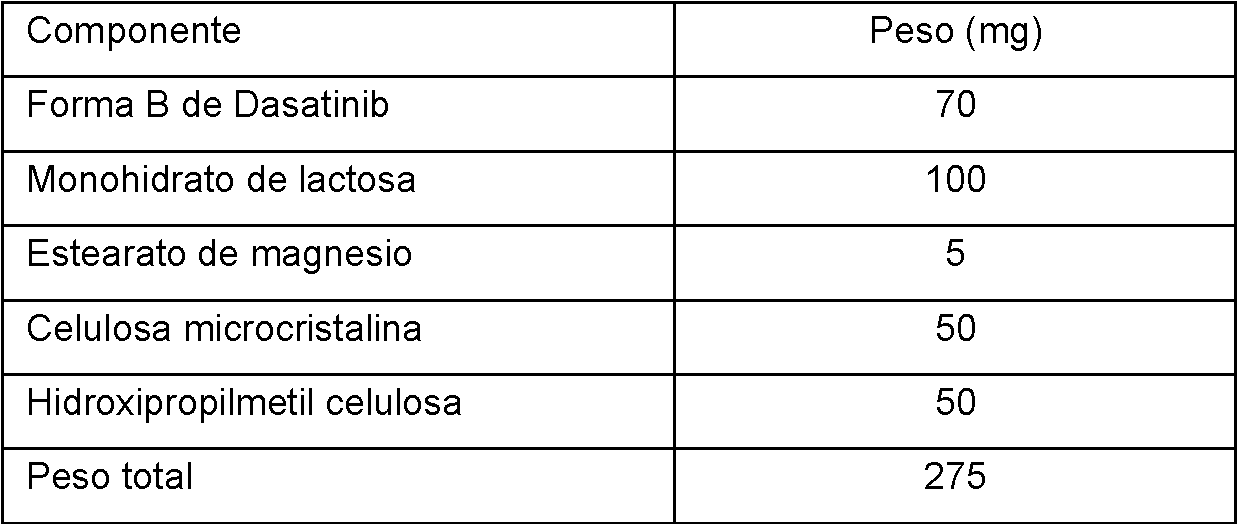
La mezcla anterior se presionó para formar un comprimido que se analizó después por PXRD proporcionando los picos principales 7,2 y 14,4 grados dos-theta.The above mixture was pressed to form a tablet that was then analyzed by PXRD to provide the main peaks 7.2 and 14.4 degrees two-theta.
Ejemplo Comparativo 84: Preparación de una formulación farmacéutica de la Forma C de DasatinibComparative Example 84: Preparation of a pharmaceutical formulation of Dasatinib Form C
La forma C de Dasatinib que tiene los picos principales de PXRD 6,1, 11,8, 15,1, 16,6, 18,2, 19,3, 20,8, 21,6, 23,0, 23,8, 24,3, 24,8 y 25,5 ± 0,2 grados 2-theta y todos los componentes presentados en la tabla a continuación se pesaron juntos y se mezclaron.Dasatinib form C having the main peaks of PXRD 6.1, 11.8, 15.1, 16.6, 18.2, 19.3, 20.8, 21.6, 23.0, 23, 8, 24.3, 24.8 and 25.5 ± 0.2 degrees 2-theta and all the components presented in the table below were weighed together and mixed.


La mezcla anterior se presiona para formar un comprimido que se analiza después por PXRD para proporcionar los picos principales 6,1, 11,8, 15,1, 18,2 y 24,3 grados dos-theta.The above mixture is pressed to form a tablet that is then analyzed by PXRD to provide the main peaks 6.1, 11.8, 15.1, 18.2 and 24.3 degrees two-theta.
Ejemplo Comparativo 85: Preparación de una formulación farmacéutica de la Forma A21 de DasatinibComparative Example 85: Preparation of a pharmaceutical formulation of Dasatinib Form A21
La forma A21 de Dasatinib que tiene los picos principales de PXRD a 6,0, 11,9, 15,1, 18,2, 20,8, 23,9, 24,3 y 25,5 ± 0,2 grados 2-theta y todos los componentes presentados en la tabla a continuación se pesaron juntos y se mezclaron.The A21 form of Dasatinib which has the main peaks of PXRD at 6.0, 11.9, 15.1, 18.2, 20.8, 23.9, 24.3 and 25.5 ± 0.2 degrees 2 -theta and all the components presented in the table below were weighed together and mixed.

La mezcla anterior se presionó para formar un comprimido que se analizó después por PXRD proporcionando los picos principales 6,0, 11,9, 15,1, 18,2 y 24,3 grados dos-theta.The above mixture was pressed to form a tablet that was then analyzed by PXRD to provide the main peaks 6.0, 11.9, 15.1, 18.2 and 24.3 degrees two-theta.
Ejemplo Comparativo 86: Procedimiento para la preparación de la Forma BL de DasatinibComparative Example 86: Procedure for the preparation of Dasatinib BL Form
La forma A21 bruta de dasatinib (240 mg) se disolvió en glicerol formal (1,25 ml) calentando a 130 °C durante 1 min. La solución se dejó enfriar espontáneamente a 20 °C en aproximadamente 20 min y después la muestra se dejó reposar a 20 °C durante 20 min adicionales. Los cristales formados se recuperaron por filtración, se lavaron mediante TBME (15 ml) y se secaron al aire durante 1 h.The crude A21 form of dasatinib (240 mg) was dissolved in formal glycerol (1.25 ml) by heating at 130 ° C for 1 min. The solution was allowed to cool spontaneously at 20 ° C in approximately 20 min and then the sample was allowed to stand at 20 ° C for an additional 20 min. The crystals formed were recovered by filtration, washed by TBME (15 ml) and air dried for 1 h.
Ejemplo Comparativo 87: Procedimiento para la preparación de la Forma N-6 de DasatinibComparative Example 87: Procedure for the preparation of Dasatinib Form N-6
Se secó Dasatinib (forma P) a 200 °C en nitrógeno durante 2 horas.Dasatinib (form P) was dried at 200 ° C under nitrogen for 2 hours.
Ejemplo Comparativo 88: Procedimiento para la preparación de la Forma N-6 de DasatinibComparative Example 88: Procedure for the preparation of Dasatinib Form N-6
Se calentó Dasatinib (200 mg, forma A3) en un baño de aceite gradualmente hasta 208 °C a 0,7 Pa finales durante aproximadamente 15 min. No se observó sublimación. MS demostró que la muestra era dasatinib puro (sin ningún cambio químico).Dasatinib (200 mg, form A3) was heated in an oil bath gradually to 208 ° C at 0.7 Pa final for approximately 15 min. No sublimation was observed. MS showed that the sample was pure dasatinib (without any chemical change).
Ejemplo Comparativo 89: Procedimiento para la preparación de la Forma BM de DasatinibComparative Example 89: Procedure for the preparation of Dasatinib BM Form
Una suspensión de 30 mg de Dasatinib (forma C) en MeOH (1 ml) se disolvió calentando a 64 °C durante 30 minutos y después la temperatura se redujo hasta 0 °C durante 1-2 minutos. Se creó una fase cristalina inmediatamente después de la caída de temperatura. El sólido se separó por filtración y se secó en un filtro en una corriente de N2. Ejemplo Comparativo 90: Procedimiento para la preparación de la Forma BM de DasatinibA suspension of 30 mg of Dasatinib (form C) in MeOH (1 ml) was dissolved by heating at 64 ° C for 30 minutes and then the temperature was reduced to 0 ° C for 1-2 minutes. A crystalline phase was created immediately after the temperature drop. The solid was filtered off and dried on a filter in a stream of N2. Comparative Example 90: Procedure for the preparation of Dasatinib BM Form
Una suspensión de 40 mg de Dasatinib (forma C) en 1 ml de MeOH se enfrió desde T.A. a (-15 °C) durante 5 min. Después calentar a 65 °C durante 170 min, mantener 10 min a 65 °C y después enfriar a (-15 °C) durante 170 min. Filtración en N2.A suspension of 40 mg of Dasatinib (form C) in 1 ml of MeOH was cooled from T.A. at (-15 ° C) for 5 min. Then heat at 65 ° C for 170 min, keep 10 min at 65 ° C and then cool to (-15 ° C) for 170 min. Filtration in N2.
Ejemplo 91: Conversión de la Forma N6 en la forma B:Example 91: Conversion of Form N6 into Form B:
Se puso Dasatinib (forma N-6, 75 mg) en un vial y se añadió 1 ml de metanol. La suspensión se dejó después a 0 °C durante 2 días. La fase sólida se filtró y se dejó secar al aire. La muestra se analizó por PXRD y proporcionó la forma N-6 que contenía aproximadamente un 10 % de forma B.Dasatinib (form N-6, 75 mg) was placed in a vial and 1 ml of methanol was added. The suspension was then left at 0 ° C for 2 days. The solid phase was filtered and allowed to air dry. The sample was analyzed by PXRD and provided the N-6 form containing approximately 10% form B.
Ejemplo 92: Conversión de la Forma N6 en la forma B: Example 92: Conversion of Form N6 into Form B:
Se puso Dasatinib (forma N-6, 75 mg) en un vial y se añadió 1 ml de metanol. La suspensión se dejó después a 20 °C durante 2 días respectivamente. La fase sólida se filtró y se dejó secar al aire. La muestra se analizó por PXRD y proporcionó la forma N-6 que contenía aproximadamente un 1 % de forma B.Dasatinib (form N-6, 75 mg) was placed in a vial and 1 ml of methanol was added. The suspension was then left at 20 ° C for 2 days respectively. The solid phase was filtered and allowed to air dry. The sample was analyzed by PXRD and provided the N-6 form containing approximately 1% form B.
En vista de lo anterior, se apreciará que la invención descrita en el presente documento entre otros se refiere a los siguientes artículos:In view of the foregoing, it will be appreciated that the invention described herein among others refers to the following articles:
Artículo 39. Una forma anhidra de dasatinib caracterizada por un patrón de XRD en polvo como se representa en la figura 2.Article 39. An anhydrous form of dasatinib characterized by a powder XRD pattern as depicted in Figure 2.
Artículo 44. La forma anhidra de dasatinib del artículo 39, caracterizada adicionalmente por los datos seleccionados del grupo que consiste en: un contenido de agua de aproximadamente un 0,5 % en peso como se mide por KF; y un contenido de disolventes residuales de aproximadamente un 0,5 % en peso como se mide por GC.Article 44. The anhydrous form of dasatinib of article 39, further characterized by the data selected from the group consisting of: a water content of approximately 0.5% by weight as measured by KF; and a residual solvent content of approximately 0.5% by weight as measured by GC.
Artículo 45. La forma anhidra de dasatinib de uno cualquiera de los artículos 39 o 44, teniendo menos de aproximadamente un 15 % en peso, preferentemente, menos de aproximadamente un 10 % en peso, más preferentemente, menos de aproximadamente un 5 % en peso de las formas cristalinas de Dasatinib N-6 caracterizada por un patrón de XRD en polvo con picos a aproximadamente 8,9, 12,4, 13,2, 13,8, 16,8, 17,2, 21,1, 24,4, 24,9 y 27,8 ± 0,2 grados 2-theta y H1-7 caracterizada por un patrón de XRD en polvo con picos a aproximadamente 4,6, 9,2, 11,2, 13,8, 15,2, 17,9, 19,5, 23,1, 23,6, 25,9 y 28,0 ± 0,2 grados 2-theta o cualquier otra forma.Article 45. The anhydrous form of dasatinib of any one of articles 39 or 44, having less than about 15% by weight, preferably, less than about 10% by weight, more preferably, less than about 5% by weight of the crystalline forms of Dasatinib N-6 characterized by a pattern of XRD powder with peaks at approximately 8.9, 12.4, 13.2, 13.8, 16.8, 17.2, 21.1, 24 , 4, 24.9 and 27.8 ± 0.2 degrees 2-theta and H1-7 characterized by a powder XRD pattern with peaks at approximately 4.6, 9.2, 11.2, 13.8, 15.2, 17.9, 19.5, 23.1, 23.6, 25.9 and 28.0 ± 0.2 degrees 2-theta or any other form.
Artículo 46. Un método para preparar una forma anhidra de dasatinib caracterizada por un patrón de XRD en polvo como se representa en la figura 2, que comprende cristalizar dasatinib a partir de una mezcla que comprende el compuesto de fórmula 1, N-(2-hidroxietil)piperazina, N-etildiisopropilamina y una mezcla de DMSO, metanol y agua. Artículo 47. El método del artículo 46, en donde la cristalización comprende hacer reaccionar el compuesto 1, N-(2-hidroxietil)piperazina y N-etildiisopropilamina en DMSO para obtener una solución que comprende dasatinib, añadir metanol y después agua a dicha solución para obtener una segunda solución y precipitar dicha forma cristalina para obtener una suspensión.Article 46. A method for preparing an anhydrous form of dasatinib characterized by a powder XRD pattern as depicted in Figure 2, comprising crystallizing dasatinib from a mixture comprising the compound of formula 1, N- (2- hydroxyethyl) piperazine, N-ethyldiisopropylamine and a mixture of DMSO, methanol and water. Article 47. The method of article 46, wherein the crystallization comprises reacting compound 1, N- (2-hydroxyethyl) piperazine and N-ethyldiisopropylamine in DMSO to obtain a solution comprising dasatinib, adding methanol and then water to said solution to obtain a second solution and precipitate said crystalline form to obtain a suspension.
Artículo 48. El método del artículo 46-47, en donde la reacción del compuesto 1, N-(2-hidroxietil)piperazina y N-etildiisopropilamina en DMSO se realiza a una temperatura de aproximadamente 40 °C a aproximadamente 150 °C. Artículo 49. El método de uno cualquiera de los artículos 46-48, en donde el metanol y el agua se añaden a una temperatura de aproximadamente 60 °C a aproximadamente 65 °C.Article 48. The method of article 46-47, wherein the reaction of compound 1, N- (2-hydroxyethyl) piperazine and N-ethyldiisopropylamine in DMSO is carried out at a temperature of about 40 ° C to about 150 ° C. Article 49. The method of any one of articles 46-48, wherein methanol and water are added at a temperature of about 60 ° C to about 65 ° C.
Artículo 50. El método de uno cualquiera de los artículos 46-49, en donde la precipitación se realiza enfriando la solución.Article 50. The method of any one of articles 46-49, where precipitation is carried out by cooling the solution.
Artículo 51. El método del artículo 46, que comprende adicionalmente recuperar la forma cristalina.Article 51. The method of article 46, which further comprises recovering the crystalline form.
Artículo 52. Un método para preparar una forma anhidra de dasatinib caracterizada por un patrón de XRD en polvo como se representa en la figura 2, que comprende cristalizar dasatinib a partir de una mezcla que comprende etanol y agua.Article 52. A method for preparing an anhydrous form of dasatinib characterized by a powder XRD pattern as depicted in Figure 2, comprising crystallizing dasatinib from a mixture comprising ethanol and water.
Artículo 53. El método del artículo 52, en donde la cristalización comprende proporcionar una solución que comprende dasatinib en una mezcla de etanol y agua y precipitar dicha forma cristalina para obtener una suspensión.Article 53. The method of article 52, wherein the crystallization comprises providing a solution comprising dasatinib in a mixture of ethanol and water and precipitating said crystalline form to obtain a suspension.
Artículo 54. El método de uno cualquiera de los artículos 52-53, en donde la solución se proporciona combinando dasatinib y una mezcla de etanol y agua y calentar la combinación.Article 54. The method of any one of articles 52-53, wherein the solution is provided by combining dasatinib and a mixture of ethanol and water and heating the combination.
Artículo 55. El método de uno cualquiera de los artículos 52-54, en donde el calentamiento es a una temperatura de aproximadamente 75 °C a aproximadamente 80 °C.Article 55. The method of any one of articles 52-54, wherein the heating is at a temperature of about 75 ° C to about 80 ° C.
Artículo 56. El método de uno cualquiera de los artículos 52-55, en donde la precipitación se realiza enfriando la segunda solución a una temperatura de aproximadamente 5°Ca aproximadamente 0 °C.Article 56. The method of any one of articles 52-55, wherein precipitation is carried out by cooling the second solution to a temperature of approximately 5 ° C to approximately 0 ° C.
Artículo 57. Un método para preparar una forma anhidra de dasatinib caracterizada por un patrón de XRD en polvo como se representa en la figura 2, que comprende proporcionar una solución opalescente de dasatinib en metanol y precipitar dicha forma cristalina para obtener una suspensión.Article 57. A method for preparing an anhydrous form of dasatinib characterized by a powder XRD pattern as depicted in Figure 2, which comprises providing an opalescent solution of dasatinib in methanol and precipitating said crystalline form to obtain a suspension.
Artículo 58. El método del artículo 57, en donde la solución opalescente se proporciona combinando dasatinib y metanol y calentar la combinación.Article 58. The method of article 57, wherein the opalescent solution is provided by combining dasatinib and methanol and heating the combination.
Artículo 59. El método de uno cualquiera de los artículos 57-58, en donde el calentamiento es a una temperatura de aproximadamente 85 °C. Article 59. The method of any one of articles 57-58, wherein the heating is at a temperature of approximately 85 ° C.
Artículo 60. El método de uno cualquiera de los artículos 57-59, en donde la precipitación se realiza enfriando la solución opalescente a una temperatura de aproximadamente 5 °C a aproximadamente 0 °C.Article 60. The method of any one of articles 57-59, wherein precipitation is carried out by cooling the opalescent solution to a temperature of about 5 ° C to about 0 ° C.
Artículo 61. El método de uno cualquiera de los artículos de métodos precedentes, que comprende adicionalmente recuperar la forma cristalina.Article 61. The method of any one of the articles of preceding methods, further comprising recovering the crystalline form.
Artículo 66. Una formulación que comprende dasatinib anhidro de uno cualquiera de los artículos precedentes y al menos un excipiente farmacéuticamente aceptable.Article 66. A formulation comprising anhydrous dasatinib of any one of the preceding articles and at least one pharmaceutically acceptable excipient.
Artículo 67. Una composición farmacéutica que comprende dasatinib anhidro preparado por el proceso de cualquiera de los artículos precedentes y al menos un excipiente farmacéuticamente aceptable.Article 67. A pharmaceutical composition comprising anhydrous dasatinib prepared by the process of any of the preceding articles and at least one pharmaceutically acceptable excipient.
Artículo 68. Un proceso para preparar una composición farmacéutica que comprende dasatinib anhidro de uno cualquiera de los artículos precedentes y al menos un excipiente farmacéuticamente aceptable.Article 68. A process for preparing a pharmaceutical composition comprising anhydrous dasatinib of any one of the preceding articles and at least one pharmaceutically acceptable excipient.
Artículo 69. Uso del dasatinib anhidro de uno cualquiera de los artículos precedentes o para la fabricación de una composición farmacéutica. Article 69. Use of anhydrous dasatinib of any one of the preceding articles or for the manufacture of a pharmaceutical composition.
Claims (11)

Applications Claiming Priority (26)
| Application Number | Priority Date | Filing Date | Title |
|---|---|---|---|
| US8699P | 1995-12-15 | ||
| US19106P | 1996-06-03 | ||
| US39011P | 1997-02-25 | ||
| US56876P | 1997-08-22 | ||
| US99999807P | 2007-10-23 | 2007-10-23 | |
| US999998P | 2007-10-23 | ||
| US869907P | 2007-12-20 | 2007-12-20 | |
| US1910608P | 2008-01-04 | 2008-01-04 | |
| US3901108P | 2008-03-24 | 2008-03-24 | |
| US4138408P | 2008-04-01 | 2008-04-01 | |
| US41384P | 2008-04-01 | ||
| US5251308P | 2008-05-12 | 2008-05-12 | |
| US52513P | 2008-05-12 | ||
| US5530908P | 2008-05-22 | 2008-05-22 | |
| US55309P | 2008-05-22 | ||
| US5687608P | 2008-05-29 | 2008-05-29 | |
| US6105408P | 2008-06-12 | 2008-06-12 | |
| US61054P | 2008-06-12 | ||
| US7362808P | 2008-06-18 | 2008-06-18 | |
| US73628P | 2008-06-18 | ||
| US7954808P | 2008-07-10 | 2008-07-10 | |
| US79548P | 2008-07-10 | ||
| US8038208P | 2008-07-14 | 2008-07-14 | |
| US80382P | 2008-07-14 | ||
| US9160708P | 2008-08-25 | 2008-08-25 | |
| US91607P | 2008-08-25 |
Publications (2)
| Publication Number | Publication Date |
|---|---|
| ES2565521T3 ES2565521T3 (en) | 2016-04-05 |
| ES2565521T5 true ES2565521T5 (en) | 2019-12-10 |
Family
ID=40580164
Family Applications (1)
| Application Number | Title | Priority Date | Filing Date |
|---|---|---|---|
| ES11194987T Active ES2565521T5 (en) | 2007-10-23 | 2008-10-23 | Dasatinib polymorphs and their preparation process |
Country Status (8)
| Country | Link |
|---|---|
| US (2) | US8067423B2 (en) |
| EP (3) | EP2508523B2 (en) |
| JP (2) | JP2010539156A (en) |
| KR (2) | KR20100058660A (en) |
| ES (1) | ES2565521T5 (en) |
| HR (1) | HRP20160208T4 (en) |
| PL (1) | PL2508523T5 (en) |
| WO (1) | WO2009053854A2 (en) |
Families Citing this family (59)
| Publication number | Priority date | Publication date | Assignee | Title |
|---|---|---|---|---|
| WO2010067374A2 (en) * | 2008-12-08 | 2010-06-17 | Hetero Research Foundation | Polymorphs of dasatinib |
| WO2010139980A1 (en) * | 2009-06-03 | 2010-12-09 | Generics [Uk] Limited | Process for preparing crystalline dasatinib monohydrate |
| WO2010139981A2 (en) * | 2009-06-03 | 2010-12-09 | Generics [Uk] Limited | Processes for preparing crystalline forms |
| WO2010139979A2 (en) * | 2009-06-03 | 2010-12-09 | Generics [Uk] Limited | Processes for preparing crystalline forms |
| CN101812060B (en) | 2010-02-02 | 2011-08-17 | 南京卡文迪许生物工程技术有限公司 | Simple novel method for preparing high-purity Sprycel, and intermediate compound |
| EP2359813A1 (en) * | 2010-02-04 | 2011-08-24 | Ratiopharm GmbH | Pharmaceutical composition comprising N-(2-chloro-6-methylphenyl)-2-[[6-[4-(2-hydroxyethyl)-1-piperazinyl]-2-methyl-4-pyrimidinyl]amino]-5-thiazolecarboxamid |
| CN101891738B (en) * | 2010-02-08 | 2011-09-28 | 南京卡文迪许生物工程技术有限公司 | Dasatinib polymorph, its preparation method and pharmaceutical composition |
| CN102250084A (en) * | 2010-02-08 | 2011-11-23 | 南京卡文迪许生物工程技术有限公司 | Dasatinib polymorphic substance as well as preparation method and pharmaceutical composition thereof |
| JP5589097B2 (en) * | 2010-02-08 | 2014-09-10 | 南京▲か▼文迪許生物工程技術有限公司 | Dasatinib polycrystal, preparation method thereof and drug composition |
| CA2806820A1 (en) | 2010-07-30 | 2012-02-02 | Ranbaxy Laboratories Limited | N-methylformamide solvate of dasatinib |
| CN102030745B (en) * | 2010-11-26 | 2012-05-09 | 江苏先声药物研究有限公司 | Dasatinib solvate and preparation method thereof |
| CN102643275B (en) * | 2011-02-21 | 2016-04-20 | 江苏先声药物研究有限公司 | The preparation method that a kind of Dasatinib N-6 crystal formation is new |
| CN102838594B (en) * | 2011-06-24 | 2015-06-24 | 南京圣和药业股份有限公司 | A kind of preparation and refining method of dasatinib |
| CN102898424A (en) * | 2011-07-29 | 2013-01-30 | 江苏奥赛康药业股份有限公司 | New polymorphic form of dasatinib and preparation method thereof |
| CN104130251A (en) * | 2011-07-29 | 2014-11-05 | 江苏奥赛康药业股份有限公司 | Dasatinib compound and preparation method thereof |
| CN103059013B (en) * | 2011-10-18 | 2016-11-23 | 北京本草天源药物研究院 | Crystal formation of Dasatinib monohydrate and preparation method thereof |
| WO2013065063A1 (en) | 2011-11-03 | 2013-05-10 | Cadila Healthcare Limited | Anhydrous form of dasatinib, process for its preparation and its use |
| CN102408423B (en) * | 2011-11-29 | 2013-12-25 | 上海希迪制药有限公司 | Method for preparing large particle size dasatinib |
| WO2013078973A1 (en) * | 2011-11-29 | 2013-06-06 | 上海创诺制药有限公司 | Large particle diameter dasatinib and preparation and use thereof |
| WO2013186726A2 (en) * | 2012-06-15 | 2013-12-19 | Basf Se | Multicomponent crystals comprising dasatinib and selected cocrystal formers |
| CN103664929B (en) * | 2012-08-30 | 2016-08-03 | 石药集团中奇制药技术(石家庄)有限公司 | Dasatinib polycrystalline form medicament and preparation method |
| CN103819469A (en) * | 2012-11-16 | 2014-05-28 | 重庆医药工业研究院有限责任公司 | Crystal form of dasatinib and preparation method for crystal form of dasatinib |
| CZ306598B6 (en) * | 2012-12-06 | 2017-03-22 | Zentiva, K.S. | A method of preparation and purification of new and known polymorphs and dasatinib solvates |
| US9249134B2 (en) * | 2013-03-26 | 2016-02-02 | Cadila Healthcare Limited | Process for preparation of amorphous form of dasatinib |
| CA2917183C (en) | 2013-07-25 | 2019-01-29 | Basf Se | Salts of dasatinib in crystalline form |
| AU2014295143B9 (en) | 2013-07-25 | 2017-03-23 | Basf Se | Salts of Dasatinib in amorphous form |
| CN104341410A (en) * | 2013-08-09 | 2015-02-11 | 上海科胜药物研发有限公司 | New Dasatinib crystal form and preparation method thereof |
| WO2015049645A2 (en) * | 2013-10-04 | 2015-04-09 | Alembic Pharmaceuticals Limited | An improved process for the preparation of dasatinib |
| JP6878004B2 (en) | 2013-12-13 | 2021-05-26 | ダナ−ファーバー キャンサー インスティテュート, インコーポレイテッド | How to Treat Lymphatic Plasma Cell Lymphoma |
| JP6879740B2 (en) | 2013-12-13 | 2021-06-02 | ダナ−ファーバー キャンサー インスティテュート, インコーポレイテッド | How to Treat Lymphatic Plasma Cell Lymphoma |
| CZ306732B6 (en) | 2013-12-19 | 2017-05-31 | Zentiva, K.S. | A method of preparation of the anhydrous polymorphic form of N-6 Dasatinib |
| US20180230140A1 (en) | 2014-06-30 | 2018-08-16 | Basf Se | Multicomponent crystals of dasatinib with menthol or vanillin |
| CN104327067B (en) * | 2014-10-11 | 2017-03-22 | 深圳市浩瑞实业发展有限公司 | Preparation method of amorphous dasatinib |
| US10112957B2 (en) | 2014-10-22 | 2018-10-30 | Dana-Farber Cancer Institute, Inc. | Thiazolyl-containing compounds for treating proliferative diseases |
| CN105130977B (en) * | 2015-07-22 | 2018-04-20 | 山东罗欣药业集团股份有限公司 | A kind of Dasatinib compound, and combinations thereof |
| CN105055327A (en) * | 2015-07-30 | 2015-11-18 | 青岛蓝盛洋医药生物科技有限责任公司 | Dasatinib composite granules capable of treating leukaemia |
| CN104997737A (en) * | 2015-08-05 | 2015-10-28 | 青岛蓝盛洋医药生物科技有限责任公司 | Composition dry suspension of medicine dasatinib tablet for treating leukemia |
| CN105055367A (en) * | 2015-08-18 | 2015-11-18 | 青岛蓝盛洋医药生物科技有限责任公司 | SprycelTM composition capsule medicine for treating leukemia |
| CN105237529A (en) * | 2015-10-29 | 2016-01-13 | 四川协力制药有限公司 | Refining method for high-purity anhydrous dasatinib |
| WO2017098391A1 (en) * | 2015-12-11 | 2017-06-15 | Shilpa Medicare Limited | Process for the preparation of dasatinib |
| ES2794804T3 (en) * | 2015-12-16 | 2020-11-19 | Synthon Bv | Pharmaceutical composition comprising anhydrous dasatinib |
| WO2017108605A1 (en) | 2015-12-22 | 2017-06-29 | Synthon B.V. | Pharmaceutical composition comprising amorphous dasatinib |
| CN105503854A (en) * | 2015-12-31 | 2016-04-20 | 哈药集团技术中心 | New crystal form substance of Dasatinib anhydrous substance and preparation method thereof |
| WO2017134617A1 (en) * | 2016-02-03 | 2017-08-10 | Dr. Reddy's Laboratories Limited | Process for the preparation of amorphous dasatinib |
| WO2017134615A1 (en) * | 2016-02-03 | 2017-08-10 | Dr. Reddy's Laboratories Limited | Solid state forms of dasatinib and processes for their preparation |
| WO2018078392A1 (en) * | 2016-10-29 | 2018-05-03 | Cipla Limited | Polymorphs of dasatinib |
| WO2018100585A1 (en) * | 2016-12-01 | 2018-06-07 | Natco Pharma Limited | An improved process for the preparation of dasatinib polymorph |
| US11059813B2 (en) | 2017-07-07 | 2021-07-13 | Biocon Limited | Polymorphic forms of Dasatinib |
| JP7166754B2 (en) | 2017-11-22 | 2022-11-08 | 沢井製薬株式会社 | Formulations containing dasatinib anhydrate |
| JP7249397B2 (en) * | 2017-12-27 | 2023-03-30 | 日本化薬株式会社 | Pharmaceutical composition containing dasatinib as an active ingredient |
| WO2019209908A1 (en) | 2018-04-25 | 2019-10-31 | Johnson Matthey Public Limited Company | Crystalline forms of dasatinib |
| CN120305263A (en) | 2018-06-15 | 2025-07-15 | 汉达癌症医药责任有限公司 | Use of salts of cabozantinib in preparing dosage forms for treating cancer |
| WO2020217235A1 (en) * | 2019-04-24 | 2020-10-29 | Aizant Drug Research Solutions Private Limited | Solid dosage form of dasatinib |
| US10799459B1 (en) | 2019-05-17 | 2020-10-13 | Xspray Microparticles Ab | Rapidly disintegrating solid oral dosage forms containing dasatinib |
| US11919780B2 (en) | 2019-07-09 | 2024-03-05 | Entegris, Inc. | Oxyhalide precursors |
| CN112569236A (en) * | 2019-09-28 | 2021-03-30 | 鲁南制药集团股份有限公司 | Dasatinib methanol solvate and preparation method thereof |
| CA3168667A1 (en) | 2020-01-24 | 2021-07-29 | Nanocopoeia, Llc | Amorphous solid dispersions of dasatinib and uses thereof |
| US11529351B2 (en) | 2021-01-21 | 2022-12-20 | Xspray Pharma Ab | Fast dissolving pharmaceutical compositions |
| US11980619B2 (en) | 2021-07-28 | 2024-05-14 | Nanocopoeia, Llc | Pharmaceutical compositions and crushable tablets including amorphous solid dispersions of dasatinib and uses |
Family Cites Families (21)
| Publication number | Priority date | Publication date | Assignee | Title |
|---|---|---|---|---|
| NZ212209A (en) | 1984-05-29 | 1988-08-30 | Pfizer | Quinolone derivatives and pharmaceutical compositions |
| GB8608962D0 (en) † | 1986-04-12 | 1986-05-14 | Beecham Group Plc | Beta-lactam antibiotics |
| US5250534A (en) | 1990-06-20 | 1993-10-05 | Pfizer Inc. | Pyrazolopyrimidinone antianginal agents |
| GB9013750D0 (en) | 1990-06-20 | 1990-08-08 | Pfizer Ltd | Therapeutic agents |
| GB9812413D0 (en) | 1998-06-10 | 1998-08-05 | Glaxo Group Ltd | Compound and its use |
| US7125875B2 (en) | 1999-04-15 | 2006-10-24 | Bristol-Myers Squibb Company | Cyclic protein tyrosine kinase inhibitors |
| NZ513639A (en) | 1999-04-15 | 2004-02-27 | Bristol Myers Squibb Co | Cyclic protein tyrosine kinase inhibitors |
| US7365086B2 (en) † | 2003-07-25 | 2008-04-29 | Synthon Ip Inc. | Pramipexole acid addition salts |
| US20050215795A1 (en) * | 2004-02-06 | 2005-09-29 | Bang-Chi Chen | Process for preparing 2-aminothiazole-5-aromatic carboxamides as kinase inhibitors |
| TWI338004B (en) * | 2004-02-06 | 2011-03-01 | Bristol Myers Squibb Co | Process for preparing 2-aminothiazole-5-aromatic carboxamides as kinase inhibitors |
| US7491725B2 (en) | 2004-02-06 | 2009-02-17 | Bristol-Myers Squibb Company | Process for preparing 2-aminothiazole-5-aromatic carboxamides as kinase inhibitors |
| US7652146B2 (en) | 2004-02-06 | 2010-01-26 | Bristol-Myers Squibb Company | Process for preparing 2-aminothiazole-5-carboxamides useful as kinase inhibitors |
| US6976694B1 (en) | 2004-07-20 | 2005-12-20 | Rayl Kevin G | Trailer hitch including V-guide |
| TW200628156A (en) † | 2004-11-04 | 2006-08-16 | Bristol Myers Squibb Co | Combination of a SRC kinase inhibitor and a BCR-ABL inhibitor for the treatment of proliferative diseases |
| CN101111481A (en) † | 2004-11-18 | 2008-01-23 | 斯索恩有限公司 | Process for preparing crystalline aripiprazole |
| PE20061394A1 (en) | 2005-03-15 | 2006-12-15 | Bristol Myers Squibb Co | METABOLITES OF N- (2-CHLORO-6-METHYLPHENYL) -2 - [[6- [4- (2-HYDROXYETHYL) -1-PIPERAZINYL] -2-METHYL-4-PYRIMIDINYL] AMINO] -5-THIAZOLCARBOXAMIDES |
| DE602006002650D1 (en) † | 2005-05-26 | 2008-10-23 | Apotecnia S A | Process for the preparation of paroxetine hydrochloride hemihydrate |
| WO2007019210A1 (en) | 2005-08-05 | 2007-02-15 | Bristol-Myers Squibb Company | Preparation of 2-amino-thiazole-5-carboxylic-acid derivatives |
| US20070105867A1 (en) * | 2005-09-21 | 2007-05-10 | Bristol-Myers Squibb Company | Oral administration of N-(2-chloro-6-methylphenyl)-2-[[6-[4-(2-hydroxyethyl)-1-piperazinyl]-2-methyl-4-pyrimidinyl]amino]-1,3-thiazole-5-carboxamide and salts thereof |
| US20070219370A1 (en) | 2006-03-15 | 2007-09-20 | Bristol-Myers Squibb Company | Process for preparing n-(2-chloro-6-methylphenyl)-2-[[6-[4-(2-hydroxyethyl)-1-piperazinyl]-2-methyl-4-pyrimidinyl]amino] -5-thiazolecarboxamide and related metabolites thereof |
| ES2794804T3 (en) † | 2015-12-16 | 2020-11-19 | Synthon Bv | Pharmaceutical composition comprising anhydrous dasatinib |
-
2008
- 2008-10-23 KR KR1020107008946A patent/KR20100058660A/en not_active Ceased
- 2008-10-23 KR KR1020127006721A patent/KR20120033357A/en not_active Ceased
- 2008-10-23 JP JP2010524603A patent/JP2010539156A/en active Pending
- 2008-10-23 US US12/257,338 patent/US8067423B2/en active Active
- 2008-10-23 PL PL11194987T patent/PL2508523T5/en unknown
- 2008-10-23 ES ES11194987T patent/ES2565521T5/en active Active
- 2008-10-23 EP EP11194987.1A patent/EP2508523B2/en active Active
- 2008-10-23 EP EP12185403A patent/EP2537847A1/en not_active Withdrawn
- 2008-10-23 WO PCT/IB2008/003862 patent/WO2009053854A2/en not_active Ceased
- 2008-10-23 EP EP08843260A patent/EP2207777A2/en not_active Ceased
-
2010
- 2010-06-14 US US12/814,916 patent/US7973045B2/en active Active
-
2012
- 2012-10-03 JP JP2012221583A patent/JP6081763B2/en active Active
-
2016
- 2016-02-26 HR HRP20160208TT patent/HRP20160208T4/en unknown
Also Published As
| Publication number | Publication date |
|---|---|
| PL2508523T5 (en) | 2020-08-10 |
| HRP20160208T1 (en) | 2016-03-25 |
| ES2565521T3 (en) | 2016-04-05 |
| US20100256158A1 (en) | 2010-10-07 |
| EP2537847A1 (en) | 2012-12-26 |
| HRP20160208T4 (en) | 2019-08-09 |
| EP2207777A2 (en) | 2010-07-21 |
| JP6081763B2 (en) | 2017-02-15 |
| US8067423B2 (en) | 2011-11-29 |
| JP2010539156A (en) | 2010-12-16 |
| EP2508523B2 (en) | 2019-04-17 |
| KR20120033357A (en) | 2012-04-06 |
| US20090118297A1 (en) | 2009-05-07 |
| EP2508523B1 (en) | 2016-02-17 |
| EP2508523A3 (en) | 2013-02-27 |
| WO2009053854A2 (en) | 2009-04-30 |
| EP2508523A2 (en) | 2012-10-10 |
| PL2508523T3 (en) | 2016-06-30 |
| US7973045B2 (en) | 2011-07-05 |
| WO2009053854A3 (en) | 2009-12-03 |
| KR20100058660A (en) | 2010-06-03 |
| JP2013047238A (en) | 2013-03-07 |
Similar Documents
| Publication | Publication Date | Title |
|---|---|---|
| JP6081763B2 (en) | Dasatinib polymorph and its preparation process | |
| ES2565078T3 (en) | Novel polymorph form of imatinib mesylate and a process for its preparation | |
| ES2621800T3 (en) | Solid state forms of cabazitaxel and their preparation processes | |
| US20090298947A1 (en) | Polymorphic and amorphous forms of lacosamide and amorphous compositions | |
| WO2010067374A2 (en) | Polymorphs of dasatinib | |
| ES2818902T3 (en) | Novel crystalline form of the 1- (5- (2,4-difluorophenyl) -1 - ((3-fluorophenyl) sulfonyl) -4-methoxy-1H-pyrrol-3-yl) -N-methylmethanamine salt | |
| US9067915B2 (en) | Sunitinib and salts thereof and their polymorphs | |
| ES2879294T3 (en) | Polymorphic forms of Belinostat and processes for their preparation | |
| WO2010139980A1 (en) | Process for preparing crystalline dasatinib monohydrate | |
| KR20200108828A (en) | The solid form of Valbenazine | |
| WO2010144675A1 (en) | Polymorphs of bendamustine hcl and processes for preparation thereof | |
| WO2013065063A1 (en) | Anhydrous form of dasatinib, process for its preparation and its use | |
| JP2005504818A (en) | Preparation of levofloxacin and its forms | |
| AU2011284341A1 (en) | N-Methylformamide solvate of dasatinib | |
| IL197962A (en) | Crystalline form of -3-(1h-indol-3-yl)-4-[2-(4-methyl-piperazin-1-yl)-quinazolin-4-yl]-pyrrole-2,5-dione acetate, pharmaceutical composition comprising it, process for its preparation and use thereof for the preparation of a pharmacological agent | |
| TWI707851B (en) | Novel crystals of piperazine compounds | |
| EP4615820B1 (en) | Crystalline forms of evenamide | |
| ES3036562T3 (en) | Crystalline forms of pyrimidino diazepine derivative | |
| ES2397342T3 (en) | Crystal forms of a pharmaceutical compound | |
| HK40003591B (en) | Polymorphic forms of belinostat and processes for preparation thereof | |
| KR20090009898A (en) | Salts and their crystalline variants |