ES2697775T3 - Novel compounds for selective histone deacetylase inhibitors and pharmaceutical composition comprising the same - Google Patents
Novel compounds for selective histone deacetylase inhibitors and pharmaceutical composition comprising the same Download PDFInfo
- Publication number
- ES2697775T3 ES2697775T3 ES14792173T ES14792173T ES2697775T3 ES 2697775 T3 ES2697775 T3 ES 2697775T3 ES 14792173 T ES14792173 T ES 14792173T ES 14792173 T ES14792173 T ES 14792173T ES 2697775 T3 ES2697775 T3 ES 2697775T3
- Authority
- ES
- Spain
- Prior art keywords
- benzyl
- hydroxycarbamoyl
- carboxamide
- phenyl
- morpholine
- Prior art date
- Legal status (The legal status is an assumption and is not a legal conclusion. Google has not performed a legal analysis and makes no representation as to the accuracy of the status listed.)
- Active
Links
- 150000001875 compounds Chemical class 0.000 title claims abstract description 739
- 239000008194 pharmaceutical composition Substances 0.000 title claims description 13
- 239000003276 histone deacetylase inhibitor Substances 0.000 title description 12
- 229940121372 histone deacetylase inhibitor Drugs 0.000 title description 5
- 229920006395 saturated elastomer Polymers 0.000 claims abstract description 169
- 229910052739 hydrogen Inorganic materials 0.000 claims abstract description 69
- 239000001257 hydrogen Substances 0.000 claims abstract description 69
- 125000000217 alkyl group Chemical group 0.000 claims abstract description 50
- 150000003839 salts Chemical class 0.000 claims abstract description 43
- LFQSCWFLJHTTHZ-UHFFFAOYSA-N Ethanol Chemical compound CCO LFQSCWFLJHTTHZ-UHFFFAOYSA-N 0.000 claims abstract description 37
- 230000003287 optical effect Effects 0.000 claims abstract description 35
- 125000004435 hydrogen atom Chemical group [H]* 0.000 claims abstract description 33
- UFHFLCQGNIYNRP-UHFFFAOYSA-N Hydrogen Chemical compound [H][H] UFHFLCQGNIYNRP-UHFFFAOYSA-N 0.000 claims abstract description 30
- 125000003545 alkoxy group Chemical group 0.000 claims abstract description 29
- 125000001997 phenyl group Chemical group [H]C1=C([H])C([H])=C(*)C([H])=C1[H] 0.000 claims abstract description 28
- 125000006273 (C1-C3) alkyl group Chemical group 0.000 claims abstract description 27
- 125000002023 trifluoromethyl group Chemical group FC(F)(F)* 0.000 claims abstract description 23
- 229910052760 oxygen Inorganic materials 0.000 claims abstract description 21
- 150000002391 heterocyclic compounds Chemical class 0.000 claims abstract description 18
- 229910052799 carbon Inorganic materials 0.000 claims abstract description 17
- 125000001495 ethyl group Chemical group [H]C([H])([H])C([H])([H])* 0.000 claims abstract description 17
- 125000000956 methoxy group Chemical group [H]C([H])([H])O* 0.000 claims abstract description 17
- 229910052717 sulfur Inorganic materials 0.000 claims abstract description 17
- 125000005055 alkyl alkoxy group Chemical group 0.000 claims abstract description 15
- 125000005842 heteroatom Chemical group 0.000 claims abstract description 14
- 229910052757 nitrogen Inorganic materials 0.000 claims abstract description 11
- 150000000660 7-membered heterocyclic compounds Chemical class 0.000 claims abstract description 9
- 125000001797 benzyl group Chemical group [H]C1=C([H])C([H])=C(C([H])=C1[H])C([H])([H])* 0.000 claims abstract description 9
- 125000000229 (C1-C4)alkoxy group Chemical group 0.000 claims abstract description 8
- ZZVUWRFHKOJYTH-UHFFFAOYSA-N diphenhydramine Chemical group C=1C=CC=CC=1C(OCCN(C)C)C1=CC=CC=C1 ZZVUWRFHKOJYTH-UHFFFAOYSA-N 0.000 claims abstract description 8
- 125000006376 (C3-C10) cycloalkyl group Chemical group 0.000 claims abstract description 7
- 150000002431 hydrogen Chemical group 0.000 claims abstract description 6
- 229910052702 rhenium Inorganic materials 0.000 claims abstract description 5
- 125000004178 (C1-C4) alkyl group Chemical group 0.000 claims abstract description 3
- 125000002887 hydroxy group Chemical group [H]O* 0.000 claims abstract 20
- -1 CH3 Chemical group 0.000 claims description 488
- 108090000353 Histone deacetylase Proteins 0.000 claims description 38
- 102000003964 Histone deacetylase Human genes 0.000 claims description 38
- 208000037265 diseases, disorders, signs and symptoms Diseases 0.000 claims description 34
- 201000010099 disease Diseases 0.000 claims description 33
- NQRYJNQNLNOLGT-UHFFFAOYSA-N Piperidine Chemical compound C1CCNCC1 NQRYJNQNLNOLGT-UHFFFAOYSA-N 0.000 claims description 28
- JUJWROOIHBZHMG-UHFFFAOYSA-N Pyridine Chemical compound C1=CC=NC=C1 JUJWROOIHBZHMG-UHFFFAOYSA-N 0.000 claims description 28
- 238000011282 treatment Methods 0.000 claims description 28
- 201000011510 cancer Diseases 0.000 claims description 19
- 206010028980 Neoplasm Diseases 0.000 claims description 17
- GLUUGHFHXGJENI-UHFFFAOYSA-N Piperazine Chemical compound C1CNCCN1 GLUUGHFHXGJENI-UHFFFAOYSA-N 0.000 claims description 16
- SIKJAQJRHWYJAI-UHFFFAOYSA-N Indole Chemical compound C1=CC=C2NC=CC2=C1 SIKJAQJRHWYJAI-UHFFFAOYSA-N 0.000 claims description 14
- UMJSCPRVCHMLSP-UHFFFAOYSA-N pyridine Natural products COC1=CC=CN=C1 UMJSCPRVCHMLSP-UHFFFAOYSA-N 0.000 claims description 14
- YLQBMQCUIZJEEH-UHFFFAOYSA-N Furan Chemical compound C=1C=COC=1 YLQBMQCUIZJEEH-UHFFFAOYSA-N 0.000 claims description 12
- SMWDFEZZVXVKRB-UHFFFAOYSA-N Quinoline Chemical compound N1=CC=CC2=CC=CC=C21 SMWDFEZZVXVKRB-UHFFFAOYSA-N 0.000 claims description 12
- CZPWVGJYEJSRLH-UHFFFAOYSA-N Pyrimidine Chemical compound C1=CN=CN=C1 CZPWVGJYEJSRLH-UHFFFAOYSA-N 0.000 claims description 11
- 208000023275 Autoimmune disease Diseases 0.000 claims description 9
- 230000001404 mediated effect Effects 0.000 claims description 9
- 239000002253 acid Substances 0.000 claims description 8
- 208000027866 inflammatory disease Diseases 0.000 claims description 8
- 230000004770 neurodegeneration Effects 0.000 claims description 8
- 125000000876 trifluoromethoxy group Chemical group FC(F)(F)O* 0.000 claims description 8
- 201000003883 Cystic fibrosis Diseases 0.000 claims description 7
- 208000010412 Glaucoma Diseases 0.000 claims description 7
- 206010019280 Heart failures Diseases 0.000 claims description 7
- 208000023105 Huntington disease Diseases 0.000 claims description 7
- 206010020880 Hypertrophy Diseases 0.000 claims description 7
- 208000012902 Nervous system disease Diseases 0.000 claims description 7
- 208000025966 Neurological disease Diseases 0.000 claims description 7
- 229910052774 Proactinium Inorganic materials 0.000 claims description 7
- 206010050207 Skin fibrosis Diseases 0.000 claims description 7
- 230000001154 acute effect Effects 0.000 claims description 7
- 230000001684 chronic effect Effects 0.000 claims description 7
- 206010012601 diabetes mellitus Diseases 0.000 claims description 7
- 230000002008 hemorrhagic effect Effects 0.000 claims description 7
- PZOUSPYUWWUPPK-UHFFFAOYSA-N indole Natural products CC1=CC=CC2=C1C=CN2 PZOUSPYUWWUPPK-UHFFFAOYSA-N 0.000 claims description 7
- RKJUIXBNRJVNHR-UHFFFAOYSA-N indolenine Natural products C1=CC=C2CC=NC2=C1 RKJUIXBNRJVNHR-UHFFFAOYSA-N 0.000 claims description 7
- 229910052745 lead Inorganic materials 0.000 claims description 7
- 208000015122 neurodegenerative disease Diseases 0.000 claims description 7
- 230000002265 prevention Effects 0.000 claims description 7
- 208000005069 pulmonary fibrosis Diseases 0.000 claims description 7
- 201000002793 renal fibrosis Diseases 0.000 claims description 7
- VSWICNJIUPRZIK-UHFFFAOYSA-N 2-piperideine Chemical compound C1CNC=CC1 VSWICNJIUPRZIK-UHFFFAOYSA-N 0.000 claims description 6
- 208000022873 Ocular disease Diseases 0.000 claims description 6
- 125000004183 alkoxy alkyl group Chemical group 0.000 claims description 6
- 206010002026 amyotrophic lateral sclerosis Diseases 0.000 claims description 6
- BAXOFTOLAUCFNW-UHFFFAOYSA-N 1H-indazole Chemical compound C1=CC=C2C=NNC2=C1 BAXOFTOLAUCFNW-UHFFFAOYSA-N 0.000 claims description 5
- 206010019668 Hepatic fibrosis Diseases 0.000 claims description 5
- 125000006275 3-bromophenyl group Chemical group [H]C1=C([H])C(Br)=C([H])C(*)=C1[H] 0.000 claims description 4
- FZWLAAWBMGSTSO-UHFFFAOYSA-N Thiazole Chemical compound C1=CSC=N1 FZWLAAWBMGSTSO-UHFFFAOYSA-N 0.000 claims description 4
- 125000001255 4-fluorophenyl group Chemical group [H]C1=C([H])C(*)=C([H])C([H])=C1F 0.000 claims description 3
- VXQWDJRBMVLLAK-UHFFFAOYSA-N n-[[4-(hydroxycarbamoyl)phenyl]methyl]-n-phenylmorpholine-4-carboxamide Chemical compound C1=CC(C(=O)NO)=CC=C1CN(C=1C=CC=CC=1)C(=O)N1CCOCC1 VXQWDJRBMVLLAK-UHFFFAOYSA-N 0.000 claims description 3
- 125000004204 2-methoxyphenyl group Chemical group [H]C1=C([H])C(*)=C(OC([H])([H])[H])C([H])=C1[H] 0.000 claims description 2
- 125000004800 4-bromophenyl group Chemical group [H]C1=C([H])C(*)=C([H])C([H])=C1Br 0.000 claims description 2
- 208000019425 cirrhosis of liver Diseases 0.000 claims description 2
- NBYCYIGEARYEMU-UHFFFAOYSA-N n-(2,4-difluorophenyl)-n-[[4-(hydroxycarbamoyl)phenyl]methyl]-2,6-dimethylmorpholine-4-carboxamide Chemical compound C1C(C)OC(C)CN1C(=O)N(C=1C(=CC(F)=CC=1)F)CC1=CC=C(C(=O)NO)C=C1 NBYCYIGEARYEMU-UHFFFAOYSA-N 0.000 claims description 2
- QPDOQKLHOCJFRM-UHFFFAOYSA-N n-(2,4-difluorophenyl)-n-[[4-(hydroxycarbamoyl)phenyl]methyl]-4-methylpiperazine-1-carboxamide Chemical compound C1CN(C)CCN1C(=O)N(C=1C(=CC(F)=CC=1)F)CC1=CC=C(C(=O)NO)C=C1 QPDOQKLHOCJFRM-UHFFFAOYSA-N 0.000 claims description 2
- DXWDZQWRORWFMR-UHFFFAOYSA-N n-[[4-(hydroxycarbamoyl)phenyl]methyl]-4-methyl-n-pyridin-2-yl-1,4-diazepane-1-carboxamide Chemical compound C1CN(C)CCCN1C(=O)N(C=1N=CC=CC=1)CC1=CC=C(C(=O)NO)C=C1 DXWDZQWRORWFMR-UHFFFAOYSA-N 0.000 claims description 2
- XGIKCACOSVRKRW-UHFFFAOYSA-N n-[[4-(hydroxycarbamoyl)phenyl]methyl]-4-phenyl-n-pyridin-2-yl-3,6-dihydro-2h-pyridine-1-carboxamide Chemical compound C1=CC(C(=O)NO)=CC=C1CN(C=1N=CC=CC=1)C(=O)N1CC=C(C=2C=CC=CC=2)CC1 XGIKCACOSVRKRW-UHFFFAOYSA-N 0.000 claims description 2
- 125000000437 thiazol-2-yl group Chemical group [H]C1=C([H])N=C(*)S1 0.000 claims description 2
- 125000004180 3-fluorophenyl group Chemical group [H]C1=C([H])C(*)=C([H])C(F)=C1[H] 0.000 claims 3
- 125000005605 benzo group Chemical group 0.000 claims 3
- 125000004029 hydroxymethyl group Chemical group [H]OC([H])([H])* 0.000 claims 2
- LMBFAGIMSUYTBN-MPZNNTNKSA-N teixobactin Chemical compound C([C@H](C(=O)N[C@@H]([C@@H](C)CC)C(=O)N[C@@H](CO)C(=O)N[C@H](CCC(N)=O)C(=O)N[C@H]([C@@H](C)CC)C(=O)N[C@@H]([C@@H](C)CC)C(=O)N[C@@H](CO)C(=O)N[C@H]1C(N[C@@H](C)C(=O)N[C@@H](C[C@@H]2NC(=N)NC2)C(=O)N[C@H](C(=O)O[C@H]1C)[C@@H](C)CC)=O)NC)C1=CC=CC=C1 LMBFAGIMSUYTBN-MPZNNTNKSA-N 0.000 claims 2
- 125000004207 3-methoxyphenyl group Chemical group [H]C1=C([H])C(*)=C([H])C(OC([H])([H])[H])=C1[H] 0.000 claims 1
- IJSPWHVAACAQLJ-UHFFFAOYSA-N 4-[(4-fluorooxan-4-yl)methyl]-N-[[4-(hydroxycarbamoyl)phenyl]methyl]-N-[3-(trifluoromethyl)phenyl]piperazine-1-carboxamide Chemical compound FC1(CCOCC1)CN1CCN(CC1)C(=O)N(C1=CC(=CC=C1)C(F)(F)F)CC1=CC=C(C=C1)C(NO)=O IJSPWHVAACAQLJ-UHFFFAOYSA-N 0.000 claims 1
- NUSLAGASMDIQSX-UHFFFAOYSA-N 4-acetyl-n-[[4-(hydroxycarbamoyl)phenyl]methyl]-n-pyridin-2-yl-1,4-diazepane-1-carboxamide Chemical compound C1CN(C(=O)C)CCCN1C(=O)N(C=1N=CC=CC=1)CC1=CC=C(C(=O)NO)C=C1 NUSLAGASMDIQSX-UHFFFAOYSA-N 0.000 claims 1
- 125000000339 4-pyridyl group Chemical group N1=C([H])C([H])=C([*])C([H])=C1[H] 0.000 claims 1
- NFOQKENCVPNLMR-UHFFFAOYSA-N N-[3-(1,3-benzodioxol-5-yl)phenyl]-4-hydroxy-N-[[4-(hydroxycarbamoyl)phenyl]methyl]-4-phenylpiperidine-1-carboxamide Chemical compound O1COC2=C1C=CC(=C2)C=2C=C(C=CC2)N(C(=O)N2CCC(CC2)(C2=CC=CC=C2)O)CC2=CC=C(C=C2)C(NO)=O NFOQKENCVPNLMR-UHFFFAOYSA-N 0.000 claims 1
- VEGLSBLRONZARS-UHFFFAOYSA-N N-[3-(1,3-benzodioxol-5-yl)phenyl]-N-[[2-fluoro-4-(hydroxycarbamoyl)phenyl]methyl]-4-hydroxypiperidine-1-carboxamide Chemical compound O1COC2=C1C=CC(=C2)C=2C=C(C=CC2)N(C(=O)N2CCC(CC2)O)CC2=C(C=C(C=C2)C(NO)=O)F VEGLSBLRONZARS-UHFFFAOYSA-N 0.000 claims 1
- LTFFMDUEHKTQQX-UHFFFAOYSA-N N-[3-(3,6-dihydro-2H-pyran-4-yl)phenyl]-N-[[2-fluoro-4-(hydroxycarbamoyl)phenyl]methyl]-4-hydroxypiperidine-1-carboxamide Chemical compound O1CCC(=CC1)C=1C=C(C=CC1)N(C(=O)N1CCC(CC1)O)CC1=C(C=C(C=C1)C(NO)=O)F LTFFMDUEHKTQQX-UHFFFAOYSA-N 0.000 claims 1
- AEMMXIMGOVAURX-UHFFFAOYSA-N N-[[4-(hydroxycarbamoyl)phenyl]methyl]-N-[4-(trifluoromethyl)phenyl]-1,4-oxazepane-4-carboxamide Chemical compound ONC(=O)C1=CC=C(CN(C(=O)N2CCOCCC2)C2=CC=C(C=C2)C(F)(F)F)C=C1 AEMMXIMGOVAURX-UHFFFAOYSA-N 0.000 claims 1
- YFASQPBLKAHRGV-UHFFFAOYSA-N n-(2,4-difluorophenyl)-n-[[4-(hydroxycarbamoyl)phenyl]methyl]morpholine-4-carboxamide Chemical compound C1=CC(C(=O)NO)=CC=C1CN(C=1C(=CC(F)=CC=1)F)C(=O)N1CCOCC1 YFASQPBLKAHRGV-UHFFFAOYSA-N 0.000 claims 1
- KKNMOAMCJSTEGH-UHFFFAOYSA-N n-(2,4-difluorophenyl)-n-[[4-(hydroxycarbamoyl)phenyl]methyl]piperidine-1-carboxamide Chemical compound C1=CC(C(=O)NO)=CC=C1CN(C=1C(=CC(F)=CC=1)F)C(=O)N1CCCCC1 KKNMOAMCJSTEGH-UHFFFAOYSA-N 0.000 claims 1
- QDFBZETYGHQQQD-UHFFFAOYSA-N n-(2-fluoro-4-methylphenyl)-n-[[4-(hydroxycarbamoyl)phenyl]methyl]-2,6-dimethylmorpholine-4-carboxamide Chemical compound C1C(C)OC(C)CN1C(=O)N(C=1C(=CC(C)=CC=1)F)CC1=CC=C(C(=O)NO)C=C1 QDFBZETYGHQQQD-UHFFFAOYSA-N 0.000 claims 1
- HFPVDCIHHLZRTH-UHFFFAOYSA-N n-(2-fluoro-4-methylphenyl)-n-[[4-(hydroxycarbamoyl)phenyl]methyl]-4-methylpiperazine-1-carboxamide Chemical compound C1CN(C)CCN1C(=O)N(C=1C(=CC(C)=CC=1)F)CC1=CC=C(C(=O)NO)C=C1 HFPVDCIHHLZRTH-UHFFFAOYSA-N 0.000 claims 1
- JLCBWTZQWITXRO-UHFFFAOYSA-N n-(3-bromophenyl)-n-[[4-(hydroxycarbamoyl)phenyl]methyl]-4-methylpiperazine-1-carboxamide Chemical compound C1CN(C)CCN1C(=O)N(C=1C=C(Br)C=CC=1)CC1=CC=C(C(=O)NO)C=C1 JLCBWTZQWITXRO-UHFFFAOYSA-N 0.000 claims 1
- LPGTURFIFBHKCW-UHFFFAOYSA-N n-(3-bromophenyl)-n-[[4-(hydroxycarbamoyl)phenyl]methyl]morpholine-4-carboxamide Chemical compound C1=CC(C(=O)NO)=CC=C1CN(C=1C=C(Br)C=CC=1)C(=O)N1CCOCC1 LPGTURFIFBHKCW-UHFFFAOYSA-N 0.000 claims 1
- NMENYXNEUPFXNE-UHFFFAOYSA-N n-[3-(1,3-benzodioxol-5-yl)phenyl]-n-[[4-(hydroxycarbamoyl)phenyl]methyl]-2,6-dimethylmorpholine-4-carboxamide Chemical compound C1C(C)OC(C)CN1C(=O)N(C=1C=C(C=CC=1)C=1C=C2OCOC2=CC=1)CC1=CC=C(C(=O)NO)C=C1 NMENYXNEUPFXNE-UHFFFAOYSA-N 0.000 claims 1
- BPAGXAAHAGKCLY-UHFFFAOYSA-N n-[[4-(hydroxycarbamoyl)phenyl]methyl]-n-(4-phenylphenyl)morpholine-4-carboxamide Chemical compound C1=CC(C(=O)NO)=CC=C1CN(C=1C=CC(=CC=1)C=1C=CC=CC=1)C(=O)N1CCOCC1 BPAGXAAHAGKCLY-UHFFFAOYSA-N 0.000 claims 1
- IVXQBCUBSIPQGU-UHFFFAOYSA-N piperazine-1-carboxamide Chemical compound NC(=O)N1CCNCC1 IVXQBCUBSIPQGU-UHFFFAOYSA-N 0.000 claims 1
- RFIOZSIHFNEKFF-UHFFFAOYSA-N piperazine-1-carboxylic acid Chemical compound OC(=O)N1CCNCC1 RFIOZSIHFNEKFF-UHFFFAOYSA-N 0.000 claims 1
- BJTCEUVUNQWFIJ-UHFFFAOYSA-N tert-butyl 4-[3-[[4-(hydroxycarbamoyl)phenyl]methyl-(morpholine-4-carbonyl)amino]phenyl]-3,6-dihydro-2h-pyridine-1-carboxylate Chemical compound C1N(C(=O)OC(C)(C)C)CCC(C=2C=C(C=CC=2)N(CC=2C=CC(=CC=2)C(=O)NO)C(=O)N2CCOCC2)=C1 BJTCEUVUNQWFIJ-UHFFFAOYSA-N 0.000 claims 1
- 125000000999 tert-butyl group Chemical group [H]C([H])([H])C(*)(C([H])([H])[H])C([H])([H])[H] 0.000 claims 1
- 125000002496 methyl group Chemical group [H]C([H])([H])* 0.000 abstract description 260
- XEKOWRVHYACXOJ-UHFFFAOYSA-N Ethyl acetate Chemical compound CCOC(C)=O XEKOWRVHYACXOJ-UHFFFAOYSA-N 0.000 description 585
- OKKJLVBELUTLKV-UHFFFAOYSA-N Methanol Chemical compound OC OKKJLVBELUTLKV-UHFFFAOYSA-N 0.000 description 450
- VLKZOEOYAKHREP-UHFFFAOYSA-N n-Hexane Chemical compound CCCCCC VLKZOEOYAKHREP-UHFFFAOYSA-N 0.000 description 297
- 238000006243 chemical reaction Methods 0.000 description 245
- KWYUFKZDYYNOTN-UHFFFAOYSA-M Potassium hydroxide Chemical compound [OH-].[K+] KWYUFKZDYYNOTN-UHFFFAOYSA-M 0.000 description 238
- VYPSYNLAJGMNEJ-UHFFFAOYSA-N Silicium dioxide Chemical compound O=[Si]=O VYPSYNLAJGMNEJ-UHFFFAOYSA-N 0.000 description 221
- 230000002829 reductive effect Effects 0.000 description 221
- ZMXDDKWLCZADIW-UHFFFAOYSA-N N,N-Dimethylformamide Chemical compound CN(C)C=O ZMXDDKWLCZADIW-UHFFFAOYSA-N 0.000 description 215
- WPYMKLBDIGXBTP-UHFFFAOYSA-N benzoic acid Chemical compound OC(=O)C1=CC=CC=C1 WPYMKLBDIGXBTP-UHFFFAOYSA-N 0.000 description 196
- 239000012044 organic layer Substances 0.000 description 185
- 239000007864 aqueous solution Substances 0.000 description 181
- 239000007787 solid Substances 0.000 description 166
- FAPWRFPIFSIZLT-UHFFFAOYSA-M Sodium chloride Chemical compound [Na+].[Cl-] FAPWRFPIFSIZLT-UHFFFAOYSA-M 0.000 description 135
- 239000000243 solution Substances 0.000 description 133
- YMWUJEATGCHHMB-UHFFFAOYSA-N Dichloromethane Chemical compound ClCCl YMWUJEATGCHHMB-UHFFFAOYSA-N 0.000 description 123
- AVXURJPOCDRRFD-UHFFFAOYSA-N Hydroxylamine Chemical compound ON AVXURJPOCDRRFD-UHFFFAOYSA-N 0.000 description 122
- 238000004440 column chromatography Methods 0.000 description 110
- 239000000377 silicon dioxide Substances 0.000 description 110
- BWHMMNNQKKPAPP-UHFFFAOYSA-L potassium carbonate Chemical compound [K+].[K+].[O-]C([O-])=O BWHMMNNQKKPAPP-UHFFFAOYSA-L 0.000 description 104
- XLYOFNOQVPJJNP-UHFFFAOYSA-N water Chemical compound O XLYOFNOQVPJJNP-UHFFFAOYSA-N 0.000 description 101
- UIIMBOGNXHQVGW-UHFFFAOYSA-M Sodium bicarbonate Chemical compound [Na+].OC([O-])=O UIIMBOGNXHQVGW-UHFFFAOYSA-M 0.000 description 100
- 229910001868 water Inorganic materials 0.000 description 100
- NLXLAEXVIDQMFP-UHFFFAOYSA-N Ammonia chloride Chemical compound [NH4+].[Cl-] NLXLAEXVIDQMFP-UHFFFAOYSA-N 0.000 description 82
- CSNNHWWHGAXBCP-UHFFFAOYSA-L Magnesium sulfate Chemical compound [Mg+2].[O-][S+2]([O-])([O-])[O-] CSNNHWWHGAXBCP-UHFFFAOYSA-L 0.000 description 77
- 239000011780 sodium chloride Substances 0.000 description 68
- VEXZGXHMUGYJMC-UHFFFAOYSA-N Hydrochloric acid Chemical compound Cl VEXZGXHMUGYJMC-UHFFFAOYSA-N 0.000 description 64
- 230000015572 biosynthetic process Effects 0.000 description 63
- 238000003786 synthesis reaction Methods 0.000 description 63
- 239000000203 mixture Substances 0.000 description 62
- YNAVUWVOSKDBBP-UHFFFAOYSA-N Morpholine Chemical compound C1COCCN1 YNAVUWVOSKDBBP-UHFFFAOYSA-N 0.000 description 53
- 229910000027 potassium carbonate Inorganic materials 0.000 description 52
- 229910000030 sodium bicarbonate Inorganic materials 0.000 description 50
- 235000017557 sodium bicarbonate Nutrition 0.000 description 50
- WTDHULULXKLSOZ-UHFFFAOYSA-N Hydroxylamine hydrochloride Chemical compound Cl.ON WTDHULULXKLSOZ-UHFFFAOYSA-N 0.000 description 44
- 239000011541 reaction mixture Substances 0.000 description 42
- WEVYAHXRMPXWCK-UHFFFAOYSA-N Acetonitrile Chemical compound CC#N WEVYAHXRMPXWCK-UHFFFAOYSA-N 0.000 description 39
- 235000019270 ammonium chloride Nutrition 0.000 description 39
- QTBSBXVTEAMEQO-UHFFFAOYSA-N Acetic acid Chemical compound CC(O)=O QTBSBXVTEAMEQO-UHFFFAOYSA-N 0.000 description 36
- KDLHZDBZIXYQEI-UHFFFAOYSA-N Palladium Chemical compound [Pd] KDLHZDBZIXYQEI-UHFFFAOYSA-N 0.000 description 33
- CDBYLPFSWZWCQE-UHFFFAOYSA-L Sodium Carbonate Chemical compound [Na+].[Na+].[O-]C([O-])=O CDBYLPFSWZWCQE-UHFFFAOYSA-L 0.000 description 33
- 239000000706 filtrate Substances 0.000 description 30
- 239000012265 solid product Substances 0.000 description 30
- KZPYGQFFRCFCPP-UHFFFAOYSA-N 1,1'-bis(diphenylphosphino)ferrocene Chemical compound [Fe+2].C1=CC=C[C-]1P(C=1C=CC=CC=1)C1=CC=CC=C1.C1=CC=C[C-]1P(C=1C=CC=CC=1)C1=CC=CC=C1 KZPYGQFFRCFCPP-UHFFFAOYSA-N 0.000 description 29
- PMZURENOXWZQFD-UHFFFAOYSA-L Sodium Sulfate Chemical compound [Na+].[Na+].[O-]S([O-])(=O)=O PMZURENOXWZQFD-UHFFFAOYSA-L 0.000 description 29
- RYHBNJHYFVUHQT-UHFFFAOYSA-N 1,4-Dioxane Chemical compound C1COCCO1 RYHBNJHYFVUHQT-UHFFFAOYSA-N 0.000 description 24
- CSJLBAMHHLJAAS-UHFFFAOYSA-N diethylaminosulfur trifluoride Chemical compound CCN(CC)S(F)(F)F CSJLBAMHHLJAAS-UHFFFAOYSA-N 0.000 description 24
- 239000003921 oil Substances 0.000 description 24
- QPJVMBTYPHYUOC-UHFFFAOYSA-N methyl benzoate Chemical compound COC(=O)C1=CC=CC=C1 QPJVMBTYPHYUOC-UHFFFAOYSA-N 0.000 description 20
- RTZKZFJDLAIYFH-UHFFFAOYSA-N Diethyl ether Chemical compound CCOCC RTZKZFJDLAIYFH-UHFFFAOYSA-N 0.000 description 19
- 125000004356 hydroxy functional group Chemical group O* 0.000 description 18
- NXLNNXIXOYSCMB-UHFFFAOYSA-N (4-nitrophenyl) carbonochloridate Chemical compound [O-][N+](=O)C1=CC=C(OC(Cl)=O)C=C1 NXLNNXIXOYSCMB-UHFFFAOYSA-N 0.000 description 16
- 229910000029 sodium carbonate Inorganic materials 0.000 description 16
- 229910017912 NH2OH Inorganic materials 0.000 description 15
- 239000012141 concentrate Substances 0.000 description 15
- 239000012230 colorless oil Substances 0.000 description 13
- 239000007788 liquid Substances 0.000 description 13
- 229910052938 sodium sulfate Inorganic materials 0.000 description 13
- 235000011152 sodium sulphate Nutrition 0.000 description 13
- ZMANZCXQSJIPKH-UHFFFAOYSA-N Triethylamine Chemical compound CCN(CC)CC ZMANZCXQSJIPKH-UHFFFAOYSA-N 0.000 description 12
- BEOOHQFXGBMRKU-UHFFFAOYSA-N sodium cyanoborohydride Chemical compound [Na+].[B-]C#N BEOOHQFXGBMRKU-UHFFFAOYSA-N 0.000 description 11
- WMFOQBRAJBCJND-UHFFFAOYSA-M Lithium hydroxide Chemical compound [Li+].[OH-] WMFOQBRAJBCJND-UHFFFAOYSA-M 0.000 description 10
- 229940095102 methyl benzoate Drugs 0.000 description 10
- 108010033040 Histones Proteins 0.000 description 9
- RWRDLPDLKQPQOW-UHFFFAOYSA-N Pyrrolidine Chemical compound C1CCNC1 RWRDLPDLKQPQOW-UHFFFAOYSA-N 0.000 description 9
- FEIOASZZURHTHB-UHFFFAOYSA-N methyl 4-formylbenzoate Chemical compound COC(=O)C1=CC=C(C=O)C=C1 FEIOASZZURHTHB-UHFFFAOYSA-N 0.000 description 9
- SEVSMVUOKAMPDO-UHFFFAOYSA-N para-Acetoxybenzaldehyde Natural products CC(=O)OC1=CC=C(C=O)C=C1 SEVSMVUOKAMPDO-UHFFFAOYSA-N 0.000 description 9
- PVOAHINGSUIXLS-UHFFFAOYSA-N 1-Methylpiperazine Chemical compound CN1CCNCC1 PVOAHINGSUIXLS-UHFFFAOYSA-N 0.000 description 8
- 238000006467 substitution reaction Methods 0.000 description 8
- PAYRUJLWNCNPSJ-UHFFFAOYSA-N Aniline Chemical compound NC1=CC=CC=C1 PAYRUJLWNCNPSJ-UHFFFAOYSA-N 0.000 description 7
- 230000021736 acetylation Effects 0.000 description 7
- 238000006640 acetylation reaction Methods 0.000 description 7
- 150000001412 amines Chemical class 0.000 description 7
- 230000000694 effects Effects 0.000 description 7
- 238000000034 method Methods 0.000 description 7
- 239000003960 organic solvent Substances 0.000 description 7
- JGFZNNIVVJXRND-UHFFFAOYSA-N N,N-Diisopropylethylamine (DIPEA) Chemical compound CCN(C(C)C)C(C)C JGFZNNIVVJXRND-UHFFFAOYSA-N 0.000 description 6
- 239000004480 active ingredient Substances 0.000 description 6
- KRKNYBCHXYNGOX-UHFFFAOYSA-N citric acid Chemical compound OC(=O)CC(O)(C(O)=O)CC(O)=O KRKNYBCHXYNGOX-UHFFFAOYSA-N 0.000 description 6
- 238000002360 preparation method Methods 0.000 description 6
- XTHFKEDIFFGKHM-UHFFFAOYSA-N Dimethoxyethane Chemical compound COCCOC XTHFKEDIFFGKHM-UHFFFAOYSA-N 0.000 description 5
- 238000006069 Suzuki reaction reaction Methods 0.000 description 5
- OTKPPUXRIADSGD-PPRNARJGSA-N avoparcina Chemical compound O([C@@H]1C2=CC=C(C(=C2)Cl)OC=2C=C3C=C(C=2O[C@H]2C([C@@H](O)[C@H](O)[C@@H](CO)O2)O[C@@H]2O[C@@H](C)[C@H](O)[C@H](N)C2)OC2=CC=C(C=C2)[C@@H](O)[C@H](C(N[C@H](C(=O)N[C@H]3C(=O)N[C@H]2C(=O)N[C@@H]1C(N[C@@H](C1=CC(O)=CC(O)=C1C=1C(O)=CC=C2C=1)C(O)=O)=O)C=1C=CC(O)=CC=1)=O)NC(=O)[C@H](NC)C=1C=CC(O[C@H]2[C@@H]([C@H](O)[C@@H](O)[C@H](C)O2)O)=CC=1)[C@H]1C[C@@H](N)[C@@H](O)[C@H](C)O1 OTKPPUXRIADSGD-PPRNARJGSA-N 0.000 description 5
- ZADPBFCGQRWHPN-UHFFFAOYSA-N boronic acid Chemical compound OBO ZADPBFCGQRWHPN-UHFFFAOYSA-N 0.000 description 5
- 210000004027 cell Anatomy 0.000 description 5
- 239000003814 drug Substances 0.000 description 5
- FWZRWHZDXBDTFK-ZHACJKMWSA-N panobinostat Chemical compound CC1=NC2=CC=C[CH]C2=C1CCNCC1=CC=C(\C=C\C(=O)NO)C=C1 FWZRWHZDXBDTFK-ZHACJKMWSA-N 0.000 description 5
- 229960005184 panobinostat Drugs 0.000 description 5
- WGCYRFWNGRMRJA-UHFFFAOYSA-N 1-ethylpiperazine Chemical group CCN1CCNCC1 WGCYRFWNGRMRJA-UHFFFAOYSA-N 0.000 description 4
- GELKGHVAFRCJNA-UHFFFAOYSA-N 2,2-Dimethyloxirane Chemical compound CC1(C)CO1 GELKGHVAFRCJNA-UHFFFAOYSA-N 0.000 description 4
- NEAQRZUHTPSBBM-UHFFFAOYSA-N 2-hydroxy-3,3-dimethyl-7-nitro-4h-isoquinolin-1-one Chemical class C1=C([N+]([O-])=O)C=C2C(=O)N(O)C(C)(C)CC2=C1 NEAQRZUHTPSBBM-UHFFFAOYSA-N 0.000 description 4
- FPQQSJJWHUJYPU-UHFFFAOYSA-N 3-(dimethylamino)propyliminomethylidene-ethylazanium;chloride Chemical compound Cl.CCN=C=NCCCN(C)C FPQQSJJWHUJYPU-UHFFFAOYSA-N 0.000 description 4
- QGZKDVFQNNGYKY-UHFFFAOYSA-N Ammonia Chemical compound N QGZKDVFQNNGYKY-UHFFFAOYSA-N 0.000 description 4
- 102000006947 Histones Human genes 0.000 description 4
- PCLIMKBDDGJMGD-UHFFFAOYSA-N N-bromosuccinimide Chemical compound BrN1C(=O)CCC1=O PCLIMKBDDGJMGD-UHFFFAOYSA-N 0.000 description 4
- HONIICLYMWZJFZ-UHFFFAOYSA-N azetidine Chemical compound C1CNC1 HONIICLYMWZJFZ-UHFFFAOYSA-N 0.000 description 4
- 230000005764 inhibitory process Effects 0.000 description 4
- 239000010410 layer Substances 0.000 description 4
- NLWBJPPMPLPZIE-UHFFFAOYSA-N methyl 4-(bromomethyl)benzoate Chemical compound COC(=O)C1=CC=C(CBr)C=C1 NLWBJPPMPLPZIE-UHFFFAOYSA-N 0.000 description 4
- HXITXNWTGFUOAU-UHFFFAOYSA-N phenylboronic acid Chemical compound OB(O)C1=CC=CC=C1 HXITXNWTGFUOAU-UHFFFAOYSA-N 0.000 description 4
- 238000006268 reductive amination reaction Methods 0.000 description 4
- 238000010992 reflux Methods 0.000 description 4
- 239000002904 solvent Substances 0.000 description 4
- RTKIYFITIVXBLE-QEQCGCAPSA-N trichostatin A Chemical compound ONC(=O)/C=C/C(/C)=C/[C@@H](C)C(=O)C1=CC=C(N(C)C)C=C1 RTKIYFITIVXBLE-QEQCGCAPSA-N 0.000 description 4
- IQXXEPZFOOTTBA-UHFFFAOYSA-N 1-benzylpiperazine Chemical group C=1C=CC=CC=1CN1CCNCC1 IQXXEPZFOOTTBA-UHFFFAOYSA-N 0.000 description 3
- PQUCQDKGRWFIMP-UHFFFAOYSA-N 1-hydroxy-2-phenylpiperidine Chemical compound ON1CCCCC1C1=CC=CC=C1 PQUCQDKGRWFIMP-UHFFFAOYSA-N 0.000 description 3
- 125000004215 2,4-difluorophenyl group Chemical group [H]C1=C([H])C(*)=C(F)C([H])=C1F 0.000 description 3
- HNVIQLPOGUDBSU-UHFFFAOYSA-N 2,6-dimethylmorpholine Chemical compound CC1CNCC(C)O1 HNVIQLPOGUDBSU-UHFFFAOYSA-N 0.000 description 3
- MDFXJBQEWLCGHP-MFOYZWKCSA-N 2-[2-[(z)-(pyridine-4-carbonylhydrazinylidene)methyl]phenoxy]acetic acid Chemical compound OC(=O)COC1=CC=CC=C1\C=N/NC(=O)C1=CC=NC=C1 MDFXJBQEWLCGHP-MFOYZWKCSA-N 0.000 description 3
- BMIBJCFFZPYJHF-UHFFFAOYSA-N 2-methoxy-5-methyl-3-(4,4,5,5-tetramethyl-1,3,2-dioxaborolan-2-yl)pyridine Chemical compound COC1=NC=C(C)C=C1B1OC(C)(C)C(C)(C)O1 BMIBJCFFZPYJHF-UHFFFAOYSA-N 0.000 description 3
- BVRDQVRQVGRNHG-UHFFFAOYSA-N 2-morpholin-4-ylpyrimido[2,1-a]isoquinolin-4-one Chemical compound N1=C2C3=CC=CC=C3C=CN2C(=O)C=C1N1CCOCC1 BVRDQVRQVGRNHG-UHFFFAOYSA-N 0.000 description 3
- SKMKJBYBPYBDMN-RYUDHWBXSA-N 3-(difluoromethoxy)-5-[2-(3,3-difluoropyrrolidin-1-yl)-6-[(1s,4s)-2-oxa-5-azabicyclo[2.2.1]heptan-5-yl]pyrimidin-4-yl]pyridin-2-amine Chemical compound C1=C(OC(F)F)C(N)=NC=C1C1=CC(N2[C@H]3C[C@H](OC3)C2)=NC(N2CC(F)(F)CC2)=N1 SKMKJBYBPYBDMN-RYUDHWBXSA-N 0.000 description 3
- RAPBNVDSDCTNRC-UHFFFAOYSA-N Chlorobenzilate Chemical compound C=1C=C(Cl)C=CC=1C(O)(C(=O)OCC)C1=CC=C(Cl)C=C1 RAPBNVDSDCTNRC-UHFFFAOYSA-N 0.000 description 3
- 208000009386 Experimental Arthritis Diseases 0.000 description 3
- PEDCQBHIVMGVHV-UHFFFAOYSA-N Glycerine Chemical compound OCC(O)CO PEDCQBHIVMGVHV-UHFFFAOYSA-N 0.000 description 3
- MUBZPKHOEPUJKR-UHFFFAOYSA-N Oxalic acid Chemical compound OC(=O)C(O)=O MUBZPKHOEPUJKR-UHFFFAOYSA-N 0.000 description 3
- RTKIYFITIVXBLE-UHFFFAOYSA-N Trichostatin A Natural products ONC(=O)C=CC(C)=CC(C)C(=O)C1=CC=C(N(C)C)C=C1 RTKIYFITIVXBLE-UHFFFAOYSA-N 0.000 description 3
- 108090000704 Tubulin Proteins 0.000 description 3
- 102000004243 Tubulin Human genes 0.000 description 3
- 206010003246 arthritis Diseases 0.000 description 3
- 125000000319 biphenyl-4-yl group Chemical group [H]C1=C([H])C([H])=C([H])C([H])=C1C1=C([H])C([H])=C([*])C([H])=C1[H] 0.000 description 3
- FJDQFPXHSGXQBY-UHFFFAOYSA-L caesium carbonate Chemical compound [Cs+].[Cs+].[O-]C([O-])=O FJDQFPXHSGXQBY-UHFFFAOYSA-L 0.000 description 3
- 229910000024 caesium carbonate Inorganic materials 0.000 description 3
- IXCSERBJSXMMFS-UHFFFAOYSA-N hydrogen chloride Substances Cl.Cl IXCSERBJSXMMFS-UHFFFAOYSA-N 0.000 description 3
- 229910000041 hydrogen chloride Inorganic materials 0.000 description 3
- NPZTUJOABDZTLV-UHFFFAOYSA-N hydroxybenzotriazole Substances O=C1C=CC=C2NNN=C12 NPZTUJOABDZTLV-UHFFFAOYSA-N 0.000 description 3
- 230000006872 improvement Effects 0.000 description 3
- 208000015978 inherited metabolic disease Diseases 0.000 description 3
- 230000002401 inhibitory effect Effects 0.000 description 3
- 125000003588 lysine group Chemical group [H]N([H])C([H])([H])C([H])([H])C([H])([H])C([H])([H])C([H])(N([H])[H])C(*)=O 0.000 description 3
- VMMOTGMKOGNJSQ-UHFFFAOYSA-N methyl 4-[(carbamothioylamino)methyl]benzoate Chemical compound COC(=O)C1=CC=C(CNC(N)=S)C=C1 VMMOTGMKOGNJSQ-UHFFFAOYSA-N 0.000 description 3
- 230000002062 proliferating effect Effects 0.000 description 3
- 206010039073 rheumatoid arthritis Diseases 0.000 description 3
- 208000024891 symptom Diseases 0.000 description 3
- 238000005406 washing Methods 0.000 description 3
- OMVQAWCHQBKZCF-UHFFFAOYSA-N (1-methylindazol-6-yl)boronic acid Chemical compound C1=C(B(O)O)C=C2N(C)N=CC2=C1 OMVQAWCHQBKZCF-UHFFFAOYSA-N 0.000 description 2
- RULQUTYJXDLRFL-UHFFFAOYSA-N (3,4,5-trimethoxyphenyl)boronic acid Chemical compound COC1=CC(B(O)O)=CC(OC)=C1OC RULQUTYJXDLRFL-UHFFFAOYSA-N 0.000 description 2
- VXWBQOJISHAKKM-UHFFFAOYSA-N (4-formylphenyl)boronic acid Chemical compound OB(O)C1=CC=C(C=O)C=C1 VXWBQOJISHAKKM-UHFFFAOYSA-N 0.000 description 2
- FTNJQNQLEGKTGD-UHFFFAOYSA-N 1,3-benzodioxole Chemical compound C1=CC=C2OCOC2=C1 FTNJQNQLEGKTGD-UHFFFAOYSA-N 0.000 description 2
- VNZLQLYBRIOLFZ-UHFFFAOYSA-N 1-(2-methoxyphenyl)piperazine Chemical group COC1=CC=CC=C1N1CCNCC1 VNZLQLYBRIOLFZ-UHFFFAOYSA-N 0.000 description 2
- ASOKPJOREAFHNY-UHFFFAOYSA-N 1-Hydroxybenzotriazole Chemical compound C1=CC=C2N(O)N=NC2=C1 ASOKPJOREAFHNY-UHFFFAOYSA-N 0.000 description 2
- VHADYSUJZAPXOW-UHFFFAOYSA-N 1h-indol-5-ylboronic acid Chemical compound OB(O)C1=CC=C2NC=CC2=C1 VHADYSUJZAPXOW-UHFFFAOYSA-N 0.000 description 2
- ZVMHOIWRCCZGPZ-UHFFFAOYSA-N 1h-indol-6-ylboronic acid Chemical compound OB(O)C1=CC=C2C=CNC2=C1 ZVMHOIWRCCZGPZ-UHFFFAOYSA-N 0.000 description 2
- UFLFSJVTFSZTKX-UHFFFAOYSA-N 2,2-dimethylmorpholine Chemical compound CC1(C)CNCCO1 UFLFSJVTFSZTKX-UHFFFAOYSA-N 0.000 description 2
- ICSNLGPSRYBMBD-UHFFFAOYSA-N 2-aminopyridine Chemical compound NC1=CC=CC=N1 ICSNLGPSRYBMBD-UHFFFAOYSA-N 0.000 description 2
- QUHVRXKSQHIZNV-UHFFFAOYSA-N 3,3-difluoroazetidine Chemical compound FC1(F)CNC1 QUHVRXKSQHIZNV-UHFFFAOYSA-N 0.000 description 2
- VIUDTWATMPPKEL-UHFFFAOYSA-N 3-(trifluoromethyl)aniline Chemical compound NC1=CC=CC(C(F)(F)F)=C1 VIUDTWATMPPKEL-UHFFFAOYSA-N 0.000 description 2
- TZZDVPMABRWKIZ-MFTLXVFQSA-N 3-[6-[4-[[1-[4-[(1R,2S)-6-hydroxy-2-phenyl-1,2,3,4-tetrahydronaphthalen-1-yl]phenyl]piperidin-4-yl]methyl]piperazin-1-yl]-3-oxo-1H-isoindol-2-yl]piperidine-2,6-dione Chemical compound OC=1C=C2CC[C@@H]([C@@H](C2=CC=1)C1=CC=C(C=C1)N1CCC(CC1)CN1CCN(CC1)C=1C=C2CN(C(C2=CC=1)=O)C1C(NC(CC1)=O)=O)C1=CC=CC=C1 TZZDVPMABRWKIZ-MFTLXVFQSA-N 0.000 description 2
- WFDIJRYMOXRFFG-UHFFFAOYSA-N Acetic anhydride Chemical compound CC(=O)OC(C)=O WFDIJRYMOXRFFG-UHFFFAOYSA-N 0.000 description 2
- CIWBSHSKHKDKBQ-JLAZNSOCSA-N Ascorbic acid Chemical compound OC[C@H](O)[C@H]1OC(=O)C(O)=C1O CIWBSHSKHKDKBQ-JLAZNSOCSA-N 0.000 description 2
- KXDAEFPNCMNJSK-UHFFFAOYSA-N Benzamide Chemical compound NC(=O)C1=CC=CC=C1 KXDAEFPNCMNJSK-UHFFFAOYSA-N 0.000 description 2
- FERIUCNNQQJTOY-UHFFFAOYSA-N Butyric acid Chemical compound CCCC(O)=O FERIUCNNQQJTOY-UHFFFAOYSA-N 0.000 description 2
- 206010007572 Cardiac hypertrophy Diseases 0.000 description 2
- 208000006029 Cardiomegaly Diseases 0.000 description 2
- 108010077544 Chromatin Proteins 0.000 description 2
- RGHNJXZEOKUKBD-SQOUGZDYSA-N D-gluconic acid Chemical compound OC[C@@H](O)[C@@H](O)[C@H](O)[C@@H](O)C(O)=O RGHNJXZEOKUKBD-SQOUGZDYSA-N 0.000 description 2
- FEWJPZIEWOKRBE-JCYAYHJZSA-N Dextrotartaric acid Chemical compound OC(=O)[C@H](O)[C@@H](O)C(O)=O FEWJPZIEWOKRBE-JCYAYHJZSA-N 0.000 description 2
- VZCYOOQTPOCHFL-OWOJBTEDSA-N Fumaric acid Chemical compound OC(=O)\C=C\C(O)=O VZCYOOQTPOCHFL-OWOJBTEDSA-N 0.000 description 2
- IAJILQKETJEXLJ-UHFFFAOYSA-N Galacturonsaeure Natural products O=CC(O)C(O)C(O)C(O)C(O)=O IAJILQKETJEXLJ-UHFFFAOYSA-N 0.000 description 2
- DHMQDGOQFOQNFH-UHFFFAOYSA-N Glycine Chemical compound NCC(O)=O DHMQDGOQFOQNFH-UHFFFAOYSA-N 0.000 description 2
- AEMRFAOFKBGASW-UHFFFAOYSA-N Glycolic acid Chemical compound OCC(O)=O AEMRFAOFKBGASW-UHFFFAOYSA-N 0.000 description 2
- 102000002812 Heat-Shock Proteins Human genes 0.000 description 2
- 108010004889 Heat-Shock Proteins Proteins 0.000 description 2
- 102100039869 Histone H2B type F-S Human genes 0.000 description 2
- 102000003893 Histone acetyltransferases Human genes 0.000 description 2
- 108090000246 Histone acetyltransferases Proteins 0.000 description 2
- 101001035372 Homo sapiens Histone H2B type F-S Proteins 0.000 description 2
- AFVFQIVMOAPDHO-UHFFFAOYSA-N Methanesulfonic acid Chemical compound CS(O)(=O)=O AFVFQIVMOAPDHO-UHFFFAOYSA-N 0.000 description 2
- HRNLUBSXIHFDHP-UHFFFAOYSA-N N-(2-aminophenyl)-4-[[[4-(3-pyridinyl)-2-pyrimidinyl]amino]methyl]benzamide Chemical compound NC1=CC=CC=C1NC(=O)C(C=C1)=CC=C1CNC1=NC=CC(C=2C=NC=CC=2)=N1 HRNLUBSXIHFDHP-UHFFFAOYSA-N 0.000 description 2
- NBIIXXVUZAFLBC-UHFFFAOYSA-N Phosphoric acid Chemical compound OP(O)(O)=O NBIIXXVUZAFLBC-UHFFFAOYSA-N 0.000 description 2
- 235000009827 Prunus armeniaca Nutrition 0.000 description 2
- 244000018633 Prunus armeniaca Species 0.000 description 2
- QAOWNCQODCNURD-UHFFFAOYSA-N Sulfuric acid Chemical compound OS(O)(=O)=O QAOWNCQODCNURD-UHFFFAOYSA-N 0.000 description 2
- 208000031673 T-Cell Cutaneous Lymphoma Diseases 0.000 description 2
- FEWJPZIEWOKRBE-UHFFFAOYSA-N Tartaric acid Natural products [H+].[H+].[O-]C(=O)C(O)C(O)C([O-])=O FEWJPZIEWOKRBE-UHFFFAOYSA-N 0.000 description 2
- DHXVGJBLRPWPCS-UHFFFAOYSA-N Tetrahydropyran Chemical compound C1CCOCC1 DHXVGJBLRPWPCS-UHFFFAOYSA-N 0.000 description 2
- ATJFFYVFTNAWJD-UHFFFAOYSA-N Tin Chemical compound [Sn] ATJFFYVFTNAWJD-UHFFFAOYSA-N 0.000 description 2
- DTQVDTLACAAQTR-UHFFFAOYSA-N Trifluoroacetic acid Chemical compound OC(=O)C(F)(F)F DTQVDTLACAAQTR-UHFFFAOYSA-N 0.000 description 2
- HVVNJUAVDAZWCB-YFKPBYRVSA-N [(2s)-pyrrolidin-2-yl]methanol Chemical compound OC[C@@H]1CCCN1 HVVNJUAVDAZWCB-YFKPBYRVSA-N 0.000 description 2
- BPTABBGLHGBJQR-UHFFFAOYSA-N [3,5-bis(trifluoromethyl)phenyl]boronic acid Chemical compound OB(O)C1=CC(C(F)(F)F)=CC(C(F)(F)F)=C1 BPTABBGLHGBJQR-UHFFFAOYSA-N 0.000 description 2
- 230000002378 acidificating effect Effects 0.000 description 2
- 238000007605 air drying Methods 0.000 description 2
- 229910021529 ammonia Inorganic materials 0.000 description 2
- 230000033115 angiogenesis Effects 0.000 description 2
- 238000010171 animal model Methods 0.000 description 2
- 230000006907 apoptotic process Effects 0.000 description 2
- 208000025261 autosomal dominant disease Diseases 0.000 description 2
- NCNRHFGMJRPRSK-MDZDMXLPSA-N belinostat Chemical compound ONC(=O)\C=C\C1=CC=CC(S(=O)(=O)NC=2C=CC=CC=2)=C1 NCNRHFGMJRPRSK-MDZDMXLPSA-N 0.000 description 2
- 229960003094 belinostat Drugs 0.000 description 2
- 239000002775 capsule Substances 0.000 description 2
- 230000004663 cell proliferation Effects 0.000 description 2
- 210000003483 chromatin Anatomy 0.000 description 2
- 235000015165 citric acid Nutrition 0.000 description 2
- 201000007241 cutaneous T cell lymphoma Diseases 0.000 description 2
- 230000004069 differentiation Effects 0.000 description 2
- 239000003085 diluting agent Substances 0.000 description 2
- XBDQKXXYIPTUBI-UHFFFAOYSA-N dimethylselenoniopropionate Natural products CCC(O)=O XBDQKXXYIPTUBI-UHFFFAOYSA-N 0.000 description 2
- ZUOUZKKEUPVFJK-UHFFFAOYSA-N diphenyl Chemical compound C1=CC=CC=C1C1=CC=CC=C1 ZUOUZKKEUPVFJK-UHFFFAOYSA-N 0.000 description 2
- 239000003937 drug carrier Substances 0.000 description 2
- 238000009472 formulation Methods 0.000 description 2
- 239000008187 granular material Substances 0.000 description 2
- 230000007062 hydrolysis Effects 0.000 description 2
- 238000006460 hydrolysis reaction Methods 0.000 description 2
- JVTAAEKCZFNVCJ-UHFFFAOYSA-N lactic acid Chemical compound CC(O)C(O)=O JVTAAEKCZFNVCJ-UHFFFAOYSA-N 0.000 description 2
- RUZLIIJDZBWWSA-INIZCTEOSA-N methyl 2-[[(1s)-1-(7-methyl-2-morpholin-4-yl-4-oxopyrido[1,2-a]pyrimidin-9-yl)ethyl]amino]benzoate Chemical group COC(=O)C1=CC=CC=C1N[C@@H](C)C1=CC(C)=CN2C(=O)C=C(N3CCOCC3)N=C12 RUZLIIJDZBWWSA-INIZCTEOSA-N 0.000 description 2
- MOBCWOUSSISGBJ-UHFFFAOYSA-N methyl 4-(anilinomethyl)benzoate Chemical compound C1=CC(C(=O)OC)=CC=C1CNC1=CC=CC=C1 MOBCWOUSSISGBJ-UHFFFAOYSA-N 0.000 description 2
- DCGMAVMKRIYBBH-UHFFFAOYSA-N methyl 4-[(pyrimidin-2-ylamino)methyl]benzoate Chemical compound C1=CC(C(=O)OC)=CC=C1CNC1=NC=CC=N1 DCGMAVMKRIYBBH-UHFFFAOYSA-N 0.000 description 2
- 201000005962 mycosis fungoides Diseases 0.000 description 2
- LKPFBGKZCCBZDK-UHFFFAOYSA-N n-hydroxypiperidine Chemical compound ON1CCCCC1 LKPFBGKZCCBZDK-UHFFFAOYSA-N 0.000 description 2
- 230000000926 neurological effect Effects 0.000 description 2
- TVMXDCGIABBOFY-UHFFFAOYSA-N octane Chemical compound CCCCCCCC TVMXDCGIABBOFY-UHFFFAOYSA-N 0.000 description 2
- 229910052763 palladium Inorganic materials 0.000 description 2
- VLTRZXGMWDSKGL-UHFFFAOYSA-N perchloric acid Chemical compound OCl(=O)(=O)=O VLTRZXGMWDSKGL-UHFFFAOYSA-N 0.000 description 2
- 239000006187 pill Substances 0.000 description 2
- 150000004885 piperazines Chemical group 0.000 description 2
- 150000003053 piperidines Chemical group 0.000 description 2
- 125000003386 piperidinyl group Chemical group 0.000 description 2
- 208000025638 primary cutaneous T-cell non-Hodgkin lymphoma Diseases 0.000 description 2
- ABMYEXAYWZJVOV-UHFFFAOYSA-N pyridin-3-ylboronic acid Chemical compound OB(O)C1=CC=CN=C1 ABMYEXAYWZJVOV-UHFFFAOYSA-N 0.000 description 2
- HZFPPBMKGYINDF-UHFFFAOYSA-N pyrimidin-5-ylboronic acid Chemical compound OB(O)C1=CN=CN=C1 HZFPPBMKGYINDF-UHFFFAOYSA-N 0.000 description 2
- 230000009467 reduction Effects 0.000 description 2
- 238000006722 reduction reaction Methods 0.000 description 2
- 238000003756 stirring Methods 0.000 description 2
- 230000002195 synergetic effect Effects 0.000 description 2
- 239000003826 tablet Substances 0.000 description 2
- 239000011975 tartaric acid Substances 0.000 description 2
- 235000002906 tartaric acid Nutrition 0.000 description 2
- CWXPZXBSDSIRCS-UHFFFAOYSA-N tert-butyl piperazine-1-carboxylate Chemical compound CC(C)(C)OC(=O)N1CCNCC1 CWXPZXBSDSIRCS-UHFFFAOYSA-N 0.000 description 2
- JOXIMZWYDAKGHI-UHFFFAOYSA-N toluene-4-sulfonic acid Chemical compound CC1=CC=C(S(O)(=O)=O)C=C1 JOXIMZWYDAKGHI-UHFFFAOYSA-N 0.000 description 2
- VZCYOOQTPOCHFL-UHFFFAOYSA-N trans-butenedioic acid Natural products OC(=O)C=CC(O)=O VZCYOOQTPOCHFL-UHFFFAOYSA-N 0.000 description 2
- 230000002103 transcriptional effect Effects 0.000 description 2
- 125000001680 trimethoxyphenyl group Chemical group 0.000 description 2
- GETQZCLCWQTVFV-UHFFFAOYSA-N trimethylamine Chemical compound CN(C)C GETQZCLCWQTVFV-UHFFFAOYSA-N 0.000 description 2
- WAEXFXRVDQXREF-UHFFFAOYSA-N vorinostat Chemical compound ONC(=O)CCCCCCC(=O)NC1=CC=CC=C1 WAEXFXRVDQXREF-UHFFFAOYSA-N 0.000 description 2
- FPZFXDGMBDJLHR-UHFFFAOYSA-N (1-methylindazol-5-yl)boronic acid Chemical compound OB(O)C1=CC=C2N(C)N=CC2=C1 FPZFXDGMBDJLHR-UHFFFAOYSA-N 0.000 description 1
- QBYIENPQHBMVBV-HFEGYEGKSA-N (2R)-2-hydroxy-2-phenylacetic acid Chemical compound O[C@@H](C(O)=O)c1ccccc1.O[C@@H](C(O)=O)c1ccccc1 QBYIENPQHBMVBV-HFEGYEGKSA-N 0.000 description 1
- VINAMCOZNJHNIH-BYPYZUCNSA-N (2s)-2-(trifluoromethyl)pyrrolidine Chemical compound FC(F)(F)[C@@H]1CCCN1 VINAMCOZNJHNIH-BYPYZUCNSA-N 0.000 description 1
- QWQBQRYFWNIDOC-UHFFFAOYSA-N (3,5-difluorophenyl)boronic acid Chemical compound OB(O)C1=CC(F)=CC(F)=C1 QWQBQRYFWNIDOC-UHFFFAOYSA-N 0.000 description 1
- GOXICVKOZJFRMB-UHFFFAOYSA-N (3-phenylphenyl)boronic acid Chemical compound OB(O)C1=CC=CC(C=2C=CC=CC=2)=C1 GOXICVKOZJFRMB-UHFFFAOYSA-N 0.000 description 1
- CDDGNGVFPQRJJM-SCSAIBSYSA-N (3r)-3-fluoropyrrolidine Chemical compound F[C@@H]1CCNC1 CDDGNGVFPQRJJM-SCSAIBSYSA-N 0.000 description 1
- CDDGNGVFPQRJJM-BYPYZUCNSA-N (3s)-3-fluoropyrrolidine Chemical compound F[C@H]1CCNC1 CDDGNGVFPQRJJM-BYPYZUCNSA-N 0.000 description 1
- SCYULBFZEHDVBN-UHFFFAOYSA-N 1,1-Dichloroethane Chemical compound CC(Cl)Cl SCYULBFZEHDVBN-UHFFFAOYSA-N 0.000 description 1
- FPJCNJSYOWFWLR-UHFFFAOYSA-N 1,4-dioxin-2-ylboronic acid Chemical compound OB(O)C1=COC=CO1 FPJCNJSYOWFWLR-UHFFFAOYSA-N 0.000 description 1
- TWJPZMYNUBAUGA-UHFFFAOYSA-N 1-(1,4-diazepan-1-yl)ethanone Chemical group CC(=O)N1CCCNCC1 TWJPZMYNUBAUGA-UHFFFAOYSA-N 0.000 description 1
- LIKXJDINUMWKQA-UHFFFAOYSA-N 1-(2,3-dimethylphenyl)piperazine Chemical group CC1=CC=CC(N2CCNCC2)=C1C LIKXJDINUMWKQA-UHFFFAOYSA-N 0.000 description 1
- URBATMJMOGHOCE-UHFFFAOYSA-N 1-(2-bromo-4-chlorophenyl)ethanone Chemical compound CC(=O)C1=CC=C(Cl)C=C1Br URBATMJMOGHOCE-UHFFFAOYSA-N 0.000 description 1
- IVTZRJKKXSKXKO-UHFFFAOYSA-N 1-(2-fluorophenyl)piperazine Chemical group FC1=CC=CC=C1N1CCNCC1 IVTZRJKKXSKXKO-UHFFFAOYSA-N 0.000 description 1
- SFLNVAVCCYTHCQ-UHFFFAOYSA-N 1-(3,4-dimethylphenyl)piperazine Chemical compound C1=C(C)C(C)=CC=C1N1CCNCC1 SFLNVAVCCYTHCQ-UHFFFAOYSA-N 0.000 description 1
- AVJKDKWRVSSJPK-UHFFFAOYSA-N 1-(4-fluorophenyl)piperazine Chemical compound C1=CC(F)=CC=C1N1CCNCC1 AVJKDKWRVSSJPK-UHFFFAOYSA-N 0.000 description 1
- FPDNKWSQWXOPSC-UHFFFAOYSA-N 1-(methylamino)ethanol Chemical compound CNC(C)O FPDNKWSQWXOPSC-UHFFFAOYSA-N 0.000 description 1
- ZQXCQTAELHSNAT-UHFFFAOYSA-N 1-chloro-3-nitro-5-(trifluoromethyl)benzene Chemical compound [O-][N+](=O)C1=CC(Cl)=CC(C(F)(F)F)=C1 ZQXCQTAELHSNAT-UHFFFAOYSA-N 0.000 description 1
- OTWVFHZMWFGHSJ-UHFFFAOYSA-N 1-fluoropyrrolidine Chemical group FN1CCCC1 OTWVFHZMWFGHSJ-UHFFFAOYSA-N 0.000 description 1
- PJUPKRYGDFTMTM-UHFFFAOYSA-N 1-hydroxybenzotriazole;hydrate Chemical compound O.C1=CC=C2N(O)N=NC2=C1 PJUPKRYGDFTMTM-UHFFFAOYSA-N 0.000 description 1
- FXHRAKUEZPSMLJ-UHFFFAOYSA-N 1-methyl-1,4-diazepane Chemical compound CN1CCCNCC1 FXHRAKUEZPSMLJ-UHFFFAOYSA-N 0.000 description 1
- AUFIRGPROMANKW-UHFFFAOYSA-N 1-methyl-3,6-dihydro-2h-pyridine Chemical compound CN1CCC=CC1 AUFIRGPROMANKW-UHFFFAOYSA-N 0.000 description 1
- PAMIQIKDUOTOBW-UHFFFAOYSA-N 1-methylpiperidine Chemical compound CN1CCCCC1 PAMIQIKDUOTOBW-UHFFFAOYSA-N 0.000 description 1
- RTBFRGCFXZNCOE-UHFFFAOYSA-N 1-methylsulfonylpiperidin-4-one Chemical compound CS(=O)(=O)N1CCC(=O)CC1 RTBFRGCFXZNCOE-UHFFFAOYSA-N 0.000 description 1
- FAZSTBCWNTWANH-UHFFFAOYSA-N 1-phenyl-3,4-dihydro-2h-pyridine Chemical group C1CCC=CN1C1=CC=CC=C1 FAZSTBCWNTWANH-UHFFFAOYSA-N 0.000 description 1
- PKDPUENCROCRCH-UHFFFAOYSA-N 1-piperazin-1-ylethanone Chemical compound CC(=O)N1CCNCC1 PKDPUENCROCRCH-UHFFFAOYSA-N 0.000 description 1
- USJUQEVUEBCLLR-UHFFFAOYSA-N 1h-indol-4-ylboronic acid Chemical compound OB(O)C1=CC=CC2=C1C=CN2 USJUQEVUEBCLLR-UHFFFAOYSA-N 0.000 description 1
- CEPCPXLLFXPZGW-UHFFFAOYSA-N 2,4-difluoroaniline Chemical compound NC1=CC=C(F)C=C1F CEPCPXLLFXPZGW-UHFFFAOYSA-N 0.000 description 1
- UNCQVRBWJWWJBF-UHFFFAOYSA-N 2-chloropyrimidine Chemical compound ClC1=NC=CC=N1 UNCQVRBWJWWJBF-UHFFFAOYSA-N 0.000 description 1
- BSKHPKMHTQYZBB-UHFFFAOYSA-N 2-methylpyridine Chemical compound CC1=CC=CC=N1 BSKHPKMHTQYZBB-UHFFFAOYSA-N 0.000 description 1
- WFCSWCVEJLETKA-UHFFFAOYSA-N 2-piperazin-1-ylethanol Chemical compound OCCN1CCNCC1 WFCSWCVEJLETKA-UHFFFAOYSA-N 0.000 description 1
- PLYTVAFAKDFFKM-UHFFFAOYSA-N 3,4-dimethylmorpholine Chemical compound CC1COCCN1C PLYTVAFAKDFFKM-UHFFFAOYSA-N 0.000 description 1
- CUYKNJBYIJFRCU-UHFFFAOYSA-N 3-aminopyridine Chemical compound NC1=CC=CN=C1 CUYKNJBYIJFRCU-UHFFFAOYSA-N 0.000 description 1
- DHYHYLGCQVVLOQ-UHFFFAOYSA-N 3-bromoaniline Chemical compound NC1=CC=CC(Br)=C1 DHYHYLGCQVVLOQ-UHFFFAOYSA-N 0.000 description 1
- 125000003682 3-furyl group Chemical group O1C([H])=C([*])C([H])=C1[H] 0.000 description 1
- 125000003349 3-pyridyl group Chemical group N1=C([H])C([*])=C([H])C([H])=C1[H] 0.000 description 1
- MUGSKSNNEORSJG-UHFFFAOYSA-N 3174-74-1 Chemical compound C1CC=CCO1 MUGSKSNNEORSJG-UHFFFAOYSA-N 0.000 description 1
- UZOFELREXGAFOI-UHFFFAOYSA-N 4-methylpiperidine Chemical compound CC1CCNCC1 UZOFELREXGAFOI-UHFFFAOYSA-N 0.000 description 1
- OMPXTQYWYRWWPH-UHFFFAOYSA-N 4-phenyl-1,2,3,6-tetrahydropyridine Chemical compound C1NCCC(C=2C=CC=CC=2)=C1 OMPXTQYWYRWWPH-UHFFFAOYSA-N 0.000 description 1
- KQKFQBTWXOGINC-UHFFFAOYSA-N 4-phenylpiperidin-4-ol Chemical compound C=1C=CC=CC=1C1(O)CCNCC1 KQKFQBTWXOGINC-UHFFFAOYSA-N 0.000 description 1
- ASPDJZINBYYZRU-UHFFFAOYSA-N 5-amino-2-chlorobenzotrifluoride Chemical compound NC1=CC=C(Cl)C(C(F)(F)F)=C1 ASPDJZINBYYZRU-UHFFFAOYSA-N 0.000 description 1
- 208000024827 Alzheimer disease Diseases 0.000 description 1
- 239000004475 Arginine Substances 0.000 description 1
- 239000005711 Benzoic acid Substances 0.000 description 1
- OYPRJOBELJOOCE-UHFFFAOYSA-N Calcium Chemical compound [Ca] OYPRJOBELJOOCE-UHFFFAOYSA-N 0.000 description 1
- BVKZGUZCCUSVTD-UHFFFAOYSA-L Carbonate Chemical compound [O-]C([O-])=O BVKZGUZCCUSVTD-UHFFFAOYSA-L 0.000 description 1
- 102000001189 Cyclic Peptides Human genes 0.000 description 1
- 108010069514 Cyclic Peptides Proteins 0.000 description 1
- AEMOLEFTQBMNLQ-YMDCURPLSA-N D-galactopyranuronic acid Chemical compound OC1O[C@H](C(O)=O)[C@H](O)[C@H](O)[C@H]1O AEMOLEFTQBMNLQ-YMDCURPLSA-N 0.000 description 1
- RGHNJXZEOKUKBD-UHFFFAOYSA-N D-gluconic acid Natural products OCC(O)C(O)C(O)C(O)C(O)=O RGHNJXZEOKUKBD-UHFFFAOYSA-N 0.000 description 1
- AEMOLEFTQBMNLQ-AQKNRBDQSA-N D-glucopyranuronic acid Chemical compound OC1O[C@H](C(O)=O)[C@@H](O)[C@H](O)[C@H]1O AEMOLEFTQBMNLQ-AQKNRBDQSA-N 0.000 description 1
- HVVNJUAVDAZWCB-RXMQYKEDSA-N D-prolinol Chemical compound OC[C@H]1CCCN1 HVVNJUAVDAZWCB-RXMQYKEDSA-N 0.000 description 1
- 108020004414 DNA Proteins 0.000 description 1
- BUDQDWGNQVEFAC-UHFFFAOYSA-N Dihydropyran Chemical compound C1COC=CC1 BUDQDWGNQVEFAC-UHFFFAOYSA-N 0.000 description 1
- WQZGKKKJIJFFOK-GASJEMHNSA-N Glucose Chemical compound OC[C@H]1OC(O)[C@H](O)[C@@H](O)[C@@H]1O WQZGKKKJIJFFOK-GASJEMHNSA-N 0.000 description 1
- WHUUTDBJXJRKMK-UHFFFAOYSA-N Glutamic acid Natural products OC(=O)C(N)CCC(O)=O WHUUTDBJXJRKMK-UHFFFAOYSA-N 0.000 description 1
- 239000004471 Glycine Substances 0.000 description 1
- DGAQECJNVWCQMB-PUAWFVPOSA-M Ilexoside XXIX Chemical compound C[C@@H]1CC[C@@]2(CC[C@@]3(C(=CC[C@H]4[C@]3(CC[C@@H]5[C@@]4(CC[C@@H](C5(C)C)OS(=O)(=O)[O-])C)C)[C@@H]2[C@]1(C)O)C)C(=O)O[C@H]6[C@@H]([C@H]([C@@H]([C@H](O6)CO)O)O)O.[Na+] DGAQECJNVWCQMB-PUAWFVPOSA-M 0.000 description 1
- ODKSFYDXXFIFQN-BYPYZUCNSA-P L-argininium(2+) Chemical compound NC(=[NH2+])NCCC[C@H]([NH3+])C(O)=O ODKSFYDXXFIFQN-BYPYZUCNSA-P 0.000 description 1
- CKLJMWTZIZZHCS-REOHCLBHSA-N L-aspartic acid Chemical compound OC(=O)[C@@H](N)CC(O)=O CKLJMWTZIZZHCS-REOHCLBHSA-N 0.000 description 1
- WHUUTDBJXJRKMK-VKHMYHEASA-N L-glutamic acid Chemical compound OC(=O)[C@@H](N)CCC(O)=O WHUUTDBJXJRKMK-VKHMYHEASA-N 0.000 description 1
- KDXKERNSBIXSRK-YFKPBYRVSA-N L-lysine Chemical compound NCCCC[C@H](N)C(O)=O KDXKERNSBIXSRK-YFKPBYRVSA-N 0.000 description 1
- KDXKERNSBIXSRK-UHFFFAOYSA-N Lysine Natural products NCCCCC(N)C(O)=O KDXKERNSBIXSRK-UHFFFAOYSA-N 0.000 description 1
- 239000004472 Lysine Substances 0.000 description 1
- FYYHWMGAXLPEAU-UHFFFAOYSA-N Magnesium Chemical compound [Mg] FYYHWMGAXLPEAU-UHFFFAOYSA-N 0.000 description 1
- 239000005913 Maltodextrin Substances 0.000 description 1
- 229920002774 Maltodextrin Polymers 0.000 description 1
- 101000654471 Mus musculus NAD-dependent protein deacetylase sirtuin-1 Proteins 0.000 description 1
- OPKOKAMJFNKNAS-UHFFFAOYSA-N N-methylethanolamine Chemical compound CNCCO OPKOKAMJFNKNAS-UHFFFAOYSA-N 0.000 description 1
- GRYLNZFGIOXLOG-UHFFFAOYSA-N Nitric acid Chemical compound O[N+]([O-])=O GRYLNZFGIOXLOG-UHFFFAOYSA-N 0.000 description 1
- 102000043276 Oncogene Human genes 0.000 description 1
- 108700020796 Oncogene Proteins 0.000 description 1
- YGYAWVDWMABLBF-UHFFFAOYSA-N Phosgene Chemical compound ClC(Cl)=O YGYAWVDWMABLBF-UHFFFAOYSA-N 0.000 description 1
- ZLMJMSJWJFRBEC-UHFFFAOYSA-N Potassium Chemical compound [K] ZLMJMSJWJFRBEC-UHFFFAOYSA-N 0.000 description 1
- OFOBLEOULBTSOW-UHFFFAOYSA-N Propanedioic acid Natural products OC(=O)CC(O)=O OFOBLEOULBTSOW-UHFFFAOYSA-N 0.000 description 1
- KAESVJOAVNADME-UHFFFAOYSA-N Pyrrole Chemical group C=1C=CNC=1 KAESVJOAVNADME-UHFFFAOYSA-N 0.000 description 1
- IWYDHOAUDWTVEP-UHFFFAOYSA-N R-2-phenyl-2-hydroxyacetic acid Natural products OC(=O)C(O)C1=CC=CC=C1 IWYDHOAUDWTVEP-UHFFFAOYSA-N 0.000 description 1
- KDYFGRWQOYBRFD-UHFFFAOYSA-N Succinic acid Natural products OC(=O)CCC(O)=O KDYFGRWQOYBRFD-UHFFFAOYSA-N 0.000 description 1
- 108091023040 Transcription factor Proteins 0.000 description 1
- 102000040945 Transcription factor Human genes 0.000 description 1
- 102000044209 Tumor Suppressor Genes Human genes 0.000 description 1
- 108700025716 Tumor Suppressor Genes Proteins 0.000 description 1
- 102000015098 Tumor Suppressor Protein p53 Human genes 0.000 description 1
- 108010078814 Tumor Suppressor Protein p53 Proteins 0.000 description 1
- LXGQHDUCNDGTDB-PAMNCVQHSA-N [2-[(8s,9r,10s,13s,14s,16s,17r)-9-fluoro-11,17-dihydroxy-10,13,16-trimethyl-3-oxo-6,7,8,11,12,14,15,16-octahydrocyclopenta[a]phenanthren-17-yl]-2-oxoethyl] acetate;[2-[(8s,9r,10s,13s,14s,16s,17r)-9-fluoro-11,17-dihydroxy-10,13,16-trimethyl-3-oxo-6,7,8,11, Chemical compound C1CC2=CC(=O)C=C[C@]2(C)[C@]2(F)[C@@H]1[C@@H]1C[C@H](C)[C@@](C(=O)COC(C)=O)(O)[C@@]1(C)CC2O.C1CC2=CC(=O)C=C[C@]2(C)[C@]2(F)[C@@H]1[C@@H]1C[C@H](C)[C@@](C(=O)COP(O)(O)=O)(O)[C@@]1(C)CC2O LXGQHDUCNDGTDB-PAMNCVQHSA-N 0.000 description 1
- NIDRXNINGRRBFV-UHFFFAOYSA-N [6-(dimethylamino)pyridin-3-yl]boronic acid Chemical compound CN(C)C1=CC=C(B(O)O)C=N1 NIDRXNINGRRBFV-UHFFFAOYSA-N 0.000 description 1
- 230000007488 abnormal function Effects 0.000 description 1
- NJSCCTZWSWXEKP-UHFFFAOYSA-N acetaldehyde morpholine Chemical compound C(C)=O.N1CCOCC1 NJSCCTZWSWXEKP-UHFFFAOYSA-N 0.000 description 1
- 125000002777 acetyl group Chemical group [H]C([H])([H])C(*)=O 0.000 description 1
- 150000001263 acyl chlorides Chemical class 0.000 description 1
- 239000000654 additive Substances 0.000 description 1
- 230000000996 additive effect Effects 0.000 description 1
- 239000002671 adjuvant Substances 0.000 description 1
- 229910000147 aluminium phosphate Inorganic materials 0.000 description 1
- 235000001014 amino acid Nutrition 0.000 description 1
- JFCQEDHGNNZCLN-UHFFFAOYSA-N anhydrous glutaric acid Natural products OC(=O)CCCC(O)=O JFCQEDHGNNZCLN-UHFFFAOYSA-N 0.000 description 1
- 239000003242 anti bacterial agent Substances 0.000 description 1
- 239000002246 antineoplastic agent Substances 0.000 description 1
- 229940041181 antineoplastic drug Drugs 0.000 description 1
- 239000003963 antioxidant agent Substances 0.000 description 1
- 230000003078 antioxidant effect Effects 0.000 description 1
- 235000006708 antioxidants Nutrition 0.000 description 1
- ODKSFYDXXFIFQN-UHFFFAOYSA-N arginine Natural products OC(=O)C(N)CCCNC(N)=N ODKSFYDXXFIFQN-UHFFFAOYSA-N 0.000 description 1
- 125000003118 aryl group Chemical group 0.000 description 1
- 235000010323 ascorbic acid Nutrition 0.000 description 1
- 229960005070 ascorbic acid Drugs 0.000 description 1
- 239000011668 ascorbic acid Substances 0.000 description 1
- 235000003704 aspartic acid Nutrition 0.000 description 1
- 229960005261 aspartic acid Drugs 0.000 description 1
- 150000003936 benzamides Chemical class 0.000 description 1
- SRSXLGNVWSONIS-UHFFFAOYSA-N benzenesulfonic acid Chemical compound OS(=O)(=O)C1=CC=CC=C1 SRSXLGNVWSONIS-UHFFFAOYSA-N 0.000 description 1
- 229940092714 benzenesulfonic acid Drugs 0.000 description 1
- BNBQRQQYDMDJAH-UHFFFAOYSA-N benzodioxan Chemical compound C1=CC=C2OCCOC2=C1 BNBQRQQYDMDJAH-UHFFFAOYSA-N 0.000 description 1
- 235000010233 benzoic acid Nutrition 0.000 description 1
- OQFSQFPPLPISGP-UHFFFAOYSA-N beta-carboxyaspartic acid Natural products OC(=O)C(N)C(C(O)=O)C(O)=O OQFSQFPPLPISGP-UHFFFAOYSA-N 0.000 description 1
- 239000011230 binding agent Substances 0.000 description 1
- 230000031018 biological processes and functions Effects 0.000 description 1
- 239000004305 biphenyl Substances 0.000 description 1
- 235000010290 biphenyl Nutrition 0.000 description 1
- GXJABQQUPOEUTA-RDJZCZTQSA-N bortezomib Chemical compound C([C@@H](C(=O)N[C@@H](CC(C)C)B(O)O)NC(=O)C=1N=CC=NC=1)C1=CC=CC=C1 GXJABQQUPOEUTA-RDJZCZTQSA-N 0.000 description 1
- SXDBWCPKPHAZSM-UHFFFAOYSA-N bromic acid Chemical compound OBr(=O)=O SXDBWCPKPHAZSM-UHFFFAOYSA-N 0.000 description 1
- 239000007853 buffer solution Substances 0.000 description 1
- 239000007975 buffered saline Substances 0.000 description 1
- KDYFGRWQOYBRFD-NUQCWPJISA-N butanedioic acid Chemical compound O[14C](=O)CC[14C](O)=O KDYFGRWQOYBRFD-NUQCWPJISA-N 0.000 description 1
- 229910052792 caesium Inorganic materials 0.000 description 1
- TVFDJXOCXUVLDH-UHFFFAOYSA-N caesium atom Chemical compound [Cs] TVFDJXOCXUVLDH-UHFFFAOYSA-N 0.000 description 1
- 239000011575 calcium Substances 0.000 description 1
- 229910052791 calcium Inorganic materials 0.000 description 1
- BVKZGUZCCUSVTD-UHFFFAOYSA-N carbonic acid Chemical compound OC(O)=O BVKZGUZCCUSVTD-UHFFFAOYSA-N 0.000 description 1
- 125000002915 carbonyl group Chemical group [*:2]C([*:1])=O 0.000 description 1
- 239000003153 chemical reaction reagent Substances 0.000 description 1
- FZFAMSAMCHXGEF-UHFFFAOYSA-N chloro formate Chemical compound ClOC=O FZFAMSAMCHXGEF-UHFFFAOYSA-N 0.000 description 1
- 238000004587 chromatography analysis Methods 0.000 description 1
- 206010009887 colitis Diseases 0.000 description 1
- 238000011284 combination treatment Methods 0.000 description 1
- 230000008094 contradictory effect Effects 0.000 description 1
- KIALFUYSJAAJSU-UHFFFAOYSA-N cyclopropyl(piperazin-1-yl)methanone Chemical group C1CNCCN1C(=O)C1CC1 KIALFUYSJAAJSU-UHFFFAOYSA-N 0.000 description 1
- 230000006196 deacetylation Effects 0.000 description 1
- 238000003381 deacetylation reaction Methods 0.000 description 1
- 238000010511 deprotection reaction Methods 0.000 description 1
- 238000011161 development Methods 0.000 description 1
- RAFNCPHFRHZCPS-UHFFFAOYSA-N di(imidazol-1-yl)methanethione Chemical compound C1=CN=CN1C(=S)N1C=CN=C1 RAFNCPHFRHZCPS-UHFFFAOYSA-N 0.000 description 1
- NIJJYAXOARWZEE-UHFFFAOYSA-N di-n-propyl-acetic acid Natural products CCCC(C(O)=O)CCC NIJJYAXOARWZEE-UHFFFAOYSA-N 0.000 description 1
- QPMLSUSACCOBDK-UHFFFAOYSA-N diazepane Chemical group C1CCNNCC1 QPMLSUSACCOBDK-UHFFFAOYSA-N 0.000 description 1
- 235000005911 diet Nutrition 0.000 description 1
- 230000037213 diet Effects 0.000 description 1
- 125000004212 difluorophenyl group Chemical group 0.000 description 1
- 208000035475 disorder Diseases 0.000 description 1
- 239000002270 dispersing agent Substances 0.000 description 1
- 229940079593 drug Drugs 0.000 description 1
- 230000008030 elimination Effects 0.000 description 1
- 238000003379 elimination reaction Methods 0.000 description 1
- 239000000839 emulsion Substances 0.000 description 1
- CCIVGXIOQKPBKL-UHFFFAOYSA-M ethanesulfonate Chemical compound CCS([O-])(=O)=O CCIVGXIOQKPBKL-UHFFFAOYSA-M 0.000 description 1
- 230000029142 excretion Effects 0.000 description 1
- 208000030533 eye disease Diseases 0.000 description 1
- 239000001530 fumaric acid Substances 0.000 description 1
- 235000011087 fumaric acid Nutrition 0.000 description 1
- CYEFKCRAAGLNHW-UHFFFAOYSA-N furan-3-ylboronic acid Chemical compound OB(O)C=1C=COC=1 CYEFKCRAAGLNHW-UHFFFAOYSA-N 0.000 description 1
- 239000000174 gluconic acid Substances 0.000 description 1
- 235000012208 gluconic acid Nutrition 0.000 description 1
- 229940097043 glucuronic acid Drugs 0.000 description 1
- 235000013922 glutamic acid Nutrition 0.000 description 1
- 239000004220 glutamic acid Substances 0.000 description 1
- QFWPJPIVLCBXFJ-UHFFFAOYSA-N glymidine Chemical compound N1=CC(OCCOC)=CN=C1NS(=O)(=O)C1=CC=CC=C1 QFWPJPIVLCBXFJ-UHFFFAOYSA-N 0.000 description 1
- 239000001963 growth medium Substances 0.000 description 1
- 230000036541 health Effects 0.000 description 1
- 238000004128 high performance liquid chromatography Methods 0.000 description 1
- XMBWDFGMSWQBCA-UHFFFAOYSA-N hydrogen iodide Chemical compound I XMBWDFGMSWQBCA-UHFFFAOYSA-N 0.000 description 1
- 229940071870 hydroiodic acid Drugs 0.000 description 1
- 125000004537 indazol-5-yl group Chemical group N1N=CC2=CC(=CC=C12)* 0.000 description 1
- 125000004531 indol-5-yl group Chemical group [H]N1C([H])=C([H])C2=C([H])C(*)=C([H])C([H])=C12 0.000 description 1
- 230000001939 inductive effect Effects 0.000 description 1
- 239000004615 ingredient Substances 0.000 description 1
- 239000003112 inhibitor Substances 0.000 description 1
- 239000007924 injection Substances 0.000 description 1
- 238000002347 injection Methods 0.000 description 1
- 239000004310 lactic acid Substances 0.000 description 1
- 235000014655 lactic acid Nutrition 0.000 description 1
- 201000010901 lateral sclerosis Diseases 0.000 description 1
- 239000000314 lubricant Substances 0.000 description 1
- 239000011777 magnesium Substances 0.000 description 1
- 229910052749 magnesium Inorganic materials 0.000 description 1
- VZCYOOQTPOCHFL-UPHRSURJSA-N maleic acid Chemical compound OC(=O)\C=C/C(O)=O VZCYOOQTPOCHFL-UPHRSURJSA-N 0.000 description 1
- 239000011976 maleic acid Substances 0.000 description 1
- 229940035034 maltodextrin Drugs 0.000 description 1
- 229960002510 mandelic acid Drugs 0.000 description 1
- 238000001819 mass spectrum Methods 0.000 description 1
- 229910052751 metal Inorganic materials 0.000 description 1
- 239000002184 metal Substances 0.000 description 1
- 229940098779 methanesulfonic acid Drugs 0.000 description 1
- GIZCKBSSWNIUMZ-UHFFFAOYSA-N methyl 4-(aminomethyl)benzoate;hydrochloride Chemical compound Cl.COC(=O)C1=CC=C(CN)C=C1 GIZCKBSSWNIUMZ-UHFFFAOYSA-N 0.000 description 1
- VEDOEEQGVQXXCI-UHFFFAOYSA-N methyl 4-[(pyridin-2-ylamino)methyl]benzoate Chemical compound C1=CC(C(=O)OC)=CC=C1CNC1=CC=CC=N1 VEDOEEQGVQXXCI-UHFFFAOYSA-N 0.000 description 1
- WGNFHTUZMPTLNE-UHFFFAOYSA-N methyl 4-[(pyridin-3-ylamino)methyl]benzoate Chemical compound C1=CC(C(=O)OC)=CC=C1CNC1=CC=CN=C1 WGNFHTUZMPTLNE-UHFFFAOYSA-N 0.000 description 1
- 230000011987 methylation Effects 0.000 description 1
- 238000007069 methylation reaction Methods 0.000 description 1
- 125000004170 methylsulfonyl group Chemical group [H]C([H])([H])S(*)(=O)=O 0.000 description 1
- 150000007522 mineralic acids Chemical class 0.000 description 1
- XMWFMEYDRNJSOO-UHFFFAOYSA-N morpholine-4-carbonyl chloride Chemical compound ClC(=O)N1CCOCC1 XMWFMEYDRNJSOO-UHFFFAOYSA-N 0.000 description 1
- 208000005264 motor neuron disease Diseases 0.000 description 1
- XXZNFWHGOMHWCO-UHFFFAOYSA-N n,n-diethylthiohydroxylamine Chemical compound CCN(S)CC XXZNFWHGOMHWCO-UHFFFAOYSA-N 0.000 description 1
- PSHKMPUSSFXUIA-UHFFFAOYSA-N n,n-dimethylpyridin-2-amine Chemical compound CN(C)C1=CC=CC=N1 PSHKMPUSSFXUIA-UHFFFAOYSA-N 0.000 description 1
- UTTMHMHHOULJMD-UHFFFAOYSA-N n-(oxan-2-yl)hydroxylamine Chemical compound ONC1CCCCO1 UTTMHMHHOULJMD-UHFFFAOYSA-N 0.000 description 1
- INYLKNHUJJYYMF-UHFFFAOYSA-N n-[4-chloro-3-(trifluoromethyl)phenyl]-n-[[4-(hydroxycarbamoyl)phenyl]methyl]-4-methylpiperazine-1-carboxamide Chemical compound C1CN(C)CCN1C(=O)N(C=1C=C(C(Cl)=CC=1)C(F)(F)F)CC1=CC=C(C(=O)NO)C=C1 INYLKNHUJJYYMF-UHFFFAOYSA-N 0.000 description 1
- YKGZOPNZKIRKDS-UHFFFAOYSA-N n-[4-chloro-3-(trifluoromethyl)phenyl]-n-[[4-(hydroxycarbamoyl)phenyl]methyl]-4-methylpiperidine-1-carboxamide Chemical compound C1CC(C)CCN1C(=O)N(C=1C=C(C(Cl)=CC=1)C(F)(F)F)CC1=CC=C(C(=O)NO)C=C1 YKGZOPNZKIRKDS-UHFFFAOYSA-N 0.000 description 1
- KDGKTJGPFXIBEB-UHFFFAOYSA-N n-hydroxyformamide Chemical class ONC=O KDGKTJGPFXIBEB-UHFFFAOYSA-N 0.000 description 1
- PSZYNBSKGUBXEH-UHFFFAOYSA-N naphthalene-1-sulfonic acid Chemical compound C1=CC=C2C(S(=O)(=O)O)=CC=CC2=C1 PSZYNBSKGUBXEH-UHFFFAOYSA-N 0.000 description 1
- 229910017604 nitric acid Inorganic materials 0.000 description 1
- 125000006501 nitrophenyl group Chemical group 0.000 description 1
- 210000004940 nucleus Anatomy 0.000 description 1
- 235000006408 oxalic acid Nutrition 0.000 description 1
- AQNQGBUEVCAVML-UHFFFAOYSA-N oxazepane Chemical compound C1CCNOCC1 AQNQGBUEVCAVML-UHFFFAOYSA-N 0.000 description 1
- 125000000636 p-nitrophenyl group Chemical group [H]C1=C([H])C(=C([H])C([H])=C1*)[N+]([O-])=O 0.000 description 1
- LIGACIXOYTUXAW-UHFFFAOYSA-N phenacyl bromide Chemical compound BrCC(=O)C1=CC=CC=C1 LIGACIXOYTUXAW-UHFFFAOYSA-N 0.000 description 1
- 230000026731 phosphorylation Effects 0.000 description 1
- 238000006366 phosphorylation reaction Methods 0.000 description 1
- HZLFQUWNZMMHQM-UHFFFAOYSA-N piperazin-1-ylmethanol Chemical compound OCN1CCNCC1 HZLFQUWNZMMHQM-UHFFFAOYSA-N 0.000 description 1
- 125000004482 piperidin-4-yl group Chemical group N1CCC(CC1)* 0.000 description 1
- IUGYQRQAERSCNH-UHFFFAOYSA-N pivalic acid Chemical compound CC(C)(C)C(O)=O IUGYQRQAERSCNH-UHFFFAOYSA-N 0.000 description 1
- 230000004481 post-translational protein modification Effects 0.000 description 1
- 229910052700 potassium Inorganic materials 0.000 description 1
- 239000011591 potassium Substances 0.000 description 1
- 230000003389 potentiating effect Effects 0.000 description 1
- 230000003449 preventive effect Effects 0.000 description 1
- 125000002924 primary amino group Chemical group [H]N([H])* 0.000 description 1
- 230000035755 proliferation Effects 0.000 description 1
- 235000019260 propionic acid Nutrition 0.000 description 1
- 235000018102 proteins Nutrition 0.000 description 1
- 108090000623 proteins and genes Proteins 0.000 description 1
- 102000004169 proteins and genes Human genes 0.000 description 1
- YQUVCSBJEUQKSH-UHFFFAOYSA-N protochatechuic acid Natural products OC(=O)C1=CC=C(O)C(O)=C1 YQUVCSBJEUQKSH-UHFFFAOYSA-N 0.000 description 1
- 125000000246 pyrimidin-2-yl group Chemical group [H]C1=NC(*)=NC([H])=C1[H] 0.000 description 1
- 125000004528 pyrimidin-5-yl group Chemical group N1=CN=CC(=C1)* 0.000 description 1
- IUVKMZGDUIUOCP-BTNSXGMBSA-N quinbolone Chemical compound O([C@H]1CC[C@H]2[C@H]3[C@@H]([C@]4(C=CC(=O)C=C4CC3)C)CC[C@@]21C)C1=CCCC1 IUVKMZGDUIUOCP-BTNSXGMBSA-N 0.000 description 1
- ZMEMBOIUHLWVRX-UHFFFAOYSA-N quinolin-7-ylboronic acid Chemical compound C1=CC=NC2=CC(B(O)O)=CC=C21 ZMEMBOIUHLWVRX-UHFFFAOYSA-N 0.000 description 1
- 230000007420 reactivation Effects 0.000 description 1
- 238000011084 recovery Methods 0.000 description 1
- 230000022532 regulation of transcription, DNA-dependent Effects 0.000 description 1
- 230000004044 response Effects 0.000 description 1
- 239000012047 saturated solution Substances 0.000 description 1
- 125000003607 serino group Chemical group [H]N([H])[C@]([H])(C(=O)[*])C(O[H])([H])[H] 0.000 description 1
- 235000021391 short chain fatty acids Nutrition 0.000 description 1
- 150000004666 short chain fatty acids Chemical class 0.000 description 1
- 239000000741 silica gel Substances 0.000 description 1
- 229910002027 silica gel Inorganic materials 0.000 description 1
- 229910052708 sodium Inorganic materials 0.000 description 1
- 239000011734 sodium Substances 0.000 description 1
- 239000008223 sterile water Substances 0.000 description 1
- BDHFUVZGWQCTTF-UHFFFAOYSA-N sulfonic acid Chemical class OS(=O)=O BDHFUVZGWQCTTF-UHFFFAOYSA-N 0.000 description 1
- 239000000829 suppository Substances 0.000 description 1
- 239000004094 surface-active agent Substances 0.000 description 1
- 239000000725 suspension Substances 0.000 description 1
- 230000008685 targeting Effects 0.000 description 1
- 238000011191 terminal modification Methods 0.000 description 1
- SHHHRQFHCPINIB-UHFFFAOYSA-N tert-butyl 3,6-dihydro-2h-pyridine-1-carboxylate Chemical compound CC(C)(C)OC(=O)N1CCC=CC1 SHHHRQFHCPINIB-UHFFFAOYSA-N 0.000 description 1
- OOTOGXCAPKOWHY-UHFFFAOYSA-N tert-butyl 4-[3-[(4-methoxycarbonylphenyl)methyl-(morpholine-4-carbonyl)amino]phenyl]-3,6-dihydro-2H-pyridine-1-carboxylate Chemical compound COC(=O)C1=CC=C(CN(C(=O)N2CCOCC2)C2=CC=CC(=C2)C2=CCN(CC2)C(=O)OC(C)(C)C)C=C1 OOTOGXCAPKOWHY-UHFFFAOYSA-N 0.000 description 1
- 238000012360 testing method Methods 0.000 description 1
- 238000011287 therapeutic dose Methods 0.000 description 1
- 238000013518 transcription Methods 0.000 description 1
- 230000035897 transcription Effects 0.000 description 1
- 108091006106 transcriptional activators Proteins 0.000 description 1
- 150000003672 ureas Chemical class 0.000 description 1
- MSRILKIQRXUYCT-UHFFFAOYSA-M valproate semisodium Chemical compound [Na+].CCCC(C(O)=O)CCC.CCCC(C([O-])=O)CCC MSRILKIQRXUYCT-UHFFFAOYSA-M 0.000 description 1
- 229960000604 valproic acid Drugs 0.000 description 1
- WKOLLVMJNQIZCI-UHFFFAOYSA-N vanillic acid Chemical compound COC1=CC(C(O)=O)=CC=C1O WKOLLVMJNQIZCI-UHFFFAOYSA-N 0.000 description 1
- TUUBOHWZSQXCSW-UHFFFAOYSA-N vanillic acid Natural products COC1=CC(O)=CC(C(O)=O)=C1 TUUBOHWZSQXCSW-UHFFFAOYSA-N 0.000 description 1
- 239000003981 vehicle Substances 0.000 description 1
- 229940099039 velcade Drugs 0.000 description 1
- 229960000237 vorinostat Drugs 0.000 description 1
- 239000003643 water by type Substances 0.000 description 1
- 229940061261 zolinza Drugs 0.000 description 1
Classifications
-
- C—CHEMISTRY; METALLURGY
- C07—ORGANIC CHEMISTRY
- C07D—HETEROCYCLIC COMPOUNDS
- C07D231/00—Heterocyclic compounds containing 1,2-diazole or hydrogenated 1,2-diazole rings
- C07D231/54—Heterocyclic compounds containing 1,2-diazole or hydrogenated 1,2-diazole rings condensed with carbocyclic rings or ring systems
- C07D231/56—Benzopyrazoles; Hydrogenated benzopyrazoles
-
- A—HUMAN NECESSITIES
- A61—MEDICAL OR VETERINARY SCIENCE; HYGIENE
- A61P—SPECIFIC THERAPEUTIC ACTIVITY OF CHEMICAL COMPOUNDS OR MEDICINAL PREPARATIONS
- A61P1/00—Drugs for disorders of the alimentary tract or the digestive system
- A61P1/16—Drugs for disorders of the alimentary tract or the digestive system for liver or gallbladder disorders, e.g. hepatoprotective agents, cholagogues, litholytics
-
- A—HUMAN NECESSITIES
- A61—MEDICAL OR VETERINARY SCIENCE; HYGIENE
- A61P—SPECIFIC THERAPEUTIC ACTIVITY OF CHEMICAL COMPOUNDS OR MEDICINAL PREPARATIONS
- A61P11/00—Drugs for disorders of the respiratory system
-
- A—HUMAN NECESSITIES
- A61—MEDICAL OR VETERINARY SCIENCE; HYGIENE
- A61P—SPECIFIC THERAPEUTIC ACTIVITY OF CHEMICAL COMPOUNDS OR MEDICINAL PREPARATIONS
- A61P13/00—Drugs for disorders of the urinary system
- A61P13/12—Drugs for disorders of the urinary system of the kidneys
-
- A—HUMAN NECESSITIES
- A61—MEDICAL OR VETERINARY SCIENCE; HYGIENE
- A61P—SPECIFIC THERAPEUTIC ACTIVITY OF CHEMICAL COMPOUNDS OR MEDICINAL PREPARATIONS
- A61P17/00—Drugs for dermatological disorders
-
- A—HUMAN NECESSITIES
- A61—MEDICAL OR VETERINARY SCIENCE; HYGIENE
- A61P—SPECIFIC THERAPEUTIC ACTIVITY OF CHEMICAL COMPOUNDS OR MEDICINAL PREPARATIONS
- A61P19/00—Drugs for skeletal disorders
- A61P19/02—Drugs for skeletal disorders for joint disorders, e.g. arthritis, arthrosis
-
- A—HUMAN NECESSITIES
- A61—MEDICAL OR VETERINARY SCIENCE; HYGIENE
- A61P—SPECIFIC THERAPEUTIC ACTIVITY OF CHEMICAL COMPOUNDS OR MEDICINAL PREPARATIONS
- A61P21/00—Drugs for disorders of the muscular or neuromuscular system
- A61P21/02—Muscle relaxants, e.g. for tetanus or cramps
-
- A—HUMAN NECESSITIES
- A61—MEDICAL OR VETERINARY SCIENCE; HYGIENE
- A61P—SPECIFIC THERAPEUTIC ACTIVITY OF CHEMICAL COMPOUNDS OR MEDICINAL PREPARATIONS
- A61P25/00—Drugs for disorders of the nervous system
- A61P25/14—Drugs for disorders of the nervous system for treating abnormal movements, e.g. chorea, dyskinesia
-
- A—HUMAN NECESSITIES
- A61—MEDICAL OR VETERINARY SCIENCE; HYGIENE
- A61P—SPECIFIC THERAPEUTIC ACTIVITY OF CHEMICAL COMPOUNDS OR MEDICINAL PREPARATIONS
- A61P27/00—Drugs for disorders of the senses
- A61P27/02—Ophthalmic agents
-
- A—HUMAN NECESSITIES
- A61—MEDICAL OR VETERINARY SCIENCE; HYGIENE
- A61P—SPECIFIC THERAPEUTIC ACTIVITY OF CHEMICAL COMPOUNDS OR MEDICINAL PREPARATIONS
- A61P27/00—Drugs for disorders of the senses
- A61P27/02—Ophthalmic agents
- A61P27/06—Antiglaucoma agents or miotics
-
- A—HUMAN NECESSITIES
- A61—MEDICAL OR VETERINARY SCIENCE; HYGIENE
- A61P—SPECIFIC THERAPEUTIC ACTIVITY OF CHEMICAL COMPOUNDS OR MEDICINAL PREPARATIONS
- A61P29/00—Non-central analgesic, antipyretic or antiinflammatory agents, e.g. antirheumatic agents; Non-steroidal antiinflammatory drugs [NSAID]
-
- A—HUMAN NECESSITIES
- A61—MEDICAL OR VETERINARY SCIENCE; HYGIENE
- A61P—SPECIFIC THERAPEUTIC ACTIVITY OF CHEMICAL COMPOUNDS OR MEDICINAL PREPARATIONS
- A61P3/00—Drugs for disorders of the metabolism
- A61P3/08—Drugs for disorders of the metabolism for glucose homeostasis
- A61P3/10—Drugs for disorders of the metabolism for glucose homeostasis for hyperglycaemia, e.g. antidiabetics
-
- A—HUMAN NECESSITIES
- A61—MEDICAL OR VETERINARY SCIENCE; HYGIENE
- A61P—SPECIFIC THERAPEUTIC ACTIVITY OF CHEMICAL COMPOUNDS OR MEDICINAL PREPARATIONS
- A61P35/00—Antineoplastic agents
-
- A—HUMAN NECESSITIES
- A61—MEDICAL OR VETERINARY SCIENCE; HYGIENE
- A61P—SPECIFIC THERAPEUTIC ACTIVITY OF CHEMICAL COMPOUNDS OR MEDICINAL PREPARATIONS
- A61P37/00—Drugs for immunological or allergic disorders
- A61P37/02—Immunomodulators
- A61P37/06—Immunosuppressants, e.g. drugs for graft rejection
-
- A—HUMAN NECESSITIES
- A61—MEDICAL OR VETERINARY SCIENCE; HYGIENE
- A61P—SPECIFIC THERAPEUTIC ACTIVITY OF CHEMICAL COMPOUNDS OR MEDICINAL PREPARATIONS
- A61P43/00—Drugs for specific purposes, not provided for in groups A61P1/00-A61P41/00
-
- A—HUMAN NECESSITIES
- A61—MEDICAL OR VETERINARY SCIENCE; HYGIENE
- A61P—SPECIFIC THERAPEUTIC ACTIVITY OF CHEMICAL COMPOUNDS OR MEDICINAL PREPARATIONS
- A61P9/00—Drugs for disorders of the cardiovascular system
-
- A—HUMAN NECESSITIES
- A61—MEDICAL OR VETERINARY SCIENCE; HYGIENE
- A61P—SPECIFIC THERAPEUTIC ACTIVITY OF CHEMICAL COMPOUNDS OR MEDICINAL PREPARATIONS
- A61P9/00—Drugs for disorders of the cardiovascular system
- A61P9/04—Inotropic agents, i.e. stimulants of cardiac contraction; Drugs for heart failure
-
- C—CHEMISTRY; METALLURGY
- C07—ORGANIC CHEMISTRY
- C07D—HETEROCYCLIC COMPOUNDS
- C07D207/00—Heterocyclic compounds containing five-membered rings not condensed with other rings, with one nitrogen atom as the only ring hetero atom
- C07D207/02—Heterocyclic compounds containing five-membered rings not condensed with other rings, with one nitrogen atom as the only ring hetero atom with only hydrogen or carbon atoms directly attached to the ring nitrogen atom
- C07D207/04—Heterocyclic compounds containing five-membered rings not condensed with other rings, with one nitrogen atom as the only ring hetero atom with only hydrogen or carbon atoms directly attached to the ring nitrogen atom having no double bonds between ring members or between ring members and non-ring members
- C07D207/08—Heterocyclic compounds containing five-membered rings not condensed with other rings, with one nitrogen atom as the only ring hetero atom with only hydrogen or carbon atoms directly attached to the ring nitrogen atom having no double bonds between ring members or between ring members and non-ring members with hydrocarbon radicals, substituted by hetero atoms, attached to ring carbon atoms
-
- C—CHEMISTRY; METALLURGY
- C07—ORGANIC CHEMISTRY
- C07D—HETEROCYCLIC COMPOUNDS
- C07D207/00—Heterocyclic compounds containing five-membered rings not condensed with other rings, with one nitrogen atom as the only ring hetero atom
- C07D207/02—Heterocyclic compounds containing five-membered rings not condensed with other rings, with one nitrogen atom as the only ring hetero atom with only hydrogen or carbon atoms directly attached to the ring nitrogen atom
- C07D207/04—Heterocyclic compounds containing five-membered rings not condensed with other rings, with one nitrogen atom as the only ring hetero atom with only hydrogen or carbon atoms directly attached to the ring nitrogen atom having no double bonds between ring members or between ring members and non-ring members
- C07D207/10—Heterocyclic compounds containing five-membered rings not condensed with other rings, with one nitrogen atom as the only ring hetero atom with only hydrogen or carbon atoms directly attached to the ring nitrogen atom having no double bonds between ring members or between ring members and non-ring members with hetero atoms or with carbon atoms having three bonds to hetero atoms with at the most one bond to halogen, e.g. ester or nitrile radicals, directly attached to ring carbon atoms
-
- C—CHEMISTRY; METALLURGY
- C07—ORGANIC CHEMISTRY
- C07D—HETEROCYCLIC COMPOUNDS
- C07D209/00—Heterocyclic compounds containing five-membered rings, condensed with other rings, with one nitrogen atom as the only ring hetero atom
- C07D209/02—Heterocyclic compounds containing five-membered rings, condensed with other rings, with one nitrogen atom as the only ring hetero atom condensed with one carbocyclic ring
- C07D209/04—Indoles; Hydrogenated indoles
- C07D209/08—Indoles; Hydrogenated indoles with only hydrogen atoms or radicals containing only hydrogen and carbon atoms, directly attached to carbon atoms of the hetero ring
-
- C—CHEMISTRY; METALLURGY
- C07—ORGANIC CHEMISTRY
- C07D—HETEROCYCLIC COMPOUNDS
- C07D209/00—Heterocyclic compounds containing five-membered rings, condensed with other rings, with one nitrogen atom as the only ring hetero atom
- C07D209/02—Heterocyclic compounds containing five-membered rings, condensed with other rings, with one nitrogen atom as the only ring hetero atom condensed with one carbocyclic ring
- C07D209/04—Indoles; Hydrogenated indoles
- C07D209/10—Indoles; Hydrogenated indoles with substituted hydrocarbon radicals attached to carbon atoms of the hetero ring
- C07D209/14—Radicals substituted by nitrogen atoms, not forming part of a nitro radical
-
- C—CHEMISTRY; METALLURGY
- C07—ORGANIC CHEMISTRY
- C07D—HETEROCYCLIC COMPOUNDS
- C07D211/00—Heterocyclic compounds containing hydrogenated pyridine rings, not condensed with other rings
- C07D211/04—Heterocyclic compounds containing hydrogenated pyridine rings, not condensed with other rings with only hydrogen or carbon atoms directly attached to the ring nitrogen atom
- C07D211/06—Heterocyclic compounds containing hydrogenated pyridine rings, not condensed with other rings with only hydrogen or carbon atoms directly attached to the ring nitrogen atom having no double bonds between ring members or between ring members and non-ring members
- C07D211/36—Heterocyclic compounds containing hydrogenated pyridine rings, not condensed with other rings with only hydrogen or carbon atoms directly attached to the ring nitrogen atom having no double bonds between ring members or between ring members and non-ring members with hetero atoms or with carbon atoms having three bonds to hetero atoms with at the most one bond to halogen, e.g. ester or nitrile radicals, directly attached to ring carbon atoms
- C07D211/40—Oxygen atoms
- C07D211/44—Oxygen atoms attached in position 4
- C07D211/46—Oxygen atoms attached in position 4 having a hydrogen atom as the second substituent in position 4
-
- C—CHEMISTRY; METALLURGY
- C07—ORGANIC CHEMISTRY
- C07D—HETEROCYCLIC COMPOUNDS
- C07D211/00—Heterocyclic compounds containing hydrogenated pyridine rings, not condensed with other rings
- C07D211/04—Heterocyclic compounds containing hydrogenated pyridine rings, not condensed with other rings with only hydrogen or carbon atoms directly attached to the ring nitrogen atom
- C07D211/06—Heterocyclic compounds containing hydrogenated pyridine rings, not condensed with other rings with only hydrogen or carbon atoms directly attached to the ring nitrogen atom having no double bonds between ring members or between ring members and non-ring members
- C07D211/36—Heterocyclic compounds containing hydrogenated pyridine rings, not condensed with other rings with only hydrogen or carbon atoms directly attached to the ring nitrogen atom having no double bonds between ring members or between ring members and non-ring members with hetero atoms or with carbon atoms having three bonds to hetero atoms with at the most one bond to halogen, e.g. ester or nitrile radicals, directly attached to ring carbon atoms
- C07D211/40—Oxygen atoms
- C07D211/44—Oxygen atoms attached in position 4
- C07D211/52—Oxygen atoms attached in position 4 having an aryl radical as the second substituent in position 4
-
- C—CHEMISTRY; METALLURGY
- C07—ORGANIC CHEMISTRY
- C07D—HETEROCYCLIC COMPOUNDS
- C07D213/00—Heterocyclic compounds containing six-membered rings, not condensed with other rings, with one nitrogen atom as the only ring hetero atom and three or more double bonds between ring members or between ring members and non-ring members
- C07D213/02—Heterocyclic compounds containing six-membered rings, not condensed with other rings, with one nitrogen atom as the only ring hetero atom and three or more double bonds between ring members or between ring members and non-ring members having three double bonds between ring members or between ring members and non-ring members
- C07D213/04—Heterocyclic compounds containing six-membered rings, not condensed with other rings, with one nitrogen atom as the only ring hetero atom and three or more double bonds between ring members or between ring members and non-ring members having three double bonds between ring members or between ring members and non-ring members having no bond between the ring nitrogen atom and a non-ring member or having only hydrogen or carbon atoms directly attached to the ring nitrogen atom
- C07D213/24—Heterocyclic compounds containing six-membered rings, not condensed with other rings, with one nitrogen atom as the only ring hetero atom and three or more double bonds between ring members or between ring members and non-ring members having three double bonds between ring members or between ring members and non-ring members having no bond between the ring nitrogen atom and a non-ring member or having only hydrogen or carbon atoms directly attached to the ring nitrogen atom with substituted hydrocarbon radicals attached to ring carbon atoms
- C07D213/36—Radicals substituted by singly-bound nitrogen atoms
- C07D213/40—Acylated substituent nitrogen atom
-
- C—CHEMISTRY; METALLURGY
- C07—ORGANIC CHEMISTRY
- C07D—HETEROCYCLIC COMPOUNDS
- C07D213/00—Heterocyclic compounds containing six-membered rings, not condensed with other rings, with one nitrogen atom as the only ring hetero atom and three or more double bonds between ring members or between ring members and non-ring members
- C07D213/02—Heterocyclic compounds containing six-membered rings, not condensed with other rings, with one nitrogen atom as the only ring hetero atom and three or more double bonds between ring members or between ring members and non-ring members having three double bonds between ring members or between ring members and non-ring members
- C07D213/04—Heterocyclic compounds containing six-membered rings, not condensed with other rings, with one nitrogen atom as the only ring hetero atom and three or more double bonds between ring members or between ring members and non-ring members having three double bonds between ring members or between ring members and non-ring members having no bond between the ring nitrogen atom and a non-ring member or having only hydrogen or carbon atoms directly attached to the ring nitrogen atom
- C07D213/60—Heterocyclic compounds containing six-membered rings, not condensed with other rings, with one nitrogen atom as the only ring hetero atom and three or more double bonds between ring members or between ring members and non-ring members having three double bonds between ring members or between ring members and non-ring members having no bond between the ring nitrogen atom and a non-ring member or having only hydrogen or carbon atoms directly attached to the ring nitrogen atom with hetero atoms or with carbon atoms having three bonds to hetero atoms with at the most one bond to halogen, e.g. ester or nitrile radicals, directly attached to ring carbon atoms
- C07D213/72—Nitrogen atoms
- C07D213/74—Amino or imino radicals substituted by hydrocarbon or substituted hydrocarbon radicals
-
- C—CHEMISTRY; METALLURGY
- C07—ORGANIC CHEMISTRY
- C07D—HETEROCYCLIC COMPOUNDS
- C07D213/00—Heterocyclic compounds containing six-membered rings, not condensed with other rings, with one nitrogen atom as the only ring hetero atom and three or more double bonds between ring members or between ring members and non-ring members
- C07D213/02—Heterocyclic compounds containing six-membered rings, not condensed with other rings, with one nitrogen atom as the only ring hetero atom and three or more double bonds between ring members or between ring members and non-ring members having three double bonds between ring members or between ring members and non-ring members
- C07D213/04—Heterocyclic compounds containing six-membered rings, not condensed with other rings, with one nitrogen atom as the only ring hetero atom and three or more double bonds between ring members or between ring members and non-ring members having three double bonds between ring members or between ring members and non-ring members having no bond between the ring nitrogen atom and a non-ring member or having only hydrogen or carbon atoms directly attached to the ring nitrogen atom
- C07D213/60—Heterocyclic compounds containing six-membered rings, not condensed with other rings, with one nitrogen atom as the only ring hetero atom and three or more double bonds between ring members or between ring members and non-ring members having three double bonds between ring members or between ring members and non-ring members having no bond between the ring nitrogen atom and a non-ring member or having only hydrogen or carbon atoms directly attached to the ring nitrogen atom with hetero atoms or with carbon atoms having three bonds to hetero atoms with at the most one bond to halogen, e.g. ester or nitrile radicals, directly attached to ring carbon atoms
- C07D213/72—Nitrogen atoms
- C07D213/75—Amino or imino radicals, acylated by carboxylic or carbonic acids, or by sulfur or nitrogen analogues thereof, e.g. carbamates
-
- C—CHEMISTRY; METALLURGY
- C07—ORGANIC CHEMISTRY
- C07D—HETEROCYCLIC COMPOUNDS
- C07D239/00—Heterocyclic compounds containing 1,3-diazine or hydrogenated 1,3-diazine rings
- C07D239/02—Heterocyclic compounds containing 1,3-diazine or hydrogenated 1,3-diazine rings not condensed with other rings
- C07D239/24—Heterocyclic compounds containing 1,3-diazine or hydrogenated 1,3-diazine rings not condensed with other rings having three or more double bonds between ring members or between ring members and non-ring members
- C07D239/26—Heterocyclic compounds containing 1,3-diazine or hydrogenated 1,3-diazine rings not condensed with other rings having three or more double bonds between ring members or between ring members and non-ring members with only hydrogen atoms, hydrocarbon or substituted hydrocarbon radicals, directly attached to ring carbon atoms
-
- C—CHEMISTRY; METALLURGY
- C07—ORGANIC CHEMISTRY
- C07D—HETEROCYCLIC COMPOUNDS
- C07D239/00—Heterocyclic compounds containing 1,3-diazine or hydrogenated 1,3-diazine rings
- C07D239/02—Heterocyclic compounds containing 1,3-diazine or hydrogenated 1,3-diazine rings not condensed with other rings
- C07D239/24—Heterocyclic compounds containing 1,3-diazine or hydrogenated 1,3-diazine rings not condensed with other rings having three or more double bonds between ring members or between ring members and non-ring members
- C07D239/28—Heterocyclic compounds containing 1,3-diazine or hydrogenated 1,3-diazine rings not condensed with other rings having three or more double bonds between ring members or between ring members and non-ring members with hetero atoms or with carbon atoms having three bonds to hetero atoms with at the most one bond to halogen, directly attached to ring carbon atoms
- C07D239/32—One oxygen, sulfur or nitrogen atom
- C07D239/42—One nitrogen atom
-
- C—CHEMISTRY; METALLURGY
- C07—ORGANIC CHEMISTRY
- C07D—HETEROCYCLIC COMPOUNDS
- C07D295/00—Heterocyclic compounds containing polymethylene-imine rings with at least five ring members, 3-azabicyclo [3.2.2] nonane, piperazine, morpholine or thiomorpholine rings, having only hydrogen atoms directly attached to the ring carbon atoms
- C07D295/16—Heterocyclic compounds containing polymethylene-imine rings with at least five ring members, 3-azabicyclo [3.2.2] nonane, piperazine, morpholine or thiomorpholine rings, having only hydrogen atoms directly attached to the ring carbon atoms acylated on ring nitrogen atoms
- C07D295/20—Heterocyclic compounds containing polymethylene-imine rings with at least five ring members, 3-azabicyclo [3.2.2] nonane, piperazine, morpholine or thiomorpholine rings, having only hydrogen atoms directly attached to the ring carbon atoms acylated on ring nitrogen atoms by radicals derived from carbonic acid, or sulfur or nitrogen analogues thereof
- C07D295/215—Radicals derived from nitrogen analogues of carbonic acid
-
- C—CHEMISTRY; METALLURGY
- C07—ORGANIC CHEMISTRY
- C07D—HETEROCYCLIC COMPOUNDS
- C07D309/00—Heterocyclic compounds containing six-membered rings having one oxygen atom as the only ring hetero atom, not condensed with other rings
- C07D309/02—Heterocyclic compounds containing six-membered rings having one oxygen atom as the only ring hetero atom, not condensed with other rings having no double bonds between ring members or between ring members and non-ring members
- C07D309/08—Heterocyclic compounds containing six-membered rings having one oxygen atom as the only ring hetero atom, not condensed with other rings having no double bonds between ring members or between ring members and non-ring members with hetero atoms or with carbon atoms having three bonds to hetero atoms with at the most one bond to halogen, e.g. ester or nitrile radicals, directly attached to ring carbon atoms
-
- C—CHEMISTRY; METALLURGY
- C07—ORGANIC CHEMISTRY
- C07D—HETEROCYCLIC COMPOUNDS
- C07D319/00—Heterocyclic compounds containing six-membered rings having two oxygen atoms as the only ring hetero atoms
- C07D319/10—1,4-Dioxanes; Hydrogenated 1,4-dioxanes
- C07D319/14—1,4-Dioxanes; Hydrogenated 1,4-dioxanes condensed with carbocyclic rings or ring systems
- C07D319/16—1,4-Dioxanes; Hydrogenated 1,4-dioxanes condensed with carbocyclic rings or ring systems condensed with one six-membered ring
- C07D319/18—Ethylenedioxybenzenes, not substituted on the hetero ring
-
- C—CHEMISTRY; METALLURGY
- C07—ORGANIC CHEMISTRY
- C07D—HETEROCYCLIC COMPOUNDS
- C07D401/00—Heterocyclic compounds containing two or more hetero rings, having nitrogen atoms as the only ring hetero atoms, at least one ring being a six-membered ring with only one nitrogen atom
- C07D401/02—Heterocyclic compounds containing two or more hetero rings, having nitrogen atoms as the only ring hetero atoms, at least one ring being a six-membered ring with only one nitrogen atom containing two hetero rings
- C07D401/12—Heterocyclic compounds containing two or more hetero rings, having nitrogen atoms as the only ring hetero atoms, at least one ring being a six-membered ring with only one nitrogen atom containing two hetero rings linked by a chain containing hetero atoms as chain links
-
- C—CHEMISTRY; METALLURGY
- C07—ORGANIC CHEMISTRY
- C07D—HETEROCYCLIC COMPOUNDS
- C07D413/00—Heterocyclic compounds containing two or more hetero rings, at least one ring having nitrogen and oxygen atoms as the only ring hetero atoms
- C07D413/02—Heterocyclic compounds containing two or more hetero rings, at least one ring having nitrogen and oxygen atoms as the only ring hetero atoms containing two hetero rings
- C07D413/12—Heterocyclic compounds containing two or more hetero rings, at least one ring having nitrogen and oxygen atoms as the only ring hetero atoms containing two hetero rings linked by a chain containing hetero atoms as chain links
-
- C—CHEMISTRY; METALLURGY
- C07—ORGANIC CHEMISTRY
- C07D—HETEROCYCLIC COMPOUNDS
- C07D417/00—Heterocyclic compounds containing two or more hetero rings, at least one ring having nitrogen and sulfur atoms as the only ring hetero atoms, not provided for by group C07D415/00
- C07D417/02—Heterocyclic compounds containing two or more hetero rings, at least one ring having nitrogen and sulfur atoms as the only ring hetero atoms, not provided for by group C07D415/00 containing two hetero rings
- C07D417/12—Heterocyclic compounds containing two or more hetero rings, at least one ring having nitrogen and sulfur atoms as the only ring hetero atoms, not provided for by group C07D415/00 containing two hetero rings linked by a chain containing hetero atoms as chain links
-
- C—CHEMISTRY; METALLURGY
- C07—ORGANIC CHEMISTRY
- C07D—HETEROCYCLIC COMPOUNDS
- C07D211/00—Heterocyclic compounds containing hydrogenated pyridine rings, not condensed with other rings
- C07D211/04—Heterocyclic compounds containing hydrogenated pyridine rings, not condensed with other rings with only hydrogen or carbon atoms directly attached to the ring nitrogen atom
- C07D211/06—Heterocyclic compounds containing hydrogenated pyridine rings, not condensed with other rings with only hydrogen or carbon atoms directly attached to the ring nitrogen atom having no double bonds between ring members or between ring members and non-ring members
- C07D211/08—Heterocyclic compounds containing hydrogenated pyridine rings, not condensed with other rings with only hydrogen or carbon atoms directly attached to the ring nitrogen atom having no double bonds between ring members or between ring members and non-ring members with hydrocarbon or substituted hydrocarbon radicals directly attached to ring carbon atoms
- C07D211/18—Heterocyclic compounds containing hydrogenated pyridine rings, not condensed with other rings with only hydrogen or carbon atoms directly attached to the ring nitrogen atom having no double bonds between ring members or between ring members and non-ring members with hydrocarbon or substituted hydrocarbon radicals directly attached to ring carbon atoms with substituted hydrocarbon radicals attached to ring carbon atoms
- C07D211/26—Heterocyclic compounds containing hydrogenated pyridine rings, not condensed with other rings with only hydrogen or carbon atoms directly attached to the ring nitrogen atom having no double bonds between ring members or between ring members and non-ring members with hydrocarbon or substituted hydrocarbon radicals directly attached to ring carbon atoms with substituted hydrocarbon radicals attached to ring carbon atoms with hydrocarbon radicals, substituted by nitrogen atoms
-
- C—CHEMISTRY; METALLURGY
- C07—ORGANIC CHEMISTRY
- C07D—HETEROCYCLIC COMPOUNDS
- C07D215/00—Heterocyclic compounds containing quinoline or hydrogenated quinoline ring systems
- C07D215/02—Heterocyclic compounds containing quinoline or hydrogenated quinoline ring systems having no bond between the ring nitrogen atom and a non-ring member or having only hydrogen atoms or carbon atoms directly attached to the ring nitrogen atom
- C07D215/12—Heterocyclic compounds containing quinoline or hydrogenated quinoline ring systems having no bond between the ring nitrogen atom and a non-ring member or having only hydrogen atoms or carbon atoms directly attached to the ring nitrogen atom with substituted hydrocarbon radicals attached to ring carbon atoms
-
- C—CHEMISTRY; METALLURGY
- C07—ORGANIC CHEMISTRY
- C07D—HETEROCYCLIC COMPOUNDS
- C07D265/00—Heterocyclic compounds containing six-membered rings having one nitrogen atom and one oxygen atom as the only ring hetero atoms
- C07D265/28—1,4-Oxazines; Hydrogenated 1,4-oxazines
- C07D265/30—1,4-Oxazines; Hydrogenated 1,4-oxazines not condensed with other rings
-
- C—CHEMISTRY; METALLURGY
- C07—ORGANIC CHEMISTRY
- C07D—HETEROCYCLIC COMPOUNDS
- C07D309/00—Heterocyclic compounds containing six-membered rings having one oxygen atom as the only ring hetero atom, not condensed with other rings
- C07D309/02—Heterocyclic compounds containing six-membered rings having one oxygen atom as the only ring hetero atom, not condensed with other rings having no double bonds between ring members or between ring members and non-ring members
- C07D309/08—Heterocyclic compounds containing six-membered rings having one oxygen atom as the only ring hetero atom, not condensed with other rings having no double bonds between ring members or between ring members and non-ring members with hetero atoms or with carbon atoms having three bonds to hetero atoms with at the most one bond to halogen, e.g. ester or nitrile radicals, directly attached to ring carbon atoms
- C07D309/10—Oxygen atoms
-
- C—CHEMISTRY; METALLURGY
- C07—ORGANIC CHEMISTRY
- C07D—HETEROCYCLIC COMPOUNDS
- C07D317/00—Heterocyclic compounds containing five-membered rings having two oxygen atoms as the only ring hetero atoms
- C07D317/08—Heterocyclic compounds containing five-membered rings having two oxygen atoms as the only ring hetero atoms having the hetero atoms in positions 1 and 3
- C07D317/44—Heterocyclic compounds containing five-membered rings having two oxygen atoms as the only ring hetero atoms having the hetero atoms in positions 1 and 3 ortho- or peri-condensed with carbocyclic rings or ring systems
- C07D317/46—Heterocyclic compounds containing five-membered rings having two oxygen atoms as the only ring hetero atoms having the hetero atoms in positions 1 and 3 ortho- or peri-condensed with carbocyclic rings or ring systems condensed with one six-membered ring
- C07D317/48—Methylenedioxybenzenes or hydrogenated methylenedioxybenzenes, unsubstituted on the hetero ring
- C07D317/50—Methylenedioxybenzenes or hydrogenated methylenedioxybenzenes, unsubstituted on the hetero ring with only hydrogen atoms, hydrocarbon or substituted hydrocarbon radicals, directly attached to atoms of the carbocyclic ring
- C07D317/58—Radicals substituted by nitrogen atoms
-
- C—CHEMISTRY; METALLURGY
- C07—ORGANIC CHEMISTRY
- C07D—HETEROCYCLIC COMPOUNDS
- C07D403/00—Heterocyclic compounds containing two or more hetero rings, having nitrogen atoms as the only ring hetero atoms, not provided for by group C07D401/00
- C07D403/02—Heterocyclic compounds containing two or more hetero rings, having nitrogen atoms as the only ring hetero atoms, not provided for by group C07D401/00 containing two hetero rings
- C07D403/12—Heterocyclic compounds containing two or more hetero rings, having nitrogen atoms as the only ring hetero atoms, not provided for by group C07D401/00 containing two hetero rings linked by a chain containing hetero atoms as chain links
-
- C—CHEMISTRY; METALLURGY
- C07—ORGANIC CHEMISTRY
- C07D—HETEROCYCLIC COMPOUNDS
- C07D405/00—Heterocyclic compounds containing both one or more hetero rings having oxygen atoms as the only ring hetero atoms, and one or more rings having nitrogen as the only ring hetero atom
- C07D405/02—Heterocyclic compounds containing both one or more hetero rings having oxygen atoms as the only ring hetero atoms, and one or more rings having nitrogen as the only ring hetero atom containing two hetero rings
- C07D405/12—Heterocyclic compounds containing both one or more hetero rings having oxygen atoms as the only ring hetero atoms, and one or more rings having nitrogen as the only ring hetero atom containing two hetero rings linked by a chain containing hetero atoms as chain links
-
- C—CHEMISTRY; METALLURGY
- C07—ORGANIC CHEMISTRY
- C07D—HETEROCYCLIC COMPOUNDS
- C07D407/00—Heterocyclic compounds containing two or more hetero rings, at least one ring having oxygen atoms as the only ring hetero atoms, not provided for by group C07D405/00
- C07D407/02—Heterocyclic compounds containing two or more hetero rings, at least one ring having oxygen atoms as the only ring hetero atoms, not provided for by group C07D405/00 containing two hetero rings
- C07D407/12—Heterocyclic compounds containing two or more hetero rings, at least one ring having oxygen atoms as the only ring hetero atoms, not provided for by group C07D405/00 containing two hetero rings linked by a chain containing hetero atoms as chain links
Landscapes
- Organic Chemistry (AREA)
- Chemical & Material Sciences (AREA)
- Health & Medical Sciences (AREA)
- Medicinal Chemistry (AREA)
- Engineering & Computer Science (AREA)
- Bioinformatics & Cheminformatics (AREA)
- Chemical Kinetics & Catalysis (AREA)
- General Chemical & Material Sciences (AREA)
- Veterinary Medicine (AREA)
- Nuclear Medicine, Radiotherapy & Molecular Imaging (AREA)
- Public Health (AREA)
- Pharmacology & Pharmacy (AREA)
- Life Sciences & Earth Sciences (AREA)
- Animal Behavior & Ethology (AREA)
- General Health & Medical Sciences (AREA)
- Immunology (AREA)
- Cardiology (AREA)
- Diabetes (AREA)
- Ophthalmology & Optometry (AREA)
- Pain & Pain Management (AREA)
- Rheumatology (AREA)
- Physical Education & Sports Medicine (AREA)
- Orthopedic Medicine & Surgery (AREA)
- Neurology (AREA)
- Heart & Thoracic Surgery (AREA)
- Psychology (AREA)
- Gastroenterology & Hepatology (AREA)
- Emergency Medicine (AREA)
- Hematology (AREA)
- Biomedical Technology (AREA)
- Hospice & Palliative Care (AREA)
- Neurosurgery (AREA)
- Transplantation (AREA)
- Urology & Nephrology (AREA)
- Dermatology (AREA)
- Pulmonology (AREA)
- Endocrinology (AREA)
- Obesity (AREA)
- Pharmaceuticals Containing Other Organic And Inorganic Compounds (AREA)
- Plural Heterocyclic Compounds (AREA)
Abstract
Un compuesto representado por la siguiente Fórmula I, un isómero óptico del mismo o una sal farmacéuticamente aceptable del mismo:**Fórmula** en donde A es**Fórmula** Xa y Xb son cada uno independientemente C o N, cada uno de L1 y L2 es independientemente hidrógeno, -F, -Cl, -Br, -I, -CF3 o -alquilo C1-3 de cadena lineal o ramificada, Q es C(=O), S((=O)2), S(=O), o C(=NH), Y se selecciona entre el grupo que consiste en:**Fórmula** M es C, O, N, S(=O)2, o S, cada uno de l y m es independientemente el número entero 0 o 1, cada uno de Ra1 y Ra2 es independientemente hidrógeno; hidroxi; alquilo C1-4 de cadena lineal o ramificada, sustituido o no sustituido con uno o más F, Cl, Br o I; alcohol C1-4 de cadena lineal o ramificada; benzhidrilo; alquilo C1-4 de cadena lineal o ramificada sustituido con un compuesto heterocíclico de 5 a 7 miembros saturado o insaturado que comprende de 1 a 3 heteroátomos seleccionados entre N, O, y S como miembro de anillo (en el que el compuesto heterocíclico puede estar no sustituido o al menos un hidrógeno puede estar opcionalmente sustituido con OH, OCH3, CH3, CH2CH3, F, Cl, Br o I); un compuesto heterocíclico de 5 a 7 miembros, saturado o insaturado, que comprende de 1 a 3 heteroátomos seleccionados entre N, O, y S como miembro de anillo (en el que el compuesto heterocíclico puede estar no sustituido o al menos un hidrógeno puede estar opcionalmente sustituido con OH, OCH3, CH3, CH2CH3, F, Cl, Br o I); fenilo, sustituido o no sustituido con uno o más F, Cl, Br, I, alcoxi C1-4, alquilo C1-2 o hidroxi; bencilo, sustituido o no sustituido con uno o más F, Cl, Br, I, alcoxi C1-4, alquilo C1-2 o hidroxi; -S((=O)2) CH3; -F; -Cl; -Br; -I; alcoxi C1- 6 de cadena lineal o ramificada; alcoxi alquilo C2-6; -C(=O)Rx, en donde Rx es alquilo C1-3 lineal o ramificado o cicloalquilo C3-10;**Fórmula** en donde cada uno de Rc y Rd es independientemente hidrógeno, alquilo C1-3 de cadena lineal o ramificada;**Fórmula** n es un número entero de 0, 1 o 2, Rb es hidrógeno; hidroxi; alquilo C1-6 de cadena lineal o ramificada, sustituido o no sustituido con uno o más F, Cl, Br o I; -C(=O) CH3; alcohol C1-4 de cadena lineal o ramificada; -alcoxi C1-6 de cadena lineal o ramificada; -alquilalcoxi C2-6 de cadena lineal o ramificada; -CF3; -F; -Cl; -Br; -I; o**Fórmula** en donde cada uno de Re y Rf es independientemente hidrógeno o -alquilo C1-3 de cadena lineal o ramificada,A compound represented by the following Formula I, an optical isomer thereof or a pharmaceutically acceptable salt thereof: ** Formula ** wherein A is ** Formula ** Xa and Xb are each independently C or N, each of L1 and L2 is independently hydrogen, -F, -Cl, -Br, -I, -CF3 or -C1-3 straight or branched chain alkyl, Q is C (= O), S ((= O) 2), S (= O), or C (= NH), Y is selected from the group consisting of: ** Formula ** M is C, O, N, S (= O) 2, or S, each of lym is independently the integer 0 or 1, each of Ra1 and Ra2 is independently hydrogen; hydroxy; C1-4 alkyl, straight or branched chain, substituted or unsubstituted with one or more F, Cl, Br or I; C1-4 straight or branched chain alcohol; benzhydryl; C 1-4 straight or branched chain alkyl substituted with a saturated or unsaturated 5 to 7 membered heterocyclic compound comprising 1 to 3 heteroatoms selected from N, O, and S as a ring member (in which the heterocyclic compound may be unsubstituted or at least one hydrogen may be optionally substituted with OH, OCH3, CH3, CH2CH3, F, Cl, Br or I); a 5 to 7 membered heterocyclic compound, saturated or unsaturated, comprising 1 to 3 heteroatoms selected from N, O, and S as a ring member (in which the heterocyclic compound may be unsubstituted or at least one hydrogen may be optionally substituted with OH, OCH3, CH3, CH2CH3, F, Cl, Br or I); phenyl, substituted or unsubstituted with one or more F, Cl, Br, I, C1-4 alkoxy, C1-2 alkyl or hydroxy; benzyl, substituted or unsubstituted with one or more F, Cl, Br, I, C1-4 alkoxy, C1-2 alkyl or hydroxy; -S ((= O) 2) CH3; -F; -Cl; -Br; -I; C1-6 straight or branched chain alkoxy; C2-6 alkyl alkoxy; -C (= O) Rx, wherein Rx is linear or branched C1-3 alkyl or C3-10 cycloalkyl; ** Formula ** where each of Rc and Rd is independently hydrogen, C1-3 straight chain alkyl or branched; ** Formula ** n is an integer of 0, 1 or 2, Rb is hydrogen; hydroxy; C1-6 straight or branched chain alkyl, substituted or unsubstituted with one or more F, Cl, Br or I; -C (= O) CH3; C1-4 straight or branched chain alcohol; C1-6 straight or branched chain alkoxy; C2-6 straight or branched chain alkylalkoxy; -CF3; -F; -Cl; -Br; -I; or ** Formula ** wherein each of Re and Rf is independently hydrogen or C1-3 straight or branched chain alkyl,
Description
DESCRIPCIÓNDESCRIPTION
Compuestos novedosos para inhibidores selectivos de histona desacetilasa y composición farmacéutica que comprende los mismosNovel compounds for selective histone deacetylase inhibitors and pharmaceutical composition comprising the same
Campo técnicoTechnical field
La presente invención se refiere a compuestos novedosos que tienen actividad inhibidora de histona desacetilasa (HDAC), isómeros ópticos de los mismos, sales farmacéuticamente aceptables de los mismos, su uso para la preparación de medicamentos para el tratamiento de enfermedades con mediación de HDAC, una composición farmacéutica que comprende los mismos, un método de preparación de los mismos y una composición farmacéutica que comprende los mismos, para su uso en la prevención o tratamiento de enfermedades con mediación de HDAC. The present invention relates to novel compounds having histone deacetylase inhibitory activity (HDAC), optical isomers thereof, pharmaceutically acceptable salts thereof, their use for the preparation of medicaments for the treatment of diseases with HDAC mediation, a Pharmaceutical composition comprising the same, a method of preparing the same and a pharmaceutical composition comprising the same, for use in the prevention or treatment of diseases with HDAC mediation.
Antecedentes de la técnicaBackground of the technique
La regulación transcripcional en células es un proceso biológico complejo. Uno de los principios básicos es la modificación pos-traducción de las proteínas de histona H2A/B, H3 y H4 que forman el complejo de núcleo de histona octamérico. Las modificaciones complejas de N-terminal en los residuos de lisina por medio de acetilación o metilación y en los residuos de serina por medio de fosforilación constituyen parte del denominado "código de histona" (Stahl & Ellis, Nature 403,41-45, 2000).Transcriptional regulation in cells is a complex biological process. One of the basic principles is the post-translational modification of the histone proteins H2A / B, H3 and H4 that form the octane histone core complex. Complex N-terminal modifications in lysine residues by means of acetylation or methylation and in serine residues by means of phosphorylation constitute part of the so-called "histone code" (Stahl & Ellis, Nature 403.41-45, 2000 ).
En un modelo sencillo, la acetilación de restos de lisina con carga positiva reduce la afinidad por ADN con carga negativa, por lo tanto, pueden introducirse fácilmente factores de transcripción.In a simple model, the acetylation of positively charged lysine residues reduces affinity for negatively charged DNA, therefore, transcription factors can be easily introduced.
La acetilación y desacetilación de histona está catalizada por las histona acetiltransferasas (HAT) y las histona desacetilasas (HDACs), respectivamente. HDAC está asociada a complejos represores de transcripción, cambiando cromatina a una estructura de referencia, inactiva desde el punto de vista transcripcional (Marks et al. Nature Cancer Rev 1, 189-202, 2001). El opuesto sigue siendo cierto para determinados HAT que se asocian a complejos de activador de transcripción. Se han descrito tres clases diferentes de HDAC, ubicados en el núcleo, hasta el momento, concretamente, clase I (HDAC, 1-3, 8; Mr=42-55 kDa) sensible a la inhibición de Tricostatina A (TSA), clase II (HDAC 4-7, 9, 10; Mr=120-130 kDa) sensible a TSA y clase III (Sir2) que son bastante distintos en cuanto a su dependencia de NAD+ e insensibilidad de TSA.Acetylation and deacetylation of histone is catalyzed by histone acetyltransferases (HAT) and histone deacetylases (HDACs), respectively. HDAC is associated with transcription repressor complexes, changing chromatin to a reference structure, inactivated from the transcriptional point of view (Marks et al., Nature Cancer Rev 1, 189-202, 2001). The opposite remains true for certain HATs that are associated with transcriptional activator complexes. Three different classes of HDAC have been described, located in the nucleus, until now, specifically, class I (HDAC, 1-3, 8, Mr = 42-55 kDa) sensitive to the inhibition of Trichostatin A (TSA), class II (HDAC 4-7, 9, 10, Mr = 120-130 kDa) sensitive to TSA and class III (Sir2) which are quite different in terms of their dependence on NAD + and TSA insensitivity.
Los inhibidores de histona desacetilasas (HDAC) constituyente una nueva clase de fármacos anticáncer con diferenciación y actividad de apoptosis. Mediante dirección a histona desacetilasas (HDAC), los inhibidores de HDAC afectan a la acetilación de histona (proteína) y a la estructura de cromatina, induciendo la re-programación transcripcional compleja, ejemplificada por medio de la reactivación de los genes supresores tumorales y la represión de los oncogenes. Además de generar la acetilación del residuo de lisina N-terminal en el núcleo de la proteína de histona, no existen dianas que no sean de histona importantes para la biología de las células cancerígenas, incluyendo la proteína de choque térmico (HSP90), tubulina o la proteína supresora tumoral p53. Por lo tanto, se pueden usar los inhibidores de HDAC para el tratamiento de cáncer, así como también enfermedades metabólicas heredadas, enfermedades autoinmunitarias, etc., ya que se ha comprobado la eficacia en modelos animales para las enfermedades inflamatorias, artritis reumatoide y neurodegeneración.The histone deacetylase inhibitors (HDAC) constitute a new class of anticancer drugs with differentiation and apoptosis activity. By targeting histone deacetylases (HDAC), HDAC inhibitors affect the histone (protein) acetylation and chromatin structure, inducing complex transcriptional re-programming, exemplified by the reactivation of tumor suppressor genes and repression of the oncogenes. In addition to generating acetylation of the N-terminal lysine residue in the core of the histone protein, there are no targets other than histone important for the biology of cancer cells, including the heat shock protein (HSP90), tubulin or the p53 tumor suppressor protein. Therefore, HDAC inhibitors can be used for the treatment of cancer, as well as inherited metabolic diseases, autoimmune diseases, etc., since efficacy has been demonstrated in animal models for inflammatory diseases, rheumatoid arthritis and neurodegeneration.
Los ejemplos de enfermedades con mediación de histona desacetilasa incluyen enfermedades de proliferación celular incluyendo tumores malignos tales como cáncer, etc., enfermedades dominantes autosómicas tales como enfermedad de Huntington, etc., enfermedades metabólicas heredadas tales como fibrosis quística, fibrosis hepática, fibrosis renal, fibrosis pulmonar, fibrosis de la piel, etc., enfermedades autoinmunitarias tales como artritis reumatoide, etc., enfermedades neurológicas crónicas y agudas tales como diabetes, ictus, etc., hipertrofia tal como hipertrofia cardíaca, etc., insuficiencia cardiaca hemorrágica, esclerosis lateral amiotrófica, glaucoma, enfermedades oculares (asociadas a angiogenesis), enfermedad de Alzheimer, etc.Examples of diseases with histone deacetylase mediation include cell proliferation diseases including malignant tumors such as cancer, etc., autosomal dominant diseases such as Huntington's disease, etc., inherited metabolic diseases such as cystic fibrosis, hepatic fibrosis, renal fibrosis, pulmonary fibrosis, skin fibrosis, etc., autoimmune diseases such as rheumatoid arthritis, etc., chronic and acute neurological diseases such as diabetes, stroke, etc., hypertrophy such as cardiac hypertrophy, etc., hemorrhagic heart failure, lateral sclerosis amyotrophic, glaucoma, eye diseases (associated with angiogenesis), Alzheimer's disease, etc.
Los inhibidores de HDAC conocidos hasta ahora se pueden clasificar en cuatro categorías de acuerdo con su estructura: 1) ácidos grasos de cadena corta (ácido butírico, ácido valproico); 2) ácidos hidroxámicos (tricostatina A, SAHA, LBH-589); 3) péptidos cíclicos (desipéptido); y 4) benzamida (MS-275, MGCD-0103)(International Journal of Onocology 33, 637-646, 2008). Estos diversos inhibidores de HDAC (sAhA, LBH-589, MS-275, etc.) inducen inhibición de proliferación de manera eficaz, diferenciación y apoptosis de diversas células transformadas en medio de cultivo, así como en modelos de animales (Marks, P.A et. al., Curr Opin Oncol. 2001. 13. 477-483) y algunos inhibidores de HDAC tales como SAHA, LBH-589, MS-275, etc. se evalúan clínicamente en cuanto al tratamiento de diversos tipos de cáncer (Johnstone, R. W Nat. Rev. Drug Discov. 2002 1.287-299). Los ejemplos típicos de compuestos inhibidores de HDAC que se conocen actualmente incluyen compuestos de hidroxamato, tales como SAHa (patente de N.° 771.760, Zolinza, Vorinostat), PXD101 (documento WO 02/30879, Belinostat), LBH-589 (WO 02/22577, Panobinostat) y compuestos de benzamida tales como MS-275 (EP8799) y MGCD0103 (Wo 04/69823). Entre estos compuestos, se aprobó SAHA en octubre de 2006 y se ha usado para el tratamiento de CTCL (linfoma de células T cutáneas). Las enfermedades para las cuales la medicina resulta eficaz se han ampliado de forma adicional, pero se sabe que existen inconvenientes en términos de eficacia y efectos secundarios (Cancer Res 2006, 66, 5781-5789). The HDAC inhibitors known up to now can be classified into four categories according to their structure: 1) short chain fatty acids (butyric acid, valproic acid); 2) hydroxamic acids (trichostatin A, SAHA, LBH-589); 3) cyclic peptides (depeptide); and 4) benzamide (MS-275, MGCD-0103) (International Journal of Onocology 33, 637-646, 2008). These various HDAC inhibitors (sAhA, LBH-589, MS-275, etc.) induce efficient proliferation inhibition, differentiation and apoptosis of various transformed cells in culture medium, as well as in animal models (Marks, PA et al. al., Curr Opin Oncol, 2001. 13. 477-483) and some HDAC inhibitors such as SAHA, LBH-589, MS-275, etc. they are evaluated clinically for the treatment of various types of cancer (Johnstone, R. W Nat. Rev. Drug Discov. 2002 1.287-299). Typical examples of HDAC inhibitor compounds that are currently known include hydroxamate compounds, such as SAHa (Patent No. 771,760, Zolinza, Vorinostat), PXD101 (WO 02/30879, Belinostat), LBH-589 (WO 02). / 22577, Panobinostat) and benzamide compounds such as MS-275 (EP8799) and MGCD0103 (Wo 04/69823). Among these compounds, SAHA was approved in October 2006 and has been used for the treatment of CTCL (cutaneous T-cell lymphoma). The diseases for which the medicine is effective have been further expanded, but it is known that there are drawbacks in terms of efficacy and side effects (Cancer Res 2006, 66, 5781-5789).
El documento WO 2009/026446 describe compuestos de ácido hidroxámico y composiciones farmacéuticas que comprenden compuestos de ácido hidroxámico para su uso en el tratamiento de un trastorno proliferativo celular tal como el cáncer.WO 2009/026446 discloses hydroxamic acid compounds and pharmaceutical compositions comprising hydroxamic acid compounds for use in the treatment of a cell proliferative disorder such as cancer.
El documento WO 03/070691 describe derivados de N-hidroxicarboxamida con potente actividad HDAC, que son útiles en el tratamiento de enfermedades relacionadas con la proliferación celular.WO 03/070691 discloses N-hydroxycarboxamide derivatives with potent HDAC activity, which are useful in the treatment of diseases related to cell proliferation.
El documento EP 2305643A describe compuestos procedentes de anillos 1H-pirrol trisustituidos y anillos aromáticos y al uso de los mismos para el tratamiento de cáncer por medio de inhibición de HDACs.EP 2305643A discloses compounds derived from trisubstituted 1H-pyrrole rings and aromatic rings and the use thereof for the treatment of cancer by means of inhibition of HDACs.
El documento WO 2011/106632 describe compuestos de ácido hidroxámico como inhibidores útiles de HDAC6 y composiciones farmacéuticas que comprenden los compuestos para su uso en el tratamiento de enfermedades proliferativas.WO 2011/106632 discloses hydroxamic acid compounds as useful inhibitors of HDAC6 and pharmaceutical compositions comprising the compounds for use in the treatment of proliferative diseases.
El documento WO 2007/017728 describe compuestos heterocíclicos, que son útiles en el tratamiento de cáncer. Es decir, aunque se han presentado muchos inhibidores de HDAC hasta la fecha, la mayoría de los inhibidores de HDAC presentan inconvenientes en términos de eficacia y efectos secundarios. Por lo tanto, para superar dichos inconvenientes, existe una demanda continua en cuanto al desarrollo de un inhibidor de HDAC eficaz con elevada selectividad y menos efectos secundarios (Mol Cancer Res, 5, 981, 2007).WO 2007/017728 describes heterocyclic compounds, which are useful in the treatment of cancer. That is, although many HDAC inhibitors have been presented to date, most HDAC inhibitors have drawbacks in terms of efficacy and side effects. Therefore, to overcome such drawbacks, there is a continuing demand for the development of an effective HDAC inhibitor with high selectivity and fewer side effects (Mol Cancer Res, 5, 981, 2007).
Divulgación de la invenciónDisclosure of the invention
Problema técnicoTechnical problem
Un objeto de la presente invención es proporcionar compuestos novedosos, isómeros ópticos de los mismos o sales farmacéuticas de los mismos.It is an object of the present invention to provide novel compounds, optical isomers thereof or pharmaceutical salts thereof.
Otro objetivo de la presente invención es proporcionar una composición farmacéutica que comprende compuestos novedosos con actividad inhibidora de histona desacetilasa (HDAC) altamente selectiva, isómeros ópticos de los mismos o sales farmacéuticas de los mismos.Another objective of the present invention is to provide a pharmaceutical composition comprising novel compounds with highly selective histone deacetylase inhibitory activity (HDAC), optical isomers thereof or pharmaceutical salts thereof.
Otro objetivo de la presente invención es proporcionar un método de preparación de los mismos.Another object of the present invention is to provide a method of preparing them.
Otro objetivo de la presente invención es proporcionar una composición farmacéutica que comprende los compuestos anteriores para el tratamiento de enfermedades asociadas a la actividad de HDAC, incluyendo el cáncer, enfermedades inflamatorias, enfermedades autoinmunitarias, neurológicas o enfermedades neurodegenerativas, etc. Solución al problemaAnother objective of the present invention is to provide a pharmaceutical composition comprising the above compounds for the treatment of diseases associated with HDAC activity, including cancer, inflammatory diseases, autoimmune diseases, neurological or neurodegenerative diseases, etc. Solution to the problem
Los presentes inventores han encontrado compuestos novedosos con actividad inhibidora de histona desacetilasa (HDAC) y los han usado para el tratamiento de enfermedades con mediación de histona deacetilasa, completando de este modo la presente invención.The present inventors have found novel compounds with histone deacetylase inhibitory activity (HDAC) and have used them for the treatment of diseases with histone deacetylase mediation, thereby completing the present invention.
De acuerdo con los objetivos anteriores, la presente invención proporciona un compuesto de la Formula siguiente I, un isómero óptico del mismo o una sal farmacéuticamente aceptable del mismo:In accordance with the above objectives, the present invention provides a compound of the following Formula I, an optical isomer thereof or a pharmaceutically acceptable salt thereof:
[Fórmula I][Formula I]
ato
en donde A eswhere A is

cada uno de Xa y Xb es independientemente C o N,each of Xa and Xb is independently C or N,
cada uno de L1 y L2 es independientemente hidrógeno, -F, -Cl, -Br, -I, alquilo CF3 o C13 de cadena lineal o ramificada,each of L1 and L2 is independently hydrogen, -F, -Cl, -Br, -I, CF3 or C13 alkyl of straight or branched chain,
Q es C(=O), S((=O)2), S(=O), o C(=NH),Q is C (= O), S ((= O) 2), S (= O), or C (= NH),
Y está seleccionado entre el grupo que consiste en: And it is selected from the group consisting of:

M es C, O, N, S(=O)2, o S,M is C, O, N, S (= O) 2, or S,
cada uno de l y m es independientemente el número entero 0 o 1 ,each of l and m is independently the integer 0 or 1,
cada uno de Ra1 y Ra2 es independientemente hidrógeno; hidroxi; alquilo C1-4 de cadena lineal o ramificada, sustituido o no sustituido con uno o más F, Cl, Br o I; alcohol C1-4 de cadena lineal o ramificada; benzhidrilo; alquilo C1-4 de cadena lineal o ramificada sustituido con un compuesto heterocíclico de 5 a 7 miembros saturado o insaturado que comprende de 1 a 3 heteroátomos seleccionados entre N, O y S como miembro de anillo (en el que el compuesto heterocíclico puede estar no sustituido o al menos un hidrógeno puede estar opcionalmente sustituido con OH, OCH3, CH3, CH2CH3, F, Cl, Br o I); un compuesto heterocíclico de 5 a 7 miembros saturado o insaturado que comprende de 1 a 3 heteroátomos seleccionados entre N, O, y S como miembro de anillo (en el que el compuesto heterocíclico puede estar no sustituido o al menos un hidrógeno puede estar opcionalmente sustituido con OH, OCH3, CH3, CH2CH3, F, Cl, Br o I); fenilo, sustituido o no sustituido con uno o más F, Cl, Br, I, alcoxi C1-4, alquilo C1-2 o hidroxi; bencilo, sustituido o no sustituido con uno o más F, Cl, Br, I, alcoxi C1-4, alquilo C1-2 o hidroxi; -S((=O)2)CH3; -F; -Cl; -Br; -I; alcoxi C1-6 de cadena lineal o ramificada; alcoxi alquilo C2-6; -C(=O)Rx, en donde Rx es alquilo C1-3 lineal o ramificado o cicloalquilo C3-10;each of Ra1 and Ra2 is independently hydrogen; hydroxy; C 1-4 straight or branched chain alkyl, substituted or unsubstituted with one or more F, Cl, Br or I; C1-4 linear or branched chain alcohol; benzhydryl; C 1-4 straight or branched chain alkyl substituted with a saturated or unsaturated 5- to 7-membered heterocyclic compound comprising from 1 to 3 heteroatoms selected from N, O and S as ring member (wherein the heterocyclic compound may be substituted or at least one hydrogen may be optionally substituted with OH, OCH3, CH3, CH2CH3, F, Cl, Br or I); a saturated or unsaturated 5- to 7-membered heterocyclic compound comprising 1 to 3 heteroatoms selected from N, O, and S as the ring member (wherein the heterocyclic compound may be unsubstituted or at least one hydrogen may be optionally substituted with OH, OCH3, CH3, CH2CH3, F, Cl, Br or I); phenyl, substituted or unsubstituted with one or more F, Cl, Br, I, C1-4 alkoxy, C1-2 alkyl or hydroxy; benzyl, substituted or unsubstituted with one or more F, Cl, Br, I, C 1-4 alkoxy, C 1-2 alkyl or hydroxy; -S ((= O) 2) CH3; -F; -Cl; -Br; -I; C1-6 straight or branched chain alkoxy; C 2-6 alkyl alkoxy; -C (= O) Rx, wherein Rx is linear or branched C1-3 alkyl or C3-10 cycloalkyl;

en donde cada uno de Rc y Rd es independientemente hidrógeno, alquilo C1-3 de cadena lineal o ramificada;wherein each of Rc and Rd is independently hydrogen, straight or branched chain C1-3 alkyl;

(en donde la estructura del compuesto heterocíclico en Ra1 y Ra2 mencionado como alquilo sustituido con compuesto heterocíclico o compuesto heterocíclico es preferentemente piridina, morfolina o tetrahidropirano) n es un número entero de 0, 1 o 2,(wherein the structure of the heterocyclic compound in Ra1 and Ra2 referred to as alkyl substituted with heterocyclic compound or heterocyclic compound is preferably pyridine, morpholine or tetrahydropyran) n is an integer of 0, 1 or 2,
Rb es hidrógeno; hidroxi; alquilo C1-6 de cadena lineal o ramificada, sustituido o no sustituido con uno o más F, Cl, Br o I; -C(=O)CH3; alcohol C1-4 de cadena lineal o ramificada; alcoxi C16 de cadena lineal o ramificada; alcoxi alquilo -C26 de cadena lineal o ramificada; -CF3; -F; -Cl; -Br;Rb is hydrogen; hydroxy; C1-6 straight or branched chain alkyl, substituted or unsubstituted with one or more F, Cl, Br or I; -C (= O) CH 3; C1-4 linear or branched chain alcohol; C16 straight or branched chain alkoxy; straight or branched chain alkoxy C26 alkyl; -CF3; -F; -Cl; -Br;
oor
KK
en donde cada uno de Re y Rf es independientemente hidrógeno o alquilo C1-3 de cadena lineal o ramificada y Z está seleccionado entre el grupo que consiste en los siguientes compuestos: wherein each of Re and Rf is independently hydrogen or straight or branched chain C1-3 alkyl and Z is selected from the group consisting of the following compounds:
en donde cada uno de Pa y Pb es independientementewhere each of Pa and Pb is independently
hidrógeno; hidroxi; alquilo C1-4 de cadena lineal o ramificada, sustituido o no sustituido con uno o más F, Cl, Br o I; -F; -Cl; -Br; I; -CF3; -OCF3; -CN; alcoxi C1-6 lineal o ramificado; alcoxi alquilo C2-6 lineal o ramificado; -CH2F; o alcohol C1-3,hydrogen; hydroxy; C 1-4 straight or branched chain alkyl, substituted or unsubstituted with one or more F, Cl, Br or I; -F; -Cl; -Br; I; -CF3; -OCF3; -CN; linear or branched C 1-6 alkoxy; linear or branched C2-6 alkoxy alkyl; -CH2F; or C1-3 alcohol,
en donde ® se selecciona entre fenilo, piridina, pirimidina, tiazol, indol, indazol, piperazina, quinolina, furano, tetrahidropiridina, piperidina o el grupo siguiente:wherein ® is selected from phenyl, pyridine, pyrimidine, thiazole, indole, indazole, piperazine, quinoline, furan, tetrahydropyridine, piperidine or the following group:

x, cada uno de y e z es independientemente el número entero 0 o 1 yx, each of y and z is independently the whole number 0 or 1 and
Rgi, Rg2 y Rg3 cada uno está seleccionado independientemente entre hidrógeno; hidroxi; alquilo C1-3;Rgi, Rg2 and Rg3 each is independently selected from hydrogen; hydroxy; C1-3 alkyl;
-CF3; alcoxi C1-6 de cadena lineal o ramificada; alcoxi alquilo C2-6 de cadena lineal o ramificada;-CF3; C1-6 straight or branched chain alkoxy; straight or branched chain C2-6 alkyl alkoxy;
-C(=O)CH3; alcohol C1-4 de cadena lineal o ramificada; -N(CH3)2; -F; -Cl; -Br; -I; fenilo; -S((=O)2)CH3; o el grupo siguiente:-C (= O) CH 3; C1-4 linear or branched chain alcohol; -N (CH3) 2; -F; -Cl; -Br; -I; phenyl; -S ((= O) 2) CH3; or the following group:
OHOH
Preferentemente, el isómero óptico del compuesto o la sal farmacéuticamente aceptable del mismo representados por la Fórmula I anterior, puede ser un compuesto representado por medio de la Fórmula siguiente II:Preferably, the optical isomer of the compound or the pharmaceutically acceptable salt thereof represented by Formula I above, may be a compound represented by the following Formula II:

en dondewhere
a es un número entero de 0, 1 o 2,a is an integer of 0, 1 or 2,
K es independientemente hidrógeno, -F, -Cl, -Br o -I,K is independently hydrogen, -F, -Cl, -Br or -I,
Y está seleccionado entre el grupo que consiste en:And it is selected from the group consisting of:

M es C, O o N,M is C, O or N,
cada uno de l y m es independientemente el número entero 0 o 1,each of l and m is independently the integer 0 or 1,
Ra1 y Ra2 son cada uno independientemente hidrógeno; hidroxi; alquilo C1-4 de cadena lineal o ramificada, sustituido o no sustituido con uno o más F, Cl, Br o I; alcohol C1-4 de cadena lineal o ramificada; benzhidrilo; alquilo C1-4 de cadena lineal o ramificada sustituido con un compuesto heterocíclico de 5 a 7 miembros saturado o insaturado que comprende de 1 a 3 heteroátomos seleccionados entre N, O, y S como miembro de anillo (en el que el compuesto heterocíclico puede estar no sustituido o al menos un hidrógeno puede estar opcionalmente sustituido con OH, OCH3, CH3, CH2CH3, F, Cl, Br o I); un compuesto heterocíclico de 5 a 7 miembros saturado o insaturado que comprende de 1 a 3 heteroátomos seleccionados entre N, O y S como miembro de anillo (en el que el compuesto heterocíclico puede estar no sustituido o al menos un hidrógeno puede estar opcionalmente sustituido con OH, OCH3, CH3, CH2CH3, F, Cl, Br o I); fenilo, sustituido o no sustituido con uno o másRa1 and Ra2 are each independently hydrogen; hydroxy; C 1-4 straight or branched chain alkyl, substituted or unsubstituted with one or more F, Cl, Br or I; C1-4 linear or branched chain alcohol; benzhydryl; C 1-4 straight or branched chain alkyl substituted with a saturated or unsaturated 5- to 7-membered heterocyclic compound comprising from 1 to 3 heteroatoms selected from N, O, and S as ring member (wherein the heterocyclic compound may be unsubstituted or at least one hydrogen may be optionally substituted with OH, OCH3, CH3, CH2CH3, F, Cl, Br or I); a 5-7 membered heterocyclic compound saturated or unsaturated comprising 1 to 3 heteroatoms selected from N, O and S as ring member (wherein the heterocyclic compound may be unsubstituted or at least one hydrogen may be optionally substituted with OH, OCH 3, CH 3, CH 2 CH 3, F, Cl, Br or I); phenyl, substituted or unsubstituted with one or more
F, Cl, Br, I, alcoxi C1-4, alquilo C1-2 o hidroxi; bencilo, sustituido o no sustituido con uno o más F, Cl, Br, I, alcoxi C1-4, alquilo C1-2 o hidroxi; -S((=O)2)CH3; -F; -Cl;F, Cl, Br, I, C1-4 alkoxy, C1-2 alkyl or hydroxy; benzyl, substituted or unsubstituted with one or more F, Cl, Br, I, C 1-4 alkoxy, C 1-2 alkyl or hydroxy; -S ((= O) 2) CH3; -F; -Cl;
-Br; -I; alcoxi C1-6 de cadena lineal o ramificada; alcoxi alquilo C2-6; -C(=O)Rx, en donde Rx es alquilo C1-3 lineal o ramificado o cicloalquilo C3-10;-Br; -I; C1-6 straight or branched chain alkoxy; C 2-6 alkyl alkoxy; -C (= O) Rx, wherein Rx is linear or branched C1-3 alkyl or C3-10 cycloalkyl;

en donde cada uno de Rc y Rd es independientemente hidrógeno, alquilo C1-3 de cadena lineal o ramificada;wherein each of Rc and Rd is independently hydrogen, straight or branched chain C1-3 alkyl;

oor

n es un número entero de 0, 1 o 2 ,n is an integer of 0, 1 or 2,
Rb es hidrógeno; hidroxi; alquilo C1-6 de cadena lineal o ramificada, sustituido o no sustituido con uno o más F, Cl, Br o I; -C(=O)CH3; alcohol C1-4 de cadena lineal o ramificada; alcoxi C1-6 de cadena lineal o ramificada; alcoxi alquilo C2-6 de cadena lineal o ramificada; -CF3; -F; -Cl; -Br; -I; oRb is hydrogen; hydroxy; C1-6 straight or branched chain alkyl, substituted or unsubstituted with one or more F, Cl, Br or I; -C (= O) CH 3; C1-4 linear or branched chain alcohol; C1-6 straight or branched chain alkoxy; straight or branched chain C2-6 alkyl alkoxy; -CF3; -F; -Cl; -Br; -I; or

en el que Re y Rf son cada uno independientemente hidrógeno o alquilo C1-3 de cadena lineal o ramificada y Z está seleccionado entre el grupo que consiste en los siguientes compuestos:wherein Re and Rf are each independently hydrogen or straight or branched chain C1-3 alkyl and Z is selected from the group consisting of the following compounds:

en donde cada uno de Pa y Pb es independientementewhere each of Pa and Pb is independently
i / B 'V ) <R»*>v i / B 'V ) <R »*> v
\ \ yY
(M,(M,
hidrógeno; hidroxi; alquilo C1-4 de cadena lineal o ramificada, sustituido o no sustituido con uno o más F, Cl, Br o I; -F; -Cl; -Br; -I; -CF3; -OCF3; -CN; alcoxi C1-6 lineal o ramificado; alcoxi alquilo C2-6 lineal o ramificado; -CH2F; o alcohol C1-3,hydrogen; hydroxy; C 1-4 straight or branched chain alkyl, substituted or unsubstituted with one or more F, Cl, Br or I; -F; -Cl; -Br; -I; -CF3; -OCF3; -CN; linear or branched C 1-6 alkoxy; linear or branched C2-6 alkoxy alkyl; -CH2F; or C1-3 alcohol,
en donde ® se selecciona entre fenilo, piridina, pirimidina, tiazol, indol, indazol, piperazina, quinolina, furano, tetrahidropiridina, piperidina o el grupo siguiente: wherein ® is selected from phenyl, pyridine, pyrimidine, thiazole, indole, indazole, piperazine, quinoline, furan, tetrahydropyridine, piperidine or the following group:
el indazol de ® puede ser indazol-5-ilo o indazol-6-ilo,the indazole of ® may be indazol-5-yl or indazol-6-yl,
la piridina de ® puede ser piridin-3-ilo,pyridine from ® can be pyridin-3-yl,
el indol de ® puede ser ¡ndol-4-ilo, indol-5-ilo o indol-6-ilo,the indole of ® can be indol-4-yl, indol-5-yl or indol-6-yl,
la pirimidina de ® puede ser pirimidin-5-ilo,pyrimidine from ® can be pyrimidin-5-yl,
la quinolina de ® puede ser quinol¡n-7ilo,quinoline can be quinoline-7-yl,
el furano de ® puede ser furan-3-ilo,furan of ® can be furan-3-yl,
la tetrahidropiridina de ® puede ser 1,2,3,6-tetrahidropiridn-4-ilo,tetrahydropyridine from ® can be 1,2,3,6-tetrahydropyridn-4-yl,
la piperidina de ® puede ser piperidin-4-ilo,piperidine from ® can be piperidin-4-yl,
el, lashe
J L J L l }l} > r - o> r - o
de ® puede ser benzo[d][1,3]dioxol-5-ilo,of ® can be benzo [d] [1,3] dioxol-5-yl,
el, lashe
J UJ U
de ® puede ser 3,6-dih¡dro-2H-p¡ran-4ilo;of puede can be 3,6-dihydro-2H-pyrn-4-yl;
el, lashe
de ® puede sertetrahidro-2H-p¡ran-4-ilo,of ® can be tetrahydro-2H-pyrn-4-yl,
el, lashe

de ® puede ser2,3-d¡hidrobenzo[b][1,4]d¡ox¡n-6-¡lo,of ® can be 2,3-dhydrobenzo [b] [1,4] d-oxn-6-l,
x, cada uno de y e z es independientemente el número entero 0 o 1 yx, each of y and z is independently the whole number 0 or 1 and
Rgi, Rg2 y Rg3 cada uno está seleccionado independientemente entre hidrógeno; hidroxi; alquilo C1-3; -CF3; alcoxi C1-6 de cadena lineal o ramificada; alcoxi alquilo C2-6 de cadena lineal o ramificada; -C(=O)CH3; alcohol C1-4 de cadena lineal o ramificada; -N(CH3)2; -F; -Cl; -Br; -I; fenilo; -S((=0)2)CH3; o el grupo siguiente:Rgi, Rg2 and Rg3 each is independently selected from hydrogen; hydroxy; C1-3 alkyl; -CF3; C1-6 straight or branched chain alkoxy; straight or branched chain C2-6 alkyl alkoxy; -C (= O) CH 3; C1-4 linear or branched chain alcohol; -N (CH3) 2; -F; -Cl; -Br; -I; phenyl; -S ((= 0) 2) CH3; or the following group:

De acuerdo con las realizaciones de la presente invención, un compuesto representado por la anterior Fórmula II, un isómero óptico del mismo o sal farmacéuticamente aceptable del mismo, puede incluir preferentemente la siguiente estructura:In accordance with embodiments of the present invention, a compound represented by the above Formula II, an optical isomer thereof or pharmaceutically acceptable salt thereof, may preferably include the following structure:
en dondewhere
a es un número entero de 0, 1 o 2 ,a is an integer of 0, 1 or 2,
K es independientemente hidrógeno, -F, -Cl, -Br o -I,K is independently hydrogen, -F, -Cl, -Br or -I,
Y esAnd it is
r - \ <R„í r - \ <R "í
f k Mf k M
* V|/* V | /
ER-inER-in
M es C, 0 o N,M is C, 0 or N,
cada uno de l y m es independientemente el número entero 0 o 1 ,each of l and m is independently the integer 0 or 1,
cada uno de Ra1 y Ra2 es independientemente hidrógeno; hidroxi; alquilo C1-4 de cadena lineal o ramificada, sustituido o no sustituido con uno o más F, Cl, Br o I; alcohol C1-4 de cadena lineal o ramificada; benzhidrilo; alquilo C1-4 de cadena lineal o ramificada sustituido con un compuesto heterocíclico de 5 a 7 miembros saturado o insaturado que comprende de 1 a 3 heteroátomos seleccionados entre N, O y S como miembro de anillo (en el que el compuesto heterocíclico puede estar no sustituido o al menos un hidrógeno puede estar opcionalmente sustituido con OH, OCH3, CH3, CH2CH3, F, Cl, Br o I); un compuesto heterocíclico de 5 a 7 miembros saturado o insaturado que comprende de 1 a 3 heteroátomos seleccionados entre N, O y S como miembro de anillo (en el que el compuesto heterocíclico puede estar no sustituido o al menos un hidrógeno puede estar opcionalmente sustituido con OH, OCH3, CH3, CH2CH3, F, Cl, Br o I); fenilo, sustituido o no sustituido con uno o más F, Cl, Br, I, alcoxi C1-4, alquilo C1-2 o hidroxi; bencilo, sustituido o no sustituido con uno o más F, Cl, Br, I, alcoxi C1-4, alquilo C1-2 o hidroxi; -S((=O)2)CH3; -F; -Cl; -Br; -I; alcoxi C1-6 de cadena lineal o ramificada; alcoxi alquilo C2-6; -C(=O)Rx, en donde Rx es alquilo C1-3 lineal o ramificado o cicloalquilo C3-10; o,each of Ra1 and Ra2 is independently hydrogen; hydroxy; C 1-4 straight or branched chain alkyl, substituted or unsubstituted with one or more F, Cl, Br or I; C1-4 linear or branched chain alcohol; benzhydryl; I rent C1-4 straight or branched chain substituted with a saturated or unsaturated 5- to 7-membered heterocyclic compound comprising from 1 to 3 heteroatoms selected from N, O and S as ring member (wherein the heterocyclic compound may be unsubstituted or at least one hydrogen may be optionally substituted with OH, OCH3, CH3, CH2CH3, F, Cl, Br or I); a saturated or unsaturated 5-7 membered heterocyclic compound comprising from 1 to 3 heteroatoms selected from N, O and S as a ring member (wherein the heterocyclic compound may be unsubstituted or at least one hydrogen may optionally be substituted with OH, OCH3, CH3, CH2CH3, F, Cl, Br or I); phenyl, substituted or unsubstituted with one or more F, Cl, Br, I, C1-4 alkoxy, C1-2 alkyl or hydroxy; benzyl, substituted or unsubstituted with one or more F, Cl, Br, I, C 1-4 alkoxy, C 1-2 alkyl or hydroxy; -S ((= O) 2) CH3; -F; -Cl; -Br; -I; C1-6 straight or branched chain alkoxy; C 2-6 alkyl alkoxy; -C (= O) Rx, wherein Rx is linear or branched C1-3 alkyl or C3-10 cycloalkyl; or,

n es un número entero de 0, 1 o 2,n is an integer of 0, 1 or 2,
Rb es hidrógeno; alquilo C1-6 de cadena lineal o ramificada, sustituido o no sustituido con uno o más F, Cl, Br o I; y Z está seleccionado entre el grupo que consiste en los siguientes compuestos:Rb is hydrogen; C1-6 straight or branched chain alkyl, substituted or unsubstituted with one or more F, Cl, Br or I; and Z is selected from the group consisting of the following compounds:

en donde cada uno de Pa y Pb es independientemente hidrógeno; hidroxi; alquilo C1-4 de cadena lineal o ramificada, sustituido o no sustituido con uno o más F, Cl, Br o I; -F; -Cl; -Br; -I; -CF3; -OCF3; -CN; alcoxi C1-6 lineal o ramificado; alcoxi alquilo C2-6 lineal o ramificado; -CH2F; alcohol C1-3;wherein each of Pa and Pb is independently hydrogen; hydroxy; C 1-4 straight or branched chain alkyl, substituted or unsubstituted with one or more F, Cl, Br or I; -F; -Cl; -Br; -I; -CF3; -OCF3; -CN; linear or branched C 1-6 alkoxy; linear or branched C2-6 alkoxy alkyl; -CH2F; C1-3 alcohol;

el, lashe

puede ser benzo[d][1,3]dioxol-5-ilo,it can be benzo [d] [1,3] dioxol-5-yl,
puede ser 2,3-dihidrobenzo[b][1,4]dioxin-6-ilo.it can be 2,3-dihydrobenzo [b] [1,4] dioxin-6-yl.
Más preferentemente, el compuesto representado por la anterior Fórmula II, el isómero óptico del mismo o la sal farmacéuticamente aceptable del mismo pueden ser un compuesto representado por la siguiente Fórmula III:More preferably, the compound represented by the above Formula II, the optical isomer thereof or the pharmaceutically acceptable salt thereof can be a compound represented by the following Formula III:
[Fórmula III][Formula III]

en dondewhere
Y es And it is

M es C, 0 o N,M is C, 0 or N,
cada uno de l y m es independientemente el número entero 0 o 1,each of l and m is independently the integer 0 or 1,
cada uno de Ra1 y Ra2 es independientemente hidrógeno; alquilo C1-4 de cadena lineal o ramificada, sustituido o no sustituido con uno o más F, Cl, Br o I; alquilo C1-4 de cadena lineal o ramificada sustituido con fenilo, piridina o pirimidina (en donde el fenilo, la piridina o la pirimidina pueden estar no sustituidos o al menos un hidrógeno puede estar opcionalmente sustituido con OH, OCH3, CH3, CH2CH3, F, Cl, Br o I);each of Ra1 and Ra2 is independently hydrogen; C 1-4 straight or branched chain alkyl, substituted or unsubstituted with one or more F, Cl, Br or I; straight or branched chain C1-4 alkyl substituted with phenyl, pyridine or pyrimidine (wherein phenyl, pyridine or pyrimidine may be unsubstituted or at least one hydrogen may be optionally substituted with OH, OCH3, CH3, CH2CH3, F , Cl, Br or I);
n es un número entero de 0, 1 o 2,n is an integer of 0, 1 or 2,
Rb es hidrógeno; alquilo C1-6 de cadena lineal o ramificada, sustituido o no sustituido con uno o más F, Cl, Br o I; y Z está seleccionado entre el grupo que consiste en los siguientes compuestos:Rb is hydrogen; C1-6 straight or branched chain alkyl, substituted or unsubstituted with one or more F, Cl, Br or I; and Z is selected from the group consisting of the following compounds:

en donde cada uno de Pa y Pb es independientemente hidrógeno; -F; -Cl; -Br; -CF3; -OCF3; -CH2F;wherein each of Pa and Pb is independently hydrogen; -F; -Cl; -Br; -CF3; -OCF3; -CH2F;
oor

el, lashe
puede ser benzo[d][1,3]dioxol-5-ilo,it can be benzo [d] [1,3] dioxol-5-yl,
el, lashe

puede ser 2,3-dihidrobenzo[b][1,4]dioxin-6-ilo.it can be 2,3-dihydrobenzo [b] [1,4] dioxin-6-yl.
El compuesto representado por la anterior Fórmula I, el isómero óptico del mismo o la sal farmacéuticamente aceptable del mismo pueden ser un compuesto representado por la siguiente Fórmula I-1:The compound represented by the above Formula I, the optical isomer thereof or the pharmaceutically acceptable salt thereof can be a compound represented by the following Formula I-1:

en donde cada uno de R1 a R5 es independientemente hidrógeno, -F, -Cl, -Br, -I, -CF3, -CH3, -CH2CH3, - OCH3, o -OCF3 y R6 es piperidina; piperidina sustituida con uno o más alquilo C1-3; morfolina; morfolina sustituida con uno o más alquilo C1-3; piperazina; piperazina sustituida con uno o más alquilo C1-3, -C(=O)CH3, benzhidrilo, fenilo, bencilo, piridina, alquil morfolina C1-2 o morfolin etanona (en donde el fenilo o bencilo pueden estar no sustituidos o al menos un hidrógeno puede estar opcionalmente sustituido con -OCH3, -CH3, -CH2CH3, -F, -Cl, -Br o -I); (piperazinil)etanona; (R)-3-fluoropirrolidina; (S)-3-fluoropirrolidina; (R)-pirrolidin-2-il-metanol; (S)-2-(trifluorometil)pirrolidina; azetidina; difluoroazetidina; fenilpiperidinol; u oxazepano. wherein each of R1 to R5 is independently hydrogen, -F, -Cl, -Br, -I, -CF3, -CH3, -CH2CH3, -OCH3, or -OCF3 and R6 is piperidine; piperidine substituted with one or more C1-3 alkyl; morpholine; morpholine substituted with one or more C1-3 alkyl; piperazine; piperazine substituted with one or more C1-3 alkyl, -C (= O) CH3, benzhydryl, phenyl, benzyl, pyridine, alkyl morpholine C1-2 or morpholine ethanone (wherein the phenyl or benzyl may be unsubstituted or at least one hydrogen may be optionally substituted with -OCH3, -CH3, -CH2CH3, -F, -Cl, -Br or -I); (piperazinyl) ethanone; (R) -3-fluoropyrrolidine; (S) -3-fluoropyrrolidine; (R) -pyrrolidin-2-yl-methanol; (S) -2- (trifluoromethyl) pyrrolidine; azetidine; difluoroazetidine; phenylpiperidinol; or oxazepane.
Preferentemente, el compuesto representado por la anterior Fórmula 1-1 puede ser un Compuesto255, 256, 279, 374, 385, 386, 389, 390, 391, 392, 393, 394, 413, 414, 415, 416, 438, 439, 440, 441, 453, 454, 455, 456, 457, 458, 459, 460, 461, 477, 478, 479, 480, 481, 482, 484, 485, 486, 494, 495, 496, 497, 498, 520, 521, 522, 529, 530, 543, 544, 545, 580, 683, 684, 717, 718, 771, 772, 773, 774, 776, 791, 800 o 801 descritos en la presente invención.Preferably, the compound represented by the above Formula 1-1 can be a Compound 255, 256, 279, 374, 385, 386, 389, 390, 391, 392, 393, 394, 413, 414, 415, 416, 438, 439 , 440, 441, 453, 454, 455, 456, 457, 458, 459, 460, 461, 477, 478, 479, 480, 481, 482, 484, 485, 486, 494, 495, 496, 497, 498 , 520, 521, 522, 529, 530, 543, 544, 545, 580, 683, 684, 717, 718, 771, 772, 773, 774, 776, 791, 800 or 801 described in the present invention.
El compuesto representado por la anterior Fórmula I, el isómero óptico del mismo o la sal farmacéuticamente aceptable del mismo pueden ser un compuesto representado por la siguiente Fórmula 1-2:The compound represented by the above Formula I, the optical isomer thereof or the pharmaceutically acceptable salt thereof can be a compound represented by the following Formula 1-2:
[Fórmula 1-2][Formula 1-2]
en donde R4 es indol, piridina, difluorofenilo, (dimetilamino)piridina, pirimidina, bis(trifluorometil)fenil,2,3-dihidrobenzo[b][1,4]dioxina, trimetoxifenilo, dimetilfenilo, furano, 3,6-dihidro-2H-pirano, 1-metil-1,2,3,6-tetrahidropiridina, 1-Boc-1,2,3,6-tetrahidropiridina, benzo[d][1,3]dioxol o tetrahidro-2H-pirano.wherein R 4 is indole, pyridine, difluorophenyl, (dimethylamino) pyridine, pyrimidine, bis (trifluoromethyl) phenyl, 2,3-dihydrobenzo [b] [1,4] dioxin, trimethoxyphenyl, dimethylphenyl, furan, 3,6-dihydro- 2H-pyran, 1-methyl-1,2,3,6-tetrahydropyridine, 1-Boc-1,2,3,6-tetrahydropyridine, benzo [d] [1,3] dioxol or tetrahydro-2H-pyran.
Preferentemente, el compuesto representado por la anterior Fórmula 1-2 puede ser un Compuesto 261, 262, 263, 395, 396, 397, 398, 399, 400, 401, 402, 403, 404, 405, 418 o 483 descrito en la presente invención.Preferably, the compound represented by the above Formula 1-2 can be a Compound 261, 262, 263, 395, 396, 397, 398, 399, 400, 401, 402, 403, 404, 405, 418 or 483 described in present invention
El compuesto representado por la anterior Fórmula I, el isómero óptico del mismo o la sal farmacéuticamente aceptable del mismo pueden ser un compuesto representado por la siguiente Fórmula 1-3:The compound represented by the above Formula I, the optical isomer thereof or the pharmaceutically acceptable salt thereof can be a compound represented by the following Formula 1-3:
[Fórmula 1-3][Formula 1-3]

en donde R4 es 1 -alquil C-i_3-1 H-indazol y R6 es morfolina, piperidina o piperazina, en donde la piperazina está sin sustituir o sustituida con alquilo C1-3.wherein R 4 is 1-alkyl C-i_3-1 H-indazole and R 6 is morpholine, piperidine or piperazine, wherein the piperazine is unsubstituted or substituted with C 1-3 alkyl.
Preferentemente, el compuesto representado por la anterior Fórmula 1-3 puede ser el Compuesto 252, 253, 254 o 260 descrito en la presente invención.Preferably, the compound represented by the above Formula 1-3 can be Compound 252, 253, 254 or 260 described in the present invention.
El compuesto representado por la anterior Fórmula I, el isómero óptico del mismo o la sal farmacéuticamente aceptable del mismo pueden ser un compuesto representado por la siguiente Fórmula 1-4:The compound represented by the above Formula I, the optical isomer thereof or the pharmaceutically acceptable salt thereof can be a compound represented by the following Formula 1-4:
[Fórmula 1-4][Formula 1-4]

en donde R4 es tetrahidropiridina o piperidina y R7 no es nada, acetilo, metilsulfonilo, N-isopropilcarbamoílo, 2-hidroxi-2 -metilpropilo, 2-fluoro-2-metilpropilo, t-butilcarboxilato.wherein R 4 is tetrahydropyridine or piperidine and R 7 is nothing, acetyl, methylsulfonyl, N-isopropylcarbamoyl, 2-hydroxy-2-methylpropyl, 2-fluoro-2-methylpropyl, t-butylcarboxylate.
Preferentemente, el compuesto representado por la anterior Fórmula 1-4 puede ser el Compuesto 419, 420, 489, 490, 491,492, 493, 517 o 518 descrito la presente invención.Preferably, the compound represented by the above Formula 1-4 may be Compound 419, 420, 489, 490, 491,492, 493, 517 or 518 described in the present invention.
El compuesto representado por la anterior Fórmula I, el isómero óptico del mismo o la sal farmacéuticamente aceptable del mismo pueden ser un compuesto representado por la siguiente Fórmula I-5: The compound represented by the above Formula I, the optical isomer thereof or the pharmaceutically acceptable salt thereof can be a compound represented by the following Formula I-5:

en donde R6 es piperidina, piperidinol, dimetilmorfolina, fenilpiperidinol, metilpiperazina, 2-(piperazin-1-il)etanol, pirrolidina, (S)-pirrolidin-2-ilmetanol, cidopropil(piperazin-1-il)metanol o azetidina.wherein R 6 is piperidine, piperidinol, dimethylmorpholine, phenylpiperidinol, methylpiperazine, 2- (piperazin-1-yl) ethanol, pyrrolidine, (S) -pyrrolidin-2-ylmethanol, cidopropyl (piperazin-1-yl) methanol or azetidine.
Preferentemente, el compuesto representado por la anterior Fórmula 1-5 puede ser el Compuesto 462, 463, 464, 465, 466, 467, 468, 469, 470 o 471 descrito en la presente invención.Preferably, the compound represented by the above Formula 1-5 can be Compound 462, 463, 464, 465, 466, 467, 468, 469, 470 or 471 described in the present invention.
El compuesto representado por la anterior Fórmula I, el isómero óptico del mismo o la sal farmacéuticamente aceptable del mismo pueden ser un compuesto representado por la siguiente Fórmula 1-6:The compound represented by the above Formula I, the optical isomer thereof or the pharmaceutically acceptable salt thereof can be a compound represented by the following Formula 1-6:
[Fórmula 1-6][Formula 1-6]

en donde cada uno de R3 y R4 es independientemente hidrógeno, -F, -Cl, -Br, -I, -CF3, benzo[d][1,3]dioxol o dihidro-2H-pirano y R6 es morfolina, hidroxipiperidina o difluoroazetidina.wherein each of R3 and R4 is independently hydrogen, -F, -Cl, -Br, -I, -CF3, benzo [d] [1,3] dioxol or dihydro-2H-pyran and R6 is morpholine, hydroxypiperidine or difluoroazetidine.
Preferentemente, el compuesto representado por la anterior Fórmula 1-6 puede ser el Compuesto 487, 488, 511, 512, 513, 514, 532, 577 o 578 descrito la presente invención.Preferably, the compound represented by the above Formula 1-6 can be Compound 487, 488, 511, 512, 513, 514, 532, 577 or 578 described in the present invention.
El compuesto representado por la anterior Fórmula I, el isómero óptico del mismo o la sal farmacéuticamente aceptable del mismo pueden ser un compuesto representado por la siguiente Fórmula 1-7:The compound represented by the above Formula I, the optical isomer thereof or the pharmaceutically acceptable salt thereof can be a compound represented by the following Formula 1-7:
[Fórmula 1-7][Formula 1-7]

en donde P, Q1 y Q2 son cada uno independientemente C o N, cada uno de R3 y R4 es independientemente hidrógeno, -F, -Cl, -Br, -I o -CF3, y R6 es piperidina, piperidina sustituida con uno o más alquilo C1-3, morfolina, morfolina sustituido con uno o más alquilo C1-3, feniltetrahidropiridina, piperazina sustituida con uno o más alquilo C1-3, bencilpiperazina, fenilpiperidinol, (metoxifenil)piperazina, (fluorofenil)piperazina, pirrolidina, diazepano sustituido con uno o más alquilo C1-3, azetidina, (dimetilfenil)piperazina, (1,4-diazepan-1-il)etanona, ciclopropil(piperazin-1-il)metanona o fluoropirrolidina.wherein P, Q1 and Q2 are each independently C or N, each of R3 and R4 is independently hydrogen, -F, -Cl, -Br, -I or -CF3, and R6 is piperidine, piperidine substituted with one or more C1-3alkyl, morpholine, morpholine substituted with one or more C1-3alkyl, phenyltetrahydropyridine, piperazine substituted with one or more C1-3alkyl, benzylpiperazine, phenylpiperidinol, (methoxyphenyl) piperazine, (fluorophenyl) piperazine, pyrrolidine, diazepane substituted with one or more C1-3 alkyl, azetidine, (dimethylphenyl) piperazine, (1,4-diazepan-1-yl) ethanone, cyclopropyl (piperazin-1-yl) methanone or fluoropyrrolidine.
Preferentemente, el compuesto representado por la anterior Fórmula 1-7 puede ser el Compuesto280, 281, 309, 311, 312, 313, 341, 342, 343, 352, 353, 354, 355, 356, 357, 358, 376, 377, 379, 450, 451,533, 778, 826, 827, 828 o 829 descritos en la presente invención.Preferably, the compound represented by the above Formula 1-7 can be Compound 280, 281, 309, 311, 312, 313, 341, 342, 343, 352, 353, 354, 355, 356, 357, 358, 376, 377 , 379, 450, 451,533, 778, 826, 827, 828 or 829 described in the present invention.
El compuesto representado por la anterior Fórmula I, el isómero óptico del mismo o la sal farmacéuticamente aceptable del mismo pueden ser un compuesto representado por la siguiente Fórmula 1-8: The compound represented by the above Formula I, the optical isomer thereof or the pharmaceutically acceptable salt thereof can be a compound represented by the following Formula 1-8:
[Fórmula 1-8][Formula 1-8]

en donde R3 es 1-metiMH-indazol, fenilo, difluorofenMo, piridina, pirimidina, quinolina, bifenilo, indol, trimetoxifenilo, bis(trifluorometil)fenilo, -F, -Cl, -Br o -1.wherein R3 is 1-methyMH-indazole, phenyl, difluorophemo, pyridine, pyrimidine, quinoline, biphenyl, indole, trimethoxyphenyl, bis (trifluoromethyl) phenyl, -F, -Cl, -Br or -1.
Preferentemente, el compuesto representado por la anterior Fórmula 1-8 puede ser el Compuesto 329, 330, 331, 332, 333, 334, 335, 336, 337, 338, 339, 340 o 372 descrito en la presente invención.Preferably, the compound represented by the above Formula 1-8 may be Compound 329, 330, 331, 332, 333, 334, 335, 336, 337, 338, 339, 340 or 372 described in the present invention.
El compuesto representado por la anterior Fórmula I, el isómero óptico del mismo o la sal farmacéuticamente aceptable del mismo pueden ser un compuesto representado por la siguiente Fórmula 1-9:The compound represented by the above Formula I, the optical isomer thereof or the pharmaceutically acceptable salt thereof can be a compound represented by the following Formula 1-9:
[Fórmula 1-9][Formula 1-9]

en donde R7 es morfolina, N-metil piperazina, (S)-pirrolidin-2-ilmetanolo (metilamino)etanol,wherein R7 is morpholine, N-methyl piperazine, (S) -pyrrolidin-2-ylmethanolo (methylamino) ethanol,
Preferentemente, el compuesto representado por la anterior Fórmula 1-9 puede ser el Compuesto 380, 381, 382 o 383 descrito en la presente invención.Preferably, the compound represented by the above Formula 1-9 may be Compound 380, 381, 382 or 383 described in the present invention.
El compuesto representado por la anterior Fórmula I, el isómero óptico del mismo o la sal farmacéuticamente aceptable del mismo pueden ser un compuesto representado por la siguiente Fórmula 1-10:The compound represented by the above Formula I, the optical isomer thereof or the pharmaceutically acceptable salt thereof can be a compound represented by the following Formula 1-10:
[Fórmula 1-10][Formula 1-10]
en donde Re es hidroxi, -F, -Cl, -Br o -I y R6 es morfolina, etilpiperazina o piperazinil-2-fluoro-2-metilpropilo.wherein Re is hydroxy, -F, -Cl, -Br or -I and R6 is morpholine, ethylpiperazine or piperazinyl-2-fluoro-2-methylpropyl.
Preferentemente, el compuesto representado por la anterior Fórmula 1-10 puede ser el Compuesto 499, 500, 765 o 766 descrito en la presente invención.Preferably, the compound represented by the above Formula 1-10 may be Compound 499, 500, 765 or 766 described in the present invention.
El compuesto representado por la anterior Fórmula I, el isómero óptico del mismo o la sal farmacéuticamente aceptable del mismo pueden ser un compuesto representado por la siguiente Fórmula 1-11:The compound represented by the above Formula I, the optical isomer thereof or the pharmaceutically acceptable salt thereof can be a compound represented by the following Formula 1-11:
[Fórmula 1-11][Formula 1-11]

en donde Rg es hidrógeno, hidroxi, -F, -Cl, -Br o -I. wherein Rg is hydrogen, hydroxy, -F, -Cl, -Br or -I.
Preferentemente, el compuesto representado por la anterior Fórmula 1-11 puede ser el Compuesto 370 o 371 descrito en la presente invención.Preferably, the compound represented by the above Formula 1-11 may be Compound 370 or 371 described in the present invention.
El compuesto representado por la anterior Fórmula I, el isómero óptico del mismo o la sal farmacéuticamente activa del mismo pueden ser un compuesto representado por la siguiente Fórmula 1-12:The compound represented by the above Formula I, the optical isomer thereof or the pharmaceutically active salt thereof can be a compound represented by the following Formula 1-12:

en donde R6 puede estar seleccionado entre el grupo siguiente:where R6 may be selected from the following group:
0 i''"’-f f 10 i '' "'- f f 1
OH vOH v
- V J C - V JC
Preferentemente, el compuesto representado por la anterior Fórmula 1-12 puede ser el Compuesto 531, 651, 716, 797, 802 o 803 descrito en la presente invención.Preferably, the compound represented by the above Formula 1-12 may be Compound 531, 651, 716, 797, 802 or 803 described in the present invention.
Los compuestos representados por las Fórmulas I y 1-1 a 1-12 son los siguientes:The compounds represented by Formulas I and 1-1 to 1-12 are the following:


En la presente invención, la sal farmacéuticamente aceptable hace referencia a sales comúnmente usadas en la industria farmacéutica, tales como sales iónicas inorgánicas formadas con calcio, potasio, sodio, magnesio, etc., sales de ácido inorgánicas formadas con ácido clorhídrico, ácido nítrico, ácido fosfórico, ácido brómico, ácido yódico, ácido perclórico, ácido tartárico, ácido sulfúrico, etc., sales de ácido orgánicas formadas con ácido acético, ácido trifluoroacético, ácido cítrico, ácido maleico, ácido succínico, ácido oxálico, ácido benzoico, ácido tartárico, ácido fumárico, ácido mandélico, ácido propiónico, ácido cítrico, ácido láctico, ácido glicólico, ácido glucónico, ácido galacturónico, ácido glutámico, ácido glutárico, ácido glucurónico, el ácido aspártico, ácido ascórbico, ácido carbónico, ácido vaníllico, ácido yodhídrico, etc., sales de ácido sulfónico formadas con ácido metanosulfónico, ácido etanosulfónico, ácido bencenosulfónico, ácido p-toluenosulfónico, ácido naftalenosulfónico, etc., sales de amino ácido formadas con glicina, arginina, lisina, etc. sales de amina formadas trimetilamina, trietilamina, amoniaco, piridina, picolina, pero los tipos de sales usados en la presente invención no se limitan a las sales anteriormente mencionadas.In the present invention, the pharmaceutically acceptable salt refers to salts commonly used in the pharmaceutical industry, such as inorganic ionic salts formed with calcium, potassium, sodium, magnesium, etc., salts of inorganic acid formed with hydrochloric acid, nitric acid, phosphoric acid, bromic acid, iodic acid, perchloric acid, tartaric acid, sulfuric acid, etc., organic acid salts formed with acetic acid, trifluoroacetic acid, citric acid, maleic acid, succinic acid, oxalic acid, benzoic acid, tartaric acid , fumaric acid, mandelic acid, propionic acid, citric acid, lactic acid, glycolic acid, gluconic acid, galacturonic acid, glutamic acid, glutaric acid, glucuronic acid, aspartic acid, ascorbic acid, carbonic acid, vanillic acid, hydroiodic acid, etc., sulphonic acid salts formed with methanesulfonic acid, acid ethanesulfonic acid, benzenesulfonic acid, p-toluenesulfonic acid, naphthalenesulfonic acid, etc., amino acid salts formed with glycine, arginine, lysine, etc. amine salts formed from trimethylamine, triethylamine, ammonia, pyridine, picoline, but the types of salts used in the present invention are not limited to the aforementioned salts.
En la presente invención, un sal preferido es una sal de ácido clorhídrico y ejemplos preferidos de este compuesto incluyen los Compuestos 461 y 493 descritos en la presente memoria descriptiva.In the present invention, a preferred salt is a hydrochloric acid salt and preferred examples of this compound include Compounds 461 and 493 described herein.
Un método de preparación específico de un compuesto novedoso de Fórmula I, un isómero óptico del mismo o una sal farmacéuticamente aceptable del mismo se muestra en los siguientes esquemas de reacción 1 a 12.A specific preparation method of a novel compound of Formula I, an optical isomer thereof or a pharmaceutically acceptable salt thereof is shown in the following reaction schemes 1 to 12.
[Esquema de Reacción 1][Reaction Scheme 1]

En el Esquema de Reacción 1, el compuesto de Fórmula 1-2 se sintetizó por medio de aminación reductora del compuesto de Fórmula 1-1 con 4-formilbenzoato de metilo a temperatura ambiente durante 12 a 24 horas o con 4-(bromometil)benzoato de metilo a temperatura ambiente durante 16 horas y el compuesto de Fórmula 1-3 se sintetizó In Reaction Scheme 1, the compound of Formula 1-2 was synthesized by reductive amination of the compound of Formula 1-1 with methyl 4-formylbenzoate at room temperature for 12 to 24 hours or with 4- (bromomethyl) benzoate of methyl at room temperature for 16 hours and the compound of Formula 1-3 was synthesized
por medio de reacción del compuesto de Fórmula 1-2 con carbonocloridrato de 4-nitrofenMo a temperatura ambiente durante 12 a 24 horas.by reaction of the compound of Formula 1-2 with 4-nitrophen Mo carbonylchloride at room temperature for 12 to 24 hours.
Después, el compuesto de Fórmula 1-4 se sintetizó por medio de reacción del compuesto de Fórmula 1-3 con un derivado de amina (Re) en presencia de disolvente de dimetilformamida a temperatura ambiente o a 60 °C durante de 1 a 2 días. Finalmente, el compuesto diana 255, 256, 279, 374, 385, 386, 389, 390, 391, 392, 393, 394, 413, 414, 415, 416, 438, 439, 440, 441,453, 454, 455, 456, 457, 458, 459,460,461,477, 478, 479, 480, 481,482, 484, 485, 486, 494, 495, 496, 497, 498, 520, 521, 522, 529, 530, 543, 544, 545, 580, 683, 684, 717, 718, 771, 772, 773, 774, 776, 791, 800 o 801 se sintetizó por medio de reacción del compuesto de Fórmula 1-4 con hidróxido potásico (KOH), metanol y clorhidrato de hidroxilamina (HONH2 HCl) a temperatura ambiente o con una solución acuosa de hidroxilamina (NH2OH) e hidróxido potásico (KOH), que se añadieron secuencialmente gota a gota, a temperatura ambiente.Then, the compound of Formula 1-4 was synthesized by reaction of the compound of Formula 1-3 with an amine derivative (Re) in the presence of dimethylformamide solvent at room temperature or at 60 ° C for 1 to 2 days. Finally, the target compound 255, 256, 279, 374, 385, 386, 389, 390, 391, 392, 393, 394, 413, 414, 415, 416, 438, 439, 440, 441, 453, 454, 455, 456 , 457, 458, 459,460,461,477, 478, 479, 480, 481,482, 484, 485, 486, 494, 495, 496, 497, 498, 520, 521, 522, 529, 530, 543, 544, 545, 580, 683 , 684, 717, 718, 771, 772, 773, 774, 776, 791, 800 or 801 was synthesized by reaction of the compound of Formula 1-4 with potassium hydroxide (KOH), methanol and hydroxylamine hydrochloride (HONH2 HCl ) at room temperature or with an aqueous solution of hydroxylamine (NH2OH) and potassium hydroxide (KOH), which were added sequentially dropwise, at room temperature.

En el Esquema de Reacción 2, el compuesto de Fórmula 2-2 se sintetizó por medio de la reacción de Suzuki del compuesto de Fórmula 2-1 con ácido borónico y posteriormente el compuesto de Fórmula 2-4 se sintetizó por medio de reducción del compuesto de Fórmula 2-3 con hidrógeno y paladio. Finalmente, el compuesto diana 261, 262, 263, 395, 396, 397, 398, 399, 400, 401, 402, 403, 404, 405, 418 o 483 se sintetizó disolviendo el compuesto de Fórmula 2 2 o 2-4 en metanol, seguido de reacción con clorhidrato de hidroxilamina (HONH2 HCl) e hidróxido potásico (KOH) a temperatura ambiente o con una solución acuosa de hidroxilamina (NH2OH) e hidróxido potásico (KOH), que se añadieron secuencialmente gota a gota, a temperatura ambiente.In Reaction Scheme 2, the compound of Formula 2-2 was synthesized by means of the Suzuki reaction of the compound of Formula 2-1 with boronic acid and subsequently the compound of Formula 2-4 was synthesized by reduction of the compound of Formula 2-3 with hydrogen and palladium. Finally, the target compound 261, 262, 263, 395, 396, 397, 398, 399, 400, 401, 402, 403, 404, 405, 418 or 483 was synthesized by dissolving the compound of Formula 2 2 or 2-4 in methanol, followed by reaction with hydroxylamine hydrochloride (HONH2 HCl) and potassium hydroxide (KOH) at room temperature or with an aqueous solution of hydroxylamine (NH2OH) and potassium hydroxide (KOH), which were added sequentially dropwise, at room temperature .
[Esquema de Reacción 3][Reaction Scheme 3]

En el Esquema de Reacción 3, el compuesto de Fórmula 3-2 se sintetizó por medio de reacción de Suzuki del compuesto de Fórmula 3-1 con ácido borónico y posteriormente el compuesto de Fórmula 3-3 se sintetizó por medio de reacción del compuesto de Fórmula 3-2 con un derivado de amina (R6) a 50 a 60 °C. Finalmente, el compuesto diana 252, 253, 254 o 260 se sintetizó disolviendo el compuesto de Fórmula 3-3 en metanol, seguido de reacción con clorhidrato de hidroxilamina, hidróxido potásico (KOH) y solución acuosa de hidroxilamina (50 % en peso), que se añadieron gota a gota, a temperatura ambiente.In Reaction Scheme 3, the compound of Formula 3-2 was synthesized by Suzuki reaction of the compound of Formula 3-1 with boronic acid and subsequently the compound of Formula 3-3 was synthesized by reaction of the compound of Formula 3-2 with an amine derivative (R6) at 50 to 60 ° C. Finally, the compound target 252, 253, 254 or 260 was synthesized by dissolving the compound of Formula 3-3 in methanol, followed by reaction with hydroxylamine hydrochloride, potassium hydroxide (KOH) and aqueous hydroxylamine solution (50% by weight), which were added drop by drop, at room temperature.

En el Esquema de Reacción 4, el compuesto de Fórmula 4-2 se sintetizó por medio de reacción del compuesto de Fórmula 4-1 con ácido clorhídrico y posteriormente el compuesto de Fórmula 4-3 se sintetizó usando anhídrido de ácido acético o cloruro de metano sulfonilo. A continuación, el compuesto de Fórmula 4-4 se sintetizó por medio de reducción del compuesto de Fórmula 4-1 con hidrógeno y paladio y el compuesto de Fórmula 4-6 se sintetizó por medio del mismo método. Posteriormente, el compuesto de Fórmula 4-7 se sintetizó por medio de reacción del compuesto de Fórmula 4-5 con 2,2-dimetiloxiane en un reactor de microondas a 120 °C y posteriormente el compuesto de Fórmula 4-8 se sintetizó usando trifluoruro de dietilaminoazufre (DAST). Finalmente, el compuesto diana 419, 420, 489, 490, 491,492, 493, 517 o 518 se sintetizó disolviendo el compuesto de fórmula 4-3, 4-6, 4-4, 4-7 o 4-8 en metanol, seguido de reacción con solución acuosa de hidroxilamina (NH2OH) e hidróxido potásico (KOH), que se añadieron secuencialmente gota a gota, a temperatura ambiente. In Reaction Scheme 4, the compound of Formula 4-2 was synthesized by reaction of the compound of Formula 4-1 with hydrochloric acid and subsequently the compound of Formula 4-3 was synthesized using acetic acid anhydride or methane chloride sulfonyl. Next, the compound of Formula 4-4 was synthesized by means of reduction of the compound of Formula 4-1 with hydrogen and palladium and the compound of Formula 4-6 was synthesized by the same method. Subsequently, the compound of Formula 4-7 was synthesized by reaction of the compound of Formula 4-5 with 2,2-dimethyloxyne in a microwave reactor at 120 ° C and subsequently the compound of Formula 4-8 was synthesized using trifluoride of diethylaminosulfur (DAST). Finally, the target compound 419, 420, 489, 490, 491,492, 493, 517 or 518 was synthesized by dissolving the compound of formula 4-3, 4-6, 4-4, 4-7 or 4-8 in methanol, followed by of reaction with aqueous solution of hydroxylamine (NH2OH) and potassium hydroxide (KOH), which were added sequentially dropwise, at room temperature.
[Esquema de Reacción 5][Reaction Scheme 5]

En el Esquema de Reacción 5, el compuesto de Fórmula 5-2 se sintetizó por medio de reacción de Suzuki del compuesto de Fórmula 5-1 con ácido borónico y posteriormente el compuesto de Fórmula 5-3 se sintetizó por medio de reacción del compuesto de Fórmula 5-2 con cloroformiato de 4-nitrofenilo a temperatura ambiente. A continuación, el compuesto de Fórmula 5-4 se sintetizó por medio de reacción del compuesto de Fórmula 5-3 con un derivado de amina (Re) a 50 °C. Finalmente, el compuesto diana 462, 463, 464, 465, 466, 467, 468, 469, 470 o 471 se sintetizó disolviendo el compuesto de Fórmula 5-4 en metanol, seguido de reacción con solución acuosa de hidroxilamina (NH2OH) e hidróxido potásico (KOH), que se añadieron secuencialmente gota a gota, a temperatura ambiente. In Reaction Scheme 5, the compound of Formula 5-2 was synthesized by Suzuki reaction of the compound of Formula 5-1 with boronic acid and subsequently the compound of Formula 5-3 was synthesized by reaction of the compound of Formula 5-2 with 4-nitrophenyl chloroformate at room temperature. Next, the compound of Formula 5-4 was synthesized by reaction of the compound of Formula 5-3 with an amine derivative (Re) at 50 ° C. Finally, the target compound 462, 463, 464, 465, 466, 467, 468, 469, 470 or 471 was synthesized by dissolving the compound of Formula 5-4 in methanol, followed by reaction with aqueous hydroxylamine (NH2OH) solution and hydroxide potassium (KOH), which were added sequentially dropwise, at room temperature.
[Esquema de Reacción 6][Reaction Scheme 6]

En el Esquema de Reacción 6, el compuesto de Fórmula 6-2 se sintetizó sustituyendo el compuesto de Fórmula 1-1 por el compuesto de Fórmula 6-1 y posteriormente el compuesto de Fórmula 6-3 se sintetizó por medio de hidrólisis del compuesto de Fórmula 6-2 con hidróxido de litio (LiOH). A continuación, el compuesto de Fórmula 6-4 se sintetizó por medio de reacción del compuesto de Fórmula 6-3 con metanol, clorhidrato de 1 -etil-3-[3-dimetilaminopropil]carbodiimida (EDC) y 1-hidroxibenzotriazol hidratado (HOBt) y posteriormente el compuesto de Fórmula 6-5 se sintetizó por medio de reacción del compuesto de Fórmula 6-4 con cloroformiato de 4-nitrofenilo a temperatura ambiente. Posteriormente, el compuesto de Fórmula 6-6 se sintetizó por medio de reacción del compuesto de Fórmula 6-5 con un derivado de amina (R6) a 50 °C y posteriormente el compuesto de Fórmula 6-7 se sintetizó por medio de reacción de Suzuki del compuesto de Fórmula 6-6 con ácido borónico, si es necesario. Finalmente, el compuesto diana 487, 488, 511, 512, 513, 514, 532, 577 o 578 se sintetizó disolviendo el compuesto de Fórmula 6-6 o 6-7 en metanol, seguido de reacción con solución acuosa de hidroxilamina (NH2OH) e hidróxido potásico (KOH), que se añadieron secuencialmente gota a gota, a temperatura ambiente. In Reaction Scheme 6, the compound of Formula 6-2 was synthesized by substituting the compound of Formula 1-1 for the compound of Formula 6-1 and subsequently the compound of Formula 6-3 was synthesized by hydrolysis of the compound of Formula 6-2 with lithium hydroxide (LiOH). Next, the compound of Formula 6-4 was synthesized by reaction of the compound of Formula 6-3 with methanol, 1-ethyl-3- [3-dimethylaminopropyl] carbodiimide hydrochloride (EDC) and 1-hydroxybenzotriazole hydrate (HOBt) ) and subsequently the compound of Formula 6-5 was synthesized by reaction of the compound of Formula 6-4 with 4-nitrophenyl chloroformate at room temperature. Subsequently, the compound of Formula 6-6 was synthesized by reaction of the compound of Formula 6-5 with an amine derivative (R6) at 50 ° C and subsequently the compound of Formula 6-7 was synthesized by reaction of Suzuki of the compound of Formula 6-6 with boronic acid, if necessary. Finally, the target compound 487, 488, 511, 512, 513, 514, 532, 577 or 578 was synthesized by dissolving the compound of Formula 6-6 or 6-7 in methanol, followed by reaction with aqueous solution of hydroxylamine (NH2OH) and potassium hydroxide (KOH), which were added sequentially dropwise, at room temperature.
[Esquema de Reacción 7][Reaction Scheme 7]

En el Esquema de Reacción 7, el compuesto de Fórmula 7-4 se sintetizó por medio de aminación reductora del compuesto de Fórmula 7-3 o por medio de sustitución del compuesto de Fórmula 7-1 con el compuesto de Fórmula 7 2. Después, el compuesto de Fórmula 7-5 se sintetizó por medio de reacción del compuesto de Fórmula 7-4 con cloroformiato de 4-nitrofenilo a temperatura ambiente o a 60 °C. Posteriormente, el compuesto de Fórmula 7-6 se sintetizó por medio de reacción del compuesto de Fórmula 7-5 con un derivado de amina (Re) a 60 °C o por medio de adición de cloruro de acilo al compuesto de Fórmula 7-4. Finalmente, el compuesto diana 280, 281, 309, 311, 312, 313, 341, 342, 343, 352, 353, 354, 355, 356, 357, 358, 376, 377, 379, 450, 451, 533, 778, 826, 827, 828 o 829 se sintetizó disolviendo el compuesto de Fórmula 7-6 en metanol, seguido de reacción con solución acuosa de hidroxilamina (NH2OH) e hidróxido potásico (KOH), que se añadieron secuencialmente gota a gota, a temperatura ambiente. In Reaction Scheme 7, the compound of Formula 7-4 was synthesized by reductive amination of the compound of Formula 7-3 or by substitution of the compound of Formula 7-1 with the compound of Formula 7 2. Then, the compound of Formula 7-5 was synthesized by reaction of the compound of Formula 7-4 with 4-nitrophenyl chloroformate at room temperature or at 60 ° C. Subsequently, the compound of Formula 7-6 was synthesized by reaction of the compound of Formula 7-5 with an amine derivative (Re) at 60 ° C or by addition of acyl chloride to the compound of Formula 7-4 . Finally, the target compound 280, 281, 309, 311, 312, 313, 341, 342, 343, 352, 353, 354, 355, 356, 357, 358, 376, 377, 379, 450, 451, 533, 778 , 826, 827, 828 or 829 was synthesized by dissolving the compound of Formula 7-6 in methanol, followed by reaction with aqueous solution of hydroxylamine (NH2OH) and potassium hydroxide (KOH), which were added sequentially dropwise, at room temperature .
[E squem a d e R eacción 8][R ection 8 E squem]


Compuesto 337: R 3 » lH-indol-6 -iloCompound 337: R 3 »lH-indol-6-yl
Compuesto 338: R3 = ¡3,4,5-tnmetoxifeniloCompound 338: R3 = 3,4,5-methoxyphenyl
. Compuesto 339: R 3 &t 3,5-bis(trifluorometil)fenílo Compuesto 340: R3 s lH-indol-4-ilo. Compound 339: R 3 & t 3,5-bis (trifluoromethyl) phenyl Compound 340: R 3 s lH-indol-4-yl
Compuesto 372: R3 = B rCompound 372: R3 = B r
En el Esquema de Reacción 8, el compuesto de Fórmula 8-2 se sintetizó por medio de sustitución del compuesto de Fórmula 8-1 con anilina y posteriormente el compuesto de Fórmula 8-3 se sintetizó por medio de reacción del compuesto de Fórmula 8-2 con N-bromosuccinimida a temperatura ambiente. A continuación, el compuesto de Fórmula 8-4 se sintetizó por medio de reacción del compuesto de Fórmula 8-3 con cloroformiato de 4-nitrofenilo a temperatura ambiente y posteriormente el compuesto de Fórmula 8-5 se sintetizó por medio de sustitución del compuesto de Fórmula 8-4 con morfolina a 60 °C. Posteriormente, el compuesto de Fórmula 8-6 se sintetizó por medio de reacción de Suzuki del compuesto de Fórmula 8-5 con ácido borónico. Finalmente, el compuesto diana 329, 330, 331, 332, 333, 334, 335, 336, 337, 338, 339, 340 o 372 se sintetizó disolviendo el compuesto de Fórmula 8-5 o 8-6 en metanol, seguido de reacción con solución acuosa de hidroxilamina (NH2OH) e hidróxido potásico (KOH), que se añadieron secuencialmente gota a gota, a temperatura ambiente. In Reaction Scheme 8, the compound of Formula 8-2 was synthesized by substitution of the compound of Formula 8-1 with aniline and subsequently the compound of Formula 8-3 was synthesized by reaction of the compound of Formula 8- 2 with N-bromosuccinimide at room temperature. Next, the compound of Formula 8-4 was synthesized by reaction of the compound of Formula 8-3 with 4-nitrophenyl chloroformate at room temperature and subsequently the compound of Formula 8-5 was synthesized by substitution of the compound of Formula 8-4 with morpholine at 60 ° C. Subsequently, the compound of Formula 8-6 was synthesized by Suzuki reaction of the compound of Formula 8-5 with boronic acid. Finally, the target compound 329, 330, 331, 332, 333, 334, 335, 336, 337, 338, 339, 340 or 372 was synthesized by dissolving the compound of Formula 8-5 or 8-6 in methanol, followed by reaction with aqueous solution of hydroxylamine (NH2OH) and potassium hydroxide (KOH), which were added sequentially dropwise, at room temperature.
[Esquema de Reacción 9][Reaction Scheme 9]

En el Esquema de Reacción 9, el compuesto de Fórmula 9-1 se sintetizó por medio de reacción de Suzuki del compuesto de Fórmula 8-5 con ácido 4-formilfenilborónico y posteriormente el compuesto de Fórmula 9-2 se sintetizó por medio de aminación reductora del compuesto de Fórmula 9-1 con un derivado de amina (R7). Finalmente, el compuesto diana 380, 381, 382 o 383 se sintetizó disolviendo el compuesto de Fórmula 9-2 en metanol, seguido de reacción con solución acuosa de hidroxilamina (NH2OH) e hidróxido potásico (KOH), que se añadieron secuencialmente gota a gota, a temperatura ambiente. In Reaction Scheme 9, the compound of Formula 9-1 was synthesized by Suzuki reaction of the compound of Formula 8-5 with 4-formylphenylboronic acid and subsequently the compound of Formula 9-2 was synthesized by reductive amination. of the compound of Formula 9-1 with an amine derivative (R7). Finally, the target compound 380, 381, 382 or 383 was synthesized by dissolving the compound of Formula 9-2 in methanol, followed by reaction with aqueous solution of hydroxylamine (NH2OH) and potassium hydroxide (KOH), which were added sequentially dropwise , at room temperature.
[Esquema de Reacción 10][Reaction Scheme 10]

En el Esquema de Reacción 10, el compuesto de Fórmula 10-2 se sintetizó por medio de aminación reductora del compuesto de Fórmula 10-1 con 4-formilbenzoato de metilo y el compuesto de Fórmula 10-3 se sintetizó por medio de reacción del compuesto de Fórmula 10-2 con cloroformiato de 4-nitrofenilo a temperatura ambiente. A continuación, el compuesto de Fórmula 10-4 se sintetizó por medio de sustitución del compuesto de Fórmula 10-3 con morfolina a temperatura ambiente y posteriormente el compuesto de Fórmula 10-5 se sintetizó por medio de hidrólisis del compuesto de Fórmula 10-4 con hidróxido de litio (LiOH). Posteriormente, el compuesto de Fórmula 10-6 se sintetizó por medio de reacción del compuesto de Fórmula 10-5 con (tetrahidropiran-2-il)hidroxilamina, clorhidrato de 1 -etil-3-[3-dimetilaminopropil]carbodiimida (EDC) y 1-hidroxibenzotriazol hidratado (HOBt) a temperatura ambiente. Después, el Compuesto diana 499 se sintetizó disolviendo el compuesto de Fórmula 10-6 en metanol y añadiendo ácido clorhídrico a temperatura ambiente.In Reaction Scheme 10, the compound of Formula 10-2 was synthesized by reductive amination of the compound of Formula 10-1 with methyl 4-formylbenzoate and the compound of Formula 10-3 was synthesized by of reaction of the compound of Formula 10-2 with 4-nitrophenyl chloroformate at room temperature. Next, the compound of Formula 10-4 was synthesized by substitution of the compound of Formula 10-3 with morpholine at room temperature and subsequently the compound of Formula 10-5 was synthesized by hydrolysis of the compound of Formula 10-4 with lithium hydroxide (LiOH). Subsequently, the compound of Formula 10-6 was synthesized by reaction of the compound of Formula 10-5 with (tetrahydropyran-2-yl) hydroxylamine, 1-ethyl-3- [3-dimethylaminopropyl] carbodiimide hydrochloride (EDC) and Hydrated 1-hydroxybenzotriazole (HOBt) at room temperature. Then, the target Compound 499 was synthesized by dissolving the compound of Formula 10-6 in methanol and adding hydrochloric acid at room temperature.
El compuesto de Fórmula 10-7 se sintetizó por medio de reacción del compuesto de Fórmula 10-4 con trifluoruro de dietilaminoazufre (DAST) y posteriormente el Compuesto diana 500 se sintetizó disolviendo el compuesto de Fórmula 10-7 en metanol, seguido de reacción con solución acuosa de hidroxilamina (NH2OH) e hidróxido potásico (KOH), que se añadieron secuencialmente gota a gota, a temperatura ambiente.The compound of Formula 10-7 was synthesized by reaction of the compound of Formula 10-4 with diethylaminosulfur trifluoride (DAST) and subsequently the target Compound 500 was synthesized by dissolving the compound of Formula 10-7 in methanol, followed by reaction with aqueous solution of hydroxylamine (NH2OH) and potassium hydroxide (KOH), which were added sequentially dropwise, at room temperature.
El compuesto de Fórmula 10-8 se sintetizó por medio de sustitución del compuesto de Fórmula 10-3 con etilpiperazina y posteriormente el compuesto de Fórmula 10-9 se sintetizó usando trifluoruro de dietilaminoazufre (DAST). A continuación, el Compuesto diana 765 se sintetizó disolviendo el compuesto de Fórmula 10-9 en metanol, seguido de reacción con solución acuosa de hidroxilamina (NH2OH) e hidróxido potásico (KOH), que se añadieron secuencialmente gota a gota, a temperatura ambiente.The compound of Formula 10-8 was synthesized by substitution of the compound of Formula 10-3 with ethylpiperazine and subsequently the compound of Formula 10-9 was synthesized using diethylaminosulfur trifluoride (DAST). Next, target Compound 765 was synthesized by dissolving the compound of Formula 10-9 in methanol, followed by reaction with aqueous solution of hydroxylamine (NH2OH) and potassium hydroxide (KOH), which were added sequentially dropwise, at room temperature.
El compuesto de Fórmula 10-11 se sintetizó por medio de introducción de Boc-piperazina en el compuesto de Fórmula 10-3, seguido de reacción con trifluoruro de dietilaminoazufre (DAST). Y, a continuación, el compuesto de Fórmula 10 12 se sintetizó por medio de Boc-desprotección en condiciones ácidas. A continuación, el compuesto de Fórmula 10 13 se sintetizó por medio de reacción del compuesto de Fórmula 10-12 con 2,2-dimetiloxirano en condiciones de irradiación en microondas y posteriormente el compuesto de Fórmula 10-14 se sintetizó usando trifluoruro de dietilaminoazufre (DAST). Finalmente, el Compuesto diana 766 se sintetizó disolviendo el compuesto de Fórmula 10 14 en metanol, seguido de reacción con solución acuosa de hidroxilamina (NH2OH) e hidróxido potásico (KOH), que se añadieron secuencialmente gota a gota, a temperatura ambiente.The compound of Formula 10-11 was synthesized by introducing Boc-piperazine into the compound of Formula 10-3, followed by reaction with diethylaminosulfur trifluoride (DAST). And then the compound of Formula 10 12 was synthesized by means of Boc-deprotection under acidic conditions. Next, the compound of Formula 10 13 was synthesized by reaction of the compound of Formula 10-12 with 2,2-dimethyloxirane under microwave irradiation conditions and subsequently the compound of Formula 10-14 was synthesized using diethylaminosulfur trifluoride ( DAST). Finally, target Compound 766 was synthesized by dissolving the compound of Formula 10 14 in methanol, followed by reaction with aqueous solution of hydroxylamine (NH 2 OH) and potassium hydroxide (KOH), which were added sequentially dropwise, at room temperature.
[Esquema de Reacción 11][Reaction Scheme 11]

En el Esquema de Reacción 11, el compuesto de Fórmula 11-3 se sintetizó por medio de sustitución del compuesto de Fórmula 11-2 con el compuesto de Fórmula 11-1 dos veces y posteriormente el compuesto de Fórmula 11-5 se sintetizó por medio de ciclado del compuesto de Fórmula 11-3 con el compuesto de Fórmula 11-4 agitando a reflujo en presencia de disolvente de etanol. A continuación, el compuesto de Fórmula 11-6 se sintetizó por medio de reacción del compuesto de Fórmula 11-5 con cloroformiato de 4-nitrofenilo a temperatura ambiente y posteriormente el compuesto de Fórmula 11-7 se sintetizó por medio de sustitución del compuesto de Fórmula 11-6 con morfolina a 60 °C. Finalmente, los Compuestos diana 370 o 731 se sintetizaron disolviendo el compuesto de Fórmula 11-7 en metanol, seguido de reacción con solución acuosa de hidroxilamina (NH2OH) e hidróxido potásico (KOH), que se añadieron secuencialmente gota a gota, a temperatura ambiente.In Reaction Scheme 11, the compound of Formula 11-3 was synthesized by substitution of the compound of Formula 11-2 with the compound of Formula 11-1 twice and subsequently the compound of Formula 11-5 was synthesized by of cyclizing the compound of Formula 11-3 with the compound of Formula 11-4 by stirring at reflux in the presence of ethanol solvent. Next, the compound of Formula 11-6 was synthesized by reaction of the compound of Formula 11-5 with 4-nitrophenyl chloroformate at room temperature and subsequently the compound of Formula 11-7 was synthesized by substitution of the compound of Formula 11-6 with morpholine at 60 ° C. Finally, target Compounds 370 or 731 were synthesized by dissolving the compound of Formula 11-7 in methanol, followed by reaction with aqueous solution of hydroxylamine (NH2OH) and potassium hydroxide (KOH), which were added sequentially dropwise, at room temperature .

En el Esquema de Reacción 12, el compuesto de Fórmula 12-1 se sintetizó por medio de reacción del compuesto de Fórmula 1-3 con N-boc-piperazina y posteriormente el compuesto de Fórmula 12-2 se sintetizó por medio de Bocdesprotección en condiciones ácidas. A continuación, el compuesto de Fórmula 12-3 se sintetizó por medio de reacción del compuesto de Fórmula 12-2 con 2,2-dimetiloxirano en condiciones de irradiación en microondas y posteriormente el compuesto de Fórmula 12-4 se sintetizó usando trifluoruro de dietilaminoazufre (DAST). Después, el Compuesto 531 se sintetizó disolviendo el compuesto de Fórmula 12-4 en metanol, seguido de reacción con solución acuosa de hidroxilamina (NH2OH) e hidróxido potásico (KOH), que se añadieron secuencialmente gota a gota, a temperatura ambiente.In Reaction Scheme 12, the compound of Formula 12-1 was synthesized by reaction of the compound of Formula 1-3 with N-boc-piperazine and subsequently the compound of Formula 12-2 was synthesized by means of Bocprotection under acidic Next, the compound of Formula 12-3 was synthesized by reaction of the compound of Formula 12-2 with 2,2-dimethyloxirane under microwave irradiation conditions and subsequently the compound of Formula 12-4 was synthesized using diethylaminosulfur trifluoride (DAST). Then, Compound 531 was synthesized by dissolving the compound of Formula 12-4 in methanol, followed by reaction with aqueous solution of hydroxylamine (NH2OH) and potassium hydroxide (KOH), which were added sequentially dropwise, at room temperature.
El compuesto de Fórmula 12-5 se sintetizó por medio de reacción del compuesto de Fórmula 12-2 con 1,6-dioxaespiro[2,5]octano en condiciones de irradiación en microondas y posteriormente el Compuesto 651 se sintetizó disolviendo el compuesto de Fórmula 12-5 en metanol, seguido de reacción con solución acuosa de hidroxilamina (NH2OH) e hidróxido potásico (KOH), que se añadieron secuencialmente gota a gota, a temperatura ambiente. The compound of Formula 12-5 was synthesized by reaction of the compound of Formula 12-2 with 1,6-dioxaespiro [2,5] octane under microwave irradiation conditions and subsequently Compound 651 was synthesized by dissolving the compound of Formula 12-5 in methanol, followed by reaction with aqueous solution of hydroxylamine (NH2OH) and potassium hydroxide (KOH), which were added sequentially dropwise, at room temperature.
El compuesto de Fórmula 12-6 se sintetizó por medio de reacción del compuesto de Fórmula 12-5 con DAST y posteriormente el Compuesto 716 se sintetizó disolviendo el compuesto de Fórmula 12-6 en metanol, seguido de reacción con solución acuosa de hidroxilamina (NH2OH) e hidróxido potásico (KOH), que se añadieron secuencialmente gota a gota, a temperatura ambiente.The compound of Formula 12-6 was synthesized by reaction of the compound of Formula 12-5 with DAST and subsequently Compound 716 was synthesized by dissolving the compound of Formula 12-6 in methanol, followed by reaction with aqueous solution of hydroxylamine (NH2OH) ) and potassium hydroxide (KOH), which were added sequentially dropwise, at room temperature.
El compuesto de Fórmula 12-8 se sintetizó por medio de introducción de un derivado de amina (Re) en el compuesto de Fórmula 1-3, seguido de sustitución y posteriormente el compuesto diana 797, 802 o 803 se sintetizó disolviendo el compuesto de Fórmula 12-8 en metanol, seguido de reacción con solución acuosa de hidroxilamina (NH2OH) e hidróxido potásico (KOH), que se añadieron secuencialmente gota a gota, a temperatura ambiente.The compound of Formula 12-8 was synthesized by introducing an amine derivative (Re) into the compound of Formula 1-3, followed by substitution and subsequently the target compound 797, 802 or 803 was synthesized by dissolving the compound of Formula 12-8 in methanol, followed by reaction with aqueous solution of hydroxylamine (NH2OH) and potassium hydroxide (KOH), which were added sequentially dropwise, at room temperature.
La presente invención proporciona una composición farmacéutica para su uso en la prevención o tratamiento de enfermedades con mediación de histona desacetilasa, que comprende un compuesto representado por la siguiente Fórmula I, un isómero óptico del mismo o una sal farmacéuticamente aceptable del mismo como ingrediente activo en donde las enfermedades mediadas por histona desacetilasa son una o más seleccionadas entre el grupo que consiste en cáncer, enfermedades inflamatorias, enfermedad de Huntington, fibrosis quística, fibrosis hepática, fibrosis renal, fibrosis pulmonar, fibrosis de la piel, enfermedades autoinmunitarias, diabetes, enfermedad neurológica aguda y crónica, hipertrofia, insuficiencia cardiaca hemorrágica, esclerosis lateral amiotrófica, glaucoma, enfermedad ocular y enfermedad neurodegenerativa.The present invention provides a pharmaceutical composition for use in the prevention or treatment of diseases with histone deacetylase mediation, comprising a compound represented by the following Formula I, an optical isomer thereof or a pharmaceutically acceptable salt thereof as an active ingredient in where the histone deacetylase-mediated diseases are one or more selected from the group consisting of cancer, inflammatory diseases, Huntington's disease, cystic fibrosis, hepatic fibrosis, renal fibrosis, pulmonary fibrosis, skin fibrosis, autoimmune diseases, diabetes, disease acute and chronic neurological, hypertrophy, hemorrhagic heart failure, amyotrophic lateral sclerosis, glaucoma, ocular disease and neurodegenerative disease.
[Fórmula 1][Formula 1]

en donde Y, Q, Z y A son iguales a como se ha definido anteriormente.where Y, Q, Z and A are the same as defined above.
Ejemplos adicionales de enfermedades con mediación de histona desacetilasa pueden incluir enfermedades proliferativas celulares que incluyen tumores malignos tales como cáncer, etc., enfermedades inflamatorias, enfermedades dominantes autosómicas tales como enfermedad de Huntington, etc., enfermedades metabólicas heredadas tales como fibrosis quística, fibrosis hepática, fibrosis renal, fibrosis pulmonar, fibrosis de la piel, etc., enfermedades autoinmunitarias tales como artritis reumatoide, etc., enfermedades neurológicas crónicas y agudas tales como diabetes, ictus, etc., hipertrofia tal como hipertrofia cardíaca, etc., insuficiencia cardiaca hemorrágica, esclerosis lateral amiotrófica, glaucoma, enfermedades oculares (asociadas a angiogenesis), enfermedades neurodegenerativa, etc. y además incluyen síntomas y enfermedades con función anómala de histona desacetilasa. Additional examples of diseases with histone deacetylase mediation may include cell proliferative diseases including malignant tumors such as cancer, etc., inflammatory diseases, autosomal dominant diseases such as Huntington's disease, etc., inherited metabolic diseases such as cystic fibrosis, liver fibrosis. , renal fibrosis, pulmonary fibrosis, skin fibrosis, etc., autoimmune diseases such as rheumatoid arthritis, etc., chronic and acute neurological diseases such as diabetes, stroke, etc., hypertrophy such as cardiac hypertrophy, etc., heart failure hemorrhagic, amyotrophic lateral sclerosis, glaucoma, ocular diseases (associated with angiogenesis), neurodegenerative diseases, etc. and also include symptoms and diseases with abnormal function of histone deacetylase.
El compuesto representado por la Fórmula I de la presente invención puede ser uno de los compuestos representado por la anterior Fórmula 1-1 a 1-12, Formula II o Fórmula III.The compound represented by Formula I of the present invention can be one of the compounds represented by the above Formula 1-1 to 1-12, Formula II or Formula III.
La sal farmacéuticamente aceptable es la misma que la descrita para el compuesto representado por la anterior Fórmula I.The pharmaceutically acceptable salt is the same as that described for the compound represented by the above Formula I.
Para la administración, la composición farmacéutica de la presente invención puede además comprender uno o más vehículos farmacéuticamente aceptables además del compuesto representado por la anterior Fórmula I, un isómero óptico del mismo o una sal farmacéuticamente aceptable del mismo. Los ejemplos del vehículo farmacéuticamente aceptable incluyen solución salina, agua estéril, solución de Ringer, solución salina tamponada, solución de dextrosa, solución de maltodextrina, glicerol, etanol y combinaciones de los mismos. En caso necesario, otros aditivos generales, tales como antioxidante, solución tampón, un agente antibacteriano, etc., se pueden añadir a la composición. Además, la composición farmacéutica de la presente invención se puede formular en inyecciones tales como solución acuosa, suspensión, emulsión, etc., píldoras, cápsulas, gránulos, comprimidos mediante adición de un diluyente, dispersante, tensioactivo, aglutinante y lubricante. En consecuencia, la composición de la presente invención se puede presentar en forma de parches, líquidos, píldoras, cápsulas, gránulos, comprimidos, supositorios, etc. Estas formulaciones se pueden formular por medio de métodos apropiados en la técnica o métodos descritos en Remington's Pharmaceutical Science (última edición), Mack Publishing Company, Easton PA, dependiendo de la enfermedad y/o ingredientes. For administration, the pharmaceutical composition of the present invention may further comprise one or more pharmaceutically acceptable carriers in addition to the compound represented by the above Formula I, an optical isomer thereof or a pharmaceutically acceptable salt thereof. Examples of the pharmaceutically acceptable carrier include saline, sterile water, Ringer's solution, buffered saline, dextrose solution, maltodextrin solution, glycerol, ethanol and combinations thereof. If necessary, other general additives, such as antioxidant, buffer solution, an antibacterial agent, etc., may be added to the composition. In addition, the pharmaceutical composition of the present invention can be formulated into injections such as aqueous solution, suspension, emulsion, etc., pills, capsules, granules, tablets by the addition of a diluent, dispersant, surfactant, binder and lubricant. Accordingly, the composition of the present invention can be presented in the form of patches, liquids, pills, capsules, granules, tablets, suppositories, etc. These formulations can be formulated by methods appropriate in the art or methods described in Remington's Pharmaceutical Science (latest edition), Mack Publishing Company, Easton PA, depending on the disease and / or ingredients.
La composición de la presente invención se puede administrar por vía oral o parenteral (por ejemplo, intravenosa, por vía subcutánea, intraperitoneal o tópica) a una dosis que depende de diversos factores que incluyen el peso del paciente, edad, el género, condición de salud, la dieta, el momento de administración, la vía de administración, la velocidad de excreción, gravedad de la enfermedad, etc. La dosis diaria de la composición de la presente invención puede ser de aproximadamente 1 a 500 mg/kg, preferiblemente de 5 a 100 mg/kg y la composición de la presente invención se puede administrar una vez o varias veces al día. The composition of the present invention can be administered orally or parenterally (for example, intravenously, subcutaneously, intraperitoneally or topically) at a dose that depends on various factors including the patient's weight, age, gender, condition of health, diet, time of administration, route of administration, rate of excretion, severity of the disease, etc. The daily dose of the composition of the present invention may be from about 1 to 500 mg / kg, preferably from 5 to 100 mg / kg and the composition of the present invention may be administered once or several times a day.
La composición farmacéutica de la presente invención puede además comprender uno o más principios activos que tienen la misma eficacia o una eficacia similar además del compuesto representado por la anterior Fórmula I, un isómero óptico del mismo o una sal farmacéuticamente aceptable del mismo.The pharmaceutical composition of the present invention may further comprise one or more active ingredients having the same efficacy or similar efficacy in addition to the compound represented by the above Formula I, an optical isomer thereof or a pharmaceutically acceptable salt thereof.
La presente invención proporciona un compuesto representado por la anterior Fórmula I, un isómero óptico del mismo o una sal farmacéuticamente aceptable del mismo para su uso en el tratamiento de enfermedades con mediación de histona desacetilasa, en donde las enfermedades mediadas por histona desacetilasa son una o más seleccionadas entre el grupo que consiste en cáncer, enfermedades inflamatorias, enfermedad de Huntington, fibrosis quística, fibrosis hepática, fibrosis renal, fibrosis pulmonar, fibrosis de la piel, enfermedades autoinmunitarias, diabetes, enfermedad neurológica aguda y crónica, hipertrofia, insuficiencia cardiaca hemorrágica, esclerosis lateral amiotrófica, glaucoma, enfermedad ocular y enfermedad neurodegenerativa.The present invention provides a compound represented by the above Formula I, an optical isomer thereof or a pharmaceutically acceptable salt thereof for use in the treatment of diseases with histone deacetylase mediation, wherein the histone deacetylase mediated diseases are a most selected among the group consisting of cancer, inflammatory diseases, Huntington's disease, cystic fibrosis, hepatic fibrosis, renal fibrosis, pulmonary fibrosis, skin fibrosis, autoimmune diseases, diabetes, acute and chronic neurological disease, hypertrophy, hemorrhagic heart failure , amyotrophic lateral sclerosis, glaucoma, ocular disease and neurodegenerative disease.
Como se usa en el presente documento, la expresión "cantidad terapéuticamente eficaz" se refiere a la cantidad de un compuesto representado por la anterior Fórmula I, que es eficaz para la prevención o tratamiento de enfermedades con mediación de histona desacetilasa.As used herein, the term "therapeutically effective amount" refers to the amount of a compound represented by the above Formula I, which is effective for the prevention or treatment of diseases mediated by histone deacetylase.
Como se describe en la presente memoria la prevención o tratamiento de enfermedades con mediación de histona desacetilasa descritas incluye la gestión de la propia enfermedad antes de la aparición de los síntomas, así como también la inhibición o eliminación de los síntomas por medio de administración del compuesto representado por la anterior Fórmula I. En la gestión de la enfermedad, la dosis preventiva o terapéutica de un principio activo específico puede variar dependiendo de la enfermedad o afección y la ruta de administración del principio activo. La dosis y la frecuencia de la misma pueden variar dependiendo de la edad del paciente, peso y respuesta. La dosis apropiada y su uso se pueden seleccionar fácilmente por parte de aquellos expertos en la técnica en base a estos factores. As described herein, the prevention or treatment of histone deacetylase-mediated diseases described includes the management of the disease itself prior to the onset of symptoms, as well as the inhibition or elimination of the symptoms by means of administration of the compound represented by the above Formula I. In the management of the disease, the preventive or therapeutic dose of a specific active principle may vary depending on the disease or condition and the route of administration of the active ingredient. The dose and frequency of it can vary depending on the patient's age, weight and response. The appropriate dose and its use can be easily selected by those skilled in the art based on these factors.
Además, la prevención o tratamiento de enfermedades con mediación de histona desacetilasa descritos en la presente memoria puede además comprender administrar una cantidad terapéuticamente eficaz de un principio activo adicional que mejore el tratamiento de la enfermedad junto con el compuesto representado por la anterior Fórmula I. El principio activo adicional puede exhibir un efecto sinérgico o aditivo junto con el compuesto representado por la anterior Fórmula I.In addition, the prevention or treatment of diseases with histone deacetylase mediation described herein may further comprise administering a therapeutically effective amount of an additional active ingredient that improves the treatment of the disease together with the compound represented by the above Formula I. Additional active ingredient may exhibit a synergistic or additive effect together with the compound represented by the above Formula I.
Además, se describe en la presente memoria el uso de un compuesto representado por la anterior Fórmula I, un isómero óptico del mismo o una sal farmacéuticamente aceptable del mismo en la preparación de medicamentos para el tratamiento de enfermedades con mediación de HDAC. El compuesto representado por la anterior Fórmula I para la preparación de medicamentos puede comprender un adyuvante farmacéuticamente aceptable, diluyentes, vehículo, etc. y se puede preparar en formulaciones combinadas junto con otros principios activos para mostrar actividades sinérgicas.In addition, the use of a compound represented by the above Formula I, an optical isomer thereof or a pharmaceutically acceptable salt thereof in the preparation of medicaments for the treatment of diseases with HDAC mediation is described herein. The compound represented by the above Formula I for the preparation of medicaments may comprise a pharmaceutically acceptable adjuvant, diluents, vehicle, etc. and can be prepared in combination formulations together with other active ingredients to show synergistic activities.
Las cuestiones mencionadas en el uso y la composición, de la presente invención se aplican igualmente a menos que sean contradictorias unas con respecto a otras.The issues mentioned in the use and composition of the present invention apply equally unless they are contradictory with respect to each other.
Efectos ventajosos de la invenciónAdvantageous effects of the invention
El compuesto representado por la anterior Fórmula I, un isómero óptico del mismo o una sal farmacéuticamente aceptable del mismo de acuerdo con la presente invención se pueden usar en la prevención y el tratamiento de enfermedades con mediación de histona desacetilasa, en donde las enfermedades mediadas por histona desacetilasa son una o más seleccionadas entre el grupo que consiste en cáncer, enfermedades inflamatorias, enfermedad de Huntington, fibrosis quística, fibrosis hepática, fibrosis renal, fibrosis pulmonar, fibrosis de la piel, enfermedades autoinmunitarias, diabetes, enfermedad neurológica aguda y crónica, hipertrofia, insuficiencia cardiaca hemorrágica, esclerosis lateral amiotrófica, glaucoma, enfermedad ocular y enfermedad neurodegenerativa.The compound represented by the above Formula I, an optical isomer thereof or a pharmaceutically acceptable salt thereof according to the present invention can be used in the prevention and treatment of diseases with histone deacetylase mediation, wherein the diseases mediated by histone deacetylase are one or more selected from the group consisting of cancer, inflammatory diseases, Huntington's disease, cystic fibrosis, hepatic fibrosis, renal fibrosis, pulmonary fibrosis, skin fibrosis, autoimmune diseases, diabetes, acute and chronic neurological disease, hypertrophy, hemorrhagic heart failure, amyotrophic lateral sclerosis, glaucoma, ocular disease and neurodegenerative disease.
Breve descripción de los dibujosBRIEF DESCRIPTION OF THE DRAWINGS
La FIG. 1 muestra los niveles de acetilación de Tubulina, Histona H3 e Histona H4 tras el tratamiento con el Compuesto 255.FIG. 1 shows the acetylation levels of Tubulin, Histone H3 and Histone H4 after treatment with Compound 255.
La FIG. 2 muestra los niveles de acetilación de Tubulina, Histona H3 e Histona H4 tras el tratamiento con el Compuesto 374.FIG. 2 shows the acetylation levels of Tubulin, Histone H3 and Histone H4 after treatment with Compound 374.
La FIG. 3 muestra la mejora de artritis tras el tratamiento con el Compuesto 254 o el Compuesto 255 para modelos de artritis inducida con colágeno.FIG. 3 shows improvement of arthritis after treatment with Compound 254 or Compound 255 for models of collagen-induced arthritis.
La FIG. 4 muestra la mejora de artritis tras el tratamiento con el Compuesto 374 para modelos de artritis inducida por colágeno.FIG. 4 shows the improvement of arthritis after treatment with Compound 374 for models of collagen-induced arthritis.
La FIG. 5 muestra la mejora de artritis tras el tratamiento con el Compuesto 255, 374 o 461 para modelos de artritis inducida por adyuvante.FIG. 5 shows improvement of arthritis after treatment with Compound 255, 374 or 461 for models of adjuvant-induced arthritis.
La FIG. 6 muestra la recuperación de peso tras el tratamiento con el Compuesto 254 o 255 para modelos de colitis. La FIG. 7 muestra el índice de combinación tras el tratamiento de combinación del Compuesto 255 y Velcade. FIG. 6 shows the recovery of weight after treatment with Compound 254 or 255 for models of colitis. FIG. 7 shows the combination index after the combination treatment of Compound 255 and Velcade.
Modo para la invenciónMode for the invention
En lo sucesivo en este documento, la presente invención se describe con detalle adicional haciendo referencia a los ejemplos, ejemplos de preparación y ejemplos de ensayo. Debe entenderse, sin embargo, que estos ejemplos son únicamente con fines ilustrativos y no se pretende que limiten el alcance de la presente invención.Hereinafter, the present invention is described in further detail with reference to examples, preparation examples and test examples. It should be understood, however, that these examples are for illustrative purposes only and are not intended to limit the scope of the present invention.
A menos que se indique otra cosa, los reactivos y disolventes mencionados a continuación fueron los disponibles en Sigma-Aldrich y TCI, HPLC fue Waters e2695, gel de sílice para la cromatografía en columna fue de Merck(malla metálica 230~400), Los datos de RMN 1H RMN se midieron usando un Bruker 400 MHz y el espectro de masas fue la serie agilent 1100.Unless otherwise indicated, the reagents and solvents mentioned below were those available in Sigma-Aldrich and TCI, HPLC was Waters e2695, silica gel for column chromatography was Merck (metal mesh 230 ~ 400), NMR 1 H NMR data were measured using a Bruker 400 MHz and the mass spectrum was the agilent 1100 series.
Preparación compuestos de urea novedososPreparation of novel urea compounds
Los métodos de preparación del compuesto de fórmula 1 se describen con la fórmula de reacción.The methods of preparing the compound of formula 1 are described with the reaction formula.
Ejemplo 1: Síntesis del Compuesto 252Example 1: Synthesis of Compound 252
(Fórmula 1-2: 4-((3-bromofenilamino)metil)benzoato de metilo(Formula 1-2: methyl 4 - ((3-bromophenylamino) methyl) benzoate

El compuesto de Fórmula 1-1 (3-bromobenzenamina; 5 g, 29 mmol) se disolvió en diclorometano (200 ml) y posteriormente 4-formilbenzoato de metilo (5,7 g, 35 mmol) y ácido acético (1,74 ml, 29 mmol) se añadieron y se agitó durante 1 hora. Después, cianoborohidruro sódico (2,2 g, 35 mmol) se añadió lentamente gota a gota y se agitó durante 1 día. Se vertió agua en la mezcla de reacción y la capa orgánica se extrajo. La capa orgánica se lavó con una solución acuosa saturada de cloruro sódico, se deshidrató con sulfato de magnesio anhidro y posteriormente se concentró a presión reducida. El residuo se purificó y se concentró por cromatografía en columna (sílice; acetato de etilo/hexano=20 %) para dar el compuesto deseado de Fórmula 1-2 (7,8 g, 84 %) en forma de un sólido de color blanco.The compound of Formula 1-1 (3-bromobenzenamine; 5 g, 29 mmol) was dissolved in dichloromethane (200 ml) and then methyl 4-formylbenzoate (5.7 g, 35 mmol) and acetic acid (1.74 ml). , 29 mmol) were added and stirred for 1 hour. Then, sodium cyanoborohydride (2.2 g, 35 mmol) was slowly added dropwise and stirred for 1 day. Water was poured into the reaction mixture and the organic layer was extracted. The organic layer was washed with a saturated aqueous solution of sodium chloride, dehydrated with anhydrous magnesium sulfate and subsequently concentrated under reduced pressure. The residue was purified and concentrated by column chromatography (silica, ethyl acetate / hexane = 20%) to give the desired compound of Formula 1-2 (7.8 g, 84%) as a white solid .
(Fórmula 3-1: 4-(((3-bromofenil)((4-nitrofenoxi)carbonil)amino)metil)benzoato de metilo(Formula 3-1: 4 - (((3-bromophenyl) - ((4-nitrophenoxy) carbonyl) amino) methyl) methyl benzoate

El compuesto de Fórmula 1-2 (4-((3-bromofenilamino)metil)benzoato de metilo; 5,90 g, 18,4 mmol) se disolvió en acetonitrilo (200 ml) y posteriormente se añadieron carbonato potásico (5,09 g, 36,9 mmol) y cloroformiato de 4-nitrofenilo (4,09 g, 20,3 mmol). Después, la mezcla se calentó y se agitó a 50 °C durante 1 día. Se vertió agua en la mezcla de reacción y la capa orgánica se extrajo con acetato de etilo. La capa orgánica se lavó con una solución acuosa saturada de cloruro sódico, se deshidrató con sulfato de magnesio anhidro y posteriormente se concentró a presión reducida. El residuo se purificó y se concentró por cromatografía en columna (sílice; metanol/ diclorometano=1 %) para dar el compuesto deseado de Fórmula 3-1 (7,3 g, 82 %) en forma de un sólido de color blanco.The compound of Formula 1-2 (methyl 4 - ((3-bromophenylamino) methyl) benzoate; 5.90 g, 18.4 mmol) was dissolved in acetonitrile (200 ml) and potassium carbonate (5.09 g) was subsequently added. g, 36.9 mmol) and 4-nitrophenyl chloroformate (4.09 g, 20.3 mmol). Then, the mixture was heated and stirred at 50 ° C for 1 day. Water was poured into the reaction mixture and the organic layer was extracted with ethyl acetate. The organic layer was washed with a saturated aqueous solution of sodium chloride, dehydrated with anhydrous magnesium sulfate and subsequently concentrated under reduced pressure. The residue was purified and concentrated by column chromatography (silica; methanol / dichloromethane = 1%) to give the desired compound of Formula 3-1 (7.3 g, 82%) as a white solid.
(Fórmula 3-2: 4-(((3-(1-metil-1H-indazol-5-il)fenil)((4-nitrofenoxi)carbonil)amino)metil)benzoato) de metilo(Formula 3-2: methyl 4 - (((3- (1-methyl-1H-indazol-5-yl) phenyl) ((4-nitrophenoxy) carbonyl) amino) methyl) benzoate) methyl

El compuesto de Fórmula 3-1 4-(((3-bromofenil)((4-nitrofenoxi)carbonil)amino)metil)benzoato de metilo; 1,00 g, 2,06 mmol), ácido 1-metil-1H-indazol-5-ilborónico (0,435 g, 2,473 mmol), Pd(dppf)Ch (0,168 g, 0,206 mmol) y carbonato sódico (0,693 g, 4,53 mmol) se mezclaron con dimetoxietano (5 ml)/H2O (5 ml), se calentó a 120 °C durante 15 minutos en condiciones de irradiación en microondas y posteriormente se redujo la temperatura a temperatura ambiente. Se vertió agua en la mezcla de reacción y la capa orgánica se extrajo con acetato de etilo. La capa orgánica se lavó con una solución acuosa saturada de cloruro sódico, se deshidrató con sulfato de magnesio anhidro y posteriormente se concentró a presión reducida. El residuo se purificó y se concentró por cromatografía en columna (sílice; acetato de etilo/hexano=30 %) para dar el compuesto deseado de Fórmula 3-2 (0,620 g, 56 %) en forma de un sólido de color blanco.The compound of Formula 3-1 Methyl 4 - (((3-bromophenyl) ((4-nitrophenoxy) carbonyl) amino) methyl) benzoate; 1.00 g, 2.06 mmol), 1-methyl-1H-indazol-5-ylboronic acid (0.435 g, 2.473 mmol), Pd (dppf) Ch (0.168 g, 0.206 mmol) and carbonate sodium (0.693 g, 4.53 mmol) were mixed with dimethoxyethane (5 ml) / H2O (5 ml), heated at 120 ° C for 15 minutes under microwave irradiation conditions and subsequently the temperature was reduced to room temperature. Water was poured into the reaction mixture and the organic layer was extracted with ethyl acetate. The organic layer was washed with a saturated aqueous solution of sodium chloride, dehydrated with anhydrous magnesium sulfate and subsequently concentrated under reduced pressure. The residue was purified and concentrated by column chromatography (silica; ethyl acetate / hexane = 30%) to give the desired compound of Formula 3-2 (0.620 g, 56%) as a white solid.
(Fórmula 3-3: 4-((N-(3-(1-metil-1H-indazol-5-il)fenil)morfolin-4-carboxamido)metil)benzoato de metilo(Formula 3-3: methyl 4 - ((N- (3- (1-methyl-1H-indazol-5-yl) phenyl) morpholin-4-carboxamido) methyl) benzoate

El compuesto de Fórmula 3-2 (4-(((3-(1-metil-1H-indazol-5-il)fenil)((4-nitrofenoxi)carbonil)amino)metil)benzoato de metilo; 0,05 g, 0,093 mmol) se disolvió en dimetilformamida (10 ml) y posteriormente se añadieron morfolina (0,012 ml, 0,14 mmol) y carbonato potásico (0,039 g, 0,28 mmol). Después, la mezcla se calentó y se agitó a 60 °C durante 12 horas. Se vertió agua en la mezcla de reacción y la capa orgánica se extrajo con acetato de etilo. La capa orgánica se lavó con una solución acuosa saturada de cloruro sódico, se deshidrató con sulfato de magnesio anhidro y posteriormente se concentró a presión reducida. El residuo se purificó y se concentró por cromatografía en columna (sílice; acetato de etilo/hexano=30 %) para dar el compuesto deseado de Fórmula 3-3 (0,035 g, 77 %) en forma de líquido incoloro.The compound of Formula 3-2 (methyl 4 - (((3- (1-methyl-1H-indazol-5-yl) phenyl) ((4-nitrophenoxy) carbonyl) amino) methyl) benzoate; 0.05 g , 0.093 mmol) was dissolved in dimethylformamide (10 ml) and subsequently morpholine (0.012 ml, 0.14 mmol) and potassium carbonate (0.039 g, 0.28 mmol) were added. Then, the mixture was heated and stirred at 60 ° C for 12 hours. Water was poured into the reaction mixture and the organic layer was extracted with ethyl acetate. The organic layer was washed with a saturated aqueous solution of sodium chloride, dehydrated with anhydrous magnesium sulfate and subsequently concentrated under reduced pressure. The residue was purified and concentrated by column chromatography (silica; ethyl acetate / hexane = 30%) to give the desired compound of Formula 3-3 (0.035 g, 77%) as a colorless liquid.
(Compuesto 252: N-(4-(hidroxicarbamoil)bencil)-N-(3-(1-metil-1H-indazol-5-il)fenil)morfolin-4-carboxamida)(Compound 252: N- (4- (hydroxycarbamoyl) benzyl) -N- (3- (1-methyl-1H-indazol-5-yl) phenyl) morpholine-4-carboxamide)

El compuesto de Fórmula 3-3 (4-((N-(3-(1-metil-1H-indazol-5-il)fenil)morfolin-4-carboxamido)metil)benzoato de metilo; 0,035 g, 0,072 mmol) se disolvió en metanol (10 ml) y posteriormente se añadieron clorhidrato de hidroxilamina (0,025 g, 0,361 mmol), hidróxido potásico (0,041 g, 0,722 mmol) e hidroxilamina (solución acuosa al 50 % en peso; 0,186 ml, 1,445 mmol) se añadieron gota a gota y se agitó a temperatura ambiente durante 6 horas. Tras completarse la reacción, el metanol se retiró a presión reducida y posteriormente se añadió ácido clorhídrico 2 N para precipitar un sólido. Después, el sólido resultante se filtró y se secó para dar el Compuesto 252 deseado (0,016 g, 46 %) en forma de un sólido de color blanco.The compound of Formula 3-3 (methyl 4 - ((N- (3- (1-methyl-1H-indazol-5-yl) phenyl) morpholin-4-carboxamido) methyl) benzoate; 0.035 g, 0.072 mmol) it was dissolved in methanol (10 ml) and subsequently hydroxylamine hydrochloride (0.025 g, 0.361 mmol), potassium hydroxide (0.041 g, 0.722 mmol) and hydroxylamine (50% strength by weight aqueous solution, 0.186 ml, 1.445 mmol) were added. they added dropwise and stirred at room temperature for 6 hours. After completion of the reaction, the methanol was removed under reduced pressure and then 2 N hydrochloric acid was added to precipitate a solid. Then, the resulting solid was filtered and dried to give the desired Compound 252 (0.016 g, 46%) as a white solid.
1H RMN (400 MHz, DIVISOR) 88,08 (s, 1 H), 7,97 (s, 1 H), 7,69 - 7,64 (m, 4 H), 7,43 - 7,35 (m, 5 H), 7,08 (d, 1 H, J = 7,0 Hz), 4,93 (s, 2 H), 4,05 (s, 3 H), 3,40 - 3,37 (m, 4 H), 3,19 - 3,16 (m, 4 H); MS (ESI) m/z 486,1 (M+ H).1 H NMR (400 MHz, DIVIDER) 88.08 (s, 1 H), 7.97 (s, 1 H), 7.69-7.64 (m, 4 H), 7.43-7.35 ( m, 5 H), 7.08 (d, 1 H, J = 7.0 Hz), 4.93 (s, 2 H), 4.05 (s, 3 H), 3.40 - 3.37 (m, 4 H), 3.19 - 3.16 (m, 4 H); MS (ESI) m / z 486.1 (M + H).
Ejemplo 2: Síntesis del Compuesto 253Example 2: Synthesis of Compound 253
(Fórmula 3-3: 4-((4-metil-N-(3-(1-metil-1H-indazol-5-il)fenil)piperazin-1-carboxamido)metil)benzoato de metilo(Formula 3-3: methyl 4 - (methyl 4 - methyl - N - (3- (1-methyl-1H-indazol-5-yl) phenyl) piperazine-1-carboxamido) methyl) benzoate

El compuesto de Fórmula 3-2 (4-(((3-(1-metil-1H-indazol-5-il)fenil)((4-nitrofenoxi)carbonil)amino)metil)benzoato de metilo); 0,05 g, 0,093 mmol) se disolvió en dimetilformamida (10 ml) y posteriormente se añadieron n-metilpiperazina (0,016 ml, 0,14 mmol) y carbonato potásico (0,039 g, 0,28 mmol). Después, la mezcla se calentó y se agitó a 55 °C durante 12 horas. Se vertió agua en la mezcla de reacción y la capa orgánica se extrajo con acetato de etilo. La capa orgánica se lavó con una solución acuosa saturada de cloruro sódico, se deshidrató con sulfato de magnesio anhidro y posteriormente se concentró a presión reducida. El residuo se purificó y se concentró por cromatografía en columna (sílice; metanol/ diclorometano=5 %) para dar el compuesto deseado de Fórmula 3-3 (0,044 g, 95 %) en forma de un líquido incoloro. The compound of Formula 3-2 (methyl 4 - ((3- (1-methyl-1H-indazol-5-yl) phenyl) ((4-nitrophenoxy) carbonyl) amino) methyl) benzoate); 0.05 g, 0.093 mmol) was dissolved in dimethylformamide (10 ml) and subsequently n-methylpiperazine (0.016 ml, 0.14 mmol) and potassium carbonate (0.039 g, 0.28 mmol) were added. Then, the mixture was heated and stirred at 55 ° C for 12 hours. Water was poured into the reaction mixture and the organic layer was extracted with ethyl acetate. The organic layer was washed with a saturated aqueous solution of sodium chloride, dehydrated with anhydrous magnesium sulfate and subsequently concentrated under reduced pressure. The residue was purified and concentrated by column chromatography (silica; methanol / dichloromethane = 5%) to give the desired compound of Formula 3-3 (0.044 g, 95%) as a colorless liquid.
(Compuesto 253: N-(4-(hidroxicarbamoil)bencil)-4-metil-N-(3-(1-metil-1H-indazol-5-il)fenil)piperazin-1-carboxamida)(Compound 253: N- (4- (hydroxycarbamoyl) benzyl) -4-methyl-N- (3- (1-methyl-1H-indazol-5-yl) phenyl) piperazine-1-carboxamide)

El compuesto de Fórmula 3-3 (4-((4-metil-N-(3-(1-metil-1H-indazol-5-il)fenil)piperazin-1-carboxamido)metil)benzoato de metilo; 0,044 g, 0,088 mmol) se disolvió en metanol (5 ml) y posteriormente clorhidrato de hidroxilamina (0,031 g, 0,442 mmol), hidróxido potásico (0,049 g, 0,884 mmol) e hidroxilamina (solución acuosa al 50 % en peso; 0,228 ml, 1,77 mmol) se añadieron gota a gota y se agitó a temperatura ambiente durante 6 horas. Tras completarse la reacción, el metanol se retiró a presión reducida y posteriormente se añadió ácido clorhídrico 2 N para precipitar un sólido de color blanco. Después, el sólido resultante se filtró y se secó para dar el Compuesto 253 deseado (0,02 g, 45 %) en forma de un sólido de color blanco.The compound of Formula 3-3 (methyl 4 - ((4-methyl-N- (3- (1-methyl-1H-indazol-5-yl) phenyl) piperazine-1-carboxamido) methyl) benzoate; 0.044 g , 0.088 mmol) was dissolved in methanol (5 ml) and subsequently hydroxylamine hydrochloride (0.031 g, 0.442 mmol), potassium hydroxide (0.049 g, 0.884 mmol) and hydroxylamine (50% by weight aqueous solution; 0.228 ml, 1, 77 mmol) were added dropwise and stirred at room temperature for 6 hours. After completion of the reaction, the methanol was removed under reduced pressure and then 2 N hydrochloric acid was added to precipitate a white solid. Then, the resulting solid was filtered and dried to give the desired Compound 253 (0.02 g, 45%) as a white solid.
1H RMN (400 MHz, DMSO-da) 88,08 (s, 1 H), 7,97 (s, 1 H), 7,69 - 7,64 (m, 4 H), 7,41 - 7,37 (m, 5 H), 7,07 - 7,06 (m, 1 H), 4,92 (s, 2 H), 4,06 (s, 3 H), 3,20 -3,19 (m, 4 H), 2,13 -2,11 (m, 4 H), 2,06 (s, 3 H); MS (ESI) m/z 499,2 (M+ H). 1 H NMR (400 MHz, DMSO-da) 88.08 (s, 1 H), 7.97 (s, 1 H), 7.69-7.64 (m, 4 H), 7.41-7, 37 (m, 5 H), 7.07-7.06 (m, 1 H), 4.92 (s, 2 H), 4.06 (s, 3 H), 3.20 -3.19 ( m, 4 H), 2.13 -2.11 (m, 4 H), 2.06 (s, 3 H); MS (ESI) m / z 499.2 (M + H).
Ejemplo 3: Síntesis del Compuesto 254Example 3: Synthesis of Compound 254
(Fórmula 3-2: 4-(((3-(1-metil-1H-indazol-6-il)fenil)((4-nitrofenoxi)carbonil)amino)metil)benzoato) de metilo(Formula 3-2: methyl 4 - (((3- (1-methyl-1H-indazol-6-yl) phenyl) ((4-nitrophenoxy) carbonyl) amino) methyl) benzoate) methyl

El compuesto de Fórmula 3-1 4-(((3-bromofenil)((4-nitrofenoxi)carbonil)amino)metil)benzoato de metilo; 1,00 g, 2,06 mmol), ácido 1-metil-1H-indazol-6-ilborónico (0,435 g, 2,47 mmol), Pd(dppf)CÍ2 (0,168 g, 0,206 mmol) y carbonato sódico (0,693 g, 4,53 mmol) se mezclaron con dimetoxietano (5 ml)/H2O (5 ml), se calentó a 120 °C durante 15 minutos en condiciones de irradiación en microondas y posteriormente se redujo la temperatura a temperatura ambiente. Se vertió agua en la mezcla de reacción y la capa orgánica se extrajo con acetato de etilo. La capa orgánica se lavó con una solución acuosa saturada de cloruro sódico, se deshidrató con sulfato de magnesio anhidro y posteriormente se concentró a presión reducida. El residuo se purificó y se concentró por cromatografía en columna (sílice; acetato de etilo/hexano=30 %) para dar el compuesto deseado de Fórmula 3-2 (1,03 g, 93 %) en forma de un sólido de color blanco.The compound of Formula 3-1 Methyl 4 - (((3-bromophenyl) ((4-nitrophenoxy) carbonyl) amino) methyl) benzoate; 1.00 g, 2.06 mmol), 1-methyl-1H-indazol-6-ylboronic acid (0.435 g, 2.47 mmol), Pd (dppf) CÍ2 (0.168 g, 0.206 mmol) and sodium carbonate (0.693) g, 4.53 mmol) were mixed with dimethoxyethane (5 ml) / H2O (5 ml), heated at 120 ° C for 15 minutes under microwave irradiation conditions and subsequently the temperature was reduced to room temperature. Water was poured into the reaction mixture and the organic layer was extracted with ethyl acetate. The organic layer was washed with a saturated aqueous solution of sodium chloride, dehydrated with anhydrous magnesium sulfate and subsequently concentrated under reduced pressure. The residue was purified and concentrated by column chromatography (silica; ethyl acetate / hexane = 30%) to give the desired compound of Formula 3-2 (1.03 g, 93%) as a white solid. .
(Fórmula 3-3: 4-((N-(3-(1-metil-1H-indazol-6-il)fenil)morfolin-4-carboxamido)metil)benzoato de metilo(Formula 3-3: methyl 4 - ((N- (3- (1-methyl-1H-indazol-6-yl) phenyl) morpholin-4-carboxamido) methyl) benzoate

El compuesto de Fórmula 3-2 (4-(((3-(1-metil-1H-indazol-6-il)fenil)((4-nitrofenoxi)carbonil)amino)metil)benzoato de metilo; 0,05 g, 0,093 mmol) se disolvió en dimetilformamida (10 ml) y posteriormente se añadieron morfolina (0,011 ml, 0,14 mmol) y carbonato potásico (0,0386 g, 0,28 mmol). Después, la mezcla se calentó y se agitó a 60 °C durante 12 horas. Se vertió agua en la mezcla de reacción y la capa orgánica se extrajo con acetato de etilo. La capa orgánica se lavó con una solución acuosa saturada de cloruro sódico, se deshidrató con sulfato de magnesio anhidro y posteriormente se concentró a presión reducida. El residuo se purificó y se concentró por cromatografía en columna (sílice; acetato de etilo/hexano=30 %) para dar el compuesto deseado de Fórmula 3-3 (0,035 g, 78 %) en forma de un sólido de color blanco.The compound of Formula 3-2 (methyl 4 - (((3- (1-methyl-1H-indazol-6-yl) phenyl) ((4-nitrophenoxy) carbonyl) amino) methyl) benzoate; 0.05 g , 0.093 mmol) was dissolved in dimethylformamide (10 ml) and subsequently morpholine (0.011 ml, 0.14 mmol) and potassium carbonate (0.0386 g, 0.28 mmol) were added. Then, the mixture was heated and stirred at 60 ° C for 12 hours. Water was poured into the reaction mixture and the organic layer was extracted with ethyl acetate. The organic layer was washed with a saturated aqueous solution of sodium chloride, dehydrated with anhydrous magnesium sulfate and subsequently concentrated under reduced pressure. The residue was purified and concentrated by column chromatography (silica; ethyl acetate / hexane = 30%) to give the desired compound of Formula 3-3 (0.035 g, 78%) as a white solid.
(Compuesto 254: N-(4-(hidroxicarbamoil)bencil)-N-(3-(1-metil-1H-indazol-6-il)fenil)morfolin-4-carboxamida) (Compound 254: N- (4- (hydroxycarbamoyl) benzyl) -N- (3- (1-methyl-1H-indazol-6-yl) phenyl) morpholine-4-carboxamide)

El compuesto de Fórmula 3-3 (4-((N-(3-(1-metil-1H-indazol-6-il)fenil)morfolin-4-carboxamido)metil)benzoato de metilo; 0,035 g, 0,072 mmol) se disolvió en metanol (5 ml) y posteriormente clorhidrato de hidroxilamina (0,025 g, 0,361 mmol), hidróxido potásico (0,041 g, 0,722 mmol) e hidroxilamina (solución acuosa al 50 % en peso; 0,186 ml, 1,45 mmol) se añadieron gota a gota y se agitó a temperatura ambiente durante 6 horas. Tras completarse la reacción, el metanol se retiró a presión reducida y posteriormente se añadió ácido clorhídrico 2 N para precipitar un sólido. Después, el sólido resultante se filtró y se secó para dar el Compuesto 254 deseado (0,024 g, 68 %) en forma de un sólido de color blanco.The compound of Formula 3-3 (methyl 4 - ((N- (3- (1-methyl-1H-indazol-6-yl) phenyl) morpholin-4-carboxamido) methyl) benzoate; 0.035 g, 0.072 mmol) it was dissolved in methanol (5 ml) and subsequently hydroxylamine hydrochloride (0.025 g, 0.361 mmol), potassium hydroxide (0.041 g, 0.722 mmol) and hydroxylamine (50% strength by weight aqueous solution, 0.186 ml, 1.45 mmol) were added. they added dropwise and stirred at room temperature for 6 hours. After completion of the reaction, the methanol was removed under reduced pressure and then 2 N hydrochloric acid was added to precipitate a solid. Then, the resulting solid was filtered and dried to give the desired Compound 254 (0.024 g, 68%) as a white solid.
1H RMN (400 MHz, DIVISOR) 88,04 (s, 1 H), 7,83 (s, 1 H), 7,80 (d, 1 H, J = 8,4 Hz), 7,65 (d, 2 H, J = 8,2 Hz), 7,52 (s, 1 H), 7,48 (d, 1 H, J = 7,9 Hz), 7,43 - 7,38 (m, 4 H), 7,14 (d, 1 H, J = 7,9 Hz), 4,95 (s, 2 H), 4,09 (s, 2 H), 3,41 - 3,40 (m, 4 H), 3,19 - 3,18 (m, 4 H); MS (ESI) m/z 486,1 (M+ H).1 H NMR (400 MHz, DIVIDER) 88.04 (s, 1 H), 7.83 (s, 1 H), 7.80 (d, 1 H, J = 8.4 Hz), 7.65 (d , 2 H, J = 8.2 Hz), 7.52 (s, 1 H), 7.48 (d, 1 H, J = 7.9 Hz), 7.43-7.38 (m, 4 H), 7.14 (d, 1 H, J = 7.9 Hz), 4.95 (s, 2 H), 4.09 (s, 2 H), 3.41 - 3.40 (m, 4 H), 3.19 - 3.18 (m, 4 H); MS (ESI) m / z 486.1 (M + H).
Ejemplo 4: Síntesis del Compuesto 255Example 4: Synthesis of Compound 255
(Fórmula 1-4: 4-((N-(3-bromofenil)morfolin-4-carboxamido)metil)benzoato de metilo)(Formula 1-4: 4 - (methyl (N- (3-bromophenyl) morpholin-4-carboxamido) methyl) benzoate)

El compuesto de Fórmula 1-3 (4-(((3-bromofenil)((4-nitrofenoxi)carbonil)amino)metil)benzoato de metilo; 1,5 g, 3,09 mmol) se disolvió en acetonitrilo (50 ml) y se añadieron lentamente carbonato potásico (1,28 g, 9,3 mmol) y morfolina (0,40 ml, 4,64 mmol). Después, se elevó lentamente la temperatura y la mezcla se agitó a 80 °C durante 3 horas. La temperatura se rebajó a temperatura ambiente y se añadió de forma adicional dimetilformamida (50 ml) y se agitó a 80 °C durante 5 horas. Después, la reacción se completó y la capa orgánica se lavó tres veces con solución acuosa saturada de cloruro de amonio, se deshidrató con sulfato sódico y se filtró. Después, el filtrado se concentró posteriormente a presión reducida y el concentrado se purificó por cromatografía en columna (sílice; acetato de etilo/hexano=0-50 %) para dar el compuesto deseado de Fórmula 1-4 (0,45 g, 33,6 %) en forma de un aceite transparente.The compound of Formula 1-3 (methyl 4 - (((3-bromophenyl) ((4-nitrophenoxy) carbonyl) amino) methyl) benzoate; 1.5 g, 3.09 mmol) was dissolved in acetonitrile (50 ml). ) and potassium carbonate (1.28 g, 9.3 mmol) and morpholine (0.40 mL, 4.64 mmol) were added slowly. Then, the temperature was raised slowly and the mixture was stirred at 80 ° C for 3 hours. The temperature was lowered to room temperature and dimethylformamide (50 ml) was further added and stirred at 80 ° C for 5 hours. Then, the reaction was complete and the organic layer was washed three times with saturated aqueous solution of ammonium chloride, dehydrated with sodium sulfate and filtered. Then, the filtrate was subsequently concentrated under reduced pressure and the concentrate was purified by column chromatography (silica; ethyl acetate / hexane = 0-50%) to give the desired compound of Formula 1-4 (0.45 g, , 6%) in the form of a clear oil.
(Compuesto 255: N-(3-bromofenil)-N-(4-(hidroxicarbamoil)bencil)morfolin-4-carboxamida)(Compound 255: N- (3-bromophenyl) -N- (4- (hydroxycarbamoyl) benzyl) morpholine-4-carboxamide)

El compuesto de Fórmula 1-4 (4-((N-(3-bromofenil)morfolin-4-carboxamido)metil)benzoato de metilo; 0,05 g, 0,12 mmol) se disolvió en metanol (2 ml) y se añadió lentamente clorhidrato de hidroxilamina (0,040 g, 0,58 mmol). Después, se añadió hidróxido potásico (0,065 g, 1,15 mmol) y se agitó a temperatura ambiente durante 10 minutos, se añadió hidroxilamina (de solución acuosa de 50,0 % en peso; 0,14 ml, 2,31 mmol). La mezcla se agitó a temperatura ambiente durante 1 día y el disolvente orgánico se concentró posteriormente a presión reducida y posteriormente se neutralizó por medio de adición de ácido clorhídrico 2 N. Después, la capa orgánica se lavó tres veces con solución acuosa de cloruro sódico saturado, se deshidrató con sulfato sódico anhidro y se filtró y el filtrado se concentró posteriormente a presión reducida. El concentrado se purificó por cromatografía en columna (sílice; acetato de etilo/hexano=0-80 %) para dar el Compuesto 255 deseado (0,036 g, 72 %) en forma de un sólido de color blanco.The compound of Formula 1-4 (methyl 4 - ((N- (3-bromophenyl) morpholin-4-carboxamido) methyl) benzoate; 0.05 g, 0.12 mmol) was dissolved in methanol (2 mL) and Hydroxylamine hydrochloride (0.040 g, 0.58 mmol) was slowly added. Then, potassium hydroxide (0.065 g, 1.15 mmol) was added and stirred at room temperature for 10 minutes, hydroxylamine (50% by weight aqueous solution, 0.14 mL, 2.31 mmol) was added. . The mixture was stirred at room temperature for 1 day and the organic solvent was subsequently concentrated under reduced pressure and subsequently neutralized by the addition of 2N hydrochloric acid. The organic layer was then washed three times with saturated aqueous sodium chloride solution. , it was dehydrated with anhydrous sodium sulfate and filtered and the filtrate was subsequently concentrated under reduced pressure. The concentrate was purified by column chromatography (silica; ethyl acetate / hexane = 0-80%) to give the desired Compound 255 (0.036 g, 72%) as a white solid.
1H RMN (400 MHz, CDCM 6) 87,63 (d, 2 H, J = 7,8 Hz), 7,27 - 7,20 (m, 4 H), 7,13 (t, 1 H, J = 7,8 Hz), 6,96 (d, 1 H, J = 7,1 Hz), 4,83 (s, 2 H), 3,49 (s a, 4 H), 3,23 (s a, 4 H); MS (ESI) m/z 436 (M+ H).1 H NMR (400 MHz, CDCM 6) 87.63 (d, 2 H, J = 7.8 Hz), 7.27-7.20 (m, 4 H), 7.13 (t, 1 H, J = 7.8 Hz), 6.96 (d, 1 H, J = 7.1 Hz), 4.83 (s, 2 H), 3.49 (sa, 4 H), 3.23 (sa, 4 H); MS (ESI) m / z 436 (M + H).
Ejemplo 5: Síntesis del Compuesto 256Example 5: Synthesis of Compound 256
(Fórmula 1-4: 4-((N-(3-bromofenil)-4-metilpiperazin-1-carboxamido)metil)benzoato de metilo) (Formula 1-4: 4 - (methyl (N- (3-bromophenyl) -4-methylpiperazin-1-carboxamido) methyl) benzoate)

El compuesto de Fórmula 1-3 (4-(((3-bromofenil)((4-nitrofenoxi)carbonil)amino)metil)benzoato de metilo); 1,5 g, 3,09 mmol) se disolvió en acetonitrilo (50 ml) y se añadieron lentamente carbonato potásico (1,28 g, 9,3 mmol) y 1-metilpiperazina (0,52 ml, 4,64 mmol). Después, se elevó lentamente la temperatura y la mezcla se agitó a 80 °C durante 3 horas. La temperatura se rebajó a temperatura ambiente y se añadió de forma adicional dimetilformamida (50 ml) y se agitó a 80 °C durante 5 horas. Después, la reacción se completó y la capa orgánica se lavó tres veces con solución acuosa saturada de cloruro de amonio, se deshidrató con sulfato sódico y se filtró. Después, el filtrado se concentró posteriormente a presión reducida y el concentrado se purificó por cromatografía en columna (sílice; acetato de etilo/hexano=0-50 %) para dar el compuesto deseado de Fórmula 1-4 (0,9 g, 65 %) en forma de un aceite transparente.The compound of Formula 1-3 (methyl 4 - (((3-bromophenyl) ((4-nitrophenoxy) carbonyl) amino) methyl) benzoate); 1.5 g, 3.09 mmol) was dissolved in acetonitrile (50 ml) and potassium carbonate (1.28 g, 9.3 mmol) and 1-methylpiperazine (0.52 ml, 4.64 mmol) were added slowly. . Then, the temperature was raised slowly and the mixture was stirred at 80 ° C for 3 hours. The temperature was lowered to room temperature and dimethylformamide (50 ml) was further added and stirred at 80 ° C for 5 hours. Then, the reaction was complete and the organic layer was washed three times with saturated aqueous solution of ammonium chloride, dehydrated with sodium sulfate and filtered. Then, the filtrate was subsequently concentrated under reduced pressure and the concentrate was purified by column chromatography (silica; ethyl acetate / hexane = 0-50%) to give the desired compound of Formula 1-4 (0.9 g, %) in the form of a transparent oil.
(Compuesto 256: N-(3-bromofenil)-N-(4-(hidroxicarbamoil)bencil)metilpiperazin-1-carboxamida)(Compound 256: N- (3-bromophenyl) -N- (4- (hydroxycarbamoyl) benzyl) methylpiperazine-1-carboxamide)

El compuesto de Fórmula 1-4 (4-((N-(3-bromofenil)-4-metilpiperazin-1-carboxamido)metil)benzoato de metilo; 0,05 g, 0,12 mmol) se disolvió en metanol (2 ml) y clorhidrato de hidroxilamina (0,039 g, 0,56 mmol) se añadió lentamente. Después, se añadió hidróxido potásico (0,063 g, 1,12 mmol) y se agitó a temperatura ambiente durante 10 minutos, se añadió hidroxilamina (de solución acuosa de 50,0 % en peso; 0,14 ml, 2,24 mmol). La mezcla se agitó a temperatura ambiente durante 1 día y el disolvente orgánico se concentró posteriormente a presión reducida y posteriormente se neutralizó por medio de adición de ácido clorhídrico 2 N. Después, la capa orgánica se lavó tres veces con solución acuosa de cloruro sódico saturado, se deshidrató con sulfato sódico anhidro y se filtró para dar el Compuesto 256 deseado (0,05 g, 99 %) en forma de un sólido de color amarillo.The compound of Formula 1-4 (methyl 4 - ((N- (3-bromophenyl) -4-methylpiperazine-1-carboxamido) methyl) benzoate; 0.05 g, 0.12 mmol) was dissolved in methanol (2). ml) and hydroxylamine hydrochloride (0.039 g, 0.56 mmol) was added slowly. Then, potassium hydroxide (0.063 g, 1.12 mmol) was added and stirred at room temperature for 10 minutes, hydroxylamine (50.0% by weight aqueous solution, 0.14 mL, 2.24 mmol) was added. . The mixture was stirred at room temperature for 1 day and the organic solvent was subsequently concentrated under reduced pressure and subsequently neutralized by the addition of 2N hydrochloric acid. The organic layer was then washed three times with saturated aqueous sodium chloride solution. , was dehydrated with anhydrous sodium sulfate and filtered to give the desired Compound 256 (0.05 g, 99%) as a yellow solid.
1H RMN (400 MHz, MeOD-ds) 87,65 (d, 2 H, J = 8,2 Hz), 7,39 (d, 2 H, J = 8,0 Hz), 7,30 - 7,09 (m, 4 H), 4,91 (s a, 2 H), 3,26 (m, 4 H), 2,26 (m, 4 H), 2,22 (s, 3 H); MS (ESI) m/z 449 (M+ H).1 H NMR (400 MHz, MeOD-ds) 87.65 (d, 2 H, J = 8.2 Hz), 7.39 (d, 2 H, J = 8.0 Hz), 7.30-7, 09 (m, 4 H), 4.91 (s, 2 H), 3.26 (m, 4 H), 2.26 (m, 4 H), 2.22 (s, 3 H); MS (ESI) m / z 449 (M + H).
Ejemplo 6: Síntesis del Compuesto 260Example 6: Synthesis of Compound 260
(Fórmula 3-3: 4-((N-(3-(1-metil-1H-indazol-5-il)fenil)piperidin-1-carboxamido)metil)benzoato de metilo)(Formula 3-3: methyl 4 - ((N- (3- (1-methyl-1H-indazol-5-yl) phenyl) piperidin-1-carboxamido) methyl) benzoate)

El compuesto de Fórmula 3-2 (4-(((3-(1-metil-1H-indazol-5-il)fenil)((4-nitrofenoxi)carbonil)amino)metil)benzoato de metilo; 0,05 g, 0,093 mmol) se disolvió en dimetilformamida (3 ml) y posteriormente se añadieron piperidina (0,012 ml, 0,14 mmol) y carbonato potásico (0,039 g, 0,28 mmol). Después, la mezcla se calentó y se agitó a 60 °C durante 12 horas. Se vertió agua en la mezcla de reacción y la capa orgánica se extrajo con acetato de etilo. La capa orgánica se lavó con una solución acuosa saturada de cloruro sódico, se deshidrató con sulfato de magnesio anhidro y posteriormente se concentró a presión reducida. El residuo se purificó y se concentró por cromatografía en columna (sílice; acetato de etilo/hexano= 20-30 %) para dar el compuesto deseado de Fórmula 3-3 (0,042 g, 93,4 %) en forma de un líquido incoloro.The compound of Formula 3-2 (methyl 4 - (((3- (1-methyl-1H-indazol-5-yl) phenyl) ((4-nitrophenoxy) carbonyl) amino) methyl) benzoate; 0.05 g , 0.093 mmol) was dissolved in dimethylformamide (3 ml) and subsequently piperidine (0.012 ml, 0.14 mmol) and potassium carbonate (0.039 g, 0.28 mmol) were added. Then, the mixture was heated and stirred at 60 ° C for 12 hours. Water was poured into the reaction mixture and the organic layer was extracted with ethyl acetate. The organic layer was washed with a saturated aqueous solution of sodium chloride, dehydrated with anhydrous magnesium sulfate and subsequently concentrated under reduced pressure. The residue was purified and concentrated by column chromatography (silica; ethyl acetate / hexane = 20-30%) to give the desired compound of Formula 3-3 (0.042 g, 93.4%) as a colorless liquid. .
(Compuesto 260: N-(4-(hidroxicarbamoil)bencil)-N-(3-(1-metil-1H-indazol-5-il)fenil)piperidin-1-carboxamida)(Compound 260: N- (4- (hydroxycarbamoyl) benzyl) -N- (3- (1-methyl-1H-indazol-5-yl) phenyl) piperidine-1-carboxamide)

El compuesto de Fórmula 3-3 (4-((N-(3-(1-metil-1H-indazol-5-il)fenil)piperidin-1-carboxamido)metil)benzoato de metilo; 0,042 g, 0,087 mmol) se disolvió en metanol (5 ml) y posteriormente clorhidrato de hidroxilamina (0,030 g, 0,435 mmol), hidróxido potásico (0,049 g, 0,87 mmol) e hidroxilamina (solución acuosa al 50 % en peso; 0,224 ml, 1,74 mmol) se añadieron gota a gota y se agitó a temperatura ambiente durante 6 horas. Tras completarse la reacción, el metanol se retiró a presión reducida y posteriormente se añadió ácido clorhídrico 2 N para precipitar un sólido. Después, el sólido resultante se filtró y se secó para dar el Compuesto 260 deseado (0,036 g, 85,5 %) en forma de un sólido de color blanco.The compound of Formula 3-3 (methyl 4 - ((N- (3- (1-methyl-1H-indazol-5-yl) phenyl) piperidine-1-carboxamido) methyl) benzoate; 0.042 g, 0.087 mmol) was dissolved in methanol (5 ml) and subsequently hydroxylamine hydrochloride (0.030 g, 0.435 mmol), potassium hydroxide (0.049 g, 0.87 mmol) and hydroxylamine (50% strength by weight aqueous solution; 0.224 ml, 1.74 mmol ) were added dropwise and stirred at room temperature for 6 hours. After completion of the reaction, the methanol was removed under reduced pressure and then 2 N hydrochloric acid was added to precipitate a solid. Then, the resulting solid was filtered and dried to give the desired Compound 260 (0.036 g, 85.5%) as a white solid.
1H RMN (400 MHz, DMSO-da) 88,08 (s, 1 H), 7,95 (s, 1 H), 7,71 - 7,64 (m, 4 H), 7,37 - 7,36 (m, 5 H), 7,04 - 7,03 (m, 1 H), 4,90 (s, 2 H), 4,05 (s, 3 H), 3,18 - 3,17 (m, 4 H), 1,42 -1,41 (m, 2 H), 1,29 - 1,28 (m, 4 H); MS (ESI) m/z 483,56 (M+ H).1 H NMR (400 MHz, DMSO-da) 88.08 (s, 1 H), 7.95 (s, 1 H), 7.71-7.64 (m, 4 H), 7.37-7, 36 (m, 5 H), 7.04-7.03 (m, 1 H), 4.90 (s, 2 H), 4.05 (s, 3 H), 3.18 - 3.17 ( m, 4 H), 1.42-1.41 (m, 2 H), 1.29-1.28 (m, 4 H); MS (ESI) m / z 483.56 (M + H).
Ejemplo 7: Síntesis del Compuesto 261Example 7: Synthesis of Compound 261
(Fórmula 2-2: 4-((N-(3-(1H-indol-6-il)fenil)morfolin-4-carboxamido)metil)benzoato de metilo)(Formula 2-2: 4 - ((N- (3- (1H-indol-6-yl) phenyl) morpholin-4-carboxamido) methyl) benzoate methyl)

El compuesto de Fórmula 2-1 (4-((N-(3-bromofenil)morfolin-4-carboxamido)metil)benzoato de metilo; 0,12 g, 0,28 mmol) se puso en un reactor de microondas y posteriormente se añadió dimetoxietano (5 ml). Después, ácido indolo-6-borónico (0,054 g, 0,33 mmol) y Pd(dppf)Cl2 (0,023 g, 0,028 mmol) se añadieron lentamente y posteriormente se añadió una solución acuosa de carbonato sódico (0,093 g, 0,61 mmol). La mezcla se agitó a 120 °C durante 15 minutos en condiciones de irradiación en microondas y posteriormente se completó la reacción. Después de lavar tres veces con solución acuosa saturada de cloruro sódico, la capa orgánica se deshidrató con sulfato sódico, se filtró y se concentró. Después, el filtrado se concentró a presión reducida. El concentrado se purificó por cromatografía en columna (sílice; acetato de etilo/hexano=0-80%) para dar el compuesto deseado de Fórmula 2-2 (0,091 g, 70 %) en forma de sólido blanco.The compound of Formula 2-1 (methyl 4 - ((N- (3-bromophenyl) morpholin-4-carboxamido) methyl) benzoate; 0.12 g, 0.28 mmol) was placed in a microwave reactor and subsequently dimethoxyethane (5 ml) was added. Then, indole-6-boronic acid (0.054 g, 0.33 mmol) and Pd (dppf) Cl2 (0.023 g, 0.028 mmol) were added slowly and then an aqueous solution of sodium carbonate (0.093 g, 0.61 g) was added. mmol). The mixture was stirred at 120 ° C for 15 minutes under microwave irradiation conditions and the reaction was subsequently completed. After washing three times with saturated aqueous sodium chloride solution, the organic layer was dehydrated with sodium sulfate, filtered and concentrated. Then, the filtrate was concentrated under reduced pressure. The concentrate was purified by column chromatography (silica; ethyl acetate / hexane = 0-80%) to give the desired compound of Formula 2-2 (0.091 g, 70%) as a white solid.
(Compuesto 261: N-(3-(1H-indol-6-il)fenil)-N-(4-(hidroxicarbamoil)bencil)morfolin-4-carboxamida)(Compound 261: N- (3- (1H-indol-6-yl) phenyl) -N- (4- (hydroxycarbamoyl) benzyl) morpholine-4-carboxamide)

El compuesto de Fórmula 2-2 (4-((N-(3-(1H-indol-6-il)fenil)morfolin-4-carboxamido)metil)benzoato de metilo; 0,09 g, 0,19 mmol) se disolvió en metanol (10 ml) y posteriormente clorhidrato de hidroxilamina (0,067 g, 0,96 mmol) se añadió lentamente. Después, se añadió hidróxido potásico (0,11 g, 1,92 mmol) y se agitó a temperatura ambiente durante 10 minutos y posteriormente hidroxilamina (solución acuosa de 50,0 % en peso; 0,23 ml, 3,83 mmol) se añadió y se agitó a temperatura ambiente durante 1 día. El disolvente orgánico se concentró a presión reducida y posteriormente se neutralizó añadiendo ácido clorhídrico 2 N. Después, se filtró el sólido producido y se secó para dar el Compuesto 261 deseado (0,05 g, 55 %) en forma de un sólido de color amarillo.The compound of Formula 2-2 (methyl 4 - ((N- (3- (1H-indol-6-yl) phenyl) morpholin-4-carboxamido) methyl) benzoate; 0.09 g, 0.19 mmol) it was dissolved in methanol (10 ml) and subsequently hydroxylamine hydrochloride (0.067 g, 0.96 mmol) was added slowly. Then, potassium hydroxide (0.11 g, 1.92 mmol) was added and stirred at room temperature for 10 minutes and then hydroxylamine (50.0% by weight aqueous solution, 0.23 ml, 3.83 mmol) it was added and stirred at room temperature for 1 day. The organic solvent was concentrated under reduced pressure and subsequently neutralized by adding 2 N hydrochloric acid. Then, the produced solid was filtered and dried to give the desired Compound 261 (0.05 g, 55%) as a colored solid yellow.
1H RMN (400 MHz, CDCla-d6) 87,65 (d, 2 H, J = 8,2 Hz), 7,60 - 7,57 (m, 2 H), 7,40 - 7,36 (m, 6 H, J = 7,8 Hz), 7,24 (d, 1 H, J = 8,2 Hz), 7,09 - 7,07 (m, 1 H), 6,43 (s, 1 H), 4,93 (s, 2 H), 3,50 (m, 4 H), 4,93 (m, 4 H), 2,49 (s, 3H); MS (ESI) m/z 471 (M+ H).1 H NMR (400 MHz, CDCla-d 6) 87.65 (d, 2 H, J = 8.2 Hz), 7.60-7.57 (m, 2 H), 7.40-7.36 (m , 6 H, J = 7.8 Hz), 7.24 (d, 1 H, J = 8.2 Hz), 7.09-7.07 (m, 1 H), 6.43 (s, 1 H), 4.93 (s, 2 H), 3.50 (m, 4 H), 4.93 (m, 4 H), 2.49 (s, 3H); MS (ESI) m / z 471 (M + H).
Ejemplo 8: Síntesis del Compuesto 262Example 8: Synthesis of Compound 262
(Fórmula 2-2: 4-((N-(3-(piridin-3-il)fenil)morfolin-4-carboxamido)metil)benzoato de metilo)(Formula 2-2: 4 - ((N- (3- (pyridin-3-yl) phenyl) morpholin-4-carboxamido) methyl) benzoate methyl)

El compuesto de Fórmula 2-1 (4-((N-(3-bromofenil)morfolin-4-carboxamido)metil)benzoato de metilo); 0,11 g, 0,25 mmol) se puso en un reactor de microondas y posteriormente se añadió dimetoxietano (5 ml). Después, ácido piridin-3-borónico (0,037 g, 0,31 mmol) y Pd(dppf)Cl2 (0,021 g, 0,025 mmol) se añadieron lentamente y posteriormente se añadió una solución acuosa de carbonato sódico (0,085 g, 0,56 mmol). La mezcla se agitó a 120 °C durante 15 minutos en condiciones de irradiación en microondas y posteriormente se completó la reacción. Después de lavar tres veces con solución acuosa saturada de cloruro sódico, la capa orgánica se deshidrató con sulfato sódico, se filtró y se concentró. Después, el filtrado se concentró a presión reducida. El concentrado se purificó por cromatografía en columna (sílice; acetato de etilo/hexano=0-80 %) para dar el compuesto deseado de Fórmula 2-2 (0,064 g, 58 %) en forma de un sólido blanco.The compound of Formula 2-1 (methyl 4 - ((N- (3-bromophenyl) morpholin-4-carboxamido) methyl) benzoate); 0.11 g, 0.25 mmol) was placed in a microwave reactor and then dimethoxyethane (5 ml) was added. Then, pyridine-3-boronic acid (0.037 g, 0.31 mmol) and Pd (dppf) Cl2 (0.021 g, 0.025 mmol) were added slowly and subsequently added an aqueous solution of sodium carbonate (0.085 g, 0.56 mmol). The mixture was stirred at 120 ° C for 15 minutes under microwave irradiation conditions and the reaction was subsequently completed. After washing three times with saturated aqueous sodium chloride solution, the organic layer was dehydrated with sodium sulfate, filtered and concentrated. Then, the filtrate was concentrated under reduced pressure. The concentrate was purified by column chromatography (silica; ethyl acetate / hexane = 0-80%) to give the desired compound of Formula 2-2 (0.064 g, 58%) as a white solid.
(Compuesto 262: N-(4-(hidroxicarbamoil)bencil)-N-(3-(piridin-3-il)fenil)morfolin-4-carboxamida)(Compound 262: N- (4- (hydroxycarbamoyl) benzyl) -N- (3- (pyridin-3-yl) phenyl) morpholine-4-carboxamide)

El compuesto de Fórmula 2-2 (4-((N-(3-(piridin-3-il)fenil)morfolin-4-carboxamido)metil)benzoato de metilo; 0,06 g, 0,14 mmol) se disolvió en metanol (10 ml) y posteriormente se añadió lentamente clorhidrato de hidroxilamina (0,048 g, 0,70 mmol). Después, se añadió hidróxido potásico (0,078 g, 1,40 mmol) y se agitó a temperatura ambiente durante 10 minutos y posteriormente hidroxilamina (solución acuosa de 50,0 % en peso; 0,17 ml, 2,78 mmol) se añadió y se agitó a temperatura ambiente durante 1 día. El disolvente orgánico se concentró a presión reducida y posteriormente se neutralizó añadiendo ácido clorhídrico 2 N. La capa orgánica se lavó con éter y tres veces con solución acuosa saturada de cloruro sódico, se deshidrató con sulfato sódico anhidro y posteriormente se filtró para dar el Compuesto 262 deseado (0,045 g, 75 %) en forma de un sólido de color blanco.The compound of Formula 2-2 (methyl 4 - ((N- (3- (pyridin-3-yl) phenyl) morpholin-4-carboxamido) methyl) benzoate; 0.06 g, 0.14 mmol) was dissolved in methanol (10 ml) and subsequently hydroxylamine hydrochloride (0.048 g, 0.70 mmol) was added slowly. Then, potassium hydroxide (0.078 g, 1.40 mmol) was added and stirred at room temperature for 10 minutes and then hydroxylamine (50.0% by weight aqueous solution, 0.17 ml, 2.78 mmol) was added. and stirred at room temperature for 1 day. The organic solvent was concentrated under reduced pressure and subsequently neutralized by adding 2 N hydrochloric acid. The organic layer was washed with ether and three times with saturated aqueous sodium chloride solution, dehydrated with anhydrous sodium sulfate and subsequently filtered to give the Compound. 262 (0.045 g, 75%) as a white solid.
1H RMN (400 MHz, MeOD-ds) 88,86 (s, 1 H), 8,64 (d, 1 H, J = 4,0 Hz), 8,29 (d, 1 H, J = 8,1 Hz), 7,24 - 7,26 (m, 9 H), 5,02 (m, 4 H), 3,30 (m, 4 H); MS (ESI) m/z 433 (M+ H).1 H NMR (400 MHz, MeOD-ds) 88.86 (s, 1 H), 8.64 (d, 1 H, J = 4.0 Hz), 8.29 (d, 1 H, J = 8, 1 Hz), 7.24-7.26 (m, 9 H), 5.02 (m, 4 H), 3.30 (m, 4 H); MS (ESI) m / z 433 (M + H).
Ejemplo 9: Síntesis del Compuesto 263Example 9: Synthesis of Compound 263
(Fórmula 2-2: 4-((N-(3-(1H-indolo-5-il)fenil)morfolin-4-carboxamido)metil)benzoato de metilo)(Formula 2-2: 4 - ((N- (3- (1H-indolo-5-yl) phenyl) morpholin-4-carboxamido) methyl) benzoate methyl)

El compuesto de Fórmula 2-1 (4-((N-(3-bromofenil)morfolin-4-carboxamido)metil)benzoato de metilo; 0,05 g, 0,12 mmol) se puso en un reactor de microondas y posteriormente se añadió dimetoxietano (5 ml). Después, ácido indolo-5-borónico (0,023 g, 0,14 mmol) y Pd(dppf)Cl2 (0,009 g, 0,012 mmol) se añadieron lentamente y posteriormente se añadió una solución acuosa de carbonato sódico (0,039 g, 0,25 mmol). La mezcla se agitó a 120 °C durante 15 minutos en condiciones de irradiación en microondas y posteriormente se completó la reacción. Después de lavar tres veces con solución acuosa saturada de cloruro sódico, la capa orgánica se deshidrató con sulfato sódico, se filtró y se concentró. Después, el filtrado se concentró a presión reducida. El concentrado se purificó por cromatografía en columna (sílice; acetato de etilo/hexano=0-80 %) para dar el compuesto deseado de Fórmula 2-2 (0,040 g, 74 %) en forma de un sólido blanco.The compound of Formula 2-1 (methyl 4 - ((N- (3-bromophenyl) morpholin-4-carboxamido) methyl) benzoate; 0.05 g, 0.12 mmol) was placed in a microwave reactor and subsequently dimethoxyethane (5 ml) was added. Then, indole-5-boronic acid (0.023 g, 0.14 mmol) and Pd (dppf) Cl2 (0.009 g, 0.012 mmol) were added slowly and then an aqueous solution of sodium carbonate (0.039 g, 0.25 g) was added. mmol). The mixture was stirred at 120 ° C for 15 minutes under microwave irradiation conditions and the reaction was subsequently completed. After washing three times with saturated aqueous sodium chloride solution, the organic layer was dehydrated with sodium sulfate, filtered and concentrated. Then, the filtrate was concentrated under reduced pressure. The concentrate was purified by column chromatography (silica; ethyl acetate / hexane = 0-80%) to give the desired compound of Formula 2-2 (0.040 g, 74%) as a white solid.
(Compuesto 263: N-(3-(1H-indol-5-il)fenil)-N-(4-(hidroxicarbamoil)bencil)morfolin-4-carboxamida)(Compound 263: N- (3- (1H-indol-5-yl) phenyl) -N- (4- (hydroxycarbamoyl) benzyl) morpholine-4-carboxamide)

El compuesto de Fórmula 2-2 (4-((N-(3-(1H-indolo-5-il)fenil)morfolin-4-carboxamido)metil)benzoato de metilo; 0,040 g, 0,085 mmol) se disolvió en metanol (2 ml) y posteriormente clorhidrato de hidroxilamina (0,030 g, 0,43 mmol) se añadió lentamente. Después, se añadió hidróxido potásico (0,48 g, 0,85 mmol) y se agitó a temperatura ambiente durante 10 minutos y posteriormente hidroxilamina (solución acuosa de 50,0 % en peso; 0,11 ml, 1,70 mmol) se añadió y se agitó a temperatura ambiente durante 1 día. El disolvente orgánico se concentró a presión reducida y posteriormente se neutralizó añadiendo ácido clorhídrico 2 N. Después, se filtró el sólido producido y se secó para dar el Compuesto 263 deseado (0,03 g, 82 %) en forma de un sólido de color amarillo.The compound of Formula 2-2 (methyl 4 - ((N- (3- (1H-indolo-5-yl) phenyl) morpholin-4-carboxamido) methyl) benzoate; 0.040 g, 0.085 mmol) was dissolved in methanol (2 ml) and subsequently hydroxylamine hydrochloride (0.030 g, 0.43 mmol) was added slowly. Then, potassium hydroxide (0.48 g, 0.85 mmol) was added and stirred at room temperature for 10 minutes and then hydroxylamine (50.0% by weight aqueous solution, 0.11 ml, 1.70 mmol). it was added and stirred at room temperature for 1 day. The organic solvent was concentrated under reduced pressure and subsequently neutralized by adding 2 N hydrochloric acid. Then, the produced solid was filtered and dried to give the desired Compound 263 (0.03 g, 82%) as a colored solid yellow.
1H RMN (400 MHz, CDCls) 88,99 (s a, 1 H), 7,75 (s, 1 H), 7,64 (d, 1 H, J = 7,8 Hz), 7,44 - 7,05 (m, 9 H), 6,46 (s, 1 H), 4,93 (s, 2 H), 3,39 (m, 4 H), 3,17 (m, 4 H); MS (ESI) m/z 471 (M+ H). 1 H NMR (400 MHz, CDCls) 88.99 (br s, 1 H), 7.75 (s, 1 H), 7.64 (d, 1 H, J = 7.8 Hz), 7.44 - 7 , 05 (m, 9 H), 6.46 (s, 1 H), 4.93 (s, 2 H), 3.39 (m, 4 H), 3.17 (m, 4 H); MS (ESI) m / z 471 (M + H).
Ejemplo 10: Síntesis del Compuesto 279Example 10: Synthesis of Compound 279
(Fórmula 1-2: 4-((fenilamino)metil)benzoato de metilo)(Formula 1-2: 4 - ((phenylamino) methyl) benzoate methyl)

El compuesto de Fórmula 1-1 (anilina; 0,20 g, 2,15 mmol) se disolvió en dicloroetano (10 ml) y posteriormente trietilamina (0,45 ml, 3,22 mmol) se añadió lentamente. Después, 4-(bromometil)benzoato de metilo (0,74 g, 3,22 mmol) se añadió, se elevó lentamente la temperatura hasta 60 °C y la mezcla se agitó durante 1 hora. La reacción se completó y la capa orgánica se lavó tres veces con solución acuosa saturada de cloruro sódico, se deshidrató con sulfato sódico anhidro y posteriormente se filtró. El filtrado se concentró a presión reducida y posteriormente el concentrado se purificó por cromatografía en columna (sílice; acetato de etilo/hexano= 0-50 %) para dar el compuesto deseado de Fórmula 1-2 (0,15 g, 29 %) en forma de un aceite de color amarillo.The compound of Formula 1-1 (aniline, 0.20 g, 2.15 mmol) was dissolved in dichloroethane (10 ml) and then triethylamine (0.45 ml, 3.22 mmol) was slowly added. Then, methyl 4- (bromomethyl) benzoate (0.74 g, 3.22 mmol) was added, the temperature was slowly raised to 60 ° C and the mixture was stirred for 1 hour. The reaction was complete and the organic layer was washed three times with saturated aqueous sodium chloride solution, dehydrated with anhydrous sodium sulfate and subsequently filtered. The filtrate was concentrated under reduced pressure and then the concentrate was purified by column chromatography (silica; ethyl acetate / hexane = 0-50%) to give the desired compound of Formula 1-2 (0.15 g, 29%). in the form of a yellow oil.
(Fórmula 1-3: 4-((((4-nitrofenoxi)carbonil) (fenil)amino)metil)benzoato de metilo)(Formula 1-3: 4 - ((((((4-nitrophenoxy) carbonyl) (phenyl) amino) methyl) benzoate methyl)

El compuesto de Fórmula 1-2 (4-((fenilamino)metil)benzoato de metilo; 0,15 g, 0,62 mmol) se disolvió en acetonitrilo (3 ml) y posteriormente se añadió lentamente carbonato potásico (0,17 g, 1,24 mmol) y se agitó a temperatura ambiente durante 10 minutos. Después, se añadió cloroformiato de 4-nitrofenilo (0,14 g, 0,68 mmol), se elevó lentamente la temperatura a 50 °C y la mezcla se agitó durante 12 horas. Tras completarse la reacción, el disolvente se evaporó a presión reducida y la capa de acetato de etilo se lavó tres veces con solución acuosa saturada de cloruro sódico y posteriormente la capa orgánica se deshidrató con sulfato sódico y posteriormente se filtró. El filtrado se concentró a presión reducida y posteriormente el concentrado se purificó por cromatografía en columna (sílice; acetato de etilo/hexano=0-20 %) para dar el compuesto deseado de Fórmula 1-3 (0,18 g, 71 %) en forma de un aceite transparente.The compound of Formula 1-2 (methyl 4 - ((phenylamino) methyl) benzoate; 0.15 g, 0.62 mmol) was dissolved in acetonitrile (3 mL) and then potassium carbonate (0.17 g) was added slowly. , 1.24 mmol) and stirred at room temperature for 10 minutes. Then, 4-nitrophenyl chloroformate (0.14 g, 0.68 mmol) was added, the temperature was slowly raised to 50 ° C and the mixture was stirred for 12 hours. After completion of the reaction, the solvent was evaporated under reduced pressure and the ethyl acetate layer was washed three times with saturated aqueous sodium chloride solution and then the organic layer was dehydrated with sodium sulfate and subsequently filtered. The filtrate was concentrated under reduced pressure and then the concentrate was purified by column chromatography (silica; ethyl acetate / hexane = 0-20%) to give the desired compound of Formula 1-3 (0.18 g, 71%). in the form of a transparent oil.
(Fórmula 1-3: 4-((N-(fenilmorfolin-4-carboxamido)metil)benzoato de metilo)(Formula 1-3: 4 - (methyl (N- (phenylmorpholin-4-carboxamido) methyl) benzoate)

El compuesto de Fórmula 1-4 (4-((((4-nitrofenoxi)carbonil)(fenil)amino)metil)benzoato de metilo; 0,18 g, 0,44 mmol) se disolvió en dimetilformamida (5 ml) y posteriormente carbonato potásico (0,18 g, 1,33 mmol) y morfolina (0,060 g, 0,67 mmol) se añadieron lentamente. La temperatura se rebajó a temperatura ambiente y se añadió de forma adicional dimetilformamida (50 ml). Después, se elevó lentamente la temperatura a 80 °C y la mezcla se agitó durante 3 horas. Después, se elevó de nuevo la temperatura a 80 °C y la mezcla se agitó durante 5 horas. La reacción se completó y la capa orgánica se lavó tres veces con solución acuosa saturada de cloruro de amonio, se deshidrató con sulfato sódico y posteriormente se filtró. El filtrado se concentró a presión reducida y el concentrado se purificó por cromatografía en columna (sílice; acetato de etilo/hexano=0-50 %) para dar el compuesto deseado de Fórmula 1-4 (0,10 g, 64 %) en forma de un sólido de color amarillo pálido.The compound of Formula 1-4 (methyl 4 - (((((4-nitrophenoxy) carbonyl) (phenyl) amino) methyl) benzoate; 0.18 g, 0.44 mmol) was dissolved in dimethylformamide (5 mL) and then potassium carbonate (0.18 g, 1.33 mmol) and morpholine (0.060 g, 0.67 mmol) were added slowly. The temperature was lowered to room temperature and dimethylformamide (50 ml) was added further. Then, the temperature was raised slowly to 80 ° C and the mixture was stirred for 3 hours. Then, the temperature was raised again to 80 ° C and the mixture was stirred for 5 hours. The reaction was complete and the organic layer was washed three times with saturated aqueous solution of ammonium chloride, dehydrated with sodium sulfate and subsequently filtered. The filtrate was concentrated under reduced pressure and the concentrate was purified by column chromatography (silica; ethyl acetate / hexane = 0-50%) to give the desired compound of Formula 1-4 (0.10 g, 64%) in shape of a pale yellow solid.
(Compuesto 279: N-(4-(hidroxicarbamoil)bencil)-N-fenilmorfolin-4-carboxamida) (Compound 279: N- (4- (hydroxycarbamoyl) benzyl) -N-phenylmorpholine-4-carboxamide)

El compuesto de Fórmula 1-4 (4-((N-fenilmorfolin-4-carboxamido)metil)benzoato de metilo; 0,15 g, 0,42 mmol) se disolvió en metanol (5 ml) y posteriormente se añadió lentamente clorhidrato de hidroxilamina (0,15 g, 2,12 mmol). Después, hidróxido potásico (0,24 g, 4,23 mmol) se añadió y se agitó a temperatura ambiente durante aproximadamente 10 minutos y posteriormente hidroxilamina (solución acuosa de 50,0 % en peso; 0,56 ml, 8,46 mmol) se añadió y se agitó a temperatura ambiente durante 1 día. El disolvente orgánico se concentró a presión reducida, se lavó dos veces con éter tras adición de agua, se neutralizó mediante adición de ácido clorhídrico 2 N y posteriormente se extrajo de forma adicional con acetato de etilo. Después, la capa orgánica se lavó dos veces con solución acuosa saturada de cloruro sódico, se deshidrató con sulfato sódico anhidro y posteriormente se filtró para dar el Compuesto 279 deseado (0,080 g, 53 %) en forma de un sólido de color blanco.The compound of Formula 1-4 (methyl 4 - ((N-phenylmorpholine-4-carboxamido) methyl) benzoate; 0.15 g, 0.42 mmol) was dissolved in methanol (5 mL) and hydrochloride was then slowly added. of hydroxylamine (0.15 g, 2.12 mmol). Then, potassium hydroxide (0.24 g, 4.23 mmol) was added and stirred at room temperature for about 10 minutes and then hydroxylamine (50.0% by weight aqueous solution: 0.56 ml, 8.46 mmol). ) was added and stirred at room temperature for 1 day. The organic solvent was concentrated under reduced pressure, washed twice with ether after addition of water, neutralized by the addition of 2 N hydrochloric acid and subsequently extracted further with ethyl acetate. Then, the organic layer was washed twice with saturated aqueous sodium chloride solution, dehydrated with anhydrous sodium sulfate and subsequently filtered to give the desired Compound 279 (0.080 g, 53%) as a white solid.
1H RMN (400 MHz, MeOD-ds) 87,66 (d, 2 H, J = 8,1 Hz), 7,41 (d, 2 H, J = 8,1 Hz), 7,34 (t, 2 H, J = 7,8 Hz), 7,15 (d, 2 H, J = 8,4 Hz), 4,92 (s, 2 H), 3,46 (t, 4 H, J = 4,7 Hz), 3,22 (t, 4 H, J = 4,7 Hz); MS (ESI) m/z 356 (M+ H).1 H NMR (400 MHz, MeOD-ds) 87.66 (d, 2 H, J = 8.1 Hz), 7.41 (d, 2 H, J = 8.1 Hz), 7.34 (t, 2 H, J = 7.8 Hz), 7.15 (d, 2 H, J = 8.4 Hz), 4.92 (s, 2 H), 3.46 (t, 4 H, J = 4 , 7 Hz), 3.22 (t, 4 H, J = 4.7 Hz); MS (ESI) m / z 356 (M + H).
Ejemplo 11: Síntesis del Compuesto 280Example 11: Synthesis of Compound 280
(Fórmula 7-4: 4-((piridin-2-ilamino)metil)benzoato de metilo)(Formula 7-4: 4 - ((pyridin-2-ylamino) methyl) benzoate methyl)

El compuesto de Fórmula 7-3 (piridin-2-amina, 0,2 g, 2,13 mmol) se disolvió en metanol (10 ml) y posteriormente se añadió 4-formilbenzoato de metilo (0,35 g, 2,13 mmol) y se agitó a temperatura ambiente durante 20 minutos. Después, cianoborohidruro sódico (0,13 g, 2,13 mmol) y ácido acético (0,12 ml, 2,13 mmol) se añadieron lentamente y se agitó a temperatura ambiente durante 5 horas. La capa orgánica se lavó tres veces con solución acuosa saturada de cloruro sódico, se deshidrató con sulfato sódico y posteriormente se filtró. El filtrado se concentró a presión reducida y el concentrado se purificó por cromatografía en columna (sílice; acetato de etilo/hexano=0-30 %) para dar el compuesto deseado deThe compound of Formula 7-3 (pyridin-2-amine, 0.2 g, 2.13 mmol) was dissolved in methanol (10 ml) and then methyl 4-formylbenzoate (0.35 g, 2.13 g. mmol) and stirred at room temperature for 20 minutes. Then, sodium cyanoborohydride (0.13 g, 2.13 mmol) and acetic acid (0.12 mL, 2.13 mmol) were added slowly and stirred at room temperature for 5 hours. The organic layer was washed three times with saturated aqueous sodium chloride solution, dehydrated with sodium sulfate and subsequently filtered. The filtrate was concentrated under reduced pressure and the concentrate was purified by column chromatography (silica; ethyl acetate / hexane = 0-30%) to give the desired compound of
Formula 7-4 (0,10 g, 19 %) en forma de un aceite transparente.Formula 7-4 (0.10 g, 19%) in the form of a clear oil.
1H RMN (400 MHz, CDCls) 88,17 (d, 1 H, J = 5,8 Hz), 8,06 (d, 2 H, J = 8,4 Hz), 7,66 (t, 1 H, J = 7,8 Hz), 7,44 (d, 2 H, J = 8,0 Hz), 6,76 (t, 1 H, J = 6,7 Hz), 6,58 (d, 1 H, J = 8,6 Hz), 4,67 (d, 2 H, J = 6,0 Hz), 3,92 (s, 3 H)1 H NMR (400 MHz, CDCls) 88.17 (d, 1 H, J = 5.8 Hz), 8.06 (d, 2 H, J = 8.4 Hz), 7.66 (t, 1 H , J = 7.8 Hz), 7.44 (d, 2 H, J = 8.0 Hz), 6.76 (t, 1 H, J = 6.7 Hz), 6.58 (d, 1 H, J = 8.6 Hz), 4.67 (d, 2 H, J = 6.0 Hz), 3.92 (s, 3 H)
(Fórmula 7-5: 4-((((4-nitrofenoxi)carbonil)(piridin-2-il)amino)metil)benzoato de metilo)(Formula 7-5: 4 - ((((((4-nitrophenoxy) carbonyl) (pyridin-2-yl) amino) methyl) methyl benzoate)

Formula 7-4 (4-((piridin-2-ilamino)metil)benzoato de metilo; 0,040 g, 0,16 mmol) se disolvió en dimetil-formamida (3 ml) y posteriormente carbonato potásico (0,046 g, 0,33 mmol) se añadió lentamente. Después, se añadió cloroformiato de 4-nitrofenilo (0,037 g, 0,18 mmol), se elevó lentamente la temperatura a 50 °C y la mezcla se agitó durante 2 días horas. Tras completarse la reacción, la capa de acetato de etilo se lavó tres veces con solución acuosa saturada de cloruro de amonio y posteriormente la capa orgánica se deshidrató con sulfato sódico y posteriormente se filtró. El filtrado se concentró a presión reducida y posteriormente el concentrado se purificó por cromatografía en columna (sílice; acetato de etilo/hexano=0-50 %) para dar el compuesto deseado de Fórmula 7-5 (0,048 g, 71 %) en forma de un aceite de color amarillo.Methyl 7-4 (4 - ((pyridin-2-ylamino) methyl) benzoate, 0.040 g, 0.16 mmol) was dissolved in dimethyl formamide (3 ml) and then potassium carbonate (0.046 g, 0.33 mmol) was added slowly. Then, 4-nitrophenyl chloroformate (0.037 g, 0.18 mmol) was added, the temperature was slowly raised to 50 ° C and the mixture was stirred for 2 days. After completion of the reaction, the ethyl acetate layer was washed three times with saturated aqueous solution of ammonium chloride and then the organic layer was dehydrated with sodium sulfate and subsequently filtered. The filtrate was concentrated under reduced pressure and then the concentrate was purified by column chromatography (silica; ethyl acetate / hexane = 0-50%) to give the desired compound of Formula 7-5 (0.048 g, 71%) as of a yellow oil.
1H RMN (400 MHz, CDCls) 88,49 - 8,48 (m, 1 H), 8,24 (dd, 2 H, J = 7,0, 2,2 Hz), 8,17 (dd, 2 H, J = 7,2, 2,0 Hz), 8,00 (d, 2 H, J = 8,4 Hz), 7,78 (t, 1 H, J = 3,8 Hz), 7,44 (d, 2 H, J = 8,0 Hz), 6,91 (dd, 2 H, J = 7,3, 2,1 Hz), 5,39 (s a, 2 H), 3,92 (s, 3 H); MS (ESI) m/z 408 (M+ H) 1 H NMR (400 MHz, CDCls) 88.49 - 8.48 (m, 1 H), 8.24 (dd, 2 H, J = 7.0, 2.2 Hz), 8.17 (dd, 2 H, J = 7.2, 2.0 Hz), 8.00 (d, 2 H, J = 8.4 Hz), 7.78 (t, 1 H, J = 3.8 Hz), 7, 44 (d, 2 H, J = 8.0 Hz), 6.91 (dd, 2 H, J = 7.3, 2.1 Hz), 5.39 (sa, 2 H), 3.92 ( s, 3 H); MS (ESI) m / z 408 (M + H)
(Fórmula 7-6: 4-((N-(piridin-2-il)morfolin-4-carboxamido)metil)benzoato de metilo)(Formula 7-6: 4 - (methyl (N- (pyridin-2-yl) morpholin-4-carboxamido) methyl) benzoate)

El compuesto de Fórmula 7-5 (4-((((4-nitrofenoxi)carbonil)(piridin-2-il)amino)metil)benzoato de metilo; 0,040 g, 0,098 mmol) se disolvió en dimetilformamida (5 ml) y posteriormente carbonato potásico (0,040 g, 0,30 mmol) y morfolina (0,013 ml, 0,15 mmol) se añadieron lentamente. Después, se elevó lentamente la temperatura a 80 °C y la mezcla se agitó durante 3 horas. La reacción se completó y la capa orgánica se lavó tres veces con cloruro de amonio saturado, se deshidrató con sulfato sódico y posteriormente se filtró. El filtrado se concentró a presión reducida y posteriormente el concentrado se purificó por cromatografía en columna (sílice; acetato de etilo/hexano=0-50 %) para dar el compuesto deseado de Fórmula 7-6 (0,022 g, 63 %) en forma de un sólido de color amarillo pálido.The compound of Formula 7-5 (methyl 4 - (((((4-nitrophenoxy) carbonyl) (pyridin-2-yl) amino) methyl) benzoate; 0.040 g, 0.098 mmol) was dissolved in dimethylformamide (5 mL) and then potassium carbonate (0.040 g, 0.30 mmol) and morpholine (0.013 ml, 0.15 mmol) were added slowly. Then, the temperature was raised slowly to 80 ° C and the mixture was stirred for 3 hours. The reaction was complete and the organic layer was washed three times with saturated ammonium chloride, dehydrated with sodium sulfate and subsequently filtered. The filtrate was concentrated under reduced pressure and then the concentrate was purified by column chromatography (silica; ethyl acetate / hexane = 0-50%) to give the desired compound of Formula 7-6 (0.022 g, 63%) as of a pale yellow solid.
1H RMN (400 MHz, CDCls) 88,37 - 8,35 (m, 1 H), 7,95 (d, 2 H, J = 8,4 Hz), 7,60 - 7,58 (m, 1 H), 7,47 (d, 2 H, J = 8,4 Hz), 6,94 - 6,89 (m, 2 H), 5,13 (s, 2 H), 3,89 (s, 3 H), 3,53 - 3,51 (m, 4 H), 3,31 - 3,29 (m, 4 H)1 H NMR (400 MHz, CDCls) 88.37 - 8.35 (m, 1 H), 7.95 (d, 2 H, J = 8.4 Hz), 7.60 - 7.58 (m, 1 H), 7.47 (d, 2 H, J = 8.4 Hz), 6.94 - 6.89 (m, 2 H), 5.13 (s, 2 H), 3.89 (s, 3 H), 3.53 - 3.51 (m, 4 H), 3.31 - 3.29 (m, 4 H)
(Compuesto 280: N-(4-(hidroxicarbamoil)bencil)-N-(piridin-2-il)morfolin-4-carboxamida)(Compound 280: N- (4- (hydroxycarbamoyl) benzyl) -N- (pyridin-2-yl) morpholine-4-carboxamide)

El compuesto de Fórmula 7-6 (4-((N-(piridin-2-il)morfolin-4-carboxamido)metil)benzoato de metilo; 0,022 g, 0,062 mmol) se disolvió en metanol (2 ml) y posteriormente clorhidrato de hidroxilamina (0,022 g, 0,31 mmol) se añadió lentamente. Después, hidróxido potásico (0,035 g, 0,62 mmol) se añadió y se agitó a temperatura ambiente durante aproximadamente 10 minutos y posteriormente hidroxilamina (solución acuosa de 50,0 % en peso; 0,082 ml, 1,24 mmol) se añadió y se agitó a temperatura ambiente durante 1 día. Después, el disolvente orgánico se concentró a presión reducida y posteriormente se neutralizó por medio de adición de ácido clorhídrico 2 N. Después, la capa orgánica se lavó tres veces con solución acuosa saturada de cloruro sódico, se deshidrató con sulfato sódico anhidro y posteriormente se filtró para dar el Compuesto 280 deseado (0,007 g, 32 %) en forma de un sólido de color blanco.The compound of Formula 7-6 (methyl 4 - ((N- (pyridin-2-yl) morpholin-4-carboxamido) methyl) benzoate; 0.022 g, 0.062 mmol) was dissolved in methanol (2 mL) and subsequently hydrochloride of hydroxylamine (0.022 g, 0.31 mmol) was added slowly. Then, potassium hydroxide (0.035 g, 0.62 mmol) was added and stirred at room temperature for about 10 minutes and then hydroxylamine (50.0% by weight aqueous solution, 0.082 ml, 1.24 mmol) was added and it was stirred at room temperature for 1 day. The organic solvent was then concentrated under reduced pressure and subsequently neutralized by the addition of 2 N hydrochloric acid. The organic layer was then washed three times with saturated aqueous sodium chloride solution, dehydrated with anhydrous sodium sulfate and subsequently filtered to give the desired Compound 280 (0.007 g, 32%) as a white solid.
1H RMN (400 MHz, MeOD-ds) 88,32 (d, 1 H, J = 3,6 Hz), 7,72 (t, 1 H, J = 6,6 Hz), 7,67 (d, 2 H, J = 8,2 Hz), 7,48 (d, 2 H, J = 8,2 Hz), 7,08-7,01 (m, 2 H), 5,08 (s, 2 H), 3,52 (t, 4 H, J = 4,8 Hz), 3,29 (t, 4 H, J = 4,8 Hz); MS (ESI) m/z 357 (M+ H).1 H NMR (400 MHz, MeOD-ds) 88.32 (d, 1 H, J = 3.6 Hz), 7.72 (t, 1 H, J = 6.6 Hz), 7.67 (d, 2 H, J = 8.2 Hz), 7.48 (d, 2 H, J = 8.2 Hz), 7.08-7.01 (m, 2 H), 5.08 (s, 2 H) ), 3.52 (t, 4 H, J = 4.8 Hz), 3.29 (t, 4 H, J = 4.8 Hz); MS (ESI) m / z 357 (M + H).
Ejemplo 12: Síntesis del Compuesto 281Example 12: Synthesis of Compound 281
(Fórmula 7-4: 4-((piridin-3-ilamino)metil)benzoato de metilo)(Formula 7-4: 4 - ((pyridin-3-ylamino) methyl) benzoate methyl)
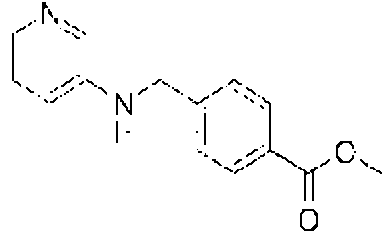
El compuesto de Fórmula 7-3 (piridin-3-amina, 0,5 g, 5,31 mmol) se disolvió en metanol (10 ml) y posteriormente se añadió 4-formilbenzoato de metilo (1,03 g, 5,31 mmol) y se agitó a temperatura ambiente durante 20 minutos. Después, cianoborohidruro sódico (0,33 g, 5,31 mmol) y ácido acético (0,32 ml, 5,31 mmol) se añadieron lentamente y se agitó a temperatura ambiente durante 5 horas. La capa orgánica se lavó tres veces con solución acuosa saturada de cloruro sódico, se deshidrató con sulfato sódico y posteriormente se filtró. El filtrado se concentró a presión reducida y el concentrado se purificó por cromatografía en columna (sílice; acetato de etilo/hexano=0-30 %) para dar el compuesto deseado de Fórmula 7-4 (0,85 g, 66 %) en forma de un sólido de color blanco.The compound of Formula 7-3 (pyridin-3-amine, 0.5 g, 5.31 mmol) was dissolved in methanol (10 ml) and then methyl 4-formylbenzoate (1.03 g, 5.31 mmol) was added. mmol) and stirred at room temperature for 20 minutes. Then, sodium cyanoborohydride (0.33 g, 5.31 mmol) and acetic acid (0.32 ml, 5.31 mmol) were added slowly and stirred at room temperature for 5 hours. The organic layer was washed three times with saturated aqueous sodium chloride solution, dehydrated with sodium sulfate and subsequently filtered. The filtrate was concentrated under reduced pressure and the concentrate was purified by column chromatography (silica; ethyl acetate / hexane = 0-30%) to give the desired compound of Formula 7-4 (0.85 g, 66%) in shape of a white solid.
(Fórmula 7-5: 4-((((4-nitrofenoxi)carbonil)(piridin-3-il)amino)metil)benzoato de metilo) (Formula 7-5: 4 - ((((((4-nitrophenoxy) carbonyl) (pyridin-3-yl) amino) methyl) benzoate methyl)

El compuesto de Fórmula 7-4 (4-((piridin-3-ilamino)metil)benzoato de metilo; 0,20 g, 0,83 mmol) se disolvió en dimetilformamida (3 ml) y posteriormente se añadieron cloroformiato de 4-nitrofenilo (0,18 g, 0,90 mmol) y carbonato potásico (0,23 g, 1,65 mmol). Después, se elevó lentamente la temperatura a 90 °C y la mezcla se agitó durante 1 día. Tras completarse la reacción, la capa de acetato de etilo se lavó tres veces con solución acuosa saturada de cloruro de amonio y posteriormente la capa orgánica se deshidrató con sulfato sódico y posteriormente se filtró. El filtrado se concentró a presión reducida y posteriormente el concentrado se purificó por cromatografía en columna (sílice; acetato de etilo/hexano=0-100 %) para dar el compuesto deseado de Fórmula 7-5 (0,030 g, 8 %) en forma de un sólido de color blanco. (Fórmula 7-6: 4-((N-(piridin-3-il)morfolin-4-carboxamido)metil)benzoato de metilo)The compound of Formula 7-4 (methyl 4 - ((pyridin-3-ylamino) methyl) benzoate, 0.20 g, 0.83 mmol) was dissolved in dimethylformamide (3 mL) and then chloroformate 4- was added. nitrophenyl (0.18 g, 0.90 mmol) and potassium carbonate (0.23 g, 1.65 mmol). Then, the temperature was raised slowly to 90 ° C and the mixture was stirred for 1 day. After completion of the reaction, the ethyl acetate layer was washed three times with saturated aqueous solution of ammonium chloride and then the organic layer was dehydrated with sodium sulfate and subsequently filtered. The filtrate was concentrated under reduced pressure and then the concentrate was purified by column chromatography (silica; ethyl acetate / hexane = 0-100%) to give the desired compound of Formula 7-5 (0.030 g, 8%) as of a white solid. (Formula 7-6: 4 - (methyl (N- (pyridin-3-yl) morpholin-4-carboxamido) methyl) benzoate)

El compuesto de Fórmula 7-5 (4-((((4-nitrofenoxi)carbonil)(piridin-3-il)amino)metil)benzoato de metilo; 0,025 g, 0,061 mmol) se disolvió en dimetilformamida (1 ml) y posteriormente se añadieron carbonato potásico (0,025 g, 0,184 mmol) y morfolina (0,008 g, 0,092 mmol). Después, se elevó lentamente la temperatura a 60 °C y la mezcla se agitó durante 3 horas. Tras completarse la reacción, la capa de acetato de etilo se lavó tres veces con solución acuosa saturada de cloruro de amonio y posteriormente la capa orgánica se deshidrató con sulfato sódico y posteriormente se filtró. El filtrado se concentró a presión reducida y posteriormente el concentrado se purificó por cromatografía en columna (sílice; metanol/diclorometano=0-10 %) para dar el compuesto deseado de Fórmula 7-6 (0,018 g, 83 %) en forma de un sólido de color amarillo pálido.The compound of Formula 7-5 (methyl 4 - (((((4-nitrophenoxy) carbonyl) (pyridin-3-yl) amino) methyl) benzoate; 0.025 g, 0.061 mmol) was dissolved in dimethylformamide (1 mL) and subsequently, potassium carbonate (0.025 g, 0.184 mmol) and morpholine (0.008 g, 0.092 mmol) were added. Then, the temperature was raised slowly to 60 ° C and the mixture was stirred for 3 hours. After completion of the reaction, the ethyl acetate layer was washed three times with saturated aqueous solution of ammonium chloride and then the organic layer was dehydrated with sodium sulfate and subsequently filtered. The filtrate was concentrated under reduced pressure and then the concentrate was purified by column chromatography (silica; methanol / dichloromethane = 0-10%) to give the desired compound of Formula 7-6 (0.018 g, 83%) as a Pale yellow solid.
(Compuesto 281: N-(4-(hidroxicarbamoil)bencil)-N-(piridin-3-il)morfolin-4-carboxamida)(Compound 281: N- (4- (hydroxycarbamoyl) benzyl) -N- (pyridin-3-yl) morpholine-4-carboxamide)

El compuesto de Fórmula 7-6 (4-((N-(piridin-3-il)morfolin-4-carboxamido)metil)benzoato de metilo; 0,018 g, 0,051 mmol) se disolvió en metanol (5 ml) y posteriormente clorhidrato de hidroxilamina (0,018 g, 0,25 mmol) se añadió lentamente. Después, hidróxido potásico (0,028 g, 0,51 mmol) se añadió y se agitó a temperatura ambiente durante aproximadamente 10 minutos y posteriormente hidroxilamina (solución acuosa de 50,0 % en peso; 0,067 ml, 1,0 mmol) se añadió y se agitó a temperatura ambiente durante 1 día. Después, la capa orgánica se concentró a presión reducida y posteriormente se neutralizó por medio de adición de ácido clorhídrico 2 N. Después, la capa orgánica se lavó tres veces con solución acuosa saturada de cloruro sódico, se deshidrató con sulfato sódico anhidro y posteriormente se filtró para dar el Compuesto 281 deseado (0,010 g, 55 %) en forma de un sólido de color blanco.The compound of Formula 7-6 (methyl 4 - ((N- (pyridin-3-yl) morpholin-4-carboxamido) methyl) benzoate; 0.018 g, 0.051 mmol) was dissolved in methanol (5 mL) and subsequently hydrochloride of hydroxylamine (0.018 g, 0.25 mmol) was added slowly. Then, potassium hydroxide (0.028 g, 0.51 mmol) was added and stirred at room temperature for about 10 minutes and then hydroxylamine (50.0% by weight aqueous solution, 0.067 ml, 1.0 mmol) was added and it was stirred at room temperature for 1 day. Then, the organic layer was concentrated under reduced pressure and subsequently neutralized by the addition of 2 N hydrochloric acid. The organic layer was then washed three times with saturated aqueous sodium chloride solution, dehydrated with anhydrous sodium sulfate and subsequently dried. filtered to give the desired Compound 281 (0.010 g, 55%) as a white solid.
1H RMN (400 MHz, MeOD-da) 88,11 (s, 1 H), 8,06 (d, 1 H, J = 4,1 Hz), 8,03 (d, 2 H, J = 8,3 Hz), 7,42 (d, 2 H, J = 2,8 Hz), 7,27 - 7,21 (m, 2 H), 4,93 (s, 2 H), 3,51 (t, 4 H, J = 4,7 Hz), 3,25 (t, 4 H, J = 4,8 Hz); MS (ESI) m/z 357 (M+ H). 1 H NMR (400 MHz, MeOD-da) 88.11 (s, 1 H), 8.06 (d, 1 H, J = 4.1 Hz), 8.03 (d, 2 H, J = 8, 3 Hz), 7.42 (d, 2 H, J = 2.8 Hz), 7.27 - 7.21 (m, 2 H), 4.93 (s, 2 H), 3.51 (t , 4 H, J = 4.7 Hz), 3.25 (t, 4 H, J = 4.8 Hz); MS (ESI) m / z 357 (M + H).
Ejemplo 13: Síntesis del Compuesto 309Example 13: Synthesis of Compound 309
(Fórmula 7-4: 4-((pirimidin-2-ilamino)metil)benzoato de metilo) (Formula 7-4: 4 - ((pyrimidin-2-ylamino) methyl) methyl benzoate)

El compuesto de Fórmula 7-1 (2-cloropirimidina; 6,25 g, 54,6 mmol) y compuesto de Fórmula 7-2 (clorhidrato de 4-(aminometil)benzoato de metilo; 10,0 g, 49,6 mmol) se disolvieron en etanol (150 ml) y trietilamina (17,0 ml, 124 mmol) se añadió y se agitó a reflujo durante 3 días. Tras completarse la reacción, la capa orgánica se extrajo con acetato de etilo y solución acuosa saturada de hidrogenocarbonato sódico, se deshidrató con sulfato de magnesio anhidro y posteriormente se filtró. El filtrado se concentró a presión reducida y posteriormente el residuo se purificó y se concentró por cromatografía en columna (sílice; acetato de etilo/hexano=30 %) para dar el compuesto deseado de Fórmula 7-4 (8,06 g, 67 %) en forma de un sólido de color blanco.The compound of Formula 7-1 (2-chloropyrimidine; 6.25 g, 54.6 mmol) and compound of Formula 7-2 (methyl 4- (aminomethyl) benzoate hydrochloride; 10.0 g, 49.6 mmol ) were dissolved in ethanol (150 ml) and triethylamine (17.0 ml, 124 mmol) was added and stirred at reflux for 3 days. After completion of the reaction, the organic layer was extracted with ethyl acetate and saturated aqueous sodium hydrogencarbonate solution, dehydrated with anhydrous magnesium sulfate and subsequently filtered. The filtrate was concentrated under reduced pressure and then the residue was purified and concentrated by column chromatography (silica: ethyl acetate / hexane = 30%) to give the desired compound of Formula 7-4 (8.06 g, 67% ) in the form of a white solid.
(Fórmula 7-5: 4-((((4-nitrofenoxi)carbonil)(pirimidin-2-il)amino)metil)benzoato de metilo)(Formula 7-5: 4 - ((((((4-nitrophenoxy) carbonyl) (pyrimidin-2-yl) amino) methyl) benzoate methyl)
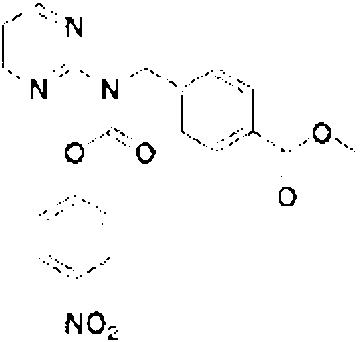
El compuesto de Fórmula 7-4 (4-((pirimidin-2-ilamino)metil)benzoato de metilo; 8,06 g, 33,1 mmol) y cloroformiato de 4-nitrofenilo (7,01 g, 34,8 mmol) se disolvieron en acetonitrilo (150 ml) y posteriormente se añadió carbonato potásico (6,87 g, 49,7 mmol) y se agitó a temperatura ambiente durante 16 horas. Después, la capa orgánica se extrajo con acetato de etilo y solución acuosa saturada de hidrogenocarbonato sódico, se deshidrató con sulfato de magnesio anhidro y posteriormente se filtró. El filtrado se concentró a presión reducida y posteriormente el residuo se purificó y se concentró por cromatografía en columna (sílice; acetato de etilo/hexano=30 %) para dar el compuesto deseado de Fórmula 7-5 (1,50 g, 11 %) en forma de un líquido amarillo claro.The compound of Formula 7-4 (methyl 4 - ((pyrimidin-2-ylamino) methyl) benzoate; 8.06 g, 33.1 mmol) and 4-nitrophenyl chloroformate (7.01 g, 34.8 mmol ) were dissolved in acetonitrile (150 ml) and then potassium carbonate (6.87 g, 49.7 mmol) was added and stirred at room temperature for 16 hours. Then, the organic layer was extracted with ethyl acetate and saturated aqueous sodium hydrogencarbonate solution, dehydrated with anhydrous magnesium sulfate and subsequently filtered. The filtrate was concentrated under reduced pressure and then the residue was purified and concentrated by column chromatography (silica: ethyl acetate / hexane = 30%) to give the desired compound of Formula 7-5 (1.50 g, 11% ) in the form of a light yellow liquid.
(Fórmula 7-6: 4-((4-bencil-N-(pirimidin-2-il)piperazin-1-carboxamido)metil)benzoato de metilo)(Formula 7-6: methyl 4 - ((4-benzyl-N- (pyrimidin-2-yl) piperazin-1-carboxamido) methyl) benzoate)

El compuesto de Fórmula 7-5 (4-((((4-nitrofenoxi)carbonil)(pirimidin-2-il)amino)metil)benzoato de metilo; 0,150 g, 0,367 mmol) se disolvió en dimetilformamida (1 ml) y posteriormente se añadieron 1-bencilpiperazina (0,130 g, 0,735 mmol) y carbonato potásico (0,152 g, 1,10 mmol) y se agitó a 60 °C durante 16 horas. Tras completarse la reacción, la capa orgánica se extrajo con acetato de etilo y solución acuosa saturada de hidrogenocarbonato sódico y se concentró a presión reducida y posteriormente el residuo se purificó y se concentró por cromatografía en columna (sílice; acetato de etilo/hexano=50 %) para dar el compuesto deseado de Fórmula 7-6 (0,132 g, 81 %) en forma de un líquido amarillo. The compound of Formula 7-5 (methyl 4 - (((((4-nitrophenoxy) carbonyl) (pyrimidin-2-yl) amino) methyl) benzoate; 0.150 g, 0.367 mmol) was dissolved in dimethylformamide (1 mL) and subsequently 1-benzylpiperazine (0.130 g, 0.735 mmol) and potassium carbonate (0.152 g, 1.10 mmol) were added and stirred at 60 ° C for 16 hours. After completion of the reaction, the organic layer was extracted with ethyl acetate and saturated aqueous sodium hydrogencarbonate solution and concentrated under reduced pressure and then the residue was purified and concentrated by column chromatography (silica, ethyl acetate / hexane = 50 %) to give the desired compound of Formula 7-6 (0.132 g, 81%) as a yellow liquid.
(el Compuesto 309: 4-bencil-N-(4-(hidroxicarbamoil)bencil)-N-(pirimidin-2-il)piperazin-1-carboxamida)(Compound 309: 4-benzyl-N- (4- (hydroxycarbamoyl) benzyl) -N- (pyrimidin-2-yl) piperazine-1-carboxamide)

El compuesto de Fórmula 7-6 (4-((4-bencil-N-(pirimidin-2-il)piperazin-1-carboxiamido)metil)benzoato de metilo; 0,132 g, 0,296 mmol) se disolvió en metanol (5 ml) y posteriormente se añadieron hidroxilamina (solución acuosa de 50,0 % en peso; 0,906 ml, 14,8 mmol) e hidróxido potásico (0,166 g, 2,96 mmol) secuencialmente y después se agitó a temperatura ambiente durante 30 minutos. Tras completarse la reacción, la solución de reacción se concentró a presión reducida hasta que su volumen fue de aproximadamente 2 ml y se añadió la solución acuosa saturada de hidrogenocarbonato sódico (1-2 ml) y se agitó. Después, el producto sólido se filtró, se lavó con agua y posteriormente se secó a vacío para dar el Compuesto 309 deseado (0,079 g, 60 %) en forma de un sólido amarillo claro.The compound of Formula 7-6 (methyl 4 - ((4-benzyl-N- (pyrimidin-2-yl) piperazine-1-carboxymethyl) methyl) benzoate; 0.132 g, 0.296 mmol) was dissolved in methanol (5 mL). ) and then hydroxylamine (50.0% by weight aqueous solution, 0.906 ml, 14.8 mmol) and potassium hydroxide (0.166 g, 2.96 mmol) were added sequentially and then stirred at room temperature for 30 minutes. After completion of the reaction, the reaction solution was concentrated under reduced pressure until its volume was about 2 ml and the saturated aqueous solution was added. sodium hydrogencarbonate (1-2 ml) and stirred. Then, the solid product was filtered, washed with water and then dried under vacuum to give the desired Compound 309 (0.079 g, 60%) as a light yellow solid.
1H RMN (400 MHz, DMSO-da) 811,18 (s, 1 H), 9,03 (s, 1 H), 8,50 (d, 2 H, J = 4,8 Hz), 7,68 (d, 2 H, J = 8,4 Hz), 7,39 (d, 2 H, J = 8,4 Hz), 7,32 - 7,21 (m, 5 H) 6,93 (t, 1 H, J = 4,8 Hz), 4,97 (s, 2 H), 3,40 (s, 2 H), 3,29 (m, 4 H), 2,19 (m, 4 H). MS (ESI) m/z 447 (M+ H).1 H NMR (400 MHz, DMSO-da) 811.18 (s, 1 H), 9.03 (s, 1 H), 8.50 (d, 2 H, J = 4.8 Hz), 7.68 (d, 2 H, J = 8.4 Hz), 7.39 (d, 2 H, J = 8.4 Hz), 7.32-7.21 (m, 5 H) 6.93 (t, 1 H, J = 4.8 Hz), 4.97 (s, 2 H), 3.40 (s, 2 H), 3.29 (m, 4 H), 2.19 (m, 4 H) . MS (ESI) m / z 447 (M + H).
Ejemplo 14: Síntesis del Compuesto 311Example 14: Synthesis of Compound 311
(Fórmula 7-6: 4-((4-hidroxi-4-fenil-N-(pirimidin-2-il)piperidin-1-carboxamido)metil)benzoato de metilo)(Formula 7-6: methyl 4 - ((4-hydroxy-4-phenyl-N- (pyrimidin-2-yl) piperidin-1-carboxamido) methyl) benzoate)

El compuesto de Fórmula 7-5 (4-((((4-nitrofenoxi)carbonil)(pirimidin-2-il)amino)metil)benzoato de metilo; 0,150 g, 0,367 mmol) se disolvió en dimetilformamida (1 ml) y posteriormente 4-fenilpiperidin-4-ol (0,130 g, 0,735 mmol) y carbonato potásico (0,152 g, 1,10 mmol) se añadieron y se agitó a 60 °C durante 16 horas. Tras completarse la reacción, la capa orgánica se extrajo con acetato de etilo y solución acuosa saturada de hidrogenocarbonato sódico y se concentró a presión reducida y posteriormente el residuo se purificó y se concentró por cromatografía en columna (sílice; acetato de etilo/hexano=30 %) para dar el compuesto deseado de Fórmula 7-6 (0,104 g, 63 %) en forma de un líquido amarillo claro.The compound of Formula 7-5 (methyl 4 - (((((4-nitrophenoxy) carbonyl) (pyrimidin-2-yl) amino) methyl) benzoate; 0.150 g, 0.367 mmol) was dissolved in dimethylformamide (1 mL) and subsequently 4-phenylpiperidin-4-ol (0.130 g, 0.735 mmol) and potassium carbonate (0.152 g, 1.10 mmol) were added and stirred at 60 ° C for 16 hours. After completion of the reaction, the organic layer was extracted with ethyl acetate and saturated aqueous sodium hydrogencarbonate solution and concentrated under reduced pressure and then the residue was purified and concentrated by column chromatography (silica; ethyl acetate / hexane = 30). %) to give the desired compound of Formula 7-6 (0.104 g, 63%) as a light yellow liquid.
(el Compuesto 311: 4-hidroxi-N-(4-(hidroxicarbamoil)bencil)-4-fenil-N-(pirimidin-2-il)piperidin-1-carboxamida)(Compound 311: 4-hydroxy-N- (4- (hydroxycarbamoyl) benzyl) -4-phenyl-N- (pyrimidin-2-yl) piperidine-1-carboxamide)

El compuesto de Fórmula 7-6 (4-((4-hidroxi-4-fenil-N-(pirimidin-2-il)piperidin-1-carboxamido)metil)benzoato de metilo); 0,104 g, 0,233 mmol) se disolvió en metanol (5 ml) y posteriormente se añadieron hidroxilamina (solución acuosa de 50,0 % en peso; 1,43 ml, 23,3 mmol) e hidróxido potásico (0,131 g, 2,33 mmol) secuencialmente y después se agitó a temperatura ambiente durante 30 minutos. Tras completarse la reacción, la solución de reacción se concentró a presión reducida hasta que su volumen fue de aproximadamente 2 ml y se añadió la solución acuosa saturada de hidrogenocarbonato sódico (1-2 ml) y se agitó. Después, el producto sólido se filtró, se lavó con agua y posteriormente se secó a vacío para dar el Compuesto 311 deseado (0,072 g, 69 %) en forma de un sólido de color blanco.The compound of Formula 7-6 (methyl 4 - ((4-hydroxy-4-phenyl-N- (pyrimidin-2-yl) piperidin-1-carboxamido) methyl) benzoate); 0.104 g, 0.233 mmol) was dissolved in methanol (5 ml) and then hydroxylamine (50.0% by weight aqueous solution, 1.43 ml, 23.3 mmol) and potassium hydroxide (0.131 g, 2.33 g) were added. mmol) sequentially and then stirred at room temperature for 30 minutes. After completion of the reaction, the reaction solution was concentrated under reduced pressure until its volume was about 2 ml and the saturated aqueous solution of sodium hydrogencarbonate (1-2 ml) was added and stirred. Then, the solid product was filtered, washed with water and then dried under vacuum to give the desired Compound 311 (0.072 g, 69%) as a white solid.
1H RMN (400 MHz, DMSO-d6) 811,19 (s, 1 H), 9,04 (s, 1 H), 8,54 (d, 2 H, J = 4,8 Hz), 7,73 (d, 2 H, J = 8,3 Hz), 7,45 (d, 2 H, J = 8,3 Hz), 7,30 - 7,26 (m, 4 H), 7,19 (m, 1 H), 6,93 (t, 1 H, J= 4,8 Hz), 5,08 (s, 1 H), 5,01 (s a, 2 H), 3,73 (s a, 2 H), 3,18 -3,11 (m, 2 H), 1,56 - 1,47 (m, 4 H). MS (ESI) m/z 448 (M+ H).1 H NMR (400 MHz, DMSO-d 6) 811.19 (s, 1 H), 9.04 (s, 1 H), 8.54 (d, 2 H, J = 4.8 Hz), 7.73 (d, 2 H, J = 8.3 Hz), 7.45 (d, 2 H, J = 8.3 Hz), 7.30 - 7.26 (m, 4 H), 7.19 (m , 1 H), 6.93 (t, 1 H, J = 4.8 Hz), 5.08 (s, 1 H), 5.01 (sa, 2 H), 3.73 (sa, 2 H) ), 3.18 -3.11 (m, 2 H), 1.56-1.47 (m, 4 H). MS (ESI) m / z 448 (M + H).
Ejemplo 15: Síntesis del Compuesto 312Example 15: Synthesis of Compound 312
(Fórmula 7-6: 4-((N-(pirimidin-2-il)morfolin-4-carboxamido)metil)benzoato de metilo)(Formula 7-6: methyl 4 - ((N- (pyrimidin-2-yl) morpholin-4-carboxamido) methyl) benzoate)

El compuesto de Fórmula 7-4 (4-((pirimidin-2-ilamino)metil)benzoato de metilo; 0,200 g, 0,822 mmol) se disolvió en acetonitrilo (2 ml) y posteriormente morfolin-4-carbonilo cloruro (0,185 g, 1,23 mmol) y N,N-diisopropiletilamina (0,291 ml, 1,64 mmol) se añadieron y se agitó a 60 °C durante 16 horas. Tras completarse la reacción, la capa orgánica se extrajo con acetato de etilo y solución acuosa saturada de hidrogenocarbonato sódico y se concentró a presión reducida y posteriormente el residuo se purificó y se concentró por cromatografía en columna (sílice; acetato de etilo/hexano=30 %) para dar el compuesto deseado de Fórmula 7-6 (0,179 g, 61 %) en forma de un sólido amarillo claro. The compound of Formula 7-4 (methyl 4 - ((pyrimidin-2-ylamino) methyl) benzoate; 0.200 g, 0.822 mmol) was dissolved in acetonitrile (2 ml) and subsequently morpholin-4-carbonyl chloride (0.185 g, 1.23 mmol) and N, N-diisopropylethylamine (0.291 mL, 1.64 mmol) were added and stirred at 60 ° C for 16 hours. After completion of the reaction, the organic layer was extracted with ethyl acetate and saturated aqueous sodium hydrogencarbonate solution and concentrated under reduced pressure and then the residue was purified and concentrated by column chromatography (silica; ethyl acetate / hexane = 30). %) to give the desired compound of Formula 7-6 (0.179 g, 61%) as a light yellow solid.
(Compuesto 312: N-(4-(hidroxicarbamoil)bencil)-N-(pirimidin-2-il)morfolin-4-carboxamida)(Compound 312: N- (4- (hydroxycarbamoyl) benzyl) -N- (pyrimidin-2-yl) morpholine-4-carboxamide)

El compuesto de Fórmula 7-6 (4-((N-(pirimidin-2-il)morfolin-4-carboxamido)metil)benzoato de metilo; 0,179 g, 0,502 mmol) se disolvió en metanol (5 ml) y posteriormente se añadieron hidroxilamina (solución acuosa de 50,0 % en peso; 2,15 ml, 35,2 mmol) e hidróxido potásico (0,282 g, 5,02 mmol) secuencialmente y después se agitó a temperatura ambiente durante 30 minutos. Tras completarse la reacción, la solución de reacción se concentró a presión reducida hasta que su volumen fue de aproximadamente 2 ml y la capa orgánica se extrajo con acetato de etilo y solución acuosa saturada de hidrogenocarbonato sódico. La capa orgánica se lavó tres veces con agua, se deshidrató con sulfato de magnesio anhidro, se filtró y posteriormente se concentró a presión reducida. El residuo se recristalizó con éter dietílico y hexano para dar el Compuesto 312 deseado (0,036 g, 20 %) en forma de un sólido de color blanco.The compound of Formula 7-6 (methyl 4 - ((N- (pyrimidin-2-yl) morpholin-4-carboxamido) methyl) benzoate; 0.179 g, 0.502 mmol) was dissolved in methanol (5 mL) and subsequently hydroxylamine (50.0% by weight aqueous solution, 2.15 ml, 35.2 mmol) and potassium hydroxide (0.282 g, 5.02 mmol) were added sequentially and then stirred at room temperature for 30 minutes. After completion of the reaction, the reaction solution was concentrated under reduced pressure until its volume was about 2 ml and the organic layer was extracted with ethyl acetate and saturated aqueous sodium hydrogencarbonate solution. The organic layer was washed three times with water, dehydrated with anhydrous magnesium sulfate, filtered and then concentrated under reduced pressure. The residue was recrystallized with diethyl ether and hexane to give the desired Compound 312 (0.036 g, 20%) as a white solid.
1H RMN (400 MHz, DMSO-da) 811,18 (s, 1 H), 8,53 (d, 2 H, J = 4,8 Hz), 7,68 (d, 2 H, J = 7,6 Hz), 7,40 (d, 2 H, J = 8,1 Hz), 6,96 (t, 1 H, J = 4,8 Hz), 4,98 (s, 2 H), 3,40 (m, 4 H), 3,28 (m, 4 H). MS (ESI) m/z 358 (M+ H).1 H NMR (400 MHz, DMSO-da) 811.18 (s, 1 H), 8.53 (d, 2 H, J = 4.8 Hz), 7.68 (d, 2 H, J = 7, 6 Hz), 7.40 (d, 2 H, J = 8.1 Hz), 6.96 (t, 1 H, J = 4.8 Hz), 4.98 (s, 2 H), 3, 40 (m, 4 H), 3.28 (m, 4 H). MS (ESI) m / z 358 (M + H).
Ejemplo 16: Síntesis del Compuesto 313Example 16: Synthesis of Compound 313
(Fórmula 7-6: 4-((2,6-dimetil-N-(pirimidin-2-il)morfolin-4-carboxamido)metil)benzoato de metilo)(Formula 7-6: methyl 4 - ((2,6-dimethyl-N- (pyrimidin-2-yl) morpholin-4-carboxamido) methyl) benzoate)

El compuesto de Fórmula 7-5 (4-((((4-nitrofenoxi)carbonil)(pirimidin-2-il)amino)metil)benzoato de metilo; 0,150 g, 0,367 mmol) se disolvió en dimetilformamida (1 ml) y posteriormente 2,6-dimetilmorfolina (0,085 g, 0,735 mmol) y carbonato potásico (0,152 g, 1,10 mmol) se añadieron y se agitó a 60 °C durante 16 horas. Tras completarse la reacción, la capa orgánica se extrajo con acetato de etilo y solución acuosa saturada de hidrogenocarbonato sódico y se concentró a presión reducida y posteriormente el residuo se purificó y se concentró por cromatografía en columna (sílice; acetato de etilo/hexano=50 %) para dar el compuesto deseado de Fórmula 7-6 (0,062 g, 44 %) en forma de un líquido amarillo. The compound of Formula 7-5 (methyl 4 - (((((4-nitrophenoxy) carbonyl) (pyrimidin-2-yl) amino) methyl) benzoate; 0.150 g, 0.367 mmol) was dissolved in dimethylformamide (1 mL) and subsequently 2,6-dimethylmorpholine (0.085 g, 0.735 mmol) and potassium carbonate (0.152 g, 1.10 mmol) were added and stirred at 60 ° C for 16 hours. After completion of the reaction, the organic layer was extracted with ethyl acetate and saturated aqueous sodium hydrogencarbonate solution and concentrated under reduced pressure and then the residue was purified and concentrated by column chromatography (silica, ethyl acetate / hexane = 50 %) to give the desired compound of Formula 7-6 (0.062 g, 44%) as a yellow liquid.
(Compuesto 313: N-(4-(hidroxicarbamoil)bencil)-2,6-dimetil-N-(pirimidin-2-il)morfolin-4-carboxa mida)(Compound 313: N- (4- (hydroxycarbamoyl) benzyl) -2,6-dimethyl-N- (pyrimidin-2-yl) morpholine-4-carboxamide)

El compuesto de Fórmula 7-6 (4-((2,6-dimetil-N-(pirimidin-2-il)morfolin-4-carboxamido)metil)benzoato de metilo; 0,062 g, 0,161 mmol) se disolvió en metanol (5 ml) y posteriormente se añadieron hidroxilamina (solución acuosa de 50,0 % en peso; 0,986 ml, 16,1 mmol) e hidróxido potásico (0,091 g, 1,61 mmol) secuencialmente y después se agitó a temperatura ambiente durante 30 minutos. Tras completarse la reacción, la solución de reacción se concentró a presión reducida hasta que su volumen fue de aproximadamente 2 ml y la capa orgánica se extrajo con acetato de etilo y solución acuosa saturada de hidrogenocarbonato sódico. La capa orgánica se lavó tres veces con agua, se deshidrató con sulfato de magnesio anhidro, se filtró y posteriormente se concentró a presión reducida. El residuo se recristalizó con éter dietílico y hexano para dar el Compuesto 313 deseado (0,037 g, 60 %) en forma de un sólido de color blanco.The compound of Formula 7-6 (methyl 4 - ((2,6-dimethyl-N- (pyrimidin-2-yl) morpholin-4-carboxamido) methyl) benzoate; 0.062 g, 0.161 mmol) was dissolved in methanol ( 5 ml) and subsequently hydroxylamine (50.0% by weight aqueous solution, 0.986 ml, 16.1 mmol) and potassium hydroxide (0.091 g, 1.61 mmol) were added sequentially and then stirred at room temperature for 30 minutes . After completion of the reaction, the reaction solution was concentrated under reduced pressure until its volume was about 2 ml and the organic layer was extracted with ethyl acetate and saturated aqueous sodium hydrogencarbonate solution. The organic layer was washed three times with water, dehydrated with anhydrous magnesium sulfate, filtered and then concentrated under reduced pressure. The residue was recrystallized with diethyl ether and hexane to give the desired Compound 313 (0.037 g, 60%) as a white solid.
1H RMN (400 MHz, DMSO-d6) 811,18 (s, 1 H), 9,02 (s, 1 H), 8,52 (d, 2 H, J = 4,4 Hz), 7,68 (d, 2 H, J = 7,8 Hz), 7,40 (d, 2 H, J = 7,8 Hz), 6,95 (t, 1 H, J = 4,6 Hz), 4,98 (s, 2 H), 3,68 (s a, 2 H), 3,21 (s a, 2 H), 2,44 - 2,41 (m, 2 H), 0,97 (s, 3 H), 0,96 (s, 3 H). MS (ESI) m/z 386 (M+ H).1 H NMR (400 MHz, DMSO-d 6) 811.18 (s, 1 H), 9.02 (s, 1 H), 8.52 (d, 2 H, J = 4.4 Hz), 7.68 (d, 2 H, J = 7.8 Hz), 7.40 (d, 2 H, J = 7.8 Hz), 6.95 (t, 1 H, J = 4.6 Hz), 4, 98 (s, 2 H), 3.68 (sa, 2 H), 3.21 (sa, 2 H), 2.44-2.41 (m, 2 H), 0.97 (s, 3 H) ), 0.96 (s, 3 H). MS (ESI) m / z 386 (M + H).
Ejemplo 17: Síntesis del Compuesto 329Example 17: Synthesis of Compound 329
(Fórmula 8-2: 4-((fenilamino)metil)benzoato de metilo) (Formula 8-2: 4 - ((phenylamino) methyl) methyl benzoate)

El compuesto de Fórmula 8-1 (4-(bromometil)benzoato de metilo; 12,5 g, 54,8 mmol) y anilina (5,00 ml, 54,8 mmol) se disolvieron en acetonitrilo (70 ml) y posteriormente N,N-diisopropiletilamina (11,6 ml, 65,7 mmol) se añadieron y se agitó a temperatura ambiente durante 16 horas. Tras completarse la reacción, la capa orgánica se extrajo con acetato de etilo y solución acuosa saturada de hidrogenocarbonato sódico, se deshidrató con sulfato de magnesio anhidro y posteriormente se filtró. El filtrado se concentró a presión reducida y posteriormente el residuo se purificó y se concentró por cromatografía en columna (sílice; acetato de etilo/hexano=15 %) para dar el compuesto deseado de Fórmula 8-2 (9,13 g, 69 %) en forma de un líquido amarillo.The compound of Formula 8-1 (methyl 4- (bromomethyl) benzoate; 12.5 g, 54.8 mmol) and aniline (5.00 mL, 54.8 mmol) were dissolved in acetonitrile (70 mL) and subsequently N, N-diisopropylethylamine (11.6 ml, 65.7 mmol) were added and stirred at room temperature for 16 hours. After completion of the reaction, the organic layer was extracted with ethyl acetate and saturated aqueous sodium hydrogencarbonate solution, dehydrated with anhydrous magnesium sulfate and subsequently filtered. The filtrate was concentrated under reduced pressure and then the residue was purified and concentrated by column chromatography (silica; ethyl acetate / hexane = 15%) to give the desired compound of Formula 8-2 (9.13 g, 69%). ) in the form of a yellow liquid.
(Fórmula 8-3: 4-((4-bromofenilamino)metil)benzoato de metilo(Formula 8-3: 4 - (methyl (4-bromophenylamino) methyl) benzoate

El compuesto de Fórmula 8-2 (4-((fenilamino)metil)benzoato de metilo; 9,13 g, 37,8 mmol) se disolvió en diclorometano (70 ml) y N-bromosuccinimida (7,07 g, 39,7 mmol) se añadió y se agitó a temperatura ambiente durante 16 horas. Tras completarse la reacción, la capa orgánica se concentró a presión reducida y posteriormente el residuo se purificó y se concentró por cromatografía en columna (sílice; acetato de etilo/hexano=15 %) para dar el compuesto deseado de Fórmula 8-3 (9,57 g, 79 %) en forma de un sólido de color blanco.The compound of Formula 8-2 (methyl 4 - ((phenylamino) methyl) benzoate; 9.13 g, 37.8 mmol) was dissolved in dichloromethane (70 ml) and N-bromosuccinimide (7.07 g, 39%). 7 mmol) was added and stirred at room temperature for 16 hours. After completion of the reaction, the organic layer was concentrated under reduced pressure and then the residue was purified and concentrated by column chromatography (silica; ethyl acetate / hexane = 15%) to give the desired compound of Formula 8-3 (9). , 57 g, 79%) in the form of a white solid.
(Fórmula 8-4: 4-(((4-bromofenil)((4-nitrofenoxi)carbonil)amino)metil)benzoato de metilo(Formula 8-4: 4 - (((4-bromophenyl) - ((4-nitrophenoxy) carbonyl) amino) methyl) methyl benzoate
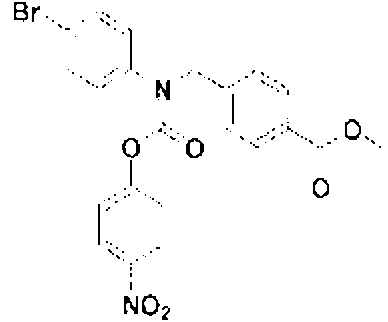
El compuesto de Fórmula 8-3 (4-((4-bromofenilamino)metil)benzoato de metilo; 7,67 g, 24,0 mmol) y cloroformiato de 4-nitrofenilo (5,31 g, 26,4 mmol) se disolvieron en acetonitrilo (70 ml) y posteriormente carbonato potásico (4,97 g, 35,9 mmol) se añadió y se agitó a temperatura ambiente durante 16 horas. Tras completarse la reacción, la capa orgánica se extrajo con acetato de etilo y solución acuosa saturada de hidrogenocarbonato sódico, se deshidrató con sulfato de magnesio anhidro y posteriormente se filtró. El filtrado se concentró a presión reducida y posteriormente el residuo se purificó y se concentró por cromatografía en columna (sílice; acetato de etilo/hexano=20 %) para dar el compuesto deseado de Fórmula 8-4 (11,2 g, 96 %) en forma de un líquido amarillo.The compound of Formula 8-3 (methyl 4 - ((4 - ((4-bromophenylamino) methyl) benzoate; 7.67 g, 24.0 mmol) and 4-nitrophenyl chloroformate (5.31 g, 26.4 mmol) were dissolved in acetonitrile (70 ml) and then potassium carbonate (4.97 g, 35.9 mmol) was added and stirred at room temperature for 16 hours. After completion of the reaction, the organic layer was extracted with ethyl acetate and saturated aqueous sodium hydrogencarbonate solution, dehydrated with anhydrous magnesium sulfate and subsequently filtered. The filtrate was concentrated under reduced pressure and then the residue was purified and concentrated by column chromatography (silica; ethyl acetate / hexane = 20%) to give the desired compound of Formula 8-4 (11.2 g, 96% ) in the form of a yellow liquid.
(Fórmula 8-5: 4-((N-(4-bromofenil)morfolin-4-carboxamido)metil)benzoato de metilo)(Formula 8-5: 4 - (methyl (N- (4-bromophenyl) morpholin-4-carboxamido) methyl) benzoate)

El compuesto de Fórmula 8-4 (4-(((4-bromofenil)((4-nitrofenoxi)carbonil)amino)metil)benzoato de metilo; 5,00 g, 10,3 mmol) se disolvió en dimetilformamida (20 ml) y posteriormente morfolina (1,35 g, 15,5 mmol) y carbonato potásico (2,85 g, 20,6 mmol) se añadieron y se agitó a 60 °C durante 5 horas. Tras completarse la reacción, la capa orgánica se extrajo con acetato de etilo y solución acuosa saturada de cloruro de amonio, se deshidrató con sulfato de magnesio anhidro y posteriormente se filtró. El filtrado se concentró a presión reducida y posteriormente el residuo se purificó y se concentró por cromatografía en columna (sílice; acetato de etilo/hexano= 30 %) para dar el compuesto deseado de Fórmula 8-5 (3,86 g, 87 %) en forma de un sólido de color amarillo. The compound of Formula 8-4 (methyl 4 - (((4-bromophenyl) ((4-nitrophenoxy) carbonyl) amino) methyl) benzoate; 5.00 g, 10.3 mmol) was dissolved in dimethylformamide (20 ml. ) and subsequently morpholine (1.35 g, 15.5 mmol) and potassium carbonate (2.85 g, 20.6 mmol) were added and stirred at 60 ° C for 5 hours. After completion of the reaction, the organic layer was extracted with ethyl acetate and saturated aqueous solution of ammonium chloride, dehydrated with anhydrous magnesium sulfate and subsequently filtered. The filtrate was concentrated under reduced pressure and then the residue was purified and concentrated by column chromatography (silica; ethyl acetate / hexane = 30%) to give the desired compound of Formula 8-5 (3.86 g, 87% ) in the form of a yellow solid.
(Fórmula 8-6: 4-((N-(4-(1-metil-1H-indazol-6-il)fenil)morfolin-4-carboxamido)metil)benzoato de metilo(Formula 8-6: 4 - (methyl N- (4- (1-methyl-1H-indazol-6-yl) phenyl) morpholin-4-carboxamido) methyl) benzoate

El compuesto de Fórmula 8-5 (4-((N-(4-bromofenil)morfolin-4-carboxamido)metil)benzoato de metilo; 0,185 g, 0,427 mmol), ácido 1-metil-indazol-6-ilborónico (0,090 g, 0,512 mmol) y Pd(dppf)Cl2 (0,035 g, 0,043 mmol) se disolvieron en 1,4-dioxano (3 ml) y posteriormente carbonato sódico (0,181 g, 1,71 mmol) disuelto en agua (1 ml) se añadió a la solución de reacción y se agitó a 80 °C durante 16 horas. Tras completarse la reacción, la capa orgánica se extrajo con acetato de etilo y solución acuosa saturada de hidrogenocarbonato sódico y se concentró a presión reducida y posteriormente el residuo se purificó y se concentró por cromatografía en columna (sílice; acetato de etilo/ hexano=30 %) para dar el compuesto deseado de Fórmula 8-6 (0,112 g, 71 %) en forma de un sólido de color blanco.The compound of Formula 8-5 (methyl 4 - ((N- (4-bromophenyl) morpholin-4-carboxamido) methyl) benzoate; 0.185 g, 0.427 mmol), 1-methyl-indazol-6-ylboronic acid (0.090) g, 0.512 mmol) and Pd (dppf) Cl2 (0.035 g, 0.043 mmol) were dissolved in 1,4-dioxane (3 ml) and subsequently sodium carbonate (0.181 g, 1.71 mmol) dissolved in water (1 ml). it was added to the reaction solution and stirred at 80 ° C for 16 hours. After completion of the reaction, the organic layer was extracted with ethyl acetate and saturated aqueous sodium hydrogencarbonate solution and concentrated under reduced pressure and then the residue was purified and concentrated by column chromatography (silica; ethyl acetate / hexane = 30). %) to give the desired compound of Formula 8-6 (0.112 g, 71%) as a white solid.
(Compuesto 329: N-(4-(hidroxicarbamoil)bencil)-N-(4-(1-metil-1H-indazol-6-il)fenil)morfolin-4-carboxamida)(Compound 329: N- (4- (hydroxycarbamoyl) benzyl) -N- (4- (1-methyl-1H-indazol-6-yl) phenyl) morpholine-4-carboxamide)

El compuesto de Fórmula 8-6 (4-((N-(4-(1-metil-1H-indazol-6-il)fenil)morfolin-4-carboxamido)metil)benzoato de metilo; 0,112 g, 0,231 mmol) se disolvió en metanol (5 ml) y posteriormente se añadieron hidroxilamina (solución acuosa de 50,0 % en peso; 1,41 ml, 23,1 mmol) e hidróxido potásico (0,130 g, 2,31 mmol) secuencialmente y después se agitó a temperatura ambiente durante 30 minutos. Tras completarse la reacción, la solución de reacción se concentró a presión reducida hasta que su volumen fue de aproximadamente 2 ml y se añadió solución acuosa saturada de cloruro de amonio (1-2 ml) y se agitó. Después, el producto sólido se filtró, se lavó con agua y posteriormente se secó a vacío para dar el Compuesto 329 deseado (0,096 g, 86 %) en forma de sólido marrón claro.The compound of Formula 8-6 (methyl 4 - ((N- (4- (1-methyl-1H-indazol-6-yl) phenyl) morpholin-4-carboxamido) methyl) benzoate; 0.112 g, 0.231 mmol) it was dissolved in methanol (5 ml) and subsequently hydroxylamine (50.0% by weight aqueous solution, 1.41 ml, 23.1 mmol) and potassium hydroxide (0.130 g, 2.31 mmol) were added sequentially and then stirred at room temperature for 30 minutes. After completion of the reaction, the reaction solution was concentrated under reduced pressure until its volume was about 2 ml and saturated aqueous solution of ammonium chloride (1-2 ml) was added and stirred. Then, the solid product was filtered, washed with water and then dried under vacuum to give the desired Compound 329 (0.096 g, 86%) as a light brown solid.
1H RMN (400 MHz, DIVISOR) 88,02 (s, 1 H), 7,88 (s, 1 H), 7,77 (d, 1 H, J = 8,4 Hz), 7,73 (d, 2 H, J = 8,6 Hz), 7,66 (d, 2 H, J = 8,2 Hz), 7,42 - 7,39 (m, 3 H), 7,26 (d, 2 H, J = 8,5 Hz), 4,93 (s, 2 H), 4,07 (s, 3 H), 3,47 - 3,43 (m, 4 H), 3,22 3,17 (m, 4 H). MS (ESI) m/z 486 (M+ H).1 H NMR (400 MHz, DIVIDER) 88.02 (s, 1 H), 7.88 (s, 1 H), 7.77 (d, 1 H, J = 8.4 Hz), 7.73 (d , 2 H, J = 8.6 Hz), 7.66 (d, 2 H, J = 8.2 Hz), 7.42 - 7.39 (m, 3 H), 7.26 (d, 2 H, J = 8.5 Hz), 4.93 (s, 2 H), 4.07 (s, 3 H), 3.47 - 3.43 (m, 4 H), 3.22 3.17 (m, 4 H). MS (ESI) m / z 486 (M + H).
Ejemplo 18: Síntesis del Compuesto 330Example 18: Synthesis of Compound 330
(Fórmula 8-6: 4-((N-(bifenil-4-il)morfolin-4-carboxamido)metil)benzoato de metilo)(Formula 8-6: 4 - (methyl (N- (biphenyl-4-yl) morpholin-4-carboxamido) methyl) benzoate)

El compuesto de Fórmula 8-5 (4-((N-(4-bromofenil)morfolin-4-carboxamido)metil)benzoato de metilo; 0,200 g, 0,462 mmol), ácido fenilborónico (0,068 g, 0,554 mmol) y Pd(dppf)Cl2 (0,038 g, 0,046 mmol) se disolvieron en 1,4-dioxano (3 ml) y posteriormente carbonato sódico (0,196 g, 1,85 mmol) disuelto en agua (1 ml) se añadió a la solución de reacción y se agitó a 100 °C durante 6 horas. Tras completarse la reacción, la capa orgánica se extrajo con acetato de etilo y solución acuosa saturada de hidrogenocarbonato sódico y se concentró a presión reducida y posteriormente el residuo se purificó y se concentró por cromatografía en columna (sílice; acetato de etilo/hexano=60 %) para dar el compuesto deseado de Fórmula 8-6 (0,160 g, 81 %) en forma de un sólido de color blanco.The compound of Formula 8-5 (methyl 4 - ((N- (4-bromophenyl) morpholin-4-carboxamido) methyl) benzoate; 0.200 g, 0.462 mmol), phenylboronic acid (0.068 g, 0.554 mmol) and Pd ( dppf) Cl2 (0.038 g, 0.046 mmol) was dissolved in 1,4-dioxane (3 ml) and then sodium carbonate (0.196 g, 1.85 mmol) dissolved in water (1 ml) was added to the reaction solution and it was stirred at 100 ° C for 6 hours. After completion of the reaction, the organic layer was extracted with ethyl acetate and saturated aqueous sodium hydrogencarbonate solution and concentrated under reduced pressure and then the residue was purified and concentrated by column chromatography (silica; ethyl acetate / hexane = 60). %) to give the desired compound of Formula 8-6 (0.160 g, 81%) as a white solid.
(Compuesto 330: N-(bifenil-4-il)-N-(4-(hidroxicarbamoil)bencil)morfolin-4-carboxamida) (Compound 330: N- (biphenyl-4-yl) -N- (4- (hydroxycarbamoyl) benzyl) morpholine-4-carboxamide)

El compuesto de Fórmula 8-6 (4-((N-(bifenil-4-il)morfolin-4-carboxamido)metil)benzoato de metilo; 0,160 g, 0,372 mmol) se disolvió en metanol (10 ml) y posteriormente se añadió hidroxilamina (solución acuosa de 50,0 % en peso; 2,27 ml, 37,2 mmol) e hidróxido potásico (0,209 g, 3,72 mmol) secuencialmente y después se agitó a temperatura ambiente durante 30 minutos. Tras completarse la reacción, la solución de reacción se concentró a presión reducida hasta que su volumen fue de aproximadamente 3 ml y se añadió una solución acuosa saturada de cloruro de amonio (1-2 ml) y se agitó. Después, el producto sólido se filtró, se lavó con agua y posteriormente se secó a vacío para dar el Compuesto 330 deseado (0,120 g, 75 %) en forma de sólido marrón claro.The compound of Formula 8-6 (methyl 4 - ((N- (biphenyl-4-yl) morpholin-4-carboxamido) methyl) benzoate; 0.160 g, 0.372 mmol) was dissolved in methanol (10 mL) and subsequently hydroxylamine (50.0% by weight aqueous solution; 2.27 ml, 37.2 mmol) and potassium hydroxide (0.209 g, 3.72 mmol) were added sequentially and then stirred at room temperature for 30 minutes. After completion of the reaction, the reaction solution was concentrated under reduced pressure until its volume was about 3 ml and a saturated aqueous solution of ammonium chloride (1-2 ml) was added and stirred. Then, the solid product was filtered, washed with water and then dried under vacuum to give the desired Compound 330 (0.120 g, 75%) as a light brown solid.
MS (ESI) m/z 432 (M+ H).MS (ESI) m / z 432 (M + H).
Ejemplo 19: Síntesis del Compuesto 331Example 19: Synthesis of Compound 331
(Fórmula 8-6: 4-((N-(3 ,5 -difluorobifenil-4-il)morfolin-4-carboxamido)metil)benzoato de metilo)(Formula 8-6: 4 - (methyl (N- (3,5-difluorobiphenyl-4-yl) morpholin-4-carboxamido) methyl) benzoate)

El compuesto de Fórmula 8-5 (4-((N-(4-bromofenil)morfolin-4-carboxamido)metil)benzoato de metilo; 0,200 g, 0,462 mmol), ácido 3',5'-difluorofenilborónico (0,088 g, 0,554 mmol) y Pd(dppf)Cl2 (0,038 g, 0,046 mmol) se disolvieron en 1,4-dioxano (3 ml) y posteriormente carbonato sódico (0,196 g, 1,85 mmol) disuelto en agua (1 ml) se añadió a la solución de reacción y se agitó a 100 °C durante 6 horas. Tras completarse la reacción, la capa orgánica se extrajo con acetato de etilo y solución acuosa saturada de hidrogenocarbonato sódico y se concentró a presión reducida y posteriormente el residuo se purificó y se concentró por cromatografía en columna (sílice; acetato de etilo/ hexano=60 %) para dar el compuesto deseado de Fórmula 8-6 (0,169 g, 79 %) en forma de un sólido de color blanco.The compound of Formula 8-5 (methyl 4 - ((N- (4-bromophenyl) morpholin-4-carboxamido) methyl) benzoate; 0.200 g, 0.462 mmol), 3 ', 5'-difluorophenylboronic acid (0.088 g, 0.554 mmol) and Pd (dppf) Cl2 (0.038 g, 0.046 mmol) were dissolved in 1,4-dioxane (3 ml) and then sodium carbonate (0.196 g, 1.85 mmol) dissolved in water (1 ml) was added to the reaction solution and stirred at 100 ° C for 6 hours. After completion of the reaction, the organic layer was extracted with ethyl acetate and saturated aqueous sodium hydrogencarbonate solution and concentrated under reduced pressure and then the residue was purified and concentrated by column chromatography (silica; ethyl acetate / hexane = 60). %) to give the desired compound of Formula 8-6 (0.169 g, 79%) as a white solid.
(Compuesto 331: N-(3',5'-difluorobifenil-4-il)-N-(4-(hidroxicarbamoil)bencil)morfolin-4-carboxamida)(Compound 331: N- (3 ', 5'-difluorobiphenyl-4-yl) -N- (4- (hydroxycarbamoyl) benzyl) morpholine-4-carboxamide)

El compuesto de Fórmula 8-6 (4-((N-(3',5'-difluorobifenil-4-il)morfolin-4-carboxamido)metil)benzoato de metilo; 0,169 g, 0,362 mmol) se disolvió en metanol (10 ml) y posteriormente se añadió hidroxilamina (solución acuosa de 50,0 % en peso; 2,22 ml, 36,2 mmol) e hidróxido potásico (0,203 g, 3,62 mmol) secuencialmente y después se agitó a temperatura ambiente durante 30 minutos. Tras completarse la reacción, la solución de reacción se concentró a presión reducida hasta que su volumen fue de aproximadamente 3 ml y se añadió una solución acuosa saturada de cloruro de amonio (1-2 ml) y se agitó. Después, el producto sólido se filtró, se lavó con agua y posteriormente se secó a vacío para dar el Compuesto 331 deseado (0,102 g, 60 %) en forma de sólido marrón claro.The compound of Formula 8-6 (methyl 4 - ((N- (3 ', 5'-difluorobiphenyl-4-yl) morpholin-4-carboxamido) methyl) benzoate; 0.169 g, 0.362 mmol) was dissolved in methanol ( 10 ml) and subsequently hydroxylamine (50.0% by weight aqueous solution, 2.22 ml, 36.2 mmol) and potassium hydroxide (0.203 g, 3.62 mmol) were added sequentially and then stirred at room temperature for 30 minutes. After completion of the reaction, the reaction solution was concentrated under reduced pressure until its volume was about 3 ml and a saturated aqueous solution of ammonium chloride (1-2 ml) was added and stirred. Then, the solid product was filtered, washed with water and then dried under vacuum to give the desired Compound 331 (0.102 g, 60%) as a light brown solid.
1H RMN (400 MHz, DMSO-d6) 87,70 (d, 2 H, J = 8,8 Hz), 7,65 (d, 2 H, J = 8,3 Hz), 7,43 - 7,37 (m, 4 H), 7,22 (d, 2 H, J = 8,8 Hz), 7,17 (m, 1 H), 4,92 (s, 2 H), 3,44 (t, 4 H, J = 4,6 Hz), 3,18 (t, 4 H, J = 4,6 Hz). MS (ESI) m/z 468 (M+ H). 1 H NMR (400 MHz, DMSO-d 6) 87.70 (d, 2 H, J = 8.8 Hz), 7.65 (d, 2 H, J = 8.3 Hz), 7.43-7, 37 (m, 4 H), 7.22 (d, 2 H, J = 8.8 Hz), 7.17 (m, 1 H), 4.92 (s, 2 H), 3.44 (t , 4 H, J = 4.6 Hz), 3.18 (t, 4 H, J = 4.6 Hz). MS (ESI) m / z 468 (M + H).
Ejemplo 20: Síntesis del Compuesto 332 Example 20: Synthesis of Compound 332
(Fórmula 8-6: 4-((N-(4-(piridin-3-il)fenil)morfolin-4-carboxamido)metil)benzoato de metilo)(Formula 8-6: 4 - (Methyl N- (4- (pyridin-3-yl) phenyl) morpholin-4-carboxamido) methyl) benzoate)

El compuesto de Fórmula 8-5 (4-((N-(4-bromofenil)morfolin-4-carboxamido)metil)benzoato de metilo; 0,200 g, 0,462 mmol), ácido piridin-3-ilborónico (0,068 g, 0,554 mmol) y Pd(dppf)Cl2 (0,038 g, 0,046 mmol) se disolvieron en 1,4-dioxano (3 ml) y posteriormente carbonato sódico (0,196 g, 1,85 mmol) disuelto en agua (1 ml) se añadió a la solución de reacción y se agitó a 100 °C durante 6 horas. Tras completarse la reacción, la capa orgánica se extrajo con acetato de etilo y solución acuosa saturada de hidrogenocarbonato sódico y se concentró a presión reducida y posteriormente el residuo se purificó y se concentró por cromatografía en columna (sílice; acetato de etilo/hexano=75 %) para dar el compuesto deseado de Fórmula 8-6 (0,132 g, 66 %) en forma de un sólido de color blanco.The compound of Formula 8-5 (methyl 4 - ((N- (4-bromophenyl) morpholin-4-carboxamido) methyl) benzoate; 0.200 g, 0.462 mmol), pyridin-3-ylboronic acid (0.068 g, 0.554 mmol ) and Pd (dppf) Cl2 (0.038 g, 0.046 mmol) were dissolved in 1,4-dioxane (3 ml) and then sodium carbonate (0.196 g, 1.85 mmol) dissolved in water (1 ml) was added to the reaction solution and stirred at 100 ° C for 6 hours. After completion of the reaction, the organic layer was extracted with ethyl acetate and saturated aqueous sodium hydrogencarbonate solution and concentrated under reduced pressure and then the residue was purified and concentrated by column chromatography (silica, ethyl acetate / hexane = 75 %) to give the desired compound of Formula 8-6 (0.132 g, 66%) as a white solid.
(Compuesto 332: N-(4-(hidroxicarbamoil)bencil)-N-(4-(piridin-3-il)fenil)morfolin-4-carboxamida)(Compound 332: N- (4- (hydroxycarbamoyl) benzyl) -N- (4- (pyridin-3-yl) phenyl) morpholine-4-carboxamide)
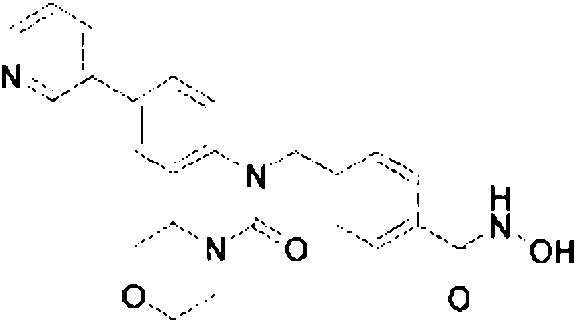
El compuesto de Fórmula 8-6 (4-((N-(4-(piridin-3-il)fenil)morfolin-4-carboxamido)metil)benzoato de metilo; 0,132 g, 0,306 mmol) se disolvió en metanol (10 ml) y posteriormente se añadió hidroxilamina (solución acuosa de 50,0 % en peso; 1,87 ml, 30,6 mmol) e hidróxido potásico (0,172 g, 3,06 mmol) secuencialmente y después se agitó a temperatura ambiente durante 30 minutos. Tras completarse la reacción, la solución de reacción se concentró a presión reducida hasta que su volumen fue de aproximadamente 3 ml y se añadió una solución acuosa saturada de cloruro de amonio (1-2 ml) y se agitó. Después, el producto sólido se filtró, se lavó con agua y posteriormente se secó a vacío para dar el Compuesto 332 deseado (0,051 g, 39 %) en forma de un sólido de color pardo.The compound of Formula 8-6 (methyl 4 - ((N- (4- (pyridin-3-yl) phenyl) morpholin-4-carboxamido) methyl) benzoate; 0.132 g, 0.306 mmol) was dissolved in methanol (10 mL). ml) and subsequently hydroxylamine (50.0% by weight aqueous solution, 1.87 ml, 30.6 mmol) and potassium hydroxide (0.172 g, 3.06 mmol) were added sequentially and then stirred at room temperature for 30 minutes. minutes After completion of the reaction, the reaction solution was concentrated under reduced pressure until its volume was about 3 ml and a saturated aqueous solution of ammonium chloride (1-2 ml) was added and stirred. Then, the solid product was filtered, washed with water and then dried under vacuum to give the desired Compound 332 (0.051 g, 39%) as a brown solid.
1H RMN (400 MHz, DIVISOR) 811,15 (s, 1 H), 9,00 (s, 1 H), 8,86 (s, 1 H), 8,52 (s, 1 H), 8,04 (d, 1 H, J = 5,2 Hz), 7,71 - 7,65(m, 4 H), 7,43 - 7,38 (m, 3 H), 7,26 (d, 2 H, J = 6,8 Hz), 4,93 (s, 2 H), 3,44 (m, 4 H), 3,19 (m, 4 H). MS (ESI) m/z 433 (M+ H).1 H NMR (400 MHz, DIVIDER) 811.15 (s, 1 H), 9.00 (s, 1 H), 8.86 (s, 1 H), 8.52 (s, 1 H), 8, 04 (d, 1 H, J = 5.2 Hz), 7.71-7.65 (m, 4 H), 7.43-7.38 (m, 3 H), 7.26 (d, 2 H, J = 6.8 Hz), 4.93 (s, 2 H), 3.44 (m, 4 H), 3.19 (m, 4 H). MS (ESI) m / z 433 (M + H).
Ejemplo 21: Síntesis del Compuesto 333Example 21: Synthesis of Compound 333
(Fórmula 8-6: 4-((N-(4-(pirimidin-5-il)fenil)morfolin-4-carboxamido)metil)benzoato de metilo)(Formula 8-6: 4 - (Methyl N- (4- (pyrimidin-5-yl) phenyl) morpholin-4-carboxamido) methyl) benzoate)
El compuesto de Fórmula 8-5 (4-((N-(4-bromofenil)morfolin-4-carboxamido)metil)benzoato de metilo; 0,200 g, 0,462 mmol), ácido pirimidin-5-ilborónico (0,069 g, 0,554 mmol) y Pd(dppf)Cl2 (0,038 g, 0,046 mmol) se disolvieron en 1,4-dioxano (3 ml) y posteriormente carbonato sódico (0,196 g, 1,85 mmol) disuelto en agua (1 ml) se añadió a la solución de reacción y se agitó a 100 °C durante 6 horas. Tras completarse la reacción, la capa orgánica se extrajo con acetato de etilo y solución acuosa saturada de hidrogenocarbonato sódico y se concentró a presión reducida y posteriormente el residuo se purificó y se concentró por cromatografía en columna (sílice; acetato de etilo/hexano=75 %) para dar el compuesto deseado de Fórmula 8-6 (0,148 g, 74 %) en forma de un sólido de color blanco.The compound of Formula 8-5 (methyl 4 - ((N- (4-bromophenyl) morpholin-4-carboxamido) methyl) benzoate; 0.200 g, 0.462 mmol), pyrimidin-5-ylboronic acid (0.069 g, 0.554 mmol ) and Pd (dppf) Cl2 (0.038 g, 0.046 mmol) were dissolved in 1,4-dioxane (3 ml) and then sodium carbonate (0.196 g, 1.85 mmol) dissolved in water (1 ml) was added to the reaction solution and stirred at 100 ° C for 6 hours. After completion of the reaction, the organic layer was extracted with ethyl acetate and saturated aqueous sodium hydrogencarbonate solution and concentrated under reduced pressure and then the residue was purified and concentrated by column chromatography (silica, ethyl acetate / hexane = 75 %) to give the desired compound of Formula 8-6 (0.148 g, 74%) as a white solid.
(Compuesto 333: N-(4-(hidroxicarbamoil)bencil)-N-(4-(pirimidin-5-il)fenil)morfolin-4-carboxamida) (Compound 333: N- (4- (hydroxycarbamoyl) benzyl) -N- (4- (pyrimidin-5-yl) phenyl) morpholine-4-carboxamide)

El compuesto de Fórmula 8-6 (4-((N-(4-(pirimidin-5-il)fenil)morfolin-4-carboxamido)metil)benzoato de metilo; 0,148 g, 0,342 mmol) se disolvió en metanol (10 ml) y posteriormente se añadió hidroxilamina (solución acuosa de 50,0 % en peso; 2,09 ml, 34,2 mmol) e hidróxido potásico (0,192 g, 3,42 mmol) secuencialmente y después se agitó a temperatura ambiente durante 30 minutos. Tras completarse la reacción, la solución de reacción se concentró a presión reducida hasta que su volumen fue de aproximadamente 3 ml y la capa orgánica se extrajo con acetato de etilo y solución acuosa saturada de hidrogenocarbonato sódico. La capa orgánica se deshidrató con sulfato de magnesio anhidro, se filtró y después se concentró a presión reducida. El residuo se recristalizó con diclorometano y hexano para dar el Compuesto 333 deseado (0,060 g, 40 %) en forma de un sólido de color blanco.The compound of Formula 8-6 (methyl 4 - ((N- (4- (pyrimidin-5-yl) phenyl) morpholin-4-carboxamido) methyl) benzoate; 0.148 g, 0.342 mmol) was dissolved in methanol (10 ml). ml) and then hydroxylamine (50.0% by weight aqueous solution, 2.09 ml, 34.2 mmol) and potassium hydroxide (0.192 g, 3.42 mmol) were added sequentially and then stirred at room temperature for 30 minutes. minutes After completion of the reaction, the reaction solution was concentrated under reduced pressure until its volume was about 3 ml and the organic layer was extracted with ethyl acetate and saturated aqueous sodium hydrogencarbonate solution. The organic layer was dehydrated with anhydrous magnesium sulfate, filtered and then concentrated under reduced pressure. The residue was recrystallized from dichloromethane and hexane to give the desired Compound 333 (0.060 g, 40%) as a white solid.
1H RMN (400 MHz, DMSO-da) 89,13 (s, 1 H), 9,10 (s, 2 H), 7,77 (d, 2 H, J = 8,7 Hz), 7,65 (d, 2 H, J = 8,3 Hz), 7,39 (d, 2 H, J = 8,2 Hz), 7,29 (d, 2 H, J = 8,7 Hz), 4,94 (s, 2 H), 3,45 (t, 4 H, J = 4,6 Hz), 3,19 (t, 4 H, J = 4,6 Hz). MS(ESI) m/z 434 (M+ H).1 H NMR (400 MHz, DMSO-da) 89.13 (s, 1 H), 9.10 (s, 2 H), 7.77 (d, 2 H, J = 8.7 Hz), 7.65 (d, 2 H, J = 8.3 Hz), 7.39 (d, 2 H, J = 8.2 Hz), 7.29 (d, 2 H, J = 8.7 Hz), 4, 94 (s, 2 H), 3.45 (t, 4 H, J = 4.6 Hz), 3.19 (t, 4 H, J = 4.6 Hz). MS (ESI) m / z 434 (M + H).
Ejemplo 22: Síntesis del Compuesto 334Example 22: Synthesis of Compound 334
(Fórmula 8-6: 4-((N-(4-(quinolin-7-il)fenil)morfolin-4-carboxamido)metil)benzoato de metilo)(Formula 8-6: 4 - (Methyl N- (4- (quinolin-7-yl) phenyl) morpholin-4-carboxamido) methyl) benzoate)

El compuesto de Fórmula 8-5 (4-((N-(4-bromofenil)morfolin-4-carboxamido)metil)benzoato de metilo; 0,200 g, 0,462 mmol), ácido quinolin-7-ilborónico (0,096 g, 0,554 mmol) y Pd(dppf)Cl2 (0,038 g, 0,046 mmol) se disolvieron en 1,4-dioxano (3 ml) y posteriormente carbonato sódico (0,196 g, 1,85 mmol) disuelto en agua (1 ml) se añadió a la solución de reacción y se agitó a 100 °C durante 6 horas. Tras completarse la reacción, la capa orgánica se extrajo con acetato de etilo y solución acuosa saturada de hidrogenocarbonato sódico y se concentró a presión reducida y posteriormente el residuo se purificó y se concentró por cromatografía en columna (sílice; acetato de etilo/hexano=70 %) para dar el compuesto deseado de Fórmula 8-6 (0,192 g, 86 %) en forma de sólido marrón claro.The compound of Formula 8-5 (methyl 4 - ((N- (4-bromophenyl) morpholin-4-carboxamido) methyl) benzoate; 0.200 g, 0.462 mmol), quinolin-7-ylboronic acid (0.096 g, 0.554 mmol ) and Pd (dppf) Cl2 (0.038 g, 0.046 mmol) were dissolved in 1,4-dioxane (3 ml) and then sodium carbonate (0.196 g, 1.85 mmol) dissolved in water (1 ml) was added to the reaction solution and stirred at 100 ° C for 6 hours. After completion of the reaction, the organic layer was extracted with ethyl acetate and saturated aqueous sodium hydrogencarbonate solution and concentrated under reduced pressure and then the residue was purified and concentrated by column chromatography (silica, ethyl acetate / hexane = 70 %) to give the desired compound of Formula 8-6 (0.192 g, 86%) as a light brown solid.
(Compuesto 334: N-(4-(hidroxicarbamoil)bencil)-N-(4-(quinolin-7-il)fenil)morfolin-4-carboxamida)(Compound 334: N- (4- (hydroxycarbamoyl) benzyl) -N- (4- (quinolin-7-yl) phenyl) morpholine-4-carboxamide)

El compuesto de Fórmula 8-6 (The compound of Formula 8-6 (
4-((N-(4-(quinolin-7-il)fenil)morfolin-4-carboxamido)metil)benzoato de metilo; 0,192 g, 0,399 mmol) se disolvió en metanol (10 ml) y posteriormente se añadió hidroxilamina (solución acuosa de 50,0 % en peso; 2,44 ml, 39,9 mmol) e hidróxido potásico (0,224 g, 3,99 mmol) secuencialmente y después se agitó a temperatura ambiente durante 30 minutos. Tras completarse la reacción, la solución de reacción se concentró a presión reducida hasta que su volumen fue de aproximadamente 3 ml y se añadió una solución acuosa saturada de cloruro de amonio (1-2 ml) y se agitó. Después, el producto sólido se filtró, se lavó con agua y posteriormente se secó a vacío para dar el Compuesto 334 deseado (0,173 g, 90 %) en forma de sólido marrón claro.4 - (Methyl (N- (4- (quinolin-7-yl) phenyl) morpholin-4-carboxamido) methyl) benzoate; 0.192 g, 0.399 mmol) was dissolved in methanol (10 ml) and subsequently hydroxylamine (50.0% by weight aqueous solution, 2.44 ml, 39.9 mmol) and potassium hydroxide (0.224 g, 3.99 g. mmol) sequentially and then stirred at room temperature for 30 minutes. After completion of the reaction, the reaction solution was concentrated under reduced pressure until its volume was about 3 ml and a saturated aqueous solution of ammonium chloride (1-2 ml) was added and stirred. Then, the solid product was filtered, washed with water and then dried under vacuum to give the desired Compound 334 (0.173 g, 90%) as a light brown solid.
1H RMN (400 MHz, DMSO-d6) 88,89 (m, 1 H), 8,41 (dd, 1 H, J = 8,3, 1,7 Hz), 7,96 (m, 1 H), 7,74 (m, 1 H), 7,71 - 7,63 (m, 5 H), 7,55 (dd, 1 H, J = 8,2, 4,1 Hz), 7,43 (d, 2 H, J = 8,2 Hz), 7,25 (d, 2 H, J = 8,6 Hz), 4,95 (s, 2 H), 3,48 - 3,45 (m, 4 H), 3,24 - 3,20 (m, 4 H). MS(ESI) m/z 483 (M+ H). 1 H NMR (400 MHz, DMSO-d 6) 88.89 (m, 1 H), 8.41 (dd, 1 H, J = 8.3, 1.7 Hz), 7.96 (m, 1 H) , 7.74 (m, 1 H), 7.71-7.63 (m, 5 H), 7.55 (dd, 1 H, J = 8.2, 4.1 Hz), 7.43 ( d, 2 H, J = 8.2 Hz), 7.25 (d, 2 H, J = 8.6 Hz), 4.95 (s, 2 H), 3.48 - 3.45 (m, 4 H), 3.24-3.20 (m, 4 H). MS (ESI) m / z 483 (M + H).
E je m p lo 23: S ín tes is de l C o m p u e s to 335E je m p lo 23: S in tin g of C o m p u e s 335
(Fórmula 8-6: 4-((N-(4-(bifenil-3-il)fenil)morfolin-4-carboxamido)metil)benzoato de metilo)(Formula 8-6: 4 - ((N- (4- (biphenyl-3-yl) phenyl) morpholin-4-carboxamido) methyl) benzoate methyl)

El compuesto de Fórmula 8-5 (4-((N-(4-bromofenil)morfolin-4-carboxamido)metil)benzoato de metilo; 0,200 g, 0,462 mmol), ácido bifenil-3-ilborónico (0,110 g, 0,554 mmol) y Pd(dppf)Cl2 (0,038 g, 0,046 mmol) se disolvieron en 1,4-dioxano (3 ml) y posteriormente se añadió carbonato sódico (0,196 g, 1,85 mmol) disuelto en agua (1 ml) a la solución de reacción y se agitó a 100 °C durante 6 horas. Tras completarse la reacción, la capa orgánica se extrajo con acetato de etilo y solución acuosa saturada de hidrogenocarbonato sódico y se concentró a presión reducida y posteriormente el residuo se purificó y se concentró por cromatografía en columna (sílice; acetato de etilo/hexano=70 %) para dar el compuesto deseado de Fórmula 8-6 (0,230 g, 98 %) en forma de un sólido de color blanco.The compound of Formula 8-5 (methyl 4 - ((N- (4-bromophenyl) morpholin-4-carboxamido) methyl) benzoate; 0.200 g, 0.462 mmol), biphenyl-3-ylboronic acid (0.110 g, 0.554 mmol ) and Pd (dppf) Cl2 (0.038 g, 0.046 mmol) were dissolved in 1,4-dioxane (3 ml) and then sodium carbonate (0.196 g, 1.85 mmol) dissolved in water (1 ml) was added to the reaction solution and stirred at 100 ° C for 6 hours. After completion of the reaction, the organic layer was extracted with ethyl acetate and saturated aqueous sodium hydrogencarbonate solution and concentrated under reduced pressure and then the residue was purified and concentrated by column chromatography (silica, ethyl acetate / hexane = 70 %) to give the desired compound of Formula 8-6 (0.230 g, 98%) as a white solid.
(Compuesto 335: N-(4-(hidroxicarbamoil)bencil)-N-(4-(bifenil-3-il)fenil)morfolin-4-carboxamida)(Compound 335: N- (4- (hydroxycarbamoyl) benzyl) -N- (4- (biphenyl-3-yl) phenyl) morpholine-4-carboxamide)

El compuesto de Fórmula 8-6 (4-((N-(4-(bifenil-3-il)fenil)morfolin-4-carboxamido)metil)benzoato de metilo; 0,230 g, 0,454 mmol) se disolvió en metanol (10 ml) y posteriormente se añadió hidroxilamina (solución acuosa de 50,0 % en peso; 2,78 ml, 45,4 mmol) e hidróxido potásico (0,255 g, 4,54 mmol) secuencialmente y después se agitó a temperatura ambiente durante 30 minutos. Tras completarse la reacción, la solución de reacción se concentró a presión reducida hasta que su volumen fue de aproximadamente 3 ml y se añadió una solución acuosa saturada de cloruro de amonio (1-2 ml) y se agitó. Después, el producto sólido se filtró, se lavó con agua y posteriormente se secó a vacío para dar el Compuesto 335 deseado (0,220 g, 96 %) en forma de sólido marrón claro.The compound of Formula 8-6 (methyl 4 - ((N- (4- (biphenyl-3-yl) phenyl) morpholin-4-carboxamido) methyl) benzoate; 0.230 g, 0.454 mmol) was dissolved in methanol (10 ml). ml) and subsequently hydroxylamine (50.0% by weight aqueous solution, 2.78 ml, 45.4 mmol) and potassium hydroxide (0.255 g, 4.54 mmol) were added sequentially and then stirred at room temperature for 30 minutes. minutes After completion of the reaction, the reaction solution was concentrated under reduced pressure until its volume was about 3 ml and a saturated aqueous solution of ammonium chloride (1-2 ml) was added and stirred. Then, the solid product was filtered, washed with water and then dried under vacuum to give the desired Compound 335 (0.220 g, 96%) as a light brown solid.
1H RMN (400 MHz, DIVISOR) 87,86 (s, 1 H), 7,75 - 7,70 (m, 4 H), 7,67 (d, 2 H, J = 8,3 Hz), 7,63 - 7,60 (m, 2 H), 7,53 - 7,45 (m, 3 H), 7,41 - 7,39 (m, 3 H), 7,24 (d, 2 H, J = 8,6 Hz), 4,92 (s, 2 H), 3,44 - 3,42 (m, 4 H), 3,19 - 3,17 (m, 4 H). MS (ESI) m/z 508 (M+ H).1 H NMR (400 MHz, DIVIDER) 87.86 (s, 1 H), 7.75-7.70 (m, 4 H), 7.67 (d, 2 H, J = 8.3 Hz), 7 , 63-7.60 (m, 2 H), 7.53-7.45 (m, 3 H), 7.41-7.39 (m, 3 H), 7.24 (d, 2 H, J = 8.6 Hz), 4.92 (s, 2 H), 3.44 - 3.42 (m, 4 H), 3.19 - 3.17 (m, 4 H). MS (ESI) m / z 508 (M + H).
Ejemplo 24: Síntesis del Compuesto 336Example 24: Synthesis of Compound 336
(Fórmula 8-6: 4-((N-(4-(1H-indol-5-il)fenil)morfolme-4-carboxamido)metil)benzoato de metilo)(Formula 8-6: 4 - ((N- (4- (1H-indol-5-yl) phenyl) morphol-4-carboxamido) methyl) benzoate methyl)

El compuesto de Fórmula 8-5 (4-((N-(4-bromofenil)morfolin-4-carboxamido)metil)benzoato de metilo; 0,200 g, 0,462 mmol), ácido indol-5-ilborónico (0,089 g, 0,554 mmol) y Pd(dppf)Cl2 (0,038 g, 0,046 mmol) se disolvieron en 1,4-dioxano (3 ml) y posteriormente se añadió carbonato sódico (0,196 g, 1,85 mmol) disuelto en agua (1 ml) a la solución de reacción y se agitó a 100 °C durante 6 horas. Tras completarse la reacción, la capa orgánica se extrajo con acetato de etilo y solución acuosa saturada de hidrogenocarbonato sódico y se concentró a presión reducida y posteriormente el residuo se purificó y se concentró por cromatografía en columna (sílice; acetato de etilo/hexano=70 %) para dar el compuesto deseado de Fórmula 8-6 (0,191 g, 88 %) en forma de sólido marrón claro. The compound of Formula 8-5 (methyl 4 - ((N- (4-bromophenyl) morpholin-4-carboxamido) methyl) benzoate; 0.200 g, 0.462 mmol), indole-5-ylboronic acid (0.089 g, 0.554 mmol ) and Pd (dppf) Cl2 (0.038 g, 0.046 mmol) were dissolved in 1,4-dioxane (3 ml) and then sodium carbonate (0.196 g, 1.85 mmol) dissolved in water (1 ml) was added to the reaction solution and stirred at 100 ° C for 6 hours. After completion of the reaction, the organic layer was extracted with ethyl acetate and saturated aqueous sodium hydrogencarbonate solution and concentrated under reduced pressure and then the residue was purified and concentrated by column chromatography (silica, ethyl acetate / hexane = 70 %) to give the desired compound of Formula 8-6 (0.191 g, 88%) as a light brown solid.
(Compuesto 336: N-(4-(1H-indol-5-il)fenil)-N-(4-(hidroxicarbamoil)bencil)morfolin-4-carboxamida)(Compound 336: N- (4- (1H-indol-5-yl) phenyl) -N- (4- (hydroxycarbamoyl) benzyl) morpholine-4-carboxamide)

El compuesto de Fórmula 8-6 (4-((N-(4-(1H-indol-5-il)fenil)morfolin-4-carboxamido)metil)benzoato de metilo; 0,191 g, 0,407 mmol) se disolvió en metanol (10 ml) y posteriormente se añadió hidroxilamina (solución acuosa de 50,0 % en peso; 2,49 ml, 40,7 mmol) e hidróxido potásico (0,228 g, 4,07 mmol) secuencialmente y después se agitó a temperatura ambiente durante 30 minutos. Tras completarse la reacción, la solución de reacción se concentró a presión reducida hasta que su volumen fue de aproximadamente 3 ml y se añadió una solución acuosa saturada de cloruro de amonio (1-2 ml) y se agitó. Después, el producto sólido se filtró, se lavó con agua y posteriormente se secó a vacío para dar el Compuesto 336 deseado (0,185 g, 97 %) en forma de un sólido de color blanco.The compound of Formula 8-6 (methyl 4 - ((N- (4- (1H-indol-5-yl) phenyl) morpholin-4-carboxamido) methyl) benzoate; 0.191 g, 0.407 mmol) was dissolved in methanol (10 ml) and subsequently hydroxylamine (50.0% by weight aqueous solution, 2.49 ml, 40.7 mmol) and potassium hydroxide (0.228 g, 4.07 mmol) were added sequentially and then stirred at room temperature for 30 minutes. After completion of the reaction, the reaction solution was concentrated under reduced pressure until its volume was about 3 ml and a saturated aqueous solution of ammonium chloride (1-2 ml) was added and stirred. Then, the solid product was filtered, washed with water and then dried under vacuum to give the desired Compound 336 (0.185 g, 97%) as a white solid.
1H RMN (400 MHz, DMSO-da) 811,14 (s, 1 H), 7,77 (s, 1 H), 7,66 (d, 2 H, J = 8,2 Hz), 7,61 (d, 2 H, J = 8,6 Hz), 7,44 -7,38 (m, 3 H), 7,36 - 7,33 (m, 2 H), 7,19 (d, 2 H, J = 8,6 Hz), 6,44 (s, 1 H), 4,90 (s, 2 H), 3,45 - 3,41 (m, 4 H), 3,21 -3,17 (m, 4H). MS (ESI) m/z 471 (M+ H).1 H NMR (400 MHz, DMSO-da) 811.14 (s, 1 H), 7.77 (s, 1 H), 7.66 (d, 2 H, J = 8.2 Hz), 7.61 (d, 2 H, J = 8.6 Hz), 7.44 -7.38 (m, 3 H), 7.36-7.33 (m, 2 H), 7.19 (d, 2 H) , J = 8.6 Hz), 6.44 (s, 1 H), 4.90 (s, 2 H), 3.45 - 3.41 (m, 4 H), 3.21 -3.17 (m, 4H). MS (ESI) m / z 471 (M + H).
Ejemplo 25: Síntesis del Compuesto 337Example 25: Synthesis of Compound 337
(Fórmula 8-6: 4-((N-(4-(1H-indol-6-il)fenil)morfolin-4-carboxamido)metil)benzoato de metilo)(Formula 8-6: 4 - ((N- (4- (1H-indol-6-yl) phenyl) morpholin-4-carboxamido) methyl) benzoate methyl)

El compuesto de Fórmula 8-5 (4-((N-(4-bromofenil)morfolin-4-carboxamido)metil)benzoato de metilo; 0,200 g, 0,462 mmol), ácido indol-6-ilborónico (0,089 g, 0,554 mmol) y Pd(dppf)Cl2 (0,038 g, 0,046 mmol) se disolvieron en 1,4-dioxano (3 ml) y posteriormente se añadió carbonato sódico (0,196 g, 1,85 mmol) disuelto en agua (1 ml) a la solución de reacción y se agitó a 100 °C durante 6 horas. Tras completarse la reacción, la capa orgánica se extrajo con acetato de etilo y solución acuosa saturada de hidrogenocarbonato sódico y se concentró a presión reducida y posteriormente el residuo se purificó y se concentró por cromatografía en columna (sílice; acetato de etilo/hexano=70 %) para dar el compuesto deseado de Fórmula 8-6 (0,201 g, 93 %) en forma de sólido marrón claro.The compound of Formula 8-5 (methyl 4 - ((N- (4-bromophenyl) morpholin-4-carboxamido) methyl) benzoate; 0.200 g, 0.462 mmol), indole-6-ylboronic acid (0.089 g, 0.554 mmol ) and Pd (dppf) Cl2 (0.038 g, 0.046 mmol) were dissolved in 1,4-dioxane (3 ml) and then sodium carbonate (0.196 g, 1.85 mmol) dissolved in water (1 ml) was added to the reaction solution and stirred at 100 ° C for 6 hours. After completion of the reaction, the organic layer was extracted with ethyl acetate and saturated aqueous sodium hydrogencarbonate solution and concentrated under reduced pressure and then the residue was purified and concentrated by column chromatography (silica, ethyl acetate / hexane = 70 %) to give the desired compound of Formula 8-6 (0.201 g, 93%) as a light brown solid.
(Compuesto 337: N-(4-(1H-indol-6-il)fenil)-N-(4-(hidroxicarbamoil)bencil)morfolin-4-carboxamida)(Compound 337: N- (4- (1H-indol-6-yl) phenyl) -N- (4- (hydroxycarbamoyl) benzyl) morpholine-4-carboxamide)
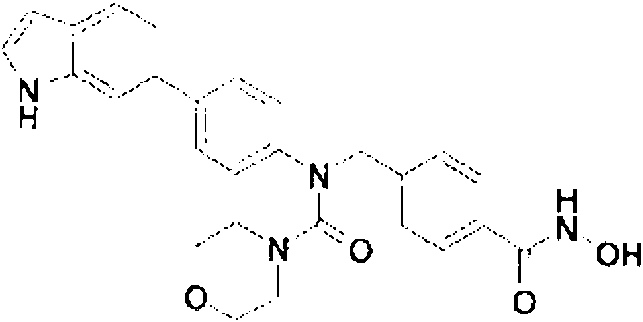
El compuesto de Fórmula 8-6 (4-((N-(4-(1H-indol-6-il)fenil)morfolin-4-carboxamido)metil)benzoato de metilo; 0,201 g, 0,428 mmol) se disolvió en metanol (10 ml) y posteriormente se añadió hidroxilamina (solución acuosa de 50,0 % en peso; 2,62 ml, 42,8 mmol) e hidróxido potásico (0,240 g, 4,28 mmol) secuencialmente y después se agitó a temperatura ambiente durante 30 minutos. Tras completarse la reacción, la solución de reacción se concentró a presión reducida hasta que su volumen fue de aproximadamente 3 ml y se añadió una solución acuosa saturada de cloruro de amonio (1-2 ml) y se agitó. Después, el producto sólido se filtró, se lavó con agua y posteriormente se secó a vacío para dar el Compuesto 337 deseado (0,195 g, 97 %) en forma de sólido marrón claro.The compound of Formula 8-6 (methyl 4 - ((N- (4- (1H-indol-6-yl) phenyl) morpholin-4-carboxamido) methyl) benzoate; 0.201 g, 0.428 mmol) was dissolved in methanol (10 ml) and subsequently hydroxylamine (50.0% by weight aqueous solution, 2.62 ml, 42.8 mmol) and potassium hydroxide (0.240 g, 4.28 mmol) were added sequentially and then stirred at room temperature for 30 minutes. After completion of the reaction, the reaction solution was concentrated under reduced pressure until its volume was about 3 ml and a saturated aqueous solution of ammonium chloride (1-2 ml) was added and stirred. Then, the solid product was filtered, washed with water and then dried in vacuo to give the desired Compound 337 (0.195 g, 97%) as a light brown solid.
1H RMN (400 MHz, DMSO-d6) 811,15 (s, 1 H), 7,67 (d, 2 H, J = 8,2 Hz), 7,63 -7,56 (m, 4H), 7,39 (d, 2 H, J = 8,2 Hz), 7,36 (m, 1 H), 7,26 (m, 1 H), 7,21 (d, 2 H, J = 8,6 Hz), 6,42 (s, 1 H), 4,91 (s, 2 H), 3,44 -3,42 (m, 4 H), 3,19 -3,17 (m, 4 H). MS (ESI) m/z 471 (M+ H). 1 H NMR (400 MHz, DMSO-d 6) 811.15 (s, 1 H), 7.67 (d, 2 H, J = 8.2 Hz), 7.63-7.56 (m, 4H), 7.39 (d, 2 H, J = 8.2 Hz), 7.36 (m, 1 H), 7.26 (m, 1 H), 7.21 (d, 2 H, J = 8, 6 Hz), 6.42 (s, 1 H), 4.91 (s, 2 H), 3.44 -3.42 (m, 4 H), 3.19 -3.17 (m, 4 H) ). MS (ESI) m / z 471 (M + H).
E je m p lo 26: S ín te s is de l C o m p u e s to 338E je m p lo 26: S ín te is is C o m p u e s 338
(Fórmula 8-6: 4-((N-(3',4',5'-trimetoxibifenil-4-il)fenil)morfolin-4-carboxamido)metil)benzoato de metilo)(Formula 8-6: 4 - ((N- (3 ', 4', 5'-trimethoxybiphenyl-4-yl) phenyl) morpholin-4-carboxamido) methyl) benzoate methyl)

El compuesto de Fórmula 8-5 (4-((N-(4-bromofenil)morfolin-4-carboxamido)metil)benzoato de metilo; 0,200 g, 0,462 mmol), 3,4,5-trimetoxifenilborónico ácido (0,117 g, 0,554 mmol) y Pd(dppf)Ch (0,038 g, 0,046 mmol) se disolvieron en 1,4-dioxano (3 ml) y posteriormente se añadió carbonato sódico (0,196 g, 1,85 mmol) disuelto en agua (1 ml) a la solución de reacción y se agitó a 100 °C durante 6 horas. Tras completarse la reacción, la capa orgánica se extrajo con acetato de etilo y solución acuosa saturada de hidrogenocarbonato sódico y se concentró a presión reducida y posteriormente el residuo se purificó y se concentró por cromatografía en columna (sílice; acetato de etilo/ hexano=70 %) para dar el compuesto deseado de Fórmula 8-6 (0,121 g, 50 %) en forma de un sólido de color blanco.The compound of Formula 8-5 (methyl 4 - ((N- (4-bromophenyl) morpholin-4-carboxamido) methyl) benzoate; 0.200 g, 0.462 mmol), 3,4,5-trimethoxyphenylboronic acid (0.117 g, 0.554 mmol) and Pd (dppf) Ch (0.038 g, 0.046 mmol) were dissolved in 1,4-dioxane (3 ml) and then sodium carbonate (0.196 g, 1.85 mmol) dissolved in water (1 ml) was added. to the reaction solution and stirred at 100 ° C for 6 hours. After completion of the reaction, the organic layer was extracted with ethyl acetate and saturated aqueous sodium hydrogencarbonate solution and concentrated under reduced pressure and then the residue was purified and concentrated by column chromatography (silica, ethyl acetate / hexane = 70 %) to give the desired compound of Formula 8-6 (0.121 g, 50%) as a white solid.
(Compuesto 338: N-(4-(hidroxicarbamoil)bencil)-N-(3',4',5'-trimetoxibifenil-4-il)morfolin-4-carboxamida)(Compound 338: N- (4- (hydroxycarbamoyl) benzyl) -N- (3 ', 4', 5'-trimethoxybiphenyl-4-yl) morpholine-4-carboxamide)

El compuesto de Fórmula 8-6 (4-((N-(3',4',5'-trimetoxibifenil-4-il)fenil)morfolin-4-carboxamido)metil)benzoato de metilo; 0,121 g, 0,232 mmol) se disolvió en metanol (10 ml) y posteriormente se añadió hidroxilamina (solución acuosa de 50,0 % en peso; 1,42 ml, 23,2 mmol) e hidróxido potásico (0,130 g, 2,32 mmol) secuencialmente y después se agitó a temperatura ambiente durante 30 minutos. Tras completarse la reacción, la solución de reacción se concentró a presión reducida hasta que su volumen fue de aproximadamente 3 ml y se añadió una solución acuosa saturada de cloruro de amonio (1-2 ml) y se agitó. Después, el producto sólido se filtró, se lavó con agua y posteriormente se secó a vacío para dar el Compuesto 338 deseado (0,038 g, 31 %) en forma de un sólido de color blanco.The compound of Formula 8-6 (methyl 4 - ((N- (3 ', 4', 5'-trimethoxybiphenyl-4-yl) phenyl) morpholin-4-carboxamido) methyl) benzoate; 0.121 g, 0.232 mmol) was dissolved in methanol (10 ml) and subsequently hydroxylamine (50.0% by weight aqueous solution; 1.42 ml, 23.2 mmol) and potassium hydroxide (0.130 g, 2.32 g. mmol) sequentially and then stirred at room temperature for 30 minutes. After completion of the reaction, the reaction solution was concentrated under reduced pressure until its volume was about 3 ml and a saturated aqueous solution of ammonium chloride (1-2 ml) was added and stirred. Then, the solid product was filtered, washed with water and then dried under vacuum to give the desired Compound 338 (0.038 g, 31%) as a white solid.
1H RMN (400 MHz, DMSO-da) 57,66-7,61 (m, 4 H), 7,38 (d, 2 H, J = 8,2 Hz), 7,20 (d, 2 H, J = 8,6 Hz), 6,86 (s, 2 H), 4,91 (s, 2 H), 3,83 (s, 6 H), 3,66 (s, 3 H), 3,44 (t, 4 H, J = 4,3 Hz), 3,17 (t, 4 H, J = 4,4 Hz). MS (ESI) m/z 522 (M+ H). 1 H NMR (400 MHz, DMSO-da) 57.66-7.61 (m, 4 H), 7.38 (d, 2 H, J = 8.2 Hz), 7.20 (d, 2 H, J = 8.6 Hz), 6.86 (s, 2 H), 4.91 (s, 2 H), 3.83 (s, 6 H), 3.66 (s, 3 H), 3, 44 (t, 4 H, J = 4.3 Hz), 3.17 (t, 4 H, J = 4.4 Hz). MS (ESI) m / z 522 (M + H).
Ejemplo 27: Síntesis del Compuesto 339Example 27: Synthesis of Compound 339
(Fórmula 8-6: 4-((N-(3',5'-bis(trifluorometil)bifenil-4-il))morfolin-4-carboxamido)metil)benzoato de metilo)(Formula 8-6: 4 - ((N- (3 ', 5'-bis (trifluoromethyl) biphenyl-4-yl)) morpholin-4-carboxamido) methyl) benzoate methyl)

El compuesto de Fórmula 8-5 (4-((N-(4-bromofenil)morfolin-4-carboxamido)metil)benzoato de metilo; 0,200 g, 0,462 mmol), ácido 3,5-bis(trifluorometil)fenilborónico (0,143 g, 0,554 mmol) y Pd(dppf)Ch (0,038 g, 0,046 mmol) se disolvieron en 1,4-dioxano (3 ml) y posteriormente carbonato sódico (0,196 g, 1,85 mmol) disuelto en agua (1 ml) se añadió a la solución de reacción y se agitó a 100 °C durante 6 horas. Tras completarse la reacción, la capa orgánica se extrajo con acetato de etilo y solución acuosa saturada de hidrogenocarbonato sódico y se concentró a presión reducida y posteriormente el residuo se purificó y se concentró por cromatografía en columna (sílice; acetato de etilo/hexano=50 %) para dar el compuesto deseado de Fórmula 8-6 (0,203 g, 78 %) en forma de un sólido de color blanco. The compound of Formula 8-5 (methyl 4 - ((N- (4-bromophenyl) morpholin-4-carboxamido) methyl) benzoate; 0.200 g, 0.462 mmol), 3,5-bis (trifluoromethyl) phenylboronic acid (0.143) g, 0.554 mmol) and Pd (dppf) Ch (0.038 g, 0.046 mmol) were dissolved in 1,4-dioxane (3 ml) and then sodium carbonate (0.196 g, 1.85 mmol) dissolved in water (1 ml). it was added to the reaction solution and stirred at 100 ° C for 6 hours. After completion of the reaction, the organic layer was extracted with ethyl acetate and saturated aqueous sodium hydrogencarbonate solution and concentrated under reduced pressure and then the residue was purified and concentrated by column chromatography (silica, ethyl acetate / hexane = 50 %) to give the desired compound of Formula 8-6 (0.203 g, 78%) as a white solid.
(Compuesto 339: N-(3',5'-bis(trifluorometil)bifenil-4-il)-N-(4-(hidroxicarbamoil)bencil)morfolin-4-carboxamida)(Compound 339: N- (3 ', 5'-bis (trifluoromethyl) biphenyl-4-yl) -N- (4- (hydroxycarbamoyl) benzyl) morpholine-4-carboxamide)

El compuesto de Fórmula 8-6 (4-((N-(3',5'-bis(trifluorometil)bifenil-4-il))morfolin-4-carboxamido)metil)benzoato de metilo; 0,203 g, 0,358 mmol) se disolvió en metanol (10 ml) y posteriormente se añadió hidroxilamina (solución acuosa de 50,0 % en peso; 2,19 ml, 35,8 mmol) e hidróxido potásico (0,201 g, 3,58 mmol) secuencialmente y después se agitó a temperatura ambiente durante 30 minutos. Tras completarse la reacción, la solución de reacción se concentró a presión reducida hasta que su volumen fue de aproximadamente 3 ml y se añadió una solución acuosa saturada de cloruro de amonio (1-2 ml) y se agitó. Después, el producto sólido se filtró, se lavó con agua y posteriormente se secó a vacío para dar el Compuesto 339 deseado (0,197 g, 97 %) en forma de sólido marrón claro.The compound of Formula 8-6 (methyl 4 - ((N- (3 ', 5'-bis (trifluoromethyl) biphenyl-4-yl)) morpholin-4-carboxamido) methyl) benzoate; 0.203 g, 0.358 mmol) was dissolved in methanol (10 ml) and then hydroxylamine (50.0% by weight aqueous solution, 2.19 ml, 35.8 mmol) and potassium hydroxide (0.201 g, 3.58 g) were added. mmol) sequentially and then stirred at room temperature for 30 minutes. After completion of the reaction, the reaction solution was concentrated under reduced pressure until its volume was about 3 ml and a saturated aqueous solution of ammonium chloride (1-2 ml) was added and stirred. Then, the solid product was filtered, washed with water and then dried under vacuum to give the desired Compound 339 (0.197 g, 97%) as a light brown solid.
1H RMN (400 MHz, DMSO-da) 88,29 (s, 2 H), 8,03 (s, 1 H), 7,82 (d, 2 H, J = 8,6 Hz), 7,66 (d, 2 H, J = 8,2 Hz), 7,40 (d, 2 H, J = 8,2 Hz), 7,28 (d, 2 H, J = 8,6 Hz), 4,94 (s, 2 H), 3,47 - 3,43 (m, 4 H), 3,21 - 3,15 (m, 4 H). MS (ESI) m/z 568 (M+ H).1 H NMR (400 MHz, DMSO-da) 88.29 (s, 2 H), 8.03 (s, 1 H), 7.82 (d, 2 H, J = 8.6 Hz), 7.66 (d, 2 H, J = 8.2 Hz), 7.40 (d, 2 H, J = 8.2 Hz), 7.28 (d, 2 H, J = 8.6 Hz), 4, 94 (s, 2 H), 3.47 - 3.43 (m, 4 H), 3.21 - 3.15 (m, 4 H). MS (ESI) m / z 568 (M + H).
Ejemplo 28: Síntesis del Compuesto 340Example 28: Synthesis of Compound 340
(Fórmula 8-6: 4-((N-(4-(1H-indol-4-il)fenil)morfolin-4-carboxamido)metil)benzoato de metilo)(Formula 8-6: 4 - (methyl (N- (4- (1H-indol-4-yl) phenyl) morpholin-4-carboxamido) methyl) benzoate)

El compuesto de Fórmula 8-5 (4-((N-(4-bromofenil)morfolin-4-carboxamido)metil)benzoato de metilo; 0,200 g, 0,462 mmol), ácido indol-4-ilborónico (0,089 g, 0,554 mmol) y Pd(dppf)Cl2 (0,038 g, 0,046 mmol) se disolvieron en 1,4-dioxano (3 ml) y posteriormente se añadió carbonato sódico (0,196 g, 1,85 mmol) disuelto en agua (1 ml) a la solución de reacción y se agitó a 100 °C durante 6 horas. Tras completarse la reacción, la capa orgánica se extrajo con acetato de etilo y solución acuosa saturada de hidrogenocarbonato sódico y se concentró a presión reducida y posteriormente el residuo se purificó y se concentró por cromatografía en columna (sílice; acetato de etilo/hexano=70 %) para dar el compuesto deseado de Fórmula 8-6 (0,142 g, 66 %) en forma de un sólido amarillo claro.The compound of Formula 8-5 (methyl 4 - ((N- (4-bromophenyl) morpholin-4-carboxamido) methyl) benzoate; 0.200 g, 0.462 mmol), indole-4-ylboronic acid (0.089 g, 0.554 mmol ) and Pd (dppf) Cl2 (0.038 g, 0.046 mmol) were dissolved in 1,4-dioxane (3 ml) and then sodium carbonate (0.196 g, 1.85 mmol) dissolved in water (1 ml) was added to the reaction solution and stirred at 100 ° C for 6 hours. After completion of the reaction, the organic layer was extracted with ethyl acetate and saturated aqueous sodium hydrogencarbonate solution and concentrated under reduced pressure and then the residue was purified and concentrated by column chromatography (silica, ethyl acetate / hexane = 70 %) to give the desired compound of Formula 8-6 (0.142 g, 66%) as a light yellow solid.
(Compuesto 340: N-(4-(1H-indol-4-il)fenil)-N-(4-(hidroxicarbamoil)bencil)morfolin-4-carboxamida)(Compound 340: N- (4- (1H-indol-4-yl) phenyl) -N- (4- (hydroxycarbamoyl) benzyl) morpholine-4-carboxamide)

El compuesto de Fórmula 8-6 (4-((N-(4-(1H-indol-4-il)fenil)morfolin-4-carboxamido)metil)benzoato de metilo; 0,142 g, 0,302 mmol) se disolvió en metanol (10 ml) y posteriormente se añadió hidroxilamina (solución acuosa de 50,0 % en peso; 1,85 ml, 30,2 mmol) e hidróxido potásico (0,170 g, 3,02 mmol) secuencialmente y después se agitó a temperatura ambiente durante 30 minutos. Tras completarse la reacción, la solución de reacción se concentró a presión reducida hasta que su volumen fue de aproximadamente 3 ml y se añadió una solución acuosa saturada de cloruro de amonio (1-2 ml) y se agitó. Después, el producto sólido se filtró, se lavó con agua y posteriormente se secó a vacío para dar el Compuesto 340 deseado (0,105 g, 74 %) en forma de un sólido de color blanco.The compound of Formula 8-6 (methyl 4 - ((N- (4- (1H-indol-4-yl) phenyl) morpholin-4-carboxamido) methyl) benzoate; 0.142 g, 0.302 mmol) was dissolved in methanol (10 ml) and subsequently hydroxylamine (50.0% by weight aqueous solution, 1.85 ml, 30.2 mmol) and potassium hydroxide (0.170 g, 3.02 mmol) were added sequentially and then stirred at room temperature for 30 minutes. After completion of the reaction, the reaction solution was concentrated under reduced pressure until its volume was about 3 ml and a saturated aqueous solution of ammonium chloride (1-2 ml) was added and stirred. Then, the solid product was filtered, washed with water and then dried under vacuum to give the desired Compound 340 (0.105 g, 74%) as a white solid.
1H RMN (400 MHz, DMSO-d6) 811,25 (s, 1 H), 7,68 (d, 2 H, J = 8,3 Hz), 7,61 (d, 2 H, J = 8,6 Hz), 7,41 -7,36 (m, 4 H), 7,25 (d, 2 H, J = 8,6 Hz), 7,14 (t, 1 H, J = 7,7 Hz), 7,04 (d, 1 H, J = 7,3 Hz), 6,51 (s, 1 H), 4,92 (s, 2 H), 3,45 - 3,43 (m, 4 H), 3,22 - 3,20 (m, 4 H). MS (ESI) m/z 471 (M+ H). 1 H NMR (400 MHz, DMSO-d 6) 811.25 (s, 1 H), 7.68 (d, 2 H, J = 8.3 Hz), 7.61 (d, 2 H, J = 8, 6 Hz), 7.41 -7.36 (m, 4 H), 7.25 (d, 2 H, J = 8.6 Hz), 7.14 (t, 1 H, J = 7.7 Hz ), 7.04 (d, 1 H, J = 7.3 Hz), 6.51 (s, 1 H), 4.92 (s, 2 H), 3.45 - 3.43 (m, 4) H), 3.22-3.20 (m, 4 H). MS (ESI) m / z 471 (M + H).
E je m p lo 29: S ín tes is de l C o m p u e s to 341E je m p lo 29: S in tin g of C o m p u e s 341
(Fórmula 7-4: 4-((piridin-2-ilamino)metil)benzoato de metilo)(Formula 7-4: 4 - ((pyridin-2-ylamino) methyl) benzoate methyl)

El compuesto de Fórmula 7-3 (piridin-2-amina; 10,0 g, 106 mmol) se disolvió en metanol (100 ml) y posteriormente 4-formilbenzoato de metilo (17,4 g, 106 mmol) y ácido acético (6,08 ml, 106 mmol) se añadieron y se agitó durante 1 día. Después, cianoborohidruro sódico (22,5 g, 106 mmol) se añadió y se agitó durante 1 día. Tras completarse la reacción, el sólido producido se filtró y la capa orgánica se lavó con una solución acuosa saturada de cloruro sódico, se deshidrató con sulfato de magnesio anhidro y posteriormente se concentró a presión reducida. El residuo se purificó y se concentró por cromatografía en columna (sílice; diclorometano/acetato de etilo=5 %) para dar el compuesto deseado de Fórmula 7-4 (8,0 g, 31 %) en forma de un sólido de color blanco.The compound of Formula 7-3 (pyridin-2-amine; 10.0 g, 106 mmol) was dissolved in methanol (100 ml) and subsequently methyl 4-formylbenzoate (17.4 g, 106 mmol) and acetic acid ( 6.08 ml, 106 mmol) were added and stirred for 1 day. Then, sodium cyanoborohydride (22.5 g, 106 mmol) was added and stirred for 1 day. After completion of the reaction, the produced solid was filtered and the organic layer was washed with a saturated aqueous solution of sodium chloride, dehydrated with anhydrous magnesium sulfate and subsequently concentrated under reduced pressure. The residue was purified and concentrated by column chromatography (silica, dichloromethane / ethyl acetate = 5%) to give the desired compound of Formula 7-4 (8.0 g, 31%) as a white solid .
(Fórmula 7-5: 4-((((4-nitrofenoxi)carbonil)(piridin-2-il)amino)metil)benzoato de metilo)(Formula 7-5: 4 - ((((((4-nitrophenoxy) carbonyl) (pyridin-2-yl) amino) methyl) methyl benzoate)

El compuesto de Fórmula 7-4 (4-((piridin-2-ilamino)metil)benzoato de metilo; 1,80 g, 7,43 mmol) se disolvió en acetonitrilo (50 ml) y posteriormente se añadieron carbonato potásico (3,08 g, 22,3 mmol) y cloroformiato de 4-nitrofenilo (2,24 g, 11,1 mmol). Después, la mezcla se calentó y se agitó a aproximadamente 50 °C durante 1 día. Se vertió agua en la mezcla de reacción y la capa orgánica se extrajo con acetato de etilo. La capa orgánica se lavó con una solución acuosa saturada de cloruro sódico, se deshidrató con sulfato de magnesio anhidro y posteriormente se concentró a presión reducida. El residuo se purificó y se concentró por cromatografía en columna (sílice; hexano/acetato de etilo=30 %) para dar el compuesto deseado de Fórmula 7-5 (0,98 g, 32 %) en forma de un sólido de color blanco. (Fórmula 7-6: 4-((N-(piridin-2-il)piperidin-1-carboxamido)metil)benzoato de metilo)The compound of Formula 7-4 (methyl 4 - ((pyridin-2-ylamino) methyl) benzoate; 1.80 g, 7.43 mmol) was dissolved in acetonitrile (50 ml) and then potassium carbonate (3%) was added. , 08 g, 22.3 mmol) and 4-nitrophenyl chloroformate (2.24 g, 11.1 mmol). Then, the mixture was heated and stirred at about 50 ° C for 1 day. Water was poured into the reaction mixture and the organic layer was extracted with ethyl acetate. The organic layer was washed with a saturated aqueous solution of sodium chloride, dehydrated with anhydrous magnesium sulfate and subsequently concentrated under reduced pressure. The residue was purified and concentrated by column chromatography (silica; hexane / ethyl acetate = 30%) to give the desired compound of Formula 7-5 (0.98 g, 32%) as a white solid . (Formula 7-6: methyl 4 - ((N- (pyridin-2-yl) piperidin-1-carboxamido) methyl) benzoate)

El compuesto de Fórmula 7-5 (4-((((4-nitrofenoxi)carbonil)(piridin-2-il)amino)metil)benzoato de metilo; 0,30 g, 0,736 mmol) se disolvió en dimetilformamida (4 ml) y posteriormente se añadieron piperidina (0,06 ml, 0,736 mmol) y carbonato potásico (0,122 g, 0,884 mmol) y la mezcla se calentó y se agitó a 60 °C durante 12 horas. Después, la dimetilformamida se retiró a presión reducida, se vertió agua en la mezcla de reacción y la capa orgánica se extrajo con acetato de etilo. La capa orgánica se lavó con una solución acuosa saturada de cloruro sódico, se deshidrató con sulfato de magnesio anhidro y posteriormente se concentró a presión reducida. El residuo se purificó y se concentró por cromatografía en columna (sílice; acetato de etilo/hexano=30 %) para dar el compuesto deseado de Fórmula 7-6 (0,27 g, 104 %) en forma de un aceite de color amarillo.The compound of Formula 7-5 (methyl 4 - (((((4-nitrophenoxy) carbonyl) (pyridin-2-yl) amino) methyl) benzoate; 0.30 g, 0.736 mmol) was dissolved in dimethylformamide (4 mL). ) and then piperidine (0.06 ml, 0.736 mmol) and potassium carbonate (0.122 g, 0.884 mmol) were added and the mixture was heated and stirred at 60 ° C for 12 hours. Then, the dimethylformamide was removed under reduced pressure, water was poured into the reaction mixture and the organic layer was extracted with ethyl acetate. The organic layer was washed with a saturated aqueous solution of sodium chloride, dehydrated with anhydrous magnesium sulfate and subsequently concentrated under reduced pressure. The residue was purified and concentrated by column chromatography (silica; ethyl acetate / hexane = 30%) to give the desired compound of Formula 7-6 (0.27 g, 104%) as a yellow oil. .
(Compuesto 341: N-(4-(hidroxicarbamoil)bencil)-N-(piridin-2-il)piperidin-1-carboxamida) (Compound 341: N- (4- (hydroxycarbamoyl) benzyl) -N- (pyridin-2-yl) piperidine-1-carboxamide)
El compuesto de Fórmula 7-6 (4-((N-(piridin-2-il)piperidin-1-carboxamido)metil)benzoato de metilo; 0,13 g, 0,38 mmol) se disolvió en metanol (10 ml) y posteriormente se añadieron hidroxilamina (0,13 g, 1,89 mmol) e hidróxido potásico (0,21 g, 3,79 mmol) y se agitó durante 5 minutos. Después, hidroxilamina (solución acuosa al 50 % en peso; 0,98 ml, 7,58 mmol) se añadió gota a gota y se agitó a temperatura ambiente durante 12 horas. Tras completarse la reacción, se añadió ácido clorhídrico 2 N y la capa orgánica se extrajo con acetato de etilo, se lavó con solución acuosa saturada de cloruro sódico, se deshidrató con sulfato de magnesio anhidro y posteriormente se concentró a presión reducida. El residuo se purificó y se concentró por cromatografía en columna (sílice; metanol/ diclorometano =5 %) para dar el Compuesto 341 deseado (0,09 g, 70 %) en forma de un sólido de color blanco.The compound of Formula 7-6 (methyl 4 - ((N- (pyridin-2-yl) piperidin-1-carboxamido) methyl) benzoate; 0.13 g, 0.38 mmol) was dissolved in methanol (10 ml. ) and then hydroxylamine (0.13 g, 1.89 mmol) and potassium hydroxide (0.21 g, 3.79 mmol) were added and stirred for 5 minutes. Then, hydroxylamine (50% by weight aqueous solution, 0.98 ml, 7.58 mmol) was added dropwise and stirred at room temperature for 12 hours. After completion of the reaction, 2N hydrochloric acid was added and the organic layer was extracted with ethyl acetate, washed with saturated aqueous sodium chloride solution, dehydrated with anhydrous magnesium sulfate and subsequently concentrated under reduced pressure. The residue was purified and concentrated by column chromatography (silica; methanol / dichloromethane = 5%) to give the desired Compound 341 (0.09 g, 70%) as a white solid.
1H RMN (400 MHz, MeOD-da) 88,31 - 8,29 (m, 1 H), 7,72 - 7,66 (m, 3 H), 7,49 (d, 2 H, J = 8,3 Hz), 7,01 - 6,98 (m, 2 H), 5,07 (s, 2 H), 3,27 (t, 4 H, J = 5,5 Hz), 1,57 - 1,53 (m, 2 H), 1,45 - 1,41 (m, 4 H); MS (ESI) m/z 355,2 (M+ H). 1 H NMR (400 MHz, MeOD-da) 88.31 - 8.29 (m, 1 H), 7.72 - 7.66 (m, 3 H), 7.49 (d, 2 H, J = 8 , 3 Hz), 7.01-6.98 (m, 2 H), 5.07 (s, 2 H), 3.27 (t, 4 H, J = 5.5 Hz), 1.57 - 1.53 (m, 2 H), 1.45-1.41 (m, 4 H); MS (ESI) m / z 355.2 (M + H).
Ejemplo 30: Síntesis del Compuesto 342Example 30: Synthesis of Compound 342
(Fórmula 7-6: 4-((4-metil-N-(piridin-2-il)piperidin-1-carboxamido)metil)benzoato de metilo)(Formula 7-6: methyl 4 - ((4-methyl-N- (pyridin-2-yl) piperidin-1-carboxamido) methyl) benzoate)

El compuesto de Fórmula 7-5 (4-((((4-nitrofenoxi)carbonil)(piridin-2-il)amino)metil)benzoato de metilo; 0,300 g, 0,736 mmol) se disolvió en dimetilformamida (4 ml) y posteriormente se añadieron 4-metilpiperidina (0,07 g, 0,736 mmol) y carbonato potásico (0,122 g, 0,884 mmol) y la mezcla se calentó y se agitó a 60 °C durante 12 horas. Después, la dimetilformamida se retiró a presión reducida, se vertió agua en la mezcla de reacción y la capa orgánica se extrajo con acetato de etilo. La capa orgánica se lavó con una solución acuosa saturada de cloruro sódico, se deshidrató con sulfato de magnesio anhidro y posteriormente se concentró a presión reducida. El residuo se purificó y se concentró por cromatografía en columna (sílice; acetato de etilo/hexano=30 %) para dar el compuesto deseado de Fórmula 7-6 (0,27 g, 100 %) en forma de un aceite de color amarillo.The compound of Formula 7-5 (methyl 4 - (((((4-nitrophenoxy) carbonyl) (pyridin-2-yl) amino) methyl) benzoate; 0.300 g, 0.736 mmol) was dissolved in dimethylformamide (4 mL) and subsequently 4-methylpiperidine (0.07 g, 0.736 mmol) and potassium carbonate (0.122 g, 0.884 mmol) were added and the mixture was heated and stirred at 60 ° C for 12 hours. Then, the dimethylformamide was removed under reduced pressure, water was poured into the reaction mixture and the organic layer was extracted with ethyl acetate. The organic layer was washed with a saturated aqueous solution of sodium chloride, dehydrated with anhydrous magnesium sulfate and subsequently concentrated under reduced pressure. The residue was purified and concentrated by column chromatography (silica; ethyl acetate / hexane = 30%) to give the desired compound of Formula 7-6 (0.27 g, 100%) as a yellow oil. .
(Compuesto 342: N-(4-(hidroxicarbamoil)bencil)-4-metil-N-(piridin-2-il)piperidin-1-carboxamida)(Compound 342: N- (4- (hydroxycarbamoyl) benzyl) -4-methyl-N- (pyridin-2-yl) piperidine-1-carboxamide)

El compuesto de Fórmula 7-6 (4-((4-metil-N-(piridin-2-il)piperidin-1-carboxamido)metil)benzoato de metilo; 0,15 g, 0,40 mmol) se disolvió en metanol (10 ml) y posteriormente se añadieron hidroxilamina (0,14 g, 2,00 mmol) e hidróxido potásico (0,22 g, 4,00 mmol) se añadieron y se agitó durante 5 minutos. Después, hidroxilamina (solución acuosa al 50 % en peso; 1,03 ml, 8,00 mmol) se añadió gota a gota y se agitó a temperatura ambiente durante 12 horas. Tras completarse la reacción, se añadió ácido clorhídrico 2 N y la capa orgánica se extrajo con acetato de etilo, se lavó con solución acuosa saturada de cloruro sódico, se deshidrató con sulfato de magnesio anhidro y posteriormente se concentró a presión reducida. El residuo se purificó y se concentró por cromatografía en columna (sílice; metanol/ diclorometano =5 %) para dar el Compuesto 342 deseado (0,09 g, 64 %) en forma de un aceite incoloro.The compound of Formula 7-6 (methyl 4 - ((4-methyl-N- (pyridin-2-yl) piperidin-1-carboxamido) methyl) benzoate; 0.15 g, 0.40 mmol) was dissolved in methanol (10 ml) and subsequently hydroxylamine (0.14 g, 2.00 mmol) and potassium hydroxide (0.22 g, 4.00 mmol) were added and stirred for 5 minutes. Then, hydroxylamine (50% by weight aqueous solution, 1.03 ml, 8.00 mmol) was added dropwise and stirred at room temperature for 12 hours. After completion of the reaction, 2N hydrochloric acid was added and the organic layer was extracted with ethyl acetate, washed with saturated aqueous sodium chloride solution, dehydrated with anhydrous magnesium sulfate and subsequently concentrated under reduced pressure. The residue was purified and concentrated by column chromatography (silica; methanol / dichloromethane = 5%) to give the desired Compound 342 (0.09 g, 64%) as a colorless oil.
1H RMN (400 MHz, MeOD-ds) 88,31 - 8,29 (m, 1 H), 7,71 - 7,67 (m, 3 H), 7,48 (d, 2 H, J = 8,3 Hz), 7,01 - 6,98 (m, 2 H), 5,07 (s, 2 H), 3,83 (d, 2 H, J = 13,2 Hz), 2,72 (td, 2 H, J = 12,6, 2,0 Hz), 1,55 - 1,50 (m, 3 H), 0,97 - 0,93 (m, 2 H), 0,95 (m, 3 H); MS (ESI) m/z 369,1 (M+ H).1 H NMR (400 MHz, MeOD-ds) 88.31-8.29 (m, 1 H), 7.71-7.67 (m, 3 H), 7.48 (d, 2 H, J = 8 , 3 Hz), 7.01-6.98 (m, 2 H), 5.07 (s, 2 H), 3.83 (d, 2 H, J = 13.2 Hz), 2.72 ( td, 2 H, J = 12.6, 2.0 Hz), 1.55-1.50 (m, 3 H), 0.97-0.93 (m, 2 H), 0.95 (m 3 H); MS (ESI) m / z 369.1 (M + H).
Ejemplo 31: Síntesis del Compuesto 343Example 31: Synthesis of Compound 343
(Fórmula 7-6: 4-((2,6-dimetil-N-(piridin-2-il)morfolin-4-carboxamido)metil)benzoato de metilo) (Formula 7-6: methyl 4 - ((2,6-dimethyl-N- (pyridin-2-yl) morpholin-4-carboxamido) methyl) benzoate)
El compuesto de Fórmula 7-5 (4-((((4-nitrofenoxi)carbonil)(piridin-2-il)amino)metil)benzoato de metilo; 0,300 g, 0,736 mmol) se disolvió en dimetilformamida (4 ml) y posteriormente se añadieron 2,6-dimetilmorfolina (0,085 g, 0,736 mmol) y carbonato potásico (0,122 g, 0,884 mmol) y la mezcla se calentó y se agitó a 60 °C durante 12 horas. Después, la dimetilformamida se retiró a presión reducida, se vertió agua en la mezcla de reacción y la capa orgánica se extrajo con acetato de etilo. La capa orgánica se lavó con una solución acuosa saturada de cloruro sódico, se deshidrató con sulfato de magnesio anhidro y posteriormente se concentró a presión reducida. El residuo se purificó y se concentró por cromatografía en columna (sílice; acetato de etilo/ hexano=30 %) para dar el compuesto deseado de Fórmula 7-6 (0,17 g, 60 %) en forma de un aceite blanco.The compound of Formula 7-5 (methyl 4 - (((((4-nitrophenoxy) carbonyl) (pyridin-2-yl) amino) methyl) benzoate; 0.300 g, 0.736 mmol) was dissolved in dimethylformamide (4 mL) and subsequently 2,6-dimethylmorpholine (0.085 g, 0.736 mmol) and potassium carbonate (0.122 g, 0.884 mmol) were added and the mixture was heated and stirred at 60 ° C for 12 hours. Then, the dimethylformamide was removed under reduced pressure, water was poured into the reaction mixture and the organic layer was extracted with ethyl acetate. The organic layer was washed with a saturated aqueous solution of sodium chloride, dehydrated with anhydrous magnesium sulfate and subsequently concentrated under reduced pressure. The residue was purified and concentrated by column chromatography (silica; ethyl acetate / hexane = 30%) to give the desired compound of Formula 7-6 (0.17 g, 60%) as a white oil.
(Compuesto 343: N-(4-(hidroxicarbamoil)bencil)-2,6-dimetil-N-(piridin-2-il)morfolin-4-carboxamida)(Compound 343: N- (4- (hydroxycarbamoyl) benzyl) -2,6-dimethyl-N- (pyridin-2-yl) morpholine-4-carboxamide)

El compuesto de Fórmula 7-6 (4-((2,6-dimetil-N-(piridin-2-il)morfolin-4-carboxamido)metil)benzoato de metilo; 0,116 g, 0,303 mmol) se disolvió en metanol (10 ml) y posteriormente se añadieron hidroxilamina (0,105 g, 1,51 mmol) e hidróxido potásico (0,169 g, 3,02 mmol) y se agitó durante 5 minutos. Después, hidroxilamina (solución acuosa al 50 % en peso; 0,778 ml, 6,05 mmol) se añadió gota a gota y se agitó a temperatura ambiente durante 12 horas. Tras completarse la reacción, se añadió ácido clorhídrico 2 N y la capa orgánica se extrajo con acetato de etilo, se lavó con solución acuosa saturada de cloruro sódico, se deshidrató con sulfato de magnesio anhidro y posteriormente se concentró a presión reducida. El residuo se purificó y se concentró por cromatografía en columna (sílice; metanol/diclorometano =5 %) para dar el Compuesto 343 deseado (0,107 g, 92 %) en forma de un aceite incoloro.The compound of Formula 7-6 (methyl 4 - ((2,6-dimethyl-N- (pyridin-2-yl) morpholin-4-carboxamido) methyl) benzoate; 0.116 g, 0.303 mmol) was dissolved in methanol ( 10 ml) and then hydroxylamine (0.105 g, 1.51 mmol) and potassium hydroxide (0.169 g, 3.02 mmol) were added and stirred for 5 minutes. Then, hydroxylamine (50% by weight aqueous solution, 0.778 ml, 6.05 mmol) was added dropwise and stirred at room temperature for 12 hours. After completion of the reaction, 2N hydrochloric acid was added and the organic layer was extracted with ethyl acetate, washed with saturated aqueous sodium chloride solution, dehydrated with anhydrous magnesium sulfate and subsequently concentrated under reduced pressure. The residue was purified and concentrated by column chromatography (silica; methanol / dichloromethane = 5%) to give the desired Compound 343 (0.107 g, 92%) as a colorless oil.
1H RMN (400 MHz, MeOD-ds) 88,32 (dd, 1 H, J = 4,9, 1,1 Hz), 7,74 - 7,69 (m, 1 H), 7,67 (d, 2 H, J = 8,2 Hz), 7,48 (d, 2 H, J = 8,2 Hz), 7,05 - 7,02 (m, 2 H), 5,08 (s, 2 H), 3,65 (d, 2 H, J = 12,9 Hz), 3,43 - 3,37 (m, 2 H), 2,46 - 2,40 (m, 2 H), 1,03 (d, 6 H, J = 6,2 Hz); MS (ESI) m/z 385,1 (M+ H).1 H NMR (400 MHz, MeOD-ds) 88.32 (dd, 1 H, J = 4.9, 1.1 Hz), 7.74-7.69 (m, 1 H), 7.67 (d , 2 H, J = 8.2 Hz), 7.48 (d, 2 H, J = 8.2 Hz), 7.05-7.02 (m, 2 H), 5.08 (s, 2 H), 3.65 (d, 2 H, J = 12.9 Hz), 3.43-3.37 (m, 2 H), 2.46-2.40 (m, 2 H), 1, 03 (d, 6 H, J = 6.2 Hz); MS (ESI) m / z 385.1 (M + H).
Ejemplo 32: Síntesis del Compuesto 352Example 32: Synthesis of Compound 352
(Fórmula 7-6: 4-((4-fenil-N-(piridin-2-il)-1,2,3,6-tetrahidropiridin-1-carboxamido)metil)benzoato de metilo)(Formula 7-6: 4 - (methyl 4-phenyl-N- (pyridin-2-yl) -1,2,3,6-tetrahydropyridine-1-carboxamido) methyl) benzoate)

El compuesto de Fórmula 7-5 (4-((((4-nitrofenoxi)carbonil)(piridin-2-il)amino)metil)benzoato de metilo; 0,50 g, 1,23 mmol) se disolvió en dimetilformamida (3 ml) y posteriormente se añadieron 4-fenil-1,2,3,6-tetrahidropiridina (0,264 g, 1,35 mmol) y carbonato potásico (0,339 g, 2,46 mmol) y la mezcla se calentó y se agitó a 55 °C durante 12 horas. Después, la dimetilformamida se retiró a presión reducida, se vertió agua en la mezcla de reacción y la capa orgánica se extrajo con acetato de etilo. La capa orgánica se lavó con una solución acuosa saturada de cloruro sódico, se deshidrató con sulfato de magnesio anhidro y posteriormente se concentró a presión reducida. El residuo se purificó y se concentró por cromatografía en columna (sílice; acetato de etilo/hexano=25 %) para dar el compuesto deseado de Fórmula 7-6 (0,57 g, 108 %) en forma de un aceite de color amarillo.The compound of Formula 7-5 (methyl 4 - ((((((4-nitrophenoxy) carbonyl) (pyridin-2-yl) amino) methyl) benzoate; 0.50 g, 1.23 mmol) was dissolved in dimethylformamide ( 3 ml) and subsequently 4-phenyl-1,2,3,6-tetrahydropyridine (0.264 g, 1.35 mmol) and potassium carbonate (0.339 g, 2.46 mmol) were added and the mixture was heated and stirred. 55 ° C for 12 hours. Then, the dimethylformamide was removed under reduced pressure, water was poured into the reaction mixture and the organic layer was extracted with ethyl acetate. The organic layer was washed with a saturated aqueous solution of sodium chloride, dehydrated with anhydrous magnesium sulfate and subsequently concentrated under reduced pressure. The residue was purified and concentrated by column chromatography (silica; ethyl acetate / hexane = 25%) to give the desired compound of Formula 7-6 (0.57 g, 108%) as a yellow oil. .
(Compuesto 352: N-(4-(hidroxicarbamoil)bencil)-4-fenil-N-(piridin-2-il)-5,6-dihidropiridin-1(2H)-carboxamida)(Compound 352: N- (4- (hydroxycarbamoyl) benzyl) -4-phenyl-N- (pyridin-2-yl) -5,6-dihydropyridin-1 (2H) -carboxamide)

El compuesto de Fórmula 7-6 (4-((4-fenil-N-(piridin-2-il)-1,2,3,6-tetrahidropiridin-1-carboxamido)metil)benzoato de metilo; 0,386 g, 0,903 mmol) se disolvió en metanol (20 ml) y posteriormente se añadieron hidroxilamina (0,313 g, 4,51 mmol) e hidróxido potásico (0,507 g, 9,03 mmol) y se agitó durante 5 minutos. Después, hidroxilamina (solución acuosa al 50 % en peso; 2,33 ml, 18,1 mmol) se añadió gota a gota y se agitó a temperatura ambiente durante 12 horas. Tras completarse la reacción, el metanol se evaporó a presión reducida y se precipitó el sólido por medio de adición de ácido clorhídrico 2 N. El sólido se filtró y se secó para dar el Compuesto 352 deseado (0,22 g, 57 %) en forma de un sólido de color blanco.The compound of Formula 7-6 (methyl 4 - ((4-phenyl-N- (pyridin-2-yl) -1,2,3,6-tetrahydropyridine-1-carboxamido) methyl) benzoate; 0.386 g, 0.903 mmol) was dissolved in methanol (20 ml) and subsequently hydroxylamine (0.313 g, 4.51 mmol) and potassium hydroxide (0.507 g, 9.03 mmol) were added and stirred for 5 minutes. Next, hydroxylamine (aqueous solution 50 % by weight; 2.33 ml, 18.1 mmol) was added dropwise and stirred at room temperature for 12 hours. After completion of the reaction, the methanol was evaporated under reduced pressure and the solid precipitated by the addition of 2N hydrochloric acid. The solid was filtered and dried to give the desired Compound 352 (0.22 g, 57%) in shape of a white solid.
1H RMN (400 MHz, MeOD-da) 88,33 (dd, 1 H, J = 5,0, 1,2 Hz), 7,74 - 7,70 (m, 1 H), 7,65 (d, 2 H, J = 8,3 Hz), 7,49 (d, 2 H, J = 8,3 Hz), 7,36 - 7,23 (m, 5 H), 7,09 - 7,02 (m, 2 H), 5,97 (t, 1 H, J = 3,2 Hz), 5,12 (s, 2 H), 3,90 (d, 2 H, J = 3,0 Hz), 3,59 (t, 2 H, J = 5,7 Hz), 2,43 (d, 2 H, J = 5,7 Hz); MS (ESI) m/z 429,1 (M+ H).1 H NMR (400 MHz, MeOD-da) 88.33 (dd, 1 H, J = 5.0, 1.2 Hz), 7.74-7.70 (m, 1 H), 7.65 (d , 2 H, J = 8.3 Hz), 7.49 (d, 2 H, J = 8.3 Hz), 7.36 - 7.23 (m, 5 H), 7.09 - 7.02 (m, 2 H), 5.97 (t, 1 H, J = 3.2 Hz), 5.12 (s, 2 H), 3.90 (d, 2 H, J = 3.0 Hz) , 3.59 (t, 2 H, J = 5.7 Hz), 2.43 (d, 2 H, J = 5.7 Hz); MS (ESI) m / z 429.1 (M + H).
Ejemplo 33: Síntesis del Compuesto 353Example 33: Synthesis of Compound 353

El compuesto de Fórmula 7-5 (4-((((4-nitrofenoxi)carbonil)(piridin-2-il)amino)metil)benzoato de metilo; 0,5 g, 1,23 mmol) se disolvió en dimetilformamida (3 ml) y posteriormente se añadieron 1-metilpiperazina(0,15 ml, 1,35 mmol) y carbonato potásico (0,339 g, 2,46 mmol) y la mezcla se calentó y se agitó a 55 °C durante 12 horas. Después, la dimetilformamida se retiró a presión reducida, se vertió agua en la mezcla de reacción y la capa orgánica se extrajo con acetato de etilo. La capa orgánica se lavó con una solución acuosa saturada de cloruro sódico, se deshidrató con sulfato de magnesio anhidro y posteriormente se concentró a presión reducida. El residuo se purificó y se concentró por cromatografía en columna (sílice; metanol/diclorometano=5 %) para dar el compuesto deseado de Fórmula 7-6 (0,33 g, 73 %) en forma de un aceite de color amarillo.The compound of Formula 7-5 (methyl 4 - (((((((4 (nitrophenoxy)) carbonyl) (pyridin-2-yl) amino) methyl) benzoate; 0.5 g, 1.23 mmol) was dissolved in dimethylformamide ( 3 ml) and then 1-methylpiperazine (0.15 ml, 1.35 mmol) and potassium carbonate (0.339 g, 2.46 mmol) were added and the mixture was heated and stirred at 55 ° C for 12 hours. Then, the dimethylformamide was removed under reduced pressure, water was poured into the reaction mixture and the organic layer was extracted with ethyl acetate. The organic layer was washed with a saturated aqueous solution of sodium chloride, dehydrated with anhydrous magnesium sulfate and subsequently concentrated under reduced pressure. The residue was purified and concentrated by column chromatography (silica: methanol / dichloromethane = 5%) to give the desired compound of Formula 7-6 (0.33 g, 73%) as a yellow oil.
(Compuesto 353: N-(4-(hidroxicarbamoil)bencil)-4-metil-N-(piridin-2-il)piperazin-1-carboxamida)(Compound 353: N- (4- (hydroxycarbamoyl) benzyl) -4-methyl-N- (pyridin-2-yl) piperazine-1-carboxamide)

El compuesto de Fórmula 7-6 (4-((4-metil-N-(piridin-2-il)-piperazin-1-carboxamido)metil)benzoato de metilo; 0,23 g, 0,624 mmol) se disolvió en metanol (20 ml) y posteriormente se añadieron hidroxilamina (0,217 g, 3,12 mmol) e hidróxido potásico (0,35 g, 6,24 mmol) y se agitó durante 5 minutos. Después, hidroxilamina (solución acuosa al 50 % en peso; 1,61 ml, 12,49 mmol) se añadió gota a gota y se agitó a temperatura ambiente durante 12 horas. Tras completarse la reacción, el metanol se evaporó a presión reducida, se añadió ácido clorhídrico 2 N y la capa orgánica se extrajo con acetato de etilo. La capa orgánica se lavó con una solución acuosa saturada de cloruro sódico, se deshidrató con sulfato de magnesio anhidro y posteriormente se concentró a presión reducida. El residuo se purificó y se concentró por cromatografía en columna (sílice; metanol/ diclorometano=10 %) para dar el Compuesto 353 deseado (0,04 g, 17 %) en forma de un aceite incoloro.The compound of Formula 7-6 (methyl 4 - ((4-methyl-N- (pyridin-2-yl) -piperazine-1-carboxamido) methyl) benzoate; 0.23 g, 0.624 mmol) was dissolved in methanol (20 ml) and subsequently hydroxylamine (0.217 g, 3.12 mmol) and potassium hydroxide (0.35 g, 6.24 mmol) were added and stirred for 5 minutes. Then, hydroxylamine (50% by weight aqueous solution, 1.61 ml, 12.49 mmol) was added dropwise and stirred at room temperature for 12 hours. After completion of the reaction, the methanol was evaporated under reduced pressure, 2 N hydrochloric acid was added and the organic layer was extracted with ethyl acetate. The organic layer was washed with a saturated aqueous solution of sodium chloride, dehydrated with anhydrous magnesium sulfate and subsequently concentrated under reduced pressure. The residue was purified and concentrated by column chromatography (silica; methanol / dichloromethane = 10%) to give the desired Compound 353 (0.04 g, 17%) as a colorless oil.
1H RMN (400 MHz, MeOD-ds) 88,33 (dd, 1 H, J = 4,9, 1,6 Hz), 7,75 - 7,71 (m, 1 H), 7,68 (d, 2 H, J = 8,2 Hz), 7,48 (d, 2 H, J = 8,1 Hz), 7,09 (d, 1 H, J = 8,2 Hz), 7,06 - 7,03 (m, 1 H), 5,08 (s, 2 H), 3,41 - 3,38 (m, 4 H), 2,59 - 2,57 (m, 4 H), 2,44 (s, 3 H); MS (ESI) m/z 370,1 (M+ H).1 H NMR (400 MHz, MeOD-ds) 88.33 (dd, 1 H, J = 4.9, 1.6 Hz), 7.75-7.71 (m, 1 H), 7.68 (d , 2 H, J = 8.2 Hz), 7.48 (d, 2 H, J = 8.1 Hz), 7.09 (d, 1 H, J = 8.2 Hz), 7.06 - 7.03 (m, 1 H), 5.08 (s, 2 H), 3.41 - 3.38 (m, 4 H), 2.59 - 2.57 (m, 4 H), 2, 44 (s, 3 H); MS (ESI) m / z 370.1 (M + H).
Ejemplo 34: Síntesis del Compuesto 354Example 34: Synthesis of Compound 354
(Fórmula 7-6: 4-((4-etil-N-(piridin-2-il)-piperazin-1-carboxamido)metil)benzoato de metilo)(Formula 7-6: methyl 4 - ((4-ethyl-N- (pyridin-2-yl) -piperazin-1-carboxamido) methyl) benzoate)

El compuesto de Fórmula 7-5 (4-((((4-nitrofenoxi)carbonil)(piridin-2-il)amino)metil)benzoato de metilo; 0,50 g, 1,23 mmol) se disolvió en dimetilformamida (3 ml) y posteriormente se añadieron 1-etilpiperazina (0,154 g, 1,35 mmol) y carbonato potásico (0,339 g, 2,45 mmol) y la mezcla se calentó y se agitó a 55 °C durante 12 horas. Después, la dimetilformamida se retiró a presión reducida, se vertió agua en la mezcla de reacción y la capa orgánica se extrajo con diclorometano. La capa orgánica se lavó con una solución acuosa saturada de cloruro sódico, se deshidrató con sulfato de magnesio anhidro y posteriormente se concentró a presión reducida. El residuo se purificó y se concentró por cromatografía en columna (sílice; metanol/ diclorometano=30 %) para dar el compuesto de Fórmula 7-6 deseado (0,3 g, 64 %) en forma de un aceite de color amarillo.The compound of Formula 7-5 (methyl 4 - ((((((4-nitrophenoxy) carbonyl) (pyridin-2-yl) amino) methyl) benzoate; 0.50 g, 1.23 mmol) was dissolved in dimethylformamide ( 3 ml) and then 1-ethylpiperazine (0.154 g, 1.35 mmol) and potassium carbonate (0.339 g, 2.45 mmol) were added and the mixture was heated and stirred at 55 ° C for 12 hours. Then, the dimethylformamide was removed under reduced pressure, water was poured into the reaction mixture and the organic layer was extracted with dichloromethane. The organic layer was washed with a saturated aqueous solution of sodium chloride, dehydrated with anhydrous magnesium sulfate and subsequently concentrated under reduced pressure. The residue was purified and concentrated by column chromatography (silica; methanol / dichloromethane = 30%) to give the desired compound of Formula 7-6 (0.3 g, 64%) as a yellow oil.
(el Compuesto 354: 4-etil-N-(4-(hidroxicarbamoil)bencil)-N-(piridin-2-il)piperazin-1-carboxamida)(Compound 354: 4-ethyl-N- (4- (hydroxycarbamoyl) benzyl) -N- (pyridin-2-yl) piperazine-1-carboxamide)

El compuesto de Fórmula 7-6 (4-((4-etil-N-(piridin-2-il)-piperazin-1-carboxamido)metil)benzoato de metilo; 0,23 g, 0,60 mmol) se disolvió en metanol (20 ml) y posteriormente se añadieron hidroxilamina (0,209 g, 3,01 mmol) e hidróxido potásico (0,337 g, 6,01 mmol) y se agitó durante 5 minutos. Después, hidroxilamina (solución acuosa al 50 % en peso; 1,55 ml, 12,02 mmol) se añadió gota a gota y se agitó a temperatura ambiente durante 12 horas. Tras completarse la reacción, se añadió ácido clorhídrico 2 N y la capa orgánica se extrajo con acetato de etilo. La capa orgánica se lavó con una solución acuosa saturada de cloruro sódico, se deshidrató con sulfato de magnesio anhidro y posteriormente se concentró a presión reducida. El residuo se purificó y se concentró por cromatografía en columna (sílice; metanol/diclorometano =10 %) para dar el Compuesto 354 deseado (0,038 g, 17 %) en forma de un aceite incoloro.The compound of Formula 7-6 (methyl 4 - ((4-ethyl-N- (pyridin-2-yl) -piperazine-1-carboxamido) methyl) benzoate; 0.23 g, 0.60 mmol) was dissolved in methanol (20 ml) and subsequently hydroxylamine (0.209 g, 3.01 mmol) and potassium hydroxide (0.337 g, 6.01 mmol) were added and stirred for 5 minutes. Then, hydroxylamine (50% by weight aqueous solution, 1.55 ml, 12.02 mmol) was added dropwise and stirred at room temperature for 12 hours. After completion of the reaction, 2N hydrochloric acid was added and the organic layer was extracted with ethyl acetate. The organic layer was washed with a saturated aqueous solution of sodium chloride, dehydrated with anhydrous magnesium sulfate and subsequently concentrated under reduced pressure. The residue was purified and concentrated by column chromatography (silica; methanol / dichloromethane = 10%) to give the desired Compound 354 (0.038 g, 17%) as a colorless oil.
1H RMN (400 MHz, MeOD-da) 88,31 (dd, 1 H, J = 4,8, 1,2 Hz), 7,73 - 7,66 (m, 3 H), 7,48 (d, 2 H, J = 8,2 Hz), 7,06 -7,01 (m, 2 H), 5,08 (s, 2 H), 3,36 -3,31 (m, 4 H), 2,46 -2,37 (m, 6 H), 1,07 (t, 3 H, J = 7,2 Hz); MS (ESI) m/z 384,1 (M+ H).1 H NMR (400 MHz, MeOD-da) 88.31 (dd, 1 H, J = 4.8, 1.2 Hz), 7.73-7.66 (m, 3 H), 7.48 (d , 2 H, J = 8.2 Hz), 7.06 -7.01 (m, 2 H), 5.08 (s, 2 H), 3.36 -3.31 (m, 4 H), 2.46 -2.37 (m, 6 H), 1.07 (t, 3 H, J = 7.2 Hz); MS (ESI) m / z 384.1 (M + H).
Ejemplo 35: Síntesis del Compuesto 355Example 35: Synthesis of Compound 355
(Fórmula 7-6: 4-((4-bencil-N-(piridin-2-il)-piperazin-1-carboxamido)metil)benzoato de metilo)(Formula 7-6: methyl 4 - ((4-benzyl-N- (pyridin-2-yl) -piperazin-1-carboxamido) methyl) benzoate)

El compuesto de Fórmula 7-5 (4-((((4-nitrofenoxi)carbonil)(piridin-2-il)amino)metil)benzoato de metilo; 0,50 g, 1,23 mmol) se disolvió en dimetilformamida (3 ml) y posteriormente se añadieron 1-bencilpiperazina(0,231 ml, 1,35 mmol) y carbonato potásico (0,339 g, 2,46 mmol) y la mezcla se calentó y se agitó a 55 °C durante 12 horas. Después, la dimetilformamida se retiró a presión reducida, se vertió agua en la mezcla de reacción y la capa orgánica se extrajo con acetato de etilo. La capa orgánica se lavó con una solución acuosa saturada de cloruro sódico, se deshidrató con sulfato de magnesio anhidro y posteriormente se concentró a presión reducida. El residuo se purificó y se concentró por cromatografía en columna (sílice; acetato de etilo/hexano=25 %) para dar el compuesto deseado de Fórmula 7-6 (0,185 g, 34 %) en forma de un aceite de color amarillo.The compound of Formula 7-5 (methyl 4 - ((((((4-nitrophenoxy) carbonyl) (pyridin-2-yl) amino) methyl) benzoate; 0.50 g, 1.23 mmol) was dissolved in dimethylformamide ( 3 ml) and subsequently 1-benzylpiperazine (0.231 ml, 1.35 mmol) and potassium carbonate (0.339 g, 2.46 mmol) were added and the mixture was heated and stirred at 55 ° C for 12 hours. Then, the dimethylformamide was removed under reduced pressure, water was poured into the reaction mixture and the organic layer was extracted with ethyl acetate. The organic layer was washed with a saturated aqueous solution of sodium chloride, dehydrated with anhydrous magnesium sulfate and subsequently concentrated under reduced pressure. The residue was purified and concentrated by column chromatography (silica; ethyl acetate / hexane = 25%) to give the desired compound of Formula 7-6 (0.185 g, 34%) as a yellow oil.
(el Compuesto 355: 4-bencil-N-(4-(hidroxicarbamoil)bencil)-N-(piridin-2-il)piperazin-1-carboxamida)(Compound 355: 4-benzyl-N- (4- (hydroxycarbamoyl) benzyl) -N- (pyridin-2-yl) piperazine-1-carboxamide)

El compuesto de Fórmula 7-6 (4-((4-bencil-N-(piridin-2-il)-piperazin-1-carboxamido)metil)benzoato de metilo; 0,136 g, 0,31 mmol) se disolvió en metanol (20 ml) y posteriormente se añadieron hidroxilamina (0,106 g, 1,53 mmol) e hidróxido potásico (0,172 g, 3,06 mmol) y se agitó durante 5 minutos. Después, hidroxilamina (solución acuosa al 50 % en peso; 0,788 ml, 6,12 mmol) se añadió gota a gota y se agitó a temperatura ambiente durante 12 horas. Tras completarse la reacción, el metanol se evaporó a presión reducida y se precipitó el sólido por medio de adición de ácido clorhídrico 2 N. El sólido se filtró para dar el Compuesto 355 deseado (0,077 g, 57 %) en forma de un sólido de color blanco. 1H RMN (400 MHz, MeOD-ds) 88,31 (dd, 1 H, J = 4,8, 0,9 Hz), 7,72 - 7,65 (m, 3 H), 7,47 (d, 2 H, J = 8,2 Hz), 7,32 -7,24 (m, 5 H), 7,03 - 7,00 (m, 2 H), 5,07 (s, 2 H), 3,48 (s, 2 H), 3,31 - 3,30 (m, 4 H), 2,32 - 2,29 (m, 4 H); MS (ESI) m/z 446,1 (M+ H). The compound of Formula 7-6 (methyl 4 - ((4-benzyl-N- (pyridin-2-yl) -piperazin-1-carboxamido) methyl) benzoate; 0.136 g, 0.31 mmol) was dissolved in methanol (20 ml) and subsequently hydroxylamine (0.106 g, 1.53 mmol) and potassium hydroxide (0.172 g, 3.06 mmol) were added and stirred for 5 minutes. Then, hydroxylamine (50% by weight aqueous solution, 0.788 ml, 6.12 mmol) was added dropwise and stirred at room temperature for 12 hours. After completion of the reaction, the methanol was evaporated under reduced pressure and the solid was precipitated by the addition of 2 N hydrochloric acid. The solid was filtered to give the desired Compound 355 (0.077 g, 57%) as a white solid. White color. 1 H NMR (400 MHz, MeOD-ds) 88.31 (dd, 1 H, J = 4.8, 0.9 Hz), 7.72-7.65 (m, 3 H), 7.47 (d , 2 H, J = 8.2 Hz), 7.32 -7.24 (m, 5 H), 7.03-7.00 (m, 2 H), 5.07 (s, 2 H), 3.48 (s, 2 H), 3.31 - 3.30 (m, 4 H), 2.32-2.29 (m, 4 H); MS (ESI) m / z 446.1 (M + H).
E je m p lo 36: S ín tes is de l C o m p u e s to 356E je m p lo 36: S ín tes of C o m p u e s 356
(Fórmula 7-6: 4-((4-(2-metoxifenil)-N-(piridin-2-il)piperazin-1-carboxamido)metil)benzoato de metilo)(Formula 7-6: methyl 4 - ((4- (2-methoxyphenyl) -N- (pyridin-2-yl) piperazine-1-carboxamido) methyl) benzoate)

El compuesto de Fórmula 7-5 (4-((((4-nitrofenoxi)carbonil)(piridin-2-il)amino)metil)benzoato de metilo; 0,50 g, 1,23 mmol) se disolvió en dimetilformamida (3 ml) y posteriormente se añadieron 1-(2-metoxifenil)piperazina (0,236 ml, 1,35 mmol) y carbonato potásico (0,339 g, 2,46 mmol) y la mezcla se calentó y se agitó a 55 °C durante 12 horas. Después, la dimetilformamida se retiró a presión reducida, se vertió agua en la mezcla de reacción y la capa orgánica se extrajo con diclorometano. La capa orgánica se lavó con una solución acuosa saturada de cloruro sódico, se deshidrató con sulfato de magnesio anhidro y posteriormente se concentró a presión reducida. El residuo se purificó y se concentró por cromatografía en columna (sílice; acetato de etilo/hexano=30 %) para dar el compuesto deseado de Fórmula 7-6 (0,565 g, 100 %) en forma de un aceite de color amarillo.The compound of Formula 7-5 (methyl 4 - ((((((4-nitrophenoxy) carbonyl) (pyridin-2-yl) amino) methyl) benzoate; 0.50 g, 1.23 mmol) was dissolved in dimethylformamide ( 3 ml) and then 1- (2-methoxyphenyl) piperazine (0.236 ml, 1.35 mmol) and potassium carbonate (0.339 g, 2.46 mmol) were added and the mixture was heated and stirred at 55 ° C for 12 hours. hours. Then, the dimethylformamide was removed under reduced pressure, water was poured into the reaction mixture and the organic layer was extracted with dichloromethane. The organic layer was washed with a saturated aqueous solution of sodium chloride, dehydrated with anhydrous magnesium sulfate and subsequently concentrated under reduced pressure. The residue was purified and concentrated by column chromatography (silica; ethyl acetate / hexane = 30%) to give the desired compound of Formula 7-6 (0.565 g, 100%) as a yellow oil.
(Compuesto 356: N-(4-(hidroxicarbamoil)bencil)-4-(2-metoxifenil)-N-(piridm-2-il)piperazme-1-carboxamida)(Compound 356: N- (4- (hydroxycarbamoyl) benzyl) -4- (2-methoxyphenyl) -N- (pyridm-2-yl) piperazme-1-carboxamide)

El compuesto de Fórmula 7-6 (4-((4-(2-metoxifenil)-N-(piridin-2-il)piperazin-1-carboxamido)metil)benzoato de metilo; 0,395 g, 0,858 mmol) se disolvió en metanol (20 ml) y posteriormente se añadieron hidroxilamina (0,298 g, 4,29 mmol) e hidróxido potásico (0,481 g, 8,58 mmol) y se agitó durante 5 minutos. Después, hidroxilamina (solución acuosa al 50 % en peso; 2,21 ml, 17,15 mmol) se añadió gota a gota y se agitó a temperatura ambiente durante 12 horas. Tras completarse la reacción, se añadió ácido clorhídrico 2 N y la capa orgánica se extrajo con acetato de etilo. La capa orgánica se lavó con una solución acuosa saturada de cloruro sódico, se deshidrató con sulfato de magnesio anhidro y posteriormente se concentró a presión reducida. El residuo se purificó y se concentró por cromatografía en columna (sílice; metanol/diclorometano =10 %) para dar el Compuesto 356 deseado (0,28 g, 70 %) en forma de un aceite incoloro.The compound of Formula 7-6 (methyl 4 - ((4- (2-methoxyphenyl) -N- (pyridin-2-yl) piperazine-1-carboxamido) methyl) benzoate; 0.395 g, 0.858 mmol) was dissolved in methanol (20 ml) and subsequently hydroxylamine (0.298 g, 4.29 mmol) and potassium hydroxide (0.481 g, 8.58 mmol) were added and stirred for 5 minutes. Then, hydroxylamine (50% by weight aqueous solution, 2.21 ml, 17.15 mmol) was added dropwise and stirred at room temperature for 12 hours. After completion of the reaction, 2N hydrochloric acid was added and the organic layer was extracted with ethyl acetate. The organic layer was washed with a saturated aqueous solution of sodium chloride, dehydrated with anhydrous magnesium sulfate and subsequently concentrated under reduced pressure. The residue was purified and concentrated by column chromatography (silica; methanol / dichloromethane = 10%) to give the desired Compound 356 (0.28 g, 70%) as a colorless oil.
1H RMN (400 MHz, MeOD-ds) 88,33 (dd, 1 H, J = 4,9, 1,2 Hz), 7,74 - 7,71 (m, 1 H), 7,68 (d, 2 H, J = 8,2 Hz), 7,51 (d, 2 H, J = 8,2 Hz), 7,09 - 6,87 (m, 6 H), 5,11 (s, 2 H), 3,82 (s, 3 H), 3,47 - 3,44 (m, 4 H), 2,87 - 2,85 (m, 4 H); MS (ESI) m/z 446,1 (M+ H).1 H NMR (400 MHz, MeOD-ds) 88.33 (dd, 1 H, J = 4.9, 1.2 Hz), 7.74-7.71 (m, 1 H), 7.68 (d , 2 H, J = 8.2 Hz), 7.51 (d, 2 H, J = 8.2 Hz), 7.09 - 6.87 (m, 6 H), 5.11 (s, 2 H), 3.82 (s, 3 H), 3.47 - 3.44 (m, 4 H), 2.87 - 2.85 (m, 4 H); MS (ESI) m / z 446.1 (M + H).
Ejemplo 37: Síntesis del Compuesto 357Example 37: Synthesis of Compound 357
(Fórmula 7-6: 4-((4-(4-fluorofenil)-N-(piridin-2-il)piperazin-1-carboxamido)metil)benzoato de metilo)(Formula 7-6: 4 - (Methyl 4- (4-fluorophenyl) -N- (pyridin-2-yl) piperazine-1-carboxamido) methyl) benzoate)

El compuesto de Fórmula 7-5 (4-((((4-nitrofenoxi)carbonil)(piridin-2-il)amino)metil)benzoato de metilo; 0,50 g, 1,23 mmol) se disolvió en dimetilformamida (3 ml) y posteriormente se añadieron 1-(4-fluorofenil)piperazina (0,243 ml, 1,35 mmol) y carbonato potásico (0,339 g, 2,46 mmol) y la mezcla se calentó y se agitó a 55 °C durante 12 horas. Después, la dimetilformamida se retiró a presión reducida, se vertió agua en la mezcla de reacción y la capa orgánica se extrajo con diclorometano. La capa orgánica se lavó con una solución acuosa saturada de cloruro sódico, se deshidrató con sulfato de magnesio anhidro y posteriormente se concentró a presión reducida. El residuo se purificó y se concentró por cromatografía en columna (sílice; acetato de etilo/hexano=25 %) para dar el compuesto deseado de Fórmula 7-6 (0,54 g, 98 %) en forma de un aceite de color amarillo. The compound of Formula 7-5 (methyl 4 - ((((((4-nitrophenoxy) carbonyl) (pyridin-2-yl) amino) methyl) benzoate; 0.50 g, 1.23 mmol) was dissolved in dimethylformamide ( 3 ml) and subsequently 1- (4-fluorophenyl) piperazine (0.243 ml, 1.35 mmol) and potassium carbonate (0.339 g, 2.46 mmol) were added and the mixture was heated and stirred at 55 ° C for 12 hours. hours. Then, the dimethylformamide was removed under reduced pressure, water was poured into the reaction mixture and the organic layer was extracted with dichloromethane. The organic layer was washed with a saturated aqueous solution of sodium chloride, dehydrated with anhydrous magnesium sulfate and subsequently concentrated under reduced pressure. The residue was purified and concentrated by column chromatography (silica; ethyl acetate / hexane = 25%) to give the desired compound of Formula 7-6 (0.54 g, 98%) as a yellow oil. .
(el Compuesto 357: 4-(4-fluorofenil)-N-(4-(hidroxicarbamoil)bencil)-N-(piridin-2-il)piperazin-1-carboxamida)(Compound 357: 4- (4-fluorophenyl) -N- (4- (hydroxycarbamoyl) benzyl) -N- (pyridin-2-yl) piperazine-1-carboxamide)

El compuesto de Formula 7-6 (4-((4-(4-fluorofenil)-N-(piridin-2-il)piperazin-1-carboxamido)metil)benzoato de metilo; 0,31 g, 0,691 mmol) se disolvió en metanol (20 ml) y posteriormente se añadieron hidroxilamina (0,24 g, 3,46 mmol) e hidróxido potásico (0,3881 g, 6,91 mmol) y se agitó durante 5 minutos. Después, hidroxilamina (solución acuosa al 50 % en peso; 1,78 ml, 13,8 mmol) se añadió gota a gota y se agitó a temperatura ambiente durante 12 horas. Tras completarse la reacción, se añadió ácido clorhídrico 2 N y la capa orgánica se extrajo con acetato de etilo. La capa orgánica se lavó con una solución acuosa saturada de cloruro sódico, se deshidrató con sulfato de magnesio anhidro y posteriormente se concentró a presión reducida. El residuo se purificó y se concentró por cromatografía en columna (sílice; metanol/diclorometano =10 %) para dar el Compuesto 357 deseado (0,27 g, 87 %) en forma de un aceite incoloro.The compound of Formula 7-6 (methyl 4 - ((4- (4-fluorophenyl) -N- (pyridin-2-yl) piperazine-1-carboxamido) methyl) benzoate; 0.31 g, 0.691 mmol) was dissolved in methanol (20 ml) and then hydroxylamine (0.24 g, 3.46 mmol) and potassium hydroxide (0.3881 g, 6.91 mmol) were added and stirred for 5 minutes. Then, hydroxylamine (50% by weight aqueous solution, 1.78 ml, 13.8 mmol) was added dropwise and stirred at room temperature for 12 hours. After completion of the reaction, 2N hydrochloric acid was added and the organic layer was extracted with ethyl acetate. The organic layer was washed with a saturated aqueous solution of sodium chloride, dehydrated with anhydrous magnesium sulfate and subsequently concentrated under reduced pressure. The residue was purified and concentrated by column chromatography (silica; methanol / dichloromethane = 10%) to give the desired Compound 357 (0.27 g, 87%) as a colorless oil.
1H RMN (400 MHz, MeOD-da) 88,34 - 8,33 (m, 1 H), 7,75 - 7,71 (m, 1 H), 7,67 (d, 2 H, J = 8,2 Hz), 7,51 (d, 2 H, J = 8,2 Hz), 7,09 (d, 1 H, J = 8,3 Hz), 7,05 - 6,89 (m, 5 H), 5,11 (s, 2 H), 3,46 - 3,44 (m, 4 H), 2,96 - 2,93 (m, 4 H); MS (ESI) m/z 450,1 (M+ H).1 H NMR (400 MHz, MeOD-da) 88.34- 8.33 (m, 1 H), 7.75-7.71 (m, 1 H), 7.67 (d, 2 H, J = 8 , 2 Hz), 7.51 (d, 2 H, J = 8.2 Hz), 7.09 (d, 1 H, J = 8.3 Hz), 7.05-6.89 (m, 5 H), 5.11 (s, 2 H), 3.46 - 3.44 (m, 4 H), 2.96 - 2.93 (m, 4 H); MS (ESI) m / z 450.1 (M + H).
Ejemplo 38: Síntesis del Compuesto 358Example 38: Synthesis of Compound 358
(Fórmula 7-6: 4-((N-(piridin-2-il)pirrolidin-1-carboxamido)metil)benzoato de metilo)(Formula 7-6: 4 - (methyl (N- (pyridin-2-yl) pyrrolidin-1-carboxamido) methyl) benzoate)

El compuesto de Fórmula 7-5 (4-((((4-nitrofenoxi)carbonil)(piridin-2-il)amino)metil)benzoato de metilo; 0,20 g, 0,491 mmol) se disolvió en dimetilformamida (4 ml) y posteriormente se añadieron pirrolidina (0,035 ml, 0,491 mmol) y carbonato potásico (0,081 g, 0,589 mmol) y la mezcla se calentó y se agitó a 55 °C durante 12 horas. Después, la dimetilformamida se retiró a presión reducida, se vertió agua en la mezcla de reacción y la capa orgánica se extrajo con acetato de etilo. La capa orgánica se lavó con una solución acuosa saturada de cloruro sódico, se deshidrató con sulfato de magnesio anhidro y posteriormente se concentró a presión reducida. El residuo se purificó y se concentró por cromatografía en columna (sílice; acetato de etilo/hexano=30 %) para dar el compuesto deseado de Fórmula 7-6 (0,031 g, 19 %) en forma de un aceite incoloro.The compound of Formula 7-5 (methyl 4 - (((((4-nitrophenoxy) carbonyl) (pyridin-2-yl) amino) methyl) benzoate, 0.20 g, 0.491 mmol) was dissolved in dimethylformamide (4 ml ) and subsequently pyrrolidine (0.035 ml, 0.491 mmol) and potassium carbonate (0.081 g, 0.589 mmol) were added and the mixture was heated and stirred at 55 ° C for 12 hours. Then, the dimethylformamide was removed under reduced pressure, water was poured into the reaction mixture and the organic layer was extracted with ethyl acetate. The organic layer was washed with a saturated aqueous solution of sodium chloride, dehydrated with anhydrous magnesium sulfate and subsequently concentrated under reduced pressure. The residue was purified and concentrated by column chromatography (silica; ethyl acetate / hexane = 30%) to give the desired compound of Formula 7-6 (0.031 g, 19%) as a colorless oil.
(Compuesto 358: N-(4-(hidroxicarbamoil)bencil)-N-(piridin-2-il)pirrolidin-1-carboxamida)(Compound 358: N- (4- (hydroxycarbamoyl) benzyl) -N- (pyridin-2-yl) pyrrolidine-1-carboxamide)

El compuesto de Fórmula 7-6 (4-((N-(piridin-2-il)pirrolidin-1-carboxamido)metil)benzoato de metilo; 0,031 g, 0,091 mmol) se disolvió en metanol (4 ml) y posteriormente se añadieron hidroxilamina (0,032 g, 0,457 mmol) e hidróxido potásico (0,051 g, 0,913 mmol) y se agitó durante 5 minutos. Después, hidroxilamina (solución acuosa al 50 % en peso; 0,135 ml, 1,83 mmol) se añadió gota a gota y se agitó a temperatura ambiente durante 12 horas. Tras completarse la reacción, el metanol se evaporó a presión reducida, se añadió ácido clorhídrico 2 N y la capa orgánica se extrajo con acetato de etilo. La capa orgánica se lavó con una solución acuosa saturada de cloruro sódico, se deshidrató con sulfato de magnesio anhidro y posteriormente se concentró a presión reducida. El residuo se purificó y se concentró por cromatografía en columna (sílice; metanol/ diclorometano=10 %) para dar el Compuesto 358 deseado (0,012 g, 39 %) en forma de un aceite incoloro.The compound of Formula 7-6 (methyl 4 - ((N- (pyridin-2-yl) pyrrolidin-1-carboxamido) methyl) benzoate; 0.031 g, 0.091 mmol) was dissolved in methanol (4 mL) and subsequently hydroxylamine (0.032 g, 0.457 mmol) and potassium hydroxide (0.051 g, 0.913 mmol) were added and stirred for 5 minutes. Then, hydroxylamine (50% by weight aqueous solution, 0.135 ml, 1.83 mmol) was added dropwise and stirred at room temperature for 12 hours. After completion of the reaction, the methanol was evaporated under reduced pressure, 2 N hydrochloric acid was added and the organic layer was extracted with ethyl acetate. The organic layer was washed with a saturated aqueous solution of sodium chloride, dehydrated with anhydrous magnesium sulfate and subsequently concentrated under reduced pressure. The residue was purified and concentrated by column chromatography (silica: methanol / dichloromethane = 10%) to give the desired Compound 358 (0.012 g, 39%) as a colorless oil.
1H RMN (400 MHz, MeOD-ds) 88,31 (dd, 1 H, J = 4,9, 1,3 Hz), 7,73 - 7,69 (m, 1 H), 7,65 (d, 2 H, J = 8,2 Hz), 7,47 (d, 2 H, J = 8,2 Hz), 7,07 - 7,02 (m, 2 H), 5,08 (s, 2 H), 3,19 -3,18 (m, 4 H), 1,80 - 1,77 (m, 4 H); MS (ESI) m/z 341,2 (M+ H). 1 H NMR (400 MHz, MeOD-ds) 88.31 (dd, 1 H, J = 4.9, 1.3 Hz), 7.73-7.69 (m, 1 H), 7.65 (d , 2 H, J = 8.2 Hz), 7.47 (d, 2 H, J = 8.2 Hz), 7.07-7.02 (m, 2 H), 5.08 (s, 2 H), 3.19 -3.18 (m, 4 H), 1.80 - 1.77 (m, 4 H); MS (ESI) m / z 341.2 (M + H).
Ejemplo 39: Síntesis del Compuesto 370Example 39: Synthesis of Compound 370
(Formula 11-3: 4-(tioureidometil)benzoato de metilo)(Formula 11-3: Methyl 4- (thioureidomethyl) benzoate)

El compuesto de Fórmula 11-2 (1,1'-tiocarbonildiimidazol; 8,26 g, 46,4 mmol) se disolvió en hidrógeno cloruro (40 ml) y posteriormente trietilamina (6,34 ml, 46,4 mmol) y compuesto de Fórmula 11-1 clorhidrato de (4-(aminometil)benzoato; 8,50 g, 42,2 mmol) se añadieron de forma lenta y secuencial y después se agitó a temperatura ambiente durante 3 horas. Después, amoníaco (solución acuosa de 28,0 % en peso; 30 ml) y metanol (10 ml) se añadieron a la mezcla y se agitó a temperatura ambiente durante 2 horas y posteriormente se añadieron de forma adicional hexano (85 ml) y agua (45 ml) y se agitó a la misma temperatura durante 1 hora. El producto sólido se filtró, se lavó con hexano y posteriormente con agua y posteriormente se secó a vacío para dar el compuesto deseado de Fórmula 11-3 (9,40 g, 99 %) en forma de sólido marrón claro.The compound of Formula 11-2 (1,1'-thiocarbonyldiimidazole, 8.26 g, 46.4 mmol) was dissolved in hydrogen chloride (40 ml) and subsequently triethylamine (6.34 ml, 46.4 mmol) and compound of Formula 11-1 (4- (aminomethyl) benzoate hydrochloride; 8.50 g, 42.2 mmol) were added slowly and sequentially and then stirred at room temperature for 3 hours. Then, ammonia (aqueous solution of 28.0% by weight, 30 ml) and methanol (10 ml) were added to the mixture and stirred at room temperature for 2 hours and subsequently hexane (85 ml) was added further and water (45 ml) and stirred at the same temperature for 1 hour. The solid product was filtered, washed with hexane and subsequently with water and then dried under vacuum to give the desired compound of Formula 11-3 (9.40 g, 99%) as a light brown solid.
(Fórmula 11-5: 4-((4-feniltiazol-2-ilamino)metil)benzoato de metilo)(Formula 11-5: 4 - (methyl (4-phenylthiazol-2-ylamino) methyl) benzoate)

El compuesto de Fórmula 11-3 (4-(tioureidometil)benzoato de metilo; 0,180 g, 0,803 mmol) y compuesto de Fórmula 11-4 (2-bromoacetofenona; 0,084 g, 0,843 mmol) se disolvieron en etanol (5 ml) y posteriormente se agitó a reflujo durante 16 horas. Tras completarse la reacción, se enfrió la temperatura de la solución de reacción a temperatura ambiente y posteriormente se añadieron acetato de etilo y hexano y se agitó. Después, el producto sólido se filtró y se secó a vacío para dar el compuesto deseado de Fórmula 11-5 (0,175 g, 67 %) en forma de sólido marrón claro. The compound of Formula 11-3 (methyl 4- (thioureidomethyl) benzoate; 0.180 g, 0.803 mmol) and compound of Formula 11-4 (2-bromoacetophenone; 0.084 g, 0.843 mmol) were dissolved in ethanol (5 mL) and it was subsequently stirred at reflux for 16 hours. After completion of the reaction, the temperature of the reaction solution was cooled to room temperature and then ethyl acetate and hexane were added and stirred. Then, the solid product was filtered and dried under vacuum to give the desired compound of Formula 11-5 (0.175 g, 67%) as a light brown solid.
(Fórmula 11-6: 4-((((4-nitrofenoxi)carbonil)(4-feniltiazol-2-il)amino)metil)benzoato de metilo)(Formula 11-6: 4 - ((((((4-nitrophenoxy) carbonyl) (4-phenylthiazol-2-yl) amino) methyl) methyl benzoate)

El compuesto de Fórmula 11-5 (4-((4-feniltiazol-2-ilamino)metil)benzoato de metilo; 0,175 g, 0,539 mmol) y cloroformiato de 4-nitrofenilo (0,141 g, 0,701 mmol) se disolvieron en acetonitrilo (10 ml) y posteriormente se añadió carbonato potásico (0,112 g, 0,809 mmol) y se agitó a temperatura ambiente durante 16 horas. Tras completarse la reacción, la capa orgánica se extrajo con acetato de etilo y solución acuosa saturada de hidrogenocarbonato sódico, se deshidrató con sulfato de magnesio anhidro y posteriormente se filtró. El filtrado se concentró a presión reducida y posteriormente el residuo se purificó y se concentró por cromatografía en columna (sílice; acetato de etilo/hexano= 20 %) para dar el compuesto deseado de Fórmula 11-6 (0,160 g, 61 %) en forma de un sólido de color amarillo.The compound of Formula 11-5 (methyl 4 - ((4-phenylthiazol-2-ylamino) methyl) benzoate; 0.175 g, 0.539 mmol) and 4-nitrophenyl chloroformate (0.141 g, 0.701 mmol) were dissolved in acetonitrile ( 10 ml) and then potassium carbonate (0.112 g, 0.809 mmol) was added and stirred at room temperature for 16 hours. After completion of the reaction, the organic layer was extracted with ethyl acetate and saturated aqueous sodium hydrogencarbonate solution, dehydrated with anhydrous magnesium sulfate and subsequently filtered. The filtrate was concentrated under reduced pressure and subsequently the residue was purified and concentrated by column chromatography (silica; ethyl acetate / hexane = 20%) to give the desired compound of Formula 11-6 (0.160 g, 61%) in shape of a yellow solid.
(Fórmula 11-7: 4-((N-(4-feniltiazol-2-il)morfolin-4-carboxamido)metil)benzoato de metilo)(Formula 11-7: methyl 4 - ((N- (4-phenylthiazol-2-yl) morpholin-4-carboxamido) methyl) benzoate)

El compuesto de Fórmula 11-6 (4-((((4-nitrofenoxi)carbonil)(4-feniltiazol-2-il)amino)metil)benzoato de metilo; 0,160 g, 0,327 mmol) se disolvió en dimetilformamida (5 ml) y posteriormente se añadieron morfolina (0,057 g, 0,654 mmol) y carbonato potásico (0,136 g, 0,981 mmol) y se agitó a 60 °C durante 16 horas. Tras completarse la reacción, la capa orgánica se extrajo con acetato de etilo y solución acuosa saturada de cloruro de amonio, se deshidrató con sulfato de magnesio anhidro y posteriormente se filtró. El filtrado se concentró a presión reducida y posteriormente el residuo se purificó y se concentró por cromatografía en columna (sílice; acetato de etilo/hexano=30 %) para dar el compuesto deseado de Fórmula 11-7 (0,085 g, 59 %) en forma de un sólido amarillo claro.The compound of Formula 11-6 (methyl 4 - ((((((4-nitrophenoxy) carbonyl) (4-phenylthiazol-2-yl) amino) methyl) benzoate; 0.160 g, 0.327 mmol) was dissolved in dimethylformamide (5 mL). ) and subsequently morpholine (0.057 g, 0.654 mmol) and potassium carbonate (0.136 g, 0.981 mmol) were added and stirred at 60 ° C for 16 hours. After completion of the reaction, the organic layer was extracted with ethyl acetate and saturated aqueous solution of ammonium chloride, dehydrated with anhydrous magnesium sulfate and subsequently filtered. The filtrate was concentrated under reduced pressure and subsequently the residue it was purified and concentrated by column chromatography (silica; ethyl acetate / hexane = 30%) to give the desired compound of Formula 11-7 (0.085 g, 59%) as a light yellow solid.
(Compuesto 370: N-(4-(hidroxicarbamoil)bencil)-N-(4-feniltiazol-2-il)morfolin-4-carboxamida)(Compound 370: N- (4- (hydroxycarbamoyl) benzyl) - N - (4-phenylthiazol-2-yl) morpholine-4-carboxamide)

El compuesto de Fórmula 11-7 (4-((N-(4-feniltiazol-2-il)morfolin-4-carboxamido)metil)benzoato de metilo; 0,085 g, 0,194 mmol) se disolvió en metanol (5 ml) y posteriormente se añadieron hidroxilamina (solución acuosa de 50,0 % en peso; 1,19 ml, 19,4 mmol) e hidróxido potásico (0,109 g, 1,94 mmol) secuencialmente y después se agitó a temperatura ambiente durante 30 minutos. Tras completarse la reacción, la solución de reacción se concentró a presión reducida hasta que su volumen fue de aproximadamente 1 ml y se añadió solución acuosa saturada de cloruro de amonio (1-2 ml) y se agitó. Después, el producto sólido se filtró, se lavó con agua y posteriormente se secó a vacío para dar el Compuesto 370 deseado (0,059 g, 69 %) en forma de un sólido de color blanco.The compound of Formula 11-7 (methyl 4 - ((N- (4-phenylthiazol-2-yl) morpholin-4-carboxamido) methyl) benzoate; 0.085 g, 0.194 mmol) was dissolved in methanol (5 mL) and subsequently, hydroxylamine (50.0% by weight aqueous solution, 1.19 ml, 19.4 mmol) and potassium hydroxide (0.109 g, 1.94 mmol) were added sequentially and then stirred at room temperature for 30 minutes. After completion of the reaction, the reaction solution was concentrated under reduced pressure until its volume was about 1 ml and saturated aqueous solution of ammonium chloride (1-2 ml) was added and stirred. Then, the solid product was filtered, washed with water and then dried under vacuum to give the desired Compound 370 (0.059 g, 69%) as a white solid.
1H RMN (400 MHz, DMSO-da) 87,82 (d, 2 H, J = 8,5 Hz), 7,67 (d, 2 H, J = 8,3 Hz), 7,55 (s, 1 H), 7,41 - 7,35 (m, 4 H), 7,29 (m, 1 H), 5,13 (s, 2 H), 3,59 - 3,57 (m, 4 H), 3,39 - 3,36 (m, 4 H). MS (ESI) m/z 439 (M+ H).1 H NMR (400 MHz, DMSO-da) 87.82 (d, 2 H, J = 8.5 Hz), 7.67 (d, 2 H, J = 8.3 Hz), 7.55 (s, 1 H), 7.41-7.35 (m, 4 H), 7.29 (m, 1 H), 5.13 (s, 2 H), 3.59 - 3.57 (m, 4 H) ), 3.39-3.36 (m, 4 H). MS (ESI) m / z 439 (M + H).
Ejemplo 40: Síntesis del Compuesto 371Example 40: Synthesis of Compound 371
(Fórmula 11-5: 4-((4-(4-clorofenil)tiazol-2-ilamino)metil)benzoato de metilo)(Formula 11-5: 4 - (methyl 4- (4-chlorophenyl) thiazol-2-ylamino) methyl) benzoate)

El compuesto de Fórmula 11-3 (4-(tioureidometil)benzoato de metilo; 0,500 g, 2,23 mmol) y 2-bromo-4-cloroacetofenona (0,573 g, 2,45 mmol) se disolvieron en etanol (20 ml) y posteriormente se agitó a reflujo durante 16 horas. Tras completarse la reacción, se enfrió la temperatura de la solución de reacción a temperatura ambiente y posteriormente se añadieron acetato de etilo y hexano y se agitó. Después, el producto sólido se filtró y se secó a vacío para dar el compuesto deseado de Fórmula 11-5 (0,700 g, 88 %) en forma de un sólido de color blanco.The compound of Formula 11-3 (methyl 4- (thioureidomethyl) benzoate; 0.500 g, 2.23 mmol) and 2-bromo-4-chloroacetophenone (0.573 g, 2.45 mmol) were dissolved in ethanol (20 ml). and subsequently stirred at reflux for 16 hours. After completion of the reaction, the temperature of the reaction solution was cooled to room temperature and then ethyl acetate and hexane were added and stirred. Then, the solid product was filtered and dried under vacuum to give the desired compound of Formula 11-5 (0.700 g, 88%) as a white solid.
(Fórmula 11-6: 4-(((4-(4-clorofenil)tiazol-2-il) ((4-nitrofenoxi)carbonil)amino)metil)benzoato de metilo)(Formula 11-6: 4 - (((4- (4-chlorophenyl) thiazol-2-yl) ((4-nitrophenoxy) carbonyl) amino) methyl) methyl benzoate)

El compuesto de Fórmula 11-5 ( 4-((4-(4-clorofenil)tiazol-2-ilamino)metil)benzoato de metilo; 0,500 g, 1,39 mmol) y cloroformiato de 4-nitrofenilo (0,337 g, 1,67 mmol) se disolvieron en dimetilformamida (10 ml) y posteriormente N,N-diisopropiletilamina(0,370 ml, 2,09 mmol) se añadió y se agitó a temperatura ambiente durante 16 horas. Tras completarse la reacción, la capa orgánica se extrajo con acetato de etilo y solución acuosa saturada de hidrogenocarbonato sódico, se deshidrató con sulfato de magnesio anhidro y posteriormente se filtró. El filtrado se concentró a presión reducida y posteriormente el residuo se purificó y se concentró por cromatografía en columna (sílice; acetato de etilo/hexano= 15 %) para dar el compuesto deseado de Fórmula 11-6 (0,520 g, 71 %) en forma de un sólido de color amarillo.The compound of Formula 11-5 (methyl 4 - ((4- (4-chlorophenyl) thiazol-2-ylamino) methyl) benzoate; 0.500 g, 1.39 mmol) and 4-nitrophenyl chloroformate (0.337 g, , 67 mmol) were dissolved in dimethylformamide (10 ml) and subsequently N, N-diisopropylethylamine (0.370 ml, 2.09 mmol) was added and stirred at room temperature for 16 hours. After completion of the reaction, the organic layer was extracted with ethyl acetate and saturated aqueous sodium hydrogencarbonate solution, dehydrated with anhydrous magnesium sulfate and subsequently filtered. The filtrate was concentrated under reduced pressure and then the residue was purified and concentrated by column chromatography (silica; ethyl acetate / hexane = 15%) to give the desired compound of Formula 11-6 (0.520 g, 71%) in shape of a yellow solid.
(Fórmula 11-7: 4-((N-(4-(4-clorofenil)tiazol-2-il)morfolin-4-carboxamido)metil)benzoato de metilo) (Formula 11-7: 4 - (methyl (N- (4- (4-chlorophenyl) thiazol-2-yl) morpholin-4-carboxamido) methyl) benzoate)

El compuesto de Fórmula 11-6 (4-(((4-(4-dorofenil)tiazol-2-il)((4-nitrofenoxi)carbonil)amino)metil)benzoato de metilo; 0,520 g, 0,992 mmol) se disolvió en dimetilformamida (5 ml) y posteriormente se añadieron morfolina (0,173 g, 1,99 mmol) y carbonato potásico (0,412 g, 2,98 mmol) y se agitó a 60 °C durante 16 horas. Tras completarse la reacción, la capa orgánica se extrajo con acetato de etilo y solución acuosa saturada de cloruro de amonio, se deshidrató con sulfato de magnesio anhidro y posteriormente se filtró. El filtrado se concentró a presión reducida y posteriormente el residuo se purificó y se concentró por cromatografía en columna (sílice; acetato de etilo/hexano=50 %) para dar el compuesto deseado de Fórmula 11-7 (0,460 g, 98 %) en forma de un sólido de color blanco.The compound of Formula 11-6 (methyl 4 - (((4- (4-dorophenyl) thiazol-2-yl) ((4-nitrophenoxy) carbonyl) amino) methyl) benzoate; 0.520 g, 0.992 mmol) was dissolved in dimethylformamide (5 ml) and subsequently morpholine (0.173 g, 1.99 mmol) and potassium carbonate (0.412 g, 2.98 mmol) were added and stirred at 60 ° C for 16 hours. After completion of the reaction, the organic layer was extracted with ethyl acetate and saturated aqueous solution of ammonium chloride, dehydrated with anhydrous magnesium sulfate and subsequently filtered. The filtrate was concentrated under reduced pressure and then the residue was purified and concentrated by column chromatography (silica; ethyl acetate / hexane = 50%) to give the desired compound of Formula 11-7 (0.460 g, 98%) in shape of a white solid.
(Compuesto 371: N-(4-(4-clorofenil)tiazol-2-il)-N-(4-(hidroxicarbamoil)bencil)morfolin-4-carboxamida)(Compound 371: N- (4- (4-chlorophenyl) thiazol-2-yl) -N- (4- (hydroxycarbamoyl) benzyl) morpholine-4-carboxamide)

El compuesto de Fórmula 11-7 (4-((N-(4-(4-clorofenil)tiazol-2-il)morfolin-4-carboxamido)metil)benzoato de metilo; 0,460 g, 0,975 mmol) se disolvió en metanol (10 ml) y posteriormente se añadió hidroxilamina (solución acuosa de 50,0 % en peso; 2,98 ml, 48,7 mmol) e hidróxido potásico (0,547 g, 9,75 mmol) secuencialmente y después se agitó a temperatura ambiente durante 30 minutos. Tras completarse la reacción, la solución de reacción se concentró a presión reducida hasta que su volumen fue de aproximadamente 1 ml y se añadió solución acuosa saturada de cloruro de amonio (1-2 ml) y se agitó. Después, el producto sólido se filtró, se lavó con agua y posteriormente se secó a vacío para dar el Compuesto 371 deseado (0,435 g, 94 %) en forma de un sólido de color blanco.The compound of Formula 11-7 (methyl 4 - ((N- (4- (4-chlorophenyl) thiazol-2-yl) morpholin-4-carboxamido) methyl) benzoate; 0.460 g, 0.975 mmol) was dissolved in methanol (10 ml) and subsequently hydroxylamine (50.0% by weight aqueous solution, 2.98 ml, 48.7 mmol) and potassium hydroxide (0.547 g, 9.75 mmol) were added sequentially and then stirred at room temperature for 30 minutes. After completion of the reaction, the reaction solution was concentrated under reduced pressure until its volume was about 1 ml and saturated aqueous solution of ammonium chloride (1-2 ml) was added and stirred. Then, the solid product was filtered, washed with water and then dried under vacuum to give the desired Compound 371 (0.435 g, 94%) as a white solid.
1H RMN (400 MHz, DIVISOR) 811,14 (s, 1 H), 9,00 (s, 1 H), 7,83 (d, 2 H, J = 8,5 Hz), 7,67 (d, 2 H, J = 8,2 Hz), 7,62 (s, 1 H), 7,45 (d, 2 H, J = 8,6 Hz), 7,39 (d, 2 H, J = 8,0 Hz), 5,14 (s, 2 H), 3,60 - 3,57 (m, 4 H), 3,41 - 3,38 (m, 4 H). MS (ESI) m/z 473 (M+ H).1 H NMR (400 MHz, DIVIDER) 811.14 (s, 1 H), 9.00 (s, 1 H), 7.83 (d, 2 H, J = 8.5 Hz), 7.67 (d , 2 H, J = 8.2 Hz), 7.62 (s, 1 H), 7.45 (d, 2 H, J = 8.6 Hz), 7.39 (d, 2 H, J = 8.0 Hz), 5.14 (s, 2 H), 3.60 - 3.57 (m, 4 H), 3.41 - 3.38 (m, 4 H). MS (ESI) m / z 473 (M + H).
Ejemplo 41: Síntesis del Compuesto 372Example 41: Synthesis of Compound 372
(Compuesto 372: N-(4-bromofenil)-N-(4-(hidroxicarbamoil)bencil)morfolin-4-carboxamida)(Compound 372: N- (4-bromophenyl) -N- (4- (hydroxycarbamoyl) benzyl) morpholine-4-carboxamide)

El compuesto de Fórmula 8-5 (4-((N-(4-bromofenil)morfolin-4-carboxamido)metil)benzoato de metilo; 0,085 g, 0,196 mmol) se disolvió en metanol (5 ml) y posteriormente se añadieron hidroxilamina (solución acuosa de 50,0 % en peso; 1,20 ml, 19,6 mmol) e hidróxido potásico (0,110 g, 1,96 mmol) secuencialmente y después se agitó a temperatura ambiente durante 30 minutos. Tras completarse la reacción, la solución de reacción se concentró a presión reducida hasta que su volumen fue de aproximadamente 1 ml y se añadió solución acuosa saturada de cloruro de amonio (1-2 ml) y se agitó. Después, el producto sólido se filtró, se lavó con agua y posteriormente se secó a vacío para dar el Compuesto 372 deseado (0,049 g, 58 %) en forma de un sólido amarillo claro.The compound of Formula 8-5 (methyl 4 - ((N- (4-bromophenyl) morpholin-4-carboxamido) methyl) benzoate; 0.085 g, 0.196 mmol) was dissolved in methanol (5 mL) and hydroxylamine was subsequently added. (50.0% by weight aqueous solution, 1.20 ml, 19.6 mmol) and potassium hydroxide (0.110 g, 1.96 mmol) were sequentially and then stirred at room temperature for 30 minutes. After completion of the reaction, the reaction solution was concentrated under reduced pressure until its volume was about 1 ml and saturated aqueous solution of ammonium chloride (1-2 ml) was added and stirred. Then, the solid product was filtered, washed with water and then dried under vacuum to give the desired Compound 372 (0.049 g, 58%) as a light yellow solid.
1H RMN (400 MHz, DMSO-d6) 87,64 (d, 2 H, J = 8,4 Hz), 7,45 (dd, 2 H, J = 6,8, 2,1 Hz), 7,33 (d, 2 H, J = 8,2 Hz), 7,09 (dd, 2 H, J = 6,8, 2,1 Hz), 4,85 (s, 2H), 3,41 (t, 4 H, J = 4,7 Hz), 3,13 (t, 4 H, J = 4,6 Hz). MS (ESI) m/z 434, 436 (M+ H).1 H NMR (400 MHz, DMSO-d 6) 87.64 (d, 2 H, J = 8.4 Hz), 7.45 (dd, 2 H, J = 6.8, 2.1 Hz), 7, 33 (d, 2 H, J = 8.2 Hz), 7.09 (dd, 2 H, J = 6.8, 2.1 Hz), 4.85 (s, 2H), 3.41 (t , 4 H, J = 4.7 Hz), 3.13 (t, 4 H, J = 4.6 Hz). MS (ESI) m / z 434, 436 (M + H).
Ejemplo 42: Síntesis del Compuesto 374Example 42: Synthesis of Compound 374
(Fórmula 1-2: 4-((3-(trifluorometil)fenilamino)metil)benzoato de metilo) (Formula 1-2: methyl 4 - ((3- (trifluoromethyl) phenylamino) methyl) benzoate)
el Compuesto Fórmula 1-1 (3-(trifluorometil)bencenamina; 0,30 g, 1,84 mmol) y carbonato potásico (0,76 g, 5,53 mmol) se disolvieron en dimetilformamida (DMF, 5 ml) y posteriormente se añadió 4-(bromometil)benzoato de metilo (0,42 g, 1,84 mmol). La mezcla se hizo reaccionar a temperatura ambiente durante 1 día y después se diluyó con acetato de etilo. La mezcla de reacción se lavó con solución acuosa saturada de cloruro sódico, se deshidrató con sulfato de magnesio anhidro, se filtró y posteriormente se concentró a presión reducida. El residuo se purificó por cromatografía en columna (sílice; acetato de etilo/hexano =20 %) para dar el compuesto deseado de Fórmula 1-2 (0,37 g, 65 %).Compound Formula 1-1 (3- (trifluoromethyl) benzenamine, 0.30 g, 1.84 mmol) and potassium carbonate (0.76 g, 5.53 mmol) were dissolved in dimethylformamide (DMF, 5 ml) and subsequently Methyl 4- (bromomethyl) benzoate (0.42 g, 1.84 mmol) was added. The mixture was reacted at room temperature for 1 day and then diluted with ethyl acetate. The reaction mixture was washed with saturated aqueous sodium chloride solution, dehydrated with anhydrous magnesium sulfate, filtered and then concentrated under reduced pressure. The residue was purified by column chromatography (silica; ethyl acetate / hexane = 20%) to give the desired compound of Formula 1-2 (0.37 g, 65%).
1H RMN (400 MHz, DMSO-da) 87,93 (d, 2 H, J = 8,3 Hz), 7,49 (d, 2 H, J = 8,3 Hz), 7,24 (t, 1 H, J = 7,9 Hz), 6,88-6,78 (m, 4 H), 4,42 (d, 2 H, J = 6,1 Hz), 3,83 (s, 3H), MS (ESI) m/z 310 (M+ H).1 H NMR (400 MHz, DMSO-da) 87.93 (d, 2 H, J = 8.3 Hz), 7.49 (d, 2 H, J = 8.3 Hz), 7.24 (t, 1 H, J = 7.9 Hz), 6.88-6.78 (m, 4 H), 4.42 (d, 2 H, J = 6.1 Hz), 3.83 (s, 3H) , MS (ESI) m / z 310 (M + H).
(Fórmula 1-3: 4-((((4-nitrofenoxi)carbonil)(3-(trifluorometil)fenil)amino)metil)benzoato de metilo)(Formula 1-3: 4 - ((((((4-nitrophenoxy) carbonyl) (3- (trifluoromethyl) phenyl) amino) methyl) benzoate methyl)

El compuesto de Fórmula 1-2 (4-((3-(trifluorometil)fenilamino)metil)benzoato de metilo; 0,26 g, 0,82 mmol) y carbonoclorhidrato de 4-nitrofenilo (0,33 g, 1,65 mmol) se disolvieron en acetonitrilo (10 ml) y posteriormente se añadió carbonato potásico (0,34 g, 2,47 mmol). La mezcla se hizo reaccionar a temperatura ambiente durante 1 día y después se diluyó con acetato de etilo. La mezcla de reacción se lavó con solución acuosa saturada de cloruro sódico, se deshidrató con sulfato sódico anhidro, se filtró y posteriormente se concentró a presión reducida. El residuo se purificó por cromatografía en columna (sílice; acetato de etilo/hexano=20 %) para dar el compuesto deseado de Fórmula 1-3 (0,35 g, 89 %) en forma de un aceite incoloro.The compound of Formula 1-2 (methyl 4 - ((3- (trifluoromethyl) phenylamino) methyl) benzoate; 0.26 g, 0.82 mmol) and 4-nitrophenylcarbonylohydrate (0.33 g, 1.65 mmol) were dissolved in acetonitrile (10 ml) and then potassium carbonate (0.34 g, 2.47 mmol) was added. The mixture was reacted at room temperature for 1 day and then diluted with ethyl acetate. The reaction mixture was washed with saturated aqueous sodium chloride solution, dehydrated with anhydrous sodium sulfate, filtered and then concentrated under reduced pressure. The residue was purified by column chromatography (silica; ethyl acetate / hexane = 20%) to give the desired compound of Formula 1-3 (0.35 g, 89%) as a colorless oil.
1H RMN (400 MHz, CDCla) 88,20 (d, 2 H, J = 10,2 Hz), 8,01 (d, 2 H, J = 7,8 Hz), 7,56-7,46 (m, 3H), 7,35 (d, 3 H, J = 8,0 Hz), 7,26 (d, 2 H, J = 8,1 Hz), 5,01 (s a, 2H), 3,90 (s, 3H).1 H NMR (400 MHz, CDCla) 88.20 (d, 2 H, J = 10.2 Hz), 8.01 (d, 2 H, J = 7.8 Hz), 7.56-7.46 ( m, 3H), 7.35 (d, 3 H, J = 8.0 Hz), 7.26 (d, 2 H, J = 8.1 Hz), 5.01 (sa, 2H), 3, 90 (s, 3H).
(Fórmula 1-4: 4-((N-(3-(trifluorometil)fenil)morfolin-4-carboxamido)metil)benzoato de metilo)(Formula 1-4: 4 - (methyl (N- (3- (trifluoromethyl) phenyl) morpholin-4-carboxamido) methyl) benzoate)

El compuesto de Fórmula 1-3 (4-((((4-nitrofenoxi)carbonil)(3-(trifluorometil)fenil)amino)metil)benzoato de metilo; 0,29 g, 0,60 mmol) se disolvió en dimetilformamida (10 ml) y posteriormente de añadieron carbonato potásico (0,25 g, 1,81 mmol) y morfolina (0,05 ml, 0,60 mmol). La mezcla se hizo reaccionar a 60 °C durante 2 días y después se diluyó con solución saturada de cloruro de amonio. La capa orgánica se extrajo con acetato de etilo, se deshidrató con sulfato sódico anhidro, se filtró y posteriormente se concentró a presión reducida. El residuo se purificó por cromatografía en columna (sílice; acetato de etilo/hexano=50 %) para dar el compuesto deseado de Fórmula 1-4 (0,15 g, 60 %). 1H RMN (400 MHz, DMSO-d6) 87,97 (d, 2 H, J = 8,2 Hz), 7,43-7,32 (m, 5H), 7,20 (d, 1 H, J = 8,0 Hz), 4,94 (s, 2H), 3,90 (s, 3H), 3,50 (t, 4 H, J = 4,8 Hz), 3,25 (t, 4 H, J = 4,8 Hz), MS (ESI) m/z 423 (M+ H).The compound of Formula 1-3 (methyl 4 - (((((4-nitrophenoxy) carbonyl) (3- (trifluoromethyl) phenyl) amino) methyl) benzoate; 0.29 g, 0.60 mmol) was dissolved in dimethylformamide (10 ml) and then added potassium carbonate (0.25 g, 1.81 mmol) and morpholine (0.05 ml, 0.60 mmol). The mixture was reacted at 60 ° C for 2 days and then diluted with saturated ammonium chloride solution. The organic layer was extracted with ethyl acetate, dehydrated with anhydrous sodium sulfate, filtered and then concentrated under reduced pressure. The residue was purified by column chromatography (silica; ethyl acetate / hexane = 50%) to give the desired compound of Formula 1-4 (0.15 g, 60%). 1 H NMR (400 MHz, DMSO-d 6) 87.97 (d, 2 H, J = 8.2 Hz), 7.43-7.32 (m, 5H), 7.20 (d, 1 H, J = 8.0 Hz), 4.94 (s, 2H), 3.90 (s, 3H), 3.50 (t, 4 H, J = 4.8 Hz), 3.25 (t, 4 H) , J = 4.8 Hz), MS (ESI) m / z 423 (M + H).
(Compuesto 374: N-(4-(hidroxicarbamoil)bencil)-N-(3-(trifluorometil)fenil)morfolin-4-carboxamida)(Compound 374: N- (4- (hydroxycarbamoyl) benzyl) -N- (3- (trifluoromethyl) phenyl) morpholine-4-carboxamide)

El compuesto de Fórmula 1-4 (4-((N-(3-(trifluorometil)fenil)morfolin-4-carboxamido)metil)benzoato de metilo; 0,15 g, 0,36 mmol) se disolvió en metanol (5 ml) y posteriormente se añadieron una solución acuosa de hidroxilamina (50 % en peso, 1 ml) e hidróxido potásico (0,10 g, 1,81 mmol) y se agitó durante una noche. Tras completarse la reacción, el metanol se retiró por destilación a presión reducida y la capa orgánica se extrajo con acetato de etilo y agua, se deshidrató con sulfato sódico anhidro, se filtró y posteriormente se concentró a presión reducida. El residuo se agitó en éter dietílico para dar un producto sólido y el sólido resultante se filtró y secó para dar el Compuesto 374 deseado (0,082 g, 54 %) en forma de un sólido de color blanco.The compound of Formula 1-4 (methyl 4 - ((N- (3- (trifluoromethyl) phenyl) morpholin-4-carboxamido) methyl) benzoate; 0.15 g, 0.36 mmol) was dissolved in methanol (5%). ml) and subsequently an aqueous solution of hydroxylamine (50% by weight, 1 ml) and potassium hydroxide (0.10 g, 1.81 mmol) were added and stirred overnight. After completion of the reaction, the methanol was distilled off under reduced pressure and the organic layer was extracted with ethyl acetate and water, dehydrated with anhydrous sodium sulfate, filtered and then concentrated under reduced pressure. The residue was stirred in diethyl ether to give a solid product and the resulting solid was filtered and dried to give the desired Compound 374 (0.082 g, 54%) as a white solid.
1H RMN (400 MHz, MeOD-da) 811,14 (s a, 1 H), 8,99 (s a, 1 H), 7,85 (d, 2 H, J= 8,0 Hz), 7,66-7,27 (m, 6 H), 4,94 (s, 2 H), 3,41 (s, 2 H), 3,15 (s, 2 H). MS (ESI) m/z 424 (M+ H). 1 H NMR (400 MHz, MeOD-da) 811.14 (br s, 1 H), 8.99 (br s, 1 H), 7.85 (d, 2 H, J = 8.0 Hz), 7.66 -7.27 (m, 6 H), 4.94 (s, 2 H), 3.41 (s, 2 H), 3.15 (s, 2 H). MS (ESI) m / z 424 (M + H).
E jem p lo 43: S ín te s is de l C o m p u e s to 376E jem p lo 43: S ín te is is C o m p u e s 376
(Fórmula 7-6: 4-((4-metil-N-(piridin-2-il)-1,4-diazepano-1-carboxamido)metil)benzoato de metilo)(Formula 7-6: methyl 4 - ((4-methyl-N- (pyridin-2-yl) -1,4-diazepane-1-carboxamido) methyl) benzoate)

El compuesto de Fórmula 7-5 (4-((((4-nitrofenoxi)carbonil)(piridin-2-il)amino)metil)benzoato de metilo; 0,50 g, 1,23 mmol) se disolvió en dimetilformamida (4 ml) y posteriormente se añadieron 1-metil-1,4-diazepano (0,183 ml, 1,47 mmol) y carbonato potásico (0,339 g, 2,45 mmol) y la mezcla se calentó y se agitó a 55 °C durante 12 horas. Después, la dimetilformamida se retiró a presión reducida, solución acuosa saturada de cloruro de amonio se vertió en la mezcla de reacción y la capa orgánica se extrajo con diclorometano. La capa orgánica se lavó con una solución acuosa saturada de cloruro sódico, se deshidrató con sulfato de magnesio anhidro y posteriormente se concentró a presión reducida. El residuo se purificó y se concentró por cromatografía en columna (sílice; acetato de etilo/hexano=50 %) para dar el compuesto deseado de Fórmula 7-6 (0,32 g, 68 %) en forma de un aceite amarillo claro.The compound of Formula 7-5 (methyl 4 - ((((((4-nitrophenoxy) carbonyl) (pyridin-2-yl) amino) methyl) benzoate; 0.50 g, 1.23 mmol) was dissolved in dimethylformamide ( 4 ml) and then 1-methyl-1,4-diazepane (0.183 ml, 1.47 mmol) and potassium carbonate (0.339 g, 2.45 mmol) were added and the mixture was heated and stirred at 55 ° C for 12 hours. Then, the dimethylformamide was removed under reduced pressure, saturated aqueous solution of ammonium chloride was poured into the reaction mixture and the organic layer was extracted with dichloromethane. The organic layer was washed with a saturated aqueous solution of sodium chloride, dehydrated with anhydrous magnesium sulfate and subsequently concentrated under reduced pressure. The residue was purified and concentrated by column chromatography (silica; ethyl acetate / hexane = 50%) to give the desired compound of Formula 7-6 (0.32 g, 68%) as a light yellow oil.
(Compuesto 376: N-(4-(hidroxicarbamoil)bencil)-4-metil-N-(piridin-2-il)-1,4-diazepano-1-carboxamida)(Compound 376: N- (4- (hydroxycarbamoyl) benzyl) -4-methyl-N- (pyridin-2-yl) -1,4-diazepane-1-carboxamide)

El compuesto de Fórmula 7-6 (4-((4-metil-N-(piridin-2-il)-1,4-diazepano-1-carboxamido)metil)benzoato de metilo; 0,15 g, 0,39 mmol) se disolvió en metanol (20 ml) y posteriormente se añadieron hidroxilamina (0,136 g, 1,96 mmol) e hidróxido potásico (0,22 g, 3,92 mmol) y se agitó durante 5 minutos. Después, hidroxilamina (solución acuosa al 50 % en peso; 1,01 ml, 7,84 mmol) se añadió gota a gota y se agitó a temperatura ambiente durante 6 horas. Tras completarse la reacción, el metanol se evaporó a presión reducida, se añadió ácido clorhídrico 1 N y la capa orgánica se extrajo con acetato de etilo. La capa orgánica se lavó con una solución acuosa saturada de cloruro sódico, se deshidrató con sulfato de magnesio anhidro y posteriormente se concentró a presión reducida. El residuo se purificó y se concentró por cromatografía en columna (sílice; metanol/ diclorometano=5 %) para dar el Compuesto 376 deseado (0,009 g, 6 %) en forma de un sólido de color blanco.The compound of Formula 7-6 (methyl 4 - ((4-methyl-N- (pyridin-2-yl) -1,4-diazepane-1-carboxamido) methyl) benzoate; 0.15 g, 0.39 mmol) was dissolved in methanol (20 ml) and subsequently hydroxylamine (0.136 g, 1.96 mmol) and potassium hydroxide (0.22 g, 3.92 mmol) were added and stirred for 5 minutes. Then, hydroxylamine (50% by weight aqueous solution, 1.01 ml, 7.84 mmol) was added dropwise and stirred at room temperature for 6 hours. After completion of the reaction, the methanol was evaporated under reduced pressure, 1N hydrochloric acid was added and the organic layer was extracted with ethyl acetate. The organic layer was washed with a saturated aqueous solution of sodium chloride, dehydrated with anhydrous magnesium sulfate and subsequently concentrated under reduced pressure. The residue was purified and concentrated by column chromatography (silica: methanol / dichloromethane = 5%) to give the desired Compound 376 (0.009 g, 6%) as a white solid.
1H RMN (400 MHz, MeOD-ds) 88,33 - 8,31 (m, 1 H), 7,74 - 7,72 (m, 1 H), 7,67 (d, 2 H, J = 8,3 Hz), 7,50 (d, 2 H, J = 8.2 Hz), 7,10 - 7,04 (m, 2 H), 5,09 (d, 2 H, J = 2,4 Hz), 3,96 - 3,93 (m, 2 H), 3,56 - 2,95 (m, 6 H), 2,88 (s, 3 H), 2,06 -2.02 (m, 2H); MS (ESI) m/z 384,1 (M+ H).1 H NMR (400 MHz, MeOD-ds) 88.33-8.31 (m, 1 H), 7.74-7.72 (m, 1 H), 7.67 (d, 2 H, J = 8 , 3 Hz), 7.50 (d, 2 H, J = 8.2 Hz), 7.10 - 7.04 (m, 2 H), 5.09 (d, 2 H, J = 2.4 Hz) , 3.96-3.93 (m, 2 H), 3.56-2.95 (m, 6 H), 2.88 (s, 3 H), 2.06-2.02 (m, 2H); MS (ESI) m / z 384.1 (M + H).
Ejemplo 44: Síntesis del Compuesto 377Example 44: Synthesis of Compound 377
(Fórmula 7-6: 4-((N-(piridin-2-il)azetidin-1-carboxamido)metil)benzoato de metilo)(Formula 7-6: 4 - (methyl (N- (pyridin-2-yl) azetidin-1-carboxamido) methyl) benzoate)

El compuesto de Fórmula 7-5 (4-((((4-nitrofenoxi)carbonil)(piridin-2-il)amino)metil)benzoato de metilo; 0,50 g, 1,23 mmol) se disolvió en dimetilformamida (4 ml) y posteriormente se añadieron azetidina (0,183 g, 1,47 mmol) y carbonato potásico (0,339 g, 2,45 mmol) y la mezcla se calentó y se agitó a 55 °C durante 1 día. Después, la dimetilformamida se retiró a presión reducida, se vertió agua en la mezcla de reacción y la capa orgánica se extrajo con diclorometano. La capa orgánica se lavó con una solución acuosa saturada de cloruro sódico, se deshidrató con sulfato de magnesio anhidro y posteriormente se concentró a presión reducida. El residuo se purificó y se concentró por cromatografía en columna (sílice; acetato de etilo/hexano=30 %) para dar el compuesto deseado de Fórmula 7-6 (0,03 g, 8 %) en forma de un sólido de color blanco.The compound of Formula 7-5 (methyl 4 - ((((((4-nitrophenoxy) carbonyl) (pyridin-2-yl) amino) methyl) benzoate; 0.50 g, 1.23 mmol) was dissolved in dimethylformamide ( 4 ml) and subsequently azetidine (0.183 g, 1.47 mmol) and potassium carbonate (0.339 g, 2.45 mmol) were added and the mixture was heated and stirred at 55 ° C for 1 day. Then, the dimethylformamide was removed under reduced pressure, water was poured into the reaction mixture and the organic layer was extracted with dichloromethane. The organic layer was washed with a saturated aqueous solution of sodium chloride, dehydrated with anhydrous magnesium sulfate and subsequently concentrated under reduced pressure. The residue was purified and concentrated by column chromatography (silica: ethyl acetate / hexane = 30%) to give the desired compound of Formula 7-6 (0.03 g, 8%) as a white solid .
(Compuesto 377: N-(4-(hidroxicarbamoil)bencil)-N-(piridin-2-il)azetidin-1-carboxamida) (Compound 377: N- (4- (hydroxycarbamoyl) benzyl) -N- (pyridin-2-yl) azetidine-1-carboxamide)

El compuesto de Formula 7-6 (4-((N-(piridin-2-il)azetidin-1-carboxamido)metil)benzoato de metilo; 0,03 g, 0,09 mmol) se disolvió en metanol (20 ml) y posteriormente se añadieron hidroxilamina (0,032 g, 0,092 mmol) e hidróxido potásico (0,052 g, 0,922 mmol) y se agitó durante 5 minutos. Después, hidroxilamina (solución acuosa al 50 % en peso; 0,238 ml, 1,84 mmol) se añadió gota a gota y se agitó a temperatura ambiente durante 6 horas. Tras completarse la reacción, se añadió ácido clorhídrico 1 N y la capa orgánica se extrajo con acetato de etilo. La capa orgánica se lavó con una solución acuosa saturada de cloruro sódico, se deshidrató con sulfato de magnesio anhidro y posteriormente se concentró a presión reducida. El residuo se purificó y se concentró por cromatografía en columna (sílice; metanol/diclorometano=5 %) para dar el Compuesto 377 deseado (0,013 g, 43 %) en forma de un sólido de color blanco.The compound of Formula 7-6 (methyl 4 - ((N- (pyridin-2-yl) azetidin-1-carboxamido) methyl) benzoate; 0.03 g, 0.09 mmol) was dissolved in methanol (20 ml. ) and then hydroxylamine (0.032 g, 0.092 mmol) and potassium hydroxide (0.052 g, 0.922 mmol) were added and stirred for 5 minutes. Then, hydroxylamine (50% by weight aqueous solution, 0.238 ml, 1.84 mmol) was added dropwise and stirred at room temperature for 6 hours. After completion of the reaction, 1N hydrochloric acid was added and the organic layer was extracted with ethyl acetate. The organic layer was washed with a saturated aqueous solution of sodium chloride, dehydrated with anhydrous magnesium sulfate and subsequently concentrated under reduced pressure. The residue was purified and concentrated by column chromatography (silica: methanol / dichloromethane = 5%) to give the desired Compound 377 (0.013 g, 43%) as a white solid.
1H RMN (400 MHz, MeOD-da) 88,38 - 8,36 (m, 1 H), 7,78 - 7,74 (m, 1 H), 7,64 (d, 2 H, J = 8,3 Hz), 7,40 (d, 2 H, J = 8,3 Hz), 7,24 (d, 1 H, J = 8,2 Hz), 7,15 -7,11 (m, 1 H), 5,09 (s, 2 H), 3,73 (t, 4 H, J = 7,7 Hz), 2,12 (tt, 2H, J = 7,7 Hz); MS (ESI) m/z 327,2 (M+ H).1 H NMR (400 MHz, MeOD-da) 88.38 - 8.36 (m, 1 H), 7.78 - 7.74 (m, 1 H), 7.64 (d, 2 H, J = 8 , 3 Hz), 7.40 (d, 2 H, J = 8.3 Hz), 7.24 (d, 1 H, J = 8.2 Hz), 7.15 -7.11 (m, 1 H), 5.09 (s, 2 H), 3.73 (t, 4 H, J = 7.7 Hz), 2.12 (tt, 2H, J = 7.7 Hz); MS (ESI) m / z 327.2 (M + H).
Ejemplo 45: Síntesis del Compuesto 379Example 45: Synthesis of Compound 379
(Fórmula 7-6: 4-((4-(3,4-dimetilfenil-N-(piridin-2-il)piperazin-1-carboxamido)metil)benzoato de metilo)(Formula 7-6: methyl 4 - ((4- (3,4-dimethylphenyl-N- (pyridin-2-yl) piperazine-1-carboxamido) methyl) benzoate)

El compuesto de Fórmula 7-5 (4-((((4-nitrofenoxi)carbonil)(piridin-2-il)amino)metil)benzoato de metilo; 0,50 g, 1,23 mmol) se disolvió en dimetilformamida (4 ml) y posteriormente se añadieron 1-(3,4-dimetilfenil)piperazina (0,28 g, 1,47 mmol) y carbonato potásico (0,339 g, 2,46 mmol) y la mezcla se calentó y se agitó a 55 °C durante 1 día. Después, la dimetilformamida se retiró a presión reducida, se vertió agua en la mezcla de reacción y la capa orgánica se extrajo con diclorometano. La capa orgánica se lavó con una solución acuosa saturada de cloruro sódico, se deshidrató con sulfato de magnesio anhidro y posteriormente se concentró a presión reducida. El residuo se purificó y se concentró por cromatografía en columna (sílice; acetato de etilo/hexano=30 %) para dar el compuesto deseado de Fórmula 7-6 (0,4 g, 71 %) en forma de un aceite de color amarillo.The compound of Formula 7-5 (methyl 4 - ((((((4-nitrophenoxy) carbonyl) (pyridin-2-yl) amino) methyl) benzoate; 0.50 g, 1.23 mmol) was dissolved in dimethylformamide ( 4 ml) and subsequently 1- (3,4-dimethylphenyl) piperazine (0.28 g, 1.47 mmol) and potassium carbonate (0.339 g, 2.46 mmol) were added and the mixture was heated and stirred at 55 ° C. ° C for 1 day. Then, the dimethylformamide was removed under reduced pressure, water was poured into the reaction mixture and the organic layer was extracted with dichloromethane. The organic layer was washed with a saturated aqueous solution of sodium chloride, dehydrated with anhydrous magnesium sulfate and subsequently concentrated under reduced pressure. The residue was purified and concentrated by column chromatography (silica; ethyl acetate / hexane = 30%) to give the desired compound of Formula 7-6 (0.4 g, 71%) as a yellow oil. .
(el Compuesto 379: 4-(3,4-dimetilfenil)-N-(4-(hidroxicarbamoil)bencil)-N-(piridin-2-il)piperazin-1-carboxamida)(Compound 379: 4- (3,4-dimethylphenyl) -N- (4- (hydroxycarbamoyl) benzyl) -N- (pyridin-2-yl) piperazine-1-carboxamide)
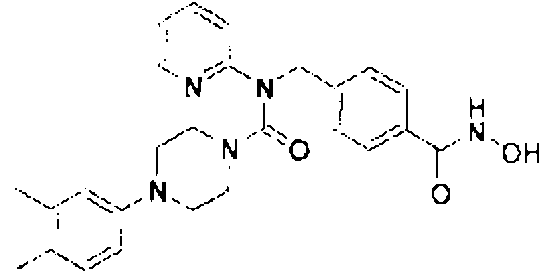
El compuesto de Fórmula 7-6 (4-((4-(3,4-dimetilfenil-N-(piridin-2-il)piperazin-1-carboxamido)metil)benzoato de metilo; 0,1 g, 0,218 mmol) se disolvió en metanol (20 ml) y posteriormente se añadieron hidroxilamina (0,076 g, 1,09 mmol) e hidróxido potásico (0,122 g, 2,18 mmol) y se agitó durante 5 minutos. Después, hidroxilamina (solución acuosa al 50 % en peso; 0,56 ml, 4,36 mmol) se añadió gota a gota y se agitó a temperatura ambiente durante 6 horas. Tras completarse la reacción, se añadió ácido clorhídrico 2 N y la capa orgánica se extrajo con acetato de etilo. La capa orgánica se lavó con una solución acuosa saturada de cloruro sódico, se deshidrató con sulfato de magnesio anhidro y posteriormente se concentró a presión reducida. El residuo se purificó y se concentró por cromatografía en columna (sílice; metanol/diclorometano=5 %) para dar el Compuesto 379 deseado (0,05 g, 52 %) en forma de un sólido de color blanco.The compound of Formula 7-6 (methyl 4 - ((4- (3,4-dimethylphenyl-N- (pyridin-2-yl) piperazine-1-carboxamido) methyl) benzoate; 0.1 g, 0.218 mmol) it was dissolved in methanol (20 ml) and then hydroxylamine (0.076 g, 1.09 mmol) and potassium hydroxide (0.122 g, 2.18 mmol) were added and stirred for 5 minutes, then hydroxylamine (50% aqueous solution). by weight, 0.56 ml, 4.36 mmol) was added dropwise and stirred at room temperature for 6 hours After the reaction was complete, 2 N hydrochloric acid was added and the organic layer was extracted with ethyl acetate. The organic layer was washed with a saturated aqueous solution of sodium chloride, dehydrated with anhydrous magnesium sulfate and then concentrated under reduced pressure, The residue was purified and concentrated by column chromatography (silica, methanol / dichloromethane = 5%). to give the desired Compound 379 (0.05 g, 52%) as a white solid.
1H RMN (400 MHz, MeOD-ds) 88,33 (dd, 1 H, J = 4,9, 1,2 Hz), 7,74 - 7,70 (m, 1 H), 7,67 (d, 2 H, J = 8,3 Hz), 7,50 (d, 2 H, J = 8,3 Hz), 7,08 (d, 1 H, J = 8,3 Hz), 7,05 - 7,02 (m, 1 H), 6,97 (d, 1 H, J = 8,3 Hz), 6,72 (d, 1 H, J = 2,2 Hz), 6,63 (dd, 1 H, J = 8,2, 2,4 Hz), 5,10 (s, 2 H), 3,45 - 3,43 (m, 4 H), 2,95 - 2,93 (m, 4 H), 2,20 (s, 3 H), 2,15 (s, 3 H); MS (ESI) m/z 460,2 (M+ H). 1 H NMR (400 MHz, MeOD-ds) 88.33 (dd, 1 H, J = 4.9, 1.2 Hz), 7.74-7.70 (m, 1 H), 7.67 (d , 2 H, J = 8.3 Hz), 7.50 (d, 2 H, J = 8.3 Hz), 7.08 (d, 1 H, J = 8.3 Hz), 7.05 - 7.02 (m, 1 H), 6.97 (d, 1 H, J = 8.3 Hz), 6.72 (d, 1 H, J = 2.2 Hz), 6.63 (dd, 1 H, J = 8.2, 2.4 Hz), 5.10 (s, 2 H), 3.45 - 3.43 (m, 4 H), 2.95 - 2.93 (m, 4 H), 2.20 (s, 3 H), 2.15 (s, 3 H); MS (ESI) m / z 460.2 (M + H).
E jem p lo 46: S ín te s is de l C o m p u e s to 380E jem p lo 46: S e ttin g from C o m p u e s 380
(Fórmula 9-1: 4-((N-(4'-formilbifenil-4-il)morfolin-4-carboxamido)metil)benzoato de metilo)(Formula 9-1: 4 - (methyl (N- (4'-formylbiphenyl-4-yl) morpholin-4-carboxamido) methyl) benzoate)

El compuesto de Fórmula 8-5 (The compound of Formula 8-5 (
4-((N-(4-bromofenil)morfolin-4-carboxamido)metil)benzoato de metilo; 1,00 g, 2,31 mmol), ácido 4-formilfenilborónico (0,415 g, 2,77 mmol) y Pd(dppf)Cl2 (0,094 g, 0,115 mmol) se disolvieron en 1,4-dioxano (12 ml) y posteriormente se añadió carbonato de cesio (2,24 g, 6,92 mmol) disuelto en agua (3 ml) a la solución de reacción y después se agitó at 140 °C durante 15 minutos en un reactor de microondas. Tras completarse la reacción, la capa orgánica se extrajo con acetato de etilo y solución acuosa saturada de hidrogenocarbonato sódico, se deshidrató con sulfato de magnesio anhidro y posteriormente se filtró. El filtrado se concentró a presión reducida y posteriormente el residuo se purificó y se concentró por cromatografía en columna (sílice; acetato de etilo/hexano=50 %) para dar el compuesto deseado de Fórmula 9-1 (0,750 g, 71 %) en forma de un sólido amarillo claro.4 - (Methyl (N- (4-bromophenyl) morpholin-4-carboxamido) methyl) benzoate; 1.00 g, 2.31 mmol), 4-formylphenylboronic acid (0.415 g, 2.77 mmol) and Pd (dppf) Cl2 (0.094 g, 0.115 mmol) were dissolved in 1,4-dioxane (12 ml) and subsequently cesium carbonate (2.24 g, 6.92 mmol) dissolved in water (3 ml) was added to the reaction solution and then stirred at 140 ° C for 15 minutes in a microwave reactor. After completion of the reaction, the organic layer was extracted with ethyl acetate and saturated aqueous sodium hydrogencarbonate solution, dehydrated with anhydrous magnesium sulfate and subsequently filtered. The filtrate was concentrated under reduced pressure and then the residue was purified and concentrated by column chromatography (silica; ethyl acetate / hexane = 50%) to give the desired compound of Formula 9-1 (0.750 g, 71%) in shape of a light yellow solid.
(Fórmula 9-2: 4-((N-(4'-(morfolinometil)bifenil-4-il)morfolin-4-carboxamido)metil)benzoato de metilo)(Formula 9-2: 4 - (Methyl N- (4 '- (morpholinomethyl) biphenyl-4-yl) morpholin-4-carboxamido) methyl) benzoate)

El compuesto de Fórmula 9-1 (4-((N-(4'-formilbifenil-4-il)morfolin-4-carboxamido)metil)benzoato de metilo; 0,150 g, 0,327 mmol) se disolvió en metanol (5 ml) y posteriormente se añadieron morfolina (0,086 g, 0,981 mmol) y ácido acético (0,094 ml, 1,64 mmol) y se agitó a temperatura ambiente durante 1 hora. Después, se añadió cianoborohidruro sódico (0,041 g, 0,654 mmol) y se agitó a la misma temperatura durante 16 horas. Tras completarse la reacción, la capa orgánica se extrajo con acetato de etilo y solución acuosa saturada de hidrogenocarbonato sódico y se concentró a presión reducida. Después, la capa orgánica se deshidrató con sulfato de magnesio anhidro y se filtró y después el filtrado se concentró a presión reducida. Después, el residuo se purificó y se concentró por cromatografía en columna (sílice; acetato de etilo/hexano=25 %) para dar el compuesto deseado de Fórmula 9-2 (0,136 g, 79 %) en forma de un sólido de color blanco.The compound of Formula 9-1 (methyl 4 - ((N- (4'-formylbiphenyl-4-yl) morpholin-4-carboxamido) methyl) benzoate; 0.150 g, 0.327 mmol) was dissolved in methanol (5 ml) and subsequently morpholine (0.086 g, 0.981 mmol) and acetic acid (0.094 mL, 1.64 mmol) were added and stirred at room temperature for 1 hour. Then, sodium cyanoborohydride (0.041 g, 0.654 mmol) was added and stirred at the same temperature for 16 hours. After completion of the reaction, the organic layer was extracted with ethyl acetate and saturated aqueous sodium hydrogencarbonate solution and concentrated under reduced pressure. Then, the organic layer was dehydrated with anhydrous magnesium sulfate and filtered and then the filtrate was concentrated under reduced pressure. Then, the residue was purified and concentrated by column chromatography (silica; ethyl acetate / hexane = 25%) to give the desired compound of Formula 9-2 (0.136 g, 79%) as a white solid. .
(Compuesto 380: N-(4-(hidroxicarbamoil)bencil)-N-(4'-(morfolinometil)bifenil-4-il)morfolin-4-carboxamida)(Compound 380: N- (4- (hydroxycarbamoyl) benzyl) - N - (4 '- (morpholinomethyl) biphenyl-4-yl) morpholine-4-carboxamide)

El compuesto de Fórmula 9-2 (4-((N-(4'-(morfolinometil)bifenil-4-il)morfolin-4-carboxamido)metil)benzoato de metilo; 0,130 g, 0,245 mmol) se disolvió en metanol (10 ml) y se añadieron hidroxilamina (solución acuosa de 50,0 % en peso; 1,50 ml, 24,5 mmol) e hidróxido potásico (0,138 g, 2,46 mmol) y después se agitó a temperatura ambiente durante 30 minutos. Tras completarse la reacción, la solución de reacción se concentró a presión reducida hasta que su volumen fue de aproximadamente 2 ml y la capa orgánica se extrajo con acetato de etilo y solución acuosa saturada de cloruro de amonio. La capa orgánica se deshidrató con sulfato de magnesio anhidro, se filtró y después se concentró a presión reducida. El residuo se recristalizó con diclorometano y hexano para dar el Compuesto 380 deseado (0,073 g, 56 %) en forma de un sólido de color blanco.The compound of Formula 9-2 (methyl 4 - ((N- (4 '- (morpholinomethyl) biphenyl-4-yl) morpholin-4-carboxamido) methyl) benzoate; 0.130 g, 0.245 mmol) was dissolved in methanol ( 10 ml) and hydroxylamine (50.0% by weight aqueous solution, 1.50 ml, 24.5 mmol) and potassium hydroxide (0.138 g, 2.46 mmol) were added and then stirred at room temperature for 30 minutes. . After completion of the reaction, the reaction solution was concentrated under reduced pressure until its volume was about 2 ml and the organic layer was extracted with ethyl acetate and saturated aqueous solution of ammonium chloride. The organic layer was dehydrated with anhydrous magnesium sulfate, filtered and then concentrated under reduced pressure. The residue was recrystallized with dichloromethane and hexane to give the desired Compound 380 (0.073 g, 56%) as a white solid.
1H RMN (400 MHz, DIVISOR) 8 11,14 (s a, H), 9,14 (s a, 1 H), 7,65 (d, 2 H, J = 8,1 Hz), 7,62 - 7,56 (m, 4 H), 7,39 -7,33 (m, 4 H), 7,21 (d, 2 H, J = 8,5 Hz), 4,90 (s, 2 H), 3,58 - 3,55 (m, 4 H), 3,46 (s, 2 H), 3,42 - 3,37 (m, 8 H), 3,17 (m, 4 H). MS (ESI) m/z 529 (M+ H). 1 H NMR (400 MHz, DIVIDER) 8 11.14 (sa, H), 9.14 (sa, 1 H), 7.65 (d, 2 H, J = 8.1 Hz), 7.62-7 , 56 (m, 4 H), 7.39 -7.33 (m, 4 H), 7.21 (d, 2 H, J = 8.5 Hz), 4.90 (s, 2 H), 3.58 - 3.55 (m, 4 H), 3.46 (s, 2 H), 3.42 - 3.37 (m, 8 H), 3.17 (m, 4 H). MS (ESI) m / z 529 (M + H).
E jem p lo 47: S ín te s is de l C o m p u e s to 381E jem p lo 47: S in te rs of C o m p u e s 381
(Fórmula 9-2: 4-((N-(4'-((4-metilpiperazin-1-il)metil)bifenil-4-il)morfolin-4-carboxamido) metil)benzoato de metilo)(Formula 9-2: 4 - (Methyl N- (4 '- ((4-methyl-piperazin-1-yl) methyl) biphenyl-4-yl) morpholin-4-carboxamido) methyl) benzoate)

El compuesto de Fórmula 9-1 (4-((N-(4 -formilbifenil-4-il)morfolin-4-carboxamido)metil)benzoato de metilo; 0,150 g, 0,327 mmol) se disolvió en metanol (5 ml) y posteriormente se añadieron 1-metilpiperazina (0,098 g, 0,981 mmol) y ácido acético (0,094 ml, 1,64 mmol) y se agitó a temperatura ambiente durante 1 hora. Después, se añadió cianoborohidruro sódico (0,041 g, 0,654 mmol) y se agitó a la misma temperatura durante 16 horas. Tras completarse la reacción, la capa orgánica se extrajo con acetato de etilo y solución acuosa saturada de hidrogenocarbonato sódico y se concentró a presión reducida. Después, la capa orgánica se deshidrató con sulfato de magnesio anhidro y se filtró y después el filtrado se concentró a presión reducida. Después, el residuo se purificó y se concentró por cromatografía en columna (sílice; metanol/ diclorometano =10 %) para dar el compuesto deseado de Fórmula 9-2 (0,140 g, 79 %) en forma de un sólido de color blanco.The compound of Formula 9-1 (methyl 4 - ((N- (4-formylbiphenyl-4-yl) morpholin-4-carboxamido) methyl) benzoate; 0.150 g, 0.327 mmol) was dissolved in methanol (5 ml) and subsequently 1-methylpiperazine (0.098 g, 0.981 mmol) and acetic acid (0.094 mL, 1.64 mmol) were added and stirred at room temperature for 1 hour. Then, sodium cyanoborohydride (0.041 g, 0.654 mmol) was added and stirred at the same temperature for 16 hours. After completion of the reaction, the organic layer was extracted with ethyl acetate and saturated aqueous sodium hydrogencarbonate solution and concentrated under reduced pressure. Then, the organic layer was dehydrated with anhydrous magnesium sulfate and filtered and then the filtrate was concentrated under reduced pressure. Then, the residue was purified and concentrated by column chromatography (silica; methanol / dichloromethane = 10%) to give the desired compound of Formula 9-2 (0.140 g, 79%) as a white solid.
(Compuesto 381: N-(4-(hidroxicarbamoil)bencil)-N-(4'-((4-metilpiperazin-1 -il)metil)bifenil-4-il) morfolin-4-carboxamida)(Compound 381: N- (4- (hydroxycarbamoyl) benzyl) -N- (4 '- ((4-methyl-piperazin-1-yl) methyl) biphenyl-4-yl) morpholine-4-carboxamide)

El compuesto de Fórmula 9-2 (4-((N-(4'-((4-metilpiperazin-1-il)metil)bifenil-4-il)morfolin-4-carboxamido) metil)benzoato de metilo; 0,140 g, 0,258 mmol) se disolvió en metanol (10 ml) y se añadieron hidroxilamina (solución acuosa de 50,0 % en peso; 1,58 ml, 25,8 mmol) e hidróxido potásico (0,145 g, 2,58 mmol) y después se agitó a temperatura ambiente durante 30 minutos. Tras completarse la reacción, la solución de reacción se concentró a presión reducida hasta que su volumen fue de aproximadamente 2 ml y la capa orgánica se extrajo con acetato de etilo y solución acuosa saturada de cloruro de amonio. La capa orgánica se deshidrató con sulfato de magnesio anhidro, se filtró y después se concentró a presión reducida. El residuo se recristalizó con diclorometano y hexano para dar el Compuesto 381 deseado (0,093 g, 66 %) en forma de un sólido de color blanco.The compound of Formula 9-2 (methyl 4 - ((N- (4 '- ((4-methyl-piperazin-1-yl) methyl) biphenyl-4-yl) morpholin-4-carboxamido) methyl) benzoate; 0.140 g , 0.258 mmol) was dissolved in methanol (10 ml) and hydroxylamine (50.0% by weight aqueous solution, 1.58 ml, 25.8 mmol) and potassium hydroxide (0.145 g, 2.58 mmol) were added and then it was stirred at room temperature for 30 minutes. After completion of the reaction, the reaction solution was concentrated under reduced pressure until its volume was about 2 ml and the organic layer was extracted with ethyl acetate and saturated aqueous solution of ammonium chloride. The organic layer was dehydrated with anhydrous magnesium sulfate, filtered and then concentrated under reduced pressure. The residue was recrystallized with dichloromethane and hexane to give the desired Compound 381 (0.093 g, 66%) as a white solid.
1H RMN (400 MHz, DMSO-da) 87,65 (d, 2 H, J = 7,8 Hz), 7,61 - 7,56 (m, 4 H), 7,38 (d, 2 H, J = 8,0 Hz), 7,32 (d, 2 H, J = 7,6 Hz), 7,21 (d, 2 H, J = 8,5 Hz), 4,90 (s, 2 H), 3,59 - 3,39 (m, 10 H), 3,17 (m, 4 H), 2,40 - 2,23 (m, 4 H), 2,18 (s, 3 H). MS (ESI) m/z 544 (M+ H).1 H NMR (400 MHz, DMSO-da) 87.65 (d, 2 H, J = 7.8 Hz), 7.61-7.56 (m, 4 H), 7.38 (d, 2 H, J = 8.0 Hz), 7.32 (d, 2 H, J = 7.6 Hz), 7.21 (d, 2 H, J = 8.5 Hz), 4.90 (s, 2 H ), 3.59-3.39 (m, 10 H), 3.17 (m, 4 H), 2.40-2.23 (m, 4 H), 2.18 (s, 3 H). MS (ESI) m / z 544 (M + H).
Ejemplo 48: Síntesis del Compuesto 382Example 48: Synthesis of Compound 382
(Fórmula 9-2: 4-((N-(4'-((2-(hidroximetil)pirrolidin-1-il)metil)bifenil-4-il)morfolin-4-carboxamido)metil)benzoato de (S)-metilo)(Formula 9-2: 4 - ((N- (4 '- ((2- (hydroxymethyl) pyrrolidin-1-yl) methyl) biphenyl-4-yl) morpholine-4-carboxamido) methyl) benzoate of (S) -methyl)

El compuesto de Fórmula 9-1 (4-((N-(4'-formilbifenil-4-il)morfolin-4-carboxamido)melthil)benzoato de metilo; 0,150 g, 0,327 mmol) se disolvió en metanol (5 ml) y posteriormente se añadieron (S)-pirrolidin-2il-metanol (0,099 g, 0,981 mmol) y ácido acético (0,094 ml, 1,64 mmol) y se agitó a temperatura ambiente durante 1 hora. Después, se añadió cianoborohidruro sódico (0,041 g, 0,654 mmol) y se agitó a la misma temperatura durante 16 horas. Tras completarse la reacción, la capa orgánica se extrajo con acetato de etilo y solución acuosa saturada de hidrogenocarbonato sódico y se concentró a presión reducida. Después, la capa orgánica se deshidrató con sulfato de magnesio anhidro y se filtró y después el filtrado se concentró a presión reducida. Después, el residuo se purificó y se concentró por cromatografía en columna (sílice; metanol/ diclorometano = 10 %) para dar el compuesto deseado de Fórmula 9-2 (0,123 g, 69 %) en forma de un sólido de color blanco.The compound of Formula 9-1 (methyl 4 - ((N- (4'-formylbiphenyl-4-yl) morpholin-4-carboxamido) melthyl) benzoate; 0.150 g, 0.327 mmol) was dissolved in methanol (5 ml) and subsequently (S) -pyrrolidin-2-yl-methanol (0.099 g, 0.981 mmol) and acetic acid (0.094 mL, 1.64 mmol) were added and stirred at room temperature for 1 hour. Then, sodium cyanoborohydride (0.041 g, 0.654 mmol) was added and stirred at the same temperature for 16 hours. After completion of the reaction, the organic layer was extracted with ethyl acetate and saturated aqueous sodium hydrogencarbonate solution and concentrated under reduced pressure. Then, the organic layer was dehydrated with anhydrous magnesium sulfate and filtered and then the filtrate was concentrated under reduced pressure. Then, the residue was purified and concentrated by chromatography Column (silica: methanol / dichloromethane = 10%) to give the desired compound of Formula 9-2 (0.123 g, 69%) as a white solid.
(Compuesto 382: (S)-N-(4-(hidroxicarbamoil)bencil)-N-(4’-((2-(hidroximetM)pirrolidin-1-il)metil)bifenil-4-il)morfoMn-4-carboxamida)(Compound 382: (S) -N- (4- (hydroxycarbamoyl) benzyl) -N- (4 '- ((2- (hydroxymethyl) pyrrolidin-1-yl) methyl) biphenyl-4-yl) morfoMn-4- carboxamide)

El compuesto de Fórmula 9-2 (4-((N-(4'-((2-(hidroximetil)pirrolidin-1-il)metil)bifenil-4-il)morfolin-4-carboxamido)metil)benzoato de(S)-metilo; 0,120 g, 0,221 mmol) se disolvió en metanol (10 ml) y se añadieron hidroxilamina (solución acuosa de 50,0 % en peso; 1,35 ml, 22,1 mmol) e hidróxido potásico (0,124 g, 2,21 mmol) y después se agitó a temperatura ambiente durante 30 minutos. Tras completarse la reacción, la solución de reacción se concentró a presión reducida hasta que su volumen fue de aproximadamente 2 ml y la capa orgánica se extrajo con acetato de etilo y solución acuosa saturada de cloruro de amonio. La capa orgánica se deshidrató con sulfato de magnesio anhidro, se filtró y posteriormente se concentró a presión reducida para dar el Compuesto 382 deseado (0,036 g, 30 %) en forma de un líquido incoloro.The compound of Formula 9-2 (4 - ((N- (4 '- ((2- (hydroxymethyl) pyrrolidin-1-yl) methyl) biphenyl-4-yl) morpholine-4-carboxamido) methyl) benzoate of ( S) -methyl, 0.120 g, 0.221 mmol) was dissolved in methanol (10 ml) and hydroxylamine (50.0% by weight aqueous solution, 1.35 ml, 22.1 mmol) and potassium hydroxide (0.124 g) were added. , 2.21 mmol) and then stirred at room temperature for 30 minutes. After completion of the reaction, the reaction solution was concentrated under reduced pressure until its volume was about 2 ml and the organic layer was extracted with ethyl acetate and saturated aqueous solution of ammonium chloride. The organic layer was dehydrated with anhydrous magnesium sulfate, filtered and then concentrated under reduced pressure to give the desired Compound 382 (0.036 g, 30%) as a colorless liquid.
1H RMN (400 MHz, DMSO-da) 87,65 (d, 2 H, J = 7,8 Hz), 7,61 - 7,55 (m, 4 H), 7,39 - 7,34 (m, 4 H), 7,21 (d, 2 H, J = 8,3 Hz), 4,90 (s, 2 H), 4,06 (m, 1 H), 3,47 -3,39 (m, 6 H), 3,37 - 3,35 (m, 2 H), 3,17 (m, 4 H), 2,24 -2,20 (m, 2 H), 1,64 - 1,52 (m, 5 H). MS (ESI) m/z 545 (M+ H).1 H NMR (400 MHz, DMSO-da) 87.65 (d, 2 H, J = 7.8 Hz), 7.61-7.55 (m, 4 H), 7.39-7.34 (m , 4 H), 7.21 (d, 2 H, J = 8.3 Hz), 4.90 (s, 2 H), 4.06 (m, 1 H), 3.47 -3.39 ( m, 6 H), 3.37 - 3.35 (m, 2 H), 3.17 (m, 4 H), 2.24 - 2.20 (m, 2 H), 1.64 - 1, 52 (m, 5 H). MS (ESI) m / z 545 (M + H).
Ejemplo 49: Síntesis del Compuesto 383Example 49: Synthesis of Compound 383
(Fórmula 9-2: 4-((N-(4'-(((2-(hidroxietil)(metil)amino)metil)bifenil-4-il)morfolin-4-carboxamido)metil)benzoato de metilo)(Formula 9-2: 4 - ((N- (4 '- ((2- (hydroxyethyl) (methyl) amino) methyl) biphenyl-4-yl) morpholin-4-carboxamido) methyl) benzoate methyl)

El compuesto de Fórmula 9-1 (4-((N-(4'-formilbifenil-4-il)morfolin-4-carboxamido)melthil)benzoato de metilo; 0,150 g, 0,327 mmol) se disolvió en metanol (5 ml) y posteriormente se añadieron 2-(metilamino)etanol (0,074 g, 0,981 mmol) y ácido acético (0,094 ml, 1,64 mmol) y se agitó a temperatura ambiente durante 1 hora. Después, se añadió cianoborohidruro sódico (0,041 g, 0,654 mmol) y se agitó a la misma temperatura durante 16 horas. Tras completarse la reacción, la capa orgánica se extrajo con acetato de etilo y solución acuosa saturada de hidrogenocarbonato sódico y se concentró a presión reducida. Después, la capa orgánica se deshidrató con sulfato de magnesio anhidro y se filtró y después el filtrado se concentró a presión reducida. Después, el residuo se purificó y se concentró por cromatografía en columna (sílice; metanol/ diclorometano= 7 %) para dar el compuesto deseado de Fórmula 9-2 (0,152 g, 90 %) en forma de un sólido de color blanco.The compound of Formula 9-1 (methyl 4 - ((N- (4'-formylbiphenyl-4-yl) morpholin-4-carboxamido) melthyl) benzoate; 0.150 g, 0.327 mmol) was dissolved in methanol (5 ml) and then 2- (methylamino) ethanol (0.074 g, 0.981 mmol) and acetic acid (0.094 mL, 1.64 mmol) were added and stirred at room temperature for 1 hour. Then, sodium cyanoborohydride (0.041 g, 0.654 mmol) was added and stirred at the same temperature for 16 hours. After completion of the reaction, the organic layer was extracted with ethyl acetate and saturated aqueous sodium hydrogencarbonate solution and concentrated under reduced pressure. Then, the organic layer was dehydrated with anhydrous magnesium sulfate and filtered and then the filtrate was concentrated under reduced pressure. Then, the residue was purified and concentrated by column chromatography (silica; methanol / dichloromethane = 7%) to give the desired compound of Formula 9-2 (0.152 g, 90%) as a white solid.
(Compuesto 383: N-(4-(hidroxicarbamoil)bencil)-N-(4'-(((2-hidroxietil)(metil)amino)metil)bifenil-4-il)morfolin-4-carboxamida)(Compound 383: N- (4- (hydroxycarbamoyl) benzyl) -N- (4 '- (((2-hydroxyethyl) (methyl) amino) methyl) biphenyl-4-yl) morpholine-4-carboxamide)
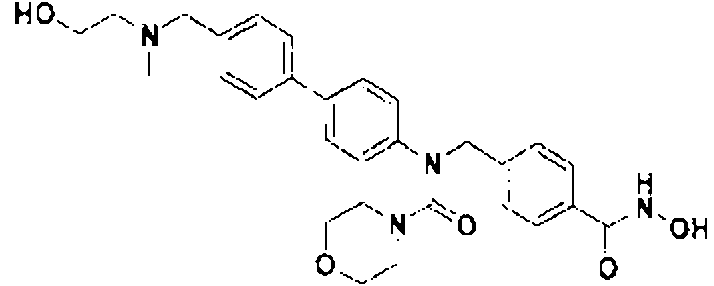
El compuesto de Fórmula 9-2 (4-((N-(4-(((2-(hidroxietil)(metil)amino)metil)bifenil-4-il)morfolin-4-carboxamido)metil)benzoato de metilo; 0,150 g, 0,290 mmol) se disolvió en metanol (10 ml) y se añadieron hidroxilamina (solución acuosa de 50,0 % en peso; 1,77 ml, 29,0 mmol) e hidróxido potásico (0,163 g, 2,90 mmol) y después se agitó a temperatura ambiente durante 30 minutos. Tras completarse la reacción, la solución de reacción se concentró a presión reducida hasta que su volumen fue de aproximadamente 2 ml y la capa orgánica se extrajo con acetato de etilo y solución acuosa saturada de cloruro de amonio. La capa orgánica se deshidrató con sulfato de magnesio anhidro, se filtró y posteriormente se concentró a presión reducida para dar el Compuesto 383 deseado (0,023 g, 15 %) en forma de un líquido incoloro. The compound of Formula 9-2 (methyl 4 - ((N- (4 - ((2- (hydroxyethyl) (methyl) amino) methyl) biphenyl-4-yl) morpholin-4-carboxamido) methyl) benzoate; 0.150 g, 0.290 mmol) was dissolved in methanol (10 ml) and hydroxylamine (50.0% by weight aqueous solution, 1.77 ml, 29.0 mmol) and potassium hydroxide (0.163 g, 2.90 mmol) were added. ) and then stirred at room temperature for 30 minutes After completion of the reaction, the reaction solution was concentrated under reduced pressure until its volume was about 2 ml and the organic layer was extracted with ethyl acetate and saturated aqueous Ammonium chloride The organic layer was dehydrated with anhydrous magnesium sulfate, filtered and then concentrated under reduced pressure to give the desired Compound 383 (0.023 g, 15%) as a colorless liquid.
1H RMN (400 MHz, DMSO-da) 57,66 - 7,56 (m, 6 H), 7,39 - 7,34 (m, 4 H), 7,21 (d, 2 H, J = 8,6 Hz), 4,90 (s, 2 H), 3,51 - 3,48 (m, 4 H), 3,42 - 3,37 (m, 4 H), 3,17 (m, 4 H), 2,45 - 2,43 (m, 2 H), 2,22 (m, 1 H), 2,15 (s, 3 H). MS (ESI) m/z 519 (M+ H).1 H NMR (400 MHz, DMSO-da) 57.66-7.56 (m, 6 H), 7.39-7.34 (m, 4 H), 7.21 (d, 2 H, J = 8 , 6 Hz), 4.90 (s, 2 H), 3.51 - 3.48 (m, 4 H), 3.42 - 3.37 (m, 4 H), 3.17 (m, 4 H), 2.45-2.43 (m, 2 H), 2.22 (m, 1 H), 2.15 (s, 3 H). MS (ESI) m / z 519 (M + H).
Ejemplo 50: Síntesis del Compuesto 385Example 50: Synthesis of Compound 385
(Fórmula 1-2: 4-((4-(trifluorometil)fenilamino)metil)benzoato de metilo)(Formula 1-2: methyl 4 - ((4- (trifluoromethyl) phenylamino) methyl) benzoate)

El compuesto de Fórmula 1-1 (4-(tnfluorometil)bencenamina; 0,30 g, 1,84 mmol) y carbonato potásico (0,76 g, 5,53 mmol) se disolvieron en dimetilformamida (10 ml) y posteriormente se añadió 4-(bromometil)benzoato de metilo (0,84 g, 3,67 mmol). La mezcla se hizo reaccionar a temperatura ambiente durante 1 día y después se diluyó con acetato de etilo. La mezcla de reacción se lavó con agua y solución acuosa saturada de cloruro sódico, se deshidrató con sulfato sódico anhidro, se filtró y posteriormente se concentró a presión reducida. El residuo se purificó por cromatografía en columna (sílice; acetato de etilo/hexano =20 %) para dar el compuesto deseado de Fórmula 1-2 (0,27 g, 47 %).The compound of Formula 1-1 (4- (tnfluoromethyl) benzenamine, 0.30 g, 1.84 mmol) and potassium carbonate (0.76 g, 5.53 mmol) were dissolved in dimethylformamide (10 ml) and subsequently added methyl 4- (bromomethyl) benzoate (0.84 g, 3.67 mmol). The mixture was reacted at room temperature for 1 day and then diluted with ethyl acetate. The reaction mixture was washed with water and saturated aqueous sodium chloride solution, dehydrated with anhydrous sodium sulfate, filtered and then concentrated under reduced pressure. The residue was purified by column chromatography (silica; ethyl acetate / hexane = 20%) to give the desired compound of Formula 1-2 (0.27 g, 47%).
(Fórmula 1-3: 4-((((4-nitrofenoxi)carbonil)(4-(trifluorometil)fenil)amino)metil)benzoato de metilo)(Formula 1-3: 4 - ((((((4-nitrophenoxy) carbonyl) (methyl 4- (trifluoromethyl) phenyl) amino) methyl) benzoate)

El compuesto de Fórmula 1-2 (4-((4-(trifluorometil)fenilamino)metil)benzoato de metilo; 0,27 g, 0,87 mmol) y carbonoclorhidrato de 4-nitrofenilo (0,35 g, 1,74 mmol) se disolvieron en acetonitrilo (10 ml) y posteriormente se añadió carbonato potásico (0,36 g, 2,61 mmol). La mezcla se hizo reaccionar a temperatura ambiente durante 1 día y después se diluyó con acetato de etilo. La mezcla de reacción se lavó con agua y solución acuosa saturada de cloruro sódico, se deshidrató con sulfato sódico anhidro, se filtró y posteriormente se concentró a presión reducida. El residuo se purificó por cromatografía en columna (sílice; acetato de etilo/ hexano =20 %) para dar el compuesto deseado de Fórmula 1-3 (0,40 g, 97 %).The compound of Formula 1-2 (methyl 4 - ((4- (trifluoromethyl) phenylamino) methyl) benzoate; 0.27 g, 0.87 mmol) and 4-nitrophenylcarbonate hydrochloride (0.35 g, 1.74 g) mmol) were dissolved in acetonitrile (10 ml) and then potassium carbonate (0.36 g, 2.61 mmol) was added. The mixture was reacted at room temperature for 1 day and then diluted with ethyl acetate. The reaction mixture was washed with water and saturated aqueous sodium chloride solution, dehydrated with anhydrous sodium sulfate, filtered and then concentrated under reduced pressure. The residue was purified by column chromatography (silica; ethyl acetate / hexane = 20%) to give the desired compound of Formula 1-3 (0.40 g, 97%).
(Fórmula 1-4: 4-((N-(4-(trifluorometil)fenil)morfolin-4-carboxamido)metil)benzoato de metilo)(Formula 1-4: 4 - (methyl (N- (4- (trifluoromethyl) phenyl) morpholin-4-carboxamido) methyl) benzoate)

El compuesto de Fórmula 1-3 (4-((((4-nitrofenoxi)carbonil)(4-(trifluorometil)fenil)amino)metil)benzoato de metilo; 0,39 g, 0,84 mmol) se disolvió en dimetilformamida y posteriormente se añadieron carbonato potásico (0,25 g, 1,81 mmol) y morfolina (10 ml). La mezcla se hizo reaccionar a 60 °C durante 2 días y se diluyó con solución saturada de cloruro de amonio. La capa orgánica se extrajo con acetato de etilo, se deshidrató con sulfato sódico anhidro, se filtró y posteriormente se concentró a presión reducida. El residuo se purificó por cromatografía en columna (sílice; acetato de etilo/hexano =50 %) para dar el compuesto deseado de Fórmula 1-4 (0,20 g, 60 %).The compound of Formula 1-3 (methyl 4 - (((((4-nitrophenoxy) carbonyl) (4- (trifluoromethyl) phenyl) amino) methyl) benzoate; 0.39 g, 0.84 mmol) was dissolved in dimethylformamide and then potassium carbonate (0.25 g, 1.81 mmol) and morpholine (10 ml) were added. The mixture was reacted at 60 ° C for 2 days and diluted with saturated ammonium chloride solution. The organic layer was extracted with ethyl acetate, dehydrated with anhydrous sodium sulfate, filtered and then concentrated under reduced pressure. The residue was purified by column chromatography (silica; ethyl acetate / hexane = 50%) to give the desired compound of Formula 1-4 (0.20 g, 60%).
(Compuesto 385, N-(4-(hidroxicarbamoil)bencil)-N-(4-(trifluorometil)fenil)morfolin-4-carboxamida) (Compound 385, N- (4- (hydroxycarbamoyl) benzyl) -N- (4- (trifluoromethyl) phenyl) morpholine-4-carboxamide)
El compuesto de Fórmula 1-4 (4-((N-(4-(trifluorometil)fenil)morfolin-4-carboxamido)metil)benzoato de metilo; 0,20 g, 0,48 mmol) se disolvió en metanol y posteriormente se añadieron hidroxilamina (solución acuosa al 50 % en peso; 0,29 ml) e hidróxido potásico (0,13 g, 2,39 mmol) y se agitó durante una noche. Tras completarse la reacción, el metanol se retiró por destilación a presión reducida y la capa orgánica se extrajo con acetato de etilo y agua, se deshidrató con sulfato sódico anhidro, se filtró y posteriormente se concentró a presión reducida. El residuo se agitó en éter dietílico para dar un sólido de color blanco y el sólido resultante se filtró y secó para dar el Compuesto 385 deseado (0,10 g, 50 %) en forma de un sólido de color blanco.The compound of Formula 1-4 (methyl 4 - ((N- (4- (trifluoromethyl) phenyl) morpholin-4-carboxamido) methyl) benzoate; 0.20 g, 0.48 mmol) was dissolved in methanol and subsequently Hydroxylamine (50% by weight aqueous solution, 0.29 ml) and potassium hydroxide (0.13 g, 2.39 mmol) were added and stirred overnight. After completion of the reaction, the methanol was distilled off under reduced pressure and the organic layer was extracted with ethyl acetate and water, dehydrated with anhydrous sodium sulfate, filtered and then concentrated under reduced pressure. The residue was stirred in diethyl ether to give a white solid and the resulting solid was filtered and dried to give the desired Compound 385 (0.10 g, 50%) as a white solid.
1H RMN (400 MHz, DMSO-da) 811,14 (s a, 1 H), 8,99 (s a, 1 H), 7,67 - 7,62 (m, 4 H), 7,38 (d, 2 H, J = 8,2 Hz), 7,29 (d, 2 H, J = 8,5 Hz), 4,94 (s, 2 H), 3,47 - 3,44 (m, 4 H), 3,21 - 3,18 (m, 4 H). MS (ESI) m/z 424 (M+ H).1 H NMR (400 MHz, DMSO-da) 811.14 (sa, 1 H), 8.99 (sa, 1 H), 7.67-7.62 (m, 4 H), 7.38 (d, 2 H, J = 8.2 Hz), 7.29 (d, 2 H, J = 8.5 Hz), 4.94 (s, 2 H), 3.47 - 3.44 (m, 4 H) ), 3.21 - 3.18 (m, 4 H). MS (ESI) m / z 424 (M + H).
Ejemplo 51: Síntesis del Compuesto 386Example 51: Synthesis of Compound 386
(Fórmula 1-2: 4-((3-(trifluorometil)fenilamino)metil)benzoato de metilo)(Formula 1-2: methyl 4 - ((3- (trifluoromethyl) phenylamino) methyl) benzoate)

El compuesto de Fórmula 1-1 (3-(trifluorometil)bencenamina; 1,00 g, 6,21 mmol) y 4-formilbenzoato de metilo (1,02 g, 6,21 mmol) se disolvieron en metanol (10 ml) y se añadieron cianoborohidruro sódico(NaCNBH3) (0,41 g, 6,21 mmol) y ácido acético (0,71 ml, 2,00 mmol). La mezcla se hizo reaccionar a temperatura ambiente durante 2 días y posteriormente el metanol se evaporó a presión reducida. La reacción se completó mediante adición de una solución saturada de hidrogenocarbonato sódico. La mezcla de reacción se extrajo con acetato de etilo, se deshidrató con sulfato sódico anhidro, se filtró y posteriormente se concentró a presión reducida. El residuo se purificó por cromatografía en columna (sílice; acetato de etilo/hexano=20 %) para dar el compuesto deseado de Fórmula 1-2 (1,43 g, 74,5 %).The compound of Formula 1-1 (3- (trifluoromethyl) benzenamine, 1.00 g, 6.21 mmol) and methyl 4-formylbenzoate (1.02 g, 6.21 mmol) were dissolved in methanol (10 ml). and sodium cyanoborohydride (NaCNBH3) (0.41 g, 6.21 mmol) and acetic acid (0.71 mL, 2.00 mmol) were added. The mixture was reacted at room temperature for 2 days and then the methanol was evaporated under reduced pressure. The reaction was completed by the addition of a saturated solution of sodium hydrogencarbonate. The reaction mixture was extracted with ethyl acetate, dehydrated with anhydrous sodium sulfate, filtered and then concentrated under reduced pressure. The residue was purified by column chromatography (silica; ethyl acetate / hexane = 20%) to give the desired compound of Formula 1-2 (1.43 g, 74.5%).
(Fórmula 1-3: 4-((((4-nitrofenoxi)carbonil)(3-(trifluorometil)fenil)amino)metil)benzoato de metilo)(Formula 1-3: 4 - ((((((4-nitrophenoxy) carbonyl) (3- (trifluoromethyl) phenyl) amino) methyl) benzoate methyl)

El compuesto de Fórmula 1-2 (4-((3-(trifluorometil)fenilamino)metil)benzoato de metilo; 1,04 g, 3,36 mmol) y carbonocloridato de 4-nitrofenilo (1,36 g, 6,73 mmol) se disolvieron en acetonitrilo (30 ml) y posteriormente se añadió carbonato potásico (1,39 g, 10,1 mmol). La mezcla se hizo reaccionar a temperatura ambiente durante 1 día y después se diluyó con acetato de etilo. La mezcla de reacción se lavó con agua y solución acuosa saturada de cloruro sódico y agua, se deshidrató con sulfato sódico anhidro, se filtró y posteriormente se concentró a presión reducida. El residuo se purificó por cromatografía en columna (sílice; acetato de etilo/ hexano=20 %) para dar el compuesto deseado de Fórmula 1-3 (1,51 g, 95 %).The compound of Formula 1-2 (methyl 4 - ((3- (trifluoromethyl) phenylamino) methyl) benzoate; 1.04 g, 3.36 mmol) and 4-nitrophenyl carbonylchloridate (1.36 g, 6.73 g) mmol) were dissolved in acetonitrile (30 ml) and then potassium carbonate (1.39 g, 10.1 mmol) was added. The mixture was reacted at room temperature for 1 day and then diluted with ethyl acetate. The reaction mixture was washed with water and saturated aqueous sodium chloride solution and water, dehydrated with anhydrous sodium sulfate, filtered and then concentrated under reduced pressure. The residue was purified by column chromatography (silica; ethyl acetate / hexane = 20%) to give the desired compound of Formula 1-3 (1.51 g, 95%).
(Fórmula 1-4: 4-((2,6-dimetil-N-(3-(trifluorometil)fenil)morfolin-4-carboxamido)metil)benzoato de metilo)(Formula 1-4: 4 - ((2,6-dimethyl-N- (3- (trifluoromethyl) phenyl) morpholin-4-carboxamido) methyl) benzoate methyl)

El compuesto de Fórmula 1-3 (4-((((4-nitrofenoxi)carbonil)(3-(trifluorometil)fenil)amino)metil)benzoato de metilo; 0,38 g, 0,80 mmol) se disolvió en dimetilformamida (10 ml) y posteriormente se añadieron carbonato potásico (0,33 g, 2,38 mmol) y 2,6-dimetilmorfolina (0,09, 0,80 mmol). La mezcla se hizo reaccionar a 60 °C durante 2 días y posteriormente se diluyó con acetato de etilo y se lavó con solución saturada de cloruro de amonio. La capa orgánica se deshidrató con sulfato de magnesio anhidro, se filtró y posteriormente se concentró a presión reducida. El residuo se purificó por cromatografía en columna (sílice; acetato de etilo/hexano =50 %) para dar el compuesto deseado de Fórmula 1-4 (0,21 g, 59 %). The compound of Formula 1-3 (methyl 4 - (((((4-nitrophenoxy) carbonyl) (3- (trifluoromethyl) phenyl) amino) methyl) benzoate; 0.38 g, 0.80 mmol) was dissolved in dimethylformamide (10 ml) and then potassium carbonate (0.33 g, 2.38 mmol) and 2,6-dimethylmorpholine (0.09, 0.80 mmol) were added. The mixture was reacted at 60 ° C for 2 days and subsequently diluted with ethyl acetate and washed with saturated ammonium chloride solution. The organic layer was dehydrated with anhydrous magnesium sulfate, filtered and then concentrated under reduced pressure. The residue was purified by column chromatography (silica; ethyl acetate / hexane = 50%) to give the desired compound of Formula 1-4 (0.21 g, 59%).
(el Compuesto 386, N-(4-(hidroxicarbamoil)bencil)-2,6-dimetil-N-(3-(trifluorometil)fenil)morfolin-4-carboxamida)(Compound 386, N- (4- (hydroxycarbamoyl) benzyl) -2,6-dimethyl-N- (3- (trifluoromethyl) phenyl) morpholine-4-carboxamide)

El compuesto de Fórmula 1-4 (4-((2,6-dimetil-N-(3-(trifluorometil)fenil)morfolin-4-carboxamido)metil)benzoato de metilo; 0,21 g, 0,47 mmol) se disolvió en metanol (50 ml) y posteriormente se añadieron una solución acuosa de hidroxilamina (50 % en peso, 0,29 ml) e hidróxido potásico (0,13 g, 2,35 mmol) y se agitó durante una noche. Tras completarse la reacción, el metanol se retiró por destilación a presión reducida y la capa orgánica se extrajo con acetato de etilo y agua, se deshidrató con sulfato de magnesio anhidro, se filtró y posteriormente se concentró a presión reducida. El residuo se agitó en éter dietílico para dar un sólido de color blanco y el sólido resultante se filtró y secó para dar el Compuesto 386 deseado (0,10 g, 48 %) en forma de un sólido de color blanco.The compound of Formula 1-4 (methyl 4 - ((2,6-dimethyl-N- (3- (trifluoromethyl) phenyl) morpholin-4-carboxamido) methyl) benzoate; 0.21 g, 0.47 mmol) it was dissolved in methanol (50 ml) and subsequently an aqueous solution of hydroxylamine (50% by weight, 0.29 ml) and potassium hydroxide (0.13 g, 2.35 mmol) were added and stirred overnight. After completion of the reaction, the methanol was distilled off under reduced pressure and the organic layer was extracted with ethyl acetate and water, dehydrated with anhydrous magnesium sulfate, filtered and then concentrated under reduced pressure. The residue was stirred in diethyl ether to give a white solid and the resulting solid was filtered and dried to give the desired Compound 386 (0.10 g, 48%) as a white solid.
1H RMN (400 MHz, DMSO-da) 811,13 (s a, 1 H), 8,98 (s a, 1 H), 7,65 (d, 2 H, J = 8,3 Hz), 7,54-7,50 (m, 1 H), 7,43 7,36 (m, 5 H), 3,55 (d, 2 H, J = 12,4 Hz), 2,36-2,31 (m, 2 H), 0,94 (s, 3 H), 0,93 (s, 3 H). MS (ESI) m/z 452 (M+ H). 1 H NMR (400 MHz, DMSO-da) 811.13 (br s, 1 H), 8.98 (br s, 1 H), 7.65 (d, 2 H, J = 8.3 Hz), 7.54 -7.50 (m, 1 H), 7.43 7.36 (m, 5 H), 3.55 (d, 2 H, J = 12.4 Hz), 2.36-2.31 (m , 2 H), 0.94 (s, 3 H), 0.93 (s, 3 H). MS (ESI) m / z 452 (M + H).
Ejemplo 52: Síntesis del Compuesto 389Example 52: Synthesis of Compound 389
(Fórmula 1-2: 4-((4-cloro-3-(trifluorometil)fenilamino)metil)benzoato de metilo)(Formula 1-2: 4 - ((methyl 4-chloro-3- (trifluoromethyl) phenylamino) methyl) benzoate)

El compuesto de Fórmula 1-1 (4-cloro-3-(trifluorometil)bencenamina; 5 g, 25,6 mmol) y 4-formilbenzoato de metilo (4,19 g, 25,6 mmol) se disolvieron en metanol (100 ml) y se agitó durante 1 hora. Después, se añadieron acético ácido (1,58 ml, 25,6 mmol) y cianoborohidruro sódico (1,61 g, 25,6 mmol) y se agitó durante 1 día. Se retiró parcialmente el metanol por medio de secado al aire para precipitar un sólido que se filtró y se secó para dar el compuesto deseado de Fórmula 1-2 (3,4 g, 39 %) en forma de un sólido de color blanco.The compound of Formula 1-1 (4-chloro-3- (trifluoromethyl) benzenamine; 5 g, 25.6 mmol) and methyl 4-formylbenzoate (4.19 g, 25.6 mmol) were dissolved in methanol (100 g. ml) and stirred for 1 hour. Then, acetic acid (1.58 ml, 25.6 mmol) and sodium cyanoborohydride (1.61 g, 25.6 mmol) were added and stirred for 1 day. The methanol was partially removed by air drying to precipitate a solid which was filtered and dried to give the desired compound of Formula 1-2 (3.4 g, 39%) as a white solid.
(Fórmula 1-3: 4-(((4-cloro-3-(trifluorometil)fenil)((4-nitrofenoxi)carbonil)amino)metil)benzoato de metilo)(Formula 1-3: 4 - (((4-chloro-3- (trifluoromethyl) phenyl) - ((4-nitrophenoxy) carbonyl) amino) methyl) methyl benzoate)
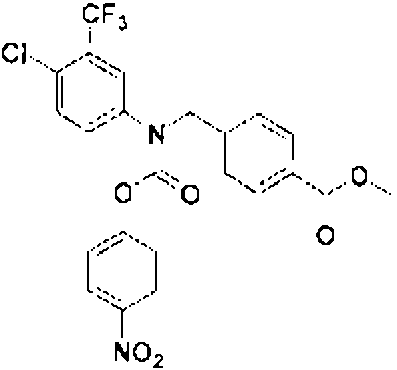
El compuesto de Fórmula 1-2 (4-((4-cloro-3-(trifluorometil)fenilamino)metil)benzoato de metilo; 2 g, 5,82 mmol) y cloroformiato de 4-nitrofenilo (1,17 g, 5,82 mmol) se disolvieron en diclorometano (50 ml) y se agitó a temperatura ambiente durante 2 días para precipitar un sólido y el sólido resultante se filtró y secó para dar el compuesto deseado de Fórmula 1-3 (3,14 g, 106 %) en forma de un sólido de color amarillo.The compound of Formula 1-2 (methyl 4 - ((4-chloro-3- (trifluoromethyl) phenylamino) methyl) benzoate; 2 g, 5.82 mmol) and 4-nitrophenyl chloroformate (1.17 g, , 82 mmol) were dissolved in dichloromethane (50 ml) and stirred at room temperature for 2 days to precipitate a solid and the resulting solid was filtered and dried to give the desired compound of Formula 1-3 (3.14 g, 106 %) in the form of a yellow solid.
(Fórmula 1-4: 4-((N-(4-cloro-3-(trifluorometil)fenil)piperidin-1-carboxamido)metil)benzoato de metilo)(Formula 1-4: 4 - (methyl (N- (4-chloro-3- (trifluoromethyl) phenyl) piperidin-1-carboxamido) methyl) benzoate)

El compuesto de Fórmula 1-3 (4-(((4-cloro-3-(trifluorometil)fenil)((4-nitrofenoxi)carbonil)amino)metil)benzoato de metilo; 0,50 g, 0,983 mmol) y piperidina (0,097 ml, 0,983 mmol) se disolvieron en dimetilformamida (10 ml) y la mezcla se calentó y se agitó a 60 °C durante 2 días. Después, la dimetilformamida se retiró a presión reducida, se vertió agua en la mezcla de reacción y la capa orgánica se extrajo con acetato de etilo. La capa orgánica se lavó con una solución acuosa saturada de cloruro sódico, se deshidrató con sulfato de magnesio anhidro y posteriormente se concentró a presión reducida. El residuo se purificó y se concentró por cromatografía en columna (sílice; acetato de etilo/hexano=20 %) para dar el compuesto deseado de Fórmula 1-4 (0,425 g, 95 %) en forma de un aceite incoloro. The compound of Formula 1-3 (methyl 4 - (((4-chloro-3- (trifluoromethyl) phenyl) ((4-nitrophenoxy) carbonyl) amino) methyl) benzoate; 0.50 g, 0.983 mmol) and piperidine (0.097 mL, 0.983 mmol) were dissolved in dimethylformamide (10 mL) and the mixture was heated and stirred at 60 ° C for 2 days. Then, the dimethylformamide was removed under reduced pressure, water was poured in the reaction mixture and the organic layer was extracted with ethyl acetate. The organic layer was washed with a saturated aqueous solution of sodium chloride, dehydrated with anhydrous magnesium sulfate and subsequently concentrated under reduced pressure. The residue was purified and concentrated by column chromatography (silica; ethyl acetate / hexane = 20%) to give the desired compound of Formula 1-4 (0.425 g, 95%) as a colorless oil.
(Compuesto 389: N-(4-cloro-3-(trifluorometil)fenil)-N-(4-(hidroxicarbamoil)bencil)piperidin-1-carboxamida)(Compound 389: N- (4-chloro-3- (trifluoromethyl) phenyl) -N- (4- (hydroxycarbamoyl) benzyl) piperidine-1-carboxamide)

El compuesto de Fórmula 1-4 (4-((N-(4-cloro-3-(trifluorometil)fenil)piperidin-1-carboxamido)metil)benzoato de metilo; 0,263 g, 0,578 mmol) se disolvió en metanol (20 ml) y se añadieron clorhidrato de hidroxilamina (0,201 g, 2,89 mmol) e hidróxido potásico (0,324 g, 5,78 mmol) y se agitó. Después, hidroxilamina (solución acuosa al 50 % en peso; 1,49 ml, 11,56 mmol) se añadió gota a gota y se agitó a temperatura ambiente durante 6 horas. Tras completarse la reacción, el metanol se retiró a presión reducida, se añadió una solución acuosa saturada de hidrogenocarbonato sódico para precipitar un sólido y el sólido resultante se filtró y secó para dar el Compuesto 389 deseado (0,18 g, 68 %) en forma de sólido de color albaricoque.The compound of Formula 1-4 (methyl 4 - ((N- (4-chloro-3- (trifluoromethyl) phenyl) piperidine-1-carboxamido) methyl) benzoate; 0.263 g, 0.578 mmol) was dissolved in methanol (20 mL). ml) and hydroxylamine hydrochloride (0.201 g, 2.89 mmol) and potassium hydroxide (0.324 g, 5.78 mmol) were added and stirred. Then, hydroxylamine (50% by weight aqueous solution, 1.49 ml, 11.56 mmol) was added dropwise and stirred at room temperature for 6 hours. After completion of the reaction, the methanol was removed under reduced pressure, a saturated aqueous solution of sodium hydrogencarbonate was added to precipitate a solid and the resulting solid was filtered and dried to give the desired Compound 389 (0.18 g, 68%) in solid form of apricot color.
1H RMN (400 MHz, DIVISOR) 87,64 (d, 2 H, J = 8,1 Hz), 7,58 (d, 1 H, J = 8,7 Hz), 7,43 (d, 1 H, J = 2,6 Hz), 7,35 (dd, 1 H, J = 8,8, 2,6 Hz), 7,28 (d, 2 H, J = 8,1 Hz), 4,87 (s, 2 H), 3,71 - 3,68 (m, 2 H), 2,69 -2,63 (m, 2 H), 1,50 - 1,44 (m, 2 H), 0,87 - 0,81 (m, 4 H); MS (ESI) m/z 456,1 (M+ H).1 H NMR (400 MHz, DIVIDER) 87.64 (d, 2 H, J = 8.1 Hz), 7.58 (d, 1 H, J = 8.7 Hz), 7.43 (d, 1 H , J = 2.6 Hz), 7.35 (dd, 1 H, J = 8.8, 2.6 Hz), 7.28 (d, 2 H, J = 8.1 Hz), 4.87 (s, 2 H), 3.71 - 3.68 (m, 2 H), 2.69 -2.63 (m, 2 H), 1.50 - 1.44 (m, 2 H), 0 , 87-0.81 (m, 4 H); MS (ESI) m / z 456.1 (M + H).
Ejemplo 53: Síntesis del Compuesto 390Example 53: Synthesis of Compound 390
(Fórmula 1-4: 4-((N-(4-cloro-3-(trifluorometil)fenil)-4-metilpiperidin-1-carboxamido)metil)benzoato de metilo)(Formula 1-4: 4 - ((N- (4-chloro-3- (trifluoromethyl) phenyl) -4-methylpiperidin-1-carboxamido) methyl) benzoate methyl)

El compuesto de Fórmula 1-3 (4-(((4-cloro-3-(trifluorometil)fenil)((4-nitrofenoxi)carbonil)amino)metil)benzoato de metilo; 0,50 g, 0,983 mmol) y 4-metilpiperidina (0,116 ml, 0,983 mmol) se disolvieron en dimetilformamida (10 ml) y la mezcla se calentó y se agitó a 60 °C durante 2 días. Después, la dimetilformamida se retiró a presión reducida, se vertió agua en la mezcla de reacción y la capa orgánica se extrajo con acetato de etilo. La capa orgánica se lavó con una solución acuosa saturada de cloruro sódico, se deshidrató con sulfato de magnesio anhidro y posteriormente se concentró a presión reducida. El residuo se purificó y se concentró por cromatografía en columna (sílice; acetato de etilo/hexano=20 %) para dar el compuesto deseado de Fórmula 1-4 (0,369 g, 80 %) en forma de un aceite blanco. The compound of Formula 1-3 (methyl 4 - (((4-chloro-3- (trifluoromethyl) phenyl) ((4-nitrophenoxy) carbonyl) amino) methyl) benzoate; 0.50 g, 0.983 mmol) and Methylpiperidine (0.116 ml, 0.983 mmol) were dissolved in dimethylformamide (10 ml) and the mixture was heated and stirred at 60 ° C for 2 days. Then, the dimethylformamide was removed under reduced pressure, water was poured into the reaction mixture and the organic layer was extracted with ethyl acetate. The organic layer was washed with a saturated aqueous solution of sodium chloride, dehydrated with anhydrous magnesium sulfate and subsequently concentrated under reduced pressure. The residue was purified and concentrated by column chromatography (silica; ethyl acetate / hexane = 20%) to give the desired compound of Formula 1-4 (0.369 g, 80%) as a white oil.
(Compuesto 390: N-(4-cloro-3-(trifluorometil)fenil)-N-(4-(hidroxicarbamoil)bencil)-4-metilpiperidin-1-carboxamida)(Compound 390: N- (4-chloro-3- (trifluoromethyl) phenyl) -N- (4- (hydroxycarbamoyl) benzyl) -4-methylpiperidine-1-carboxamide)

El compuesto de Fórmula 1-4 (4-((N-(4-cloro-3-(trifluorometil)fenil)-4-metilpiperidin-1-carboxamido)metil)benzoato de metilo, 0,239 g, 0,51 mmol) se disolvió en metanol (20 ml) y se añadieron clorhidrato de hidroxilamina (0,177 g, 2,55 mmol) e hidróxido potásico (0,286 g, 5,09 mmol) y se agitó. Después, hidroxilamina (solución acuosa al 50 % en peso; 1,31 ml, 10,19 mmol) se añadió gota a gota y se agitó a temperatura ambiente durante 6 horas. Tras completarse la reacción, el metanol se retiró a presión reducida, se añadió una solución acuosa saturada de hidrogenocarbonato sódico para precipitar un sólido y el sólido resultante se filtró y secó para dar el Compuesto 390 deseado (0,175 g, 73 %) en forma de sólido de color albaricoque.The compound of Formula 1-4 (methyl 4 - ((N- (4-chloro-3- (trifluoromethyl) phenyl) -4-methylpiperidin-1-carboxamido) methyl) benzoate, 0.239 g, 0.51 mmol) dissolved in methanol (20 ml) and hydroxylamine hydrochloride (0.177 g, 2.55 mmol) and potassium hydroxide (0.286 g, 5.09 mmol) were added and stirred. Then, hydroxylamine (50% by weight aqueous solution, 1.31 ml, 10.19 mmol) was added dropwise and stirred at room temperature for 6 hours. After completion of the reaction, the methanol was removed under reduced pressure, a saturated aqueous solution of sodium hydrogencarbonate was added to precipitate a solid and the resulting solid was filtered and dried to give the desired Compound 390 (0.175 g, 73%) as a solid. solid apricot.
1H RMN (400 MHz, DMSO-d6) 87,64 (d, 2 H, J = 8,2 Hz), 7,58 (d, 1 H, J = 8,8 Hz), 7,44 (d, 1 H, J = 2,6 Hz), 7,34 (dd, 1 H, J = 8,8, 2,6 Hz), 7,29 (d, 2 H, J = 8,2 Hz), 4,88 (s, 2 H), 3,18 -3,15 (m, 4 H), 1,46 - 1,45 (m, 3 H), 1,33 - 1,32 (m, 5 H); MS (ESI) m/z 470,1 (M+ H). 1 H NMR (400 MHz, DMSO-d 6) 87.64 (d, 2 H, J = 8.2 Hz), 7.58 (d, 1 H, J = 8.8 Hz), 7.44 (d, 1 H, J = 2.6 Hz), 7.34 (dd, 1 H, J = 8.8, 2.6 Hz), 7.29 (d, 2 H, J = 8.2 Hz), 4 , 88 (s, 2 H), 3.18 -3.15 (m, 4 H), 1.46-1.45 (m, 3 H), 1.33-1.32 (m, 5 H) ; MS (ESI) m / z 470.1 (M + H).
E je m p lo 54: S ín te s is de l C o m p u e s to 391E je m p lo 54: S ín te is is C o m p u e s 391
(Fórmula 1-4: 4-((N-(4-doro-3-(trifluorometil)fenil)morfolin-4-carboxamido)metil)benzoato de metilo)(Formula 1-4: 4 - ((N- (4-chloro-3- (trifluoromethyl) phenyl) morpholin-4-carboxamido) methyl) benzoate)

El compuesto de Fórmula 1-3 (4-(((4-cloro-3-(trifluorometil)fenil)((4-nitrofenoxi)carbonil)amino)metil)benzoato de metilo; 0,50 g, 0,983 mmol) y morfolina (0,086 ml, 0,983 mmol) se disolvieron en dimetilformamida (10 ml) y la mezcla se calentó y se agitó a 60 °C durante 2 días. Después, la dimetilformamida se retiró a presión reducida, se vertió agua en la mezcla de reacción y la capa orgánica se extrajo con acetato de etilo. La capa orgánica se lavó con una solución acuosa saturada de cloruro sódico, se deshidrató con sulfato de magnesio anhidro y posteriormente se concentró a presión reducida. El residuo se purificó y se concentró por cromatografía en columna (sílice; acetato de etilo/hexano=20 %) para dar el compuesto deseado de Fórmula 1-4 (0,229 g, 51 %) en forma de un aceite blanco. The compound of Formula 1-3 (methyl 4 - (((4-chloro-3- (trifluoromethyl) phenyl) ((4-nitrophenoxy) carbonyl) amino) methyl) benzoate; 0.50 g, 0.983 mmol) and morpholine (0.086 ml, 0.983 mmol) were dissolved in dimethylformamide (10 ml) and the mixture was heated and stirred at 60 ° C for 2 days. Then, the dimethylformamide was removed under reduced pressure, water was poured into the reaction mixture and the organic layer was extracted with ethyl acetate. The organic layer was washed with a saturated aqueous solution of sodium chloride, dehydrated with anhydrous magnesium sulfate and subsequently concentrated under reduced pressure. The residue was purified and concentrated by column chromatography (silica; ethyl acetate / hexane = 20%) to give the desired compound of Formula 1-4 (0.229 g, 51%) as a white oil.
(Compuesto 391: N-(4-cloro-3-(trifluorometil)fenil)-N-(4-(hidroxicarbamoil)bencil)morfolin-4-carboxamida)(Compound 391: N- (4-chloro-3- (trifluoromethyl) phenyl) -N- (4- (hydroxycarbamoyl) benzyl) morpholine-4-carboxamide)

El compuesto de Fórmula 1-4 (4-((N-(4-cloro-3-(trifluorometil)fenil)morfolin-4-carboxamido)metil)benzoato de metilo, 0,138 g, 0,302 mmol) se disolvió en metanol (20 ml) y se añadieron clorhidrato de hidroxilamina (0,105 g, 1,51 mmol) e hidróxido potásico (0,169 g, 3,02 mmol) y se agitó. Después, hidroxilamina (solución acuosa al 50 % en peso; 0,778 ml, 6,04 mmol) se añadió gota a gota y se agitó a temperatura ambiente durante 6 horas. Tras completarse la reacción, el metanol se retiró a presión reducida, solución acuosa saturada de hidrogenocarbonato sódico se añadió para precipitar un sólido y el sólido resultante se filtró y secó para dar el Compuesto 391 deseado (0,089 g, 64 %) en forma de un sólido blanco.The compound of Formula 1-4 (methyl 4 - ((N- (4-chloro-3- (trifluoromethyl) phenyl) morpholin-4-carboxamido) methyl) benzoate, 0.138 g, 0.302 mmol) was dissolved in methanol (20 mL). ml) and hydroxylamine hydrochloride (0.105 g, 1.51 mmol) and potassium hydroxide (0.169 g, 3.02 mmol) were added and stirred. Then, hydroxylamine (50% by weight aqueous solution, 0.778 ml, 6.04 mmol) was added dropwise and stirred at room temperature for 6 hours. After completion of the reaction, the methanol was removed under reduced pressure, saturated aqueous sodium hydrogencarbonate solution was added to precipitate a solid and the resulting solid was filtered and dried to give the desired Compound 391 (0.089 g, 64%) as a solid white.
1H RMN (400 MHz, DIVISOR) 811,13 (s, 1 H), 8,99 (s, 1 H), 7,65 (d, 2 H, J = 8,3 Hz), 7,60 (d, 1 H, J = 8,7 Hz), 7,54 (d, 1 H, J = 2,6 Hz), 7,43 - 7,40 (m, 1 H), 7,36 (d, 2 H, J = 8,2 Hz), 4,94 (s, 2 H), 3,44 - 3,42 (m, 4 H), 3,18 - 3,16 (m, 4 H); MS (ESI) m/z 458,1 (M+ H).1 H NMR (400 MHz, DIVIDER) 811.13 (s, 1 H), 8.99 (s, 1 H), 7.65 (d, 2 H, J = 8.3 Hz), 7.60 (d , 1 H, J = 8.7 Hz), 7.54 (d, 1 H, J = 2.6 Hz), 7.43-7.40 (m, 1 H), 7.36 (d, 2 H, J = 8.2 Hz), 4.94 (s, 2 H), 3.44 - 3.42 (m, 4 H), 3.18 - 3.16 (m, 4 H); MS (ESI) m / z 458.1 (M + H).
Ejemplo 55: Síntesis del Compuesto 392Example 55: Synthesis of Compound 392
(Fórmula 1-4: 4-((N-(4-cloro-3-(trifluorometil)fenil)-2,6-dimetilmorfolin-4-carboxamido)metil)benzoato de metilo)(Formula 1-4: 4 - ((N- (4-chloro-3- (trifluoromethyl) phenyl) -2,6-dimethylmorpholin-4-carboxamido) methyl) benzoate methyl)
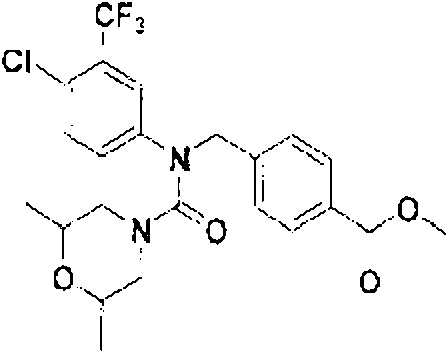
El compuesto de Fórmula 1-3 (4-(((4-cloro-3-(trifluorometil)fenil)((4-nitrofenoxi)carbonil)amino)metil)benzoato de metilo; 0,50 g, 0,983 mmol) y 2,6-dimetilmorfolina (0,12 ml, 0,983 mmol) se disolvieron en dimetilformamida (10 ml) y la mezcla se calentó y se agitó a 60 °C durante 2 días. Después, la dimetilformamida se retiró a presión reducida, se vertió agua en la mezcla de reacción y la capa orgánica se extrajo con acetato de etilo. La capa orgánica se lavó con una solución acuosa saturada de cloruro sódico, se deshidrató con sulfato de magnesio anhidro y posteriormente se concentró a presión reducida. El residuo se purificó y se concentró por cromatografía en columna (sílice; acetato de etilo/hexano=20 %) para dar el compuesto deseado de Fórmula 1-4 (0,2 g, 42 %) en forma de un aceite blanco. The compound of Formula 1-3 (methyl 4 - (((4-chloro-3- (trifluoromethyl) phenyl) ((4-nitrophenoxy) carbonyl) amino) methyl) benzoate; 0.50 g, 0.983 mmol) and , 6-dimethylmorpholine (0.12 ml, 0.983 mmol) were dissolved in dimethylformamide (10 ml) and the mixture was heated and stirred at 60 ° C for 2 days. Then, the dimethylformamide was removed under reduced pressure, water was poured into the reaction mixture and the organic layer was extracted with ethyl acetate. The organic layer was washed with a saturated aqueous solution of sodium chloride, dehydrated with anhydrous magnesium sulfate and subsequently concentrated under reduced pressure. The residue was purified and concentrated by column chromatography (silica; ethyl acetate / hexane = 20%) to give the desired compound of Formula 1-4 (0.2 g, 42%) as a white oil.
(Compuesto 392: N-(4-doro-3-(trifluorometil)fenil)-N-(4-(hidroxicarbamoil)bencil)-2,6-dimetilm orfolin-4-carboxamida)(Compound 392: N- (4-doro-3- (trifluoromethyl) phenyl) -N- (4- (hydroxycarbamoyl) benzyl) -2,6-dimethyl-orfolin-4-carboxamide)

El compuesto de Fórmula 1-4 (4-((N-(4-doro-3-(trifluorometil)fenil)-2,6-dimetilmorfolin-4-carboxamido)metil)benzoato de metilo, 0,121 g, 0,250 mmol) se disolvió en metanol (20 ml) y se añadieron clorhidrato de hidroxilamina (0,087 g, 1,25 mmol) e hidróxido potásico (0,14 g, 2,49 mmol) y se agitó. Después, hidroxilamina (solución acuosa al 50 % en peso; 0,643 ml, 4,99 mmol) gota a gota y se agitó a temperatura ambiente durante 6 horas. Tras completarse la reacción, el metanol se retiró a presión reducida, solución acuosa saturada de hidrogenocarbonato sódico se añadió para precipitar un sólido y el sólido resultante se filtró y secó para dar el Compuesto 392 deseado (0,056 g, 46 %) en forma de un sólido blanco.The compound of Formula 1-4 (methyl 4 - ((N- (4-duro-3- (trifluoromethyl) phenyl) -2,6-dimethylmorpholin-4-carboxamido) methyl) benzoate, 0.121 g, 0.250 mmol) was dissolved in methanol (20 ml) and hydroxylamine hydrochloride (0.087 g, 1.25 mmol) and potassium hydroxide (0.14 g, 2.49 mmol) were added and stirred. Then, hydroxylamine (50% strength by weight aqueous solution, 0.643 ml, 4.99 mmol) was added dropwise and stirred at room temperature for 6 hours. After completion of the reaction, the methanol was removed under reduced pressure, saturated aqueous sodium hydrogencarbonate solution was added to precipitate a solid and the resulting solid was filtered and dried to give the desired Compound 392 (0.056 g, 46%) as a solid white.
1H RMN (400 MHz, DIVISOR) 87,64 (d, 2 H, J = 8,3 Hz), 7,59 (d, 1 H, J = 8,8 Hz), 7,49 (d, 1 H, J = 2,6 Hz), 7,39 -7,36 (m 1 H), 7,30 (d, 2 H, J = 8,2 Hz), 4,89 (s, 2 H), 3,58 - 3,55 (m, 2 H), 2,40 - 2,32 (m, 4 H), 0,96 (d, 6 H, J = 6,2 Hz); MS (ESI) m/z 486,1 (M+ H).1 H NMR (400 MHz, DIVIDER) 87.64 (d, 2 H, J = 8.3 Hz), 7.59 (d, 1 H, J = 8.8 Hz), 7.49 (d, 1 H , J = 2.6 Hz), 7.39 -7.36 (m 1 H), 7.30 (d, 2 H, J = 8.2 Hz), 4.89 (s, 2 H), 3 , 58-3.55 (m, 2 H), 2.40-2.32 (m, 4 H), 0.96 (d, 6 H, J = 6.2 Hz); MS (ESI) m / z 486.1 (M + H).
Ejemplo 56: Síntesis del Compuesto 393Example 56: Synthesis of Compound 393
(Fórmula 1-4: 4-((N-(4-cloro-3-(trifluorometil)fenil)-4-metilpiperazin-1-carboxamido)metil)benzoato de metilo)(Formula 1-4: 4 - ((Methyl N- (4-chloro-3- (trifluoromethyl) phenyl) -4-methylpiperazine-1-carboxamido) methyl) benzoate)
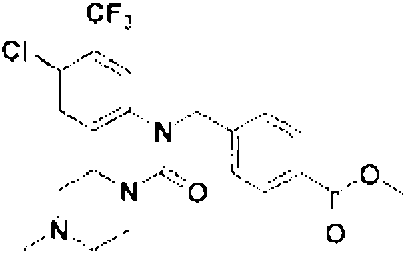
El compuesto de Fórmula 1-3 (4-(((4-cloro-3-(trifluorometil)fenil)((4-nitrofenoxi)carbonil)amino)metil)benzoato de metilo; 0,50 g, 0,983 mmol) y 1-metilpiperazina (0,109 ml, 0,983 mmol) se disolvieron en dimetilformamida (10 ml) y la mezcla se calentó y se agitó a 60 °C durante 2 días. Después, la dimetilformamida se retiró a presión reducida, se vertió agua en la mezcla de reacción y la capa orgánica se extrajo con acetato de etilo. La capa orgánica se lavó con una solución acuosa saturada de cloruro sódico, se deshidrató con sulfato de magnesio anhidro y posteriormente se concentró a presión reducida. El residuo se purificó y se concentró por cromatografía en columna (sílice; metanol/diclorometano= 5 %) para dar el compuesto deseado de Fórmula 1-4 (0,420 g, 91 %) en forma de un aceite de color amarillo.The compound of Formula 1-3 (methyl 4 - (((4-chloro-3- (trifluoromethyl) phenyl) ((4-nitrophenoxy) carbonyl) amino) methyl) benzoate; 0.50 g, 0.983 mmol) and methylpiperazine (0.109 ml, 0.983 mmol) were dissolved in dimethylformamide (10 ml) and the mixture was heated and stirred at 60 ° C for 2 days. Then, the dimethylformamide was removed under reduced pressure, water was poured into the reaction mixture and the organic layer was extracted with ethyl acetate. The organic layer was washed with a saturated aqueous solution of sodium chloride, dehydrated with anhydrous magnesium sulfate and subsequently concentrated under reduced pressure. The residue was purified and concentrated by column chromatography (silica; methanol / dichloromethane = 5%) to give the desired compound of Formula 1-4 (0.420 g, 91%) as a yellow oil.
(Compuesto 393: N-(4-cloro-3-(trifluorometil)fenil)-N-(4-(hidroxicarbamoil)bencil)-4-metilpiperazin-1-carboxamida)(Compound 393: N- (4-chloro-3- (trifluoromethyl) phenyl) -N- (4- (hydroxycarbamoyl) benzyl) -4-methylpiperazine-1-carboxamide)

El compuesto de Fórmula 1-4 (4-((N-(4-cloro-3-(trifluorometil)fenil)-4-metilpiperazin-1-carboxamido)metil)benzoato de metilo), 0,251 g, 0,534 mmol) se disolvió en metanol (20 ml) y se añadieron clorhidrato de hidroxilamina (0,185 g, 2,67 mmol) e hidróxido potásico (0,299 g, 5,34 mmol) y se agitó. Después, hidroxilamina (solución acuosa al 50 % en peso; 1,38 ml, 10,7 mmol) gota a gota y se agitó a temperatura ambiente durante 6 horas. Tras completarse la reacción, el metanol se retiró a presión reducida, solución acuosa saturada de hidrogenocarbonato sódico se añadió para precipitar un sólido y el sólido resultante se filtró y secó para dar el Compuesto 393 deseado (0,19 g, 75 %) en forma de un sólido blanco.The compound of Formula 1-4 (methyl 4 - ((N- (4-chloro-3- (trifluoromethyl) phenyl) -4-methylpiperazine-1-carboxamido) methyl) benzoate), 0.251 g, 0.534 mmol) was dissolved in methanol (20 ml) and hydroxylamine hydrochloride (0.185 g, 2.67 mmol) and potassium hydroxide (0.299 g, 5.34 mmol) were added and stirred. Then, hydroxylamine (50% by weight aqueous solution, 1.38 ml, 10.7 mmol) dropwise and stirred at room temperature for 6 hours. After completion of the reaction, the methanol was removed under reduced pressure, saturated aqueous sodium hydrogencarbonate solution was added to precipitate a solid and the resulting solid was filtered and dried to give the desired Compound 393 (0.19 g, 75%) as of a white solid.
1H RMN (400 MHz, DMSO-d6) 811,13 (s, 1 H), 8,99 (s, 1 H), 7,65 (d, 2 H, J = 8,1 Hz), 7,60 (d, 1 H, J = 8,7 Hz), 7,49 (d, 1 H, J = 2,4 Hz), 7,40 - 7,35 (m, 3 H), 5,75 (s, 1 H), 4,92 (s, 2 H), 3,17 (m, 4 H), 2,14 (m, 4 H), 2,10 (s, 3 H); MS (ESI) m/z 471,1 (M+ H). 1 H NMR (400 MHz, DMSO-d 6) 811.13 (s, 1 H), 8.99 (s, 1 H), 7.65 (d, 2 H, J = 8.1 Hz), 7.60 (d, 1 H, J = 8.7 Hz), 7.49 (d, 1 H, J = 2.4 Hz), 7.40-7.35 (m, 3 H), 5.75 (s) , 1 H), 4.92 (s, 2 H), 3.17 (m, 4 H), 2.14 (m, 4 H), 2.10 (s, 3 H); MS (ESI) m / z 471.1 (M + H).
E je m p lo 57: S ín tes is de l C o m p u e s to 394E je m p lo 57: S in te is of C o m p u e s 394
(Fórmula 1-4: 4-((N-(4-doro-3-(trifluorometil)fenil)-4-etilpiperazin-1-carboxamido)metil)benzoato de metilo)(Formula 1-4: 4 - ((N- (4-chloro-3- (trifluoromethyl) phenyl) -4-ethylpiperazin-1-carboxamido) methyl) benzoate)

El compuesto de Fórmula 1-3 (4-(((4-cloro-3-(trifluorometil)fenil)((4-nitrofenoxi)carbonil)amino)metil)benzoato de metilo; 0,5 g, 0,983 mmol) y 1 -etilpiperazina (0,125 ml, 0,983 mmol) se disolvieron en dimetilformamida (10 ml) y la mezcla se calentó y se agitó a 60 °C durante 2 días. Después, la dimetilformamida se retiró a presión reducida, se vertió agua en la mezcla de reacción y la capa orgánica se extrajo con acetato de etilo. La capa orgánica se lavó con una solución acuosa saturada de cloruro sódico, se deshidrató con sulfato de magnesio anhidro y posteriormente se concentró a presión reducida. El residuo se purificó y se concentró por cromatografía en columna (sílice; metanol/diclorometano = 5 %) para dar el compuesto deseado de Fórmula 1-4 (0,411 g, 86 %) en forma de un aceite de color amarillo.The compound of Formula 1-3 (methyl 4 - (((4-chloro-3- (trifluoromethyl) phenyl) ((4-nitrophenoxy) carbonyl) amino) methyl) benzoate; 0.5 g, 0.983 mmol) and Ethylpiperazine (0.125 ml, 0.983 mmol) were dissolved in dimethylformamide (10 ml) and the mixture was heated and stirred at 60 ° C for 2 days. Then, the dimethylformamide was removed under reduced pressure, water was poured into the reaction mixture and the organic layer was extracted with ethyl acetate. The organic layer was washed with a saturated aqueous solution of sodium chloride, dehydrated with anhydrous magnesium sulfate and subsequently concentrated under reduced pressure. The residue was purified and concentrated by column chromatography (silica; methanol / dichloromethane = 5%) to give the desired compound of Formula 1-4 (0.411 g, 86%) as a yellow oil.
(Compuesto 394: N-(4-cloro-3-(trifluorometil)fenil)-4-etil-N-(4-(hidroxicarbamoil)bencil)piperazin-1-carboxamida)(Compound 394: N- (4-chloro-3- (trifluoromethyl) phenyl) -4-ethyl-N- (4- (hydroxycarbamoyl) benzyl) piperazine-1-carboxamide)

El compuesto de Fórmula 1-4 (4-((N-(4-cloro-3-(trifluorometil)fenil)-4-etilpiperazin-1-carboxamido)metil)benzoato de metilo, 0,261 g, 0,539 mmol) se disolvió en metanol (20 ml) y se añadieron clorhidrato de hidroxilamina (0,187 g, 2,69 mmol) e hidróxido potásico (0,303 g, 5,39 mmol) y se agitó. Después, hidroxilamina (solución acuosa al 50 % en peso; 1,39 ml, 10,79 mmol) gota a gota y se agitó a temperatura ambiente durante 6 horas. Tras completarse la reacción, el metanol se retiró a presión reducida, se añadió una solución acuosa saturada de hidrogenocarbonato sódico para precipitar un sólido y el sólido resultante se filtró y secó para dar el Compuesto 394 deseado (0,25 g, 95 %) en forma de un sólido amarillo claro.The compound of Formula 1-4 (methyl 4 - ((N- (4-chloro-3- (trifluoromethyl) phenyl) -4-ethylpiperazine-1-carboxamido) methyl) benzoate, 0.261 g, 0.539 mmol) was dissolved in methanol (20 ml) and hydroxylamine hydrochloride (0.187 g, 2.69 mmol) and potassium hydroxide (0.303 g, 5.39 mmol) were added and stirred. Then, hydroxylamine (50% strength by weight aqueous solution, 1.39 ml, 10.79 mmol) was added dropwise and stirred at room temperature for 6 hours. After completion of the reaction, the methanol was removed under reduced pressure, a saturated aqueous solution of sodium hydrogencarbonate was added to precipitate a solid and the resulting solid was filtered and dried to give the desired Compound 394 (0.25 g, 95%) in shape of a light yellow solid.
1H RMN (400 MHz, DIVISOR) 811,13 (s, 1 H), 9,00 (s, 1 H), 7,65 (d, 2 H, J = 8,2 Hz), 7,60 (d, 1 H, J = 8,8 Hz), 7,49 (d, 1 H, J = 2,4 Hz), 7,40 - 7,35 (m, 3 H), 5,75 (s, 2 H), 4,92 (s, 2 H), 3,18 (m, 4 H), 2,24 (q, 2 H, J = 7,2 Hz), 2,19 (m, 4 H), 0,93 (t, 3 H, J = 7,1 Hz); MS (ESI) m/z 485,1 (M+ H).1 H NMR (400 MHz, DIVIDER) 811.13 (s, 1 H), 9.00 (s, 1 H), 7.65 (d, 2 H, J = 8.2 Hz), 7.60 (d , 1 H, J = 8.8 Hz), 7.49 (d, 1 H, J = 2.4 Hz), 7.40-7.35 (m, 3 H), 5.75 (s, 2 H), 4.92 (s, 2 H), 3.18 (m, 4 H), 2.24 (q, 2 H, J = 7.2 Hz), 2.19 (m, 4 H), 0.93 (t, 3 H, J = 7.1 Hz); MS (ESI) m / z 485.1 (M + H).
Ejemplo 58: Síntesis del Compuesto 395Example 58: Synthesis of Compound 395
(Fórmula 2-2: 4-((N-(3',5'-difluorobifenil-3-il)morfolin-4-carboxamido)metil)benzoato de metilo)(Formula 2-2: 4 - (methyl (N- (3 ', 5'-difluorobiphenyl-3-yl) morpholin-4-carboxamido) methyl) benzoate)

El compuesto de Fórmula 2-1 (4-((N-(3-bromofenil)morfolin-4-carboxamido)metil)benzoato de metilo; 0,200 g, 0,462 mmol), 3,5-difluorofenilborónico ácido (0,088 g, 0,554 mmol) y Pd(dppf)Cl2 (0,038 g, 0,046 mmol) se disolvieron en 1,4-dioxano (3 ml) y se añadió carbonato potásico (0,128 g, 0,923 mmol) disuelto en agua (1 ml) a la solución de reacción y se agitó a 100 °C durante 4 horas. Tras completarse la reacción, la capa orgánica se extrajo con acetato de etilo y solución acuosa saturada de hidrogenocarbonato sódico y se concentró a presión reducida y posteriormente el residuo se purificó y se concentró por cromatografía en columna (sílice; acetato de etilo/hexano=50 %) para dar el compuesto deseado de Fórmula 2-2 (0,180 g, 84 %) en forma de sólido marrón claro.The compound of Formula 2-1 (methyl 4 - ((N- (3-bromophenyl) morpholin-4-carboxamido) methyl) benzoate; 0.200 g, 0.462 mmol), 3,5-difluorophenylboronic acid (0.088 g, 0.554 mmol) ) and Pd (dppf) Cl2 (0.038 g, 0.046 mmol) were dissolved in 1,4-dioxane (3 ml) and potassium carbonate (0.128 g, 0.923 mmol) dissolved in water (1 ml) was added to the reaction solution. and stirred at 100 ° C for 4 hours. After completion of the reaction, the organic layer was extracted with ethyl acetate and saturated aqueous sodium hydrogencarbonate solution and concentrated under reduced pressure and then the residue was purified and concentrated by column chromatography (silica, ethyl acetate / hexane = 50 %) to give the desired compound of Formula 2-2 (0.180 g, 84%) as a light brown solid.
(Compuesto 395: N-(3',5'-difluorobifenil-3-il)-N-(4-(hidroxicarbamoil)bencil)morfolin-4-carboxa mida) (Compound 395: N- (3 ', 5'-difluorobiphenyl-3-yl) -N- (4- (hydroxycarbamoyl) benzyl) morpholine-4-carboxamide)

El compuesto de Fórmula 2-2 (4-((N-(3',5'-difluorobifenil-3-il)morfolin-4-carboxamido)metil)benzoato de metilo; 0,180 g, 0,386 mmol) se disolvió en metanol (10 ml) y se añadieron hidroxilamina (solución acuosa de 50,0 % en peso; 2,36 ml, 38,6 mmol) e hidróxido potásico (0,217 g, 3,86 mmol) secuencialmente y después se agitó a temperatura ambiente durante 30 minutos. Tras completarse la reacción, la solución de reacción se concentró a presión reducida hasta que su volumen fue de aproximadamente 1 ml y posteriormente se añadió una solución acuosa saturada de cloruro de amonio (1-2 ml) y se agitó. Después, el producto sólido se filtró, se lavó con agua y posteriormente se secó a vacío para dar el Compuesto 395 deseado (0,159 g, 88 %) en forma de sólido marrón claro.The compound of Formula 2-2 (methyl 4 - ((N- (3 ', 5'-difluorobiphenyl-3-yl) morpholin-4-carboxamido) methyl) benzoate; 0.180 g, 0.386 mmol) was dissolved in methanol ( 10 ml) and hydroxylamine (50.0% by weight aqueous solution, 2.36 ml, 38.6 mmol) and potassium hydroxide (0.217 g, 3.86 mmol) were added sequentially and then stirred at room temperature for 30 minutes. minutes After completion of the reaction, the reaction solution was concentrated under reduced pressure until its volume was about 1 ml and then a saturated aqueous solution of ammonium chloride (1-2 ml) was added and stirred. Then, the solid product was filtered, washed with water and then dried under vacuum to give the desired Compound 395 (0.159 g, 88%) as a light brown solid.
1H RMN (400 MHz, DIVISOR) 67,64 (d, 2 H, J = 8,2 Hz), 7,57 (s, 1 H), 7,46 - 7,36 (m, 6 H), 7,23 (m, 1 H), 7,15 (m, 1 H), 4,96 (s, 2 H), 3,40 - 3,37 (m, 4 H), 3,17 - 3,14 (m, 4 H). MS (ESI) m/z 468 (M+ H).1 H NMR (400 MHz, DIVIDER) 67.64 (d, 2 H, J = 8.2 Hz), 7.57 (s, 1 H), 7.46-7.36 (m, 6 H), 7 , 23 (m, 1 H), 7.15 (m, 1 H), 4.96 (s, 2 H), 3.40 - 3.37 (m, 4 H), 3.17 - 3.14 (m, 4 H). MS (ESI) m / z 468 (M + H).
Ejemplo 59: Síntesis del Compuesto 396Example 59: Synthesis of Compound 396
(Fórmula 2-2: 4-((N-(3-(6-(dimetilamino)piridin-3-il)fenil)morfolin-4-carboxamido)metil)benzoato de metilo)(Formula 2-2: 4 - ((N- (3- (6- (dimethylamino) pyridin-3-yl) phenyl) morpholin-4-carboxamido) methyl) benzoate methyl)

El compuesto de Fórmula 2-1 (4-((N-(3-bromofenil)morfolin-4-carboxamido)metil)benzoato de metilo; 0,200 g, 0,462 mmol), ácido 6-dimetilaminopiridin-3-ilborónico (0,092 g, 0,554 mmol) y Pd(dppf)Cl2 (0,038 g, 0,046 mmol) se disolvieron en 1,4-dioxano (3 ml) y se añadió carbonato potásico (0,128 g, 0,923 mmol) disuelto en agua (1 ml) a la solución de reacción y se agitó a 100 °C durante 4 horas. Tras completarse la reacción, la capa orgánica se extrajo con acetato de etilo y solución acuosa saturada de hidrogenocarbonato sódico y se concentró a presión reducida y posteriormente el residuo se purificó y se concentró por cromatografía en columna (sílice; acetato de etilo/hexano=50 %) para dar el compuesto deseado de Fórmula 2-2 (0,136 g, 62 %) en forma de sólido marrón claro.The compound of Formula 2-1 (methyl 4 - ((N- (3-bromophenyl) morpholin-4-carboxamido) methyl) benzoate; 0.200 g, 0.462 mmol), 6-dimethylaminopyridin-3-ylboronic acid (0.092 g, 0.554 mmol) and Pd (dppf) Cl2 (0.038 g, 0.046 mmol) were dissolved in 1,4-dioxane (3 ml) and potassium carbonate (0.128 g, 0.923 mmol) dissolved in water (1 ml) was added to the solution of reaction and stirred at 100 ° C for 4 hours. After completion of the reaction, the organic layer was extracted with ethyl acetate and saturated aqueous sodium hydrogencarbonate solution and concentrated under reduced pressure and then the residue was purified and concentrated by column chromatography (silica, ethyl acetate / hexane = 50 %) to give the desired compound of Formula 2-2 (0.136 g, 62%) as a light brown solid.
(Compuesto 396: N-(3-(6-(dimetilamino)piridin-3-il)fenil)-N-(4-(hidroxicarbamoil)bencil)morfolin-4-carboxamida)(Compound 396: N- (3- (6- (dimethylamino) pyridin-3-yl) phenyl) -N- (4- (hydroxycarbamoyl) benzyl) morpholine-4-carboxamide)

El compuesto de Fórmula 2-2 (4-((N-(3-(6-(dimetilamino)piridin-3-il)fenil)morfolin-4-carboxamido)metil)benzoato de metilo; 0,136 g, 0,287 mmol) se disolvió en metanol (10 ml) y se añadieron hidroxilamina (solución acuosa de 50,0 % en peso; 1,75 ml, 28,7 mmol) e hidróxido potásico (0,161 g, 2,87 mmol) secuencialmente y después se agitó a temperatura ambiente durante 30 minutos. Tras completarse la reacción, la solución de reacción se concentró a presión reducida hasta que su volumen fue de aproximadamente 1 ml y posteriormente se añadió una solución acuosa saturada de cloruro de amonio (1-2 ml) y se agitó. Después, el producto sólido se filtró, se lavó con agua y posteriormente se secó a vacío para dar deseado el Compuesto 396 (0,118 g, 87 %) en forma de sólido marrón claro.The compound of Formula 2-2 (methyl 4 - ((N- (3- (6- (dimethylamino) pyridin-3-yl) phenyl) morpholin-4-carboxamido) methyl) benzoate; 0.136 g, 0.287 mmol) is dissolved in methanol (10 ml) and hydroxylamine (50.0% by weight aqueous solution, 1.75 ml, 28.7 mmol) and potassium hydroxide (0.161 g, 2.87 mmol) were added sequentially and then stirred room temperature for 30 minutes. After completion of the reaction, the reaction solution was concentrated under reduced pressure until its volume was about 1 ml and then a saturated aqueous solution of ammonium chloride (1-2 ml) was added and stirred. Then, the solid product was filtered, washed with water and then dried in vacuo to give Compound 396 (0.118 g, 87%) as a light brown solid.
1H RMN (400 MHz, DMSO-d6) 68,38 (d, 1 H, J = 2,5 Hz), 7,78 (m, 1 H), 7,64 (d, 2 H, J = 8,3 Hz), 7,39 - 7,35 (m, 3 H), 7,32 - 7,29 (m, 2 H), 7,05 (m, 1 H), 6,69 (d, 1 H, J = 8,9 Hz), 4,93 (s, 2 H), 3,41 - 3,38 (m, 4 H), 3,18 - 3,15 (m, 4 H), 3,05 (s, 6 H). MS (ESI) m/z 476 (M+ H).1 H NMR (400 MHz, DMSO-d 6) 68.38 (d, 1 H, J = 2.5 Hz), 7.78 (m, 1 H), 7.64 (d, 2 H, J = 8, 3 Hz), 7.39-7.35 (m, 3 H), 7.32-7.29 (m, 2 H), 7.05 (m, 1 H), 6.69 (d, 1 H) , J = 8.9 Hz), 4.93 (s, 2 H), 3.41 - 3.38 (m, 4 H), 3.18 - 3.15 (m, 4 H), 3.05 (s, 6 H). MS (ESI) m / z 476 (M + H).
Ejemplo 60: Síntesis del Compuesto 397Example 60: Synthesis of Compound 397
(Fórmula 2-2: 4-((N-(3-(pirimidin-5-il)fenil)morfolin-4-carboxamido)metil)benzoato de metilo) (Formula 2-2: 4 - (methyl (N- (3- (pyrimidin-5-yl) phenyl) morpholin-4-carboxamido) methyl) benzoate)
El compuesto de Fórmula 2-1 (4-((N-(3-bromofenil)morfolin-4-carboxamido)metil)benzoato de metilo; 0,200 g, 0,462 mmol), ácido pirimidin-5-ilborónico (0,069 g, 0,554 mmol) y Pd(dppf)Cl2 (0,038 g, 0,046 mmol) se disolvieron en 1,4-dioxano (3 ml) y se añadió carbonato potásico (0,128 g, 0,923 mmol) disuelto en agua (1 ml) a la solución de reacción y se agitó a 100 °C durante 4 horas. Tras completarse la reacción, la capa orgánica se extrajo con acetato de etilo y solución acuosa saturada de hidrogenocarbonato sódico y se concentró a presión reducida y posteriormente el residuo se purificó y se concentró por cromatografía en columna (sílice; acetato de etilo/hexano=25 %) para dar el compuesto deseado de Fórmula 2-2 (0,120 g, 60 %) en forma de un sólido de color amarillo.The compound of Formula 2-1 (methyl 4 - ((N- (3-bromophenyl) morpholin-4-carboxamido) methyl) benzoate; 0.200 g, 0.462 mmol), pyrimidin-5-ylboronic acid (0.069 g, 0.554 mmol ) and Pd (dppf) Cl2 (0.038 g, 0.046 mmol) were dissolved in 1,4-dioxane (3 ml) and potassium carbonate (0.128 g, 0.923 mmol) dissolved in water (1 ml) was added to the reaction solution. and stirred at 100 ° C for 4 hours. After completion of the reaction, the organic layer was extracted with ethyl acetate and saturated aqueous sodium hydrogencarbonate solution and concentrated under reduced pressure and then the residue was purified and concentrated by column chromatography (silica; ethyl acetate / hexane = 25). %) to give the desired compound of Formula 2-2 (0.120 g, 60%) as a yellow solid.
(Compuesto 397: N-(4-(hidroxicarbamoil)bencil)-N-(3-(pirimidin-5-il)fenil)morfolin-4-carboxamida)(Compound 397: N- (4- (hydroxycarbamoyl) benzyl) -N- (3- (pyrimidin-5-yl) phenyl) morpholine-4-carboxamide)

El compuesto de Fórmula 2-2 (4-((N-(3-(pirimidin-5-il)fenil)morfolin-4-carboxamido)metil)benzoato de metilo; 0,120 g, 0,277 mmol) se disolvió en metanol (10 ml) y se añadieron hidroxilamina (solución acuosa de 50,0 % en peso; 1,70 ml, 27,7 mmol) e hidróxido potásico (0,156 g, 2,78 mmol) secuencialmente y después se agitó a temperatura ambiente durante 30 minutos. Tras completarse la reacción, la solución de reacción se concentró a presión reducida hasta que su volumen fue de aproximadamente 2 ml y después se extrajo con acetato de etilo y solución acuosa saturada de cloruro de amonio. Después, la capa orgánica se deshidrató con sulfato de magnesio anhidro y se filtró y el filtrado posteriormente se concentró a presión reducida para dar el Compuesto 397 deseado (0,056 g, 47 %) en forma de un sólido de color pardo.The compound of Formula 2-2 (methyl 4 - ((N- (3- (pyrimidin-5-yl) phenyl) morpholin-4-carboxamido) methyl) benzoate; 0.120 g, 0.277 mmol) was dissolved in methanol (10 ml). ml) and hydroxylamine (50.0% by weight aqueous solution, 1.70 ml, 27.7 mmol) and potassium hydroxide (0.156 g, 2.78 mmol) were added sequentially and then stirred at room temperature for 30 minutes . After completion of the reaction, the reaction solution was concentrated under reduced pressure until its volume was about 2 ml and then it was extracted with ethyl acetate and saturated aqueous solution of ammonium chloride. Then, the organic layer was dehydrated with anhydrous magnesium sulfate and filtered and the filtrate was subsequently concentrated under reduced pressure to give the desired Compound 397 (0.056 g, 47%) as a brown solid.
1H RMN (400 MHz, DIVISOR) 811,21 (s a, 1 H), 9,18 (s a, 1 H), 9,13 (s, 2 H), 8,97 (s, 1 H), 7,66 -7,63 (m, 3 H), 7,51 - 7,41 (m, 4 H), 7,20 (m, 1 H), 4,97 (s, 2 H), 3,41 - 3,37 (m, 4 H), 3,19 - 3,16 (m, 4 H). MS (ESI) m/z 434 (M+ H). 1 H NMR (400 MHz, DIVIDER) 811.21 (sa, 1 H), 9.18 (sa, 1 H), 9.13 (s, 2 H), 8.97 (s, 1 H), 7, 66-7.63 (m, 3 H), 7.51-7.41 (m, 4 H), 7.20 (m, 1 H), 4.97 (s, 2 H), 3.41 - 3.37 (m, 4 H), 3.19 - 3.16 (m, 4 H). MS (ESI) m / z 434 (M + H).
Ejemplo 61: Síntesis del Compuesto 398Example 61: Synthesis of Compound 398
(Fórmula 2-2: 4-((N-(3',5'-bis(trifluorometil)bifenil-3-il)morfolin-4-carboxamido)metil)benzoato de metilo)(Formula 2-2: 4 - ((N- (3 ', 5'-bis (trifluoromethyl) biphenyl-3-yl) morpholin-4-carboxamido) methyl) benzoate methyl)

El compuesto de Fórmula 2-1 (4-((N-(3-bromofenil)morfolin-4-carboxamido)metil)benzoato de metilo; 0,200 g, 0,462 mmol), ácido 3,5-bis(trifluorometil)fenilborónico (0,143 g, 0,554 mmol) y Pd(dppf)Cl2 (0,038 g, 0,046 mmol) se disolvieron en 1,4-dioxano (3 ml) y se añadió carbonato potásico (0,128 g, 0,923 mmol) disuelto en agua (1 ml) a la solución de reacción y se agitó a 100 °C durante 4 horas. Tras completarse la reacción, la capa orgánica se extrajo con acetato de etilo y solución acuosa saturada de hidrogenocarbonato sódico y se concentró a presión reducida y posteriormente el residuo se purificó y se concentró por cromatografía en columna (sílice; acetato de etilo/hexano=30 %) para dar el compuesto deseado de Fórmula 2-2 (0,185 g, 71 %) en forma de un sólido de color blanco.The compound of Formula 2-1 (methyl 4 - ((N- (3-bromophenyl) morpholin-4-carboxamido) methyl) benzoate; 0.200 g, 0.462 mmol), 3,5-bis (trifluoromethyl) phenylboronic acid (0.143) g, 0.554 mmol) and Pd (dppf) Cl2 (0.038 g, 0.046 mmol) were dissolved in 1,4-dioxane (3 ml) and potassium carbonate (0.128 g, 0.923 mmol) dissolved in water (1 ml) was added to The reaction solution was stirred at 100 ° C for 4 hours. After completion of the reaction, the organic layer was extracted with ethyl acetate and saturated aqueous sodium hydrogencarbonate solution and concentrated under reduced pressure and then the residue was purified and concentrated by column chromatography (silica; ethyl acetate / hexane = 30). %) to give the desired compound of Formula 2-2 (0.185 g, 71%) as a white solid.
(Compuesto 398: N-(3',5'-bis(trifluorometil)bifenil-3-il)-N-(4-(hidroxicarbamoil)bencil)morfolin-4-carboxamida)(Compound 398: N- (3 ', 5'-bis (trifluoromethyl) biphenyl-3-yl) -N- (4- (hydroxycarbamoyl) benzyl) morpholine-4-carboxamide)

El compuesto de Fórmula 2-2 (The compound of Formula 2-2 (
4-((N-(3',5'-bis(trifluorometil)bifenil-3-il)morfolin-4-carboxamido)metil)benzoato de metilo; 0,185 g, 0,327 mmol) se disolvió en metanol (10 ml) y se añadieron hidroxilamina (solución acuosa de 50,0 % en peso; 2,00 ml, 32,7 mmol) e hidróxido potásico (0,183 g, 3,27 mmol) secuencialmente y después se agitó a temperatura ambiente durante 30 minutos. Tras completarse la reacción, la solución de reacción se concentró a presión reducida hasta que su volumen fue de aproximadamente 1 ml y posteriormente se añadió una solución acuosa saturada de cloruro de amonio (1-2 ml) y se agitó. Después, el producto sólido se filtró, se lavó con agua y posteriormente se secó a vacío para dar el Compuesto 398 deseado (0,160 g, 86 %) en forma de un sólido de color blanco.4 - (Methyl N- (3 ', 5'-bis (trifluoromethyl) biphenyl-3-yl) morpholin-4-carboxamido) methyl) benzoate; 0.185 g, 0.327 mmol) was dissolved in methanol (10 ml) and hydroxylamine (50.0% by weight aqueous solution, 2.00 ml, 32.7 mmol) and potassium hydroxide (0.183 g, 3.27 mmol) were added. ) sequentially and then stirred at room temperature for 30 minutes. After completion of the reaction, the reaction solution was concentrated under reduced pressure until its volume was about 1 ml and then a saturated aqueous solution of ammonium chloride (1-2 ml) was added and stirred. Then, the solid product was filtered, washed with water and then dried under vacuum to give the desired Compound 398 (0.160 g, 86%) as a white solid.
1H RMN (400 MHz, DMSO-d6) 88,31 (s, 2 H), 8,09 (s, 1 H), 7,74 (s, 1 H), 7,64 (d, 2 H, J = 8,4 Hz), 7,57 (m, 1 H), 7,43 - 7,40 (m, 3 H), 7,22 (m, 1 H), 4,98 (s, 2 H), 3,41 - 3,38 (m, 4 H), 3,19 - 3,16 (m, 4 H). MS (ESI) m/z 568 (M+ H). 1 H NMR (400 MHz, DMSO-d 6) 88.31 (s, 2 H), 8.09 (s, 1 H), 7.74 (s, 1 H), 7.64 (d, 2 H, J = 8.4 Hz), 7.57 (m, 1 H), 7.43 - 7.40 (m, 3 H), 7.22 (m, 1 H), 4.98 (s, 2 H) , 3.41 - 3.38 (m, 4 H), 3.19 - 3.16 (m, 4 H). MS (ESI) m / z 568 (M + H).
E je m p lo 62: S ín tes is del C o m p u e s to 399E m m p lo 62: S ín tes of C o m p u s s 399
(Fórmula 2-2: 4-((N-(3-(2,3-dihidrobenzo[b][1,4]dioxin-6-il)fenil)morfolin-4-carboxamido)metil)benzoato de metilo)(Formula 2-2: methyl 4 - ((N- (3- (2,3-dihydrobenzo [b] [1,4] dioxin-6-yl) phenyl) morpholin-4-carboxamido) methyl) benzoate)

El compuesto de Fórmula 2-1 (4-((N-(3-bromofenil)morfolin-4-carboxamido)metil)benzoato de metilo; 0,200 g, 0,462 mmol), 2,3-dihidrobenzo[b][1,4]dioxin-6-ilborónico ácido (0,100 g, 0,554 mmol) y Pd(dppf)Cl2 (0,038 g, 0,046 mmol) se disolvieron en 1,4-dioxano (3 ml) y se añadió carbonato potásico (0,128 g, 0,923 mmol) disuelto en agua (1 ml) a la solución de reacción y se agitó a 100 °C durante 4 horas. Tras completarse la reacción, la capa orgánica se extrajo con acetato de etilo y solución acuosa saturada de hidrogenocarbonato sódico y se concentró a presión reducida y posteriormente el residuo se purificó y se concentró por cromatografía en columna (sílice; acetato de etilo/hexano=50 %) para dar el compuesto deseado de Fórmula 2-2 (0,182 g, 81 %) en forma de un líquido amarillo.The compound of Formula 2-1 (methyl 4 - ((N- (3-bromophenyl) morpholin-4-carboxamido) methyl) benzoate; 0.200 g, 0.462 mmol), 2,3-dihydrobenzo [b] [1.4 ] dioxin-6-ylboronic acid (0.100 g, 0.554 mmol) and Pd (dppf) Cl2 (0.038 g, 0.046 mmol) were dissolved in 1,4-dioxane (3 ml) and potassium carbonate (0.128 g, 0.923 mmol) was added. ) dissolved in water (1 ml) to the reaction solution and stirred at 100 ° C for 4 hours. After completion of the reaction, the organic layer was extracted with ethyl acetate and saturated aqueous sodium hydrogencarbonate solution and concentrated under reduced pressure and then the residue was purified and concentrated by column chromatography (silica, ethyl acetate / hexane = 50 %) to give the desired compound of Formula 2-2 (0.182 g, 81%) as a yellow liquid.
(Compuesto 399: N-(3-(2,3-dihidrobenzo[b][1,4]dioxin-6-il)fenil)-N-(4-(hidroxicarbamoil)bencil)morfolin-4-carboxamida)(Compound 399: N- (3- (2,3-dihydrobenzo [b] [1,4] dioxin-6-yl) phenyl) -N- (4- (hydroxycarbamoyl) benzyl) morpholine-4-carboxamide)

El compuesto de Fórmula 2-2 (4-((N-(3-(2,3-dihidrobenzo[b][1,4]dioxin-6-il)fenil)morfolin-4-carboxamido)metil)benzoato de metilo; 0,182 g, 0,373 mmol) se disolvió en metanol (10 ml) y se añadieron hidroxilamina (solución acuosa de 50,0 % en peso; 2,28 ml, 37,3 mmol) e hidróxido potásico (0,209 g, 3,73 mmol) secuencialmente y después se agitó a temperatura ambiente durante 30 minutos. Tras completarse la reacción, la solución de reacción se concentró a presión reducida hasta que su volumen fue de aproximadamente 1 ml y posteriormente se añadió una solución acuosa saturada de cloruro de amonio (1-2 ml) y se agitó. Después, el producto sólido se filtró, se lavó con agua y posteriormente se secó a vacío para dar el Compuesto 399 deseado (0,165 g, 91 %) en forma de sólido marrón claro.The compound of Formula 2-2 (Methyl methyl 4 - ((N- (3- (2,3-dihydrobenzo [b] [1,4] dioxin-6-yl) phenyl) morpholin-4-carboxamido) methyl) benzoate 0.182 g, 0.373 mmol) was dissolved in methanol (10 ml) and hydroxylamine (50.0% by weight aqueous solution, 2.28 ml, 37.3 mmol) and potassium hydroxide (0.209 g, 3.73 g. mmol) sequentially and then stirred at room temperature for 30 minutes. After completion of the reaction, the reaction solution was concentrated under reduced pressure until its volume was about 1 ml and then a saturated aqueous solution of ammonium chloride (1-2 ml) was added and stirred. Then, the solid product was filtered, washed with water and then dried in vacuo to give the desired Compound 399 (0.165 g, 91%) as a light brown solid.
1H RMN (400 MHz, DIVISOR) 87,64 (d, 2 H, J = 8,2 Hz), 7,38 (d, 2 H, J = 8,2 Hz), 7,34 - 7,27 (m, 3 H), 7,12 - 7,04 (m, 3 H), 6,91 (d, 1 H, J = 8,3 Hz), 4,92 (s, 2 H), 4,26 (s, 4 H), 3,40 - 3,37 (m, 4 H), 3,17 - 3,15 (m, 4 H). MS (ESI) m/z 490 (M+ H).1 H NMR (400 MHz, DIVIDER) 87.64 (d, 2 H, J = 8.2 Hz), 7.38 (d, 2 H, J = 8.2 Hz), 7.34 - 7.27 ( m, 3 H), 7.12-7.04 (m, 3 H), 6.91 (d, 1 H, J = 8.3 Hz), 4.92 (s, 2 H), 4.26 (s, 4 H), 3.40 - 3.37 (m, 4 H), 3.17 - 3.15 (m, 4 H). MS (ESI) m / z 490 (M + H).
Ejemplo 63: Síntesis del Compuesto 400Example 63: Synthesis of Compound 400
(Fórmula 2-2: 4-((N-(3',4',5'-trimetoxibifenil-3-il)morfolin-4-carboxamido)metil)benzoato de metilo)(Formula 2-2: 4 - (Methyl N- (3 ', 4', 5'-trimethoxybiphenyl-3-yl) morpholin-4-carboxamido) methyl) benzoate)

El compuesto de Fórmula 2-1 (4-((N-(3-bromofenil)morfolin-4-carboxamido)metil)benzoato de metilo; 0,200 g, 0,462 mmol), 3,4,5-trimetoxifenilborónico ácido (0,117 g, 0,554 mmol) y Pd(dppf)Cl2 (0,038 g, 0,046 mmol) se disolvieron en 1,4-dioxano (3 ml) y se añadió carbonato potásico (0,128 g, 0,923 mmol) disuelto en agua (1 ml) a la solución de reacción y se agitó a 100 °C durante 4 horas. Tras completarse la reacción, la capa orgánica se extrajo con acetato de etilo y solución acuosa saturada de hidrogenocarbonato sódico y se concentró a presión reducida y posteriormente el residuo se purificó y se concentró por cromatografía en columna (sílice; acetato de etilo/hexano=50 %) para dar el compuesto deseado de Fórmula 2-2 (0,146 g, 61 %) en forma de un sólido de color blanco.The compound of Formula 2-1 (methyl 4 - ((N- (3-bromophenyl) morpholin-4-carboxamido) methyl) benzoate; 0.200 g, 0.462 mmol), 3,4,5-trimethoxyphenylboronic acid (0.117 g, 0.554 mmol) and Pd (dppf) Cl2 (0.038 g, 0.046 mmol) were dissolved in 1,4-dioxane (3 ml) and potassium carbonate (0.128 g, 0.923 mmol) dissolved in water (1 ml) was added to the solution of reaction and stirred at 100 ° C for 4 hours. After completion of the reaction, the organic layer was extracted with ethyl acetate and saturated aqueous sodium hydrogencarbonate solution and concentrated under reduced pressure and then the residue was purified and concentrated by column chromatography (silica, ethyl acetate / hexane = 50 %) to give the desired compound of Formula 2-2 (0.146 g, 61%) as a white solid.
(Compuesto 400: N-(4-(hidroxicarbamoil)bencil)-N-(3',4',5'-trimetoxibifenil-3-il)morfolin-4-carboxamida) (Compound 400: N- (4- (hydroxycarbamoyl) benzyl) -N- (3 ', 4', 5'-trimethoxybiphenyl-3-yl) morpholine-4-carboxamide)

El compuesto de Fórmula 2-2 (4-((N-(3',4',5'-trimetoxibifenil-3-il)morfolin-4-carboxamido)metil)benzoato de metilo; 0,146 g, 0,280 mmol) se disolvió en metanol (10 ml) y se añadieron hidroxilamina (solución acuosa de 50,0 % en peso; 1,72 ml, 28,1 mmol) e hidróxido potásico (0,157 g, 2,81 mmol) secuencialmente y después se agitó a temperatura ambiente durante 30 minutos. Tras completarse la reacción, la solución de reacción se concentró a presión reducida hasta que su volumen fue de aproximadamente 1 ml y posteriormente se añadió una solución acuosa saturada de cloruro de amonio (1-2 ml) y se agitó. Después, el producto sólido se filtró, se lavó con agua y posteriormente se secó a vacío para dar el Compuesto 400 deseado (0,125 g, 86 %) en forma de sólido marrón claro.The compound of Formula 2-2 (methyl 4 - ((N- (3 ', 4', 5'-trimethoxybiphenyl-3-yl) morpholin-4-carboxamido) methyl) benzoate; 0.146 g, 0.280 mmol) was dissolved in methanol (10 ml) and hydroxylamine (50.0% by weight aqueous solution, 1.72 ml, 28.1 mmol) and potassium hydroxide (0.157 g, 2.81 mmol) were added sequentially and then stirred at room temperature. environment for 30 minutes. After completion of the reaction, the reaction solution was concentrated under reduced pressure until its volume was about 1 ml and then a saturated aqueous solution of ammonium chloride (1-2 ml) was added and stirred. Then, the solid product was filtered, washed with water and then dried under vacuum to give the desired Compound 400 (0.125 g, 86%) as a light brown solid.
1H RMN (400 MHz, DMSO-da) 87,65 (d, 2 H, J = 8,2 Hz), 7,41 - 7,39 (m, 3 H), 7,37 - 7,35 (m, 2 H), 7,12 (m, 1 H), 6,81 (s, 2 H), 4,95 (s, 2 H), 3,83 (s, 6 H), 3,67 (s, 3 H), 3,43 - 3,40 (m, 4 H), 3,19 - 3,16 (m, 4 H). MS (ESI) m/z 522 (M+ H).1 H NMR (400 MHz, DMSO-da) 87.65 (d, 2 H, J = 8.2 Hz), 7.41-7.39 (m, 3 H), 7.37-7.35 (m , 2 H), 7.12 (m, 1 H), 6.81 (s, 2 H), 4.95 (s, 2 H), 3.83 (s, 6 H), 3.67 (s) , 3 H), 3.43-3.40 (m, 4 H), 3.19 - 3.16 (m, 4 H). MS (ESI) m / z 522 (M + H).
Ejemplo 64: Síntesis del Compuesto 401Example 64: Synthesis of Compound 401
(Fórmula 2-2: 4-((N-(2',6'-dimetilbifenil-3-il)morfolin-4-carboxamido)metil)benzoato de metilo)(Formula 2-2: 4 - (methyl (N- (2 ', 6'-dimethylbiphenyl-3-yl) morpholin-4-carboxamido) methyl) benzoate)

El compuesto de Fórmula 2-1 (4-((N-(3-bromofenil)morfolin-4-carboxamido)metil)benzoato de metilo; 0,200 g, 0,462 mmol), ácido 2,6-dimetilfenilborónico (0,083 g, 0,554 mmol) y Pd(dppf)Cl2 (0,038 g, 0,046 mmol) se disolvieron en 1,4-dioxano (3 ml) y se añadió carbonato potásico (0,128 g, 0,923 mmol) disuelto en agua (1 ml) a la solución de reacción y se agitó a 100 °C durante 4 horas. Tras completarse la reacción, la capa orgánica se extrajo con acetato de etilo y solución acuosa saturada de hidrogenocarbonato sódico y se concentró a presión reducida y posteriormente el residuo se purificó y se concentró por cromatografía en columna (sílice; acetato de etilo/hexano=50 %) para dar el compuesto deseado de Fórmula 2-2 (0,205 g, 97 %) en forma de un sólido de color blanco.The compound of Formula 2-1 (methyl 4 - ((N- (3-bromophenyl) morpholin-4-carboxamido) methyl) benzoate; 0.200 g, 0.462 mmol), 2,6-dimethylphenylboronic acid (0.083 g, 0.554 mmol) ) and Pd (dppf) Cl2 (0.038 g, 0.046 mmol) were dissolved in 1,4-dioxane (3 ml) and potassium carbonate (0.128 g, 0.923 mmol) dissolved in water (1 ml) was added to the reaction solution. and stirred at 100 ° C for 4 hours. After completion of the reaction, the organic layer was extracted with ethyl acetate and saturated aqueous sodium hydrogencarbonate solution and concentrated under reduced pressure and then the residue was purified and concentrated by column chromatography (silica, ethyl acetate / hexane = 50 %) to give the desired compound of Formula 2-2 (0.205 g, 97%) as a white solid.
(Compuesto 401: N-(2',6'-dimetilbifenil-3-il)-N-(4-(hidroxicarbamoil)bencil)morfolin-4-carboxa mida)(Compound 401: N- (2 ', 6'-dimethylbiphenyl-3-yl) -N- (4- (hydroxycarbamoyl) benzyl) morpholine-4-carboxamide)

El compuesto de Fórmula 2-2 (4-((N-(2',6'-dimetilbifenil-3-il)morfolin-4-carboxamido)metil)benzoato de metilo; 0,205 g, 0,447 mmol) se disolvió en metanol (10 ml) y se añadieron hidroxilamina (solución acuosa de 50,0 % en peso; 2,74 ml, 44,7 mmol) e hidróxido potásico (0,251 g, 4,47 mmol) secuencialmente y después se agitó a temperatura ambiente durante 30 minutos. Tras completarse la reacción, la solución de reacción se concentró a presión reducida hasta que su volumen fue de aproximadamente 1 ml y posteriormente se añadió una solución acuosa saturada de cloruro de amonio (1-2 ml) y se agitó. Después, el producto sólido se filtró, se lavó con agua y posteriormente se secó a vacío para dar el Compuesto 401 deseado (0,195 g, 95 %) en forma de un sólido de color blanco.The compound of Formula 2-2 (methyl 4 - ((N- (2 ', 6'-dimethylbiphenyl-3-yl) morpholine-4-carboxamido) methyl) benzoate; 0.205 g, 0.447 mmol) was dissolved in methanol ( 10 ml) and hydroxylamine (50.0% by weight aqueous solution, 2.74 ml, 44.7 mmol) and potassium hydroxide (0.251 g, 4.47 mmol) were added sequentially and then stirred at room temperature for 30 minutes. minutes After completion of the reaction, the reaction solution was concentrated under reduced pressure until its volume was about 1 ml and then a saturated aqueous solution of ammonium chloride (1-2 ml) was added and stirred. Then, the solid product was filtered, washed with water and then dried under vacuum to give the desired Compound 401 (0.195 g, 95%) as a white solid.
1H RMN (400 MHz, DMSO-d6) 87,61 (d, 2 H, J = 8,2 Hz), 7,38 (t, 1 H, J = 7,8 Hz), 7,33 (d, 2 H, J = 8,3 Hz), 7,16 - 7,11 (m, 2 H), 7,06 (d, 2 H, J = 7,4 Hz), 6,81 (d, 1 H, J = 7,6 Hz), 6,77 (m, 1 H), 4,86 (s, 2 H), 3,40 - 3,37 (m, 4 H), 3,17 -3,14 (m, 4 H), 1,83 (s, 6 H). MS (ESI) m/z 460 (M+ H).1 H NMR (400 MHz, DMSO-d 6) 87.61 (d, 2 H, J = 8.2 Hz), 7.38 (t, 1 H, J = 7.8 Hz), 7.33 (d, 2 H, J = 8.3 Hz), 7.16-7.11 (m, 2 H), 7.06 (d, 2 H, J = 7.4 Hz), 6.81 (d, 1 H) , J = 7.6 Hz), 6.77 (m, 1 H), 4.86 (s, 2 H), 3.40 - 3.37 (m, 4 H), 3.17 -3.14 (m, 4 H), 1.83 (s, 6 H). MS (ESI) m / z 460 (M + H).
Ejemplo 65: Síntesis del Compuesto 402Example 65: Synthesis of Compound 402
(Fórmula 2-2: 4-((N-(3-(furan-3-il)fenil)morfolin-4-carboxamido)metil)benzoato de metilo) (Formula 2-2: 4 - (Methyl N- (3- (furan-3-yl) phenyl) morpholin-4-carboxamido) methyl) benzoate)
El compuesto de Fórmula 2-1 (4-((N-(3-bromofenil)morfolin-4-carboxamido)metil)benzoato de metilo; 0,200 g, 0,462 mmol), ácido furan-3-ilborónico (0,062 g, 0,554 mmol) y Pd(dppf)Cl2 (0,038 g, 0,046 mmol) se disolvieron en 1,4-dioxano (3 ml) y se añadió carbonato potásico (0,128 g, 0,923 mmol) disuelto en agua (1 ml) a la solución de reacción y se agitó a 100 °C durante 4 horas. Tras completarse la reacción, la capa orgánica se extrajo con acetato de etilo y solución acuosa saturada de hidrogenocarbonato sódico y se concentró a presión reducida y posteriormente el residuo se purificó y se concentró por cromatografía en columna (sílice; acetato de etilo/hexano=50 %) para dar el compuesto deseado de Fórmula 2-2 (0,113 g, 58 %) en forma de un sólido de color pardo.The compound of Formula 2-1 (methyl 4 - ((N- (3-bromophenyl) morpholin-4-carboxamido) methyl) benzoate; 0.200 g, 0.462 mmol), furan-3-ylboronic acid (0.062 g, 0.554 mmol ) and Pd (dppf) Cl2 (0.038 g, 0.046 mmol) were dissolved in 1,4-dioxane (3 ml) and potassium carbonate (0.128 g, 0.923 mmol) dissolved in water (1 ml) was added to the reaction solution. and stirred at 100 ° C for 4 hours. After completion of the reaction, the organic layer was extracted with ethyl acetate and saturated aqueous sodium hydrogencarbonate solution and concentrated under reduced pressure and then the residue was purified and concentrated by column chromatography (silica, ethyl acetate / hexane = 50 %) to give the desired compound of Formula 2-2 (0.113 g, 58%) as a brown solid.
(Compuesto 402: N-(3-(furan-3-il)fenil)-N-(4-(hidroxicarbamoil)bencil)morfolin-4-carboxamida)(Compound 402: N- (3- (furan-3-yl) phenyl) -N- (4- (hydroxycarbamoyl) benzyl) morpholine-4-carboxamide)

El compuesto de Fórmula 2-2 (4-((N-(3-(furan-3-il)fenil)morfolin-4-carboxamido)metil)benzoato de metilo; 0,113 g, 0,269 mmol) se disolvió en metanol (10 ml) y se añadieron hidroxilamina (solución acuosa de 50,0 % en peso; 1,64 ml, 26,9 mmol) e hidróxido potásico (0,151 g, 2,69 mmol) secuencialmente y después se agitó a temperatura ambiente durante 30 minutos. Tras completarse la reacción, la solución de reacción se concentró a presión reducida hasta que su volumen fue de aproximadamente 1 ml y posteriormente se añadió una solución acuosa saturada de cloruro de amonio (1-2 ml) y se agitó. Después, el producto sólido se filtró, se lavó con agua y posteriormente se secó a vacío para dar el Compuesto 402 deseado (0,060 g, 53 %) en forma de un sólido de color pardo.The compound of Formula 2-2 (methyl 4 - ((N- (3- (furan-3-yl) phenyl) morpholin-4-carboxamido) methyl) benzoate; 0.113 g, 0.269 mmol) was dissolved in methanol (10 ml). ml) and hydroxylamine (50.0% by weight aqueous solution, 1.64 ml, 26.9 mmol) and potassium hydroxide (0.151 g, 2.69 mmol) were added sequentially and then stirred at room temperature for 30 minutes . After completion of the reaction, the reaction solution was concentrated under reduced pressure until its volume was about 1 ml and then a saturated aqueous solution of ammonium chloride (1-2 ml) was added and stirred. Then, the solid product was filtered, washed with water and then dried under vacuum to give the desired Compound 402 (0.060 g, 53%) as a brown solid.
1H RMN (400 MHz, DIVISOR) 88,20 (s, 1 H), 7,73 (s, 1 H), 7,63 (d, 2 H, J = 8,1 Hz), 7,43 (s, 1 H), 7,38 (d, 2 H, J = 8,1 Hz), 7,30 - 7,28 (m, 2 H), 7,00 (m, 1 H), 6,95 (m, 1 H), 4,91 (s, 2 H), 3,39 - 3,36 (m, 4 H), 3,16 - 3,13 (m, 4 H). MS (ESI) m/z 422 (M+ H).1 H NMR (400 MHz, DIVIDER) 88.20 (s, 1 H), 7.73 (s, 1 H), 7.63 (d, 2 H, J = 8.1 Hz), 7.43 (s) , 1 H), 7.38 (d, 2 H, J = 8.1 Hz), 7.30 - 7.28 (m, 2 H), 7.00 (m, 1 H), 6.95 ( m, 1 H), 4.91 (s, 2 H), 3.39 - 3.36 (m, 4 H), 3.16 - 3.13 (m, 4 H). MS (ESI) m / z 422 (M + H).
Ejemplo 66: Síntesis del Compuesto 403Example 66: Synthesis of Compound 403
(Fórmula 2-2: 4-((N-(3-(3,6-dihidro-2H-piran-4-il)fenil)morfolin-4-carboxamido)metil)benzoato de metilo)(Formula 2-2: 4 - ((N- (3- (3,6-dihydro-2H-pyran-4-yl) phenyl) morpholin-4-carboxamido) methyl) benzoate methyl)

El compuesto de Fórmula 2-1 (4-((N-(3-bromofenil)morfolin-4-carboxamido)metil)benzoato de metilo; 0,400 g, 0,923 mmol), éster de pinacol de ácido 1,2,3,6-tetrahidropiran-4-borónico (0,233 g, 1,11 mmol) y Pd(dppf)Cl2 (0,030 g, 0,046 mmol) se disolvieron en 1,4-dioxano (4 ml) y se añadió carbonato de cesio (0,897 g, 2,77 mmol) disuelto en agua (1 ml) a la solución de reacción y se agitó a 140 °C durante 15 minutos usando un reactor de microondas. Tras completarse la reacción, la capa orgánica se extrajo con acetato de etilo y solución acuosa saturada de hidrogenocarbonato sódico. Después, la capa orgánica se deshidrató con sulfato de magnesio anhidro y se filtró. Se concentró a presión reducida y posteriormente el residuo se purificó y se concentró por cromatografía en columna (sílice; acetato de etilo/hexano=50 %) para dar el compuesto deseado de Fórmula 2-2 (0,132 g, 33 %) en forma de un sólido de color pardo.The compound of Formula 2-1 (methyl 4 - ((N- (3-bromophenyl) morpholin-4-carboxamido) methyl) benzoate; 0.400 g, 0.923 mmol), pinacol ester of 1,2,3,6 acid -tetrahydropyran-4-boronic acid (0.233 g, 1.11 mmol) and Pd (dppf) Cl2 (0.030 g, 0.046 mmol) were dissolved in 1,4-dioxane (4 ml) and cesium carbonate (0.897 g, 2.77 mmol) dissolved in water (1 ml) was added to the reaction solution and stirred at 140 ° C for 15 minutes using a microwave reactor. After completion of the reaction, the organic layer was extracted with ethyl acetate and saturated aqueous sodium hydrogencarbonate solution. Then, the organic layer was dehydrated with anhydrous magnesium sulfate and filtered. It was concentrated under reduced pressure and then the residue was purified and concentrated by column chromatography (silica; ethyl acetate / hexane = 50%) to give the desired compound of Formula 2-2 (0.132 g, 33%) as a solid of brown color.
(Compuesto 403: N-(3-(3,6-dihidro-2H-piran-4-il)fenil)-N-(4-(hidroxicarbamoil)bencil)morfolin-4 -carboxamida)(Compound 403: N- (3- (3,6-dihydro-2H-pyran-4-yl) phenyl) -N- (4- (hydroxycarbamoyl) benzyl) morpholin-4-carboxamide)

El compuesto de Fórmula 2-2 (4-((N-(3-(3,6-dihidro-2H-piran-4-il)fenil)morfolin-4-carboxamido)metil)benzoato de metilo; 0,050 g, 0,115 mmol) se disolvió en metanol (5 ml) y se añadieron hidroxilamina (solución acuosa de 50,0 % en peso; 1,40 ml, 22,9 mmol) e hidróxido potásico (0,064 g, 1,15 mmol) secuencialmente y después se agitó a temperatura ambiente durante 30 minutos. Tras completarse la reacción, la solución de reacción se concentró a presión reducida hasta que su volumen fue de aproximadamente 1 ml y posteriormente se añadió una solución acuosa saturada de cloruro de amonio (1-2 ml) y se agitó. Después, el producto sólido se filtró, se lavó con agua y posteriormente se secó a vacío para dar el Compuesto 403 deseado (0,030 g, 60 %) en forma de un sólido de color blanco. The compound of Formula 2-2 (methyl 4 - ((N- (3- (3,6-dihydro-2H-pyran-4-yl) phenyl) morpholin-4-carboxamido) methyl) benzoate; 0.050 g, 0.115 mmol) was dissolved in methanol (5 ml) and hydroxylamine (50.0% by weight aqueous solution, 1.40 ml, 22.9 mmol) and potassium hydroxide (0.064 g, 1.15 mmol) were added sequentially and then it was stirred at room temperature for 30 minutes. After completion of the reaction, the reaction solution was concentrated under reduced pressure until its volume was about 1 ml and then a saturated aqueous solution of ammonium chloride (1-2 ml) was added and stirred. Then, the solid product was filtered, washed with water and then dried under vacuum to give the desired Compound 403 (0.030 g, 60%) as a white solid.
1H RMN (400 MHz, DMSO-da) 6 11,12 (s, 1 H), 8,97 (s, 1 H), 7,63 (d, 2 H, J = 8,3 Hz), 7,36 (d, 2 H, J = 8,3 Hz), 7,27 (t, 1 H, J = 7,9 Hz), 7,18 (s, 1 H), 7,14 (d, 1 H, J = 7,6 Hz), 7,03 (d, 1 H, J = 7,8 Hz), 6,23 (m, 1H), 4,88 (s, 2 H), 4,19 (d, 2 H, J = 2,6 Hz), 3,78 (t, 2 H, J = 5,5 Hz), 3,39 - 3,36 (m, 4 H), 3,14 -3,11 (m, 4 H), 2,38 -2,36 (m, 2 H). MS (ESI) m/z 438 (M+ H).1 H NMR (400 MHz, DMSO-da) 6 11.12 (s, 1 H), 8.97 (s, 1 H), 7.63 (d, 2 H, J = 8.3 Hz), 7, 36 (d, 2 H, J = 8.3 Hz), 7.27 (t, 1 H, J = 7.9 Hz), 7.18 (s, 1 H), 7.14 (d, 1 H) , J = 7.6 Hz), 7.03 (d, 1 H, J = 7.8 Hz), 6.23 (m, 1H), 4.88 (s, 2 H), 4.19 (d , 2 H, J = 2.6 Hz), 3.78 (t, 2 H, J = 5.5 Hz), 3.39 - 3.36 (m, 4 H), 3.14 -3.11 (m, 4 H), 2.38-2.36 (m, 2 H). MS (ESI) m / z 438 (M + H).
Ejemplo 67: Síntesis del Compuesto 404Example 67: Synthesis of Compound 404
(Fórmula 2-2: 4-((N-(3-(1-metil-1,2,3,6-tetrahidropiridn-4-il)fenil)morfolin-4-carboxamido) metil)benzoato de metilo )(Formula 2-2: 4 - ((N- (3- (1-methyl-1,2,3,6-tetrahydropyridn-4-yl) phenyl) morpholin-4-carboxamido) methyl) benzoate methyl)

El compuesto de Fórmula 2-1 (4-((N-(3-bromofenil)morfolin-4-carboxamido)metil)benzoato de metilo; 0,400 g, 0,923 mmol), éster de pinacol de ácido 1-metil-1,2,3,6-tetrahidropiridin-4-borónico (0,247 g, 1,11 mmol) y Pd(dppf)Cl2 (0,030 g, 0,046 mmol) se disolvieron en 1,4-dioxano (4 ml) y se añadió carbonato de cesio (0,897 g, 2,77 mmol) disuelto en agua (1 ml) a la solución de reacción y se agitó a 140 °C durante 15 minutos usando un reactor de microondas. Tras completarse la reacción, la capa orgánica se extrajo con acetato de etilo y solución acuosa saturada de hidrogenocarbonato sódico. Después, la capa orgánica se deshidrató con sulfato de magnesio anhidro y se filtró. Se concentró a presión reducida y posteriormente el residuo se purificó y se concentró por cromatografía en columna (sílice; metanol/diclorometano=10 %) para dar el compuesto deseado de Fórmula 2-2 (0,193 g, 47 %) en forma de un sólido de color pardo.The compound of Formula 2-1 (methyl 4 - ((N- (3-bromophenyl) morpholin-4-carboxamido) methyl) benzoate; 0.400 g, 0.923 mmol), pinacol ester of 1-methyl-1,2 acid , 3,6-tetrahydropyridin-4-boronic acid (0.247 g, 1.11 mmol) and Pd (dppf) Cl2 (0.030 g, 0.046 mmol) were dissolved in 1,4-dioxane (4 ml) and cesium carbonate was added. (0.897 g, 2.77 mmol) dissolved in water (1 ml) was added to the reaction solution and stirred at 140 ° C for 15 minutes using a microwave reactor. After completion of the reaction, the organic layer was extracted with ethyl acetate and saturated aqueous sodium hydrogencarbonate solution. Then, the organic layer was dehydrated with anhydrous magnesium sulfate and filtered. It was concentrated under reduced pressure and then the residue was purified and concentrated by column chromatography (silica; methanol / dichloromethane = 10%) to give the desired compound of Formula 2-2 (0.193 g, 47%) as a solid. of brown color.
(Compuesto 404: N-(4-(hidroxicarbamoil)bencil)-N-(3-(1-metil-1,2,3,6-tetrahidropiridin-4-il)fenil) morfolin-4-carboxamida)(Compound 404: N- (4- (hydroxycarbamoyl) benzyl) -N- (3- (1-methyl-1,2,3,6-tetrahydropyridin-4-yl) phenyl) morpholine-4-carboxamide)

El compuesto de Fórmula 2-2 (4-((N-(3-(1-metil-1,2,3,6-tetrahidropiridn-4-il)fenil)morfolin-4-carboxamido) metil)benzoato de metilo; 0,050 g, 0,111 mmol) se disolvió en metanol (5 ml) y se añadieron hidroxilamina (solución acuosa de 50,0 % en peso; 1,36 ml, 22,2 mmol) e hidróxido potásico (0,062 g, 1,11 mmol) secuencialmente y después se agitó a temperatura ambiente durante 30 minutos. Tras completarse la reacción, la solución de reacción se concentró a presión reducida hasta que su volumen fue de aproximadamente 1 ml y posteriormente se añadió una solución acuosa saturada de cloruro de amonio (1-2 ml) y se agitó. Después, el producto sólido se filtró, se lavó con agua y posteriormente se secó a vacío para dar el Compuesto 404 deseado (0,015 g, 30 %) en forma de un sólido de color pardo.The compound of Formula 2-2 (methyl 4 - ((N- (3- (1-methyl-1,2,3,6-tetrahydropyridn-4-yl) phenyl) morpholin-4-carboxamido) methyl) benzoate; 0.050 g, 0.111 mmol) was dissolved in methanol (5 ml) and hydroxylamine (50.0% by weight aqueous solution, 1.36 ml, 22.2 mmol) and potassium hydroxide (0.062 g, 1.11 mmol) were added. ) sequentially and then stirred at room temperature for 30 minutes. After completion of the reaction, the reaction solution was concentrated under reduced pressure until its volume was about 1 ml and then a saturated aqueous solution of ammonium chloride (1-2 ml) was added and stirred. Then, the solid product was filtered, washed with water and then dried under vacuum to give the desired Compound 404 (0.015 g, 30%) as a brown solid.
MS (ESI) m/z 451 (M+ H).MS (ESI) m / z 451 (M + H).
Ejemplo 68: Síntesis del Compuesto 405Example 68: Synthesis of Compound 405
(Fórmula 2-2: 4-(3-(N-(4-(metoxicarbonil)bencil)morfolin-4-carboxamido)fenil)-5,6-dihidropiridin-1(2H)-carboxilato de tere-butilo)(Formula 2-2: 4- (3- (N- (4- (methoxycarbonyl) benzyl) morpholin-4-carboxamido) phenyl) -5,6-dihydropyridin-1 (2H)-tere-butylcarboxylate)

El compuesto de Fórmula 2-1 (4-((N-(3-bromofenil)morfolin-4-carboxamido)metil)benzoato de metilo; 0,800 g, 1,85 mmol), éster de pinacol de ácido N-Boc-1,2,3,6-tetrahidropiridin-4-borónico (0,685 g, 2,22 mmol) y Pd(dppf)Cl2 (0,060 g, 0,092 mmol) se disolvieron en 1,4-dioxano (8 ml) y se añadió carbonato de cesio (1,79 g, 5,54 mmol) disuelto en agua (2 ml) a la solución de reacción y se agitó a 140 °C durante 15 minutos usando un reactor de microondas. Tras completarse la reacción, la capa orgánica se extrajo con acetato de etilo y solución acuosa saturada de hidrogenocarbonato sódico. Después, la capa orgánica se deshidrató con sulfato de magnesio anhidro y se filtró. Se concentró a presión reducida y posteriormente el residuo se purificó y se concentró por cromatografía en columna (sílice; acetato de etilo/hexano=50 %) para dar el compuesto deseado de Fórmula 2-2 (0,832 g, 84 %) en forma de un sólido de color pardo. The compound of Formula 2-1 (methyl 4 - ((N- (3-bromophenyl) morpholin-4-carboxamido) methyl) benzoate; 0.800 g, 1.85 mmol), pinacol ester of N-Boc-1 acid , 2,3,6-tetrahydropyridin-4-boronic acid (0.685 g, 2.22 mmol) and Pd (dppf) Cl 2 (0.060 g, 0.092 mmol) were dissolved in 1,4-dioxane (8 ml) and carbonate was added. of cesium (1.79 g, 5.54 mmol) dissolved in water (2 ml) was added to the reaction solution and stirred at 140 ° C for 15 minutes using a microwave reactor. After completion of the reaction, the organic layer was extracted with ethyl acetate and saturated aqueous sodium hydrogencarbonate solution. Then, the organic layer was dehydrated with anhydrous magnesium sulfate and filtered. It was concentrated under reduced pressure and then the residue was purified and concentrated by column chromatography (silica; ethyl acetate / hexane = 50%) to give the desired compound of Formula 2-2 (0.832 g, 84%) as a solid of brown color.
(Compuesto 405: 4-(3-(N-(4-(hidroxicarbamoil)bencil)morfolin-4-carboxamido)fenil)-5,6-dihidropiridin-1(2H)-carboxilato de terc-butilo)(Compound 405: 4- (3- (N- (4- (hydroxycarbamoyl) benzyl) morpholin-4-carboxamido) phenyl) -5,6-dihydropyridin-1 (2H) -carboxylic acid tert -butyl)

El compuesto de Fórmula 2-2 (4-(3-(N-(4-(metoxicarbonil)bencil)morfolin-4-carboxamido)fenil)-5,6-dihidro piridin-1(2H)-carboxilato de terc-butilo; 0,050 g, 0,093 mmol) se disolvió en metanol (5 ml) y se añadieron hidroxilamina (solución acuosa de 50,0 % en peso; 1,14 ml, 18,7 mmol) e hidróxido potásico (0,052 g, 0,933 mmol) secuencialmente y después se agitó a temperatura ambiente durante 30 minutos. Tras completarse la reacción, la solución de reacción se concentró a presión reducida hasta que su volumen fue de aproximadamente 1 ml y posteriormente se añadió una solución acuosa saturada de cloruro de amonio (1-2 ml) y se agitó. Después, el producto sólido se filtró, se lavó con agua y posteriormente se secó a vacío para dar el Compuesto 405 deseado (0,030 g, 60 %) en forma de un sólido de color blanco.The compound of Formula 2-2 (4- (3- (N- (4- (methoxycarbonyl) benzyl) morpholin-4-carboxamido) phenyl) -5,6-dihydro pyridin-1 (2H) -carboxylic acid tert -butyl ester 0.050 g, 0.093 mmol) was dissolved in methanol (5 ml) and hydroxylamine (50.0% by weight aqueous solution, 1.14 ml, 18.7 mmol) and potassium hydroxide (0.052 g, 0.933 mmol) were added. sequentially and then stirred at room temperature for 30 minutes. After completion of the reaction, the reaction solution was concentrated under reduced pressure until its volume was about 1 ml and then a saturated aqueous solution of ammonium chloride (1-2 ml) was added and stirred. Then, the solid product was filtered, washed with water and then dried under vacuum to give the desired Compound 405 (0.030 g, 60%) as a white solid.
1H RMN (400 MHz, DMSO-da) 87,63 (d, 2 H, J = 8,3 Hz), 7,35 (d, 2 H, J = 8,2 Hz), 7,26 (t, 1 H, J = 7,9 Hz), 7,18 (s, 1 H), 7,12 (d, 1 H, J = 8,2 Hz), 7,02 (d, 1 H, J = 8,0 Hz), 6,17 (m, 1 H), 4,87 (s, 2 H), 3,97 (s a, 2 H), 3,50 (t, 2 H, J = 5,7 Hz), 3,38 (t, 4 H, J = 4,6 Hz), 3,12 (t, 4 H, J = 4,5 Hz), 2,40 (s a, 2 H), 1,41 (s, 9 H). MS (ESI) m/z 537.1 H NMR (400 MHz, DMSO-da) 87.63 (d, 2 H, J = 8.3 Hz), 7.35 (d, 2 H, J = 8.2 Hz), 7.26 (t, 1 H, J = 7.9 Hz), 7.18 (s, 1 H), 7.12 (d, 1 H, J = 8.2 Hz), 7.02 (d, 1 H, J = 8 , 0 Hz), 6.17 (m, 1 H), 4.87 (s, 2 H), 3.97 (sa, 2 H), 3.50 (t, 2 H, J = 5.7 Hz ), 3.38 (t, 4 H, J = 4.6 Hz), 3.12 (t, 4 H, J = 4.5 Hz), 2.40 (sa, 2 H), 1.41 ( s, 9 H). MS (ESI) m / z 537.
Ejemplo 69: Síntesis del Compuesto 413Example 69: Synthesis of Compound 413
(Fórmula 1-2: 4-((2,4-difluorofenilamino)metil)benzonato de metilo)(Formula 1-2: methyl 4 - ((2,4-difluorophenylamino) methyl) benzonate)

El compuesto de Fórmula 1-1 (2,4-difluorobencenamina; 3,0 g, 23,2 mmol) y 4-formilbenzoato de metilo (3,81 g, 23,2 mmol) se disolvieron en metanol (500 ml) y se agitó a temperatura ambiente durante 2 horas. Después, ácido acético (1,33 ml, 23,2 mmol) y cianoborohidruro sódico (1,46 g, 23,2 mmol) se añadieron y se agitó durante 1 día. Se retiró el metanol parcialmente por medio de secado al aire para precipitar un sólido y el sólido resultante se filtró y se secó para dar el compuesto deseado de Fórmula 1-2 (2,9 g, 45 %) en forma de un sólido de color blanco.The compound of Formula 1-1 (2,4-difluorobenzenamine; 3.0 g, 23.2 mmol) and methyl 4-formylbenzoate (3.81 g, 23.2 mmol) were dissolved in methanol (500 mL) and it was stirred at room temperature for 2 hours. Then, acetic acid (1.33 ml, 23.2 mmol) and sodium cyanoborohydride (1.46 g, 23.2 mmol) were added and stirred for 1 day. The methanol was partially removed by air drying to precipitate a solid and the resulting solid was filtered and dried to give the desired compound of Formula 1-2 (2.9 g, 45%) as a colored solid White.
(Fórmula 1-3: 4-(((2,4-difluorofenil)((4-nitrofenoxi)carbonil)amino)metil)benzoato de metilo(Formula 1-3: 4 - (((2,4-difluorophenyl) ((4-nitrophenoxy) carbonyl) amino) methyl) methyl benzoate

El compuesto de Fórmula 1-2 (4-((2,4-difluorofenilamido)metil)benzonato de metilo; 2 g, 7,21 mmol) y cloroformiato de 4-nitrofenilo (1,45 g, 7,21 mmol) se disolvieron en diclorometano (50 ml) y se agitó a temperatura ambiente durante 3 días. Después, se añadió agua para extraer la capa orgánica. La capa orgánica se lavó con una solución acuosa saturada de cloruro sódico, se deshidrató con sulfato de magnesio anhidro y posteriormente se concentró a presión reducida. El residuo se secó para dar el compuesto deseado de Fórmula 1-3 (2,5 g, 78 %) en forma de un aceite de color amarillo.The compound of Formula 1-2 (methyl 4 - ((2,4-difluorophenylamido) methyl) benzonate; 2 g, 7.21 mmol) and 4-nitrophenyl chloroformate (1.45 g, 7.21 mmol) are dissolved in dichloromethane (50 ml) and stirred at room temperature for 3 days. Then, water was added to extract the organic layer. The organic layer was washed with a saturated aqueous solution of sodium chloride, dehydrated with anhydrous magnesium sulfate and subsequently concentrated under reduced pressure. The residue was dried to give the desired compound of Formula 1-3 (2.5 g, 78%) as a yellow oil.
(Fórmula 1-4: 4-((N-(2,4-difluorofenil)morfolin-4-carboxamido)metil)benzoato de metilo)(Formula 1-4: 4 - (methyl (N- (2,4-difluorophenyl) morpholin-4-carboxamido) methyl) benzoate)

El compuesto de Fórmula 1-3 (4-(((2,4-difluorofenil)((4-nitrofenoxi)carbonil)amino)metil)benzoato de metilo; 0,50 g, 1,13 mmol) y morfolina (0,098 ml, 1,13 mmol) se disolvieron en dimetilformamida (10 ml) y la mezcla se calentó y se agitó a 60 °C durante 2 días. Después, la dimetilformamida se retiró a presión reducida, se vertió agua en la mezcla de reacción y la capa orgánica se extrajo con acetato de etilo. La capa orgánica se lavó con una solución acuosa saturada de cloruro sódico, se deshidrató con sulfato de magnesio anhidro y posteriormente se concentró a presión reducida. El residuo se purificó y se concentró por cromatografía en columna (sílice; acetato de etilo/hexano=30 %) para dar el compuesto deseado de Fórmula 1-4 (0,44 g, 98 %) en forma de un aceite incoloro.The compound of Formula 1-3 (methyl 4 - (((2,4-difluorophenyl) ((4-nitrophenoxy) carbonyl) amino) methyl) benzoate; 0.50 g, 1.13 mmol) and morpholine (0.098 mL) , 1.13 mmol) were dissolved in dimethylformamide (10 ml) and the mixture was heated and stirred at 60 ° C for 2 days. Then, the dimethylformamide was removed under reduced pressure, water was poured into the reaction mixture and the organic layer was extracted with ethyl acetate. The organic layer was washed with a saturated aqueous solution of sodium chloride, dehydrated with anhydrous magnesium sulfate and subsequently concentrated under reduced pressure. The residue was purified and concentrated by column chromatography (silica; ethyl acetate / hexane = 30%) to give the desired compound of Formula 1-4 (0.44 g, 98%) as a colorless oil.
(Compuesto 413: N-(2,4-difluorofenil)-N-(4-(hidroxicarbamoil)bencil)morfolina -4-carboxamida)(Compound 413: N- (2,4-difluorophenyl) -N- (4- (hydroxycarbamoyl) benzyl) morpholine-4-carboxamide)

El compuesto de Fórmula 1-4 (4-((N-(2,4-difluorofenil)morfolin-4-carboxamido)metil)benzoato de metilo; 0,10 g, 0,256 mmol) se disolvió en metanol (20 ml) y se añadieron clorhidrato de hidroxilamina (0,089 g, 1,28 mmol) e hidróxido potásico (0,144 g, 2,56 mmol) y se agitó. Después, hidroxilamina (solución acuosa al 50 % en peso; 0,329 ml, 5,12 mmol) gota a gota y se agitó a temperatura ambiente durante 3 horas. Tras completarse la reacción, el metanol se retiró a presión reducida, se vertió agua en la mezcla de reacción y la capa orgánica se extrajo con acetato de etilo. La capa orgánica se lavó con una solución acuosa saturada de cloruro sódico, se deshidrató con sulfato de magnesio anhidro y posteriormente se concentró a presión reducida. Después, el residuo se disolvió en diclorometano y hexano se añadió para precipitar un sólido y el sólido resultante se filtró y se secó para dar el Compuesto 413 deseado (0,076 g, 76 %) en forma de un sólido de color amarillo pálido.The compound of Formula 1-4 (methyl 4 - ((N- (2,4-difluorophenyl) morpholin-4-carboxamido) methyl) benzoate; 0.10 g, 0.256 mmol) was dissolved in methanol (20 ml) and Hydroxylamine hydrochloride (0.089 g, 1.28 mmol) and potassium hydroxide (0.144 g, 2.56 mmol) were added and stirred. Then, hydroxylamine (50% strength by weight aqueous solution, 0.329 ml, 5.12 mmol) was added dropwise and stirred at room temperature for 3 hours. After completion of the reaction, the methanol was removed under reduced pressure, water was poured into the reaction mixture and the organic layer was extracted with ethyl acetate. The organic layer was washed with a saturated aqueous solution of sodium chloride, dehydrated with anhydrous magnesium sulfate and subsequently concentrated under reduced pressure. Then, the residue was dissolved in dichloromethane and hexane was added to precipitate a solid and the resulting solid was filtered and dried to give the desired Compound 413 (0.076 g, 76%) as a pale yellow solid.
1H RMN (400 MHz, MeOD-da) 87,65 (d, 2 H, J = 8,3 Hz), 7,41 (d, 2 H, J = 8,2 Hz), 7,27 - 7,25 (m, 1 H), 7,04 - 6,96 (m, 2 H), 4,80 (s, 2 H), 3,46 - 3,43 (m, 4 H), 3,22 - 3,19 (m, 4 H); MS (ESI) m/z 392,1 (M+ H).1 H NMR (400 MHz, MeOD-da) 87.65 (d, 2 H, J = 8.3 Hz), 7.41 (d, 2 H, J = 8.2 Hz), 7.27-7, 25 (m, 1 H), 7.04-6.96 (m, 2 H), 4.80 (s, 2 H), 3.46 - 3.43 (m, 4 H), 3.22 - 3.19 (m, 4 H); MS (ESI) m / z 392.1 (M + H).
Ejemplo 70: Síntesis del Compuesto 414Example 70: Synthesis of Compound 414
(Fórmula 1-4: 4-((N-(2,4-difluorofenil)piperidin-1-carboxamido)metil)benzoato de metilo)(Formula 1-4: 4 - (methyl (N- (2,4-difluorophenyl) piperidin-1-carboxamido) methyl) benzoate)

El compuesto de Fórmula 1-3 (4-(((2,4-difluorofenil)((4-nitrofenoxi)carbonil)amino)metil)benzoato de metilo; 0,50 g, 1,13 mmol) y piperidina (0,112 ml, 1,13 mmol) se disolvieron en dimetilformamida (10 ml) y la mezcla se calentó y se agitó a 60 °C durante 2 días. Después, la dimetilformamida se retiró a presión reducida, se vertió agua en la mezcla de reacción y la capa orgánica se extrajo con acetato de etilo. La capa orgánica se lavó con una solución acuosa saturada de cloruro sódico, se deshidrató con sulfato de magnesio anhidro y posteriormente se concentró a presión reducida. El residuo se purificó y se concentró por cromatografía en columna (sílice; acetato de etilo/hexano=10 %) para dar el compuesto deseado de Fórmula 1-4 (0,46 g, 104,8 %) en forma de un aceite incoloro.The compound of Formula 1-3 (methyl 4 - (((2,4-difluorophenyl) ((4-nitrophenoxy) carbonyl) amino) methyl) benzoate; 0.50 g, 1.13 mmol) and piperidine (0.112 ml) , 1.13 mmol) were dissolved in dimethylformamide (10 ml) and the mixture was heated and stirred at 60 ° C for 2 days. Then, the dimethylformamide was removed under reduced pressure, water was poured into the reaction mixture and the organic layer was extracted with ethyl acetate. The organic layer was washed with a saturated aqueous solution of sodium chloride, dehydrated with anhydrous magnesium sulfate and subsequently concentrated under reduced pressure. The residue was purified and concentrated by column chromatography (silica; ethyl acetate / hexane = 10%) to give the desired compound of Formula 1-4 (0.46 g, 104.8%) as a colorless oil. .
(Compuesto 414: N-(2,4-difluorofenil)-N-(4-(hidroxicarbamoil)bencil)piperidin-1-carboxamida)(Compound 414: N- (2,4-difluorophenyl) -N- (4- (hydroxycarbamoyl) benzyl) piperidine-1-carboxamide)

El compuesto de Fórmula 1-4 (4-((N-(2,4-difluorofenil)piperidne-1-carboxamido)metil)benzoato de metilo; 0,15 g, 0,386 mmol) se disolvió en metanol (20 ml) y se añadieron clorhidrato de hidroxilamina (0,134 g, 1,93 mmol) e hidróxido potásico (0,217 g, 3,86 mmol) y se agitó. Después, hidroxilamina (solución acuosa al 50 % en peso; 0,496 ml, 7,72 mmol) gota a gota y se agitó a temperatura ambiente durante 3 horas. Tras completarse la reacción, el metanol se retiró a presión reducida, se vertió agua en la mezcla de reacción y la capa orgánica se extrajo con acetato de etilo. La capa orgánica se lavó con una solución acuosa saturada de cloruro sódico, se deshidrató con sulfato de magnesio anhidro y posteriormente se concentró a presión reducida. Después, el residuo se disolvió en diclorometano y hexano se añadió para precipitar un sólido y el sólido resultante se filtró y se secó para dar el Compuesto 414 deseado (0,118 g, 79 %) en forma de un sólido de color amarillo pálido.The compound of Formula 1-4 (methyl 4 - ((N- (2,4-difluorophenyl) piperidne-1-carboxamido) methyl) benzoate; 0.15 g, 0.386 mmol) was dissolved in methanol (20 mL) and Hydroxylamine hydrochloride (0.134 g, 1.93 mmol) and potassium hydroxide (0.217 g, 3.86 mmol) were added and stirred. Then, hydroxylamine (50% strength by weight aqueous solution, 0.496 ml, 7.72 mmol) was added dropwise and stirred at room temperature for 3 hours. After completion of the reaction, the methanol was removed under reduced pressure, water was poured into the reaction mixture and the organic layer was extracted with ethyl acetate. The organic layer was washed with a saturated aqueous solution of sodium chloride, dehydrated with anhydrous magnesium sulfate and subsequently concentrated under reduced pressure. Then, the residue was dissolved in dichloromethane and hexane was added to precipitate a solid and the resulting solid was filtered and dried to give the desired Compound 414 (0.118 g, 79%) as a pale yellow solid.
1H RMN (400 MHz, MeOD-ds) 87,65 (d, 2 H, J = 8,2 Hz), 7,41 (d, 2 H, J = 8,1 Hz), 7,23 - 7,20 (m, 1 H), 7,05 - 6,94 (m, 2 H), 4,77 (s, 2 H), 3,21 - 3,18 (m, 4 H), 1,51 -1,49 (m, 2 H), 1,32 -1,31 (m, 4 H); MS (ESI) m/z 390,1 (M+ H). 1 H NMR (400 MHz, MeOD-ds) 87.65 (d, 2 H, J = 8.2 Hz), 7.41 (d, 2 H, J = 8.1 Hz), 7.23-7, 20 (m, 1 H), 7.05-6.94 (m, 2 H), 4.77 (s, 2 H), 3.21 - 3.18 (m, 4 H), 1.51 - 1.49 (m, 2 H), 1.32-1.31 (m, 4 H); MS (ESI) m / z 390.1 (M + H).
Ejemplo 71: Síntesis del Compuesto 415Example 71: Synthesis of Compound 415
(Fórmula 1-4: 4-((N-(2,4-difluorofenil)2,6-dimetilmorfolin-4-carboxamido)metil)benzoato de metilo)(Formula 1-4: 4 - (methyl (N- (2,4-difluorophenyl) 2,6-dimethylmorpholin-4-carboxamido) methyl) benzoate)

El compuesto de Fórmula 1-3 (4-(((2,4-difluorofenil)((4-nitrofenoxi)carbonil)amino)metil)benzoato de metilo; 0,50 g, 1,13 mmol) y 2,6-dimetilmorfolina(0,138 ml, 1,13 mmol) se disolvieron en dimetilformamida (10 ml) y la mezcla se calentó y se agitó a 60 °C durante 2 días. Después, la dimetilformamida se retiró a presión reducida, se vertió agua en la mezcla de reacción y la capa orgánica se extrajo con acetato de etilo. La capa orgánica se lavó con una solución acuosa saturada de cloruro sódico, se deshidrató con sulfato de magnesio anhidro y posteriormente se concentró a presión reducida. El residuo se purificó y se concentró por cromatografía en columna (sílice; acetato de etilo/hexano=30 %) para dar el compuesto deseado de Fórmula 1-4 (0,40 g, 85 %) en forma de un aceite incoloro. The compound of Formula 1-3 (methyl 4 - (((2,4-difluorophenyl) ((4-nitrophenoxy) carbonyl) amino) methyl) benzoate; 0.50 g, 1.13 mmol) and 2.6- dimethylmorpholine (0.138 ml, 1.13 mmol) were dissolved in dimethylformamide (10 ml) and the mixture was heated and stirred at 60 ° C for 2 days. Then, the dimethylformamide was removed under reduced pressure, water was poured into the reaction mixture and the organic layer was extracted with ethyl acetate. The organic layer was washed with a saturated aqueous solution of sodium chloride, dehydrated with anhydrous magnesium sulfate and subsequently concentrated under reduced pressure. The residue was purified and concentrated by column chromatography (silica; ethyl acetate / hexane = 30%) to give the desired compound of Formula 1-4 (0.40 g, 85%) as a colorless oil.
(Compuesto 415: N-(2,4-difluorofenil)-N-(4-(hidroxicarbamoil)bencil)-2,6-dimetilmorfolin-4-carboxamida)(Compound 415: N- (2,4-difluorophenyl) -N- (4- (hydroxycarbamoyl) benzyl) -2,6-dimethylmorpholine-4-carboxamide)

El compuesto de Fórmula 1-4 (4-((N-(2,4-difluorofenil)2,6-dimetilmorfolin-4-carboxamido)metil)benzoato de metilo; 0,20 g, 0,478 mmol) se disolvió en metanol (20 ml) y se añadieron clorhidrato de hidroxilamina (0,166 g, 2,39 mmol) e hidróxido potásico (0,268 g, 4,78 mmol) y se agitó. Después, hidroxilamina (solución acuosa al 50 % en peso; 0,614 ml, 9,56 mmol) gota a gota y se agitó a temperatura ambiente durante 3 horas. Tras completarse la reacción, el metanol se retiró a presión reducida, se vertió agua en la mezcla de reacción y la capa orgánica se extrajo con acetato de etilo. La capa orgánica se lavó con una solución acuosa saturada de cloruro sódico, se deshidrató con sulfato de magnesio anhidro y posteriormente se concentró a presión reducida. Después, el residuo se disolvió en diclorometano y hexano se añadió para precipitar un sólido y el sólido resultante se filtró y se secó para dar el Compuesto 415 deseado (0,086 g, 43 %) en forma de un sólido de color amarillo pálido.The compound of Formula 1-4 (methyl 4 - ((N- (2,4-difluorophenyl) 2,6-dimethylmorpholine-4-carboxamido) methyl) benzoate; 0.20 g, 0.478 mmol) was dissolved in methanol ( 20 ml) and hydroxylamine hydrochloride (0.166 g, 2.39 mmol) and potassium hydroxide (0.268 g, 4.78 mmol) were added and stirred. Then, hydroxylamine (50% by weight aqueous solution, 0.614 ml, 9.56 mmol) dropwise and stirring at room temperature for 3 hours. After completion of the reaction, the methanol was removed under reduced pressure, water was poured into the reaction mixture and the organic layer was extracted with ethyl acetate. The organic layer was washed with a saturated aqueous solution of sodium chloride, dehydrated with anhydrous magnesium sulfate and subsequently concentrated under reduced pressure. Then, the residue was dissolved in dichloromethane and hexane was added to precipitate a solid and the resulting solid was filtered and dried to give the desired Compound 415 (0.086 g, 43%) as a pale yellow solid.
1H RMN (400 MHz, MeOD-ds) 87,65 (d, 2 H, J = 8,0 Hz), 7,41 (d, 2 H, J = 8,0 Hz), 7,27 - 7,26 (m, 1 H), 7,04 - 6,94 (m, 2 H), 4,79 (s, 2 H), 3,58 (d, 2 H, J = 12,9 Hz), 2,38 - 2,32 (m, 2 H), 1,01 (d, 6 H, J = 6,2 Hz); MS (ESI) m/z 420,1 (M+ H).1 H NMR (400 MHz, MeOD-ds) 87.65 (d, 2 H, J = 8.0 Hz), 7.41 (d, 2 H, J = 8.0 Hz), 7.27-7, 26 (m, 1 H), 7.04-6.94 (m, 2 H), 4.79 (s, 2 H), 3.58 (d, 2 H, J = 12.9 Hz), 2 , 38-2.32 (m, 2 H), 1.01 (d, 6 H, J = 6.2 Hz); MS (ESI) m / z 420.1 (M + H).
Ejemplo 72: Síntesis del Compuesto 416Example 72: Synthesis of Compound 416
(Fórmula 1-4: 4-((N-(2,4-difluorofenil)-4-metilpiperazin-1-carboxamido)metil)benzoato de metilo)(Formula 1-4: 4 - (methyl (N- (2,4-difluorophenyl) -4-methylpiperazine-1-carboxamido) methyl) benzoate)

El compuesto de Fórmula 1-3 (4-(((2,4-difluorofenil)((4-nitrofenoxi)carbonil)amino)metil)benzoato de metilo; 0,50 g, 1,13 mmol) y 1-metilpiperazina (0,126 ml, 1,13 mmol) se disolvieron en dimetilformamida (10 ml) y la mezcla se calentó y se agitó a 60 °C durante 2 días. Después, la dimetilformamida se retiró a presión reducida, se vertió agua en la mezcla de reacción y la capa orgánica se extrajo con acetato de etilo. La capa orgánica se lavó con una solución acuosa saturada de cloruro sódico, se deshidrató con sulfato de magnesio anhidro y posteriormente se concentró a presión reducida. El residuo se purificó y se concentró por cromatografía en columna (sílice; metanol/diclorometano=5 %) para dar el compuesto deseado de Fórmula 1-4 (0,46 g, 101 %) en forma de un aceite de color amarillo.The compound of Formula 1-3 (methyl 4 - (((2,4-difluorophenyl) ((4-nitrophenoxy) carbonyl) amino) methyl) benzoate; 0.50 g, 1.13 mmol) and 1-methylpiperazine ( 0.126 ml, 1.13 mmol) were dissolved in dimethylformamide (10 ml) and the mixture was heated and stirred at 60 ° C for 2 days. Then, the dimethylformamide was removed under reduced pressure, water was poured into the reaction mixture and the organic layer was extracted with ethyl acetate. The organic layer was washed with a saturated aqueous solution of sodium chloride, dehydrated with anhydrous magnesium sulfate and subsequently concentrated under reduced pressure. The residue was purified and concentrated by column chromatography (silica; methanol / dichloromethane = 5%) to give the desired compound of Formula 1-4 (0.46 g, 101%) as a yellow oil.
(Compuesto 416: N-(2,4-difluorofenil)-N-(4-(hidroxicarbamoil)bencil)-4-metilpiperazin-1-carboxa mida) (Compound 416: N- (2,4-difluorophenyl) -N- (4- (hydroxycarbamoyl) benzyl) -4-methylpiperazine-1-carboxamide)

El compuesto de Fórmula 1-4 (4-((N-(2,4-difluorofenil)-4-metilpiperazin-1-carboxamido)metil)benzoato de metilo; 0,22 g, 0,545 mmol) se disolvió en metanol (20 ml) y se añadieron clorhidrato de hidroxilamina (0,189 g, 2,73 mmol) e hidróxido potásico (0,306 g, 5,45 mmol) y se agitó. Después, hidroxilamina (solución acuosa al 50 % en peso; 0,701 ml, 10,9 mmol) gota a gota y se agitó a temperatura ambiente durante 3 horas. Tras completarse la reacción, el metanol se retiró a presión reducida, se vertió agua en la mezcla de reacción y la capa orgánica se extrajo con acetato de etilo. La capa orgánica se lavó con una solución acuosa saturada de cloruro sódico, se deshidrató con sulfato de magnesio anhidro y posteriormente se concentró a presión reducida. Después, el residuo se disolvió en diclorometano y hexano se añadió para precipitar un sólido y el sólido resultante se filtró y se secó para dar el Compuesto 416 deseado (0,154 g, 70 %) en forma de un sólido de color amarillo.The compound of Formula 1-4 (methyl 4 - ((N- (2,4-difluorophenyl) -4-methylpiperazine-1-carboxamido) methyl) benzoate; 0.22 g, 0.545 mmol) was dissolved in methanol (20%). ml) and hydroxylamine hydrochloride (0.189 g, 2.73 mmol) and potassium hydroxide (0.306 g, 5.45 mmol) were added and stirred. Then, hydroxylamine (50% by weight aqueous solution, 0.701 ml, 10.9 mmol) was added dropwise and stirred at room temperature for 3 hours. After completion of the reaction, the methanol was removed under reduced pressure, water was poured into the reaction mixture and the organic layer was extracted with ethyl acetate. The organic layer was washed with a saturated aqueous solution of sodium chloride, dehydrated with anhydrous magnesium sulfate and subsequently concentrated under reduced pressure. Then, the residue was dissolved in dichloromethane and hexane was added to precipitate a solid and the resulting solid was filtered and dried to give the desired Compound 416 (0.154 g, 70%) as a yellow solid.
1H RMN (400 MHz, MeOD-ds) 87,65 (d, 2 H, J = 8,2 Hz), 7,40 (d, 2 H, J = 8,2 Hz), 7,26 - 7,25 (m, 1 H), 7,04 - 6,96 (m, 2 H), 4,79 (s, 2 H), 3,25 - 3,23 (m, 4 H), 2,24 - 2,21 (m, 7 H); MS (ESI) m/z 405,1 (M+ H).1 H NMR (400 MHz, MeOD-ds) 87.65 (d, 2 H, J = 8.2 Hz), 7.40 (d, 2 H, J = 8.2 Hz), 7.26-7, 25 (m, 1 H), 7.04 - 6.96 (m, 2 H), 4.79 (s, 2 H), 3.25 - 3.23 (m, 4 H), 2.24 - 2.21 (m, 7 H); MS (ESI) m / z 405.1 (M + H).
Ejemplo 73: Síntesis del Compuesto 418Example 73: Synthesis of Compound 418
(Fórmula 2-2: 4-((N-(3-(benzo[d][1,3]dioxol-5-il)fenil)morfolin-4-carboxamido)metil)benzoato de metilo)(Formula 2-2: 4 - ((N- (3- (benzo [d] [1,3] dioxol-5-yl) phenyl) morpholin-4-carboxamido) methyl) benzoate methyl)

El compuesto de Fórmula 2-1 (4-((N-(3-bromofenil)morfolin-4-carboxamido)metil)benzoato de metilo; 0,200 g, 0,462 mmol), benzo[d][1,3]dioxol-5-ilborónico ácido (0,092 g, 0,554 mmol) y Pd(dppf)Ch (0,015 g, 0,023 mmol) se disolvieron en 1,4-dioxano (4 ml) y se añadió carbonato de cesio (0,448 g, 1,39 mmol) disuelto en agua (1 ml) a la solución de reacción y se agitó a 140 °C durante 15 minutos usando un reactor de microondas. Tras completarse la reacción, la capa orgánica se extrajo con acetato de etilo y solución acuosa saturada de hidrogenocarbonato sódico. Después, la capa orgánica se deshidrató con sulfato de magnesio anhidro y se filtró. Se concentró a presión reducida y posteriormente el residuo se purificó y se concentró por cromatografía en columna (sílice; acetato de etilo/hexano=30 %) para dar el compuesto deseado de Fórmula 2-2 (0,146 g, 67 %) en forma de sólido marrón claro.The compound of Formula 2-1 (methyl 4 - ((N- (3-bromophenyl) morpholin-4-carboxamido) methyl) benzoate; 0.200 g, 0.462 mmol), benzo [d] [1,3] dioxol-5 -boronic acid (0.092 g, 0.554 mmol) and Pd (dppf) Ch (0.015 g, 0.023 mmol) were dissolved in 1,4-dioxane (4 ml) and cesium carbonate (0.448 g, 1.39 mmol) was added. dissolved in water (1 ml) to the reaction solution and stirred at 140 ° C for 15 minutes using a microwave reactor. After completion of the reaction, the organic layer was extracted with ethyl acetate and saturated aqueous sodium hydrogencarbonate solution. Then, the organic layer was dehydrated with anhydrous magnesium sulfate and filtered. It was concentrated under reduced pressure and then the residue was purified and concentrated by column chromatography (silica; ethyl acetate / hexane = 30%) to give the desired compound of Formula 2-2 (0.146 g, 67%) as solid light brown.
(Compuesto 418: N-(3-(benzo[d][1,3]dioxol-5-il)fenil)-N-(4-(hidroxicarbamoil)bencil)morfolin-4-carboxamida)(Compound 418: N- (3- (benzo [d] [1,3] dioxol-5-yl) phenyl) -N- (4- (hydroxycarbamoyl) benzyl) morpholine-4-carboxamide)

El compuesto de Fórmula 2-2 (4-((N-(3-(benzo[d][1,3]dioxol-5-il)fenil)morfolin-4-carboxamido)metil)benzoato de metilo; 0,146 g, 0,308 mmol) se disolvió en metanol (10 ml) y se añadieron hidroxilamina (solución acuosa de 50,0 % en peso; 1,88 ml, 30,8 mmol) e hidróxido potásico (0,173 g, 3,08 mmol) secuencialmente y después se agitó a temperatura ambiente durante 30 minutos. Tras completarse la reacción, la solución de reacción se concentró a presión reducida hasta que su volumen fue de aproximadamente 2 ml y después se extrajo con acetato de etilo y solución acuosa saturada de cloruro de amonio. Después, la capa orgánica se lavó con agua y se deshidrató con sulfato de magnesio anhidro. Se filtró y se concentró a presión reducida para dar el Compuesto 418 deseado (0,121 g, 83 %) en forma de sólido marrón claro.The compound of Formula 2-2 (methyl 4 - ((N- (3- (benzo [d] [1,3] dioxol-5-yl) phenyl) morpholin-4-carboxamido) methyl) benzoate; 0.146 g, 0.308 mmol) was dissolved in methanol (10 ml) and hydroxylamine (50.0% by weight aqueous solution, 1.88 ml, 30.8 mmol) and potassium hydroxide (0.173 g, 3.08 mmol) were added sequentially and then it was stirred at room temperature for 30 minutes. After completion of the reaction, the reaction solution was concentrated under reduced pressure until its volume was about 2 ml and then it was extracted with ethyl acetate and saturated aqueous solution of ammonium chloride. Then, the organic layer was washed with water and dehydrated with anhydrous magnesium sulfate. It was filtered and concentrated under reduced pressure to give the desired Compound 418 (0.121 g, 83%) as a light brown solid.
1H RMN (400 MHz, DMSO-d6) 87,63 (d, 2 H, J = 8,2 Hz), 7,34 -7,27 (m, 5 H), 7,21 (d, 1 H, J = 1,7 Hz), 7,09 (dd, 1 H, J = 8,1, 1,8 Hz), 7,05 (d, 1 H, J = 7,7 Hz), 6,97 (d, 1 H, J = 8,1 Hz), 6,05 (s, 2 H), 4,90 (s, 2 H), 3,39 (t, 4 H, J = 4,5 Hz), 3,16 (t, 4 H, J = 4,4 Hz). MS (ESI) m/z 476 (M+ H).1 H NMR (400 MHz, DMSO-d 6) 87.63 (d, 2 H, J = 8.2 Hz), 7.34 -7.27 (m, 5 H), 7.21 (d, 1 H, J = 1.7 Hz), 7.09 (dd, 1 H, J = 8.1, 1.8 Hz), 7.05 (d, 1 H, J = 7.7 Hz), 6.97 ( d, 1 H, J = 8.1 Hz), 6.05 (s, 2 H), 4.90 (s, 2 H), 3.39 (t, 4 H, J = 4.5 Hz), 3.16 (t, 4 H, J = 4.4 Hz). MS (ESI) m / z 476 (M + H).
Ejemplo 74: Síntesis del Compuesto 419Example 74: Synthesis of Compound 419
(Fórmula 4-2: clorhidrato de 4-((N-(3-(1,2,3,6-tetrahidropiridin-4-il)fenil)morfolin-4-carboxamido)metil)benzoato de metilo) (Formula 4-2: 4 - ((N- (3- (1,2,3,6-tetrahydropyridin-4-yl) phenyl) morpholin-4-carboxamido) methyl) benzoate hydrochloride)

El compuesto de Formula 4-1 (4-(3-(N-(4-(metoxicarbonil)bencil)morfolin-4-carboxamido)fenil)-5,6-dihidro piridin-1(2H)-carboxilato de terc-butilo; 0,510 g, 0,952 mmol) se disolvió en 1,4-dioxano (5 ml) y posteriormente se añadió ácido clorhídrico (solución en 1,4-dioxando 4,0 M; 4,76 ml, 19,0 mmol) y se agitó a temperatura ambiente durante 3 horas. Tras completarse la reacción, la capa orgánica se concentró a presión reducida y el residuo se recristalizó con diclorometano y hexano para dar el compuesto deseado de Fórmula 4-2 (0,440 g, 98 %) en forma de un sólido de color pardo.The compound of Formula 4-1 (4- (3- (N- (4- (methoxycarbonyl) benzyl) morpholin-4-carboxamido) phenyl) -5,6-dihydro pyridin-1 (2H) -carboxylic acid tert-butyl ester 0.510 g, 0.952 mmol) was dissolved in 1,4-dioxane (5 ml) and then hydrochloric acid (solution in 4.0 M dioxide 4.06, 4.76 ml, 19.0 mmol) was added and stirred at room temperature for 3 hours. After completion of the reaction, the organic layer was concentrated under reduced pressure and the residue was recrystallized with dichloromethane and hexane to give the desired compound of Formula 4-2 (0.440 g, 98%) as a brown solid.
(Fórmula 4-3: 4-((N-(3-(1-acetil-1,2,3,6-tetrahidropiridin-4-il)fenil)morfolin-4-carboxamido) metil)benzoato de metilo)(Formula 4-3: 4 - ((N- (3- (1-acetyl-1,2,3,6-tetrahydropyridin-4-yl) phenyl) morpholin-4-carboxamido) methyl) benzoate methyl)

El compuesto de Fórmula 4-2 clorhidrato de (4-((N-(3-(1,2,3,6-tetrahidropindin-4-il)fenil)morfolin-4-carboxamido)metil)benzoato de metilo; 0,140 g, 0,297 mmol) se suspendió en diclorometano (5 ml) y posteriormente se añadieron N,N-diisopropiletilamina (0,158 ml, 0,890 mmol) y ácido acético anhídrido (0,036 g, 0,356 mmol) secuencialmente y después se agitó a temperatura ambiente durante 16 horas. Tras completarse la reacción, la capa orgánica se extrajo con acetato de etilo y solución acuosa saturada de hidrogenocarbonato sódico, se deshidrató con sulfato de magnesio anhidro y posteriormente se filtró. El filtrado se concentró a presión reducida y posteriormente el residuo se purificó y se concentró por cromatografía en columna (sílice; acetato de etilo/hexano=25 %) para dar el compuesto deseado de Fórmula 4-3 (0,103 g, 73 %) en forma de un sólido de color blanco.The compound of Formula 4-2 methyl (4 - ((N- (3- (1,2,3,6-tetrahydropindin-4-yl) phenyl) morpholin-4-carboxamido) methyl) benzoate hydrochloride; 0.140 g , 0.297 mmol) was suspended in dichloromethane (5 ml) and subsequently N, N-diisopropylethylamine (0.158 ml, 0.890 mmol) and anhydrous acetic acid (0.036 g, 0.356 mmol) were added sequentially and then stirred at room temperature for 16 hours . After completion of the reaction, the organic layer was extracted with ethyl acetate and saturated aqueous sodium hydrogencarbonate solution, dehydrated with anhydrous magnesium sulfate and subsequently filtered. The filtrate was concentrated under reduced pressure and then the residue was purified and concentrated by column chromatography (silica; ethyl acetate / hexane = 25%) to give the desired compound of Formula 4-3 (0.103 g, 73%) in shape of a white solid.
(Compuesto 419: N-(3-(1-acetil-1,2,3,6-tetrahidropiridin-4-il)fenil)-N-(4-(hidroxicarbamoil)bencil) morfolin-4-carboxamida)(Compound 419: N- (3- (1-acetyl-1,2,3,6-tetrahydropyridin-4-yl) phenyl) -N- (4- (hydroxycarbamoyl) benzyl) morpholine-4-carboxamide)

El compuesto de Fórmula 4-3 (4-((N-(3-(1-acetil-1,2,3,6-tetrahidropiridin-4-il)fenil)morfolin-4-carboxamido) metil)benzoato de metilo; 0,103 g, 0,216 mmol) se disolvió en metanol (10 ml) y posteriormente se añadió hidroxilamina (solución acuosa de 50,0 % en peso; 1,32 ml, 21,6 mmol) e hidróxido potásico (0,121 g, 2,16 mmol) secuencialmente y después se agitó a temperatura ambiente durante 30 minutos. Tras completarse la reacción, la solución de reacción se concentró a presión reducida hasta que su volumen fue de aproximadamente 2 ml y la capa orgánica se extrajo con acetato de etilo y solución acuosa saturada de cloruro de amonio. La capa orgánica se lavó con agua, se deshidrató con sulfato de magnesio anhidro, se filtró y posteriormente se concentró a presión reducida para dar el Compuesto 419 deseado (0,043 g, 42 %) en forma de un sólido de color blanco.The compound of Formula 4-3 (methyl 4 - ((N- (3- (1-acetyl-1,2,3,6-tetrahydropyridin-4-yl) phenyl) morpholin-4-carboxamido) methyl) benzoate; 0.103 g, 0.216 mmol) was dissolved in methanol (10 ml) and subsequently hydroxylamine (50.0% by weight aqueous solution, 1.32 ml, 21.6 mmol) and potassium hydroxide (0.121 g, 2.16 g. mmol) sequentially and then stirred at room temperature for 30 minutes. After completion of the reaction, the reaction solution was concentrated under reduced pressure until its volume was about 2 ml and the organic layer was extracted with ethyl acetate and saturated aqueous solution of ammonium chloride. The organic layer was washed with water, dehydrated with anhydrous magnesium sulfate, filtered and then concentrated under reduced pressure to give the desired Compound 419 (0.043 g, 42%) as a white solid.
1H RMN (400 MHz, DMSO-d6) 811,13 (s, 1 H), 8,98 (s, 1 H), 7,63 (d, 2 H, J = 8,2 Hz), 7,36 (d, 2 H, J = 8,2 Hz), 7,27 (t, 1 H, J = 7,9 Hz), 7,18 - 7,12 (m, 2 H), 7,03 (d, 1 H, J = 8,4 Hz), 6,16 (m, 1 H), 4,87 (s, 2 H), 4,12 - 4,06 (m, 2 H), 3,63 - 3,58 (m, 2 H), 3,39 (t, 4 H, J = 4,5 Hz), 3,12 (t, 4 H, J = 4,4 Hz), 2,38 (s a, 2 H), 2,07 (d, 3 H, J = 9,0 Hz). MS (ESI) m/z 479 (M+ H).1 H NMR (400 MHz, DMSO-d 6) 811.13 (s, 1 H), 8.98 (s, 1 H), 7.63 (d, 2 H, J = 8.2 Hz), 7.36 (d, 2 H, J = 8.2 Hz), 7.27 (t, 1 H, J = 7.9 Hz), 7.18 - 7.12 (m, 2 H), 7.03 (d , 1 H, J = 8.4 Hz), 6.16 (m, 1 H), 4.87 (s, 2 H), 4.12 - 4.06 (m, 2 H), 3.63 - 3.58 (m, 2 H), 3.39 (t, 4 H, J = 4.5 Hz), 3.12 (t, 4 H, J = 4.4 Hz), 2.38 (sa, 2 H), 2.07 (d, 3 H, J = 9.0 Hz). MS (ESI) m / z 479 (M + H).
Ejemplo 75: Síntesis del Compuesto 420Example 75: Synthesis of Compound 420
(Fórmula 4-3: 4-((N-(3-(1-(metilsulfonil)-1,2,3,6-tetrahidropiridin-4-il)fenil)morfolin-4-carboxamido)metil)benzoato de metilo)(Formula 4-3: 4 - ((N- (3- (1- (methylsulfonyl) -1,2,3,6-tetrahydropyridin-4-yl) phenyl) morpholin-4-carboxamido) methyl) benzoate methyl)

El compuesto de Fórmula 4-2 clorhidrato de (4-((N-(3-(1,2,3,6-tetrahidropiridin-4-il)fenil)morfolin-4-carboxamido)metil)benzoato de metilo; 0,140 g, 0,297 mmol) se suspendió en diclorometano (5 ml) y posteriormente se añadieron N,N-diisopropiletilamina (0,158 ml, 0,890 mmol) y cloruro de metilsulfonilo (0,040 g, 0,356 mmol) secuencialmente y después se agitó a temperatura ambiente durante 16 horas. Tras completarse la reacción, la capa orgánica se extrajo con acetato de etilo y solución acuosa saturada de hidrogenocarbonato sódico, se deshidrató con sulfato de magnesio anhidro y posteriormente se filtró. El filtrado se concentró a presión reducida y posteriormente el residuo se purificó y se concentró por cromatografía en columna (sílice; acetato de etilo/hexano=70 %) para dar el compuesto deseado de Fórmula 4-3 (0,114 g, 75 %) en forma de un sólido de color blanco.The compound of Formula 4-2 methyl (4 - ((N- (3- (1,2,3,6-tetrahydropyridin-4-yl) phenyl) morpholin-4-carboxamido) methyl) benzoate hydrochloride; 0.140 g 0.297 mmol) was suspended in dichloromethane (5 ml) and subsequently N, N-diisopropylethylamine (0.158 ml, 0.890 mmol) and methylsulfonyl chloride (0.040 g, 0.356 mmol) were added sequentially and then stirred at room temperature for 16 hours. After completion of the reaction, the organic layer was extracted with ethyl acetate and saturated aqueous sodium hydrogencarbonate solution, dehydrated with anhydrous magnesium sulfate and subsequently filtered. The filtrate was concentrated under reduced pressure and then the residue was purified and concentrated by column chromatography (silica; ethyl acetate / hexane = 70%) to give the desired compound of Formula 4-3 (0.114 g, 75%) in shape of a white solid.
(Compuesto 420: N-(4-(hidroxicarbamoil)bencil)-N-(3-(1-(metilsulfonil)-1,2,3,6-tetrahidropiridin-4-il)fenil)morfolin-4-carboxamida)(Compound 420: N- (4- (hydroxycarbamoyl) benzyl) -N- (3- (1- (methylsulfonyl) -1,2,3,6-tetrahydropyridin-4-yl) phenyl) morpholine-4-carboxamide)
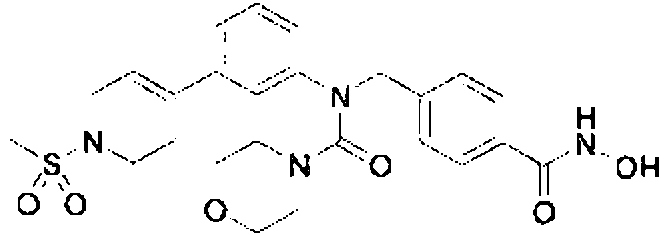
El compuesto de Fórmula 4-3 (4-((N-(3-(1 -(metilsulfonil)-1,2,3,6-tetrahidropiridin-4-il)fenil)morfolin-4-carboxamido)metil)benzoato de metilo; 0,114 g, 0,222 mmol) se disolvió en metanol (10 ml) y posteriormente se añadió hidroxilamina (solución acuosa de 50,0 % en peso; 1,36 ml, 22,2 mmol) e hidróxido potásico (0,125 g, 2,22 mmol) secuencialmente y después se agitó a temperatura ambiente durante 30 minutos. Tras completarse la reacción, la solución de reacción se concentró a presión reducida hasta que su volumen fue de aproximadamente 2 ml y la capa orgánica se extrajo con acetato de etilo y solución acuosa saturada de cloruro de amonio. La capa orgánica se lavó con agua, se deshidrató con sulfato de magnesio anhidro, se filtró y posteriormente se concentró a presión reducida para dar el Compuesto 420 deseado (0,038 g, 33 %) en forma de sólido marrón claro.The compound of Formula 4-3 (4 - ((N- (3- (1- (methylsulfonyl) -1,2,3,6-tetrahydropyridin-4-yl) phenyl) morpholine-4-carboxamido) methyl) benzoate of methyl, 0.114 g, 0.222 mmol) was dissolved in methanol (10 ml) and then hydroxylamine (50.0% by weight aqueous solution, 1.36 ml, 22.2 mmol) and potassium hydroxide (0.125 g, 2%) were added. , 22 mmol) sequentially and then stirred at room temperature for 30 minutes. After completion of the reaction, the reaction solution was concentrated under reduced pressure until its volume was about 2 ml and the organic layer was extracted with ethyl acetate and saturated aqueous solution of ammonium chloride. The organic layer was washed with water, dehydrated with anhydrous magnesium sulfate, filtered and then concentrated under reduced pressure to give the desired Compound 420 (0.038 g, 33%) as a light brown solid.
1H RMN (400 MHz, DIVISOR) 87,63 (d, 2 H, J = 8,0 Hz), 7,34 (d, 2 H, J = 7,9 Hz), 7,27 (t, 1 H, J = 7,8 Hz), 7,20 (s, 1 H), 7,14 (d, 1 H, J = 8,3 Hz), 7,04 (d, 1 H, J = 7,0 Hz), 6,19 (s, 1 H), 4,85 (s, 2 H), 3,83 (d, 2 H, J = 2,2 Hz), 3,39 - 3,35 (m, 6 H), 3,14 - 3,11 (m, 4 H), 2,92 (s, 3 H), 2,54 (m, 2 H). MS (ESI) m/z 515 (M+ H).1 H NMR (400 MHz, DIVIDER) 87.63 (d, 2 H, J = 8.0 Hz), 7.34 (d, 2 H, J = 7.9 Hz), 7.27 (t, 1 H , J = 7.8 Hz), 7.20 (s, 1 H), 7.14 (d, 1 H, J = 8.3 Hz), 7.04 (d, 1 H, J = 7.0) Hz), 6.19 (s, 1 H), 4.85 (s, 2 H), 3.83 (d, 2 H, J = 2.2 Hz), 3.39 - 3.35 (m, 6 H), 3.14 - 3.11 (m, 4 H), 2.92 (s, 3 H), 2.54 (m, 2 H). MS (ESI) m / z 515 (M + H).
Ejemplo 76: Síntesis del Compuesto 438Example 76: Synthesis of Compound 438
(Fórmula 1-2: 4-((2-fluoro-4-metilfenilamino)metil)benzoato de metilo)(Formula 1-2: methyl 4 - ((2-fluoro-4-methylphenylamino) methyl) benzoate)

El compuesto de Fórmula 1-1 (2-fluoro-4-metilbencenamina; 3,0 g, 23,9 mmol) y 4-formilbenzoato de metilo (3,94 g, 23,9 mmol) se disolvieron en metanol (500 ml) y se agitó a temperatura ambiente durante 2 horas. Después, se añadieron acético ácido (1,44 ml, 23,9 mmol) y cianoborohidruro sódico (1,51 g, 23,9 mmol) y se agitó durante 1 día. Se retiró parcialmente el metanol por medio de secado al aire para precipitar un sólido que se filtró y se secó para dar el compuesto deseado de Fórmula 1-2 (4,2 g, 64 %) en forma de un sólido de color blanco.The compound of Formula 1-1 (2-fluoro-4-methylbenzenamine; 3.0 g, 23.9 mmol) and methyl 4-formylbenzoate (3.94 g, 23.9 mmol) were dissolved in methanol (500 ml. ) and stirred at room temperature for 2 hours. Then, acetic acid (1.44 ml, 23.9 mmol) and sodium cyanoborohydride (1.51 g, 23.9 mmol) were added and stirred for 1 day. The methanol was partially removed by air drying to precipitate a solid which was filtered and dried to give the desired compound of Formula 1-2 (4.2 g, 64%) as a white solid.
(Fórmula 1-3: 4-(((2-fluoro-4-metilfenil)((4-nitrofenoxi)carbonil)amino)metil)benzoato de metilo)(Formula 1-3: 4 - (((2-fluoro-4-methylphenyl) ((4-nitrophenoxy) carbonyl) amino) methyl) methyl benzoate)

El compuesto de Fórmula 1-2 (4-((2-fluoro-4-metilfenilamino)metil)benzoato de metilo; 2 g, 7,32 mmol) y cloroformiato de 4-nitrofenilo (1,48 g, 7,32 mmol) se disolvieron en diclorometano (50 ml) y se agitó a temperatura ambiente durante 3 días y posteriormente la capa orgánica se extrajo con agua. La capa orgánica se lavó con una solución acuosa saturada de cloruro sódico, se deshidrató con sulfato de magnesio anhidro y posteriormente se concentró a presión reducida. El residuo se secó para dar el compuesto deseado de Fórmula 1-3 (2,5 g, 78 %) en forma de un sólido de color amarillo.The compound of Formula 1-2 (methyl 4 - ((2-fluoro-4-methylphenylamino) methyl) benzoate; 2 g, 7.32 mmol) and 4-nitrophenyl chloroformate (1.48 g, 7.32 mmol were dissolved in dichloromethane (50 ml) and stirred at room temperature for 3 days and then the organic layer was extracted with water. The organic layer was washed with a saturated aqueous solution of sodium chloride, dehydrated with anhydrous magnesium sulfate and subsequently concentrated under reduced pressure. The residue was dried to give the desired compound of Formula 1-3 (2.5 g, 78%) as a yellow solid.
(Fórmula 1-4: 4-((N-(2-fluoro-4-metilfenil)piperidin-1-carboxamido)metil)benzoato de metilo) (Formula 1-4: 4 - (methyl (N- (2-fluoro-4-methylphenyl) piperidin-1-carboxamido) methyl) benzoate)

El compuesto de Formula 1-3 (4-(((2-fluoro-4-metilfenil)((4-nitrofenoxi)carbonil)amino)metil)benzoato de metilo; 0,50 g, 1,14 mmol) y piperidina (0,113 ml, 1,14 mmol) se disolvieron en dimetilformamida (10 ml) y la mezcla se calentó y se agitó a 60 °C durante 2 días. Después, la dimetilformamida se retiró a presión reducida, se vertió agua en la mezcla de reacción y la capa orgánica se extrajo con acetato de etilo. La capa orgánica se lavó con una solución acuosa saturada de cloruro sódico, se deshidrató con sulfato de magnesio anhidro y posteriormente se concentró a presión reducida. El residuo se purificó y se concentró por cromatografía en columna (sílice; acetato de etilo/hexano=10 %) para dar el compuesto deseado de Fórmula 1-4 (0,56 g, 127 %) en forma de un aceite blanco.The compound of Formula 1-3 (methyl 4 - (((2-fluoro-4-methylphenyl) ((4-nitrophenoxy) carbonyl) amino) methyl) benzoate; 0.50 g, 1.14 mmol) and piperidine ( 0.113 ml, 1.14 mmol) were dissolved in dimethylformamide (10 ml) and the mixture was heated and stirred at 60 ° C for 2 days. Then, the dimethylformamide was removed under reduced pressure, water was poured into the reaction mixture and the organic layer was extracted with ethyl acetate. The organic layer was washed with a saturated aqueous solution of sodium chloride, dehydrated with anhydrous magnesium sulfate and subsequently concentrated under reduced pressure. The residue was purified and concentrated by column chromatography (silica; ethyl acetate / hexane = 10%) to give the desired compound of Formula 1-4 (0.56 g, 127%) as a white oil.
(Compuesto 438: N-(2-fluoro-4-metilfenil)-N-(4-(hidroxicarbamoil)bencil)piperidin-1-carboxamida)(Compound 438: N- (2-fluoro-4-methylphenyl) -N- (4- (hydroxycarbamoyl) benzyl) piperidine-1-carboxamide)

El compuesto de Fórmula 1-4 (4-((N-(2-fluoro-4-metilfenil)piperidin-1-carboxamido)metil)benzoato de metilo; 0,281 g, 0,731 mmol) se disolvió en metanol (20 ml) y se añadieron clorhidrato de hidroxilamina (0,254 g, 3,66 mmol) e hidróxido potásico (0,41 g, 7,31 mmol) y se agitó. Después, hidroxilamina (solución acuosa al 50 % en peso; 0,94 ml, 14,6 mmol) gota a gota y se agitó a temperatura ambiente durante 3 horas. Tras completarse la reacción, el metanol se retiró a presión reducida y se añadió una solución acuosa saturada de hidrogenocarbonato sódico para precipitar un sólido y el sólido resultante se filtró y se secó para dar el Compuesto 438 deseado (0,23 g, 82 %) en forma de un sólido de color amarillo.The compound of Formula 1-4 (methyl 4 - ((N- (2-fluoro-4-methylphenyl) piperidin-1-carboxamido) methyl) benzoate; 0.281 g, 0.731 mmol) was dissolved in methanol (20 ml) and Hydroxylamine hydrochloride (0.254 g, 3.66 mmol) and potassium hydroxide (0.41 g, 7.31 mmol) were added and stirred. Then, hydroxylamine (50% by weight aqueous solution, 0.94 ml, 14.6 mmol) dropwise and stirring at room temperature for 3 hours. After completion of the reaction, the methanol was removed under reduced pressure and a saturated aqueous solution of sodium hydrogencarbonate was added to precipitate a solid and the resulting solid was filtered and dried to give the desired Compound 438 (0.23 g, 82%) in the form of a yellow solid.
1H RMN (400 MHz, DIVISOR) 87,61 (d, 2 H, J = 8,2 Hz), 7,34 (d, 2 H, J = 8,2 Hz), 7,13 - 7,08 (m, 1 H), 7,03 (d, 1 H, J = 11,6 Hz), 6,94 (d, 1 H, J = 8,2 Hz), 4,68 (s, 2 H), 3,09 - 3,06 (m, 4 H), 2,24 (s, 3 H), 1,39 (m, 2 H), 1,19 (m, 4 H); MS (ESI) m/z 386,1 (M+ H).1 H NMR (400 MHz, DIVIDER) 87.61 (d, 2 H, J = 8.2 Hz), 7.34 (d, 2 H, J = 8.2 Hz), 7.13-7.08 ( m, 1 H), 7.03 (d, 1 H, J = 11.6 Hz), 6.94 (d, 1 H, J = 8.2 Hz), 4.68 (s, 2 H), 3.09-3.06 (m, 4 H), 2.24 (s, 3 H), 1.39 (m, 2 H), 1.19 (m, 4 H); MS (ESI) m / z 386.1 (M + H).
Ejemplo 77: Síntesis del Compuesto 439Example 77: Synthesis of Compound 439
(Fórmula 1-4: 4-((N-(2-fluoro-4-metilfenil)morfolin-4-carboxamido)metil)benzoato de metilo)(Formula 1-4: 4 - (methyl (N- (2-fluoro-4-methylphenyl) morpholin-4-carboxamido) methyl) benzoate)

El compuesto de Fórmula 1-3 (4-(((2-fluoro-4-metilfenil)((4-nitrofenoxi)carbonil)amino)metil)benzoato de metilo; 0,50 g, 1,14 mmol) y morfolina (0,099 ml, 1,14 mmol) se disolvieron en dimetilformamida (10 ml) y la mezcla se calentó y se agitó a 60 °C durante 2 días. Después, la dimetilformamida se retiró a presión reducida, se vertió agua en la mezcla de reacción y la capa orgánica se extrajo con acetato de etilo. La capa orgánica se lavó con una solución acuosa saturada de cloruro sódico, se deshidrató con sulfato de magnesio anhidro y posteriormente se concentró a presión reducida. El residuo se purificó y se concentró por cromatografía en columna (sílice; acetato de etilo/hexano=20 %) para dar el compuesto deseado de Fórmula 1-4 (0,50 g, 114 %) en forma de un aceite blanco.The compound of Formula 1-3 (methyl 4 - (((2-fluoro-4-methylphenyl) ((4-nitrophenoxy) carbonyl) amino) methyl) benzoate; 0.50 g, 1.14 mmol) and morpholine ( 0.099 ml, 1.14 mmol) were dissolved in dimethylformamide (10 ml) and the mixture was heated and stirred at 60 ° C for 2 days. Then, the dimethylformamide was removed under reduced pressure, water was poured into the reaction mixture and the organic layer was extracted with ethyl acetate. The organic layer was washed with a saturated aqueous solution of sodium chloride, dehydrated with anhydrous magnesium sulfate and subsequently concentrated under reduced pressure. The residue was purified and concentrated by column chromatography (silica; ethyl acetate / hexane = 20%) to give the desired compound of Formula 1-4 (0.50 g, 114%) as a white oil.
(Compuesto 439: N-(2-fluoro-4-metilfenil)-N-(4-(hidroxicarbamoil)bencil)morfolin-4-carboxamida)(Compound 439: N- (2-fluoro-4-methylphenyl) -N- (4- (hydroxycarbamoyl) benzyl) morpholine-4-carboxamide)

El compuesto de Fórmula 1-4 (4-((N-(2-fluoro-4-metilfenil)morfolin-4-carboxamido)metil)benzoato de metilo; 0,213 g, 0,551 mmol) se disolvió en metanol (20 ml) y se añadieron clorhidrato de hidroxilamina (0,191 g, 2,76 mmol) e hidróxido potásico (0,309 g, 5,51 mmol) y se agitó. Después, hidroxilamina (solución acuosa al 50 % en peso; 0,709 ml, 11,0 mmol) gota a gota y se agitó a temperatura ambiente durante 3 horas. Tras completarse la reacción, el metanol se retiró a presión reducida y se añadió una solución acuosa saturada de hidrogenocarbonato sódico para precipitar un sólido y el sólido resultante se filtró y se secó para dar el Compuesto 439 deseado (0,175 g, 82 %) en forma de un sólido de color blanco.The compound of Formula 1-4 (methyl 4 - ((N- (2-fluoro-4-methylphenyl) morpholin-4-carboxamido) methyl) benzoate; 0.213 g, 0.551 mmol) was dissolved in methanol (20 ml) and Hydroxylamine hydrochloride (0.191 g, 2.76 mmol) and potassium hydroxide (0.309 g, 5.51 mmol) were added and stirred. Then, hydroxylamine (50% strength by weight aqueous solution, 0.709 ml, 11.0 mmol) was added dropwise and stirred at room temperature for 3 hours. After completion of the reaction, the methanol was removed under reduced pressure and a saturated aqueous solution of sodium hydrogencarbonate was added to precipitate a solid and the resulting solid was filtered and dried to give the desired Compound 439 (0.175 g, 82%) as a white solid.
1H RMN (400 MHz, DMSO-da) 811,14 (s, 1 H), 9,01 (s, 1 H), 7,62 (d, 2 H, J = 8,2 Hz), 7,33 (d, 2 H, J = 8,2 Hz), 7,17 -7,13 (m, 1 H), 7,05 (d, 1 H, J = 11,6 Hz), 6,96 (d, 1 H, J = 8,2 Hz), 4,72 (s, 2 H), 3,33 - 3,29 (m, 4 H), 3,09 - 3,06 (m, 4 H), 3,42 (s, 3 H); MS (ESI) m/z 388,2 (M+ H).1 H NMR (400 MHz, DMSO-da) 811.14 (s, 1 H), 9.01 (s, 1 H), 7.62 (d, 2 H, J = 8.2 Hz), 7.33 (d, 2 H, J = 8.2 Hz), 7.17 -7.13 (m, 1 H), 7.05 (d, 1 H, J = 11.6 Hz), 6.96 (d , 1 H, J = 8.2 Hz), 4.72 (s, 2 H), 3.33 - 3.29 (m, 4 H), 3.09 - 3.06 (m, 4 H), 3.42 (s, 3 H); MS (ESI) m / z 388.2 (M + H).
Ejemplo 78: Síntesis del Compuesto 440Example 78: Synthesis of Compound 440
(Fórmula 1-4: 4-((N-(2-fluoro-4-metilfenil)2,6-dimetilmorfolin-4-carboxamido)metil)benzoato de metilo )(Formula 1-4: 4 - (methyl (N- (2-fluoro-4-methylphenyl) 2,6-dimethylmorpholin-4-carboxamido) methyl) benzoate)

El compuesto de Fórmula 1-3 (4-(((2-fluoro-4-metilfenil)((4-nitrofenoxi)carbonil)amino)metil)benzoato de metilo; 0,50 g, 1,14 mmol) y 2,6-dimetilmorfolina (0,14 ml, 1,14 mmol) se disolvieron en dimetilformamida (10 ml) y la mezcla se calentó y se agitó a 60 °C durante 2 días. Después, la dimetilformamida se retiró a presión reducida, se vertió agua en la mezcla de reacción y la capa orgánica se extrajo con acetato de etilo. La capa orgánica se lavó con una solución acuosa saturada de cloruro sódico, se deshidrató con sulfato de magnesio anhidro y posteriormente se concentró a presión reducida. El residuo se purificó y se concentró por cromatografía en columna (sílice; acetato de etilo/hexano=20 %) para dar el compuesto deseado de Fórmula 1-4 (0,27 g, 57 %) en forma de un aceite blanco. The compound of Formula 1-3 (methyl 4 - (((2-fluoro-4-methylphenyl) ((4-nitrophenoxy) carbonyl) amino) methyl) benzoate; 0.50 g, 1.14 mmol) and 2, 6-dimethylmorpholine (0.14 ml, 1.14 mmol) was dissolved in dimethylformamide (10 ml) and the mixture was heated and stirred at 60 ° C for 2 days. Then, the dimethylformamide was removed under reduced pressure, water was poured into the reaction mixture and the organic layer was extracted with ethyl acetate. The organic layer was washed with a saturated aqueous solution of sodium chloride, dehydrated with anhydrous magnesium sulfate and subsequently concentrated under reduced pressure. The residue was purified and concentrated by column chromatography (silica; ethyl acetate / hexane = 20%) to give the desired compound of Formula 1-4 (0.27 g, 57%) as a white oil.
(Compuesto 440: N-(2-fluoro-4-metilfenil)-N-(4-(hidroxicarbamoil)bencil)-2,6-dimetilmorfolin-4-carboxamida)(Compound 440: N- (2-fluoro-4-methylphenyl) -N- (4- (hydroxycarbamoyl) benzyl) -2,6-dimethylmorpholine-4-carboxamide)

El compuesto de Fórmula 1-4 (4-((N-(2-fluoro-4-metilfenil)-2,6-dimetilmorfolin-4-carboxamido)metil)benzoato de metilo; 0,104 g, 0,251 mmol) se disolvió en metanol (20 ml) y se añadieron clorhidrato de hidroxilamina (0,087 g, 1,26 mmol) e hidróxido potásico (0,141 g, 2,51 mmol) y se agitó. Después, hidroxilamina (solución acuosa al 50 % en peso; 0,323 ml, 5,02 mmol) gota a gota y se agitó a temperatura ambiente durante 3 horas. Tras completarse la reacción, el metanol se retiró a presión reducida y se añadió una solución acuosa saturada de hidrogenocarbonato sódico para precipitar un sólido y el sólido resultante se filtró y se secó para dar el Compuesto 440 deseado (0,086 g, 83 %) en forma de un sólido de color blanco.The compound of Formula 1-4 (methyl 4 - ((N- (2-fluoro-4-methylphenyl) -2,6-dimethylmorpholin-4-carboxamido) methyl) benzoate; 0.104 g, 0.251 mmol) was dissolved in methanol (20 ml) and hydroxylamine hydrochloride (0.087 g, 1.26 mmol) and potassium hydroxide (0.141 g, 2.51 mmol) were added and stirred. Next, hydroxylamine (50% strength by weight aqueous solution, 0.323 ml, 5.02 mmol) was added dropwise and stirred at room temperature for 3 hours. After completion of the reaction, the methanol was removed under reduced pressure and a saturated aqueous solution of sodium hydrogencarbonate was added to precipitate a solid and the resulting solid was filtered and dried to give the desired Compound 440 (0.086 g, 83%) as of a white solid.
1H RMN (400 MHz, DMSO-d6) 87,60 (d, 2 H, J = 7,8 Hz), 7,27 (d, 2 H, J = 6,7 Hz), 7,14 - 7,12 (m, 1 H), 7,03 (d, 1 H, J = 11,8 Hz), 6,94 (d, 1 H, J = 8,0 Hz), 4,68 (s, 2 H), 3,49 (d, 2 H, J = 12,7 Hz), 3,19 -3,17 (m, 2 H), 2,27 -2,21 (m, 2 H), 0,90 (d, 6 H, J = 6,1 Hz); MS (ESI) m/z 416,2 (M+ H).1 H NMR (400 MHz, DMSO-d 6) 87.60 (d, 2 H, J = 7.8 Hz), 7.27 (d, 2 H, J = 6.7 Hz), 7.14-7, 12 (m, 1 H), 7.03 (d, 1 H, J = 11.8 Hz), 6.94 (d, 1 H, J = 8.0 Hz), 4.68 (s, 2 H) ), 3.49 (d, 2 H, J = 12.7 Hz), 3.19 -3.17 (m, 2 H), 2.27-2.21 (m, 2 H), 0.90 (d, 6 H, J = 6.1 Hz); MS (ESI) m / z 416.2 (M + H).
Ejemplo 79: Síntesis del Compuesto 441Example 79: Synthesis of Compound 441
(Fórmula 1-4: 4-((N-(2-fluoro-4-metilfenil)4-metilpiperazin-1-carboxamido)metil)benzoato de metilo)(Formula 1-4: 4 - (methyl (N- (2-fluoro-4-methylphenyl) -4-methylpiperazine-1-carboxamido) methyl) benzoate)

El compuesto de Fórmula 1-3 (4-(((2-fluoro-4-metilfenil)((4-nitrofenoxi)carbonil)amino)metil)benzoato de metilo; 0,50 g, 1,14 mmol) y 1-metilpiperazina (0,127 ml, 1,14 mmol) se disolvieron en dimetilformamida (10 ml) y la mezcla se calentó y se agitó a 60 °C durante 2 días. Después, la dimetilformamida se retiró a presión reducida, se vertió agua en la mezcla de reacción y la capa orgánica se extrajo con acetato de etilo. La capa orgánica se lavó con una solución acuosa saturada de cloruro sódico, se deshidrató con sulfato de magnesio anhidro y posteriormente se concentró a presión reducida. El residuo se purificó y se concentró por cromatografía en columna (sílice; acetato de etilo/hexano=5 %) para dar el compuesto deseado de Fórmula 1-4 (0,43 g, 94 %) en forma de un aceite de color amarillo.The compound of Formula 1-3 (methyl 4 - (((2-fluoro-4-methylphenyl) ((4-nitrophenoxy) carbonyl) amino) methyl) benzoate; 0.50 g, 1.14 mmol) and 1- methylpiperazine (0.127 ml, 1.14 mmol) were dissolved in dimethylformamide (10 ml) and the mixture was heated and stirred at 60 ° C for 2 days. Then, the dimethylformamide was removed under reduced pressure, water was poured into the reaction mixture and the organic layer was extracted with ethyl acetate. The organic layer was washed with a saturated aqueous solution of sodium chloride, dehydrated with anhydrous magnesium sulfate and subsequently concentrated under reduced pressure. The residue was purified and concentrated by column chromatography (silica; ethyl acetate / hexane = 5%) to give the desired compound of Formula 1-4 (0.43 g, 94%) as a yellow oil. .
(Compuesto 441: N-(2-fluoro-4-metilfenil)-N-(4-(hidroxicarbamoil)bencil)-4-metilpiperazin-1-carboxamida) (Compound 441: N- (2-fluoro-4-methylphenyl) -N- (4- (hydroxycarbamoyl) benzyl) -4-methylpiperazine-1-carboxamide)

El compuesto de Formula 1-4 (4-((N-(2-fluoro-4-metilfenil)4-metilpiperazin-1-carboxamido)metil)benzoato de metilo; 0,095 g, 0,238 mmol) se disolvió en metanol (20 ml) y se añadieron clorhidrato de hidroxilamina (0,083 g, 1,19 mmol) e hidróxido potásico (0,133 g, 2,38 mmol) y se agitó. Después, hidroxilamina (solución acuosa al 50 % en peso; 0,306 ml, 4,76 mmol) gota a gota y se agitó a temperatura ambiente durante 3 horas. Tras completarse la reacción, el metanol se retiró a presión reducida y se añadió una solución acuosa saturada de hidrogenocarbonato sódico para precipitar un sólido y el sólido resultante se filtró y se secó para dar el Compuesto 441 deseado (0,008 g, 8 %) en forma de un sólido de color blanco.The compound of Formula 1-4 (methyl 4 - ((N- (2-fluoro-4-methylphenyl) 4-methylpiperazine-1-carboxamido) methyl) benzoate; 0.095 g, 0.238 mmol) was dissolved in methanol (20 ml ) and hydroxylamine hydrochloride (0.083 g, 1.19 mmol) and potassium hydroxide (0.133 g, 2.38 mmol) were added and stirred. Then, hydroxylamine (50% by weight aqueous solution, 0.306 ml, 4.76 mmol) dropwise and stirring at room temperature for 3 hours. After completion of the reaction, the methanol was removed under reduced pressure and a saturated aqueous solution of sodium hydrogencarbonate was added to precipitate a solid and the resulting solid was filtered and dried to give the desired Compound 441 (0.008 g, 8%) as of a white solid.
1H RMN (400 MHz, DMSO-da) 811,14 (s, 1 H), 9,01 (s, 1 H), 7,61 (d, 2 H, J = 8,3 Hz), 7,32 (d, 2 H, J = 8,2 Hz), 7,14 -7,10 (m, 1 H), 7,05 - 7,02 (m, 1 H), 6,95 (d, 1 H, J = 8,2 Hz), 4,70 (s, 2 H), 3,09 - 3,07 (m, 4 H), 2,24 (s, 3 H), 2,05 -2,02 (m, 4 H); MS (ESI) m/z 401,2 (M+ H).1 H NMR (400 MHz, DMSO-da) 811.14 (s, 1 H), 9.01 (s, 1 H), 7.61 (d, 2 H, J = 8.3 Hz), 7.32 (d, 2 H, J = 8.2 Hz), 7.14 -7.10 (m, 1 H), 7.05-7.02 (m, 1 H), 6.95 (d, 1 H) , J = 8.2 Hz), 4.70 (s, 2 H), 3.09 - 3.07 (m, 4 H), 2.24 (s, 3 H), 2.05 -2.02 (m, 4 H); MS (ESI) m / z 401.2 (M + H).
Ejemplo 80: Síntesis del Compuesto 450Example 80: Synthesis of Compound 450
(Fórmula 7-6: 4-((4-acetil-N-(piridin-2-il)-1,4-diazepano-1-carboxamido)metil)benzoato de metilo)(Formula 7-6: methyl 4 - ((4-acetyl-N- (pyridin-2-yl) -1,4-diazepane-1-carboxamido) methyl) benzoate)

El compuesto de Fórmula 7-5 (4-((((4-nitrofenoxi)carbonil)(piridin-2-il)amino)metil)benzoato de metilo; 0,40 g, 0,74 mmol) se disolvió en dimetilformamida (10 ml) y posteriormente se añadió 1-(1,4-diazepano-1-il)etanona (0,102 ml, 1,08 mmol) y la mezcla se calentó y se agitó a 60 °C durante 2 días. Después, la dimetilformamida se retiró a presión reducida, se vertió agua en la mezcla de reacción y la capa orgánica se extrajo con acetato de etilo. La capa orgánica se lavó con una solución acuosa saturada de cloruro sódico, se deshidrató con sulfato de magnesio anhidro y posteriormente se concentró a presión reducida. El residuo se purificó y se concentró por cromatografía en columna (sílice; metanol/diclorometano=5 %) para dar el compuesto deseado de Fórmula 7-6 (0,378 g, 94 %) en forma de un aceite blanco.The compound of Formula 7-5 (methyl 4 - ((((((4-nitrophenoxy) carbonyl) (pyridin-2-yl) amino) methyl) benzoate; 0.40 g, 0.74 mmol) was dissolved in dimethylformamide ( 10 ml) and then 1- (1,4-diazepane-1-yl) ethanone (0.102 ml, 1.08 mmol) was added and the mixture was heated and stirred at 60 ° C for 2 days. Then, the dimethylformamide was removed under reduced pressure, water was poured into the reaction mixture and the organic layer was extracted with ethyl acetate. The organic layer was washed with a saturated aqueous solution of sodium chloride, dehydrated with anhydrous magnesium sulfate and subsequently concentrated under reduced pressure. The residue was purified and concentrated by column chromatography (silica; methanol / dichloromethane = 5%) to give the desired compound of Formula 7-6 (0.378 g, 94%) as a white oil.
(el Compuesto 450: 4-acetil-N-(4-(hidroxicarbamoil)bencil)-N-(piridin-2-il)-1,4-diazepano-1-carboxamida)(Compound 450: 4-acetyl-N- (4- (hydroxycarbamoyl) benzyl) -N- (pyridin-2-yl) -1,4-diazepane-1-carboxamide)
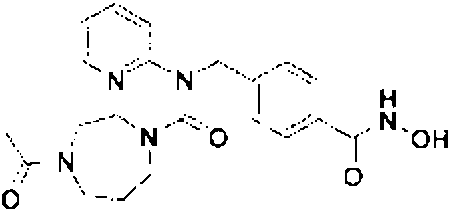
El compuesto de Fórmula 7-6 (4-((4-acetil-N-(piridin-2-il)-1,4-diazepano-1-carboxamido)metil)benzoato de metilo; 0,20 g, 0,487 mmol) se disolvió en metanol (20 ml), se añadieron hidroxilamina (0,169 g, 2,44 mmol) e hidróxido potásico (0,273 g, 4,87 mmol). Después, hidroxilamina (solución acuosa al 50 % en peso; 0,626 ml, 9,75 mmol) gota a gota y se agitó a temperatura ambiente durante 3 horas. Tras completarse la reacción, el metanol se retiró a presión reducida, se añadió una solución acuosa saturada de hidrogenocarbonato sódico para precipitar un sólido y el sólido resultante se filtró y secó para dar el Compuesto 450 deseado (0,07 g, 35 %) en forma de un aceite de color amarillo.The compound of Formula 7-6 (methyl 4 - ((4-acetyl-N- (pyridin-2-yl) -1,4-diazepane-1-carboxamido) methyl) benzoate; 0.20 g, 0.487 mmol) was dissolved in methanol (20 ml), hydroxylamine (0.169 g, 2.44 mmol) and potassium hydroxide (0.273 g, 4.87 mmol) were added. Then, hydroxylamine (50% by weight aqueous solution, 0.626 ml, 9.75 mmol) was added dropwise and stirred at room temperature for 3 hours. After completion of the reaction, the methanol was removed under reduced pressure, a saturated aqueous solution of sodium hydrogencarbonate was added to precipitate a solid and the resulting solid was filtered and dried to give the desired Compound 450 (0.07 g, 35%) in shape of a yellow oil.
1H RMN (400 MHz, MeOD-da) 88,33 - 8,30 (m, 1 H), 7,74 - 7,63 (m, 3 H), 7,51 - 7,46 (m, 2 H), 7,06 - 6,99 (m, 2 H), 4,89 (s, 2 H), 3,58 -3,27 (m, 8 H, 1,99 - 1,96 (m, 3 H), 1,76 - 1,57 (m, 2 H); MS (ESI) m/z 412,2 (M+ H).1 H NMR (400 MHz, MeOD-da) 88.33-8.30 (m, 1 H), 7.74-7.63 (m, 3 H), 7.51-7.46 (m, 2 H) ), 7.06-6.99 (m, 2 H), 4.89 (s, 2 H), 3.58 -3.27 (m, 8 H, 1.99- 1.96 (m, 3 H), 1.76-1.57 (m, 2 H); MS (ESI) m / z 412.2 (M + H).
Ejemplo 81: Síntesis del Compuesto 451Example 81: Synthesis of Compound 451
(Fórmula 7-6: 4-((4-(ciclopropanocarbonil)-N-(piridin-2-il)piperazin-1-carboxamido)metil)benzoato de metilo) El compuesto de Fórmula 7-5 (4-((((4-nitrofenoxi)carbonil)(piridin-2-il)amino)metil)benzoato de metilo; 0,40 g, 0,982 mmol) se disolvió en dimetilformamida (10 ml) y posteriormente se añadió cidopropil(piperazin-1-il)metanona (0,167 ml, 1,17 mmol) y la mezcla se calentó y se agitó a 60 °C durante 2 días. Después, la dimetilformamida se retiró a presión reducida, se vertió agua en la mezcla de reacción y la capa orgánica se extrajo con acetato de etilo. La capa orgánica se lavó con una solución acuosa saturada de cloruro sódico, se deshidrató con sulfato de magnesio anhidro y posteriormente se concentró a presión reducida. El residuo se purificó y se concentró por cromatografía en columna (sílice; metanol/diclorometano=5 %) para dar el compuesto deseado de Fórmula 7-6 (0,4 g, 96 %) en forma de un aceite blanco.(Formula 7-6: methyl 4 - ((4- (cyclopropanecarbonyl) -N- (pyridin-2-yl) piperazine-1-carboxamido) methyl) benzoate) The compound of Formula 7-5 (methyl 4 - (((((4-nitrophenoxy) carbonyl) (pyridin-2-yl) amino) methyl) benzoate; 0.40 g, 0.982 mmol) was dissolved in dimethylformamide (10 ml). ) and then cidopropyl (piperazin-1-yl) methanone (0.167 ml, 1.17 mmol) was added and the mixture was heated and stirred at 60 ° C for 2 days. Then, the dimethylformamide was removed under reduced pressure, water was poured into the reaction mixture and the organic layer was extracted with ethyl acetate. The organic layer was washed with a saturated aqueous solution of sodium chloride, dehydrated with anhydrous magnesium sulfate and subsequently concentrated under reduced pressure. The residue was purified and concentrated by column chromatography (silica; methanol / dichloromethane = 5%) to give the desired compound of Formula 7-6 (0.4 g, 96%) as a white oil.
(el Compuesto 451: 4-(ciclopropanocarbonil)-N-(4-(hidroxicarbamoil)bencil)-N-(piridin-2-il)piperazin-1-carboxamida)(Compound 451: 4- (cyclopropanecarbonyl) -N- (4- (hydroxycarbamoyl) benzyl) -N- (pyridin-2-yl) piperazine-1-carboxamide)

El compuesto de Fórmula 7-6 (4-((4-(ciclopropanocarbonil)-N-(piridin-2-il)piperazin-1-carboxamido)metil)benzoato de metilo; 0,20 g, 0,473 mmol) se disolvió en metanol (20 ml), se añadieron hidroxilamina (0,164 g, 2,38 mmol) e hidróxido potásico (0,265 g, 4,73 mmol) y se agitó. Después, hidroxilamina (solución acuosa al 50 % en peso; 0,61 ml, 9,47 mmol) gota a gota y se agitó a temperatura ambiente durante 3 horas. Tras completarse la reacción, se añadió una solución acuosa saturada de hidrogenocarbonato sódico para precipitar un sólido y el sólido resultante se filtró y secó para dar el Compuesto 451 deseado (0,05 g, 25 %) en forma de un aceite de color amarillo.The compound of Formula 7-6 (methyl 4 - ((4- (cyclopropanecarbonyl) -N- (pyridin-2-yl) piperazine-1-carboxamido) methyl) benzoate; 0.20 g, 0.473 mmol) was dissolved in methanol (20 ml), hydroxylamine (0.164 g, 2.38 mmol) and potassium hydroxide (0.265 g, 4.73 mmol) were added and stirred. Then, hydroxylamine (50% strength by weight aqueous solution, 0.61 ml, 9.47 mmol) was added dropwise and stirred at room temperature for 3 hours. After completion of the reaction, a saturated aqueous solution of sodium hydrogencarbonate was added to precipitate a solid and the resulting solid was filtered and dried to give the desired Compound 451 (0.05 g, 25%) as a yellow oil.
1H RMN (400 MHz, MeOD-da) 88,33 (d, 1 H, J = 3,7 Hz), 7,75 - 7,71 (m, 1 H), 7,67 (d, 2 H, J = 8,2 Hz), 7,49 (d, 2 H, J = 8,2 Hz), 7,10 (d, 1 H, J = 8,3 Hz), 7,06 - 7,03 (m, 1 H), 5,05 (s, 2 H), 3,67 (m, 4 H), 3,31 (m, 4 H), 1,89 - 1,86 (m, 1 H), 0,89 - 0,88 (m, 4 H); MS (ESI) m/z 424,2 (M+ H).1 H NMR (400 MHz, MeOD-da) 88.33 (d, 1 H, J = 3.7 Hz), 7.75-7.71 (m, 1 H), 7.67 (d, 2 H, J = 8.2 Hz), 7.49 (d, 2 H, J = 8.2 Hz), 7.10 (d, 1 H, J = 8.3 Hz), 7.06-7.03 ( m, 1 H), 5.05 (s, 2 H), 3.67 (m, 4 H), 3.31 (m, 4 H), 1.89-1.86 (m, 1 H), 0.89-0.88 (m, 4 H); MS (ESI) m / z 424.2 (M + H).
Ejemplo 82: Síntesis del Compuesto 453Example 82: Synthesis of Compound 453
(Fórmula 1-4: 4-((4-etil-N-(2-fluoro-4-metilfenil)piperazin-1-carboxamido)metil)benzoato de metilo)(Formula 1-4: 4 - ((methyl 4-ethyl-N- (2-fluoro-4-methylphenyl) piperazine-1-carboxamido) methyl) benzoate)

El compuesto de Fórmula 1-3 (4-(((2-fluoro-4-metilfenil)((4-nitrofenoxi)carbonil)amino)metil)benzoato de metilo; 0,20 g, 0,456 mmol) y 1 -etilpiperazina (0,116 ml, 0,912 mmol) se disolvieron en dimetilformamida (10 ml) y la mezcla se calentó y se agitó a 60 °C durante 12 horas. Después, la dimetilformamida se retiró a presión reducida, se vertió agua en la mezcla de reacción y la capa orgánica se extrajo con acetato de etilo. La capa orgánica se lavó con una solución acuosa saturada de cloruro sódico, se deshidrató con sulfato de magnesio anhidro y posteriormente se concentró a presión reducida. El residuo se purificó y se concentró por cromatografía en columna (sílice; metanol/diclorometano=5 %) para dar el compuesto deseado de Fórmula 1-4 (0,14 g, 74 %) en forma de un aceite de color amarillo.The compound of Formula 1-3 (methyl 4 - (((2-fluoro-4-methylphenyl) ((4-nitrophenoxy) carbonyl) amino) methyl) benzoate; 0.20 g, 0.456 mmol) and 1-ethylpiperazine ( 0.116 ml, 0.912 mmol) were dissolved in dimethylformamide (10 ml) and the mixture was heated and stirred at 60 ° C for 12 hours. Then, the dimethylformamide was removed under reduced pressure, water was poured into the reaction mixture and the organic layer was extracted with ethyl acetate. The organic layer was washed with a saturated aqueous solution of sodium chloride, dehydrated with anhydrous magnesium sulfate and subsequently concentrated under reduced pressure. The residue was purified and concentrated by column chromatography (silica; methanol / dichloromethane = 5%) to give the desired compound of Formula 1-4 (0.14 g, 74%) as a yellow oil.
(el Compuesto 453: 4-etil-N-(2-fluoro-4-metilfenil)-N-(4-(hidroxicarbamoil)bencil)piperazin-1-carboxamida)(Compound 453: 4-ethyl-N- (2-fluoro-4-methylphenyl) -N- (4- (hydroxycarbamoyl) benzyl) piperazine-1-carboxamide)

El compuesto de Fórmula 1-4 (4-((4-etil-N-(2-fluoro-4-metilfenil)piperazin-1-carboxamido)metil)benzoato de metilo; 0,14 g, 0,339 mmol) se disolvió en metanol (5 ml) y se añadieron clorhidrato de hidroxilamina (0,118 g, 1,69 mmol) e hidróxido potásico (0,19 g, 3,39 mmol) y se agitó. Después, hidroxilamina (solución acuosa al 50 % en peso; 0,435 ml, 6,77 mmol) gota a gota y se agitó a temperatura ambiente durante 3 horas. Tras completarse la reacción, el metanol se retiró a presión reducida y se añadió una solución acuosa saturada de hidrogenocarbonato sódico para precipitar un sólido y el sólido resultante se filtró y se secó para dar el Compuesto 453 deseado (0,12 g, 86 %) en forma de un aceite de color amarillo.The compound of Formula 1-4 (methyl 4 - ((4-ethyl-N- (2-fluoro-4-methylphenyl) piperazine-1-carboxamido) methyl) benzoate; 0.14 g, 0.339 mmol) was dissolved in methanol (5 ml) and hydroxylamine hydrochloride (0.118 g, 1.69 mmol) and potassium hydroxide (0.19 g, 3.39 mmol) were added and stirred. Then, hydroxylamine (50% strength by weight aqueous solution, 0.435 ml, 6.77 mmol) was added dropwise and stirred at room temperature for 3 hours. After completion of the reaction, the methanol was removed under reduced pressure and a saturated aqueous solution of sodium hydrogencarbonate was added to precipitate a solid and the resulting solid was filtered and dried to give the desired Compound 453 (0.12 g, 86%) in the form of a yellow oil.
1H RMN (400 MHz, MeOD-ds) 87,64 (d, 2 H, J = 8,2 Hz), 7,33 (d, 2 H, J = 8,2 Hz), 7,06 - 6,93 (m, 3 H), 4,77 (s, 2 H), 3,26 - 3,24 (m, 4 H), 2,34 (q, 2 H, J = 7,2 Hz), 2,29 (s, 3 H), 2,26 - 2,23 (m, 4 H), 1,03 (t, 3 H, J = 7,2 Hz); MS (ESI) m/z 415,2 (M+ H). 1 H NMR (400 MHz, MeOD-ds) 87.64 (d, 2 H, J = 8.2 Hz), 7.33 (d, 2 H, J = 8.2 Hz), 7.06-6, 93 (m, 3 H), 4.77 (s, 2 H), 3.26 - 3.24 (m, 4 H), 2.34 (q, 2 H, J = 7.2 Hz), 2 , 29 (s, 3 H), 2.26-2.23 (m, 4 H), 1.03 (t, 3 H, J = 7.2 Hz); MS (ESI) m / z 415.2 (M + H).
Ejemplo 83: Síntesis del Compuesto 454Example 83: Synthesis of Compound 454
(Fórmula 1-4: 4-((N-(2-fluoro-4-metilfenil)-4-(2-metoxifenil)piperazin-1-carboxamido)metil)benzoato de metilo)(Formula 1-4: 4 - ((N- (2-fluoro-4-methylphenyl) -4- (2-methoxyphenyl) piperazine-1-carboxamido) methyl) benzoate methyl)

El compuesto de Fórmula 1-3 (4-(((2-fluoro-4-metilfenil)((4-nitrofenoxi)carbonil)amino)metil)benzoato de metilo; 0,20 g, 0,456 mmol) y 4-(2-metoxifenil)piperazina (0,175 ml, 0,912 mmol) se disolvieron en dimetilformamida (10 ml) y la mezcla se calentó y se agitó a 60 °C durante 12 horas. Después, la dimetilformamida se retiró a presión reducida, se vertió agua en la mezcla de reacción y la capa orgánica se extrajo con acetato de etilo. La capa orgánica se lavó con una solución acuosa saturada de cloruro sódico, se deshidrató con sulfato de magnesio anhidro y posteriormente se concentró a presión reducida. El residuo se purificó y se concentró por cromatografía en columna (sílice; acetato de etilo/hexano = 30 %) para dar el compuesto deseado de Fórmula 1-4 (0,15 g, 67 %) en forma de un aceite de color amarillo.The compound of Formula 1-3 (methyl 4 - (((2-fluoro-4-methylphenyl) ((4-nitrophenoxy) carbonyl) amino) methyl) benzoate; 0.20 g, 0.456 mmol) and 4- (2 -methoxyphenyl) piperazine (0.175 ml, 0.912 mmol) were dissolved in dimethylformamide (10 ml) and the mixture was heated and stirred at 60 ° C for 12 hours. Then, the dimethylformamide was removed under reduced pressure, water was poured into the reaction mixture and the organic layer was extracted with ethyl acetate. The organic layer was washed with a saturated aqueous solution of sodium chloride, dehydrated with anhydrous magnesium sulfate and subsequently concentrated under reduced pressure. The residue was purified and concentrated by column chromatography (silica; ethyl acetate / hexane = 30%) to give the desired compound of Formula 1-4 (0.15 g, 67%) as a yellow oil. .
(Compuesto 454: N-(2-fluoro-4-metilfenil)-N-(4-(hidroxicarbamoil)bencil)-4-(2-metoxifenil)piperazin-1-carboxamida)(Compound 454: N- (2-fluoro-4-methylphenyl) -N- (4- (hydroxycarbamoyl) benzyl) -4- (2-methoxyphenyl) piperazine-1-carboxamide)

El compuesto de Fórmula 1-4 (4-((N-(2-fluoro-4-metilfenil)-4-(2-metoxifenil)piperazin-1-carboxamido)metil)benzoato de metilo; 0,15 g, 0,305 mmol) se disolvió en metanol (5 ml) y se añadieron clorhidrato de hidroxilamina (0,106 g, 1,53 mmol) e hidróxido potásico (0,171 g, 3,05 mmol) y se agitó. Después, hidroxilamina (solución acuosa al 50 % en peso; 0,392 ml, 6,10 mmol) gota a gota y se agitó a temperatura ambiente durante 3 horas. Tras completarse la reacción, el metanol se retiró a presión reducida y se añadió una solución acuosa saturada de hidrogenocarbonato sódico para precipitar un sólido y el sólido resultante se filtró y se secó para dar el Compuesto 454 deseado (0,06 g, 43 %) en forma de un sólido de color amarillo.The compound of Formula 1-4 (methyl 4 - ((N- (2-fluoro-4-methylphenyl) -4- (2-methoxyphenyl) piperazine-1-carboxamido) methyl) benzoate; 0.15 g, 0.305 mmol ) was dissolved in methanol (5 ml) and hydroxylamine hydrochloride (0.106 g, 1.53 mmol) and potassium hydroxide (0.171 g, 3.05 mmol) were added and stirred. Next, hydroxylamine (50% by weight aqueous solution, 0.392 ml, 6.10 mmol) was added dropwise and stirred at room temperature for 3 hours. After completion of the reaction, the methanol was removed under reduced pressure and a saturated aqueous solution of sodium hydrogencarbonate was added to precipitate a solid and the resulting solid was filtered and dried to give the desired Compound 454 (0.06 g, 43%) in the form of a yellow solid.
1H RMN (400 MHz, MeOD-ds) 87,67 (d, 2 H, J = 8,0 Hz), 7,44 (d, 2 H, J = 8,0 Hz), 7,14 -7,10 (m, 1 H), 7,03 -6,84 (m, 6 H), 4,83 (s, 2 H), 3,82 (s, 3 H), 3,38 (m, 4 H), 2,80 (m, 4 H), 2,33 (s, 3 H); MS (ESI) m/z 493,2 (M+ H).1 H NMR (400 MHz, MeOD-ds) 87.67 (d, 2 H, J = 8.0 Hz), 7.44 (d, 2 H, J = 8.0 Hz), 7.14 -7, 10 (m, 1 H), 7.03 -6.84 (m, 6 H), 4.83 (s, 2 H), 3.82 (s, 3 H), 3.38 (m, 4 H) ), 2.80 (m, 4 H), 2.33 (s, 3 H); MS (ESI) m / z 493.2 (M + H).
Ejemplo 84: Síntesis del Compuesto 455Example 84: Synthesis of Compound 455
(Fórmula 1-4: 4-((N-(2-fluoro-4-metilfenil)-4-(4-fluorofenil)piperazin-1-carboxamido)metil) benzoato de metilo)(Formula 1-4: 4 - (methyl (N- (2-fluoro-4-methylphenyl) -4- (4-fluorophenyl) piperazine-1-carboxamido) methyl) benzoate)

El compuesto de Fórmula 1-3 (4-(((2-fluoro-4-metilfenil)((4-nitrofenoxi)carbonil)amino)metil)benzoato de metilo; 0,20 g, 0,456 mmol) y 1-(4-fluorofenil)piperazina (0,164 ml, 0,912 mmol) se disolvieron en dimetilformamida (10 ml) y la mezcla se calentó y se agitó a 60 °C durante 12 horas. Después, la dimetilformamida se retiró a presión reducida, se vertió agua en la mezcla de reacción y la capa orgánica se extrajo con acetato de etilo. La capa orgánica se lavó con una solución acuosa saturada de cloruro sódico, se deshidrató con sulfato de magnesio anhidro y posteriormente se concentró a presión reducida. El residuo se purificó y se concentró por cromatografía en columna (sílice; acetato de etilo/hexano = 20 %) para dar el Compuesto de Fórmula 1-4 deseado (0,12 g, 55 %) en forma de un aceite de color amarillo.The compound of Formula 1-3 (methyl 4 - (((2-fluoro-4-methylphenyl) ((4-nitrophenoxy) carbonyl) amino) methyl) benzoate; 0.20 g, 0.456 mmol) and 1- (4 Fluorophenyl) piperazine (0.164 ml, 0.912 mmol) was dissolved in dimethylformamide (10 ml) and the mixture was heated and stirred at 60 ° C for 12 hours. Then, the dimethylformamide was removed under reduced pressure, water was poured into the reaction mixture and the organic layer was extracted with ethyl acetate. The organic layer was washed with a saturated aqueous solution of sodium chloride, dehydrated with anhydrous magnesium sulfate and subsequently concentrated under reduced pressure. The residue was purified and concentrated by column chromatography (silica, ethyl acetate / hexane = 20%) to give the desired Compound of Formula 1-4 (0.12 g, 55%) as a yellow oil .
(Compuesto 455: N-(2-fluoro-4-metilfenil)-4-(4-fluorofenil)-N-(4-(hidroxicarbamoil)bencil)piperazin-1-carboxamida) (Compound 455: N- (2-fluoro-4-methylphenyl) -4- (4-fluorophenyl) -N- (4- (hydroxycarbamoyl) benzyl) piperazine-1-carboxamide)

El compuesto de Fórmula 1-4 (4-((N-(2-fluoro-4-metilfenil)-4-(4-fluorofenil)piperazin-1-carboxamido)metil) benzoato de metilo; 0,12 g, 0,25 mmol) se disolvió en metanol (5 ml) y se añadieron clorhidrato de hidroxilamina (0,087 g, 1,25 mmol) e hidróxido potásico (0,14 g, 2,50 mmol) y se agitó. Después, hidroxilamina (solución acuosa al 50 % en peso; 0,322 ml, 5,01 mmol) gota a gota y se agitó a temperatura ambiente durante 3 horas. Tras completarse la reacción, el metanol se retiró a presión reducida y se añadió una solución acuosa saturada de hidrogenocarbonato sódico para precipitar un sólido y el sólido resultante se filtró y se secó para dar el Compuesto 455 deseado (0,051 g, 42 %) en forma de un sólido de color amarillo.The compound of Formula 1-4 (methyl 4 - ((N- (2-fluoro-4-methylphenyl) -4- (4-fluorophenyl) piperazine-1-carboxamido) methyl) benzoate; 0.12 g, 0, 25 mmol) was dissolved in methanol (5 ml) and hydroxylamine hydrochloride (0.087 g, 1.25 mmol) and potassium hydroxide (0.14 g, 2.50 mmol) were added and stirred. Then hydroxylamine (50% by weight aqueous solution, 0.322 ml, 5.01 mmol) was added dropwise and stirred at room temperature for 3 hours. After completion of the reaction, the methanol was removed under reduced pressure and a saturated aqueous solution of sodium hydrogencarbonate was added to precipitate a solid and the resulting solid was filtered and dried to give the desired Compound 455 (0.051 g, 42%) as of a yellow solid.
1H RMN (400 MHz, MeOD-ds) 87,65 (d, 2 H, J = 8,1 Hz), 7,38 (d, 2 H, J = 8,1 Hz), 7,10 -7,06 (m, 1 H), 6,99 -6,86 (m, 6 H), 4,80 (s, 2 H), 3,38 - 3,35 (m, 4 H), 2,87 - 2,84 (m, 4 H), 2,30 (s, 3 H); MS (ESI) m/z 481,2 (M+ H).1 H NMR (400 MHz, MeOD-ds) 87.65 (d, 2 H, J = 8.1 Hz), 7.38 (d, 2 H, J = 8.1 Hz), 7.10 -7, 06 (m, 1 H), 6.99 -6.86 (m, 6 H), 4.80 (s, 2 H), 3.38 - 3.35 (m, 4 H), 2.87 - 2.84 (m, 4 H), 2.30 (s, 3 H); MS (ESI) m / z 481.2 (M + H).
Ejemplo 85: Síntesis del Compuesto 456Example 85: Synthesis of Compound 456
(Fórmula 1-2: 4-((3-cloro-4-fluorofenilamino)metil)benzoato de metilo)(Formula 1-2: methyl 4 - ((3-chloro-4-fluorophenylamino) methyl) benzoate)

El compuesto de Fórmula 1-1 (3-cloro-4-fluorobenzenamina; 2,0 g, 13,7 mmol) y 4-formilbenzoato de metilo (2,26 g, 13,7 mmol) se disolvieron en metanol (500 ml) y se agitó a temperatura ambiente durante 3 horas. Después, se añadieron acético ácido (0,786 ml, 13,7 mmol) y cianoborohidruro sódico (0,86 g, 13,7 mmol) y se agitó durante 1 día. El metanol se retiró parcialmente por medio de secado al aire para precipitar un sólido y el sólido resultante se filtró y se secó para dar el compuesto deseado de Fórmula 1-2 (2,9 g, 72 %) en forma de un sólido gris.The compound of Formula 1-1 (3-chloro-4-fluorobenzenamine; 2.0 g, 13.7 mmol) and methyl 4-formylbenzoate (2.26 g, 13.7 mmol) were dissolved in methanol (500 ml). ) and stirred at room temperature for 3 hours. Then, acetic acid (0.766 ml, 13.7 mmol) and sodium cyanoborohydride (0.86 g, 13.7 mmol) were added and stirred for 1 day. The methanol was partially removed by air drying to precipitate a solid and the resulting solid was filtered and dried to give the desired compound of Formula 1-2 (2.9 g, 72%) as a gray solid.
(Fórmula 1-3: 4-(((3-cloro-4-fluorofenil)((4-nitrofenoxi)carbonil)amino)metil)benzoato de metilo)(Formula 1-3: 4 - (((3-chloro-4-fluorophenyl) ((4-nitrophenoxy) carbonyl) amino) methyl) methyl benzoate)

El compuesto de Fórmula 1-2 (4-((3-cloro-4-fluorofenilamido)metil)benzoato de metilo; 2,5 g, 8,51 mmol) y cloroformiato de 4-nitrofenilo (2,06 g, 10,2 mmol) se disolvieron en diclorometano (50 ml) y se agitó a temperatura ambiente durante 3 días y posteriormente la capa orgánica se extrajo con agua. La capa orgánica se lavó con una solución acuosa saturada de cloruro sódico, se deshidrató con sulfato de magnesio anhidro y posteriormente se concentró a presión reducida. El residuo se secó para dar el compuesto deseado de Fórmula 1-3 (2,5 g, 64 %) en forma de un aceite púrpura.The compound of Formula 1-2 (methyl 4 - ((3-chloro-4-fluorophenylamido) methyl) benzoate; 2.5 g, 8.51 mmol) and 4-nitrophenyl chloroformate (2.06 g, 10%). 2 mmol) were dissolved in dichloromethane (50 ml) and stirred at room temperature for 3 days and then the organic layer was extracted with water. The organic layer was washed with a saturated aqueous solution of sodium chloride, dehydrated with anhydrous magnesium sulfate and subsequently concentrated under reduced pressure. The residue was dried to give the desired compound of Formula 1-3 (2.5 g, 64%) as a purple oil.
(Fórmula 1-4: 4-((N-(3-cloro-4-fluorofenil)piperidin-1-carboxamido)metil)benzoato de metilo)(Formula 1-4: 4 - (methyl (N- (3-chloro-4-fluorophenyl) piperidin-1-carboxamido) methyl) benzoate)

El compuesto de Fórmula 1-3 (4-(((3-cloro-4-fluorofenil)((4-nitrofenoxi)carbonil)amino)metil)benzoato de metilo; 0,20 g, 0,436 mmol) y piperidina (0,043 ml, 0,436 mmol) se disolvieron en dimetilformamida (10 ml) y la mezcla se calentó y se agitó a 60 °C durante 12 horas. Después, la dimetilformamida se retiró a presión reducida, se vertió agua en la mezcla de reacción y la capa orgánica se extrajo con acetato de etilo. La capa orgánica se lavó con una solución acuosa saturada de cloruro sódico, se deshidrató con sulfato de magnesio anhidro y posteriormente se concentró a presión reducida. El residuo se purificó y se concentró por cromatografía en columna (sílice; acetato de etilo/hexano=20 %) para dar el compuesto deseado de Fórmula 1-4 (0,15 g, 85 %) en forma de un sólido de color blanco.The compound of Formula 1-3 (methyl 4 - (((3-chloro-4-fluorophenyl) ((4-nitrophenoxy) carbonyl) amino) methyl) benzoate; 0.20 g, 0.436 mmol) and piperidine (0.043 ml) , 0.436 mmol) were dissolved in dimethylformamide (10 ml) and the mixture was heated and stirred at 60 ° C for 12 hours. Then, the dimethylformamide was removed under reduced pressure, water was poured into the reaction mixture and the organic layer was extracted with ethyl acetate. The organic layer was washed with a saturated aqueous solution of sodium chloride, dehydrated with anhydrous magnesium sulfate and then concentrated to a reduced pressure. The residue was purified and concentrated by column chromatography (silica, ethyl acetate / hexane = 20%) to give the desired compound of Formula 1-4 (0.15 g, 85%) as a white solid .
(Compuesto 456: N-(3-cloro-4-fluorofenil)-N-(4-(hidroxicarbamoil)bencil)piperidin-1-carboxamida)(Compound 456: N- (3-chloro-4-fluorophenyl) -N- (4- (hydroxycarbamoyl) benzyl) piperidine-1-carboxamide)

El compuesto de Fórmula 1-4 (4-((N-(3-cloro-4-fluorofenil)piperidin-1-carboxamido)metil)benzoato de metilo; 0,10 g, 0,247 mmol) se disolvió en metanol (5 ml) y se añadieron clorhidrato de hidroxilamina (0,086 g, 1,23 mmol) e hidróxido potásico (0,139 g, 2,47 mmol) y se agitó. Después, hidroxilamina (solución acuosa al 50 % en peso; 0,318 ml, 4,94 mmol) gota a gota y se agitó a temperatura ambiente durante 3 horas. Tras completarse la reacción, el metanol se retiró a presión reducida y se añadió una solución acuosa saturada de hidrogenocarbonato sódico para precipitar un sólido y el sólido resultante se filtró y se secó para dar el Compuesto 456 deseado (0,066 g, 66 %) en forma de un sólido de color blanco.The compound of Formula 1-4 (methyl 4 - ((N- (3-chloro-4-fluorophenyl) piperidin-1-carboxamido) methyl) benzoate; 0.10 g, 0.247 mmol) was dissolved in methanol (5 mL). ) and hydroxylamine hydrochloride (0.086 g, 1.23 mmol) and potassium hydroxide (0.139 g, 2.47 mmol) were added and stirred. Then, hydroxylamine (50% by weight aqueous solution, 0.318 ml, 4.94 mmol) was added dropwise and stirred at room temperature for 3 hours. After completion of the reaction, the methanol was removed under reduced pressure and a saturated aqueous solution of sodium hydrogencarbonate was added to precipitate a solid and the resulting solid was filtered and dried to give the desired Compound 456 (0.066 g, 66%) as of a white solid.
1H RMN (400 MHz, DIVISOR) 87,64 (d, 2 H, J = 8,2 Hz), 7,35 - 7,29 (m, 4 H), 7,10 - 7,06 (m, 1 H), 4,82 (s, 2 H), 3,14 -3,12 (m, 4 H), 1,44- 1,43 (m, 2 H), 1,30 (m, 4 H); MS (ESI) m/z 406,1 (M+ H).1 H NMR (400 MHz, DIVIDER) 87.64 (d, 2 H, J = 8.2 Hz), 7.35-7.29 (m, 4 H), 7.10-7.06 (m, 1 H), 4.82 (s, 2 H), 3.14 -3.12 (m, 4 H), 1.44- 1.43 (m, 2 H), 1.30 (m, 4 H) ; MS (ESI) m / z 406.1 (M + H).
Ejemplo 86: Síntesis del Compuesto 457Example 86: Synthesis of Compound 457
(Fórmula 1-4: 4-((N-(3-cloro-4-fluorofenil)4-metilpiperidin-1-carboxamido)metil)benzoato de metilo)(Formula 1-4: 4 - (methyl (N- (3-chloro-4-fluorophenyl) 4-methylpiperidin-1-carboxamido) methyl) benzoate)

El compuesto de Fórmula 1-3 (4-(((3-cloro-4-fluorofenil)((4-nitrofenoxi)carbonil)amino)metil)benzoato de metilo; 0,20 g, 0,436 mmol) y 4-metilpiperidina (0,051 ml, 0,436 mmol) se disolvieron en dimetilformamida (10 ml) y la mezcla se calentó y se agitó a 60 °C durante 12 horas. Después, la dimetilformamida se retiró a presión reducida, se vertió agua en la mezcla de reacción y la capa orgánica se extrajo con acetato de etilo. La capa orgánica se lavó con una solución acuosa saturada de cloruro sódico, se deshidrató con sulfato de magnesio anhidro y posteriormente se concentró a presión reducida. El residuo se purificó y se concentró por cromatografía en columna (sílice; acetato de etilo/hexano=20 %) para dar el compuesto deseado de Fórmula 1-4 (0,17 g, 93 %) en forma de un aceite de color amarillo.The compound of Formula 1-3 (methyl 4 - (((3-chloro-4-fluorophenyl) ((4-nitrophenoxy) carbonyl) amino) methyl) benzoate; 0.20 g, 0.436 mmol) and 4-methylpiperidine ( 0.051 ml, 0.436 mmol) were dissolved in dimethylformamide (10 ml) and the mixture was heated and stirred at 60 ° C for 12 hours. Then, the dimethylformamide was removed under reduced pressure, water was poured into the reaction mixture and the organic layer was extracted with ethyl acetate. The organic layer was washed with a saturated aqueous solution of sodium chloride, dehydrated with anhydrous magnesium sulfate and subsequently concentrated under reduced pressure. The residue was purified and concentrated by column chromatography (silica; ethyl acetate / hexane = 20%) to give the desired compound of Formula 1-4 (0.17 g, 93%) as a yellow oil. .
(Compuesto 457: N-(3-cloro-4-fluorofenil)-N-(4-(hidroxicarbamoil)bencil)-4-metilpiperidin-1-carboxamida)(Compound 457: N- (3-chloro-4-fluorophenyl) -N- (4- (hydroxycarbamoyl) benzyl) -4-methylpiperidine-1-carboxamide)

El compuesto de Fórmula 1-4 (4-((N-(3-cloro-4-fluorofenil)4-metilpiperidin-1-carboxamido)metil)benzoato de metilo; 0,10 g, 0,239 mmol) se disolvió en metanol (5 ml) y se añadieron clorhidrato de hidroxilamina (0,083 g, 1,19 mmol) e hidróxido potásico (0,134 g, 2,39 mmol) y se agitó. Después, hidroxilamina (solución acuosa al 50 % en peso; 0,307 ml, 4,78 mmol) gota a gota y se agitó a temperatura ambiente durante 3 horas. Tras completarse la reacción, el metanol se retiró a presión reducida y se añadió una solución acuosa saturada de hidrogenocarbonato sódico para precipitar un sólido y el sólido resultante se filtró y se secó para dar el Compuesto 457 deseado (0,04 g, 40 %) en forma de un sólido de color blanco.The compound of Formula 1-4 (methyl 4 - ((N- (3-chloro-4-fluorophenyl) 4-methylpiperidine-1-carboxamido) methyl) benzoate; 0.10 g, 0.239 mmol) was dissolved in methanol ( 5 ml) and hydroxylamine hydrochloride (0.083 g, 1.19 mmol) and potassium hydroxide (0.134 g, 2.39 mmol) were added and stirred. Then, hydroxylamine (50% by weight aqueous solution, 0.307 ml, 4.78 mmol) dropwise and stirring at room temperature for 3 hours. After completion of the reaction, the methanol was removed under reduced pressure and a saturated aqueous solution of sodium hydrogencarbonate was added to precipitate a solid and the resulting solid was filtered and dried to give the desired Compound 457 (0.04 g, 40%) in the form of a white solid.
1H RMN (400 MHz, DMSO-d6) 87,64 (d, 2 H, J = 8,2 Hz), 7,35 - 7,31 (m, 4 H), 7,06 - 7,04 (m, 1 H), 4,82 (s, 2 H), 3,69 - 3,66 (m, 2 H), 2,59 (m, 2 H), 1,46 - 1,44 (m, 3 H), 0,82 - 0,81 (m, 5 H); MS (ESI) m/z 420,2 (M+ H). 1 H NMR (400 MHz, DMSO-d 6) 87.64 (d, 2 H, J = 8.2 Hz), 7.35-7.31 (m, 4 H), 7.06-7.04 (m , 1 H), 4.82 (s, 2 H), 3.69 - 3.66 (m, 2 H), 2.59 (m, 2 H), 1.46 - 1.44 (m, 3 H), 0.82-0.81 (m, 5 H); MS (ESI) m / z 420.2 (M + H).
Ejemplo 87: Síntesis del compuesto 458Example 87: Synthesis of compound 458
(Fórmula 1-4: 4-((N-(3-doro-4-fluorofenil)morfolin-4-carboxamido)metil)benzoato de metilo)(Formula 1-4: 4 - (methyl (N- (3-duro-4-fluorophenyl) morpholin-4-carboxamido) methyl) benzoate)

El compuesto de Fórmula 1-3 (4-(((3-cloro-4-fluorofenil)((4-nitrofenoxi)carbonil)amino)metil)benzoato de metilo; 0,20 g, 0,436 mmol) y morfolina (0,038 ml, 0,436 mmol) se disolvieron en dimetilformamida (10 ml) y la mezcla se calentó y se agitó a 60 °C durante 12 horas. Después, la dimetilformamida se retiró a presión reducida, se vertió agua en la mezcla de reacción y la capa orgánica se extrajo con acetato de etilo. La capa orgánica se lavó con una solución acuosa saturada de cloruro sódico, se deshidrató con sulfato de magnesio anhidro y después se concentró a presión reducida. El residuo se purificó y se concentró por cromatografía en columna (sílice; acetato de etilo/hexano = 20 %) para dar el compuesto deseado de Fórmula 1-4 (0,022 g, 12 %) en forma de un aceite incoloro.The compound of Formula 1-3 (methyl 4 - (((3-chloro-4-fluorophenyl) ((4-nitrophenoxy) carbonyl) amino) methyl) benzoate; 0.20 g, 0.436 mmol) and morpholine (0.038 ml) , 0.436 mmol) were dissolved in dimethylformamide (10 ml) and the mixture was heated and stirred at 60 ° C for 12 hours. Then, the dimethylformamide was removed under reduced pressure, water was poured into the reaction mixture and the organic layer was extracted with ethyl acetate. The organic layer was washed with a saturated aqueous solution of sodium chloride, dehydrated with anhydrous magnesium sulfate and then concentrated under reduced pressure. The residue was purified and concentrated by column chromatography (silica; ethyl acetate / hexane = 20%) to give the desired compound of Formula 1-4 (0.022 g, 12%) as a colorless oil.
(Compuesto 458: N-(3-cloro-4-fluorofenil)-N-(4-(hidroxicarbamoil)bencil)morfolin-4-carboxamida)(Compound 458: N- (3-chloro-4-fluorophenyl) -N- (4- (hydroxycarbamoyl) benzyl) morpholine-4-carboxamide)

El compuesto de Fórmula 1-4 (4-((N-(3-cloro-4-fluorofenil)morfolin-4-carboxamido)metil)benzoato de metilo; 0,050 g, 0,123 mmol) se disolvió en metanol (5 ml), se añadieron clorhidrato de hidroxilamina (0,043 g, 0,614 mmol) e hidróxido potásico (0,069 g, 1,23 mmol) y se agitó. Después, se añadió gota a gota hidroxilamina (solución acuosa al 50 % en peso; 0,158 ml, 2,46 mmol) y se agitó a temperatura ambiente durante 3 horas. Después de que se completara la reacción, el metanol se retiró a presión reducida y se añadió una solución acuosa saturada de hidrogenocarbonato sódico para precipitar un sólido, y el sólido resultante se filtró y se secó para dar el compuesto 458 deseado (0,017 g, 34 %) en forma de un sólido de color blanco.The compound of Formula 1-4 (methyl 4 - ((N- (3-chloro-4-fluorophenyl) morpholin-4-carboxamido) methyl) benzoate; 0.050 g, 0.123 mmol) was dissolved in methanol (5 mL), Hydroxylamine hydrochloride (0.043 g, 0.614 mmol) and potassium hydroxide (0.069 g, 1.23 mmol) were added and stirred. Then, hydroxylamine (50% by weight aqueous solution, 0.158 ml, 2.46 mmol) was added dropwise and stirred at room temperature for 3 hours. After the reaction was complete, the methanol was removed under reduced pressure and a saturated aqueous solution of sodium hydrogencarbonate was added to precipitate a solid, and the resulting solid was filtered and dried to give the desired compound 458 (0.017 g, 34 %) in the form of a white solid.
1H RMN (400 MHz, DIVISOR) 67,63 (d, 2 H, J = 8,2 Hz), 7,44 - 7,42 (m, 1 H), 7,33 - 7,29 (m, 3 H), 7,15 - 7,11 (m, 1 H), 4,84 (s, 2 H), 3,41 - 3,40 (m, 4 H), 3,14 - 3,12 (m, 4 H); MS (ESI) m/z 408,1 (M+ H).1 H NMR (400 MHz, DIVIDER) 67.63 (d, 2 H, J = 8.2 Hz), 7.44-7.42 (m, 1 H), 7.33-7.29 (m, 3 H), 7.15 - 7.11 (m, 1 H), 4.84 (s, 2 H), 3.41 - 3.40 (m, 4 H), 3.14 - 3.12 (m , 4 H); MS (ESI) m / z 408.1 (M + H).
Ejemplo 88: Síntesis del compuesto 459Example 88: Synthesis of compound 459
(Fórmula 1-4: 4-((4-metil-N-(3-(trifluorometil)fenil)piperidin-1-carboxamido)metil)benzoato de metilo)(Formula 1-4: 4 - ((methyl 4-methyl-N- (3- (trifluoromethyl) phenyl) piperidin-1-carboxamido) methyl) benzoate)
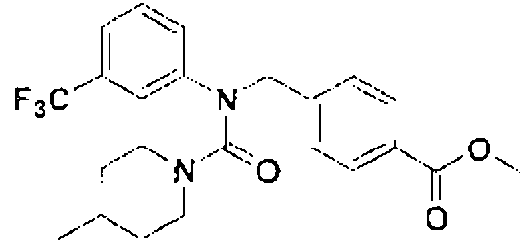
El compuesto de Fórmula 1-3 (4-((((4-nitrofenoxi)carbonil)(3-(trifluorometil)fenil)amino)metil)benzoato de metilo; 0,38 g, 0,80 mmol) se disolvió en dimetilformamida (10 ml) y después se añadieron carbonato potásico (0,33 g, 2,38 mmol) y 4-metilpiperidina (0,10 ml, 0,80 mmol). La mezcla se hizo reaccionar a 60 °C durante 2 días y después se diluyó con acetato de etilo y se lavó con una solución saturada de cloruro de amonio. La capa orgánica se deshidrató con sulfato sódico anhidro, se filtró y después se concentró a presión reducida. El residuo se purificó por cromatografía en columna (sílice; acetato de etilo/hexano = 50 %) para dar el compuesto deseado de Fórmula 1-4 (0,26 g, 75 %).The compound of Formula 1-3 (methyl 4 - (((((4-nitrophenoxy) carbonyl) (3- (trifluoromethyl) phenyl) amino) methyl) benzoate; 0.38 g, 0.80 mmol) was dissolved in dimethylformamide (10 ml) and then potassium carbonate (0.33 g, 2.38 mmol) and 4-methylpiperidine (0.10 ml, 0.80 mmol) were added. The mixture was reacted at 60 ° C for 2 days and then diluted with ethyl acetate and washed with a saturated solution of ammonium chloride. The organic layer was dehydrated with anhydrous sodium sulfate, filtered and then concentrated under reduced pressure. The residue was purified by column chromatography (silica; ethyl acetate / hexane = 50%) to give the desired compound of Formula 1-4 (0.26 g, 75%).
(Compuesto 459: N-(4-(hidroxicarbamoil)bencil)-4-metil-N-(3-(trifluorometil)fenil)piperidin-1-carboxamida)(Compound 459: N- (4- (hydroxycarbamoyl) benzyl) -4-methyl-N- (3- (trifluoromethyl) phenyl) piperidine-1-carboxamide)

El compuesto de Fórmula 1-4 (4-((4-metil-N-(3-(trifluorometil)fenil)piperidin-1-carboxamido)metil)benzoato de metilo; 0,26 g, 0,60 mmol) se disolvió en metanol (5 ml), después se añadieron hidroxilamina (solución acuosa al 50 % en peso; 0,37 ml) e hidróxido potásico (0,17 g, 2,98 mmol) y se agitó durante una noche. Después de que se completara la reacción, el metanol se retiró por destilación a presión reducida y la capa orgánica se extrajo con acetato de etilo y agua, se deshidrató con sulfato de magnesio anhidro, se filtró y después se concentró a presión reducida. El residuo se agitó en éter dietílico para dar un producto sólido de color blanco y el sólido resultante se filtró y se secó para dar el compuesto 459 deseado (0,07 g, 26 %) en forma de un sólido de color blanco.The compound of Formula 1-4 (methyl 4 - ((4-methyl-N- (3- (trifluoromethyl) phenyl) piperidin-1-carboxamido) methyl) benzoate; 0.26 g, 0.60 mmol) was dissolved in methanol (5 ml), then hydroxylamine (50% by weight aqueous solution, 0.37 ml) and potassium hydroxide (0.17 g, 2.98 mmol) were added and stirred overnight. After the reaction was complete, the methanol was distilled off under reduced pressure and the organic layer was extracted with ethyl acetate and water, dehydrated with anhydrous magnesium sulfate, filtered and then concentrated under reduced pressure. The residue was stirred in diethyl ether to give a white solid product and the resulting solid was filtered and dried to give the desired compound 459 (0.07 g, 26%) as a white solid.
1H RMN (400 MHz, DMSO-da) 811,13 (s a, 1 H), 8,98 (s a, 1 H), 7,65 (d, 2 H, J = 8,3 Hz), 7,54-7,50 (m, 1 H), 7,43 7,36 (m, 5 H), 4,92 (s, 2 H), 3,41-3,36 (m, 4 H), 2,36-2,26 (m, 3 H), 0,94 (s, 3 H).1 H NMR (400 MHz, DMSO-da) 811.13 (br s, 1 H), 8.98 (br s, 1 H), 7.65 (d, 2 H, J = 8.3 Hz), 7.54 -7.50 (m, 1 H), 7.43 7.36 (m, 5 H), 4.92 (s, 2 H), 3.41-3.36 (m, 4 H), 2, 36-2.26 (m, 3 H), 0.94 (s, 3 H).
Ejemplo 89: Síntesis del compuesto 460Example 89: Synthesis of compound 460
0 (Fórmula 1-4: 4-((N-(3-(trifluorometil)fenil)piperidin-1-carboxamido)metil)benzoato de metilo)0 (Formula 1-4: 4 - (methyl (N- (3- (trifluoromethyl) phenyl) piperidin-1-carboxamido) methyl) benzoate)

El compuesto de Fórmula 1-3 (4-((((4-nitrofenoxi)carbonil)(3-(trifluorometil)fenil)amino)metil)benzoato de metilo; 0,44 g, 0,94 mmol) se disolvió en dimetilformamida (10 ml) y después se añadieron carbonato potásico (0,39 g, 2,81 mmol) y piperidina (0,09 ml, 0,94 mmol). La mezcla se hizo reaccionar a 60 °C durante 1 día y después se diluyó con acetato de etilo y se lavó con una solución saturada de cloruro de amonio. La capa orgánica se deshidrató con sulfato de magnesio anhidro, se filtró y después se concentró a presión reducida. El residuo se purificó por cromatografía en columna (sílice; acetato de etilo hexano = 20 %) para dar el compuesto deseado de Fórmula 1-4 (0,16 g, 41 %). The compound of Formula 1-3 (methyl 4 - (((((4-nitrophenoxy) carbonyl) (3- (trifluoromethyl) phenyl) amino) methyl) benzoate; 0.44 g, 0.94 mmol) was dissolved in dimethylformamide (10 ml) and then potassium carbonate (0.39 g, 2.81 mmol) and piperidine (0.09 ml, 0.94 mmol) were added. The mixture was reacted at 60 ° C for 1 day and then diluted with ethyl acetate and washed with a saturated solution of ammonium chloride. The organic layer was dehydrated with anhydrous magnesium sulfate, filtered and then concentrated under reduced pressure. The residue was purified by column chromatography (silica; ethyl acetate: hexane = 20%) to give the desired compound of Formula 1-4 (0.16 g, 41%).
(Compuesto 460: N-(4-(hidroxicarbamoil)bencil)-N-(3-(trifluorometil)fenil)piperidin-1-carboxamida)(Compound 460: N- (4- (hydroxycarbamoyl) benzyl) -N- (3- (trifluoromethyl) phenyl) piperidine-1-carboxamide)

El compuesto de Fórmula 1-4 (4-((N-(3-(trifluorometil)fenil)piperidin-1-carboxamido)metil)benzoato de metilo; 0,27 g, 0,65 mmol) se disolvió en metanol (5 ml), después se añadieron hidroxilamina (solución acuosa al 50 % en peso; 0,40 ml) e hidróxido potásico (0,18 g, 3,27 mmol) y se agitó durante una noche. Después de que se completara la reacción, el metanol se retiró por destilación a presión reducida y la capa orgánica se extrajo con acetato de etilo y agua, se deshidrató con sulfato de magnesio anhidro, se filtró y después se concentró a presión reducida. El residuo se agitó en éter dietílico para dar un producto sólido y el sólido resultante se filtró y se secó para dar el compuesto 460 deseado (0,07 g, 24 %) en forma de un sólido de color amarillo.The compound of Formula 1-4 (methyl 4 - ((N- (3- (trifluoromethyl) phenyl) piperidine-1-carboxamido) methyl) benzoate; 0.27 g, 0.65 mmol) was dissolved in methanol (5%). ml), then hydroxylamine (50% by weight aqueous solution, 0.40 ml) and potassium hydroxide (0.18 g, 3.27 mmol) were added and stirred overnight. After the reaction was complete, the methanol was distilled off under reduced pressure and the organic layer was extracted with ethyl acetate and water, dehydrated with anhydrous magnesium sulfate, filtered and then concentrated under reduced pressure. The residue was stirred in diethyl ether to give a solid product and the resulting solid was filtered and dried to give the desired compound 460 (0.07 g, 24%) as a yellow solid.
H RMN (400 MHz, DMSO-d6) 87,65 (d, 2 H, J = 8,2 Hz), 7,53-7,49 (m, 1 H), 7,38-7,32 (m, 5 H), 7,15-7,11 (m, 1 H), 4,91 (s, 2 H), 3,17-3,14 (m, 4 H), 1,45-1,46 (m, 2 H), 1,30 (s a, 4 H); MS (ESI) m/z 422,1 (M+ H).H NMR (400 MHz, DMSO-d6) 87.65 (d, 2 H, J = 8.2 Hz), 7.53-7.49 (m, 1 H), 7.38-7.32 (m , 5 H), 7.15-7.11 (m, 1 H), 4.91 (s, 2 H), 3.17-3.14 (m, 4 H), 1.45-1.46 (m, 2 H), 1.30 (br s, 4 H); MS (ESI) m / z 422.1 (M + H).
Ejemplo 90: Síntesis del compuesto 461Example 90: Synthesis of compound 461
(Fórmula 1-4: 4-((4-etil-N-(3-(trifluorometil)fenil)piperazin-1-carboxamido)metil)benzoato de metilo)(Formula 1-4: 4 - ((methyl 4-ethyl-N- (3- (trifluoromethyl) phenyl) piperazine-1-carboxamido) methyl) benzoate)

El compuesto de Fórmula 1-3 (4-((((4-nitrofenoxi)carbonil)(3-(trifluorometil)fenil)amino)metil)benzoato de metilo; 0,346 g, 0,73 mmol) se disolvió en dimetilformamida (10 ml) y después se añadieron carbonato potásico (0,30 g, 2,19 mmol) y 1-etilpiperazina (0,09 ml, 0,73 mmol). La mezcla se hizo reaccionar a 60 °C durante 1 día y después se diluyó con acetato de etilo y se lavó con una solución saturada de cloruro de amonio. La capa orgánica se deshidrató con sulfato de magnesio anhidro, se filtró y después se concentró a presión reducida. El residuo se purificó por cromatografía en columna (sílice; acetato de etilo hexano = 50 %) para dar el compuesto deseado de Fórmula 1-4 (0,15 g, 46 %). The compound of Formula 1-3 (methyl 4 - ((((((4-nitrophenoxy) carbonyl) (3- (trifluoromethyl) phenyl) amino) methyl) benzoate; 0.346 g, 0.73 mmol) was dissolved in dimethylformamide. ml) and then potassium carbonate (0.30 g, 2.19 mmol) and 1-ethylpiperazine (0.09 mL, 0.73 mmol) were added. The mixture was reacted at 60 ° C for 1 day and then diluted with ethyl acetate and washed with a saturated solution of ammonium chloride. The organic layer was dehydrated with anhydrous magnesium sulfate, filtered and then concentrated under reduced pressure. The residue was purified by column chromatography (silica; ethyl acetate: hexane = 50%) to give the desired compound of Formula 1-4 (0.15 g, 46%).
(Compuesto 461: 4-etil-N-(4-(hidroxicarbamoil)bencil)-N-(3-(trifluorometil)fenil)piperazin-1-carboxamida)(Compound 461: 4-ethyl-N- (4- (hydroxycarbamoyl) benzyl) -N- (3- (trifluoromethyl) phenyl) piperazine-1-carboxamide)

El compuesto de Fórmula 1-4 (4-((4-etil-N-(3-(trifluorometil)fenil)piperazin-1-carboxamido)metil)benzoato de metilo; 0,15 g, 0,33 mmol) se disolvió en metanol (10 ml), después se añadieron hidroxilamina (solución acuosa al 50 % en peso; 0,20 ml) e hidróxido potásico (0,09 g, 1,67 mmol) y se agitó durante una noche. Después de que se completara la reacción, el metanol se retiró por destilación a presión reducida y la capa orgánica se extrajo con acetato de etilo y agua, se deshidrató con sulfato de magnesio anhidro, se filtró y después se concentró a presión reducida. El residuo se agitó en éter dietílico para dar un producto sólido y el sólido resultante se filtró y se secó para dar el compuesto 461 deseado (0,09 g, 61 %) en forma de un sólido de color amarillo.The compound of Formula 1-4 (methyl 4 - ((4-ethyl-N- (3- (trifluoromethyl) phenyl) piperazine-1-carboxamido) methyl) benzoate; 0.15 g, 0.33 mmol) was dissolved in methanol (10 ml), then hydroxylamine (50% by weight aqueous solution, 0.20 ml) and potassium hydroxide (0.09 g, 1.67 mmol) were added and stirred overnight. After the reaction was complete, the methanol was distilled off under reduced pressure and the organic layer was extracted with ethyl acetate and water, dehydrated with anhydrous magnesium sulfate, filtered and then concentrated under reduced pressure. The residue was stirred in diethyl ether to give a solid product and the resulting solid was filtered and dried to give the desired compound 461 (0.09 g, 61%) as a yellow solid.
1H RMN (400 MHz, DIVISOR) 811,1 (s a, 1 H), 7,65 (d, 2 H, J = 8,2 Hz), 7,51 (t, 1 H, J = 7,9 Hz), 7,41-7,36 (m, 5 H), 4,92 (s, 2 H), 3,17-3,14 (m, 4 H), 2,25, 2,22 (AC a, 2 H, J = 12,4, 7,2 Hz), 2,18-2,15 (m, 4 H), 0,92 (t, 3 H, J = 7,2 Hz); MS (ESI) m/z 451,1 (M+ H).1 H NMR (400 MHz, DIVIDER) 811.1 (br s, 1 H), 7.65 (d, 2 H, J = 8.2 Hz), 7.51 (t, 1 H, J = 7.9 Hz ), 7.41-7.36 (m, 5 H), 4.92 (s, 2 H), 3.17-3.14 (m, 4 H), 2.25, 2.22 (AC a , 2 H, J = 12.4, 7.2 Hz), 2.18-2.15 (m, 4 H), 0.92 (t, 3 H, J = 7.2 Hz); MS (ESI) m / z 451.1 (M + H).
Ejemplo 91: Síntesis del compuesto 462Example 91: Synthesis of compound 462
(Fórmula 5-2: 4-((3-(benzo[d][1,3]dioxol-5-il)fenilamino)metil)benzoato de metilo)(Formula 5-2: methyl 4 - ((3- (benzo [d] [1,3] dioxol-5-yl) phenylamino) methyl) benzoate)

El compuesto de Fórmula 5-1 (4-((3-bromofenilamino)metil)benzoato de metilo; 3,00 g, 9,37 mmol), ácido benzo[d] [1,3]dioxol-5-ilborónico (1,87 g, 11,2 mmol) y Pd(dbpf)Cl2 (0,305 g, 0,468 mmol) se disolvieron en 1,4-dioxano (24 ml), a la solución de reacción se le añadió carbonato sódico (1,99 g, 18,7 mmol) disuelto en agua (6 ml) y se agitó en un reactor de microondas a 120 °C durante 30 minutos. Después de que se completara la reacción, la capa orgánica se extrajo con acetato de etilo y solución acuosa saturada de hidrogenocarbonato sódico, se deshidrogenó con sulfato de magnesio anhidro y después se filtró. El filtrado se concentró a presión reducida y después el residuo se purificó y se concentró por cromatografía en columna (sílice; acetato de etilo/hexano = 10 %) para dar el compuesto deseado de Fórmula 5-2 (1,52 g, 45 %) en forma de un sólido de color pardo.The compound of Formula 5-1 (methyl 4 - ((3-bromophenylamino) methyl) benzoate; 3.00 g, 9.37 mmol), benzo [d] [1,3] dioxol-5-ylboronic acid (1 , 87 g, 11.2 mmol) and Pd (dbpf) Cl2 (0.305 g, 0.468 mmol) were dissolved in 1,4-dioxane (24 ml), sodium carbonate (1.99 g) was added to the reaction solution. , 18.7 mmol) dissolved in water (6 ml) and stirred in a microwave reactor at 120 ° C for 30 minutes. After the reaction was complete, the organic layer was extracted with ethyl acetate and saturated aqueous sodium hydrogencarbonate solution, dehydrogenated with anhydrous magnesium sulfate and then filtered. The filtrate was concentrated under reduced pressure and then the residue was purified and concentrated by column chromatography (silica; ethyl acetate / hexane = 10%) to give the desired compound of Formula 5-2 (1.52 g, 45% ) in the form of a brown solid.
(Fórmula 5-3: 4-(((3-(benzo[d][1,3]dioxol-5-il)fenil)((4-nitrofenoxi)carbonil)amino)metil)benzoato de metilo)(Formula 5-3: 4 - (((3- (Benzo [d] [1,3] dioxol-5-yl) phenyl) ((4-nitrophenoxy) carbonyl) amino) methyl) methyl benzoate)

El compuesto de Fórmula 5-2 (4-((3-(benzo[d][1,3]dioxol-5-il)fenilamino)metil)benzoato de metilo; 1,52 g, 4,21 mmol) y cloroformiato de 4-nitrofenilo (0,933 g, 4,63 mmol) se disolvieron en acetonitrilo (20 ml) y después se añadió carbonato potásico (0,872 g, 6,31 mmol) y se agitó a temperatura ambiente durante 3 horas. Después de que se completara la reacción, la capa orgánica se extrajo con acetato de etilo y solución acuosa saturada de hidrogenocarbonato sódico, se deshidrogenó con sulfato de magnesio anhidro y después se filtró. El filtrado se concentró a presión reducida y después el residuo se purificó y se concentró por cromatografía en columna (sílice; acetato de etilo/hexano = 20 %) para dar el compuesto deseado de Fórmula 5-3 (1,87 g, 84 %) en forma de un sólido de color amarillo claro.The compound of Formula 5-2 (methyl 4 - ((3- (benzo [d] [1,3] dioxol-5-yl) phenylamino) methyl) benzoate; 1.52 g, 4.21 mmol) and chloroformate of 4-nitrophenyl (0.933 g, 4.63 mmol) were dissolved in acetonitrile (20 ml) and then potassium carbonate (0.872 g, 6.31 mmol) was added and stirred at room temperature for 3 hours. After the reaction was complete, the organic layer was extracted with ethyl acetate and saturated aqueous sodium hydrogencarbonate solution, dehydrogenated with anhydrous magnesium sulfate and then filtered. The filtrate was concentrated under reduced pressure and then the residue was purified and concentrated by column chromatography (silica; ethyl acetate / hexane = 20%) to give the desired compound of Formula 5-3 (1.87 g, 84% ) in the form of a light yellow solid.
(Fórmula 5-4: 4-((N-(3-(benzo[d][1,3]dioxol-5-il)fenil)piperidin-1-carboxamido)metil)benzoato de metilo) (Formula 5-4: 4 - ((N- (3- (benzo [d] [1,3] dioxol-5-yl) phenyl) piperidin-1-carboxamido) methyl) benzoate methyl)
El compuesto de Fórmula 5-3 (4-(((3-(benzo[d][1,3]dioxol-5-il)fenil)((4-nitrofenoxi)carbonil)amino)metil)benzoato de metilo; 0,180 g, 0,342 mmol) se disolvió en dimetilformamida (2 ml) y después se añadieron piperidina (0,087 g, 1,03 mmol) y carbonato potásico (0,142 g, 1,03 mmol) y se agitó a 50 °C durante 16 horas. Después de que se completara la reacción, la capa orgánica se extrajo con acetato de etilo y solución acuosa saturada de cloruro de amonio, se deshidrogenó con sulfato de magnesio anhidro y después se filtró. El filtrado se concentró a presión reducida y después el residuo se purificó y se concentró por cromatografía en columna (sílice; acetato de etilo/hexano = 30 %) para dar el compuesto deseado de Fórmula 5-4 (0,155 g, 96 %) en forma de un sólido de color amarillo claro.The compound of Formula 5-3 (methyl 4 - (((3- (benzo [d] [1,3] dioxol-5-yl) phenyl) ((4-nitrophenoxy) carbonyl) amino) methyl) benzoate; g, 0.342 mmol) was dissolved in dimethylformamide (2 ml) and then piperidine (0.087 g, 1.03 mmol) and potassium carbonate (0.142 g, 1.03 mmol) were added and stirred at 50 ° C for 16 hours. After the reaction was complete, the organic layer was extracted with ethyl acetate and saturated aqueous solution of ammonium chloride, dehydrogenated with anhydrous magnesium sulfate and then filtered. The filtrate was concentrated under reduced pressure and then the residue was purified and concentrated by column chromatography (silica; ethyl acetate / hexane = 30%) to give the desired compound of Formula 5-4 (0.155 g, 96%) in shape of a light yellow solid.
(Compuesto 462: N-(3-(benzo[d][1,3]dioxol-5-il)fenil)-N-(4-(hidroxicarbamoil)bencil)piperidin-1-carboxamida)(Compound 462: N- (3- (benzo [d] [1,3] dioxol-5-yl) phenyl) -N- (4- (hydroxycarbamoyl) benzyl) piperidine-1-carboxamide)

El compuesto de Fórmula 5-4 (4-((N-(3-(benzo[d][1,3]dioxol-5-il)fenil)piperidin-1-carboxamido)metil)benzoato de metilo; 0,155 g, 0,328 mmol) se disolvió en metanol (10 ml), después se añadieron secuencialmente hidroxilamina (solución acuosa al 50,0 % en peso; 1,00 ml, 16,4 mmol) e hidróxido potásico (0,184 g, 3,28 mmol) y después se agitó a temperatura ambiente durante 30 minutos. Después de que se completara la reacción, la solución de reacción se concentró a presión reducida hasta que su volumen se volvió de aproximadamente 1 ml, se añadió una solución acuosa saturada de cloruro de amonio (1-2 ml) y se agitó. Después, el producto sólido se filtró, se lavó con agua y después se secó al vacío para dar el compuesto 462 deseado (0,153 g, 99 %) en forma de un sólido de color blanco.The compound of Formula 5-4 (methyl 4 - ((N- (3- (benzo [d] [1,3] dioxol-5-yl) phenyl) piperidin-1-carboxamido) methyl) benzoate; 0.155 g, 0.288 mmol) was dissolved in methanol (10 ml), then hydroxylamine (50.0% by weight aqueous solution, 1.00 ml, 16.4 mmol) and potassium hydroxide (0.184 g, 3.28 mmol) were added sequentially. and then stirred at room temperature for 30 minutes. After the reaction was completed, the reaction solution was concentrated under reduced pressure until its volume became about 1 ml, a saturated aqueous solution of ammonium chloride (1-2 ml) was added and stirred. Then, the solid product was filtered, washed with water and then dried under vacuum to give the desired compound 462 (0.153 g, 99%) as a white solid.
1H RMN (400 MHz, DIVISOR) 87,64 (d, 2 H, J = 8,3 Hz), 7,39 (d, 2 H, J = 8,2 Hz), 7,36 - 7,25 (m, 3 H), 7,19 (d, 1 H, J = 1,8 Hz), 7,08 (dd, 1 H, J = 8,1, 1,8 Hz), 7,02 -6,95 (m, 2 H), 6,05 (s, 2 H), 4,90 (s, 2 H), 3,17 -3,14 (m, 4 H), 1,43 (m, 2 H), 1,28 (m, 4 H). MS (ESI) m/z 474 (M+ H).1 H NMR (400 MHz, DIVIDER) 87.64 (d, 2 H, J = 8.3 Hz), 7.39 (d, 2 H, J = 8.2 Hz), 7.36-7.25 ( m, 3 H), 7.19 (d, 1 H, J = 1.8 Hz), 7.08 (dd, 1 H, J = 8.1, 1.8 Hz), 7.02 -6, 95 (m, 2 H), 6.05 (s, 2 H), 4.90 (s, 2 H), 3.17 -3.14 (m, 4 H), 1.43 (m, 2 H) ), 1.28 (m, 4 H). MS (ESI) m / z 474 (M + H).
Ejemplo 92: Síntesis del compuesto 463Example 92: Synthesis of compound 463
(Fórmula 5-4: 4-((N-(3-(benzo[d][1,3]dioxol-5-il)fenil)-4-hidroxipiperidin-1-carboxamido)metil)benzoato de metilo)(Formula 5-4: 4 - ((N- (3- (benzo [d] [1,3] dioxol-5-yl) phenyl) -4-hydroxypiperidine-1-carboxamido) methyl) benzoate methyl)

El compuesto de Fórmula 5-3 (4-(((3-(benzo[d][1,3]dioxol-5-il)fenil)((4-nitrofenoxi)carbonil)amino)metil)benzoato de metilo; 0,180 g, 0,342 mmol) se disolvió en dimetilformamida (2 ml), después se añadieron después 4-hidroxipiperidina (0,104 g, 1,03 mmol) y carbonato potásico (0,142 g, 1,03 mmol) y se agitó a 50 °C durante 16 horas. Después de que se completara la reacción, la capa orgánica se extrajo con acetato de etilo y solución acuosa saturada de cloruro de amonio, se deshidrogenó con sulfato de magnesio anhidro y después se filtró. El filtrado se concentró a presión reducida y después el residuo se purificó y se concentró por cromatografía en columna (sílice; acetato de etilo/hexano = 25 %) para dar el compuesto deseado de Fórmula 5-4 (0,128 g, 77 %) en forma de un sólido de color amarillo claro. The compound of Formula 5-3 (methyl 4 - (((3- (benzo [d] [1,3] dioxol-5-yl) phenyl) ((4-nitrophenoxy) carbonyl) amino) methyl) benzoate; g, 0.342 mmol) was dissolved in dimethylformamide (2 ml), then 4-hydroxypiperidine (0.104 g, 1.03 mmol) and potassium carbonate (0.142 g, 1.03 mmol) were added and stirred at 50 ° C for 16 hours. After the reaction was complete, the organic layer was extracted with ethyl acetate and saturated aqueous solution of ammonium chloride, dehydrogenated with anhydrous magnesium sulfate and then filtered. The filtrate was concentrated under reduced pressure and then the residue was purified and concentrated by column chromatography (silica; ethyl acetate / hexane = 25%) to give the desired compound of Formula 5-4 (0.128 g, 77%) in shape of a light yellow solid.
(Compuesto 463: N-(3-(benzo[d][1,3]dioxol-5-il)fenil)-4-hidroxi-N-(4-(hidroxicarbamoil)bencil)piperidin-1-carboxamida)(Compound 463: N- (3- (benzo [d] [1,3] dioxol-5-yl) phenyl) -4-hydroxy-N- (4- (hydroxycarbamoyl) benzyl) piperidine-1-carboxamide)

El compuesto de Fórmula 5-4 (4-((N-(3-(benzo[d][1,3]dioxol-5-il)fenil)-4-hidroxipiperidin-1-carboxamido)metil)benzoato de metilo; 0,128 g, 0,262 mmol) se disolvió en metanol (10 ml), después se añadieron secuencialmente hidroxilamina (solución acuosa al 50,0 % en peso; 0,801 ml, 13,1 mmol) e hidróxido potásico (0,147 g, 2,62 mmol) y después se agitó a temperatura ambiente durante 30 minutos. Después de que se completara la reacción, la solución de reacción se concentró a presión reducida hasta que su volumen se volvió de aproximadamente 1 ml, se añadió una solución acuosa saturada de cloruro de amonio (1-2 ml) y se agitó. Después, el producto sólido se filtró, se lavó con agua y después se secó al vacío para dar el compuesto 463 deseado (0,085 g, 66 %) en forma de un sólido de color pardo claro.The compound of Formula 5-4 (methyl 4 - ((N- (3- (benzo [d] [1,3] dioxol-5-yl) phenyl) -4-hydroxypiperidine-1-carboxamido) methyl) benzoate; 0.128 g, 0.262 mmol) was dissolved in methanol (10 ml), then hydroxylamine (50.0% by weight aqueous solution, 0.801 ml, 13.1 mmol) and potassium hydroxide (0.147 g, 2.62 mmol) were added sequentially. ) and then stirred at room temperature for 30 minutes. After the reaction was completed, the reaction solution was concentrated under reduced pressure until its volume became about 1 ml, a saturated aqueous solution of ammonium chloride (1-2 ml) was added and stirred. Then, the solid product was filtered, washed with water and then dried under vacuum to give the desired compound 463 (0.085 g, 66%) as a light brown solid.
1H RMN (400 MHz, DMSO-d6) 87,64 (d, 2 H, J = 8,3 Hz), 7,39 (d, 2 H, J = 8,3 Hz), 7,33 - 7,27 (m, 3 H), 7,20 (d, 1 H, J = 1,8 Hz), 7,08 (dd, 1 H, J = 8,1, 1,8 Hz), 7,02 - 7,00 (m, 1 H), 6,97 (d, 1 H, J = 8,1 Hz), 6,05 (s, 2 H), 4,90 (s, 2 H), 4,65 (s a, 1 H), 3,54 - 3,51 (m, 3 H), 2,87 - 2,81 (m, 2 H), 1,56 - 1,53 (m, 2 H), 1,14 - 1,09 (m, 2 H). MS (ESI) m/z 490 (M+ H).1 H NMR (400 MHz, DMSO-d 6) 87.64 (d, 2 H, J = 8.3 Hz), 7.39 (d, 2 H, J = 8.3 Hz), 7.33-7, 27 (m, 3 H), 7.20 (d, 1 H, J = 1.8 Hz), 7.08 (dd, 1 H, J = 8.1, 1.8 Hz), 7.02 - 7.00 (m, 1 H), 6.97 (d, 1 H, J = 8.1 Hz), 6.05 (s, 2 H), 4.90 (s, 2 H), 4.65 (br s, 1 H), 3.54 - 3.51 (m, 3 H), 2.87 - 2.81 (m, 2 H), 1.56 - 1.53 (m, 2 H) ), 1.14 - 1.09 (m, 2 H). MS (ESI) m / z 490 (M + H).
Ejemplo 93: Síntesis del compuesto 464Example 93: Synthesis of compound 464
(Fórmula 5-4: 4-((N-(3-(benzo[d][1,3]dioxol-5-il)fenil)-2,6-dimetilmorfolin-4-carboxamido)metil)benzoato de metilo)(Formula 5-4: 4 - ((N- (3- (benzo [d] [1,3] dioxol-5-yl) phenyl) -2,6-dimethylmorpholin-4-carboxamido) methyl) benzoate methyl)

El compuesto de Fórmula 5-3 (4-(((3-(benzo[d][1,3]dioxol-5-il)fenil)((4-nitrofenoxi)carbonil)amino)metil)benzoato de metilo; 0,180 g, 0,342 mmol) se disolvió en dimetilformamida (2 ml), después se añadieron 2,6-dimetilmorfolina (0,118 g, 1,03 mmol) y carbonato potásico (0,142 g, 1,03 mmol) y se agitó a 50 °C durante 16 horas. Después de que se completara la reacción, la capa orgánica se extrajo con acetato de etilo y solución acuosa saturada de cloruro de amonio, se deshidrogenó con sulfato de magnesio anhidro y después se filtró. El filtrado se concentró a presión reducida y después el residuo se purificó y se concentró por cromatografía en columna (sílice; acetato de etilo/hexano = 25 %) para dar el compuesto deseado de Fórmula 5-4 (0,116 g, 68 %) en forma de un líquido incoloro.The compound of Formula 5-3 (methyl 4 - (((3- (benzo [d] [1,3] dioxol-5-yl) phenyl) ((4-nitrophenoxy) carbonyl) amino) methyl) benzoate; g, 0.342 mmol) was dissolved in dimethylformamide (2 ml), then 2,6-dimethylmorpholine (0.118 g, 1.03 mmol) and potassium carbonate (0.142 g, 1.03 mmol) were added and stirred at 50 ° C. for 16 hours. After the reaction was complete, the organic layer was extracted with ethyl acetate and saturated aqueous solution of ammonium chloride, dehydrogenated with anhydrous magnesium sulfate and then filtered. The filtrate was concentrated under reduced pressure and then the residue was purified and concentrated by column chromatography (silica; ethyl acetate / hexane = 25%) to give the desired compound of Formula 5-4 (0.116 g, 68%) in form of a colorless liquid.
(Compuesto 464: N-(3-(benzo[d][1,3]dioxol-5-il)fenil)-N-(4-(hidroxicarbamoil)bencil)-2,6-dimetilmorfolin-4-carboxamida)(Compound 464: N- (3- (benzo [d] [1,3] dioxol-5-yl) phenyl) -N- (4- (hydroxycarbamoyl) benzyl) -2,6-dimethylmorpholine-4-carboxamide)

El compuesto de Fórmula 5-4 (4-((N-(3-(benzo[d][1,3]dioxol-5-il)fenil)-2,6-dimetilmorfolin-4-carboxamido)metil)benzoato de metilo; 0,116 g, 0,231 mmol) se disolvió en metanol (10 ml), después se añadieron secuencialmente hidroxilamina (solución acuosa al 50,0 % en peso; 0,706 ml, 11,5 mmol) e hidróxido potásico (0,130 g, 2,31 mmol) y después se agitó a temperatura ambiente durante 30 minutos. Después de que se completara la reacción, la solución de reacción se concentró a presión reducida hasta que su volumen se volvió de aproximadamente 1 ml, se añadió una solución acuosa saturada de cloruro de amonio (1-2 ml) y se agitó. Después, el producto sólido se filtró, se lavó con agua y después se secó al vacío para dar el compuesto 464 deseado (0,085 g, 73 %) en forma de un sólido de color blanco.The compound of Formula 5-4 (4 - ((N- (3- (benzo [d] [1,3] dioxol-5-yl) phenyl) -2,6-dimethylmorpholin-4-carboxamido) methyl) benzoate of methyl, 0.116 g, 0.231 mmol) was dissolved in methanol (10 ml), then hydroxylamine (50.0% by weight aqueous solution, 0.706 ml, 11.5 mmol) and potassium hydroxide (0.130 g, 2%) were added sequentially. 31 mmol) and then stirred at room temperature for 30 minutes. After the reaction was completed, the reaction solution was concentrated under reduced pressure until its volume became about 1 ml, a saturated aqueous solution of ammonium chloride (1-2 ml) was added and stirred. Then, the solid product was filtered, washed with water and then dried under vacuum to give the desired compound 464 (0.085 g, 73%) as a white solid.
1H RMN (400 MHz, DMSO-d6) 87,63 (d, 2 H, J = 8,3 Hz), 7,40 (d, 2 H, J = 8,2 Hz), 7,37 - 7,27 (m, 3 H), 7,21 (d, 1 H, J = 1,8 Hz), 7,09 (dd, 1 H, J = 8,1, 1,8 Hz), 7,04 (m, 1 H), 6,98 (d, 1 H, J = 8,1 Hz), 6,05 (s, 2 H), 4,90 (s, 2 H), 3,61 -3,58 (m, 2 H), 3,29 - 3,27 (m, 2 H), 2,30 - 2,27 (m, 2 H), 0,92 (s, 3 H), 0,90 (s, 3 H). MS (ESI) m/z 504 (M+ H). 1 H NMR (400 MHz, DMSO-d 6) 87.63 (d, 2 H, J = 8.3 Hz), 7.40 (d, 2 H, J = 8.2 Hz), 7.37-7, 27 (m, 3 H), 7.21 (d, 1 H, J = 1.8 Hz), 7.09 (dd, 1 H, J = 8.1, 1.8 Hz), 7.04 ( m, 1 H), 6.98 (d, 1 H, J = 8.1 Hz), 6.05 (s, 2 H), 4.90 (s, 2 H), 3.61 -3.58 (m, 2 H), 3.29 - 3.27 (m, 2 H), 2.30 - 2.27 (m, 2 H), 0.92 (s, 3 H), 0.90 (s) , 3 H). MS (ESI) m / z 504 (M + H).
Ejemplo 94: Síntesis del compuesto 465Example 94: Synthesis of compound 465
(Fórmula 5-4: 4-((N-(3-(benzo[d][1,3]dioxol-5-il)fenil)-4-hidroxi-4-fenilpiperidin-1-carboxamido)metil)benzoato de metlio)(Formula 5-4: 4 - ((N- (3- (benzo [d] [1,3] dioxol-5-yl) phenyl) -4-hydroxy-4-phenylpiperidine-1-carboxamido) methyl) benzoate metlio)

El compuesto de Fórmula 5-3 (4-(((3-(benzo[d][1,3]dioxol-5-il)fenil)((4-nitrofenoxi)carbonil)amino)metil)benzoato de metilo; 0,180 g, 0,342 mmol) se disolvió en dimetilformamida (2 ml), después se añadieron 4-fenilpiperidin-4-ol (0,182 g, 1,03 mmol) y carbonato potásico (0,142 g, 1,03 mmol) y se agitó a 50 °C durante 16 horas. Después de que se completara la reacción, la capa orgánica se extrajo con acetato de etilo y solución acuosa saturada de cloruro de amonio, se deshidrogenó con sulfato de magnesio anhidro y después se filtró. El filtrado se concentró a presión reducida y después el residuo se purificó y se concentró por cromatografía en columna (sílice; acetato de etilo/hexano = 30 %) para dar el compuesto deseado de Fórmula 5-4 (0,137 g, 71 %) en forma de un sólido de color amarillo claro. The compound of Formula 5-3 (methyl 4 - (((3- (benzo [d] [1,3] dioxol-5-yl) phenyl) ((4-nitrophenoxy) carbonyl) amino) methyl) benzoate; g, 0.342 mmol) was dissolved in dimethylformamide (2 ml), then 4-phenylpiperidin-4-ol (0.182 g, 1.03 mmol) and potassium carbonate (0.142 g, 1.03 mmol) were added and stirred at 50 g. ° C for 16 hours. After the reaction was complete, the organic layer was extracted with ethyl acetate and saturated aqueous solution of ammonium chloride, dehydrogenated with anhydrous magnesium sulfate and then filtered. The filtrate was concentrated under reduced pressure and then the residue was purified and concentrated by column chromatography (silica; ethyl acetate / hexane = 30%) to give the desired compound of Formula 5-4 (0.137 g, 71%) in shape of a light yellow solid.
(Compuesto 465: N-(3-(benzo[d][1,3]dioxol-5-N)fenN)-4-hidroxi-N-(4-(hidroxicarbamoN)bencN)-4-fenNpiperidin-1-carboxamida)(Compound 465: N- (3- (benzo [d] [1,3] dioxol-5-N) phenN) -4-hydroxy-N- (4- (hydroxycarbamoN) bencN) -4-phenNpiperidin-1-carboxamide )

El compuesto de Fórmula 5-4 (4-((N-(3-(benzo[d][1,3]dioxol-5-il)fenM)-4-hidroxi-4-fenilpiperidin-1-carboxamido)metil)benzoato de metilo; 0,137 g, 0,243 mmol) se disolvió en metanol (10 ml), después se añadieron secuencialmente hidroxilamina (solución acuosa al 50,0 % en peso; 0,742 ml, 12,1 mmol) e hidróxido potásico (0,136 g, 2,43 mmol) y después se agitó a temperatura ambiente durante 30 minutos. Después de que se completara la reacción, la solución de reacción se concentró a presión reducida hasta que su volumen se volvió de aproximadamente 1 ml, se añadió una solución acuosa saturada de cloruro de amonio (1-2 ml) y se agitó. Después, el producto sólido se filtró, se lavó con agua y después se secó al vacío para dar el compuesto 465 deseado (0,118 g, 86 %) en forma de un sólido de color blanco.The compound of Formula 5-4 (4 - ((N- (3- (benzo [d] [1,3] dioxol-5-yl) fenM) -4-hydroxy-4-phenylpiperidine-1-carboxamido) methyl) methyl benzoate, 0.137 g, 0.243 mmol) was dissolved in methanol (10 ml), then hydroxylamine (50.0% by weight aqueous solution, 0.742 ml, 12.1 mmol) and potassium hydroxide (0.136 g, 2.43 mmol) and then stirred at room temperature for 30 minutes. After the reaction was completed, the reaction solution was concentrated under reduced pressure until its volume became about 1 ml, a saturated aqueous solution of ammonium chloride (1-2 ml) was added and stirred. Then, the solid product was filtered, washed with water and then dried under vacuum to give the desired compound 465 (0.118 g, 86%) as a white solid.
1H RMN (400 MHz, DIVISOR) 87,66 (d, 2 H, J = 8,2 Hz), 7,41 (d, 2 H, J = 7,9 Hz), 7,38 - 7,33 (m, 2 H), 7,29 - 7,20 (m, 6 H), 7,17 -7,06 (m, 3 H), 6,99 (d, 1 H, J = 8,2 Hz), 6,06 (s, 2 H), 4,98 (s, 1 H), 4,92 (s, 2 H), 3,69 (d, 2 H, J = 11,8 Hz), 3,04 (t, 2 H, J = 12,2 Hz), 1,63 - 1,58 (m, 2 H), 1,40 - 1,36 (m, 2 H). MS (ESI) m/z 566 (M+ H).1 H NMR (400 MHz, DIVIDER) 87.66 (d, 2 H, J = 8.2 Hz), 7.41 (d, 2 H, J = 7.9 Hz), 7.38-7.33 ( m, 2 H), 7.29-7.20 (m, 6 H), 7.17 -7.06 (m, 3 H), 6.99 (d, 1 H, J = 8.2 Hz) , 6.06 (s, 2 H), 4.98 (s, 1 H), 4.92 (s, 2 H), 3.69 (d, 2 H, J = 11.8 Hz), 3, 04 (t, 2 H, J = 12.2 Hz), 1.63-1.58 (m, 2 H), 1.40-1.36 (m, 2 H). MS (ESI) m / z 566 (M + H).
Ejemplo 95: Síntesis del compuesto 466Example 95: Synthesis of compound 466
(Fórmula 5-4: 4-((N-(3-(benzo[d][1,3]dioxol-5-il)fenil)-4-metilpiperazin-1-carboxamido)metil)benzoato de metilo)(Formula 5-4: 4 - ((N- (3- (benzo [d] [1,3] dioxol-5-yl) phenyl) -4-methylpiperazin-1-carboxamido) methyl) benzoate methyl)

El compuesto de Fórmula 5-3 (4-(((3-(benzo[d][1,3]dioxol-5-il)fenil)((4-nitrofenoxi)carbonil)amino)metil)benzoato de metilo; 0,180 g, 0,342 mmol) se disolvió en dimetilformamida (2 ml), después se añadieron 1-metilpiperazina (0,103 g, 1,03 mmol) y carbonato potásico (0,142 g, 1,03 mmol) y se agitó a 50 °C durante 16 horas. Después de que se completara la reacción, la capa orgánica se extrajo con acetato de etilo y solución acuosa saturada de cloruro de amonio, se deshidrogenó con sulfato de magnesio anhidro y después se filtró. El filtrado se concentró a presión reducida y después el residuo se purificó y se concentró por cromatografía en columna (sílice; metanol/diclorometano = 10 %) para dar el compuesto deseado de Fórmula 5-4 (0,099 g, 59 %) en forma de un líquido de color amarillo. The compound of Formula 5-3 (methyl 4 - (((3- (benzo [d] [1,3] dioxol-5-yl) phenyl) ((4-nitrophenoxy) carbonyl) amino) methyl) benzoate; g, 0.342 mmol) was dissolved in dimethylformamide (2 ml), then 1-methylpiperazine (0.103 g, 1.03 mmol) and potassium carbonate (0.142 g, 1.03 mmol) were added and stirred at 50 ° C for 16 h. hours. After the reaction was complete, the organic layer was extracted with ethyl acetate and saturated aqueous solution of ammonium chloride, dehydrogenated with anhydrous magnesium sulfate and then filtered. The filtrate was concentrated under reduced pressure and then the residue was purified and concentrated by column chromatography (silica: methanol / dichloromethane = 10%) to give the desired compound of Formula 5-4 (0.099 g, 59%) as a yellow liquid.
(Compuesto 466: N-(3-(benzo[d][1,3]dioxol-5-il)fenil)-N-(4-(hidroxicarbamoil)bencil)-4-metilpiperazin-1-carboxamida)(Compound 466: N- (3- (benzo [d] [1,3] dioxol-5-yl) phenyl) -N- (4- (hydroxycarbamoyl) benzyl) -4-methylpiperazine-1-carboxamide)

El compuesto de Fórmula 5-4 (4-((N-(3-(benzo[d][1,3]dioxol-5-il)fenil)-4-metilpiperazin-1-carboxamido)metil)benzoato de metilo; 0,099 g, 0,203 mmol) se disolvió en metanol (10 ml), después se añadieron secuencialmente hidroxilamina (solución acuosa al 50,0 % en peso; 0,621 ml, 10,2 mmol) e hidróxido potásico (0,114 g, 2,03 mmol) y después se agitó a temperatura ambiente durante 30 minutos. Después de que se completara la reacción, la solución de reacción se concentró a presión reducida hasta que su volumen se volvió de aproximadamente 1 ml, se añadió una solución acuosa saturada de hidrogenocarbonato sódico (1-2 ml) y se agitó. Después, el producto sólido se filtró, se lavó con agua y después se secó al vacío para dar el compuesto 466 deseado (0,036 g, 36 %) en forma de un sólido de color amarillo claro.The compound of Formula 5-4 (methyl 4 - ((N- (3- (benzo [d] [1,3] dioxol-5-yl) phenyl) -4-methylpiperazin-1-carboxamido) methyl) benzoate; 0.099 g, 0.203 mmol) was dissolved in methanol (10 ml), then hydroxylamine (50.0% by weight aqueous solution, 0.621 ml, 10.2 mmol) and potassium hydroxide (0.114 g, 2.03 mmol) were added sequentially. ) and then stirred at room temperature for 30 minutes. After the reaction was completed, the reaction solution was concentrated under reduced pressure until its volume became about 1 ml, a saturated aqueous solution of sodium hydrogencarbonate (1-2 ml) was added and stirred. Then, the solid product was filtered, washed with water and then dried under vacuum to give the desired compound 466 (0.036 g, 36%) as a light yellow solid.
1H RMN (400 MHz, DMSO-d6) 87,63 (d, 2 H, J = 8,1 Hz), 7,35 (d, 2 H, J = 8,2 Hz), 7,32 - 7,26 (m, 3 H), 7,21 (d, 1 H, J = 1,8 Hz), 7,09 (dd, 1 H, J = 8,2, 1,7 Hz), 7,02 (m, 1 H), 6,98 (d, 1 H, J = 8,1 Hz), 6,05 (s, 2 H), 4,90 (s, 2 H), 3,17 (m, 4 H), 2,10 (m, 4 H), 2,06 (s, 3 H). MS (ESI) m/z 489 (M+ H).1 H NMR (400 MHz, DMSO-d 6) 87.63 (d, 2 H, J = 8.1 Hz), 7.35 (d, 2 H, J = 8.2 Hz), 7.32-7, 26 (m, 3 H), 7.21 (d, 1 H, J = 1.8 Hz), 7.09 (dd, 1 H, J = 8.2, 1.7 Hz), 7.02 ( m, 1 H), 6.98 (d, 1 H, J = 8.1 Hz), 6.05 (s, 2 H), 4.90 (s, 2 H), 3.17 (m, 4 H), 2.10 (m, 4 H), 2.06 (s, 3 H). MS (ESI) m / z 489 (M + H).
Ejemplo 96: Síntesis del compuesto 467 Example 96: Synthesis of compound 467
(Fórmula 5-4: 4-((N-(3-(benzo[d][1,3]dioxol-5-il)fenil)-4-(2-hidroxietil)piperazin-1-carboxamido)metil)benzoato de metilo)(Formula 5-4: 4 - ((N- (3- (benzo [d] [1,3] dioxol-5-yl) phenyl) -4- (2-hydroxyethyl) piperazine-1-carboxamido) methyl) benzoate of methyl)

El compuesto de Fórmula 5-3 (4-(((3-(benzo[d][1,3]dioxol-5-il)fenil)((4-nitrofenoxi)carbonil)amino)metil)benzoato de metilo; 0,180 g, 0,342 mmol) se disolvió en dimetilformamida (2 ml), después se añadieron 2-(piperazin-1-il)etanol (0,134 g, 1,03 mmol) y carbonato potásico (0,142 g, 1,03 mmol) y se agitó a 50 °C durante 16 horas. Después de que se completara la reacción, la capa orgánica se extrajo con acetato de etilo y solución acuosa saturada de cloruro de amonio, se deshidrogenó con sulfato de magnesio anhidro y después se filtró. El filtrado se concentró a presión reducida y después el residuo se purificó y se concentró por cromatografía en columna (sílice; metanol/diclorometano = 10 %) para dar el compuesto deseado de Fórmula 5-4 (0,101 g, 57 %) en forma de un líquido de color amarillo. The compound of Formula 5-3 (methyl 4 - (((3- (benzo [d] [1,3] dioxol-5-yl) phenyl) ((4-nitrophenoxy) carbonyl) amino) methyl) benzoate; g, 0.342 mmol) was dissolved in dimethylformamide (2 ml), then 2- (piperazin-1-yl) ethanol (0.134 g, 1.03 mmol) and potassium carbonate (0.142 g, 1.03 mmol) were added and stirred at 50 ° C for 16 hours. After the reaction was complete, the organic layer was extracted with ethyl acetate and saturated aqueous solution of ammonium chloride, dehydrogenated with anhydrous magnesium sulfate and then filtered. The filtrate was concentrated under reduced pressure and then the residue was purified and concentrated by column chromatography (silica; methanol / dichloromethane = 10%) to give the desired compound of Formula 5-4 (0.101 g, 57%) as a yellow liquid.
(Compuesto 467: N-(3-(benzo[d][1,3]dioxol-5-il)fenil)-N-(4-(hidroxicarbamoil)bencil)-4-(2-hidroxietil)piperazin-1-carboxamida)(Compound 467: N- (3- (benzo [d] [1,3] dioxol-5-yl) phenyl) -N- (4- (hydroxycarbamoyl) benzyl) -4- (2-hydroxyethyl) piperazin-1- carboxamide)

El compuesto de Fórmula 5-4 (4-((N-(3-(benzo[d][1,3]dioxol-5-il)fenil)-4-(2-hidroxietil)piperazin-1-carboxamido)metil)benzoato de metilo; 0,101 g, 0,195 mmol) se disolvió en metanol (10 ml), después se añadieron secuencialmente hidroxilamina (solución acuosa al 50,0 % en peso; 0,597 ml, 9,76 mmol) e hidróxido potásico (0,110 g, 1,95 mmol) se añadieron y después se agitó a temperatura ambiente durante 30 minutos. Después de que se completara la reacción, la solución de reacción se concentró a presión reducida hasta que su volumen se volvió de aproximadamente 1 ml y se extrajo con acetato de etilo y solución acuosa saturada de hidrogenocarbonato sódico. La capa orgánica se lavó con agua y se deshidrogenó con sulfato de magnesio anhidro, se filtró y después se concentró a presión reducida para dar el compuesto 467 deseado (0,054 g, 53 %) en forma de un sólido de color amarillo claro.The compound of Formula 5-4 (4 - ((N- (3- (benzo [d] [1,3] dioxol-5-yl) phenyl) -4- (2-hydroxyethyl) piperazine-1-carboxamido) methyl methylbenzoate, 0.101 g, 0.195 mmol) was dissolved in methanol (10 ml), then hydroxylamine (50.0% by weight aqueous solution, 0.597 ml, 9.76 mmol) and potassium hydroxide (0.110 g) were added sequentially. , 1.95 mmol) were added and then stirred at room temperature for 30 minutes. After the reaction was complete, the reaction solution was concentrated under reduced pressure until its volume became approximately 1 ml and extracted with ethyl acetate and saturated aqueous sodium hydrogencarbonate solution. The organic layer was washed with water and dehydrogenated with anhydrous magnesium sulfate, filtered and then concentrated under reduced pressure to give the desired compound 467 (0.054 g, 53%) as a light yellow solid.
1H RMN (400 MHz, DIVISOR) 811,12 (s, 1 H), 9,00 (s, 1 H), 7,64 (d, 2 H, J = 8,2 Hz), 7,38 (d, 2 H, J = 8,2 Hz), 7,34 -7,26 (m, 3 H), 7,21 (d, 1 H, J = 1,7 Hz), 7,09 (dd, 1 H, J = 8,2, 1,8 Hz), 7,02 (d, 1 H, J = 7,9 Hz), 6,98 (d, 1 H, J = 8,1 Hz), 6,05 (s, 2 H), 4,91 (s, 2 H), 4,36 (t, 1 H, J = 5,3 Hz), 3,41 (q, 2 H, J = 5,9 Hz), 3,16 (m, 4 H), 2,27 (t, 2 H, J = 6,2 Hz), 2,22 (m, 4 H). MS (ESI) m/z 519 (M+ H).1 H NMR (400 MHz, DIVIDER) 811.12 (s, 1 H), 9.00 (s, 1 H), 7.64 (d, 2 H, J = 8.2 Hz), 7.38 (d , 2 H, J = 8.2 Hz), 7.34 -7.26 (m, 3 H), 7.21 (d, 1 H, J = 1.7 Hz), 7.09 (dd, 1 H, J = 8.2, 1.8 Hz), 7.02 (d, 1 H, J = 7.9 Hz), 6.98 (d, 1 H, J = 8.1 Hz), 6, 05 (s, 2 H), 4.91 (s, 2 H), 4.36 (t, 1 H, J = 5.3 Hz), 3.41 (q, 2 H, J = 5.9 Hz ), 3.16 (m, 4 H), 2.27 (t, 2 H, J = 6.2 Hz), 2.22 (m, 4 H). MS (ESI) m / z 519 (M + H).
Ejemplo 97: Síntesis del compuesto 468Example 97: Synthesis of compound 468
(Fórmula 5-4: 4-((N-(3-(benzo[d][1,3]dioxol-5-il)fenil)pirrolidin-1-carboxamido)metil)benzoato de metilo)(Formula 5-4: 4 - ((N- (3- (benzo [d] [1,3] dioxol-5-yl) phenyl) pyrrolidin-1-carboxamido) methyl) benzoate methyl)

El compuesto de Fórmula 5-3 (4-(((3-(benzo[d][1,3]dioxol-5-il)fenil)((4-nitrofenoxi)carbonil)amino)metil)benzoato de metilo; 0,180 g, 0,342 mmol) se disolvió en dimetilformamida (2 ml), después se añadieron pirrolidina (0,073 g, 1,03 mmol) y carbonato potásico (0,142 g, 1,03 mmol) y se agitó a 50 °C durante 16 horas. Después de que se completara la reacción, la capa orgánica se extrajo con acetato de etilo y solución acuosa saturada de cloruro de amonio, se deshidrogenó con sulfato de magnesio anhidro y después se filtró. El filtrado se concentró a presión reducida y después el residuo se purificó y se concentró por cromatografía en columna (sílice; acetato de etilo/hexano = 30 %) para dar el compuesto deseado de Fórmula 5-4 (0,148 g, 94 %) en forma de un líquido incoloro.The compound of Formula 5-3 (methyl 4 - (((3- (benzo [d] [1,3] dioxol-5-yl) phenyl) ((4-nitrophenoxy) carbonyl) amino) methyl) benzoate; g, 0.342 mmol) was dissolved in dimethylformamide (2 ml), then pyrrolidine (0.073 g, 1.03 mmol) and potassium carbonate (0.142 g, 1.03 mmol) were added and stirred at 50 ° C for 16 hours. After the reaction was complete, the organic layer was extracted with ethyl acetate and saturated aqueous solution of ammonium chloride, dehydrogenated with anhydrous magnesium sulfate and then filtered. The filtrate was concentrated under reduced pressure and then the residue was purified and concentrated by column chromatography (silica; ethyl acetate / hexane = 30%) to give the desired compound of Formula 5-4 (0.148 g, 94%) in form of a colorless liquid.
(Compuesto 468: N-(3-(benzo[d][1,3]dioxol-5-il)fenil)-N-(4-(hidroxicarbamoil)bencil)pirrolidin-1-carboxamida) (Compound 468: N- (3- (benzo [d] [1,3] dioxol-5-yl) phenyl) -N- (4- (hydroxycarbamoyl) benzyl) pyrrolidine-1-carboxamide)

El compuesto de Formula 5-4 (4-((N-(3-(benzo[d][1,3]dioxol-5-il)fenil)pirrolidin-1-carboxamido)metil)benzoato de metilo; 0,148 g, 0,323 mmol) se disolvió en metanol (10 ml), después se añadieron secuencialmente hidroxilamina (solución acuosa al 50,0 % en peso; 0,987 ml, 16,1 mmol) e hidróxido potásico (0,181 g, 3,23 mmol) y después se agitó a temperatura ambiente durante 30 minutos. Después de que se completara la reacción, la solución de reacción se concentró a presión reducida hasta que su volumen se volvió de aproximadamente 1 ml, se añadió una solución acuosa saturada de cloruro de amonio (1-2 ml) y se agitó. Después, el producto sólido se filtró, se lavó con agua y después se secó al vacío para dar el compuesto 468 deseado (0,137 g, 92 %) en forma de un sólido de color blanco.The compound of Formula 5-4 (methyl 4 - ((N- (3- (benzo [d] [1,3] dioxol-5-yl) phenyl) pyrrolidin-1-carboxamido) methyl) benzoate; 0.148 g, 0.333 mmol) was dissolved in methanol (10 ml), then hydroxylamine (50.0% by weight aqueous solution, 0.987 ml, 16.1 mmol) and potassium hydroxide (0.181 g, 3.23 mmol) were added sequentially and then it was stirred at room temperature for 30 minutes. After the reaction was completed, the reaction solution was concentrated under reduced pressure until its volume became about 1 ml, a saturated aqueous solution of ammonium chloride (1-2 ml) was added and stirred. Then, the solid product was filtered, washed with water and then dried under vacuum to give the desired compound 468 (0.137 g, 92%) as a white solid.
1H RMN (400 MHz, DMSO-da) 87,63 (d, 2 H, J = 8,1 Hz), 7,38 (d, 2 H, J = 8,2 Hz), 7,31 - 7,28 (m, 3 H), 7,18 (d, 1 H, J = 1,7 Hz), 7,05 (dd, 1 H, J = 8,1, 1,9 Hz), 7,00 - 6,95 (m, 2 H), 6,04 (s, 2 H), 4,91 (s, 2 H), 3,04 (m, 4 H), 1,64 (m, 4 H). MS (ESI) m/z 460 (M+ H).1 H NMR (400 MHz, DMSO-da) 87.63 (d, 2 H, J = 8.1 Hz), 7.38 (d, 2 H, J = 8.2 Hz), 7.31-7, 28 (m, 3 H), 7.18 (d, 1 H, J = 1.7 Hz), 7.05 (dd, 1 H, J = 8.1, 1.9 Hz), 7.00 - 6.95 (m, 2 H), 6.04 (s, 2 H), 4.91 (s, 2 H), 3.04 (m, 4 H), 1.64 (m, 4 H). MS (ESI) m / z 460 (M + H).
Ejemplo 98: Síntesis del compuesto 469Example 98: Synthesis of compound 469
(Fórmula 5-4: 4-((N-(3-(benzo[d][1,3]dioxol-5-il)fenil)-2(hidroximetil)pirrolidin-1-carboxamido)metil)benzoato de (S)-metilo)(Formula 5-4: 4 - ((N- (3- (benzo [d] [1,3] dioxol-5-yl) phenyl) -2 (hydroxymethyl) pyrrolidin-1-carboxamido) methyl) benzoate (S) )-methyl)
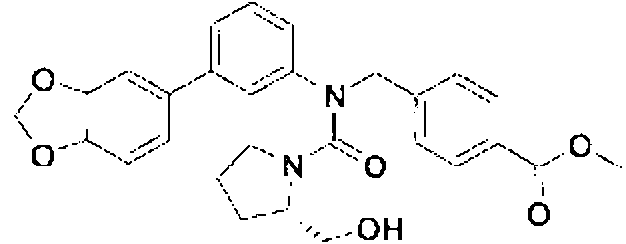
El compuesto de Fórmula 5-3 (4-(((3-(benzo[d][1,3]dioxol-5-il)fenil)((4-nitrofenoxi)carbonil)amino)metil)benzoato de metilo; 0,180 g, 0,342 mmol) se disolvió en dimetilformamida (2 ml), después se añadieron (S)-pirrolidin-2-il-metanol (0,104 g, 1,03 mmol) y carbonato potásico (0,142 g, 1,03 mmol) y se agitó a 50 °C durante 16 horas. Después de que se completara la reacción, la capa orgánica se extrajo con acetato de etilo y solución acuosa saturada de cloruro de amonio, se deshidrogenó con sulfato de magnesio anhidro y después se filtró. El filtrado se concentró a presión reducida y después el residuo se purificó y se concentró por cromatografía en columna (sílice; acetato de etilo/hexano = 30 %) para dar el compuesto deseado de Fórmula 5-4 (0,142 g, 85 %) en forma de un líquido incoloro.The compound of Formula 5-3 (methyl 4 - (((3- (benzo [d] [1,3] dioxol-5-yl) phenyl) ((4-nitrophenoxy) carbonyl) amino) methyl) benzoate; g, 0.342 mmol) was dissolved in dimethylformamide (2 ml), then (S) -pyrrolidin-2-yl-methanol (0.104 g, 1.03 mmol) and potassium carbonate (0.142 g, 1.03 mmol) were added and it was stirred at 50 ° C for 16 hours. After the reaction was complete, the organic layer was extracted with ethyl acetate and saturated aqueous solution of ammonium chloride, dehydrogenated with anhydrous magnesium sulfate and then filtered. The filtrate was concentrated under reduced pressure and then the residue was purified and concentrated by column chromatography (silica; ethyl acetate / hexane = 30%) to give the desired compound of Formula 5-4 (0.142 g, 85%) in form of a colorless liquid.
(Compuesto 469: (S)-N-(3-(benzo[d][1,3]dioxol-5-il)fenil)-N-(4-(hidroxicarbamoil)bencil)-2-(hidroximetil)pirrolidin-1-carboxamida)(Compound 469: (S) -N- (3- (benzo [d] [1,3] dioxol-5-yl) phenyl) -N- (4- (hydroxycarbamoyl) benzyl) -2- (hydroxymethyl) pyrrolidin- 1-carboxamide)

El compuesto de Fórmula 5-4 (4-((N-(3-(benzo[d][1,3]dioxol-5-il)fenil)-2(hidroximetil)pirrolidin-1-carboxamido)metil)benzoato de (S)-metilo; 0,142 g, 0,291 mmol) se disolvió en metanol (10 ml), después se añadieron secuencialmente hidroxilamina (solución acuosa al 50,0 % en peso; 0,889 ml, 14,5 mmol) e hidróxido potásico (0,163 g, 2,91 mmol) y después se agitó a temperatura ambiente durante 30 minutos. Después de que se completara la reacción, la solución de reacción se concentró a presión reducida hasta que su volumen se volvió de aproximadamente 1 ml, se añadió una solución acuosa saturada de cloruro de amonio (1-2 ml) y se agitó. Después, el producto sólido se filtró, se lavó con agua y después se secó al vacío para dar el compuesto 469 deseado (0,112 g, 79 %) en forma de un sólido de color amarillo claro.The compound of Formula 5-4 (4 - ((N- (3- (benzo [d] [1,3] dioxol-5-yl) phenyl) -2 (hydroxymethyl) pyrrolidin-1-carboxamido) methyl) benzoate of (S) -methyl, 0.142 g, 0.291 mmol) was dissolved in methanol (10 ml), then hydroxylamine (50.0% by weight aqueous solution, 0.889 ml, 14.5 mmol) and potassium hydroxide (0.163) were added sequentially. g, 2.91 mmol) and then stirred at room temperature for 30 minutes. After the reaction was completed, the reaction solution was concentrated under reduced pressure until its volume became about 1 ml, a saturated aqueous solution of ammonium chloride (1-2 ml) was added and stirred. Then, the solid product was filtered, washed with water and then dried under vacuum to give the desired compound 469 (0.112 g, 79%) as a light yellow solid.
1H RMN (400 MHz, DMSO-d6) 87,63 (d, 2 H, J = 8,2 Hz), 7,39 - 7,36 (m, 3 H), 7,31 - 7,25 (m, 2 H), 7,20 (d, 1 H, J = 1,8 Hz), 7,11 - 7,07 (m, 2 H), 6,95 (d, 1 H, J = 8,1 Hz), 6,04 (s, 2 H), 5,01 (d, 1 H, J = 16,1 Hz), 4,85 -4,81 (m, 2 H), 3,93 (m, 1 H), 3,54 (m, 2 H), 3,10 (m, 1 H), 2,55 (m, 1 H), 1,82 (m, 1 H), 1,65 (m, 2 H), 1,56 (m, 1 H). MS (ESI) m/z 490 (M+ H).1 H NMR (400 MHz, DMSO-d 6) 87.63 (d, 2 H, J = 8.2 Hz), 7.39-7.36 (m, 3 H), 7.31-7.25 (m , 2 H), 7.20 (d, 1 H, J = 1.8 Hz), 7.11-7.07 (m, 2 H), 6.95 (d, 1 H, J = 8.1 Hz), 6.04 (s, 2 H), 5.01 (d, 1 H, J = 16.1 Hz), 4.85 -4.81 (m, 2 H), 3.93 (m, 1 H), 3.54 (m, 2 H), 3.10 (m, 1 H), 2.55 (m, 1 H), 1.82 (m, 1 H), 1.65 (m, 2 H), 1.56 (m, 1 H). MS (ESI) m / z 490 (M + H).
Ejemplo 99: Síntesis del compuesto 470Example 99: Synthesis of compound 470
(Fórmula 5-4: 4-((N-(3-(benzo[d][1,3]dioxol-5-il)fenil)-4-(ciclopropanocarbonil)piperazin-1-carboxamido)metil)benzoato de metilo) (Formula 5-4: 4 - ((N- (3- (benzo [d] [1,3] dioxol-5-yl) phenyl) -4- (cyclopropanecarbonyl) piperazine-1-carboxamido) methyl) methyl benzoate )

El compuesto de Fórmula 5-3 (4-(((3-(benzo[d][1,3]dioxol-5-il)fenil)((4-nitrofenoxi)carbonil)amino)metil)benzoato de metilo; 0,180 g, 0,342 mmol) se disolvió en dimetilformamida (2 ml), después se añadieron ciclopropil(piperazin-1-il)metanona (0,158 g, 1,03 mmol) y carbonato potásico (0,142 g, 1,03 mmol) y se agitó a 50 °C durante 16 horas. Después de que se completara la reacción, la capa orgánica se extrajo con acetato de etilo y solución acuosa saturada de cloruro de amonio, se deshidrogenó con sulfato de magnesio anhidro y después se filtró. El filtrado se concentró a presión reducida y después el residuo se purificó y se concentró por cromatografía en columna (sílice; acetato de etilo/hexano = 30 %) para dar el compuesto deseado de Fórmula 5-4 (0,096 g, 52 %) en forma de un líquido de color amarillo.The compound of Formula 5-3 (methyl 4 - (((3- (benzo [d] [1,3] dioxol-5-yl) phenyl) ((4-nitrophenoxy) carbonyl) amino) methyl) benzoate; g, 0.342 mmol) was dissolved in dimethylformamide (2 ml), then cyclopropyl (piperazin-1-yl) methanone (0.158 g, 1.03 mmol) and potassium carbonate (0.142 g, 1.03 mmol) were added and stirred. at 50 ° C for 16 hours. After the reaction was complete, the organic layer was extracted with ethyl acetate and saturated aqueous solution of ammonium chloride, dehydrogenated with anhydrous magnesium sulfate and then filtered. The filtrate was concentrated under reduced pressure and then the residue was purified and concentrated by column chromatography (silica; ethyl acetate / hexane = 30%) to give the desired compound of Formula 5-4 (0.096 g, 52%) in shape of a yellow liquid.
(Compuesto 470: N-(3-(benzo[d][1,3]dioxol-5-il)fenil)-4-(ciclopropanocarbonil)-N-(4-(hidroxicarbam oil)bencil)piperazin-1-carboxamida)(Compound 470: N- (3- (benzo [d] [1,3] dioxol-5-yl) phenyl) -4- (cyclopropanecarbonyl) -N- (4- (hydroxycarbamyl) benzyl) piperazine-1-carboxamide )

El compuesto de Fórmula 5-4 (4-((N-(3-(benzo[d][1,3]dioxol-5-il)fenil)-4-(ciclopropanocarbonil)piperazin-1-carboxamido)metil)benzoato de metilo; 0,096 g, 0,177 mmol) se disolvió en metanol (10 ml), después se añadieron secuencialmente hidroxilamina (solución acuosa al 50,0 % en peso; 0,542 ml, 8,86 mmol) e hidróxido potásico (0,100 g, 1,77 mmol) y después se agitó a temperatura ambiente durante 30 minutos. Después de que se completara la reacción, la solución de reacción se concentró a presión reducida hasta que su volumen se volvió de aproximadamente 1 ml, se añadió una solución acuosa saturada de cloruro de amonio (1-2 ml) y se agitó. Después, el producto sólido se filtró, se lavó con agua y después se secó al vacío para dar el compuesto 470 deseado (0,048 g, 50 %) en forma de un sólido de color amarillo claro.The compound of Formula 5-4 (4 - ((N- (3- (benzo [d] [1,3] dioxol-5-yl) phenyl) -4- (cyclopropanecarbonyl) piperazine-1-carboxamido) methyl) benzoate of methyl, 0.096 g, 0.177 mmol) was dissolved in methanol (10 ml), then hydroxylamine (50.0% by weight aqueous solution, 0.542 ml, 8.86 mmol) and potassium hydroxide (0.100 g, 1 g) were added sequentially. , 77 mmol) and then stirred at room temperature for 30 minutes. After the reaction was completed, the reaction solution was concentrated under reduced pressure until its volume became about 1 ml, a saturated aqueous solution of ammonium chloride (1-2 ml) was added and stirred. Then, the solid product was filtered, washed with water and then dried under vacuum to give the desired compound 470 (0.048 g, 50%) as a light yellow solid.
1H RMN (400 MHz, DIVISOR) 87,63 (d, 2 H, J = 8,1 Hz), 7,40 - 7,38 (m, 3 H), 7,33 - 7,31 (m, 2 H), 7,23 (d, 1 H, J = 1,6 Hz), 7,10 (dd, 1 H, J = 8,1, 1,6 Hz), 7,06 (m, 1 H), 6,97 (d, 1 H, J = 8,2 Hz), 6,05 (s, 2 H), 4,93 (s, 2 H), 3,50 (m, 4 H), 3,21 - 3,17 (m, 4 H), 1,88 (m, 1 H), 0,68 - 0,63 (m, 4 H). MS (ESI) m/z 543 (M+ H).1 H NMR (400 MHz, DIVIDER) 87.63 (d, 2 H, J = 8.1 Hz), 7.40-7.38 (m, 3 H), 7.33-7.31 (m, 2 H), 7.23 (d, 1 H, J = 1.6 Hz), 7.10 (dd, 1 H, J = 8.1, 1.6 Hz), 7.06 (m, 1 H) , 6.97 (d, 1 H, J = 8.2 Hz), 6.05 (s, 2 H), 4.93 (s, 2 H), 3.50 (m, 4 H), 3, 21-3.17 (m, 4 H), 1.88 (m, 1 H), 0.68-0.03 (m, 4 H). MS (ESI) m / z 543 (M + H).
Ejemplo 100: Síntesis del compuesto 471Example 100: Synthesis of compound 471
(Fórmula 5-4: 4-((N-(3-(benzo[d][1,3]dioxol-5-il)fenil)azetidin-1-carboxamido)metil)benzoato de metilo)(Formula 5-4: 4 - ((N- (3- (benzo [d] [1,3] dioxol-5-yl) phenyl) azetidin-1-carboxamido) methyl) benzoate methyl)

El compuesto de Fórmula 5-3 (4-(((3-(benzo[d][1,3]dioxol-5-il)fenil)((4-nitrofenoxi)carbonil)amino)metil)benzoato de metilo; 0,180 g, 0,342 mmol) se disolvió en dimetilformamida (2 ml), después se añadieron clorhidrato de azetidina (0,096 g, 1,03 mmol) y carbonato potásico (0,142 g, 1,03 mmol) y se agitó a 50 °C durante 16 horas. Después de que se completara la reacción, la capa orgánica se extrajo con acetato de etilo y solución acuosa saturada de cloruro de amonio, se deshidrogenó con sulfato de magnesio anhidro y después se filtró. El filtrado se concentró a presión reducida y después el residuo se purificó y se concentró por cromatografía en columna (sílice; acetato de etilo/hexano = 30 %) para dar el compuesto deseado de Fórmula 5-4 (0,150 g, 99 %) en forma de un sólido de color blanco. The compound of Formula 5-3 (methyl 4 - (((3- (benzo [d] [1,3] dioxol-5-yl) phenyl) ((4-nitrophenoxy) carbonyl) amino) methyl) benzoate; g, 0.342 mmol) was dissolved in dimethylformamide (2 ml), then azetidine hydrochloride (0.096 g, 1.03 mmol) and potassium carbonate (0.142 g, 1.03 mmol) were added and stirred at 50 ° C for 16 hours. hours. After the reaction was complete, the organic layer was extracted with ethyl acetate and saturated aqueous solution of ammonium chloride, dehydrogenated with anhydrous magnesium sulfate and then filtered. The filtrate was concentrated under reduced pressure and then the residue was purified and concentrated by column chromatography (silica; ethyl acetate / hexane = 30%) to give the desired compound of Formula 5-4 (0.150 g, 99%) in shape of a white solid.
(Compuesto 471: N-(3-(benzo[d][1,3]dioxol-5-il)fenil)-N-(4-(hidroxicarbamoil)bencil)azetidin-1-carboxamida)(Compound 471: N- (3- (benzo [d] [1,3] dioxol-5-yl) phenyl) -N- (4- (hydroxycarbamoyl) benzyl) azetidine-1-carboxamide)

El compuesto de Fórmula 5-4 (4-((N-(3-(benzo[d][1,3]dioxol-5-il)fenil)azetidin-1-carboxamido)metil)benzoato de metilo; 0,150 g, 0,337 mmol) se disolvió en metanol (10 ml), después se añadieron secuencialmente hidroxilamina (solución acuosa al 50,0 % en peso; 1,03 ml, 16,9 mmol) e hidróxido potásico (0,189 g, 3,38 mmol) y después se agitó a temperatura ambiente durante 30 minutos. Después de que se completara la reacción, la solución de reacción se concentró a presión reducida hasta que su volumen se volvió de aproximadamente 1 ml, se añadió una solución acuosa saturada de hidrogenocarbonato sódico (1-2 ml) y se agitó. Después, el producto sólido se filtró, se lavó con agua y después se secó al vacío para dar el compuesto 471 deseado (0,150 g, 99 %) en forma de un sólido de color blanco.The compound of Formula 5-4 (methyl 4 - ((N- (3- (benzo [d] [1,3] dioxol-5-yl) phenyl) azetidin-1-carboxamido) methyl) benzoate; 0.150 g, 0.337 mmol) was dissolved in methanol (10 ml), then hydroxylamine (50.0% by weight aqueous solution, 1.03 ml, 16.9 mmol) and potassium hydroxide (0.189 g, 3.38 mmol) were added sequentially. and then stirred at room temperature for 30 minutes. After the reaction was completed, the reaction solution was concentrated under reduced pressure until its volume became about 1 ml, a saturated aqueous solution of sodium hydrogencarbonate (1-2 ml) was added and stirred. Then, the solid product was filtered, washed with water and then dried in vacuo to give the desired compound 471 (0.150 g, 99%) as a white solid.
1H RMN (400 MHz, DMSO-da) 87,63 (d, 2 H, J = 8,2 Hz), 7,40 - 7,37 (m, 2 H), 7,34 - 7,30 (m, 3 H), 7,19 (d, 1 H, J = 1,8 Hz), 7,08 - 7,05 (m, 2 H), 6,97 (d, 1 H, J = 8,1 Hz), 6,04 (s, 2 H), 4,90 (s, 2 H), 3,52 - 3,48 (m, 4 H), 1,94 - 1,92 (m, 2 H). MS (ESI) m/z 446 (M+ H).1 H NMR (400 MHz, DMSO-da) 87.63 (d, 2 H, J = 8.2 Hz), 7.40-7.37 (m, 2 H), 7.34-7.30 (m , 3 H), 7.19 (d, 1 H, J = 1.8 Hz), 7.08-7.05 (m, 2 H), 6.97 (d, 1 H, J = 8.1) Hz), 6.04 (s, 2 H), 4.90 (s, 2 H), 3.52 - 3.48 (m, 4 H), 1.94 - 1.92 (m, 2 H) . MS (ESI) m / z 446 (M + H).
Ejemplo 101: Síntesis del compuesto 477Example 101: Synthesis of compound 477
(Fórmula 1-4: 4-((N-(3-cloro-4-fluorofenil)-2,6-dimetilmorfolin-4-carboxamido)metil)benzoato de metilo)(Formula 1-4: 4 - (methyl (N- (3-chloro-4-fluorophenyl) -2,6-dimethylmorpholin-4-carboxamido) methyl) benzoate)

El compuesto de Fórmula 1-3 (4-(((3-cloro-4-fluorofenil)((4-nitrofenoxi)carbonil)amino)metil)benzoato de metilo; 0,20 g, 0,436 mmol) y 2,6-dimetilmorfolina (0,053 ml, 0,436 mmol) se disolvieron en dimetilformamida (10 ml) y la mezcla se calentó y se agitó a 60 °C durante 12 horas. Después, la dimetilformamida se retiró a presión reducida, se vertió agua en la mezcla de reacción y la capa orgánica se extrajo con acetato de etilo. La capa orgánica se lavó con una solución acuosa saturada de cloruro sódico, se deshidrató con sulfato de magnesio anhidro y después se concentró a presión reducida. El residuo se purificó y se concentró por cromatografía en columna (sílice; acetato de etilo/hexano = 20 %) para dar el compuesto deseado de Fórmula 1-4 (0,048 g, 25 %) en forma de un aceite de color amarillo. The compound of Formula 1-3 (methyl 4 - (((3-chloro-4-fluorophenyl) ((4-nitrophenoxy) carbonyl) amino) methyl) benzoate; 0.20 g, 0.436 mmol) and 2,6- dimethylmorpholine (0.053 ml, 0.436 mmol) were dissolved in dimethylformamide (10 ml) and the mixture was heated and stirred at 60 ° C for 12 hours. Then, the dimethylformamide was removed under reduced pressure, water was poured into the reaction mixture and the organic layer was extracted with ethyl acetate. The organic layer was washed with a saturated aqueous solution of sodium chloride, dehydrated with anhydrous magnesium sulfate and then concentrated under reduced pressure. The residue was purified and concentrated by column chromatography (silica; ethyl acetate / hexane = 20%) to give the desired compound of Formula 1-4 (0.048 g, 25%) as a yellow oil.
(Compuesto 477: N-(3-cloro-4-fluorofenil)-N-(4-(hidroxicarbamoil)bencil)-2,6-dimetilmorfolin-4-carboxamida)(Compound 477: N- (3-chloro-4-fluorophenyl) -N- (4- (hydroxycarbamoyl) benzyl) -2,6-dimethylmorpholine-4-carboxamide)

El compuesto de Fórmula 1-4 (4-((N-(3-cloro-4-fluorofenil)-2,6-dimetilmorfolin-4-carboxamido)metil)benzoato de metilo; 0,048 g, 0,11 mmol) se disolvió en metanol (5 ml), se añadieron clorhidrato de hidroxilamina (0,038 g, 0,552 mmol) e hidróxido potásico (0,062 g, 1,10 mmol) y se agitó. Después, se añadió gota a gota hidroxilamina (solución acuosa al 50 % en peso; 0,142 ml, 2,21 mmol) y se agitó a temperatura ambiente durante 3 horas. Después de que se completara la reacción, el metanol se retiró a presión reducida y se añadió una solución acuosa saturada de hidrogenocarbonato sódico se añadió para precipitar un sólido, y el sólido resultante se filtró y se secó para dar el compuesto 477 deseado (0,022 g, 46 %) en forma de un sólido de color amarillo.The compound of Formula 1-4 (methyl 4 - ((N- (3-chloro-4-fluorophenyl) -2,6-dimethylmorpholin-4-carboxamido) methyl) benzoate; 0.048 g, 0.11 mmol) was dissolved in methanol (5 ml), hydroxylamine hydrochloride (0.038 g, 0.552 mmol) and potassium hydroxide (0.062 g, 1.10 mmol) were added and stirred. Then hydroxylamine (50% by weight aqueous solution, 0.142 ml, 2.21 mmol) was added dropwise and stirred at room temperature for 3 hours. After the reaction was complete, the methanol was removed under reduced pressure and a saturated aqueous solution of sodium hydrogencarbonate was added to precipitate a solid, and the resulting solid was filtered and dried to give the desired compound 477 (0.022 g. , 46%) in the form of a yellow solid.
1H RMN (400 MHz, MeOD-da) 87,67 (d, 2 H, J = 7,7 Hz), 7,40 (d, 2 H, J = 7,6 Hz), 7,31 -7,30 (m, 1 H), 7,22 -7,18 (m, 1 H), 7,11 - 7,09 (m, 1 H), 3,66 -3,62 (m, 2 H), 3,43 - 3,39 (m, 2 H), 2,40 -2,34 (m, 2 H), 1,03 (d, 6 H, J = 6,1 Hz); MS (ESI) m/z 436,1 (M+ H).1 H NMR (400 MHz, MeOD-da) 87.67 (d, 2 H, J = 7.7 Hz), 7.40 (d, 2 H, J = 7.6 Hz), 7.31 -7, 30 (m, 1 H), 7.22 -7.18 (m, 1 H), 7.11-7.09 (m, 1 H), 3.66 -3.62 (m, 2 H), 3.43-3.39 (m, 2 H), 2.40 -2.34 (m, 2 H), 1.03 (d, 6 H, J = 6.1 Hz); MS (ESI) m / z 436.1 (M + H).
Ejemplo 102: Síntesis del compuesto 478Example 102: Synthesis of compound 478
(Fórmula 1-4: 4-((N-(3-cloro-4-fluorofenil)-4-metilpiperazin-1-carboxamido)metil)benzoato de metilo)(Formula 1-4: 4 - (methyl (N- (3-chloro-4-fluorophenyl) -4-methylpiperazin-1-carboxamido) methyl) benzoate)

El compuesto de Fórmula 1-3 (4-(((3-cloro-4-fluorofenil)((4-nitrofenoxi)carbonil)amino)metil)benzoato de metilo; 0,20 g, 0,436 mmol) y 1-metilpiperazina (0,049 ml, 0,436 mmol) se disolvieron en dimetilformamida (10 ml) y la mezcla se calentó y se agitó a 60 °C durante 12 horas. Después, la dimetilformamida se retiró a presión reducida, se vertió agua en la mezcla de reacción y la capa orgánica se extrajo con acetato de etilo. La capa orgánica se lavó con una solución acuosa saturada de cloruro sódico, se deshidrató con sulfato de magnesio anhidro y después se concentró a presión reducida. El residuo se purificó y se concentró por cromatografía en columna (sílice; metanol/diclorometano = 5 %) para dar el compuesto deseado de Fórmula 1-4 (0,13 g, 72 %) en forma de un aceite de color amarillo.The compound of Formula 1-3 (methyl 4 - (((3-chloro-4-fluorophenyl) ((4-nitrophenoxy) carbonyl) amino) methyl) benzoate; 0.20 g, 0.436 mmol) and 1-methylpiperazine ( 0.049 ml, 0.436 mmol) were dissolved in dimethylformamide (10 ml) and the mixture was heated and stirred at 60 ° C for 12 hours. Then, the dimethylformamide was removed under reduced pressure, water was poured into the reaction mixture and the organic layer was extracted with ethyl acetate. The organic layer was washed with a saturated aqueous solution of sodium chloride, dehydrated with anhydrous magnesium sulfate and then concentrated under reduced pressure. The residue was purified and concentrated by column chromatography (silica; methanol / dichloromethane = 5%) to give the desired compound of Formula 1-4 (0.13 g, 72%) as a yellow oil.
(Compuesto 478: N-(3-cloro-4-fluorofenil)-N-(4-(hidroxicarbamoil)bencil)-4-metilpiperazin-1-carboxamida)(Compound 478: N- (3-chloro-4-fluorophenyl) -N- (4- (hydroxycarbamoyl) benzyl) -4-methylpiperazine-1-carboxamide)

El compuesto de Fórmula 1-4 (4-((N-(3-cloro-4-fluorofenil)-4-metilpiperazin-1-carboxamido)metil)benzoato de metilo; 0,10 g, 0,238 mmol) se disolvió en metanol (5 ml), se añadieron clorhidrato de hidroxilamina (0,083 g, 1,19 mmol) e hidróxido potásico (0,134 g, 2,38 mmol) y se agitó. Después, se añadió gota a gota hidroxilamina (solución acuosa al 50 % en peso; 0,307 ml, 4,76 mmol) y se agitó a temperatura ambiente durante 3 horas. Después de que se completara la reacción, el metanol se retiró a presión reducida, se añadió una solución acuosa saturada de hidrogenocarbonato sódico para precipitar un sólido y el sólido resultante se filtró y se secó para dar el compuesto 478 deseado (0,077 g, 77 %) en forma de un aceite de color amarillo.The compound of Formula 1-4 (methyl 4 - ((N- (3-chloro-4-fluorophenyl) -4-methylpiperazine-1-carboxamido) methyl) benzoate; 0.10 g, 0.238 mmol) was dissolved in methanol (5 ml), hydroxylamine hydrochloride (0.083 g, 1.19 mmol) and potassium hydroxide (0.134 g, 2.38 mmol) were added and stirred. Then, hydroxylamine (50% by weight aqueous solution, 0.307 ml, 4.76 mmol) was added dropwise and stirred at room temperature for 3 hours. After the reaction was completed, the methanol was removed under reduced pressure, a saturated aqueous solution of sodium hydrogencarbonate was added to precipitate a solid and the resulting solid was filtered and dried to give the desired compound 478 (0.077 g, 77% ) in the form of a yellow oil.
1H RMN (400 MHz, MeOD-da) 87,67 (d, 2 H, J = 8,1 Hz), 7,38 (d, 2 H, J = 8,1 Hz), 7,30 -7,28 (m, 1 H), 7,22 -7,17 (m, 1 H), 7,10 - 7,07 (m, 1 H), 4,89 (s, 2 H), 3,29 - 3,27 (m, 4 H), 2,30 - 2,27 (m, 4 H), 2,23 (s, 3 H); MS (ESI) m/z 421,1 (M+ H).1 H NMR (400 MHz, MeOD-da) 87.67 (d, 2 H, J = 8.1 Hz), 7.38 (d, 2 H, J = 8.1 Hz), 7.30-7, 28 (m, 1 H), 7.22 -7.17 (m, 1 H), 7.10-7.07 (m, 1 H), 4.89 (s, 2 H), 3.29 - 3.27 (m, 4 H), 2.30-2.27 (m, 4 H), 2.23 (s, 3 H); MS (ESI) m / z 421.1 (M + H).
Ejemplo 103: Síntesis del compuesto 479Example 103: Synthesis of compound 479
(Fórmula 1-4: 4-((N-(3-cloro-4-fluorofenil)-4-etilpiperazin-1-carboxamido)metil)benzoato de metilo)(Formula 1-4: 4 - (methyl (N- (3-chloro-4-fluorophenyl) -4-ethylpiperazin-1-carboxamido) methyl) benzoate)

El compuesto de Fórmula 1-3 (4-(((3-cloro-4-fluorofenil)((4-nitrofenoxi)carbonil)amino)metil)benzoato de metilo; 0,20 g, 0,436 mmol) y 1-etilpiperazina (0,055 ml, 0,436 mmol) se disolvieron en dimetilformamida (10 ml) y la mezcla se calentó y se agitó a 60 °C durante 12 horas. Después, la dimetilformamida se retiró a presión reducida, se vertió agua en la mezcla de reacción y la capa orgánica se extrajo con acetato de etilo. La capa orgánica se lavó con una solución acuosa saturada de cloruro sódico, se deshidrató con sulfato de magnesio anhidro y después se concentró a presión reducida. El residuo se purificó y se concentró por cromatografía en columna (sílice; metanol/diclorometano = 5 %) para dar el compuesto deseado de Fórmula 1-4 (0,165 g, 87 %) en forma de un aceite de color amarillo.The compound of Formula 1-3 (methyl 4 - (((3-chloro-4-fluorophenyl) ((4-nitrophenoxy) carbonyl) amino) methyl) benzoate; 0.20 g, 0.436 mmol) and 1-ethylpiperazine ( 0.055 ml, 0.436 mmol) were dissolved in dimethylformamide (10 ml) and the mixture was heated and stirred at 60 ° C for 12 hours. Then, the dimethylformamide was removed under reduced pressure, water was poured into the reaction mixture and the organic layer was extracted with ethyl acetate. The organic layer was washed with a saturated aqueous solution of sodium chloride, dehydrated with anhydrous magnesium sulfate and then concentrated under reduced pressure. The residue was purified and concentrated by column chromatography (silica; methanol / dichloromethane = 5%) to give the desired compound of Formula 1-4 (0.165 g, 87%) as a yellow oil.
(Compuesto 479: N-(3-cloro-4-fluorofenil)-4-etil-N-(4-(hidroxicarbamoil)bencil)piperazin-1-carboxamida)(Compound 479: N- (3-chloro-4-fluorophenyl) -4-ethyl-N- (4- (hydroxycarbamoyl) benzyl) piperazine-1-carboxamide)

El compuesto de Fórmula 1-4 (4-((N-(3-cloro-4-fluorofenil)-4-etilpiperazin-1-carboxamido)metil)benzoato de metilo; 0,10 g, 0,23 mmol) se disolvió en metanol (5 ml), se añadieron clorhidrato de hidroxilamina (0,08 g, 1,15 mmol) e hidróxido potásico (0,129 g, 2,31 mmol) y se agitó. Después, se añadió gota a gota hidroxilamina (solución acuosa al 50 % en peso; 0,297 ml, 4,61 mmol) y se agitó a temperatura ambiente durante 3 horas. Después de que se completara la reacción, el metanol se retiró a presión reducida y se añadió una solución acuosa saturada de hidrogenocarbonato sódico se añadió para precipitar un sólido, y el sólido resultante se filtró y se secó para dar el compuesto 479 deseado (0,092 g, 92 %) en forma de un sólido de color amarillo.The compound of Formula 1-4 (methyl 4 - ((N- (3-chloro-4-fluorophenyl) -4-ethylpiperazine-1-carboxamido) methyl) benzoate; 0.10 g, 0.23 mmol) was dissolved in methanol (5 ml), hydroxylamine hydrochloride (0.08 g, 1.15 mmol) and potassium hydroxide (0.129 g, 2.31 mmol) were added and stirred. Then, hydroxylamine (50% by weight aqueous solution, 0.297 ml, 4.61 mmol) was added dropwise and stirred at room temperature for 3 hours. After the reaction was completed, the methanol was removed under reduced pressure and a saturated aqueous solution of sodium hydrogencarbonate was added to precipitate a solid, and the resulting solid was filtered and dried to give the desired compound 479 (0.092 g. , 92%) in the form of a yellow solid.
1H RMN (400 MHz, MeOD-ds) 87,67 (d, 2 H, J = 8,2 Hz), 7,39 (d, 2 H, J = 8,2 Hz), 7,30 - 7,28 (m, 1 H), 7,22 - 7,17 (m, 1 H), 7,10 (m, 1 H), 4,90 (s, 2 H), 3,31 - 3,28 (m, 4 H), 2,41 - 2,36 (m, 2 H), 2,33 - 2,31 (m, 4 H), 1,06 (t, 3 H, J = 7,2 Hz); MS (ESI) m/z 435,1 (M+ H). 1 H NMR (400 MHz, MeOD-ds) 87.67 (d, 2 H, J = 8.2 Hz), 7.39 (d, 2 H, J = 8.2 Hz), 7.30-7, 28 (m, 1 H), 7.22-7.17 (m, 1 H), 7.10 (m, 1 H), 4.90 (s, 2 H), 3.31 - 3.28 ( m, 4 H), 2.41-2.36 (m, 2 H), 2.33-2.31 (m, 4 H), 1.06 (t, 3 H, J = 7.2 Hz) ; MS (ESI) m / z 435.1 (M + H).
Ejemplo 104: Síntesis del compuesto 480Example 104: Synthesis of compound 480
(Fórmula 1-4: 4-((4-bencil-N-(3-doro-4-fluorofenil)piperazin-1-carboxamido)metil)benzoato de metilo)(Formula 1-4: 4 - ((methyl 4-benzyl-N- (3-duro-4-fluorophenyl) piperazine-1-carboxamido) methyl) benzoate)

El compuesto de Fórmula 1-3 (4-(((3-cloro-4-fluorofenil)((4-nitrofenoxi)carbonil)amino)metil)benzoato de metilo; 0,20 g, 0,436 mmol) y 1-bencilpiperazina (0,075 ml, 0,436 mmol) se disolvieron en dimetilformamida (10 ml) y la mezcla se calentó y se agitó a 60 °C durante 12 horas. Después, la dimetilformamida se retiró a presión reducida, se vertió agua en la mezcla de reacción y la capa orgánica se extrajo con acetato de etilo. La capa orgánica se lavó con una solución acuosa saturada de cloruro sódico, se deshidrató con sulfato de magnesio anhidro y después se concentró a presión reducida. El residuo se purificó y se concentró por cromatografía en columna (sílice; acetato de etilo/hexano = 20 %) para dar el compuesto deseado de Fórmula 1-4 (0,151 g, 70 %) en forma de un aceite de color amarillo.The compound of Formula 1-3 (methyl 4 - (((3-chloro-4-fluorophenyl) ((4-nitrophenoxy) carbonyl) amino) methyl) benzoate; 0.20 g, 0.436 mmol) and 1-benzylpiperazine ( 0.075 ml, 0.436 mmol) were dissolved in dimethylformamide (10 ml) and the mixture was heated and stirred at 60 ° C for 12 hours. Then, the dimethylformamide was removed under reduced pressure, water was poured into the reaction mixture and the organic layer was extracted with ethyl acetate. The organic layer was washed with a saturated aqueous solution of sodium chloride, dehydrated with anhydrous magnesium sulfate and then concentrated under reduced pressure. The residue was purified and concentrated by column chromatography (silica; ethyl acetate / hexane = 20%) to give the desired compound of Formula 1-4 (0.151 g, 70%) as a yellow oil.
(Compuesto 480: 4-bencil-N-(3-cloro-4-fluorofenil)-N-(4-(hidroxicarbamoil)bencil)piperazin-1-carboxamida)(Compound 480: 4-benzyl-N- (3-chloro-4-fluorophenyl) -N- (4- (hydroxycarbamoyl) benzyl) piperazine-1-carboxamide)
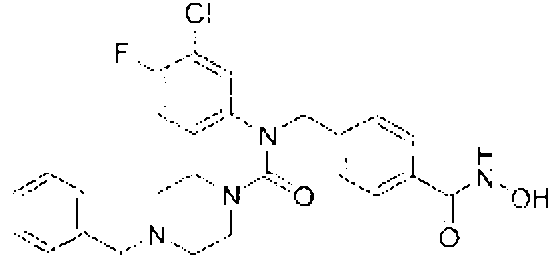
El compuesto de Fórmula 1-4 (4-((4-bencil-N-(3-cloro-4-fluorofenil)piperazin-1-carboxamido)metil)benzoato de metilo; 0,10 g, 0,202 mmol) se disolvió en metanol (5 ml), se añadieron clorhidrato de hidroxilamina (0,07 g, 1,01 mmol) e hidróxido potásico (0,113 g, 2,02 mmol) y se agitó. Después, se añadió gota a gota hidroxilamina (solución acuosa al 50 % en peso; 0,26 ml, 4,03 mmol) y se agitó a temperatura ambiente durante 3 horas. Después de que se completara la reacción, el metanol se retiró a presión reducida y se añadió una solución acuosa saturada de hidrogenocarbonato sódico se añadió para precipitar un sólido, y el sólido resultante se filtró y se secó para dar el compuesto 480 deseado (0,057 g, 57 %) en forma de un sólido de color amarillo.The compound of Formula 1-4 (methyl 4 - ((4-benzyl-N- (3-chloro-4-fluorophenyl) piperazine-1-carboxamido) methyl) benzoate; 0.10 g, 0.202 mmol) was dissolved in methanol (5 ml), hydroxylamine hydrochloride (0.07 g, 1.01 mmol) and potassium hydroxide (0.113 g, 2.02 mmol) were added and stirred. Then, hydroxylamine (50% by weight aqueous solution, 0.26 ml, 4.03 mmol) was added dropwise and stirred at room temperature for 3 hours. After the reaction was completed, the methanol was removed under reduced pressure and a saturated aqueous solution of sodium hydrogencarbonate was added to precipitate a solid, and the resulting solid was filtered and dried to give the desired compound 480 (0.057 g. , 57%) in the form of a yellow solid.
1H RMN (400 MHz, MeOD-ds) 87,67 (d, 2 H, J = 8,2 Hz), 7,39 (d, 2 H, J = 8,2 Hz), 7,32 -7,15 (m, 6 H), 7,09 -7,05 (m, 1 H), 4,88 (s, 2 H), 3,48 (s, 2 H), 3,27 (m, 4 H), 2,30 (m, 4 H); MS (ESI) m/z 497,2 (M+ H).1 H NMR (400 MHz, MeOD-ds) 87.67 (d, 2 H, J = 8.2 Hz), 7.39 (d, 2 H, J = 8.2 Hz), 7.32 -7, 15 (m, 6 H), 7.09 -7.05 (m, 1 H), 4.88 (s, 2 H), 3.48 (s, 2 H), 3.27 (m, 4 H) ), 2.30 (m, 4 H); MS (ESI) m / z 497.2 (M + H).
Ejemplo 105: Síntesis del compuesto 481Example 105: Synthesis of compound 481
(Fórmula 1-4: 4-((N-(3-cloro-4-fluorofenil)-4-(2-metoxifenil)piperazin-1-carboxamido)metil)benzoato de metilo)(Formula 1-4: 4 - (methyl (N- (3-chloro-4-fluorophenyl) -4- (2-methoxyphenyl) piperazine-1-carboxamido) methyl) benzoate)

El compuesto de Fórmula 1-3 (4-(((3-cloro-4-fluorofenil)((4-nitrofenoxi)carbonil)amino)metil)benzoato de metilo; 0,20 g, 0,436 mmol) y 4-(2-metoxifenil)piperazina (0,076 ml, 0,436 mmol) se disolvieron en dimetilformamida (10 ml) y la mezcla se calentó y se agitó a 60 °C durante 12 horas. Después, la dimetilformamida se retiró a presión reducida, se vertió agua en la mezcla de reacción y la capa orgánica se extrajo con acetato de etilo. La capa orgánica se lavó con una solución acuosa saturada de cloruro sódico, se deshidrató con sulfato de magnesio anhidro y después se concentró a presión reducida. El residuo se purificó y se concentró por cromatografía en columna (sílice; acetato de etilo/hexano = 20 %) para dar el compuesto deseado de Fórmula 1-4 (0,157 g, 70 %) en forma de un aceite de color amarillo.The compound of Formula 1-3 (methyl 4 - (((3-chloro-4-fluorophenyl) ((4-nitrophenoxy) carbonyl) amino) methyl) benzoate; 0.20 g, 0.436 mmol) and 4- (2 -methoxyphenyl) piperazine (0.076 ml, 0.436 mmol) were dissolved in dimethylformamide (10 ml) and the mixture was heated and stirred at 60 ° C for 12 hours. Then, the dimethylformamide was removed under reduced pressure, water was poured into the reaction mixture and the organic layer was extracted with ethyl acetate. The organic layer was washed with a saturated aqueous solution of sodium chloride, dehydrated with anhydrous magnesium sulfate and then concentrated under reduced pressure. The residue was purified and concentrated by column chromatography (silica; ethyl acetate / hexane = 20%) to give the desired compound of Formula 1-4 (0.157 g, 70%) as a yellow oil.
(Compuesto 481: N-(3-cloro-4-fluorofenil)-N-(4-(hidroxicarbamoil)bencil)-4-(2-metoxifenil)piperazin-1-carboxamida) (Compound 481: N- (3-chloro-4-fluorophenyl) -N- (4- (hydroxycarbamoyl) benzyl) -4- (2-methoxyphenyl) piperazine-1-carboxamide)

El compuesto de Fórmula 1-4 (4-((N-(3-doro-4-fluorofenil)-4-(2-metoxifenil)piperazin-1-carboxamido)metil)benzoato de metilo; 0,10 g, 0,195 mmol) se disolvió en metanol (5 ml), se añadieron clorhidrato de hidroxilamina (0,068 g, 0,977 mmol) e hidróxido potásico (0,109 g, 1,95 mmol) y se agitó. Después, se añadió gota a gota hidroxilamina (solución acuosa de 50 % en peso; 0,252 ml, 3,91 mmol) y se agitó a temperatura ambiente durante 3 horas. Después de que se completara la reacción, el metanol se retiró a presión reducida y se añadió una solución acuosa saturada de hidrogenocarbonato sódico para precipitar un sólido, y el sólido resultante se filtró y se secó para dar el compuesto 481 deseado (0,037 g, 37 %) en forma de un sólido de color blanco.The compound of Formula 1-4 (methyl 4 - ((N- (3-duro-4-fluorophenyl) -4- (2-methoxyphenyl) piperazine-1-carboxamido) methyl) benzoate: 0.10 g, 0.195 mmol ) was dissolved in methanol (5 ml), hydroxylamine hydrochloride (0.068 g, 0.977 mmol) and potassium hydroxide (0.109 g, 1.95 mmol) were added and stirred. Then, hydroxylamine (50% by weight aqueous solution, 0.252 ml, 3.91 mmol) was added dropwise and stirred at room temperature for 3 hours. After the reaction was complete, the methanol was removed under reduced pressure and a saturated aqueous solution of sodium hydrogencarbonate was added to precipitate a solid, and the resulting solid was filtered and dried to give the desired compound 481 (0.037 g, 37 %) in the form of a white solid.
1H RMN (400 MHz, MeOD-da) 87,75 (d, 2 H, J = 8,1 Hz), 7,44 (d, 2 H, J = 8,1 Hz), 7,41 -7,39 (m, 1 H), 7,31 -7,19 (m, 2 H), 7,05 - 6,93 (m, 4 H), 4,96 (s, 2 H), 3,86 (s, 3 H), 3,44 (m, 4 H), 2,92 - 2,91 (m, 4 H); MS (ESI) m/z 513,1 (M+ H).1 H NMR (400 MHz, MeOD-da) 87.75 (d, 2 H, J = 8.1 Hz), 7.44 (d, 2 H, J = 8.1 Hz), 7.41 -7, 39 (m, 1 H), 7.31 -7.19 (m, 2 H), 7.05-6.93 (m, 4 H), 4.96 (s, 2 H), 3.86 ( s, 3 H), 3.44 (m, 4 H), 2.92-2.91 (m, 4 H); MS (ESI) m / z 513.1 (M + H).
Ejemplo 106: Síntesis del compuesto 482Example 106: Synthesis of compound 482
(Fórmula 1-4: 4-((N-(3-cloro-4-fluorofenil)-4-(4-fluorofenil)piperazin-1-carboxamido)metil) benzoato de metilo)(Formula 1-4: 4 - ((Methyl N- (3-chloro-4-fluorophenyl) -4- (4-fluorophenyl) piperazine-1-carboxamido) methyl) benzoate)

El compuesto de Fórmula 1-3 (4-(((3-cloro-4-fluorofenil)((4-nitrofenoxi)carbonil)amino)metil)benzoato de metilo; 0,20 g, 0,436 mmol) y 1-(4-fluorofenil)piperazina (0,079 ml, 0,436 mmol) se disolvieron en dimetilformamida (10 ml) y la mezcla se calentó y se agitó a 60 °C durante 12 horas. Después, la dimetilformamida se retiró a presión reducida, se vertió agua en la mezcla de reacción y la capa orgánica se extrajo con acetato de etilo. La capa orgánica se lavó con una solución acuosa saturada de cloruro sódico, se deshidrató con sulfato de magnesio anhidro y después se concentró a presión reducida. El residuo se purificó y se concentró por cromatografía en columna (sílice; acetato de etilo/hexano = 20 %) para dar el compuesto deseado de Fórmula 1-4 (0,184 g, 84 %) en forma de un aceite de color amarillo.The compound of Formula 1-3 (methyl 4 - (((3-chloro-4-fluorophenyl) ((4-nitrophenoxy) carbonyl) amino) methyl) benzoate; 0.20 g, 0.436 mmol) and 1- (4 Fluorophenyl) piperazine (0.079 ml, 0.436 mmol) were dissolved in dimethylformamide (10 ml) and the mixture was heated and stirred at 60 ° C for 12 hours. Then, the dimethylformamide was removed under reduced pressure, water was poured into the reaction mixture and the organic layer was extracted with ethyl acetate. The organic layer was washed with a saturated aqueous solution of sodium chloride, dehydrated with anhydrous magnesium sulfate and then concentrated under reduced pressure. The residue was purified and concentrated by column chromatography (silica; ethyl acetate / hexane = 20%) to give the desired compound of Formula 1-4 (0.184 g, 84%) as a yellow oil.
(Compuesto 482: N-(3-cloro-4-fluorofenil)-4-(4-fluorofenil)-N-(4-(hidroxicarbamoil)bencil)piperazin-1-carboxamida)(Compound 482: N- (3-chloro-4-fluorophenyl) -4- (4-fluorophenyl) -N- (4- (hydroxycarbamoyl) benzyl) piperazine-1-carboxamide)

El compuesto de Fórmula 1-4 (4-((N-(3-cloro-4-fluorofenil)-4-(4-fluorofenil)piperazin-1-carboxamido)metil) benzoato de metilo; 0,10 g, 0,20 mmol) se disolvió en metanol (5 ml), se añadieron clorhidrato de hidroxilamina (0,069 g, 1,00 mmol) e hidróxido potásico (0,112 g, 2,00 mmol) y se agitó. Después, se añadió gota a gota hidroxilamina (solución acuosa al 50 % en peso; 0,258 ml, 4,00 mmol) y se agitó a temperatura ambiente durante 3 horas. Después de que se completara la reacción, el metanol se retiró a presión reducida y se añadió una solución acuosa saturada de hidrogenocarbonato sódico para precipitar un sólido, y el sólido resultante se filtró y se secó para dar el compuesto 482 deseado (0,029 g, 29 %) en forma de un sólido de color blanco.The compound of Formula 1-4 (methyl 4 - ((N- (3-chloro-4-fluorophenyl) -4- (4-fluorophenyl) piperazine-1-carboxamido) methyl) benzoate; 0.10 g, 0, 20 mmol) was dissolved in methanol (5 ml), hydroxylamine hydrochloride (0.069 g, 1.00 mmol) and potassium hydroxide (0.112 g, 2.00 mmol) were added and stirred. Then, hydroxylamine (50% by weight aqueous solution, 0.258 ml, 4.00 mmol) was added dropwise and stirred at room temperature for 3 hours. After the reaction was complete, the methanol was removed under reduced pressure and a saturated aqueous solution of sodium hydrogencarbonate was added to precipitate a solid, and the resulting solid was filtered and dried to give the desired compound 482 (0.029 g, %) in the form of a white solid.
1H RMN (400 MHz, MeOD-ds) 87,75 (d, 2 H, J = 6,8 Hz), 7,48 - 7,43 (m, 3 H), 7,34 - 7,30 (m, 1 H), 7,22 (m, 1 H), 7,08 - 6,99 (m, 4 H), 4,98 (s, 2 H), 3,45 (m, 4 H), 3,01 (m, 4H); MS (ESI) m/z 501,1 (M+ H).1 H NMR (400 MHz, MeOD-ds) 87.75 (d, 2 H, J = 6.8 Hz), 7.48-7.43 (m, 3 H), 7.34-7.30 (m , 1 H), 7.22 (m, 1 H), 7.08-6.99 (m, 4 H), 4.98 (s, 2 H), 3.45 (m, 4 H), 3 , 01 (m, 4H); MS (ESI) m / z 501.1 (M + H).
Ejemplo 107: Síntesis del compuesto 483Example 107: Synthesis of compound 483
(Fórmula 2-4: 4-((N-(3-(tetrahidro-2H-piran-4-il)fenil)morfolin-4-carboxamido)metil)benzoato de metilo) (Formula 2-4: 4 - ((N- (3- (tetrahydro-2H-pyran-4-yl) phenyl) morpholin-4-carboxamido) methyl) benzoate methyl)

El compuesto de Formula 2-3 (4-((N-(3-(3,6-dihidro-2H-piran-4-il)fenil)morfolin-4-carboxamido)metil)benzoato de metilo; 0,260 g, 0,596 mmol) se disolvió en tetrahidrofurano (10 ml) a temperatura ambiente, se añadió lentamente Pd/C (al 10,0 %, 0,032 g, 0,030 mmol), se acopló un globo de hidrógeno y después la mezcla se agitó a la misma temperatura durante 16 horas. La mezcla de reacción se filtró a través de un lecho de celite y el filtrado se concentró a presión reducida. Después, el residuo se purificó y se concentró por cromatografía en columna (sílice; acetato de etilo/hexano = 20-50 %) para dar el compuesto deseado de Fórmula 2-4 (0,217 g, 83 %) en forma de un sólido de color blanco.The compound of Formula 2-3 (methyl 4 - ((N- (3- (3,6-dihydro-2H-pyran-4-yl) phenyl) morpholin-4-carboxamido) methyl) benzoate; 0.260 g, 0.596 mmol) was dissolved in tetrahydrofuran (10 ml) at room temperature, Pd / C (10.0%, 0.032 g, 0.030 mmol) was added slowly, a hydrogen balloon was coupled and then the mixture was stirred at the same temperature for 16 hours. The reaction mixture was filtered through a pad of celite and the filtrate was concentrated under reduced pressure. Then, the residue was purified and concentrated by column chromatography (silica; ethyl acetate / hexane = 20-50%) to give the desired compound of Formula 2-4 (0.217 g, 83%) as a white solid. White color.
(Compuesto 483: N-(4-(hidroxicarbamoil)bencil)-N-(3-(tetrahidro-2H-piran-4-il)fenil)morfolin-4-carboxamida)(Compound 483: N- (4- (hydroxycarbamoyl) benzyl) -N- (3- (tetrahydro-2H-pyran-4-yl) phenyl) morpholine-4-carboxamide)

El compuesto de Fórmula 2-4 (4-((N-(3-(tetrahidro-2H-piran-4-il)fenil)morfolin-4-carboxamido)metil)benzoato de metilo; 0,217 g, 0,495 mmol) se disolvió en metanol (10 ml), se añadió hidroxilamina (solución acuosa al 50,0 % en peso; 1,51 ml, 24,7 mmol) a temperatura ambiente y después se añadió hidróxido potásico (0,278 g, 4,95 mmol) y se agitó a la misma temperatura durante 30 minutos. Después, la mezcla de reacción se concentró a presión reducida hasta que su volumen se volvió de aproximadamente 1 ml, se añadió una solución acuosa saturada de hidrogenocarbonato sódico (1-2 ml) y se agitó. Después, el sólido precipitado se filtró y se secó para dar el compuesto 483 deseado (0,120 g, 55 %) en forma de un sólido de color blanco.The compound of Formula 2-4 (methyl 4 - ((N- (3- (tetrahydro-2H-pyran-4-yl) phenyl) morpholin-4-carboxamido) methyl) benzoate; 0.217 g, 0.495 mmol) was dissolved in methanol (10 ml), hydroxylamine (50.0% by weight aqueous solution, 1.51 ml, 24.7 mmol) was added at room temperature and then potassium hydroxide (0.278 g, 4.95 mmol) was added and it was stirred at the same temperature for 30 minutes. Then, the reaction mixture was concentrated under reduced pressure until its volume became about 1 ml, a saturated aqueous solution of sodium hydrogencarbonate (1-2 ml) was added and stirred. Then, the precipitated solid was filtered and dried to give the desired compound 483 (0.120 g, 55%) as a white solid.
1H RMN (400 MHz, DMSO-da) 811,12 (s a, 1 H), 8,97 (s a, 1 H), 7,64 (d, 2 H, J = 8,2 Hz), 7,34 (d, 2 H, J = 8,3 Hz), 7,23 (t, 1 H, J = 7,7 Hz), 6,98 - 6,94 (m, 3 H), 4,84 (s, 2 H), 3,93 - 3,90 (m, 2 H), 3,42 - 3,37 (m, 6 H), 3,12 - 3,10 (m, 4 H), 2,69 (m, 1 H), 1,62 - 1,54 (m, 4 H). MS (ESI) m/z 440 (M+ H).1 H NMR (400 MHz, DMSO-da) 811.12 (br s, 1 H), 8.97 (br s, 1 H), 7.64 (d, 2 H, J = 8.2 Hz), 7.34 (d, 2 H, J = 8.3 Hz), 7.23 (t, 1 H, J = 7.7 Hz), 6.98 - 6.94 (m, 3 H), 4.84 (s) , 2 H), 3.93 - 3.90 (m, 2 H), 3.42 - 3.37 (m, 6 H), 3.12 - 3.10 (m, 4 H), 2.69 (m, 1 H), 1.62-1.54 (m, 4 H). MS (ESI) m / z 440 (M + H).
Ejemplo 108: Síntesis del compuesto 484Example 108: Synthesis of compound 484
(Fórmula 1-2: 4-(((3-metoxifenil)amino)metil)benzoato de metilo)(Formula 1-2: methyl 4 - (((3-methoxyphenyl) amino) methyl) benzoate)
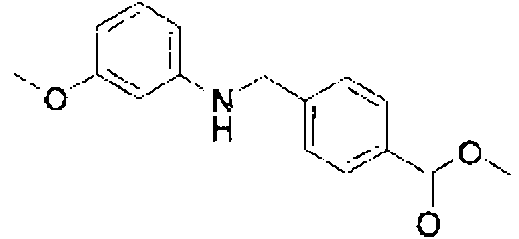
El compuesto de Fórmula 1 -1 (manisidina; 3,23 g, 26,2 mmol) y 4-(bromometil)benzoato de metilo (5,00 g, 21,8 mmol) se disolvieron en acetonitrilo (50 ml), se añadió N,N-diisopropiletilamina (5,80 ml, 32,7 mmol) y se agitó a temperatura ambiente durante 16 horas. Después de que se completara la reacción, la capa orgánica se extrajo con acetato de etilo y solución acuosa saturada de hidrogenocarbonato sódico, se deshidrogenó con sulfato de magnesio anhidro y después se filtró. El filtrado se concentró a presión reducida y después el residuo se purificó y se concentró por cromatografía en columna (sílice; acetato de etilo/hexano = 5 %) para dar el compuesto deseado de Fórmula 1-2 (5,14 g, 87 %) en forma de un sólido de color amarillo claro.The compound of Formula 1 -1 (manisidine, 3.23 g, 26.2 mmol) and methyl 4- (bromomethyl) benzoate (5.00 g, 21.8 mmol) were dissolved in acetonitrile (50 ml), added N, N-diisopropylethylamine (5.80 ml, 32.7 mmol) and stirred at room temperature for 16 hours. After the reaction was complete, the organic layer was extracted with ethyl acetate and saturated aqueous sodium hydrogencarbonate solution, dehydrogenated with anhydrous magnesium sulfate and then filtered. The filtrate was concentrated under reduced pressure and then the residue was purified and concentrated by column chromatography (silica; ethyl acetate / hexane = 5%) to give the desired compound of Formula 1-2 (5.14 g, 87% ) in the form of a light yellow solid.
(Fórmula 1-3: 4-(((3-metoxifenil)((4-nitrofenoxi)carbonil)amino)metil)benzoato de metilo)(Formula 1-3: 4 - (((3-methoxyphenyl) ((4-nitrophenoxy) carbonyl) amino) methyl) methyl benzoate)
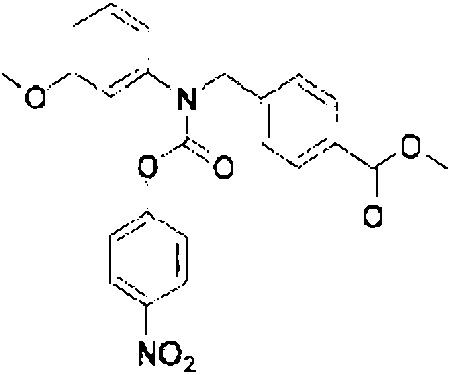
El compuesto de Fórmula 1-2 (4-(((3-metoxifenil)amino)metil)benzoato de metilo; 5,14 g, 18,9 mmol) y cloroformiato de 4-nitrofenilo (4,20 g, 20,8 mmol) se disolvieron en acetonitrilo (100 ml), se añadió carbonato potásico (3,93 g, 28,4 mmol) y se agitó a temperatura ambiente durante 3 horas. Después de que se completara la reacción, la capa orgánica se extrajo con acetato de etilo y solución acuosa saturada de hidrogenocarbonato sódico, se deshidrogenó con sulfato de magnesio anhidro y después se filtró. El filtrado se concentró a presión reducida y después el residuo se purificó y se concentró por cromatografía en columna (sílice; acetato de etilo/hexano = 20 %) para dar el compuesto deseado de Fórmula 1-3 (5,88 g, 71 %) en forma de un líquido de color amarillo.The compound of Formula 1-2 (methyl 4 - (((3-methoxyphenyl) amino) methyl) benzoate; 5.14 g, 18.9 mmol) and 4-nitrophenyl chloroformate (4.20 g, 20.8 mmol) were dissolved in acetonitrile (100 ml), potassium carbonate (3.93 g, 28.4 g. mmol) and stirred at room temperature for 3 hours. After the reaction was complete, the organic layer was extracted with ethyl acetate and saturated aqueous sodium hydrogencarbonate solution, dehydrogenated with anhydrous magnesium sulfate and then filtered. The filtrate was concentrated under reduced pressure and then the residue was purified and concentrated by column chromatography (silica, ethyl acetate / hexane = 20%) to give the desired compound of Formula 1-3 (5.88 g, 71%). ) in the form of a yellow liquid.
(Fórmula 1-4: 4-((N-(3-metoxifenil)morfolin-4-carboxamido)metil)benzoato de metilo)(Formula 1-4: 4 - (methyl (N- (3-methoxyphenyl) morpholin-4-carboxamido) methyl) benzoate)

El compuesto de Fórmula 1-3 (4-(((3-metoxifenil)((4-nitrofenoxi)carbonil)amino)metil)benzoato de metilo; 5,88 g, 13,5 mmol) se disolvió en dimetilformamida (50 ml), se añadieron morfolina (2,35 g, 27,0 mmol) y carbonato potásico (5,60 g, 40,5 mmol) y se agitó a 60 °C durante 16 horas. Después de que se completara la reacción, la capa orgánica se extrajo con acetato de etilo y solución acuosa saturada de cloruro de amonio, se deshidrogenó con sulfato de magnesio anhidro y después se filtró. El filtrado se concentró a presión reducida y después el residuo se purificó y se concentró por cromatografía en columna (sílice; acetato de etilo/hexano = 30 %) para dar el compuesto deseado de Fórmula 1 4 (3,69 g, 71 %) en forma de un sólido de color amarillo.The compound of Formula 1-3 (methyl 4 - (((3-methoxyphenyl) ((4-nitrophenoxy) carbonyl) amino) methyl) benzoate; 5.88 g, 13.5 mmol) was dissolved in dimethylformamide (50 ml). ), morpholine (2.35 g, 27.0 mmol) and potassium carbonate (5.60 g, 40.5 mmol) were added and stirred at 60 ° C for 16 hours. After the reaction was complete, the organic layer was extracted with ethyl acetate and saturated aqueous solution of ammonium chloride, dehydrogenated with anhydrous magnesium sulfate and then filtered. The filtrate was concentrated under reduced pressure and then the residue was purified and concentrated by column chromatography (silica: ethyl acetate / hexane = 30%) to give the desired compound of Formula 1 4 (3.69 g, 71%) in the form of a yellow solid.
(Compuesto 484: N-(4-(hidroxicarbamoil)bencil)-N-(3-methyoxifenil)morfolin-4-carboxamida)(Compound 484: N- (4- (hydroxycarbamoyl) benzyl) -N- (3-methyoxyphenyl) morpholine-4-carboxamide)
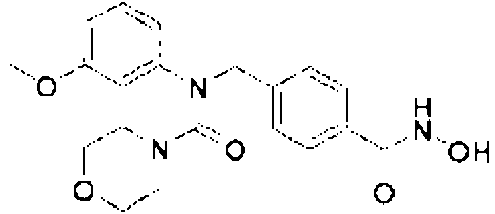
El compuesto de Fórmula 1-4 (4-((N-(3-metoxifenil)morfolin-4-carboxamino)metil)benzoato de metilo; 0,180 g, 0,468 mmol) se disolvió en metanol (10 ml), se añadió hidroxilamina (solución acuosa al 50,0 % en peso; 1,43 ml, 23,4 mmol) a temperatura ambiente, después se añadió hidróxido potásico (0,263 g, 4,68 mmol) y se agitó a la misma temperatura durante 30 minutos. Después, el concentrado se obtuvo retirando el disolvente de la mezcla de reacción a presión reducida. Se vertió una solución acuosa saturada de cloruro de amonio en el concentrado obtenido y la capa orgánica se extrajo con acetato de etilo. La capa orgánica se lavó con una solución acuosa saturada de cloruro sódico, se deshidrató con sulfato de magnesio anhidro y después se concentró a presión reducida. El residuo se cristalizó con diclorometano (2 ml) y hexano (10 ml) para dar el compuesto 484 deseado (0,140 g, 78 %) en forma de un sólido de color blanco.The compound of Formula 1-4 (methyl 4 - ((N- (3-methoxyphenyl) morpholin-4-carboxamino) methyl) benzoate; 0.180 g, 0.468 mmol) was dissolved in methanol (10 mL), hydroxylamine ( 50.0% by weight aqueous solution, 1.43 ml, 23.4 mmol) at room temperature, then potassium hydroxide (0.263 g, 4.68 mmol) was added and stirred at the same temperature for 30 minutes. Then, the concentrate was obtained by removing the solvent from the reaction mixture under reduced pressure. A saturated aqueous solution of ammonium chloride was poured into the obtained concentrate and the organic layer was extracted with ethyl acetate. The organic layer was washed with a saturated aqueous solution of sodium chloride, dehydrated with anhydrous magnesium sulfate and then concentrated under reduced pressure. The residue was crystallized with dichloromethane (2 ml) and hexane (10 ml) to give the desired compound 484 (0.140 g, 78%) as a white solid.
1H RMN (400 MHz, DIVISOR) 87,63 (d, 2 H, J = 8,1 Hz), 7,32 (m, 2 H), 7,19 (t, 1 H, J = 8,4 Hz), 6,69 - 6,67 (m, 2 H), 6,62 (m, 1 H), 4,84 (s, 2 H), 3,69 (s, 3 H), 3,39 - 3,36 (m, 4 H), 3,15 - 3,12 (m, 4 H). MS (ESI) m/z 386 (M+ H). 1 H NMR (400 MHz, DIVIDER) 87.63 (d, 2 H, J = 8.1 Hz), 7.32 (m, 2 H), 7.19 (t, 1 H, J = 8.4 Hz ), 6.69 - 6.67 (m, 2 H), 6.62 (m, 1 H), 4.84 (s, 2 H), 3.69 (s, 3 H), 3.39 - 3.36 (m, 4 H), 3.15 - 3.12 (m, 4 H). MS (ESI) m / z 386 (M + H).
Ejemplo 109: Síntesis del compuesto 485Example 109: Synthesis of compound 485
(Fórmula 1-4: 4-((3,3-difluoro-N-(4-(trifluorometil)fenil)azetidin-1-carboxamido)metil)benzoato de metilo)(Formula 1-4: 4 - ((3,3-difluoro-N- (4- (trifluoromethyl) phenyl) azetidin-1-carboxamido) methyl) benzoate methyl)

El compuesto de Fórmula 1-3 (4-((((4-nitrofenoxi)carbonil)(4-(trifluorometil)fenil)amino)metil)benzoato de metilo; 0,22 g, 0,46 mmol) se disolvió en dimetilformamida (5 ml) y después se añadieron carbonato potásico (0,19 g, 1,37 mmol) y 3,3-difluoroazetidina (0,19 g, 0,92 mmol). La mezcla se hizo reaccionar a 60 °C durante 2 días, se diluyó con acetato de etilo y se lavó con una solución saturada de cloruro de sodio y amonio. La capa orgánica se deshidrató con sulfato sódico anhidro, se filtró y después se concentró a presión reducida. El residuo se purificó por cromatografía en columna (sílice; acetato de etilo/hexano = 50 %) para dar el compuesto deseado de Fórmula 1-4 (0,20 g, 101 %).The compound of Formula 1-3 (methyl 4 - ((((((4-nitrophenoxy) carbonyl) (4- (trifluoromethyl) phenyl) amino) methyl) benzoate; 0.22 g, 0.46 mmol) was dissolved in dimethylformamide (5 ml) and then potassium carbonate (0.19 g, 1.37 mmol) and 3,3-difluoroazetidine (0.19 g, 0.92 mmol) were added. The mixture was reacted at 60 ° C for 2 days, diluted with ethyl acetate and washed with a saturated solution of sodium chloride and ammonium. The organic layer was dehydrated with anhydrous sodium sulfate, filtered and then concentrated under reduced pressure. The residue was purified by column chromatography (silica; ethyl acetate / hexane = 50%) to give the desired compound of Formula 1-4 (0.20 g, 101%).
(Compuesto 485, 3,3-difluoro-N-(4-(hidroxicarbamoil)bencil)-N-(4-(trifluorometil)fenil)azetidin-1-carboxamida) (Compound 485, 3,3-difluoro-N- (4- (hydroxycarbamoyl) benzyl) - N - (4- (trifluoromethyl) phenyl) azetidine-1-carboxamide)

El compuesto de Fórmula 1-4 (4-((3,3-difluoro-N-(4-(trifluorometil)fenil)azetidin-1-carboxamido)metil)benzoato de metilo; 0,20 g, 0,47 mmol) se disolvió en metanol (10 ml), después se añadieron hidroxilamina (solución acuosa al 50 % en peso; 0,29 ml) e hidróxido potásico (0,13 g, 2,33 mmol) y se agitó durante una noche. Después de que se completara la reacción, el metanol se retiró por destilación a presión reducida y la capa orgánica se extrajo con acetato de etilo y agua, se deshidrató con sulfato sódico anhidro, se filtró y posteriormente se concentró a presión reducida. El residuo se purificó por cromatografía en columna (sílice; metanol/diclorometano = 10 %) para dar el compuesto 485 deseado (0,07 g, 36 %) en forma de un sólido de color blanco.The compound of Formula 1-4 (methyl 4 - ((3,3-difluoro-N- (4- (trifluoromethyl) phenyl) azetidin-1-carboxamido) methyl) benzoate; 0.20 g, 0.47 mmol) it was dissolved in methanol (10 ml), then hydroxylamine (50% by weight aqueous solution, 0.29 ml) and potassium hydroxide (0.13 g, 2.33 mmol) were added and stirred overnight. After the reaction was complete, the methanol was distilled off under reduced pressure and the organic layer was extracted with ethyl acetate and water, dehydrated with anhydrous sodium sulfate, filtered and then concentrated under reduced pressure. The residue was purified by column chromatography (silica: methanol / dichloromethane = 10%) to give the desired compound 485 (0.07 g, 36%) as a white solid.
1H RMN (400 MHz, DMSO-da) 811,13 (s a, 1 H), 8,98 (s a, 1 H), 7,84-7,81 (m, 2 H), 7,43-7,34 (m, 6 H), 4,42 (s, 2 H), 4,18-4,14 (m, 4 H). MS (ESI) m/z 430 (M+ H).1 H NMR (400 MHz, DMSO-da) 811.13 (br s, 1 H), 8.98 (br s, 1 H), 7.84-7.81 (br, 2 H), 7.43-7, 34 (m, 6 H), 4.42 (s, 2 H), 4.18-4.14 (m, 4 H). MS (ESI) m / z 430 (M + H).
Ejemplo 110: Síntesis del compuesto 486Example 110: Synthesis of compound 486
(Fórmula 1-4: 4-((4-hidroxi-4-fenil-N-(4-(trifluorometil)fenil)piperidin-1-carboxamido)metil)benzoato de metilo)(Formula 1-4: 4 - ((4-hydroxy-4-phenyl-N- (4- (trifluoromethyl) phenyl) piperidin-1-carboxamido) methyl) benzoate methyl)

El compuesto de Fórmula 1-3 (4-((((4-nitrofenoxi)carbonil)(4-(trifluorometil)fenil)amino)metil)benzoato de metilo; 0,25 g, 0,53 mmol) se disolvió en dimetilformamida (5 ml) y después se añadieron carbonato potásico (0,22 g, 1,61 mmol) y 4-fenilpiperidin-4-ol (0,19 g, 1,07 mmol). La mezcla se hizo reaccionar a 60 °C durante 2 días, se diluyó con acetato de etilo y se lavó con una solución saturada de cloruro de sodio y amonio. La capa orgánica se deshidrató con sulfato sódico anhidro, se filtró y después se concentró a presión reducida. El residuo se purificó por cromatografía en columna (sílice; acetato de etilo/hexano = 50 %) para dar el compuesto deseado de Fórmula 1-4 (0,17 g, 60 %).The compound of Formula 1-3 (methyl 4 - (((((4-nitrophenoxy) carbonyl) (4- (trifluoromethyl) phenyl) amino) methyl) benzoate; 0.25 g, 0.53 mmol) was dissolved in dimethylformamide (5 ml) and then potassium carbonate (0.22 g, 1.61 mmol) and 4-phenylpiperidin-4-ol (0.19 g, 1.07 mmol) were added. The mixture was reacted at 60 ° C for 2 days, diluted with ethyl acetate and washed with a saturated solution of sodium chloride and ammonium. The organic layer was dehydrated with anhydrous sodium sulfate, filtered and then concentrated under reduced pressure. The residue was purified by column chromatography (silica; ethyl acetate / hexane = 50%) to give the desired compound of Formula 1-4 (0.17 g, 60%).
(Compuesto 486, 4-hidroxi-N-(4-(hidroxicarbamoil)bencil)-4-fenil-N-(4-(trifluorometil)fenil)piperidin-1-carboxamida)(Compound 486, 4-hydroxy-N- (4- (hydroxycarbamoyl) benzyl) -4-phenyl-N- (4- (trifluoromethyl) phenyl) piperidine-1-carboxamide)

El compuesto de Fórmula 1-4 (4-((4-hidroxi-4-fenil-N-(4-(trifluorometil)fenil)piperidin-1-carboxamido)metil)benzoato de metilo; 0,17 g, 0,32 mmol) se disolvió en metanol (10 ml) y después se añadieron hidroxilamina (solución acuosa al 50 % en peso; 0,20 ml) e hidróxido potásico (0,09 g, 1,61 mmol) y se agitaron durante una noche. Después de que se completara la reacción, el metanol se retiró por destilación a presión reducida y la capa orgánica se extrajo con acetato de etilo y agua, se deshidrató con sulfato de magnesio anhidro, se filtró y después se concentró a presión reducida. El residuo se purificó por cromatografía en columna (sílice; metanol/diclorometano = 10 %) para dar el compuesto 486 deseado (0,09 g, 55 %) en forma de un sólido de color blanco.The compound of Formula 1-4 (methyl 4 - ((4-hydroxy-4-phenyl-N- (4- (trifluoromethyl) phenyl) piperidin-1-carboxamido) methyl) benzoate; 0.17 g, 0.32 mmol) was dissolved in methanol (10 ml) and then hydroxylamine (50% by weight aqueous solution, 0.20 ml) and potassium hydroxide (0.09 g, 1.61 mmol) were added and stirred overnight. After the reaction was complete, the methanol was distilled off under reduced pressure and the organic layer was extracted with ethyl acetate and water, dehydrated with anhydrous magnesium sulfate, filtered and then concentrated under reduced pressure. The residue was purified by column chromatography (silica; methanol / dichloromethane = 10%) to give the desired compound 486 (0.09 g, 55%) as a white solid.
1H RMN (400 MHz, DMSO-d6) 811,13 (s a, 1 H), 8,98 (s a, 1 H), 7,84-7,82 (m, 2 H), 7,55-7,53 (m, 2 H), 7,43-7,30 (m, 9 H), 4,42 (s, 2 H), 3,39-3,29 (m, 4 H), 2,10-2,05 (m, 2 H), 1,84-1,81 (m, 2 H). MS (ESI) m/z 496 (M+ H).1 H NMR (400 MHz, DMSO-d 6) 811.13 (br s, 1 H), 8.98 (br s, 1 H), 7.84-7.82 (br, 2 H), 7.55-7, 53 (m, 2 H), 7.43-7.30 (m, 9 H), 4.42 (s, 2 H), 3.39-3.29 (m, 4 H), 2.10- 2.05 (m, 2 H), 1.84-1.81 (m, 2 H). MS (ESI) m / z 496 (M + H).
Ejemplo 111: Síntesis del compuesto 487Example 111: Synthesis of compound 487
(Fórmula 6-2: 4-((3-bromofenilamino)metil)-3-fluorobenzonitrilo) (Formula 6-2: 4 - ((3-bromophenylamino) methyl) -3-fluorobenzonitrile)

El compuesto de Formula 6-1 (4-(bromometil)-3-fluorobenzonitrilo; 1,93 g, 9,02 mmol) se disolvió en acetonitrilo (20 ml), después se añadieron 3-bromoanilina (1,18 ml, 10,8 mmol) y N,N-diisopropiletilamina (2,40 ml, 13,5 mmol) a temperatura ambiente y se agitaron a la misma temperatura durante 16 horas. Después, se vertió una solución acuosa saturada de hidrogenocarbonato sódico en la mezcla de reacción y la capa orgánica se extrajo con acetato de etilo. La capa orgánica se lavó con una solución acuosa saturada de cloruro sódico, se deshidrató con sulfato de magnesio anhidro y después se concentró a presión reducida. El residuo se purificó y se concentró por cromatografía en columna (sílice; acetato de etilo/hexano = 20 %) para dar el compuesto deseado de Fórmula 6-2 (2,57 g, 93 %) en forma de un sólido de color amarillo claro.The compound of Formula 6-1 (4- (bromomethyl) -3-fluorobenzonitrile; 1.93 g, 9.02 mmol) was dissolved in acetonitrile (20 ml), then 3-bromoaniline (1.18 ml, 10 ml) was added. , 8 mmol) and N, N-diisopropylethylamine (2.40 ml, 13.5 mmol) at room temperature and were stirred at the same temperature for 16 hours. Then, a saturated aqueous solution of sodium hydrogencarbonate was poured into the reaction mixture and the organic layer was extracted with ethyl acetate. The organic layer was washed with a saturated aqueous solution of sodium chloride, dehydrated with anhydrous magnesium sulfate and then concentrated under reduced pressure. The residue was purified and concentrated by column chromatography (silica; ethyl acetate / hexane = 20%) to give the desired compound of Formula 6-2 (2.57 g, 93%) as a yellow solid. Clear.
(Fórmula 6-3: ácido 4-((3-bromofenilamino)metil)-3-fluorobenzoico)(Formula 6-3: 4 - ((3-bromophenylamino) methyl) -3-fluorobenzoic acid)

El compuesto de Fórmula 6-2 (4-((3-bromofenilamino)metil)-3-fluorobenzonitrilo; 2,57 g, 8,42 mmol) e hidróxido de litio monohidrato (3,53 g, 84,2 mmol) se disolvieron en metanol (20 ml)/agua (10 ml) y se agitaron a reflujo durante 16 horas. Después, el concentrado se obtuvo retirando el disolvente de la mezcla de reacción a presión reducida. se vertió una solución acuosa 1 N de ácido clorhídrico en el concentrado obtenido y la capa orgánica se extrajo con acetato de etilo. La capa orgánica se lavó con una solución acuosa saturada de cloruro sódico, se deshidrató con sulfato de magnesio anhidro y después se concentró a presión reducida para dar el compuesto deseado de Fórmula 6-3 (2,57 g, 94 %) en forma de un sólido de color amarillo claro.The compound of Formula 6-2 (4 - ((3-bromophenylamino) methyl) -3-fluorobenzonitrile; 2.57 g, 8.42 mmol) and lithium hydroxide monohydrate (3.53 g, 84.2 mmol) are dissolved in methanol (20 ml) / water (10 ml) and stirred at reflux for 16 hours. Then, the concentrate was obtained by removing the solvent from the reaction mixture under reduced pressure. a 1 N aqueous solution of hydrochloric acid was poured into the obtained concentrate and the organic layer was extracted with ethyl acetate. The organic layer was washed with a saturated aqueous solution of sodium chloride, dehydrated with anhydrous magnesium sulfate and then concentrated under reduced pressure to give the desired compound of Formula 6-3 (2.57 g, 94%) as a a light yellow solid.
(Fórmula 6-4; 4-((3-bromofenilamino)metil)-3-fluorobenzoato de metilo)(Formula 6-4; methyl 4 - ((3-bromophenylamino) methyl) -3-fluorobenzoate)

El compuesto de Fórmula 6-3 (ácido 4-((3-bromofenilamino)metil)-3-fluorobenzoico; 2,57 g, 7,93 mmol), metanol (6,43 ml, 159 mmol) y N,N-diisopropiletilamina (4,21 ml, 23,8 mmol) se disolvieron en THF (50 ml), después se añadieron clorhidrato de 1-etil-3-[3-dimetilaminopropil]carbodiimida (EDC, 3,04 g, 15,9 mmol) y 1-hidroxibenzotriazol hidrato (HOBt, 2,14 g, 15,9 mmol) a temperatura ambiente y se agitaron a la misma temperatura durante 16 horas. Después, se vertió una solución acuosa saturada de hidrogenocarbonato sódico en la mezcla de reacción y la capa orgánica se extrajo con acetato de etilo. La capa orgánica se lavó con una solución acuosa saturada de cloruro sódico, se deshidrató con sulfato de magnesio anhidro y después se concentró a presión reducida. El residuo se purificó y se concentró por cromatografía en columna (sílice; acetato de etilo/hexano = 20 %) para dar el compuesto deseado de Fórmula 6-4 (2,48 g, 93 %) en forma de un líquido de color amarillo.The compound of Formula 6-3 (4 - ((3-bromophenylamino) methyl) -3-fluorobenzoic acid; 2.57 g, 7.93 mmol), methanol (6.43 mL, 159 mmol) and N, N- Diisopropylethylamine (4.21 ml, 23.8 mmol) was dissolved in THF (50 ml), then 1-ethyl-3- [3-dimethylaminopropyl] carbodiimide hydrochloride (EDC, 3.04 g, 15.9 mmol. ) and 1-hydroxybenzotriazole hydrate (HOBt, 2.14 g, 15.9 mmol) at room temperature and stirred at the same temperature for 16 hours. Then, a saturated aqueous solution of sodium hydrogencarbonate was poured into the reaction mixture and the organic layer was extracted with ethyl acetate. The organic layer was washed with a saturated aqueous solution of sodium chloride, dehydrated with anhydrous magnesium sulfate and then concentrated under reduced pressure. The residue was purified and concentrated by column chromatography (silica; ethyl acetate / hexane = 20%) to give the desired compound of Formula 6-4 (2.48 g, 93%) as a yellow liquid .
(Fórmula 6-5: 4-(((3-bromofenil)((4-nitrofenoxi)carbonil)amino)metil)-3-fluorobenzoato de metilo)(Formula 6-5: 4 - (((3-bromophenyl) (methyl (4-nitrophenoxy) carbonyl) amino) methyl) -3-fluorobenzoate)

El compuesto de Fórmula 6-4 (4-((3-bromofenilamino)metil)-3-fluorobenzoato de metilo; 2,48 g, 7,33 mmol), cloroformiato de 4-nitrofenilo (1,63 g, 8,07 mmol) y carbonato potásico (1,52 g, 11,0 mmol) se disolvieron en acetonitrilo (30 ml) a temperatura ambiente y se agitaron a la misma temperatura durante 16 horas. Después, se vertió una solución acuosa saturada de hidrogenocarbonato sódico en la mezcla de reacción y la capa orgánica se extrajo con acetato de etilo. La capa orgánica se lavó con una solución acuosa saturada de cloruro sódico, se deshidrató con sulfato de magnesio anhidro y después se concentró a presión reducida para dar el compuesto deseado de Fórmula 6-5 (3,40 g, 92 %) en forma de un líquido de color amarillo.The compound of Formula 6-4 (methyl 4 - ((3-bromophenylamino) methyl) -3-fluorobenzoate; 2.48 g, 7.33 mmol), 4-nitrophenyl chloroformate (1.63 g, 8.07 g) mmol) and potassium carbonate (1.52 g, 11.0 mmol) were dissolved in acetonitrile (30 ml) at room temperature and stirred at the same temperature for 16 hours. Then, a saturated aqueous solution of sodium hydrogencarbonate was poured into the reaction mixture and the organic layer was extracted with ethyl acetate. The organic layer was washed with a saturated aqueous solution of sodium chloride, dehydrated with Anhydrous magnesium sulfate and then concentrated under reduced pressure to give the desired compound of Formula 6-5 (3.40 g, 92%) as a yellow liquid.
(Fórmula 6-6: 4-((N-(3-bromofenil)morfolin-4-carboxamido)metil)-3-fluorobenzoato de metilo)(Formula 6-6: 4 - (methyl (N- (3-bromophenyl) morpholin-4-carboxamido) methyl) -3-fluorobenzoate)

El compuesto de Fórmula 6-5 (4-(((3-bromofenil)((4-nitrofenoxi)carbonil)amino)metil)-3-fluorobenzoato de metilo; 1,80 g, 3,58 mmol), morfolina (0,944 ml, 10,7 mmol) y carbonato potásico (2,47 g, 17,9 mmol) se disolvieron en dimetilformamida (15 ml) a 50 °C y se agitaron a la misma temperatura durante 16 horas. Después, se vertió una solución acuosa saturada de cloruro de amonio en la mezcla de reacción y la capa orgánica se extrajo con acetato de etilo. La capa orgánica se lavó con una solución acuosa saturada de cloruro sódico, se deshidrató con sulfato de magnesio anhidro y después se concentró a presión reducida. El residuo se purificó y se concentró por cromatografía en columna (sílice; acetato de etilo/hexano = 30-60 %) para dar el compuesto deseado de Fórmula 6-6 (1,58 g, 98 %) en forma de un líquido de color amarillo.The compound of Formula 6-5 (methyl 4 - (((3-bromophenyl) ((4-nitrophenoxy) carbonyl) amino) methyl) -3-fluorobenzoate; 1.80 g, 3.58 mmol), morpholine (0.944) ml, 10.7 mmol) and potassium carbonate (2.47 g, 17.9 mmol) were dissolved in dimethylformamide (15 ml) at 50 ° C and stirred at the same temperature for 16 hours. Then, a saturated aqueous solution of ammonium chloride was poured into the reaction mixture and the organic layer was extracted with ethyl acetate. The organic layer was washed with a saturated aqueous solution of sodium chloride, dehydrated with anhydrous magnesium sulfate and then concentrated under reduced pressure. The residue was purified and concentrated by column chromatography (silica; ethyl acetate / hexane = 30-60%) to give the desired compound of Formula 6-6 (1.58 g, 98%) as a liquid. yellow color.
(Compuesto 487: N-(3-bromofenil)-N-(2-fluoro-4-(hidroxicarbamoil)bencil)morfolin-4-carboxamida)(Compound 487: N- (3-bromophenyl) -N- (2-fluoro-4- (hydroxycarbamoyl) benzyl) morpholine-4-carboxamide)

El compuesto de Fórmula 6-6 (4-((N-(3-bromofenil)morfolin-4-carboxamido)metil)-3-fluorobenzoato de metilo; 0,200 g, 0,443 mmol) se disolvió en metanol (10 ml), se añadió hidroxilamina (solución acuosa al 50,0 % en peso; 1,90 ml, 31,0 mmol) a temperatura ambiente, después se añadió hidróxido potásico (0,249 g, 4,43 mmol) y se agitó a la misma temperatura durante 30 minutos. Después, el concentrado se obtuvo retirando el disolvente de la mezcla de reacción a presión reducida. Se vertió una solución acuosa saturada de hidrogenocarbonato sódico en el concentrado obtenido y la capa orgánica se extrajo con acetato de etilo. La capa orgánica se lavó con una solución acuosa saturada de cloruro sódico, se deshidrató con sulfato de magnesio anhidro y después se concentró a presión reducida. Al concentrado se le añadieron diclorometano (2 ml) y éter dietílico (20 ml) y se agitó. Después, el sólido precipitado se filtró y se secó para dar el compuesto 487 deseado (0,162 g, 81 %) en forma de un sólido de color pardo claro. 1H RMN (400 MHz, DIVISOR) 811,23 (s a, 1 H), 9,14 (s a, 1 H), 7,54 -7,45 (m, 3 H), 7,40 (s, 1 H), 7,31 - 7,27 (m, 2 H), 7,15 (m, 1 H), 4,88 (s, 2 H), 3,41 - 3,38 (m, 4 H), 3,14 - 3,12 (m, 4 H). MS (ESI) m/z 452, 454 (M+ H).The compound of Formula 6-6 (methyl 4 - ((N- (3-bromophenyl) morpholin-4-carboxamido) methyl) -3-fluorobenzoate; 0.200 g, 0.443 mmol) was dissolved in methanol (10 mL), hydroxylamine (50.0% by weight aqueous solution, 1.90 ml, 31.0 mmol) was added at room temperature, then potassium hydroxide (0.249 g, 4.43 mmol) was added and stirred at the same temperature for 30 minutes. minutes Then, the concentrate was obtained by removing the solvent from the reaction mixture under reduced pressure. A saturated aqueous solution of sodium hydrogencarbonate was poured into the obtained concentrate and the organic layer was extracted with ethyl acetate. The organic layer was washed with a saturated aqueous solution of sodium chloride, dehydrated with anhydrous magnesium sulfate and then concentrated under reduced pressure. To the concentrate were added dichloromethane (2 ml) and diethyl ether (20 ml) and stirred. Then, the precipitated solid was filtered and dried to give the desired compound 487 (0.162 g, 81%) as a light brown solid. 1 H NMR (400 MHz, DIVIDER) 811.23 (br s, 1 H), 9.14 (br s, 1 H), 7.54 -7.45 (m, 3 H), 7.40 (s, 1 H ), 7.31-7.27 (m, 2 H), 7.15 (m, 1 H), 4.88 (s, 2 H), 3.41-3.38 (m, 4 H), 3.14 - 3.12 (m, 4 H). MS (ESI) m / z 452, 454 (M + H).
Ejemplo 112: Síntesis del compuesto 488Example 112: Synthesis of compound 488
(Fórmula 6-6: 4-((N-(3-bromofenil)-4-hidroxipiperidin-1-carboxamido)metil)-3-fluorobenzoato de metilo)(Formula 6-6: 4 - ((N- (3-bromophenyl) -4-hydroxypiperidine-1-carboxamido) methyl) -3-fluorobenzoate methyl)

El compuesto de Fórmula 6-5 (4-(((3-bromofenil)((4-nitrofenoxi)carbonil)amino)metil)-3-fluorobenzoato de metilo; 1,60 g, 3,18 mmol), 4-hidroxipiperidina (0,965 g, 9,54 mmol) y carbonato potásico (2,20 g, 15,9 mmol) se disolvieron en dimetilformamida (15 ml) a 50 °C y se agitaron a la misma temperatura durante 16 horas. Después, se vertió una solución acuosa saturada de cloruro de amonio en la mezcla de reacción y la capa orgánica se extrajo con acetato de etilo. La capa orgánica se lavó con una solución acuosa saturada de cloruro sódico, se deshidrató con sulfato de magnesio anhidro y después se concentró a presión reducida. El residuo se purificó y se concentró por cromatografía en columna (sílice; acetato de etilo/hexano = 50-80 %) para dar el compuesto deseado de Fórmula 6-6 (1,16 g, 78 %) en forma de un líquido de color amarillo.The compound of Formula 6-5 (methyl 4 - (((3-bromophenyl) ((4-nitrophenoxy) carbonyl) amino) methyl) -3-fluorobenzoate; 1.60 g, 3.18 mmol), 4-hydroxypiperidine (0.965 g, 9.54 mmol) and potassium carbonate (2.20 g, 15.9 mmol) were dissolved in dimethylformamide (15 mL) at 50 ° C and stirred at the same temperature for 16 hours. Then, a saturated aqueous solution of ammonium chloride was poured into the reaction mixture and the organic layer was extracted with ethyl acetate. The organic layer was washed with a saturated aqueous solution of sodium chloride, dehydrated with anhydrous magnesium sulfate and then concentrated under reduced pressure. The residue was purified and concentrated by column chromatography (silica; ethyl acetate / hexane = 50-80%) to give the desired compound of Formula 6-6 (1.16 g, 78%) as a liquid. yellow color.
(Compuesto 488: N-(3-bromofenil)-N-(2-fluoro-4-(hidroxicarbamoil)bencil)-4-hidroxipiperidin-1-carboxamida) (Compound 488: N- (3-bromophenyl) -N- (2-fluoro-4- (hydroxycarbamoyl) benzyl) -4-hydroxypiperidine-1-carboxamide)

El compuesto de Fórmula 6-6 (4-((N-(3-bromofenil)-4-hidroxipiperidin-1-carboxamido)metil)-3-fluorobenzoato de metilo; 0,200 g, 0,430 mmol) se disolvió en metanol (10 ml), se añadió hidroxilamina (solución acuosa al 50,0 % en peso; 1,84 ml, 30,1 mmol) a temperatura ambiente, después se añadió hidróxido potásico (0,241 g, 4,30 mmol) y se agitó a la misma temperatura durante 30 minutos. Después, el concentrado se obtuvo retirando el disolvente de la mezcla de reacción a presión reducida. Se vertió una solución acuosa saturada de hidrogenocarbonato sódico en el concentrado obtenido y la capa orgánica se extrajo con acetato de etilo. La capa orgánica se lavó con una solución acuosa saturada de cloruro sódico, se deshidrató con sulfato de magnesio anhidro y después se concentró a presión reducida. Al concentrado se le añadieron diclorometano (2 ml) y éter dietílico (20 ml) y se agitó. Después, el sólido precipitado se filtró y se secó para dar el compuesto 488 deseado (0,101 g, 50 %) en forma de un sólido de color amarillo claro.The compound of Formula 6-6 (methyl 4 - ((N- (3-bromophenyl) -4-hydroxypiperidine-1-carboxamido) methyl) -3-fluorobenzoate; 0.200 g, 0.430 mmol) was dissolved in methanol (10 ml ), hydroxylamine (50.0% by weight aqueous solution, 1.84 ml, 30.1 mmol) was added at room temperature, then potassium hydroxide (0.241 g, 4.30 mmol) was added and stirred thereto. temperature for 30 minutes. Then, the concentrate was obtained by removing the solvent from the reaction mixture under reduced pressure. A saturated aqueous solution of sodium hydrogencarbonate was poured into the obtained concentrate and the organic layer was extracted with ethyl acetate. The organic layer was washed with a saturated aqueous solution of sodium chloride, dehydrated with anhydrous magnesium sulfate and then concentrated under reduced pressure. To the concentrate were added dichloromethane (2 ml) and diethyl ether (20 ml) and stirred. Then, the precipitated solid was filtered and dried to give the desired compound 488 (0.101 g, 50%) as a light yellow solid.
1H RMN (400 MHz, DMSO-da) 811,23 (s a, 1 H), 9,14 (s a, 1 H), 7,63 -7,46 (m, 3 H), 7,32 (s, 1 H), 7,27 - 7,24 (m, 2 H), 6,90 (m, 1 H), 4,85 (s, 2 H), 4,68 (s, 1 H), 3,55 -3,45 (m, 3 H), 2,87 -2,82 (m, 2H), 1,56 - 1,53 (m, 2 H), 1,15 -1,12 (m, 2 H). MS (ESI) m/z 466, 468 (M+ H).1 H NMR (400 MHz, DMSO-da) 811.23 (br s, 1 H), 9.14 (br s, 1 H), 7.63 -7.46 (m, 3 H), 7.32 (s, 1 H), 7.27-7.24 (m, 2 H), 6.90 (m, 1 H), 4.85 (s, 2 H), 4.68 (s, 1 H), 3, 55 -3.45 (m, 3 H), 2.87-2.82 (m, 2H), 1.56-1.53 (m, 2 H), 1.15-1.12 (m, 2) H). MS (ESI) m / z 466, 468 (M + H).
Ejemplo 113: Síntesis del compuesto 489Example 113: Synthesis of compound 489
(Compuesto 489: 4-(3-(N-(4-(hidroxicarbamoil)bencil)morfolin-4-carboxamido)fenil)piperidin-1-carboxilato de tercbutilo)(Compound 489: 4- (3- (N- (4- (hydroxycarbamoyl) benzyl) morpholin-4-carboxamido) phenyl) piperidine-1-carboxylic acid tert-butyl ester)

El compuesto de Fórmula 4-4 (4-(3-(N-(4-(metoxicarbonil)bencil)morfolin-4-carboxamido)fenil)piperydine-1-carboxilato de terc-butilo; 0,100 g, 0,186 mmol) se disolvió en metanol (10 ml), se añadió hidroxilamina (solución acuosa al 50,0 % en peso; 1,14 ml, 18,6 mmol) a temperatura ambiente, después se añadió hidróxido potásico (0,104 g, 1,86 mmol) y se agitó a la misma temperatura durante 30 minutos. Después, la mezcla de reacción se concentró a presión reducida hasta que su volumen se volvió de aproximadamente 1 ml, se añadió una solución acuosa saturada de hidrogenocarbonato sódico (1 ml) y se agitó. Después, el sólido precipitado se filtró y se secó para dar el compuesto 489 deseado (0,086 g, 86 %) en forma de un sólido de color blanco.The compound of Formula 4-4 (tert-butyl 4- (3- (N- (4- (methoxycarbonyl) benzyl) morpholin-4-carboxamido) phenyl) piperydine-1-carboxylate, 0.100 g, 0.186 mmol) was dissolved in methanol (10 ml), hydroxylamine (50.0% by weight aqueous solution, 1.14 ml, 18.6 mmol) was added at room temperature, then potassium hydroxide (0.104 g, 1.86 mmol) was added and it was stirred at the same temperature for 30 minutes. Then, the reaction mixture was concentrated under reduced pressure until its volume became about 1 ml, a saturated aqueous solution of sodium hydrogencarbonate (1 ml) was added and stirred. Then, the precipitated solid was filtered and dried to give the desired compound 489 (0.086 g, 86%) as a white solid.
1H RMN (400 MHz, DMSO-d6) 87,63 (d, 2 H, J = 8,4 Hz), 7,34 (d, 2 H, J = 8,3 Hz), 7,22 (t, 1 H, J = 7,6 Hz), 6,99 - 6,93 (m, 3 H), 4,84 (s, 2 H), 4,06 -4,02 (m, 2 H), 3,40 - 3,37 (m, 4 H), 3,12 -3,10 (m, 4 H), 2,66 -2,63 (m, 2 H), 1,71 - 1,68 (m, 2 H), 1,44 (m, 3 H), 1,40 (s, 9 H). MS (ESI) m/z 539 (M+ H).1 H NMR (400 MHz, DMSO-d 6) 87.63 (d, 2 H, J = 8.4 Hz), 7.34 (d, 2 H, J = 8.3 Hz), 7.22 (t, 1 H, J = 7.6 Hz), 6.99-6.93 (m, 3 H), 4.84 (s, 2 H), 4.06 -4.02 (m, 2 H), 3 , 40-3.37 (m, 4 H), 3.12 -3.10 (m, 4 H), 2.66-2.63 (m, 2 H), 1.71-1.68 (m , 2 H), 1.44 (m, 3 H), 1.40 (s, 9 H). MS (ESI) m / z 539 (M + H).
Ejemplo 114: Síntesis del compuesto 490Example 114: Synthesis of compound 490
(Fórmula 4-4: 4-(3-(N-(4-(metoxicarbonil)bencil)morfolin-4-carboxamido)fenil)piperidin-1-carboxilato de terc-butilo)(Formula 4-4: 4- (3- (N- (4- (methoxycarbonyl) benzyl) morpholin-4-carboxamido) phenyl) piperidine-1-carboxylate of tert-butyl)

El compuesto de Fórmula 4-1 (4-(3-(N-(4-(metoxicarbonil)bencil)morfolin-4-carboxamido)fenil)-5,6-dihidro piridin-1(2H)-carboxilato de terc-butilo; 3,28 g, 6,12 mmol) se disolvió en THF (30 ml) a temperatura ambiente, se añadió lentamente Pd/C (130 mg), se acopló un globo de hidrógeno y después la mezcla se agitó a la misma temperatura durante 16 horas. La mezcla de reacción se filtró a través de un lecho de celite y el filtrado se concentró a presión reducida para dar el compuesto deseado de Fórmula 4-4 (3,28 g, 99 %) en forma de un sólido de color blanco. The compound of Formula 4-1 (4- (3- (N- (4- (methoxycarbonyl) benzyl) morpholin-4-carboxamido) phenyl) -5,6-dihydro pyridin-1 (2H) -carboxylic acid tert-butyl ester 3.28 g, 6.12 mmol) was dissolved in THF (30 ml) at room temperature, Pd / C (130 mg) was slowly added, a hydrogen balloon was coupled and then the mixture was stirred at the same temperature for 16 hours. The reaction mixture was filtered through a pad of celite and the filtrate was concentrated under reduced pressure to give the desired compound of Formula 4-4 (3.28 g, 99%) as a white solid.
(Fórmula 4-5: clorhidrato de 4-((N-(3-(piperidin-4-il)fenil)morfolin-4-carboxamido)metil)bezonato de metilo) El compuesto de Fórmula 4-4 (4-(3-(N-(4-(metoxicarbonil)bencil)morfolin-4-carboxamido)fenil)piperidin-1-carboxilato de terc-butilo; 3,10 g, 5,77 mmol) se disolvió en 1,4-dioxano (10 ml), después se añadió hidrógeno cloruro (solución 4,0 M en 1,4-dioxano; 14,4 ml, 57,7 mmol) a temperatura ambiente y se agitó a la misma temperatura durante 3 horas. La mezcla de reacción se concentró a presión reducida para dar el compuesto deseado de Fórmula 4-5 (2,65 g, 99 %) en forma de un sólido de color blanco.(Formula 4-5: methyl 4 - ((N- (3- (piperidin-4-yl) phenyl) morpholin-4-carboxamido) methyl) bezonate hydrochloride) The compound of Formula 4-4 (4- (3- (N- (4- (methoxycarbonyl) benzyl) morpholin-4-carboxamido) phenyl) piperidine-1-carboxylic acid tert -butyl ester, 3.10 g, 5.77 mmol) was dissolved in 1,4-dioxane (10 ml), then hydrogen chloride (4.0 M solution in 1,4-dioxane, 14.4 ml, 57.7 mmol) was added at room temperature and stirred at room temperature. the same temperature for 3 hours. The reaction mixture was concentrated under reduced pressure to give the desired compound of Formula 4-5 (2.65 g, 99%) as a white solid.
(Fórmula 4-6: 4-((N-(3-(1-acetilpiperidin-4-il)fenil)morfolin-4-carboxamido)metil)benzoato de metilo)(Formula 4-6: 4 - (Methyl N- (3- (1-acetylpiperidin-4-yl) phenyl) morpholin-4-carboxamido) methyl) benzoate)

El compuesto de Fórmula 4-5 (clorhidrato de 4-((N-(3-(piperidin-4-il)fenil)morfolin-4-carboxamido)metil)bezonato de metilo; 0,150 g, 0,316 mmol) y N,N-diisopropiletilamina (0,168 ml, 0,949 mmol) se disolvieron en diclorometano (3 ml), después se añadió ácido acético anhídrido (0,065 g, 0,633 mmol) a temperatura ambiente y se agitó a la misma temperatura durante 1 hora. Se vertió una solución acuosa saturada de hidrogenocarbonato sódico en la mezcla de reacción y la capa orgánica se extrajo con acetato de etilo. La capa orgánica se lavó con una solución acuosa saturada de cloruro sódico, se deshidrató con sulfato de magnesio anhidro y después se concentró a presión reducida. El residuo se purificó y se concentró por cromatografía en columna (sílice; acetato de etilo/hexano = 80-100 %) para dar el compuesto deseado de Fórmula 4-6 (0,148 g, 98 %) en forma de un líquido incoloro.The compound of Formula 4-5 (methyl 4 - ((N- (3- (piperidin-4-yl) phenyl) morpholin-4-carboxamido) methyl) bezonate hydrochloride; 0.150 g, 0.316 mmol) and N, N Diisopropylethylamine (0.168 ml, 0.949 mmol) was dissolved in dichloromethane (3 ml), then anhydrous acetic acid (0.065 g, 0.633 mmol) was added at room temperature and stirred at the same temperature for 1 hour. A saturated aqueous solution of sodium hydrogencarbonate was poured into the reaction mixture and the organic layer was extracted with ethyl acetate. The organic layer was washed with a saturated aqueous solution of sodium chloride, dehydrated with anhydrous magnesium sulfate and then concentrated under reduced pressure. The residue was purified and concentrated by column chromatography (silica; ethyl acetate / hexane = 80-100%) to give the desired compound of Formula 4-6 (0.148 g, 98%) as a colorless liquid.
(Compuesto 490: N-(3-(1-acetilpiperidin-4-il)fenil)-N-(4-(hidroxicarbamoil)bencil)morfolin-4-carboxamida)(Compound 490: N- (3- (1-acetylpiperidin-4-yl) phenyl) -N- (4- (hydroxycarbamoyl) benzyl) morpholine-4-carboxamide)

El compuesto de Fórmula 4-6 (4-((N-(3-(1-acetilpiperidin-4-il)fenil)morfolin-4-carboxamido)metil)benzoato de metilo; 0,148 g, 0,309 mmol) se disolvió en metanol (10 ml), se añadió hidroxilamina (solución acuosa al 50,0 % en peso; 1,32 ml, 21,6 mmol) a temperatura ambiente, después se añadió hidróxido potásico (0,173 g, 3,09 mmol) y se agitó al mismo tiempo durante 30 minutos. El concentrado se obtuvo retirando el disolvente de la mezcla de reacción a presión reducida. Se vertió una solución acuosa saturada de hidrogenocarbonato sódico en el concentrado obtenido y la capa orgánica se extrajo con acetato de etilo. La capa orgánica se lavó con una solución acuosa saturada de cloruro sódico, se deshidrató con sulfato de magnesio anhidro y después se concentró a presión reducida. Al concentrado se le añadieron diclorometano (5 ml) y hexano (20 ml) se añadieron y se agitó. Después, el sólido precipitado se filtró y se secó para dar el compuesto 490 deseado (0,036 g, 24 %) en forma de un sólido de color blanco.The compound of Formula 4-6 (methyl 4 - ((N- (3- (1-acetylpiperidin-4-yl) phenyl) morpholin-4-carboxamido) methyl) benzoate; 0.148 g, 0.309 mmol) was dissolved in methanol (10 ml), hydroxylamine (50.0% by weight aqueous solution, 1.32 ml, 21.6 mmol) was added at room temperature, then potassium hydroxide (0.173 g, 3.09 mmol) was added and stirred at the same time for 30 minutes. The concentrate was obtained by removing the solvent from the reaction mixture under reduced pressure. A saturated aqueous solution of sodium hydrogencarbonate was poured into the obtained concentrate and the organic layer was extracted with ethyl acetate. The organic layer was washed with a saturated aqueous solution of sodium chloride, dehydrated with anhydrous magnesium sulfate and then concentrated under reduced pressure. To the concentrate were added dichloromethane (5 ml) and hexane (20 ml) were added and stirred. Then, the precipitated solid was filtered and dried to give the desired compound 490 (0.036 g, 24%) as a white solid.
1H RMN (400 MHz, DMSO-d6) 8 11,12 (s a, 1 H), 9,03 (s a, 1 H), 7,63 (d, 2 H, J = 8,4 Hz), 7,33 (d, 2 H, J = 8,4 Hz), 7,22 (t, 1 H, J = 7,9 Hz), 6,99 - 6,93 (m, 3 H), 4,84 (s, 2 H), 4,50 (m, 1 H), 3,89 (m, 1 H), 3,39 - 3,36 (m, 4 H), 3,12 -3,10 (m, 4 H), 2,68 (m, 1 H), 2,57 - 2,53 (m, 2 H), 2,01 (s, 3 H), 1,74 - 1,70 (m, 2 H), 1,54 (m, 1 H), 1,38 (m, 1 H). MS (ESI) m/z 481 (M+ H).1 H NMR (400 MHz, DMSO-d 6) 8 11 12 (sa, 1 H), 9.03 (sa, 1 H), 7.63 (d, 2 H, J = 8.4 Hz), 7, 33 (d, 2 H, J = 8.4 Hz), 7.22 (t, 1 H, J = 7.9 Hz), 6.99-6.93 (m, 3 H), 4.84 ( s, 2 H), 4.50 (m, 1 H), 3.89 (m, 1 H), 3.39 - 3.36 (m, 4 H), 3.12 -3.10 (m, 4 H), 2.68 (m, 1 H), 2.57-2.53 (m, 2 H), 2.01 (s, 3 H), 1.74-1.70 (m, 2 H) ), 1.54 (m, 1 H), 1.38 (m, 1 H). MS (ESI) m / z 481 (M + H).
Ejemplo 115: Síntesis del compuesto 491Example 115: Synthesis of compound 491
(Fórmula 4-6: 4-((N-(3-(1-(metilsulfonil)piperidin-4-il)fenil)morfolin-4-carboxamido)metil) benzoato de metilo)(Formula 4-6: 4 - ((N- (3- (1- (Methylsulfonyl) piperidin-4-yl) phenyl) morpholin-4-carboxamido) methyl) benzoate methyl)

El compuesto de Fórmula 4-5 (clorhidrato de 4-((N-(3-(piperidin-4-il)fenil)morfolin-4-carboxamido)metil)bezonato de metilo; 0,150 g, 0,316 mmol) y N,N-diisopropiletilamina (0,168 ml, 0,949 mmol) se disolvieron en diclorometano (3 ml), después se añadió cloruro de metanosulfonilo (0,049 ml, 0,633 mmol) a temperatura ambiente y se agitó a la misma temperatura durante 1 hora. Se vertió una solución acuosa saturada de hidrogenocarbonato sódico en la mezcla de reacción y la capa orgánica se extrajo con acetato de etilo. La capa orgánica se lavó con una solución acuosa saturada de cloruro sódico, se deshidrató con sulfato de magnesio anhidro y después se concentró a presión reducida. El residuo se purificó y se concentró por cromatografía en columna (sílice; acetato de etilo/hexano = 50-100 %) para dar el compuesto deseado de Fórmula 4-6 (0,119 g, 73 %) en forma de un líquido incoloro. The compound of Formula 4-5 (methyl 4 - ((N- (3- (piperidin-4-yl) phenyl) morpholin-4-carboxamido) methyl) bezonate hydrochloride; 0.150 g, 0.316 mmol) and N, N Diisopropylethylamine (0.168 ml, 0.949 mmol) was dissolved in dichloromethane (3 ml), then methanesulfonyl chloride (0.049 ml, 0.633 mmol) was added at room temperature and stirred at the same temperature for 1 hour. A saturated aqueous solution of sodium hydrogencarbonate was poured into the reaction mixture and the organic layer was extracted with ethyl acetate. The organic layer was washed with a saturated aqueous solution of sodium chloride, dehydrated with anhydrous magnesium sulfate and then concentrated under reduced pressure. The residue was purified and concentrated by column chromatography (silica; ethyl acetate / hexane = 50-100%) to give the desired compound of Formula 4-6 (0.119 g, 73%) as a colorless liquid.
(Compuesto 491: N-(4-(hidroxicarbamoil)bencil)-N-(3-(1-(metilsulfonil)piperidin-4-il)fenil)morfolin-4-carboxamida)(Compound 491: N- (4- (hydroxycarbamoyl) benzyl) -N- (3- (1- (methylsulfonyl) piperidin-4-yl) phenyl) morpholine-4-carboxamide)

El compuesto de Fórmula 4-6 (4-((N-(3-(1-(metilsulfonil)piperidin-4-il)fenil)morfolin-4-carboxamido)metil) benzoato de metilo; 0,119 g, 0,231 mmol) se disolvió en metanol (10 ml), se añadió hidroxilamina (solución acuosa al 50,0 % en peso; 0,988 ml, 16,2 mmol) a temperatura ambiente, después se añadió hidróxido potásico (0,129 g, 2,31 mmol) y se agitó al mismo tiempo durante 30 minutos. El concentrado se obtuvo retirando el disolvente de la mezcla de reacción a presión reducida. Se vertió una solución acuosa saturada de hidrogenocarbonato sódico en el concentrado obtenido y la capa orgánica se extrajo con acetato de etilo. La capa orgánica se lavó con una solución acuosa saturada de cloruro sódico, se deshidrató con sulfato de magnesio anhidro y después se concentró a presión reducida. Al concentrado se le añadieron diclorometano (5 ml) y hexano (20 ml) se añadieron y se agitó. Después, el sólido precipitado se filtró y se secó para dar el compuesto 491 deseado (0,043 g, 36 %) en forma de un sólido de color blanco.The compound of Formula 4-6 (methyl 4 - ((N- (3- (1- (methylsulfonyl) piperidin-4-yl) phenyl) morpholin-4-carboxamido) methyl) benzoate; 0.119 g, 0.231 mmol) was dissolved in methanol (10 ml), hydroxylamine (50.0% by weight aqueous solution, 0.998 ml, 16.2 mmol) was added at room temperature, then potassium hydroxide (0.129 g, 2.31 mmol) was added and stirred at the same time for 30 minutes. The concentrate was obtained by removing the solvent from the reaction mixture under reduced pressure. A saturated aqueous solution of sodium hydrogencarbonate was poured into the obtained concentrate and the organic layer was extracted with ethyl acetate. The organic layer was washed with a saturated aqueous solution of sodium chloride, dehydrated with anhydrous magnesium sulfate and then concentrated under reduced pressure. To the concentrate were added dichloromethane (5 ml) and hexane (20 ml) were added and stirred. Then, the precipitated solid was filtered and dried to give the desired compound 491 (0.043 g, 36%) as a white solid.
1H RMN (400 MHz, DMSO-da) 8 11,13 (s a, 1 H), 8,98 (s a, 1 H), 7,64 (d, 2 H, J = 8,2 Hz), 7,34 (d, 2 H, J = 8,3 Hz), 7,23 (t, 1 H, J = 7,8 Hz), 7,02 (s, 1 H), 6,97 (d, 2 H, J = 7,9 Hz), 4,85 (s, 2 H), 3,66 - 3,63 (m, 2 H), 3,38 - 3,36 (m, 4 H), 3,28 - 3,26 (m, 2 H), 3,12 - 3,10 (m, 4 H), 2,79 - 2,76 (m, 2 H), 2,66 - 2,61 (m, 2 H), 1,82 - 1,79 (m, 2 H), 1,64 - 1,60 (m, 2 H). MS (ESI) m/z 517 (M+ H).1 H NMR (400 MHz, DMSO-da) 8 11.13 (br s, 1 H), 8.98 (br s, 1 H), 7.64 (d, 2 H, J = 8.2 Hz), 7, 34 (d, 2 H, J = 8.3 Hz), 7.23 (t, 1 H, J = 7.8 Hz), 7.02 (s, 1 H), 6.97 (d, 2 H) , J = 7.9 Hz), 4.85 (s, 2 H), 3.66 - 3.63 (m, 2 H), 3.38 - 3.36 (m, 4 H), 3.28 - 3.26 (m, 2 H), 3.12 - 3.10 (m, 4 H), 2.79 - 2.76 (m, 2 H), 2.66 - 2.61 (m, 2 H), 1.82-1.79 (m, 2 H), 1.64-1.60 (m, 2 H). MS (ESI) m / z 517 (M + H).
Ejemplo 116: Síntesis del compuesto 492Example 116: Synthesis of compound 492
(Fórmula 4-6: 4-((N-(3-(1-(isopropilcarbamoil)piperidin-4-il)fenil)morfolin-4-carboxamido)metil)benzoato de metilo)(Formula 4-6: 4 - ((N- (3- (1- (isopropylcarbamoyl) piperidin-4-yl) phenyl) morpholin-4-carboxamido) methyl) benzoate methyl)

El compuesto de Fórmula 4-5 (clorhidrato de 4-((N-(3-(piperidin-4-il)fenil)morfolin-4-carboxamido)metil)bezonato de metilo; 0,150 g, 0,316 mmol) y N,N-diisopropiletilamina (0,168 ml, 0,949 mmol) se disolvieron en diclorometano (3 ml), después se añadió isocianato de isopropilo (0,054 ml, 0,633 mmol) a temperatura ambiente y se agitó a la misma temperatura durante 1 hora. Se vertió una solución acuosa saturada de hidrogenocarbonato sódico en la mezcla de reacción y la capa orgánica se extrajo con acetato de etilo. La capa orgánica se lavó con una solución acuosa saturada de cloruro sódico, se deshidrató con sulfato de magnesio anhidro y después se concentró a presión reducida. El residuo se purificó y se concentró por cromatografía en columna (sílice; acetato de etilo/hexano = 50-100 %) para dar el compuesto deseado de Fórmula 4-6 (0,101 g, 61 %) en forma de un sólido de color blanco.The compound of Formula 4-5 (methyl 4 - ((N- (3- (piperidin-4-yl) phenyl) morpholin-4-carboxamido) methyl) bezonate hydrochloride; 0.150 g, 0.316 mmol) and N, N -diisopropylethylamine (0.168 ml, 0.949 mmol) were dissolved in dichloromethane (3 ml), then isopropyl isocyanate (0.054 ml, 0.633 mmol) was added at room temperature and stirred at the same temperature for 1 hour. A saturated aqueous solution of sodium hydrogencarbonate was poured into the reaction mixture and the organic layer was extracted with ethyl acetate. The organic layer was washed with a saturated aqueous solution of sodium chloride, dehydrated with anhydrous magnesium sulfate and then concentrated under reduced pressure. The residue was purified and concentrated by column chromatography (silica, ethyl acetate / hexane = 50-100%) to give the desired compound of Formula 4-6 (0.101 g, 61%) as a white solid .
(Compuesto 492: N-(4-(hidroxicarbamoil)bencil)-N-(3-(1-(isopropilcarbamoil)piperidin-4-il)fenil)morfolin-4-carboxamida)(Compound 492: N- (4- (hydroxycarbamoyl) benzyl) -N- (3- (1- (isopropylcarbamoyl) piperidin-4-yl) phenyl) morpholine-4-carboxamide)

El compuesto de Fórmula 4-6 (4-((N-(3-(1-(isopropilcarbamoil)piperidin-4-il)fenil)morfolin-4-carboxamido)metil)benzoato de metilo; 0,101 g, 0,193 mmol) se disolvió en metanol (10 ml), se añadió hidroxilamina (solución acuosa al 50,0 % en peso; 0,827 ml, 13,5 mmol) a temperatura ambiente, después se añadió hidróxido potásico (0,108 g, 1,93 mmol) y se agitó al mismo tiempo durante 30 minutos. El concentrado se obtuvo retirando el disolvente de la mezcla de reacción a presión reducida. Se vertió una solución acuosa saturada de hidrogenocarbonato sódico en el concentrado obtenido y la capa orgánica se extrajo con acetato de etilo. La capa orgánica se lavó con una solución acuosa saturada de cloruro sódico, se deshidrató con sulfato de magnesio anhidro y después se concentró a presión reducida. Al concentrado se le añadieron diclorometano (5 ml) y hexano (20 ml) se añadieron y se agitó. Después, el sólido precipitado se filtró y se secó para dar el compuesto 492 deseado (0,047 g, 46 %) en forma de un sólido de color pardo claro.The compound of Formula 4-6 (methyl 4 - ((N- (3- (1- (isopropylcarbamoyl) piperidin-4-yl) phenyl) morpholin-4-carboxamido) methyl) benzoate; 0.101 g, 0.193 mmol) is dissolved in methanol (10 ml), hydroxylamine (50.0% by weight aqueous solution, 0.827 ml, 13.5 mmol) was added at room temperature, then potassium hydroxide (0.108 g, 1.93 mmol) was added and stirred at the same time for 30 minutes. The concentrate was obtained by removing the solvent from the reaction mixture under reduced pressure. A saturated aqueous solution of sodium hydrogencarbonate was poured into the obtained concentrate and the organic layer was extracted with ethyl acetate. The organic layer was washed with a saturated aqueous solution of sodium chloride, dehydrated with anhydrous magnesium sulfate and then concentrated under reduced pressure. To the concentrate were added dichloromethane (5 ml) and hexane (20 ml) were added and stirred. Then, the precipitated solid was filtered and dried to give the desired compound 492 (0.047 g, 46%) as a light brown solid.
1H RMN (400 MHz, DMSO-d6) 87,63 (d, 2 H, J = 8,2 Hz), 7,34 (d, 2 H, J = 8,2 Hz), 7,22 (t, 1 H, J = 8,2 Hz), 6,97 - 6,92 (m, 3 H), 6,13 (d, 1 H, J = 7,5 Hz), 4,84 (s, 2 H), 4,08 -4,05 (m, 2 H), 3,76 (m, 1 H), 3,34 (m, 4 H), 3,11 (m, 4 H), 2,69 - 2,63 (m, 3 H), 1,67 - 1,64 (m, 2 H), 1,47 - 1,42 (m, 2 H), 1,04 (d, 6 H, J = 6,6 Hz). MS (ESI) m/z 524 (M+ H). 1 H NMR (400 MHz, DMSO-d 6) 87.63 (d, 2 H, J = 8.2 Hz), 7.34 (d, 2 H, J = 8.2 Hz), 7.22 (t, 1 H, J = 8.2 Hz), 6.97 - 6.92 (m, 3 H), 6.13 (d, 1 H, J = 7.5 Hz), 4.84 (s, 2 H) ), 4.08 -4.05 (m, 2 H), 3.76 (m, 1 H), 3.34 (m, 4 H), 3.11 (m, 4 H), 2.69 - 2.63 (m, 3 H), 1.67-1.64 (m, 2 H), 1.47-1.42 (m, 2 H), 1.04 (d, 6 H, J = 6 , 6 Hz). MS (ESI) m / z 524 (M + H).
E jem p lo 117: S ín te s is de l co m p u e s to 493E jem p lo 117: S ín te is is of the co m p u e s 493
(Compuesto 493: clorhidrato de N-(4-(hidroxicarbamoil)bencil)-N-(3-(piperidin-4-il)fenil)morfolin-4-carboxamida)(Compound 493: N- (4- (hydroxycarbamoyl) benzyl) -N- (3- (piperidin-4-yl) phenyl) morpholine-4-carboxamide hydrochloride)

El Compuesto 489 (4-(3-(N-(4-(hidroxicarbamoil)bencil)morfolin-4-carboxamido)fenil)piperidin-1-carboxilato de tercbutilo; 0,050 g, 0,093 mmol) se disolvió en 1,4-dioxano (3 ml), después se añadió cloruro de hidrógeno (solución 4,0 M en 1,4-dioxano; 0,696 ml, 2,79 mmol) a temperatura ambiente, se agitó a la misma temperatura y la mezcla de reacción se concentró a presión reducida. Al concentrado se le añadió éter dietílico (10 ml) y se agitó. Después, el sólido precipitado se filtró y se secó para dar el compuesto 493 deseado (0,027 g, 61 %) en forma de un sólido de color pardo.Compound 489 (4- (3- (N- (4- (hydroxycarbamoyl) benzyl) morpholin-4-carboxamido) phenyl) piperidine-1-carboxylic acid tertbutyl ester, 0.050 g, 0.093 mmol) was dissolved in 1,4-dioxane (3 ml), then hydrogen chloride (4.0 M solution in 1,4-dioxane, 0.696 ml, 2.79 mmol) was added at room temperature, stirred at the same temperature and the reaction mixture was concentrated at room temperature. reduced pressure. To the concentrate was added diethyl ether (10 ml) and stirred. Then, the precipitated solid was filtered and dried to give the desired compound 493 (0.027 g, 61%) as a brown solid.
1H RMN (400 MHz, DMSO-da) 811,16 (s a, 1 H), 9,04 (s a, 1 H), 8,88 (s a, 1 H), 7,64 (d, 2 H, J = 7,8 Hz), 7,37 -7,24 (m, 3 H), 7,12 -6,98 (m, 2 H), 4,87 (s, 2 H), 3,26 (m, 3 H), 3,11 (m, 4 H), 2,94 (m, 2 H), 2,82 (m, 2 H), 1,83 - 1,78 (m, 3 H), 1,39 (m, 4 H). MS (ESI) m/z 439 (M+ H).1 H NMR (400 MHz, DMSO-da) 811.16 (sa, 1 H), 9.04 (sa, 1 H), 8.88 (sa, 1 H), 7.64 (d, 2 H, J = 7.8 Hz), 7.37 -7.24 (m, 3 H), 7.12 -6.98 (m, 2 H), 4.87 (s, 2 H), 3.26 (m , 3 H), 3.11 (m, 4 H), 2.94 (m, 2 H), 2.82 (m, 2 H), 1.83-1.78 (m, 3 H), 1 , 39 (m, 4 H). MS (ESI) m / z 439 (M + H).
Ejemplo 118: Síntesis del compuesto 494Example 118: Synthesis of compound 494
(Fórmula 1-4: 4-((4-acetil-N-(3-(trifluorometil)fenil)piperazin-1-carboxamido)metil)benzoato de metilo)(Formula 1-4: 4 - ((methyl 4-acetyl-N- (3- (trifluoromethyl) phenyl) piperazine-1-carboxamido) methyl) benzoate)

El compuesto de Fórmula 1-3 (4-((((4-nitrofenoxi)carbonil)(3-(trifluorometil)fenil)amino)metil)benzoato de metilo; 0,21 g, 0,45 mmol) se disolvió en dimetilformamida (3 ml) y después se añadieron carbonato potásico (0,19 g, 1,34 mmol) y 1-(piperazin-1-il)etanona (0,06 g, 0,45 mmol). La mezcla se hizo reaccionar a 60 °C durante 1 día y después se diluyó con una solución saturada de cloruro de amonio. La capa orgánica se extrajo con acetato de etilo, se deshidrató con sulfato sódico anhidro, se filtró y posteriormente se concentró a presión reducida. El residuo se purificó por cromatografía en columna (sílice; acetato de etilo/hexano = 60 %) para dar el compuesto deseado de Fórmula 1-4 (0,16 g, 75 %).The compound of Formula 1-3 (methyl 4 - (((((4-nitrophenoxy) carbonyl) (3- (trifluoromethyl) phenyl) amino) methyl) benzoate; 0.21 g, 0.45 mmol) was dissolved in dimethylformamide (3 ml) and then potassium carbonate (0.19 g, 1.34 mmol) and 1- (piperazin-1-yl) ethanone (0.06 g, 0.45 mmol) were added. The mixture was reacted at 60 ° C for 1 day and then diluted with a saturated solution of ammonium chloride. The organic layer was extracted with ethyl acetate, dehydrated with anhydrous sodium sulfate, filtered and then concentrated under reduced pressure. The residue was purified by column chromatography (silica; ethyl acetate / hexane = 60%) to give the desired compound of Formula 1-4 (0.16 g, 75%).
(Compuesto 494: 4-acetil-N-(4-(hidroxicarbamoil)bencil)-N-(3-(trifluorometil)fenil)piperazin-1-carboxamida)(Compound 494: 4-acetyl-N- (4- (hydroxycarbamoyl) benzyl) - N - (3- (trifluoromethyl) phenyl) piperazine-1-carboxamide)

El compuesto de Fórmula 1-4 (4-((4-acetil-N-(3-(trifluorometil)fenil)piperazin-1-carboxamido)metil)benzoato de metilo de metilo; 0,16 g, 0,33 mmol) se disolvió en metanol (5 ml), después se añadieron hidroxilamina (solución acuosa al 50 % en peso; 0,21 ml) e hidróxido potásico (0,09 g, 1,67 mmol) y se agitó durante una noche. Después de que se completara la reacción, el metanol se retiró por destilación a presión reducida y la capa orgánica se extrajo con acetato de etilo y agua, se deshidrató con sulfato sódico anhidro, se filtró y posteriormente se concentró a presión reducida. El residuo se purificó por cromatografía en columna (sílice; metanol/diclorometano = 10 %) para dar el compuesto 494 deseado (0,02 g, 10 %) en forma de un sólido de color amarillo.The compound of Formula 1-4 (Methyl methyl 4 - ((4-acetyl-N- (3- (trifluoromethyl) phenyl) piperazine-1-carboxamido) methyl) benzoate; 0.16 g, 0.33 mmol) it was dissolved in methanol (5 ml), then hydroxylamine (50% by weight aqueous solution, 0.21 ml) and potassium hydroxide (0.09 g, 1.67 mmol) were added and stirred overnight. After the reaction was complete, the methanol was distilled off under reduced pressure and the organic layer was extracted with ethyl acetate and water, dehydrated with anhydrous sodium sulfate, filtered and then concentrated under reduced pressure. The residue was purified by column chromatography (silica; methanol / dichloromethane = 10%) to give the desired compound 494 (0.02 g, 10%) as a yellow solid.
1H RMN (400 MHz, DMSO-d6) 811,16 (s a, 1 H), 9,17 (s a, 1 H), 7,65 (d, 2 H, J = 8,2 Hz), 7,53-7,36 (m, 6 H), 4,95 (s, 2 H), 3,29 (m, 4 H), 3,15 (m, 4 H), 1,94 (s, 3 H). MS (ESI) m/z 465 (M+ H).1 H NMR (400 MHz, DMSO-d 6) 811.16 (br s, 1 H), 9.17 (br s, 1 H), 7.65 (d, 2 H, J = 8.2 Hz), 7.53 -7.36 (m, 6 H), 4.95 (s, 2 H), 3.29 (m, 4 H), 3.15 (m, 4 H), 1.94 (s, 3 H) . MS (ESI) m / z 465 (M + H).
Ejemplo 119: Síntesis del compuesto 495Example 119: Synthesis of compound 495
(Fórmula 1-4: 4-((3-fluoro-N-(3-(trifluorometil)fenil)pirrolidin-1-carboxamido)metil)benzoato de (R)-metilo) (Formula (1-4): 4 - ((3-fluoro-N- (3- (trifluoromethyl) phenyl) pyrrolidin-1-carboxamido) methyl) benzoate of (R) -methyl)

El compuesto de Fórmula 1-3 (4-((((4-nitrofenoxi)carbonil)(3-(trifluorometil)fenil)amino)metil)benzoato de metilo; 0,23 g, 0,49 mmol) se disolvió en dimetilformamida (5 ml) y después se añadieron carbonato potásico (0,20 g, 1,48 mmol) y clorhidrato de (R)-3-fluoropirrolidina (0,12 g, 0,99 mmol). La mezcla se hizo reaccionar a 60 °C durante 1 día y después se diluyó con una solución saturada de cloruro de amonio. La capa orgánica se extrajo con acetato de etilo, se deshidrató con sulfato sódico anhidro, se filtró y posteriormente se concentró a presión reducida. El residuo se purificó por cromatografía en columna (sílice; acetato de etilo/hexano = 40 %) para dar el compuesto deseado de Fórmula 1-4 (0,18 g, 87 %).The compound of Formula 1-3 (methyl 4 - (((((4-nitrophenoxy) carbonyl) (3- (trifluoromethyl) phenyl) amino) methyl) benzoate; 0.23 g, 0.49 mmol) was dissolved in dimethylformamide (5 ml) and then potassium carbonate (0.20 g, 1.48 mmol) and (R) -3-fluoropyrrolidine hydrochloride (0.12 g, 0.99 mmol) were added. The mixture was reacted at 60 ° C for 1 day and then diluted with a saturated solution of ammonium chloride. The organic layer was extracted with ethyl acetate, dehydrated with anhydrous sodium sulfate, filtered and then concentrated under reduced pressure. The residue was purified by column chromatography (silica; ethyl acetate / hexane = 40%) to give the desired compound of Formula 1-4 (0.18 g, 87%).
(Compuesto 495: (R)-3-fluoro-N-(4-(hidroxicarbamoil)bencil)-N-(3-(trifluorometil)fenil)pirrolidin-1-carboxamida)(Compound 495: (R) -3-fluoro-N- (4- (hydroxycarbamoyl) benzyl) - N - (3- (trifluoromethyl) phenyl) pyrrolidine-1-carboxamide)

El compuesto de Fórmula 1-4 (4-((3-fluoro-N-(3-(trifluorometil)fenil)pirrolidin-1-carboxamido)metil)benzoato de (R)-metilo; 0,18 g, 0,43 mmol) se disolvió en metanol (5 ml), después se añadieron hidroxilamina (solución acuosa al 50 % en peso; 0,26 ml) e hidróxido potásico (0,12 g, 2,16 mmol) y se agitó durante una noche. Después de que se completara la reacción, el metanol se retiró por destilación a presión reducida y la capa orgánica se extrajo con acetato de etilo y una solución acuosa saturada de carbonato potásico, se deshidrató con sulfato sódico anhidro, se filtró y posteriormente se concentró a presión reducida. El residuo se purificó por cromatografía en columna (sílice; metanol/diclorometano = 10 %) para dar el compuesto 495 deseado (0,10 g, 54 %) en forma de un sólido de color blanco.The compound of Formula 1-4 (4 - ((3-fluoro-N- (3- (trifluoromethyl) phenyl) pyrrolidin-1-carboxamido) methyl) benzoate of (R) -methyl; 0.18 g, 0.43 mmol) was dissolved in methanol (5 ml), then hydroxylamine (50% by weight aqueous solution, 0.26 ml) and potassium hydroxide (0.12 g, 2.16 mmol) were added and stirred overnight. After the reaction was complete, the methanol was distilled off under reduced pressure and the organic layer was extracted with ethyl acetate and a saturated aqueous solution of potassium carbonate, dehydrated with anhydrous sodium sulfate, filtered and then concentrated to a reduced pressure. The residue was purified by column chromatography (silica; methanol / dichloromethane = 10%) to give the desired compound 495 (0.10 g, 54%) as a white solid.
1H RMN (400 MHz, DMSO-da) 8 11,14 (s a, 1 H), 9,00 (s a, 1 H), 7,64 (d, 2 H, J = 7,7 Hz), 7,52 (t, 1 H, J = 7,9 Hz), 7,45-7,35 (m, 5 H), 5,19 (d, 1 H, J = 53,1 Hz), 4,99-4,89 (m, 2 H), 3,32-3,18 (m, 3 H), 3,09-3,02 (m, 1 H), 1,99-1,83 (m, 2 H). MS (ESI) m/z 426 (M+ H).1 H NMR (400 MHz, DMSO-da) 8 11.14 (br s, 1 H), 9.00 (br s, 1 H), 7.64 (d, 2 H, J = 7.7 Hz), 7, 52 (t, 1 H, J = 7.9 Hz), 7.45-7.35 (m, 5 H), 5.19 (d, 1 H, J = 53.1 Hz), 4.99- 4.89 (m, 2 H), 3.32-3.18 (m, 3 H), 3.09-3.02 (m, 1 H), 1.99-1.83 (m, 2 H) ). MS (ESI) m / z 426 (M + H).
Ejemplo 120: Síntesis del compuesto 496Example 120: Synthesis of compound 496
(Fórmula 1-4: 4-((3-fluoro-N-(3-(trifluorometil)fenil)pirrolidin-1-carboxamido)metil)benzoato de (S)-metilo)(Formula (1-4): 4- ((3-fluoro-N- (3- (trifluoromethyl) phenyl) pyrrolidin-1-carboxamido) methyl) benzoate of (S) -methyl)

El compuesto de Fórmula 1-3 (4-((((4-nitrofenoxi)carbonil)(3-(trifluorometil)fenil)amino)metil)benzoato de metilo; 0,29 g, 0,62 mmol) se disolvió en dimetilformamida (5 ml) y después se añadieron carbonato potásico (0,26 g, 1,86 mmol) y clorhidrato de (S)-3-fluoropirrolidina (0,16 g, 1,24 mmol). La mezcla se hizo reaccionar a 60 °C durante 1 día y después se diluyó con una solución saturada de cloruro de amonio. La capa orgánica se extrajo con acetato de etilo, se deshidrató con sulfato sódico anhidro, se filtró y posteriormente se concentró a presión reducida. El residuo se purificó por cromatografía en columna (sílice; acetato de etilo/hexano = 40 %) para dar el compuesto deseado de Fórmula 1-4 (0,20 g, 75 %).The compound of Formula 1-3 (methyl 4 - ((((((4-nitrophenoxy) carbonyl) (3- (trifluoromethyl) phenyl) amino) methyl) benzoate; 0.29 g, 0.62 mmol) was dissolved in dimethylformamide (5 ml) and then potassium carbonate (0.26 g, 1.86 mmol) and (S) -3-fluoropyrrolidine hydrochloride (0.16 g, 1.24 mmol) were added. The mixture was reacted at 60 ° C for 1 day and then diluted with a saturated solution of ammonium chloride. The organic layer was extracted with ethyl acetate, dehydrated with anhydrous sodium sulfate, filtered and then concentrated under reduced pressure. The residue was purified by column chromatography (silica; ethyl acetate / hexane = 40%) to give the desired compound of Formula 1-4 (0.20 g, 75%).
(Compuesto 496: (S)-3-fluoro-N-(4-(hidroxicarbamoil)bencil)-N-(3-(trifluorometil)fenil)pirrolidin-1-carboxamida) El compuesto de Fórmula 1-4 (4-((3-fluoro-N-(3-(trifluorometil)fenil)pirrolidin-1-carboxamido)metil)benzoato de (S)-metilo; 0,20 g, 0,47 mmol) se disolvió en metanol (5 ml), después se añadieron hidroxilamina (solución acuosa al 50 % en peso; 0,29 ml) e hidróxido potásico (0,13 g, 2,33 mmol) y se agitó durante una noche. Después de que se completara la reacción, el metanol se retiró por destilación a presión reducida y la capa orgánica se extrajo con acetato de etilo y una solución acuosa saturada de carbonato potásico, se deshidrató con sulfato sódico anhidro, se filtró y posteriormente se concentró a presión reducida. El residuo se purificó por cromatografía en columna (sílice; metanol/diclorometano = 10 %) para dar el compuesto 496 deseado (0,14 g, 72 %) en forma de un sólido de color blanco.(Compound 496: (S) -3-fluoro-N- (4- (hydroxycarbamoyl) benzyl) -N- (3- (trifluoromethyl) phenyl) pyrrolidine-1-carboxamide) The compound of Formula (1-4 (4 - ((3-fluoro-N- (3- (trifluoromethyl) phenyl) pyrrolidin-1-carboxamido) methyl) benzoate of (S) -methyl; 0.20 g, 0.47 mmol) was dissolved in methanol (5 ml), then hydroxylamine (50% by weight aqueous solution, 0.29 ml) and potassium hydroxide (0.13 g, 2.33 mmol) were added and stirred overnight. After the reaction was complete, the methanol was distilled off under reduced pressure and the organic layer was extracted with ethyl acetate and a saturated aqueous solution of potassium carbonate, dehydrated with anhydrous sodium sulfate, filtered and then concentrated to a reduced pressure. The residue was purified by column chromatography (silica; methanol / dichloromethane = 10%) to give the desired compound 496 (0.14 g, 72%) as a white solid.
1H RMN (400 MHz, DMSO-da) 811,15 (s a, 1 H), 10,18 (s a, 1 H), 9,00 (s a, 1 H), 7,65 (d, 2 H, J = 8,2 Hz), 7,53-7,49 (m, 1 H), 7,45-7,33 (m, 5 H), 5,19 (d, 1 H, J = 53,2 Hz), 4,99-4,89 (m, 2 H), 3,36-3,19 (m, 3 H), 3,09-3,02 (m, 1 H), 1,99-1,83 (m, 2 H). MS (ESI) m/z 426 (M+ H).1 H NMR (400 MHz, DMSO-da) 811.15 (sa, 1 H), 10.18 (sa, 1 H), 9.00 (sa, 1 H), 7.65 (d, 2 H, J = 8.2 Hz), 7.53-7.49 (m, 1 H), 7.45-7.33 (m, 5 H), 5.19 (d, 1 H, J = 53.2 Hz ), 4.99-4.89 (m, 2 H), 3.36-3.19 (m, 3 H), 3.09-3.02 (m, 1 H), 1.99-1, 83 (m, 2 H). MS (ESI) m / z 426 (M + H).
Ejemplo 121: Síntesis del compuesto 497Example 121: Synthesis of compound 497
(Fórmula 1-4: 4-((2-(hidroximetil)-N-(3-(trifluorometil)fenil)pirrolidin-1-carboxamido)metil)benzoato de (R)-metilo)(Formula (1-4): 4 - ((2- (hydroxymethyl) -N- (3- (trifluoromethyl) phenyl) pyrrolidin-1-carboxamido) methyl) benzoate of (R) -methyl)

El compuesto de Fórmula 1-3 (4-((((4-nitrofenoxi)carbonil)(3-(trifluorometil)fenil)amino)metil)benzoato de metilo; 0,23 g, 0,48 mmol) se disolvió en dimetilformamida (5 ml) y después se añadieron carbonato potásico (0,20 g, 1,44 mmol) y (R)-pirrolidin-2-ilmetanol (0,10 g, 0,96 mmol). La mezcla se hizo reaccionar a 60 °C durante 1 día y después se diluyó con una solución saturada de cloruro de amonio. La capa orgánica se extrajo con acetato de etilo, se deshidrató con sulfato sódico anhidro, se filtró y posteriormente se concentró a presión reducida. El residuo se purificó por cromatografía en columna (sílice; acetato de etilo/hexano = 40 %) para dar el compuesto deseado de Fórmula 1-4 (0,15 g, 73 %).The compound of Formula 1-3 (methyl 4 - (((((4-nitrophenoxy) carbonyl) (3- (trifluoromethyl) phenyl) amino) methyl) benzoate; 0.23 g, 0.48 mmol) was dissolved in dimethylformamide (5 ml) and then potassium carbonate (0.20 g, 1.44 mmol) and (R) -pyrrolidin-2-ylmethanol (0.10 g, 0.96 mmol) were added. The mixture was reacted at 60 ° C for 1 day and then diluted with a saturated solution of ammonium chloride. The organic layer was extracted with ethyl acetate, dehydrated with anhydrous sodium sulfate, filtered and then concentrated under reduced pressure. The residue was purified by column chromatography (silica; ethyl acetate / hexane = 40%) to give the desired compound of Formula 1-4 (0.15 g, 73%).
(Compuesto 497: (R)-N-(4-(hidroxicarbamoil)bencil)-2-(hidroximetil)-N-(3-(trifluorometil)fenil)pirrolidin-1-carboxamida)(Compound 497: (R) -N- (4- (hydroxycarbamoyl) benzyl) -2- (hydroxymethyl) -N- (3- (trifluoromethyl) phenyl) pyrrolidine-1-carboxamide)

El compuesto de Fórmula 1-4 (4-((2-(hidroximetil)-N-(3-(trifluorometil)fenil)pirrolidin-1-carboxamido)metil)benzoato de (R)-metilo; 0,15 g, 0,39 mmol) se disolvió en metanol (5 ml), después se añadieron hidroxilamina (solución acuosa al 50 % en peso; 0,21 ml) e hidróxido potásico (0,10 g, 1,74 mmol) y se agitó durante una noche. Después de que se completara la reacción, el metanol se retiró por destilación a presión reducida y la capa orgánica se extrajo con acetato de etilo y una solución acuosa saturada de carbonato potásico, se deshidrató con sulfato sódico anhidro, se filtró y posteriormente se concentró a presión reducida. El residuo se purificó por cromatografía en columna (sílice; metanol/diclorometano = 10 %) para dar el compuesto 497 deseado (0,04 g, 28 %) en forma de un sólido de color blanco.The compound of Formula 1-4 (4 - ((2- (hydroxymethyl) -N- (3- (trifluoromethyl) phenyl) pyrrolidin-1-carboxamido) methyl) benzoate of (R) -methyl; 0.15 g, , 39 mmol) was dissolved in methanol (5 ml), then hydroxylamine (50% strength by weight aqueous solution, 0.21 ml) and potassium hydroxide (0.10 g, 1.74 mmol) were added and stirred for one hour. night. After the reaction was complete, the methanol was distilled off under reduced pressure and the organic layer was extracted with ethyl acetate and a saturated aqueous solution of potassium carbonate, dehydrated with anhydrous sodium sulfate, filtered and then concentrated to a reduced pressure. The residue was purified by column chromatography (silica; methanol / dichloromethane = 10%) to give the desired compound 497 (0.04 g, 28%) as a white solid.
1H RMN (400 MHz, DMSO-d6) 811,13 (s a, 1 H), 8,98 (s a, 1 H), 7,84-7,82 (m, 3 H), 7,65-7,63 (m, 1 H), 7,41-7,17 (m, 4 H), 4,42 (s, 2 H), 3,88-3,63 (m, 2 H), 3,43-3,30 (m, 3 H), 1,67-1,42 (m, 4 H). MS (ESI) m/z 438 (M+ H).1 H NMR (400 MHz, DMSO-d 6) 811.13 (br s, 1 H), 8.98 (br s, 1 H), 7.84-7.82 (br, 3 H), 7.65-7, 63 (m, 1 H), 7.41-7.17 (m, 4 H), 4.42 (s, 2 H), 3.88-3.63 (m, 2 H), 3.43- 3.30 (m, 3 H), 1.67-1.42 (m, 4 H). MS (ESI) m / z 438 (M + H).
Ejemplo 122: Síntesis del compuesto 498Example 122: Synthesis of compound 498
(Fórmula 1-4: 4-((2-(trifluorometil)-N-(3-(trifluorometil)fenil)pirrolidin-1-carboxamido)metil)benzoato de (S)-metilo)(Formula (1-4): 4- (2- (trifluoromethyl) -N- (3- (trifluoromethyl) phenyl) pyrrolidin-1-carboxamido) methyl) benzoate (S) -methyl)

El compuesto de Fórmula 1-3 (4-((((4-nitrofenoxi)carbonil)(3-(trifluorometil)fenil)amino)metil)benzoato de metilo; 0,22 g, 0,47 mmol) se disolvió en dimetilformamida (5 ml) y después se añadieron carbonato potásico (0,20 g, 1,42 mmol) y (S)-2-(trifluorometil)pirrolidina (0,13 g, 0,95 mmol). La mezcla se hizo reaccionar a 60 °C durante 1 día y después se diluyó con una solución saturada de cloruro de amonio. La capa orgánica se extrajo con acetato de etilo, se deshidrató con sulfato sódico anhidro, se filtró y posteriormente se concentró a presión reducida. El residuo se purificó por cromatografía en columna (sílice; acetato de etilo/hexano = 30 %) para dar el compuesto deseado de Fórmula 1-4 (0,17 g, 74 %).The compound of Formula 1-3 (methyl 4 - (((((4-nitrophenoxy) carbonyl) (3- (trifluoromethyl) phenyl) amino) methyl) benzoate; 0.22 g, 0.47 mmol) was dissolved in dimethylformamide (5 ml) and then potassium carbonate (0.20 g, 1.42 mmol) and (S) -2- (trifluoromethyl) pyrrolidine (0.13 g, 0.95 mmol) were added. The mixture was reacted at 60 ° C for 1 day and then diluted with a saturated solution of ammonium chloride. The organic layer was extracted with ethyl acetate, dehydrated with anhydrous sodium sulfate, filtered and then concentrated under reduced pressure. The residue was purified by column chromatography (silica; ethyl acetate / hexane = 30%) to give the desired compound of Formula 1-4 (0.17 g, 74%).
(Compuesto 498: (S)-N-(4-(hidroxicarbamoil)bencil)-2-(trifluorometil)-N-(3-(trifluorometil)fenil)pirrolidin-1-carboxamida)(Compound 498: (S) -N- (4- (hydroxycarbamoyl) benzyl) -2- (trifluoromethyl) -N- (3- (trifluoromethyl) phenyl) pyrrolidine-1-carboxamide)

El compuesto de Fórmula 1-4 (4-((2-(trifluorometil)-N-(3-(trifluorometil)fenil)pirrolidin-1-carboxamido)metil)benzoato de (S)-metilo; 0,17 g, 0,35 mmol) se disolvió en metanol (5 ml), después se añadieron hidroxilamina (solución acuosa al 50 % en peso; 0,21 ml) e hidróxido potásico (0,10 g, 1,74 mmol) y se agitaron durante una noche. Después de que se completara la reacción, el metanol se retiró por destilación a presión reducida y la capa orgánica se extrajo con acetato de etilo y una solución acuosa saturada de carbonato potásico, se deshidrató con sulfato sódico anhidro, se filtró y posteriormente se concentró a presión reducida. El residuo se purificó por cromatografía en columna (sílice; metanol/diclorometano = 10 %) para dar el compuesto 498 deseado (0,07 g, 44 %) en forma de un sólido de color blanco.The compound of Formula (1-4 (4 - ((2- (trifluoromethyl) -N- (3- (trifluoromethyl) phenyl) pyrrolidin-1-carboxamido) methyl) benzoate of (S) -methyl; 0.17 g, , 35 mmol) was dissolved in methanol (5 ml), then hydroxylamine (50% by weight aqueous solution, 0.21 ml) and potassium hydroxide (0.10 g, 1.74 mmol) were added and stirred for one hour. night. After the reaction was complete, the methanol was distilled off under reduced pressure and the organic layer was extracted with ethyl acetate and a saturated aqueous solution of potassium carbonate, dehydrated with anhydrous sodium sulfate, filtered and then concentrated to a reduced pressure. The residue was purified by column chromatography (silica; methanol / dichloromethane = 10%) to give the desired compound 498 (0.07 g, 44%) as a white solid.
1H RMN (400 MHz, DMSO-da) 811,13 (s a, 1 H), 8,98 (s a, 1 H), 7,84-7,82 (m, 3 H), 7,65-7,63 (m, 1 H), 7,41-7,17 (m, 4 H), 4,42 (s, 2 H), 4,17-4,15 (m, 1 H), 3,40-3,30 (m, 2 H), 1,67-1,42 (m, 4 H). MS (ESI) m/z 438 (M+ H).1 H NMR (400 MHz, DMSO-da) 811.13 (br s, 1 H), 8.98 (br s, 1 H), 7.84-7.82 (br, 3 H), 7.65-7, 63 (m, 1 H), 7.41-7.17 (m, 4 H), 4.42 (s, 2 H), 4.17-4.15 (m, 1 H), 3.40- 3.30 (m, 2 H), 1.67-1.42 (m, 4 H). MS (ESI) m / z 438 (M + H).
Ejemplo 123: Síntesis del compuesto 499Example 123: Synthesis of compound 499
(Fórmula 10-2: 4-((3-(hidroximetil)fenilamino)metil)benzoato de metilo)(Formula 10-2: methyl 4 - ((3- (hydroxymethyl) phenylamino) methyl) benzoate)

El compuesto de Fórmula 10-1 (3-hidroximetilanilina; 5,00 g, 40,6 mmol), 4-formilbenzoato de metilo (8,00 g, 48,7 mmol) y ácido acético (4,64 ml, 81,2 mmol) se disolvieron en metanol (100 ml) y se agitaron a temperatura ambiente durante 30 minutos, después se añadió cianoborohidruro sódico (3,83 g, 60,9 mmol) y se agitó a la misma temperatura durante 16 horas. Después, el concentrado se obtuvo retirando el disolvente de la mezcla de reacción a presión reducida. Se vertió una solución acuosa saturada de hidrogenocarbonato sódico en el concentrado obtenido y después la capa orgánica se extrajo con acetato de etilo. La capa orgánica se lavó con una solución acuosa saturada de cloruro sódico, se deshidrató con sulfato de magnesio anhidro y después se concentró a presión reducida. El residuo se purificó y se concentró por cromatografía en columna (sílice; acetato de etilo/hexano = 20-50 %) para dar el compuesto deseado de Fórmula 10-2 (10,9 g, 99 %) en forma de un sólido de color amarillo claro.The compound of Formula 10-1 (3-hydroxymethylaniline; 5.00 g, 40.6 mmol), methyl 4-formylbenzoate (8.00 g, 48.7 mmol) and acetic acid (4.64 mL, 81%). 2 mmol) were dissolved in methanol (100 ml) and stirred at room temperature for 30 minutes, then sodium cyanoborohydride (3.83 g, 60.9 mmol) was added and stirred at the same temperature for 16 hours. Then, the concentrate was obtained by removing the solvent from the reaction mixture under reduced pressure. A saturated aqueous solution of sodium hydrogencarbonate was poured into the concentrate obtained and then the organic layer was extracted with ethyl acetate. The organic layer was washed with a saturated aqueous solution of sodium chloride, dehydrated with anhydrous magnesium sulfate and then concentrated under reduced pressure. The residue was purified and concentrated by column chromatography (silica; ethyl acetate / hexane = 20-50%) to give the desired compound of Formula 10-2 (10.9 g, 99%) as a white solid. light yellow color.
(Fórmula 10-3: 4-(((3-(hidroximetil)fenil)((4-nitrofenoxi)carbonil)amino)metil)benzoato de metilo)(Formula 10-3: 4 - (((3- (hydroxymethyl) phenyl) ((4-nitrophenoxy) carbonyl) amino) methyl) methyl benzoate)

El compuesto de Fórmula 10-2 (4-((3-(hidroximetil)fenilamino)metil)benzoato de metilo; 1,60 g, 5,90 mmol) y carbonato potásico (1,63 g, 11,8 mmol) se disolvieron en acetonitrilo (100 ml), se añadió cloroformiato de 4-nitrofenilo (1,31 g, 6,49 mmol) a temperatura ambiente y se agitó a la misma temperatura durante 16 horas. Después, se vertió una solución acuosa saturada de hidrogenocarbonato sódico en la mezcla de reacción y la capa orgánica se extrajo con acetato de etilo. La capa orgánica se lavó con una solución acuosa saturada de cloruro sódico, se deshidrató con sulfato de magnesio anhidro y después se concentró a presión reducida para dar el compuesto deseado de Fórmula 10-3 (2,43 g, 94 %) en forma de un líquido de color amarillo.The compound of Formula 10-2 (methyl 4 - ((3- (hydroxymethyl) phenylamino) methyl) benzoate; 1.60 g, 5.90 mmol) and potassium carbonate (1.63 g, 11.8 mmol) are dissolved in acetonitrile (100 ml), 4-nitrophenyl chloroformate (1.31 g, 6.49 mmol) was added at room temperature and stirred at the same temperature for 16 hours. Then, a saturated aqueous solution of sodium hydrogencarbonate was poured into the reaction mixture and the organic layer was extracted with ethyl acetate. The organic layer was washed with a saturated aqueous solution of sodium chloride, dehydrated with anhydrous magnesium sulfate and then concentrated under reduced pressure to give the desired compound of Formula 10-3 (2.43 g, 94%) as a a yellow liquid.
(Fórmula 10-4: 4-((N-(3-(hidroximetil)fenil)morfolin-4-carboxamido)metil)benzoato de metilo) (Formula 10-4: 4 - (methyl (N- (3- (hydroxymethyl) phenyl) morpholin-4-carboxamido) methyl) benzoate)

El compuesto de Formula 10-3 (4-(((3-(hidroximetil)fenil)((4-nitrofenoxi)carbonil)amino)metil)benzoato de metilo; 2,43 g, 5,57 mmol), morfolina (2,45 ml, 27,8 mmol) y carbonato potásico (3,85 g, 27,8 mmol) se disolvieron en dimetilformamida (20 ml) a temperatura ambiente y se agitaron a la misma temperatura durante 60 horas. Después, se vertió una solución acuosa saturada de cloruro de amonio en la mezcla de reacción y la capa orgánica se extrajo con acetato de etilo. La capa orgánica se lavó con una solución acuosa saturada de cloruro sódico, se deshidrató con sulfato de magnesio anhidro y después se concentró a presión reducida. El residuo se purificó y se concentró por cromatografía en columna (sílice; acetato de etilo/hexano = 50-100 %) para dar el compuesto deseado de Fórmula 10 4 (1,96 g, 92 %) en forma de un líquido de color amarillo.The compound of Formula 10-3 (methyl 4 - (((3- (hydroxymethyl) phenyl) ((4-nitrophenoxy) carbonyl) amino) methyl) benzoate; 2.43 g, 5.57 mmol), morpholine (2) , 45 ml, 27.8 mmol) and potassium carbonate (3.85 g, 27.8 mmol) were dissolved in dimethylformamide (20 ml) at room temperature and stirred at the same temperature for 60 hours. Then, a saturated aqueous solution of ammonium chloride was poured into the reaction mixture and the organic layer was extracted with ethyl acetate. The organic layer was washed with a saturated aqueous solution of sodium chloride, dehydrated with anhydrous magnesium sulfate and then concentrated under reduced pressure. The residue was purified and concentrated by column chromatography (silica; ethyl acetate / hexane = 50-100%) to give the desired compound of Formula 10 4 (1.96 g, 92%) as a colored liquid yellow.
(Fórmula 10-5: ácido 4-((N-(3-(hidroximetil)fenil)morfolin-4-carboxamido)metil)benzoico)(Formula 10-5: 4 - ((N- (3- (hydroxymethyl) phenyl) morpholine-4-carboxamido) methyl) benzoic acid)

El compuesto de Fórmula 10-4 (4-((N-(3-(hidroximetil)fenil)morfolin-4-carboxamido)metil)benzoato de metilo; 1,96 g, 5,10 mmol) e hidróxido de litio monohidrato (2,14 g, 51,0 mmol) se disolvieron en metanol (10 ml)/agua (5 ml) y se agitaron a 50 °C durante 16 horas. Después, el concentrado se obtuvo retirando el disolvente de la mezcla de reacción a presión reducida. se vertió una solución acuosa 0,5 N de ácido clorhídrico en el concentrado obtenido y la capa orgánica se extrajo con acetato de etilo. La capa orgánica se lavó con una solución acuosa saturada de cloruro sódico, se deshidrató con sulfato de magnesio anhidro y después se concentró a presión reducida para dar el compuesto deseado de Fórmula 10-5 (1,82 g, 96 %) en forma de un sólido de color amarillo claro.The compound of Formula 10-4 (methyl 4 - ((N- (3- (hydroxymethyl) phenyl) morpholin-4-carboxamido) methyl) benzoate; 1.96 g, 5.10 mmol) and lithium hydroxide monohydrate ( 2.14 g, 51.0 mmol) were dissolved in methanol (10 ml) / water (5 ml) and stirred at 50 ° C for 16 hours. Then, the concentrate was obtained by removing the solvent from the reaction mixture under reduced pressure. a 0.5 N aqueous solution of hydrochloric acid was poured into the obtained concentrate and the organic layer was extracted with ethyl acetate. The organic layer was washed with a saturated aqueous solution of sodium chloride, dehydrated with anhydrous magnesium sulfate and then concentrated under reduced pressure to give the desired compound of Formula 10-5 (1.82 g, 96%) as a light yellow solid.
(Fórmula 10-6: N-(3-(hidroximetil)fenil)-N-(4-(tetrahidro-2H-piran-2-iloxicarbamoil)bencil)morfolin-4-carboxamida)(Formula 10-6: N- (3- (hydroxymethyl) phenyl) -N- (4- (tetrahydro-2H-pyran-2-yloxycarbamoyl) benzyl) morpholine-4-carboxamide)

El compuesto de Fórmula 10-5 (ácido 4-((N-(3-(hidroximetil)fenil)morfolin-4-carboxamido)metil)benzoico; 1,82 g, 4,91 mmol) y N,N-diisopropiletilamina (2,61 ml, 14,7 mmol) se disolvieron en diclorometano (30 ml) y después se añadió O-(tetrahidropiran-2-il)hidroxilamina (0,748 g, 6,39 mmol) a temperatura ambiente. Después, se añadieron clorhidrato de 1-etil-3-[3-dimetilaminopropil]carbodiimida (EDC, 1,88 g, 9,83 mmol) y 1-hidroxibenzotriazol hidrato (HOBt, 1,34 g, 9,83 mmol) y después se agitó a la misma temperatura durante 16 horas. Después, se vertió una solución acuosa saturada de hidrogenocarbonato sódico en la mezcla de reacción y la capa orgánica se extrajo con diclorometano. La capa orgánica se lavó con una solución acuosa saturada de cloruro sódico, se deshidrató con sulfato de magnesio anhidro y después se concentró a presión reducida. El residuo se purificó y se concentró por cromatografía en columna (sílice; acetato de etilo/hexano = 70-100 %) para dar el compuesto deseado de Fórmula 10-6 (1,35 g, 58 %) en forma de un sólido de color blanco.The compound of Formula 10-5 (4 - ((N- (3- (hydroxymethyl) phenyl) morpholine-4-carboxamido) methyl) benzoic acid, 1.82 g, 4.91 mmol) and N, N-diisopropylethylamine ( 2.61 ml, 14.7 mmol) were dissolved in dichloromethane (30 ml) and then O- (tetrahydropyran-2-yl) hydroxylamine (0.748 g, 6.39 mmol) was added at room temperature. Then, 1-ethyl-3- [3-dimethylaminopropyl] carbodiimide hydrochloride (EDC, 1.88 g, 9.83 mmol) and 1-hydroxybenzotriazole hydrate (HOBt, 1.34 g, 9.83 mmol) were added and then it was stirred at the same temperature for 16 hours. Then, a saturated aqueous solution of sodium hydrogencarbonate was poured into the reaction mixture and the organic layer was extracted with dichloromethane. The organic layer was washed with a saturated aqueous solution of sodium chloride, dehydrated with anhydrous magnesium sulfate and then concentrated under reduced pressure. The residue was purified and concentrated by column chromatography (silica; ethyl acetate / hexane = 70-100%) to give the desired compound of Formula 10-6 (1.35 g, 58%) as a white solid. White color.
(Compuesto 499: N-(4-(hidroxicarbamoil)bencil)-N-(3-(hidroximetil)fenil)morfolin-4-carboxamida)(Compound 499: N- (4- (hydroxycarbamoyl) benzyl) -N- (3- (hydroxymethyl) phenyl) morpholine-4-carboxamide)

El compuesto de Fórmula 10-6 (N-(3-(hidroximetil)fenil)-N-(4-(tetrahidro-2H-piran-2-iloxicarbamoil)bencil) morfolin-4-carboxamida; 0,050 g, 0,106 mmol) se disolvió en metanol (3 ml), después se añadió cloruro de hidrógeno (solución 4,0 M en 1,4-dioxano; 0,799 ml, 3,20 mmol) a temperatura ambiente y se agitó a la misma temperatura durante 1 hora. Después, el concentrado se obtuvo retirando el disolvente de la mezcla de reacción a presión reducida. Se vertió una solución acuosa saturada de hidrogenocarbonato sódico en el concentrado obtenido y después la capa orgánica se extrajo con acetato de etilo. La capa orgánica se lavó con una solución acuosa saturada de cloruro sódico, se deshidrató con sulfato de magnesio anhidro y después se concentró a presión reducida para dar el compuesto 499 deseado (0,016 g, 39 %) en forma de un sólido de color amarillo claro.The compound of Formula 10-6 (N- (3- (hydroxymethyl) phenyl) -N- (4- (tetrahydro-2H-pyran-2-yloxycarbamoyl) benzyl) morpholine-4-carboxamide, 0.050 g, 0.106 mmol) is dissolved in methanol (3 ml), then hydrogen chloride (4.0 M solution in 1,4-dioxane, 0.799 ml, 3.20 mmol) was added at room temperature and stirred at the same temperature for 1 hour. Then, the concentrate was obtained by removing the solvent from the reaction mixture under reduced pressure. A saturated aqueous solution of sodium hydrogencarbonate was poured into the concentrate obtained and then the organic layer was extracted with ethyl acetate. The organic layer was washed with a saturated aqueous solution of sodium chloride, dehydrated with anhydrous magnesium sulfate and then concentrated under reduced pressure to give the desired compound 499 (0.016 g, 39%) as a light yellow solid. .
1H RMN (400 MHz, DMSO-da) 8 11,12 (s a, 1 H), 8,97 (s a, 1 H), 7,64 (d, 2 H, J = 8,2 Hz), 7,35 (d, 2 H, J = 8,2 Hz), 7,27 (m, 1 H), 7,10 (s, 1 H), 6,99 - 6,97 (m, 2 H), 4,88 (s, 2 H), 4,43 (s, 2 H), 3,38 (m, 4 H), 3,16 (m, 4 H). MS (ESI) m/z 386 (M+ H).1 H NMR (400 MHz, DMSO-da) 8 11 12 (sa, 1 H), 8.97 (sa, 1 H), 7.64 (d, 2 H, J = 8.2 Hz), 7, 35 (d, 2 H, J = 8.2 Hz), 7.27 (m, 1 H), 7.10 (s, 1 H), 6.99-6.97 (m, 2 H), 4 , 88 (s, 2 H), 4.43 (s, 2 H), 3.38 (m, 4 H), 3.16 (m, 4 H). MS (ESI) m / z 386 (M + H).
Ejemplo 124: Síntesis del compuesto 500Example 124: Synthesis of compound 500
(Fórmula 10-7: 4-((N-(3-(fluorometil)fenil)morfolin-4-carboxamido)metil)benzoato de metilo)(Formula 10-7: 4 - (methyl (N- (3- (fluoromethyl) phenyl) morpholin-4-carboxamido) methyl) benzoate)

El compuesto de Fórmula 10-5 (ácido 4-((N-(3-(hidroximetil)fenil)morfolin-4-carboxamido)metil)benzoico; 1,25 g, 3,25 mmol) se disolvió en diclorometano (20 ml), después se añadió trifluoruro de dietilaminoazufre (DAST, 0,424 ml, 3,58 mmol) a 0 °C y se agitó a la misma temperatura durante 1 hora. Después, se vertió una solución acuosa saturada de hidrogenocarbonato sódico en la mezcla de reacción y la capa orgánica se extrajo con diclorometano. La capa orgánica se lavó con una solución acuosa saturada de cloruro sódico, se deshidrató con sulfato de magnesio anhidro y después se concentró a presión reducida. El residuo se purificó y se concentró por cromatografía en columna (sílice; acetato de etilo/hexano = 30-50 %) para dar el compuesto deseado de Fórmula 10-7 (0,617 g, 49 %) en forma de un líquido incoloro.The compound of Formula 10-5 (4 - ((N- (3- (hydroxymethyl) phenyl) morpholin-4-carboxamido) methyl) benzoic acid, 1.25 g, 3.25 mmol) was dissolved in dichloromethane (20 ml. ), then diethylaminosulfur trifluoride (DAST, 0.424 ml, 3.58 mmol) was added at 0 ° C and stirred at the same temperature for 1 hour. Then, a saturated aqueous solution of sodium hydrogencarbonate was poured into the reaction mixture and the organic layer was extracted with dichloromethane. The organic layer was washed with a saturated aqueous solution of sodium chloride, dehydrated with anhydrous magnesium sulfate and then concentrated under reduced pressure. The residue was purified and concentrated by column chromatography (silica; ethyl acetate / hexane = 30-50%) to give the desired compound of Formula 10-7 (0.617 g, 49%) as a colorless liquid.
(Compuesto 500: N-(3-(fluorometil)fenil)-N-(4-(hidroxicarbamoil)bencil)morfolin-4-carboxamida)(Compound 500: N- (3- (fluoromethyl) phenyl) -N- (4- (hydroxycarbamoyl) benzyl) morpholine-4-carboxamide)

El compuesto de Fórmula 10-7 (4-((N-(3-(fluorometil)fenil)morfolin-4-carboxamido)metil)benzoato de metilo; 0,100 g, 0,259 mmol) se disolvió en metanol (10 ml), se añadió hidroxilamina (solución acuosa al 50,0 % en peso; 1,11 ml, 18,1 mmol) temperatura ambiente, después se añadió hidróxido potásico (0,145 g, 2,59 mmol) y se agitó a la misma temperatura durante 30 minutos. Después, el concentrado se obtuvo retirando el disolvente de la mezcla de reacción a presión reducida. Se vertió una solución acuosa saturada de hidrogenocarbonato sódico en el concentrado obtenido y después la capa orgánica se extrajo con acetato de etilo. La capa orgánica se lavó con una solución acuosa saturada de cloruro sódico, se deshidrató con sulfato de magnesio anhidro y después se concentró a presión reducida. Al concentrado se le añadieron diclorometano (5 ml) y hexano (30 ml) y se agitó. Después, el sólido precipitado se filtró y se secó para dar el compuesto 500 deseado (0,089 g, 89 %) en forma de un sólido de color blanco.The compound of Formula 10-7 (methyl 4 - ((N- (3- (fluoromethyl) phenyl) morpholin-4-carboxamido) methyl) benzoate; 0.100 g, 0.259 mmol) was dissolved in methanol (10 mL), hydroxylamine (50.0% by weight aqueous solution, 1.11 ml, 18.1 mmol) was added at room temperature, then potassium hydroxide (0.145 g, 2.59 mmol) was added and stirred at the same temperature for 30 minutes . Then, the concentrate was obtained by removing the solvent from the reaction mixture under reduced pressure. A saturated aqueous solution of sodium hydrogencarbonate was poured into the concentrate obtained and then the organic layer was extracted with ethyl acetate. The organic layer was washed with a saturated aqueous solution of sodium chloride, dehydrated with anhydrous magnesium sulfate and then concentrated under reduced pressure. To the concentrate were added dichloromethane (5 ml) and hexane (30 ml) and stirred. Then, the precipitated solid was filtered and dried to give the desired compound 500 (0.089 g, 89%) as a white solid.
1H RMN (400 MHz, DMSO-d6) 811,12 (s a, 1 H), 8,98 (s a, 1 H), 7,64 (d, 2 H, J = 8,3 Hz), 7,36 - 7,32 (m, 3 H), 7,20 (s, 1 H), 7,15 (d, 1 H, J = 7,5 Hz), 7,09 (d, 1 H, J = 7,4 Hz), 5,36 (d, 2 H, J = 47,5 Hz), 4,87 (s, 2 H), 3,39 (t, 4 H, J = 4,6 Hz), 3,13 (t, 4 H, J = 4,6 Hz). MS (ESI) m/z 388 (M+ H).1 H NMR (400 MHz, DMSO-d 6) 811.12 (br s, 1 H), 8.98 (br s, 1 H), 7.64 (d, 2 H, J = 8.3 Hz), 7.36 - 7.32 (m, 3 H), 7.20 (s, 1 H), 7.15 (d, 1 H, J = 7.5 Hz), 7.09 (d, 1 H, J = 7 , 4 Hz), 5.36 (d, 2 H, J = 47.5 Hz), 4.87 (s, 2 H), 3.39 (t, 4 H, J = 4.6 Hz), 3 , 13 (t, 4 H, J = 4.6 Hz). MS (ESI) m / z 388 (M + H).
Ejemplo 125: Síntesis del compuesto 511Example 125: Synthesis of compound 511
(Fórmula 6-7: 4-((N-(3-(benzo[d][1,3]dioxol-5-il)fenil)morfolin-4-carboxamido)metil)-3-fluorobenzoato de metilo)(Formula 6-7: 4 - ((N- (3- (benzo [d] [1,3] dioxol-5-yl) phenyl) morpholin-4-carboxamido) methyl) -3-fluorobenzoate methyl)

El compuesto de Fórmula 6-6 (4-((N-(3-bromofenil)morfolin-4-carboxamido)metil)-3-fluorobenzoato de metilo; 0,200 g, 0,443 mmol), ácido benzo[d][1,3]dioxol-5-ilborónico (0,096 g, 0,576 mmol), Pd(dppf)Cl2 (0,018 g, 0,022 mmol) y carbonato sódico (solución acuosa 2,0 M; 0,665 ml, 1,33 mmol) se disolvieron en 1,4-dioxano (2 ml) y se agitaron a 110 °C durante 16 horas. Después, se vertió una solución acuosa saturada de hidrogenocarbonato sódico en la mezcla de reacción y la capa orgánica se extrajo con acetato de etilo. La capa orgánica se lavó con una solución acuosa saturada de cloruro sódico, se deshidrató con sulfato de magnesio anhidro y después se concentró a presión reducida. The compound of Formula 6-6 (methyl 4 - ((N- (3-bromophenyl) morpholin-4-carboxamido) methyl) -3-fluorobenzoate; 0.200 g, 0.443 mmol), benzo [d] acid [1,3] ] dioxol-5-ylboronic acid (0.096 g, 0.576 mmol), Pd (dppf) Cl2 (0.018 g, 0.022 mmol) and sodium carbonate (2.0 M aqueous solution, 0.665 mL, 1.33 mmol) were dissolved in 1, 4-dioxane (2 ml) and stirred at 110 ° C for 16 hours. Then, a saturated aqueous solution of sodium hydrogencarbonate was poured into the reaction mixture and the organic layer was extracted with ethyl acetate. The organic layer was washed with a saturated aqueous solution of sodium chloride, dehydrated with anhydrous magnesium sulfate and then concentrated under reduced pressure.
El residuo se purificó y se concentró por cromatografía en columna (sílice; acetato de etilo/hexano = 30-60 %) para dar el compuesto deseado de Fórmula 6-7 (0,077 g, 35 %) en forma de un sólido de color blanco.The residue was purified and concentrated by column chromatography (silica, ethyl acetate / hexane = 30-60%) to give the desired compound of Formula 6-7 (0.077 g, 35%) as a white solid .
(Compuesto 511: N-(3-(benzo[d][1,3]dioxol-5-il)fenil)-N-(2-fluoro-4-(hidroxicarbamoil)bencil)morfolin-4-carboxamida)(Compound 511: N- (3- (benzo [d] [1,3] dioxol-5-yl) phenyl) -N- (2-fluoro-4- (hydroxycarbamoyl) benzyl) morpholine-4-carboxamide)
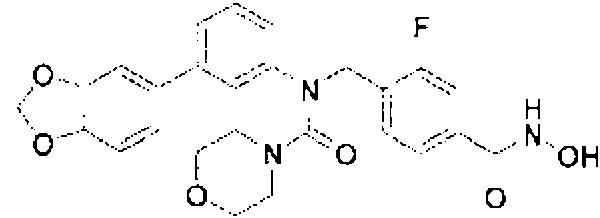
El compuesto de Fórmula 6-7 (4-((N-(3-(benzo[d][1,3]dioxol-5-il)fenil)morfolin-4-carboxamido)metil)-3-fluorobenzoato de metilo; 0,077 g, 0,156 mmol) se disolvió en metanol (10 ml), se añadió hidroxilamina (solución acuosa al 50,0 % en peso; 0,956 ml, 15,6 mmol) a temperatura ambiente, después se añadió hidróxido potásico (0,088 g, 1,56 mmol) y se agitó a la misma temperatura durante 30 minutos. Después, el concentrado se obtuvo retirando el disolvente de la mezcla de reacción a presión reducida. Se vertió una solución acuosa saturada de hidrogenocarbonato sódico en el concentrado obtenido y se agitó. Después, el sólido precipitado se filtró y se secó para dar el compuesto 511 deseado (0,056 g, 73 %) en forma de un sólido de color blanco.The compound of Formula 6-7 (methyl 4 - ((N- (3- (benzo [d] [1,3] dioxol-5-yl) phenyl) morpholin-4-carboxamido) methyl) -3-fluorobenzoate; 0.077 g, 0.156 mmol) was dissolved in methanol (10 ml), hydroxylamine (50.0% by weight aqueous solution, 0.956 ml, 15.6 mmol) was added at room temperature, then potassium hydroxide (0.088 g, 1.56 mmol) and stirred at the same temperature for 30 minutes. Then, the concentrate was obtained by removing the solvent from the reaction mixture under reduced pressure. A saturated aqueous solution of sodium hydrogencarbonate was poured into the obtained concentrate and stirred. Then, the precipitated solid was filtered and dried to give the desired compound 511 (0.056 g, 73%) as a white solid.
MS (ESI) m/z 494 (M+ H).MS (ESI) m / z 494 (M + H).
Ejemplo 126: Síntesis del compuesto 512Example 126: Synthesis of compound 512
(Fórmula 6-7: 4-((N-(3-(3,6-dihidro-2H-piran-4-il)fenil)morfolin-4-carboxamido)metil)-3-fluorobenzoato de metilo)(Formula 6-7: 4 - ((N- (3- (3,6-dihydro-2H-pyran-4-yl) phenyl) morpholin-4-carboxamido) methyl) -3-fluorobenzoate methyl)

El compuesto de Fórmula 6-6 (4-((N-(3-bromofenil)morfolin-4-carboxamido)metil)-3-fluorobenzoato de metilo; 0,300 g, 0,665 mmol), pinacol éster del ácido 3,6-dihidro-2H-piran-4-borónico (0,182 g, 0,864 mmol), Pd(dppf)Cl2 (0,027 g, 0,033 mmol) y carbonato sódico (solución acuosa 2,0 M; 0,997 ml, 1,99 mmol) se disolvieron en 1,4-dioxano (3 ml) y se agitaron a 110 °C durante 16 horas. Después, se vertió una solución acuosa saturada de hidrogenocarbonato sódico en la mezcla de reacción y la capa orgánica se extrajo con acetato de etilo. La capa orgánica se lavó con una solución acuosa saturada de cloruro sódico, se deshidrató con sulfato de magnesio anhidro y después se concentró a presión reducida. El residuo se purificó y se concentró por cromatografía en columna (sílice; acetato de etilo/hexano = 20-50 %) para dar el compuesto deseado de Fórmula 6-7 (0,068 g, 23 %) en forma de un sólido de color pardo claro. The compound of Formula 6-6 (methyl 4 - ((N- (3-bromophenyl) morpholin-4-carboxamido) methyl) -3-fluorobenzoate; 0.300 g, 0.665 mmol), pinacol ester of 3,6-dihydro acid -2H-pyran-4-boronic acid (0.182 g, 0.864 mmol), Pd (dppf) Cl2 (0.027 g, 0.033 mmol) and sodium carbonate (2.0 M aqueous solution, 0.997 mL, 1.99 mmol) were dissolved in 1,4-dioxane (3 ml) and stirred at 110 ° C for 16 hours. Then, a saturated aqueous solution of sodium hydrogencarbonate was poured into the reaction mixture and the organic layer was extracted with ethyl acetate. The organic layer was washed with a saturated aqueous solution of sodium chloride, dehydrated with anhydrous magnesium sulfate and then concentrated under reduced pressure. The residue was purified and concentrated by column chromatography (silica; ethyl acetate / hexane = 20-50%) to give the desired compound of Formula 6-7 (0.068 g, 23%) as a brown solid. Clear.
(Compuesto 512: N-(3-(3,6-dihidro-2H-piran-4-il)fenil)-N-(2-fluoro-4-(hidroxicarbamoil)bencil)morfolin-4-carboxamida)(Compound 512: N- (3- (3,6-dihydro-2H-pyran-4-yl) phenyl) -N- (2-fluoro-4- (hydroxycarbamoyl) benzyl) morpholine-4-carboxamide)

El compuesto de Fórmula 6-7 (4-((N-(3-(3,6-dihidro-2H-piran-4-il)fenil)morfolin-4-carboxamido)metil)-3-fluorobenzoato de metilo; 0,068 g, 0,150 mmol) se disolvió en metanol (10 ml), se añadió hidroxilamina (solución acuosa al 50,0 % en peso; 0,915 ml, 15,0 mmol) a temperatura ambiente, después se añadió hidróxido potásico (0,084 g, 1,50 mmol) y se agitó a la misma temperatura durante 30 minutos. Después, el concentrado se obtuvo retirando el disolvente de la mezcla de reacción a presión reducida. Se vertió una solución acuosa saturada de hidrogenocarbonato sódico en el concentrado obtenido y se extrajo con acetato de etilo. La capa orgánica se lavó con una solución acuosa saturada de cloruro sódico, se deshidrató con sulfato de magnesio anhidro y después se concentró a presión reducida. Al concentrado se le añadieron diclorometano (3 ml) y hexano (20 ml) y se agitó. Después, el sólido precipitado se filtró y se secó para dar el compuesto 512 deseado (0,028 g, 41 %) en forma de un sólido de color blanco.The compound of Formula 6-7 (methyl 4 - ((N- (3- (3,6-dihydro-2H-pyran-4-yl) phenyl) morpholin-4-carboxamido) methyl) -3-fluorobenzoate; g, 0.150 mmol) was dissolved in methanol (10 ml), hydroxylamine (50.0% by weight aqueous solution, 0.915 ml, 15.0 mmol) was added at room temperature, then potassium hydroxide (0.084 g, 1 g) was added. , 50 mmol) and stirred at the same temperature for 30 minutes. Then, the concentrate was obtained by removing the solvent from the reaction mixture under reduced pressure. A saturated aqueous solution of sodium hydrogencarbonate was poured into the obtained concentrate and extracted with ethyl acetate. The organic layer was washed with a saturated aqueous solution of sodium chloride, dehydrated with anhydrous magnesium sulfate and then concentrated under reduced pressure. To the concentrate were added dichloromethane (3 ml) and hexane (20 ml) and stirred. Then, the precipitated solid was filtered and dried to give the desired compound 512 (0.028 g, 41%) as a white solid.
1H RMN (400 MHz, DMSO-d6) 811,25 (s a, 1 H), 9,11 (s a, 1 H), 7,53 - 7,43 (m, 3 H), 7,29 (m, 1 H), 7,21 -7,17 (m, 2 H), 7,04 (m, 1 H), 6,25 (s, 1 H), 4,88 (s, 2 H), 4,20 (m, 2 H), 3,79 (m, 2 H), 3,36 (m, 4 H), 3,12 (m, 4 H), 2,38 (m, 2 H). MS (ESI) m/z 456 (M+ H).1 H NMR (400 MHz, DMSO-d 6) 811.25 (br s, 1 H), 9.11 (sa, 1 H), 7.53-7.43 (m, 3 H), 7.29 (m, 1 H), 7.21 -7.17 (m, 2 H), 7.04 (m, 1 H), 6.25 (s, 1 H), 4.88 (s, 2 H), 4, 20 (m, 2 H), 3.79 (m, 2 H), 3.36 (m, 4 H), 3.12 (m, 4 H), 2.38 (m, 2 H). MS (ESI) m / z 456 (M + H).
Ejemplo 127: Síntesis del compuesto 513 Example 127: Synthesis of compound 513
(Fórmula 6-7: 4-((N-(3-(benzo[d][1,3]dioxol-5-il)fenil)-4-hidroxipiperidin-1-carboxamido)metil)-3-fluorobenzoato de metilo)(Formula 6-7: 4 - ((N- (3- (benzo [d] [1,3] dioxol-5-yl) phenyl) -4-hydroxypiperidine-1-carboxamido) methyl) -3-fluorobenzoate )

El compuesto de Fórmula 6-6 (4-((N-(3-bromofenil)-4-hidroxipiperidin-1-carboxamido)metil)-3-fluorobenzoato de metilo; 0,200 g, 0,430 mmol), ácido benzo[d][1,3]dioxol-5-ilborónico (0,093 g, 0,559 mmol), Pd(dppf)Cl2 (0,018 g, 0,021 mmol) y carbonato sódico (solución acuosa 2,0 M; 0,645 ml, 1,29 mmol) se disolvieron en 1,4-dioxano (2 ml) y se agitaron a 110 °C durante 16 horas. Después, se vertió una solución acuosa saturada de hidrogenocarbonato sódico en la mezcla de reacción y la capa orgánica se extrajo con acetato de etilo. La capa orgánica se lavó con una solución acuosa saturada de cloruro sódico, se deshidrató con sulfato de magnesio anhidro y después se concentró a presión reducida. El residuo se purificó y se concentró por cromatografía en columna (sílice; acetato de etilo/hexano = 40-70 %) para dar el compuesto deseado de Fórmula 6-7 (0,037 g, 17 %) en forma de un sólido de color amarillo claro. The compound of Formula 6-6 (methyl 4 - ((N- (3-bromophenyl) -4-hydroxypiperidine-1-carboxamido) methyl) -3-fluorobenzoate; 0.200 g, 0.430 mmol), benzo acid [d] [ 1,3] dioxol-5-ylboronic acid (0.093 g, 0.599 mmol), Pd (dppf) Cl2 (0.018 g, 0.021 mmol) and sodium carbonate (2.0 M aqueous solution, 0.645 mL, 1.29 mmol) were dissolved in 1,4-dioxane (2 ml) and stirred at 110 ° C for 16 hours. Then, a saturated aqueous solution of sodium hydrogencarbonate was poured into the reaction mixture and the organic layer was extracted with ethyl acetate. The organic layer was washed with a saturated aqueous solution of sodium chloride, dehydrated with anhydrous magnesium sulfate and then concentrated under reduced pressure. The residue was purified and concentrated by column chromatography (silica; ethyl acetate / hexane = 40-70%) to give the desired compound of Formula 6-7 (0.037 g, 17%) as a yellow solid. Clear.
(Compuesto 513: N-(3-(benzo[d][1,3]dioxol-5-il)fenil)-N-(2-fluoro-4-(hidroxicarbamoil)bencil)-4-hidroxipiperidin-1-carboxamida)(Compound 513: N- (3- (benzo [d] [1,3] dioxol-5-yl) phenyl) -N- (2-fluoro-4- (hydroxycarbamoyl) benzyl) -4-hydroxypiperidine-1-carboxamide )

El compuesto de Fórmula 6-7 (4-((N-(3-(benzo[d][1,3]dioxol-5-il)fenil)-4-hidroxipiperidin-1-carboxamido)metil)-3-fluorobenzoato de metilo; 0,037 g, 0,073 mmol) se disolvió en metanol (10 ml), se añadió hidroxilamina (solución acuosa al 50,0 % en peso; 0,447 ml, 7,31 mmol) a temperatura ambiente, después se añadió hidróxido potásico (0,041 g, 0,730 mmol) y se agitó a la misma temperatura durante 30 minutos. Después, el concentrado se obtuvo retirando el disolvente de la mezcla de reacción a presión reducida. Se vertió una solución acuosa saturada de hidrogenocarbonato sódico en el concentrado obtenido y se agitó. Después, el sólido precipitado se filtró y se secó para dar el compuesto 513 deseado (0,032 g, 86 %) en forma de un sólido de color pardo claro.The compound of Formula 6-7 (4 - ((N- (3- (benzo [d] [1,3] dioxol-5-yl) phenyl) -4-hydroxypiperidine-1-carboxamido) methyl) -3-fluorobenzoate of methyl, 0.037 g, 0.073 mmol) was dissolved in methanol (10 ml), hydroxylamine (50.0% by weight aqueous solution, 0.47 ml, 7.31 mmol) was added at room temperature, then potassium hydroxide was added ( 0.041 g, 0.730 mmol) and stirred at the same temperature for 30 minutes. Then, the concentrate was obtained by removing the solvent from the reaction mixture under reduced pressure. A saturated aqueous solution of sodium hydrogencarbonate was poured into the obtained concentrate and stirred. Then, the precipitated solid was filtered and dried to give the desired compound 513 (0.032 g, 86%) as a light brown solid.
1H RMN (400 MHz, DMSO-d6) 87,63 - 7,59 (m, 2 H), 7,54 (m, 1 H), 7,36 - 7,32 (m, 3 H), 7,21 (m, 1 H), 7,09 (m, 1 H), 7,02 (m, 1 H), 6,96 (m, 1 H), 6,65 (s, 2 H), 4,89 (s, 2 H), 4,63 (d, 1 H, J = 4,0 Hz), 3,52 - 3,49 (m, 3 H), 2,85 - 2,82 (m, 2 H), 1,53 - 1,50 (m, 2 H), 1,13 -1,09 (m, 2 H).MS (ESI) m/z 508 (M+ H).1 H NMR (400 MHz, DMSO-d 6) 87.63-7.59 (m, 2 H), 7.54 (m, 1 H), 7.36-7.32 (m, 3 H), 7, 21 (m, 1 H), 7.09 (m, 1 H), 7.02 (m, 1 H), 6.96 (m, 1 H), 6.65 (s, 2 H), 4, 89 (s, 2 H), 4.63 (d, 1 H, J = 4.0 Hz), 3.52 - 3.49 (m, 3 H), 2.85-2.82 (m, 2) H), 1.53-1.50 (m, 2 H), 1.13-1.09 (m, 2 H) .MS (ESI) m / z 508 (M + H).
Ejemplo 128: Síntesis del compuesto 514Example 128: Synthesis of compound 514
(Fórmula 6-7: 4-((N-(3-(3,6-dihidro-2H-piran-4-il)fenil)-4-hidroxipiperidin-1-carboxamido)metil)-3-fluorobenzoato de metilo)(Formula 6-7: 4 - ((N- (3- (3,6-dihydro-2H-pyran-4-yl) phenyl) -4-hydroxypiperidine-1-carboxamido) methyl) -3-fluorobenzoate methyl)

El compuesto de Fórmula 6-6 (4-((N-(3-bromofenil)-4-hidroxipiperidin-1-carboxamido)metil)-3-fluorobenzoato de metilo; 0,300 g, 0,645 mmol), pinacol éster del ácido 3,6-dihidro-2H-piran-4-borónico (0,176 g, 0,838 mmol), Pd(dppf)Cl2 (0,026 g, 0,032 mmol) y carbonato sódico (solución acuosa 2,0 M; 0,967 ml, 1,93 mmol) se disolvieron en 1,4-dioxano (3 ml) y se agitaron a 110 °C durante 16 horas. Después, se vertió una solución acuosa saturada de hidrogenocarbonato sódico en la mezcla de reacción y la capa orgánica se extrajo con acetato de etilo. La capa orgánica se lavó con una solución acuosa saturada de cloruro sódico, se deshidrató con sulfato de magnesio anhidro y después se concentró a presión reducida. El residuo se purificó y se concentró por cromatografía en columna (sílice; acetato de etilo/hexano = 50-80 %) para dar el compuesto deseado de Fórmula 6-7 (0,078 g, 26 %) en forma de un sólido de color amarillo claro.The compound of Formula 6-6 (methyl 4 - ((N- (3-bromophenyl) -4-hydroxypiperidine-1-carboxamido) methyl) -3-fluorobenzoate; 0.300 g, 0.645 mmol), pinacol ester of acid 3, 6-dihydro-2H-pyran-4-boronic acid (0.176 g, 0.838 mmol), Pd (dppf) Cl2 (0.026 g, 0.032 mmol) and sodium carbonate (2.0 M aqueous solution, 0.967 mL, 1.93 mmol) they were dissolved in 1,4-dioxane (3 ml) and stirred at 110 ° C for 16 hours. Then, a saturated aqueous solution of sodium hydrogencarbonate was poured into the reaction mixture and the organic layer was extracted with ethyl acetate. The organic layer was washed with a saturated aqueous solution of sodium chloride, dehydrated with anhydrous magnesium sulfate and then concentrated under reduced pressure. The residue was purified and concentrated by column chromatography (silica; ethyl acetate / hexane = 50-80%) to give the desired compound of Formula 6-7 (0.078 g, 26%) as a yellow solid. Clear.
(Compuesto 514: N-(3-(3,6-dihidro-2H-piran-4-il)fenil)-N-(2-fluoro-4-(hidroxicarbamoil)bencil)-4-hidroxipiperidin-1-carboxamida) (Compound 514: N- (3- (3,6-dihydro-2H-pyran-4-yl) phenyl) -N- (2-fluoro-4- (hydroxycarbamoyl) benzyl) -4-hydroxypiperidine-1-carboxamide)

El compuesto de Fórmula 6-7 (4-((N-(3-(3,6-dihidro-2H-piran-4-il)fenil)-4-hidroxipiperidin-1-carboxamido)metil)-3-fluorobenzoato de metilo; 0,078 g, 0,166 mmol) se disolvió en metanol (10 ml), se añadió hidroxilamina (solución acuosa al 50,0 % en peso; 1,02 ml, 16,6 mmol) a temperatura ambiente, después se añadió hidróxido potásico (0,093 g, 1,67 mmol) y se agitó a la misma temperatura durante 30 minutos. Después, el concentrado se obtuvo retirando el disolvente de la mezcla de reacción a presión reducida. Se vertió una solución acuosa saturada de hidrogenocarbonato sódico en el concentrado obtenido y se extrajo con acetato de etilo. La capa orgánica se lavó con una solución acuosa saturada de cloruro sódico, se deshidrató con sulfato de magnesio anhidro y después se concentró a presión reducida. Al concentrado se le añadieron diclorometano (3 ml) y hexano (20 ml) y se agitó. Después, el sólido precipitado se filtró y se secó para dar el compuesto 514 deseado (0,036 g, 46 %) en forma de un sólido de color verde claro. 1H RMN (400 MHz, DIVISOR) 811,25 (s a, 1 H), 9,11 (s a, 1 H), 7,54 -7,44 (m, 3 H), 7,28 (t, 1 H, J = 7,8 Hz), 7,18 -7,15 (m, 2 H), 7,00 (d, 1 H, J = 8,6 Hz), 6,23 (s, 1 H), 4,84 (s, 2 H), 4,63 (d, 1 H, J = 4,0 Hz), 4,19 (m, 2 H), 3,79 (t, 2 H, J = 5,4 Hz), 3,52 - 3,46 (m, 3 H), 2,83 - 2,76 (m, 2 H), 2,37 (m, 2 H), 1,52 - 1,49 (m, 2 H), 1,16-1,13 (m, 2 H). MS (ESI) m/z 470 (M+ H).The compound of Formula 6-7 (4 - ((N- (3- (3,6-dihydro-2H-pyran-4-yl) phenyl) -4-hydroxypiperidine-1-carboxamido) methyl) -3-fluorobenzoate of methyl, 0.078 g, 0.166 mmol) was dissolved in methanol (10 ml), hydroxylamine (50.0% by weight aqueous solution, 1.02 ml, 16.6 mmol) was added at room temperature, then potassium hydroxide was added. (0.093 g, 1.67 mmol) and stirred at the same temperature for 30 minutes. Then, the concentrate was obtained by removing the solvent from the reaction mixture under reduced pressure. A saturated aqueous solution of sodium hydrogencarbonate was poured into the obtained concentrate and extracted with ethyl acetate. The organic layer was washed with a saturated aqueous solution of sodium chloride, dehydrated with anhydrous magnesium sulfate and then concentrated under reduced pressure. To the concentrate were added dichloromethane (3 ml) and hexane (20 ml) and stirred. Then, the precipitated solid was filtered and dried to give the desired compound 514 (0.036 g, 46%) as a light green solid. 1 H NMR (400 MHz, DIVIDER) 811.25 (br s, 1 H), 9.11 (sa, 1 H), 7.54 -7.44 (m, 3 H), 7.28 (t, 1 H , J = 7.8 Hz), 7.18 -7.15 (m, 2 H), 7.00 (d, 1 H, J = 8.6 Hz), 6.23 (s, 1 H), 4.84 (s, 2 H), 4.63 (d, 1 H, J = 4.0 Hz), 4.19 (m, 2 H), 3.79 (t, 2 H, J = 5, 4 Hz), 3.52 - 3.46 (m, 3 H), 2.83 - 2.76 (m, 2 H), 2.37 (m, 2 H), 1.52 - 1.49 ( m, 2 H), 1.16-1.13 (m, 2 H). MS (ESI) m / z 470 (M + H).
Ejemplo 129: Síntesis del compuesto 517Example 129: Synthesis of compound 517
(Fórmula 4-7: 4-((N-(3-(1-(2-hidroxi-2-metilpropil)piperidin-4-il)fenil)morfolin-4-carboxamido)metil)benzoato de etilo)(Formula 4-7: 4 - ((N- (3- (1- (2-hydroxy-2-methylpropyl) piperidin-4-yl) phenyl) morpholin-4-carboxamido) methyl) ethyl benzoate)

El compuesto de Fórmula 4-5 (clorhidrato de 4-((N-(3-(piperidin-4-il)fenil)morfolin-4-carboxiamido)metil)benzoato de metilo; 0,540 g, 1,139 mmol), 2,2-dimetiloxirano (0,411 g, 5,696 mmol) y carbonato potásico (0,472 g, 3,42 mmol) se mezclaron con agua (1 ml)/etanol (3 ml). Después, la mezcla se calentó a 120 °C durante 20 minutos con irradiación con microondas y después la temperatura se disminuyó a temperatura ambiente. Después, el concentrado se obtuvo retirando el disolvente de la mezcla de reacción a presión reducida. Se vertió agua en el concentrado obtenido y la capa orgánica se extrajo con acetato de etilo. La capa orgánica se lavó con una solución acuosa saturada de cloruro sódico, se deshidrató con sulfato de magnesio anhidro y después se concentró a presión reducida. El residuo se purificó y se concentró por cromatografía en columna (sílice; metanol/diclorometano = 2-10 %) para dar el compuesto deseado de Fórmula 4-7 (0,325 g, 55 %) en forma de un líquido incoloro.The compound of Formula 4-5 (methyl 4 - ((N- (3- (piperidin-4-yl) phenyl) morpholin-4-carboxyamido) methyl) benzoate hydrochloride; 0.540 g, 1.139 mmol), 2.2 dimethyloxirane (0.411 g, 5.696 mmol) and potassium carbonate (0.472 g, 3.42 mmol) were mixed with water (1 ml) / ethanol (3 ml). Then, the mixture was heated at 120 ° C for 20 minutes with microwave irradiation and then the temperature was lowered to room temperature. Then, the concentrate was obtained by removing the solvent from the reaction mixture under reduced pressure. Water was poured into the concentrate obtained and the organic layer was extracted with ethyl acetate. The organic layer was washed with a saturated aqueous solution of sodium chloride, dehydrated with anhydrous magnesium sulfate and then concentrated under reduced pressure. The residue was purified and concentrated by column chromatography (silica; methanol / dichloromethane = 2-10%) to give the desired compound of Formula 4-7 (0.325 g, 55%) as a colorless liquid.
(Compuesto 517: N-(3-(1-(2-hidroxi-2-metilpropil)piperidin-4-il)fenil)-N-(4-(hidroxicarbamoil)bencil)morfolin-4-carboxamida)(Compound 517: N- (3- (1- (2-hydroxy-2-methylpropyl) piperidin-4-yl) phenyl) -N- (4- (hydroxycarbamoyl) benzyl) morpholine-4-carboxamide)

El compuesto de Fórmula 4-7 (4-((N-(3-(1-(2-hidroxi-2-metilpropil)piperidin-4-il)fenil)morfolin-4-carboxamido)metil)benzoato de etilo; 0,050 g, 0,095 mmol) se disolvió en metanol (10 ml), se añadió hidroxilamina (solución acuosa al 50,0 % en peso; 0,584 ml, 9,55 mmol) a temperatura ambiente, después se añadió hidróxido potásico (0,054 g, 0,955 mmol) y se agitó a la misma temperatura durante 30 minutos. Después, el concentrado se obtuvo retirando el disolvente de la mezcla de reacción a presión reducida. Se vertió una solución acuosa saturada de hidrogenocarbonato sódico en el concentrado obtenido y la capa orgánica se extrajo con acetato de etilo. La capa orgánica se lavó con una solución acuosa saturada de cloruro sódico, se deshidrató con sulfato de magnesio anhidro y después se concentró a presión reducida. Al concentrado se le añadieron diclorometano (2 ml) y hexano (20 ml) y se agitó. Después, el sólido precipitado se filtró y se secó para dar el compuesto 517 deseado (0,032 g, 66 %) en forma de un sólido de color blanco.The compound of Formula 4-7 (ethyl 4 - ((N- (3- (1- (2-hydroxy-2-methylpropyl) piperidin-4-yl) phenyl) morpholin-4-carboxamido) methyl) benzoate; g, 0.095 mmol) was dissolved in methanol (10 ml), hydroxylamine (50.0% by weight aqueous solution, 0.584 ml, 9.55 mmol) was added at room temperature, then potassium hydroxide (0.054 g, 0.955 g) was added. mmol) and stirred at the same temperature for 30 minutes. Then, the concentrate was obtained by removing the solvent from the reaction mixture under reduced pressure. A saturated aqueous solution of sodium hydrogencarbonate was poured into the obtained concentrate and the organic layer was extracted with ethyl acetate. The organic layer was washed with a saturated aqueous solution of sodium chloride, dehydrated with anhydrous magnesium sulfate and then concentrated under reduced pressure. To the concentrate were added dichloromethane (2 ml) and hexane (20 ml) and stirred. Then, the precipitated solid was filtered and dried to give the desired compound 517 (0.032 g, 66%) as a white solid.
1H RMN (400 MHz, DMSO-d6) 8 11,12 (s a, 1 H), 8,98 (s a, 1 H), 7,63 (d, 2 H, J = 8,2 Hz), 7,34 (d, 2 H, J = 8,1 Hz), 7,21 (m, 1 H), 6,97 - 6,93 (m, 3 H), 4,83 (s, 2 H), 3,37 - 3,34 (m, 6 H), 3,12 - 3,10 (m, 4 H), 3,00 (m, 1 H), 2,32 (m, 1 H), 2,19 -2,14 (m, 3 H), 1,68 - 1,62 (m, 4 H), 1,22 (s, 3 H), 1,10 (m, 4 H). MS (ESI) m/z 511 (M+ H). 1 H NMR (400 MHz, DMSO-d 6) 8 11 12 (sa, 1 H), 8.98 (sa, 1 H), 7.63 (d, 2 H, J = 8.2 Hz), 7, 34 (d, 2 H, J = 8.1 Hz), 7.21 (m, 1 H), 6.97-6.93 (m, 3 H), 4.83 (s, 2 H), 3 , 37 - 3.34 (m, 6 H), 3.12 - 3.10 (m, 4 H), 3.00 (m, 1 H), 2.32 (m, 1 H), 2.19 -2.14 (m, 3 H), 1.68-1.62 (m, 4 H), 1.22 (s, 3 H), 1.10 (m, 4 H). MS (ESI) m / z 511 (M + H).
Ejemplo 130: Síntesis del compuesto 518Example 130: Synthesis of compound 518
(Fórmula 4-8: 4((N-(3-(1-(2-fluoro-2-metilpropil)piperidin-4-il)fenil)morfolin-4-carboxamido)metil)benzoato de etilo)(Formula 4-8: 4 ((N- (3- (1- (2-fluoro-2-methylpropyl) piperidin-4-yl) phenyl) morpholin-4-carboxamido) methyl) ethyl benzoate)

El compuesto de Fórmula 4-7 (4-((N-(3-(1 -(2-hidroxi-2-metilpropil)pipendin-4-il)fenil)morfolin-4-carboxamido)metil)benzoato de etilo; 0,275 g, 0,525 mmol) se disolvió en diclorometano (20 ml), después se añadió trifluoruro de dimetilaminoazufre (DAST, 0,068 ml, 0,578 mmol) a 0 °C y se agitó a la misma temperatura durante 1 hora. Después, se vertió una solución acuosa saturada de hidrogenocarbonato sódico en la mezcla de reacción y la capa orgánica se extrajo con acetato de etilo. La capa orgánica se lavó con una solución acuosa saturada de cloruro sódico, se deshidrató con sulfato de magnesio anhidro y después se concentró a presión reducida. El residuo se purificó y se concentró por cromatografía en columna (sílice; metanol/diclorometano = 2-10 %) para dar el compuesto deseado de Fórmula 4-8 (0,146 g, 53 %) en forma de un líquido incoloro.The compound of Formula 4-7 (ethyl 4 - ((N- (3- (1 - (2-hydroxy-2-methylpropyl) pipendin-4-yl) phenyl) morpholin-4-carboxamido) methyl) benzoate; 0.275 g, 0.525 mmol) was dissolved in dichloromethane (20 ml), then dimethylaminosulfur trifluoride (DAST, 0.068 ml, 0.578 mmol) was added at 0 ° C and stirred at the same temperature for 1 hour. Then, a saturated aqueous solution of sodium hydrogencarbonate was poured into the reaction mixture and the organic layer was extracted with ethyl acetate. The organic layer was washed with a saturated aqueous solution of sodium chloride, dehydrated with anhydrous magnesium sulfate and then concentrated under reduced pressure. The residue was purified and concentrated by column chromatography (silica; methanol / dichloromethane = 2-10%) to give the desired compound of Formula 4-8 (0.146 g, 53%) as a colorless liquid.
(Compuesto 518: N-(3-(1-(2-fluoro-2-metilpropil)piperidin-4-il)fenil)-N-(4-(hidroxicarbamoil)bencil)morfolin-4-carboxamida)(Compound 518: N- (3- (1- (2-fluoro-2-methylpropyl) piperidin-4-yl) phenyl) -N- (4- (hydroxycarbamoyl) benzyl) morpholine-4-carboxamide)

El compuesto de Fórmula 4-8 (4-((N-(3-(1-(2-fluoro-2-metilpropil)piperidin-4-il)fenil)morfolin-4-carboxamido)metil)benzoato de etilo; 0,146 g, 0,278 mmol) se disolvió en metanol (10 ml), se añadió hidroxilamina (solución acuosa al 50,0 % en peso; 1,19 ml, 19,4 mmol) a temperatura ambiente, después se añadió hidróxido potásico (0,156 g, 2,78 mmol) y se agitó a la misma temperatura. Después, el concentrado se obtuvo retirando el disolvente de la mezcla de reacción a presión reducida. Se vertió una solución acuosa saturada de hidrogenocarbonato sódico en el concentrado obtenido y la capa orgánica se extrajo con acetato de etilo. La capa orgánica se lavó con una solución acuosa saturada de cloruro sódico, se deshidrató con sulfato de magnesio anhidro y después se concentró a presión reducida. Al concentrado se le añadieron diclorometano (2 ml) y hexano (20 ml) y se agitó. Después, el sólido precipitado se filtró y se secó para dar el compuesto 518 deseado (0,092 g, 65 %) en forma de un sólido de color blanco.The compound of Formula 4-8 (ethyl 4 - ((N- (3- (1- (2-fluoro-2-methylpropyl) piperidin-4-yl) phenyl) morpholin-4-carboxamido) methyl) benzoate; 0.146 g, 0.278 mmol) was dissolved in methanol (10 ml), hydroxylamine (50.0% by weight aqueous solution, 1.19 ml, 19.4 mmol) was added at room temperature, then potassium hydroxide (0.156 g) was added. 2.78 mmol) and stirred at the same temperature. Then, the concentrate was obtained by removing the solvent from the reaction mixture under reduced pressure. A saturated aqueous solution of sodium hydrogencarbonate was poured into the obtained concentrate and the organic layer was extracted with ethyl acetate. The organic layer was washed with a saturated aqueous solution of sodium chloride, dehydrated with anhydrous magnesium sulfate and then concentrated under reduced pressure. To the concentrate were added dichloromethane (2 ml) and hexane (20 ml) and stirred. Then, the precipitated solid was filtered and dried to give the desired compound 518 (0.092 g, 65%) as a white solid.
1H RMN (400 MHz, DIVISOR) 8 11,12 (s a, 1 H), 8,99 (s a, 1 H), 7,64 (d, 2 H, J = 8,3 Hz), 7,34 (d, 2 H, J = 8,2 Hz), 7,21 (t, 1 H, J = 7,7 Hz), 6,98 - 6,94 (m, 3 H), 4,84 (s, 2 H), 3,37 - 3,35 (m, 4 H), 3,14 - 3,10 (m, 4 H), 2,97 - 2,95 (m, 2 H), 2,46 -2,38 (m, 3 H), 2,17 -2,14 (m, 2 H), 1,67 - 1,60 (m, 4 H), 1,33 (s, 3 H), 1,28 (s, 3 H). MS (ESI) m/z 513 (M+ H).1 H NMR (400 MHz, DIVIDER) 8 11 12 (sa, 1 H), 8.99 (sa, 1 H), 7.64 (d, 2 H, J = 8.3 Hz), 7.34 ( d, 2 H, J = 8.2 Hz), 7.21 (t, 1 H, J = 7.7 Hz), 6.98-6.94 (m, 3 H), 4.84 (s, 2 H), 3.37 - 3.35 (m, 4 H), 3.14 - 3.10 (m, 4 H), 2.97 - 2.95 (m, 2 H), 2.46 - 2.38 (m, 3 H), 2.17 -2.14 (m, 2 H), 1.67-1.60 (m, 4 H), 1.33 (s, 3 H), 1, 28 (s, 3 H). MS (ESI) m / z 513 (M + H).
Ejemplo 131: Síntesis del compuesto 520Example 131: Synthesis of compound 520
(Fórmula 1-4: 4-((3-fluoro-N-(4-(trifluorometil)fenil)pirrolidin-1-carboxamido)metil)benzoato de (R)-metilo)(Formula (1-4): 4 - ((3-fluoro-N- (4- (trifluoromethyl) phenyl) pyrrolidin-1-carboxamido) methyl) benzoate of (R) -methyl)

El compuesto de Fórmula 1-3 (4-((((4-nitrofenoxi)carbonil)(4-(trifluorometil)fenil)amino)metil)benzoato de metilo; 0,239 g, 0,504 mmol), clorhidrato de (R)-3-fluoropirrolidina (0,127 g, 1,008 mmol) y carbonato potásico (0,209 g, 1,513 mmol) se disolvieron en N,N-dimetilformamida (5 ml), se agitaron a 60 °C durante 24 horas, y después la reacción se completó disminuyendo la temperatura a temperatura ambiente. Se vertió una solución acuosa saturada de hidrogenocarbonato sódico en la mezcla de reacción y la capa orgánica se extrajo con acetato de etilo. La capa orgánica se lavó con una solución acuosa saturada de cloruro sódico, se deshidrató con sulfato sódico anhidro, se filtró y posteriormente se concentró a presión reducida. El concentrado se purificó y se concentró por cromatografía en columna (sílice; acetato de etilo/hexano = 40 %) para dar el compuesto deseado de Fórmula 1-4 (0,081 g, 37,8 %) en forma de un sólido de color blanco. The compound of Formula 1-3 (methyl 4 - ((((((4-nitrophenoxy) carbonyl) (4- (trifluoromethyl) phenyl) amino) methyl) benzoate; 0.249 g, 0.504 mmol), hydrochloride of (R) -3 Fluoropyrrolidine (0.127 g, 1.008 mmol) and potassium carbonate (0.209 g, 1.513 mmol) were dissolved in N, N-dimethylformamide (5 mL), stirred at 60 ° C for 24 hours, and then the reaction was completed by decreasing the temperature at room temperature. A saturated aqueous solution of sodium hydrogencarbonate was poured into the reaction mixture and the organic layer was extracted with ethyl acetate. The organic layer was washed with a saturated aqueous solution of sodium chloride, dehydrated with anhydrous sodium sulfate, filtered and then concentrated under reduced pressure. The concentrate was purified and concentrated by column chromatography (silica; ethyl acetate / hexane = 40%) to give the desired compound of Formula 1-4 (0.081 g, 37.8%) as a white solid .
(Compuesto 520, (R)-3-fluoro-N-(4-(hidroxicarbamoil)bencil)-N-(4-(trifluorometil)fenil)pirrolidin-1-carboxamida)(Compound 520, (R) -3-fluoro-N- (4- (hydroxycarbamoyl) benzyl) -N- (4- (trifluoromethyl) phenyl) pyrrolidine-1-carboxamide)

El compuesto de Fórmula 1-4 (4-((3-fluoro-N-(4-(trifluorometil)fenil)pirrolidin-1-carboxamido)metil)benzoato de (R)-metilo; 0,081 g, 0,191 mmol) e hidroxilamina (solución acuosa al 50 % en peso; 0,063 g, 1,909 mmol) se disolvieron en metanol (5 ml) y se agitaron a temperatura ambiente durante 24 horas. El concentrado se obtuvo retirando el disolvente de la mezcla de reacción a presión reducida. Se vertió una solución acuosa saturada de hidrogenocarbonato sódico en el concentrado obtenido y la capa orgánica se extrajo con acetato de etilo. La capa orgánica se lavó con una solución acuosa saturada de cloruro sódico, se deshidrató con sulfato de magnesio anhidro y después se concentró a presión reducida. El concentrado se purificó y se concentró por cromatografía en columna (sílice; metanol/diclorometano = 10 %) para dar el compuesto 520 deseado (0,067 g, 83,0 %) en forma de un sólido de color blanco.The compound of Formula 1-4 (4 - ((3-fluoro-N- (4- (trifluoromethyl) phenyl) pyrrolidin-1-carboxamido) methyl) benzoate of (R) -methyl; 0.081 g, 0.191 mmol) and hydroxylamine (50% by weight aqueous solution, 0.063 g, 1.909 mmol) were dissolved in methanol (5 ml) and stirred at room temperature for 24 hours. The concentrate was obtained by removing the solvent from the reaction mixture under reduced pressure. A saturated aqueous solution of sodium hydrogencarbonate was poured into the obtained concentrate and the organic layer was extracted with ethyl acetate. The organic layer was washed with a saturated aqueous solution of sodium chloride, dehydrated with anhydrous magnesium sulfate and then concentrated under reduced pressure. The concentrate was purified and concentrated by column chromatography (silica: methanol / dichloromethane = 10%) to give the desired compound 520 (0.067 g, 83.0%) as a white solid.
1H RMN (400 MHz, DMSO-da) 8 11,1 (s, 1 H), 8,99 (s, 1 H), 7,66 - 7,63 (m, 4 H), 7,37 (d, 2 H, J = 8,1 Hz), 7,30 (d, 2 H, J = 8,4 Hz), 5,27 (s, 0,5 H), 5,14 (s, 0,5 H), 4,98 -4,88 (m, 2 H), 3,34 - 3,30 (m, 2 H), 3,18 - 3,11 (m, 2 H), 2,02 -I , 92 (m, 2 H); MS (ESI) m/z 426,1 (M+ H).1 H NMR (400 MHz, DMSO-da) 8 11.1 (s, 1 H), 8.99 (s, 1 H), 7.66-7.63 (m, 4 H), 7.37 (d , 2 H, J = 8.1 Hz), 7.30 (d, 2 H, J = 8.4 Hz), 5.27 (s, 0.5 H), 5.14 (s, 0.5 H), 4.98 -4.88 (m, 2 H), 3.34-3.30 (m, 2 H), 3.18 - 3.11 (m, 2 H), 2.02-I 92 (m, 2 H); MS (ESI) m / z 426.1 (M + H).
Ejemplo 132: Síntesis del compuesto 521Example 132: Synthesis of compound 521
(Fórmula 1-4: 4-((3-fluoro-N-(4-(trifluorometil)fenil)pirrolidin-1-carboxamido)metil)benzoato de (S)-metilo)(Formula (1-4): 4- ((3-fluoro-N- (4- (trifluoromethyl) phenyl) pyrrolidin-1-carboxamido) methyl) benzoate (S) -methyl)

El compuesto de Fórmula 1-3 (4-((((4-nitrofenoxi)carbonil)(4-(trifluorometil)fenil)amino)metil)benzoato de metilo; 0,312 g, 0,659 mmol), clorhidrato de (S)-3-fluoropirrolidina (0,165 g, 1,317 mmol) y carbonato potásico (0,273 g, 1,976 mmol) se disolvieron en N,N-dimetilformamida (5 ml), se agitaron a 60 °C durante 24 horas, y después la reacción se completó disminuyendo la temperatura a temperatura ambiente. Se vertió una solución acuosa saturada de hidrogenocarbonato sódico en la mezcla de reacción y la capa orgánica se extrajo con acetato de etilo. La capa orgánica se lavó con una solución acuosa saturada de cloruro sódico, se deshidrató con sulfato sódico anhidro, se filtró y posteriormente se concentró a presión reducida. El concentrado se purificó y se concentró por cromatografía en columna (sílice; acetato de etilo/hexano = 40 %) para dar el compuesto deseado de Fórmula 1-4 (0,115 g, 41,0 %) en forma de un sólido de color blanco.The compound of Formula 1-3 (methyl 4 - ((((((4-nitrophenoxy) carbonyl) (4- (trifluoromethyl) phenyl) amino) methyl) benzoate; 0.312 g, 0.655 mmol), hydrochloride of (S) -3 Fluoropyrrolidine (0.165 g, 1.317 mmol) and potassium carbonate (0.273 g, 1.976 mmol) were dissolved in N, N-dimethylformamide (5 mL), stirred at 60 ° C for 24 hours, and then the reaction was completed by decreasing the temperature at room temperature. A saturated aqueous solution of sodium hydrogencarbonate was poured into the reaction mixture and the organic layer was extracted with ethyl acetate. The organic layer was washed with a saturated aqueous solution of sodium chloride, dehydrated with anhydrous sodium sulfate, filtered and then concentrated under reduced pressure. The concentrate was purified and concentrated by column chromatography (silica; ethyl acetate / hexane = 40%) to give the desired compound of Formula 1-4 (0.115 g, 41.0%) as a white solid .
(Compuesto 521, (S)-3-fluoro-N-(4-(hidroxicarbamoil)bencil)-N-(4-(trifluorometil)fenil)pirrolidin-1-carboxamida)(Compound 521, (S) -3-fluoro-N- (4- (hydroxycarbamoyl) benzyl) -N- (4- (trifluoromethyl) phenyl) pyrrolidine-1-carboxamide)

El compuesto de Fórmula 1-4 (4-((3-fluoro-N-(4-(trifluorometil)fenil)pirrolidin-1-carboxamido)metil)benzoato de (S)-metilo; 0,115 g, 0,271 mmol) e hidroxilamina (solución acuosa al 50 % en peso; 0,090 g, 2,710 mmol) se disolvieron en metanol (5 ml) y se agitaron a temperatura ambiente durante 24 horas. El concentrado se obtuvo retirando el disolvente de la mezcla de reacción a presión reducida. Se vertió una solución acuosa saturada de hidrogenocarbonato sódico en el concentrado obtenido y la capa orgánica se extrajo con acetato de etilo. La capa orgánica se lavó con una solución acuosa saturada de cloruro sódico, se deshidrató con sulfato de magnesio anhidro y después se concentró a presión reducida. El concentrado se purificó y se concentró por cromatografía en columna (sílice; metanol/diclorometano = 10 %) para dar el compuesto 521 deseado (0,075 g, 65,2 %) en forma de un sólido de color blanco. The compound of Formula (1-4 (4 - ((3-fluoro-N- (4- (trifluoromethyl) phenyl) pyrrolidin-1-carboxamido) methyl) benzoate of (S) -methyl; 0.115 g, 0.271 mmol) and hydroxylamine (50% by weight aqueous solution, 0.090 g, 2.710 mmol) were dissolved in methanol (5 ml) and stirred at room temperature for 24 hours. The concentrate was obtained by removing the solvent from the reaction mixture under reduced pressure. A saturated aqueous solution of sodium hydrogencarbonate was poured into the obtained concentrate and the organic layer was extracted with ethyl acetate. The organic layer was washed with a saturated aqueous solution of sodium chloride, dehydrated with anhydrous magnesium sulfate and then concentrated under reduced pressure. The concentrate was purified and concentrated by column chromatography (silica; methanol / dichloromethane = 10%) to give the desired compound 521 (0.075 g, 65.2%) as a white solid.
1H RMN (400 MHz, DMSO-da) 5 11,1 (s, 1 H), 9,00 (s, 1 H), 7,66 - 7,63 (m, 4 H), 7,37 (d, 2 H, J = 8,1 Hz), 7,30 (d, 2 H, J = 8,4 Hz), 5,27 (s, 0,5 H), 5,14 (s, 0,5 H), 5,02 - 4,88 (m, 2 H), 3,34 - 3,30 (m, 2 H), 3,24 - 3,11 (m, 2 H), 2,07 -I , 86 (m, 2 H); MS (ESI) m/z 426,1 (M+ H).1 H NMR (400 MHz, DMSO-da) 5 11.1 ( s, 1 H), 9.00 (s, 1 H), 7.66-7.63 (m, 4 H), 7.37 (d , 2 H, J = 8.1 Hz), 7.30 (d, 2 H, J = 8.4 Hz), 5.27 (s, 0.5 H), 5.14 (s, 0.5 H), 5.02 - 4.88 (m, 2 H), 3.34 - 3.30 (m, 2 H), 3.24 - 3.11 (m, 2 H), 2.07 - I 86 (m, 2 H); MS (ESI) m / z 426.1 (M + H).
Ejemplo 133: Síntesis del compuesto 522Example 133: Synthesis of compound 522
(Fórmula 1-4: 4-((2-(hidroximetil)-N-(4-(trifluorometil)fenil)pirrolidin-1-carboxamido)metil)benzoato de (R)-metilo)(Formula (1-4): 4 - ((2- (hydroxymethyl) -N- (4- (trifluoromethyl) phenyl) pyrrolidin-1-carboxamido) methyl) benzoate of (R) -methyl)

El compuesto de Fórmula 1-3 (4-((((4-nitrofenoxi)carbonil)(4-(trifluorometil)fenil)amino)metil)benzoato de metilo; 0,312 g, 0,659 mmol), (R)-pirrolidin-2-ilmetanol (0,133 g, 1,317 mmol) y carbonato potásico (0,273 g, 1,976 mmol) se disolvieron en N,N-dimetilformamida (5 ml), se agitaron a 60 °C durante 24 horas, y después la reacción se completó disminuyendo la temperatura a temperatura ambiente. Se vertió una solución acuosa saturada de hidrogenocarbonato sódico en la mezcla de reacción y la capa orgánica se extrajo con acetato de etilo. La capa orgánica se lavó con una solución acuosa saturada de cloruro sódico, se deshidrató con sulfato sódico anhidro, se filtró y posteriormente se concentró a presión reducida. El concentrado se purificó y se concentró por cromatografía en columna (sílice; acetato de etilo/hexano = 50 %) para dar el compuesto deseado de Fórmula 1-4 (0,116 g, 40,4 %) en forma de un líquido de color amarillo.The compound of Formula 1-3 (methyl 4 - ((((((4-nitrophenoxy) carbonyl) (4- (trifluoromethyl) phenyl) amino) methyl) benzoate; 0.312 g, 0.655 mmol), (R) -pyrrolidin-2 -olmethanol (0.133 g, 1.317 mmol) and potassium carbonate (0.273 g, 1.976 mmol) were dissolved in N, N-dimethylformamide (5 mL), stirred at 60 ° C for 24 hours, and then the reaction was completed by decreasing the temperature at room temperature. A saturated aqueous solution of sodium hydrogencarbonate was poured into the reaction mixture and the organic layer was extracted with ethyl acetate. The organic layer was washed with a saturated aqueous solution of sodium chloride, dehydrated with anhydrous sodium sulfate, filtered and then concentrated under reduced pressure. The concentrate was purified and concentrated by column chromatography (silica; ethyl acetate / hexane = 50%) to give the desired compound of Formula 1-4 (0.116 g, 40.4%) as a yellow liquid .
(Compuesto 522, (R)-N-(4-(hidroxicarbamoil)bencil)-2-(hidroximetil)-N-(4-(trifluorometil)fenil)pirrolidin-1-carboxamida)(Compound 522, (R) -N- (4- (hydroxycarbamoyl) benzyl) -2- (hydroxymethyl) -N- (4- (trifluoromethyl) phenyl) pyrrolidine-1-carboxamide)

El compuesto de Fórmula 1-4 ((4-((2-(hidroximetil)-N-(4-(trifluorometil)fenil)pirrolidin-1-carboxamido)metil)benzoato de (R)-metilo; 0,116 g, 0,273 mmol) e hidroxilamina (solución acuosa al 50 % en peso; 0,088 g, 2,658 mmol) se disolvieron en metanol (5 ml) y se agitaron a temperatura ambiente durante 24 horas. El concentrado se obtuvo retirando el disolvente de la mezcla de reacción a presión reducida. Se vertió una solución acuosa saturada de hidrogenocarbonato sódico en el concentrado obtenido y la capa orgánica se extrajo con acetato de etilo. La capa orgánica se lavó con una solución acuosa saturada de cloruro sódico, se deshidrató con sulfato de magnesio anhidro y después se concentró a presión reducida. El concentrado se purificó y se concentró por cromatografía en columna (sílice; metanol/diclorometano = 10 %) para dar el compuesto 522 deseado (0,025 g, 20,7 %) en forma de un sólido de color blanco.The compound of Formula 1-4 ((4 - ((2- (hydroxymethyl) -N- (4- (trifluoromethyl) phenyl) pyrrolidin-1-carboxamido) methyl) benzoate of (R) -methyl; 0.116 g, 0.273 mmol ) and hydroxylamine (50% by weight aqueous solution, 0.088 g, 2.688 mmol) were dissolved in methanol (5 ml) and stirred at room temperature for 24 hours.The concentrate was obtained by removing the solvent from the reaction mixture under pressure. A saturated aqueous solution of sodium hydrogencarbonate was poured into the obtained concentrate and the organic layer was extracted with ethyl acetate.The organic layer was washed with a saturated aqueous solution of sodium chloride, dehydrated with anhydrous magnesium sulfate and then concentrated under reduced pressure The concentrate was purified and concentrated by column chromatography (silica: methanol / dichloromethane = 10%) to give the desired compound 522 (0.025 g, 20.7%) as a white solid.
1H RMN (400 MHz, DMSO-d6) 511,1 (s, 1 H), 8,99 (s, 1 H), 7,65 (d, 2 H, J = 8,3 Hz), 7,59 (d, 2 H, J = 8,6 Hz), 7,38 (d, 2 H, J = 8,2 Hz), 7,32 (d, 2 H, J = 8,5 Hz), 5,07 (s, 0,5 H), 5,03 (s, 0,5 H), 4,85 - 4,79 (m, 2 H), 3,99 - 3,94 (m, 1 H), 3,60 - 3,50 (m, 2 H), 3,12 - 3,07 (m, 1 H), 2,67 - 2,59 (m, 1 H), 1,89 - 1,83 (m, 1 H), 1,75 - 1,66 (m, 2 H), 1,62 - 1,60 (m, 1 H); MS (ESI) m/z 438,2 (M+ H).1 H NMR (400 MHz, DMSO-d 6) 511.1 (s, 1 H), 8.99 (s, 1 H), 7.65 (d, 2 H, J = 8.3 Hz), 7.59 (d, 2 H, J = 8.6 Hz), 7.38 (d, 2 H, J = 8.2 Hz), 7.32 (d, 2 H, J = 8.5 Hz), 5, 07 (s, 0.5 H), 5.03 (s, 0.5 H), 4.85 - 4.79 (m, 2 H), 3.99 - 3.94 (m, 1 H), 3.60 - 3.50 (m, 2 H), 3.12 - 3.07 (m, 1 H), 2.67 - 2.59 (m, 1 H), 1.89 - 1.83 ( m, 1 H), 1.75-1.66 (m, 2 H), 1.62-1.60 (m, 1 H); MS (ESI) m / z 438.2 (M + H).
Ejemplo 134: Síntesis del compuesto 529Example 134: Synthesis of compound 529
(Fórmula 1-2: 4-(((3-fluorofenil)amino)metil)benzoato de metilo)(Formula 1-2: methyl 4 - (((3-fluorophenyl) amino) methyl) benzoate)

El compuesto de Fórmula 1-1 (3-fluoroanilina; 0,865 ml, 8,999 mmol) y 4-formilbenzoato de metilo (1,477 g, 8,999 mmol) se disolvieron en metanol (50 ml) y se agitaron a temperatura ambiente durante 3 horas. Después, se añadieron ácido acético (1,029 ml, 17,999 mmol) y cianoborohidruro sódico (95,0 %, 0,595 g, 8,999 mmol) y se agitaron adicionalmente a la misma temperatura durante 24 horas. Se vertió una solución acuosa saturada de hidrogenocarbonato sódico en la mezcla de reacción y la capa orgánica se extrajo con acetato de etilo. La capa orgánica se lavó con una solución acuosa saturada de cloruro sódico, se deshidrató con sulfato de magnesio anhidro, se filtró y después se concentró a presión reducida. El concentrado se purificó y se concentró por cromatografía en columna (sílice; acetato de etilo/hexano = 0-20 %) para dar el compuesto deseado de Fórmula 1-2 (1,840 g, 78,9 %) en forma de un líquido incoloro.The compound of Formula 1-1 (3-fluoroaniline; 0.865 ml, 8.999 mmol) and methyl 4-formylbenzoate (1.477 g, 8.999 mmol) were dissolved in methanol (50 ml) and stirred at room temperature for 3 hours. Then, acetic acid (1.029 ml, 17.999 mmol) and sodium cyanoborohydride (95.0%, 0.595 g, 8.999 mmol) were added and further stirred at the same temperature for 24 hours. A saturated aqueous solution of sodium hydrogencarbonate was poured into the reaction mixture and the organic layer was extracted with ethyl acetate. The organic layer was washed with a saturated aqueous solution of sodium chloride, dehydrated with anhydrous magnesium sulfate, filtered and then concentrated under reduced pressure. The concentrate was purified and concentrated by chromatography on column (silica; ethyl acetate / hexane = 0-20%) to give the desired compound of Formula 1-2 (1.840 g, 78.9%) as a colorless liquid.
(Fórmula 1-3: 4-(((3-fluorofenil)((4-nitrofenoxi)carbonil)amino)metil)benzoato de metilo)(Formula 1-3: 4 - (((3-fluorophenyl) (methyl (4-nitrophenoxy) carbonyl) amino) methyl) benzoate)

El compuesto de Fórmula 1-2 (4-(((3-fluorofenil)amino)metil)benzoato de metilo; 2,700 g, 10,413 mmol), carbonoclorhidato de 4-nitrofenilo (4,198 g, 20,827 mmol) y después carbonato potásico (4,318 g, 31,240 mmol) se disolvieron en acetonitrilo (100 ml) a temperatura ambiente y se agitaron a la misma temperatura durante 24 horas. Se vertió una solución acuosa saturada de cloruro sódico en la mezcla de reacción y la capa orgánica se extrajo con acetato de etilo. La capa orgánica se lavó con una solución acuosa saturada de cloruro sódico, se deshidrató con sulfato de magnesio anhidro, se filtró y después se concentró a presión reducida. El concentrado se purificó y se concentró por cromatografía en columna (sílice; acetato de etilo/hexano = 0-20 %) para dar el compuesto deseado de Fórmula 1-3 (2,650 g, 60,0 %) en forma de un líquido incoloro.The compound of Formula 1-2 (methyl 4 - (((3-fluorophenyl) amino) methyl) benzoate; 2,700 g, 10.413 mmol), 4-nitrophenyl carbonchlorhydrate (4.198 g, 20.827 mmol) and then potassium carbonate (4.318) g, 31.240 mmol) were dissolved in acetonitrile (100 ml) at room temperature and stirred at the same temperature for 24 hours. A saturated aqueous solution of sodium chloride was poured into the reaction mixture and the organic layer was extracted with ethyl acetate. The organic layer was washed with a saturated aqueous solution of sodium chloride, dehydrated with anhydrous magnesium sulfate, filtered and then concentrated under reduced pressure. The concentrate was purified and concentrated by column chromatography (silica; ethyl acetate / hexane = 0-20%) to give the desired compound of Formula 1-3 (2.650 g, 60.0%) as a colorless liquid. .
(Fórmula 1-4: 4-((4-acetil-N-(3-fluorofenil)piperazin-1-carboxamido)metil)benzoato de metilo)(Formula 1-4: 4 - ((methyl 4-acetyl-N- (3-fluorophenyl) piperazine-1-carboxamido) methyl) benzoate)

El compuesto de Fórmula 1-3 (4-(((3-fluorofenil)((4-nitrofenoxi)carbonil)amino)metil)benzoato de metilo; 0,247 g, 0,582 mmol), 1-(piperazin-1-il)etanona (0,145 ml, 1,164 mmol) y carbonato potásico (0,241 g, 1,746 mmol) se disolvieron en N,N-dimetilformamida (5 ml) a 60 °C y se agitaron a la misma temperatura durante 16 horas. Se vertió una solución acuosa saturada de hidrogenocarbonato sódico en la mezcla de reacción y la capa orgánica se extrajo con acetato de etilo. La capa orgánica se lavó con una solución acuosa saturada de cloruro sódico, se deshidrató con sulfato de magnesio anhidro y después se concentró a presión reducida. El concentrado se purificó y se concentró por cromatografía en columna (sílice; acetato de etilo/hexano = 40-100 %) para dar el compuesto deseado de Fórmula 1 4 (0,112 g, 46,7 %) en forma de un líquido de color amarillo claro.The compound of Formula 1-3 (methyl 4 - (((3-fluorophenyl) ((4-nitrophenoxy) carbonyl) amino) methyl) benzoate; 0.247 g, 0.582 mmol), 1- (piperazin-1-yl) ethanone (0.145 mL, 1.164 mmol) and potassium carbonate (0.241 g, 1.746 mmol) were dissolved in N, N-dimethylformamide (5 mL) at 60 ° C and stirred at the same temperature for 16 hours. A saturated aqueous solution of sodium hydrogencarbonate was poured into the reaction mixture and the organic layer was extracted with ethyl acetate. The organic layer was washed with a saturated aqueous solution of sodium chloride, dehydrated with anhydrous magnesium sulfate and then concentrated under reduced pressure. The concentrate was purified and concentrated by column chromatography (silica; ethyl acetate / hexane = 40-100%) to give the desired compound of Formula 1 4 (0.112 g, 46.7%) as a colored liquid light yellow.
(Compuesto 529: 4-acetil-N-(3-fluorofenil)-N-(4-(hidroxicarbamoil)bencil)piperazin-1-carboxamida)(Compound 529: 4-acetyl-N- (3-fluorophenyl) -N- (4- (hydroxycarbamoyl) benzyl) piperazine-1-carboxamide)

El compuesto de Fórmula 1-4 (4-((4-acetil-N-(3-fluorofenil)piperazin-1-carboxamido)metil)benzoato de metilo; 0,112 g, 0,271 mmol) e hidroxilamina (solución acuosa al 50,0 % en peso, 0,166 ml, 2,709 mmol) se disolvieron en metanol (10 ml), después se añadió hidróxido potásico (0,076 g, 1,354 mmol) a temperatura ambiente y se agitó a la misma temperatura durante 16 horas. Después, el concentrado se obtuvo retirando el disolvente de la mezcla de reacción a presión reducida. Se vertió una solución acuosa saturada de hidrogenocarbonato sódico en el concentrado obtenido y la capa orgánica se extrajo con acetato de etilo. La capa orgánica se deshidrató con sulfato de magnesio anhidro, y después se concentró a presión reducida. El sólido precipitado se filtró y se secó para dar el compuesto 529 deseado (0,048 g, 42,8 %) en forma de un sólido de color amarillo.The compound of Formula 1-4 (methyl 4 - ((4-acetyl-N- (3-fluorophenyl) piperazine-1-carboxamido) methyl) benzoate; 0.112 g, 0.271 mmol) and hydroxylamine (50.0 aqueous solution) % by weight, 0.166 ml, 2.709 mmol) were dissolved in methanol (10 ml), then potassium hydroxide (0.076 g, 1.354 mmol) was added at room temperature and stirred at the same temperature for 16 hours. Then, the concentrate was obtained by removing the solvent from the reaction mixture under reduced pressure. A saturated aqueous solution of sodium hydrogencarbonate was poured into the obtained concentrate and the organic layer was extracted with ethyl acetate. The organic layer was dehydrated with anhydrous magnesium sulfate, and then concentrated under reduced pressure. The precipitated solid was filtered and dried to give the desired compound 529 (0.048 g, 42.8%) as a yellow solid.
1H RMN (400 MHz, DIVISOR) 811,1 (s, 1 H), 8,99 (s, 1 H), 7,64 (d, 2 H, J = 8,2 Hz), 7,37 (d, 2 H, J = 8,2 Hz), 7,33 -7,28 (m, 1 H), 7,07 - 7,02 (m, 1 H), 6,99 - 6,94 (m, 1 H), 6,89 - 6,84 (m, 1 H), 4,89 (s, 2 H), 3,30 - 3,29 (m, 2 H), 3,20 -3,15 (m, 4 H), 2,55 -2,54 (m, 1 H), 2,45 -2,44 
Ejemplo 135: Síntesis del compuesto 530 Example 135: Synthesis of compound 530
(Fórmula 1-2: 4-((3-fluorofenilamino)metil)benzoato de metilo)(Formula 1-2: methyl 4 - ((3-fluorophenylamino) methyl) benzoate)

El compuesto de Fórmula 1-1 (4-formilbenzoato de metilo; 1,47 g, 8,99 mmol) se disolvió en metanol (50 ml) y después se añadió 3-fluorobencenamina (1,0 g, 8,99 mmol). La mezcla se hizo reaccionar a temperatura ambiente durante 3 horas y después se añadieron cianoborohidruro sódico (NaCNBH3; 0,56 g, 8,99 mmol) y ácido acético (1,03 ml, 17,99 mmol). Después de hacer reaccionar la mezcla a temperatura ambiente durante 1 día, el concentrado se obtuvo retirando el disolvente de la mezcla de reacción a presión reducida. Se vertió una solución acuosa saturada de hidrogenocarbonato sódico en el concentrado obtenido y la capa orgánica se extrajo con acetato de etilo. La capa orgánica se deshidrató con sulfato de magnesio anhidro y después se concentró a presión reducida. El residuo se purificó por cromatografía en columna (sílice; acetato de etilo/hexano = 20 %) para dar el compuesto deseado de Fórmula 1-2 (1,84 g, 79 %).The compound of Formula 1-1 (methyl 4-formylbenzoate; 1.47 g, 8.99 mmol) was dissolved in methanol (50 ml) and then 3-fluorobenzenamine (1.0 g, 8.99 mmol) was added. . The mixture was reacted at room temperature for 3 hours and then sodium cyanoborohydride (NaCNBH3, 0.56 g, 8.99 mmol) and acetic acid (1.03 ml, 17.99 mmol) were added. After reacting the mixture at room temperature for 1 day, the concentrate was obtained by removing the solvent from the reaction mixture under reduced pressure. A saturated aqueous solution of sodium hydrogencarbonate was poured into the obtained concentrate and the organic layer was extracted with ethyl acetate. The organic layer was dehydrated with anhydrous magnesium sulfate and then concentrated under reduced pressure. The residue was purified by column chromatography (silica; ethyl acetate / hexane = 20%) to give the desired compound of Formula 1-2 (1.84 g, 79%).
(Fórmula 1-3: 4-(((3-fluorofenil)((4-nitrofenoxi)carbonil)amino)metil)benzoato de metilo)(Formula 1-3: 4 - (((3-fluorophenyl) (methyl (4-nitrophenoxy) carbonyl) amino) methyl) benzoate)

El compuesto de Fórmula 1-2 (4-((3-fluorofenilamino)metil)benzoato de metilo; 2,7 g, 10,4 mmol) y cloroformiato de 4-nitrofenilo (4,20 g, 20,8 mmol) se disolvieron en acetonitrilo (100 ml) y después se añadió carbonato potásico (4,32 g, 31,2 mmol). La mezcla se hizo reaccionar a temperatura ambiente durante 1 día y después se diluyó con acetato de etilo. La mezcla de reacción se lavó con solución acuosa saturada de cloruro sódico, se deshidrató con sulfato sódico anhidro, se filtró y posteriormente se concentró a presión reducida. El residuo se purificó por cromatografía en columna (sílice; acetato de etilo/hexano = 20 %) para dar el compuesto deseado de Fórmula 1-3 (2,65 g, 60 %) en forma de un aceite incoloro.The compound of Formula 1-2 (methyl 4 - ((3-fluorophenylamino) methyl) benzoate: 2.7 g, 10.4 mmol) and 4-nitrophenyl chloroformate (4.20 g, 20.8 mmol) are dissolved in acetonitrile (100 ml) and then potassium carbonate (4.32 g, 31.2 mmol) was added. The mixture was reacted at room temperature for 1 day and then diluted with ethyl acetate. The reaction mixture was washed with saturated aqueous sodium chloride solution, dehydrated with anhydrous sodium sulfate, filtered and then concentrated under reduced pressure. The residue was purified by column chromatography (silica; ethyl acetate / hexane = 20%) to give the desired compound of Formula 1-3 (2.65 g, 60%) as a colorless oil.
(Fórmula 1-4: 4-((N-(3-fluorofenil)morfolin-4-carboxamido)metil)benzoato de metilo)(Formula 1-4: 4 - (methyl (N- (3-fluorophenyl) morpholin-4-carboxamido) methyl) benzoate)

El compuesto de Fórmula 1-3 (4-(((3-fluorofenil)((4-nitrofenoxi)carbonil)amino)metil)benzoato de metilo; 0,32 g, 0,75 mmol) se disolvió en dimetilformamida (5 ml) y después se añadieron carbonato potásico (0,31 g, 2,24 mmol) y morfolina (0,13 ml, 1,49 mmol). La mezcla se hizo reaccionar a 60 °C durante 1 día y se diluyó con una solución saturada de cloruro de amonio. La capa orgánica se extrajo con acetato de etilo, se deshidrató con sulfato sódico anhidro, se filtró y posteriormente se concentró a presión reducida. El residuo se purificó por cromatografía en columna (sílice; acetato de etilo/hexano = 30 %) para dar el compuesto deseado de Fórmula 1-4 (0,13 g, 45 %).The compound of Formula 1-3 (methyl 4 - (((3-fluorophenyl) ((4-nitrophenoxy) carbonyl) amino) methyl) benzoate; 0.32 g, 0.75 mmol) was dissolved in dimethylformamide (5 ml. ) and then potassium carbonate (0.31 g, 2.24 mmol) and morpholine (0.13 mL, 1.49 mmol) were added. The mixture was reacted at 60 ° C for 1 day and diluted with a saturated solution of ammonium chloride. The organic layer was extracted with ethyl acetate, dehydrated with anhydrous sodium sulfate, filtered and then concentrated under reduced pressure. The residue was purified by column chromatography (silica; ethyl acetate / hexane = 30%) to give the desired compound of Formula 1-4 (0.13 g, 45%).
(Compuesto 530: N-(3-fluorofenil)-N-(4-(hidroxicarbamoil)bencil)morfolin-4-carboxamida)(Compound 530: N- (3-fluorophenyl) -N- (4- (hydroxycarbamoyl) benzyl) morpholine-4-carboxamide)

El compuesto de Fórmula 1-4 (4-((N-(3-fluorofenil)morfolin-4-carboxamido)metil)benzoato de metilo; 0,108 g, 0,290 mmol) se disolvió en metanol (10 ml), se añadió hidroxilamina (solución acuosa al 50,0 % en peso; 1,19 ml, 19,4 mmol) a temperatura ambiente, después se añadió hidróxido potásico (0,156 g, 2,78 mmol) y se agitó a la misma temperatura durante 16 horas. El concentrado se obtuvo retirando el disolvente de la mezcla de reacción a presión reducida. Se vertió una solución acuosa saturada de hidrogenocarbonato sódico en el concentrado obtenido y la capa orgánica se extrajo con acetato de etilo. La capa orgánica se lavó con una solución acuosa saturada de cloruro sódico, se deshidrató con sulfato de magnesio anhidro y después se concentró a presión reducida. El sólido precipitado se filtró y se secó para dar el compuesto 530 deseado (0,062 g, 57 %) en forma de un sólido de color blanco.The compound of Formula 1-4 (methyl 4 - ((N- (3-fluorophenyl) morpholin-4-carboxamido) methyl) benzoate; 0.108 g, 0.290 mmol) was dissolved in methanol (10 mL), hydroxylamine ( 50.0% by weight aqueous solution, 1.19 ml, 19.4 mmol) at room temperature, then potassium hydroxide (0.156 g, 2.78 mmol) was added and stirred at the same temperature for 16 hours. The concentrate was obtained by removing the solvent from the reaction mixture under reduced pressure. A saturated aqueous solution of sodium hydrogencarbonate was poured into the concentrate obtained and the organic layer was extracted with ethyl acetate. The organic layer was washed with a saturated aqueous solution of sodium chloride, dehydrated with anhydrous magnesium sulfate and then concentrated under reduced pressure. The precipitated solid was filtered and dried to give the desired compound 530 (0.062 g, 57%) as a white solid.
1H RMN (400 MHz, DIVISOR) 6 11,14 (s a, 1 H), 8,99 (s a, 1 H), 7,65 (d, 2 H, J = 7,0 Hz), 7,38-7,30 (m, 3H), 7,05 6,85 (m, 3H), 4,89 (s, 1H), 3,44-3,42 (m, 4H), 3,18-3,15 (m, 4H), 2,08 (s, 3H). MS (ESI) m/z 374 (M+ H).1 H NMR (400 MHz, DIVIDER) 6 11.14 (sa, 1 H), 8.99 (sa, 1 H), 7.65 (d, 2 H, J = 7.0 Hz), 7.38- 7.30 (m, 3H), 7.05 6.85 (m, 3H), 4.89 (s, 1H), 3.44-3.42 (m, 4H), 3.18-3.15 (m, 4H), 2.08 (s, 3H). MS (ESI) m / z 374 (M + H).
Ejemplo 136: Síntesis del compuesto 531Example 136: Synthesis of compound 531
(Fórmula 12-1: 4-((4-(metoxicarbonil)bencil)(3-(trifluorometil)fenil)carbamoil)piperazin-1-carboxilato de terc-butilo)(Formula 12-1: 4 - ((4- (methoxycarbonyl) benzyl) (3- (trifluoromethyl) phenyl) carbamoyl) piperazine-1-carboxylic acid tert-butyl ester)

El compuesto de Fórmula 1-3 (4-((((4-nitrofenoxi)carbonil)(3-(trifluorometil)fenil)amino)metil)benzoato de metilo; 1,040 g, 2,192 mmol), piperazin-1-carboxilato de terc-butilo (0,817 g, 4,385 mmol) y carbonato potásico (0,909 g, 6,577 mmol) se disolvieron en N,N-dimetilformamida (10 ml) a 60 °C y se agitaron a la misma temperatura durante 1 día. Después, se vertió una solución acuosa saturada de hidrogenocarbonato sódico en la mezcla de reacción y la capa orgánica se extrajo con acetato de etilo. La capa orgánica se lavó con una solución acuosa saturada de cloruro sódico, se deshidrató con sulfato de magnesio anhidro y después se concentró a presión reducida. El concentrado se purificó y se concentró por cromatografía en columna (sílice; acetato de etilo/hexano = 20-60 %) para dar el compuesto deseado de Fórmula 12-1 (0,679 g, 59,4 %) en forma de un sólido de color blanco.The compound of Formula 1-3 (methyl 4 - ((((((4-nitrophenoxy) carbonyl) (3- (trifluoromethyl) phenyl) amino) methyl) benzoate; 1.040 g, 2.192 mmol), tert.-piperazine-1-carboxylate -butyl (0.817 g, 4.385 mmol) and potassium carbonate (0.909 g, 6.577 mmol) were dissolved in N, N-dimethylformamide (10 mL) at 60 ° C and stirred at the same temperature for 1 day. Then, a saturated aqueous solution of sodium hydrogencarbonate was poured into the reaction mixture and the organic layer was extracted with ethyl acetate. The organic layer was washed with a saturated aqueous solution of sodium chloride, dehydrated with anhydrous magnesium sulfate and then concentrated under reduced pressure. The concentrate was purified and concentrated by column chromatography (silica; ethyl acetate / hexane = 20-60%) to give the desired compound of Formula 12-1 (0.679 g, 59.4%) as a white solid. White color.
(Fórmula 12-2; clorhidrato de 4-((N-(3-(trifluorometil)fenil)piperazin-1-carboxamido)metil)benzoato de metilo)(Formula 12-2; methyl 4 - ((N- (3- (trifluoromethyl) phenyl) piperazine-1-carboxamido) methyl) benzoate hydrochloride)

El compuesto de Fórmula 12-1 (4-((4-(metoxicarbonil)bencil)(3-(trifluorometil)fenil)carbamoil)piperazin-1-carboxilato de terc-butilo; 0,360 g, 0,690 mmol) se disolvió en 1,4-dioxano (5 ml) a temperatura ambiente, después a la solución se le añadió ácido clorhídrico (solución 4,0 M en 1,4-dioxano; 0,863 ml, 3,451 mmol) y se agitó a la misma temperatura durante 2 horas. Después, la mezcla de reacción se concentró a presión reducida. El producto obtenido se usó sin proceso de purificación alguno y el compuesto de Fórmula 12-2 (0,370 g, 117,1 %) se obtuvo en forma de un líquido de color amarillo claro.The compound of Formula 12-1 (tert-butyl 4 - ((4- (methoxycarbonyl) benzyl) (3- (trifluoromethyl) phenyl) carbamoyl) piperazine-1-carboxylate, 0.360 g, 0.690 mmol) was dissolved in 1, 4-dioxane (5 ml) at room temperature, then hydrochloric acid (4.0 M solution in 1,4-dioxane, 0.863 ml, 3.451 mmol) was added to the solution and stirred at the same temperature for 2 hours. Then, the reaction mixture was concentrated under reduced pressure. The product obtained was used without any purification process and the compound of Formula 12-2 (0.370 g, 117.1%) was obtained as a light yellow liquid.
(Fórmula 12-3: 4-((4-(2-hidroxi-2-metilpropil)-N-(3-(trifluorometil)fenil)piperazin-1-carboxamido)metil)benzoato de etilo)(Formula 12-3: 4- (ethyl 4- (2-hydroxy-2-methylpropyl) -N- (3- (trifluoromethyl) phenyl) piperazine-1-carboxamido) methyl) benzoate)

El compuesto de Fórmula 12-2 (clorhidrato de 4-((N-(3-(trifluorometil)fenil)piperazin-1-carboxamido)metil)benzoato de metilo; 0,310 g, 0,677 mmol), 2,2-dimetiloxirano (0,610 ml, 6,770 mmol) y carbonato potásico (0,936 g, 6,770 mmol) se mezclaron con etanol (4 ml)/agua (1 ml) y se calentaron a 110 °C durante 1 hora con irradiación con microondas y después la temperatura se redujo a temperatura ambiente. Después, se vertió una solución acuosa saturada de hidrogenocarbonato sódico en la mezcla de reacción y la capa orgánica se extrajo con acetato de etilo. La capa orgánica se lavó con una solución acuosa saturada de cloruro sódico, se deshidrató con sulfato de magnesio anhidro y después se concentró a presión reducida. El concentrado se purificó y se concentró por cromatografía en columna (sílice; acetato de etilo/hexano = 30-70 %) para dar el compuesto deseado de Fórmula 12-3 (0,121 g, 35,2 %) en forma de un líquido incoloro.The compound of Formula 12-2 (methyl 4 - ((N- (3- (trifluoromethyl) phenyl) piperazine-1-carboxamido) methyl) benzoate; 0.310 g, 0.677 mmol), 2,2-dimethyloxirane (0.610) ml, 6.770 mmol) and potassium carbonate (0.936 g, 6.770 mmol) were mixed with ethanol (4 ml) / water (1 ml) and heated at 110 ° C for 1 hour with microwave irradiation and then the temperature was reduced to room temperature. Then, a saturated aqueous solution of sodium hydrogencarbonate was poured into the reaction mixture and the organic layer was extracted with ethyl acetate. The organic layer was washed with a saturated aqueous solution of sodium chloride, dehydrated with anhydrous magnesium sulfate and then concentrated under reduced pressure. The concentrate was purified and concentrated by column chromatography (silica; ethyl acetate / hexane = 30-70%) to give the desired compound of Formula 12-3 (0.121 g, 35.2%) as a colorless liquid. .
(Fórmula 12-4: 4-((4-(2-fluoro-2-metilpropil)-N-(3-(trifluorometil)fenil)piperazin-1-carboxamido)metil)benzoato de etilo) El compuesto de Fórmula 12-3 (4-((4-(2-hidroxi-2-metilpropil)-N-(3-(trifluorometil)fenil)piperazin-1 -carboxamido)metil)benzoato de etilo; 0,121 g, 0,238 mmol) se disolvió en cloruro de metileno (10 ml), después se añadió DAST (0,034 ml, 0,262 mmol) a 0 °C y se agitó a la misma temperatura durante 2 horas. Después, se vertió una solución acuosa saturada de hidrogenocarbonato sódico en la mezcla de reacción y la capa orgánica se extrajo con cloruro de metileno. La capa orgánica se lavó con una solución acuosa saturada de cloruro sódico, se deshidrató con sulfato de magnesio anhidro y después se concentró a presión reducida. El concentrado se purificó y se concentró por cromatografía en columna (sílice; acetato de etilo/hexano = 30-60 %) para dar el compuesto deseado de Fórmula 12-4 (0,056 g, 46,0 %) en forma de un líquido incoloro.(Formula 12-4: 4 - ((ethyl 4- (2-fluoro-2-methylpropyl) -N- (3- (trifluoromethyl) phenyl) piperazine-1-carboxamido) methyl) benzoate) The compound of Formula 12-3 ethyl (4 - ((4- (2-hydroxy-2-methylpropyl) -N- (3- (trifluoromethyl) phenyl) piperazin-1 -carboxamido) methyl) benzoate; 0.121 g, 0.238 mmol) was dissolved in methylene chloride (10 ml), then DAST (0.034 ml, 0.262 mmol) was added at 0 ° C and stirred at the same temperature for 2 hours. Then, a saturated aqueous solution of sodium hydrogencarbonate was poured into the reaction mixture and the organic layer was extracted with methylene chloride. The organic layer was washed with a saturated aqueous solution of sodium chloride, dehydrated with anhydrous magnesium sulfate and then concentrated under reduced pressure. The concentrate was purified and concentrated by column chromatography (silica; ethyl acetate / hexane = 30-60%) to give the desired compound of Formula 12-4 (0.056 g, 46.0%) as a colorless liquid. .
(Compuesto 531: 4-(2-fluoro-2-metNpropN)-N-(4-(hidroxicarbamoN)bencN)-N-(3-(trifluorometN)fenN)piperazin-1-carboxamida)(Compound 531: 4- (2-fluoro-2-metNpropN) -N- (4- (hydroxycarbamoN) bencN) -N- (3- (trifluorometN) phenN) piperazine-1-carboxamide)

El compuesto de Fórmula 12-4 (4-((4-(2-fluoro-2-metilpropil)-N-(3-(trifluorometil)fenil)piperazin-1-carboxamido)metil)benzoato de etilo; 0,056 g, 0,110 mmol), hidroxilamina (solución acuosa al 50,0 % en peso; 0,067 ml, 1,099 mmol) e hidróxido potásico (0,031 g, 0,550 mmol) se disolvieron en metanol (5 ml) a temperatura ambiente y se agitaron a la misma temperatura durante 16 horas. Después, el concentrado se obtuvo retirando el disolvente de la mezcla de reacción a presión reducida. Se vertió una solución acuosa saturada de hidrogenocarbonato sódico en el concentrado obtenido y después la capa orgánica se extrajo con acetato de etilo. La capa orgánica se deshidrató con sulfato de magnesio anhidro y después se concentró a presión reducida. El sólido precipitado se filtró y se secó para dar el compuesto 531 deseado (0,045 g, 82,5 %) en forma de un sólido de color amarillo claro.The compound of Formula 12-4 ethyl (4 - ((4- (2-fluoro-2-methylpropyl) -N- (3- (trifluoromethyl) phenyl) piperazine-1-carboxamido) methyl) benzoate; 0.056 g, 0.110 mmol), hydroxylamine (50.0% by weight aqueous solution, 0.067 ml, 1.099 mmol) and potassium hydroxide (0.031 g, 0.550 mmol) were dissolved in methanol (5 ml) at room temperature and stirred at the same temperature during 16 hours. Then, the concentrate was obtained by removing the solvent from the reaction mixture under reduced pressure. A saturated aqueous solution of sodium hydrogencarbonate was poured into the concentrate obtained and then the organic layer was extracted with ethyl acetate. The organic layer was dehydrated with anhydrous magnesium sulfate and then concentrated under reduced pressure. The precipitated solid was filtered and dried to give the desired compound 531 (0.045 g, 82.5%) as a light yellow solid.
1H RMN (400 MHz, DIVISOR) 8 11,1 (s a, 1 H), 9,20 (s a, 1 H), 7,65 (d, 2 H, J = 8,1 Hz), 7,53 - 7,49 (m, 1 H), 7,39 -7,36 (m, 5 H), 4,92 (s, 2 H), 3,61 - 3,56 (m, 1 H), 3,42 - 3,37 (m, 2 H), 2,55 - 2,45 (m, 2 H), 2,44 - 2,38 (m, 1 H), 2,32 -2,29 (m, 4 H), 1,28 (s, 3 H), 1,23 (s, 3 H); MS (ESI) m/z 497,2 (M+ H).1 H NMR (400 MHz, DIVIDER) 8 11.1 (sa, 1 H), 9.20 (sa, 1 H), 7.65 (d, 2 H, J = 8.1 Hz), 7.53 - 7.49 (m, 1 H), 7.39 -7.36 (m, 5 H), 4.92 (s, 2 H), 3.61 - 3.56 (m, 1 H), 3, 42-3.37 (m, 2 H), 2.55-2.45 (m, 2 H), 2.44-2.38 (m, 1 H), 2.32-2.29 (m, 4 H), 1.28 (s, 3 H), 1.23 (s, 3 H); MS (ESI) m / z 497.2 (M + H).
Ejemplo 137: Síntesis del compuesto 532Example 137: Synthesis of compound 532
(Fórmula 6-2: 3-fluoro-4-(((3-(trifluorometil)fenil)amino)metil)benzonitrilo)(Formula 6-2: 3-fluoro-4 - (((3- (trifluoromethyl) phenyl) amino) methyl) benzonitrile)

El compuesto de Fórmula 1-1 (3-(trifluorometil)anilina; 0,998 ml, 8,068 mmol) se disolvió en acetonitrilo (60 ml), después se añadieron 4-(bromometil)-3-fluorobenzonitrilo (2,072 g, 9,682 mmol) y DIPEA (2,143 ml, 12,102 mmol) a temperatura ambiente y se agitaron a la misma temperatura durante 1 día. Después, se vertió una solución acuosa saturada de hidrogenocarbonato sódico en la mezcla de reacción y la capa orgánica se extrajo con acetato de etilo. La capa orgánica se lavó con una solución acuosa saturada de cloruro sódico, se deshidrató con sulfato de magnesio anhidro y después se concentró a presión reducida. El concentrado se purificó y se concentró por cromatografía en columna (sílice; acetato de etilo/hexano = 5-20 %) para dar el compuesto deseado de Fórmula 6-2 (2,380 g, 64,4 %) en forma de un líquido de color amarillo.The compound of Formula 1-1 (3- (trifluoromethyl) aniline, 0.998 ml, 8.068 mmol) was dissolved in acetonitrile (60 ml), then 4- (bromomethyl) -3-fluorobenzonitrile (2.072 g, 9.682 mmol) was added and DIPEA (2.143 ml, 12.102 mmol) at room temperature and stirred at the same temperature for 1 day. Then, a saturated aqueous solution of sodium hydrogencarbonate was poured into the reaction mixture and the organic layer was extracted with ethyl acetate. The organic layer was washed with a saturated aqueous solution of sodium chloride, dehydrated with anhydrous magnesium sulfate and then concentrated under reduced pressure. The concentrate was purified and concentrated by column chromatography (silica; ethyl acetate / hexane = 5-20%) to give the desired compound of Formula 6-2 (2.380 g, 64.4%) as a liquid. yellow color.
(Fórmula 6-3: ácido 3-fluoro-4-(((3-(trifluorometil)fenil)amino)metil)benzoico)(Formula 6-3: 3-Fluoro-4 - (((3- (trifluoromethyl) phenyl) amino) methyl) benzoic acid)

El compuesto de Fórmula 6-2 (3-fluoro-4-(((3-(trifluorometil)fenil)amino)metil)benzonitrilo; 2,310 g, 7,850 mmol) e hidróxido de litio (3,294 g, 78,505 mmol) se mezclaron con metanol (40 ml) / H2O (20 ml) y después se agitaron a reflujo durante 16 horas. Después, la temperatura se redujo a temperatura ambiente y la mezcla de reacción se concentró a presión reducida. Se añadió una solución acuosa 2 M de ácido clorhídrico para ajustar el pH a 1 y después el sólido precipitado se filtró y se secó para dar el compuesto deseado de Fórmula 6-3 (1,700 g, 69,1 %) en forma de un sólido de color blanco.The compound of Formula 6-2 (3-fluoro-4 - (((3- (trifluoromethyl) phenyl) amino) methyl) benzonitrile; 2.310 g, 7.850 mmol) and lithium hydroxide (3.294 g, 78.505 mmol) were mixed with methanol (40 ml) / H2O (20 ml) and then stirred at reflux for 16 hours. Then, the temperature was reduced to room temperature and the reaction mixture was concentrated under reduced pressure. A 2 M aqueous solution of hydrochloric acid was added to adjust the pH to 1 and then the precipitated solid was filtered and dried to give the desired compound of Formula 6-3 (1.700 g, 69.1%) as a solid White color.
(Fórmula 6-4: 3-fluoro-4-(((3-(trifluorometil)fenil)amino)metil)benzoato de metilo) (Formula 6-4: methyl 3-fluoro-4 - (((3- (trifluoromethyl) phenyl) amino) methyl) benzoate)

El compuesto de Fórmula 6-3 (ácido 3-fluoro-4-(((3-(trifluorometil)fenil)amino)metil)benzoico; 1,700 g, 5,427 mmol), metanol (4,402 ml, 108,540 mmol), EDC (2,081 g, 10,854 mmol), HOBt (1,467 g, 10,854 mmol) y DIPEA (2,883 ml, 16,281 mmol) se disolvieron en tetrahidrofurano (50 ml) a temperatura ambiente y se agitaron a la misma temperatura durante 16 horas. Después, se vertió una solución acuosa saturada de hidrogenocarbonato sódico en la mezcla de reacción y la capa orgánica se extrajo con acetato de etilo. La capa orgánica se lavó con una solución acuosa saturada de cloruro sódico, se deshidrató con sulfato de magnesio anhidro y después se concentró a presión reducida. El concentrado se purificó y se concentró por cromatografía en columna (sílice; acetato de etilo/hexano = 10-40 %) para dar el compuesto deseado de Fórmula 6-4 (1,500 g, 84,5 %) en forma de un líquido incoloro.The compound of Formula 6-3 (3-fluoro-4 - (((3- (trifluoromethyl) phenyl) amino) methyl) benzoic acid, 1700 g, 5.427 mmol), methanol (4.402 mL, 108.540 mmol), EDC (2.081) g, 10.854 mmol), HOBt (1.467 g, 10.854 mmol) and DIPEA (2.883 mL, 16.281 mmol) were dissolved in tetrahydrofuran (50 mL) at room temperature and stirred at the same temperature for 16 hours. Then, a saturated aqueous solution of sodium hydrogencarbonate was poured into the reaction mixture and the organic layer was extracted with ethyl acetate. The organic layer was washed with a saturated aqueous solution of sodium chloride, dehydrated with anhydrous magnesium sulfate and then concentrated under reduced pressure. The concentrate was purified and concentrated by column chromatography (silica; ethyl acetate / hexane = 10-40%) to give the desired compound of Formula 6-4 (1,500 g, 84.5%) as a colorless liquid. .
(Fórmula 6-5: 3-fluoro-4-((((4-nitrofenoxi)carbonil)(3-(trifluorometil)fenil)amino)metil)benzoato de metilo)(Formula 6-5: 3-Fluoro-4 - ((((((4-nitrophenoxy) carbonyl) (3- (trifluoromethyl) phenyl) amino) methyl) benzoate methyl)

El compuesto de Fórmula 6-4 (3-fluoro-4-(((3-(trifluorometil)fenil)amino)metil)benzoato de metilo; 1,500 g, 4,583 mmol), carbonocloridato de 4-nitrofenilo (1,848 g, 9,167 mmol) y carbonato potásico (1,900 g, 13,750 mmol) se disolvieron en acetonitrilo (80 ml) a temperatura ambiente y se agitaron a la misma temperatura durante 16 horas. Después, se vertió una solución acuosa saturada de hidrogenocarbonato sódico en la mezcla de reacción y la capa orgánica se extrajo con acetato de etilo. La capa orgánica se lavó con una solución acuosa saturada de cloruro sódico, se deshidrató con sulfato de magnesio anhidro y después se concentró a presión reducida. El concentrado se purificó y se concentró por cromatografía en columna (sílice; acetato de etilo/hexano = 10-40 %) para dar el compuesto deseado de Fórmula 6-5 (0,927 g, 41,1 %) en forma de un líquido incoloro.The compound of Formula 6-4 (methyl 3-fluoro-4 - (((3- (trifluoromethyl) phenyl) amino) methyl) benzoate; 1,500 g, 4.583 mmol), 4-nitrophenyl carbonchloridate (1.848 g, 9.167 mmol) ) and potassium carbonate (1,900 g, 13,750 mmol) were dissolved in acetonitrile (80 ml) at room temperature and stirred at the same temperature for 16 hours. Then, a saturated aqueous solution of sodium hydrogencarbonate was poured into the reaction mixture and the organic layer was extracted with ethyl acetate. The organic layer was washed with a saturated aqueous solution of sodium chloride, dehydrated with anhydrous magnesium sulfate and then concentrated under reduced pressure. The concentrate was purified and concentrated by column chromatography (silica; ethyl acetate / hexane = 10-40%) to give the desired compound of Formula 6-5 (0.927 g, 41.1%) as a colorless liquid. .
(Fórmula 6-6 : 3-fluoro-4-((N-(3-(trifluorometil)fenil)morfolin-4-carboxamido)metil)benzoato de metilo)(Formula 6-6: methyl 3-fluoro-4 - ((N- (3- (trifluoromethyl) phenyl) morpholin-4-carboxamido) methyl) benzoate)
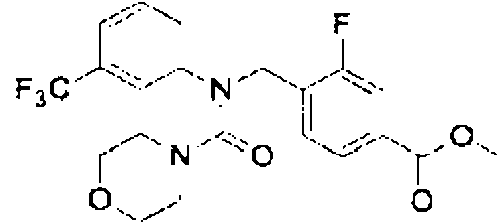
El compuesto de Fórmula 6-5 (3-fluoro-4-((((4-nitrofenoxi)carbonil)(3-(trifluorometil)fenil)amino)metil)benzoato de metilo; 0,129 g, 0,262 mmol), morfolina (0,046 ml, 0,524 mmol) y carbonato potásico (0,109 g, 0,786 mmol) se disolvieron en N,N-dimetilformamida (5 ml) a 60 °C y se agitaron a la misma temperatura durante 2 días. Después, se vertió una solución acuosa saturada de hidrogenocarbonato sódico en la mezcla de reacción y la capa orgánica se extrajo con acetato de etilo. La capa orgánica se lavó con una solución acuosa saturada de cloruro sódico, se deshidrató con sulfato de magnesio anhidro y después se concentró a presión reducida. El concentrado se purificó y se concentró por cromatografía en columna (sílice; acetato de etilo/hexano = 30-60 %) para dar el compuesto deseado de Fórmula 6-6 (0,094 g, 81,5 %) en forma de un líquido incoloro.The compound of Formula 6-5 (methyl 3-fluoro-4 - (((((4-nitrophenoxy) carbonyl) (3- (trifluoromethyl) phenyl) amino) methyl) benzoate; 0.129 g, 0.262 mmol), morpholine (0.046) ml, 0.524 mmol) and potassium carbonate (0.109 g, 0.786 mmol) were dissolved in N, N-dimethylformamide (5 ml) at 60 ° C and stirred at the same temperature for 2 days. Then, a saturated aqueous solution of sodium hydrogencarbonate was poured into the reaction mixture and the organic layer was extracted with ethyl acetate. The organic layer was washed with a saturated aqueous solution of sodium chloride, dehydrated with anhydrous magnesium sulfate and then concentrated under reduced pressure. The concentrate was purified and concentrated by column chromatography (silica; ethyl acetate / hexane = 30-60%) to give the desired compound of Formula 6-6 (0.094 g, 81.5%) as a colorless liquid. .
(Compuesto 532: N-(2-fluoro-4-(hidroxicarbamoil)bencil)-N-(3-(trifluorometil)fenil)morfolin-4-carboxamida)(Compound 532: N- (2-fluoro-4- (hydroxycarbamoyl) benzyl) -N- (3- (trifluoromethyl) phenyl) morpholine-4-carboxamide)

El compuesto de Fórmula 6-6 (3-fluoro-4-((N-(3-(trifluorometil)fenil)morfolin-4-carboxamido)metil)benzoato de metilo; 0,094 g, 0,213 mmol) e hidroxilamina (solución acuosa al 50,0 % en peso; 0,071 g, 2,134 mmol) se disolvieron en metanol (5 ml), después se añadió hidróxido potásico (0,060 g, 1,067 mmol) a temperatura ambiente, se agitó a la misma temperatura durante 2 horas y la mezcla de reacción se concentró a presión reducida. Al concentrado se le añadió éter dietílico (10 ml) y se agitó. Después, el sólido precipitado se filtró y se secó para dar el compuesto 532 deseado (0,068 g, 72,2 %) en forma de un sólido de color amarillo claro.The compound of Formula 6-6 (methyl 3-fluoro-4 - ((N- (3- (trifluoromethyl) phenyl) morpholin-4-carboxamido) methyl) benzoate; 0.094 g, 0.213 mmol) and hydroxylamine (aqueous 50.0% by weight, 0.071 g, 2.134 mmol) were dissolved in methanol (5 ml), then potassium hydroxide (0.060 g, 1.067 mmol) was added at room temperature, stirred at the same temperature for 2 hours and the mixture of reaction was concentrated under reduced pressure. The concentrate is add diethyl ether (10 ml) and stir. Then, the precipitated solid was filtered and dried to give the desired compound 532 (0.068 g, 72.2%) as a light yellow solid.
1H RMN (400 MHz, DMSO-da) 8 11,2 (s a, 1 H), 9,13 (s a, 1 H), 7,57 - 7,42 (m, 7 H), 4,94 (s, 2 H), 3,44 - 3,34 (m, 4 H), 3,18 - 3,12 (m, 4 H); MS (ESI) m/z 442,1 (M+ H).1 H NMR (400 MHz, DMSO-da) 8 11.2 (br s, 1 H), 9.13 (br s, 1 H), 7.57-7.42 (m, 7 H), 4.94 (s) , 2 H), 3.44-3.34 (m, 4 H), 3.18 - 3.12 (m, 4 H); MS (ESI) m / z 442.1 (M + H).
Ejemplo 138: Síntesis del compuesto 533Example 138: Synthesis of compound 533
(Fórmula 7-4: 4-(((5-cloropiridin-2-il)amino)metil)benzoato de metilo)(Formula 7-4: methyl 4 - (((5-chloropyridin-2-yl) amino) methyl) benzoate)

El compuesto de Fórmula 7-3 (5-cloropiridin-2-amina, 2,000 g, 15,557 mmol) y 4-formilbenzoato de metilo(2,554 g, 15,557 mmol) se disolvieron en metanol (50 ml), después se añadió ácido acético (0,890 ml, 15,557 mmol) a la solución de reacción y se agitó a temperatura ambiente durante 2 horas. Después, se añadió cianoborohidruro sódico (0,978 g, 15,557 mmol) y se agitó durante 1 día. Después, el metanol se retiró por secado al aire para precipitar un sólido, y el sólido resultante se filtró y se secó para dar el compuesto deseado de Fórmula 7-4 (2,700 g, 62,7 %) en forma de un sólido de color blanco.The compound of Formula 7-3 (5-chloropyridin-2-amine, 2,000 g, 15.557 mmol) and methyl 4-formylbenzoate (2.544 g, 15.557 mmol) were dissolved in methanol (50 mL), then acetic acid was added ( 0.890 ml, 15.557 mmol) was added to the reaction solution and stirred at room temperature for 2 hours. Then, sodium cyanoborohydride (0.978 g, 15.557 mmol) was added and stirred for 1 day. Then, the methanol was removed by air drying to precipitate a solid, and the resulting solid was filtered and dried to give the desired compound of Formula 7-4 (2.700 g, 62.7%) as a solid of color White.
(Fórmula 7-5: 4-(((5-cloropiridin-2-il)((4-nitrofenoxi)carbonil)amino)metil)benzoato de metilo)(Formula 7-5: 4 - (((5-chloropyridin-2-yl) ((4-nitrophenoxy) carbonyl) amino) methyl) methyl benzoate)

El compuesto de Fórmula 7-4 (4-(((5-cloropiridin-2-il)amino)metil)benzoato de metilo; 1,000 g, 3,614 mmol) y cloroformiato de 4-nitrofenilo (0,801 g, 3,975 mmol) se disolvieron en diclorometano (30 ml) a temperatura ambiente y se agitaron a la misma temperatura durante 3 días, y el sólido se retiró por filtración. Después, se vertió agua en la mezcla de reacción y la capa orgánica se extrajo con diclorometano. Después, la capa orgánica se lavó con una solución acuosa saturada de cloruro sódico, se deshidrató con sulfato de magnesio anhidro y después se concentró a presión reducida. El concentrado se purificó y se concentró por cromatografía en columna (sílice; acetato de etilo:hexano = 20-30 %) para dar el compuesto deseado de Fórmula 7-5 (0,160 g, 10,0 %) en forma de un sólido de color blanco.The compound of Formula 7-4 (methyl 4 - (((5-chloropyridin-2-yl) amino) methyl) benzoate; 1,000 g, 3.614 mmol) and 4-nitrophenyl chloroformate (0.801 g, 3.975 mmol) were dissolved in dichloromethane (30 ml) at room temperature and stirred at the same temperature for 3 days, and the solid was removed by filtration. Then, water was poured into the reaction mixture and the organic layer was extracted with dichloromethane. Then, the organic layer was washed with a saturated aqueous solution of sodium chloride, dehydrated with anhydrous magnesium sulfate and then concentrated under reduced pressure. The concentrate was purified and concentrated by column chromatography (silica; ethyl acetate: hexane = 20-30%) to give the desired compound of Formula 7-5 (0.160 g, 10.0%) as a white solid. White color.
(Fórmula 7-6: 4-((N-(5-cloropiridin-2-il)morfolin-4-carboxamido)metil)benzoato de metilo)(Formula 7-6: 4 - (methyl (N- (5-chloropyridin-2-yl) morpholin-4-carboxamido) methyl) benzoate)

El compuesto de Fórmula 7-5 (4-(((5-cloropiridin-2-il)((4-nitrofenoxi)carbonil)amino)metil)benzoato de metilo; 0,100 g, 0,226 mmol) y morfolina (0,024 ml, 0,272 mmol) se disolvieron en dimetilformamida (10 ml) a 60 °C y se agitaron a la misma temperatura durante 12 horas. Después, la dimetilformamida se retiró a presión reducida, se vertió agua en la mezcla de reacción y la capa orgánica se extrajo con acetato de etilo. La capa orgánica se lavó con una solución acuosa saturada de cloruro sódico, se deshidrató con sulfato de magnesio anhidro y después se concentró a presión reducida. El concentrado se purificó y se concentró por cromatografía en columna (sílice; acetato de etilo/hexano = 20-30 %) para dar el compuesto deseado de Fórmula 7-6 (0,032 g, 36,3 %) en forma de un aceite incoloro.The compound of Formula 7-5 (methyl 4 - (((5-chloropyridin-2-yl) ((4-nitrophenoxy) carbonyl) amino) methyl) benzoate; 0.100 g, 0.226 mmol) and morpholine (0.024 ml, 0.272) mmol) were dissolved in dimethylformamide (10 ml) at 60 ° C and stirred at the same temperature for 12 hours. Then, the dimethylformamide was removed under reduced pressure, water was poured into the reaction mixture and the organic layer was extracted with ethyl acetate. The organic layer was washed with a saturated aqueous solution of sodium chloride, dehydrated with anhydrous magnesium sulfate and then concentrated under reduced pressure. The concentrate was purified and concentrated by column chromatography (silica; ethyl acetate / hexane = 20-30%) to give the desired compound of Formula 7-6 (0.032 g, 36.3%) as a colorless oil. .
(Compuesto 533: N-(5-cloropiridin-2-il)-N-(4-(hidroxicarbamoil)bencil)morfolin-4-carboxamida) (Compound 533: N- (5-chloropyridin-2-yl) -N- (4- (hydroxycarbamoyl) benzyl) morpholine-4-carboxamide)
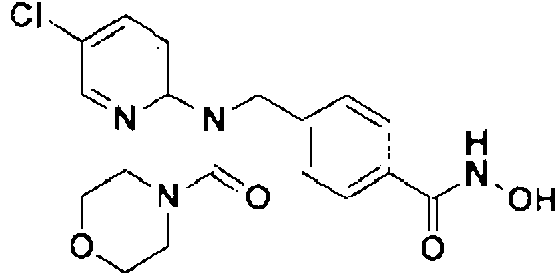
El compuesto de Fórmula 7-6 (4-((N-(5-doropiridin-2-il)morfolin-4-carboxamido)metil)benzoato de metilo; 0,032 g, 0,082 mmol) se disolvió en metanol (10 ml) a temperatura ambiente, después se añadieron clorhidrato de hidroxilamina (0,028 g, 0,410 mmol), hidróxido potásico (0,046 g, 0,821 mmol) e hidroxilamina (solución acuosa al 50 % en peso; 0,211 ml, 1,642 mmol) a la solución de reacción y se agitó a la misma temperatura durante 6 horas. Después, se vertió agua en la mezcla de reacción y la capa orgánica se extrajo con acetato de etilo. Después, la capa orgánica se lavó con una solución acuosa saturada de cloruro sódico, se deshidrató con sulfato de magnesio anhidro y después se concentró a presión reducida. Al concentrado se le añadieron diclorometano y hexano y se agitó. Después, el sólido precipitado se filtró y se secó para dar el compuesto 533 deseado (0,011 g, 34,3 %) en forma de un sólido de color blanco.The compound of Formula 7-6 (methyl 4 - ((N- (5-doropyridin-2-yl) morpholin-4-carboxamido) methyl) benzoate; 0.032 g, 0.082 mmol) was dissolved in methanol (10 mL) At room temperature, then hydroxylamine hydrochloride (0.028 g, 0.410 mmol), potassium hydroxide (0.046 g, 0.821 mmol) and hydroxylamine (50% strength by weight aqueous solution, 0.211 mL, 1.642 mmol) were added to the reaction solution and stirred at the same temperature for 6 hours. Then, water was poured into the reaction mixture and the organic layer was extracted with ethyl acetate. Then, the organic layer was washed with a saturated aqueous solution of sodium chloride, dehydrated with anhydrous magnesium sulfate and then concentrated under reduced pressure. Dichloromethane and hexane were added to the concentrate and stirred. Then, the precipitated solid was filtered and dried to give the desired compound 533 (0.011 g, 34.3%) as a white solid.
1H RMN (400 MHz, DIVISOR) 88,31 (d, 1 H, J = 1,5 Hz), 7,79 - 7,76 (m, 1 H), 7,64 (d, 2 H, J = 7,3 Hz), 7,29 (d, 2 H, J = 7,8 Hz), 7,08 (d, 1 H, J = 8,9 Hz), 4,95 (s, 2 H), 3,46 -3,45 (m, 4 H), 3,24 -3,23 (m, 4 H); MS (ESI) m/z 391,1 (M+ H).1 H NMR (400 MHz, DIVIDER) 88.31 (d, 1 H, J = 1.5 Hz), 7.79-7.76 (m, 1 H), 7.64 (d, 2 H, J = 7.3 Hz), 7.29 (d, 2 H, J = 7.8 Hz), 7.08 (d, 1 H, J = 8.9 Hz), 4.95 (s, 2 H), 3.46 -3.45 (m, 4 H), 3.24 -3.23 (m, 4 H); MS (ESI) m / z 391.1 (M + H).
Ejemplo 139: Síntesis del compuesto 543Example 139: Synthesis of compound 543
(Fórmula 1-4: 4-((4-(2-morfolinoetil)-N-(4-(trifluorometil)fenil)piperazin-1-carboxamido)metil)benzoato de metilo)(Formula 1-4: 4 - (Methyl 4- (2-morpholinoethyl) -N- (4- (trifluoromethyl) phenyl) piperazine-1-carboxamido) methyl) benzoate)

El compuesto de Fórmula 1-3 (4-((((4-nitrofenoxi)carbonil)(4-(trifluorometil)fenil)amino)metil)benzoato de metilo; 0,253 g, 0,534 mmol), 4-(2-(piperazin-1-il)etil)morfolina (0,213 g, 1,068 mmol) y carbonato potásico (0,221 g, 1,602 mmol) se disolvieron en N,N-dimetilformamida (5 ml) y se agitaron a 60 °C durante 2 días. Se vertió una solución acuosa saturada de hidrogenocarbonato sódico en la mezcla de reacción y la capa orgánica se extrajo con acetato de etilo. La capa orgánica se lavó con una solución acuosa saturada de cloruro sódico, se deshidrató con sulfato sódico anhidro, se filtró y posteriormente se concentró a presión reducida. El concentrado se purificó y se concentró por cromatografía en columna (sílice; metanol/ diclorometano =10 %) para dar el compuesto deseado de Fórmula 1-4 (0,139 g, 48,5 %) en forma de un líquido incoloro.The compound of Formula 1-3 (methyl 4 - ((((((4-nitrophenoxy) carbonyl) (4- (trifluoromethyl) phenyl) amino) methyl) benzoate; 0.253 g, 0.534 mmol), 4- (2- (piperazine -1-yl) ethyl) morpholine (0.213 g, 1.068 mmol) and potassium carbonate (0.221 g, 1.602 mmol) were dissolved in N, N-dimethylformamide (5 ml) and stirred at 60 ° C for 2 days. A saturated aqueous solution of sodium hydrogencarbonate was poured into the reaction mixture and the organic layer was extracted with ethyl acetate. The organic layer was washed with a saturated aqueous solution of sodium chloride, dehydrated with anhydrous sodium sulfate, filtered and then concentrated under reduced pressure. The concentrate was purified and concentrated by column chromatography (silica; methanol / dichloromethane = 10%) to give the desired compound of Formula 1-4 (0.139 g, 48.5%) as a colorless liquid.
(Compuesto 543, N-(4-(hidroxicarbamoil)bencil)-4-(2-morfolinoetil)-N-(4-(trifluorometil)fenil)piperazin-1-carboxamida)(Compound 543, N- (4- (hydroxycarbamoyl) benzyl) -4- (2-morpholinoethyl) -N- (4- (trifluoromethyl) phenyl) piperazine-1-carboxamide)

El compuesto de Fórmula 1-4 (4-((4-(2-morfolinoetil)-N-(4-(trifluorometil)fenil)piperazin-1-carboxamido)metil)benzoato de metilo; 0,139 g, 0,260 mmol) e hidroxilamina (solución acuosa al 50 % en peso; 0,159 ml, 2,600 mmol) se disolvieron en metanol (5 ml) y se añadió hidróxido potásico (0,073 g, 1,300 mmol). Se agitó a temperatura ambiente durante 16 horas. El concentrado se obtuvo retirando el disolvente de la mezcla de reacción a presión reducida. Se vertió una solución acuosa saturada de hidrogenocarbonato sódico en el concentrado obtenido y la capa orgánica se extrajo con acetato de etilo. La capa orgánica se deshidrató con sulfato de magnesio anhidro, y después se concentró a presión reducida. El sólido precipitado se filtró y se secó para dar el compuesto 543 deseado (0,055 g, 39,5 %) en forma de un sólido de color blanco.The compound of Formula 1-4 (methyl 4 - ((4- (2-morpholinoethyl) -N- (4- (trifluoromethyl) phenyl) piperazine-1-carboxamido) methyl) benzoate; 0.139 g, 0.260 mmol) and hydroxylamine (50% by weight aqueous solution, 0.159 ml, 2,600 mmol) were dissolved in methanol (5 ml) and potassium hydroxide (0.073 g, 1,300 mmol) was added. It was stirred at room temperature for 16 hours. The concentrate was obtained by removing the solvent from the reaction mixture under reduced pressure. A saturated aqueous solution of sodium hydrogencarbonate was poured into the obtained concentrate and the organic layer was extracted with ethyl acetate. The organic layer was dehydrated with anhydrous magnesium sulfate, and then concentrated under reduced pressure. The precipitated solid was filtered and dried to give the desired compound 543 (0.055 g, 39.5%) as a white solid.
1H RMN (400 MHz, DMSO-d6) 811,2 (s a, 1 H), 9,10 (s a, 1 H), 7,64 -7,56 (m, 4 H), 7,34 (d, 2 H, J = 8,0 Hz), 7,20 (d, 2 H, J = 8,8 Hz), 4,89 (s, 2 H), 3,49 - 3,47 (m, 4 H), 3,16 - 3,14 (m, 4 H), 2,31 - 2,24 (m, 12 H); MS (ESI) m/z 536,2 (M+ H). 1 H NMR (400 MHz, DMSO-d 6) 811.2 (br s, 1 H), 9.10 (br s, 1 H), 7.64-7.56 (m, 4 H), 7.34 (d, 2 H, J = 8.0 Hz), 7.20 (d, 2 H, J = 8.8 Hz), 4.89 (s, 2 H), 3.49 - 3.47 (m, 4 H) ), 3.16 - 3.14 (m, 4 H), 2.31-2.24 (m, 12 H); MS (ESI) m / z 536.2 (M + H).
Ejemplo 140: Síntesis del compuesto 544Example 140: Synthesis of compound 544
(Fórmula 1-4: 4-((4-(piridin-4-il)-N-(4-(trifluorometil)fenil)piperazin-1-carboxamido)metil)benzoato de metilo)(Formula 1-4: 4 - ((4- (pyridin-4-yl) -N- (4- (trifluoromethyl) phenyl) piperazine-1-carboxamido) methyl) benzoate methyl)

El compuesto de Fórmula 1-3 (4-((((4-nitrofenoxi)carbonil)(4-(trifluorometil)fenil)amino)metil)benzoato de metilo; 0,230 g, 0,484 mmol), 1 -(piridin-4-il)piperazina (0,159 g, 0,968 mmol) y carbonato potásico (0,201 g, 1,451 mmol) se disolvieron en N,N-dimetilformamida (5 ml) y se agitaron a 60 °C durante 2 días. Se vertió una solución acuosa saturada de hidrogenocarbonato sódico en la mezcla de reacción y la capa orgánica se extrajo con acetato de etilo. La capa orgánica se lavó con una solución acuosa saturada de cloruro sódico, se deshidrató con sulfato sódico anhidro, se filtró y posteriormente se concentró a presión reducida. El concentrado se purificó y se concentró por cromatografía en columna (sílice; metanol/diclorometano =10 %) para dar el compuesto deseado de Fórmula 1-4 (0,104 g, 43,0 %) en forma de un líquido incoloro.The compound of Formula 1-3 (methyl 4 - ((((((4-nitrophenoxy) carbonyl) (4- (trifluoromethyl) phenyl) amino) methyl) benzoate; 0.230 g, 0.484 mmol), 1- (pyridine-4-) il) piperazine (0.159 g, 0.968 mmol) and potassium carbonate (0.201 g, 1.451 mmol) were dissolved in N, N-dimethylformamide (5 ml) and stirred at 60 ° C for 2 days. A saturated aqueous solution of sodium hydrogencarbonate was poured into the reaction mixture and the organic layer was extracted with ethyl acetate. The organic layer was washed with a saturated aqueous solution of sodium chloride, dehydrated with anhydrous sodium sulfate, filtered and then concentrated under reduced pressure. The concentrate was purified and concentrated by column chromatography (silica; methanol / dichloromethane = 10%) to give the desired compound of Formula 1-4 (0.104 g, 43.0%) as a colorless liquid.
(Compuesto 544, N-(4-(hidroxicarbamoil)bencil)-4-(piridin-4-il)-N-(4-(trifluorometil)fenil)piperazin-1-carboxamida)(Compound 544, N- (4- (hydroxycarbamoyl) benzyl) -4- (pyridin-4-yl) -N- (4- (trifluoromethyl) phenyl) piperazine-1-carboxamide)

El compuesto de Fórmula 1-4 (4-((4-(piridin-4-il)-N-(4-(trifluorometil)fenil)piperazin-1-carboxamido)metil)benzoato de metilo; 0,104 g, 0,209 mmol) e hidroxilamina (solución acuosa al 50 % en peso; 0,128 ml, 2,086 mmol) se disolvieron en metanol (5 ml) y se añadió hidróxido potásico (0,059 g, 1,043 mmol). Se agitó a temperatura ambiente durante 16 horas. La mezcla de reacción se concentró a presión reducida. Se vertió una solución acuosa saturada de hidrogenocarbonato sódico (30 ml) en el concentrado y se agitó. El sólido precipitado se filtró y se secó para dar el compuesto 544 deseado (0,086 g, 82,7 %) en forma de un sólido de color blanco.The compound of Formula 1-4 (methyl 4 - ((4- (pyridin-4-yl) -N- (4- (trifluoromethyl) phenyl) piperazine-1-carboxamido) methyl) benzoate; 0.104 g, 0.209 mmol) and hydroxylamine (50% by weight aqueous solution, 0.128 ml, 2.086 mmol) were dissolved in methanol (5 ml) and potassium hydroxide (0.059 g, 1.043 mmol) was added. It was stirred at room temperature for 16 hours. The reaction mixture was concentrated under reduced pressure. A saturated aqueous solution of sodium hydrogencarbonate (30 ml) was poured into the concentrate and stirred. The precipitated solid was filtered and dried to give the desired compound 544 (0.086 g, 82.7%) as a white solid.
1H RMN (400 MHz, DIVISOR) 6 11,1 (s a, 1 H), 8,99 (s a, 1 H), 8,10 (d, 2 H, J = 6,4 Hz), 7,63 -7,58 (m, 4 H), 7,35 (d, 2 H, J = 8,4 Hz), 7,29 (d, 2 H, J = 8,0 Hz), 6,72 (d, 2 H, J = 6,4 Hz), 4,93 (s, 2 H), 3,28 (s, 4 H); MS (ESI) m/z 500,2 (M+ H).1 H NMR (400 MHz, DIVIDER) 6 11.1 (sa, 1 H), 8.99 (sa, 1 H), 8.10 (d, 2 H, J = 6.4 Hz), 7.63 - 7.58 (m, 4 H), 7.35 (d, 2 H, J = 8.4 Hz), 7.29 (d, 2 H, J = 8.0 Hz), 6.72 (d, 2 H, J = 6.4 Hz), 4.93 (s, 2 H), 3.28 (s, 4 H); MS (ESI) m / z 500.2 (M + H).
Ejemplo 141: Síntesis del compuesto 545Example 141: Synthesis of compound 545
(Fórmula 1-4: 4-((4-(2-morfolino-2-oxoetil)-N-(4-(trifluorometil)fenil)piperazin-1-carboxamido)metil)benzoato de metilo)(Formula 1-4: 4 - ((methyl 4- (2-morpholino-2-oxoethyl) -N- (4- (trifluoromethyl) phenyl) piperazine-1-carboxamido) methyl) benzoate)

El compuesto de Fórmula 1-3 (4-((((4-nitrofenoxi)carbonil)(4-(trifluorometil)fenil)amino)metil)benzoato de metilo; 0,213 g, 0,450 mmol), 1-morfolino-2-(piperazin-1-il)etanona (0,192 g, 0,900 mmol) y carbonato potásico (0,187 g, 1,350 mmol) se disolvieron en N,N-dimetilformamida (5 ml) y se agitaron a 60 °C durante 2 días. Se vertió una solución acuosa saturada de hidrogenocarbonato sódico en la mezcla de reacción y la capa orgánica se extrajo con acetato de etilo. La capa orgánica se lavó con una solución acuosa saturada de cloruro sódico, se deshidrató con sulfato sódico anhidro, se filtró y posteriormente se concentró a presión reducida. El concentrado se purificó y se concentró por cromatografía en columna (sílice; metanol/ diclorometano =10 %) para dar el compuesto deseado de Fórmula 1-4 (0,109 g, 44,1 %) en forma de un líquido incoloro.The compound of Formula 1-3 (methyl 4 - ((((((4-nitrophenoxy) carbonyl) (4- (trifluoromethyl) phenyl) amino) methyl) benzoate; 0.213 g, 0.450 mmol), 1-morpholino-2- ( piperazin-1-yl) ethanone (0.192 g, 0.900 mmol) and potassium carbonate (0.187 g, 1.350 mmol) were dissolved in N, N-dimethylformamide (5 mL) and stirred at 60 ° C for 2 days. A saturated aqueous solution of sodium hydrogencarbonate was poured into the reaction mixture and the organic layer was extracted with ethyl acetate. The organic layer was washed with a saturated aqueous solution of sodium chloride, dehydrated with anhydrous sodium sulfate, filtered and then concentrated under reduced pressure. The concentrate was purified and concentrated by column chromatography (silica; methanol / dichloromethane = 10%) to give the desired compound of Formula 1-4 (0.109 g, 44.1%) as a colorless liquid.
(Compuesto 545, N-(4-(hidroxicarbamoil)bencil)-4-(2-morfolino-2-oxoetil)-N-(4-(trifluorometil)fenil)piperazin-1-carboxamida) (Compound 545, N- (4- (hydroxycarbamoyl) benzyl) -4- (2-morpholino-2-oxoethyl) -N- (4- (trifluoromethyl) phenyl) piperazine-1-carboxamide)

El compuesto de Fórmula 1-4 (4-((4-(2-morfolino-2-oxoetil)-N-(4-(trifluorometil)fenil)piperazin-1-carboxamido)metil)benzoato de metilo; 0,109 g, 0,199 mmol) e hidroxilamina (solución acuosa al 50 % en peso; 0,122 ml, 1,987 mmol) se disolvieron en metanol (5 ml) y se añadió hidróxido potásico (0,056 g, 0,994 mmol). Se agitó a temperatura ambiente durante 16 horas. La mezcla de reacción se concentró a presión reducida. Se vertió una solución acuosa saturada de hidrogenocarbonato sódico (30 ml) en el concentrado y se agitó. El sólido precipitado se filtró y se secó para dar el compuesto 545 deseado (0,057 g, 52,0 %) en forma de un sólido de color blanco.The compound of Formula 1-4 (methyl 4 - ((4- (2-morpholino-2-oxoethyl) -N- (4- (trifluoromethyl) phenyl) piperazine-1-carboxamido) methyl) benzoate; 0.109 g, 0.199 mmol) and hydroxylamine (50% by weight aqueous solution, 0.122 ml, 1.987 mmol) were dissolved in methanol (5 ml) and potassium hydroxide (0.056 g, 0.994 mmol) was added. It was stirred at room temperature for 16 hours. The reaction mixture was concentrated under reduced pressure. A saturated aqueous solution of sodium hydrogencarbonate (30 ml) was poured into the concentrate and stirred. The precipitated solid was filtered and dried to give the desired compound 545 (0.057 g, 52.0%) as a white solid.
1H RMN (400 MHz, DMSO-da) 811,1 (s a, 1 H), 8,99 (s a, 1 H), 7,64 -7,57 (m, 4 H), 7,32 -7,30 (m, 2 H), 7,20 (d, 2 H, J = 8,4 Hz), 4,88 (s, 2 H), 3,48 - 3,46 (m, 6 H), 3,36 - 3,35 (m, 2 H), 3,17 (s a, 4 H), 3,08 (s, 2 H), 2,26 (s a, 4 H); MS (ESI) m/z 550,2 (M+ H).1 H NMR (400 MHz, DMSO-da) 811.1 (sa, 1 H), 8.99 (sa, 1 H), 7.64 -7.57 (m, 4 H), 7.32 -7, 30 (m, 2 H), 7.20 (d, 2 H, J = 8.4 Hz), 4.88 (s, 2 H), 3.48 - 3.46 (m, 6 H), 3 , 36-3.35 (m, 2 H), 3.17 (ss, 4 H), 3.08 (s, 2 H), 2.26 (ss, 4 H); MS (ESI) m / z 550.2 (M + H).
Ejemplo 142: Síntesis del compuesto 577Example 142: Synthesis of compound 577
(Fórmula 6-2: 3-fluoro-4-((4-trifluorometil)fenilamino)metil)benzonitrilo)(Formula 6-2: 3-fluoro-4 - ((4-trifluoromethyl) phenylamino) methyl) benzonitrile)

El compuesto de Fórmula 6-1 (4-(bromometil)-3-fluorobenzonitrilo; 1,10 g, 5,06 mmol) se disolvió en acetonitrilo (60 ml), después se añadieron 4-(trifluorometil)bencenamina (0,39 ml, 4,30 mmol) y N,N-diisopropiletilamina (1,14 ml, 6,45 mmol) a temperatura ambiente y se agitaron a la misma temperatura durante 16 horas. Después, se vertió una solución acuosa saturada de hidrogenocarbonato sódico en la mezcla de reacción y la capa orgánica se extrajo con acetato de etilo. La capa orgánica se lavó con una solución acuosa saturada de cloruro sódico, se deshidrató con sulfato de magnesio anhidro y después se concentró a presión reducida. El residuo se purificó y se concentró por cromatografía en columna (sílice; acetato de etilo/hexano = 10-30 %) para dar el compuesto deseado de Fórmula 6-2 (0,11 g, 28 %) en forma de un aceite incoloro.The compound of Formula 6-1 (4- (bromomethyl) -3-fluorobenzonitrile; 1.10 g, 5.06 mmol) was dissolved in acetonitrile (60 ml), then 4- (trifluoromethyl) benzenamine (0.39 g) was added. ml, 4.30 mmol) and N, N-diisopropylethylamine (1.14 ml, 6.45 mmol) at room temperature and stirred at the same temperature for 16 hours. Then, a saturated aqueous solution of sodium hydrogencarbonate was poured into the reaction mixture and the organic layer was extracted with ethyl acetate. The organic layer was washed with a saturated aqueous solution of sodium chloride, dehydrated with anhydrous magnesium sulfate and then concentrated under reduced pressure. The residue was purified and concentrated by column chromatography (silica; ethyl acetate / hexane = 10-30%) to give the desired compound of Formula 6-2 (0.11 g, 28%) as a colorless oil. .
(Fórmula 6-3: ácido 3-fluoro-4-((4-(trifluorometil)fenilamino)metil)benzoico)(Formula 6-3: 3-Fluoro-4 - ((4- (trifluoromethyl) phenylamino) methyl) benzoic acid)

El compuesto de Fórmula 6-2 (3-fluoro-4-((4-trifluorometil)fenilamino)metil)benzonitrilo; 0,93 g, 3,17 mmol) e hidróxido de litio monohidrato (1,33 g, 31,73 mmol) se disolvieron en metanol (30 ml)/agua (15 ml) y se agitaron a reflujo durante 16 horas. Después, el concentrado se obtuvo retirando el disolvente de la mezcla de reacción a presión reducida. Se vertió una solución acuosa 2 N de ácido clorhídrico en el concentrado obtenido y el sólido precipitado se filtró para dar el compuesto deseado de Fórmula 6-3 (0,36 g, 37 %) en forma de un sólido de color blanco claro.The compound of Formula 6-2 (3-fluoro-4 - ((4-trifluoromethyl) phenylamino) methyl) benzonitrile; 0.93 g, 3.17 mmol) and lithium hydroxide monohydrate (1.33 g, 31.73 mmol) were dissolved in methanol (30 ml) / water (15 ml) and stirred at reflux for 16 hours. Then, the concentrate was obtained by removing the solvent from the reaction mixture under reduced pressure. A 2 N aqueous solution of hydrochloric acid was poured into the concentrate obtained and the precipitated solid was filtered to give the desired compound of Formula 6-3 (0.36 g, 37%) as a light white solid.
(Fórmula 6-4: 3-fluoro-4-((4-(trifluorometil)fenilamino)metil)benzoato de metilo)(Formula 6-4: methyl 3-fluoro-4 - ((4- (trifluoromethyl) phenylamino) methyl) benzoate)

El compuesto de Fórmula 6-3 (ácido 3-fluoro-4-((4-(trifluorometil)fenilamino)metil)benzoico; 0,36 g, 1,17 mmol), metanol (0,95 ml, 23,49 mmol) y N,N-diisopropiletilamina (0,62 ml, 3,52 mmol) se disolvieron en THF (30 ml), después se añadieron clorhidrato de 1-etil-3-[3-dimetilaminopropil] carbodiimida (EDC, 0,45 g, 2,35 mmol) y 1 hidroxibenzotriazol hidrato (HOBt, 0,31 g, 2,35 mmol) a temperatura ambiente y se agitaron a la misma temperatura durante 16 horas. Después, se vertió una solución acuosa saturada de hidrogenocarbonato sódico en la mezcla de reacción y la capa orgánica se extrajo con acetato de etilo. La capa orgánica se lavó con una solución acuosa saturada de cloruro sódico, se deshidrató con sulfato de magnesio anhidro y después se concentró a presión reducida. El residuo se purificó y se concentró por cromatografía en columna (sílice; acetato de etilo/hexano = 10-40 %) para dar el compuesto deseado de Fórmula 6-4 (0,11 g, 28 %) en forma de un sólido de color blanco. The compound of Formula 6-3 (3-fluoro-4 - ((4- (trifluoromethyl) phenylamino) methyl) benzoic acid, 0.36 g, 1.17 mmol), methanol (0.95 mL, 23.49 mmol) ) and N, N-diisopropylethylamine (0.62 ml, 3.52 mmol) were dissolved in THF (30 ml), then 1-ethyl-3- [3-dimethylaminopropyl] carbodiimide hydrochloride (EDC, 0.45 was added g, 2.35 mmol) and 1 hydroxybenzotriazole hydrate (HOBt, 0.31 g, 2.35 mmol) at room temperature and stirred at the same temperature for 16 hours. Then, a saturated aqueous solution of sodium hydrogencarbonate was poured into the reaction mixture and the organic layer was extracted with ethyl acetate. The organic layer was washed with a saturated aqueous solution of sodium chloride, dehydrated with anhydrous magnesium sulfate and then concentrated under reduced pressure. The residue was purified and concentrated by column chromatography (silica; ethyl acetate / hexane = 10-40%) to give the desired compound of Formula 6-4 (0.11 g, 28%) as a white solid. White color.
(Fórmula 6-5: 3-fluororo-4-((((4-nitrofenoxi)carbonil)(4-(trifluorometil)fenil)amino)metil)benzoato de metilo)(Formula 6-5: 3-Fluoro-4 - ((((((4-nitrophenoxy) carbonyl) (4- (trifluoromethyl) phenyl) amino) methyl) methyl benzoate)

El compuesto de Fórmula 6-4 (3-fluoro-4-((4-(trifluorometil)fenilamino)metil)benzoato de metilo; 0,61 g, 1,86 mmol), 4-nitrofenilo cloroformiato (0,75 g, 3,72 mmol) y carbonato potásico (0,77 g, 5,59 mmol) se disolvieron en acetonitrilo (50 ml) a temperatura ambiente y se agitaron a la misma temperatura durante 16 horas. Después, se vertió una solución acuosa saturada de hidrogenocarbonato sódico en la mezcla de reacción y la capa orgánica se extrajo con acetato de etilo. La capa orgánica se lavó con una solución acuosa saturada de cloruro sódico, se deshidrató con sulfato de magnesio anhidro y después se concentró a presión reducida. El residuo se purificó y se concentró por cromatografía en columna (sílice; acetato de etilo/hexano = 10-30 %) para dar el compuesto deseado de Fórmula 6-5 (0,62 g, 67 %) en forma de un aceite incoloro.The compound of Formula 6-4 (methyl 3-fluoro-4 - ((4- (trifluoromethyl) phenylamino) methyl) benzoate; 0.61 g, 1.86 mmol), 4-nitrophenyl chloroformate (0.75 g, 3.72 mmol) and potassium carbonate (0.77 g, 5.59 mmol) were dissolved in acetonitrile (50 ml) at room temperature and stirred at the same temperature for 16 hours. Then, a saturated aqueous solution of sodium hydrogencarbonate was poured into the reaction mixture and the organic layer was extracted with ethyl acetate. The organic layer was washed with a saturated aqueous solution of sodium chloride, dehydrated with anhydrous magnesium sulfate and then concentrated under reduced pressure. The residue was purified and concentrated by column chromatography (silica; ethyl acetate / hexane = 10-30%) to give the desired compound of Formula 6-5 (0.62 g, 67%) as a colorless oil. .
(Fórmula 6-6 : 3-fluoro-4-((N-(4-(trifluorometil)fenil)morfolin-4-carboxamido)metil)benzoato de metilo)(Formula 6-6: methyl 3-fluoro-4 - ((N- (4- (trifluoromethyl) phenyl) morpholin-4-carboxamido) methyl) benzoate)

El compuesto de Fórmula 6-5 (3-fluororo-4-((((4-nitrofenoxi)carbonil)(4-(trifluorometil)fenil)amino)metil)benzoato de metilo; 0,31 g, 0,63 mmol), morfolina (0,11 ml, 1,25 mmol) y carbonato potásico (0,26 g, 1,88 mmol) se disolvieron en dimetilformamida (5 ml) a 60 °C y se agitaron a la misma temperatura durante 16 horas. Después, se vertió una solución acuosa saturada de cloruro de amonio en la mezcla de reacción y la capa orgánica se extrajo con acetato de etilo. La capa orgánica se lavó con una solución acuosa saturada de cloruro sódico, se deshidrató con sulfato de magnesio anhidro y después se concentró a presión reducida. El residuo se purificó y se concentró por cromatografía en columna (sílice; acetato de etilo/hexano = 20-60 %) para dar el compuesto deseado de Fórmula 6-6 (1,58 g, 98 %) en forma de un líquido incoloro.The compound of Formula 6-5 (methyl 3-fluoro-4 - ((((((4-nitrophenoxy) carbonyl) (4- (trifluoromethyl) phenyl) amino) methyl) benzoate; 0.31 g, 0.63 mmol) , morpholine (0.11 ml, 1.25 mmol) and potassium carbonate (0.26 g, 1.88 mmol) were dissolved in dimethylformamide (5 ml) at 60 ° C and stirred at the same temperature for 16 hours. Then, a saturated aqueous solution of ammonium chloride was poured into the reaction mixture and the organic layer was extracted with ethyl acetate. The organic layer was washed with a saturated aqueous solution of sodium chloride, dehydrated with anhydrous magnesium sulfate and then concentrated under reduced pressure. The residue was purified and concentrated by column chromatography (silica; ethyl acetate / hexane = 20-60%) to give the desired compound of Formula 6-6 (1.58 g, 98%) as a colorless liquid. .
(Compuesto 577: N-(2-fluoro-4-(hidroxicarbamoil)bencil)-N-(4-(trifluorometil)fenil)morfolin-4-carboxamida)(Compound 577: N- (2-fluoro-4- (hydroxycarbamoyl) benzyl) -N- (4- (trifluoromethyl) phenyl) morpholine-4-carboxamide)

El compuesto de Fórmula 6-6 (3-fluoro-4-((N-(4-(trifluorometil)fenil)morfolin-4-carboxamido)metil)benzoato de metilo; 0,15 g, 0,35 mmol) se disolvió en MeOH (10 ml), se añadieron la hidroxilamina (solución acuosa al 50,0 % en peso; 0,21 ml, 3,49 mmol) e hidróxido potásico (0,078 g, 1,40 mmol) a temperatura ambiente y se agitaron a la misma temperatura durante una noche. Después, el concentrado se obtuvo retirando el disolvente de la mezcla de reacción a presión reducida. Se vertió una solución acuosa saturada de hidrogenocarbonato sódico en el concentrado obtenido y la capa orgánica se extrajo con acetato de etilo. La capa orgánica se lavó con una solución acuosa saturada de cloruro sódico, se deshidrató con sulfato de magnesio anhidro y después se concentró a presión reducida. El concentrado se purificó y se concentró por cromatografía en columna (sílice; metanol/diclorometano = 10 %) para dar el compuesto 577 deseado (0,084 g, 54 %) en forma de un sólido de color blanco.The compound of Formula 6-6 (methyl 3-fluoro-4 - ((N- (4- (trifluoromethyl) phenyl) morpholin-4-carboxamido) methyl) benzoate; 0.15 g, 0.35 mmol) was dissolved in MeOH (10 ml), hydroxylamine (50.0% by weight aqueous solution, 0.21 ml, 3.49 mmol) and potassium hydroxide (0.078 g, 1.40 mmol) were added at room temperature and stirred at the same temperature overnight. Then, the concentrate was obtained by removing the solvent from the reaction mixture under reduced pressure. A saturated aqueous solution of sodium hydrogencarbonate was poured into the obtained concentrate and the organic layer was extracted with ethyl acetate. The organic layer was washed with a saturated aqueous solution of sodium chloride, dehydrated with anhydrous magnesium sulfate and then concentrated under reduced pressure. The concentrate was purified and concentrated by column chromatography (silica: methanol / dichloromethane = 10%) to give the desired compound 577 (0.084 g, 54%) as a white solid.
1H RMN (400 MHz, DMSO-d6) 811,2 (s a, 1 H), 9,11 (s a, 1 H), 7,63 (d, 2 H, J = 8,8 Hz), 7,52 -7,43 (m, 3 H), 7,28 (d, 2 H, J = 8,4 Hz), 4,92 (s, 2 H), 3,41 - 3,39 (m, 4 H), 3,16 - 3,15 (m, 4 H).1 H NMR (400 MHz, DMSO-d 6) 811.2 (br s, 1 H), 9.11 (sa, 1 H), 7.63 (d, 2 H, J = 8.8 Hz), 7.52 -7.43 (m, 3 H), 7.28 (d, 2 H, J = 8.4 Hz), 4.92 (s, 2 H), 3.41 - 3.39 (m, 4 H) ), 3.16 - 3.15 (m, 4 H).
Ejemplo 143: Síntesis del compuesto 578Example 143: Synthesis of compound 578
(F ó rm u la 6-6: 4 -((3 ,3 -d iflu o ro -N -(4 -(tr if lu o ro m e til) fe n il)a z e tid in -1 -c a rb o x a m id o )m e til)3 -flu o ro b e n z o a to de m etilo ) (F o rm a la 6-6: 4 - ((3, 3 -d iflu o ro -N - (4 - (tr if lu useful me) faith n il) aze tid in -1 -ca rb oxam id o) me til) 3 -flu or ro benzoa to m ethyl)

El compuesto de Fórmula 6-5 (3-fluororo-4-((((4-nitrofenoxi)carbonil)(4-(trifluorometil)fenil)amino)metil)benzoato de metilo; 0,31 g, 0,63 mmol), clorhidrato de 3,3-difluoroazetidina (0,16 g, 1,25 mmol) y carbonato potásico (0,26 g, 1,88 mmol) se disolvieron en dimetilformamida (5 ml) a 60 °C y se agitaron a la misma temperatura durante 16 horas. Después, se vertió una solución acuosa saturada de cloruro de amonio en la mezcla de reacción y la capa orgánica se extrajo con acetato de etilo. La capa orgánica se lavó con una solución acuosa saturada de cloruro sódico, se deshidrató con sulfato de magnesio anhidro y después se concentró a presión reducida. El residuo se purificó y se concentró por cromatografía en columna (sílice; acetato de etilo/hexano = 10-40 %) para dar el compuesto deseado de Fórmula 6-6 (0,19 g, 68 %) en forma de un líquido incoloro.The compound of Formula 6-5 (methyl 3-fluoro-4 - ((((((4-nitrophenoxy) carbonyl) (4- (trifluoromethyl) phenyl) amino) methyl) benzoate; 0.31 g, 0.63 mmol) , 3,3-difluoroazetidine hydrochloride (0.16 g, 1.25 mmol) and potassium carbonate (0.26 g, 1.88 mmol) were dissolved in dimethylformamide (5 ml) at 60 ° C and stirred at room temperature. Same temperature for 16 hours. Then, a saturated aqueous solution of ammonium chloride was poured into the reaction mixture and the organic layer was extracted with ethyl acetate. The organic layer was washed with a saturated aqueous solution of sodium chloride, dehydrated with anhydrous magnesium sulfate and then concentrated under reduced pressure. The residue was purified and concentrated by column chromatography (silica; ethyl acetate / hexane = 10-40%) to give the desired compound of Formula 6-6 (0.19 g, 68%) as a colorless liquid. .
(Compuesto 578: 3,3-difluoro-N-(2-fluoro-4-(hidroxicarbamoil)bencil)-N-(4-(trifluorometil)fenil) azetidin-1-carboxamida)(Compound 578: 3,3-difluoro-N- (2-fluoro-4- (hydroxycarbamoyl) benzyl) -N- (4- (trifluoromethyl) phenyl) azetidine-1-carboxamide)

El compuesto de Fórmula 6-6 (4-((3,3-difluoro-N-(4-(trifluorometil)fenil)azetidin-1-carboxamido)metil)3-fluorobenzoato de metilo; 0,19 g, 0,42 mmol) se disolvió en MeOH (10 ml), se añadieron la hidroxilamina (solución acuosa al 50,0 % en peso; 0,26 ml, 4,27 mmol) e hidróxido potásico (0,12 g, 2,14 mmol) a temperatura ambiente y se agitaron a la misma temperatura durante una noche. Después, la mezcla de reacción se concentró a presión reducida. Se vertió una solución acuosa saturada de hidrogenocarbonato sódico (50 ml) en el concentrado y se agitó. El sólido precipitado se filtró y se secó para dar el compuesto 578 deseado (0,15 g, 82 %) en forma de un sólido de color blanco.The compound of Formula 6-6 (methyl 4 - ((3,3-difluoro-N- (4- (trifluoromethyl) phenyl) azetidin-1-carboxamido) methyl) 3-fluorobenzoate; 0.19 g, 0.42 mmol) was dissolved in MeOH (10 ml), hydroxylamine (50.0% by weight aqueous solution, 0.26 ml, 4.27 mmol) and potassium hydroxide (0.12 g, 2.14 mmol) were added. at room temperature and stirred at the same temperature overnight. Then, the reaction mixture was concentrated under reduced pressure. A saturated aqueous solution of sodium hydrogencarbonate (50 ml) was poured into the concentrate and stirred. The precipitated solid was filtered and dried to give the desired compound 578 (0.15 g, 82%) as a white solid.
1H RMN (400 MHz, DMSO-d6) 8 11,2 (s a, 1 H), 9,10 (s a, 1 H), 7,70 (d, 2 H, J = 8,4 Hz), 7,52 - 7,44 (m, 4 H), 7,42 -7,39 (m, 1 H), 4,95 (s, 2 H), 3,94 - 3,88 (m, 4 H).1 H NMR (400 MHz, DMSO-d 6) 8 11.2 (br s, 1 H), 9.10 (br s, 1 H), 7.70 (d, 2 H, J = 8.4 Hz), 7, 52-7.44 (m, 4 H), 7.42 -7.39 (m, 1 H), 4.95 (s, 2 H), 3.94 - 3.88 (m, 4 H).
Ejemplo 144: Síntesis del compuesto 580Example 144: Synthesis of compound 580
(Fórmula 1-4: 4-((N-(4-(trifluorometil)fenil)-1,4-oxazepano-4-carboxamido)metil)benzoato de metilo)(Formula 1-4: 4 - ((N- (4- (trifluoromethyl) phenyl) -1,4-oxazepane-4-carboxamido) methyl) benzoate methyl)

El compuesto de Fórmula 1-3 (4-((((4-nitrofenoxi)carbonil)(4-(trifluorometil)fenil)amino)metil)benzoato de metilo; 0,29 g, 0,62 mmol se disolvió en dimetilformamida. Se añadieron 1,4-oxazepano (0,17 g, 1,24 mmol) y carbonato potásico (0,25 g, 1,86 mmol). Se hizo reaccionar a 60 °C durante un día y después se diluyó con una solución saturada de cloruro de amonio. La capa orgánica se extrajo con acetato de etilo, se deshidrató con sulfato sódico anhidro, se filtró y posteriormente se concentró a presión reducida. El residuo se purificó y se concentró por cromatografía en columna (sílice; acetato de etilo/hexano = 10-40 %) para dar el compuesto deseado de Fórmula 1-4 (0,08 g, 30 %) en forma de un líquido incoloro.The compound of Formula 1-3 (methyl 4 - ((((((4-nitrophenoxy) carbonyl) (4- (trifluoromethyl) phenyl) amino) methyl) benzoate; 0.29 g, 0.62 mmol was dissolved in dimethylformamide. 1,4-Oxazepane (0.17 g, 1.24 mmol) and potassium carbonate (0.25 g, 1.86 mmol) were added, reacted at 60 ° C for one day and then diluted with a solution. saturated with ammonium chloride The organic layer was extracted with ethyl acetate, dehydrated with anhydrous sodium sulfate, filtered and then concentrated under reduced pressure The residue was purified and concentrated by column chromatography (silica, ethyl acetate hexane = 10-40%) to give the desired compound of Formula 1-4 (0.08 g, 30%) as a colorless liquid.
(Compuesto 580, N-(4-(hidroxicarbamoil)bencil)-N-(4-(trifluorometil)fenil)-1,4-oxazepano-4-carboxamida)(Compound 580, N- (4- (hydroxycarbamoyl) benzyl) -N- (4- (trifluoromethyl) phenyl) -1,4-oxazepane-4-carboxamide)

El compuesto de Fórmula 1-4 (4-((N-(4-(trifluorometil)fenil)-1,4-oxazepano-4-carboxamido)metil)benzoato de metilo; 0,082 g, 0,18 mmol) se disolvió en MeOH (10 ml). Se añadieron hidroxilamina (solución acuosa al 50 % en peso; 0,057 ml, 0,939 mmol) e hidróxido potásico (0,10 g, 1,87 mmol) y se hicieron reaccionar a temperatura ambiente durante una noche. El concentrado se obtuvo retirando el disolvente de la mezcla de reacción a presión reducida. Se vertió una solución acuosa saturada de hidrogenocarbonato sódico en el concentrado obtenido y la capa orgánica se extrajo con acetato de etilo. La capa orgánica se lavó con una solución acuosa saturada de cloruro sódico, se deshidrató con sulfato de magnesio anhidro y después se concentró a presión reducida. El concentrado se purificó y se concentró por cromatografía en columna (sílice; metanol/ diclorometano = 10 %) para dar el compuesto 580 deseado (0,03 g, 40 %) en forma de un sólido de color blanco.The compound of Formula 1-4 (methyl 4 - ((N- (4- (trifluoromethyl) phenyl) -1,4-oxazepane-4-carboxamido) methyl) benzoate; 0.082 g, 0.18 mmol) was dissolved in MeOH (10 ml). Hydroxylamine (50% strength by weight aqueous solution, 0.057 ml, 0.939 mmol) and potassium hydroxide (0.10 g, 1.87 mmol) were added and reacted at room temperature for one hour. night. The concentrate was obtained by removing the solvent from the reaction mixture under reduced pressure. A saturated aqueous solution of sodium hydrogencarbonate was poured into the obtained concentrate and the organic layer was extracted with ethyl acetate. The organic layer was washed with a saturated aqueous solution of sodium chloride, dehydrated with anhydrous magnesium sulfate and then concentrated under reduced pressure. The concentrate was purified and concentrated by column chromatography (silica; methanol / dichloromethane = 10%) to give the desired compound 580 (0.03 g, 40%) as a white solid.
1H RMN (400 MHz, DMSO-da) 811,2 (s a, 1 H), 9,19 (s a, 1 H), 7,63 -7,59 (m, 4 H), 7,39 (d, 2 H, J = 8,0 Hz), 7,22 (d, 2 H, J = 8,4 Hz), 4,88 (s, 2 H), 3,54 - 3,49 (m, 4 H), 3,40 - 3,28 (m, 4 H), 1,75 - 1,66 (m, 2 H).1 H NMR (400 MHz, DMSO-da) 811.2 (br s, 1 H), 9.19 (br s, 1 H), 7.63-7.59 (m, 4 H), 7.39 (d, 2 H, J = 8.0 Hz), 7.22 (d, 2 H, J = 8.4 Hz), 4.88 (s, 2 H), 3.54 - 3.49 (m, 4 H) ), 3.40 - 3.28 (m, 4 H), 1.75 - 1.66 (m, 2 H).
Ejemplo 145: Síntesis del compuesto 651Example 145: Synthesis of compound 651
(Fórmula 12-5: 4-((4-((4-hidroxi-tetrahidro-2H-piran-4-il)metil)-N-(3-(trifluorometil)fenil)piperazin-1-carboxamido)metil)benzoato de metilo)(Formula 12-5: 4 - ((4 - ((4-hydroxy-tetrahydro-2H-pyran-4-yl) methyl) -N- (3- (trifluoromethyl) phenyl) piperazine-1-carboxamido) methyl) benzoate of methyl)

El compuesto de Fórmula 12-2 (clorhidrato de 4-((N-(3-(trifluorometil)fenil)piperazin-1-carboxamido)metil)benzoato de metilo; 0,15 g, 0,35 mmol), 1,6-dioxaespiro[2,5]octano (0,12 ml, 1,06 mmol) y N,N-diisopropiletilamina (0,30 ml, 1,78 mmol) se mezclaron con etanol (10 ml) y se calentaron a 110 °C durante 40 minutos con irradiación con microondas, y después la temperatura se redujo a temperatura ambiente. Después, se vertió una solución acuosa saturada de hidrogenocarbonato sódico en la mezcla de reacción y la capa orgánica se extrajo con acetato de etilo. La capa orgánica se lavó con una solución acuosa saturada de cloruro sódico, se deshidrató con sulfato de magnesio anhidro y después se concentró a presión reducida. El concentrado se purificó y se concentró por cromatografía en columna (sílice; metanol/cloruro de metileno = 10 %) para dar el compuesto deseado de Fórmula 12-5 (0,11 g, 58 %) en forma de un líquido incoloro.The compound of Formula 12-2 (methyl 4 - ((N- (3- (trifluoromethyl) phenyl) piperazine-1-carboxamido) methyl) benzoate; 0.15 g, 0.35 mmol), 1.6 -dioxaespiro [2,5] octane (0.12 ml, 1.06 mmol) and N, N-diisopropylethylamine (0.30 ml, 1.78 mmol) were mixed with ethanol (10 ml) and heated to 110 °. C for 40 minutes with microwave irradiation, and then the temperature was reduced to room temperature. Then, a saturated aqueous solution of sodium hydrogencarbonate was poured into the reaction mixture and the organic layer was extracted with ethyl acetate. The organic layer was washed with a saturated aqueous solution of sodium chloride, dehydrated with anhydrous magnesium sulfate and then concentrated under reduced pressure. The concentrate was purified and concentrated by column chromatography (silica; methanol / methylene chloride = 10%) to give the desired compound of Formula 12-5 (0.11 g, 58%) as a colorless liquid.
(Compuesto 651: 4-((4-hidroxi-tetrahidro-2H-piran-4-il)metil)-N-(4-(hidroxicarbamoil)bencil)-N-(3-(trifluorometil)fenil)piperazin-1-carboxamida)(Compound 651: 4 - ((4-hydroxy-tetrahydro-2H-pyran-4-yl) methyl) -N- (4- (hydroxycarbamoyl) benzyl) -N- (3- (trifluoromethyl) phenyl) piperazin-1- carboxamide)

El compuesto de Fórmula 12-5 (4-((4-((4-hidroxi-tetrahidro-2H-piran-4-il)metil)-N-(3-(trifluorometil)fenil)piperazin-1-carboxamido)metil)benzoato de metilo; 0,11 g, 0,20 mmol) e hidroxilamina (solución acuosa al 50,0 % en peso; 0,06 ml, 1,04 mmol) se disolvieron en metanol (10 ml), después se añadió hidróxido potásico (0,11 g, 2,09 mmol) a temperatura ambiente y se agitó a la misma temperatura durante 16 horas. Después, se vertió una solución acuosa saturada de hidrogenocarbonato sódico en la mezcla de reacción y la capa orgánica se extrajo con acetato de etilo. La capa orgánica se lavó con una solución acuosa saturada de cloruro sódico, se deshidrató con sulfato de magnesio anhidro y después se concentró a presión reducida. El concentrado se purificó y se concentró por cromatografía en columna (sílice; metanol/cloruro de metileno = 10 %) para dar el compuesto 651 deseado (0,07 g, 70 %) en forma de un sólido de color blanco.The compound of Formula 12-5 (4 - ((4 - ((4-hydroxy-tetrahydro-2H-pyran-4-yl) methyl) -N- (3- (trifluoromethyl) phenyl) piperazine-1-carboxamido) methyl methyl benzoate, 0.11 g, 0.20 mmol) and hydroxylamine (50.0% by weight aqueous solution, 0.06 ml, 1.04 mmol) were dissolved in methanol (10 ml), then added potassium hydroxide (0.11 g, 2.09 mmol) at room temperature and stirred at the same temperature for 16 hours. Then, a saturated aqueous solution of sodium hydrogencarbonate was poured into the reaction mixture and the organic layer was extracted with ethyl acetate. The organic layer was washed with a saturated aqueous solution of sodium chloride, dehydrated with anhydrous magnesium sulfate and then concentrated under reduced pressure. The concentrate was purified and concentrated by column chromatography (silica, methanol / methylene chloride = 10%) to give the desired compound 651 (0.07 g, 70%) as a white solid.
1H RMN (400 MHz, DMSO-d6) 8 11,1 (s a, 1 H), 9,02 (s a, 1 H), 7,66 (d, 2 H, J = 7,7 Hz), 7,53 - 7,49 (m, 1 H), 7,39 -7,37 (m, 5 H), 4,92 (s, 2 H), 4,15 (s, 1 H), 3,60 -3,54 (m, 4 H), 3,16 (s, 4 H), 2,35 (s, 4 H), 2,18 (s, 2 H), 1,52 - 1,47 (m, 2 H), 1,35-1,31 (m, 2 H).1 H NMR (400 MHz, DMSO-d 6) 8 11.1 (sa, 1 H), 9.02 (sa, 1 H), 7.66 (d, 2 H, J = 7.7 Hz), 7, 53-7.49 (m, 1 H), 7.39-7.37 (m, 5 H), 4.92 (s, 2 H), 4.15 (s, 1 H), 3.60 - 3.54 (m, 4 H), 3.16 (s, 4 H), 2.35 (s, 4 H), 2.18 (s, 2 H), 1.52 - 1.47 (m, 2 H), 1.35-1.31 (m, 2 H).
Ejemplo 146: Síntesis del compuesto 683Example 146: Synthesis of compound 683
(Fórmula 1-4: 4-((4-bencil-N-(3-(trifluorometil)fenil)piperazin-1-carboxamido)metil)benzoato de metilo)(Formula 1-4: 4 - ((methyl 4-benzyl-N- (3- (trifluoromethyl) phenyl) piperazine-1-carboxamido) methyl) benzoate)

El compuesto de Fórmula 1-3 (4-((((4-nitrofenoxi)carbonil)(3-(trifluorometil)fenilo amino)metil)benzoato de metilo; 0,13 g, 0,27 mmol) se disolvió en dimetilformamida (2 ml) y después se añadieron carbonato potásico (0,11 g, 0,83 mmol) y 1-bencilpiperazina (0,10 ml, 0,55 mmol). La mezcla se hizo reaccionar a 40 °C durante 16 horas. La dimetilformamida se retiró a presión reducida, se vertió agua en la mezcla de reacción y la capa orgánica se extrajo con acetato de etilo. La capa orgánica se lavó con una solución acuosa saturada de cloruro sódico, se deshidrató con sulfato sódico anhidro y después se concentró a presión reducida. El residuo se purificó y se concentró por cromatografía en columna (sílice; acetato de etilo/hexano = 20-60 %) para dar el compuesto deseado de Fórmula 1-4 (0,07 g, 53 %) en forma de un aceite incoloro.The compound of Formula 1-3 (methyl 4 - (((((4-nitrophenoxy) carbonyl) (3- (trifluoromethyl) phenyl) amino) methyl) benzoate; 0.13 g, 0.27 mmol) was dissolved in dimethylformamide ( 2 ml) and then potassium carbonate (0.11 g, 0.83 mmol) and 1-benzylpiperazine (0.10 ml, 0.55 mmol) were added.The mixture was reacted at 40 ° C for 16 hours. dimethylformamide was removed under reduced pressure, water was poured into the reaction mixture and the organic layer was extracted with ethyl acetate.The organic layer was washed with a saturated aqueous solution of sodium chloride, dehydrated with anhydrous sodium sulfate and then concentrated at reduced pressure The residue was purified and concentrated by column chromatography (silica, ethyl acetate / hexane = 20-60%) to give the desired compound of Formula 1-4 (0.07 g, 53%) as of a colorless oil.
(Compuesto 683: 4-bencil-N-(4-(hidroxicarbamoil)bencil)-N-(3-(trifluorometil)fenil)piperazin-1-carboxamida)(Compound 683: 4-benzyl-N- (4- (hydroxycarbamoyl) benzyl) - N - (3- (trifluoromethyl) phenyl) piperazine-1-carboxamide)

El compuesto de Fórmula 1-4 (4-((4-bencil-N-(3-(trifluorometil)fenil)piperazin-1-carboxamido)metil)benzoato de metilo; 0,07 g, 0,14 mmol) e hidroxilamina (solución acuosa al 50,0 % en peso; 0,045 ml, 0,743 mmol) se disolvieron en metanol (10 ml) a temperatura ambiente, después se añadió hidróxido potásico (0,08 g, 1,48 mmol) y se agitó a la misma temperatura durante 16 horas. La mezcla de reacción se concentró a presión reducida. Se vertió hidrogenocarbonato sódico saturado (50 ml) en el concentrado y se agitó. El sólido precipitado se filtró y se secó para dar el compuesto 683 deseado (0,06 g, 89 %) en forma de un sólido de color blanco.The compound of Formula 1-4 (methyl 4 - ((4-benzyl-N- (3- (trifluoromethyl) phenyl) piperazine-1-carboxamido) methyl) benzoate; 0.07 g, 0.14 mmol) and hydroxylamine (50.0% by weight aqueous solution, 0.045 ml, 0.743 mmol) were dissolved in methanol (10 ml) at room temperature, then potassium hydroxide (0.08 g, 1.48 mmol) was added and stirred at room temperature. Same temperature for 16 hours. The reaction mixture was concentrated under reduced pressure. Saturated sodium hydrogencarbonate (50 ml) was poured into the concentrate and stirred. The precipitated solid was filtered and dried to give the desired compound 683 (0.06 g, 89%) as a white solid.
1H RMN (400 MHz, DIVISOR) 8 11,1 (s a, 1 H), 9,03 (s a, 1 H), 7,64 (d, 2 H, J = 8,2 Hz), 7,52 - 7,48 (m, 1 H), 7,39 -7,35 (m, 5 H), 7,31 - 7,17 (m, 5 H), 4,87 (s, 2 H), 3,39 (s, 2 H), 3,17 (s, 4 H), 2,33 (s, 4 H).1 H NMR (400 MHz, DIVIDER) 8 11.1 (sa, 1 H), 9.03 (sa, 1 H), 7.64 (d, 2 H, J = 8.2 Hz), 7.52 - 7.48 (m, 1 H), 7.39 -7.35 (m, 5 H), 7.31-7.17 (m, 5 H), 4.87 (s, 2 H), 3, 39 (s, 2 H), 3.17 (s, 4 H), 2.33 (s, 4 H).
Ejemplo 147: Síntesis del compuesto 684Example 147: Synthesis of compound 684
(Fórmula 1-4: 4-((4-(3-metoxifenil)-N-(3-(trifluorometil)fenil)piperazin-1-carboxamido)metil)benzoato de metilo)(Formula 1-4: 4 - ((4- (3-methoxyphenyl) -N- (3- (trifluoromethyl) phenyl) piperazine-1-carboxamido) methyl) benzoate methyl)

El compuesto de Fórmula 1-3 (4-((((4-nitrofenoxi)carbonil)(3-(trifluorometil)fenilo amino)metil)benzoato de metilo; 0,13 g, 0,28 mmol) se disolvió en dimetilformamida (2 ml) y después se añadieron carbonato potásico (0,11 g, 0,85 mmol) y 1-(3-metoxifenil)piperazina (0,10 ml, 0,56 mmol). La mezcla se hizo reaccionar a 40 °C durante 16 horas. La dimetilformamida se retiró a presión reducida, se vertió agua en la mezcla de reacción y la capa orgánica se extrajo con acetato de etilo. La capa orgánica se lavó con una solución acuosa saturada de cloruro sódico, se deshidrató con sulfato sódico anhidro y después se concentró a presión reducida. El residuo se purificó y se concentró por cromatografía en columna (sílice; acetato de etilo/hexano = 10-40 %) para dar el compuesto deseado de Fórmula 1-4 (0,07 g, 47 %) en forma de un aceite incoloro.The compound of Formula 1-3 (methyl 4 - (((((4-nitrophenoxy) carbonyl) (3- (trifluoromethyl) phenyl) amino) methyl) benzoate; 0.13 g, 0.28 mmol) was dissolved in dimethylformamide ( 2 ml) and then potassium carbonate (0.11 g, 0.85 mmol) and 1- (3-methoxyphenyl) piperazine (0.10 ml, 0.56 mmol) were added.The mixture was reacted at 40 ° C. for 16 hours The dimethylformamide was removed under reduced pressure, water was poured into the reaction mixture and the organic layer was extracted with ethyl acetate.The organic layer was washed with a saturated aqueous solution of sodium chloride, dehydrated with sodium sulfate. Anhydrous and then concentrated under reduced pressure The residue was purified and concentrated by column chromatography (silica, ethyl acetate / hexane = 10-40%) to give the desired compound of Formula 1-4 (0.07 g, 47%) in the form of a colorless oil.
(Compuesto 684: N-(4-(hidroxicarbamoil)bencil)-4-(3-metoxifenil)-N-(3-(trifluorometil)fenil)piperazin-1-carboxamida)(Compound 684: N- (4- (hydroxycarbamoyl) benzyl) -4- (3-methoxyphenyl) -N- (3- (trifluoromethyl) phenyl) piperazine-1-carboxamide)

El compuesto de Fórmula 1-4 (4-((4-(3-metoxifenil)-N-(3-(trifluorometil)fenil)piperazin-1-carboxamido)metil)benzoato de metilo; 0,07 g, 0,13 mmol) e hidroxilamina (solución acuosa al 50,0 % en peso; 0,04 ml, 0,67 mmol) se disolvieron en metanol (10 ml) a temperatura ambiente, después se añadió hidróxido potásico (0,07 g, 1,34 mmol) y se agitó a la misma temperatura durante 16 horas. La mezcla de reacción se concentró a presión reducida. Se vertió hidrogenocarbonato sódico saturado (50 ml) en el concentrado y se agitó. El sólido precipitado se filtró y se secó para dar el compuesto 684 deseado (0,05 g, 77 %) en forma de un sólido de color blanco.The compound of Formula 1-4 (methyl 4 - ((4- (3-methoxyphenyl) -N- (3- (trifluoromethyl) phenyl) piperazine-1-carboxamido) methyl) benzoate; 0.07 g, 0.13 mmol) and hydroxylamine (50.0% by weight aqueous solution, 0.04 ml, 0.67 mmol) were dissolved in methanol (10 ml) at room temperature, then potassium hydroxide (0.07 g, 1%) was added. 34 mmol) and stirred at the same temperature for 16 hours. The reaction mixture was concentrated under reduced pressure. Saturated sodium hydrogencarbonate (50 ml) was poured into the concentrate and stirred. The precipitated solid was filtered and dried to give the desired compound 684 (0.05 g, 77%) as a white solid.
1H RMN (400 MHz, DMSO-d6) 87,65 (d, 2 H, J = 8,1 Hz), 7,54 - 7,44 (m, 3 H), 7,39 - 7,34 (m, 3 H), 7,08 (t, 1 H, J = 8,2 Hz), 6,46 - 6,35 (m, 3 H), 4,92 (s, 2 H), 3,68 (s, 3 H), 3,30 (s, 4 H), 2,97 (s, 4 H). 1 H NMR (400 MHz, DMSO-d 6) 87.65 (d, 2 H, J = 8.1 Hz), 7.54-7.44 (m, 3 H), 7.39-7.34 (m , 3 H), 7.08 (t, 1 H, J = 8.2 Hz), 6.46 - 6.35 (m, 3 H), 4.92 (s, 2 H), 3.68 ( s, 3 H), 3.30 (s, 4 H), 2.97 (s, 4 H).
Ejemplo 148: Síntesis del compuesto 716Example 148: Synthesis of compound 716
(Fórmula 12-6: 4-((4-fluoro-tetrahidro-2H-piran-4-il)metil)-N-(3-(trifluorometil)fenil)piperazin-1-carboxamido)metil)benzoato de metilo)(Formula 12-6: methyl 4 - ((4-fluoro-tetrahydro-2H-pyran-4-yl) methyl) -N- (3- (trifluoromethyl) phenyl) piperazine-1-carboxamido) methyl) benzoate)

El compuesto de Fórmula 12-5 (4-((4-((4-hidroxi-tetrahidro-2H-piran-4-il)metil)-N-(3-(trifluorometil)fenil)piperazin-1-carboxamido)metil)benzoato de metilo; 0,28 g, 0,52 mmol) se disolvió en cloruro de metileno (15 ml), después se añadió DAST (0,08 ml, 0,58 mmol) a 0 °C y se agitó a la misma temperatura durante 3 horas. Después, se vertió una solución acuosa saturada de hidrogenocarbonato sódico en la mezcla de reacción y la capa orgánica se extrajo con acetato de etilo. La capa orgánica se lavó con una solución acuosa saturada de cloruro sódico, se deshidrató con sulfato de magnesio anhidro y después se concentró a presión reducida. El concentrado se purificó y se concentró por cromatografía en columna (sílice; acetato de etilo/hexano = 30-90 %) para dar el compuesto deseado de Fórmula 12 6 (0,15 g, 54 %) en forma de un líquido incoloro.The compound of Formula 12-5 (4 - ((4 - ((4-hydroxy-tetrahydro-2H-pyran-4-yl) methyl) -N- (3- (trifluoromethyl) phenyl) piperazine-1-carboxamido) methyl methylbenzoate, 0.28 g, 0.52 mmol) was dissolved in methylene chloride (15 ml), then DAST (0.08 ml, 0.58 mmol) was added at 0 ° C and stirred at room temperature. Same temperature for 3 hours. Then, a saturated aqueous solution of sodium hydrogencarbonate was poured into the reaction mixture and the organic layer was extracted with ethyl acetate. The organic layer was washed with a saturated aqueous solution of sodium chloride, dehydrated with anhydrous magnesium sulfate and then concentrated under reduced pressure. The concentrate was purified and concentrated by column chromatography (silica; ethyl acetate / hexane = 30-90%) to give the desired compound of Formula 12 6 (0.15 g, 54%) as a colorless liquid.
(Compuesto 716: 4-((4-fluorotetrahidro-2H-piran-4-il)metil)-N-(4-(hidroxicarbamoil)bencil)-N-(3-(trifluorometil)fenil)piperazin-1-carboxamida)(Compound 716: 4 - ((4-Fluorotetrahydro-2H-pyran-4-yl) methyl) -N- (4- (hydroxycarbamoyl) benzyl) - N - (3- (trifluoromethyl) phenyl) piperazine-1-carboxamide)

El compuesto de Fórmula 12-6 (4-((4-fluoro-tetrahidro-2H-piran-4-il)metil)-N-(3-(trifluorometil)fenil)piperazin-1-carboxamido)metil)benzoato de metilo; 0,15 g, 0,28 mmol) e hidroxilamina (solución acuosa al 50,0 % en peso; 0,08 ml, 1,44 mmol) se disolvieron en MeOH (10 ml), a la mezcla se le añadió hidróxido potásico (0,16 g, 2,88 mmol) y se agitó a temperatura ambiente y se agitó a la misma temperatura durante 16 horas. Después, el concentrado se obtuvo retirando el disolvente de la mezcla de reacción a presión reducida. Se vertió una solución acuosa saturada de hidrogenocarbonato sódico en el concentrado obtenido y la capa orgánica se extrajo con acetato de etilo. La capa orgánica se lavó con una solución acuosa saturada de cloruro sódico, se deshidrató con sulfato de magnesio anhidro y después se concentró a presión reducida. El concentrado se purificó y se concentró por cromatografía en columna (sílice; metanol/diclorometano = 10 %) para dar el compuesto 716 deseado (0,06 g, 41 %) en forma de un sólido de color blanco.The compound of Formula 12-6 (methyl 4 - ((4-fluoro-tetrahydro-2H-pyran-4-yl) methyl) -N- (3- (trifluoromethyl) phenyl) piperazine-1-carboxamido) methyl) benzoate ; 0.15 g, 0.28 mmol) and hydroxylamine (50.0% by weight aqueous solution, 0.08 ml, 1.44 mmol) were dissolved in MeOH (10 ml), potassium hydroxide was added to the mixture. (0.16 g, 2.88 mmol) and stirred at room temperature and stirred at the same temperature for 16 hours. Then, the concentrate was obtained by removing the solvent from the reaction mixture under reduced pressure. A saturated aqueous solution of sodium hydrogencarbonate was poured into the obtained concentrate and the organic layer was extracted with ethyl acetate. The organic layer was washed with a saturated aqueous solution of sodium chloride, dehydrated with anhydrous magnesium sulfate and then concentrated under reduced pressure. The concentrate was purified and concentrated by column chromatography (silica; methanol / dichloromethane = 10%) to give the desired compound 716 (0.06 g, 41%) as a white solid.
1H RMN (400 MHz, DMSO-d6) 8 11,1 (s a, 1 H), 9,00 (s a, 1 H), 7,65 (d, 2 H, J = 7,7 Hz), 7,53 - 7,49 (m, 1 H), 7,39 -7,35 (m, 5 H), 4,92 (s, 2 H), 3,64 - 3,61 (m, 2 H), 3,52 - 3,49 (m, 2 H), 3,22 - 3,16 (m, 4 H), 2,46 (s, 2 H), 2,33 - 2,29 (m, 4 H), 1,69-1,67 (m, 4 H).1 H NMR (400 MHz, DMSO-d 6) 8 11.1 (sa, 1 H), 9.00 (sa, 1 H), 7.65 (d, 2 H, J = 7.7 Hz), 7, 53-7.49 (m, 1 H), 7.39 -7.35 (m, 5 H), 4.92 (s, 2 H), 3.64 - 3.61 (m, 2 H), 3.52 - 3.49 (m, 2 H), 3.22 - 3.16 (m, 4 H), 2.46 (s, 2 H), 2.33-2.29 (m, 4 H) ), 1.69-1.67 (m, 4 H).
Ejemplo 149: Síntesis del compuesto 717Example 149: Synthesis of compound 717
(Fórmula 1-4: 4-((4-fenil-N-(3-(trifluorometil)fenil)piperazin-1-carboxamido)metil)benzoato de metilo)(Formula 1-4: 4 - ((4-phenyl-N- (3- (trifluoromethyl) phenyl) piperazine-1-carboxamido) methyl) benzoate methyl)

El compuesto de Fórmula 1-3 (4-((((4-nitrofenoxi)carbonil)(3-(trifluorometil)fenilo amino)metil)benzoato de metilo; 0,12 g, 0,26 mmol) se disolvió en dimetilformamida (5 ml) y después se añadieron carbonato potásico (0,10 g, 0,79 mmol) y 1-fenilpiperazina (0,08 ml, 0,56 mmol). La mezcla se hizo reaccionar a 40 °C durante 16 horas. La dimetilformamida se retiró a presión reducida, se vertió agua en la mezcla de reacción y la capa orgánica se extrajo con acetato de etilo. La capa orgánica se lavó con una solución acuosa saturada de cloruro sódico, se deshidrató con sulfato sódico anhidro y después se concentró a presión reducida. El residuo se purificó y se concentró por cromatografía en columna (sílice; acetato de etilo/hexano = 5-70 %) para dar el compuesto deseado de Fórmula 1-4 (0,07 g, 57 %) en forma de un aceite incoloro.The compound of Formula 1-3 (methyl 4 - (((((4-nitrophenoxy) carbonyl) (3- (trifluoromethyl) phenyl) amino) methyl) benzoate; 0.12 g, 0.26 mmol) was dissolved in dimethylformamide ( 5 ml) and then potassium carbonate (0.10 g, 0.79 mmol) and 1-phenylpiperazine (0.08 ml, 0.56 mmol) were added.The mixture was reacted at 40 ° C for 16 hours. dimethylformamide was removed under reduced pressure, water was poured into the reaction mixture and the organic layer was extracted with ethyl acetate.The organic layer was washed with a saturated aqueous solution of sodium chloride, dehydrated with anhydrous sodium sulfate and then concentrated at reduced pressure The residue was purified and concentrated by column chromatography (silica, ethyl acetate / hexane = 5-70%) to give the desired compound of Formula 1-4 (0.07 g, 57%) as of a colorless oil.
(Compuesto 717: N-(4-(hidroxicarbamoil)bencil)-4-fenil-N-(3-(trifluorometil)fenil)piperazin-1-carboxamida) (Compound 717: N- (4- (hydroxycarbamoyl) benzyl) -4-phenyl-N- (3- (trifluoromethyl) phenyl) piperazine-1-carboxamide)

El compuesto de Fórmula 1-4 (4-((4-fenil-N-(3-(trifluorometil)fenil)piperazin-1-carboxamido)metil)benzoato de metilo; 0,07 g, 0,15 mmol) se disolvió en metanol (10 ml) a temperatura ambiente, después se añadieron hidroxilamina (solución acuosa al 50,0 % en peso; 0,04 ml, 0,76 mmol) e hidróxido potásico (0,08 g, 1,52 mmol) y se agitaron a la misma temperatura durante 16 horas. La mezcla de reacción se concentró a presión reducida. Se vertió hidrogenocarbonato sódico saturado (30 ml) en el concentrado y se agitó. El sólido precipitado se filtró y se secó para dar el compuesto 717 deseado (0,05 g, 70 %) en forma de un sólido de color blanco.The compound of Formula 1-4 (methyl 4 - ((4-phenyl-N- (3- (trifluoromethyl) phenyl) piperazine-1-carboxamido) methyl) benzoate; 0.07 g, 0.15 mmol) was dissolved in methanol (10 ml) at room temperature, then hydroxylamine (50.0% by weight aqueous solution, 0.04 ml, 0.76 mmol) and potassium hydroxide (0.08 g, 1.52 mmol) were added and they were stirred at the same temperature for 16 hours. The reaction mixture was concentrated under reduced pressure. Saturated sodium hydrogencarbonate (30 ml) was poured into the concentrate and stirred. The precipitated solid was filtered and dried to give the desired compound 717 (0.05 g, 70%) as a white solid.
1H RMN (400 MHz, DMSO-da) 87,65 (d, 2 H, J = 8,2 Hz), 7,58 - 7,46 (m, 3 H), 7,39 - 7,31 (m, 3 H), 7,20 - 7,16 (m, 2 H), 6,87 (d, 2 H, J = 8,0 Hz), 6,80 - 6,76 (m, 1 H), 4,95 (s, 2 H), 3,32 - 3,30 (m, 4 H), 2,98 - 2,95 (m, 4 H).1 H NMR (400 MHz, DMSO-da) 87.65 (d, 2 H, J = 8.2 Hz), 7.58-7.46 (m, 3 H), 7.39-7.31 (m , 3 H), 7.20-7.16 (m, 2 H), 6.87 (d, 2 H, J = 8.0 Hz), 6.80-6.76 (m, 1 H), 4.95 (s, 2 H), 3.32-3.30 (m, 4 H), 2.98-2.95 (m, 4 H).
Ejemplo 150: Síntesis del compuesto 718Example 150: Synthesis of compound 718
(Fórmula 1-4: 4-((4-benzhidril-N-(3-(trifluorometil)fenil)piperazin-1-carboxamido)metil)benzoato de metilo)(Formula 1-4: 4 - ((methyl 4-benzhydryl-N- (3- (trifluoromethyl) phenyl) piperazine-1-carboxamido) methyl) benzoate)

El compuesto de Fórmula 1-3 (4-((((4-nitrofenoxi)carbonil)(3-(trifluorometil)fenilo amino)metil)benzoato de metilo; 0,14 g, 0,29 mmol) se disolvió en dimetilformamida (5 ml) y después se añadieron carbonato potásico (0,12 g, 0,88 mmol) y 1-benzhidrilpiperazina (0,15 g, 0,59 mmol). La mezcla se hizo reaccionar a 40 °C durante 16 horas. La dimetilformamida se retiró a presión reducida, se vertió agua en la mezcla de reacción y la capa orgánica se extrajo con acetato de etilo. La capa orgánica se lavó con una solución acuosa saturada de cloruro sódico, se deshidrató con sulfato sódico anhidro y después se concentró a presión reducida. El residuo se purificó y se concentró por cromatografía en columna (sílice; acetato de etilo/hexano = 5-70 %) para dar el compuesto deseado de Fórmula 1-4 (0,13 g, 77 %) en forma de un aceite incoloro.The compound of Formula 1-3 (methyl 4 - (((((4-nitrophenoxy) carbonyl) (3- (trifluoromethyl) phenyl) amino) methyl) benzoate; 0.14 g, 0.29 mmol) was dissolved in dimethylformamide ( 5 ml) and then potassium carbonate (0.12 g, 0.88 mmol) and 1-benzhydrylpiperazine (0.15 g, 0.59 mmol) were added in. The mixture was reacted at 40 ° C for 16 hours. dimethylformamide was removed under reduced pressure, water was poured into the reaction mixture and the organic layer was extracted with ethyl acetate.The organic layer was washed with a saturated aqueous solution of sodium chloride, dehydrated with anhydrous sodium sulfate and then concentrated at reduced pressure The residue was purified and concentrated by column chromatography (silica, ethyl acetate / hexane = 5-70%) to give the desired compound of Formula 1-4 (0.13 g, 77%) as of a colorless oil.
(Compuesto 718: 4-benzhidril-N-(4-(hidroxicarbamoil)bencil)-N-(3-(trifluorometil)fenil)piperazin-1-carboxamida)(Compound 718: 4-benzhydryl-N- (4- (hydroxycarbamoyl) benzyl) -N- (3- (trifluoromethyl) phenyl) piperazine-1-carboxamide)

El compuesto de Fórmula 1-4 (4-((4-benzhidril-N-(3-(trifluorometil)fenil)piperazin-1-carboxamido)metil)benzoato de metilo; 0,13 g, 0,22 mmol) se disolvió en metanol (10 ml) a temperatura ambiente, después se añadieron hidroxilamina (solución acuosa al 50,0 % en peso; 0,07 ml, 1,14 mmol) e hidróxido potásico (0,12 g, 2,28 mmol) y se agitaron a la misma temperatura durante 16 horas. La mezcla de reacción se concentró a presión reducida. El sólido precipitado se filtró y se secó para dar el compuesto 718 deseado (0,06 g, 46 %) en forma de un sólido de color amarillo pálido. 1H RMN (400 MHz, DMSO-d6) 87,62 - 7,59 (m, 2 H), 7,49 - 7,43 (m, 1 H), 7,38-7,32 (m, 7 H), 7,27 - 7,22 (m, 6 H), 7,17 - 7,13 (m, 2 H), 4,85 (s, 2 H), 4,20 (s, 1 H), 3,19 (s a, 4 H), 2,13 (s a, 4 H).The compound of Formula 1-4 (methyl 4 - ((4-benzhydryl-N- (3- (trifluoromethyl) phenyl) piperazine-1-carboxamido) methyl) benzoate; 0.13 g, 0.22 mmol) was dissolved in methanol (10 ml) at room temperature, then hydroxylamine (50.0% by weight aqueous solution, 0.07 ml, 1.14 mmol) and potassium hydroxide (0.12 g, 2.28 mmol) were added and they were stirred at the same temperature for 16 hours. The reaction mixture was concentrated under reduced pressure. The precipitated solid was filtered and dried to give the desired compound 718 (0.06 g, 46%) as a pale yellow solid. 1 H NMR (400 MHz, DMSO-d 6) 87.62-7.59 (m, 2 H), 7.49-7.43 (m, 1 H), 7.38-7.32 (m, 7 H) ), 7.27-7.22 (m, 6 H), 7.17-7.13 (m, 2 H), 4.85 (s, 2 H), 4.20 (s, 1 H), 3.19 (sa, 4 H), 2.13 (sa, 4 H).
Ejemplo 151: Síntesis del compuesto 765Example 151: Synthesis of compound 765
(F ó rm u la 10-8: 4 -((4 -e til-N -(3 -(h id ro x im e til) fe n il)p ip e ra z in -1 -c a rb o x a m id o )m e til)b e n z o a to de m e tilo ) (F o rm u la 10-8: 4 - ((4 -e til-N - (3 - (h id ro x im e til) fe n il) p ip e ra z in -1 -ca rb oxam id o) I use) benzoa to me lime)

El compuesto de Formula 10-3 (4-(((3-(hidroximetil)fenil)((4-nitrofenoxi)carbonil)amino)metil)benzoato de metilo; 0,500 g, 1,15 mmol), 1 -etil-piperazina (0,392 g, 3,44 mmol) y carbonato potásico (0,792 g, 5,73 mmol) se mezclaron con N,N-dimetilformaldehído (5 ml) a temperatura ambiente y se agitaron a la misma temperatura durante 60 horas. Después, se vertió una solución acuosa saturada de cloruro de amonio en la mezcla de reacción y la capa orgánica se extrajo con acetato de etilo. La capa orgánica se lavó con solución acuosa saturada de hidrogenocarbonato sódico, se deshidrató con sulfato de magnesio anhidro y después se concentró a presión reducida. El concentrado se purificó y se concentró por cromatografía en columna (sílice; metanol/cloruro de metileno = 10 %) para dar el compuesto deseado de Fórmula 10-8 (0,252 g, 54 %) en forma de un líquido de color amarillo claro.The compound of Formula 10-3 (methyl 4 - (((3- (hydroxymethyl) phenyl) ((4-nitrophenoxy) carbonyl) amino) methyl) benzoate; 0.500 g, 1.15 mmol), 1-ethyl-piperazine (0.392 g, 3.44 mmol) and potassium carbonate (0.792 g, 5.73 mmol) were mixed with N, N-dimethylformaldehyde (5 mL) at room temperature and stirred at the same temperature for 60 hours. Then, a saturated aqueous solution of ammonium chloride was poured into the reaction mixture and the organic layer was extracted with ethyl acetate. The organic layer was washed with saturated aqueous sodium hydrogencarbonate solution, dehydrated with anhydrous magnesium sulfate and then concentrated under reduced pressure. The concentrate was purified and concentrated by column chromatography (silica; methanol / methylene chloride = 10%) to give the desired compound of Formula 10-8 (0.252 g, 54%) as a light yellow liquid.
(Fórmula 10-9: 4-((4-etil-N-(3-(fluorometil)fenil)piperazin-1-carboxamido)metil)benzoato de metilo)(Formula 10-9: 4 - ((methyl 4-ethyl-N- (3- (fluoromethyl) phenyl) piperazine-1-carboxamido) methyl) benzoate)

El compuesto de Fórmula 10-8 (4-((4-etil-N-(3-(hidroximetil)fenil)piperazin-1-carboxamido)metil)benzoato de metilo; 0,252 g, 0,61 mmol) se disolvió en cloruro de metileno (10 ml) a temperatura ambiente, después a la solución se le añadieron trifluoruro de dimetilaminoazufre (0,089 ml, 0,67 mmol) y se agitó a la misma temperatura durante 2 horas. Después, se vertió una solución acuosa saturada de hidrogenocarbonato sódico en la mezcla de reacción y la capa orgánica se extrajo con cloruro de metileno. La capa orgánica se lavó con una solución acuosa saturada de cloruro sódico, se deshidrató con sulfato de magnesio anhidro, se filtró y después se concentró a presión reducida. El concentrado se purificó y se concentró por cromatografía en columna (sílice; metanol/cloruro de metileno = 10 %) para dar el compuesto deseado de Fórmula 10-9 (0,210 g, 83 %) en forma de un líquido de color amarillo.The compound of Formula 10-8 (methyl 4 - ((4-ethyl-N- (3- (hydroxymethyl) phenyl) piperazine-1-carboxamido) methyl) benzoate; 0.252 g, 0.61 mmol) was dissolved in chloride of methylene (10 ml) at room temperature, then dimethylaminosulfur trifluoride (0.089 ml, 0.67 mmol) was added to the solution and stirred at the same temperature for 2 hours. Then, a saturated aqueous solution of sodium hydrogencarbonate was poured into the reaction mixture and the organic layer was extracted with methylene chloride. The organic layer was washed with a saturated aqueous solution of sodium chloride, dehydrated with anhydrous magnesium sulfate, filtered and then concentrated under reduced pressure. The concentrate was purified and concentrated by column chromatography (silica; methanol / methylene chloride = 10%) to give the desired compound of Formula 10-9 (0.210 g, 83%) as a yellow liquid.
(Compuesto 765: 4-etil-N-(3-(fluorometil)fenil)-N-(4-(hidroxicarbamoil)bencil)piperazin-1-carboxamida)(Compound 765: 4-ethyl-N- (3- (fluoromethyl) phenyl) -N- (4- (hydroxycarbamoyl) benzyl) piperazine-1-carboxamide)

El compuesto de Fórmula 10-9 (4-((4-etil-N-(3-(fluorometil)fenil)piperazin-1-carboxamido)metil)benzoato de metilo; 0,210 g, 0,508 mmol) se disolvió en metanol (10 ml) a temperatura ambiente, después a la solución se le añadieron hidroxilamina (solución acuosa al 50 % en peso; 3,11 ml, 50,79 mmol) e hidróxido potásico (0,285 g, 5,08 mmol) y se agitó a la misma temperatura durante 3 horas. Después, el concentrado se obtuvo retirando el disolvente de la mezcla de reacción a presión reducida. Se vertió una solución acuosa saturada de hidrogenocarbonato sódico en el concentrado obtenido y después la capa orgánica se extrajo con acetato de etilo. La capa orgánica se lavó con una solución acuosa saturada de cloruro sódico, se deshidrató con sulfato de magnesio anhidro, se filtró y después se concentró a presión reducida. El producto obtenido se usó sin proceso de purificación alguno para dar el compuesto 765 deseado (0,137 g, 65,1 %) en forma de un sólido de color blanco.The compound of Formula 10-9 (methyl 4 - ((4-ethyl-N- (3- (fluoromethyl) phenyl) piperazine-1-carboxamido) methyl) benzoate; 0.210 g, 0.508 mmol) was dissolved in methanol (10 ml). ml) at room temperature, then to the solution were added hydroxylamine (50% strength by weight aqueous solution, 3.11 ml, 50.79 mmol) and potassium hydroxide (0.285 g, 5.08 mmol) and stirred at room temperature. Same temperature for 3 hours. Then, the concentrate was obtained by removing the solvent from the reaction mixture under reduced pressure. A saturated aqueous solution of sodium hydrogencarbonate was poured into the concentrate obtained and then the organic layer was extracted with ethyl acetate. The organic layer was washed with a saturated aqueous solution of sodium chloride, dehydrated with anhydrous magnesium sulfate, filtered and then concentrated under reduced pressure. The product obtained was used without any purification process to give the desired compound 765 (0.137 g, 65.1%) as a white solid.
1H RMN (400 MHz, DIVISOR) 8 11,16 (s a, 1 H), 9,10 (s a, 1 H), 7,66 (d, 2 H, J = 8,1 Hz), 7,38 - 7,29 (m, 3 H), 7,17 (s, 1 H), 7,13 - 7,08 (m, 2 H), 5,37 (d, 2 H, J = 47,5 Hz), 4,88 (s, 2 H), 3,16 (m, 4 H), 2,23 (q, 2 H, J = 7,1 Hz), 2,17 (m, 4 H), 0,93 (t, 3 H, J = 7,1 Hz). MS (ESI) m/z 415 (M+ H).1 H NMR (400 MHz, DIVIDER) 8 11.16 (sa, 1 H), 9.10 (sa, 1 H), 7.66 (d, 2 H, J = 8.1 Hz), 7.38 - 7.29 (m, 3 H), 7.17 (s, 1 H), 7.13-7.08 (m, 2 H), 5.37 (d, 2 H, J = 47.5 Hz) , 4.88 (s, 2 H), 3.16 (m, 4 H), 2.23 (q, 2 H, J = 7.1 Hz), 2.17 (m, 4 H), 0, 93 (t, 3 H, J = 7.1 Hz). MS (ESI) m / z 415 (M + H).
Ejemplo 152: Síntesis del compuesto 766Example 152: Synthesis of compound 766
(Fórmula 10-10: 4-((3-(hidroximetil)fenil)(4-(metoxicarbonil)bencil)carbamoil)piperazin-1-carboxilato de terc-butilo)(Formula 10-10: 4 - ((3- (hydroxymethyl) phenyl) (4- (methoxycarbonyl) benzyl) carbamoyl) piperazine-1-carboxylic acid tert-butyl ester)

El compuesto de Fórmula 10-3 (4-(((3-(hidroximetil)fenil)((4-nitrofenoxi)carbonil)amino)metil)benzoato de metilo; 1,000 g, 2,29 mmol), 1-Boc-piperazina (1,280 g, 6,87 mmol) y carbonato potásico (1,583 g, 11,46 mmol) se mezclaron con N,N-dimetilformamida (7 ml) a temperatura ambiente y se agitaron a la misma temperatura durante 60 horas. Después, se vertió una solución acuosa saturada de cloruro de amonio en la mezcla de reacción y la capa orgánica se extrajo con acetato de etilo. La capa orgánica se lavó con solución acuosa saturada de hidrogenocarbonato sódico, se deshidrató con sulfato de magnesio anhidro y después se concentró a presión reducida. El concentrado se purificó y se concentró por cromatografía en columna (sílice; acetato de etilo/hexano = 30-60 %) para dar el compuesto deseado de Fórmula 10-10 (0,263 g, 24 %) en forma de un sólido de color blanco.The compound of Formula 10-3 (methyl 4 - (((3- (hydroxymethyl) phenyl) ((4-nitrophenoxy) carbonyl) amino) methyl) benzoate; 1,000 g, 2.29 mmol), 1-Boc-piperazine (1.280 g, 6.87 mmol) and potassium carbonate (1.583 g, 11.46 mmol) were mixed with N, N-dimethylformamide (7 ml) at room temperature and stirred at the same temperature for 60 hours. Then, a saturated aqueous solution of ammonium chloride was poured into the reaction mixture and the organic layer was extracted with ethyl acetate. The organic layer was washed with saturated aqueous sodium hydrogencarbonate solution, dehydrated with anhydrous magnesium sulfate and then concentrated under reduced pressure. The concentrate was purified and concentrated by column chromatography (silica; ethyl acetate / hexane = 30-60%) to give the desired compound of Formula 10-10 (0.263 g, 24%) as a white solid. .
(Fórmula 10-11: 4-((3-(fluorometil)fenil)(4-(metoxicarbonil)bencil)carbamoil)piperazin-1 -carboxilato de terc-butilo)(Formula 10-11: 4 - ((3- (fluoromethyl) phenyl) (4- (methoxycarbonyl) benzyl) carbamoyl) piperazin-1-tert-butylcarboxylate)

El compuesto de Fórmula 10-10 (4-((3-(hidroximetil)fenil)(4-(metoxicarbonil)bencil)carbamoil)piperazin-1-carboxilato de terc-butilo; 0,263 g, 0,54 mmol) se disolvió en cloruro de metileno (10 ml) a temperatura ambiente, después a la solución se le añadieron trifluoruro de dimetilaminoazufre (0,079 ml, 0,60 mmol) y se agitó a la misma temperatura durante 2 horas. Después, se vertió una solución acuosa saturada de hidrogenocarbonato sódico en la mezcla de reacción y la capa orgánica se extrajo con cloruro de metileno. La capa orgánica se lavó con una solución acuosa saturada de cloruro sódico, se deshidrató con sulfato de magnesio anhidro, se filtró y después se concentró a presión reducida. El concentrado se purificó y se concentró por cromatografía en columna (sílice; acetato de etilo/hexano = 20-50 %) para dar el compuesto deseado de Fórmula 10-11 (0,221 g, 84 %) en forma de un líquido incoloro.The compound of Formula 10-10 (4 - ((3- (hydroxymethyl) phenyl) (4- (methoxycarbonyl) benzyl) carbamoyl) piperazine-1-carboxylic acid tert-butyl ester, 0.263 g, 0.54 mmol) was dissolved in Methylene chloride (10 ml) at room temperature, then dimethylaminosulfur trifluoride (0.079 ml, 0.60 mmol) was added to the solution and stirred at the same temperature for 2 hours. Then, a saturated aqueous solution of sodium hydrogencarbonate was poured into the reaction mixture and the organic layer was extracted with methylene chloride. The organic layer was washed with a saturated aqueous solution of sodium chloride, dehydrated with anhydrous magnesium sulfate, filtered and then concentrated under reduced pressure. The concentrate was purified and concentrated by column chromatography (silica; ethyl acetate / hexane = 20-50%) to give the desired compound of Formula 10-11 (0.221 g, 84%) as a colorless liquid.
(Fórmula 10-12: clorhidrato de 4-((N-(3-(fluorometil)fenil)piperazin-1-carboxamido)metil)benzoato de metilo)(Formula 10-12: Methyl 4 - ((N- (3- (fluoromethyl) phenyl) piperazine-1-carboxamido) methyl) benzoate hydrochloride)

El compuesto de Fórmula 10-11 (4-((3-(fluorometil)fenil)(4-(metoxicarbonil)bencil)carbamoil)piperazin-1-carboxilato de terc-butilo; 0,221 g, 0,46 mmol) se disolvió en 1,4-dioxano (5 ml) a temperatura ambiente, después a la solución se le añadieron ácido clorhídrico (solución 4 M en 1,4-dioxano; 5,689 ml, 22,76 mmol) y se agitó a la misma temperatura durante 1 hora. Después, el disolvente se retiró de la mezcla de reacción a presión reducida, al concentrado se le añadieron acetato de etilo (10 ml) y hexano (30 ml) y se agitó. Después, el sólido precipitado se filtró, se lavó con hexano y se secó para dar el compuesto deseado de Fórmula 10-12 (0,160 g, 83 %) en forma de un sólido de color blanco.The compound of Formula 10-11 (tert-butyl 4 - ((3- (fluoromethyl) phenyl) (4- (methoxycarbonyl) benzyl) carbamoyl) piperazine-1-carboxylate; 0.221 g, 0.46 mmol) was dissolved in 1,4-dioxane (5 ml) at room temperature, then hydrochloric acid (4 M solution in 1,4-dioxane, 5.689 ml, 22.76 mmol) was added to the solution and stirred at the same temperature for 1 h. hour. Then, the solvent was removed from the reaction mixture under reduced pressure, to the concentrate were added ethyl acetate (10 ml) and hexane (30 ml) and stirred. Then, the precipitated solid was filtered, washed with hexane and dried to give the desired compound of Formula 10-12 (0.160 g, 83%) as a white solid.
(Fórmula 10-13: 4-((N-(3-(fluorometil)fenil)-4-(2-hidroxi-2-metilpropil)piperazin-1-carboxamido)metil)benzoato de metilo)(Formula 10-13: 4 - ((N- (3- (fluoromethyl) phenyl) -4- (2-hydroxy-2-methylpropyl) piperazine-1-carboxamido) methyl) benzoate methyl)
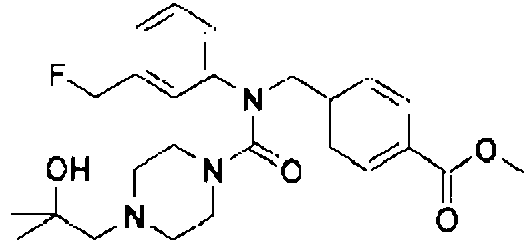
clorhidrato de El compuesto de Fórmula 10-12 (4-((N-(3-(fluorometil)fenil)piperazin-1-carboxamido)metil)benzoato de metilo; 0,137 g, 0,33 mmol), 2,2-dimetiloxirano (0,289 ml, 3,25 mmol) y carbonato potásico (0,224 g, 1,62 mmol) se mezclaron con etanol (10 ml) y se calentaron a 110 °C durante 20 minutos con irradiación con microondas. Después, la temperatura se redujo a temperatura ambiente y la reacción se completó. Después, el concentrado se obtuvo retirando el disolvente de la mezcla de reacción a presión reducida. Se vertió agua en el concentrado obtenido y la capa orgánica se extrajo con acetato de etilo. La capa orgánica se lavó con una solución acuosa saturada de cloruro sódico, se deshidrató con sulfato de magnesio anhidro, se filtró y después se concentró a presión reducida. El producto obtenido se usó sin proceso de purificación alguno para dar el compuesto deseado de Fórmula 10-13 (0,129 g, 87 %) en forma de un líquido de color amarillo claro.The compound of Formula 10-12 (methyl 4 - ((N- (3- (fluoromethyl) phenyl) piperazine-1-carboxamido) methyl) benzoate; 0.137 g, 0.33 mmol), 2,2-dimethyloxirane (0.289 mL, 3.25 mmol) and potassium carbonate (0.224 g, 1.62 mmol) were mixed with ethanol (10 mL) and heated at 110 ° C for 20 minutes with microwave irradiation. Then, the temperature was reduced to room temperature and the reaction was complete. Then, the concentrate was obtained by removing the solvent from the reaction mixture under reduced pressure. Water was poured into the concentrate obtained and the organic layer was extracted with ethyl acetate. The organic layer was washed with a saturated aqueous solution of sodium chloride, dehydrated with anhydrous magnesium sulfate, filtered and then concentrated under reduced pressure. The product obtained was used without any purification process to give the desired compound of Formula 10-13 (0.129 g, 87%) as a light yellow liquid.
(F ó rm u la 10-14: 4 -((4 -(2 -flu o ro -2 -m e tilp ro p il)-N -(3 -(flu o ro m e til) fe n il)p ip e ra z in -1 -c a rb o x a m id o )m e til)b e n z o a to de m e tilo ) (F or rm u 10-14: 4 - ((4 - (2 -flu or ro -2 -me tilp ro p il) -N - (3 - (useful flu) faith n il) p ip e ra z in -1 -ca rb oxam id o) me til) benzoa to me tilo)

El compuesto de Fórmula 10-13 (4-((N-(3-(fluorometil)fenil)-4-(2-hidroxi-2-metilpropil)piperazin-1-carboxamido)metil)benzoato de metilo; 0,129 g, 0,28 mmol) se disolvió en cloruro de metileno (10 ml) a temperatura ambiente, después se añadió trifluoruro de dietilaminoazufre (0,041 ml, 0,31 mmol) a la solución y se agitó a la misma temperatura durante 2 horas. Después, se vertió una solución acuosa saturada de hidrogenocarbonato sódico en la mezcla de reacción y la capa orgánica se extrajo con cloruro de metileno. La capa orgánica se lavó con una solución acuosa saturada de cloruro sódico, se deshidrató con sulfato de magnesio anhidro, se filtró y después se concentró a presión reducida. El concentrado se purificó y se concentró por cromatografía en columna (sílice; acetato de etilo/hexano = 10-40 %) para dar el compuesto deseado de Fórmula 10-14 (0,111 g, 86 %) en forma de un líquido incoloro.The compound of Formula 10-13 (methyl 4 - ((N- (3- (fluoromethyl) phenyl) -4- (2-hydroxy-2-methylpropyl) piperazine-1-carboxamido) methyl) benzoate; 0.129 g, , 28 mmol) was dissolved in methylene chloride (10 ml) at room temperature, then diethylaminosulfur trifluoride (0.041 ml, 0.31 mmol) was added to the solution and stirred at the same temperature for 2 hours. Then, a saturated aqueous solution of sodium hydrogencarbonate was poured into the reaction mixture and the organic layer was extracted with methylene chloride. The organic layer was washed with a saturated aqueous solution of sodium chloride, dehydrated with anhydrous magnesium sulfate, filtered and then concentrated under reduced pressure. The concentrate was purified and concentrated by column chromatography (silica; ethyl acetate / hexane = 10-40%) to give the desired compound of Formula 10-14 (0.111 g, 86%) as a colorless liquid.
(Compuesto 766: 4-(2-fluoro-2-metilpropil)-N-(3-(fluorometil)fenil)-N-(4-(hidroxicarbamoil)bencil)piperazin-1-carboxamida)(Compound 766: 4- (2-fluoro-2-methylpropyl) -N- (3- (fluoromethyl) phenyl) -N- (4- (hydroxycarbamoyl) benzyl) piperazine-1-carboxamide)
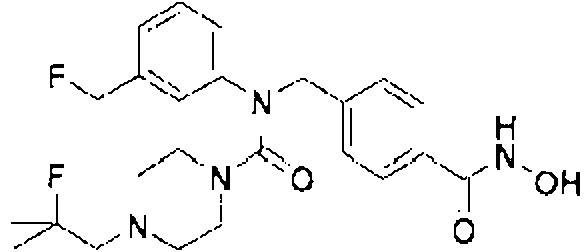
El compuesto de Fórmula 10-14 (4-((4-(2-fluoro-2-metilpropil)-N-(3-(fluorometil)fenil)piperazin-1-carboxamido)metil)benzoato de metilo; 0,111 g, 0,24 mmol) se disolvió en metanol (10 ml) a temperatura ambiente, después a la solución se le añadieron hidroxilamina (solución acuosa al 50 % en peso; 1,477 ml, 24,16 mmol) e hidróxido potásico (0,136 g, 2,42 mmol) y se agitó a la misma temperatura durante 3 horas. Después, el concentrado se obtuvo retirando el disolvente de la mezcla de reacción a presión reducida. Se vertió una solución acuosa saturada de hidrogenocarbonato sódico en el concentrado obtenido y después la capa orgánica se extrajo con acetato de etilo. La capa orgánica se lavó con una solución acuosa saturada de cloruro sódico, se deshidrató con sulfato de magnesio anhidro, se filtró y después se concentró a presión reducida. El producto obtenido se usó sin proceso de purificación alguno para dar el compuesto 766 deseado (0,087 g, 78 %) en forma de un sólido de color blanco.The compound of Formula 10-14 (methyl 4 - ((4- (2-fluoro-2-methylpropyl) -N- (3- (fluoromethyl) phenyl) piperazine-1-carboxamido) methyl) benzoate; 0.111 g, , 24 mmol) was dissolved in methanol (10 ml) at room temperature, then hydroxylamine (50% strength by weight aqueous solution, 1.477 ml, 24.16 mmol) and potassium hydroxide (0.136 g, 2%) were added to the solution. 42 mmol) and stirred at the same temperature for 3 hours. Then, the concentrate was obtained by removing the solvent from the reaction mixture under reduced pressure. A saturated aqueous solution of sodium hydrogencarbonate was poured into the concentrate obtained and then the organic layer was extracted with ethyl acetate. The organic layer was washed with a saturated aqueous solution of sodium chloride, dehydrated with anhydrous magnesium sulfate, filtered and then concentrated under reduced pressure. The product obtained was used without any purification process to give the desired compound 766 (0.087 g, 78%) as a white solid.
1H RMN (400 MHz, DIVISOR) 8 11,15 (s a, 1 H), 9,04 (s a, 1 H), 7,65 (d, 2 H, J = 8,2 Hz), 7,37 - 7,32 (m, 3 H), 7,16 (s, 1H), 7,12 - 7,08 (m, 2 H), 5,37 (d, 2 H, J = 47,5 Hz), 4,87 (s, 2 H), 3,16 (m, 4 H), 2,36 (s, 2 H, J = 23,0 Hz), 2,33 (m, 4 H), 1,29 (s, 3 H), 1,23 (s, 3 H). MS (ESI) m/z 461 (M+ H).1 H NMR (400 MHz, DIVIDER) 8 11.15 (sa, 1 H), 9.04 (sa, 1 H), 7.65 (d, 2 H, J = 8.2 Hz), 7.37 - 7.32 (m, 3 H), 7.16 (s, 1H), 7.12-7.08 (m, 2 H), 5.37 (d, 2 H, J = 47.5 Hz), 4.87 (s, 2 H), 3.16 (m, 4 H), 2.36 (s, 2 H, J = 23.0 Hz), 2.33 (m, 4 H), 1.29 (s, 3 H), 1.23 (s, 3 H). MS (ESI) m / z 461 (M + H).
Ejemplo 153: Síntesis del compuesto 771Example 153: Synthesis of compound 771
(Fórmula 1-2: 4-(((2-(trifluorometoxi)fenil)amino)metil)benzoato de metilo)(Formula 1-2: methyl 4 - (((2- (trifluoromethoxy) phenyl) amino) methyl) benzoate)

El compuesto de Fórmula 1-1 (2-(trifluorometoxi)anilina; 0,385 ml, 4,625 mmol), 4-(bromometil)benzoato de metilo (1,271 g, 5,550 mmol) y DIPEA (1,228 ml, 6,937 mmol) se disolvieron en acetonitrilo (5 ml) a temperatura ambiente y se agitaron a la misma temperatura durante 16 horas. Se vertió agua en la mezcla de reacción y la capa orgánica se extrajo con acetato de etilo. La capa orgánica se lavó con una solución acuosa saturada de cloruro sódico, se deshidrató con sulfato de magnesio anhidro, se filtró y después se concentró a presión reducida. El concentrado se purificó y se concentró por cromatografía en columna (sílice; acetato de etilo/hexano = 20 %) para dar el compuesto deseado de Fórmula 1-2 (0,806 g, 53,6 %) en forma de un líquido incoloro.The compound of Formula 1-1 (2- (trifluoromethoxy) aniline; 0.385 mL, 4.625 mmol), methyl 4- (bromomethyl) benzoate (1.271 g, 5.550 mmol) and DIPEA (1.228 mL, 6.937 mmol) were dissolved in acetonitrile (5 ml) at room temperature and stirred at the same temperature for 16 hours. Water was poured into the reaction mixture and the organic layer was extracted with ethyl acetate. The organic layer was washed with a saturated aqueous solution of sodium chloride, dehydrated with anhydrous magnesium sulfate, filtered and then concentrated under reduced pressure. The concentrate was purified and concentrated by column chromatography (silica; ethyl acetate / hexane = 20%) to give the desired compound of Formula 1-2 (0.806 g, 53.6%) as a colorless liquid.
(F ó rm u la 1-3: 4 -((((4 -n itro fe n o x i)c a rb o n il)(2 -( tr if lu o ro m e to x i) fe n il)a m in o )m e til)b e n z o a to de m e tilo ) (F or rm u la 1-3: 4 - ((((4 -n itro fe noxi) ca rb on il) (2 - (tr if lu o ro to xi) faith n il) am in o) me useful) benzoa to me tilo)

El compuesto de Fórmula 1-2 (metil 4-(((2-(trifluorometoxi)fenil)amino)metil)benzoato; 0,806 g, 2,477 mmol), 4-nitrofenilo dorofoririiato (0,549 g, 2,725 mmol) y carbonato potásico (0,685 g, 4,955 mmol) se disolvieron en acetonitrilo (5 ml) a temperatura ambiente y se agitaron a la misma temperatura durante 16 horas. Se vertió agua en la mezcla de reacción y la capa orgánica se extrajo con acetato de etilo. La capa orgánica se lavó con una solución acuosa saturada de cloruro sódico, se deshidrató con sulfato de magnesio anhidro, se filtró y después se concentró a presión reducida. El concentrado se purificó y se concentró por cromatografía en columna (sílice; acetato de etilo/hexano = 20 %) para dar el compuesto deseado de Fórmula 1-3 (1,172 g, 96,5 %) en forma de un líquido de color amarillo.The compound of Formula 1-2 (methyl 4 - (((2- (trifluoromethoxy) phenyl) amino) methyl) benzoate: 0.806 g, 2.477 mmol), 4-nitrophenyl dorofoririiate (0.549 g, 2.725 mmol) and potassium carbonate (0.685) g, 4.955 mmol) were dissolved in acetonitrile (5 ml) at room temperature and stirred at the same temperature for 16 hours. Water was poured into the reaction mixture and the organic layer was extracted with ethyl acetate. The organic layer was washed with a saturated aqueous solution of sodium chloride, dehydrated with anhydrous magnesium sulfate, filtered and then concentrated under reduced pressure. The concentrate was purified and concentrated by column chromatography (silica; ethyl acetate / hexane = 20%) to give the desired compound of Formula 1-3 (1.172 g, 96.5%) as a yellow liquid .
(Fórmula 1-4: 4-((N-(2-(trifluorometoxi)fenil)morfolin-4-carboxamido)metil)benzoato de metilo)(Formula 1-4: 4 - (methyl (N- (2- (trifluoromethoxy) phenyl) morpholin-4-carboxamido) methyl) benzoate)

El compuesto de Fórmula 1-3 (4-((((4-nitrofenoxi)carbonil)(2-(trifluorometoxi)fenil)amino)metil)benzoato de metilo; 1,172 g, 2,390 mmol), morfolina (2,082 g, 23,899 mmol) y carbonato potásico (1,652 g, 11,950 mmol) se disolvieron en N,N-dimetilformamida (5 ml) a 40 °C y se agitaron a la misma temperatura durante 16 horas. Después, la temperatura se redujo a temperatura ambiente y la reacción se completó. Se vertió agua en la mezcla de reacción y la capa orgánica se extrajo con acetato de etilo. La capa orgánica se lavó con una solución acuosa saturada de cloruro sódico, se deshidrató con sulfato de magnesio anhidro, se filtró y después se concentró a presión reducida. El concentrado se purificó y se concentró por cromatografía en columna (sílice; acetato de etilo/hexano = 30 %) para dar el compuesto deseado de Fórmula 1-4 (0,948 g, 90,4 %) en forma de un líquido incoloro.The compound of Formula 1-3 (methyl 4 - ((((((4-nitrophenoxy) carbonyl) (2- (trifluoromethoxy) phenyl) amino) methyl) benzoate; 1.172 g, 2.390 mmol), morpholine (2.082 g, 23.899 mmol ) and potassium carbonate (1.652 g, 11.950 mmol) were dissolved in N, N-dimethylformamide (5 ml) at 40 ° C and stirred at the same temperature for 16 hours. Then, the temperature was reduced to room temperature and the reaction was complete. Water was poured into the reaction mixture and the organic layer was extracted with ethyl acetate. The organic layer was washed with a saturated aqueous solution of sodium chloride, dehydrated with anhydrous magnesium sulfate, filtered and then concentrated under reduced pressure. The concentrate was purified and concentrated by column chromatography (silica; ethyl acetate / hexane = 30%) to give the desired compound of Formula 1-4 (0.948 g, 90.4%) as a colorless liquid.
(Compuesto 771: N-(4-(hidroxicarbamoil)bencil)-N-(2-(trifluorometoxi)fenil)morfolin-4-carboxamida)(Compound 771: N- (4- (hydroxycarbamoyl) benzyl) -N- (2- (trifluoromethoxy) phenyl) morpholine-4-carboxamide)

El compuesto de Fórmula 1-4 (4-((N-(2-(trifluorometoxi)fenil)morfolin-4-carboxamido)metil)benzoato de metilo; 0,948 g, 2,162 mmol), hidroxilamina (solución acuosa al 50,0 % en peso; 1,323 ml, 21,624 mmol) e hidróxido potásico (1,213 g, 21,624 mmol) se disolvieron en metanol (3 ml) a temperatura ambiente y se agitaron a la misma temperatura durante 3 horas. Se vertió agua en la mezcla de reacción y la capa orgánica se extrajo con acetato de etilo. La capa orgánica se lavó con una solución acuosa saturada de cloruro sódico, se deshidrató con sulfato de magnesio anhidro, se filtró y después se concentró a presión reducida. El concentrado se purificó y se concentró por cromatografía en columna (sílice; acetato de etilo/hexano = 50-80 %) para dar el compuesto 771 deseado (0,656 g, 69,0 %) en forma de un sólido de color blanco.The compound of Formula 1-4 (methyl 4 - ((N- (2- (trifluoromethoxy) phenyl) morpholin-4-carboxamido) methyl) benzoate; 0.948 g, 2.162 mmol), hydroxylamine (50.0% aqueous solution by weight, 1.323 ml, 21.624 mmol) and potassium hydroxide (1.213 g, 21.624 mmol) were dissolved in methanol (3 ml) at room temperature and stirred at the same temperature for 3 hours. Water was poured into the reaction mixture and the organic layer was extracted with ethyl acetate. The organic layer was washed with a saturated aqueous solution of sodium chloride, dehydrated with anhydrous magnesium sulfate, filtered and then concentrated under reduced pressure. The concentrate was purified and concentrated by column chromatography (silica; ethyl acetate / hexane = 50-80%) to give the desired compound 771 (0.656 g, 69.0%) as a white solid.
1H RMN (400 MHz, DIVISOR) d 7,68 (d, 2 H, J = 8,0 Hz), 7,39 - 7,32 (m, 6 H), 4,76 (s, 2 H), 3,36 ~ 3,35 (m, 4 H), 3,10 (m, 4 H); MS (ESI) m/z 440,1 (M+ H).1 H NMR (400 MHz, DIVIDER) d 7.68 (d, 2 H, J = 8.0 Hz), 7.39-7.32 (m, 6 H), 4.76 (s, 2 H), 3.36 ~ 3.35 (m, 4 H), 3.10 (m, 4 H); MS (ESI) m / z 440.1 (M + H).
Ejemplo 154: Síntesis del compuesto 772Example 154: Synthesis of compound 772
(F ó rm u la 1-2: 4 -(((4 -( tr iflu o ro m e to x i)fe n il)a m in o )m e til)b e n z o a to de m etilo ) (F o rm u la 1-2: 4 - (((4 - (tr iflu ro me to xi) faith n il) am in o) me til) benzoa to de m etil

El compuesto de Fórmula 1-1 (4-(trifluorometoxi)anilina; 0,385 ml, 4,625 mmol), 4-(bromometil)benzoato de metilo (1,271 g, 5,550 mmol) y DIPEA (1,228 ml, 6,937 mmol) se disolvieron en acetonitrilo (5 ml) a temperatura ambiente y se agitaron a la misma temperatura durante 16 horas. Se vertió agua en la mezcla de reacción y la capa orgánica se extrajo con acetato de etilo. La capa orgánica se lavó con una solución acuosa saturada de cloruro sódico, se deshidrató con sulfato de magnesio anhidro, se filtró y después se concentró a presión reducida. El concentrado se purificó y se concentró por cromatografía en columna (sílice; acetato de etilo/hexano = 20 %) para dar el compuesto deseado de Fórmula 1-2 (0,645 g, 42,8 %) en forma de un líquido incoloro.The compound of Formula 1-1 (4- (trifluoromethoxy) aniline; 0.385 mL, 4.625 mmol), methyl 4- (bromomethyl) benzoate (1.271 g, 5.550 mmol) and DIPEA (1.228 mL, 6.937 mmol) were dissolved in acetonitrile (5 ml) at room temperature and stirred at the same temperature for 16 hours. Water was poured into the reaction mixture and the organic layer was extracted with ethyl acetate. The organic layer was washed with a saturated aqueous solution of sodium chloride, dehydrated with anhydrous magnesium sulfate, filtered and then concentrated under reduced pressure. The concentrate was purified and concentrated by column chromatography (silica; ethyl acetate / hexane = 20%) to give the desired compound of Formula 1-2 (0.645 g, 42.8%) as a colorless liquid.
(Fórmula 1-3: 4-((((4-nitrofenoxi)carbonil)(4-(trifluorometoxi)fenil)amino)metil)benzoato de metilo)(Formula 1-3: 4 - (((((4-nitrophenoxy) carbonyl) (methyl 4- (trifluoromethoxy) phenyl) amino) methyl) benzoate)

El compuesto de Fórmula 1-2 (metil 4-(((4-(trifluorometoxi)fenil)amino)metil)benzoato; 0,645 g, 1,981 mmol), 4-nitrofenilo cloroformiato (0,439 g, 2,180 mmol) y carbonato potásico (0,548 g, 3,963 mmol) se disolvieron en acetonitrilo (5 ml) a temperatura ambiente y se agitaron a la misma temperatura durante 16 horas. Se vertió agua en la mezcla de reacción y la capa orgánica se extrajo con acetato de etilo. La capa orgánica se lavó con una solución acuosa saturada de cloruro sódico, se deshidrató con sulfato de magnesio anhidro, se filtró y después se concentró a presión reducida. El concentrado se purificó y se concentró por cromatografía en columna (sílice; acetato de etilo/hexano = 20 %) para dar el compuesto deseado de Fórmula 1-3 (0,633 g, 65,1 %) en forma de un sólido de color blanco.The compound of Formula 1-2 (methyl 4 - (((4- (trifluoromethoxy) phenyl) amino) methyl) benzoate; 0.645 g, 1.981 mmol), 4-nitrophenyl chloroformate (0.439 g, 2180 mmol) and potassium carbonate (0.548) g, 3.963 mmol) were dissolved in acetonitrile (5 ml) at room temperature and stirred at the same temperature for 16 hours. Water was poured into the reaction mixture and the organic layer was extracted with ethyl acetate. The organic layer was washed with a saturated aqueous solution of sodium chloride, dehydrated with anhydrous magnesium sulfate, filtered and then concentrated under reduced pressure. The concentrate was purified and concentrated by column chromatography (silica: ethyl acetate / hexane = 20%) to give the desired compound of Formula 1-3 (0.633 g, 65.1%) as a white solid .
(Fórmula 1-4: 4-((N-(4-(trifluorometoxi)fenil)morfolin-4-carboxamido)metil)benzoato de metilo)(Formula 1-4: 4 - (methyl (N- (4- (trifluoromethoxy) phenyl) morpholin-4-carboxamido) methyl) benzoate)

El compuesto de Fórmula 1-3 (4-((((4-nitrofenoxi)carbonil)(4-(trifluorometoxi)fenil)amino)metil)benzoato de metilo; 0,633 g, 1,291 mmol), morfolina (1,125 g, 12,909 mmol) y carbonato potásico (0,892 g, 6,454 mmol) se disolvieron en N,N-dimetilformamida (5 ml) a 40 °C y se agitaron a la misma temperatura durante 16 horas. Después, la temperatura se redujo a temperatura ambiente y la reacción se completó. Se vertió agua en la mezcla de reacción y la capa orgánica se extrajo con acetato de etilo. La capa orgánica se lavó con una solución acuosa saturada de cloruro sódico, se deshidrató con sulfato de magnesio anhidro, se filtró y después se concentró a presión reducida. El concentrado se purificó y se concentró por cromatografía en columna (sílice; acetato de etilo/hexano = 30 %) para dar el compuesto deseado de Fórmula 1-4 (0,555 g, 98,1 %) en forma de un líquido incoloro.The compound of Formula 1-3 (methyl 4 - (((((((4-nitrophenoxy) carbonyl) (4- (trifluoromethoxy) phenyl) amino) methyl) benzoate; 0.633 g, 1.291 mmol), morpholine (1.125 g, 12.909 mmol ) and potassium carbonate (0.892 g, 6.454 mmol) were dissolved in N, N-dimethylformamide (5 ml) at 40 ° C and stirred at the same temperature for 16 hours. Then, the temperature was reduced to room temperature and the reaction was complete. Water was poured into the reaction mixture and the organic layer was extracted with ethyl acetate. The organic layer was washed with a saturated aqueous solution of sodium chloride, dehydrated with anhydrous magnesium sulfate, filtered and then concentrated under reduced pressure. The concentrate was purified and concentrated by column chromatography (silica; ethyl acetate / hexane = 30%) to give the desired compound of Formula 1-4 (0.555 g, 98.1%) as a colorless liquid.
(Compuesto 772: N-(4-(hidroxicarbamoil)bencil)-N-(4-(trifluorometoxi)fenil)morfolin-4-carboxamida)(Compound 772: N- (4- (hydroxycarbamoyl) benzyl) -N- (4- (trifluoromethoxy) phenyl) morpholine-4-carboxamide)

El compuesto de Fórmula 1-4 (4-((N-(4-(trifluorometoxi)fenil)morfolin-4-carboxamido)metil)benzoato de metilo; 0,555 g, 1,266 mmol), hidroxilamina (solución acuosa al 50,0 % en peso; 0,774 ml, 12,660 mmol) e hidróxido potásico (0,710 g, 12,660 mmol) se disolvieron en metanol (3 ml) a temperatura ambiente y se agitaron a la misma temperatura durante 3 horas. Se vertió agua en la mezcla de reacción y la capa orgánica se extrajo con acetato de etilo. La capa orgánica se lavó con una solución acuosa saturada de cloruro sódico, se deshidrató con sulfato de magnesio anhidro, se filtró y después se concentró a presión reducida. El concentrado se purificó y se concentró por cromatografía en columna (sílice; acetato de etilo/hexano = 50-80 %) para dar el compuesto 772 deseado (0,544 g, 97,8 %) en forma de un sólido de color blanco.The compound of Formula 1-4 (methyl 4 - ((N- (4- (trifluoromethoxy) phenyl) morpholin-4-carboxamido) methyl) benzoate; 0.555 g, 1.266 mmol), hydroxylamine (50.0% aqueous solution by weight, 0.774 ml, 12.660 mmol) and potassium hydroxide (0.710 g, 12.660 mmol) were dissolved in methanol (3 ml) at room temperature and stirred at the same temperature for 3 hours. Water was poured into the reaction mixture and the organic layer was extracted with ethyl acetate. The organic layer was washed with a saturated aqueous solution of sodium chloride, dehydrated with anhydrous magnesium sulfate, filtered and then concentrated under reduced pressure. The concentrate was purified and concentrated by column chromatography (silica; ethyl acetate / hexane = 50-80%) to give the desired compound 772 (0.544 g, 97.8%) as a white solid.
1H RMN (400 MHz, DMSO-da) d 10,33 (s a, 1 H), 9,78 (s a, 1 H), 7,65 (d, 2 H, J= 7,8 Hz), 7,42 (t, 1 H, J = 8,2 Hz), 7,37 (d, 2 H, J = 7,8 Hz), 7,18 (d, 1 H, J = 7,6 Hz), 7,12 (s, 1 H), 7,03 (d, 1 H, J = 8,3 Hz), 4,91 (s, 2 H), 3,43 (m, 4 H), 3,17 (m, 4 H) ; MS (ESI) m/z 440,1 (M+ H).1 H NMR (400 MHz, DMSO-da) d 10.33 (br s, 1 H), 9.78 (br s, 1 H), 7.65 (d, 2 H, J = 7.8 Hz), 7, 42 (t, 1 H, J = 8.2 Hz), 7.37 (d, 2 H, J = 7.8 Hz), 7.18 (d, 1 H, J = 7.6 Hz), 7 , 12 (s, 1 H), 7.03 (d, 1 H, J = 8.3 Hz), 4.91 (s, 2 H), 3.43 (m, 4 H), 3.17 ( m, 4 H); MS (ESI) m / z 440.1 (M + H).
Ejemplo 155: Síntesis del compuesto 773Example 155: Synthesis of compound 773
(Fórmula 1-2: 4-(((3-(trifluorometoxi)fenil)amino)metil)benzoato de metilo)(Formula 1-2: 4 - (((3- (trifluoromethoxy) phenyl) amino) methyl) benzoate methyl)

El compuesto de Fórmula 1-1 (3-(trifluorometoxi)anilina; 0,385 ml, 4,625 mmol), 4-(bromometil)benzoato de metilo (1,271 g, 5,550 mmol) y DIPEA (1,228 ml, 6,937 mmol) se disolvieron en acetonitrilo (5 ml) a temperatura ambiente y se agitaron a la misma temperatura durante 16 horas. Se vertió agua en la mezcla de reacción y la capa orgánica se extrajo con acetato de etilo. La capa orgánica se lavó con una solución acuosa saturada de cloruro sódico, se deshidrató con sulfato de magnesio anhidro, se filtró y después se concentró a presión reducida. El concentrado se purificó y se concentró por cromatografía en columna (sílice; acetato de etilo/hexano = 20 %) para dar el compuesto deseado de Fórmula 1-2 (0,607 g, 40,3 %) en forma de un sólido de color blanco.The compound of Formula 1-1 (3- (trifluoromethoxy) aniline; 0.385 mL, 4.625 mmol), methyl 4- (bromomethyl) benzoate (1.271 g, 5.550 mmol) and DIPEA (1.228 mL, 6.937 mmol) were dissolved in acetonitrile (5 ml) at room temperature and stirred at the same temperature for 16 hours. Water was poured into the reaction mixture and the organic layer was extracted with ethyl acetate. The organic layer was washed with a saturated aqueous solution of sodium chloride, dehydrated with anhydrous magnesium sulfate, filtered and then concentrated under reduced pressure. The concentrate was purified and concentrated by column chromatography (silica, ethyl acetate / hexane = 20%) to give the desired compound of Formula 1-2 (0.607 g, 40.3%) as a white solid .
(Fórmula 1-3: 4-((((4-nitrofenoxi)carbonil)(3-(trifluorometoxi)fenil)amino)metil)benzoato de metilo)(Formula 1-3: 4 - ((((((4-nitrophenoxy) carbonyl) (3- (trifluoromethoxy) phenyl) amino) methyl) methyl benzoate)

El compuesto de Fórmula 1-2 (metil 4-(((3-(trifluorometoxi)fenil)amino)metil)benzoato; 0,607 g, 1,865 mmol), 4-nitrofenilo cloroformiato (0,413 g, 2,051 mmol) y carbonato potásico (0,515 g, 3,730 mmol) se disolvieron en acetonitrilo (5 ml) a temperatura ambiente y se agitaron a la misma temperatura durante 16 horas. Se vertió agua en la mezcla de reacción y la capa orgánica se extrajo con acetato de etilo. La capa orgánica se lavó con una solución acuosa saturada de cloruro sódico, se deshidrató con sulfato de magnesio anhidro, se filtró y después se concentró a presión reducida. El concentrado se purificó y se concentró por cromatografía en columna (sílice; acetato de etilo/hexano = 20 %) para dar el compuesto deseado de Fórmula 1-3 (0,649 g, 71,0 %) en forma de un sólido de color blanco.The compound of Formula 1-2 (methyl 4 - (((3- (trifluoromethoxy) phenyl) amino) methyl) benzoate, 0.607 g, 1.865 mmol), 4-nitrophenyl chloroformate (0.413 g, 2.051 mmol) and potassium carbonate (0.515) g, 3.730 mmol) were dissolved in acetonitrile (5 ml) at room temperature and stirred at the same temperature for 16 hours. Water was poured into the reaction mixture and the organic layer was extracted with ethyl acetate. The organic layer was washed with a saturated aqueous solution of sodium chloride, dehydrated with anhydrous magnesium sulfate, filtered and then concentrated under reduced pressure. The concentrate was purified and concentrated by column chromatography (silica; ethyl acetate / hexane = 20%) to give the desired compound of Formula 1-3 (0.649 g, 71.0%) as a white solid. .
(Fórmula 1-4: 4-((N-(3-(trifluorometoxi)fenil)morfolin-4-carboxamido)metil)benzoato de metilo)(Formula 1-4: 4 - (methyl (N- (3- (trifluoromethoxy) phenyl) morpholin-4-carboxamido) methyl) benzoate)

El compuesto de Fórmula 1-3 (4-((((4-nitrofenoxi)carbonil)(3-(trifluorometoxi)fenil)amino)metil)benzoato de metilo; 0,649 g, 1,324 mmol), morfolina (1,154 g, 13,243 mmol) y carbonato potásico (0,915 g, 6,621 mmol) se disolvieron en N,N-dimetilformamida (5 ml) a 40 °C y se agitaron a la misma temperatura durante 16 horas. Después, la temperatura se redujo a temperatura ambiente y la reacción se completó. Se vertió agua en la mezcla de reacción y la capa orgánica se extrajo con acetato de etilo. La capa orgánica se lavó con una solución acuosa saturada de cloruro sódico, se deshidrató con sulfato de magnesio anhidro, se filtró y después se concentró a presión reducida. El concentrado se purificó y se concentró por cromatografía en columna (sílice; acetato de etilo/hexano = 30 %) para dar el compuesto deseado de Fórmula 1-4 (0,512 g, 88,2 %) en forma de un líquido incoloro.The compound of Formula 1-3 (methyl 4 - ((((((4-nitrophenoxy) carbonyl) (3- (trifluoromethoxy) phenyl) amino) methyl) benzoate; 0.649 g, 1.344 mmol), morpholine (1.144 g, 13.243 mmol ) and potassium carbonate (0.915 g, 6.621 mmol) were dissolved in N, N-dimethylformamide (5 ml) at 40 ° C and stirred at the same temperature for 16 hours. Then, the temperature was reduced to room temperature and the reaction was complete. Water was poured into the reaction mixture and the organic layer was extracted with ethyl acetate. The organic layer was washed with a saturated aqueous solution of sodium chloride, dehydrated with anhydrous magnesium sulfate, filtered and then concentrated under reduced pressure. The concentrate was purified and concentrated by column chromatography (silica; ethyl acetate / hexane = 30%) to give the desired compound of Formula 1-4 (0.512 g, 88.2%) as a colorless liquid.
(Compuesto 773: N-(4-(hidroxicarbamoil)bencil)-N-(3-(trifluorometoxi)fenil)morfolin-4-carboxamida) (Compound 773: N- (4- (hydroxycarbamoyl) benzyl) -N- (3- (trifluoromethoxy) phenyl) morpholine-4-carboxamide)

El compuesto de Fórmula 1-4 (4-((N-(3-(trifluorometoxi)fenil)morfolin-4-carboxamido)metil)benzoato de metilo; 0,512 g, 1,168 mmol), hidroxilamina (solución acuosa al 50,0 % en peso; 0,714 ml, 11,679 mmol) e hidróxido potásico (0,655 g, 11,679 mmol) se disolvieron en metanol (3 ml) a temperatura ambiente y se agitaron a la misma temperatura durante 3 horas. Se vertió agua en la mezcla de reacción y la capa orgánica se extrajo con acetato de etilo. La capa orgánica se lavó con una solución acuosa saturada de cloruro sódico, se deshidrató con sulfato de magnesio anhidro, se filtró y después se concentró a presión reducida. El concentrado se purificó y se concentró por cromatografía en columna (sílice; acetato de etilo/hexano = 50-80 %) para dar el compuesto 773 deseado (0,417 g, 81,3 %) en forma de un sólido de color blanco.The compound of Formula 1-4 (methyl 4 - ((N- (3- (trifluoromethoxy) phenyl) morpholin-4-carboxamido) methyl) benzoate; 0.512 g, 1.168 mmol), hydroxylamine (50.0% aqueous solution by weight, 0.714 ml, 11.679 mmol) and potassium hydroxide (0.655 g, 11.679 mmol) were dissolved in methanol (3 ml) at room temperature and stirred at the same temperature for 3 hours. Water was poured into the reaction mixture and the organic layer was extracted with ethyl acetate. The organic layer was washed with a saturated aqueous solution of sodium chloride, dehydrated with anhydrous magnesium sulfate, filtered and then concentrated under reduced pressure. The concentrate was purified and concentrated by column chromatography (silica; ethyl acetate / hexane = 50-80%) to give the desired compound 773 (0.417 g, 81.3%) as a white solid.
1H RMN (400 MHz, DIVISOR) d 10,35 (s a, 1 H), 8,68 (s a, 1 H), 7,67 (d, 2 H, J = 8,0 Hz), 7,37 (d, 2 H, J = 8,0 Hz), 7,31 ~ 7,24 (m, 4 H), 4,88 (s, 2 H), 3,42 (m, 4 H), 3,15 (m, 4 H) ; MS (ESI) m/z 440,1 (M+ H).1 H NMR (400 MHz, DIVIDER) d 10.35 (br s, 1 H), 8.68 (br s, 1 H), 7.67 (d, 2 H, J = 8.0 Hz), 7.37 ( d, 2 H, J = 8.0 Hz), 7.31 ~ 7.24 (m, 4 H), 4.88 (s, 2 H), 3.42 (m, 4 H), 3.15 (m, 4 H); MS (ESI) m / z 440.1 (M + H).
Ejemplo 156: Síntesis del compuesto 774Example 156: Synthesis of compound 774
(Fórmula 1-2: 4-(((2-metoxi-5-(trifluorometil)fenil)amino)metil)benzoato de metilo)(Formula 1-2: methyl 4 - (((2-methoxy-5- (trifluoromethyl) phenyl) amino) methyl) benzoate)

El compuesto de Fórmula 1-1 (2-metoxi-5-(trifluorometil)anilina; 0,385 ml, 4,625 mmol), 4-(bromometil)benzoato de metilo (1,271 g, 5,550 mmol) y DIPEA (1,228 ml, 6,937 mmol) se disolvieron en acetonitrilo (5 ml) a temperatura ambiente y se agitaron a la misma temperatura durante 16 horas. Se vertió agua en la mezcla de reacción y la capa orgánica se extrajo con acetato de etilo. La capa orgánica se lavó con una solución acuosa saturada de cloruro sódico, se deshidrató con sulfato de magnesio anhidro, se filtró y después se concentró a presión reducida. El concentrado se purificó y se concentró por cromatografía en columna (sílice; acetato de etilo/hexano = 20 %) para dar el compuesto deseado de Fórmula 1-2 (0,607 g, 40,3 %) en forma de un sólido de color blanco.The compound of Formula 1-1 (2-methoxy-5- (trifluoromethyl) aniline; 0.385 mL, 4.625 mmol), methyl 4- (bromomethyl) benzoate (1.271 g, 5.550 mmol) and DIPEA (1.228 mL, 6.937 mmol) they were dissolved in acetonitrile (5 ml) at room temperature and stirred at the same temperature for 16 hours. Water was poured into the reaction mixture and the organic layer was extracted with ethyl acetate. The organic layer was washed with a saturated aqueous solution of sodium chloride, dehydrated with anhydrous magnesium sulfate, filtered and then concentrated under reduced pressure. The concentrate was purified and concentrated by column chromatography (silica, ethyl acetate / hexane = 20%) to give the desired compound of Formula 1-2 (0.607 g, 40.3%) as a white solid .
(Fórmula 1-3: 4-(((2-metoxi-5-(trifluorometil)fenil)((4-nitrofenoxi)carbonil) amino)metil)benzoato de metilo)(Formula 1-3: 4 - (((2-methoxy-5- (trifluoromethyl) phenyl) - ((4-nitrophenoxy) carbonyl) amino) methyl) methyl benzoate)

El compuesto de Fórmula 1-2 (4-(((2-metoxi-5-(trifluorometil)fenil)amino)metil)benzoato de metilo; 0,607 g, 1,865 mmol), 4-nitrofenilo cloroformiato (0,413 g, 2,051 mmol) y carbonato potásico (0,515 g, 3,730 mmol) se disolvieron en acetonitrilo (5 ml) a temperatura ambiente y se agitaron a la misma temperatura durante 16 horas. Se vertió agua en la mezcla de reacción y la capa orgánica se extrajo con acetato de etilo. La capa orgánica se lavó con una solución acuosa saturada de cloruro sódico, se deshidrató con sulfato de magnesio anhidro, se filtró y después se concentró a presión reducida. El concentrado se purificó y se concentró por cromatografía en columna (sílice; acetato de etilo/hexano = 20 %) para dar el compuesto deseado de Fórmula 1-3 (0,649 g, 71,0 %) en forma de un sólido de color blanco.The compound of Formula 1-2 (methyl 4 - (((2-methoxy-5- (trifluoromethyl) phenyl) amino) methyl) benzoate; 0.607 g, 1.865 mmol), 4-nitrophenyl chloroformate (0.413 g, 2.051 mmol) and potassium carbonate (0.515 g, 3.730 mmol) were dissolved in acetonitrile (5 ml) at room temperature and stirred at the same temperature for 16 hours. Water was poured into the reaction mixture and the organic layer was extracted with ethyl acetate. The organic layer was washed with a saturated aqueous solution of sodium chloride, dehydrated with anhydrous magnesium sulfate, filtered and then concentrated under reduced pressure. The concentrate was purified and concentrated by column chromatography (silica; ethyl acetate / hexane = 20%) to give the desired compound of Formula 1-3 (0.649 g, 71.0%) as a white solid. .
(Fórmula 1-4: 4-((N-(2-metoxi-5-(trifluorometil)fenil)morfolin-4-carboxamido)metil)benzoato de metilo)(Formula 1-4: 4 - ((Methyl N- (2-methoxy-5- (trifluoromethyl) phenyl) morpholin-4-carboxamido) methyl) benzoate)

El compuesto de Fórmula 1-3 (4-(((2-metoxi-5-(trifluorometil)fenil)((4-nitrofenoxi)carbonil) amino)metil)benzoato de metilo; 0,649 g, 1,324 mmol), morfolina (1,154 g, 13,243 mmol) y carbonato potásico (0,915 g, 6,621 mmol) se disolvieron en N,N-dimetilformamida (5 ml) a 40 °C y se agitaron a la misma temperatura durante 16 horas. Después, la temperatura se redujo a temperatura ambiente y la reacción se completó. Se vertió agua en la mezcla de reacción y la capa orgánica se extrajo con acetato de etilo. La capa orgánica se lavó con una solución acuosa saturada de cloruro sódico, se deshidrató con sulfato de magnesio anhidro, se filtró y después se concentró a presión reducida. El concentrado se purificó y se concentró por cromatografía en columna (sílice; acetato de etilo/hexano = 30 %) para dar el compuesto deseado de Fórmula 1-4 (0,512 g, 88,2 %) en forma de un líquido incoloro.The compound of Formula 1-3 (methyl 4 - (((2-methoxy-5- (trifluoromethyl) phenyl) ((4-nitrophenoxy) carbonyl) amino) methyl) benzoate; 0.649 g, 1.344 mmol), morpholine (1.154) g, 13.243 mmol) and potassium carbonate (0.915 g, 6.621 mmol) were dissolved in N, N-dimethylformamide (5 ml) at 40 ° C and stirred at the same temperature for 16 hours. After, the temperature was reduced to room temperature and the reaction was complete. Water was poured into the reaction mixture and the organic layer was extracted with ethyl acetate. The organic layer was washed with a saturated aqueous solution of sodium chloride, dehydrated with anhydrous magnesium sulfate, filtered and then concentrated under reduced pressure. The concentrate was purified and concentrated by column chromatography (silica; ethyl acetate / hexane = 30%) to give the desired compound of Formula 1-4 (0.512 g, 88.2%) as a colorless liquid.
(Compuesto 774: N-(4-(hidroxicarbamoil)bencil)-N-(2-metoxi-5-(trifluorometil)fenil)morfolin-4-carboxamida)(Compound 774: N- (4- (hydroxycarbamoyl) benzyl) -N- (2-methoxy-5- (trifluoromethyl) phenyl) morpholine-4-carboxamide)

El compuesto de Fórmula 1-4 (4-((N-(2-metoxi-5-(trifluorometil)fenil)morfolin-4-carboxamido)metil)benzoato de metilo; 0,512 g, 1,168 mmol), hidroxilamina (solución acuosa al 50,0 % en peso; 0,714 ml, 11,679 mmol) e hidróxido potásico (0,655 g, 11,679 mmol) se disolvieron en metanol (3 ml) a temperatura ambiente y se agitaron a la misma temperatura durante 3 horas. Se vertió agua en la mezcla de reacción y la capa orgánica se extrajo con acetato de etilo. La capa orgánica se lavó con una solución acuosa saturada de cloruro sódico, se deshidrató con sulfato de magnesio anhidro, se filtró y después se concentró a presión reducida. El concentrado se purificó y se concentró por cromatografía en columna (sílice; acetato de etilo/hexano = 50-80 %) para dar el compuesto 774 deseado (0,417 g, 81,3 %) en forma de un sólido de color blanco.The compound of Formula 1-4 (methyl 4 - ((N- (2-methoxy-5- (trifluoromethyl) phenyl) morpholin-4-carboxamido) methyl) benzoate; 0.512 g, 1.168 mmol), hydroxylamine (aqueous 50.0% by weight, 0.714 ml, 11.679 mmol) and potassium hydroxide (0.655 g, 11.679 mmol) were dissolved in methanol (3 ml) at room temperature and stirred at the same temperature for 3 hours. Water was poured into the reaction mixture and the organic layer was extracted with ethyl acetate. The organic layer was washed with a saturated aqueous solution of sodium chloride, dehydrated with anhydrous magnesium sulfate, filtered and then concentrated under reduced pressure. The concentrate was purified and concentrated by column chromatography (silica; ethyl acetate / hexane = 50-80%) to give the desired compound 774 (0.417 g, 81.3%) as a white solid.
1H RMN (400 MHz, DIVISOR) d 10,35 (s a, 1 H), 8,68 (s a, 1 H), 7,67 (d, 2 H, J = 8,0 Hz), 7,37 (d, 2 H, J = 8,0 Hz), 7,31 ~ 7,24 (m, 4 H), 4,88 (s, 2 H), 3,42 (m, 4 H), 3,15 (m, 4 H) ; MS (ESI) m/z 454,1 (M+ H).1 H NMR (400 MHz, DIVIDER) d 10.35 (br s, 1 H), 8.68 (br s, 1 H), 7.67 (d, 2 H, J = 8.0 Hz), 7.37 ( d, 2 H, J = 8.0 Hz), 7.31 ~ 7.24 (m, 4 H), 4.88 (s, 2 H), 3.42 (m, 4 H), 3.15 (m, 4 H); MS (ESI) m / z 454.1 (M + H).
Ejemplo 157: Síntesis del compuesto 776Example 157: Synthesis of compound 776
(Fórmula 1-2: 4-(((2-cloro-5-(trifluorometil)fenil)amino)metil)benzoato de metilo)(Formula 1-2: 4 - (((methyl 2-chloro-5- (trifluoromethyl) phenyl) amino) methyl) benzoate)

El compuesto de Fórmula 1-1 (2-cloro-5-(trifluorometil)anilina; 0,352 ml, 2,557 mmol), 4-(bromometil)benzoato de metilo (0,703 g, 3,068 mmol) y DIPEA (0,679 ml, 3,835 mmol) se disolvieron en acetonitrilo (5 ml) a temperatura ambiente y se agitaron a la misma temperatura durante 16 horas. Se vertió agua en la mezcla de reacción y la capa orgánica se extrajo con acetato de etilo. La capa orgánica se lavó con una solución acuosa saturada de cloruro sódico, se deshidrató con sulfato de magnesio anhidro, se filtró y después se concentró a presión reducida. El concentrado se purificó y se concentró por cromatografía en columna (sílice; acetato de etilo/hexano = 20 %) para dar el compuesto deseado de Fórmula 1-2 (0,752 g, 85,6 %) en forma de un sólido de color blanco.The compound of Formula 1-1 (2-chloro-5- (trifluoromethyl) aniline; 0.352 mL, 2.557 mmol), methyl 4- (bromomethyl) benzoate (0.703 g, 3.068 mmol) and DIPEA (0.679 mL, 3.835 mmol) they were dissolved in acetonitrile (5 ml) at room temperature and stirred at the same temperature for 16 hours. Water was poured into the reaction mixture and the organic layer was extracted with ethyl acetate. The organic layer was washed with a saturated aqueous solution of sodium chloride, dehydrated with anhydrous magnesium sulfate, filtered and then concentrated under reduced pressure. The concentrate was purified and concentrated by column chromatography (silica, ethyl acetate / hexane = 20%) to give the desired compound of Formula 1-2 (0.752 g, 85.6%) as a white solid .
(Fórmula 1-3: 4-(((2-cloro-5-(trifluorometil)fenil)((4-nitrofenoxi)carbonil)amino)metil)benzoato de metilo)(Formula 1-3: 4 - (((2-chloro-5- (trifluoromethyl) phenyl) - ((4-nitrophenoxy) carbonyl) amino) methyl) methyl benzoate)

El compuesto de Fórmula 1-2 (4-(((2-cloro-5-(trifluorometil)fenil)amino)metil)benzoato de metilo; 0,752 g, 2,188 mmol), 4-nitrofenilo cloroformiato (0,485 g, 2,407 mmol) y carbonato potásico (0,605 g, 4,376 mmol) se disolvieron en acetonitrilo (5 ml) a temperatura ambiente y se agitaron a la misma temperatura durante 16 horas. Se vertió agua en la mezcla de reacción y la capa orgánica se extrajo con acetato de etilo. La capa orgánica se lavó con una solución acuosa saturada de cloruro sódico, se deshidrató con sulfato de magnesio anhidro, se filtró y después se concentró a presión reducida. El concentrado se purificó y se concentró por cromatografía en columna (sílice; acetato de etilo/hexano = 20 %) para dar el compuesto deseado de Fórmula 1-3 (0,903 g, 81,1 %) en forma de un sólido de color blanco. The compound of Formula 1-2 (methyl 4 - (((2-chloro-5- (trifluoromethyl) phenyl) amino) methyl) benzoate; 0.752 g, 2.188 mmol), 4-nitrophenyl chloroformate (0.485 g, 2.407 mmol) and potassium carbonate (0.605 g, 4.376 mmol) were dissolved in acetonitrile (5 mL) at room temperature and stirred at the same temperature for 16 hours. Water was poured into the reaction mixture and the organic layer was extracted with ethyl acetate. The organic layer was washed with a saturated aqueous solution of sodium chloride, dehydrated with anhydrous magnesium sulfate, filtered and then concentrated under reduced pressure. The concentrate was purified and concentrated by column chromatography (silica; ethyl acetate / hexane = 20%) to give the desired compound of Formula 1-3 (0.903 g, 81.1%) as a white solid .
(Fórmula 1-4: 4-((N-(2-doro-5-(trifluorometil)fenil)morfolin-4-carboxamido)metil)benzoato de metilo)(Formula 1-4: 4 - ((Methyl N- (2-chloro-5- (trifluoromethyl) phenyl) morpholin-4-carboxamido) methyl) benzoate)

El compuesto de Fórmula 1-3 (4-(((2-doro-5-(trifluorometil)fenil)((4-nitrofenoxi)carbonil)amino)metil)benzoato de metilo; 0,903 g, 1,775 mmol), morfolina (1,546 g, 17,747 mmol) y carbonato potásico (1,226 g, 8,873 mmol) se disolvieron en N,N-dimetilformamida (5 ml) a 40 °C y se agitaron a la misma temperatura durante 16 horas. Después, la temperatura se redujo a temperatura ambiente y la reacción se completó. Se vertió agua en la mezcla de reacción y la capa orgánica se extrajo con acetato de etilo. La capa orgánica se lavó con una solución acuosa saturada de cloruro sódico, se deshidrató con sulfato de magnesio anhidro, se filtró y después se concentró a presión reducida. El concentrado se purificó y se concentró por cromatografía en columna (sílice; acetato de etilo/hexano = 30 %) para dar el compuesto deseado de Fórmula 1-4 (0,582 g, 71,8 %) en forma de un líquido incoloro.The compound of Formula 1-3 (methyl 4 - (((2-duro-5- (trifluoromethyl) phenyl) ((4-nitrophenoxy) carbonyl) amino) methyl) benzoate; 0.903 g, 1.775 mmol), morpholine (1,546 g, 17.747 mmol) and potassium carbonate (1.226 g, 8.873 mmol) were dissolved in N, N-dimethylformamide (5 ml) at 40 ° C and stirred at the same temperature for 16 hours. Then, the temperature was reduced to room temperature and the reaction was complete. Water was poured into the reaction mixture and the organic layer was extracted with ethyl acetate. The organic layer was washed with a saturated aqueous solution of sodium chloride, dehydrated with anhydrous magnesium sulfate, filtered and then concentrated under reduced pressure. The concentrate was purified and concentrated by column chromatography (silica; ethyl acetate / hexane = 30%) to give the desired compound of Formula 1-4 (0.582 g, 71.8%) as a colorless liquid.
(Compuesto 776: N-(2-cloro-5-(trifluorometil)fenil)-N-(4-(hidroxicarbamoil)bencil)morfolin-4-carboxamida)(Compound 776: N- (2-chloro-5- (trifluoromethyl) phenyl) -N- (4- (hydroxycarbamoyl) benzyl) morpholine-4-carboxamide)

El compuesto de Fórmula 1-4 (4-((N-(2-cloro-5-(trifluorometil)fenil)morfolin-4-carboxamido)metil)benzoato de metilo; 0,582 g, 1,274 mmol), hidroxilamina (solución acuosa al 50,0 % en peso; 0,779 ml, 12,740 mmol) e hidróxido potásico (0,715 g, 12,740 mmol) se disolvieron en metanol (3 ml) a temperatura ambiente y se agitaron a la misma temperatura durante 3 horas. Se vertió agua en la mezcla de reacción y la capa orgánica se extrajo con acetato de etilo. La capa orgánica se lavó con una solución acuosa saturada de cloruro sódico, se deshidrató con sulfato de magnesio anhidro, se filtró y después se concentró a presión reducida. El concentrado se purificó y se concentró por cromatografía en columna (sílice; acetato de etilo/hexano = 50-80 %) para dar el compuesto 776 deseado (0,521 g, 89,3 %) en forma de un sólido de color marfil.The compound of Formula 1-4 (methyl 4 - ((N- (2-chloro-5- (trifluoromethyl) phenyl) morpholin-4-carboxamido) methyl) benzoate; 0.582 g, 1.274 mmol), hydroxylamine (aqueous 50.0% by weight, 0.779 ml, 12.740 mmol) and potassium hydroxide (0.715 g, 12.740 mmol) were dissolved in methanol (3 ml) at room temperature and stirred at the same temperature for 3 hours. Water was poured into the reaction mixture and the organic layer was extracted with ethyl acetate. The organic layer was washed with a saturated aqueous solution of sodium chloride, dehydrated with anhydrous magnesium sulfate, filtered and then concentrated under reduced pressure. The concentrate was purified and concentrated by column chromatography (silica; ethyl acetate / hexane = 50-80%) to give the desired compound 776 (0.521 g, 89.3%) as an ivory solid.
1H RMN (400 MHz, DIVISOR) d 10,33 (s a, 1 H), 8,67 (s a, 1 H), 7,76 (d, 1 H, J = 8,1 Hz), 7,65 (s, 1 H), 7,64 (s, 2 H), 7,60 (d, 1 H, J = 8,3 Hz), 7,36 (d, 2 H, J = 8,1 Hz), 4,82 (s, 2 H), 3,33 (m, 4 H), 3,13 ~ 3,12 (m, 4 H) ; MS (ESI) m/z 458,0 (M+ H).1 H NMR (400 MHz, DIVIDER) d 10.33 (br s, 1 H), 8.67 (br s, 1 H), 7.76 (d, 1 H, J = 8.1 Hz), 7.65 ( s, 1 H), 7.64 (s, 2 H), 7.60 (d, 1 H, J = 8.3 Hz), 7.36 (d, 2 H, J = 8.1 Hz), 4.82 (s, 2 H), 3.33 (m, 4 H), 3.13 ~ 3.12 (m, 4 H); MS (ESI) m / z 458.0 (M + H).
Ejemplo 158: Síntesis del compuesto 778Example 158: Synthesis of compound 778
(Fórmula 7-4: 4-(((6-(trifluorometil)piridin-2-il)amino)metil)benzoato de metilo)(Formula 7-4: methyl 4 - (((6- (trifluoromethyl) pyridin-2-yl) amino) methyl) benzoate)

El compuesto de Fórmula 7-3 (6-(trifluorometil)piridin-2-amina (0,500 g, 3,084 mmol), 4-(bromometil)benzoato de metilo (1,413 g, 6,169 mmol) y DIPEA(1,092 ml, 6,169 mmol) se disolvieron en acetonitrilo (10 ml) a temperatura ambiente y se agitaron a la misma temperatura durante 16 horas. Después, se vertió agua en la mezcla de reacción y la capa orgánica se extrajo con acetato de etilo. Después, la capa orgánica se lavó con una solución acuosa saturada de cloruro sódico, se deshidrató con sulfato de magnesio anhidro, se filtró y después se concentró a presión reducida. El concentrado se purificó y se concentró por cromatografía en columna (sílice; acetato de etilo/hexano = 20 %) para dar el compuesto deseado de Fórmula 7-4 (0,588 g, 61,4 %) en forma de un sólido de color blanco.The compound of Formula 7-3 (6- (trifluoromethyl) pyridin-2-amine (0.500 g, 3.084 mmol), methyl 4- (bromomethyl) benzoate (1.413 g, 6.169 mmol) and DIPEA (1.092 mL, 6.169 mmol) they were dissolved in acetonitrile (10 ml) at room temperature and stirred at the same temperature for 16 hours, then water was poured into the reaction mixture and the organic layer was extracted with ethyl acetate, then the organic layer was washed. With a saturated aqueous solution of sodium chloride, it was dehydrated with anhydrous magnesium sulfate, filtered and then concentrated under reduced pressure.The concentrate was purified and concentrated by column chromatography (silica, ethyl acetate / hexane = 20%). to give the desired compound of Formula 7-4 (0.588 g, 61.4%) as a white solid.
(Fórmula 7-5: 4-((((4-nitrofenoxi)carbonil)(6-(trifluorometil)piridin-2-il)amino)metil)benzoato de metilo) (Formula 7-5: 4 - (((((4-nitrophenoxy) carbonyl) (6- (trifluoromethyl) pyridin-2-yl) amino) methyl) methyl benzoate)

El compuesto de Fórmula 7-4 (4-(((6-(trifluorometil)piridin-2-il)amino)metil)benzoato de metilo; 0,588 g, 1,895 mmol), cloroformiato de 4-nitrofenilo (0,420 g, 2,085 mmol) y carbonato potásico (0,524 g, 3,790 mmol) se disolvieron en acetonitrilo (10 ml) a temperatura ambiente y se agitaron a la misma temperatura durante 16 horas. Después, se vertió agua en la mezcla de reacción y la capa orgánica se extrajo con acetato de etilo. Después, la capa orgánica se lavó con una solución acuosa saturada de cloruro sódico, se deshidrató con sulfato de magnesio anhidro, se filtró y después se concentró a presión reducida. El concentrado se purificó y se concentró por cromatografía en columna (sílice; acetato de etilo/hexano = 20 %) para dar el compuesto deseado de Fórmula 7-5 (0,295 g, 32,7 %) en forma de un líquido de color amarillo.The compound of Formula 7-4 (methyl 4 - ((6- (trifluoromethyl) pyridin-2-yl) amino) methyl) benzoate; 0.588 g, 1.895 mmol), 4-nitrophenyl chloroformate (0.420 g, 2.085 mmol ) and potassium carbonate (0.524 g, 3.790 mmol) were dissolved in acetonitrile (10 ml) at room temperature and stirred at the same temperature for 16 hours. Then, water was poured into the reaction mixture and the organic layer was extracted with ethyl acetate. Then, the organic layer was washed with a saturated aqueous solution of sodium chloride, dehydrated with anhydrous magnesium sulfate, filtered and then concentrated under reduced pressure. The concentrate was purified and concentrated by column chromatography (silica; ethyl acetate / hexane = 20%) to give the desired compound of Formula 7-5 (0.295 g, 32.7%) as a yellow liquid .
(Fórmula 7-6: 4-((N-(6-(trifluorometil)piridin-2-il)morfolin-4-carboxamido)metil)benzoato de metilo)(Formula 7-6: 4 - (methyl (N- (6- (trifluoromethyl) pyridin-2-yl) morpholin-4-carboxamido) methyl) benzoate)

El compuesto de Fórmula 7-5 (4-((((4-nitrofenoxi)carbonil)(6-(trifluorometil)piridin-2-il)amino)metil)benzoato de metilo; 0,295 g, 0,621 mmol), morfolina (0,541 ml, 6,206 mmol) y carbonato potásico (0,429 g, 3,103 mmol) se disolvieron en N,N-dimetilformamida (5 ml) a temperatura ambiente y se agitaron a la misma temperatura durante 1 hora. Después, se vertió agua en la mezcla de reacción y la capa orgánica se extrajo con acetato de etilo. Después, la capa orgánica se lavó con una solución acuosa saturada de cloruro sódico, se deshidrató con sulfato de magnesio anhidro, se filtró y después se concentró a presión reducida. El concentrado se purificó y se concentró por cromatografía en columna (sílice; acetato de etilo/hexano = 50 %) para dar el compuesto deseado de Fórmula 7-6 (0,112 g, 42,6 %) en forma de un líquido incoloro.The compound of Formula 7-5 (methyl 4 - ((((((4-nitrophenoxy) carbonyl) (6- (trifluoromethyl) pyridin-2-yl) amino) methyl) benzoate; 0.295 g, 0.621 mmol), morpholine (0.541) ml, 6.206 mmol) and potassium carbonate (0.429 g, 3.103 mmol) were dissolved in N, N-dimethylformamide (5 ml) at room temperature and stirred at the same temperature for 1 hour. Then, water was poured into the reaction mixture and the organic layer was extracted with ethyl acetate. Then, the organic layer was washed with a saturated aqueous solution of sodium chloride, dehydrated with anhydrous magnesium sulfate, filtered and then concentrated under reduced pressure. The concentrate was purified and concentrated by column chromatography (silica; ethyl acetate / hexane = 50%) to give the desired compound of Formula 7-6 (0.112 g, 42.6%) as a colorless liquid.
(Compuesto 778: N-(4-(hidroxicarbamoil)bencil)-N-(6-(trifluorometil)piridin-2-il)morfolin-4-carboxamida)(Compound 778: N- (4- (hydroxycarbamoyl) benzyl) -N- (6- (trifluoromethyl) pyridin-2-yl) morpholine-4-carboxamide)

El compuesto de Fórmula 7-6 (4-((N-(6-(trifluorometil)piridin-2-il)morfolin-4-carboxamido)metil)benzoato de metilo; 0,112 g, 0,265 mmol), hidroxilamina (solución acuosa al 50,0 % en peso; 0,162 ml, 2,645 mmol) e hidróxido potásico (0,148 g, 2,645 mmol) se disolvieron en metanol (5 ml) a temperatura ambiente y se agitaron a la misma temperatura durante 1 hora. Después, se vertió agua en la mezcla de reacción y la capa orgánica se extrajo con acetato de etilo. Después, la capa orgánica se lavó con una solución acuosa saturada de cloruro sódico, se deshidrató con sulfato de magnesio anhidro, se filtró y después se concentró a presión reducida. El concentrado se purificó y se concentró por cromatografía en columna (sílice; acetato de etilo/hexano = 50-80 %) para dar el compuesto 778 deseado (0,072 g, 64.1 %) en forma de un sólido de color blanco.The compound of Formula 7-6 (methyl 4 - ((N- (6- (trifluoromethyl) pyridin-2-yl) morpholin-4-carboxamido) methyl) benzoate; 0.112 g, 0.265 mmol), hydroxylamine (aqueous 50.0% by weight, 0.162 ml, 2.645 mmol) and potassium hydroxide (0.148 g, 2.645 mmol) were dissolved in methanol (5 ml) at room temperature and stirred at the same temperature for 1 hour. Then, water was poured into the reaction mixture and the organic layer was extracted with ethyl acetate. Then, the organic layer was washed with a saturated aqueous solution of sodium chloride, dehydrated with anhydrous magnesium sulfate, filtered and then concentrated under reduced pressure. The concentrate was purified and concentrated by column chromatography (silica; ethyl acetate / hexane = 50-80%) to give the desired compound 778 (0.072 g, 64.1%) as a white solid.
1H RMN (400 MHz, CD3OD) d 7,88 (t, 1 H, J = 7,9 Hz), 7,70 (d, 2 H, J = 8,1 Hz), 7,53 (d, 2 H, J = 8,1 Hz), 7,35 (d, 1 H, J = 7,4 Hz), 7,24 (d, 1 H, J = 8,4 Hz), 5,11 (s, 2 H), 3,55 (t, 4 H, J = 4,7 Hz), 3,36 (t, 4 H, J = 4,6 Hz) ; MS (ESI) m/z 425.1 (M+ H).1 H NMR (400 MHz, CD 3 OD) d 7.88 (t, 1 H, J = 7.9 Hz), 7.70 (d, 2 H, J = 8.1 Hz), 7.53 (d, 2 H, J = 8.1 Hz), 7.35 (d, 1 H, J = 7.4 Hz), 7.24 (d, 1 H, J = 8.4 Hz), 5.11 (s, 2 H), 3.55 (t, 4 H, J = 4.7 Hz), 3.36 (t, 4 H, J = 4.6 Hz); MS (ESI) m / z 425.1 (M + H).
Ejemplo 159: Síntesis del compuesto 791Example 159: Synthesis of compound 791
(Fórmula 1-2: 4-(((2,3-difluorofenil)amino)metil)benzoato de metilo)(Formula 1-2: methyl 4 - (((2,3-difluorophenyl) amino) methyl) benzoate)

El compuesto de Fórmula 1-1 (2,3-difluoroanMina (0,300 g, 2,324 mmol), 4-(bromometil)benzoato de metilo (0,639 g, 2,788 mmol) y DIPEA (0,809 ml, 4,647 mmol) se disolvieron en acetonitrilo (3 ml) a temperatura ambiente y se agitaron a la misma temperatura durante 17 horas. Se vertió agua en la mezcla de reacción y la capa orgánica se extrajo con diclorometano. La capa orgánica se lavó con una solución acuosa saturada de cloruro sódico, se deshidrató con sulfato de magnesio anhidro, se filtró y después se concentró a presión reducida. El concentrado se purificó y se concentró por cromatografía en columna (sílice; acetato de etilo/hexano = 10 %) para dar el compuesto deseado de Fórmula 1 2 (0,284 g, 44,1 %) en forma de un sólido de color blanco.The compound of Formula 1-1 (2,3-difluoroanMine (0.300 g, 2.324 mmol), methyl 4- (bromomethyl) benzoate (0.639 g, 2.888 mmol) and DIPEA (0.809 mL, 4.647 mmol) were dissolved in acetonitrile ( 3 ml) at room temperature and stirred at the same temperature for 17 hours, water was poured into the reaction mixture and the organic layer was extracted with dichloromethane.The organic layer was washed with a saturated aqueous solution of sodium chloride, dehydrated with anhydrous magnesium sulfate, filtered and then concentrated under reduced pressure The concentrate was purified and concentrated by column chromatography (silica: ethyl acetate / hexane = 10%) to give the desired compound of Formula 1 2 (0.284). g, 44.1%) in the form of a white solid.
(Fórmula 1-3: 4-(((2,3-difluorofenil)((4-nitrofenoxi)carbonil)amino)metil)benzoato de metilo)(Formula 1-3: 4 - (((2,3-difluorophenyl) ((4-nitrophenoxy) carbonyl) amino) methyl) methyl benzoate)
El compuesto de Fórmula 1-2 (4-(((2,3-difluorofenil)amino)metil)benzoato de metilo; 0,275 g, 0,992 mmol), cloroformiato de 4-nitrofenilo (0,240 g, 1,190 mmol) y carbonato potásico (0,274 g, 1,948 mmol) se disolvieron en diclorometano (3 ml) a temperatura ambiente y se agitaron a la misma temperatura durante 20 horas. Se vertió agua en la mezcla de reacción y la capa orgánica se extrajo con diclorometano. La capa orgánica se lavó con una solución acuosa saturada de cloruro sódico, se deshidrató con sulfato de magnesio anhidro, se filtró y después se concentró a presión reducida. El concentrado se purificó y se concentró por cromatografía en columna (sílice; acetato de etilo/hexano = 20 %) para dar el compuesto deseado de Fórmula 1-3 (0,177 g, 40,3 %) en forma de un aceite incoloro. The compound of Formula 1-2 (methyl 4 - (((2,3-difluorophenyl) amino) methyl) benzoate; 0.275 g, 0.992 mmol), 4-nitrophenyl chloroformate (0.240 g, 1.190 mmol) and potassium carbonate ( 0.274 g, 1.988 mmol) were dissolved in dichloromethane (3 ml) at room temperature and stirred at the same temperature for 20 hours. Water was poured into the reaction mixture and the organic layer was extracted with dichloromethane. The organic layer was washed with a saturated aqueous solution of sodium chloride, dehydrated with anhydrous magnesium sulfate, filtered and then concentrated under reduced pressure. The concentrate was purified and concentrated by column chromatography (silica; ethyl acetate / hexane = 20%) to give the desired compound of Formula 1-3 (0.177 g, 40.3%) as a colorless oil.
(Fórmula 1-4: 4-((N-(2,3-difluorofenil)morfolin-4-carboxamido)metil)benzoato de metilo)(Formula 1-4: 4 - (methyl (N- (2,3-difluorophenyl) morpholin-4-carboxamido) methyl) benzoate)
El compuesto de Fórmula 1-3 (4-(((2,3-difluorofenil)((4-nitrofenoxi)carbonil)amino)metil)benzoato de metilo; 0,170 g, 0,384 mmol), morfolina (0,338 ml, 3,843 mmol) y carbonato potásico (0,265 g, 1,921 mmol) se disolvieron en N,N-dimetilformamida (2 ml) a 50 °C y se agitaron a la misma temperatura durante 18 horas. Después, la temperatura se redujo a temperatura ambiente y la reacción se completó. Se vertió agua en la mezcla de reacción y la capa orgánica se extrajo con acetato de etilo. La capa orgánica se lavó con una solución acuosa saturada de cloruro sódico, se deshidrató con sulfato de magnesio anhidro, se filtró y después se concentró a presión reducida. El concentrado se purificó y se concentró por cromatografía en columna (sílice; acetato de etilo/hexano = 20 %) para dar el compuesto deseado de Fórmula 1-4 (0,113 g, 75,3 %) en forma de un líquido incoloro.The compound of Formula 1-3 (methyl 4 - ((2,3-difluorophenyl) ((4-nitrophenoxy) carbonyl) amino) methyl) benzoate; 0.170 g, 0.384 mmol), morpholine (0.348 mL, 3.843 mmol) and potassium carbonate (0.265 g, 1.921 mmol) were dissolved in N, N-dimethylformamide (2 mL) at 50 ° C and stirred at the same temperature for 18 hours. Then, the temperature was reduced to room temperature and the reaction was complete. Water was poured into the reaction mixture and the organic layer was extracted with ethyl acetate. The organic layer was washed with a saturated aqueous solution of sodium chloride, dehydrated with anhydrous magnesium sulfate, filtered and then concentrated under reduced pressure. The concentrate was purified and concentrated by column chromatography (silica; ethyl acetate / hexane = 20%) to give the desired compound of Formula 1-4 (0.113 g, 75.3%) as a colorless liquid.
(Compuesto 791: N-(2,3-difluorofenil)-N-(4-(hidroxicarbamoil)bencil)morfolin-4-carboxamida)(Compound 791: N- (2,3-difluorophenyl) -N- (4- (hydroxycarbamoyl) benzyl) morpholine-4-carboxamide)

El compuesto de Fórmula 1-4 (4-((N-(2,3-difluorofenil)morfolin-4-carboxamido)metil)benzoato de metilo; 0,105 g, 0,269 mmol), hidroxilamina (solución acuosa al 50,0 % en peso; 0,329 ml, 5,379 mmol) e hidróxido potásico (0,151 g, 2,690 mmol) se mezclaron y se agitaron a temperatura ambiente durante 1 hora. Se vertió una solución acuosa saturada de hidrogenocarbonato sódico en la solución de reacción y la capa orgánica se extrajo con diclorometano. La capa orgánica se deshidrató con sulfato de magnesio anhidro, se filtró y después se concentró a presión reducida para dar el compuesto 791 deseado (0,074 g, 70,3 %) en forma de un sólido de color pardo claro.The compound of Formula 1-4 (methyl 4 - ((N- (2,3-difluorophenyl) morpholin-4-carboxamido) methyl) benzoate; 0.105 g, 0.269 mmol), hydroxylamine (50% aqueous solution in Weight: 0.329 ml, 5.379 mmol) and potassium hydroxide (0.151 g, 2.690 mmol) were mixed and stirred at room temperature for 1 hour. A saturated aqueous solution of sodium hydrogencarbonate was poured into the reaction solution and the organic layer was extracted with dichloromethane. The organic layer was dehydrated with anhydrous magnesium sulfate, filtered and then concentrated under reduced pressure to give the desired compound 791 (0.074 g, 70.3%) as a light brown solid.
MS (ESI) m/z 392,13 (M+ H).MS (ESI) m / z 392.13 (M + H).
Ejemplo 160: Síntesis del compuesto 797 Example 160: Synthesis of compound 797
(Fórmula 12-7: 4-(((3S,5R)-3,5-dimetil-N-(3-(trifluorometil)fenil)piperazin-1-carboxamido)metil)benzoato de metilo)(Formula 12-7: methyl 4 - (((3S, 5R) -3,5-dimethyl-N- (3- (trifluoromethyl) phenyl) piperazine-1-carboxamido) methyl) benzoate)

El compuesto de Fórmula 1-3 (4-((((4-nitrofenoxi)carbonil)(3-(trifluorometil)fenil)amino)metil)benzoato de metilo; 1,263 g, 2,662 mmol), (2S,6R)-2,6-dimetilpiperazina (1,520 g, 13,309 mmol) y carbonato potásico (0,736 g, 5,323 mmol) se disolvieron en N,N-dimetilformamida (5 ml) a 40 °C y se agitaron a la misma temperatura durante 16 horas. Después, la temperatura se redujo a temperatura ambiente y la reacción se completó. Después, se vertió agua en la mezcla de reacción y la capa orgánica se extrajo con acetato de etilo. Después, la capa orgánica se lavó con una solución acuosa saturada de cloruro sódico, se deshidrató con sulfato de magnesio anhidro, se filtró y después se concentró a presión reducida. El concentrado se purificó y se concentró por cromatografía en columna (sílice; acetato de etilo/hexano = 20-50 %) para dar el compuesto deseado de Fórmula 12-7 (0,726 g, 60,7 %) en forma de un líquido de color amarillo. The compound of Formula 1-3 (methyl 4 - (((((4-nitrophenoxy) carbonyl) (3- (trifluoromethyl) phenyl) amino) methyl) benzoate; 1.263 g, 2.662 mmol), (2S, 6R) -2 , 6-dimethylpiperazine (1.520 g, 13.309 mmol) and potassium carbonate (0.736 g, 5.323 mmol) were dissolved in N, N-dimethylformamide (5 ml) at 40 ° C and stirred at the same temperature for 16 hours. Then, the temperature was reduced to room temperature and the reaction was complete. Then, water was poured into the reaction mixture and the organic layer was extracted with ethyl acetate. Then, the organic layer was washed with a saturated aqueous solution of sodium chloride, dehydrated with anhydrous magnesium sulfate, filtered and then concentrated under reduced pressure. The concentrate was purified and concentrated by column chromatography (silica; ethyl acetate / hexane = 20-50%) to give the desired compound of Formula 12-7 (0.726 g, 60.7%) as a liquid. yellow color.
(Fórmula 12-8: 4-(((3S,5R)-4-etil-3,5-dimetil-N-(3-(trifluorometil)fenil)piperazin-1-carboxamido)metil)benzoato de metilo)(Formula 12-8: 4 - (((3S, 5R) -4-ethyl-3,5-dimethyl-N- (3- (trifluoromethyl) phenyl) piperazine-1-carboxamido) methyl) benzoate methyl)

El compuesto de Fórmula 12-7 (4-(((3S,5R)-3,5-dimetil-N-(3-(trifluorometil)fenil)piperazin-1-carboxamido)metil)benzoato de metilo; 0,200 g, 0,445 mmol), yodoetano (0,107 ml, 1,335 mmol) y carbonato potásico (0,184 g, 1,335 mmol) se mezclaron con acetonitrilo (10 ml) y se calentaron a 120 °C durante 20 minutos con irradiación con microondas. Después, la temperatura se redujo a temperatura ambiente y la reacción se completó. Después, se vertió agua en la mezcla de reacción y la capa orgánica se extrajo con acetato de etilo. Después, la capa orgánica se lavó con una solución acuosa saturada de cloruro sódico, se deshidrató con sulfato de magnesio anhidro, se filtró y después se concentró a presión reducida. El concentrado se purificó y se concentró por cromatografía en columna (sílice; acetato de etilo/hexano = 30-80 %) para dar el compuesto deseado de Fórmula 12-8 (0,109 g, 51,3 %) en forma de un líquido incoloro.The compound of Formula 12-7 (methyl 4 - (((3S, 5R) -3,5-dimethyl-N- (3- (trifluoromethyl) phenyl) piperazine-1-carboxamido) methyl) benzoate; 0.200 g, 0.445 mmol), iodoethane (0.107 ml, 1.335 mmol) and potassium carbonate (0.184 g, 1.335 mmol) were mixed with acetonitrile (10 ml) and heated at 120 ° C for 20 minutes with microwave irradiation. Then, the temperature was reduced to room temperature and the reaction was complete. Then, water was poured into the reaction mixture and the organic layer was extracted with ethyl acetate. Then, the organic layer was washed with a saturated aqueous solution of sodium chloride, dehydrated with anhydrous magnesium sulfate, filtered and then concentrated under reduced pressure. The concentrate was purified and concentrated by column chromatography (silica; ethyl acetate / hexane = 30-80%) to give the desired compound of Formula 12-8 (0.109 g, 51.3%) as a colorless liquid. .
(Compuesto 797: (3S,5R)-4-etil-N-(4-(hidroxicarbamoil)bencil)-3,5-dimetil-N-(3-(trifluorometil) fenil)piperazin-1-carboxamida)(Compound 797: (3S, 5R) -4-ethyl-N- (4- (hydroxycarbamoyl) benzyl) -3,5-dimethyl-N- (3- (trifluoromethyl) phenyl) piperazine-1-carboxamide)

El compuesto de Fórmula 12-8 (4-(((3S,5R)-4-etil-3,5-dimetil-N-(3-(trifluorometil)fenil)piperazin-1-carboxamido)metil)benzoato de metilo; 0,109 g, 0,228 mmol), hidroxilamina (solución acuosa al 50,0 % en peso; 0,140 ml, 2,283 mmol) e hidróxido potásico (0,128 g, 2,283 mmol) se disolvieron en metanol (2 ml) a temperatura ambiente y se agitaron a la misma temperatura durante 1 hora. Después, el disolvente se retiró de la mezcla de reacción a presión reducida, al concentrado se le añadió una solución acuosa saturada de hidrogenocarbonato sódico (20 ml) y se agitó. Después, el sólido precipitado se filtró, se lavó con éter dietílico y se secó para dar el compuesto 797 deseado (0,071 g, 65,0 %) en forma de un sólido de color blanco.The compound of Formula 12-8 (methyl 4 - (((3S, 5R) -4-ethyl-3,5-dimethyl-N- (3- (trifluoromethyl) phenyl) piperazine-1-carboxamido) methyl) benzoate; 0.109 g, 0.228 mmol), hydroxylamine (50.0% by weight aqueous solution, 0.140 ml, 2.283 mmol) and potassium hydroxide (0.128 g, 2.283 mmol) were dissolved in methanol (2 ml) at room temperature and stirred at room temperature. the same temperature for 1 hour. Then, the solvent was removed from the reaction mixture under reduced pressure, a saturated aqueous solution of sodium hydrogencarbonate (20 ml) was added to the concentrate and stirred. Then, the precipitated solid was filtered, washed with diethyl ether and dried to give the desired compound 797 (0.071 g, 65.0%) as a white solid.
1H RMN (400 MHz, CD3OD) d 7,68 (d, 2 H, J = 8,3 Hz), 7,55 (t, 1 H, J = 8,2 Hz), 7,45 ~ 7,42 (m, 5 H), 4,98 (s, 2 H), 3,65 (d, 2 H, J = 11,6 Hz), 2,89 (q, 2 H, J = 7,1 Hz), 2,52 ~ 2,42 (m, 4 H), 0,96 (d, 6 H, J = 5,8 Hz), 0,97 (s, 3 H), 0,95 (s, 3 H), 0,86 (t, 3 H, J = 7,2 Hz) ; MS (ESI) m/z 479,1 (M+ H).1 H NMR (400 MHz, CD 3 OD) d 7.68 (d, 2 H, J = 8.3 Hz), 7.55 (t, 1 H, J = 8.2 Hz), 7.45 ~ 7.42. (m, 5 H), 4.98 (s, 2 H), 3.65 (d, 2 H, J = 11.6 Hz), 2.89 (q, 2 H, J = 7.1 Hz) , 2.52 ~ 2.42 (m, 4 H), 0.96 (d, 6 H, J = 5.8 Hz), 0.97 (s, 3 H), 0.95 (s, 3 H) ), 0.86 (t, 3 H, J = 7.2 Hz); MS (ESI) m / z 479.1 (M + H).
Ejemplo 161: Síntesis del compuesto 800Example 161: Synthesis of compound 800
(Fórmula 1-4: 4-((2,6-dimetil-N-(3-(trifluorometoxi)fenil)morfolin-4-carboxamido)metil)benzoato de metilo) (Formula 1-4: 4 - ((2,6-dimethyl-N- (3- (trifluoromethoxy) phenyl) morpholin-4-carboxamido) methyl) benzoate methyl)

El compuesto de Fórmula 1-3 (4-((((4-nitrofenoxi)carbonil)(3-(trifluorometoxi)fenil)amino)metil)benzoato de metilo; 0,200 g, 0,408 mmol), 2,6-dimetilmorfolina (0,235 g, 2,039 mmol) y carbonato potásico (0,169 g, 1,224 mmol) se disolvieron en N,N-dimetilformamida (5 ml) a 40 °C y se agitaron a la misma temperatura durante 16 horas. Después, la temperatura se redujo a temperatura ambiente y la reacción se completó. Se vertió agua en la mezcla de reacción y la capa orgánica se extrajo con acetato de etilo. La capa orgánica se lavó con una solución acuosa saturada de cloruro sódico, se deshidrató con sulfato de magnesio anhidro, se filtró y después se concentró a presión reducida. El concentrado se purificó y se concentró por cromatografía en columna (sílice; acetato de etilo/hexano = 50 %) para dar el compuesto deseado de Fórmula 1-4 (0,166 g, 87,3 %) en forma de un líquido de color amarillo.The compound of Formula 1-3 (methyl 4 - ((((((4-nitrophenoxy) carbonyl) (3- (trifluoromethoxy) phenyl) amino) methyl) benzoate; 0.200 g, 0.408 mmol), 2,6-dimethylmorpholine (0.235) g, 2.039 mmol) and potassium carbonate (0.169 g, 1.224 mmol) were dissolved in N, N-dimethylformamide (5 ml) at 40 ° C and stirred at the same temperature for 16 hours. Then, the temperature was reduced to room temperature and the reaction was complete. Water was poured into the reaction mixture and the organic layer was extracted with ethyl acetate. The organic layer was washed with a saturated aqueous solution of sodium chloride, dehydrated with anhydrous magnesium sulfate, filtered and then concentrated under reduced pressure. The concentrate was purified and concentrated by column chromatography (silica; ethyl acetate / hexane = 50%) to give the desired compound of Formula 1-4 (0.166 g, 87.3%) as a yellow liquid .
(Compuesto 800: N-(4-(hidroxicarbamoil)bencil)-2,6-dimetil-N-(3-(trifluorometoxi)fenil)morfolin-4-carboxamida)(Compound 800: N- (4- (hydroxycarbamoyl) benzyl) -2,6-dimethyl-N- (3- (trifluoromethoxy) phenyl) morpholine-4-carboxamide)

El compuesto de Fórmula 1-4 (4-((2,6-dimetil-N-(3-(trifluorometoxi)fenil)morfolin-4-carboxamido)metil)benzoato de metilo; 0,166 g, 0,356 mmol), hidroxilamina (solución acuosa al 50,0 % en peso; 0,218 ml, 3,559 mmol) e hidróxido potásico (0,200 g, 3,559 mmol) se disolvieron en metanol (2 ml) a temperatura ambiente y se agitaron a la misma temperatura durante 3 horas. Después, el disolvente se retiró de la mezcla de reacción a presión reducida, al concentrado se le añadió una solución acuosa saturada de hidrogenocarbonato sódico (20 ml) y se agitó. Después, el sólido precipitado se filtró, se lavó con hexano y se secó para dar el compuesto 800 deseado (0,098 g, 59,0 %) en forma de un sólido de color marfil claro.The compound of Formula 1-4 (methyl 4 - ((2,6-dimethyl-N- (3- (trifluoromethoxy) phenyl) morpholin-4-carboxamido) methyl) benzoate; 0.166 g, 0.356 mmol), hydroxylamine (solution 50.0% by weight aqueous, 0.218 ml, 3.559 mmol) and potassium hydroxide (0.200 g, 3.559 mmol) were dissolved in methanol (2 ml) at room temperature and stirred at the same temperature for 3 hours. Then, the solvent was removed from the reaction mixture under reduced pressure, a saturated aqueous solution of sodium hydrogencarbonate (20 ml) was added to the concentrate and stirred. Then, the precipitated solid was filtered, washed with hexane and dried to give the desired compound 800 (0.098 g, 59.0%) as a light ivory solid.
1H RMN (400 MHz, CD3OD) d 7,68 (d, 2 H, J = 8,4 Hz), 7,43 (d, 2 H, J = 8,4 Hz), 7,43 (t, 1 H, J = 8,1 Hz), 7,16 (ddd, 1 H, J = 8,2, 2,0, 0,8 Hz), 7,06 (d, 1 H, J = 0,9 Hz), 7,04 (d, 1 H, J = 1,0 Hz), 4,96 (s, 2 H), 3,66 (d, 2 H, J = 12,4 Hz), 3,44 ~ 3,40 (m, 2 H), 2,38 (dd, 2 H, J = 13,2, 10,6 Hz), 1,04 (s, 3 H), 1,02 (s, 3 H); MS (ESI) m/z 468,1 (M+ H). 1 H NMR (400 MHz, CD 3 OD) d 7.68 (d, 2 H, J = 8.4 Hz), 7.43 (d, 2 H, J = 8.4 Hz), 7.43 (t, 1 H, J = 8.1 Hz), 7.16 (ddd, 1 H, J = 8.2, 2.0, 0.8 Hz), 7.06 (d, 1 H, J = 0.9 Hz ), 7.04 (d, 1 H, J = 1.0 Hz), 4.96 (s, 2 H), 3.66 (d, 2 H, J = 12.4 Hz), 3.44 ~ 3.40 (m, 2 H), 2.38 (dd, 2 H, J = 13.2, 10.6 Hz), 1.04 (s, 3 H), 1.02 (s, 3 H) ; MS (ESI) m / z 468.1 (M + H).
Ejemplo 162: Síntesis del compuesto 801Example 162: Synthesis of compound 801
(Fórmula 1-4: 4-((2,6-dimetil-N-(2-(trifluorometoxi)fenil)morfolin-4-carboxamido)metil)benzoato de metilo)(Formula 1-4: 4 - ((2,6-dimethyl-N- (2- (trifluoromethoxy) phenyl) morpholin-4-carboxamido) methyl) benzoate methyl)

El compuesto de Fórmula 1-3 (4-((((4-nitrofenoxi)carbonil)(2-(trifluorometoxi)fenil)amino)metil)benzoato de metilo; 0,300 g, 0,612 mmol), 2,6-dimetilmorfolina (0,352 g, 3,059 mmol) y carbonato potásico (0,254 g, 1,835 mmol) se disolvieron en N,N-dimetilformamida (5 ml) a temperatura ambiente y se agitaron a la misma temperatura durante 16 horas. Se vertió agua en la mezcla de reacción y la capa orgánica se extrajo con acetato de etilo. La capa orgánica se lavó con una solución acuosa saturada de cloruro sódico, se deshidrató con sulfato de magnesio anhidro, se filtró y después se concentró a presión reducida. El concentrado se purificó y se concentró por cromatografía en columna (sílice; acetato de etilo/hexano = 50 %) para dar el compuesto deseado de Fórmula 1-4 (0,116 g, 40,7 %) en forma de un líquido de color amarillo.The compound of Formula 1-3 (methyl 4 - (((((((4-nitrophenoxy) carbonyl) (2- (trifluoromethoxy) phenyl) amino) methyl) benzoate; 0.300 g, 0.612 mmol), 2,6-dimethylmorpholine (0.352) g, 3.059 mmol) and potassium carbonate (0.254 g, 1.835 mmol) were dissolved in N, N-dimethylformamide (5 ml) at room temperature and stirred at the same temperature for 16 hours. Water was poured into the reaction mixture and the organic layer was extracted with ethyl acetate. The organic layer was washed with a saturated aqueous solution of sodium chloride, dehydrated with anhydrous magnesium sulfate, filtered and then concentrated under reduced pressure. The concentrate was purified and concentrated by column chromatography (silica; ethyl acetate / hexane = 50%) to give the desired compound of Formula 1-4 (0.116 g, 40.7%) as a yellow liquid .
(Compuesto 801: N-(4-(hidroxicarbamoil)bencil)-2,6-dimetil-N-(2-(trifluorometoxi)fenil)morfolin-4-carboxamida)(Compound 801: N- (4- (hydroxycarbamoyl) benzyl) -2,6-dimethyl-N- (2- (trifluoromethoxy) phenyl) morpholine-4-carboxamide)

El compuesto de Fórmula 1-4 (4-((2,6-dimetil-N-(2-(trifluorometoxi)fenil)morfolin-4-carboxamido)metil)benzoato de metilo; 0,116 g, 0,249 mmol), hidroxilamina (solución acuosa al 50,0 % en peso; 0,152 ml, 2,487 mmol) e hidróxido potásico (0,140 g, 2,487 mmol) se disolvieron en metanol (2 ml) a temperatura ambiente y se agitaron a la misma temperatura durante 3 horas. Después, se vertió agua en la mezcla de reacción y la capa orgánica se extrajo con acetato de etilo. La capa orgánica se lavó con una solución acuosa saturada de cloruro sódico, se deshidrató con sulfato de magnesio anhidro, se filtró y después se concentró a presión reducida. El concentrado se purificó por cromatografía en columna (Waters, C18; acetonitrilo / solución acuosa de ácido trifluoroacético al 0,1 % = 5-70 %) y se concentró con un cartucho SPE para dar el compuesto deseado del compuesto 801 (0,020 g, 17,5 %) en forma de un sólido de color blanco.The compound of Formula 1-4 (methyl 4 - ((2,6-dimethyl-N- (2- (trifluoromethoxy) phenyl) morpholin-4-carboxamido) methyl) benzoate; 0.116 g, 0.249 mmol), hydroxylamine (solution aqueous 50.0% by weight, 0.152 ml, 2.487 mmol) and potassium hydroxide (0.140 g, 2.487 mmol) were dissolved in methanol (2 ml) at room temperature and stirred at the same temperature for 3 hours. Then, water was poured into the reaction mixture and the organic layer was extracted with ethyl acetate. The organic layer was washed with a saturated aqueous solution of sodium chloride, dehydrated with anhydrous magnesium sulfate, filtered and then concentrated under reduced pressure. The concentrate was purified by column chromatography (Waters, C18; acetonitrile / 0.1% trifluoroacetic acid aqueous solution = 5-70%) and concentrated with an SPE cartridge to give the desired compound of compound 801 (0.020 g, 17.5%) in the form of a white solid.
1H RMN (400 MHz, DMSO-da) d 7,66 (d, 2 H, J = 8,4 Hz), 7,40 ~ 7,32 (m, 6 H), 4,73 (s, 2 H), 3,52 (s, 2 H), 3,25 ~ 3,18 (m, 2 H), 2,25 (dd, 2 H, J = 13,0, 10,7 Hz), 0,92 (s, 3 H), 0,91 (s, 3 H) ; MS (ESI) m/z 468,1 (M+ H).1 H NMR (400 MHz, DMSO-da) d 7.66 (d, 2 H, J = 8.4 Hz), 7.40 ~ 7.32 (m, 6 H), 4.73 (s, 2 H) ), 3.52 (s, 2 H), 3.25 ~ 3.18 (m, 2 H), 2.25 (dd, 2 H, J = 13.0, 10.7 Hz), 0.92 (s, 3 H), 0.91 (s, 3 H); MS (ESI) m / z 468.1 (M + H).
Ejemplo 163: Síntesis del compuesto 802Example 163: Synthesis of compound 802
(Fórmula 12-8: 4-(((3S,5R)-4-bencil-3,5-dimetil-N-(3-(trifluorometil)fenil)piperazin-1-carboxamido)metil)benzoato de metilo)(Formula 12-8: 4 - (((3S, 5R) -4-benzyl-3,5-dimethyl-N- (3- (trifluoromethyl) phenyl) piperazine-1-carboxamido) methyl) benzoate methyl)

El compuesto de Fórmula 12-7 (4-(((3S,SR)-3,5-dimetil-N-(3-(trifluorometil)fenil)piperazin-1-carboxamido)metil)benzoato de metilo; 0,200 g, 0,445 mmol), (bromometil)benceno (2,324 g, 1,335 mmol) y carbonato potásico (0,184 g, 1,335 mmol) se mezclaron con acetonitrilo (3 ml) y se calentaron a 120 °C durante 40 minutos con irradiación con microondas. Después, la temperatura se redujo a temperatura ambiente y la reacción se completó. Después, se vertió agua en la mezcla de reacción y la capa orgánica se extrajo con acetato de etilo. Después, la capa orgánica se lavó con una solución acuosa saturada de cloruro sódico, se deshidrató con sulfato de magnesio anhidro, se filtró y después se concentró a presión reducida. El concentrado se purificó y se concentró por cromatografía en columna (sílice; acetato de etilo/hexano = 20 %) para dar el compuesto deseado de Fórmula 12-8 (0,113 g, 47,1 %) en forma de un líquido incoloro.The compound of Formula 12-7 (methyl 4 - (((3S, SR) -3,5-dimethyl-N- (3- (trifluoromethyl) phenyl) piperazine-1-carboxamido) methyl) benzoate; 0.200 g, 0.445 mmol), (bromomethyl) benzene (2.324 g, 1.335 mmol) and potassium carbonate (0.184 g, 1.335 mmol) were mixed with acetonitrile (3 ml) and heated at 120 ° C for 40 minutes with microwave irradiation. Then, the temperature was reduced to room temperature and the reaction was complete. Then, water was poured into the reaction mixture and the organic layer was extracted with ethyl acetate. Then, the organic layer was washed with a saturated aqueous solution of sodium chloride, dehydrated with anhydrous magnesium sulfate, filtered and then concentrated under reduced pressure. The concentrate was purified and concentrated by column chromatography (silica; ethyl acetate / hexane = 20%) to give the desired compound of Formula 12-8 (0.113 g, 47.1%) as a colorless liquid.
(Compuesto 802: (3S,5R)-4-bencil-N-(4-(hidroxicarbamoil)bencil)-3,5-dimetil-N-(3-(trifluorometil)fenil)piperazin-1-carboxamida)(Compound 802: (3S, 5R) -4-benzyl-N- (4- (hydroxycarbamoyl) benzyl) -3,5-dimethyl-N- (3- (trifluoromethyl) phenyl) piperazine-1-carboxamide)

El compuesto de Fórmula 12-8 (4-(((3S,5R)-4-bencil-3,5-dimetil-N-(3-(trifluorometil)fenil)piperazin-1-carboxamido)metil)benzoato de metilo; 0,113 g, 0,209 mmol), hidroxilamina (solución acuosa al 50,0 % en peso; 0,128 ml, 2,094 mmol) e hidróxido potásico (0,118 g, 2,094 mmol) se disolvieron en metanol (2 ml) a temperatura ambiente y se agitaron a la misma temperatura durante 3 horas. Después, el disolvente se retiró de la mezcla de reacción a presión reducida, al concentrado se le añadió una solución acuosa saturada de hidrogenocarbonato sódico (10 ml) y se agitó. Después, el sólido precipitado se filtró, se lavó con hexano y se secó para dar el compuesto 802 deseado (0,010 g, 8,8 %) en forma de un sólido de color marfil.The compound of Formula 12-8 (methyl 4 - (((3S, 5R) -4-benzyl-3,5-dimethyl-N- (3- (trifluoromethyl) phenyl) piperazine-1-carboxamido) methyl) benzoate; 0.113 g, 0.209 mmol), hydroxylamine (50.0% by weight aqueous solution, 0.128 mL, 2.094 mmol) and potassium hydroxide (0.118 g, 2.094 mmol) were dissolved in methanol (2 mL) at room temperature and stirred at room temperature. the same temperature for 3 hours. Then, the solvent was removed from the reaction mixture under reduced pressure, a saturated aqueous solution of sodium hydrogencarbonate (10 ml) was added to the concentrate and stirred. Then, the precipitated solid was filtered, washed with hexane and dried to give the desired compound 802 (0.010 g, 8.8%) as an ivory solid.
1H RMN (400 MHz, DMSO-d6) d 7,63 (d, 2 H, J = 8,3 Hz), 7,50 (t, 1 H, J = 8,0 Hz), 7,39 ~ 7,38 (m, 3 H), 7,31 ~ 7,25 (m, 6 H), 7,18 ~ 7,15 (m, 1 H), 4,88 (s, 2 H), 3,65 (s, 2 H), 3,57 (s, 2 H), 3,52 (s, 2 H), 2,38 ~ 2,29 (m, 2 H), 0,81 (s, 3 H), 0,79 (s, 3 H) ; MS (ESI) m/z 541,1 (M+ H).1 H NMR (400 MHz, DMSO-d 6) d 7.63 (d, 2 H, J = 8.3 Hz), 7.50 (t, 1 H, J = 8.0 Hz), 7.39 ~ 7 , 38 (m, 3 H), 7.31 ~ 7.25 (m, 6 H), 7.18 ~ 7.15 (m, 1 H), 4.88 (s, 2 H), 3.65 (s, 2 H), 3.57 (s, 2 H), 3.52 (s, 2 H), 2.38 ~ 2.29 (m, 2 H), 0.81 (s, 3 H) 0.79 (s, 3 H); MS (ESI) m / z 541.1 (M + H).
Ejemplo 164: Síntesis del compuesto 803Example 164: Synthesis of compound 803
(Fórmula 12-8: 4-(((3S,5R)-3,5-dimetil-4-(2,2,3,3,3-pentafluoropropil)-N-(3-(trifluorometil)fenil)piperazin-1-carboxamido)metil)benzoato de metilo) (Formula 12-8: 4 - (((3S, 5R) -3,5-dimethyl-4- (2,2,3,3,3-pentafluoropropyl) -N- (3- (trifluoromethyl) phenyl) piperazine- Methyl 1-carboxamido) methyl) benzoate)

El compuesto de Fórmula 12-7 (4-(((3S,5R)-3,5-dimetil-N-(3-(trifluorometil)fenil)piperazin-1-carboxamido)metil)benzoato de metilo; 0,200 g, 0,445 mmol), trifluorometanosulfonato de 2,2,3,3,3-pentafluoropropilo (0,221 ml, 1,335 mmol) y carbonato potásico (0,184 g, 1,335 mmol) se mezclaron con acetonitrilo (3 ml) y se calentaron a 120 °C durante 30 minutos con irradiación con microondas. Después, la temperatura se redujo a temperatura ambiente y la reacción se completó. Después, se vertió agua en la mezcla de reacción y la capa orgánica se extrajo con acetato de etilo. Después, la capa orgánica se lavó con una solución acuosa saturada de cloruro sódico, se deshidrató con sulfato de magnesio anhidro, se filtró y después se concentró a presión reducida. El concentrado se purificó y se concentró por cromatografía en columna (sílice; acetato de etilo/hexano = 20 %) para dar el compuesto deseado de Fórmula 12-8 (0,042 g, 16,2 %) en forma de un líquido incoloro.The compound of Formula 12-7 (methyl 4 - (((3S, 5R) -3,5-dimethyl-N- (3- (trifluoromethyl) phenyl) piperazine-1-carboxamido) methyl) benzoate; 0.200 g, 0.445 mmol), 2,2,3,3,3-pentafluoropropyl trifluoromethanesulfonate (0.221 ml, 1.335 mmol) and potassium carbonate (0.184 g, 1.335 mmol) were mixed with acetonitrile (3 ml) and heated at 120 ° C for 30 minutes. minutes with irradiation with microwaves. Then, the temperature was reduced to room temperature and the reaction was complete. Then, water was poured into the reaction mixture and the organic layer was extracted with ethyl acetate. Then, the organic layer was washed with a saturated aqueous solution of sodium chloride, dehydrated with anhydrous magnesium sulfate, filtered and then concentrated under reduced pressure. The concentrate was purified and concentrated by column chromatography (silica; ethyl acetate / hexane = 20%) to give the desired compound of Formula 12-8 (0.042 g, 16.2%) as a colorless liquid.
(Compuesto 803: (3S,5R)-N-(4-(hidroxicarbamoil)bencil)-3,5-dimetil-4-(2,2,3,3,3-pentafluoropropil)-N-(3-(trifluorometil)fenil)piperazin-1-carboxamida)(Compound 803: (3S, 5R) -N- (4- (hydroxycarbamoyl) benzyl) -3,5-dimethyl-4- (2,2,3,3,3-pentafluoropropyl) -N- (3- (trifluoromethyl) Phenyl) piperazine-1-carboxamide)

El compuesto de Fórmula 12-8 (4-(((3S,5R)-3,5-dimetil-4-(2,2,3,3,3-pentafluoropropil)-N-(3-(trifluorometil)fenil)piperazin-1-carboxamido)metil)benzoato de metilo; 0,042 g, 0,072 mmol), hidroxilamina (solución acuosa al 50,0 % en peso; 0,044 ml, 0,722 mmol) e hidróxido potásico (0,041 g, 0,722 mmol) se disolvieron en metanol (2 ml) a temperatura ambiente y se agitaron a la misma temperatura durante 1 hora. Después, el disolvente se retiró de la mezcla de reacción a presión reducida, al concentrado se le añadió una solución acuosa saturada de hidrogenocarbonato sódico (10 ml) y se agitó. Después, el sólido precipitado se filtró, se lavó con hexano y se secó para dar el compuesto 803 deseado (0,016 g, 38,0 %) en forma de un sólido de color blanco.The compound of Formula 12-8 (4 - (((3S, 5R) -3,5-dimethyl-4- (2,2,3,3,3-pentafluoropropyl) -N- (3- (trifluoromethyl) phenyl) methyl piperazine-1-carboxamido) methyl) benzoate, 0.042 g, 0.072 mmol), hydroxylamine (50.0% by weight aqueous solution, 0.044 ml, 0.722 mmol) and potassium hydroxide (0.041 g, 0.722 mmol) were dissolved in methanol (2 ml) at room temperature and stirred at the same temperature for 1 hour. Then, the solvent was removed from the reaction mixture under reduced pressure, a saturated aqueous solution of sodium hydrogencarbonate (10 ml) was added to the concentrate and stirred. Then, the precipitated solid was filtered, washed with hexane and dried to give the desired compound 803 (0.016 g, 38.0%) as a white solid.
1H RMN (400 MHz, CD3OD) d 7,69 (d, 2 H, J = 8,3 Hz), 7,53 (t, 1 H, J = 7,8 Hz), 7,43 ~ 7,38 (m, 5 H), 4,96 (s, 2 H), 3,59 (d, 2 H, J = 12,5 Hz), 2,63 ~2,53 (m, 4 H), 1,36 ~ 1,31 (m, 2 H), 0,97 (s, 3 H), 0,96 (s, 3 H) ; MS (ESI) m/z 583,2 (M+ H).1 H NMR (400 MHz, CD 3 OD) d 7.69 (d, 2 H, J = 8.3 Hz), 7.53 (t, 1 H, J = 7.8 Hz), 7.43 ~ 7.38 (m, 5 H), 4.96 (s, 2 H), 3.59 (d, 2 H, J = 12.5 Hz), 2.63 ~ 2.53 (m, 4 H), 1, 36 ~ 1.31 (m, 2 H), 0.97 (s, 3 H), 0.96 (s, 3 H); MS (ESI) m / z 583.2 (M + H).
Ejemplo 165: Síntesis del compuesto 826Example 165: Synthesis of compound 826
(Fórmula 7-6: 4-((4-etil-N-(6-(trifluorometil)piridin-2-il)piperazin-1-carboxamido)metil)benzoato de metilo)(Formula 7-6: methyl 4 - ((4-ethyl-N- (6- (trifluoromethyl) pyridin-2-yl) piperazine-1-carboxamido) methyl) benzoate)

El compuesto de Fórmula 7-5 (4-((((4-nitrofenoxi)carbonil)(6-(trifluorometil)piridin-2-il)amino)metil)benzoato de metilo; 0,500 g, 1,052 mmol), 1-etilpiperazina (0,240 g, 2,104 mmol) y carbonato potásico (0,291 g, 2,104 mmol) se mezclaron con N,N-dimetilformamida (3 ml) y se calentaron a 150 °C durante 30 minutos con irradiación con microondas. Después, la temperatura se redujo a temperatura ambiente y la reacción se completó. Después, se vertió agua en la mezcla de reacción y la capa orgánica se extrajo con acetato de etilo. Después, la capa orgánica se lavó con una solución acuosa saturada de cloruro sódico, se deshidrató con sulfato de magnesio anhidro, se filtró y después se concentró a presión reducida. El concentrado se purificó y se concentró por cromatografía en columna (sílice; acetato de etilo/hexano = 50 %) para dar el compuesto deseado de Fórmula 7-6 (0,276 g, 58,2 %) en forma de un líquido de color amarillo.The compound of Formula 7-5 (methyl 4 - (((((4-nitrophenoxy) carbonyl) (6- (trifluoromethyl) pyridin-2-yl) amino) methyl) benzoate; 0.500 g, 1.052 mmol), 1-ethylpiperazine (0.240 g, 2.104 mmol) and potassium carbonate (0.291 g, 2.104 mmol) were mixed with N, N-dimethylformamide (3 ml) and heated at 150 ° C for 30 minutes with microwave irradiation. Then, the temperature was reduced to room temperature and the reaction was complete. Then, water was poured into the reaction mixture and the organic layer was extracted with ethyl acetate. Then, the organic layer was washed with a saturated aqueous solution of sodium chloride, dehydrated with anhydrous magnesium sulfate, filtered and then concentrated under reduced pressure. The concentrate was purified and concentrated by column chromatography (silica; ethyl acetate / hexane = 50%) to give the desired compound of Formula 7-6 (0.276 g, 58.2%) as a yellow liquid .
(C o m p u e s to 826: 4 -e til-N -(4 -(h id ro x ic a rb a m o il)b e n c il)-N -(6 -(tr if lu o ro m e til)p ir id in -2 - il)p ip e ra z in -1 -c a rb o x a m id a ) (C ompues to 826: 4 -e til-N - (4 - (h id ro x ic a rb amo il) benc il) -N - (6 - (tr if lu useful) p ir id in - 2 - il) p ip e ra z in -1 -ca rb oxam id a)

El compuesto de Fórmula 7-6 (4-((4-etil-N-(6-(trifluorometil)piridin-2-il)piperazin-1-carboxamido)metil)benzoato de metilo; 0,276 g, 0,613 mmol), hidroxilamina (solución acuosa al 50,0 % en peso; 0,375 ml, 6,127 mmol) e hidróxido potásico (0,344 g, 6,127 mmol) se disolvieron en metanol (1 ml) a temperatura ambiente y se agitaron a la misma temperatura durante 1 horas. El disolvente se retiró de la mezcla de reacción, al concentrado se le añadió la solución acuosa saturada de hidrogenocarbonato sódico (20 ml) y se agitó. Después, el sólido precipitado se filtró y se secó para dar el compuesto 826 deseado (0,089 g, 32,2 %) en forma de un sólido de color amarillo.The compound of Formula 7-6 (methyl 4 - ((4-ethyl-N- (6- (trifluoromethyl) pyridin-2-yl) piperazine-1-carboxamido) methyl) benzoate; 0.276 g, 0.613 mmol), hydroxylamine (50.0% by weight aqueous solution, 0.375 ml, 6.127 mmol) and potassium hydroxide (0.344 g, 6.127 mmol) were dissolved in methanol (1 ml) at room temperature and stirred at the same temperature for 1 hour. The solvent was removed from the reaction mixture, the saturated aqueous solution of sodium hydrogencarbonate (20 ml) was added to the concentrate and stirred. Then, the precipitated solid was filtered and dried to give the desired compound 826 (0.089 g, 32.2%) as a yellow solid.
1H RMN (400 MHz, CD3OD) d 7,88 (t, 1 H, J = 7,9 Hz), 7,71 (d, 2 H, J = 8,3 Hz), 7,49 (d, 2 H, J = 8,3 Hz), 7,35 (d, 1 H, J = 7,5 Hz), 7,20 (d, 1 H, J = 8,5 Hz), 5,10 (s, 2 H), 3,40 (t, 4 H, J = 4,9 Hz), 2,40 (q, 2 H, J = 7,3 Hz), 2,35 (t, 4 H, J = 5,0 Hz), 1,07 (t, 3 H, J = 7,2 Hz) ; MS (ESI) m/z 452,1 (M+ H).1 H NMR (400 MHz, CD 3 OD) d 7.88 (t, 1 H, J = 7.9 Hz), 7.71 (d, 2 H, J = 8.3 Hz), 7.49 (d, 2 H, J = 8.3 Hz), 7.35 (d, 1 H, J = 7.5 Hz), 7.20 (d, 1 H, J = 8.5 Hz), 5.10 (s, 2 H), 3.40 (t, 4 H, J = 4.9 Hz), 2.40 (q, 2 H, J = 7.3 Hz), 2.35 (t, 4 H, J = 5 , 0 Hz), 1.07 (t, 3 H, J = 7.2 Hz); MS (ESI) m / z 452.1 (M + H).
Ejemplo 166: Síntesis del compuesto 827Example 166: Synthesis of compound 827
(Fórmula 7-6: 4-((2,6-dimetil-N-(6-(trifluorometil)piridin-2-il)morfolin-4-carboxamido)metil)benzoato de metilo)(Formula 7-6: methyl 4 - ((2,6-dimethyl-N- (6- (trifluoromethyl) pyridin-2-yl) morpholin-4-carboxamido) methyl) benzoate)

El compuesto de Fórmula 7-5 (4-((((4-nitrofenoxi)carbonil)(6-(trifluorometil)piridin-2-il)amino)metil)benzoato de metilo; 0,100 g, 0,210 mmol), 2,6-dimetilmorfolina (0,048 g, 0,421 mmol) y carbonato potásico (0,058 g, 0,421 mmol) se mezclaron con N,N-dimetilformamida (3 ml) y se calentaron a 150 °C durante 30 minutos con irradiación con microondas. Después, la temperatura se redujo a temperatura ambiente y la reacción se completó. Después, se vertió agua en la mezcla de reacción y la capa orgánica se extrajo con acetato de etilo. Después, la capa orgánica se lavó con una solución acuosa saturada de cloruro sódico, se deshidrató con sulfato de magnesio anhidro, se filtró y después se concentró a presión reducida. El concentrado se purificó y se concentró por cromatografía en columna (sílice; acetato de etilo/hexano = 50 %) para dar el compuesto deseado de Fórmula 7-6 (0,076 g, 79,7 %) en forma de un líquido de color amarillo.The compound of Formula 7-5 (methyl 4 - (((((4-nitrophenoxy) carbonyl) (6- (trifluoromethyl) pyridin-2-yl) amino) methyl) benzoate; 0.100 g, 0.210 mmol), 2.6 Dimethylmorpholine (0.048 g, 0.421 mmol) and potassium carbonate (0.058 g, 0.421 mmol) were mixed with N, N-dimethylformamide (3 mL) and heated at 150 ° C for 30 minutes with microwave irradiation. Then, the temperature was reduced to room temperature and the reaction was complete. Then, water was poured into the reaction mixture and the organic layer was extracted with ethyl acetate. Then, the organic layer was washed with a saturated aqueous solution of sodium chloride, dehydrated with anhydrous magnesium sulfate, filtered and then concentrated under reduced pressure. The concentrate was purified and concentrated by column chromatography (silica; ethyl acetate / hexane = 50%) to give the desired compound of Formula 7-6 (0.076 g, 79.7%) as a yellow liquid .
(Compuesto 827: N-(4-(hidroxicarbamoil)bencil)-2,6-dimetil-N-(6-(trifluorometil)piridin-2-il)morfolin-4-carboxamida)(Compound 827: N- (4- (hydroxycarbamoyl) benzyl) -2,6-dimethyl-N- (6- (trifluoromethyl) pyridin-2-yl) morpholine-4-carboxamide)

El compuesto de Fórmula 7-6 (4-((2,6-dimetil-N-(6-(trifluorometil)piridin-2-il)morfolin-4-carboxamido)metil)benzoato de metilo; 0,076 g, 0,168 mmol), hidroxilamina (solución acuosa al 50,0 % en peso; 0,103 ml, 1,684 mmol) e hidróxido potásico (0,094 g, 1,684 mmol) se disolvieron en metanol (1 ml) a temperatura ambiente y se agitaron a la misma temperatura durante 1 horas. El disolvente se retiró de la mezcla de reacción, al concentrado se le añadió la solución acuosa saturada de hidrogenocarbonato sódico (20 ml) y se agitó. Después, el sólido precipitado se filtró y se secó para dar el compuesto 827 deseado (0,042 g, 55,5 %) en forma de un sólido de color blanco.The compound of Formula 7-6 (methyl 4 - ((2,6-dimethyl-N- (6- (trifluoromethyl) pyridin-2-yl) morpholin-4-carboxamido) methyl) benzoate; 0.076 g, 0.168 mmol) , hydroxylamine (50.0% by weight aqueous solution, 0.103 ml, 1.684 mmol) and potassium hydroxide (0.094 g, 1.684 mmol) were dissolved in methanol (1 ml) at room temperature and stirred at the same temperature for 1 hour . The solvent was removed from the reaction mixture, the saturated aqueous solution of sodium hydrogencarbonate (20 ml) was added to the concentrate and stirred. Then, the precipitated solid was filtered and dried to give the desired compound 827 (0.042 g, 55.5%) as a white solid.
1H RMN (400 MHz, CD3OD) d 7,88 (t, 1 H, J = 7,7 Hz), 7,70 (d, 2 H, J = 8,4 Hz), 7,53 (d, 2 H, J = 8,4 Hz), 7,36 (d, 1 H, J = 7,4 Hz), 7,21 (d, 1 H, J = 8,5 Hz), 5,12 (s, 2 H), 3,71 (d, 2 H, J = 12,5 Hz), 3,45 ~ 3,38 (m, 2 H), 2,53 (dd, 2 H, J = 10,7, 13,1 Hz), 1,07 (s, 3 H), 1,05 (s, 3 H) ; MS (ESI) m/z 453,1 (M+ H)1 H NMR (400 MHz, CD 3 OD) d 7.88 (t, 1 H, J = 7.7 Hz), 7.70 (d, 2 H, J = 8.4 Hz), 7.53 (d, 2 H, J = 8.4 Hz), 7.36 (d, 1 H, J = 7.4 Hz), 7.21 (d, 1 H, J = 8.5 Hz), 5.12 (s, 2 H), 3.71 (d, 2 H, J = 12.5 Hz), 3.45 ~ 3.38 (m, 2 H), 2.53 (dd, 2 H, J = 10.7, 13.1 Hz), 1.07 (s, 3 H), 1.05 (s, 3 H); MS (ESI) m / z 453.1 (M + H)
Ejemplo 167: Síntesis del compuesto 828Example 167: Synthesis of compound 828
(Fórmula 7-6: 4-((N-(6-(trifluorometil)piridin-2-il)piperidin-1-carboxamido)metil)benzoato de metilo) (Formula 7-6: methyl 4 - ((N- (6- (trifluoromethyl) pyridin-2-yl) piperidin-1-carboxamido) methyl) benzoate)

El compuesto de Fórmula 7-5 (4-((((4-nitrofenoxi)carbonil)(6-(trifluorometil)piridin-2-il)amino)metil)benzoato de metilo; 0,100 g, 0,210 mmol), piperidina (0,036 g, 0,421 mmol) y carbonato potásico (0,058 g, 0,421 mmol) se mezclaron con N,N-dimetilformamida (3 ml) y se calentaron a 150 °C durante 30 minutos con irradiación con microondas. Después, la temperatura se redujo a temperatura ambiente y la reacción se completó. Después, se vertió agua en la mezcla de reacción y la capa orgánica se extrajo con acetato de etilo. Después, la capa orgánica se lavó con una solución acuosa saturada de cloruro sódico, se deshidrató con sulfato de magnesio anhidro, se filtró y después se concentró a presión reducida. El concentrado se purificó y se concentró por cromatografía en columna (sílice; acetato de etilo/hexano = 50 %) para dar el compuesto deseado de Fórmula 7-6 (0,063 g, 71,1 %) en forma de un líquido de color amarillo.The compound of Formula 7-5 (methyl 4 - ((((((4-nitrophenoxy) carbonyl) (6- (trifluoromethyl) pyridin-2-yl) amino) methyl) benzoate; 0.100 g, 0.210 mmol), piperidine (0.036) g, 0.421 mmol) and potassium carbonate (0.058 g, 0.421 mmol) were mixed with N, N-dimethylformamide (3 mL) and heated at 150 ° C for 30 minutes with microwave irradiation. Then, the temperature was reduced to room temperature and the reaction was complete. Then, water was poured into the reaction mixture and the organic layer was extracted with ethyl acetate. Then, the organic layer was washed with a saturated aqueous solution of sodium chloride, dehydrated with anhydrous magnesium sulfate, filtered and then concentrated under reduced pressure. The concentrate was purified and concentrated by column chromatography (silica; ethyl acetate / hexane = 50%) to give the desired compound of Formula 7-6 (0.063 g, 71.1%) as a yellow liquid .
(Compuesto 828: N-(4-(hidroxicarbamoil)bencil)-N-(6-(trifluorometil)piridin-2-il)piperidin-1-carboxamida)(Compound 828: N- (4- (hydroxycarbamoyl) benzyl) -N- (6- (trifluoromethyl) pyridin-2-yl) piperidine-1-carboxamide)

El compuesto de Fórmula 7-6 (4-((N-(6-(trifluorometil)piridin-2-il)piperidin-1-carboxamido)metil)benzoato de metilo; 0,063 g, 0,149 mmol), hidroxilamina (solución acuosa al 50,0 % en peso; 0,091 ml, 1,495 mmol) e hidróxido potásico (0,084 g, 1,495 mmol) se disolvieron en metanol (1 ml) a temperatura ambiente y se agitaron a la misma temperatura durante 1 horas. El disolvente se retiró de la mezcla de reacción, al concentrado se le añadió la solución acuosa saturada de hidrogenocarbonato sódico (20 ml) y se agitó. Después, el sólido precipitado se filtró, se lavó con hexano y se secó para dar el compuesto 828 deseado (0,017 g, 26,6 %) en forma de un sólido de color blanco.The compound of Formula 7-6 (methyl 4 - ((N- (6- (trifluoromethyl) pyridin-2-yl) piperidine-1-carboxamido) methyl) benzoate; 0.063 g, 0.149 mmol), hydroxylamine (aqueous 50.0% by weight, 0.091 ml, 1.495 mmol) and potassium hydroxide (0.084 g, 1.495 mmol) were dissolved in methanol (1 ml) at room temperature and stirred at the same temperature for 1 hour. The solvent was removed from the reaction mixture, the saturated aqueous solution of sodium hydrogencarbonate (20 ml) was added to the concentrate and stirred. Then, the precipitated solid was filtered, washed with hexane and dried to give the desired compound 828 (0.017 g, 26.6%) as a white solid.
1H RMN (400 MHz, CD3OD) d 7,86 (t, 1 H, J = 8,0 Hz), 7,70 (d, 2 H, J = 8,3 Hz), 7,54 (d, 2 H, J = 8,4 Hz), 7,33 (d, 1 H, J = 7,4 Hz), 7,16 (d, 1 H, J = 8,6 Hz), 5,11 (s, 2 H), 3,50 ~3,39 (m, 4 H), 1,65 ~ 1,53 (m, 6 H) ; MS (ESI) m/z 423,1 (M+ H).1 H NMR (400 MHz, CD 3 OD) d 7.86 (t, 1 H, J = 8.0 Hz), 7.70 (d, 2 H, J = 8.3 Hz), 7.54 (d, 2 H, J = 8.4 Hz), 7.33 (d, 1 H, J = 7.4 Hz), 7.16 (d, 1 H, J = 8.6 Hz), 5.11 (s, 2 H), 3.50 ~ 3.39 (m, 4 H), 1.65 ~ 1.53 (m, 6 H); MS (ESI) m / z 423.1 (M + H).
Ejemplo 168: Síntesis del compuesto 829Example 168: Synthesis of compound 829
(Fórmula 7-6: 4-((3-fluoro-N-(6-(trifluorometil)piridin-2-il)pirrolidin-1-carboxamido)metil)benzoato de (S)-metilo)(Formula (7-6): 4- ((3-fluoro-N- (6- (trifluoromethyl) pyridin-2-yl) pyrrolidin-1-carboxamido) methyl) benzoate of (S) -methyl)

El compuesto de Fórmula 7-5 (4-((((4-nitrofenoxi)carbonil)(6-(trifluorometil)piridin-2-il)amino)metil)benzoato de metilo; 0,100 g, 0,210 mmol), (S)-3-fluoropirrolidina (0,037 g, 0,421 mmol) y carbonato potásico (0,058 g, 0,421 mmol) se mezclaron con N,N-dimetilformamida (3 ml) y se calentaron a 150 °C durante 30 minutos con irradiación con microondas. Después, la temperatura se redujo a temperatura ambiente y la reacción se completó. Después, se vertió agua en la mezcla de reacción y la capa orgánica se extrajo con acetato de etilo. Después, la capa orgánica se lavó con una solución acuosa saturada de cloruro sódico, se deshidrató con sulfato de magnesio anhidro, se filtró y después se concentró a presión reducida. El concentrado se purificó y se concentró por cromatografía en columna (sílice; acetato de etilo/hexano = 50 %) para dar el compuesto deseado de Fórmula 7-6 (0,077 g, 85,4 %) en forma de un líquido de color amarillo.The compound of Formula 7-5 (methyl 4 - (((((4-nitrophenoxy) carbonyl) (6- (trifluoromethyl) pyridin-2-yl) amino) methyl) benzoate; 0.100 g, 0.210 mmol), (S) -3-fluoropyrrolidine (0.037 g, 0.421 mmol) and potassium carbonate (0.058 g, 0.421 mmol) were mixed with N, N-dimethylformamide (3 mL) and heated at 150 ° C for 30 minutes with microwave irradiation. Then, the temperature was reduced to room temperature and the reaction was complete. Then, water was poured into the reaction mixture and the organic layer was extracted with ethyl acetate. Then, the organic layer was washed with a saturated aqueous solution of sodium chloride, dehydrated with anhydrous magnesium sulfate, filtered and then concentrated under reduced pressure. The concentrate was purified and concentrated by column chromatography (silica; ethyl acetate / hexane = 50%) to give the desired compound of Formula 7-6 (0.077 g, 85.4%) as a yellow liquid .
(Compuesto 829: (S)-3-fluoro-N-(4-(hidroxicarbamoil)bencil)-N-(6-(trifluorometil)piridin-2-il)pirrolidin-1-carboxamida)(Compound 829: (S) -3-fluoro-N- (4- (hydroxycarbamoyl) benzyl) - N - (6- (trifluoromethyl) pyridin-2-yl) pyrrolidine-1-carboxamide)

El compuesto de Fórmula 7-6 (4-((3-fluoro-N-(6-(trifluorometil)piridin-2-il)pirrolidin-1-carboxamido)metil)benzoato de (S)-metilo; 0,100 g, 0,235 mmol), hidroxilamina (solución acuosa al 50,0 % en peso; 0,144 ml, 2,351 mmol) e hidróxido potásico (0,132 g, 2,351 mmol) se disolvieron en metanol (1 ml) a temperatura ambiente y se agitaron a la misma temperatura durante 1 horas. El disolvente se retiró de la mezcla de reacción, al concentrado se le añadió la solución acuosa saturada de hidrogenocarbonato sódico (20 ml) y se agitó. Después, el sólido precipitado se filtró, se lavó con hexano y se secó para dar el compuesto 829 deseado (0,051 g, 51,1 %) en forma de un sólido de color blanco. 1H RMN (400 MHz, CD3OD) d 7,94 (d, 1 H, J = 8,4 Hz), 7,89 (t, 1 H, J = 7,7 Hz), 7,68 (d, 1 H, J = 8,3 Hz), 7,53 (d, 2 H, J = 8,4 Hz), 7,37 (d, 1 H, J = 7,4 Hz), 7,24 (d, 1 H, J = 8,4 Hz), 5,14 (s, 2 H), 3,56 ~ 3,38 (m, 5 H), 2,21 ~ 1,92 (m, 2 H) ; MS (ESI) m/z 427,1 (M+ H).The compound of Formula 7-6 (S - methyl (4 - ((3-fluoro-N- (6- (trifluoromethyl) pyridin-2-yl) pyrrolidin-1-carboxamido) methyl) benzoate; 0.100 g, 0.235 mmol), hydroxylamine (50.0% by weight aqueous solution, 0.144 ml, 2.351 mmol) and potassium hydroxide (0.132 g, 2.351 mmol) were dissolved in methanol (1 ml) at room temperature and stirred at the same temperature during 1 hours The solvent was removed from the reaction mixture, the saturated aqueous solution of sodium hydrogencarbonate (20 ml) was added to the concentrate and stirred. Then, the precipitated solid was filtered, washed with hexane and dried to give the desired compound 829 (0.051 g, 51.1%) as a white solid. 1 H NMR (400 MHz, CD 3 OD) d 7.94 (d, 1 H, J = 8.4 Hz), 7.89 (t, 1 H, J = 7.7 Hz), 7.68 (d, 1 H, J = 8.3 Hz), 7.53 (d, 2 H, J = 8.4 Hz), 7.37 (d, 1 H, J = 7.4 Hz), 7.24 (d, 1 H, J = 8.4 Hz), 5.14 (s, 2 H), 3.56 ~ 3.38 (m, 5 H), 2.21 ~ 1.92 (m, 2 H); MS (ESI) m / z 427.1 (M + H).
Una fórmula estructural del compuesto se muestra de la tabla 1 a la tabla 13.A structural formula of the compound is shown from table 1 to table 13.
T l 11T l 11

T l 21T l 21

T l 1T l 1

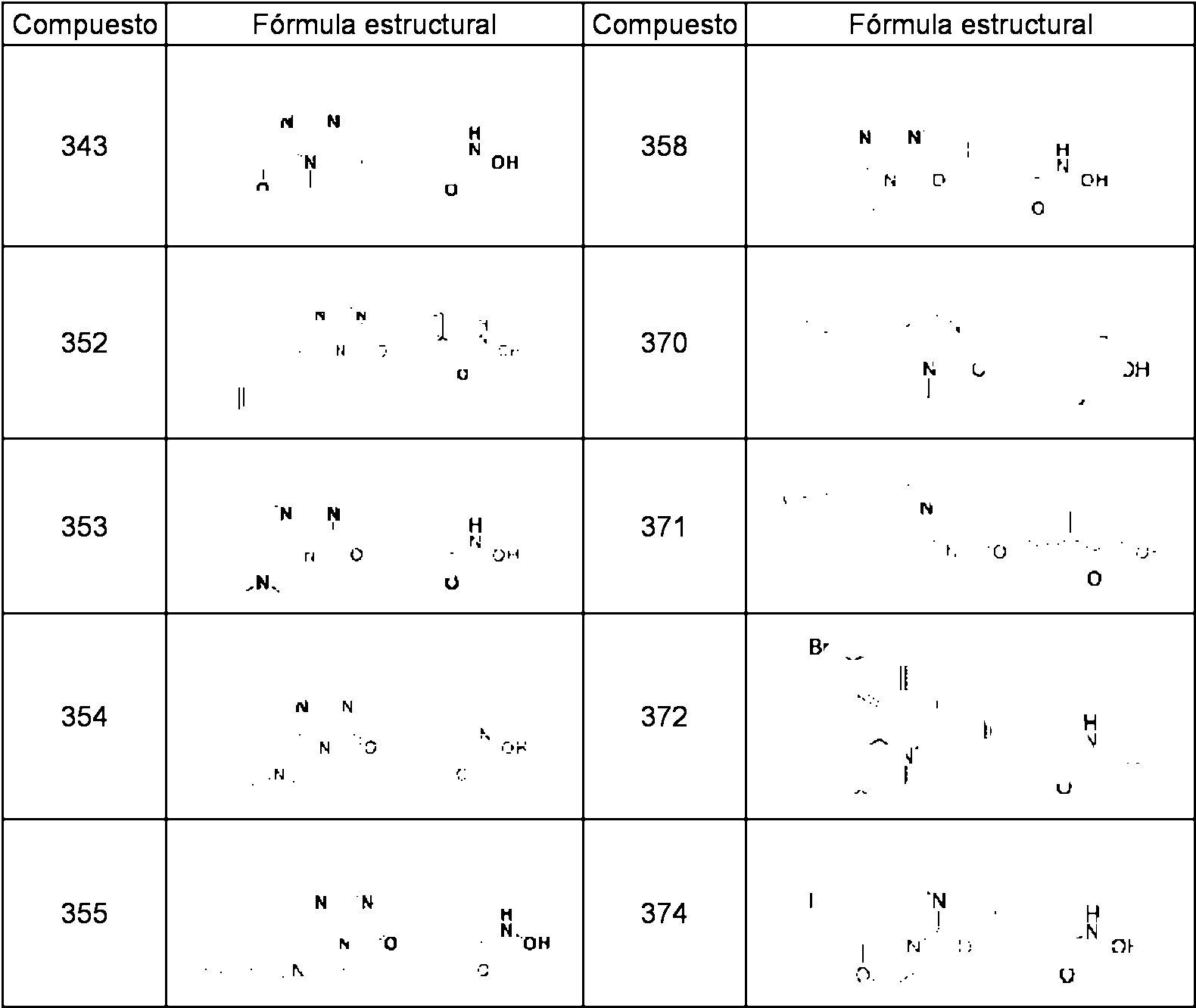


T l 1T l 1
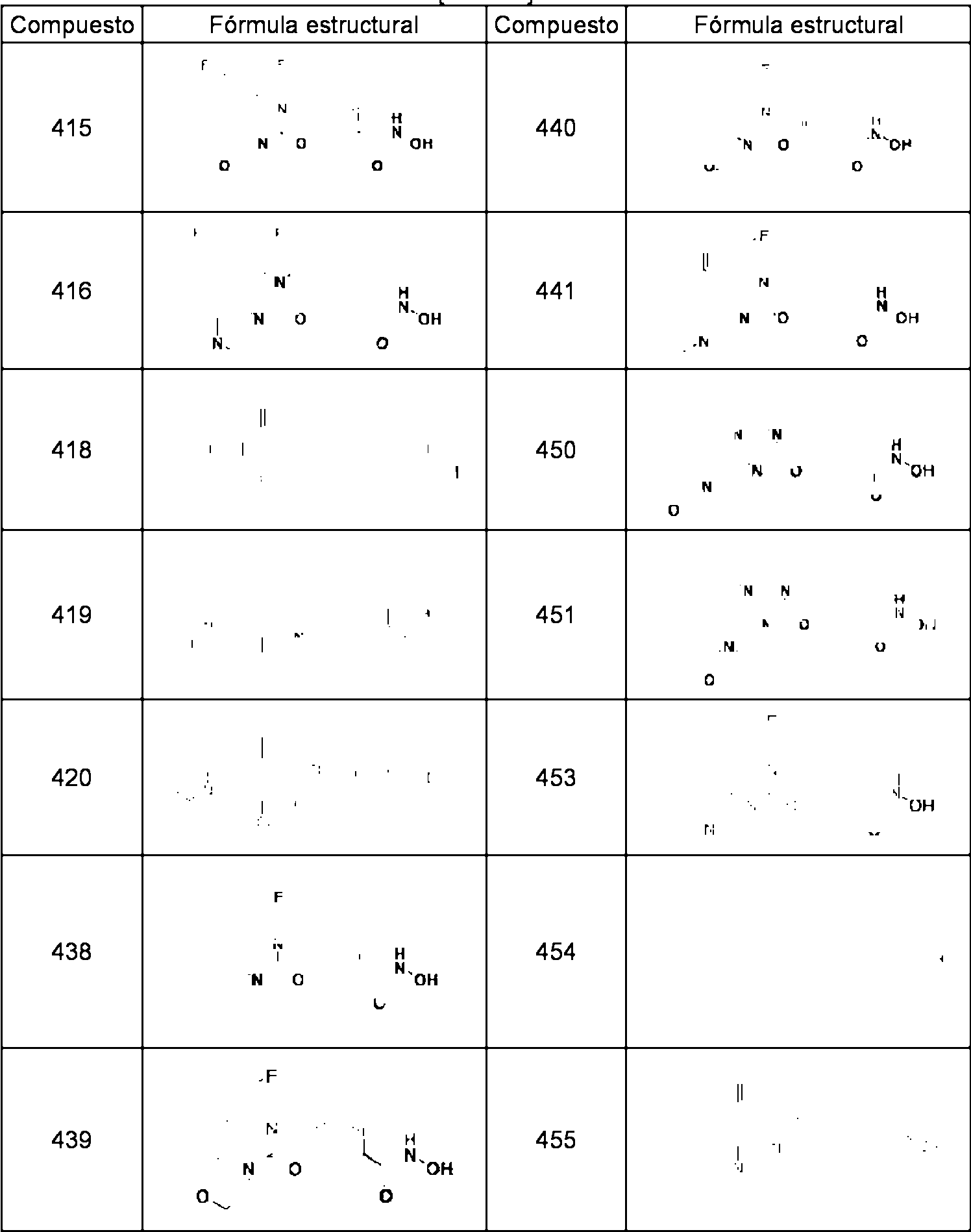
T l 71T l 71


T l 1T l 1


T l 11T l 11


T l 11T l 11

Protocolos para medición y análisis de actividades de compuestos de la invenciónProtocols for measurement and analysis of activities of compounds of the invention
Ejemplo 170: Determinación de la inhibición de actividades HDAC (in vitro)Example 170: Determination of inhibition of HDAC activities (in vitro)
Los inhibidores selectivos de la HDAC6 son críticos para la selectividad de la inhibición de la HDAC1, que produce efectos secundarios y, por lo tanto, se determinó la selectividad de enzimas HDAC1/6 y la selectividad celular (HDAC1: Acetilación de histona/HDAC6: Acetilación de tubulina).Selective HDAC6 inhibitors are critical for the selectivity of HDAC1 inhibition, which produces side effects and, therefore, the selectivity of HDAC1 / 6 enzymes and cell selectivity (HDAC1: Histone Acetylation / HDAC6: Acetylation of tubulin).
1. Ensayo de actividades HDAC (HDAC1 y HDAC6)1. Essay of HDAC activities (HDAC1 and HDAC6)
Las actividades inhibidoras de HDAC de materiales de ensayo se midieron usando el kit de ensayo de descubrimiento de fármacos fluorimétrico de HDAC1 (Enzolifesciences: BML-AK511) y una HDAC6 recombinante humana (Calbiochem: 382180). En el ensayo de HDAC1, las muestras se trataron con concentraciones de 100, 1000 y 10000 nM, y en el ensayo de HDAC6, las muestras se trataron con concentraciones de 0,1, 1, 10, 100 y 1000 nM. Después del tratamiento de las muestras, las muestras se hicieron reaccionar a 37 °C durante 60 minutos, se trataron con un revelador y después se hicieron reaccionar a 37 °C durante 30 minutos. Después, se midió la intensidad de fluorescencia (Ex 390, Em 460) usando el FlexStatin 3 (Molecular device).The HDAC inhibitory activities of test materials were measured using the fluorometric drug discovery assay kit of HDAC1 (Enzolifesciences: BML-AK511) and a recombinant human HDAC6 (Calbiochem: 382180). In the HDAC1 assay, the samples were treated with concentrations of 100, 1000 and 10000 nM, and in the HDAC6 assay, the samples were treated with concentrations of 0.1, 1, 10, 100 and 1000 nM. After the treatment of the samples, the samples were reacted at 37 ° C for 60 minutes, treated with a developer and then reacted at 37 ° C for 30 minutes. Then, the fluorescence intensity was measured (Ex 390, Em 460) using the FlexStatin 3 (Molecular device).
Los resultados se muestran en la tabla 14.The results are shown in table 14.
Tal como se muestra en la Tabla 14, los nuevos derivados de urea de la presente invención presentan una excelente selectividad por la enzima HDAC1/6.As shown in Table 14, the new urea derivatives of the present invention exhibit excellent selectivity for the HDAC1 / 6 enzyme.


Se confirmaron las actividades inhibidoras de los compuestos 255 y 374 sobre todas las HDAC (por Reaction Biology Corp.). Los resultados se muestran en la tabla 15:The inhibitory activities of compounds 255 and 374 were confirmed on all HDACs (by Reaction Biology Corp.). The results are shown in table 15:
[Tabla 11 A ivi inhi i r ^ HDA l m 2 5 y 374[Table 11 A ivi inhi i r ^ HDA l m 2 5 and 374

Tal como se muestra en la Tabla 15, se observó que el compuesto 255 tenía una selectividad de 160 veces por HDAC6: 0,001 uM y HDAC1: 0,16 uM y el compuesto 374 tenía una selectividad de 424 veces por HDAC6: 0,005 uM y HDAC1: 2,12 uM.As shown in Table 15, it was observed that compound 255 had a selectivity of 160 times by HDAC6: 0.001 uM and HDAC1: 0.16 uM and compound 374 had a selectivity of 424 times by HDAC6: 0.005 uM and HDAC1 : 2.12 uM.
2. Determinación de la acetilación de tubulina, histona H3 e histona H4 en células2. Determination of the acetylation of tubulin, histone H3 and histone H4 in cells
Para determinar la selectividad por HDAC6 en células, se midieron los niveles de acetilación de tubulina, histona H3 e histona H4 dependiendo de la concentración de compuestos mediante transferencia de Western.To determine the selectivity for HDAC6 in cells, acetylation levels of tubulin, histone H3 and histone H4 were measured depending on the concentration of compounds by Western blotting.
Se sembraron células RPMI8226 (1,0 x 10⁶ células/pocillo) en placas de seis pocillos y se trataron con fármacos (Compuestos 255 y 374) a cada concentración. Después de 24 horas, las proteínas se extrajeron con tampón RIPA y se cuantificaron por el método de Bradford. Se lisaron 25 |jg de proteína en tampón de muestra, se sometieron a electroforesis en un gel en gradiente del 4-12 % y después se transfirieron a membranas de nitrocelulosa durante 50 minutos. Después, la proteína transferida se bloqueó con leche desnatada al 5 % durante 1 hora. Se añadieron anticuerpos anti-acetil H3 (1:2,000), anti-acetil H4 (1:5,000), anti-acetil tubulina (1:5,000) y anti-p-actina (1:10,000) en leche desnatada al 5 % y las membranas se sumergieron en leche desnatada, se hicieron reaccionar a 4 °C durante 16 horas y después se lavaron tres veces durante 10 minutos cada vez con TBS-T 1X. Después, se añadió anticuerpo IgG-HRP (1:5,000) en leche desnatada al 5 % y posteriormente las membranas se sumergieron en la leche desnatada, se hicieron reaccionar a temperatura ambiente durante 40 minutos y después se lavaron tres veces durante -10 minutos cada vez con TBS-T 1X. Después, se determinaron los niveles de acetilación con un LAS 3000 usando solución de ECL. RPMI8226 cells (1.0 x 10 6 cells / well) were seeded in six-well plates and treated with drugs (Compounds 255 and 374) at each concentration. After 24 hours, the proteins were extracted with RIPA buffer and quantified by the Bradford method. 25 μg of protein were lysed in sample buffer, electrophoresed on a gradient gel of 4-12% and then transferred to nitrocellulose membranes for 50 minutes. Then, the transferred protein was blocked with 5% skimmed milk for 1 hour. Anti-acetyl H3 (1: 2,000), anti-acetyl H4 (1: 5,000), anti-acetyl tubulin (1: 5,000) and anti-p-actin (1: 10,000) antibodies were added in 5% skimmed milk and the membranes were immersed in skimmed milk, reacted at 4 ° C for 16 hours and then washed three times for 10 minutes each time with TBS-T 1X. Then, IgG-HRP antibody (1: 5,000) was added in 5% skim milk and subsequently the membranes were immersed in the skimmed milk, reacted at room temperature for 40 minutes and then washed three times for -10 minutes each once with TBS-T 1X. Then, the acetylation levels were determined with a LAS 3000 using ECL solution.
Los resultados se muestran en las figuras 1 y 2.The results are shown in figures 1 and 2.
Como se muestra en las figuras 1 y 2, se observó que el compuesto 255 (FIG. 1) y el compuesto 374 (FIG. 2) tenían excelentes actividades a bajas concentraciones, ya que la acetilación de tubulina (HDAC6) se expresó a una baja concentración de aproximadamente 10 nM. Por el contrario, se observó que el compuesto 255 y el compuesto 374 tenían una actividad pequeña o nula a bajas concentraciones, ya que la acetilación de histona (HDAC1) se expresó a una concentración de 1 uM de compuesto 255 y 10 uM de compuesto 374. Por lo tanto, a partir de la diferencia en la concentración expresada de tubulina e histona, se observó que los nuevos compuestos de urea de la presente invención tienen una excelente selectividad celular.As shown in Figures 1 and 2, it was observed that compound 255 (FIG.1) and compound 374 (FIG.2) had excellent activities at low concentrations, since acetylation of tubulin (HDAC6) was expressed at a low concentration of approximately 10 nM. On the contrary, it was observed that compound 255 and compound 374 had little or no activity at low concentrations, since histone acetylation (HDAC1) was expressed at a concentration of 1 uM of compound 255 and 10 uM of compound 374 Therefore, from the difference in the expressed concentration of tubulin and histone, it was observed that the new urea compounds of the present invention have excellent cellular selectivity.
Ejemplo 170: Eficacia de los compuestos 254, 255 y 374 en modelos de artritis inducida por colágenoExample 170: Efficacy of compounds 254, 255 and 374 in models of collagen-induced arthritis
Se determinó la eficacia de los nuevos derivados de urea de la presente invención sobre el tratamiento de la artritis en modelos de artritis inducida por colágeno.The efficacy of the new urea derivatives of the present invention on the treatment of arthritis in models of collagen-induced arthritis was determined.
Se preparó una emulsión mezclando colágeno bovino de tipo II (Chondrex) y adyuvante completo de Freund (Chondrex) a una relación de 1:1 hasta que se midió la viscosidad usando una pipeta de 1 ml. Cada 100 ul de emulsión se inyectó por vía intradérmica en la cola de ratones DBA/1J para la primera inmunización. Después de 21 días, se preparó una emulsión mezclando colágeno bovino de tipo II y adyuvante incompleto de Freund (Chondrex) a una relación de 1:1 por el mismo método que se ha indicado anteriormente. Cada 100 ul de emulsión se inyectó por vía intradérmica en la parte superior de la cola de ratones DBA/1J para la segunda inmunización de refuerzo. Después de la segunda inmunización de refuerzo, los ratones se agruparon según el peso corporal, se administró el fármaco de ensayo a cada grupo y los efectos de los fármacos de ensayo se midieron midiendo la puntuación clínica y el peso corporal. Las puntuaciones clínicas se asignaron de 0 a 4, y la puntuación clínica total se determinó evaluando el pie de cada ratón y sumando las puntuaciones (normal: 0, el edema más grave: 16). Es decir, la eficacia en los modelos de artritis se evaluó con la gravedad del edema de la articulación, y se asignó una puntuación superior al edema más grave.An emulsion was prepared by mixing bovine type II collagen (Chondrex) and complete Freund's adjuvant (Chondrex) at a ratio of 1: 1 until the viscosity was measured using a 1 ml pipette. Each 100 ul of emulsion was injected intradermally into the tail of DBA / 1J mice for the first immunization. After 21 days, an emulsion was prepared by mixing bovine type II collagen and incomplete Freund's adjuvant (Chondrex) at a ratio of 1: 1 by the same method as indicated above. Each 100 ul of emulsion was injected intradermally in the upper part of the tail of DBA / 1J mice for the second booster immunization. After the second booster immunization, the mice were pooled by body weight, the test drug was administered to each group and the effects of the test drugs were measured by measuring clinical score and body weight. The clinical scores were assigned from 0 to 4, and the total clinical score was determined by evaluating the foot of each mouse and adding the scores (normal: 0, the most severe edema: 16). That is, the efficacy in arthritis models was evaluated with the severity of the joint edema, and a higher score was assigned to the more severe edema.
Los resultados experimentales anteriores se muestran en las figuras 3 y 4.The previous experimental results are shown in Figures 3 and 4.
Como se muestra en la figura 3, la puntuación clínica del grupo de vehículo fue de 11,6 y la del grupo tratado con compuesto 254 en una cantidad de 30 mg/kg dos veces al día fue de 6,4, a partir de lo cual puede verse que los síntomas de artritis se mejoraron en más de un 40 %. Además, las puntuaciones clínicas de los grupos tratados con compuesto 255 en una cantidad de 10 y 30 mg/kg dos veces al día fueron de 5,2 y 6,5, a partir de lo cual puede verse que los síntomas de artritis se mejoraron en más de un 50 %. Además, como se muestra en la figura 4, la puntuación clínica del grupo de vehículo (v) fue de 6,7 y las del grupo tratado con compuesto 374 a diferentes concentraciones fueron de 2,8 y 2,5, a partir de lo cual puede verse que los síntomas de artritis se mejoraron en más de un 60 %. Es decir, se observó edema grave en el grupo de vehículo no tratado con fármacos, mientras que el edema se redujo significativamente en el grupo tratado con los nuevos compuestos de urea de la presente invención, a partir de lo cual puede verse que los síntomas de artritis se redujeron significativamente.As shown in Figure 3, the clinical score of the vehicle group was 11.6 and that of the group treated with compound 254 in an amount of 30 mg / kg twice a day was 6.4, from which can be seen that the arthritis symptoms were improved by more than 40%. In addition, the clinical scores of the groups treated with compound 255 in an amount of 10 and 30 mg / kg twice a day were 5.2 and 6.5, from which it can be seen that the symptoms of arthritis were improved. in more than 50%. In addition, as shown in Figure 4, the clinical score of the vehicle group (v) was 6.7 and those of the group treated with compound 374 at different concentrations were 2.8 and 2.5, from which can be seen that the arthritis symptoms were improved by more than 60%. That is, severe edema was observed in the vehicle group not treated with drugs, while the edema was significantly reduced in the group treated with the new urea compounds of the present invention, from which it can be seen that the symptoms of arthritis were significantly reduced.
Ejemplo 171: Eficacia de los compuestos 255, 374 y 461 en modelos de artritis inducida por adyuvanteExample 171: Efficacy of compounds 255, 374 and 461 in models of adjuvant-induced arthritis
Se determinó la eficacia de los nuevos derivados de urea de la presente invención sobre el tratamiento de la artritis en modelos de artritis inducida por adyuvante.The efficacy of the new urea derivatives of the present invention on the treatment of arthritis in models of adjuvant-induced arthritis was determined.
Se mezcló suficientemente adyuvante completo de Freund (Chondrex) que contenía 10 mg/ml de toxina de micobacteria inactivada por calor y, después, se cogieron 100 ul y se inyectaron por vía intradérmica en la parte superior de la cola de ratas Lewis para inducir artritis. Después de 10 días, se midió la longitud de la circunferencia del tobillo de las ratas y, después, las ratas se agruparon y se usaron en el experimento. Cada compuesto se inyectó por vía intraperitoneal dos veces al día. La puntuación clínica, la longitud de la circunferencia del tobillo y el peso se midieron dos veces una semana después de la administración de los compuestos. Las puntuaciones clínicas se asignaron de 0 a 4 basándose en la tesis de Woods, etc. (J. Immunology, 1214-1222, 2001), y la puntuación clínica total se determinó evaluando el pie de cada rata y sumando las puntuaciones (normal: 0, el edema más grave: 16). La longitud de la circunferencia del tobillo se calculó basándose en la fórmula de 2 X 3,14(V(a2+b2/2)) después de medir los lados superior-inferior (a) del pie y los lados laterales (b) del pie. El valor final se determinó calculando el promedio de los valores calculados para cada pie.Freund's complete adjuvant (Chondrex) containing 10 mg / ml of heat-inactivated mycobacterium toxin was sufficiently mixed and 100 ul was then taken and injected intradermally into the upper tail of Lewis rats to induce arthritis . After 10 days, the length of the ankle circumference of the rats was measured and then the rats were pooled and used in the experiment. Each compound was injected intraperitoneally twice a day. The clinical score, the length of the ankle circumference and the weight were measured twice a week after the administration of the compounds. Clinical scores were assigned from 0 to 4 based on Woods' thesis, etc. (J. Immunology, 1214-1222, 2001), and the total clinical score was determined by evaluating the foot of each rat and adding the scores (normal: 0, the most severe edema: 16). The length of the ankle circumference was calculated based on the formula of 2 X 3.14 (V (a2 + b2 / 2)) after measuring the upper-lower sides (a) of the foot and the lateral sides (b) of the foot. The final value was determined by calculating the average of the calculated values for each foot.
Los resultados se muestran en la figura 5. En la figura 5, (A) muestra los resultados experimentales del compuesto 255, (B) muestra los resultados experimentales del compuesto 374 y (C) muestra los resultados experimentales del compuesto 461. En (A) de la figura 5, la puntuación clínica del grupo de vehículo fue de 4,9 y las de los grupos experimentales tratados con compuesto 255 en una cantidad de 3, 10 y 30 mg/kg dos veces al día fueron de 3,0, 2,6 y 0,7, a partir de lo cual puede verse que los síntomas de artritis se mejoraron en un 40 a un 90 %. En (B) de la figura 5, la puntuación clínica del grupo de vehículo fue de 8,1 y las de los grupos experimentales tratados con compuesto 374 en una cantidad de 3, 10 y 30 mg/kg dos veces al día fueron de 2,5, 0,8 y 1,3, a partir de lo cual puede verse que los síntomas de artritis se mejoraron en un 70 a un 90 %. En todos los experimentos, la comparación de los compuestos 255 y 374 con el compuesto de control Tofacitinib revela que tienen una eficacia equivalente. En (C) de la figura 5, la puntuación clínica del grupo de vehículo fue de 4,2 y las de los grupos experimentales tratados con compuesto 461 en una cantidad de 25 y 50 mg/kg dos veces al día fueron de 1,9 y 1,3, a partir de lo cual puede verse que los síntomas de artritis se mejoraron en más de un 50 a un 70 %, que fue un valor superior al de MTX usado como grupo de control. Ejemplo 172: Eficacia de los compuestos 254 y 255 en modelos de colitisThe results are shown in Figure 5. In Figure 5, (A) shows the experimental results of compound 255, (B) shows the experimental results of compound 374 and (C) shows the experimental results of compound 461. In (A) ) of figure 5, the clinical score of the vehicle group was 4.9 and those of the experimental groups treated with compound 255 in an amount of 3, 10 and 30 mg / kg twice a day were 3.0, 2.6 and 0.7, from which it can be seen that the symptoms of arthritis were improved by 40 to 90%. In (B) of figure 5, the clinical score of the vehicle group was 8.1 and those of the experimental groups treated with compound 374 in an amount of 3, 10 and 30 mg / kg twice a day were 2 , 5, 0.8 and 1.3, from which it can be seen that the symptoms of arthritis were improved by 70 to 90%. In all the experiments, the comparison of the compounds 255 and 374 with the control compound Tofacitinib reveals that they have equivalent efficacy. In (C) of figure 5, the clinical score of the vehicle group was 4.2 and those of the experimental groups treated with compound 461 in an amount of 25 and 50 mg / kg twice daily were 1.9 and 1.3, from which it can be seen that arthritis symptoms were improved by more than 50 to 70%, which was higher than the value of MTX used as a control group. Example 172: Efficacy of compounds 254 and 255 in colitis models
Se determinó la eficacia de los nuevos derivados de urea de la presente invención sobre el tratamiento de la colitis en modelos de colitis.The efficacy of the new urea derivatives of the present invention on the treatment of colitis in colitis models was determined.
Se disolvió dextrano sulfato sódico al 3,0 % (DSS: MP biomedicals) en agua desionizada y se suministró a ratones C57BL/6J de 9 semanas de edad durante 5 a 7 días y después se les suministró agua normalmente a los ratones para inducir colitis en modelos animales. Los animales experimentales se clasificaron en un grupo de control con disolvente y cada grupo tratado con compuesto 254 y compuesto 255 como materiales de ensayo basándose en el peso corporal de los animales experimentales. El material de ensayo se administró por vía intraperitoneal dos veces al día después de 8 días desde que se suministró el DSS. La evaluación de la eficacia en modelos de colitis se realizó determinando el grado en el que se recuperó el peso, perdido debido a la enfermedad, a un nivel normal y los resultados se muestran en la figura 6.3.0% sodium dextran sulfate (DSS: MP biomedicals) was dissolved in deionized water and was supplied to 9-week-old C57BL / 6J mice for 5 to 7 days and then the mice were normally given water to induce colitis in animal models. The experimental animals were classified in a solvent control group and each group treated with compound 254 and compound 255 as test materials based on the body weight of the experimental animals. The test material was administered intraperitoneally twice a day after 8 days from the time the DSS was delivered. The evaluation of efficacy in colitis models was performed by determining the degree to which the weight was recovered, lost due to the disease, to a normal level and the results are shown in figure 6.
Como se muestra en la figura 6, los pesos de los modelos en los que se indujo la enfermedad se redujeron hasta un valor de 17,5 a 18 g y después se recuperaron hasta un valor de 18,5 a 19,0 g mediante la administración de compuesto 254 y hasta un valor de 19 a 19.5 g mediante la administración de compuesto 255, lo que indica que la eficacia era excelente. Como resultado, se confirmó la eficacia de los nuevos derivados de urea sobre el tratamiento de la colitis. Ejemplo 173: Actividades anticancerosas en mieloma múltipleAs shown in Figure 6, the weights of the models in which the disease was induced were reduced to a value of 17.5 to 18 g and then recovered to a value of 18.5 to 19.0 g by administration of compound 254 and up to a value of 19 to 19.5 g by the administration of compound 255, indicating that the efficacy was excellent. As a result, the efficacy of the new urea derivatives on the treatment of colitis was confirmed. Example 173: Anti-cancer activities in multiple myeloma
Se determinó la eficacia de los nuevos derivados de urea de la presente invención sobre el tratamiento del mieloma múltiple mediante transferencia de western, Ensayo de MTT e índice de combinación.The efficacy of the new urea derivatives of the present invention was determined on the treatment of multiple myeloma by western blotting, MTT assay and combination index.
1. Determinación de la acetilación de tubulina, Histona H3 e Histona H41. Determination of the acetylation of tubulin, Histone H3 and Histone H4
Se determinó la acetilación de tubulina, histona H3 e histona H4 en células RPMI8226 (1,0 x 10⁶ células/pocillo) derivadas de mieloma de la misma manera que se realizó la determinación de células en el ejemplo 1.The acetylation of tubulin, histone H3 and histone H4 in RPMI8226 cells (1.0 x 10⁶ cells / well) derived from myeloma was determined in the same manner as the determination of cells in example 1 was carried out.
Los resultados se muestran en las figuras 1 y 2.The results are shown in figures 1 and 2.
Como se muestra en las figuras 1 y 2, se observó que los compuestos 255 y 374 tienen eficacia sobre el tratamiento de mieloma múltiple con excelente sensibilidad celular.As shown in Figures 1 and 2, it was observed that compounds 255 and 374 have efficacy over the treatment of multiple myeloma with excellent cellular sensitivity.
2. Determinación de la viabilidad celular2. Determination of cell viability
Se sembraron células RPMI 8226 en una placa de 96 pocillos de fondo en U a 3 x 10⁵ células/ml en 180 pl por pocillo y se añadieron 20 pl de material de ensayo a la placa. Las células se incubaron en una incubadora humidificada con un 5 % de CO2 a 37 °C durante 48 horas y se añadieron 20 pl de solución de bromuro de 2-(4,5-dimetiltiazol-2-il)-2,5-difeniltetrazolio (MTT) a 5 mg/ml disuelta en PBS y la mezcla se incubó de nuevo durante 4 horas. Después de la formación de formazán, se retiró el medio completamente, se añadieron 200 pl de DMSO y después se midió la absorbancia usando un lector de microplacas a 570 nm.RPMI 8226 cells were seeded in a 96-well bottom U-plate at 3 x 10 5 cells / ml in 180 μl per well and 20 μl of test material was added to the plate. The cells were incubated in a humidified incubator with 5% CO 2 at 37 ° C for 48 hours and 20 μl of 2- (4,5-dimethylthiazol-2-yl) -2,5-diphenyltetrazolium bromide solution was added. (MTT) at 5 mg / ml dissolved in PBS and the mixture was incubated again for 4 hours. After formation of formazan, the medium was completely removed, 200 pl of DMSO was added and then the absorbance was measured using a microplate reader at 570 nm.
3. Determinación del índice de combinación (IC) para el tratamiento combinado3. Determination of the combination index (IC) for the combined treatment
Para el análisis cuantitativo de la interacción de fármacos entre los nuevos compuestos de urea de la presente invención y Velcade (BOZ) bien conocido como agente terapéutico para el mieloma múltiple, se calculó el índice de combinación (IC) de fracciones celulares sobre la citotoxicidad producida por los fármacos basándose en la curva de dosis-respuesta de tratamientos individuales y combinados. Para el análisis de la interacción entre dos fármacos, el IC se midió usando el programa informático Compusyn software (Combosyn Inc.) de acuerdo con el método de Chou y Talalay (CompuSyn de Ting-Chao Chou y Nick Martin, 2005). El IC es la relación de dosis de dos agentes anticancerosos tratados con la dosis de dos agentes anticancerosos en el punto que representa los efectos citotóxicos equivalentes. CI<1, CI=1 y CI>1 se interpreta como sinergia, aditividad y antagonismo, respectivamente.For the quantitative analysis of drug interaction between the new urea compounds of the present invention and Velcade (BOZ) well known as a therapeutic agent for multiple myeloma, the combination index (CI) of cell fractions on the cytotoxicity produced was calculated. by the drugs based on the dose-response curve of individual and combined treatments. For the analysis of the interaction between two drugs, the CI was measured using Compusyn software software (Combosyn Inc.) according to the Chou and Talalay method (CompuSyn by Ting-Chao Chou and Nick Martin, 2005). The IC is the dose ratio of two anticancer agents treated with the dose of two anticancer agents at the point representing the equivalent cytotoxic effects. CI <1, CI = 1 and CI> 1 is interpreted as synergy, additivity and antagonism, respectively.
Los resultados se muestran en la tabla 16 y en la figura 7. The results are shown in table 16 and in figure 7.

Como se muestra en la tabla 16 y en la figura 7, la eficacia de la combinación de dos fármacos puede determinarse por el índice de combinación (IC) y el efecto de combinación es excelente cuando este índice no es menor de 1. En el caso del compuesto 255, el IC no es menor que 1 en la mayoría de las dosis, a partir de lo cual puede verse que el efecto de la combinación es excelente. As shown in Table 16 and Figure 7, the efficacy of the combination of two drugs can be determined by the combination index (CI) and the combination effect is excellent when this index is not less than 1. In the case of compound 255, the IC is not less than 1 in most doses, from which it can be seen that the effect of the combination is excellent.
Claims (8)


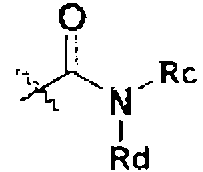


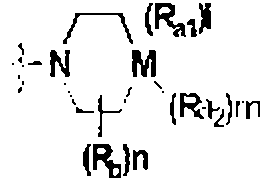


Applications Claiming Priority (2)
| Application Number | Priority Date | Filing Date | Title |
|---|---|---|---|
| KR20130047212 | 2013-04-29 | ||
| PCT/KR2014/003776 WO2014178606A1 (en) | 2013-04-29 | 2014-04-29 | Novel compounds for selective histone deacetylase inhibitors, and pharmaceutical composition comprising the same |
Publications (1)
| Publication Number | Publication Date |
|---|---|
| ES2697775T3 true ES2697775T3 (en) | 2019-01-28 |
Family
ID=51843665
Family Applications (1)
| Application Number | Title | Priority Date | Filing Date |
|---|---|---|---|
| ES14792173T Active ES2697775T3 (en) | 2013-04-29 | 2014-04-29 | Novel compounds for selective histone deacetylase inhibitors and pharmaceutical composition comprising the same |
Country Status (20)
| Country | Link |
|---|---|
| US (1) | US9878986B2 (en) |
| EP (1) | EP2991982B1 (en) |
| JP (1) | JP6117430B2 (en) |
| KR (1) | KR101645379B1 (en) |
| CN (1) | CN105358556B (en) |
| AU (1) | AU2014260605B2 (en) |
| BR (1) | BR112015027114B1 (en) |
| CA (1) | CA2908542C (en) |
| DK (1) | DK2991982T3 (en) |
| ES (1) | ES2697775T3 (en) |
| HR (1) | HRP20181647T1 (en) |
| HU (1) | HUE041881T2 (en) |
| MX (1) | MX372861B (en) |
| MY (1) | MY184756A (en) |
| NZ (1) | NZ712696A (en) |
| PH (1) | PH12015502425B1 (en) |
| PL (1) | PL2991982T3 (en) |
| PT (1) | PT2991982T (en) |
| RU (1) | RU2634694C2 (en) |
| WO (1) | WO2014178606A1 (en) |
Families Citing this family (26)
| Publication number | Priority date | Publication date | Assignee | Title |
|---|---|---|---|---|
| KR101494594B1 (en) | 2011-08-30 | 2015-02-23 | 주식회사 종근당 | Sustained-release lipid pre-concentrate of pharmacologically active substance and pharmaceutical composition comprising the same |
| KR101601035B1 (en) | 2013-02-28 | 2016-03-08 | 주식회사 종근당 | Composition for gene delivery comprising chitosan and liquid crystal formation material |
| TW201636329A (en) | 2015-02-02 | 2016-10-16 | 佛瑪治療公司 | Bicyclo[4,6,0]hydroxamic acid as HDAC inhibitor |
| PL3292116T3 (en) | 2015-02-02 | 2022-02-21 | Valo Health, Inc. | 3-aryl-4-amido-bicyclic [4,5,0]hydroxamic acids as hdac inhibitors |
| US9809539B2 (en) | 2015-03-03 | 2017-11-07 | Shuttle Pharmaceuticals, Llc | Dual function molecules for histone deacetylase inhibition and ataxia telangiectasia mutated activation and methods of use thereof |
| HRP20200554T1 (en) | 2015-05-22 | 2020-07-24 | Chong Kun Dang Pharmaceutical Corp. | COMPOUNDS OF HETEROCYCLIC ALKYL DERIVATIVES SERVING AS SELECTIVE HISTON DEACETYLASE INHIBITORS AND PHARMACEUTICAL PREPARATIONS CONTAINING THEM |
| MX383920B (en) | 2016-05-26 | 2025-03-14 | Recurium Ip Holdings Llc | Egfr inhibitor compounds |
| EP3472131B1 (en) | 2016-06-17 | 2020-02-19 | Forma Therapeutics, Inc. | 2-spiro-5- and 6-hydroxamic acid indanes as hdac inhibitors |
| ES2914123T3 (en) | 2017-01-09 | 2022-06-07 | Shuttle Pharmaceuticals Inc | Selective histone deacetylase inhibitors for the treatment of a human disease |
| US11584733B2 (en) | 2017-01-09 | 2023-02-21 | Shuttle Pharmaceuticals, Inc. | Selective histone deacetylase inhibitors for the treatment of human disease |
| WO2018165520A1 (en) | 2017-03-10 | 2018-09-13 | Vps-3, Inc. | Metalloenzyme inhibitor compounds |
| KR102236356B1 (en) | 2017-11-24 | 2021-04-05 | 주식회사 종근당 | Compositions for Preventing or Treating Lupus |
| CN112004537A (en) | 2018-01-09 | 2020-11-27 | 穿梭药业公司 | Selective histone deacetylase inhibitors for the treatment of human disease |
| KR20190099952A (en) * | 2018-02-20 | 2019-08-28 | 주식회사 종근당 | Compositions for Preventing or Treating Uveitis |
| KR20190118251A (en) * | 2018-04-10 | 2019-10-18 | 주식회사 종근당 | Compositions for Preventing or Treating Dry Eye |
| WO2020076129A1 (en) * | 2018-10-12 | 2020-04-16 | Chong Kun Dang Pharmaceutical Corp. | Pharmaceutical composition comprising histone deacetylase inhibitor and methotrexate |
| US20220008414A1 (en) * | 2018-11-23 | 2022-01-13 | Chong Kun Dang Pharmaceutical Corp. | Pharmaceutical composition comprising histone deacetylase 6 inhibitors |
| JP2022538284A (en) | 2019-06-27 | 2022-09-01 | ザ ジョージ ワシントン ユニバーシティ, ア コングレッショナリー チャータード ノット-フォー-プロフィット コーポレイション | HDAC6-activated macrophages, compositions and uses thereof |
| AU2020321955A1 (en) | 2019-07-30 | 2022-03-17 | Eikonizo Therapapeutics, Inc. | HDAC6 inhibitors and uses thereof |
| EP4037670A4 (en) * | 2019-10-03 | 2023-09-27 | Tenaya Therapeutics, Inc. | 5-fluoronicotinamide derivatives and uses thereof |
| BR112022007623A2 (en) * | 2019-10-23 | 2022-07-12 | Chong Kun Dang Pharmaceutical Corp | COMPOSITIONS TO PREVENT OR TREAT CHRONIC OBSTRUCTIVE PULMONARY DISEASES (COPD) |
| MX2022007376A (en) | 2019-12-20 | 2022-09-02 | Tenaya Therapeutics Inc | FLUOROALQULL-OXADIAZOLES AND THEIR USES. |
| KR20220134744A (en) | 2021-03-26 | 2022-10-05 | 주식회사 종근당 | Composition for Preventing or Treating Multiple Sclerosis |
| WO2023073600A1 (en) * | 2021-10-29 | 2023-05-04 | Chong Kun Dang Pharmaceutical Corp. | Compositions for preventing or treating idiopathic pulmonary fibrosis (ipf) |
| TW202345813A (en) | 2022-04-08 | 2023-12-01 | 美商艾科尼佐療法股份有限公司 | Oxadiazole hdac6 inhibitors and uses thereof |
| CN117247336A (en) * | 2022-06-10 | 2023-12-19 | 上海医药工业研究院有限公司 | A hydroxamic acid compound that inhibits HDAC6 and its preparation method and application |
Family Cites Families (22)
| Publication number | Priority date | Publication date | Assignee | Title |
|---|---|---|---|---|
| US771760A (en) | 1902-07-12 | 1904-10-04 | David M Balch | Process of treating seaweed. |
| US5369108A (en) | 1991-10-04 | 1994-11-29 | Sloan-Kettering Institute For Cancer Research | Potent inducers of terminal differentiation and methods of use thereof |
| US6174905B1 (en) | 1996-09-30 | 2001-01-16 | Mitsui Chemicals, Inc. | Cell differentiation inducer |
| PE20020354A1 (en) | 2000-09-01 | 2002-06-12 | Novartis Ag | HYDROXAMATE COMPOUNDS AS HISTONE-DESACETILASE (HDA) INHIBITORS |
| JP4975941B2 (en) | 2000-09-29 | 2012-07-11 | トポターゲット ユーケー リミテッド | (E) -N-hydroxy-3- (3-sulfamoyl-phenyl) acrylamide compound and therapeutic use thereof |
| AR035513A1 (en) | 2000-12-23 | 2004-06-02 | Hoffmann La Roche | DERIVATIVES OF TETRAHYDROPIRIDINE, PROCESS TO PREPARE THEM, PHARMACEUTICAL COMPOSITIONS CONTAINING THEM, AND USE OF SUCH COMPOUNDS IN THE PREPARATION OF MEDICINES |
| US6897220B2 (en) | 2001-09-14 | 2005-05-24 | Methylgene, Inc. | Inhibitors of histone deacetylase |
| JPWO2003070691A1 (en) * | 2002-02-21 | 2005-06-09 | 財団法人大阪産業振興機構 | N-hydroxycarboxamide derivatives |
| TW200530166A (en) * | 2003-10-27 | 2005-09-16 | S Bio Pte Ltd | Acylurea connected and sulfonylurea connected hydroxamates |
| MXPA06010900A (en) | 2004-03-26 | 2007-02-21 | Methylgene Inc | Inhibitors of histone deacetylase. |
| US20100152188A1 (en) | 2005-08-05 | 2010-06-17 | Akella Satya Surya Visweswara Srinivas | Novel Heterocyclic Compounds |
| US20080255149A1 (en) | 2005-09-27 | 2008-10-16 | Novartis Ag | Carboxyamine Compounds and Methods of Use Thereof |
| GB0521244D0 (en) * | 2005-10-19 | 2005-11-30 | Astrazeneca Ab | Benzamide compounds |
| JP2010536876A (en) * | 2007-08-21 | 2010-12-02 | アークル インコーポレイテッド | HDAC inhibitor |
| CN101230049A (en) * | 2008-02-27 | 2008-07-30 | 中国药科大学 | Hydroxamic acid histone deacetylase inhibitor and its preparation method and use |
| KR101168801B1 (en) * | 2009-03-27 | 2012-07-25 | 주식회사종근당 | Novel hydroxamate derivatives, method for the preparation thereof, and pharmaceutical composition containing the same |
| EP2305643A1 (en) | 2009-10-02 | 2011-04-06 | Ikerchem, S.L. | New histone deacetylase inhibitors based simultaneously on trisubstituted 1h-pyrroles and aromatic and heteroaromatic spacers |
| WO2011106632A1 (en) | 2010-02-26 | 2011-09-01 | Millennium Pharmaceuticals, Inc. | Substituted hydroxamic acids and uses thereof |
| AU2012212323A1 (en) | 2011-02-01 | 2013-09-12 | The Board Of Trustees Of The University Of Illinois | HDAC inhibitors and therapeutic methods using the same |
| CA2850757A1 (en) * | 2011-10-03 | 2013-04-11 | The Trustees Of Columbia University In The City Of New York | Novel molecules that selectively inhibit histone deacetylase 6 relative to histone deacetylase 1 |
| CN103906732A (en) | 2011-10-28 | 2014-07-02 | 株式会社钟根堂 | Hydroxamate derivatives for hdac inhibitor, and the pharmaceutical composition comprising thereof |
| KR101685639B1 (en) | 2014-01-03 | 2016-12-12 | 주식회사 종근당 | Indole Derivatives Compound, and the pharmaceutical composition comprising the same |
-
2014
- 2014-04-29 BR BR112015027114-6A patent/BR112015027114B1/en active IP Right Grant
- 2014-04-29 DK DK14792173.8T patent/DK2991982T3/en active
- 2014-04-29 NZ NZ712696A patent/NZ712696A/en unknown
- 2014-04-29 CN CN201480024266.8A patent/CN105358556B/en active Active
- 2014-04-29 PL PL14792173T patent/PL2991982T3/en unknown
- 2014-04-29 RU RU2015150946A patent/RU2634694C2/en active
- 2014-04-29 JP JP2016511675A patent/JP6117430B2/en active Active
- 2014-04-29 MX MX2015014962A patent/MX372861B/en active IP Right Grant
- 2014-04-29 EP EP14792173.8A patent/EP2991982B1/en active Active
- 2014-04-29 HR HRP20181647TT patent/HRP20181647T1/en unknown
- 2014-04-29 US US14/785,812 patent/US9878986B2/en active Active
- 2014-04-29 KR KR1020140051151A patent/KR101645379B1/en active Active
- 2014-04-29 AU AU2014260605A patent/AU2014260605B2/en active Active
- 2014-04-29 ES ES14792173T patent/ES2697775T3/en active Active
- 2014-04-29 WO PCT/KR2014/003776 patent/WO2014178606A1/en not_active Ceased
- 2014-04-29 PT PT14792173T patent/PT2991982T/en unknown
- 2014-04-29 CA CA2908542A patent/CA2908542C/en active Active
- 2014-04-29 MY MYPI2015703425A patent/MY184756A/en unknown
- 2014-04-29 HU HUE14792173A patent/HUE041881T2/en unknown
-
2015
- 2015-10-21 PH PH12015502425A patent/PH12015502425B1/en unknown
Also Published As
Similar Documents
| Publication | Publication Date | Title |
|---|---|---|
| ES2697775T3 (en) | Novel compounds for selective histone deacetylase inhibitors and pharmaceutical composition comprising the same | |
| ES2641478T3 (en) | 3-Acetylamino-1- (phenyl-heteroaryl-aminocarbonyl or phenyl-heteroaryl-carbonylamino) benzene derivatives for the treatment of hyperproliferative disorders | |
| ES2525252T3 (en) | Anthelmintic agents and their use | |
| JP5992615B2 (en) | Aromatic compounds substituted with cyclopropanecarboxamide, an anticancer drug | |
| JP7175888B2 (en) | Piperazine Derivatives as Selective HDAC1,2 Inhibitors | |
| CN111196804B (en) | TGF-beta R1 inhibitors and uses thereof | |
| ES2393822T3 (en) | New piperazine-amide derivatives | |
| ES2934986T3 (en) | heterocyclic derivatives | |
| MXPA03003007A (en) | Aliphatic nitrogenous five-membered ring compounds. | |
| ES2776680T3 (en) | Heterocycloalkyl-derived compounds as selective histone deacetylase inhibitors and pharmaceutical compositions comprising them | |
| CN111454233B (en) | 4- (2- (pyrrolidine/piperidine-1-yl) benzyl) -piperazinylurea TRPV1 antagonist and preparation and application thereof | |
| AU2016382372B2 (en) | Sulfonamide derivative and preparation method and use thereof | |
| WO2023192817A9 (en) | Inhibitors of the myst family of lysine acetyl transferases | |
| AU2014367284A1 (en) | WNT pathway modulators | |
| BR112018008204B1 (en) | COMPOUND, PHARMACEUTICAL COMPOSITION, AND METHOD FOR TREATMENT OF DISORDERS ASSOCIATED WITH IRREGULARITIES OF GLUTAMATERGIC SIGNAL TRANSMISSION AND DISORDERS OF THE CENTRAL NERVOUS SYSTEM | |
| JP2018503683A (en) | Pyrrolamide compound, production method and use thereof | |
| ES2725977T3 (en) | Methyl-1H-pyrazolalkylamine compounds that have multimodal activity against pain | |
| BR112019025836A2 (en) | aminopyrimidine compound, method of preparing it and using it | |
| HK1216532B (en) | Novel compounds for selective histone deacetylase inhibitors, and pharmaceutical composition comprising the same | |
| HK40001081A (en) | Substituted 2, 4-diamino-quinoline derivatives for use in the treatment of proliferative diseases | |
| KR20190063745A (en) | NEW COMPOUNDS FOR INHIBITING BINDING BETWEEN p34 PROTEIN AND NEDD4-1 PROTEIN AND USE THEREOF | |
| BR112018001720B1 (en) | COMPOUNDS OF 1,3,4-OXADIAZOLE SULFONAMIDE DERIVATIVE AS A HISTONE DEACETYLASE 6 INHIBITOR AND THE PHARMACEUTICAL COMPOSITION COMPRISING THE SAME |