ES2698511T3 - New condensed pyridine derivatives useful as inhibitors of c-met tyrosine kinase - Google Patents
New condensed pyridine derivatives useful as inhibitors of c-met tyrosine kinase Download PDFInfo
- Publication number
- ES2698511T3 ES2698511T3 ES13809182T ES13809182T ES2698511T3 ES 2698511 T3 ES2698511 T3 ES 2698511T3 ES 13809182 T ES13809182 T ES 13809182T ES 13809182 T ES13809182 T ES 13809182T ES 2698511 T3 ES2698511 T3 ES 2698511T3
- Authority
- ES
- Spain
- Prior art keywords
- compound
- phenyl
- yloxy
- dihydro
- oxo
- Prior art date
- Legal status (The legal status is an assumption and is not a legal conclusion. Google has not performed a legal analysis and makes no representation as to the accuracy of the status listed.)
- Active
Links
Classifications
-
- C—CHEMISTRY; METALLURGY
- C07—ORGANIC CHEMISTRY
- C07D—HETEROCYCLIC COMPOUNDS
- C07D471/00—Heterocyclic compounds containing nitrogen atoms as the only ring hetero atoms in the condensed system, at least one ring being a six-membered ring with one nitrogen atom, not provided for by groups C07D451/00 - C07D463/00
- C07D471/02—Heterocyclic compounds containing nitrogen atoms as the only ring hetero atoms in the condensed system, at least one ring being a six-membered ring with one nitrogen atom, not provided for by groups C07D451/00 - C07D463/00 in which the condensed system contains two hetero rings
- C07D471/04—Ortho-condensed systems
-
- A—HUMAN NECESSITIES
- A61—MEDICAL OR VETERINARY SCIENCE; HYGIENE
- A61K—PREPARATIONS FOR MEDICAL, DENTAL OR TOILETRY PURPOSES
- A61K31/00—Medicinal preparations containing organic active ingredients
- A61K31/33—Heterocyclic compounds
- A61K31/395—Heterocyclic compounds having nitrogen as a ring hetero atom, e.g. guanethidine or rifamycins
- A61K31/435—Heterocyclic compounds having nitrogen as a ring hetero atom, e.g. guanethidine or rifamycins having six-membered rings with one nitrogen as the only ring hetero atom
- A61K31/4353—Heterocyclic compounds having nitrogen as a ring hetero atom, e.g. guanethidine or rifamycins having six-membered rings with one nitrogen as the only ring hetero atom ortho- or peri-condensed with heterocyclic ring systems
-
- A—HUMAN NECESSITIES
- A61—MEDICAL OR VETERINARY SCIENCE; HYGIENE
- A61K—PREPARATIONS FOR MEDICAL, DENTAL OR TOILETRY PURPOSES
- A61K31/00—Medicinal preparations containing organic active ingredients
- A61K31/33—Heterocyclic compounds
- A61K31/395—Heterocyclic compounds having nitrogen as a ring hetero atom, e.g. guanethidine or rifamycins
- A61K31/435—Heterocyclic compounds having nitrogen as a ring hetero atom, e.g. guanethidine or rifamycins having six-membered rings with one nitrogen as the only ring hetero atom
- A61K31/4353—Heterocyclic compounds having nitrogen as a ring hetero atom, e.g. guanethidine or rifamycins having six-membered rings with one nitrogen as the only ring hetero atom ortho- or peri-condensed with heterocyclic ring systems
- A61K31/437—Heterocyclic compounds having nitrogen as a ring hetero atom, e.g. guanethidine or rifamycins having six-membered rings with one nitrogen as the only ring hetero atom ortho- or peri-condensed with heterocyclic ring systems the heterocyclic ring system containing a five-membered ring having nitrogen as a ring hetero atom, e.g. indolizine, beta-carboline
-
- A—HUMAN NECESSITIES
- A61—MEDICAL OR VETERINARY SCIENCE; HYGIENE
- A61P—SPECIFIC THERAPEUTIC ACTIVITY OF CHEMICAL COMPOUNDS OR MEDICINAL PREPARATIONS
- A61P25/00—Drugs for disorders of the nervous system
- A61P25/28—Drugs for disorders of the nervous system for treating neurodegenerative disorders of the central nervous system, e.g. nootropic agents, cognition enhancers, drugs for treating Alzheimer's disease or other forms of dementia
-
- A—HUMAN NECESSITIES
- A61—MEDICAL OR VETERINARY SCIENCE; HYGIENE
- A61P—SPECIFIC THERAPEUTIC ACTIVITY OF CHEMICAL COMPOUNDS OR MEDICINAL PREPARATIONS
- A61P27/00—Drugs for disorders of the senses
- A61P27/02—Ophthalmic agents
-
- A—HUMAN NECESSITIES
- A61—MEDICAL OR VETERINARY SCIENCE; HYGIENE
- A61P—SPECIFIC THERAPEUTIC ACTIVITY OF CHEMICAL COMPOUNDS OR MEDICINAL PREPARATIONS
- A61P35/00—Antineoplastic agents
-
- A—HUMAN NECESSITIES
- A61—MEDICAL OR VETERINARY SCIENCE; HYGIENE
- A61P—SPECIFIC THERAPEUTIC ACTIVITY OF CHEMICAL COMPOUNDS OR MEDICINAL PREPARATIONS
- A61P35/00—Antineoplastic agents
- A61P35/02—Antineoplastic agents specific for leukemia
-
- A—HUMAN NECESSITIES
- A61—MEDICAL OR VETERINARY SCIENCE; HYGIENE
- A61P—SPECIFIC THERAPEUTIC ACTIVITY OF CHEMICAL COMPOUNDS OR MEDICINAL PREPARATIONS
- A61P35/00—Antineoplastic agents
- A61P35/04—Antineoplastic agents specific for metastasis
-
- A—HUMAN NECESSITIES
- A61—MEDICAL OR VETERINARY SCIENCE; HYGIENE
- A61P—SPECIFIC THERAPEUTIC ACTIVITY OF CHEMICAL COMPOUNDS OR MEDICINAL PREPARATIONS
- A61P37/00—Drugs for immunological or allergic disorders
-
- A—HUMAN NECESSITIES
- A61—MEDICAL OR VETERINARY SCIENCE; HYGIENE
- A61P—SPECIFIC THERAPEUTIC ACTIVITY OF CHEMICAL COMPOUNDS OR MEDICINAL PREPARATIONS
- A61P37/00—Drugs for immunological or allergic disorders
- A61P37/02—Immunomodulators
-
- A—HUMAN NECESSITIES
- A61—MEDICAL OR VETERINARY SCIENCE; HYGIENE
- A61P—SPECIFIC THERAPEUTIC ACTIVITY OF CHEMICAL COMPOUNDS OR MEDICINAL PREPARATIONS
- A61P43/00—Drugs for specific purposes, not provided for in groups A61P1/00-A61P41/00
-
- A—HUMAN NECESSITIES
- A61—MEDICAL OR VETERINARY SCIENCE; HYGIENE
- A61P—SPECIFIC THERAPEUTIC ACTIVITY OF CHEMICAL COMPOUNDS OR MEDICINAL PREPARATIONS
- A61P9/00—Drugs for disorders of the cardiovascular system
-
- C—CHEMISTRY; METALLURGY
- C07—ORGANIC CHEMISTRY
- C07D—HETEROCYCLIC COMPOUNDS
- C07D401/00—Heterocyclic compounds containing two or more hetero rings, having nitrogen atoms as the only ring hetero atoms, at least one ring being a six-membered ring with only one nitrogen atom
- C07D401/02—Heterocyclic compounds containing two or more hetero rings, having nitrogen atoms as the only ring hetero atoms, at least one ring being a six-membered ring with only one nitrogen atom containing two hetero rings
- C07D401/12—Heterocyclic compounds containing two or more hetero rings, having nitrogen atoms as the only ring hetero atoms, at least one ring being a six-membered ring with only one nitrogen atom containing two hetero rings linked by a chain containing hetero atoms as chain links
-
- C—CHEMISTRY; METALLURGY
- C07—ORGANIC CHEMISTRY
- C07D—HETEROCYCLIC COMPOUNDS
- C07D498/00—Heterocyclic compounds containing in the condensed system at least one hetero ring having nitrogen and oxygen atoms as the only ring hetero atoms
- C07D498/02—Heterocyclic compounds containing in the condensed system at least one hetero ring having nitrogen and oxygen atoms as the only ring hetero atoms in which the condensed system contains two hetero rings
- C07D498/04—Ortho-condensed systems
-
- C—CHEMISTRY; METALLURGY
- C07—ORGANIC CHEMISTRY
- C07D—HETEROCYCLIC COMPOUNDS
- C07D513/00—Heterocyclic compounds containing in the condensed system at least one hetero ring having nitrogen and sulfur atoms as the only ring hetero atoms, not provided for in groups C07D463/00, C07D477/00 or C07D499/00 - C07D507/00
- C07D513/02—Heterocyclic compounds containing in the condensed system at least one hetero ring having nitrogen and sulfur atoms as the only ring hetero atoms, not provided for in groups C07D463/00, C07D477/00 or C07D499/00 - C07D507/00 in which the condensed system contains two hetero rings
- C07D513/04—Ortho-condensed systems
Landscapes
- Chemical & Material Sciences (AREA)
- Organic Chemistry (AREA)
- Health & Medical Sciences (AREA)
- Public Health (AREA)
- Pharmacology & Pharmacy (AREA)
- Veterinary Medicine (AREA)
- General Health & Medical Sciences (AREA)
- Medicinal Chemistry (AREA)
- Animal Behavior & Ethology (AREA)
- Life Sciences & Earth Sciences (AREA)
- Nuclear Medicine, Radiotherapy & Molecular Imaging (AREA)
- General Chemical & Material Sciences (AREA)
- Chemical Kinetics & Catalysis (AREA)
- Bioinformatics & Cheminformatics (AREA)
- Engineering & Computer Science (AREA)
- Epidemiology (AREA)
- Immunology (AREA)
- Biomedical Technology (AREA)
- Neurosurgery (AREA)
- Neurology (AREA)
- Oncology (AREA)
- Cardiology (AREA)
- Hospice & Palliative Care (AREA)
- Hematology (AREA)
- Heart & Thoracic Surgery (AREA)
- Psychiatry (AREA)
- Ophthalmology & Optometry (AREA)
- Pharmaceuticals Containing Other Organic And Inorganic Compounds (AREA)
- Nitrogen And Oxygen Or Sulfur-Condensed Heterocyclic Ring Systems (AREA)
- Nitrogen Condensed Heterocyclic Rings (AREA)
- Heterocyclic Carbon Compounds Containing A Hetero Ring Having Oxygen Or Sulfur (AREA)
Abstract
Un compuesto de fórmula I o una de sus sales farmacéuticamente aceptable:**Fórmula** en donde, B no está o es, O, S, OCH2 o SCH2; R1, R2, R3 y R4 son cada uno independientemente hidrógeno, halógeno, alquilo C1-6 sustituido o no sustituido, o carbamoilo, o o R1 y R2 a la vez, o R3 y R4 a la vez, forman =O; A es N o CH; n es 0, 1, 2 o 3; cada R5 es independientemente halógeno, o alquilo C1-6, Z es NHR6 o de fórmula II:**Fórmula** en donde R18 y R19 son cada uno independientemente hidrógeno, alquilo C1-8 sustituido o no sustituido o arilo C6-8 sustituido o no sustituido; R6 tiene la fórmula VI:**Fórmula** en donde: Q3 es hidrógeno; R8 es hidrógeno, o fenil sustituido con halógeno; y R9 es hidrógeno.A compound of formula I or a pharmaceutically acceptable salt thereof: ** Formula ** wherein, B is not or is, O, S, OCH2 or SCH2; R1, R2, R3 and R4 are each independently hydrogen, halogen, substituted or unsubstituted C1-6 alkyl, or carbamoyl, or or R1 and R2 at the same time, or R3 and R4 at the same time, form = O; A is N or CH; n is 0, 1, 2, or 3; each R5 is independently halogen, or C1-6 alkyl, Z is NHR6 or of formula II: ** Formula ** wherein R18 and R19 are each independently hydrogen, substituted or unsubstituted C1-8 alkyl, or substituted C6-8 aryl or unsubstituted; R6 has formula VI: ** Formula ** where: Q3 is hydrogen; R8 is hydrogen, or halogen-substituted phenyl; and R9 is hydrogen.
Description
DESCRIPCIÓNDESCRIPTION
Nuevos derivados de piridina condensados útiles como inhibidores de c-Met tirosina cinasaNew condensed pyridine derivatives useful as inhibitors of c-Met tyrosine kinase
Campo técnicoTechnical field
Esta invención se refiere a determinados nuevos derivados de piridina fusionados como inhibidores de c-Met, a su síntesis y a su uso para tratar un trastorno mediado por c-Met.This invention relates to certain new pyridine derivatives fused as inhibitors of c-Met, to their synthesis and to their use to treat a disorder mediated by c-Met.
Técnica anteriorPrevious technique
El estudio de las vías de transducción de señales en estados normales y patológicos es de considerable interés debido al posible beneficio terapéutico que surge de los nuevos agentes moleculares que se dirigen a algunas de estas vías relacionadas con la enfermedad.The study of signal transduction pathways in normal and pathological states is of considerable interest due to the possible therapeutic benefit that emerges from the new molecular agents that target some of these pathways related to the disease.
Las tirosina cinasas receptoras (RTK) son enzimas clave en las vías de transducción de señales que catalizan la autofosforilación de restos de tirosina en el dominio citosólico, C-terminal de la proteína. Esto genera sitios de acoplamiento para la captación de proteínas aguas abajo y la posterior propagación de señales involucradas en una serie de episodios celulares incluidos el crecimiento, la proliferación y la supervivencia. La señalización de la cinasa desregulada más generalmente está implicada en una serie diversa de estados patológicos incluidos trastornos inmunológicos e inflamatorios, enfermedades cardiovasculares y neurodegenerativas. Las tirosina cinasas receptoras conocidas abarcan 20 familias y muchos son oncogenes (Blume-Jensen et al. 2001. Nature 411 355-365). c-Met es el miembro prototípico de una subfamilia de RTK que incluye las proteínas Ron relacionadas (receptor de proteínas estimuladoras de macrófagos) y su ortólogo de pollo, Sea. El ligando endógeno es el factor de crecimiento de hepatocitos del factor de crecimiento y motilidad (HGF, también conocido como factor de dispersión). c-Met y HGF se expresan en una variedad de tipos de tejidos, aunque su expresión está normalmente restringida a células de origen epitelial y mesenquimatoso. En cambio, las células tumorales a menudo expresan c-Met activada constitutivamente. En la actualidad existe un conjunto creciente de pruebas convincentes, tanto en estudios con animales como en pacientes con cáncer, en que la señalización de HGF-Met desempeña una función importante en el desarrollo y la evolución del cáncer y está relacionada en particular con fenotipos invasivos. c-Met y HGF se expresan mucho en relación con el tejido circundante en numerosos cánceres y su expresión se correlaciona con un deficiente pronóstico del paciente (Jiang, W. et al. 1999 Crit. Rev. Oncol.-hematol., 29, 209-248.) Las mutaciones puntuales de activación en el dominio de cinasa de c-Met están implicadas en la causa de formas esporádicas y hereditarias de carcinoma renal papilar (Danilkovitch-Miagkova, A. et al. 2002. 1 J. Clin. Invest. 109, 863-867). c-Met es un marcador tanto para el cáncer como para la neoplasia y cabe esperar que los agentes que inhiben la señalización de c-Met-HGF mejoren la evolución de la enfermedad en cánceres relevantes.The receptor tyrosine kinases (RTK) are key enzymes in signal transduction pathways that catalyze the autophosphorylation of tyrosine residues in the cytosolic, C-terminal domain of the protein. This generates coupling sites for downstream protein uptake and the subsequent propagation of signals involved in a series of cellular events including growth, proliferation and survival. Deregulated kinase signaling is most often involved in a diverse series of disease states including immunological and inflammatory disorders, cardiovascular and neurodegenerative diseases. The known receptor tyrosine kinases span 20 families and many are oncogenes (Blume-Jensen et al., 2001. Nature 411 355-365). c-Met is the prototypical member of a subfamily of RTK that includes the related Ron proteins (receptor for macrophage stimulating proteins) and its chicken ortholog, Sea. The endogenous ligand is the hepatocyte growth factor of the growth factor and motility (HGF, also known as dispersion factor). c-Met and HGF are expressed in a variety of tissue types, although their expression is normally restricted to cells of epithelial and mesenchymal origin. In contrast, tumor cells often express constitutively activated c-Met. There is now a growing body of compelling evidence, both in animal studies and in cancer patients, in which HGF-Met signaling plays an important role in the development and evolution of cancer and is related in particular to invasive phenotypes . c-Met and HGF are highly expressed in relation to the surrounding tissue in numerous cancers and their expression correlates with a poor prognosis of the patient (Jiang, W. et al., 1999 Crit. Rev. Oncol.-hematol., 29, 209 -248.) Point activation mutations in the c-Met kinase domain are implicated in the cause of sporadic and hereditary forms of papillary renal carcinoma (Danilkovitch-Miagkova, A. et al., 2002. 1 J. Clin. . 109, 863-867). c-Met is a marker for both cancer and neoplasia and it is expected that agents that inhibit c-Met-HGF signaling will improve the course of the disease in relevant cancers.
El documento WO 2006/116713 A1 describe derivados sustituidos en 5 de 1,2,3,4-tetrahidro-1,8-naftiridina útiles en el tratamiento del cáncer y la angiogenia.WO 2006/116713 A1 describes derivatives substituted in 5 1,2,3,4-tetrahydro-1,8-naphthyridine useful in the treatment of cancer and angiogenesis.
El documento WO 2006/014325 A2 se refiere a quinazolinas y quinolinas que inhiben, regulan y/o modulan las vías de transducción de señales del receptor de cinasa relacionadas con los cambios en actividades celulares. En especial, estos compuestos inhibirán a c-Met, KDR y flt-3.WO 2006/014325 A2 refers to quinazolines and quinolines that inhibit, regulate and / or modulate the kinase receptor signal transduction pathways related to changes in cellular activities. In particular, these compounds will inhibit c-Met, KDR and flt-3.
Compendio de la invenciónCompendium of the invention
La presente invención se refiere a nuevos compuestos de piridina fusionados útiles como inhibidores de c-Met y para el tratamiento de afecciones mediadas por c-Met. Los compuestos de la invención tienen la estructura general como fórmula I:The present invention relates to novel fused pyridine compounds useful as inhibitors of c-Met and for the treatment of conditions mediated by c-Met. The compounds of the invention have the general structure as formula I:
Un compuesto de fórmula I o una de sus sales farmacéuticamente aceptable:A compound of formula I or a pharmaceutically acceptable salt thereof:

en donde,where,
B no está o es, O, S, OCH2 o SCH2 ;B is not or is, O, S, OCH 2 or SCH 2 ;
R1, R2, R3 y R4 son cada uno independientemente hidrógeno, halógeno, alquilo C1-6 sustituido o no sustituido, o carbamoílo, o R 1 , R 2 , R 3 and R 4 are each independently hydrogen, halogen, substituted or unsubstituted C 1-6 alkyl, or carbamoyl, or
o Ri y R2 a la vez, o R3 y R4 a la vez, forman =O;or Ri and R 2 at the same time, or R 3 and R 4 at the same time, form = O;
A es N oCH;A is N oCH;
n es 0 , 1 , 2 ;n is 0 , 1 , 2 ;
cada R5 es independientemente halógeno, o alquilo C1-6,each R 5 is independently halogen or C 1 alkyl - 6,
Z es NHR6 o de fórmula II:Z is NHR 6 or of formula II:

en donde R18 y R19 son cada uno independientemente hidrógeno, alquilo C1-8 sustituido o no sustituido o arilo C6-8 sustituido o no sustituido;wherein R 18 and R 19 are each independently hydrogen, substituted or unsubstituted C 1-8 alkyl or substituted or unsubstituted C6-8 aryl;
R6 tiene la fórmula VI:R6 has the formula VI:

en donde:where:
Q3 es hidrógeno;Q 3 is hydrogen;
R8 es hidrógeno, o fenil sustituido con halógeno; yR 8 is hydrogen, or phenyl substituted with halogen; Y
R9 es hidrógeno.R 9 is hydrogen.
La presente invención proporciona además algunas soluciones técnicas preferidas con respecto al compuesto de fórmula (I).The present invention also provides some preferred technical solutions with respect to the compound of formula (I).
En algunas realizaciones de fórmula (I), R1, R2 , R3 y R4 son cada uno independientemente hidrógeno, halógeno, alquilo C1-4 sustituido o no sustituido o carbamoílo; oIn some embodiments of formula (I), R 1 , R 2 , R 3 and R 4 are each independently hydrogen, halogen, substituted or unsubstituted C 1-4 alkyl or carbamoyl; or
R1 y R2 a la vez, o R3 y R4 a la vez, forman =O.R 1 and R 2 at the same time, or R 3 and R 4 at the same time, form = O.
En algunas realizaciones de fórmula (I), R1, R2, R3 y R4 son cada uno independientemente hidrógeno, F, o metilo; o R1 y R2 a la vez, o R3 y R4 a la vez, forman =O.In some embodiments of formula (I), R 1 , R 2 , R 3 and R 4 are each independently hydrogen, F, or methyl; or R 1 and R 2 at the same time, or R 3 and R 4 at the same time, form = O.
En algunas realizaciones de fórmula (I), R1, R2, R3 y R4 son todos hidrógeno.In some embodiments of formula (I), R 1 , R 2 , R 3 and R 4 are all hydrogen.
En algunas realizaciones de fórmula (I), R1 y R2 a la vez, o R3 y R4 a la vez forman =O.In some embodiments of formula (I), R 1 and R 2 at the same time, or R 3 and R 4 at the same time form = O.
En algunas realizaciones de fórmula (I), n es 0 o 1.In some embodiments of formula (I), n is 0 or 1.
En algunas realizaciones de fórmula (I), R5 es halógeno o alquilo C1-4.In some embodiments of formula (I), R 5 is halogen or C 1 alkyl - 4.
En algunas realizaciones de fórmula (I), R5 es F o metilo.In some embodiments of formula (I), R 5 is F or methyl.
En algunas realizaciones de fórmula (I), B falta o es O.In some embodiments of formula (I), B is missing or is O.
En algunas realizaciones de fórmula (I), A es CH.In some embodiments of formula (I), A is CH.
En algunas realizaciones de fórmula (I), Z es de fórmula II en donde R18 y R19 son cada uno independientemente hidrógeno, alquilo C1-4 sustituido o no sustituido, en concreto metilo, etilo sustituido o no sustituido, propilo sustituido o no sustituido, arilo C6-8 sustituido o no sustituido.In some embodiments of formula (I), Z is of formula II wherein R 18 and R 19 are each independently hydrogen, substituted or unsubstituted C 1-4 alkyl, namely methyl, substituted or unsubstituted ethyl, substituted propyl or unsubstituted, substituted or unsubstituted C 6-8 aryl.
En algunas realizaciones de fórmula (I), Z es de fórmula II en donde R18 y R19 son cada uno independientemente hidrógeno, metilo o fenilo sustituido con halógeno. In some embodiments of formula (I), Z is of formula II wherein R 18 and R 19 are each independently hydrogen, methyl or phenyl substituted with halogen.
En algunas realizaciones de fórmula (I), Z es de fórmula II en donde R18 es metilo; y Rig es fenilo sustituido con F en la posición para.In some embodiments of formula (I), Z is of formula II wherein R 18 is methyl; and Rig is phenyl substituted with F in the para position.
En algunas realizaciones, el compuesto de fórmula (I) es de fórmula VIII:In some embodiments, the compound of formula (I) is of formula VIII:

en donde,where,
Ri, R2 , R3 y R4 son cada uno independientemente hidrógeno, halógeno; o alquilo C1 -3sustituido o no sustituido; o Ri y R2 a la vez, o R3 y R4 a la vez, forman =O;Ri, R 2 , R 3 and R 4 are each independently hydrogen, halogen; or substituted or unsubstituted C 1 -C 3 alkyl; or Ri and R 2 at the same time, or R 3 and R 4 at the same time, form = O;
cada R5 es independientemente halógeno, o alquilo C1-3 sustituido o no sustituido;each R 5 is independently halogen, or C 1-3 substituted or unsubstituted alkyl;
n es 0 o 1;n is 0 or 1;
Q3 es hidrógeno; yQ 3 is hydrogen; Y
R8 es hidrógeno o fenilo sustituido con halógeno; yR8 is hydrogen or phenyl substituted with halogen; Y
Rg es hidrógeno.Rg is hydrogen.
La presente invención proporciona además algunas soluciones técnicas preferidas de fórmula VIII:The present invention also provides some preferred technical solutions of formula VIII:
En algunas realizaciones del compuesto de fórmula VIII, Ri, R2 , R3 y R4 son cada uno independientemente hidrógeno o halógeno; o Ri y R2 a la vez, o R3 y R4 a la vez, forman =O.In some embodiments of the compound of formula VIII, Ri, R 2 , R 3 and R 4 are each independently hydrogen or halogen; or Ri and R 2 at the same time, or R 3 and R 4 at the same time, form = O.
En algunas realizaciones del compuesto de fórmula VIII, Ri, R2 , R3 y R4 son cada uno independientemente hidrógeno o halógeno.In some embodiments of the compound of formula VIII, Ri, R 2 , R 3 and R 4 are each independently hydrogen or halogen.
En algunas realizaciones del compuesto de fórmula VIII, Ri y R2 son cada uno F; y R3 y R4 son cada uno hidrógeno. En algunas realizaciones del compuesto de fórmula VIII, Ri y R2 son cada uno hidrógeno; y R3 y R4 son cada uno F. En algunas realizaciones del compuesto de fórmula VIII, Ri, R2 , R3 y R4 son cada uno hidrógeno.In some embodiments of the compound of formula VIII, Ri and R 2 are each F; and R 3 and R 4 are each hydrogen. In some embodiments of the compound of formula VIII, Ri and R 2 are each hydrogen; and R 3 and R 4 are each F. In some embodiments of the compound of formula VIII, Ri, R 2 , R 3 and R 4 are each hydrogen.
En algunas realizaciones del compuesto de fórmula VIII, Ri y R2 a la vez forman =O.In some embodiments of the compound of formula VIII, Ri and R 2 at the same time form = O.
En algunas realizaciones del compuesto de fórmula VIII, R3 y R4 a la vez forman =O.In some embodiments of the compound of formula VIII, R 3 and R 4 at the same time form = O.
En algunas realizaciones del compuesto de fórmula VIII, R5 es halógeno.In some embodiments of the compound of formula VIII, R 5 is halogen.
En algunas realizaciones del compuesto de fórmula VIII, R5 es F.In some embodiments of the compound of formula VIII, R 5 is F.
En algunas realizaciones del compuesto de fórmula VIII, R8 es fenilo sustituido con halógeno en la posición para. En algunas realizaciones del compuesto de fórmula VIII, R8 es fenilo sustituido con flúor en la posición para.In some embodiments of the compound of formula VIII, R8 is phenyl substituted with halogen in the para position. In some embodiments of the compound of formula VIII, R8 is phenyl substituted with fluorine in the para position.
La presente invención proporciona además algunas soluciones técnicas especialmente preferidas con respecto al compuesto de fórmula I. El compuesto es:The present invention also provides some especially preferred technical solutions with respect to the compound of formula I. The compound is:
N-(4-(2,3-dihidro-iH-pirrolo[2,3-b]piridin-4-iloxi)-3-fluorofenil)-5-(4-fluorofenil)-4-oxo-i,4-dihidropiridin-3-carboxamida; N-(3-fluoro-4-(3-oxo-3,4-dihidro-2H-pirido[3,2-b][i,4]oxazin-8-iloxi) fenil)-5-(4-fluorofenil) )-4-oxo-i,4-dihidropiridin-3-carboxamida;N- (4- (2,3-dihydro-iH-pyrrolo [2,3-b] pyridin-4-yloxy) -3-fluorophenyl) -5- (4-fluorophenyl) -4-oxo-i, 4- dihydropyridine-3-carboxamide; N- (3-fluoro-4- (3-oxo-3,4-dihydro-2H-pyrido [3,2-b] [1,4] oxazin-8-yloxy) phenyl) -5- (4-fluorophenyl) )) -4-oxo-i, 4-dihydropyridine-3-carboxamide;
N-(4-(3,4-dihidro-2H-pirido[3,2-b][i,4]oxazin-8-iloxi)-3-fluorofenil)-5-4-fluorofenil)-4-oxo-i,4-dihidropiridin-3-carboxamida;N- (4- (3,4-dihydro-2H-pyrido [3,2-b] [1,4] oxazin-8-yloxy) -3-fluorophenyl) -5-4-fluorophenyl) -4-oxo- i, 4-dihydropyridine-3-carboxamide;
N-(4-(3,4-dihidro-2H-pirido[3,2-b][i,4]oxazin-8-iloxi) fenil)-5-(4-fluorofenil)-4 oxo-i,4-dihidropiridin-3-carboxamida; N-(3-fluoro-4-(2-oxo-2,3-dihidro-1H-pirrolo[2,3-b]piridin-4-iloxi)fenil)-5-(4-fluorofenil)-4-oxo-1,4-dihidropiridin-3-carboxamida;N- (4- (3,4-dihydro-2H-pyrido [3,2-b] [1,4] oxazin-8-yloxy) phenyl) -5- (4-fluorophenyl) -4 oxo-i, 4 -dihydropyridine-3-carboxamide; N- (3-fluoro-4- (2-oxo-2,3-dihydro-1H-pyrrolo [2,3-b] pyridin-4-yloxy) phenyl) -5- (4-fluorophenyl) -4-oxo -1,4-dihydropyridine-3-carboxamide;
8-(6-(2-(4-fluorofenilamino)-1-metil-6-oxo-1,6-dihidropirimidin-5-il) piridin-3-iloxi)-2H-pirido[3,2-b][ 1,4]oxazin-3 (4H)-ona;8- (6- (2- (4-fluorophenylamino) -1-methyl-6-oxo-1,6-dihydropyrimidin-5-yl) pyridin-3-yloxy) -2H-pyrido [3,2-b] [ 1,4] oxazin-3 (4H) -one;
5-(5-(2,3-dihidro-1H-pirrolo[2,3-b]piridin-4-iloxi) piridin-2-il)-2-(4-fluorofenilamino)-3-metilpirimidin-4(3H) )-ona;5- (5- (2,3-dihydro-1H-pyrrolo [2,3-b] pyridin-4-yloxy) pyridin-2-yl) -2- (4-fluorophenylamino) -3-methylpyrimidin-4 (3H )) -one;
N-(4-(3,4-dihidro-2H-pirido[3,2-b][1,4]oxazin-8-iloxi)fenil)-5-(4-fluorofenil)-4-oxo-1, 4-dihidropiridin-3-carboxamida;N- (4- (3,4-dihydro-2H-pyrido [3,2-b] [1,4] oxazin-8-yloxy) phenyl) -5- (4-fluorophenyl) -4-oxo-1, 4-dihydropyridine-3-carboxamide;
[4-(3,4-dihidro-2H-pirido[3,2-b][1,4]tiazin-8-iloxi)-3-fluoro-fenil]-amida del ácido 5-(4-fluoro-feml)-4-oxo-1,4-dihidropiridin-3-carboxílico;[4- (3,4-Dihydro-2H-pyrido [3,2-b] [1,4] thiazin-8-yloxy) -3-fluoro-phenyl] -amide of 5- (4-fluoro-fem) -4-oxo-1,4-dihydropyridine-3-carboxylic acid;
[4-(3,4-dihidro-2H-pirido[3,2-b][1,4]tiazin-8-iloxi)-fenil]-amida del ácido 5-(4-fluoro-fenil)-4-oxo-1,4-dihidro-piridin-3-carboxílico;[4- (3,4-Dihydro-2H-pyrido [3,2-b] [1,4] thiazin-8-yloxy) -phenyl] -amide of 5- (4-fluoro-phenyl) -4- oxo-1,4-dihydro-pyridine-3-carboxylic acid;
5-[5-(3,4-dihidro-2H-pirido[3,2-b][1,4]tiazin-8-iloxi)-piridin-2-il]-2-(4-fluoro-fenilamino)-3-metil-3H-pirimidin-4-ona;5- [5- (3,4-dihydro-2H-pyrido [3,2-b] [1,4] thiazin-8-yloxy) -pyridin-2-yl] -2- (4-fluoro-phenylamino) -3-methyl-3H-pyrimidin-4-one;
5-[5-(3,3-dimetil-3,4-dihidro-2H-pirido[3,2-b][1,4]tiazin-8-iloxi)-piridin-2-il]-2-( 4-fluoro-fenilamino)-3-metil-3H-pirimidin-4- ona;5- [5- (3,3-dimethyl-3,4-dihydro-2H-pyrido [3,2-b] [1,4] thiazin-8-yloxy) -pyridin-2-yl] -2- ( 4-fluoro-phenylamino) -3-methyl-3H-pyrimidin-4-one;
[4-(3,3-dimetil-3,4-dihidro-2H-pirido[3,2-b][1,4]tiazin-8-iloxi)-3-fluoro-fenil]-amida del ácido 5-(4-fluoro-fenil)-4-oxo-1,4-dihidro-piridin-3-carboxílico;[4- (3,3-dimethyl-3,4-dihydro-2H-pyrido [3,2-b] [1,4] thiazin-8-yloxy) -3-fluoro-phenyl] -amide of 5- (4-fluoro-phenyl) -4-oxo-1,4-dihydro-pyridine-3-carboxylic acid;
[4-(3,3-dimetil-3,4-dihidro-2H-pirido[3,2-b][1,4]tiazin-8-iloxi)-fenil]-amida del ácido 5-(4-fluoro-fenil)-4-oxo-1,4-dihidropiridin-3-carboxílico;[4- (3,3-dimethyl-3,4-dihydro-2H-pyrido [3,2-b] [1,4] thiazin-8-yloxy) -phenyl] -amide of 5- (4-fluoro) phenyl) -4-oxo-1,4-dihydropyridine-3-carboxylic acid;
5- [5-(3,3-dimetil-3,4-dihidro-2H-pirido[3,2-b][1,4]oxazin-8-iloxi)-piridin-2-il]-2-(4-fluoro-fenilamino)-3-metil-3H-pirimidin-4-ona;5- [5- (3,3-dimethyl-3,4-dihydro-2H-pyrido [3,2-b] [1,4] oxazin-8-yloxy) -pyridin-2-yl] -2- ( 4-fluoro-phenylamino) -3-methyl-3H-pyrimidin-4-one;
[4-(3,3-dimetil-3,4-dihidro-2H-pirido[3,2-b][1,4]oxazin-8-iloxi)-3-fluoro-fenil]-amida del ácido 5-(4-fluoro-fenil)-4-oxo-1.4- dihidro-piridin-3-carboxílico;[4- (3,3-dimethyl-3,4-dihydro-2H-pyrido [3,2-b] [1,4] oxazin-8-yloxy) -3-fluoro-phenyl] -amide of 5- (4-fluoro-phenyl) -4-oxo-1,4-dihydro-pyridine-3-carboxylic acid;
[4-(3,3-dimetil-3,4-dihidro-2H-pirido[3,2-b][1,4]oxazin-8-iloxi)-fenil]-amida del ácido 5-(4-fluoro-fenil)-4-oxo-1,4-dihidropiridin-3-carboxílico;[4- (3,3-Dimethyl-3,4-dihydro-2H-pyrido [3,2-b] [1,4] oxazin-8-yloxy) -phenyl] -amide of 5- (4-fluoro) phenyl) -4-oxo-1,4-dihydropyridine-3-carboxylic acid;
[4-(6,7,8,9-tetrahidro-5-tia-1,9-diaza-benzociclohepten-4-iloxi)-fenil]-amida del ácido 5-(4-fluoro-fenil)-4-oxo-1,4-dihidro-piridin-3-carboxílico;5- (4-fluoro-phenyl) -4-oxo [4- (6,7,8,9-tetrahydro-5-thia-1,9-diaza-benzocyclohepten-4-yloxy) -phenyl] -amide -1,4-dihydro-pyridine-3-carboxylic acid;
2-(4-fluoro-fenilamino)-3-metil-5-[5-(6,7,8,9-tetrahidro-5-tia-1,9-diaza-benzociclohepten-4-iloxi)-piridin-2-il]-3H-pirimidin-4-ona;2- (4-Fluoro-phenylamino) -3-methyl-5- [5- (6,7,8,9-tetrahydro-5-thia-1,9-diaza-benzocyclohepten-4-yloxy) -pyridin-2 -yl] -3H-pyrimidin-4-one;
[3-fluoro-4-(6,7,8,9-tetrahidro-5-tia-1,9-diaza-benzociclohepten-4-iloxi)-fenil]-amida del ácido 5-(4-fluoro-fenil)-4-oxo-1.4- dihidro-piridin-3-carboxílico;[3-Fluoro-4- (6,7,8,9-tetrahydro-5-thia-1,9-diaza-benzocyclohepten-4-yloxy) -phenyl] -amide of 5- (4-fluoro-phenyl)] -4-oxo-1,4- dihydro-pyridine-3-carboxylic acid;
[3-fluoro-4-(6,7,8,9-tetrahidro-5-oxa-1,9-diaza-benzociclohepten-4-iloxi)-fenil]-amida del ácido 5-(4-fluoro-fenil)-4-oxo-1.4- dihidro-piridin-3-carboxílico;[3-Fluoro-4- (6,7,8,9-tetrahydro-5-oxa-1,9-diaza-benzocyclohepten-4-yloxy) -phenyl] -amide of 5- (4-fluoro-phenyl)] -4-oxo-1,4- dihydro-pyridine-3-carboxylic acid;
2-(4-fluoro-fenilamino)-3-metil-5-[5-(6,7,8,9-tetrahidro-5-oxa-1,9-diaza-benzociclohepten-4-iloxi)-piridin-2-il]-3H-pirimidin-4-ona;2- (4-Fluoro-phenylamino) -3-methyl-5- [5- (6,7,8,9-tetrahydro-5-oxa-1,9-diaza-benzocyclohepten-4-yloxy) -pyridin-2 -yl] -3H-pyrimidin-4-one;
4-(6,7,8,9-tetrahidro-5-oxa-1,9-diaza-benzociclohepten-4-iloxi)-fenil]-amida del ácido 5-(4-fluoro-fenil)-4-oxo-1,4-dihidro-piridin-3-carboxílico;5- (4-fluoro-phenyl) -4-oxo- 4- (6,7,8,9-tetrahydro-5-oxa-1,9-diaza-benzocyclohepten-4-yloxy) -phenyl] -amide 1,4-dihydro-pyridine-3-carboxylic acid;
N-(4-(3,4-dimetil-2,3,4,5-tetrahidropirido[3,2-b][1,4]oxazepin-9-iloxi) fenil)-5-(4-fluorofenil)-4-oxo-1,4-dihidropiridin-3-carboxamida;N- (4- (3,4-dimethyl-2,3,4,5-tetrahydropyrido [3,2-b] [1,4] oxazepin-9-yloxy) phenyl) -5- (4-fluorophenyl) - 4-oxo-1,4-dihydropyridine-3-carboxamide;
[4-(3,3-difluoro-2,3-dihidro-1H-pirrolo[2,3-b]piridin-4-iloxi)-3-fluoro-fenil]-amida del ácido 5-(4-fluoro-fenil)-4-oxo-1,4-dihidro-piridin-3-carboxílico;[4- (3,3-difluoro-2,3-dihydro-1H-pyrrolo [2,3-b] pyridin-4-yloxy) -3-fluoro-phenyl] -amide of 5- (4-fluoro- phenyl) -4-oxo-1,4-dihydro-pyridine-3-carboxylic acid;
N-(4-(2,2-difluoro-2,3-dihidro-1H-pirrolo[2,3-b]piridin-4-iloxi)-3-fluorofenil)-5-(4-fluorofenil)-4-oxo-1,4-dihidropiridin-3-carboxamida;N- (4- (2,2-difluoro-2,3-dihydro-1H-pyrrolo [2,3-b] pyridin-4-yloxy) -3-fluorophenyl) -5- (4-fluorophenyl) -4- oxo-1,4-dihydropyridine-3-carboxamide;
N-(4-(3',4'-dihidrospiro[ciclopropano-1,2'-pirido[3,2-b][1,4]oxazina]-8'-iloxi)-3-fluorofenil)-5-(4-fluorofenil)-4-oxo-1,4-dihidropiridin-3-carboxamida;N- (4- (3 ', 4'-dihydrospiro [cyclopropane-1,2'-pyrido [3,2-b] [1,4] oxazine] -8'-yloxy) -3-fluorophenyl) -5- (4-fluorophenyl) -4-oxo-1,4-dihydropyridine-3-carboxamide;
N-(3-fluoro-4-(2-(hidroximetil)-3,4-dihidro-2H-pirido[3,2-b][1,4]oxazin-8-iloxi)fenil)-5-(4-fluorofenil)-4-oxo-1,4-dihidropiridin-3-carboxamida; N- (3-fluoro-4- (2- (hydroxymethyl) -3,4-dihydro-2H-pyrido [3,2-b] [1,4] oxazin-8-yloxy) phenyl) -5- (4 -fluorophenyl) -4-oxo-1,4-dihydropyridine-3-carboxamide;
8-(2-fluoro-4-(5-(4-fluorofenil)-4-oxo-1,4-dihidropiridin-3-carboxainido)fenoxi)-3,4-dihidro-2H-pirido[3,2-b ][1,4]oxazina-2-carboxamida;8- (2-Fluoro-4- (5- (4-fluorophenyl) -4-oxo-1,4-dihydropyridine-3-carboxainido) phenoxy) -3,4-dihydro-2H-pyrido [3,2-b] ] [1,4] oxazine-2-carboxamide;
N-(4-(2-(aziridin-1-ilmetil)-3,4-dihidro-2H-pirido[3,2-b][1,4]oxazin-8-iloxi)-3-fluorofenil)-5-(4-fluorofenil)-4-oxo-1,4-dihidropiridin-3-carboxamida;N- (4- (2- (aziridin-1-ylmethyl) -3,4-dihydro-2H-pyrido [3,2-b] [1,4] oxazin-8-yloxy) -3-fluorophenyl) -5 - (4-fluorophenyl) -4-oxo-1,4-dihydropyridine-3-carboxamide;
N-(3-fluoro-4-(3-(2-hidroxietil)-2,3-dihidro-1H-pirrolo[2,3-b]piridin-4-iloxi)fenil)-5-(4-fluorofenilo)-4-oxo-1,4-dihidropiridin-3-carboxamida; oN- (3-Fluoro-4- (3- (2-hydroxyethyl) -2,3-dihydro-1H-pyrrolo [2,3-b] pyridin-4-yloxy) phenyl) -5- (4-fluorophenyl) -4-oxo-1,4-dihydropyridine-3-carboxamide; or
N-(3-fluoro-4-(2'-oxo-1 ', 2-dihidrospiro[ciclopropano-1,3-pirrolo[2,3-b]piridina]-4-iloxi) fenil)-5-(4-fluorofenil)-4-oxo-1,4-dihidropiridin-3-carboxamida.N- (3-fluoro-4- (2'-oxo-1 ', 2-dihydrospiro [cyclopropane-1,3-pyrrolo [2,3-b] pyridine] -4-yloxy) phenyl) -5- (4 -fluorophenyl) -4-oxo-1,4-dihydropyridine-3-carboxamide.
La presente invención también proporciona una composición farmacéutica que comprende al menos un compuesto descrito en la presente memoria y al menos un excipiente farmacéuticamente aceptable, tal como hidroxipropilmetil celulosa. En la composición, la relación en peso del compuesto al excipiente puede estar comprendida dentro del intervalo, p. ej., de aproximadamente 0,0001 a aproximadamente 10.The present invention also provides a pharmaceutical composition comprising at least one compound described herein and at least one pharmaceutically acceptable excipient, such as hydroxypropylmethyl cellulose. In the composition, the weight ratio of the compound to the excipient may be within the range, e.g. eg, from about 0.0001 to about 10.
La presente invención proporcionó adicionalmente un uso de la composición farmacéutica descrita en la presente memoria para la preparación de un medicamento.The present invention further provided a use of the pharmaceutical composition described herein for the preparation of a medicament.
En algunas realizaciones, un medicamento preparado de este modo puede usarse para el tratamiento o prevención del cáncer, metástasis del cáncer, enfermedad cardiovascular, un trastorno inmunológico o un trastorno ocular. In some embodiments, a medicament prepared in this way can be used for the treatment or prevention of cancer, cancer metastasis, cardiovascular disease, an immunological disorder or an eye disorder.
En algunas realizaciones, un medicamento preparado de este modo puede usarse para retrasar o prevenir la evolución de la enfermedad en cáncer, metástasis de cáncer, enfermedad cardiovascular, un trastorno inmunológico o un trastorno ocular.In some embodiments, a medicament prepared in this way can be used to delay or prevent the progression of the disease in cancer, cancer metastasis, cardiovascular disease, an immunological disorder or an eye disorder.
En algunas realizaciones, un medicamento preparado de este modo puede usarse para tratar o retrasar la evolución o aparición de cáncer, la metástasis de cáncer, la enfermedad cardiovascular, un trastorno inmunológico o un trastorno ocular.In some embodiments, a medicament prepared in this way can be used to treat or delay the progression or onset of cancer, metastasis of cancer, cardiovascular disease, an immunological disorder or an eye disorder.
En algunas realizaciones, un medicamento preparado de este modo puede usarse para el tratamiento o prevención del cáncer, la metástasis del cáncer, la enfermedad cardiovascular, un trastorno inmunológico o un trastorno ocular. In some embodiments, a medicament prepared in this way can be used for the treatment or prevention of cancer, cancer metastasis, cardiovascular disease, an immunological disorder or an eye disorder.
En algunas realizaciones, un medicamento preparado de este modo puede usarse para retrasar o prevenir la evolución de la enfermedad en cáncer, la metástasis de cáncer, la enfermedad cardiovascular, un trastorno inmunológico o un trastorno ocular.In some embodiments, a medicament prepared in this way can be used to delay or prevent the progression of the disease in cancer, metastasis of cancer, cardiovascular disease, an immunological disorder or an eye disorder.
En algunas realizaciones, un medicamento preparado de este modo puede usarse para tratar o retrasar la evolución o aparición de cáncer, la metástasis de cáncer, la enfermedad cardiovascular, un trastorno inmunológico o un trastorno ocular.In some embodiments, a medicament prepared in this way can be used to treat or delay the progression or onset of cancer, metastasis of cancer, cardiovascular disease, an immunological disorder or an eye disorder.
En algunas realizaciones, un medicamento preparado de este modo puede usarse como inhibidor de c-Met. Además, la presente invención proporciona al menos un compuesto para uso en el tratamiento del cáncer, la prevención de la metástasis del cáncer o el tratamiento de la enfermedad cardiovascular, un trastorno inmunológico o un trastorno ocular.In some embodiments, a medicament prepared in this way can be used as a c-Met inhibitor. In addition, the present invention provides at least one compound for use in the treatment of cancer, the prevention of cancer metastasis or the treatment of cardiovascular disease, an immunological disorder or an eye disorder.
En algunas realizaciones, un medicamento preparado de este modo puede usarse para tratar a un paciente que tiene una afección que está mediada por la actividad de la proteína cinasa. Ejemplos de la proteína cinasa incluyen KDR, Tie-2, Flt3, FGFR3, Abl, Aurora A, c-Src, IGF-IR, ALK, c-MET, RON, PAK1, PAK2yTAK1.In some embodiments, a medicament prepared in this way can be used to treat a patient having a condition that is mediated by protein kinase activity. Examples of the protein kinase include KDR, Tie-2, Flt3, FGFR3, Abl, Aurora A, c-Src, IGF-IR, ALK, c-MET, RON, PAK1, PAK2, andTAK1.
En algunas realizaciones, la afección mediada por la actividad de la proteína cinasa es el cáncer.In some embodiments, the condition mediated by the protein kinase activity is cancer.
Los ejemplos de cáncer incluyen un tumor sólido, un sarcoma, un fibrosarcoma, un osteoma, un melanoma, un retinoblastoma, un rabdomiosarcoma, un glioblastoma, un neuroblastoma, un teratocarcinoma, un tumor maligno hematopoyético, una ascitis maligna, cáncer de pulmón, cáncer de mama, cáncer colorrectal, cáncer renal, cáncer pancreático, cáncer de cabeza, cáncer de cuello, carcinoma hereditario de células renales papilares, carcinoma hepatocelular infantil y cáncer gástrico.Examples of cancer include a solid tumor, a sarcoma, a fibrosarcoma, an osteoma, a melanoma, a retinoblastoma, a rhabdomyosarcoma, a glioblastoma, a neuroblastoma, a teratocarcinoma, a malignant hematopoietic tumor, a malignant ascites, lung cancer, cancer of breast, colorectal cancer, renal cancer, pancreatic cancer, head cancer, neck cancer, hereditary papillary renal cell carcinoma, childhood hepatocellular carcinoma and gastric cancer.
También se proporciona al menos un compuesto como se describe en la presente memoria o una de sus sales farmacéuticamente aceptable para uso como medicamento.Also provided is at least one compound as described herein or a pharmaceutically acceptable salt thereof for use as a medicament.
Además, se proporciona al menos un compuesto como se describe en la presente memoria o una de sus sales farmacéuticamente aceptable para uso en el tratamiento del cáncer.In addition, at least one compound as described herein or a pharmaceutically acceptable salt thereof is provided for use in the treatment of cancer.
Los ejemplos de cáncer incluyen un tumor sólido, un sarcoma, un fibrosarcoma, un osteoma, un melanoma, un retinoblastoma, un rabdomiosarcoma, un glioblastoma, un neuroblastoma, un teratocarcinoma, un tumor maligno hematopoyético, una ascitis maligna, cáncer de pulmón, cáncer de mama, cáncer colorrectal, cáncer renal, cáncer pancreático, cáncer de cabeza, cáncer de cuello, carcinoma hereditario de células renales papilares, carcinoma hepatocelular infantil y cáncer gástrico. El término “halógeno”, como se emplea en la presente memoria, a menos que se indique de otra manera, significa flúor, cloro, bromo o yodo. Los grupos de halógeno preferidos incluyen F, Cl y Br. Examples of cancer include a solid tumor, a sarcoma, a fibrosarcoma, an osteoma, a melanoma, a retinoblastoma, a rhabdomyosarcoma, a glioblastoma, a neuroblastoma, a teratocarcinoma, a malignant hematopoietic tumor, a malignant ascites, lung cancer, cancer of breast, colorectal cancer, renal cancer, pancreatic cancer, head cancer, neck cancer, hereditary papillary renal cell carcinoma, carcinoma hepatocellular cancer and gastric cancer. The term "halogen", as used herein, unless otherwise indicated, means fluorine, chlorine, bromine or iodine. Preferred halogen groups include F, Cl and Br.
Como se emplea en la presente memoria, a menos que se indique lo contrario, alquilo incluye radicales hidrocarbonados monovalentes saturados que tienen restos lineales, ramificados o cíclicos. Por ejemplo, los radicales alquilo incluyen metilo, etilo, propilo, isopropilo, ciclopropilo, n-butilo, isobutilo, sec-butilo, t-butilo, ciclobutilo, n-pentilo, 3-(2-metil) butilo, 2-pentilo, 2-metilbutilo, neopentilo, ciclopentilo, n-hexilo, 2-hexilo, 2-metilpentilo y ciclohexilo. De manera similar, C1-8 , como en alquilo C1-8, se define para identificar el grupo que tiene 1, 2, 3, 4, 5, 6, 7 u 8 átomos de carbono en una configuración lineal o ramificada.As used herein, unless otherwise indicated, alkyl includes saturated monovalent hydrocarbon radicals having straight, branched or cyclic moieties. For example, alkyl radicals include methyl, ethyl, propyl, isopropyl, cyclopropyl, n-butyl, isobutyl, sec-butyl, t-butyl, cyclobutyl, n-pentyl, 3- (2-methyl) butyl, 2-pentyl, 2-methylbutyl, neopentyl, cyclopentyl, n-hexyl, 2-hexyl, 2-methylpentyl and cyclohexyl. Similarly, C 1-8, as in C 1 alkyl - 8, is defined to identify the group as having 1, 2, 3, 4, 5, 6, 7 or 8 carbon atoms in a straight or branched configuration.
Los grupos alquenilo y alquinilo incluyen alquenos y alquinos de cadena lineal o ramificada. Del mismo modo, "alquenilo C2-8" y "alquinilo C2-8"se refiere a radicales alquenilo o alquinilo que tienen 2, 3, 4, 5, 6, 7 u 8 átomos de carbono en una configuración lineal o abierta.The alkenyl and alkynyl groups include straight or branched chain alkenes and alkynes. Similarly, "alkenyl C 2-8" and "alkynyl C 2-8" refers to alkenyl or alkynyl radicals having 2, 3, 4, 5, 6, 7 or 8 carbon atoms in a linear or open configuration .
Los radicales alcoxilo son éteres oxigenados formados a partir de los grupos alquilo lineales, de cadena ramificada o cíclicos descritos anteriormente.The alkoxy radicals are oxygenated ethers formed from the linear, branched chain or cyclic alkyl groups described above.
El término "arilo", como se emplea en esta memoria, a menos que se indique lo contrario, se refiere a un sistema de anillo mono o policíclico no sustituido o sustituido que contiene átomos de anillo de carbono. Los arilos preferidos son sistemas de anillos aromáticos monocíclicos o bicíclicos de 6 a 10 eslabones. Fenilo y naftilo son arilos preferidos. El arilo más preferido es fenilo.The term "aryl", as used herein, unless otherwise indicated, refers to an unsubstituted or substituted monocyclic or polycyclic ring system containing carbon ring atoms. Preferred aryls are monocyclic or bicyclic aromatic ring systems of 6 to 10 links. Phenyl and naphthyl are preferred aryls. The most preferred aryl is phenyl.
El término "heterociclilo", como se emplea en esta memoria, a menos que se indique lo contrario, representa un sistema de anillo saturado monocíclico no sustituido o sustituido de tres a ocho eslabones que consta de átomos de carbono y de uno a tres heteroátomos seleccionados de N, O o S, y en donde los heteroátomos de nitrógeno o azufre se pueden oxidar opcionalmente, y el heteroátomo de nitrógeno opcionalmente se puede cuaternizar. El grupo heterociclilo puede estar unido a cualquier heteroátomo o átomo de carbono, lo que resulta en la creación de una estructura estable. Los ejemplos de dichos grupos heterociclo incluyen, entre otros, azetidinilo, pirrolidinilo, piperidinilo, piperazinilo, oxopiperazinilo, oxopiperidinilo, oxoazepinilo, azepinilo, tetrahidrofuranilo, dioxolanilo, tetrahidroimidazolilo, tetrahidrotiazolilo, tetrahidrooxazolilo, tetrahidropiranilo, morfolinilo, tiomorfolinilo, sulfóxido de tiamorfolinilo, tiamorfolinil sulfona y oxodiazolilo.The term "heterocyclyl", as used herein, unless otherwise indicated, represents an unsubstituted or substituted monocyclic saturated ring system of three to eight links consisting of carbon atoms and one to three selected heteroatoms. of N, O or S, and wherein the nitrogen or sulfur heteroatoms may optionally be oxidized, and the nitrogen heteroatom may optionally be quaternized. The heterocyclyl group can be attached to any hetero atom or carbon atom, resulting in the creation of a stable structure. Examples of such heterocycle groups include, among others, azetidinyl, pyrrolidinyl, piperidinyl, piperazinyl, oxopiperazinyl, oxopiperidinyl, oxoazepinyl, azepinyl, tetrahydrofuranyl, dioxolanyl, tetrahydroimidazolyl, tetrahydrothiazolyl, tetrahydrooxazolyl, tetrahydropyranyl, morpholinyl, thiomorpholinyl, thiamorpholinyl sulfoxide, thiamorpholinyl sulfone and oxodiazolil.
El término "heteroarilo", como se emplea en esta memoria, a menos que se indique lo contrario, representa un sistema de anillo aromático monocíclico no sustituido o sustituido de cinco o seis eslabones o un sistema de anillo heteroaromático benzo-fusionado de nueve o diez eslabones no sustituido o sustituido que consta de átomos de carbono y de uno a cuatro heteroátomos seleccionados de N, O o S y en el que los heteroátomos de nitrógeno o azufre opcionalmente pueden estar oxidados, y el heteroátomo de nitrógeno opcionalmente puede estar cuaternizado. El grupo heteroarilo puede estar unido a cualquier heteroátomo o átomo de carbono, lo que da lugar a la creación de una estructura estable. Los ejemplos de grupos heteroarilo incluyen, entre otros, tienilo, furanilo, imidazolilo, isoxazolilo, oxazolilo, pirazolilo, pirrolilo, tiazolilo, tiadiazolilo, triazolilo, piridilo, piridazinilo, indolilo, azaindolilo, indazolilo, benzimidazolilo, benzofuranilo, benzotienilo, benzisoxazolilo, benzoxazolilo, benzopirazolilo, benzotiazolilo, benzotiadiazolilo, benzotriazolilo, adenililo, quinolinilo o isoquinolino.The term "heteroaryl", as used herein, unless indicated to the contrary, represents an unsubstituted or substituted monocyclic aromatic ring system of five or six links or a benzo-fused heteroaromatic ring system of nine or ten. unsubstituted or substituted bonds consisting of carbon atoms and one to four heteroatoms selected from N, O or S and wherein the nitrogen or sulfur heteroatoms may optionally be oxidized, and the nitrogen heteroatom optionally may be quaternized. The heteroaryl group can be attached to any heteroatom or carbon atom, which results in the creation of a stable structure. Examples of heteroaryl groups include, among others, thienyl, furanyl, imidazolyl, isoxazolyl, oxazolyl, pyrazolyl, pyrrolyl, thiazolyl, thiadiazolyl, triazolyl, pyridyl, pyridazinyl, indolyl, azaindolyl, indazolyl, benzimidazolyl, benzofuranyl, benzothienyl, benzisoxazolyl, benzoxazolyl, benzopyrazolyl, benzothiazolyl, benzothiadiazolyl, benzotriazolyl, adenylyl, quinolinyl or isoquinolino.
El término "carbonilo" se refiere al grupo C(O).The term "carbonyl" refers to the group C (O).
El término "alcoxicarbonilo" se refiere a los ésteres de cadena lineal o ramificada de un derivado de ácido carboxílico de la presente invención del número de átomos de carbono especificado (p. ej., alcoxicarbonilo C1-6), o cualquier número dentro de este intervalo (p. ej., metiloxicarbonilo (MeOCO)-), etiloxicarbonilo o butiloxicarbonilo.The term "alkoxycarbonyl" refers to esters of linear or branched of a carboxylic acid derivative of the present invention the number of carbon atoms specified chain (eg alkoxycarbonyl C 1 -.. 6), or any number within this range (eg, methyloxycarbonyl (MeOCO) -), ethyloxycarbonyl or butyloxycarbonyl.
Siempre que el término "alquilo" o "arilo" o cualquiera de sus raíces de prefijo aparezcan en el nombre de un sustituyente (p. ej., aralquilo o dialquilamino) se interpretará que incluye las limitaciones dadas anteriormente para "alquilo" y "arilo". Los números designados de átomos de carbono (p. ej., C1-6) se referirán independientemente al número de átomos de carbono en un resto alquilo o a la porción alquilo de un sustituyente mayor en el que el alquilo aparece como su raíz prefijo.Whenever the term "alkyl" or "aryl" or any of its prefix roots appear in the name of a substituent (e.g., aralkyl or dialkylamino) it shall be construed as including the limitations given above for "alkyl" and "aryl"" Designated numbers of carbon atoms (e.g., C 1 -.. 6) shall refer independently to the number of carbon atoms in an alkyl or alkyl portion of a larger substituent in which alkyl appears as its prefix root.
El término "alquilsulfinilo" se refiere a alquilsulfonas de cadena lineal o ramificada del número de átomos de carbono especificado (p. ej., alquil C1-6 sulfonilo), o cualquier número dentro de este intervalo (p. ej., metilsulfinilo (MeSO-), etilsulfinilo, isopropilsulfinilo).The term "alkylsulfinyl" refers to straight or branched chain alkylsulphones of the specified number of carbon atoms (eg, C 1-6 alkyl sulfonyl), or any number within this range (e.g., methylsulfinyl ( MeSO-), ethylsulfinyl, isopropylsulfinyl).
El término "alquilsulfonilo" se refiere a alquilsulfonas de cadena lineal o ramificada con el número de átomos de carbono especificado (p. ej., alquil C1-6 sulfonilo), o cualquier número dentro de este intervalo p. ej., metilsulfonilo (MeSO2-), etilsulfonilo, isopropilsulfonilo, etc].The term "alkylsulfonyl" refers to straight or branched chain alkylsulfones with the specified number of carbon atoms (eg, C 1-6 alkyl sulfonyl), or any number within this range p. eg, methylsulfonyl (MeSO 2 -), ethylsulfonyl, isopropylsulfonyl, etc.].
El término "alquiltio" se refiere a alquilsulfuros de cadena lineal o ramificada del número de átomos de carbono especificado (p. ej, alquil C ^ tio ), o cualquier número dentro de este intervalo [p. ej., metiltio (MeS-), etiltio, isopropiltio, etc].The term "alkylthio" refers to straight or branched chain alkylsulfides of the specified number of carbon atoms (eg, alkyl C ^ thio), or any number within this range [p. eg, methylthio (MeS-), ethylthio, isopropylthio, etc.].
El término "alqueniloxi" se refiere al grupo -O-alquenilo, donde el alquenilo se define como anteriormente. The term "alkenyloxy" refers to the group -O-alkenyl, wherein the alkenyl is defined as above.
El término "alquiniloxi" se refiere al grupo -O-alquinilo, donde alquinilo se define como anteriormente.The term "alkynyloxy" refers to the group -O-alkynyl, wherein alkynyl is defined as above.
El término "composición", como se emplea en este documento, pretende abarcar un producto que comprende los ingredientes especificados en las cantidades especificadas, así como cualquier producto que resulte, directa o indirectamente, de combinaciones de los ingredientes especificados en las cantidades especificadas. Por consiguiente, las composiciones farmacéuticas que contienen los compuestos de la presente invención como principio activo, así como los métodos para preparar los presentes compuestos, también forman parte de la presente invención. Además, algunas de las formas cristalinas para los compuestos pueden existir como polimorfos y, como tales, pretenden incluirse en la presente invención. Además, algunos de los compuestos pueden formar solvatos con el agua (es decir, hidratos) o disolventes orgánicos comunes y dichos solvatos se desea que estén comprendidos dentro del alcance de esta invención.The term "composition", as used herein, is intended to encompass a product comprising the specified ingredients in the specified amounts, as well as any product that results, directly or indirectly, from combinations of the specified ingredients in the specified amounts. Accordingly, the pharmaceutical compositions containing the compounds of the present invention as active ingredient, as well as the methods for preparing the present compounds, also form part of the present invention. In addition, some of the crystalline forms for the compounds may exist as polymorphs and, as such, are intended to be included in the present invention. In addition, some of the compounds may form solvates with water (ie, hydrates) or common organic solvents and said solvates are intended to be within the scope of this invention.
Los compuestos de la presente invención también pueden estar presentes en forma de sales farmacéuticamente aceptables. Para su uso en medicina, las sales de los compuestos de esta invención se refieren a "sales farmacéuticamente aceptables" atóxicas. Las formas de sales farmacéuticamente aceptables incluyen sales ácidas/ aniónicas o básicas/catiónicas farmacéuticamente aceptables. La sal ácida/aniónica farmacéuticamente aceptable generalmente toma una forma en la que el nitrógeno básico está protonado con un ácido inorgánico u orgánico. Los ácidos orgánicos o inorgánicos representativos incluyen clorhídrico, bromhídrico, yodhídrico, perclórico, sulfúrico, nítrico, fosfórico, acético, propiónico, glicólico, láctico, succínico, maleico, fumárico, málico, tartárico, cítrico, benzoico, mandélico, metansulfónico, hidroxietansulfónico, bencensulfónico, oxálico, pamoico, 2-naftalensulfónico, ptoluensulfónico, ciclohexansulfámico, salicílico, sacarínico o trifluoroacético. Las sales básicas/catiónicas farmacéuticamente aceptables incluyen, entre otras, las de aluminio, calcio, cloroprocaína, colina, dietanolamina, etilendiamina, litio, magnesio, potasio, sodio y cinc.The compounds of the present invention may also be present in the form of pharmaceutically acceptable salts. For use in medicine, the salts of the compounds of this invention refer to non-toxic "pharmaceutically acceptable salts". The pharmaceutically acceptable salt forms include pharmaceutically acceptable acidic / anionic or basic / cationic salts. The pharmaceutically acceptable acidic / anionic salt generally takes a form in which the basic nitrogen is protonated with an inorganic or organic acid. Representative organic or inorganic acids include hydrochloric, hydrobromic, hydroiodic, perchloric, sulfuric, nitric, phosphoric, acetic, propionic, glycolic, lactic, succinic, maleic, fumaric, malic, tartaric, citric, benzoic, mandelic, methanesulfonic, hydroxyethane sulfonic, benzenesulfonic , oxalic, pamoic, 2-naphthalenesulfonic, ptoluenesulfonic, cyclohexansulfamic, salicylic, saccharinic or trifluoroacetic. The pharmaceutically acceptable basic / cationic salts include, among others, those of aluminum, calcium, chloroprocaine, choline, diethanolamine, ethylenediamine, lithium, magnesium, potassium, sodium and zinc.
Se pretende que la definición de cualquier sustituyente o variable en una posición determinada en una molécula sea independiente de sus definiciones en otra parte de esa molécula. Se entiende que los sustituyentes y los patrones de sustitución en los compuestos de esta invención pueden ser seleccionados por un experto en la técnica para proporcionar compuestos que sean químicamente estables y que puedan sintetizarse fácilmente mediante técnicas conocidas en la técnica, así como los métodos expuestos en la presente memoria.It is intended that the definition of any substituent or variable in a given position in a molecule be independent of its definitions in another part of that molecule. It is understood that substituents and substitution patterns in the compounds of this invention can be selected by one skilled in the art to provide compounds that are chemically stable and that can be easily synthesized by techniques known in the art, as well as the methods set forth in the present memory.
La presente invención incluye compuestos descritos que pueden contener uno o más centros asimétricos y, por lo tanto, pueden dar lugar a diastereómeros e isómeros ópticos. La presente invención incluye todos los diastereoisómeros posibles así como sus mezclas racémicas, sus enantiómeros resueltos sustancialmente puros, todos los isómeros geométricos posibles y sus sales farmacéuticamente aceptables.The present invention includes disclosed compounds that may contain one or more asymmetric centers and, therefore, may give rise to diastereomers and optical isomers. The present invention includes all possible diastereomers as well as their racemic mixtures, their substantially pure resolved enantiomers, all possible geometric isomers and their pharmaceutically acceptable salts.
La fórmula I anterior se muestra sin una estereoquímica definitiva en determinadas posiciones. La presente invención incluye todos los estereoisómeros de fórmula I y sus sales farmacéuticamente aceptables. Además, también se incluyen mezclas de estereoisómeros así como estereoisómeros específicos aislados. Durante el curso de los procedimientos sintéticos utilizados para preparar dichos compuestos, o al utilizar procedimientos de racemización o epimerización conocidos por los expertos en la técnica, los productos de dichos procedimientos pueden ser una mezcla de estereoisómeros.Formula I above is shown without a definitive stereochemistry in certain positions. The present invention includes all stereoisomers of formula I and their pharmaceutically acceptable salts. In addition, mixtures of stereoisomers as well as specific isolated stereoisomers are also included. During the course of the synthetic procedures used to prepare said compounds, or by using racemization or epimerization methods known to those skilled in the art, the products of said processes may be a mixture of stereoisomers.
Cuando existe un tautómero del compuesto de fórmula (I), la presente invención incluye cualquier posible tautómero y sus sales farmacéuticamente aceptables, y mezclas de los mismos, excepto cuando se indique específicamente lo contrario.When a tautomer of the compound of formula (I) exists, the present invention includes any possible tautomer and pharmaceutically acceptable salts thereof, and mixtures thereof, except where specifically indicated to the contrary.
La expresión "sales farmacéuticamente aceptables" se refiere a sales preparadas a partir de bases o ácidos atóxicos farmacéuticamente aceptables. Cuando el compuesto de la presente invención es ácido, su sal correspondiente puede prepararse convenientemente a partir de bases atóxicas farmacéuticamente aceptables, incluidas bases inorgánicas y bases orgánicas. Las sales derivadas de dichas bases inorgánicas incluyen las de aluminio, amonio, calcio, cobre (ico y oso), férrico, ferroso, litio, magnesio, manganeso (ico y oso), potasio, sodio, cinc y sales similares. Son particularmente preferidas las sales de amonio, calcio, magnesio, potasio y sodio. Las sales derivadas de bases orgánicas atóxicas farmacéuticamente aceptables incluyen sales de aminas primarias, secundarias y terciarias, así como aminas cíclicas y aminas sustituidas, tales como aminas sustituidas naturales y sintetizadas. Otras bases atóxicas orgánicas farmacéuticamente aceptables a partir de las cuales se pueden formar sales incluyen resinas de intercambio iónico tales como, por ejemplo, arginina, betaína, cafeína, colina, N',N'-dibenciletilendiamina, dietilamina, 2-dietilaminoetanol, 2-dimetilaminoetanol, etanolamina, etilendiamina, N-etilmorfolina, N-etilpiperidina, glucamina, glucosamina, histidina, hidrabamina, isopropilamina, lisina, metilglucamina, morfolina, piperazina, piperidina, resinas de poliamina, procaína, purinas, teobromina, trietilamina, trimetilamina, tripropilamina, trometamina y similares. The term "pharmaceutically acceptable salts" refers to salts prepared from pharmaceutically acceptable non-toxic bases or acids. When the compound of the present invention is acid, its corresponding salt can conveniently be prepared from non-toxic pharmaceutically acceptable bases, including inorganic bases and organic bases. Salts derived from said inorganic bases include those of aluminum, ammonium, calcium, copper (ico and bear), ferric, ferrous, lithium, magnesium, manganese (ico and bear), potassium, sodium, zinc and similar salts. Particularly preferred are the ammonium, calcium, magnesium, potassium and sodium salts. Salts derived from pharmaceutically acceptable non-toxic organic bases include salts of primary, secondary and tertiary amines, as well as cyclic amines and substituted amines, such as natural and synthesized substituted amines. Other non-toxic pharmaceutically acceptable organic bases from which salts can be formed include ion exchange resins such as, for example, arginine, betaine, caffeine, choline, N ', N'-dibenzylethylenediamine, diethylamine, 2-diethylaminoethanol, 2- dimethylaminoethanol, ethanolamine, ethylenediamine, N-ethylmorpholine, N-ethylpiperidine, glucamine, glucosamine, histidine, hydrabamine, isopropylamine, lysine, methylglucamine, morpholine, piperazine, piperidine, polyamine resins, procaine, purines, theobromine, triethylamine, trimethylamine, tripropylamine, tromethamine and the like.
Cuando el compuesto de la presente invención es básico, su sal correspondiente puede prepararse convenientemente a partir de ácidos atóxicos farmacéuticamente aceptables, incluidos ácidos orgánicos e inorgánicos. Dichos ácidos incluyen, por ejemplo, acético, bencensulfónico, benzoico, alcanforsulfónico, cítrico, etansulfónico, fórmico, fumárico, glucónico, glutámico, bromhídrico, clorhídrico, isetiónico, láctico, maleico, málico, mandélico, metansulfónico, múcico, nítrico, pamoico, pantoténico, fosfórico, succínico, sulfúrico, tartárico, p-toluensulfónico y similares. Los preferidos son los ácidos cítrico, bromhídrico, fórmico, clorhídrico, maleico, fosfórico, sulfúrico y tartárico. Particularmente preferidos son los ácidos fórmico y clorhídrico. Dado que los compuestos de fórmula (I) están destinados a uso farmacéutico, se proporcionan preferiblemente en forma sustancialmente pura, por ejemplo, al menos 60% puros, más adecuadamente al menos 75% puros, especialmente al menos 98% puros (% son en peso por peso).When the compound of the present invention is basic, its corresponding salt can conveniently be prepared from pharmaceutically acceptable non-toxic acids, including organic and inorganic acids. Such acids include, for example, acetic, benzenesulfonic, benzoic, camphorsulfonic, citric, ethanesulfonic, formic, fumaric, gluconic, glutamic, hydrobromic, hydrochloric, isethionic, lactic, maleic, malic, mandelic, methanesulfonic, mucic, nitric, pamoic, pantothenic , phosphoric, succinic, sulfuric, tartaric, p-toluenesulfonic and the like. Preferred are citric, hydrobromic, formic, hydrochloric, maleic, phosphoric, sulfuric and tartaric acids. Particularly preferred are formic and hydrochloric acids. Since the compounds of formula (I) are intended for pharmaceutical use, preferably they provide in substantially pure form, for example, at least 60% pure, more suitably at least 75% pure, especially at least 98% pure (% are by weight per weight).
Las composiciones farmacéuticas de la presente invención comprenden un compuesto representado por la fórmula I (o una de sus sales farmacéuticamente aceptables) como principio activo, un vehículo farmacéuticamente aceptable y opcionalmente otros ingredientes terapéuticos o adyuvantes. Las composiciones incluyen composiciones adecuadas para administración oral, rectal, tópica y parenteral (incluidas la subcutánea, intramuscular e intravenosa), aunque la ruta más adecuada en cualquier caso dependerá del anfitrión en particular, y de la naturaleza y gravedad de las enfermedades para las cuales se está administrando el principio activo. Las composiciones farmacéuticas pueden presentarse convenientemente en forma galénica unitaria y prepararse por cualquiera de los métodos bien conocidos en la técnica de la farmacia.The pharmaceutical compositions of the present invention comprise a compound represented by formula I (or a pharmaceutically acceptable salt thereof) as an active ingredient, a pharmaceutically acceptable carrier and optionally other therapeutic ingredients or adjuvants. The compositions include compositions suitable for oral, rectal, topical and parenteral administration (including subcutaneous, intramuscular and intravenous), although the most appropriate route in any case will depend on the host in particular, and the nature and severity of the diseases for which the active substance is being administered. The pharmaceutical compositions may conveniently be presented in unit dosage form and prepared by any of the methods well known in the art of pharmacy.
En la práctica, los compuestos representados por la fórmula I, o una de sus sales farmacéuticamente aceptables, de esta invención se pueden combinar como el principio activo en mezcla íntima con un vehículo farmacéutico según técnicas de composición farmacéutica convencionales. El excipiente puede tomar una amplia variedad de formas dependiendo de la forma de preparación deseada para administración, p. ej., oral o parenteral (incluida la intravenosa). Por lo tanto, las composiciones farmacéuticas de la presente invención pueden presentarse como unidades discretas adecuadas para la administración oral, tales como cápsulas, sellos o comprimidos, que contienen cada uno una cantidad predeterminada del principio activo. Además, las composiciones pueden presentarse en forma de polvo, de gránulos, de solución, de suspensión en un líquido acuoso, de líquido no acuoso, de emulsión líquida de aceite en agua o de agua en aceite. Además de las formas de dosificación comunes indicadas anteriormente, el compuesto representado por la fórmula I, o una de sus sales farmacéuticamente aceptables, también puede administrarse mediante liberación controlada y/o dispositivos de administración. Las composiciones pueden prepararse por cualquiera de los métodos de farmacia. En general, dichos métodos incluyen una etapa para poner en contacto el principio activo con el principio activo que constituye uno o más ingredientes necesarios. En general, las composiciones se preparan mezclando uniforme e íntimamente el principio activo con excipientes líquidos o excipientes sólidos finamente divididos o ambos. El producto puede entonces moldearse convenientemente en la presentación deseada.In practice, the compounds represented by formula I, or a pharmaceutically acceptable salt thereof, of this invention can be combined as the active ingredient in intimate admixture with a pharmaceutical carrier according to conventional pharmaceutical composition techniques. The excipient may take a wide variety of forms depending on the form of preparation desired for administration, e.g. oral or parenteral (including intravenous). Therefore, the pharmaceutical compositions of the present invention can be presented as discrete units suitable for oral administration, such as capsules, stamps or tablets, each containing a predetermined amount of the active ingredient. In addition, the compositions may be in the form of a powder, a granule, a solution, a suspension in an aqueous liquid, a non-aqueous liquid, a liquid emulsion of oil in water or water in oil. In addition to the common dosage forms indicated above, the compound represented by formula I, or a pharmaceutically acceptable salt thereof, can also be administered by controlled release and / or delivery devices. The compositions can be prepared by any of the pharmacy methods. In general, said methods include a step for contacting the active principle with the active principle that constitutes one or more necessary ingredients. In general, the compositions are prepared by uniformly and intimately admixing the active ingredient with liquid excipients or finely divided solid carriers or both. The product can then be conveniently molded into the desired presentation.
Por lo tanto, las composiciones farmacéuticas de esta invención pueden incluir un excipiente farmacéuticamente aceptable y un compuesto, o una sal farmacéuticamente aceptable, de fórmula I. Los compuestos de fórmula I, o una de sus sales farmacéuticamente aceptables, también pueden incluirse en composiciones farmacéuticas en combinación con uno o más de otros compuestos terapéuticamente activos.Therefore, the pharmaceutical compositions of this invention can include a pharmaceutically acceptable excipient and a compound, or a pharmaceutically acceptable salt, of formula I. The compounds of formula I, or a pharmaceutically acceptable salt thereof, can also be included in pharmaceutical compositions in combination with one or more other therapeutically active compounds.
El excipiente farmacéutico empleado puede ser, por ejemplo, un sólido, líquido o gas. Los ejemplos de excipientes sólidos incluyen lactosa, arcilla blanca, sacarosa, talco, gelatina, agar-agar, pectina, goma arábiga, estearato de magnesio y ácido esteárico. Ejemplos de excipientes líquidos son el jarabe de azúcar, el aceite de cacahuete, el aceite de oliva y el agua. Los ejemplos de excipientes gaseosos incluyen dióxido de carbono y nitrógeno. Al preparar las composiciones para la forma galénica oral, se puede emplear cualquier medio farmacéutico conveniente. Por ejemplo, se pueden usar agua, glicoles, aceites, alcoholes, agentes aromatizantes, conservantes, agentes colorantes y similares para formar preparados líquidos orales tales como suspensiones, elixires y soluciones; mientras que los excipientes tales como almidones, azúcares, celulosa microcristalina, diluyentes, agentes de granulación, lubricantes, aglutinantes, agentes disgregadores, y similares pueden usarse para formar preparados sólidos orales tales como polvos, cápsulas y comprimidos. Debido a su facilidad de administración, los comprimidos y las cápsulas son las dosis individuales orales preferidas por las cuales se emplean excipientes farmacéuticos sólidos. Opcionalmente, los comprimidos pueden recubrirse mediante técnicas acuosas o no acuosas habituales.The pharmaceutical excipient used can be, for example, a solid, liquid or gas. Examples of solid excipients include lactose, white clay, sucrose, talc, gelatin, agar-agar, pectin, gum arabic, magnesium stearate, and stearic acid. Examples of liquid excipients are sugar syrup, peanut oil, olive oil and water. Examples of gaseous excipients include carbon dioxide and nitrogen. In preparing the compositions for oral galenic form, any convenient pharmaceutical medium can be employed. For example, water, glycols, oils, alcohols, flavoring agents, preservatives, coloring agents and the like can be used to form oral liquid preparations such as suspensions, elixirs and solutions; while excipients such as starches, sugars, microcrystalline cellulose, diluents, granulating agents, lubricants, binders, disintegrating agents, and the like can be used to form oral solid preparations such as powders, capsules and tablets. Because of their ease of administration, tablets and capsules are the preferred oral single doses by which solid pharmaceutical excipients are employed. Optionally, the tablets can be coated by customary aqueous or non-aqueous techniques.
Un comprimido que contiene la composición de esta invención puede prepararse por compresión o moldeo, opcionalmente con uno o más ingredientes accesorios o adyuvantes. Los comprimidos pueden prepararse comprimiendo, en una máquina adecuada, el principio activo en forma suelta, como en polvo o gránulos, mezclados opcionalmente con un aglutinante, lubricante, diluyente inerte, tensioactivo o agente dispersante. Los comprimidos moldeados pueden fabricarse moldeando en una máquina adecuada, una mezcla del compuesto en polvo humedecido con un diluyente líquido inerte. Cada comprimido contiene preferiblemente de aproximadamente 0,05 mg a aproximadamente 5 g del principio activo y cada sello o cápsula contiene preferiblemente de aproximadamente 0,05 mg a aproximadamente 5 g del principio activo. Por ejemplo, una formulación destinada a administración oral a personas puede contener de aproximadamente 0,5 mg a aproximadamente 5 g de principio activo, compuesto con una cantidad apropiada y conveniente de material excipiente que puede variar desde aproximadamente 5 a aproximadamente 95 por ciento de la composición total. Las formas galénicas unitarias generalmente contendrán entre aproximadamente 1 mg y aproximadamente 2 g del principio activo, generalmente 25 mg, 50 mg, 100 mg, 200 mg, 300 mg, 400 mg, 500 mg, 600 mg, 800 mg, o 1000 mg.A tablet containing the composition of this invention can be prepared by compression or molding, optionally with one or more accessory ingredients or adjuvants. The tablets can be prepared by compressing, in a suitable machine, the active ingredient in loose form, such as powder or granules, optionally mixed with a binder, lubricant, inert diluent, surfactant or dispersing agent. The molded tablets can be manufactured by molding in a suitable machine, a mixture of the powdered compound moistened with an inert liquid diluent. Each tablet preferably contains from about 0.05 mg to about 5 g of the active ingredient and each seal or capsule preferably contains from about 0.05 mg to about 5 g of the active ingredient. For example, a formulation intended for oral administration to persons may contain from about 0.5 mg to about 5 g of active ingredient, compounded with an appropriate and convenient amount of excipient material which may vary from about 5 to about 95 percent of the total composition. Unitary galenic forms will generally contain between about 1 mg and about 2 g of the active ingredient, generally 25 mg, 50 mg, 100 mg, 200 mg, 300 mg, 400 mg, 500 mg, 600 mg, 800 mg, or 1000 mg.
Las composiciones farmacéuticas de la presente invención adecuadas para administración parenteral pueden prepararse como soluciones o suspensiones de los principios activos en agua. Se puede incluir un tensioactivo adecuado tal como, por ejemplo, hidroxipropilcelulosa. Las dispersiones también se pueden preparar en glicerol, polietilenglicoles líquidos y sus mezclas en aceites. Además, se puede incluir un conservante para evitar el crecimiento perjudicial de microorganismos. The pharmaceutical compositions of the present invention suitable for parenteral administration can be prepared as solutions or suspensions of the active ingredients in water. A suitable surfactant may be included such as, for example, hydroxypropylcellulose. The dispersions can also be prepared in glycerol, liquid polyethylene glycols and their mixtures in oils. In addition, a preservative may be included to prevent harmful growth of microorganisms.
Las composiciones farmacéuticas de la presente invención adecuadas para uso inyectable incluyen soluciones o dispersiones acuosas estériles. Además, las composiciones pueden estar en forma de polvos estériles para la preparación improvisada de dichas soluciones o dispersiones inyectables estériles. En todos los casos, la forma inyectable final debe ser estéril y debe ser efectivamente fluida para una fácil inyectabilidad. Las composiciones farmacéuticas deben ser estables en las condiciones de fabricación y almacenamiento; por lo tanto, preferiblemente debe conservarse contra la acción contaminante de microorganismos tales como bacterias y hongos. El excipiente puede ser un disolvente o medio de dispersión que contenga, por ejemplo, agua, etanol, poliol (p. ej., glicerol, propilenglicol y polietilenglicol líquido), aceites vegetales y una de sus mezclas adecuadas.The pharmaceutical compositions of the present invention suitable for injectable use include sterile aqueous solutions or dispersions. In addition, the compositions may be in the form of sterile powders for the improvised preparation of said sterile injectable solutions or dispersions. In all cases, the final injectable form must be sterile and must be effectively fluid for easy injectability. The pharmaceutical compositions must be stable under the conditions of manufacture and storage; therefore, it should preferably be preserved against the contaminating action of microorganisms such as bacteria and fungi. The excipient may be a solvent or dispersion medium containing, for example, water, ethanol, polyol (eg, glycerol, propylene glycol and liquid polyethylene glycol), vegetable oils and one of their suitable mixtures.
Las composiciones farmacéuticas de la presente invención pueden estar en una forma adecuada para uso tópico tal como, por ejemplo, un aerosol, crema, pomada, loción, polvo para espolvorear, o similares. Además, las composiciones pueden estar en una forma adecuada para uso en dispositivos transdérmicos. Estas formulaciones pueden prepararse, utilizando un compuesto representado por la fórmula I de esta invención, o una de sus sales farmacéuticamente aceptables, por métodos de tratamiento convencionales. Como ejemplo, se prepara una crema o ungüento mezclando material hidrófilo y agua, junto con aproximadamente 5% en peso a aproximadamente 10% en peso del compuesto, para producir una crema o pomada que tenga la consistencia deseada.The pharmaceutical compositions of the present invention may be in a form suitable for topical use such as, for example, an aerosol, cream, ointment, lotion, dusting powder, or the like. In addition, the compositions may be in a form suitable for use in transdermal devices. These formulations can be prepared, using a compound represented by the formula I of this invention, or a pharmaceutically acceptable salt thereof, by conventional treatment methods. As an example, a cream or ointment is prepared by mixing hydrophilic material and water, together with about 5% by weight to about 10% by weight of the compound, to produce a cream or ointment having the desired consistency.
Las composiciones farmacéuticas de esta invención pueden estar en una forma adecuada para administración rectal en la que el excipiente es un sólido. Es preferible que la mezcla forme supositorios de dosis individual. Los excipientes adecuados incluyen manteca de cacao y otros materiales frecuentemente usados en la técnica. Los supositorios pueden formarse convenientemente mezclando en primer lugar la composición con el (los) soporte(s) ablandado(s) o fundido(s) seguido de enfriamiento y moldeado en moldes.The pharmaceutical compositions of this invention may be in a form suitable for rectal administration in which the excipient is a solid. It is preferable that the mixture forms individual dose suppositories. Suitable excipients include cocoa butter and other materials frequently used in the art. The suppositories can be conveniently formed by first mixing the composition with the softened (s) or melted support (s) followed by cooling and casting into molds.
Además de los ingredientes excipientes mencionados anteriormente, las formulaciones farmacéuticas descritas anteriormente pueden incluir, según corresponda, uno o más ingredientes excipientes adicionales tales como diluyentes, amortiguadores, agentes aromatizantes, aglutinantes, agentes tensioactivos, espesantes, lubricantes, conservantes (incluidos los antioxidantes) y similares. Además, se pueden incluir otros adyuvantes para hacer que la formulación sea isotónica con la sangre del receptor deseado. Las composiciones que contienen un compuesto descrito por la fórmula I, o una de sus sales farmacéuticamente aceptables, también pueden prepararse en forma de polvo o concentrado líquido.In addition to the excipient ingredients mentioned above, the pharmaceutical formulations described above may include, as appropriate, one or more additional excipient ingredients such as diluents, buffers, flavoring agents, binders, surfactants, thickeners, lubricants, preservatives (including antioxidants) and Similar. In addition, other adjuvants may be included to make the formulation isotonic with the blood of the desired recipient. Compositions containing a compound described by formula I, or a pharmaceutically acceptable salt thereof, can also be prepared in the form of a liquid powder or concentrate.
Generalmente, las cantidades de administración del orden de aproximadamente 0,01 mg/kg a aproximadamente 150 mg/kg de peso corporal al día son útiles en el tratamiento de las afecciones indicadas anteriormente, o alternativamente de aproximadamente 0,5 mg a aproximadamente 7 g por paciente al día. Por ejemplo, la inflamación, el cáncer, la psoriasis, la alergia/asma, las enfermedades y las afecciones del sistema inmunológico, las enfermedades y las afecciones del sistema nervioso central (SNC) se pueden tratar de manera eficaz mediante la administración de aproximadamente 0,01 a 50 mg del compuesto por kilogramo de peso corporal al día, o alternativamente, de aproximadamente 0,5 mg a aproximadamente 3,5 g por paciente al día.Generally, administration amounts of the order of about 0.01 mg / kg to about 150 mg / kg of body weight per day are useful in the treatment of the conditions indicated above, or alternatively from about 0.5 mg to about 7 g. per patient per day. For example, inflammation, cancer, psoriasis, allergy / asthma, diseases and conditions of the immune system, diseases and conditions of the central nervous system (CNS) can be treated effectively by administering approximately 0 , 01 to 50 mg of the compound per kilogram of body weight per day, or alternatively, from about 0.5 mg to about 3.5 g per patient per day.
Sin embargo, se entiende que el nivel de dosis específico para cualquier paciente en particular dependerá de una variedad de factores incluida la edad, el peso corporal, la salud general, el sexo, la alimentación, el tiempo de administración, la vía de administración, la tasa de excreción, la combinación de fármacos y la gravedad de la enfermedad concreta sometida a tratamiento.However, it is understood that the specific dose level for any particular patient will depend on a variety of factors including age, body weight, general health, sex, diet, time of administration, route of administration, the rate of excretion, the combination of drugs and the severity of the specific disease undergoing treatment.
Estos y otros aspectos se harán evidentes a partir de la siguiente descripción escrita de la invención.These and other aspects will become apparent from the following written description of the invention.
Modos de realización de la invención.Embodiments of the invention.
La presente invención está dirigida a nuevos compuestos con actividad inhibidora de c-Met. Los compuestos de la invención incluyen los de fórmula I y una de sus sales farmacéuticamente aceptables.The present invention is directed to new compounds with c-Met inhibitory activity. The compounds of the invention include those of formula I and one of their pharmaceutically acceptable salts.

En la fórmula I,In formula I,
B falta o es O, S, OCH2 o SCH2;B is missing or is O, S, OCH 2 or SCH 2 ;
R1, R2, R3 y R4 son cada uno independientemente hidrógeno, halógeno, alquilo C1-6 sustituido o no sustituido, alquenilo C2-8 o carbamoílo; o R1 y R2 a la vez, o R3 y R4 a la vez, forman =O; R 1 , R 2 , R 3 and R 4 are each independently hydrogen, halogen, substituted or unsubstituted C 1-6 alkyl, C 2-8 alkenyl or carbamoyl; or R 1 and R 2 at the same time, or R 3 and R 4 at the same time, form = O;
A es N oCH;A is N oCH;
n es 0, 1, 2 o 3;n is 0, 1, 2 or 3;
cada R5 es independientemente halógeno o alquilo C1-6 ;each R 5 is independently halogen or C 1 alkyl - 6;
cada R50 es independientemente hidrógeno o alquilo C1-6 sustituido o no sustituido;each R 50 is independently hydrogen or substituted or unsubstituted C 1-6 alkyl;
Z es NHR6 o de fórmula II:Z is NHR6 or of formula II:

en donde R18 y R19 son cada uno independientemente hidrógeno, alquilo C1-8 sustituido o no sustituido o arilo C6-8 sustituido o no sustituido;wherein R 18 and R 19 are each independently hydrogen, substituted or unsubstituted C 1-8 alkyl or substituted or unsubstituted C6-8 aryl;
R6 es de fórmula VI:R6 is of formula VI:

en donde:where:
Q3 es hidrógeno;Q 3 is hydrogen;
X 1 es NR8 o CR8 R9;X 1 is NR 8 or CR 8 R 9 ;
R8 es hidrógeno o fenil sustituido con halógeno; yR 8 is hydrogen or phenyl substituted with halogen; Y
R9 es hidrógeno.R 9 is hydrogen.
Los siguientes compuestos de la invención se proporcionan para que el lector comprenda los compuestos incluidos en la invención:The following compounds of the invention are provided for the reader to understand the compounds included in the invention:
N-(4-(2,3-dihidro-1H-pirrolo[2,3-b]piridin-4-iloxi)-3-fluorofenil)-5-(4-fluorofenil)-4-oxo-1,4-dihidropiridin-3-carboxamida; N-(3-fluoro-4-(3-oxo-3,4-dihidro-2H-pirido[3,2-b][1,4]oxazin-8-iloxi) fenil)-5-(4-fluorofenilo) )-4-oxo-1,4-dihidropiridin-3-carboxamida;N- (4- (2,3-dihydro-1H-pyrrolo [2,3-b] pyridin-4-yloxy) -3-fluorophenyl) -5- (4-fluorophenyl) -4-oxo-1,4- dihydropyridine-3-carboxamide; N- (3-fluoro-4- (3-oxo-3,4-dihydro-2H-pyrido [3,2-b] [1,4] oxazin-8-yloxy) phenyl) -5- (4-fluorophenyl) )) -4-oxo-1,4-dihydropyridine-3-carboxamide;
N-(4-(3,4-dihidro-2H-pirido[3,2-b][1,4]oxazin-8-iloxi)-3-fluorofenil)-5-4-(fluorofenil)-4-oxo-1,4-dihidropiridin-3-carboxamida;N- (4- (3,4-dihydro-2H-pyrido [3,2-b] [1,4] oxazin-8-yloxy) -3-fluorophenyl) -5-4- (fluorophenyl) -4-oxo -1,4-dihydropyridine-3-carboxamide;
N-(4-(3,4-dihidro-2H-pirido[3,2-b][1,4]oxazin-8-iloxi) fenil)-5-(4-fluorofenil)-4 oxo-1,4-dihidropiridin-3-carboxamida; N-(3-fluoro-4-(2-oxo-2,3-dihidro-1H-pirrolo[2,3-b]piridin-4-iloxi)fenil)-5-(4-fluorofenil)-4-oxo-1,4-dihidropiridin-3-carboxamida;N- (4- (3,4-dihydro-2H-pyrido [3,2-b] [1,4] oxazin-8-yloxy) phenyl) -5- (4-fluorophenyl) -4 oxo-1,4 -dihydropyridine-3-carboxamide; N- (3-fluoro-4- (2-oxo-2,3-dihydro-1H-pyrrolo [2,3-b] pyridin-4-yloxy) phenyl) -5- (4-fluorophenyl) -4-oxo -1,4-dihydropyridine-3-carboxamide;
8-(6-(2-(4-fluorofenilamino)-1-metil-6-oxo-1,6-dihidropirimidin-5-il)piridin-3-iloxi)-2H-pirido[3,2-b][ 1,4]oxazin-3(4H)-ona;8- (6- (2- (4-fluorophenylamino) -1-methyl-6-oxo-1,6-dihydropyrimidin-5-yl) pyridin-3-yloxy) -2H-pyrido [3,2-b] [ 1,4] oxazin-3 (4H) -one;
5-(5-(2,3-dihidro-1H-pirrolo[2,3-b]piridin-4-iloxi) piridin-2-il)-2-(4-fluorofenilamino)-3-metilpirimidin-4(3H) )-ona;5- (5- (2,3-dihydro-1H-pyrrolo [2,3-b] pyridin-4-yloxy) pyridin-2-yl) -2- (4-fluorophenylamino) -3-methylpyrimidin-4 (3H )) -one;
N-(4-(3,4-dihidro-2H-pirido[3,2-b][1,4]oxazin-8-iloxi)fenil)-5-(4-fluorofenil)-4-oxo-1, 4-dihidropiridin-3-carboxamida;N- (4- (3,4-dihydro-2H-pyrido [3,2-b] [1,4] oxazin-8-yloxy) phenyl) -5- (4-fluorophenyl) -4-oxo-1, 4-dihydropyridine-3-carboxamide;
[4-(3,4-dihidro-2H-pirido[3,2-b][1,4]tiazin-8-iloxi)-3-fluoro-fenil]-amida del ácido 5-(4-fluoro-fenil)-4-oxo-1,4-dihidropiridin-3-carboxílico;[4- (3,4-Dihydro-2H-pyrido [3,2-b] [1,4] thiazin-8-yloxy) -3-fluoro-phenyl] -amide of 5- (4-fluoro-phenyl) -4-oxo-1,4-dihydropyridine-3-carboxylic acid;
[4-(3,4-dihidro-2H-pirido[3,2-b][1,4]tiazin-8-iloxi)-fenil]-amida del ácido 5-(4-fluoro-fenil)-4-oxo-1,4-dihidro-piridin-3-carboxílico; [4- (3,4-Dihydro-2H-pyrido [3,2-b] [1,4] thiazin-8-yloxy) -phenyl] -amide of 5- (4-fluoro-phenyl) -4- oxo-1,4-dihydro-pyridine-3-carboxylic acid;
5-[5-(3,4-dihidro-2H-pirido[3,2-b][1,4]tiazin-8-iloxi)-piridin-2-il]-2-(4-fluoro-fenilamino)-3-metil-3H-pirimidin-4-ona;5- [5- (3,4-dihydro-2H-pyrido [3,2-b] [1,4] thiazin-8-yloxy) -pyridin-2-yl] -2- (4-fluoro-phenylamino) -3-methyl-3H-pyrimidin-4-one;
5-[5-(3,3-dimetil-3,4-dihidro-2H-pirido[3,2-b][1,4]tiazin-8-iloxi)-piridin-2-il]-2-( 4-fluoro-fenilamino)-3-metil-3H-pirimidin-4- ona;5- [5- (3,3-dimethyl-3,4-dihydro-2H-pyrido [3,2-b] [1,4] thiazin-8-yloxy) -pyridin-2-yl] -2- ( 4-fluoro-phenylamino) -3-methyl-3H-pyrimidin-4-one;
[4-(3,3-dimetil-3,4-dihidro-2H-pirido[3,2-b][1,4]tiazin-8-iloxi)-3-fluoro-fenil]-amida del ácido 5-(4-fluoro-fenil)-4-oxo-1,4-dihidro-piridin-3-carboxílico;[4- (3,3-dimethyl-3,4-dihydro-2H-pyrido [3,2-b] [1,4] thiazin-8-yloxy) -3-fluoro-phenyl] -amide of 5- (4-fluoro-phenyl) -4-oxo-1,4-dihydro-pyridine-3-carboxylic acid;
[4-(3,3-dimetil-3,4-dihidro-2H-pirido[3,2-b][1,4]tiazin-8-iloxi)-fenil]-amida del ácido 5-(4-fluoro-fenil)-4-oxo-1,4-dihidropiridin-3-carboxílico[4- (3,3-dimethyl-3,4-dihydro-2H-pyrido [3,2-b] [1,4] thiazin-8-yloxy) -phenyl] -amide of 5- (4-fluoro) phenyl) -4-oxo-1,4-dihydropyridine-3-carboxylic acid
5- [5-(3,3-dimetil-3,4-dihidro-2H-pirido[3,2-b][1,4]oxazin-8-iloxi)-piridin-2-il]-2-(4-fluoro-fenilamino)-3-metil-3H-pirimidin-4-ona;5- [5- (3,3-dimethyl-3,4-dihydro-2H-pyrido [3,2-b] [1,4] oxazin-8-yloxy) -pyridin-2-yl] -2- ( 4-fluoro-phenylamino) -3-methyl-3H-pyrimidin-4-one;
[4-(3,3-dimetil-3,4-dihidro-2H-pirido[3,2-b][1,4]oxazin-8-iloxi)-3-fluoro-fenil]-amida del ácido 5-(4-fluoro-fenil)-4-oxo-1.4- dihidro-piridin-3-carboxílico;[4- (3,3-dimethyl-3,4-dihydro-2H-pyrido [3,2-b] [1,4] oxazin-8-yloxy) -3-fluoro-phenyl] -amide of 5- (4-fluoro-phenyl) -4-oxo-1,4-dihydro-pyridine-3-carboxylic acid;
[4-(3,3-dimetil-3,4-dihidro-2H-pirido[3,2-b][1,4]oxazin-8-iloxi)-fenil]-amida del ácido 5-(4-fluoro-fenil)-4-oxo-1,4-dihidropiridin-3-carboxílico;[4- (3,3-Dimethyl-3,4-dihydro-2H-pyrido [3,2-b] [1,4] oxazin-8-yloxy) -phenyl] -amide of 5- (4-fluoro) phenyl) -4-oxo-1,4-dihydropyridine-3-carboxylic acid;
[4-(6,7,8,9-tetrahidro-5-tia-1,9-diaza-benzociclohepten-4-iloxi)-fenil]-amida del ácido 5-(4-fluoro-fenil)-4-oxo-1,4-dihidro-piridin-3-carboxílico;5- (4-fluoro-phenyl) -4-oxo [4- (6,7,8,9-tetrahydro-5-thia-1,9-diaza-benzocyclohepten-4-yloxy) -phenyl] -amide -1,4-dihydro-pyridine-3-carboxylic acid;
2-(4-fluoro-fenilamino)-3-metil-5-[5-(6,7,8,9-tetrahidro-5-tia-1,9-diaza-benzociclohepten-4-iloxi)-piridin-2-il]-3H-pirimidin-4-ona;2- (4-Fluoro-phenylamino) -3-methyl-5- [5- (6,7,8,9-tetrahydro-5-thia-1,9-diaza-benzocyclohepten-4-yloxy) -pyridin-2 -yl] -3H-pyrimidin-4-one;
[3-fluoro-4-(6,7,8,9-tetrahidro-5-tia-1,9-diaza-benzociclohepten-4-iloxi)-fenil]-amida del ácido 5-(4-fluoro-fenil)-4-oxo-1.4- dihidro-piridin-3-carboxílico;[3-Fluoro-4- (6,7,8,9-tetrahydro-5-thia-1,9-diaza-benzocyclohepten-4-yloxy) -phenyl] -amide of 5- (4-fluoro-phenyl)] -4-oxo-1,4- dihydro-pyridine-3-carboxylic acid;
2-(4-fluoro-fenilamino)-3-metil-5-[5-(6,7,8,9-tetrahidro-5-oxa-1,9-diaza-benzociclohepten-4-iloxi)-piridin-2-il]-3H-pirimidin-4-ona;2- (4-Fluoro-phenylamino) -3-methyl-5- [5- (6,7,8,9-tetrahydro-5-oxa-1,9-diaza-benzocyclohepten-4-yloxy) -pyridin-2 -yl] -3H-pyrimidin-4-one;
[4-(6,7,8,9-tetrahidro-5-oxa-1,9-diaza-benzociclohepten-4-iloxi)-fenil]-amida del ácido 5-(4-fluoro-fenil)-4-oxo-1,4-dihidro-piridin-3-carboxílico;5- (4-fluoro-phenyl) -4-oxo [4- (6,7,8,9-tetrahydro-5-oxa-1,9-diaza-benzocyclohepten-4-yloxy) -phenyl] -amide -1,4-dihydro-pyridine-3-carboxylic acid;
N-(4-(3,4-dimetil-2,3,4,5-tetrahidrospiro[3,2-b][1,4]oxazepin-9-iloxi)fenil)-5-(4-fluorofenil)-4-oxo-1,4-dihidropiridin-3-carboxamida;N- (4- (3,4-dimethyl-2,3,4,5-tetrahydrospiro [3,2-b] [1,4] oxazepin-9-yloxy) phenyl) -5- (4-fluorophenyl) - 4-oxo-1,4-dihydropyridine-3-carboxamide;
[4-(3,3-difluoro-2,3-dihidro-1 H-pirrolo[2,3-b]piridin-4-iloxi)-3-fluoro-fenil]-amida del ácido 5-(4-fluoro-fenil)-4-oxo-1,4-dihidropiridin-3-carboxílico;[4- (3,3-difluoro-2,3-dihydro-1 H -pyrrolo [2,3-b] pyridin-4-yloxy) -3-fluoro-phenyl] -amide of 5- (4-fluoro) phenyl) -4-oxo-1,4-dihydropyridine-3-carboxylic acid;
N-(4-(2,2-difluoro-2,3,-dihidro-1H-pirrolo[2,3-b]piridin-4-iloxi)-3-fluorofenil)-5-(4-fluorofenil)-4-oxo-1,4-dihidropiridin-3-carboxamida;N- (4- (2,2-difluoro-2,3, -dihydro-1H-pyrrolo [2,3-b] pyridin-4-yloxy) -3-fluorophenyl) -5- (4-fluorophenyl) -4 -oxo-1,4-dihydropyridine-3-carboxamide;
N-(4-(3',4-dihidrospiro[ciclopropano-1,2-pirido[3,2-b][1,4]oxazina]-8-iloxi)-3-fluorofenil)-5-(4-fluorofenil)-4-oxo-1,4-dihidropiridin-3-carboxamida;N- (4- (3 ', 4-dihydrospiro [cyclopropane-1,2-pyrido [3,2-b] [1,4] oxazine] -8-yloxy) -3-fluorophenyl) -5- (4- fluorophenyl) -4-oxo-1,4-dihydropyridine-3-carboxamide;
N-(3-fluoro-4-(2-(hidroximetil)-3,4-dihidro-2H-pirido[3,2-b][1,4]oxazin-8-iloxi)fenil)-5-(4-fluorofenil)-4-oxo-1,4-dihidropiridin-3-carboxamida;N- (3-fluoro-4- (2- (hydroxymethyl) -3,4-dihydro-2H-pyrido [3,2-b] [1,4] oxazin-8-yloxy) phenyl) -5- (4 -fluorophenyl) -4-oxo-1,4-dihydropyridine-3-carboxamide;
8-(2-fluoro-4-(5-(4-fluorofenil)-4-oxo-1,4-dihidropiridin-3-carboxamido)fenoxi)-3,4-dihidro-2H-pirido[3,2-b][1,4]oxazina-2-carboxamida;8- (2-Fluoro-4- (5- (4-fluorophenyl) -4-oxo-1,4-dihydropyridine-3-carboxamido) phenoxy) -3,4-dihydro-2H-pyrido [3,2-b] ] [1,4] oxazine-2-carboxamide;
N-(4-(2-(aziridin-1-ilmetil)-3,4-dihidro-2H-pirido[3,2-b][1,4]oxazin-8-iloxi)-3-fluorofenil)-5-(4-fluorofenil)-4-oxo-1,4-dihidropiridin-3-carboxamida;N- (4- (2- (aziridin-1-ylmethyl) -3,4-dihydro-2H-pyrido [3,2-b] [1,4] oxazin-8-yloxy) -3-fluorophenyl) -5 - (4-fluorophenyl) -4-oxo-1,4-dihydropyridine-3-carboxamide;
N-(3-fluoro-4-(3-(2-hidroxietil)-2,3-dihidro-1H-pirrolo[2,3-b]piridin-4-iloxi)fenil)-5-(4-fluorofenilo)-4-oxo-1,4-dihidropiridin-3-carboxamida; oN- (3-Fluoro-4- (3- (2-hydroxyethyl) -2,3-dihydro-1H-pyrrolo [2,3-b] pyridin-4-yloxy) phenyl) -5- (4-fluorophenyl) -4-oxo-1,4-dihydropyridine-3-carboxamide; or
N-(3-fluoro-4-(2'-oxo-1', 2'-dihidrospiro[ciclopropano-1,3'-pirrolo[2,3-b]piridina]-4'-iloxi) fenil)-5-(4-fluorofenil)-4-oxo-1.4- dihidropiridin-3-carboxamida.N- (3-fluoro-4- (2'-oxo-1 ', 2'-dihydrospiro [cyclopropane-1,3'-pyrrolo [2,3-b] pyridine] -4'-yloxy) phenyl) -5 - (4-fluorophenyl) -4-oxo-1,4-dihydropyridine-3-carboxamide.
Como se define en la presente memoria, el término "sujeto" o "paciente" se refiere a un animal, preferiblemente un mamífero, más preferiblemente un ser humano, que ha sido objeto de tratamiento, observación o experimento. La expresión "cantidades terapéuticamente eficaces" empleada en la presente memoria, significa la cantidad de principio activo o agente farmacéutico que provoca la respuesta biológica o medicinal en un sistema hístico, animal o humano que un investigador, veterinario, médico u otro clínico busca, que incluye el alivio de los síntomas de la enfermedad o trastorno que se está tratando. As defined herein, the term "subject" or "patient" refers to an animal, preferably a mammal, more preferably a human being, that has been the subject of treatment, observation or experiment. The term "therapeutically effective amounts" used herein, means the amount of active ingredient or pharmaceutical agent that elicits the biological or medicinal response in a tissue, animal or human system that a researcher, veterinarian, physician or other clinician seeks, that includes relief of symptoms of the disease or disorder being treated.
El término "sustituido", como se define en la presente memoria, incluye múltiples sustituyentes (p. ej., Phe, arilo, heteroarilo), preferiblemente de uno a cinco sustituyentes, más preferiblemente de uno a tres sustituyentes, aún más preferiblemente de uno a dos sustituyentes, seleccionados independientemente de la lista de sustituyentes. Los sustituyentes típicos incluyen, entre otros, -X, -CH3, -C2H5 , -OH, =O, -SH, =S, -NH2 , -CX3 , -CF3, -CN, -NO2, -OS(O2)OH, -C(O)OH, donde cada X es independientemente un halógeno. El término "sustituido" contempla específicamente y permite sustituciones que son frecuentes en la técnica. Sin embargo, los expertos en la técnica entienden generalmente que los sustituyentes deben seleccionarse de manera que no afecten negativamente las características farmacológicas del compuesto o interfieran negativamente en el uso del medicamento.The term "substituted", as defined herein, includes multiple substituents (e.g., Phe, aryl, heteroaryl), preferably from one to five substituents, more preferably from one to three substituents, even more preferably from one to two substituents, independently selected from the list of substituents. Typical substituents include, among others, -X, -CH 3 , -C 2 H 5 , -OH, = O, -SH, = S, -NH 2 , -CX 3 , -CF 3 , -CN, -NO 2 , -OS (O 2 ) OH, -C (O) OH, wherein each X is independently a halogen. The term "substituted" specifically contemplates and allows substitutions that are common in the art. However, those skilled in the art generally understand that substituents should be selected so as not to adversely affect the pharmacological characteristics of the compound or to negatively interfere with the use of the medicament.
Los compuestos de la presente invención pueden tener átomos de carbono asimétricos. Dichas mezclas diastereoméricas pueden separarse en sus diastereómeros individuales en base a sus diferencias fisicoquímicas por métodos conocidos por los expertos en la técnica, por ejemplo, por cromatografía o cristalización fraccionada. Los enantiómeros pueden separarse convirtiendo las mezclas enantioméricas en una mezcla diastereomérica por reacción con un compuesto ópticamente activo apropiado (p. ej., alcohol), separando los diastereoisómeros y convirtiendo (p. ej., hidrolizando) los diastereoisómeros individuales en los enantiómeros puros correspondientes. Todos estos isómeros, incluidas las mezclas de diastereómeros y los enantiómeros puros, se consideran parte de la invención. The compounds of the present invention can have asymmetric carbon atoms. Said diastereomeric mixtures can be separated into their individual diastereomers on the basis of their physicochemical differences by methods known to those skilled in the art, for example, by chromatography or fractional crystallization. The enantiomers can be separated by converting the enantiomeric mixtures into a diastereomeric mixture by reaction with an appropriate optically active compound (eg, alcohol), separating the diastereoisomers and converting (eg, hydrolyzing) the individual diastereomers into the corresponding pure enantiomers. . All these isomers, including mixtures of diastereomers and pure enantiomers, are considered part of the invention.
En general, los compuestos de la presente invención pueden prepararse según el esquema 1 que representa rutas sintéticas generales para compuestos de la invención y no pretenden ser restrictivas. Más específicamente, el esquema 1 representa la síntesis de compuestos de piridina fusionados. Se describen ejemplos específicos posteriormente a estas descripciones sintéticas generales para permitir que un experto en la técnica prepare y use quinazolinas o quinolinas de la invención.In general, the compounds of the present invention can be prepared according to scheme 1 which represents general synthetic routes for compounds of the invention and are not intended to be restrictive. More specifically, scheme 1 represents the synthesis of fused pyridine compounds. Specific examples are described below to these general synthetic descriptions to enable one skilled in the art to prepare and use quinazolines or quinolines of the invention.
El esquema 1 describe los procedimientos generales que se podrían usar para proporcionar compuestos de la presente invención, por ejemplo, Z es NHR6 en la fórmula I.Scheme 1 describes the general procedures that could be used to provide compounds of the present invention, for example, Z is NHR6 in formula I.

Los compuestos de fórmula I de la presente invención, Z es NHR6 en la fórmula I, pueden prepararse a partir de compuestos intermedios 5 y compuestos ácidos adecuados, R6-OH, donde R6 se definió anteriormente, utilizando condiciones de reacción de acoplamiento habituales para la formación de amidas. Compuestos de ácido adecuado, R6-OH, donde R6 se ha definido anteriormente, están disponibles en el mercado, son conocidos en la bibliografía o pueden prepararse convenientemente por una variedad de métodos conocidos por los expertos en la técnica.The compounds of formula I of the present invention, Z is NHR6 in formula I, can be prepared from intermediate compounds 5 and suitable acidic compounds, R6-OH, where R6 was defined above, using customary coupling reaction conditions for the formation of amides. Suitable acid compounds, R6-OH, where R6 is defined above, are commercially available, are known in the literature or can conveniently be prepared by a variety of methods known to those skilled in the art.
Una ruta común para los compuestos intermedios 5 se ilustra en el esquema 1. Los compuestos 1 pueden reaccionar con el compuesto intermedio 2 a temperatura elevada, en presencia de una base adecuada tal como bicarbonato de sodio en un solvente apropiado tal como DMF, seguido de una reducción típica del grupo nitro, para proporciona los compuestos intermedios 5. Una ruta alternativa para la preparación de compuestos intermedios 5 puede ser la reacción de sustitución de los compuestos 1 con el intermedio anilina 3 a temperatura elevada en presencia de una base adecuada, como bicarbonato de sodio, en un disolvente adecuado, como DMF, como se muestra en esquema 1. A common route for intermediate compounds 5 is illustrated in scheme 1. Compounds 1 can be reacted with intermediate compound 2 at elevated temperature, in the presence of a suitable base such as sodium bicarbonate in an appropriate solvent such as DMF, followed by a typical reduction of the nitro group, to provide the intermediate compounds 5 . An alternative route for the preparation of intermediate compounds 5 can be the substitution reaction of the compounds 1 with the intermediate aniline 3 at elevated temperature in the presence of a suitable base, such as sodium bicarbonate, in a suitable solvent, such as DMF, as shows in diagram 1.
El esquema 2 describe los procedimientos generales que se podrían usar para proporcionar compuestos de la presente invención, por ejemplo, Z en grupos en la fórmula II. Scheme 2 describes the general procedures that could be used to provide compounds of the present invention, for example, Z in groups in formula II.

Los intermedios adecuados 6 , donde R18 y R19 se definieron anteriormente, están disponibles en el mercado, son conocidos en la bibliografía o pueden prepararse convenientemente por una variedad de métodos conocidos por los expertos en la técnica. Los intermedios 6 pueden reaccionar con los compuestos 1 a temperatura elevada, en presencia de una base adecuada tal como bicarbonato de sodio en un disolvente apropiado como DMF, para proporcionar compuestos de la presente invención, por ejemplo, Z en grupos en la fórmula II.Suitable intermediates 6 , where R 18 and R 19 were defined above, are commercially available, are known in the literature or can conveniently be prepared by a variety of methods known to those skilled in the art. Intermediates 6 can react with compounds 1 at elevated temperature, in the presence of a suitable base such as sodium bicarbonate in an appropriate solvent such as DMF, to provide compounds of the present invention, for example, Z in groups in formula II.
Para preparar las composiciones farmacéuticas de esta invención, uno o más compuestos de fórmula (I) o una de sus sal como principio activo, se mezclan íntimamente con un excipiente farmacéutico según técnicas de composición farmacéutica convencionales, excipiente que puede tomar una amplia variedad de formas dependiendo de la forma de preparación deseada para su administración (p. ej., oral o parenteral). Los excipientes farmacéuticamente aceptables adecuados son bien conocidos en la técnica. Las descripciones de algunos de estos excipientes farmacéuticamente aceptables se pueden encontrar en The Handbook of Pharmaceutical Excipients, publicado por la American Pharmaceutical Association y la Pharmaceutical Society of Great Britain. Durante cualquiera de los procesos para la preparación de los compuestos de la presente invención, puede ser necesario y/o deseable proteger los grupos sensibles o reactivos en cualquiera de las moléculas en cuestión. Esto puede conseguirse por medio de grupos protectores convencionales, como los descritos en Protective Groups in Organic Chemistry, ed. J. F. W. McOmie, Plenum Press, 1973; y T. W. Greene & P. G. M. Wuts, Protective Groups in síntesis Synthesis, John Wiley & Sons, 1991. Los grupos protectores pueden eliminarse en una etapa posterior conveniente utilizando métodos conocidos en la técnica.To prepare the pharmaceutical compositions of this invention, one or more compounds of formula (I) or one of their salt as an active ingredient are intimately mixed with a pharmaceutical excipient according to conventional pharmaceutical composition techniques, excipient which can take a wide variety of forms depending on the form of preparation desired for its administration (eg, oral or parenteral). Suitable pharmaceutically acceptable excipients are well known in the art. Descriptions of some of these pharmaceutically acceptable excipients can be found in The Handbook of Pharmaceutical Excipients, published by the American Pharmaceutical Association and the Pharmaceutical Society of Great Britain. During any of the processes for the preparation of the compounds of the present invention, it may be necessary and / or desirable to protect the sensitive or reactive groups in any of the molecules in question. This can be achieved by means of conventional protecting groups, such as those described in Protective Groups in Organic Chemistry, ed. J. F. W. McOmie, Plenum Press, 1973; and W. W. Greene & P. G. M. Wuts, Protective Groups in Synthesis Synthesis, John Wiley & Sons, 1991. Protective groups can be removed at a convenient later stage using methods known in the art.
La administración de los compuestos activos puede efectuarse por cualquier método que permita la administración de los compuestos en el punto de actuación (p. ej., células cancerosas). Estos métodos incluyen vías orales, vías rectales, vías intraduodenales, inyección parenteral (incluida la administración intravenosa, subcutánea, intramuscular, intravascular o infusión), administración tópica, etc. La cantidad de compuesto activo administrado dependerá, por supuesto, del sujeto tratado, de la gravedad de la afección, de la forma de administración y del criterio del médico que receta. Sin embargo, una dosis eficaz está comprendida en el intervalo de aproximadamente 0,001 mg a aproximadamente 300 mg (preferiblemente, de aproximadamente 0,01 mg a aproximadamente 100 mg; y, más preferiblemente, de aproximadamente 0,1 mg a aproximadamente 30 mg) y se puede administrar a una dosis de alrededor de 0,001 mg/kg/día a aproximadamente 300 mg/kg/día (preferiblemente, de aproximadamente 0,01 mg/kg/día a aproximadamente 100 mg/kg/día; y, más preferiblemente, de aproximadamente 0,1 mg/kg/día a aproximadamente 30 mg/kg/día).The administration of the active compounds can be effected by any method that allows administration of the compounds at the site of action (eg, cancer cells). These methods include oral routes, rectal routes, intraduodenal routes, parenteral injection (including intravenous, subcutaneous, intramuscular, intravascular or infusion administration), topical administration, etc. The amount of active compound administered will, of course, depend on the subject being treated, the severity of the condition, the manner of administration and the judgment of the prescribing physician. However, an effective dose is in the range of about 0.001 mg to about 300 mg (preferably, from about 0.01 mg to about 100 mg, and, more preferably, about 0.1 mg to about 30 mg) and it can be administered at a dose of about 0.001 mg / kg / day to about 300 mg / kg / day (preferably, from about 0.01 mg / kg / day to about 100 mg / kg / day; and, more preferably, from about 0.1 mg / kg / day to about 30 mg / kg / day).
La composición puede estar, por ejemplo, en una forma adecuada para administración oral tal como un comprimido, cápsula, píldora, polvo, formulación de liberación lenta, solución o suspensión; para inyección parenteral, tal como una solución, suspensión o emulsión estéril; o para administración tópica como una pomada o crema o para administración rectal como supositorio. La composición farmacéutica puede estar en formas galénicas unitarias adecuadas para la administración aislada de dosis precisas. La composición farmacéutica incluirá un vehículo o excipiente farmacéutico convencional y un compuesto según la presente invención como principio activo. Además, puede incluir otros agentes medicinales o farmacéuticos, vehículos, adyuvantes, etc.The composition may be, for example, in a form suitable for oral administration such as a tablet, capsule, pill, powder, slow-release formulation, solution or suspension; for parenteral injection, such as a sterile solution, suspension or emulsion; or for topical administration as an ointment or cream or for rectal administration as a suppository. The pharmaceutical composition can be in unitary galenic forms suitable for the isolated administration of precise doses. The pharmaceutical composition will include a conventional pharmaceutical carrier or excipient and a compound according to the present invention as an active ingredient. In addition, it may include other medicinal or pharmaceutical agents, vehicles, adjuvants, etc.
Ejemplos de formas de administración parenteral incluyen soluciones o suspensiones de compuestos activos en soluciones acuosas estériles, por ejemplo, soluciones acuosas de propilenglicol o dextrosa. Dichas formas de dosificación pueden amortiguarse adecuadamente, si se desea.Examples of parenteral administration forms include solutions or suspensions of active compounds in sterile aqueous solutions, for example, aqueous solutions of propylene glycol or dextrose. Said dosage forms can be adequately damped, if desired.
Los vehículos farmacéuticos adecuados incluyen diluyentes o cargas inertes, agua y diversos disolventes orgánicos. Las composiciones farmacéuticas, si se desea, pueden contener ingredientes adicionales tales como aromatizantes, aglutinantes, excipientes y similares. Por lo tanto, para la administración oral, los comprimidos que contienen diversos excipientes, como el ácido cítrico, pueden emplearse junto con varios disgregadores como el almidón, el ácido algínico y determinados silicatos complejos y con agentes aglutinantes como la sacarosa, la gelatina y la goma arábiga. Además, los agentes lubricantes como el estearato de magnesio, el laurilsulfato de sodio y el talco a menudo son útiles para la fabricación de comprimidos.Suitable pharmaceutical carriers include diluents or inert fillers, water and various organic solvents. The pharmaceutical compositions, if desired, may contain additional ingredients such as flavors, binders, excipients and the like. Therefore, for oral administration, tablets containing various excipients, such as citric acid, can be used together with various disintegrators such as starch, alginic acid and certain complex silicates and with binding agents such as sucrose, gelatin and Arabic gum. In addition, lubricating agents such as magnesium stearate, sodium lauryl sulfate and talc are often useful for the manufacture of tablets.
Las composiciones sólidas de un tipo similar también se pueden emplear en cápsulas de gelatina rellenas blandas y duras. Los materiales preferidos, por lo tanto, incluyen lactosa o azúcar de leche y polietilenglicoles de alto peso molecular. Cuando se desean suspensiones acuosas o elixires para administración oral, el compuesto activo en ellos puede combinarse con diversos agentes edulcorantes o aromatizantes, materias colorantes o tintes y, si se desea, agentes emulsionantes o agentes de suspensión, junto con diluyentes tales como agua, etanol, propilenglicol, glicerina o una de sus combinaciones.Solid compositions of a similar type can also be used in soft and hard filled gelatin capsules. Preferred materials, therefore, include lactose or milk sugar and high molecular weight polyethylene glycols. When aqueous suspensions or elixirs are desired for oral administration, the active compound in them it may be combined with various sweetening or flavoring agents, coloring matters or dyes and, if desired, emulsifying agents or suspending agents, together with diluents such as water, ethanol, propylene glycol, glycerin or a combination thereof.
EjemplosExamples
Los ejemplos siguientes se proporcionan para ilustrar mejor la presente invención. Los ejemplos 6-15, 18-20, 24-27, 32-35, 39-42, 44-46, 49, 51, 53-55, 58, 61-67 son ejemplos de referencia. Todas las partes y porcentajes son en peso y todas las temperaturas son en grados Celsius, a menos que se indique explícitamente lo contrario. Las siguientes abreviaturas se han utilizado en los ejemplos:The following examples are provided to better illustrate the present invention. Examples 6-15, 18-20, 24-27, 32-35, 39-42, 44-46, 49, 51, 53-55, 58, 61-67 are reference examples. All parts and percentages are by weight and all temperatures are in degrees Celsius, unless explicitly stated otherwise. The following abbreviations have been used in the examples:
ATP: trifosfato de adenosina;ATP: adenosine triphosphate;
DIPEA: N,N-diisopropiletilamina;DIPEA: N, N-diisopropylethylamine;
DMF: N,N-dimetilformamida;DMF: N, N-dimethylformamide;
DMA: N,N-dimetiacetamida;DMA: N, N-dimethiacetamide;
DMAP: 4-N,N-dimetilamiopiridina;DMAP: 4-N, N-dimethylampyridine;
DMSO: Sulfóxido de dimetilo;DMSO: Dimethyl sulfoxide;
DEAD: Azodicarboxilato de dietilo;DEAD: Diethyl azodicarboxylate;
HATU: Hexafluorofosfato de O-(7-azabenzotriazol-1-il)-N,N,N',N'-tetrametiluronio;HATU: O- (7-azabenzotriazol-1-yl) -N, N, N ', N'-tetramethyluronium hexafluorophosphate;
DIPEA: N,N-diisopropiletilamina;DIPEA: N, N-diisopropylethylamine;
EDC: 1-etil-3-(3-dimetilaminopropil)carbodiimida;EDC: 1-ethyl-3- (3-dimethylaminopropyl) carbodiimide;
TBAB: Bromuro de tetrabutilamonio;TBAB: tetrabutylammonium bromide;
TEA: Trietilamina;TEA: Triethylamine;
EtOAc: Acetato de etilo;EtOAc: Ethyl acetate;
GSR: Glutatión-S-transferasa;GSR: Glutathione-S-transferase;
Crk: CT10 (Retrovirus 10 de tumor de pollo);Crk: CT10 (Chicken tumor retrovirus 10);
min: minutos;min: minutes;
h: horas;h: hours;
t. a. o T. A.: temperatura ambiente;t. to. or T. A .: room temperature;
SDS: Dodecilsulfato de sodio;SDS: Sodium Dodecyl Sulfate;
SDS-PAGE: electroforesis en gel de poliacrilamida con dodecilsulfato sódico;SDS-PAGE: polyacrylamide gel electrophoresis with sodium dodecyl sulfate;
TLC: Cromatografía en capa fina.TLC: Thin layer chromatography.
EjemplosExamples
Ejemplo 1Example 1
N-(4-(2,3-dihidro-1H-pirrolo[2,3-b]pirídin-4-iloxi)-3-fluorofenil)-5-(4-fluorofenil)-4-oxo-1,4-dihidropirídin-3-carboxamida (Producto 1) N- ( 4- ( 2,3-dihydro-1H-pyrrolo [2,3-b] pyridin-4-yloxy) -3-fluorophenyl) -5- ( 4-fluorophenyl) -4-oxo-1,4- dihydropyridine-3-carboxamide ( Product 1)
Etapa 0. Preparación del ácido 1Stage 0. Preparation of acid 1
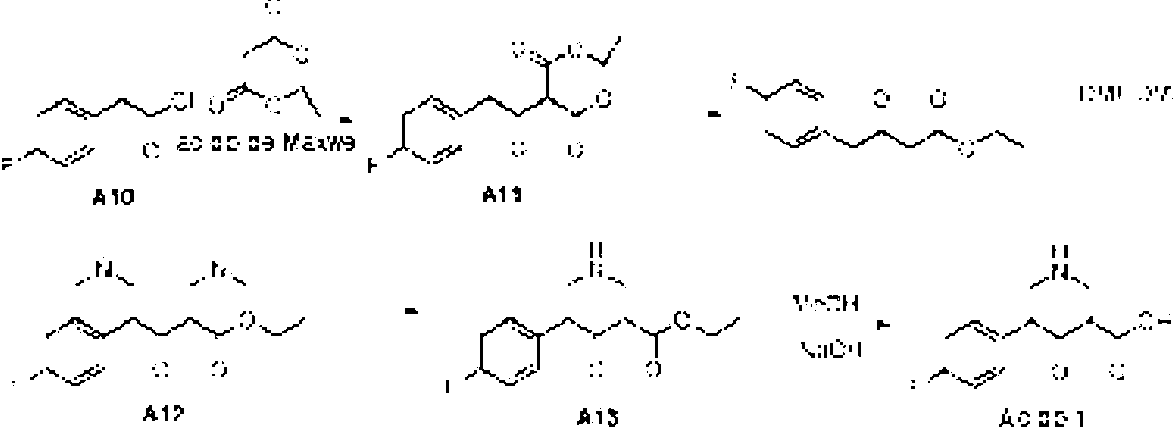
1. Preparación de A111. Preparation of A11
Se añadió piridina (70,35 g) a la mezcla de ácido Maxwell (50,32 g) en DCM (450 ml) con agitación, seguido de la adición de A10 (62,28 g) a 0°C. La reacción se continuó a 0°Cdurante 2,5 horas o hasta que se completó la reacción controlada por TLC. La mezcla de reacción se diluyó con agitación con DCM (300 ml) y 750 ml de HCl 1 N. La fase orgánica se separó y se secó al vacío para dar un sólido, A11 (66,70 g).Pyridine (70.35 g) was added to the Maxwell acid mixture (50.32 g) in DCM (450 ml) with stirring, followed by the addition of A10 (62.28 g) at 0 ° C. The reaction was continued at 0 ° C for 2.5 hours or until the controlled reaction was completed by TLC. The reaction mixture was diluted with stirring with DCM (300 ml) and 750 ml of 1 N HCl. The organic phase was separated and dried under vacuum to give a solid, A11 (66.70 g).
2. Preparación de A122. Preparation of A12
Se calentó a 87°C A11 (66,70 g) en etanol (400 ml) y se agitó durante la noche. La mezcla de reacción se enfrió y se concentró al vacío para dar un aceite (55 g). El residuo oleoso se disolvió en DMF/DMA (200 ml), se calentó a 110°Cdurante 3 h, y luego se concentró al vacío, seguido de dilución con acetato de etilo y agitación. El precipitado se recogió por filtración para dar A12 (52 g).It was heated at 87 ° C A11 (66.70 g) in ethanol (400 ml) and stirred overnight. The reaction mixture was cooled and concentrated in vacuo to give an oil (55 g). The oily residue was dissolved in DMF / DMA (200 ml), heated at 110 ° C for 3 h, and then concentrated in vacuo, followed by dilution with ethyl acetate and stirring. The precipitate was collected by filtration to give A12 (52 g).
3. Preparación de A133. Preparation of A13
Se disolvió A12 (27,20g) en etanol (600 ml) al que se añadió NH4CI. La mezcla de reacción se calentó a reflujo durante 2 horas y luego se enfrió a temperatura ambiente. El sólido se recogió por filtración para dar A13 (16,88 g). A12 (27.20 g) was dissolved in ethanol (600 ml) to which NH 4 CI was added. The reaction mixture was heated to reflux for 2 hours and then cooled to room temperature. The solid was collected by filtration to give A13 (16.88 g).
4. Preparación de ácido 14. Preparation of acid 1
Se añadió solución de NaOH 2 N (120 ml) a A13 (16,88 g) en etanol (50 ml). La mezcla de reacción se agitó y se calentó a 65°Cdurante 2 horas, y luego se enfrió a temperatura ambiente. La mezcla de reacción se añadió en HCl 1,5 N (400 ml) para precipitar el sólido. La filtración fue para recoger el sólido. El sólido se lavó dos veces con agua y se secó al vacío para dar ácido 1 (14,13 g).2N NaOH solution (120 ml) was added to A13 (16.88 g) in ethanol (50 ml). The reaction mixture was stirred and heated at 65 ° C for 2 hours, and then cooled to room temperature. The reaction mixture was added in 1.5 N HCl (400 ml) to precipitate the solid. The filtration was to collect the solid. The solid was washed twice with water and dried in vacuo to give acid 1 (14.13 g).
Etapa 1. Preparación de 4-doropiridin-2-ilcarbamato de terc-butilo (Compuesto 11)Step 1. Preparation of tert-butyl 4-doropyridin-2-ylcarbamate (Compound 11 )
El compuesto 10 (4-cloropiridin-2-amina, 128 g, 1 mol) se disolvió en DCM (3,0 l), a lo que se añadió TEA (121 g, 1,2 mol) y DMAP (9,76 g, 0,08 mol) con agitación. Después la mezcla se agitó a 15°C-20°C durante varios minutos, a cuya mezcla de reacción se añadió lentamente (Boc)2O (229 g) en DCM (500 ml) a 15°C-20°C. La reacción se continuó por debajo de 25°C hasta que se completó. El precipitado se recogió por filtración y se lavó con DCM (500 ml). El compuesto final 11 se purificó por recristalización con acetato de etilo para dar el compuesto 11 (160 g).Compound 10 (4-chloropyridin-2-amine, 128 g, 1 mol) was dissolved in DCM (3.0 L), to which was added TEA (121 g, 1.2 mol) and DMAP (9.76). g, 0.08 mol) with stirring. The mixture was then stirred at 15 ° C-20 ° C for several minutes, to which reaction mixture was slowly added (Boc) 2 O (229 g) in DCM (500 ml) at 15 ° C-20 ° C. The reaction was continued below 25 ° C until it was complete. The precipitate was collected by filtration and washed with DCM (500 ml). The final compound 11 was purified by recrystallization with ethyl acetate to give compound 11 (160 g).
Etapa 2. Preparación de 4-cloro-3-(2-hidroxietil)piridin-2-ilcarbamato de terc-butilo (Compuesto 12)Step 2. Preparation of tert-butyl 4-chloro-3- (2-hydroxyethyl) pyridin-2-ylcarbamate (Compound 12 )
El compuesto 11 (2,01 g, 8,80 mmol) en THF (15 ml) se enfrió a -78°C, y luego se le añadió gota a gota n-BuLi (12 ml, 19,26 mmol). La mezcla de reacción se calentó a -70°Cy se mantuvo otra media hora. Se añadió óxido de etileno (1,93 g, 43,75mmol) a la mezcla de reacción a -70°Cy se agitó durante la noche para calentar a temperatura ambiente. La reacción se detuvo con agua (1 ml) y se extrajo con acetato de etilo (100 ml) y salmuera (100 ml). Se separó la capa orgánica y se secó. La concentración de la capa orgánica dio el compuesto 12 en forma de sólido amarillo (2,0 g). Etapa 3. Preparación de 4-cloro-2,3-dihidro-1H-pirrolo[2,3-b]piridin-1-carboxilato de terc-butilo (Compuesto 13) El compuesto 12 (1,37 g, 5,04 mmol) se disolvió en THF (20 ml), al que se añadió Ph3P (1,59g, 6,05 mmol). Se añadió gota a gota DEAD (1,07 g, 6,06 mmol) a la mezcla de reacción a 0°C, y luego se calentó lentamente a temperatura ambiente. Después de concentrar, la mezcla de reacción se purificó por columna de gel de sílice para dar el compuesto 13 en forma de sólido blanco (1,15 g).Compound 11 (2.01 g, 8.80 mmol) in THF (15 ml) was cooled to -78 ° C, and then n-BuLi (12 ml, 19.26 mmol) was added dropwise. The reaction mixture was heated to -70 ° C and maintained another half hour. Ethylene oxide (1.93 g, 43.75 mmol) was added to the reaction mixture at -70 ° C and stirred overnight to warm to room temperature. The reaction was quenched with water (1 ml) and extracted with ethyl acetate (100 ml) and brine (100 ml). The organic layer was separated and dried. Concentration of the organic layer gave compound 12 as a yellow solid (2.0 g). Step 3. Preparation of tert-butyl 4-chloro-2,3-dihydro-1H-pyrrolo [2,3-b] pyridine-1-carboxylate (Compound 13) Compound 12 (1.37 g, 5.04) mmol) was dissolved in THF (20 ml), to which Ph 3 P (1.59 g, 6.05 mmol) was added. DEAD (1.07 g, 6.06 mmol) was added dropwise to the reaction mixture at 0 ° C, and then slowly warmed to room temperature. After concentrating, the reaction mixture was purified by silica gel column to give compound 13 as a white solid (1.15 g).
Etapa 4. Preparación del compuesto 14 Step 4. Preparation of compound 14
El Compuesto 13 (1,15g, 4,53 mmol) y 4-amino-2-fluoro-fenol (1,15g, 9,06 mmol) se disolvió en DMF (20 ml), al que se añadió a continuación carbonato de cesio (4,43 g, 13,59 mmol). La mezcla de reacción se calentó a 125°C durante la noche. Después de enfriar a temperatura ambiente, la mezcla de reacción se diluyó con acetato de etilo. La fase orgánica se recogió y se evaporó al vacío para dar el compuesto 14 en forma de sólido (0,80 g). Compound 13 (1.15 g, 4.53 mmol) and 4-amino-2-fluoro-phenol (1.15 g, 9.06 mmol) was dissolved in DMF (20 ml), to which was added carbonate cesium (4.43 g, 13.59 mmol). The reaction mixture was heated at 125 ° C overnight. After cooling to room temperature, the reaction mixture was diluted with ethyl acetate. The organic phase was collected and evaporated in vacuo to give compound 14 as a solid (0.80 g).
Etapa 5. Preparación del compuesto 15 Step 5. Preparation of compound 15
El Compuesto 14 (4,00 g, 11,6 mimóles) y el ácido 1 (2,97 g, 12,8 mimóles) se disolvieron en DCM (60 ml) seguido de la adición de HATU (5,29 g, 13,9 mmoles) y TEA (3,52 g, 34,8 mmoles). La reacción se agitó a temperatura ambiente durante la noche y luego se diluyó con acetato de etilo y agua. La fase orgánica se separó y la capa acuosa se extrajo con acetato de etilo. Toda la capa orgánica se combinó y se secó. Después de la evaporación del disolvente, el residuo se purificó en columna de gel para dar el compuesto l5 en forma de sólido amarillo claro (4,8 g).Compound 14 (4.00 g, 11.6 mimols) and acid 1 (2.97 g, 12.8 mimoles) were dissolved in DCM (60 ml) followed by the addition of HATU (5.29 g, , 9 mmol) and TEA (3.52 g, 34.8 mmol). The reaction was stirred at room temperature overnight and then diluted with ethyl acetate and water. The organic phase was separated and the aqueous layer was extracted with ethyl acetate. The entire organic layer was combined and dried. After evaporation of the solvent, the residue was purified on a gel column to give compound 15 as a light yellow solid (4.8 g).
Etapa 6. Preparación del producto 1 Stage 6. Preparation of the product 1
El Compuesto 15 (3,5 g) se añadió en la mezcla de DCM (15 ml) y ácido trifluoroacético (15 ml), la reacción se continuó durante 3 horas a temperatura ambiente. La mezcla de reacción se evaporó al vacío para dar el producto 1 en forma de sólido rojo claro (2,46 g). MS: 461 (M+H)+ RMN H (DMSO-da): 13,14 (s, 1H), 12,68 (s, 1H), 8,62 (s, 1H), 8,09 (s, 1H), 7,96-8,00 (dd, 1H, J = 9,60Hz 1,80Hz), 7,68-7,72 (m, 2H), 7,61-7,62 (d, 1H, J = 4,50 Hz), 7,39-7,42 (dd, 1H, J = 6,60 Hz 1,20Hz ), 7,20-7,29 (m, 3H), 6,48 (s, 1H), 5,90-5,91 (d, 1H, J = 4,50 Hz), 3,45-3,49 (m, 2H), 2,83-2,89 (m, 2H). Compound 15 (3.5 g) was added into the mixture of DCM (15 ml) and trifluoroacetic acid (15 ml), the reaction was continued for 3 hours at room temperature. The reaction mixture was evaporated in vacuo to give product 1 as a light red solid (2.46 g). MS: 461 (M + H) + H NMR (DMSO-da): 13.14 (s, 1H), 12.68 (s, 1H), 8.62 (s, 1H), 8.09 (s, 1H), 7.96-8.00 (dd, 1H, J = 9.60Hz 1.80Hz), 7.68-7.72 (m, 2H), 7.61-7.62 (d, 1H, J = 4.50 Hz), 7.39-7.42 (dd, 1H, J = 6.60 Hz 1.20Hz), 7.20-7.29 (m, 3H), 6.48 (s, 1H), 5.90-5.91 (d, 1H, J = 4.50 Hz), 3.45-3.49 (m, 2H), 2.83-2.89 (m, 2H).
Ejemplo 2Example 2
N-(3-fluoro-4-(3-oxo-3,4-dihidro-2H-pirido[3,2-b][1,4]oxazin-8-iloxi) fenil)-5-(4-fluorofenil)-4-oxo-1,4-dihidropiridin-3-carboxamida (Producto 2) N- ( 3-fluoro-4- ( 3-oxo-3,4-dihydro-2H-pyrido [3,2-b] [1,4] oxazin-8-yloxy) phenyl) -5- ( 4-fluorophenyl) ) -4-oxo-1,4-dihydropyridine-3-carboxamide ( Product 2)

Etapa 1. Preparación del compuesto 21Step 1. Preparation of compound 21
El compuesto 20 (184 mg, 1,0 mmol), 2-fluoro-4-amino-fenol (190 mg, 1,5 mmol) y carbonato de cesio (652 mg, 2,0 mmol) se mezclaron en N-metil pirrolidona (3 ml). La mezcla de reacción se calentó a 180°C durante la noche bajo N2. A continuación, la mezcla de reacción se añadió en agua (50 ml) y se extrajo con acetato de etilo (100 ml). La fase orgánica se lavó con salmuera, se secó y se concentró, seguido de purificación en columna ultrarrápida para dar el compuesto 21 (105 mg).Compound 20 (184 mg, 1.0 mmol), 2-fluoro-4-amino-phenol (190 mg, 1.5 mmol) and cesium carbonate (652 mg, 2.0 mmol) were mixed in N-methyl pyrrolidone (3 ml). The reaction mixture was heated at 180 ° C overnight under N 2 . Then, the reaction mixture was added in water (50 ml) and extracted with ethyl acetate (100 ml). The organic phase was washed with brine, dried and concentrated, followed by purification on an ultra-flash column to give compound 21 (105 mg).
Etapa 2. Preparación del producto 2.Stage 2. Preparation of the product 2.
HATU (76 mg, 0,2 mmol), DIPEA (26 mg, 0,2 mmol) y ácido 1 (25,6 mg, 0,11 mmol) se mezclaron en DCM (3 ml) a 0°C y se agitaron durante 15 minutos, seguido de la adición del compuesto 21 (27 mg), 0,1mmol). La mezcla de reacción se agitó durante 4 horas a temperatura ambiente. Después de concentrar, la mezcla de reacción se purificó por columna ultrarrapida para dar el producto 2 (16 mg). MS: 491 (M+H)+.HATU (76 mg, 0.2 mmol), DIPEA (26 mg, 0.2 mmol) and acid 1 (25.6 mg, 0.11 mmol) were mixed in DCM (3 mL) at 0 ° C and stirred for 15 minutes, followed by the addition of compound 21 (27 mg), 0.1 mmol). The reaction mixture was stirred for 4 hours at room temperature. After concentrating, the reaction mixture was purified by ultrarapid column to give product 2 (16 mg). MS: 491 (M + H) +.
Ejemplo 3Example 3
N-(4-(3,4-dihidro-2H-pirido[3,2-b][1,4]oxazin-8-iloxi)-3-fluorofenil)-5-(4-fluorofenil)-4-oxo-1,4-dihidropiridin-3-carboxamida (Producto 3) N- ( 4- ( 3,4-dihydro-2H-pyrido [3,2-b] [1,4] oxazin-8-yloxy) -3-fluorophenyl) -5- ( 4-fluorophenyl) -4-oxo -1,4-dihydropyridine-3-carboxamide ( Product 3)

Etapa 1. Preparación del compuesto 31Step 1. Preparation of compound 31
El compuesto 30 (1,52 g, 10 mmol), 3,4-difluoronitrobenceno (1,75 g, 1 mmol) y carbonato de cesio (3,60 g, 1 mmol) se mezclaron en DMF (15 ml) y se agitaron a temperatura ambiente durante la noche. Una vez completado el control por TLC, la mezcla de reacción se añadió en agua (400 ml) y se extrajo con acetato de etilo (800 ml). La capa acuosa se extrajo con acetato de etilo. Toda la capa orgánica se combinó, se lavó con salmuera y se secó. Después de la concentración, el residuo se purificó por columna ultrarrápida hasta el compuesto 31 (2,20 g). Compound 30 (1.52 g, 10 mmol), 3,4-difluoronitrobenzene (1.75 g, 1 mmol) and cesium carbonate (3.60 g, 1 mmol) were mixed in DMF (15 ml) and they were stirred at room temperature overnight. After completion of control by TLC, the reaction mixture was added in water (400 ml) and extracted with ethyl acetate (800 ml). The aqueous layer was extracted with ethyl acetate. The entire organic layer was combined, washed with brine and dried. After concentration, the residue was purified by flash column to compound 31 (2.20 g).
Etapa 2. Preparación del compuesto 32Step 2. Preparation of compound 32
El compuesto 31 (2,20 g) se añadió a la mezcla de Pd/Cal 5% (0,8 g) y metanol (100 ml). La mezcla resultante se agitó bajo H2 hasta que no hubo material de partida. Luego, la mezcla de reacción se filtró para eliminar Pd/C. El filtrado se concentró para dar el compuesto 32 (1,60 g).Compound 31 (2.20 g) was added to the mixture of Pd / Cal 5% (0.8 g) and methanol (100 ml). The resulting mixture was stirred under H 2 until there was no starting material. Then, the reaction mixture was filtered to remove Pd / C. The filtrate was concentrated to give compound 32 (1.60 g).
Etapa 3. Preparación del producto 3Stage 3. Preparation of the product 3
El producto deseado 3 se sintetiza utilizando la secuencia y las condiciones similares a las descritas para el ejemplo 2. MS: 477 (M+H)+.The desired product 3 is synthesized using the sequence and conditions similar to those described for example 2. MS: 477 (M + H) +.
Ejemplo 4Example 4
N-(4-(3,4-dihidro-2H-pirído[3,2-b][1,4]oxazin-8-iloxi)fenil)-5-(4-fluorofenil)-4-oxo-1,4-dihidropirídin-3-carboxamida (Producto 4) N- ( 4- ( 3,4-dihydro-2H-pyrido [3,2-b] [1,4] oxazin-8-yloxy) phenyl) -5- ( 4-fluorophenyl) -4-oxo-1, 4-dihydropyridine-3-carboxamide ( Product 4)

El compuesto 42 deseado se sintetiza utilizando la secuencia y condiciones similares a las descritas para el ejemplo 3.The desired compound 42 is synthesized using the sequence and conditions similar to those described for Example 3.
El producto deseado 4 se sintetiza utilizando la secuencia y las condiciones similares a las descritas para el ejemplo 2. MS: 459 (M+)+.The desired product 4 is synthesized using the sequence and conditions similar to those described for example 2. MS: 459 (M +) +.
Ejemplo 5Example 5
N-(3-fluoro-4-(2-oxo-2,3-dihidro-1H-pirrolo[2,3-b]piridin-4-iloxi)fenil)-5-(4-flourofenil)-4-oxo-1,4-dihidropiridin-3-carboxamida (Producto 5) N- ( 3-fluoro-4- ( 2-oxo-2,3-dihydro-1H-pyrrolo [2,3-b] pyridin-4-yloxy) phenyl) -5- ( 4-fluorophenyl) -4-oxo -1,4-dihydropyridine-3-carboxamide ( Product 5)

Etapa 1. Preparación del compuesto 51 Step 1. Preparation of compound 51
El compuesto 50 (3,0 g 20 mmoles) se disolvió en alcohol terc-butílico (200 ml), al que se añadió tribromuro de piridinio (21,5 g 67 mmoles). La mezcla de reacción se agitó a temperatura ambiente durante la noche, seguido de concentración al vacío. El residuo se purificó por extracción y recristalización para dar el compuesto 51 (3,60 g). Etapa 2. Preparación del compuesto 52 Compound 50 (3.0 g 20 mmol) was dissolved in tert-butyl alcohol (200 ml), to which pyridinium tribromide (21.5 g 67 mmol) was added. The reaction mixture was stirred at room temperature overnight, followed by concentration in vacuo. The residue was purified by extraction and recrystallization to give compound 51 (3.60 g). Step 2. Preparation of compound 52
El compuesto 51 (3,6 g) se disolvió en alcohol (50 ml), al que se añadió lentamente ácido acético (2,0 ml). La reacción se calentó a reflujo hasta que se completó. La filtración de la mezcla de reacción se empleó para eliminar el sólido y el filtrado se concentró al vacío para dar el compuesto 52 (1,12 g).Compound 51 (3.6 g) was dissolved in alcohol (50 ml), to which acetic acid (2.0 ml) was added slowly. The reaction was heated to reflux until complete. Filtration of the reaction mixture was used to remove the solid and the filtrate was concentrated in vacuo to give compound 52 (1.12 g).
Etapa 3. Preparación del compuesto 53 Step 3. Preparation of compound 53
El compuesto 52 (1,12 g, 66 mmol), fluoro-4-aminofenol (930 mg, 73 mmol) y carbonato de cesio (4,30mg, 132 mmol) se mezclaron en DMSO (15 ml) y se calentó a 135°C durante la noche bajo N2. La mezcla de reacción se diluyó con acetato de etilo y agua. La capa orgánica se separó y se secó. La evaporación de la capa orgánica dio el compuesto 53 (660 mg).Compound 52 (1.12 g, 66 mmol), fluoro-4-aminophenol (930 mg, 73 mmol) and cesium carbonate (4.30 mg, 132 mmol) were mixed in DMSO (15 mL) and heated to 135 ° C during the night under N 2 . The reaction mixture was diluted with ethyl acetate and water. The organic layer was separated and dried. Evaporation of the organic layer gave compound 53 (660 mg).
Etapa 4. Preparación del producto 5 Stage 4. Preparation of the product 5
El producto deseado 5 se sintetiza utilizando la secuencia y las condiciones similares a las descritas para el ejemplo 2. MS: 475 (M+H)+. The desired 5 product is synthesized using the sequence and conditions similar to those described for Example 2. MS: 475 (M + H) +.
Ejemplo 6Example 6
N-(3-fluoro-4-(3-oxo-3,4-dihidro-2H-pirido[3,2-b][1,4]oxazin-8-iloxi)fenil)-1-(4-fluorofenil)-2-oxo-1,2-dihidropiridin-3-carboxamida (Producto 6) N- ( 3-fluoro-4- ( 3-oxo-3,4-dihydro-2H-pyrido [3,2-b] [1,4] oxazin-8-yloxy) phenyl) -1- ( 4-fluorophenyl) ) -2-oxo-1,2-dihydropyridine-3-carboxamide ( Product 6 )

Etapa 1. Preparación de A21Stage 1. Preparation of A21
Se disolvió A20 (3,10 g) en DMF (25 ml) y se enfrió a 0°C, a lo que se añadió 4-fluoroanilina. La reacción se continuó durante 7 horas a 0°C, seguido de la adición de EDC-HCl (5,40 g) y DMAP (0,6 l g) y se agitó durante la noche. La mezcla de reacción se diluyó con agua y acetato de etilo. La capa orgánica se separó y se lavó con salmuera. Después de secar, el disolvente se eliminó por evaporación para dar A21 (2,80 g). A20 (3.10 g) was dissolved in DMF (25 ml) and cooled to 0 ° C, to which 4-fluoroaniline was added. The reaction was continued for 7 hours at 0 ° C, followed by the addition of EDC - HCl (5.40 g) and DMAP (0.6 lg) and stirred overnight. The reaction mixture was diluted with water and ethyl acetate. The organic layer was separated and washed with brine. After drying, the solvent was removed by evaporation to give A21 (2.80 g).
Etapa 2. Preparación de ácido 2 Step 2. Preparation of acid 2
Se mezcló A21 (2,61 g) en solución de NaOH (1,60 g de NaOH y 40 ml de agua) y metanol (8 ml). A continuación, la mezcla de reacción se agitó y se calentó a reflujo durante 1 hora. Después de enfriar a temperatura ambiente, la mezcla de reacción se ajustó a pH = 1. El sólido resultante se recogió por filtración y se lavó con agua, seguido de secado para dar ácido 2 (2,25 g). A21 (2.61 g) was mixed in NaOH solution (1.60 g of NaOH and 40 ml of water) and methanol (8 ml). Then, the reaction mixture was stirred and refluxed for 1 hour. After cooling to room temperature, the reaction mixture was adjusted to pH = 1. The resulting solid was collected by filtration and washed with water, followed by drying to give acid 2 (2.25 g).
Etapa 3. Preparación del producto 6 Stage 3. Preparation of the product 6
El producto deseado 6 se sintetiza utilizando la secuencia y las condiciones similares a las descritas para el ejemplo 2 con ácido 2 en lugar de ácido 1. MS: 491 (M+H)+.The desired product 6 is synthesized using the sequence and conditions similar to those described for Example 2 with acid 2 instead of acid 1 . MS: 491 (M + H) +.
Ejemplo 7Example 7
N-(4-(2,3-dihidro-1H-pirrolo[2,3-b]pirídin-4-iloxi)-3-fluorofenil)-1-(4-fluorofenil)-2-oxo-1,2-dihidropiridin-3-carboxamida (Producto 7) N- ( 4- ( 2,3-dihydro-1H-pyrrolo [2,3-b] pyridin-4-yloxy) -3-fluorophenyl) -1- ( 4-fluorophenyl) -2-oxo-1,2- dihydropyridine-3-carboxamide ( Product 7)

El compuesto 71 se obtuvo mediante el compuesto 14 que estaba sin la protección de Boc.Compound 71 was obtained by compound 14 which was without the Boc protection.
El producto deseado 7 se sintetiza utilizando una secuencia y condiciones similares a las descritas para el ejemplo 2 con ácido 2 en lugar de ácido 1. MS: 461 (M+H)+. RMN H (DMSO-d6): 12,10 (s, 1H), 8,57-8,59 (dd, 1H, J = 5,40Hz 1,50Hz), 8,13-8,15 (dd, 1H, J = 5,10Hz 1,80Hz), 7,99-8,03 (dd, 1H, J = 9,60Hz 1,65Hz), 7,60-7,64 (m, 4H), 7,41-7,49 (m, 3H), 7,31-7,36 (t, 1H, J = 13,50Hz), 6,72-6,75 (t, 1H, J = 10,20 Hz), 6,10-6,11 (d, 1H, J = 5,10Hz), 3,62-3,66 (m, 2H), 2,89-2,93 (m, 2H). The desired product 7 is synthesized using a sequence and conditions similar to those described for Example 2 with acid 2 instead of acid 1 . MS: 461 (M + H) +. H-NMR (DMSO-d6): 12.10 (s, 1H), 8.57-8.59 (dd, 1H, J = 5.40Hz 1.50Hz), 8.13-8.15 (dd, 1H) , J = 5.10Hz 1.80Hz), 7.99-8.03 (dd, 1H, J = 9.60Hz 1.65Hz), 7.60-7.64 (m, 4H), 7.41Hz 7.49 (m, 3H), 7.31-7.36 (t, 1H, J = 13.50Hz), 6.72-6.75 (t, 1H, J = 10.20 Hz), 6, 10-6.11 (d, 1H, J = 5.10Hz), 3.62-3.66 (m, 2H), 2.89-2.93 (m, 2H).
Ejemplo 8Example 8
N-(4-(3,4-dihidm-2H-pirído[3,2-b][1,4]oxazin-8-iloxi)-3-fluomfenil)-1-(4-fluomfenil)-2-oxo-1,2-dihidmpirídin-3-carboxamida (Producto 8) N- ( 4- ( 3,4-dihydm-2H-pyrido [3,2-b] [1,4] oxazin-8-yloxy) -3-fluomophenyl) -1- ( 4-fluomphenyl) -2-oxo -1,2-dihydropyridine-3-carboxamide ( Product 8 )

El producto deseado 8 se sintetiza utilizando la secuencia y las condiciones similares a las descritas para el ejemplo 2 con ácido 2 en lugar de ácido 1. MS: 477 (M+H)+. RMN H (DMSO-da): 12,03 (s, 1H), 8,56-8,59 (dd, 1H, J = 5,40Hz 1,65Hz), 8,11-8,13 (dd, 1H, J = 4,80Hz 1,50Hz), 7,93-7,97 (dd, 1H, J = 9,90Hz 1,80Hz), 7,60-7,62 (m, 2H), 7,40-7,46 (m, 4H), 7,12-7,16 (t, 1H, J = 13,80Hz), 6,81 (s, 1H ), 6,70-6,74 (t, 1H, J = 10,50Hz), 6,00 (ms, 1H), 4,11-4,16 (m, 2H), 3,41-3,42 (m, 2H).The desired product 8 is synthesized using the sequence and conditions similar to those described for Example 2 with acid 2 instead of acid 1 . MS: 477 (M + H) +. H-NMR (DMSO-da): 12.03 (s, 1H), 8.56-8.59 (dd, 1H, J = 5.40Hz, 1.65Hz), 8.11-8.13 (dd, 1H) , J = 4.80Hz 1.50Hz), 7.93-7.97 (dd, 1H, J = 9.90Hz 1.80Hz), 7.60-7.62 (m, 2H), 7.40Hz 7.46 (m, 4H), 7.12-7.16 (t, 1H, J = 13.80Hz), 6.81 (s, 1H), 6.70-6.74 (t, 1H, J = 10.50Hz), 6.00 (ms, 1H), 4.11-4.16 (m, 2H), 3.41-3.42 (m, 2H).
Ejemplo 9Example 9
N-(4-(3,4-dihidro-2H-pirido[3,2-b][1,4]oxazin-8-iloxi)fenil)-1-(4-fluorofenil)-2-oxo-1,2-dihidropiridin-3-carboxamida (Producto 9) N- ( 4- ( 3,4-dihydro-2H-pyrido [3,2-b] [1,4] oxazin-8-yloxy) phenyl) -1- ( 4-fluorophenyl) -2-oxo-1, 2-dihydropyridine-3-carboxamide ( Product 9)

El producto deseado 9 se sintetiza utilizando la secuencia y las condiciones similares a las descritas para el ejemplo 2 con ácido 2 en lugar de ácido 1. MS: 459 (M+H)+. RMN H (DMSO-d6): 11,90 (s, 1H), 8,56-8,58 (dd, 1H, J = 5,40 Hz 1,50 Hz), 8,09-8,11 (dd, 1H, J = 4,8 Hz 1,5 Hz), 7,67-7,71 (d, 2H, J =6,90 Hz), 7,59-7,62 (m, 2H), 7,47-7,48 (d, 1H, J = 4,2 Hz), 7,40-7,44 (t, 2H, J = 13,20 Hz), 6,99-7,01 (d, 2H, J = 6,90 Hz), 6,80 (s, 1H), 6,69-6,73 (t, 1H, J = 10,20 Hz), 6,07-6,08 (d, 1H, J = 4,20 Hz), 4,08-4,10 (m, 2H), 3,40-3,41 (m, 2H).The desired product 9 is synthesized using the sequence and conditions similar to those described for Example 2 with acid 2 instead of acid 1. MS: 459 (M + H) +. H-NMR (DMSO-d6): 11.90 (s, 1H), 8.56-8.58 (dd, 1H, J = 5.40 Hz, 1.50 Hz), 8.09-8.11 (dd) , 1H, J = 4.8 Hz 1.5 Hz), 7.67-7.71 (d, 2H, J = 6.90 Hz), 7.59-7.62 (m, 2H), 7, 47-7.48 (d, 1H, J = 4.2 Hz), 7.40-7.44 (t, 2H, J = 13.20 Hz), 6.99-7.01 (d, 2H, J = 6.90 Hz), 6.80 (s, 1H), 6.69-6.73 (t, 1H, J = 10.20 Hz), 6.07-6.08 (d, 1H, J = 4.20 Hz), 4.08-4.10 (m, 2H), 3.40-3.41 (m, 2H).
Ejemplo 10Example 10
N-(3-fluoro-4-(2-oxo-2,3-dihidro-1H-pirrolo[2,3-b]piridin-4-iloxi)fenil)-1-(4-fluorofenil)-2-oxo-1,2-dihidropiridin-3-carboxamida (Producto 10) N- ( 3-fluoro-4- ( 2-oxo-2,3-dihydro-1H-pyrrolo [2,3-b] pyridin-4-yloxy) phenyl) -1- ( 4-fluorophenyl) -2-oxo -1,2-dihydropyridine-3-carboxamide ( Product 10)

El producto deseado 10 se sintetiza utilizando la secuencia y las condiciones similares a las descritas para el ejemplo 2 con ácido 2 en lugar de ácido 1. MS: 475 (M+H)+. The desired product 10 is synthesized using the sequence and conditions similar to those described for Example 2 with acid 2 instead of acid 1 . MS: 475 (M + H) +.
Ejemplo 11Example 11
N-(3-fluoro-4-(3-oxo-3,4-dihidro-2H-pirído[3,2-b][1,4]oxazin-8-iloxi)fenil)-N-(4-fluorofenil)ddopropano-1,1-dicarboxamida (Producto 11) N- ( 3-fluoro-4- ( 3-oxo-3,4-dihydro-2H-pyrido [3,2-b] [1,4] oxazin-8-yloxy) phenyl) -N- ( 4-fluorophenyl) ) ddopropane-1,1-dicarboxamide ( Product 11 )

Etapa 1. Preparación de A31 Stage 1. Preparation of A31
Se añadieron malonato de dietilo (33,01 g), 1,2-dicloroetano (40,38 g), TBAB (2,09 g), benceno (100 ml), carbonato de potasio (72,50 g) y agua (1,00 ml) en un matraz de 500 ml y se calentaron a 115°C durante la noche. La mezcla de reacción se enfrió a temperatura ambiente y se filtró. El filtrado se concentró y se continuó con la purificación de la columna ultrarrápida para dar A31 (24,80 g).Diethyl malonate (33.01 g), 1,2-dichloroethane (40.38 g), TBAB (2.09 g), benzene (100 ml), potassium carbonate (72.50 g) and water ( 1.00 ml) in a 500 ml flask and heated at 115 ° C overnight. The reaction mixture was cooled to room temperature and filtered. The filtrate was concentrated and the purification of the ultra-flash column continued to give A31 (24.80 g).
Etapa 2. Preparación de A32 Stage 2. Preparation of A32
Se mezcló A31 (24,80 g) con etanol (150 ml) y solución de NaOH (5,08 g en 100 H2O) a 0°C. La mezcla de reacción se agitó durante la noche y se calentó lentamente a temperatura ambiente. A continuación, el etanol se evaporó y se lavó con éter para dar A32 (20,45 g). A31 (24.80 g) was mixed with ethanol (150 ml) and NaOH solution (5.08 g in 100 H 2 O) at 0 ° C. The reaction mixture was stirred overnight and slowly warmed to room temperature. Then, the ethanol was evaporated and washed with ether to give A32 (20.45 g).
Etapa 3. Preparación de A33 Stage 3. Preparation of A33
Se mezclaron A32 (20,45 g) y cloruro de tionilo (150 ml) y se sometieron a reflujo durante 2 horas. A continuación, el cloruro de tionilo se evaporó después de completar la reacción controlada por TLC. El sólido resultante se lavó con DCM para dar A33. A32 (20.45 g) and thionyl chloride (150 ml) were mixed and refluxed for 2 hours. Then, the thionyl chloride was evaporated after completing the TLC controlled reaction. The resulting solid was washed with DCM to give A33 .
Etapa 4. Preparación de A34 Stage 4. Preparation of A34
Se añadió lentamente A33 (de la etapa 3) en DCM (100 ml) a la solución de p-fluoroanilina (16,05 g), TEA (40 ml) y DCM (200 ml) a 0°C. La mezcla de reacción se agitó durante la noche y se calentó a temperatura ambiente lentamente. La reacción se detuvo mediante la adición de agua (150 ml). Luego la fase orgánica se lavó dos veces con HCl diluido, se secó con sulfato de sodio anhidro. Por evaporación del disolvente, el residuo se purificó mediante una columna ultrarrápida para dar A34 (20,23 g). A33 (from step 3) in DCM (100 ml) was slowly added to the solution of p-fluoroaniline (16.05 g), TEA (40 ml) and DCM (200 ml) at 0 ° C. The reaction mixture was stirred overnight and warmed to room temperature slowly. The reaction was stopped by the addition of water (150 ml). Then the organic phase was washed twice with dilute HCl, dried with anhydrous sodium sulfate. Upon evaporation of the solvent, the residue was purified by a flash column to give A34 (20.23 g).
Etapa 5. Preparación de ácido 3 Step 5. Preparation of acid 3
Se mezcló A34 (19,40 g) con etanol (100 ml) y solución de NaOH 2 N (200 ml). La mezcla de reacción se calentó a 65°C y se agitó durante 1 hora. La mezcla de reacción se enfrió por debajo de 10°C y se añadió lentamente a una mezcla de HCl concentrado (50 ml), acetato de etilo (200 ml) y agua (300 ml). La capa orgánica se separó y se lavó dos veces con salmuera y se secó con sulfato de sodio anhidro. La evaporación del disolvente orgánico al vacío dio el ácido 3 (16,21 g). A34 (19.40 g) was mixed with ethanol (100 ml) and 2 N NaOH solution (200 ml). The reaction mixture was heated to 65 ° C and stirred for 1 hour. The reaction mixture was cooled to below 10 ° C and added slowly to a mixture of concentrated HCl (50 ml), ethyl acetate (200 ml) and water (300 ml). The organic layer was separated and washed twice with brine and dried with anhydrous sodium sulfate. Evaporation of the organic solvent in vacuo gave acid 3 (16.21 g).
Etapa 6. Preparación del producto 11 Stage 6. Preparation of the product 11
El producto deseado 11 se sintetiza utilizando la secuencia y condiciones similares a las descritas para el ejemplo 2 con ácido 3 en lugar de ácido 1. MS: 481 (M+H)+. The desired product 11 is synthesized using the sequence and conditions similar to those described for Example 2 with acid 3 instead of acid 1. MS: 481 (M + H) +.
Ejemplo 12Example 12
N-(4-(2,3-dihidro-1H-pirrolo[2,3-b]pirídin-4-iloxi)-3-fluorofenil)-N-(4-fluorofenil)ddopropropano-1,1-dicarboxamida (Producto 12) N- ( 4- ( 2,3-dihydro-1H-pyrrolo [2,3-b] pyridin-4-yloxy) -3-fluorophenyl) -N- ( 4-fluorophenyl) ddopropropane-1,1-dicarboxamide ( Product 12)

El producto deseado 12 se sintetiza utilizando la secuencia y las condiciones similares a las descritas para el Ejemplo 2 con ácido 3 en lugar de ácido 1. MS: 451 (M+H)+. RMN H (DMSO-da): 10,30 (s, 1H), 9,99 (s, 1H), 7,79-7,82 (d, 1H, J = 10,20Hz), 7,56-7,78 (m, 3H), 7,40-7,42 (d, 1H, J = 6,30 Hz), 7,21-7,26 (t, 1H, J = 13,50Hz), 7,12-7,17 (t, 2H, J = 13,20Hz), 6,90-6,95 (t, 1H, J = 13,80Hz), 6,36-6,48 (m, 3H), 5,80-5,86 (dd, 1H, J = 12,00Hz 4,5Hz), 5,39 (s, 1H), 3,41 3,52 (m, 2H), 2,84-2,92 (m, 2H)The desired product 12 is synthesized using the sequence and conditions similar to those described for Example 2 with acid 3 instead of acid 1 . MS: 451 (M + H) +. H-NMR (DMSO-da): 10.30 (s, 1H), 9.99 (s, 1H), 7.79-7.82 (d, 1H, J = 10.20Hz), 7.56-7 , 78 (m, 3H), 7.40-7.42 (d, 1H, J = 6.30 Hz), 7.21-7.26 (t, 1H, J = 13.50Hz), 7.12 -7.17 (t, 2H, J = 13.20Hz), 6.90-6.95 (t, 1H, J = 13.80Hz), 6.36-6.48 (m, 3H), 5, 80-5.86 (dd, 1H, J = 12.00Hz 4.5Hz), 5.39 (s, 1H), 3.41 3.52 (m, 2H), 2.84-2.92 (m , 2H)
Ejemplo 13Example 13
N-(4-(3,4-dihidro-2H-pirido[3,2-b][1,4]oxazin-8-iloxi)-3-fluorofenil)-N-(4-fluorofenil) ddopropano-1,1-dicarboxamida (Producto 13) N- ( 4- ( 3,4-dihydro-2H-pyrido [3,2-b] [1,4] oxazin-8-yloxy) -3-fluorophenyl) -N- ( 4-fluorophenyl) ddopropane-1, 1-dicarboxamide ( Product 13)

El producto deseado 13 se sintetiza utilizando la secuencia y condiciones similares a las descritas para el ejemplo 2 con ácido 3 en lugar de ácido 1. MS: 467 (M+H)+.The desired product 13 is synthesized using the sequence and conditions similar to those described for Example 2 with acid 3 instead of acid 1 . MS: 467 (M + H) +.
Ejemplo 14Example 14
N-(4-(3,4-dihidro-2H-pirido[3,2-b][1,4]oxazin-8-iloxi)fenil)-N-(4-fluorofenil) ddopropano-1,1-dicarboxamida (Producto 14) N- ( 4- ( 3,4-dihydro-2H-pyrido [3,2-b] [1,4] oxazin-8-yloxy) phenyl) -N- ( 4-fluorophenyl) ddopropane-1,1-dicarboxamide ( Product 14)

El producto deseado 14 se sintetiza utilizando la secuencia y las condiciones similares a las descritas para el ejemplo 2 con ácido 3 en lugar de ácido 1. MS: 449 (M+H)+. RMN H (DMSO-d 6 ): 10,04-10,07 (d, 2H, J = 9,30Hz), 7,59-7,64 (m, 4H), 7,46-7,47 (d, 1H, J = 4,20Hz), 7,12-7,16 (t, 2H, J = 13,50 Hz), 6,96-6,98 (d, 2H, J = 6,90Hz), 6,78 (s, 1H), 6,02-6,03 (d, 1H, J = 4,20 Hz), 4,07-4,10 (m, 2H), 3,40-3,43 (m, 2H), 1,44 (s, 4H).The desired product 14 is synthesized using the sequence and conditions similar to those described for Example 2 with acid 3 instead of acid 1 . MS: 449 (M + H) +. H NMR (DMSO-d 6): 10.04-4.07 (d, 2H, J = 9.30Hz), 7.59-7.64 (m, 4H), 7.46-7.47 (d , 1H, J = 4.20Hz), 7.12-7.16 (t, 2H, J = 13.50 Hz), 6.96-6.98 (d, 2H, J = 6.90Hz), 6 , 78 (s, 1H), 6.02-6.03 (d, 1H, J = 4.20 Hz), 4.07-4.10 (m, 2H), 3.40-3.43 (m , 2H), 1.44 (s, 4H).
Ejemplo 15Example 15
N-(3-fluoro-4-(2-oxo-2,3-dihidro-1H-pirrolo[2,3-b]piridin-4-iloxi)fenil)-N-(4-fluorofenil) cidopropano-1,1-dicarboxamida (Producto 15) N- ( 3-fluoro-4- ( 2-oxo-2,3-dihydro-1H-pyrrolo [2,3-b] pyridin-4-yloxy) phenyl) -N- ( 4-fluorophenyl) cidopropane-1, 1-dicarboxamide ( Product 15)

El producto deseado 15 se sintetiza utilizando la secuencia y condiciones similares a las descritas para el ejemplo 2 con ácido 3 en lugar de ácido 1. MS: 465 (M+H)+. The desired product 15 is synthesized using the sequence and conditions similar to those described for Example 2 with acid 3 instead of acid 1 . MS: 465 (M + H) +.
Ejemplo 16Example 16
8-(6-(2-(4-fluorofenilamino)-1-metil-6-oxo-1,6-dihidropirímidin-5-il)piridin-3-iloxi)-2H-pirído[3,2-b][1,4]oxazin-3 (4H)-ona (Producto 16) 8- ( 6- ( 2- ( 4-fluorophenylamino) -1-methyl-6-oxo-1,6-dihydropyrimidin-5-yl) pyridin-3-yloxy) -2H-pyrido [3,2-b] [ 1,4] oxazin-3 ( 4H) -one ( Product 16)
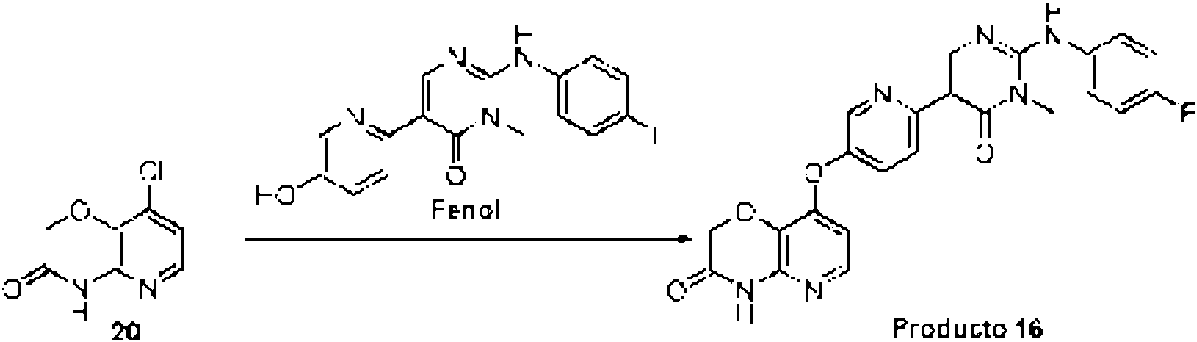
El producto deseado 16 se sintetiza utilizando la secuencia y condiciones similares a las descritas para el ejemplo 2 con fenol en lugar de ácido 1. MS: 461 (M+H)+.The desired product 16 is synthesized using the sequence and conditions similar to those described for Example 2 with phenol instead of acid 1 . MS: 461 (M + H) +.
Ejemplo 17Example 17
5-(5-(2,3-dihidro-1H-pirrolo[2,3-b]piridin-4-iloxi)piridin-2-il)-2-(4-fluorofenilamino)-3-metilpirimidin-4(3H)-ona (Producto 17) 5- ( 5- ( 2,3-dihydro-1H-pyrrolo [2,3-b] pyridin-4-yloxy) pyridin-2-yl) -2- ( 4-fluorophenylamino) -3-methylpyrimidin-4 ( 3H -one ( Product 17)

El producto deseado 17 se sintetiza utilizando la secuencia y condiciones similares a las descritas para el ejemplo 2 con fenol en lugar de ácido 1. MS: 431 (M+H)+.The desired product 17 is synthesized using the sequence and conditions similar to those described for Example 2 with phenol instead of acid 1 . MS: 431 (M + H) +.
Ejemplo 18Example 18
N-(3-fluoro-4-(3-oxo-3,4-dihidro-2H-pirido[3,2-b][1,4]oxazin-8-iloxi)fenil)-1,5-dimetil-3-oxo-2-fenil-2,3-dihidro-1H-pirazol-4-carboxamida (Producto 18) N- ( 3-fluoro-4- ( 3-oxo-3,4-dihydro-2H-pyrido [3,2-b] [1,4] oxazin-8-yloxy) phenyl) -1,5-dimethyl- 3-oxo-2-phenyl-2,3-dihydro-1H-pyrazole-4-carboxamide ( Product 18)
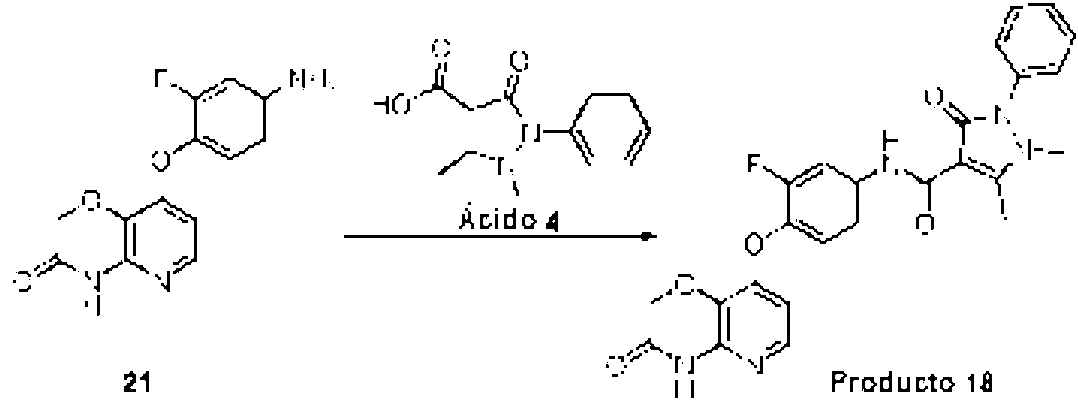
El producto deseado 18 se sintetiza utilizando la secuencia y condiciones similares a las descritas para el ejemplo 2 con ácido 4 en lugar de ácido 1. MS: 490 (M+H)+.The desired product 18 is synthesized using the sequence and conditions similar to those described for Example 2 with acid 4 instead of acid 1 . MS: 490 (M + H) +.
Ejemplo 19Example 19
N-(4-(2,3-dihidro-1H-pirrolo[2,3-b]piridin-4-iloxi)-3-fluorofenil)-1,5-dimetil-3-oxo-2-fenil-2,3-dihidro-1H-pirazol-4-carboxamida (Producto 19) N- ( 4- ( 2,3-dihydro-1H-pyrrolo [2,3-b] pyridin-4-yloxy) -3-fluorophenyl) -1,5-dimethyl-3-oxo-2-phenyl-2, 3-dihydro-1H-pyrazole-4-carboxamide ( Product 19)
El producto deseado 19 se sintetiza utilizando la secuencia y condiciones similares a las descritas para el ejemplo 2 con ácido 4 en lugar de ácido 1. MS: 460 (M+H)+. RMN H (DMSO-da): 10,91 (s, 1H), 7,88-7,95 (dd, 1H, J = 10,50Hz 1,50Hz), 7,60-7,62 (m, 3H), 7,52-7,53 (m, 1H), 7,42-7,44 (m, 2H), 7,22-7,32 (m, 2H), 6,77 (s, 1H), 5,93-5,95 (d, 1H, J = 4,50 Hz), 3,49-3,53 (m, 2H), 3,37 (s, 3H), 2,84-2,89 (m, 2H), 2,70 (s, 3H)The desired product 19 is synthesized using the sequence and conditions similar to those described for Example 2 with acid 4 instead of acid 1 . MS: 460 (M + H) +. H-NMR (DMSO-da): 10.91 (s, 1H), 7.88-7.95 (dd, 1H, J = 10.50Hz 1.50Hz), 7.60-7.62 (m, 3H) ), 7.52-7.53 (m, 1H), 7.42-7.44 (m, 2H), 7.22-7.32 (m, 2H), 6.77 (s, 1H), 5.93-5.95 (d, 1H, J = 4.50 Hz), 3.49-3.53 (m, 2H), 3.37 (s, 3H), 2.84-2.89 ( m, 2H), 2.70 (s, 3H)
Ejemplo 20Example 20
N-(4-(3,4-dihidro-2H-pirido[3,2-b][1,4]oxazin-8-iloxi)-3-fluorofenil)-1,5-dimetil-3-oxo-2-fenil-2,3-dihidro-1H-pirazol-4-carboxamida (Producto 20) N- ( 4- ( 3,4-dihydro-2H-pyrido [3,2-b] [1,4] oxazin-8-yloxy) -3-fluorophenyl) -1,5-dimethyl-3-oxo-2 -phenyl-2,3-dihydro-1H-pyrazole-4-carboxamide ( Product 20)

El producto 20 deseado se sintetiza utilizando la secuencia y condiciones similares a las descritas para el ejemplo 2 con ácido 4 en lugar de ácido 1. MS: 476 (M+H)+. RMN H (DMSO-d6): 10,87 (s, 1H), 7,86-7,90 (dd, 1H, J = 9,60Hz 1,50Hz), 7,42-7,61 (m, 6H), 7,12-7,26 (m, 2H), 6,897 (s, 1H), 5,99-6,00 (d, 1H, J = 4,2Hz), 4,12-4,14 (m, 2H), 3,42 3,43 (m, 2H), 3,36 (s, 3H), 2,70 (s, 3 H )).The desired product 20 is synthesized using the sequence and similar to those described for Example 2 with 4 acid instead of 1- conditions. MS: 476 (M + H) +. H-NMR (DMSO-d6): 10.87 (s, 1H), 7.86-7.90 (dd, 1H, J = 9.60Hz 1.50Hz), 7.42-7.61 (m, 6H) ), 7.12-7.26 (m, 2H), 6.897 (s, 1H), 5.99-6.00 (d, 1H, J = 4.2Hz), 4.12-4.14 (m , 2H), 3.42 3.43 (m, 2H), 3.36 (s, 3H), 2.70 (s, 3 H)).
Ejemplo 21Example 21
N-(4-(3,4-dihidro-2H-pirído[3,2-b][1,4]oxazin-8-iloxi)fenil)-5-(4-fluorofenil)-4-oxo-1,4-dihidropiridin-3-carboxamida (Producto 21) N- ( 4- ( 3,4-dihydro-2H-pyrido [3,2-b] [1,4] oxazin-8-yloxy) phenyl) -5- ( 4-fluorophenyl) -4-oxo-1, 4-dihydropyridine-3-carboxamide ( Product 21)

El producto deseado 21 se sintetiza utilizando la secuencia y condiciones similares descritas para el ejemplo 2. MS: 459 (M+H)+.The desired product 21 is synthesized using the sequence and similar conditions described for example 2. MS: 459 (M + H) +.


Pruebas farmacológicasPharmacological tests
Los siguientes ensayos demuestran que determinados compuestos de la presente invención inhiben potentemente la fosforilación de c-Met in vitro, inhiben potentemente c-Met in vivo y tienen actividad antitumoral dependiente de la dosis en determinados modelos de xenoinjerto.The following tests demonstrate that certain compounds of the present invention potently inhibit the phosphorylation of c-Met in vitro, potently inhibit c-Met in vivo and have dose-dependent antitumor activity in certain models of xenograft.
Ensayos biológicosBiological tests
Se incuba Met (h) con MOPS 8 mM, pH 7,0, EDTA 0,2 mM, KKKSPGEYVNIEFG 250 pM, acetato de Mg 10 mM, [y-33P-ATP] (actividad específica de aprox. 500 cpm/pmol, concentración según sea necesario) y compuesto de prueba 0,2 pM. La reacción se inicia mediante la adición de la mezcla MgATP. Después de la incubación durante 40 minutos a temperatura ambiente, la reacción se detiene mediante la adición de una solución de ácido fosfórico al 3%. Luego se colocan 10 pl de la reacción en una alfombrilla filtrante P30 y se lavan tres veces durante 5 minutos en ácido fosfórico 75 mM y una vez en metanol antes del secado y el recuento de centelleo. Este ensayo se realiza por Millipore. El experimento se lleva a cabo por duplicado. El valor para la muestra de referencia (DMSO) se fijó en 100%, y los valores para las muestras tratadas con compuesto se expresaron como actividad con respecto a la muestra de referencia.Met (h) is incubated with 8 mM MOPS, pH 7.0, 0.2 mM EDTA, 250 pM KKKSPGEYVNIEFG, 10 mM Mg acetate, [y-33P-ATP] (specific activity of about 500 cpm / pmol, concentration as necessary) and 0.2 pM test compound. The reaction is initiated by the addition of the MgATP mixture. After incubation for 40 minutes at room temperature, the reaction is stopped by the addition of a 3% phosphoric acid solution. Then 10 pl of the reaction is placed in a P30 filter mat and washed three times for 5 minutes in 75 mM phosphoric acid and once in methanol before drying and scintillation counting. This test is performed by Millipore. The experiment is carried out in duplicate. The value for the reference sample (DMSO) was set at 100%, and the values for the samples treated with compound were expressed as activity with respect to the reference sample.
Tabla 1Table 1

Análisis de proliferación celularCell proliferation analysis
El análisis de proliferación celular se realizó mediante el protocolo de análisis MTS. En resumen, se cultivarán células U87-MG en medio EMEM, se cultivarán células EBC-1 y células SNU-5 en medio MEM, se cultivarán células MKN45, células NCI-H1975 y células NCI-H1993 en medio RPMI1640, se cultivarán células A549 en medio 5a de McCoy. Todas las células se cultivarán en medio enriquecido con 10% de FBS, a la temperatura de 37°C, 5% de CO2 y 95% de humedad. Todos los medios de cultivo se comprarán en GIBCO (EE.UU.). Las células se recolectarán respectivamente durante el período de crecimiento logarítmico y se hará el recuento con hemocitómetro. La viabilidad celular es superior al 98% por exclusión con azul tripano. Se ajustan las concentraciones celulares a 2,22 x 10⁵ o 1,11 x 10⁵ o 5,56 x 10⁴ celulas/ml con el medio respectivo. Se añaden 90 pl de suspensiones celulares a las placas de 96 pocillos (por triplicado para cada concentración celular), las densidades celulares finales son 2 x 10⁴ o 1 x 10⁴ o 5 x 10³ células/pocillo. La densidad de 5 x 10³ células/pocillo se utilizará para la primera prueba. La densidad celular apropiada se determinará y ajustará según los resultados de la primera prueba. Al día siguiente, se disuelve el artículo de prueba o los medicamentos positivos con DMSO o PBS como solución madre. Se dispensan 2 pl de solución de fármaco en 1 ml de medio de cultivo. Se agregan 200 pl de medio de fármaco en placas de 96 pocillos (por triplicado para cada concentración de fármaco) después de desechar el medio anterior. La concentración final del fármaco será 0, 0,03, 0,1, 0,3, 1, 3, 10, 30 o 100 pM. Las placas se cultivarán durante otros 7 días y a continuación se cuantificarán mediante un análisis MTS. Se prepara la solución MTS/PMS inmediatamente antes de su uso, se pipetean 20 pl de la mezcla en cada pocillo de la placa analítica de 96 pocillos que contiene 100 pl de medio de cultivo. (El volumen de reacción final es de 120 pl). Se incuba la placa durante 1-4 horas a 37°C en una atmósfera humidificada y 5% de CO2. Se registra la absorbancia a 490 nm utilizando el espectrofotómetro VictorX5 para microplacas.Cell proliferation analysis was performed by the MTS analysis protocol. In summary, U87-MG cells will be cultured in EMEM medium, EBC-1 cells and SNU-5 cells will be cultured in MEM medium, MKN45 cells, NCI-H1975 cells and NCI-H1993 cells will be cultured in RPMI1640 medium, A549 cells will be cultured. in the middle 5a of McCoy. All cells will be cultured in medium enriched with 10% FBS, at a temperature of 37 ° C, 5% CO 2 and 95% moisture. All culture media will be purchased from GIBCO (USA). The cells will be harvested respectively during the logarithmic growth period and the count will be made with a hemocytometer. The cell viability is higher than 98% by exclusion with trypan blue. The cell concentrations are adjusted to 2.22 x 10 5 or 1.11 x 10 5 or 5.56 x 10 4 cells / ml with the respective medium. 90 μl of cell suspensions are added to the 96-well plates (in triplicate for each cell concentration), the final cell densities are 2 × 10 4 or 1 × 10 4 or 5 × 10 3 cells / well. The density of 5 x 10³ cells / well will be used for the first test. The appropriate cell density will be determined and adjusted according to the results of the first test. The next day, the test article or the positive drugs with DMSO or PBS are dissolved as a stock solution. 2 pl of drug solution are dispensed in 1 ml of culture medium. 200 μl of drug medium is added in 96 well plates (in triplicate for each drug concentration) after discarding the previous medium. The final concentration of the drug will be 0, 0.03, 0.1, 0.3, 1, 3, 10, 30 or 100 pM. The plates will be grown for another 7 days and then quantified by an MTS analysis. The MTS / PMS solution is prepared immediately before use, pipetting 20 μl of the mixture into each well of the 96-well analytical plate containing 100 μl of culture medium. (The final reaction volume is 120 pl). The plate is incubated for 1-4 hours at 37 ° C in a humidified atmosphere and 5% CO 2 . Absorbance is recorded at 490 nm using the VictorX5 microplate spectrophotometer.
Tabla 2Table 2

Modelos tumorales de xenoinjertoTumor models of xenograft
Células A549 de cáncer de pulmón no microcítico humano, células MKN45 de cáncer gástrico humano y células EBC-1 de carcinoma escamoso de pulmón humano se expanden en cultivo, se recolectan y se inyectan por vía subcutánea en el flanco derecho de ratones lampiños BALB/c. El compuesto de prueba se prepara en un vehículo apropiado y se administra por sonda oral cuando se comprueban los tumores (6-10 días después del implante). La respuesta del tumor se determina mediante la medición del volumen del tumor realizada dos veces a la semana durante el curso del tratamiento. La inhibición del volumen tumoral (% de inhibición del crecimiento) se calcula comparando los grupos tratados con el grupo de referencia del vehículo. El peso corporal se toma como una medida general de toxicidad. El compuesto del ejemplo 1 demuestra una excelente actividad antitumoral en estos modelos. Por ejemplo, cuando se administra a 60 y 120 mg/kg (cada día x 24), el ejemplo 1 puede causar 76,6% y 96,7% de inhibición del crecimiento de tumores A549, respectivamente. Cuando se administra a 60 y 120 mg/kg (cada día x 22), el ejemplo 1 puede causar una inhibición del crecimiento de 38,9% y 71,9% de los tumores MKN45, respectivamente. Cuando se administra a 40 y 80 mg/kg (cada día x 17), el ejemplo 1 puede causar una inhibición del crecimiento de 56,5% y 100% de los tumores EBC-1, respectivamente.A549 cells from human non-small cell lung cancer, human gastric cancer MKN45 cells and human lung squamous cell carcinoma EBC-1 cells are expanded in culture, harvested and injected subcutaneously into the right flank of BALB / c hairless mice . The test compound is prepared in an appropriate vehicle and is administered by oral gavage when the tumors are checked (6-10 days after implantation). The tumor response is determined by measuring the volume of the tumor performed twice a week during the course of treatment. Inhibition of tumor volume (% growth inhibition) is calculated by comparing the treated groups with the vehicle reference group. Body weight is taken as a general measure of toxicity. The compound of Example 1 demonstrates excellent antitumor activity in these models. For example, when administered at 60 and 120 mg / kg (every day x 24), Example 1 can cause 76.6% and 96.7% inhibition of A549 tumor growth, respectively. When administered at 60 and 120 mg / kg (every day x 22), Example 1 can cause a growth inhibition of 38.9% and 71.9% of MKN45 tumors, respectively. When administered at 40 and 80 mg / kg (every day x 17), Example 1 can cause growth inhibition of 56.5% and 100% of EBC-1 tumors, respectively.
La sobreexpresión de c-Met en tumores relacionados con c-Met y modelos de xenoinjerto es una característica común de muchos tumores humanos, incluidos los de pulmón, mama, colorrectal, gástrico, renal, pancreático, cabeza y cuello(12). Las mutaciones activadoras de c-Met en el dominio de cinasa están implicadas como la causa de varios tumores, como el carcinoma papilar hereditario de células renales, el carcinoma hepatocelular infantil y el cáncer gástrico(36). Los inhibidores de c-Met de Pfizer demostraron eficacia antitumoral en muchos tumores de xenoinjerto humanos, incluidos U87MG, GTL16, H441, Caki-1 y PC3<7>.Overexpression of c-Met in tumors related to c-Met and xenograft models is a common feature of many human tumors, including lung, breast, colorectal, gastric, renal, pancreatic, head and neck tumors (12). Activating mutations of c-Met in the kinase domain are implicated as the cause of several tumors, such as hereditary papillary renal cell carcinoma, infantile hepatocellular carcinoma and gastric cancer (36). Pfizer c-Met inhibitors demonstrated antitumor efficacy in many human xenograft tumors, including U87MG, GTL16, H441, Caki-1 and PC3 <7>.
1. Christinsen, J. G., Burrows, J., y Salgia, R. Cáncer Letters 225: 1-26, 2005.1. Christinsen, JG, Burrows, J., and Salgia, R. Cancer Letters 225: 1-26, 2005.
2. Birchmeier, C., Birchmeier, W., Gherardi, E., y Vande Woude, G. F. Nat. Rev. Mol. Cell Biol. 4: 915-925, 2003. 2. Birchmeier, C., Birchmeier, W., Gherardi, E., and Vande Woude, GF Nat. Rev. Mol. Cell Biol. 4: 915-925, 2003.
3. Di Renzo, M. F., Olivero, M., Martone, T. et al. Oncogene 19: 1547-1555, 2000. 3. Di Renzo, MF, Olivero, M., Martone, T. et al. Oncogene 19: 1547-1555, 2000.
4. Lee, J. H., Han, S. U., Cho, H. et al. Oncogene 19: 4947-4953, 2000.4. Lee, JH, Han, SU, Cho, H. et al. Oncogene 19: 4947-4953, 2000.
5. Ma, P. ej. C., Kijima, T., Maulik, G. et al. Cáncer Res. 63: 6272-6281, 2003. 6. Park, W. S., Dong, S. M., Kim, S. Y. et al. Cáncer Res. 59: 307-310, 1999.5. Ma, P. ex. C., Kijima, T., Maulik, G. et al. Cancer Res. 63: 6272-6281, 2003. 6. Park, WS, Dong, SM, Kim, SY et al. Cancer Res. 59: 307-310, 1999.
6. Schmidt, L., Duh, F. M., Chen, F., et al. Nat. Genet.16: 68-73, 1997.6. Schmidt, L., Duh, FM, Chen, F., et al. Nat. Genet.16: 68-73, 1997.
7. Zou, H. Y., Li, Qiuhua., Lee, J. H., et al. Cancer Res. 67: 4408-4417, 2007.7. Zou, HY, Li, Qiuhua., Lee, JH, et al. Cancer Res. 67: 4408-4417, 2007.
Los compuestos de la presente invención se formulan preferiblemente como composiciones farmacéuticas administradas por una variedad de vías. De la manera más preferible, dichas composiciones son para administración oral. Dichas composiciones farmacéuticas y procedimientos para preparar los mismos son bien conocidos en la técnica. Véase, p. ej., REMINGTON: THE SCIENCE AND PRACTICE OF PHARMACY (A. Gennaro, et al., eds., 19a ed., Mack Publishing Co., 1995). Los compuestos de fórmula I son generalmente eficaces en un amplio intervalo de dosis.The compounds of the present invention are preferably formulated as pharmaceutical compositions administered by a variety of routes. Most preferably, said compositions are for oral administration. Said pharmaceutical compositions and methods for preparing the same are well known in the art. See, p. eg, REMINGTON: THE SCIENCE AND PRACTICE OF PHARMACY (A. Gennaro, et al., eds., 19th ed., Mack Publishing Co., 1995). The compounds of formula I are generally effective over a wide range of doses.
Por ejemplo, las dosis diarias normalmente están comprendidas dentro del intervalo de aproximadamente 1 mg a aproximadamente 200 mg de dosis diaria total, preferiblemente de 1 mg a 150 mg de dosis diaria total, más preferiblemente de 1 mg a 50 mg de dosis diaria total. En algunos casos, las cantidades de dosis por debajo del límite inferior del intervalo mencionado anteriormente pueden ser más que adecuados, mientras que en otros casos se pueden emplear dosis aún mayores. El intervalo de dosificación anterior no pretende limitar el alcance de la invención de ninguna manera. Debe entenderse que la cantidad del compuesto realmente administrado la determinará un médico, a la luz de las circunstancias oportunas, incluida la afección a tratar, la vía de administración elegida, el compuesto o compuestos reales administrados, la edad, el peso y la respuesta de cada paciente y la gravedad de los síntomas del paciente. For example, daily doses normally fall within the range of from about 1 mg to about 200 mg of total daily dose, preferably from 1 mg to 150 mg of total daily dose, more preferably from 1 mg to 50 mg of total daily dose. In some cases, the dose amounts below the lower limit of the aforementioned range may be more than adequate, while in other cases even higher doses may be employed. The above dosage range is not intended to limit the scope of the invention in any way. It is to be understood that the amount of the compound actually administered will be determined by a physician, in light of the appropriate circumstances, including the condition to be treated, the route of administration chosen, the actual compound or compounds administered, the age, weight and response of the patient. each patient and the severity of the patient's symptoms.
Claims (34)


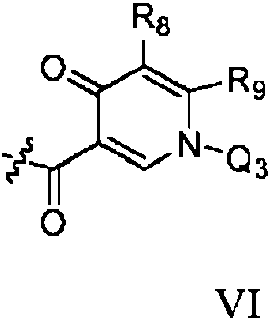

Applications Claiming Priority (2)
| Application Number | Priority Date | Filing Date | Title |
|---|---|---|---|
| CN2012077924 | 2012-06-29 | ||
| PCT/CN2013/078592 WO2014000713A1 (en) | 2012-06-29 | 2013-07-01 | NOVEL FUSED PYRIDINE DERIVATIVES USEFUL AS c-MET TYROSINE KINASE INHIBITORS |
Publications (1)
| Publication Number | Publication Date |
|---|---|
| ES2698511T3 true ES2698511T3 (en) | 2019-02-05 |
Family
ID=49782283
Family Applications (1)
| Application Number | Title | Priority Date | Filing Date |
|---|---|---|---|
| ES13809182T Active ES2698511T3 (en) | 2012-06-29 | 2013-07-01 | New condensed pyridine derivatives useful as inhibitors of c-met tyrosine kinase |
Country Status (15)
| Country | Link |
|---|---|
| US (1) | US9617257B2 (en) |
| EP (1) | EP2867223B1 (en) |
| JP (1) | JP6059342B2 (en) |
| KR (3) | KR101726522B1 (en) |
| CN (1) | CN104507930B (en) |
| AU (1) | AU2013283993B2 (en) |
| BR (1) | BR112014032745B1 (en) |
| CA (1) | CA2878049C (en) |
| ES (1) | ES2698511T3 (en) |
| IN (1) | IN2015DN00372A (en) |
| RU (1) | RU2619130C2 (en) |
| SG (1) | SG11201408750VA (en) |
| TW (1) | TWI520962B (en) |
| WO (1) | WO2014000713A1 (en) |
| ZA (1) | ZA201500344B (en) |
Families Citing this family (17)
| Publication number | Priority date | Publication date | Assignee | Title |
|---|---|---|---|---|
| CN106279147A (en) | 2015-05-21 | 2017-01-04 | 中国科学院上海药物研究所 | A kind of pyrido nitrogen heterocyclic and its production and use |
| ES2769124T3 (en) * | 2015-07-20 | 2020-06-24 | Betta Pharmaceuticals Co Ltd | Crystalline form of maleate of condensed pyridine derivatives and uses thereof |
| CN108853108A (en) * | 2015-12-31 | 2018-11-23 | 北京浦润奥生物科技有限责任公司 | Compound is preparing the purposes in the drug for treating glioma |
| US9815850B2 (en) | 2016-02-05 | 2017-11-14 | Denali Therapeutics Inc. | Compounds, compositions and methods |
| LT3552017T (en) | 2016-12-09 | 2022-05-10 | Denali Therapeutics Inc. | COMPOUNDS TO BE USED AS RIPK1 INHIBITORS |
| WO2018215668A1 (en) * | 2017-05-26 | 2018-11-29 | Glenmark Pharmaceuticals S.A. | Novel inhibitors of map4k1 |
| JP7131837B2 (en) * | 2017-06-19 | 2022-09-06 | アビスコ セラピューティクス カンパニー リミテッド | AZAaryl DERIVATIVE HAVING CSF-1R INHIBITING ACTIVITY, PRODUCTION AND APPLICATION THEREOF |
| CN109988108B (en) * | 2017-12-29 | 2022-04-29 | 江苏豪森药业集团有限公司 | Preparation method of cabozantinib |
| WO2020124060A1 (en) | 2018-12-14 | 2020-06-18 | Beta Pharma, Inc. | Organophosphorus-substituted compounds as c-met inhibitors and therapeutic uses thereof |
| CA3129665A1 (en) | 2019-03-21 | 2020-09-24 | Onxeo | A dbait molecule in combination with kinase inhibitor for the treatment of cancer |
| KR20220098759A (en) | 2019-11-08 | 2022-07-12 | 인쎄름 (엥스띠뛰 나씨오날 드 라 쌍떼 에 드 라 흐쉐르슈 메디깔) | A method of treating cancer that has acquired resistance to a kinase inhibitor |
| WO2021148581A1 (en) | 2020-01-22 | 2021-07-29 | Onxeo | Novel dbait molecule and its use |
| CN112225748B (en) * | 2020-10-20 | 2021-11-30 | 四川大学华西医院 | Small molecule compound with FLT3 kinase inhibitory activity and application thereof |
| TWI812301B (en) * | 2021-06-24 | 2023-08-11 | 南韓商Lg化學股份有限公司 | Novel urea derivative compound as ron inhibitor |
| EP4463229A1 (en) | 2022-01-12 | 2024-11-20 | Denali Therapeutics Inc. | Crystalline forms of (s)-5-benzyl-n-(5-methyl-4-oxo-2, 3,4,5- tetrahydropyrido [3,2-b] [l,4]oxazepin-3-yl)-4h-l,2,4-triazole-3-carboxamide |
| JP2025513455A (en) | 2022-04-22 | 2025-04-24 | バーテックス ファーマシューティカルズ インコーポレイテッド | Heteroaryl compounds for the treatment of pain - Patents.com |
| EP4289427A1 (en) * | 2022-06-10 | 2023-12-13 | Anagenesis Biotechnologies | Dihydro[1,8]naphthyridin-7-one and pyrido[3,2-b][1,4]oxazin-3-one for use in treating cancer, and metastases in particular. |
Family Cites Families (14)
| Publication number | Priority date | Publication date | Assignee | Title |
|---|---|---|---|---|
| WO2005005389A2 (en) * | 2003-07-07 | 2005-01-20 | Merck Patent Gmbh | Malonamide derivatives |
| DE10357510A1 (en) * | 2003-12-09 | 2005-07-07 | Bayer Healthcare Ag | Heteroaryl-substituted benzenes |
| US20050288290A1 (en) * | 2004-06-28 | 2005-12-29 | Borzilleri Robert M | Fused heterocyclic kinase inhibitors |
| CA2572331A1 (en) * | 2004-07-02 | 2006-02-09 | Exelixis, Inc. | C-met modulators and method of use |
| EP1781664B1 (en) * | 2004-07-30 | 2013-09-04 | MethylGene Inc. | Inhibitors of vegf receptor and hgf receptor signaling |
| MX2007006230A (en) * | 2004-11-30 | 2007-07-25 | Amgen Inc | Quinolines and quinazoline analogs and their use as medicaments for treating cancer. |
| JO2787B1 (en) * | 2005-04-27 | 2014-03-15 | امجين إنك, | Substituted Amid derivatives & methods of use |
| MX2007014617A (en) | 2005-05-20 | 2008-02-11 | Methylgene Inc | Inhibitors of vegf receptor and hgf receptor signaling. |
| US20100016307A1 (en) * | 2006-10-27 | 2010-01-21 | Toshihiro Hamajima | Novel compounds |
| US7960567B2 (en) | 2007-05-02 | 2011-06-14 | Amgen Inc. | Compounds and methods useful for treating asthma and allergic inflammation |
| KR100961410B1 (en) * | 2008-10-14 | 2010-06-09 | (주)네오팜 | As protein kinase inhibitors, heterocyclic compounds |
| AU2009303602B2 (en) * | 2008-10-14 | 2012-06-14 | Sunshine Lake Pharma Co., Ltd. | Compounds and methods of use |
| CN102086211B (en) * | 2009-12-08 | 2013-09-11 | 广东东阳光药业有限公司 | Aromatic heterocyclic compounds serving as protein kinase inhibitor |
| SG187064A1 (en) * | 2010-07-14 | 2013-02-28 | Zhejiang Beta Pharma Inc | NOVEL FUSED HETEROCYCLIC DERIVATIVES USEFUL AS c-MET TYROSINE KINASE INHIBITORS |
-
2013
- 2013-06-29 TW TW102123415A patent/TWI520962B/en not_active IP Right Cessation
- 2013-07-01 RU RU2015102057A patent/RU2619130C2/en active
- 2013-07-01 SG SG11201408750VA patent/SG11201408750VA/en unknown
- 2013-07-01 IN IN372DEN2015 patent/IN2015DN00372A/en unknown
- 2013-07-01 CN CN201380038959.8A patent/CN104507930B/en not_active Expired - Fee Related
- 2013-07-01 KR KR1020157002238A patent/KR101726522B1/en not_active Expired - Fee Related
- 2013-07-01 BR BR112014032745-9A patent/BR112014032745B1/en not_active IP Right Cessation
- 2013-07-01 CA CA2878049A patent/CA2878049C/en not_active Expired - Fee Related
- 2013-07-01 AU AU2013283993A patent/AU2013283993B2/en not_active Ceased
- 2013-07-01 ES ES13809182T patent/ES2698511T3/en active Active
- 2013-07-01 JP JP2015518816A patent/JP6059342B2/en not_active Expired - Fee Related
- 2013-07-01 US US14/411,515 patent/US9617257B2/en not_active Expired - Fee Related
- 2013-07-01 WO PCT/CN2013/078592 patent/WO2014000713A1/en not_active Ceased
- 2013-07-01 KR KR1020177003335A patent/KR101726555B1/en not_active Expired - Fee Related
- 2013-07-01 KR KR1020177003331A patent/KR101770545B1/en not_active Expired - Fee Related
- 2013-07-01 EP EP13809182.2A patent/EP2867223B1/en not_active Not-in-force
-
2015
- 2015-01-16 ZA ZA2015/00344A patent/ZA201500344B/en unknown
Also Published As
| Publication number | Publication date |
|---|---|
| KR20150031320A (en) | 2015-03-23 |
| RU2015102057A (en) | 2016-08-20 |
| KR20170017014A (en) | 2017-02-14 |
| EP2867223A4 (en) | 2016-01-06 |
| IN2015DN00372A (en) | 2015-06-12 |
| KR101726522B1 (en) | 2017-04-12 |
| SG11201408750VA (en) | 2015-01-29 |
| TW201418254A (en) | 2014-05-16 |
| JP2015521634A (en) | 2015-07-30 |
| US9617257B2 (en) | 2017-04-11 |
| EP2867223B1 (en) | 2018-09-05 |
| CA2878049C (en) | 2016-12-13 |
| ZA201500344B (en) | 2016-08-31 |
| RU2619130C2 (en) | 2017-05-12 |
| CN104507930A (en) | 2015-04-08 |
| CN104507930B (en) | 2017-10-10 |
| KR101726555B1 (en) | 2017-04-12 |
| EP2867223A1 (en) | 2015-05-06 |
| TWI520962B (en) | 2016-02-11 |
| BR112014032745A2 (en) | 2017-06-27 |
| JP6059342B2 (en) | 2017-01-11 |
| KR20170017015A (en) | 2017-02-14 |
| HK1207642A1 (en) | 2016-02-05 |
| US20150315210A1 (en) | 2015-11-05 |
| BR112014032745B1 (en) | 2022-01-04 |
| WO2014000713A1 (en) | 2014-01-03 |
| CA2878049A1 (en) | 2014-01-03 |
| AU2013283993B2 (en) | 2016-07-07 |
| AU2013283993A1 (en) | 2015-02-05 |
| KR101770545B1 (en) | 2017-08-22 |
Similar Documents
| Publication | Publication Date | Title |
|---|---|---|
| AU2013283993B2 (en) | Novel fused pyridine derivatives useful as c-Met tyrosine kinase inhibitors | |
| ES2598530T3 (en) | New condensed heterocyclic derivatives useful as c-Met tyrosine kinase inhibitors | |
| ES2870203T3 (en) | Tricyclic derivative compound, method for preparing it and pharmaceutical composition comprising the same | |
| ES2779673T3 (en) | Biarylamide compounds as kinase inhibitors | |
| ES2797252T3 (en) | Dihydronaphthyridines and related compounds useful as kinase inhibitors for the treatment of proliferative diseases | |
| ES2864839T3 (en) | Chiral diaryl macrocycles as modulators of protein kinases | |
| ES2729243T3 (en) | Compounds and compositions as kinase inhibitors | |
| ES3062289T3 (en) | Factor xiia inhibitors | |
| AU2019218186B2 (en) | Urea-substituted aromatic ring-linked dioxinoquinoline compounds, preparation method and uses thereof | |
| CA3083020A1 (en) | Halo-allylamine ssao/vap-1 inhibitor and use thereof | |
| CA3096732A1 (en) | Dual atm and dna-pk inhibitors for use in anti-tumor therapy | |
| ES2927529T3 (en) | condensed heterocyclic compound | |
| TW202122382A (en) | Hydantoin derivative | |
| KR102436669B1 (en) | Urea-substituted aromatic ring-linked dioxinoquinoline compound, preparation method and use thereof | |
| HK1207642B (en) | Novel fused pyridine derivatives useful as c-met tyrosine kinase inhibitors |