ES2699699T3 - Polyurethane silicone thermoplastic elastomers - Google Patents
Polyurethane silicone thermoplastic elastomers Download PDFInfo
- Publication number
- ES2699699T3 ES2699699T3 ES15750413T ES15750413T ES2699699T3 ES 2699699 T3 ES2699699 T3 ES 2699699T3 ES 15750413 T ES15750413 T ES 15750413T ES 15750413 T ES15750413 T ES 15750413T ES 2699699 T3 ES2699699 T3 ES 2699699T3
- Authority
- ES
- Spain
- Prior art keywords
- thermoplastic
- silicone
- weight
- organic polymer
- polymer
- Prior art date
- Legal status (The legal status is an assumption and is not a legal conclusion. Google has not performed a legal analysis and makes no representation as to the accuracy of the status listed.)
- Active
Links
Classifications
-
- C—CHEMISTRY; METALLURGY
- C08—ORGANIC MACROMOLECULAR COMPOUNDS; THEIR PREPARATION OR CHEMICAL WORKING-UP; COMPOSITIONS BASED THEREON
- C08L—COMPOSITIONS OF MACROMOLECULAR COMPOUNDS
- C08L75/00—Compositions of polyureas or polyurethanes; Compositions of derivatives of such polymers
- C08L75/04—Polyurethanes
-
- C—CHEMISTRY; METALLURGY
- C08—ORGANIC MACROMOLECULAR COMPOUNDS; THEIR PREPARATION OR CHEMICAL WORKING-UP; COMPOSITIONS BASED THEREON
- C08G—MACROMOLECULAR COMPOUNDS OBTAINED OTHERWISE THAN BY REACTIONS ONLY INVOLVING UNSATURATED CARBON-TO-CARBON BONDS
- C08G77/00—Macromolecular compounds obtained by reactions forming a linkage containing silicon with or without sulfur, nitrogen, oxygen or carbon in the main chain of the macromolecule
- C08G77/04—Polysiloxanes
- C08G77/12—Polysiloxanes containing silicon bound to hydrogen
-
- C—CHEMISTRY; METALLURGY
- C08—ORGANIC MACROMOLECULAR COMPOUNDS; THEIR PREPARATION OR CHEMICAL WORKING-UP; COMPOSITIONS BASED THEREON
- C08G—MACROMOLECULAR COMPOUNDS OBTAINED OTHERWISE THAN BY REACTIONS ONLY INVOLVING UNSATURATED CARBON-TO-CARBON BONDS
- C08G77/00—Macromolecular compounds obtained by reactions forming a linkage containing silicon with or without sulfur, nitrogen, oxygen or carbon in the main chain of the macromolecule
- C08G77/04—Polysiloxanes
- C08G77/20—Polysiloxanes containing silicon bound to unsaturated aliphatic groups
-
- C—CHEMISTRY; METALLURGY
- C08—ORGANIC MACROMOLECULAR COMPOUNDS; THEIR PREPARATION OR CHEMICAL WORKING-UP; COMPOSITIONS BASED THEREON
- C08J—WORKING-UP; GENERAL PROCESSES OF COMPOUNDING; AFTER-TREATMENT NOT COVERED BY SUBCLASSES C08B, C08C, C08F, C08G or C08H
- C08J5/00—Manufacture of articles or shaped materials containing macromolecular substances
-
- C—CHEMISTRY; METALLURGY
- C08—ORGANIC MACROMOLECULAR COMPOUNDS; THEIR PREPARATION OR CHEMICAL WORKING-UP; COMPOSITIONS BASED THEREON
- C08K—Use of inorganic or non-macromolecular organic substances as compounding ingredients
- C08K3/00—Use of inorganic substances as compounding ingredients
- C08K3/02—Elements
- C08K3/04—Carbon
-
- C—CHEMISTRY; METALLURGY
- C08—ORGANIC MACROMOLECULAR COMPOUNDS; THEIR PREPARATION OR CHEMICAL WORKING-UP; COMPOSITIONS BASED THEREON
- C08K—Use of inorganic or non-macromolecular organic substances as compounding ingredients
- C08K3/00—Use of inorganic substances as compounding ingredients
- C08K3/34—Silicon-containing compounds
- C08K3/36—Silica
-
- C—CHEMISTRY; METALLURGY
- C08—ORGANIC MACROMOLECULAR COMPOUNDS; THEIR PREPARATION OR CHEMICAL WORKING-UP; COMPOSITIONS BASED THEREON
- C08L—COMPOSITIONS OF MACROMOLECULAR COMPOUNDS
- C08L25/00—Compositions of, homopolymers or copolymers of compounds having one or more unsaturated aliphatic radicals, each having only one carbon-to-carbon double bond, and at least one being terminated by an aromatic carbocyclic ring; Compositions of derivatives of such polymers
- C08L25/02—Homopolymers or copolymers of hydrocarbons
- C08L25/04—Homopolymers or copolymers of styrene
- C08L25/08—Copolymers of styrene
-
- C—CHEMISTRY; METALLURGY
- C08—ORGANIC MACROMOLECULAR COMPOUNDS; THEIR PREPARATION OR CHEMICAL WORKING-UP; COMPOSITIONS BASED THEREON
- C08L—COMPOSITIONS OF MACROMOLECULAR COMPOUNDS
- C08L33/00—Compositions of homopolymers or copolymers of compounds having one or more unsaturated aliphatic radicals, each having only one carbon-to-carbon double bond, and only one being terminated by only one carboxyl radical, or of salts, anhydrides, esters, amides, imides or nitriles thereof; Compositions of derivatives of such polymers
-
- C—CHEMISTRY; METALLURGY
- C08—ORGANIC MACROMOLECULAR COMPOUNDS; THEIR PREPARATION OR CHEMICAL WORKING-UP; COMPOSITIONS BASED THEREON
- C08L—COMPOSITIONS OF MACROMOLECULAR COMPOUNDS
- C08L83/00—Compositions of macromolecular compounds obtained by reactions forming in the main chain of the macromolecule a linkage containing silicon with or without sulfur, nitrogen, oxygen or carbon only; Compositions of derivatives of such polymers
-
- C—CHEMISTRY; METALLURGY
- C08—ORGANIC MACROMOLECULAR COMPOUNDS; THEIR PREPARATION OR CHEMICAL WORKING-UP; COMPOSITIONS BASED THEREON
- C08L—COMPOSITIONS OF MACROMOLECULAR COMPOUNDS
- C08L83/00—Compositions of macromolecular compounds obtained by reactions forming in the main chain of the macromolecule a linkage containing silicon with or without sulfur, nitrogen, oxygen or carbon only; Compositions of derivatives of such polymers
- C08L83/04—Polysiloxanes
-
- C—CHEMISTRY; METALLURGY
- C08—ORGANIC MACROMOLECULAR COMPOUNDS; THEIR PREPARATION OR CHEMICAL WORKING-UP; COMPOSITIONS BASED THEREON
- C08L—COMPOSITIONS OF MACROMOLECULAR COMPOUNDS
- C08L9/00—Compositions of homopolymers or copolymers of conjugated diene hydrocarbons
- C08L9/06—Copolymers with styrene
-
- C—CHEMISTRY; METALLURGY
- C08—ORGANIC MACROMOLECULAR COMPOUNDS; THEIR PREPARATION OR CHEMICAL WORKING-UP; COMPOSITIONS BASED THEREON
- C08L—COMPOSITIONS OF MACROMOLECULAR COMPOUNDS
- C08L2207/00—Properties characterising the ingredient of the composition
- C08L2207/04—Thermoplastic elastomer
Landscapes
- Chemical & Material Sciences (AREA)
- Health & Medical Sciences (AREA)
- Chemical Kinetics & Catalysis (AREA)
- Medicinal Chemistry (AREA)
- Polymers & Plastics (AREA)
- Organic Chemistry (AREA)
- Engineering & Computer Science (AREA)
- Manufacturing & Machinery (AREA)
- Materials Engineering (AREA)
- Compositions Of Macromolecular Compounds (AREA)
- Processes Of Treating Macromolecular Substances (AREA)
Abstract
Una composición elastomérica termoplástica que comprende una mezcla de (A) un polímero orgánico termoplástico que comprende un polímero de uretano y (B) una composición de silicona que comprende: (B1) una base de silicona que comprende: (B1a) una goma de diorganopolisiloxano que tiene un promedio de al menos 2 grupos alquenilo por molécula y (B1b) de 1 a 50 % en peso, respecto de la goma de diorganopolisiloxano (B1a) de un relleno de refuerzo, y (B2) un compuesto de organohidruro de silicona que contiene un promedio de al menos 2 grupos hidrógeno unidos por silicio por molécula, en el que la proporción en peso del polímero orgánico termoplástico (A) a la composición de silicona (B) está en el intervalo 55:45 a 80:20.A thermoplastic elastomeric composition comprising a mixture of (A) a thermoplastic organic polymer comprising a urethane polymer and (B) a silicone composition comprising: (B1) a silicone base comprising: (B1a) a diorganopolysiloxane gum having an average of at least 2 alkenyl groups per molecule and (B1b) from 1 to 50% by weight, based on the diorganopolysiloxane gum (B1a) of a reinforcing filler, and (B2) a silicon organohydride compound which it contains an average of at least 2 hydrogen groups bonded per silicon per molecule, wherein the weight ratio of the thermoplastic organic polymer (A) to the silicone composition (B) is in the range 55:45 to 80:20.
Description
DESCRIPCIÓNDESCRIPTION
Elastómeros termoplásticos de silicona poliuretanoPolyurethane silicone thermoplastic elastomers
Esta invención se refiere a composiciones elastoméricas termoplásticas que comprenden una mezcla de un polímero de uretano termoplástico y una composición de silicona y a un procedimiento para formar una composición elastomérica termoplástica vulcanizada. En un aspecto, la invención se refiere al uso de tal composición elastomérica termoplástica para formar un artículo que se puede llevar puesto destinado a estar en contacto con la piel del portador cuando lo usa y a un artículo que se puede llevar puesto formado con la composición elastomérica termoplástica.This invention relates to thermoplastic elastomer compositions comprising a blend of a thermoplastic urethane polymer and a silicone composition and to a process for forming a vulcanized thermoplastic elastomer composition. In one aspect, the invention relates to the use of such a thermoplastic elastomeric composition to form an article that can be worn intended to be in contact with the skin of the wearer when wearing it and to an article that can be worn formed with the elastomeric composition. thermoplastic
En un aspecto, la invención se refiere al uso de tal composición elastomérica termoplástica para formar piezas de automóviles estéticas y funcionales tales como pomos de cambios de marchas, conectores del cinturón del asiento, alfombrillas interiores, cubiertas protectoras del airbag, fundas de tableros de instrumentos y de reposabrazos; para formar piezas de electrodomésticos como empuñaduras de tacto suave en dispositivos que se agarran con la mano; para formar dispositivos médicos, artículos deportivos y piezas de caucho en general; que requieren propiedades ergonómicas, táctiles y estéticas duraderas junto con estabilidad y baja capacidad de teñido cuando se exponen a los productos químicos más usados comúnmente y rendimientos mecánicos y resistencia al rayado y a la abrasión altos.In one aspect, the invention relates to the use of such a thermoplastic elastomeric composition to form aesthetic and functional automotive parts such as gear shift knobs, seat belt connectors, interior mats, airbag protective covers, instrument panel covers and armrest; to form pieces of household appliances such as soft-touch handles on devices that are held by hand; to form medical devices, sporting goods and rubber parts in general; which require lasting ergonomic, tactile and aesthetic properties together with stability and low dyeing capacity when exposed to the most commonly used chemicals and high mechanical performance and scratch and abrasion resistance.
La composición elastomérica termoplástica según la invención se puede usar para fabricar piezas o componentes para aplicaciones en automóviles, electrodomésticos, electrónica, electrónica portátil, eléctricas, de comunicación y médicas, en las cuales se pueden buscar, de manera simultánea, rendimientos de suficiente tacto y sensibilidad, resistencia al rayado y a estropearse, resistencia química y resistencia al teñido y rendimiento mecánico.The thermoplastic elastomer composition according to the invention can be used to manufacture parts or components for applications in automobiles, household appliances, electronics, portable electronics, electrical, communication and medical, in which performances of sufficient tactility can be sought simultaneously. Sensitivity, resistance to scratching and damage, chemical resistance and resistance to dyeing and mechanical performance.
Los silanos y los siloxanos son compuestos que contienen silicio.Silanes and siloxanes are compounds that contain silicon.
Un silano es un compuesto derivado de SiH4. Con frecuencia, un silano contiene al menos un enlace Si-C. Habitualmente, un silano tiene solo un átomo de Si.A silane is a compound derived from SiH 4 . Frequently, a silane contains at least one Si-C bond. Usually, a silane has only one Si atom.
Un siloxano es un compuesto que tiene al menos un enlace Si-O.A siloxane is a compound that has at least one Si-O bond.
Un polisiloxano tiene varios enlaces Si-O-Si que forman una cadena polimérica, en la cual la unidad de repetición es -(Si-O)-. A veces se denomina siliconas a los organopolisiloxanos. Un organopolisiloxano contiene unidades de repetición -(Si-O)- en las que al menos un átomo de Si lleva al menos un grupo orgánico. Aquí “orgánico” significa que tiene al menos un átomo de carbono. Un grupo orgánico es un grupo químico que comprende al menos un átomo de carbono.A polysiloxane has several Si-O-Si bonds that form a polymer chain, in which the repeating unit is - (Si-O) -. Organopolysiloxanes are sometimes referred to as silicones. An organopolysiloxane contains repeating units - (Si-O) - in which at least one Si atom carries at least one organic group. Here "organic" means that it has at least one carbon atom. An organic group is a chemical group comprising at least one carbon atom.
Un polisiloxano contiene grupos terminales y grupos colgantes. Un grupo terminal es un grupo químico situado en un átomo de Si que está en un extremo de la cadena polimérica. Un grupo colgante es un grupo situado en un átomo de Si que no está en el extremo de la cadena polimérica.A polysiloxane contains terminal groups and pendant groups. A terminal group is a chemical group located on a Si atom that is at one end of the polymer chain. A hanging group is a group located on an Si atom that is not at the end of the polymer chain.
Un polímero es un compuesto que contiene unidades de repetición que forman típicamente al menos una cadena polimérica. Un polímero puede ser un homopolímero o un copolímero. Un homopolímero es un polímero que está formado de un único tipo de monómero. Un copolímero es un polímero formado a partir de al menos dos monómeros. Un polímero se denomina polímero orgánico cuando las unidades de repetición contienen átomos de carbono.A polymer is a compound that contains repeat units that typically form at least one polymer chain. A polymer can be a homopolymer or a copolymer. A homopolymer is a polymer that is formed from a single type of monomer. A copolymer is a polymer formed from at least two monomers. A polymer is called an organic polymer when the repeating units contain carbon atoms.
Algunos polímeros son termoestables: una vez que se han enfriado y endurecido, estos polímeros mantienen sus formas y no pueden volver a su forma original. Otros polímeros son termoplásticos: pueden ablandarse cuando se calientan y volver a su forma original.Some polymers are thermostable: once they have cooled and hardened, these polymers maintain their shapes and can not return to their original form. Other polymers are thermoplastic: they can soften when heated and return to their original shape.
Una reacción de reticulación es una reacción en la que una o más moléculas, siendo al menos una de ellas un polímero, se unen entre sí para endurecer o “curar” el polímero. Un reticulador es un compuesto capaz de producir una reacción de reticulación de un polímero.A crosslinking reaction is a reaction in which one or more molecules, at least one of which is a polymer, are bonded together to harden or "cure" the polymer. A crosslinker is a compound capable of producing a crosslinking reaction of a polymer.
Una goma se hace habitualmente con un polímero de alto peso molecular. Una goma toma la forma de un fluido que tiene alta viscosidad. Típicamente, una goma tiene una viscosidad de al menos 100 mPa s a 25 °C. Una goma puede tener una viscosidad de hasta 2000 mPas a 25 °C o incluso más.A gum is usually made with a high molecular weight polymer. A rubber takes the form of a fluid that has high viscosity. Typically, a gum has a viscosity of at least 100 mPa s at 25 ° C. A rubber can have a viscosity of up to 2000 mPas at 25 ° C or even more.
El enlace uretano es el enlace -NH-(C=O)-O-. Un polímero de uretano se denomina también poliuretano.The urethane bond is the -NH- (C = O) -O- bond. A urethane polymer is also referred to as polyurethane.
Un elastómero, denominado en ocasiones caucho, es un polímero que tiene tanto viscosidad como elasticidad. Los elastómeros termoplásticos (TPE por sus siglas en inglés) son materiales poliméricos que poseen propiedades tanto plásticas como elásticas. Tienen propiedades mecánicas elastoméricas, pero, a diferencia de los cauchos termoestables convencionales, pueden reprocesarse a temperaturas elevadas. Esta capacidad de reprocesado es una ventaja importante de los TPE respecto de los cauchos reticulados químicamente puesto que permite el reciclado de piezas fabricadas, lo que implica una reducción considerable de desperdicios. An elastomer, sometimes called rubber, is a polymer that has both viscosity and elasticity. Thermoplastic elastomers (TPE) are polymeric materials that have both plastic and elastic properties. They have elastomeric mechanical properties, but, unlike conventional thermoset rubbers, they can be reprocessed at elevated temperatures. This reprocessing capacity is an important advantage of the TPE with respect to the chemically crosslinked rubbers since it allows the recycling of manufactured parts, which implies a considerable reduction of waste.
En general, se conocen dos tipos principales de elastómeros termoplásticos. Los elastómeros termoplásticos copolímeros de bloques contienen segmentos de plástico “duros” que tienen un punto de fusión o temperatura de transición vítrea por encima de la temperatura ambiente, así como segmentos poliméricos “blandos” que tienen una temperatura de transición o un punto de fusión considerablemente por debajo de la temperatura ambiente. En estos sistemas, los segmentos duros se agregan para formar microfases separadas y actúan como reticuladores físicos de la fase blanda, proporcionando un carácter elástico a temperatura ambiente. A temperaturas elevadas, los segmentos duros se funden o ablandan y permiten que el copolímero fluya y se procese como una resina termoplástica corriente.In general, two main types of thermoplastic elastomers are known. Thermoplastic block copolymer elastomers contain "hard" plastic segments that have a melting point or glass transition temperature above room temperature, as well as "soft" polymer segments that have a transition temperature or a melting point below room temperature. In these systems, the hard segments aggregate to form separate microphases and act as physical crosslinkers of the soft phase, providing an elastic character at room temperature. At high temperatures, the hard segments melt or soften and allow the copolymer to flow and process as a current thermoplastic resin.
De manera alternativa, un elastómero termoplástico considerado como una simple mezcla (mezcla física) se puede obtener mezclando de manera uniforme un componente elastomérico con una resina termoplástica. Cuando el componente elastomérico se reticula también durante la mezcla, se produce como resultado un elastómero termoplástico conocido en la técnica como vulcanizado termoplástico (TPV, por sus siglas en inglés). Puesto que la fase elastomérica reticulada de un TPV es insoluble y no es capaz de fluir a temperatura elevada, los TPV presentan generalmente una resistencia mejorada a los aceites y disolventes así como una deformación permanente por compresión reducida respecto de las mezclas simples.Alternatively, a thermoplastic elastomer considered as a simple mixture (physical mixture) can be obtained by uniformly mixing an elastomeric component with a thermoplastic resin. When the elastomeric component is also crosslinked during mixing, a thermoplastic elastomer known in the art as thermoplastic vulcanizate (TPV) is produced as a result. Since the crosslinked elastomeric phase of a TPV is insoluble and is not capable of flowing at elevated temperature, TPVs generally exhibit improved resistance to oils and solvents as well as a reduced permanent compression set compared to simple mixtures.
Típicamente, un TPV se forma mediante un proceso conocido como vulcanización dinámica, en el que el elastómero y la matriz termoplástica se mezclan y el elastómero se endurece con la ayuda de un agente de reticulación y/o un catalizador durante el proceso de mezcla. En la técnica se conoce una cantidad de tales TPV, incluyendo algunos en los que el componente elastomérico reticulado puede ser un polímero de silicona mientras que el componente termoplástico es un polímero orgánico, que no es una silicona (es decir, un vulcanizado de silicona termoplástico, o TPSiV, por sus siglas en inglés).Typically, a TPV is formed by a process known as dynamic vulcanization, in which the elastomer and the thermoplastic matrix are mixed and the elastomer hardens with the aid of a crosslinking agent and / or a catalyst during the mixing process. A number of such TPVs are known in the art, including some in which the crosslinked elastomer component can be a silicone polymer while the thermoplastic component is an organic polymer, which is not a silicone (ie, a vulcanized thermoplastic silicone). , or TPSiV, for its acronym in English).
El documento de la patente de Estados Unidos 6759487 describe una composición termoplástica reprocesable que comprende un polímero de poliuretano termoplástico y un elastómero de silicona en una proporción en peso de 95:5 a 15:85. El elastómero de silicona es el producto de reacción de vulcanización dinámica de una goma de tipo diorganopolisiloxano, un relleno o carga de refuerzo, un compuesto de organohidrurosilicio y un catalizador de hidrosilación. Hemos encontrado que tales límites no permiten conseguir una composición elastomérica termoplástica capaz de formar un artículo que se pueda llevar puesto destinado a estar en contacto con la piel del usuario cuando se usa. Como consecuencia de ello, la presente invención describe un intervalo más estrecho de formulación (A) respecto de (B) capaz de proporcionar superiores resistencia a la abrasión y al rayado y resistencia química. Además, la presente invención subraya y destaca la necesidad de una selección específica del polímero de base (A).U.S. Patent 6759487 discloses a reprocessible thermoplastic composition comprising a thermoplastic polyurethane polymer and a silicone elastomer in a weight ratio of 95: 5 to 15:85. The silicone elastomer is the reaction product of dynamic vulcanization of a diorganopolysiloxane type gum, a filler or reinforcing filler, an organohydrosilicon compound and a hydrosilation catalyst. We have found that such limits do not allow a thermoplastic elastomeric composition capable of forming an article that can be worn to be in contact with the user's skin when it is used. As a consequence, the present invention describes a narrower range of formulation (A) with respect to (B) capable of providing superior resistance to abrasion and scratching and chemical resistance. In addition, the present invention emphasizes and emphasizes the need for a specific selection of the base polymer (A).
El documento de la patente de Estados Unidos 6153691 describe la preparación de un elastómero termoplástico mezclando una resina termoplástica, un diorganopolisiloxano terminado en silanol, un compuesto de organohidrurosilicio y un catalizador de condensación, y endureciendo dinámicamente el diorganopolisiloxano. El documento de la patente europea EP 2380 933 describe la preparación de un elastómero termoplástico mediante inyección lateral de dos partes de un prepolímero de silicona líquida, una parte que comprende un catalizador y la otra parte reticulador SiH para conseguir la reticulación de la silicona. El método de preparación descrito en la presente invención se basa en el uso de 3 productos de silicona por separado: una base de silicona (B1), una organohidrurosilicona (B2) y un catalizador de hidrosililación (C).US Pat. No. 6153691 describes the preparation of a thermoplastic elastomer by mixing a thermoplastic resin, a silanol-terminated diorganopolysiloxane, an organohydrosilicon compound and a condensation catalyst, and dynamically hardening the diorganopolysiloxane. The document of the European patent EP 2380 933 describes the preparation of a thermoplastic elastomer by lateral injection of two parts of a liquid silicone prepolymer, one part comprising a catalyst and the other part SiH crosslinker to achieve crosslinking of the silicone. The preparation method described in the present invention is based on the use of 3 silicone products separately: a silicone base (B1), an organohydrurosilicone (B2) and a hydrosilylation catalyst (C).
Hemos encontrado, según la invención, que ciertas composiciones termoplásticas que comprenden un polímero de uretano termoplástico y un elastómero de silicona, que tienen proporciones particulares de silicona a polímero de uretano y de relleno de refuerzo a silicona, tienen un tacto suave para la piel, deseable, y una buena resistencia al rayado y resistencia química cuando se usan en contacto prolongado con la piel humana.We have found, according to the invention, that certain thermoplastic compositions comprising a thermoplastic urethane polymer and a silicone elastomer, having particular proportions of silicone to urethane polymer and silicone reinforcing filler, have a soft touch to the skin, desirable, and good scratch resistance and chemical resistance when used in prolonged contact with human skin.
Una composición elastomérica termoplástica según la invención comprende una mezcla de (A) un polímero orgánico termoplástico que comprende un polímero de uretano y (B) una composición de silicona que comprende: (B1) una base de silicona que comprende: (B1a) una goma de diorganopolisiloxano que tiene un promedio de al menos 2 grupos alquenilo por molécula y (B1b) de 1 a 50 % en peso, respecto del peso de la goma de diorganopolisiloxano (B1a) de un relleno de refuerzo, y (B2) un compuesto de organohidruro de silicona que contiene un promedio de al menos 2 grupos hidrógeno unidos por silicio por molécula y (C) un catalizador de hidrosililación, en el que la proporción en peso del polímero orgánico termoplástico (A) a la composición de silicona (B) está en el intervalo 55:45 a 80:20.A thermoplastic elastomeric composition according to the invention comprises a mixture of (A) a thermoplastic organic polymer comprising a urethane polymer and (B) a silicone composition comprising: (B1) a silicone base comprising: (B1a) a gum of diorganopolysiloxane having an average of at least 2 alkenyl groups per molecule and (B1b) of 1 to 50% by weight, based on the weight of the diorganopolysiloxane gum (B1a) of a reinforcing filler, and (B2) a compound of silicone organohydride containing an average of at least 2 hydrogen groups bonded per silicon per molecule and (C) a hydrosilylation catalyst, wherein the weight ratio of the thermoplastic organic polymer (A) to the silicone composition (B) is in the interval 55:45 to 80:20.
Un artículo que se puede llevar puesto según la invención, tal como una pulsera o un soporte almohadillado protector para gafas de sol, gafas de lectura o productos de electrónica que se pueden llevar puestos, se forma con la composición elastomérica termoplástica descrita previamente.An article that can be worn according to the invention, such as a bracelet or a protective cushion holder for sunglasses, reading glasses or wearable electronics, is formed with the thermoplastic elastomer composition described previously.
La invención incluye el uso de la composición elastomérica termoplástica descrita previamente para formar un artículo que se puede llevar puesto destinado a estar en contacto con la piel del portador cuando se usa.The invention includes the use of the thermoplastic elastomeric composition previously described to form an article that can be worn intended to be in contact with the skin of the wearer when in use.
El procedimiento según la invención para formar un elastómero termoplástico vulcanizado comprende poner en contacto (A) un polímero de uretano termoplástico, (B1) una base de silicona que comprende: (B1a) una goma de diorganopolisiloxano que tiene un promedio de al menos 2 grupos alquenilo por molécula y (B1b) de 1 a 50 % en peso, respecto del peso de la goma de diorganopolisiloxano (B1a) de un relleno de refuerzo, (B2) un compuesto de organohidruro de silicona que contiene un promedio de al menos 2 grupos hidrógeno unidos por silicio por molécula y (C) un catalizador de hidrosililación, de forma que la proporción en peso del polímero orgánico termoplástico (A) al peso total de la base de silicona (B1) y del compuesto de organohidruro de silicona (B2) está en el intervalo 55:45 a 80:20.The process according to the invention for forming a vulcanized thermoplastic elastomer comprises contacting (A) a thermoplastic urethane polymer, (B1) a silicone base comprising: (B1a) a gum diorganopolysiloxane having an average of at least 2 alkenyl groups per molecule and (B1b) from 1 to 50 % by weight, based on the weight of the diorganopolysiloxane gum (B1a) of a reinforcing filler, (B2) an organohydride compound of silicone containing an average of at least 2 hydrogen groups bound by silicon per molecule and (C) a hydrosilylation catalyst, such that the weight ratio of the thermoplastic organic polymer (A) to the total weight of the silicone base (B1) and the silicone organohydride compound (B2) is in the range 55:45 to 80:20.
El polímero de uretano termoplástico puede ser el único polímero orgánico termoplástico (A) presente. Con la expresión polímero orgánico nos referimos a un polímero en el cual al menos 50 % de los átomos de la cadena polimérica son átomos de carbono. El polímero orgánico termoplástico (A) puede comprender, de manera alternativa, de 50 a 100 % en peso de polímero de uretano termoplástico y de 0 a 50 % en peso de otro polímero orgánico termoplástico, el cual puede ser un elastómero termoplástico.The thermoplastic urethane polymer may be the only thermoplastic organic polymer (A) present. By the term organic polymer we refer to a polymer in which at least 50% of the atoms of the polymer chain are carbon atoms. The thermoplastic organic polymer (A) may alternatively comprise 50 to 100% by weight of thermoplastic urethane polymer and 0 to 50% by weight of another thermoplastic organic polymer, which may be a thermoplastic elastomer.
El polímero de uretano termoplástico es generalmente un poliuretano formado a partir de un polisiocianato y un poliol. Típicamente, el poliisocianato es un diisocianato y puede ser aromático, por ejemplo, diisocianato de tolueno, diisocianato de metilendifenilo, diisocianto de p-fenileno o diisocianato de 1,5-naftileno; o alifático, por ejemplo, diisocianato de isoforona, diisocianato de hexametileno o 4,4'-metilenbis(ciclohexil diisocianato); o puede ser un compuesto arílico que contiene grupos isocianato alifáticos como 1,3-bis(1-isocianato-1-metiletil)benceno. Se pueden usar mezclas de poliisocianatos, por ejemplo, una mezcla de diisocianatos alifáticos y aromáticos.The thermoplastic urethane polymer is generally a polyurethane formed from a polysiocyanate and a polyol. Typically, the polyisocyanate is a diisocyanate and may be aromatic, for example, toluene diisocyanate, methylenediphenyl diisocyanate, p-phenylene diisocyanate or 1,5-naphthylene diisocyanate; or aliphatic, for example, isophorone diisocyanate, hexamethylene diisocyanate or 4,4'-methylenebis (cyclohexyl diisocyanate); or it may be an aryl compound containing aliphatic isocyanate groups such as 1,3-bis (1-isocyanato-1-methylethyl) benzene. Mixtures of polyisocyanates can be used, for example, a mixture of aliphatic and aromatic diisocyanates.
Típicamente, el poliol es un diol y puede ser un diol polimérico tal como polipropilenglicol, politetrametilenglicol, poliadipato, policaprolactona o policarbonatodiol, o un compuesto de tipo diol, como butano-1,4-diol, hidroquinona, propano-1,3-diol, isosorbida o etilhexanodiol. Se pueden usar mezclas de polioles, por ejemplo una mezcla de un diol polimérico y un diol de bajo peso molecular. El polímero de uretano termoplástico (A) se puede formar a partir de un poliisocianato, un poliol y un compuesto polimerizable a un diol polimérico en presencia de un diol de bajo peso molecular, por ejemplo, una lactona como caprolactona (2-oxepanona).Typically, the polyol is a diol and can be a polymeric diol such as polypropylene glycol, polytetramethylene glycol, polyadipate, polycaprolactone or polycarbonate diol, or a diol-type compound, such as butane-1,4-diol, hydroquinone, propane-1,3-diol , isosorbide or ethylhexanediol. Mixtures of polyols can be used, for example a mixture of a polymeric diol and a low molecular weight diol. The thermoplastic urethane polymer (A) can be formed from a polyisocyanate, a polyol and a polymerizable compound to a polymeric diol in the presence of a low molecular weight diol, for example, a lactone such as caprolactone (2-oxepanone).
El polímero de uretano puede contener enlaces de tipo urea, además de los enlaces uretano. Tal polímero de uretano se puede formar haciendo reaccionar un poliisocianato con una mezcla de un poliol y una poliamina.The urethane polymer may contain urea-type bonds, in addition to the urethane linkages. Such a urethane polymer can be formed by reacting a polyisocyanate with a mixture of a polyol and a polyamine.
Ejemplos de poliuretanos disponibles comercialmente adecuados como el polímero de uretano termoplástico (A) son los poliuretanos termoplásticos formados a partir de diisocianato de metilendifenilo, 1,4-butanodiol y 2-oxepanona vendidos por la compañía Dow Chemical Company con las marcas registradas “Pellethane 2102-75A” y “Pellethane 2102- 80A”; el poliuretano termoplástico formado a partir de diisocianato de metilendifenilo, 1,4-butanodiol y adipato de polibutileno vendido por la compañía Dow Chemical Company con la marca registrada “Pellethane 2355-75A”; los poliuretanos termoplásticos formados a partir de diisocianato de metilendifenilo, 1,4-butanodiol y politetrametilenglicol vendidos por la compañía Dow Chemical Company con las marcas registradas “Pellethane 2103- 70A” y “Pellethane 2103-80AE”; los poliuretanos termoplásticos de base copoliéster policaprolactona vendidos por la empresa Lubrizol-Merquinsa con las marcas registradas “Pearlthane 11T80”, “Pearlthane 11T85” y “Pearlthane 11T98”, “Pearlthane 91T85” y “Pearlthane 91T86”, donde las series “Pearlthane 11” y “Pearlthane 91” corresponden, respectivamente, a grupos de productos de diisocianato de base aromática y diisocianato de base alifática; los poliuretanos basados en poliésteres aromáticos vendidos por BASF con las marcas registradas “Elastollan C78A15”, “Elastollan S80A15”, “Elastollan 688A10N”, “Elastollan B80A11”, “Elastollan C75A15HPM” y los poliuretanos basados en poliésteres alifáticos vendidos por BASF con la marca registrada “Elastollan®LP 9277” o por Bayer con la marca registrada “DESMOPAN W83085A”; poliuretanos basados en poliéter vendidos por BASF por ejemplo con la marca registrada “Elastollan 1100” y “Elastollan 1180A” y poliuretanos termoplásticos basados en poliéteres aromáticos vendidos por Bayer con las marcas registradas “Texin 985”, “Texin 990R” y “Texin DP7-1165” y el poliuretano termoplástico de base de poliéter aromático vendido por Bayer con la marca registrada “Desmopan 385” y poliuretanos poliéster-éter vendidos por Bayer con la marca registrada “DESMOPAN 588 A” para la categoría de diisocianatos aromáticos o “DESMOPAN W85092A” y “DESMOPAN W85085A”para la categoría de diisocianatos alifáticos respectivamente y poliuretanos policarbonato-éter vendidos por Bayer con la marca registrada “Desmopan DP 87040D”.Examples of commercially available polyurethanes suitable as the thermoplastic urethane polymer (A) are the thermoplastic polyurethanes formed from methylenediphenyl diisocyanate, 1,4-butanediol and 2-oxepanone sold by Dow Chemical Company under the trademarks "Pellethane 2102 -75A "and" Pellethane 2102-80A "; the thermoplastic polyurethane formed from methylenediphenyl diisocyanate, 1,4-butanediol and polybutylene adipate sold by Dow Chemical Company under the trademark "Pellethane 2355-75A"; thermoplastic polyurethanes formed from methylenediphenyl diisocyanate, 1,4-butanediol and polytetramethylene glycol sold by Dow Chemical Company under the trademarks "Pellethane 2103-70A" and "Pellethane 2103-80AE"; the copolyester polycarbonate polycarbonate-based polyurethanes sold by the company Lubrizol-Merquinsa under the trademarks "Pearlthane 11T80", "Pearlthane 11T85" and "Pearlthane 11T98", "Pearlthane 91T85" and "Pearlthane 91T86", where the "Pearlthane 11" series and "Pearlthane 91" correspond, respectively, to product groups of aromatic base diisocyanate and aliphatic base diisocyanate; polyurethanes based on aromatic polyesters sold by BASF under the trademarks "Elastollan C78A15", "Elastollan S80A15", "Elastollan 688A10N", "Elastollan B80A11", "Elastollan C75A15HPM" and the polyurethanes based on aliphatic polyesters sold by BASF under the trademark registered "Elastollan®LP 9277" or by Bayer with the trademark "DESMOPAN W83085A"; polyether-based polyurethanes sold by BASF for example under the trademark "Elastollan 1100" and "Elastollan 1180A" and thermoplastic polyurethanes based on aromatic polyethers sold by Bayer under the trademarks "Texin 985", "Texin 990R" and "Texin DP7- 1165 "and the aromatic polyether-based thermoplastic polyurethane sold by Bayer under the registered trademark" Desmopan 385 "and polyester-ether polyurethanes sold by Bayer under the trademark" DESMOPAN 588 A "for the category of aromatic diisocyanates or" DESMOPAN W85092A " and "DESMOPAN W85085A" for the category of aliphatic diisocyanates respectively and polycarbonate polycarbonate-ether sold by Bayer under the trademark "Desmopan DP 87040D".
El polímero de uretano termoplástico (A) puede ser no plastificado, pero se puede usar un poliuretano termoplástico plastificado, por ejemplo, los vendidos por BASF con las marcas registradas “Elastollan C60A10W” y “Elastollan C70A10W”, que contienen hasta un 35 % de plastificante y hasta un 25 % de plastificante, respectivamente.The thermoplastic urethane polymer (A) can be unplasticized, but a plasticized thermoplastic polyurethane can be used, for example, those sold by BASF under the trademarks "Elastollan C60A10W" and "Elastollan C70A10W", which contain up to 35% of plasticizer and up to 25% plasticizer, respectively.
Si el polímero orgánico termoplástico (A) comprende una mezcla de un polímero de uretano termoplástico y otro polímero orgánico termoplástico, ese otro polímero orgánico termoplástico puede ser, por ejemplo, un elastoméro no reticulado de base estirénica. El elastómero no reticulado de base estirénica puede ser por ejemplo un copolímero de estireno e isopreno, un copolímero de estireno y butileno, un terpolímero de estireno, etileno y propileno o un terpolímero de estireno, etileno y butileno. Tal elastómero no reticulado de base estirénica puede formar hasta 50 % en peso del polímero orgánico termoplástico (A). El otro polímero orgánico termoplástico puede comprender de manera adicional o alternativa un copolímero de estireno acrílico, es decir, un copolímero de estireno con al menos un monómero acrílico tal como un éster de acrilato o metacrilato o acrilonitrilo. El copolímero de estireno acrílico puede ser por ejemplo un copolímero de acrilonitrilo, acrilato de butilo, metacrilato de metilo y estireno. Tal copolímero de estireno acrílico puede formar, por ejemplo, hasta 50 % en peso del polímero orgánico termoplástico (A). De este modo, el polímero orgánico termoplástico (A) puede comprender de 50 a 100 % en peso de poliuretano termoplástico, de 0 a 50 % en peso de un elastómero no reticulado de base estirénica y de 0 a 20 % de un copolímero de estireno acrílico.If the thermoplastic organic polymer (A) comprises a mixture of a thermoplastic urethane polymer and another thermoplastic organic polymer, that other thermoplastic organic polymer can be, for example, a non-crosslinked elastomer of styrenic base. The non-crosslinked elastomer of styrenic base can be for example a copolymer of styrene and isoprene, a copolymer of styrene and butylene, a terpolymer of styrene, ethylene and propylene or a terpolymer of styrene, ethylene and butylene. Such a non-crosslinked elastomer of styrenic base can form up to 50% by weight of the thermoplastic organic polymer (A). The other thermoplastic organic polymer may additionally or alternatively comprise an acrylic styrene copolymer, ie, a styrene copolymer with at least one acrylic monomer such as an acrylate or methacrylate or acrylonitrile ester. The acrylic styrene copolymer can be, for example, a copolymer of acrylonitrile, butyl acrylate, methyl methacrylate and styrene. Such acrylic styrene copolymer can form, for example, up to 50% by weight of the thermoplastic organic polymer (TO). Thus, the thermoplastic organic polymer (A) can comprise from 50 to 100 % by weight of thermoplastic polyurethane, from 0 to 50% by weight of a non-crosslinked elastomer of styrenic base and from 0 to 20% of a styrene copolymer acrylic.
Los grupos alquenilo de la goma de tipo diorganopolisiloxano (B1a) se pueden ejemplificar con grupos vinilo, hexenilo, alilo, butenilo, pentenilo y heptenilo. Los grupos orgánicos enlazados a silicio en el organopolisiloxano (A) distintos de los grupos alquenilo se pueden ejemplificar mediante grupos metilo, etilo, propilo, butilo, pentilo, hexilo o grupos alquilo similares; o fenilo, tolilo, xililo o grupos arilo similares.The alkenyl groups of the diorganopolysiloxane type gum (B1a) can be exemplified with vinyl, hexenyl, allyl, butenyl, pentenyl and heptenyl groups. The organic groups bonded to silicon in the organopolysiloxane (A) other than the alkenyl groups can be exemplified by methyl, ethyl, propyl, butyl, pentyl, hexyl or similar alkyl groups; or phenyl, tolyl, xylyl or similar aryl groups.
La goma de tipo organopolisiloxano (B1a) puede tener una estructura molecular predominantemente lineal. La goma de tipo organopolisiloxano (B1a) puede comprender por ejemplo un a,w-vinildimetilsiloxi polidimetilsiloxano, un a,wvinildimetilsiloxi copolímero de unidades metilvinilsiloxano y dimetilsiloxano y/o un a,u>-trimetilsiloxi copolímero de unidades metilvinilsiloxano y dimetilsiloxano. Habitualmente, la goma de tipo organopolisiloxano (B1a) tiene una viscosidad de al menos 100 mPas a 25 °C, por ejemplo, al menos 300 mPas y puede tener una viscosidad de hasta 90000 mPa.s, por ejemplo hasta 70000 mPas, Si se desea, la goma de tipo organopolisiloxano (B1a) se puede modificar con una pequeña cantidad de una silicona no reactiva tal como un polidimetilsiloxano terminado con grupos trimetilsililo.The organopolysiloxane type rubber (B1a) can have a predominantly linear molecular structure. Organopolysiloxane type gum (B1a) may comprise for example an α, ω-vinyl dimethylsiloxy polydimethylsiloxane, an α, ω-vinyl dimethylsiloxy copolymer of methylvinylsiloxane units and dimethylsiloxane and / or an α, ω-trimethylsiloxy copolymer of methylvinylsiloxane units and dimethylsiloxane. Typically, the organopolysiloxane type gum (B1a) has a viscosity of at least 100 mPas at 25 ° C, for example, at least 300 mPas and can have a viscosity of up to 90000 mPa.s, for example up to 70000 mPas, Si According to the invention, the organopolysiloxane type rubber (B1a) can be modified with a small amount of a non-reactive silicone such as a polydimethylsiloxane terminated with trimethylsilyl groups.
El organopolisiloxano (B2) que tiene al menos dos átomos de hidrógeno unidos a Si por molécula puede ser por ejemplo una resina de organosilicio de bajo peso molecular o un polímero de organopolisiloxano, que puede ser lineal o cíclico, de cadena larga o corta. Preferiblemente, el organopolisiloxano (B2) tiene al menos tres hidrógenos enlazados a silicio por molécula que son capaces de reaccionar con el grupo alquenilo u otros grupos insaturados alifáticamente de la goma de tipo poliorganosiloxano (B1a). Por ejemplo, el poliorganosiloxano (B2) puede tener la fórmula generalThe organopolysiloxane (B2) having at least two hydrogen atoms linked to Si per molecule can be, for example, a low molecular weight organosilicon resin or an organopolysiloxane polymer, which can be linear or cyclic, long or short chain. Preferably, the organopolysiloxane (B2) has at least three hydrogens bonded to silicon per molecule which are capable of reacting with the alkenyl group or other aliphatically unsaturated groups of the polyorganosiloxane type gum (B1a). For example, the polyorganosiloxane (B2) may have the general formula
R3R42SiO(R42SiO)p(R4HSiO)qSiR42R3 R 3 R 42 SiO (R 42 SiO) p (R 4 HSiO) qSiR 42 R 3
oor

donde R4 denota un grupo alquilo o arilo que tiene hasta 10 átomos de carbono y R3 representa un grupo R4 o un átomo de hidrógeno, p tiene un valor de 0 a 20 y q tiene un valor de 1 a 70, y hay al menos 2 o 3 átomos de hidrógeno enlazados a silicio presentes por molécula. R4 puede ser, por ejemplo, un grupo alquilo inferior que tiene de 1 a 3 átomos de carbono, tal como un grupo metilo. El organopolisiloxano (B2) puede tener por ejemplo una viscosidad de 1 a 150 mPa s a 25 °C, alternativamente de 2 a 100 mPas o de 5 a 60 mPas a 25 °C. El grado promedio de polimerización del organopolisiloxano (B2) puede estar, por ejemplo, en el intervalo de 30 a 400 unidades de siloxano por molécula. Ejemplos de organopolisiloxanos (B2) adecuados son polimetilhidrosiloxanos bloqueados en los extremos con trimetilsiloxano, metilhidrosiloxano bloqueados en los extremos con dimetilhidrosiloxano, copolímeros de dimetilsiloxano y metilhidrosiloxano y tetrametilciclotetrasiloxano. El organopolisiloxano (B2) puede comprender una mezcla de más de uno de estos materiales.where R4 denotes an alkyl or aryl group having up to 10 carbon atoms and R3 represents a group R4 or a hydrogen atom, p has a value of 0 to 20 and q has a value of 1 to 70, and there is at least 2 or 3 hydrogen atoms bonded to silicon present per molecule. R 4 can be, for example, a lower alkyl group having from 1 to 3 carbon atoms, such as a methyl group. The organopolysiloxane (B2) can have, for example, a viscosity of 1 to 150 mPa s at 25 ° C, alternatively 2 to 100 mPas or 5 to 60 mPas at 25 ° C. The average degree of polymerization of the organopolysiloxane (B2) can be, for example, in the range of 30 to 400 siloxane units per molecule. Examples of suitable organopolysiloxanes (B2) are terminally blocked polymethylhydrosiloxanes with trimethylsiloxane, end-blocked methylhydrosiloxane with dimethylhydrosiloxane, copolymers of dimethylsiloxane and methylhydrosiloxane and tetramethylcyclotetrasiloxane. The organopolysiloxane (B2) may comprise a mixture of more than one of these materials.
La proporción molar de grupos Si-H en el organopolisiloxano (B2) a grupos insaturados alifáticamente en la goma de tipo organopolisiloxano (B1a) es preferiblemente al menos 1:1 y puede ser de hasta 8:1 o 10:1. Por ejemplo, la proporción molar de grupos Si-H a grupos insaturados alifáticamente está en el intervalo de 1,5:1 a 5:1.The molar ratio of Si-H groups in the organopolysiloxane (B2) to aliphatically unsaturated groups in the organopolysiloxane type gum (B1a) is preferably at least 1: 1 and can be up to 8: 1 or 10: 1. For example, the molar ratio of Si-H groups to aliphatically unsaturated groups is in the range of 1.5: 1 to 5: 1.
El relleno de refuerzo (B1b) puede ser, por ejemplo, sílice. La sílice puede ser, por ejemplo, sílice pirogénica, tal como la vendida por la empresa Cabot con la marca registrada Cab-O-Sil MS-75D, o puede ser sílice precipitada. El tamaño de partículas de la sílice está, por ejemplo, en el intervalo de 0,5 pm a 20 pm y de forma alternativa de 1 pm a 10 pm. La sílice puede ser sílice tratada producida, por ejemplo, tratando sílice con un silano o con un polisiloxano. El silano o polisiloxano usados para tratar la sílice contienen habitualmente grupos hidrofílicos que se unen a la superficie de la sílice y grupos hidrocarbonados insaturados alifáticamente o grupos hidroxicarbonoxi y/o átomos de hidrógeno unidos a Si.The reinforcing filler (B1b) can be, for example, silica. The silica can be, for example, pyrogenic silica, such as that sold by the Cabot company under the trademark Cab-O-Sil MS-75D, or it can be precipitated silica. The particle size of the silica is, for example, in the range of 0.5 pm to 20 pm and alternatively from 1 pm to 10 pm. The silica can be treated silica produced, for example, by treating silica with a silane or with a polysiloxane. The silane or polysiloxane used to treat the silica usually contain hydrophilic groups which are bonded to the surface of the silica and aliphatically unsaturated hydrocarbon groups or hydroxycarbonoxy groups and / or hydrogen atoms attached to Si.
La sílice se puede tratar, por ejemplo, con un alcoxisilano, por ejemplo un silano que comprende al menos un grupo alcoxi unido a un átomo de Si y al menos un grupo alquenilo enlazado a un Si o al menos un átomo de hidrógeno unido a un Si. El alcoxisilano puede ser un monoalcoxisilano, un dialcoxisilano o un trialcoxisilano que contiene al menos un grupo hidrocarbonado insaturado alifáticamente tal como un grupo vinilalcoxisilano, por ejemplo, un viniltrimetoxisilano, viniltrietoxisilano o vinilmetildimetoxisilano. Los grupos alcoxi unidos a Si son fácilmente hidrolizables a grupos silanol que se unen a la superficie de la sílice.The silica can be treated, for example, with an alkoxysilane, for example a silane comprising at least one alkoxy group attached to an Si atom and at least one alkenyl group linked to an Si or at least one hydrogen atom attached to a Yes. The alkoxysilane may be a monoalkoxysilane, a dialkoxysilane or a trialkoxysilane containing at least one aliphatically unsaturated hydrocarbon group such as a vinylalkoxysilane group, for example, a vinyltrimethoxysilane, vinyltriethoxysilane or vinylmethyldimethoxysilane. The alkoxy groups attached to Si are easily hydrolysable to silanol groups that bind to the surface of the silica.
De manera alternativa, la sílice se puede tratar con un polisiloxano, por ejemplo, un organopolisiloxano oligomérico, que contiene grupos alquenilo unidos a Si y grupos terminales silanol. Alternatively, the silica can be treated with a polysiloxane, for example, an oligomeric organopolysiloxane, containing alkenyl groups attached to Si and silanol end groups.
La sílice se puede tratar por ejemplo con de 2 % a 60 % en peso, respecto del peso de sílice, de un alcoxisilano que contiene grupos alquenilo o de un organopolisiloxano oligomérico que contiene grupos alquenilo.The silica can be treated, for example, from 2 % to 60 % by weight, based on the weight of silica, of an alkoxysilane containing alkenyl groups or of an oligomeric organopolysiloxane containing alkenyl groups.
El catalizador de hidrosililación (C) es, preferiblemente, un metal del grupo del platino (grupo VIII de la tabla periódica) o un compuesto suyo. Se prefieren el platino y/o los compuestos de platino, por ejemplo, platino finamente dividido en polvo; un ácido cloroplatínico o una disolución alcohólica de un ácido cloroplatínico; un complejo de olefina de un ácido cloroplatínico; un complejo de un ácido cloroplatínico y un alquenilsiloxano; un complejo platinodicetona; platino metálico sobre sílice, alúmina, carbono un portador similar; o un polvo de resina termoplástica que contiene un compuesto de platino. Ejemplos de catalizadores basados en otros metales del grupo del platino son compuestos de rodio, rutenio, iridio o paladio. Por ejemplo, estos catalizadores se pueden representar mediante las fórmulas siguientes: RhCl(PPh3)3, RhCl(CO)(PPh3)2, Ru3(CO)12, IrCl(CO)(PPh3)2 y Pd(PPh3)4 (donde Ph representa un grupo fenilo).The hydrosilylation catalyst (C) is preferably a metal of the platinum group (group VIII of the periodic table) or a compound thereof. Platinum and / or platinum compounds are preferred, for example, finely divided platinum powder; a chloroplatinic acid or an alcoholic solution of a chloroplatinic acid; an olefin complex of a chloroplatinic acid; a complex of a chloroplatinic acid and an alkenylsiloxane; a complex platinodicetone; metallic platinum on silica, alumina, carbon a similar carrier; or a thermoplastic resin powder containing a platinum compound. Examples of catalysts based on other metals of the platinum group are compounds of rhodium, ruthenium, iridium or palladium. For example, these catalysts can be represented by the following formulas: RhCl (PPh 3 ) 3 , RhCl (CO) (PPh 3 ) 2 , Ru 3 (CO) 12 , IrCl (CO) (PPh 3) 2 and Pd (PPh) 3) 4 (where Ph represents a phenyl group).
Preferiblemente, el catalizador (C) se usa en una cantidad de 0,5 a 100 partes por millón en peso de metal del grupo del platino, respecto del poliorganosiloxano (B), más preferiblemente de 1 a 50 partes por millón. El catalizador de hidrosililación (C) cataliza la reacción de los grupos alquenilo de la goma de tipo organopolisiloxano (B1a) con los grupos Si-H del organopolisiloxano (B2).Preferably, the catalyst (C) is used in an amount of from 0.5 to 100 parts per million by weight of metal of the platinum group, with respect to the polyorganosiloxane (B), more preferably from 1 to 50 parts per million. The hydrosilylation catalyst (C) catalyzes the reaction of the alkenyl groups of the organopolysiloxane type gum (B1a) with the Si-H groups of the organopolysiloxane (B2).
El elastómero termoplástico se produce poniendo en contacto el polímero orgánico termoplástico (A) que comprende un polímero de uretano con (B1) una base de silicona que comprende: (B1a) el diorganopolisiloxano que tiene un promedio de al menos 2 grupos alquenilo por molécula y (B1b) el relleno de refuerzo, (B2) el compuesto de organohidruro de silicona que contiene un promedio de al menos 2 grupos hidrógeno unidos a silicio por molécula y (C) el catalizador de hidrosililación. El polímero orgánico termoplástico (A), la base de silicona (B1), el compuesto de organohidruro de silicona (B2) y el catalizador de hidrosililación (C) se ponen en contacto generalmente a temperatura elevada, por ejemplo a una temperatura en el intervalo de 100 °C a 250 °C. De forma conveniente, se pueden usar temperaturas en el intervalo de 160 °C a 240 °C o alternativamente de 180 °C a 220 °C. La reacción de los grupos alquenilo de la goma organopolisiloxano (B1a) con los grupos Si-H del organopolisiloxano (B2) se produce a la vez que la mezcla de la composición de silicona (B) con el polímero orgánico termoplástico (A), produciendo una composición elastomérica termoplástica vulcanizada.The thermoplastic elastomer is produced by contacting the thermoplastic organic polymer (A) comprising a urethane polymer with (B1) a silicone base comprising: (B1a) the diorganopolysiloxane having an average of at least 2 alkenyl groups per molecule and (B1b) the reinforcing filler, (B2) the silicone organohydride compound containing an average of at least 2 silicon-bonded hydrogen groups per molecule and (C) the hydrosilylation catalyst. The thermoplastic organic polymer (A), the silicone base (B1), the silicone organohydride compound (B2) and the hydrosilylation catalyst (C) are generally contacted at elevated temperature, for example at a temperature in the range from 100 ° C to 250 ° C. Conveniently, temperatures in the range of 160 ° C to 240 ° C or alternatively from 180 ° C to 220 ° C can be used. The reaction of the alkenyl groups of the organopolysiloxane gum (B1a) with the Si-H groups of the organopolysiloxane (B2) occurs at the same time as the mixing of the silicone composition (B) with the thermoplastic organic polymer (A), producing a vulcanized thermoplastic elastomeric composition.
El polímero orgánico termoplástico (A), la base de silicona (B1), el compuesto de organohidruro de silicona (B2) y el catalizador de hidrosililación (C) se mezclan en cualquier dispositivo capaz de dispersar los componentes de silicona de manera uniforme en el polímero de poliuretano termoplástico. Por ejemplo, el polímero orgánico termoplástico (A), la base de silicona (B1), el compuesto de organohidruro de silicona (B2) y el catalizador de hidrosililación (C) se pueden mezclar en un extrusor. El extrusor puede ser un extrusor uniaxial, biaxial o un extrusor multiaxial. Generalmente es adecuado un extrusor de husillos gemelos, en particular uno que tiene una relación longitud / diámetro (L/D) superior a 40. La velocidad del husillo puede ser por ejemplo de 150 a 300 rpm. El tiempo de estancia del polímero orgánico termoplástico (A) y de la base de silicona (B1) en el extrusor puede ser por ejemplo de 30 a 240 segundos.The thermoplastic organic polymer (A), the silicone base (B1), the silicone organohydride compound (B2) and the hydrosilylation catalyst (C) are mixed in any device capable of dispersing the silicone components uniformly in the thermoplastic polyurethane polymer. For example, the thermoplastic organic polymer (A), the silicone base (B1), the silicone organohydride compound (B2) and the hydrosilylation catalyst (C) can be mixed in an extruder. The extruder may be a uniaxial, biaxial extruder or a multi-axial extruder. A twin-screw extruder is generally suitable, in particular one having a length / diameter (L / D) ratio greater than 40. The spindle speed can be, for example, 150 to 300 rpm. The residence time of the thermoplastic organic polymer (A) and the silicone base (B1) in the extruder can be, for example, from 30 to 240 seconds.
La base de silicona se puede preparar mezclando previamente la goma de tipo diorganopolisiloxano (B1a) y el relleno de refuerzo (B1b) antes de alimentar la base de silicona (B1) al extrusor o a cualquier otro dispositivo de mezcla, o bien la goma de tipo diorganopolisiloxano (B1a) y el relleno de refuerzo (B1b) se pueden alimentar de forma separada al dispositivo de mezcla. La base de silicona (B1) se puede mezclar con el polímero orgánico termoplástico (A) en la sección de procesado inicial del extrusor. El polímero orgánico termoplástico (A) puede, por ejemplo, introducirse en la zona de alimentación principal de un extrusor de doble husillo co-rotativo que funciona a una temperatura suficientemente alta como para fundir el polímero orgánico termoplástico. La base de silicona (B1) se puede añadir a la fase del polímero de olefina ya fundida utilizando por ejemplo una bomba de engranajes. Para mantener la calidad de los alrededores de la zona de trabajo y evitar reacciones laterales, se puede usar un aporte de gas inerte o bien desaeración utilizando un venteo de una sola etapa o un venteo multi-etapa.The silicone base can be prepared by pre-mixing the diorganopolysiloxane type rubber (B1a) and the reinforcing filler (B1b) before feeding the silicone base (B1) to the extruder or any other mixing device, or the rubber type diorganopolysiloxane (B1a) and reinforcing filler (B1b) can be fed separately to the mixing device. The silicone base (B1) can be mixed with the thermoplastic organic polymer (A) in the initial processing section of the extruder. The thermoplastic organic polymer (A) can, for example, be introduced into the main feed zone of a co-rotating twin screw extruder operating at a temperature high enough to melt the thermoplastic organic polymer. The silicone base (B1) can be added to the molten olefin polymer phase using for example a gear pump. To maintain the quality of the surroundings of the work area and avoid side reactions, an inert gas supply or deaeration can be used using a single-stage vent or a multi-stage vent.
El compuesto de organohidruro de silicona (B2) y el catalizador de hidrosililación (C) se pueden añadir en secciones posteriores del extrusor. El endurecimiento dinámico o vulcanización del diorganopolisiloxano se lleva a cabo durante la etapa de mezcla, típicamente dentro del extrusor, cuando ambos compuestos, el compuesto de organohidruro de silicona (B2) y el catalizador de hidrosililación (C) se han añadido a la composición. El orden de adición del compuesto de organohidruro de silicona (B2) y el catalizador de hidrosililación (C) no es crítico. Sin embargo, cualquiera de estos componentes que se añada primero debería dispersarse bien en el polímero de poliuretano termoplástico antes de que se añada el otro componente para iniciar la vulcanización dinámica, mientras se continúa con la mezcla. Alternativamente, el compuesto de organohidruro de silicona (B2) se podría añadir a la composición con la base de silicona (B1). En otra alternativa más, el catalizador de hidrosililación (C) se puede añadir a la composición después de que se hayan mezclado el polímero orgánico termoplástico (A) y la base de silicona (B1) y el compuesto de organohidruro de silicona (B2) se puede añadir posteriormente para iniciar la vulcanización dinámica mientras se continúa mezclando todo.The silicone organohydride compound (B2) and the hydrosilylation catalyst (C) can be added in subsequent sections of the extruder. The dynamic hardening or vulcanization of the diorganopolysiloxane is carried out during the mixing step, typically within the extruder, when both compounds, the silicone organohydride compound (B2) and the hydrosilylation catalyst (C) have been added to the composition. The order of addition of the silicone organohydride compound (B2) and the hydrosilylation catalyst (C) is not critical. However, any of these components that are first added should be well dispersed in the thermoplastic polyurethane polymer before the other component is added to initiate dynamic vulcanization, while continuing the mixing. Alternatively, the silicone organohydride compound (B2) could be added to the composition with the silicone base (B1). In still another alternative, the hydrosilylation catalyst (C) can be added to the composition after the thermoplastic organic polymer (A) and the silicone base (B1) have been mixed and the silicone organohydride compound (B2) is mixed. You can add later to start the dynamic vulcanization while continuing to mix everything.
Se puede usar equipamiento alternativo para mezclar plásticos, por ejemplo, un mezclador interno por lotes, tal como un mezclador de palas en Z o un mezclador de tipo Banbury. Los componentes se pueden mezclar en el orden descrito previamente, dejando un tiempo de mezcla suficiente para que la base de silicona (B1) y el compuesto de organohidruro de silicona (B2) se dispersen bien en el polímero de poliuretano termoplástico antes de añadir el catalizador de hidrosililación para iniciar la vulcanización dinámica.Alternative equipment may be used to mix plastics, for example, an internal batch mixer, such as a Z-blade mixer or a Banbury-type mixer. The components can be mixed in the order previously described, leaving a sufficient mixing time for the silicone base (B1) and the compound of Silicone organohydride (B2) are well dispersed in the thermoplastic polyurethane polymer before adding the hydrosilylation catalyst to initiate dynamic vulcanization.
Otros componentes adicionales pueden estar presentes en las composiciones elastoméricas termoplásticas de la invención para obtener las propiedades deseadas de procesado o rendimiento en el elastómero termoplástico. Entre tales componentes adicionales pueden incluirse, por ejemplo, aceites minerales ablandadores, plastificantes, otros rellenos minerales, pigmentos, colorantes, modificadores de la viscosidad, estabilizantes, lubricantes y/o flexibilizantes.Other additional components may be present in the thermoplastic elastomer compositions of the invention to obtain the desired processing properties or performance in the thermoplastic elastomer. Such additional components may include, for example, mineral oils softeners, plasticizers, other mineral fillers, pigments, colorants, viscosity modifiers, stabilizers, lubricants and / or flexibilizers.
Los aceites minerales son generalmente destilados de petróleo que incluyen compuestos que tienen de 15 a 40 átomos de carbono, por ejemplo, aceite blanco, parafina líquida o un aceite nafténico. Si se emplea, el aceite mineral se puede, por ejemplo, mezclar previamente con el polímero orgánico termoplástico (A). El aceite mineral puede estar presente por ejemplo en una cantidad de 0,5 a 20 % en peso, respecto del peso del polímero orgánico termoplástico (A).Mineral oils are generally petroleum distillates which include compounds having from 15 to 40 carbon atoms, for example, white oil, liquid paraffin or a naphthenic oil. If used, the mineral oil can, for example, be premixed with the thermoplastic organic polymer (A). The mineral oil may be present, for example, in an amount of 0.5 to 20% by weight, based on the weight of the thermoplastic organic polymer (A).
Los plastificantes pueden estar presentes en combinación con los aceites minerales o de forma alternativa a ellos. Ejemplos de plastificantes adecuados son los plastificantes de ésteres de fosfato tales como triaril fosfato isopropilado, resorcinal bis-(difenil fosfato) o los ésteres de fosfato vendidos por la empresa Great Lakes Chemical Corporation con la marca registrada Reofos® RDP. Tales plastificantes se pueden usar por ejemplo en cantidades en el intervalo de 0,5 hasta un máximo de 15 %. Los ésteres de fosfato presentan una doble funcionalidad en el poliuretano, como agentes plastificantes y retardantes de llama.Plasticizers can be present in combination with mineral oils or alternatively to them. Examples of suitable plasticizers are phosphate ester plasticizers such as isopropylated triaryl phosphate, bis- (diphenyl phosphate) resorcinol or phosphate esters sold by Great Lakes Chemical Corporation under the trademark Reofos® RDP. Such plasticizers can be used, for example, in amounts ranging from 0.5 to a maximum of 15%. Phosphate esters have a dual functionality in polyurethane, as plasticizers and flame retardants.
Ejemplos de otros materiales de relleno minerales son talco o carbonato de calcio. Los rellenos pueden tratarse para hacer hidrofóbica su superficie. Tales materiales de relleno, si están presentes, lo están preferiblemente a un nivel más bajo que el del relleno de refuerzo (B1b), como sílice. Los materiales de relleno se pueden mezclar previamente bien con el polímero orgánico termoplástico (A) o bien con la base de silicona (B1).Examples of other mineral fillers are talc or calcium carbonate. Fillers can be treated to make their surface hydrophobic. Such fillers, if present, are preferably at a lower level than that of the reinforcing filler (B1b), such as silica. The filling materials can be pre-mixed either with the thermoplastic organic polymer (A) or with the silicone base (B1).
Entre los ejemplos de pigmentos se incluyen negro de carbono y dióxido de titanio. Los pigmentos se pueden mezclar previamente con el polímero orgánico termoplástico (A), por ejemplo.Examples of pigments include carbon black and titanium dioxide. The pigments can be pre-mixed with the thermoplastic organic polymer (A), for example.
Un estabilizante puede ser por ejemplo un antioxidante, por ejemplo un antioxidante fenólico estéricamente impedido, tal como el producto tetrakis(metilen(3,5-di-ter-butil-4-hidroxi-hidrocinamato)metano vendido por BASF con la marca registrada “Irganox 1010”. Tal antioxidante se puede usar, por ejemplo, en una proporción de 0,05 a 0,5 % en peso respecto del peso de la composición elastomérica termoplástica.A stabilizer can be for example an antioxidant, for example a sterically hindered phenolic antioxidant, such as the product tetrakis (methylene (3,5-di-tert-butyl-4-hydroxy-hydrocinnamate) methane sold by BASF under the trademark " Irganox 1010. Such an antioxidant can be used, for example, in a proportion of 0.05 to 0.5% by weight relative to the weight of the thermoplastic elastomeric composition.
Un lubricante puede ser por ejemplo un aditivo lubricante de superficies para mejorar la capacidad de procesado del elastómero termoplástico en las operaciones de moldeo. Un ejemplo de aditivo lubricador de superficies es la etilbutilestearamida vendida por CRODA con la marca registrada “Crodamide-EBS”. El lubricante puede usarse por ejemplo en una proporción de 0,1 a 2 % en peso de la composición elastomérica termoplástica.A lubricant can be for example a surface lubricant additive for improving the processability of the thermoplastic elastomer in the molding operations. An example of a surface lubricant additive is ethylbutylstearamide sold by CRODA under the trademark "Crodamide-EBS". The lubricant can be used for example in a proportion of 0.1 to 2% by weight of the thermoplastic elastomer composition.
Las composiciones elastoméricas termoplásticas de esta invención tienen propiedades deseables como tacto suave para la piel y alto rendimiento mecánico, buena resistencia al rayado y resistencia química (resistencia a los productos químicos usados más comúnmente). Estas características de tacto suave en contacto con la piel, buena resistencia al rayado y resistencia química y alto rendimiento mecánico se mantienen cuando el elastómero termoplástico se usa en condiciones tales como contacto prolongado con la piel humana. Siendo la silicona un material traspirable, permite que el elastómero termoplástico sea permeable a los gases y al vapor de agua, pero lo suficientemente hidrofóbico como para limitar la condensación del agua dentro de la composición. Puesto que la fase de silicona se reticula (vulcaniza) durante la fase de mezcla y se microdispersa de manera uniforme dentro de la matriz de poliuretano, la composición elastomérica termoplástica tiene sustancial resistencia química y una capacidad de retención de agua disminuida, protegiendo de este modo la matriz de poliuretano frente a la hidrólisis potencial y tiene alto rendimiento mecánico, resistencia al rayado, resistencia a la abrasión mecánica y resistencia al desgaste por el uso, todo lo cual da como resultado una durabilidad global mejorada.The thermoplastic elastomeric compositions of this invention have desirable properties such as soft touch to the skin and high mechanical performance, good scratch resistance and chemical resistance (resistance to the most commonly used chemicals). These characteristics of soft touch in contact with the skin, good scratch resistance and chemical resistance and high mechanical performance are maintained when the thermoplastic elastomer is used under conditions such as prolonged contact with human skin. The silicone being a breathable material, allows the thermoplastic elastomer to be permeable to gases and water vapor, but sufficiently hydrophobic to limit the condensation of water within the composition. Since the silicone phase is crosslinked (vulcanized) during the mixing phase and uniformly microdispersed within the polyurethane matrix, the thermoplastic elastomer composition has substantial chemical resistance and decreased water retention capacity, thereby protecting the polyurethane matrix against potential hydrolysis and has high mechanical performance, scratch resistance, mechanical abrasion resistance and wear resistance through use, all of which results in improved overall durability.
Las composiciones elastoméricas termoplásticas de esta invención se pueden conformar mediante cualesquiera de los procedimientos usados típicamente para los materiales termoplásticos, por ejemplo, moldeo por compresión, moldeo por inyección o extrusión. En una realización, el elastómero termoplástico se puede unir, moldear, sobremoldear o co-extrudir con sustratos tales como otros termoplásticos, vidrio o metal sin poner en peligro las características previamente indicadas.The thermoplastic elastomeric compositions of this invention can be formed by any of the processes typically used for thermoplastic materials, for example, compression molding, injection molding or extrusion. In one embodiment, the thermoplastic elastomer can be bonded, molded, overmoulded or co-extruded with substrates such as other thermoplastics, glass or metal without endangering the previously indicated characteristics.
Las composiciones elastoméricas termoplásticas de esta invención son adecuadas para su uso donde quiera que se desee tener simultáneamente un toque o tacto suave y resistencia química y resistencia al rayado. Por ejemplo, los elastómeros termoplásticos se pueden usar para fabricar piezas o componentes en aplicaciones del sector del automóvil, en electrónica, aplicaciones de electrónica portátil, aplicaciones eléctricas o de comunicación, de electrodomésticos o médicas. Por ejemplo, se puede usar para producir tubos y aislantes de cables, componentes en automoción, electrónica y electrodomésticos como cinturones, brazaletes o pulseras, patillas blandas, cubiertas protectoras y electrónica que se puede llevar encima; mangueras, botas, fuelles, juntas, cubiertas de tacto blando, reposamuñecas de teclados, piezas y cubiertas protectoras de dispositivos como ordenadores portátiles y tabletas, piezas para automóviles: revestimientos para la cubierta de airbags, revestimientos para volantes, pomos de cambios de marchas, empuñaduras, apoyabrazos, revestimientos interiores, alfombrillas de coche, (como la del soporte de tazas, papelera, de la guantera), pomos pequeños, mandos, y piezas grandes en automoción (aquí grandes significa piezas de más de 20 cm2) como el panel de la guantera, tablero de mandos, paneles de las puertas, etc. Debido a sus propiedades elastoméricas intrínsecas, se pueden usar también para aislantes frente al tiempo atmosférico, como sistemas de sellados para espejos y sistemas de sellado exteriores.The thermoplastic elastomeric compositions of this invention are suitable for use wherever it is desired to simultaneously have a soft touch or feel and chemical resistance and scratch resistance. For example, thermoplastic elastomers can be used to make parts or components in applications in the automotive sector, in electronics, portable electronics applications, electrical or communication applications, electrical appliances or medical applications. For example, it can be used to produce tubes and cable insulators, automotive components, electronics and appliances such as belts, bracelets or bracelets, soft pins, protective covers and electronics that can be carried on; hoses, boots, bellows, gaskets, soft-touch covers, key fobs, parts and protective covers for devices such as laptops and tablets, automotive parts: coverings for airbag covers, coverings for steering wheels, steering wheels changes of gears, handles, armrests, interior linings, car mats, (such as the cup holder, bin, glove box), small knobs, controls, and large parts in the automotive industry (large here means pieces of more than 20 cm2 ) as the glove compartment panel, dashboard, door panels, etc. Due to their intrinsic elastomeric properties, they can also be used for insulation against weather, such as sealing systems for mirrors and exterior sealing systems.
Otras aplicaciones son: cubiertas protectoras; componentes de tuberías de líquidos y tubos de aire; sistemas de sellado en arquitectura; cierres de botellas; componentes de muebles; empuñaduras resistentes y de tacto suave para dispositivos que se sujetan con la mano; componentes de envases como sellos o cierres, botellas, latas, vasos; dispositivos médicos y de higiene; piezas de utensilios de cocina y accesorios; objetos para deportes y ocio, como raquetas, piezas de bicicletas; suelas de calzado, juguetes y piezas de caucho en general; dispositivos médicos; artículos deportivos y piezas de caucho en general.Other applications are: protective covers; components of liquid pipes and air pipes; sealing systems in architecture; bottle closures; furniture components; resistant, soft-touch handles for hand held devices; packaging components such as seals or closures, bottles, cans, glasses; medical and hygiene devices; pieces of kitchen utensils and accessories; objects for sports and leisure, such as rackets, bicycle parts; shoe soles, toys and rubber parts in general; medical devices; sporting goods and rubber parts in general.
Las composiciones elastoméricas termoplásticas de esta invención son especialmente ventajosas cuando se usan para formar artículos que se pueden llevar puestos tales como brazaletes y pulseras, pulseras GPS, patillas y apoyos nasales de gafas de lectura y de sol. Tales artículos que se pueden llevar puestos mantienen sus características tras su contacto prolongado con la piel humana y diversos productos químicos cosméticos aplicados en la piel, tales como fragancias y perfumes, productos hidratantes y cremas, y exudados de la piel como el sudor. Por ejemplo, se puede necesitar apretar y ajustar una pulsera de elastómero termoplástico lo suficientemente apretada al brazo de tal forma que la pulsera no se mueva con el movimiento del brazo del usuario, de modo que cualquier cosmético, o el sudor, entrará en contacto con el plástico. En muchas de estas aplicaciones, por ejemplo, para auriculares pequeños o patillas blandas para gafas de sol, el elastómero termoplástico se moldea encima de un sustrato duro para proporcionar así una superficie de tacto suave con una excelente capacidad de sujeción. Las pulseras o brazaletes, tal como las pulseras de reloj, no se moldean normalmente encima de otra pieza; en esta aplicación, el elastómero termoplástico tiene que ser lo suficientemente suave y blando como para que pueda aún proporcionar un tacto suave a pesar de ser lo suficientemente duro y rígido como para resistir el contacto con objetos más duros que pueden estar cerca; por ejemplo, se podría llevar la pulsera de termoplástico junto con una pulsera metálica en el mismo brazo.The thermoplastic elastomeric compositions of this invention are especially advantageous when used to form articles that can be worn such as bracelets and wristbands, GPS wristbands, sideburns and nosepieces of reading and sun glasses. Such articles that can be worn maintain their characteristics after prolonged contact with human skin and various cosmetic chemicals applied to the skin, such as fragrances and perfumes, moisturizers and creams, and exudates from the skin such as sweat. For example, it may be necessary to tighten and adjust a thermoplastic elastomer bracelet tight enough to the arm so that the bracelet does not move with the movement of the user's arm, so that any cosmetic, or sweat, will come into contact with the plastic. In many of these applications, for example, for small earpieces or soft earpieces for sunglasses, the thermoplastic elastomer is molded on top of a hard substrate to thereby provide a soft touch surface with excellent clamping capability. Bracelets or bracelets, such as watchbands, are not usually molded on top of another piece; in this application, the thermoplastic elastomer has to be soft and soft enough so that it can still provide a soft touch despite being hard and stiff enough to withstand contact with harder objects that may be nearby; for example, you could wear the thermoplastic wristband along with a metal bracelet on the same arm.
La composición elastomérica termoplástica de esta invención tiene propiedades deseables como tacto suave para la piel, buena resistencia al rayado y resistencia química (estabilidad frente a los productos químicos más comúnmente usados). Estas características se mantienen cuando el elastómero termoplástico se extruye, co-extruye, se lamina por extrusión, se somete a calandrado, se somete a extrusión-calandrado o se lamina para formar una película termoplástica, una lámina termoplástica y cuero sintético, con superficies con grano o sin él. La composición elastomérica termoplástica de esta invención se puede aplicar sobre textiles, creando un laminado que forma un producto de cuero sintético. Se puede conseguir formar un laminado complejo mediante co-extrusión o procesado posterior con un material compatible, termoplástico, textil natural o sintético tejido o no tejido. Se puede lograr la co extrusión o procesado posterior con un material no compatible, termoplástico, textil natural o sintético tejido o no tejido, para formar un laminado complejo, utilizando un material de imprimación o interfacial.The thermoplastic elastomeric composition of this invention has desirable properties such as soft touch to the skin, good scratch resistance and chemical resistance (stability against the most commonly used chemicals). These characteristics are maintained when the thermoplastic elastomer is extruded, co-extruded, extruded, calendered, calendered or rolled to form a thermoplastic film, a thermoplastic sheet and synthetic leather, with surfaces with grain or without it. The thermoplastic elastomeric composition of this invention can be applied to textiles, creating a laminate that forms a synthetic leather product. It is possible to form a complex laminate by co-extrusion or subsequent processing with a compatible material, thermoplastic, natural or synthetic textile, woven or non-woven. The co-extrusion or subsequent processing can be achieved with a non-compatible material, thermoplastic, natural or synthetic textile, woven or nonwoven, to form a complex laminate, using a primer or interfacial material.
Ejemplos de aplicaciones son:Examples of applications are:
- cuero sintético para usos de aplicación en la industria del automóvil tales como asientos, cubiertas de paneles de puertas, pomos de palancas de cambio, apoyabrazos, volantes, cubiertas de ruedas;- synthetic leather for applications in the automotive industry such as seats, door panel covers, shift lever knobs, armrests, steering wheels, wheel covers;
- cuero sintético para aplicaciones en electrónica o electrodomésticos, tales como dispositivos electrónicos como ordenadores portátiles o tabletas, proporcionando un tacto suave a los mismos;- synthetic leather for applications in electronics or household appliances, such as electronic devices such as laptops or tablets, providing a soft touch to them;
- cuero sintético para artículos deportivos y aplicaciones en calzado;- synthetic leather for sporting goods and footwear applications;
- correas para dispositivos de seguimiento en actividades de fitness;- straps for tracking devices in fitness activities;
- piezas 2K (doble inyección avanzada) basadas en una pieza moldeada encima, coextruida o moldeada sobre el dorso de una lámina con la composición elastomérica termoplástica de esta invención y un material compatible; - piezas 2K (doble inyección avanzada) basadas en una pieza moldeada encima, coextruida o moldeada sobre el dorso de una lámina con la composición elastomérica termoplástica de esta invención y un material no compatible uso de un promotor de adherencia o una técnica adecuados para juntar ambos materiales.- 2K pieces (double advanced injection) based on a piece molded on top, coextruded or molded on the back of a sheet with the thermoplastic elastomeric composition of this invention and a compatible material; - 2K pieces (double advanced injection) based on a piece molded on top, coextruded or molded on the back of a sheet with the thermoplastic elastomeric composition of this invention and a non-compatible material using an adhesion promoter or a suitable technique to join both materials.
Las composiciones elastoméricas termoplásticas de esta invención tienen también ventajas particulares cuando se usan para formar piezas electrónicas grandes y accesorios, en especial en dispositivos electrónicos portátiles, como reposamuñecas en teclados, o piezas y cubiertas protectoras de ordenadores portátiles y dispositivos informáticos de tipo tableta. Las composiciones elastoméricas termoplásticas de la invención combinan un rendimiento mecánico alto, resistencia al rayado y durabilidad mejorada con un tacto suave conveniente.The thermoplastic elastomeric compositions of this invention also have particular advantages when used to form large electronic parts and accessories, especially in portable electronic devices, such as wrist rests on keyboards, or protective pieces and covers of laptops and tablet-type computer devices. The thermoplastic elastomeric compositions of the invention combine high mechanical performance, scratch resistance and improved durability with a convenient soft touch.
La proporción en peso (A):(B) de los dos componentes es siempre la cantidad de (A) y (B) respecto de una cantidad total de (A) (B) de 100. The proportion by weight (A) :( B) of the two components is always the amount of (A) and (B) with respect to a total amount of (A) (B) of 100.
La proporción en peso del polímero orgánico termoplástico (A) respecto de la composición de silicona (B) está generalmente en el intervalo 55:45 a 80:20. Dentro de este intervalo, el nivel de sílice en la composición de silicona (B), la proporción en peso de polímero orgánico termoplástico (A) a composición de silicona (B) y la densidad de reticulación de la silicona pueden variarse para conseguir el equilibrio deseado de tacto suave, rendimiento mecánico, resistencia a la humedad, resistencia química frente a los cosméticos y resistencia al rayado. La densidad de reticulación de la silicona se puede variar variando la goma de diorganopolisiloxano (B1a) usada, en particular en lo que se refiere a la longitud de la cadena de siloxano entre grupos alquenilo. Una goma de diorganopolisiloxano (B1a) de cadena larga que tiene solamente dos grupos alquenilo terminales formará un elastómero termoplástico más blando; una goma de diorganopolisiloxano (B1a) que tiene más grupos alquenilo o una longitud de cadena más larga formará un elastómero termoplástico más duro.The weight ratio of the thermoplastic organic polymer (A) to the silicone composition (B) is generally in the range 55:45 to 80:20. Within this range, the level of silica in the silicone composition (B), the weight ratio of thermoplastic organic polymer (A) to silicone composition (B) and the crosslinking density of the silicone can be varied to achieve equilibrium desired soft touch, mechanical performance, resistance to moisture, chemical resistance to cosmetics and scratch resistance. The crosslinking density of the silicone can be varied by varying the diorganopolysiloxane gum (B1a) used, in particular as regards the length of the siloxane chain between alkenyl groups. A long chain diorganopolysiloxane (B1a) gum having only two terminal alkenyl groups will form a softer thermoplastic elastomer; a diorganopolysiloxane gum (B1a) having more alkenyl groups or a longer chain length will form a harder thermoplastic elastomer.
Los elastómeros termoplásticos usados para formar artículos que se pueden llevar puestos tienen una dureza baja, preferiblemente, por ejemplo, una dureza Shore A inferior a 80, por ejemplo, una dureza Shore A en el intervalo de 65 a 80. Tales elastómeros termoplásticos de baja dureza pueden tener, por ejemplo, una proporción en peso de polímero orgánico termoplástico (A) (por ejemplo, poliuretano) a composición de silicona (B) en el intervalo de 55:45 a 65:35, o alternativamente, de 55:45 a 60:40. Hemos encontrado que, para los elastómeros termoplásticos que tienen esta proporción de peso de polímero orgánico termoplástico (A) a composición de silicona (B), la combinación óptima de tacto suave y confort cuando se llevan puestos con alta resistencia al rayado se obtiene cuando el contenido de relleno de refuerzo se mantiene bajo, por ejemplo cuando está presente un relleno de refuerzo de sílice (B1b) en cantidades de 1 a 2 % en peso hasta un máximo de 4 %, 6 % o 10 % en peso respecto del peso de goma de diorganopolisiloxano (B1b).The thermoplastic elastomers used to form articles that can be worn have a low hardness, preferably, for example, a Shore A hardness of less than 80, for example, a Shore A hardness in the range of 65 to 80. Such low thermoplastic elastomers hardness may have, for example, a weight ratio of thermoplastic organic polymer (A) (eg, polyurethane) to silicone composition (B) in the range of 55:45 to 65:35, or alternatively, of 55:45 at 60:40. We have found that, for thermoplastic elastomers having this weight ratio of thermoplastic organic polymer (A) to silicone composition (B), the optimum combination of soft touch and comfort when worn with high scratch resistance is obtained when the The reinforcing filler content is kept low, for example when a silica reinforcing filler (B1b) is present in amounts of 1 to 2% by weight up to a maximum of 4%, 6% or 10% by weight based on the weight of the filler. diorganopolysiloxane gum (B1b).
Un elastómero termoplástico más duro, por ejemplo, con una dureza Shore A en el intervalo de 75 a 85, puede tener, por ejemplo, una proporción en peso de polímero orgánico termoplástico (A) a composición de silicona (B) en el intervalo 65:35 a 80:20, o alternativamente de 65:35 a 75:25. Hemos encontrado que, para los elastómeros termoplásticos que tienen esta proporción de peso de polímero orgánico termoplástico (A) a composición de silicona (B), la combinación óptima de tacto suave con alta resistencia al rayado se obtiene cuando el relleno de refuerzo, por ejemplo sílice, está presente en cantidades de de 6 a 20 % en peso, por ejemplo de 6 a 15 %, respecto del peso de goma de diorganopolisiloxano (B1b). Tales composiciones presentan una viscosidad adecuada para moldear piezas grandes o para operaciones de sobremoldeo (moldeo sobre otra pieza), como en cubiertas protectoras de ordenadores portátiles, tabletas y otros dispositivos electrónicos o electrodomésticos portátiles. Los elastómeros termoplásticos forman una capa delgada de piel suave que tiene buena resistencia al rayado.A harder thermoplastic elastomer, for example, with a Shore A hardness in the range of 75 to 85, may have, for example, a weight ratio of thermoplastic organic polymer (A) to silicone composition (B) in the range 65 : 35 to 80:20, or alternatively from 65:35 to 75:25. We have found that, for thermoplastic elastomers having this weight ratio of thermoplastic organic polymer (A) to silicone composition (B), the optimum combination of soft touch with high scratch resistance is obtained when the reinforcing filler, for example silica, is present in amounts of from 6 to 20% by weight, for example from 6 to 15%, based on the weight of diorganopolysiloxane gum (B1b). Such compositions have a suitable viscosity for molding large pieces or for overmolding operations (molding on another piece), such as in protective covers of laptops, tablets and other electronic devices or portable household appliances. Thermoplastic elastomers form a thin layer of smooth skin that has good scratch resistance.
La invención se ilustra con los ejemplos siguientes, en los cuales las partes y porcentajes se indican en peso, a menos que se diga lo contrario.The invention is illustrated with the following examples, in which the parts and percentages are indicated by weight, unless otherwise stated.
Los materiales usados en los ejemplos fueron:The materials used in the examples were:
• Caucho-Si 1: base de caucho de silicona no catalizada que comprende una goma de tipo diorganopolisiloxano terminada con vinilo de dureza Shore A 70 con un contenido de sílice de 35 %.• Rubber-Si 1: base of uncatalyzed silicone rubber comprising a diorganopolysiloxane type rubber finished with vinyl of Shore A hardness 70 with a silica content of 35%.
• Caucho-Si 2: caucho de silicona no catalizado que comprende una goma de tipo diorganopolisiloxano terminada con vinilo de dureza Shore A 40 con un contenido de sílice de 8 %.• Rubber-Si 2: non-catalyzed silicone rubber comprising a diorganopolysiloxane type rubber finished with a Shore A 40 hardness vinyl with an 8% silica content.
• Fluido-Si es un polidimetilsiloxano fluido• Fluid-If it is a fluid polydimethylsiloxane
• Cat: catalizador de platino “Syl-Off 4000” de Dow Corning que tiene un contenido de platino de 0,40 %• Cat: platinum catalyst "Syl-Off 4000" from Dow Corning that has a platinum content of 0.40%
• XL: copolímero, dimetil metilhidrógeno siloxano, terminado en grupos trimetilsiloxi de contenido de hidrógeno enlazado a Si del 1,6 %• XL: copolymer, dimethyl methylhydrogen siloxane, terminated in trimethylsiloxy groups with hydrogen content bound to Si of 1.6%
• TPU1: poliuretano termoplástico, ELASTOLLAN B 90 A 11000 de BASF• TPU1: thermoplastic polyurethane, ELASTOLLAN B 90 A 11000 from BASF
• TPU2: poliuretano termoplástico, ELASTOLAN C70A10WH de BASF• TPU2: thermoplastic polyurethane, ELASTOLAN C70A10WH from BASF
• TPU3: poliuretano termoplástico, “Pearlsthane 11T85” de Lubrysol-Merquinsa• TPU3: thermoplastic polyurethane, "Pearlsthane 11T85" from Lubrysol-Merquinsa
• AO: tetrakis(metilen(3,5-di-ter-butil-4-hidroxi-hidrocinamato)metano, Irganox 1010 de BASF• AO: tetrakis (methylene (3,5-di-tert-butyl-4-hydroxy-hydrocinnamate) methane, Irganox 1010 from BASF
• Aditivo: Crodamide-EBS, de CRoda, etilbutilestearamida, aditivo lubricante de superficies.• Additive: Crodamide-EBS, from CRoda, ethylbutyltearamide, surface lubricant additive.
• Negro MB: concentardo de color que contiene 40 % de negro de carbono mezclado con poliuretano termoplástico, suministrado por Polyone• Black MB: color concentant containing 40% carbon black mixed with thermoplastic polyurethane, supplied by Polyone
Se prepararon cinco elastómeros termoplásticos mediante el procedimiento de la invención. La mezcla de los componentes y la vulcanización se llevó a cabo utilizando un extrusor de doble husillo de 25 mm de diámetro y relación L/D de 48. La sección de procesado se calentó en el intervalo de 180 °C hasta un máximo de 220 °C, la velocidad del husillo era de 200 rpm y el caudal de salida fue de 15 kg/hora. Se añadieron Caucho-Si 1 y Caucho-Si 2 a la premezcla termoplástica orgánica (TPU, poliuretano termoplástico) dentro de las dos primeras secciones del extrusor. El organohidruropolisiloxano XL se añade a la mezcla para conseguir una buena dispersión de estos dos componentes de silicona en el poliuretano termoplástico antes de añadir el catalizador, el cual inicia la vulcanización de la composición de silicona dentro de la matriz de poliuretano. Las zonas de alimentación para cada componente se fijan y se sitúan dentro de la primera mitad del tambor del extrusor de doble husillo. Las proporciones de materiales usadas se muestran en la tabla 1 que va a continuación.Five thermoplastic elastomers were prepared by the process of the invention. The mixing of the components and vulcanization was carried out using a twin-screw extruder with a diameter of 25 mm and a L / D ratio of 48. The processing section was heated in the range of 180 ° C to a maximum of 220 ° C, the spindle speed was 200 rpm and the output flow rate was 15 kg / hour. Rubber-Si 1 and Rubber-Si were added 2 to the organic thermoplastic premix (TPU, thermoplastic polyurethane) within the first two sections of the extruder. The organohydruropolysiloxane XL is added to the mixture to achieve a good dispersion of these two silicone components in the thermoplastic polyurethane before adding the catalyst, which initiates the vulcanization of the silicone composition within the polyurethane matrix. The feeding zones for each component are fixed and placed within the first half of the drum of the twin-screw extruder. The proportions of materials used are shown in Table 1 below.
Se prepararon muestras de ensayo para determinar la resistencia mecánica y al rayado mediante moldeo por inyección. Se estableció la temperatura de calentamiento para el moldeo por inyección en 180 °C a 220 °C y la temperatura del molde se fijó a 40 °C. Se ensayaron las propiedades mecánicas según los estándares internacionales, como se presenta en la tabla 1.Test samples were prepared to determine mechanical strength and scratch by injection molding. The heating temperature for the injection molding was set at 180 ° C to 220 ° C and the mold temperature was set at 40 ° C. The mechanical properties were tested according to international standards, as presented in Table 1.
La medida de rendimiento frente al rayado se basa en un protocolo de ensayo desarrollado específicamente para caracterizar la resistencia al rayado de productos elastoméricos blandos que corresponden a valores de dureza Shore A típicos de 40 a 98 definidos según el estándar ISO 868 para materiales de caucho y elastoméricos. El protocolo de resistencia al rayado usado se basa en una medida cuantitativa del cambio de aspecto provocado por líneas de rayado en una muestra moldeada, El cambio de aspecto es la traducción tanto de la medida de aberración cromática como del cambio de brillo antes y después de que se realice el rayado sobre la muestra. Con el objetivo de disponer de un elemento de comparación y para aumentar la consistencia y la solidez del ensayo, se ha usado un evaluador de dureza al rayado calibrado 430 PII suministrado por Erichsen. Se ajusta el evaluador de dureza al rayado para realizar un patrón de rayado compuesto por 80 líneas paralelas espaciadas entre sí 0,5 mm utilizando una punta de rayado con forma de bola de 0,5 mm de diámetro a la cual se aplica una carga constante de 6 N. Los resultados de rendimiento frente al rayado presentados en la tabla 1 son cálculos representativos del aspecto residual de la superficie, tras el impacto del rayado, comparados con la superficie sin dañar. Cuanto mayor es el valor, mayor es la resistencia al rayado. Un valor por encima de 50 % indica buena resistencia al rayado.The measure of performance against scratching is based on a test protocol developed specifically to characterize the scratch resistance of soft elastomeric products that correspond to typical Shore A hardness values of 40 to 98 defined according to the ISO 868 standard for rubber materials and elastomeric The scratch resistance protocol used is based on a quantitative measure of the change of appearance caused by lines of streaking in a molded sample. The change in appearance is the translation of both the measure of chromatic aberration and the change in brightness before and after Scratch on the sample. In order to have a comparison element and to increase the consistency and robustness of the test, a 430 PII calibrated scratch hardness tester supplied by Erichsen has been used. The scratch-hardness tester is adjusted to perform a scratch pattern consisting of 80 parallel lines spaced 0.5 mm apart using a ball-shaped scoring tip 0.5 mm in diameter to which a constant load is applied of 6 N. The results of performance against scratching presented in table 1 are representative calculations of the residual aspect of the surface, after the impact of scratching, compared with the surface without damaging. The higher the value, the greater the resistance to scratching. A value above 50% indicates good scratch resistance.
Tabla 1Table 1


Cuando se usa como base de silicona Caucho-Si 1, que contiene un nivel de sílice relativamente alto, los resultados de la tabla 1 muestran un aumento significativo de la resistencia al rayado junto con un aumento de las propiedades mecánicas cuando se disminuye el contenido de base de caucho de silicona. El rendimiento más alto se alcanza con la composición 3 que corresponde a un contenido bajo, del 25 %, de Caucho-Si 1. Por otra parte, considerando las composiciones 4 y 5, basadas en Caucho-Si 2, se alcanza el máximo rendimiento frente al rayado con un alto contenido de base de caucho de silicona, mientras que disminuyen el rendimiento mecánico y la dureza, debido al aumento del contenido de base de caucho de silicona, La composición 4 es un ejemplo de un elastómero termoplástico que es particularmente adecuado para formar artículos que se puedan llevar puestos tales como pulseras de relojes.When used as a Silicone Rubber-Si 1 base, which contains a relatively high silica level, the results in Table 1 show a significant increase in scratch resistance along with an increase in mechanical properties when the content of silicone rubber base. The highest yield is achieved with the composition 3 which corresponds to a low content of 25% of Rubber-Si 1. On the other hand, considering the compositions 4 and 5, based on Rubber-Si 2, the maximum yield is reached against scratching with a high content of silicone rubber base, while decreasing mechanical performance and hardness, due to the increase of silicone rubber base content, Composition 4 is an example of a thermoplastic elastomer which is particularly suitable to form items that can be worn, such as watch wristbands.
Para evaluar la capacidad de procesado de cada composición, se determinó la viscosidad capilar de las composiciones 1 a 5 descritas previamente. Los ensayos de viscosidad capilar permiten determinar la viscosidad de cizallamiento o viscosidad dinámica en condiciones de cizallamiento definidas a una temperatura dada. El intervalo de la tasa de cizallamiento aplicada es representativo de los procesos estándar de transformación. Los resultados se resumen en la tabla 2 que va a continuación. La composición 3 que usa Caucho-Si 1 al 25 % combina el mejor rendimiento en cuanto al rayado con la viscosidad más baja, lo que la hace especialmente adecuada para moldear piezas grandes y para operaciones de moldeo de paredes finas.To evaluate the processability of each composition, the capillary viscosity of compositions 1 to 5 previously described was determined. The capillary viscosity tests allow to determine the shear viscosity or dynamic viscosity under defined shear conditions at a given temperature. The range of the applied shear rate is representative of the standard transformation processes. The results are summarized in table 2 below. The composition 3 used by Rubber-Si 1 at 25% combines the best performance in terms of scratching with the lowest viscosity, which makes it especially suitable for molding large pieces and for thin-walled molding operations.
Tabla 2Table 2
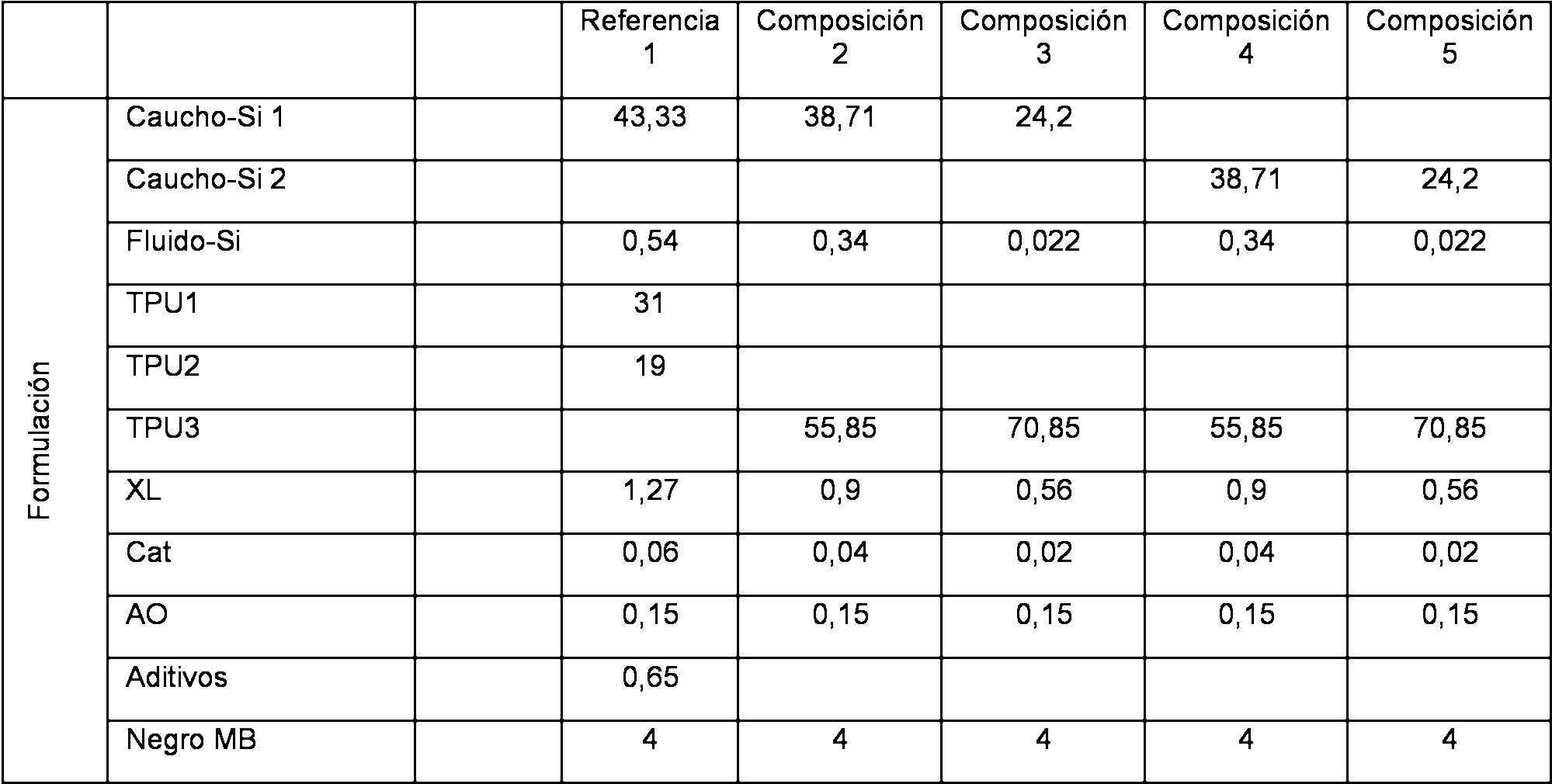

La composición de ensayo en esta sección difiere ligeramente de la composición previa en la composición química de los poliuretanos termoplásticos usados. El objetivo de esta sección es demostrar las ventajas de la composición de silicona termoplástica de la invención en los ensayos de resistencia a las manchas estándar frente a las soluciones existentes recomendadas para todos los usos coloreados incluyendo la composición de silicona pura. Los materiales usados en los siguientes ejemplos fueron:The test composition in this section differs slightly from the previous composition in the chemical composition of the thermoplastic polyurethanes used. The objective of this section is to demonstrate the advantages of the thermoplastic silicone composition of the invention in the standard stain resistance tests against the existing recommended solutions for all colored uses including the pure silicone composition. The materials used in the following examples were:
• Caucho-Si 1: base de caucho de silicona no catalizada que comprende una goma de tipo diorganopolisiloxano terminada con vinilo de dureza Shore A 70 con un contenido de sílice de 35 %.• Rubber-Si 1: base of uncatalyzed silicone rubber comprising a diorganopolysiloxane type rubber finished with vinyl of Shore A hardness 70 with a silica content of 35%.
• Caucho-Si 2: caucho de silicona no catalizado que comprende una goma de tipo diorganopolisiloxano terminada con vinilo de dureza Shore A 40 con un contenido de sílice de 21 %.• Rubber-Si 2: uncatalyzed silicone rubber comprising a diorganopolysiloxane type rubber finished with a Shore A 40 hardness vinyl with a silica content of 21%.
• Caucho-Si 3 - Parte A: una base de caucho de silicona catalizada con complejo de platino al 0,005 % en peso que comprende una goma de diorganopolisiloxano líquido terminado en grupos vinilo de valor de dureza Shore A 70 con un contenido de sílice de 32 %• Rubber-Si 3 - Part A: a silicone rubber base catalyzed with a 0.005% by weight platinum complex comprising a liquid diorganopolysiloxane rubber finished in vinyl groups of Shore A hardness value 70 with a silica content of 32%. %
• Caucho-Si 3 - Parte B: una base de caucho de silicona que contiene un 5 % en peso de un copolímero de dimetil, metilhidrógenosiloxano, que comprende 5 % en peso de copolímero de dimetil, metilhidrógenosiloxano y una goma de diorganopolisiloxano líquido terminado en grupos vinilo de valor de dureza Shore A 70 con un contenido de sílice de 32 %• Rubber-Si 3 - Part B: a silicone rubber base containing 5% by weight of a copolymer of dimethyl, methylhydrogensiloxane, comprising 5% by weight of dimethyl copolymer, methylhydrogensiloxane and a liquid diorganopolysiloxane rubber finished in vinyl groups of Shore A 70 hardness value with a silica content of 32%
• Fluido-Si es un polidimetilsiloxano fluido• Fluid-If it is a fluid polydimethylsiloxane
• Catalizador: catalizador de platino “Syl-Off 4000” de Dow Corning que tiene un contenido de platino de 0,40 % • XL: copolímero, dimetil metilhidrógeno siloxano, terminado en grupos trimetilsiloxi de contenido de hidrógeno enlazado a Si del 1,6 % • Catalyst: platinum catalyst "Syl-Off 4000" from Dow Corning that has a platinum content of 0.40% • XL: copolymer, dimethyl methylhydrogen siloxane, finished in trimethylsiloxy groups of hydrogen content bound to Si 1.6 %
TPU4: poliuretano termoplástico, “Pearlsthane 91T85” de Lubrysol-MerquinsaTPU4: Thermoplastic polyurethane, "Pearlsthane 91T85" from Lubrysol-Merquinsa
TPU5: poliuretano termoplástico, DESMOPAN DP 85092A de BayerTPU5: thermoplastic polyurethane, DESMOPAN DP 85092A from Bayer
TPU6: poliuretano termoplástico, DESMOPAN DP 85085A de BayerTPU6: thermoplastic polyurethane, DESMOPAN DP 85085A from Bayer
TPU7: poliuretano termoplástico, ELASTOLLAN LP 9277 de BASFTPU7: thermoplastic polyurethane, ELASTOLLAN LP 9277 from BASF
Copolímero 1: copolímero de acrilonitrilo, acrilato de butilo, metacrilato de metilo y estireno, SUNIGUM P95, de OMNOVA SOLUTIONSCopolymer 1: copolymer of acrylonitrile, butyl acrylate, methyl methacrylate and styrene, SUNIGUM P95, from OMNOVA SOLUTIONS
Copolímero 2: copolímero de polímero de estireno y dieno hidrogenado, copolímero de butanodiol y diisocianatodifenilmetano y polímero terminado en grupos hidroxi de butadieno, estireno e isopreno hidrogenado, TU-S5265 de KURARAY KURAMIRONCopolymer 2: copolymer of styrene polymer and hydrogenated diene, copolymer of butanediol and diisocyanatodiphenylmethane and polymer terminated in hydroxy groups of butadiene, styrene and hydrogenated isoprene, TU-S5265 of KURARAY KURAMIRON
Elastómero 1: copolímero de bloques estireno-etileno, butileno-estireno, KRATON G1654, de KRATON POLYMERSElastomer 1: styrene-ethylene, butylene-styrene block copolymer, KRATON G1654, from KRATON POLYMERS
Elástomero 2: copolímero de bloques estireno-etileno, butileno-estireno, KRATON G1651, de KRATON POLYMERSElastomer 2: styrene-ethylene, butylene-styrene block copolymer, KRATON G1651, from KRATON POLYMERS
• Elástomero 3: copolímero de bloques estireno isopreno estireno insaturado, Kuraray HYBRAR 5127• Elstomer 3: unsaturated styrene-isoprene styrene block copolymer, Kuraray HYBRAR 5127
• Plastificante: aceite mineral Usoco PRIMOL 352, 70 cst• Plasticizer: Usoco PRIMOL 352 mineral oil, 70 cst
• Relleno: relleno mineral de carbonato de calcio, OMYACARB 5 AV de OMYA• Filling: calcium carbonate mineral filling, OMYACARB 5 AV de OMYA
• AO: tetrakis(metilen(3,5-di-ter-butil-4-hidroxi-hidrocinamato)metano, Irganox 1010 de BASF• AO: tetrakis (methylene (3,5-di-tert-butyl-4-hydroxy-hydrocinnamate) methane, Irganox 1010 from BASF
• Aditivo: Crodamide-EBS, de Croda, etilbutilestearamida, aditivo lubricante de superficies.• Additive: Crodamide-EBS, from Croda, ethylbutyltearamide, surface lubricant additive.
Se prepararon cuatro elastómeros termoplásticos mediante el procedimiento de la invención. La mezcla de los componentes y la vulcanización se realizó utilizando un extrusor de doble husillo de 25 mm de diámetro y relación L/D de 48. La sección de procesado se calentó en el intervalo de 180 °C hasta un máximo de 220 °C, la velocidad del husillo era de 200 rpm y el caudal de salida fue de 15 kg/hora. Se añadieron Caucho-Si 1 y Caucho-Si 2 a la premezcla termoplástica orgánica (TPU, poliuretano termoplástico) dentro de las dos primeras secciones del extrusor. El organohidruropolisiloxano XL se añade a la mezcla para conseguir una buena dispersión de estos dos componentes de silicona en el poliuretano termoplástico antes de añadir el catalizador, el cual inicia la vulcanización de la composición de silicona dentro de la matriz de poliuretano. Las zonas de alimentación para cada componente se fijan y se sitúan dentro de la primera mitad del tambor del extrusor de doble husillo. La muestra de la quinta composición se ha preparado directamente mediante moldeo por inyección utilizando un equipo adecuado al cual no se refiere la invención que se discute en esta especificación; esta quinta composición se usa como referencia de producto de silicona puro. Las proporciones de materiales usados se muestran en la tabla 3 que va a continuación. Se prepararon muestras de ensayo para los ensayos de resistencia a las manchas mediante moldeo por inyección. Se estableció la temperatura de calentamiento para el moldeo por inyección en 180 °C a 220 °C y la temperatura del molde se fijó a 40 °C.Four thermoplastic elastomers were prepared by the process of the invention. The mixture of the components and the vulcanization was carried out using a twin-screw extruder with a diameter of 25 mm and a L / D ratio of 48. The processing section was heated in the range of 180 ° C to a maximum of 220 ° C, the spindle speed was 200 rpm and the output flow rate was 15 kg / hour. Rubber-Si 1 and Rubber-Si 2 were added to the organic thermoplastic premix (TPU, thermoplastic polyurethane) within the first two sections of the extruder. The organohydruropolysiloxane XL is added to the mixture to achieve a good dispersion of these two silicone components in the thermoplastic polyurethane before adding the catalyst, which initiates the vulcanization of the silicone composition within the polyurethane matrix. The feeding zones for each component are fixed and placed within the first half of the drum of the twin-screw extruder. The sample of the fifth composition has been prepared directly by injection molding using a suitable equipment to which the invention which is discussed in this specification does not relate; this fifth composition is used as a reference for pure silicone product. The proportions of materials used are shown in Table 3 below. Test samples were prepared for stain resistance tests by injection molding. The heating temperature for the injection molding was set at 180 ° C to 220 ° C and the mold temperature was set at 40 ° C.
La medida de resistencia al manchado se basa en un protocolo de ensayo diseñado específicamente para caracterizar la capacidad intrínseca de los materiales para resistir al manchado por pantalones vaqueros (“blue jeans”) y se pretende que simule el uso en la vida diaria de dispositivos portátiles o que se pueden llevar encima puestos que se frotan y rozan contra pantalones vaqueros. El protocolo de resistencia al manchado se basa en una medida cuantitativa del cambio de aspecto de una muestra moldeada provocado por los desplazamientos repetitivos de una pieza de pantalones vaqueros (pantalones vaqueros Levi's 501 Dark) sobre la superficie de la muestra. El cambio de aspecto es una traducción de la medida de la aberración cromática (delta E) antes y después de que la muestra se haya expuesto a ensayo. Con el objetivo de disponer de un elemento de comparación y para aumentar la consistencia y la solidez del ensayo, se emplea un equipo de abrasión lineal Taber Industries 5750. Se realiza una secuencia de 500 ciclos a 60 ciclos/min bajo una carga constante de 5 N. Se estima luego la resistencia al manchado gracias a la medida de aberración cromática (delta E) realizada utilizando un espectrómetro Minolta antes y después de exponer la muestra al ensayo. Se han aplicado dos condiciones de ensayo de comparación, ya sea con la superficie interior de un vaquero seco cortada con los hilos en dirección paralela al frotamiento o en una condición de ensayo con vaquero húmedo empleando una pieza de pantalones vaqueros empapada en agua, por la que se pasa una toalla de papel, ensayada con la superficie exterior. Los resultados en ambas condiciones de ensayo se resumen en la tabla 3: The stain resistance measure is based on a test protocol specifically designed to characterize the intrinsic ability of the materials to resist staining by jeans ("blue jeans") and is intended to simulate the use in everyday life of portable devices or that can be worn on posts that are rubbed and rubbed against jeans. The stain resistance protocol is based on a quantitative measure of the change in appearance of a molded sample caused by the repetitive displacement of a piece of jeans (Levi's 501 Dark jeans) on the surface of the sample. The change in appearance is a translation of the chromatic aberration measure (delta E) before and after the sample has been tested. In order to have a comparison element and to increase the consistency and strength of the test, a Taber Industries 5750 linear abrasion machine is used. A sequence of 500 cycles is performed at 60 cycles / min under a constant load of 5. N. The stain resistance is then estimated thanks to the chromatic aberration measure (delta E) made using a Minolta spectrometer before and after exposing the sample to the test. Two comparison test conditions have been applied, either with the inner surface of a dry cowboy cut with the yarns in a direction parallel to the rubbing or in a test condition with wet cowboy using a piece of jeans soaked in water, by the that a paper towel is passed, tested with the outer surface. The results in both test conditions are summarized in Table 3:
Tabla 3Table 3

Claims (10)
Applications Claiming Priority (2)
| Application Number | Priority Date | Filing Date | Title |
|---|---|---|---|
| EP14306269 | 2014-08-12 | ||
| PCT/EP2015/068489 WO2016023914A1 (en) | 2014-08-12 | 2015-08-11 | Thermoplastic polyurethane silicone elastomers |
Publications (1)
| Publication Number | Publication Date |
|---|---|
| ES2699699T3 true ES2699699T3 (en) | 2019-02-12 |
Family
ID=51398589
Family Applications (1)
| Application Number | Title | Priority Date | Filing Date |
|---|---|---|---|
| ES15750413T Active ES2699699T3 (en) | 2014-08-12 | 2015-08-11 | Polyurethane silicone thermoplastic elastomers |
Country Status (7)
| Country | Link |
|---|---|
| US (1) | US10253180B2 (en) |
| EP (1) | EP3180389B1 (en) |
| JP (1) | JP2017524068A (en) |
| KR (1) | KR20170039249A (en) |
| CN (1) | CN106795369B (en) |
| ES (1) | ES2699699T3 (en) |
| WO (1) | WO2016023914A1 (en) |
Families Citing this family (33)
| Publication number | Priority date | Publication date | Assignee | Title |
|---|---|---|---|---|
| CN110536929B (en) | 2017-04-25 | 2022-05-03 | 艾维恩股份有限公司 | Thermoplastic elastomer compound exhibiting retained clarity and improved surface structure |
| EP3615610B1 (en) * | 2017-04-25 | 2022-06-01 | Avient Corporation | Thermoplastic elastomer compounds exhibiting improved stain resistance |
| CN109135293B (en) * | 2017-06-28 | 2022-04-22 | 万华化学集团股份有限公司 | Dynamic vulcanized silicone rubber/thermoplastic polyurethane elastomer and preparation method thereof |
| EP3456763A1 (en) * | 2017-09-19 | 2019-03-20 | Feng Tay Enterprises Co., Ltd. | Thermoplastic vulcanizate composition |
| US10364336B2 (en) | 2017-09-22 | 2019-07-30 | Feng Tay Enterprises Co., Ltd. | Thermoplastic vulcanizate composition, method of forming the same and product thereof |
| CN107815089B (en) * | 2017-10-13 | 2020-11-10 | 上海永利带业股份有限公司 | Modified polyurethane film and application thereof |
| CN109836824B (en) * | 2017-11-24 | 2021-07-23 | 万华化学集团股份有限公司 | A low friction coefficient dynamic vulcanized silicone rubber/thermoplastic polyurethane elastomer material and its preparation method and application |
| WO2019140607A1 (en) * | 2018-01-18 | 2019-07-25 | 广州金海纳防护用品有限公司 | Earplug preparation material capable of releasing negative ions, soundproof earplug made of pu material and preparation method therefor |
| CN108587123B (en) * | 2018-05-10 | 2021-06-25 | 成都思立可科技有限公司 | A kind of dynamic vulcanization thermoplastic polyurethane/polysiloxane elastomer and preparation method thereof |
| CN112533992B (en) * | 2018-08-03 | 2023-02-03 | 埃万特公司 | Bloom-free thermoplastic polyurethane compounds and thermoplastic articles molded therefrom |
| CN109593173B (en) * | 2018-11-20 | 2022-03-18 | 高鼎精细化工(昆山)有限公司 | Silicon-based thermoplastic vulcanized rubber with flame retardance and synthetic method thereof |
| TWI688585B (en) * | 2018-11-20 | 2020-03-21 | 高鼎精密材料股份有限公司 | Flame-retardant thermoplastic silicone vulcanizate and preparation method thereof |
| CN109593349B (en) * | 2018-11-30 | 2021-12-07 | 广东省石油与精细化工研究院 | Flame-retardant thermoplastic dynamic vulcanized silicone rubber and preparation method thereof |
| CN109608866B (en) * | 2018-11-30 | 2021-12-07 | 广东省石油与精细化工研究院 | Heat-conducting thermoplastic dynamic vulcanized silicone rubber and preparation method thereof |
| CN109608867B (en) * | 2018-11-30 | 2021-12-07 | 广东省石油与精细化工研究院 | Oil-resistant thermoplastic dynamic vulcanized silicone rubber and preparation method thereof |
| CN109517367B (en) * | 2018-11-30 | 2021-12-07 | 广东省石油与精细化工研究院 | Conductive thermoplastic dynamic vulcanized silicone rubber and preparation method thereof |
| CN109651822B (en) * | 2018-12-29 | 2021-01-12 | 山东百多安医疗器械股份有限公司 | Medical silicone rubber with high mechanical property and preparation method thereof |
| EP3908629A4 (en) | 2019-01-09 | 2022-09-14 | Avient Corporation | THERMOPLASTIC POLYURETHANE COMPOUNDS WITH ENHANCED STAIN RESISTANCE |
| CN113272385A (en) | 2019-01-09 | 2021-08-17 | 艾维恩股份有限公司 | Thermoplastic polyurethane compounds exhibiting improved stain resistance |
| US11697733B2 (en) | 2019-01-09 | 2023-07-11 | Avient Corporation | Thermoplastic polyurethane compounds exhibiting stain resistance and enhanced UV stability |
| CN113383041B (en) | 2019-01-09 | 2023-03-07 | 埃万特公司 | Thermoplastic polyurethane compounds exhibiting improved stain resistance |
| CN109868005A (en) * | 2019-02-25 | 2019-06-11 | 江苏艾森半导体材料股份有限公司 | Light heat dual curing solder mask and its application method with high adhesion force |
| CN112011185B (en) * | 2019-05-30 | 2022-01-04 | 北京化工大学 | Method for preparing silicone thermoplastic vulcanizate by double premix dynamic vulcanization process |
| CN114206970A (en) | 2019-08-05 | 2022-03-18 | 路博润先进材料公司 | Thermoplastic polyurethane containing polysiloxane caprolactone polyol |
| IL293546A (en) | 2019-12-06 | 2022-08-01 | Nusil Tech Llc | Encapsulated catalyst for one-part organopolysiloxane systems and methods related thereto |
| US12264246B2 (en) | 2020-01-07 | 2025-04-01 | Ahf, Llc | Homogeneous sheet excluding polyvinyl chloride |
| CN113004682B (en) * | 2021-02-09 | 2022-07-05 | 成都思立可科技有限公司 | High-resilience polyurethane/organic silicon thermoplastic elastomer and preparation method thereof |
| KR102625307B1 (en) * | 2021-02-22 | 2024-01-16 | (주)한성피.엔.씨 | Continuous method for producing polymer alloy of thermoplastic carbonaceous resin and silicone rubber by dynamic crosslinking |
| US12606665B2 (en) | 2021-04-30 | 2026-04-21 | Avient Corporation | Electronic devices and polymer blends for high frequency applications |
| CN114621577B (en) * | 2022-03-22 | 2023-09-01 | 浙江伟星实业发展股份有限公司 | Anti-color-absorption resin material and preparation method and application thereof |
| CN114634703A (en) * | 2022-04-24 | 2022-06-17 | 普特美橡塑原料(东莞)有限公司 | Silica gel-like handfeel elastomer composite suitable for wearable equipment and preparation method thereof |
| CN117844253B (en) * | 2023-11-25 | 2024-12-03 | 广东启悦未来科技股份有限公司 | A soft, skin-friendly, tear-resistant conductive silicone and preparation method thereof |
| CN120310140B (en) * | 2025-06-19 | 2025-09-16 | 金发科技股份有限公司 | A polypropylene composition and its preparation method and application |
Family Cites Families (9)
| Publication number | Priority date | Publication date | Assignee | Title |
|---|---|---|---|---|
| WO1990006958A1 (en) * | 1988-12-14 | 1990-06-28 | Bramite Limited | Silicone modified polyurethanes |
| JPH03502469A (en) | 1988-12-14 | 1991-06-06 | ブラマイト・リミテッド | silicone modified polyurethane |
| IL96937A0 (en) | 1991-01-13 | 1992-03-29 | Shlomit Bar On | Customized insole support and a method for its preparation |
| US6013715A (en) * | 1997-04-22 | 2000-01-11 | Dow Corning Corporation | Thermoplastic silicone elastomers |
| US6153691A (en) | 1998-10-07 | 2000-11-28 | Dow Corning Corporation | Thermoplastic silicone vulcanizates prepared by condensation cure |
| US6569955B1 (en) | 2001-10-19 | 2003-05-27 | Dow Corning Corporation | Thermoplastic silicone elastomers from compatibilized polyamide resins |
| KR100968355B1 (en) * | 2001-10-23 | 2010-07-06 | 다우 코닝 코포레이션 | Thermoplastic Elastomer Compositions, Methods of Making Thermoplastic Elastomers, and Products Prepared by the Methods |
| TW201033287A (en) * | 2008-12-23 | 2010-09-16 | Multibase Sa | Elastomeric composition |
| FR2959235B1 (en) | 2010-04-21 | 2013-09-20 | Hutchinson | THERMOPLASTIC TRANSFORMATION RETICLE ELASTOMER AND PROCESS FOR PREPARING THE SAME |
-
2015
- 2015-08-11 ES ES15750413T patent/ES2699699T3/en active Active
- 2015-08-11 WO PCT/EP2015/068489 patent/WO2016023914A1/en not_active Ceased
- 2015-08-11 KR KR1020177005523A patent/KR20170039249A/en not_active Ceased
- 2015-08-11 US US15/503,229 patent/US10253180B2/en active Active
- 2015-08-11 JP JP2017527974A patent/JP2017524068A/en active Pending
- 2015-08-11 EP EP15750413.5A patent/EP3180389B1/en active Active
- 2015-08-11 CN CN201580043180.4A patent/CN106795369B/en active Active
Also Published As
| Publication number | Publication date |
|---|---|
| JP2017524068A (en) | 2017-08-24 |
| EP3180389B1 (en) | 2018-09-26 |
| US10253180B2 (en) | 2019-04-09 |
| WO2016023914A1 (en) | 2016-02-18 |
| CN106795369B (en) | 2019-09-06 |
| EP3180389A1 (en) | 2017-06-21 |
| CN106795369A (en) | 2017-05-31 |
| KR20170039249A (en) | 2017-04-10 |
| US20170233572A1 (en) | 2017-08-17 |
Similar Documents
| Publication | Publication Date | Title |
|---|---|---|
| ES2699699T3 (en) | Polyurethane silicone thermoplastic elastomers | |
| ES2689243T3 (en) | Thermoplastic Silicone Elastomers | |
| CN110234680B (en) | Thermoplastic composition | |
| US8292956B2 (en) | Silicone elastomer composition for artificial integument | |
| US11332618B2 (en) | Thermoplastic copolymer block polyamide silicone elastomers | |
| KR20200140850A (en) | Thermoplastic composition |