ES2700226T3 - Derivatives of 3-oxo-2,3,5,8-tetrahydro- [1,2,4] triazolo [4,3-a] pyrimidine for the treatment of respiratory diseases - Google Patents
Derivatives of 3-oxo-2,3,5,8-tetrahydro- [1,2,4] triazolo [4,3-a] pyrimidine for the treatment of respiratory diseases Download PDFInfo
- Publication number
- ES2700226T3 ES2700226T3 ES13826565T ES13826565T ES2700226T3 ES 2700226 T3 ES2700226 T3 ES 2700226T3 ES 13826565 T ES13826565 T ES 13826565T ES 13826565 T ES13826565 T ES 13826565T ES 2700226 T3 ES2700226 T3 ES 2700226T3
- Authority
- ES
- Spain
- Prior art keywords
- methyl
- oxo
- tetrahydro
- cyano
- phenyl
- Prior art date
- Legal status (The legal status is an assumption and is not a legal conclusion. Google has not performed a legal analysis and makes no representation as to the accuracy of the status listed.)
- Active
Links
- 0 CC(C)(N([C@]1C(C*)CC=C(C=C)C#N)C(CN)=*)N(*(C=CC=C(C)C(F)(F)F)=C)C(C)=C1C(OC)=O Chemical compound CC(C)(N([C@]1C(C*)CC=C(C=C)C#N)C(CN)=*)N(*(C=CC=C(C)C(F)(F)F)=C)C(C)=C1C(OC)=O 0.000 description 3
- SJKORMUVOCAPJU-IVELBNOPSA-N C/C=C\C=C/NCCCc1c([C@H](C(C(OC)=O)=C(C)N2c3cc(C(F)(F)F)ccc3)N3C2=NNC3=O)ccc(C#N)c1 Chemical compound C/C=C\C=C/NCCCc1c([C@H](C(C(OC)=O)=C(C)N2c3cc(C(F)(F)F)ccc3)N3C2=NNC3=O)ccc(C#N)c1 SJKORMUVOCAPJU-IVELBNOPSA-N 0.000 description 1
- HVJPQXARZBXJQA-HXUWFJFHSA-N CC(N(C(N1[C@@H]2c(ccc(C#N)c3)c3Br)=CNC1=O)c1cc(C(F)(F)F)ccc1)=C2C(OC)=O Chemical compound CC(N(C(N1[C@@H]2c(ccc(C#N)c3)c3Br)=CNC1=O)c1cc(C(F)(F)F)ccc1)=C2C(OC)=O HVJPQXARZBXJQA-HXUWFJFHSA-N 0.000 description 1
- UVYAMFLXEVCOPY-UHFFFAOYSA-N CC(N(c1cc(C(F)(F)F)ccc1)C(N(C1c(ccc(C#N)c2)c2Br)C(N)=O)=[N-])=C1C(OC)=O Chemical compound CC(N(c1cc(C(F)(F)F)ccc1)C(N(C1c(ccc(C#N)c2)c2Br)C(N)=O)=[N-])=C1C(OC)=O UVYAMFLXEVCOPY-UHFFFAOYSA-N 0.000 description 1
- XAFZBTHOADEDLZ-UHFFFAOYSA-N CN(C)CC(CC1)CCS1(=O)=O Chemical compound CN(C)CC(CC1)CCS1(=O)=O XAFZBTHOADEDLZ-UHFFFAOYSA-N 0.000 description 1
Classifications
-
- C—CHEMISTRY; METALLURGY
- C07—ORGANIC CHEMISTRY
- C07D—HETEROCYCLIC COMPOUNDS
- C07D487/00—Heterocyclic compounds containing nitrogen atoms as the only ring hetero atoms in the condensed system, not provided for by groups C07D451/00 - C07D477/00
- C07D487/02—Heterocyclic compounds containing nitrogen atoms as the only ring hetero atoms in the condensed system, not provided for by groups C07D451/00 - C07D477/00 in which the condensed system contains two hetero rings
- C07D487/04—Ortho-condensed systems
-
- A—HUMAN NECESSITIES
- A61—MEDICAL OR VETERINARY SCIENCE; HYGIENE
- A61K—PREPARATIONS FOR MEDICAL, DENTAL OR TOILETRY PURPOSES
- A61K9/00—Medicinal preparations characterised by special physical form
- A61K9/0012—Galenical forms characterised by the site of application
- A61K9/0053—Mouth and digestive tract, i.e. intraoral and peroral administration
-
- A—HUMAN NECESSITIES
- A61—MEDICAL OR VETERINARY SCIENCE; HYGIENE
- A61K—PREPARATIONS FOR MEDICAL, DENTAL OR TOILETRY PURPOSES
- A61K9/00—Medicinal preparations characterised by special physical form
- A61K9/0012—Galenical forms characterised by the site of application
- A61K9/007—Pulmonary tract; Aromatherapy
-
- A—HUMAN NECESSITIES
- A61—MEDICAL OR VETERINARY SCIENCE; HYGIENE
- A61P—SPECIFIC THERAPEUTIC ACTIVITY OF CHEMICAL COMPOUNDS OR MEDICINAL PREPARATIONS
- A61P1/00—Drugs for disorders of the alimentary tract or the digestive system
-
- A—HUMAN NECESSITIES
- A61—MEDICAL OR VETERINARY SCIENCE; HYGIENE
- A61P—SPECIFIC THERAPEUTIC ACTIVITY OF CHEMICAL COMPOUNDS OR MEDICINAL PREPARATIONS
- A61P1/00—Drugs for disorders of the alimentary tract or the digestive system
- A61P1/04—Drugs for disorders of the alimentary tract or the digestive system for ulcers, gastritis or reflux esophagitis, e.g. antacids, inhibitors of acid secretion, mucosal protectants
-
- A—HUMAN NECESSITIES
- A61—MEDICAL OR VETERINARY SCIENCE; HYGIENE
- A61P—SPECIFIC THERAPEUTIC ACTIVITY OF CHEMICAL COMPOUNDS OR MEDICINAL PREPARATIONS
- A61P11/00—Drugs for disorders of the respiratory system
-
- A—HUMAN NECESSITIES
- A61—MEDICAL OR VETERINARY SCIENCE; HYGIENE
- A61P—SPECIFIC THERAPEUTIC ACTIVITY OF CHEMICAL COMPOUNDS OR MEDICINAL PREPARATIONS
- A61P11/00—Drugs for disorders of the respiratory system
- A61P11/02—Nasal agents, e.g. decongestants
-
- A—HUMAN NECESSITIES
- A61—MEDICAL OR VETERINARY SCIENCE; HYGIENE
- A61P—SPECIFIC THERAPEUTIC ACTIVITY OF CHEMICAL COMPOUNDS OR MEDICINAL PREPARATIONS
- A61P11/00—Drugs for disorders of the respiratory system
- A61P11/06—Antiasthmatics
-
- A—HUMAN NECESSITIES
- A61—MEDICAL OR VETERINARY SCIENCE; HYGIENE
- A61P—SPECIFIC THERAPEUTIC ACTIVITY OF CHEMICAL COMPOUNDS OR MEDICINAL PREPARATIONS
- A61P17/00—Drugs for dermatological disorders
-
- A—HUMAN NECESSITIES
- A61—MEDICAL OR VETERINARY SCIENCE; HYGIENE
- A61P—SPECIFIC THERAPEUTIC ACTIVITY OF CHEMICAL COMPOUNDS OR MEDICINAL PREPARATIONS
- A61P17/00—Drugs for dermatological disorders
- A61P17/06—Antipsoriatics
-
- A—HUMAN NECESSITIES
- A61—MEDICAL OR VETERINARY SCIENCE; HYGIENE
- A61P—SPECIFIC THERAPEUTIC ACTIVITY OF CHEMICAL COMPOUNDS OR MEDICINAL PREPARATIONS
- A61P29/00—Non-central analgesic, antipyretic or antiinflammatory agents, e.g. antirheumatic agents; Non-steroidal antiinflammatory drugs [NSAID]
-
- A—HUMAN NECESSITIES
- A61—MEDICAL OR VETERINARY SCIENCE; HYGIENE
- A61P—SPECIFIC THERAPEUTIC ACTIVITY OF CHEMICAL COMPOUNDS OR MEDICINAL PREPARATIONS
- A61P37/00—Drugs for immunological or allergic disorders
-
- A—HUMAN NECESSITIES
- A61—MEDICAL OR VETERINARY SCIENCE; HYGIENE
- A61P—SPECIFIC THERAPEUTIC ACTIVITY OF CHEMICAL COMPOUNDS OR MEDICINAL PREPARATIONS
- A61P37/00—Drugs for immunological or allergic disorders
- A61P37/08—Antiallergic agents
-
- A—HUMAN NECESSITIES
- A61—MEDICAL OR VETERINARY SCIENCE; HYGIENE
- A61P—SPECIFIC THERAPEUTIC ACTIVITY OF CHEMICAL COMPOUNDS OR MEDICINAL PREPARATIONS
- A61P43/00—Drugs for specific purposes, not provided for in groups A61P1/00-A61P41/00
-
- C—CHEMISTRY; METALLURGY
- C07—ORGANIC CHEMISTRY
- C07C—ACYCLIC OR CARBOCYCLIC COMPOUNDS
- C07C309/00—Sulfonic acids; Halides, esters, or anhydrides thereof
- C07C309/01—Sulfonic acids
- C07C309/02—Sulfonic acids having sulfo groups bound to acyclic carbon atoms
- C07C309/03—Sulfonic acids having sulfo groups bound to acyclic carbon atoms of an acyclic saturated carbon skeleton
- C07C309/04—Sulfonic acids having sulfo groups bound to acyclic carbon atoms of an acyclic saturated carbon skeleton containing only one sulfo group
-
- C—CHEMISTRY; METALLURGY
- C07—ORGANIC CHEMISTRY
- C07C—ACYCLIC OR CARBOCYCLIC COMPOUNDS
- C07C309/00—Sulfonic acids; Halides, esters, or anhydrides thereof
- C07C309/01—Sulfonic acids
- C07C309/02—Sulfonic acids having sulfo groups bound to acyclic carbon atoms
- C07C309/03—Sulfonic acids having sulfo groups bound to acyclic carbon atoms of an acyclic saturated carbon skeleton
- C07C309/07—Sulfonic acids having sulfo groups bound to acyclic carbon atoms of an acyclic saturated carbon skeleton containing oxygen atoms bound to the carbon skeleton
- C07C309/08—Sulfonic acids having sulfo groups bound to acyclic carbon atoms of an acyclic saturated carbon skeleton containing oxygen atoms bound to the carbon skeleton containing hydroxy groups bound to the carbon skeleton
-
- C—CHEMISTRY; METALLURGY
- C07—ORGANIC CHEMISTRY
- C07C—ACYCLIC OR CARBOCYCLIC COMPOUNDS
- C07C309/00—Sulfonic acids; Halides, esters, or anhydrides thereof
- C07C309/01—Sulfonic acids
- C07C309/02—Sulfonic acids having sulfo groups bound to acyclic carbon atoms
- C07C309/20—Sulfonic acids having sulfo groups bound to acyclic carbon atoms of an acyclic unsaturated carbon skeleton
-
- C—CHEMISTRY; METALLURGY
- C07—ORGANIC CHEMISTRY
- C07C—ACYCLIC OR CARBOCYCLIC COMPOUNDS
- C07C309/00—Sulfonic acids; Halides, esters, or anhydrides thereof
- C07C309/01—Sulfonic acids
- C07C309/28—Sulfonic acids having sulfo groups bound to carbon atoms of six-membered aromatic rings of a carbon skeleton
- C07C309/29—Sulfonic acids having sulfo groups bound to carbon atoms of six-membered aromatic rings of a carbon skeleton of non-condensed six-membered aromatic rings
-
- C—CHEMISTRY; METALLURGY
- C07—ORGANIC CHEMISTRY
- C07C—ACYCLIC OR CARBOCYCLIC COMPOUNDS
- C07C47/00—Compounds having —CHO groups
- C07C47/02—Saturated compounds having —CHO groups bound to acyclic carbon atoms or to hydrogen
- C07C47/19—Saturated compounds having —CHO groups bound to acyclic carbon atoms or to hydrogen containing hydroxy groups
-
- C—CHEMISTRY; METALLURGY
- C07—ORGANIC CHEMISTRY
- C07C—ACYCLIC OR CARBOCYCLIC COMPOUNDS
- C07C53/00—Saturated compounds having only one carboxyl group bound to an acyclic carbon atom or hydrogen
- C07C53/02—Formic acid
- C07C53/06—Salts thereof
-
- C—CHEMISTRY; METALLURGY
- C07—ORGANIC CHEMISTRY
- C07D—HETEROCYCLIC COMPOUNDS
- C07D453/00—Heterocyclic compounds containing quinuclidine or iso-quinuclidine ring systems, e.g. quinine alkaloids
- C07D453/02—Heterocyclic compounds containing quinuclidine or iso-quinuclidine ring systems, e.g. quinine alkaloids containing not further condensed quinuclidine ring systems
-
- C—CHEMISTRY; METALLURGY
- C07—ORGANIC CHEMISTRY
- C07D—HETEROCYCLIC COMPOUNDS
- C07D487/00—Heterocyclic compounds containing nitrogen atoms as the only ring hetero atoms in the condensed system, not provided for by groups C07D451/00 - C07D477/00
- C07D487/02—Heterocyclic compounds containing nitrogen atoms as the only ring hetero atoms in the condensed system, not provided for by groups C07D451/00 - C07D477/00 in which the condensed system contains two hetero rings
- C07D487/08—Bridged systems
-
- C—CHEMISTRY; METALLURGY
- C07—ORGANIC CHEMISTRY
- C07D—HETEROCYCLIC COMPOUNDS
- C07D519/00—Heterocyclic compounds containing more than one system of two or more relevant hetero rings condensed among themselves or condensed with a common carbocyclic ring system not provided for in groups C07D453/00 or C07D455/00
Landscapes
- Chemical & Material Sciences (AREA)
- Organic Chemistry (AREA)
- Health & Medical Sciences (AREA)
- Life Sciences & Earth Sciences (AREA)
- Veterinary Medicine (AREA)
- Public Health (AREA)
- General Health & Medical Sciences (AREA)
- Medicinal Chemistry (AREA)
- Animal Behavior & Ethology (AREA)
- Pharmacology & Pharmacy (AREA)
- Nuclear Medicine, Radiotherapy & Molecular Imaging (AREA)
- General Chemical & Material Sciences (AREA)
- Chemical Kinetics & Catalysis (AREA)
- Engineering & Computer Science (AREA)
- Bioinformatics & Cheminformatics (AREA)
- Pulmonology (AREA)
- Epidemiology (AREA)
- Dermatology (AREA)
- Immunology (AREA)
- Nutrition Science (AREA)
- Physiology (AREA)
- Rheumatology (AREA)
- Pain & Pain Management (AREA)
- Otolaryngology (AREA)
- Nitrogen Condensed Heterocyclic Rings (AREA)
- Pharmaceuticals Containing Other Organic And Inorganic Compounds (AREA)
- Nitrogen And Oxygen Or Sulfur-Condensed Heterocyclic Ring Systems (AREA)
- Plural Heterocyclic Compounds (AREA)
Abstract
Un compuesto de fórmula (I) o una sal farmacéuticamente aceptable del mismo: **(Ver fórmula)** en la que A es CH; B es CH; D es CH; R1 se selecciona entre la lista que consiste en: - hidrógeno; - alquilo (C1-C6); - NR7R8alquilo (C1-C6); - alquenilo (C1-C4); - fenilalquilo (C1-C6) en el que dicho anillo fenilo está opcionalmente sustituido por un grupo NR15R16alquilo (C1-C6) o por N+R15R16R17alquilo (C1-C6); - un grupo -CH2(CH2)nOH; - un grupo -(CH2)nCONR5R6; - un grupo -(CH2)nSO2NR5R6; - un grupo -CH2-(CH2)nNR5SO2R6; - un grupo -(CH2)t-(C6H4)-SO2alquilo (C1-C4); - un grupo -(CH2)rSO2alquilo (C1-C4) en el que dicho alquilo (C1-C4) está opcionalmente sustituido por un grupo -NR15R16 o -N+R15R16R17; - un grupo -SO2-fenilo en el que dicho anillo fenilo está opcionalmente sustituido por NR7R8alquilo (C1-C6); y - un grupo -(CH2)n-W en el que W es un anillo heteroarilo de 5-6 miembros que está opcionalmente sustituido por un grupo -SO2alquilo(C1-C4); n es 1, 2 o 3; t es cero, 1, 2 o 3; r es cero, 1, 2, 3 o 4; R5 se selecciona entre el grupo que consiste en: hidrógeno, alquilo (C1-C6), NR16R15alquilo (C1-C6) y N+R17R15R16alquilo (C1-C6); R6 es hidrógeno o alquilo (C1-C6); R7 se selecciona entre el grupo que consiste en: hidrógeno, alquilo (C1-C6), alquilcarbonilo (C1-C6), -SO2alquilo (C1-C4) y NR16R15alquilo (C1-C6); R8 es hidrógeno o alquilo (C1-C6); como alternativa, R7 y R8 junto con el átomo de nitrógeno al que están unidos forman un sistema de anillo heterocicloalquilo (C5-C7) que está opcionalmente sustituido por uno o más grupos alquilo (C1-C6) y oxo; R16 es hidrógeno o alquilo (C1-C6); R15 es hidrógeno o alquilo (C1-C6); R17 es hidrógeno o alquilo (C1-C6); R3 es un grupo -C(O)-XR4; X es el grupo divalente -O-; R4 es un grupo seleccionado entre la lista que consiste en: - hidrógeno; - alquilo (C1-C6); R2 es un grupo -[CH2]y-G-[CH2]j-CH2-N+R22R23R24 O R2 es un grupo: ...A compound of formula (I) or a pharmaceutically acceptable salt thereof: ** (See formula) ** in which A is CH; B is CH; D is CH; R1 is selected from the list consisting of: - hydrogen; - (C1-C6) alkyl; - NR7R8 (C1-C6) alkyl; - (C1-C4) alkenyl; - phenylalkyl (C1-C6) in which said phenyl ring is optionally substituted by a group NR15R16alkyl (C1-C6) or by N + R15R16R17alkyl (C1-C6); - a group -CH2 (CH2) nOH; - a group - (CH2) nCONR5R6; - a group - (CH2) nSO2NR5R6; - a group -CH2- (CH2) nNR5SO2R6; - a group - (CH2) t- (C6H4) -SO2 (C1-C4) alkyl; - a group - (CH2) rSO2 (C1-C4) alkyl in which said (C1-C4) alkyl is optionally substituted by a group -NR15R16 or -N + R15R16R17; - a -SO2-phenyl group in which said phenyl ring is optionally substituted by NR7R8 (C1-C6) alkyl; and - a group - (CH2) n-W in which W is a 5-6 membered heteroaryl ring that is optionally substituted by a group -SO2 (C1-C4) alkyl; n is 1, 2 or 3; t is zero, 1, 2 or 3; r is zero, 1, 2, 3 or 4; R5 is selected from the group consisting of: hydrogen, (C1-C6) alkyl, NR16R15 (C1-C6) alkyl and N + R17R15R16 (C1-C6) alkyl; R6 is hydrogen or (C1-C6) alkyl; R7 is selected from the group consisting of: hydrogen, (C1-C6) alkyl, (C1-C6) alkylcarbonyl, -SO2 (C1-C4) alkyl and NR16R15 (C1-C6) alkyl; R8 is hydrogen or (C1-C6) alkyl; alternatively, R7 and R8 together with the nitrogen atom to which they are attached form a heterocycloalkyl (C5-C7) ring system that is optionally substituted by one or more (C1-C6) alkyl and oxo groups; R16 is hydrogen or (C1-C6) alkyl; R15 is hydrogen or (C1-C6) alkyl; R17 is hydrogen or (C1-C6) alkyl; R3 is a group -C (O) -XR4; X is the divalent group -O-; R4 is a group selected from the list consisting of: - hydrogen; - (C1-C6) alkyl; R2 is a group - [CH2] and -G- [CH2] j-CH2-N + R22R23R24 OR R2 is a group: ...
Description
DESCRIPCIÓNDESCRIPTION
Derivados de 3-oxo-2,3,5,8-tetrahidro-[1,2,4]triazolo[4,3-a]pirimidina para el tratamiento de enfermedades respiratoriasDerivatives of 3-oxo-2,3,5,8-tetrahydro- [1,2,4] triazolo [4,3-a] pyrimidine for the treatment of respiratory diseases
Campo de la invenciónField of the invention
La presente invención se refiere a compuestos heterocíclicos, que son derivados de pirimidinona que tienen propiedades inhibidoras de elastasa de neutrófilos humanos, y a su uso en terapia.The present invention relates to heterocyclic compounds, which are pyrimidinone derivatives having human neutrophil elastase inhibitory properties, and to their use in therapy.
Antecedentes de la invenciónBACKGROUND OF THE INVENTION
La elastasa de neutrófilos humanos (ENH) es una serina proteasa de 32 kDa que se encuentra en los gránulos azurófilos de los neutrófilos. Tiene un papel en la degradación de un amplio intervalo de proteínas de la matriz extracelular, que incluye fibronectina, laminina, proteoglicanos, colágenos de tipo III y de tipo IV así como elastina (Bieth, G. En: Regulation of Matrix accumulation, Mecham, R.P. (Eds), Academic Press, NY, EE.UU. 1986, 217-306). Durante mucho tiempo se ha considerado que la ENH desempeña un papel importante en la homeostasis mediante la reparación y la eliminación de tejidos dañados a través de la degradación de las proteínas estructurales de los tejidos. También se relevante en la defensa frente a una invasión bacteriana mediante la degradación del cuerpo bacteriano. Además de sus efectos sobre los tejidos matriciales, la ENH también está implicada en la regulación positiva de la expresión del gen de IL-8 y también induce la liberación de IL-8 desde las células epiteliales del pulmón. En modelos animales de enfermedad pulmonar obstructiva crónica inducida por exposición al humo del tabaco, tanto los inhibidores de moléculas pequeñas como los inhibidores de proteínas de ENH inhiben la respuesta inflamatoria y el desarrollo de enfisema (Wright, J.L. y col. Am. J. Respir. Crit. Care Med. 2002, 166, 954-960; Churg, A. y col. Am. J. Respir. Crit. Care Med. 2003, 168, 199-207). Por lo tanto, la ENH puede desempeñar un papel tanto en la destrucción de la matriz como en la amplificación de respuestas inflamatorias en enfermedades respiratorias crónicas en las que la entrada de neutrófilos en un aspecto característico. De hecho, se cree que la ENH desempeña un papel en varias enfermedades pulmonares, que incluyen enfermedad pulmonar obstructiva crónica (EPOC), fibrosis quística (FQ), síndrome de distrés respiratorio agudo (SDRA), enfisema pulmonar, neumonía y fibrosis pulmonar. También está implicada en varias enfermedades cardiovasculares en las que está implicada la remodelación del tejido, por ejemplo, en insuficiencia cardíaca y la generación de lesiones de tejido isquémico tras un infarto agudo de miocardio.The human neutrophil elastase (ENH) is a 32 kDa serine protease found in the azurophil granules of neutrophils. It has a role in the degradation of a wide range of extracellular matrix proteins, including fibronectin, laminin, proteoglycans, type III and type IV collagens as well as elastin (Bieth, G. In: Regulation of Matrix accumulation, Mecham, RP (Eds), Academic Press, NY, USA 1986, 217-306). For a long time, it has been considered that ENH plays an important role in homeostasis through the repair and elimination of damaged tissues through the degradation of the structural proteins of tissues. It is also relevant in the defense against a bacterial invasion by the degradation of the bacterial body. In addition to its effects on matrix tissues, ENH is also involved in the positive regulation of IL-8 gene expression and also induces the release of IL-8 from lung epithelial cells. In animal models of chronic obstructive pulmonary disease induced by exposure to tobacco smoke, both small molecule inhibitors and inhibitors of ENH proteins inhibit the inflammatory response and the development of emphysema (Wright, JL et al., Am. J. Respir. Crit Care Care 2002, 166, 954-960; Churg, A. et al., J. Respir Crit Care Care 2003, 168, 199-207). Therefore, ENH can play a role both in the destruction of the matrix and in the amplification of inflammatory responses in chronic respiratory diseases in which the entry of neutrophils in a characteristic aspect. In fact, it is believed that ENH plays a role in several lung diseases, including chronic obstructive pulmonary disease (COPD), cystic fibrosis (CF), acute respiratory distress syndrome (ARDS), pulmonary emphysema, pneumonia, and pulmonary fibrosis. It is also involved in several cardiovascular diseases in which tissue remodeling is involved, for example, in heart failure and the generation of ischemic tissue lesions after an acute myocardial infarction.
EPOC es un término global que abarca tres afecciones patológicas diferentes, que contribuyen a la limitación de flujo aéreo: bronquitis crónica, enfisema y bronquiolitis. Generalmente, las tres existirán en diversos grados en pacientes que presenten EPOC y las tres se pueden deber a la inflamación mediada por neutrófilos, tal como se demuestra mediante el elevado número de neutrófilos observado en los fluidos del lavado broncoalveolar (LBA) de pacientes de EPOC (Thompson, A.B.; Daughton, D.; y col. Am. Rev. Respir. Dis. 1989, 140, 1527-1537). Durante mucho tiempo se ha considerado que el principal determinante patogénico en la EPOC es el equilibrio proteasa-antiproteasa (también conocido como la "hipótesis elastasa-antielastasa"), en la que un desequilibrio de la ENH y de antiproteasas endógenas tales como a1-antitripsina (a1-AT), inhibidor secretorio de proteasa leucocítica (SLPI) y preelafina lleva a los diversos trastornos inflamatorios de la EPOC. Los sujetos que tienen una deficiencia genética del inhibidor de proteasa a1-antitripsina desarrollan un enfisema que aumenta su gravedad con el tiempo (Laurrell, C.B.; Erikkson, S Scand. J. Clin. Invest. 196315, 132-140). Por lo tanto, un exceso de ENH es destructivo, llevando al deterioro de la morfología pulmonar con pérdida de elasticidad y destrucción de las uniones alveolares de las vías respiratorias en el pulmón (enfisema) a la vez que aumenta de manera simultánea la permeabilidad microvascular y la hipersecreción de moco (bronquitis crónica).COPD is a global term that encompasses three different pathological conditions, which contribute to airflow limitation: chronic bronchitis, emphysema, and bronchiolitis. Generally, all three will exist to varying degrees in patients with COPD and all three may be due to neutrophil-mediated inflammation, as demonstrated by the high number of neutrophils observed in the bronchoalveolar lavage (BAL) fluids of COPD patients. (Thompson, AB; Daughton, D .; et al., Am. Rev. Respir. Dis. 1989, 140, 1527-1537). For a long time it has been considered that the main pathogenic determinant in COPD is the protease-antiprotease balance (also known as the "elastase-antielastase hypothesis"), in which an imbalance of ENH and endogenous antiproteases such as a1-antitrypsin (a1-AT), leukocyte protease secretory inhibitor (SLPI) and preelafin leads to the various inflammatory disorders of COPD. Subjects who have a genetic deficiency of the a1-antitrypsin protease inhibitor develop emphysema that increases in severity over time (Laurrell, C.B., Erikkson, S Scand, J. Clin, Invest, 196315, 132-140). Therefore, an excess of ENH is destructive, leading to the deterioration of pulmonary morphology with loss of elasticity and destruction of the alveolar junctions of the airways in the lung (emphysema) while simultaneously increasing microvascular permeability and mucus hypersecretion (chronic bronchitis).
Hasta ahora se han desvelado varios inhibidores de neutrófilos en la materia. En particular, las Solicitudes de Patente Internacional n.° WO2011/110858 y n.° WO2011/110859 describen algunos derivados de pirimidina que tienen propiedades inhibidoras de elastasa de neutrófilos humanos y su uso en terapia.Up to now, several neutrophil inhibitors have been disclosed in the art. In particular, International Patent Applications No. WO2011 / 110858 and No. WO2011 / 110859 describe some pyrimidine derivatives having human neutrophil elastase inhibitory properties and their use in therapy.
Aunque hasta agora se han desvelado varios inhibidores de ENH tal como se ha documentado anteriormente, aún hay una necesidad por inhibidores de ENH adicionales. En particular, aún hay una necesidad por inhibidores de ENH adicionales dotados de una alta potencia de inhibición de la enzima ENH. También sería particularmente ventajosa la identificación de inhibidores de ENH adicionales dotados de una alta potencia para la inhibición de la enzima ENH y que presentarían un perfil de desarrollabilidad apropiado como un tratamiento por inhalación.Although up to now several ENH inhibitors have been disclosed as previously documented, there is still a need for additional ENH inhibitors. In particular, there is still a need for additional ENH inhibitors endowed with a high power of inhibition of the ENH enzyme. It would also be particularly advantageous to identify additional ENH inhibitors endowed with a high potency for the inhibition of the ENH enzyme and which would have an appropriate development profile as an inhalation treatment.
La presente invención abarca la necesidad mencionada anteriormente proporcionando los compuestos de la invención.The present invention encompasses the need mentioned above to provide the compounds of the invention.
Breve descripción de la invenciónBRIEF DESCRIPTION OF THE INVENTION
La presente invención proporciona nuevos compuestos que son inhibidores de ENH y son útiles en el tratamiento de enfermedades o afecciones en las que la actividad de la ENH desempeña un papel importante.The present invention provides novel compounds that are inhibitors of ENH and are useful in the treatment of diseases or conditions in which the activity of the ENH plays an important role.
Descripción detallada de la invención Detailed description of the invention
En un aspecto la invención proporciona un compuesto de fórmula (I) o una sal farmacéuticamente aceptable del mismo:In one aspect the invention provides a compound of formula (I) or a pharmaceutically acceptable salt thereof:

en la quein which
A es CH; A is CH;
B es CH; B is CH;
D es CH; D is CH;
Ri se selecciona entre la lista que consiste en: R i is selected from the list consisting of:
- hidrógeno;- hydrogen;
- alquilo (Ci-Ca);- alkyl (Ci-Ca);
- NR7R8alquilo (Ci-Ca);- NR7R8alkyl (Ci-Ca);
- alquenilo (C1-C4);- (C 1 -C 4) alkenyl;
- fenilalquilo (Ci-Ca) en el que dicho anillo fenilo está opcionalmente sustituido por un grupo NRisRiaalquilo (Ci Ca) o por N+Ri5RiaRi7alquilo (Ci-Ca);- phenylalkyl (Ci-Ca) wherein said phenyl ring is optionally substituted by a group NRisRiaalkyl (Ci Ca) or by N + Ri 5 RiaRi7alkyl (Ci-Ca);
- un grupo -CH2(CH2)nOH;- a group -CH2 (CH2) nOH;
- un grupo -(CH2)nCONR5Ra;- a group - (CH2) nCONR5Ra;
- un grupo -(CH2)nSO2NR5Ra;- a group - (CH2) nSO2NR5Ra;
- un grupo -CH2-(CH2)nNR5SO2Ra;- a group -CH2- (CH2) nNR5SO2Ra;
- un grupo -(CH2)t-(CaH4)-SO2alquilo (C1-C4);- a group - (CH2) t- (CaH4) -SO2alkyl (C1-C4);
- un grupo -(CH2)rSO2alquilo (C1-C4) en el que dicho alquilo (C1-C4) está opcionalmente sustituido por un grupo -NRi5Ria o -N+Ri5RiaRi7;- a group - (CH2) rSO2alkyl (C1-C4) wherein said (C1-C4) alkyl is optionally substituted by a group -NRi5Ria or -N + Ri5RiaRi7;
- un grupo -SO2-fenilo en el que dicho anillo fenilo está opcionalmente sustituido por NR7R8alquilo (Ci-Ca) y - un grupo -(CH2)n-W en el que W es un anillo heteroarilo de 5-a miembros que está opcionalmente sustituido por un grupo -SO2alquilo (Ci-C4);- a -SO2-phenyl group in which said phenyl ring is optionally substituted by NR7R8alkyl (Ci-Ca) and - a group - (CH2) nW wherein W is a 5-a member heteroaryl ring which is optionally substituted by a -SO2alkyl group (Ci-C4);
n es i, 2 o 3; n is i, 2 or 3;
t es cero, i, 2 o 3; t is zero, i, 2 or 3;
r es cero, i, 2, 3 o 4; r is zero, i, 2, 3 or 4;
R5 se selecciona entre el grupo que consiste en: hidrógeno, alquilo (Ci-Ca), NRiaRi5alquilo (Ci-Ca) y N+Ri7Ri5Riaalquilo (Ci-Ca); R 5 is selected from the group consisting of: hydrogen, alkyl (Ci-Ca), NRiaRi5alkyl (Ci-Ca) and N + Ri7Ri5Riaalkyl (Ci-Ca);
R6 es hidrógeno o alquilo (Ci-Ca); R 6 is hydrogen or alkyl (Ci-Ca);
R7 se selecciona entre el grupo que consiste en: hidrógeno, alquilo (Ci-Ca), alquilcarbonilo (Ci-Ca), -SO2alquilo (Ci-C4) y NRiaRi5alquilo (Ci-Ca); R7 is selected from the group consisting of: hydrogen, alkyl (Ci-Ca), alkylcarbonyl (Ci-Ca), -SO2alkyl (Ci-C4) and NRiaRi5alkyl (Ci-Ca);
R8 es hidrógeno o alquilo (Ci-Ca); R 8 is hydrogen or alkyl (Ci-Ca);
como alternativa, R7 y R8 junto con el átomo de nitrógeno al que están unidos pueden formar un sistema de anillo heterocicloalquilo (C5-C7) que está opcionalmente sustituido por uno o más grupos alquilo (Ci-Ca) y oxo;alternatively, R 7 and R 8 together with the nitrogen atom to which they are attached can form a (C5-C7) heterocycloalkyl ring system which is optionally substituted by one or more alkyl (Ci-Ca) and oxo groups;
Ri 6 es hidrógeno o alquilo (Ci-Ca); R i 6 is hydrogen or alkyl (Ci-Ca);
R15 es hidrógeno o alquilo (Ci-Ca); R 15 is hydrogen or alkyl (Ci-Ca);
R17 es hidrógeno o alquilo (Ci-Ca); R 17 is hydrogen or alkyl (Ci-Ca);
R3 es un grupo-C(O)-XR4; R 3 is a group-C (O) -XR 4;
X es el grupo divalente -O-; X is the divalent group -O-;
R4 es un grupo seleccionado entre la lista que consiste en: R 4 is a group selected from the list consisting of:
- hidrógeno;- hydrogen;
- alquilo (Ci-Ca);- alkyl (Ci-Ca);
R2 es un grupo -[CH2]y-G-[CH2]j-CH2-N+R22R23R24 o R 2 is a group - [CH 2] and G- [CH 2] j -CH 2 -N + R 22 R 23 R 24 or
R2 es un grupo: R 2 is a group:

Ri 8 es hidrógeno o alquilo (Ci-Ca); R i 8 is hydrogen or alkyl (Ci-Ca);
R19 es hidrógeno o alquilo (Ci-Ca); R 19 is hydrogen or alkyl (Ci-Ca);
R20 se selecciona entre el grupo que consiste en: hidrógeno, alquilo (Ci-Ca), alquil (Ci-Ca)NRi8Ri9; R 20 is selected from the group consisting of: hydrogen, alkyl (Ci-Ca), alkyl (Ci-Ca) NRi 8 R i 9;
R21 es hidrógeno o alquilo (Ci-Ca); j está en el intervalo de cero a 4; y está en el intervalo de cero a 4; R 21 is hydrogen or alkyl (Ci-Ca); j is in the range of zero to 4; and is in the range of zero to 4;
G es un enlazador divalente seleccionado entre el grupo que consiste en: un enlace, -alquinileno C2-C6, cicloalquileno (C3-Ce), heterocicloalquileno mono o bicíclico, -[CONR25]-; G is a divalent linker selected from the group consisting of: a bond, -C2-C6alkynylene, cycloalkylene (C3-Ce), mono- or bicyclic heterocycloalkylene, - [CONR25] -;
R25 es hidrógeno o alquilo (Ci-Ce); R 25 is hydrogen or alkyl (Ci-Ce);
R22 se selecciona entre el grupo que consiste en: alquilo (Ci-Ce), dicho alquilo (Ci-Ca) está opcionalmente sustituido por uno o más grupos cicloalquilo (C3-Ce), fenilo, bencilo, CN, -OR2e, -SO2R26, -CO2R26, -CONR2aR27 o -SO2NR2eR27; cicloalquilo (C3-Cio) que está opcionalmente sustituido por uno o más grupos -OR2e y heterocicloalquilo (C4-C7) que está opcionalmente sustituido por uno o más grupos -SO2R2e; R 22 is selected from the group consisting of: alkyl (Ci-Ce), said alkyl (Ci-Ca) is optionally substituted by one or more cycloalkyl groups (C3-Ce), phenyl, benzyl, CN, -OR2e, - SO2R26, -CO2R26, -CONR2aR27 or -SO2NR2eR27; cycloalkyl (C3-Cio) which is optionally substituted by one or more groups -OR2e and heterocycloalkyl (C4-C7) which is optionally substituted by one or more -SO2R2e groups;
R26 es hidrógeno o alquilo (Ci-Ca); R 26 is hydrogen or alkyl (Ci-Ca);
R27 es hidrógeno o alquilo (Ci-Ca); R 27 is hydrogen or alkyl (Ci-Ca);
R23 es hidrógeno o alquilo (Ci-Ca), cuyo alquilo (Ci-Ca) está opcionalmente sustituido por uno o más grupos -OR29, -SO2R29, -CONR29R30; R 23 is hydrogen or alkyl (Ci-Ca), which alkyl (Ci-Ca) is optionally substituted by one or more groups -OR29, -SO2R29, -CONR29R30;
R24 es hidrógeno o alquilo (Ci-Ca), cuyo alquilo (Ci-Ca) está opcionalmente sustituido por uno o más grupos -OR3i; como alternativa, R23 y R24 junto con el átomo de nitrógeno al que están unidos pueden formar un sistema de anillo heterocíclico monocíclico o bicíclico saturado de 5 - ii miembros que está opcionalmente sustituido por uno o más grupos -OR28, halo, alquilo Ci-Ca, -SO2R33, -CONR33R34 o -SO2NR33R34; y cuyo anillo monocíclico o bicíclico saturado de 5 - i i miembros opcionalmente contiene otro heteroátomo que es oxígeno o nitrógeno o un grupo -SO2-; o R22 junto con R23, R24 y el átomo de nitrógeno al que están unidos, pueden formar un sistema de anillo heterocíclico bicíclico puenteado; R 24 is hydrogen or alkyl (Ci-Ca), whose alkyl (Ci-Ca) is optionally substituted by one or more -OR 3i groups; alternatively, R 23 and R 24 together with the nitrogen atom to which they are attached can form a 5- or 7-membered saturated monocyclic or bicyclic heterocyclic ring system which is optionally substituted by one or more groups -OR28, halo, Ci alkyl -Ca, -SO2R33, -CONR33R34 or -SO2NR33R34; and whose saturated monocyclic or bicyclic ring of 5-ii members optionally contains another heteroatom which is oxygen or nitrogen or a group -SO2-; or R22 together with R23, R24 and the nitrogen atom to which they are attached, can form a bridged bicyclic heterocyclic ring system;
R28 es hidrógeno o alquilo (Ci-Ca); R 28 is hydrogen or alkyl (Ci-Ca);
R29 es hidrógeno o alquilo (Ci-Ca); R 29 is hydrogen or alkyl (Ci-Ca);
R30 es hidrógeno o alquilo (Ci-Ca); R 30 is hydrogen or alkyl (Ci-Ca);
R31 es hidrógeno o alquilo (Ci-Ca); R 31 is hydrogen or alkyl (Ci-Ca);
R32 es hidrógeno o alquilo (Ci-Ca); R 32 is hydrogen or alkyl (Ci-Ca);
R33 es hidrógeno o alquilo (Ci-Ca); R 33 is hydrogen or alkyl (Ci-Ca);
R34 es hidrógeno o alquilo (Ci-Ca); R 34 is hydrogen or alkyl (Ci-Ca);
R38 representa uno o dos sustituyentes opcionales seleccionados, en cada caso, entre la lista que consiste en: alquilo (Ci-Ca), alcoxilo (Ci-Ca), hidroxil-alquilo Ci-Ca-, halo; R 38 represents one or two optional substituents selected, in each case, from the list consisting of: alkyl (Ci-Ca), alkoxy (Ci-Ca), hydroxyl-Ci-Ca- alkyl, halo;
en el que si están presentes uno o más grupos N+Ri5RieRi7-, estos forman sales cuaternarias con un contraión farmacéuticamente aceptable;wherein if one or more N + Ri5RieRi7- groups are present, they form quaternary salts with a pharmaceutically acceptable counter ion;
y en el que los grupos R5 a R38 y n pueden tener el mismo o diferentes significados en cada caso, si están presentes en más de un grupo.and wherein the groups R5 to R38 and n may have the same or different meanings in each case, if they are present in more than one group.
Los compuestos de fórmula (I) pueden prepararse en forma de sales, particularmente sales, N-óxidos, hidratos, solvatos y polimorfos de los mismos farmacéuticamente aceptables. Cualquier referencia a un compuesto en el presente documento o referencia a "compuestos de la invención", "compuestos de fórmula (I)" y similares, incluye dichos compuestos estén o no en forma de sal, N-óxido, hidrato, solvato o polimorfo.The compounds of formula (I) can be prepared in the form of pharmaceutically acceptable salts, particularly salts, N-oxides, hydrates, solvates and polymorphs thereof. Any reference to a compound herein or reference to "compounds of the invention," "compounds of formula (I)" and the like, includes such compounds whether or not in the form of a salt, N-oxide, hydrate, solvate or polymorph. .
Los compuestos de la invención se pueden usar en el tratamiento o en la prevención de enfermedades en las que está implicada la ENH, por ejemplo, enfermedad pulmonar obstructiva crónica (EPOC), bronquiectasia, bronquitis crónica, fibrosis pulmonar, neumonía, síndrome de distrés respiratorio agudo (SDRA), enfisema pulmonar, enfisema inducido por tabaquismo y fibrosis quística.The compounds of the invention can be used in the treatment or prevention of diseases in which HNS is involved, for example, chronic obstructive pulmonary disease (COPD), bronchiectasis, chronic bronchitis, pulmonary fibrosis, pneumonia, respiratory distress syndrome. acute (ARDS), pulmonary emphysema, emphysema induced by smoking and cystic fibrosis.
Por lo tanto, otros aspectos de la invención son (i) una composición farmacéutica que comprende un compuesto de la invención y un vehículo o excipiente farmacéuticamente aceptable; y (ii) el uso de un compuesto de la invención para la fabricación de un medicamento para el tratamiento o la prevención de una enfermedad o afección en la que está implicada la ENH.Therefore, other aspects of the invention are (i) a pharmaceutical composition comprising a compound of the invention and a pharmaceutically acceptable carrier or excipient; and (ii) the use of a compound of the invention for the manufacture of a medicament for the treatment or prevention of a disease or condition in which ENH is involved.
En una realización, la invención proporciona un compuesto de fórmula (IB) o una sal farmacéuticamente aceptable del mismo: In one embodiment, the invention provides a compound of formula (IB) or a pharmaceutically acceptable salt thereof:

en la quein which
A es CH; A is CH;
B es CH; B is CH;
D es CH; D is CH;
Ri se selecciona entre la lista que consiste en: R i is selected from the list consisting of:
- hidrógeno;- hydrogen;
- alquilo (Ci-Ca);- alkyl (Ci-Ca);
- NR7R8alquilo (Ci-Ca);- NR7R8alkyl (Ci-Ca);
- alquenilo (C1-C4);- (C 1 -C 4) alkenyl;
- fenilalquilo (Ci-Ca) en el que dicho anillo fenilo está opcionalmente sustituido por un grupo NRisRiaalquilo (Ci-Ca) o por N+Ri5RiaRi7alquilo (Ci-Ca);- phenylalkyl (Ci-Ca) wherein said phenyl ring is optionally substituted by a group NRisRiaalkyl (Ci-Ca) or by N + Ri 5 RiaRi7alkyl (Ci-Ca);
- un grupo -CH2(CH2)nOH;- a group -CH2 (CH2) nOH;
- un grupo -(CH2)nCONRsRa;- a group - (CH2) nCONRsRa;
- un grupo -(CH2)nSO2NRsRa;- a group - (CH2) nSO2NRsRa;
- un grupo -CH2-(CH2)nNRsSO2Ra;- a group -CH2- (CH2) nNRsSO2Ra;
- un grupo -(CH2)t-(CaH4)-SO2alquilo (C1-C4);- a group - (CH2) t- (CaH4) -SO2alkyl (C1-C4);
- un grupo -(CH2)rSO2alquilo (C1-C4) en el que dicho alquilo (C1-C4) está opcionalmente sustituido por un grupo -NRi5Ria o -N+Ri5RiaRi7;- a group - (CH2) rSO2alkyl (C1-C4) wherein said (C1-C4) alkyl is optionally substituted by a group -NRi5Ria or -N + Ri5RiaRi7;
- un grupo -SO2-fenilo en el que dicho anillo fenilo está opcionalmente sustituido por NR7R8alquilo (Ci-Ca); y - un grupo -(CH2)n-W en el que W es un anillo heteroarilo de 5-a miembros que está opcionalmente sustituido por un grupo -SO2alquilo (Ci-C4);- a -SO2-phenyl group in which said phenyl ring is optionally substituted by NR7R8alkyl (Ci-Ca); and - a group - (CH2) n-W wherein W is a 5-a member heteroaryl ring that is optionally substituted by an -SO2alkyl group (Ci-C4);
n es i, 2 o 3; n is i, 2 or 3;
t es cero, i, 2 o 3; t is zero, i, 2 or 3;
r es cero, i, 2, 3 o 4; r is zero, i, 2, 3 or 4;
R5 se selecciona entre el grupo que consiste en: hidrógeno, alquilo (Ci-Ca), NRiaRisalquilo (Ci-Ca) y N+Ri7Ri5Riaalquilo (Ci-Ca); Ra es hidrógeno o alquilo (Ci-Ca); R 5 is selected from the group consisting of: hydrogen, alkyl (Ci-Ca), NRiaRisalkyl (Ci-Ca) and N + Ri7Ri5Riaalkyl (Ci-Ca); Ra is hydrogen or alkyl (Ci-Ca);
R7 se selecciona entre el grupo que consiste en: hidrógeno, alquilo (Ci-Ca), alquilcarbonilo (Ci-Ca), -SO2alquilo (Ci-C4) y NRiaRi5alquilo (Ci-Ca); R7 is selected from the group consisting of: hydrogen, alkyl (Ci-Ca), alkylcarbonyl (Ci-Ca), -SO2alkyl (Ci-C4) and NRiaRi5alkyl (Ci-Ca);
R8 es hidrógeno o alquilo (Ci-Ca); R 8 is hydrogen or alkyl (Ci-Ca);
como alternativa, R7 y R8 junto con el átomo de nitrógeno al que están unidos forman un sistema de anillo heterocicloalquilo (C5-C7) que está opcionalmente sustituido por uno o más grupos alquilo (Ci-Ca) y oxo;alternatively, R 7 and R 8 together with the nitrogen atom to which they are attached form a heterocycloalkyl (C 5 -C 7) ring system which is optionally substituted by one or more alkyl (Ci-Ca) and oxo groups;
Ri 6 es hidrógeno o alquilo (Ci-Ca); R i 6 is hydrogen or alkyl (Ci-Ca);
R15 es hidrógeno o alquilo (Ci-Ca); R 15 is hydrogen or alkyl (Ci-Ca);
R17 es hidrógeno o alquilo (Ci-Ca); R 17 is hydrogen or alkyl (Ci-Ca);
R3 es un grupo-C(O)-XR4; R 3 is a group-C (O) -XR 4;
X es el grupo divalente -O-; X is the divalent group -O-;
R4 es un grupo seleccionado entre la lista que consiste en: R 4 is a group selected from the list consisting of:
- hidrógeno;- hydrogen;
- alquilo (Ci-Ca);- alkyl (Ci-Ca);
R2 un grupo -[CH2]y-G-[CH2]j-CH2-N+R22R23R24 o R2 es un grupo: R 2 a group - [CH2] and G- [CH2] j-CH2-N + R22R23R24 or R2 is a group:

Ri 8 es hidrógeno o alquilo (Ci-Ca); R i 8 is hydrogen or alkyl (Ci-Ca);
R19 es hidrógeno o alquilo (Ci-Ca); R 19 is hydrogen or alkyl (Ci-Ca);
R20 se selecciona entre el grupo que consiste en: hidrógeno, alquilo (Ci-Ca), alquil (Ci-Ca)NRi8Ri9; R 20 is selected from the group consisting of: hydrogen, alkyl (Ci-Ca), alkyl (Ci-Ca) NRi 8 R i 9;
R21 es hidrógeno o alquilo (Ci-Ca); j está en el intervalo de cero a 4; y está en el intervalo de cero a 4; R 21 is hydrogen or alkyl (Ci-Ca); j is in the range of zero to 4; and is in the range of zero to 4;
G es un enlazador divalente seleccionado entre el grupo que consiste en: un enlace, -alquinileno C2-C6, -[CONR25]-; G is a divalent linker selected from the group consisting of: a bond, -C2-C6alkynylene, - [CONR25] -;
R25 es hidrógeno o alquilo (Ci-Ca); R 25 is hydrogen or alkyl (Ci-Ca);
R22 se selecciona entre el grupo que consiste en: alquilo (Ci-Ca), cuyo alquilo (Ci-Ca) está opcionalmente sustituido por uno o más grupos -OR26, -SO2R26, -CO2R2a, -CONR2aR27 o -SO2NR26R27; cicloalquilo (C3-Ca) y heterocicloalquilo (C4-C7); R2a es hidrógeno o alquilo (Ci-Ca); R 22 is selected from the group consisting of: alkyl (Ci-Ca), whose alkyl (Ci-Ca) is optionally substituted by one or more groups -OR26, -SO2R26, -CO2R2a, -CONR2aR27 or -SO2NR26R27; cycloalkyl (C3-Ca) and heterocycloalkyl (C4-C7); R2a is hydrogen or alkyl (Ci-Ca);
R27 es hidrógeno o alquilo (Ci-Ca); R 27 is hydrogen or alkyl (Ci-Ca);
R23 es hidrógeno o alquilo (Ci-Ca), cuyo alquilo (Ci-Ca) está opcionalmente sustituido por uno o más grupos -OR29, -SO2R29, -CONR29R30; R 23 is hydrogen or alkyl (Ci-Ca), which alkyl (Ci-Ca) is optionally substituted by one or more groups -OR29, -SO2R29, -CONR29R30;
R24 es hidrógeno o alquilo (Ci-Ca), cuyo alquilo (Ci-Ca) está opcionalmente sustituido por uno o más grupos -OR3i; como alternativa, R23 y R24 junto con el átomo de nitrógeno al que están unidos pueden formar un sistema de anillo heterocíclico monocíclico o bicíclico saturado de 5 - i i miembros que está opcionalmente sustituido por uno o más grupos -OR28, halo, alquilo Ci-Ca, -SO2R33, -CO2R33, -CONR33R34 o -SO2NR33R34; y cuyo anillo monocíclico o bicíclico saturado de 5 - ii miembros opcionalmente contiene otro heteroátomo que es oxígeno o nitrógeno o un grupo -SO2-; R 24 is hydrogen or alkyl (Ci-Ca), whose alkyl (Ci-Ca) is optionally substituted by one or more -OR 3i groups; alternatively, R 23 and R 24 together with the nitrogen atom to which they are attached can form a 5- or 7-membered saturated monocyclic or bicyclic heterocyclic ring system which is optionally substituted by one or more groups -OR28, halo, Ci alkyl -Ca, -SO2R33, -CO2R33, -CONR33R34 or -SO2NR33R34; and whose saturated monocyclic or bicyclic ring of 5-ii members optionally contains another heteroatom which is oxygen or nitrogen or a group -SO2-;
o R22 junto con R23 , R24 y el átomo de nitrógeno al que están unidos, pueden formar un sistema de anillo heterocíclico bicíclico puenteado;or R 22 together with R 23 , R 24 and the nitrogen atom to which they are attached, can form a bridged bicyclic heterocyclic ring system;
R28 es hidrógeno o alquilo (Ci-Ca); R 28 is hydrogen or alkyl (Ci-Ca);
R29 es hidrógeno o alquilo (Ci-Ca); R 29 is hydrogen or alkyl (Ci-Ca);
R30 es hidrógeno o alquilo (Ci-Ca); R 30 is hydrogen or alkyl (Ci-Ca);
R31 es hidrógeno o alquilo (Ci-Ca); R 31 is hydrogen or alkyl (Ci-Ca);
R32 es hidrógeno o alquilo (Ci-Ca); R 32 is hydrogen or alkyl (Ci-Ca);
R33 es hidrógeno o alquilo (Ci-Ca); R 33 is hydrogen or alkyl (Ci-Ca);
R34 es hidrógeno o alquilo (Ci-Ca); R 34 is hydrogen or alkyl (Ci-Ca);
R38 representa uno o dos sustituyentes opcionales seleccionados, en cada caso, entre la lista que consiste en: alquilo (Ci-Ca), alcoxilo (Ci-Ca), hidroxil-alquilo Ci-Ca-, halo; R 38 represents one or two optional substituents selected, in each case, from the list consisting of: alkyl (Ci-Ca), alkoxy (Ci-Ca), hydroxyl-Ci-Ca- alkyl, halo;
en el que si están presentes uno o más grupos N+R^RiaR^-, estos forman sales cuaternarias con un contraión farmacéuticamente aceptable;wherein if one or more N + R ^ RiaR ^ - groups are present, they form quaternary salts with a pharmaceutically acceptable counter ion;
y en el que los grupos R5 a R37 y n pueden tener el mismo o diferentes significados en cada caso, si están presentes en más de un grupo.and wherein the groups R5 to R37 and n may have the same or different meanings in each case, if they are present in more than one group.
TerminologíaTerminology
La expresión "alquilo (Ca-Cb)", en el que a y b son números enteros, se refiere a un radical alquilo de cadena lineal o ramificada que tiene entre a y b átomos de carbono. En consecuencia, cuando a es i y b es a, por ejemplo, el término incluye metilo, etilo, n-propilo, isopropilo, n-butilo, isobutilo, sec-butilo, t-butilo, n-pentilo y n-hexilo.The term "alkyl (Ca-Cb)", wherein a and b are integers, refers to a straight or branched chain alkyl radical having between a and b carbon atoms. Accordingly, when a is i and b is a, for example, the term includes methyl, ethyl, n-propyl, isopropyl, n-butyl, isobutyl, sec-butyl, t-butyl, n-pentyl and n-hexyl.
La expresión "alquenilo (Cd-Cb)", en el que a y b son números enteros, se refiere a un resto alquenilo de cadena lineal o ramificada que tiene de d a b átomos de carbono que tienen al menos un doble enlace de estereoquímica E o Z, cuando sea aplicable. En consecuencia, cuando d es 2 y b es a, por ejemplo, el término incluye, por ejemplo, vinilo, alilo, i- y 2-butenilo y 2-metil-2-propenilo.The term "(Cd-Cb) alkenyl", wherein a and b are integers, refers to a straight or branched chain alkenyl moiety having carbon atoms having at least one stereo E or Z double bond, when applicable. Accordingly, when d is 2 and b is a, for example, the term includes, for example, vinyl, allyl, i- and 2-butenyl and 2-methyl-2-propenyl.
La expresión "alquinilo (Cd-Cb)" se refiere a cadenas de carbono lineales o ramificadas con uno o más triples enlaces en las que el número de átomos de carbono está en el intervalo de 2 a a.The term "(Cd-Cb) alkynyl" refers to linear or branched carbon chains with one or more triple bonds in which the number of carbon atoms is in the range of 2 to a.
Por analogía, la expresión "alquinileno (Cd-Cb)" se refiere a un radical "alquinilo (Cd-Cb)" divalente como se ha definido anteriormente.By analogy, the expression "alkynylene (Cd-Cb)" refers to a divalent "Ciny-loc (Cd-Cb)" radical as defined above.
La expresión "NR^Riaalquilo (Ca-Cb)", "NRi8Ri9 alquilo (Ca-Cb)" o "NR7R8alquilo (Ca-Cb)", en la que a y b son como se definen anteriormente, se refiere a los grupos "alquilo (Ca-Cb)" definidos anteriormente, en los que un átomo de hidrógeno está sustituido por un grupo - NR^RiarNR^R^ o -NR7R8 respectivamente.The expression "NR ^ Riaalkyl (Ca-Cb)", "NRi8Ri9 alkyl (Ca-Cb)" or "NR7R8alkyl (Ca-Cb)", wherein a and b are as defined above, refers to the groups "alkyl ( Ca-Cb) "defined above, in which a hydrogen atom is substituted by a group - NR ^ RiarNR ^ R ^ or -NR7R8 respectively.
La expresión "N+R^RiaR^alquilo (Ca-Cb)" en la que a y b son como se define anteriormente, se refiere a los grupos "(alquilo Ca-Cb)" definidos anteriormente, en los que un átomo de hidrógeno está sustituido por un grupo -N+Ri5RiaRi7.The expression "N + R ^ RiaR ^ alkyl (Ca-Cb)" in which a and b are as defined above, refers to the groups "(alkyl Ca-Cb)" defined above, in which a hydrogen atom is replaced by a group -N + Ri5RiaRi7.
Las expresiones "fenilalquilo (Ca-Cb)"se refieren a los radicales definidos anteriormente "alquilo (Ca-Cb)" en los que un átomo de hidrógeno está sustituido por un grupo fenilo.The terms "phenylalkyl (Ca-Cb)" refer to the radicals defined above "alkyl (Ca-Cb)" in which a hydrogen atom is substituted by a phenyl group.
La expresión "cicloalquilo (Ca-Cb)", en la que a y b son números enteros, se refiere a grupos hidrocarburo monocíclicos, bicíclicos o tricíclicos saturados que contienen entre a y b átomos de carbono, según sea adecuado. Los ejemplos incluyen ciclopropilo, ciclobutilo, ciclopentilo, ciclohexilo y cicloheptilo, adamantilo.The term "cycloalkyl (Ca-Cb)", in which a and b are integers, refers to monocyclic, bicyclic or tricyclic saturated hydrocarbon groups containing between a and b carbon atoms, as appropriate. Examples include cyclopropyl, cyclobutyl, cyclopentyl, cyclohexyl and cycloheptyl, adamantyl.
Como se utiliza en el presente documento, el término general "heterociclilo" o "heterocíclico" se refiere a un radical no aromático mono, bi o tricíclico saturado que contiene uno o más heteroátomos seleccionados entre S, N y O. En el caso de sistemas heterocíclicos bicíclicos, están incluidos dentro del ámbito del término sistemas bicíclicos fusionados, espiro y puenteados, tal como por ejemplo un anillo de quinuclidina. En particular, la expresión As used herein, the general term "heterocyclyl" or "heterocyclic" refers to a saturated mono, bi or tricyclic non-aromatic radical containing one or more heteroatoms selected from S, N and O. In the case of systems Bicyclic heterocyclics are included within the scope of the term fused, spiro and bridged bicyclic systems, such as for example a quinuclidine ring. In particular, the expression
a to
"heterocicloalquilo Ca-Cb" se refiere a grupos cicloalquilo (Ca-Cb) monocíclicos, en los que al menos un átomo del anillo de carbono está sustituido o un heteroátomo (por ejemplo, N, NH, S u O). Los ejemplos de heterocicloalquilo (Ca-Cb) incluyen pirrolidinilo, tiazolidinilo, piperazinilo, piperidinilo, morfolinilo, tiomorfolinilo."heterocycloalkyl Ca-Cb" refers to monocyclic cycloalkyl (Ca-Cb) groups, wherein at least one atom of the carbon ring is substituted or one heteroatom (for example, N, NH, S or O). Examples of heterocycloalkyl (Ca-Cb) include pyrrolidinyl, thiazolidinyl, piperazinyl, piperidinyl, morpholinyl, thiomorpholinyl.
Por analogía, la expresión "heterocicloalquileno" se refiere a un radical heterocíclico divalente como se ha definido anteriormente. En particular, la expresión "(heterocicloalquileno Ca-Cb)" se refiere a un radical heterocicloalquilo (Ca-Cb) divalente (tal como, por ejemplo, pirrolidineno) en el que grupo "heterocicloalquilo (Ca-Cb)" es como se ha definido anteriormente.By analogy, the term "heterocycloalkylene" refers to a divalent heterocyclic radical as defined above. In particular, the expression "(heterocycloalkylene Ca-Cb)" refers to a divalent heterocycloalkyl (Ca-Cb) radical (such as, for example, pyrrolidinene) in which "heterocycloalkyl (Ca-Cb)" group is as defined above.
La expresión "heteroarilo" se refiere a sistemas de anillo mono o bicíclicos con 5 a 11 átomos en el anillo, en los que al menos un anillo es aromático y en los que al menos un átomo en el anillo es un heteroátomo (por ejemplo, N, NH, S u O).The term "heteroaryl" refers to mono- or bicyclic ring systems with 5 to 11 ring atoms, wherein at least one ring is aromatic and in which at least one atom in the ring is a heteroatom (e.g., N, NH, S or O).
Los ejemplos de sistemas heteroarilo monocíclico de 5,6 miembros adecuados incluyen, por ejemplo, radicales tiofeno, benceno, pirrol, pirazol, imidazol, isoxazol, oxazol, isotiazol, tiazol, piridina, imidazolidina, furano y similares. La expresión "alcoxilo (Ca-Cb)" en el que a y b son números enteros, se refiere a grupos alcoxi de cadena lineal y ramificada en los que el número de átomos de carbono constituyentes está en el intervalo desde a hasta b. Son grupos alquilo específicos metoxilo, etoxilo, n-propoxilo, isopropoxilo y t-butoxilo.Examples of suitable 5,6-membered monocyclic heteroaryl systems include, for example, thiophene, benzene, pyrrole, pyrazole, imidazole, isoxazole, oxazole, isothiazole, thiazole, pyridine, imidazolidine, furan and the like radicals. The term "alkoxy (Ca-Cb)" in which a and b are integers, refers to straight and branched chain alkoxy groups in which the number of constituent carbon atoms is in the range from a to b. Alkyl groups are methoxy, ethoxy, n-propoxy, isopropoxy and t-butoxy groups.
El símbolo "-C6H4-" indica un radical de anillo de fenileno divalente.The symbol "-C6H4-" denotes a divalent phenylene ring radical.
La expresión "(alquilcarbonilo Ca-Cb)" se refiere a grupos -COalquilo (Ca-Cb) en los que el grupo "alquilo (Ca-Cb)" tiene el mismo significado definido anteriormente.The term "(alkylcarbonyl Ca-Cb)" refers to -COalkyl groups (Ca-Cb) in which the group "alkyl (Ca-Cb)" has the same meaning defined above.
A menos que se especifique otra cosa, el término "sustituido", como se aplica a cualquier resto en el presente documento, significa sustituido por hasta cuatro sustituyentes compatibles, cada uno de los cuales puede ser independientemente, por ejemplo, alquilo (C-i-Ca), alcoxilo (C-i-Ca), hidroxilo, hidroxil-alquilo C1-C6-, halo (incluyendo flúor, bromo y cloro), trifluorometilo, trifluorometoxi. Un "sustituyente opcional" puede ser uno de los siguientes grupos sustituyentes.Unless otherwise specified, the term "substituted", as applied to any moiety herein, means substituted by up to four compatible substituents, each of which may independently be, for example, alkyl (Ci-Ca) ), alkoxy (Ci-Ca), hydroxyl, hydroxyl-C 1 -C 6 alkyl-, halo (including fluorine, bromine and chlorine), trifluoromethyl, trifluoromethoxy. An "optional substituent" can be one of the following substituent groups.
El término "sal" incluye sales de adición de base y sales de adición de ácido.The term "salt" includes base addition salts and acid addition salts.
La expresión "sales farmacéuticamente aceptables" se refiere a derivados de los compuestos de fórmula (I) en los que el compuesto original está modificado de forma adecuada convirtiendo cualquier grupo ácido o básico libre, si está presente, en la correspondiente sal de adición con cualquier base o ácido destinado habitualmente a ser farmacéuticamente aceptable.The term "pharmaceutically acceptable salts" refers to derivatives of the compounds of formula (I) in which the parent compound is suitably modified by converting any free acid or basic group, if present, into the corresponding addition salt with any base or acid usually intended to be pharmaceutically acceptable.
Los compuestos de la invención que son ácidos pueden formar sales, incluyendo sales farmacéuticamente aceptables, con bases tales como hidróxidos de metales alcalinos, por ejemplo hidróxidos de sodio y potasio; hidróxidos de metales alcalinotérreos, por ejemplo, hidróxidos de calcio, bario y magnesio; con bases orgánicas, por ejemplo, N-metil-D-glucamina, colina tris(hidroximetil)amino-metano, L-arginina, L-lisina, N-etil piperidina, dibencilamina y similares. Aquellos compuestos que son básicos pueden formar sales, incluyendo sales farmacéuticamente aceptables, con ácidos inorgánicos, por ejemplo con hidrácidos de halógenos tales como ácidos clorhídrico o bromhídrico, ácido sulfúrico, ácido nítrico o ácido fosfórico y similares y con ácidos orgánicos tales como ácidos acético, tartárico, succínico, fumárico, maleico, málico, salicílico, cítrico, metanosulfónico, ptoluenosulfónico, benzoico, bencenosulfónico, glutámico, láctico y mandélico y similares. Aquellos compuestos que tienen nitrógeno cuaternario también pueden formar sales cuaternarias con un contraión farmacéuticamente aceptable tal como cloruro, bromuro, acetato, formiato, p-toluenosulfonato, succinato, hemi-succinato, naftaleno-bis sulfonato, metanosulfonato, xinafoato y similares.The compounds of the invention which are acidic can form salts, including pharmaceutically acceptable salts, with bases such as alkali metal hydroxides, for example sodium and potassium hydroxides; alkaline earth metal hydroxides, for example, calcium, barium and magnesium hydroxides; with organic bases, for example, N-methyl-D-glucamine, choline tris (hydroxymethyl) amino-methane, L-arginine, L-lysine, N-ethyl piperidine, dibenzylamine and the like. Those compounds that are basic can form salts, including pharmaceutically acceptable salts, with inorganic acids, for example with hydrohalic acids such as hydrochloric or hydrobromic acid, sulfuric acid, nitric acid or phosphoric acid and the like and with organic acids such as acetic acid, tartaric, succinic, fumaric, maleic, malic, salicylic, citric, methanesulfonic, p-toluenesulfonic, benzoic, benzenesulfonic, glutamic, lactic and mandelic and the like. Those compounds having quaternary nitrogen can also form quaternary salts with a pharmaceutically acceptable counterion such as chloride, bromide, acetate, formate, p-toluenesulfonate, succinate, hemi-succinate, naphthalene-bisulfonate, methanesulfonate, xinafoate and the like.
Donde los compuestos de la invención tienen al menos un centro estereogénico, estos pueden existir en forma de enantiómeros. Cuando los compuestos de acuerdo con la invención poseen dos o más centros estereogénicos, estos además deben existir en forma de diaestereoisómeros. Debe entenderse que todos estos isómeros y mezclas de los mismos en cualquier proporción están incluidos dentro del ámbito de la presente invención.Where the compounds of the invention have at least one stereogenic center, these may exist in the form of enantiomers. When the compounds according to the invention possess two or more stereogenic centers, these must also exist in the form of diastereoisomers. It should be understood that all these isomers and mixtures thereof in any proportion are included within the scope of the present invention.
Será evidente que los compuestos de fórmula general (I) contienen al menos un centro estereogénico, concretamente representado por el átomo de carbono (1) con un asterisco a continuación y por lo tanto existen en forma de estereoisómeros ópticos: It will be apparent that the compounds of general formula (I) contain at least one stereogenic center, namely represented by the carbon atom (1) with an asterisk below and therefore exist in the form of optical stereoisomers:

En una realización, la presente invención está dirigida a compuestos de fórmula (I)', que son compuestos de fórmula (I) como se define anteriormente en los que la configuración absoluta del carbono (1) es como se muestra a continuación:In one embodiment, the present invention is directed to compounds of formula (I) ', which are compounds of formula (I) as defined above in which the absolute configuration of carbon (1) is as shown below:

En otra realización, la presente invención está dirigida a compuestos de fórmula (I)", que son compuestos de fórmula (I) como se define a continuación en los que la configuración absoluta del carbono (1) es como se muestra a continuación:In another embodiment, the present invention is directed to compounds of formula (I) ", which are compounds of formula (I) as defined below in which the absolute configuration of carbon (1) is as shown below:

La configuración absoluta del carbono (1) se asigna basándose en la nomenclatura de Cahn-Ingold-Prelog en función de las prioridades de los grupos.The absolute carbon configuration (1) is assigned based on the Cahn-Ingold-Prelog nomenclature according to the priorities of the groups.
Debe entenderse que todos los grupos preferidos o las realizaciones descritas a continuación para los compuestos de fórmula (I) pueden combinarse entre sí y aplicarse también a los compuestos de fórmula (I)', (I)", (IA) y (IB), mutatis mutandis. It is to be understood that all preferred groups or embodiments described below for the compounds of formula (I) can be combined with each other and also applied to the compounds of formula (I) ', (I) ", (IA) and (IB) , mutatis mutandis.
En una realización, R2 es un grupo -[CH2]y-G-[CH2]j-CH2-N+R22R23R24.In one embodiment, R2 is a group - [CH2] and -G- [CH2] j-CH2-N + R22R23R24.
En una realización, para los compuestos de fórmula (I), R1 es hidrógeno o un grupo -(CH2)rSO2alquilo (C1-C4). En otra realización, R1 es hidrógeno.In one embodiment, for the compounds of formula (I), R1 is hydrogen or a group - (CH2) rSO2alkyl (C1-C4). In another embodiment, R1 is hydrogen.
En una realización, se proporciona un compuesto de fórmula (IA) In one embodiment, a compound of formula (IA) is provided

en la que R3 es -C(O)-XR4 y los otros grupos R4, R2 y Ri son como se ha definido anteriormente. En una realización, para los compuestos de fórmula (IA), R1 es hidrógeno.wherein R3 is -C (O) -XR4 and the other groups R4, R2 and Ri are as defined above. In one embodiment, for the compounds of formula (IA), R1 is hydrogen.
En otra realización, se selecciona un compuesto de la invención entre el grupo que consiste en:In another embodiment, a compound of the invention is selected from the group consisting of:
formiato de (3-{5-ciano-2-[2-(3-metanosulfonil-propil)-6-metoxicarbonil-7-metil-3-oxo-8-m-tolil-2,3,5,8-tetrahidro-[1.2.4] triazolo[4,3-a]pirimidin-5-il]-fenil}-prop-2-inil)-trimetil-amonio;(3- {5-cyano-2- [2- (3-methanesulfonyl-propyl) -6-methoxycarbonyl-7-methyl-3-oxo-8-m-tolyl-2,3,5,8-tetrahydro formate - [1.2.4] triazolo [4,3-a] pyrimidin-5-yl] -phenyl} -prop-2-ynyl) -trimethyl-ammonium;
bromuro de {5-ciano-2-[6-metoxicarbonil-7-metil-3-oxo-8-(3-trifluorometil-fenil)-2,3,5,8-tetrahidro-[1.2.4] triazolo[4,3-a]pirimidin-5-il]-bencil}-trimetil-amonio;{5-cyano-2- [6-methoxycarbonyl-7-methyl-3-oxo-8- (3-trifluoromethyl-phenyl) -2,3,5,8-tetrahydro- [1,2,4] triazolo bromide [4 , 3-a] pyrimidin-5-yl] -benzyl} -trimethyl-ammonium;
cloruro de (2-{5-ciano-2-[6-metoxicarbonil-7-metil-3-oxo-8-(3-trifluorometil-fenil)-2,3,5,8-tetrahidro-[1.2.4] triazolo[4,3-a]pirimidin-5-il]-benzoilamino}-etil)-trimetil-amonio;(2- {5-cyano-2- [6-methoxycarbonyl-7-methyl-3-oxo-8- (3-trifluoromethyl-phenyl) -2,3,5,8-tetrahydro- [1.2.4]] chloride triazolo [4,3-a] pyrimidin-5-yl] -benzoylamino} -ethyl) -trimethyl-ammonium;
formiato de {5-ciano-2-[(R)-6-metoxicarbonil-7-metil-3-oxo-8-(3-trifluorometil-fenil)-2,3,5,8-tetrahidro-[1.2.4] triazolo[4,3-a]pirimidin-5-il]-bencil}-trimetil-amonio;{5-cyano-2 - [(R) -6-methoxycarbonyl-7-methyl-3-oxo-8- (3-trifluoromethyl-phenyl) -2,3,5,8-tetrahydro- [1.2.4] formate ] triazolo [4,3-a] pyrimidin-5-yl] -benzyl} -trimethyl-ammonium;
yoduro de (3-{5-ciano-2-[(R)-6-metoxicarbonil-7-metil-3-oxo-8-(3-trifluorometil-fenil)-2,3,5,8-tetrahidro-[1.2.4] triazolo[4,3-a]pirimidin-5-il]-fenil}-prop-2-inil)-trimetil-amonio;iodide (3- {5-cyano-2 - [(R) -6-methoxycarbonyl-7-methyl-3-oxo-8- (3-trifluoromethyl-phenyl) -2,3,5,8-tetrahydro- [ 1.2.4] triazolo [4,3-a] pyrimidin-5-yl] -phenyl} -prop-2-ynyl) -trimethyl-ammonium;
yoduro de (3-{5-ciano-2-[(R)-6-metoxicarbonil-7-metil-3-oxo-8-(3-trifluorometil-fenil)-2,3,5,8-tetrahidro-[1.2.4] triazolo[4,3-a]pirimidin-5-il]-fenil}-propil)-trimetil-amonio y sus sales farmacéuticamente aceptables. En una realización adicional, se selecciona un compuesto de la invención entre el grupo que consiste en: formiato de (3-{5-ciano-2-[2-(3-metanosulfonil-propil)-6-metoxicarbonil-7-metil-3-oxo-8-m-tolil-2,3,5,8-tetrahidro-[1.2.4] triazolo[4,3-a]pirimidin-5-il]-fenil}-prop-2-inil)-trimetil-amonio;iodide (3- {5-cyano-2 - [(R) -6-methoxycarbonyl-7-methyl-3-oxo-8- (3-trifluoromethyl-phenyl) -2,3,5,8-tetrahydro- [ 1.2.4] triazolo [4,3-a] pyrimidin-5-yl] -phenyl} -propyl) -trimethyl-ammonium and its pharmaceutically acceptable salts. In a further embodiment, a compound of the invention is selected from the group consisting of: (3- {5-cyano-2- [2- (3-methanesulfonyl-propyl) -6-methoxycarbonyl-7-methyl- formate 3-oxo-8-m-tolyl-2,3,5,8-tetrahydro- [1,2,4] triazolo [4,3-a] pyrimidin-5-yl] -phenyl} -prop-2-ynyl) - trimethyl ammonium;
bromuro de {5-ciano-2-[6-metoxicarbonil-7-metil-3-oxo-8-(3-trifluorometil-fenil)-2,3,5,8-tetrahidro-[1.2.4] triazolo[4,3-a]pirimidin-5-il]-bencil}-trimetil-amonio;{5-cyano-2- [6-methoxycarbonyl-7-methyl-3-oxo-8- (3-trifluoromethyl-phenyl) -2,3,5,8-tetrahydro- [1,2,4] triazolo bromide [4 , 3-a] pyrimidin-5-yl] -benzyl} -trimethyl-ammonium;
cloruro de (2-{5-ciano-2-[6-metoxicarbonil-7-metil-3-oxo-8-(3-trifluorometil-fenil)-2,3,5,8-tetrahidro-[1.2.4] triazolo[4,3-a]pirimidin-5-il]-benzoilamino}-etil)-trimetil-amonio;(2- {5-cyano-2- [6-methoxycarbonyl-7-methyl-3-oxo-8- (3-trifluoromethyl-phenyl) -2,3,5,8-tetrahydro- [1.2.4]] chloride triazolo [4,3-a] pyrimidin-5-yl] -benzoylamino} -ethyl) -trimethyl-ammonium;
formiato de {5-ciano-2-[(R)-6-metoxicarbonil-7-metil-3-oxo-8-(3-trifluorometil-fenil)-2,3,5,8-tetrahidro-[1.2.4] triazolo[4,3-a]pirimidin-5-il]-bencil}-trimetil-amonio;{5-cyano-2 - [(R) -6-methoxycarbonyl-7-methyl-3-oxo-8- (3-trifluoromethyl-phenyl) -2,3,5,8-tetrahydro- [1.2.4] formate ] triazolo [4,3-a] pyrimidin-5-yl] -benzyl} -trimethyl-ammonium;
yoduro de (3-{5-ciano-2-[(R)-6-metoxicarbonil-7-metil-3-oxo-8-(3-trifluorometil-fenil)-2,3,5,8-tetrahidro-[1.2.4] triazolo[4,3-a]pirimidin-5-il]-fenil}-prop-2-inil)-trimetil-amonio;iodide (3- {5-cyano-2 - [(R) -6-methoxycarbonyl-7-methyl-3-oxo-8- (3-trifluoromethyl-phenyl) -2,3,5,8-tetrahydro- [ 1.2.4] triazolo [4,3-a] pyrimidin-5-yl] -phenyl} -prop-2-ynyl) -trimethyl-ammonium;
yoduro de (3-{5-ciano-2-[(R)-6-metoxicarbonil-7-metil-3-oxo-8-(3-trifluorometil-fenil)-2,3,5,8-tetrahidro-[1.2.4] triazolo[4,3-a]pirimidin-5-il]-fenil}-propil)-trimetil-amonio;iodide (3- {5-cyano-2 - [(R) -6-methoxycarbonyl-7-methyl-3-oxo-8- (3-trifluoromethyl-phenyl) -2,3,5,8-tetrahydro- [ 1.2.4] triazolo [4,3-a] pyrimidin-5-yl] -phenyl} -propyl) -trimethyl-ammonium;
yoduro de (3-{5-ciano-2-[(R)-6-metoxicarbonil-7-metil-3-oxo-8-(3-trifluorometil-fenil)-2,3,5,8-tetrahidro-[1.2.4] triazolo[4,3-a]pirimidin-5-il]-fenil}-propil)-trimetil-amonio;iodide (3- {5-cyano-2 - [(R) -6-methoxycarbonyl-7-methyl-3-oxo-8- (3-trifluoromethyl-phenyl) -2,3,5,8-tetrahydro- [ 1.2.4] triazolo [4,3-a] pyrimidin-5-yl] -phenyl} -propyl) -trimethyl-ammonium;
formiato de (3-{5-ciano-2-[(R)-6-metoxicarbonil-7-metil-3-oxo-8-(3-trifluorometil-fenil)-2,3,5,8-tetrahidro-[1.2.4] triazolo[4,3-a]pirimidin-5-il]-fenil}-propil)-(3-metanosulfonil-propil)-dimetil-amonio;formate of (3- {5-cyano-2 - [(R) -6-methoxycarbonyl-7-methyl-3-oxo-8- (3-trifluoromethyl-phenyl) -2,3,5,8-tetrahydro- [ 1.2.4] triazolo [4,3-a] pyrimidin-5-yl] -phenyl} -propyl) - (3-methanesulfonyl-propyl) -dimethyl-ammonium;
formiato de (3-{5-ciano-2-[(R)-6-metoxicarbonil-7-metil-3-oxo-8-(3-trifluorometil-fenil)-2,3,5,8-tetrahidro-[1.2.4] triazolo[4,3-a]pirimidin-5-il]-fenil}-propil)-ciclopropilmetil-dimetil-amonio;formate of (3- {5-cyano-2 - [(R) -6-methoxycarbonyl-7-methyl-3-oxo-8- (3-trifluoromethyl-phenyl) -2,3,5,8-tetrahydro- [ 1.2.4] triazolo [4,3-a] pyrimidin-5-yl] -phenyl} -propyl) -cyclopropylmethyl-dimethyl-ammonium;
formiato de (3-{5-ciano-2-[(R)-6-metoxicarbonil-7-metil-3-oxo-8-(3-trifluorometil-fenil)-2,3,5,8-tetrahidro-[1.2.4] triazolo[4,3-a]pirimidin-5-il]-fenil}-propil)-(3-hidroxi-propil)-dimetil-amonio;formate of (3- {5-cyano-2 - [(R) -6-methoxycarbonyl-7-methyl-3-oxo-8- (3-trifluoromethyl-phenyl) -2,3,5,8-tetrahydro- [ 1.2.4] triazolo [4,3-a] pyrimidin-5-yl] -phenyl} -propyl) - (3-hydroxy-propyl) -dimethyl-ammonium;
formiato de (3-{5-ciano-2-[(R)-6-metoxicarbonil-7-metil-3-oxo-8-(3-trifluorometil-fenil)-2,3,5,8-tetrahidro[1,2,4]triazolo[4,3-a]pirimidin-5-il]-fenil}-propil)-(3-metoxi-propil)-dimetil-amonio:formate of (3- {5-cyano-2 - [(R) -6-methoxycarbonyl-7-methyl-3-oxo-8- (3-trifluoromethyl-phenyl) -2,3,5,8-tetrahydro [1 , 2,4] triazolo [4,3-a] pyrimidin-5-yl] -phenyl} -propyl) - (3-methoxy-propyl) -dimethyl-ammonium:
formiato de (3-{5-ciano-2-[(R)-6-metoxicarbonil-7-metil-3-oxo-8-(3-trifluorometil-fenil)-2,3,5,8-tetrahidro[1,2,4]triazolo[4,3-a]pirimidin-5-il]-fenil}-propil)-dimetilcarbamoilmetil-dimetil-amonio;formate of (3- {5-cyano-2 - [(R) -6-methoxycarbonyl-7-methyl-3-oxo-8- (3-trifluoromethyl-phenyl) -2,3,5,8-tetrahydro [1 , 2,4] triazolo [4,3-a] pyrimidin-5-yl] -phenyl} -propyl) -dimethylcarbamoylmethyl-dimethyl-ammonium;
formiato de 1-(3-{5-ciano-2-[(R)-6-metoxicarbonil-7-metil-3-oxo-8-(3-trifluorometil-fenil)-2,3,5,8-tetrahidro-[1.2.4] triazolo[4,3-a]pirimidin-5-il]-fenil}-propil)-1-azonia-biciclo[2.2.2]octano;formate of 1- (3- {5-cyano-2 - [(R) -6-methoxycarbonyl-7-methyl-3-oxo-8- (3-trifluoromethyl-phenyl) -2,3,5,8-tetrahydro - [1.2.4] triazolo [4,3-a] pyrimidin-5-yl] -phenyl} -propyl) -1-azonia-bicyclo [2.2.2] octane;
formiato de 1-(3-{5-ciano-2-[(R)-6-metoxicarbonil-7-metil-3-oxo-8-(3-trifluorometil-fenil)-2,3,5,8-tetrahidro[1,2,4]triazolo[4,3-a]pirimidin-5-il]-fenil}-propil)-4-aza-1-azonia-biciclo[2.2.2] octano;formate of 1- (3- {5-cyano-2 - [(R) -6-methoxycarbonyl-7-methyl-3-oxo-8- (3-trifluoromethyl-phenyl) -2,3,5,8-tetrahydro [1,2,4] triazolo [4,3-a] pyrimidin-5-yl] -phenyl} -propyl) -4-aza-1-azonia-bicyclo [2.2.2] octane;
formiato de (3-{5-ciano-2-[(R)-6-metoxicarbonil-7-metil-3-oxo-8-(3-trifluorometil-fenil)-2,3,5,8-tetrahidro-[1.2.4] triazolo[4,3-a]pirimidin-5-il]-fenil}-propil)-(4-hidroxi-ciclohexil)-dimetil-amonio;formate of (3- {5-cyano-2 - [(R) -6-methoxycarbonyl-7-methyl-3-oxo-8- (3-trifluoromethyl-phenyl) -2,3,5,8-tetrahydro- [ 1.2.4] triazolo [4,3-a] pyrimidin-5-yl] -phenyl} -propyl) - (4-hydroxy-cyclohexyl) -dimethyl-ammonium;
formiato de 4-(3-{5-ciano-2-[(R)-6-metoxicarbonil-7-metil-3-oxo-8-(3-trifluorometil-fenil)-2,3,5,8-tetrahidro-[1.2.4] triazolo[4,3-a]pirimidin-5-il]-fenil}-propil)-4-metil-morfolin-4-io; 4- (3- {5-cyano-2 - [(R) -6-methoxycarbonyl-7-methyl-3-oxo-8- (3-trifluoromethyl-phenyl) -2,3,5,8-tetrahydro formate - [1.2.4] triazolo [4,3-a] pyrimidin-5-yl] -phenyl} -propyl) -4-methyl-morpholin-4-io;
formiato de adamantan-1-il-(3-{5-ciano-2-[(R)-6-metoxicarbonil-7-metil-3-oxo-8-(3-trifluorometil-fenil)-2,3,5,8-tetrahidro-[1,2,4]triazolo[4,3-a]pirimidin-5-il]-fenil}-propil)-amonio;adamantan-1-yl- (3- {5-cyano-2 - [(R) -6-methoxycarbonyl-7-methyl-3-oxo-8- (3-trifluoromethyl-phenyl) -2,3,5-formate , 8-tetrahydro- [1,2,4] triazolo [4,3-a] pyrimidin-5-yl] -phenyl} -propyl) -ammonium;
formiato de 4-{5-ciano-2-[(R)-6-metoxicarbonN-7-metN-3-oxo-8-(3-trifluorometil-fenN)-2,3,5,8-tetrahidro-[1.2.4] triazolo[4,3-a]pirimidin-5-il]-bencil}-4-metil-morfolin-4-io;formate of 4- {5-cyano-2 - [(R) -6-methoxycarbon-7-metN-3-oxo-8- (3-trifluoromethyl-phenN) -2,3,5,8-tetrahydro- [1.2 .4] triazolo [4,3-a] pyrimidin-5-yl] -benzyl} -4-methyl-morpholin-4-io;
formiato de {5-ciano-2-[(R)-6-metoxicarbonN-7-metN-3-oxo-8-(3-trifluorometil-fenN)-2,3,5,8-tetrahidro-[1.2.4] triazolo[4,3-a]pirimidin-5-il]-bencil}-(3-hidroxi-propil)-dimetil-amonio;{5-cyano-2 - [(R) -6-methoxycarbon-7-metN-3-oxo-8- (3-trifluoromethyl-phenN) -2,3,5,8-tetrahydro- [1.2.4] formate ] triazolo [4,3-a] pyrimidin-5-yl] -benzyl} - (3-hydroxy-propyl) -dimethyl-ammonium;
formiato de {5-ciano-2-[(R)-6-metoxicarbonN-7-metN-3-oxo-8-(3-trifluorometil-fenN)-2,3,5,8-tetrahidro-[1.2.4] triazolo[4,3-a]pirimidin-5-il]-bencil}-etil-dimetil-amonio;{5-cyano-2 - [(R) -6-methoxycarbon-7-metN-3-oxo-8- (3-trifluoromethyl-phenN) -2,3,5,8-tetrahydro- [1.2.4] formate ] triazolo [4,3-a] pyrimidin-5-yl] -benzyl} -ethyl-dimethyl-ammonium;
formiato de 1-{5-ciano-2-[(R)-6-metoxicarbonN-7-metN-3-oxo-8-(3-trifluorometil-fenN)-2,3,5,8-tetrahidro-[1.2.4] triazolo[4,3-a]pirimidin-5-il]-bencil}-piridinio;formate of 1- {5-cyano-2 - [(R) -6-methoxycarbon-7-metN-3-oxo-8- (3-trifluoromethyl-phenN) -2,3,5,8-tetrahydro- [1.2 .4] triazolo [4,3-a] pyrimidin-5-yl] -benzyl} -pyridinium;
formiato de 1-{5-ciano-2-[(R)-6-metoxicarbonN-7-metN-3-oxo-8-(3-trifluorometil-fenN)-2,3,5,8-tetrahidro-[1.2.4] triazolo[4,3-a]pirimidin-5-il]-bencil}-1-azonia-biciclo[2.2.2]octano;formate of 1- {5-cyano-2 - [(R) -6-methoxycarbon-7-metN-3-oxo-8- (3-trifluoromethyl-phenN) -2,3,5,8-tetrahydro- [1.2 .4] triazolo [4,3-a] pyrimidin-5-yl] -benzyl} -1-azonia-bicyclo [2.2.2] octane;
formiato 1-{5-ciano-2-[(R)-6-metoxicarbonN-7-metN-3-oxo-8-(3-trifluorometil-fenN)-2,3,5,8-tetrahidro-[1.2.4] triazolo[4,3-a]pirimidin-5-il]-bencil}-1,4-dimetil-piperazin-1-io;formate 1- {5-cyano-2 - [(R) -6-methoxycarbon-7-metN-3-oxo-8- (3-trifluoromethyl-phenN) -2,3,5,8-tetrahydro- [1.2. 4] triazolo [4,3-a] pyrimidin-5-yl] -benzyl} -1,4-dimethyl-piperazin-1-io;
formiato de {5-ciano-2-[(R)-6-metoxicarbonN-7-metN-3-oxo-8-(3-trifluorometil-fenN)-2,3,5,8-tetrahidro-[1.2.4] triazolo[4,3-a]pirimidin-5-il]-bencil}-(4-hidroxi-ciclohexil)-dimetil-amonio;{5-cyano-2 - [(R) -6-methoxycarbon-7-metN-3-oxo-8- (3-trifluoromethyl-phenN) -2,3,5,8-tetrahydro- [1.2.4] formate ] triazolo [4,3-a] pyrimidin-5-yl] -benzyl} - (4-hydroxy-cyclohexyl) -dimethyl-ammonium;
formiato de 1-{5-ciano-2-[(R)-6-metoxicarbonN-7-metN-3-oxo-8-(3-trifluorometil-fenN)-2,3,5,8-tetrahidro-[1.2.4] triazolo[4,3-a]pirimidin-5-il]-bencil}-4-aza-1-azonia-biciclo[2.2.2]octano;formate of 1- {5-cyano-2 - [(R) -6-methoxycarbon-7-metN-3-oxo-8- (3-trifluoromethyl-phenN) -2,3,5,8-tetrahydro- [1.2 .4] triazolo [4,3-a] pyrimidin-5-yl] -benzyl} -4-aza-1-azonia-bicyclo [2.2.2] octane;
formiato de 1-{2-[(R)-6-carboxi-7-metil-3-oxo-8-(3-trifluorometil-fenil)-2,3,5,8-tetrahidro-[1,2,4]triazolo[4,3-a]pirimidin-5-il]-5-ciano-bencil}-4-aza-1-azonia-biciclo[2.2.2]octano;formate of 1- {2 - [(R) -6-carboxy-7-methyl-3-oxo-8- (3-trifluoromethyl-phenyl) -2,3,5,8-tetrahydro- [1,2,4 ] triazolo [4,3-a] pyrimidin-5-yl] -5-cyano-benzyl} -4-aza-1-azonia-bicyclo [2.2.2] octane;
formiato de butil-{5-ciano-2-[(R)-6-metoxicarbonil-7-metil-3-oxo-8-(3-trifluorometil-fenil)-2,3,5,8-tetrahidro-[1.2.4] triazolo[4,3-a]pirimidin-5-il]-bencil}-dimetil-amonio;butyl- {5-cyano-2 - [(R) -6-methoxycarbonyl-7-methyl-3-oxo-8- (3-trifluoromethyl-phenyl) -2,3,5,8-tetrahydro- [1.2] formate .4] triazolo [4,3-a] pyrimidin-5-yl] -benzyl} -dimethyl-ammonium;
formiato de 1-{5-ciano-2-[(R)-6-metoxicarbonN-7-metN-3-oxo-8-(3-trifluorometil-fenN)-2,3,5,8-tetrahidro-[1.2.4] triazolo[4,3-a]pirimidin-5-il]-bencil}-4-hidroxi-1-metil-piperidinio;formate of 1- {5-cyano-2 - [(R) -6-methoxycarbon-7-metN-3-oxo-8- (3-trifluoromethyl-phenN) -2,3,5,8-tetrahydro- [1.2 .4] triazolo [4,3-a] pyrimidin-5-yl] -benzyl} -4-hydroxy-1-methyl-piperidinium;
formiato de 1-{5-ciano-2-[(R)-6-metoxicarbonN-7-metN-3-oxo-8-(3-trifluorometil-fenN)-2,3,5,8-tetrahidro-[1.2.4] triazolo[4,3-a]pirimidin-5-il]-bencil}-1 -metil-pirrolidinio;formate of 1- {5-cyano-2 - [(R) -6-methoxycarbon-7-metN-3-oxo-8- (3-trifluoromethyl-phenN) -2,3,5,8-tetrahydro- [1.2 .4] triazolo [4,3-a] pyrimidin-5-yl] -benzyl} -1-methyl-pyrrolidinium;
formiato de 1-{5-ciano-2-[(R)-6-metoxicarbonN-7-metN-3-oxo-8-(3-trifluorometil-fenN)-2,3,5,8-tetrahidro-[1.2.4] triazolo[4,3-a]pirimidin-5-il]-bencil}-1 -metil-piperidinio;formate of 1- {5-cyano-2 - [(R) -6-methoxycarbon-7-metN-3-oxo-8- (3-trifluoromethyl-phenN) -2,3,5,8-tetrahydro- [1.2 .4] triazolo [4,3-a] pyrimidin-5-yl] -benzyl} -1-methyl-piperidinium;
formiato de 1-{5-ciano-2-[(R)-6-metoxicarbonil-7-metil-3-oxo-8-(3-trifluorometil-fenil)-2,3,5,8-tetrahidro-[1.2.4] triazolo[4,3-a]pirimidin-5-il]-bencil}-1-(2-hidroxi-etil)-pirrolidinio;formate of 1- {5-cyano-2 - [(R) -6-methoxycarbonyl-7-methyl-3-oxo-8- (3-trifluoromethyl-phenyl) -2,3,5,8-tetrahydro- [1.2 .4] triazolo [4,3-a] pyrimidin-5-yl] -benzyl} -1- (2-hydroxy-ethyl) -pyrrolidinium;
formiato de {5-ciano-2-[(R)-6-metoxicarbonil-7-metil-3-oxo-8-(3-trifluorometil-fenil)-2,3,5,8-tetrahidro-[1.2.4] triazolo[4,3-a]pirimidin-5-il]-bencil}-(3-dimetilcarbamoil-propil)-dimetil-amonio;{5-cyano-2 - [(R) -6-methoxycarbonyl-7-methyl-3-oxo-8- (3-trifluoromethyl-phenyl) -2,3,5,8-tetrahydro- [1.2.4] formate ] triazolo [4,3-a] pyrimidin-5-yl] -benzyl} - (3-dimethylcarbamoyl-propyl) -dimethyl-ammonium;
formiato de bencil-{5-ciano-2-[(R)-6-metoxicarbonil-7-metil-3-oxo-8-(3-trifluorometil-fenil)-2,3,5,8-tetrahidro-[1.2.4] triazolo[4,3-a]pirimidin-5-il]-bencil}-dimetil-amonio;Benzyl- {5-cyano-2 - [(R) -6-methoxycarbonyl-7-methyl-3-oxo-8- (3-trifluoromethyl-phenyl) -2,3,5,8-tetrahydro- [1.2] formate .4] triazolo [4,3-a] pyrimidin-5-yl] -benzyl} -dimethyl-ammonium;
bromuro de (3-{5-ciano-2-[(R)-6-metoxicarbonil-7-metil-3-oxo-8-(3-trifluorometil-fenil)-2,3,5,8-tetrahidro-[1.2.4] triazolo[4,3-a]pirimidin-5-il]-fenil}-propil)-trimetil-amonio;(3- {5-cyano-2 - [(R) -6-methoxycarbonyl-7-methyl-3-oxo-8- (3-trifluoromethyl-phenyl) -2,3,5,8-tetrahydro- [bromide] 1.2.4] triazolo [4,3-a] pyrimidin-5-yl] -phenyl} -propyl) -trimethyl-ammonium;
bencenosulfonato de (3-{5-ciano-2-[(R)-6-metoxicarbonil-7-metil-3-oxo-8-(3-trifluorometil-fenil)-2,3,5,8-tetrahidro-[1,2,4]triazolo[4,3-a]pirimidin-5-il]-fenil}-propil)-trimetil-amonio;Benzenesulfonate (3- {5-cyano-2 - [(R) -6-methoxycarbonyl-7-methyl-3-oxo-8- (3-trifluoromethyl-phenyl) -2,3,5,8-tetrahydro- [ 1,2,4] triazolo [4,3-a] pyrimidin-5-yl] -phenyl} -propyl) -trimethyl-ammonium;
formiato de (5-{5-ciano-2-[(R)-6-metoxicarbonil-7-metil-3-oxo-8-(3-trifluorometil-fenil)-2,3,5,8-tetrahidro-[1.2.4] triazolo[4,3-a]pirimidin-5-il]-fenil}-pentil)-trimetil-amonio;formate of (5- {5-cyano-2 - [(R) -6-methoxycarbonyl-7-methyl-3-oxo-8- (3-trifluoromethyl-phenyl) -2,3,5,8-tetrahydro- [ 1.2.4] triazolo [4,3-a] pyrimidin-5-yl] -phenyl} -pentyl) -trimethyl-ammonium;
formiato de (4-{5-ciano-2-[(R)-6-metoxicarbonil-7-metil-3-oxo-8-(3-trifluorometil-fenil)-2,3,5,8-tetrahidro-[1.2.4] triazolo[4,3-a]pirimidin-5-il]-fenil}-butil)-trimetil-amonio;formate of (4- {5-cyano-2 - [(R) -6-methoxycarbonyl-7-methyl-3-oxo-8- (3-trifluoromethyl-phenyl) -2,3,5,8-tetrahydro- [ 1.2.4] triazolo [4,3-a] pyrimidin-5-yl] -phenyl} -butyl) -trimethyl-ammonium;
formiato de 1-(4-{5-ciano-2-[(R)-6-metoxicarbonil-7-metil-3-oxo-8-(3-trifluorometil-fenil)-2,3,5,8-tetrahidro-[1.2.4] triazolo[4,3-a]pirimidin-5-il]-fenil}-butil)-1-azonia-biciclo[2.2.2]octano;1- (4- {5-cyano-2 - [(R) -6-methoxycarbonyl-7-methyl-3-oxo-8- (3-trifluoromethyl-phenyl) -2,3,5,8-tetrahydro formate - [1.2.4] triazolo [4,3-a] pyrimidin-5-yl] -phenyl} -butyl) -1-azonia-bicyclo [2.2.2] octane;
formiato de 1-(4-{5-ciano-2-[(R)-6-metoxicarbonil-7-metil-3-oxo-8-(3-trifluorometil-fenil)-2,3,5,8-tetrahidro-[1.2.4] triazolo[4,3-a]pirimidin-5-il]-fenil}-butil)-1-azonia-biciclo[2.2.2]octano;1- (4- {5-cyano-2 - [(R) -6-methoxycarbonyl-7-methyl-3-oxo-8- (3-trifluoromethyl-phenyl) -2,3,5,8-tetrahydro formate - [1.2.4] triazolo [4,3-a] pyrimidin-5-yl] -phenyl} -butyl) -1-azonia-bicyclo [2.2.2] octane;
bromuro de (2-{5-ciano-2-[(R)-6-metoxicarbonil-7-metil-3-oxo-8-(3-trifluorometil-fenil)-2,3,5,8-tetrahidro-[1.2.4] triazolo[4,3-a]pirimidin-5-il]-fenil}-etil)-trimetil-amonio;(2- {5-cyano-2 - [(R) -6-methoxycarbonyl-7-methyl-3-oxo-8- (3-trifluoromethyl-phenyl) -2,3,5,8-tetrahydro- [bromide] bromide 1.2.4] triazolo [4,3-a] pyrimidin-5-yl] -phenyl} -ethyl) -trimethyl-ammonium;
bromuro de (2-{5-ciano-2-[(R)-6-metoxicarbonil-7-metil-3-oxo-8-(3-trifluorometil-fenil)-2,3,5,8-tetrahidro-[1.2.4] triazolo[4,3-a]pirimidin-5-il]-fenil}-etil)-trimetil-amonio;(2- {5-cyano-2 - [(R) -6-methoxycarbonyl-7-methyl-3-oxo-8- (3-trifluoromethyl-phenyl) -2,3,5,8-tetrahydro- [bromide] bromide 1.2.4] triazolo [4,3-a] pyrimidin-5-yl] -phenyl} -ethyl) -trimethyl-ammonium;
bromuro de 1-(2-{5-ciano-2-[(R)-6-metoxicarbonil-7-metil-3-oxo-8-(3-trifluorometil-fenil)-2,3,5,8-tetrahidro-[1.2.4] triazolo[4,3-a]pirimidin-5-il]-fenil}-etil)-piridinio;1- (2- {5-cyano-2 - [(R) -6-methoxycarbonyl-7-methyl-3-oxo-8- (3-trifluoromethyl-phenyl) -2,3,5,8-tetrahydro bromide - [1.2.4] triazolo [4,3-a] pyrimidin-5-yl] -phenyl} -ethyl) -pyridinium;
formiato de 1-(2-{5-ciano-2-[(R)-6-metoxicarbonil-7-metil-3-oxo-8-(3-trifluorometil-fenil)-2,3,5,8-tetrahidro-[1.2.4] triazolo[4,3-a]pirimidin-5-il]-fenil}-etil)-piridininio;formate of 1- (2- {5-cyano-2 - [(R) -6-methoxycarbonyl-7-methyl-3-oxo-8- (3-trifluoromethyl-phenyl) -2,3,5,8-tetrahydro - [1.2.4] triazolo [4,3-a] pyrimidin-5-yl] -phenyl} -ethyl) -pyridininium;
bromuro de 1-(3-{5-ciano-2-[(R)-6-metoxicarbonil-7-metil-3-oxo-8-(3-trifluorometil-fenil)-2,3,5,8-tetrahidro-[1.2.4] triazolo[4,3-a]pirimidin-5-il]-fenil}-propil)-piridinio;1- (3- {5-cyano-2 - [(R) -6-methoxycarbonyl-7-methyl-3-oxo-8- (3-trifluoromethyl-phenyl) -2,3,5,8-tetrahydro bromide - [1.2.4] triazolo [4,3-a] pyrimidin-5-yl] -phenyl} -propyl) -pyridinium;
formiato de 1-(3-{5-ciano-2-[(R)-6-metoxicarbonil-7-metil-3-oxo-8-(3-trifluorometil-fenil)-2,3,5,8-tetrahidro-[1.2.4] triazolo[4,3-a]pirimidin-5-il]-fenil}-propil)-piridinio;formate of 1- (3- {5-cyano-2 - [(R) -6-methoxycarbonyl-7-methyl-3-oxo-8- (3-trifluoromethyl-phenyl) -2,3,5,8-tetrahydro - [1.2.4] triazolo [4,3-a] pyrimidin-5-yl] -phenyl} -propyl) -pyridinium;
bencenosulfonato de 1-(3-{5-ciano-2-[(R)-6-metoxicarbonil-7-metil-3-oxo-8-(3-trifluorometil-fenil)-2,3,5,8-tetrahidro-[1,2,4]triazolo[4,3-a]pirimidin-5-il]-fenil}-propil)-piridinio;1- (3- {5-cyano-2 - [(R) -6-methoxycarbonyl-7-methyl-3-oxo-8- (3-trifluoromethyl-phenyl) -2,3,5,8-tetrahydro benzenesulfonate - [1,2,4] triazolo [4,3-a] pyrimidin-5-yl] -phenyl} -propyl) -pyridinium;
cloruro de 1-(3-{5-ciano-2-[(R)-6-metoxicarbonil-7-metil-3-oxo-8-(3-trifluorometil-fenil)-2,3,5,8-tetrahidro-[1.2.4] triazolo[4,3-a]pirimidin-5-il]-fenil}-propil)-piridinio;1- (3- {5-cyano-2 - [(R) -6-methoxycarbonyl-7-methyl-3-oxo-8- (3-trifluoromethyl-phenyl) -2,3,5,8-tetrahydro chloride - [1.2.4] triazolo [4,3-a] pyrimidin-5-yl] -phenyl} -propyl) -pyridinium;
2-hidroxi-etanosulfonato de 1-(3-{5-ciano-2-[(R)-6-metoxicarbonil-7-metil-3-oxo-8-(3-trifluorometil-fenil)-2,3,5,8-tetrahidro-[1,2,4]triazolo[4,3-a]pirimidin-5-il]-fenil}-propil)-piridinio;2-hydroxy-ethanesulfonate 1- (3- {5-cyano-2 - [(R) -6-methoxycarbonyl-7-methyl-3-oxo-8- (3-trifluoromethyl-phenyl) -2,3,5 , 8-tetrahydro- [1,2,4] triazolo [4,3-a] pyrimidin-5-yl] -phenyl} -propyl) -pyridinium;
metanosulfonato de 1-(3-{5-ciano-2-[(R)-6-metoxicarbonil-7-metil-3-oxo-8-(3-trifluorometil-fenil)-2,3,5,8-tetrahidro-[1,2,4]triazolo[4,3-a]pirimidin-5-il]-fenil}-propil)-piridinio; 1- (3- {5-cyano-2 - [(R) -6-methoxycarbonyl-7-methyl-3-oxo-8- (3-trifluoromethyl-phenyl) -2,3,5,8-tetrahydromethanesulfonate - [1,2,4] triazolo [4,3-a] pyrimidin-5-yl] -phenyl} -propyl) -pyridinium;
tosilato de 1-(3-{5-ciano-2-[(R)-6-metoxicarboml-7-metil-3-oxo-8-(3-trifluorometil-feml)-2,3,5,8-tetrahidro-[1.2.4] triazolo[4,3-a]pirimidin-5-il]-fenil}-propil)-3-hidroximetil-piridinio;1- (3- {5-cyano-2 - [(R) -6-methoxycarboml-7-methyl-3-oxo-8- (3-trifluoromethyl-fem) -2,3,5,8-tetrahydro) tosylate - [1.2.4] triazolo [4,3-a] pyrimidin-5-yl] -phenyl} -propyl) -3-hydroxymethyl-pyridinium;
formiato de 1-(3-{5-ciano-2-[(R)-6-metoxicarboml-7-metil-3-oxo-8-(3-trifluorometil-feml)-2,3,5,8-tetrahidro-[1.2.4] triazolo[4,3-a]pirimidin-5-il]-fenil}-propil)-3-metil-piridinio;formate of 1- (3- {5-cyano-2 - [(R) -6-methoxycarboml-7-methyl-3-oxo-8- (3-trifluoromethyl-feml) -2,3,5,8-tetrahydro - [1.2.4] triazolo [4,3-a] pyrimidin-5-yl] -phenyl} -propyl) -3-methyl-pyridinium;
formiato de 1-(3-{5-ciano-2-[(R)-6-metoxicarboml-7-metil-3-oxo-8-(3-trifluorometil-feml)-2,3,5,8-tetrahidro-[1.2.4] triazolo[4,3-a]pirimidin-5-il]-fenil}-propil)-2-metil-piridinio;formate of 1- (3- {5-cyano-2 - [(R) -6-methoxycarboml-7-methyl-3-oxo-8- (3-trifluoromethyl-feml) -2,3,5,8-tetrahydro - [1.2.4] triazolo [4,3-a] pyrimidin-5-yl] -phenyl} -propyl) -2-methyl-pyridinium;
formiato de 1-(3-{5-ciano-2-[(R)-6-metoxicarboml-7-metil-3-oxo-8-(3-trifluorometil-feml)-2,3,5,8-tetrahidro-[1.2.4] triazolo[4,3-a]pirimidin-5-il]-fenil}-propil)-3-hidroximetil-piridinio;formate of 1- (3- {5-cyano-2 - [(R) -6-methoxycarboml-7-methyl-3-oxo-8- (3-trifluoromethyl-feml) -2,3,5,8-tetrahydro - [1.2.4] triazolo [4,3-a] pyrimidin-5-yl] -phenyl} -propyl) -3-hydroxymethyl-pyridinium;
formiato de 3-doro-1-(3-{5-ciano-2-[(R)-6-metoxicarboml-7-metil-3-oxo-8-(3-trifluorometil-feml)-2,3,5,8-tetrahidro-[1,2,4]triazolo[4,3-a]pirimidin-5-il]-fenil}-propil)-piridinio;formate of 3-doro-1- (3- {5-cyano-2 - [(R) -6-methoxycarboml-7-methyl-3-oxo-8- (3-trifluoromethyl-feml) -2.3,5 , 8-tetrahydro- [1,2,4] triazolo [4,3-a] pyrimidin-5-yl] -phenyl} -propyl) -pyridinium;
formiato de butil-(3-{5-ciano-2-[(R)-6-metoxicarbonil-7-metil-3-oxo-8-(3-trifluorometil-fenil)-2,3,5,8-tetrahidro-[1.2.4] triazolo[4,3-a]pirimidin-5-il]-fenil}-etil)-dimetil-amonio;Butyl- (3- {5-cyano-2 - [(R) -6-methoxycarbonyl-7-methyl-3-oxo-8- (3-trifluoromethyl-phenyl) -2,3,5,8-tetrahydro) formate - [1.2.4] triazolo [4,3-a] pyrimidin-5-yl] -phenyl} -ethyl) -dimethyl-ammonium;
formiato de 3-{5-ciano-2-[(R)-6-metoxicarboml-7-metil-3-oxo-8-(3-trifluorometilfeml)-2,3,5,8-tetrahidro-[1.2.4] triazolo[4,3-a]pirimidin-5-il]-fenil}-etil)-ciclohexil-dimetil-amonio;formate of 3- {5-cyano-2 - [(R) -6-methoxycarboml-7-methyl-3-oxo-8- (3-trifluoromethylfem) -2,3,5,8-tetrahydro- [1.2.4 ] triazolo [4,3-a] pyrimidin-5-yl] -phenyl} -ethyl) -cyclohexyl-dimethyl-ammonium;
formiato de 1-(3-{5-ciano-2-[(R)-6-metoxicarboml-7-metil-3-oxo-8-(3-trifluorometilfeml)-2,3,5,8-tetrahidro-[1.2.4] triazolo[4,3-a]pirimidin-5-il]-fenil}-etil)-1-metil-pirrolidinio;formate of 1- (3- {5-cyano-2 - [(R) -6-methoxycarboml-7-methyl-3-oxo-8- (3-trifluoromethylfem) -2,3,5,8-tetrahydro- [ 1.2.4] triazolo [4,3-a] pyrimidin-5-yl] -phenyl} -ethyl) -1-methyl-pyrrolidinium;
formiato de 1-(3-{5-ciano-2-[(R)-6-metoxicarboml-7-metil-3-oxo-8-(3-trifluorometilfeml)-2,3,5,8-tetrahidro-[1.2.4] triazolo[4,3-a]pirimidin-5-il]-fenil}-etil)-1 -metil-piperidinio;formate of 1- (3- {5-cyano-2 - [(R) -6-methoxycarboml-7-methyl-3-oxo-8- (3-trifluoromethylfem) -2,3,5,8-tetrahydro- [ 1.2.4] triazolo [4,3-a] pyrimidin-5-yl] -phenyl} -ethyl) -1-methyl-piperidinium;
formiato de 1-(3-{5-ciano-2-[(R)-6-metoxicarboml-7-metil-3-oxo-8-(3-trifluorometilfeml)-2,3,5,8-tetrahidro-[1.2.4] triazolo[4,3-a]pirimidin-5-il]-fenil}-etil)-4-hidroxi-1 -metil-piperidinio;formate of 1- (3- {5-cyano-2 - [(R) -6-methoxycarboml-7-methyl-3-oxo-8- (3-trifluoromethylfem) -2,3,5,8-tetrahydro- [ 1.2.4] triazolo [4,3-a] pyrimidin-5-yl] -phenyl} -ethyl) -4-hydroxy-1-methyl-piperidinium;
formiato de (3-{5-ciano-2-[(R)-6-metoxicarboml-7-metil-3-oxo-8-(3-trifluorometil-feml)-2,3,5,8-tetrahidro-[1.2.4] triazolo[4,3-a]pirimidin-5-il]-fenil}-etil)-dimetil-oxetan-3-il-amonio;formate (3- {5-cyano-2 - [(R) -6-methoxycarboml-7-methyl-3-oxo-8- (3-trifluoromethyl-feml) -2,3,5,8-tetrahydro- [ 1.2.4] triazolo [4,3-a] pyrimidin-5-yl] -phenyl} -ethyl) -dimethyl-oxetan-3-yl-ammonium;
formiato de (3-{5-ciano-2-[(R)-6-metoxicarboml-7-metil-3-oxo-8-(3-trifluorometilfeml)-2,3,5,8-tetrahidro-[1.2.4] triazolo[4,3-a]pirimidin-5-il]-fenil}-etil)-dimetil-(tetrahidro-piran-4-il)-amonio;formate of (3- {5-cyano-2 - [(R) -6-methoxycarboml-7-methyl-3-oxo-8- (3-trifluoromethylfem) -2,3,5,8-tetrahydro- [1.2. 4] triazolo [4,3-a] pyrimidin-5-yl] -phenyl} -ethyl) -dimethyl- (tetrahydro-pyran-4-yl) -ammonium;
formiato de 4-(2-{5-ciano-2-[(R)-6-metoxicarboml-7-metil-3-oxo-8-(3-trifluorometilfeml)-2,3,5,8-tetrahidro-[1.2.4] triazolo[4,3-a]pirimidin-5-il]-fenil}-etil)-4-metil-morfolin-4-io;formate of 4- (2- {5-cyano-2 - [(R) -6-methoxycarboml-7-methyl-3-oxo-8- (3-trifluoromethylfem) -2,3,5,8-tetrahydro- [ 1.2.4] triazolo [4,3-a] pyrimidin-5-yl] -phenyl} -ethyl) -4-methyl-morpholin-4-io;
formiato de (2-{5-ciano-2-[(R)-6-metoxicarboml-7-metil-3-oxo-8-(3-trifluorometil-feml)-2,3,5,8-tetrahidro-[1.2.4] triazolo[4,3-a]pirimidin-5-il]-fenil}-etil)-dimetilcarbamoilmetil-dimetil-amonio;formate of (2- {5-cyano-2 - [(R) -6-methoxycarboml-7-methyl-3-oxo-8- (3-trifluoromethyl-feml) -2,3,5,8-tetrahydro- [ 1.2.4] triazolo [4,3-a] pyrimidin-5-yl] -phenyl} -ethyl) -dimethylcarbamoylmethyl-dimethyl-ammonium;
formiato de (2-{5-ciano-2-[(R)-6-metoxicarboml-7-metil-3-oxo-8-(3-trifluorometil-feml)-2,3,5,8-tetrahidro-[1.2.4] triazolo[4,3-a]pirimidin-5-il]-fenil}-etil)-(3-metoxi-propil)-dimetil-amonio;formate of (2- {5-cyano-2 - [(R) -6-methoxycarboml-7-methyl-3-oxo-8- (3-trifluoromethyl-feml) -2,3,5,8-tetrahydro- [ 1.2.4] triazolo [4,3-a] pyrimidin-5-yl] -phenyl} -ethyl) - (3-methoxy-propyl) -dimethyl-ammonium;
formiato de (2-{5-ciano-2-[(R)-6-metoxicarboml-7-metil-3-oxo-8-(3-trifluorometilfeml)-2,3,5,8-tetrahidro-[1.2.4] triazolo[4,3-a]pirimidin-5-il]-fenil}-etil)-ciclobutilmetil-dimetil-amonio;formate of (2- {5-cyano-2 - [(R) -6-methoxycarboml-7-methyl-3-oxo-8- (3-trifluoromethylfem) -2,3,5,8-tetrahydro- [1.2. 4] triazolo [4,3-a] pyrimidin-5-yl] -phenyl} -ethyl) -cyclobutylmethyl-dimethyl-ammonium;
formiato de (2-{5-ciano-2-[(R)-6-metoxicarboml-7-metil-3-oxo-8-(3-trifluorometil-feml)-2,3,5,8-tetrahidro-[1.2.4] triazolo[4,3-a]pirimidin-5-il]-fenil}-etil)-dimetil-(tetrahidro-piran-4-ilmetil)-amonio;formate of (2- {5-cyano-2 - [(R) -6-methoxycarboml-7-methyl-3-oxo-8- (3-trifluoromethyl-feml) -2,3,5,8-tetrahydro- [ 1.2.4] triazolo [4,3-a] pyrimidin-5-yl] -phenyl} -ethyl) -dimethyl- (tetrahydro-pyran-4-ylmethyl) -ammonium;
formiato de 1-(2-{5-ciano-2-[(R)-6-metoxicarboml-7-metil-3-oxo-8-(3-trifluorometil-feml)-2,3,5,8-tetrahidro-[1.2.4] triazolo[4,3-a]pirimidin-5-il]-fenil}-etil)-1(2-hidroxi-etil)-pirrolidinio;formate of 1- (2- {5-cyano-2 - [(R) -6-methoxycarboml-7-methyl-3-oxo-8- (3-trifluoromethyl-fem) -2,3,5,8-tetrahydro) - [1.2.4] triazolo [4,3-a] pyrimidin-5-yl] -phenyl} -ethyl) -1 (2-hydroxy-ethyl) -pyrrolidinium;
formiato de (2-{5-ciano-2-[(R)-6-metoxicarboml-7-metil-3-oxo-8-(3-trifluorometil-feml)-2,3,5,8-tetrahidro-[1.2.4] triazolo[4,3-a]pirimidin-5-il]-fenil}-etil)-[2-(2-hidroxi-etoxi)-etil]-dimetil-amonio;formate of (2- {5-cyano-2 - [(R) -6-methoxycarboml-7-methyl-3-oxo-8- (3-trifluoromethyl-feml) -2,3,5,8-tetrahydro- [ 1.2.4] triazolo [4,3-a] pyrimidin-5-yl] -phenyl} -ethyl) - [2- (2-hydroxy-ethoxy) -ethyl] -dimethyl-ammonium;
formiato de (2-{5-ciano-2-[(R)-6-metoxicarbonil-7-metil-3-oxo-8-(3-trifluorometil-fenil)-2,3,5,8-tetrahidro-[1.2.4] triazolo[4,3-a]pirimidin-5-il]-fenil}-etil)-bis-(2-hidroxi-etil)-metil-amonio;formate of (2- {5-cyano-2 - [(R) -6-methoxycarbonyl-7-methyl-3-oxo-8- (3-trifluoromethyl-phenyl) -2,3,5,8-tetrahydro- [ 1.2.4] triazolo [4,3-a] pyrimidin-5-yl] -phenyl} -ethyl) -bis- (2-hydroxy-ethyl) -methyl-ammonium;
formiato de (2-{5-ciano-2-[(R)-6-metoxicarbonil-7-metil-3-oxo-8-(3-trifluorometil-fenil)-2,3,5,8-tetrahidro-[1.2.4] triazolo[4,3-a]pirimidin-5-il]-fenil}-etil)-(2-hidroxi-etil)-dimetil-amonio;formate of (2- {5-cyano-2 - [(R) -6-methoxycarbonyl-7-methyl-3-oxo-8- (3-trifluoromethyl-phenyl) -2,3,5,8-tetrahydro- [ 1.2.4] triazolo [4,3-a] pyrimidin-5-yl] -phenyl} -ethyl) - (2-hydroxy-ethyl) -dimethyl-ammonium;
formiato de (2-{5-ciano-2-[(R)-6-metoxicarbonil-7-metil-3-oxo-8-(3-trifluorometil-fenil)-2,3,5,8-tetrahidro-[1.2.4] triazolo[4,3-a]pirimidin-5-il]-fenil}-etil)-etil-dimetil-amonio;formate of (2- {5-cyano-2 - [(R) -6-methoxycarbonyl-7-methyl-3-oxo-8- (3-trifluoromethyl-phenyl) -2,3,5,8-tetrahydro- [ 1.2.4] triazolo [4,3-a] pyrimidin-5-yl] -phenyl} -ethyl) -ethyl-dimethyl-ammonium;
formiato de bencil-(2-{5-ciano-2-[(R)-6-metoxicarbonil-7-metil-3-oxo-8-(3-trifluorometil-fenil)-2,3,5,8-tetrahidro-[1.2.4] triazolo[4,3-a]pirimidin-5-il]-fenil}-etil)-dimetil-amonio;Benzyl- (2- {5-cyano-2 - [(R) -6-methoxycarbonyl-7-methyl-3-oxo-8- (3-trifluoromethyl-phenyl) -2,3,5,8-tetrahydro formate - [1.2.4] triazolo [4,3-a] pyrimidin-5-yl] -phenyl} -ethyl) -dimethyl-ammonium;
formiato de (2-{5-ciano-2-[(R)-6-metoxicarbonil-7-metil-3-oxo-8-(3-trifluorometil-fenil)-2,3,5,8-tetrahidro-[1.2.4] triazolo[4,3-a]pirimidin-5-il]-fenil}-etil)-ciclohexilmetil-dimetil-amonio;formate of (2- {5-cyano-2 - [(R) -6-methoxycarbonyl-7-methyl-3-oxo-8- (3-trifluoromethyl-phenyl) -2,3,5,8-tetrahydro- [ 1.2.4] triazolo [4,3-a] pyrimidin-5-yl] -phenyl} -ethyl) -cyclohexylmethyl-dimethyl-ammonium;
formiato de (2-{5-ciano-2-[(R)-6-metoxicarbonil-7-metil-3-oxo-8-(3-trifluorometil-fenil)-2,3,5,8-tetrahidro-[1.2.4] triazolo[4,3-a]pirimidin-5-il]-fenil}-etil)-(3-hidroxi-propil)-dimetil-amonio;formate of (2- {5-cyano-2 - [(R) -6-methoxycarbonyl-7-methyl-3-oxo-8- (3-trifluoromethyl-phenyl) -2,3,5,8-tetrahydro- [ 1.2.4] triazolo [4,3-a] pyrimidin-5-yl] -phenyl} -ethyl) - (3-hydroxy-propyl) -dimethyl-ammonium;
formiato de (2-{5-ciano-2-[(R)-6-metoxicarbonil-7-metil-3-oxo-8-(3-trifluorometilfenil)-2,3,5,8-tetrahidro-[1.2.4] triazolo[4,3-a]pirimidin-5-il]-fenil}-etil)-dietil-metil-amonio;formate of (2- {5-cyano-2 - [(R) -6-methoxycarbonyl-7-methyl-3-oxo-8- (3-trifluoromethylphenyl) -2,3,5,8-tetrahydro- [1.2. 4] triazolo [4,3-a] pyrimidin-5-yl] -phenyl} -ethyl) -diethyl-methyl-ammonium;
formiato de (2-{5-ciano-2-[(R)-6-metoxicarbonil-7-metil-3-oxo-8-(3-trifluorometilfenil)-2,3,5,8-tetrahidro-[1.2.4] triazolo[4,3-a]pirimidin-5-il]-fenil}-etil)-ciclopropilmetil-dimetil-amonio;formate of (2- {5-cyano-2 - [(R) -6-methoxycarbonyl-7-methyl-3-oxo-8- (3-trifluoromethylphenyl) -2,3,5,8-tetrahydro- [1.2. 4] triazolo [4,3-a] pyrimidin-5-yl] -phenyl} -ethyl) -cyclopropylmethyl-dimethyl-ammonium;
formiato de 1-(2-{5-ciano-2-[(R)-6-metoxicarbonil-7-metil-3-oxo-8-(3-trifluorometil-fenil)-2,3,5,8-tetrahidro-[1.2.4] triazolo[4,3-a]pirimidin-5-il]-fenil}-etil)-1-azonia-biciclo[2.2.2]octano;formate of 1- (2- {5-cyano-2 - [(R) -6-methoxycarbonyl-7-methyl-3-oxo-8- (3-trifluoromethyl-phenyl) -2,3,5,8-tetrahydro - [1.2.4] triazolo [4,3-a] pyrimidin-5-yl] -phenyl} -ethyl) -1-azonia-bicyclo [2.2.2] octane;
formiato de 1-(2-{5-ciano-2-[(R)-6-metoxicarbonil-7-metil-3-oxo-8-(3-trifluorometilfenil)-2,3,5,8-tetrahidro-[1.2.4] triazolo[4,3-a]pirimidin-5-il]-fenil}-etil)-3-hidroximetil-piridinio;formate of 1- (2- {5-cyano-2 - [(R) -6-methoxycarbonyl-7-methyl-3-oxo-8- (3-trifluoromethylphenyl) -2,3,5,8-tetrahydro- [ 1.2.4] triazolo [4,3-a] pyrimidin-5-yl] -phenyl} -ethyl) -3-hydroxymethyl-pyridinium;
formiato de 1-(2-{5-ciano-2-[(R)-6-metoxicarbonil-7-metil-3-oxo-8-(3-trifluorometil-fenil)-2,3,5,8-tetrahidro-[1.2.4] triazolo[4,3-a]pirimidin-5-il]-fenil}-etil)-3-metil-piridinio;formate of 1- (2- {5-cyano-2 - [(R) -6-methoxycarbonyl-7-methyl-3-oxo-8- (3-trifluoromethyl-phenyl) -2,3,5,8-tetrahydro - [1.2.4] triazolo [4,3-a] pyrimidin-5-yl] -phenyl} -ethyl) -3-methyl-pyridinium;
formiato de {5-ciano-2-[(R)-6-metoxicarbonil-7-metil-3-oxo-8-(3-trifluorometil-fenil)-2,3,5,8-tetrahidro-[1.2.4] triazolo[4,3-a]pirimidin-5-il]-bencil}-ciclobutilmetil-dimetil-amonio;{5-cyano-2 - [(R) -6-methoxycarbonyl-7-methyl-3-oxo-8- (3-trifluoromethyl-phenyl) -2,3,5,8-tetrahydro- [1.2.4] formate ] triazolo [4,3-a] pyrimidin-5-yl] -benzyl} -cyclobutylmethyl-dimethyl-ammonium;
formiato de {5-ciano-2-[(R)-6-metoxicarbonil-7-metil-3-oxo-8-(3-trifluorometilfenil)-2,3,5,8-tetrahidro-[1.2.4] triazolo[4,3-a]pirimidin-5-il]-bencil}-dimetil-(tetrahidro-piran-4-ilmetil)-amonio;{5-cyano-2 - [(R) -6-methoxycarbonyl-7-methyl-3-oxo-8- (3-trifluoromethyl-phenyl) -2,3,5,8-tetrahydro- [1,2,4] triazolo) formate [4,3-a] pyrimidin-5-yl] -benzyl} -dimethyl- (tetrahydro-pyran-4-ylmethyl) -ammonium;
formiato de {{5-ciano-2-[(R)-6-metoxicarbonil-7-metil-3-oxo-8-(3-trifluorometil-fenil)-2,3,5,8-tetrahidro-[1.2.4] triazolo[4,3-a]pirimidin-5-il]-bencil}-(2-metoxi-etil)-dimetil-amonio; {{5-cyano-2 - [(R) -6-methoxycarbonyl-7-methyl-3-oxo-8- (3-trifluoromethyl-phenyl) -2,3,5,8-tetrahydro- [1.2. 4] triazolo [4,3-a] pyrimidin-5-yl] -benzyl} - (2-methoxy-ethyl) -dimethyl-ammonium;
formiato de {5-ciano-2-[(R)-6-metoxicarbonil-7-metil-3-oxo-8-(3-trifluorometil-fenil)-2,3,5,8-tetrahidro-[1.2.4] triazolo[4,3-a]pirimidin-5-il]-bencil}-cidopropilmetil-dimetil-amonio;{5-cyano-2 - [(R) -6-methoxycarbonyl-7-methyl-3-oxo-8- (3-trifluoromethyl-phenyl) -2,3,5,8-tetrahydro- [1.2.4] formate ] triazolo [4,3-a] pyrimidin-5-yl] -benzyl} -cidopropylmethyl-dimethyl-ammonium;
formiato de 3-doro-1-{5-ciano-2-[(R)-6-metoxicarbonil-7-metil-3-oxo-8-(3-trifluorometil-fenil)-2,3,5,8-tetrahidro-[1.2.4] triazolo[4,3-a]pirimidin-5-il]-bencil}-piridinio;formate of 3-doro-1- {5-cyano-2 - [(R) -6-methoxycarbonyl-7-methyl-3-oxo-8- (3-trifluoromethyl-phenyl) -2,3,5,8- tetrahydro- [1.2.4] triazolo [4,3-a] pyrimidin-5-yl] -benzyl} -pyridinium;
formiato de {5-ciano-2-[(R)-6-metoxicarbonil-7-metil-3-oxo-8-(3-trifluorometil-fenil)-2,3,5,8-tetrahidro-[1.2.4] triazolo[4,3-a]pirimidin-5-il]-bencil}-(2-hidroxi-etil)-dimetil-amonio;{5-cyano-2 - [(R) -6-methoxycarbonyl-7-methyl-3-oxo-8- (3-trifluoromethyl-phenyl) -2,3,5,8-tetrahydro- [1.2.4] formate ] triazolo [4,3-a] pyrimidin-5-yl] -benzyl} - (2-hydroxy-ethyl) -dimethyl-ammonium;
formiato de 1-{5-ciano-2-[(R)-6-metoxicarbonil-7-metil-3-oxo-8-(3-trifluorometil-fenil)-2,3,5,8-tetrahidro-[1.2.4] triazolo[4,3-a]pirimidin-5-il]-bencil}-4-metoxi-piridinio;formate of 1- {5-cyano-2 - [(R) -6-methoxycarbonyl-7-methyl-3-oxo-8- (3-trifluoromethyl-phenyl) -2,3,5,8-tetrahydro- [1.2 .4] triazolo [4,3-a] pyrimidin-5-yl] -benzyl} -4-methoxy-pyridinium;
formiato de 1-{5-ciano-2-[(R)-6-metoxicarbonil-7-metil-3-oxo-8-(3-trifluorometil-fenil)-2,3,5,8-tetrahidro-[1.2.4] triazolo[4,3-a]pirimidin-5-il]-bencil}-3-hidroximetil-piridinio;formate of 1- {5-cyano-2 - [(R) -6-methoxycarbonyl-7-methyl-3-oxo-8- (3-trifluoromethyl-phenyl) -2,3,5,8-tetrahydro- [1.2 .4] triazolo [4,3-a] pyrimidin-5-yl] -benzyl} -3-hydroxymethyl-pyridinium;
formiato de {l-{5-ciano-2-[(R)-6-metoxicarbonil-7-metil-3-oxo-8-(3-trifluorometil-fenil)-2,3,5,8-tetrahidro-[1.2.4] triazolo[4,3-a]pirimidin-5-il]-bencil}-4-hidroximetil-1-metil-piperidinio;{l- {5-cyano-2 - [(R) -6-methoxycarbonyl-7-methyl-3-oxo-8- (3-trifluoromethyl-phenyl) -2,3,5,8-tetrahydro- [-] formate 1.2.4] triazolo [4,3-a] pyrimidin-5-yl] -benzyl} -4-hydroxymethyl-1-methyl-piperidinium;
formiato de {5-ciano-2-[(R)-6-metoxicarbonil-7-metil-3-oxo-8-(3-trifluorometil-fenil)-2,3,5,8-tetrahidro-[1.2.4] triazolo[4,3-a]pirimidin-5-il]-bencil}-etoxicarbonilmetil-dimetil-amonio;{5-cyano-2 - [(R) -6-methoxycarbonyl-7-methyl-3-oxo-8- (3-trifluoromethyl-phenyl) -2,3,5,8-tetrahydro- [1.2.4] formate ] triazolo [4,3-a] pyrimidin-5-yl] -benzyl} -ethoxycarbonylmethyl-dimethyl-ammonium;
formiato de {5-ciano-2-[(R)-6-metoxicarbonil-7-metil-3-oxo-8-(3-trifluorometil-fenil)-2,3,5,8-tetrahidro-[1.2.4] triazolo[4,3-a]pirimidin-5-il]-bencil}-(1,1-dioxo-hexahidro-1lambda*6*-tiopiran-4-ilmetil)-dimetil-amonio; formiato de 1-{5-ciano-2-[(R)-6-metoxicarbonil-7-metil-3-oxo-8-(3-trifluorometil-fenil)-2,3,5,8-tetrahidro-[1.2.4] triazolo[4,3-a]pirimidin-5-il]-bencil}-3,4-dihidroxi-1-metil-pirrolidinio;{5-cyano-2 - [(R) -6-methoxycarbonyl-7-methyl-3-oxo-8- (3-trifluoromethyl-phenyl) -2,3,5,8-tetrahydro- [1.2.4] formate ] triazolo [4,3-a] pyrimidin-5-yl] -benzyl} - (1,1-dioxo-hexahydro-1-lambda * 6 * -thiopyran-4-ylmethyl) -dimethyl-ammonium; formate of 1- {5-cyano-2 - [(R) -6-methoxycarbonyl-7-methyl-3-oxo-8- (3-trifluoromethyl-phenyl) -2,3,5,8-tetrahydro- [1.2 .4] triazolo [4,3-a] pyrimidin-5-yl] -benzyl} -3,4-dihydroxy-1-methyl-pyrrolidinium;
formiato de 4-{5-dano-2-[(R)-6-metoxicarbonN-7-metN-3-oxo-8-(3-trifluorometiM:enN)-2,3,5,8-tetrahidro-[1.2.4] triazolo[4,3-a]pirimidin-5-il]-bencil}-4-etil-morfolin-4-io;formate of 4- {5-dane-2 - [(R) -6-methoxycarbonN-7-metN-3-oxo-8- (3-trifluoromethyl): enN) -2,3,5,8-tetrahydro- [1.2 .4] triazolo [4,3-a] pyrimidin-5-yl] -benzyl} -4-ethyl-morpholin-4-io;
formiato de 1-{5-ciano-2-[(R)-6-metoxicarbonil-7-metil-3-oxo-8-(3-trifluorometil-fenil)-2,3,5,8-tetrahidro-[1.2.4] triazolo[4,3-a]pirimidin-5-il]-bencil}-4-dimetilcarbamoil-1-metil-piperazin-1-io;formate of 1- {5-cyano-2 - [(R) -6-methoxycarbonyl-7-methyl-3-oxo-8- (3-trifluoromethyl-phenyl) -2,3,5,8-tetrahydro- [1.2 .4] triazolo [4,3-a] pyrimidin-5-yl] -benzyl} -4-dimethylcarbamoyl-1-methyl-piperazin-1-yl;
formiato de {5-ciano-2-[(R)-6-metoxicarbonil-7-metil-3-oxo-8-(3-trifluorometil-fenil)-2,3,5,8-tetrahidro-[1.2.4] triazolo[4,3-a]pirimidin-5-il]-bencil}-dimetilcarbamoilmetil-dimetil-amonio;{5-cyano-2 - [(R) -6-methoxycarbonyl-7-methyl-3-oxo-8- (3-trifluoromethyl-phenyl) -2,3,5,8-tetrahydro- [1.2.4] formate ] triazolo [4,3-a] pyrimidin-5-yl] -benzyl} -dimethylcarbamoylmethyl-dimethyl-ammonium;
formiato de {5-ciano-2-[(R)-6-metoxicarbonil-7-metil-3-oxo-8-(3-trifluorometil-fenil)-2,3,5,8-tetrahidro-[1.2.4] triazolo[4,3-a]pirimidin-5-il]-bencil}-(1-metanosulfonil-piperidin-4-il)-dimetil-amonio;{5-cyano-2 - [(R) -6-methoxycarbonyl-7-methyl-3-oxo-8- (3-trifluoromethyl-phenyl) -2,3,5,8-tetrahydro- [1.2.4] formate ] triazolo [4,3-a] pyrimidin-5-yl] -benzyl} - (1-methanesulfonyl-piperidin-4-yl) -dimethyl-ammonium;
formiato de {5-ciano-2-[(R)-6-metoxicarbonil-7-metil-3-oxo-8-(3-trifluorometil-fenil)-2,3,5,8-tetrahidro-[1.2.4] triazolo[4,3-a]pirimidin-5-il]-bencil}-dimetil-oxetan-3-ilmetil-amonio;{5-cyano-2 - [(R) -6-methoxycarbonyl-7-methyl-3-oxo-8- (3-trifluoromethyl-phenyl) -2,3,5,8-tetrahydro- [1.2.4] formate ] triazolo [4,3-a] pyrimidin-5-yl] -benzyl} -dimethyl-oxetan-3-ylmethyl-ammonium;
formiato de {5-ciano-2-[(R)-6-metoxicarbonil-7-metil-3-oxo-8-(3-trifluorometil-fenil)-2,3,5,8-tetrahidro-[1.2.4] triazolo[4,3-a]pirimidin-5-il]-bencil}-dimetil-(3-metilcarbamoil-propil)-amonio;{5-cyano-2 - [(R) -6-methoxycarbonyl-7-methyl-3-oxo-8- (3-trifluoromethyl-phenyl) -2,3,5,8-tetrahydro- [1.2.4] formate ] triazolo [4,3-a] pyrimidin-5-yl] -benzyl} -dimethyl- (3-methylcarbamoyl-propyl) -ammonium;
formiato de {5-ciano-2-[(R)-6-metoxicarbonil-7-metil-3-oxo-8-(3-trifluorometil-fenil)-2,3,5,8-tetrahidro-[1.2.4] triazolo[4,3-a]pirimidin-5-il]-bencil}-(3-dimetilsulfamoil-propil)-dimetil-amonio;{5-cyano-2 - [(R) -6-methoxycarbonyl-7-methyl-3-oxo-8- (3-trifluoromethyl-phenyl) -2,3,5,8-tetrahydro- [1.2.4] formate ] triazolo [4,3-a] pyrimidin-5-yl] -benzyl} - (3-dimethylsulfamoyl-propyl) -dimethyl-ammonium;
formiato de 1-{5-ciano-2-[(R)-6-metoxicarbonil-7-metil-3-oxo-8-(3-trifluorometil-fenil)-2,3,5,8-tetrahidro-[1.2.4] triazolo[4,3-a]pirimidin-5-il]-bencil}-4-metanosulfonil-1-metil-piperazin-1-io;formate of 1- {5-cyano-2 - [(R) -6-methoxycarbonyl-7-methyl-3-oxo-8- (3-trifluoromethyl-phenyl) -2,3,5,8-tetrahydro- [1.2 .4] triazolo [4,3-a] pyrimidin-5-yl] -benzyl} -4-methanesulfonyl-1-methyl-piperazin-1-yl;
formiato de {5-ciano-2-[(R)-6-metoxicarbonil-7-metil-3-oxo-8-(3-trifluorometil-fenil)-2,3,5,8-tetrahidro-[1.2.4] triazolo[4,3-a]pirimidin-5-il]-bencil}-bis-(2-hidroxietil)-metil-amonio;{5-cyano-2 - [(R) -6-methoxycarbonyl-7-methyl-3-oxo-8- (3-trifluoromethyl-phenyl) -2,3,5,8-tetrahydro- [1.2.4] formate ] triazolo [4,3-a] pyrimidin-5-yl] -benzyl} -bis- (2-hydroxyethyl) -methyl-ammonium;
formiato de 1-{5-ciano-2-[(R)-6-metoxicarbonil-7-metil-3-oxo-8-(3-trifluorometilfenil)-2,3,5,8-tetrahidro-[1.2.4] triazolo[4,3-a]pirimidin-5-il]-bencil}-4,4-difluoro-1-metil-piperidinio;formate of 1- {5-cyano-2 - [(R) -6-methoxycarbonyl-7-methyl-3-oxo-8- (3-trifluoromethylphenyl) -2,3,5,8-tetrahydro- [1.2.4 ] triazolo [4,3-a] pyrimidin-5-yl] -benzyl} -4,4-difluoro-1-methyl-piperidinium;
formiato de 4-{5-ciano-2-[(R)-6-metoxicarbonil-7-metil-3-oxo-8-(3-trifluorometil-fenil)-2,3,5,8-tetrahidro-[1.2.4] triazolo[4,3-a]pirimidin-5-il]-bencil}-4-metil-[1,4]oxazepan-4-io;formate of 4- {5-cyano-2 - [(R) -6-methoxycarbonyl-7-methyl-3-oxo-8- (3-trifluoromethyl-phenyl) -2,3,5,8-tetrahydro- [1.2 .4] triazolo [4,3-a] pyrimidin-5-yl] -benzyl} -4-methyl- [1,4] oxazepan-4-io;
formiato de {5-ciano-2-[(R)-6-metoxicarbonil-7-metil-3-oxo-8-(3-trifluorometil-fenil)-2,3,5,8-tetrahidro-[1.2.4] triazolo[4,3-a]pirimidin-5-il]-bencil}-(3-metoxi-propil)-dimetil-amonio;{5-cyano-2 - [(R) -6-methoxycarbonyl-7-methyl-3-oxo-8- (3-trifluoromethyl-phenyl) -2,3,5,8-tetrahydro- [1.2.4] formate ] triazolo [4,3-a] pyrimidin-5-yl] -benzyl} - (3-methoxy-propyl) -dimethyl-ammonium;
formiato de {5-ciano-2-[(R)-6-metoxicarbonil-7-metil-3-oxo-8-(3-trifluorometil-fenil)-2,3,5,8-tetrahidro-[1.2.4] triazolo[4,3-a]pirimidin-5-il]-bencil}-(3-metanosulfonil-propil)-dimetil-amonio;{5-cyano-2 - [(R) -6-methoxycarbonyl-7-methyl-3-oxo-8- (3-trifluoromethyl-phenyl) -2,3,5,8-tetrahydro- [1.2.4] formate ] triazolo [4,3-a] pyrimidin-5-yl] -benzyl} - (3-methanesulfonyl-propyl) -dimethyl-ammonium;
formiato de {5-ciano-2-[(R)-6-metoxicarbonil-7-metil-3-oxo-8-(3-trifluorometil-fenil)-2,3,5,8-tetrahidro-[1.2.4] triazolo[4,3-a]pirimidin-5-il]-bencil}-dimetil-(1-metil-piperidin-4-il)-amonio;{5-cyano-2 - [(R) -6-methoxycarbonyl-7-methyl-3-oxo-8- (3-trifluoromethyl-phenyl) -2,3,5,8-tetrahydro- [1.2.4] formate ] triazolo [4,3-a] pyrimidin-5-yl] -benzyl} -dimethyl- (1-methyl-piperidin-4-yl) -ammonium;
formiato de {5-ciano-2-[(R)-6-metoxicarbonil-7-metil-3-oxo-8-(3-trifluorometil-fenil)-2,3,5,8-tetrahidro-[1.2.4] triazolo[4,3-a]pirimidin-5-il]-bencil}-dimetil-piperidin-4-il-amonio;{5-cyano-2 - [(R) -6-methoxycarbonyl-7-methyl-3-oxo-8- (3-trifluoromethyl-phenyl) -2,3,5,8-tetrahydro- [1.2.4] formate ] triazolo [4,3-a] pyrimidin-5-yl] -benzyl} -dimethyl-piperidin-4-yl-ammonium;
formiato de {5-ciano-2-[(R)-6-metoxicarbonil-7-metil-3-oxo-8-(3-trifluorometil-fenil)-2,3,5,8-tetrahidro-[1.2.4] triazolo[4,3-a]pirimidin-5-il]-bencil}-dimetil-(tetrahidro-piran-4-il)-amonio;{5-cyano-2 - [(R) -6-methoxycarbonyl-7-methyl-3-oxo-8- (3-trifluoromethyl-phenyl) -2,3,5,8-tetrahydro- [1.2.4] formate ] triazolo [4,3-a] pyrimidin-5-yl] -benzyl} -dimethyl- (tetrahydro-pyran-4-yl) -ammonium;
bromuro de 1-{5-ciano-2-[(R)-6-metoxicarbonil-7-metil-3-oxo-8-(3-trifluorometilfenil)-2,3,5,8-tetrahidro-[1.2.4] triazolo[4,3-a]pirimidin-5-il]-bencil}-piridinio;1- {5-cyano-2 - [(R) -6-methoxycarbonyl-7-methyl-3-oxo-8- (3-trifluoromethylphenyl) -2,3,5,8-tetrahydro- [1.2.4] bromide ] triazolo [4,3-a] pyrimidin-5-yl] -benzyl} -pyridinium;
bencenosulfonato de 1-{5-ciano-2-[(R)-6-metoxicarbonil-7-metil-3-oxo-8-(3-trifluorometil-fenil)-2,3,5,8-tetrahidro-[1,2,4]triazolo[4,3-a]pirimidin-5-il]-bencil}-piridinio;1- {5-cyano-2 - [(R) -6-methoxycarbonyl-7-methyl-3-oxo-8- (3-trifluoromethyl-phenyl) -2,3,5,8-tetrahydro- [1-benzenesulfonate] , 2,4] triazolo [4,3-a] pyrimidin-5-yl] -benzyl} -pyridinium;
tosilato de 1-{5-ciano-2-[(R)-6-metoxicarbonil-7-metil-3-oxo-8-(3-trifluorometil-fenil)-2,3,5,8-tetrahidro-[1.2.4] triazolo[4,3-a]pirimidin-5-il]-bencil}-piridinio;1- {5-cyano-2 - [(R) -6-methoxycarbonyl-7-methyl-3-oxo-8- (3-trifluoromethyl-phenyl) -2,3,5,8-tetrahydro- [1.2] tosylate .4] triazolo [4,3-a] pyrimidin-5-yl] -benzyl} -pyridinium;
bromuro de bencil-{5-ciano-2-[(R)-6-metoxicarbonil-7-metil-3-oxo-8-(3-trifluorometil-fenil)-2,3,5,8-tetrahidro-[1.2.4] triazolo[4,3-a]pirimidin-5-il]-bencil}-dimetil-amonio;benzyl- {5-cyano-2 - [(R) -6-methoxycarbonyl-7-methyl-3-oxo-8- (3-trifluoromethyl-phenyl) -2,3,5,8-tetrahydro- [1.2] bromide .4] triazolo [4,3-a] pyrimidin-5-yl] -benzyl} -dimethyl-ammonium;
bencenosulfonato de bencil-{5-ciano-2-[(R)-6-metoxicarbonil-7-metil-3-oxo-8-(3-trifluorometil-fenil)-2,3,5,8-tetrahidro-[1,2,4]triazolo[4,3-a]pirimidin-5-il]-bencil}-dimetil-amonio;Benzyl- {5-cyano-2 - [(R) -6-methoxycarbonyl-7-methyl-3-oxo-8- (3-trifluoromethyl-phenyl) -2,3,5,8-tetrahydro- [1] benzenesulfonate , 2,4] triazolo [4,3-a] pyrimidin-5-yl] -benzyl} -dimethyl-ammonium;
bromuro de 4-{5-ciano-2-[(R)-6-metoxicarbonil-7-metil-3-oxo-8-(3-trifluorometil-fenil)-2,3,5,8-tetrahidro-[1.2.4] triazolo[4,3-a]pirimidin-5-il]-bencil}-4-metil-morfolin-4-io;4- {5-cyano-2 - [(R) -6-methoxycarbonyl-7-methyl-3-oxo-8- (3-trifluoromethyl-phenyl) -2,3,5,8-tetrahydro- [1.2] bromide .4] triazolo [4,3-a] pyrimidin-5-yl] -benzyl} -4-methyl-morpholin-4-io;
bromuro de 4-{5-ciano-2-[(R)-6-metoxicarbonil-7-metil-3-oxo-8-(3-trifluorometil-fenil)-2,3,5,8-tetrahidro-[1.2.4] triazolo[4,3-a]pirimidin-5-il]-bencil}-4-metil-morfolin-4-io;4- {5-cyano-2 - [(R) -6-methoxycarbonyl-7-methyl-3-oxo-8- (3-trifluoromethyl-phenyl) -2,3,5,8-tetrahydro- [1.2] bromide .4] triazolo [4,3-a] pyrimidin-5-yl] -benzyl} -4-methyl-morpholin-4-io;
bromuro de 4-{5-ciano-2-[(R)-6-metoxicarbonil-7-metil-3-oxo-8-(3-trifluorometil-fenil)-2,3,5,8-tetrahidro-[1.2.4] triazolo[4,3-a]pirimidin-5-il]-bencil}-4-metil-morfolin-4-io; 4- {5-cyano-2 - [(R) -6-methoxycarbonyl-7-methyl-3-oxo-8- (3-trifluoromethyl-phenyl) -2,3,5,8-tetrahydro- [1.2] bromide .4] triazolo [4,3-a] pyrimidin-5-yl] -benzyl} -4-methyl-morpholin-4-io;
bromuro de 4-{5-ciano-2-[(R)-6-metoxicarbonil-7-metil-3-oxo-8-(3-trifluorometil-fenil)-2,3,5,8-tetrahidro-[1.2.4] triazolo[4,3-a]pirimidin-5-il]-bencil}-4-metil-morfolin-4-io;4- {5-cyano-2 - [(R) -6-methoxycarbonyl-7-methyl-3-oxo-8- (3-trifluoromethyl-phenyl) -2,3,5,8-tetrahydro- [1.2] bromide .4] triazolo [4,3-a] pyrimidin-5-yl] -benzyl} -4-methyl-morpholin-4-io;
bencenosulfonato de {5-ciano-2-[(R)-6-metoxicarbonil-7-metil-3-oxo-8-(3-trifluorometil-fenil)-2,3,5,8-tetrahidro-[1.2.4] triazolo[4,3-a]pirimidin-5-il]-bencil}-trimetil-amonio;{5-cyano-2 - [(R) -6-methoxycarbonyl-7-methyl-3-oxo-8- (3-trifluoromethyl-phenyl) -2,3,5,8-tetrahydro- [1.2.4] benzenesulfonate ] triazolo [4,3-a] pyrimidin-5-yl] -benzyl} -trimethyl-ammonium;
2-hidroxi-etanosulfonato de 1-(2-{5-ciano-2-[(R)-6-metoxicarbonil-7-metil-3-oxo-8-(3-trifluorometil-fenil)-2,3,5,8-tetrahidro-[1,2,4]triazolo[4,3-a]pirimidin-5-il]-fenil}-etil)-piridinio;2-hydroxy-ethanesulfonate 1- (2- {5-cyano-2 - [(R) -6-methoxycarbonyl-7-methyl-3-oxo-8- (3-trifluoromethyl-phenyl) -2,3,5 , 8-tetrahydro- [1,2,4] triazolo [4,3-a] pyrimidin-5-yl] -phenyl} -ethyl) -pyridinium;
metanosulfonato de 1-(2-{5-ciano-2-[(R)-6-metoxicarbonil-7-metil-3-oxo-8-(3-trifluorometil-fenil)-2,3,5,8-tetrahidro-[1,2,4]triazolo[4,3-a]pirimidin-5-il]-fenil}-etil)-piridinio;methanesulfonate of 1- (2- {5-cyano-2 - [(R) -6-methoxycarbonyl-7-methyl-3-oxo-8- (3-trifluoromethyl-phenyl) -2,3,5,8-tetrahydro - [1,2,4] triazolo [4,3-a] pyrimidin-5-yl] -phenyl} -ethyl) -pyridinium;
cloruro de 1-{5-ciano-2-[(R)-6-metoxicarbonil-7-metil-3-oxo-8-(3 -trifluorometil-fenil)-2,3,5,8-tetrahidro-[1.2.4] triazolo[4,3-a]pirimidin-5-il]-bencil}-piridinio;1- {5-cyano-2 - [(R) -6-methoxycarbonyl-7-methyl-3-oxo-8- (3-trifluoromethyl-phenyl) -2,3,5,8-tetrahydro- [1.2] chloride .4] triazolo [4,3-a] pyrimidin-5-yl] -benzyl} -pyridinium;
bencenosulfonato de {5-ciano-2-[(R)-6-metoxicarbonil-7-metil-3-oxo-8-(3-trifluorometil-fenil)-2,3,5,8-tetrahidro-[1.2.4] triazolo[4,3-a]pirimidin-5-il]-bencil}-bis-(2-hidroxi-etil)-metil-amonio;{5-cyano-2 - [(R) -6-methoxycarbonyl-7-methyl-3-oxo-8- (3-trifluoromethyl-phenyl) -2,3,5,8-tetrahydro- [1.2.4] benzenesulfonate ] triazolo [4,3-a] pyrimidin-5-yl] -benzyl} -bis- (2-hydroxy-ethyl) -methyl-ammonium;
bencenosulfonato de 1-(2-{5-ciano-2-[(R)-6-metoxicarbonil-7-metil-3-oxo-8-(3-trifluorometil-fenil)-2,3,5,8-tetrahidro-[1,2,4]triazolo[4,3-a]pirimidin-5-il]-fenil}-etil)-piridinio;1- (2- {5-cyano-2 - [(R) -6-methoxycarbonyl-7-methyl-3-oxo-8- (3-trifluoromethyl-phenyl) -2,3,5,8-tetrahydro-benzenesulfonate - [1,2,4] triazolo [4,3-a] pyrimidin-5-yl] -phenyl} -ethyl) -pyridinium;
2-hidroxi-etanosulfonato de (2-{5-ciano-2-[(R)-6-metoxicarbonil-7-metil-3-oxo-8-(3-trifluorometil-fenil)-2,3,5,8-tetrahidro-[1,2,4]triazolo[4,3-a]pirimidin-5-il]-fenil}-etil)-trimetil-amonio;2-hydroxy-ethanesulfonate (2- {5-cyano-2 - [(R) -6-methoxycarbonyl-7-methyl-3-oxo-8- (3-trifluoromethyl-phenyl) -2,3,5,8 -tetrahydro- [1,2,4] triazolo [4,3-a] pyrimidin-5-yl] -phenyl} -ethyl) -trimethyl-ammonium;
metanosulfonato de (2-{5-ciano-2-[(R)-6-metoxicarbonil-7-metil-3-oxo-8-(3-trifluorometil-fenil)-2,3,5,8-tetrahidro-[1,2,4]triazolo[4,3-a]pirimidin-5-il]-fenil}-etil)-trimetil-amonio;methanesulfonate of (2- {5-cyano-2 - [(R) -6-methoxycarbonyl-7-methyl-3-oxo-8- (3-trifluoromethyl-phenyl) -2,3,5,8-tetrahydro- [ 1,2,4] triazolo [4,3-a] pyrimidin-5-yl] -phenyl} -ethyl) -trimethyl-ammonium;
cloruro de (2-{5-ciano-2-[(R)-6-metoxicarbonil-7-metil-3-oxo-8-(3-trifluorometil-fenil)-2,3,5,8-tetrahidro-[1.2.4] triazolo[4,3-a]pirimidin-5-il]-fenil}-etil)-trimetil-amonio(2- {5-cyano-2 - [(R) -6-methoxycarbonyl-7-methyl-3-oxo-8- (3-trifluoromethyl-phenyl) -2,3,5,8-tetrahydro- [ 1.2.4] triazolo [4,3-a] pyrimidin-5-yl] -phenyl} -ethyl) -trimethyl-ammonium
y sus sales farmacéuticamente aceptables.and their pharmaceutically acceptable salts.
La utilidad terapéutica de los presentes compuestos es pertinente para cualquier enfermedad de la que se sepa que está mediada, al menos parcialmente, por la acción de la elastasa de los neutrófilos humanos. Por ejemplo, los presentes compuestos pueden ser beneficiosos en el tratamiento de enfermedad pulmonar obstructiva crónica (EPOC), fibrosis quística (FQ), bronquiectasia, síndrome de distrés respiratorio agudo (SDRA), enfisema pulmonar, neumonía y fibrosis pulmonar.The therapeutic utility of the present compounds is relevant to any disease known to be mediated, at least partially, by the action of the elastase of human neutrophils. For example, the present compounds may be beneficial in the treatment of chronic obstructive pulmonary disease (COPD), cystic fibrosis (CF), bronchiectasis, acute respiratory distress syndrome (ARDS), pulmonary emphysema, pneumonia and pulmonary fibrosis.
Los compuestos de la invención son útiles para el tratamiento de trastornos respiratorios inflamatorios, por ejemplo, asma (leve, moderado o grave), asma resistente a los esteroides, bronquitis, enfermedad pulmonar obstructiva crónica (EPOC), fibrosis quística (FQ), edema pulmonar, embolia pulmonar, neumonía, sarcoidosis pulmonar, enfisema pulmonar, silicosis, fibrosis pulmonar, hipertensión pulmonar, insuficiencia respiratoria, síndrome de distrés respiratorio agudo (SDRA), enfisema, bronquitis crónica, tuberculosis, aspergilosis y otras infecciones fúngicas, neumonitis por hipersensibilidad, trastornos vasculíticos y trombóticos de los vasos sanguíneos del pulmón, actividad antitusiva que incluye el tratamiento de tos crónica asociada con afecciones inflamatorias y secretoras de las vías respiratorias, infección debido al virus respiratorio sincicial, al virus de la gripe, a coronavirus (incluyendo el síndrome respiratorio agudo grave (SRAG) y a adenovirus, bronquiectasia y cáncer de pulmón.The compounds of the invention are useful for the treatment of inflammatory respiratory disorders, for example, asthma (mild, moderate or severe), asthma resistant to steroids, bronchitis, chronic obstructive pulmonary disease (COPD), cystic fibrosis (CF), edema pulmonary embolism, pulmonary embolism, pulmonary sarcoidosis, pulmonary emphysema, silicosis, pulmonary fibrosis, pulmonary hypertension, respiratory insufficiency, acute respiratory distress syndrome (ARDS), emphysema, chronic bronchitis, tuberculosis, aspergillosis and other fungal infections, hypersensitivity pneumonitis, vasculitic and thrombotic disorders of the blood vessels of the lung, antitussive activity that includes the treatment of chronic cough associated with inflammatory and secretory conditions of the respiratory tract, infection due to respiratory syncytial virus, influenza virus, coronavirus (including the syndrome acute respiratory disease (SARS) and adenovirus, bronchitis Ctasia and lung cancer.
La presente invención también se refiere a formulaciones farmacéuticas que comprenden, como principio activo, un compuesto de la invención. Se pueden combinar otros compuestos con los compuestos de la presente invención para la prevención y el tratamiento de enfermedades inflamatorias del pulmón. Por lo tanto, la presente invención también se refiere a composiciones farmacéuticas para la prevención y el tratamiento de enfermedades inflamatorias del pulmón que comprenden una cantidad terapéuticamente eficaz de un compuesto de la invención y uno o más agentes terapéuticos.The present invention also relates to pharmaceutical formulations comprising, as an active ingredient, a compound of the invention. Other compounds can be combined with the compounds of the present invention for the prevention and treatment of inflammatory diseases of the lung. Therefore, the present invention also relates to pharmaceutical compositions for the prevention and treatment of inflammatory diseases of the lung comprising a therapeutically effective amount of a compound of the invention and one or more therapeutic agents.
Los agentes terapéuticos adecuados para una terapia de combinación con los compuestos de la invención incluyen: (1) un corticosteroide, por ejemplo, budesonida, beclometasona, beclometasona (como el éster de mono o dipropionato), flunisolida, fluticasona (por ejemplo, como el éster de propionato o de furoato), ciclesonida, mometasona (por ejemplo, como el éster de furoato), mometasona, desonida, rofleponida, hidrocortisona, prednisona, prednisolona, metilprednisolona, naflocort, deflazacort, acetato de halopredona, fluocinolona acetonida, fluocinonida, clocortolona, tipredano, prednicarbato, dipropionato de alclometasona, halometasona, rimexolona, propionato de deprodona, triamcinolona, betametasona, fludrocoritisona, desoxicorticosterona, rofleponida, dicloacetato de etiprednol y similares. Los fármacos esteroides pueden incluir adicionalmente esteroides en desarrollo clínico o preclínico para enfermedades respiratorias tales como GW-685698, GW-799943, GSK 870086, QAE397, NCX-1010, NCX-1020, NO-dexametasona, PL-2146, NS-126 (anteriormente ST-126). Los fármacos esteroides también pueden incluir adicionalmente moléculas de la próxima generación en desarrollo con perfiles de efectos secundarios reducidos tales como agonistas selectivos del receptor de glucocorticoides (SEGRA, del inglés selective glucocorticoid receptor agonists), que incluyen ZK-216348 y AZD5423; (2) un agonista de p2-adrenorreceptor, tal como albuterol, bambuterol, terbutalina, fenoterol, formoterol, fumarato de formoterol, salmeterol, xinafoato de salmeterol, arformoterol, tartrato de arformoterol, indacaterol (QAB-149), carmoterol, BI 1744 CL, GSK159797 (milveterol), GSK59790, GSK159802, GSK642444 (vilanterol), GSK678007, GSK96108, clenbuterol, procaterol, bitolterol, LAS100977 (abediterol), BI1744CL (olodaterol) y brodxaterol; (3 ) un modulador de leucotrienos, por ejemplo montelukast, zafirlukast o pranlukast; (4) agentes anticolinérgicos, por ejemplo, antagonistas selectivos del receptor muscarínico 3 (M3) tales como bromuro de ipratropio, tiotropio, bromuro de tiotropio (Spiriva®), bromuro de glicopirronio, bromuro de aclidinio, LAS34273, GSK656398, g Sk233705, GSK 573719 (umeclidinio), LAS35201, QAT370 y bromuro de oxitropio; (5) inhibidores de fosfodiesterasa IV (PDE-IV), por ejemplo, roflumilast, cilomilast o teofilina; (6) un agente antitusivo, tal como codeína o dextramorfán; y (7 ) un agente antiinflamatorio no esteroideo (AINE), por ejemplo, ibuprofeno o ketoprofeno; (8) un mucolítico, por ejemplo, N-acetilcisteína o fudosteína; (9) un expectorante/modulador mucocinético, por ejemplo, ambroxol, soluciones hipertónicas (por ejemplo, solución salina o manitol) o tensioactivo; (10) un mucolítico peptídico, por ejemplo, desoxirribonucleasa I humana recombinante (dornasa alfa y rhDNasa) o helicidina; (11) antibióticos, por ejemplo, azitromicina, tobramicina y aztreonam; y (12) inhibidores de proteína cinasa activada por mitógeno p38 (MAP, del inglés Mitogen Activated Protein), tales como GSK 856553 y GSK 681323; (12) inhibidores de Janus cinasas (JAK) tales como CP-690550 o GLPG0634; (13) Inhibidores de tirosina cinasa del bazo (SYK, del inglés Spleen Tyrosine Kinase) tales como R406, R343 o PRT062607; (14) inhibidores de las isoformas delta y/o gamma de fosfatidilinositol 3-cinasa (PI3K); (15) agentes antirretrovíricos tales como ribavirina, zanamivir o laninamivir; (16) agonistas de PPAR-y tales como pioglitazona y rosiglitazona.Suitable therapeutic agents for combination therapy with the compounds of the invention include: (1) a corticosteroid, for example, budesonide, beclomethasone, beclomethasone (such as the mono or dipropionate ester), flunisolide, fluticasone (e.g. propionate or furoate ester), ciclesonide, mometasone (for example, as the furoate ester), mometasone, desonide, rofleponide, hydrocortisone, prednisone, prednisolone, methylprednisolone, naflocort, deflazacort, halopredone acetate, fluocinolone acetonide, fluocinonide, clocortolone , tipredane, prednicarbate, alclometasone dipropionate, halomethasone, rimexolone, deprodone propionate, triamcinolone, betamethasone, fludrocoritisone, deoxycorticosterone, rofleponide, ethyprednol dicloacetate, and the like. Steroid drugs may additionally include steroids in clinical or preclinical development for respiratory diseases such as GW-685698, GW-799943, GSK 870086, QAE397, NCX-1010, NCX-1020, NO-dexamethasone, PL-2146, NS-126 ( previously ST-126). Steroid drugs may also additionally include next generation molecules in development with reduced side effect profiles such as selective glucocorticoid receptor agonists (SEGRA), which include ZK-216348 and AZD5423; (2) a p2-adrenoreceptor agonist, such as albuterol, bambuterol, terbutaline, fenoterol, formoterol, formoterol fumarate, salmeterol, salmeterol xinafoate, arformoterol, arformoterol tartrate, indacaterol (QAB-149), carmoterol, BI 1744 CL , GSK159797 (milveterol), GSK59790, GSK159802, GSK642444 (vilanterol), GSK678007, GSK96108, clenbuterol, procaterol, bitolterol, LAS100977 (abediterol), BI1744CL (olodaterol) and brodxaterol; (3) a leukotriene modulator, for example montelukast, zafirlukast or pranlukast; (4) anticholinergic agents, for example, selective muscarinic 3 (M3) receptor antagonists such as ipratropium bromide, tiotropium, tiotropium bromide (Spiriva®), glycopyrronium bromide, aclidinium bromide, LAS34273, GSK656398, g S k 233705 , GSK 573719 (umeclidinium), LAS35201, QAT370 and oxitropium bromide; (5) phosphodiesterase IV (PDE-IV) inhibitors, by example, roflumilast, cilomilast or theophylline; (6) an antitussive agent, such as codeine or dextramorphan; and (7) a non-steroidal anti-inflammatory agent (NSAID), for example, ibuprofen or ketoprofen; (8) a mucolytic, for example, N-acetylcysteine or fudostein; (9) an expectorant / mucokinetic modulator, for example, ambroxol, hypertonic solutions (eg, saline or mannitol) or surfactant; (10) a peptide mucolytic, for example, recombinant human deoxyribonuclease I (dornase alfa and rhDNase) or helicidin; (11) antibiotics, for example, azithromycin, tobramycin and aztreonam; and (12) inhibitors of mitogen-activated protein kinase p38 (MAP ), such as GSK 856553 and GSK 681323; (12) Janus kinase inhibitors (JAK) such as CP-690550 or GLPG0634; (13) Spleen Tyrosine Kinase Inhibitors (SYK ) such as R406, R343 or PRT062607; (14) inhibitors of the delta and / or gamma isoforms of phosphatidylinositol 3-kinase (PI3K); (15) antiretroviral agents such as ribavirin, zanamivir or laninamivir; (16) PPAR-agonists and such as pioglitazone and rosiglitazone.
En un aspecto, la invención proporciona el uso de la administración inhalada de compuestos de la invención en combinación con otros fármacos antiinflamatorios y combinaciones de fármacos broncodilatadores (es decir, el producto de combinación triple), que incluye, pero sin limitación, xinafoato de salmeterol/propionato de fluticasona (Advair/Seretide®), vilanterol/furoato de fluticasona (BREO ELLIPTA™), fumarato de formoterol/budesonida (Symbicort®), fumarato de formoterol/furoato de mometasona, fumarato de formoterol/dipropionato de beclometasona (Foster®), fumarato de formoterol/propionato de fluticasona (FlutiForm®), Indacaterol/furoato de mometasona, Indacaterol/QAE-397, GSK159797/GSK 685698, GSK159802/GSK 685698, GSK642444/GSK 685698, fumarato de formoterol/ciclesonida, tartrato de arformoterol/ciclesonida.In one aspect, the invention provides the use of the inhaled administration of compounds of the invention in combination with other antiinflammatory drugs and combinations of bronchodilator drugs (ie, the triple combination product), including, but not limited to, salmeterol xinafoate. / fluticasone propionate (Advair / Seretide®), vilanterol / fluticasone furoate (BREO ELLIPTA ™), formoterol / budesonide fumarate (Symbicort®), formoterol fumarate / mometasone furoate, formoterol fumarate / beclomethasone dipropionate (Foster® ), formoterol fumarate / fluticasone propionate (FlutiForm®), Indacaterol / mometasone furoate, Indacaterol / QAE-397, GSK159797 / GSK 685698, GSK159802 / GSK 685698, GSK642444 / GSK 685698, formoterol / ciclesonide fumarate, arformoterol tartrate / ciclesonide.
En otro aspecto, la invención proporciona el uso de la administración inhalada de compuestos de la invención en combinación con otras combinaciones de fármacos broncodilatadores, en particular, las combinaciones de agonista de p2/antagonista de M3 (es decir, producto de combinación triple), que incluye, pero sin limitación, xinafoato de salmeterol/bromuro de tiotropio, fumarato de formoterol/bromuro de tiotropio, fumarato de formoterol/ glicopirrolato (PT003), BI 1744 CL/bromuro de tiotropio, indacaterol/NVA237, indacterol/QAT-370, formoterol/ LAS34273, umeclidinio/vilanterol (Anoro™), GSK159797/GSK 573719, GSK159802/GSK 573719, GSK642444/GSK 573719, GSK159797/GSK 233705, GSK159802/GSK 233705, GSK642444/GSK 233705.In another aspect, the invention provides the use of the inhaled administration of compounds of the invention in combination with other combinations of bronchodilator drugs, in particular, combinations of p2 agonist / M3 antagonist (ie, triple combination product), including, but not limited to, salmeterol xinafoate / tiotropium bromide, formoterol fumarate / tiotropium bromide, formoterol fumarate / glycopyrrolate (PT003), BI 1744 CL / tiotropium bromide, indacaterol / NVA237, indacterol / QAT-370, formoterol / LAS34273, umeclidinium / vilanterol (Anoro ™), GSK159797 / GSK 573719, GSK159802 / GSK 573719, GSK642444 / GSK 573719, GSK159797 / GSK 233705, GSK159802 / GSK 233705, GSK642444 / GSK 233705.
La proporción de peso del primer y segundo principio activo puede variar y dependerá de la dosis eficaz de cada ingrediente. De manera general, se usará una dosis eficaz de cada uno.The weight ratio of the first and second active ingredients may vary and will depend on the effective dose of each ingredient. In general, an effective dose of each will be used.
La magnitud de la dosis profiláctica o terapéutica de un compuesto de la invención variará, por supuesto, con la naturaleza de la gravedad de la afección a tratar y con el compuesto en particular y su vía de administración, y generalmente se determinará mediante ensayo clínico tal como se requiere en la técnica farmacéutica. También variará de acuerdo con la edad, con el peso, y con la respuesta del paciente individual. En general, el intervalo de dosis diaria estará dentro del intervalo de aproximadamente 0,001 mg a aproximadamente 100 mg por kg de peso corporal de un mamífero, preferentemente, de 0,01 mg a aproximadamente 50 mg por kg, y lo más preferentemente, de 0,1 a 10 mg por kg, en dosis únicas o divididas. Por otro lado, en algunos casos puede ser necesario usar dosificaciones fuera de estos límites.The magnitude of the prophylactic or therapeutic dose of a compound of the invention will, of course, vary with the nature of the severity of the condition to be treated and with the particular compound and its route of administration, and will generally be determined by clinical trial such as required in the pharmaceutical technique. It will also vary according to age, weight, and the response of the individual patient. In general, the daily dose range will be within the range of about 0.001 mg to about 100 mg per kg of body weight of a mammal, preferably from 0.01 mg to about 50 mg per kg, and most preferably, of 0 , 1 to 10 mg per kg, in single or divided doses. On the other hand, in some cases it may be necessary to use dosages outside these limits.
Otro aspecto de la presente invención proporciona composiciones farmacéuticas que comprenden un compuesto de la invención y un vehículo farmacéuticamente aceptable. El término "composición", tal como en composición farmacéutica, pretende abarcar un producto que comprende el(los) principio(s) activo(s), y el(los) ingrediente(s) inerte(s) (excipientes farmacéuticamente aceptables) que forman el vehículo, así como cualquier producto que es resultado, directa o indirectamente, de la combinación, complejación o agregación de cualquiera de dos o más ingredientes, o de la disociación de uno o más de los ingredientes, o de otros tipos de reacciones o interacciones de uno o más de los ingredientes. Por consiguiente, las composiciones farmacéuticas de la invención abarcan cualquier composición hecha mediante la mezcla de un compuesto de la invención, principio(s) activo(s) adicional(es) y excipientes farmacéuticamente aceptables.Another aspect of the present invention provides pharmaceutical compositions comprising a compound of the invention and a pharmaceutically acceptable carrier. The term "composition", such as in pharmaceutical composition, is intended to encompass a product comprising the active ingredient (s), and the inert ingredient (s) (pharmaceutically acceptable excipients) which form the vehicle, as well as any product that is a result, directly or indirectly, of the combination, complexation or aggregation of any of two or more ingredients, or of the dissociation of one or more of the ingredients, or of other types of reactions or interactions of one or more of the ingredients. Accordingly, the pharmaceutical compositions of the invention encompass any composition made by mixing a compound of the invention, additional active ingredient (s) and pharmaceutically acceptable excipients.
Las composiciones farmacéuticas de la invención comprenden un compuesto de la invención como un principio activo o una sal farmacéuticamente aceptable del mismo, y también puede contener un vehículo farmacéuticamente aceptable y opcionalmente otros ingredientes terapéuticos. La expresión "sales farmacéuticamente aceptables" se refiere a sales preparadas a partir de bases o ácidos no tóxicos farmacéuticamente aceptables que incluyen bases o ácidos inorgánicos y bases o ácidos orgánicos.The pharmaceutical compositions of the invention comprise a compound of the invention as an active ingredient or a pharmaceutically acceptable salt thereof, and may also contain a pharmaceutically acceptable carrier and optionally other therapeutic ingredients. The term "pharmaceutically acceptable salts" refers to salts prepared from pharmaceutically acceptable non-toxic bases or acids including inorganic bases or acids and organic bases or acids.
Cualquier vía de administración adecuada se puede emplear para proporcionarle a un mamífero, especialmente a un ser humano, una dosificación eficaz de un compuesto de la presente invención. Para su uso terapéutico, el compuesto activo se puede administrar mediante cualquier vía conveniente, adecuada o eficaz. Se conocen las vías de administración adecuadas, e incluyen la administración oral, intravenosa, rectal, parenteral, tópica, ocular, nasal, bucal y pulmonar (mediante inhalación).Any suitable route of administration can be employed to provide a mammal, especially a human, with an effective dosage of a compound of the present invention. For therapeutic use, the active compound can be administered by any convenient, adequate or effective route. Suitable administration routes are known, and include oral, intravenous, rectal, parenteral, topical, ocular, nasal, buccal and pulmonary (by inhalation) administration.
Se conocen las composiciones adecuadas para la administración por inhalación, y pueden incluir vehículos y/o diluyentes que son conocidos para su uso en tales composiciones. La composición puede contener el 0,01-99 % en peso de compuesto activo. Preferentemente, una dosis unitaria comprende el compuesto activo en una cantidad de 1 |jg a 10 mg. Suitable compositions for administration by inhalation are known, and may include carriers and / or diluents that are known for use in such compositions. The composition may contain 0.01-99% by weight of active compound. Preferably, a unit dose comprises the active compound in an amount of 1 | jg to 10 mg.
El nivel de dosificación más adecuado se puede determinar mediante cualquier procedimiento adecuado conocido. Se entenderá, sin embargo, que la cantidad específica para cualquier paciente particular dependerá de una variedad de factores, que incluyen la actividad del compuesto específico que se usa, la edad, el peso corporal, la dieta, la salud general y el sexo del paciente, el tiempo de administración, la vía de administración, de la tasa de excreción, el uso de cualquier otro fármaco y la gravedad de la enfermedad a tratar.The most suitable dosage level can be determined by any known suitable method. It will be understood, however, that the specific amount for any particular patient will depend on a variety of factors, including the activity of the specific compound being used, the age, body weight, diet, general health and sex of the patient. , the time of administration, the route of administration, the rate of excretion, the use of any other drug and the severity of the disease to be treated.
Para la administración por inhalación, el compuesto activo está preferentemente en la forma de micropartículas. Se pueden preparar mediante una variedad de técnicas, que incluyen el secado por pulverización, la liofilización y la micronización.For administration by inhalation, the active compound is preferably in the form of microparticles. They can be prepared by a variety of techniques, including spray drying, lyophilization and micronization.
A modo de ejemplo, se puede preparar una composición de la invención tal como una suspensión para la administración a partir de un nebulizador o como un aerosol en un propulsor de líquido, por ejemplo, para su uso en un inhalador de dosis medida presurizada (PMDI, del inglés pressurised metered dose inhaler). El experto en la materia conoce los propulsores adecuados para su uso en un PMDI, e incluyen CFC-12, HFA-134a, HFA-227, HCFC-22 (CCl2F2) y HFA-152 (CH4F2 e isobutano).By way of example, a composition of the invention such as a suspension for administration from a nebulizer or as an aerosol in a liquid propellant can be prepared, for example, for use in a pressurized metered dose inhaler (PMDI). , from the English pressurized metered dose inhaler). The person skilled in the art knows the propellants suitable for use in a PMDI, and include CFC-12, HFA-134a, HFA-227, HCFC-22 (CCl2F2) and HFA-152 (CH4F2 and isobutane).
En una realización preferida de la invención, una composición de la invención está en forma de polvo seco, para la administración usando un inhalador de polvo seco (DPI, del inglés drypowderinhaler). Se conocen muchos tipos de DPI.In a preferred embodiment of the invention, a composition of the invention is in the form of dry powder, for administration using a dry powder inhaler (DPI) of the drypowderinhaler. Many types of DPI are known.
Las micropartículas para el suministro mediante administración se pueden formular con excipientes que ayudan al suministro y la liberación. Por ejemplo, en una formulación de polvo seco, se pueden formular micropartículas con grandes partículas de vehículo que ayudan al flujo desde el DPI hasta el pulmón. Las partículas de vehículo adecuadas son conocidas, e incluyen partículas de lactosa; pueden tener un diámetro aerodinámico mediano másico de más de 90 pm.Microparticles for delivery by administration can be formulated with excipients that aid delivery and delivery. For example, in a dry powder formulation, microparticles can be formulated with large vehicle particles that aid flow from the DPI to the lung. Suitable carrier particles are known, and include lactose particles; they can have a mass median aerodynamic diameter of more than 90 pm.
En el caso de una formulación a base de aerosoles, una composición preferida es:In the case of an aerosol-based formulation, a preferred composition is:
Compuesto de la invención 24 mg / recipienteCompound of the invention 24 mg / container
Lecitina, NF Liq. Conc. 1,2 mg / recipienteLecithin, NF Liq. Conc. 1.2 mg / container
Triclorofluorometano, NF 4,025 g / recipiente Diclorodifluorometaano, NF 12,15 g / recipiente.Trichlorofluoromethane, NF 4.025 g / container Dichlorodifluoromethane, NF 12.15 g / container.
Los compuestos de la invención se pueden usar en combinación con otros fármacos que se usan en el tratamiento / la prevención / la supresión o la mejora de las enfermedades o afecciones para las que son útiles los presentes compuestos. Tales otros fármacos pueden administrarse, por una ruta y en una cantidad comúnmente utilizada, por lo tanto, de forma simultánea o secuencial con un compuesto de la invención. Cuando un compuesto de la invención se usa de forma simultánea con uno o más fármacos, se prefiere una composición farmacéutica que contiene tales otros fármacos además del compuesto de la invención. Por consiguiente, las composiciones farmacéuticas de la invención incluyen aquellas que también contienen uno o más de los otros principios activos, además de un compuesto de la invención.The compounds of the invention can be used in combination with other drugs that are used in the treatment / prevention / suppression or amelioration of the diseases or conditions for which the present compounds are useful. Such other drugs can be administered, by one route and in a commonly used amount, therefore, simultaneously or sequentially with a compound of the invention. When a compound of the invention is used simultaneously with one or more drugs, a pharmaceutical composition containing such other drugs in addition to the compound of the invention is preferred. Accordingly, the pharmaceutical compositions of the invention include those which also contain one or more of the other active ingredients, in addition to a compound of the invention.
Los agentes de la invención se pueden administrar en forma inhalada. La generación de aerosoles se puede llevar a cabo usando, por ejemplo, atomizadores de chorro a presión o atomizadores ultrasónicos, preferentemente utilizando aerosoles medidos impulsados por propulsor o la administración sin propulsor de compuestos activos micronizados de, por ejemplo, cápsulas de inhalación u otros sistemas de administración de "polvo seco".The agents of the invention can be administered in inhaled form. The generation of aerosols can be carried out using, for example, jet stream atomizers or ultrasonic atomizers, preferably using propellant-driven measured aerosols or the non-propellant delivery of micronized active compounds from, for example, inhalation capsules or other systems of "dry powder" administration.
Los compuestos activos se pueden dosificar tal como se describe en función del sistema de inhalador usado. Además de los compuestos activos, las formas de administración pueden contener adicionalmente excipientes, tales como, por ejemplo, propulsores (por ejemplo, Frigen en el caso de aerosoles medidos), sustancias tensioactivas, emulsionantes, estabilizantes, conservantes, aromatizantes, rellenos (por ejemplo, lactosa en el caso de inhaladores de polvo) o, si es adecuado, compuestos activos adicionales.The active compounds can be dosed as described based on the inhaler system used. In addition to the active compounds, the administration forms may additionally contain excipients, such as, for example, propellants (for example, Frigen in the case of measured aerosols), surfactants, emulsifiers, stabilizers, preservatives, flavorings, fillers (for example , lactose in the case of powder inhalers) or, if appropriate, additional active compounds.
Para los fines de inhalación, está disponible un gran número de sistemas con los que se pueden generar y administrar los aerosoles de tamaño de partícula óptimo, usando una técnica de inhalación que sea apropiada para el paciente. Además del uso de adaptadores (cámaras inhalatorias, expansores) y recipientes con forma de pera (por ejemplo, Nebulator®, Volumatic®), y dispositivos automáticos que emiten un pulverizador inhalador (Autohaler®), para aerosoles medidos, en particular en el caso de inhaladores de polvo, están disponibles una serie de soluciones técnicas (por ejemplo, Diskhaler®, Rotadisk®, Turbohaler® o los inhaladores, por ejemplo, tal como se describe en el documento EP-A-0505321).For the purpose of inhalation, a large number of systems are available with which aerosols of optimal particle size can be generated and administered, using an inhalation technique that is appropriate for the patient. In addition to the use of adapters (inhalation chambers, expanders) and pear-shaped containers (for example, Nebulator®, Volumatic®), and automatic devices that emit an inhaler spray (Autohaler®), for measured aerosols, particularly in the case of powder inhalers, a number of technical solutions are available (for example, Diskhaler®, Rotadisk®, Turbohaler® or inhalers, for example, as described in EP-A-0505321).
Procedimientos de síntesisSynthesis procedures
En un aspecto de la invención, se proporciona un procedimiento para la preparación de compuestos de la invención (la), es decir compuestos de fórmula (I) en la que Ri es hidrógeno y R3 es -C0 XR4 y de compuestos de la invención de fórmula (Ib), es decir compuestos de fórmula (I) en la que Ri no es hidrógeno y R3 es -COXR4, de acuerdo con las rutas sintéticas generales representadas en el esquema A siguiente.In one aspect of the invention, there is provided a process for the preparation of compounds of the invention (Ia), ie compounds of formula (I) in which Ri is hydrogen and R3 is -C0 XR4 and compounds of the invention of formula (Ib), ie compounds of formula (I) in which Ri is not hydrogen and R3 is -COXR4, according to the general synthetic routes represented in scheme A below.
Esquema AScheme A

Los compuestos de fórmula (IV) pueden prepararse a partir de los compuestos de fórmula (111) mediante reacción con cloroformiato de etilo (o pirocarbonato de etilo) en presencia de una base tal como trietilamina en un disolvente tal como THF a una temperatura desde 0 °C a temperatura de reflujo. Los compuestos de fórmula (IV) pueden transformarse en compuestos de fórmula (Ia) mediante calentamiento en un disolvente apropiado. Las condiciones adecuadas incluyen el uso de un disolvente tal como IMS y calentamiento usando irradiación de microondas a una temperatura de hasta 150 °C o calentamiento convencional en un disolvente tal como n-butanol a temperatura de reflujo. Los compuestos de fórmula (Ia), como se definen anteriormente, pueden convertirse en compuestos de fórmula (Ib), como se definen anteriormente, mediante reacción con un haluro de alquilo (VI) de fórmula Ri-X’ en el que X’ es un grupo saliente apropiado (X’ = Cl, Br, I, tosilato, etc.) en un disolvente tal como DMF en presencia de una base tal como carbonato de cesio a una temperatura desde temperatura ambiente hasta 100°C. Como alternativa, puede conseguirse la transformación mediante reacción de Mitsunobu con un alcohol (VII) de fórmula RiOH. Los reactivos empleados habitualmente son trifenilfosfina y DIAD en un disolvente tal como THF.The compounds of formula (IV) can be prepared from the compounds of formula (111) by reaction with ethyl chloroformate (or ethyl pyrocarbonate) in the presence of a base such as triethylamine in a solvent such as THF at a temperature from 0 ° C at reflux temperature. The compounds of formula (IV) can be transformed into compounds of formula (Ia) by heating in an appropriate solvent. Suitable conditions include the use of a solvent such as IMS and heating using microwave irradiation at a temperature of up to 150 ° C or conventional heating in a solvent such as n-butanol at reflux temperature. The compounds of formula (Ia), as defined above, can be converted to compounds of formula (Ib), as defined above, by reaction with an alkyl halide (VI) of formula Ri-X 'wherein X' is an appropriate leaving group (X '= Cl, Br, I, tosylate, etc.) in a solvent such as DMF in the presence of a base such as cesium carbonate at a temperature from room temperature to 100 ° C. Alternatively, the transformation can be achieved by reaction of Mitsunobu with an alcohol (VII) of formula RiOH. The reagents usually employed are triphenylphosphine and DIAD in a solvent such as THF.
Los compuestos de fórmula (III) en la que R4 es alquilo (CrCe), pueden prepararse de acuerdo con el esquema B siguiente:The compounds of formula (III) wherein R 4 is alkyl (CrCe), can be prepared according to Scheme B below:
Esquema B Scheme B

Los compuestos de fórmula (V) puede hacerse reaccionar con un benzaldehído tal como 3-bromo-4-formilbenzonitrilo y un acetoacetato tal como acetoacetato de etilo en presencia de un ácido tal como TMS-polifosfato en un disolvente tal como THF a una temperatura desde temperatura ambiente hasta temperatura de reflujo para dar compuestos de fórmula (VIII), en la que R4 es alquilo (C1-C6) y los otros grupos son como se define para los compuestos de fórmula (I). Los compuestos de fórmula (III) pueden prepararse a partir de los compuestos de fórmula (VIII) mediante reacción con un agente oxidante tal como peróxido de hidrógeno y urea seguido de tratamiento insitu con hidrazina hidrato en IMS.The compounds of formula (V) can be reacted with a benzaldehyde such as 3-bromo-4-formylbenzonitrile and an acetoacetate such as ethyl acetoacetate in the presence of an acid such as TMS-polyphosphate in a solvent such as THF at a temperature of room temperature to reflux temperature to give compounds of formula (VIII), wherein R 4 is (C 1 -C 6) alkyl and the other groups are as defined for the compounds of formula (I). The compounds of formula (III) can be prepared from the compounds of formula (VIII) by reaction with an oxidizing agent such as hydrogen peroxide and urea followed by in situ treatment with hydrazine hydrate in IMS.
Además los compuestos de fórmula (I)’, que son compuestos de fórmula (I) como se definen anteriormente en los que la configuración absoluta del carbono (1 ) es el que se muestra a continuación, pueden prepararse de acuerdo con el esquema C.In addition, the compounds of formula (I) ', which are compounds of formula (I) as defined above in which the absolute configuration of carbon (1) is shown below, can be prepared according to scheme C.
Esquema CScheme C

Los compuestos de fórmula (II) pueden obtenerse a partir de los compuestos de fórmula (V) haciéndolos reaccionar con ácido 3-bromo-4-formilbenzoico usando un procedimiento similar al descrito para la transformación de los compuestos de fórmula (V) a compuestos de fórmula (VIII) en el Esquema B. Los compuestos de fórmula (II)’, que son los compuestos de fórmula (II) en los que la configuración absoluta en el centro estereogénico (1) es como se indica en el esquema C, pueden obtenerse a partir de los compuestos de fórmula (II) formando una sal diastereomérica quiral con una amina quiral adecuada tal como (+)-cinconina en un disolvente adecuado tal como dioxano, seguido de tratamiento de la sal con un ácido tal como ácido clorhídrico para dar los compuestos enantioméricamente puros de fórmula (II)’. Los compuestos de fórmula (VIII)’, que son compuestos de fórmula (VIII) en los que la configuración absoluta en el centro estereogénico (1) es como se indica en el esquema C, pueden prepararse a partir de los compuestos de fórmula (II)' mediante reacción con amoniaco acuoso en presencia de un agente de acoplamiento tal como carbonildiimidazol en un disolvente tal como THF a una temperatura desde 0 °C hasta temperatura ambiente para dar la amida primaria intermedia. La conversión de la amida a los compuestos de fórmula (VIII)' puede realizarse usando un agente de deshidratación. Las condiciones adecuadas incluyen el uso de un disolvente tal como DMF y un agente de deshidratación tal como oxicloruro de fósforo a una temperatura desde 0 °C hasta temperatura ambiente.The compounds of formula (II) can be obtained from the compounds of formula (V) by reacting them with 3-bromo-4-formylbenzoic acid using a procedure similar to that described for the transformation of the compounds of formula (V) to compounds of formula (VIII) in Scheme B. The compounds of formula (II) ', which are the compounds of formula (II) in which the absolute configuration in the stereogenic center (1) is as indicated in scheme C, can obtained from the compounds of formula (II) by forming a chiral diastereomeric salt with a suitable chiral amine such as (+) - cinchonin in a suitable solvent such as dioxane, followed by treatment of the salt with an acid such as hydrochloric acid for give the enantiomerically pure compounds of formula (II) '. The compounds of formula (VIII) ', which are compounds of formula (VIII) wherein the absolute configuration in the stereogenic center (1) is as indicated in scheme C, can be prepared from the compounds of formula (II) 'by reaction with aqueous ammonia in the presence of a coupling agent such as carbonyldiimidazole in a solvent such as THF at a temperature from 0 ° C to room temperature to give the intermediate primary amide. The conversion of the amide to the compounds of formula (VIII) 'can be carried out using a dehydrating agent. Suitable conditions include the use of a solvent such as DMF and a dehydrating agent such as phosphorus oxychloride at a temperature from 0 ° C to room temperature.
Los compuestos de fórmula (Ia)' y (Ib)', que son los compuestos de fórmula (Ib) y (Ia) como se definen anteriormente y en los que la configuración absoluta del carbono (1) es como se muestra en el esquema C (procedimiento A), pueden obtenerse a partir de los compuestos de fórmula (VIII)' usando procedimientos similares descritos para la transformación de los compuestos de fórmula (VIII) a compuestos de fórmula de fórmula (Ia) y (Ib) en los esquemas B y A. Como alternativa, los compuestos de fórmula (Ia)' y (Ib)', que son los compuestos de fórmula (Ib) y (Ia) como se definen anteriormente y en los que la configuración absoluta del carbono (1 ) es como se muestra en el esquema C, también pueden obtenerse a partir de los compuestos de fórmula (VIII)' usando el procedimiento B; en el que los compuestos de fórmula (VIII)' pueden hacerse reaccionar con un compuesto de liberación/retención de clorocarbonilo tal como fosgeno o trifosgeno e hidrazina anhidro en presencia de una base tal como 2 ,6-lutadina en un disolvente tal como diclorometano a una temperatura de desde -5-5 °C para dar los compuestos de fórmula (Ia)' en la que R4 es alquilo (C-i-Ca) y los otros grupos son como se define para los compuestos de fórmula (I).The compounds of formula (Ia) 'and (Ib)', which are the compounds of formula (Ib) and (Ia) as defined above and in which the absolute configuration of carbon (1) is as shown in the scheme C (process A), can be obtained from the compounds of formula (VIII) 'using similar procedures described for the transformation of the compounds of formula (VIII) to compounds of formula of formula (Ia) and (Ib) in the schemes B and A. As an alternative, the compounds of formula (Ia) 'and (Ib)', which are the compounds of formula (Ib) and (Ia) as defined above and in which the absolute configuration of carbon (1) is as shown in Scheme C, can also be obtained from the compounds of formula (VIII) 'using process B; wherein the compounds of formula (VIII) 'can be reacted with a chlorocarbonyl releasing / retention compound such as phosgene or triphosgene and anhydrous hydrazine in the presence of a base such as 2,6-lutadine in a solvent such as dichloromethane a a temperature of from -5-5 ° C to give the compounds of formula (Ia) 'wherein R4 is alkyl (Ci-Ca) and the other groups are as defined for the compounds of formula (I).
El experto en la materia entenderá que mediante la selección de la amina quiral apropiada y su configuración absoluta, pueden obtenerse derivados de fórmula (II)", (VIII)", (Ib)" y (Ia)" [que son compuestos de fórmula (II), (VIII), (Ib) y (Ia) respectivamente, en los que la configuración absoluta en el centro estereogénico (1) es opuesta a la indicada en el esquema C].The person skilled in the art will understand that by selecting the appropriate chiral amine and its absolute configuration, derivatives of formula (II) ", (VIII)", (Ib) "and (Ia)" [which are compounds of formula (II), (VIII), (Ib) and (Ia) respectively, in which the absolute configuration in the stereogenic center (1) is opposite to that indicated in scheme C].
El experto en la técnica puede introducir, cuando sea apropiado, variaciones adecuadas de las condiciones específicamente descritas en los experimentos para adaptar las rutas sintéticas para proporcionar otros compuestos de la invención. Dichas variaciones incluyen, pero sin limitación, el uso de materiales de partida apropiados para generar diferentes compuestos, cambios en el disolvente y la temperatura de las reacciones, sustitución de los reactivos con una función química análoga, introducción de etapas de protección/desprotección de los grupos funcionales sensibles a las condiciones de reacción y los reactivos, así como la introducción de etapas sintéticas específicas de eliminación orientadas a una mayor funcionalización de la estructura química.The person skilled in the art can introduce, when appropriate, suitable variations of the conditions specifically described in the experiments to adapt the synthetic routes to provide other compounds of the invention. Such variations include, but are not limited to, the use of appropriate starting materials to generate different compounds, changes in the solvent and temperature of the reactions, replacement of the reagents with a similar chemical function, introduction of protection / deprotection steps of the functional groups sensitive to reaction conditions and reagents, as well as the introduction of specific synthetic stages of elimination oriented to a greater functionalization of the chemical structure.
Los procedimientos que pueden usarse y que se describen e indican en los ejemplos no deben verse como limitantes del ámbito de los procedimientos sintéticos disponibles para la preparación de los compuestos de la presente invención.The methods that can be used and which are described and indicated in the examples should not be seen as limiting the scope of the synthetic procedures available for the preparation of the compounds of the present invention.
Los compuestos usados como materiales de partida o intermedios pueden estar disponibles comercialmente, su preparación puede estar descrita de forma específica en la literatura o pueden prepararse de acuerdo con los procedimientos disponibles en la literatura y bien conocidos por el experto en la técnica.The compounds used as starting materials or intermediates may be commercially available, their preparation may be specifically described in the literature or they may be prepared according to the procedures available in the literature and well known to the person skilled in the art.
El procedimiento descrito es particularmente ventajoso puesto que es susceptible de modularse de forma apropiada, a través cualquier variación apropiada conocida por el experto en la técnica, para obtener cualquiera de los compuestos deseados de la presente invención. Dichas variantes están incluidas dentro del ámbito de la presente invención.The process described is particularly advantageous since it is capable of being appropriately modulated, through any appropriate variation known to the person skilled in the art, to obtain any of the desired compounds of the present invention. Said variants are included within the scope of the present invention.
A partir de todo lo anterior, debe estar claro para el experto en la técnica que cualquiera de los grupos descritos puede estar presente tal cual o en cualquier forma protegida de forma apropiada. En particular, los grupos funcionales presentes en los intermedios y en los ejemplos y que puedan generar reacciones secundarias indeseadas y subproductos, necesitan estar protegidos de forma apropiada antes de que la alquilación, acilación, acoplamiento o sulfonilación tenga lugar. Igualmente, la posterior desprotección de los mismos grupos protegidos puede seguir al término de dichas reacciones.From all of the foregoing, it should be clear to the person skilled in the art that any of the described groups may be present as such or in any appropriately protected form. In particular, the functional groups present in the intermediates and in the examples and which may generate undesired side reactions and by-products, need to be appropriately protected before the alkylation, acylation, coupling or sulfonylation takes place. Likewise, the subsequent deprotection of the same protected groups can follow the termination of said reactions.
En la presente invención, salvo que se indique de otra forma, la expresión "grupo protector" designa un grupo protector adaptado para conservar la función del grupo al que está unido. Habitualmente, los grupos protectores se usan para conservar las funciones amino, hidroxilo o carboxilo. Por lo tanto los grupos protectores apropiados pueden incluir, por ejemplo, ésteres de bencilo, benciloxicarbonilo, t-butoxicarbonilo, alquilo o bencilo o similares, que son bien conocidos por los expertos en la técnica [véase, para una referencia general, T. W. Green; Protective Groups in Organic Synthesis (Wiley, N. Y. 1981)].In the present invention, unless otherwise indicated, the term "protecting group" designates a protective group adapted to retain the function of the group to which it is attached. Usually, the protecting groups are used to preserve the amino, hydroxyl or carboxyl functions. Thus suitable protecting groups may include, for example, benzyl, benzyloxycarbonyl, t-butoxycarbonyl, alkyl or benzyl esters or the like, which are well known to those skilled in the art [see, for a general reference, T. W. Green; Protective Groups in Organic Synthesis (Wiley, N. Y. 1981)].
Igualmente, la protección y la desprotección selectiva de cualquiera de dichos grupos, incluyendo por ejemplo grupos carbonilo, hidroxilo o amino, puede lograrse de acuerdo con procedimientos muy bien conocidos empleados habitualmente en la química sintética orgánica.Likewise, protection and selective deprotection of any of said groups, including for example carbonyl, hydroxyl or amino groups, can be achieved according to very well-known procedures commonly employed in organic synthetic chemistry.
La formación opcional de sal de los compuestos de fórmula (I) puede llevarse a cabo mediante la conversión apropiada de cualquiera de los grupos ácido o amino libres en las correspondientes sales farmacéuticamente aceptables. En este caso también, las condiciones operativas empleadas para la salificación opcional de los compuestos de la invención están todas dentro del conocimiento habitual del experto en la técnica. The optional salt formation of the compounds of formula (I) can be carried out by appropriate conversion of any of the free acid or amino groups into the corresponding pharmaceutically acceptable salts. In this case also, the operating conditions employed for the optional salification of the compounds of the invention are all within the ordinary knowledge of the person skilled in the art.
Los diaestereoisómeros de los compuestos de fórmula (I), donde estén disponibles, pueden obtenerse de acuerdo con procedimientos bien conocidos en la técnica, tal como, por ejemplo, mediante HPLC preparativa o mediante purificaciones cromatográficas. También puede separarse una mezcla racémica de los compuestos de fórmula (I) usando HPLC preparativa y una columna con una fase estacionaria quiral o resolverse para proporcionar enantiómeros individuales usando procedimientos bien conocidos en la técnica. Además, los intermedios quirales pueden resolverse y usarse para preparar compuestos quirales de la invención.The diastereoisomers of the compounds of formula (I), where available, can be obtained according to procedures well known in the art, such as, for example, by preparative HPLC or by chromatographic purifications. A racemic mixture of the compounds of formula (I) can also be separated using preparative HPLC and a column with a chiral stationary phase or resolved to provide individual enantiomers using methods well known in the art. In addition, the chiral intermediates can be resolved and used to prepare chiral compounds of the invention.
A partir de todo lo anterior, debe estar claro para el experto en la técnica que el procedimiento anterior, que incluye cualquier variante del mismo, para la preparación de compuestos adecuados de la invención, puede modificarse de manera conveniente para adaptar las condiciones de reacción a las necesidades específicas, por ejemplo seleccionando agentes de condensación, disolventes y grupos protectores apropiados, según sea el caso.From all of the above, it should be clear to the person skilled in the art that the above process, which includes any variant thereof, for the preparation of suitable compounds of the invention, can be conveniently modified to adapt the reaction conditions to the specific needs, for example selecting suitable condensation agents, solvents and protecting groups, as the case may be.
Los compuestos de fórmula (XII), en la que R3 es un grupo -COXR4, R1 es como se ha definido anteriormente, A, B y D son c H y R2 es bromo u otro grupo de activación adecuado tomado del grupo, pero no exclusivamente, Cl, I, OTf, pueden prepararse a partir de los compuestos de fórmula (IX) de acuerdo con el esquema D representado a continuación:The compounds of formula (XII), in which R3 is a group -COXR4, R1 is as defined above, A, B and D are c H and R2 is bromine or another suitable activation group taken from the group, but not exclusively, Cl, I, OTf, can be prepared from the compounds of formula (IX) according to scheme D represented below:
Esquema DScheme D

El tratamiento de un compuesto de fórmula (IX) con un ácido fuerte de Lewis tal como tribromuro de boro en un disolvente tal como DCM a una temperatura de desde -78 °C hasta temperatura ambiente, seguido de interrupción con agua o metanol, puede proporcionar los compuestos de fórmula (X).Treatment of a compound of formula (IX) with a strong Lewis acid such as boron tribromide in a solvent such as DCM at a temperature of from -78 ° C to room temperature, followed by interruption with water or methanol, can provide the compounds of formula (X).
Debe quedar claro al experto en la técnica que pueden contemplarse otras estrategias de grupo protector apropiadas y que el ácido (X) representa un intermedio versátil para una mayor funcionalización así como para la preparación de los compuestos de fórmula (XII).It should be clear to the person skilled in the art that other suitable protecting group strategies can be contemplated and that the acid (X) represents a versatile intermediate for further functionalization as well as for the preparation of the compounds of formula (XII).
De hecho, debe subrayarse que muchas de las rutas sintéticas descritas a continuación en el presente documento, partiendo de los compuestos de fórmula (IX) (es decir en los esquemas F, G y H) pueden aplicarse, como puede comprender el experto en la materia, también a los compuestos de fórmula (X) y (XII), para conseguir compuestos adicionales de fórmula (I), (Ia) y (Ib).In fact, it should be emphasized that many of the synthetic routes described hereinafter, starting from the compounds of formula (IX) (ie in schemes F, G and H) can be applied, as can be understood by the person skilled in the art. also compounds of formula (X) and (XII), to obtain additional compounds of formula (I), (Ia) and (Ib).
A modo de ejemplo, mediante la derivatización apropiada de un compuesto de fórmula (X), como se define anteriormente, en un compuesto de fórmula (XI) en la que R1 no es hidrógeno, pueden obtenerse los correspondientes compuestos de fórmula (XII) en la que R1 no es hidrógeno. Pueden obtenerse los compuestos de fórmula (XI) a partir de los compuestos de fórmula (X) usando el procedimiento descrito para la transformación de los compuestos de fórmula (Ia) a los compuestos de fórmula (Ib) en el esquema A.By way of example, by appropriate derivatization of a compound of formula (X), as defined above, in a compound of formula (XI) in which R1 is not hydrogen, the corresponding compounds of formula (XII) can be obtained in the one that R1 is not hydrogen. The compounds of formula (XI) can be obtained from the compounds of formula (X) using the procedure described for the transformation of the compounds of formula (Ia) to the compounds of formula (Ib) in scheme A.
Pueden prepararse los compuestos de fórmula (XII) a partir de los compuestos de fórmula (XI) mediante reacción con un alcohol o amina (no forma parte de la invención) XHR4 tal como amoniaco (no forma parte de la invención) o 2-metoxi-etanol en presencia de un agente de acoplamiento tal como HATU en un disolvente tal como DMF en presencia de una base tal como trietilamina a una temperatura de desde temperatura ambiente hasta 80 °C. La ruta sintética mostrada en el esquema D sería beneficiosa al introducir sustituyentes -XR4 en una etapa tardía.Compounds of formula (XII) can be prepared from the compounds of formula (XI) by reaction with an alcohol or amine (not part of the invention) XHR4 such as ammonia (not part of the invention) or 2-methoxy ethanol in the presence of a coupling agent such as HATU in a solvent such as DMF in the presence of a base such as triethylamine at a temperature of from room temperature to 80 ° C. The synthetic route shown in Scheme D would be beneficial in introducing substituents -XR4 at a late stage.
Esquema E Scheme E

Los compuestos de fórmula (XIV) y (XV) ninguna de las cuales forma parte de la invención, es decir, los compuestos de fórmula (XII) en la que R3 es un grupo -CN, pueden prepararse de acuerdo con el esquema E a partir de los compuestos de fórmula (X). Los compuestos de fórmula (XIII), que son los compuestos de fórmula (XII) en la que R1 es H y XR4 es NH2, pueden prepararse mediante reacción con amoniaco en presencia de un agente de acoplamiento tal como HATU en un disolvente tal como DMF en presencia de una base tal como trietilamina a una temperatura de desde temperatura ambiente hasta 80 °C.The compounds of formula (XIV) and (XV) none of which forms part of the invention, ie, the compounds of formula (XII) in which R3 is a -CN group, can be prepared according to scheme E a from the compounds of formula (X). The compounds of formula (XIII), which are the compounds of formula (XII) in which R1 is H and XR4 is NH2, can be prepared by reaction with ammonia in the presence of a coupling agent such as HATU in a solvent such as DMF in the presence of a base such as triethylamine at a temperature of from room temperature to 80 ° C.
Los compuestos de fórmula (XIV) pueden prepararse a partir de los compuestos de fórmula (XIII) mediante reacción con un agente de deshidratación tal como un reactivo de Burgess en un disolvente tal como THF a una temperatura de desde temperatura ambiente hasta temperatura de reflujo. Pueden obtenerse los compuestos de fórmula (XV) a partir de los compuestos de fórmula (XIV) usando los procedimientos descritos para la transformación de los compuestos de fórmula (Ia) a los compuestos de fórmula (Ib) en el esquema A.The compounds of formula (XIV) can be prepared from the compounds of formula (XIII) by reaction with a dehydrating agent such as a Burgess reagent in a solvent such as THF at a temperature of from room temperature to reflux temperature. Compounds of formula (XV) can be obtained from the compounds of formula (XIV) using the methods described for the transformation of the compounds of formula (Ia) to the compounds of formula (Ib) in scheme A.
Será por tanto evidente para los expertos en la técnica que, mediante la adaptación de las rutas sintéticas descritas en el presente documento a continuación en los esquemas F o G y partiendo de compuestos de fórmula (XIV) o (XV), pueden prepararse los compuestos de fórmula (Im), es decir, los compuestos de fórmula (I) en la que R3 es un grupo ciano (no forma parte de la invención).It will therefore be apparent to those skilled in the art that, by adapting the synthetic routes described hereinbelow in Schemes F or G and starting with compounds of formula (XIV) or (XV), the compounds can be prepared of formula (Im), ie, the compounds of formula (I) in which R3 is a cyano group (does not form part of the invention).
Los compuestos de fórmula (Ic), (Id), (Ie) y (If), es decir los compuestos de fórmula (I) en la que R3 es un grupo -COXR4, X es oxígeno, R4 es un grupo metilo, R1 es como se ha definido anteriormente, A, B y D son CH y R2 es respectivamente un grupo como se representa en el esquema F en el que Ry puede tener diferentes significados de acuerdo con aquellos descritos para los compuestos de fórmula (I), pueden prepararse a partir de los compuestos de fórmula (IX) de acuerdo con el Esquema F representado a continuación:The compounds of formula (Ic), (Id), (Ie) and (If), ie the compounds of formula (I) in which R3 is a group -COXR4, X is oxygen, R4 is a methyl group, R1 is as defined above, A, B and D are CH and R2 is respectively a group as represented in scheme F where Ry can have different meanings according to those described for compounds of formula (I), can prepared from the compounds of formula (IX) according to Scheme F depicted below:
Esquema F Scheme F

La transformación de los compuestos de fórmula (IX) en los compuestos de fórmula (Ic) puede conseguirse mediante reacción con compuesto acetílico adecuadamente no sustituido (XVI) en presencia de una mezcla catalítica tal como dicloruro de £vs(trifenilfosfina)paladio (II) y yoduro de cobre (1) con una base tal como trietilamina en un disolvente tal como DMF a una temperatura de hasta 120 °C, habitualmente usando irradiación por microondas. Los compuestos de fórmula (Id) pueden prepararse a partir de los compuestos de fórmula (Ic) mediante hidrogenación usando un catalizador tal como Pd/C en un disolvente tal como IMS.The conversion of the compounds of formula (IX) to the compounds of formula (Ic) can be achieved by reaction with suitably unsubstituted acetyl compound (XVI) in the presence of a catalytic mixture such as dichloride of (v. Triphenylphosphine) palladium (II) and copper iodide (1) with a base such as triethylamine in a solvent such as DMF at a temperature of up to 120 ° C, usually using microwave irradiation. The compounds of formula (Id) can be prepared from the compounds of formula (Ic) by hydrogenation using a catalyst such as Pd / C in a solvent such as IMS.
Además, los compuestos de la fórmula (Ie) y (If) pueden obtenerse a partir de los compuestos de fórmula (Ic) e (Id), respectivamente, usando los procedimientos descritos para la transformación de los compuestos de fórmula (Ia) en los compuestos de fórmula (Ib) en el esquema A.In addition, the compounds of the formula (Ie) and (If) can be obtained from the compounds of the formula (Ic) and (Id), respectively, using the methods described for the transformation of the compounds of the formula (Ia) into the compounds of formula (Ib) in scheme A.
Los compuestos de fórmula (Ig), es decir compuestos de fórmula (I) en la que R3 es un grupo -COXR4, R1 es como se ha definido anteriormente, X es oxígeno, R4 es un grupo metilo, A, B y D son CH y R2 es una amina terciaria NR18R19 unida a metileno (no forma parte de la invención) o amina cuaternaria NR22R23R24, pueden prepararse a partir de los compuestos de fórmula (IX) de acuerdo con el esquema G siguiente:The compounds of formula (Ig), ie compounds of formula (I) wherein R3 is a group -COXR4, R1 is as defined above, X is oxygen, R4 is a methyl group, A, B and D are CH and R2 is a tertiary amine NR18R19 bound to methylene (not part of the invention) or quaternary amine NR22R23R24, can be prepared from the compounds of formula (IX) according to the following scheme G:
Esquema G Scheme G

La transformación de los compuestos de fórmula (IX) en los compuestos de fórmula (XVII) puede conseguirse mediante reacción con un nucleófilo adecuado tal como estannano de viniltributilo en presencia de un catalizador tal como tefraqru/s(trifenilfosfina)paladio (0) en un disolvente tal como dioxano o DMF a una temperatura de hasta 150 °C, habitualmente usando irradiación por microondas. Los compuestos de fórmula (XVIII) pueden prepararse a partir de los compuestos de fórmula (XVII) siguiendo un procedimiento de 2 etapas que comienza con oxidación usando un catalizador tal como osmiato de potasio dihidrato con un cooxidante tal como A/-óxido de N-metilmorfolina en una mezcla disolvente tal como acetona/agua a temperatura ambiente. Los compuestos de fórmula (XVIII) se obtienen por tanto después de la escisión del diol intermedio usando un reactivo adecuado tal como peryodato de sodio en una mezcla disolvente apropiada tal como THF/agua. Los compuestos de fórmula (XIX) pueden obtenerse a partir de los compuestos de fórmula (XVIII) mediante reducción, habitualmente usando un agente reductor tal como borohidruro sódico en un disolvente tal como MeOH. Los compuestos de fórmula (XX) pueden obtenerse a partir de los compuestos de fórmula (XIX) mediante bromación. Las condiciones adecuadas implican reacción con un agente de bromación apropiado tal como tetrabromuro de carbono con trifenilfosfina en un disolvente tal como diclorometano a una temperatura de desde 0 °C a temperatura ambiente. La conversión de los compuestos de fórmula (XX) a aminas terciarias (que no forman parte de la invención) o cuaternarias de fórmula (Ig) puede conseguirse mediante reacción con una amina secundaria adecuada de fórmula NHR18R19 o amina terciaria de fórmula NR22R23R24, respectivamente, en un disolvente adecuado tal como THF o MeCN. Como alternativa, las aminas cuaternarias de fórmula (Ig) pueden obtenerse secuencialmente a partir de aminas terciarias de fórmula (Ig), seguidas de reacción con un electrófilo adecuado tal como bromuro de metilo en un disolvente adecuado tal como MeCN a temperatura ambiente. Además, puede conseguirse la conversión de los compuestos de fórmula (XX) a compuestos de piridinio de fórmula (Ig) mediante reacción con un compuesto que contiene piridina adecuadamente sustituido, piridina (R38).The transformation of the compounds of formula (IX) into the compounds of formula (XVII) can be achieved by reaction with a suitable nucleophile such as vinyltributyl stannane in the presence of a catalyst such as tefraqru / s (triphenylphosphine) palladium (0) in a solvent such as dioxane or DMF at a temperature of up to 150 ° C, usually using microwave irradiation. The compounds of formula (XVIII) can be prepared from the compounds of formula (XVII) following a 2-step procedure beginning with oxidation using a catalyst such as potassium osmiate dihydrate with a co-oxidant such as A / -N-oxide. methylmorpholine in a solvent mixture such as acetone / water at room temperature. The compounds of formula (XVIII) are thus obtained after cleavage of the intermediate diol using a suitable reagent such as sodium periodate in an appropriate solvent mixture such as THF / water. The compounds of formula (XIX) can be obtained from the compounds of formula (XVIII) by reduction, usually using a reducing agent such as sodium borohydride in a solvent such as MeOH. The compounds of formula (XX) can be obtained from the compounds of formula (XIX) by bromination. Suitable conditions involve reaction with an appropriate brominating agent such as carbon tetrabromide with triphenylphosphine in a solvent such as dichloromethane at a temperature of from 0 ° C to room temperature. The conversion of the compounds of formula (XX) to tertiary amines (which do not form part of the invention) or quaternary amines of formula (Ig) can be achieved by reaction with a suitable secondary amine of formula NHR18R19 or tertiary amine of formula NR22R23R24, respectively, in a suitable solvent such as THF or MeCN. Alternatively, the quaternary amines of formula (Ig) can be obtained sequentially from tertiary amines of formula (Ig), followed by reaction with a suitable electrophile such as methyl bromide in a suitable solvent such as MeCN at room temperature. In addition, the conversion of the compounds of formula (XX) to pyridinium compounds of formula (Ig) can be achieved by reaction with a suitably substituted pyridine-containing compound, pyridine (R38).
Debe quedar claro al experto en la técnica que el aldehído (XVIII) representa un intermedio versátil para una mayor funcionalización así como para la preparación de los compuestos de fórmula (Ig).It should be clear to the person skilled in the art that the aldehyde (XVIII) represents a versatile intermediate for further functionalization as well as for the preparation of the compounds of formula (Ig).
Los compuestos de fórmula (Ih), es decir los compuestos de fórmula (I) en la que R3 es un grupo-COXR4, R1 es como se ha definido anteriormente, A, B y D son CH, X es oxígeno, R4 es un grupo metilo y R2 es un grupo enlazado a amida como se representa en el esquema H en el que Rx puede tener diferentes significados de acuerdo con aquellos descritos para los compuestos de fórmula (I), pueden prepararse a partir de los compuestos de fórmula (XVIII) de acuerdo con el esquema H siguiente:The compounds of formula (Ih), ie the compounds of formula (I) wherein R3 is a group-COXR4, R1 is as defined above, A, B and D are CH, X is oxygen, R4 is a methyl group and R2 is an amide linked group as depicted in Scheme H wherein Rx can have different meanings according to those described for the compounds of formula (I), can be prepared from the compounds of formula (XVIII ) according to the following scheme H:
Esquema H Scheme H

Los compuestos de fórmula (XXI) pueden prepararse a partir de los compuestos de fórmula (XVIII) usando un agente reactivo oxidante adecuado tal como clorito sódico y un correductor apropiado tal como 2-metil-2-buteno en una mezcla disolvente adecuada tal como ferc-butanol/agua y usando una base apropiada tal como dihidrogenofosfato sódico a temperatura ambiente. Habitualmente, los compuestos de fórmula (Ih) en la que R1 = H, pueden obtenerse a partir de los compuestos de fórmula (XXI) mediante reacción con una amina (XXII) en presencia de un agente de acoplamiento tal como HATU en un disolvente tal como DMF en presencia de una base tal como trietilamina a una temperatura de desde temperatura ambiente hasta 80 °C.The compounds of formula (XXI) can be prepared from the compounds of formula (XVIII) by using a suitable oxidizing reagent such as sodium chlorite and an appropriate reducing agent such as 2-methyl-2-butene in a suitable solvent mixture such as ferric -butanol / water and using an appropriate base such as sodium dihydrogen phosphate at room temperature. Usually, compounds of formula (Ih) wherein R1 = H, can be obtained from the compounds of formula (XXI) by reaction with an amine (XXII) in the presence of a coupling agent such as HATU in such a solvent as DMF in the presence of a base such as triethylamine at a temperature of from room temperature to 80 ° C.
Además, los compuestos de la fórmula (Ig) y (Ih) en la que R1 t H pueden obtenerse a partir de los compuestos de fórmula (Ig) y (Ih) en la que R1 = H, usando los procedimientos descritos para la transformación de los compuestos de fórmula (Ia) a los compuestos de fórmula (Ib) en el esquema A. Debe quedar claro al experto en la técnica que pueden contemplarse otras estrategias de grupo protector apropiadas en R1 y que la incorporación de R1 (donde R1 t H) puede ser posible en cualquier etapa de intervención en la síntesis de los compuestos de la invención, (Ig) y (Ih).In addition, the compounds of the formula (Ig) and (Ih) wherein R1 t H can be obtained from the compounds of the formula (Ig) and (Ih) wherein R1 = H, using the procedures described for transformation of the compounds of formula (Ia) to the compounds of formula (Ib) in scheme A. It should be clear to the person skilled in the art that other appropriate protective group strategies may be contemplated in R1 and that the incorporation of R1 (where R1 t H) may be possible at any stage of intervention in the synthesis of the compounds of the invention, (Ig) and (Ih).
Puede prepararse un compuesto de fórmula (XXVI) de acuerdo con el esquema J a partir de un compuesto de fórmula (IX). Puede prepararse un compuesto de fórmula (XXIV) usando la química de acoplamiento de Heck mediante reacción con un compuesto de vinilo apropiadamente sustituido (XXIII) en presencia de un sistema de catalizador/ligando apropiado tal como catalizador de Herrmann-Beller/tetrafluoroborato de tributilfosfina en un disolvente tal como tetraetilenglicol o dimetoxietano en presencia de una base tal como pentametilpiperidina a una temperatura de desde temperatura ambiente hasta 160 °C. Puede prepararse un compuesto de fórmula (XXV) a partir de compuestos de fórmula (XXIV) después de las etapas de hidrólisis y reducción usando un ácido tal como ácido trifluoroacético en un disolvente tal como DCM a -10 °C para dar el intermedio aldehido y un agente reductor tal como borohidruro sódico en un disolvente tal como MeOH a una temperatura de desde 0 °C hasta temperatura ambiente para dar un compuesto de fórmula (XXV). Puede prepararse un compuesto de fórmula (XXVI) a partir de un compuesto de fórmula (XXV) usando una mezcla de tetrabromuro de carbono/trifenilfosfina en un disolvente tal como DCM a una temperatura de desde 0 °C hasta 50 °C.A compound of formula (XXVI) according to scheme J can be prepared from a compound of formula (IX). A compound of formula (XXIV) can be prepared using Heck coupling chemistry by reaction with an appropriately substituted vinyl compound (XXIII) in the presence of an appropriate catalyst / ligand system such as Herrmann-Beller catalyst / tributylphosphine tetrafluoroborate in a solvent such as tetraethylene glycol or dimethoxyethane in the presence of a base such as pentamethylpiperidine at a temperature of from room temperature to 160 ° C. A compound of formula (XXV) can be prepared from compounds of formula (XXIV) after the hydrolysis and reduction steps using an acid such as trifluoroacetic acid in a solvent such as DCM at -10 ° C to give the intermediate aldehyde and a reducing agent such as sodium borohydride in a solvent such as MeOH at a temperature of from 0 ° C to room temperature to give a compound of formula (XXV). A compound of formula (XXVI) can be prepared from a compound of formula (XXV) using a mixture of carbon tetrabromide / triphenylphosphine in a solvent such as DCM at a temperature of from 0 ° C to 50 ° C.
Esquema JScheme J
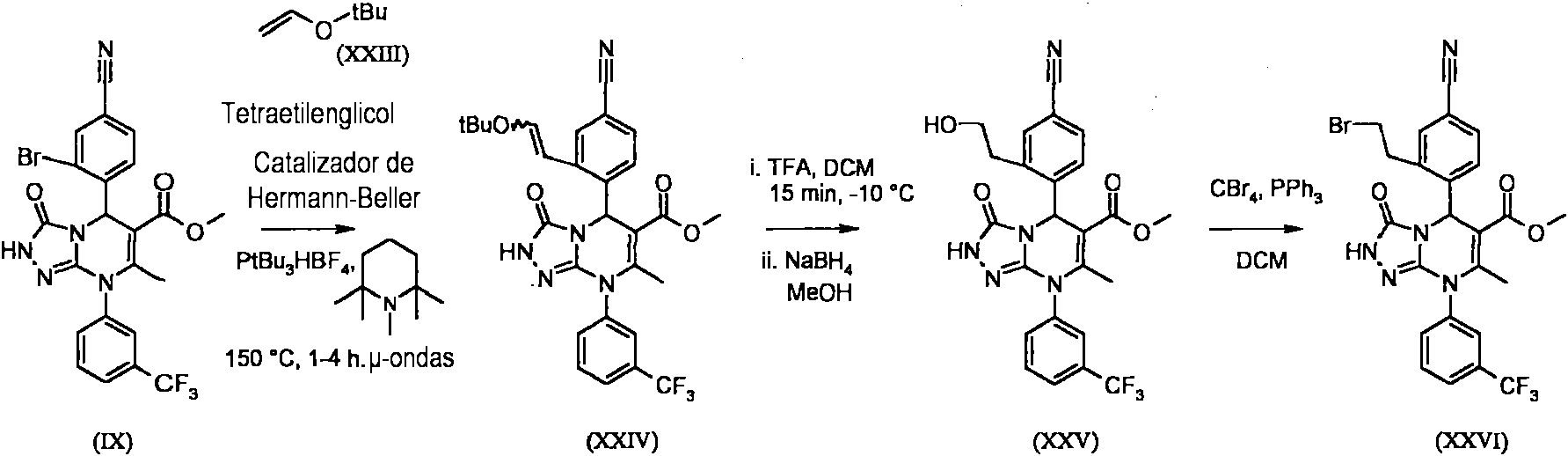
Los compuestos de fórmula (Ij), (Ik) o (Im), es decir, los compuestos de fórmula (I) en la que R2 se define como alquileno (C-i-C4)N+R22R23R24 (que no es parte de la invención), un grupo alquileno (C1-C4)NR1sR19 (que no es parte de la invención), un grupo [CH2]yG[CH2]jCH2-N+piridinio (R38), respectivamente como sustituyentes, pueden prepararse de acuerdo con el esquema K. De forma análoga, los compuestos de fórmula (Ij), (Ik) o (Im), es decir, los compuestos de fórmula (I) en la que R2 se define como un grupo alquino -Ry o C(O)NHCH2Rx, pueden prepararse de acuerdo con el esquema K. Los compuestos de fórmula (Ij), (Ik) o (Im) también pueden prepararse de forma similar a partir de los compuestos de fórmula (XXVII).The compounds of formula (Ij), (Ik) or (Im), ie, the compounds of formula (I) wherein R2 is defined as alkylene (Ci-C4) N + R22R23R24 (which is not part of the invention ), a (C1-C4) alkylene group NR1sR19 (which is not part of the invention), a group [CH2] and G [CH2] jCH2-N + pyridinium (R38), respectively as substituents, can be prepared according to the scheme K. Analogously, the compounds of formula (Ij), (Ik) or (Im), ie, the compounds of formula (I) wherein R2 is defined as an alkyne group -Ry or C (O) NHCH2Rx , can be prepared according to scheme K. The compounds of formula (Ij), (Ik) or (Im) can also be prepared in a similar manner from the compounds of formula (XXVII).
Esquema K Scheme K

Los compuestos de fórmula (Ij) pueden obtenerse directamente mediante reacción de alquilación de una amina terciaria apropiada R22R23R24N, tal como trimetilamina o dimetilpiperazina, con los compuestos de fórmula (XXVII) en los que X' es un grupo saliente apropiado (X' = Cl, Br, I, tosilato, etc.) y el grupo -CH2R representa la porción de un compuesto de fórmula (Ij) que queda fuera de su sustitución mediante un grupo alquileno (C1-C4)N+R22 R23 R24. Las condiciones típicas podrían involucrar el calentamiento de una amina terciaria en un disolvente tal como etanol o THF a temperaturas elevadas de entre 60 °C y 150 °C, usando irradiación por microondas.The compounds of formula (Ij) can be obtained directly by alkylation reaction of an appropriate tertiary amine R22R23R24N, such as trimethylamine or dimethylpiperazine, with the compounds of formula (XXVII) in which X 'is an appropriate leaving group (X' = Cl , Br, I, tosylate, etc.) and the group -CH2R represents the portion of a compound of formula (Ij) which is left out of its substitution by an alkylene group (C1-C4) N + R22 R23 R24. Typical conditions could involve heating a tertiary amine in a solvent such as ethanol or THF at elevated temperatures between 60 ° C and 150 ° C, using microwave irradiation.
Como alternativa, la transformación de los compuestos de fórmula (XXVII) a los compuestos de fórmula (Ij) puede conseguirse mediante la amina terciaria (Ik) en la que R18 y R19 £ H. Los compuestos de amina terciaria de fórmula (Ik) pueden prepararse a partir de los compuestos de fórmula (XXVII) mediante reacción con una amina secundaria R19R18NH. Las condiciones habituales de reacción incluyen el uso de una base tal como carbonato de cesio o carbonato de potasio en un disolvente tal como DMF a TA. La conversión de los compuestos de fórmula (Ik), en los que R18 y R19 £ H, a los compuestos de fórmula (Ij) pueden obtenerse usando agentes metilantes tales como bromuro de metilo, yoduro de metilo o bencenosulfonato de metilo. Las condiciones habituales de reacción consisten en el uso de un disolvente tal como MeCN o acetona a una temperatura de entre TA a 60 °C en condiciones habituales de calentamiento por microondas.Alternatively, the transformation of the compounds of formula (XXVII) to the compounds of formula (Ij) can be achieved by the tertiary amine (Ik) wherein R18 and R19 £ H. The tertiary amine compounds of formula (Ik) can prepared from the compounds of formula (XXVII) by reaction with a secondary amine R19R18NH. Typical reaction conditions include the use of a base such as cesium carbonate or potassium carbonate in a solvent such as DMF at RT. The conversion of compounds of formula (Ik), wherein R18 and R19 £ H, to compounds of formula (Ij) can be obtained using methylating agents such as methyl bromide, methyl iodide or methyl benzene sulfonate. The usual reaction conditions consist in the use of a solvent such as MeCN or acetone at a temperature of between 60 ° C and 60 ° C under standard conditions of microwave heating.
Además, también pueden prepararse los compuestos de amina primaria y secundaria de fórmula (Ik) a partir de los compuestos de fórmula (XXVII) mediante reacción con amoniaco o una amina primaria adecuada R18NH2, respectivamente para dar una amina primaria o una amina secundaria.In addition, the primary and secondary amine compounds of formula (Ik) can also be prepared from the compounds of formula (XXVII) by reaction with ammonia or a suitable primary amine R18NH2, respectively, to give a primary amine or a secondary amine.
Pueden obtenerse los compuestos de fórmula (Im) directamente mediante reacción de alquilación de un compuesto que contiene piridina apropiado tal como piridina con los compuestos de fórmula (XXVII), en la que X' es un grupo saliente apropiado (X' = Cl, Br, I, tosilato, etc.) y el grupo -CH2R representa la porción de un compuesto de fórmula (Im) que queda fuera de su sustitución mediante un grupo [CH2]yG[CH2]jCH2-N+piridinio (R38). Las condiciones habituales pueden implicar el calentamiento de los compuestos de fórmula (XXVII), con piridina en un disolvente tal como MeCN o THF a temperatura elevadas de entre 50 °C y 100 °C, usando irradiación por microondas.The compounds of formula (Im) can be obtained directly by alkylation reaction of an appropriate pyridine-containing compound such as pyridine with the compounds of formula (XXVII), wherein X 'is an appropriate leaving group (X' = Cl, Br , I, tosylate, etc.) and the -CH2R group represents the portion of a compound of formula (Im) which is left out of its substitution by a group [CH2] and G [CH2] jCH2-N + pyridinium (R38). Typical conditions may involve heating the compounds of formula (XXVII), with pyridine in a solvent such as MeCN or THF at elevated temperatures between 50 ° C and 100 ° C, using microwave irradiation.
Los compuestos de fórmula (Ij), (Ik) o (Im), es decir, los compuestos de fórmula (I) que incorporan un grupo Ry o Rx (véase el esquema F/H) definido como alquileno (C1-C4)N+R22R23R24, un grupo alquileno (C1-C4)NR18R19 o un grupo [CH2]yG[CH2]jCH2-N+piridinio (R38), respectivamente como sustituyentes, también puede prepararse de acuerdo con el esquema K a partir de los compuestos de fórmula (XXVI).The compounds of formula (Ij), (Ik) or (Im), ie, the compounds of formula (I) that incorporate a group Ry or Rx (see scheme F / H) defined as (C1-C4) alkylene N + R22R23R24, an alkylene group (C1-C4) NR18R19 or a group [CH2] and G [CH2] jCH2-N + pyridinium (R38), respectively as substituents, can also be prepared according to scheme K from the compounds of formula (XXVI).
Detalles experimentales generalesGeneral experimental details
Las reacciones no se llevaron a cabo en una atmósfera inerte salvo que se especifique y todos los disolventes y reactivos comerciales se usaron tal como se recibieron.The reactions were not carried out in an inert atmosphere unless it was specified and all commercial solvents and reagents were used as received.
La purificación mediante cromatografía se refiere a la purificación usando el sistema de purificación CombiFlash ® Companion o el sistema de purificación Biotage SP1. Cuando los productos se purificaron usando un cartucho Isolute® SPE Si II, 'Cartucho Isolute SPE Si' se refiere a una columna de polipropileno preenvasada que contiene sílice activada no unida con partículas irregulares con un tamaño promedio de 50 pm y una porosidad teórica de 60Á. Las partes que contienen el producto requerido (identificado mediante análisis de TLC y/o LCMS) se agruparon, se retiró la parte orgánica mediante evaporación, y se liofilizó la parte acuosa restante, para dar el producto final. Cuando se ha usado la cromatografía en capa fina (TLC, del inglés thin layer cromatography), se refiere a placas que usan gel de sílice de TLC, normalmente gel de sílice de 3 x 6 cm en placas de papel de aluminio con un indicador fluorescente (254 nm), (por ejemplo, Fluka 60778). Los experimentos de microondas se llevaron a cabo usando un Biotage Initiator 60 ™ que utiliza un resonador de modo único y un ajuste dinámico de campo. Se puede alcanzar una temperatura de 40-250 °C y presiones de hasta 30 bar.Purification by chromatography refers to purification using the CombiFlash ® Companion purification system or the Biotage SP1 purification system. When the products were purified using an Isolute® SPE Si II cartridge, 'Isolute SPE Si' Cartridge refers to a prepacked polypropylene column containing activated silica not bound with irregular particles with an average size of 50 μm and a theoretical porosity of 60 μA . The parts containing the required product (identified by TLC and / or LCMS analysis) were pooled, the organic part was removed by evaporation, and the remaining aqueous part was lyophilized, to give the final product. When thin layer chromatography (TLC ) has been used, it refers to plates using TLC silica gel, typically 3 x 6 cm silica gel on aluminum foil plates with a fluorescent indicator (254 nm), (for example, Fluka 60778). Microwave experiments were carried out using a Biotage Initiator 60 ™ that uses a unique mode resonator and dynamic field adjustment. It can reach a temperature of 40-250 ° C and pressures of up to 30 bar.
Los espectros de RMN se obtuvieron en un espectrómetro Varian Unity Inova 400 con una sonda de resonancia triple de detección inversa de 5 mm que funciona a 400 MHz o en un espectrómetro Bruker Avance DRX 400 con una sonda de TXI de resonancia triple de detección inversa de 5 mm que funciona a 400 MHz o en un Bruker Espectrómetro Avance DPX 300 con una sonda de frecuencia dual estándar de 5 mm que funciona a 300 MHz. Los desplazamientos se dan en ppm en relación con el tetrametilsilano.The NMR spectra were obtained on a Varian Unity Inova 400 spectrometer with a resonance probe triple reverse detection of 5 mm operating at 400 MHz or on a Bruker Avance DRX 400 spectrometer with a 3-mm reverse detection triple resonance TXI probe operating at 400 MHz or on a Bruker Advance DPX 300 Spectrometer with a probe standard 5 mm dual frequency operating at 300 MHz. Displacements are given in ppm relative to tetramethylsilane.
Los nombres de los compuestos se generaron usando la función Autonom 2000 en el programa informático MDL ISIS™/Draw 2.5 SP2.The names of the compounds were generated using the Autonom 2000 function in the MDL ISIS ™ / Draw 2.5 SP2 software.
Condiciones de HPLC preparativaPreparative HPLC conditions
Sistema de HPLC 1HPLC system 1
Columna de fase inversa C18 de extremos protegidos (columna Gemini de 250 x 21,2 mm, tamaño de partícula 5 |jm), eluyendo con un gradiente de A: agua; B: MeCN (ácido fórmico al 0,1% añadido) con un caudal de típicamente 18 ml/min y un gradiente de 1%/min de incremento en B. Detección de UV a 254 nm.Column of reverse phase C18 of protected ends (Gemini column of 250 x 21.2 mm, particle size 5 | jm), eluting with a gradient of A: water; B: MeCN (0.1% added formic acid) with a flow rate of typically 18 ml / min and a gradient of 1% / min increase in B. UV detection at 254 nm.
Sistema de HPLC 2HPLC system 2
Columna de fase inversa C18 de extremos protegidos (columna Gemini de 250 x 21,2 mm, tamaño de partícula 5 jm), eluyendo con un gradiente de A: agua; B: metanol (ácido fórmico al 0,1% añadido) con un caudal de típicamente 13 ml/min y un gradiente de 1%/min de incremento en B. Detección de UV a 254 nm.Column of reverse phase C18 of protected ends (Gemini column of 250 x 21.2 mm, particle size 5 jm), eluting with a gradient of A: water; B: methanol (added 0.1% formic acid) with a flow rate of typically 13 ml / min and a gradient of 1% / min increase in B. UV detection at 254 nm.
Condiciones de CL-EM analíticaAnalytical CL-MS conditions
Procedimiento de CL-EM 1CL-MS procedure 1
El espectrómetro de masas cuadrupolo Waters ZQ con una columna de fase inversa C18 (Phenomenex Luna de 30 x 4,6 mm, tamaño de partícula 3 jm), elución con A: agua ácido fórmico al 0,1%; B: MeCN ácido fórmico al 0,1%. Gradiente:The Waters ZQ quadrupole mass spectrometer with a C18 reverse phase column (Phenomenex Luna 30 x 4.6 mm, particle size 3 jm), elution with A: water 0.1% formic acid; B: MeCN 0.1% formic acid. Gradient:
Tiempo de gradiente Caudal (ml/min) % de A % de B 0,00 2,0 95 5Gradient time Flow rate (ml / min)% A% B 0.00 2.0 95 5
0,30 2,0 95 50.30 2.0 95 5
4,30 2,0 5 954.30 2.0 5 95
5,30 2,0 5 955.30 2.0 5 95
5,80 2,0 95 55.80 2.0 95 5
6,00 2,0 95 5 Detección- MS, ELS, UV (200 jl/min inyectados a la fuente IEN con detector HP1100 PDA en línea) Procedimiento de ionización EM - Electronebulización (ion positivo y negativo)_________________ Procedimiento de CL-EM 26.00 2.0 95 5 Detection- MS, ELS, UV (200 jl / min injected to the IEN source with HP1100 PDA detector in line) EM ionization procedure - Electrospray (positive and negative ion) _________________ CL-MS procedure two
Espectrómetro de masas cuadrupolo Waters Micromass ZMD con una columna de fase inversa C18 (Phenomenex Luna de 30 x 4,6 mm, tamaño de partícula 3 jm), elución con A: agua ácido fórmico al 0,1%; B: MeCN ácido fórmico al 0,1%. Gradiente:Waters Micromass quadrupole mass spectrometer ZMD with a C18 reverse phase column (Phenomenex Luna 30 x 4.6 mm, particle size 3 jm), elution with A: water 0.1% formic acid; B: MeCN 0.1% formic acid. Gradient:
Tiempo deTime of
gradiente Caudal (ml/min) % de A % de B 0,00 2,0 95 5 gradient Flow rate (ml / min)% A% B 0.00 2.0 95 5
0,50 2,0 95 50.50 2.0 95 5
4,50 2,0 5 954.50 2.0 5 95
5,50 2,0 5 955,50 2,0 5 95
6,00 2,0 95 5 Detección- MS, ELS, Procedimiento de ionización EM6.00 2.0 95 5 Detection- MS, ELS, EM ionization procedure
UV (100 j l inyectados al EM con detector UV en línea) - Electronebulización (ion positivo y negativo) Procedimiento de CL-EM 3 UV (100 jl injected to the EM with in-line UV detector) - Electronebulization (positive and negative ion) LC-MS procedure 3
Espectrómetro de masas Waters Micromass ZQ2000 con una columna de fase inversa C18 (Acquity BEH 100 x 2,1 mm con un tamaño de partícula de 1,7 |jm) mantenida a 40 °C, elución con A: agua ácido fórmico al 0,1%; B: MeCN ácido fórmico al 0,1%. Como alternativa, cuando se especifica, se usó una columna de fase inversa C18 (100 x 2,1 mm Acquity UPLC BEH Shield, tamaño de partícula 1,7 jm ) se usó.Waters Micromass ZQ2000 mass spectrometer with a C18 reverse phase column (Acquity BEH 100 x 2.1 mm with a particle size of 1.7 | jm) maintained at 40 ° C, elution with A: water 0 formic acid one%; B: MeCN 0.1% formic acid. Alternatively, when specified, a C18 reverse phase column (100 x 2.1 mm Acquity UPLC BEH Shield, particle size 1.7 jm) was used.
Gradiente:Gradient:
Tiempo deTime of
gradiente Caudal (ml/min) % de A % de B Gradient Flow rate (ml / min)% of A% B
0,00 0,4 95 50.00 0.4 95 5
0,40 0,4 95 50.40 0.4 95 5
6,00 0,4 5 956.00 0.4 5 95
6,80 0,4 5 956.80 0.4 5 95
7,00 0,4 95 57.00 0.4 95 5
8,00 0,4 95 58.00 0.4 95 5
Detección- MS, UV PDADetection- MS, UV PDA
Procedimiento de ionización EM- Electronebulización (ionEM ionization procedure - Electronebulization (ion
positivo/negativo).positive negative).
Procedimiento de CL-EM 4CL-MS procedure 4
Espectrómetro de masas cuadrupolo Waters Platform LC con una columna de fase inversa C18 (Phenomenex Luna de 30 x 4,6 mm, tamaño de partícula 3 jm), elución con A: agua ácido fórmico al 0,1%; B: MeCN ácido fórmico al 0,1%. Gradiente:Waters Platform LC quadrupole mass spectrometer with a C18 reverse phase column (Phenomenex Luna 30 x 4.6 mm, particle size 3 jm), elution with A: water 0.1% formic acid; B: MeCN 0.1% formic acid. Gradient:
Tiempo de gradiente Caudal (ml/min) % de A % de BGradient time Flow rate (ml / min)% of A% B
0,00 2,0 95 50.00 2.0 95 5
0,50 2,0 95 50.50 2.0 95 5
4,50 2,0 5 954.50 2.0 5 95
5,50 2,0 5 955,50 2,0 5 95
6,00 2,0 95 56.00 2.0 95 5
Detección- MS, ELS, UV (Split - 200 jl/min inyectados a la fuente IEN con detección HP1100 DAD en línea) Procedimiento de ionización EM - Electronebulización (ion positivo y negativo).Detection - MS, ELS, UV (Split - 200 jl / min injected to the IEN source with HP1100 DAD detection in line) EM ionization procedure - Electronebulization (positive and negative ion).
Procedimiento de CL-EM 5LC-MS procedure 5
Espectrómetro cuadrupolo Waters VG Platform II con una columna de fase inversa C18 (Luna de 30 x 4,6 mm, tamaño de partícula 3 jm), elución con A: agua ácido fórmico al 0,1%; B: MeCN ácido fórmico al 0,1%.Waters VG Platform II quadrupole spectrometer with a C18 reverse phase column (Luna of 30 x 4.6 mm, particle size 3 jm), elution with A: water 0.1% formic acid; B: MeCN 0.1% formic acid.
Gradiente:Gradient:
Tiempo de gradiente Caudal % de A % de BGradient time Flow rate% of A% B
0,00 2,0 95 50.00 2.0 95 5
0,30 2,0 95 50.30 2.0 95 5
4,30 2,0 5 954.30 2.0 5 95
5,30 2,0 5 955.30 2.0 5 95
5,80 2,0 95 55.80 2.0 95 5
6,00 2,0 95 56.00 2.0 95 5
Detección- MS, ELS, UV (Split - 200 jl/min inyectados a la fuente IEN con detección HP1050 DAD en línea) Procedimiento de ionización EM - Electronebulización (ion positivo y negativo) Detection - MS, ELS, UV (Split - 200 μl / min injected to the IEN source with HP1050 DAD detection in line) EM ionization procedure - Electronebulization (positive and negative ion)
Sistema de MDAP:MDAP system:
Instrumentación: Sistema de purificación Agilent 1260 infinity. CL/EM de cuadrupolo simple Agilent serie 6100Instrumentation: Agilent 1260 infinity purification system. Agilent 6100 series single quadrupole LC / MS
Columna: XSELECT CSH Prep C185 pm OBD, 30X150 mm, TAColumn: XSELECT CSH Prep C185 pm OBD, 30X150 mm, TA
Fase móvil A: ácido fórmico acuoso al 0,1%Mobile phase A: 0.1% aqueous formic acid
Fase móvil B: ácido fórmico al 0,1% en acetonitriloMobile phase B: 0.1% formic acid in acetonitrile
Caudal: 60 ml/minFlow rate: 60 ml / min
Programa de 10%-95%, 22 min, centrado alrededor de un gradienteProgram of 10% -95%, 22 min, centered around a gradient
gradiente: enfocado específicogradient: specific focused
Inyección de muestra de una solución de 20-60 mg/ml en DMSO (+ ácido fórmico y agua opcional).Sample injection of a 20-60 mg / ml solution in DMSO (+ formic acid and optional water).
Abreviaturas usadas en la sección experimental:Abbreviations used in the experimental section:
9-BBN 9-borabiciclo[3.3.1]nonano9-BBN 9-borabicyclo [3.3.1] nonane
dba Dibencilidenoacetonadba Dibenzylideneacetone
DCE DicloroetanoDCE Dichloroethane
DCM DiclorometanoDCM Dichloromethane
DIPEA Di-isopropiletilaminaDIPEA Di-isopropylethylamine
DMF W,W-dimetilformamidaDMF W, W-dimethylformamide
DMSO DimetilsulfóxidoDMSO Dimethylsulfoxide
Dppf 1,1'-bis(difenilfosfino)ferrocenoDppf 1,1'-bis (diphenylphosphino) ferrocene
Et2O Éter dietílicoEt2O Diethyl ether
EtOAc Acetato de etiloEtOAc Ethyl acetate
HPLC Cromatografía líquida de alta resolución IMS Alcoholes metilados industrialesHPLC High resolution liquid chromatography IMS Industrial methylated spirits
CL-EM Cromatografía líquida-espectrometría de masas MeCN AcetonitriloCL-EM Liquid chromatography-mass spectrometry MeCN Acetonitrile
MDAP Purificación automática dirigida por masaMDAP Automatic purification directed by mass
NBS W-bromosuccinimidaNBS W-bromosuccinimide
NMO W-óxido de W-metilmorfolinaNMO W-methylmorpholine W-oxide
Tr Tiempo de retenciónTr Holding time
TA Temperatura ambienteTA Ambient temperature
THF TetrahidrofuranoTHF Tetrahydrofuran
En los siguientes procedimientos, algunos de los materiales de partida se identifican mediante un número de "intermedio" o "ejemplo". Esto se proporciona simplemente como ayuda al químico experto. El material de partida puede no haberse preparado necesariamente del lote al que se hace referencia.In the following procedures, some of the starting materials are identified by an "intermediate" or "example" number. This is simply provided as an aid to the expert chemist. The starting material may not necessarily have been prepared from the batch to which reference is made.
Cuando se hace referencia al uso de un procedimiento "similar" o "análogo", como apreciarán los expertos en la técnica, dicho procedimiento puede implicar variaciones menores, por ejemplo temperatura de la reacción, cantidad de reactivo/disolvente, tiempo de reacción, condiciones de proceso o condiciones de purificación cromatográfica. Ejemplo 1 (preparación de intermedios) When reference is made to the use of a "like" or "analogous" procedure, as will be appreciated by those skilled in the art, such a procedure may involve minor variations, for example reaction temperature, amount of reagent / solvent, reaction time, conditions of process or chromatographic purification conditions. Example 1 (preparation of intermediates)

Éster metílico del ácido 5-r4-c¡ano-2-(4-h¡drox¡-but-1-¡n¡l)-fenM1-7-met¡l-3-oxo-8-(3-tr¡fluoromet¡l-fen¡l)-2.3.5.8-tetrahidro-ri.2.41triazolor4.3-alpirimidin-6-carboxílico (no forma parte de la invención)Methyl ester of 5-r4-cyano-2- (4-hydroxyl-but-1-yl) -fenM1-7-methyl-3-oxo-8- (3-tr Fluoromethy1-pheny1) -2.3.5.8-tetrahydro-ri.2.41triazolor4.3-alpyrimidine-6-carboxylic acid (does not form part of the invention)
Intermedio 1Intermediate 1

Éster metílico del ácido 4-(2-bromo-4-c¡anofen¡l)-6-met¡l-2-t¡oxo-1-(3-tr¡fluoromet¡lfen¡l)-1.2.3.4-tetrahidropirimidin-5-carboxílico4- (2-Bromo-4-cyanophenyl) -6-methylene-2-t-oxo-1- (3-trifluoromethylene) methyl ester -1.2.3.4- tetrahydropyrimidine-5-carboxylic
3-trifluorometilfeniltiourea (12,8 g, 87 mmol), 2-bromo-4-cianobenzaldehído (18,3 g, 87 mmol) y acetoacetato de metilo (10,4 ml, 96 mmol) se disolvieron en THF (300 ml) en atmósfera de N2 y después se añadió trimetilsililfosfato (18 g) en THF (50 ml) y la mezcla se calentó a 75 °C. Después de 17 horas la mezcla de reacción se dejó enfriar, se vertió en HCl 0,5 M (600 ml) y se agitó durante 30 min. La mezcla se extrajo en EtOAc. La fase orgánica se lavó con agua, después salmuera y se secó (Na2SO4) antes de concentrarse al vacío. El sólido resultante se trituró con Et2O (50 ml), se filtró y el sólido se recogió para proporcionar el compuesto del título en forma de un sólido de color blanco (22,2 g).3-trifluoromethylphenylthiourea (12.8 g, 87 mmol), 2-bromo-4-cyanobenzaldehyde (18.3 g, 87 mmol) and methyl acetoacetate (10.4 mL, 96 mmol) were dissolved in THF (300 mL). under N2 and then trimethylsilylphosphate (18 g) in THF (50 ml) was added and the mixture was heated to 75 ° C. After 17 hours the reaction mixture was allowed to cool, poured into 0.5 M HCl (600 ml) and stirred for 30 min. The mixture was extracted into EtOAc. The organic phase was washed with water, then brine and dried (Na2SO4) before being concentrated in vacuo. The resulting solid was triturated with Et2O (50 mL), filtered and the solid was collected to give the title compound as a white solid (22.2 g).
CL-EM (procedimiento 2): Tr = 4,03 min, m/z = 432 [M(79Br) H]+LC-MS (method 2): Tr = 4.03 min, m / z = 432 [M (79Br) H] +
Intermedio 2Intermediate 2

Éster metílico del ácido 4-(2-Bromo-4-c¡anofen¡l)-2-h¡draz¡no-6-met¡l-1-(3-tr¡fluoromet¡lfenil)-1.4-d¡h¡dropirimidin-5-carboxílico4- (2-Bromo-4-cyanophenyl) -2-hydanzane-6-methyl-1- (3-trifluoromethylene) -1.4-d-methyl ester h -dropirimidin-5-carboxylic acid
El intermedio 1 (4,6 g, 9 mmol) se disolvió en IMS (350 ml), se añadió peróxido de hidrógeno y urea (3,4 g, 36,2 mmol) y la mezcla se agitó durante 2 horas a TA antes de la adición de hidrazina hidrato (4,1 ml, 54,4 mmol). La mezcla se agitó durante otras 2 horas a TA y se filtró, el filtrado se recogió el después se redujo el disolvente a un volumen menor al vacío. El residuo resultante se repartió entre EtOAc y salmuera. La capa orgánica se separó, se lavó con salmuera, se secó (Na2SO4) y se evaporó al vacío. El residuo resultante se usó directamente en la siguiente etapa.Intermediate 1 (4.6 g, 9 mmol) was dissolved in IMS (350 ml), hydrogen peroxide and urea (3.4 g, 36.2 mmol) were added and the mixture was stirred for 2 hours at RT before of the hydrazine hydrate addition (4.1 ml, 54.4 mmol). The The mixture was stirred for a further 2 hours at RT and filtered, the filtrate was collected, then the solvent was reduced to a smaller volume in vacuo. The resulting residue was partitioned between EtOAc and brine. The organic layer was separated, washed with brine, dried (Na2SO4) and evaporated in vacuo. The resulting residue was used directly in the next step.
CL-EM (procedimiento 2): Tr = 2,49 min, m/z = 508 [M(79Br)+H]+LC-MS (method 2): Tr = 2.49 min, m / z = 508 [M (79Br) + H] +
Intermedio 3Intermediate 3
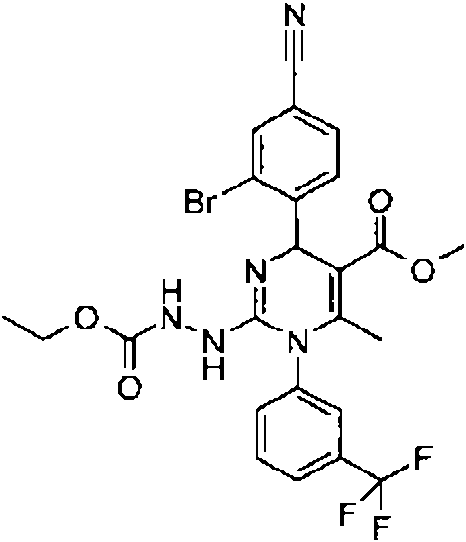
Éster metílico del ácido 4-(2-bromo-4-cianofenin-2-W-etoxicarbonil-hidrazino)-6-metil-1-(3-trifluorometilfenil)-1.4-dihidro-pirimidin-5-carboxílico4- (2-Bromo-4-cyanophene-2-W-ethoxycarbonyl-hydrazino) -6-methyl-1- (3-trifluoromethyl-phenyl) -1,4-dihydro-pyrimidine-5-carboxylic acid methyl ester
El intermedio 2 (aproximadamente 9 mmol) se disolvió en DCM (40 ml) en atmósfera de N2 y se enfrió a -78 °C antes de la adición de trietilamina (1,7 ml, 12 mmol) y cloroformiato de etilo (765 pl, 8 mmol). La mezcla de reacción se agitó a -78 °C y se dejó calentar lentamente a TA durante 16 horas y después se repartió entre EtOAc y agua. La capa orgánica se separó, se lavó con salmuera, se secó (Na2SO4) y se evaporó al vacío. El residuo resultante se purificó por cromatografía sobre gel de sílice eluyendo con un gradiente de EtOAc al 0-50% en ciclohexano para dar el compuesto del título en forma de un sólido de color amarillo (2 g en 2 etapas).Intermediate 2 (approximately 9 mmol) was dissolved in DCM (40 ml) under N2 and cooled to -78 ° C before the addition of triethylamine (1.7 ml, 12 mmol) and ethyl chloroformate (765 pl). 8 mmol). The reaction mixture was stirred at -78 ° C and allowed to slowly warm to RT for 16 hours and then partitioned between EtOAc and water. The organic layer was separated, washed with brine, dried (Na2SO4) and evaporated in vacuo. The resulting residue was purified by chromatography on silica gel eluting with a gradient of 0-50% EtOAc in cyclohexane to give the title compound as a yellow solid (2 g in 2 steps).
CL-EM (procedimiento 2): Tr = 3,55 min, m/z = 580 [M(79Br)+H]+LC-MS (method 2): Tr = 3.55 min, m / z = 580 [M (79Br) + H] +
Intermedio 4Intermediate 4
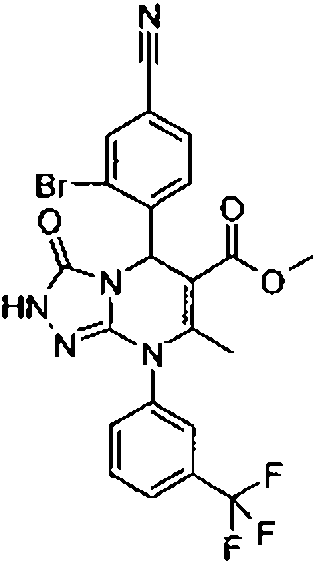
Éster metílico del ácido 5-(2-bromo-4-cianofenih-7-metil-3-oxo-8-(3-trifluorometilfenih-2.3.5.8-tetrahidrori.2.41tr¡azolor4.3-alp¡r¡m¡d¡n-6-carboxílico5- (2-Bromo-4-cyanophene-7-methyl-3-oxo-8- (3-trifluoromethylphenih-2.3.5.8-tetrahydrori.2.41tr¡azolor4.3-alpyrimethenic acid methyl ester N-6-carboxylic
Ruta ARoute A
El intermedio 3 (2 g, 3,5 mmol) se disolvió en IMS (20 ml) y se calentó a 160 °C durante 1 hora usando irradiación por microondas. El disolvente se eliminó al vacío y el residuo resultante se trituró con Et2O, se filtró y el sólido se recogió para proporcionar el compuesto del título en forma de un sólido de color blanco (1,5 g).Intermediate 3 (2 g, 3.5 mmol) was dissolved in IMS (20 ml) and heated at 160 ° C for 1 hour using microwave irradiation. The solvent was removed in vacuo and the resulting residue was triturated with Et2O, filtered and the solid was collected to give the title compound as a white solid (1.5 g).
CL-EM (procedimiento 3): Tr = 4,65 min, m/z = 534 [M(79Br)+H]+LC-MS (method 3): Tr = 4.65 min, m / z = 534 [M (79Br) + H] +
RMN 1H (400 MHz, DMSO) 811,20 (1H, s), 8,18 (1H, d, J = 1,6 Hz), 8,09 (1H, s a), 7,93-7,75 (5H, m), 6,23 (1H, d, J = 1,2 Hz), 3,49 (3H, s), 2,13 (3H, s).1 H NMR (400 MHz, DMSO) 811.20 (1H, s), 8.18 (1H, d, J = 1.6 Hz), 8.09 (1H, sa), 7.93-7.75 ( 5H, m), 6.23 (1H, d, J = 1.2 Hz), 3.49 (3H, s), 2.13 (3H, s).
Ruta BRoute B
Al intermedio 1 (75 g, 147 mmol) disuelto en DCM seco (1350 ml) y 2,6-lutidina (51,3 ml) a 0 °C en atmósfera de nitrógeno se le añadió trifosgeno en porciones (13,82 g) con agitación. Después de 5 min la reacción se calentó a 20 °C y se agitó durante 25 min. La mezcla de reacción se enfrió a 10 °C y se añadió mediante una cánula a una solución en agitación de hidrazina anhidra (0,419 moles) en THF (400 ml) y MeCN (380 ml) enfriada en un baño de hielo. Después de otros 5 min la reacción se calentó a 20 °C y se agitó a TA durante 2 % h. Se añadió agua(800 ml) desgasificada con nitrógeno a la reacción y la capa orgánica se lavó con más agua (800 ml) y después salmuera (500 ml). La capa orgánica se secó (Na2SO4) y se evaporó al vacío y el residuo se volvió a disolver en tolueno (300 ml) y de nuevo se evaporó al vacío. El residuo se disolvió en tolueno (500 ml) por última vez y se concentró hasta un peso de -200 g. La solución resultante se diluyó con Et2O (500 ml) y se dejó cristalizar. El compuesto del título se recogió por filtración para dar un sólido de color amarillo (32,1 g). Las aguas madre se concentraron al vacío y el residuo resultante se disolvió en DCM y se dejó cristalizar. El sólido se recogió para dar más producto del título en forma de un sólido de color amarillo (2,56 g).Intermediate 1 (75 g, 147 mmol) dissolved in dry DCM (1350 ml) and 2,6-lutidine (51.3 ml) at 0 ° C under nitrogen was added with triphosgene in portions (13.82 g) with agitation. After 5 min the reaction was heated to 20 ° C and stirred for 25 min. The reaction mixture was cooled to 10 ° C and added by cannula to a stirred solution of anhydrous hydrazine (0.419 mol) in THF (400 ml) and MeCN (380 ml) cooled in a water bath. ice. After a further 5 min the reaction was heated to 20 ° C and stirred at RT for 2% h. Water (800 ml) degassed with nitrogen was added to the reaction and the organic layer was washed with more water (800 ml) and then brine (500 ml). The organic layer was dried (Na2SO4) and evaporated in vacuo and the residue redissolved in toluene (300 ml) and again evaporated in vacuo. The residue was dissolved in toluene (500 ml) for the last time and concentrated to a weight of -200 g. The resulting solution was diluted with Et2O (500 mL) and allowed to crystallize. The title compound was collected by filtration to give a yellow solid (32.1 g). The mother liquors were concentrated in vacuo and the resulting residue was dissolved in DCM and allowed to crystallize. The solid was collected to give more title product as a yellow solid (2.56 g).
CL-EM (710016978): Tr = 3,39 min, m/z = 533,9 [M(79Br)+H]+LC-MS (710016978): Tr = 3.39 min, m / z = 533.9 [M (79Br) + H] +
Intermedio 4a/4bIntermediate 4a / 4b

Éster metílico del ácido (R) y (S) 5-(2-bromo-4-ciano-fenil)-7-metil-3-oxo-8-(3-trifluorometil-fenil)-2.3.5.8-tetrahidro-ri.2.41triazolor4.3-alpirimidin-6-carboxílicoMethyl ester of the acid (R) and (S) 5- (2-bromo-4-cyano-phenyl) -7-methyl-3-oxo-8- (3-trifluoromethyl-phenyl) -2.3.5.8-tetrahydro-ri .2.41triazolor4.3-alpyrimidine-6-carboxylic acid
Los enantiómeros del intermedio 4 (155 mg, 0,290 mmol) se separaron por cromatografía de HPLC preparativa sobre una fase quiral [columna Daicel Chiralpak IC (5 pm, 250 mm x 10 mm, eluyente MeOH al 1%/DCM, caudal 5 ml/min, detección a 220 nm)] para dar 69 mg del enantiómero (R) (primer eluyente y denominado 4a) y 71 mg del enantiómero (S) (segundo eluyente y denominado 4b).The enantiomers of intermediate 4 (155 mg, 0.290 mmol) were separated by preparative HPLC chromatography on a chiral phase [Daicel Chiralpak IC column (5 μm, 250 mm × 10 mm, eluent 1% MeOH / DCM, flow rate 5 ml / min, detection at 220 nm)] to give 69 mg of the (R) -enantiomer (first eluent and designated 4a) and 71 mg of the (S) -enantiomer (second eluent and termed 4b).
Éster metílico del ácido 5-r4-ciano-2-(4-hidroxi-but-1-inil)-fenM1-7-metil-3-oxo-8-(3-trifluorometil-fenil)-2.3.5.8-tetrahidro-ri.2.41triazolor4.3-a1pirimidin-6-carboxílico (ejemplo 1) (no forma parte de la invención)Methyl ester of 5-r4-cyano-2- (4-hydroxy-but-1-ynyl) -fenM1-7-methyl-3-oxo-8- (3-trifluoromethyl-phenyl) -2.3.5.8-tetrahydro- ri.2.41triazolor4.3-a1-pyrimidine-6-carboxylic acid (example 1) (does not form part of the invention)
El intermedio 4 (150 mg, 0,28 mmol), 3-butin-1-ol (42 ml, 0,57 mmol), dicloruro de 6/s(trifenilfosfina)paladio (II) (15 mg, 0,021 mmol) y yoduro de cobre (1) (6 mg, 0,024 mmol) se disolvieron en DMF (1,5 ml) y trietilamina (1,5 ml) y después se purgaron con N2 durante 5 min. Después, la mezcla de reacción se calentó a 120 °C durante 1 hora usando irradiación por microondas. Después se filtró la mezcla de reacción a través de un lecho de sílice y el residuo resultante se purificó por HPLC de fase inversa (procedimiento 1) usando un gradiente de MeCN al 10-60% (+ ácido fórmico al 0,1%) en agua para producir el compuesto del título en forma de un sólido de color blanquecino (32 mg). CL-EM (procedimiento 3): Tr = 4,30 min, m/z = 524 [M+H]+Intermediate 4 (150 mg, 0.28 mmol), 3-butyn-1-ol (42 ml, 0.57 mmol), 6 / s dichloride (triphenylphosphine) palladium (II) (15 mg, 0.021 mmol) and copper iodide (1) (6 mg, 0.024 mmol) were dissolved in DMF (1.5 ml) and triethylamine (1.5 ml) and then purged with N2 for 5 min. Then, the reaction mixture was heated at 120 ° C for 1 hour using microwave irradiation. The reaction mixture was then filtered through a pad of silica and the resulting residue was purified by reverse phase HPLC (method 1) using a gradient of 10-60% MeCN (+ 0.1% formic acid) in water to yield the title compound as an off-white solid (32 mg). LC-MS (method 3): Tr = 4.30 min, m / z = 524 [M + H] +
RMN 1H (400 MHz, CDCla) 88,14 (1H, s), 7,79 (1H, d, J = 8 Hz), 7,72-7,67 (2H, m), 7,60 (1H, s), 7,54 (2H, dd, J = 8, 2 Hz), 7,37 (1H, d, J = 8 Hz), 6,64 (1H, s), 3,87-3,77 (2H, m), 3,58 (3H, s), 2,76-2,63 (2H, m), 2,58 (1H, s), 2,24 (3H, s).1 H NMR (400 MHz, CDCla) 88.14 (1H, s), 7.79 (1H, d, J = 8 Hz), 7.72-7.67 (2H, m), 7.60 (1H, s), 7.54 (2H, dd, J = 8, 2 Hz), 7.37 (1H, d, J = 8 Hz), 6.64 (1H, s), 3.87-3.77 ( 2H, m), 3.58 (3H, s), 2.76-2.63 (2H, m), 2.58 (1H, s), 2.24 (3H, s).
Ejemplo 2 (intermedio. no es parte de la invención) Example 2 (intermediate, is not part of the invention)
Sal formiato del éster metílico del ácido 5-r4-ciano-2-(3-dimetilamino-prop-1-inih-fenil1-7-metil-3-oxo-8-(3-trifluorometil-fenih-2.3.5.8-tetrahidro-ri.2.41triazolor4.3-alpirimidin-6-carboxílico (intermedio, no forma parte de la invención)Salt formate of 5-r4-cyano-2- (3-dimethylamino-prop-1-inih-phenyl-1-7-methyl-3-oxo-8- (3-trifluoromethyl-phenih-2.3.5.8-tetrahydro) methyl ester -ri.2.41-triazolor4.3-alpyrimidine-6-carboxylic acid (intermediate, not part of the invention)
El intermedio 4 (400 mg, 0,75 mmol), 1-dimetilamino-2-propina (160 pl, 1,5 mmol), dicloruro de ó/s(trifenMfosfina)paladio (II) (79 mg, 0,11 mmol) y yoduro de cobre (1) (43 mg, 0,23 mmol) se disolvieron en DMF (2,5 ml) y trietilamina (2,5 ml) y se purgaron con N2 durante 5 min. Después la reacción se calentó a 125 °C durante 50 min. usando irradiación por microondas. La mezcla de reacción se filtró a través de un lecho de celite y después se diluyó con EtOAc. La solución resultante se lavó con salmuera, se secó (Na2SO4) y se evaporó al vacío. Una porción del residuo resultante (25 mg) se purificó por HPLC de fase inversa (procedimiento 1) usando un gradiente de MeCN al 10-40% en agua (+ ácido fórmico al 0,1%) y dio el compuesto del título en forma de un sólido de color blanquecino (11 mg).Intermediate 4 (400 mg, 0.75 mmol), 1-dimethylamino-2-propine (160 μL, 1.5 mmol), O / S dichloride (triphenphosphine) palladium (II) (79 mg, 0.11 mmol ) and copper iodide (1) (43 mg, 0.23 mmol) were dissolved in DMF (2.5 ml) and triethylamine (2.5 ml) and purged with N2 for 5 min. Then the reaction was heated at 125 ° C for 50 min. using microwave irradiation. The reaction mixture was filtered through a pad of celite and then diluted with EtOAc. The resulting solution was washed with brine, dried (Na2SO4) and evaporated in vacuo. A portion of the resulting residue (25 mg) was purified by reverse phase HPLC (method 1) using a gradient of 10-40% MeCN in water (+ 0.1% formic acid) and gave the title compound as of an off-white solid (11 mg).
CL-EM (procedimiento 3): Tr = 3,38 min, m/z = 537 [M+H]+LC-MS (method 3): Tr = 3.38 min, m / z = 537 [M + H] +
RMN 1H (400 MHz, CDCla) 89,30 (1H, s a), 8,28 (1H, s), 7,82-7,71 (3H, m), 7,64-7,58 (3H, m), 7,42 (1H, d, J = 8 Hz), 6,50 (1H, s), 3,84 (1H, d, J = 17 Hz), 3,76 (1H, d, J = 17 Hz), 3,60 (3H, s), 2,60 (6H, s), 2,26 (3H, s).1 H NMR (400 MHz, CDCla) 89.30 (1H, sa), 8.28 (1H, s), 7.82-7.71 (3H, m), 7.64-7.58 (3H, m) ), 7.42 (1H, d, J = 8 Hz), 6.50 (1H, s), 3.84 (1H, d, J = 17 Hz), 3.76 (1H, d, J = 17 Hz), 3.60 (3H, s), 2.60 (6H, s), 2.26 (3H, s).
Ejemplo 3 (preparación de intermedios)Example 3 (preparation of intermediates)

Éster metílico del ácido 5-r4-ciano-2-(3-dimetilamino-prop-1-inil)-fenM1-2-(3-metanosulfonil-propil)-7-metil-3-oxo-8-(3-trifluorometil-fenin-2.3.5.8-tetrahidro-ri.2.41triazolor4.3-a1pirimidin-6-carboxílico (intermedio. no forma parte de la invención)Methyl ester of 5-r4-cyano-2- (3-dimethylamino-prop-1-ynyl) -fenM1-2- (3-methanesulfonyl-propyl) -7-methyl-3-oxo-8- (3-trifluoromethyl) -fenin-2.3.5.8-tetrahydro-ri.2.41triazolor4.3-a1-pyrimidine-6-carboxylic acid (intermediate, not part of the invention)
Intermedio 5Intermediate 5

1-bromo-3-metanosulfonil-propano1-bromo-3-methanesulfonyl-propane
3-(metilsulfonil)-1-propanol (276 mg, 2 mmol) se disolvió en DCM (10 ml) y después se añadió CBr4 (730 mg, 2,2 mmol) seguido de PPh3 (580 mg, 2,2 mmol) en porciones en atmósfera de N2. La solución resultante se agitó a TA durante 17 horas. La mezcla se repartió entre DCM y agua. La capa orgánica se separó, se lavó con salmuera, se secó (Na2SO4) y se evaporó al vacío. El residuo resultante se purificó por cromatografía sobre gel de sílice eluyendo con EtOAc al 50% en ciclohexano para producir el compuesto del título en forma de un aceite incoloro (297 mg).3- (Methylsulfonyl) -1-propanol (276 mg, 2 mmol) was dissolved in DCM (10 ml) and then CBr4 (730 mg, 2.2 mmol) was added followed by PPh3 (580 mg, 2.2 mmol) in portions in N2 atmosphere. The resulting solution was stirred at RT for 17 hours. The mixture was partitioned between DCM and water. The organic layer was separated, washed with brine, dried (Na2SO4) and evaporated in vacuo. The resulting residue was purified by chromatography on silica gel eluting with 50% EtOAc in cyclohexane to give the title compound as a colorless oil (297 mg).
RMN 1H (400 MHz, DMSO) 83,63 (2H, t, J = 7 Hz), 3,25-3,20 (2H, m), 3,01 (3H, s), 2,27-2,19 (2H, m).1 H NMR (400 MHz, DMSO) 83.63 (2H, t, J = 7 Hz), 3.25-3.20 (2H, m), 3.01 (3H, s), 2.27-2, 19 (2H, m).
Éster metílico del ácido 5-r4-ciano-2-(3-dimetilamino-prop-1-inil)-fenM1-2-(3-metanosulfonil-propil)-7-metil-3-oxo-8-(3-trifluorometil-fenin-2.3.5.8-tetrahidro-ri.2.41triazolor4.3-a1pirimidin-6-carboxílico (intermedio. no forma parte de la invención)Methyl ester of 5-r4-cyano-2- (3-dimethylamino-prop-1-ynyl) -fenM1-2- (3-methanesulfonyl-propyl) -7-methyl-3-oxo-8- (3-trifluoromethyl) -fenin-2.3.5.8-tetrahydro-ri.2.41triazolor4.3-a1-pyrimidine-6-carboxylic acid (intermediate, not part of the invention)
El ejemplo 2 (34,5 mg, 0,06 mmol) se disolvió en DMF (1 ml) y después se añadió carbonato de cesio (25 mg, 0,08 mmol) y el intermedio 4 (13 mg, 0,06 mmol). La mezcla se agitó a TA durante 16 horas. La mezcla se repartió entre EtOAc y agua. La capa orgánica se separó, y la capa acuosa se extrajo con EtOAc. Las capas orgánicas combinadas se lavaron con salmuera, se secaron (Na2SO4) y se evaporaron al vacío. El residuo resultante se purificó por cromatografía sobre gel de sílice eluyendo de 0-10% (NH32 M en MeOH) en DCM para producir el compuesto del título en forma de un sólido de color blanco (4 mg).Example 2 (34.5 mg, 0.06 mmol) was dissolved in DMF (1 ml) and then cesium carbonate (25 mg, 0.08 mmol) and intermediate 4 (13 mg, 0.06 mmol) were added. ). The mixture was stirred at RT for 16 hours. The mixture was partitioned between EtOAc and water. The organic layer was separated, and the aqueous layer was extracted with EtOAc. The combined organic layers were washed with brine, dried (Na2SO4) and evaporated in vacuo. The resulting residue was purified by chromatography on silica gel eluting 0-10% (NH32M in MeOH) in DCM to yield the title compound as a white solid (4 mg).
CL-EM (procedimiento 3): Tr = 3,45 min, m/z = 657 [M+H]+LC-MS (method 3): Tr = 3.45 min, m / z = 657 [M + H] +
RMN 1H (400 MHz, CDCla) 87,82-7,69 (3H, m), 7,63-7,58 (3H, m), 7,43 (1H, d, J = 8 Hz), 6,50 (1H, s), 3,74-3,59 (2H, m), 3,61 (3H, s), 3,55 (2H, s), 2,95-2,90 (2H, m), 2,80 (3H, s), 2,40 (6H, s), 2,24 (3H, s), 2,12-2,04 (2H, m). 1 H NMR (400 MHz, CDCla) 87.82-7.69 (3H, m), 7.63-7.58 (3H, m), 7.43 (1H, d, J = 8 Hz), 6, 50 (1H, s), 3.74-3.59 (2H, m), 3.61 (3H, s), 3.55 (2H, s), 2.95-2.90 (2H, m) , 2.80 (3H, s), 2.40 (6H, s), 2.24 (3H, s), 2.12-2.04 (2H, m).
Ejemplo 4Example 4

Formiato de (3-f5-c¡ano-2-r2-(3-metanosulfon¡l-prop¡l)-6-metox¡carbon¡l-7-met¡l-3-oxo-8-m-tolil-2.3.5.8-tetrahidro-ri.2.41triazolor4.3-alpirimidin-5-ill-fenil}-prop-2-inin-trimetil-amonioFormate of (3-f5-cyano-2-r2- (3-methanesulfonyl-propyl) -6-methoxycarbonyl-7-methyl-3-oxo-8-m-tolyl -2.3.5.8-tetrahydro-ri.2.41triazolor4.3-alpyrimidin-5-ill-phenyl} -prop-2-inin-trimethyl-ammonium
El ejemplo 3 (16 mg, 0,02 mmol) se disolvió en una solución de bromuro de metilo al 30% MeCN (1 ml) y después se añadió K2CO3 (10 mg). La mezcla se agitó a TA durante 24 horas. La mezcla de reacción se filtró y después se evaporó al vacío. El residuo resultante se purificó por HPLC de fase inversa (procedimiento 1) eluyendo de 10-40% de MeCN en agua (+ ácido fórmico al 0,1%) y dio el compuesto del título en forma de un sólido de color blanco (11 mg).Example 3 (16 mg, 0.02 mmol) was dissolved in a solution of 30% methyl bromide MeCN (1 ml) and then K2CO3 (10 mg) was added. The mixture was stirred at RT for 24 hours. The reaction mixture was filtered and then evaporated in vacuo. The resulting residue was purified by reverse phase HPLC (method 1) eluting 10-40% MeCN in water (+ 0.1% formic acid) and gave the title compound as a white solid (11). mg).
CL-EM (procedimiento 3): Tr = 3,45 min, m/z = 671 [M+H]+LC-MS (method 3): Tr = 3.45 min, m / z = 671 [M + H] +
RMN 1H (400 MHz, DMSO) 8 8,46 (2H, s), 8,16-8,15 (1H, m), 7,96-7,92 (2H, m), 7,89-7,82 (2H, m), 6,34 (1H, s), 4,78 (1H, d, J = 16 Hz), 4,72 (1H, d, J = 16 Hz), 3,64-3,56 (2H, m), 3,53 (3H, s), 3,27 (9H, s), 3,05-2,92 (2H, m), 2,88 (3H, s), 2,17 (3H, s), 1,86-1,77 (2H, m).1 H NMR (400 MHz, DMSO) 8 8.46 (2H, s), 8.16-8.15 (1H, m), 7.96-7.92 (2H, m), 7.89-7, 82 (2H, m), 6.34 (1H, s), 4.78 (1H, d, J = 16 Hz), 4.72 (1H, d, J = 16 Hz), 3.64-3, 56 (2H, m), 3.53 (3H, s), 3.27 (9H, s), 3.05-2.92 (2H, m), 2.88 (3H, s), 2.17 (3H, s), 1.86-1.77 (2H, m).
Ejemplo 5 (no forma parte de la invención)Example 5 (not part of the invention)

Éster metílico del ácido 5-r4-c¡ano-2-(3-d¡met¡lam¡no-prop¡l)-fen¡l1-7-met¡l-3-oxo-8-(3-tr¡fluoromet¡l-fen¡l)-2.3.5.8-tetrahidro-ri.2.41triazolor4.3-a1pirimidin-6-carboxílico (no forma parte de la invención)Methyl ester of 5-r4-cyano-2- (3-dithmethanol-propyl) -phenyl-1 -7-methyl-3-oxo-8- (3-tr Fluoromethy1-pheny1) -2.3.5.8-tetrahydro-ri.2.41-triazol-4,3-a1-pyrimidine-6-carboxylic acid (does not form part of the invention)
El ejemplo 2 (35 mg, 0,06 mmol) se disolvió en IMS (0,5 ml) y después se añadió a una suspensión de paladio sobre carbono al 10% (aprox. 30 mg) en IMS (0,5 ml). La mezcla se agitó en atmósfera de H2 (globo) durante 2 horas y después se filtró a través de Celite© y el filtrado se evaporó al vacío. El residuo resultante se purificó por cromatografía sobre gel de sílice eluyendo de 0-10% (NH32 M en MeOH) en DCM para dar el compuesto del título en forma de un sólido de color blanco (6 mg).Example 2 (35 mg, 0.06 mmol) was dissolved in IMS (0.5 ml) and then added to a suspension of 10% palladium on carbon (approximately 30 mg) in IMS (0.5 ml). . The mixture was stirred under H2 (balloon) for 2 hours and then filtered through Celite® and the filtrate was evaporated in vacuo. The resulting residue was purified by chromatography on silica gel eluting 0-10% (NH32M in MeOH) in DCM to give the title compound as a white solid (6 mg).
CL-EM (procedimiento 3): Tr = 3,43 min, m/z = 541 [M+H]+LC-MS (method 3): Tr = 3.43 min, m / z = 541 [M + H] +
RMN 1H (400 MHz, CDCla) 87,80 (1H, d, J = 9 Hz), 7,72 (1H, t, J = 8 Hz), 7,64 (1H, s), 7,59 (1H, d, J = 8 Hz), 7,54 (1H, s), 7,50 (1H, dd, J = 8 , 1 Hz), 7,37 (1H, d, J = 8 Hz), 6,28 (1H, s), 3,59 (3H, s), 3,28-3,20 (1H, m), 3,07-2,99 (1H, m), 2,48 (2H, t, J = 7 Hz), 2,28 (6 H, s), 2,24 (3H, s), 2,07-1,99 (1H, m), 1,94-1,85 (1H, m).1 H NMR (400 MHz, CDCla) 87.80 (1H, d, J = 9 Hz), 7.72 (1H, t, J = 8 Hz), 7.64 (1H, s), 7.59 (1H , d, J = 8 Hz), 7.54 (1H, s), 7.50 (1H, dd, J = 8, 1 Hz), 7.37 (1H, d, J = 8 Hz), 6, 28 (1H, s), 3.59 (3H, s), 3.28-3.20 (1H, m), 3.07-2.99 (1H, m), 2.48 (2H, t, J = 7 Hz), 2.28 (6 H, s), 2.24 (3H, s), 2.07-1.99 (1H, m), 1.94-1.85 (1H, m) .
Ejemplo 6 (preparación de intermedios) Example 6 (preparation of intermediates)

Éster metílico del ácido 5-(4-c¡ano-2-d¡met¡lam¡nomet¡l-fen¡l)-7-met¡l-3-oxo-8-(3-tr¡fluoromet¡l-fenil)-2.3.5.8-tetrahidro-ri.2.41triazolor4.3-alpirimidin-6-carboxílico (no forma parte de la invención)5- (4-Cyano-2-methylmethanol-1-phenyl) -7-methyl-3-oxo-8- (3-trifluoromethyl) methyl ester -phenyl) -2.3.5.8-tetrahydro-ri.2.41triazolor4.3-alpyrimidine-6-carboxylic acid (does not form part of the invention)
Intermedio 6Intermediate 6

Éster metílico del ácido 5-(4-c¡ano-2-v¡n¡l-fen¡l)-7-met¡l-3-oxo-8-(3-tr¡fluoromet¡l-fen¡l)-2.3.5.8-tetrahidrori.2.41triazolor4.3-a1pirimidin-6-carboxílico5- (4-Cyano-2-vinyl-phenyl) -7-methyl-3-oxo-8- (3-trifluoromethyl-phenol) methyl ester ) -2.3.5.8-tetrahydrori.2.41triazolor4.3-a1pyrimidine-6-carboxylic acid
El intermedio 4 (1,42 g, 2,66 mmol), tributilvinil estannano y tefragu/s(trifenilfosfina)paladio se disolvieron en dioxano (18 ml) y unas gotas de DMF y la solución resultante se purgó con N2 durante 5 minutos. Después, la mezcla de reacción se calentó a 150 °C durante 1 hora usando irradiación por microondas. La mezcla de reacción se purificó por cromatografía sobre gel de sílice eluyendo con un gradiente de EtOAc al 0-70% en ciclohexano seguido de trituración con Et2O para producir el compuesto del título en forma de un sólido de color blanquecino (1,02 g).Intermediate 4 (1.42 g, 2.66 mmol), tributylvinyl stannane and tefragu / s (triphenylphosphine) palladium were dissolved in dioxane (18 ml) and a few drops of DMF and the resulting solution was purged with N2 for 5 minutes. Then, the reaction mixture was heated at 150 ° C for 1 hour using microwave irradiation. The reaction mixture was purified by chromatography on silica gel eluting with a gradient of 0-70% EtOAc in cyclohexane followed by trituration with Et 2 O to yield the title compound as an off-white solid (1.02 g) .
CL-EM (procedimiento 2): Tr = 3,52 min, m/z = 482 [M+H]+LC-MS (method 2): Tr = 3.52 min, m / z = 482 [M + H] +
Intermedio 7Intermediate 7

Éster metílico del ácido 5-(4-c¡ano-2-form¡l-fen¡l)-7-met¡l-3-oxo-8-(3-tr¡fluoromet¡l-fen¡l)-2.3.5.8-tetrahidrori.2.41triazolor4.3-a1pirimidin-6-carboxílico5- (4-Cyano-2-formyl-phenyl) -7-methyl-3-oxo-8- (3-trifluoromethyl-phenyl) -methyl ester - 2.3.5.8-tetrahydrori.2.41triazolor4.3-a1pyrimidine-6-carboxylic acid
El intermedio 6 (0,8 g, 1,66 mmol) se suspendió en acetona (4,5 ml) y agua (0,5 ml). Se añadió osmiato de potasio dihidrato (31 mg, 0,08 mmol), seguido de NMO (0,39 g, 3,32 mmol) y la mezcla de reacción se agitó vigorosamente a TA durante 18 horas. Después se añadió Na2S2O5 (4 g, 21,06 mmol) y la reacción se diluyó con DCM y se agitó durante otros 20 minutos. La mezcla resultante se filtró a través de celite y después se evaporó al vacío. El residuo resultante se recogió en THF (8 ml) y agua (8 ml) y después se enfrió a 0 °C antes de añadir peryodato sódico (0,71 g, 3,32 mmol). La mezcla de reacción se dejó calentar a TA y después se agitó durante 3 horas antes de diluirse con NaHCO3 acuoso saturado y después se extrajo con EtOAc. Las capas orgánicas combinadas se lavaron con NaHCO3 acuoso saturado, después salmuera, se secaron (Na2SO4) y se evaporaron al vacío. El residuo resultante se purificó por cromatografía sobre gel de sílice eluyendo con un gradiente de EtOAc al 50-70% en ciclohexano para producir el compuesto del título en forma de un sólido de color (0,56 g). CL-EM (procedimiento 1): Tr = 2,98 min, m/z = 484 [M+H]+Intermediate 6 (0.8 g, 1.66 mmol) was suspended in acetone (4.5 ml) and water (0.5 ml). Potassium osmiate dihydrate (31 mg, 0.08 mmol) was added, followed by NMO (0.39 g, 3.32 mmol) and the reaction mixture was stirred vigorously at RT for 18 hours. Then Na2S2O5 (4 g, 21.06 mmol) was added and the reaction was diluted with DCM and stirred for another 20 minutes. The resulting mixture was filtered through celite and then evaporated in vacuo. The resulting residue was taken up in THF (8 ml) and water (8 ml) and then cooled to 0 ° C before adding sodium periodate (0.71 g, 3.32 mmol). The reaction mixture was allowed to warm to RT and then stirred for 3 hours before being diluted with saturated aqueous NaHCO3 and then extracted with EtOAc. The combined organic layers were washed with saturated aqueous NaHCO3, then brine, dried (Na2SO4) and evaporated in vacuo. The resulting residue was purified by chromatography on silica gel eluting with a gradient of 50-70% EtOAc in cyclohexane to yield the title compound as a color solid (0.56 g). LC-MS (method 1): Tr = 2.98 min, m / z = 484 [M + H] +
Intermedio 8Intermediate 8

Éster metílico del ácido 5-(4-ciano-2-hidroximetil-fenil)-7-metil-3-oxo-8-(3-trifluorometilfenil)-2.3.5.8-tetrahidro-ri.2.41triazolor4.3-alpirimidin-6-carboxílico5- (4-Cyano-2-hydroxymethyl-phenyl) -7-methyl-3-oxo-8- (3-trifluoromethylphenyl) -2.3.5.8-tetrahydro-ri.2.41triazolor4.3-alpyrimidin-6-methyl ester -carboxylic
El intermedio 7 (273 mg, 0,57 mmol) se disolvió en MeOH (5 ml) y se añadió borohidruro sódico (26 mg, 0,68 mmol) y la reacción se agitó a TA durante 2 horas. La mezcla se evaporó al vacío y el residuo se repartió entre EtOAc y agua y las fases se separaron. La capa orgánica se lavó con salmuera, se secaron (Na2SO4) y se evaporaron al vacío. El residuo resultante se trituró con Et2O, se filtró y el sólido se recogió para producir el compuesto del título en forma de un sólido de color blanquecino (184 mg).Intermediate 7 (273 mg, 0.57 mmol) was dissolved in MeOH (5 ml) and sodium borohydride (26 mg, 0.68 mmol) was added and the reaction was stirred at RT for 2 hours. The mixture was evaporated in vacuo and the residue was partitioned between EtOAc and water and the phases were separated. The organic layer was washed with brine, dried (Na2SO4) and evaporated in vacuo. The resulting residue was triturated with Et2O, filtered and the solid was collected to yield the title compound as an off-white solid (184 mg).
CL-EM (procedimiento 2): Tr = 3,24 min, m/z = 486 [M+H]+LC-MS (method 2): Tr = 3.24 min, m / z = 486 [M + H] +
Intermedio 9Intermediate 9

Éster metílico del ácido 5-(2-Bromometil-4-ciano-fenil)-7-metil-3-oxo-8-(3-trifluorometil-fenil)-2.3.5.8-tetrahidro-ri.2.41triazolor4.3-a1pirimidin-6-carboxílico5- (2-Bromomethyl-4-cyano-phenyl) -7-methyl-3-oxo-8- (3-trifluoromethyl-phenyl) -2.3.5.8-tetrahydro-ri.2.41triazolor4.3-a1pyrimidine methyl ester -6-carboxylic
El intermedio 8 (aproximadamente 0,1 mmol) se disolvió en DCM (1 ml) y la solución se enfrió a 0 °C. Se añadió tetrabromuro de carbono (40 mg, 0,12 mmol), seguido de trifenilfosfina (29 mg, 0,11 mmol) y la reacción se agitó a TA. Después de 5 horas, se añadieron más porciones de tetrabromuro de carbono (53 mg, 0,16 mmol) y trifenilfosfina (42 mg, 0,16 mmol) y la agitación continuó a TA durante 16 horas. La mezcla de reacción se diluyó con DCM y se lavó con agua seguido de salmuera, se secó (Na2SO4) y se evaporó al vacío. El residuo resultante se purificó por cromatografía sobre gel de sílice eluyendo con un gradiente de EtOAc al 50-80% en ciclohexano para dar el compuesto del título en forma de un sólido de color blanco (19 mg).Intermediate 8 (approximately 0.1 mmol) was dissolved in DCM (1 ml) and the solution was cooled to 0 ° C. Carbon tetrabromide (40 mg, 0.12 mmol) was added, followed by triphenylphosphine (29 mg, 0.11 mmol) and the reaction was stirred at RT. After 5 hours, additional portions of carbon tetrabromide (53 mg, 0.16 mmol) and triphenylphosphine (42 mg, 0.16 mmol) were added and stirring continued at RT for 16 hours. The reaction mixture was diluted with DCM and washed with water followed by brine, dried (Na2SO4) and evaporated in vacuo. The resulting residue was purified by chromatography on silica gel eluting with a gradient of 50-80% EtOAc in cyclohexane to give the title compound as a white solid (19 mg).
CL-EM (procedimiento 1): Tr = 3,12 min, m/z = 548 [M+H]+LC-MS (method 1): Tr = 3.12 min, m / z = 548 [M + H] +
Éster metílico del ácido 5-(4-ciano-2-dimetilaminometil-fenil)-7-metil-3-oxo-8-(3-trifluorometil-fenil)-2.3.5.8-tetrahidro-ri.2.41triazolor4.3-a1pirimidin-6-carboxílico (ejemplo 6) (no forma parte de la invención) 5- (4-Cyano-2-dimethylaminomethyl-phenyl) -7-methyl-3-oxo-8- (3-trifluoromethyl-phenyl) -2.3.5.8-tetrahydro-ri.2.41-triazole-4-a1-pyrimidine methyl ester -6-carboxylic acid (example 6) (not part of the invention)
El intermedio 9 (23 mg, 0,04 mmol) se disolvió en THF (0,5 ml), se añadió dimetilamina 2 M en MeOH (0,5 ml) y la reacción se agitó a TA. Después de 2 horas la mezcla de reacción se evaporó a sequedad y el residuo resultante se purificó por cromatografía sobre gel de sílice eluyendo con un gradiente de 0-5% (NH32 M en MeOH) en DCM para producir el compuesto del título en forma de un sólido de color blanco (13 mg).Intermediate 9 (23 mg, 0.04 mmol) was dissolved in THF (0.5 ml), 2 M dimethylamine in MeOH (0.5 ml) was added and the reaction was stirred at RT. After 2 hours the reaction mixture was evaporated to dryness and the resulting residue was purified by chromatography on silica gel eluting with a gradient of 0-5% (NH.sub.3 M in MeOH) in DCM to yield the title compound in the form of a white solid (13 mg).
CL-EM (procedimiento 3): Tr = 3,38 min, m/z = 513 [M+H]+LC-MS (method 3): Tr = 3.38 min, m / z = 513 [M + H] +
RMN 1H (400 MHz, CDCla) 8 8,07 (1H, s), 7,82-7,81 (2H, m), 7,74 (1H, t, J = 8 Hz), 7,65 (1H, s), 7,60 (1H, d, J = 7 Hz), 7,55-7,52 (1H, m), 7,38 (1H, d, J = 8 Hz), 6,31 (1H, s), 4,16 (1H, d, J = 16 Hz), 3,86 (1H, d, J = 16 Hz), 3,61 (3H, s), 2,38 (6 H, s), 2,26 (3H, s).1 H NMR (400 MHz, CDCla) 8 8.07 (1H, s), 7.82-7.81 (2H, m), 7.74 (1H, t, J = 8 Hz), 7.65 (1H , s), 7.60 (1H, d, J = 7 Hz), 7.55-7.52 (1H, m), 7.38 (1H, d, J = 8 Hz), 6.31 (1H , s), 4.16 (1H, d, J = 16 Hz), 3.86 (1H, d, J = 16 Hz), 3.61 (3H, s), 2.38 (6H, s) , 2.26 (3H, s).
Ejemplo 7Example 7

Bromuro______de_____ l5-ciano-2-r6-metoxicarbonil-7-metil-3-oxo-8-(3-trifluorometilfenih-2.3.5.8-tetrahidrori.2.41triazolor4.3-alpirimidin-5-ill-bencil}-trimetil-amonioBromide ______ of _____ l5-cyano-2-r6-methoxycarbonyl-7-methyl-3-oxo-8- (3-trifluoromethylphenih-2.3.5.8-tetrahydrori.2.41triazolor4.3-alpyrimidin-5-ill-benzyl} -trimethyl-ammonium
El intermedio 9 (17 mg, 0,03 mmol) se disolvió en THF (2 ml) y trimetilamina al 31% en EtOH (2 ml) y la mezcla se agitó a TA durante 72 horas. El disolvente se eliminó al vacío y el residuo resultante se purificó por HPLC de fase inversa usando un gradiente de MeCN al 10-90% en agua para dar el compuesto del título en forma de un sólido de color blanco (6 mg). CL-EM (procedimiento 3): Tr = 3,28 min, m/z = 527 [M]+Intermediate 9 (17 mg, 0.03 mmol) was dissolved in THF (2 ml) and 31% trimethylamine in EtOH (2 ml) and the mixture was stirred at RT for 72 hours. The solvent was removed in vacuo and the resulting residue was purified by reverse phase HPLC using a gradient of 10-90% MeCN in water to give the title compound as a white solid (6 mg). LC-MS (procedure 3): Tr = 3.28 min, m / z = 527 [M] +
RMN 1H (400 MHz, DMSO) 811,34 (1H, s), 8,11 (2H, s), 8,03 (1H, dd, J = 2 y 8 Hz), 7,95-7,79 (4H, m), 6,48 (1H, s), 5,13 (1H, d, J = 14 Hz), 4,98 (1H, d, J = 14 Hz), 3,52 (3H, s), 3,26 (9H, s), 2,07 (3H, s).1 H NMR (400 MHz, DMSO) 811.34 (1H, s), 8.11 (2H, s), 8.03 (1H, dd, J = 2 and 8 Hz), 7.95-7.79 ( 4H, m), 6.48 (1H, s), 5.13 (1H, d, J = 14 Hz), 4.98 (1H, d, J = 14 Hz), 3.52 (3H, s) , 3.26 (9H, s), 2.07 (3H, s).
Ejemplo 8Example 8

Cloruro_____ de_____(2-{5-ciano-2-r6-metoxicarbonil-7-metil-3-oxo-8-(3-trifluorometil-fenih-2.3.5.8-tetrahidrori.2.41triazolor4.3-a1pirimidin-5-il1-benzoilamino}-etih-trimetil-amonioChloride_____ from _____ (2- {5-cyano-2-r6-methoxycarbonyl-7-methyl-3-oxo-8- (3-trifluoromethyl-phenih-2,3,5,8-tetrahydrori.2.41-triazol-4,3-a1-pyrimidin-5-yl- benzoylamino} -etih-trimethyl-ammonium
Intermedio 10 Intermediate 10

Éster metílico del ácido 5-(2-Carboxi-4-ciano-fenih-7-metil-3-oxo-8-(3-trifluorometil-fenih-2.3.5.8-tetrahidrori.2.41triazolor4.3-alpirimidin-6-carboxílico5- (2-Carboxy-4-cyano-phenyl-7-methyl-3-oxo-8- (3-trifluoromethyl-phenyl-2.3.5.8-tetrahydrori.2.41-triazol-4-alpyrimidine-6-carboxylic acid methyl ester
El intermedio 7 (50 mg, 0,1 mmol) se disolvió en ferc-butanol (700 pl) y agua (170 pl), después se añadió dihidrogenofosfato de sodio (14 mg, 0,1 mmol) y 2-metil-2-buteno (2 M en THF, 220 pl, 0,44 mmol), seguido de clorito de sodio (40 mg, 0,35 mmol) y la mezcla se agitó a TA durante 4 horas. La mezcla se acidificó a pH 1 con HCl acuoso 1 M y después se extrajo con EtOAc y las capas orgánicas combinadas se lavaron con salmuera, se secaron (Na2SO4) y se evaporaron al vacío para producir el compuesto del título en forma de una espuma de color crema. CL-EM (procedimiento 1): Tr = 2,77 min, m/z = 500 [M+H]+Intermediate 7 (50 mg, 0.1 mmol) was dissolved in fer-butanol (700 μl) and water (170 μl), then sodium dihydrogen phosphate (14 mg, 0.1 mmol) and 2-methyl-2 were added. -butene (2 M in THF, 220 pl, 0.44 mmol), followed by sodium chlorite (40 mg, 0.35 mmol) and the mixture was stirred at RT for 4 hours. The mixture was acidified to pH 1 with 1M aqueous HCl and then extracted with EtOAc and the combined organic layers were washed with brine, dried (Na2SO4) and evaporated in vacuo to yield the title compound as a foam. cream. LC-MS (procedure 1): Tr = 2.77 min, m / z = 500 [M + H] +
Cloruro_____ de_____(2-{5-ciano-2-r6-metoxicarbonil-7-metil-3-oxo-8-(3-trifluorometil-fenih-2.3.5.8-tetrahidrori.2.41triazolor4.3-a1pirimidin-5-il1-benzoilamino}-etih-trimetil-amonio (ejemplo 8)Chloride_____ from _____ (2- {5-cyano-2-r6-methoxycarbonyl-7-methyl-3-oxo-8- (3-trifluoromethyl-phenih-2,3,5,8-tetrahydrori.2.41-triazol-4,3-a1-pyrimidin-5-yl- benzoylamino} -etih-trimethyl-ammonium (example 8)
El intermedio 10 (0,1 mmol) se disolvió en DMF (2 ml) y se añadió diisopropiletilamina (68 pl, 0,4 mmol) seguida de HATU (57 mg, 0,15 mmol). Se añadió clorhidrato de cloruro (2-aminoetil)trimetilamonio (22 mg, 0,12 mmol) y la mezcla se agitó a TA durante 16 horas. La mezcla se repartió entre EtOAc y agua. La capa orgánica se separó y la capa acuosa se extrajo con EtOAc y las capas orgánicas combinadas se lavaron con salmuera, se secaron (Na2SO4) y se evaporaron al vacío. El residuo resultante se purificó por HPLC de fase inversa usando un gradiente de MeCN al 10-90% en agua (+ ácido fórmico al 0,1%) para dar el formiato del compuesto del título en forma de un sólido de color blanco. Después de elución a través de resina de cloruro Amberlite IRA458, el compuesto del título se obtuvo en forma de un sólido de color blanco (14 mg). CL-EM (procedimiento 3): Tr = 3,28 min, m/z = 584 [M]+Intermediate 10 (0.1 mmol) was dissolved in DMF (2 ml) and diisopropylethylamine (68 pl, 0.4 mmol) was added followed by HATU (57 mg, 0.15 mmol). Chloride (2-aminoethyl) trimethylammonium hydrochloride (22 mg, 0.12 mmol) was added and the mixture was stirred at RT for 16 hours. The mixture was partitioned between EtOAc and water. The organic layer was separated and the aqueous layer was extracted with EtOAc and the combined organic layers were washed with brine, dried (Na2SO4) and evaporated in vacuo. The resulting residue was purified by reverse phase HPLC using a gradient of 10-90% MeCN in water (+ 0.1% formic acid) to give the formate of the title compound as a white solid. After elution through Amberlite IRA458 chloride resin, the title compound was obtained as a white solid (14 mg). LC-MS (method 3): Tr = 3.28 min, m / z = 584 [M] +
RMN 1H (400 MHz, DMSO) 811,63 (1H, s), 9,48 (1H, s), 7,98-7,92 (3H, m), 7,88-7,80 (4H, m), 6,40 (1H, m), 3,87 3,71 (2H, m), 3,57 (2H, t, J = 7 Hz), 3,41 (3H, s), 3,17 (9H, s), 2,16 (3H, s).1 H NMR (400 MHz, DMSO) 811.63 (1H, s), 9.48 (1H, s), 7.98-7.92 (3H, m), 7.88-7.80 (4H, m) ), 6.40 (1H, m), 3.87 3.71 (2H, m), 3.57 (2H, t, J = 7 Hz), 3.41 (3H, s), 3.17 ( 9H, s), 2.16 (3H, s).
Ejemplo 9Example 9

Formiato de l5-ciano-2-r(R)-6-metoxicarbonil-7-metil-3-oxo-8-(3-trifluorometilfenih-2.3.5.8-tetrahidrori.2.41triazolor4.3-a1pirimidin-5-il1-bencil}-trimetil-amonioFormate of l5-cyano-2-r (R) -6-methoxycarbonyl-7-methyl-3-oxo-8- (3-trifluoromethylphenih-2.3.5.8-tetrahydrori.2.41triazolor4.3-a1pyrimidin-5-yl-benzyl } -trimethyl-ammonium
El compuesto del título se preparó a partir del intermedio 4b (2,05 g, 3,81 mmol) usando un procedimiento análogo al del ejemplo 7. Después de purificación MDAP el compuesto del título se obtuvo en forma de un sólido de color blanco (107 mg).The title compound was prepared from intermediate 4b (2.05 g, 3.81 mmol) using a procedure analogous to that of Example 7. After MDAP purification the title compound was obtained as a white solid ( 107 mg).
CL-EM (procedimiento 3): Tr = 3,28 min, m/z = 527 [M]+LC-MS (procedure 3): Tr = 3.28 min, m / z = 527 [M] +
RMN 1H (400 MHz, DMSO) 8 11,59 (1H, s), 8,42 (1,6H, s, formiato) 8,11 (2H, m), 8,04 (1H, dd, J = 1,7 y 8,3 Hz), 7,95-7,79 (4H, m), 6,49 (1H, s), 5,13 (1H, d, J = 14 Hz), 4,98 (1H, d, J = 14 Hz), 3,52 (3H, s), 3,26 (9H, s), 2,07 (3H, s). 1 H NMR (400 MHz, DMSO) 8 11.59 (1H, s), 8.42 (1.6H, s, formate) 8.11 (2H, m), 8.04 (1H, dd, J = 1 , 7 and 8.3 Hz), 7.95-7.79 (4H, m), 6.49 (1H, s), 5.13 (1H, d, J = 14 Hz), 4.98 (1H , d, J = 14 Hz), 3.52 (3H, s), 3.26 (9H, s), 2.07 (3H, s).
Ejemplo 10 (intermedio, no es parte de la invención)Example 10 (intermediate, is not part of the invention)

Éster metílico del ácido (R)-5-r4-ciano-2-(3-dimetilamino-prop-1-inih-fenill-7-metil-3-oxo-8-(3-trifluorometilfenin-2.3.5.8-tetrahidro-r1.2.4ltriazolor4.3alpirimidin-6-carboxílico (intermedio, no es parte de la invención) El intermedio 4b (500 mg, 0,94 mmol), 1-dimetilamino-2-propina (305 pl, 3,76 mmol), dicloruro de ó/s(trifenMfosfina)paladio (II) (65 mg, 0,093 mmol) y yoduro de cobre (1) (43 mg, 0,096 mmol) se disolvieron en dioxano (4 ml) y trietilamina (0,48 ml) y se purgaron con argón durante 5 min. Después la reacción se calentó a 120 °C durante 30 min. usando irradiación por microondas. La mezcla de reacción se diluyó con acetato de etilo y se lavó con agua y la capa orgánica se secó (Na2SO4) y se concentró al vacío. El residuo resultante se purificó por cromatografía eluyendo de 0-5% (NH32 M en MeOH) en DCM para producir el compuesto del título en forma de una goma de color pardo (159 mg). Methyl ester of (R) -5-R4-cyano-2- (3-dimethylamino-prop-1-inih-phenyl-7-methyl-3-oxo-8- (3-trifluoromethylphenin-2.3.5.8-tetrahydro- r1.2.4ltriazolor4.3alpyrimidine-6-carboxylic acid (intermediate, not part of the invention) Intermediate 4b (500 mg, 0.94 mmol), 1-dimethylamino-2-tipping (305 pl, 3.76 mmol), dichloride of o / s (triphenphosphine) palladium (II) (65 mg, 0.093 mmol) and copper iodide (1) (43 mg, 0.096 mmol) were dissolved in dioxane (4 ml) and triethylamine (0.48 ml) and were purged with argon for 5 min.Then the reaction was heated at 120 ° C for 30 min using microwave irradiation.The reaction mixture was diluted with ethyl acetate and washed with water and the organic layer was dried (Na2SO4). and concentrated in vacuo The resulting residue was purified by chromatography eluting 0-5% (NH32M in MeOH) in DCM to yield the title compound as a brown gum (159 mg).
CL-EM (procedimiento 1): Tr = 2,48 min, m/z = 537 [M+H]+LC-MS (method 1): Tr = 2.48 min, m / z = 537 [M + H] +
RMN 1H (400 MHz, DMSO) 8 8,75 (1H, s a), 7,80 (1H, d, J = 7,8 Hz), 7,76 (1H, d, J = 1,6 Hx), 7,72 (1H, t, J = 7,8 Hz), 7,64 (1H, s a), 7,62-7,54 (2H, m), 7,42 (1 h, d, J = 8,1 Hz), 6,48 (1H, m), 3,52 (2H, m), 3,60 (3H, s), 2,38 (6 H, s), 2,24 (3H, s).1 H NMR (400 MHz, DMSO) 8 8.75 (1H, br), 7.80 (1H, d, J = 7.8 Hz), 7.76 (1H, d, J = 1.6 Hx), 7.72 (1H, t, J = 7.8 Hz), 7.64 (1H, sa), 7.62-7.54 (2H, m), 7.42 (1 h, d, J = 8 , 1 Hz), 6.48 (1H, m), 3.52 (2H, m), 3.60 (3H, s), 2.38 (6 H, s), 2.24 (3H, s) .
Ejemplo 11Example 11

Yoduro de (3-{5-ciano-2-r(R)-6-metoxicarbonil-7-metil-3-oxo-8-(3-trifluorometilfenih-2.3.5.8-tetrahidror1.2.4ltriazolor4.3-alpirimidin-5-ill-fenil}-prop-2-inih-trimetil-amonioIodide of (3- {5-cyano-2-r (R) -6-methoxycarbonyl-7-methyl-3-oxo-8- (3-trifluoromethylphenih-2.3.5.8-tetrahydror1.2.4ltriazolor4.3-alpyrimidin-5 -ill-phenyl} -prop-2-inih-trimethyl-ammonium
El ejemplo 10 (41 mg, 0,076 mmol) en MeCN (1 ml) se trató con yodometano (24 pl, 0,385 mmol). Después de 20 min la reacción se concentró al vacío y el residuo se sometió a ultrasonidos con éter dietílico y el residuo sólido se recogió por filtración para dar el compuesto del título en forma de un sólido de color pardo pálido (36 mg).Example 10 (41 mg, 0.076 mmol) in MeCN (1 ml) was treated with iodomethane (24 pl, 0.385 mmol). After 20 min the reaction was concentrated in vacuo and the residue was sonicated with diethyl ether and the solid residue was collected by filtration to give the title compound as a pale brown solid (36 mg).
CL-EM (procedimiento 3): Tr = 3,47 min, m/z = 555,4 [M]+ RMN 1H (400 MHz, DMSO) 811,24 (1H, s), 8,12 (1H, s), 7,95-7,89 (2H, m), 7,85-7,79 (2H, m), 7,71 (1H, dd, J = 1,5, 8,1 Hz), 7,66 (1H, da, J = 8,1Hz), 6,17 (1H, s), 3,52 (3H, s), 3,48 (2H, t, J = 8,5 Hz), 3,27 (1H, m) 3,13 (9H, s),) 2,97 (1H, m) 2,40 (1H, m), 2,20 (1H, m) y 2,15 (3H, s).LC-MS (method 3): Tr = 3.47 min, m / z = 555.4 [M] + 1 H NMR (400 MHz, DMSO) 811.24 (1H, s), 8.12 (1H, s) ), 7.95-7.89 (2H, m), 7.85-7.79 (2H, m), 7.71 (1H, dd, J = 1.5, 8.1 Hz), 7, 66 (1H, day, J = 8.1Hz), 6.17 (1H, s), 3.52 (3H, s), 3.48 (2H, t, J = 8.5 Hz), 3.27 (1H, m) 3.13 (9H, s),) 2.97 (1H, m) 2.40 (1H, m), 2.20 (1H, m) and 2.15 (3H, s).
Ejemplo 12 (intermedio. no es parte de la invención) Example 12 (intermediate, is not part of the invention)

Ruta ARoute A
Éster metílico del ácido (R)-5-r4-ciano-2-(3-dimetilamino-propil-fenil1-7-metil-3-oxo-8-(3-trifluorometil-fenil)-2.3.5.8-tetrahidro-ri.2.41triazolor4.3-alpirimidin-6-carboxílico (intermedio, no forma parte de la invención) El compuesto del título se preparó a partir de ejemplo 10 (120 mg, 0,223 mmol) usando un procedimiento análogo al del ejemplo 5 excepto que la reacción requiere calentar a 50 °C para progresar de forma satisfactoria. El residuo resultante se purificó por cromatografía eluyendo de 3-8 % (NH32 M en MeOH) en DCM para producir el compuesto del título en forma de una goma de color pardo (45 mg). CL-EM (procedimiento 3): Tr = 2,55 min, m/z = 541 [M+H]+ RMN 1H (400 MHz, CDCla) 87,80 (1H, d, J = 9 Hz), 7,72 (1H, t, J = 8 Hz), 7,64 (1H, s), 7,59 (1H, d, J = 8 Hz), 7,54 (1H, s), 7,50 (1H, dd, J = 8 , 1 Hz), 7,37 (1H, d, J = 8 Hz), 6,28 (1H, s), 3,59 (3H, s), 3,28-3,20 (1H, m), 3,07-2,99 (1H, m), 2,48 (2H, t, J = 7 Hz), 2,28 (6 H, s), 2,24 (3H, s), 2,07-1,99 (1H, m), 1,94-1,85 (1H, m). Methyl ester of (R) -5-r4-cyano-2- (3-dimethylamino-propyl-phenyl-1-7-methyl-3-oxo-8- (3-trifluoromethyl-phenyl) -2.3.5.8-tetrahydro-ri acid .2.41-triazole-4,3-alpyrimidine-6-carboxylic acid (intermediate, not part of the invention) The title compound was prepared from example 10 (120 mg, 0.223 mmol) using a procedure analogous to that of Example 5 except that the The reaction requires heating to 50 ° C to progress satisfactorily.The resulting residue was purified by chromatography eluting 3-8% (NH.sub.3 M in MeOH) in DCM to yield the title compound as a brown gum. LC) LC-MS (method 3): Tr = 2.55 min, m / z = 541 [M + H] + 1 H NMR (400 MHz, CDCla) 87.80 (1H, d, J = 9 Hz) , 7.72 (1H, t, J = 8 Hz), 7.64 (1H, s), 7.59 (1H, d, J = 8 Hz), 7.54 (1H, s), 7.50 (1H, dd, J = 8, 1 Hz), 7.37 (1H, d, J = 8 Hz), 6.28 (1H, s), 3.59 (3H, s), 3.28-3 , 20 (1H, m), 3.07-2.99 (1H, m), 2.48 (2H, t, J = 7 Hz), 2.28 (6 H, s), 2.24 (3H , s), 2.07-1.99 (1H, m ), 1.94-1.85 (1H, m).
Ruta B para el ejemplo 12Route B for example 12
Intermedio 11Intermediate 11

Éster metílico del ácido (R)-5-r4-c¡ano-2-(3-oxo-prop¡l)-fen¡l1-7-met¡l-3-oxo-8-(3-tr¡fluoromet¡l-fen¡l)-2.3.5.8-tetrahidro-ri.241triazolor4.3-a1pirimidin-6-carboxílicoMethyl ester of (R) -5-r4-cyano-2- (3-oxo-propyl) -phenyl-1 -7-methyl-3-oxo-8- (3-trifluoromethoxy) L-pheny1) -2.3.5.8-tetrahydro-ri.241triazolor4.3-a1pyrimidine-6-carboxylic acid
Una suspensión de tetrafluoroborato de tri-ferc-butilfosfonio (163 mg, 0,56 mmol) y tris(dibencilidenoacetona)dipaladio (0) en dioxano seco (20 ml) se desgasificó con argón durante 10 min. A esto se le añadió una solución del intermedio 4b (5,0 g, 9,36 mmol) en dioxano seco (30 ml), seguido de alcohol alílico (2,55 ml, 37,43 mmol) y W,W-diciclohexilmetilamina (4,01 ml, 18,72 mmol). La mezcla resultante se agitó a 60 °C durante 30 min, después se enfrió, se filtró a través de Celite y se concentró al vacío para producir el compuesto del título en forma de una espuma de color amarillo oscuro que se usó sin purificación adicional (287 mg).A suspension of tri-fer-butylphosphonium tetrafluoroborate (163 mg, 0.56 mmol) and tris (dibenzylideneacetone) dipalladium (0) in dry dioxane (20 ml) was degassed with argon for 10 min. To this was added a solution of intermediate 4b (5.0 g, 9.36 mmol) in dry dioxane (30 ml), followed by allyl alcohol (2.55 ml, 37.43 mmol) and W, W-dicyclohexylmethylamine. (4.01 mL, 18.72 mmol). The resulting mixture was stirred at 60 ° C for 30 min, then cooled, filtered through Celite and concentrated in vacuo to yield the title compound as a dark yellow foam which was used without further purification ( 287 mg).
CL-EM (procedimiento 4): Tr = 3,32/3,49 min, m/z = 512 [M+H]+LC-MS (method 4): Tr = 3.32 / 3.49 min, m / z = 512 [M + H] +
Éster metílico del ácido (R)-5-r4-ciano-2-(3-dimetilamino-propM)-fenM1-7-metil-3-oxo-8-(3-trifluorometil-fenil)-2.3.5.8-tetrahidro-ri.2.41triazolor4.3-a1pirimidin-6-carboxílico (Ejemplo 12) (intermedio. no forma parte de la invención)Methyl ester of (R) -5-R4-cyano-2- (3-dimethylamino-propM) -fenM1-7-methyl-3-oxo-8- (3-trifluoromethyl-phenyl) -2.3.5.8-tetrahydro- ri.2.41-triazol-4,3-a1-pyrimidine-6-carboxylic acid (Example 12) (intermediate, not part of the invention)
A una solución de intermedio en bruto 11 (4,79 g, 9,36 mmol) en MeOH (80 ml) a 5 °C se le añadió solución de dimetilamina (2 M en metanol, 37,44 ml, 74,88 mmol) seguido de cianoborohidruro sódico (647 mg, 10,30 mmol), cloruro de cinc (647 mg, 4,74 mmol) y HCl 1 M (56 ml, 56,0 mmol). La mezcla se agitó durante 30 min y se dejó calentar a TA. Después se repartió la mezcla resultante entre DCM y agua y la capa acuosa se extrajo con DCM (x 2) y las capas orgánicas combinadas se secaron (Na2SO4) y se concentraron al vacío. El residuo resultante se purificó por cromatografía usando un cartucho Isolute® SPE Si NH2 eluyendo con un gradiente de 2-9% (NH32 M en MeOH) en DCM. El producto en bruto se purificó adicionalmente mediante un cartucho NH2, eluyendo con MeOH al 0-10% en EtOAc para proporcionar el compuesto del título en forma de una espuma de color crema (3,9 g) CL-EM (procedimiento 4): Tr = 2,50 min, m/z = 541 [M+H]+To a solution of crude intermediate 11 (4.79 g, 9.36 mmol) in MeOH (80 mL) at 5 ° C was added dimethylamine solution (2 M in methanol, 37.44 mL, 74.88 mmol ) followed by sodium cyanoborohydride (647 mg, 10.30 mmol), zinc chloride (647 mg, 4.74 mmol) and 1 M HCl (56 mL, 56.0 mmol). The mixture was stirred for 30 min and allowed to warm to RT. The resulting mixture was then partitioned between DCM and water and the aqueous layer was extracted with DCM (x2) and the combined organic layers were dried (Na2SO4) and concentrated in vacuo. The resulting residue was purified by chromatography using an Isolute® SPE Si NH2 cartridge eluting with a gradient of 2-9% (NH32M in MeOH) in DCM. The crude product was further purified by an NH2 cartridge, eluting with 0-10% MeOH in EtOAc to provide the title compound as a cream-colored foam (3.9 g) LC-MS (method 4): Tr = 2.50 min, m / z = 541 [M + H] +
Ejemplo 13Example 13

Yoduro de (3-{5-ciano-2-r(R)-6-metoxicarbonil-7-metil-3-oxo-8-(3-trifluorometilfenih-2.3.5.8-tetrahidrori.2.41triazolor4.3-alpirimidin-5-ill-fenil}-propih-trimetil-amonioIodide of (3- {5-cyano-2-r (R) -6-methoxycarbonyl-7-methyl-3-oxo-8- (3-trifluoromethylphenih-2.3.5.8-tetrahydrori.2.41triazolor4.3-alpyrimidin-5 -ill-phenyl} -propih-trimethyl-ammonium
El compuesto del título se preparó a partir de ejemplo 12 (41 mg, 0,076 mmol) usando un procedimiento análogo al del ejemplo 11 para dar el compuesto del título en forma de un sólido de color pardo pálido (38 mg). CL-EM (procedimiento 3): Tr = 3,47 min, m/z = 555,4 [M]+The title compound was prepared from Example 12 (41 mg, 0.076 mmol) using a procedure analogous to that of Example 11 to give the title compound as a pale brown solid (38 mg). LC-MS (method 3): Tr = 3.47 min, m / z = 555.4 [M] +
RMN 1H (400 MHz, DMSO) 811,24 (1H, s), 8,12 (1H, s), 7,95-7,89 (2H, m), 7,85-7,79 (2H, m), 7,71 (1H, dd, J = 1,5, 8,1 Hz), 7,66 (1H, da, J = 8,1Hz), 6,17 (1H, s), 3,52 (3H, s), 3,48 (2H, t, J = 8,4 Hz), 3,27 (1H, m) 3,13 (9H, s), 2,97 (1H, m) 2,40 (1H, m), 2,20 (1H, m) y 2,15 (3H, s).1 H NMR (400 MHz, DMSO) 811.24 (1H, s), 8.12 (1H, s), 7.95-7.89 (2H, m), 7.85-7.79 (2H, m) ), 7.71 (1H, dd, J = 1.5, 8.1 Hz), 7.66 (1H, s, J = 8.1Hz), 6.17 (1H, s), 3.52 ( 3H, s), 3.48 (2H, t, J = 8.4 Hz), 3.27 (1H, m) 3.13 (9H, s), 2.97 (1H, m) 2.40 ( 1H, m), 2.20 (1H, m) and 2.15 (3H, s).
Ejemplo 14Example 14

Formiato de (3-{5-ciano-2-r(R)-6-metoxicarbonil-7-metil-3-oxo-8-(3-trifluorometilfenih-2.3.5.8-tetrahidrori.2.41triazolor4.3-a1pirimidin-5-il1-fenil1-propih-(3-metanosulfonil-propih-dimetil-amonioFormate of (3- {5-cyano-2-r (R) -6-methoxycarbonyl-7-methyl-3-oxo-8- (3-trifluoromethylphenih-2.3.5.8-tetrahydrori.2.41triazolor4.3-a1pyrimidin-5 -il1-phenyl-1-propih- (3-methanesulfonyl-propyl-dimethyl-ammonium)
A una solución del ejemplo 12 (150 mg, 0,28 mmol) en MeCN (2 ml) se le añadió 1-bromo-3-metanosulfonilpropano (225 mg, 1,12 mmol). La mezcla resultante se calentó a 90 °C durante 40 min usando irradiación por microondas. El disolvente se retiró al vacío y el residuo resultante se purificó por cromatografía de fase inversa (MDAP), dando el compuesto del título en forma de un sólido de color blanquecino (65 mg)To a solution of Example 12 (150 mg, 0.28 mmol) in MeCN (2 mL) was added 1-bromo-3-methanesulfonylpropane (225 mg, 1.12 mmol). The resulting mixture was heated at 90 ° C for 40 min using microwave irradiation. The solvent was removed in vacuo and the resulting residue was purified by reverse phase chromatography (MDAP) to give the title compound as an off-white solid (65 mg).
CL-Em (procedimiento 3): Tr = 3,53 min, m/z = 661,2 [M]+CL-E m (procedure 3): Tr = 3.53 min, m / z = 661.2 [M] +
RMN 1H (400 MHz, DMSO) 811,44 (1H, s a), 8,46 (1H, s), 8,14 (1H, s), 7,97-7,91 (2H, m), 7,91-7,87 (2H, m), 7,73 (1H, dd, J = 1,6, 8,2 Hz), 7,67 (1H, da, J = 8,2Hz), 6,20 (1H, s), 3,54 (3H, s), 3,52 (2H, t, J = 8,3 Hz), 3,45 (2H, t, J = 8,3 Hz), 3,36-3,20 (4H, m), 3,14 (6H, s), 3,07 (3H, s), 2,98 (1H, m), 2,42 (1H, m), 2,26-2,14 (2H, m), 2,17 (3H, s) Los siguientes ejemplos se prepararon a partir del ejemplo 12 y el haluro de alquilo apropiadamente sustituido usando un procedimiento análogo al del ejemplo 14:1 H NMR (400 MHz, DMSO) 811.44 (1H, sa), 8.46 (1H, s), 8.14 (1H, s), 7.97-7.91 (2H, m), 7, 91-7.87 (2H, m), 7.73 (1H, dd, J = 1.6, 8.2 Hz), 7.67 (1H, da, J = 8.2Hz), 6.20 ( 1H, s), 3.54 (3H, s), 3.52 (2H, t, J = 8.3 Hz), 3.45 (2H, t, J = 8.3 Hz), 3.36- 3.20 (4H, m), 3.14 (6H, s), 3.07 (3H, s), 2.98 (1H, m), 2.42 (1H, m), 2.26-2 , 14 (2H, m), 2.17 (3H, s) The following examples were prepared from Example 12 and the appropriately substituted alkyl halide using a procedure analogous to that of Example 14:

(continuación)(continuation)

(continuación)(continuation)

Intermedio 12 Intermediate 12

Éster metílico del ácido(R)-5-r4-ciano-2-(3-hidroxi-propih-fenill-7-metil-3-oxo-8-(3-trifluorometil-fenih-2.3.5.8-tetrahidro-ri.2.41triazolor4.3-alpirimidin-6-carboxílicoMethyl ester of (R) -5-r4-cyano-2- (3-hydroxy-propyl-phenyl-7-methyl-3-oxo-8- (3-trifluoromethyl-phenyl-2.3.5.8-tetrahydro-ri. 2.41triazolor4.3-alpyrimidine-6-carboxylic acid
A una solución del intermedio 11 (4,30 mmol) en MeOH (40 ml) a 5 °C se le añadió borohidruro sódico (163 mg, 4,30 mmol) en porciones. La mezcla se agitó durante 30 min y se dejó calentar a TA. El disolvente se retiró al vacío y el residuo se repartió entre HCl 1 N y EtOAc. La capa acuosa se extrajo con EtOAc (x 2) y los extractos orgánicos combinados se secaron (Na2SO4) y se concentraron al vacío. El residuo resultante se purificó por cromatografía eluyendo con un gradiente de MeOH al 0-10% en DCM para dar el compuesto del título en forma de una espuma de color amarillo (990 mg). CL-EM (procedimiento 4): Tr = 3,29 min, m/z = 514 [M+H]+To a solution of intermediate 11 (4.30 mmol) in MeOH (40 ml) at 5 ° C was added sodium borohydride (163 mg, 4.30 mmol) in portions. The mixture was stirred for 30 min and allowed to warm to RT. The solvent was removed in vacuo and the residue was partitioned between 1 N HCl and EtOAc. The aqueous layer was extracted with EtOAc (x2) and the combined organic extracts were dried (Na2SO4) and concentrated in vacuo. The resulting residue was purified by chromatography eluting with a gradient of 0-10% MeOH in DCM to give the title compound as a yellow foam (990 mg). LC-MS (method 4): Tr = 3.29 min, m / z = 514 [M + H] +
Intermedio 13Intermediate 13

Éster metílico del ácido (R)-5-r2-(3-Bromo-propih-4-ciano-fenil1-7-metil-3-oxo-8-(3-trifluorometil-fenih-2.3.5.8-tetrahidro-ri.2.41triazolor4.3-a1pirimidin-6-carboxílicoMethyl ester of (R) -5-r2- (3-Bromo-propyl-4-cyano-phenyl-1-7-methyl-3-oxo-8- (3-trifluoromethyl-phenyl-2.3.5.8-tetrahydro-ri. 2.41triazolor4.3-a1pyrimidine-6-carboxylic acid
A una solución del intermedio 12 (780 mg, 1,52 mmol) en DCM (20 ml) a 5 °C se le añadió tetrabromuro de carbono (756 mg, 2,28 mmol) seguido de trifenilfosfina (598 mg, 2,28 mmol). La mezcla resultante se agitó durante 1,5 h y se dejó calentar a TA. La solución se diluyó con DCM y se lavó con agua y la capa orgánica se secó (Na2SO4) y se concentró al vacío. El residuo resultante se purificó por cromatografía eluyendo de EtOAc al 0-50% en ciclohexano para dar el compuesto del título en forma de una espuma de color amarillo (620 mg).To a solution of intermediate 12 (780 mg, 1.52 mmol) in DCM (20 ml) at 5 ° C was added carbon tetrabromide (756 mg, 2.28 mmol) followed by triphenylphosphine (598 mg, 2.28 mmol). mmol). The resulting mixture was stirred for 1.5 h and allowed to warm to RT. The solution was diluted with DCM and washed with water and the organic layer was dried (Na2SO4) and concentrated in vacuo. The resulting residue was purified by chromatography eluting 0-50% EtOAc in cyclohexane to give the title compound as a yellow foam (620 mg).
CL-EM (procedimiento 4): Tr = 3,90 min, m/z = 576/578 [M+H]+ (patrón de Br isotrópico)LC-MS (method 4): Tr = 3.90 min, m / z = 576/578 [M + H] + (isotropic Br standard)
Ejemplo 19 Example 19

Formiato______ 1-(3-f5-ciano-2-IYR)-6-metoxicarbonil-7-metil-3-oxo-8-(3-trifluorometil-fenih-2.3.5.8-tetrahidrori.2.4ltriazolor4.3-alpirimidin-5-ill-fenil}-propih-1-azonia-biciclor2.2.2loctano Formiato______ 1- (3-f5-cyano-2-I and R) -6-methoxycarbonyl-7-methyl-3-oxo-8- (3-trifluoromethyl- phenyl ) -2.3.5.8-tetrahydrori.2.4ltriazole4.3- alpyrimidin-5-ill-phenyl} -propih-1-azonia-biciclor2.2.2 loctane
A una solución del intermedio 13 (100 mg, 0,17 mmol) en MeCN (2 ml) se le añadió quinuclidina (77 mg, 0,69 mmol). La mezcla se calentó a 90 °C durante 30 min. usando irradiación por microondas. El disolvente se eliminó al vacío y el residuo se purificó por cromatografía de fase inversa (MDAP), dando el compuesto del título en forma de un sólido de color blanquecino (98 mg).To a solution of intermediate 13 (100 mg, 0.17 mmol) in MeCN (2 ml) was added quinuclidine (77 mg, 0.69 mmol). The mixture was heated at 90 ° C for 30 min. using microwave irradiation. The solvent was removed in vacuo and the residue was purified by reverse phase chromatography (MDAP) to give the title compound as an off-white solid (98 mg).
CL-EM (procedimiento 3): Tr = 3,80 min, m/z = 607,3 [M]+LC-MS (procedure 3): Tr = 3.80 min, m / z = 607.3 [M] +
RMN 1H (400 MHz, DMSO) 811,52 (1H, s a), 8,45 (1H, s), 8,14 (1H, s), 7,97-7,91 (2H, m), 7,87-7,81 (2H, m), 7,73 (1H, dd, J = 1,6, 8,2 Hz), 7,67 (1H, da, J = 8,2Hz), 6,19 (1H, s), 3,54 (3H, s), 3,51-3,43 (6H, m), 3,34-3,22 (3H, m), 2,95 (1H, m), 2,36 (1H, m) 2,17 (3H, s), 2,17 (1H, m) 2,10 (1H, m), 1,93-1,85 (6H, m)1 H NMR (400 MHz, DMSO) 811.52 (1H, sa), 8.45 (1H, s), 8.14 (1H, s), 7.97-7.91 (2H, m), 7, 87-7.81 (2H, m), 7.73 (1H, dd, J = 1.6, 8.2 Hz), 7.67 (1H, da, J = 8.2Hz), 6.19 ( 1H, s), 3.54 (3H, s), 3.51-3.43 (6H, m), 3.34-3.22 (3H, m), 2.95 (1H, m), 2 , 36 (1H, m) 2.17 (3H, s), 2.17 (1H, m) 2.10 (1H, m), 1.93-1.85 (6H, m)
Los siguientes ejemplos se prepararon a partir del intermedio 13 y la amina terciaria apropiadamente sustituida usando un procedimiento análogo al del ejemplo 19:The following examples were prepared from intermediate 13 and the appropriately substituted tertiary amine using a procedure analogous to that of Example 19:

____________________ ______________________ ____________________ ______________________
continuacióncontinuation

Intermedio 14Intermediate 14

Éster metílico del ácido (R)-5-(2-Bromomet¡l-4-c¡ano-fen¡l)-7-met¡l-3-oxo-8-(3-tr¡fluoromet¡lfen¡l)-2.3.5.8-tetrah¡dro-ri.2.41tr¡azolor4.3-alp¡r¡m¡d¡n-6-carboxíl¡coMethyl ester of (R) -5- (2-Bromometyl-4-cyano-phenyl) -7-methyl-3-oxo-8- (3-trifluoromethylene) ) -2.3.5.8-tetrahydro-ri.2.41tr¡azolor4.3-alp¡r¡m¡d¡n-6-carboxylic
El compuesto del título se preparó a partir del intermedio 4b (0,5 g, 1,03 mmol) usando procedimientos análogos a los empleados para fabricar el intermedio 9 y dar el compuesto del título en forma de una goma incolora (1,26 g). CL-EM (procedimiento 4); Tr = 3,70 min, m/z = 548,0 [M(79Br)+H]+The title compound was prepared from intermediate 4b (0.5 g, 1.03 mmol) using procedures analogous to those used to make intermediate 9 and give the title compound as a colorless gum (1.26 g). ). LC-MS (method 4); Tr = 3.70 min, m / z = 548.0 [M (79Br) + H] +
Ejemplo 24 Example 24

Formiato_________4-f5-ciano-2-IYR)-6-metoxicarbonil-7-metil-3-oxo-8-(3-trifluorometilfenih-2.3.5.8-tetrahidrori.2.41triazolor4.3-alpirimidin-5-ill-bencil}-4-metilmorfolin-4-io Formate _________ 4-f5-cyano-2-I and R) -6-methoxycarbonyl-7-methyl-3-oxo-8- (3-trifluoromethylpheni h -2.3.5.8-tetrahydrori.2.41triazolor4.3-alpyrimidin-5-ill- benzyl} -4-methylmorpholin-4-io
El intermedio 14 (110 mg, 0,2 mmol) se calentó en W-metilmorfolina (6 ml) en atmósfera de argón durante 11 h a 50 °C. El material resultante se repartió entre EtOAc y agua y la capa acuosa se separó y se sometió a purificación mediante HPLC (sistema 1). Las fracciones del producto en bruto se concentraron para eliminar el MeCN y se trataron con amoniaco acuoso concentrado (10% en volumen) durante 15 min a temperatura ambiente. La solución se purificó adicionalmente mediante cromatografía usando un cartucho C18 Isolute y eluyendo con MeCN de 0-30% (+ HCO2H al 0,1%) para dar, después de criodesecación, el producto del título en forma de un sólido de color blanco (34 mg).Intermediate 14 (110 mg, 0.2 mmol) was heated in W-methylmorpholine (6 ml) under an argon atmosphere for 11 h at 50 ° C. The resulting material was partitioned between EtOAc and water and the aqueous layer was separated and subjected to purification by HPLC (system 1). The fractions of the crude product were concentrated to remove the MeCN and treated with concentrated aqueous ammonia (10% by volume) for 15 min at room temperature. The solution was further purified by chromatography using an Isolute C18 cartridge and eluting with 0-30% MeCN (+ 0.1% HCO2H) to give, after freeze drying, the title product as a white solid ( 34 mg).
CL-EM (procedimiento 3): Tr = 3,37 min, m/z = 569,2 [M]+LC-MS (method 3): Tr = 3.37 min, m / z = 569.2 [M] +
RMN 1H (400 MHz, DMSO-Da) 88,43 (1H, s), 8,10 (2H, m), 8,03 (1H, dd, J = 8,0, 1,5 Hz), 7,95-7,79 (4H, m), 6,54 (1H, s), 5,22 (1H, d, J = 13,8 Hz), 5,10 (1H, d, J = 13,8 Hz), 4,09-3,53 (8H, m), 3,54 (3H, s), 3,28 (3H, s) y 2,07 (3H, s).1 H NMR (400 MHz, DMSO-Da) 88.43 (1H, s), 8.10 (2H, m), 8.03 (1H, dd, J = 8.0, 1.5 Hz), 7, 95-7.79 (4H, m), 6.54 (1H, s), 5.22 (1H, d, J = 13.8 Hz), 5.10 (1H, d, J = 13.8 Hz ), 4.09-3.53 (8H, m), 3.54 (3H, s), 3.28 (3H, s) and 2.07 (3H, s).
Los siguientes ejemplos se prepararon a partir del intermedio 14 usando un procedimiento análogo al del ejemplo 24:The following examples were prepared from intermediate 14 using a procedure analogous to that of Example 24:

(continuación)(continuation)
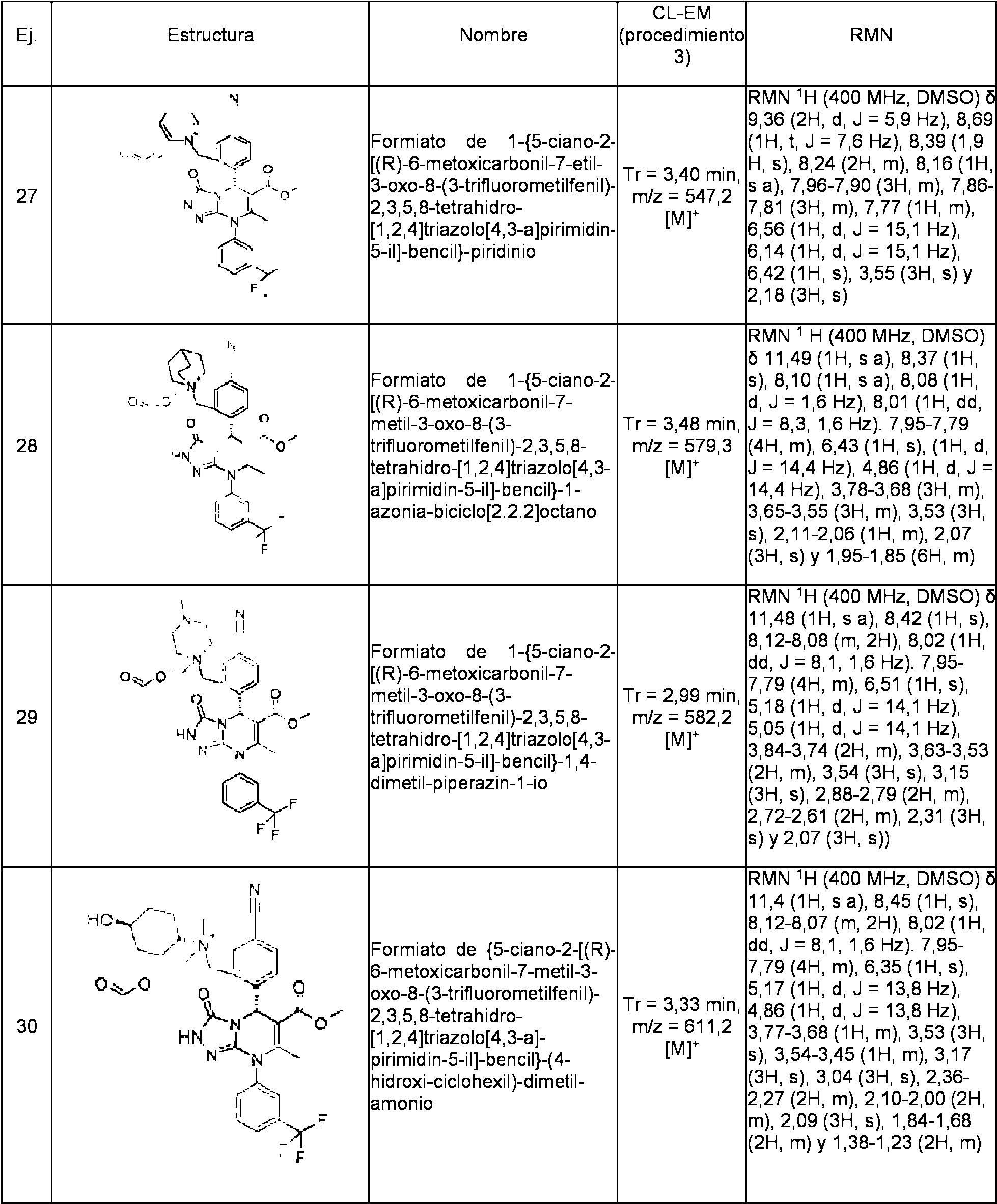
(continuación)(continuation)

(continuación)(continuation)

(continuación)(continuation)
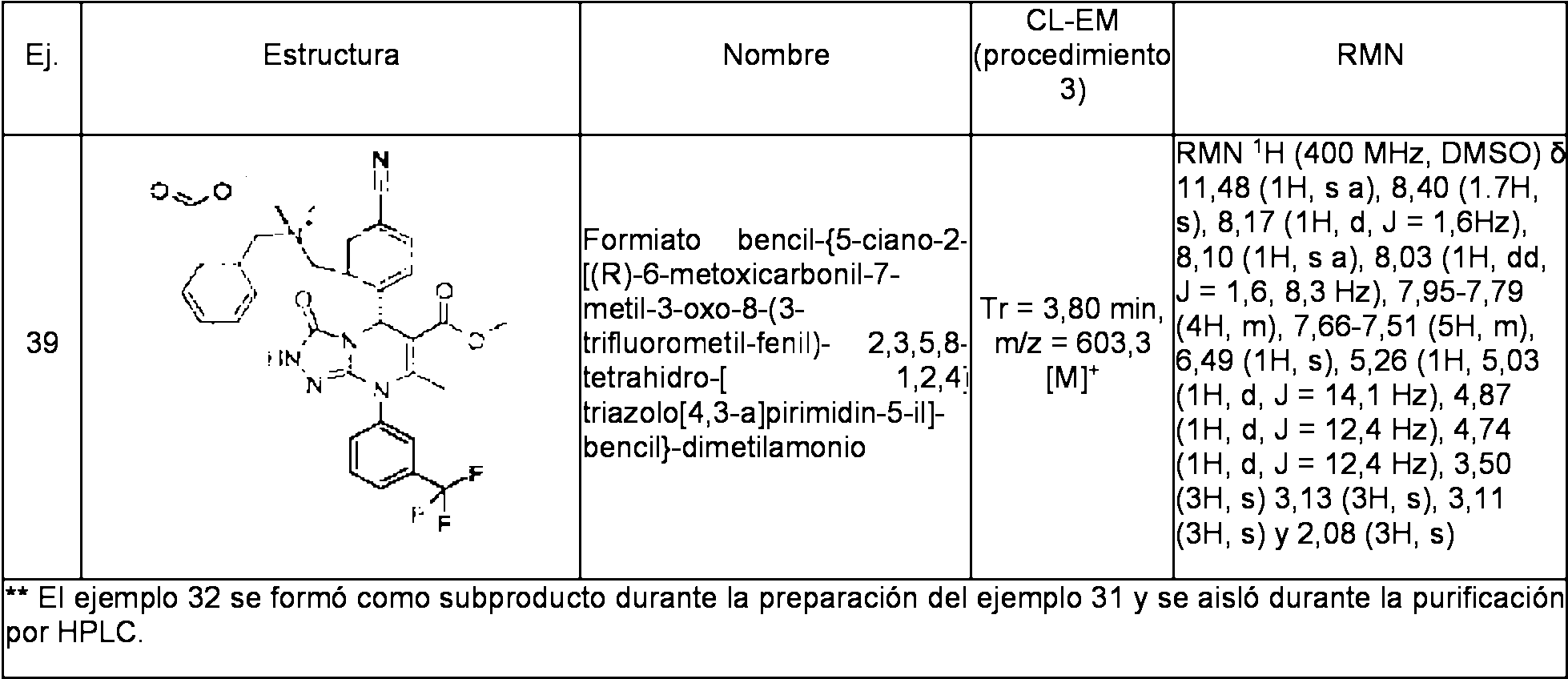
Ejemplo 40Example 40

Bromuro de (3-f5-ciano-2-r(R)-6-metoxicarbonil-7-metil-3-oxo-8-(3-trifluorometilfenih-2.3.5.8-tetrahidrori.2.41triazolor4.3-alpirimidin-5-ill-fenil}-propih-trimetil-amonioBromide of (3-f5-cyano-2-r (R) -6-methoxycarbonyl-7-methyl-3-oxo-8- (3-trifluoromethylphenih-2.3.5.8-tetrahydrori.2.41triazolor4.3-alpyrimidin-5- ill-phenyl} -propih-trimethyl-ammonium
A una solución del ejemplo 12 (2,0 g, 3,70 mmol) en MeCN (10 ml) a 5 °C se le añadió gota a gota una solución al 26% de bromuro de metilo en acetonitrilo (10 ml). La mezcla se dejó calentar a temperatura ambiente y se agitó durante 2 h. El disolvente se evaporó al vacío. El residuo resultante se recogió en MeCN al 30% en agua (30 ml) y se criodesecó para producir un sólido de color blanco (2,05 g).To a solution of Example 12 (2.0 g, 3.70 mmol) in MeCN (10 mL) at 5 ° C was added dropwise a 26% solution of methyl bromide in acetonitrile (10 mL). The mixture was allowed to warm to room temperature and was stirred for 2 h. The solvent was evaporated in vacuo. The resulting residue was taken up in 30% MeCN in water (30 ml) and cryo-dried to give a white solid (2.05 g).
CL-EM (procedimiento 3): Tr = 3,48 min, m/z = 555,2 [M]+LC-MS (method 3): Tr = 3.48 min, m / z = 555.2 [M] +
RMN 1H (400 MHz, DMSO) 811,26 (1H, s), 8,14 (1H, s), 7,96-7,92 (2H, m), 7,87-7,82 (2H, m), 7,73 (1H, dd, J = 1,5, 8,1 Hz), 7,68 (1H, da, J = 8,1Hz), 6,19 (1H, s), 3,54 (3H, s), 3,51 (2H, t, J = 8,4 Hz), 3,30 (1H, m) 3,15 (9H, s), 2,99 (1H, m) 2,42 (1H, m), 2,22 (1H, m) y 2,17 (3H, s).1 H NMR (400 MHz, DMSO) 811.26 (1H, s), 8.14 (1H, s), 7.96-7.92 (2H, m), 7.87-7.82 (2H, m) ), 7.73 (1H, dd, J = 1.5, 8.1 Hz), 7.68 (1H, s, J = 8.1Hz), 6.19 (1H, s), 3.54 ( 3H, s), 3.51 (2H, t, J = 8.4 Hz), 3.30 (1H, m) 3.15 (9H, s), 2.99 (1H, m) 2.42 ( 1H, m), 2.22 (1H, m) and 2.17 (3H, s).
Ejemplo 41 (no forma parte de la invención) Example 41 (not part of the invention)
Éster metílico del ácido (S)-5-r4-ciano-2-(5-hidroxipentih-fenill-7-metil-3-oxo-8-(3-trifluorometil-fenih-2.3.5.8-tetrahidro-ri.2.41triazolor4.3-alpirimidin-6-carboxílicoMethyl ester of (S) -5-R4-cyano-2- (5-hydroxypentih-phenyl-7-methyl-3-oxo-8- (3-trifluoromethyl-phenih-2.3.5.8-tetrahydro-ri.2.41triazolor4) .3-alpyrimidine-6-carboxylic
A pent-4-en-1-ol (51 mg) en atmósfera de argón a 0 °C se le añadió una solución de 9-BBN (0,5 M en THF, 2,24 ml). Después se agitó la solución a ta durante 2 h. Después se añadió carbonato de cesio (241 mg, 0,74 mmol), intermedio 4a (200 mg, 0,37 mmol), PdCh(dppf).DCM (30 mg, 0,037 mmol) y agua (0,2 ml). La mezcla se calentó a reflujo durante 6 h, después se añadió DMF (1 ml) y el THF se eliminó por destilación en atmósfera de argón. La reacción se calentó a 115 °C en atmósfera de argón durante otras 1,5 h. La mezcla se enfrió y se diluyó con EtOAc y agua y el extracto orgánico se secó (Na2SO4) y se concentró al vacío. El residuo resultante se purificó mediante cromatografía, eluyendo con metanol al 0-10% en DCM y después mediante HPLC (sistema 1) eluyendo con MeCN al 20-80% en agua (+ HCO2H al 0,1%) para dar el compuesto del título en forma de una goma incolora, (25 mg). CL-EM (procedimiento 1): Tr = 3,24 min, m/z = 542,1 [M+H]+A solution of 9-BBN (0.5 M in THF, 2.24 ml) was added to pent-4-en-1-ol (51 mg) under argon at 0 ° C. The solution was then stirred at rt for 2 h. Then cesium carbonate (241 mg, 0.74 mmol), intermediate 4a (200 mg, 0.37 mmol), PdCh (dppf) .DCM (30 mg, 0.037 mmol) and water (0.2 ml) were added. The mixture was refluxed for 6 h, then DMF (1 ml) was added and the THF was distilled off under an argon atmosphere. The reaction was heated to 115 ° C under an argon atmosphere for another 1.5 h. The mixture was cooled and diluted with EtOAc and water and the organic extract was dried (Na2SO4) and concentrated in vacuo. The resulting residue was purified by chromatography, eluting with 0-10% methanol in DCM and then by HPLC (system 1) eluting with 20-80% MeCN in water (+ 0.1% HCO2H) to give the title compound. title in the form of a colorless gum, (25 mg). LC-MS (method 1): Tr = 3.24 min, m / z = 542.1 [M + H] +
RMN 1H (400 MHz, CDCla) 89,69 (1H, s), 7,80 (1H, d, J = 7,8 Hz), 7,72 (1H, t, J = 7,8 Hz), 7,63 (1H, s), 7,58 (1H, d, J = 7,8 Hz), 7,5 (1H, s a), 7,48 (1H, da, J = 7,4 Hz), 7,33 (1H, d, J = 7,4 Hz), 6,29 (1H, s), 3,59 (3H, s), 3,55 (2H, t, J = 6,16 Hz), 3,33-3,24 (1H, m), 2,95-2,85 (1H, m), 2,24 (3H, s), 1,90-1,68 (2H, m), 1,68-1,47 (4H, m).1 H NMR (400 MHz, CDCla) 89.69 (1H, s), 7.80 (1H, d, J = 7.8 Hz), 7.72 (1H, t, J = 7.8 Hz), 7 , 63 (1H, s), 7.58 (1H, d, J = 7.8 Hz), 7.5 (1H, sa), 7.48 (1H, da, J = 7.4 Hz), 7 , 33 (1H, d, J = 7.4 Hz), 6.29 (1H, s), 3.59 (3H, s), 3.55 (2H, t, J = 6.16 Hz), 3 , 33-3.24 (1H, m), 2.95-2.85 (1H, m), 2.24 (3H, s), 1.90-1.68 (2H, m), 1.68 -1.47 (4H, m).
Ejemplo 42Example 42
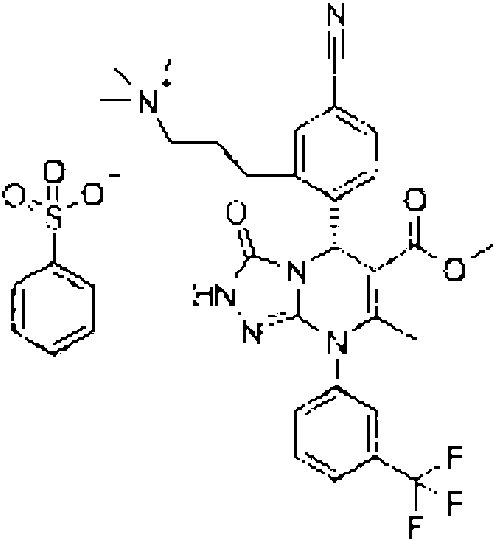
Bencenosulfonato de (3-f5-ciano-2-IYR)-6-metoxicarbonil-7-metil-3-oxo-8-(3-trifluorometilfenil-2.3.5.8-tetrahidro-ri.2.41triazolor4.3-a1pirimidin-5-il1-fenil}-propih-trimetil-amonio Benzene sulphonate of (3-f5-cyano-2-I and R) -6-methoxycarbonyl-7-methyl-3-oxo-8- (3-trifluoromethylphenyl-2,3,5,8-tetrahydro-ri.2.41triazolor4.3-a1pyrimidin- 5-yl-1-phenyl} -propih-trimethyl-ammonium
La resina de "cloruro" Amberlite IRA 458 (40 g, húmeda) se convirtió en el besilato equivalente pasando una solución de ácido bencenosulfónico (400 ml, solución acuosa al 10%) a través de la resina en una columna de cristal a un caudal lento de 5-10 ml/minuto. Después de esto, la resina se lavó con agua hasta que el filtrado tuvo un pH de ~ 5/6. La resina se almacenó "húmeda" antes de su uso. Una solución del ejemplo 40 (1 g, 1,57 mmol) en un matraz de fondo redondo (250 ml) se trató con MeCN al 30%/agua (60 ml) y después se mezcló con la resina de besilato (40 g, húmeda). La mezcla resultante se agitó suavemente rotando lentamente el matraz en un evaporador Buchi durante 50 min. a presión atmosférica. Los contenidos se colocaron en un tubo de resina, después se filtraron y se lavaron con MeCN al 30%/agua y el filtrado se liofilizó para dar el compuesto del título en forma de un sólido electrostático de color blanco (1,01 g).The "chloride" Amberlite IRA 458 resin (40 g, wet) was converted to the equivalent besylate by passing a solution of benzenesulfonic acid (400 ml, 10% aqueous solution) through the resin on a glass column at a flow rate. slow of 5-10 ml / minute. After this, the resin was washed with water until the filtrate had a pH of ~ 5/6. The resin was stored "wet" before use. A solution of Example 40 (1 g, 1.57 mmol) in a round bottom flask (250 ml) was treated with 30% MeCN / water (60 ml) and then mixed with the besylate resin (40 g, wet). The resulting mixture was gently stirred by slowly rotating the flask in a Buchi evaporator for 50 min. at atmospheric pressure. The contents were placed in a resin tube, then filtered and washed with 30% MeCN / water and the filtrate was lyophilized to give the title compound as a white electrostatic solid (1.01 g).
CL-EM (procedimiento 3):Tr = 3,47 min, m/z = 555,4 [M]+LC-MS (method 3): Tr = 3.47 min, m / z = 555.4 [M] +
RMN 1H (400 MHz, DMSO) 8 11,24 (1H, s), 8,12 (1H, s), 7,96-7,89 (2H, m), 7,86-7,80 (2H, m), 7,74-7,63 (2H, m), 7,63-7,55 (2H, m, besilato), 7,35-7,27 (3H, m, besilato), 6,17 (1H, s), 3,52 (3H, s), 3,51-3,43 (2H, m), 3,32-3,21 (1H, m) 3,13 (9H, s), 3,03-2,91 (1H, m) 2,40 (1H, m), 2,20 (1H, m), 2,15 (3H, s).1 H NMR (400 MHz, DMSO) 8 11.24 (1H, s), 8.12 (1H, s), 7.96-7.89 (2H, m), 7.86-7.80 (2H, m), 7.74-7.63 (2H, m), 7.63-7.55 (2H, m, besylate), 7.35-7.27 (3H, m, besylate), 6.17 ( 1H, s), 3.52 (3H, s), 3.51-3.43 (2H, m), 3.32-3.21 (1H, m) 3.13 (9H, s), 3, 03-2.91 (1H, m) 2.40 (1H, m), 2.20 (1H, m), 2.15 (3H, s).
Ejemplo 43 Example 43
Formiato de (5-f5-ciano-2-r(R)-6-metoxicarbonil-7-metil-3-oxo-8-(3-trifluorometilfenih-2.3.5.8-tetrahidrori.2.41triazolor4.3-alpirimidin-5-ill-fenil}-pentih-trimetil-amonioFormate of (5-f5-cyano-2-r (R) -6-methoxycarbonyl-7-methyl-3-oxo-8- (3-trifluoromethylphenih-2.3.5.8-tetrahydrori.2.41triazolor4.3-alpyrimidin-5- ill-phenyl} -pentih-trimethyl-ammonium
Intermedio 15Intermediate 15

Éster metílico del ácido (R)-5-r2-(5-Bromo-pentih-4-ciano-fenil1-7-metil-3-oxo-8-(3-trifluorometil-fenih-2.3.5.8-tetrahidro-ri.2.41triazolor4.3-a1pirimidin-6-carboxílicoMethyl ester of (R) -5-r2- (5-Bromo-pentih-4-cyano-phenyl-1-7-methyl-3-oxo-8- (3-trifluoromethyl-phenyl-2.3.5.8-tetrahydro-ri. 2.41triazolor4.3-a1pyrimidine-6-carboxylic acid
El compuesto del título se preparó a partir del intermedio 4b (240 mg, 0,45 mmol) usando procedimientos análogos a aquellos usados para el ejemplo 41 y el intermedio 13 y dio el compuesto deseado en forma de una goma de color amarillo (90 mg).The title compound was prepared from intermediate 4b (240 mg, 0.45 mmol) using procedures analogous to those used for example 41 and intermediate 13 and gave the desired compound as a yellow gum (90 mg ).
CL-EM (procedimiento 3): Tr = 4,12 min, m/z = 604 [M(79Br)+H]+LC-MS (method 3): Tr = 4.12 min, m / z = 604 [M (79Br) + H] +
Formiato de (5-f5-ciano-2-r(R)-6-metoxicarbonil-7-metil-3-oxo-8-(3-trifluorometilfenih-2.3.5.8-tetrahidrori.2.41triazolor4.3-a1pirimidin-5-il1-fenil}-pentih-trimetil-amonio (ejemplo 43)Formate of (5-f5-cyano-2-r (R) -6-methoxycarbonyl-7-methyl-3-oxo-8- (3-trifluoromethylphenih-2.3.5.8-tetrahydrori.2.41triazolor4.3-a1pyrimidin-5- il1-phenyl} -pentih-trimethyl-ammonium (example 43)
El compuesto del título se preparó a partir del intermedio 15 (89 mg, 0,15 mmol) usando un procedimiento análogo al usado para el ejemplo 7 y dio el compuesto deseado en forma de una goma de color amarillo (10 mg) después de purificación cromatográfica (sistema de HPLC 1).The title compound was prepared from intermediate 15 (89 mg, 0.15 mmol) using a procedure analogous to that used for Example 7 and gave the desired compound as a yellow gum (10 mg) after purification chromatographic (HPLC system 1).
CL-EM (procedimiento 3):Tr = 3,66 min, m/z = 583,3 [M]+LC-MS (method 3): Tr = 3.66 min, m / z = 583.3 [M] +
RMN 1H (400 MHz, DMSO) 811,28 (1H, s a), 8,42 (1,6H, s, formiato), 8,09 (1H, s), 7,95-7,86 (2H, m), 7,84-7,77 (1H, m), 7,69-7,58 (3H, m), 6,18 (1H, s), 3,51 (3H, s), 3,37-3,28 (2H, m) 3,26-3,14 (1H, m), 3,06 (9H, s), 3,07-2,95 (1H, m), 2,14 (3H, s), 1,93-1,70 (4H, m), 1,51-1,39 (2H, m).1 H NMR (400 MHz, DMSO) 811.28 (1H, br), 8.42 (1.6H, s, formate), 8.09 (1H, s), 7.95-7.86 (2H, m) ), 7.84-7.77 (1H, m), 7.69-7.58 (3H, m), 6.18 (1H, s), 3.51 (3H, s), 3.37- 3.28 (2H, m) 3.26-3.14 (1H, m), 3.06 (9H, s), 3.07-2.95 (1H, m), 2.14 (3H, s) ), 1.93-1.70 (4H, m), 1.51-1.39 (2H, m).
Ejemplo 44Example 44

Formiato de (4-{5-ciano-2-r(R)-6-metoxicarbonil-7-metil-3-oxo-8-(3-trifluorometilfenih-2.3.5.8-tetrahidrori.2.41triazolor4.3-a1pirimidin-5-il1-fenil}-butih-trimetil-amonioFormate of (4- {5-cyano-2-r (R) -6-methoxycarbonyl-7-methyl-3-oxo-8- (3-trifluoromethylphenih-2.3.5.8-tetrahydrori.2.41triazolor4.3-a1pyrimidin-5 -yl1-phenyl} -butytrimethylammonium
Intermedio 16 Intermediate 16

Éster metílico del ácido (R)-5-r2-(5-Bromo-pentih-4-ciano-fenil1-7-metil-3-oxo-8-(3-trifluorometil-fenih-2.3.5.8-tetrahidro-ri.2.41triazolor4.3-alpirimidin-6-carboxílicoMethyl ester of (R) -5-r2- (5-Bromo-pentih-4-cyano-phenyl-1-7-methyl-3-oxo-8- (3-trifluoromethyl-phenyl-2.3.5.8-tetrahydro-ri. 2.41triazolor4.3-alpyrimidine-6-carboxylic acid
A una mezcla del intermedio 4b (1,0 g, 1,87 mmol), but-3-en-1-ol (270 mg, 3,74 mmol), tetrafluoroborato de tributil fosfonio terciario (100 mg, 0,34 mmol), Pd2(dba)3 (90 mg, 0,10 mmol) y diciclohexil-metil-amina (1,80 ml, 8,42 mmol) se le añadió DMF (10 ml) y la solución resultante se desgasificó con argón. Después, la mezcla se calentó a 95 °C durante 18 h. La mezcla se enfrió, se diluyó con EtOAc y ácido cítrico acuoso al 10% y el extracto orgánico se lavó con salmuera, después se secó (Na2SO4) y se concentró al vacío. El residuo resultante se purificó mediante cromatografía, eluyendo con MeOH al 0-5% en DCM para dar el compuesto del título en forma de un sólido de color amarillo (816 mg), que se contaminó con más del 50% de un producto secundario isomérico (mostrado anteriormente). Este material se usó sin purificación adicional.To a mixture of intermediate 4b (1.0 g, 1.87 mmol), but-3-en-1-ol (270 mg, 3.74 mmol), tertiary tributyl phosphonium tetrafluoroborate (100 mg, 0.34 mmol ), Pd2 (dba) 3 (90 mg, 0.10 mmol) and dicyclohexyl-methyl-amine (1.80 ml, 8.42 mmol) was added DMF (10 ml) and the resulting solution was degassed with argon. Then, the mixture was heated at 95 ° C for 18 h. The mixture was cooled, diluted with EtOAc and 10% aqueous citric acid and the organic extract was washed with brine, then dried (Na2SO4) and concentrated in vacuo. The resulting residue was purified by chromatography, eluting with 0-5% MeOH in DCM to give the title compound as a yellow solid (816 mg), which was contaminated with more than 50% of an isomeric secondary product. (shown above). This material was used without further purification.
CL-EM (procedimiento 4):Tr = 3,35 min, m/z = 526,2 [M+H]+LC-MS (method 4): Tr = 3.35 min, m / z = 526.2 [M + H] +
Intermedio 17Intermediate 17

Éster metílico del ácido (R)-5-r2-(4-bromo-butih-4-ciano-fenil1-7-metil-3-oxo-8-(3-trifluorometil-fenih-2.3.5.8-tetrahidro-ri.2.41triazolor4.3-a1pirimidin-6-carboxílicoMethyl ester of (R) -5-r2- (4-bromo-butyh-4-cyano-phenyl-1-7-methyl-3-oxo-8- (3-trifluoromethyl-phenyl-2.3.5.8-tetrahydro-ri. 2.41triazolor4.3-a1pyrimidine-6-carboxylic acid
El compuesto del título se preparó a partir del intermedio 16 (270 mg, 0,51 mmol) usando procedimientos análogos a los usados para el ejemplo 5 y el intermedio 13 y dio el compuesto deseado en forma de un sólido de color blanco (260 mg).The title compound was prepared from intermediate 16 (270 mg, 0.51 mmol) using procedures analogous to those used for example 5 and intermediate 13 and gave the desired compound as a white solid (260 mg ).
CL-EM (procedimiento 4):Tr = 3,99 min, m/z = 589,9[M(79Br)+H]+LC-MS (method 4): Tr = 3.99 min, m / z = 589.9 [M (79Br) + H] +
Formiato de (4-f5-ciano-2-r(R)-6-metoxicarbonil-7-metil-3-oxo-8-(3-trifluorometilfenih-2.3.5.8-tetrahidrori.2.41triazolor4.3-a1pirimidin-5-il1-fenil}-butih-trimetil-amonio (ejemplo 44)Formate of (4-f5-cyano-2-r (R) -6-methoxycarbonyl-7-methyl-3-oxo-8- (3-trifluoromethylphenih-2.3.5.8-tetrahydrori.2.41triazolor4.3-a1pyrimidin-5- il1-phenyl} -buty-trimethyl-ammonium (example 44)
El compuesto del título se preparó a partir del intermedio 17 (80 mg, 0,13 mmol) usando un procedimiento análogo al usado para el ejemplo 7 y dio el compuesto deseado en forma de un sólido electrostático (44 mg) después de purificación cromatográfica (sistema de HPLC 1). CL-EM (procedimiento 3): Tr = 3,52 min, m/z = 569,3 [M]+ RMN 1H (400 MHz, DMSO) 811,40 (1H, s a), 8,49 (1H, s, formiato), 8,11 (1H, s), 7,95-7,87 (2H, m), 7,85-7,79 (1H, m), 7,74-7,70 (1H, m), 7,70-7,61 (2H, m), 6,18 (1H, s), 3,52 (3H, s), 3,43-3,35 (2H, m) 3,28-3,18 (1H, m), 3,09 (9H, s), 3,18-3,05 (1H, m, oscuro), 2,14 (3H, s), 1,95-1,80 (3H, m), 1,80-1,67 (1H, m).The title compound was prepared from intermediate 17 (80 mg, 0.13 mmol) using a procedure analogous to that used for Example 7 and gave the desired compound as an electrostatic solid (44 mg) after chromatographic purification ( HPLC system 1). LC-MS (method 3): Tr = 3.52 min, m / z = 569.3 [M] + 1 H NMR (400 MHz, DMSO) 811.40 (1H, br), 8.49 (1H, s) , formate), 8.11 (1H, s), 7.95-7.87 (2H, m), 7.85-7.79 (1H, m), 7.74-7.70 (1H, m ), 7.70-7.61 (2H, m), 6.18 (1H, s), 3.52 (3H, s), 3.43-3.35 (2H, m) 3.28-3 , 18 (1H, m), 3.09 (9H, s), 3.18-3.05 (1H, m, dark), 2.14 (3H, s), 1.95-1.80 (3H , m), 1.80-1.67 (1H, m).
Los ejemplos siguientes se prepararon a partir del intermedio 17 y las aminas terciarias apropiadamente sustituidas usando un procedimiento análogo al del ejemplo 44:The following examples were prepared from intermediate 17 and the appropriately substituted tertiary amines using a procedure analogous to that of Example 44:

Ejemplo 47Example 47

Bromuro de (2-{5-ciano-2-r(R)-6-metoxicarbonil-7-metil-3-oxo-8-(3-trifluorometilfenil)-2.3.5.8-tetrahidrori.2.41triazolor4.3-alpirimidin-5-ill-fenil}-etih-trimetil-amonioBromide of (2- {5-cyano-2-r (R) -6-methoxycarbonyl-7-methyl-3-oxo-8- (3-trifluoromethylphenyl) -2.3.5.8-tetrahydrori.2.41triazolor4.3-alpyrimidin- 5-ill-phenyl} -etih-trimethyl-ammonium
Intermedio 18 Intermediate 18
Éster metílico del ácido (R)-5-r2-(2-terc-butox¡-v¡nMM-c¡ano-fenM1-7-met¡l-3-oxo-8-(3-tr¡fluoromet¡l-fen¡l)-2.3.5.8-tetrahidro-ri.2.41triazolor4.3-alpirimidin-6-carboxílicoMethyl ester of (R) -5-r2- (2-tert-butoxy) -vMM-cyano-phenM1-7-methyl-3-oxo-8- (3-trifluoromethyl) acid -fenl) -2.3.5.8-tetrahydro-ri.2.41triazolor4.3-alpyrimidine-6-carboxylic acid
Se cargó un autoclave con una mezcla del intermedio 4b (10 g, 18,72 mmol), 2-metil-2-viniloxi-propano (6,55 g, 65,50 mmol), tetrafluoroborato de tributil fosfonio terciario (540 mg, 1,86 mmol), catalizador de Herrmann-Beller (trans-di(|>acetotao)£vs(0-di-o-tolil-fosfino)bencil)dipaladio (II)) (880 mg, 0,94 mmol), 1,2,2,6,6-pentametilpiperidina (11,5 g, 74,20 mmol). Se añadió tetra-etilenglicol (140 ml) y la solución resultante se desgasificó con argón. Después, la mezcla se calentó a 150 °C durante 1 h. La mezcla se enfrió, se diluyó con EtOAc y ácido cítrico acuoso al 10% y el extracto orgánico se lavó con agua y salmuera, después se secó (Na2SO4) y se concentró al vacío. El residuo resultante se purificó mediante cromatografía, eluyendo con EtOAc al 25-75% en ciclohexano para dar el compuesto del título en forma de una mezcla [3:1] de isómeros E/Z y en forma de una espuma de color amarillo (7,95 g).An autoclave was charged with a mixture of intermediate 4b (10 g, 18.72 mmol), 2-methyl-2-vinyloxy-propane (6.55 g, 65.50 mmol), tertiary tributyl phosphonium tetrafluoroborate (540 mg, 1.86 mmol), Herrmann-Beller catalyst (trans-di (|> acetotao) £ vs (0-di-o-tolyl-phosphino) benzyl) dipalladium (II)) (880 mg, 0.94 mmol), 1,2,2,6,6-pentamethylpiperidine (11.5 g, 74.20 mmol). Tetra-ethylene glycol (140 ml) was added and the resulting solution was degassed with argon. Then, the mixture was heated at 150 ° C for 1 h. The mixture was cooled, diluted with EtOAc and 10% aqueous citric acid and the organic extract was washed with water and brine, then dried (Na2SO4) and concentrated in vacuo. The resulting residue was purified by chromatography, eluting with 25-75% EtOAc in cyclohexane to give the title compound as a mixture [3: 1] of E / Z isomers and as a yellow foam (7). , 95 g).
CL-EM (procedimiento 5):Tr = 3,87 min, m/z = 554,2 [M+H]+LC-MS (method 5): Tr = 3.87 min, m / z = 554.2 [M + H] +
Intermedio 19Intermediate 19

Éster metílico del ácido (R)-5-r4-ciano-2-(2-hidroxi-etih-fenil1-7-metil-3-oxo-8-(3-trifluorometil-fenih-2.3.5.8-tetrahidro-H .2.41triazolor4.3-a1pirimidin-6-carboxílico Methyl ester of the acid (R) -5-r4-cyano-2- (2-hydroxy- ethyl ) -phenyl-1-7-methyl-3-oxo-8- (3-trifluoromethyl- phein ) -2.3.5.8-tetrahydro- H .2.41triazolor4.3-a1pyrimidine-6-carboxylic acid
Una solución del intermedio 18 (7,87 g, 14,20 mmol) en DCM (130 ml) se enfrió a -10 °C usando un baño de sal/hielo y se trató gota a gota con TFA (6,35 ml, 85,47 mmol). Después de agitar la solución a -10 °C durante 2 h la solución resultante se vertió en solución acuosa enfriada en hielo de Na2CO3. La fase orgánica se separó y la fase acuosa se volvió a extraer con DCM (70 ml) y el extracto combinado con DCM se devolvió al baño de sal/hielo a -5 °C. Se añadió borohidruro sódico (1,57 g, 41,42 mmol) en porciones y después se agitó durante 15 minutos, se añadió MeOH (32 ml) a la mezcla resultante. La reacción se agitó a -5 °C durante 1,5 h, se añadió agua y la mezcla resultante se dejó en agitación vigorosa durante 15 minutos antes de separar la fase orgánica. La fase acuosa se extrajo adicionalmente con DCM y el extracto orgánico combinado se lavó con salmuera, se secó (Na2SO4) y se concentró al vacío. El residuo resultante se purificó mediante cromatografía, eluyendo con EtOAc y dio el compuesto del título en forma de un sólido de color crema (3,7 g). CL-EM (procedimiento 5):Tr = 3,17 min, m/z = 500,1 [M+H]+ Síntesis alternativa del intermedio 19: A solution of intermediate 18 (7.87 g, 14.20 mmol) in DCM (130 ml) was cooled to -10 ° C using a salt / ice bath and treated dropwise with TFA (6.35 ml, 85.47 mmol). After stirring the solution at -10 ° C for 2 h the resulting solution was poured into ice-cold aqueous Na 2 CO 3 solution. The organic phase was separated and the aqueous phase was back extracted with DCM (70 ml) and the combined extract with DCM was returned to the salt / ice bath at -5 ° C. Sodium borohydride (1.57 g, 41.42 mmol) was added in portions and then stirred for 15 minutes, MeOH (32 mL) was added to the resulting mixture. The reaction was stirred at -5 ° C for 1.5 h, water was added and the resulting mixture was allowed to stir vigorously for 15 minutes before removing the organic phase. The aqueous phase was further extracted with DCM and the combined organic extract was washed with brine, dried (Na2SO4) and concentrated in vacuo. The resulting residue was purified by chromatography, eluting with EtOAc and giving the title compound as a cream-colored solid (3.7 g). LC-MS (procedure 5): Tr = 3.17 min, m / z = 500.1 [M + H] + Alternative synthesis of intermediate 19:
Intermedio 20Intermediate 20

Éster metílico del ácido (R)-5-(4-ciano-2-metoxicarbonilmetil-fenih-7-metil-3-oxo-8-(3-trifluorometil-fenih-2.3.5.8-tetrahidro-ri.2.41triazolor4.3-a1pirimidin-6-carboxílico Methyl ester of (R) -5- (4-cyano-2-methoxycarbonylmethyl-phene-7-methyl-3-oxo-8- (3-trifluoromethyl-phenyl-2.3.5.8-tetrahydro-ri.2.41-triazol4.3) α1-pyrimidine-6-carboxylic acid
Se cargó un recipiente de microondas con el intermedio 4b (2,5 g, 4,67 mmol), 8/s(dibencilidenoacetona)paladio (0) (132 mg, 0,23 mmol), fluoruro de cinc (242 mg, 2.34 mmol) y DMF seca (12 ml), después se desgasificó en atmósfera de argón. Se añadió a la reacción una solución de tri(ferc-butil)fosfina (1 M en tolueno; 475 pl, 0,19 mmol) y 1-(ferc-butildimetilsililoxi)-1-metoxieteno (3,05 ml, 14 mmol), seguido de otra desgasificación. La mezcla se calentó con irradiación por microondas a 135 °C durante 4 h. Se añadió más 1-(ferc-butildimetilsililoxi)-1-metoxieteno (0,7 ml, 3,2 mmol) y la mezcla se calentó con irradiación por microondas durante 1 h más a 135 °C. La mezcla resultante se repartió entre EtOAc y agua y la capa acuosa se extrajo con EtOAc. El extracto orgánico combinado se lavó con salmuera, se secó (MgSO4) y después se concentró al vacío. El residuo resultante se disolvió en MeOH, se trató con TFA (5 gotas) y se dejó en agitación durante 18 h a TA (este procedimiento eliminó el grupo TBDMS del producto sililado inicialmente generado). La mezcla de reacción se concentró al vacío y después se purificó mediante cromatografía, eluyendo con EtOAc al 0-100% en ciclohexano, para proporcionar el compuesto del título en forma de un sólido de color blanco (1,82 g).A microwave container was charged with intermediate 4b (2.5 g, 4.67 mmol), 8 / sec (dibenzylideneacetone) palladium (0) (132 mg, 0.23 mmol), zinc fluoride (242 mg, 2.34 mmol). mmol) and dry DMF (12 ml), then degassed under argon atmosphere. To the reaction was added a solution of tri (fer-butyl) phosphine (1 M in toluene; 475 pl, 0.19 mmol) and 1- (fer-butyldimethylsilyloxy) -1-methoxyethene (3.05 mL, 14 mmol) , followed by another degassing. The mixture was heated with microwave irradiation at 135 ° C for 4 h. More 1- (fer-butyldimethylsilyloxy) -1-methoxyethene (0.7 ml, 3.2 mmol) was added and the mixture was heated with microwave irradiation for 1 h more at 135 ° C. The resulting mixture was partitioned between EtOAc and water and the aqueous layer was extracted with EtOAc. The combined organic extract was washed with brine, dried (MgSO4) and then concentrated in vacuo. The resulting residue was dissolved in MeOH, treated with TFA (5 drops) and allowed to stir for 18 h at RT (this procedure removed the TBDMS group from the initially generated silylated product). The reaction mixture was concentrated in vacuo and then purified by chromatography, eluting with 0-100% EtOAc in cyclohexane, to give the title compound as a white solid (1.82 g).
CL-EM (procedimiento 4):Tr = 3,45 min, m/z = 528,3 [M+H]+LC-MS (method 4): Tr = 3.45 min, m / z = 528.3 [M + H] +
Éster metílico del ácido (R)-5-r4-ciano-2-(2-hidroxi-etih-fenil1-7-metil-3-oxo-8-(3-trifluorometil-fenih-2.3.5.8-tetrahidro-ri.2.41triazolor4.3-alpirimidin-6-carboxílico (intermedio 19)Methyl ester of (R) -5-R4-cyano-2- (2-hydroxy-ethy-phenyl-1-7-methyl-3-oxo-8- (3-trifluoromethyl-phenyl-2.3.5.8-tetrahydro-ri. 2.41triazolor4.3-alpyrimidine-6-carboxylic acid (intermediate 19)
Una solución del intermedio 20 (458 mg, 0,87 mmol) en THF anhidro (5 ml) en atmósfera de argón se enfrió a 0 °C en un baño de hielo. Una solución de borohidruro de litio (1 M en THF; 1,04 ml, 1,04 mmol) se añadió gota a gota. La solución resultante se agitó a 0 °C durante 3 h, después a TA durante 18 h. La reacción se interrumpió con agua y se diluyó con EtOAc. La capa acuosa se extrajo adicionalmente con EtOAc. El extracto orgánico combinado se lavó con salmuera, se secó (MgSO4), y se purificó por cromatografía, eluyendo con MeOH al 0-5% en DCM, para proporcionar el compuesto del título en forma de un sólido de color blanco (115 mg).A solution of intermediate 20 (458 mg, 0.87 mmol) in anhydrous THF (5 ml) under argon was cooled to 0 ° C in an ice bath. A solution of lithium borohydride (1 M in THF, 1.04 mL, 1.04 mmol) was added dropwise. The resulting solution was stirred at 0 ° C for 3 h, then at RT for 18 h. The reaction was quenched with water and diluted with EtOAc. The aqueous layer was further extracted with EtOAc. The combined organic extract was washed with brine, dried (MgSO4), and purified by chromatography, eluting with 0-5% MeOH in DCM, to give the title compound as a white solid (115 mg) .
Intermedio 21Intermediate 21

Éster metílico del ácido (R)-5-r2-(2-bromo-et¡l)-4-c¡ano-fen¡l1-7-met¡l-3-oxo-8-(3-tr¡fluoromet¡l-fen¡l)-2.3.5.8-tetrahidro-ri.2.41triazolor4.3-a1pirimidin-6-carboxílicoMethyl ester of (R) -5-r2- (2-bromo-ethyl) -4-cyano-phenyl-1-7-methyl-3-oxo-8- (3-trifluoromethoxy) L-pheny1) -2.3.5.8-tetrahydro-ri.2.41triazolor4.3-a1pyrimidine-6-carboxylic acid
El compuesto del título se preparó a partir del intermedio 19 (0,30 g, 0,60 mmol) usando un procedimiento análogo al usado para el intermedio 13 y dio el compuesto deseado en forma de un sólido de color blanco (0,24 g).The title compound was prepared from intermediate 19 (0.30 g, 0.60 mmol) using a procedure analogous to that used for intermediate 13 and gave the desired compound as a white solid (0.24 g). ).
CL-EM (procedimiento 4):Tr = 3,83 min, m/z = 562,1 [M(79Br)+H]+LC-MS (method 4): Tr = 3.83 min, m / z = 562.1 [M (79Br) + H] +
Bromuro de (2-(5-c¡ano-2-r(R)-6-metox¡carbon¡l-7-met¡l-3-oxo-8-(3-tr¡fluoromet¡lfen¡l)-2.3.5.8-tetrahidrori.2.41triazolor4.3-a1pirimidin-5-il1-fenil}-etih-trimetil-bromuro (ejemplo 47)Bromide of (2- (5-cyano-2-r (R) -6-methoxycarbonyl-7-methyl-3-oxo-8- (3-trifluoromethylene) -2.3.5.8-tetrahydrori.2.41triazolor4.3-a1pyrimidin-5-yl1-phenyl} -etih-trimethyl-bromide (example 47)
Una solución enfriada (baño de hielo) del intermedio 21 (400 mg, 0,71 mmol) en MeCN (10 ml) se trató gota a gota con una solución de trimetilamina en EtOH (50 % en peso) y la solución resultante se dejó en agitación a TA durante 18 h. La mezcla se concentró al vacío, después se trituró con Et2O y después de someter a ultrasonidos, se recogió un sólido y se secó al vacío a 35 °C durante 2 h. El producto sólido se repartió entre agua (10 ml) y EtOAc (10 ml) y la capa acuosa se separó y se congeló para dar el compuesto del título en forma de un sólido electrostático de color blanco.A cooled solution (ice bath) of intermediate 21 (400 mg, 0.71 mmol) in MeCN (10 ml) was treated dropwise with a solution of trimethylamine in EtOH (50% by weight) and the resulting solution was left stirring at RT for 18 h. The mixture was concentrated in vacuo, then triturated with Et2O and after sonication, a solid was collected and dried under vacuum at 35 ° C for 2 h. The solid product was partitioned between water (10 ml) and EtOAc (10 ml) and the aqueous layer was separated and frozen to give the title compound as a white electrostatic solid.
CL-EM (procedimiento 3) Tr = 3,46 min, m/z = 541,2 [M]+LC-MS (procedure 3) Tr = 3.46 min, m / z = 541.2 [M] +
RMN 1H (400 MHz, DMSO) 811,30 (1H, s a), 8,13 (1H, s a), 7,97-7,87 (2H, m), 7,86-7,79 (2H, m), 7,78-7,67 (2H, m), 6,27 (1H, s), 4,03-3,93 (1H, m), 3,79-3,62 (2H, m) 3,53 (3H, s), 3,43-3,34 (1H, m, oscuro), 3,21 (9H, s), 2,17 (3H, s).1 H NMR (400 MHz, DMSO) 811.30 (1H, br), 8.13 (1H, br), 7.97-7.87 (2H, m), 7.86-7.79 (2H, m) ), 7.78-7.67 (2H, m), 6.27 (1H, s), 4.03-3.93 (1H, m), 3.79-3.62 (2H, m) 3 , 53 (3H, s), 3.43-3.34 (1H, m, dark), 3.21 (9H, s), 2.17 (3H, s).
Ejemplo 48 Example 48

Bromuro de (2-{5-ciano-2-r(R)-6-metoxicarbonil-7-metil-3-oxo-8-(3-trifluorometilfenih-2.3.5.8-tetrahidrori.2.41triazolor4.3-alpirimidin-5-ill-fenil}-etih-trimetil-amonioBromide of (2- {5-cyano-2-r (R) -6-methoxycarbonyl-7-methyl-3-oxo-8- (3-trifluoromethylphenih-2.3.5.8-tetrahydrori.2.41triazolor4.3-alpyrimidin-5 -ill-phenyl} -etih-trimethyl-ammonium
Intermedio 22Intermediate 22

Éster metílico del ácido (R)-5-(4-c¡ano-2-tr¡met¡ls¡lan¡let¡n¡l-fen¡n-7-met¡l-3-oxo-8-(3-tr¡fluoromet¡l-fen¡l)-2.3.5.8-tetrahidro-ri.2.41triazolor4.3-a1pirimidin-6-carboxílicoMethyl esters of (R) -5- (4-cyano-2-trismethyl-1-phenyl-7-methyl-3-oxo-8- ( 3-trifluoromethyl-phenyl] -2.3.5.8-tetrahydro-ri.2.41triazolor4.3-a1pyrimidine-6-carboxylic acid
Un recipiente de microondas se cargó con una mezcla del intermedio 4b (3,5 g, 6,57 mmol), etinil-trimetil-silano (3,70 ml, 26,28 mmol), dicloruro de £vs(trifenilfosfina)paladio (II) (461 mg, 0,66 mmol), yoduro de cobre (II) (136 mg, 0,72 mmol) y DIPEA (3,40 ml, 19,71 mmol). Se añadió dioxano (16 ml) y la solución resultante se desgasificó con argón. Después, la mezcla se calentó a 130 °C durante 1,25 h. La reacción se enfrió, se diluyó con agua y la mezcla se extrajo con EtOAc (x 3) y el extracto orgánico combinado se lavó con salmuera, después se secó (MgSO4), se filtró y se concentró al vacío. El residuo resultante se purificó mediante cromatografía, eluyendo con EtOAc al 0-60% en ciclohexano para dar el compuesto del título en forma de una espuma de color crema (5,65 g).A microwave vessel was charged with a mixture of intermediate 4b (3.5 g, 6.57 mmol), ethynyltrimethylsilane (3.70 ml, 26.28 mmol), dichloride of vs (triphenylphosphine) palladium ( II) (461 mg, 0.66 mmol), copper (II) iodide (136 mg, 0.72 mmol) and DIPEA (3.40 mL, 19.71 mmol). Dioxane (16 ml) was added and the resulting solution was degassed with argon. Then, the mixture was heated at 130 ° C for 1.25 h. The reaction was cooled, diluted with water and the mixture was extracted with EtOAc (x3) and the combined organic extract was washed with brine, then dried (MgSO4), filtered and concentrated in vacuo. The resulting residue was purified by chromatography, eluting with 0-60% EtOAc in cyclohexane to give the title compound as a cream colored foam (5.65 g).
CL-EM (procedimiento 2):Tr = 4,18 min, m/z = 552,3 [M+H]+LC-MS (method 2): Tr = 4.18 min, m / z = 552.3 [M + H] +
Intermedio 23 Intermediate 23
Éster metílico del ácido (R)-5-(2-bromoetinil-4-ciano-fenih-7-metil-3-oxo-8-(3-trifluorometilfenih-2.3.5.8-tetrahidro-ri.2.41triazolor4.3-alpirimidin-6-carboxílicoMethyl ester of (R) -5- (2-bromoetinyl-4-cyano-phenyl-7-methyl-3-oxo-8- (3-trifluoromethylphenih-2,3,5,8-tetrahydro-ri.2.41triazolor4.3-alpyrimidine) -6-carboxylic
Una solución enfriada (baño de hielo) en agitación del intermedio 22 (2,14 g, 3,88 mmol) en acetona (40 ml) se trató con nitrato de plata (66 mg, 0,39 mmol) seguido de NBS (829 mg, 4,66 mmol). El baño de refrigeración se retiró después de 1 h y después de 1 h más, la mezcla se diluyó en EtOAc y se vertió en agua. La capa acuosa se separó y se volvió a extraer con EtOAc (x 3) y el extracto orgánico combinado se lavó con salmuera, se secó (MgSO4), se filtró y se concentró al vacío. El residuo resultante se purificó mediante cromatografía, eluyendo con EtOAc al 0-100% en ciclohexano para dar el compuesto del título en forma de una espuma de color amarillo pálido (1 g).A cooled solution (ice bath) under stirring of intermediate 22 (2.14 g, 3.88 mmol) in acetone (40 ml) was treated with silver nitrate (66 mg, 0.39 mmol) followed by NBS (829). mg, 4.66 mmol). The cooling bath was removed after 1 h and after 1 h more, the mixture was diluted in EtOAc and poured into water. The aqueous layer was separated and re-extracted with EtOAc (x3) and the combined organic extract was washed with brine, dried (MgSO4), filtered and concentrated in vacuo. The resulting residue was purified by chromatography, eluting with 0-100% EtOAc in cyclohexane to give the title compound as a pale yellow foam (1 g).
CL-EM (procedimiento 5):Tr = 3,63 min, m/z = 558,1 [M(79Br)+H]+LC-MS (method 5): Tr = 3.63 min, m / z = 558.1 [M (79Br) + H] +
Intermedio 24Intermediate 24

Éster metílico del ácido (R)-5-14-ciano-2-(2-dimetilamino-etil)-fenin-7-metil-3-oxo-8-(3-trifluorometil-fenil)-2.3.5.8-tetrahidro-ri.2.41triazolor4.3-a1pirimidin-6-carboxílico Methyl ester of (R) -5-14-cyano-2- (2-dimethylamino-ethyl) -pheni -7-methyl-3-oxo-8- (3-trifluoromethyl-phenyl) - 2.3.5.8-tetrahydro -ri.2.41triazolor4.3-a1pyrimidine-6-carboxylic acid
Una solución del intermedio 23 (210 mg, 0,38 mmol) en MeCN (0,40 ml) se trató con una solución de dimetilamina (2 M en THF; 1,90 ml, 3,80 mmol) y la mezcla resultante se agitó durante 18 h. La mezcla de reacción se enfrió a 0 °C y se añadió MeOH (3 ml), seguido de borohidruro sódico (71 mg, 1,88 mmol). Después de agitar durante 1 h la mezcla resultante se vertió en EtOAc y después se lavó con salmuera, se secó (MgSO4), se filtró y se concentró al vacío. El residuo resultante se purificó mediante cromatografía, eluyendo con 2-8% (NH32 M en MeOH) en DCM para dar el compuesto del título en forma de un aceite transparente.A solution of intermediate 23 (210 mg, 0.38 mmol) in MeCN (0.40 ml) was treated with a solution of dimethylamine (2 M in THF, 1.90 ml, 3.80 mmol) and the resulting mixture was it stirred for 18 h. The reaction mixture was cooled to 0 ° C and MeOH (3 mL) was added, followed by sodium borohydride (71 mg, 1.88 mmol). After stirring for 1 h the resulting mixture was poured into EtOAc and then washed with brine, dried (MgSO4), filtered and concentrated in vacuo. The resulting residue was purified by chromatography, eluting with 2-8% (NH32M in MeOH) in DCM to give the title compound as a clear oil.
CL-EM (procedimiento 4):Tr = 3,52 min, m/z = 527,2 [M+H]+LC-MS (method 4): Tr = 3.52 min, m / z = 527.2 [M + H] +
Intermedio 25Intermediate 25

Yoduro de (2-{5-ciano-2-r(R)-6-metoxicarbonil-7-metil-3-oxo-8-(3-trifluorometilfenil)-2.3.5.8-tetrahidrori.2.41triazolor4.3-a1pirimidin-5-il1-fenil}-etih-trimetil-amonioIodide of (2- {5-cyano-2-r (R) -6-methoxycarbonyl-7-methyl-3-oxo-8- (3-trifluoromethylphenyl) -2.3.5.8-tetrahydrori.2.41triazolor4.3-a1pyrimidin- 5-il1-phenyl} -etih-trimethyl-ammonium
A una solución del intermedio 24 (0,59 g, 1,12 mmol) en MeCN (10 ml) se le añadió yoduro de metilo (0,25 ml, 4,0 mmol). La mezcla resultante se calentó a 50 °C y se agitó durante 1,5 h. El disolvente se evaporó al vacío para producir el compuesto del título en forma de un sólido de color naranja claro (0,68 g).To a solution of intermediate 24 (0.59 g, 1.12 mmol) in MeCN (10 mL) was added methyl iodide (0.25 mL, 4.0 mmol). The resulting mixture was heated to 50 ° C and stirred for 1.5 h. The solvent was evaporated in vacuo to yield the title compound as a light orange solid (0.68 g).
CL-EM (procedimiento 1):Tr = 2,39 min, m/z = 541,3 [M]+LC-MS (procedure 1): Tr = 2.39 min, m / z = 541.3 [M] +
Bencenosulfonato de (2-{5-ciano-2-r(R)-6-metoxicarbonil-7-metil-3-oxo-8-(3-trifluorometilfenih-2.3.5.8-tetrah¡dro-ri.2.41tr¡azolor4.3-a1p¡r¡m¡d¡n-5-¡l1-fen¡l}-et¡l)-tr¡met¡l-amon¡o (ejemplo 48) Benzenesulfonate (2- {5-cyano-2-r (R) -6-methoxycarbonyl-7-methyl-3-oxo-8- (3-trifluoromethylphenih-2.3.5.8-tetrahydro-ri.2.41tr-azole) .3-a1p¡r¡m¡d¡n-5 -l1-pheny1 -eti1) -tr1methyl-ammonium (Example 48)
El compuesto del título se preparó a partir del intermedio 25 (0,68 g, 1,02 mmol) usando un procedimiento análogo al usado para el ejemplo 42 y dio el compuesto deseado en forma de un sólido electrostático de color amarillo claro (0,72 g).The title compound was prepared from intermediate 25 (0.68 g, 1.02 mmol) using a procedure analogous to that used for Example 42 and gave the desired compound as a light yellow electrostatic solid (0, 72 g).
CL-EM (procedimiento 3): Tr = 3,45 min, m/z = 541,2 [M]+LC-MS (method 3): Tr = 3.45 min, m / z = 541.2 [M] +
RMN 1H (400 MHz, DMSO) 811,30 (1H, s a), 8,13 (1H, s a), 7,97-7,87 (2H, m), 7,86-7,79 (2H, m), 7,78-7,67 (2H, m), 7,62-6,56 (2H, m. besilato), 7,35-7,28 (3H, m, besilato), 6,27 (1H, s), 4,03-3,93 (1H, m), 3,79-3,62 (2H, m), 3,53 (3H, s), 3,46-3,34 (1H, m, oscuro), 3,21 (9H, s), 2,17 (3H, s).1 H NMR (400 MHz, DMSO) 811.30 (1H, br), 8.13 (1H, br), 7.97-7.87 (2H, m), 7.86-7.79 (2H, m) ), 7.78-7.67 (2H, m), 7.62-6.56 (2H, m.besilate), 7.35-7.28 (3H, m, besylate), 6.27 (1H , s), 4.03-3.93 (1H, m), 3.79-3.62 (2H, m), 3.53 (3H, s), 3.46-3.34 (1H, m , dark), 3.21 (9H, s), 2.17 (3H, s).
Ejemplo 49Example 49

Bromuro de 1-(2-f5-ciano-2-IYR)-6-metoxicarbonil-7-metil-3-oxo-8-(3-trifluorometil-fenih-2.3.5.8-tetrahidrori.2.41triazolor4.3-alpirimidin-5-ill-fenil}-etih-piridinioBromide 1- (2-f5-cyano-2-IYR) -6-methoxycarbonyl-7-methyl-3-oxo-8- (3-trifluoromethyl-phenih-2.3.5.8-tetrahydrori.2.41triazolor4.3-alpyrimidin- 5-ill-phenyl} -etih-pyridinium
Una mezcla del intermedio 21 (0,40 g, 0,71 mmol) y piridina se calentó a 50 °C durante 3 h y después se concentró al vacío. El producto en bruto se repartió entre agua y EtOAc y la capa acuosa se separó y se criodesecó para dar el compuesto del título en forma de un sólido electrostático de color blanco (0,39 g).A mixture of intermediate 21 (0.40 g, 0.71 mmol) and pyridine was heated at 50 ° C for 3 h and then concentrated in vacuo. The crude product was partitioned between water and EtOAc and the aqueous layer was separated and freeze dried to give the title compound as a white electrostatic solid (0.39 g).
CL-Em (procedimiento 3): Tr = 3,48 min, m/z = 561,2 [M]+CL-Em (procedure 3): Tr = 3.48 min, m / z = 561.2 [M] +
RMN 1H (400 MHz, DMSO)8 11,38 (1H, s a), 9,10 (2H, d, J = 5,6 Hz), 8,67 (1H, t, J = 7,7 Hz), 8,23 (2H, t, J = 7,2 Hz), 8,15 (1H, s a), 7,97-7,87 (2H, m), 7,86-7,80 (1H, m), 7,79-7,70 (2H, m), 7,61 (1H, m), 6,43 (1H, s), 5,26-5,07 (2H, m), 3,97-3,84 (1H, m), 3,65-3,52 (1H, m), 3,49 (3H, s), 2,16 (3H, s).1 H NMR (400 MHz, DMSO) 8 11.38 (1H, sa), 9.10 (2H, d, J = 5.6 Hz), 8.67 (1H, t, J = 7.7 Hz), 8.23 (2H, t, J = 7.2 Hz), 8.15 (1H, sa), 7.97-7.87 (2H, m), 7.86-7.80 (1H, m) , 7.79-7.70 (2H, m), 7.61 (1H, m), 6.43 (1H, s), 5.26-5.07 (2H, m), 3.97-3 , 84 (1H, m), 3.65-3.52 (1H, m), 3.49 (3H, s), 2.16 (3H, s).
Ejemplo 50Example 50

Formiato de 1-(2-f5-ciano-2-IYR)-6-metoxicarbonil-7-metil-3-oxo-8-(3-trifluorometil-fenih-2.3.5.8-tetrahidrori.2.41triazolor4.3-a1pirimidin-5-il1-fenil}-etih-piridininioFormate of 1- (2-f5-cyano-2-IYR) -6-methoxycarbonyl-7-methyl-3-oxo-8- (3-trifluoromethyl-phenih-2.3.5.8-tetrahydrori.2.41-triazol-4,3-a1-pyrimidine- 5-yl-1-phenyl} -etih-pyridinium
Una solución del intermedio 21 (100 mg, 0,18 mmol) en una mezcla de MeCN (2,5 ml) y piridina (0,15 ml, 1,78 mmol) se calentó a 70 °C durante 18 h en un vial cerrado herméticamente. La solución resultante se concentró al vacío y el producto en bruto se purificó directamente mediante DMAP para dar el compuesto del título en forma de un sólido electrostático de color blanco (54 mg).A solution of intermediate 21 (100 mg, 0.18 mmol) in a mixture of MeCN (2.5 ml) and pyridine (0.15 ml, 1.78 mmol) was heated at 70 ° C for 18 h in a vial hermetically sealed. The resulting solution was concentrated in vacuo and the crude product was purified directly by DMAP to give the title compound as a white electrostatic solid (54 mg).
CL-EM (procedimiento 3):Tr = 3,52 min, m/z = 561,2 [M]+LC-MS (method 3): Tr = 3.52 min, m / z = 561.2 [M] +
RMN 1H (400 MHz, DMSO) 8 11,67 (1H, s a), 9,11 (2H, d, J = 5,7 Hz), 8,67 (1H, t, J = 7,8 Hz), 8,46 (1,4H, sa, formiato), 8,23 (2H, t, J = 7,2 Hz), 8,15 (1H, s a), 7,97-7,87 (2H, m), 7,86-7,80 (1H, m), 7,79-7,69 (2H, m), 7,61 (1H, m), 6,43 (1H, s), 5,27-5,09 (2H, m), 3,97-3,85 (1H, m), 3,65-3,52 (1H, m), 3,49 (3H, s), 2,16 (3H, s). 1 H NMR (400 MHz, DMSO) 8 11.67 (1H, sa), 9.11 (2H, d, J = 5.7 Hz), 8.67 (1H, t, J = 7.8 Hz), 8.46 (1.4H, sa, formate), 8.23 (2H, t, J = 7.2 Hz), 8.15 (1H, sa), 7.97-7.87 (2H, m) , 7.86-7.80 (1H, m), 7.79-7.69 (2H, m), 7.61 (1H, m), 6.43 (1H, s), 5.27-5 , 09 (2H, m), 3.97-3.85 (1H, m), 3.65-3.52 (1H, m), 3.49 (3H, s), 2.16 (3H, s) ).
Ejemplo 51Example 51

Bromuro de 1-(3-f5-ciano-2-r(R)-6-metoxicarbonil-7-metil-3-oxo-8-(3-trifluorometil-fenih-2.3.5.8-tetrahidrori.2.41triazolor4.3-alpirimidin-5-ill-fenil}-propih-piridinioBromide of 1- (3-f5-cyano-2-r (R) -6-methoxycarbonyl-7-methyl-3-oxo-8- (3-trifluoromethyl-phenih-2.3.5.8-tetrahydrori.2.41triazolor4.3- alpyrimidin-5-ill-phenyl} -propih-pyridinium
El compuesto del título se preparó a partir del intermedio 13 (0,68 g, 1,02 mmol) y piridina usando un procedimiento análogo al usado para el ejemplo 19 y dio el compuesto deseado en forma de un sólido electrostático de color amarillo claro (0,72 g). CL-EM (procedimiento 3):Tr = 3,53 min, m/z = 575,22 [M]+The title compound was prepared from intermediate 13 (0.68 g, 1.02 mmol) and pyridine using a procedure analogous to that used for Example 19 and gave the desired compound as a light yellow electrostatic solid ( 0.72 g). LC-MS (method 3): Tr = 3.53 min, m / z = 575.22 [M] +
RMN 1H (400 MHz, DMSO) 8 11,18 (1H, s a), 9,18 (2H, d, J = 6,6 Hz), 8,64 (1H, t, J = 7,8 Hz), 8,21 (2H, t, J = 7,2 Hz), 8,12 (1H, s a), 7,96-7,86 (2H, m), 7,86-7,80 (1H, m), 7,76-7,72 (1H, m), 7,72-7,60 (2H, m), 6,12 (1H, s), 4,79 (2H, t, J = 7,5 Hz), 3,50 (3H, s), 3,35-3,24 (1H, m, oscuro), 3,12-2,99 (1H, m), 2,65-2,53 (1H, m), 2,51-2,40 (1H, m, oscuro), 2,14 (3H, s).1 H NMR (400 MHz, DMSO) 8 11.18 (1H, sa), 9.18 (2H, d, J = 6.6 Hz), 8.64 (1H, t, J = 7.8 Hz), 8.21 (2H, t, J = 7.2 Hz), 8.12 (1H, sa), 7.96-7.86 (2H, m), 7.86-7.80 (1H, m) , 7.76-7.72 (1H, m), 7.72-7.60 (2H, m), 6.12 (1H, s), 4.79 (2H, t, J = 7.5 Hz ), 3.50 (3H, s), 3.35-3.24 (1H, m, dark), 3.12-2.99 (1H, m), 2.65-2.53 (1H, m ), 2.51-2.40 (1H, m, dark), 2.14 (3H, s).
Ejemplo 52Example 52

Formiato de 1-(3-f5-ciano-2-r(R)-6-metoxicarbonil-7-metil-3-oxo-8-(3-trifluorometil-fenih-2.3.5.8-tetrahidrori.2.41tr¡azolor4.3-a1p¡r¡m¡d¡n-5-M1-fen¡l1-prop¡n-p¡r¡d¡n¡oFormate of 1- (3-f5-cyano-2-r (R) -6-methoxycarbonyl-7-methyl-3-oxo-8- (3-trifluoromethyl-phenih-2.3.5.8-tetrahydrori.2.41tr-azole4. 3-a1p¡r¡m¡d¡n-5-M1-phen1l1-prop¡np¡r¡d¡n¡o
El compuesto del título se preparó a partir del ejemplo 51 (91 mg, 0,14 mmol) seguido de purificación mediante MDAP y dio el compuesto del título en forma de un sólido electrostático de color blanco (59 mg). CL-EM (procedimiento 3):Tr = 3,52 min, m/z = 575,22 [M]+The title compound was prepared from Example 51 (91 mg, 0.14 mmol) followed by purification by MDAP and gave the title compound as a white electrostatic solid (59 mg). LC-MS (method 3): Tr = 3.52 min, m / z = 575.22 [M] +
RMN 1H (400 MHz, DMSO) 8 11,50 (1H, s a), 9,20 (2H, d, J = 5,7 Hz), 8,64 (1H, t, J = 7,8 Hz), 8,46 (1,4H, sa, formiato), 8,21 (2H, t, J = 6,8 Hz), 8,12 (1H, s a), 7,96-7,87 (2H, m), 7,86-7,79 (1H, m), 7,76-7,72 (1H, m), 7,72-7,61 (2H, m), 6,12 (1H, s), 4,80 (2H, t, J = 7,4 Hz), 3,49 (3H, s), 3,37-3,24 (1H, m, oscuro), 3,12-2,99 (1H, m), 2,65-2,53 (1H, m), 2,51-2,40 (1H, m, oscuro), 2,14 (3H, s).1 H NMR (400 MHz, DMSO) 8 11.50 (1H, br), 9.20 (2H, d, J = 5.7 Hz), 8.64 (1H, t, J = 7.8 Hz), 8.46 (1.4H, sa, formate), 8.21 (2H, t, J = 6.8 Hz), 8.12 (1H, sa), 7.96-7.87 (2H, m) , 7.86-7.79 (1H, m), 7.76-7.72 (1H, m), 7.72-7.61 (2H, m), 6.12 (1H, s), 4 , 80 (2H, t, J = 7.4 Hz), 3.49 (3H, s), 3.37-3.24 (1H, m, dark), 3.12-2.99 (1H, m ), 2.65-2.53 (1H, m), 2.51-2.40 (1H, m, dark), 2.14 (3H, s).
Ejemplo 53 Example 53

Bencenosulfonato de 1-(3-f5-ciano-2-r(R)-6-metoxicarbonil-7-metil-3-oxo-8-(3-trifluorometil-fenih-2.3.5.8-tetrahidro-ri.2.41triazolor4.3-alpirimidin-5-ill-fenil}-propih-piridinioBenzenesulfonate of 1- (3-f5-cyano-2-r (R) -6-methoxycarbonyl-7-methyl-3-oxo-8- (3-trifluoromethyl-phenih-2.3.5.8-tetrahydro-ri.2.41triazol4). 3-alpyrimidin-5-ill-phenyl} -propih-pyridinium
El compuesto del título se preparó a partir del ejemplo 51 (0,51 g, 0,78 mmol) usando un procedimiento análogo al usado para el ejemplo 42 y dio el compuesto deseado en forma de un sólido electrostático de color amarillo claro (0,55 g).The title compound was prepared from Example 51 (0.51 g, 0.78 mmol) using a procedure analogous to that used for Example 42 and gave the desired compound as a light yellow electrostatic solid (0, 55 g).
CL-EM (procedimiento 3):Tr = 3,50 min, m/z = 575,2 [M]+LC-MS (procedure 3): Tr = 3.50 min, m / z = 575.2 [M] +
RMN 1H (400 MHz, DMSO) 8 11,23 (1H, s a), 9,18 (2H, d, J = 6,5 Hz), 8,64 (1H, t, J = 7,7 Hz), 8,21 (2H, t, J = 7,4 Hz), 8,12 (1H, s a), 7,95-7,88 (2H, m), 7,86-7,78 (1H, m), 7,76-7,72 (1H, m), 7,72-7,61 (2H, m), 7,61-7,57 (2H, m, besilato), 7,35-7,27 (3H, m, besilato), 6,12 (1H, s), 4,80 (2H, t, J = 7,4 Hz), 3,49 (3H, s), 3,37-3,24 (1H, m, oscuro), 3,12-2,99 (1H, m), 2,65-2,53 (1H, m), 2,51-2,40 (1H, m, oscuro), 2,14 (3H, s).1 H NMR (400 MHz, DMSO) 8 11.23 (1H, sa), 9.18 (2H, d, J = 6.5 Hz), 8.64 (1H, t, J = 7.7 Hz), 8.21 (2H, t, J = 7.4 Hz), 8.12 (1H, sa), 7.95-7.88 (2H, m), 7.86-7.78 (1H, m) , 7.76-7.72 (1H, m), 7.72-7.61 (2H, m), 7.61-7.57 (2H, m, besylate), 7.35-7.27 ( 3H, m, besylate), 6.12 (1H, s), 4.80 (2H, t, J = 7.4 Hz), 3.49 (3H, s), 3.37-3.24 (1H , m, dark), 3.12-2.99 (1H, m), 2.65-2.53 (1H, m), 2.51-2.40 (1H, m, dark), 2.14 (3H, s).
Ejemplo 54Example 54

Cloruro de 1-(3-f5-ciano-2-r(R)-6-metoxicarbonil-7-metil-3-oxo-8-[3-trifluorometil-feml)-2.3.5.8-tetrahidrori.2.41triazolor4.3-a1pirimidin-5-il1-fenil}-propih-piridinioChloride of 1- (3-f5-cyano-2-r (R) -6-methoxycarbonyl-7-methyl-3-oxo-8- [3-trifluoromethyl-feml) -2.3.5.8-tetrahydrori.2.41triazolor4.3 α1-pyrimidin-5-yl-1-phenyl} -propih-pyridinium
El compuesto del título se preparó a partir del ejemplo 53 (0,51 g, 0,70 mmol) usando resina de "cloruro" Amberlite IRA 458 (40 g, húmeda) y un procedimiento análogo al usado para el ejemplo 42 y dio el compuesto deseado en forma de un sólido electrostático de color blanco (0,44 g). CL-EM (procedimiento 3):Tr = 3,50 min, m/z = 575,2 [M]+ RMN 1H (400 MHz, DMSO) 8 11,25 (1H, s a), 9,19 (2H, d, J = 6,7 Hz), 8,64 (1H, t, J = 7,8 Hz), 8,21 (2H, t, J = 7,0 Hz), 8,12 (1H, s a), 7,95-7,88 (2H, m), 7,86-7,78 (1H, m), 7,76-7,72 (1H, m), 7,71-7,61 (2H, m), 6,12 (1H, s), 4,80 (2H, t, J = 7,4 Hz), 3,49 (3H, s), 3,36-3,23 (1H, m, oscuro), 3,12-2,99 (1H, m), 2,65-2,53 (1H, m), 2,51-2,40 (1H, m, oscuro), 2,14 (3H, s).The title compound was prepared from Example 53 (0.51 g, 0.70 mmol) using "chloride" Amberlite IRA 458 resin (40 g, wet) and a procedure analogous to that used for Example 42 and gave the desired compound in the form of a white electrostatic solid (0.44 g). LC-MS (method 3): Tr = 3.50 min, m / z = 575.2 [M] + 1 H NMR (400 MHz, DMSO) 8 11.25 (1H, sa), 9.19 (2H, d, J = 6.7 Hz), 8.64 (1H, t, J = 7.8 Hz), 8.21 (2H, t, J = 7.0 Hz), 8.12 (1H, sa) , 7.95-7.88 (2H, m), 7.86-7.78 (1H, m), 7.76-7.72 (1H, m), 7.71-7.61 (2H, m), 6.12 (1H, s), 4.80 (2H, t, J = 7.4 Hz), 3.49 (3H, s), 3.36-3.23 (1H, m, dark ), 3.12-2.99 (1H, m), 2.65-2.53 (1H, m), 2.51-2.40 (1H, m, dark), 2.14 (3H, s) ).
Los siguientes compuestos se prepararon a partir del ejemplo 51 usando un procedimiento análogo al usado para el ejemplo 42, utilizando un ácido apropiado para preparar la resina IRA-458 deseada y dio los compuestos deseados en forma de sólidos electrostáticos de color blanco:The following compounds were prepared from example 51 using an analogous procedure to that used for example 42, using an appropriate acid to prepare the desired IRA-458 resin and gave the desired compounds as white electrostatic solids:


Los siguientes ejemplos se prepararon a partir del intermedio 13 y las piridinas apropiadamente sustituidas usando un procedimiento análogo al del ejemplo 19: The following examples were prepared from intermediate 13 and appropriately substituted pyridines using a procedure analogous to that of Example 19:

continuacióncontinuation

Los ejemplos siguientes se prepararon a partir del intermedio 23 y las aminas secundarias apropiadamente sustituidas usando procedimientos análogos a los usados para el intermedio 24 y el intermedio 25, respectivamente. Después de purificación mediante MDAP y liofilización, se obtuvieron los compuestos del título en forma de sólidos electrostáticos de color blanco:The following examples were prepared from intermediate 23 and secondary amines appropriately substituted using procedures analogous to those used for intermediate 24 and intermediate 25, respectively. After purification by MDAP and lyophilization, the title compounds were obtained in the form of white electrostatic solids:

(continuación)(continuation)

(continuación)(continuation)
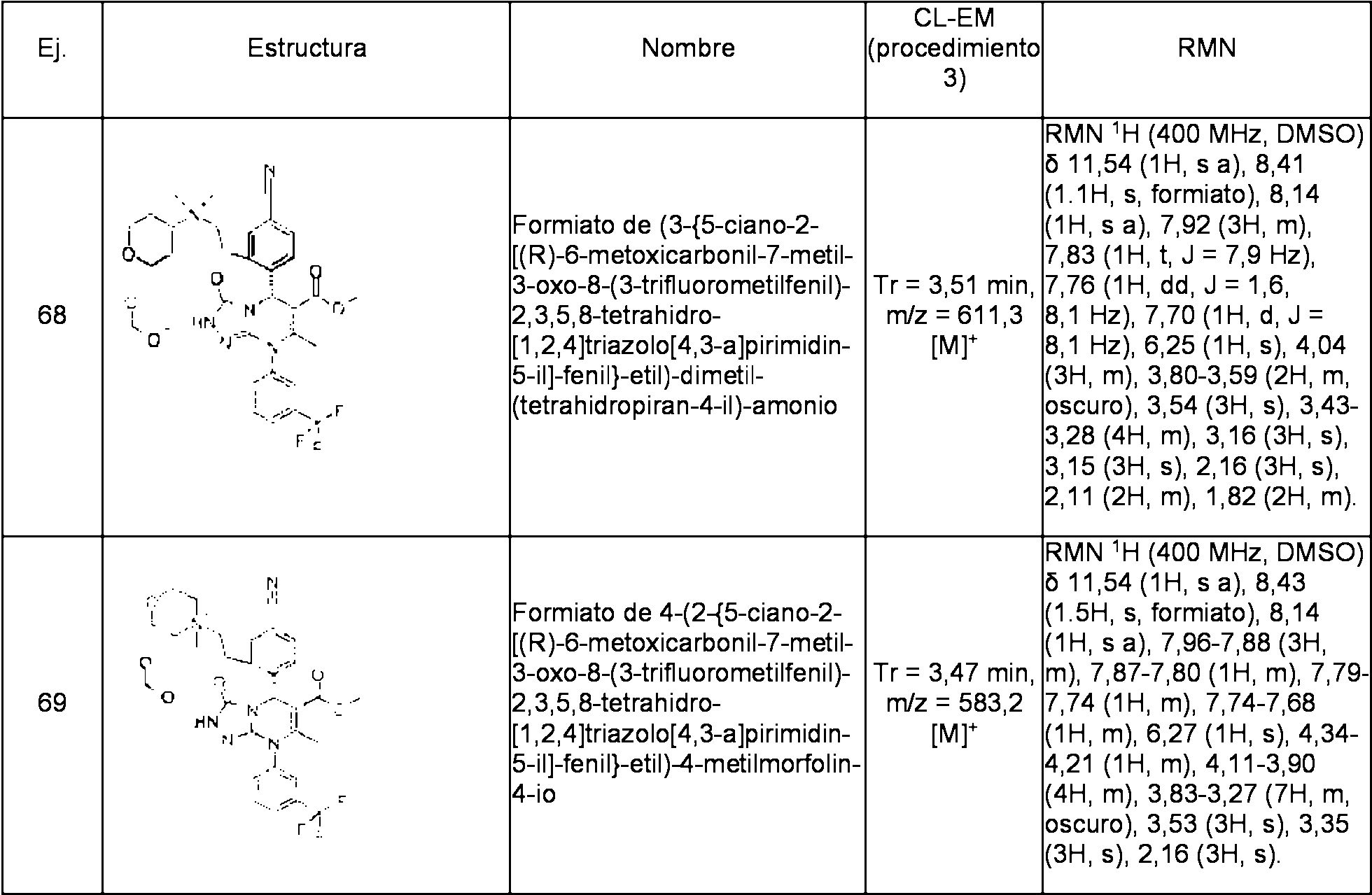
Intermedio 26Intermediate 26

D¡met¡l-(tetrah¡dro-p¡ran-4-¡lmet¡l)-am¡naD¡metl- (tetrahydro-pyrn-4-methylmet) -amn
Se disolvió 4-(bromometil)tetrahidro-2H-pirano (0,50 g, 2,8 mmol) en dimetilamina (40% en agua, 5 ml) y la mezcla de reacción se agitó a TA durante 18 h. La mezcla se saturó con NaCl y se extrajo en Et2O (2 x). El extracto orgánico combinado se secó (K2CO3), se filtró y se concentró al vacío para dar el compuesto del título en forma de un aceite incoloro (0,40 g).4- (Bromomethyl) tetrahydro-2H-pyran (0.50 g, 2.8 mmol) was dissolved in dimethylamine (40% in water, 5 mL) and the reaction mixture was stirred at RT for 18 h. The mixture was saturated with NaCl and extracted into Et2O (2 x). The combined organic extract was dried (K2CO3), filtered and concentrated in vacuo to give the title compound as a colorless oil (0.40 g).
RMN 1H (400 MHz, CDCla) 83,97 (2H, dd, J = 11,6, 4,4 Hz), 3,39 (2H, td, J = 11,6, 1,6 Hz), 2,20 (6H, s), 2,12 (2H, d, J = 6,5 Hz), 1,75-1,62 (3H, m), 1,33-1,21 (2H, m).1 H NMR (400 MHz, CDCla) 83.97 (2H, dd, J = 11.6, 4.4 Hz), 3.39 (2H, td, J = 11.6, 1.6 Hz), 2, 20 (6H, s), 2.12 (2H, d, J = 6.5 Hz), 1.75-1.62 (3H, m), 1.33-1.21 (2H, m).
Los ejemplos siguientes se prepararon a partir del intermedio 21 y las aminas terciarias apropiadamente sustituidas o heterociclos básicos usando un procedimiento análogo al usado en el ejemplo 50 (todas las aminas terciarias eran conocidas o estaban disponibles comercialmente a menos que se indique otra cosa). Después de purificación mediante MDAP y liofilización, se obtuvieron los compuestos del título en forma de sólidos electrostáticos de color blanco: The following examples were prepared from intermediate 21 and the appropriately substituted tertiary amines or basic heterocycles using a procedure analogous to that used in Example 50 (all tertiary amines were known or were commercially available unless otherwise indicated). After purification by MDAP and lyophilization, the title compounds were obtained in the form of white electrostatic solids:

(continuación)(continuation)

(continuación)(continuation)

(continuación)(continuation)

(continuación)(continuation)

Intermedio 27Intermediate 27

(1.1-d¡oxo-hexah¡dro-1lambda*6*-t¡op¡ran-4-¡lmet¡l)-d¡met¡lam¡na(1.1-dxoxo-hexahydro-1-lambda * 6 * -t¡op¡ran-4-methylmet) -d¡met¡lamine
Se disolvió [(1,1-dioxotetrahidro-2H-tiopiran-4-il)metil]amina (500 mg, 3,07 mmol) en ácido fórmico (1 ml) y formaldehído (37% en agua, 1 ml) y la mezcla de reacción se calentó a 65 °C durante 4 h. La mezcla se enfrió y se vertió cuidadosamente sobre NaHCO3 acuoso y se lavó con EtOAc. La capa acuosa se basificó a pH 13 con NaOH y se extrajo en 2-metilTHF (3 x). El extracto orgánico combinado se secó (MgSO4), se filtró y se concentró al vacío y el residuo resultante se purificó por cromatografía eluyendo de 0-10% (NH32 M en MeOH) en DCM para dar el compuesto del título en forma de un aceite transparente (80 mg).[(1,1-Dioxotetrahydro-2H-thiopyran-4-yl) methyl] amine (500 mg, 3.07 mmol) was dissolved in formic acid (1 ml) and formaldehyde (37% in water, 1 ml) and the The reaction mixture was heated at 65 ° C for 4 h. The mixture was cooled and carefully poured into aqueous NaHCO3 and washed with EtOAc. The aqueous layer was basified to pH 13 with NaOH and extracted into 2-methylTHF (3 x). The combined organic extract was dried (MgSO4), filtered and concentrated in vacuo and the resulting residue was purified by chromatography eluting 0-10% (NH32M in MeOH) in DCM to give the title compound as an oil transparent (80 mg).
RMN 1H (400 MHz, CDCla) 83,11 (4H, m), 2,20 (6 H, s), 2,24-2,12 (4H, m), 1,88-1,57 (3H, m).1 H NMR (400 MHz, CDCla) 83.11 (4H, m), 2.20 (6 H, s), 2.24-2.12 (4H, m), 1.88-1.57 (3H, m).
Intermedio 28Intermediate 28

Dimetil-oxetan-3-ilmetilaminaDimethyl-oxetane-3-ylmethylamine
Se disolvió oxetan-3-il-metilamina (0,25 g, 2.87 mmol) en una mezcla de formaldehído (37% solución en agua; 1 ml) y ácido fórmico (1 ml), después se calentó a 65 °C durante 4 h. La mezcla de reacción se vertió en hidróxido sódico acuoso/salmuera y se extrajo con Et2O. La capa orgánica se secó sobre MgSO4, se filtró y se concentró cuidadosamente al vacío para proporcionar el compuesto del título en forma de un residuo que aún contenía trazas de Et2O (0,11 g).Oxetan-3-yl-methylamine (0.25 g, 2.87 mmol) was dissolved in a mixture of formaldehyde (37% solution in water, 1 ml) and formic acid (1 ml), then heated at 65 ° C for 4 hours. h. The reaction mixture was poured into aqueous sodium hydroxide / brine and extracted with Et2O. The organic layer was dried over MgSO 4, filtered and carefully concentrated in vacuo to provide the title compound as a residue that still contained traces of Et 2 O (0.11 g).
RMN 1H (300 MHz, CDCl3): 84,80 (2H, m), 4,38-4,45 (2H, m), 3,09-3,28 (1H, m), 2,62 (2H, d, J = 7,4 Hz), 2,20 (6 H, s). Intermedio 291 H NMR (300 MHz, CDCl 3): 84.80 (2H, m), 4.38-4.45 (2H, m), 3.09-3.28 (1H, m), 2.62 (2H, d, J = 7.4 Hz), 2.20 (6 H, s). Intermediate 29

4-d¡met¡lam¡no-N-met¡l-but¡ram¡da4-methylene-N-methyl-butyramide
Una solución agitada de sal de clorhidrato de ácido 4-dimetilamino-butírico (0,50 g, 2,98 mmol; para el procedimiento de referencia del ácido 4-aminobutírico, véase JACS, 1963, 85, 1-8) y DIPEA (3,22 ml, 18,50 mmol) en DMF (5 ml) se trató con una solución de metilamina (2 M en THF; 5,96 ml, 11,93 mmol) y después HATU (1,42 g, 3,73 mmol). La mezcla se agitó a TA durante 4 h antes de diluirse con MeOH (15 ml). Esta solución resultante se purificó mediante un cartucho SCX-2 y las fracciones pertinentes se concentraron al vacío para proporcionar el compuesto del título en forma de un aceite incoloro (0,31 g).A stirred solution of 4-dimethylamino-butyric acid hydrochloride salt (0.50 g, 2.98 mmol, for the reference procedure of 4-aminobutyric acid, see JACS, 1963, 85, 1-8) and DIPEA ( 3.22 ml, 18.50 mmol) in DMF (5 ml) was treated with a solution of methylamine (2 M in THF, 5.96 ml, 11.93 mmol) and then HATU (1.42 g, 3, 73 mmol). The mixture was stirred at RT for 4 h before being diluted with MeOH (15 ml). This resulting solution was purified by an SCX-2 cartridge and the relevant fractions were concentrated in vacuo to provide the title compound as a colorless oil (0.31 g).
RMN 1H (300 MHz, DMSO): 87,66 (1H, s a), 2,54 (3H, d, J = 4,6 Hz), 2,15 (2H, t, J = 7,2 Hz), 2,09 (6 H, s), 2,04 (2H, t, J = 7,5 Hz), 1,53-1,65 (2H, m).1 H NMR (300 MHz, DMSO): 87.66 (1H, sa), 2.54 (3H, d, J = 4.6 Hz), 2.15 (2H, t, J = 7.2 Hz), 2.09 (6 H, s), 2.04 (2H, t, J = 7.5 Hz), 1.53-1.65 (2H, m).
Intermedio 30Intermediate 30
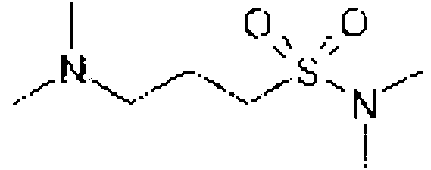
D¡met¡lam¡da del ác¡do 3-d¡met¡lam¡no-propano-1-sulfón¡coDissolution of the acid 3-dimethyl-propane-1-sulphonic acid

a) D¡met¡lam¡da del ác¡do 3-cloro-propano-1-sulfón¡co a) Demethylation of the acid 3-chloro-propane-1-sulphon
Una solución en agitación de cloruro de 3-cloropropilsulfonilo (6,00 g, 33,90 mmol) en THF (35 ml) se enfrió en un baño de hielo a 0-5 °C. Se añadió dimetilamina (2 M en THF; 36 ml, 72 mmol) gota a gota, manteniendo la temperatura por debajo de 10 °C y la suspensión resultante se agitó a 5 °C durante 30 min, después se dejó calentar a tA. Después de 1 h, la mezcla se diluyó con agua y se extrajo en EtOAc y el extracto le lavó con agua, salmuera y después se secó (Na2SO4), se filtró y se concentró al vacío para proporcionar el compuesto del título en forma de un aceite de color amarillo claro (5,19 g).A stirring solution of 3-chloropropylsulfonyl chloride (6.00 g, 33.90 mmol) in THF (35 ml) was cooled in an ice bath at 0-5 ° C. Dimethylamine (2 M in THF, 36 mL, 72 mmol) was added dropwise, keeping the temperature below 10 ° C and the resulting suspension was stirred at 5 ° C for 30 min, then allowed to warm to tA. After 1 h, the mixture was diluted with water and extracted into EtOAc and the extract was washed with water, brine and then dried (Na2SO4), filtered and concentrated in vacuo to give the title compound as an light yellow oil (5.19 g).
RMN 1H (400 MHz, CDCl3): 83,70 (2H, t, J 6,2 Hz), 3,06-3,12 (2H, m), 2,90 (6H, s), 2,25 (2H, m).1 H NMR (400 MHz, CDCl 3): 83.70 (2H, t, J 6.2 Hz), 3.06-3.12 (2H, m), 2.90 (6H, s), 2.25 ( 2H, m).

b) Dimetilamida del ácido 3-d¡met¡lam¡no-propano-1-sulfón¡cob) 3-Dimethyl-propane-1-sulfonyl acid dimethylamide
Una solución de dimetilamida del ácido 3-cloro-propano-1-sulfónico (0,55 g, 3,00 mmol) en MeCN (5 ml) se trató con dimetilamina (2 M en THF; 10 ml, 20 mmol), carbonato potásico (455 mg, 3,30 mmol) y una cantidad catalítica de yoduro potásico (50 mg, 0,03 mmol). Esta mezcla se calentó en un tubo cerrado herméticamente a 65 °C durante 18 h, después se enfrió y se diluyó con agua y se extrajo en EtOAc. El extracto orgánico se lavó con salmuera después se secó (Na2SO4), se filtró y se concentró al vacío para proporcionar el compuesto del título en forma de un aceite de color pardo claro (0,40 g).A solution of 3-chloro-propane-1-sulfonic acid dimethylamide (0.55 g, 3.00 mmol) in MeCN (5 mL) was treated with dimethylamine (2 M in THF, 10 mL, 20 mmol), carbonate potassium (455 mg, 3.30 mmol) and a catalytic amount of potassium iodide (50 mg, 0.03 mmol). This mixture was heated in a sealed tube at 65 ° C for 18 h, then cooled and diluted with water and extracted into EtOAc. The organic extract was washed with brine then dried (Na2SO4), filtered and concentrated in vacuo to give the title compound as a light brown oil (0.40 g).
RMN 1H (400 MHz, CDCl3): 83,01-2,95 (2H, m), 2,88 (6H, s), 2,38 (2H, t, J = 6,8 Hz), 2,22 (6H, s), 2,02-1,92 (2H, m).1 H NMR (400 MHz, CDCl 3): 83.01-2.95 (2H, m), 2.88 (6H, s), 2.38 (2H, t, J = 6.8 Hz), 2.22 (6H, s), 2.02-1.92 (2H, m).
Intermedio 31Intermediate 31

-metil-H.41oxazepano-methyl-H.41oxazepano
Clorhidrato de [1,4]oxazepano (730 mg, 5.3 mmol) y NaHCO3 (450 mg, 5,3 mmol) se suspendieron en ácido fórmico (2 ml) y una solución de formaldehído (37 % en peso en agua; 1 ml) y se calentó a reflujo durante 5,5 h. La reacción se enfrió y se añadió cuidadosamente una solución de NaOH (2 g en 5 ml de agua). Después se extrajo el producto con Et2O (50 ml), se secó (Na2SO4) y el disolvente se eliminó por destilación a presión atmosférica para proporcionar un líquido de color pardo claro que contenía algún resto de Et2O (680 mg).[1,4] Oxazepane hydrochloride (730 mg, 5.3 mmol) and NaHCO 3 (450 mg, 5.3 mmol) were suspended in formic acid (2 ml) and formaldehyde solution (37% by weight in water; ) and was heated to reflux for 5.5 h. The reaction was cooled and a solution of NaOH (2 g in 5 ml of water) was carefully added. The product was then extracted with Et2O (50 ml), dried (Na2SO4) and the solvent was distilled off at atmospheric pressure to give a light brown liquid containing some residue of Et2O (680 mg).
RMN 1H (300 MHz, CDCl3) 83,85-3,78 (2H, m), 3,76-3,70 (2H, m), 2,68-2,59 (4H, m), 2,41-2,37 (3H, m), 1,98-1,88 (2H, m).1 H NMR (300 MHz, CDCl 3) 83.85-3.78 (2H, m), 3.76-3.70 (2H, m), 2.68-2.59 (4H, m), 2.41. -2.37 (3H, m), 1.98-1.88 (2H, m).
Intermedio 32Intermediate 32

(3-metanosulfonilpropil)dimetilamina(3-methanesulfonylpropyl) dimethylamine
1-bromo-3-metanosulfonilpropano (500 mg, 2,5 mmol) se suspendió en una solución de dimetilamina (2 M en THF; 10 ml, 20 mmol) y se agitó a TA, dando como resultado un sólido cristalino. La reacción se dejó en reposo durante una noche y la mezcla de reacción después se diluyó con Et2O (10 ml) y se filtró. El filtrado se concentró al vacío dando como resultado un sólido aceitoso de color naranja que se disolvió de nuevo en Et2O (10 ml), se filtró y se concentró al vacío para dar el compuesto del título en forma de un aceite de color naranja (420 mg).1-Bromo-3-methanesulfonylpropane (500 mg, 2.5 mmol) was suspended in a solution of dimethylamine (2 M in THF, 10 mL, 20 mmol) and stirred at RT, resulting in a crystalline solid. The reaction was allowed to stand overnight and the reaction mixture was then diluted with Et2O (10 ml) and filtered. The filtrate was concentrated in vacuo to give an orange oily solid which was redissolved in Et2O (10 mL), filtered and concentrated in vacuo to give the title compound as an orange oil (420 mg).
RMN 1H (300 MHz, CDCl3) 83,07-2,99 (2H, m), 2,84 (3H, m), 2,34 (2H, t, J = 6,7 Hz), 2,16 (6H, s), 2,00-1,88 (2H, m).1 H NMR (300 MHz, CDCl 3) 83.07-2.99 (2H, m), 2.84 (3H, m), 2.34 (2H, t, J = 6.7 Hz), 2.16 ( 6H, s), 2.00-1.88 (2H, m).
Los siguientes ejemplos se prepararon a partir del intermedio 14 y las aminas terciarias apropiadamente sustituidas o heterociclos básicos usando un procedimiento análogo al usado en el ejemplo 24 (todas las aminas terciarias/heterociclos básicos eran conocidos o estaban disponibles comercialmente a menos que se indique otra cosa). Donde se limitó la amina terciaria usada, la mezcla de reacción se diluyó más con MeCN.The following examples were prepared from intermediate 14 and the appropriately substituted tertiary amines or basic heterocycles using a procedure analogous to that used in Example 24 (all tertiary amines / basic heterocycles were known or were commercially available unless otherwise indicated) ). Where the tertiary amine used was limited, the reaction mixture was further diluted with MeCN.
Después de purificación mediante MDAP y liofilización, se obtuvieron los compuestos del título en forma de sólidos electrostáticos de color blanco: After purification by MDAP and lyophilization, the title compounds were obtained in the form of white electrostatic solids:

(continuación)(continuation)

(co n tin u a c ió n )(continuation )

(co n tin u a c ió n )(continuation )

(co n tin u a c ió n )(continuation )

(continuación)(continuation)

(co n tin u a c ió n )(continuation )

(continuación)(continuation)
m),m),

(co n tin u a c ió n )(continuation )

(co n tin u a c ió n )(continuation )

(continuación)(continuation)

(continuación)(continuation)

Ejemplo 116 Example 116
Bromuro de 1-f5-ciano-2-r(R)-6-metoxicarbonil-7-metil-3-oxo-8-(3-trifluorometil-fenih-2.3.5.8-tetrahidrori.2.41triazolor4.3-alpirimidin-5-ill-bencil}-piridinioBromide of 1-f5-cyano-2-r (R) -6-methoxycarbonyl-7-methyl-3-oxo-8- (3-trifluoromethyl-phenih-2.3.5.8-tetrahydrori.2.41triazolor4.3-alpyrimidin-5 -ill-benzyl} -pyridinium
Una solución del intermedio 14 (1,30 g, 2,37 mmol) en MeCN (10 ml) se trató con piridina (1,91 ml, 23,72 mmol) y se calentó a 50 °C durante 3 h. La mezcla resultante se concentró al vacío y el producto en bruto se repartió entre agua (30 ml) y EtOAc (25 ml) y la capa acuosa se separó y se liofilizó para dar el producto deseado en forma de un sólido electrostático de color blanco.A solution of intermediate 14 (1.30 g, 2.37 mmol) in MeCN (10 ml) was treated with pyridine (1.91 ml, 23.72 mmol) and heated at 50 ° C for 3 h. The resulting mixture was concentrated in vacuo and the crude product was partitioned between water (30 ml) and EtOAc (25 ml) and the aqueous layer was separated and lyophilized to give the desired product as a white electrostatic solid.
CL-EM (procedimiento 3):Tr = 3,42 min, m/z = 547,2 [M]+LC-MS (method 3): Tr = 3.42 min, m / z = 547.2 [M] +
RMN 1H (400 MHz, DMSO) 811,39 (1H, s a), 9,35 (2H, d, J = 6,4 Hz), 8,69 (1H, t, J = 7,8 Hz), 8,24 (2H, m), 8,18 (1H, s a), 8,04-7,89 (3H, m), 7,88-7,79 (2H, m), 7,79-7,75 (1H, m), 6,56 (1H, d, J = 15,3 Hz), 6,42 (1H, s), 6,14 (1H, d, J = 15,1 Hz), 3,55 (3H, s) y 2,18 (3H, s).1 H NMR (400 MHz, DMSO) 811.39 (1H, sa), 9.35 (2H, d, J = 6.4 Hz), 8.69 (1H, t, J = 7.8 Hz), 8 , 24 (2H, m), 8.18 (1H, sa), 8.04-7.89 (3H, m), 7.88-7.79 (2H, m), 7.79-7.75 (1H, m), 6.56 (1H, d, J = 15.3 Hz), 6.42 (1H, s), 6.14 (1H, d, J = 15.1 Hz), 3.55 (3H, s) and 2.18 (3H, s).
Los siguientes compuestos se prepararon a partir del intermedio 14 usando un procedimiento análogo al usado para el ejemplo 116, utilizando un ácido apropiado para preparar la resina IRA-458 deseada (véase el ejemplo 42 para el procedimiento de intercambio quat) y dio los compuestos deseados en forma de sólidos electrostáticos de color blanco:The following compounds were prepared from intermediate 14 using an analogous procedure to that used for example 116, using an appropriate acid to prepare the desired IRA-458 resin (see example 42 for the quat exchange process) and gave the desired compounds in the form of white electrostatic solids:

Ejemplo 120 Example 120

Bromuro de bencil-f5-ciano-2-r(R)-6-metoxicarbonil-7-metil-3-oxo-8-(3-trifluorometil-fenih-2.3.5.8-tetrahidrori.2.41triazolor4.3-alpirimidin-5-ill-bencill-dimetil-amonioBromide of benzyl-f5-cyano-2-r (R) -6-methoxycarbonyl-7-methyl-3-oxo-8- (3-trifluoromethyl-phenih-2.3.5.8-tetrahydrori.2.41triazolor4.3-alpyrimidin-5 -ill-benzyl-dimethyl-ammonium
Se añadió dietilamina de N-bencilo (1,80 ml, 12,0 mmol) a una solución del intermedio 14 (1,26 g, 2,36 mmol) en MeCN (8 ml) y tolueno (4 ml) contenido en un recipiente de microondas grande. Este se cerró herméticamente y se calentó a 50 °C con agitación durante 21 h. Los disolventes se retiraron al vacío y el residuo de color verde resultante se trituró con Et2O. Los orgánicos se eliminaron por decantación y el residuo se empapó en EtOAc (50 ml) durante 1 h, después se filtró y se secó al vacío para proporcionar un sólido de color blanquecino. El sólido resultante se repartió entre agua y una mezcla [1:1] de EtOAc/Et2O y se separó la fase acuosa turbia, se purgó con una corriente de aire para eliminar los restos volátiles de disolvente. Se añadió MeCN (25 ml) y la solución resultante se liofilizó para proporcionar el compuesto del título en forma de un sólido electrostático de color crema (0,66 g).N-Benzyl diethylamine (1.80 mL, 12.0 mmol) was added to a solution of intermediate 14 (1.26 g, 2.36 mmol) in MeCN (8 mL) and toluene (4 mL) contained in a large microwave container. This was sealed and heated to 50 ° C with stirring for 21 h. The solvents were removed in vacuo and the resulting green residue was triturated with Et2O. The organics were removed by decantation and the residue was soaked in EtOAc (50 ml) for 1 h, then filtered and dried under vacuum to provide an off-white solid. The resulting solid was partitioned between water and a [1: 1] mixture of EtOAc / Et2O and the turbid aqueous phase was separated, purged with a stream of air to remove volatile solvent residues. MeCN (25 ml) was added and the resulting solution was lyophilized to give the title compound as a cream colored electrostatic solid (0.66 g).
CL-EM (procedimiento 3):Tr = 3,72 min, m/z = 603,4 [M]+LC-MS (method 3): Tr = 3.72 min, m / z = 603.4 [M] +
RMN 1H (400 MHz, DMSO) 811,36 (1H, s a), 8,17 (1H, d, J = 1,6 Hz), 8,11 (1H, s a), 8,04 (1H, dd, J = 1,6, 8,3 Hz), 7,95-7,85 (3H, m), 7,84-7,78 (1H, m), 7,66-7,60 (2H, m), 7,58-7,51 (3H, m), 6,50 (1H, s), 5,27 (1H, d, J = 14,5 Hz), 5,03 (1H, d, J = 14,1 Hz), 4,87 (1H, d, J = 12,4 Hz), 4,75 (1H, d, J = 12,4 Hz), 3,50 (3H, s) 3,14 (3H, s), 3,12 (3H, s) y 2,08 (3H, s).1 H NMR (400 MHz, DMSO) 811.36 (1H, sa), 8.17 (1H, d, J = 1.6 Hz), 8.11 (1H, sa), 8.04 (1H, dd, J = 1.6, 8.3 Hz), 7.95-7.85 (3H, m), 7.84-7.78 (1H, m), 7.66-7.60 (2H, m) , 7.58-7.51 (3H, m), 6.50 (1H, s), 5.27 (1H, d, J = 14.5 Hz), 5.03 (1H, d, J = 14 , 1 Hz), 4.87 (1H, d, J = 12.4 Hz), 4.75 (1H, d, J = 12.4 Hz), 3.50 (3H, s) 3.14 (3H , s), 3.12 (3H, s) and 2.08 (3H, s).
Ejemplo 121Example 121
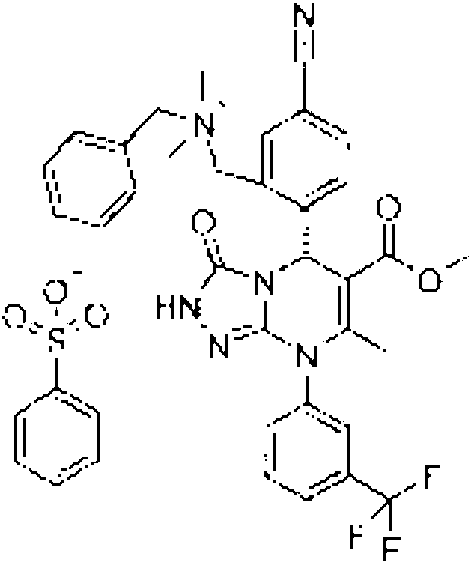
Bencenosulfonato de bencil-f5-ciano-2-IYR)-6-metoxicarbonil-7-metil-3-oxo-8-(3-trifluorometil-fenih-2.3.5.8-tetrah¡dro-ri.2.41tr¡azolor4.3-a1p¡r¡m¡d¡n-5-M1-benc¡l}-d¡met¡l-amon¡o Benzyl-f5-cyano-2-I and R) -6-methoxycarbonyl-7-methyl-3-oxo-8- (3-trifluoromethyl- phene ) -2.3.5.8-tetrahydro-ri.2.41tr azolor4.3-a1p¡r¡m¡d¡n-5-M1-benc¡l} -d¡met¡l-amon¡o
El compuesto del título se preparó a partir del ejemplo 120 (0,53 g, 0,77 mmol) usando un procedimiento análogo al usado para el ejemplo 42 y dio el compuesto deseado en forma de un sólido electrostático de color blanco. Este se suspendió en agua (5,0 ml) con calentamiento a 45 °C, después se enfrió a TA, se filtró y se secó al vacío para proporcionar el compuesto del título en forma de un sólido de color blanco (0,32 g).The title compound was prepared from Example 120 (0.53 g, 0.77 mmol) using a procedure analogous to that used for Example 42 and gave the desired compound as a white electrostatic solid. This was suspended in water (5.0 ml) with heating at 45 ° C, then cooled to RT, filtered and dried under vacuum to give the title compound as a white solid (0.32 g). ).
CL-EM (procedimiento 3):Tr = 3,69 min, m/z = 603,2 [M]+LC-MS (procedure 3): Tr = 3.69 min, m / z = 603.2 [M] +
RMN 1H (400 MHz, DMSO) 811,36 (1H, s a), 8,17 (1H, d, J = 1,6 Hz), 8,10 (1H, s a), 8,04 (1H, dd, J = 1,6, 8,3 Hz), 7,95-7,85 (3H, m), 7,84-7,78 (1H, m), 7,66-7,51 (7H, m), 7,34-7,26 (3H, m), 6,49 (1H, s), 5,26 (1H, d, J = 14,5 Hz), 5,02 (1H, d, J = 14,1 Hz), 4,86 (1H, d, J = 12,4 Hz), 4,74 (1H, d, J = 12,4 Hz), 3,50 (3H, s) 3,14 (3H, s), 3,11 (3H, s) y 2,08 (3H, s).1 H NMR (400 MHz, DMSO) 811.36 (1H, sa), 8.17 (1H, d, J = 1.6 Hz), 8.10 (1H, sa), 8.04 (1H, dd, J = 1.6, 8.3 Hz), 7.95-7.85 (3H, m), 7.84-7.78 (1H, m), 7.66-7.51 (7H, m) , 7.34-7.26 (3H, m), 6.49 (1H, s), 5.26 (1H, d, J = 14.5 Hz), 5.02 (1H, d, J = 14 , 1 Hz), 4.86 (1H, d, J = 12.4 Hz), 4.74 (1H, d, J = 12.4 Hz), 3.50 (3H, s) 3.14 (3H , s), 3.11 (3H, s) and 2.08 (3H, s).
Ejemplo 122 Example 122

Bromuro de 4-{5-ciano-2-r(R)-6-metoxicarbonil-7-metil-3-oxo-8-(3-trifluorometilfenih-2.3.5.8-tetrahidrori.2.41triazolor4.3-alpirimidin-5-ill-bencil}-4-metil-morfolin-4-ioBromide of 4- {5-cyano-2-r (R) -6-methoxycarbonyl-7-methyl-3-oxo-8- (3-trifluoromethylphenih-2.3.5.8-tetrahydrori.2.41triazolor4.3-alpyrimidin-5- ill-benzyl} -4-methyl-morpholin-4-io
El compuesto del título se preparó a partir del intermedio 14 (1,20 g, 2,19 mmol) usando un procedimiento análogo al usado para el ejemplo 120. El producto sólido semipuro se volvió a agitar en EtOAc (30 ml) a 40 °C durante 2 h y se sometió a ultrasonidos durante 5 min. El sólido resultante se filtró para dar una torta de color beis, que se disolvió en MeCN/H2O (10 ml) y se liofilizó para dar el compuesto del título en forma de un sólido electrostático de color blanquecino (0,43 g).The title compound was prepared from intermediate 14 (1.20 g, 2.19 mmol) using a procedure analogous to that used for Example 120. The solid semi-pure product was stirred again in EtOAc (30 mL) at 40 ° C. C for 2 h and was sonicated for 5 min. The resulting solid was filtered to give a beige cake, which was dissolved in MeCN / H2O (10 ml) and lyophilized to give the title compound as an off white electrostatic solid (0.43 g).
CL-EM (procedimiento 3): Tr = 3,33 min, m/z = 569,2 [M]+LC-MS (method 3): Tr = 3.33 min, m / z = 569.2 [M] +
RMN 1H (400 MHz, DMSO-Da) 811,36 (1H, s), 8,15-8,08 (2H, m), 8,04 (1H, dd, J = 8,2, 1,7 Hz), 7,95-7,79 (4H, m), 6,55 (1H, s), 5,24 (1H, d J = 14,1 Hz), 5,11 (1H, d, J = 14,1 Hz), 4,10-3,92 (4H, m), 3,91-3,79 (2H, m), 3,64-3,54 (2H, m, oscuro), 3,54 (3H, s), 3,28 (3H, s) y 2,07 (3H, s).1 H NMR (400 MHz, DMSO-Da) 811.36 (1H, s), 8.15-8.08 (2H, m), 8.04 (1H, dd, J = 8.2, 1.7 Hz ), 7.95-7.79 (4H, m), 6.55 (1H, s), 5.24 (1H, d J = 14.1 Hz), 5.11 (1H, d, J = 14 , 1 Hz), 4.10-3.92 (4H, m), 3.91-3.79 (2H, m), 3.64-3.54 (2H, m, dark), 3.54 ( 3H, s), 3.28 (3H, s) and 2.07 (3H, s).
Ejemplo 123Example 123

Bromuro de 4-{5-ciano-2-r(R)-6-metoxicarbonil-7-metil-3-oxo-8-(3-trifluorometilfenil)-2.3.5.8-tetrahidrori.2.41triazolor4.3-a1pirimidin-5-il1-bencil}-4-metil-morfolin-4-ioBromide of 4- {5-cyano-2-r (R) -6-methoxycarbonyl-7-methyl-3-oxo-8- (3-trifluoromethylphenyl) -2.3.5.8-tetrahydrori.2.41triazolor4.3-a1pyrimidin-5 -yl1-benzyl} -4-methyl-morpholin-4-io
El compuesto del título se preparó a partir del ejemplo 122 (0,47 g, 0,72 mmol) usando un procedimiento análogo al usado para el ejemplo 42. El producto sólido semipuro se volvió a purificar mediante HPLC (sistema 1) y después se liofilizó para dar el compuesto del título en forma de un sólido electrostático de color blanco (0,23 g).The title compound was prepared from Example 122 (0.47 g, 0.72 mmol) using a procedure analogous to that used for Example 42. The semi-solid solid product was further purified by HPLC (system 1) and then lyophilized to give the title compound as a white electrostatic solid (0.23 g).
CL-EM (procedimiento 3): Tr = 3,33 min, m/z = 569,2 [M]+LC-MS (method 3): Tr = 3.33 min, m / z = 569.2 [M] +
RMN 1H (400 MHz, DMSO-D6) 811,36 (1H, s), 8,14-8,08 (2H, m), 8,03 (1H, dd, J = 8,2, 1,8 Hz), 7,95-7,78 (4H, m), 7,62-7,57 (2H, m, besilato), 7,34-7,27 (3H, m, besilato), 6,54 (1H, s), 5,22 (1H, d J = 14,2 Hz), 5,10 (1H, d, J = 14,2 Hz), 4,09-3,91 (4H, m), 3,91-3,79 (2H, m), 3,64-3,54 (2H, m, oscuro), 3,54 (3H, s), 3,27 (3H, s) y 2,07 (3H, s).1 H NMR (400 MHz, DMSO-D6) 811.36 (1H, s), 8.14-8.08 (2H, m), 8.03 (1H, dd, J = 8.2, 1.8 Hz ), 7.95-7.78 (4H, m), 7.62-7.57 (2H, m, besylate), 7.34-7.27 (3H, m, besylate), 6.54 (1H , s), 5.22 (1H, d J = 14.2 Hz), 5.10 (1H, d, J = 14.2 Hz), 4.09-3.91 (4H, m), 3, 91-3.79 (2H, m), 3.64-3.54 (2H, m, dark), 3.54 (3H, s), 3.27 (3H, s) and 2.07 (3H, s).
Ejemplo 124 Example 124

Bromuro de 4-{5-ciano-2-r(R)-6-metoxicarbonil-7-metil-3-oxo-8-(3-trifluorometilfenih-2.3.5.8-tetrahidrori.2.41triazolor4.3-alpirimidin-5-ill-bencil}-4-metil-morfolin-4-ioBromide of 4- {5-cyano-2-r (R) -6-methoxycarbonyl-7-methyl-3-oxo-8- (3-trifluoromethylphenih-2.3.5.8-tetrahydrori.2.41triazolor4.3-alpyrimidin-5- ill-benzyl} -4-methyl-morpholin-4-io
El compuesto del título se preparó a partir del intermedio 14 (0,76 g, 1,38 mmol) usando un procedimiento análogo al usado para el ejemplo 120. Un cartucho C-is Isolute (50 g) se preacondicionó mediante elución con MeCN (150 ml) seguido de MeCN al 75%-0,5% en acuoso 0,01M (100 ml). El producto en bruto (650 mg) se disolvió en MeCN al 0,5%: HBr 0,01M (10 ml), cargado en el cartucho y eluido en MeCN al 0,5%-40% en HBr acuoso 0,01 M. El compuesto del título se obtuvo en forma de un sólido electrostático después de liofilización (0,42 g).The title compound was prepared from intermediate 14 (0.76 g, 1.38 mmol) using an analogous procedure to that used for Example 120. A C-is Isolute cartridge (50 g) was preconditioned by elution with MeCN ( 150 ml) followed by 75% -0.5% MeCN in 0.01M aqueous (100 ml). The crude product (650 mg) was dissolved in 0.5% MeCN: 0.01M HBr (10 ml), loaded in the cartridge and eluted in 0.5% -40% MeCN in 0.01 M aqueous HBr. The title compound was obtained as an electrostatic solid after lyophilization (0.42 g).
CL-Em (procedimiento 3): Tr = 3,26 min, m/z = 571,2 [M]+CL-E m (procedure 3): Tr = 3.26 min, m / z = 571.2 [M] +
RMN 1H (400 MHz, DMSO-Da) 8 11,36 (1H, s a), 8,14 (1H, d, J = 1,6 Hz), 8,11 (1H, s a), 8,02 (1H, dd, J = 8,1, 1,5 Hz), 7,95-7,78 (4H, m), 6,49 (1H, s), 5,12 (1H, d, J = 14,0 Hz), 4,97 (1H, d, J = 14,0 Hz), 3,68-3,60 (2H, m), 3,59 3,53 (2H, m, oscuro), 3,53 (3H, s), 3,22 (3H, s), 3,17 (3H, s), 2,07 (3H, s) y 2,07-1,97 (2H, m), OH no observado. Ejemplo 125 1 H NMR (400 MHz, DMSO-Da) 8 11.36 (1H, sa), 8.14 (1H, d, J = 1.6 Hz), 8.11 (1H, sa), 8.02 (1H) , dd, J = 8.1, 1.5 Hz), 7.95-7.78 (4H, m), 6.49 (1H, s), 5.12 (1H, d, J = 14.0 Hz), 4.97 (1H, d, J = 14.0 Hz), 3.68-3.60 (2H, m), 3.59 3.53 (2H, m, dark), 3.53 ( 3H, s), 3.22 (3H, s), 3.17 (3H, s), 2.07 (3H, s) and 2.07-1.97 (2H, m), OH not observed. Example 125

Bromuro de 4-{5-ciano-2-r(R)-6-metoxicarbonil-7-metil-3-oxo-8-(3-trifluorometilfenil)-2.3.5.8-tetrahidrori.2.41triazolor4.3-a1pirimidin-5-il1-bencil}4-metil-morfolin-4-ioBromide of 4- {5-cyano-2-r (R) -6-methoxycarbonyl-7-methyl-3-oxo-8- (3-trifluoromethylphenyl) -2.3.5.8-tetrahydrori.2.41triazolor4.3-a1pyrimidin-5 -yl1-benzyl} 4-methyl-morpholin-4-io
El compuesto del título se preparó a partir del ejemplo 124 (0,72 g, 1,31 mmol) usando un procedimiento análogo al usado para el ejemplo 42. El producto sólido semipuro se volvió a purificar mediante HPLC (sistema 1) y después se liofilizó para dar el compuesto del título en forma de un sólido electrostático de color blanco (0,23 g).The title compound was prepared from Example 124 (0.72 g, 1.31 mmol) using a procedure analogous to that used for Example 42. The semi-solid solid product was further purified by HPLC (System 1) and then lyophilized to give the title compound as a white electrostatic solid (0.23 g).
CL-EM (procedimiento 3): Tr = 3,27 min, m/z = 571,3 [M]+LC-MS (procedure 3): Tr = 3.27 min, m / z = 571.3 [M] +
RMN 1H (400 MHz, DMSO-D6) 8 11,36 (1H, s a), 8,12 (1H, d, J = 1,6 Hz), 8,10 (1H, s a), 8,02 (1H, dd, J = 8,2, 1,6 Hz), 7,95-7,78 (4H, m), 7,62-7,57 (2H, m, besilato), 7,34-7,27 (3H, m, besilato), 6,48 (1H, s), 5,11 (1H, d, J = 14,0 Hz), 4,96 (1H, d, J = 14,0 Hz), 4,85 (1H, s a), 3,68-3,60 (2H, m), 3,59-3,53 (2H, m, oscuro), 3,53 (3H, s), 3,21 (3H, s), 3,16 (3H, s), 2,07 (3H, s) y 2,07-1,97 (2H, m).1 H NMR (400 MHz, DMSO-D6) 8 11.36 (1H, sa), 8.12 (1H, d, J = 1.6 Hz), 8.10 (1H, sa), 8.02 (1H , dd, J = 8.2, 1.6 Hz), 7.95-7.78 (4H, m), 7.62-7.57 (2H, m, besylate), 7.34-7.27 (3H, m, besylate), 6.48 (1H, s), 5.11 (1H, d, J = 14.0 Hz), 4.96 (1H, d, J = 14.0 Hz), 4 , 85 (1H, sa), 3.68-3.60 (2H, m), 3.59-3.53 (2H, m, dark), 3.53 (3H, s), 3.21 (3H , s), 3.16 (3H, s), 2.07 (3H, s) and 2.07-1.97 (2H, m).
Ejemplo 126 Example 126

Bencenosulfonato de l5-ciano-2-r(R)-6-metoxicarbonil-7-metil-3-oxo-8-(3-trifluorometilfenih-2.3.5.8-tetrahidrori.2.41triazolor4.3-alpirimidin-5-ill-bencil}-trimetil-amonioL5-cyano-2-r (R) -6-methoxycarbonyl-7-methyl-3-oxo-8- (3-trifluoromethylphenih-2.3.5.8-tetrahydrori.2.41triazolor4.3-alpyrimidin-5-ill-benzyl) benzenesulfonate } -trimethyl-ammonium
El compuesto del título se preparó a partir del ejemplo 9 (0,85 g, 1,37 mmol) usando un procedimiento análogo al usado para el ejemplo 42. El producto sólido semipuro se volvió a purificar mediante HPLC (sistema 1) y después se liofilizó para dar el compuesto del título en forma de un sólido electrostático de color blanco (0,90 g).The title compound was prepared from Example 9 (0.85 g, 1.37 mmol) using an analogous procedure to that used for Example 42. The semi-solid solid product was further purified by HPLC (system 1) and then lyophilized to give the title compound as a white electrostatic solid (0.90 g).
CL-EM (procedimiento 3): Tr = 3,27 min, m/z = 571,3 [M]+LC-MS (procedure 3): Tr = 3.27 min, m / z = 571.3 [M] +
RMN 1H (400 MHz, DMSO-Da) 8 11,36 (1H, s a), 8,12 (1H, d, J = 1,6 Hz), 8,10 (1H, s a), 8,02 (1H, dd, J = 8,2, 1,6 Hz), 7,95-7,78 (4H, m), 7,62-7,57 (2H, m, besilato), 7,34-7,27 (3H, m, besilato), 6,48 (1H, s), 5,11 (1H, d, J = 14,0 Hz), 4,96 (1H, d, J = 14,0 Hz), 4,85 (1H, s a), 3,68-3,60 (2H, m), 3,59-3,53 (2H, m, oscuro), 3,53 (3H, s), 3,21 (3H, s), 3,16 (3H, s), 2,07 (3H, s) y 2,07-1,97 (2H, m).1 H NMR (400 MHz, DMSO-Da) 8 11.36 (1H, sa), 8.12 (1H, d, J = 1.6 Hz), 8.10 (1H, sa), 8.02 (1H , dd, J = 8.2, 1.6 Hz), 7.95-7.78 (4H, m), 7.62-7.57 (2H, m, besylate), 7.34-7.27 (3H, m, besylate), 6.48 (1H, s), 5.11 (1H, d, J = 14.0 Hz), 4.96 (1H, d, J = 14.0 Hz), 4 , 85 (1H, sa), 3.68-3.60 (2H, m), 3.59-3.53 (2H, m, dark), 3.53 (3H, s), 3.21 (3H , s), 3.16 (3H, s), 2.07 (3H, s) and 2.07-1.97 (2H, m).
Ejemplo 127Example 127

Bencenosulfonato de l5-ciano-2-r(R)-6-metoxicarbonil-7-metil-3-oxo-8-(3-trifluorometilfenih-2.3.5.8-tetrahidrori.2.41tr¡azolor4.3-a1p¡r¡m¡d¡n-5-M1-benc¡l}-b¡s-(2-h¡drox¡-et¡n-met¡l-amon¡oL5-cyano-2-r (R) -6-methoxycarbonyl-7-methyl-3-oxo-8- (3-trifluoromethylphenih-2.3.5.8-tetrahydrori.2.41tr¡azolor4.3-a1p¡r¡m benzenesulfonate Dn-5-M1-benzyl} -b, s- (2-hydroxy-ethylene-methylene-ammonium
El compuesto del título se preparó a partir del ejemplo 107 (0,60 g, 0,95 mmol) usando un procedimiento análogo al usado para el ejemplo 42 y dio el compuesto del título en forma de un sólido electrostático de color blanco (0,54 g).The title compound was prepared from Example 107 (0.60 g, 0.95 mmol) using a procedure analogous to that used for Example 42 and gave the title compound as a white electrostatic solid (0, 54 g).
CL-EM (procedimiento 3): Tr = 3,28 min, m/z = 587,2 [M]+LC-MS (procedure 3): Tr = 3.28 min, m / z = 587.2 [M] +
RMN 1H (400 MHz, DMSO-D6) 8 1H RMN (400 MHz, DMSO) 8 11,36 (1H, s a), 8,23-8,18 (1H, m), 8,11 (1H, s a), 8,03-7,98 (1H, m), 7,95-7,78 (4H, m), 7,61-7,56 (2H, m, besilato), 7,34-7,27 (3H, m, besilato), 6,50 (1H, s), 5,47-5,39 (2H, m, 2 x OH), 5,30-5,13 (2H, m), 4,06-3,79 (6H, m), 3,72-3,62 (2H, m), 3,53 (3H, s), 3,23 (3H, s), 2,05 (3H, s).1 H NMR (400 MHz, DMSO-D 6) 8 1 H NMR (400 MHz, DMSO) 8 11.36 (1H, sa), 8.23-8.18 (1H, m), 8.11 (1H, sa) , 8.03-7.98 (1H, m), 7.95-7.78 (4H, m), 7.61-7.56 (2H, m, besylate), 7.34-7.27 ( 3H, m, besylate), 6.50 (1H, s), 5.47-5.39 (2H, m, 2 x OH), 5.30-5.13 (2H, m), 4.06- 3.79 (6H, m), 3.72-3.62 (2H, m), 3.53 (3H, s), 3.23 (3H, s), 2.05 (3H, s).
Ruta B para el intermedio 4b Route B for intermediate 4b

Éster metílico del ácido(S)-5-(2-bromo-4-cianofenih-7-metil-3-oxo-8-(3-trifluorometilfenih-2.3.5.8-tetrahidrori.2.41triazolor4.3-alpirimidin-6-carboxílicoMethyl ester of (S) -5- (2-bromo-4-cyanophenih-7-methyl-3-oxo-8- (3-trifluoromethylphenih-2,3,5,8-tetrahydrori.2.41triazolor4.3-alpyrimidine-6-carboxylic acid
Intermedio 33Intermediate 33

Ácido 3-bromo-4-dibromomet¡lbenzo¡co3-bromo-4-dibromomethoxybenzoic acid
Se disolvieron ácido 3-bromo-4-metilbenzoico (910 g, 4,23 mol, 1,0 equiv.) y NBS (2010 g, 11,29 mol, 2,67 equiv.) en DCM (8,5 l) en un matraz con reborde de 20 l equipado con un agitador mecánico. Después se añadió una suspensión de AIBN (50 g, 0,3 mol, 0,07 equiv.) en DCM (1 l) y la mezcla se irradió con una luz potente (500 W) en un condensador de reflujo en atmósfera de N2. La temperatura interna de la reacción se elevó de 17 °C a 41 °C y la suspensión de color blanco inicial se convirtió en una suspensión de color naranja claro mientras alcanzaba suavemente la temperatura de reflujo. Después de un total de 72 h, la reacción se completó y se añadió agua (5 l) a la solución turbia de color naranja, que se agitó a TA durante 1 h. Después la mezcla bifásica de color naranja se dejó en reposo durante una noche y después se concentró al vacío para dar un destilado de color naranja y un sólido suspendido de color tostado. Después se recogió el sólido por filtración, se lavó con agua (2 l) y se secó por succión durante 2 h para dar el compuesto del título en forma de un sólido humedecido de color tostado (1860 g).3-Bromo-4-methylbenzoic acid (910 g, 4.23 mol, 1.0 equiv.) And NBS (2010 g, 11.29 mol, 2.67 equiv.) Were dissolved in DCM (8.5 l). in a flask with 20 l flange equipped with a mechanical stirrer. Then a suspension of AIBN (50 g, 0.3 mol, 0.07 equiv.) In DCM (1 l) was added and the mixture was irradiated with a powerful light (500 W) in a reflux condenser under N2 atmosphere. . The internal temperature of the reaction was raised from 17 ° C to 41 ° C and the initial white suspension became a light orange suspension while gently reaching the reflux temperature. After a total of 72 h, the reaction was complete and water (5 L) was added to the cloudy orange solution, which was stirred at RT for 1 h. Then the orange biphasic mixture was allowed to stand overnight and then concentrated in vacuo to give an orange distillate and a tan solid suspended solid. The solid was then collected by filtration, washed with water (2 L) and dried by suction for 2 h to give the title compound as a tan solid (1860 g).
CLEM (procedimiento 1):Tr = 3,39 min, m/z 369, 371, 373, 375 [M-H]LCMS (procedure 1): Tr = 3.39 min, m / z 369, 371, 373, 375 [M-H]
RMN 1H (300 MHz, DMSO): 88,14-8,03 (3H, m), 7 ,36 (1H, s).1 H NMR (300 MHz, DMSO): 88.14-8.03 (3H, m), 7.36 (1H, s).
Intermedio 34Intermediate 34

Ácido 3-bromo-4-form¡lbenzo¡co3-bromo-4-formylbenzoic acid
El intermedio 33 (1860 g, 4,23 mol, 1,0 equiv.) se suspendió en agua (5 l) y la suspensión se calentó a una temperatura interna de 40 °C. Después se añadió Na2CO3 (1460 g, 13,77 mol, 3,25 equiv.) en porciones pequeñas durante un periodo de 20 min. Se produjo espuma en la adición inicial, por lo que se añadió EtOAc (0,2 l) para colapsar la espuma y suprimir cualquier espumación adicional. Una vez que se completó la adición, la suspensión de color pardo se calentó a 90 °C durante 40 min, después se agitó a 90 °C durante 90 min, después se enfrió a 40 °C durante 90 min. Se añadió EtOAc (1,5 l), seguido de la adición de HCl acuoso concentrado mediante un embudo de goteo (0,7 l), dando como resultado una vigorosa evolución de CO2 gaseoso y la evaporación de la mayoría del EtOAc. Se añadió más EtOAc (1 l) para lavar el producto espumoso del condensador y las paredes del reactor, después se añadió más EtOAc (0,3 l) y la suspensión espesa se agitó a TA durante una noche. Después se calentó la suspensión a 40 °C y se añadió más HCl acuoso concentrado mediante un embudo de goteo con agitación vigorosa durante 45 min, dando como resultado la evolución del CO2 gaseoso, la evaporación de la mayoría del EtOAc y la formación de un sólido. La agitación cesó y el sólido flotó a la parte superior de la mezcla acuosa (pH 1). La mayoría de la capa acuosa se separó (aprox. 5 l) y después se añadió 2-MeTHF (5 l). Después se eliminó la capa acuosa clara y la capa orgánica se diluyó hasta 10 l con más 2-MeTHF y se calentó hasta 50 °C para dar una solución de color naranja oscuro. Después se lavó la capa orgánica con HCl 1 M (0,5 l), se evaporó y se destiló azeotrópicamente con tolueno para proporcionar el compuesto del título en forma de un sólido de color tostado (960,3 g).Intermediate 33 (1860 g, 4.23 mol, 1.0 equiv.) Was suspended in water (5 l) and the suspension was heated to an internal temperature of 40 ° C. Then Na2CO3 (1460 g, 13.77 mol, 3.25 equiv.) Was added in small portions over a period of 20 min. Foam was produced at the initial addition, whereby EtOAc (0.2 L) was added to collapse the foam and suppress any further foaming. Once the addition was complete, the brown suspension was heated at 90 ° C for 40 min, then stirred at 90 ° C for 90 min, then cooled to 40 ° C for 90 min. EtOAc (1.5 L) was added, followed by the addition of concentrated aqueous HCl by means of a dropping funnel (0.7 L), resulting in a vigorous evolution of gaseous CO 2 and evaporation of most of the EtOAc. More EtOAc (1 L) was added to wash the foaming product from the condenser and the walls of the reactor, then more EtOAc (0.3 L) was added and the slurry was stirred at RT overnight. Then it got hot the suspension at 40 ° C and more concentrated aqueous HCl was added via a dropping funnel with vigorous stirring for 45 min, resulting in the evolution of gaseous CO 2, the evaporation of most of the EtOAc and the formation of a solid. The stirring was stopped and the solid floated to the top of the aqueous mixture (pH 1). The majority of the aqueous layer was separated (ca. 5 L) and then 2-MeTHF (5 L) was added. The clear aqueous layer was then removed and the organic layer was diluted to 10 L with more 2-MeTHF and heated to 50 ° C to give a dark orange solution. The organic layer was then washed with 1 M HCl (0.5 L), evaporated and azeotropically distilled with toluene to give the title compound as a tan solid (960.3 g).
CLEM (procedimiento 4):Tr 2,73 min, m/z 227, 229 [M-H]LCMS (method 4): Tr 2.73 min, m / z 227, 229 [M-H]
RMN 1H (300 MHz, DMSO): 810,26 (1H, d, J = 0,8 Hz), 8,20 (1H, d, J = 1,5 Hz), 8,08-8,04 (1H, m), 7,95 (1H, d, J = 8,0 Hz).1 H NMR (300 MHz, DMSO): 810.26 (1H, d, J = 0.8 Hz), 8.20 (1H, d, J = 1.5 Hz), 8.08-8.04 (1H , m), 7.95 (1H, d, J = 8.0 Hz).
Intermedio 35Intermediate 35

Éster metílico del ácido 4-(2-Bromo-4-carboxifenin-6-metil-2-tioxo-1-(3-trifluorometilfenil)-1.2.3.4-tetrahidropirimidin-5-carboxílico4- (2-Bromo-4-carboxyphenyl-6-methyl-2-thioxo-1- (3-trifluoromethylphenyl) -1.2.3.4-tetrahydropyrimidine-5-carboxylic acid methyl ester
El intermedio 34 (458 g, 2 mol, 1,0 equiv.), acetoacetato de metilo (274,4 g, 255 ml, 2,36 mol, 1,18 equiv.) y 3-trifluorometilfenil tiourea (519 g, 2,36 mol, 1,18 equiv.), se cargaron en un reactor encamisado de 10 l en atmósfera de N2 y se suspendieron en THF (4,6 l) y mientras se agitaba, se enfrió a -10 °C (temperatura interna -3 °C). Se precalentó ácido polifosfórico (1650 g, 3,6 equiv. en peso) en un baño de agua a 50 °C, después se añadió en una porción, dando como resultado una exotermia inmediata y la temperatura interna se elevó a 19 °C. La mezcla de color naranja resultante se calentó después hasta 75 °C en aumentos de 10 °C a un reflujo suave y la reacción se agitó a esta temperatura durante 20 h. Después, la reacción se enfrió a 20 °C y la mayoría del THF se eliminó al vacío para dar un aceite viscoso de color naranja oscuro, que después se diluyó con agua (5 l) y Et2O (5 l). La capa acuosa se separó y se extrajo de nuevo con Et2O (2 x 2 l) y los extractos orgánicos combinados se lavaron después con agua (1 l) y salmuera (1 l) y se secaron (Na2SO4) y se filtraron a través de Celite para eliminar cualquier partícula fina. Después se concentró al vacío la solución filtrada para dar una goma viscosa que se volvió a suspender en Et2O (aprox. 1,5 l) y se dejó en reposo durante una noche. La suspensión resultante se filtró y el sólido recogido de lavó con Et2O (0,5 l) y se secó en un horno de vacío a 50 °C (0,8 kPa) durante 4 días para proporcionar el compuesto del título (754 g).Intermediate 34 (458 g, 2 mol, 1.0 equiv.), Methyl acetoacetate (274.4 g, 255 ml, 2.36 mol, 1.18 equiv.) And 3-trifluoromethylphenyl thiourea (519 g, , 36 mol, 1.18 equiv.), Were loaded in a 10 l jacketed reactor under N2 atmosphere and suspended in THF (4.6 l) and while stirring, cooled to -10 ° C (internal temperature -3 ° C). Polyphosphoric acid (1650 g, 3.6 equiv. By weight) was pre-heated in a 50 ° C water bath, then added in one portion, resulting in an immediate exotherm and the internal temperature raised to 19 ° C. The resulting orange mixture was then heated to 75 ° C in 10 ° C increments at a gentle reflux and the reaction was stirred at this temperature for 20 h. The reaction was then cooled to 20 ° C and most of the THF was removed under vacuum to give a dark orange viscous oil, which was then diluted with water (5 L) and Et 2 O (5 L). The aqueous layer was separated and extracted again with Et 2 O (2 x 2 L) and the combined organic extracts were then washed with water (1 L) and brine (1 L) and dried (Na 2 SO 4) and filtered through Celite to eliminate any fine particles. The filtered solution was then concentrated in vacuo to give a viscous gum which was resuspended in Et 2 O (ca 1.5 l) and left to stand overnight. The resulting suspension was filtered and the collected solid was washed with Et2O (0.5 L) and dried in a vacuum oven at 50 ° C (0.8 kPa) for 4 days to provide the title compound (754 g) .
CLEM (procedimiento 1):Tr 3,52 min, m/z 529, 531 [M+H]+LCMS (procedure 1): Tr 3.52 min, m / z 529, 531 [M + H] +
RMN 1H (300 MHz, DMSO): 810,15 (1H, d, J = 3,5 Hz), 8,11 (1H, d, J = 1,6 Hz), 8,05 (1H, dd, J = 8,1, 1,7 Hz), 7,92 7,64 (5H, m), 5,80 (1H, d, J = 2,9 Hz), 3,53 (3H, s), 2,07 (3H, s).1 H NMR (300 MHz, DMSO): 810.15 (1H, d, J = 3.5 Hz), 8.11 (1H, d, J = 1.6 Hz), 8.05 (1H, dd, J = 8.1, 1.7 Hz), 7.92 7.64 (5H, m), 5.80 (1H, d, J = 2.9 Hz), 3.53 (3H, s), 2, 07 (3H, s).
Intermedio 36 Intermediate 36
Éster metílico del ácido (S)-4-(2-Bromo-4-carbox¡-fen¡n-6-metM-2-t¡oxo-1-(3-tr¡fluoromet¡lfen¡l)-1.2.3.4-tetrahidro-pirimidin-5-carboxílicoMethyl ester of (S) -4- (2-Bromo-4-carboxy-phen-6-metM-2-t-oxo-1- (3-trifluoromethylene) -1.2. 3,4-tetrahydro-pyrimidine-5-carboxylic acid
El intermedio 35 (151,7 g, 0,29 mol, 1,0 equiv.) se disolvió en dioxano (2 l) y se calentó a 80 °C. La suspensión resultante se filtró para eliminar cualquier residuo inorgánico y la solución transparente se volvió a calentar a 80 °C y se añadió (+)-cinconina (88 g, 0,29 mol, 1,0 equiv.), dando como resultado una solución transparente. La mezcla resultante se dejó enfriar lentamente y cristalizar. Después de 3 h, el sólido resultante se filtró y se lavó con dioxano frío. El sólido se volvió a suspender en dioxano caliente (85 °C) y se dejó enfriar y cristalizar durante una noche. Los cristales resultantes se eliminaron por filtración, se lavaron con dioxano frío y el sólido se volvió a cristalizar de nuevo con dioxano caliente. Los sólidos de la recristalización final se eliminaron por filtración y se secaron al aire para dar el intermedio sal de (+)-cinconina en forma de un sólido de color blanco 83,2 g (68%).Intermediate 35 (151.7 g, 0.29 mol, 1.0 equiv.) Was dissolved in dioxane (2 L) and heated to 80 ° C. The resulting suspension was filtered to remove any inorganic residue and the clear solution was reheated to 80 ° C and (+) - cinchonine (88 g, 0.29 mol, 1.0 equiv.) Was added, resulting in a transparent solution. The resulting mixture was allowed to cool slowly and crystallize. After 3 h, the resulting solid was filtered and washed with cold dioxane. The solid was resuspended in hot dioxane (85 ° C) and allowed to cool and crystallize overnight. The resulting crystals were removed by filtration, washed with cold dioxane and the solid recrystallized with hot dioxane. The solids of the final recrystallization were removed by filtration and air dried to give the intermediate salt of (+) - cinchonin as a white solid 83.2 g (68%).
La pureza óptica de la sal de (+)-cinconina resuelta se determinó repartiendo entre HCl 1 M y EtOAc; la capa orgánica se separó, se concentró al vacío y se volvió a suspender en IPA al 20% / n-heptano con TFA al 0,1% y se sometió a HPLC analítica quiral (ChiralPak IA, 5 pM 4,6 x 250 mm), eluyendo con IPA al 20%/n-heptano (+TFA al 0,1%) a 1 ml/min y una longitud de onda de 254 nm. El producto racémico también se comprobó por HPLC quiral; Los tiempos de retención de 14,8 y 42,5 min se observaron para una muestra racémica y el enantiómero deseado se eluyó a los 42,5 min y se encontró que era mayor de 99,5 % de ee.The optical purity of the resolved (+) - cinchonin salt was determined by partitioning between 1M HCl and EtOAc; the organic layer was separated, concentrated in vacuo and resuspended in 20% IPA / n-heptane with 0.1% TFA and subjected to chiral analytical HPLC (ChiralPak IA, 5 pM 4.6 x 250 mm ), eluting with 20% IPA / n-heptane (+ 0.1% TFA) at 1 ml / min and a wavelength of 254 nm. The racemic product was also checked by chiral HPLC; Retention times of 14.8 and 42.5 min were observed for a racemic sample and the desired enantiomer was eluted at 42.5 min and found to be greater than 99.5% ee.
El intermedio sal de (+)-cinconina (83,2 g, 101,75 mmol) se liberó repartiéndolo entre EtOAc (1 l) y HCl 1 M (1 l). La capa acuosa se volvió a extraer con EtOAc (2 x 0,5 l) y las capas orgánicas combinadas se lavaron con HCl 1 M (0,5 l), después salmuera (0,25 l), se secaron (Na2SO4) y se concentraron al vacío para dar el compuesto del título en forma de un sólido de color blanco (45,45 g).The salt intermediate of (+) - cinchonine (83.2 g, 101.75 mmol) was released by partitioning between EtOAc (1 L) and 1 M HCl (1 L). The aqueous layer was back extracted with EtOAc (2 x 0.5 L) and the combined organic layers were washed with 1 M HCl (0.5 L), then brine (0.25 L), dried (Na 2 SO 4) and were concentrated in vacuo to give the title compound as a white solid (45.45 g).
Intermedio 37Intermediate 37

Éster metílico del ácido (S)-4-(2-Bromo-4-carbamo¡l-fen¡n-6-met¡l-2-t¡oxo-1-(3-tr¡fluoromet¡lfen¡l)-1.2.3.4-tetrahidro-pirimidin-5-carboxílicoMethyl ester of (S) -4- (2-Bromo-4-carbamoyl-phenyl-6-methyl-2-t-oxo-1- (3-trifluoromethylene) -1.2.3.4-tetrahydro-pyrimidine-5-carboxylic acid
El intermedio 36 (93,8 g, 0,18 mol) se disolvió en THF (1 l) y se añadió 1,1-carbonildiimidazol (57,5 g, 0,35 mol, 2,0 equiv.) en porciones y se dejó en agitación a TA hasta que cesó la evolución del gas. Después se añadió una solución de amoniaco acuoso (33%, 330 ml) gota a gota, asegurando que la temperatura interna no superara los 10 °C (se observó exotermia al inicio de la adición). La reacción se dejó en agitación a TA durante 2 h, después se añadió salmuera y se separaron las capas. La fase orgánica se lavó con HCl acuoso 1 M (2 x) y la capa ácida se volvió a extraer con EtOAc. Las capas orgánicas combinadas se lavaron con salmuera, se secaron (Na2SO4), se filtraron y se concentraron al vacío para proporcionar el compuesto del título en forma de una espuma incolora (87,3 g).Intermediate 36 (93.8 g, 0.18 mol) was dissolved in THF (1 l) and 1,1-carbonyldiimidazole (57.5 g, 0.35 mol, 2.0 equiv.) Was added in portions and it was left stirring at RT until gas evolution ceased. Then a solution of aqueous ammonia (33%, 330 ml) was added dropwise, ensuring that the internal temperature did not exceed 10 ° C (exotherm was observed at the start of the addition). The reaction was allowed to stir at RT for 2 h, then brine was added and the layers were separated. The organic phase was washed with 1 M aqueous HCl (2 x) and the acid layer was re-extracted with EtOAc. The combined organic layers were washed with brine, dried (Na2SO4), filtered and concentrated in vacuo to provide the title compound as a colorless foam (87.3 g).
CLEM (procedimiento 2):Tr 3,44 min, m/z 528, 530 [M+H]+LCMS (procedure 2): Tr 3.44 min, m / z 528, 530 [M + H] +
RMN 1H (300 MHz, DMSO): 810,12 (1H, d, J = 2,6 Hz), 8,12 (1H, s), 8,11 (1H, d, J = 1,7 Hz), 7,96 (1H, dd, J = 8,1, 1,7 Hz), 7,88-7,77 (2H, m), 7,75-7,63 (3H, m), 7,54 (1H, s), 5,78 (1H, s), 3,54 (3H, s), 2,07 (3H, s).1 H NMR (300 MHz, DMSO): 810.12 (1H, d, J = 2.6 Hz), 8.12 (1H, s), 8.11 (1H, d, J = 1.7 Hz), 7.96 (1H, dd, J = 8.1, 1.7 Hz), 7.88-7.77 (2H, m), 7.75-7.63 (3H, m), 7.54 ( 1H, s), 5.78 (1H, s), 3.54 (3H, s), 2.07 (3H, s).
Intermedio 38 Intermediate 38

Éster metílico del ácido (S)-4-(2-Bromo-4-c¡anofen¡l)-6-met¡l-2-t¡oxo-1-(3-tr¡fluoromet¡lfenil)-1.2.3.4-tetrahidropirimidin-5-carboxílicoMethyl ester of (S) -4- (2-Bromo-4-cyanophenyl) -6-methyl-2-t-oxo-1- (3-trifluoromethylene) -1.2. 3,4-tetrahydropyrimidine-5-carboxylic acid
Se disolvió el intermedio 37 (87,3 g, 0,165 mol) en DMF (400 ml) y se enfrió a 0-5 °C en un baño de hielo. Después se añadió oxicloruro de fósforo (62,0 g, 37,0 ml, 2,5 equiv.) gota a gota, asegurando que la temperatura interna no excediera de 10 °C. Una vez se completó la adición, la solución de color amarillo se agitó a 0-5 °C durante 15 min, después se vertió en una mezcla de Na2CO3 sólido 2 M y hielo. Se formó un precipitado de color amarillo y la suspensión se envejeció durante 1 h, después se filtró el sólido, se lavó con agua y se secó en un horno de vacío sobre P2O5 a 40-45 °C. El análisis por RMN del producto resultante mostró que todavía quedaba material de partida por lo que se repitió la reacción de nuevo usando otros 20 ml de oxicloruro de fósforo. La RMN del sólido resultante mostró que el producto era un aducto con POCh. Por lo tanto, el sólido se disolvió en EtOH absoluto (1000 ml) y la suspensión se calentó para favorecer la disolución. Después se añadió solución acuosa saturada de NaHCO3 (250 ml) y la mezcla se calentó a 40 °C y se agitó durante 2 h. La mezcla resultante se vertió después en agua (500 ml) y el sólido de color blanco resultante se eliminó por filtración, se lavó con agua y se secó al aire para proporcionar el compuesto del título (77,5 g). lCMS (procedimiento 2):Tr 3,94 min, m/z 510, 512 [M+H]+Intermediate 37 (87.3 g, 0.165 mol) was dissolved in DMF (400 ml) and cooled to 0-5 ° C in an ice bath. Then phosphorus oxychloride (62.0 g, 37.0 ml, 2.5 equiv.) Was added dropwise, ensuring that the internal temperature did not exceed 10 ° C. After the addition was complete, the yellow solution was stirred at 0-5 ° C for 15 min, then poured into a mixture of 2 M solid Na2CO3 and ice. A yellow precipitate formed and the suspension was aged for 1 h, then the solid was filtered, washed with water and dried in a vacuum oven over P2O5 at 40-45 ° C. The NMR analysis of the resulting product showed that there was still starting material, so the reaction was repeated again using another 20 ml of phosphorus oxychloride. The NMR of the resulting solid showed that the product was an adduct with POCh. Therefore, the solid was dissolved in absolute EtOH (1000 ml) and the suspension heated to favor dissolution. Then, saturated aqueous NaHCO3 solution (250 ml) was added and the mixture was heated to 40 ° C and stirred for 2 h. The resulting mixture was then poured into water (500 ml) and the resulting white solid was removed by filtration, washed with water and air dried to provide the title compound (77.5 g). LCMS (procedure 2): Tr 3.94 min, m / z 510, 512 [M + H] +
RMN 1H (300 MHz, DMSO): 810,18 (1H, d, J = 2,7 Hz), 8,24 (1H, d, J = 1,5 Hz), 7,96 (1H, dd, J = 8,0, 1,6 Hz), 7,89 7,76 (3H, m), 7,74-7,64 (2H, m), 5,8 (1H, s), 3,53 (3H, s), 2,06 (3H, s).1 H NMR (300 MHz, DMSO): 810.18 (1H, d, J = 2.7 Hz), 8.24 (1H, d, J = 1.5 Hz), 7.96 (1H, dd, J = 8.0, 1.6 Hz), 7.89 7.76 (3H, m), 7.74-7.64 (2H, m), 5.8 (1H, s), 3.53 (3H , s), 2.06 (3H, s).
Éster metílico del ácido(S)-5-(2-bromo-4-cianofenih-7-metil-3-oxo-8-(3-trifluorometilfenih-2.3.5.8-tetrahidrori.2.41triazolor4.3-alpirimidin-6-carboxílicoMethyl ester of (S) -5- (2-bromo-4-cyanophenih-7-methyl-3-oxo-8- (3-trifluoromethylphenih-2,3,5,8-tetrahydrori.2.41triazolor4.3-alpyrimidine-6-carboxylic acid
(Intermedio 4b)(Intermediate 4b)
El intermedio 38 (49,8 g, 98 mmol) se disolvió en DCM (830 ml), se añadió 2,6-lutidina (32,4 ml, 278 mmol, 2,85 equiv.) y la solución se enfrió a 2 °C. Después, mientras se agitaba, se añadió trifosgeno (9,17 g, 30,9 mmol, 0,32 equiv.) lentamente durante un periodo de 3 min. Después de 5 min, la reacción se calentó a TA y se agitó durante 25 min. La reacción se enfrió a 8 °C y después la solución se transfirió mediante una cánula a una mezcla refrigerada (7 °C) de solución de hidrazina (1 M en THF, 278 ml) y MeCN (250 ml). La reacción se agitó a 7 °C durante otros 10 min y después se dejó calentar a TA. Después de 2,25 h, la mezcla de reacción se lavó con agua, después con salmuera saturada al 50% y la fase orgánica se secó (Na2SO4), se filtró y se concentró al vacío. La goma resultante se destiló azeotrópicamente con tolueno y se trituró con Et2O (200 ml) para proporcionar un sólido que se eliminó por filtración, se lavó con Et2O y se secó para proporcionar el compuesto del título en forma de un sólido de color crema (31,75 g).Intermediate 38 (49.8 g, 98 mmol) was dissolved in DCM (830 ml), 2,6-lutidine (32.4 ml, 278 mmol, 2.85 equiv.) Was added and the solution was cooled to 2 ml. ° C. Then, while stirring, triphosgene (9.17 g, 30.9 mmol, 0.32 equiv.) Was added slowly over a period of 3 min. After 5 min, the reaction was warmed to RT and stirred for 25 min. The reaction was cooled to 8 ° C and then the solution was transferred via a cannula to a refrigerated (7 ° C) mixture of hydrazine solution (1 M in THF, 278 ml) and MeCN (250 ml). The reaction was stirred at 7 ° C for another 10 min and then allowed to warm to RT. After 2.25 h, the reaction mixture was washed with water, then with 50% saturated brine and the organic phase was dried (Na2SO4), filtered and concentrated in vacuo. The resulting gum was azeotropically distilled with toluene and triturated with Et2O (200 ml) to provide a solid which was filtered off, washed with Et2O and dried to give the title compound as a cream solid (31 , 75 g).
CLEM (procedimiento 5):Tr 3,51 min, m/z 534, 536 [M+H]+LCMS (method 5): Tr 3.51 min, m / z 534, 536 [M + H] +
RMN 1H (300 MHz, CDCla): 88,36 (1H, s), 7,88 (1H, d, J = 1,5 Hz), 7,83-7,79 (1H, m), 7,73 (1H, t, J = 8,0 Hz), 7,65 7,60 (2H, m), 7,59-7,50 (2H, m), 6,39 (1H, d, J = 1,0 Hz), 3,62 (3H, s), 2,25 (3H, d, J = 1,0 Hz).1 H NMR (300 MHz, CDCla): 88.36 (1H, s), 7.88 (1H, d, J = 1.5 Hz), 7.83-7.79 (1H, m), 7.73. (1H, t, J = 8.0 Hz), 7.65 7.60 (2H, m), 7.59-7.50 (2H, m), 6.39 (1H, d, J = 1, 0 Hz), 3.62 (3H, s), 2.25 (3H, d, J = 1.0 Hz).
La pureza quiral se analizó mediante una columna de HPLC quiral Chiralpak IC (5 pm de tamaño de partícula, MeOH al 5%/DCM, caudal 5 ml/min) y dio un Tr = 5,83 min. (100% de ee). Una muestra racémica (intermedio 4) dio un Tr para el primer y el segundo enantiómeros de elución de 3,58 y 5,85 min, respectivamente.The chiral purity was analyzed by a chiral HPLC column Chiralpak IC (5 μm particle size, 5% MeOH / DCM, flow rate 5 ml / min) and gave a Tr = 5.83 min. (100% ee). A racemic sample (intermediate 4) gave a Tr for the first and second elution enantiomers of 3.58 and 5.85 min, respectively.
Los siguientes compuestos se prepararon a partir del ejemplo 49 usando un procedimiento análogo al usado para el ejemplo 42, utilizando un ácido apropiado para preparar la resina IRA-458 deseada y dio los compuestos deseados en forma de sólidos electrostáticos de color blanco: The following compounds were prepared from Example 49 using an analogous procedure to that used for Example 42, using an appropriate acid to prepare the desired IRA-458 resin and gave the desired compounds in the form of white electrostatic solids:

Los siguientes compuestos (ejemplos 131 y 132) se prepararon a partir del ejemplo 47 y el ejemplo 133 se preparó a partir del ejemplo 48, usando un procedimiento análogo al usado para el ejemplo 42, utilizando un ácido apropiado para preparar la resina IRA-458 deseada y dio los compuestos deseados en forma de sólidos electrostáticos de color blanco: The following compounds (examples 131 and 132) were prepared from example 47 and example 133 was prepared from example 48, using a procedure analogous to that used for example 42, using an appropriate acid to prepare the resin IRA-458 desired and gave the desired compounds in the form of white electrostatic solids:

Ensayo biológicoBiological test
Se probó la potencia de los compuestos de la presente invención en un ensayo de actividad de la enzima elastasa de neutrófilos humanos (ENH).The potency of the compounds of the present invention was tested in an activity assay of the human neutrophil elastase enzyme (ENH).
Ensayo enzimático de ENHEnzyme assay of ENH
Los ensayos se realizaron en placas de 96 pocillos en un volumen total de ensayo de 100 pl. La concentración final de enzima elastasa (elastasa de los leucocitos humanos, Sigma E8140) fue de 0,00072 U/ml. El sustrato peptídico (MeOSuc-Ala-Ala-Pro-Val-AMC, Calbiochem n.° 324740) se usó a una concentración final de 100 pM. La concentración final de DMSO fue del 1 % en el tampón de ensayo (Tris.HCl 0,05 M, NaCl 0,1 M, CaCl20,1 M, brij-35 al 0,0005 %, a pH 7,5). La reacción enzimática comenzó mediante la adición de la enzima y se incubó a 25 °C durante 30 minutos. Después de la incubación, la reacción se detuvo mediante la adición de inhibidor de tripsina de soja (Sigma T9003) a una concentración final de 50 pg/pocillo. La fluorescencia se midió usando un lector de placa de fluorescencia de Molecular Devices usando longitudes de onda de excitación de 380 nm y de emisión de 460 nm. Se realizó una respuesta a la dosis para cada compuesto y el efecto del compuesto en cada experimento se expresó como un porcentaje de inhibición de la fluorescencia de la enzima de control. Se representaron gráficamente las curvas de respuesta a la dosis y se determinó la potencia del compuesto (CI50). Los compuestos se probaron en al menos dos experimentos separados. Las CI50 para los Ejemplos de ensayo, representativos de la invención, se muestran en la siguiente tabla: The assays were performed in 96-well plates in a total assay volume of 100 pl. The final concentration of elastase enzyme (elastase of human leukocytes, Sigma E8140) was 0.00072 U / ml. The peptide substrate (MeOSuc-Ala-Ala-Pro-Val-AMC, Calbiochem No. 324740) was used at a final concentration of 100 pM. The final concentration of DMSO was 1% in the assay buffer (0.05 M Tris.HCl, 0.1 M NaCl, 20.1 M CaCl, 0.755% brij-35, at pH 7.5). The enzymatic reaction started by the addition of the enzyme and incubated at 25 ° C for 30 minutes. After incubation, the reaction was stopped by the addition of soybean trypsin inhibitor (Sigma T9003) to a final concentration of 50 pg / well. Fluorescence was measured using a fluorescence plate reader from Molecular Devices using excitation wavelengths of 380 nm and emission of 460 nm. A dose response was made for each compound and the effect of the compound in each experiment was expressed as a percent inhibition of the fluorescence of the control enzyme. The dose response curves were graphically plotted and the potency of the compound (IC50) was determined. The compounds were tested in at least two separate experiments. The IC50 for the test Examples, representative of the invention, are shown in the following table:

Los ejemplos 1-3, 5, 6, 10 y 12 no son parte de la invención.Examples 1-3, 5, 6, 10 and 12 are not part of the invention.
En la tabla anterior, la inhibición de la enzima ENH (valores de CI50) se indican tal como sigue: > 500 nM '+'; 100-500 nM '++'; 20-100 nM '+++'; <20 nM '++++'. In the table above, the inhibition of the ENH enzyme (IC50 values) are indicated as follows:> 500 nM '+'; 100-500 nM '++'; 20-100 nM '+++'; <20 nM '++++'.
Claims (11)


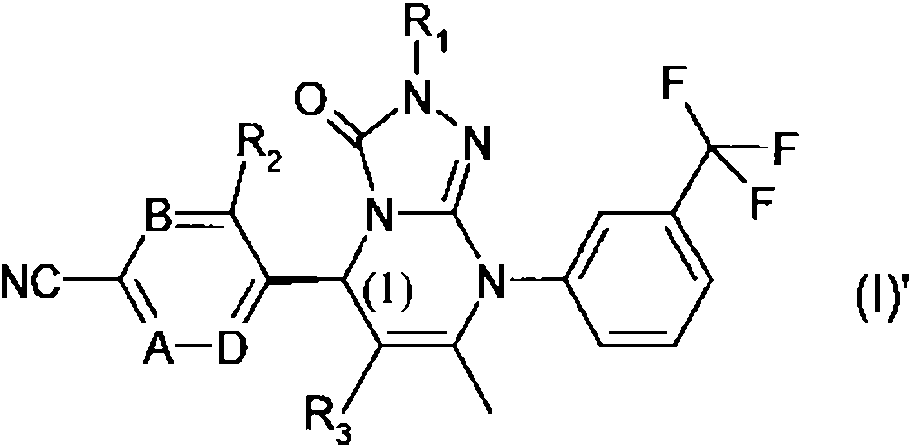
Applications Claiming Priority (3)
| Application Number | Priority Date | Filing Date | Title |
|---|---|---|---|
| EP12197767 | 2012-12-18 | ||
| EP13158757 | 2013-03-12 | ||
| PCT/EP2013/076672 WO2014095700A1 (en) | 2012-12-18 | 2013-12-16 | Novel compounds |
Publications (1)
| Publication Number | Publication Date |
|---|---|
| ES2700226T3 true ES2700226T3 (en) | 2019-02-14 |
Family
ID=50030225
Family Applications (1)
| Application Number | Title | Priority Date | Filing Date |
|---|---|---|---|
| ES13826565T Active ES2700226T3 (en) | 2012-12-18 | 2013-12-16 | Derivatives of 3-oxo-2,3,5,8-tetrahydro- [1,2,4] triazolo [4,3-a] pyrimidine for the treatment of respiratory diseases |
Country Status (32)
| Country | Link |
|---|---|
| US (2) | US9365577B2 (en) |
| EP (1) | EP2935274B1 (en) |
| JP (1) | JP6390919B2 (en) |
| KR (1) | KR102197721B1 (en) |
| CN (1) | CN104870449B (en) |
| AU (1) | AU2013363783B2 (en) |
| BR (1) | BR112015014438B1 (en) |
| CA (1) | CA2895352C (en) |
| CL (1) | CL2015001678A1 (en) |
| CY (1) | CY1122368T1 (en) |
| DK (1) | DK2935274T3 (en) |
| EA (1) | EA028507B1 (en) |
| ES (1) | ES2700226T3 (en) |
| GE (2) | GEAP201813860A (en) |
| HR (1) | HRP20182007T1 (en) |
| IL (1) | IL239447B (en) |
| LT (1) | LT2935274T (en) |
| MX (1) | MX2015007379A (en) |
| NZ (1) | NZ709153A (en) |
| PE (1) | PE20151084A1 (en) |
| PH (1) | PH12015501043B1 (en) |
| PL (1) | PL2935274T3 (en) |
| PT (1) | PT2935274T (en) |
| RS (1) | RS58129B1 (en) |
| SA (1) | SA515360612B1 (en) |
| SG (2) | SG11201504737RA (en) |
| SI (1) | SI2935274T1 (en) |
| TN (1) | TN2015000276A1 (en) |
| TW (1) | TWI675837B (en) |
| UA (1) | UA118021C2 (en) |
| WO (1) | WO2014095700A1 (en) |
| ZA (1) | ZA201504331B (en) |
Families Citing this family (16)
| Publication number | Priority date | Publication date | Assignee | Title |
|---|---|---|---|---|
| EP2592078A1 (en) | 2011-11-11 | 2013-05-15 | Almirall, S.A. | New cyclohexylamine derivatives having beta2 adrenergic agonist and M3 muscarinic antagonist activities |
| TW201517906A (en) | 2013-07-25 | 2015-05-16 | Almirall Sa | Combinations comprising MABA compounds and corticosteroids |
| CN105873933A (en) * | 2013-12-16 | 2016-08-17 | 奇斯药制品公司 | Tetrahydrotriazolopyrimidine derivatives as human neutrophil elastase inhibitors |
| US9487528B2 (en) | 2014-06-09 | 2016-11-08 | Chiesi Farmaceutici S.P.A. | Compounds |
| EP3154977B1 (en) * | 2014-06-12 | 2018-05-02 | Chiesi Farmaceutici S.p.A. | Novel compounds |
| US9657015B2 (en) | 2014-07-31 | 2017-05-23 | Boehringer Ingelheim International Gmbh | Substituted bicyclic dihydropyrimidinones and their use as inhibitors of neutrophil elastase activity |
| US9475779B2 (en) | 2014-07-31 | 2016-10-25 | Boehringer Ingelheim International Gmbh | Substituted bicyclic dihydropyrimidinones and their use as inhibitors of neutrophil elastase activity |
| TW201617343A (en) | 2014-09-26 | 2016-05-16 | 阿爾米雷爾有限公司 | New bicyclic derivatives having [beta]2 adrenergic agonist and M3 muscarinic antagonist activities |
| US9890169B2 (en) | 2015-12-14 | 2018-02-13 | Chiesi Farmaceutici S.P.A. | Triazolinone compounds as HNE inhibitors |
| US9862706B2 (en) | 2016-05-31 | 2018-01-09 | Chiesi Farmaceutici S.P.A. | Compounds |
| AR108608A1 (en) | 2016-05-31 | 2018-09-05 | Chiesi Farm Spa | AHR INHIBITING PIRAZOLIL CARBONIL DERIVATIVES |
| WO2017207430A1 (en) | 2016-05-31 | 2017-12-07 | Chiesi Farmaceutici S.P.A. | Imidazolone compounds as human neutrophil elastase inhibitors |
| KR102778714B1 (en) | 2018-10-30 | 2025-03-10 | 치에시 파마슈티시 에스.피.아. | A device for administering drugs to a patient on mechanical ventilation |
| CA3150240A1 (en) | 2019-09-24 | 2021-04-01 | Tomaso GUIDI | Dry powder formulation for a dry powder inhaler, with a combination of spheronised particles and coarse particles, and a dry powder inhaler comprising the formulation |
| EP4452980A1 (en) | 2021-12-22 | 2024-10-30 | Chiesi Farmaceutici S.p.A. | Triazolone derivative salt as neutrophil elastase inhibitor |
| CN118434739A (en) | 2021-12-22 | 2024-08-02 | 奇斯药制品公司 | Triazolone derivative salts as neutrophil elastase inhibitors |
Family Cites Families (7)
| Publication number | Priority date | Publication date | Assignee | Title |
|---|---|---|---|---|
| AU650953B2 (en) | 1991-03-21 | 1994-07-07 | Novartis Ag | Inhaler |
| CA2250209A1 (en) * | 1996-03-28 | 1997-10-09 | Glaxo Group Limited | Pyrrolopyrrolone derivatives as inhibitors of neutrophil elastase |
| GB0608844D0 (en) * | 2006-05-04 | 2006-06-14 | Argenta Discovery Ltd | Enzyme inhibitors |
| DE102009004197A1 (en) * | 2009-01-09 | 2010-07-15 | Bayer Schering Pharma Aktiengesellschaft | Heterocyclic fused diaryldihydropyrimidine derivatives and their use |
| GB201004179D0 (en) * | 2010-03-12 | 2010-04-28 | Pulmagen Therapeutics Inflamma | Enzyme inhibitors |
| GB201004178D0 (en) * | 2010-03-12 | 2010-04-28 | Pulmagen Therapeutics Inflamma | Enzyme inhibitors |
| CA2848557A1 (en) * | 2011-09-14 | 2013-03-21 | Chiesi Farmaceutici S.P.A. | Tetrahydrotriazolopyrimidine derivatives as human neutrophil elastase inhibitors |
-
2013
- 2013-12-16 EP EP13826565.7A patent/EP2935274B1/en active Active
- 2013-12-16 WO PCT/EP2013/076672 patent/WO2014095700A1/en not_active Ceased
- 2013-12-16 PE PE2015000931A patent/PE20151084A1/en unknown
- 2013-12-16 RS RS20181517A patent/RS58129B1/en unknown
- 2013-12-16 UA UAA201505958A patent/UA118021C2/en unknown
- 2013-12-16 KR KR1020157016352A patent/KR102197721B1/en active Active
- 2013-12-16 SI SI201331244T patent/SI2935274T1/en unknown
- 2013-12-16 ES ES13826565T patent/ES2700226T3/en active Active
- 2013-12-16 BR BR112015014438-1A patent/BR112015014438B1/en active IP Right Grant
- 2013-12-16 EA EA201590962A patent/EA028507B1/en unknown
- 2013-12-16 NZ NZ709153A patent/NZ709153A/en unknown
- 2013-12-16 GE GEAP201813860A patent/GEAP201813860A/en unknown
- 2013-12-16 TW TW102146370A patent/TWI675837B/en active
- 2013-12-16 CA CA2895352A patent/CA2895352C/en active Active
- 2013-12-16 PT PT13826565T patent/PT2935274T/en unknown
- 2013-12-16 SG SG11201504737RA patent/SG11201504737RA/en unknown
- 2013-12-16 MX MX2015007379A patent/MX2015007379A/en active IP Right Grant
- 2013-12-16 DK DK13826565.7T patent/DK2935274T3/en active
- 2013-12-16 AU AU2013363783A patent/AU2013363783B2/en active Active
- 2013-12-16 JP JP2015547060A patent/JP6390919B2/en active Active
- 2013-12-16 SG SG10201703484YA patent/SG10201703484YA/en unknown
- 2013-12-16 LT LTEP13826565.7T patent/LT2935274T/en unknown
- 2013-12-16 CN CN201380065981.1A patent/CN104870449B/en active Active
- 2013-12-16 PL PL13826565T patent/PL2935274T3/en unknown
- 2013-12-16 GE GEAP201313860A patent/GEP20186885B/en unknown
- 2013-12-16 HR HRP20182007TT patent/HRP20182007T1/en unknown
- 2013-12-17 US US14/108,904 patent/US9365577B2/en active Active
-
2015
- 2015-05-11 PH PH12015501043A patent/PH12015501043B1/en unknown
- 2015-06-15 ZA ZA2015/04331A patent/ZA201504331B/en unknown
- 2015-06-16 TN TNP2015000276A patent/TN2015000276A1/en unknown
- 2015-06-16 CL CL2015001678A patent/CL2015001678A1/en unknown
- 2015-06-16 IL IL239447A patent/IL239447B/en active IP Right Grant
- 2015-06-17 SA SA515360612A patent/SA515360612B1/en unknown
-
2016
- 2016-05-10 US US15/150,749 patent/US9828382B2/en active Active
-
2018
- 2018-11-07 CY CY20181101168T patent/CY1122368T1/en unknown
Also Published As
Similar Documents
| Publication | Publication Date | Title |
|---|---|---|
| ES2700226T3 (en) | Derivatives of 3-oxo-2,3,5,8-tetrahydro- [1,2,4] triazolo [4,3-a] pyrimidine for the treatment of respiratory diseases | |
| TWI568735B (en) | Novel compounds | |
| US9573955B2 (en) | Compounds | |
| EP3464273A1 (en) | Imidazolone compounds as human neutrophil elastase inhibitors | |
| EP3464269A1 (en) | Heterocyclic compounds for use in the treatment of a disease in which hne is implicated | |
| ES2670018T3 (en) | New compounds | |
| CA3020435C (en) | Imidazoline compounds as human neutrophil elastase inhibitors | |
| WO2017207432A1 (en) | Novel compounds | |
| HK1212985B (en) | Compounds | |
| HK1232861A1 (en) | Novel compounds |