ES2701855T3 - Process for obtaining 3,14-diacetyloxymorphona from oripavine - Google Patents
Process for obtaining 3,14-diacetyloxymorphona from oripavine Download PDFInfo
- Publication number
- ES2701855T3 ES2701855T3 ES16382245T ES16382245T ES2701855T3 ES 2701855 T3 ES2701855 T3 ES 2701855T3 ES 16382245 T ES16382245 T ES 16382245T ES 16382245 T ES16382245 T ES 16382245T ES 2701855 T3 ES2701855 T3 ES 2701855T3
- Authority
- ES
- Spain
- Prior art keywords
- compound
- mol
- suspension
- solution
- hours
- Prior art date
- Legal status (The legal status is an assumption and is not a legal conclusion. Google has not performed a legal analysis and makes no representation as to the accuracy of the status listed.)
- Active
Links
- ZKLXUUYLEHCAMF-UUWFMWQGSA-N Oripavine Chemical compound C([C@@H](N(CC1)C)C2=CC=C3OC)C4=CC=C(O)C5=C4[C@@]21[C@H]3O5 ZKLXUUYLEHCAMF-UUWFMWQGSA-N 0.000 title claims abstract description 74
- ZKLXUUYLEHCAMF-UHFFFAOYSA-N Oripavine Natural products COC1=CC=C2C(N(CC3)C)CC4=CC=C(O)C5=C4C23C1O5 ZKLXUUYLEHCAMF-UHFFFAOYSA-N 0.000 title claims abstract description 65
- 238000000034 method Methods 0.000 title claims abstract description 45
- 230000008569 process Effects 0.000 title claims abstract description 38
- OPPSZLCGCWIRIA-MBPVOVBZSA-N 3,14-diacetyloxymorphone Chemical compound O([C@H]1C(CC[C@]23OC(C)=O)=O)C4=C5[C@@]12CCN(C)[C@@H]3CC5=CC=C4OC(C)=O OPPSZLCGCWIRIA-MBPVOVBZSA-N 0.000 claims abstract description 59
- 150000001875 compounds Chemical class 0.000 claims abstract description 57
- 238000005984 hydrogenation reaction Methods 0.000 claims abstract description 25
- 238000002360 preparation method Methods 0.000 claims abstract description 25
- 239000012345 acetylating agent Substances 0.000 claims abstract description 12
- 239000003795 chemical substances by application Substances 0.000 claims abstract description 11
- 239000007800 oxidant agent Substances 0.000 claims abstract description 7
- WFDIJRYMOXRFFG-UHFFFAOYSA-N Acetic anhydride Chemical compound CC(=O)OC(C)=O WFDIJRYMOXRFFG-UHFFFAOYSA-N 0.000 claims description 120
- 239000000203 mixture Substances 0.000 claims description 66
- HLMSIZPQBSYUNL-IPOQPSJVSA-N Noroxymorphone Chemical compound O=C([C@@H]1O2)CC[C@@]3(O)[C@H]4CC5=CC=C(O)C2=C5[C@@]13CCN4 HLMSIZPQBSYUNL-IPOQPSJVSA-N 0.000 claims description 59
- QTBSBXVTEAMEQO-UHFFFAOYSA-N Acetic acid Chemical compound CC(O)=O QTBSBXVTEAMEQO-UHFFFAOYSA-N 0.000 claims description 56
- 238000006243 chemical reaction Methods 0.000 claims description 50
- MHAJPDPJQMAIIY-UHFFFAOYSA-N Hydrogen peroxide Chemical compound OO MHAJPDPJQMAIIY-UHFFFAOYSA-N 0.000 claims description 37
- QAOWNCQODCNURD-UHFFFAOYSA-N Sulfuric acid Chemical compound OS(O)(=O)=O QAOWNCQODCNURD-UHFFFAOYSA-N 0.000 claims description 17
- 238000002955 isolation Methods 0.000 claims description 16
- 238000000746 purification Methods 0.000 claims description 12
- UZHSEJADLWPNLE-GRGSLBFTSA-N naloxone Chemical compound O=C([C@@H]1O2)CC[C@@]3(O)[C@H]4CC5=CC=C(O)C2=C5[C@@]13CCN4CC=C UZHSEJADLWPNLE-GRGSLBFTSA-N 0.000 claims description 10
- 229960004127 naloxone Drugs 0.000 claims description 10
- DQCKKXVULJGBQN-XFWGSAIBSA-N naltrexone Chemical compound N1([C@@H]2CC3=CC=C(C=4O[C@@H]5[C@](C3=4)([C@]2(CCC5=O)O)CC1)O)CC1CC1 DQCKKXVULJGBQN-XFWGSAIBSA-N 0.000 claims description 10
- 229960003086 naltrexone Drugs 0.000 claims description 10
- 230000007062 hydrolysis Effects 0.000 claims description 9
- 238000006460 hydrolysis reaction Methods 0.000 claims description 9
- 229960000805 nalbuphine Drugs 0.000 claims description 8
- NETZHAKZCGBWSS-CEDHKZHLSA-N nalbuphine Chemical compound C([C@]12[C@H]3OC=4C(O)=CC=C(C2=4)C[C@@H]2[C@]1(O)CC[C@@H]3O)CN2CC1CCC1 NETZHAKZCGBWSS-CEDHKZHLSA-N 0.000 claims description 8
- 239000003054 catalyst Substances 0.000 claims description 7
- ATDGTVJJHBUTRL-UHFFFAOYSA-N cyanogen bromide Chemical compound BrC#N ATDGTVJJHBUTRL-UHFFFAOYSA-N 0.000 claims description 7
- RIFGWPKJUGCATF-UHFFFAOYSA-N ethyl chloroformate Chemical group CCOC(Cl)=O RIFGWPKJUGCATF-UHFFFAOYSA-N 0.000 claims description 7
- 239000012649 demethylating agent Substances 0.000 claims description 6
- 239000011541 reaction mixture Substances 0.000 claims description 6
- 239000002253 acid Substances 0.000 claims description 5
- FZFAMSAMCHXGEF-UHFFFAOYSA-N chloro formate Chemical compound ClOC=O FZFAMSAMCHXGEF-UHFFFAOYSA-N 0.000 claims description 5
- WJBLNOPPDWQMCH-MBPVOVBZSA-N Nalmefene Chemical compound N1([C@@H]2CC3=CC=C(C=4O[C@@H]5[C@](C3=4)([C@]2(CCC5=C)O)CC1)O)CC1CC1 WJBLNOPPDWQMCH-MBPVOVBZSA-N 0.000 claims description 4
- 229960005297 nalmefene Drugs 0.000 claims description 4
- UFHFLCQGNIYNRP-UHFFFAOYSA-N Hydrogen Chemical compound [H][H] UFHFLCQGNIYNRP-UHFFFAOYSA-N 0.000 claims description 3
- FGUUSXIOTUKUDN-IBGZPJMESA-N C1(=CC=CC=C1)N1C2=C(NC([C@H](C1)NC=1OC(=NN=1)C1=CC=CC=C1)=O)C=CC=C2 Chemical compound C1(=CC=CC=C1)N1C2=C(NC([C@H](C1)NC=1OC(=NN=1)C1=CC=CC=C1)=O)C=CC=C2 FGUUSXIOTUKUDN-IBGZPJMESA-N 0.000 claims description 2
- YXFVVABEGXRONW-UHFFFAOYSA-N Toluene Chemical compound CC1=CC=CC=C1 YXFVVABEGXRONW-UHFFFAOYSA-N 0.000 description 132
- XLYOFNOQVPJJNP-UHFFFAOYSA-N water Substances O XLYOFNOQVPJJNP-UHFFFAOYSA-N 0.000 description 107
- 239000000725 suspension Substances 0.000 description 94
- 229910001868 water Inorganic materials 0.000 description 91
- 239000007787 solid Substances 0.000 description 87
- 239000000243 solution Substances 0.000 description 86
- XEKOWRVHYACXOJ-UHFFFAOYSA-N Ethyl acetate Chemical compound CCOC(C)=O XEKOWRVHYACXOJ-UHFFFAOYSA-N 0.000 description 63
- 238000004128 high performance liquid chromatography Methods 0.000 description 53
- VFNHLTBRAFJQER-ISWURRPUSA-N (4r,4as,7ar,12bs)-4a,9-dihydroxy-3-methyl-2,4,7a,13-tetrahydro-1h-4,12-methanobenzofuro[3,2-e]isoquinoline-7-one Chemical compound O=C([C@@H]1O2)C=C[C@@]3(O)[C@]4([H])N(C)CC[C@]13C1=C2C(O)=CC=C1C4 VFNHLTBRAFJQER-ISWURRPUSA-N 0.000 description 45
- UQCNKQCJZOAFTQ-ISWURRPUSA-N Oxymorphone Chemical compound O([C@H]1C(CC[C@]23O)=O)C4=C5[C@@]12CCN(C)[C@@H]3CC5=CC=C4O UQCNKQCJZOAFTQ-ISWURRPUSA-N 0.000 description 45
- 229960005118 oxymorphone Drugs 0.000 description 45
- WEVYAHXRMPXWCK-UHFFFAOYSA-N Acetonitrile Chemical compound CC#N WEVYAHXRMPXWCK-UHFFFAOYSA-N 0.000 description 42
- 238000003556 assay Methods 0.000 description 31
- 239000000047 product Substances 0.000 description 31
- 239000002904 solvent Substances 0.000 description 30
- VYPSYNLAJGMNEJ-UHFFFAOYSA-N Silicium dioxide Chemical compound O=[Si]=O VYPSYNLAJGMNEJ-UHFFFAOYSA-N 0.000 description 27
- 238000010268 HPLC based assay Methods 0.000 description 25
- 238000006640 acetylation reaction Methods 0.000 description 25
- 230000021736 acetylation Effects 0.000 description 24
- 238000007254 oxidation reaction Methods 0.000 description 24
- BWHMMNNQKKPAPP-UHFFFAOYSA-L potassium carbonate Chemical compound [K+].[K+].[O-]C([O-])=O BWHMMNNQKKPAPP-UHFFFAOYSA-L 0.000 description 24
- 230000003647 oxidation Effects 0.000 description 23
- WYURNTSHIVDZCO-UHFFFAOYSA-N Tetrahydrofuran Chemical compound C1CCOC1 WYURNTSHIVDZCO-UHFFFAOYSA-N 0.000 description 22
- LFQSCWFLJHTTHZ-UHFFFAOYSA-N Ethanol Chemical compound CCO LFQSCWFLJHTTHZ-UHFFFAOYSA-N 0.000 description 21
- QGZKDVFQNNGYKY-UHFFFAOYSA-N Ammonia Chemical compound N QGZKDVFQNNGYKY-UHFFFAOYSA-N 0.000 description 18
- ZMANZCXQSJIPKH-UHFFFAOYSA-N Triethylamine Chemical compound CCN(CC)CC ZMANZCXQSJIPKH-UHFFFAOYSA-N 0.000 description 18
- 238000001035 drying Methods 0.000 description 16
- BDAGIHXWWSANSR-UHFFFAOYSA-N methanoic acid Natural products OC=O BDAGIHXWWSANSR-UHFFFAOYSA-N 0.000 description 16
- BEYOTYCQJXUUHC-OJRLVACOSA-N (4R,4aS,7aR,12bS)-9-acetyl-4a,9-dihydroxy-3-methyl-1,2,4,7a,10,13-hexahydro-4,12-methanobenzofuro[3,2-e]isoquinolin-7-one Chemical compound C(C)(=O)C1(CC=C2C[C@@H]3[C@@]4(C=CC([C@H]5[C@@]4(C2=C1O5)CCN3C)=O)O)O BEYOTYCQJXUUHC-OJRLVACOSA-N 0.000 description 15
- -1 WO99 / 02529 Chemical compound 0.000 description 15
- JWUJQDFVADABEY-UHFFFAOYSA-N 2-methyltetrahydrofuran Chemical compound CC1CCCO1 JWUJQDFVADABEY-UHFFFAOYSA-N 0.000 description 14
- UIIMBOGNXHQVGW-UHFFFAOYSA-M Sodium bicarbonate Chemical compound [Na+].OC([O-])=O UIIMBOGNXHQVGW-UHFFFAOYSA-M 0.000 description 14
- BQJCRHHNABKAKU-KBQPJGBKSA-N morphine Chemical compound O([C@H]1[C@H](C=C[C@H]23)O)C4=C5[C@@]12CCN(C)[C@@H]3CC5=CC=C4O BQJCRHHNABKAKU-KBQPJGBKSA-N 0.000 description 14
- 238000003786 synthesis reaction Methods 0.000 description 14
- 239000003610 charcoal Substances 0.000 description 13
- 230000000052 comparative effect Effects 0.000 description 13
- HEDRZPFGACZZDS-UHFFFAOYSA-N Chloroform Chemical compound ClC(Cl)Cl HEDRZPFGACZZDS-UHFFFAOYSA-N 0.000 description 12
- VEXZGXHMUGYJMC-UHFFFAOYSA-N Hydrochloric acid Chemical compound Cl VEXZGXHMUGYJMC-UHFFFAOYSA-N 0.000 description 12
- 230000015572 biosynthetic process Effects 0.000 description 12
- 229910000027 potassium carbonate Inorganic materials 0.000 description 12
- 238000010992 reflux Methods 0.000 description 12
- 238000001914 filtration Methods 0.000 description 11
- 239000012071 phase Substances 0.000 description 11
- 238000003756 stirring Methods 0.000 description 11
- DMGAPZQHWZFIRE-GRGSLBFTSA-N 3-acetyloxymorphone Chemical compound O([C@H]1C(CC[C@]23O)=O)C4=C5[C@@]12CCN(C)[C@@H]3CC5=CC=C4OC(C)=O DMGAPZQHWZFIRE-GRGSLBFTSA-N 0.000 description 10
- 239000007864 aqueous solution Substances 0.000 description 10
- 235000015320 potassium carbonate Nutrition 0.000 description 10
- 238000001953 recrystallisation Methods 0.000 description 10
- ZAFNJMIOTHYJRJ-UHFFFAOYSA-N Diisopropyl ether Chemical compound CC(C)OC(C)C ZAFNJMIOTHYJRJ-UHFFFAOYSA-N 0.000 description 9
- OKKJLVBELUTLKV-UHFFFAOYSA-N Methanol Chemical compound OC OKKJLVBELUTLKV-UHFFFAOYSA-N 0.000 description 9
- BRUQQQPBMZOVGD-XFKAJCMBSA-N Oxycodone Chemical compound O=C([C@@H]1O2)CC[C@@]3(O)[C@H]4CC5=CC=C(OC)C2=C5[C@@]13CCN4C BRUQQQPBMZOVGD-XFKAJCMBSA-N 0.000 description 9
- 239000000706 filtrate Substances 0.000 description 9
- 229960002085 oxycodone Drugs 0.000 description 9
- 230000009467 reduction Effects 0.000 description 9
- OSWFIVFLDKOXQC-UHFFFAOYSA-N 4-(3-methoxyphenyl)aniline Chemical compound COC1=CC=CC(C=2C=CC(N)=CC=2)=C1 OSWFIVFLDKOXQC-UHFFFAOYSA-N 0.000 description 8
- 229910021529 ammonia Inorganic materials 0.000 description 8
- 238000001704 evaporation Methods 0.000 description 8
- 230000008020 evaporation Effects 0.000 description 8
- 235000019253 formic acid Nutrition 0.000 description 8
- FQXXSQDCDRQNQE-UHFFFAOYSA-N markiertes Thebain Natural products COC1=CC=C2C(N(CC3)C)CC4=CC=C(OC)C5=C4C23C1O5 FQXXSQDCDRQNQE-UHFFFAOYSA-N 0.000 description 8
- FQXXSQDCDRQNQE-VMDGZTHMSA-N thebaine Chemical compound C([C@@H](N(CC1)C)C2=CC=C3OC)C4=CC=C(OC)C5=C4[C@@]21[C@H]3O5 FQXXSQDCDRQNQE-VMDGZTHMSA-N 0.000 description 8
- 229930003945 thebaine Natural products 0.000 description 8
- VHUUQVKOLVNVRT-UHFFFAOYSA-N Ammonium hydroxide Chemical compound [NH4+].[OH-] VHUUQVKOLVNVRT-UHFFFAOYSA-N 0.000 description 7
- 235000011114 ammonium hydroxide Nutrition 0.000 description 7
- 238000010520 demethylation reaction Methods 0.000 description 7
- 229960005181 morphine Drugs 0.000 description 7
- 235000017557 sodium bicarbonate Nutrition 0.000 description 7
- 229910000030 sodium bicarbonate Inorganic materials 0.000 description 7
- WRRSFOZOETZUPG-FFHNEAJVSA-N (4r,4ar,7s,7ar,12bs)-9-methoxy-3-methyl-2,4,4a,7,7a,13-hexahydro-1h-4,12-methanobenzofuro[3,2-e]isoquinoline-7-ol;hydrate Chemical compound O.C([C@H]1[C@H](N(CC[C@@]112)C)C3)=C[C@H](O)[C@@H]1OC1=C2C3=CC=C1OC WRRSFOZOETZUPG-FFHNEAJVSA-N 0.000 description 6
- SCYULBFZEHDVBN-UHFFFAOYSA-N 1,1-Dichloroethane Chemical compound CC(Cl)Cl SCYULBFZEHDVBN-UHFFFAOYSA-N 0.000 description 6
- KXDHJXZQYSOELW-UHFFFAOYSA-M Carbamate Chemical compound NC([O-])=O KXDHJXZQYSOELW-UHFFFAOYSA-M 0.000 description 6
- YMWUJEATGCHHMB-UHFFFAOYSA-N Dichloromethane Chemical compound ClCCl YMWUJEATGCHHMB-UHFFFAOYSA-N 0.000 description 6
- KFZMGEQAYNKOFK-UHFFFAOYSA-N Isopropanol Chemical compound CC(C)O KFZMGEQAYNKOFK-UHFFFAOYSA-N 0.000 description 6
- HEMHJVSKTPXQMS-UHFFFAOYSA-M Sodium hydroxide Chemical compound [OH-].[Na+] HEMHJVSKTPXQMS-UHFFFAOYSA-M 0.000 description 6
- 229960004126 codeine Drugs 0.000 description 6
- OROGSEYTTFOCAN-DNJOTXNNSA-N codeine Natural products C([C@H]1[C@H](N(CC[C@@]112)C)C3)=C[C@H](O)[C@@H]1OC1=C2C3=CC=C1OC OROGSEYTTFOCAN-DNJOTXNNSA-N 0.000 description 6
- OROGSEYTTFOCAN-UHFFFAOYSA-N hydrocodone Natural products C1C(N(CCC234)C)C2C=CC(O)C3OC2=C4C1=CC=C2OC OROGSEYTTFOCAN-UHFFFAOYSA-N 0.000 description 6
- 150000002576 ketones Chemical class 0.000 description 6
- 239000012085 test solution Substances 0.000 description 6
- 240000001090 Papaver somniferum Species 0.000 description 5
- 229930013930 alkaloid Natural products 0.000 description 5
- 239000008346 aqueous phase Substances 0.000 description 5
- 230000000694 effects Effects 0.000 description 5
- 239000000839 emulsion Substances 0.000 description 5
- 239000000284 extract Substances 0.000 description 5
- 239000012535 impurity Substances 0.000 description 5
- 239000000543 intermediate Substances 0.000 description 5
- 239000012074 organic phase Substances 0.000 description 5
- 150000003839 salts Chemical class 0.000 description 5
- 238000012360 testing method Methods 0.000 description 5
- VFNHLTBRAFJQER-OSMBCOQSSA-N (4s,4as,7ar,12bs)-4a,9-dihydroxy-3-methyl-2,4,7a,13-tetrahydro-1h-4,12-methanobenzofuro[3,2-e]isoquinoline-7-one Chemical compound O([C@H]1C(C=C[C@]23O)=O)C4=C5[C@@]12CCN(C)[C@H]3CC5=CC=C4O VFNHLTBRAFJQER-OSMBCOQSSA-N 0.000 description 4
- NLXLAEXVIDQMFP-UHFFFAOYSA-N Ammonium chloride Substances [NH4+].[Cl-] NLXLAEXVIDQMFP-UHFFFAOYSA-N 0.000 description 4
- RTZKZFJDLAIYFH-UHFFFAOYSA-N Diethyl ether Chemical compound CCOCC RTZKZFJDLAIYFH-UHFFFAOYSA-N 0.000 description 4
- CDBYLPFSWZWCQE-UHFFFAOYSA-L Sodium Carbonate Chemical compound [Na+].[Na+].[O-]C([O-])=O CDBYLPFSWZWCQE-UHFFFAOYSA-L 0.000 description 4
- QAOWNCQODCNURD-UHFFFAOYSA-L Sulfate Chemical compound [O-]S([O-])(=O)=O QAOWNCQODCNURD-UHFFFAOYSA-L 0.000 description 4
- ZLTGXHQIFKJWTE-OEUJKCCCSA-N [(4R,4aR,7aR,12bS)-9-hydroxy-3-methyl-7-oxo-2,4,4a,7a,10,13-hexahydro-1H-4,12-methanobenzofuro[3,2-e]isoquinolin-9-yl] acetate Chemical compound C(C)(=O)OC1(CC=C2C[C@@H]3[C@@H]4C=CC([C@H]5[C@@]4(C2=C1O5)CCN3C)=O)O ZLTGXHQIFKJWTE-OEUJKCCCSA-N 0.000 description 4
- OGJUNGZPMDHPEI-NJKFGOSDSA-N [(4R,4aS,7aR,12bS)-4a-acetyloxy-9-hydroxy-3-methyl-7-oxo-1,2,4,7a,10,13-hexahydro-4,12-methanobenzofuro[3,2-e]isoquinolin-9-yl] acetate Chemical compound C(C)(=O)OC1(CC=C2C[C@@H]3[C@@]4(C=CC([C@H]5[C@@]4(C2=C1O5)CCN3C)=O)OC(C)=O)O OGJUNGZPMDHPEI-NJKFGOSDSA-N 0.000 description 4
- ILAHWRKJUDSMFH-UHFFFAOYSA-N boron tribromide Chemical compound BrB(Br)Br ILAHWRKJUDSMFH-UHFFFAOYSA-N 0.000 description 4
- 239000006227 byproduct Substances 0.000 description 4
- 238000004364 calculation method Methods 0.000 description 4
- 238000009903 catalytic hydrogenation reaction Methods 0.000 description 4
- MVPPADPHJFYWMZ-UHFFFAOYSA-N chlorobenzene Chemical compound ClC1=CC=CC=C1 MVPPADPHJFYWMZ-UHFFFAOYSA-N 0.000 description 4
- 239000000539 dimer Substances 0.000 description 4
- 239000003814 drug Substances 0.000 description 4
- 238000002347 injection Methods 0.000 description 4
- 239000007924 injection Substances 0.000 description 4
- CSCPPACGZOOCGX-UHFFFAOYSA-N Acetone Chemical compound CC(C)=O CSCPPACGZOOCGX-UHFFFAOYSA-N 0.000 description 3
- IAZDPXIOMUYVGZ-UHFFFAOYSA-N Dimethylsulphoxide Chemical compound CS(C)=O IAZDPXIOMUYVGZ-UHFFFAOYSA-N 0.000 description 3
- NBIIXXVUZAFLBC-UHFFFAOYSA-N Phosphoric acid Chemical compound OP(O)(O)=O NBIIXXVUZAFLBC-UHFFFAOYSA-N 0.000 description 3
- 150000003797 alkaloid derivatives Chemical class 0.000 description 3
- 230000000202 analgesic effect Effects 0.000 description 3
- 238000013459 approach Methods 0.000 description 3
- 238000002425 crystallisation Methods 0.000 description 3
- 230000008025 crystallization Effects 0.000 description 3
- 230000017858 demethylation Effects 0.000 description 3
- 238000001514 detection method Methods 0.000 description 3
- 238000004090 dissolution Methods 0.000 description 3
- 239000006260 foam Substances 0.000 description 3
- 230000014759 maintenance of location Effects 0.000 description 3
- 238000004519 manufacturing process Methods 0.000 description 3
- 239000002243 precursor Substances 0.000 description 3
- 229920006395 saturated elastomer Polymers 0.000 description 3
- 239000007858 starting material Substances 0.000 description 3
- 231100000331 toxic Toxicity 0.000 description 3
- 230000002588 toxic effect Effects 0.000 description 3
- LJCZNYWLQZZIOS-UHFFFAOYSA-N 2,2,2-trichlorethoxycarbonyl chloride Chemical compound ClC(=O)OCC(Cl)(Cl)Cl LJCZNYWLQZZIOS-UHFFFAOYSA-N 0.000 description 2
- USFZMSVCRYTOJT-UHFFFAOYSA-N Ammonium acetate Chemical compound N.CC(O)=O USFZMSVCRYTOJT-UHFFFAOYSA-N 0.000 description 2
- 239000005695 Ammonium acetate Substances 0.000 description 2
- 229910015845 BBr3 Inorganic materials 0.000 description 2
- AFVFQIVMOAPDHO-UHFFFAOYSA-N Methanesulfonic acid Chemical compound CS(O)(=O)=O AFVFQIVMOAPDHO-UHFFFAOYSA-N 0.000 description 2
- 150000001204 N-oxides Chemical class 0.000 description 2
- KFSLWBXXFJQRDL-UHFFFAOYSA-N Peracetic acid Chemical compound CC(=O)OO KFSLWBXXFJQRDL-UHFFFAOYSA-N 0.000 description 2
- FAPWRFPIFSIZLT-UHFFFAOYSA-M Sodium chloride Chemical compound [Na+].[Cl-] FAPWRFPIFSIZLT-UHFFFAOYSA-M 0.000 description 2
- 238000005903 acid hydrolysis reaction Methods 0.000 description 2
- 230000002378 acidificating effect Effects 0.000 description 2
- 235000019257 ammonium acetate Nutrition 0.000 description 2
- 229940043376 ammonium acetate Drugs 0.000 description 2
- 239000000908 ammonium hydroxide Substances 0.000 description 2
- UORVGPXVDQYIDP-UHFFFAOYSA-N borane Chemical compound B UORVGPXVDQYIDP-UHFFFAOYSA-N 0.000 description 2
- 239000003153 chemical reaction reagent Substances 0.000 description 2
- AOGYCOYQMAVAFD-UHFFFAOYSA-N chlorocarbonic acid Chemical class OC(Cl)=O AOGYCOYQMAVAFD-UHFFFAOYSA-N 0.000 description 2
- 238000010549 co-Evaporation Methods 0.000 description 2
- 238000006900 dealkylation reaction Methods 0.000 description 2
- 239000008367 deionised water Substances 0.000 description 2
- 229910021641 deionized water Inorganic materials 0.000 description 2
- NFDFQCUYFHCNBW-SCGPFSFSSA-N dienestrol Chemical compound C=1C=C(O)C=CC=1\C(=C/C)\C(=C\C)\C1=CC=C(O)C=C1 NFDFQCUYFHCNBW-SCGPFSFSSA-N 0.000 description 2
- ASLNLSYDVOWAFS-UHFFFAOYSA-N diethylazanium;dihydrogen phosphate Chemical compound CCNCC.OP(O)(O)=O ASLNLSYDVOWAFS-UHFFFAOYSA-N 0.000 description 2
- 229940079593 drug Drugs 0.000 description 2
- PQLFROTZSIMBKR-UHFFFAOYSA-N ethenyl carbonochloridate Chemical compound ClC(=O)OC=C PQLFROTZSIMBKR-UHFFFAOYSA-N 0.000 description 2
- 229910052739 hydrogen Inorganic materials 0.000 description 2
- 239000001257 hydrogen Substances 0.000 description 2
- 230000006872 improvement Effects 0.000 description 2
- 229910052751 metal Inorganic materials 0.000 description 2
- 239000002184 metal Substances 0.000 description 2
- 229940127240 opiate Drugs 0.000 description 2
- 150000004967 organic peroxy acids Chemical class 0.000 description 2
- 235000006502 papoula Nutrition 0.000 description 2
- 235000011007 phosphoric acid Nutrition 0.000 description 2
- 235000015497 potassium bicarbonate Nutrition 0.000 description 2
- 229910000028 potassium bicarbonate Inorganic materials 0.000 description 2
- 239000011736 potassium bicarbonate Substances 0.000 description 2
- 235000011181 potassium carbonates Nutrition 0.000 description 2
- TYJJADVDDVDEDZ-UHFFFAOYSA-M potassium hydrogencarbonate Chemical compound [K+].OC([O-])=O TYJJADVDDVDEDZ-UHFFFAOYSA-M 0.000 description 2
- 229940086066 potassium hydrogencarbonate Drugs 0.000 description 2
- 238000012545 processing Methods 0.000 description 2
- 230000002035 prolonged effect Effects 0.000 description 2
- AOJFQRQNPXYVLM-UHFFFAOYSA-N pyridin-1-ium;chloride Chemical compound [Cl-].C1=CC=[NH+]C=C1 AOJFQRQNPXYVLM-UHFFFAOYSA-N 0.000 description 2
- 235000017550 sodium carbonate Nutrition 0.000 description 2
- 229910000029 sodium carbonate Inorganic materials 0.000 description 2
- HLBBKKJFGFRGMU-UHFFFAOYSA-M sodium formate Chemical compound [Na+].[O-]C=O HLBBKKJFGFRGMU-UHFFFAOYSA-M 0.000 description 2
- 239000012086 standard solution Substances 0.000 description 2
- 150000003467 sulfuric acid derivatives Chemical class 0.000 description 2
- YLQBMQCUIZJEEH-UHFFFAOYSA-N tetrahydrofuran Natural products C=1C=COC=1 YLQBMQCUIZJEEH-UHFFFAOYSA-N 0.000 description 2
- 238000012546 transfer Methods 0.000 description 2
- CXDMJGWJKDQNKM-ALULZMFBSA-N (4r,4as,7ar,12bs)-4a,9-dihydroxy-3-methyl-3-oxido-2,4,7a,13-tetrahydro-1h-4,12-methanobenzofuro[3,2-e]isoquinoline-3-ium-7-one Chemical compound O([C@H]1C(C=C[C@]23O)=O)C4=C5[C@@]12CC[N+](C)([O-])[C@@H]3CC5=CC=C4O CXDMJGWJKDQNKM-ALULZMFBSA-N 0.000 description 1
- YYCRAERBSFHMPL-XFKAJCMBSA-N (4r,4as,7ar,12bs)-4a-hydroxy-9-methoxy-3-methyl-2,4,7a,13-tetrahydro-1h-4,12-methanobenzofuro[3,2-e]isoquinoline-7-one Chemical compound O=C([C@@H]1O2)C=C[C@@]3(O)[C@]4([H])N(C)CC[C@]13C1=C2C(OC)=CC=C1C4 YYCRAERBSFHMPL-XFKAJCMBSA-N 0.000 description 1
- WSLDOOZREJYCGB-UHFFFAOYSA-N 1,2-Dichloroethane Chemical compound ClCCCl WSLDOOZREJYCGB-UHFFFAOYSA-N 0.000 description 1
- LNRUJSUKKBJFOM-UHFFFAOYSA-N 1-methoxycyclohexa-1,3-diene Chemical group COC1=CC=CCC1 LNRUJSUKKBJFOM-UHFFFAOYSA-N 0.000 description 1
- YYCRAERBSFHMPL-UHFFFAOYSA-N 14beta-Hydroxycodeinone Natural products O1C2C(=O)C=CC3(O)C4CC5=CC=C(OC)C1=C5C23CCN4C YYCRAERBSFHMPL-UHFFFAOYSA-N 0.000 description 1
- JQPFYXFVUKHERX-UHFFFAOYSA-N 2-hydroxycyclohex-2-en-1-one Chemical compound OC1=CCCCC1=O JQPFYXFVUKHERX-UHFFFAOYSA-N 0.000 description 1
- LJGHYPLBDBRCRZ-UHFFFAOYSA-N 3-(3-aminophenyl)sulfonylaniline Chemical compound NC1=CC=CC(S(=O)(=O)C=2C=C(N)C=CC=2)=C1 LJGHYPLBDBRCRZ-UHFFFAOYSA-N 0.000 description 1
- NHQDETIJWKXCTC-UHFFFAOYSA-N 3-chloroperbenzoic acid Chemical compound OOC(=O)C1=CC=CC(Cl)=C1 NHQDETIJWKXCTC-UHFFFAOYSA-N 0.000 description 1
- AMFCFGFZMSQOIU-UHFFFAOYSA-N 4-hydroxycyclohex-2-en-1-one Chemical group OC1CCC(=O)C=C1 AMFCFGFZMSQOIU-UHFFFAOYSA-N 0.000 description 1
- BXBJZYXQHHPVGO-UHFFFAOYSA-N 4-hydroxycyclohexan-1-one Chemical group OC1CCC(=O)CC1 BXBJZYXQHHPVGO-UHFFFAOYSA-N 0.000 description 1
- OKTJSMMVPCPJKN-UHFFFAOYSA-N Carbon Chemical compound [C] OKTJSMMVPCPJKN-UHFFFAOYSA-N 0.000 description 1
- 206010010774 Constipation Diseases 0.000 description 1
- 239000004470 DL Methionine Substances 0.000 description 1
- LCGLNKUTAGEVQW-UHFFFAOYSA-N Dimethyl ether Chemical compound COC LCGLNKUTAGEVQW-UHFFFAOYSA-N 0.000 description 1
- 235000004694 Eucalyptus leucoxylon Nutrition 0.000 description 1
- 244000166102 Eucalyptus leucoxylon Species 0.000 description 1
- SECXISVLQFMRJM-UHFFFAOYSA-N N-Methylpyrrolidone Chemical compound CN1CCCC1=O SECXISVLQFMRJM-UHFFFAOYSA-N 0.000 description 1
- UIQMVEYFGZJHCZ-SSTWWWIQSA-N Nalorphine Chemical compound C([C@@H](N(CC1)CC=C)[C@@H]2C=C[C@@H]3O)C4=CC=C(O)C5=C4[C@@]21[C@H]3O5 UIQMVEYFGZJHCZ-SSTWWWIQSA-N 0.000 description 1
- 235000008753 Papaver somniferum Nutrition 0.000 description 1
- 241000218180 Papaveraceae Species 0.000 description 1
- 241000220010 Rhode Species 0.000 description 1
- 239000004280 Sodium formate Substances 0.000 description 1
- 206010046555 Urinary retention Diseases 0.000 description 1
- 125000000218 acetic acid group Chemical group C(C)(=O)* 0.000 description 1
- FXXACINHVKSMDR-UHFFFAOYSA-N acetyl bromide Chemical compound CC(Br)=O FXXACINHVKSMDR-UHFFFAOYSA-N 0.000 description 1
- WETWJCDKMRHUPV-UHFFFAOYSA-N acetyl chloride Chemical compound CC(Cl)=O WETWJCDKMRHUPV-UHFFFAOYSA-N 0.000 description 1
- 239000012346 acetyl chloride Substances 0.000 description 1
- 230000009471 action Effects 0.000 description 1
- 239000008186 active pharmaceutical agent Substances 0.000 description 1
- 230000010933 acylation Effects 0.000 description 1
- 238000005917 acylation reaction Methods 0.000 description 1
- 230000029936 alkylation Effects 0.000 description 1
- 238000005804 alkylation reaction Methods 0.000 description 1
- BHELZAPQIKSEDF-UHFFFAOYSA-N allyl bromide Chemical compound BrCC=C BHELZAPQIKSEDF-UHFFFAOYSA-N 0.000 description 1
- 238000005937 allylation reaction Methods 0.000 description 1
- 229910000147 aluminium phosphate Inorganic materials 0.000 description 1
- 230000036592 analgesia Effects 0.000 description 1
- 238000004458 analytical method Methods 0.000 description 1
- 230000000954 anitussive effect Effects 0.000 description 1
- 239000003434 antitussive agent Substances 0.000 description 1
- 229940124584 antitussives Drugs 0.000 description 1
- 239000012298 atmosphere Substances 0.000 description 1
- 238000009835 boiling Methods 0.000 description 1
- 229910000085 borane Inorganic materials 0.000 description 1
- AEILLAXRDHDKDY-UHFFFAOYSA-N bromomethylcyclopropane Chemical compound BrCC1CC1 AEILLAXRDHDKDY-UHFFFAOYSA-N 0.000 description 1
- 239000000872 buffer Substances 0.000 description 1
- 229910052799 carbon Inorganic materials 0.000 description 1
- 125000002915 carbonyl group Chemical group [*:2]C([*:1])=O 0.000 description 1
- JFWMYCVMQSLLOO-UHFFFAOYSA-N cyclobutanecarbonyl chloride Chemical compound ClC(=O)C1CCC1 JFWMYCVMQSLLOO-UHFFFAOYSA-N 0.000 description 1
- HPNMFZURTQLUMO-UHFFFAOYSA-N diethylamine Chemical compound CCNCC HPNMFZURTQLUMO-UHFFFAOYSA-N 0.000 description 1
- 238000002474 experimental method Methods 0.000 description 1
- 231100000025 genetic toxicology Toxicity 0.000 description 1
- 230000001738 genotoxic effect Effects 0.000 description 1
- 230000002650 habitual effect Effects 0.000 description 1
- 230000036571 hydration Effects 0.000 description 1
- 238000006703 hydration reaction Methods 0.000 description 1
- 150000002431 hydrogen Chemical class 0.000 description 1
- 125000002887 hydroxy group Chemical group [H]O* 0.000 description 1
- 239000013067 intermediate product Substances 0.000 description 1
- 239000000463 material Substances 0.000 description 1
- LULAYUGMBFYYEX-UHFFFAOYSA-N metachloroperbenzoic acid Natural products OC(=O)C1=CC=CC(Cl)=C1 LULAYUGMBFYYEX-UHFFFAOYSA-N 0.000 description 1
- 239000003863 metallic catalyst Substances 0.000 description 1
- 229940098779 methanesulfonic acid Drugs 0.000 description 1
- FFEARJCKVFRZRR-UHFFFAOYSA-N methionine Chemical compound CSCCC(N)C(O)=O FFEARJCKVFRZRR-UHFFFAOYSA-N 0.000 description 1
- 229930182817 methionine Natural products 0.000 description 1
- 235000006109 methionine Nutrition 0.000 description 1
- INAXVFBXDYWQFN-XHSDSOJGSA-N morphinan Chemical class C1C2=CC=CC=C2[C@]23CCCC[C@H]3[C@@H]1NCC2 INAXVFBXDYWQFN-XHSDSOJGSA-N 0.000 description 1
- 239000012452 mother liquor Substances 0.000 description 1
- KWBIXTIBYFUAGV-UHFFFAOYSA-M n-ethylcarbamate Chemical compound CCNC([O-])=O KWBIXTIBYFUAGV-UHFFFAOYSA-M 0.000 description 1
- XGZZHZMWIXFATA-UEZBDDGYSA-N nalfurafine Chemical compound C([C@]12[C@H]3OC=4C(O)=CC=C(C2=4)C[C@@H]2[C@]1(O)CC[C@H]3N(C)C(=O)\C=C\C1=COC=C1)CN2CC1CC1 XGZZHZMWIXFATA-UEZBDDGYSA-N 0.000 description 1
- 229960000441 nalfurafine Drugs 0.000 description 1
- 229960000938 nalorphine Drugs 0.000 description 1
- 239000003887 narcotic antagonist Substances 0.000 description 1
- 238000006386 neutralization reaction Methods 0.000 description 1
- 229910052759 nickel Inorganic materials 0.000 description 1
- 229940051807 opiod analgesics morphinan derivative Drugs 0.000 description 1
- 229940005483 opioid analgesics Drugs 0.000 description 1
- 230000036407 pain Effects 0.000 description 1
- 229910052763 palladium Inorganic materials 0.000 description 1
- RGSFGYAAUTVSQA-UHFFFAOYSA-N pentamethylene Natural products C1CCCC1 RGSFGYAAUTVSQA-UHFFFAOYSA-N 0.000 description 1
- 150000004965 peroxy acids Chemical class 0.000 description 1
- 239000008363 phosphate buffer Substances 0.000 description 1
- 229910052697 platinum Inorganic materials 0.000 description 1
- 229910052700 potassium Inorganic materials 0.000 description 1
- 230000035484 reaction time Effects 0.000 description 1
- 238000011084 recovery Methods 0.000 description 1
- 230000001105 regulatory effect Effects 0.000 description 1
- QEVHRUUCFGRFIF-MDEJGZGSSA-N reserpine Chemical compound O([C@H]1[C@@H]([C@H]([C@H]2C[C@@H]3C4=C(C5=CC=C(OC)C=C5N4)CCN3C[C@H]2C1)C(=O)OC)OC)C(=O)C1=CC(OC)=C(OC)C(OC)=C1 QEVHRUUCFGRFIF-MDEJGZGSSA-N 0.000 description 1
- 230000029058 respiratory gaseous exchange Effects 0.000 description 1
- 229910052708 sodium Inorganic materials 0.000 description 1
- 239000011734 sodium Substances 0.000 description 1
- 239000011780 sodium chloride Substances 0.000 description 1
- 235000019254 sodium formate Nutrition 0.000 description 1
- HRQDCDQDOPSGBR-UHFFFAOYSA-M sodium;octane-1-sulfonate Chemical compound [Na+].CCCCCCCCS([O-])(=O)=O HRQDCDQDOPSGBR-UHFFFAOYSA-M 0.000 description 1
- 235000011149 sulphuric acid Nutrition 0.000 description 1
- 230000009466 transformation Effects 0.000 description 1
- 238000000844 transformation Methods 0.000 description 1
- 235000013311 vegetables Nutrition 0.000 description 1
- 125000000391 vinyl group Chemical group [H]C([*])=C([H])[H] 0.000 description 1
- 229920002554 vinyl polymer Polymers 0.000 description 1
Classifications
-
- C—CHEMISTRY; METALLURGY
- C07—ORGANIC CHEMISTRY
- C07D—HETEROCYCLIC COMPOUNDS
- C07D489/00—Heterocyclic compounds containing 4aH-8, 9 c- Iminoethano-phenanthro [4, 5-b, c, d] furan ring systems, e.g. derivatives of [4, 5-epoxy]-morphinan of the formula:
- C07D489/06—Heterocyclic compounds containing 4aH-8, 9 c- Iminoethano-phenanthro [4, 5-b, c, d] furan ring systems, e.g. derivatives of [4, 5-epoxy]-morphinan of the formula: with a hetero atom directly attached in position 14
- C07D489/08—Oxygen atom
Landscapes
- Chemical & Material Sciences (AREA)
- Organic Chemistry (AREA)
- Pharmaceuticals Containing Other Organic And Inorganic Compounds (AREA)
Abstract
Un proceso para la preparación de 3,14-diacetiloximorfona (I) que comprende las etapas de: a) hacer reaccionar oripavina (II) con un agente de acetilación para producir el compuesto (III), **(Ver fórmula)** b) hacer reaccionar el compuesto (III) con un agente oxidante para producir el compuesto (IV), **(Ver fórmula)** c) hacer reaccionar el compuesto (IV) con un agente de hidrogenación para producir el compuesto (V), **(Ver fórmula)** d) hacer reaccionar el compuesto (V) con un agente de acetilación para producir 3,14-diacetiloximorfona (I).A process for the preparation of 3,14-diacetyloxymorphone (I) comprising the steps of: a) reacting oripavine (II) with an acetylating agent to produce the compound (III), ) reacting the compound (III) with an oxidizing agent to produce the compound (IV), (c) reacting the compound (IV) with a hydrogenation agent to produce the compound (V), ** (d) reacting the compound (V) with an acetylating agent to produce 3,14-diacetyloxymorphone (I).
Description
DESCRIPCIÓNDESCRIPTION
Proceso para la obtención de 3,14-diacetiloximorfona a partir de oripavinaProcess for obtaining 3,14-diacetyloxymorphona from oripavine
Campo de la invenciónField of the invention
La presente invención se refiere a un nuevo proceso para la obtención de 3,14-diacetiloximorfona a partir de oripavina.The present invention relates to a new process for the preparation of 3,14-diacetyloxymorphona from oripavine.
Antecedentes de la invenciónBACKGROUND OF THE INVENTION
Los alcaloides opiáceos, obtenidos a partir de las plantas de la adormidera de la familia Papaveraceae, incluyen algunos de los fármacos con mayor potencia de acción y utilidad clínica para inducir analgesia y además son agentes útiles para inducir el sueño en presencia de dolor y como agentes antitusivos. Algunos opiáceos de origen natural a modo de ejemplo incluyen morfina, codeína, tebaína y oripavina.The opioid alkaloids, obtained from poppy plants of the Papaveraceae family , include some of the drugs with greater potency of action and clinical utility to induce analgesia and are also useful agents to induce sleep in the presence of pain and as agents antitussives. Some opiates of natural origin by way of example include morphine, codeine, thebaine and oripavine.

A pesar de sus valiosas propiedades clínicas, la morfina tiene un gran número de efectos negativos dado que deprime la respiración, y causa estreñimiento y retención urinaria. Lo más importante, si se administra durante un periodo prolongado de tiempo, los pacientes desarrollan tolerancia al efecto analgésico, de modo que se debe aumentar la dosis, y se puede desarrollar dependencia a la morfina y los compuestos relacionados.Despite its valuable clinical properties, morphine has a large number of negative effects as it depresses respiration, and causes constipation and urinary retention. Most importantly, if administered over a prolonged period of time, patients develop tolerance to the analgesic effect, so that the dose should be increased, and dependence on morphine and related compounds can develop.
Por estas razones, se han dirigido esfuerzos exhaustivos hacia la semisíntesis de moléculas de tipo morfina con propiedades analgésicas pero con menores efectos secundarios adictivos indeseables, tales como la nalorfina, que conserva las propiedades analgésicas pero también actúa como antagonista narcótico para invertir muchos de los efectos secundarios indeseados de la morfina. Algunos de ellos incluyen 14-hidroxiderivados tales como los fármacos usados clínicamente naloxona, naltrexona y nalbufina. La noroximorfona, un alcaloide semisintético, es el compuesto intermedio común para la síntesis de naloxona, naltrexona, nalmefeno, nalbufina y nalfurafina.For these reasons, exhaustive efforts have been directed towards the semi-synthesis of morphine-like molecules with analgesic properties but with less undesirable addictive side effects, such as nalorphine, which retains the analgesic properties but also acts as a narcotic antagonist to reverse many of the effects unwanted side effects of morphine. Some of them include 14-hydroxiderivatives such as the clinically used drugs naloxone, naltrexone and nalbuphine. Noroxymorphone, a semi-synthetic alkaloid, is the common intermediate compound for the synthesis of naloxone, naltrexone, nalmefene, nalbuphine and nalfurafine.

La fabricación de noroximorfona a partir de 3,14-diacetiloximorfona es un método descrito en la técnica que se muestra en el siguiente esquema: The manufacture of noroxymorphone from 3,14-diacetyloxymorphone is a method described in the art that is shown in the following scheme:
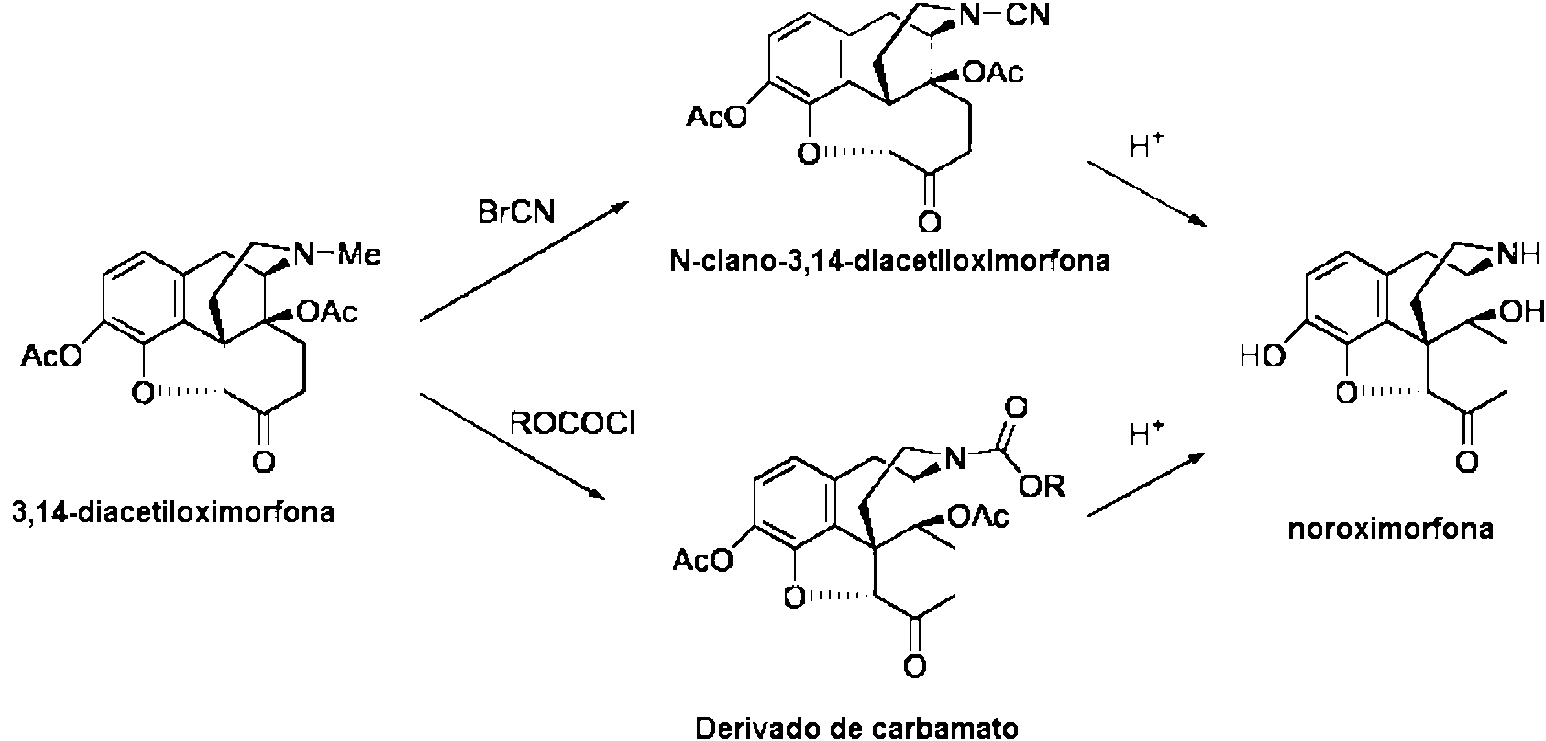
La W-desalquilación se lleva a cabo por lo general con bromuro de cianógeno en cloroformo (por ejemplo, documento de Patente US3254088, Norton et al. J. Med. Chem. 1973, 16, 556), o con cloroformiatos, tales como cloroformiato de vinilo (por ejemplo, documento de Patente US4141897, Olofson et al., Tetrahedron Lett. 1977, 1567-1570), cloroformiato de tricloroetilo (por ejemplo, documento de Patente GB2000137B) o cloroformiato de etilo (por ejemplo, documentos de Patente WO2006/084412, WO2009/078989 Mallinckrodt o WO2009/122436 Sun Pharmaceuticals). Finalmente, la hidrólisis ácida proporciona la noroximorfona.W-dealkylation is generally carried out with cyanogen bromide in chloroform (for example, patent document US3254088, Norton et al., J. Med. Chem. 1973, 16, 556), or with chloroformates, such as chloroformate. of vinyl (for example, patent document US4141897, Olofson et al., Tetrahedron Lett., 1977, 1567-1570), trichloroethyl chloroformate (for example, GB2000137B patent document) or ethyl chloroformate (for example, WO2006 patent documents) / 084412, WO2009 / 078989 Mallinckrodt or WO2009 / 122436 Sun Pharmaceuticals). Finally, acid hydrolysis provides noroxymorphone.
Se han desvelado varios procesos en la bibliografía para la síntesis de 3,14-diacetiloximorfona. La mayoría de ellos se resuelven con el uso de oxicodona y/u oximorfona como compuestos intermedios clave.Several processes have been disclosed in the literature for the synthesis of 3,14-diacetyloxymorphone. Most of them are solved with the use of oxycodone and / or oxymorphone as key intermediates.

En conjunto, la preparación industrial de 3,14-diacetiloximorfona a través de oxicodona implica varias etapas a partir de alcaloides de origen natural tales como tebaína o codeína y se ve dificultada por varios problemas. Taken together, the industrial preparation of 3,14-diacetyloxymorphone through oxycodone involves several steps starting from alkaloids of natural origin such as thebaine or codeine and is hampered by several problems.
Las síntesis en dos etapas de oxicodona a partir de tebaína (por ejemplo, documentos de Patente EP2121698B1, EP2137190B1, EP2377866B1, Kranig et al. Arch. Pharm. Pharm. Med. Chem. 1996, 329, 325-326) se ha visto dificultada por el hecho de que históricamente la tebaína era un alcaloide minoritario descubierto en la planta de la adormidera, Papaver Somniferum y el rendimiento medio global (61-78 %).The two-step synthesis of oxycodone from thebaine (for example, patent documents EP2121698B1, EP2137190B1, EP2377866B1, Kranig et al., Arch. Pharm.Pharm.Med. Chem. 1996, 329, 325-326) has been hindered due to the fact that historically thebaine was a minority alkaloid discovered in the opium poppy plant, Papaver Somniferum and the overall average yield (61-78%).
Debido a la baja disponibilidad de la tebaína en ese momento, se intentaron otros enfoques para la 3,14-diacetiloximorfona partiendo de materiales tales como morfina (por ejemplo, documento de Patente WO99/02529, Penick) y codeína (por ejemplo, documento de Patente WO99/02529, Penick; Schwartz et al., J. Med. Chem. 1981, 24, 1525). Aunque la morfina y la codeína se encuentran en mayor abundancia natural que la tebaína, estos enfoques alternativos implican siete o seis etapas, respectivamente.Due to the low availability of the theaine at that time, other approaches for 3,14-diacetyloxymorphone were attempted starting from materials such as morphine (e.g., WO99 / 02529, Penick) and codeine (e.g. Patent WO99 / 02529, Penick, Schwartz et al., J. Med. Chem. 1981, 24, 1525). Although morphine and codeine are in greater natural abundance than thebaine, these alternative approaches involve seven or six stages, respectively.
Además, un problema común pero muy exigente es la retirada del grupo O-metilo de la oxicodona para dar oximorfona. El documento de Patente US2806033 reivindica un proceso para la conversión de oxicodona en oximorfona usando HBr reconcentrado con solo un 27 % de rendimiento. El documento de Patente ES465073 desveló un procedimiento que usa clorhidrato de piridina en DMSO con un 60 % de rendimiento. Rice et al. (J. Org. Chem. 1998, 63, 4392) introdujeron L-Selectride como reactivo para la O-desmetilación de la oxicodona, pero es necesaria la protección del grupo carbonilo y el rendimiento es solo moderado. El documento de Patente US5071985 (Sanofi) desvela la conversión de oxicodona en oximorfona por reacción de un exceso muy grande de ácido metanosulfónico corrosivo en presencia de DL-metionina con un 72 % de rendimiento (véase también Andre et al. Synth. Commun. 1992, 22, 2313-2327). La mayoría de los procedimientos experimentales para la conversión de oxicodona en oximorfona implican el uso de un exceso del reactivo caro y corrosivo BBr3 en disolventes halogenados (cloroformo, clorobenceno) como se desvela en los documentos de Patente WO80/00841, WO2007/137782, Alpharma y WO2009/111162, Mallinckrodt. Rice et al. (J. Med. Chem. 1978, 21, 398) informa un rendimiento de un 76 % para la reacción de desmetilación usando BBr3 en cloroformo.In addition, a common but very demanding problem is the withdrawal of the O-methyl group from oxycodone to give oxymorphone. Patent document US2806033 claims a process for the conversion of oxycodone to oxymorphone using reconcentrated HBr with only 27% yield. Patent document ES465073 disclosed a process using pyridine hydrochloride in DMSO with 60% yield. Rice et al. (J. Org. Chem. 1998, 63, 4392) introduced L-Selectride as a reagent for the O-demethylation of oxycodone, but protection of the carbonyl group is necessary and the yield is only moderate. Patent document US5071985 (Sanofi) discloses the conversion of oxycodone to oxymorphone by reaction of a very large excess of corrosive methanesulfonic acid in the presence of DL-methionine with 72% yield (see also Andre et al., Synth Commun. , 22, 2313-2327). Most experimental procedures for the conversion of oxycodone to oxymorphone involve the use of an excess of the expensive and corrosive reagent BBr3 in halogenated solvents (chloroform, chlorobenzene) as disclosed in Patent Documents WO80 / 00841, WO2007 / 137782, Alpharma and WO2009 / 111162, Mallinckrodt. Rice et al. (J. Med. Chem. 1978, 21, 398) reports a 76% yield for the demethylation reaction using BBr3 in chloroform.
En general, las síntesis actuales de 3,14-diacetiloximorfona a partir de tebaína, morfina o codeína son largas, de bajo rendimiento, problemáticas y caras.In general, the current 3,14-diacetyloxymorphone syntheses from thebaine, morphine or codeine are long, low yield, problematic and expensive.
En el pasado, los suministros a granel de oripavina, otro alcaloide de origen natural, fueron difíciles de obtener debido a su baja abundancia natural en la adormidera (Nielsen et al. Planta Med. 1983, 48, 205-206). Más recientemente, se han desarrollado cepas mutantes de adormidera que tienen un contenido mucho mayor de oripavina (Millgate et al. Nature 2004, 431, 413), lo que ha abierto la posibilidad de su uso como material de partida a granel. La oripavina es un material de partida muy atractivo para la preparación de una diversidad de otros opiáceos, tales como oximorfona y los derivados de la misma. De forma notable, la oripavina carece del grupo O-metilo (a diferencia de la tebaína) que obvia la necesidad de llevar a cabo una etapa de O-desmetilación durante la preparación de estos opiáceos semisintéticos.In the past, bulk supplies of oripavine, another alkaloid of natural origin, were difficult to obtain due to their low natural abundance in the opium poppy (Nielsen et al., Planta Med. 1983, 48, 205-206). More recently, opium poppy mutant strains having a much higher content of oripavine have been developed (Millgate et al., Nature 2004, 431, 413), which has opened the possibility of their use as a bulk starting material. Oripavine is a very attractive starting material for the preparation of a variety of other opiates, such as oxymorphone and derivatives thereof. Notably, oripavine lacks the O-methyl group (unlike thebaine) which obviates the need to carry out an O-demethylation stage during the preparation of these semisynthetic opioids.
Por ejemplo, Coop et al. (J. Org. Chem. 1996, 61, 6774 y 1998, 63, 4392-4396) informaron que aunque la oxidación del sistema dienol éter de la oripavina con ácido perfórmico demostró ser algo problemática, el ácido mcloroperbenzoico (MCPBA) dio 14-hidroximorfinona con un 62% de rendimiento. Partiendo de 14-hidroximorfinona sintetizada a partir de 14-hidroxicodeinona (documento de Patente US 2112210)), Weiss et al. habían desvelado anteriormente su reducción a oximorfona (J. Org. Chem. 1957, 22, 1505-1508).For example, Coop et al. (J. Org. Chem. 1996, 61, 6774 and 1998, 63, 4392-4396) reported that although the oxidation of the dienol ether system of oripavine with performic acid proved somewhat problematic, the mcloroperbenzoic acid (MCPBA) gave 14- hydroxymorfinone with 62% yield. Starting from 14-hydroxymorphinone synthesized from 14-hydroxycodeinone (US Pat. No. 2112210)), Weiss et al. they had previously disclosed their reduction to oxymorphone (J. Org. Chem. 1957, 22, 1505-1508).
De acuerdo con la enseñanza del documento de Patente WO2008/072018 (Johnson Matthey), la oxidación de oripavina a 14-hidroximorfinona también se puede llevar a cabo usando una mezcla de ácido fórmico acuoso y peróxido de hidrógeno al 35%. Después de la neutralización con hidróxido de amonio diluido, se forma 14-hidroximorfinona y se retira por filtración. La hidrogenación catalítica de este producto proporciona oximorfona impura que necesita purificarse adicionalmente con el fin de minimizar el contenido de 14-hidroximorfinona (una cetona a,p-insaturada o ABUK).In accordance with the teaching of WO2008 / 072018 (Johnson Matthey), the oxidation of oripavine to 14-hydroxymorphinone can also be carried out using a mixture of aqueous formic acid and 35% hydrogen peroxide. After neutralization with dilute ammonium hydroxide, 14-hydroxymorphinone is formed and removed by filtration. Catalytic hydrogenation of this product provides impure oxymorphone which needs to be further purified in order to minimize the content of 14-hydroxymorphinone (an α, p-unsaturated ketone or ABUK).

oripavina 14-hidroximorfinona oximorfona oripavine 14-hydroxymorphinone oxymorphone

oripavina 14-hidroximorfinona oximorfona Alternativamente, el documento de Patente WO2008/048711A1 (EP2073636B1, Penick Corporation) desvela un método para preparar oximorfona o una sal de la misma que comprende una etapa de oxidación individual de oripavina para obtener 14-hidroximorfinona, y reducción de la 14-hidroximorfinona para obtener oximorfona, en el que la 14-hidroximorfinona no se aísla antes de la reducción. Se usa una mezcla de ácido fórmico al 30 % y peróxido de hidrógeno al 30 % para la etapa de oxidación. La reducción se lleva a cabo por lo general por hidrogenación catalítica. Los rendimientos de la oripavina con respecto a la oximorfona en bruto están en el intervalo de un 87,2 a 95,2 %. La purificación de la oximorfona (91 % de rendimiento) y la adición de ácido clorhídrico proporcionaron oximorfona HCl con un 86,7 % de rendimiento. oripavine 14-hydroxymorphinone oxymorphone Alternatively, Patent Document WO2008 / 048711A1 (EP2073636B1, Penick Corporation) discloses a method for preparing oxymorphone or a salt thereof comprising an individual oxidation step of oripavine to obtain 14-hydroxymorphinone, and reduction of 14-hydroxymorphinone to obtain oxymorphone, in which 14-hydroxymorphinone is not isolated before reduction. A mixture of 30% formic acid and 30% hydrogen peroxide is used for the oxidation step. The reduction is carried out generally by catalytic hydrogenation. The yields of the oripavine with respect to the crude oxymorphone are in the range of 87.2 to 95.2%. Purification of oxymorphone (91% yield) and the addition of hydrochloric acid provided oxymorphone HCl with an 86.7% yield.

Alternativamente, el documento de Patente WO2008/130553 (EP2137190B1, Mallinckrodt) y el documento de Patente WO2013/188418 (Siegfried) han desvelado procesos en un solo paso de dos etapas que implican la oxidación de la oripavina o una sal de la misma usando perácidos seguido de la reducción de la 14-hidroximorfinona usando condiciones de transferencia de hidrógeno (por ejemplo, HCO2Na, Et3N, Pd/C). El documento de Patente WO2011/171712 (EP2377866B1, Siegfried) ha desvelado varios procesos de reactor de flujo continuo partiendo de oripavina a oximorfona, incluyendo algunas reacciones en un solo paso.Alternatively, Patent Document WO2008 / 130553 (EP2137190B1, Mallinckrodt) and Patent Document WO2013 / 188418 (Siegfried) have disclosed two step, two step processes involving the oxidation of oripavine or a salt thereof using peracids followed by reduction of 14-hydroxymorphinone using hydrogen transfer conditions (e.g., HCO2Na, Et3N, Pd / C). Patent document WO2011 / 171712 (EP2377866B1, Siegfried) has disclosed several continuous flow reactor processes starting from oripavine to oxymorphone, including some reactions in a single step.
De importancia, las síntesis de oximorfona a partir de oripavina no están exentas de problemas. Algunos de los problemas relacionados con este enfoque son:Of importance, syntheses of oxymorphone from oripavine are not without problems. Some of the problems related to this approach are:
a) se conoce que la oxidación de la oripavina puede ser problemática. Por ejemplo, puede proporcionar mezclas de 14-hidroximorfinona y su correspondiente N-óxido derivado (por ejemplo, documento de Patente WO2008/118654, Mallinckrodt). De hecho, es posible oxidar selectivamente oripavina a su clorhidrato de N-óxido sin afectar la subunidad de dienol metil éter (Kok et al. Org. Biomol. Chem. 2011, 9, 1008-1011) o llevar a cabo directamente la oxidación de oripavina a N-óxido de 14-hidroximorfinona (documento de Patente WO2005/028483, GSK).a) it is known that the oxidation of oripavine can be problematic. For example, it can provide mixtures of 14-hydroxymorphinone and its corresponding N-oxide derivative (for example, WO2008 / 118654, Mallinckrodt). In fact, it is possible to selectively oxidize oripavine to its N-oxide hydrochloride without affecting the dienol methyl ether subunit (Kok et al., Org Biomol. Chem. 2011, 9, 1008-1011) or to directly carry out the oxidation of oripavine to 14-hydroxymorphinone N-oxide (WO2005 / 028483, GSK).
b) la hidrogenación catalítica de 14-hidroximorfinona HCl en ácido acético acuoso puede proporcionar ciertas cantidades de 6-hidroxi producto secundario, producido por la sobrerreducción del producto deseado (Kok et al. RSC Advances 2012, 2, 11318-11325).b) Catalytic hydrogenation of 14-hydroxymorphinone HCl in aqueous acetic acid can provide certain amounts of 6-hydroxy byproduct, produced by over-reduction of the desired product (Kok et al., RSC Advances 2012, 2, 11318-11325).
c) en la práctica habitual en la industria para llevar a cabo la secuencia de dos etapas en un solo paso, sin el aislamiento de la 14-hidroximorfinona, se ha informado que la presencia de cualquier exceso de agente oxidante da como resultado la formación de productos secundarios de 1,1'-dímero. Estos dímeros son más insolubles que la oximorfona, y por lo tanto son difíciles de retirar mediante recristalización (véase el documento de Patente WO 2008/118654, EP2125824B1 Mallinckrodt). Estás impurezas se pueden arrastrar durante las síntesis para producir 2 ,2 '-binaloxona o pseudonaltrexona, impurezas habituales de naloxona y naltrexona, respectivamente. c) In the usual practice in the industry to carry out the two-step sequence in a single step, without the isolation of 14-hydroxymorphinone, it has been reported that the presence of any excess of oxidizing agent results in the formation of secondary products of 1,1'-dimer. These dimers are more insoluble than oxymorphone, and therefore difficult to remove by recrystallization (see WO 2008/118654, EP2125824B1 Mallinckrodt). These impurities can be dragged during the synthesis to produce 2, 2'-binaloxone or pseudonaltrexone, habitual impurities of naloxone and naltrexone, respectively.

orí pavina N-oxido deorí pavina N-oxide
14-hidroximorfmona 14-hidroximorflnona 14-hydroxymorphonone 14-hydroxymorphonone
Catalizador metálicoMetallic catalyst

d) durante la oxidación de oripavina a 14-hidroximorfinona y la reducción a oximorfona, se pueden formar ciertos productos secundarios, por ejemplo, 8a-hidroxioximorfona (también denominada 8a,14-dihidroxidihidromorfinona) y 8p-hidroxioximorfona (también denominada 8p,14-dihidroxidihidromorfinona) debido a una reacción de 14-hidroximorfinona con el agua presente en la mezcla de reacción. Estos productos secundarios se pueden convertir adicionalmente en 14-hidroximorfinona cuando se usa medio ácido (documento de Patente WO 2014/013313, Rhodes). Además, se ha descubierto que los períodos de retención prolongados de las soluciones de oximorfona pueden conducir a un aumento de los niveles de 14-hidroximorfinona. Este efecto se muestra especialmente a temperaturas elevadas, en particular en el punto de ebullición del disolvente.d) during the oxidation of oripavine to 14-hydroxymorphinone and the reduction to oxymorphone, certain by-products can be formed, for example, 8a-hydroxyoxymorphone (also called 8a, 14-dihydroxydihydromorfinone) and 8p-hydroxyoxymorphone (also called 8p, 14- dihydroxydihydromorfinone) due to a reaction of 14-hydroxymorphinone with the water present in the reaction mixture. These side products can be additionally converted to 14-hydroxymorphinone when acidic medium is used (WO 2014/013313, Rhodes). In addition, it has been found that prolonged retention periods of oxymorphone solutions can lead to an increase in 14-hydroxymorphinone levels. This effect is shown especially at high temperatures, in particular at the boiling point of the solvent.
La presencia de pequeñas cantidades de 14-hidroximorfinona o de los precursores de cetona a,p-insaturada mencionados anteriormente (por ejemplo, 8-hidroxioximorfona) es una preocupación. La 14-hidroximorfinona pertenece a una clase de compuestos conocida como cetonas a,p-insaturadas (ABUK). Estos compuestos contienen un componente subestructural (la unidad de cetona a,p-insaturada) que produce una alerta de relación estructuraactividad por genotoxicidad.The presence of small amounts of 14-hydroxymorphinone or of the a, p-unsaturated ketone precursors mentioned above (e.g., 8-hydroxyoxymorphone) is a concern. The 14-hydroxymorphinone belongs to a class of compounds known as a, p-unsaturated ketones (ABUK). These compounds contain a substructural component (the a, p-unsaturated ketone unit) that produces a warning of structure-related relationship by genotoxicity.

Como se puede esperar, la cantidad de estos productos secundarios es mayor cuando la síntesis de la oximorfona se lleva a cabo en un proceso en un solo paso partir de oripavina. Por ejemplo, de acuerdo con la enseñanza del documento de Patente WO2013/188418, la oximorfona HCl obtenida a partir de oripavina sin aislamiento de 14-hidroximorfinona y crudo base de oximorfona contuvo 1703 ppm de 8,14-dihidroxidihidromorfinona.As can be expected, the quantity of these secondary products is greater when the synthesis of oxymorphone is carried out in a one-step process starting from oripavine. For example, according to the teaching of Patent Document WO2013 / 188418, oxymorphone HCl obtained from oripavine without isolation of 14-hydroxymorphinone and crude oxymorphone base contained 1703 ppm of 8,14-dihydroxydihydromorfinone.
La oximorfona resultante, y sus derivados, se tienen que someter de ese modo a una o más etapas de purificación adicionales (por ejemplo, una reducción adicional como en el documento de Patente WO2008/072018 Johnson Matthey, recristalizaciones, etc.) para reducir la cantidad de las ABUK por debajo de los límites establecidos por las autoridades reguladoras (< 100 ppm), aumentando los costes de producción. Además, cuando se someten a reducción adicional con el fin de minimizar el contenido de las ABUK, se han detectado pequeñas cantidades de 6-noroximorfoles (documento de Patente WO2015/015147, Mallinckrodt).The resulting oxymorphone, and its derivatives, must thus be subjected to one or more additional purification steps (for example, a further reduction as in Patent document WO2008 / 072018 Johnson Matthey, recrystallizations, etc.) to reduce the amount of the ABUK below the limits established by the regulatory authorities (<100 ppm), increasing the production costs. In addition, when subjected to further reduction in order to minimize the content of the ABUKs, small amounts of 6-noroxymorphols have been detected (WO2015 / 015147, Mallinckrodt).
Además, se conoce que la 14-hidroximorfinona experimenta hidratación a 8-hidroxioximorfona en medio básico acuoso y que la 8-hidroxioximorfona se deshidrata de vuelta a 14-hidroximorfinona en medio ácido (Weiss, J. Org. Chem. 1957, 22, 1505-1508; véase también el documento de Patente WO2013/188418). Además, se cree que en condiciones ácidas acuosas se produce un equilibrio entre 14-hidroximorfinona y 8-hidroxioximorfona (véase la pág.In addition, it is known that 14-hydroxymorphinone undergoes hydration to 8-hydroxyoxymorphone in aqueous basic medium and that 8-hydroxyoxymorphone is dehydrated back to 14-hydroxymorphinone in acid medium (Weiss, J. Org. Chem. 1957, 22, 1505 -1508; see also Patent document WO2013 / 188418). Furthermore, it is believed that in aqueous acidic conditions there is an equilibrium between 14-hydroxymorphinone and 8-hydroxyoxymorphone (see p.
5, documento de Patente WO2015/015147 Johnson Matthey). 5, WO2015 / 015147 Johnson Matthey).

En otras palabras: si se convierte oripavina en oximorfona sin el aislamiento de 14-hidroximorfinona, los dímeros pueden ser un problema, dado que se produce una hidrogenación parcial y una N-oxidación parcial; si se aísla la 14-hidroximorfinona, hay una etapa más y hay algunos problemas de estabilidad del producto que pueden tener impacto en el contenido de ABUK de los API finales.In other words: if oripavine is converted to oxymorphone without the isolation of 14-hydroxymorphinone, the dimers may be a problem, since partial hydrogenation and partial N-oxidation occur; if 14-hydroxymorphinone is isolated, there is one more stage and there are some product stability problems that may have an impact on the ABUK content of the final APIs.
En su conjunto, las síntesis actuales de oximorfona y, de ese modo, de 3,14-diacetiloximorfona a partir de oripavina son problemáticas y caras. Por lo tanto, existe la necesidad de un método mejorado de síntesis de 3,14-diacetiloximorfona, noroximorfona y otros derivados de morfinano que proporcione una mejora significativa del rendimiento, así como una mayor calidad con una menor cantidad de contenidos de ABUK, preferentemente sin la intermediación de 14-hidroximorfinona.Taken together, the current syntheses of oxymorphone and, thus, 3,14-diacetyloxymorphone from oripavine are problematic and expensive. Therefore, there is a need for an improved method of synthesis of 3,14-diacetyloxymorphone, noroxymorphone and other morphinan derivatives which provides a significant performance improvement, as well as a higher quality with a lower amount of ABUK contents, preferably without the intermediation of 14-hydroxymorphinone.
A partir de la 3,14-diacetiloximorfona, dos etapas sintéticas clásicas conducen a noroximorfona. La N-desalquilación de 3,14-diacetiloximorfona se lleva a cabo por lo general con bromuro de cianógeno en cloroformo (por ejemplo, documento de Patente US3254088, Norton et al. J. Med. Chem. 1973, 16, 556), o con cloroformiatos, tales como cloroformiato de vinilo (por ejemplo, documento de Patente US4141897, Olofson et al., Tetrahedron Lett. 1977, 1567-1570), cloroformiato de tricloroetilo (por ejemplo, documento de Patente GB2000137B) o cloroformiato de etilo (por ejemplo, documentos de Patente WO2006/084412, WO2009/078989 Mallinckrodt o WO2009/122436 Sun Pharmaceuticals). Finalmente, la hidrólisis ácida proporciona noroximorfona.From 3,14-diacetyloxymorphone, two classical synthetic steps lead to noroxymorphone. The N-dealkylation of 3,14-diacetyloxymorphone is generally carried out with cyanogen bromide in chloroform (for example, patent document US3254088, Norton et al., J. Med. Chem. 1973, 16, 556), or with chloroformates, such as vinyl chloroformate (for example, patent document US4141897, Olofson et al., Tetrahedron Lett, 1977, 1567-1570), trichloroethyl chloroformate (eg, GB2000137B patent document) or ethyl chloroformate (by example, Patent documents WO2006 / 084412, WO2009 / 078989 Mallinckrodt or WO2009 / 122436 Sun Pharmaceuticals). Finally, acid hydrolysis provides noroxymorphone.


Derivado de carbamatoDerived from carbamate
Aunque estas rutas para la preparación de noroximorfona a partir de diacetiloximorfona se conocen por los expertos en la materia, hasta la fecha solo se han descrito en condiciones que no están exentas de problemas. Por ejemplo, requieren el uso de disolventes clorados tóxicos (cloroformo, 1,2-dicloroetano, clorobenceno), el uso de un exceso muy elevado de bromuro de cianógeno tóxico o el uso de cloroformiato caros y tóxicos, por lo general usados en un gran exceso (por ejemplo, documentos de Patente WO2006/084412, WO2009/122436).Although these routes for the preparation of noroxymorphone from diacetyloxymorphone are known to those skilled in the art, to date they have only been described under conditions that are not without problems. For example, they require the use of toxic chlorinated solvents (chloroform, 1,2-dichloroethane, chlorobenzene), the use of a very high excess of toxic cyanogen bromide or the use of expensive and toxic chloroformate, usually used in a large excess (for example, patent documents WO2006 / 084412, WO2009 / 122436).
Por lo tanto, existe la necesidad de un método mejorado de síntesis de 3,14-diacetiloximorfona, preferentemente sin la necesidad de sintetizar oxicodona u oximorfona, que proporcione una mejora significativa de rendimiento, así como la opción de una síntesis en un solo paso en la que el producto se forme en un vaso de reacción individual sin el aislamiento del compuesto intermedio, y con una cantidad minoritaria de contenidos de ABUK.Therefore, there is a need for an improved method of synthesis of 3,14-diacetyloxymorphone, preferably without the need to synthesize oxycodone or oxymorphone, which provides a significant performance improvement, as well as the option of a one-step synthesis in that the product is formed in an individual reaction vessel without the isolation of the intermediate compound, and with a minor amount of ABUK contents.
Sumario de la invenciónSummary of the invention
Los presentes inventores han diseñado un proceso para fabricar 3,14-diacetiloximorfona que implica cuatro transformaciones sintéticas a partir de oripavina, en el que solo necesitan aislarse dos productos intermedios, dado que se pueden llevar a cabo dos conjuntos de reacciones como reacciones en un solo paso.The present inventors have designed a process to manufacture 3,14-diacetyloxymorphona which involves four synthetic transformations from oripavine, in which only two intermediate products need to be isolated, since two sets of reactions can be carried out as reactions in one single He passed.
Con respecto a la técnica anterior, el proceso de la invención tiene las siguientes ventajas: With respect to the prior art, the process of the invention has the following advantages:
a) se selecciona la oripavina como el material de partida, evitando la etapa de O-desmetilación problemática implicada en los procesos de la técnica anterior que parten de tebaína o codeína,a) Oripavine is selected as the starting material, avoiding the problematic O-demethylation step involved in the prior art processes starting from thebaine or codeine,
b) la 14-hidroximorfinona no está implicada en la síntesis, evitando de ese modo sus problemas de estabilidad, c) se minimiza la formación de 1,1'-dímeros. Esto se consigue a través de la protección del acetilo así como debido a que las reacciones de oxidación e hidrogenación se llevan a cabo en etapas separadas,b) 14-hydroxymorphinone is not involved in the synthesis, thereby avoiding its stability problems, c) the formation of 1,1'-dimers is minimized. This is achieved through the protection of acetyl as well as because the oxidation and hydrogenation reactions are carried out in separate stages,
d) la hidrogenación de 3-acetiloximorfinona funciona muy bien (> 95 % de rendimiento), en sorprendente contraste con la hidrogenación de 3,14-diacetiloximorfona, lo que proporciona 3,14-diacetiloximorfona con un rendimiento medio (70 %).d) the hydrogenation of 3-acetyloxymorphinone works very well (> 95% yield), in striking contrast to the hydrogenation of 3,14-diacetyloxymorphone, which provides 3,14-diacetyloxymorphone with an average yield (70%).
e) se ha descubierto que cuando se usa la 3,14-diacetiloximorfona obtenida mediante esta nueva ruta para obtener noroximorfona, el nivel de 6-hidroxiderivados es muy bajo (a menudo inferior a 0,03 % en peso).e) it has been found that when 3,14-diacetyloxymorphona obtained by this new route is used to obtain noroxymorphone, the level of 6-hydroxiderivatives is very low (often less than 0.03% by weight).
f) se ha descubierto que cuando se usa la 3,14-diacetiloximorfona obtenida mediante esta nueva ruta para obtener noroximorfona el nivel de cetonas a,p-insaturadas (ABUK) en la noroximorfona final es < 1000 ppm (sin purificación) o < 500 (a través de sulfato).f) it has been found that when 3,14-diacetyloxymorphone obtained by this new route is used to obtain noroxymorphone the level of α, p-unsaturated ketones (ABUK) in the final noroxymorphone is <1000 ppm (without purification) or <500 (through sulfate).
La 3,14-diacetiloximorfona obtenida mediante esta nueva ruta se ha convertido con éxito en noroximorfona y a continuación en naloxona, naltrexona o nalbufina.The 3,14-diacetyloxymorphone obtained by this new route has been successfully converted to noroxymorphone and then to naloxone, naltrexone or nalbuphine.
Descripción detallada de la invenciónDetailed description of the invention
En un primer aspecto la presente invención se refiere a un proceso (mostrado en el Esquema 1) para la preparación de 3,14-diacetiloximorfona (I) que comprende las etapas de:In a first aspect the present invention relates to a process (shown in Scheme 1) for the preparation of 3,14-diacetyloxymorphone (I) comprising the steps of:
a) hacer reaccionar oripavina (II) con un agente de acetilación para producir el compuesto (III),a) reacting oripavine (II) with an acetylating agent to produce the compound (III),
b) hacer reaccionar el compuesto (III) con un agente oxidante para producir el compuesto (IV),b) reacting the compound (III) with an oxidizing agent to produce the compound (IV),
c) hacer reaccionar el compuesto (IV) con un agente de hidrogenación para producir el compuesto (V),c) reacting the compound (IV) with a hydrogenation agent to produce the compound (V),
d) hacer reaccionar el compuesto (V) con un agente de acetilación para producir el compuesto (I),d) reacting the compound (V) with an acetylating agent to produce the compound (I),

También se puede obtener noroximorfona (VIII) a partir de oripavina (II) en un proceso en el que se prepara 3,14-diacetiloximorfona como se ha descrito anteriormente y a continuación se convierte en noroximorfona como se muestra en el Esquema 2. Noroxymorphone (VIII) can also be obtained from oripavine (II) in a process in which 3,14-diacetyloxymorphone is prepared as described above and then converted to noroxymorphone as shown in Scheme 2.

De ese modo, en un segundo aspecto de la presente invención se proporciona un proceso (mostrado en el Esquema 2) para la preparación de compuesto de fórmula (VIII) partiendo de compuesto de fórmula (II) que comprende las siguientes etapas:Thus, in a second aspect of the present invention there is provided a process (shown in Scheme 2) for the preparation of compound of formula (VIII) starting from compound of formula (II) comprising the following steps:
a) hacer reaccionar oripavina (II) con un agente de acetilación para producir el compuesto (III),a) reacting oripavine (II) with an acetylating agent to produce the compound (III),
b) hacer reaccionar el compuesto (III) con un agente oxidante para producir el compuesto (IV),b) reacting the compound (III) with an oxidizing agent to produce the compound (IV),
c) hacer reaccionar el compuesto (IV) con un agente de hidrogenación para producir el compuesto (V),c) reacting the compound (IV) with a hydrogenation agent to produce the compound (V),
d) hacer reaccionar el compuesto (V) con un agente de acetilación para producir el compuesto (I),d) reacting the compound (V) with an acetylating agent to produce the compound (I),
e) hacer reaccionar el compuesto (I) con un agente de desmetilación para producir el compuesto (VI) o el compuesto (VII) , ye) reacting the compound (I) with a demethylating agent to produce the compound (VI) or the compound (VII), and
f) hacer reaccionar el compuesto (VI) por el compuesto (VII) con un agente de hidrólisis para producir noroximorfona (VIII) .f) reacting the compound (VI) with the compound (VII) with a hydrolysis agent to produce noroxymorphone (VIII).
En un tercer aspecto de la presente invención, la noroximorfona (VIII) que se ha obtenido de acuerdo con el segundo aspecto de la invención se usa para la preparación de naloxona, naltrexona, nalbufina o nalmefeno.In a third aspect of the present invention, noroxymorphone (VIII) which has been obtained according to the second aspect of the invention is used for the preparation of naloxone, naltrexone, nalbuphine or nalmefene.
Con fines comparativos, los inventores también han llevado a cabo la síntesis de 3,14-diacetiloximorfona (I) a partir de oripavina (II) siguiendo una ruta alternativa (mostrada en el esquema 3 y el Ejemplo comparativo 1) que no entra dentro del ámbito de la presente invención.For comparative purposes, the inventors have also carried out the synthesis of 3,14-diacetyloxymorphone (I) from oripavine (II) following an alternative route (shown in Scheme 3 and Comparative Example 1) that does not fall within the scope of the invention. scope of the present invention.
Esta ruta alternativa emplea el mismo tipo de reacciones usadas en la ruta del esquema 2 de acuerdo con la invención; es decir, la oxidación del anillo de 1-metoxi-ciclohexa-1,3-dieno a un anillo de 4-hidroxi-ciclohex-2-enona, la acetilación de los tres grupos hidroxilo libres, y la hidrogenación del anillo de 4-hidroxi-ciclohex-2-enona a un anillo de 4-hidroxi-ciclohexanona para ir desde el compuesto (IX) al compuesto (I). Sin embargo, los inventores han descubierto que en esta alternativa la hidrogenación catalítica del diacetato, el compuesto de fórmula (X), proporcionó un compuesto final de fórmula (I) que tuvo niveles considerables de varias impurezas. This alternative route employs the same type of reactions used in the route of scheme 2 according to the invention; that is, the oxidation of the 1-methoxy-cyclohexa-1,3-diene ring to a 4-hydroxy-cyclohex-2-enone ring, the acetylation of the three free hydroxyl groups, and the hydrogenation of the 4- ring hydroxy-cyclohex-2-enone to a 4-hydroxy-cyclohexanone ring to go from the compound (IX) to the compound (I). However, the inventors have discovered that in this alternative the catalytic hydrogenation of the diacetate, the compound of formula (X), provided a final compound of formula (I) which had considerable levels of various impurities.

En una realización de la presente invención la etapa b) se lleva a cabo después de la etapa a) sin el aislamiento o la purificación del producto (III).In an embodiment of the present invention step b) is carried out after step a) without isolation or purification of the product (III).
En otra realización de la presente invención la etapa d) se lleva a cabo después de la etapa c) sin el aislamiento o la purificación del producto (V).In another embodiment of the present invention step d) is carried out after step c) without isolation or purification of the product (V).
En a otra realización de la presente invención el producto (IV) se aísla de la mezcla de reacción que resulta de la etapa b) antes de llevar a cabo la etapa c).In another embodiment of the present invention the product (IV) is isolated from the reaction mixture resulting from step b) before carrying out step c).
En una realización de la presente invención los agentes de acetilación que se usan en las etapas a) y d) pueden ser iguales o diferentes y se seleccionan preferentemente entre el grupo que consiste en haluros de acetilo y anhídrido acético. Algunos ejemplos de agentes de acetilación adecuados son cloruro de acetilo, bromuro de acetilo y anhídrido acético, en particular anhídrido acético.In one embodiment of the present invention the acetylating agents that are used in steps a) and d) may be the same or different and are preferably selected from the group consisting of acetyl halides and acetic anhydride. Some examples of suitable acetylating agents are acetyl chloride, acetyl bromide and acetic anhydride, in particular acetic anhydride.
En una realización de la presente invención el agente oxidante que se usa en la etapa b) es un perácido orgánico o un precursor del mismo. En otra realización de la invención el perácido orgánico o el precursor del mismo se selecciona entre el grupo que consiste en ácido peracético, mezcla de H2O2 y ácido acético, ácido fórmico, mezcla de H2O2 y ácido fórmico y ácido meta-cloroperbenzoico, preferentemente una mezcla de H2O2 y ácido acético.In one embodiment of the present invention the oxidizing agent that is used in step b) is an organic peracid or a precursor thereof. In another embodiment of the invention the organic peracid or the precursor thereof is selected from the group consisting of peracetic acid, mixture of H2O2 and acetic acid, formic acid, mixture of H2O2 and formic acid and meta-chloroperbenzoic acid, preferably a mixture of H2O2 and acetic acid.
En una realización de la presente invención el agente de hidrogenación que se usa en la etapa c) es gas hidrógeno en presencia de un catalizador metálico tal como Pd, Pt, Ni (opcionalmente en presencia de carbón activo) u otra fuente de hidrógeno en condiciones de transferencia seleccionadas entre el grupo que consiste en formiato de sodio y trietilamina en presencia de un catalizador metálico tal como Pd/C.In one embodiment of the present invention the hydrogenation agent which is used in step c) is hydrogen gas in the presence of a metal catalyst such as Pd, Pt, Ni (optionally in the presence of active carbon) or another source of hydrogen under of transfer selected from the group consisting of sodium formate and triethylamine in the presence of a metal catalyst such as Pd / C.
En una realización de la presente invención el producto (I) se puede purificar ventajosamente por recristalización en 2-metiltetrahidrofurano (2-MeTHF).In one embodiment of the present invention the product (I) can be advantageously purified by recrystallization from 2-methyltetrahydrofuran (2-MeTHF).
En una realización del segundo aspecto de la presente invención el agente de desmetilación que se usa en la etapa e) para convertir el compuesto (I) en el compuesto (VI) es bromuro de cianógeno, preferentemente en cloroformo o acetonitrilo, lo más preferentemente en acetonitrilo. Este proceso se describe en el documento de Patente de Estados Unidos n.° 3.254.088 que se incorpora por referencia.In an embodiment of the second aspect of the present invention the demethylating agent which is used in step e) to convert the compound (I) to the compound (VI) is cyanogen bromide, preferably in chloroform or acetonitrile, most preferably in acetonitrile. This process is described in U.S. Patent No. 3,254,088 which is incorporated by reference.
En una realización del segundo aspecto de la presente invención el agente de desmetilación que se usa en la etapa e) para convertir el compuesto (I) en el compuesto (VII) es un cloroformiato, tal como cloroformiato de etilo o cloroformiato de vinilo. Este proceso se describe en los documentos de Patente WO 2006/084412, WO 2009/078989 y WO 2009/122436 que se incorporan por referencia.In an embodiment of the second aspect of the present invention the demethylating agent which is used in step e) to convert the compound (I) to the compound (VII) is a chloroformate, such as ethyl chloroformate or vinyl chloroformate. This process is described in Patent Documents WO 2006/084412, WO 2009/078989 and WO 2009/122436 which are incorporated by reference.
En una realización del segundo aspecto de la presente invención el agente de hidrólisis que se usa en la etapa f) para convertir el compuesto (VI) o el compuesto (VII) en noroximorfona (VIII) es un ácido que tiene un pHa inferior a 5 tal como ácido sulfúrico. In an embodiment of the second aspect of the present invention the hydrolysis agent that is used in step f) to convert the compound (VI) or the compound (VII) to noroxymorphone (VIII) is an acid having a pHa below 5 such as sulfuric acid.
Proceso para la determinación de cetonas g.B-insaturadas (ABUK) en los productos y los compuestos intermedios de la invención.Process for the determination of g.B-unsaturated ketones (ABUK) in the products and intermediates of the invention.
Método de HPLC general (usado para seguir las reacciones y para comprobar la pureza de los productos) Columna: Hypersil ODS2. 200 x 4.6 mm. 5 |jm de Thermo Scientific. General HPLC method (used to follow the reactions and to check the purity of the products) Column: Hypersil ODS2. 200 x 4.6 mm. 5 | jm from Thermo Scientific.
Fase móvil: tampón de dietilamina fosfato a pH 6.5 y acetonitrilo.Mobile phase: diethylamine phosphate buffer at pH 6.5 and acetonitrile.
Tampón: dietilamina fosfato a pH 6.5: (0.86 g de H3PO4 al 85 %, 1 litro de agua y ajustar el pH a 6.5 con dietilamina) GradienteBuffer: diethylamine phosphate at pH 6.5: (0.86 g of 85% H3PO4, 1 liter of water and adjust the pH to 6.5 with diethylamine) Gradient

Temperatura: 30 °CTemperature: 30 ° C
Flujo: 1 ml/minFlow: 1 ml / min
Detector: 230 nmDetector: 230 nm
Volumen de inyección: 10 j lInjection volume: 10 j l
Sistema de inyección: automático.Injection system: automatic.
Preparación de las muestrasPreparation of the samples
Las muestras se disuelven en acetonitrilo o HCl 0.1 M.The samples are dissolved in acetonitrile or 0.1 M HCl.
IPC: aproximadamente 100 mg de muestra en 50 mlIPC: approximately 100 mg of sample in 50 ml
Muestras sólidas: aproximadamente 25 mg en 50 mlSolid samples: approximately 25 mg in 50 ml
Tiempos de reacción (minutos) Reaction times ( minutes )


Este ensayo permite la detección del curso de las diferentes reacciones y la presencia y la cantidad de los diferentes compuestos intermedios, productos finales y productos secundarios.This test allows the detection of the course of the different reactions and the presence and quantity of the different intermediate compounds, final products and by-products.
Forma la base para el cálculo del valor "% de pureza por HPLC". Este valor calcula el % del producto de interés en una mezcla dada por comparación del área del pico que corresponde al producto con las áreas de todos los picos identificados en el cromatograma.It forms the basis for the calculation of the "% purity by HPLC" value. This value calculates the% of the product of interest in a given mixture by comparing the area of the peak corresponding to the product with the areas of all the peaks identified in the chromatogram.
También forma la base del cálculo del "% de ensayo por HPLC". Este valor se calcula a partir de la relación entre el área y el peso del estándar y el área y el peso de la muestra.It also forms the basis of the calculation of "% test by HPLC". This value is calculated from the relationship between the area and the weight of the standard and the area and weight of the sample.
Método de HPLC para la determinación de ABUKHPLC method for the determination of ABUK
Fase móvil A: pesar 0,777 (± 0,03) g de acetato de amonio en una botella de fase móvil adecuada, disolver con 950 ml de agua desionizada, añadir 25 ml de acetonitrilo y 25 ml de MeOH al recipiente. Mezclar bien y desgasificar. Fase móvil B: pesar 0,777 (± 0,03) g de acetato de amonio en una botella de fase móvil adecuada, disolver con 100 ml de agua desionizada, añadir 450 ml de acetonitrilo y 450 ml de MeOH al recipiente. Mezclar bien y desgasificar.Mobile phase A: weigh 0.777 (± 0.03) g of ammonium acetate in a suitable mobile phase bottle, dissolve with 950 ml of deionized water, add 25 ml of acetonitrile and 25 ml of MeOH to the vessel. Mix well and degas. Mobile phase B: weigh 0.777 (± 0.03) g of ammonium acetate in a suitable mobile phase bottle, dissolve with 100 ml of deionized water, add 450 ml of acetonitrile and 450 ml of MeOH to the vessel. Mix well and degas.
Condiciones de operación:Operating conditions:
Columna: ODS 5 pm, 4,6 x 250 mm.Column: ODS 5 pm, 4.6 x 250 mm.
Temperatura de la columna: 50 °C.Column temperature: 50 ° C.
Volumen de inyección: 10 pl.Injection volume: 10 pl.
Detección: 220 nm.Detection: 220 nm.
Caudal: 1 ml/min.Flow rate: 1 ml / min.
Tiempo de análisis: 40 min.Analysis time: 40 min.
Tiempo de proceso: 48 min.Processing time: 48 min.
Condiciones de gradiente lineal:Linear gradient conditions:

Tiempos de retención (minutos) Retention times ( minutes )

Preparación de las muestrasPreparation of the samples
Estándar de ABUKABUK standard
Disolver 15 mg de 3,14-diacetiloximorfinona (ABUK) en 50 ml de acetonitrilo y diluir 1 ml de esta solución hasta 50 ml con acetonitrilo.Dissolve 15 mg of 3,14-diacetyloxymorphinone (ABUK) in 50 ml of acetonitrile and dilute 1 ml of this solution to 50 ml with acetonitrile.
Solución de ensayoTest solution
Disolver aproximadamente 35 mg de 3,14-diacetiloximorfona.Dissolve approximately 35 mg of 3,14-diacetyloxymorphone.
CálculosCalculations
% de ABUK en la muestra = (Amuestra/Aest) x (Cest/Cmuestra) x 100% of ABUK in the sample = ( A sample / A est ) x ( C est / C sample ) x 100
Donde:Where:
Amuestra: significa el área del pico debida a ABUK en el cromatograma obtenido con la solución de ensayo. A sample : means the area of the peak due to ABUK in the chromatogram obtained with the test solution.
Aest: significa el área del pico debida a ABUK en el cromatograma obtenido con la solución de estándar. A est : means the area of the peak due to ABUK in the chromatogram obtained with the standard solution.
Cmuestra : significa la concentración en mg/ml de la solución de ensayo. C sample : means the concentration in mg / ml of the test solution.
Cest: significa la concentración en mg/ml del estándar. C est : means the concentration in mg / ml of the standard.
Método de HPLC para la determinación de ABUK en noroximorfonaHPLC method for the determination of ABUK in noroxymorphone
Fase móvilMobile phase
Preparar una solución como sigue a continuación: disolver 1,17 g de octanosulfonato de sodio en 1000 ml de agua, ajustar el pH a 2,0 con solución 50 % v/v de ácido fosfórico.Prepare a solution as follows: dissolve 1.17 g of sodium octanesulfonate in 1000 ml of water, adjust the pH to 2.0 with 50% v / v solution of phosphoric acid.
MP A: 20 ml de acetonitrilo, 40 ml de tetrahidrofurano y 940 ml de la solución anterior.MP A: 20 ml of acetonitrile, 40 ml of tetrahydrofuran and 940 ml of the above solution.
MP B: 170 ml de acetonitrilo, 40 ml de tetrahidrofurano y 790 ml de la solución anterior.MP B: 170 ml of acetonitrile, 40 ml of tetrahydrofuran and 790 ml of the above solution.
Condiciones de operación:Operating conditions:
Columna: Kromasil C8 (o equivalente), 5 pm, 4,0 x 125 mm.Column: Kromasil C8 (or equivalent), 5 pm, 4.0 x 125 mm.
Temperatura de la columna: 40 °C.Column temperature: 40 ° C.
Volumen de inyección: 20 pl.Injection volume: 20 pl.
Detección: 230 nm.Detection: 230 nm.
Caudal: 1,5 ml/min.Flow rate: 1.5 ml / min.
Condiciones de gradiente lineal:Linear gradient conditions:

Tiempos de retención (minutos) Retention times ( minutes )


Preparación de las muestrasPreparation of the samples
Estándar de 1 ppm1 ppm standard
Disolver 10 mg de mezcla 1:1 de NHM y 8-OH en 100 ml de HCl 0,1 M y diluir 2 ml de esta solución hasta 100 ml con HCl 0,1 M.Dissolve 10 mg of 1: 1 mixture of NHM and 8-OH in 100 ml of 0.1 M HCl and dilute 2 ml of this solution to 100 ml with 0.1 M HCl.
Considerar que la muestra es una mezcla 1:1 de NHM y 8-OH, y entonces la solución final será 1 ppm para cada compuesto.Consider that the sample is a 1: 1 mixture of NHM and 8-OH, and then the final solution will be 1 ppm for each compound.
Solución de ensayoTest solution
Disolver aproximadamente 50-150 mg de noroximorfona en 50 ml de HCl 0,1 M.Dissolve approximately 50-150 mg of noroxymorphone in 50 ml of 0.1 M HCl.
La solución es aproximadamente de 1000 a 3000 ppm.The solution is approximately 1000 to 3000 ppm.
CálculosCalculations
ppm en la muestra = (Amuestra/Aest) x (Cest/Cmuestra) x 1000000ppm in the sample = ( A sample / A est ) x ( C est / C sample ) x 1000000
Donde:Where:
Amuestra: significa el área del pico debida a cualquier impureza en el cromatograma obtenido con la solución de ensayo. A sample : means the area of the peak due to any impurity in the chromatogram obtained with the test solution.
Aest: significa el área del pico debida a cualquier impureza en el cromatograma obtenido con la solución de estándar. Cmuestra : significa la concentración en ppm de la solución de ensayo. A est : means the area of the peak due to any impurity in the chromatogram obtained with the standard solution. C sample : means the concentration in ppm of the test solution.
Cest: significa la concentración en ppm del estándar. C est : means the concentration in ppm of the standard.
EJEMPLOS COMPARATIVOS:COMPARATIVE EXAMPLES:
Ejemplo Comparativo 1 Comparative Example 1
Etapa 1. Oxidación de oripavina a 14-hidroximorfinona (IX)Stage 1. Oxidation of oripavine to 14-hydroxymorphinone (IX)

Se añadió oripavina (II) (80 g, 0,269 mol) en 20 minutos a una solución de agua (42,4 g) y ácido fórmico (220,8 g) a 20 - 25 °C. La mezcla se agitó a 20 - 25 °C hasta disolución completa (15 - 20 minutos). Se añadió peróxido de hidrógeno al 30 % (33,6 g) gota a gota en una hora a aproximadamente 20 °C y la solución se agitó durante 16 h a 15 - 20 °C. La reacción se enfrió a 5 - 10 °C y a continuación se añadió amoníaco (300 ml) hasta pH 8,5, y precipitó 14-hidromorfinona; la suspensión se agitó durante 4 horas a 2 °C y el sólido se filtró y se lavó con agua (55 ml). Después de secado, se obtuvieron 81,4 g de sólido de color pardo claro. Ensayo por HPLC: 85 %. Pureza por HPLC: 99 %. El rendimiento fue de un 86 %.Oripavine (II) (80 g, 0.269 mol) was added in 20 minutes to a solution of water (42.4 g) and formic acid (220.8 g) at 20-25 ° C. The mixture was stirred at 20-25 ° C until complete dissolution (15-20 minutes). 30% hydrogen peroxide (33.6 g) was added dropwise in one hour at about 20 ° C and the solution was stirred for 16 h at 15-20 ° C. The reaction was cooled to 5-10 ° C and then ammonia (300 ml) was added until pH 8.5, and 14-hydromorfinone precipitated; the suspension was stirred for 4 hours at 2 ° C and the solid was filtered and washed with water (55 ml). After drying, 81.4 g of light brown solid were obtained. HPLC assay: 85%. Purity by HPLC: 99%. The yield was 86%.
Etapa 2. Acetilación de 14-hidroximorfinona a 3,14-diacetiloximorfinona (X)Step 2. Acetylation of 14-hydroxymorphinone to 3,14-diacetyloxymorphonone (X)

Se suspendió 14-hidromorfinona (IX) (80 g, 85% de ensayo, 0,227 mol) se suspendió en tolueno (280 ml) y la suspensión se calentó a reflujo. Se destilaron azeotrópicamente agua y ácido fórmico (Dean-Stark, se destilaron 11 ml). Después de eso, se añadió anhídrido acético (90 g, 0,882 mol) y la solución se agitó durante aproximadamente 10 horas a reflujo. La solución se enfrió a ta y el disolvente se evaporó; se destilaron azeotrópicamente ácido acético y anhídrido acético con tolueno reciente. Se obtuvieron 81 g de un sólido de color amarillo después de evaporación hasta sequedad. Ensayo por HPLC: 98 %. Pureza por HPLC: 98 %. El rendimiento fue de un 91 %.14-Hydromorfinone (IX) (80 g, 85% assay, 0.227 mol) was suspended in toluene (280 ml) and the suspension was heated to reflux. Water and formic acid were azeotropically distilled (Dean-Stark, 11 ml was distilled). After that, acetic anhydride (90 g, 0.882 mol) was added and the solution was stirred for about 10 hours at reflux. The solution was cooled to rt and the solvent was evaporated; Acetic acid and acetic anhydride were azeotropically distilled with fresh toluene. 81 g of a yellow solid were obtained after evaporation to dryness. HPLC assay: 98%. Purity by HPLC: 98%. The yield was 91%.
Etapa 3. Proceso de acetilación de 14-hidroximorfinona (IX) seguido de hidrogenación.Step 3. Process of acetylation of 14-hydroxymorphinone (IX) followed by hydrogenation.

Preparación de 3,14-diacetiloximorfinona (X)Preparation of 3,14-diacetyloxymorfinone (X)
Se suspendió 14-hidromorfinona (IX) (23 g, 90% de ensayo, 0,069 mol) en tolueno (200 g) y la suspensión se calentó a reflujo. Se añadió anhídrido acético (37,5 g, 0,367 mol) y la solución se agitó durante aproximadamente 6 horas a reflujo. La solución se enfrió a ta y se apartó 1/10 de la misma.14-Hydromorfinone (IX) (23 g, 90% assay, 0.069 mol) in toluene (200 g) was suspended and the suspension was heated to reflux. Acetic anhydride (37.5 g, 0.367 mol) was added and the solution was stirred for about 6 hours at reflux. The solution was cooled to rt and removed 1/10 of it.
El disolvente se evaporó y se destilaron azeotrópicamente ácido acético y anhídrido acético con tolueno reciente. Se obtuvieron 20,6 g de un sólido de color amarillo (3,14-diacetiloximorfinona, X) después de evaporación hasta sequedad. Ensayo por HPLC: 99 %. Pureza por HPlC: 99 %. El rendimiento fue de un 86 %.The solvent was evaporated and acetic acid and acetic anhydride were azeotropically distilled with fresh toluene. 20.6 g of a yellow solid (3,14-diacetyloxymorphinone, X) were obtained after evaporation to dryness. Assay by HPLC: 99%. Purity by HP l C: 99%. The yield was 86%.
Hidrogenación alternativa 1 (un solo paso) Alternative hydrogenation 1 ( one step)
A 1/10 de la solución de la reacción de acetilación (30,9 g, 3 g de 3,14-diacetiloximorfinona) se añadieron 0,3 g de Pd/C (50% húmedo) y a continuación la reacción se hidrogenó a presión atmosférica para dar 3,14-diacetiloximorfona (I) con un 52 % de rendimiento. To 1/10 of the solution of the acetylation reaction (30.9 g, 3 g of 3,14-diacetyloxymorfinone) 0.3 g of Pd / C (50% wet) was added and then the reaction was hydrogenated under pressure atmosphere to give 3,14-diacetyloxymorphone (I) with a 52% yield.
Hidrogenación alternativa 2 (con aislamiento de 3,14-diacetiloximorfinona) Alternative hydrogenation 2 ( with isolation of 3,14-diacetyloxymorfinone)
Se disolvieron 2 g de la 3,14-diacetiloximorfinona aislada (5,2 mmol) en THF (30 g) a ta y a continuación, se añadieron 0,3 g de Pd/C (50% húmedo) y trietilamina (0,11 g, 1,09 mmol). La reacción se hidrogenó a presión atmosférica para dar 3,14-diacetiloximorfona (I) con un 87 % de rendimiento.2 g of the isolated 3,14-diacetyl-oxymorphinan (5.2 mmol) were dissolved in THF (30 g) at rt and then 0.3 g of Pd / C (50% wet) and triethylamine (0.11 g) were added. g, 1.09 mmol). The reaction was hydrogenated at atmospheric pressure to give 3,14-diacetyloxymorphone (I) in 87% yield.
Hidrogenación alternativa 3 (con aislamiento de 3,14-diacetiloximorfinona seguido de purificación en 2-metiltetrahidrofurano) Alternative hydrogenation 3 ( with isolation of 3,14-diacetyloxymorfinone followed by purification in 2-methyltetrahydrofuran)
Se disolvieron 41 g de 3,14-diacetiloximorfinona (X) (0,105 mol, 98% de ensayo) en THF (360 g) a ta y a continuación, se añadieron 3,28 g de Pd/C (50% húmedo) y trietilamina (2,13 g, 0,021 mmol). La reacción se hidrogenó a 65 psi (448 kPa) a 22 °C durante aproximadamente 10 horas. El catalizador se filtró sobre Celite, se lavó con THF y el disolvente se evaporó al vacío para dar 40,2 de 3,14-diacetiloximorfona en bruto (pureza por HPLC 87 % y ensayo por HPLC 85 %, 83 % de rendimiento). El producto se purificó por cristalización en 2 metiltetrahidrofurano para proporcionar 28,5 g de producto puro (pureza por HPLC 98 % y ensayo por HPLC 99 %). Rendimiento: 70,5 %.41 g of 3,14-diacetyloxymorphinone (X) (0.105 mol, 98% test) were dissolved in THF (360 g) at rt and then 3.28 g of Pd / C (50% wet) and triethylamine were added. (2.13 g, 0.021 mmol). The reaction was hydrogenated at 65 psi (448 kPa) at 22 ° C for about 10 hours. The catalyst was filtered over Celite, washed with THF and the solvent was evaporated in vacuo to give 40.2 of crude 3,14-diacetyl-oxymorphone (purity by HPLC 87% and HPLC assay 85%, 83% yield). The product was purified by crystallization from 2-methyltetrahydrofuran to provide 28.5 g of pure product (98% HPLC purity and 99% HPLC assay). Yield: 70.5%.
Ejemplo comparativo 2Comparative example 2

Etapas 1 y 2. Acetilación de oripavina seguido de oxidación (un solo paso).Stages 1 and 2. Acetylation of oripavine followed by oxidation (one step).

Se añadió oripavina (10,0 g, 0,0336 mol) en porciones a anhídrido acético (21,6 g, 0,212 mol) con un baño de hielo en 10 minutos y la suspensión resultante se agitó durante 2 horas a temperatura ambiente. Se añadió agua (4,0 g) (baño de hielo) y la mezcla se agitó a temperatura ambiente durante un periodo adicional de 2 horas. Se añadió gota a gota peróxido de hidrógeno (4,0 g, 0,0352 mol) con un baño de hielo en 80 minutos y la reacción se mantuvo en agitación durante una noche a temperatura ambiente. La solución oscura resultante se diluyó con acetato de etilo y agua y el pH se llevó a 8,5 con solución acuosa al 20 % de Na2CO3. La suspensión se filtró y el sólido obtenido se aclaró con agua y se secó para proporcionar (IV) (9,08 g, 77 % de rendimiento considerando un 97 % de ensayo por HPLC) en forma de un sólido de color pardusco con 99 % de pureza. Oripavine (10.0 g, 0.0336 mol) was added in portions to acetic anhydride (21.6 g, 0.212 mol) with an ice bath in 10 minutes and the resulting suspension was stirred for 2 hours at room temperature. Water (4.0 g) (ice bath) was added and the mixture was stirred at room temperature for an additional period of 2 hours. Hydrogen peroxide (4.0 g, 0.0352 mol) was added dropwise with an ice bath in 80 minutes and the reaction was maintained under stirring overnight at room temperature. The resulting dark solution was diluted with ethyl acetate and water and the pH was brought to 8.5 with 20% aqueous Na2CO3 solution. The suspension was filtered and the obtained solid was rinsed with water and dried to provide (IV) (9.08 g, 77% yield considering a 97% assay by HPLC) as a brownish solid with 99% of purity.
Etapa 3. Acetilación de 3-acetil-14-hidroximorfinona (IV) a 3,14-diacetiloximorfinona (X).Step 3. Acetylation of 3-acetyl-14-hydroxymorphinone (IV) to 3,14-diacetyloxymorphinone (X).

Se suspendió 3-acetil-14-hidroximorfinona (IV) (4,5 g, 94,6 % de ensayo, 0,0124 mol) en tolueno (45 ml) y se anadió anhídrido acético (2,35 g, 0,0231 mol). La suspensión se agitó durante aproximadamente 2 horas a 100 °C y la solución se enfrió a ta, y precipitó un sólido. El sólido se filtró y se lavó con tolueno; se obtuvieron 3 g de un sólido de color beige después de secado. Ensayo por HPLC: 99 %. Pureza por HPLC: 99,6 %. El rendimiento fue de un 62,5 %.3-acetyl-14-hydroxymorphinone (IV) (4.5 g, 94.6% assay, 0.0124 mol) in toluene (45 ml) was suspended and acetic anhydride (2.35 g, 0.0231 g) was added. mol). The suspension was stirred for about 2 hours at 100 ° C and the solution was cooled to rt, and a solid precipitated. The solid was filtered and washed with toluene; 3 g of a beige solid was obtained after drying. Assay by HPLC: 99%. Purity by HPLC: 99.6%. The yield was 62.5%.
Las aguas madre se evaporaron hasta sequedad para proporcionar 1,9 g de producto adicional (en forma de un sólido de color beige). Ensayo por HPLC: 96 %. Pureza por HPLC: 96 %. El rendimiento de esta recuperación fue de un 38,4 %.The mother liquor was evaporated to dryness to provide 1.9 g of additional product (in the form of a beige solid). HPLC assay: 96%. Purity by HPLC: 96%. The yield of this recovery was 38.4%.
Etapa 4.Stage 4

Se disolvió 3,14-diacetiloximorfinona (X) (3,0 g, 7,7 mmol, 98 % de ensayo) en THF (30 g) a temperatura ambiente y a continuación se añadieron Pd/C (0,3 g, 50 % húmedo) y trietilamina (0,16 g, 1,53 mmol). La reacción se hidrogenó a presión atmosférica a 20 °C durante aproximadamente 20 horas. El catalizador se filtró sobre Celite, se lavó con THF y el disolvente se evaporó al vacío para dar 3,0 g de 3,14-diacetiloximorfona en bruto (pureza por HPLC de un 87 % y ensayo por HPLC de un 83 %, 84 % de rendimiento).3,14-Diacetyloxymorphonone (X) (3.0 g, 7.7 mmol, 98% assay) was dissolved in THF (30 g) at room temperature and then Pd / C (0.3 g, 50%) was added. wet) and triethylamine (0.16 g, 1.53 mmol). The reaction was hydrogenated at atmospheric pressure at 20 ° C for about 20 hours. The catalyst was filtered over Celite, washed with THF and the solvent was evaporated in vacuo to give 3.0 g of crude 3,14-diacetyloxymorphone (purity by HPLC of 87% and HPLC assay of 83%, 84%). % of performance).
Ejemplo comparativo 3.Comparative example 3

Etapas 1 y 2. Oxidación de oripavina (II) seguida de hidrogenación de 14-hidroximorfinona (IX) a oximorfona (XI). Stages 1 and 2. Oxidation of oripavine (II) followed by hydrogenation of 14-hydroxymorphinone (IX) to oxymorphone (XI).

Alternativa a)Alternative a)
Se añadió oripavina (80 g, 0,269 mol) en 20 minutos a una solución de agua (42,4 g) y ácido fórmico (220,8 g) a 20 -25 °C. La mezcla se agitó a 20 - 25 °C hasta disolución completa (15 - 20 minutos). Se añadió gota a gota peróxido de hidrógeno al 30 % (33,6 g) en una hora a aproximadamente 20 °C y la solución se agitó durante 16 h a 15 -20 °C. La reacción se dividió en dos partes. La parte 1 se hidrogenó directamente para obtener oximorfona (XI).Oripavine (80 g, 0.269 mol) was added in 20 minutes to a solution of water (42.4 g) and formic acid (220.8 g) at 20-25 ° C. The mixture was stirred at 20-25 ° C until complete dissolution (15-20 minutes). 30% hydrogen peroxide (33.6 g) was added dropwise in one hour at about 20 ° C and the solution was stirred for 16 h at 15-20 ° C. The reaction was divided into two parts. Part 1 was hydrogenated directly to obtain oxymorphone (XI).

Alternativa b)Alternative b)
La parte 2 se enfrió a 5 - 10°C y a continuación se añadió amoníaco (200 ml) hasta pH 8,5, y precipitó 14-hidroximorfinona; la suspensión se agitó durante 4 horas a 2 °C y el sólido se filtró y se lavó con agua (55 ml). Después de secado, se obtuvieron 39 g de 14-hidroximorfinona (IX) en forma de un sólido de color pardo claro. Ensayo por HPLC: 78 %. Pureza por HPLC: 99 %. El rendimiento fue de un 76 %.Part 2 was cooled to 5-10 ° C and then ammonia (200 ml) was added until pH 8.5, and 14-hydroxymorphinone precipitated; the suspension was stirred for 4 hours at 2 ° C and the solid was filtered and washed with water (55 ml). After drying, 39 g of 14-hydroxymorphinone (IX) were obtained as a light brown solid. HPLC assay: 78%. Purity by HPLC: 99%. The yield was 76%.
La parte 1 se diluyó con 2-propanol (80 ml) y se añadieron 1,25 g de Pd/C (50 % húmedo). La mezcla se hidrogenó a 20 psi (138 kPa) durante 20 horas a 70 °C. Se añadieron de nuevo 1,25 g de Pd/C (50 % húmedo) y la mezcla se hidrogenó a 20 psi (138 kPa) durante 48 horas a 70 °C. El catalizador se filtró sobre Celite, se lavó con agua (2 x 25 ml) y el filtrado se diluyó con agua (200 ml). Se añadió hidróxido de sodio acuoso al 50 % a 40 - 50 °C hasta pH 8 y está suspensión se agitó durante 30 minutos a 50 °C. El pH se ajustó at 9 con más NaOH al 50 % y la mezcla se enfrió a ta y se agitó durante 1 hora. El producto se recogió por filtración y se lavó con agua (3 x 25 ml) y 2-propanol (25 ml). Después de secado, se obtuvo 35,62 g de oximorfona. Ensayo por HPLC: 88,5 % Pureza por HPLC: 96,7 %, 2,3 % de oximorfol. Rendimiento de un 78 %.Part 1 was diluted with 2-propanol (80 ml) and 1.25 g of Pd / C (50% wet) was added. The mixture was hydrogenated at 20 psi (138 kPa) for 20 hours at 70 ° C. Again 1.25 g of Pd / C (50% wet) was added and the mixture was hydrogenated at 20 psi (138 kPa) for 48 hours at 70 ° C. The catalyst was filtered over Celite, washed with water (2 x 25 ml) and the filtrate was diluted with water (200 ml). 50% aqueous sodium hydroxide was added at 40-50 ° C until pH 8 and this suspension was stirred for 30 minutes at 50 ° C. The pH was adjusted to 9 with more 50% NaOH and the mixture was cooled to rt and stirred for 1 hour. The product was collected by filtration and washed with water (3 x 25 ml) and 2-propanol (25 ml). After drying, 35.62 g of oxymorphone was obtained. HPLC assay: 88.5% HPLC purity: 96.7%, 2.3% oxymorph. Performance of 78%.
Etapa 3. Acetilación de oximorfona (XI) a 3,14-diacetiloximorfona (I).Step 3. Acetylation of oxymorphone (XI) to 3,14-diacetyloxymorphone (I).

Se suspendió oximorfona (10 g, 88,5% de ensayo, 0,029 mol) en tolueno (50 ml) y se añadió anhídrido acético (13,5 g, 0,132 mol). La suspensión se agitó durante aproximadamente 2,5 horas a 70 °C; el sólido se disolvió después de 5 minutos de reacción. La solución se enfrió a ta y el disolvente se evaporó; se destilaron azeotrópicamente ácido acético y anhídrido acético con tolueno reciente. Se obtuvieron 14,4 g de un sólido de color naranja después de evaporación hasta sequedad. Ensayo por HPLC: 67 %. Pureza por HPLC: 87,6 %. El rendimiento fue de un 85,3 %.Oxymorphone (10 g, 88.5% assay, 0.029 mol) in toluene (50 ml) was suspended and acetic anhydride (13.5 g, 0.132 mol) was added. The suspension was stirred for about 2.5 hours at 70 ° C; the solid dissolved after 5 minutes of reaction. The solution was cooled to rt and the solvent was evaporated; Acetic acid and acetic anhydride were azeotropically distilled with fresh toluene. 14.4 g of an orange solid were obtained after evaporation to dryness. HPLC assay: 67%. Purity by HPLC: 87.6%. The yield was 85.3%.
El producto se purificó por cristalización en 2-metiltetrahidrofurano para proporcionar 7,74 g de producto puro (pureza por HPLC de un 97,2 % y ensayo por HPLC de un 91,6 %; ABUK: 0,22 %). Rendimiento de la purificación: 73,5 %. The product was purified by crystallization from 2-methyltetrahydrofuran to provide 7.74 g of pure product (purity by HPLC of 97.2% and HPLC assay of 91.6%, ABUK: 0.22%). Purification performance: 73.5%.
Ejemplo comparativo 4Comparative example 4

Etapa 1.Stage 1.
Se añadió oripavina (40 g, 0,1345 mol) en 20 minutos a una solución de agua (21,2 g) y ácido fórmico (110,4 g) a 20 - 25 °C. La mezcla se agitó a 20 - 25 °C hasta disolución completa (15 - 20 minutos). Se añadió gota a gota peróxido de hidrógeno al 30 % (16,8 g) en una hora a aproximadamente 20 °C y la solución se agitó durante 16 h a 15 -20 °C. A continuación, se enfrió a 5 - 10 °C y a continuación se añadió amoníaco (200 ml) hasta pH 8,5, y precipitó 14-hidroximorfinona; la suspensión se agitó durante 4 horas a 2 °C y el sólido se filtró y se lavó con agua (55 ml). Después de secado, se obtuvieron 39 g de 14-hidroximorfinona (IX) en forma de un sólido de color pardo claro. Ensayo por HPLC: 78 %. Pureza por HPLC: 99 %. El rendimiento fue de un 76 %.Oripavine (40 g, 0.1355 mol) was added in 20 minutes to a solution of water (21.2 g) and formic acid (110.4 g) at 20-25 ° C. The mixture was stirred at 20-25 ° C until complete dissolution (15-20 minutes). 30% hydrogen peroxide (16.8 g) was added dropwise in one hour at about 20 ° C and the solution was stirred for 16 h at 15-20 ° C. Then, it was cooled to 5-10 ° C and then ammonia (200 ml) was added until pH 8.5, and 14-hydroxymorphinone precipitated; the suspension was stirred for 4 hours at 2 ° C and the solid was filtered and washed with water (55 ml). After drying, 39 g of 14-hydroxymorphinone (IX) were obtained as a light brown solid. HPLC assay: 78%. Purity by HPLC: 99%. The yield was 76%.
Etapa 2. Hidrogenación de 14-hidroximorfinona (IX) aislada a oximorfona (XI) siguiendo la enseñanza del documento de Patente WO2008/072018 (técnica anterior)Step 2. Hydrogenation of 14-hydroxymorphinone (IX) isolated to oxymorphone (XI) following the teaching of Patent document WO2008 / 072018 (prior art)

Se disolvió 14-hidroximorfinona (IX) (38,8 g, 78 % de ensayo, 0,101 mol) en agua (100 ml) y ácido acético (29 g). Se añadieron 1,6 g de Pd/C (50 % húmedo). La mezcla se hidrogenó a 40 psi (276 kPa) durante 4 horas a 30 °C. El catalizador se filtró sobre Celite, se lavó con agua (30 ml) y el filtrado se enfrió a 0 - 2 °C. Se añadió hidróxido de amonio acuoso al 13 % a 2 °C hasta pH 9,5 y está suspensión se agitó durante 30 minutos a 2 °C. El producto se recogió por filtración y se lavó con agua (3 x 25 ml). Después de secado, se obtuvieron 30 g de oximorfona. Ensayo por HPLC: 91,6 % Pureza por HPLC: 94,6 %, 5 % de oximorfol. Rendimiento del 90 %.14-hydroxymorphinone (IX) (38.8 g, 78% assay, 0.101 mol) was dissolved in water (100 ml) and acetic acid (29 g). 1.6 g of Pd / C (50% wet) was added. The mixture was hydrogenated at 40 psi (276 kPa) for 4 hours at 30 ° C. The catalyst was filtered over Celite, washed with water (30 ml) and the filtrate was cooled to 0-2 ° C. 13% aqueous ammonium hydroxide was added at 2 ° C until pH 9.5 and this suspension was stirred for 30 minutes at 2 ° C. The product was collected by filtration and washed with water (3 x 25 ml). After drying, 30 g of oxymorphone was obtained. HPLC assay: 91.6% Purity by HPLC: 94.6%, 5% oxymorfol. 90% yield.
Etapa 3. Acetilación de oximorfona (XI) a 3,14-diacetiloximorfona (I).Step 3. Acetylation of oxymorphone (XI) to 3,14-diacetyloxymorphone (I).

Se suspendió oximorfona (10 g, 91,6% de ensayo, 0,030 mol) en tolueno (50 ml) y se añadió anhídrido acético (13,5 g, 0,132 mol). La suspensión se agitó durante aproximadamente 2,5 horas a 70 °C; el sólido se disolvió después de 5 minutos de reacción. La solución se enfrió a ta y el disolvente se evaporó; se destilaron azeotrópicamente ácido acético y anhídrido acético con tolueno reciente. Se obtuvieron 13 g de un sólido de color naranja después de evaporación hasta sequedad. Ensayo por HPLC: 84%. Pureza por HPLC: 91,5%. El rendimiento fue de un 93,3 %.Oxymorphone (10 g, 91.6% assay, 0.030 mol) in toluene (50 ml) was suspended and acetic anhydride (13.5 g, 0.132 mol) was added. The suspension was stirred for about 2.5 hours at 70 ° C; the solid dissolved after 5 minutes of reaction. The solution was cooled to rt and the solvent was evaporated; Acetic acid and acetic anhydride were azeotropically distilled with fresh toluene. 13 g of an orange solid were obtained after evaporation to dryness. HPLC assay: 84%. Purity by HPLC: 91.5%. The performance was 93.3%.
El producto se purificó por cristalización en 2-metiltetrahidrofurano para proporcionar 9,51 g de producto puro (pureza por HPLC de un 98,1 % y ensayo por HPLC de un 96%; ABUK: 0,23%). Rendimiento de purificación: 83,5 %.The product was purified by crystallization from 2-methyltetrahydrofuran to provide 9.51 g of pure product (purity by HPLC of 98.1% and HPLC assay of 96%, ABUK: 0.23%). Purification performance: 83.5%.
Ejemplo comparativo 5Comparative example 5

Etapa 1. Acetilación de oximorfona (XI) pura a 3,14-diacetiloximorfona (I).Step 1. Acetylation of pure oxymorphone (XI) to 3,14-diacetyloxymorphone (I).
Se suspendió oximorfona (39,1 g, >98 % de ensayo, 0,127 mol) en tolueno (196 ml) y se añadió anhídrido acético (43 g, 0,422 mol). La suspensión se agitó durante aproximadamente 3 horas a 70 °C; el sólido se disolvió después de 60 minutos de reacción. La solución se enfrió a ta y el disolvente se evaporó; se destilaron azeotrópicamente ácido acético y anhídrido acético con tolueno reciente. Se obtuvieron 50 g de un sólido de color beige después de evaporación hasta sequedad. Ensayo por HPLC: 99 %. Pureza por HPLC: 98 %. El rendimiento fue de un 100 %.Oxymorphone (39.1 g,> 98% assay, 0.127 mol) in toluene (196 ml) was suspended and acetic anhydride (43 g, 0.422 mol) was added. The suspension was stirred for about 3 hours at 70 ° C; the solid dissolved after 60 minutes of reaction. The solution was cooled to rt and the solvent was evaporated; Acetic acid and acetic anhydride were azeotropically distilled with fresh toluene. 50 g of a beige solid were obtained after evaporation to dryness. Assay by HPLC: 99%. Purity by HPLC: 98%. The yield was 100%.

Etapa 2. Desmetilación de 3,14-diacetiloximorfona (I) (del ejemplo comparativo 8) a A/-ciano-3,14-d¡acet¡loximorfona (VI)Step 2. Demethylation of 3,14-diacetyloxymorphone (I) (from comparative example 8) to A / -cyano-3,14-di acetyl-oxymorphone (VI)

Se suspendió 3,14-diacetiloximorfona (I) (49 g, >98% de ensayo, 0,125 mol) en acetomtnlo (270 ml) y se añadió bromuro de cianógeno (27,4 g, 0,258 mol). La suspensión se agitó durante aproximadamente 4 horas a 75 °C; el sólido se disolvió durante la reacción. La solución se diluyó con acetonitrilo (54 ml) y se enfrió a 2 °C durante 3 - 4 horas. Precipitó un sólido que se filtró y se lavó con acetonitrilo; se obtuvieron 40 g de un sólido de color blanco después de secado. Ensayo por HPLC: 97 %. Pureza por HPLC: 97 %. El rendimiento fue de un 78,5 %. 3,14-Diacetyloxymorphone (I) (49 g,> 98% assay, 0.125 mol) was suspended in acetone (270 ml) and cyanogen bromide (27.4 g, 0.258 mol) was added. The suspension was stirred for about 4 hours at 75 ° C; the solid dissolved during the reaction. The solution was diluted with acetonitrile (54 ml) and cooled to 2 ° C for 3-4 hours. A solid precipitated which was filtered and washed with acetonitrile; 40 g of a white solid was obtained after drying. HPLC assay: 97%. Purity by HPLC: 97%. The yield was 78.5%.
Etapa 3. Hidrólisis del W-cianoderivado (VI) (del ejemplo comparativo 9) a noroximorfona (VIII)Step 3. Hydrolysis of the W-cyanoderivative (VI) (from comparative example 9) to noroxymorphone (VIII)

Se suspendió W-ciano-3,14-diacetiloximorfona (VI) (40 g, 97% de ensayo, 0,98 mol) en ácido sulfúrico al 25% (960 ml). La suspensión se calentó a reflujo y se agitó durante aproximadamente 18 horas a 100 °C; el sólido se disolvió después de 2 horas de reacción. La reacción se enfrió a 15 - 20 °C y a continuación se añadió amoníaco al 25 % (500 ml) hasta pH 9, para precipitar noroximorfona; la suspensión se agitó durante 1 hora a 5 °C y el sólido se filtró y se lavó con agua (2 x 75 ml) y etanol (75 ml). Después de secado, se obtuvieron 28 g de dihidrato de noroximorfona (en forma de un sólido de color pardo claro). Ensayo por HPLC: 98 %. Pureza por HPLC: 98 %. El rendimiento fue de un 86,7 %.W-cyano-3,14-diacetyloxymorphone (VI) (40 g, 97% assay, 0.98 mol) was suspended in 25% sulfuric acid (960 ml). The suspension was heated to reflux and stirred for approximately 18 hours at 100 ° C; the solid dissolved after 2 hours of reaction. The reaction was cooled to 15-20 ° C and then 25% ammonia (500 ml) was added until pH 9, to precipitate noroxymorphone; the suspension was stirred for 1 hour at 5 ° C and the solid was filtered and washed with water (2 x 75 ml) and ethanol (75 ml). After drying, 28 g of noroxymorphone dihydrate (in the form of a light brown solid) were obtained. HPLC assay: 98%. Purity by HPLC: 98%. The yield was 86.7%.
Ejemplo comparativo 6Comparative example 6

Se suspendió oximorfona (39,1 g, >98 % de ensayo, 0,127 mol) en tolueno (196 ml) y se añadió anhídrido acético (43 g, 0,422 mol). La suspensión se agitó durante aproximadamente 3 horas a 70 °C; el sólido se disolvió después de 60 minutos de reacción. La solución se enfrió a ta y el disolvente se evaporó; se destilaron azeotrópicamente ácido acético y anhídrido acético con tolueno reciente. Se obtuvieron 50 g de un sólido de color beige después de evaporación hasta sequedad. Ensayo por HPLC: 99 %. Pureza por HPLC: 98 %. El rendimiento fue de un 100 %.Oxymorphone (39.1 g,> 98% assay, 0.127 mol) in toluene (196 ml) was suspended and acetic anhydride (43 g, 0.422 mol) was added. The suspension was stirred for about 3 hours at 70 ° C; the solid dissolved after 60 minutes of reaction. The solution was cooled to rt and the solvent was evaporated; Acetic acid and acetic anhydride were azeotropically distilled with fresh toluene. 50 g of a beige solid were obtained after evaporation to dryness. Assay by HPLC: 99%. Purity by HPLC: 98%. The yield was 100%.

Etapa 2. Desmetilación de 3,14-diacetiloximorfona (I) (del Ejemplo comparativo 8) a un carbamato (VII) Step 2. Demethylation of 3,14-diacetyloxymorphone (I) (from Comparative Example 8) to a carbamate (VII)
Se añadió 3,14-diacetiloximorfona (I) (5,0 g, 0,0130 mol) en una porción a una suspensión de bicarbonato de sodio (1,1 g, 0,0130 mol) en dicloroetano (17 ml). La mezcla se enfrió con un baño de hielo y se añadió gota a gota una solución de cloroformiato de etilo (3,1 g, 0,0288 mol) en dicloroetano (8,0 ml). Una vez se hubo realizado la adición, la solución turbia resultante se agitó a temperatura ambiente durante 30 minutos y a continuación se calentó a reflujo hasta finalización (48 horas). La mezcla de reacción se enfrió a temperatura ambiente y se lavó con solución saturada acuosa de NaHCO3 (2 x 25 ml). La fase orgánica se secó, se filtró y se evaporó para proporcionar VII (5,5 g) en forma de un sólido de color amarillo (96 % de rendimiento).3,14-Diacetyloxymorphone (I) (5.0 g, 0.0130 mol) was added in one portion to a suspension of sodium bicarbonate (1.1 g, 0.0130 mol) in dichloroethane (17 ml). The mixture was cooled with an ice bath and a solution of ethyl chloroformate (3.1 g, 0.0288 mol) in dichloroethane (8.0 ml) was added dropwise. Once the addition had been made, the resulting cloudy solution was stirred at room temperature for 30 minutes and then heated to reflux until completion (48 hours). The reaction mixture was cooled to room temperature and washed with saturated aqueous NaHCO3 solution (2 x 25 ml). The organic phase was dried, filtered and evaporated to give VII (5.5 g) as a yellow solid (96% yield).
Etapa 3. Hidrólisis del carbamato (del Ejemplo comparativo 10) a noroximorfona (VIII)Step 3. Hydrolysis of carbamate (from Comparative Example 10) to noroxymorphone (VIII)

Una suspensión de carbamato (VII) (5,5 g, 0,0124 mol) en ácido sulfúrico al 40 % (60 ml) se calentó a 95-100 °C durante una noche. La solución resultante se enfrió a 75 °C, se añadió carbón vegetal y la suspensión de color negro se agitó durante 30 minutos a esta temperatura. La mezcla se filtró a través de Celite y la torta se aclaró con agua caliente (60 °C). La solución clarificada se llevó a pH 8,5 con solución de amoníaco al 25 % manteniendo la temperatura entre 25-30 °C. Una vez se hubo realizado la basificación, la solución resultante se enfrió a 10 °C y se agitó a esta temperatura durante 1 hora; la suspensión se filtró, se aclaró con agua y etanol y se secó para proporcionar VIII en forma de un sólido de color pardusco (3,1 g, 96 % de pureza por HPLc y 96 % de ensayo por HPLC). Rendimiento del 78 %.A suspension of carbamate (VII) (5.5 g, 0.0124 mol) in 40% sulfuric acid (60 ml) was heated at 95-100 ° C overnight. The resulting solution was cooled to 75 ° C, charcoal was added and the black suspension was stirred for 30 minutes at this temperature. The mixture was filtered through Celite and the cake was rinsed with hot water (60 ° C). The clarified solution was brought to pH 8.5 with 25% ammonia solution maintaining the temperature between 25-30 ° C. Once the basification had been carried out, the resulting solution was cooled to 10 ° C and stirred at this temperature for 1 hour; the suspension was filtered, rinsed with water and ethanol and dried to afford VIII as a brownish solid (3.1 g, 96% purity by HPL C and 96% HPLC assay). Performance of 78%.
EjemplosExamples
Ejemplo 1. Acetilación de oripavina a 3-acetiloripavina (MI). Preparación de 3-acetiloripavina (III).Example 1. Acetylation of oripavine to 3-acetiloripavine (MI). Preparation of 3-acetiloripavine (III).
A una solución de oripavina (50 g, 0,1684 mol) en tolueno seco (100 ml) se añadió anhídrido acético (86 g, 0,8418 mol) con un baño de agua. La suspensión resultante se agitó a temperatura ambiente durante 1 hora y a continuación se evaporó el disolvente. Se llevaron a cabo varias evaporaciones conjuntas con tolueno y el residuo se disolvió en una mezcla de acetato de etilo/agua y el pH se llevó a 8,5 con una solución acuosa al 33 % de K2CO3. La suspensión se filtró y el sólido obtenido se aclaró con agua y se secó para proporcionar (III) (51,52 g, 81 % de rendimiento) en forma de un sólido de color pardo con un 98,5 % de pureza y un 90 % en el ensayo por HPLC. Ejemplo 2. Acetilación de oripavina seguida de oxidación (un solo paso). Preparación de 3-acetil-14-hidroximorfinona (IV) a partir de oripavina en un solo paso. Aislamiento de 3-acetil-14-hidroximorfinona (IV) con solución al 20 % de Na 2 CO 3 (escala de 40 g). To a solution of oripavine (50 g, 0.1684 mol) in dry toluene (100 ml) was added acetic anhydride (86 g, 0.8418 mol) with a water bath. The resulting suspension was stirred at room temperature for 1 hour and then the solvent was evaporated. Several combined evaporations were carried out with toluene and the residue was dissolved in a mixture of ethyl acetate / water and the pH was brought to 8.5 with a 33% aqueous solution of K2CO3. The suspension was filtered and the obtained solid was rinsed with water and dried to give (III) (51.52 g, 81% yield) as a brown solid with 98.5% purity and 90 % in the HPLC assay. Example 2. Acetylation of oripavine followed by oxidation (one step). Preparation of 3-acetyl-14-hydroxymorphinone (IV) from oripavine in a single step. Isolation of 3-acetyl-14-hydroxymorphinone ( IV) with 20% Na 2 CO 3 solution ( 40 g scale).

Se añadió oripavina (40,0 g, 0,1345 mol) en porciones a anhídrido acético (86,4 g, 0,8463 mol) con un baño de hielo en 40 minutos y la suspensión resultante se agitó durante 2 horas a temperatura ambiente. Se añadió agua (16,0 g) (baño de hielo) en media hora y la mezcla se agitó a temperatura ambiente durante un periodo adicional de 2 horas. Se añadió gota a gota peróxido de hidrógeno (16,0 g, 0,1411 mol) a aproximadamente 15 °C en 1,5 horas y la reacción se mantuvo en agitación durante una noche a temperatura ambiente. La solución oscura resultante se diluyó con acetato de etilo y agua y el pH se llevó a 8,5 con solución acuosa al 20 % de Na2CO3. La suspensión se filtró y el sólido obtenido se aclaró con agua y se secó para proporcionar (IV) (36,4 g, 75 % de rendimiento) en forma de un sólido de color parduzco con más de un 98 % de pureza y un 95 % de ensayo por HPLC. Oripavine (40.0 g, 0.1355 mol) was added in portions to acetic anhydride (86.4 g, 0.8463 mol) with an ice bath in 40 minutes and the resulting suspension was stirred for 2 hours at room temperature . Water (16.0 g) (ice bath) was added in half an hour and the mixture was stirred at room temperature for an additional 2 hours. Hydrogen peroxide (16.0 g, 0.1411 mol) was added dropwise at about 15 ° C in 1.5 hours and the reaction was maintained under stirring overnight at room temperature. The resulting dark solution was diluted with ethyl acetate and water and the pH was brought to 8.5 with 20% aqueous Na2CO3 solution. The suspension was filtered and the obtained solid was rinsed with water and dried to provide (IV) (36.4 g, 75% yield) as a brownish solid with more than 98% purity and a % assay by HPLC.
Ejemplo 3. Acetilación de oripavina seguida de oxidación (un solo paso). Preparación de 3-acetil-14-hidroximorfinona (IV) a partir de oripavina en un solo paso. Aislamiento de 3-acetil-14-hidroximorfinona (IV) con solución al 25 % de amoníaco. Example 3. Acetylation of oripavine followed by oxidation (one step). Preparation of 3-acetyl-14-hydroxymorphinone (IV) from oripavine in a single step. Isolation of 3-acetyl-14-hydroxymorphinone ( IV) with 25% ammonia solution.
Se añadió oripavina (40,0 g, 0,1345 mol) en porciones a anhídrido acético (86,4 g, 0,8463 mol) con un baño de hielo en 40 minutos y la suspensión resultante se agitó durante 2 horas a temperatura ambiente. Se añadió agua (16,0 g) (baño de hielo) en media hora y la mezcla se agitó a temperatura ambiente durante un periodo adicional de 2 horas. Se añadió gota a gota peróxido de hidrógeno (16,0 g, 0,1411 mol) a aproximadamente 10 °C en 1,5 horas y la reacción se mantuvo en agitación durante una noche a temperatura ambiente. La solución oscura resultante se diluyó con acetato de etilo y agua y el pH se llevó a 8,5 con solución acuosa de amoníaco al 25 %. La suspensión se filtró y el sólido obtenido se aclaró con agua y se secó para proporcionar (IV) (35,9 g) en forma de un sólido de color pardusco con un 95,5 % de pureza y un 94 % de ensayo por HPLC. (Rendimiento = 73,5 %).Oripavine (40.0 g, 0.1355 mol) was added in portions to acetic anhydride (86.4 g, 0.8463 mol) with an ice bath in 40 minutes and the resulting suspension was stirred for 2 hours at room temperature . Water (16.0 g) (ice bath) was added in half an hour and the mixture was stirred at room temperature for an additional 2 hours. Hydrogen peroxide (16.0 g, 0.1411 mol) was added dropwise at about 10 ° C in 1.5 hours and the reaction was maintained under stirring overnight at room temperature. The resulting dark solution was diluted with ethyl acetate and water and the pH was brought to 8.5 with 25% aqueous ammonia solution. The suspension was filtered and the obtained solid was rinsed with water and dried to provide (IV) (35.9 g) as a brownish solid with 95.5% purity and 94% assay by HPLC . (Yield = 73.5%).
Ejemplo 4. Acetilación de oripavina seguida de oxidación (un solo paso). Preparación de 3-acetil-14-hidroximorfinona (IV) a partir de oripavina en un solo paso. Aislamiento de 3-acetil-14-hidroximorfinona (IV) con solución al 33 % de K Example 4. Acetylation of oripavine followed by oxidation (one step). Preparation of 3-acetyl-14-hydroxymorphinone (IV) from oripavine in a single step. Isolation of 3-acetyl-14-hydroxymorphinone ( IV) with 33% solution of K 2two COCO 33 ..
Se añadió oripavina (80,0 g, 0,269 mol) en porciones a anhídrido acético (173 g, 1,693 mol) a temperatura ambiente en 40 minutos y la suspensión resultante se agitó durante 2 horas a la misma temperatura. Se añadió agua (32,0 g) en 50 minutos y la mezcla se agitó durante un periodo adicional de 2 horas. Se añadió gota a gota peróxido de hidrógeno (32,0 g, 0,282 mol) a aproximadamente 15 °C en 1,2 horas y la reacción se mantuvo en agitación durante una noche a temperatura ambiente. La solución oscura resultante se diluyó con acetato de etilo y agua y el pH se llevó a 8,5 con solución acuosa al 33 % de K2CO3. La suspensión se filtró y el sólido obtenido se aclaró con agua y se secó para proporcionar (IV) (71,8 g, 76 % de rendimiento) en forma de un sólido de color parduzco con más de un 98 % de pureza y un 96 % de ensayo por HPLC.Oripavine (80.0 g, 0.269 mol) was added in portions to acetic anhydride (173 g, 1.693 mol) at room temperature in 40 minutes and the resulting suspension was stirred for 2 hours at the same temperature. Water (32.0 g) was added in 50 minutes and the mixture was stirred for an additional period of 2 hours. Hydrogen peroxide (32.0 g, 0.282 mol) was added dropwise at about 15 ° C in 1.2 hours and the reaction was maintained under stirring overnight at room temperature. The resulting dark solution was diluted with ethyl acetate and water and the pH was brought to 8.5 with 33% aqueous solution of K2CO3. The suspension was filtered and the obtained solid was rinsed with water and dried to provide (IV) (71.8 g, 76% yield) as a brownish solid with more than 98% purity and a 96% strength. % assay by HPLC.
Ejemplo 5. Acetilación de oripavina seguida de oxidación (un solo paso). Preparación de 3-acetil-14-hidroximorfinona (IV) a partir de oripavina en un solo paso. Aislamiento de 3-acetil-14-hidroximorfinona (IV) con solución al 50 % de K Example 5. Acetylation of oripavine followed by oxidation (one step). Preparation of 3-acetyl-14-hydroxymorphinone (IV) from oripavine in a single step. Isolation of 3-acetyl-14-hydroxymorphinone ( IV) with 50% K solution 2two COCO 33 ..
Se añadió oripavina (80,0 g, 0,269 mol) en porciones a anhídrido acético (173 g, 1,693 mol) a temperatura ambiente en 20 minutos y la suspensión resultante se agitó durante 2 horas a la misma temperatura. Se añadió agua (32,0 g) en 37 minutos y la mezcla se agitó durante un periodo adicional de 2 horas. Se añadió gota a gota peróxido de hidrógeno (32,0 g, 0,282 mol) a aproximadamente 15 °C en 74 minutos y la reacción se mantuvo en agitación durante una noche a temperatura ambiente. La solución oscura resultante se diluyó con acetato de etilo y agua y el pH se llevó a 8,5 con solución acuosa al 50 % de K2CO3. La suspensión se filtró y el sólido obtenido se aclaró con agua y se secó para proporcionar (IV) (70,7 g, 73 % de rendimiento) en forma de un sólido de color parduzco con un 99 % de pureza y un 95 % de ensayo por HPLC.Oripavine (80.0 g, 0.269 mol) was added in portions to acetic anhydride (173 g, 1.693 mol) at room temperature in 20 minutes and the resulting suspension was stirred for 2 hours at the same temperature. Water (32.0 g) was added in 37 minutes and the mixture was stirred for an additional period of 2 hours. Hydrogen peroxide (32.0 g, 0.282 mol) was added dropwise at about 15 ° C in 74 minutes and the reaction was maintained under stirring overnight at room temperature. The resulting dark solution was diluted with ethyl acetate and water and the pH was brought to 8.5 with 50% aqueous solution of K2CO3. The suspension was filtered and the obtained solid was rinsed with water and dried to provide (IV) (70.7 g, 73% yield) as a brownish solid with 99% purity and 95% yield. HPLC assay.
Ejemplo 6. Acetilación de oripavina seguida de oxidación (un solo paso). Preparación de 3-acetil-14-hidroximorfinona (IV) a partir de oripavina en un solo paso. Aislamiento de 3-acetil-14-hidroximorfinona (IV) con solución al 33 % de K Example 6. Acetylation of oripavine followed by oxidation (one step). Preparation of 3-acetyl-14-hydroxymorphinone (IV) from oripavine in a single step. Isolation of 3-acetyl-14-hydroxymorphinone ( IV) with 33% solution of K 2two COCO 3 3 (escala de 120 g). ( scale of 120 g).
Se añadió oripavina (120,0 g, 0,404 mol) en porciones a anhídrido acético (260 g, 2,543 mol) a temperatura ambiente en 21 minutos y la suspensión resultante se agitó durante 2 horas a la misma temperatura. Se añadió agua (48 g) en 55 minutos y la mezcla se agitó durante un periodo adicional de 2 horas. Se añadió gota a gota peróxido de hidrógeno (48 g, 0,424 mol) a aproximadamente 15 °C en 74 minutos y la reacción se mantuvo en agitación durante una noche a temperatura ambiente. La solución oscura resultante se diluyó con acetato de etilo y agua y el pH se llevó a 8,5 con solución acuosa al 33 % de K2CO3. La suspensión se filtró y el sólido obtenido se aclaró con agua y se secó para proporcionar (IV) (113,3 g, 78 % de rendimiento) en forma de un sólido de color parduzco con un 98 % de pureza y un 95 % de ensayo por HPLC. Oripavine (120.0 g, 0.404 mol) was added in portions to acetic anhydride (260 g, 2.543 mol) at room temperature in 21 minutes and the resulting suspension was stirred for 2 hours at the same temperature. Water (48 g) was added in 55 minutes and the mixture was stirred for an additional period of 2 hours. Hydrogen peroxide (48 g, 0.424 mol) was added dropwise at about 15 ° C in 74 minutes and the reaction was maintained under stirring overnight at room temperature. The resulting dark solution was diluted with ethyl acetate and water and the pH was brought to 8.5 with 33% aqueous solution of K2CO3. The suspension was filtered and the obtained solid was rinsed with water and dried to provide (IV) (113.3 g, 78% yield) as a brownish solid with 98% purity and 95% strength. HPLC assay.
Ejemplo 7. Acetilación de oripavina seguida de oxidación e hidrogenación (un solo paso). Preparación de 3-acetiloximorfona (V) a partir de oripavina en un solo paso.Example 7. Acetylation of oripavine followed by oxidation and hydrogenation (one step). Preparation of 3-acetyloxymorphone (V) from oripavine in a single step.

Se añadió oripavina (30,0 g, 0,1010 mol) en porciones a anhídrido acético (65 g, 0,6336 mol) a temperatura ambiente en 15 minutos y la suspensión resultante se agitó durante 2 horas a la misma temperatura. Se añadió agua (12,0 g) en 22 minutos y la mezcla se agitó durante un periodo adicional de 2 horas. Se añadió gota a gota peróxido de hidrógeno (12,0 g, 0,1061 mol) a aproximadamente 15 °C en 44 minutos y la reacción se mantuvo en agitación durante una noche a temperatura ambiente. La solución oscura resultante se diluyó con agua (20 ml), se añadió Pd/C (5 %) y la mezcla se hidrogenó a presión durante varias horas. Se llevó a cabo una filtración a través de Celite seguida del aclarado de la torta con una mezcla 1:1 de AcOH:H2O. La solución resultante se evaporó hasta que se obtuvo una suspensión, a continuación se diluyó con acetato de etilo y agua y el pH se llevó a 8,5 con solución acuosa al 33 % de K2CO3. La emulsión se filtró a través de Celite y se separaron las fases. La torta de Celite se aclaró con acetato de etilo y se usó para extraer de nuevo la fase acuosa. Los extractos orgánicos combinados se secaron, se filtraron y se evaporaron hasta que se obtuvo una espuma de color pardo (35,5 g, se detectaron aproximadamente 27 g de (V) con un 82 % de pureza y un 78 % de rendimiento).Oripavine (30.0 g, 0.1010 mol) was added in portions to acetic anhydride (65 g, 0.6336 mol) at room temperature in 15 minutes and the resulting suspension was stirred for 2 hours at the same temperature. Water (12.0 g) was added in 22 minutes and the mixture was stirred for an additional period of 2 hours. Hydrogen peroxide (12.0 g, 0.1061 mol) was added dropwise at about 15 ° C in 44 minutes and the reaction was maintained under stirring overnight at room temperature. The resulting dark solution was diluted with water (20 ml), Pd / C (5%) was added and the mixture was hydrogenated under pressure for several hours. A filtration through Celite was carried out followed by rinsing the cake with a 1: 1 mixture of AcOH: H2O. The resulting solution was evaporated until a suspension was obtained, then it was diluted with ethyl acetate and water and the pH was brought to 8.5 with 33% aqueous solution of K2CO3. The emulsion was filtered through Celite and the phases were separated. The Celite cake was rinsed with ethyl acetate and used to extract the aqueous phase again. The combined organic extracts were dried, filtered and evaporated until a brown foam was obtained (35.5 g, about 27 g of (V) was detected with 82% purity and 78% yield).
Ejemplo 8. Acetilación de oripavina seguida de oxidación, hidrogenación y acetilación (un solo paso). Preparación de 3,14-diacetiloximorfona (I) a partir de oripavina en un solo paso.Example 8. Acetylation of oripavine followed by oxidation, hydrogenation and acetylation (one step). Preparation of 3,14-diacetyloxymorphone (I) from oripavine in a single step.

Se añadió oripavina (30,0 g, 0,1010 mol) en porciones a anhídrido acético (65 g, 0,6336 mol) a temperatura ambiente en 15 minutos y la suspensión resultante se agitó durante 2 horas a la misma temperatura. Se añadió agua (12,0 g) en 26 minutos y la mezcla se agitó durante un periodo adicional de 2 horas. Se añadió gota a gota peróxido de hidrógeno (12,0 g, 0,1061 mol) a aproximadamente 15 °C en 35 minutos y la reacción se mantuvo en agitación durante una noche a temperatura ambiente. La solución oscura resultante se diluyó con agua (20 ml), se añadió Pd/C (5 %) y la mezcla se hidrogenó a presión durante varias horas. Se llevó a cabo una filtración a través de Celite seguida del aclarado de la torta con una mezcla 1:1 de AcOH:H2O y el disolvente se evaporó azeotrópicamente a través de varias evaporaciones conjuntas con tolueno para proporcionar una solución de tolueno oscura que contenía aproximadamente un 25 % de producto. A la solución previa, se añadió anhídrido acético (22 g, 0,216 mol) y la mezcla se calentó a 75 °C hasta finalización. El disolvente se evaporó parcialmente a presión reducida y el residuo se evaporó conjuntamente con tolueno seco hasta que se consiguieron 53,5 g de suspensión. Se añadieron 232 g de (2-MeTHF) y carbón vegetal. La suspensión oscura se calentó durante 30 minutos, se filtró, la mezcla obtenida se calentó a reflujo hasta la disolución total del producto y a continuación se retiró por destilación aproximadamente un 90 % del disolvente a presión atmosférica. La suspensión resultante se enfrió a -5 °C en 5 horas y la mezcla se mantuvo entre -5 °C a 0 °C durante 15 horas. La suspensión se filtró y se aclaró con diisopropil éter para proporcionar 21,5 g de un sólido de color pardusco (52 % de rendimiento) con un 95 % de pureza y un 94 % en el ensayo por HPLC.Oripavine (30.0 g, 0.1010 mol) was added in portions to acetic anhydride (65 g, 0.6336 mol) at room temperature in 15 minutes and the resulting suspension was stirred for 2 hours at the same temperature. Water (12.0 g) was added in 26 minutes and the mixture was stirred for an additional period of 2 hours. Hydrogen peroxide (12.0 g, 0.1061 mol) was added dropwise at about 15 ° C in 35 minutes and the reaction was maintained under stirring overnight at room temperature. The resulting dark solution was diluted with water (20 ml), Pd / C (5%) was added and the mixture was hydrogenated under pressure for several hours. A filtration was carried out through Celite followed by rinsing the cake with a 1: 1 mixture of AcOH: H 2 O and the solvent was azeotropically evaporated through several co-evaporations with toluene to provide a dark toluene solution containing about 25% product. To the previous solution, acetic anhydride (22 g, 0.216 mol) was added and the mixture was heated to 75 ° C until complete. The solvent was partially evaporated under reduced pressure and the residue was co-evaporated with dry toluene until 53.5 g of suspension was obtained. 232 g of (2-MeTHF) and vegetable charcoal were added. The dark suspension was heated for 30 minutes, filtered, the obtained mixture was heated to reflux until the product was completely dissolved and then approximately 90% of the solvent was distilled off at atmospheric pressure. The resulting suspension was cooled to -5 ° C in 5 hours and the mixture was maintained at -5 ° C to 0 ° C for 15 hours. The suspension was filtered and rinsed with diisopropyl ether to provide 21.5 g of a brownish solid (52% yield) at 95% purity and 94% in the HPLC assay.
Ejemplo 9. Oxidación de 3-acetiloripavina (MI) a 3-acetil-14-hidroximorfinona (IV).Example 9. Oxidation of 3-acetyl-uravin (MI) to 3-acetyl-14-hydroxymorphinone (IV).

Se preparó una suspensión de (III) (5,0 g, 0,0148 mol) en anhídrido acético (7,5 g, 0,0737 mol). A continuación se añadió agua (1,8 g) con un baño de hielo y la mezcla se agitó a temperatura ambiente durante 2 horas. Se añadió gota a gota peróxido de hidrógeno (1,8 g, 0,0155 mol) a aproximadamente 15 °C y la reacción se mantuvo en agitación durante una noche. La mezcla se diluyó con acetato de etilo y agua, se enfrió con un baño de hielo y el pH se llevó a 8,5 con solución acuosa al 33 % de K2CO3. La suspensión se filtró y el sólido obtenido se aclaró con agua y se secó para proporcionar un sólido de color pardusco (4,34 g, 67 % de rendimiento) con un 94 % de pureza y un 75 % en el ensayo por HPLC.A suspension of (III) (5.0 g, 0.0148 mol) in acetic anhydride (7.5 g, 0.0737 mol) was prepared. Then water (1.8 g) was added with an ice bath and the mixture was stirred at room temperature for 2 hours. Hydrogen peroxide (1.8 g, 0.0155 mol) was added dropwise at about 15 ° C and the reaction was maintained under stirring overnight. The mixture was diluted with ethyl acetate and water, cooled with an ice bath and the pH was brought to 8.5 with 33% aqueous solution of K2CO3. The suspension was filtered and the solid obtained was rinsed with water and dried to give a brownish solid (4.34 g, 67% yield) with 94% purity and 75% in the HPLC assay.
Ejemplo 10. Hidrogenación de 3-acetil-14-hidroximorfinona (IV) a 3-acetiloximorfona (V).Example 10. Hydrogenation of 3-acetyl-14-hydroxymorphinone (IV) to 3-acetyloxymorphone (V).

Una solución de (IV) (71,8, 0,210 mol), Pd/C (2,0 g, 2,8 %) en una mezcla de ácido acético (263 g)/agua (7 g) se hidrogenó a presión durante varias horas. Se llevó a cabo la filtración a través de Celite seguida de aclarado con una mezcla 1:1 de AcOH:H2O. La solución resultante se evaporó hasta que se obtuvo una suspensión, a continuación se diluyó con acetato de etilo (750 ml) y agua (165 ml) y el pH se llevó a 8,5 con solución acuosa al 33 % de K2CO3. La emulsión formada se filtró a través de Celite y se separaron las fases. La torta de Celite se aclaró con acetato de etilo (200 ml) y se usó para extraer de nuevo la fase acuosa. Los extractos orgánicos combinados se secaron, se filtraron y se evaporaron hasta que se obtuvo una espuma de color pardo (70,6 g) con más de un 97 % de pureza de (V), un 98 % de ensayo por HPLc , un 0,9 % de 3-acetil-14-hidroximorfinona y un 0,5 % de oximorfona. Rendimiento = 95 %.A solution of (IV) (71.8, 0.210 mol), Pd / C (2.0 g, 2.8%) in a mixture of acetic acid (263 g) / water (7 g) was hydrogenated under pressure during several hours. Filtration was carried out through Celite followed by rinsing with a 1: 1 mixture of AcOH: H2O. The resulting solution was evaporated until a suspension was obtained, then it was diluted with ethyl acetate (750 ml) and water (165 ml) and the pH was brought to 8.5 with 33% aqueous solution of K2CO3. The formed emulsion was filtered through Celite and the phases were separated. The Celite cake was rinsed with ethyl acetate (200 ml) and used to extract the aqueous phase again. The combined organic extracts were dried, filtered and evaporated until a brown foam (70.6 g) with more than 97% purity of (V), 98% test by HPL c , was obtained. 0.9% 3-acetyl-14-hydroxymorphinone and 0.5% oxymorphone. Yield = 95%.
Ejemplo 11. Hidrogenación de 3-acetiloximorfinona (IV) a 3-acetiloximorfona (V).Example 11. Hydrogenation of 3-acetyloxymorphinone (IV) to 3-acetyloxymorphone (V).

Una solución de (IV) (70,7, 0,207 mol), Pd/C (1,9 g, 2,5 %) en una mezcla de ácido acético (280 g)/agua (7,5 g) se hidrogenó a presión durante varias horas. Se llevó a cabo la filtración a través de Celite seguida de aclarado con una mezcla 1:1 de AcOH:H2O. La solución resultante se evaporó hasta que se obtuvo una suspensión, a continuación se diluyó con tolueno (400 ml) y agua (150 ml) y el pH se llevó a 8,5 con solución acuosa al 33% de K2CO3. La emulsión se filtró a través de Celite y se separaron las fases. La torta de Celite se aclaró con tolueno (150 ml) y se usó para extraer de nuevo la fase acuosa. Los extractos orgánicos combinados se secaron, se filtraron y se evaporaron hasta que se obtuvo una solución de (V) en tolueno (68,8 g de producto en 260 g de tolueno). El análisis por HPLC de la solución reveló un 96 % de pureza, un 0,4 % de oximorfinona y un 0,4 % de oximorfona con un 97 % de rendimiento.A solution of (IV) (70.7, 0.207 mol), Pd / C (1.9 g, 2.5%) in a mixture of acetic acid (280 g) / water (7.5 g) was hydrogenated pressure for several hours. Filtration was carried out through Celite followed by rinsing with a 1: 1 mixture of AcOH: H2O. The resulting solution was evaporated until a suspension was obtained, then it was diluted with toluene (400 ml) and water (150 ml) and the pH was brought to 8.5 with 33% aqueous solution of K2CO3. The emulsion was filtered through Celite and the phases were separated. The Celite cake was rinsed with toluene (150 ml) and used to extract the aqueous phase again. The combined organic extracts were dried, filtered and evaporated until a solution of (V) in toluene (68.8 g of product in 260 g of toluene) was obtained. HPLC analysis of the solution revealed 96% purity, 0.4% oxymorphinone and 0.4% oxymorphone with a 97% yield.
Ejemplo 12. Hidrogenación de 3-acetiloximorfinona (IV) a 3-acetiloximorfona (V).Example 12. Hydrogenation of 3-acetyloxymorphinone (IV) to 3-acetyloxymorphone (V).

Una solución de (IV) (100,4 g, 0,294 mol), Pd/C (2,6 g, 2,5 %) en una mezcla de ácido acético (360 g)/agua (40 g) se hidrogenó a presión durante varias horas. Se llevó a cabo la filtración a través de Celite seguida de aclarado con una mezcla 1:1 de AcOH:H2O. La solución resultante se evaporó hasta que se obtuvo una suspensión, a continuación se diluyó con acetato de etilo (700 ml) y agua (200 ml) y el pH se llevó a 8,5 con solución acuosa al 33 % de K2CO3. La emulsión se filtró a través de Celite y se separaron las fases. La torta de Celite se aclaró con acetato de etilo (200 ml) y se usó para extraer de nuevo la fase acuosa. Los extractos orgánicos combinados se secaron, se filtraron, se añadió tolueno (100 g) y el disolvente se evaporó. La suspensión resultante se evaporó conjuntamente con tolueno con el fin de retirar el acetato de etilo remanente para proporcionar una solución de (V) en tolueno (100 g de producto en 385 g de tolueno). El análisis por HPLC de la solución reveló un 93% de pureza, un 1,2% de oximorfinona y un 1,2 % de oximorfona. Rendimiento = 99 %.A solution of (IV) (100.4 g, 0.294 mol), Pd / C (2.6 g, 2.5%) in a mixture of acetic acid (360 g) / water (40 g) was hydrogenated under pressure for several hours. Filtration was carried out through Celite followed by rinsing with a 1: 1 mixture of AcOH: H2O. The resulting solution was evaporated until a suspension was obtained, then it was diluted with ethyl acetate (700 ml) and water (200 ml) and the pH was brought to 8.5 with 33% aqueous solution of K2CO3. The emulsion was filtered through Celite and the phases were separated. The Celite cake was rinsed with ethyl acetate (200 ml) and used to extract the aqueous phase again. The combined organic extracts were dried, filtered, toluene (100 g) was added and the solvent was evaporated. The resulting suspension was co-evaporated with toluene in order to remove the remaining ethyl acetate to provide a solution of (V) in toluene (100 g of product in 385 g of toluene). HPLC analysis of the solution revealed 93% purity, 1.2% oxymorphinone and 1.2% oxymorphone. Performance = 99%.
Ejemplo 13. Hidrogenación de 3-acetiloximorfinona (IV) seguida de acetilación a 3,14-diacetiloximorfona (I) (un solo paso).Example 13. Hydrogenation of 3-acetyloxymorphinone (IV) followed by acetylation to 3,14-diacetyloxymorphone (I) (one step).

Una solución de (IV) (46 g, 0,1349 mol), Pd/C (0,75 g, 2,5 %) en una mezcla de 180 g de ácido acético y 20 g de agua se hidrogenó a presión (máximo de 3 bares) durante varias horas. Se llevó a cabo una filtración a través de Celite seguida de 35 g de una mezcla 1:1 de ácido acético y agua. El disolvente se evaporó azeotrópicamente mediante evaporaciones secuenciales conjuntas con tolueno hasta que se obtuvieron 60 g (se cuantificaron 45 g de V por HPLC) de suspensión con un 94% de pureza y un 1,2% de oximorfinona y un 1,5% de oximorfona detectadas.A solution of (IV) (46 g, 0.1349 mol), Pd / C (0.75 g, 2.5%) in a mixture of 180 g of acetic acid and 20 g of water was hydrogenated under pressure (maximum of 3 bars) for several hours. Filtration was carried out through Celite followed by 35 g of a 1: 1 mixture of acetic acid and water. The solvent was azeotropically evaporated by sequential joint evaporations with toluene until 60 g (45 g of V were quantified by HPLC) of suspension with 94% purity and 1.2% of oxymorphinone and 1.5% of oxymorphone detected.
Al residuo previo (46 g de V, 0,1312 mol), se añadió tolueno seco (190 g) junto con anhídrido acético (26,8 g, 0,2624 mol) y la mezcla se calentó entre 70 y 75 °C hasta finalización. El disolvente se evaporó parcialmente a presión reducida y el residuo se evaporó conjuntamente con tolueno seco hasta que se consiguieron 75 g de un sólido de color pardo oscuro. La recristalización en 2-MeTHF dio una suspensión que se enfrió a -5 °C en 5 horas y la mezcla se mantuvo entre -5 °C y 0 °C durante 15 horas. La suspensión de color pardo oscuro se filtró y se aclaró con diisopropil éter (70 g) para proporcionar 44,6 g de un sólido de color pardo oscuro que después de análisis por HPLC reveló un 97 % de pureza, un 89 % en el ensayo y ABUK: 0,3 %. El rendimiento de (T) fue de un 76 %.To the previous residue (46 g of V, 0.1312 mol), dry toluene (190 g) was added together with acetic anhydride (26.8 g, 0.2624 mol) and the mixture was heated between 70 and 75 ° C until ending. The solvent was partially evaporated under reduced pressure and the residue was co-evaporated with dry toluene until 75 g of a dark brown solid was obtained. Recrystallization from 2-MeTHF gave a suspension which was cooled to -5 ° C in 5 hours and the mixture was maintained between -5 ° C and 0 ° C for 15 hours. The dark brown suspension was filtered and rinsed with diisopropyl ether (70 g) to provide 44.6 g of a dark brown solid which after HPLC analysis revealed 97% purity, 89% in the test and ABUK: 0.3%. The yield of (T) was 76%.
Ejemplo 14. Acetilación de 3-acetiloximorfona (V) a 3,14-diacetiloximorfona (I).Example 14. Acetylation of 3-acetyloxymorphone (V) to 3,14-diacetyloxymorphone (I).

Una solución de (V) (70,6 g, 0,206 mol y aislada usando acetato de etilo), anhídrido acético (38 g, 0,371 mol) en tolueno seco (350 ml) se calentaron a 75 °C hasta finalización. El disolvente se evaporó parcialmente a presión reducida y el residuo se evaporó conjuntamente con tolueno seco hasta que se consiguieron 100 g de suspensión. La recristalización en 2-MeTHF dio una suspensión que se enfrió a -5 °C en 5 horas y la mezcla se mantuvo entre -5 °C y 0 °C durante 15 horas. La suspensión se filtró y se aclaró con diisopropil éter para proporcionar (I) (70 g, 87 % de rendimiento) en forma de un sólido de color amarillo claro con un 98 % de pureza y un 98 % de ensayo por HPLC. ABUK: 0,29 %.A solution of (V) (70.6 g, 0.206 mol and isolated using ethyl acetate), acetic anhydride (38 g, 0.371 mol) in dry toluene (350 ml) was heated at 75 ° C until complete. The solvent was partially evaporated under pressure reduced and the residue was co-evaporated with dry toluene until 100 g of suspension was achieved. Recrystallization from 2-MeTHF gave a suspension which was cooled to -5 ° C in 5 hours and the mixture was maintained between -5 ° C and 0 ° C for 15 hours. The suspension was filtered and rinsed with diisopropyl ether to provide (I) (70 g, 87% yield) as a light yellow solid with 98% purity and 98% assay by HPLC. ABUK: 0.29%.
Ejemplo 15. Acetilación de 3-acetiloximorfona (V) a 3,14-diacetiloximorfona (I).Example 15. Acetylation of 3-acetyloxymorphone (V) to 3,14-diacetyloxymorphone (I).

Una solución de (V) (14,3 g, 0,04169 mol (proveniente de (III) en un solo paso y aislada usando acetato de etilo), anhídrido acético (7,7 g, 0,075 mol) en tolueno seco (75 ml) se calentaron a 75 °C hasta finalización. El disolvente se evaporó parcialmente a presión reducida y el residuo se evaporó conjuntamente con tolueno seco hasta que se consiguieron 29 g de suspensión. La recristalización en 2-MeTHF dio una suspensión que se enfrió a -5 °C en 5 horas y la mezcla se mantuvo entre -5 °C y 0 °C durante 15 horas. La suspensión se filtró y se aclaró con diisopropil éter para proporcionar 17 g de un sólido de color amarillo con un 94 % de pureza y un 92 % de ensayo por HPLC. El rendimiento de (I) fue de un 97 %. ABUK: 1,58 %.A solution of (V) (14.3 g, 0.04169 mol (from (III) in a single step and isolated using ethyl acetate), acetic anhydride (7.7 g, 0.075 mol) in dry toluene (75 ml) were heated to 75 ° C until complete, the solvent was partially evaporated under reduced pressure and the residue was co-evaporated with dry toluene until 29 g of suspension was obtained.Recrystallization from 2-MeTHF gave a suspension which was cooled -5 ° C in 5 hours and the mixture was maintained between -5 ° C and 0 ° C for 15 hours The suspension was filtered and rinsed with diisopropyl ether to provide 17 g of a yellow solid with 94% purity and 92% assay by HPLC The yield of (I) was 97% ABUK: 1.58%.
Ejemplo 16. Acetilación de 3-acetiloximorfona (V) a 3,14-diacetiloximorfona (I).Example 16. Acetylation of 3-acetyloxymorphone (V) to 3,14-diacetyloxymorphone (I).

Una solución de (V) (27 g, 0,0787 mol (proveniente de oripavina en un solo paso y aislada usando acetato de etilo), anhídrido acético (14,5 g, 0,142 mol) en tolueno seco (90 ml) se calentaron a 75 °C hasta finalización. El disolvente se evaporó parcialmente a presión reducida y el residuo se evaporó conjuntamente con tolueno seco hasta que se consiguieron 51 g de suspensión. La recristalización en 2-MeTHF dio una suspensión que se enfrió a -5 °C en 5 horas y la mezcla se mantuvo entre -5 °C y 0 °C durante 15 horas. La suspensión se filtró y se aclaró con diisopropil éter para proporcionar 26 g de un sólido de color amarillo con un 95 % de pureza y un 94 % de ensayo por HPLC. El rendimiento de (I) fue de un 80 %. ABUK: 0,90 %.A solution of (V) (27 g, 0.0787 mol (from one step oripavine and isolated using ethyl acetate), acetic anhydride (14.5 g, 0.142 mol) in dry toluene (90 ml) was heated at 75 ° C until complete The solvent was partially evaporated under reduced pressure and the residue was co-evaporated with dry toluene until 51 g of suspension was obtained Recrystallization from 2-MeTHF gave a suspension which was cooled to -5 ° C in 5 hours and the mixture was maintained between -5 ° C and 0 ° C for 15 hours.The suspension was filtered and rinsed with diisopropyl ether to provide 26 g of a yellow solid with 95% purity and a 95% purity. % assay by HPLC The yield of (I) was 80% ABUK: 0.90%.
Ejemplo 17. Acetilación de 3-acetiloximorfona (V) a 3,14-diacetiloximorfona (I).Example 17. Acetylation of 3-acetyloxymorphone (V) to 3,14-diacetyloxymorphone (I).

Una solución de (V) (100 g en 300 g de tolueno) y anhídrido acético (53,6 g, 0,525 mol) se calentaron a 75 °C hasta finalización. El disolvente se evaporó parcialmente a presión reducida y el residuo se evaporó conjuntamente con tolueno seco hasta que se consiguieron 147 g de suspensión. La recristalización en 2-MeTHF dio una suspensión que se enfrió a -5 °C en 5 horas y la mezcla se mantuvo entre -5 °C y 0 °C durante 15 horas. La suspensión se filtró y se aclaró con diisopropil éter para proporcionar 101,8 g de un sólido de color amarillo con un 98 % de pureza y un 98 % de ensayo por HPLC. El rendimiento de (I) fue de un 89 %. ABUK: 0,29 %. A solution of (V) (100 g in 300 g of toluene) and acetic anhydride (53.6 g, 0.525 mol) was heated at 75 ° C until complete. The solvent was partially evaporated under reduced pressure and the residue was co-evaporated with dry toluene until 147 g of suspension was obtained. Recrystallization from 2-MeTHF gave a suspension which was cooled to -5 ° C in 5 hours and the mixture was maintained between -5 ° C and 0 ° C for 15 hours. The suspension was filtered and rinsed with diisopropyl ether to provide 101.8 g of a yellow solid at 98% purity and 98% assay by HPLC. The yield of (I) was 89%. ABUK: 0.29%.
Ejemplo 18. Acetilación de 3-acetiloximorfona (V) a 3,14-diacetiloximorfona (I).Example 18. Acetylation of 3-acetyloxymorphone (V) to 3,14-diacetyloxymorphone (I).

Una solución de (V) (100 g en 385 g de tolueno proveniente de un intercambio de disolvente entre acetato de etilo y tolueno realizado en el procesamiento de la reacción previa) y anhídrido acético (53,8 g, 0,527 mol) se calentaron a 75 °C hasta finalización. El disolvente se evaporó parcialmente a presión reducida y el residuo se evaporó conjuntamente con tolueno seco hasta que se consiguieron 154 g de suspensión. La recristalización en 2-MeTHF dio una suspensión que se enfrió a -5 °C en 5 horas y la mezcla se mantuvo entre -5 °C y 0 °C durante 15 horas. La suspensión se filtró y se aclaró con diisopropil éter para proporcionar 96,7 g de un sólido de color amarillo con un 98 % de pureza y un 98 % de ensayo por HPLC. El rendimiento de (I) fue de un 84 %. ABUK: 0,29 %A solution of (V) (100 g in 385 g of toluene from a solvent exchange between ethyl acetate and toluene made in the previous reaction processing) and acetic anhydride (53.8 g, 0.527 mol) was heated to 75 ° C until completion. The solvent was partially evaporated under reduced pressure and the residue was co-evaporated with dry toluene until 154 g of suspension was obtained. Recrystallization from 2-MeTHF gave a suspension which was cooled to -5 ° C in 5 hours and the mixture was maintained between -5 ° C and 0 ° C for 15 hours. The suspension was filtered and rinsed with diisopropyl ether to provide 96.7 g of a yellow solid at 98% purity and 98% assay by HPLC. The yield of (I) was 84%. ABUK: 0.29%
Ejemplo 19. Oxidación de 3-acetiloripavina (III) seguida de hidrogenación (un solo paso) para producir 3-acetiloximorfona (V).Example 19. Oxidation of 3-acetyl-olipavin (III) followed by hydrogenation (one step) to produce 3-acetyloxymorphone (V).

Se preparó una suspensión de (III) (25,0 g, 0,0738 mol) en anhídrido acético (38 g, 0,03687 mol). A continuación se añadió agua (8,8 g) con un baño de hielo y la mezcla se agitó a temperatura ambiente durante 2 horas. Se añadió gota a gota peróxido de hidrógeno (8,8 g, 0,0774 mol) a aproximadamente 15 °C en 50 minutos y la reacción se mantuvo en agitación durante una noche. La solución oscura resultante se diluyó con agua (15 ml), se añadió Pd/C (5 %) y la mezcla se hidrogenó a presión durante varias horas. Se llevó a cabo una filtración a través de Celite seguida de aclarado con una mezcla 1:1 de AcOH:H2O. La solución resultante se evaporó hasta que se obtuvo una suspensión, a continuación se diluyó con acetato de etilo y agua y el pH se llevó a 8,5 con solución acuosa al 33 % de K2CO3. La emulsión resultante se filtró a través de Celite y se separaron las fases. La torta de Celite se aclaró con acetato de etilo y se usó para extraer de nuevo la fase acuosa. Los extractos orgánicos combinados se secaron, se filtraron y se evaporaron hasta que se obtuvo una espuma de color pardo (24 g, se detectaron aproximadamente 14 g de (V) con un 70 % de pureza). También se observaron un 10 % de oximorfona y un 3,6 % de oximorfinona. El rendimiento de (I) fue de un 57 %.A suspension of (III) (25.0 g, 0.0738 mol) in acetic anhydride (38 g, 0.03687 mol) was prepared. Then water (8.8 g) was added with an ice bath and the mixture was stirred at room temperature for 2 hours. Hydrogen peroxide (8.8 g, 0.0774 mol) was added dropwise at about 15 ° C in 50 minutes and the reaction was maintained under stirring overnight. The resulting dark solution was diluted with water (15 ml), Pd / C (5%) was added and the mixture was hydrogenated under pressure for several hours. A filtration through Celite was carried out followed by rinsing with a 1: 1 mixture of AcOH: H2O. The resulting solution was evaporated until a suspension was obtained, then it was diluted with ethyl acetate and water and the pH was brought to 8.5 with 33% aqueous solution of K2CO3. The resulting emulsion was filtered through Celite and the phases were separated. The Celite cake was rinsed with ethyl acetate and used to extract the aqueous phase again. The combined organic extracts were dried, filtered and evaporated until a brown foam was obtained (24 g, about 14 g of (V) was detected with 70% purity). A 10% oxymorphone and a 3.6% oxymorphinone were also observed. The yield of (I) was 57%.
Ejemplo 20. Oxidación de 3-acetiloripavina seguido de hidrogenación y acetilación (un solo paso) para producir 3,14-diacetiloximorfona (I). Example 20. Oxidation of 3-acetyl-olipavine followed by hydrogenation and acetylation (one step) to produce 3,14-diacetyloxymorphone (I).
Se preparó una suspensión de (III) (25,0 g, 0,0738 mol) en anhídrido acético (38 g, 0,03687 mol). Se añadió agua (8,8 g) con un baño de hielo y la mezcla se agitó a temperatura ambiente durante 2 horas. Se añadió gota a gota peróxido de hidrógeno (8,8 g, 0,0774 mol) a aproximadamente 15 °C y la reacción se mantuvo en agitación durante una noche. La solución oscura resultante se diluyó con agua (15 ml), se añadió Pd/C (5 %) y la mezcla se hidrogenó a presión durante varias horas. Se llevó a cabo la filtración a través de Celite seguida de aclarado con una mezcla 1:1 de AcOH:H2O. El disolvente se evaporó azeotrópicamente a través de varias evaporaciones conjuntas con tolueno para proporcionar una solución oscura en tolueno que contenía aproximadamente un 25 % de producto. A la solución previa, se añadió anhídrido acético (19 g, 0,186 mol) y la mezcla se calentó a 75 °C hasta finalización. El disolvente se evaporó parcialmente a presión reducida y el residuo se evaporó conjuntamente con tolueno seco hasta que se consiguieron 50 g de suspensión. La recristalización en 2-MeTHF dio una suspensión que se enfrió a -5 °C en 5 horas y la mezcla se mantuvo entre -5 °C y 0 °C durante 15 horas. La suspensión se filtró y se aclaró con diisopropil éter para proporcionar 20,2 g de un sólido de color pardusco con un 94 % de pureza y un 78 % de ensayo por HPLC. El rendimiento de (I) fue de un 55 % ABUK: 1,36 %.A suspension of (III) (25.0 g, 0.0738 mol) in acetic anhydride (38 g, 0.03687 mol) was prepared. Water (8.8 g) was added with an ice bath and the mixture was stirred at room temperature for 2 hours. Hydrogen peroxide (8.8 g, 0.0774 mol) was added dropwise at about 15 ° C and the reaction was kept stirring overnight. The resulting dark solution was diluted with water (15 ml), Pd / C (5%) was added and the mixture was hydrogenated under pressure for several hours. Filtration was carried out through Celite followed by rinsing with a 1: 1 mixture of AcOH: H2O. The solvent was azeotropically evaporated through several co-evaporations with toluene to provide a dark solution in toluene containing about 25% product. To the previous solution, acetic anhydride (19 g, 0.186 mol) was added and the mixture was heated to 75 ° C until complete. The solvent was partially evaporated under reduced pressure and the residue was co-evaporated with dry toluene until 50 g of suspension was obtained. Recrystallization from 2-MeTHF gave a suspension which was cooled to -5 ° C in 5 hours and the mixture was maintained between -5 ° C and 0 ° C for 15 hours. The suspension was filtered and rinsed with diisopropyl ether to provide 20.2 g of a brownish solid with 94% purity and 78% assay by HPLC. The yield of (I) was 55% ABUK: 1.36%.
Ejemplo 21. Desmetilación de 3,14-diacetiloximorfona (I) a W-c¡ano-3,14-d¡acet¡lox¡morfona (VI)Example 21. Demethylation of 3,14-diacetyloxymorphone (I) to W-cyano-3,14-diacetyl oxophon (VI)

Se suspendió 3,14-diacetiloximorfona (I) (96 g, >98% de ensayo, 0,244 mol) en acetonitrilo (576 ml) y se añadió bromuro de cianógeno (38,3 g, 0,361 mol). La suspensión se agitó durante aproximadamente 3 horas a 70 °C. La reacción se enfrió a 2 °C durante 3 - 4 horas. Precipitó un sólido que se filtró y se lavó con acetonitrilo; se obtuvieron 86,5 g de un sólido de color blanco después de secado. Ensayo por HPLC: 95,5 %. Pureza por HPLC: 97 %, y se cuantificó menos de un 0,1 % de W-ciano-3,14-diacetiloximorfinona. El rendimiento fue de un 85,3 %.3,14-Diacetyloxymorphone (I) (96 g,> 98% assay, 0.244 mol) was suspended in acetonitrile (576 ml) and cyanogen bromide (38.3 g, 0.361 mol) was added. The suspension was stirred for about 3 hours at 70 ° C. The reaction was cooled to 2 ° C for 3-4 hours. A solid precipitated which was filtered and washed with acetonitrile; 86.5 g of a white solid were obtained after drying. HPLC assay: 95.5%. Purity by HPLC: 97%, and less than 0.1% of W-cyano-3,14-diacetyloxymorfinone was quantified. The yield was 85.3%.
Ejemplo 22. Hidrólisis de N-cianoderivado (VI) a noroximorfona (VIII)Example 22. Hydrolysis of N-cyanoderivative (VI) to noroxymorphone (VIII)

Se suspendió A/-c¡ano-3,14-diacet¡lox¡morfona (VI) (89,3 g, 91,8 % de ensayo, 0,207 mol) en ácido sulfúrico al 25 % (1068 ml). La suspensión se calentó a reflujo y se agitó durante aproximadamente 18 horas a 100 °C; el sólido se disolvió después de 2 horas de reacción. La reacción se enfrió a 65 °C, se añadió carbón vegetal (5 %) y la suspensión se agitó a aproximadamente 60 °C durante 1 hora. Se filtró el carbón vegetal sobre Celite y se lavó con agua (230 ml). Se añadió amoníaco al 25 % (aproximadamente 650 ml) al filtrado hasta pH 9 a aproximadamente 50 °C y precipitó noroximorfona. La suspensión se enfrió y se agitó durante 1 hora a 5 °C y el sólido se filtró y se lavó con agua (2 x 160 ml) y etanol (160 ml). Después de secado (50 °C al vacío), se obtuvieron 61,76 g de noroximorfona monohidratada (en forma de un sólido de color pardo claro). Ensayo por HPLC: 99 %. Pureza por HPLC: 99,7 %. ABUK: 770 ppm. El rendimiento fue de un 96,7 %.A / -cyano-3,14-diacetyl-x-morphone (VI) (89.3 g, 91.8% assay, 0.207 mol) was suspended in 25% sulfuric acid (1068 ml). The suspension was heated to reflux and stirred for approximately 18 hours at 100 ° C; the solid dissolved after 2 hours of reaction. The reaction was cooled to 65 ° C, charcoal (5%) was added and the suspension was stirred at about 60 ° C for 1 hour. The charcoal was filtered over Celite and washed with water (230 ml). 25% ammonia (approximately 650 ml) was added to the filtrate to pH 9 at about 50 ° C and noroxymorphone precipitated. The suspension was cooled and stirred for 1 hour at 5 ° C and the solid was filtered and washed with water (2 x 160 ml) and ethanol (160 ml). After drying (50 ° C under vacuum), 61.76 g of noroxymorphone monohydrate (in the form of a light brown solid) were obtained. Assay by HPLC: 99%. Purity by HPLC: 99.7%. ABUK: 770 ppm. The yield was 96.7%.
Ejemplo 23. Hidrólisis de N-cianoderivado (VI) a noroximorfona (VIII) (con aislamiento de sal de sulfato)Example 23. Hydrolysis of N-cyanoderivative (VI) to noroxymorphone (VIII) (with sulfate salt isolation)

Se suspendió N-ciano-3,14-diacetiloximorfona (VI) (84,2 g, 96 % de ensayo, 0,204 mol) en ácido sulfúrico al 25 % (1045 ml). La suspensión se calentó a reflujo y se agitó durante aproximadamente 18 horas a 100 °C; el sólido se disolvió después de 2 horas de reacción. La reacción se enfrió a 65 °C, se añadió carbón vegetal (5 %) y la suspensión se agitó a aproximadamente 60 °C durante 1 hora. Se filtró el carbón vegetal sobre Celite y se lavó con agua (75 ml). El filtrado se enfrió a 0 - 5 °C y se agitó a esta temperatura durante aproximadamente 16 horas, y precipitó la sal de sulfato de noroximorfona. El sólido de color blanco se filtró y se lavó con ácido sulfúrico al 25 % (25 ml). La sal húmeda (78 g que contenía 53,6 g de base de noroximorfona) se disolvió con agua (535 ml) a 60 -65 °C y se añadió carbón vegetal (5 %). La suspensión se agitó a aproximadamente 60 °C durante 1 hora. Se filtró el carbón vegetal sobre Celite y se lavó con agua (15 ml) y el filtrado se neutralizó con amoníaco al 25% (aproximadamente 22 ml) hasta pH 9 a aproximadamente 50 °C, y precipitó noroximorfona. La suspensión se enfrió y se agitó durante 1 hora a 10 °C; el sólido se filtró y se lavó con agua (2 x 60 ml) y etanol (60 ml). Después de secado (50 °C), se obtuvieron 57,2 g de noroximorfona dihidratada (en forma de un sólido de color blanco). Ensayo por HPLC: 99 %. Pureza por HPLC: 99,8 %. ABUK: 120 ppm. El rendimiento fue de un 86 %.N-cyano-3,14-diacetyloxymorphone (VI) (84.2 g, 96% assay, 0.204 mol) was suspended in 25% sulfuric acid (1045 ml). The suspension was heated to reflux and stirred for approximately 18 hours at 100 ° C; the solid dissolved after 2 hours of reaction. The reaction was cooled to 65 ° C, charcoal (5%) was added and the suspension was stirred at about 60 ° C for 1 hour. The charcoal was filtered over Celite and washed with water (75 ml). The filtrate was cooled to 0-5 ° C and stirred at this temperature for about 16 hours, and the noroxymorphone sulfate salt precipitated. The white solid was filtered and washed with 25% sulfuric acid (25 ml). The wet salt (78 g containing 53.6 g of noroxymorphone base) was dissolved with water (535 ml) at 60-65 ° C and charcoal (5%) was added. The suspension was stirred at about 60 ° C for 1 hour. The charcoal was filtered over Celite and washed with water (15 ml) and the filtrate was neutralized with 25% ammonia (about 22 ml) to pH 9 at about 50 ° C, and noroxymorphone was precipitated. The suspension was cooled and stirred for 1 hour at 10 ° C; the solid was filtered and washed with water (2 x 60 ml) and ethanol (60 ml). After drying (50 ° C), 57.2 g of noroxymorphone dihydrate (as a white solid) was obtained. Assay by HPLC: 99%. Purity by HPLC: 99.8%. ABUK: 120 ppm. The yield was 86%.
Ejemplo 24. Purificación de noroximorfona (VIII) a través de su sal de sulfatoExample 24. Purification of noroxymorphone (VIII) through its sulfate salt
Se disolvieron 10 g de noroximorfona (7,3 % de agua, sólido de color gris: 99,66 % de pureza, 450 ppm de ABUK) en H2SO4 al 25 % (160 ml) a aproximadamente 80 °C. La solución se enfrió a 0 - 5 °C en aproximadamente 3 horas y la suspensión se agitó a esta temperatura durante 5 horas. El sulfato precipitó a 50 - 55 °C en forma de un sólido cristalino de color blanco. El sólido se filtró y se lavó con disolvente frío (5 ml).10 g of noroxymorphone (7.3% water, gray solid: 99.66% purity, 450 ppm ABUK) were dissolved in 25% H2SO4 (160 ml) at about 80 ° C. The solution was cooled to 0-5 ° C in about 3 hours and the suspension was stirred at this temperature for 5 hours. The sulfate precipitated at 50-55 ° C as a white crystalline solid. The solid was filtered and washed with cold solvent (5 ml).
Se obtuvieron 12,7 g de sólido húmedo.12.7 g of wet solid were obtained.
El sólido húmedo obtenido se disolvió en agua (90 ml) a aproximadamente 60 °C y la solución se trató con carbón vegetal (0,4 g) durante aproximadamente 30 minutos. El carbón vegetal se filtró y se lavó con agua caliente (15 ml). El filtrado se alcalinizó con amoníaco hasta pH 8 a 50 °C y precipitó noroximorfona. La suspensión se enfrió a 10 °C y se agitó a esta temperatura durante 1 hora. El sólido se filtró y se lavó con agua (2 x 20 ml) y etanol (20 ml).The obtained wet solid was dissolved in water (90 ml) at about 60 ° C and the solution treated with charcoal (0.4 g) for about 30 minutes. The charcoal was filtered and washed with hot water (15 ml). The filtrate was alkalized with ammonia to pH 8 at 50 ° C and noroxymorphone precipitated. The suspension was cooled to 10 ° C and stirred at this temperature for 1 hour. The solid was filtered and washed with water (2 x 20 ml) and ethanol (20 ml).
Después de secado, se obtuvieron 9,2 g de noroximorfona dihidratada (en forma de un sólido de color blanco; 11.6 % de agua). Pureza por HPLC: 99,88 %. ABUK: 307 ppm. Rendimiento: 88 %.After drying, 9.2 g of noroxymorphone dihydrate (in the form of a white solid, 11.6% water) were obtained. Purity by HPLC: 99.88%. ABUK: 307 ppm. Yield: 88%.
Ejemplo 25. Purificación opcional de noroximorfona (VIII) a través de su clorhidratoExample 25. Optional purification of noroxymorphone (VIII) through its hydrochloride
Se disolvieron 10 g de noroximorfona (7,3 % de agua, sólido de color gris: 99,66 % de pureza, 450 ppm de ABUK) en HCl al 16 % (160 ml) a aproximadamente 90 °C. La solución se enfrió a 0 - 5 °C en aproximadamente 3 horas y la suspensión se agitó a esta temperatura durante 5 horas. El clorhidrato precipitó a 60 - 65 °C en forma de un sólido cristalino de color blanco. El sólido se filtró y se lavó con disolvente frío (5 ml).10 g of noroxymorphone (7.3% water, gray solid: 99.66% purity, 450 ppm ABUK) were dissolved in 16% HCl (160 ml) at about 90 ° C. The solution was cooled to 0-5 ° C in about 3 hours and the suspension was stirred at this temperature for 5 hours. The hydrochloride precipitated at 60-65 ° C as a white crystalline solid. The solid was filtered and washed with cold solvent (5 ml).
Se obtuvieron 12,6 g de sólido húmedo.12.6 g of wet solid were obtained.
El sólido húmedo obtenido se disolvió en agua (90 ml) a aproximadamente 60 °C y la solución se trató con carbón vegetal (0,4 g) durante aproximadamente 30 minutos. El carbón vegetal se filtró y se lavó con agua caliente (15 ml). El filtrado se alcalinizó con amoníaco hasta pH 8 a 50 °C y precipitó noroximorfona. La suspensión se enfrió a 10 °C y se agitó a esta temperatura durante 1 hora. El sólido se filtró y se lavó con agua (2 x 20 ml) y etanol (20 ml).The obtained wet solid was dissolved in water (90 ml) at about 60 ° C and the solution treated with charcoal (0.4 g) for about 30 minutes. The charcoal was filtered and washed with hot water (15 ml). The filtrate was alkalized with ammonia to pH 8 at 50 ° C and noroxymorphone precipitated. The suspension was cooled to 10 ° C and stirred at this temperature for 1 hour. The solid was filtered and washed with water (2 x 20 ml) and ethanol (20 ml).
Después de secado, se obtuvieron 9,57 g de noroximorfona dihidratada (en forma de un sólido de color blanco; 10.7 % de agua).After drying, 9.57 g of noroxymorphone dihydrate (in the form of a white solid, 10.7% water) were obtained.
Pureza por HPLC: 99,93 %. ABUK: 167 ppm. Rendimiento: 92 %.Purity by HPLC: 99.93%. ABUK: 167 ppm. Yield: 92%.
Ejemplo 26. Reacción de 3,14-diacetiloximorfona para producir (VII).Example 26. Reaction of 3,14-diacetyloxymorphone to produce (VII).

Se añadió 3,14-diacetiloximorfona (I) (5,0 g, 0,0129 mol) en una porción a una suspensión de bicarbonato de sodio (1,2 g, 0,0143 mol) en dicloroetano (16 ml). La mezcla se enfrió con un baño de hielo y se añadió gota a gota una solución de cloroformiato de etilo (3,2 g, 0,0299 mol) en dicloroetano (8,0 ml). Una vez se hubo realizado la adición, la solución turbia resultante se agitó a temperatura ambiente durante 30 minutos y a continuación se calentó a reflujo hasta finalización (96 horas). La mezcla de reacción se enfrió a temperatura ambiente y se lavó con solución acuosa saturada de NaHCO3 (2 x 25 ml). La fase orgánica se secó, se filtró y se evaporó para proporcionar (VII) (5,78 g, 94 % de rendimiento) en forma de un sólido de color amarillo. 3,14-Diacetyloxymorphone (I) (5.0 g, 0.0129 mol) was added in one portion to a suspension of sodium bicarbonate (1.2 g, 0.0143 mol) in dichloroethane (16 ml). The mixture was cooled with an ice bath and a solution of ethyl chloroformate (3.2 g, 0.0299 mol) in dichloroethane (8.0 ml) was added dropwise. Once the addition had been made, the resulting cloudy solution was stirred at room temperature for 30 minutes and then heated to reflux until completion (96 hours). The reaction mixture was cooled to room temperature and washed with saturated aqueous NaHCO3 solution (2 x 25 ml). The organic phase was dried, filtered and evaporated to provide (VII) (5.78 g, 94% yield) as a yellow solid.
Ejemplo 27. Reacción de 3,14-diacetiloximorfona para producir un carbamato (VII).Example 27. Reaction of 3,14-diacetyloxymorphone to produce a carbamate (VII).

Se anadio 3,14-diacetiloximorfona (I) (5,0 g, 0,0129 mol) en una porción a una suspensión de bicarbonato de sodio (1,2 g, 0,0143 mol) en dicloroetano (16 ml). La mezcla se enfrió con un baño de hielo y se añadió gota a gota una solución de cloroformiato de etilo (3,2 g, 0,0299 mol) en dicloroetano (8,0 ml). Una vez se hubo realizado la adición, la solución turbia resultante se agitó a temperatura ambiente durante 30 minutos y a continuación se calentó a reflujo hasta finalización (48 horas). La mezcla de reacción se enfrió a temperatura ambiente y se lavó con solución acuosa saturada de NaHCO3 (2 x 25 ml). La fase orgánica se secó, se filtró y se evaporó para proporcionar (VII) (6,85 g) en forma de una goma de color amarillo que se sometió directamente a la siguiente etapa de hidrólisis.3,14-Diacetyloxymorphone (I) (5.0 g, 0.0129 mol) was added in one portion to a suspension of sodium bicarbonate (1.2 g, 0.0143 mol) in dichloroethane (16 ml). The mixture was cooled with an ice bath and a solution of ethyl chloroformate (3.2 g, 0.0299 mol) in dichloroethane (8.0 ml) was added dropwise. Once the addition had been made, the resulting cloudy solution was stirred at room temperature for 30 minutes and then heated to reflux until completion (48 hours). The reaction mixture was cooled to room temperature and washed with saturated aqueous NaHCO3 solution (2 x 25 ml). The organic phase was dried, filtered and evaporated to provide (VII) (6.85 g) as a yellow gum which was directly subjected to the next hydrolysis step.
Ejemplo 28. Hidrólisis del carbamato (VII) para producir noroximorfona (VIII)Example 28. Hydrolysis of carbamate (VII) to produce noroxymorphone (VIII)

Una suspensión de N-etil carbamato-diacetiloximorfona (VII) (5,4 g, 0,0122 mol) en ácido sulfúrico al 40 % (60 ml) se calentó a 95 °C durante una noche. La solución resultante se enfrió a 75 °C, se añadió carbón vegetal y la suspensión de color negro se agitó durante 30 minutos a la temperatura mencionada. La mezcla se filtró a través de Celite y la torta se aclaró con agua caliente (60 °C). La solución clarificada se llevó a pH 8,5 con solución de amoníaco al 25 % manteniendo la temperatura entre 60-70 °C. Una vez se hubo realizado la basificación, la solución resultante se enfrió a 0 °C en 3 horas; la suspensión se filtró, se aclaró con agua y etanol y se secó para proporcionar 2,97 g de un sólido de color pardusco con un 96 % de pureza, un 91,5 % de ensayo por HPLC y un 78 % de rendimiento.A suspension of N-ethyl carbamate diacetyloxymorphone (VII) (5.4 g, 0.0122 mol) in 40% sulfuric acid (60 ml) was heated at 95 ° C overnight. The resulting solution was cooled to 75 ° C, charcoal was added and the black suspension was stirred for 30 minutes at the temperature mentioned. The mixture was filtered through Celite and the cake was rinsed with hot water (60 ° C). The clarified solution was brought to pH 8.5 with 25% ammonia solution maintaining the temperature between 60-70 ° C. Once the basification had been carried out, the resulting solution was cooled to 0 ° C in 3 hours; the suspension was filtered, rinsed with water and ethanol and dried to provide 2.97 g of a brownish solid with 96% purity, 91.5% assay by HPLC and 78% yield.
Ejemplo 29. Alilación de noroximorfona (VIII) a naloxonaExample 29. Allylation of noroxymorphone (VIII) to naloxone

Se suspendió noroximorfona (17,5 g, 10,74% de agua, 0,054 mol) en N-metilpirrolidona (61,5 g) a ta. Se añadió hidrogenocarbonato de potasio (9,03 g, 0,090 mol) y la suspensión se agitó a 20 - 25 °C durante 10 minutos. Se añadió gota a gota bromuro de alilo (10,15 g, 0,084 mol) y la reacción se agitó a 30 °C durante 2 horas. Después de eso, se añadió agua (350 ml) y precipitó naloxona y el pH se ajustó a 9 con carbonato de potasio acuoso al 33 %. La suspensión se agitó a 0 - 5 °C durante 3 horas y el sólido se filtró y se lavó con agua (35 ml). Después de secado, se obtuvieron 17,43 g de naloxona (en forma de un sólido de color blanco). Ensayo por HPLC: 93 %. Pureza por HPLC: 98 %. Rendimiento: 91 %.Noroxymorphone (17.5 g, 10.74% water, 0.054 mol) was suspended in N-methylpyrrolidone (61.5 g) at rt. Potassium hydrogen carbonate (9.03 g, 0.090 mol) was added and the suspension was stirred at 20-25 ° C for 10 minutes. Allyl bromide (10.15 g, 0.084 mol) was added dropwise and the reaction was stirred at 30 ° C for 2 hours. After that, water (350 ml) was added and naloxone precipitated and the pH was adjusted to 9 with 33% aqueous potassium carbonate. The suspension was stirred at 0-5 ° C for 3 hours and the solid was filtered and washed with water (35 ml). After drying, 17.43 g of naloxone (in the form of a white solid) were obtained. HPLC assay: 93%. Purity by HPLC: 98%. Yield: 91%.
Ejemplo 30. Alquilación de noroximorfona (VIII) a naltrexonaExample 30. Alkylation of noroxymorphone (VIII) to naltrexone

Se suspendió noroximorfona (7,18 g, 7% de agua, 0,023 mol) en W-metilpirrolidona (26,5 g) a ta. Se añadió hidrogenocarbonato de potasio (3,88 g, 0,039 mol) y la suspensión se agitó a 20 - 25 °C durante 10 minutos. Se añadió gota a gota bromuro de ciclopropilmetilo (4,06 g, 0,030 mol) y a continuación la reacción se agitó a 50 °C durante 5 horas. Después de eso, se añadió cloruro de sodio acuoso al 10 % (150 ml) y precipitó naltrexona y el pH se ajustó at 9 con carbonato de potasio acuoso al 33 %. La suspensión se agitó a 0 - 5 °C durante 2 horas y el sólido se filtró y se lavó con agua (15 ml).Noroxymorphone (7.18 g, 7% water, 0.023 mol) was suspended in W-methylpyrrolidone (26.5 g) at rt. Potassium hydrogen carbonate (3.88 g, 0.039 mol) was added and the suspension was stirred at 20-25 ° C for 10 minutes. Cyclopropylmethyl bromide (4.06 g, 0.030 mol) was added dropwise and then the reaction was stirred at 50 ° C for 5 hours. After that, 10% aqueous sodium chloride (150 ml) was added and naltrexone precipitated and the pH was adjusted to 9 with 33% aqueous potassium carbonate. The suspension was stirred at 0-5 ° C for 2 hours and the solid was filtered and washed with water (15 ml).
Después de secado, se obtuvieron 6,9 g de naltrexona (en forma de un sólido de color blanco).After drying, 6.9 g of naltrexone (in the form of a white solid) was obtained.
Ensayo por HPLC: 98,8 %. Pureza por HPLC: 98,5 %. Rendimiento: 86 %.HPLC assay: 98.8%. Purity by HPLC: 98.5%. Performance: 86%.
Ejemplo 31. Acilación de noroximorfona a N,O-bis(ciclobutanocarbonil)noroximorfonaExample 31. Acylation of noroxymorphone to N, O-bis (cyclobutanecarbonyl) noroxymorphone

Se suspendió noroximorfona (10 g, 10 % de agua, 0,031 mol) en THF (90 ml) a ta. La suspensión se enfrió a 15 °C y se añadió gota a gota trietilamina (9,8 g, 0,97 mol) y la reacción se agitó durante aproximadamente 5 minutos. Se añadió cloruro de ciclobutanocarbonilo (9,9 g, 0,835 mol) a 15 °C en 30 minutos y la suspensión se agitó durante 1 hora. Las sales se filtraron y se lavaron con THF y el filtrado se evaporó para dar un aceite que se disolvió en diclorometano (100 ml) y se lavó con bicarbonato de sodio acuoso al 5 %. La fase orgánica se secó sobre sulfato y el disolvente se evaporó para proporcionar un sólido pegajoso que se trituró con isopropil éter (100 ml). El sólido se filtró y se lavó con éter.Noroxymorphone (10 g, 10% water, 0.031 mol) in THF (90 ml) was suspended at rt. The suspension was cooled to 15 ° C and triethylamine (9.8 g, 0.97 mol) was added dropwise and the reaction was stirred for about 5 minutes. Cyclobutanecarbonyl chloride (9.9 g, 0.835 mol) was added at 15 ° C in 30 minutes and the suspension was stirred for 1 hour. The salts were filtered and washed with THF and the filtrate was evaporated to give an oil which was dissolved in dichloromethane (100 ml) and washed with 5% aqueous sodium bicarbonate. The organic phase was dried over sulfate and the solvent was evaporated to give a sticky solid which was triturated with isopropyl ether (100 ml). The solid was filtered and washed with ether.
Después de secado (50 °C al vacío), se obtuvieron 12,5 g de N,03-bis(ciclobutanocarbonil)noroximorfona (en forma de un sólido fino de color blanco). Pureza por HPLC: >98. Rendimiento: 87 %.After drying (50 ° C under vacuum), 12.5 g of N, 03-bis (cyclobutanecarbonyl) noroxymorphone (in the form of a fine white solid) were obtained. Purity by HPLC:> 98. Performance: 87%.
Ejemplo 32. Reducción de N,O-bis(ciclobutanocarbonil)noroximorfona a nalbufinaExample 32. Reduction of N, O-bis (cyclobutanecarbonyl) noroxymorphone to nalbuphine

Se añadió una solución de 1 g (2,22 mmol) de N,03-bis(ciclobutanocarbonil)noroximorfona en 10 ml de THF a una solución de complejo de borano:THF (50 ml) a 5°C en 20 minutos. La reacción se calentó a reflujo durante aproximadamente 8 horas y se añadió ácido clorhídrico 3 M (20 ml) y a continuación esta mezcla se calentó a reflujo durante 1 hora. La suspensión se enfrió a ta y se filtraron las sales. El filtrado se diluyó con diclorometano y se neutralizó con amoníaco acuoso al 25 % hasta pH 8. La fase orgánica se secó sobre sulfato y el disolvente se evaporó para proporcionar 0,6 g de nalbufina (en forma de un sólido de color blanco). Rendimiento 75 %. El producto se cristalizó en metanol para dar 0,15 g de producto puro. A solution of 1 g (2.22 mmol) of N, 03-bis (cyclobutanecarbonyl) noroxymorphone in 10 ml of THF was added to a solution of borane: THF complex (50 ml) at 5 ° C in 20 minutes. The reaction was heated to reflux for about 8 hours and 3 M hydrochloric acid (20 ml) was added and then this mixture was refluxed for 1 hour. The suspension was cooled to rt and the salts filtered. The filtrate was diluted with dichloromethane and neutralized with 25% aqueous ammonia to pH 8. The organic phase was dried over sulfate and the solvent was evaporated to provide 0.6 g of nalbuphine (as a white solid). Performance 75%. The product was crystallized from methanol to give 0.15 g of pure product.
Claims (15)


Applications Claiming Priority (1)
| Application Number | Priority Date | Filing Date | Title |
|---|---|---|---|
| EP16382245.5A EP3252055B1 (en) | 2016-05-31 | 2016-05-31 | Process for obtaining 3,14-diacetyloxymorphone from oripavine |
Publications (1)
| Publication Number | Publication Date |
|---|---|
| ES2701855T3 true ES2701855T3 (en) | 2019-02-26 |
Family
ID=56116379
Family Applications (1)
| Application Number | Title | Priority Date | Filing Date |
|---|---|---|---|
| ES16382245T Active ES2701855T3 (en) | 2016-05-31 | 2016-05-31 | Process for obtaining 3,14-diacetyloxymorphona from oripavine |
Country Status (3)
| Country | Link |
|---|---|
| EP (1) | EP3252055B1 (en) |
| ES (1) | ES2701855T3 (en) |
| WO (1) | WO2017207519A1 (en) |
Families Citing this family (1)
| Publication number | Priority date | Publication date | Assignee | Title |
|---|---|---|---|---|
| US20230399334A1 (en) * | 2020-11-02 | 2023-12-14 | Rhodes Technologies | Process for purifying noroxymorphone |
Family Cites Families (25)
| Publication number | Priority date | Publication date | Assignee | Title |
|---|---|---|---|---|
| US2772270A (en) | 1954-10-21 | 1956-11-27 | M J Lewenstein | 14-hydroxymorphinone and 8, 14-dihydroxydihydromorphinone |
| US2806033A (en) | 1955-08-03 | 1957-09-10 | Lewenstein | Morphine derivative |
| US3254088A (en) | 1961-03-14 | 1966-05-31 | Lewenstein | Morphine derivative |
| US4141897A (en) | 1976-12-20 | 1979-02-27 | Research Corporation | N-dealkylation of N-alkyl-14-hydroxymorphinans and derivatives thereof |
| DE2727805A1 (en) | 1977-06-21 | 1979-01-04 | Goedecke Ag | METHOD FOR PRODUCING OXYNORMORPHONE |
| ES465073A1 (en) | 1977-12-14 | 1979-01-01 | Union Quimico Farma | Procedure for obtaining naloxone from tebaina (Machine-translation by Google Translate, not legally binding) |
| NO793297L (en) | 1978-10-19 | 1980-04-22 | Mallinckrodt Inc | PROCEDURE FOR THE MANUFACTURE OF OXYMORPHONE |
| FR2636330B1 (en) | 1988-09-13 | 1990-11-30 | Sanofi Sa | PROCESS FOR THE PREPARATION OF MORPHINANE DERIVATIVES |
| US5869669A (en) | 1996-07-26 | 1999-02-09 | Penick Corporation | Preparation of 14-hydroxynormorphinones from normorphinone dienol acylates |
| HUE034668T2 (en) | 2003-09-22 | 2018-02-28 | Glaxosmithkline Australia Pty Ltd | Process for the synthesis of morphinane compounds and intermediates thereof |
| WO2006084389A1 (en) | 2005-02-11 | 2006-08-17 | Cilag Ltd. | Method for purifying noroxymorphone compounds |
| GB2438400A (en) | 2006-05-25 | 2007-11-28 | Alpharma Aps | N-Demethylation of 14-hydroxy morphinans with alpha-chloroethyl chloroformate |
| AU2007313103C1 (en) | 2006-10-17 | 2014-01-30 | Penick Corporation | Process for preparing oxymorphone |
| JP2010511725A (en) | 2006-12-04 | 2010-04-15 | ノランコ・インコーポレーテツド | Method for reducing impurities in oxycodone bases |
| GB0624880D0 (en) | 2006-12-14 | 2007-01-24 | Johnson Matthey Plc | Improved method for making analgesics |
| EP2125824B2 (en) | 2007-03-23 | 2023-11-15 | Mallinckrodt LLC | Improved preparation of oxymorphone from oripavine |
| JP5373764B2 (en) | 2007-04-16 | 2013-12-18 | マリンクロッド エルエルシー | Novel opiate reduction using catalytic hydrogen transfer reaction |
| AU2008338971B2 (en) | 2007-12-17 | 2013-08-29 | SpecGx LLC | Processes for the preparation of normorphinan salts |
| US7999105B2 (en) | 2008-02-29 | 2011-08-16 | Mallinckrodt Inc. | Process for the preparation of 3-hydroxymorphinan derivatives |
| WO2009122436A2 (en) | 2008-03-31 | 2009-10-08 | Sun Pharmaceutical Industries Ltd. | An improved process for the preparation of morphinane analogues |
| EP2377866B1 (en) | 2010-03-23 | 2014-02-26 | Siegfried AG | Preparation of low impurity opiates in a continuous flow reactor |
| CN103619847A (en) * | 2011-05-06 | 2014-03-05 | 布鲁克大学 | Process for the preparation of morphine analogs via metal catalyzed N-demethylation/functionalization and intramolecular group transfer |
| AU2013274407B2 (en) | 2012-06-11 | 2017-06-22 | Siegfried Ag | Improved method of preparing oxymorphone |
| SG11201407988UA (en) | 2012-07-16 | 2015-01-29 | Rhodes Technologies | Process for improved opioid synthesis |
| GB201313915D0 (en) | 2013-08-02 | 2013-09-18 | Johnson Matthey Plc | Process |
-
2016
- 2016-05-31 EP EP16382245.5A patent/EP3252055B1/en not_active Not-in-force
- 2016-05-31 ES ES16382245T patent/ES2701855T3/en active Active
-
2017
- 2017-05-30 WO PCT/EP2017/062951 patent/WO2017207519A1/en not_active Ceased
Also Published As
| Publication number | Publication date |
|---|---|
| WO2017207519A1 (en) | 2017-12-07 |
| EP3252055A1 (en) | 2017-12-06 |
| EP3252055B1 (en) | 2018-09-19 |
Similar Documents
| Publication | Publication Date | Title |
|---|---|---|
| ES2393221T3 (en) | Preparation procedure for oxycodone with reduced levels of 14-hydroxycodeinone | |
| AU2009233315B2 (en) | An improved process for the preparation of morphinane analogues | |
| US8134002B2 (en) | Process for preparing oxymorphone | |
| ES2380297T3 (en) | Nalmefene Hydrochloride Dihydrate | |
| ES2378710T3 (en) | Procedure to reduce impurities in the oxycodone base | |
| ES2746207T3 (en) | Crystalline derivative of 6,7-unsaturated-7-carbamoylmorphinan and method of production thereof | |
| US20120156290A1 (en) | Process for preparing oxymorphone, naltrexone, and buprenorphine | |
| JP2021501191A (en) | Macrocycles and their use as Wee1 inhibitors | |
| AU2018365174A1 (en) | Processes for the resolution of benzodiazepin-2-one and benzoazepin-2-one derivatives | |
| JP2004502637A (en) | Method for producing oxycodone | |
| US20080125592A1 (en) | Process for preparing oxymorphone, naltrexone, and buprenorphine | |
| JP6244035B2 (en) | Process for improved oxymorphone synthesis | |
| PT1658293E (en) | A method of preparation of oxycodone | |
| JP2013541564A (en) | Method for producing naltrexone | |
| ES2622156T3 (en) | Procedure for the recovery of nalmefene hydrochloride | |
| CA2934527A1 (en) | Synthesis of oxycodone hydrochloride | |
| ES2391223T3 (en) | Demethylation of substituted 14-hydroxy alkaloid derivatives | |
| EP3252055B1 (en) | Process for obtaining 3,14-diacetyloxymorphone from oripavine | |
| EP3186256B1 (en) | Improved process for making 14-hydroxycodeinone | |
| EP2970320B1 (en) | Morphine sulfate methanolic solvate, processes for making same and related compositions and methods for treating pain | |
| CN112574205B (en) | Preparation method of tofacitinib water-soluble impurities | |
| WO2025174540A1 (en) | Novel morphine framework derivatives | |
| SG189369A1 (en) | Method for the manufacturing of naltrexone |