ES2703256T3 - Microorganism that has a better ornithine production capacity and ornithine production method using the same - Google Patents
Microorganism that has a better ornithine production capacity and ornithine production method using the same Download PDFInfo
- Publication number
- ES2703256T3 ES2703256T3 ES11846603T ES11846603T ES2703256T3 ES 2703256 T3 ES2703256 T3 ES 2703256T3 ES 11846603 T ES11846603 T ES 11846603T ES 11846603 T ES11846603 T ES 11846603T ES 2703256 T3 ES2703256 T3 ES 2703256T3
- Authority
- ES
- Spain
- Prior art keywords
- ornithine
- microorganism
- glutamate
- strain
- sequence
- Prior art date
- Legal status (The legal status is an assumption and is not a legal conclusion. Google has not performed a legal analysis and makes no representation as to the accuracy of the status listed.)
- Active
Links
Classifications
-
- C—CHEMISTRY; METALLURGY
- C12—BIOCHEMISTRY; BEER; SPIRITS; WINE; VINEGAR; MICROBIOLOGY; ENZYMOLOGY; MUTATION OR GENETIC ENGINEERING
- C12P—FERMENTATION OR ENZYME-USING PROCESSES TO SYNTHESISE A DESIRED CHEMICAL COMPOUND OR COMPOSITION OR TO SEPARATE OPTICAL ISOMERS FROM A RACEMIC MIXTURE
- C12P13/00—Preparation of nitrogen-containing organic compounds
- C12P13/04—Alpha- or beta- amino acids
- C12P13/10—Citrulline; Arginine; Ornithine
-
- C—CHEMISTRY; METALLURGY
- C12—BIOCHEMISTRY; BEER; SPIRITS; WINE; VINEGAR; MICROBIOLOGY; ENZYMOLOGY; MUTATION OR GENETIC ENGINEERING
- C12N—MICROORGANISMS OR ENZYMES; COMPOSITIONS THEREOF; PROPAGATING, PRESERVING, OR MAINTAINING MICROORGANISMS; MUTATION OR GENETIC ENGINEERING; CULTURE MEDIA
- C12N15/00—Mutation or genetic engineering; DNA or RNA concerning genetic engineering, vectors, e.g. plasmids, or their isolation, preparation or purification; Use of hosts therefor
- C12N15/09—Recombinant DNA-technology
- C12N15/63—Introduction of foreign genetic material using vectors; Vectors; Use of hosts therefor; Regulation of expression
- C12N15/74—Vectors or expression systems specially adapted for prokaryotic hosts other than E. coli, e.g. Lactobacillus, Micromonospora
- C12N15/77—Vectors or expression systems specially adapted for prokaryotic hosts other than E. coli, e.g. Lactobacillus, Micromonospora for Corynebacterium; for Brevibacterium
-
- C—CHEMISTRY; METALLURGY
- C07—ORGANIC CHEMISTRY
- C07K—PEPTIDES
- C07K14/00—Peptides having more than 20 amino acids; Gastrins; Somatostatins; Melanotropins; Derivatives thereof
- C07K14/195—Peptides having more than 20 amino acids; Gastrins; Somatostatins; Melanotropins; Derivatives thereof from bacteria
- C07K14/34—Peptides having more than 20 amino acids; Gastrins; Somatostatins; Melanotropins; Derivatives thereof from bacteria from Corynebacterium (G)
-
- C—CHEMISTRY; METALLURGY
- C12—BIOCHEMISTRY; BEER; SPIRITS; WINE; VINEGAR; MICROBIOLOGY; ENZYMOLOGY; MUTATION OR GENETIC ENGINEERING
- C12N—MICROORGANISMS OR ENZYMES; COMPOSITIONS THEREOF; PROPAGATING, PRESERVING, OR MAINTAINING MICROORGANISMS; MUTATION OR GENETIC ENGINEERING; CULTURE MEDIA
- C12N1/00—Microorganisms; Compositions thereof; Processes of propagating, maintaining or preserving microorganisms or compositions thereof; Processes of preparing or isolating a composition containing a microorganism; Culture media therefor
- C12N1/20—Bacteria; Culture media therefor
-
- C—CHEMISTRY; METALLURGY
- C12—BIOCHEMISTRY; BEER; SPIRITS; WINE; VINEGAR; MICROBIOLOGY; ENZYMOLOGY; MUTATION OR GENETIC ENGINEERING
- C12N—MICROORGANISMS OR ENZYMES; COMPOSITIONS THEREOF; PROPAGATING, PRESERVING, OR MAINTAINING MICROORGANISMS; MUTATION OR GENETIC ENGINEERING; CULTURE MEDIA
- C12N1/00—Microorganisms; Compositions thereof; Processes of propagating, maintaining or preserving microorganisms or compositions thereof; Processes of preparing or isolating a composition containing a microorganism; Culture media therefor
- C12N1/20—Bacteria; Culture media therefor
- C12N1/205—Bacterial isolates
-
- C—CHEMISTRY; METALLURGY
- C12—BIOCHEMISTRY; BEER; SPIRITS; WINE; VINEGAR; MICROBIOLOGY; ENZYMOLOGY; MUTATION OR GENETIC ENGINEERING
- C12N—MICROORGANISMS OR ENZYMES; COMPOSITIONS THEREOF; PROPAGATING, PRESERVING, OR MAINTAINING MICROORGANISMS; MUTATION OR GENETIC ENGINEERING; CULTURE MEDIA
- C12N15/00—Mutation or genetic engineering; DNA or RNA concerning genetic engineering, vectors, e.g. plasmids, or their isolation, preparation or purification; Use of hosts therefor
- C12N15/09—Recombinant DNA-technology
- C12N15/11—DNA or RNA fragments; Modified forms thereof; Non-coding nucleic acids having a biological activity
- C12N15/52—Genes encoding for enzymes or proenzymes
-
- C—CHEMISTRY; METALLURGY
- C12—BIOCHEMISTRY; BEER; SPIRITS; WINE; VINEGAR; MICROBIOLOGY; ENZYMOLOGY; MUTATION OR GENETIC ENGINEERING
- C12N—MICROORGANISMS OR ENZYMES; COMPOSITIONS THEREOF; PROPAGATING, PRESERVING, OR MAINTAINING MICROORGANISMS; MUTATION OR GENETIC ENGINEERING; CULTURE MEDIA
- C12N9/00—Enzymes; Proenzymes; Compositions thereof; Processes for preparing, activating, inhibiting, separating or purifying enzymes
- C12N9/0004—Oxidoreductases (1.)
- C12N9/0008—Oxidoreductases (1.) acting on the aldehyde or oxo group of donors (1.2)
-
- C—CHEMISTRY; METALLURGY
- C12—BIOCHEMISTRY; BEER; SPIRITS; WINE; VINEGAR; MICROBIOLOGY; ENZYMOLOGY; MUTATION OR GENETIC ENGINEERING
- C12N—MICROORGANISMS OR ENZYMES; COMPOSITIONS THEREOF; PROPAGATING, PRESERVING, OR MAINTAINING MICROORGANISMS; MUTATION OR GENETIC ENGINEERING; CULTURE MEDIA
- C12N9/00—Enzymes; Proenzymes; Compositions thereof; Processes for preparing, activating, inhibiting, separating or purifying enzymes
- C12N9/10—Transferases (2.)
- C12N9/1003—Transferases (2.) transferring one-carbon groups (2.1)
- C12N9/1018—Carboxy- and carbamoyl transferases (2.1.3)
-
- C—CHEMISTRY; METALLURGY
- C12—BIOCHEMISTRY; BEER; SPIRITS; WINE; VINEGAR; MICROBIOLOGY; ENZYMOLOGY; MUTATION OR GENETIC ENGINEERING
- C12N—MICROORGANISMS OR ENZYMES; COMPOSITIONS THEREOF; PROPAGATING, PRESERVING, OR MAINTAINING MICROORGANISMS; MUTATION OR GENETIC ENGINEERING; CULTURE MEDIA
- C12N9/00—Enzymes; Proenzymes; Compositions thereof; Processes for preparing, activating, inhibiting, separating or purifying enzymes
- C12N9/10—Transferases (2.)
- C12N9/1025—Acyltransferases (2.3)
- C12N9/1029—Acyltransferases (2.3) transferring groups other than amino-acyl groups (2.3.1)
-
- C—CHEMISTRY; METALLURGY
- C12—BIOCHEMISTRY; BEER; SPIRITS; WINE; VINEGAR; MICROBIOLOGY; ENZYMOLOGY; MUTATION OR GENETIC ENGINEERING
- C12N—MICROORGANISMS OR ENZYMES; COMPOSITIONS THEREOF; PROPAGATING, PRESERVING, OR MAINTAINING MICROORGANISMS; MUTATION OR GENETIC ENGINEERING; CULTURE MEDIA
- C12N9/00—Enzymes; Proenzymes; Compositions thereof; Processes for preparing, activating, inhibiting, separating or purifying enzymes
- C12N9/10—Transferases (2.)
- C12N9/1096—Transferases (2.) transferring nitrogenous groups (2.6)
-
- C—CHEMISTRY; METALLURGY
- C12—BIOCHEMISTRY; BEER; SPIRITS; WINE; VINEGAR; MICROBIOLOGY; ENZYMOLOGY; MUTATION OR GENETIC ENGINEERING
- C12N—MICROORGANISMS OR ENZYMES; COMPOSITIONS THEREOF; PROPAGATING, PRESERVING, OR MAINTAINING MICROORGANISMS; MUTATION OR GENETIC ENGINEERING; CULTURE MEDIA
- C12N9/00—Enzymes; Proenzymes; Compositions thereof; Processes for preparing, activating, inhibiting, separating or purifying enzymes
- C12N9/10—Transferases (2.)
- C12N9/12—Transferases (2.) transferring phosphorus containing groups, e.g. kinases (2.7)
- C12N9/1217—Phosphotransferases with a carboxyl group as acceptor (2.7.2)
-
- C—CHEMISTRY; METALLURGY
- C12—BIOCHEMISTRY; BEER; SPIRITS; WINE; VINEGAR; MICROBIOLOGY; ENZYMOLOGY; MUTATION OR GENETIC ENGINEERING
- C12Y—ENZYMES
- C12Y102/00—Oxidoreductases acting on the aldehyde or oxo group of donors (1.2)
- C12Y102/01—Oxidoreductases acting on the aldehyde or oxo group of donors (1.2) with NAD+ or NADP+ as acceptor (1.2.1)
- C12Y102/01038—N-Acetyl-gamma-glutamyl-phosphate reductase (1.2.1.38)
-
- C—CHEMISTRY; METALLURGY
- C12—BIOCHEMISTRY; BEER; SPIRITS; WINE; VINEGAR; MICROBIOLOGY; ENZYMOLOGY; MUTATION OR GENETIC ENGINEERING
- C12Y—ENZYMES
- C12Y201/00—Transferases transferring one-carbon groups (2.1)
- C12Y201/03—Carboxy- and carbamoyltransferases (2.1.3)
- C12Y201/03003—Ornithine carbamoyltransferase (2.1.3.3)
-
- C—CHEMISTRY; METALLURGY
- C12—BIOCHEMISTRY; BEER; SPIRITS; WINE; VINEGAR; MICROBIOLOGY; ENZYMOLOGY; MUTATION OR GENETIC ENGINEERING
- C12Y—ENZYMES
- C12Y203/00—Acyltransferases (2.3)
- C12Y203/01—Acyltransferases (2.3) transferring groups other than amino-acyl groups (2.3.1)
- C12Y203/01035—Glutamate N-acetyltransferase (2.3.1.35)
-
- C—CHEMISTRY; METALLURGY
- C12—BIOCHEMISTRY; BEER; SPIRITS; WINE; VINEGAR; MICROBIOLOGY; ENZYMOLOGY; MUTATION OR GENETIC ENGINEERING
- C12Y—ENZYMES
- C12Y206/00—Transferases transferring nitrogenous groups (2.6)
- C12Y206/01—Transaminases (2.6.1)
- C12Y206/01013—Ornithine aminotransferase (2.6.1.13)
-
- C—CHEMISTRY; METALLURGY
- C12—BIOCHEMISTRY; BEER; SPIRITS; WINE; VINEGAR; MICROBIOLOGY; ENZYMOLOGY; MUTATION OR GENETIC ENGINEERING
- C12Y—ENZYMES
- C12Y207/00—Transferases transferring phosphorus-containing groups (2.7)
- C12Y207/02—Phosphotransferases with a carboxy group as acceptor (2.7.2)
- C12Y207/02008—Acetylglutamate kinase (2.7.2.8)
-
- C—CHEMISTRY; METALLURGY
- C12—BIOCHEMISTRY; BEER; SPIRITS; WINE; VINEGAR; MICROBIOLOGY; ENZYMOLOGY; MUTATION OR GENETIC ENGINEERING
- C12R—INDEXING SCHEME ASSOCIATED WITH SUBCLASSES C12C - C12Q, RELATING TO MICROORGANISMS
- C12R2001/00—Microorganisms ; Processes using microorganisms
- C12R2001/01—Bacteria or Actinomycetales ; using bacteria or Actinomycetales
- C12R2001/15—Corynebacterium
Landscapes
- Chemical & Material Sciences (AREA)
- Health & Medical Sciences (AREA)
- Life Sciences & Earth Sciences (AREA)
- Organic Chemistry (AREA)
- Engineering & Computer Science (AREA)
- Genetics & Genomics (AREA)
- Zoology (AREA)
- Wood Science & Technology (AREA)
- Bioinformatics & Cheminformatics (AREA)
- Biochemistry (AREA)
- General Health & Medical Sciences (AREA)
- General Engineering & Computer Science (AREA)
- Biotechnology (AREA)
- Biomedical Technology (AREA)
- Microbiology (AREA)
- Molecular Biology (AREA)
- Medicinal Chemistry (AREA)
- Biophysics (AREA)
- Virology (AREA)
- Tropical Medicine & Parasitology (AREA)
- Chemical Kinetics & Catalysis (AREA)
- General Chemical & Material Sciences (AREA)
- Gastroenterology & Hepatology (AREA)
- Proteomics, Peptides & Aminoacids (AREA)
- Physics & Mathematics (AREA)
- Plant Pathology (AREA)
- Preparation Of Compounds By Using Micro-Organisms (AREA)
- Micro-Organisms Or Cultivation Processes Thereof (AREA)
Abstract
Un microorganismo que pertenece a Corynebacterium sp., que tiene una capacidad mejorada para producir ornitina en comparación con su cepa parental, en el que se modifican las actividades de la ornitina carbamoiltransferasa y una proteína que participa en la exportación del glutamato (NCgl1221) para que sean atenuadas mediante una eliminación parcial o completa de los genes que codifican la ornitina carbamoil transferasa y NCg11221, en comparación con las actividades de la ornitina carbamoiltransfereasa y NCg11221 que posee la cepa parental en su estado nativo, en el que la cepa parental no tiene ninguna modificación en las actividades de la ornitina carbamoiltransferasa ni de NCg11221.A microorganism belonging to Corynebacterium sp., Which has an enhanced ability to produce ornithine compared to its parent strain, in which the activities of ornithine carbamoyltransferase and a protein that participates in glutamate export (NCgl1221) are modified so that are attenuated by a partial or complete deletion of the genes encoding ornithine carbamoyl transferase and NCg11221, compared to the activities of ornithine carbamoyltransferease and NCg11221 that the parental strain possesses in its native state, in which the parental strain does not have any modification in the activities of ornithine carbamoyltransferase and NCg11221.
Description
DESCRIPCIÓNDESCRIPTION
Microorganismo que tiene una mejor capacidad de producción de ornitina y método de producción de ornitina usando el mismoMicroorganism that has a better ornithine production capacity and ornithine production method using the same
[Campo técnico][Technical field]
La presente invención se refiere a un microorganismo que tiene una mejor capacidad de producción de ornitina y a un método de producción de ornitina usando el mismo.The present invention relates to a microorganism that has a better ornithine production capacity and an ornithine production method using the same.
[Antecedentes de la técnica][Background of the technique]
La ornitina es una sustancia que se encuentra ampliamente en plantas, animales y microorganismos, y que se usa como un precursor en la biosíntesis de arginina, prolina y poliaminas. Como aminoácido no esencial, la ornitina no se encuentra en las proteínas, pero está presente en los antibióticos peptídicos tales como la tirosidina y la gramicidina. La ornitina desempeña un papel importante en la vía de excreción de la urea producida a partir del aminoácido o del amoníaco a través del ciclo de la ornitina en el metabolismo in vivo de animales superiores.Ornithine is a substance that is widely found in plants, animals and microorganisms, and that is used as a precursor in the biosynthesis of arginine, proline and polyamines. As a non-essential amino acid, ornithine is not found in proteins, but is present in peptide antibiotics such as tyrosidine and gramicidin. Ornithine plays an important role in the excretion pathway of the urea produced from the amino acid or ammonia through the ornithine cycle in the in vivo metabolism of higher animals.
La ornitina ayuda a construir los músculos y a reducir la grasa corporal, y por lo tanto, se usa como suplemento nutricional. El ornitina-alfa quetoglutarato (OKG) que contiene ornitina y el ácido alfa-cetoglutárico a una proporción de 2:1 se usa como un potenciador inmunitario. La ornitina también se usa como fármacos para mejorar la cirrosis hepática y los trastornos de la función hepática, ya que ayuda a eliminar el amoníaco dañino del hígado. Los métodos conocidos para producir ornitina son el tratamiento de la caseína láctea con enzimas digestivas y el uso de E. coli transformada o microorganismos industriales pertenecientes a Corynebacterium sp., que se usan ampliamente en la producción de aminoácidos, ácidos nucleicos, enzimas y sustancias similares a antibióticos.Ornithine helps build muscle and reduce body fat, and therefore, it is used as a nutritional supplement. Ornithine-alpha ketoglutarate (OKG) containing ornithine and alpha-ketoglutaric acid at a ratio of 2: 1 is used as an immune enhancer. Ornithine is also used as drugs to improve liver cirrhosis and liver function disorders, as it helps eliminate harmful ammonia from the liver. The known methods for producing ornithine are the treatment of dairy casein with digestive enzymes and the use of transformed E. coli or industrial microorganisms belonging to Corynebacterium sp., Which are widely used in the production of amino acids, nucleic acids, enzymes and similar substances to antibiotics.
En los microorganismos que pertenecen a Corynebacterium sp., L-arginina es sintetizada a partir del glutamato por una enzima expresada de un gen en el operón de arginina en forma de argCJBDFRGH. Los genes del operón de arginina, que desempeñan el papel más importante en la biosíntesis de la arginina, sintetizan la arginina usando glutamato intracelular (L-glutamato) como sustrato, y se produce ornitina como producto intermedio durante la síntesis de la arginina. Específicamente, como en la FIG. 2, que ilustra esquemáticamente una vía sintética de arginina a partir de glutamato en un microorganismo perteneciente a Corynebacterium sp., se sabe que argJ codifica una enzima que convierte el glutamato en A/-acetil-glutamato, argB codifica una enzima que convierte el A/-acetil-glutamato en N-acetilglutamil-fosfato, argC codifica una enzima que convierte el N-acetilglutamil-fosfato en semialdehído de N-acetilglutamato, argD codifica una enzima que convierte el semialdehído de N-acetil-glutamato en N-acetil-ornitina, argJ codifica una enzima que convierte la N-acetil-ornitina en ornitina, argF codifica una enzima que convierte la ornitina en citrulina, argG codifica una enzima conversora de la citrulina en argininosuccinato, y argH codifica una enzima conversora del argininosuccinato en arginina en la vía sintética de la arginina, y la vía sintética de ornitina se incluye en la vía sintética de la arginina.In microorganisms belonging to Corynebacterium sp., L-arginine is synthesized from glutamate by an enzyme expressed from a gene in the arginine operon in the form of argCJBDFRGH. The genes of the arginine operon, which play the most important role in the biosynthesis of arginine, synthesize arginine using intracellular glutamate (L-glutamate) as a substrate, and ornithine is produced as an intermediate product during the synthesis of arginine. Specifically, as in FIG. 2, which schematically illustrates a synthetic arginine pathway from glutamate in a microorganism belonging to Corynebacterium sp., It is known that argJ codes for an enzyme that converts glutamate to A / -acetyl-glutamate, argB codes for an enzyme that converts A / -acetyl-glutamate in N-acetylglutamyl-phosphate, argC encodes an enzyme that converts N-acetylglutamyl-phosphate into semialdehyde of N-acetylglutamate, argD encodes an enzyme that converts semialdehyde from N-acetyl-glutamate to N-acetyl- ornithine, argJ codes for an enzyme that converts N-acetyl-ornithine to ornithine, argF codes for an enzyme that converts ornithine to citrulline, argG codes for a converting enzyme from citrulline to argininosuccinate, and argH encodes an argininosuccinate converting enzyme to arginine in the synthetic route of arginine, and the synthetic route of ornithine is included in the synthetic route of arginine.
Las cepas productoras de arginina conocidas se han desarrollado mediante la introducción de una mutación en el operón de arginina o mediante una mutación en el promotor para aumentar los niveles de expresión de las enzimas que participan en la biosíntesis de la arginina. Entre ellos, argR que controla y suprime la expresión del operón de arginina y argB inhibida por el nivel de arginina han sido ampliamente estudiadas como dianas para aumentar la producción de arginina (publicación de patente coreana n.° 2010-0060909).Known arginine producing strains have been developed by introducing a mutation in the arginine operon or by mutation in the promoter to increase the expression levels of the enzymes involved in the biosynthesis of arginine. Among them, argR that controls and suppresses the expression of the arginine and argB operon inhibited by the level of arginine have been widely studied as targets for increasing arginine production (Korean Patent Publication No. 2010-0060909).
Para mejorar la productividad de la ornitina, se sabe que la producción de ornitina es aumentada por la acción de la ornitina ciclodesaminasa (ocd) mediante el cultivo del microorganismo Corynebacterium en un medio complementado con prolina, o mediante la modificación de los impulsores y las condiciones de cultivo durante el cultivo del microorganismo. Además, cuando se usa una E. coli transformada, la productividad de la ornitina se mejora cultivando las cepas con argF y argR eliminados en un medio complementado con glutamato, o usando una cepa transformada con la eliminación del gen proB que codifica la Y-glutamilquinasa que participa en la primera etapa de la vía sintética de la prolina a partir del glutamato en lugar de la vía sintética de la ornitina a partir del glutamato.To improve the productivity of ornithine, it is known that ornithine production is enhanced by the action of ornithine cyclodeoxynase (ocd) by culturing the Corynebacterium microorganism in a medium supplemented with proline, or by modifying the boosters and conditions of culture during the culture of the microorganism. In addition, when a transformed E. coli is used, the productivity of ornithine is improved by culturing the strains with argF and argR removed in a medium supplemented with glutamate, or using a strain transformed with the elimination of the proB gene encoding Y-glutamyl kinase which participates in the first stage of the synthetic proline pathway from glutamate instead of the synthetic route of ornithine from glutamate.
Además, se ha usado sistemáticamente Corynebacterium glutamicum para la producción de alto rendimiento de glutamato como un precursor de la ornitina. Se sabe que la excreción de glutamato a partir de Corynebacterium glutamicum aumenta mediante la limitación de la biotina o el tratamiento con penicilina G o un tensioactivo de éster de ácido graso. Dado que estos tratamientos se correlacionan con el daño en la pared celular, anteriormente se creía que el glutamato se filtra de forma pasiva a través de la pared celular dañada.In addition, Corynebacterium glutamicum has been used systematically for the high yield production of glutamate as a precursor of ornithine. It is known that the excretion of glutamate from Corynebacterium glutamicum increases by limiting biotin or treatment with penicillin G or a fatty acid ester surfactant. Since these treatments correlate with damage to the cell wall, it was previously thought that glutamate is passively filtered through the damaged cell wall.
La proteína NCgl1221 derivada de Corynebacterium glutamicum de tipo silvestre (Cgl 13032) proporciona un eflujo de betaína y su secuencia de aminoácidos es similar a la de la proteína del canal mecanosensible de E. coli, yggB (publicación de patente coreana n.° 2010-0017581). Hwang Joong-Hee et al. (J. of Microbiology and Biotechnology, 2008, 18, 704-710) desvelan el efecto del aumento de la disponibilidad de glutamato en la producción de L-ornitina en Corynebacterium glutamicum con la eliminación de argF, argR y probB. Se concluye que la concentración intracelular de glutamato no es una etapa limitante de la velocidad en C. glutamicum, pero que es limitante de la velocidad en E. The NCgl1221 protein derived from wild type Corynebacterium glutamicum (Cgl 13032) provides an efflux of betaine and its amino acid sequence is similar to that of the E. coli mechanosensitive channel protein , yggB (Korean Patent Publication No. 2010- 0017581). Hwang Joong-Hee et al. (J. of Microbiology and Biotechnology, 2008, 18, 704-710) disclose the effect of increased glutamate availability on the production of L-ornithine in Corynebacterium glutamicum with the elimination of argF, argR and probB. It is concluded that the intracellular concentration of glutamate is not a limiting stage of the speed in C. glutamicum, but that it is limiting the speed in E.
coli (sumario, Figura 1, página 705, 2° párrafo de la izquierda). coli (summary, Figure 1, page 705, 2nd paragraph on the left).
[DIVULGACIÓN][DIVULGATION]
[Problema técnico][Technical problem]
En este contexto, los presentes inventores han hecho muchos esfuerzos para desarrollar una cepa de Corynebacterium capaz de producir la ornitina útil a un rendimiento superior. Como resultado de ello, encontraron que se puede desarrollar una cepa sobreproductora de ornitina mediante el bloqueo de la vía biosintética de la arginina a partir de la ornitina, mediante el bloqueo de una proteína que participa en la exportación del glutamato para aumentar el nivel de glutamato intracelular y la mejora de la vía biosintética de la ornitina a partir del glutamato, completando de esta forma la presente invención.In this context, the present inventors have made many efforts to develop a strain of Corynebacterium capable of producing the useful ornithine at a superior yield. As a result, they found that an overproducing strain of ornithine can be developed by blocking the biosynthetic pathway of arginine from ornithine, by blocking a protein that participates in the export of glutamate to increase the level of glutamate. intracellular and the improvement of the biosynthetic pathway of ornithine from glutamate, thus completing the present invention.
[Solución técnica][Technical solution]
Un objeto de la presente invención es proporcionar un microorganismo que tenga una mejor capacidad de producción de ornitina. Otro objeto de la presente invención es proporcionar un método de producción de ornitina usando el microorganismo.An object of the present invention is to provide a microorganism that has a better ornithine production capacity. Another object of the present invention is to provide a method of producing ornithine using the microorganism.
[Efecto ventajoso][Advantageous effect]
El microorganismo de la presente invención que tiene una mejor capacidad de producción de ornitina se puede usar de manera más eficaz en una amplia variedad de aplicaciones para la producción de ornitina.The microorganism of the present invention having a better ornithine production capacity can be used more effectively in a wide variety of applications for the production of ornithine.
[Breve descripción de los dibujos][Brief description of the drawings]
La FIG. 1 muestra la vía biosintética de ornitina y los genes relacionados de Corynebacterium glutamicum transformada de la presente invención;FIG. 1 shows the biosynthetic pathway of ornithine and the related genes of transformed Corynebacterium glutamicum of the present invention;
la FIG. 2 muestra la vía biosintética de arginina conocida de Corynebacterium glutamicum; yFIG. 2 shows the known arginine biosynthetic pathway of Corynebacterium glutamicum; Y
la FIG. 3 muestra un vector pDZ que se introducirá en el cromosoma del microorganismo perteneciente a Corynebacterium sp.FIG. 3 shows a pDZ vector that will be introduced into the chromosome of the microorganism belonging to Corynebacterium sp.
[Mejor modo][Best mode]
En un aspecto para conseguir los objetos anteriores de la presente invención, la presente invención proporciona un microorganismo que pertenece al género Corynebacterium sp. que tiene una mejor capacidad de producción de ornitina, en el que se modifican las actividades de la ornitina carbamoiltransferasa y una proteína que participa en la exportación del glutamato (NCgl1221) para que sean atenuadas mediante una eliminación parcial o completa de los genes que codifican la ornitina carbamoiltransferasa y NCg11221, en comparación con sus actividades endógenas. Como se usa en el presente documento, “ornitina carbamoiltransferasa (OCT)” se refiere a una enzima catalítica que media la reacción entre el fosfato de carbamoílo y la ornitina para sintetizar citrulina y ácido fosfórico. La OCT está presente en el hígado de animales que excretan urea, así como en plantas y en microorganismos; y en los microorganismos, participa en la síntesis de la arginina. La enzima OCT comprende un dominio catalítico y un dominio regulador, y cuando la ornitina se une al dominio regulador, la actividad de la enzima se inhibe.In one aspect to achieve the above objects of the present invention, the present invention provides a microorganism belonging to the genus Corynebacterium sp. which has a better ornithine production capacity, in which the activities of the ornithine carbamoyltransferase and a protein that participates in the export of glutamate (NCgl1221) are modified so that they are attenuated by a partial or complete elimination of the genes that encode the ornithine carbamoyltransferase and NCg11221, compared to its endogenous activities. As used herein, "ornithine carbamoyltransferase (OCT)" refers to a catalytic enzyme that mediates the reaction between carbamoyl phosphate and ornithine to synthesize citrulline and phosphoric acid. OCT is present in the liver of animals that excrete urea, as well as in plants and microorganisms; and in microorganisms, it participates in the synthesis of arginine. The OCT enzyme comprises a catalytic domain and a regulatory domain, and when ornithine binds to the regulatory domain, the activity of the enzyme is inhibited.
La cepa de E. coli K12 tiene dos tipos de OCT (ArgF y ArgI), y los microorganismos intestinales que incluyen las cepas E. coli B y W tienen una proteína OCT similar a ArgI. Las OCT codificadas por argFy argI tienen diferentes secuencias de aminoácidos entre sí, pero se consideran isoenzimas que tienen la misma función (EMBO J. (1982) 1:853-857). La cepa de Corynebacterium sp. solo tiene OCT codificada por el gen argF. La OCT solo actúa en la vía sintética de la ornitina a la arginina y, por lo tanto, si la actividad de la OCT se debilita, el nivel de ornitina intracelular puede aumentar. Para la acumulación de ornitina intracelular, la presente invención proporciona un microorganismo de Corynebacterium en el que se bloquea la vía sintética de la arginina a partir de la ornitina. Para conseguir esto, se preparó una cepa transformada con una eliminación del gen que codifica la ornitina carbamoiltransferasa. En este sentido, la ornitina carbamoiltransferasa puede ser, pero sin limitarse en particular a, una proteína que tiene una secuencia de aminoácidos de SEQ ID NO: 18, o una proteína que tiene un 70% o más de homología con la secuencia, más preferentemente, un 80 % o más de homología con la secuencia, y mucho más preferentemente un 90 % o más de homología con la secuencia.The strain of E. coli K12 has two types of OCT (ArgF and ArgI), and the intestinal microorganisms that include the strains E. coli B and W have an OCT protein similar to ArgI. The OCTs encoded by argF and argI have different amino acid sequences to each other, but isoenzymes are considered to have the same function (EMBO J. (1982) 1: 853-857). The strain of Corynebacterium sp. it only has OCT encoded by the argF gene . OCT only acts in the synthetic route from ornithine to arginine and, therefore, if the activity of OCT is weakened, the level of intracellular ornithine may increase. For the accumulation of intracellular ornithine, the present invention provides a Corynebacterium microorganism in which the synthetic route of arginine is blocked from ornithine. To achieve this, a transformed strain was prepared with an elimination of the gene encoding ornithine carbamoyltransferase. In this regard, ornithine carbamoyltransferase can be, but not limited to, a protein having an amino acid sequence of SEQ ID NO: 18, or a protein having 70% or more homology to the sequence, more preferably , 80% or more of homology to the sequence, and most preferably 90% or more of homology to the sequence.
Como se usa en el presente documento, "homología" se refiere a la similitud en las secuencias de nucleótidos o secuencias de aminoácidos del gen que codifica una proteína. Cuando la homología es suficientemente alta, los productos del gen correspondiente pueden ser iguales o tener una actividad similar.As used herein, "homology" refers to the similarity in the nucleotide sequences or amino acid sequences of the gene encoding a protein. When the homology is sufficiently high, the products of the corresponding gene may be the same or have a similar activity.
Como se usa en el presente documento, "proteína que participa en la exportación de glutamato" se refiere a un tipo de canales mecanosensibles que funcionan para exportar el glutamato producido intracelularmente al entorno extracelular. La presente invención proporciona un microorganismo de Corynebacterium que tiene mejor productividad de ornitina. Para esta labor, se prepara una cepa transformada capaz de mantener un alto nivel de glutamato intracelular eliminando un gen que codifica la proteína que funciona para excretar el glutamato, que es una materia prima para la síntesis de ornitina. As used herein, "protein that participates in the export of glutamate" refers to a type of mechanosensitive channels that function to export the glutamate produced intracellularly to the extracellular environment. The present invention provides a Corynebacterium microorganism that has improved ornithine productivity. For this work, a transformed strain capable of maintaining a high level of intracellular glutamate is prepared by eliminating a gene that codes for the protein that works to excrete glutamate, which is a raw material for the synthesis of ornithine.
Al aumentar el nivel intracelular de glutamato, es decir, un precursor de la ornitina, se puede estimular una vía biosintética de ornitina. En la presente invención, la exportación de glutamato puede reducirse o inhibirse disminuyendo la actividad de NCgl1221. La proteína eliminada que participa en la exportación del glutamato puede ser una proteína que tenga una secuencia de aminoácidos de s Eq ID NO: 20 o una secuencia de aminoácidos que tenga una homología del 70 % o más, y más preferentemente, que tenga una homología del 80 % o más, incluso más preferentemente, que tenga una homología del 90 % o más, pero sin limitación.By increasing the intracellular level of glutamate, that is, a precursor of ornithine, an ornithine biosynthetic pathway can be stimulated. In the present invention, the export of glutamate can be reduced or inhibited by decreasing the activity of NCgl1221. The deleted protein that participates in the export of glutamate can be a protein having an amino acid sequence of s Eq ID NO: 20 or an amino acid sequence having a homology of 70% or more, and more preferably, having a homology 80% or more, even more preferably, having a homology of 90% or more, but without limitation.
La actividad de la ornitina carbamoiltransferasa y la proteína que participa en la exportación del glutamato se puede disminuir mediante un método seleccionado del grupo que consiste en (1) una eliminación parcial o completa de un gen que codifica la proteína; (2) la modificación de una secuencia reguladora de la expresión para suprimir la expresión génica; (3) la modificación de la secuencia de nucleótidos en el cromosoma para disminuir la actividad de la proteína; y 4) una combinación de las mismas, pero sin limitación.The activity of ornithine carbamoyltransferase and the protein involved in the export of glutamate can be decreased by a method selected from the group consisting of (1) a partial or complete removal of a gene encoding the protein; (2) modification of an expression regulatory sequence to suppress gene expression; (3) the modification of the nucleotide sequence on the chromosome to decrease the activity of the protein; and 4) a combination thereof, but without limitation.
Se puede realizar una eliminación parcial o completa de un polinucleótido que codifica la proteína introduciendo un vector para la inserción cromosómica en un microorganismo, reemplazando así el polinucleótido que codifica una proteína diana endógena en el cromosoma con un polinucleótido parcialmente eliminado o un gen marcador. La longitud "parcial" puede variar dependiendo del tipo de polinucleótido, pero específicamente se refiere a una longitud de 1 a 300 nucleótidos, preferentemente de 1 a 100 nucleótidos y, más preferentemente, 1 a 50 nucleótidos.A partial or complete removal of a polynucleotide encoding the protein can be performed by introducing a vector for the chromosomal insertion into a microorganism, thus replacing the polynucleotide encoding an endogenous target protein on the chromosome with a partially deleted polynucleotide or a marker gene. The "partial" length may vary depending on the type of polynucleotide, but specifically refers to a length of 1 to 300 nucleotides, preferably 1 to 100 nucleotides and, more preferably, 1 to 50 nucleotides.
Además, la modificación de una secuencia reguladora de la expresión para reducir la expresión del polinucleótido puede realizarse induciendo una modificación en la secuencia reguladora de la expresión a través de la eliminación, inserción, sustitución no conservativa o conservativa de la secuencia de nucleótidos, o una combinación de las mismas para disminuir la actividad de la secuencia reguladora de la expresión, o reemplazando la secuencia reguladora de la expresión con una secuencia de nucleótidos que tiene una actividad más débil. La secuencia reguladora de la expresión incluye un promotor, una secuencia de operador, una secuencia que codifica el sitio de unión al ribosoma y una secuencia que regula la terminación de la transcripción y la traducción.In addition, modification of an expression regulatory sequence to reduce expression of the polynucleotide can be accomplished by inducing a modification in the regulatory sequence of expression through deletion, insertion, non-conservative or conservative substitution of the nucleotide sequence, or a combination thereof to decrease the activity of the regulatory sequence of the expression, or by replacing the regulatory sequence of the expression with a nucleotide sequence having a weaker activity. The regulatory sequence of the expression includes a promoter, an operator sequence, a sequence encoding the ribosome binding site and a sequence that regulates the termination of transcription and translation.
Por otra parte, la modificación de una secuencia de polinucleótidos en el cromosoma, que codifica la enzima de la presente invención, se puede realizar mediante la inducción de una mutación en la secuencia a través de la eliminación, inserción, sustitución no conservativa o conservativa de la secuencia de polinucleótido, o una combinación de las mismas para disminuir la actividad enzimática, o reemplazando la secuencia con una secuencia de polinucleótidos que se modifica para tener una actividad más débil.On the other hand, modification of a polynucleotide sequence on the chromosome, which encodes the enzyme of the present invention, can be performed by induction of a mutation in the sequence through deletion, insertion, non-conservative or conservative substitution of the polynucleotide sequence, or a combination thereof to decrease the enzymatic activity, or by replacing the sequence with a polynucleotide sequence that is modified to have a weaker activity.
Como se usa en el presente documento, "actividad endógena" se refiere a la actividad de enzima que posee un microorganismo en su estado nativo. En la presente invención, la actividad endógena se refiere a la actividad de la ornitina carbamoil transferasa y una proteína que participa en la exportación del glutamato, es decir, NCgl1221, que un microorganismo posee de manera natural. Además, como se usa en el presente documento, "modificadas para que tenga una actividad más débil que una actividad endógena" se refiere al estado en el que una ornitina carbamoil transferasa y una proteína que participa en la exportación del glutamato, es decir, NCgl1221, no funcionan correctamente debido a la eliminación o mutación de genes, y de ese modo, la actividad de la ornitina carbamoil transferasa y una proteína que participa en la exportación del glutamato, es decir, NCgl1221, que un microorganismo posee de manera natural, se debilita.As used herein, "endogenous activity" refers to the enzyme activity possessed by a microorganism in its native state. In the present invention, the endogenous activity refers to the activity of ornithine carbamoyl transferase and a protein that participates in the export of glutamate, that is, NCgl1221, which a microorganism naturally possesses. Furthermore, as used herein, "modified to have a weaker activity than an endogenous activity" refers to the state in which an ornithine carbamoyl transferase and a protein involved in the export of glutamate, ie, NCgl1221 , do not work correctly due to the elimination or mutation of genes, and thus, the activity of ornithine carbamoyl transferase and a protein that participates in the export of glutamate, that is, NCgl1221, that a microorganism naturally possesses, is weakens
Como se usa en el presente documento, la expresión "microorganismo que tiene una mejor capacidad de producción de ornitina" se refiere a un microorganismo que tiene una capacidad de producción de ornitina superior a la de la cepa parental, y el microorganismo que tiene una mejor capacidad de producción de ornitina puede ser, pero sin limitarse en particular a, un microorganismo que se transforma adicionalmente para tener una mayor actividad de la acetilglutamato sintasa (ArgJ), que convierte el glutamato en acetil-glutamato (W-acetil-glutamato) o la ornitina acetiltransferasa (ArgJ), que convierte la acetil-ornitina en ornitina, la acetilglutamato quinasa (ArgB), que convierte el acetil-glutamato en acetilglutamil-fosfato (W-acetilglutamil-fosfato), la acetil-gamma-glutamil-fosfato reductasa (ArgC), que convierte el acetil-glutamil-fosfato en semialdehído de acetil-glutamato (semialdehído de W-acetil-glutamato), la acetilornitina aminotransferasa (ArgD), que convierte el semialdehído de acetil-glutamato en acetilornitina (W-acetilornitina) o similares en comparación con la actividad endógena, para mejorar la vía biosintética de la ornitina a partir del glutamato.As used herein, the term "microorganism having a better ornithine production capacity" refers to a microorganism that has an ornithine production capacity superior to that of the parental strain, and the microorganism that has a better ornithine production capacity can be, but not limited to, a microorganism that is further transformed to have a higher activity of acetylglutamate synthase (ArgJ), which converts glutamate to acetyl-glutamate (W-acetyl-glutamate) or Ornithine acetyltransferase (ArgJ), which converts acetyl-ornithine into ornithine, acetylglutamate kinase (ArgB), which converts acetyl-glutamate into acetylglutamyl-phosphate (W-acetylglutamyl-phosphate), acetyl-gamma-glutamyl-phosphate reductase (ArgC), which converts acetyl-glutamyl-phosphate into semialdehyde of acetyl-glutamate (semialdehyde of W-acetyl-glutamate), acetylornithine aminotransferase (ArgD), which converts semialdehyde of acetyl-glutamate in acetylornithine (W-acetylornithine) or similar in comparison with endogenous activity, to improve the biosynthetic pathway of ornithine from glutamate.
El microorganismo transformado se preparó mediante un método diferente al método conocido de desarrollo de una cepa productora de ornitina, es decir, el método conocido se realiza eliminando o atenuando la función de ArgR que actúa como un inhibidor de la transcripción en la vía biosintética de la arginina para aumentar la producción de ornitina, y eliminando además el gen de la ornitina carbamoiltransferasa e introduciendo la W-acetilglutamato sintasa resistente a la retroalimentación para aumentar la producción de ornitina (publicación de patente coreana n.° 2010-0060909). The transformed microorganism was prepared by a method different from the known method of developing an ornithine producing strain, that is, the known method is carried out by eliminating or attenuating the function of ArgR which acts as an inhibitor of transcription in the biosynthetic pathway of the arginine to increase ornithine production, and further eliminating the ornithine carbamoyltransferase gene and introducing the feedback-resistant W-acetylglutamate synthase to increase ornithine production (Korean Patent Publication No. 2010-0060909).
En este sentido, la acetil gamma-glutamil-fosfato reductasa (ArgC), la acetilglutamato sintasa o la ornitina acetiltransferasa (argJ), la acetilglutamato quinasa (ArgB) y la acetilornitina aminotransferasa (argD) pueden tener preferentemente, pero sin limitarse en particular a, las secuencias de aminoácidos de SEQ ID NO: 23, 25, 27 y 29, o un 70 % o más de homología con la secuencia, más preferentemente, un 80 % o más de homología con la secuencia, y mucho más preferentemente, un 90 % o más de homología con la secuencia, respectivamente. El aumento en su actividad se puede realizar mediante uno o más métodos seleccionados del grupo que consiste en 1) un aumento en el número de copias de un polinucleótido que codifica la proteína; y 2) un aumento en la expresión del polinucleótido mediante la modificación de la secuencia de control de la expresión; 3) la potenciación de la actividad enzimática mediante la modificación de la secuencia polinucleotídica en el cromosoma; y 4) la potenciación mediante una combinación de las mismas.In this regard, acetyl gamma-glutamyl phosphate reductase (ArgC), acetylglutamate synthase or ornithine acetyltransferase (argJ), acetylglutamate kinase (ArgB) and acetylornithine aminotransferase (argD) may preferably have, but not be limited in particular to , the amino acid sequences of SEQ ID NO: 23, 25, 27 and 29, or 70% or more of homology to the sequence, more preferably, 80% or more of homology to the sequence, and most preferably, a 90% or more of homology with the sequence, respectively. The increase in its activity can be carried out by one or more methods selected from the group consisting of 1) an increase in the number of copies of a polynucleotide that encodes the protein; and 2) an increase in the expression of the polynucleotide by modifying the expression control sequence; 3) the enhancement of enzymatic activity by modifying the polynucleotide sequence on the chromosome; and 4) potentiation by a combination of them.
Para ser específicos, se pueden usar varios métodos para aumentar la actividad enzimática en un microorganismo en general. Por ejemplo, el nivel de expresión de un polinucleótido puede aumentarse aumentando el número de copias del polinucleótido a través de la transformación que implica la inserción del plásmido, la recombinación homóloga, la conjugación y la translocación; modificando una secuencia reguladora de la expresión del polinucleótido; amplificando un gen que codifica un factor regulador que estimula la expresión del polinucleótido; o eliminando o inhibiendo un gen que codifica un factor regulador que suprime la expresión del polinucleótido. Para ser más específicos, el nivel de expresión de un polinucleótido puede aumentarse uniendo operativamente un fragmento de gen que comprende el polinucleótido a un vector multicopia que puede replicarse en cepas de Corynebacterium sp., introduciendo copias únicas o múltiples del polinucleótido en el cromosoma, o reemplazando la secuencia reguladora de la expresión del polinucleótido por una que tenga una mejor actividad que incluya un promotor potente.To be specific, various methods can be used to increase the enzymatic activity in a microorganism in general. For example, the level of expression of a polynucleotide can be increased by increasing the number of copies of the polynucleotide through the transformation involving the insertion of the plasmid, homologous recombination, conjugation and translocation; modifying a regulatory sequence of the expression of the polynucleotide; amplifying a gene encoding a regulatory factor that stimulates the expression of the polynucleotide; or by removing or inhibiting a gene encoding a regulatory factor that suppresses expression of the polynucleotide. To be more specific, the level of expression of a polynucleotide can be increased by operably linking a gene fragment comprising the polynucleotide to a multicopy vector that can replicate in strains of Corynebacterium sp., By introducing single or multiple copies of the polynucleotide into the chromosome, or replacing the regulatory sequence of the expression of the polynucleotide with one having a better activity that includes a potent promoter.
Por ejemplo, el grupo de genes argCJBD puede transformarse en un microorganismo usando el vector pHC139T para preparar un microorganismo con una productividad de ornitina significativamente mejorada. Como alternativa, se puede preparar un microorganismo en el que se mejore la vía biosintética de la ornitina mejorando una región promotora reguladora de la expresión del gen argCJBD en el cromosoma del microorganismo o reemplazando una región promotora por un promotor con una actividad más mejorada. En particular, un método para mejorar la región promotora puede implicar, para reemplazar un promotor dentro del cromosoma, preparar un fragmento génico que comprenda secuencias de nucleótidos de ambos sitios terminales adyacentes al sitio diana en el cromosoma y una secuencia promotora para insertarse de la misma forma que en el cromosoma original y siguiendo el mismo método de eliminación de genes usando un vector pDZ publicado por la publicación de patente coreana n.° 2009-0082702, pero sin limitación. Aquí, el promotor mejorado puede ser preferentemente, pero sin limitación, el promotor pcj7 (o P(CJ7)) que tiene una secuencia de nucleótidos de SEQ ID NO: 30 (patente coreana con n.° de registro 0620092). El vector pDZ puede ser preferentemente, pero sin limitación, un vector representado por un mapa de escisión de la Figura 3.For example, the group of genes argCJBD can be transformed into a microorganism using the vector pHC139T to prepare a microorganism with significantly improved ornithine productivity. Alternatively, a microorganism can be prepared in which the biosynthetic pathway of ornithine is improved by improving a promoter region regulating the expression of the argCJBD gene in the chromosome of the microorganism or by replacing a promoter region with a promoter with a more improved activity. In particular, a method for improving the promoter region may involve, to replace a promoter within the chromosome, preparing a gene fragment comprising nucleotide sequences from both terminal sites adjacent to the target site on the chromosome and a promoter sequence to be inserted therefrom. in the same manner as in the original chromosome and following the same method of gene deletion using a pDZ vector published by Korean Patent Publication No. 2009-0082702, but without limitation. Here, the improved promoter may be preferably, but not limited to, the promoter pcj7 (or P (CJ7)) having a nucleotide sequence of SEQ ID NO: 30 (Korean patent with registration number 0620092). The vector pDZ can be preferably, but without limitation, a vector represented by a cleavage map of Figure 3.
Como se usa en el presente documento, "vector" se refiere a una construcción de ADN que comprende una secuencia de nucleótidos del gen que está unida operativamente a una secuencia reguladora de la expresión apropiada para expresar un gen diana en una célula hospedadora adecuada. La secuencia reguladora de la expresión comprende un promotor que puede iniciar la transcripción, una secuencia de operador opcional para regular la transcripción, una secuencia que codifica un sitio de unión al ribosoma de ARNm adecuado y una secuencia que regula la terminación de la transcripción y la traducción.As used herein, "vector" refers to a DNA construct comprising a nucleotide sequence of the gene that is operably linked to an appropriate expression regulatory sequence to express a target gene in a suitable host cell. The expression regulatory sequence comprises a promoter that can initiate transcription, an optional operator sequence to regulate transcription, a sequence encoding a suitable ribosome binding site of mRNA and a sequence that regulates the termination of transcription and the translation.
Los ejemplos de vectores convencionales incluyen un plásmido natural o recombinante, un cósmido, un virus y un bacteriófago. Por ejemplo, pWE15, M13, AEMBL3, AEMBL4, AFIXII, ADASHII, AZAPII, Agt10, Agt11, Charon4A y Charon21A pueden usarse como vector de fago o vector de cósmido. Como vector plásmido, se pueden usar el vector pDZ, tipo pBR, tipo pUC, tipo pBluescriptlI, tipo pGEM, tipo pTZ, tipo pCL y tipo pET. El vector que se puede usar no se limita a uno en particular, y puede usarse cualquier vector de expresión conocido, preferentemente, se puede usar el vector pDZ.Examples of conventional vectors include a natural or recombinant plasmid, a cosmid, a virus and a bacteriophage. For example, pWE15, M13, AEMBL3, AEMBL4, AFIXII, ADASHII, AZAPII, Agt10, Agt11, Charon4A and Charon21A can be used as a phage vector or cosmid vector. As the plasmid vector, the vector pDZ, pBR type, pUC type, pBluescriptlI type, pGEM type, pTZ type, pCL type and pET type can be used. The vector that can be used is not limited to one in particular, and any known expression vector can be used, preferably, the pDZ vector can be used.
Paralelamente, el microorganismo de la presente invención puede ser, pero sin limitarse en particular a, un microorganismo preparado mediante la transformación de un microorganismo que pertenece a Escherichia sp., Shigella sp., Citrobacter sp., Salmonella sp., Enterobacter sp., Yersinia sp., Klebsiella sp., Erwinia sp., Corynebacterium sp., Brevibacterium sp., Lactobacillus sp., Selenomanas sp., o Vibrio sp., que tiene las actividades de la ornitina carbamoiltransferasa y una proteína que participa en la exportación del glutamato (NCgl1221).In parallel, the microorganism of the present invention may be, but not limited to, a microorganism prepared by transforming a microorganism belonging to Escherichia sp., Shigella sp., Citrobacter sp., Salmonella sp., Enterobacter sp., Yersinia sp., Klebsiella sp., Erwinia sp., Corynebacterium sp., Brevibacterium sp., Lactobacillus sp., Selenomanas sp., Or Vibrio sp., Which has the activities of ornithine carbamoyltransferase and a protein that participates in the export of glutamate (NCgl1221).
Preferentemente, el microorganismo de la presente invención puede ser la cepa de Corynebacterium sp., y más preferentemente, Corynebacterium glutamicum. Para ser más específicos, se puede usar una cepa de tipo silvestre de Corynebacterium glutamicum ATCC 13032 o una cepa sobreproductora de glutamato KCCM-10785P (publicación de patente coreana n.° 2008-0034334), pero sin limitación. La cepa KCCM-10785P es una cepa sobreproductora de glutamato generada mediante la eliminación de los genes cg2624 (NCBI LOCUS ID YP_226636) y cg2115 (NCBI LOCUS ID YP_226173) en una cepa productora de glutamato (KFCC-11074), que se generó usando un mutágeno tal como N-metil-N'-nitro-N-nitrosoguanidina (NTG). Aunque la sobreproducción de glutamato mediante la eliminación de cg2624 y cg2115 no se ha identificado antes de la publicación anterior, cg2624 se identifica como pcaR, que es una proteína reguladora de la familia IclR, y cg2115 se identifica como sugR, que es un regulador de la transcripción del metabolismo del azúcar.Preferably, the microorganism of the present invention can be the strain of Corynebacterium sp., And more preferably, Corynebacterium glutamicum. To be more specific, a wild-type strain of Corynebacterium glutamicum ATCC 13032 or an overproducing strain of glutamate KCCM-10785P (Korean Patent Publication No. 2008-0034334) can be used, but without limitation. Strain KCCM-10785P is an overproducing glutamate strain generated by the elimination of the genes cg2624 (NCBI LOCUS ID YP_226636) and cg2115 (NCBI LOCUS ID YP_226173) in a glutamate-producing strain (KFCC-11074), which was generated using a mutagen such as N-methyl-N'-nitro-N-nitrosoguanidine (NTG). Although the overproduction of glutamate by eliminating cg2624 and cg2115 has not been identified prior to the previous publication, cg2624 is identified as pcaR, which is a regulatory protein of the IclR family, and cg2115 is identified as sugR, which is a regulator of the transcription of sugar metabolism.
De acuerdo con una realización de la presente invención, se prepararon una cepa de Corynebacterium glutamicum con una eliminación del gen argF (ATCC 13032 AargF y KCCM-10785P AargF) (Ejemplo 1), una cepa de Corynebacterium glutamicum con la eliminación de los genes argF y NCgl1221 (ATCC 13032 AargF ANCgl1221 y KCCM-10785P AargF ANCgl1221) (Ejemplo 2), una cepa de Corynebacterium glutamicum con la eliminación de los genes argF y NCgl1221 y con una introducción del gen argCJBD (ATCC 13032 AargF ANCgl1221/pHC139T-argCJBD(Cgl) y KCCM-10785P AargF ANCgl1221/pHC139T-argCJBD(Cgl)) (Ejemplo 3-1), y una cepa de Corynebacterium glutamicum con la eliminación de los genes argF y NCgl1221 y con el reemplazo del promotor de la agrupación de genes argCJBD en el cromosoma (ATCC 13032 AargF ANCgl1221 P(CJ7)-argCJBD y KCCM-10785P AargF ANCgl1221 P(CJ7)-argCJBD) (Ejemplo 3-2). El resultado de comparar sus productividades de ornitina mostró que la cepa Corynebacterium glutamicum con las eliminaciones de los genes argF y NCgl1221 y con el reemplazo del promotor de la agrupación de genes argCJBD en el cromosoma (ATCC 13032 AargF ANCgl1221 P(CJ7)-argCJBD y KCCM-10785P AargF ANCgl1221 P(CJ7)-argCJBD) tiene una productividad de ornitina excelente (Tablas 5 y 6). Por lo tanto, la cepa productora de ornitina que tiene una mejor capacidad de producción de ornitina se designó como "CC01-0061 (At Cc 13032 AargF ANCgl122l P(CJ7)-argCJBD)", y se depositó en virtud del Tratado de Budapest en el Centro de Cultivos de Microorganismos de Corea, cuya dirección es Hongje-1-dong, Seodaemun-gu, Seúl, el 24 de noviembre de 2010, con el número de acceso KCCM11137P.According to an embodiment of the present invention, a strain of Corynebacterium glutamicum was prepared with an elimination of the argF gene (ATCC 13032 AargF and KCCM-10785P AargF) (Example 1), a strain of Corynebacterium glutamicum with the elimination of the argF genes and NCgl1221 (ATCC 13032 AargF ANCgl1221 and KCCM-10785P AargF ANCgl1221) (Example 2), a strain of Corynebacterium glutamicum with the elimination of the argF and NCgl1221 genes and with an introduction of the argCJBD gene (ATCC 13032 AargF ANCgl1221 / pHC139T-argCJBD ( Cgl) and KCCM-10785P AargF ANCgl1221 / pHC139T-argCJBD (Cgl)) (Example 3-1), and a strain of Corynebacterium glutamicum with the removal of the argF and NCgl1221 genes and with the promoter replacement of the argCJBD gene cluster in the chromosome (ATCC 13032 AargF ANCgl1221 P (CJ7) -argCJBD and KCCM-10785P AargF ANCgl1221 P (CJ7) -argCJBD) (Example 3-2). The result of comparing their ornithine productivities showed that the Corynebacterium glutamicum strain with the deletions of the argF and NCgl1221 genes and with the promoter replacement of the argCJBD gene cluster on the chromosome (ATCC 13032 AargF ANCgl1221 P (CJ7) -argCJBD and KCCM-10785P AargF ANCgl1221 P (CJ7) -argCJBD) has an excellent ornithine productivity (Tables 5 and 6). Therefore, the ornithine producing strain that has a better ornithine production capacity was designated as "CC01-0061 (At Cc 13032 AargF ANCgl122l P (CJ7) -argCJBD)", and was deposited under the Budapest Treaty in the Korean Microorganism Crops Center, whose address is Hongje-1-dong, Seodaemun-gu, Seoul, on November 24, 2010, with accession number KCCM11137P.
En otro aspecto de la presente invención para conseguirse los objetos anteriores, la presente invención proporciona un método para producir ornitina, incluyendo las etapas de (i) cultivar el microorganismo que tiene una mejor capacidad de producción de ornitina para obtenerse un cultivo; y (ii) recuperar la ornitina del microorganismo cultivado o del cultivo.In another aspect of the present invention to achieve the above objects, the present invention provides a method for producing ornithine, including the steps of (i) culturing the microorganism having a better ornithine production capacity to obtain a culture; and (ii) recover the ornithine of the cultivated microorganism or the culture.
En el método, el cultivo del microorganismo puede realizarse preferentemente mediante cultivo discontinuo, cultivo continuo y cultivo discontinuo alimentado, conocidos en la técnica, pero sin limitación. Además, en cuanto a las condiciones de cultivo, se puede mantener un pH óptimo de 5 a 9, preferentemente de 6 a 8, y lo más preferentemente un pH 6,8 usando un agente químico básico (por ejemplo: hidróxido sódico, hidróxido potásico o amoniaco) o un agente químico ácido (por ejemplo: ácido fosfórico o ácido sulfúrico). Además, pueden mantenerse condiciones aeróbicas añadiendo oxígeno o una mezcla gaseosa que contenga oxígeno al cultivo celular. La temperatura de cultivo puede mantenerse a de 20 °C a 45 °C, y preferentemente a de 25 °C a 40 °C. Además, es preferible cultivar durante aproximadamente 10 a 160 horas. La ornitina producida por el cultivo anterior puede excretarse a un medio de cultivo o permanecer dentro de la célula.In the method, the culture of the microorganism can be preferably performed by batch culture, continuous culture and fed batch culture, known in the art, but without limitation. In addition, as for the culture conditions, an optimum pH of 5 to 9, preferably 6 to 8, and most preferably pH 6.8 can be maintained using a basic chemical agent (for example: sodium hydroxide, potassium hydroxide or ammonia) or an acid chemical agent (for example: phosphoric acid or sulfuric acid). In addition, aerobic conditions can be maintained by adding oxygen or a gaseous mixture containing oxygen to the cell culture. The culture temperature can be maintained at 20 ° C to 45 ° C, and preferably at 25 ° C to 40 ° C. In addition, it is preferable to cultivate for about 10 to 160 hours. The ornithine produced by the above culture can be excreted to a culture medium or remain inside the cell.
Además, el medio para el cultivo puede comprender azúcar e hidratos de carbono (por ejemplo: glucosa, sacarosa, lactosa, fructosa, maltosa, melaza, almidón y celulosa), aceite y grasa (por ejemplo: aceite de soja, aceite de semillas de girasol, aceite de cacahuete y aceite de coco), ácido graso (por ejemplo: ácido palmítico, ácido esteárico y ácido linoleico), alcohol (por ejemplo: glicerol y etanol) y ácido orgánico (por ejemplo: ácido acético) individualmente o en combinación como fuente de carbono; compuesto orgánico que contiene nitrógeno (por ejemplo: peptona, extracto de levadura, jugo de carne, extracto de malta, solución de maíz, harina de soja en polvo y urea) o compuesto inorgánico (por ejemplo: sulfato de amonio, cloruro de amonio, fosfato de amonio, carbonato de amonio y nitrato de amonio) individualmente o en combinación, como fuente de nitrógeno; dihidrogenofosfato de potasio, fosfato de dipotasio o una sal que contenga sodio correspondiente al mismo, individualmente o en combinación, como una fuente de fósforo; otras sustancias esenciales estimulantes del crecimiento, incluyendo las sales metálicas (por ejemplo: sulfato de magnesio o sulfato de hierro), aminoácidos y vitaminas.In addition, the culture medium can comprise sugar and carbohydrates (for example: glucose, sucrose, lactose, fructose, maltose, molasses, starch and cellulose), oil and fat (for example: soybean oil, seed oil). sunflower, peanut oil and coconut oil), fatty acid (for example: palmitic acid, stearic acid and linoleic acid), alcohol (for example: glycerol and ethanol) and organic acid (for example: acetic acid) individually or in combination as a carbon source; organic compound containing nitrogen (for example: peptone, yeast extract, meat juice, malt extract, corn solution, soybean powder and urea) or inorganic compound (for example: ammonium sulfate, ammonium chloride, ammonium phosphate, ammonium carbonate and ammonium nitrate) individually or in combination, as a source of nitrogen; potassium dihydrogen phosphate, dipotassium phosphate or a salt containing sodium corresponding thereto, individually or in combination, as a source of phosphorus; other essential growth stimulating substances, including metal salts (for example: magnesium sulfate or iron sulphate), amino acids and vitamins.
[Modo para la invención][Mode for invention]
En lo sucesivo, en el presente documento, la presente invención se describirá con más detalle con referencia a los ejemplos. Sin embargo, estos ejemplos son únicamente con fines ilustrativos, y no se pretende que la invención esté limitada por estos ejemplos.Hereinafter, the present invention will be described in more detail with reference to the examples. However, these examples are for illustrative purposes only, and it is not intended that the invention be limited by these examples.
Ejemplo 1: Preparación de la cepa de Corynebacterium glutamicum con argF eliminadoExample 1: Preparation of the strain of Corynebacterium glutamicum with argF removed
En este ejemplo, se preparó una cepa con argF eliminado a partir de la cepa de Corynebacterium glutamicum ATCC 13032 y una cepa sobreproductora de glutamato KCCM-10785P que se generó mediante la eliminación de los genes cg2624 y cg2115 en una cepa productora de glutamato KFCC-11074 generada mediante el uso de mutágenos tales como n Tg (publicación de patente coreana n.° 2008-0034334) para bloquear una vía sintética de arginina a partir de ornitina. Los genes biosintéticos de arginina de Corynebacterium glutamicum ATCC 13032 están organizados en un operón que tiene una forma de argCJBDFRGH, y está presente un gen argF diana de eliminación (SEQ ID NO: 17) adyacente a los genes que codifican enzimas que participan en la vía sintética de la ornitina en el cromosoma. Por lo tanto, se preparó un plásmido para eliminar el gen argF basándose en la secuencia de nucleótidos de argD y argR que se encuentran adyacentes al gen argF diana de eliminación.In this example, a strain was prepared with argF removed from the strain of Corynebacterium glutamicum ATCC 13032 and an overproducing strain of glutamate KCCM-10785P that was generated by the removal of the genes cg2624 and cg2115 in a glutamate-producing strain KFCC- 11074 generated by the use of mutagens such as n Tg (Korean Patent Publication No. 2008-0034334) to block a synthetic arginine pathway from ornithine. The arginine biosynthetic genes of Corynebacterium glutamicum ATCC 13032 are organized in an operon having a form of argCJBDFRGH, and a target argF deletion gene (SEQ ID NO: 17) adjacent to the genes encoding enzymes involved in the pathway is present. Synthetic of the ornithine in the chromosome. Therefore, a plasmid was prepared to remove the argF gene based on the nucleotide sequence of argD and argR that are adjacent to the target argF deletion gene.
Para ser específicos, basados en la secuencia de nucleótidos de argD y argR de la cepa ATCC 13032, se construyeron un fragmento de recombinación homóloga adyacente a la secuencia N-terminal de argF y un fragmento de recombinación homóloga adyacente a la secuencia C-terminal de argF. Para ello, se obtuvo el fragmento adyacente a la secuencia N-terminal de argF mediante PCR usando el ADN genómico de la cepa ATCC 13032 como molde, y los cebadores (SEQ ID NO: 1 y 2) (28 ciclos de desnaturalización durante 30 segundos a 94 °), hibridación durante 30 segundos a 55 °C y extensión durante 30 segundos a 72 °C). Asimismo, se obtuvo el fragmento adyacente a la secuencia C-terminal de argF mediante PCR usando el ADN genómico de la cepa ATCC 13032 como molde, y los cebadores (SEQ ID NO: 3 y 4) en las mismas condiciones de PCR (Tabla 1). To be specific, based on the nucleotide sequence of argD and argR of strain ATCC 13032, a fragment of homologous recombination adjacent to the N-terminal sequence of argF and a fragment of homologous recombination adjacent to the C-terminal sequence of argF. For this, the fragment adjacent to the N-terminal sequence of argF was obtained by PCR using the genomic DNA of strain ATCC 13032 as a template, and the primers (SEQ ID NO: 1 and 2) (28 cycles of denaturation for 30 seconds. at 94 °), hybridization for 30 seconds at 55 ° C and extension for 30 seconds at 72 ° C). Also, the fragment adjacent to the C-terminal sequence of argF was obtained by PCR using the genomic DNA of strain ATCC 13032 as template, and the primers (SEQ ID NO: 3 and 4) under the same PCR conditions (Table 1 ).
T l 1T l 1

El fragmento de recombinación homóloga preparado anteriormente adyacente a la secuencia N-terminal de argF fue digerido con BamHI y SalI, y el fragmento de recombinación homóloga adyacente a la secuencia C-terminal de argF fue digerido con SalI y XbaI. Luego, se insertó cada uno de los fragmentos escindidos en el vector pDZ que también se digirió con BamHI y XbaI, produciendo así un plásmido pDZ-argF (K/O).The homologous recombination fragment prepared above adjacent to the N-terminal sequence of argF was digested with BamHI and SalI, and the homologous recombination fragment adjacent to the C-terminal sequence of argF was digested with SalI and XbaI. Then, each of the excised fragments was inserted into the vector pDZ which was also digested with BamHI and XbaI, thus producing a plasmid pDZ-argF (K / O).
El plásmido PDZ-argF (K/S) preparado anteriormente se transformó en la cepa ATCC 13032 y en la cepa KCCM-10785P. A continuación, se sembraron las cepas transformadas en placas y se cultivaron en una placa BHIS (infusión de cerebro y corazón a 37 g/l, sorbitol a 91 g/l, agar al 2 %) que contiene kanamicina (25 mg/ml) y X-gal (5-bromo-4-cloro-3-indolin-p-D-galactósido), mientras que las colonias crecen en la placa. Entre las colonias formadas en la placa, se recogieron colonias de color azul para seleccionar la cepa insertada con el plásmido pDZ-argF (K/O).Plasmid PDZ-argF (K / S) prepared above was transformed into strain ATCC 13032 and strain KCCM-10785P. The transformed strains were then seeded onto plates and cultured on a BHIS plate (brain and heart infusion at 37 g / L, sorbitol at 91 g / L, 2% agar) containing kanamycin (25 mg / mL). and X-gal (5-bromo-4-chloro-3-indolin-pD-galactoside), while the colonies grow on the plate. Among the colonies formed on the plate, blue colonies were collected to select the strain inserted with the plasmid pDZ-argF (K / O).
Las cepas seleccionadas anteriores se cultivaron con agitación en medio CM (glucosa 10 g/l, polipeptona a 10 g/l, extracto de levadura 5 g/l, extracto de carne a 5 g/l, NaCl a 2,5 g/l, urea a 2 g/l, pH 6,8) a 30 °C durante 8 horas. Posteriormente, cada cultivo celular se diluyó en serie de 10'4 a 10'10. A continuación, se sembraron las muestras diluidas en placas y se cultivaron en un medio sólido que contenía X-gal, dejando que las colonias crecieran. Entre las colonias formadas en la placa, solo se recogieron las colonias blancas que aparecían con una frecuencia relativamente baja para seleccionar las cepas con argF eliminado.The above selected strains were cultured with shaking in CM medium (glucose 10 g / l, polypeptone at 10 g / l, yeast extract 5 g / l, meat extract at 5 g / l, NaCl at 2.5 g / l , urea at 2 g / l, pH 6.8) at 30 ° C for 8 hours. Subsequently, each cell culture was serially diluted from 10.4 to 10.10. The diluted samples were then seeded onto plates and cultured on a solid medium containing X-gal, allowing the colonies to grow. Among the colonies formed in the plaque, only the white colonies that appeared with a relatively low frequency were selected to select the strains with argF removed.
La inserción exitosa del plásmido pDZargF (K/O) en las cepas seleccionadas anteriormente se confirmó realizando una PCR usando el ADN cromosómico de la cepa seleccionada anteriormente como molde y los cebadores de SEQ ID NO. 1 y 4. A través de esta confirmación por PCR, se confirmó que la cepa seleccionada anteriormente es la cepa con argF eliminado (es decir, ATCC 13032 ÁargF y KCCM-10785P AargF). Successful insertion of the plasmid pDZargF (K / O) into the strains selected above was confirmed by performing a PCR using the chromosomal DNA of the strain previously selected as template and the primers of SEQ ID NO. 1 and 4. Through this confirmation by PCR, it was confirmed that the strain selected above is the strain with deleted argF (ie, ATCC 13032 ÁargF and KCCM-10785P AargF).
Ejemplo 2: Preparación de la cepa de Corynebacterium glutamicum con argF y NCgl1221 eliminadosExample 2: Preparation of the strain of Corynebacterium glutamicum with argF and NCgl1221 removed
El gen NCgl1221 codificante de la proteína que participa en la exportación del glutamato se eliminó además en la cepa ATCC 13032 AargF y en la cepa KCCM-10785P AargF obtenidas en el Ejemplo 1 para aumentar el nivel intracelular del glutamato, que es un precursor de ornitina.The NCgl1221 gene encoding the protein involved in glutamate export was further removed in strain ATCC 13032 AargF and in strain KCCM-10785P AargF obtained in Example 1 to increase the intracellular level of glutamate, which is a precursor of ornithine. .
Para ser específicos, basado en la secuencia de nucleótidos (SEQ ID NO: 19) de NCgl1221 de la cepa ATCC 13032, se construyeron un fragmento de recombinación homóloga adyacente a la secuencia N-terminal de NCgl1221 y un fragmento de recombinación homóloga adyacente a la secuencia C-terminal de NCgl1221. Para ello, se generó el fragmento adyacente a la secuencia adyacente de N-terminal de NCgl1221 por PCR usando el ADN genómico de la cepa ATCC 13032 como molde y cebadores (SEQ ID NO: 5 y 6), y se generó el fragmento adyacente a la secuencia C-terminal de NCgl1221 por PCR usando el A d N genómico de la cepa ATCC 13032 como molde y cebadores (SEQ ID NO: 7 y 8) en las mismas condiciones de PCR que en el Ejemplo 1 (Tabla 2).To be specific, based on the nucleotide sequence (SEQ ID NO: 19) of NCgl1221 of strain ATCC 13032, a fragment of homologous recombination adjacent to the N-terminal sequence of NCgl1221 and a fragment of homologous recombination adjacent to the C-terminal sequence of NCgl1221. For this, the fragment adjacent to the adjacent N-terminal sequence of NCgl1221 was generated by PCR using the genomic DNA of strain ATCC 13032 as template and primers (SEQ ID NO: 5 and 6), and the fragment adjacent to the C-terminal sequence of NCgl1221 by PCR using the genomic A d N of strain ATCC 13032 as template and primers (SEQ ID NO: 7 and 8) under the same PCR conditions as in Example 1 (Table 2).
T l 2T l 2

El fragmento de recombinación homóloga preparado anteriormente adyacente a la secuencia N-terminal de NCgl1221 fue digerido con BamHI y SalI. Asimismo, el fragmento de recombinación homóloga adyacente a la secuencia C-terminal de NCgl1221 se digirió con SalI y XbaI. Luego, se insertó cada uno de los fragmentos escindidos en el vector pDZ que se escindió con BamHI y XbaI, produciéndose así un plásmido pDZ-NCgl1221 (K/O).The homologous recombination fragment prepared above adjacent to the N-terminal sequence of NCgl1221 was digested with BamHI and SalI. Also, the homologous recombination fragment adjacent to the C-terminal sequence of NCgl1221 was digested with SalI and XbaI. Then, each of the excised fragments was inserted into the vector pDZ which was cleaved with BamHI and XbaI, thus producing a plasmid pDZ-NCgl1221 (K / O).
El plásmido PDZ-NCgl1221 (K/S) preparado anteriormente se transformó en la cepa ATCC 13032 AargF y en la cepa KCCM-10785P AargF. A continuación, se sembraron las cepas transformadas en placas y se cultivaron en una placa BHIS (infusión de cerebro y corazón a 37 g/l, sorbitol a 91 g/l, agar al 2 %) que contiene kanamicina (25 mg/ml) y X-gal (5-bromo-4-cloro-3-indolin-p-D-galactósido), mientras que las colonias crecen en la placa. Entre las colonias formadas en la placa, se recogieron colonias de color azul para seleccionar la cepa insertada con el plásmido pDZ-NCgl1221 (K/O). Plasmid PDZ-NCgl1221 (K / S) prepared above was transformed into strain ATCC 13032 AargF and strain KCCM-10785P AargF. The transformed strains were then seeded onto plates and cultured on a BHIS plate (brain and heart infusion at 37 g / L, sorbitol at 91 g / L, 2% agar) containing kanamycin (25 mg / mL). and X-gal (5-bromo-4-chloro-3-indolin-pD-galactoside), while the colonies grow on the plate. Among the colonies formed on the plate, blue colonies were collected to select the strain inserted with the plasmid pDZ-NCgl1221 (K / O).
Las cepas seleccionadas anteriores se cultivaron con agitación en medio CM a 30 °C durante 8 horas. Posteriormente, cada cultivo celular se diluyó en serie de 10-4 a 10-10. A continuación, se sembraron las muestras diluidas en placas y se cultivaron en un medio sólido que contenía X-gal, dejando que las colonias crecieran. Entre las colonias formadas en la placa, solo se recogieron las colonias blancas que aparecieron con una frecuencia relativamente baja para seleccionar las cepas con NCgl1221 eliminado.The above selected strains were cultured with shaking in CM medium at 30 ° C for 8 hours. Subsequently, each cell culture was serially diluted from 10-4 to 10-10. The diluted samples were then seeded onto plates and cultured on a solid medium containing X-gal, allowing the colonies to grow. Among the colonies formed on the plate, only the white colonies that appeared with a relatively low frequency were selected to select strains with NCgl1221 removed.
La inserción exitosa del plásmido pDZ-NCgl1221(K/O) en las cepas seleccionadas anteriormente se confirmó realizando una PCR usando el ADN cromosómico de la cepa seleccionada anteriormente como molde y los cebadores de SEQ ID NO. 5 y 8. Por consiguiente, las cepas con NCgl1221 eliminado seleccionadas se nombraron como ATCC 13032 AargF ANCgl1221 o KCCM-10785P AargF ANCgl1221.Successful insertion of the plasmid pDZ-NCgl1221 (K / O) into the strains selected above was confirmed by performing a PCR using the chromosomal DNA of the strain previously selected as template and the primers of SEQ ID NO. 5 and 8. Accordingly, strains with selected NCgl1221 selected were named ATCC 13032 AargF ANCgl1221 or KCCM-10785P AargF ANCgl1221.
Ejemplo 3: Preparación de cepa de Corynebacterium glutamicum con argCJBD introducidoExample 3: Preparation of Corynebacterium glutamicum strain with argCJBD introduced
Ejemplo 3-1: Clonación del gen argCJBD y preparación del transformanteExample 3-1: Cloning of the argCJBD gene and preparation of the transformant
En este ejemplo, se preparó un vector insertado con los genes argC, argJ, argB, y argD (SEQ ID NO: 22, 24, 26 y 28 respectivamente), y se preparó un transformante mediante la introducción del mismo, para potenciar la vía sintética de la ornitina mediante el aumento del número de copias del operón de argCJBD (SEQ ID NO: 21, que comprende la región promotora) que codifica las enzimas que participan en una vía sintética de la ornitina a partir del glutamato. In this example, an inserted vector was prepared with the genes argC, argJ, argB, and argD (SEQ ID NO: 22, 24, 26 and 28 respectively), and a transformant was prepared by introducing it, to enhance the pathway Synthetic Ornithine by increasing the copy number of the argCJBD operon (SEQ ID NO: 21, comprising the promoter region) encoding the enzymes involved in a synthetic pathway of ornithine from glutamate.
En primer lugar, se realizó la PCR, obteniéndose el gen argCJBD mediante el uso del cromosoma de la cepa ATCC 13032 como molde y cebadores (SEQ ID NO: 9 y 10, Tabla 3) (30 ciclos de desnaturalización durante 40 segundos a 95 °C, hibridación durante 40 segundos a 55 °C y extensión durante 150 segundos a 72 °C), obteniéndose así un fragmento génico que tiene un tamaño de 4.900 pb.First, PCR was performed, obtaining the argCJBD gene by using the chromosome of strain ATCC 13032 as a template and primers (SEQ ID NO: 9 and 10, Table 3) (30 cycles of denaturation for 40 seconds at 95 ° C). C, hybridization for 40 seconds at 55 ° C and extension for 150 seconds at 72 ° C), thus obtaining a gene fragment having a size of 4,900 bp.
T l 1T l 1

Se procesó el fragmento del gen preparado anteriormente a través de electroforesis en gel sobre gel de agarosa al 0,8 %, y se cortó una banda del tamaño diana y se aisló una muestra de ADN de la misma. El ADN aislado se digirió con KpnI y XbaI, obteniéndose un fragmento, luego se clonó el fragmento escindido en un vector pHC139T-gfp (publicación de patente coreana n.° 2008-0074286), produciéndose así un vector de expresión pHC139T-argCJBD(Cgl).The gene fragment prepared above was processed through gel electrophoresis on a 0.8% agarose gel, and a band of the target size was cut and a DNA sample was isolated therefrom. The isolated DNA was digested with KpnI and XbaI, a fragment was obtained, then the excised fragment was cloned into a vector pHC139T-gfp (Korean Patent Publication No. 2008-0074286), thus producing an expression vector pHC139T-argCJBD (Cgl ).
Posteriormente, se introdujo el vector de expresión pHC139T-argCJBD(Cgl) preparado para aumentar el nivel de producción de ornitina en la célula en la cepa ATCC 13032 AargF ANCgl1221 y la cepa KCCM-10785P AargF ANCgl1221 a través de electroporación. A continuación, se seleccionó un transformante exitoso sembrando en placas las células transformadas en una placa de BHIS que contenía 25 pg/mt de kanamicina. Por último, cada uno de los transformantes seleccionados se denominó correspondientemente ATCC 13032 AargF ANCgl1221/pHC139T-argCJBD(Cgl) y KCCM-10785P AargF ANCgl1221/pHC139T-argCJBD(Cgl).Subsequently, the expression vector pHC139T-argCJBD (Cgl) prepared to increase the level of ornithine production in the cell was introduced in strain ATCC 13032 AargF ANCgl1221 and strain KCCM-10785P AargF ANCgl1221 through electroporation. Next, a successful transformant was selected by plating the transformed cells in a BHIS plate containing 25 pg / mt of kanamycin. Finally, each of the selected transformants was correspondingly designated ATCC 13032 AargF ANCgl1221 / pHC139T-argCJBD (Cgl) and KCCM-10785P AargF ANCgl1221 / pHC139T-argCJBD (Cgl).
Ejemplo 3-2: Sustitución del promotor del gen argCJBD en el cromosomaExample 3-2: Substitution of the promoter of the argCJBD gene in the chromosome
En este ejemplo, se sustituyó un promotor de argCJBD con el promotor CJ7 que fue desarrollado recientemente por el presente solicitante en el cromosoma, para aumentar el nivel de expresión mediante la eliminación de la regulación del gen argCJBD que codifica las enzimas que participan en una vía sintética de la ornitina a partir del glutamato. In this example, an argCJBD promoter was substituted with the CJ7 promoter that was recently developed by the present applicant on the chromosome, to increase the level of expression by eliminating the regulation of the argCJBD gene encoding the enzymes involved in a pathway. synthesis of ornithine from glutamate.
En primer lugar, se preparó un fragmento de recombinación homóloga que comprendía un promotor CJ7 y una secuencia de nucleótidos de ambos sitios terminales del promotor.First, a fragment of homologous recombination comprising a CJ7 promoter and a nucleotide sequence of both terminal sites of the promoter was prepared.
Para ser específicos, se obtuvo la secuencia de nucleótidos del sitio 5'-terminal del promotor CJ7 realizando una PCR con el uso del ADN genómico de la cepa ATCC 13032 como molde y cebadores (Se Q ID NO: 11 y 12) (28 ciclos de desnaturalización durante 30 segundos a 94 °C, hibridación durante 30 segundos a 55 °C y extensión durante 30 segundos a 72 °C). Asimismo, se obtuvo la secuencia de nucleótidos de la región del promotor CJ7 mediante PCR usando cebadores (SEQ ID NO: 13 y 14) en las mismas condiciones de PCR, y se obtuvo la secuencia de nucleótidos del sitio 3'-terminal del promotor CJ7 mediante PCR usando el ADN genómico de las cepas ATCC 13032 como molde y cebadores (SEQ ID NO: 15 y 16) en las mismas condiciones de PCR.To be specific, the nucleotide sequence of the 5'-terminal site of the CJ7 promoter was obtained by performing a PCR with the use of the genomic DNA of strain ATCC 13032 as template and primers (Se Q ID NO: 11 and 12) (28 cycles denaturation for 30 seconds at 94 ° C, hybridization for 30 seconds at 55 ° C and extension for 30 seconds at 72 ° C). Also, the nucleotide sequence of the CJ7 promoter region was obtained by PCR using primers (SEQ ID NO: 13 and 14) under the same PCR conditions, and the nucleotide sequence of the 3'-terminal site of the CJ7 promoter was obtained. by PCR using the genomic DNA of strains ATCC 13032 as template and primers (SEQ ID NO: 15 and 16) under the same PCR conditions.
T l 41T l 41


El fragmento de sitio 5'-terminal preparado anteriormente de promotor (argC-L) se digirió con BamHI y EcoRI, el fragmento de la región del promotor CJ7 se digirió con EcoRI y XbaI, y el fragmento del sitio 3'-terminal del promotor (argCR) se digirió con XbaI y SalI. Luego, se clonó cada uno de los productos de la PCR escindidos en el vector pDZ que también se digirió con BamHI y SalI, produciéndose así un vector de expresión pDZ-CJ7(arg) en el que el promotor de argCJBD estaba sustituido con el promotor CJ7.The 5'-terminal fragment prepared above from the promoter (argC-L) was digested with BamHI and EcoRI, the fragment from the CJ7 promoter region was digested with EcoRI and XbaI, and the fragment from the 3'-terminal site of the promoter (argCR) was digested with XbaI and SalI. Then, each of the PCR products cleaved in the pDZ vector was cloned which was also digested with BamHI and SalI, thus producing an expression vector pDZ-CJ7 (arg) in which the argCJBD promoter was substituted with the promoter CJ7.
El vector de expresión anteriormente preparado PDZ-CJ7(arg) se transformó en la cepa ATCC 13032 AargF ANCgl1221 y KCCM-10785P AargF ANCgl1221 a través de electroporación. A continuación, se cultivaron los transformantes con agitación en medio CM (30 °C, 8 horas) y se diluyó el cultivo celular en serie de 10-4 a 10-10. A continuación, se sembraron y se cultivaron las muestras diluidas en una placa de BHIS que contenía 25 pg/ml de kanamicina y X-gal, dejando que las colonias crecieran.The previously prepared expression vector PDZ-CJ7 (arg) was transformed into strain ATCC 13032 AargF ANCgl1221 and KCCM-10785P AargF ANCgl1221 by electroporation. The transformants were then cultured with stirring in CM medium (30 ° C, 8 hours) and the serial cell culture was diluted from 10-4 to 10-10. The diluted samples were then sown and cultured on a BHIS plate containing 25 pg / ml kanamycin and X-gal, allowing the colonies to grow.
Se aislaron las colonias de color blanco que aparecieron a baja frecuencia de la mayoría de las colonias azules, seleccionando de este modo solamente la cepa en la que el promotor arg fue sustituido con éxito con el promotor CJ7 a través de un entrecruzamiento doble.The white colonies that appeared at low frequency of most of the blue colonies were isolated, thus selecting only the strain in which the arg promoter was successfully substituted with the CJ7 promoter through double cross-linking.
La sustitución con éxito del promotor argCJBD en el cromosoma mediante el vector de expresión introducido PDZ-CJ7(arg) se confirmó mediante la realización de la PCR usando el ADN genómico de las cepas seleccionadas anteriormente como molde y cebadores (SEQ ID NO: 13 y 16) (28 ciclos de desnaturalización durante 30 segundos a 94 °C, hibridación durante 30 segundos a 55 °C y extensión durante 60 segundos a 72 °C). Por último, las cepas confirmadas se nombraron como ATCC 13032 AargF ANCgl1221 P(CJ7)-argCJBD y KCCM-10785P AargF ANCgl1221 P(CJ7)-argCJBD, correspondientemente.The successful substitution of the argCJBD promoter in the chromosome by the introduced expression vector PDZ-CJ7 (arg) was confirmed by carrying out the PCR using the genomic DNA of the strains selected above as template and primers (SEQ ID NO: 13 and 16) (28 cycles of denaturation for 30 seconds at 94 ° C, annealing for 30 seconds at 55 ° C and extension for 60 seconds at 72 ° C). Finally, the confirmed strains were named ATCC 13032 AargF ANCgl1221 P (CJ7) -argCJBD and KCCM-10785P AargF ANCgl1221 P (CJ7) -argCJBD, correspondingly.
Ejemplo 4: Mejora de la productividad de ornitina mediante la eliminación de los genes argF y NCgl1221 y mejora del nivel de expresión de argCJBD Example 4: Improvement of ornithine productivity by eliminating the argF and NCgl1221 genes and improving the expression level of argCJBD
Ejemplo 4-1: Productividad de ornitina de la cepa derivada de Corynebacterium glutamicum ATCC 13032 Example 4-1: Ornithine productivity of the strain derived from Corynebacterium glutamicum ATCC 13032
Para examinar si la productividad de la ornitina se ve afectada por la eliminación de los genes argF y NCgl1221 y la mejora del nivel de expresión de argCJBD en las cepas derivadas de Corynebacterium glutamicum ATCC 13032, se comparó la capacidad de producción de ornitina entre las cepas preparadas en los Ejemplos 2 y 3.To examine whether the productivity of ornithine is affected by the elimination of the argF and NCgl1221 genes and the improvement of the level of expression of argCJBD in the strains derived from Corynebacterium glutamicum ATCC 13032, the production capacity of ornithine between the strains was compared prepared in Examples 2 and 3.
En detalle, se dispersó cada una de las cepas preparadas en los Ejemplos 2 y 3 (ATCC 13032 AargF ANCgl1221, ATCC 13032 AargF ANCgl1221/pHC139T-argCJBD(Cgl), ATCC 13032 AargF ANCgl1221 P(CJ7)-argCJBD) en una placa de CMA que contenía arginina 1 mM, y se cultivó a 37 °C durante 24 horas. Se inoculó cada una de las cepas cultivadas en 25 ml de medio de titulación (glucosa al 2 % (p/v), polipeptona al 1 % (p/v), extracto de levadura al 0,5 % (p/v), (NH4)2SO4 al 0,5 % (p/v), urea al 0,15 % (p/v), KH2PO4 al 0,4 % (p/v), K2HPO4 al 0,8 % (p/v), MgSO4 al 0,05 % (p/v), 100 pg/l de biotina y 1 mg/l de tiamina) que contenía arginina 1 mM, y luego se cultivó con agitación a 30 °C y 200 rpm durante 48 horas, y se determinó la concentración de ornitina producida en cada cultivo, y se comparó entre sí (Tabla 5). En este momento, la cepa ATCC 13032 sin modificación genómica se usó como grupo de control.In detail, each of the strains prepared in Examples 2 and 3 was dispersed (ATCC 13032 AargF ANCgl1221, ATCC 13032 AargF ANCgl1221 / pHC139T-argCJBD (Cgl), ATCC 13032 AargF ANCgl1221 P (CJ7) -argCJBD) in a plate CMA containing 1 mM arginine, and cultured at 37 ° C for 24 hours. Each of the cultivated strains was inoculated in 25 ml of titration medium (2% glucose (w / v), 1% polypeptone (w / v), 0.5% yeast extract (w / v), (NH 4 ) 2 SO 4 at 0.5% (w / v), urea at 0.15% (w / v), KH 2 PO 4 at 0.4% (w / v), K 2 HPO 4 at 0.8% (w / v), 0.05% MgSO 4 (w / v), 100 pg / l biotin and 1 mg / l thiamine) containing 1 mM arginine, and then cultured with stirring 30 ° C and 200 rpm for 48 hours, and the concentration of ornithine produced in each culture was determined, and compared with each other (Table 5). At this time, strain ATCC 13032 without genomic modification was used as the control group.
T lT l
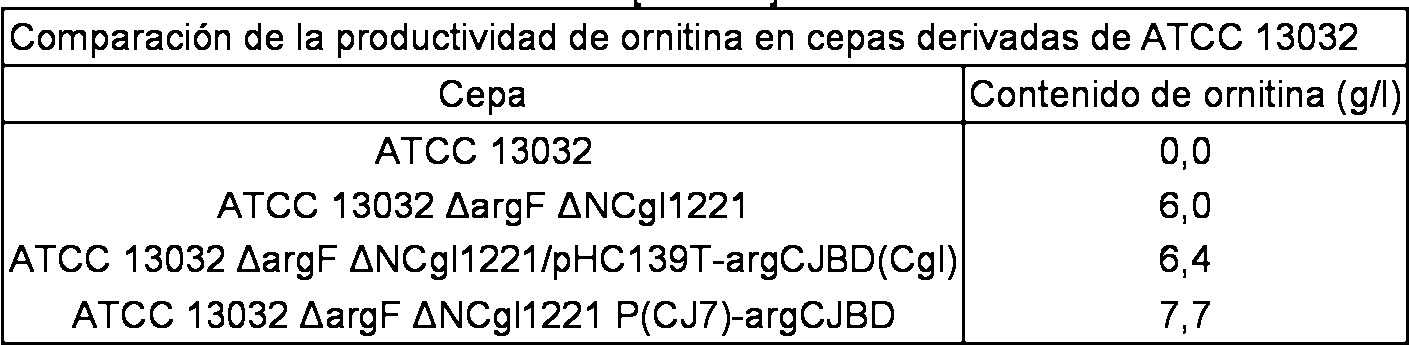
Como se muestra en la Tabla 5, la cepa con argF y NCgl1221 eliminados produjeron 6,0 g/l de ornitina, que no fueron producidos por la cepa de tipo silvestre. Con respecto al aumento del nivel de expresión del gen argCJBD, cuando el gen argCJBD se introdujo en forma de vector, la concentración de la ornitina producida fue de 6,4 g/l, y cuando se reemplazó el promotor argCJBD en el cromosoma por CJ7, la concentración de la ornitina producida aumentó ligeramente hasta 7,7 g/l.As shown in Table 5, the strain with argF and NCgl1221 removed produced 6.0 g / L of ornithine, which were not produced by the wild-type strain. With respect to the increase in the level of expression of the argCJBD gene, when the argCJBD gene was introduced as a vector, the concentration of ornithine produced was 6.4 g / l, and when the argCJBD promoter in the chromosome was replaced by CJ7 , the concentration of ornithine produced increased slightly to 7.7 g / l.
Ejemplo 4-2: Productividad de ornitina de la cepa derivada de Corynebacterium glutamicum KCCM-10785P Example 4-2: Productivity of ornithine from the strain derived from Corynebacterium glutamicum KCCM-10785P
Claims (8)
Applications Claiming Priority (3)
| Application Number | Priority Date | Filing Date | Title |
|---|---|---|---|
| KR20100124866 | 2010-12-08 | ||
| KR1020110130594A KR101372635B1 (en) | 2010-12-08 | 2011-12-07 | Microorganisms for producing ornithine and process for producing ornithine using the same |
| PCT/KR2011/009477 WO2012077994A2 (en) | 2010-12-08 | 2011-12-08 | Microbes with an improved ability to produce ornithine and method for producing ornithine using same |
Publications (1)
| Publication Number | Publication Date |
|---|---|
| ES2703256T3 true ES2703256T3 (en) | 2019-03-07 |
Family
ID=46684297
Family Applications (1)
| Application Number | Title | Priority Date | Filing Date |
|---|---|---|---|
| ES11846603T Active ES2703256T3 (en) | 2010-12-08 | 2011-12-08 | Microorganism that has a better ornithine production capacity and ornithine production method using the same |
Country Status (13)
| Country | Link |
|---|---|
| US (1) | US9303277B2 (en) |
| EP (1) | EP2650358B1 (en) |
| JP (1) | JP5860476B2 (en) |
| KR (1) | KR101372635B1 (en) |
| CN (1) | CN103282486B (en) |
| AU (1) | AU2011339171B2 (en) |
| BR (1) | BR112013014441B1 (en) |
| ES (1) | ES2703256T3 (en) |
| MY (1) | MY165897A (en) |
| PH (1) | PH12013501164A1 (en) |
| PL (1) | PL2650358T3 (en) |
| RU (1) | RU2567669C2 (en) |
| WO (1) | WO2012077994A2 (en) |
Families Citing this family (14)
| Publication number | Priority date | Publication date | Assignee | Title |
|---|---|---|---|---|
| KR101526047B1 (en) * | 2013-04-26 | 2015-06-04 | 상지대학교산학협력단 | Microorganism having improved L-ornithin production by increasing the aminotransferase activity and process for preparing the L-ornithin employing the same |
| KR101835164B1 (en) | 2013-07-17 | 2018-03-06 | 씨제이제일제당 (주) | Modified Ornithine Decarboxylase protein with an improved producing capability for Putrescine and a Use thereof |
| KR101835935B1 (en) | 2014-10-13 | 2018-03-12 | 씨제이제일제당 (주) | A microorganism of genus corynebacterium having an ability to produce L-arginine and a method for producing L-arginine using the same |
| WO2016144247A1 (en) * | 2015-03-12 | 2016-09-15 | Biopetrolia Ab | L-ornithine production in eukaryotic cells |
| KR101813759B1 (en) * | 2015-06-24 | 2018-01-02 | 씨제이제일제당 (주) | Microorganisms for producing putrescine or ornithine and process for producing putrescine or ornithine using them |
| KR101735935B1 (en) | 2015-07-20 | 2017-05-16 | 씨제이제일제당 (주) | Microorganisms for producing putrescine or ornithine and process for producing putrescine or ornithine using them |
| CN105950524A (en) * | 2016-04-27 | 2016-09-21 | 齐鲁工业大学 | Construction method of corynebacterium glutamicum engineering bacteria for high production of L-lysine |
| KR101937569B1 (en) * | 2017-06-14 | 2019-01-11 | 씨제이제일제당 (주) | Novel polypeptide and a method for producing a desired product derived from ornithine using the same |
| KR101941775B1 (en) | 2017-06-14 | 2019-01-24 | 씨제이제일제당 (주) | Novel polypeptide and a method for producing a desired product derived from ornithine using the same |
| CN110195088B (en) * | 2018-02-26 | 2022-09-27 | 中国科学院分子植物科学卓越创新中心 | Arginine hydrolase, and coding gene and application thereof |
| CN114317582B (en) * | 2020-10-10 | 2026-04-21 | 中国科学院分子植物科学卓越创新中心 | A method to improve the stability of arginine production capacity of bacterial strains |
| US20250197841A1 (en) * | 2022-03-18 | 2025-06-19 | Cj Cheiljedang Corporation | Carbamoyl-phosphate synthetase large subunit variant and l-ornithine production method using same |
| KR102853096B1 (en) * | 2022-03-18 | 2025-09-02 | 씨제이제일제당 주식회사 | Microorganism producing L-amino acid with weakened activity of carbamoyl-phosphate synthetase and L-amino acid production method using the same |
| CN121046252B (en) * | 2025-08-29 | 2026-05-01 | 山东精鸿生物科技有限公司 | Culture medium and method for producing arginine through fermentation |
Family Cites Families (6)
| Publication number | Priority date | Publication date | Assignee | Title |
|---|---|---|---|---|
| US7344874B2 (en) * | 2004-03-04 | 2008-03-18 | Ajinomoto Co., Inc. | L-glutamic acid-producing microorganism and a method for producing L-glutamic acid |
| WO2006035831A1 (en) * | 2004-09-28 | 2006-04-06 | Kyowa Hakko Kogyo Co., Ltd. | Method of producing l-arginine, l-ornithine or l-citrulline |
| CN103468758B (en) * | 2004-12-28 | 2015-10-28 | 味之素株式会社 | Produce the microorganism of Pidolidone and produce the method for Pidolidone |
| EP3170889A1 (en) * | 2006-09-15 | 2017-05-24 | CJ Cheiljedang Corporation | A corynebacteria having enhanced l-lysine productivity and a method of producing l-lysine using the same |
| BRPI0903495B1 (en) * | 2008-04-10 | 2019-01-29 | Korea Advanced Institute Of Science And Technology | mutant microorganisms capable of producing putrescine and method for producing putrescine using the same |
| KR20100060909A (en) * | 2008-11-28 | 2010-06-07 | 전북대학교산학협력단 | Microbes enhanced ornithine productivity by suppressing of transcriptional repressor and ornithine production method using the same |
-
2011
- 2011-12-07 KR KR1020110130594A patent/KR101372635B1/en active Active
- 2011-12-08 US US13/992,241 patent/US9303277B2/en active Active
- 2011-12-08 AU AU2011339171A patent/AU2011339171B2/en active Active
- 2011-12-08 CN CN201180064409.4A patent/CN103282486B/en active Active
- 2011-12-08 ES ES11846603T patent/ES2703256T3/en active Active
- 2011-12-08 BR BR112013014441-6A patent/BR112013014441B1/en active IP Right Grant
- 2011-12-08 PL PL11846603T patent/PL2650358T3/en unknown
- 2011-12-08 JP JP2013543102A patent/JP5860476B2/en active Active
- 2011-12-08 PH PH1/2013/501164A patent/PH12013501164A1/en unknown
- 2011-12-08 MY MYPI2013002102A patent/MY165897A/en unknown
- 2011-12-08 WO PCT/KR2011/009477 patent/WO2012077994A2/en not_active Ceased
- 2011-12-08 EP EP11846603.6A patent/EP2650358B1/en active Active
- 2011-12-08 RU RU2013131039/10A patent/RU2567669C2/en active
Also Published As
| Publication number | Publication date |
|---|---|
| PH12013501164A1 (en) | 2013-07-29 |
| MY165897A (en) | 2018-05-18 |
| BR112013014441B1 (en) | 2021-08-17 |
| PL2650358T3 (en) | 2019-05-31 |
| WO2012077994A3 (en) | 2012-09-07 |
| AU2011339171B2 (en) | 2016-02-11 |
| KR101372635B1 (en) | 2014-03-13 |
| BR112013014441A2 (en) | 2016-09-13 |
| JP2013544532A (en) | 2013-12-19 |
| EP2650358A2 (en) | 2013-10-16 |
| KR20120064045A (en) | 2012-06-18 |
| RU2013131039A (en) | 2015-01-20 |
| EP2650358B1 (en) | 2018-10-17 |
| RU2567669C2 (en) | 2015-11-10 |
| CN103282486A (en) | 2013-09-04 |
| JP5860476B2 (en) | 2016-02-16 |
| US9303277B2 (en) | 2016-04-05 |
| AU2011339171A1 (en) | 2013-07-18 |
| CN103282486B (en) | 2016-02-17 |
| EP2650358A4 (en) | 2015-07-01 |
| US20130344545A1 (en) | 2013-12-26 |
| WO2012077994A2 (en) | 2012-06-14 |
Similar Documents
| Publication | Publication Date | Title |
|---|---|---|
| RU2567669C2 (en) | Microorganisms having improved ornithine-producing capacity and method of producing ornithine using same | |
| KR101348461B1 (en) | Microorganisms for producing putrescine and process for producing putrescine using the same | |
| ES2739002T3 (en) | Microorganisms to produce putrescine or ornithine and process to produce putrescine or ornithine using them | |
| US11365400B2 (en) | Microorganism for producing ornithine and process for producing ornithine using them | |
| JP6297134B2 (en) | Microorganism having putrescine productivity and putrescine production method using the same | |
| CN111655860A (en) | Novel promoter and method for producing L-amino acid using the same | |
| ES2711857T3 (en) | Putrescine-producing variant strain and production method that uses it | |
| TWI657140B (en) | Microorganisms having cadaverine productivity and methods of producing cadaverine using them | |
| ES2717600T3 (en) | Diamine producing microorganism and method to produce diamine using the same |