ES2704064T3 - Oral formulations of mitochondrially directed antioxidants and their preparation and use - Google Patents
Oral formulations of mitochondrially directed antioxidants and their preparation and use Download PDFInfo
- Publication number
- ES2704064T3 ES2704064T3 ES12792111T ES12792111T ES2704064T3 ES 2704064 T3 ES2704064 T3 ES 2704064T3 ES 12792111 T ES12792111 T ES 12792111T ES 12792111 T ES12792111 T ES 12792111T ES 2704064 T3 ES2704064 T3 ES 2704064T3
- Authority
- ES
- Spain
- Prior art keywords
- compound
- skq1
- formula
- formulation
- divalent
- Prior art date
- Legal status (The legal status is an assumption and is not a legal conclusion. Google has not performed a legal analysis and makes no representation as to the accuracy of the status listed.)
- Active
Links
Classifications
-
- A—HUMAN NECESSITIES
- A61—MEDICAL OR VETERINARY SCIENCE; HYGIENE
- A61K—PREPARATIONS FOR MEDICAL, DENTAL OR TOILETRY PURPOSES
- A61K31/00—Medicinal preparations containing organic active ingredients
- A61K31/045—Hydroxy compounds, e.g. alcohols; Salts thereof, e.g. alcoholates
- A61K31/047—Hydroxy compounds, e.g. alcohols; Salts thereof, e.g. alcoholates having two or more hydroxy groups, e.g. sorbitol
-
- A—HUMAN NECESSITIES
- A61—MEDICAL OR VETERINARY SCIENCE; HYGIENE
- A61K—PREPARATIONS FOR MEDICAL, DENTAL OR TOILETRY PURPOSES
- A61K31/00—Medicinal preparations containing organic active ingredients
- A61K31/12—Ketones
- A61K31/122—Ketones having the oxygen directly attached to a ring, e.g. quinones, vitamin K1, anthralin
-
- A—HUMAN NECESSITIES
- A61—MEDICAL OR VETERINARY SCIENCE; HYGIENE
- A61K—PREPARATIONS FOR MEDICAL, DENTAL OR TOILETRY PURPOSES
- A61K31/00—Medicinal preparations containing organic active ingredients
- A61K31/33—Heterocyclic compounds
- A61K31/395—Heterocyclic compounds having nitrogen as a ring hetero atom, e.g. guanethidine or rifamycins
- A61K31/435—Heterocyclic compounds having nitrogen as a ring hetero atom, e.g. guanethidine or rifamycins having six-membered rings with one nitrogen as the only ring hetero atom
- A61K31/4353—Heterocyclic compounds having nitrogen as a ring hetero atom, e.g. guanethidine or rifamycins having six-membered rings with one nitrogen as the only ring hetero atom ortho- or peri-condensed with heterocyclic ring systems
- A61K31/4375—Heterocyclic compounds having nitrogen as a ring hetero atom, e.g. guanethidine or rifamycins having six-membered rings with one nitrogen as the only ring hetero atom ortho- or peri-condensed with heterocyclic ring systems the heterocyclic ring system containing a six-membered ring having nitrogen as a ring heteroatom, e.g. quinolizines, naphthyridines, berberine, vincamine
-
- A—HUMAN NECESSITIES
- A61—MEDICAL OR VETERINARY SCIENCE; HYGIENE
- A61K—PREPARATIONS FOR MEDICAL, DENTAL OR TOILETRY PURPOSES
- A61K31/00—Medicinal preparations containing organic active ingredients
- A61K31/66—Phosphorus compounds
-
- A—HUMAN NECESSITIES
- A61—MEDICAL OR VETERINARY SCIENCE; HYGIENE
- A61K—PREPARATIONS FOR MEDICAL, DENTAL OR TOILETRY PURPOSES
- A61K47/00—Medicinal preparations characterised by the non-active ingredients used, e.g. carriers or inert additives; Targeting or modifying agents chemically bound to the active ingredient
- A61K47/06—Organic compounds, e.g. natural or synthetic hydrocarbons, polyolefins, mineral oil, petrolatum or ozokerite
- A61K47/08—Organic compounds, e.g. natural or synthetic hydrocarbons, polyolefins, mineral oil, petrolatum or ozokerite containing oxygen, e.g. ethers, acetals, ketones, quinones, aldehydes, peroxides
- A61K47/10—Alcohols; Phenols; Salts thereof, e.g. glycerol; Polyethylene glycols [PEG]; Poloxamers; PEG/POE alkyl ethers
-
- A—HUMAN NECESSITIES
- A61—MEDICAL OR VETERINARY SCIENCE; HYGIENE
- A61K—PREPARATIONS FOR MEDICAL, DENTAL OR TOILETRY PURPOSES
- A61K47/00—Medicinal preparations characterised by the non-active ingredients used, e.g. carriers or inert additives; Targeting or modifying agents chemically bound to the active ingredient
- A61K47/06—Organic compounds, e.g. natural or synthetic hydrocarbons, polyolefins, mineral oil, petrolatum or ozokerite
- A61K47/08—Organic compounds, e.g. natural or synthetic hydrocarbons, polyolefins, mineral oil, petrolatum or ozokerite containing oxygen, e.g. ethers, acetals, ketones, quinones, aldehydes, peroxides
- A61K47/12—Carboxylic acids; Salts or anhydrides thereof
-
- A—HUMAN NECESSITIES
- A61—MEDICAL OR VETERINARY SCIENCE; HYGIENE
- A61K—PREPARATIONS FOR MEDICAL, DENTAL OR TOILETRY PURPOSES
- A61K47/00—Medicinal preparations characterised by the non-active ingredients used, e.g. carriers or inert additives; Targeting or modifying agents chemically bound to the active ingredient
- A61K47/06—Organic compounds, e.g. natural or synthetic hydrocarbons, polyolefins, mineral oil, petrolatum or ozokerite
- A61K47/08—Organic compounds, e.g. natural or synthetic hydrocarbons, polyolefins, mineral oil, petrolatum or ozokerite containing oxygen, e.g. ethers, acetals, ketones, quinones, aldehydes, peroxides
- A61K47/14—Esters of carboxylic acids, e.g. fatty acid monoglycerides, medium-chain triglycerides, parabens or PEG fatty acid esters
-
- A—HUMAN NECESSITIES
- A61—MEDICAL OR VETERINARY SCIENCE; HYGIENE
- A61K—PREPARATIONS FOR MEDICAL, DENTAL OR TOILETRY PURPOSES
- A61K47/00—Medicinal preparations characterised by the non-active ingredients used, e.g. carriers or inert additives; Targeting or modifying agents chemically bound to the active ingredient
- A61K47/06—Organic compounds, e.g. natural or synthetic hydrocarbons, polyolefins, mineral oil, petrolatum or ozokerite
- A61K47/26—Carbohydrates, e.g. sugar alcohols, amino sugars, nucleic acids, mono-, di- or oligo-saccharides; Derivatives thereof, e.g. polysorbates, sorbitan fatty acid esters or glycyrrhizin
-
- A—HUMAN NECESSITIES
- A61—MEDICAL OR VETERINARY SCIENCE; HYGIENE
- A61K—PREPARATIONS FOR MEDICAL, DENTAL OR TOILETRY PURPOSES
- A61K47/00—Medicinal preparations characterised by the non-active ingredients used, e.g. carriers or inert additives; Targeting or modifying agents chemically bound to the active ingredient
- A61K47/30—Macromolecular organic or inorganic compounds, e.g. inorganic polyphosphates
- A61K47/36—Polysaccharides; Derivatives thereof, e.g. gums, starch, alginate, dextrin, hyaluronic acid, chitosan, inulin, agar or pectin
-
- A—HUMAN NECESSITIES
- A61—MEDICAL OR VETERINARY SCIENCE; HYGIENE
- A61K—PREPARATIONS FOR MEDICAL, DENTAL OR TOILETRY PURPOSES
- A61K47/00—Medicinal preparations characterised by the non-active ingredients used, e.g. carriers or inert additives; Targeting or modifying agents chemically bound to the active ingredient
- A61K47/50—Medicinal preparations characterised by the non-active ingredients used, e.g. carriers or inert additives; Targeting or modifying agents chemically bound to the active ingredient the non-active ingredient being chemically bound to the active ingredient, e.g. polymer-drug conjugates
- A61K47/51—Medicinal preparations characterised by the non-active ingredients used, e.g. carriers or inert additives; Targeting or modifying agents chemically bound to the active ingredient the non-active ingredient being chemically bound to the active ingredient, e.g. polymer-drug conjugates the non-active ingredient being a modifying agent
- A61K47/54—Medicinal preparations characterised by the non-active ingredients used, e.g. carriers or inert additives; Targeting or modifying agents chemically bound to the active ingredient the non-active ingredient being chemically bound to the active ingredient, e.g. polymer-drug conjugates the non-active ingredient being a modifying agent the modifying agent being an organic compound
- A61K47/545—Heterocyclic compounds
-
- A—HUMAN NECESSITIES
- A61—MEDICAL OR VETERINARY SCIENCE; HYGIENE
- A61K—PREPARATIONS FOR MEDICAL, DENTAL OR TOILETRY PURPOSES
- A61K47/00—Medicinal preparations characterised by the non-active ingredients used, e.g. carriers or inert additives; Targeting or modifying agents chemically bound to the active ingredient
- A61K47/50—Medicinal preparations characterised by the non-active ingredients used, e.g. carriers or inert additives; Targeting or modifying agents chemically bound to the active ingredient the non-active ingredient being chemically bound to the active ingredient, e.g. polymer-drug conjugates
- A61K47/51—Medicinal preparations characterised by the non-active ingredients used, e.g. carriers or inert additives; Targeting or modifying agents chemically bound to the active ingredient the non-active ingredient being chemically bound to the active ingredient, e.g. polymer-drug conjugates the non-active ingredient being a modifying agent
- A61K47/54—Medicinal preparations characterised by the non-active ingredients used, e.g. carriers or inert additives; Targeting or modifying agents chemically bound to the active ingredient the non-active ingredient being chemically bound to the active ingredient, e.g. polymer-drug conjugates the non-active ingredient being a modifying agent the modifying agent being an organic compound
- A61K47/548—Phosphates or phosphonates, e.g. bone-seeking
-
- A—HUMAN NECESSITIES
- A61—MEDICAL OR VETERINARY SCIENCE; HYGIENE
- A61K—PREPARATIONS FOR MEDICAL, DENTAL OR TOILETRY PURPOSES
- A61K9/00—Medicinal preparations characterised by special physical form
- A61K9/0087—Galenical forms not covered by A61K9/02 - A61K9/7023
- A61K9/0095—Drinks; Beverages; Syrups; Compositions for reconstitution thereof, e.g. powders or tablets to be dispersed in a glass of water; Veterinary drenches
-
- A—HUMAN NECESSITIES
- A61—MEDICAL OR VETERINARY SCIENCE; HYGIENE
- A61P—SPECIFIC THERAPEUTIC ACTIVITY OF CHEMICAL COMPOUNDS OR MEDICINAL PREPARATIONS
- A61P17/00—Drugs for dermatological disorders
- A61P17/02—Drugs for dermatological disorders for treating wounds, ulcers, burns, scars, keloids, or the like
-
- A—HUMAN NECESSITIES
- A61—MEDICAL OR VETERINARY SCIENCE; HYGIENE
- A61P—SPECIFIC THERAPEUTIC ACTIVITY OF CHEMICAL COMPOUNDS OR MEDICINAL PREPARATIONS
- A61P19/00—Drugs for skeletal disorders
- A61P19/02—Drugs for skeletal disorders for joint disorders, e.g. arthritis, arthrosis
-
- A—HUMAN NECESSITIES
- A61—MEDICAL OR VETERINARY SCIENCE; HYGIENE
- A61P—SPECIFIC THERAPEUTIC ACTIVITY OF CHEMICAL COMPOUNDS OR MEDICINAL PREPARATIONS
- A61P29/00—Non-central analgesic, antipyretic or antiinflammatory agents, e.g. antirheumatic agents; Non-steroidal antiinflammatory drugs [NSAID]
-
- A—HUMAN NECESSITIES
- A61—MEDICAL OR VETERINARY SCIENCE; HYGIENE
- A61P—SPECIFIC THERAPEUTIC ACTIVITY OF CHEMICAL COMPOUNDS OR MEDICINAL PREPARATIONS
- A61P3/00—Drugs for disorders of the metabolism
- A61P3/08—Drugs for disorders of the metabolism for glucose homeostasis
- A61P3/10—Drugs for disorders of the metabolism for glucose homeostasis for hyperglycaemia, e.g. antidiabetics
-
- A—HUMAN NECESSITIES
- A61—MEDICAL OR VETERINARY SCIENCE; HYGIENE
- A61P—SPECIFIC THERAPEUTIC ACTIVITY OF CHEMICAL COMPOUNDS OR MEDICINAL PREPARATIONS
- A61P39/00—General protective or antinoxious agents
- A61P39/06—Free radical scavengers or antioxidants
-
- C—CHEMISTRY; METALLURGY
- C07—ORGANIC CHEMISTRY
- C07F—ACYCLIC, CARBOCYCLIC OR HETEROCYCLIC COMPOUNDS CONTAINING ELEMENTS OTHER THAN CARBON, HYDROGEN, HALOGEN, OXYGEN, NITROGEN, SULFUR, SELENIUM OR TELLURIUM
- C07F9/00—Compounds containing elements of Groups 5 or 15 of the Periodic Table
- C07F9/02—Phosphorus compounds
- C07F9/28—Phosphorus compounds with one or more P—C bonds
- C07F9/54—Quaternary phosphonium compounds
- C07F9/5435—Cycloaliphatic phosphonium compounds
-
- C—CHEMISTRY; METALLURGY
- C07—ORGANIC CHEMISTRY
- C07F—ACYCLIC, CARBOCYCLIC OR HETEROCYCLIC COMPOUNDS CONTAINING ELEMENTS OTHER THAN CARBON, HYDROGEN, HALOGEN, OXYGEN, NITROGEN, SULFUR, SELENIUM OR TELLURIUM
- C07F9/00—Compounds containing elements of Groups 5 or 15 of the Periodic Table
- C07F9/02—Phosphorus compounds
- C07F9/28—Phosphorus compounds with one or more P—C bonds
- C07F9/54—Quaternary phosphonium compounds
- C07F9/5442—Aromatic phosphonium compounds (P-C aromatic linkage)
-
- C—CHEMISTRY; METALLURGY
- C07—ORGANIC CHEMISTRY
- C07F—ACYCLIC, CARBOCYCLIC OR HETEROCYCLIC COMPOUNDS CONTAINING ELEMENTS OTHER THAN CARBON, HYDROGEN, HALOGEN, OXYGEN, NITROGEN, SULFUR, SELENIUM OR TELLURIUM
- C07F9/00—Compounds containing elements of Groups 5 or 15 of the Periodic Table
- C07F9/02—Phosphorus compounds
- C07F9/28—Phosphorus compounds with one or more P—C bonds
- C07F9/54—Quaternary phosphonium compounds
- C07F9/5456—Arylalkanephosphonium compounds
-
- C—CHEMISTRY; METALLURGY
- C09—DYES; PAINTS; POLISHES; NATURAL RESINS; ADHESIVES; COMPOSITIONS NOT OTHERWISE PROVIDED FOR; APPLICATIONS OF MATERIALS NOT OTHERWISE PROVIDED FOR
- C09B—ORGANIC DYES OR CLOSELY-RELATED COMPOUNDS FOR PRODUCING DYES, e.g. PIGMENTS; MORDANTS; LAKES
- C09B11/00—Diaryl- or thriarylmethane dyes
- C09B11/04—Diaryl- or thriarylmethane dyes derived from triarylmethanes, i.e. central C-atom is substituted by amino, cyano, alkyl
- C09B11/10—Amino derivatives of triarylmethanes
- C09B11/24—Phthaleins containing amino groups ; Phthalanes; Fluoranes; Phthalides; Rhodamine dyes; Phthaleins having heterocyclic aryl rings; Lactone or lactame forms of triarylmethane dyes
-
- C—CHEMISTRY; METALLURGY
- C09—DYES; PAINTS; POLISHES; NATURAL RESINS; ADHESIVES; COMPOSITIONS NOT OTHERWISE PROVIDED FOR; APPLICATIONS OF MATERIALS NOT OTHERWISE PROVIDED FOR
- C09B—ORGANIC DYES OR CLOSELY-RELATED COMPOUNDS FOR PRODUCING DYES, e.g. PIGMENTS; MORDANTS; LAKES
- C09B57/00—Other synthetic dyes of known constitution
-
- C—CHEMISTRY; METALLURGY
- C09—DYES; PAINTS; POLISHES; NATURAL RESINS; ADHESIVES; COMPOSITIONS NOT OTHERWISE PROVIDED FOR; APPLICATIONS OF MATERIALS NOT OTHERWISE PROVIDED FOR
- C09B—ORGANIC DYES OR CLOSELY-RELATED COMPOUNDS FOR PRODUCING DYES, e.g. PIGMENTS; MORDANTS; LAKES
- C09B69/00—Dyes not provided for by a single group of this subclass
- C09B69/001—Dyes containing an onium group attached to the dye skeleton via a bridge
Landscapes
- Health & Medical Sciences (AREA)
- Chemical & Material Sciences (AREA)
- Life Sciences & Earth Sciences (AREA)
- General Health & Medical Sciences (AREA)
- Veterinary Medicine (AREA)
- Public Health (AREA)
- Animal Behavior & Ethology (AREA)
- Pharmacology & Pharmacy (AREA)
- Medicinal Chemistry (AREA)
- Epidemiology (AREA)
- Organic Chemistry (AREA)
- Engineering & Computer Science (AREA)
- Chemical Kinetics & Catalysis (AREA)
- General Chemical & Material Sciences (AREA)
- Molecular Biology (AREA)
- Biochemistry (AREA)
- Oil, Petroleum & Natural Gas (AREA)
- Bioinformatics & Cheminformatics (AREA)
- Nuclear Medicine, Radiotherapy & Molecular Imaging (AREA)
- Diabetes (AREA)
- Inorganic Chemistry (AREA)
- Rheumatology (AREA)
- Biophysics (AREA)
- Emergency Medicine (AREA)
- Immunology (AREA)
- Toxicology (AREA)
- Endocrinology (AREA)
- Hematology (AREA)
- Dermatology (AREA)
- Obesity (AREA)
- Pain & Pain Management (AREA)
- Orthopedic Medicine & Surgery (AREA)
- Physical Education & Sports Medicine (AREA)
- Medicinal Preparation (AREA)
- Pharmaceuticals Containing Other Organic And Inorganic Compounds (AREA)
- Acyclic And Carbocyclic Compounds In Medicinal Compositions (AREA)
- Cosmetics (AREA)
Abstract
Una formulación farmacéutica que comprende un compuesto de Fórmula I**Fórmula** en la que: A es un antioxidante de Fórmula II:**Fórmula** y/o la forma reducida del mismo, en la que m comprende un número entero de 1 a 3; Y se selecciona independientemente del grupo que consiste en: alquilo inferior, alcoxi inferior, o dos grupos Y adyacentes, junto con los átomos de carbono a los que se unen, forman la siguiente estructura de Fórmula III:**Fórmula** y/o la forma reducida del mismo, en la que: R1 y R2 son iguales o diferentes y son, cada uno, independientemente, alquilo inferior o alcoxi inferior; L es un grupo enlazador, que comprende: a) una cadena de hidrocarburo lineal o ramificada opcionalmente sustituida con uno o más enlaces dobles o triples, o enlaces de éter, o enlaces de éster o C-S, o S-S o enlaces de péptido; y que se sustituye opcionalmente con uno o más sustituyentes seleccionados preferentemente de alquilo, alcoxi, halógeno, grupo ceto, grupo amino; o b) una cadena de isopreno natural; n es un número entero de 1 a 20; y B es un grupo diana que comprende: a) un ion de Skulachev Sk (Sk + Z-) en el que: Sk es un catión lipófilo o una metaloporfirina lipófila y Z es un anión farmacéuticamente aceptable; o b) un zwitterión anfífilo, en forma oxidada y/o reducida en 1,2-propilen glicol a entre el 20 % y el 100 % o glicerol al 10-30 %, con la condición de que, en el compuesto de Fórmula I, A no sea ubiquinona (por ejemplo, 2-metil-4,5-dimetoxi-3,6-dioxo-1,4- ciclohexadienilo) o tocoferol o un compuesto mimético de superóxido de dismutasa o ebseleno; cuando L es un radical decilo divalente, pentilo divalente o propilo divalente y cuando B es un catión de trifenilfosfonio.A pharmaceutical formulation comprising a compound of Formula I ** Formula wherein: A is an antioxidant of Formula II: ** Formula ** and / or the reduced form thereof, wherein m comprises an integer of 1 to 3; And it is independently selected from the group consisting of: lower alkyl, lower alkoxy, or two adjacent Y groups, together with the carbon atoms to which they are attached, form the following structure of Formula III: ** Formula ** and / or the reduced form thereof, wherein: R1 and R2 are the same or different and are each, independently, lower alkyl or lower alkoxy; L is a linker group, comprising: a) a linear or branched hydrocarbon chain optionally substituted with one or more double or triple bonds, or ether bonds, or ester or C-S bonds, or S-S or peptide bonds; and which is optionally substituted with one or more substituents preferably selected from alkyl, alkoxy, halogen, keto group, amino group; or b) a natural isoprene chain; n is an integer from 1 to 20; and B is a target group comprising: a) a Skulachev Sk ion (Sk + Z-) wherein: Sk is a lipophilic lipophilic cation or a metalloporphyrin and Z is a pharmaceutically acceptable anion; or b) an amphiphilic zwitterion, in oxidized form and / or reduced in 1,2-propylene glycol to between 20% and 100% or 10-30% glycerol, with the proviso that, in the compound of Formula I, A is not ubiquinone (e.g., 2-methyl-4,5-dimethoxy-3,6-dioxo-1,4-cyclohexadienyl) or tocopherol or a mimetic compound of dismutase superoxide or ebselen; when L is a divalent decyl radical, divalent pentyl or divalent propyl and when B is a triphenylphosphonium cation.
Description
DESCRIPCIÓNDESCRIPTION
Formulaciones orales de antioxidantes dirigidos mitocondrialmente y su preparación y usoOral formulations of mitochondrially directed antioxidants and their preparation and use
Campo de la invenciónField of the invention
Esta divulgación se encuentra en los campos de la biología celular, la farmacología y la medicina y, en particular, la inflamación, la diabetes, el choque séptico, la cicatrización de heridas y la cardiopatía coronaria.This disclosure is found in the fields of cell biology, pharmacology and medicine and, in particular, inflammation, diabetes, septic shock, wound healing and coronary heart disease.
AntecedentesBackground
Se han descrito propiedades terapéuticas alentadoras de los antioxidantes dirigidos a las mitocondrias (MTA en inglés) (véase, por ejemplo, el documento US2008176929; Skulachev y col. (2009), Biochim. Biophys. Acta, 1787:437-61). Los experimentos realizados que revelaron estas propiedades se realizaron con soluciones recién preparadas de MTA y se realizaron mediante la disolución de soluciones madre de etanol conservadas a -80 °C poco antes de la administración de la preparación a los animales. Tal procedimiento de preparación y administración no es adecuado o realista para la preparación de productos farmacéuticos, ya que es extremadamente inconveniente, si no imposible, para la fabricación industrial, la logística y el uso por parte de los pacientes. El documento CA 2764481 A1 desvela composiciones estabilizadas de bromuro de SkQ1 para el tratamiento de los ojos. Los componentes, como el glicerol y el propilen glicol, se pueden seleccionar como agentes de isotonización. Los intentos de desarrollar una composición farmacéutica (para su administración oral o inyección) con una estabilidad aceptable revelaron que los MTA no son estables en la mayoría de los tipos de composiciones orales o inyectables. Hasta ahora, no se han descrito composiciones farmacéuticas estables que contengan MTA que posean una estabilidad aceptable. Por consiguiente, todavía se necesitan formulaciones líquidas mejoradas con estabilidad.Encouraging therapeutic properties of antioxidants directed to mitochondria (MTA) have been described (see, for example, US2008176929, Skulachev et al (2009), Biochim, Biophys. Acta, 1787: 437-61). The experiments carried out that revealed these properties were carried out with freshly prepared solutions of MTA and were carried out by dissolving ethanol stock solutions stored at -80 ° C shortly before the administration of the preparation to the animals. Such preparation and administration procedure is not suitable or realistic for the preparation of pharmaceutical products, since it is extremely inconvenient, if not impossible, for industrial manufacture, logistics and use by patients. CA 2764481 A1 discloses stabilized compositions of SkQ1 bromide for the treatment of eyes. Components, such as glycerol and propylene glycol, can be selected as isotonization agents. Attempts to develop a pharmaceutical composition (for oral administration or injection) with acceptable stability revealed that MTAs are not stable in most types of oral or injectable compositions. Heretofore, stable pharmaceutical compositions containing MTA having acceptable stability have not been described. Accordingly, improved liquid formulations with stability are still needed.
SumarioSummary
La presente divulgación proporciona formulaciones líquidas y sólidas estabilizadas que comprenden MTA adecuadas para su administración oral, nasal e intravenosa e inyectable y procedimientos de preparación de tales formulaciones. La invención también proporciona procedimientos de tratamiento y profilaxis de enfermedades y afecciones relacionadas con las mitocondrias que usan tales formulaciones. El ámbito de la invención está definido por las reivindicaciones. Cualquier referencia en la descripción a procedimientos de tratamiento se refiere a los compuestos, composiciones farmacéuticas y medicamentos de la presente invención para su uso en un procedimiento para el tratamiento del cuerpo humano (o animal) mediante terapia (o para diagnóstico).The present disclosure provides stabilized liquid and solid formulations comprising MTAs suitable for oral, nasal and intravenous and injectable administration and methods of preparing such formulations. The invention also provides methods of treatment and prophylaxis of diseases and conditions related to mitochondria using such formulations. The scope of the invention is defined by the claims. Any reference in the description to treatment methods refers to the compounds, pharmaceutical compositions and medicaments of the present invention for use in a method for the treatment of the human (or animal) body by therapy (or for diagnosis).
En un aspecto, la divulgación proporciona un producto farmacéutico estabilizado, tal como se define en las reivindicaciones, que comprende un compuesto de Fórmula I en forma oxidada y/o reducida. El compuesto de Fórmula I es:In one aspect, the disclosure provides a stabilized pharmaceutical product, as defined in the claims, comprising a compound of Formula I in oxidized and / or reduced form. The compound of Formula I is:

en el que:in which:
A es un antioxidante de Fórmula II:A is an antioxidant of Formula II:

y/o la forma reducida del mismo, en el que m comprende un número entero de 1 a 3;and / or the reduced form thereof, wherein m comprises an integer from 1 to 3;
Y se selecciona independientemente del grupo que consiste en: alquilo inferior, alcoxi inferior, o dos grupos Y adyacentes, junto con los átomos de carbono a los que se unen, forman la siguiente estructura de Fórmula III: y/o la forma reducida del mismo, en el que:And it is independently selected from the group consisting of: lower alkyl, lower alkoxy, or two adjacent Y groups, together with the carbon atoms to which they are attached, form the following structure of Formula III: and / or the reduced form thereof, in which:
R1 y R2 son iguales o diferentes y son, cada uno, independientemente, alquilo inferior o alcoxi inferior;R1 and R2 are the same or different and are each independently lower alkyl or lower alkoxy;
L es un grupo enlazador, que comprende: a) una cadena de hidrocarburo lineal o ramificada opcionalmente sustituida con uno o más enlaces dobles o triples, o enlaces de éter, o enlaces de éster o C-S, o S-S o enlaces de péptido; y que se sustituye opcionalmente con uno o más sustituyentes seleccionados preferentemente de alquilo, alcoxi, halógeno, grupo ceto, grupo amino; o b) una cadena de isopreno natural; n es un número entero de 1 a 20; yL is a linker group, comprising: a) a linear or branched hydrocarbon chain optionally substituted with one or more double or triple bonds, or ether bonds, or ester or C-S bonds, or S-S or peptide bonds; and which is optionally substituted with one or more substituents preferably selected from alkyl, alkoxy, halogen, keto group, amino group; or b) a natural isoprene chain; n is an integer from 1 to 20; Y
B es un grupo diana que comprende: a) un ion de Skulachev Sk (Sk Z') en el que: Sk es un catión lipófilo o una metaloporfirina lipófila y Z es un anión farmacéuticamente aceptable; o b) un zwitterión anfífilo, con la condición de que, en el compuesto de Fórmula I, A no sea ubiquinona (por ejemplo, 2-metil-4,5-dimetoxi-3,6-dioxo-1,4-ciclohexadienilo) o tocoferol o un compuesto mimético de superóxido de dismutasa o ebseleno; cuando L es un radical decilo divalente, pentilo divalente o propilo divalente; y cuando B es un catión de trifenilfosfonio.B is a target group comprising: a) a Skulachev Sk ion (Sk Z ') wherein: Sk is a lipophilic lipophilic cation or a metalloporphyrin and Z is a pharmaceutically acceptable anion; or b) an amphiphilic zwitterion, with the proviso that, in the compound of Formula I, A is not ubiquinone (e.g., 2-methyl-4,5-dimethoxy-3,6-dioxo-1,4-cyclohexadienyl) or tocopherol or a mimetic compound of dismutase superoxide or ebselen; when L is a divalent decyl radical, divalent pentyl or divalent propyl; and when B is a triphenylphosphonium cation.
En una realización particular, la composición se reduce o se oxida. En algunas realizaciones, la formulación está en forma líquida y, en otras realizaciones, la formulación está en forma sólida.In a particular embodiment, the composition is reduced or oxidized. In some embodiments, the formulation is in liquid form and, in other embodiments, the formulation is in solid form.
La formulación comprende un compuesto de Fórmula I en glicerol a entre el 10 % y el 30 % o 1,2-propilen glicol al 20-100 %. En una realización particular, la composición de Fórmula I está en 1,2-propilen glicol a aproximadamente el 50 %.The formulation comprises a compound of Formula I in glycerol at between 10% and 30% or 1,2- propylene glycol at 20-100%. In a particular embodiment, the composition of Formula I is at about 50% in 1,2-propylene glycol.
La divulgación también proporciona formulaciones farmacéuticas sólidas estabilizadas que comprenden un compuesto de Fórmula I en forma oxidada o reducida, con la condición de que, en el compuesto de Fórmula I, A no sea ubiquinona (por ejemplo, 2-metil-4,5-dimetoxi-3,6-dioxo-1,4-ciclohexadienilo) o tocoferol o un compuesto mimético de superóxido de dismutasa o ebseleno; cuando L es un radical decilo divalente, pentilo divalente o propilo divalente; y cuando B es un catión de trifenilfosfonio.The disclosure also provides stabilized solid pharmaceutical formulations comprising a compound of Formula I in oxidized or reduced form, with the proviso that, in the compound of Formula I, A is not ubiquinone (eg, 2-methyl-4,5- dimethoxy-3,6-dioxo-1,4-cyclohexadienyl) or tocopherol or a mimetic compound of dismutase superoxide or ebselen; when L is a divalent decyl radical, divalent pentyl or divalent propyl; and when B is a triphenylphosphonium cation.
En una realización, la formulación también comprende de 1 equivalente molar a 200 equivalentes molares de un agente de antioxidación que reduce la forma oxidada del compuesto de Fórmula 1 y un vehículo farmacéuticamente aceptable.In one embodiment, the formulation also comprises from 1 molar equivalent to 200 molar equivalents of an antioxidation agent that reduces the oxidized form of the compound of Formula 1 and a pharmaceutically acceptable carrier.
En algunas realizaciones, el agente de antioxidación es ácido ascórbico.In some embodiments, the antioxidation agent is ascorbic acid.
En algunas realizaciones, el vehículo farmacéuticamente aceptable comprende sorbito, glucosa y/o estearato de magnesio.In some embodiments, the pharmaceutically acceptable carrier comprises sorbitol, glucose and / or magnesium stearate.
En determinadas realizaciones, la formulación farmacéutica es SkQ1 o SkQ1H2. En otras realizaciones, el compuesto es SkQR1 o SkQR1H2. Aún en otras realizaciones, el compuesto es SkQ3 o SkQ3H2. En otras realizaciones más, el compuesto es SkQRB o SkQRBH2. En otras realizaciones, el compuesto es SkQB1 o SkQB1H2. Aún en otras realizaciones, el compuesto es SkQBP1 o SkQBP1H2.In certain embodiments, the pharmaceutical formulation is SkQ1 or SkQ1H2. In other embodiments, the compound is SkQR1 or SkQR1H2. In still other embodiments, the compound is SkQ3 or SkQ3H2. In still other embodiments, the compound is SkQRB or SkQRBH2. In other embodiments, the compound is SkQB1 or SkQB1H2. In still other embodiments, the compound is SkQBP1 or SkQBP1H2.
En otros aspectos, la divulgación proporciona procedimientos de tratamiento y prevención de la diabetes tipo I y II, la inflamación, el choque séptico, la artritis y la cardiopatía coronaria y procedimientos de ayuda en la cicatrización de heridas. En estos procedimientos, se administra a un paciente una cantidad terapéuticamente eficaz de una formulación que comprende un compuesto estabilizado de Fórmula I en forma líquida o sólida, con la condición de que, en el compuesto de Fórmula I, A no sea ubiquinona (por ejemplo, 2-metil-4,5-dimetoxi-3,6-dioxo-1,4-ciclohexadienilo) o tocoferol o un compuesto mimético de superóxido de dismutasa o ebseleno; cuando L es un radical decilo divalente, pentilo divalente o propilo divalente y cuando B es un catión de trifenilfosfonio.In other aspects, the disclosure provides methods of treatment and prevention of type I and II diabetes, inflammation, septic shock, arthritis and coronary heart disease and procedures to aid in wound healing. In these methods, a patient is administered a therapeutically effective amount of a formulation comprising a stabilized compound of Formula I in liquid or solid form, with the proviso that, in the compound of Formula I, A is not ubiquinone (e.g. , 2-methyl-4,5-dimethoxy-3,6-dioxo-1,4-cyclohexadienyl) or tocopherol or a mimetic compound of dismutase superoxide or ebselen; when L is a divalent decyl radical, divalent pentyl or divalent propyl and when B is a triphenylphosphonium cation.
En algunas realizaciones del procedimiento, la formulación comprende glicerol, glicol y/o etanol. En algunas realizaciones, la formulación comprende SkQ1, SkQ1H2, SkQR1, SkQR1H2, SkQ3, SkQ3H2, SkQBP1, SkQBP1H2, SkQRB o SkQRBH2.In some embodiments of the process, the formulation comprises glycerol, glycol and / or ethanol. In some embodiments, the formulation comprises SkQ1, SkQ1H2, SkQR1, SkQR1H2, SkQ3, SkQ3H2, SkQBP1, SkQBP1H2, SkQRB or SkQRBH2.
En algunas realizaciones, la formulación líquida se administra por vía oral o mediante inyección. En otras realizaciones, la formulación sólida se administra por vía oral, anal o vaginal. En algunas realizaciones, la formulación es un sólido y comprende ácido ascórbico. En realizaciones particulares, la formulación también comprende un vehículo farmacéuticamente aceptable.In some embodiments, the liquid formulation is administered orally or by injection. In other embodiments, the solid formulation is administered orally, anally or vaginally. In some embodiments, the formulation is a solid and comprises ascorbic acid. In particular embodiments, the formulation also comprises a pharmaceutically acceptable carrier.
En algunas realizaciones, la diabetes tipo I o II se trata con SkQ1 o SkQ1H2 en glicerol al 20 %.In some embodiments, type I or II diabetes is treated with SkQ1 or SkQ1H2 in 20% glycerol.
En determinadas realizaciones, la artritis se trata con una formulación que comprende SkQ1 o SkQ1H2 en glicerol al 20 %. Aún en otras realizaciones, la artritis se trata con una formulación que comprende SkQ1 y ácido ascórbico. Breve descripción de los dibujos In certain embodiments, arthritis is treated with a formulation comprising SkQ1 or SkQ1H2 in 20% glycerol. In yet other embodiments, arthritis is treated with a formulation comprising SkQ1 and ascorbic acid. BRIEF DESCRIPTION OF THE DRAWINGS
Los objetos anteriores y otros de la presente divulgación, las diversas características de la misma, así como la propia invención, pueden entenderse más completamente a partir de la siguiente descripción, cuando se leen junto con los dibujos adjuntos. The above objects and others of the present disclosure, the various features thereof, as well as the invention itself, can be more fully understood from the following description, when read together with the accompanying drawings.
La Figura 1 es una representación gráfica del efecto de SkQ1 sobre el nivel de glucosa en sangre del modelo de animal diabético (ratones tratados con aloxano);Figure 1 is a graphical representation of the effect of SkQ1 on the blood glucose level of the diabetic animal model (mice treated with alloxan);
la Figura 2 es una representación gráfica del efecto de SkQ1 sobre el daño hepático de ratones diabéticos db/db; la Figura 3a es una representación gráfica que ilustra el efecto de SkQ1 sobre la epitelización de heridas diabéticas;Figure 2 is a graphical representation of the effect of SkQ1 on the liver damage of diabetic mice db / db; Figure 3a is a graphical representation illustrating the effect of SkQ1 on the epithelization of diabetic wounds;
la Figura 3b es una representación gráfica que ilustra el efecto de SkQ1 sobre la cantidad de neutrófilos en las heridas diabéticas; la Figura 3c es una representación gráfica que ilustra el efecto de SkQ1 sobre la densidad de vasos en las heridas diabéticas;Figure 3b is a graphical representation illustrating the effect of SkQ1 on the amount of neutrophils in diabetic wounds; Figure 3c is a graphical representation illustrating the effect of SkQ1 on vessel density in diabetic wounds;
la Figura 4 es una representación gráfica del efecto de SkQ1 sobre la supervivencia de ratones sometidos a choque séptico;Figure 4 is a graphic representation of the effect of SkQ1 on the survival of mice subjected to septic shock;
la Figura 5 es una representación gráfica que demuestra el efecto antiinflamatorio de SkQ1 en la artritis inducida por colágeno en ratas;Figure 5 is a graphical representation demonstrating the anti-inflammatory effect of SkQ1 in collagen-induced arthritis in rats;
la Figura 6 es una representación gráfica que demuestra el efecto antiinflamatorio de SkQ1 y SkQR1 al rescatar las células endoteliales de la muerte inducida por la citocina proinflamatoria TNF-alfa;Figure 6 is a graphical representation demonstrating the anti-inflammatory effect of SkQ1 and SkQR1 in rescuing endothelial cells from death induced by the proinflammatory cytokine TNF-alpha;
la Figura 7a es una representación gráfica que demuestra la capacidad de SkQ1 para inhibir la inflamación in vitro mediante la disminución de la expresión de citocinas proinflamatorias; yFigure 7a is a graphical representation demonstrating the ability of SkQ1 to inhibit inflammation in vitro by decreasing the expression of proinflammatory cytokines; Y
la Figura 7b es una representación gráfica que demuestra la capacidad de SkQ1 para inhibir la inflamación in vivo mediante la disminución de la expresión de citocinas proinflamatorias, tal como se mide mediante la expresión relativa de ARNm de ICAM-1 en ratones.Figure 7b is a graphical representation demonstrating the ability of SkQ1 to inhibit inflammation in vivo by decreasing the expression of proinflammatory cytokines, as measured by the relative expression of ICAM-1 mRNA in mice.
DescripciónDescription
Antes de la descripción detallada de la invención que sigue, se debe entender que la invención no está limitada a la metodología, los protocolos y los reactivos particulares descritos en el presente documento, ya que están sujetos a cambios. Además, se debe entender que, en la presente invención, la terminología se usa para describir solo realizaciones particulares y no limita el ámbito de la presente invención, que estará limitada únicamente por las reivindicaciones adjuntas. A menos que se especifique de otro modo, todos los términos técnicos y científicos usados en el presente documento tienen los mismos significados que pueden entender aquellos expertos en la materia.Prior to the detailed description of the invention that follows, it should be understood that the invention is not limited to the particular methodology, protocols and reagents described herein, as they are subject to change. Furthermore, it should be understood that, in the present invention, the terminology is used to describe only particular embodiments and does not limit the scope of the present invention, which will be limited only by the appended claims. Unless otherwise specified, all technical and scientific terms used in this document have the same meanings that those skilled in the art can understand.
De manera inesperada, se halló que muchos MTA eficaces no son lo suficientemente estables en las formulaciones farmacéuticas líquidas y sólidas habituales adecuadas para su administración mediante inyección o mediante administración oral, IV; nasal, tópica o entérica. Esta característica limitada la aplicación clínica de los productos farmacéuticos basados en MTA como compuestos activos.Unexpectedly, it was found that many effective MTAs are not stable enough in usual liquid and solid pharmaceutical formulations suitable for administration by injection or by oral, IV administration; nasal, topical or enteric. This feature limited the clinical application of pharmaceutical products based on MTA as active compounds.
I. Formulaciones estabilizadasI. Stabilized formulations
La presente divulgación proporciona composiciones farmacéuticas basadas en MTA líquidas estables aplicables en la práctica clínica. Un MTA útil es un compuesto de Fórmula I en forma oxidada y/o reducida.The present disclosure provides stable liquid MTA-based pharmaceutical compositions applicable in clinical practice. A useful MTA is a compound of Formula I in oxidized and / or reduced form.
El compuesto de Fórmula I es:The compound of Formula I is:

en el que:in which:
A es un antioxidante de Fórmula II:A is an antioxidant of Formula II:

y/o la forma reducida del mismo, en el que m comprende un número entero de 1 a 3;and / or the reduced form thereof, wherein m comprises an integer from 1 to 3;
Y se selecciona independientemente del grupo que consiste en: alquilo inferior, alcoxi inferior, o dos grupos Y adyacentes, junto con los átomos de carbono a los que se unen, forman la siguiente estructura de Fórmula III: And it is independently selected from the group consisting of: lower alkyl, lower alkoxy, or two adjacent Y groups, together with the carbon atoms to which they are attached, form the following structure of Formula III:

y/o la forma reducida del mismo, en el que:and / or the reduced form thereof, in which:
R1 y R2 son iguales o diferentes y son, cada uno, independientemente, alquilo inferior o alcoxi inferior;R1 and R2 are the same or different and are each independently lower alkyl or lower alkoxy;
L es un grupo enlazador, que comprende: a) una cadena de hidrocarburo lineal o ramificada opcionalmente sustituida con uno o más enlaces dobles o triples, o enlaces de éter, o enlaces de éster o C-S, o S-S o enlaces de péptido; y que se sustituye opcionalmente con uno o más sustituyentes seleccionados preferentemente de alquilo, alcoxi, halógeno, grupo ceto, grupo amino; o b) una cadena de isopreno natural; L is a linker group, comprising: a) a linear or branched hydrocarbon chain optionally substituted with one or more double or triple bonds, or ether bonds, or ester or C-S bonds, or S-S or peptide bonds; and which is optionally substituted with one or more substituents preferably selected from alkyl, alkoxy, halogen, keto group, amino group; or b) a natural isoprene chain;
n es un número entero de 1 a 20; yn is an integer from 1 to 20; Y
B es un grupo diana que comprende: a) un ion de Skulachev Sk: (Sk+ Z'), en el que: Sk es un catión lipófilo o una metaloporfirina lipófila y Z es un anión farmacéuticamente aceptable; o b) un zwitterión anfífilo, con la condición de que, en el compuesto de Fórmula I, A no sea ubiquinona (porejemplo, 2-metil-4,5-dimetoxi-3,6-dioxo-1,4-ciclohexadienilo) o tocoferol o un compuesto mimético de superóxido de dismutasa o ebseleno; cuando L es un radical decilo divalente, pentilo divalente o propilo divalente; y cuando B es un catión de trifenilfosfonio, con la condición de que, en el compuesto de Fórmula I, A no sea ubiquinona (por ejemplo, 2-metil-4,5-dimetoxi-3,6-dioxo-1,4-ciclohexadienilo) o tocoferol o un compuesto mimético de superóxido de dismutasa o ebseleno; cuando L es un radical decilo divalente, pentilo divalente o propilo divalente; y cuando B es un catión de trifenilfosfonio.B is a target group comprising: a) Skulachev Sk ion: (Sk + Z '), wherein: Sk is a lipophilic lipophilic cation or a metalloporphyrin and Z is a pharmaceutically acceptable anion; or b) an amphiphilic zwitterion, with the proviso that, in the compound of Formula I, A is not ubiquinone (for example, 2-methyl-4,5-dimethoxy-3,6-dioxo-1,4-cyclohexadienyl) or tocopherol or a mimetic compound of dismutase superoxide or ebselen; when L is a divalent decyl radical, divalent pentyl or divalent propyl; and when B is a triphenylphosphonium cation, with the proviso that, in the compound of Formula I, A is not ubiquinone (e.g., 2-methyl-4,5-dimethoxy-3,6-dioxo-1,4- cyclohexadienyl) or tocopherol or a mimetic compound of dismutase superoxide or ebselen; when L is a divalent decyl radical, divalent pentyl or divalent propyl; and when B is a triphenylphosphonium cation.
Los MTA útiles específicos incluyen, pero sin limitación, el SkQ1 y SkQRI:Specific useful MTAs include, but are not limited to, SkQ1 and SkQRI:

y sus formas reducidas (quinol) SkQ1H2 y SkQR1H2, respectivamente. Estos MTA se han descrito en el documento PCT/RU2006/000394.and its reduced forms (quinol) SkQ1H2 and SkQR1H2, respectively. These MTAs have been described in PCT / RU2006 / 000394.
Otras variantes de MTA útiles incluyen, pero sin limitación, SkQ3: Other useful MTA variants include, but are not limited to, SkQ3:

y su forma reducida (quinol) SkQ3H2;and its reduced form (quinol) SkQ3H2;
para SkQRB:for SkQRB:

y su forma oxidada (quinona) SkQRB;and its oxidized form (quinone) SkQRB;
para SkQB1:for SkQB1:

y su forma reducida (quinol), SkQB1H2; yand its reduced form (quinol), SkQB1H2; Y
para SkQBPI:for SkQBPI:

y su forma reducida (quinol) SkQBP1H2. and its reduced form (quinol) SkQBP1H2.
Estos MTA se formulan para su administración oral como soluciones líquidas y como formulaciones sólidas.These MTAs are formulated for oral administration as liquid solutions and as solid formulations.
Las soluciones líquidas también son útiles para la administración de aerosol mediante inyección, para la administración IV, administración nasal, administración tópica o administración entérica.Liquid solutions are also useful for administration of aerosol by injection, for IV administration, nasal administration, topical administration or enteral administration.
Tales formulaciones líquidas adecuadas incluyen uno o más disolventes o componentes solubles en los que se colocan los MTA. Los disolventes incluyen glicerol o 1,2-propilen glicol, tal como se define en las reivindicaciones. Por ejemplo, las formulaciones estables útiles contienen al menos glicerol al 10 % o mezclas del mismo, que también pueden incluir agua, glicerol, etanol y/o 1,2-propileno para compensar la diferencia. Por ejemplo, las soluciones estabilizantes representativas de SkQ1H2, SkQR1, SkQR1H2,SKQ3, SkQ3H2, SKQRB, SkQRBH2, SKQB1, SkQB1H2, SKQBP1, SkQBP1H2 y/o SkQ1 de 1 nM a 1 mM contienen 1,2-propilen glicol a entre el 20 % y el 100 % o glicerol al 10-30%. Otros vehículos farmacéuticamente aceptables también pueden ser componentes de tales formulaciones.Such suitable liquid formulations include one or more solvents or soluble components in which the MTAs are placed. The solvents include glycerol or 1,2-propylene glycol, as defined in the claims. For example, useful stable formulations contain at least 10% glycerol or mixtures thereof, which may also include water, glycerol, ethanol and / or 1,2-propylene to compensate for the difference. For example, representative stabilizing solutions of SkQ1H2, SkQR1, SkQR1H2, SKQ3, SkQ3H2, SKQRB, SkQRBH2, SKQB1, SkQB1H2, SKQBP1, SkQBP1H2 and / or SkQ1 from 1 nM to 1 mM contain 1,2-propylene glycol at 20 % and 100% or 10-30% glycerol. Other pharmaceutically acceptable carriers can also be components of such formulations.
Debido a que los MTA no son productos de larga conservación durante períodos de tiempo largos, se sometieron a ensayo diversos compuestos para determinar su capacidad para estabilizar SkQ1 y SkQR1 como MTA representativos en forma seca.Because MTAs are not long-shelf products for long periods of time, various compounds were tested for their ability to stabilize SkQ1 and SkQR1 as representative MTAs in dry form.
La beta-ciclodextrina, la goma arábiga, las fibras de frutas y el cloruro de sodio no proporcionaron niveles de estabilización adecuados (la velocidad de degradación, %/día, fue de 0,8 a 8,1).Beta-cyclodextrin, gum arabic, fruit fibers and sodium chloride did not provide adequate levels of stabilization (the rate of degradation,% / day, was 0.8 to 8.1).
Los disolventes líquidos también se sometieron a ensayo para determinar su capacidad para estabilizar los MTA representativos SkQ1 y SkQR1. Los disolventes sometidos a ensayo fueron soluciones de agua de glicerol (del 10 % al 100 %), lactulosa al 50 % y 1,2-propilen glicol (del 10 % al 100 %, a 60 °C). Algunos resultados representativos se muestran a continuación (Tabla 1).The liquid solvents were also tested for their ability to stabilize the representative MTA SkQ1 and SkQR1. The solvents tested were glycerol water solutions (10% to 100%), 50% lactulose and 1,2-propylene glycol (10% to 100%, 60 ° C). Some representative results are shown below (Table 1).
Tabla 1Table 1

Estos resultados ilustran la alta estabilidad de los MTA en una composición farmacéutica para su administración en forma de solución en glicerol (de aproximadamente el 10 % a aproximadamente el 100 % de glicerol) y solución de 1,2-propilen glicol a aproximadamente el 50 %. These results illustrate the high stability of MTAs in a pharmaceutical composition for administration in the form of glycerol solution (from about 10% to about 100% glycerol) and 1,2-propylene glycol solution at about 50% .
Además, la estabilidad de SkQ1 y SkQRI aumentó de manera significativa en los viales de plástico o vidrio de color oscuro, lo que indicaba que estos compuestos eran sensibles a la luz. Por consiguiente, una de las formas de mejorar o aumentar adicionalmente la estabilidad de las composiciones líquidas de SkQ durante el almacenamiento y el transporte es mediante su protección de la luz.In addition, the stability of SkQ1 and SkQRI increased significantly in the dark colored plastic or glass vials, indicating that these compounds were sensitive to light. Accordingly, one of the ways to improve or further increase the stability of liquid SkQ compositions during storage and transport is by their protection from light.
Cuando los compuestos de SkQ de Fórmula I según la divulgación están en forma sólida, estos se pueden estabilizar, por ejemplo, con un agente de antioxidación. Tal agente puede ser ácido ascórbico. Las cantidades útiles de ácido ascórbico varían de aproximadamente 1 equivalente molar a aproximadamente 200 equivalentes molares. Tal como se usa en el presente documento, el término "equivalente molar" se refiere al índice de partículas disueltas o esa cantidad que reacciona con o suministra un mol de H+ en una reacción de ácido-base o que reacciona o suministra un mol de electrones en una reacción de reducción-oxidación. Otros componentes útiles de las formulaciones de MTA estabilizadas representativas se muestran en la Tabla 2. Tales formulaciones pueden comprender también vehículos farmacéuticamente aceptables, tales como, pero sin limitación, sorbito, glucosa y estearato de magnesio.When the SkQ compounds of Formula I according to the disclosure are in solid form, they can be stabilized, for example, with an anti-oxidation agent. Such an agent can be ascorbic acid. Useful amounts of ascorbic acid vary from about 1 molar equivalent to about 200 molar equivalents. As used herein, the term "molar equivalent" refers to the rate of dissolved particles or that amount which reacts with or supplies one mole of H + in an acid-base reaction or which reacts or delivers one mole of electrons in a reduction-oxidation reaction. Other useful components of the representative stabilized MTA formulations are shown in Table 2. Such formulations may also comprise pharmaceutically acceptable carriers, such as, but not limited to sorbitol, glucose and magnesium stearate.
Otro enfoque para estabilizar un compuesto de SkQ en una formulación farmacéutica es el uso de su forma reducida (quinol). Por ejemplo, la forma reducida de SkQ1 es el SkQ1H2 quinol:Another approach to stabilizing a SkQ compound in a pharmaceutical formulation is the use of its reduced form (quinol). For example, the reduced form of SkQ1 is the SkQ1H2 quinol:
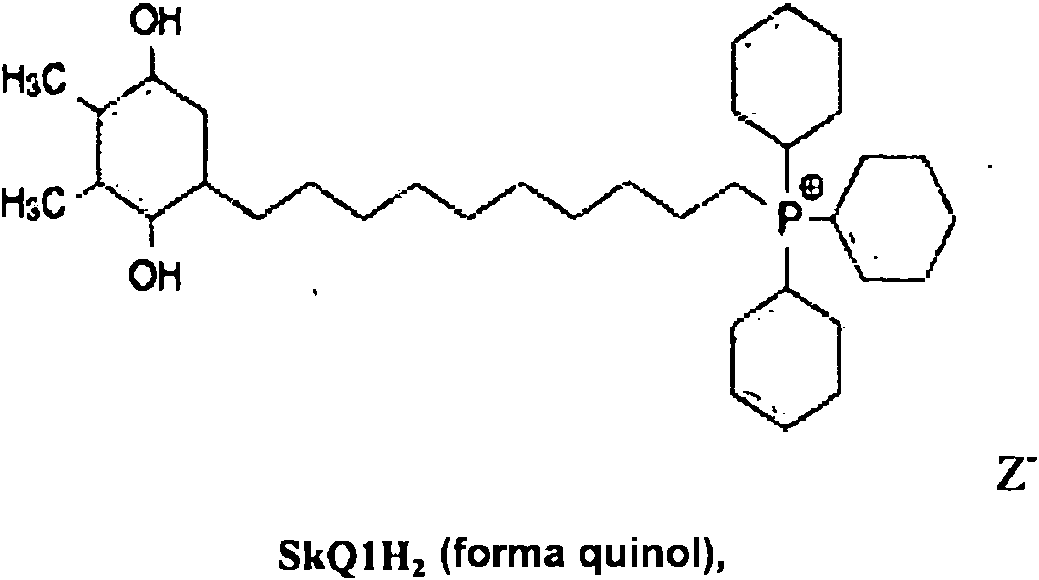
en el que Z- es un anión farmacéuticamente aceptable, tal como, pero sin limitación, bromuro, cloruro o ascorbato. En una composición farmacéutica seca o soluble, SkQ1H2 se puede estabilizar y proteger de la oxidación mediante un agente de reducción, tal como, pero sin limitación, ascorbato.wherein Z- is a pharmaceutically acceptable anion, such as, but not limited to, bromide, chloride or ascorbate. In a dry or soluble pharmaceutical composition, SkQ1H2 can be stabilized and protected from oxidation by a reducing agent, such as, but not limited to, ascorbate.
Otro enfoque aún para mejorar la estabilidad es la colocación del MTA, en forma reducida u oxidada, en una formulación de "cápsula blanda", que es una cápsula basada en gelatina con un relleno líquido. Las formulaciones de cápsula blanda de MTA proporcionan una buena biodisponibilidad, ya que la cápsula blanda se disuelve en vehículos líquidos, oleosos y miscibles en agua, tales como mono y diglicéridos de ácido cáprico/caprílico (Capmul MCM), aceite Miglyol 8122 (triglicéridos de cadena media). Cuando la cápsula blanda se libera en el cuerpo, consigue emulsionarse y proporciona una dispersión del fármaco en un área superficial alta.Still another approach to improve stability is the placement of the MTA, in reduced or oxidized form, in a "soft capsule" formulation, which is a gelatin-based capsule with a liquid filler. MTA soft capsule formulations provide good bioavailability, since the soft capsule is dissolved in liquid, oily, water-miscible carriers, such as capric / caprylic acid mono- and diglycerides (Capmul MCM), Miglyol 8122 oil (triglycerides of medium chain). When the soft capsule is released into the body, it becomes emulsified and provides a dispersion of the drug in a high surface area.
Se pueden usar los mono y diglicéridos de ácido cáprico/caprílico (Capmul MCM), aceite Miglyol 8122 (triglicéridos de cadena media). Tales vehículos oleosos a medida que pasan a formar parte de un sistema autoemulsionante. Otros componentes estabilizantes ejemplares son el succinato de polietilen glicol/vitamina E, el monooleato de sorbitán, el labrasol y las combinaciones de los mismos. De manera adicional, basándose en su potencial de oxidación, el tocoferol, el hidroxitolueno butilado y/o el anisol de hidroxi butilado se pueden incluir en la composición como antioxidante.The mono and diglycerides of capric / caprylic acid (Capmul MCM), Miglyol 8122 oil (medium chain triglycerides) can be used. Such oily vehicles as they become part of a self-emulsifying system. Other exemplary stabilizing components are polyethylene glycol / vitamin E succinate, sorbitan monooleate, sunflower and combinations thereof. Additionally, based on their oxidation potential, tocopherol, butylated hydroxytoluene and / or butylated hydroxy anisole can be included in the composition as an antioxidant.
Otro enfoque para el aumento de la estabilización de los MTA en la solución es la creación de una nanosuspensión de MTA (< 1000nm) estabilizada con, por ejemplo, succinato de polietilen glicol/vitamina E. Se puede usar la molienda en húmedo de Netzsch (http://www.netzsch-grinding.com) para lograr esta nanosuspensión.Another approach to increasing the stabilization of MTAs in the solution is the creation of a nano-suspension of MTA (<1000nm) stabilized with, for example, polyethylene glycol succinate / vitamin E. Wet milling of Netzsch can be used ( http://www.netzsch-grinding.com) to achieve this nanosuspension.
De manera adicional, las soluciones de etanol de MTA reducido (tal como SkQ1H2) se pueden mezclar con el ácido ascórbico y secar con ácido para crear un polvo o sólido resultante que es estable durante varios meses.Additionally, reduced MTA ethanol solutions (such as SkQ1H2) can be mixed with the ascorbic acid and dried with acid to create a resulting powder or solid that is stable for several months.
Las formulaciones estables en forma de comprimidos orales se pueden preparar mediante extrusión por fundición en caliente. Esta técnica de granulación por fundición mantiene la estabilidad polimórfica de los fármacos y mejora de manera significativa su biodisponibilidad oral. Se puede lograr mediante el mezclado en conjunto de los MTA con macrogoles (por ejemplo, polietilen glicoles 3350, 6000, polivinil pirrolidona, hidroxi propil celulosa y vitamina E TPSG) a través de una extrusora de fundición en caliente y la compresión de la granulación resultante en comprimidos o la encapsulación en cápsulas de gelatina dura.Stable formulations in the form of oral tablets can be prepared by extrusion by hot melt. This melting granulation technique maintains the polymorphic stability of the drugs and significantly improves their oral bioavailability. It can be achieved by thoroughly mixing the MTAs with macrogols (for example, polyethylene glycols 3350, 6000, polyvinyl pyrrolidone, hydroxy propyl cellulose and vitamin E TPSG) through a hot melt extruder and compressing the resulting granulation in tablets or encapsulation in hard gelatine capsules.
Las formulaciones de SkQ1 orales líquidas y sólidas estables representativas se muestran a continuación (Tabla 2): Tabla 2Stable representative liquid and solid oral SkQ1 formulations are shown below (Table 2): Table 2
SkQ1 oxidadoOxidized SkQ1
Soluciones:Solutions:
SkQ1 en glicerol al 20 % (% en peso), preparado con tampón de fosfatoSkQ1 in 20 % glycerol (% by weight), prepared with phosphate buffer
SkQ1 en 1,2-propilen glicol al 50 % (% en peso) con ácido pirúvicoSkQ1 in 50% 1,2-propylene glycol (% by weight) with pyruvic acid
SkQ1 en 1,2-propilen glicol al 50 % (% en peso) con ácido lácticoSkQ1 in 50% 1,2-propylene glycol (% by weight) with lactic acid
Composiciones sólidas:Solid compositions:
SkQ1 con PEG-4000SkQ1 with PEG-4000
SkQ1 con dextranoSkQ1 with dextran
SkQ1 con ácido p-aminobenzoico (p-ABA)SkQ1 with p-aminobenzoic acid (p-ABA)
SkQ1 con dextrano y p-ABASkQ1 with dextran and p-ABA
SkQ1 con mioinositaSkQ1 with myoinitis
SkQ1 con ácido pirúvico y Pearlitol 200SkQ1 with pyruvic acid and Pearlitol 200
SkQ1 con ácido pirúvico y celulosa microcristalinaSkQ1 with pyruvic acid and microcrystalline cellulose
SkQ1 con ácido pirúvico y F-Melt CSkQ1 with pyruvic acid and F-Melt C
SkQ1 con ácido pirúvico y Syloid FPSkQ1 with pyruvic acid and Syloid FP
SkQ1 con ácido cítrico (o ácido tartárico, o ácido láctico o glicina) y Pearlitol 200SkQ1 with citric acid (or tartaric acid, or lactic acid or glycine) and Pearlitol 200
SkQ1 con ácido cítrico (o ácido tartárico, o ácido láctico o glicina) y celulosa microcristalinaSkQ1 with citric acid (or tartaric acid, or lactic acid or glycine) and microcrystalline cellulose
SkQ1 con ácido cítrico (o ácido tartárico, o ácido láctico o glicina) y F-Melt CSkQ1 with citric acid (or tartaric acid, or lactic acid or glycine) and F-Melt C
SkQ1 con ácido cítrico (o ácido tartárico, o ácido láctico o glicina) y Syloid FPSkQ1 with citric acid (or tartaric acid, or lactic acid or glycine) and Syloid FP
SkQ1 H2 (forma reducida) SkQ 1 H 2 (reduced form)
Soluciones:Solutions:
SkQ1H2 (0,11 M) con ácido ascórbico (10 eq) en EtOH al 55 %SkQ1H2 (0.11 M) with ascorbic acid (10 eq) in 55% EtOH
SkQ1H2 (7,4 mM) con ácido ascórbico (5 eq) y sorbito (20 partes en peso) en 1,2-propilen glicol al 30 %SkQ1H2 (7.4 mM) with ascorbic acid (5 eq) and sorbitol (20 parts by weight) in 30% 1,2-propylene glycol
Composiciones sólidas:Solid compositions:
SkQ1H2 (1 eq) con ácido ascórbico (> 2 eq molares) con PEG-4000SkQ1H2 (1 eq) with ascorbic acid (> 2 eq molar) with PEG-4000
SkQ1H2 (1 eq) con ácido ascórbico (> 2 eq molares) con dextranoSkQ1H2 (1 eq) with ascorbic acid (> 2 eq molar) with dextran
SkQ1H2 (1 eq) con ácido ascórbico (> 10 eq molares) con PEG-4000SkQ1H2 (1 eq) with ascorbic acid (> 10 eq molar) with PEG-4000
SkQ1H2 (1 eq) con ácido ascórbico (> 10 eq molares) con dextranoSkQ1H2 (1 eq) with ascorbic acid (> 10 eq molar) with dextran
SkQ1H2 (1 eq) con sorbito (30 partes en peso)SkQ1H2 (1 eq) with sorbito (30 parts by weight)
SkQ1H2 (1 eq) con ácido ascórbico (0-5 eq) y sorbito (30 partes en peso)SkQ1H2 (1 eq) with ascorbic acid (0-5 eq) and sorbitol (30 parts by weight)
SkQ1H2 (1 eq) con ácido ascórbico (0-5 eq) y glucosa (10 partes en peso)SkQ1H2 (1 eq) with ascorbic acid (0-5 eq) and glucose (10 parts by weight)
SkQ1 H2 (1 eq) con ácido ascórbico (0-5 eq) y monohidrato de lactosa (10 partes en peso)SkQ1 H2 (1 eq) with ascorbic acid (0-5 eq) and lactose monohydrate (10 parts by weight)
SkQ1H2 (1 eq) con ácido ascórbico (0-5 eq) y Pearlitol 200 (30 partes en peso)SkQ1H2 (1 eq) with ascorbic acid (0-5 eq) and Pearlitol 200 (30 parts by weight)
SkQ1 H2 (1 eq) con ácido ascórbico (0-5 eq) y celulosa microcristalina (30 partes en peso)SkQ1 H2 (1 eq) with ascorbic acid (0-5 eq) and microcrystalline cellulose (30 parts by weight)
SkQ1 H2 (1 eq) con ácido ascórbico (0-5 eq) y F-Melt C (30 partes en peso)SkQ1 H2 (1 eq) with ascorbic acid (0-5 eq) and F-Melt C (30 parts by weight)
SkQ1H2 (1 eq) con ácido ascórbico (0-5 eq) y Syloid FP (30 partes en peso)SkQ1H2 (1 eq) with ascorbic acid (0-5 eq) and Syloid FP (30 parts by weight)
Se preparó SkQ1H2 en polvo ligero a un rendimiento de casi el 100% mediante la reducción de SkQ1 con ácido ascórbico o cualquier otro agente de reducción adecuado en la mezcla de alcohol/agua, seguida del aislamiento mediante la extracción con cloroformo o cualquier otro disolvente adecuado, o mediante precipitación a partir de agua, seguida de separación centrífuga, o mediante cromatografía en columna (gel de sílice) o mediante el procedimiento HPLC RP. El material aislado estaba caracterizado por la RMN 1H, CL/CM y los datos de análisis elemental.SkQ1H2 was prepared in light powder at a yield of almost 100% by reducing SkQ1 with ascorbic acid or any other suitable reducing agent in the alcohol / water mixture, followed by isolation by extraction with chloroform or any other suitable solvent , or by precipitation from water, followed by centrifugal separation, or by column chromatography (silica gel) or by the RP HPLC method. The isolated material was characterized by 1 H NMR, CL / CM and elemental analysis data.
Se comprobó que la muestra tenía una excelente estabilidad durante 1 mes a TA o varios meses a 4 °C en la oscuridad en una atmósfera inerte sin ningún acceso a la humedad (Tabla 17). La muestra también se puede estabilizar mediante su disolución en cualquier disolvente aprótico y anhidro desoxigenado. La forma reducida de SkQ1H2 se oxida rápidamente hasta la forma original de SkQ1 cuando se expone al aire o una atmósfera húmeda o se disuelve en agua o cualquier disolvente protónico (Tabla 18).The sample was found to have excellent stability for 1 month at RT or several months at 4 ° C in the dark in an inert atmosphere with no access to moisture (Table 17). The sample can also be stabilized by dissolving it in any aprotic and deoxygenated anhydrous solvent. The reduced form of SkQ1H2 is rapidly oxidized to the original SkQ1 form when exposed to air or a humid atmosphere or dissolved in water or any proton solvent (Table 18).
La estabilidad de SkQ1H2 en las composiciones sólidas depende en gran medida de la sequedad de la composición, así como de la sequedad de los excipientes y otros componentes. La humedad de la atmósfera ambiente y la presencia de aire también desempeñan una función esencial en la oxidación de SkQ1H2 en SkQ1, seguida de la degradación de este último.The stability of SkQ1H2 in the solid compositions depends to a large extent on the dryness of the composition, as well as the dryness of the excipients and other components. The humidity of the ambient atmosphere and the presence of air also play an essential role in the oxidation of SkQ1H2 in SkQ1, followed by degradation of the latter.
II. TratamientosII. Treatments
Los experimentos in vivo e in vitro demuestran la capacidad de los MTA, incluyendo, pero sin limitación, SkQ1 y SkQR1, para prevenir y tratar la diabetes y trastornos relacionados con la diabetes (Ejemplo 2). Tales experimentos in vivo e in vitro también demuestran que las soluciones líquidas de MTA, incluyendo, pero sin limitación, SkQ1 y SkQR1, se pueden usar para la prevención y el tratamiento de enfermedades inflamatorias y afecciones relacionadas, tales como choque séptico y/o sistémico. Por ejemplo, estas formulaciones líquidas basadas en MTA con una estabilidad aceptable se combinaron con los resultados que mostraban la eficacia en los modelos de diabetes, inflamación, choque séptico y trastornos relacionados (Ejemplos 2-7).The in vivo and in vitro experiments demonstrate the ability of MTAs, including, but not limited to, SkQ1 and SkQR1, to prevent and treat diabetes and diabetes-related disorders (Example 2). Such in vivo and in vitro experiments also demonstrate that liquid MTA solutions, including, but not limited to, SkQ1 and SkQR1, can be used for the prevention and treatment of inflammatory diseases and related conditions, such as septic and / or systemic shock. . For example, these liquid formulations based on MTA with acceptable stability were combined with results showing efficacy in the models of diabetes, inflammation, septic shock and related disorders (Examples 2-7).
El tratamiento con SkQ1 también impidió la desunión de los contactos intracelulares y la reorganización del citoesqueleto causada por el TNFa (datos obtenidos mediante estudios de misroscopía de VE-cadherina, betacatenina y F-actina). Por tanto, se mostró que SkQ1 era eficaz en la protección de las células endoteliales contra la disfunción de la barrera endotelial causada por las citocinas y, por tanto, se puede usar para la prevención y el tratamiento de muchas afecciones patológicas, incluyendo la diabetes, la aterosclerosis, el envejecimiento y las enfermedades inflamatorias crónicas.The treatment with SkQ1 also prevented the dissociation of the intracellular contacts and the reorganization of the cytoskeleton caused by TNFa (data obtained by studies of VE-cadherin, beta-catenin and F-actin misroscopy). Therefore, it was shown that SkQ1 was effective in protecting endothelial cells against endothelial barrier dysfunction caused by cytokines and, therefore, can be used for the prevention and treatment of many pathological conditions, including diabetes, atherosclerosis, aging and chronic inflammatory diseases.
De manera adicional, el SkQ1 disminuye la fosforilación y la degradación de IkBa causada por TNFa. Se sabe que el NFkB está permanentemente activo en muchas enfermedades inflamatorias, tales como enfermedad intestinal inflamatoria, artritis, sepsis, gastritis, asma y aterosclerosis (Monaco y col. (2004) PNAS., 101:5634-9). Se mostró que el SkQ1 prevenía la activación del NFkB, un inhibidor fundamental de la actividad de NFkB asociada a una mortalidad elevada, especialmente de enfermedades cardiovasculares (Venuraju y col. (2010) J. Am. Coll. Cardiol., 55:2049-61). Además, se mostró que el SkQ1 prevenía la translocación del factor de transcripción p65 (RelA) del citoplasma al núcleo, disminuyendo de este modo de manera potencial las consecuencias patológicas.Additionally, SkQ1 decreases the phosphorylation and degradation of IkBa caused by TNFa. It is known that NFkB is permanently active in many inflammatory diseases, such as inflammatory bowel disease, arthritis, sepsis, gastritis, asthma and atherosclerosis (Monaco et al (2004) PNAS., 101: 5634-9). It was shown that SkQ1 prevented the activation of NFkB, a fundamental inhibitor of NFkB activity associated with high mortality, especially of cardiovascular diseases (Venuraju et al (2010) J. Am. Coll. Cardiol., 55: 2049- 61). In addition, it was shown that SkQ1 prevented the translocation of transcription factor p65 (RelA) from the cytoplasm to the nucleus, thereby potentially decreasing the pathological consequences.
EjemplosExamples
Ejemplo 1Example 1
Formulaciones estables de la forma reducida de SkQ1 (SkQ1H?)Stable formulations of the reduced form of SkQ1 (SkQ1H?)
El SkQ1H2, una forma quinol reducida de SkQ, se preparó de la siguiente manera: se mezclaron por completo 10 ml de solución de SkQ1H2 (con una concentración de 1 mg/ml) en etanol con 200 mg de ácido ascórbico y, después, se secaron al vacío. El polvo resultante contenía ácido ascórbico al 95 % y SkQ1H2 al 5 % y demostró una estabilidad aceptable a varias temperaturas de almacenamiento. Por ejemplo, en el experimento de descomposición acelerada, la pureza de SkQ1 se redujo del 98,7 % inicial al 95,1 % después del almacenamiento durante 12 días a 60 °C. A partir de estos resultados, se puede calcular que el almacenamiento durante 1 año a 4 °C dará como resultado una pérdida de aproximadamente el 3,5% de la concentración inicial del compuesto activo SkQ1 que tiene una estabilidad aceptable.SkQ1H2, a reduced quinol form of SkQ, was prepared as follows: 10 ml of SkQ1H2 solution (at a concentration of 1 mg / ml) in ethanol was mixed thoroughly with 200 mg of ascorbic acid and then They dried to the emptiness. The resulting powder contained 95% ascorbic acid and 5% SkQ1H2 and demonstrated acceptable stability at various storage temperatures. For example, in the accelerated decomposition experiment, the purity of SkQ1 was reduced from initial 98.7% to 95.1% after storage for 12 days at 60 ° C. From these results, it can be calculated that storage for 1 year at 4 ° C will result in a loss of about 3.5% of the initial concentration of active compound SkQ1 having an acceptable stability.
Como alternativa, se preparó una mezcla seca de SkQ1H2 y ácido ascórbico mediante la disolución de 10 mg de SkQ1H2 en 10 ml de solución de ácido ascórbico (20 mg/ml) y se secó al vacío.Alternatively, a dry mixture of SkQ1H2 and ascorbic acid was prepared by dissolving 10 mg of SkQ1H2 in 10 ml of ascorbic acid solution (20 mg / ml) and dried under vacuum.
Otra forma más de preparar una mezcla de SkQ1-ácido ascórbico es el mezclado de 5 ml de solución de SkQ1H2 en etanol (2 mg/ml) con 5 ml de solución de ácido ascórbico en agua (40 mg/ml) y el secado al vacío. La forma reducida de SkQH2 se estabiliza en solución de ácido ascórbico, eliminando la etapa de secado y, por tanto, la formulación líquida correspondiente.Another way to prepare a mixture of SkQ1-ascorbic acid is by mixing 5 ml of SkQ1H2 solution in ethanol (2 mg / ml) with 5 ml of ascorbic acid solution in water (40 mg / ml) and drying empty. The reduced form of SkQH2 is stabilized in ascorbic acid solution, eliminating the drying step and, therefore, the corresponding liquid formulation.
Ejemplo 2Example 2
Efecto de las formulaciones de MTA líquidas en la diabetesEffect of liquid MTA formulations on diabetes
A. Estudios de animales con aloxanoA. Studies of animals with alloxan
El aloxano es un agente diabetogénico bien conocido usado ampliamente para inducir la diabetes tipo 2 en los animales (Viana y col. (2004) BMC Pharmacol., 8:4-9).Aloxane is a well-known diabetogenic agent widely used to induce type 2 diabetes in animals (Viana et al (2004) BMC Pharmacol., 8: 4-9).
La inducción de la diabetes con aloxano se realizó de la siguiente manera: dos grupos de ratas de laboratorio (20 animales en cada grupo) con acceso libre a comida y agua se alimentaron con una solución 250 nM de SkQ1 durante 10 días. El consumo diario por rata fue de 60 ml de solución acuosa (que contenía 15 nmoles de SkQ1). El peso promedio de las ratas fue de 300 g. Por tanto, las ratas consumieron aproximadamente 50 nmol/kg de peso corporal por día. Otros dos grupos de animales no recibieron SkQ1. Después de 10 días, las ratas se inyectaron por vía subcutánea (en el área del muslo) con aloxano disuelto en una solución de sal isotónica del 0,9 % p/v de NaCl (100 mg/kg de peso corporal; los grupos "Aloxano SkQ1" y "Aloxano". Los animales de control se inyectaron con una solución de sal sin aloxano (los grupos "Control SkQ1" y "Control"). Después de la inyección, las ratas continuaron bebiendo agua que contenía SkQ1 (250 nM) durante 14 días (el grupo "Aloxano SkQ1") o se mantuvieron sin SkQ1 (el grupo "Aloxano").The induction of diabetes with alloxane was carried out in the following manner: two groups of laboratory rats (20 animals in each group) with free access to food and water were fed with a 250 nM solution of SkQ1 for 10 days. The daily consumption per rat was 60 ml of aqueous solution (containing 15 nmoles of SkQ1). The average weight of the rats was 300 g. Therefore, the rats consumed approximately 50 nmol / kg of weight body per day. Two other groups of animals did not receive SkQ1. After 10 days, the rats were injected subcutaneously (in the thigh area) with alloxan dissolved in an isotonic salt solution of 0.9% w / v NaCl (100 mg / kg body weight; Aloxano SkQ1 "and" Aloxano. "The control animals were injected with a salt solution without alloxan (the" Control SkQ1 "and" Control "groups.) After injection, the rats continued to drink water containing SkQ1 (250 nM ) for 14 days (the group "Aloxano SkQ1") or were kept without SkQ1 (the group "Aloxano").
Los datos sobre el nivel de glucosa en sangre se midieron mediante el procedimiento de la glucosa oxidasa (Saifer y col. (1958) J. Lab. Clin. Med., 51:445-460) después de 2 semanas de inyección de aloxano. Los resultados se presentan en la Figura 1. Todos los datos se presentan como la media /-SE.Data on blood glucose level were measured by the glucose oxidase method (Saifer et al (1958) J. Lab. Clin. Med., 51: 445-460) after 2 weeks of alloxane injection. The results are presented in Figure 1. All the data are presented as the mean / -SE.
Los animales que consumieron SkQ1 después de la inyección de aloxano tuvieron aproximadamente 2 veces menos de glucosa en sangre, en comparación con los ratones sin tratamiento con SkQ1.The animals that consumed SkQ1 after the injection of alloxan had approximately 2 times less blood glucose, compared to the mice without treatment with SkQ1.
Estos resultados demuestran que los MTA estabilizados, por ejemplo, SkQ1, son útiles para la prevención y el tratamiento de la diabetes mellitus y sus complicaciones.These results demonstrate that stabilized MTAs, for example, SkQ1, are useful for the prevention and treatment of diabetes mellitus and its complications.
En otro experimento, se dividieron las ratas Wistar macho de 200 g a 250 g (de 7 a 8 semanas) en 3 grupos, de 12 a 15 animales cada uno, y se inyectaron con 125 mg/kg de aloxano por vía intraperitoneal (i.p.) después de ayuno durante una noche. Los animales de control se inyectaron con solución salina (NaCl al 0,9 %). La formulación estabilizada (etanol al 1 %, 5 ml/kg) y SkQ1H2 (5 eq de ácido ascórbico, 30 partes en peso de sorbito) en una dosificación de 1250 mmol/kg se administraron por vía intragástrica (i.g.) mediante sonda una vez al día durante 2 semanas antes y 1 semana después de la administración de aloxano. Se recogieron muestras de sangre de la vena de la cola después del ayuno durante una noche y se midieron los niveles de glucosa antes de la administración de aloxano y 1 día, 2 días, 3 días y 7 días después mediante el procedimiento convencional de la glucosa-oxidasa. Siete días después de la administración de aloxano, las ratas se sometieron a un ensayo de tolerancia a la glucosa. Las ratas recibieron 3 g/kg de glucosa i.g. Se midieron los niveles de glucosa en sangre antes de la inyección de glucosa y 15 min, 30 min, 60 min y 90 min después.In another experiment, the male Wistar rats from 200 g to 250 g (from 7 to 8 weeks) were divided into 3 groups, from 12 to 15 animals each, and injected with 125 mg / kg of alloxan intraperitoneally (ip) after fasting for one night. The control animals were injected with saline (0.9% NaCl). The stabilized formulation (1% ethanol, 5 ml / kg) and SkQ1H2 (5 eq of ascorbic acid, 30 parts by weight of sorbite) in a dosage of 1250 mmol / kg were administered intragastric (ig) by gavage once daily for 2 weeks before and 1 week after administration of alloxan. Blood samples were collected from the tail vein after fasting overnight and glucose levels were measured before the administration of alloxan and 1 day, 2 days, 3 days and 7 days later by the conventional glucose method -oxidase. Seven days after the administration of alloxan, the rats were subjected to a glucose tolerance test. The rats received 3 g / kg of glucose i.g. Blood glucose levels were measured before the glucose injection and 15 min, 30 min, 60 min and 90 min later.
Se obtuvieron los siguientes resultados (Tabla 3):The following results were obtained (Table 3):
Tabla 3Table 3

B. Estudios de ratones diabéticosB. Studies of diabetic mice
Se sabe que los ratones portadores de la mutación en el gen del receptor de leptina (ratones C57BLKS-Leprdb/J o ratones db/db) están afectados por trastornos metabólicos de la glucosa. Estos ratones se usan como modelo de diabetes tipo II con muchas de las características de las enfermedades humanas, incluyendo la hiperfagia, la hiperglicemia, la resistencia a la insulina, la obesidad progresiva (Hummel y col. (1966) Sciencia, 153:1127-1128). El SkQ1 en glicerol al 20 %, tal como se describe más adelante en el Ejemplo 8, se administró por vía oral (250 nmol/kg por día) a ratones db/db (n = 8) homocigotos de 10 a 12 semanas, al tiempo que a ratones db/db (n = 8) de vehículo y db/++ (n = 5) heterocigotos de control no diabéticos durante 12 semanas. El contenido de sustancia reactiva a TBA hepática (MDA en inglés) se determinó mediante un ensayo según el procedimiento de Mihara y col. ((1978) Anal. Biochem., 86:271-278).It is known that mice carrying the mutation in the leptin receptor gene (C57BLKS-Leprdb / J mice or db / db mice) are affected by metabolic glucose disorders. These mice are used as a model of type II diabetes with many of the characteristics of human diseases, including hyperphagia, hyperglycemia, insulin resistance, progressive obesity (Hummel et al. (1966) Sciencia, 153: 1127- 1128). SkQ1 in 20% glycerol, as described below in Example 8, was administered orally (250 nmol / kg per day) to homozygous db / db (n = 8) mice for 10 to 12 weeks, time than to db / db mice (n = 8) of vehicle and db / ++ (n = 5) non-diabetic control heterozygotes for 12 weeks. The content of reactive substance to hepatic TBA (MDA) was determined by an assay according to the procedure of Mihara et al. ((1978) Anal. Biochem., 86: 271-278).
Tal como se muestra en la Figura 2, los niveles elevados de glucosa inducen estrés oxidativo reflejado por el aumento de los niveles de MDA en el hígado de ratones db/db. El aumento del nivel de MDA refleja la estimulación de la peroxidación de lípidos que, a su vez, se considera responsable del deterioro de las células endoteliales, la permeabilidad de los capilares y el metabolismo de los fibroblastos y el colágeno, los principales factores de las patologías asociadas a la diabetes. La solución estabilizada de SkQ1 disminuyó de manera significativa los niveles de MDA en el hígado de ratones db/db diabéticos, lo que indicaba una disminución de la tasa de peroxidación de lípidos y una disminución de los daños del hígado.As shown in Figure 2, elevated glucose levels induce oxidative stress reflected by increased levels of MDA in the liver of db / db mice. The increase in the level of MDA reflects the stimulation of lipid peroxidation which, in turn, is considered responsible for the deterioration of endothelial cells, the permeability of capillaries and the metabolism of fibroblasts and collagen, the main factors of pathologies associated with diabetes. The stabilized solution of SkQ1 significantly decreased MDA levels in the liver of diabetic db / db mice, indicating a decrease in the rate of lipid peroxidation and a decrease in liver damage.
Ejemplo 3Example 3
Efecto de los MTA estabilizados sobre la cicatrización de heridasEffect of stabilized MTA on wound healing
La cicatrización de heridas se estudió en dos series usando ratones (db/db) C57BLKS-Leprdb/J homocigotos y ratones (db/+) C57BLKS-Leprdb/J heterocigotos de 6 meses. Estos ratones se usan como modelo de diabetes tipo II con alteración de la cicatrización de heridas (Michaels, y col. (2007) Wound Repair and Regeneration, 15:665-670). Wound healing was studied in two series using heterozygous 6-month old mice (db / db) C57BLKS-Leprdb / J homozygotes and mice (db / +) C57BLKS-Leprdb / J heterozygous. These mice are used as a model of type II diabetes with impaired wound healing (Michaels, et al (2007) Wound Repair and Regeneration, 15: 665-670).
A los ratones se les administró diariamente 250 nmol/kg de peso corporal por día de la forma farmacéutica de SkQ1 en glicerol al 20% (tal como se describe en el Ejemplo 8) durante un período de tiempo de 10 semanas a 12 semanas. Los grupos de control de ratones db/db y db/+ no se sometieron a tratamiento con SkQ1. Las heridas dérmicas de espesor completo se hicieron con anestesia de ketamina (80 mg/kg). Los animales se mantuvieron en jaulas de plástico en regímenes convencionales de temperatura, luz y alimentación. 7 días después de las heridas, se sacrificaron los animales mediante decapitación. Las heridas se extirparon, se fijaron en formalina al 10 % en un tampón de PBS convencional, se procesaron histológicamente y se embebieron en parafina. Las secciones histológicas de la parte central de las heridas se cortaron y se tiñeron con hematoxilina y eosina. Las secciones se tiñeron inmunohistoquímicamente para los marcadores de células endoteliales (CD31), macrófagos (f4/80) y miofibroblastos (a-actina del músculo liso). Se usó el software ImageJ (National Institutes of Health (NIH) http7rsb.info.nih.gov/ij/) para calcular la cantidad total de células, el índice de los neutrófilos, los macrófagos y la densidad de vasos (área del vaso/área de tejido de granulación * 100) en las microfotografías de secciones de heridas. En cada animal se analizaron 100 mm2 de área de sección. La tasa de epitelización de las heridas se evaluó en % como la relación del área de herida epitelizada respecto al área de herida total en la sección de tejido * 100. En el análisis estadístico se usó el ensayo U de Mann-Whitney no paramétrico. Los datos se muestran como medias ± S.E.M.Mice were dosed daily with 250 nmol / kg body weight per day of the SkQ1 dosage form in 20% glycerol (as described in Example 8) for a period of 10 weeks to 12 weeks. The control groups of db / db and db / + mice were not treated with SkQ1. Full thickness dermal wounds were made with ketamine anesthesia (80 mg / kg). The animals were kept in plastic cages under conventional temperature, light and feeding regimes. 7 days after the wounds, the animals were sacrificed by decapitation. Wounds were excised, fixed in 10% formalin in a standard PBS buffer, histologically processed and embedded in paraffin. The histological sections of the central part of the wounds were cut and stained with hematoxylin and eosin. Sections were stained immunohistochemically for endothelial cell markers (CD31), macrophages (f4 / 80) and myofibroblasts (smooth muscle a-actin). ImageJ software (National Institutes of Health (NIH) http7rsb.info.nih.gov/ij/) was used to calculate the total number of cells, the neutrophil index, the macrophages and the density of vessels (vessel area / granulation tissue area * 100) in microphotographs of wound sections. In each animal, 100 mm2 of section area was analyzed. The rate of wound epithelization was evaluated in% as the ratio of the epithelial wound area to the total wound area in the tissue section * 100. In the statistical analysis, the nonparametric Mann-Whitney U test was used. The data are shown as means ± S.E.M.
Tal como se muestra en las Figuras 3a, 3b y 3c, la forma farmacéutica estabilizada de SkQ1 es capaz de acelerar la cicatrización de heridas mediante la disminución de la infiltración de neutrófilos, el aumento de la vascularización y el aumento de la tasa de epitelización en ratones diabéticos.As shown in Figures 3a, 3b and 3c, the stabilized pharmaceutical form of SkQ1 is capable of accelerating wound healing by decreasing neutrophil infiltration, increasing vascularization and increasing the rate of epithelialization in Diabetic mice.
Ejemplo 4Example 4
Efecto de los MTA estabilizados sobre la inflamación y el choque sépticoEffect of stabilized MTAs on inflammation and septic shock
Se sabe que el choque séptico activa numerosas vías inflamatorias en un organismo que conduce a la muerte. El ratón con choque séptico inducido por lipopolisacáridos (LPS) es un modelo ampliamente aceptado en investigaciones farmacológicas y biológicas (Villa y col. (2004) Meth. Molec. Med., 98:199-206).It is known that septic shock activates numerous inflammatory pathways in an organism that leads to death. The mouse with septic shock induced by lipopolysaccharides (LPS) is a widely accepted model in pharmacological and biological research (Villa et al (2004) Meth. Molec. Med., 98: 199-206).
La inducción del choque séptico se realizó la siguiente manera: se dividieron 43 ratones BALB/c machos con acceso libre a alimentos y agua en 4 grupos experimentales. El grupo "K" consiguió agua sin fármacos. Los grupos "SkQ 50", "SkQ 250" y "SkQ 1250" se trataron por vía parenteral diariamente con una forma farmacéutica de SkQ1 en agua que comprendía 50 nmol/kg, 250 nmol/kg y 1250 nmol/kg en consecuencia. Después de 3 semanas de tratamiento con SkQ1, los animales se inyectaron por vía intraperitoneal con 250 mg/kg de LPS y 700 mg/kg de D-galactosamina (D-GalN) que indujeron un choque séptico que condujo a la muerte del 50 % de los animales de control no tratados (dosis de LD50). Se registró la muerte de los animales después de 4 días de la inducción del choque séptico.Induction of septic shock was performed as follows: 43 male BALB / c mice were divided with free access to food and water in 4 experimental groups. The "K" group got water without drugs. The groups "SkQ 50", "SkQ 250" and "SkQ 1250" were treated parenterally daily with a pharmaceutical form of SkQ1 in water comprising 50 nmol / kg, 250 nmol / kg and 1250 nmol / kg accordingly. After 3 weeks of treatment with SkQ1, the animals were injected intraperitoneally with 250 mg / kg of LPS and 700 mg / kg of D-galactosamine (D-GalN) that induced a septic shock that led to 50% death of untreated control animals (dose of LD50). The death of the animals was recorded after 4 days of the induction of septic shock.
Los resultados del experimento se muestran en la Figura 4. SkQ1 mejoró de manera significativa la supervivencia de los ratones después del tratamiento con LPS/D-GalN. El efecto estadísticamente significativo se mostró para una dosis de 50 nmol/kg (p = 0,03).The results of the experiment are shown in Figure 4. SkQ1 significantly improved the survival of the mice after treatment with LPS / D-GalN. The statistically significant effect was shown for a dose of 50 nmol / kg (p = 0.03).
Estos resultados indican claramente que el SkQ1 actúa como un agente antiinflamatorio que tiene una aplicación terapéutica para el tratamiento del choque séptico.These results clearly indicate that SkQ1 acts as an anti-inflammatory agent that has a therapeutic application for the treatment of septic shock.
En otros estudios, se dividieron los ratones BALB/c con acceso libre a alimentos y agua en 4 grupos experimentales. El grupo "K" recibe glicerol al 20 % sin fármacos. Los grupos "SkQ 50", "SkQ 250" y "SkQ 1250" se trataron por vía parenteral diariamente con una forma farmacéutica de SkQ1 en glicerol al 20 % (Ejemplo 8) que comprendía 50 nmol/kg, 250 nmol/kg y 1250 nmol/kg en consecuencia. Después de 3 semanas de tratamiento con SkQ1, los animales se inyectaron por vía intraperitoneal con 250 mg/kg de LPS y 700 mg/kg de D-galactosamina (D-GalN) que indujeron un choque séptico que condujo a la muerte del 50 % de los animales de control no tratados (dosis de LD50). Se registró la muerte de los animales después de 4 días de la inducción del choque séptico.In other studies, BALB / c mice with free access to food and water were divided into 4 experimental groups. The "K" group receives 20% glycerol without drugs. The groups "SkQ 50", "SkQ 250" and "SkQ 1250" were treated parenterally daily with a pharmaceutical form of SkQ1 in 20% glycerol (Example 8) comprising 50 nmol / kg, 250 nmol / kg and 1250 nmol / kg accordingly. After 3 weeks of treatment with SkQ1, the animals were injected intraperitoneally with 250 mg / kg of LPS and 700 mg / kg of D-galactosamine (D-GalN) that induced a septic shock that led to 50% death of untreated control animals (dose of LD50). The death of the animals was recorded after 4 days of the induction of septic shock.
Ejemplo 5Example 5
Efecto de los MTA estabilizados sobre la artritisEffect of stabilized MTA on arthritis
El modelo de rata con artritis inducida por colágeno (CIA en inglés) se usó para examinar la susceptibilidad de la artritis reumatoide (AR) al tratamiento con agentes antiartríticos potenciales (Griffiths y col. (2001) Immunol. Rev., 184:172-83).The rat model with collagen-induced arthritis (CIA) was used to examine the susceptibility of rheumatoid arthritis (RA) to treatment with potential antiarthritic agents (Griffiths et al (2001) Immunol Rev., 184: 172- 83).
Se inyectaron treinta ratas Wistar con acceso libre a alimentos y agua con adyuvante completo de Freund y 250 mg de colágeno tipo II para inducir la CIA. A partir de los 14 días y de los 24 días después de la inyección, dos grupos de 10 animales en cada uno se alimentaron diariamente con una forma farmacéutica de SkQ1 en agua que comprendía 250 nmol/kg de peso corporal por día (los grupos "SkQ1 desde el día 14" y "SkQ1 desde el día 24"; el grupo "Control" recibió agua sin fármacos).Thirty Wistar rats were injected with free access to food and water with complete Freund's adjuvant and 250 mg of type II collagen to induce CIA. After 14 days and 24 days after the injection, two groups of 10 animals in each were fed daily with a pharmaceutical form of SkQ1 in water comprising 250 nmol / kg of body weight per day (the groups). SkQ1 from day 14 "and" SkQ1 from day 24 ", the group" Control "received water without drugs).
Tal como se muestra en la Figura 5, SkQ1 redujo el número de animales con inflamación aparente, es decir, los animales con volúmenes de pata aumentados medidos mediante manometría de agua, en comparación con el grupo de control. Por tanto, SkQ1 posee efectos antiinflamatorios y antiartríticos.As shown in Figure 5, SkQ1 reduced the number of animals with apparent inflammation, i.e. animals with increased paw volumes measured by water manometry, compared to the control group. Therefore, SkQ1 has anti-inflammatory and anti-arthritic effects.
En otros estudios, se inyectaron ratas Wistar con acceso libre a alimentos y agua con adyuvante completo de Freund y 250 mg de colágeno tipo II para inducir la CIA. A partir de los 14 días y de los 24 días después de la inyección, dos grupos de animales en cada uno se alimentaron diariamente con una forma farmacéutica de SkQ1 en glicerol al 20 % (Ejemplo 8) que comprendía 250 nmol/kg de peso corporal por día (los grupos "SkQ1 desde el día 14" y "SkQ1 desde el día 24"; el grupo "Control" recibió agua sin fármacos).In other studies, Wistar rats were injected with free access to food and water with complete Freund's adjuvant and 250 mg of type II collagen to induce CIA. After 14 days and 24 days after injection, two groups of animals in each were fed daily with a pharmaceutical form of SkQ1 in 20% glycerol (Example 8) comprising 250 nmol / kg of body weight per day (the groups "SkQ1 from day 14" and "SkQ1 from day 24", the group "Control" received water without drugs).
Ejemplo 6Example 6
Efecto de los MTA estabilizados sobre la inflamación asociada a la cardiopatía coronariaEffect of stabilized MTA on inflammation associated with coronary heart disease
La intensa producción de citocinas inducida por la inflamación puede conducir a la muerte de las células endoteliales, lo que, junto con el aumento del estrés oxidativo y la inflamación vascular, conduce a una disfunción endotelial y aumenta el riesgo de arteriopatía coronaria.The intense production of cytokines induced by inflammation can lead to the death of endothelial cells, which, together with the increase in oxidative stress and vascular inflammation, leads to endothelial dysfunction and increases the risk of coronary artery disease.
Se usó la línea celular endotelial humana EA.hy926 (colección ATCC; número de catálogo CRL-2922) como modelo de endotelio vascular. Esta línea celular es similar a la línea celular HUVEC primaria (Edgell y col. (1983) PNAS, 80 (12): 3734-7; Edgell y col. (1990) In Vitro Cell Dev Biol., 26(12):1167-72) y se usa ampliamente como modelo relevante para los estudios de inflamación (Riesbeck y col. (1998) Clin. Vaccine Immunol., 5:5675-682).The human endothelial cell line EA.hy926 (ATCC collection, catalog number CRL-2922) was used as a model of vascular endothelium. This cell line is similar to the primary HUVEC cell line (Edgell et al (1983) PNAS, 80 (12): 3734-7; Edgell et al (1990) In Vitro Cell Dev Biol., 26 (12): 1167 -72) and is widely used as a relevant model for inflammation studies (Riesbeck et al (1998) Clin Vaccine Immunol., 5: 5675-682).
Por consiguiente, las células endoteliales humanas EA.hy926 se incubaron previamente con solución de SkQR1 0,2 nM o SkQ12 nM en un Medio de Eagle Modificado de Dulbecco (DMEM en inglés) suplementado con el 10 % de suero fetal (Ejemplo 1) durante 4 días. Después de eso, las células se incubaron durante una noche con un medio DMEM nuevo con el 0,2 % de suero fetal. Las células se incubaron 2 días con TNF-a (de 0,25 ng/ml a 50 ng/ml) y la muerte celular se controló usando un ensayo convencional de MTT (Berrdige y col. (1996) Biochemica, 4:14-9). Los datos de este ensayo se muestran como medias ± S.E. al menos para 3 experimentos separados.Accordingly, the human endothelial cells EA.hy926 were previously incubated with 0.2 nM SkQR1 or nQ SkQ12 solution in Dulbecco's Modified Eagle's Medium (DMEM) supplemented with 10% fetal serum (Example 1) during 4 days. After that, the cells were incubated overnight with a fresh DMEM medium with 0.2% fetal serum. The cells were incubated for 2 days with TNF-α (from 0.25 ng / ml to 50 ng / ml) and cell death was monitored using a conventional MTT assay (Berrdige et al (1996) Biochemica, 4: 14- 9). The data of this test are shown as means ± S.E. at least for 3 separate experiments.
Tal como se muestra en la Figura 6, tanto el SkQ1 como el SkQR1 redujeron en gran medida la muerte celular, en comparación con el control sin MTA. Por tanto, se mostró que SkQ1 y SkQR1 son sustancias eficaces que protegen las células endoteliales contra la acción inflamatoria de las citocinas y se pueden usar para la prevención y el tratamiento de la arteriopatía coronaria, incluyendo la aterotrombosis.As shown in Figure 6, both SkQ1 and SkQR1 greatly reduced cell death, compared to the control without MTA. Therefore, it was shown that SkQ1 and SkQR1 are effective substances that protect endothelial cells against the inflammatory action of cytokines and can be used for the prevention and treatment of coronary artery disease, including atherothrombosis.
Ejemplo 7Example 7
Efecto de los MTA estabilizados sobre la disfunción vascularEffect of stabilized MTA on vascular dysfunction
A. Estudios in vitro A. In vitro studies
Las citocinas inflamatorias inducen la expresión de ICAM-1 (Molécula de Adhesión Intercelular 1). La ICAM-1 es una molécula fundamental que funciona en el procedimiento de adhesión intercelular y la transmigración de los leucocitos a través del endotelio vascular durante la respuesta inflamatoria. La expresión de ICAM-1, así como las citocinas inflamatorias que incluyen IL-6 y IL-8, se evalúa en muchas condiciones patológicas, incluyendo la diabetes, la aterosclerosis, el envejecimiento y las enfermedades inflamatorias crónicas.Inflammatory cytokines induce the expression of ICAM-1 (Intercellular Adhesion Molecule 1). ICAM-1 is a fundamental molecule that functions in the intercellular adhesion procedure and the transmigration of leukocytes through the vascular endothelium during the inflammatory response. The expression of ICAM-1, as well as inflammatory cytokines including IL-6 and IL-8, is evaluated in many pathological conditions, including diabetes, atherosclerosis, aging and chronic inflammatory diseases.
Se examinaron los efectos de SkQ1 sobre la expresión de ARNm de ICAM-1 y la secreción de proteínas de citocinas (IL-6, IL-8) inducida por TNF-a en células endoteliales humanas EAhy926 (colección ATCC; número de catálogo CRL-2922). La TNF-a es una citocina proinflamatoria central que estimula la expresión de las moléculas de adhesión celular y muchas citocinas inflamatorias. Las propiedades antiinflamatorias de muchos fármacos a menudo dependen de su capacidad para inhibir la expresión de citocinas proinflamatorias inducida por TNF-a usando células endoteliales EAhy926 (Edgell y col. (1983) Proc. Natl. Acad. Sci. USA, 80:3734-7; Lombardi y col. (2009) Eur. J. Cell. Biol., 88:731-42; Manea y col. (2010) Cell Tissue Res., 340:71-9).We examined the effects of SkQ1 on the expression of ICAM-1 mRNA and the secretion of cytokine proteins (IL-6, IL-8) induced by TNF-a in human endothelial cells EAhy926 (ATCC collection, catalog number CRL- 2922). TNF-a is a central proinflammatory cytokine that stimulates the expression of cell adhesion molecules and many inflammatory cytokines. The anti-inflammatory properties of many drugs often depend on their ability to inhibit the expression of proinflammatory cytokines induced by TNF-α using endothelial cells EAhy926 (Edgell et al (1983) Proc. Natl. Acad. Sci. USA, 80: 3734- 7; Lombardi et al (2009) Eur. J. Cell. Biol., 88: 731-42; Manea et al (2010) Cell Tissue Res., 340: 71-9).
Se colocaron 300.000 células en placas de cultivo de 60 mm2 y, después de la adhesión, se sometieron a tratamiento con una solución de SkQ1 (0,2 nM en un medio DMEM con suero fetal al 10%) durante 4 días y, a continuación, se estimularon con TNF-a (0,05 ng/ml durante 4 h para la ICAM-1 o 5 ng/ml durante 15 h para las citocinas, respectivamente). La expresión de ARNm de ICAM-1 se determinó mediante PCR en tiempo real (Okada y col. (2005) Invest. Ophtalmol. Vis. Sci., 46:4512-8). La secreción de IL-6 e IL-8 se evaluó mediante ELISA (Toma y col. (2009) Biochem. Biophys. Res. Commun., 390:877-82; Volanti y col. (2002) Photochem. Photobiol., 75:36-45.) Los datos se muestran como medias ± S.E. al menos para 3 experimentos separados.300,000 cells were placed in culture plates of 60 mm2 and, after adhesion, they were treated with a solution of SkQ1 (0.2 nM in a DMEM medium with 10% fetal serum) for 4 days and then , were stimulated with TNF-a (0.05 ng / ml for 4 h for ICAM-1 or 5 ng / ml for 15 h for cytokines, respectively). The expression of ICAM-1 mRNA was determined by real-time PCR (Okada et al (2005) Invest. Ophthalmol, Vis. Sci., 46: 4512-8). The secretion of IL-6 and IL-8 was evaluated by ELISA (Toma et al (2009) Biochem Biophys. Res. Commun., 390: 877-82; Volanti et al. (2002) Photochem. Photobiol., 75 : 36-45.) The data is shown as means ± SE at least for 3 separate experiments.
Los resultados mostrados en la Figura 7a confirman que SkQ1 es una sustancia antiinflamatoria vascular eficaz que previene la expresión excesiva de citoquinas inflamatorias e ICAM-1. Por tanto, los MTA son útiles para la prevención y el tratamiento de patologías vasculares, incluyendo la aterosclerosis.The results shown in Figure 7a confirm that SkQ1 is an effective vascular anti-inflammatory substance that prevents the excessive expression of inflammatory cytokines and ICAM-1. Therefore, MTAs are useful for the prevention and treatment of vascular pathologies, including atherosclerosis.
B. Estudios in vivo B. In vivo studies
Tal como se ha descrito antes en el Ejemplo 7A, anteriormente, la expresión de ICAM-1 se evalúa en muchas condiciones vasculares patológicas. La eficacia de SkQ1 en la reducción de la expresión de ICAM-1 se sometió a tratamiento in vivo en ratones. Al comienzo del experimento, se dividieron 30 ratones macho C57Black/CBA híbridos en 3 grupos experimentales (10 animales en cada grupo). El grupo "Ratones jóvenes" incluyó ratones a la edad de 6 meses. Los grupos "Ratones mayores" y "Ratones mayores, SkQ1" incluyeron ratones a la edad de 24 meses. El grupo "Ratones mayores, SkQ1" tuvo acceso gratuito al agua potable con SkQ1 disuelto en agua 100 nM por 1 kg de peso corporal durante 7 meses. Después de este período, se decapitaron los animales. Se extirparon las aortas y se aisló el ARN total usando el kit DNeasy Blood and Tissue (QIAGEN), se transcribió de forma inversa en ADNc y se usó para el análisis cuantitativo de pCr en tiempo real del nivel de ARNm de ICAM-1. Para el procedimiento de normalización, se usó la geometría promedia de los niveles de expresión de los genes de mantenimiento GAPDH y RPL32. Los datos se muestran como medias ± S.E.M.As described above in Example 7A, above, the expression of ICAM-1 is evaluated in many pathological vascular conditions. The efficacy of SkQ1 in reducing the expression of ICAM-1 was subjected to in vivo treatment in mice. At the beginning of the experiment, 30 C57Black / CBA hybrid male mice were divided into 3 experimental groups (10 animals in each group). The group "Young mice" included mice at the age of 6 months. The groups "Major mice" and "Major mice, SkQ1" included mice at the age of 24 months. The group "Big mice, SkQ1" had free access to drinking water with SkQ1 dissolved in 100 nM water per 1 kg of body weight for 7 months. After this period, the animals were decapitated. The aortas were removed and the total RNA was isolated using the DNeasy Blood and Tissue kit (QIAGEN), reverse transcribed into cDNA and used for the quantitative real-time pCr analysis of the ICAM-1 mRNA level. For the normalization procedure, the average geometry of the expression levels of the GAPDH and RPL32 maintenance genes was used. The data is shown as means ± SEM
Tal como se muestra en la Figura 7b, SkQ1 redujo de manera significativa los niveles de ARNm de ICAM-1 en ratones mayores sometidos a tratamiento en comparación con el grupo de control y se acercó al nivel de ICAM-1 en ratones jóvenes.As shown in Figure 7b, SkQ1 significantly reduced ICAM-1 mRNA levels in older mice subjected to treatment compared to the control group and approached the level of ICAM-1 in young mice.
Los resultados demuestran que el SkQ1 previene el aumento relacionado con la edad de la expresión de ICAM-1 en el endotelio vascular. Por tanto, el SkQ1 se puede usar para la prevención de patologías vasculares relacionadas con la edad, incluyendo la aterosclerosis.The results demonstrate that SkQ1 prevents the age-related increase of ICAM-1 expression in the vascular endothelium. Therefore, SkQ1 can be used for the prevention of vascular pathologies related to age, including atherosclerosis.
En otros estudios, se dividieron los ratones macho C57Black/CBA híbridos en 3 grupos experimentales, "jóvenes", "mayores" y "ratones mayores, SkQ1", tal como se ha descrito anteriormente. El tercer grupo recibió SkQ1 en glicerol al 20 % que comprendía 250 nmol/kg de peso corporal por día, hasta 7 meses. El grupo "mayor" era el control y recibió glicerol sin fármacos. Después de este período, se decapitaron los animales. Se extirparon las aortas y se aisló el ARN total usando el kit DNeasy Blood and Tissue (QIAGEN), se transcribió de forma inversa en ADNc y se usó para el análisis cuantitativo de PCR en tiempo real del nivel de ARNm de ICAM-1. Para el procedimiento de normalización, se usaron la geometría promedia de los niveles de expresión de los genes de mantenimiento GAPDH y RPL32. Los datos se calculan como medias ± S.E.M.In other studies, male C57Black / CBA hybrid mice were divided into 3 experimental groups, "young", "older" and "older mice, SkQ1", as described above. The third group received SkQ1 in 20% glycerol comprising 250 nmol / kg of body weight per day, up to 7 months. The "largest" group was in control and received glycerol without drugs. After this period, the animals were decapitated. The aortas were excised and the total RNA was isolated using the DNeasy Blood and Tissue kit (QIAGEN), reverse transcribed into cDNA and used for quantitative real-time PCR analysis of the ICAM-1 mRNA level. For the normalization procedure, the average geometry of the expression levels of the maintenance genes GAPDH and RPL32 were used. The data is calculated as means ± S.E.M.
Ejemplo 8Example 8
Preparación y estabilidad de las formulaciones de SkQ1 en forma oxidadaPreparation and stability of SkQ1 formulations in oxidized form
1. SkQ1 en glicerol al 20 % (% en peso) y tampón de fosfato1. SkQ1 in 20% glycerol (% by weight) and phosphate buffer
El glicerol (20 g) se diluyó con el tampón de fosfato (80 g, KH2PO40,01 M, a pH 4,77). Se colocó una muestra de SkQ1 (20 mg) en un vial de vidrio de color oscuro y se disolvió en propilen glicol (0,2 ml) y se diluyó con una alícuota (19,8 ml) del disolvente anterior hasta 1 mM.Glycerol (20 g) was diluted with phosphate buffer (80 g, KH2PO40.01 M, pH 4.77). A sample of SkQ1 (20 mg) was placed in a dark colored glass vial and dissolved in propylene glycol (0.2 ml) and diluted with an aliquot (19.8 ml) of the above solvent to 1 mM.
La estabilidad del SkQ1 en la solución preparada se investigó mediante su almacenamiento a TA y a 60 °C (Tabla 4).23The stability of SkQ1 in the prepared solution was investigated by storage at RT and at 60 ° C (Table 4) .23
Tabla 4Table 4

2. SkQ1 en 1,2-propilen glicol al 50 % (% en peso) con ácido pirúvico (10 equivalentes (eq) con respecto a SkQ1) Se colocaron el SkQ1 (50 mg) y el ácido pirúvico (71 mg, 10 eq) en un vial de vidrio de color oscuro y se disolvieron en una mezcla de propilen glicol-agua al 50 % (100 ml) para producir una solución de SkQ1 0,081 mM.2. SkQ1 in 50% 1,2-propylene glycol (% by weight) with pyruvic acid (10 equivalents (eq) with respect to SkQ1) SkQ1 (50 mg) and pyruvic acid (71 mg, 10 eq) were placed. ) in a dark colored glass vial and dissolved in a 50% propylene glycol-water mixture (100 ml) to produce a 0.081 mM SkQ1 solution.
La estabilidad del SkQ1 en la solución preparada se investigó mediante su almacenamiento a 60 °C (Tabla 5).The stability of SkQ1 in the prepared solution was investigated by storage at 60 ° C (Table 5).
3. SkQ1 en 1,2-propilen glicol al 50 % (% en peso) con ácido láctico (10 eq con respecto al SkQ1)3. SkQ1 in 50% 1,2-propylene glycol (% by weight) with lactic acid (10 eq to SkQ1)
Se colocaron el SkQ1 (50 mg) y el ácido L(+)-láctico (73 mg, 10 eq) en un vial de vidrio de color oscuro y se disolvieron en una mezcla de propilen glicol-agua al 50 % (100 ml) para producir una solución de SkQ1 0,081 mM. La estabilidad del SkQ1 en la solución preparada se investigó mediante su almacenamiento a 60 °C (Tabla 5). SkQ1 (50 mg) and L (+) - lactic acid (73 mg, 10 eq) were placed in a dark colored glass vial and dissolved in a 50 % propylene glycol-water mixture (100 ml) to yield a 0.081 mM SkQ1 solution. The stability of SkQ1 in the prepared solution was investigated by storage at 60 ° C (Table 5).
Tabla 5Table 5

4. SkQ1 con PEG-40004. SkQ1 with PEG-4000
Se mezcló una solución de 8 mg de SkQ1 en 0,5 ml de EtOH con 200 mg de PEG-4000 y el disolvente se evaporó hasta sequedad.A solution of 8 mg of SkQ1 in 0.5 ml of EtOH was mixed with 200 mg of PEG-4000 and the solvent was evaporated to dryness.
La estabilidad del SkQ1 en la composición preparada se investigó mediante su almacenamiento a 4 °C en oscuridad (Tabla 6).The stability of SkQ1 in the prepared composition was investigated by storage at 4 ° C in the dark (Table 6).
Tabla 6Table 6

5. SkQ1 con dextrano5. SkQ1 with dextran
Se añadió una solución de 10 mg de SkQ1 en 0,75 ml de EtOH a una solución de 100 mg de dextrano en 1 ml de agua. La mezcla se agitó enérgicamente y el disolvente se evaporó hasta sequedad.A solution of 10 mg of SkQ1 in 0.75 ml of EtOH was added to a solution of 100 mg of dextran in 1 ml of water. The mixture was stirred vigorously and the solvent was evaporated to dryness.
La estabilidad del SkQ1 en la composición preparada se investigó mediante su almacenamiento a 60 °C en oscuridad (Tabla 7).The stability of SkQ1 in the prepared composition was investigated by storage at 60 ° C in the dark (Table 7).
Tabla 7Table 7

6. SkQ1 con ácido p-aminobenzoico (p-ABA)6. SkQ1 with p-aminobenzoic acid (p-ABA)
Se añadió una solución de 8 mg de SkQ1 en 0,5 ml de EtOH a una solución de 200 mg de ácido p-aminobenzoico (p-ABA) en 1,5 ml de EtOH. El disolvente se evaporó hasta sequedad.A solution of 8 mg of SkQ1 in 0.5 ml of EtOH was added to a solution of 200 mg of p-aminobenzoic acid (p-ABA) in 1.5 ml of EtOH. The solvent was evaporated to dryness.
La estabilidad del SkQ1 en la composición preparada se investigó mediante su almacenamiento a TA en oscuridad (Tabla 8).The stability of SkQ1 in the prepared composition was investigated by storage at RT in the dark (Table 8).
Tabla 8Table 8

7. SkQ1 con dextrano y p-ABA7. SkQ1 with dextran and p-ABA
Se añadió una solución de 10 mg de SkQ1 en 0,75 ml de EtOH a una solución de p-ABA (2 mg en 0,5 ml de EtOH) y dextrano (100 mg en 1 ml de agua). La mezcla se agitó enérgicamente y el disolvente se evaporó hasta sequedad. La estabilidad del SkQ1 en la composición preparada se investigó mediante su almacenamiento a 60 °C en oscuridad (Tabla 9).A solution of 10 mg of SkQ1 in 0.75 ml of EtOH was added to a solution of p-ABA (2 mg in 0.5 ml of EtOH) and dextran (100 mg in 1 ml of water). The mixture was stirred vigorously and the solvent was evaporated to dryness. The stability of SkQ1 in the prepared composition was investigated by storage at 60 ° C in the dark (Table 9).
Tabla 9Table 9

(continuación)(continuation)

8. SkQ1 (1 eq) con mioinosita (30 partes en peso con respecto al SkQ1)8. SkQ1 (1 eq) with myoinosite (30 parts by weight with respect to SkQ1)
Se añadieron 45 mg de mioinosita a una solución de 5 mg de SkQ1 en 5 ml de EtOH. La mezcla se agitó enérgicamente y el disolvente se evaporó hasta sequedad.45 mg of myoinosite was added to a solution of 5 mg of SkQ1 in 5 ml of EtOH. The mixture was stirred vigorously and the solvent was evaporated to dryness.
La estabilidad del SkQ1 en la composición preparada se investigó mediante su almacenamiento a TA en oscuridad (Tabla 10).The stability of SkQ1 in the prepared composition was investigated by storage at RT in the dark (Table 10).
Tabla 10Table 10

9. SkQ1 (1 eq) con ácido pirúvico (10 eq) y Pearlitol 200 (30 partes en peso con respecto al SkQ1)9. SkQ1 (1 eq) with pyruvic acid (10 eq) and Pearlitol 200 (30 parts by weight with respect to SkQ1)
Se añadieron 375 mg de Pearlitol 200 a una solución de 12,5 mg de SkQ1 y 17,8 mg (10 eq) de ácido pirúvico en 0,75 ml de EtOH. La mezcla se agitó enérgicamente y el disolvente se evaporó hasta sequedad.375 mg of Pearlitol 200 was added to a solution of 12.5 mg of SkQ1 and 17.8 mg (10 eq) of pyruvic acid in 0.75 ml of EtOH. The mixture was stirred vigorously and the solvent was evaporated to dryness.
La estabilidad del SkQ1 en la composición preparada se investigó mediante su almacenamiento a 60 °C en oscuridad (Tabla 11).The stability of SkQ1 in the prepared composition was investigated by storage at 60 ° C in the dark (Table 11).
10. SkQ1 (1 eq) con ácido pirúvico (10 eq) y celulosa microcristalina (30 partes en peso con respecto al SkQ1) Se añadieron 375 mg de celulosa microcristalina a una solución de 12,5 mg de SkQ1 y 17,8 mg (10 eq) de ácido pirúvico en 0,75 ml de EtOH. La mezcla se agitó enérgicamente y el disolvente se evaporó hasta sequedad.10. SkQ1 (1 eq) with pyruvic acid (10 eq) and microcrystalline cellulose (30 parts by weight with respect to SkQ1) 375 mg of microcrystalline cellulose was added to a solution of 12.5 mg of SkQ1 and 17.8 mg ( 10 eq) of pyruvic acid in 0.75 ml of EtOH. The mixture was stirred vigorously and the solvent was evaporated to dryness.
La estabilidad del SkQ1 en la composición preparada se investigó mediante su almacenamiento a 60 °C en oscuridad (Tabla 11).The stability of SkQ1 in the prepared composition was investigated by storage at 60 ° C in the dark (Table 11).
11. SkQ1 (1 eq) con ácido pirúvico (10 eq) y F-Melt C (partes en peso con respecto al SkQ1)11. SkQ1 (1 eq) with pyruvic acid (10 eq) and F-Melt C (parts by weight with respect to SkQ1)
Se añadieron 375 mg de F-Melt C a una solución de 12,5 mg de SkQ1 y 17,8 mg (10 eq) de ácido pirúvico en 0,75 ml de EtOH. La mezcla se agitó enérgicamente y el disolvente se evaporó hasta sequedad.375 mg of F-Melt C was added to a solution of 12.5 mg of SkQ1 and 17.8 mg (10 eq) of pyruvic acid in 0.75 ml of EtOH. The mixture was stirred vigorously and the solvent was evaporated to dryness.
La estabilidad del SkQ1 en la composición preparada se investigó mediante su almacenamiento a 60 °C en oscuridad (Tabla 11).The stability of SkQ1 in the prepared composition was investigated by storage at 60 ° C in the dark (Table 11).
12. SkQ1 (1 eq) con ácido pirúvico (0 eq) y Syloid FP (30 partes en peso con respecto al SkQ1)12. SkQ1 (1 eq) with pyruvic acid (0 eq) and Syloid FP (30 parts by weight with respect to SkQ1)
Se añadieron 375 mg de Syloid FP a una solución de 12,5 mg de SkQ1 y 17,8 mg (10 eq) de ácido pirúvico en 0,75 ml de EtOH. La mezcla se agitó enérgicamente y el disolvente se evaporó hasta sequedad.375 mg of Syloid FP were added to a solution of 12.5 mg of SkQ1 and 17.8 mg (10 eq) of pyruvic acid in 0.75 ml of EtOH. The mixture was stirred vigorously and the solvent was evaporated to dryness.
La estabilidad del SkQ1 en la composición preparada se investigó mediante su almacenamiento a 60 °C en oscuridad (Tabla 11).The stability of SkQ1 in the prepared composition was investigated by storage at 60 ° C in the dark (Table 11).
Tabla 11Table 11

Las siguientes preparaciones de SkQ1 también se pueden formular tal como se ha descrito supra en el Ejemplo 8: SkQ1 (1 eq) con ácido cítrico (o ácido tartárico, o ácido láctico o glicina, 10 eq) y Pearlitol 200 (30 partes en peso con respecto al SkQ1H2)The following preparations of SkQ1 can also be formulated as described above in Example 8: SkQ1 (1 eq) with citric acid (or tartaric acid, or lactic acid or glycine, 10 eq) and Pearlitol 200 (30 parts by weight with respect to SkQ1H2)
SkQ1 (1 eq) con ácido cítrico (o ácido tartárico, o ácido láctico o glicina, 10 eq) y celulosa microcristalina (30 partes en peso con respecto al SkQ1H2)SkQ1 (1 eq) with citric acid (or tartaric acid, or lactic acid or glycine, 10 eq) and microcrystalline cellulose (30 eq) parts by weight with respect to SkQ1H2)
SkQ1 (1 eq) con ácido cítrico (o ácido tartárico, o ácido láctico o glicina, 10 eq) y F-Melt C (30 partes en peso con respecto al SkQ1H2)SkQ1 (1 eq) with citric acid (or tartaric acid, or lactic acid or glycine, 10 eq) and F-Melt C (30 parts by weight with respect to SkQ1H2)
SkQ1 (1 eq) con ácido cítrico (o ácido tartárico, o ácido láctico o glicina, 10 eq) y Syloid FP (30 partes en peso con respecto al SkQ1H2)SkQ1 (1 eq) with citric acid (or tartaric acid, or lactic acid or glycine, 10 eq) and Syloid FP (30 parts by weight with respect to SkQ1H2)
Ejemplo 9Example 9
Preparación y estabilidad de las formulaciones de SkQH? en forma reducidaPreparation and stability of SkQH formulations? in reduced form
13. SkQ1H2 (1 eq) preparado in situ mediante la reducción de SkQ1 y ácido ascórbico (2 eq molares) y PEG-400013. SkQ1H2 (1 eq) prepared in situ by reducing SkQ1 and ascorbic acid (2 eq molar) and PEG-4000
(10 partes en peso con respecto al SkQ1H2)(10 parts by weight with respect to SkQ1H2)
Se añadió una solución de 10 mg de SkQ1 en 0,6 ml de EtOH a una solución de 5,7 mg (2 eq) de ácido ascórbico enA solution of 10 mg of SkQ1 in 0.6 ml of EtOH was added to a solution of 5.7 mg (2 eq) of ascorbic acid in
0,1 ml de agua. La mezcla se agitó hasta que se completó la reducción de SkQ1H2 (aproximadamente 1 h). A continuación, se añadieron 100 mg de PEG-4000. La mezcla se agitó enérgicamente durante 30 min y el disolvente se evaporó hasta sequedad.0.1 ml of water. The mixture was stirred until the reduction of SkQ1H2 was completed (approximately 1 h). Next, 100 mg of PEG-4000 was added. The mixture was stirred vigorously for 30 min and the solvent was evaporated to dryness.
La estabilidad del SkQ1H2 en la composición preparada se investigó mediante su almacenamiento a 4 °C en oscuridad (Tabla 12).The stability of SkQ1H2 in the prepared composition was investigated by storage at 4 ° C in the dark (Table 12).
14. SkQ1H2 (1 eq) preparado in situ mediante la reducción de SkQ1 con ácido ascórbico (2 eq molares) y dextrano)14. SkQ1H2 (1 eq) prepared in situ by reducing SkQ1 with ascorbic acid (2 eq molar) and dextran)
Se añadió una solución de 10 mg de SkQ1 en 0,6 ml de EtOH a una solución de 5,7 mg (2 eq) de ácido ascórbico enA solution of 10 mg of SkQ1 in 0.6 ml of EtOH was added to a solution of 5.7 mg (2 eq) of ascorbic acid in
0,1 ml de agua. La mezcla se agitó hasta que se completó la reducción de SkQ1H2 (aproximadamente 1 h). A continuación, se añadió una solución de 100 mg de dextrano en 1 ml de agua. La mezcla se agitó enérgicame durante 30 min y el disolvente se evaporó hasta sequedad.0.1 ml of water. The mixture was stirred until the reduction of SkQ1H2 was completed (approximately 1 h). Next, a solution of 100 mg dextran in 1 ml of water was added. The mixture was stirred vigorously for 30 min and the solvent was evaporated to dryness.
La estabilidad del SkQ1H2 en la composición preparada se investigó mediante su almacenamiento a 4 °C en oscuridad (Tabla 12).The stability of SkQ1H2 in the prepared composition was investigated by storage at 4 ° C in the dark (Table 12).
Tabla 12Table 12

15. SkQ1H2 (1 eq) preparado in situ mediante la reducción de SkQ1 con ácido ascórbico (10 eq molares) y dextrano15. SkQ1H2 (1 eq) prepared in situ by reducing SkQ1 with ascorbic acid (10 eq molar) and dextran
(10 partes en peso con respecto al SkQ1H2)(10 parts by weight with respect to SkQ1H2)
Se añadió una solución de 10 mg de SkQ1 en 0,6 ml de EtOH a una solución de 28,5 mg (10 eq) de ácido ascórbico en 0,25 ml de agua. La mezcla se agitó hasta que se completó la reducción de SkQ1H2 (aproximadamente 30 min).A solution of 10 mg of SkQ1 in 0.6 ml of EtOH was added to a solution of 28.5 mg (10 eq) of ascorbic acid in 0.25 ml of water. The mixture was stirred until the reduction of SkQ1H2 was completed (approximately 30 min).
A continuación, se añadió una solución de 100 mg de dextrano en 1 ml de agua. La mezcla se agitó enérgicamente durante 30 min y el disolvente se evaporó hasta sequedad.Next, a solution of 100 mg dextran in 1 ml of water was added. The mixture was stirred vigorously for 30 min and the solvent was evaporated to dryness.
La estabilidad del SKQ1H2 en la composición preparada se investigó mediante su almacenamiento a 60 °C en oscuridad (Tabla 13).The stability of SKQ1H2 in the prepared composition was investigated by storage at 60 ° C in the dark (Table 13).
16. SkQ1H2 (1 eq) preparado in situ mediante la reducción de SkQ1 con ácido ascórbico (> 10 eq molares) con dextrano y p-ABA (10 partes en peso con respecto al SkQ1H2)16. SkQ1H2 (1 eq) prepared in situ by reducing SkQ1 with ascorbic acid (> 10 eq molar) with dextran and p-ABA (10 parts by weight with respect to SkQ1H2)
Se añadió una solución de 10 mg de SkQ1 en 0,6 ml de EtOH a una solución de 28,5 mg (10 eq) de ácido ascórbico en 0,25 ml de agua. La mezcla se agitó hasta que se completó la reducción de SkQ1H2 (aproximadamente 30 min).A solution of 10 mg of SkQ1 in 0.6 ml of EtOH was added to a solution of 28.5 mg (10 eq) of ascorbic acid in 0.25 ml of water. The mixture was stirred until the reduction of SkQ1H2 was completed (approximately 30 min).
A continuación, se añadieron una solución de 100 mg de dextrano en 1 ml de agua y una solución de 2 mg de p-ABA en 0,5 ml de EtOH. La mezcla se agitó enérgicamente durante 30 min y el disolvente se evaporó hasta sequedad.Next, a solution of 100 mg of dextran in 1 ml of water and a solution of 2 mg of p-ABA in 0.5 ml of EtOH was added. The mixture was stirred vigorously for 30 min and the solvent was evaporated to dryness.
La estabilidad del SkQ1H2 en la composición preparada se investigó mediante su almacenamiento a 60 °C en oscuridad (Tabla 13). The stability of SkQ1H2 in the prepared composition was investigated by storage at 60 ° C in the dark (Table 13).
Tabla 13Table 13

17. Polvo de SkQ1H17. SkQ1H powder
Se añadió una solución de 2 g de SkQ1 en 40 ml de EtOH a una solución de 5,7 g de ácido ascórbico en 60 ml de agua. La mezcla se agitó hasta que se completó la reducción de SkQ1H2 (aproximadamente 30 min). La finalización de la reducción se puede detectar a medida que la solución se vuelve incolora. A continuación, se retiró por evaporación el disolvente y se repartió el residuo entre agua (50 ml) y CHCh (150 ml). La capa orgánica se lavó con agua (2 veces 25 ml), se secó con sulfato de sodio anhidro, se filtró y se evaporó.A solution of 2 g of SkQ1 in 40 ml of EtOH was added to a solution of 5.7 g of ascorbic acid in 60 ml of water. The mixture was stirred until the reduction of SkQ1H2 was completed (approximately 30 min). The completion of the reduction can be detected as the solution becomes colorless. Subsequently, the solvent was removed by evaporation and the residue was partitioned between water (50 ml) and CHCh (150 ml). The organic layer was washed with water (2 times 25 ml), dried over anhydrous sodium sulfate, filtered and evaporated.
El rendimiento del SkQ1H2 fue de 2 g (aproximadamente el 100 % de rendimiento) en forma de polvo ligero. Los resultados de la estabilidad se muestran a continuación (Tabla 14 y Tabla 15).The yield of SkQ1H2 was 2 g (approximately 100% yield) as a light powder. The results of stability are shown below (Table 14 and Table 15).
Tabla 14Table 14

Tabla 15Table 15
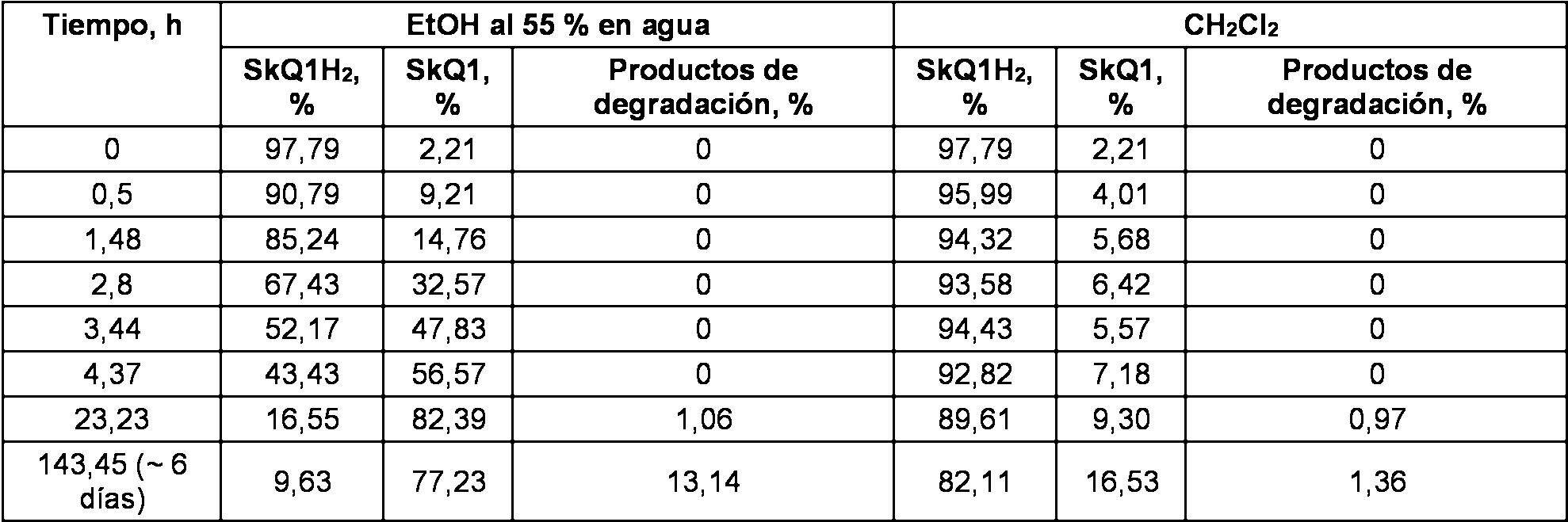
18. SkQ1H? (1 eq) con sorbito (30 partes en peso con respecto al SkQ1H?)18. SkQ1H? (1 eq) with siphon (30 parts by weight with respect to SkQ1H?)
Se añadió una solución de 20 mg de SkQ1H2 en 1,3 ml de EtOH a una solución de 600 mg de sorbito en 1,3 ml de agua. El disolvente se evaporó hasta sequedad. El residuo se secó de manera adicional con pentóxido de difósforo (P2O5) a presión reducida.A solution of 20 mg of SkQ1H2 in 1.3 ml of EtOH was added to a solution of 600 mg of sorbitol in 1.3 ml of water. The solvent was evaporated to dryness. The residue was further dried with diphosphorus pentoxide (P2O5) under reduced pressure.
La estabilidad del SkQ1H2 en la composición preparada se investigó mediante su almacenamiento a 60 °C en oscuridad (Tabla 16). The stability of SkQ1H2 in the prepared composition was investigated by storage at 60 ° C in the dark (Table 16).
Tabla 16Table 16

19. SkQ1H? (1 eq) con ácido ascórbico (0-5 eq) y sorbito (30 partes en peso con respecto al SkQ1H?) Procedimiento 1:19. SkQ1H? (1 eq) with ascorbic acid ( 0-5 eq) and sorbitol (30 parts by weight with respect to SkQ1H?) Procedure 1:
Se añadió una solución de 20 mg de SkQ1H2 en 1,3 ml de EtOH a una solución de 28,4 mg (5 eq) de ácido ascórbico y 600 mg de sorbito en 1,3 ml de agua. El disolvente se evaporó hasta sequedad. El residuo se secó de manera adicional con P2O5 a presión reducida.A solution of 20 mg of SkQ1H2 in 1.3 ml of EtOH was added to a solution of 28.4 mg (5 eq) of ascorbic acid and 600 mg of sorbitol in 1.3 ml of water. The solvent was evaporated to dryness. The residue was further dried with P2O5 under reduced pressure.
Procedimiento 2:Procedure 2:
Se añadieron 20 mg de SkQ1H2 y 28,4 mg (5 eq) de ácido ascórbico a sorbito (600 mg) fundido en un vial de vidrio (temperatura de baño 110 °C) lentamente con agitación enérgica y se continuó la agitación durante 1 h. La mezcla se enfrió hasta TA y se trituró enérgicamente para proporcionar un polvo microcristalino.20 mg of SkQ1H2 and 28.4 mg (5 eq) of ascorbic acid were added to sorbite (600 mg) melted in a glass vial (bath temperature 110 ° C) slowly with vigorous stirring and stirring was continued for 1 h . The mixture was cooled to RT and triturated vigorously to provide a microcrystalline powder.
La estabilidad del SkQ1H2 en las composiciones preparadas mediante ambos procedimientos se investigó mediante su almacenamiento a 60 °C y 4 °C en oscuridad (Tabla 17).The stability of SkQ1H2 in the compositions prepared by both procedures was investigated by storage at 60 ° C and 4 ° C in the dark (Table 17).
Tabla 17Table 17

Las siguientes preparaciones de SkQ1H2 en ácido ascórbico también se preparan como en el Ejemplo 19 supra: SkQ1H2 (1 eq) con ácido ascórbico (0-5 eq) con estearato de magnesio (10 % en peso con respecto al SkQ1H2) y glucosa (10 partes en peso con respecto al SkQ1H2)The following preparations of SkQ1H2 in ascorbic acid are also prepared as in Example 19 above: SkQ1H2 (1 eq) with ascorbic acid (0-5 eq) with magnesium stearate (10 wt% with respect to SkQ1H2) and glucose (10 parts by weight with respect to SkQ1H2)
SkQ1H2 (1 eq) con ácido ascórbico (0-5 eq) con estearato de magnesio (10 % en peso con respecto al SkQ1H2) y monohidrato de lactosa (10 partes en peso con respecto al SkQ1H2)SkQ1H2 (1 eq) with ascorbic acid (0-5 eq) with magnesium stearate (10% by weight with respect to SkQ1H2) and lactose monohydrate (10 parts by weight with respect to SkQ1H2)
SkQ1H2 (1 eq) con ácido ascórbico (0-5 eq) y Pearlitol 200 (30 partes en peso con respecto al SkQ1H2) SkQ1H2 (1 eq) con ácido ascórbico (0-5 eq) y celulosa microcristalina (30 partes en peso con respecto al SkQ1H2)SkQ1H2 (1 eq) with ascorbic acid (0-5 eq) and Pearlitol 200 (30 parts by weight with respect to SkQ1H2) SkQ1H2 (1 eq) with ascorbic acid (0-5 eq) and microcrystalline cellulose (30 parts by weight with with respect to SkQ1H2)
SkQ1H2 (1 eq) con ácido ascórbico (0-5 eq) y F-Melt C (30 partes en peso con respecto al SkQ1H2)SkQ1H2 (1 eq) with ascorbic acid (0-5 eq) and F-Melt C (30 parts by weight with respect to SkQ1H2)
SkQ1 H2 (1 eq) con ácido ascórbico (0-5 eq) y Syloid FP (30 partes en peso con respecto al SkQ1H2)SkQ1 H2 (1 eq) with ascorbic acid (0-5 eq) and Syloid FP (30 parts by weight with respect to SkQ1H2)
20 - 22 y 26 - 30. SkQ1H? con ácido ascórbico (0-5 eq) y glucosa20-22 and 26-30. SkQ1H? with ascorbic acid (0-5 eq) and glucose
Procedimiento 3:Procedure 3:
Se añadió una solución de 20 mg de SkQ1H2 en 1,3 ml de EtOH a 2 mg de estearato de magnesio y solución de ácido ascórbico (cantidades desglosadas en la Tabla 18) y 600 mg de glicosa en 1,3 ml de agua (1,3 ml). El disolvente se evaporó hasta sequedad. El residuo se secó de manera adicional con P2O5 a presión reducida.A solution of 20 mg of SkQ1H2 in 1.3 ml of EtOH was added to 2 mg of magnesium stearate and ascorbic acid solution (amounts broken down in Table 18) and 600 mg of glycosa in 1.3 ml of water (1 , 3 ml). The solvent was evaporated to dryness. The residue was further dried with P2O5 under reduced pressure.
Procedimiento 4:Procedure 4:
Se mezclaron 20 mg de SkQ1H2, 2 mg de estearato de magnesio, ácido ascórbico (cantidades desglosadas en la Tabla 18) y 600 mg de glicosa anhidra y se trituraron enérgicamente.20 mg of SkQ1H2, 2 mg of magnesium stearate, ascorbic acid (amounts broken down in Table 18) and 600 mg of anhydrous glycine were mixed and vigorously ground.
La estabilidad del SkQ1H2 en las composiciones preparadas mediante los Procedimientos 3 y 4 se investigó mediante su almacenamiento a 60 °C en oscuridad (Tabla 18). The stability of SkQ1H2 in the compositions prepared by Methods 3 and 4 was investigated by storage at 60 ° C in the dark (Table 18).
23. - 25. SkQ1H? con ácido ascórbico (0-5 eq) y monohidrato de lactosa23. - 25. SkQ1H? with ascorbic acid ( 0-5 eq) and lactose monohydrate
Las composiciones se prepararon tal como se ha descrito anteriormente en el Procedimiento 3 o 4 usando monohidrato de lactosa en lugar de glicosa.The compositions were prepared as described above in Procedure 3 or 4 using lactose monohydrate in place of glycoside.
La estabilidad del SkQ1H2 en las composiciones preparadas mediante ambos procedimientos se investigó mediante su almacenamiento a 60 °C en oscuridad (Tabla 18).The stability of SkQ1H2 in the compositions prepared by both procedures was investigated by storage at 60 ° C in the dark (Table 18).
Tabla 18Table 18

31. SkQ1H? con ácido ascórbico en EtOH al 55 %31. SkQ1H? with ascorbic acid in 55% EtOH
Se añadió una solución de SkQ1H2 puro (1 g en 5 ml de EtOH) a una solución de ácido ascórbico (2,85 g (10 eq) en 10 ml de agua).A solution of pure SkQ1H2 (1 g in 5 ml of EtOH) was added to a solution of ascorbic acid (2.85 g (10 eq) in 10 ml of water).
La estabilidad del SkQ1H2 en la solución preparada se investigó mediante su almacenamiento a TA en oscuridad (Tabla 19).The stability of SkQ1H2 in the prepared solution was investigated by storage at RT in the dark (Table 19).
Tabla 19Table 19

32. SkQ1H? con ácido ascórbico y sorbito en 1.2-propilen glicol al 30 %32. SkQ1H? with ascorbic acid and sorbito in 30% 1,2-propylene glycol
Se añadió una solución de SkQ1H2 puro (50 mg en 1 ml de 1.2-propilen glicol) a una solución de ácido ascórbico (67.4 mg (5 eq)) y sorbito (1.5 g) en 10 ml de agua. A solution of pure SkQ1H2 (50 mg in 1 ml of 1.2-propylene glycol) was added to a solution of ascorbic acid (67.4 mg (5 eq)) and sorbitol (1.5 g) in 10 ml of water.
La estabilidad del SkQ1H2 en la solución preparada se investigó mediante su almacenamiento a 60 °C en oscuridad (Tabla 20).The stability of SkQ1H2 in the prepared solution was investigated by storage at 60 ° C in the dark (Table 20).
Tabla 20Table 20

Claims (12)


Applications Claiming Priority (2)
| Application Number | Priority Date | Filing Date | Title |
|---|---|---|---|
| US201161492940P | 2011-06-03 | 2011-06-03 | |
| PCT/US2012/040711 WO2012167236A1 (en) | 2011-06-03 | 2012-06-04 | Oral formulations of mitochondrially-targeted antioxidants and their preparation and use |
Publications (1)
| Publication Number | Publication Date |
|---|---|
| ES2704064T3 true ES2704064T3 (en) | 2019-03-14 |
Family
ID=47259946
Family Applications (1)
| Application Number | Title | Priority Date | Filing Date |
|---|---|---|---|
| ES12792111T Active ES2704064T3 (en) | 2011-06-03 | 2012-06-04 | Oral formulations of mitochondrially directed antioxidants and their preparation and use |
Country Status (10)
| Country | Link |
|---|---|
| US (2) | US9192676B2 (en) |
| EP (1) | EP2714024B1 (en) |
| JP (2) | JP6448366B2 (en) |
| CN (1) | CN103764132B (en) |
| AU (1) | AU2012261854B2 (en) |
| BR (1) | BR112013030605A2 (en) |
| CA (1) | CA2837437C (en) |
| EA (1) | EA031399B1 (en) |
| ES (1) | ES2704064T3 (en) |
| WO (1) | WO2012167236A1 (en) |
Families Citing this family (9)
| Publication number | Priority date | Publication date | Assignee | Title |
|---|---|---|---|---|
| WO2012167236A1 (en) * | 2011-06-03 | 2012-12-06 | Mitotech Sa | Oral formulations of mitochondrially-targeted antioxidants and their preparation and use |
| EA031799B1 (en) * | 2013-01-22 | 2019-02-28 | Ооо Митотех | Method of treating an inflammatory disorder using a mitochondrially-targeted antioxidant |
| EP3030267A2 (en) * | 2013-04-11 | 2016-06-15 | Mitotech SA | Mitochondrially-targeted timoquinones and toluquinones |
| WO2015162494A2 (en) | 2014-02-25 | 2015-10-29 | Mitotech, S.A. | Cosmetic compositions of mitochonrially targeted antioxidants |
| WO2019139831A1 (en) * | 2018-01-10 | 2019-07-18 | Dana-Farber Cancer Institute, Inc. | Methods for identification, assessment, prevention, and treatment of metabolic disorders using succinate |
| CN115551476A (en) * | 2019-12-10 | 2022-12-30 | 米陀科技有限公司 | Polymer matrices for different compositions of mitochondrially targeted antioxidants |
| WO2021198786A1 (en) * | 2020-04-03 | 2021-10-07 | Mitotech S.A. | Use of mitochondria-targeted antioxidants to treat severe inflammatory conditions |
| CN114344274A (en) * | 2022-01-05 | 2022-04-15 | 盖茨汉普(武汉)植物应用研究有限公司 | Mitoq antioxidant hard capsule formula and preparation process |
| WO2025078880A1 (en) * | 2023-10-11 | 2025-04-17 | Mitotech S.A. | Mitochondria-targeted antioxidants for use in the treatment of cell balloooning-associated diseases, such as non-alcoholic fatty liver disease (nafld) and non-alcoholic steatohepatitis (nash) |
Family Cites Families (22)
| Publication number | Priority date | Publication date | Assignee | Title |
|---|---|---|---|---|
| US5538974A (en) | 1994-01-27 | 1996-07-23 | Senju Pharamceutical Co., Ltd. | Ophthalmic composition for lowering intraocular pressure |
| NZ505352A (en) | 1997-11-25 | 2002-12-20 | Univ Otago | Mitochondrially targeted antioxidants |
| US6331532B1 (en) | 1998-11-25 | 2001-12-18 | University Of Otago | Mitochondrially targeted antioxidants |
| US20080275005A1 (en) | 1998-11-25 | 2008-11-06 | Murphy Michael P | Mitochondrially targeted antioxidants |
| US20070270381A1 (en) | 2000-05-25 | 2007-11-22 | Antipodean Pharmaceuticals, Inc. | Mitochondrially targeted antioxidants |
| US20020044913A1 (en) | 2000-02-11 | 2002-04-18 | Hamilton Nathan D. | Cosmetics to support skin metabolism |
| ITRM20010755A1 (en) | 2001-12-20 | 2003-06-20 | Simonelli Giuseppe | USE OF Q10 QUINONE FOR THE TREATMENT OF EYE DISEASES. |
| US6984636B2 (en) | 2002-08-12 | 2006-01-10 | Medical Research Council | Mitochondrially targeted antioxidants |
| WO2005033092A1 (en) | 2003-09-19 | 2005-04-14 | Galileo Pharmaceuticals, Inc. | Chroman derivatives |
| CN1997403A (en) | 2004-07-13 | 2007-07-11 | 奥里迪斯生物医学研究及开发有限责任公司 | Mitochondrially targeted antioxidants in the treatment of liver diseases and epithelial cancers |
| WO2006025247A1 (en) * | 2004-08-30 | 2006-03-09 | Kaneka Corporation | Mitochondria activators |
| RU2318500C2 (en) | 2005-10-18 | 2008-03-10 | Общество С Ограниченной Ответственностью "Митотехнология" | Method for on body by target delivery of biologically active substances in mitochondria, pharmaceutical composition for its realization and compound used for this aim |
| EP2119436A4 (en) | 2006-10-20 | 2010-03-03 | Ltd Liability Company Mitotech | Pharmaceutical compositions for preventing and treating eye pathologies |
| WO2008048135A1 (en) | 2006-10-20 | 2008-04-24 | Limited Liability Company 'mitotechnology' | Composition for regenerating and stimulating growth of plants and for adapting plants to different stress factors |
| EP2145623A4 (en) * | 2007-01-29 | 2010-10-27 | Ltd Liability Company Mitotech | Pharmaceutical and cosmetic compositions for accelerated healing of wounds and other surface damages |
| US9439916B2 (en) * | 2007-04-11 | 2016-09-13 | Mitotech Sa | Composition for decelerating the aging in the organism and for extending the life time thereof and the use of said composition |
| US8518915B2 (en) * | 2007-06-29 | 2013-08-27 | Mitotech Sa | Use of mitochondrially-addressed compounds for preventing and treating cardiovascular diseases |
| WO2009158348A1 (en) | 2008-06-25 | 2009-12-30 | Edison Pharmaceuticals, Inc. | 2-heterocyclylaminoalkyl-(p-quinone) derivatives for treatment of oxidative stress diseases |
| JP2012525397A (en) | 2009-04-28 | 2012-10-22 | エジソン ファーマシューティカルズ, インコーポレイテッド | Tocotrienol quinone formulation for the treatment of ophthalmic diseases |
| CN102548548B (en) * | 2009-06-10 | 2017-09-01 | 米拓科技有限公司(卢森堡) | Ophthalmic pharmaceutical composition for use in medicine and veterinary medicine |
| MX2012005356A (en) * | 2009-11-13 | 2013-01-29 | Obschestvo S Ogranichennoi Otvetstvennostyu Mitotekh | Pharmaceutical substances on the basis of mitochondrially addressed antioxidants. |
| WO2012167236A1 (en) * | 2011-06-03 | 2012-12-06 | Mitotech Sa | Oral formulations of mitochondrially-targeted antioxidants and their preparation and use |
-
2012
- 2012-06-04 WO PCT/US2012/040711 patent/WO2012167236A1/en not_active Ceased
- 2012-06-04 ES ES12792111T patent/ES2704064T3/en active Active
- 2012-06-04 US US14/123,311 patent/US9192676B2/en active Active
- 2012-06-04 EP EP12792111.2A patent/EP2714024B1/en active Active
- 2012-06-04 AU AU2012261854A patent/AU2012261854B2/en not_active Ceased
- 2012-06-04 CA CA2837437A patent/CA2837437C/en active Active
- 2012-06-04 CN CN201280027129.0A patent/CN103764132B/en not_active Expired - Fee Related
- 2012-06-04 BR BR112013030605A patent/BR112013030605A2/en not_active Application Discontinuation
- 2012-06-04 JP JP2014513785A patent/JP6448366B2/en active Active
- 2012-06-04 EA EA201301321A patent/EA031399B1/en not_active IP Right Cessation
-
2015
- 2015-10-20 US US14/887,406 patent/US9572890B2/en active Active
-
2017
- 2017-10-10 JP JP2017196849A patent/JP6461276B2/en active Active
Also Published As
| Publication number | Publication date |
|---|---|
| EP2714024A1 (en) | 2014-04-09 |
| CN103764132B (en) | 2017-04-12 |
| AU2012261854B2 (en) | 2017-11-16 |
| CA2837437C (en) | 2020-12-15 |
| CA2837437A1 (en) | 2012-12-06 |
| EP2714024B1 (en) | 2018-10-03 |
| EA201301321A1 (en) | 2014-11-28 |
| BR112013030605A2 (en) | 2016-12-13 |
| EP2714024A4 (en) | 2014-12-31 |
| EA031399B1 (en) | 2018-12-28 |
| US9192676B2 (en) | 2015-11-24 |
| US20160038603A1 (en) | 2016-02-11 |
| US9572890B2 (en) | 2017-02-21 |
| WO2012167236A1 (en) | 2012-12-06 |
| JP6448366B2 (en) | 2019-01-09 |
| US20150025043A1 (en) | 2015-01-22 |
| JP2014515407A (en) | 2014-06-30 |
| JP6461276B2 (en) | 2019-01-30 |
| CN103764132A (en) | 2014-04-30 |
| JP2018035182A (en) | 2018-03-08 |
Similar Documents
| Publication | Publication Date | Title |
|---|---|---|
| ES2704064T3 (en) | Oral formulations of mitochondrially directed antioxidants and their preparation and use | |
| AU2012261854A1 (en) | Oral formulations of mitochondrially-targeted antioxidants and their preparation and use | |
| ES2978534T3 (en) | Phospholipid ether analogues as anticancer drug carriers | |
| WO2013120040A1 (en) | Targeted pathway inhibition to improve muscle structure, function and activity in muscular dystrophy | |
| ES2698620T3 (en) | Icaritine for use in the prevention or treatment of hematocytopenia | |
| EP3458448B1 (en) | Fasn inhibitors for use in treating non-alcoholic steatohepatitis | |
| ES2608659T3 (en) | Composition to inhibit the activity of NADPH oxidase | |
| JP2014169321A (en) | Purine derivative for therapy of cystic disease | |
| US20230014055A1 (en) | Treatment of Immune-Related Disorders, Kidney Disorders, Liver Disorders, Hemolytic Disorders, and Oxidative Stress-Associated Disorders Using NRH, NARH and Reduced Derivatives Thereof | |
| CA3218320A1 (en) | Compositions comprising mixtures of compounds and uses thereof | |
| ES2917982T3 (en) | Method for treating liver disorders | |
| WO2024151720A1 (en) | Compositions of caffeoylspermidine compounds, uses thereof, and supplements of spermidine thereof | |
| PT2097080E (en) | Use of an indazolemethoxyalkanoic acid for reducing triglyceride, cholesterol and glucose levels | |
| CN116211831A (en) | Lipid Matrix Topical Injection Formulations | |
| KR20240037280A (en) | Method for preparing liposomal formulations | |
| WO2022226191A9 (en) | Methods of stabilizing the neuronal proteome against collapse and protecting vascular cells | |
| WO2024151725A1 (en) | Methods of enrichment of caffeoylspermidine compounds, anti-aging properties thereof, and methods of inhibition of histone deacetylases | |
| ES3021190T3 (en) | Therapeutic potential of curcumin/cyclodextrin/cellulose nanocrystals in the treatment of peripheral neuropathies | |
| CN101601669B (en) | Combination Drugs Used to Treat Tumors | |
| ES2992873T3 (en) | A perillyl alcohol-3 bromopyruvate conjugate and methods of treating cancer | |
| Chen et al. | Synergism and attenuation of triptolide through prodrug engineering combined with liposomal scaffold strategy to enhance inhibition in pancreatic cancer | |
| US20250345318A1 (en) | Compound and use thereof in preventing or treating radiation damage | |
| US12239620B2 (en) | Methods to decrease triglyceride synthesis in the liver | |
| CN119548496A (en) | Application of desmethylberberine in preparing medicine for preventing or treating gout | |
| Cuzzocrea et al. | Raxofelast |