ES2706429T3 - Salty biscuit with marble appearance and methods of making it - Google Patents
Salty biscuit with marble appearance and methods of making it Download PDFInfo
- Publication number
- ES2706429T3 ES2706429T3 ES12758979T ES12758979T ES2706429T3 ES 2706429 T3 ES2706429 T3 ES 2706429T3 ES 12758979 T ES12758979 T ES 12758979T ES 12758979 T ES12758979 T ES 12758979T ES 2706429 T3 ES2706429 T3 ES 2706429T3
- Authority
- ES
- Spain
- Prior art keywords
- salty
- inclusion
- biscuit
- inclusions
- pieces
- Prior art date
- Legal status (The legal status is an assumption and is not a legal conclusion. Google has not performed a legal analysis and makes no representation as to the accuracy of the status listed.)
- Active
Links
- 235000015895 biscuits Nutrition 0.000 title claims abstract description 112
- 239000004579 marble Substances 0.000 title claims abstract description 31
- 238000000034 method Methods 0.000 title claims description 25
- 239000000203 mixture Substances 0.000 claims abstract description 96
- 235000013311 vegetables Nutrition 0.000 claims abstract description 66
- 235000000346 sugar Nutrition 0.000 claims abstract description 26
- 244000017020 Ipomoea batatas Species 0.000 claims abstract description 24
- 235000002678 Ipomoea batatas Nutrition 0.000 claims abstract description 24
- 229920002472 Starch Polymers 0.000 claims abstract description 20
- 235000019698 starch Nutrition 0.000 claims abstract description 20
- 235000013312 flour Nutrition 0.000 claims abstract description 15
- 235000019198 oils Nutrition 0.000 claims abstract description 15
- 244000000626 Daucus carota Species 0.000 claims abstract description 8
- 235000002767 Daucus carota Nutrition 0.000 claims abstract description 8
- 235000004879 dioscorea Nutrition 0.000 claims abstract description 8
- 235000010855 food raising agent Nutrition 0.000 claims abstract description 8
- 150000008163 sugars Chemical class 0.000 claims abstract description 6
- 235000021537 Beetroot Nutrition 0.000 claims abstract description 5
- XLYOFNOQVPJJNP-UHFFFAOYSA-N water Substances O XLYOFNOQVPJJNP-UHFFFAOYSA-N 0.000 claims description 31
- 239000003921 oil Substances 0.000 claims description 14
- 238000002156 mixing Methods 0.000 claims description 12
- 239000008107 starch Substances 0.000 claims description 9
- 239000000796 flavoring agent Substances 0.000 claims description 6
- 238000004519 manufacturing process Methods 0.000 claims description 6
- 235000019634 flavors Nutrition 0.000 claims description 5
- 230000036571 hydration Effects 0.000 claims description 5
- 238000006703 hydration reaction Methods 0.000 claims description 5
- 235000016068 Berberis vulgaris Nutrition 0.000 claims description 3
- 241000335053 Beta vulgaris Species 0.000 claims description 3
- 238000001035 drying Methods 0.000 claims description 3
- 238000013459 approach Methods 0.000 description 33
- 239000000047 product Substances 0.000 description 26
- 239000004615 ingredient Substances 0.000 description 21
- 239000000463 material Substances 0.000 description 19
- 230000032258 transport Effects 0.000 description 13
- 230000008569 process Effects 0.000 description 12
- 150000003839 salts Chemical class 0.000 description 12
- 235000002639 sodium chloride Nutrition 0.000 description 12
- 235000014510 cooky Nutrition 0.000 description 8
- 238000012545 processing Methods 0.000 description 6
- 239000000835 fiber Substances 0.000 description 5
- 239000002245 particle Substances 0.000 description 5
- 238000013517 stratification Methods 0.000 description 5
- 230000015572 biosynthetic process Effects 0.000 description 4
- 235000013399 edible fruits Nutrition 0.000 description 4
- 235000011194 food seasoning agent Nutrition 0.000 description 4
- 239000008187 granular material Substances 0.000 description 4
- 235000016709 nutrition Nutrition 0.000 description 4
- 238000000926 separation method Methods 0.000 description 4
- 238000000605 extraction Methods 0.000 description 3
- 238000009472 formulation Methods 0.000 description 3
- 238000004806 packaging method and process Methods 0.000 description 3
- 238000002360 preparation method Methods 0.000 description 3
- 230000009467 reduction Effects 0.000 description 3
- 235000011888 snacks Nutrition 0.000 description 3
- 239000005418 vegetable material Substances 0.000 description 3
- 239000004278 EU approved seasoning Substances 0.000 description 2
- 244000046052 Phaseolus vulgaris Species 0.000 description 2
- 235000010627 Phaseolus vulgaris Nutrition 0.000 description 2
- 240000004713 Pisum sativum Species 0.000 description 2
- 235000010582 Pisum sativum Nutrition 0.000 description 2
- UIIMBOGNXHQVGW-DEQYMQKBSA-M Sodium bicarbonate-14C Chemical compound [Na+].O[14C]([O-])=O UIIMBOGNXHQVGW-DEQYMQKBSA-M 0.000 description 2
- 244000061456 Solanum tuberosum Species 0.000 description 2
- 235000002595 Solanum tuberosum Nutrition 0.000 description 2
- 241000209140 Triticum Species 0.000 description 2
- 235000021307 Triticum Nutrition 0.000 description 2
- 240000008042 Zea mays Species 0.000 description 2
- 235000005824 Zea mays ssp. parviglumis Nutrition 0.000 description 2
- 235000002017 Zea mays subsp mays Nutrition 0.000 description 2
- 235000005822 corn Nutrition 0.000 description 2
- 238000010438 heat treatment Methods 0.000 description 2
- 238000010348 incorporation Methods 0.000 description 2
- 229910052500 inorganic mineral Inorganic materials 0.000 description 2
- 239000002648 laminated material Substances 0.000 description 2
- 235000021374 legumes Nutrition 0.000 description 2
- 238000012423 maintenance Methods 0.000 description 2
- 239000011159 matrix material Substances 0.000 description 2
- 235000010755 mineral Nutrition 0.000 description 2
- 239000011707 mineral Substances 0.000 description 2
- 238000005096 rolling process Methods 0.000 description 2
- 235000020357 syrup Nutrition 0.000 description 2
- 239000006188 syrup Substances 0.000 description 2
- 239000011782 vitamin Substances 0.000 description 2
- 235000013343 vitamin Nutrition 0.000 description 2
- 229940088594 vitamin Drugs 0.000 description 2
- 229930003231 vitamin Natural products 0.000 description 2
- 235000000832 Ayote Nutrition 0.000 description 1
- 229920002261 Corn starch Polymers 0.000 description 1
- 235000009854 Cucurbita moschata Nutrition 0.000 description 1
- 240000001980 Cucurbita pepo Species 0.000 description 1
- 235000009804 Cucurbita pepo subsp pepo Nutrition 0.000 description 1
- 241000219130 Cucurbita pepo subsp. pepo Species 0.000 description 1
- 235000003954 Cucurbita pepo var melopepo Nutrition 0.000 description 1
- 208000032538 Depersonalisation Diseases 0.000 description 1
- NKWPZUCBCARRDP-UHFFFAOYSA-L calcium bicarbonate Chemical compound [Ca+2].OC([O-])=O.OC([O-])=O NKWPZUCBCARRDP-UHFFFAOYSA-L 0.000 description 1
- 229910000020 calcium bicarbonate Inorganic materials 0.000 description 1
- YYRMJZQKEFZXMX-UHFFFAOYSA-L calcium bis(dihydrogenphosphate) Chemical compound [Ca+2].OP(O)([O-])=O.OP(O)([O-])=O YYRMJZQKEFZXMX-UHFFFAOYSA-L 0.000 description 1
- 239000001506 calcium phosphate Substances 0.000 description 1
- 239000003086 colorant Substances 0.000 description 1
- 238000007906 compression Methods 0.000 description 1
- 230000006835 compression Effects 0.000 description 1
- 230000001143 conditioned effect Effects 0.000 description 1
- 235000005687 corn oil Nutrition 0.000 description 1
- 239000008120 corn starch Substances 0.000 description 1
- 238000010586 diagram Methods 0.000 description 1
- 239000006185 dispersion Substances 0.000 description 1
- 230000000694 effects Effects 0.000 description 1
- 239000012467 final product Substances 0.000 description 1
- 235000013355 food flavoring agent Nutrition 0.000 description 1
- 235000003599 food sweetener Nutrition 0.000 description 1
- 235000013572 fruit purees Nutrition 0.000 description 1
- 235000021552 granulated sugar Nutrition 0.000 description 1
- 230000000887 hydrating effect Effects 0.000 description 1
- 238000002347 injection Methods 0.000 description 1
- 239000007924 injection Substances 0.000 description 1
- 230000001788 irregular Effects 0.000 description 1
- 238000010030 laminating Methods 0.000 description 1
- 238000003475 lamination Methods 0.000 description 1
- 235000021073 macronutrients Nutrition 0.000 description 1
- 230000007246 mechanism Effects 0.000 description 1
- 239000011785 micronutrient Substances 0.000 description 1
- 235000013369 micronutrients Nutrition 0.000 description 1
- 229910000150 monocalcium phosphate Inorganic materials 0.000 description 1
- 235000019691 monocalcium phosphate Nutrition 0.000 description 1
- 239000000843 powder Substances 0.000 description 1
- 239000012254 powdered material Substances 0.000 description 1
- 235000015136 pumpkin Nutrition 0.000 description 1
- 230000000717 retained effect Effects 0.000 description 1
- 239000007787 solid Substances 0.000 description 1
- 238000003860 storage Methods 0.000 description 1
- 239000003765 sweetening agent Substances 0.000 description 1
- 238000007669 thermal treatment Methods 0.000 description 1
- 210000003462 vein Anatomy 0.000 description 1
- 235000020985 whole grains Nutrition 0.000 description 1
- 235000011844 whole wheat flour Nutrition 0.000 description 1
Classifications
-
- A—HUMAN NECESSITIES
- A21—BAKING; EDIBLE DOUGHS
- A21D—TREATMENT OF FLOUR OR DOUGH FOR BAKING, e.g. BY ADDITION OF MATERIALS; BAKING; BAKERY PRODUCTS
- A21D13/00—Finished or partly finished bakery products
- A21D13/40—Products characterised by the type, form or use
- A21D13/47—Decorated or decorative products
-
- A—HUMAN NECESSITIES
- A21—BAKING; EDIBLE DOUGHS
- A21D—TREATMENT OF FLOUR OR DOUGH FOR BAKING, e.g. BY ADDITION OF MATERIALS; BAKING; BAKERY PRODUCTS
- A21D2/00—Treatment of flour or dough by adding materials thereto before or during baking
- A21D2/08—Treatment of flour or dough by adding materials thereto before or during baking by adding organic substances
- A21D2/36—Vegetable material
-
- A—HUMAN NECESSITIES
- A21—BAKING; EDIBLE DOUGHS
- A21D—TREATMENT OF FLOUR OR DOUGH FOR BAKING, e.g. BY ADDITION OF MATERIALS; BAKING; BAKERY PRODUCTS
- A21D2/00—Treatment of flour or dough by adding materials thereto before or during baking
- A21D2/08—Treatment of flour or dough by adding materials thereto before or during baking by adding organic substances
- A21D2/36—Vegetable material
- A21D2/366—Tubers, roots
-
- A—HUMAN NECESSITIES
- A23—FOODS OR FOODSTUFFS; TREATMENT THEREOF, NOT COVERED BY OTHER CLASSES
- A23L—FOODS, FOODSTUFFS OR NON-ALCOHOLIC BEVERAGES, NOT OTHERWISE PROVIDED FOR; PREPARATION OR TREATMENT THEREOF
- A23L7/00—Cereal-derived products; Malt products; Preparation or treatment thereof
- A23L7/10—Cereal-derived products
- A23L7/117—Flakes or other shapes of ready-to-eat type; Semi-finished or partly-finished products therefor
Landscapes
- Life Sciences & Earth Sciences (AREA)
- Engineering & Computer Science (AREA)
- Food Science & Technology (AREA)
- Health & Medical Sciences (AREA)
- Nutrition Science (AREA)
- Chemical & Material Sciences (AREA)
- Polymers & Plastics (AREA)
- Confectionery (AREA)
- Bakery Products And Manufacturing Methods Therefor (AREA)
- Medicinal Preparation (AREA)
Abstract
Una galleta salada que tiene una superficie con aspecto marmóreo, comprendiendo la galleta salada: una parte de galleta salada formada a partir de una composición de masa que comprende harina, almidones, azúcares, aceite, saborizantes, y agentes leudantes, teniendo la composición de masa un aspecto de galleta salada; una parte de inclusión que tiene inclusiones con 2 a 60 por ciento de azúcar de modo que la parte de inclusión incluye piezas visualmente identificables de las inclusiones, permaneciendo las inclusiones intactas y extendidas por una superficie de la galleta salada de modo que un aspecto de inclusión tiene al menos uno de un color, sombreado y textura en contraste cuando se compara con la parte de galleta salada; y siendo visible al menos una parte de cada una de la parte de galleta salada y la parte de inclusión en la superficie con aspecto marmóreo, formando la parte de inclusión al menos una inclusión contigua que cubre al menos 1 por ciento de la superficie con aspecto marmóreo donde al menos una de las piezas visualmente identificables de las inclusiones tiene una parte extendida en la superficie de la galleta salada y una parte integrada que se extiende hasta el interior de un cuerpo de la galleta salada, en donde las piezas visualmente identificables de las inclusiones son piezas de verdura seleccionadas del grupo que consiste en boniatos, ñames, raíces de remolacha, tubérculos, zanahorias y mezclas de los mismos, en donde la galleta salada tiene una relación selecta de tamaño de inclusión a espesor de 0,7 a 1,5 para formar el aspecto de inclusión.A salty biscuit having a marble-like surface, the salty biscuit comprising: a part of salty biscuit formed from a dough composition comprising flour, starches, sugars, oil, flavorings, and leavening agents, having the dough composition a salty cracker appearance; an inclusion part having inclusions with 2 to 60 percent sugar so that the inclusion part includes visually identifiable pieces of the inclusions, the inclusions remaining intact and spread over a surface of the salty biscuit so that an inclusion aspect has at least one of a color, shading and texture in contrast when compared to the salty cracker part; and at least a part of each of the salty biscuit portion and the inclusion portion on the surface being marmoreal in appearance, the inclusion portion forming at least one contiguous inclusion that covers at least 1 percent of the surface with appearance marble where at least one of the visually identifiable pieces of the inclusions has an extended part on the surface of the salty biscuit and an integrated part that extends to the interior of a body of the salty biscuit, wherein the visually identifiable pieces of the inclusions are pieces of vegetables selected from the group consisting of sweet potatoes, yams, beet roots, tubers, carrots and mixtures thereof, wherein the salty biscuit has a select inclusion size ratio at a thickness of 0.7 to 1, 5 to form the inclusion aspect.
Description
DESCRIPCIÓNDESCRIPTION
Galleta salada con aspecto marmóreo y métodos de fabricación de la mismaSalty biscuit with marble appearance and methods of making it
CampoField
La presente solicitud se refiere, de modo general, a galletas saladas que tienen superficies con aspecto marmóreo. Más especialmente, la presente solicitud se refiere a galletas saladas que tienen una superficie con aspecto marmóreo creado por una o más inclusiones.The present application refers, in general, to salty biscuits having marble-like surfaces. More especially, the present application relates to salty cookies having a marble-like surface created by one or more inclusions.
AntecedentesBackground
El documento US2008/206424 describe una masa con base de fruta y productos de tentempié elaborados a partir de los mismos.US2008 / 206424 discloses a fruit-based dough and snack products made therefrom.
Las galletas saladas, láminas crocantes y productos crujientes se pueden preparar de diversos modos utilizando ingredientes tradicionales a base de masa. Además, se han fabricado galletas saladas y láminas crocantes utilizando materiales en puré o en polvo, tales como verduras, frutas y otras inclusiones. Al incluir verduras, puede mejorarse el valor nutritivo global de la galleta salada. Por ejemplo, las verduras incluyen diversas vitaminas, minerales y macronutrientes para mejorar el valor nutricional del producto. Además, las verduras en puré o en polvo también pueden proporcionar al producto sabores y otras propiedades organolépticas.Salted cookies, crispy slices and crunchy products can be prepared in various ways using traditional dough-based ingredients. In addition, crackers and crispy sheets have been made using mashed or powdered materials, such as vegetables, fruits and other inclusions. By including vegetables, the overall nutritional value of the salty biscuit can be improved. For example, vegetables include various vitamins, minerals and macronutrients to improve the nutritional value of the product. In addition, pureed or powdered vegetables can also provide flavors and other organoleptic properties to the product.
Sin embargo, estos productos generalmente se preparan de modo que las verduras en puré o en polvo se dispersan uniformemente por toda la masa de galleta salada y tienen un tamaño de partículas tan pequeño que el material de verdura puede no ser visible, aparecer solo como pequeñas manchas, o influir tan solo mínimamente si no en el color o la textura del producto. Los purés o polvos producen una pérdida de la identidad y la estructura del producto de la fruta o la verdura cuando se incluyen en la masa. Por lo tanto, el producto resultante puede no ser muy diferenciable de otros productos que no contienen materiales de verdura. Además, el perfil de sabor puede ser relativamente soso ya que los materiales de verdura se dispersan generalmente de manera uniforme por toda la galleta salada en concentraciones relativamente bajas.However, these products are generally prepared so that the mashed or powdered vegetables are uniformly dispersed throughout the salty cracker dough and have a particle size so small that the vegetable material may not be visible, appear only as small spots, or influence only minimally if not on the color or texture of the product. Purees or powders produce a loss of the identity and structure of the product of the fruit or vegetable when they are included in the dough. Therefore, the resulting product may not be very differentiable from other products that do not contain vegetable materials. In addition, the flavor profile may be relatively bland since the vegetable materials are generally dispersed uniformly throughout the salty biscuit at relatively low concentrations.
En algunos casos, se han propuesto tentempiés no uniformes formando un producto de tentempié heterogéneo desmenuzando dos partes diferentes de masa, en donde cada parte de masa incluye un puré de fruta. Sin embargo, este enfoque todavía da lugar a la dispersión uniforme del puré por toda la(s) parte(s) de masa, dando lugar a la misma pérdida de identidad y estructura que la fruta o verduras arriba descritas.In some cases, non-uniform snacks have been proposed forming a heterogeneous snack product by shredding two different parts of dough, wherein each dough part includes a fruit puree. However, this approach still results in uniform dispersion of the mash throughout the mass part (s), resulting in the same loss of identity and structure as the fruit or vegetables described above.
SumarioSummary
La presente invención proporciona una galleta salada que tiene una superficie con aspecto marmóreo y un método de elaboración de una galleta salada que tiene una superficie con aspecto marmóreo, como se define en las reivindicaciones adjuntas.The present invention provides a salty cracker having a marble-like surface and a method of making a salty cracker having a marble-like surface, as defined in the appended claims.
En un enfoque, se proporciona una galleta salada que tiene una superficie con aspecto marmóreo con piezas visualmente identificables extendidas sobre una o más superficies de la galleta salada. La galleta salada incluye una parte de galleta salada formada a partir de una composición de masa con harina, almidones, azúcares, aceite, saborizantes y agentes leudantes. Una vez calentada, cocinada, horneada, frita, y similares, la composición de masa tiene un aspecto de galleta salada. La galleta salada incluye una parte de inclusión que tiene inclusiones que permanecen como piezas visualmente identificables de las inclusiones en la superficie de galleta salada. En un aspecto, las inclusiones permanecen intactas y extendidas por una superficie de la galleta salada de modo que un aspecto de inclusión tiene al menos un color, sombreado y textura en contrastante cuando se compara con la parte de galleta salada. En este aspecto, las inclusiones generalmente tienen de 2 a 60 por ciento de azúcar y, en otros casos, de 20 a 60 por ciento de azúcar, que tiende a permitir que las inclusiones permanecen como piezas intactas y visualmente identificables de las inclusiones sobre la superficie de galleta salada. La galleta salada también tiene al menos una parte de cada parte de galleta salada y siendo la parte de inclusión visible en la superficie con aspecto marmóreo. Formando la parte de inclusión al menos una inclusión o pieza contigua que cubre al menos 1 por ciento de la superficie con aspecto marmóreo, donde al menos una de las piezas visualmente identificables de las inclusiones tiene una parte extendida en la superficie de galleta salada y una parte integrada que se extiende hacia el interior de un cuerpo de la galleta salada. Las piezas visualmente identificables de las inclusiones son piezas de verdura seleccionadas del grupo que consiste en boniatos, ñames, raíces de remolacha, tubérculos, zanahorias y mezclas de los mismos. La galleta salada tiene una relación selecta de tamaño de inclusión a espesor de 0,7 a 1,5 para formar el aspecto de inclusión. In one approach, a salty cracker having a marble-like surface with visually identifiable pieces spread on one or more surfaces of the salty cracker is provided. The salty biscuit includes a part of salty biscuit formed from a dough composition with flour, starches, sugars, oil, flavorings and leavening agents. Once heated, cooked, baked, fried, and the like, the dough composition looks like a salty biscuit. The salty biscuit includes an inclusion part that has inclusions that remain as visually identifiable pieces of the inclusions on the surface of the salty biscuit. In one aspect, the inclusions remain intact and spread over a surface of the salty biscuit so that an inclusion aspect has at least one color, shading and contrasting texture when compared to the salty biscuit part. In this aspect, inclusions generally have 2 to 60 percent sugar and, in other cases, 20 to 60 percent sugar, which tends to allow inclusions to remain intact and visually identifiable pieces of inclusions over the surface of salty biscuit. The salty biscuit also has at least a part of each part of salty biscuit and the inclusion part being visible on the surface with marble aspect. The inclusion part forming at least one inclusion or contiguous piece that covers at least 1 percent of the marble-like surface, where at least one of the visually identifiable pieces of the inclusions has an extended portion on the surface of the salty biscuit and a Integrated part that extends into the interior of a body of the salty biscuit. The visually identifiable pieces of the inclusions are pieces of vegetables selected from the group consisting of sweet potatoes, yams, beet roots, tubers, carrots and mixtures thereof. The salty biscuit has a select inclusion size ratio at a thickness of 0.7 to 1.5 to form the inclusion aspect.
En otro enfoque, se describe un método de elaboración de una galleta salada que tiene una superficie con aspecto marmóreo. El método incluye prehidratar una pluralidad de piezas de verduras deshidratadas para formar piezas de verduras hidratadas. Después, las piezas de verduras hidratadas se mezclan en una composición de masa que comprende harinas, almidones, azúcares, aceite, saborizantes, agentes leudantes. La masa se estratifica a continuación como una mezcla combinada para proporcionar una mezcla estratificada. A continuación, la mezcla estratificada se hace pasar a través de uno o más rodillos para crear una lámina que tiene una superficie con aspecto marmóreo formada por al menos una parte de las piezas de verduras hidratadas extendida sobre la superficie de las galletas saladas. En un enfoque, al menos una parte de cada una de la composición de masa y la composición de inclusión siendo visible sobre la superficie con aspecto marmóreo de modo que la composición de inclusión forma al menos una inclusión contigua que cubre al menos 1 por ciento de la superficie con aspecto marmóreo. En un enfoque, la superficie extendida con aspecto marmóreo resulta posible porque el método incluye una etapa de hacer pasar la composición formada a través de una cortina de vapor y luego al interior de un horno, lo que tiende a hacer posible que la masa y las inclusiones de alto contenido en humedad sean horneadas, cocinadas, secadas o calentadas en el horno eficazmente. Las piezas visualmente identificables de las inclusiones son piezas de verdura seleccionadas del grupo que consiste en boniatos, ñames, raíces de remolacha, tubérculos, zanahorias y mezclas de los mismos. La galleta salada tiene una relación selecta de tamaño de inclusión a espesor de 0,7 a 1,5 para formar el aspecto de inclusión. In another approach, a method of making a salty biscuit having a marble-like surface is described. The method includes prehydrating a plurality of pieces of dehydrated vegetables to form pieces of hydrated vegetables. Then, the pieces of hydrated vegetables are mixed in a dough composition comprising flours, starches, sugars, oil, flavorings, leavening agents. The mass is stratified to then as a blended mixture to provide a stratified mixture. The stratified mixture is then passed through one or more rollers to create a sheet having a marble-like surface formed by at least a portion of the hydrated vegetable pieces spread on the surface of the salty biscuits. In one approach, at least a part of each of the dough composition and the inclusion composition being visible on the surface with marble appearance so that the inclusion composition forms at least one contiguous inclusion that covers at least 1 percent of the surface with marble aspect. In one approach, the marble-like extended surface is made possible because the method includes a step of passing the formed composition through a steam curtain and then into a furnace, which tends to make it possible for the dough and High moisture content inclusions are baked, cooked, dried or heated in the oven effectively. The visually identifiable pieces of the inclusions are pieces of vegetables selected from the group consisting of sweet potatoes, yams, beet roots, tubers, carrots and mixtures thereof. The salty biscuit has a select inclusion size ratio at a thickness of 0.7 to 1.5 to form the inclusion aspect.
Breve descripción de los dibujosBRIEF DESCRIPTION OF THE DRAWINGS
La Fig. 1A es una vista en perspectiva de una cara de una galleta salada con aspecto marmóreo ilustrativa;Fig. 1A is a perspective view of a face of a salty biscuit with illustrative marble aspect;
la Fig. 1B es una vista en perspectiva de una segunda cara de la galleta salada con aspecto marmóreo ilustrativa de la Fig. 1 A;Fig. 1B is a perspective view of a second side of the salty biscuit with illustrative marble aspect of Fig. 1 A;
la Fig. 1C es una vista en sección transversal de una galleta salada con aspecto marmóreo ilustrativa; y Fig. 1C is a cross-sectional view of a salty biscuit with illustrative marble-like appearance; Y
la Fig. 2 es un diagrama de flujo del proceso que representa un proceso para formar galletas saladas o productos crujientes con aspecto marmóreo.Fig. 2 is a process flow diagram depicting a process for forming salty crackers or crispy products with marble appearance.
Descripción detalladaDetailed description
Se proporciona una galleta salada que tiene al menos una superficie exterior con aspecto marmóreo que incluye inclusiones individualmente identificables que mantienen al menos una parte de su identidad, estructura y/o consistencia física de producto de la inclusión. Es decir, la inclusión que es una pieza de verdura, mantiene al menos una parte de su tamaño, forma y/o integridad de la pieza de modo que permanece visualmente identificable como verdura en y/o sobre el producto de galleta salada acabado. La superficie con aspecto marmóreo incluye una parte de galleta salada formada por una composición de masa y una parte de inclusión extendida o untada por al menos una de las superficies exteriores y de modo que la inclusión mantiene características e identidad de la fuente de inclusión y tiene un color, textura, aspecto y/o sabor en contrastante cuando se compara con la parte de galleta salada y masa. La composición de masa y la composición de inclusión se combinan de modo que al menos una parte de cada una de la composición de masa y la composición de inclusión son visibles en la superficie con aspecto marmóreo. En una forma, la composición de inclusión forma al menos una inclusión contigua extendida o que recubre de otro modo al menos de 1 a 5 por ciento de la superficie exterior de una superficie de galleta salada. En otra forma, una o más inclusiones (en total o en combinación) pueden cubrir de 5 a 50 % del área de superficie exterior total de una cara de la superficie exterior de la galleta salada para formar el aspecto marmóreo. En otra forma, algunas de las inclusiones pueden extenderse sobre una parte de la superficie exterior de la galleta salada definiendo el aspecto marmóreo y, al mismo tiempo, extendiéndose hacia el interior de la galleta salada. En otra forma, algunas inclusiones pueden formar una parte de la superficie con aspecto marmóreo en ambas caras de la galleta salada y extenderse a través de una parte interior del cuerpo de galleta salada al mismo tiempo. En otra forma adicional, la galleta salada puede tener tanto inclusiones que forman una superficie con aspecto marmóreo como inclusiones contenidas por completo en el cuerpo de la galleta salada no extendidas ni visibles sobre una superficie. A salty biscuit is provided having at least one exterior surface with marble aspect that includes individually identifiable inclusions that maintain at least a portion of its identity, structure and / or physical consistency of inclusion product. That is, the inclusion that is a piece of vegetable, maintains at least a part of its size, shape and / or integrity of the piece so that it remains visually identifiable as a vegetable in and / or on the finished salty cracker product. The marble-like surface includes a portion of salty biscuit formed by a dough composition and an extended inclusion portion or smeared by at least one of the outer surfaces and so that the inclusion retains characteristics and identity of the inclusion source and has a contrasting color, texture, appearance and / or taste when compared to the salty cracker and dough portion. The dough composition and the inclusion composition are combined so that at least a portion of each of the dough composition and the inclusion composition are visible on the surface with marble appearance. In one form, the inclusion composition forms at least one contiguous inclusion extended or otherwise covering at least 1 to 5 percent of the outer surface of a salty biscuit surface. In another form, one or more inclusions (in total or in combination) can cover from 5 to 50% of the total exterior surface area of a face of the outer surface of the salty biscuit to form the marble aspect. In another form, some of the inclusions may extend over a part of the outer surface of the salty biscuit defining the marble aspect and, at the same time, extending into the salty biscuit. In another form, some inclusions may form a part of the marble-like surface on both sides of the salty biscuit and extend through an inner part of the salty biscuit body at the same time. In yet another form, the salty cracker may have both inclusions that form a marble-like surface and inclusions completely contained in the body of the salty cracker not extended or visible on a surface.
Además, las inclusiones pueden tener un color en contrastante cuando se compara con la composición de masa. Por ejemplo, la composición de masa puede tener un color generalmente claro mientras que las inclusiones pueden tener un color oscuro tal como, aunque no de forma limitativa, rojo, naranja, amarillo o verde. De forma adicional, las inclusiones pueden proporcionar no solo contraste de color sino también un perfil de textura y sabor único. Además, las inclusiones pueden mejorar las propiedades nutritivas de la galleta salada con vitaminas, minerales y otros micronutrientes. En una forma, las inclusiones dan a la galleta salada un aspecto en general marmóreo que puede ser más atractivo y verosímil para los consumidores. Además, el aspecto marmóreo mejora las propiedades de aspecto y nutricionales de cara al consumidor.In addition, the inclusions may have a contrasting color when compared to the dough composition. For example, the dough composition may have a generally light color while the inclusions may have a dark color such as, but not limited to, red, orange, yellow or green. Additionally, the inclusions can provide not only color contrast but also a unique texture and flavor profile. In addition, the inclusions can improve the nutritional properties of the salty biscuit with vitamins, minerals and other micronutrients. In one form, the inclusions give the salty biscuit an overall marble appearance that can be more attractive and credible to consumers. In addition, the marble appearance improves the appearance and nutritional properties for the consumer.
En otro aspecto, la galleta salada se puede procesar de diversos modos diferentes y puede incluir diversas combinaciones de diferentes ingredientes. En una forma, puede incluirse una composición de verdura, tal como de boniato, como gránulos, trozos o partículas en la composición de inclusión. En este sentido, la composición de verdura puede ser un material deshidratado que a continuación se rehidrata cuando se combina con la composición de la masa. A continuación, la composición combinada se hace pasar a través de uno o más rodillos para su estratificación.In another aspect, the salty biscuit can be processed in several different ways and can include various combinations of different ingredients. In one form, a vegetable composition, such as sweet potato, may be included as granules, pieces or particles in the inclusion composition. In this regard, the vegetable composition can be a dehydrated material that is then rehydrated when combined with the composition of the dough. Next, the combined composition is passed through one or more rollers for stratification.
Las inclusiones integradas en la masa son eficaces para dar el aspecto marmóreo. Según un enfoque, las inclusiones se deshidratan inicialmente y se hidratan durante el procesamiento hasta alcanzar un contenido eficaz en humedad que es adecuado para ablandar las inclusiones en grado suficiente pero que permite al mismo tiempo el mantenimiento de la identidad de partícula física por parte de la inclusión cuando se procesa. Las inclusiones hidratadas se acondicionan y después se aplanan durante un proceso de laminación utilizando rodillos de reducción para formar el aspecto marmóreo. Las inclusiones incluyen piezas de verduras con altos niveles de azúcar, especialmente de piezas de verduras de raíz, incluidos boniato, ñames, tubérculos, raíces de remolacha, zanahorias, y similares. Las inclusiones pueden también incluir otros tipos de trozos de piezas de verdura y pueden incluir piezas de legumbres tales como judías, guisantes, y similares. En otros casos, las inclusiones pueden incluir calabaza, curcubita y calabacín, y mezclas de los mismos.The inclusions integrated in the dough are effective to give the marble appearance. According to one approach, the inclusions are initially dehydrated and hydrated during processing until an moisture-effective content is achieved which is adequate to soften the inclusions to a sufficient degree but which at the same time allows the maintenance of the physical particle identity by the inclusion when it is processed. The hydrated inclusions are conditioned and they are then flattened during a rolling process using reduction rollers to form the marble aspect. The inclusions include pieces of vegetables with high levels of sugar, especially of pieces of root vegetables, including sweet potatoes, yams, tubers, roots of beet, carrots, and the like. The inclusions may also include other types of pieces of vegetable pieces and may include pieces of legumes such as beans, peas, and the like. In other cases, the inclusions may include pumpkin, curcubita and zucchini, and mixtures thereof.
Se ha descubierto que no todas las verduras son adecuadas para formar el aspecto de superficie marmóreo. En general, las verduras con altos niveles de azúcar son las más adecuadas para formar la superficie con aspecto marmóreo. Por ejemplo, las verduras con al menos 15 por ciento, en algunos casos, al menos 20 por ciento de azúcar son eficaces para formar un aspecto marmóreo. En otros casos, las verduras pueden incluir de 15 a 60 por ciento de azúcar y, en otros casos, de 20 a 60 por ciento de azúcar. En otros enfoques adicionales, las verduras pueden tener de 2 a 60 por ciento de azúcar.It has been discovered that not all vegetables are adequate to form the appearance of marble surface. In general, vegetables with high levels of sugar are the most suitable to form the surface with marble appearance. For example, vegetables with at least 15 percent, in some cases, at least 20 percent sugar are effective to form a marbled appearance. In other cases, vegetables can include 15 to 60 percent sugar and, in other cases, 20 to 60 percent sugar. In other additional approaches, vegetables can have 2 to 60 percent sugar.
En otro enfoque, el proceso de producción puede comprender hidratar y ablandar las piezas de inclusión a temperaturas elevadas antes de la formación de la masa. El proceso permite la fabricación usando altos niveles de las inclusiones. Opcionalmente, las inclusiones se pueden añadir a la masa o durante la etapa de estratificación/laminación. Las inclusiones con aspecto marmóreo pasan a formar parte de la matriz de producto que son perceptibles y visibles.In another approach, the production process may comprise hydrating and softening the inclusion pieces at elevated temperatures prior to the formation of the dough. The process allows manufacturing using high levels of inclusions. Optionally, the inclusions may be added to the dough or during the laminating / lamination step. The inclusions with marble aspect become part of the product matrix that are perceptible and visible.
Volviendo a más detalles y haciendo referencia primero a las Figs. 1A-1C, se ilustra una galleta salada 8 que tiene superficies laterales opuestas que incluyen una primera cara 10 con una superficie 12 con aspecto marmóreo. La superficie 12 con aspecto marmóreo incluye, generalmente, una o más inclusiones 14 incorporadas en una parte de galleta salada formada a partir de una masa 16. Según un enfoque, la galleta salada tiene una parte única de masa o galleta salada que forma una matriz de galleta salada continua con las inclusiones en su interior. En una forma, la masa 16 tiene un aspecto de masa horneada, frita, o de otro modo cocinada, tal como un color claro junto con una textura relativamente suave. Las inclusiones 14 pueden tener un aspecto en contrastante cuando se compara con la masa 16. Por ejemplo, las inclusiones 14 pueden tener un color oscuro, tal como rojo, naranja, marrón, amarillo o verde dependiendo de la fuente de la inclusión. Además, las inclusiones 14 pueden tener una textura más rugosa cuando se compara con la masa 16. Sin embargo, se debe entender que las inclusiones 14 pueden tener cualquier aspecto en contrastante cuando se compara con el aspecto de la masa. Las inclusiones tienen un tamaño y forma tal que permanecen visualmente identificables y mantienen al menos una parte de su integridad física procedente de la fuente que proporciona la inclusión. Returning to more details and referring first to Figs. 1A-1C, a salted biscuit 8 having opposing side surfaces including a first face 10 with a surface 12 with marble appearance is illustrated. The marble-like surface 12 includes, generally, one or more inclusions 14 incorporated in a salty biscuit part formed from a dough 16. According to one approach, the salty biscuit has a unique portion of dough or salty biscuit that forms a matrix of salty biscuit continues with the inclusions inside. In one form, dough 16 has a baked, fried, or otherwise cooked dough appearance, such as a light color together with a relatively smooth texture. The inclusions 14 may have a contrasting aspect when compared to the mass 16. For example, the inclusions 14 may have a dark color, such as red, orange, brown, yellow or green depending on the source of the inclusion. In addition, the inclusions 14 may have a rougher texture when compared to the mass 16. However, it should be understood that the inclusions 14 may have any contrasting aspect when compared to the appearance of the dough. The inclusions have a size and shape such that they remain visually identifiable and maintain at least a portion of their physical integrity from the source providing the inclusion.
Las inclusiones 14 pueden tener también un aspecto expandido, alargado o extendido sobre la superficie exterior de la galleta salada de modo que los bordes de las inclusiones 14 son irregulares y no necesariamente uniformes. Así formada, la inclusión continúa manteniendo una integridad de su material fuente de modo que las inclusiones continúan manteniendo una parte contigua de las mismas. De forma adicional, no es necesario que las inclusiones 14 tengan un color sólido, sino que pueden tener variaciones de color junto con otros colores dispersados en su interior. Por ejemplo, las inclusiones pueden tener un color generalmente naranja, pero pueden también incluir puntos más oscuros que pueden ser indicativos de inclusiones más profundas. Las diferencias de color pueden variar dentro de una sola inclusión 14 y pueden también variar entre la pluralidad de inclusiones 14. Del modo similar, la textura de la inclusión 14 también puede variar dentro de una sola inclusión 14 y también puede variar entre la pluralidad de inclusiones.The inclusions 14 may also have an expanded, elongated or extended appearance on the outer surface of the salty biscuit so that the edges of the inclusions 14 are irregular and not necessarily uniform. Thus formed, the inclusion continues to maintain an integrity of its source material so that the inclusions continue to maintain a contiguous portion thereof. Additionally, it is not necessary for the inclusions 14 to have a solid color, but may have color variations along with other colors dispersed therein. For example, inclusions may have a generally orange color, but may also include darker spots that may be indicative of deeper inclusions. The color differences may vary within a single inclusion 14 and may also vary between the plurality of inclusions 14. Similarly, the texture of the inclusion 14 may also vary within a single inclusion 14 and may also vary between the plurality of inclusions 14. inclusions.
Como se muestra en la Fig. 1B, se muestra una segunda cara opuesta 20 de la galleta salada 8 de la Fig. 1A. En una forma, la segunda cara 20 tiene también una superficie 22 generalmente de aspecto marmóreo que incluye una pluralidad de inclusiones 14. Las inclusiones 14 de la segunda cara 20 no tienen por qué ser las mismas inclusiones 14 que las de la primera cara 10.As shown in Fig. 1B, a second opposite face 20 of the salty biscuit 8 of Fig. 1A is shown. In one form, the second face 20 also has a generally marble-like surface 22 that includes a plurality of inclusions 14. The inclusions 14 of the second face 20 need not be the same inclusions 14 as those of the first face 10.
La Fig. 1C es una vista seccional transversal de la galleta salada 8 que muestra que las inclusiones 14 pueden no extenderse por una superficie exterior 11 de la galleta salada 8, pero una o más de las inclusiones pueden también extenderse al menos parcialmente en el interior de un cuerpo 13 de la galleta salada 8. Por ejemplo, la inclusión 14a puede tener una parte 14b que se extiende por la superficie exterior 11 y la misma inclusión 14a puede también tener una parte 14c integrada o que se extiende internamente hasta el cuerpo 13 de la galleta salada. Sin embargo, algunas de las inclusiones, tales como la inclusión 14d mostrada en la Fig. 1C puede extenderse desde la primera cara 10 internamente a través del cuerpo 13 de galleta salada hasta la segunda cara 20 de modo que la misma inclusión 14d puede ser visible en ambas caras 10 y 20. Es decir, una o más inclusiones pueden tener una parte visiblemente identificable y/o extendida sobre cada una de las superficies opuestas de galleta salada con una parte de interconexión que se extiende a través del cuerpo de la galleta salada y que está integrada en él, como muestra la inclusión ilustrativa 14d. En otros casos, algunas de las inclusiones, tales como la inclusión 14e, pueden estar completamente contenidas dentro del cuerpo 13 de la galleta salada. La galleta salada 8 puede contener cualquier combinación de los diversos tipos de inclusiones. Fig. 1C is a cross sectional view of the salty biscuit 8 showing that the inclusions 14 may not extend over an outer surface 11 of the salty biscuit 8, but one or more of the inclusions may also extend at least partially into the interior of a body 13 of the salty biscuit 8. For example, the inclusion 14a may have a part 14b extending on the outer surface 11 and the same inclusion 14a may also have a part 14c integrated or extending internally to the body 13 of the salty biscuit. However, some of the inclusions, such as the inclusion 14d shown in Fig. 1C may extend from the first face 10 internally through the salty biscuit body 13 to the second face 20 so that the same inclusion 14d may be visible on both sides 10 and 20. That is, one or more inclusions may have a visibly identifiable and / or extended portion on each of the opposing surfaces of salted cracker with an interconnecting portion extending through the body of the salty cracker and that it is integrated into it, as the illustrative inclusion 14d shows. In other cases, some of the inclusions, such as inclusion 14e, may be completely contained within the body 13 of the salty biscuit. The salty biscuit 8 can contain any combination of the different types of inclusions.
Las inclusiones 14 son generalmente piezas, gránulos o partículas de verdura de tamaños uniformes. Según un enfoque, las piezas pueden tener un tamaño que se caracteriza como 6.730 a 2.000 micrómetros (tamaño de malla estándar estadounidense -3 10. Es decir, el 100 por cien de las piezas pueden caer a través de un tamiz de 6.730 micrómetros (malla estándar estadounidense 3) y el 100 por cien de las piezas pueden quedar retenidas en un tamiz de 2.000 micrómetros (malla estándar estadounidense 10). En otro enfoque, las piezas de tamaño no uniforme pueden variar en tamaño de 0,159 cm a 0,635 cm (1/16 pulgada a 1/4 pulgada); sin embargo, se pueden utilizar otros tamaños dependiendo de la aplicación, verdura u otra inclusión. Además, las inclusiones 14 pueden cubrir del 5 al 50 por ciento de la superficie específica expuesta de la primera cara 10 y/o la segunda cara 20 y, al mismo tiempo, también puede cubrir del 5 al 50 por ciento de una sección transversal de la galleta salada y, en algunos casos, del 5 al 30 por ciento de una sección transversal de la galleta salada de modo que la galleta salada tiene una parte de las inclusiones extendidas sobre las superficies exteriores mayor que dentro de un cuerpo de la galleta salada.The inclusions 14 are generally pieces, granules or vegetable particles of uniform sizes. According to one approach, the pieces can have a size that is characterized as 6,730 to 2,000 micrometers (American standard mesh size -3 10. That is, 100 percent of the pieces can fall through a 6,730 micrometer sieve (mesh) US standard 3) and 100 percent of the pieces can be retained in a 2000 micron sieve (standard US 10 mesh) In another approach, pieces of non-uniform size can vary in size from 0.159 cm to 0.635 cm (1 / 16 inch to 1/4 inch), however, others can be used sizes depending on the application, vegetable or other inclusion. In addition, the inclusions 14 can cover from 5 to 50 percent of the exposed surface area of the first face 10 and / or the second face 20 and, at the same time, also can cover from 5 to 50 percent of a cross section of the salty biscuit and, in some cases, from 5 to 30 percent of a cross section of the salty biscuit so that the salty biscuit has a part of the inclusions extended on the outer surfaces greater than inside a body of the salty biscuit .
Según un enfoque, una inclusión eficaz para formar un aspecto marmóreo también puede estar relacionada con el tamaño y el espesor de la galleta salada. Por ejemplo, el tamaño de la inclusión puede estar relacionado con el espesor en sección transversal de la galleta salada final. Por lo tanto, se puede usar una inclusión antes del mezclado en la masa de galleta salada que varía en tamaño caracterizada por los tamaños de malla superiores a o de 0,159 cm a 0,635 cm (1/16 pulgada a 1/4 pulgada) en una galleta salada que tiene un espesor final de 0,20 cm a 0,51 cm (de 0,08 pulgadas a 0,2 pulgadas) para lograr el aspecto marmóreo deseado. La selección de dicho espesor de galleta salada y tamaños de preinclusión es eficaz para permitir extender suficiente material de inclusión en las superficies. Si la inclusión es demasiado pequeña o la galleta salada es demasiado espesa, entonces la inclusión puede no formar el aspecto marmóreo porque puede no tener suficientes partes de inclusión expuestas en las superficies exteriores. Las galletas saladas con aspecto marmóreo tienen una relación marmórea de tamaño de inclusión a espesor de galleta salada de 0,7 a 1,5 para conseguir los efectos deseados de superficie con aspecto marmóreo.According to one approach, an effective inclusion to form a marbled appearance may also be related to the size and thickness of the salty biscuit. For example, the size of the inclusion may be related to the cross-sectional thickness of the final salty biscuit. Therefore, an inclusion before mixing in the salty cookie dough that varies in size characterized by mesh sizes greater than or 0.159 cm to 0.635 cm (1/16 inch to 1/4 inch) in a cookie may be used. salt that has a final thickness of 0.20 cm to 0.51 cm (0.08 inch to 0.2 inch) to achieve the desired marble appearance. The selection of said salt biscuit thickness and preinclusion sizes is effective to allow sufficient inclusion material to be spread on the surfaces. If the inclusion is too small or the salty biscuit is too thick, then the inclusion may not form the marble aspect because it may not have sufficient inclusion parts exposed on the outer surfaces. Salty biscuits with a marbled appearance have a marbling ratio of inclusion size to salt biscuit thickness of 0.7 to 1.5 to achieve the desired surface effects with marble appearance.
Como se ha mencionado anteriormente, las inclusiones son verduras de raíz, tales como boniatos, ñames, tubérculos, zanahorias, remolachas, y similares. Las inclusiones también pueden ser legumbres tales como guisantes, judías y similares. Para que sean una inclusión eficaz, las verduras incluyen, generalmente, niveles eficaces de almidón, azúcar y fibra que permiten que la verdura se hidrate y ablande en grado suficiente para permitir extenderla o untarla sobre la superficie de galleta salada, pero al mismo tiempo, el almidón, azúcares y fibra también hacen posible que la inclusión permanezca intacta en la galleta salada y conserven su integridad estructural y/o su identidad de producto o pieza después de la hidratación y extensión. Como se ha mencionado anteriormente, la inclusión puede tener de 15 a 60 por ciento de azúcar. Las inclusiones eficaces también pueden tener menos del 12 por ciento de almidón, tal como de 4 a 12 por ciento de almidón. Las inclusiones adecuadas también tienen al menos 3 por ciento de fibra y en algunos casos de 3 a 10 por ciento de fibra. Las inclusiones también pueden deshidratarse antes de su incorporación a la masa. En algunos enfoques, las inclusiones pueden tener de 0,5 a 5 por ciento de humedad antes de la hidratación e incorporación a la galleta salada o masa.As mentioned above, the inclusions are root vegetables, such as sweet potatoes, yams, tubers, carrots, beets, and the like. The inclusions can also be legumes such as peas, beans and the like. To be an effective inclusion, the vegetables generally include effective levels of starch, sugar and fiber that allow the vegetable to hydrate and soften sufficiently to allow it to spread or spread over the surface of the salty cracker, but at the same time, the starch, sugars and fiber also make it possible for the inclusion to remain intact in the salty biscuit and preserve its structural integrity and / or its product or piece identity after hydration and extension. As mentioned above, the inclusion can have from 15 to 60 percent sugar. Effective inclusions may also have less than 12 percent starch, such as from 4 to 12 percent starch. Suitable inclusions also have at least 3 percent fiber and in some cases 3 to 10 percent fiber. The inclusions can also be dehydrated before their incorporation into the mass. In some approaches, the inclusions may have 0.5 to 5 percent moisture before hydration and incorporation into the salty biscuit or dough.
Volviendo a la Fig. 2, se ilustra un método ilustrativo de fabricación de la galleta salada con aspecto marmóreo. En este método ilustrativo, los ingredientes 30 pueden combinarse primero en un mezclador 32 de masa para formar masa, donde las inclusiones se hidratan de modo eficaz para mantener la estructura e integridad de la inclusión. Esto puede tener lugar en una sola etapa 32 de mezclado de masa o puede tener lugar en un proceso en dos etapas donde las inclusiones deshidratadas se prehidratan con una parte del agua de proceso. La masa mezclada puede estratificarse 34 a continuación para formar láminas de masa que se procesan a continuación a través de uno o más rodillos reductores 38, que pueden incluir rodillos 40 reductores iniciales y rodillos 42 de transporte finales. Según un enfoque, son los rodillos de transporte finales los que determinan el espesor de la galleta salada y forman la superficie con aspecto marmóreo extendiendo al menos una parte de las inclusiones expuestas sobre las superficies exteriores de la masa laminada. La masa procedente de los rodillos de transporte finales que tienen una superficie con aspecto marmóreo se envía a continuación a una cortadora 46, una estación 48 de aplicación de sal y a continuación a través de una cortina 50 de vapor opcional antes de un horno 52 de horneado. A medida que las galletas saladas horneadas salen del horno, pueden recibir una aplicación de aceite u otros condimentos en la etapa 60 previa al envasado 62. Cada una de estas etapas del proceso será descrita con mayor detalle más adelante en la presente memoria.Returning to FIG. 2, an illustrative method of manufacturing the salty biscuit with marble appearance is illustrated. In this illustrative method, the ingredients 30 may be first combined in a dough mixer 32 to form dough, where the inclusions are hydrated efficiently to maintain the structure and integrity of the inclusion. This can take place in a single stage 32 of mass mixing or can take place in a two stage process where the dehydrated inclusions are prehydrated with a part of the process water. The mixed mass can then be stratified to form dough sheets which are then processed through one or more reducing rollers 38, which may include initial reducing rollers 40 and final transport rollers 42. According to one approach, it is the final transport rollers that determine the thickness of the salty biscuit and form the marble-like surface by extending at least a portion of the inclusions exposed on the outer surfaces of the laminated mass. The dough coming from the final transport rollers having a marble-like surface is then sent to a cutter 46, a salt application station 48 and then through an optional steam curtain 50 before a baking oven 52 . As baked baked crackers leave the oven, they may receive an application of oil or other seasoning in step 60 prior to packaging 62. Each of these stages of the process will be described in greater detail hereinafter.
La masa puede incluir diversos ingredientes que pueden combinarse de diversas maneras. Por ejemplo, la composición de masa puede incluir harina, agua, almidones, agentes leudantes, aceites, condimentos, sabores y las inclusiones. Más específicamente, la composición de masa puede incluir harina, agua, sal y condimentos, bicarbonato sódico, aceite, almidón de maíz, fosfato de monocalcio y otros materiales. Según un enfoque, se proporciona una composición de masa ilustrativa en la tabla 1 mostrada a continuación. Cuando se incluyen inclusiones, se ha descubierto que en algunos casos puede ser ventajoso utilizar niveles más altos de almidón en la masa que comúnmente se usan en galletas saladas y láminas crocantes. Los niveles más altos de almidón pueden ayudar a formar la textura de galleta salada o de tipo lámina crujiente deseada cuando se incluyen altos niveles de inclusiones en la masa. En algunos enfoques, una cantidad eficaz de almidón en la masa a una cantidad de inclusión o inclusiones en la masa es de 0,2 a 4 y, en otros enfoques, de 0,5 a 2. Esta relación de inicio de masa a la cantidad de inclusión permite obtener altos niveles de inclusiones adecuados para extender sobre una superficie, conservando no obstante la capacidad de formar la textura de galleta salada deseada. The dough can include various ingredients that can be combined in various ways. For example, the dough composition may include flour, water, starches, leavening agents, oils, seasonings, flavors and inclusions. More specifically, the dough composition may include flour, water, salt and seasonings, sodium bicarbonate, oil, corn starch, monocalcium phosphate and other materials. According to one approach, an illustrative dough composition is provided in Table 1 shown below. When inclusions are included, it has been found that in some cases it may be advantageous to use higher levels of starch in the dough which are commonly used in crackers and crispy sheets. Higher levels of starch can help to form the desired cracker-like or salty cracker texture when high levels of inclusions are included in the dough. In some approaches, an effective amount of starch in the dough to an inclusion amount or inclusions in the dough is 0.2 to 4 and, in other approaches, 0.5 to 2. This ratio of dough onset to dough Inclusion amount allows to obtain high levels of suitable inclusions to spread on a surface, while retaining the ability to form the desired salty biscuit texture.
Tabla V. Composición ilustrativaTable V. Illustrative composition


Los ingredientes incluyen una inclusión o una composición de inclusión que tiene una pluralidad de piezas o partículas de verduras visualmente identificables. La composición de inclusión puede incluir piezas, tales como piezas de verduras cortadas en trocitos. En una forma, la composición de inclusión incluye piezas de verdura donde la verdura contiene más de 15 por ciento de azúcar. Por ejemplo, las piezas de verdura pueden incluir de 2 a 60 por ciento de azúcar y, en algunos casos, de 20 a 60 por ciento de azúcar. Sin pretender imponer ninguna teoría, se cree que dicho intervalo de azúcar en las verduras puede contribuir a la formación del aspecto marmóreo, reteniendo al mismo tiempo la integridad de las piezas de verdura. Por ejemplo, se cree que dichos niveles de azúcar en las verduras contribuyen a la compresión y aplanamiento de las piezas, manteniéndose al mismo tiempo la integridad de la verdura. En otra forma, la composición de inclusión puede también incluir verduras deshidratadas que son más adecuadas para el almacenamiento que pueden rehidratarse a continuación durante el procesamiento. Las inclusiones adecuadas incluyen verduras de raíz tales como boniato, ñames, raíces de remolacha, tubérculos, zanahorias y mezclas de los mismos. A continuación, se describirán de forma más detallada detalles adicionales relativos a estas composiciones y órdenes de adición.The ingredients include an inclusion or an inclusion composition having a plurality of visually identifiable vegetable pieces or particles. The inclusion composition may include pieces, such as pieces of vegetables cut into pieces. In one form, the inclusion composition includes vegetable pieces where the vegetable contains more than 15 percent sugar. For example, vegetable pieces can include 2 to 60 percent sugar and, in some cases, 20 to 60 percent sugar. Without wishing to impose any theory, it is believed that said sugar interval in the vegetables can contribute to the formation of the marble aspect, while retaining the integrity of the vegetable pieces. For example, it is believed that such sugar levels in vegetables contribute to the compression and flattening of the pieces, while maintaining the integrity of the vegetable. In another form, the inclusion composition may also include dehydrated vegetables that are more suitable for storage that can then be rehydrated during processing. Suitable inclusions include root vegetables such as sweet potato, yams, beet roots, tubers, carrots and mixtures thereof. In the following, additional details relating to these compositions and addition orders will be described in more detail.
Cuando se preparan utilizando piezas de verduras deshidratadas, puede ser preferible prehidratar 100 las piezas 102 de inclusión secas en agua para ablandar las piezas antes de mezclar las piezas de verdura con el resto de ingredientes de masa como se muestra mediante las líneas discontinuas en la Fig. 2. Según un enfoque, una parte del agua 104 de proceso usada para preparar la masa de galleta salada se fusiona con las piezas 102 de inclusión deshidratadas. Según un enfoque, del 50 a 60 por ciento de los requerimientos de agua de la formulación se mezclan con las piezas de verduras deshidratadas en esta etapa de prehidratación. Las verduras deshidratadas pueden hidratarse a continuación a un 40 a 50 por ciento de humedad antes de mezclarlas con otros ingredientes de la masa. En otro enfoque, el agua utilizada en esta etapa de prehidratación puede ser de al menos 60 0C (140 0F) y, preferiblemente, de 65,6 0C a 76,7 0C (de 150 a 170 0F). Dichas temperaturas del agua se seleccionan para hidratar rápidamente las verduras y también para mantener la integridad de la pieza. Las temperaturas del agua más altas pueden influir negativamente en la integridad física de las piezas de verdura. Para mantener la integridad de la inclusión en el producto final, se ha descubierto que son deseables para obtener las galletas saladas extendidas de la presente memoria algunos factores como la selección de características de inclusión (es decir, azúcar, fibra, humedad y similares como se ha descrito anteriormente), así como la selección de las condiciones de procesamiento. Con la prehidratación, la composición de la inclusión se ablanda normalmente y continúa manteniendo la integridad de la pieza de modo que cuando se combina con la composición de la masa, se minimiza la separación de los materiales. Si la composición de la inclusión es sustancialmente más dura que la composición de la masa, es posible que los materiales puedan separarse durante el procesamiento, dando lugar a espacios y orificios en el producto acabado. Generalmente, el material de inclusión se hidrata y se ablanda de modo que tiene un contenido de humedad de 40 a 50 por ciento y, en algunos casos, de 45 a 50 por ciento.When prepared using dehydrated vegetable pieces, it may be preferable to prehydrate the dry inclusion pieces 102 in water to soften the pieces before mixing the vegetable pieces with the rest of the dough ingredients as shown by the dashed lines in the FIG. 2. According to one approach, a portion of the process water 104 used to prepare the salty cookie dough is fused with the dehydrated inclusion pieces 102. According to one approach, 50 to 60 percent of the water requirements of the formulation are mixed with the pieces of dehydrated vegetables in this prehydration stage. Dehydrated vegetables can then be hydrated at 40 to 50 percent moisture before mixing with other ingredients in the dough. In another approach, the water used in this pre-hydration step can be at least 60 ° C (140 ° F) and, preferably, 65.6 ° C to 76.7 ° C (150 to 170 ° F). Said water temperatures are selected to rapidly hydrate the vegetables and also to maintain the integrity of the piece. Higher water temperatures can negatively influence the physical integrity of the vegetable pieces. In order to maintain the integrity of the inclusion in the final product, it has been found that some factors such as the selection of inclusion characteristics (ie, sugar, fiber, moisture and the like) are desirable to obtain the salted cookies extended herein. described above), as well as the selection of processing conditions. With prehydration, the composition of the inclusion softens normally and continues to maintain the integrity of the piece so that when combined with the composition of the dough, the separation of the materials is minimized. If the composition of the inclusion is substantially harder than the composition of the dough, it is possible that the materials can be separated during processing, giving rise to spaces and holes in the finished product. Generally, the inclusion material is hydrated and softened so that it has a moisture content of 40 to 50 percent and, in some cases, 45 to 50 percent.
Después de prehidratar las piezas de inclusión, las inclusiones hidratadas son mezcladas con los demás ingredientes de la masa y la parte restante del agua. Sin pretender imponer ninguna teoría, esta hidratación y mezclado en dos etapas puede ser útil para hidratar correctamente los almidones de las inclusiones. Si las inclusiones se hidratan en una sola etapa con toda el agua del proceso, puede darse competición entre las inclusiones y los demás ingredientes en la fórmula o masa para el agua. En tal caso, las inclusiones pueden no ser adecuadamente hidratadas. Cuando las inclusiones prehidratadas se añaden con el resto de ingredientes de la masa, la segunda parte del agua del proceso se añade a continuación a la masa. Esta segunda parte puede ser de 40 a 50 por ciento de los requerimientos de agua. También se cree que la humedad de superficie de las inclusiones prehidratadas puede también aportar agua a la formulación de la masa.After prehydrating the inclusion pieces, the hydrated inclusions are mixed with the other ingredients of the dough and the remaining part of the water. Without pretending to impose any theory, this hydration and mixing in two stages can be useful to correctly hydrate the starches of the inclusions. If the inclusions are hydrated in a single stage with all the water in the process, competition can occur between the inclusions and the other ingredients in the formula or mass for the water. In such a case, the inclusions may not be adequately hydrated. When the prehydrated inclusions are added with the other ingredients of the dough, the second part of the process water is then added to the dough. This second part can be 40 to 50 percent of the water requirements. It is also believed that the surface moisture of the prehydrated inclusions can also provide water to the dough formulation.
Según un enfoque, la masa puede incluir de 95 por ciento de ingredientes de masa a 5 por ciento de inclusiones hasta 50 por ciento de ingredientes de masa hasta 50 por ciento de inclusiones.According to one approach, the dough can include 95 percent ingredients from dough to 5 percent inclusions up to 50 percent ingredients from dough to 50 percent inclusions.
En el mezclador de masa, las inclusiones hidratadas y otros ingredientes de masa se mezclan de forma eficaz para mezclar apropiadamente los ingredientes, manteniendo no obstante al mismo tiempo la integridad de la inclusión. Esto puede lograrse, en un enfoque, usando de 20 a 60 rpm durante un tiempo de mezclado total de 6 a 12 minutos. También pueden utilizarse otras velocidades y tiempos siempre que se mantenga la integridad y estructura de la inclusión. La masa acabada puede tener una temperatura de 43,3 0C a 54,4 0C (de 110 a 130 0F), que es eficaz para mezclar apropiadamente los ingredientes de la masa y seguir manteniendo al mismo tiempo la integridad de la inclusión. En algunos enfoques, en el procedimiento de mezcla se puede añadir además aceite en una etapa aparte al final de la mezcla de masa, lo que se puede usar para favorecer la adherencia y el procesamiento de la masa. In the dough mixer, the hydrated inclusions and other dough ingredients are mixed efficiently to properly mix the ingredients while maintaining the integrity of the inclusion at the same time. This can be achieved, in one approach, by using 20 to 60 rpm for a total mixing time of 6 to 12 minutes. Other speeds and times may also be used as long as the integrity and structure of the inclusion is maintained. The finished dough can have a temperature of 43.3 ° C to 54.4 ° C (110 to 130 ° F), which is effective to properly mix the ingredients of the dough and still maintain the integrity of the inclusion at the same time. In some approaches, in the mixing process, additional oil can be added in a separate step at the end of the dough mixture, which can be used to promote the adhesion and processing of the dough.
Debe señalarse también que no es necesario combinar la composición de masa con la composición de inclusión en el mezclador 32 de masa, sino que la composición de masa se puede combinar con la composición de inclusión en una etapa 34 de estratificación. De esta forma, solamente se añadirán al mezclador 32 de masa los ingredientes para la composición de masa. Sin embargo, la composición de inclusión se puede combinar con la composición de masa en el mezclador 32 de masa. Además, debe señalarse que los componentes de la composición de masa pueden proporcionarse, de forma alternativa, en la composición de inclusión y viceversa. Por ejemplo, se puede proporcionar agua en la composición de masa, en la de inclusión, o en ambas. Sin embargo, se ha descubierto que, en muchos casos, dependiendo de la composición de inclusión, puede ser deseable incorporar al menos una parte del agua total en la composición de masa, ya que la composición de inclusión puede absorber la mayor parte, si no toda, el agua, de modo que puede no suministrarse suficiente agua a la composición de masa.It should also be noted that it is not necessary to combine the dough composition with the inclusion composition in the dough mixer 32, but that the dough composition can be combined with the inclusion composition in a stratification step 34. In this way, only the ingredients for the dough composition will be added to the dough mixer 32. However, the inclusion composition can be combined with the dough composition in the dough mixer 32. Furthermore, it should be noted that the components of the dough composition can be provided, alternatively, in the inclusion composition and vice versa. For example, water may be provided in the dough composition, in the inclusion composition, or in both. However, it has been found that, in many cases, depending on the inclusion composition, it may be desirable to incorporate at least a part of the total water in the dough composition, since the inclusion composition can absorb most, if not all the water, so that not enough water can be supplied to the dough composition.
En algunos casos, las partes de harina y de inclusión hidratadas pueden tratarse térmicamente durante el mezclado de la masa. El tratamiento térmico puede ayudar a hidratar las inclusiones y gelatinizar o cocinar al menos partes del almidón en las harinas de trigo. Este tratamiento tiende a transmitir una textura más parecida a una lámina crujiente al producto acabado. Según un enfoque, el tratamiento térmico puede consistir en inyectar vapor a una presión de 103.400 Pa a 275.800 Pa (de 15 a 40 psi) bajo presión atmosférica durante un período de 5 a 15 minutos mientras se mezclan los ingredientes de masa en el mezclador de masa para gelatinizar y/o cocinar los materiales. La masa resultante puede ser de 54,4 0C a 65,6 0C (de 130 a 150 0F).In some cases, the hydrated flour and inclusion parts can be heat treated during the mixing of the dough. The heat treatment can help hydrate the inclusions and gelatinize or cook at least parts of the starch in the wheat flours. This treatment tends to convey a texture more like a crispy sheet to the finished product. According to one approach, the thermal treatment may consist of injecting steam at a pressure of 103,400 Pa to 275,800 Pa (15 to 40 psi) under atmospheric pressure for a period of 5 to 15 minutes while mixing the dough ingredients in the mixer. dough to gelatinize and / or cook the materials. The resulting mass can be from 54.4 ° C to 65.6 ° C (130 to 150 ° F).
Después de la preparación 32 de la masa, la composición de la masa se estratifica y lamina mediante una serie de rodillos reductores y de transporte. Independientemente del proceso de preparación de masa arriba descrito, la masa se combina con la composición de inclusión cuando los materiales pasan por la etapa 34 de estratificación para formar una mezcla combinada. La masa mezclada se vierte desde el mezclador y se procesa a través de una serie de rodillos que forman una lámina de 0,64 cm (1/4 pulgadas) de espesor (en un enfoque). La lámina puede doblarse a continuación en 3 a 5 capas totales obteniéndose un total de 2,54 cm a 3,18 cm (de 1 a 1,25 pulgadas) de espesor. A continuación, la masa plegada se envía a través de una serie de rodillos de reducción hasta obtenerse el espesor final. Generalmente, en la etapa 34 de estratificación se forma la mezcla combinada como una o más mezclas estratificadas o láminas de masa con inclusiones en su interior.After preparation 32 of the dough, the composition of the dough is laminated and laminated by a series of reducing and transporting rollers. Regardless of the dough preparation process described above, the dough is combined with the inclusion composition when the materials pass through the layering stage 34 to form a blended mixture. The mixed mass is poured from the mixer and processed through a series of rolls that form a 0.64 cm (1/4 inch) thick sheet (in one approach). The sheet can then be folded in 3 to 5 total layers obtaining a total of 2.54 cm to 3.18 cm (1 to 1.25 inches) in thickness. Then, the folded mass is sent through a series of reduction rollers until the final thickness is obtained. Generally, in the stratification step 34 the blended mixture is formed as one or more layered mixtures or dough sheets with inclusions therein.
La mezcla estratificada se transfiere a continuación, a través de la línea 36, a uno o más rodillos reductores 38 para reducir el espesor de las láminas estratificadas de masa. Los rodillos 38 pueden incluir diversos tipos diferentes de rodillos. Por ejemplo, como se muestra en la Fig. 2, el proceso incluye rodillos reductores 40 y rodillos 42 de transporte. Por lo general, los rodillos reductores constituyen un par de rodillos opuestos que tienen un espesor de separación de 1/4 (en un enfoque) para reducir inicialmente el espesor de la lámina estratificada. La mezcla estratificada de espesor reducido puede desplazarse a continuación a los rodillos 42 de transporte finales que son un par de rodillos opuestos que tienen un espesor de separación de 0,10 cm (0,04 pulgadas) para reducir el espesor a su espesor final sin hornear y producir una lámina de masa continua que tiene aspecto marmóreo. También pueden usarse, según sea necesario, otros tamaños de tamiz. Los rodillos de transporte finales y el tamaño de las inclusiones son tales que estos rodillos producen el aspecto marmóreo de las inclusiones de la masa. Según un enfoque, los rodillos reductores tienen una superficie lisa con el rodillo superior sobre el rodillo de transporte de acabado girando de 15 a 25 por ciento más deprisa para liberar la lámina de masa del rodillo superior.The stratified mixture is then transferred, via line 36, to one or more reducing rollers 38 to reduce the thickness of the laminated sheets of dough. The rollers 38 may include various different types of rollers. For example, as shown in Fig. 2, the process includes reducing rollers 40 and transport rollers 42. In general, the reducing rollers constitute a pair of opposed rollers having a separation thickness of 1/4 (in one approach) to initially reduce the thickness of the laminated sheet. The stratified mixture of reduced thickness can then be moved to the final transport rollers 42 which are a pair of opposed rollers having a separation thickness of 0.10 cm (0.04 inches) to reduce the thickness to their final thickness without Bake and produce a continuous dough sheet that looks marbled. Other sieve sizes may also be used, as necessary. The final transport rollers and the size of the inclusions are such that these rollers produce the marble appearance of the inclusions of the mass. According to one approach, the reducing rollers have a smooth surface with the upper roller on the finishing transport roller rotating 15 to 25 percent faster to release the dough sheet from the upper roller.
Como se ha indicado anteriormente, la composición de inclusión se ablanda generalmente de modo que se minimiza la separación entre la composición de masa y la composición de inclusión. Si la composición de inclusión es mucho más dura o no tiene el contenido de agua correcto, las composiciones se pueden separar. Además, a medida que la composición de inclusión se ablanda, es más adecuada para untarla o formar vetas, tal como al hacerla pasar a través de los rodillos 38. Si las inclusiones no están correctamente hidratadas como se ha descrito anteriormente, pueden no formar el aspecto marmóreo deseado o pueden incluso no resistir su paso a través de los rodillos de transporte finales. Si no están adecuadamente hidratadas, las inclusiones pueden ser demasiado duras y quedar pegadas en los rodillos de transporte finales causando la formación de vetas en la masa.As indicated above, the inclusion composition is generally softened so that the separation between the dough composition and the inclusion composition is minimized. If the inclusion composition is much harder or does not have the correct water content, the compositions can be separated. In addition, as the inclusion composition softens, it is more suitable for smearing or streaking, such as by passing it through the rollers 38. If the inclusions are not properly hydrated as described above, they may not form the desired marble appearance or may not even resist its passage through the final transport rollers. If they are not adequately hydrated, the inclusions can be too hard and get stuck in the final transport rollers causing the formation of veins in the dough.
Los rodillos de transporte finales son eficaces para formar el aspecto marmóreo en la superficie exterior de las láminas estratificadas. Según un enfoque, debe señalarse que a medida que el material estratificado pasa a través de los rodillos 38, los rodillos proporcionan suficiente presión para hacer que la composición de inclusión se unte o forme vetas, pero no tanta presión como para que la composición de inclusión se vuelva indistinguible de la composición de masa. A este respecto, generalmente el material estratificado no se hace pasar a través de los rodillos de alta cizalla. The final transport rollers are effective to form the marble appearance on the outer surface of the laminated sheets. According to one approach, it should be noted that as the laminated material passes through the rollers 38, the rollers provide sufficient pressure to cause the inclusion composition to smear or form streaks, but not as much pressure as to make the inclusion composition becomes indistinguishable from the mass composition. In this regard, generally the laminated material is not passed through the high shear rollers.
Después de pasar a través de los rodillos 38, el material se transfiere, como en la línea 44, a una cortadora 46, de modo que el material puede cortarse con las formas y tamaños deseados para formar un material cortado. A continuación, el material cortado se puede transferir opcionalmente a una etapa 48 de sal de modo que se pueden añadir sal y otros agentes saborizantes al material cortado. La aplicación de sal y otros saborizantes en este momento puede contribuir a favorecer la formación del aspecto marmóreo porque la sal y los aderezos de aceite pueden ayudar a mejorar las diferencias entre la masa y la inclusión en el producto acabado. After passing through the rollers 38, the material is transferred, as in line 44, to a cutter 46, so that the material can be cut to the desired shapes and sizes to form a cut material. Next, the cut material can optionally be transferred to a salt stage 48 so that salt and other flavoring agents can be added to the cut material. The application of salt and other flavorings at this time can contribute to favoring the formation of the marble aspect because salt and oil dressings can help to improve the differences between the dough and the inclusion in the finished product.
Además, en otra etapa opcional, el material cortado se puede transferir a través de una cortina 50 de vapor antes de entrar en un horno 52. El vapor se proporciona en una cantidad y a una temperatura eficaz para ayudar a mantener la humedad durante las etapas de calentamiento iniciales en el horno 52 como se describe más adelante. Según un enfoque, la cortina de vapor incluye una serie de 3 a 5 colectores de vapor que están contenidos en un espacio cerrado antes de la entrada al horno. La salida del espacio cerrado de vapor incluye una campana u otro espacio cerrado que cubre el producto a medida que sale del espacio cerrado de cortina de vapor y se transporta al interior del horno. De este modo, la campana atrapa al menos una parte del vapor y lo transfiere a la primera zona del horno. En algunos enfoques, el producto se transporta mediante una cinta transportadora u otro mecanismo transportador a través de la cortina de vapor y al interior del horno. El movimiento del transporte tiende a arrastrar o transportar vapor desde la cortina de vapor hasta el interior de la primera zona del horno. El vapor proporciona un ambiente de horneado más óptimo para mejorar el horneado de extracción de humedad, el color, y la textura de la galleta salada acabada. Según un enfoque, la cortina de vapor se coloca justo antes de la entrada al horno de horneado y las boquillas de vapor están de 7,62 a 15,24 cm (de 3 a 6 pulgadas) por encima del producto y de la cinta transportadora que transporta el producto. El vapor puede estar a una presión de 34.470 Pa a 275.790 Pa (de 5 a 40 psi) y a una temperatura de 82,2 a 100 °C (de 180 a 212 0F).In addition, in another optional step, the cut material can be transferred through a steam curtain 50 before entering an oven 52. The steam is provided in an amount and at an effective temperature to help maintain the humidity during the steps of initial heating in the furnace 52 as described below. According to one approach, the steam curtain includes a series of 3 to 5 steam collectors that are contained in a closed space prior to entry to the furnace. The exit from the closed vapor space includes a hood or other enclosed space that covers the product as it leaves the closed space of the steam curtain and is transported into the interior of the oven. In this way, the hood captures at least part of the steam and transfers it to the first zone of the oven. In some approaches, the product is transported via a conveyor belt or other conveyor mechanism through the steam curtain and into the oven. The transport movement tends to drag or transport steam from the steam curtain to the interior of the first zone of the furnace. The steam provides a more optimal baking environment to improve the baking of moisture extraction, the color, and the texture of the finished salty biscuit. According to one approach, the steam curtain is placed just before the entrance to the baking oven and the steam nozzles are 7.62 to 15.24 cm (3 to 6 inches) above the product and the conveyor belt which transports the product. The steam may be at a pressure of 34,470 Pa to 275,790 Pa (5 to 40 psi) and at a temperature of 82.2 to 100 ° C (180 to 212 0F).
Según un enfoque, el vapor se aplica mediante una serie de 3 a 5 tubos con boquillas de inyección de 1,27 cm a 5,08 cm (de 0,5 a 2 pulgadas) separadas con piezas de inserción que aíslan el condensado y solamente permiten el paso de vapor hacia el producto de modo que no se acumula nada o prácticamente nada de condensado o agua sobre la superficie de la galleta salada. La cortina de vapor incluye un espacio cerrado que rodea los colectores con un espacio cerrado de entrada y un espacio cerrado de salida en la entrada y salida de la cortina de vapor para retener sustancialmente el vapor dentro del espacio cerrado. Se cree que el vapor transportado a la primera zona del horno mejora la humedad relativa del horno y provoca un aumento de la temperatura en las dos primeras zonas del horno. According to one approach, the steam is applied through a series of 3 to 5 tubes with 1.27 cm to 5.08 cm (0.5 to 2 inch) injection nozzles separated with inserts that insulate the condensate and only they allow the passage of steam towards the product so that nothing or practically nothing of condensate or water accumulates on the surface of the salty biscuit. The steam curtain includes a closed space surrounding the collectors with an enclosed entrance space and an enclosed exit space at the entrance and exit of the vapor curtain to substantially retain the vapor within the enclosed space. It is believed that the steam transported to the first zone of the furnace improves the relative humidity of the furnace and causes an increase in temperature in the first two zones of the furnace.
En el horno, el material cortado y tratado al vapor es a continuación horneado o cocinado de otro modo a una temperatura de 135 a 232 0C (de 275 a 450 0F) durante un período de 3 a 7 minutos para proporcionar un artículo horneado o cocinado. El contenido de humedad final de la galleta salada es de 1,5 a 3 por ciento.In the oven, the cut and steamed material is then baked or otherwise cooked at a temperature of 135 to 232 ° C (275 to 450 ° F) for a period of 3 to 7 minutes to provide a baked or cooked item . The final moisture content of the salty biscuit is 1.5 to 3 percent.
Sin pretender imponer ninguna teoría, la cortina 50 de vapor es eficaz para retrasar la deshidratación de la superficie exterior de la galleta salada en la primera zona del horno para ayudar a obtener un horneado u horneado de extracción de humedad de la galleta salada más uniforme. La cortina de vapor permite que se alcance una temperatura más alta en la primera zona del horno. Si no se utiliza la cortina de vapor, entonces las superficies exteriores de la galleta salada se pueden secar u hornear más rápidamente en las etapas iniciales del horno, lo que tiende a formar una costra sobre las galletas saladas. Si se forma una costra, ésta puede dificultar el horneado de extracción de humedad y secado de las partes interiores de la galleta salada. Según un enfoque, debido a las inclusiones hidratadas usadas en las galletas saladas arriba descritas, se puede usar agua adicional y/o tratamiento con vapor en las etapas de preparación de la masa que no sería necesariamente horneada o secada en el horno correctamente si la cortina de vapor no se utilizara. La masa con las inclusiones está generalmente a una humedad de 25 a 35 por ciento (en algunos casos 30 por ciento de humedad) y podría llegar a contener de 5 a 20 por ciento más de agua que una formulación de galleta salada estándar. Por lo tanto, la cortina de vapor es eficaz en tales circunstancias para ayudar a hornear y secar correctamente la galleta salada hasta un contenido de humedad final de 1 a 4 por ciento y controla la expansión, lo que da como resultado una textura más crujiente/crocante.Without intending to impose any theory, the steam curtain 50 is effective to delay dewatering of the outer surface of the salty biscuit in the first zone of the oven to assist in obtaining a more uniform baking or kiln extraction of the salty cracker. The steam curtain allows a higher temperature to be reached in the first zone of the oven. If the steam curtain is not used, then the outer surfaces of the salty biscuit can be dried or baked more quickly in the initial stages of the oven, which tends to crust over the salty biscuits. If a crust forms, this can hinder the drying of moisture and drying of the inside parts of the salty biscuit. According to one approach, due to the hydrated inclusions used in the above-described saltines, additional water and / or steam treatment can be used in the dough preparation stages which would not necessarily be baked or dried in the oven correctly if the curtain of steam will not be used. The mass with the inclusions is generally at a humidity of 25 to 35 percent (in some cases 30 percent moisture) and could contain 5 to 20 percent more water than a standard salty biscuit formulation. Therefore, the steam curtain is effective in such circumstances to help bake and properly dry the salty cracker to a final moisture content of 1 to 4 percent and controls expansion, which results in a crispier texture. crispy
Después del horno 52, el producto cocinado también puede estar opcionalmente aceitado y sazonado, tal como en la etapa 60 antes de ser transferido al envasado 62.After the oven 52, the cooked product may also be optionally oiled and seasoned, such as in step 60 before being transferred to the packaging 62.
Las ventajas y realizaciones de las galletas saladas descritas en la presente memoria se ilustran de forma adicional mediante los siguientes ejemplos. Todos los porcentajes son en peso, salvo que se indique lo contrario. The advantages and embodiments of the salty cookies described herein are further illustrated by the following examples. All percentages are by weight, unless otherwise indicated.
Ejemplo 1Example 1
En una forma, pueden prepararse galletas saladas con harina de trigo (no acondicionadas y/o integrales), almidones (de patata y/o maíz), azúcar (granulado y sirope), piezas de verdura secadas reales, sal, condimento, aceite y agentes leudantes. Los almidones, azúcar granulado y verduras secadas se pueden mezclar con agua caliente (de 65,6 °C a 82,2 °C (150 - 180 0F)) en la fase de mezclado inicial. Esto permite que los almidones se hidraten adecuadamente y ablanda asimismo las piezas de verdura lo suficiente para permitir procesarlas mediante laminación sin que se rompa la masa. El resto de ingredientes se pueden mezclar para crear una masa acabada. La masa puede mantenerse durante un período de 30 a 120 minutos, y estará a una temperatura de entre 433 °C a 51,7 °C (de 110 0F a 125 0F). Una vez que se ha completado el período de mantenimiento, se puede laminar la masa.In one form, salty crackers can be prepared with wheat flour (unprocessed and / or whole grain), starches (of potato and / or corn), sugar (granulated and syrup), dried real vegetable pieces, salt, seasoning, oil and leavening agents. Starches, granulated sugar and dried vegetables can be mixed with hot water (65.6 ° C to 82.2 ° C (150 - 180 0F)) in the initial mixing phase. This allows the starches to hydrate properly and also softens the vegetable pieces sufficiently to allow processing by rolling without breaking the dough. The rest of the ingredients can be mixed to create a finished dough. The dough can be maintained for a period of 30 to 120 minutes, and will be at a temperature between 433 ° C to 51.7 ° C (110 ° F to 125 ° F). Once the maintenance period has been completed, the dough can be laminated.
La masa pasará a través del proceso de estratificación, seguido por una serie de 2-3 rodillos de reducción. A continuación, las galletas saladas se pueden cortar y salar. Se coloca una serie de 3-5 colectores de vapor a la entrada del horno, con una campana/espacio cerrado para asegurar que el vapor permanezca sobre el producto y entre en el horno. Las galletas saladas pueden pasar a través del vapor y entrar en el horno para el horneado. El vapor ayuda a mantener un ambiente de horneado más óptimo para mejorar el horneado de extracción de humedad, el color y la textura de la galleta salada acabada. Las galletas saladas acabadas son aceitadas y pasan a continuación a través de un secador posterior al horno y después al envasado. De forma alternativa, las galletas saladas se pueden hornear/secar e incluir una aplicación de aceite posterior al horneado. Las galletas saladas acabadas se introducen en bolsas que se llenan y a continuación se introducen en cajas de cartón.The dough will pass through the stratification process, followed by a series of 2-3 reduction rolls. Next, the crackers can be cut and salted. A series of 3-5 steam collectors is placed at the entrance to the oven, with a hood / enclosed space to ensure that steam remains on the product and enters the oven. The crackers can pass through the steam and enter the oven for baking. Steam helps maintain a more optimal baking environment to improve the baking of moisture extraction, the color and texture of the finished salty biscuit. The finished salted biscuits are oiled and then pass through a subsequent dryer to the oven and then to the packaging. Alternatively, cookies Salted can be baked / dried and include a post-bake oil application. The finished crackers are filled into bags that are filled and then put into cardboard boxes.
Ejemplo 2Example 2
En este ejemplo, se preparó una galleta salada que contenía boniato no procesada térmicamente utilizando los componentes indicados en la tabla 2. Después del horneado, se aplican sal y aceite a la galleta salada. El boniato consiste en piezas de tamaños no uniformes deshidratadas caracterizadas como -3+10 como se ha descrito anteriormente.In this example, a salty biscuit containing heat-treated sweet potato was prepared using the components indicated in table 2. After baking, salt and oil are applied to the salty biscuit. The sweet potato consists of pieces of non-uniform dehydrated sizes characterized as -3 + 10 as described above.
Tabla 2: Fórmula de galleta salada de verduraTable 2: Salty vegetable biscuit formula

El boniato se deshidrató primero con una parte del agua. A continuación, los boniatos prehidratados se combinaron con el resto de ingredientes y se mezclaron durante un período de 6 a 12 minutos a una velocidad de 20 a 60 rpm. La temperatura del agua era de 60 0C a 82,2 0C (de 140 a 180 0C).The sweet potato was dehydrated first with a part of the water. Next, the prehydrated sweet potatoes were combined with the rest of the ingredients and mixed for a period of 6 to 12 minutes at a speed of 20 to 60 rpm. The water temperature was 60 0C to 82.2 0C (140 to 180 0C).
Ejemplo 3Example 3
En el ejemplo 3, se preparó una galleta salada de boniato térmicamente procesada usando los componentes indicados en la tabla 3.In Example 3, a thermally processed salted sweet potato biscuit was prepared using the components indicated in Table 3.
Tabla 3: Boniato térmicamente procesadoTable 3: Thermally processed sweet potato
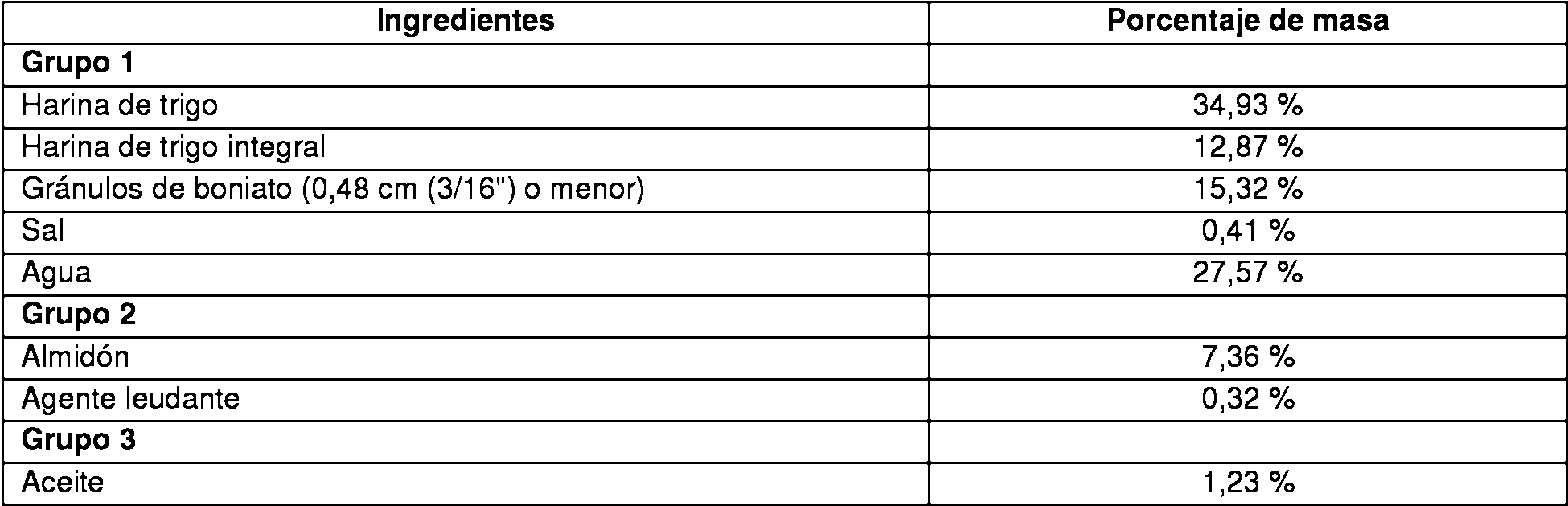
Generalmente, los gránulos de boniato se hidrataron en agua a una temperatura de 21,1 a 23,9 0C (de 70 a 75 0F) durante un período de aproximadamente 10-15 minutos. A continuación, se combinaron la harina, harina de trigo integral, sal, gránulos de verdura y agua a temperatura ambiente (de 21,1 a 23,9 0C (de 70 a 75 0F)) en un mezclador de masa (Shaffer) para gelatinizar/cocinar el material inyectando vapor a una temperatura de aproximadamente 71, 10C a 82,2 0C (160-180 0F) con mezclado a 20 rpm durante un período de 10 a 15 minutos. A continuación, los ingredientes indicados en el grupo 2, salvo el aceite, se añadieron al material gelatinizado/cocinado y se dejaron mezclar a 20 rpm durante 2 minutos. A continuación se añadió el aceite y se mezcló a 20 rpm durante 2 minutos. La temperatura de la masa era de aproximadamente 54,4 0C a 65,6 0C (130 150 0F). La masa se laminó a continuación sin estratificación y a continuación se horneó en un horno hasta un contenido de humedad máximo de 4 por ciento. El material se sometió a continuación a un acabado en un secador dieléctrico o posterior a la convección hasta un contenido de humedad de 1-3 por ciento. Este ejemplo produjo un producto similar a una lámina crujiente que tenía un aspecto de superficie marmórea. Generally, the sweet potato granules were hydrated in water at a temperature of 21.1 to 23.9 ° C (70 to 75 ° F) for a period of about 10-15 minutes. Next, the flour, whole wheat flour, salt, vegetable granules and water at room temperature (from 21.1 to 23.9 ° C (70 to 75 ° F)) were combined in a dough mixer (Shaffer) to gelatinize / cook the material by injecting steam at a temperature of approximately 71, 10C to 82.2 0C (160-180 0F) with mixing at 20 rpm for a period of 10 to 15 minutes. Next, the ingredients indicated in group 2, except for the oil, were added to the gelatinized / cooked material and allowed to mix at 20 rpm for 2 minutes. The oil was then added and mixed at 20 rpm for 2 minutes. The temperature of the dough was approximately 54.4 0C to 65.6 0C (130 150 0F). The dough was then laminated without stratification and then baked in an oven to a maximum moisture content of 4 percent. The material was then subjected to finishing in a dielectric or post-convection dryer to a moisture content of 1-3 percent. This example produced a product similar to a crunchy sheet that had a marble-like appearance.
Ejemplo 4Example 4
En el ejemplo 4, se preparó una galleta salada de boniato no térmicamente procesada usando los componentes indicados en la tabla 4. Las piezas de boniato eran de un tamaño similar a las del ejemplo 2.In Example 4, a non-thermally processed sweet potato biscuit was prepared using the components indicated in Table 4. The sweet potato pieces were of a size similar to those of Example 2.
Tabla 4: Boniato no térmicamente procesadoTable 4: Non-thermally processed sweet potato

De forma general, se combinan el edulcorante, almidones (que pueden ser de patata, maíz, o combinaciones de los mismos) y piezas de boniato y se mezclan durante treinta segundos. A continuación se añade el agua a 65,6 0C (150 0F) y se mezcla a alta velocidad (60 rpm) durante 3 minutos. A continuación, se añaden el aceite y sirope y se mezclan a alta velocidad (60 rpm) durante 1 minuto. A continuación, se añaden la harina (que puede ser harina no enriquecida, harina de Graham, y/o combinaciones de las mismas); agente leudante (que puede ser bicarbonato sódico, bicarbonato cálcico, y/o mezclas de los mismos); y otros ingredientes y agua adicional (0,45 kg (1 libra)) y se mezclan a alta velocidad durante 7 minutos.Generally, the sweetener, starches (which may be potato, corn, or combinations thereof) and pieces of sweet potato are combined and mixed for thirty seconds. The water is then added at 65.6 ° C (150 ° F) and mixed at high speed (60 rpm) for 3 minutes. The oil and syrup are then added and mixed at high speed (60 rpm) for 1 minute. Next, the flour (which can be unenriched flour, Graham flour, and / or combinations thereof) is added; leavening agent (which may be sodium bicarbonate, calcium bicarbonate, and / or mixtures thereof); and other ingredients and additional water (0.45 kg (1 pound)) and mixed at high speed for 7 minutes.
Ejemplo 5Example 5
En el ejemplo 5, se preparó otra galleta salada de boniato no térmicamente procesada usando los componentes indicados en la tabla 5.In Example 5, another non-thermally processed sweet potato biscuit was prepared using the components indicated in Table 5.
Tabla 5: Boniato no térmicamente procesadoTable 5: Non-thermally processed sweet potato

Ejemplo 6Example 6
En este ejemplo, se preparó otra galleta salada de boniato no térmicamente procesada usando los componentes indicados en la tabla 6. In this example, another non-thermally processed sweet potato biscuit was prepared using the components indicated in Table 6.
Tabla 6: Boniato no térmicamente procesadoTable 6: Non-thermally processed sweet potato

Claims (13)
Applications Claiming Priority (2)
| Application Number | Priority Date | Filing Date | Title |
|---|---|---|---|
| US201161533075P | 2011-09-09 | 2011-09-09 | |
| PCT/US2012/054188 WO2013036782A1 (en) | 2011-09-09 | 2012-09-07 | Snacks with marbled-like appearance and methods for steam treating dough-based snacks |
Publications (1)
| Publication Number | Publication Date |
|---|---|
| ES2706429T3 true ES2706429T3 (en) | 2019-03-28 |
Family
ID=46846039
Family Applications (1)
| Application Number | Title | Priority Date | Filing Date |
|---|---|---|---|
| ES12758979T Active ES2706429T3 (en) | 2011-09-09 | 2012-09-07 | Salty biscuit with marble appearance and methods of making it |
Country Status (10)
| Country | Link |
|---|---|
| US (1) | US20140322392A1 (en) |
| EP (1) | EP2753183B1 (en) |
| JP (1) | JP2014526249A (en) |
| CN (1) | CN104080346B (en) |
| AU (1) | AU2012304446B2 (en) |
| BR (1) | BR112014005035A2 (en) |
| CA (1) | CA2847854C (en) |
| ES (1) | ES2706429T3 (en) |
| RU (1) | RU2014108465A (en) |
| WO (1) | WO2013036782A1 (en) |
Cited By (1)
| Publication number | Priority date | Publication date | Assignee | Title |
|---|---|---|---|---|
| US20240298655A1 (en) * | 2021-05-21 | 2024-09-12 | Soremartec S.A. | Wafer for foodstuff products |
Families Citing this family (11)
| Publication number | Priority date | Publication date | Assignee | Title |
|---|---|---|---|---|
| BR112014030490A2 (en) | 2012-06-05 | 2017-06-27 | Intercontinental Great Brands Llc | production of fragmented products with inclusions |
| USD772526S1 (en) * | 2013-01-23 | 2016-11-29 | Baptista's Bakery, Inc. | Food product |
| AU358082S (en) | 2014-03-30 | 2014-10-07 | Intercontinental Great Brands Llc | Biscuit |
| USD909007S1 (en) | 2014-03-30 | 2021-02-02 | Intercontinental Great Brands Llc | Thin biscuit sandwich |
| US20170172189A1 (en) * | 2015-12-22 | 2017-06-22 | Frito-Lay North America, Inc. | Preservation of Native Fruit and/or Vegetable Coloring in Cooked Food Products |
| WO2017212335A1 (en) | 2016-06-05 | 2017-12-14 | Mondelez Europe Gmbh | Baked savory food composition comprising shredded root vegetable and method of making the same |
| USD862834S1 (en) * | 2016-06-27 | 2019-10-15 | Mondelez Europe Gmbh | Cracker |
| USD879408S1 (en) * | 2016-06-06 | 2020-03-31 | Mondelez Europe Gmbh | Cracker |
| US11291226B1 (en) | 2017-10-09 | 2022-04-05 | The Hershey Company | Crispy pressed snacks with inclusions |
| USD864516S1 (en) | 2018-05-14 | 2019-10-29 | Intercontinental Great Brands Llc | Thin food cluster |
| WO2020058911A1 (en) * | 2018-09-19 | 2020-03-26 | Enjoy Chips Se | Snack and production process thereof |
Family Cites Families (17)
| Publication number | Priority date | Publication date | Assignee | Title |
|---|---|---|---|---|
| IT1235063B (en) * | 1989-01-19 | 1992-06-17 | Dicofarm Spa | COMPOSITION OF A DIETARY FOOD IN THE FORM OF CRACKER WITH A HIGH CONTENT OF FIBER AND A REDUCED CALORIC CONTENT |
| US5221546A (en) * | 1991-06-14 | 1993-06-22 | The Procter & Gamble Company | Laminated pastry dough |
| IL100404A0 (en) * | 1990-12-24 | 1992-09-06 | Mccormick & Co Inc | Process for preparing dehydrated vegetable products and the resulting products |
| ES2146320T3 (en) * | 1994-11-08 | 2000-08-01 | Quest Int | DRY BAKERY PRODUCTS AND PROCEDURE FOR THEIR PREPARATION. |
| CN1228265A (en) * | 1998-03-06 | 1999-09-15 | 铁岭精达食品有限公司 | Double layer double color instant noodles and its preparing method |
| US8367142B2 (en) * | 2005-04-29 | 2013-02-05 | Kraft Foods Global Brands Llc | Production of shredded or flaked whole grain-containing composite food products |
| CN1692746A (en) * | 2005-05-18 | 2005-11-09 | 李晓光 | Chromatically layered dough sheet for dampling, steamed ban and noodes, and making method therefor |
| US7507431B2 (en) * | 2006-08-24 | 2009-03-24 | Frito-Lay North America, Inc. | Production of multi-grain, whole-grain, soft and crunchy sheeted snacks |
| JP5460334B2 (en) * | 2007-02-01 | 2014-04-02 | プリングルズ エス.アー.エール.エル. | Nutritional processed snack products |
| US20080206424A1 (en) * | 2007-02-28 | 2008-08-28 | The Procter & Gamble Company | Fruit based dough and fabricated snack products made therefrom |
| US8277865B2 (en) * | 2007-03-02 | 2012-10-02 | Paul Ralph Bunke | Nutritious fabricated snack products |
| US20090202700A1 (en) * | 2007-08-16 | 2009-08-13 | Paul Ralph Bunke | Nutritious snack products |
| FR2934466B1 (en) * | 2008-08-01 | 2011-12-30 | Gen Biscuit | PROCESS FOR MANUFACTURING EXTRUDED FOOD PRODUCT |
| US20100215826A1 (en) * | 2009-02-26 | 2010-08-26 | Frito-Lay Trading Company Gmbh | Snack Cracker and Method for Making Same |
| CN101579083B (en) * | 2009-06-11 | 2013-04-17 | 陈义 | Natural and crisp biscuit prepared by freezing method and preparation process thereof |
| US20110244088A1 (en) * | 2010-04-02 | 2011-10-06 | Frito-Lay North America, Inc. | Multi-Color Crackers and Method for Making Same |
| BR112014030490A2 (en) * | 2012-06-05 | 2017-06-27 | Intercontinental Great Brands Llc | production of fragmented products with inclusions |
-
2012
- 2012-09-07 EP EP12758979.4A patent/EP2753183B1/en not_active Not-in-force
- 2012-09-07 BR BR112014005035A patent/BR112014005035A2/en not_active IP Right Cessation
- 2012-09-07 US US14/342,513 patent/US20140322392A1/en not_active Abandoned
- 2012-09-07 CN CN201280055196.3A patent/CN104080346B/en not_active Expired - Fee Related
- 2012-09-07 ES ES12758979T patent/ES2706429T3/en active Active
- 2012-09-07 JP JP2014529901A patent/JP2014526249A/en not_active Ceased
- 2012-09-07 WO PCT/US2012/054188 patent/WO2013036782A1/en not_active Ceased
- 2012-09-07 CA CA2847854A patent/CA2847854C/en active Active
- 2012-09-07 AU AU2012304446A patent/AU2012304446B2/en not_active Ceased
- 2012-09-07 RU RU2014108465/13A patent/RU2014108465A/en not_active Application Discontinuation
Cited By (1)
| Publication number | Priority date | Publication date | Assignee | Title |
|---|---|---|---|---|
| US20240298655A1 (en) * | 2021-05-21 | 2024-09-12 | Soremartec S.A. | Wafer for foodstuff products |
Also Published As
| Publication number | Publication date |
|---|---|
| CN104080346A (en) | 2014-10-01 |
| CN104080346B (en) | 2017-03-01 |
| CA2847854C (en) | 2019-11-26 |
| BR112014005035A2 (en) | 2017-03-21 |
| RU2014108465A (en) | 2015-10-20 |
| AU2012304446A1 (en) | 2014-03-20 |
| CA2847854A1 (en) | 2013-03-14 |
| EP2753183B1 (en) | 2018-11-07 |
| AU2012304446B2 (en) | 2015-09-03 |
| EP2753183A1 (en) | 2014-07-16 |
| US20140322392A1 (en) | 2014-10-30 |
| JP2014526249A (en) | 2014-10-06 |
| WO2013036782A1 (en) | 2013-03-14 |
Similar Documents
| Publication | Publication Date | Title |
|---|---|---|
| ES2706429T3 (en) | Salty biscuit with marble appearance and methods of making it | |
| ES2345284T3 (en) | PRODUCTION OF COMPOUND FOOD PRODUCTS THAT HAVE WHOLE GRAINS. | |
| EP0184964B1 (en) | Starch snack foods and process | |
| RU2469556C2 (en) | Sweet potato chips and method for their production | |
| ES2333458T3 (en) | PRODUCTION OF INTEGRATED CRUSHED PRODUCTS. | |
| KR101962296B1 (en) | Method for manufacturing of shiitake mushroom snack and shiitake mushroom snack manufactured thereby | |
| ES2899997T3 (en) | Methods for the manufacture of flour-based food products and food products made in this way | |
| US20050202125A1 (en) | Low-fat crispy snack food product and process for preparing the same | |
| ES2545380T3 (en) | Production of filamented integral products | |
| EP2914130B1 (en) | Method for producing crispy foodstuff with soft portion | |
| KR20210028874A (en) | Method for manufacturing of lentinula edodes snack | |
| KR101861921B1 (en) | The method of laver, and the laver manufacturing by the method | |
| KR100881110B1 (en) | Rice cakes fried and preparation method thereof | |
| KR20160050850A (en) | A method for manufacturing fry of scorched rice | |
| KR102599891B1 (en) | Composition for forming dumpling wing and frozen dumpling using the same, method for manufacturing the frozen dumpling | |
| KR101579252B1 (en) | Method for manufacturing potato dough for cooking and method for manufacturing potato flat cakes or potato pancakes using the same | |
| KR20160058199A (en) | Composition of Breader Mix for Microwave Cooking in Fried Food | |
| KR100653947B1 (en) | Preparation of Seasoned Seaweed | |
| KR20190002578U (en) | Laver dumplings and its manufacturing method | |
| EP1574138A1 (en) | Low-fat, crispy, crinkled snack food product and process for preparing the same | |
| US20130059045A1 (en) | Oven baked french fry with reduced acrylamide level | |
| CN102948770A (en) | Paper-covered mutton food and making method thereof | |
| CN104824564A (en) | Method for producing spinach-flavored instant cornflakes | |
| KR20110101115A (en) | Bacon rolled rice ball and the manufacturing method | |
| CN105230914A (en) | Soft fruit candy containing noodles |