ES2710177T3 - Process for the production of isocyanate - Google Patents
Process for the production of isocyanate Download PDFInfo
- Publication number
- ES2710177T3 ES2710177T3 ES08752810T ES08752810T ES2710177T3 ES 2710177 T3 ES2710177 T3 ES 2710177T3 ES 08752810 T ES08752810 T ES 08752810T ES 08752810 T ES08752810 T ES 08752810T ES 2710177 T3 ES2710177 T3 ES 2710177T3
- Authority
- ES
- Spain
- Prior art keywords
- including isomers
- group
- acid ester
- reaction
- reaction vessel
- Prior art date
- Legal status (The legal status is an assumption and is not a legal conclusion. Google has not performed a legal analysis and makes no representation as to the accuracy of the status listed.)
- Active
Links
Classifications
-
- C—CHEMISTRY; METALLURGY
- C07—ORGANIC CHEMISTRY
- C07C—ACYCLIC OR CARBOCYCLIC COMPOUNDS
- C07C263/00—Preparation of derivatives of isocyanic acid
- C07C263/04—Preparation of derivatives of isocyanic acid from or via carbamates or carbamoyl halides
-
- C—CHEMISTRY; METALLURGY
- C07—ORGANIC CHEMISTRY
- C07C—ACYCLIC OR CARBOCYCLIC COMPOUNDS
- C07C263/00—Preparation of derivatives of isocyanic acid
-
- C—CHEMISTRY; METALLURGY
- C07—ORGANIC CHEMISTRY
- C07C—ACYCLIC OR CARBOCYCLIC COMPOUNDS
- C07C263/00—Preparation of derivatives of isocyanic acid
- C07C263/18—Separation; Purification; Stabilisation; Use of additives
-
- C—CHEMISTRY; METALLURGY
- C07—ORGANIC CHEMISTRY
- C07C—ACYCLIC OR CARBOCYCLIC COMPOUNDS
- C07C265/00—Derivatives of isocyanic acid
-
- C—CHEMISTRY; METALLURGY
- C07—ORGANIC CHEMISTRY
- C07C—ACYCLIC OR CARBOCYCLIC COMPOUNDS
- C07C265/00—Derivatives of isocyanic acid
- C07C265/02—Derivatives of isocyanic acid having isocyanate groups bound to acyclic carbon atoms
-
- C—CHEMISTRY; METALLURGY
- C07—ORGANIC CHEMISTRY
- C07C—ACYCLIC OR CARBOCYCLIC COMPOUNDS
- C07C265/00—Derivatives of isocyanic acid
- C07C265/14—Derivatives of isocyanic acid containing at least two isocyanate groups bound to the same carbon skeleton
-
- C—CHEMISTRY; METALLURGY
- C07—ORGANIC CHEMISTRY
- C07C—ACYCLIC OR CARBOCYCLIC COMPOUNDS
- C07C2601/00—Systems containing only non-condensed rings
- C07C2601/12—Systems containing only non-condensed rings with a six-membered ring
- C07C2601/14—The ring being saturated
Landscapes
- Chemical & Material Sciences (AREA)
- Organic Chemistry (AREA)
- Organic Low-Molecular-Weight Compounds And Preparation Thereof (AREA)
Abstract
Un proceso para la producción de un isocianato mediante el sometimiento de un éster de ácido carbámico a una reacción de descomposición térmica, que comprende las etapas de: recuperar un componente de bajo punto de ebullición en forma de un componente de fase gaseosa de un recipiente de reacción de descomposición térmica en el que se lleva a cabo la reacción de descomposición térmica; recuperar un componente de fase líquida que contiene el éster de ácido carbámico de la parte inferior del recipiente de reacción de descomposición térmica; y suministrar todo o una parte del componente de fase líquida a la parte superior del recipiente de reacción de descomposición térmica, en el que el éster de ácido carbámico es un éster de ácido carbámico producido mediante la reacción de un éster de ácido carbónico con un compuesto de amina, en el que el éster de ácido carbónico es un compuesto representado mediante la siguiente Fórmula (8): en la que R5 representa un grupo alifático que tiene de 1 a 20 átomos de carbono o un grupo aromático que tiene de 6 a 20 átomos de carbono, en el que el éster de ácido carbónico contiene un átomo de metal de 0,001 ppm al 10 % y en el que el átomo de metal es hierro.A process for the production of an isocyanate by subjecting a carbamic acid ester to a thermal decomposition reaction, comprising the steps of: recovering a low-boiling component as a gas phase component from a container of thermal decomposition reaction in which the thermal decomposition reaction takes place; recovering a liquid phase component containing the carbamic acid ester from the bottom of the thermal decomposition reaction vessel; and supplying all or part of the liquid phase component to the top of the thermal decomposition reaction vessel, wherein the carbamic acid ester is a carbamic acid ester produced by reacting a carbonic acid ester with a compound of amine, wherein the carbonic acid ester is a compound represented by the following Formula (8): wherein R5 represents an aliphatic group having 1 to 20 carbon atoms or an aromatic group having 6 to 20 carbon atoms, where the carbonic acid ester contains a 0.001 ppm to 10% metal atom and where the metal atom is iron.
Description
DESCRIPCIONDESCRIPTION
Proceso para la produccion de isocianatoProcess for the production of isocyanate
Campo tecnicoTechnical field
La presente invencion se refiere a un proceso de produccion de isocianato.The present invention relates to an isocyanate production process.
Tecnica antecedenteBackground technique
Los isocianatos se usan ampliamente como materias primas de productos, tales como espuma de poliuretano, pinturas, adhesivos. El proceso de produccion industrial principal de isocianatos implica hacer reaccionar compuestos de amina con fosgeno (metodo de fosgeno) y casi toda la cantidad total de isocianatos producidos en todo el mundo se produce de acuerdo con el metodo de fosgeno. Sin embargo, el metodo de fosgeno tiene numerosos problemas. Isocyanates are widely used as raw materials for products, such as polyurethane foam, paints, adhesives. The main industrial production process of isocyanates involves reacting amine compounds with phosgene (phosgene method) and almost the total amount of isocyanates produced worldwide is produced according to the phosgene method. However, the phosgene method has numerous problems.
En primer lugar, este metodo requiere el uso de una gran cantidad de fosgeno como materia prima. El fosgeno es extremadamente toxico y requiere precauciones de manipulacion especiales para prevenir la exposicion de los manipuladores al mismo y tambien requiere aparatos especiales para desintoxicar los desechos.First, this method requires the use of a large amount of phosgene as a raw material. Phosgene is extremely toxic and requires special handling precautions to prevent exposure of the manipulators to the same and also requires special devices to detoxify the waste.
En segundo lugar, puesto que se produce cloruro de hidrogeno altamente corrosivo en grandes cantidades como subproducto del metodo de fosgeno, ademas de requerir un proceso para desintoxicar el cloruro de hidrogeno, en muchos casos, el cloro hidrolttico esta contenido en los isocianatos producidos. En consecuencia, en el caso de usar los isocianatos producidos mediante el metodo de fosgeno, los isocianatos pueden tener un efecto perjudicial sobre la resistencia al clima y la resistencia al calor de los productos de poliuretano.Second, since highly corrosive hydrogen chloride is produced in large quantities as a byproduct of the phosgene method, in addition to requiring a process to detoxify hydrogen chloride, in many cases, the hydrolytic chlorine is contained in the isocyanates produced. Accordingly, in the case of using the isocyanates produced by the phosgene method, the isocyanates may have a detrimental effect on the weather resistance and heat resistance of the polyurethane products.
Sobre la base de estos antecedentes, se ha buscado un proceso para la produccion de compuestos de isocianato que no use fosgeno. Un ejemplo de un metodo para la produccion de compuestos de isocianato sin usar fosgeno que se ha propuesto implica la descomposicion termica de esteres de acido carbamico. Se ha sabido desde hace mucho tiempo que los isocianatos y los compuestos hidroxi se obtienen mediante descomposicion termica de los esteres de acido carbamico (vease, por ejemplo, el documento no de patente 1). La reaccion basica se ilustra mediante la siguiente Formula:On the basis of this background, a process has been sought for the production of isocyanate compounds that do not use phosgene. An example of a method for the production of isocyanate compounds without using phosgene that has been proposed involves the thermal decomposition of esters of carbamic acid. It has been known for a long time that isocyanates and hydroxy compounds are obtained by thermal decomposition of carbamic acid esters (see, for example, non-patent document 1). The basic reaction is illustrated by the following Formula:
R(NHCOOR')a ^ R(NCO)a + a R'OH (1)R (NHCOOR ') a ^ R (NCO) a + a R'OH (1)
(en la que R representa un residuo organico que tiene una valencia de a, R' representa un residuo organico monovalente y a representa un numero entero de 1 o mas).(wherein R represents an organic residue having a valence of a, R 'represents a monovalent organic residue and a represents an integer of 1 or more).
Por otro lado, la descomposicion termica de los esteres del acido carbamico es susceptible a la aparicion simultanea de diversas reacciones secundarias irreversibles, tales como las reacciones de desnaturalizacion termica indeseables para los esteres de acido carbamico, o la condensacion de los isocianatos formados mediante la descomposicion termica. Los ejemplos de estas reacciones secundarias pueden incluir una reaccion en la que se forman enlaces de urea, tal como se representa mediante la siguiente Formula (2), una reaccion en la que se forman carbodiimidas, tal como se representa mediante la siguiente Formula (3), y una reaccion en la que se forman isocianuratos, tal como se representa mediante la siguiente Formula (4) (veanse los documentos no de patente 1 y 2).On the other hand, the thermal decomposition of carbamic acid esters is susceptible to the simultaneous appearance of various irreversible secondary reactions, such as undesirable thermal denaturation reactions for carbamic acid esters, or the condensation of isocyanates formed by decomposition. thermal Examples of these side reactions may include a reaction in which urea bonds are formed, as represented by the following Formula (2), a reaction in which carbodiimides are formed, as represented by the following Formula (3) ), and a reaction in which isocyanurates are formed, as represented by the following Formula (4) (see non-patent documents 1 and 2).

Cabe destacar que, en las formulas anteriores, R y R' representan grupos, tales como grupos alquilo alifaticos o grupos alquilo aromaticos.It should be noted that, in the above formulas, R and R 'represent groups, such as aliphatic alkyl groups or aromatic alkyl groups.
Ademas de estas reacciones secundarias que conducen a una disminucion en el rendimiento y la selectividad del isocianato diana, en la produccion de poliisocianatos en particular, estas reacciones pueden dificultar el funcionamiento a largo plazo como resultado de, por ejemplo, causar la precipitacion de solidos polimericos que obstruyen el recipiente de reaccion. In addition to these side reactions which lead to a decrease in the yield and selectivity of the target isocyanate, in the production of polyisocyanates in particular, these reactions can hinder long-term operation as a result of, for example, causing the precipitation of polymer solids. that clog the reaction vessel.
Hasta ahora se han propuesto diversos procesos para la produccion de isocianatos sin usar fosgeno.Up to now, various processes have been proposed for the production of isocyanates without using phosgene.
De acuerdo con la descripcion del documento de patente 1, el diuretano alifatico y/o diuretano alidclico y/o el poliuretano alifatico y/o poliuretano alidclico se obtienen mediante la reaccion de la diamina primaria alifatica y/o diamina primaria alidclica y/o la poliamina primaria alifatica y/o poliamina primaria alidclica en presencia de un carbamato de O-alquilo y alcohol, en presencia o ausencia de un catalizador a una temperatura de 160 a 300 °C, de tal manera que la relacion de los grupos NH2 amina respecto al carbamato respecto al alcohol sea de 1:0,8 a 10:0,25 a 50, y mediante la retirada del amoniaco formado, tal como sea necesario. El diuretano y/o poliuretano resultante se puede convertir en el correspondiente diisocianato y/o poliisocianato altamente funcional, tal como sea necesario. Los detalles de las condiciones de reaccion de la descomposicion termica no se describen en el documento de patente aplicable.According to the description of the patent document 1, the aliphatic diurethane and / or alidcic diurethane and / or aliphatic polyurethane and / or alidcic polyurethane are obtained by the reaction of the aliphatic primary diamine and / or primary allylic diamine and / or the primary aliphatic polyamine and / or primary allylic polyamine in the presence of an O-alkyl carbamate and alcohol, in the presence or absence of a catalyst at a temperature of 160 to 300 ° C, such that the ratio of the amine NH2 groups the carbamate to the alcohol is from 1: 0.8 to 10: 0.25 to 50, and by removal of the ammonia formed, as necessary. The resulting diurethane and / or polyurethane can be converted into the corresponding highly functional diisocyanate and / or polyisocyanate, as necessary. The details of the reaction conditions of the thermal decomposition are not described in the applicable patent document.
De acuerdo con el documento de patente 2, los diisocianatos y/o poliisocianatos aromaticos se producen mediante su paso a traves de las siguientes dos etapas. Mas espedficamente, en la primera etapa, una amina primaria aromatica y/o poliamina primaria aromatica se hacen reaccionar con un carbamato de O-alquilo en presencia o ausencia de un catalizador y en presencia o ausencia de urea y alcohol para formar un diuretano de arilo y/o poliuretano de arilo, seguido de la retirada del amoniaco formado, tal como sea necesario. En la segunda etapa, un isocianato aromatico y/o poliisocianato aromatico se obtienen mediante la descomposicion termica del diuretano de arilo y/o poliuretano de arilo.According to the patent document 2, the aromatic diisocyanates and / or polyisocyanates are produced by passing through the following two steps. More specifically, in the first step, a primary aromatic amine and / or aromatic primary polyamine are reacted with an O-alkyl carbamate in the presence or absence of a catalyst and in the presence or absence of urea and alcohol to form an aryl diurethane and / or aryl polyurethane, followed by removal of the ammonia formed, as necessary. In the second step, an aromatic isocyanate and / or aromatic polyisocyanate are obtained by the thermal decomposition of the aryl diurethane and / or aryl polyurethane.
Otras publicaciones contienen descripciones relacionadas con la sustitucion parcial de urea y/o diamina con un compuesto que contiene carbonilo, tal como carbamato N-sustituido y/o carbonato de dialquilo, o con urea monosustituida, urea disustituida, poliurea monosustituida o poliurea disustituida (veanse el documento de patente 3, el documento de patente 4, el documento de patente 5, el documento de patente 6 y el documento de patente 7). El documento de patente 8 describe un proceso para la produccion de uretano de O-arilo alifatico mediante la reaccion de poliaminas alifaticas (dclicas) con urea y compuestos de hidroxi aromaticos.Other publications contain descriptions related to the partial replacement of urea and / or diamine with a carbonyl-containing compound, such as N-substituted carbamate and / or dialkyl carbonate, or with monosubstituted urea, disubstituted urea, monosubstituted polyurea or disubstituted polyurea (cf. the patent document 3, the patent document 4, the patent document 5, the patent document 6 and the patent document 7). The patent document 8 describes a process for the production of aliphatic O-aryl urethane by the reaction of aliphatic polyamines (diclics) with urea and aromatic hydroxy compounds.
Se conocen varios procesos para la formacion del correspondiente isocianato y alcohol mediante la descomposicion termica de los monouretanos y diuretanos alifaticos (dclicos) y particularmente aromaticos, cuyos ejemplos pueden incluir un proceso llevado a cabo a una temperatura alta en una fase gaseosa y un proceso llevado a cabo en condiciones de temperatura comparativamente baja en una fase lfquida. En estos procesos, sin embargo, puesto que hay casos en los que, por ejemplo, la mezcla de reaccion forma precipitados, sustancias polimericas y compuestos encerrados en el recipiente de reaccion y el aparato de recuperacion debido a la aparicion de reacciones secundarias, tal como se ha descrito previamente, o estas sustancias forman sustancias que se adhieren a las paredes del recipiente de reaccion, la eficacia economica es insuficiente en el caso de producir isocianatos durante un largo penodo de tiempo.Various processes are known for the formation of the corresponding isocyanate and alcohol by the thermal decomposition of the monofethanes and diurethanes aliphatic (cyclic) and particularly aromatic, examples of which may include a process carried out at a high temperature in a gas phase and a process carried out performed under conditions of comparatively low temperature in a liquid phase. In these processes, however, since there are cases in which, for example, the reaction mixture forms precipitates, polymeric substances and compounds enclosed in the reaction vessel and the recovery apparatus due to the occurrence of side reactions, such as previously described, or these substances form substances that adhere to the walls of the reaction vessel, the economic efficiency is insufficient in the case of producing isocyanates for a long period of time.
Por tanto, los metodos qrnmicos, tales como el uso de un catalizador especial (vease el documento de patente 9 y el documento de patente 10) o un catalizador combinado con un disolvente inerte (vease el documento de patente 11), se desvelan para la mejora del rendimiento durante la descomposicion termica del uretano.Therefore, chemical methods, such as the use of a special catalyst (see patent document 9 and patent document 10) or a catalyst combined with an inert solvent (see patent document 11), are disclosed for the purpose of performance improvement during thermal decomposition of urethane.
Por ejemplo, el documento de patente 12 describe un proceso para la produccion de diisocianato de hexametileno que implica la descomposicion termica de dietil uretano de hexametileno en presencia de tolueno de dibencilo como disolvente y en presencia de una mezcla de catalizador que contiene sulfonato de metil tolueno y dicloruro de difenil estano. Sin embargo, puesto que no hay ninguna descripcion detallada de la produccion de los componentes de partida, el aislamiento o la purificacion y la recuperacion arbitraria del disolvente y la mezcla de catalizador, los efectos economicos de este proceso fueron incapaces de evaluarse.For example, the patent document 12 describes a process for the production of hexamethylene diisocyanate which involves the thermal decomposition of diethyl urethane of hexamethylene in the presence of toluene of dibenzyl as a solvent and in the presence of a mixture of catalyst containing methyl toluene sulfonate. and diphenyl tin dichloride. However, since there is no detailed description of the production of the starting components, the isolation or the purification and the arbitrary recovery of the solvent and the catalyst mixture, the economic effects of this process were unable to be evaluated.
De acuerdo con el proceso descrito en el documento de patente 13, el uretano se puede descomponer facilmente en isocianato y alcohol en un lecho fluidizado que contiene carbono sin usar un catalizador. Ademas, de acuerdo con la descripcion del documento de patente 14, el dialquil uretano de hexametileno se puede descomponer en una fase gaseosa a una temperatura superior a 300 °C en presencia o ausencia de un material de relleno permeable a los gases compuesto de, por ejemplo, carbono, cobre, bronce, acero, zinc, aluminio, titanio, cromo, cobalto o cuarzo, lo que da como resultado la formacion de diisocianato de hexametileno.In accordance with the process described in patent document 13, urethane can be readily decomposed to isocyanate and alcohol in a fluidized bed containing carbon without using a catalyst. Furthermore, according to the description of the patent document 14, the hexamethylene dialkyl urethane can be decomposed in a gas phase at a temperature higher than 300 ° C in the presence or absence of a gas permeable packing material composed of, for example, carbon, copper, bronze, steel, zinc, aluminum, titanium, chromium, cobalt or quartz, which results in the formation of hexamethylene diisocyanate.
De acuerdo con la descripcion del documento de patente 14, el proceso se lleva a cabo en presencia de un haluro de hidrogeno y/o donador de haluro de hidrogeno. Sin embargo, este proceso es incapaz de lograr un rendimiento del diisocianato de hexametileno del 90 % o mas. Esto se debe a que el producto de descomposicion se reenlaza parcialmente, lo que da como resultado la formacion de enlaces de uretano. Por tanto, se sigue requiriendo la purificacion del diisocianato de hexametileno mediante destilacion y existen numerosos casos en los que aumenta la perdida de rendimiento.According to the description of the patent document 14, the process is carried out in the presence of a hydrogen halide and / or hydrogen halide donor. However, this process is unable to achieve a yield of hexamethylene diisocyanate of 90% or more. This is because the decomposition product partially re-links, which results in the formation of urethane bonds. Therefore, the purification of hexamethylene diisocyanate is still required by distillation and there are numerous cases in which the loss of yield increases.
Ademas, el documento de patente 15 desvela que los monocarbamatos se pueden descomponer de manera ventajosa a alto rendimiento sin usar un disolvente a presion reducida y/o en presencia o ausencia de un estabilizante y a una temperatura comparativamente baja. Los productos de descomposicion (monoisocianatos y alcohol) se retiran mediante destilacion de una mezcla de reaccion en ebullicion y se capturan por separado mediante condensacion fraccional. Un metodo para la retirada parcial de la mezcla de reaccion se describe de manera generica con el fin de retirar los subproductos formados durante la descomposicion termica. Por tanto, aunque resulta posible retirar los subproductos de la parte inferior del recipiente de reaccion, sigue existiendo el problema del caso de las sustancias que se adhieren a las paredes del recipiente de reaccion, tal como se ha descrito previamente, y los problemas con respecto al funcionamiento a largo plazo no estan resueltos. Ademas, no existe ninguna descripcion con respecto al uso industrial de la sustancias residuales retiradas (que contienen grandes cantidades de componentes utiles). Furthermore, the patent document 15 discloses that the monocarbamates can be advantageously decomposed at high yield without using a solvent under reduced pressure and / or in the presence or absence of a stabilizer and at a comparatively low temperature. The decomposition products (monoisocyanates and alcohol) are removed by distillation from a boiling reaction mixture and captured separately by condensation. fractional A method for the partial removal of the reaction mixture is generically described in order to remove the by-products formed during the thermal decomposition. Therefore, although it is possible to remove the by-products from the lower part of the reaction vessel, the problem remains of the case of the substances adhering to the walls of the reaction vessel, as previously described, and the problems with respect to the reaction vessel. to long-term operation are not resolved. Furthermore, there is no description regarding the industrial use of the waste residual substances (which contain large amounts of useful components).
De acuerdo con la descripcion del documento de patente 16, la descomposicion termica de policarbamatos alifaticos, alidclicos o aromaticos se lleva a cabo a entre 150 y 350 °C y de 0,1 KPa a 2.000 KPa, en presencia de un disolvente inerte y en presencia o ausencia de un catalizador y adyuvante en forma de cloruro de hidrogeno, cloruro de acido organico, agente de alquilacion o compuesto de estano organico. Los subproductos formados se pueden retirar de manera continua del recipiente de reaccion junto con la solucion de reaccion, por ejemplo, y se anaden, de manera simultanea, las cantidades correspondientes de disolvente nuevo o disolvente recuperado. Los ejemplos de las desventajas de este proceso pueden incluir una disminucion en el rendimiento espacio-tiempo del poliisocianato debido al uso de un disolvente de circulacion y un gran requisito de energfa, incluyendo la recuperacion del disolvente. Ademas, puesto que el adyuvante usado es volatil en las condiciones de reaccion, se puede producir la contaminacion de los productos de descomposicion. Ademas, puesto que existe una gran cantidad de sustancias residuales formadas en relacion con el poliisocianato formado, existe alguna duda con respecto a la eficacia economica y la fiabilidad como proceso industrial.According to the description of the patent document 16, the thermal decomposition of aliphatic, alicyclic or aromatic polycarbamates is carried out at 150 to 350 ° C and 0.1 KPa to 2,000 KPa, in the presence of an inert solvent and in presence or absence of a catalyst and adjuvant in the form of hydrogen chloride, organic acid chloride, alkylating agent or organic tin compound. The formed by-products can be continuously removed from the reaction vessel together with the reaction solution, for example, and the corresponding amounts of new solvent or recovered solvent are added simultaneously. Examples of the disadvantages of this process may include a decrease in the space-time yield of the polyisocyanate due to the use of a circulating solvent and a high energy requirement, including solvent recovery. Furthermore, since the adjuvant used is volatile under the reaction conditions, contamination of the decomposition products can occur. Furthermore, since there is a large amount of residual substances formed in relation to the polyisocyanate formed, there is some doubt as to the economic efficiency and reliability as an industrial process.
El documento de patente 17 describe un proceso para la descomposicion termica continua de un carbamato suministrado a lo largo de las paredes internas de un recipiente de reaccion tubular en forma de lfquido en presencia de un disolvente de alto punto de ebullicion, cuyo ejemplo puede incluir un diuretano alidclico en forma de 5-(etoxicarbonilamino)-1-(etoxicarbonilaminometil)-1,3,3-trimetilciclohexano. Este proceso tiene los inconvenientes de un bajo rendimiento y una baja selectividad durante la produccion de diisocianatos alifaticos (dclicos). Ademas, no existe ninguna descripcion de un metodo continuo que acompane a la recuperacion de carbamatos reenlazados o parcialmente descompuestos, ni tampoco existe ninguna mencion del tratamiento posterior de disolventes que contienen subproductos y catalizadores.Patent document 17 describes a process for the continuous thermal decomposition of a carbamate supplied along the inner walls of a tubular reaction vessel in the form of liquid in the presence of a high boiling point solvent, which example can include a alidic diurethane in the form of 5- (ethoxycarbonylamino) -1- (ethoxycarbonylaminomethyl) -1,3,3-trimethylcyclohexane. This process has the disadvantages of low yield and low selectivity during the production of aliphatic (cyclic) diisocyanates. In addition, there is no description of a continuous method that accompanies the recovery of re-linked or partially decomposed carbamates, nor is there any mention of the subsequent treatment of solvents containing by-products and catalysts.
De acuerdo con la descripcion del documento de patente 18, se desvela un proceso de circulacion para la produccion de diisocianatos alifaticos (dclicos) mediante la conversion de la correspondiente diamina en diuretano, seguida de la descomposicion termica del uretano. Este proceso minimiza las disminuciones en cuanto al rendimiento mediante la recirculacion del producto de la etapa de descomposicion de uretano despues de la reaccion con alcohol a una etapa de uretanizacion. Los subproductos que son incapaces de recircularse se retiran al separar los subproductos mediante la destilacion de una mezcla de los productos de uretanizacion y, en este caso, se forman residuos sin valor en forma de productos de parte inferior y todos los componentes que tienen un punto de ebullicion comparativamente bajo, incluyendo diuretano, se retiran de la parte superior de la columna. Sin embargo, este proceso tiene el inconveniente de usar una gran cantidad de energfa. Esto se debe a que, ademas de requerir que todos los diuretanos se evaporen en presencia de un catalizador, los diuretanos deben evaporarse a un nivel de temperatura dentro de un intervalo de la temperatura de descomposicion del uretano. Los grupos isocianato formados en los productos utiles se hacen reaccionar con el uretano residual, lo que, con frecuencia, da como resultado la formacion de subproductos de peso molecular comparativamente alto que disminuyen el rendimiento.According to the description of the patent document 18, a circulation process for the production of aliphatic (cyclic) diisocyanates is revealed by converting the corresponding diamine into diurethane, followed by the thermal decomposition of the urethane. This process minimizes the decreases in performance by recirculating the product from the urethane decomposition stage after the reaction with alcohol to a urethanization stage. The byproducts that are unable to be recycled are removed by separating the by-products by distilling a mixture of the urethanization products and, in this case, worthless residues are formed in the form of bottom products and all components having a point Comparatively low boiling, including diurethane, are removed from the top of the column. However, this process has the drawback of using a large amount of energy. This is because, in addition to requiring that all diurethanes be evaporated in the presence of a catalyst, the diurethanes must be evaporated at a temperature level within a range of the decomposition temperature of the urethane. The isocyanate groups formed in the useful products are reacted with the residual urethane, which often results in the formation of comparatively high molecular weight byproducts that decrease yield.
De acuerdo con la descripcion del documento de patente 19, se desvela un proceso por el que los subproductos sin valor se retiran parcialmente fuera del sistema antes de llevar a cabo la descomposicion termica del poliuretano. El inconveniente de este proceso es una disminucion en el rendimiento del isocianato, puesto que el poliuretano termina estando contenido en los subproductos parcialmente retirados fuera del sistema. Ademas, aunque los componentes que no se someten a descomposicion termica estan presentes en una mezcla de reaccion obtenida en la etapa de descomposicion termica del poliuretano y que contiene poliuretano sin reaccionar, los oligomeros de alto punto de ebullicion y otros subproductos sin valor que son capaces de reutilizarse se separan y se retiran de manera continua del aparato de descomposicion termica y se recirculan a la etapa de uretanizacion despues de la reaccion con alcohol ya sea directamente o tal como sea necesario en un intento de aumentar el rendimiento de los isocianatos, los oligomeros de alto punto de ebullicion recirculados presentes en el sistema durante la etapa de uretanizacion pueden precipitarse en el recipiente de reaccion de uretanizacion y acumularse de manera gradual sobre las paredes del recipiente de reaccion, afectando de este modo al funcionamiento durante un largo penodo de tiempo.According to the description of the patent document 19, a process is disclosed whereby the by-products without value are partially removed out of the system before carrying out the thermal decomposition of the polyurethane. The drawback of this process is a decrease in the yield of the isocyanate, since the polyurethane ends up being contained in the by-products partially removed outside the system. Furthermore, although the components that do not undergo thermal decomposition are present in a reaction mixture obtained in the thermal decomposition stage of the polyurethane and containing unreacted polyurethane, the high boiling point oligomers and other by-products with no value that are capable after being reused, they are separated and continuously removed from the thermal decomposition apparatus and recirculated to the urethanization step after the reaction with alcohol either directly or as necessary in an attempt to increase the yield of the isocyanates, the oligomers High recirculated boiling points present in the system during the urethanization stage may precipitate in the urethanization reaction vessel and gradually accumulate on the walls of the reaction vessel, thereby affecting operation for a long time.
Ademas, de acuerdo con la descripcion del documento de patente 20, los isocianatos se producen mediante la descomposicion de escision termica continua de ester de acido carbamico usando un proceso en el que un medio de reaccion que contiene ester de acido carbamico se calienta, de manera que se forma una mezcla bifasica que tiene un volumen de gas mayor del 50 %, la fase gaseosa se descarga de manera continua del recipiente de reaccion y la fase lfquida se descarga de manera continua del recipiente de reaccion. En este proceso tambien, aunque los componentes que no se someten a descomposicion termica estan presentes en una mezcla de reaccion que contiene poliuretano sin reaccionar, los oligomeros de alto punto de ebullicion y otros subproductos sin valor que son capaces de reutilizarse se separan y se retiran de manera continua del aparato de descomposicion termica y se recirculan a la etapa de uretanizacion despues de la reaccion con alcohol ya sea directamente o tal como sea necesario en un intento de aumentar el rendimiento de los isocianatos, de manera similar al proceso descrito anteriormente, los oligomeros de alto punto de ebullicion recirculados presentes en el sistema durante la etapa de uretanizacion pueden precipitarse en el recipiente de reaccion de uretanizacion y acumularse de manera gradual sobre las paredes del recipiente de reaccion, afectando de este modo al funcionamiento durante un largo penodo de tiempo.In addition, according to the description of the patent document 20, the isocyanates are produced by the decomposition of continuous thermal splitting of carbamic acid ester using a process in which a reaction medium containing carbamic acid ester is heated, so that a biphasic mixture having a gas volume greater than 50% is formed, the gas phase is continuously discharged from the reaction vessel and the liquid phase is discharged continuously from the reaction vessel. In this process also, although the components that do not undergo thermal decomposition are present in a reaction mixture containing unreacted polyurethane, the high boiling point oligomers and other valueless byproducts that are capable of being reused are separated and removed. continuously from the thermal decomposition apparatus and recirculated to the urethanization step after the reaction with alcohol either directly or as necessary in an attempt to increase the yield of the isocyanates, in a manner similar to the process described above, oligomers of High recirculated boiling points present in the system during the urethanization stage can be precipitated in the urethanization reaction vessel and gradually accumulate on the walls of the reaction vessel, thereby affecting operation for a long period of time.
El documento de patente 21 desvela un proceso para llevar a cabo la descomposicion termica mediante la evaporacion del uretano de metilo, obtenido mediante la reaccion de carbonato de dimetilo y amina en presencia de un catalizador basico, seguida de la introduccion en un recipiente de reaccion de descomposicion termica. Aunque los componentes sin evaporar se retiran de la parte inferior del evaporador durante la evaporacion del uretano de metilo, puesto que el uretano de metilo termina estando contenido en los componentes retirados, este proceso tiene el inconveniente de causar una disminucion en el rendimiento del isocianato. Ademas, la desnaturalizacion termica del uretano de metilo tambien tiende a producirse facilmente, puesto que el vapor del uretano de metilo se transfiere a una temperatura alta.Patent document 21 discloses a process for carrying out the thermal decomposition by evaporation of the methyl urethane, obtained by the reaction of dimethyl carbonate and amine in the presence of a basic catalyst, followed by the introduction into a reaction vessel of thermal decomposition. Although the non-evaporated components are removed from the bottom of the evaporator during the evaporation of the methyl urethane, since the methyl urethane ends up being contained in the removed components, this process has the drawback of causing a decrease in the yield of the isocyanate. In addition, the thermal denaturation of the methyl urethane also tends to be easily produced, since the methyl urethane vapor is transferred at a high temperature.
Documento de patente 1: patente estadounidense n.° 4497963Patent Document 1: US Patent No. 4497963
Documento de patente 2: patente estadounidense n.° 4290970Patent Document 2: US Patent No. 4290970
Documento de patente 3: patente estadounidense n.° 4388238Patent Document 3: US Patent No. 4388238
Documento de patente 4: patente estadounidense n.° 4430505Patent Document 4: US Patent No. 4430505
Documento de patente 5: patente estadounidense n.° 4480110Patent Document 5: US Patent No. 4480110
Documento de patente 6: patente estadounidense n.° 4596678Patent Document 6: US Patent No. 4596678
Documento de patente 7: patente estadounidense n.° 4596679Patent document 7: US Patent No. 4596679
Documento de patente 8: publicacion de patente europea n.° 0320235Patent Document 8: Publication of European Patent No. 0320235
Documento de patente 9: patente estadounidense n.° 2692275Patent Document 9: US Patent No. 2692275
Documento de patente 10: patente estadounidense n.° 3734941Patent document 10: US Patent No. 3734941
Documento de patente 11: patente estadounidense n.° 4081472Patent document 11: US Patent No. 4081472
Documento de patente 12: patente estadounidense n.° 4388426Patent document 12: US Patent No. 4388426
Documento de patente 13: patente estadounidense n.° 4482499Patent document 13: US Patent No. 4482499
Documento de patente 14: patente estadounidense n.° 4613466Patent Document 14: US Patent No. 4613466
Documento de patente 15: patente estadounidense n.° 4386033Patent Document 15: US Patent No. 4386033
Documento de patente 16: patente estadounidense n.° 4388246Patent document 16: US Patent No. 4388246
Documento de patente 17: patente estadounidense n.° 4692550Patent document 17: US Patent No. 4692550
Documento de patente 18: patente europea n.° 0355443Patent document 18: European patent n ° 0355443
Documento de patente 19: patente estadounidense n.° 5386053Patent document 19: US Patent No. 5386053
Documento de patente 20: patente japonesa n.° 3238201Patent Document 20: Japanese Patent No. 3238201
Documento de patente 21: patente estadounidense n.° 5315034Patent document 21: US Patent No. 5315034
Documento no de patente 1: Berchte der Deutechen Chemischen Gesellschaft, Vol. 3, p. 653, 1870 Documento no de patente 2: Journal of American Chemical Society, Vol. 81, p. 2138, 1959Non-Patent Document 1: Berchte der Deutechen Chemischen Gesellschaft, Vol. 3, p. 653, 1870 Non-Patent Document 2: Journal of the American Chemical Society, Vol. 81, p. 2138, 1959
Divulgacion de la invencionDisclosure of the invention
Problemas a resolver por la invencionProblems to be solved by the invention
Tal como se ha descrito anteriormente, se han realizado diversos estudios sobre los procesos para la produccion de isocianatos sin usar fosgeno toxico. Sin embargo, debido al problema del funcionamiento continuo a largo plazo, que resulta diffcil debido a la formacion de subproductos de alto punto de ebullicion y la adhesion de estos subproductos de alto punto de ebullicion al recipiente de reaccion, casi ninguno de estos procesos se ha llevado a cabo industrialmente.As described above, various studies have been carried out on the processes for the production of isocyanates without the use of toxic phosgene. However, due to the problem of long-term continuous operation, which is difficult due to the formation of high-boiling by-products and the adhesion of these high-boiling byproducts to the reaction vessel, almost none of these processes has been industrially carried out
Un objeto de la presente invencion es proporcionar un proceso que permita una produccion estable de isocianatos durante un largo penodo sin usar fosgeno que este libre de los diversos problemas hallados en la tecnica anterior. An object of the present invention is to provide a process that allows stable production of isocyanates over a long period without using phosgene that is free from the various problems encountered in the prior art.
Medios para resolver los problemasMeans to solve problems
Como resultado de la realizacion de amplios estudios para resolver los problemas anteriores, los inventores de la presente invencion hallaron de manera inesperada que, en un proceso para la produccion de isocianatos mediante el sometimiento del ester de acido carbamico a una reaccion de descomposicion termica, el funcionamiento se puede llevar a cabo de manera continua durante un largo penodo de tiempo sin causar la obstruccion del recipiente de reaccion debido a la adhesion de los subproductos al mismo mediante el suministro de un componente de fase lfquida recuperado de la parte inferior del recipiente de reaccion de descomposicion termica a la parte superior del recipiente de reaccion de descomposicion termica, conduciendo de este modo a la finalizacion de la presente invencion.As a result of extensive studies to solve the above problems, the inventors of the present invention unexpectedly found that, in a process for the production of isocyanates by subjecting the carbamic acid ester to a thermal decomposition reaction, the Operation can be carried out continuously for a long period of time without causing clogging of the reaction vessel due to the adhesion of the by-products thereto by supplying a liquid phase component recovered from the bottom of the reaction vessel. of thermal decomposition to the upper part of the thermal decomposition reaction vessel, thereby leading to the completion of the present invention.
En concreto, la presente invencion proporciona lo siguiente:In particular, the present invention provides the following:
[1] un proceso para la produccion de un isocianato mediante el sometimiento de un ester de acido carbamico a una reaccion de descomposicion termica, que comprende las etapas de:[1] a process for the production of an isocyanate by subjecting a carbamic acid ester to a thermal decomposition reaction, comprising the steps of:
recuperar un componente de bajo punto de ebullicion en forma de un componente de fase gaseosa de un recipiente de reaccion de descomposicion termica en el que se lleva a cabo la reaccion de descomposicion termica;recover a low boiling point component in the form of a gas phase component of a thermal decomposition reaction vessel in which the thermal decomposition reaction is carried out;
recuperar un componente de fase l^quida que contiene el ester de acido carbamico de la parte inferior del recipiente de reaccion de descomposicion termica; yrecovering a liquid phase component containing the carbamic acid ester from the bottom of the thermal decomposition reaction vessel; Y
suministrar todo o una parte del componente de fase lfquida a la parte superior del recipiente de reaccion de descomposicion termica,supplying all or a part of the liquid phase component to the upper part of the thermal decomposition reaction vessel,
en el que el ester de acido carbamico es un ester de acido carbamico producido mediante la reaccion de un ester de acido carbonico con un compuesto de amina,wherein the carbamic acid ester is a carbamic acid ester produced by the reaction of a carbonic acid ester with an amine compound,
en el que el ester de acido carbonico es un compuesto representado mediante la siguiente Formula (8):wherein the carbonic acid ester is a compound represented by the following Formula (8):

(en la que R5 representa un grupo alifatico que tiene de 1 a 20 atomos de carbono o un grupo aromatico que tiene de 6 a 20 atomos de carbono),(wherein R 5 represents an aliphatic group having from 1 to 20 carbon atoms or an aromatic group having from 6 to 20 carbon atoms),
en el que el ester de acido carbonico contiene un atomo de metal de 0,001 ppm al 10 % ywherein the carbonic acid ester contains a metal atom of 0.001 ppm at 10% and
en el que el atomo de metal es hierro.in which the metal atom is iron.
[2] El proceso de acuerdo con el artfculo [1], en el que el ester de acido carbamico se suministra al recipiente de reaccion de descomposicion termica dentro de un intervalo de temperatura de 50 a 180 °C.[2] The process according to item [1], wherein the carbamic acid ester is supplied to the thermal decomposition reaction vessel within a temperature range of 50 to 180 ° C.
[3] El proceso de acuerdo con el artfculo [1] o [2], en el que el ester de acido carbamico se suministra al recipiente de reaccion de descomposicion termica en forma de un Uquido.[3] The process according to item [1] or [2], wherein the carbamic acid ester is supplied to the thermal decomposition reaction vessel in the form of an equid.
[4] El proceso de acuerdo con el artfculo [1], en el que el recipiente de reaccion para la produccion del ester de acido carbamico y el recipiente de reaccion de descomposicion termica pueden ser los mismos o diferentes y el recipiente de reaccion para la produccion de ester de acido carbamico y el recipiente de reaccion de descomposicion termica son al menos un recipiente de reaccion seleccionado del grupo que consiste en un recipiente de reaccion de tipo columna y un recipiente de reaccion de tipo tanque.[4] The process according to item [1], wherein the reaction vessel for the production of the carbamic acid ester and the thermal decomposition reaction vessel may be the same or different and the reaction vessel for the The production of carbamic acid ester and the thermal decomposition reaction vessel are at least one reaction vessel selected from the group consisting of a column type reaction vessel and a tank type reaction vessel.
[5] El proceso de acuerdo con uno cualquiera de los artfculos [1] a [4], en el que el recipiente de reaccion de descomposicion termica se compone de al menos un recipiente de reaccion seleccionado del grupo que consiste en un evaporador, una columna de destilacion multifase continua, una columna rellena, un evaporador de pelfcula fina y un evaporador de pelfcula descendente.[5] The process according to any one of articles [1] to [4], wherein the thermal decomposition reaction vessel is composed of at least one reaction vessel selected from the group consisting of an evaporator, a Continuous multiphase distillation column, a packed column, a thin film evaporator and a falling film evaporator.
[6] El proceso de acuerdo con uno cualquiera de los artfculos [1] a [5], en el que la reaccion de descomposicion termica se lleva a cabo en una fase Uquida.[6] The process according to any one of the articles [1] to [5], in which the reaction of thermal decomposition is carried out in an Uquida phase.
[7] El proceso de acuerdo con uno cualquiera de los artfculos [1] a [6], en el que una mezcla, en la que todo o una parte de un compuesto de hidroxi y/o todo o una parte del ester de acido carbonico se ha separado de una mezcla que contiene el ester de acido carbamico producido mediante la reaccion de un ester de acido carbonico y un compuesto de amina, se suministra a un aparato de reaccion de descomposicion termica.[7] The process according to any one of articles [1] to [6], wherein a mixture, in which all or a part of a hydroxy compound and / or all or a part of the acid ester The carbonic acid has been separated from a mixture containing the carbamic acid ester produced by the reaction of a carbonic acid ester and an amine compound, is supplied to a thermal decomposition reaction apparatus.
[8] El proceso de acuerdo con el artfculo [7], en el que la separacion se lleva a cabo mediante la separacion por destilacion y la separacion por destilacion se lleva a cabo a 180 °C o menos.[8] The process according to article [7], in which the separation is carried out by separation by distillation and separation by distillation is carried out at 180 ° C or less.
[9] El proceso de acuerdo con uno cualquiera de los artfculos [1] a [8], en el que todo o una parte del componente de fase lfquida recuperado de la parte inferior del recipiente de reaccion de descomposicion termica se suministra a la parte superior del recipiente de reaccion de descomposicion termica dentro de un intervalo de temperatura de 50 a 180 °C.[9] The process according to any one of items [1] to [8], in which all or a part of the liquid phase component recovered from the lower part of the thermal decomposition reaction vessel is supplied to the of the thermal decomposition reaction vessel within a temperature range of 50 to 180 ° C.
[10] El proceso de acuerdo con el artfculo [1], en el que el ester de acido carbonico se usa en una relacion estequiometrica de 1 vez o mas basandose en los grupos amino que constituyen el compuesto de amina.[10] The process according to item [1], wherein the carbonic acid ester is used in a 1-time or longer stoichiometric ratio based on the amino groups that constitute the amine compound.
[11] El proceso de acuerdo con uno cualquiera de los artfculos [1] a [10], que comprende, adicionalmente, limpiar un subproducto de alto punto de ebullicion adherido al recipiente de reaccion de descomposicion termica, con un acido.[11] The process according to any one of articles [1] to [10], which additionally comprises cleaning a by-product of high boiling point adhered to the thermal decomposition reaction vessel, with an acid.
[12] El proceso de acuerdo con el artfculo [11], en el que el acido es un compuesto de hidroxi aromatico.[12] The process according to article [11], in which the acid is a hydroxy aromatic compound.
[13] El proceso de acuerdo con el artfculo [1] a [12], en el que R5 en el ester de acido carbonico representa un grupo alifatico que tiene de 5 a 7 atomos de carbono.[13] The process according to article [1] to [12], wherein R 5 in the carbonic acid ester represents an aliphatic group having from 5 to 7 carbon atoms.
[14] El proceso de acuerdo con uno cualquiera de los artfculos [1] a [13], en el que el compuesto de amina es un compuesto representado mediante la siguiente Formula (2):[14] The process according to any one of articles [1] to [13], wherein the amine compound is a compound represented by the following Formula (2):
R2(NH2)n (2)R 2 (NH 2 ) n (2)
(en la que R2 representa un grupo seleccionado del grupo que consiste en un grupo alifatico que tiene de 1 a 20 atomos de carbono y un grupo aromatico que tiene de 6 a 20 atomos de carbono, conteniendo el grupo anterior un atomo seleccionado de los atomos de carbono y oxfgeno y teniendo una valencia igual a n, y n representa un numero entero de 2 a 10).(wherein R 2 represents a group selected from the group consisting of an aliphatic group having from 1 to 20 carbon atoms and an aromatic group having from 6 to 20 carbon atoms, the former group containing an atom selected from the atoms of carbon and oxygen and having a valence equal to n, and n represents an integer from 2 to 10).
[15] El proceso de acuerdo con el artfculo [14], en el que el compuesto de amina es un compuesto de diamina representado mediante la Formula (2) en la que n es 2.[15] The process according to item [14], wherein the amine compound is a diamine compound represented by Formula (2) wherein n is 2.
[16] El proceso de acuerdo con uno cualquiera de los artfculos [1] a [15], en el que un componente de bajo punto de ebullicion se suministra a una columna de destilacion en forma de un componente gaseoso a partir del componente de bajo punto de ebullicion formado mediante la reaccion de descomposicion termica y recuperado en forma de un componente de fase gaseosa y un compuesto de hidroxi que se origina a partir del ester de acido carbamico y un isocianato que se origina a partir del ester de acido carbamico se separan en la columna de destilacion.[16] The process according to any one of articles [1] to [15], in which a low-point component The boiling is supplied to a distillation column in the form of a gaseous component from the low boiling component formed by the thermal decomposition reaction and recovered in the form of a gas phase component and a hydroxy compound originating from Starting from the carbamic acid ester and an isocyanate originating from the carbamic acid ester are separated in the distillation column.
[17] El proceso de acuerdo con uno cualquiera de los artfculos [1] a [16], en el que un compuesto de hidroxi que se origina a partir del ester de acido carbamico y un isocianato que se origina a partir del ester de acido carbamico se recuperan por separado a partir de un componente de bajo punto de ebullicion formado mediante la reaccion de descomposicion termica y recuperado en forma de un componente gaseoso mediante un evaporador de pelfcula fina.[17] The process according to any one of articles [1] to [16], in which a hydroxy compound that originates from the carbamic acid ester and an isocyanate that originates from the acid ester The carbamic particles are recovered separately from a low-boiling component formed by the thermal decomposition reaction and recovered as a gaseous component by a thin film evaporator.
[18] El proceso de acuerdo con uno cualquiera de los artfculos [1] a [17], en el que el isocianato se recupera a partir del componente de fase lfquida mediante la separacion por destilacion.[18] The process according to any one of articles [1] to [17], wherein the isocyanate is recovered from the liquid phase component by distillation separation.
[19] El proceso de acuerdo con uno cualquiera de los artfculos [1] a [18], en el que R5 en el ester de acido carbonico en la Formula (8) representa un grupo alifatico que tiene de 1 a 20 atomos de carbono y el ester de acido carbonico se produce de acuerdo con un proceso que comprende las siguientes Etapas (1) y (2):[19] The process according to any one of articles [1] to [18], wherein R5 in the carbonic acid ester in Formula (8) represents an aliphatic group having from 1 to 20 carbon atoms and the carbonic acid ester is produced according to a process comprising the following Steps (1) and (2):
Etapa (1): obtener una mezcla de reaccion que contiene un carbonato de dialquilo mediante la reaccion de un compuesto de estano organico que tiene un enlace de estano-oxfgeno-carbono y dioxido de carbono; y Etapa (2): obtener un carbonato de dialquilo y un lfquido de residuo mediante la separacion de la mezcla de reaccion.Step (1): obtain a reaction mixture containing a dialkyl carbonate by the reaction of an organic tin compound having a bond of tin-oxygen-carbon and carbon dioxide; and Step (2): obtain a dialkyl carbonate and a residue liquid by separating the reaction mixture.
[20] El proceso de acuerdo con uno cualquiera de los artfculos [1] a [18], en el que R5 en el ester de acido carbonico en la Formula (8) representa un grupo aromatico que tiene de 6 a 20 atomos de carbono y el ester de acido carbonico se produce de acuerdo con un proceso que comprende la siguiente Etapa (3), ademas de las Etapas (1) y (2):[20] The process according to any one of articles [1] to [18], wherein R5 in the carbonic acid ester in Formula (8) represents an aromatic group having from 6 to 20 carbon atoms and the carbonic acid ester is produced according to a process comprising the following Step (3), in addition to Steps (1) and (2):
Etapa (3): obtener un carbonato de diarilo mediante la reaccion del carbonato de dialquilo separado en la Etapa (2) y un Compuesto A de hidroxi aromatico, seguida de la recuperacion de un alcohol de subproducto.Step (3): obtain a diaryl carbonate by the reaction of the dialkyl carbonate separated in Step (2) and a Compound A of aromatic hydroxy, followed by the recovery of a by-product alcohol.
[21] El proceso de acuerdo con el artfculo [19] o [20], en el que el ester de acido carbonico es un ester de acido carbonico producido mediante un proceso que comprende las siguientes Etapas (4) y (5), ademas de las Etapas (1) y (2) o las Etapas (1) a (3):[21] The process according to article [19] or [20], wherein the carbonic acid ester is a carbonic acid ester produced by a process comprising the following Steps (4) and (5), in addition of Stages (1) and (2) or Stages (1) to (3):
Etapa (4): formar un compuesto de estano organico que tiene un enlace de estano-oxfgeno-carbono y agua mediante la reaccion del lfquido de residuo obtenido en la Etapa (2) con un alcohol, seguida de la retirada del agua de un sistema de reaccion; yStep (4): forming an organic tin compound having a tin-oxygen-carbon bond and water by reacting the residue liquid obtained in Step (2) with an alcohol, followed by removal of water from a system of reaction; Y
Etapa (5): reutilizar el compuesto de estano organico que tiene el enlace de estano-oxfgeno-carbono obtenido en la Etapa (4) como el compuesto de estano organico que tiene el enlace de estano-oxfgeno-carbono de la Etapa (1).Step (5): reusing the organic tin compound having the tin-oxygen-carbon bond obtained in Step (4) as the organic tin compound having the tin-oxygen-carbon bond of Step (1) .
[22] El proceso de acuerdo con el artfculo [21], en el que el alcohol recuperado en la Etapa (3) se reutiliza como el alcohol de la Etapa (4).[22] The process according to article [21], in which the alcohol recovered in Stage (3) is reused as the alcohol in Stage (4).
[23] El proceso de acuerdo con el artfculo [21], en el que en caso de que el compuesto de hidroxi sea un alcohol, este se usa como el alcohol de la Etapa (4), mientras que, en caso de que el compuesto de hidroxi sea un compuesto de hidroxi aromatico, este se usa como el Compuesto A de hidroxi aromatico de la Etapa (3).[23] The process according to article [21], in which in case the hydroxy compound is an alcohol, it is used as the alcohol of Stage (4), while, in case the The hydroxy compound is an aromatic hydroxy compound, this is used as the aromatic hydroxy Compound A of Step (3).
[24] El proceso de acuerdo con uno cualquiera de los artfculos [7] a [23], en el que el ester de acido carbonico separado se reutiliza como ester de acido carbonico.[24] The process according to any one of articles [7] to [23], in which the separated carbonic acid ester is reused as carbonic acid ester.
[25] El proceso de acuerdo con uno cualquiera de los artfculos [1] a [24], en el que la reaccion de descomposicion termica del ester de acido carbamico se lleva a cabo en ausencia de un disolvente.[25] The process according to any one of articles [1] to [24], wherein the thermal decomposition reaction of the carbamic acid ester is carried out in the absence of a solvent.
[26] El proceso de acuerdo con el artfculo [1] a [25], en el que el suministro del compuesto de amina al recipiente de reaccion en el que se hacen reaccionar el ester de acido carbonico y el compuesto de amina se lleva a cabo en un estado lfquido.[26] The process according to item [1] to [25], wherein the supply of the amine compound to the reaction vessel in which the carbonic acid ester and the amine compound are reacted is brought to out in a liquid state.
[27] El proceso de acuerdo con el artfculo [1] a [26], en el que el suministro del compuesto de amina al recipiente de reaccion en el que se hacen reaccionar el ester de acido carbonico y el compuesto de amina se lleva a cabo en forma de una mezcla con alcohol, agua o ester de acido carbonico.[27] The process according to item [1] to [26], wherein the supply of the amine compound to the reaction vessel in which the carbonic acid ester and the amine compound are reacted is brought to in the form of a mixture with alcohol, water or carbonic acid ester.
Efectos ventajosos de la invencionAdvantageous effects of the invention
De acuerdo con la presente invencion, los isocianatos se pueden producir sin usar fosgeno y resulta posible el funcionamiento continuo durante un largo periodo de tiempo.According to the present invention, isocyanates can be produced without using phosgene and continuous operation is possible for a long period of time.
Breve descripcion de los dibujosBrief description of the drawings
La FIG. 1 es un dibujo conceptual que muestra un aparato de produccion continua para la produccion de ester de acido carbonico de acuerdo con una realizacion de la presente invencion;FIG. 1 is a conceptual drawing showing a continuous production apparatus for the production of carbonic acid ester according to an embodiment of the present invention;
la FIG. 2 es un dibujo conceptual que muestra un aparato de produccion de ester de acido carbamico de acuerdo con una realizacion de la presente invencion;FIG. 2 is a conceptual drawing showing an apparatus for producing carbamic acid ester according to an embodiment of the present invention;
la FIG. 3 es un dibujo conceptual que muestra un aparato de destilacion de componente de bajo punto de ebullicion de acuerdo con una realizacion de la presente invencion;FIG. 3 is a conceptual drawing showing a low boiling component distillation apparatus according to an embodiment of the present invention;
la FIG. 4 es un dibujo conceptual que muestra un aparato de destilacion de componente de bajo punto de ebullicion de acuerdo con una realizacion de la presente invencion;FIG. 4 is a conceptual drawing showing a low boiling component distillation apparatus according to an embodiment of the present invention;
la FIG. 5 es un dibujo conceptual que muestra un aparato de produccion de isocianato de acuerdo con una realizacion de la presente invencion;FIG. 5 is a conceptual drawing showing an isocyanate production apparatus according to an embodiment of the present invention;
la FIG. 6 es un dibujo conceptual que muestra un aparato de produccion de isocianato de acuerdo con una realizacion de la presente invencion;FIG. 6 is a conceptual drawing showing an isocyanate production apparatus according to an embodiment of the present invention;
la FIG. 7 es un dibujo conceptual que muestra un aparato de produccion de ester de acido carbamico de acuerdo con una realizacion de la presente invencion;FIG. 7 is a conceptual drawing showing an apparatus for producing carbamic acid ester according to an embodiment of the present invention;
la FIG. 8 es un dibujo conceptual que muestra un aparato de produccion de isocianato de acuerdo con una realizacion de la presente invencion;FIG. 8 is a conceptual drawing showing an isocyanate production apparatus according to an embodiment of the present invention;
la FIG. 9 es un dibujo conceptual que muestra un aparato de produccion de ester de acido carbamico de acuerdo con una realizacion de la presente invencion;FIG. 9 is a conceptual drawing showing an apparatus for producing carbamic acid ester according to an embodiment of the present invention;
la FIG. 10 es un dibujo conceptual que muestra un aparato de produccion de ester de acido carbamico de acuerdo con una realizacion de la presente invencion; yFIG. 10 is a conceptual drawing showing an apparatus for producing carbamic acid ester according to an embodiment of the present invention; Y
la FIG. 11 es un dibujo conceptual que muestra un aparato de produccion de isocianato de acuerdo con una realizacion de la presente invencion.FIG. 11 is a conceptual drawing showing an isocyanate production apparatus according to an embodiment of the present invention.
Descripcion de los numeros de referenciaDescription of the reference numbers
(en la FIG. 1)(in FIG 1)
101, 107: columna de destilacion101, 107: Distillation column
102: recipiente de reaccion de tipo columna102: column type reaction vessel
103, 106: evaporador de pelmula fina103, 106: thin film evaporator
104: autoclave104: autoclave
105: tanque de descarbonizacion105: decarbonization tank
111, 112, 117: recalentador111, 112, 117: reheater
121, 123, 126, 127: condensador121, 123, 126, 127: capacitor
1,2, 3, 4, 5, 6, 7, 8, 9, 10, 11, 12, 13, 14, 15, 16, 17: lmea1,2, 3, 4, 5, 6, 7, 8, 9, 10, 11, 12, 13, 14, 15, 16, 17: lmea
(en la FIG. 2)(in FIG 2)
201, 202, 203, 206: tanque de almacenamiento201, 202, 203, 206: storage tank
204: recipiente de reaccion regulado204: regulated reaction vessel
205: columna205: column
21, 22, 23, 24, 25: lmea21, 22, 23, 24, 25: lmea
(en la FIG. 3)(in FIG 3)
302: columna de destilacion multifase continua302: Continuous multiphase distillation column
305, 306: tanque de almacenamiento305, 306: storage tank
301: precalentador301: preheater
303: condensador303: capacitor
304: recalentador304: reheater
31, 32, 33, 34, 35: lmea31, 32, 33, 34, 35: lmea
(en la FIG. 4)(in FIG 4)
402: columna de destilacion multifase continua402: Continuous multiphase distillation column
405, 406: tanque de almacenamiento405, 406: storage tank
401: precalentador401: preheater
403: condensador403: capacitor
404: recalentador404: reheater
41, 42, 43, 44, 45: lmea41, 42, 43, 44, 45: lmea
(en la FIG. 5)(in FIG.5)
501: evaporador de pelmula fina501: thin film evaporator
502, 505: columna de destilacion multifase continua502, 505: continuous multistage distillation column
508, 509, 510: tanque de almacenamiento508, 509, 510: storage tank
503, 506: condensador503, 506: capacitor
504, 507: recalentador504, 507: reheater
50, 51, 52, 53, 54, 55, 56, 57, 58, 59, 60, 61, 62, 63, 64: lmea 50, 51, 52, 53, 54, 55, 56, 57, 58, 59, 60, 61, 62, 63, 64: lmea
(en la FIG. 6)(in FIG 6)
701: evaporador de pelmula fina701: thin film evaporator
702, 705, 708: columna de destilacion multifase continua702, 705, 708: continuous multistage distillation column
703, 706, 709: condensador703, 706, 709: capacitor
704, 707, 710: recalentador704, 707, 710: reheater
711: tanque de almacenamiento711: storage tank
70, 71, 72, 73, 74, 75, 76, 77, 78, 79, 80, 81, 82, 83, 84, 85, 86, 87, 88, 89: lmea70, 71, 72, 73, 74, 75, 76, 77, 78, 79, 80, 81, 82, 83, 84, 85, 86, 87, 88, 89: lmea
(en la FIG. 7)(in FIG 7)
721, 722, 723, 725: tanque de almacenamiento721, 722, 723, 725: storage tank
724: recipiente de reaccion regulado724: regulated reaction vessel
A1, A2, A3, A4: lmeaA1, A2, A3, A4: lmea
(en la FIG. 8)(in FIG 8)
801, 804, 807: columna de destilacion multifase continua801, 804, 807: continuous multistage distillation column
802, 605, 808: condensador802, 605, 808: capacitor
803, 806, 809: recalentador803, 806, 809: reheater
B1, B2, B3, B4, B5, B6, B7, B8, B9, B10, B11, B12, B13, B14, B15: lmeaB1, B2, B3, B4, B5, B6, B7, B8, B9, B10, B11, B12, B13, B14, B15: lmea
(en la FIG. 9)(in FIG 9)
901, 902, 903, 906: tanque de almacenamiento901, 902, 903, 906: storage tank
904: recipiente de reaccion regulado904: regulated reaction vessel
905: columna905: column
C1, C2, C3, C4, C5, C6: lmeaC1, C2, C3, C4, C5, C6: lmea
(en la FIG. 10)(in FIG 10)
1001, 1002, 1003, 1006: tanque de almacenamiento1001, 1002, 1003, 1006: storage tank
1004: recipiente de reaccion regulado1004: regulated reaction vessel
1005: columna 1007: condensador1005: column 1007: capacitor
D1, D2, D3, D4, D5, D6: lmeaD1, D2, D3, D4, D5, D6: lmea
(en la FIG. 11)(in Fig. 11)
1102, 1409, 1411: tanque de almacenamiento1102, 1409, 1411: storage tank
1104: recipiente de reaccion regulado1104: regulated reaction vessel
1105, 1106: columna de destilacion multifase continua1105, 1106: Continuous multiphase distillation column
1107, 1110: condensador1107, 1110: capacitor
1108, 1112: recalentador1108, 1112: reheater
E1, E2, E3, E4, E5, E6, E7, E8, E9, E10, E11, E12, E13: lmeaE1, E2, E3, E4, E5, E6, E7, E8, E9, E10, E11, E12, E13: lmea
Mejor modo para llevar a cabo la invencionBest way to carry out the invention
Lo siguiente proporciona una explicacion detallada del mejor modo para llevar a cabo la presente invencion (en lo sucesivo en el presente documento denominado "presente realizacion").The following provides a detailed explanation of the best mode for carrying out the present invention (hereinafter referred to as "present embodiment").
El proceso de produccion de isocianato de acuerdo con la presente realizacion es un proceso para la produccion de isocianato mediante el sometimiento de un ester de acido carbamico, producido mediante la reaccion de un ester de acido carbonico y un compuesto de amina, a una reaccion de descomposicion termica en ausencia de un disolvente, que comprende las etapas de: recuperar un componente de bajo punto de ebullicion del recipiente de reaccion de descomposicion termica en el que la reaccion de descomposicion termica se lleva a cabo en forma de un componente de fase gaseosa; recuperar un componente de fase lfquida que contiene ester de acido carbamico de la parte inferior del recipiente de reaccion de descomposicion termica; y suministrar todo o una parte del componente de fase lfquida a la parte superior del recipiente de reaccion de descomposicion termica.The isocyanate production process according to the present embodiment is a process for the production of isocyanate by subjecting a carbamic acid ester, produced by the reaction of a carbonic acid ester and an amine compound, to a reaction of thermal decomposition in the absence of a solvent, comprising the steps of: recovering a low boiling point component from the thermal decomposition reaction vessel in which the thermal decomposition reaction is carried out in the form of a gas phase component; recovering a liquid phase component containing carbamic acid ester from the bottom of the thermal decomposition reaction vessel; and supplying all or a part of the liquid phase component to the upper part of the thermal decomposition reaction vessel.
<Ester de acido carbamico><Carbamic acid ester>
Aunque no existe ninguna limitacion particular sobre el ester de acido carbamico usado en el proceso de produccion de isocianato de acuerdo con la presente realizacion, se usa preferentemente un ester de acido carbamico representado mediante la siguiente Formula (7): Although there is no particular limitation on the carbamic acid ester used in the isocyanate production process according to the present embodiment, a carbamic acid ester represented by the following Formula (7) is preferably used:

(en la que R3 representa un grupo seleccionado del grupo que consiste en un grupo alifatico que tiene de 1 a 20 atomos de carbono y un grupo aromatico que tiene de 6 a 20 atomos de carbono, conteniendo el grupo anterior un atomo seleccionado de los atomos de carbono y oxfgeno y teniendo una Valencia igual a n,(wherein R3 represents a group selected from the group consisting of an aliphatic group having from 1 to 20 carbon atoms and an aromatic group having from 6 to 20 carbon atoms, the former group containing a selected atom of the atoms of carbon and oxygen and having a Valencia equal to n,
R4 representa un grupo alifatico que tiene de 1 a 20 atomos de carbono o un grupo aromatico que tiene de 6 a 20 atomos de carbono, conteniendo el grupo alifatico y aromatico un atomo seleccionado de los atomos de carbono y oxfgeno, yR4 represents an aliphatic group having from 1 to 20 carbon atoms or an aromatic group having from 6 to 20 carbon atoms, the aliphatic and aromatic group containing a selected atom of the carbon and oxygen atoms, and
n representa un numero entero de 1 a 10).n represents an integer from 1 to 10).
En la Formula (7) anterior, el ester de acido carbamico es preferentemente un ester de acido policarbamico en el que n es un numero seleccionado de los numeros enteros de 2 o mas y mas preferentemente un ester de acido policarbamico en el que n es 2.In Formula (7) above, the carbamic acid ester is preferably a polycarbamic acid ester in which n is a selected number of the integers of 2 or more and more preferably a polycarbamic acid ester in which n is 2 .
Los ejemplos de R3 en la Formula (7) pueden incluir hidrocarburos lineales, tales como metileno, dimetileno, trimetileno, tetrametileno, pentametileno, hexametileno u octametileno; hidrocarburos alidclicos no sustituidos, tales como ciclopentano, ciclohexano, cicloheptano, ciclooctano o bis(ciclohexil)alcano; ciclohexanos sustituidos con alquilo, tales como metilciclopentano, etilciclopentano, metilciclohexano (incluyendo isomeros), etilciclohexano (incluyendo isomeros), propilciclohexano (incluyendo isomeros), butilciclohexano (incluyendo isomeros), pentilciclohexano (incluyendo isomeros) o hexilciclohexano (incluyendo isomeros); ciclohexanos sustituidos con dialquilo, tales como dimetilciclohexano (incluyendo isomeros), dietilciclohexano (incluyendo isomeros) o dibutilciclohexano (incluyendo isomeros); ciclohexanos sustituidos con trialquilo, tales como 1,5,5-trimetilciclohexano, 1,5,5-trietilciclohexano, 1,5,5-tripropilciclohexano (incluyendo isomeros) o 1,5,5-tributilciclohexano (incluyendo isomeros); bencenos sustituidos con monoalquilo, tales como tolueno, etilbenceno o propilbenceno; bencenos sustituidos con dialquilo, tales como xileno, dietilbenceno o dipropilbenceno; e hidrocarburos aromaticos, tales como difenilalcano o benceno. En particular, se usan preferentemente los grupos hexametileno, fenileno, difenilmetano, tolueno, ciclohexano, xilenilo, metilciclohexano, isoforona y diciclohexilmetano.Examples of R3 in Formula (7) may include linear hydrocarbons, such as methylene, dimethylene, trimethylene, tetramethylene, pentamethylene, hexamethylene or octamethylene; unsubstituted aliphatic hydrocarbons, such as cyclopentane, cyclohexane, cycloheptane, cyclooctane or bis (cyclohexyl) alkane; alkyl-substituted cyclohexanes, such as methylcyclopentane, ethylcyclopentane, methylcyclohexane (including isomers), ethylcyclohexane (including isomers), propylcyclohexane (including isomers), butylcyclohexane (including isomers), pentylcyclohexane (including isomers) or hexylcyclohexane (including isomers); dialkyl substituted cyclohexanes, such as dimethylcyclohexane (including isomers), diethylcyclohexane (including isomers) or dibutylcyclohexane (including isomers); trialkyl-substituted cyclohexanes, such as 1,5,5-trimethylcyclohexane, 1,5,5-triethylcyclohexane, 1,5,5-tripropylcyclohexane (including isomers) or 1,5,5-tributylcyclohexane (including isomers); benzenes substituted with monoalkyl, such as toluene, ethylbenzene or propylbenzene; dialkyl-substituted benzenes, such as xylene, diethylbenzene or dipropylbenzene; and aromatic hydrocarbons, such as diphenylalkane or benzene. In particular, the hexamethylene, phenylene, diphenylmethane, toluene, cyclohexane, xylenyl, methylcyclohexane, isophorone and dicyclohexylmethane groups are preferably used.
Los ejemplos de R4 en la Formula (7) anterior pueden incluir grupos alquilo, tales como un grupo metilo, un grupo etilo, un grupo propilo (incluyendo isomeros), un grupo butilo (incluyendo isomeros), un grupo pentilo (incluyendo isomeros), un grupo hexilo (incluyendo isomeros), un grupo heptilo (incluyendo isomeros), un grupo octilo (incluyendo isomeros), un grupo nonilo (incluyendo isomeros), un grupo decilo (incluyendo isomeros), un grupo undecilo (incluyendo isomeros), un grupo dodecilo (incluyendo isomeros), un grupo tridecilo (incluyendo isomeros), un grupo tetradecilo (incluyendo isomeros), un grupo pentadecilo (incluyendo isomeros), un grupo hexadecilo (incluyendo isomeros), un grupo heptadecilo (incluyendo isomeros), un grupo octadecilo (incluyendo isomeros), un grupo nonadecilo (incluyendo isomeros) o un grupo eicosilo (incluyendo isomeros); grupos cicloalquilo, tales como un grupo ciclopentilo, un grupo ciclohexilo, un grupo cicloheptilo, un grupo ciclooctilo, un grupo ciclononilo o un grupo ciclodecilo; grupos alcoxialquilo, tales como un grupo metoximetilo, un grupo metoxietilo (incluyendo isomeros), un grupo metoxipropilo (incluyendo isomeros), un grupo metoxibutilo (incluyendo isomeros), un grupo metoxipentilo (incluyendo isomeros), un grupo metoxihexilo (incluyendo isomeros), un grupo metoxiheptilo (incluyendo isomeros), un grupo metoxioctilo (incluyendo isomeros), un grupo metoxinonilo (incluyendo isomeros), un grupo metoxidecilo (incluyendo isomeros), un grupo metoxiundecilo (incluyendo isomeros), un grupo metoxidodecilo (incluyendo isomeros), un grupo metoxitridecilo (incluyendo isomeros), un grupo metoxitetradecilo (incluyendo isomeros), un grupo metoxipentadecilo (incluyendo isomeros), un grupo metoxihexadecilo (incluyendo isomeros), un grupo metoxiheptadecilo (incluyendo isomeros), un grupo metoxioctadecilo (incluyendo isomeros), un grupo metoxinonadecilo (incluyendo isomeros), un grupo etoximetilo, un grupo etoxietilo (incluyendo isomeros), un grupo etoxipropilo (incluyendo isomeros), un grupo etoxibutilo (incluyendo isomeros), un grupo etoxipentilo (incluyendo isomeros), un grupo etoxihexilo (incluyendo isomeros), un grupo etoxiheptilo (incluyendo isomeros), un grupo etoxioctilo (incluyendo isomeros), un grupo etoxinonilo (incluyendo isomeros), un grupo etoxidecilo (incluyendo isomeros), un grupo etoxiundecilo (incluyendo isomeros), un grupo etoxidodecilo (incluyendo isomeros), un grupo etoxitridecilo (incluyendo isomeros), un grupo etoxitetradecilo (incluyendo isomeros), un grupo etoxipentadecilo (incluyendo isomeros), un grupo etoxihexadecilo (incluyendo isomeros), un grupo etoxiheptadecilo (incluyendo isomeros), un grupo etoxioctadecilo (incluyendo isomeros), un grupo propiloximetilo (incluyendo isomeros), un grupo propiloxietilo (incluyendo isomeros), un grupo propiloxipropilo (incluyendo isomeros), un grupo propiloxibutilo (incluyendo isomeros), un grupo propiloxipentilo (incluyendo isomeros), un grupo propiloxihexilo (incluyendo isomeros), un grupo propiloxiheptilo (incluyendo isomeros), un grupo propiloxioctilo (incluyendo isomeros), un grupo propiloxinonilo (incluyendo isomeros), un grupo propiloxidecilo (incluyendo isomeros), un grupo propiloxiundecilo (incluyendo isomeros), un grupo propiloxidodecilo (incluyendo isomeros), un grupo propiloxitridecilo (incluyendo isomeros), un grupo propiloxitetradecilo (incluyendo isomeros), un grupo propiloxipentadecilo (incluyendo isomeros), un grupo propiloxihexadecilo (incluyendo isomeros), un grupo propiloxiheptadecilo (incluyendo isomeros), un grupo butiloximetilo (incluyendo isomeros), un grupo butiloxietilo (incluyendo isomeros), un grupo butiloxipropilo (incluyendo isomeros), un grupo butiloxibutilo (incluyendo isomeros), un grupo butiloxipentilo (incluyendo isomeros), un grupo butiloxihexilo (incluyendo isomeros), un grupo butiloxiheptilo (incluyendo isomeros), un grupo butiloxioctilo (incluyendo isomeros), un grupo butiloxinonilo (incluyendo isomeros), un grupo butiloxidecilo (incluyendo isomeros), un grupo butiloxiundecilo (incluyendo isomeros), un grupo butiloxidodecilo (incluyendo isomeros), un grupo butiloxitridecilo (incluyendo isomeros), un grupo butiloxitetradecilo (incluyendo isomeros), un grupo butiloxipentadecilo (incluyendo isomeros), un grupo butiloxihexadecilo (incluyendo isomeros), un grupo pentiloximetilo (incluyendo isomeros), un grupo pentiloxietilo (incluyendo isomeros), un grupo pentiloxipropilo (incluyendo isomeros), un grupo pentiloxibutilo (incluyendo isomeros), un grupo pentiloxipentilo (incluyendo isomeros), un grupo pentiloxihexilo (incluyendo isomeros), un grupo pentiloxiheptilo (incluyendo isomeros), un grupo pentiloxioctilo (incluyendo isomeros), un grupo pentiloxinonilo (incluyendo isomeros), un grupo pentiloxidecilo (incluyendo isomeros), un grupo pentiloxiundecilo (incluyendo isomeros), un grupo pentiloxidodecilo (incluyendo isomeros), un grupo pentiloxitridecilo (incluyendo isomeros), un grupo pentiloxitetradecilo (incluyendo isomeros), un grupo pentiloxipentadecilo (incluyendo isomeros), un grupo hexiloximetilo (incluyendo isomeros), un grupo hexiloxietilo (incluyendo isomeros), un grupo hexiloxipropilo (incluyendo isomeros), un grupo hexiloxibutilo (incluyendo isomeros), un grupo hexiloxipentilo (incluyendo isomeros), un grupo hexiloxihexilo (incluyendo isomeros), un grupo hexiloxiheptilo (incluyendo isomeros), un grupo hexiloxioctilo (incluyendo isomeros), un grupo hexiloxinonilo (incluyendo isomeros), un grupo hexiloxidecilo (incluyendo isomeros), un grupo hexiloxiundecilo (incluyendo isomeros), un grupo hexiloxidodecilo (incluyendo isomeros), un grupo hexiloxitridecilo (incluyendo isomeros), un grupo hexiloxitetradecilo (incluyendo isomeros), un grupo heptiloximetilo (incluyendo isomeros), un grupo heptiloxietilo (incluyendo isomeros), un grupo heptiloxipropilo (incluyendo isomeros), un grupo heptiloxibutilo (incluyendo isomeros), un grupo heptiloxipentilo (incluyendo isomeros), un grupo heptiloxihexilo (incluyendo isomeros), un grupo heptiloxiheptilo (incluyendo isomeros), un grupo heptiloxioctilo (incluyendo isomeros), un grupo heptiloxinonilo (incluyendo isomeros), un grupo heptiloxidecilo (incluyendo isomeros), un grupo heptiloxiundecilo (incluyendo isomeros), un grupo heptiloxidodecilo (incluyendo isomeros), un grupo heptiloxitridecilo (incluyendo isomeros), un grupo octiloximetilo, un grupo octiloxietilo (incluyendo isomeros), un grupo octiloxipropilo (incluyendo isomeros), un grupo octiloxibutilo (incluyendo isomeros), un grupo octiloxipentilo (incluyendo isomeros), un grupo octiloxihexilo (incluyendo isomeros), un grupo octiloxiheptilo (incluyendo isomeros), un grupo octiloxioctilo (incluyendo isomeros), un grupo octiloxinonilo (incluyendo isomeros), un grupo octiloxidecilo (incluyendo isomeros), un grupo octiloxiundecilo (incluyendo isomeros), un grupo octiloxidodecilo (incluyendo isomeros), un grupo noniloximetilo (incluyendo isomeros), un grupo noniloxietilo (incluyendo isomeros), un grupo noniloxipropilo (incluyendo isomeros), un grupo noniloxibutilo (incluyendo isomeros), un grupo noniloxipentilo (incluyendo isomeros), un grupo noniloxihexilo (incluyendo isomeros), un grupo noniloxiheptilo (incluyendo isomeros), un grupo noniloxioctilo (incluyendo isomeros), un grupo noniloxinonilo (incluyendo isomeros), un grupo noniloxidecilo (incluyendo isomeros), un grupo noniloxiundecilo (incluyendo isomeros), un grupo deciloximetilo (incluyendo isomeros), un grupo deciloxietilo (incluyendo isomeros), un grupo deciloxipropilo (incluyendo isomeros), un grupo deciloxibutilo (incluyendo isomeros), un grupo deciloxipentilo (incluyendo isomeros), un grupo deciloxihexilo (incluyendo isomeros), un grupo deciloxiheptilo (incluyendo isomeros), un grupo deciloxioctilo (incluyendo isomeros), un grupo deciloxinonilo (incluyendo isomeros), un grupo deciloxidecilo (incluyendo isomeros), un grupo undeciloximetilo, un grupo undeciloxietilo (incluyendo isomeros), un grupo undeciloxipropilo (incluyendo isomeros), un grupo undeciloxibutilo (incluyendo isomeros), un grupo undeciloxipentilo (incluyendo isomeros), un grupo undeciloxihexilo (incluyendo isomeros), un grupo undeciloxiheptilo (incluyendo isomeros), un grupo undeciloxioctilo (incluyendo isomeros), un grupo undeciloxinonilo (incluyendo isomeros), un grupo dodeciloximetilo (incluyendo isomeros), un grupo dodeciloxietilo (incluyendo isomeros), un grupo dodeciloxipropilo (incluyendo isomeros), un grupo dodeciloxibutilo (incluyendo isomeros), un grupo dodeciloxipentilo (incluyendo isomeros), un grupo dodeciloxihexilo (incluyendo isomeros), un grupo dodeciloxiheptilo (incluyendo isomeros), un grupo dodecildeciloxioctilo (incluyendo isomeros), un grupo trideciloximetilo (incluyendo isomeros), un grupo trideciloxietilo (incluyendo isomeros), un grupo trideciloxipropilo (incluyendo isomeros), un grupo trideciloxibutilo (incluyendo isomeros), un grupo trideciloxipentilo (incluyendo isomeros), un grupo trideciloxihexilo (incluyendo isomeros), un grupo trideciloxiheptilo (incluyendo isomeros), un grupo tetradeciloximetilo (incluyendo isomeros), un grupo tetradeciloxietilo (incluyendo isomeros), un grupo tetradeciloxipropilo (incluyendo isomeros), un grupo tetradeciloxibutilo (incluyendo isomeros), un grupo tetradeciloxipentilo (incluyendo isomeros), un grupo tetradeciloxihexilo (incluyendo isomeros), un grupo pentadeciloximetilo, un grupo pentadeciloxietilo (incluyendo isomeros), un grupo pentadeciloxipropilo (incluyendo isomeros), un grupo pentadeciloxibutilo (incluyendo isomeros), un grupo pentadeciloxipentilo (incluyendo isomeros), un grupo hexadeciloximetilo (incluyendo isomeros), un grupo hexadeciloxietilo (incluyendo isomeros), un grupo hexadeciloxipropilo (incluyendo isomeros), un grupo hexadeciloxibutilo (incluyendo isomeros), un grupo heptadeciloximetilo, un grupo heptadeciloxietilo (incluyendo isomeros), un grupo heptadeciloxipropilo (incluyendo isomeros), un grupo octadeciloximetilo (incluyendo isomeros) o un grupo octadeciloxietilo (incluyendo isomeros); y grupos aromaticos, tales como un grupo fenilo, un grupo metilfenilo (incluyendo isomeros), un grupo etilfenilo (incluyendo isomeros), un grupo propilfenilo (incluyendo isomeros), un grupo butilfenilo (incluyendo isomeros), un grupo pentilfenilo (incluyendo isomeros), un grupo hexilfenilo (incluyendo isomeros), un grupo heptilfenilo (incluyendo isomeros), un grupo octilfenilo (incluyendo isomeros), un grupo nonilfenilo (incluyendo isomeros), un grupo decilfenilo (incluyendo isomeros), un grupo dodecilfenilo (incluyendo isomeros), un grupo fenilfenilo (incluyendo isomeros), un grupo fenoxifenilo (incluyendo isomeros), un grupo cumilfenilo (incluyendo isomeros), un grupo dimetilfenilo (incluyendo isomeros), un grupo dietilfenilo (incluyendo isomeros), un grupo dipropilfenilo (incluyendo isomeros), un grupo dibutilfenilo (incluyendo isomeros), un grupo dipentilfenilo (incluyendo isomeros), un grupo dihexilfenilo (incluyendo isomeros), un grupo diheptilfenilo (incluyendo isomeros), un grupo difenilfenilo (incluyendo isomeros), un grupo difenoxifenilo (incluyendo isomeros), un grupo metiletilfenilo (incluyendo isomeros), un grupo metilpropilfenilo (incluyendo isomeros), un grupo metilbutilfenilo (incluyendo isomeros), un grupo metilpentilfenilo (incluyendo isomeros), un grupo metilhexilfenilo (incluyendo isomeros), un grupo metilheptilfenilo (incluyendo isomeros), un grupo metiloctilfenilo (incluyendo isomeros), un grupo metilnonilfenilo (incluyendo isomeros), un grupo metildecilfenilo (incluyendo isomeros), un grupo metildodecilfenilo (incluyendo isomeros), un grupo metilfenilfenilo (incluyendo isomeros), un grupo metilfenoxifenilo (incluyendo isomeros), un grupo metilcumilfenilo (incluyendo isomeros), un grupo etilpropilfenilo (incluyendo isomeros), un grupo etilbutilfenilo (incluyendo isomeros), un grupo etilpentilfenilo (incluyendo isomeros), un grupo etilhexilfenilo (incluyendo isomeros), un grupo etilheptilfenilo (incluyendo isomeros), un grupo etiloctilfenilo (incluyendo isomeros), un grupo etilnonilfenilo (incluyendo isomeros), un grupo etildecilfenilo (incluyendo isomeros), un grupo etildodecilfenilo (incluyendo isomeros), un grupo etilfenilfenilo (incluyendo isomeros), un grupo etilfenoxifenilo (incluyendo isomeros), un grupo etilcumilfenilo (incluyendo isomeros), un grupo propilbutilfenilo (incluyendo isomeros), un grupo propilpentilfenilo (incluyendo isomeros), un grupo propilhexilfenilo (incluyendo isomeros), un grupo propilheptilfenilo (incluyendo isomeros), un grupo propiloctilfenilo (incluyendo isomeros), un grupo propilnonilfenilo (incluyendo isomeros), un grupo propildecilfenilo (incluyendo isomeros), un grupo propilfenilfenilo (incluyendo isomeros), un grupo propilfenoxifenilo (incluyendo isomeros), un grupo butilpentilfenilo (incluyendo isomeros), un grupo butilhexilfenilo (incluyendo isomeros), un grupo butilheptilfenilo (incluyendo isomeros), un grupo butiloctilfenilo (incluyendo isomeros), un grupo butilnonilfenilo (incluyendo isomeros), un grupo butildecilfenilo (incluyendo isomeros), un grupo butilfenilfenilo (incluyendo isomeros), un grupo butilfenoxifenilo (incluyendo isomeros), un grupo pentilhexilfenilo (incluyendo isomeros), un grupo pentilheptilfenilo (incluyendo isomeros), un grupo pentiloctilfenilo (incluyendo isomeros), un grupo pentilnonilfenilo (incluyendo isomeros), un grupo pentilfenilfenilo (incluyendo isomeros), un grupo pentilfenoxifenilo (incluyendo isomeros), un grupo hexilheptilfenilo (incluyendo isomeros), un grupo hexiloctilfenilo (incluyendo isomeros), un grupo hexilfenilfenilo (incluyendo isomeros), un grupo hexilfenoxifenilo (incluyendo isomeros), un grupo trimetilfenilo (incluyendo isomeros), un grupo trietilfenilo (incluyendo isomeros), un grupo tripropilfenilo (incluyendo isomeros), un grupo tributilfenilo (incluyendo isomeros), un grupo dimetiletilfenilo (incluyendo isomeros), un grupo dimetilpropilfenilo (incluyendo isomeros), un grupo dimetilbutilfenilo (incluyendo isomeros), un grupo dimetilpentilfenilo (incluyendo isomeros), un grupo dimetilhexilfenilo (incluyendo isomeros), un grupo dimetilheptilfenilo (incluyendo isomeros), un grupo dimetiloctilfenilo (incluyendo isomeros), un grupo dimetilnonilfenilo (incluyendo isomeros), un grupo dimetildecilfenilo (incluyendo isomeros), un grupo dimetildodecilfenilo (incluyendo isomeros), un grupo dimetilfenilfenilo (incluyendo isomeros), un grupo dimetilfenoxifenilo (incluyendo isomeros), un grupo dimetilcumilfenilo (incluyendo isomeros), un grupo dietilmetilfenilo (incluyendo isomeros), un grupo dietilpropilfenilo (incluyendo isomeros), un grupo dietilbutilfenilo (incluyendo isomeros), un grupo dietilpentilfenilo (incluyendo isomeros), un grupo dietilhexilfenilo (incluyendo isomeros), un grupo dietilheptilfenilo (incluyendo isomeros), un grupo dietiloctilfenilo (incluyendo isomeros), un grupo dietilnonilfenilo (incluyendo isomeros), un grupo dietildecilfenilo (incluyendo isomeros), un grupo dietilfenilfenilo (incluyendo isomeros), un grupo dietilfenoxifenilo (incluyendo isomeros), un grupo dietilcumilfenilo (incluyendo isomeros), un grupo dipropilmetilfenilo (incluyendo isomeros), un grupo dipropiletilfenilo (incluyendo isomeros), un grupo dipropilbutilfenilo (incluyendo isomeros), un grupo dipropilpentilfenilo (incluyendo isomeros), un grupo dipropilhexilfenilo (incluyendo isomeros), un grupo dipropilheptilfenilo (incluyendo isomeros), un grupo dipropilfenilfenilo (incluyendo isomeros), un grupo dipropilfenoxifenilo (incluyendo isomeros), un grupo dibutilmetilfenilo (incluyendo isomeros), un grupo dibutiletilfenilo (incluyendo isomeros), un grupo dibutilpropilfenilo (incluyendo isomeros), un grupo dibutilpentilfenilo (incluyendo isomeros), un grupo dibutilhexilfenilo (incluyendo isomeros), un grupo dibutilfenilfenilo (incluyendo isomeros), un grupo dibutilfenoxifenilo (incluyendo isomeros), un grupo dipentilmetilfenilo (incluyendo isomeros), un grupo dipentiletilfenilo (incluyendo isomeros), un grupo dipentilpropilfenilo (incluyendo isomeros), un grupo dipentilbutilfenilo (incluyendo isomeros), un grupo dihexilmetilfenilo (incluyendo isomeros), un grupo dihexiletilfenilo (incluyendo isomeros), un grupo metiletilpropilfenilo (incluyendo isomeros), un grupo metiletilbutilfenilo (incluyendo isomeros), un grupo metiletilpentilfenilo (incluyendo isomeros), un grupo metiletilhexilfenilo (incluyendo isomeros), un grupo metiletilheptilfenilo (incluyendo isomeros), un grupo metiletiloctilfenilo (incluyendo isomeros), un grupo metiletilnonilfenilo (incluyendo isomeros), un grupo metiletildecilfenilo (incluyendo isomeros), un grupo metiletilfenoxifenilo (incluyendo isomeros), un grupo metiletilcumilfenilo (incluyendo isomeros), un grupo metilpropilbutilfenilo (incluyendo isomeros), un grupo metilpropilpentilfenilo (incluyendo isomeros), un grupo metilpropilhexilfenilo (incluyendo isomeros), un grupo metilpropilheptilfenilo (incluyendo isomeros), un grupo metilpropiloctilfenilo (incluyendo isomeros), un grupo metilpropilnonilfenilo (incluyendo isomeros), un grupo metilpropildecilfenilo (incluyendo isomeros), un grupo metilpropilfenoxifenilo (incluyendo isomeros), un grupo metilpropilcumilfenilo (incluyendo isomeros), un grupo metilbutilpentilfenilo (incluyendo isomeros), un grupo metilbutilhexilfenilo (incluyendo isomeros), un grupo metilbutilheptilfenilo (incluyendo isomeros), un grupo metilbutiloctilfenilo (incluyendo isomeros), un grupo metilbutilfenoxifenilo (incluyendo isomeros), un grupo metilbutilcumilfenilo (incluyendo isomeros), un grupo metilpentilhexilfenilo (incluyendo isomeros), un grupo metilpentilheptilfenilo (incluyendo isomeros), un grupo metilpentiloctilfenilo (incluyendo isomeros), un grupo metilpentilfenoxifenilo (incluyendo isomeros), un grupo metilhexilheptilfenilo (incluyendo isomeros), un grupo etilpropilbutilfenilo (incluyendo isomeros), un grupo etilpropilpentilfenilo (incluyendo isomeros), un grupo etilpropilhexilfenilo (incluyendo isomeros), un grupo etilpropilheptilfenilo (incluyendo isomeros), un grupo etilpropiloctilfenilo (incluyendo isomeros), un grupo etilpropilnonilfenilo (incluyendo isomeros), un grupo etilpropilfenoxifenilo (incluyendo isomeros), un grupo etilpropilcumilfenilo (incluyendo isomeros), un grupo etilbutilpentilfenilo (incluyendo isomeros), un grupo etilbutilhexilfenilo (incluyendo isomeros), un grupo etilbutilheptilfenilo (incluyendo isomeros), un grupo etilbutiloctilfenilo (incluyendo isomeros), un grupo etilbutilfenoxifenilo (incluyendo isomeros), un grupo etilpentilhexilfenilo (incluyendo isomeros), un grupo etilpentilheptilfenilo (incluyendo isomeros), un grupo etilpentilfenoxifenilo (incluyendo isomeros), un grupo propilbutilfenilo (incluyendo isomeros), un grupo propilbutilpentilfenilo (incluyendo isomeros), un grupo propilbutilhexilfenilo (incluyendo isomeros), un grupo propilbutilheptilfenilo (incluyendo isomeros), un grupo propilbutilfenoxifenilo (incluyendo isomeros), un grupo propilpentilhexilfenilo (incluyendo isomeros) o un grupo propilpentilfenoxifenilo.Examples of R4 in Formula (7) above may include alkyl groups, such as a methyl group, an ethyl group, a propyl group (including isomers), a butyl group (including isomers), a pentyl group (including isomers), a hexyl group (including isomers), a heptyl group (including isomers), an octyl group (including isomers), a nonyl group (including isomers), a decyl group (including isomers), an undecyl group (including isomers), a group dodecyl (including isomers), a tridecyl group (including isomers), a tetradecyl group (including isomers), a pentadecyl group (including isomers), a hexadecyl group (including isomers), a heptadecyl group (including isomers), an octadecyl group ( including isomers), a nonadecyl group (including isomers) or an eicosyl group (including isomers); cycloalkyl groups, such as a cyclopentyl group, a cyclohexyl group, a cycloheptyl group, a cyclooctyl group, a cyclononyl group or a cyclodecyl group; alkoxyalkyl groups, such as a methoxymethyl group, a methoxyethyl group (including isomers), a methoxypropyl group (including isomers), a methoxybutyl group (including isomers), a methoxypentyl group (including isomers), a methoxyhexyl group (including isomers), a methoxyheptyl group (including isomers), a methoxyoctyl group (including isomers), a methoxynononyl group (including isomers), a methoxydecyl group (including isomers), a methoxyundecyl group (including isomers), a methoxydecyl group (including isomers), a methoxytridecyl group (including isomers), a methoxytetradecyl group (including isomers), a methoxypentadecyl group (including isomers), a methoxyhexadecyl group (including isomers), a methoxyheptadecyl group (including isomers), a methoxyoctadecyl group (including isomers), a methoxynondecyl group (including isomers), an ethoxymethyl group, an ethoxyethyl group (including isomers), an ethoxypropyl group (including isomers), an ethoxybutyl group (including isomers), an ethoxypentyl group (including isomers), an ethoxyhexyl group (including isomers), an ethoxyheptyl group (including isomers), an ethoxyoctyl group (including isomers), an ethoxynonyl group (including isomers) , an etoxidecyl group (including isomers), an ethoxydecyl group (including isomers), an ethoxydecyl group (including isomers), an ethoxytridecyl group (including isomers), an ethoxytetradecyl group (including isomers), an ethoxypentadecyl group (including isomers), an ethoxyhexadecyl group (including isomers), an ethoxyheptadecyl group (including isomers), an ethoxyoctadecyl group (including isomers), a propyloxymethyl group (including isomers), a propyloxyethyl group (including isomers), a propyloxypropyl group (including isomers), a propyloxybutyl group (including isomers), a propyloxypentyl group (including isomers), a propyloxyhexyl group (including isomers), a group or propyloxyheptyl (including isomers), a propyloxyoctyl group (including isomers), a propyloxyinonyl group (including isomers), a propyloxydryl group (including isomers), a propyloxydecyl group (including isomers), a propyloxydecyl group (including isomers), a propyloxytridecyl group (including isomers), a propyloxytetradecyl group (including isomers), a propyloxypentadecyl group (including isomers), a propyloxyhexadecyl group (including isomers), a propyloxyheptadecyl group (including isomers), a butyloxymethyl group (including isomers), a butyloxyethyl group (including isomers), a butyloxypropyl group (including isomers), a butyloxybutyl group (including isomers), a butyloxypentyl group (including isomers), a butyloxyhexyl group (including isomers), a butyloxyheptyl group (including isomers), a butyloxyoctyl group (including isomers), a butyloxynonyl group (including isomers), a butyloxydecyl group (including isomers), a butyloxydecyl group (including isomers), a butyloxydecyl group (including isomers), a butyloxytridecyl group (including isomers), a butyloxytetradecyl group (including isomers), a butyloxypentadecyl group (including isomers), a butyloxyhexadecyl group (including isomers), a pentyloxymethyl group (including isomers), a pentyloxyethyl group (including isomers), a pentyloxypropyl group (including isomers) , a pentyloxybutyl group (including isomers), a pentyloxypentyl group (including isomers), a pentyloxyhexyl group (including isomers), a pentyloxyheptyl group (including isomers), a pentyloxyoctyl group (including isomers), a pentyloxynonyl group (including isomers), a a pentyloxydecyl group (including isomers), a pentyloxydecyl group (including isomers), or a a pentyloxydecyl group (including isomers), a pentyloxytridecyl group (including isomers), a pentyloxytetradecyl group (including isomers), a pentyloxypentadecyl group (including isomers), a hexyloxymethyl group (including isomers), a hexyloxyethyl group (including isomers), a group hexyloxypropyl (including isomers), a hexyloxybutyl group (including isomers), a hexyloxypentyl group (including isomers), a hexyloxyhexyl group (including isomers), a hexyloxyheptyl group (including isomers), a hexyloxyoctyl group (including isomers), a hexyloxynonyl group ( including isomers), a hexyloxydecyl group (including isomers), a hexyloxydecyl group (including isomers), a hexyloxydecyl group (including isomers), a hexyloxytridecyl group (including isomers), a hexyloxytetradecyl group (including isomers), a heptyloxymethyl group (including isomers) ), a heptyloxyethyl group (including isomers), a heptyloxypropyl group ( including isomers), a heptyloxybutyl group (including isomers), a heptyloxypentyl group (including isomers), a heptyloxyhexyl group (including isomers), a heptyloxyheptyl group (including isomers), a heptyloxyoctyl group (including isomers), a heptyloxinonyl group (including isomers) ), a heptyloxydecyl group (including isomers), a heptyloxyundecyl group (including isomers), a heptyloxydecyl group (including isomers), a heptyloxytridecyl group (including isomers), an octyloxymethyl group, an octyloxyethyl group (including isomers), an octyloxypropyl group ( including isomers), an octyloxybutyl group (including isomers), an octyloxypentyl group (including isomers), an octyloxyhexyl group (including isomers), an octyloxyheptyl group (including isomers), an octyloxyoctyl group (including isomers), an octyloxynonyl group (including isomers) ), an octyloxydecyl group (including isomers), an octyloxydecyl group (including shallow), an octyloxydecyl group (including isomers), a nonyloxymethyl group (including isomers), a nonyloxyethyl group (including isomers), a nonyloxypropyl group (including isomers), a nonyloxybutyl group (including isomers), a nonyloxypentyl group (including isomers) , a nonyloxyhexyl group (including isomers), a nonyloxyheptyl group (including isomers), a nonyloxyoctyl group (including isomers), a nonyloxynonyl group (including isomers), a nonyloxycyclic group (including isomers), a nonyloxyundecyl group (including isomers), a decyloxymethyl group (including isomers), a decyloxyethyl group (including isomers), a decyloxypropyl group (including isomers), a decyloxybutyl group (including isomers), a decyloxypentyl group (including isomers), a decyloxyhexyl group (including isomers), a decyloxyheptyl group (including isomers), a decyloxyoctyl group (including isomers), a decyloxynonyl group (including isomer) os), a decyloxydecyl group (including isomers), an undecyloxymethyl group, an undecyloxyethyl group (including isomers), an undecyloxypropyl group (including isomers), an undecyloxybutyl group (including isomers), an undecyloxypentyl group (including isomers), an undecyloxyhexyl group (including isomers), an undecyloxyheptyl group (including isomers), an undecyloxyoctyl group (including isomers), an undecyloxynonyl group (including isomers), a dodecyloxymethyl group (including isomers), a dodecyloxyethyl group (including isomers), a dodecyloxypropyl group (including isomers), a dodecyloxybutyl group (including isomers), a dodecyl oxypentyl group (including isomers), a dodecyloxyhexyl group (including isomers), a dodecyloxyheptyl group (including isomers), a dodecyldecyloxyoctyl group (including isomers), a tridecyloxymethyl group (including isomers) , a tridecyloxyethyl group (including isomers), a tridecyloxypropyl group ( including isomers), a tridecyloxybutyl group (including isomers), a tridecylxypentyl group (including isomers), a tridecyloxyhexyl group (including isomers), a tridecyloxyheptyl group (including isomers), a tetradecyloxymethyl group (including isomers), a tetradecyloxyethyl group (including isomers) ), a tetradecyloxypropyl group (including isomers), a tetradecyloxybutyl group (including isomers), a tetradecyl oxypentyl group (including isomers), a tetradecyloxyhexyl group (including isomers), a pentadecyloxymethyl group, a pentadecyloxyethyl group (including isomers), a pentadecyloxypropyl group ( including isomers), a pentadecyloxybutyl group (including isomers), a pentadecyl oxypentyl group (including isomers), a hexadecyloxymethyl group (including isomers), a hexadecyloxyethyl group (including isomers), a hexadecyloxypropyl group (including isomers), a hexadecyloxybutyl group (including isomers) ), a heptadecyl group ximethyl, a heptadecyloxyethyl group (including isomers), a heptadecyloxypropyl group (including isomers), an octadecyloxymethyl group (including isomers) or an octadecyloxyethyl group (including isomers); and aromatic groups, such as a phenyl group, a methylphenyl group (including isomers), an ethylphenyl group (including isomers), a propylphenyl group (including isomers), a butylphenyl group (including isomers), a pentylphenyl group (including isomers), a hexylphenyl group (including isomers), a heptylphenyl group (including isomers), an octylphenyl group (including isomers), a nonylphenyl group (including isomers), a decylphenyl group (including isomers), a dodecylphenyl group (including isomers), a group phenylphenyl (including isomers), a phenoxyphenyl group (including isomers), a cumylphenyl group (including isomers), a dimethylphenyl group (including isomers), a diethylphenyl group (including isomers), a dipropylphenyl group (including isomers), a dibutylphenyl group ( including isomers), a dipentylphenyl group (including isomers), a dihexylphenyl group (including isomers), a diheptylphenyl group (including isomers), a group diphenyl phenyl (including isomers), a diphenoxyphenyl group (including isomers), a methyl ethyl group (including isomers), a methylpropylphenyl group (including isomers), a methylbutylphenyl group (including isomers), a methylpentylphenyl group (including isomers), a methylhexylphenyl group (including isomers), a methylheptylphenyl group (including isomers), a group methyloctylphenyl (including isomers), a methylnonylphenyl group (including isomers), a methyldecylphenyl group (including isomers), a methyldodecylphenyl group (including isomers), a methylphenylphenyl group (including isomers), a methylphenoxyphenyl group (including isomers), a methylphenylphenyl group ( including isomers), an ethylpropylphenyl group (including isomers), an ethylbutylphenyl group (including isomers), an ethylphenylphenyl group (including isomers), an ethylhexylphenyl group (including isomers), an ethylheptylphenyl group (including isomers), an ethylphenylphenyl group (including isomers) ), an ethylnonylphenyl group (including isomers), an ethyldecylphenyl group (including isomers), an ethyldodecylphenyl group (including isomers), an ethylphenylphenyl group (including isomers), an ethylphenoxyphenyl group (including isomers), an ethylpumilphenyl group (including isomers), a propyl-butylphenyl group (including isomers), a propylpentylphenyl group (in including isomers), a propylhexylphenyl group (including isomers), a propylheptylphenyl group (including isomers), a propyloctylphenyl group (including isomers), a propylnonylphenyl group (including isomers), a propyl-diphenyl group (including isomers), a propylphenylphenyl group (including isomers) ), a propylphenoxyphenyl group (including isomers), a butylpentylphenyl group (including isomers), a butylhexylphenyl group (including isomers), a butylheptylphenyl group (including isomers), a butyloctylphenyl group (including isomers), a butylnonylphenyl group (including isomers), a butyldecylphenyl group (including isomers), a butylphenylphenyl group (including isomers), a butylphenoxyphenyl group (including isomers), a pentylhexylphenyl group (including isomers), a pentylphenylphenyl group (including isomers), a pentyloctylphenyl group (including isomers), a group Pentylnonylphenyl (including isomers), a pentylphenylphenyl group (incl. isomers), a pentylphenoxyphenyl group (including isomers), a hexylheptylphenyl group (including isomers), a hexyloctylphenyl group (including isomers), a hexylphenylphenyl group (including isomers), a hexylphenoxyphenyl group (including isomers), a trimethylphenyl group (including isomers) ), a triethylphenyl group (including isomers), a tripropylphenyl group (including isomers), a tributylphenyl group (including isomers), a dimethylethylphenyl group (including isomers), a dimethylpropylphenyl group (including isomers), a dimethylbutylphenyl group (including isomers), a dimethylpentylphenyl group (including isomers), a dimethylhexylphenyl group (including isomers), a dimethylheptylphenyl group (including isomers), a dimethyloctylphenyl group (including isomers), a dimethylnonylphenyl group (including isomers), a dimethyldecylphenyl group (including isomers), a group dimethyldodecylphenyl (including isomers), a dimethylphenylphenyl group (in including isomers), a dimethylphenoxyphenyl group (including isomers), a dimethylcumylphenyl group (including isomers), a diethylmethylphenyl group (including isomers), a diethylpropylphenyl group (including isomers), a diethylbutylphenyl group (including isomers), a diethylpentylphenyl group (including isomers) ), a diethylhexylphenyl group (including isomers), a diethylheptylphenyl group (including isomers), a diethyl octylphenyl group (including isomers), a diethylnonylphenyl group (including isomers), a diethyldecylphenyl group (including isomers), a diethylphenylphenyl group (including isomers), a diethylphenoxyphenyl group (including isomers), a diethylcumylphenyl group (including isomers), a dipropylmethylphenyl group (including isomers), a dipropylethylphenyl group (including isomers), a dipropylbutylphenyl group (including isomers), a dipropylpentylphenyl group (including isomers), a group dipropylhexylphenyl (including isomers), a dipr group opylheptylphenyl (including isomers), a dipropylphenylphenyl group (including isomers), a diprophenylphenoxyphenyl group (including isomers), a dibutylmethylphenyl group (including isomers), a dibutylethylphenyl group (including isomers), a dibutylpropylphenyl group (including isomers), a dibutylpentylphenyl group ( including isomers), a dibutylhexylphenyl group (including isomers), a dibutylphenylphenyl group (including isomers), a dibutylphenoxyphenyl group (including isomers), a dipentylmethylphenyl group (including isomers), a dipentylethylphenyl group (including isomers), a dipentylphenylphenyl group (including isomers) ), a dipentylbutylphenyl group (including isomers), a dihexylmethylphenyl group (including isomers), a dihexylethylphenyl group (including isomers), a methylethylpropylphenyl group (including isomers), a methyl ethylbutylphenyl group (including isomers), a methyl ethylpentyl group (including isomers), a methylethylhexyl group ilo (including isomers), a methylethyl heptylphenyl group (including isomers), a methylethyloctylphenyl group (including isomers), a methylethylnonylphenyl group (including isomers), a methylethyldecylphenyl group (including isomers), a methylethylphenoxyphenyl group (including isomers), a methylethylcumylphenyl group ( including isomers), a methylpropylbutylphenyl group (including isomers), a methylpropylpentylphenyl group (including isomers), a methylpropylhexylphenyl group (including isomers), a methylpropylheptylphenyl group (including isomers), a methylpropyl octylphenyl group (including isomers), a methylpropylnonylphenyl group (including isomers) ), a methylpropyldecylphenyl group (including isomers), a methylpropylphenoxyphenyl group (including isomers), a methylpropylcumylphenyl group (including isomers), a methylbutylpentylphenyl group (including isomers), a methylbutylhexylphenyl group (including isomers), a methylbutylheptylphenyl group (including omeros), a methylbutyloctylphenyl group (including isomers), a methylbutylphenoxyphenyl group (including isomers), a methylbutylcumylphenyl group (including isomers), a methylpentylhexylphenyl group (including isomers), a methylpentylphenylphenyl group (including isomers), a methylpentyloctylphenyl group (including isomers) , a methylpentylphenoxyphenyl group (including isomers), a methylhexylheptylphenyl group (including isomers), an ethylpropylbutylphenyl group (including isomers), an ethylpropylpentylphenyl group (including isomers), an ethylpropylhexylphenyl group (including isomers), an ethylpropylheptylphenyl group (including isomers), an ethylpropyloctylphenyl group (including isomers), an ethylpropylnonylphenyl group (including isomers), an ethylpropylphenoxyphenyl group (including isomers), an ethylpropylcumylphenyl group (including isomers), an ethylbutylpentylphenyl group (including isomers), an ethylbutylhexylphenyl group (including isomers), a group ethylbutylheptylphenyl (including isomers), an ethylbutyloctylphenyl group (including isomers), an ethylbutylphenoxyphenyl group (including isomers), an ethylpentylhexylphenyl group (including isomers), an ethylpentylphenylphenyl group (including isomers), an ethylpentylphenoxyphenyl group (including isomers), a propylbutylphenyl group ( including isomers), a propylbutylpentylphenyl group (including isomers), a propylbutylhexylphenyl group (including isomers), a propylbutylheptylphenyl group (including isomers), a group propylbutylphenoxyphenyl (including isomers), a propylpentylhexylphenyl group (including isomers) or a propylpentylphenoxyphenyl group.
Entre estos grupos, los grupos alquilo, en los que el numero de atomos de carbono que constituyen el grupo es un numero seleccionado del grupo que consiste en numeros enteros de 5 a 12, o los grupos arilo, en los que el numero de atomos de carbono que constituyen el grupo es un numero seleccionado del grupo que consiste en numeros enteros de 6 a 12, son preferibles y los grupos alquilo en forma de grupos pentilo (incluyendo isomeros), grupos hexilo (incluyendo isomeros), grupos heptilo (incluyendo isomeros) o grupos octilo (incluyendo isomeros), en los que el numero de atomos de carbono que constituyen el grupo es un numero seleccionado del grupo que consiste en numeros enteros de 5 a 7, y los grupos arilo en forma de grupos fenilo o grupos metilfenilo (incluyendo isomeros), en los que el numero de atomos de carbono que constituyen el grupo es un numero seleccionado del grupo que consiste en numeros enteros de 5 a 7, se usan mas preferentemente. En el caso de los grupos alquilo o grupos arilo en los que el numero de atomos de carbono es 4 o menor, puesto que el punto de ebullicion del ester de acido carbamico no es lo suficientemente alto, en las condiciones de descomposicion termica de los esteres de acido carbamico que se describiran mas adelante, existen casos en los que el ester de acido carbamico se retira por destilacion en la fase gaseosa, dificultando de este modo la separacion de los isocianatos. Ademas, en el caso de los grupos alquilo o grupos arilo en los que el numero de atomos de carbono es 8 o mas, puesto que la diferencia entre el punto de ebullicion del compuesto de hidroxi formado en la reaccion de descomposicion termica y el punto de ebullicion del isocianato se vuelve pequena, se pueden encontrar dificultades durante la separacion.Among these groups, the alkyl groups, in which the number of carbon atoms that make up the group is a number selected from the group consisting of whole numbers from 5 to 12, or aryl groups, in which the number of atoms of carbon The carbon constituting the group is a number selected from the group consisting of whole numbers of 6 to 12, are preferable and alkyl groups in the form of pentyl groups (including isomers), hexyl groups (including isomers), heptyl groups (including isomers) or octyl groups (including isomers), in which the number of carbon atoms constituting the group is a number selected from the group consisting of integers from 5 to 7, and aryl groups in the form of phenyl groups or methylphenyl groups ( including isomers), in which the number of carbon atoms constituting the group is a number selected from the group consisting of integers from 5 to 7, are more preferably used. In the case of alkyl groups or aryl groups in which the number of carbon atoms is 4 or less, since the boiling point of the carbamic acid ester is not sufficiently high, under the conditions of thermal decomposition of the esters of carbamic acid to be described below, there are cases in which the carbamic acid ester is removed by distillation in the gas phase, thus making it difficult to separate the isocyanates. Further, in the case of alkyl groups or aryl groups in which the number of carbon atoms is 8 or more, since the difference between the boiling point of the hydroxy compound formed in the thermal decomposition reaction and the point of boiling of the isocyanate becomes small, difficulties may be encountered during separation.
Los ejemplos de tales policarbamatos de alquilo pueden incluir carbamatos de alquilo, tales como dipentil ester de acido N,N'-hexanodiil-bis-carbamico (incluyendo isomeros), dihexil ester de acido N,N'-hexanodiil-bis-carbamico (incluyendo isomeros), diheptil ester de acido N,N'-hexanodiil-bis-carbamico (incluyendo isomeros), dipentil-4,4'-metilen-diciclohexilcarbamato (incluyendo isomeros), dihexil-4,4'-metilen-diciclohexilcarbamato (incluyendo isomeros), diheptil-4,4'-metilen-diciclohexilcarbamato (incluyendo isomeros), pentil ester de acido 3-(pentiloxicarbonilaminometil)-3,5,5-trimetilciclohexil carbamico (incluyendo isomeros), hexil ester de acido 3-(hexiloxicarbonilaminometil)-3,5,5-trimetilciclohexil carbamico (incluyendo isomeros), heptil ester de acido 3-(heptiloxicarbonilaminometil)-3,5,5-trimetilciclohexil carbamico (incluyendo isomeros), dipentil ester de acido toluen dicarbamico (incluyendo isomeros), dihexil ester de acido toluen dicarbamico (incluyendo isomeros), diheptil ester de acido toluen dicarbamico (incluyendo isomeros), dipentil ester de acido N,N'-(4,4'-metanodiil-difenil)-biscarbamico, dihexil ester de acido N,N'-(4,4'-metanodiil-difenil)-biscarbamico o diheptil ester de acido N,N'-(4,4'-metanodiil-difenil)-biscarbamico; y carbamatos de arilo, tales como difenil ester de acido N,N'-hexanodiil-bis-carbamico, di(metilfenil) ester de acido N,N'-hexanodiil-biscarbamico (incluyendo isomeros), difenil-4,4'-metilen-diciclohexilcarbamato, di(metilfenil)-4,4'-metilendiciclohexilcarbamato (incluyendo isomeros), fenil ester de acido 3-(fenoxicarbonilaminometil)-3,5,5-trimetilciclohexil carbamico (incluyendo isomeros), (metilfenil) ester de acido 3-((metilfenoxi)carbonilaminometil)-3,5,5-trimetilciclohexil carbamico (incluyendo isomeros), difenil ester de acido toluen dicarbamico (incluyendo isomeros), di(metilfenil) ester de acido toluen dicarbamico (incluyendo isomeros), difenil ester de acido N,N'-(4,4'-metanodiil-difenil)-biscarbamico o di(metilfenil) ester de acido N,N'-(4,4'-metanodiil-difenil)-biscarbamico.Examples of such alkyl polycarbamates may include alkyl carbamates, such as N, N'-hexanediyl-bis-carbamic acid dipentyl ester (including isomers), N, N'-hexanediyl-bis-carbamic acid dihexyl ester (including isomers), diheptyl ester of N, N'-hexanediyl-bis-carbamic acid (including isomers), dipentyl-4,4'-methylene-dicyclohexylcarbamate (including isomers), dihexyl-4,4'-methylene-dicyclohexylcarbamate (including isomers) ), diheptyl-4,4'-methylene-dicyclohexylcarbamate (including isomers), 3- (pentyloxycarbonylaminomethyl) -3,5,5-trimethylcyclohexyl carbamic acid pentyl ester (including isomers), 3- (hexyloxycarbonylaminomethyl) hexyl ester- 3,5,5-trimethylcyclohexyl carbamic (including isomers), 3- (heptyloxycarbonylaminomethyl) -3,5,5-trimethylcyclohexyl carbamic acid heptyl ester (including isomers), toluene dicarbamic acid dipentyl ester (including isomers), dihexyl ester toluene dicarbamic acid (including isomers), diheptil toluene dicarbamic acid ester (including isomers), N, N '- (4,4'-methanediyl-diphenyl) -biscarbamic acid dipentyl ester, N, N' - (4,4'-methanediyl-diphenyl) acid dihexyl ester ) -biscarbamic or diheptyl ester of N, N '- (4,4'-methanediyl-diphenyl) -biscarbamic acid; and aryl carbamates, such as N, N'-hexanediyl-bis-carbamic acid diphenyl ester, N, N'-hexanediyl-biscarbamic acid di (methylphenyl) ester (including isomers), diphenyl-4,4'-methylene -dicyclohexylcarbamate, di (methylphenyl) -4,4'-methylenedicyclohexylcarbamate (including isomers), 3- (phenoxycarbonylaminomethyl) -3,5,5-trimethylcyclohexyl carbamic acid phenyl ester (including isomers), acid (methylphenyl) ester 3- ((methylphenoxy) carbonylaminomethyl) -3,5,5-trimethylcyclohexyl carbamic (including isomers), diphenyl ester of toluene dicarbamic acid (including isomers), di (methylphenyl) ester of toluene dicarbamic acid (including isomers), acid diphenyl ester N , N '- (4,4'-methanediyl-diphenyl) -biscarbamic acid or N, N' - (4,4'-methanediyl-diphenyl) -biscarbamic acid di (methylphenyl) ester.
Los esteres de acido carbamico de la presente invencion se producen mediante la reaccion de los esteres de acido carbonico y los compuestos de amina.The carbamic acid esters of the present invention are produced by the reaction of the carbonic acid esters and the amine compounds.
Los esteres de acido carbonico representados mediante la siguiente Formula (8) se usan para el ester de acido carbonico.The carbonic acid esters represented by the following Formula (8) are used for the carbonic acid ester.

(en la que R5 representa un grupo alifatico lineal o ramificado que tiene de 1 a 20 atomos de carbono o un grupo aromatico que tiene de 6 a 20 atomos de carbono).(wherein R5 represents a linear or branched aliphatic group having from 1 to 20 carbon atoms or an aromatic group having from 6 to 20 carbon atoms).
Los ejemplos de R5 pueden incluir grupos alquilo, tales como un grupo metilo, un grupo etilo, un grupo propilo (incluyendo isomeros), un grupo butilo (incluyendo isomeros), un grupo pentilo (incluyendo isomeros), un grupo hexilo (incluyendo isomeros), un grupo heptilo (incluyendo isomeros), un grupo octilo (incluyendo isomeros), un grupo nonilo (incluyendo isomeros), un grupo decilo (incluyendo isomeros), un grupo undecilo (incluyendo isomeros), un grupo dodecilo (incluyendo isomeros), un grupo tridecilo (incluyendo isomeros), un grupo tetradecilo (incluyendo isomeros), un grupo pentadecilo (incluyendo isomeros), un grupo hexadecilo (incluyendo isomeros), un grupo heptadecilo (incluyendo isomeros), un grupo octadecilo (incluyendo isomeros), un grupo nonadecilo (incluyendo isomeros) o un grupo eicosilo (incluyendo isomeros); grupos cicloalquilo, tales como un grupo ciclopentilo, un grupo ciclohexilo, un grupo cicloheptilo, un grupo ciclooctilo, un grupo ciclononilo o un grupo ciclodecilo; grupos alcoxialquilo, tales como un grupo metoximetilo, un grupo metoxietilo (incluyendo isomeros), un grupo metoxipropilo (incluyendo isomeros), un grupo metoxibutilo (incluyendo isomeros), un grupo metoxipentilo (incluyendo isomeros), un grupo metoxihexilo (incluyendo isomeros), un grupo metoxiheptilo (incluyendo isomeros), un grupo metoxioctilo (incluyendo isomeros), un grupo metoxinonilo (incluyendo isomeros), un grupo metoxidecilo (incluyendo isomeros), un grupo metoxiundecilo (incluyendo isomeros), un grupo metoxidodecilo (incluyendo isomeros), un grupo metoxitridecilo (incluyendo isomeros), un grupo metoxitetradecilo (incluyendo isomeros), un grupo metoxipentadecilo (incluyendo isomeros), un grupo metoxihexadecilo (incluyendo isomeros), un grupo metoxiheptadecilo (incluyendo isomeros), un grupo metoxioctadecilo (incluyendo isomeros), un grupo metoxinonadecilo (incluyendo isomeros), un grupo etoximetilo, un grupo etoxietilo (incluyendo isomeros), un grupo etoxipropilo (incluyendo isomeros), un grupo etoxibutilo (incluyendo isomeros), un grupo etoxipentilo (incluyendo isomeros), un grupo etoxihexilo (incluyendo isomeros), un grupo etoxiheptilo (incluyendo isomeros), un grupo etoxioctilo (incluyendo isomeros), un grupo etoxinonilo (incluyendo isomeros), un grupo etoxidecilo (incluyendo isomeros), un grupo etoxiundecilo (incluyendo isomeros), un grupo etoxidodecilo (incluyendo isomeros), un grupo etoxitridecilo (incluyendo isomeros), un grupo etoxitetradecilo (incluyendo isomeros), un grupo etoxipentadecilo (incluyendo isomeros), un grupo etoxihexadecilo (incluyendo isomeros), un grupo etoxiheptadecilo (incluyendo isomeros), un grupo etoxioctadecilo (incluyendo isomeros), un grupo propiloximetilo (incluyendo isomeros), un grupo propiloxietilo (incluyendo isomeros), un grupo propiloxipropilo (incluyendo isomeros), un grupo propiloxibutilo (incluyendo isomeros), un grupo propiloxipentilo (incluyendo isomeros), un grupo propiloxihexilo (incluyendo isomeros), un grupo propiloxiheptilo (incluyendo isomeros), un grupo propiloxioctilo (incluyendo isomeros), un grupo propiloxinonilo (incluyendo isomeros), un grupo propiloxidecilo (incluyendo isomeros), un grupo propiloxiundecilo (incluyendo isomeros), un grupo propiloxidodecilo (incluyendo isomeros), un grupo propiloxitridecilo (incluyendo isomeros), un grupo propiloxitetradecilo (incluyendo isomeros), un grupo propiloxipentadecilo (incluyendo isomeros), un grupo propiloxihexadecilo (incluyendo isomeros), un grupo propiloxiheptadecilo (incluyendo isomeros), un grupo butiloximetilo (incluyendo isomeros), un grupo butiloxietilo (incluyendo isomeros), un grupo butiloxipropilo (incluyendo isomeros), un grupo butiloxibutilo (incluyendo isomeros), un grupo butiloxipentilo (incluyendo isomeros), un grupo butiloxihexilo (incluyendo isomeros), un grupo butiloxiheptilo (incluyendo isomeros), un grupo butiloxioctilo (incluyendo isomeros), un grupo butiloxinonilo (incluyendo isomeros), un grupo butiloxidecilo (incluyendo isomeros), un grupo butiloxiundecilo (incluyendo isomeros), un grupo butiloxidodecilo (incluyendo isomeros), un grupo butiloxitridecilo (incluyendo isomeros), un grupo butiloxitetradecilo (incluyendo isomeros), un grupo butiloxipentadecilo (incluyendo isomeros), un grupo butiloxihexadecilo (incluyendo isomeros), un grupo pentiloximetilo (incluyendo isomeros), un grupo pentiloxietilo (incluyendo isomeros), un grupo pentiloxipropilo (incluyendo isomeros), un grupo pentiloxibutilo (incluyendo isomeros), un grupo pentiloxipentilo (incluyendo isomeros), un grupo pentiloxihexilo (incluyendo isomeros), un grupo pentiloxiheptilo (incluyendo isomeros), un grupo pentiloxioctilo (incluyendo isomeros), un grupo pentiloxinonilo (incluyendo isomeros), un grupo pentiloxidecilo (incluyendo isomeros), un grupo pentiloxiundecilo (incluyendo isomeros), un grupo pentiloxidodecilo (incluyendo isomeros), un grupo pentiloxitridecilo (incluyendo isomeros), un grupo pentiloxitetradecilo (incluyendo isomeros), un grupo pentiloxipentadecilo (incluyendo isomeros), un grupo hexiloximetilo (incluyendo isomeros), un grupo hexiloxietilo (incluyendo isomeros), un grupo hexiloxipropilo (incluyendo isomeros), un grupo hexiloxibutilo (incluyendo isomeros), un grupo hexiloxipentilo (incluyendo isomeros), un grupo hexiloxihexilo (incluyendo isomeros), un grupo hexiloxiheptilo (incluyendo isomeros), un grupo hexiloxioctilo (incluyendo isomeros), un grupo hexiloxinonilo (incluyendo isomeros), un grupo hexiloxidecilo (incluyendo isomeros), un grupo hexiloxiundecilo (incluyendo isomeros), un grupo hexiloxidodecilo (incluyendo isomeros), un grupo hexiloxitridecilo (incluyendo isomeros), un grupo hexiloxitetradecilo (incluyendo isomeros), un grupo heptiloximetilo (incluyendo isomeros), un grupo heptiloxietilo (incluyendo isomeros), un grupo heptiloxipropilo (incluyendo isomeros), un grupo heptiloxibutilo (incluyendo isomeros), un grupo heptiloxipentilo (incluyendo isomeros), un grupo heptiloxihexilo (incluyendo isomeros), un grupo heptiloxiheptilo (incluyendo isomeros), un grupo heptiloxioctilo (incluyendo isomeros), un grupo heptiloxinonilo (incluyendo isomeros), un grupo heptiloxidecilo (incluyendo isomeros), un grupo heptiloxiundecilo (incluyendo isomeros), un grupo heptiloxidodecilo (incluyendo isomeros), un grupo heptiloxitridecilo (incluyendo isomeros), un grupo octiloximetilo, un grupo octiloxietilo (incluyendo isomeros), un grupo octiloxipropilo (incluyendo isomeros), un grupo octiloxibutilo (incluyendo isomeros), un grupo octiloxipentilo (incluyendo isomeros), un grupo octiloxihexilo (incluyendo isomeros), un grupo octiloxiheptilo (incluyendo isomeros), un grupo octiloxioctilo (incluyendo isomeros), un grupo octiloxinonilo (incluyendo isomeros), un grupo octiloxidecilo (incluyendo isomeros), un grupo octiloxiundecilo (incluyendo isomeros), un grupo octiloxidodecilo (incluyendo isomeros), un grupo noniloximetilo (incluyendo isomeros), un grupo noniloxietilo (incluyendo isomeros), un grupo noniloxipropilo (incluyendo isomeros), un grupo noniloxibutilo (incluyendo isomeros), un grupo noniloxipentilo (incluyendo isomeros), un grupo noniloxihexilo (incluyendo isomeros), un grupo noniloxiheptilo (incluyendo isomeros), un grupo noniloxioctilo (incluyendo isomeros), un grupo noniloxinonilo (incluyendo isomeros), un grupo noniloxidecilo (incluyendo isomeros), un grupo noniloxiundecilo (incluyendo isomeros), un grupo deciloximetilo (incluyendo isomeros), un grupo deciloxietilo (incluyendo isomeros), un grupo deciloxipropilo (incluyendo isomeros), un grupo deciloxibutilo (incluyendo isomeros), un grupo deciloxipentilo (incluyendo isomeros), un grupo deciloxihexilo (incluyendo isomeros), un grupo deciloxiheptilo (incluyendo isomeros), un grupo deciloxioctilo (incluyendo isomeros), un grupo deciloxinonilo (incluyendo isomeros), un grupo deciloxidecilo (incluyendo isomeros), un grupo undeciloximetilo, un grupo undeciloxietilo (incluyendo isomeros), un grupo undeciloxipropilo (incluyendo isomeros), un grupo undeciloxibutilo (incluyendo isomeros), un grupo undeciloxipentilo (incluyendo isomeros), un grupo undeciloxihexilo (incluyendo isomeros), un grupo undeciloxiheptilo (incluyendo isomeros), un grupo undeciloxioctilo (incluyendo isomeros), un grupo undeciloxinonilo (incluyendo isomeros), un grupo dodeciloximetilo (incluyendo isomeros), un grupo dodeciloxietilo (incluyendo isomeros), un grupo dodeciloxipropilo (incluyendo isomeros), un grupo dodeciloxibutilo (incluyendo isomeros), un grupo dodeciloxipentilo (incluyendo isomeros), un grupo dodeciloxihexilo (incluyendo isomeros), un grupo dodeciloxiheptilo (incluyendo isomeros), un grupo dodeciloxioctilo (incluyendo isomeros), un grupo trideciloximetilo (incluyendo isomeros), un grupo trideciloxietilo (incluyendo isomeros), un grupo trideciloxipropilo (incluyendo isomeros), un grupo trideciloxibutilo (incluyendo isomeros), un grupo trideciloxipentilo (incluyendo isomeros), un grupo trideciloxihexilo (incluyendo isomeros), un grupo trideciloxiheptilo (incluyendo isomeros), un grupo tetradeciloximetilo (incluyendo isomeros), un grupo tetradeciloxietilo (incluyendo isomeros), un grupo tetradeciloxipropilo (incluyendo isomeros), un grupo tetradeciloxibutilo (incluyendo isomeros), un grupo tetradeciloxipentilo (incluyendo isomeros), un grupo tetradeciloxihexilo (incluyendo isomeros), un grupo pentadeciloximetilo (incluyendo isomeros), un grupo pentadeciloxietilo (incluyendo isomeros), un grupo pentadeciloxipropilo (incluyendo isomeros), un grupo pentadeciloxibutilo (incluyendo isomeros), un grupo pentadeciloxipentilo (incluyendo isomeros), un grupo hexadeciloximetilo (incluyendo isomeros), un grupo hexadeciloxietilo (incluyendo isomeros), un grupo hexadeciloxipropilo (incluyendo isomeros), un grupo hexadeciloxibutilo (incluyendo isomeros), un grupo heptadeciloximetilo (incluyendo isomeros), un grupo heptadeciloxietilo (incluyendo isomeros), un grupo heptadeciloxipropilo (incluyendo isomeros), un grupo octadeciloximetilo (incluyendo isomeros) o un grupo octadeciloxietilo (incluyendo isomeros); y grupos aromaticos, tales como un grupo fenilo, un grupo metilfenilo (incluyendo isomeros), un grupo etilfenilo (incluyendo isomeros), un grupo propilfenilo (incluyendo isomeros), un grupo butilfenilo (incluyendo isomeros), un grupo pentilfenilo (incluyendo isomeros), un grupo hexilfenilo (incluyendo isomeros), un grupo heptilfenilo (incluyendo isomeros), un grupo octilfenilo (incluyendo isomeros), un grupo nonilfenilo (incluyendo isomeros), un grupo decilfenilo (incluyendo isomeros), un grupo dodecilfenilo (incluyendo isomeros), un grupo fenilfenilo (incluyendo isomeros), un grupo fenoxifenilo (incluyendo isomeros), un grupo cumilfenilo (incluyendo isomeros), un grupo dimetilfenilo (incluyendo isomeros), un grupo dietilfenilo (incluyendo isomeros), un grupo dipropilfenilo (incluyendo isomeros), un grupo dibutilfenilo (incluyendo isomeros), un grupo dipentilfenilo (incluyendo isomeros), un grupo dihexilfenilo (incluyendo isomeros), un grupo diheptilfenilo (incluyendo isomeros), un grupo difenilfenilo (incluyendo isomeros), un grupo difenoxifenilo (incluyendo isomeros), un grupo metiletilfenilo (incluyendo isomeros), un grupo metilpropilfenilo (incluyendo isomeros), un grupo metilbutilfenilo (incluyendo isomeros), un grupo metilpentilfenilo (incluyendo isomeros), un grupo metilhexilfenilo (incluyendo isomeros), un grupo metilheptilfenilo (incluyendo isomeros), un grupo metiloctilfenilo (incluyendo isomeros), un grupo metilnonilfenilo (incluyendo isomeros), un grupo metildecilfenilo (incluyendo isomeros), un grupo metildodecilfenilo (incluyendo isomeros), un grupo metilfenilfenilo (incluyendo isomeros), un grupo metilfenoxifenilo (incluyendo isomeros), un grupo metilcumilfenilo (incluyendo isomeros), un grupo etilpropilfenilo (incluyendo isomeros), un grupo etilbutilfenilo (incluyendo isomeros), un grupo etilpentilfenilo (incluyendo isomeros), un grupo etilhexilfenilo (incluyendo isomeros), un grupo etilheptilfenilo (incluyendo isomeros), un grupo etiloctilfenilo (incluyendo isomeros), un grupo etilnonilfenilo (incluyendo isomeros), un grupo etildecilfenilo (incluyendo isomeros), un grupo etildodecilfenilo (incluyendo isomeros), un grupo etilfenilfenilo (incluyendo isomeros), un grupo etilfenoxifenilo (incluyendo isomeros), un grupo etilcumilfenilo (incluyendo isomeros), un grupo propilbutilfenilo (incluyendo isomeros), un grupo propilpentilfenilo (incluyendo isomeros), un grupo propilhexilfenilo (incluyendo isomeros), un grupo propilheptilfenilo (incluyendo isomeros), un grupo propiloctilfenilo (incluyendo isomeros), un grupo propilnonilfenilo (incluyendo isomeros), un grupo propildecilfenilo (incluyendo isomeros), un grupo propilfenilfenilo (incluyendo isomeros), un grupo propilfenoxifenilo (incluyendo isomeros), un grupo butilpentilfenilo (incluyendo isomeros), un grupo butilhexilfenilo (incluyendo isomeros), un grupo butilheptilfenilo (incluyendo isomeros), un grupo butiloctilfenilo (incluyendo isomeros), un grupo butilnonilfenilo (incluyendo isomeros), un grupo butildecilfenilo (incluyendo isomeros), un grupo butilfenilfenilo (incluyendo isomeros), un grupo butilfenoxifenilo (incluyendo isomeros), un grupo pentilhexilfenilo (incluyendo isomeros), un grupo pentilheptilfenilo (incluyendo isomeros), un grupo pentiloctilfenilo (incluyendo isomeros), un grupo pentilnonilfenilo (incluyendo isomeros), un grupo pentilfenilfenilo (incluyendo isomeros), un grupo pentilfenoxifenilo (incluyendo isomeros), un grupo hexilheptilfenilo (incluyendo isomeros), un grupo hexiloctilfenilo (incluyendo isomeros), un grupo hexilfenilfenilo (incluyendo isomeros), un grupo hexilfenoxifenilo (incluyendo isomeros), un grupo trimetilfenilo (incluyendo isomeros), un grupo trietilfenilo (incluyendo isomeros), un grupo tripropilfenilo (incluyendo isomeros), un grupo tributilfenilo (incluyendo isomeros), un grupo dimetiletilfenilo (incluyendo isomeros), un grupo dimetilpropilfenilo (incluyendo isomeros), un grupo dimetilbutilfenilo (incluyendo isomeros), un grupo dimetilpentilfenilo (incluyendo isomeros), un grupo dimetilhexilfenilo (incluyendo isomeros), un grupo dimetilheptilfenilo (incluyendo isomeros), un grupo dimetiloctilfenilo (incluyendo isomeros), un grupo dimetilnonilfenilo (incluyendo isomeros), un grupo dimetildecilfenilo (incluyendo isomeros), un grupo dimetildodecilfenilo (incluyendo isomeros), un grupo dimetilfenilfenilo (incluyendo isomeros), un grupo dimetilfenoxifenilo (incluyendo isomeros), un grupo dimetilcumilfenilo (incluyendo isomeros), un grupo dietilmetilfenilo (incluyendo isomeros), un grupo dietilpropilfenilo (incluyendo isomeros), un grupo dietilbutilfenilo (incluyendo isomeros), un grupo dietilpentilfenilo (incluyendo isomeros), un grupo dietilhexilfenilo (incluyendo isomeros), un grupo dietilheptilfenilo (incluyendo isomeros), un grupo dietiloctilfenilo (incluyendo isomeros), un grupo dietilnonilfenilo (incluyendo isomeros), un grupo dietildecilfenilo (incluyendo isomeros), un grupo dietilfenilfenilo (incluyendo isomeros), un grupo dietilfenoxifenilo (incluyendo isomeros), un grupo dietilcumilfenilo (incluyendo isomeros), un grupo dipropilmetilfenilo (incluyendo isomeros), un grupo dipropiletilfenilo (incluyendo isomeros), un grupo dipropilbutilfenilo (incluyendo isomeros), un grupo dipropilpentilfenilo (incluyendo isomeros), un grupo dipropilhexilfenilo (incluyendo isomeros), un grupo dipropilheptilfenilo (incluyendo isomeros), un grupo dipropilfenilfenilo (incluyendo isomeros), un grupo dipropilfenoxifenilo (incluyendo isomeros), un grupo dibutilmetilfenilo (incluyendo isomeros), un grupo dibutiletilfenilo (incluyendo isomeros), un grupo dibutilpropilfenilo (incluyendo isomeros), un grupo dibutilpentilfenilo (incluyendo isomeros), un grupo dibutilhexilfenilo (incluyendo isomeros), un grupo dibutilfenilfenilo (incluyendo isomeros), un grupo dibutilfenoxifenilo (incluyendo isomeros), un grupo dipentilmetilfenilo (incluyendo isomeros), un grupo dipentiletilfenilo (incluyendo isomeros), un grupo dipentilpropilfenilo (incluyendo isomeros), un grupo dipentilbutilfenilo (incluyendo isomeros), un grupo dihexilmetilfenilo (incluyendo isomeros), un grupo dihexiletilfenilo (incluyendo isomeros), un grupo metiletilpropilfenilo (incluyendo isomeros), un grupo metiletilbutilfenilo (incluyendo isomeros), un grupo metiletilpentilfenilo (incluyendo isomeros), un grupo metiletilhexilfenilo (incluyendo isomeros), un grupo metiletilheptilfenilo (incluyendo isomeros), un grupo metiletiloctilfenilo (incluyendo isomeros), un grupo metiletilnonilfenilo (incluyendo isomeros), un grupo metiletildecilfenMo (incluyendo isomeros), un grupo metiletilfenoxifenilo (incluyendo isomeros), un grupo metiletilcumilfenilo (incluyendo isomeros), un grupo metilpropilbutilfenilo (incluyendo isomeros), un grupo metilpropilpentilfenilo (incluyendo isomeros), un grupo metilpropilhexilfenilo (incluyendo isomeros), un grupo metilpropilheptilfenilo (incluyendo isomeros), un grupo metilpropiloctilfenilo (incluyendo isomeros), un grupo metilpropilnonilfenilo (incluyendo isomeros), un grupo metilpropildecilfenilo (incluyendo isomeros), un grupo metilpropilfenoxifenilo (incluyendo isomeros), un grupo metilpropilcumilfenilo (incluyendo isomeros), un grupo metilbutilpentilfenilo (incluyendo isomeros), un grupo metilbutilhexilfenilo (incluyendo isomeros), un grupo metilbutilheptilfenilo (incluyendo isomeros), un grupo metilbutiloctilfenilo (incluyendo isomeros), un grupo metilbutilfenoxifenilo (incluyendo isomeros), un grupo metilbutilcumilfenilo (incluyendo isomeros), un grupo metilpentilhexilfenilo (incluyendo isomeros), un grupo metilpentilheptilfenilo (incluyendo isomeros), un grupo metilpentiloctilfenilo (incluyendo isomeros), un grupo metilpentilfenoxifenilo (incluyendo isomeros), un grupo metilhexilheptilfenilo (incluyendo isomeros), un grupo etilpropilbutilfenilo (incluyendo isomeros), un grupo etilpropilpentilfenilo (incluyendo isomeros), un grupo etilpropilhexilfenilo (incluyendo isomeros), un grupo etilpropilheptilfenilo (incluyendo isomeros), un grupo etilpropiloctilfenilo (incluyendo isomeros), un grupo etilpropilnonilfenilo (incluyendo isomeros), un grupo etilpropilfenoxifenilo (incluyendo isomeros), un grupo etilpropilcumilfenilo (incluyendo isomeros), un grupo etilbutilpentilfenilo (incluyendo isomeros), un grupo etilbutilhexilfenilo (incluyendo isomeros), un grupo etilbutilheptilfenilo (incluyendo isomeros), un grupo etilbutiloctilfenilo (incluyendo isomeros), un grupo etilbutilfenoxifenilo (incluyendo isomeros), un grupo etilpentilhexilfenilo (incluyendo isomeros), un grupo etilpentilheptilfenilo (incluyendo isomeros), un grupo etilpentilfenoxifenilo (incluyendo isomeros), un grupo propilbutilfenilo (incluyendo isomeros), un grupo propilbutilpentilfenilo (incluyendo isomeros), un grupo propilbutilhexilfenilo (incluyendo isomeros), un grupo propilbutilheptilfenilo (incluyendo isomeros), un grupo propilbutilfenoxifenilo (incluyendo isomeros), un grupo propilpentilhexilfenilo (incluyendo isomeros) o un grupo propilpentilfenoxifenilo. Entre estos grupos, los grupos alquilo, en los que el numero de atomos de carbono que constituyen el grupo es un numero seleccionado de numeros enteros de 1 a 20, tales como un grupo metilo, un grupo etilo, un grupo propilo (incluyendo isomeros), un grupo butilo (incluyendo isomeros), un grupo pentilo (incluyendo isomeros), un grupo hexilo (incluyendo isomeros), un grupo heptilo (incluyendo isomeros) o un grupo octilo (incluyendo isomeros), son preferibles. Entre estos grupos, los grupos alquilo que tienen de 1 a 12 atomos de carbono o los grupos aromaticos que tienen de 6 a 12 atomos de carbono son preferibles, aunque los grupos alquilo que tienen de 5 a 7 atomos de carbono o los grupos aromaticos que tienen de 5 a 7 atomos de carbono son mas preferibles. Los ejemplos de tales esteres de acido carbonico pueden incluir carbonato de dipentilo (incluyendo isomeros), carbonato de dihexilo (incluyendo isomeros), carbonato de diheptilo (incluyendo isomeros), carbonato de difenilo y carbonato de di(metilfenilo).Examples of R5 may include alkyl groups, such as a methyl group, an ethyl group, a propyl group (including isomers), a butyl group (including isomers), a pentyl group (including isomers), a hexyl group (including isomers) , a heptyl group (including isomers), an octyl group (including isomers), a nonyl group (including isomers), a decyl group (including isomers), an undecyl group (including isomers), a dodecyl group (including isomers), a tridecyl group (including isomers), a tetradecyl group (including isomers), a pentadecyl group (including isomers), a hexadecyl group (including isomers), a heptadecyl group (including isomers), an octadecyl group (including isomers), a nonadecyl group (including isomers) or an eicosyl group (including isomers); cycloalkyl groups, such as a cyclopentyl group, a cyclohexyl group, a cycloheptyl group, a cyclooctyl group, a cyclononyl group or a cyclodecyl group; alkoxyalkyl groups, such as a methoxymethyl group, a methoxyethyl group (including isomers), a methoxypropyl group (including isomers), a methoxybutyl group (including isomers), a methoxypentyl group (including isomers), a methoxyhexyl group (including isomers), a methoxyheptyl group (including isomers), a methoxyoctyl group (including isomers), a methoxynononyl group (including isomers), a methoxyderyl group (including isomers), a methoxyundecyl group (including isomers), a methoxydecyl group (including isomers), a methoxytridecyl group (including isomers), a methoxytetradecyl group (including isomers), a methoxypentadecyl group (including isomers), a methoxyhexadecyl group (including isomers), a methoxyheptadecyl group (including isomers), a methoxyoctadecyl group (including isomers), a methoxynondecyl group (including isomers), an ethoxymethyl group, an ethoxyethyl group (including isomers), an ethoxypropyl group (including isomers), an ethoxybutyl group (including isomers), an ethoxypentyl group (including isomers), an ethoxyhexyl group (including isomers), an ethoxyheptyl group (including isomers), an ethoxyoctyl group (including isomers), an ethoxynonityl group (including isomers), an ethoxydecyl group (including isomers), an ethoxydecyl group (including isomers), an ethoxydecyl group (including isomers), an ethoxytridecyl group (including isomers), an ethoxytetradecyl group (including isomers), an ethoxypentadecyl group (including isomers), an ethoxyhexadecyl group (including isomers), an ethoxyheptadecyl group (including isomers), an ethoxyoctadecyl group (including isomers), a propyloxymethyl group (including isomers), a propyloxyethyl group (including isomers), a propyloxypropyl group (including isomers), a propyloxybutyl group (including isomers), a propyloxypentyl group (including isomers), a propyloxyhexyl group (including isomers), a propyloxyheptyl group (including isomers), a propyloxyoctyl group (including isomers) , a propyloxynonyl group (including isomers), a propyloxydecyl group (including isomers), a propyloxyundecyl group (including isomers), a propyloxydecyl group (including isomers), a propyloxytridecyl group (including isomers), a propyloxytetradecyl group (including isomers), a propyloxypentadecyl group (including isomers), a propyloxyhexadecyl group (including iso groupers), a propyloxyheptadecyl group (including isomers), a butyloxymethyl group (including isomers), a butyloxyethyl group (including isomers), a butyloxypropyl group (including isomers), a butyloxybutyl group (including isomers), a butyloxypentyl group (including isomers) , a butyloxyhexyl group (including isomers), a butyloxyheptyl group (including isomers), a butyloxyoctyl group (including isomers), a butyloxynonyl group (including isomers), a butyloxydecyl group (including isomers), a butyloxydecyl group (including isomers), a butyloxydecyl group (including isomers), a butyloxytridecyl group (including isomers), a butyloxytetradecyl group (including isomers), a butyloxypentadecyl group (including isomers), a butyloxyhexadecyl group (including isomers), a pentyloxymethyl group (including isomers), a pentyloxyethyl group (including isomers), a pentyloxypropyl group (including isomers), a pentyloxybu group lime (including isomers), a pentyloxypentyl group (including isomers), a pentyloxyhexyl group (including isomers), a pentyloxyheptyl group (including isomers), a pentyloxyoctyl group (including isomers), a pentyloxynonyl group (including isomers), a pentyloxydecyl group ( including isomers), a pentyloxydecyl group (including isomers), a pentyloxydecyl group (including isomers), a pentyloxytridecyl group (including isomers), a pentyloxytetradecyl group (including isomers), a pentyloxypentadecyl group (including isomers), a hexyloxymethyl group (including isomers) ), a hexyloxyethyl group (including isomers), a hexyloxypropyl group (including isomers), a hexyloxybutyl group (including isomers), a hexyloxypentyl group (including isomers), a hexyloxyhexyl group (including isomers), a hexyloxyheptyl group (including isomers), a hexyloxyoctyl group (including isomers), a hexyloxynononyl group (including isomers), a hexyloxydecyl group (including isomers), a hexyloxydecyl group (including isomers), a hexyloxydecyl group (including isomers), a hexyloxytridecyl group (including isomers), a hexyloxytetradecyl group (including isomers), a heptyloxymethyl group (including isomers), a group heptyloxyethyl (including isomers), a heptyloxypropyl group (including isomers), a heptyloxybutyl group (including isomers), a heptyloxypentyl group (including isomers), a heptyloxyhexyl group (including isomers), a heptyloxyheptyl group (including isomers), a heptyloxyoctyl group ( including isomers), a heptyloxinonyl group (including isomers), a heptyloxydecyl group (including isomers), a heptyloxyundecyl group (including isomers), a heptyloxydecyl group (including isomers), a heptyloxytridecyl group (including isomers), an octyloxymethyl group, a group octyloxyethyl (including isomers), an octyloxypropyl group (including isomers), or n octyloxybutyl group (including isomers), an octyloxypentyl group (including isomers), an octyloxyhexyl group (including isomers), an octyloxyheptyl group (including isomers), an octyloxyoctyl group (including isomers), an octyloxynonyl group (including isomers), a group octyloxydecyl (including isomers), an octyloxydecyl group (including isomers), an octyloxydecyl group (including isomers), a nonyloxymethyl group (including isomers), a nonyloxyethyl group (including isomers), a nonyloxypropyl group (including isomers), a nonyloxybutyl group ( including isomers), a noniloxypentyl group (including isomers), a nonyloxyhexyl group (including isomers), a nonyloxyheptyl group (including isomers), a nonyloxyoctyl group (including isomers), a nonyloxynonyl group (including isomers), a nonyl oxide group (including isomers) ), a noniloxiundecyl group (including isomers), a decyloxymethyl group (including isomers), a g decyloxyethyl (including isomers), a decyloxypropyl group (including isomers), a decyloxybutyl group (including isomers), a decyloxypentyl group (including isomers), a decyloxyhexyl group (including isomers), a decyloxyheptyl group (including isomers), a decyloxyoctyl group (including isomers), a decyloxynonyl group (including isomers), a decylohexyl group (including isomers), an undecyloxymethyl group, an undecyloxyethyl group (including isomers), an undecyloxypropyl group (including isomers), an undecyloxybutyl group (including isomers), an undecyloxypentyl group (including isomers), an undecyloxyhexyl group (including isomers), an undecyloxyheptyl group (including isomers), an undecyloxyoctyl group (including isomers), an undecyloxynonyl group (including isomers), a dodecyloxymethyl group (including isomers), a dodecyloxyethyl group (including isomers), a dodecyloxypropyl group (including isomers), a group of decyloxybutyl (including isomers), a dodecyl oxypentyl group (including isomers), a dodecyloxyhexyl group (including isomers), a dodecyloxyheptyl group (including isomers), a dodecyloxyoctyl group (including isomers), a tridecyloxymethyl group (including isomers), a tridecyloxyethyl group ( including isomers), a tridecyloxypropyl group (including isomers), a tridecyloxybutyl group (including isomers), a tridecylxypentyl group (including isomers), a tridecyloxyhexyl group (including isomers), a tridecyloxyheptyl group (including isomers), a tetradecyloxymethyl group (including isomers), a tetradecyloxyethyl group (including isomers), a tetradecyloxypropyl group (including isomers), a tetradecyloxybutyl group (including isomers), a tetradecyl oxypentyl group (including isomers), a tetradecyloxyhexyl group (including isomers) , a pentadecyloxymethyl group (including isomers), a pentadecyloxyethyl group (including isomers), a pentadecyloxypropyl group (including isomers), a pentadecyloxybutyl group (including isomers), a pentadecyl oxypentyl group (including isomers), a hexadecyloxymethyl group (including isomers), a hexadecyloxyethyl group (including isomers), a hexadecyloxypropyl group (including isomers), a hexadecyloxybutyl group (including isomers), a heptadecyloxymethyl group (including isomers), a heptadecyloxyethyl group (including isomers), a heptadecyloxypropyl group (including isomers), an octadecyloxymethyl group (including isomers) or a octadecyloxyethyl group (including isomers); and aromatic groups, such as a phenyl group, a methylphenyl group (including isomers), an ethylphenyl group (including isomers), a propylphenyl group (including isomers), a butylphenyl group (including isomers), a pentylphenyl group (including isomers), a hexylphenyl group (including isomers), a heptylphenyl group (including isomers), an octylphenyl group (including isomers), a nonylphenyl group (including isomers), a decylphenyl group (including isomers), a dodecylphenyl group (including isomers), a group phenylphenyl (including isomers), a phenoxyphenyl group (including isomers), a cumylphenyl group (including isomers), a dimethylphenyl group (including isomers), a diethylphenyl group (including isomers), a dipropylphenyl group (including isomers), a dibutylphenyl group ( including isomers), a dipentylphenyl group (including isomers), a dihexylphenyl group (including isomers), a diheptylphenyl group (including isomers), a group diphenyl phenyl (including isomers), a diphenoxyphenyl group (including isomers), a methyl ethyl group (including isomers), a methylpropylphenyl group (including isomers), a methylbutylphenyl group (including isomers), a methylpentylphenyl group (including isomers), a methylhexylphenyl group (including isomers), a methylheptylphenyl group (including isomers), a methyloctylphenyl group (including isomers), a methylnonylphenyl group (including isomers), a methyldecylphenyl group (including isomers), a methyldodecylphenyl group (including isomers), a methylphenylphenyl group (including isomers), a methylphenoxyphenyl group (including isomers), a methylcumylphenyl group (including isomers), an ethylpropylphenyl group (including isomers), an ethylbutylphenyl group (including isomers), an ethylphenylphenyl group (including isomers), an ethylhexylphenyl group (including isomers) , an ethylheptylphenyl group (including isomers), an ethyl-ethylphenyl group (in including isomers), an ethylnonylphenyl group (including isomers), an ethyldecylphenyl group (including isomers), an ethyldodecylphenyl group (including isomers), an ethylphenylphenyl group (including isomers), an ethylphenoxyphenyl group (including isomers), an ethylphenylphenyl group (including isomers) ), a propylbutylphenyl group (including isomers), a propylpentylphenyl group (including isomers), a propylhexylphenyl group (including isomers), a propylheptylphenyl group (including isomers), a propyloctylphenyl group (including isomers), a propylnonylphenyl group (including isomers), a propyl-diphenyl group (including isomers), a propylphenylphenyl group (including isomers), a propylphenoxyphenyl group (including isomers), a butylpentylphenyl group (including isomers), a butylhexylphenyl group (including isomers), a butylheptylphenyl group (including isomers), a group butyloctylphenyl (including isomers), a butylnonylphenyl group (including isomers), a butyldecylphenyl group (including isomers), a butylphenylphenyl group (including isomers), a butylphenoxyphenyl group (including isomers), a pentylhexylphenyl group (including isomers), a pentylphenylphenyl group (including isomers), a pentyloctylphenyl group (including isomers) , a pentylnonylphenyl group (including isomers), a pentylphenylphenyl group (including isomers), a pentylphenoxyphenyl group (including isomers), a hexylheptylphenyl group (including isomers), a hexyloctylphenyl group (including isomers), a hexylphenylphenyl group (including isomers), a hexylphenoxyphenyl group (including isomers), a trimethylphenyl group (including isomers), a triethylphenyl group (including isomers), a tripropylphenyl group (including isomers), a tributylphenyl group (including isomers), a dimethylethylphenyl group (including isomers), a dimethylpropylphenyl group (including isomers), a dimethylbutylphenyl group (including isomers), a dimethylpentylphenyl group (including isomers), a dimethylhexylphenyl group (including isomers), a dimethylheptylphenyl group (including isomers), a dimethyloctylphenyl group (including isomers), a dimethylnonylphenyl group (including isomers), a dimethyldecylphenyl group (including isomers), a group dimethyldodecylphenyl (including isomers), a dimethylphenylphenyl group (including isomers), a dimethylphenoxyphenyl group (including isomers), a dimethylphenylphenyl group (including isomers), a diethylmethylphenyl group (including isomers), a diethylpropylphenyl group (including isomers), a diethylbutylphenyl group ( including isomers), a diethylpentylphenyl group (including isomers), a diethylhexylphenyl group (including isomers), a diethylheptylphenyl group (including isomers), a diethyl octylphenyl group (including isomers), a diethylnonylphenyl group (including isomers), a diethyldecylphenyl group (including isomers) ), a diethylphenylphenyl group (incl. isomers), a diethylphenoxyphenyl group (including isomers), a diethylcumylphenyl group (including isomers), a dipropylmethylphenyl group (including isomers), a dipropylethylphenyl group (including isomers), a dipropylbutylphenyl group (including isomers), a dipropylpentylphenyl group (including isomers) ), a dipropylhexylphenyl group (including isomers), a dipropylheptylphenyl group (including isomers), a dipropylphenylphenyl group (including isomers), a dipropylphenoxyphenyl group (including isomers), a dibutylmethylphenyl group (including isomers), a dibutylethylphenyl group (including isomers), a dibutylpropylphenyl group (including isomers), a dibutylpentylphenyl group (including isomers), a dibutylhexylphenyl group (including isomers), a dibutylphenylphenyl group (including isomers), a dibutylphenoxyphenyl group (including isomers), a dipentylmethylphenyl group (including isomers), a group dipentiletilphenyl (including isomers), or n Dipentylpropylphenyl group (including isomers), a dipentylbutylphenyl group (including isomers), a dihexylmethylphenyl group (including isomers), a dihexylethylphenyl group (including isomers), a methylethylpropylphenyl group (including isomers), a methylethylbutylphenyl group (including isomers), a group Methylethylpentylphenyl (including isomers), a methylethylhexylphenyl group (including isomers), a methylethylheptylphenyl group (including isomers), a methylethyloctylphenyl group (including isomers), a methylethylnonylphenyl group (including isomers), a group Methylethyldecylphenyl (including isomers), a methylethylphenoxyphenyl group (including isomers), a methylethylcumylphenyl group (including isomers), a methylpropylbutylphenyl group (including isomers), a methylpropylpentylphenyl group (including isomers), a methylpropylhexylphenyl group (including isomers), a methylpropylheptylphenyl group ( including isomers), a methylpropyloctylphenyl group (including isomers), a methylpropylnonylphenyl group (including isomers), a methylpropyldecylphenyl group (including isomers), a methylpropylphenoxyphenyl group (including isomers), a methylpropylcumylphenyl group (including isomers), a methylbutylpentylphenyl group (including isomers) ), a methylbutylhexylphenyl group (including isomers), a methylbutylheptylphenyl group (including isomers), a methylbutyloctylphenyl group (including isomers), a methylbutylphenoxyphenyl group (including isomers), a methylbutylcumylphenyl group (including isomers), a methylpentylhexyl group phenyl (including isomers), a methylpentylphenylphenyl group (including isomers), a methylpentyloctylphenyl group (including isomers), a methylpentylphenoxyphenyl group (including isomers), a methylhexylheptylphenyl group (including isomers), an ethylpropylbutylphenyl group (including isomers), an ethylpropylpentylphenyl group ( including isomers), an ethylpropylhexylphenyl group (including isomers), an ethylpropylheptylphenyl group (including isomers), an ethylpropyloctylphenyl group (including isomers), an ethylpropylnonylphenyl group (including isomers), an ethylpropylphenoxyphenyl group (including isomers), an ethylpropylcumylphenyl group (including isomers) ), an ethylbutylpentylphenyl group (including isomers), an ethylbutylhexylphenyl group (including isomers), an ethylbutylheptylphenyl group (including isomers), an ethylbutyloctylphenyl group (including isomers), an ethylbutylphenoxyphenyl group (including isomers), an ethylpentylphenylphenyl group (including isomers) omeros), an ethylpentylphenylphenyl group (including isomers), an ethylpentylphenoxyphenyl group (including isomers), a propylbutylphenyl group (including isomers), a propylbutylpentylphenyl group (including isomers), a propylbutylhexylphenyl group (including isomers), a propylbutylheptylphenyl group (including isomers) , a propylbutylphenoxyphenyl group (including isomers), a propylpentylhexylphenyl group (including isomers) or a propylpentylphenoxyphenyl group. Among these groups, the alkyl groups, in which the number of carbon atoms constituting the group is a selected number of integers from 1 to 20, such as a methyl group, an ethyl group, a propyl group (including isomers) , a butyl group (including isomers), a pentyl group (including isomers), a hexyl group (including isomers), a heptyl group (including isomers) or an octyl group (including isomers), are preferable. Among these groups, alkyl groups having from 1 to 12 carbon atoms or aromatic groups having from 6 to 12 carbon atoms are preferable, although alkyl groups having from 5 to 7 carbon atoms or aromatic groups that They have 5 to 7 carbon atoms are more preferable. Examples of such carbonic acid esters may include dipentyl carbonate (including isomers), dihexyl carbonate (including isomers), diheptyl carbonate (including isomers), diphenyl carbonate, and di (methylphenyl) carbonate.
Estos esteres de acido carbonico contienen atomos de hierro dentro de un intervalo de 0,001 ppm al 10 %, mas preferentemente dentro de un intervalo de 0,001 ppm al 5 % e incluso mas preferentemente dentro de un intervalo de 0,002 ppm al 3 %. Ademas, los atomos de metal pueden estar presentes en forma de iones de metal o en forma de atomos de metal individuales. El atomo de metal es hierro. Los inventores de la presente invencion hallaron, de manera inesperada, que cuando se usan los esteres de acido carbonico que contienen atomos de metal en una concentracion dentro del intervalo anterior, se demuestra un efecto que inhibe una reaccion de desnaturalizacion de los esteres de acido carbamico formados en la reaccion entre los esteres de acido carbonico y los compuestos de amina. Aunque el mecanismo mediante el que se demuestra este efecto no es claro, los inventores de la presente invencion supusieron que estos atomos de metal se coordinan con los enlaces de uretano (-NHCOO-) de los esteres de acido carbamico formados en la reaccion, estabilizando de este modo los enlaces de uretano e inhibiendo las reacciones secundarias, tal como se indica en la Formula (2) anterior y la Formula (9) a continuacion, por ejemplo:These carbonic acid esters contain iron atoms within a range of 0.001 ppm to 10%, more preferably within a range of 0.001 ppm to 5% and even more preferably within a range of 0.002 ppm to 3%. In addition, the metal atoms may be present in the form of metal ions or in the form of individual metal atoms. The metal atom is iron. The inventors of the present invention unexpectedly found that when the carbonic acid esters containing metal atoms are used in a concentration within the above range, an effect is demonstrated that inhibits a denaturing reaction of the carbamic acid esters formed in the reaction between the carbonic acid esters and the amine compounds. Although the mechanism by which this effect is demonstrated is unclear, the inventors of the present invention assumed that these metal atoms coordinate with the urethane bonds (-NHCOO-) of the carbamic acid esters formed in the reaction, stabilizing in this way urethane bonds and inhibiting secondary reactions, as indicated in Formula (2) above and Formula (9) below, for example:

(en la que cada uno de R y R' representa, de manera independiente, un grupo alquilo o grupo aromatico).(wherein each of R and R 'represents, independently, an alkyl group or aromatic group).
Ademas, aunque el efecto de inhibicion de la desnaturalizacion de los esteres de acido carbamico mediante atomos de metal tambien se observa en el transporte de un lfquido de reaccion que contiene esteres de acido carbamico que se describira mas adelante, el mecanismo de este efecto tambien se supone que es el mismo que el descrito anteriormente.Furthermore, although the inhibition effect of the denaturation of carbamic acid esters by metal atoms is also observed in the transport of a reaction liquid containing carbamic acid esters which will be described below, the mechanism of this effect is also assumes that it is the same as the one described above.
Aunque se espera obtener efectos similares incluso si se produce una mezcla mediante el mezclado de los esteres de acido carbonico y los compuestos de amina y los ejemplos indicados previamente de atomos de metal se anaden a la mezcla dentro del intervalo anterior, como resultado de amplios estudios realizados por los inventores de la presente invencion, se determino que resulta dificil la obtencion de los efectos anterior simplemente mediante la adicion de atomos de metal a la mezcla de los esteres de acido carbonico y los compuestos de amina. Aunque la razon para la obtencion de tal resultado no es clara, los inventores de la presente invencion supusieron que, al contrario de los esteres de acido carbonico que se coordinan con los atomos de metal contenidos en el ester de acido carbonico, puesto que la interaccion entre los atomos de metal y los compuestos de amina es mayor que la interaccion entre los atomos de metal y los esteres de acido carbonico, los atomos de metal anadidos a la mezcla de los esteres de acido carbonico y los compuestos de amina se coordinan en gran medida con los compuestos de amina, dificultando de este modo la coordinacion con los enlaces de uretano de los esteres de acido carbamico formados.Although similar effects are expected to be obtained even if a mixture is produced by mixing the carbonic acid esters and the amine compounds and the previously indicated examples of metal atoms are added to the mixture within the above range, as a result of extensive studies The present inventors made it difficult to obtain the above effects simply by adding metal atoms to the mixture of the carbonic acid esters and the amine compounds. Although the reason for obtaining such a result is not clear, the inventors of the present invention supposed that, unlike the carbonic acid esters that coordinate with the metal atoms contained in the carbonic acid ester, since the interaction between the metal atoms and the amine compounds is greater than the interaction between the metal atoms and the carbonic acid esters, the metal atoms added to the mixture of the carbonic acid esters and the amine compounds are largely coordinated measured with the amine compounds, making this difficult coordination with the urethane bonds of the carbamic acid esters formed.
Aunque los esteres de acido carbonico en la presente realizacion se producen preferentemente mediante el proceso descrito a continuacion, en caso de que los ejemplos indicados previamente de atomos de metal esten contenidos en los esteres de acido carbonico producidos de acuerdo con este proceso dentro del intervalo preferible descrito anteriormente, ese ester de acido carbonico se puede usar como tal como esta. En caso de que la cantidad de los atomos de metal contenidos en los esteres de acido carbonico sea menor que el intervalo descrito previamente, se pueden anadir otros atomos de metal en forma de sal organica, tal como acetatos o naftenatos, cloruro o complejo de acetona de acetilo. Ademas, en caso de que la cantidad de los atomos de metal sea mayor que el intervalo descrito previamente, los esteres de acido carbonico se pueden usar despues de la reduccion de la cantidad de atomos de metal dentro del intervalo descrito previamente mediante la retirada mediante, por ejemplo, limpieza con disolvente, purificacion por destilacion, cristalizacion o uso de una resina de intercambio ionico o mediante la retirada con una resina quelante.Although the carbonic acid esters in the present embodiment are preferably produced by the process described below, in case the previously indicated examples of metal atoms are contained in the carbonic acid esters produced according to this process within the preferred range described above, that carbonic acid ester can be used as such. In case the amount of the metal atoms contained in the carbonic acid esters is less than the range previously described, other metal atoms may be added in the form of an organic salt, such as acetates or naphthenates, chloride or acetone complex. of acetyl. Furthermore, in case the amount of the metal atoms is greater than the range previously described, the carbonic acid esters can be used after the reduction of the amount of metal atoms within the range previously described by the removal by, for example, cleaning with solvent, purification by distillation, crystallization or use of an ion exchange resin or by removal with a chelating resin.
Cabe destacar que, puesto que no se reconoce que los atomos de metal contenidos dentro del intervalo anterior en los esteres de acido carbonico tengan una accion catalftica en las reacciones entre los esteres de acido carbonico y los compuestos de amina en casi todos los casos, en este sentido, se distinguen claramente de los catalizadores usados para la produccion de los esteres de acido carbamico que se describiran mas adelante.It should be noted that, since it is not recognized that the metal atoms contained within the above range in the carbonic acid esters have a catalytic action in the reactions between the carbonic acid esters and the amine compounds in almost all cases, in this sense, they are clearly distinguished from the catalysts used for the production of the carbamic acid esters which will be described below.
Puesto que la cantidad de los componentes de metal contenidos en el carbonato de diarilo se pueden cuantificar mediante diversos metodos conocidos, tales como analisis de absorcion atomica, espectrometna de emision atomica de plasma acoplado inductivamente, espectrometna de masa de plasma acoplado inductivamente, analisis de rayos X fluorescentes, espectroscopfa fotoelectronica de rayos X, microanalisis por haz de electrones o espectrometna de masa de iones secundarios, el metodo se puede seleccionar en consideracion de la forma de la muestra y la cantidad de los componentes de metal contenidos en la misma.Since the amount of the metal components contained in the diaryl carbonate can be quantified by various known methods, such as atomic absorption analysis, inductively coupled plasma atomic emission spectrometry, inductively coupled plasma mass spectrometry, lightning analysis X fluorescent, photoelectronic X-ray spectroscopy, electron beam microanalysis or secondary ion mass spectrometry, the method can be selected in consideration of the shape of the sample and the amount of metal components contained therein.
Los esteres de acido carbonico se producen preferentemente de acuerdo con las siguientes Etapas (1) y (2), en caso de que el ester de acido carbonico sea un carbonato de dialquilo, o se producen de acuerdo con las siguientes Etapas (I) a (3), en caso de que el ester de acido carbonico sea un carbonato de diarilo, en concreto:The carbonic acid esters are preferably produced according to the following Steps (1) and (2), in case the carbonic acid ester is a dialkyl carbonate, or are produced according to the following Steps (I) to (3), in case the carbonic acid ester is a diaryl carbonate, in particular:
Etapa (1): (etapa de formacion de carbonato de dialquilo) obtener una mezcla de reaccion que contiene un carbonato de dialquilo mediante la reaccion de un compuesto de estano organico que tiene un enlace de estanooxfgeno-carbono y dioxido de carbono,Step (1): (dialkyl carbonate formation step) obtain a reaction mixture containing a dialkyl carbonate by the reaction of an organic tin compound having a linkage of stanooxgen-carbon and carbon dioxide,
Etapa (2): (etapa de separacion de carbonato de dialquilo) obtener un lfquido de residuo junto con la separacion del carbonato de dialquilo de la mezcla de reaccion; yStep (2): (dialkyl carbonate separation step) obtain a residue liquid together with the separation of the dialkyl carbonate from the reaction mixture; Y
Etapa (3): (etapa de produccion de carbonato de diarilo) obtener un carbonato de diarilo mediante la reaccion del carbonato de dialquilo separado en la Etapa (2) y un Compuesto A de hidroxi aromatico, seguida de la recuperacion de un alcohol de subproducto.Step (3): (diaryl carbonate production step) obtain a diaryl carbonate by the reaction of the dialkyl carbonate separated in Step (2) and a Compound A of aromatic hydroxy, followed by the recovery of a by-product alcohol .
Ademas, se pueden llevar a cabo las siguientes Etapas (4) y (5), ademas de estas Etapas (1) y (2) o las Etapas (1) a (3), en concreto:In addition, the following Steps (4) and (5) may be carried out, in addition to these Steps (1) and (2) or Steps (1) to (3), namely:
Etapa (4): (etapa de regeneracion de compuesto de estano organico) formar un compuesto de estano organico que tiene un enlace de estano-oxfgeno-carbono y agua mediante la reaccion del lfquido de residuo obtenido en la Etapa (2) con un alcohol, seguida de la retirada del agua del sistema de reaccion; yStep (4): (step of regenerating organic tin compound) form an organic tin compound having a tin-oxygen-carbon bond and water by reaction of the residue liquid obtained in Step (2) with an alcohol , followed by withdrawal of the water from the reaction system; Y
Etapa (5): (etapa de reciclado) reutilizar el compuesto de estano organico que tiene el enlace de estano-oxfgenocarbono obtenido en la Etapa (4) como el compuesto de estano organico que tiene el enlace de estano-oxfgenocarbono de la Etapa (1).Step (5): (recycling step) reuse the organic tin compound having the tin-oxygen bicarbonate bond obtained in Step (4) as the organic tin compound having the tin-oxygen bicarbonate bond of Step (1) ).
Los compuestos de estano de dialquilo se usan preferentemente para el compuesto de estano organico usado en la Etapa (1). El compuesto de estano de dialquilo se refiere a un compuesto de estano organico en el que se enlazan dos grupos alquilo con un atomo de estano individual.The dialkyl tin compounds are preferably used for the organic tin compound used in Step (1). The dialkyl tin compound refers to an organic tin compound in which two alkyl groups are linked with an individual tin atom.
Los ejemplos de estos compuestos de estano de dialquilo pueden incluir compuestos seleccionados de al menos un tipo de compuesto seleccionado del grupo que consiste en compuestos de estano de dialquilo representados mediante la siguiente Formula (10) y compuestos de diestannoxano de tetraalquilo representados mediante la siguiente Formula ( I I ) :Examples of these dialkyl tin compounds may include compounds selected from at least one type of compound selected from the group consisting of dialkyl tin compounds represented by the following Formula (10) and tetraalkyl diestannoxane compounds represented by the following Formula (II):

(en la que cada uno de R6 y R7 representa, de manera independiente, un grupo alquilo lineal o ramificado que tiene de 1 a 12 atomos de carbono, cada uno de X1 y X2 representa, de manera independiente, al menos un tipo de sustituyente seleccionado del grupo que consiste en un grupo alcoxi, un grupo aciloxilo y un atomo de halogeno, a y b representan, de manera respectiva, numeros enteros de 0 a 2, y a b = 2 y(wherein each of R6 and R7 represents, independently, a linear or branched alkyl group having from 1 to 12 carbon atoms, each of X1 and X2 independently represents at least one type of substituent selected from the group consisting of an alkoxy group, an acyloxy group and a halogen atom, a and b represent, in a manner respective, whole numbers from 0 to 2, yab = 2 and
c y d, de manera respectiva, representan numeros enteros de 0 a 2, y c d = 2);c and d, respectively, represent integers from 0 to 2, and c d = 2);

(en la que cada uno de R8, R9, R10 y R11 representa, de manera independiente, un grupo alquilo lineal o ramificado que tiene de 1 a 12 atomos de carbono,(wherein each of R8, R9, R10 and R11 represents, independently, a linear or branched alkyl group having from 1 to 12 carbon atoms,
X3 y X4 representan al menos un tipo de su sustituyente seleccionado del grupo que consiste en un grupo alcoxi, un grupo aciloxilo y un atomo de halogeno, yX3 and X4 represent at least one type of their substituent selected from the group consisting of an alkoxy group, an acyloxy group and a halogen atom, and
e, f, g y h representan, de manera respectiva, numeros enteros de 0 a 2, e f = 2 y g h = 2).e, f, g and h represent, respectively, integers from 0 to 2, e f = 2 and g h = 2).
Los ejemplos de R6 y R7 en el catalizador de estano de dialquilo representado mediante la Formula (10) anterior, asf como los ejemplos de R8, R9, R10 y R11 en el compuesto de diestannoxano de tetraalquilo representado mediante la Formula (11) anterior pueden incluir grupos alquilo en forma de grupos hidrocarburos alifaticos, en los que el numero de atomos de carbono que constituyen el grupo es un numero seleccionado del grupo que consiste en numeros enteros de 1 a 12, tales como un grupo metilo, un grupo etilo, un grupo propilo (incluyendo isomeros), un grupo butilo (incluyendo isomeros), un grupo pentilo (incluyendo isomeros), un grupo hexilo (incluyendo isomeros), un grupo heptilo (incluyendo isomeros), un grupo octilo (incluyendo isomeros), un grupo nonilo (incluyendo isomeros), un grupo decilo (incluyendo isomeros) o un grupo dodecilo (incluyendo isomeros). Los ejemplos mas preferibles pueden incluir grupos alquilo lineales o ramificados en los que el numero de atomos de carbono que constituyen el grupo es un numero seleccionado del grupo que consiste en numeros enteros de 1 a 8 y, aunque se pueden usar los compuestos de estano de dialquilo en los que el numero de atomos de carbono que constituyen el grupo esta fuera del intervalo indicado anteriormente, existen casos en los que la fluidez puede ser deficiente o la productividad puede verse afectada. Ademas, un grupo n-butilo o grupo n-octilo resulta mas preferible en consideracion de la facilidad de adquisicion durante la produccion industrial.Examples of R6 and R7 in the dialkyl tin catalyst represented by the above Formula (10), as well as the examples of R8, R9, R10 and R11 in the tetraalkyl diastanoxane compound represented by Formula (11) above can be include alkyl groups in the form of aliphatic hydrocarbon groups, in which the number of carbon atoms constituting the group is a number selected from the group consisting of integers from 1 to 12, such as a methyl group, an ethyl group, an propyl group (including isomers), a butyl group (including isomers), a pentyl group (including isomers), a hexyl group (including isomers), a heptyl group (including isomers), an octyl group (including isomers), a nonyl group (including isomers), a decyl group (including isomers) or a dodecyl group (including isomers). More preferable examples may include linear or branched alkyl groups in which the number of carbon atoms constituting the group is a number selected from the group consisting of integers from 1 to 8 and, although the tin compounds of dialkyl in which the number of carbon atoms that constitute the group is outside the range indicated above, there are cases in which the fluidity may be poor or productivity may be affected. In addition, an n-butyl group or n-octyl group is more preferable in consideration of the ease of acquisition during industrial production.
X1 y X2 del compuesto de estano de dialquilo representado mediante la Formula (10) anterior y X3 y X4 del compuesto de diestannoxano de tetraalquilo representado mediante la Formula (11) anterior pueden incluir al menos un tipo de sustituyente seleccionado del grupo que consiste en un grupo alcoxi, un grupo aciloxilo y un grupo halogeno y, en caso de que el grupo sea un grupo alcoxi y/o un grupo aciloxi, el numero de atomos de carbono que constituyen el grupo es preferentemente un numero seleccionado del grupo que consiste en numeros enteros de 0 a 12. Los ejemplos de tales grupos pueden incluir grupos alcoxi compuestos de un grupo alquilo saturado lineal o ramificado y un atomo de oxfgeno, tales como un grupo metoxi, un grupo etoxi, un grupo propoxi (incluyendo isomeros), un grupo butoxi (incluyendo isomeros), un grupo pentiloxi (incluyendo isomeros), un grupo hexiloxi (incluyendo isomeros), un grupo heptiloxi (incluyendo isomeros), un grupo octiloxi (incluyendo isomeros), un grupo noniloxi (incluyendo isomeros) o un grupo deciloxi (incluyendo isomeros); grupos aciloxilo compuestos de un grupo alquilo saturado lineal o ramificado, grupo carbonilo y atomo de oxfgeno, tales como un grupo acetoxi, un grupo propioniloxi, un grupo butiriloxi, un grupo valeriloxi o un grupo lauroiloxi; y atomos de halogeno, tales como un grupo cloro o grupo bromo. Los ejemplos mas preferibles pueden incluir grupos alcoxi que tienen de 4 a 8 atomos de carbono en consideracion de la fluidez y la solubilidad, asf como su uso como catalizador de produccion de ester de acido carbonico.X1 and X2 of the dialkyl tin compound represented by Formula (10) above and X3 and X4 of the tetraalkyl diastanxane compound represented by Formula (11) above may include at least one type of substituent selected from the group consisting of alkoxy group, an acyloxy group and a halogen group and, in case the group is an alkoxy group and / or an acyloxy group, the number of carbon atoms constituting the group is preferably a number selected from the group consisting of whole from 0 to 12. Examples of such groups may include alkoxy groups composed of a linear or branched saturated alkyl group and an oxygen atom, such as a methoxy group, an ethoxy group, a propoxy group (including isomers), a group butoxy (including isomers), a pentyloxy group (including isomers), a hexyloxy group (including isomers), a heptyloxy group (including isomers), an octyloxy group (including isomers), a group not niloxy (including isomers) or a decyloxy group (including isomers); acyloxy groups composed of a linear or branched saturated alkyl group, carbonyl group and oxygen atom, such as an acetoxy group, a propionyloxy group, a butyryloxy group, a valeryloxy group or a lauroyloxy group; and halogen atoms, such as a chloro group or bromo group. More preferable examples may include alkoxy groups having from 4 to 8 carbon atoms in consideration of fluidity and solubility, as well as their use as a catalyst for the production of carbonic acid ester.
Los ejemplos de compuestos de estano de dialquilo representados mediante la Formula (10) pueden incluir estanos de dialquil-dialcoxi, tales como estano de dimetil-dimetoxi, estano de dimetil-dietoxi, estano de dimetil-dipropoxi (incluyendo isomeros), estano de dimetil-dibutoxi (incluyendo isomeros), estano de dimetil-dipentiloxi (incluyendo isomeros), estano de dimetil-dihexiloxi (incluyendo isomeros), estano de dimetil-diheptiloxi (incluyendo isomeros), estano de dimetil-dioctiloxi (incluyendo isomeros), estano de dimetil-dinoniloxi (incluyendo isomeros), estano de dimetil-dideciloxi (incluyendo isomeros), estano de dibutil-dimetoxi (incluyendo isomeros), estano de dibutil-dietoxi (incluyendo isomeros), estano de dibutil-dipropoxi (incluyendo isomeros), estano de dibutil-dibutiloxi (incluyendo isomeros), estano de dibutil-dipentiloxi (incluyendo isomeros), estano de dibutil-dihexiloxi (incluyendo isomeros), estano de dibutil-diheptiloxi (incluyendo isomeros), estano de dibutil-dioctiloxi (incluyendo isomeros), estano de dibutildinoniloxi (incluyendo isomeros), estano de dibutil-dideciloxi (incluyendo isomeros), estano de dioctil-dimetoxi (incluyendo isomeros), estano de dioctil-dietoxi (incluyendo isomeros), estano de dioctil-dipropoxi (incluyendo isomeros), estano de dioctil-dibutiloxi (incluyendo isomeros), estano de dioctil-dipentiloxi (incluyendo isomeros), estano de dioctil-dihexiloxi (incluyendo isomeros), estano de dioctil-diheptiloxi (incluyendo isomeros), estano de dioctildioctiloxi (incluyendo isomeros), estano de dioctil-dinoniloxi (incluyendo isomeros) o estano de dioctil-dideciloxi (incluyendo isomeros); estanos de dialquil-diaciloxi, tales como estano de dimetil-diacetoxi, estano de dimetildipropioniloxi (incluyendo isomeros), estano de dimetil-dibutiriloxi (incluyendo isomeros), estano de dimetil-valeriloxi (incluyendo isomeros), estano de dimetil-dilauroiloxi (incluyendo isomeros), estano de dibutil-diacetoxi (incluyendo isomeros), estano de dibutil-dipropioniloxi (incluyendo isomeros), estano de dibutil-dibutiriloxi (incluyendo isomeros), estano de dibutil-divaleriloxi (incluyendo isomeros), estano de dibutil-dilauroiloxi (incluyendo isomeros), estano de dioctil-diacetoxi (incluyendo isomeros), estano de dioctil-dipropioniloxi (incluyendo isomeros), estano de dioctildibutiriloxi (incluyendo isomeros), estano de dioctil-valeriloxi (incluyendo isomeros) o estano de dioctil-dilauroiloxi (incluyendo isomeros); y estanos de dialquil-dihaluro, tales como estano de dimetil-dicloro, estano de dimetil-dibromo, estano de dibutil-dicloro (incluyendo isomeros), estano de dibutil-dibromo (incluyendo isomeros), estano de dioctildicloro (incluyendo isomeros) o estano de dioctil-dibromo (incluyendo isomeros).Examples of dialkyl tin compounds represented by Formula (10) may include dialkyl dialkoxy stanols, such as dimethyl dimethoxy tin, dimethyl diethoxy tin, dimethyl dipropoxy tin (including isomers), dimethyl tin -dibutoxy (including isomers), dimethyl-dipentyloxy tin (including isomers), dimethyl-dihexyloxy tin (including isomers), dimethyl-diheptyloxy tin (including isomers), dimethyl-dioctyloxy tin (including isomers), dimethyl tin -dinonyloxy (including isomers), dimethyl-didecyloxy tin (including isomers), dibutyl-dimethoxy tin (including isomers), dibutyl-diethoxy tin (including isomers), dibutyl dipropoxy tin (including isomers), dibutyl tin -dibutyloxy (including isomers), dibutyl-dipentyloxy tin (including isomers), dibutyl-dihexyloxy tin (including isomers), dibutyl-diheptyloxy tin (including isomers), dibutyl-dioctyl tin oxy (including isomers), dibutyldinonyloxy tin (including isomers), dibutyl-didecyloxy tin (including isomers), dioctyl-dimethoxy tin (including isomers), dioctyl-diethoxy tin (including isomers), dioctyl dipropoxy tin ( including isomers), dioctyl-dibutyloxy tin (including isomers), dioctyl-dipentyloxy tin (including isomers), dioctyl-dihexyloxy tin (including isomers), dioctyl-diheptyloxy tin (including isomers), dioctyldioctyloxy tin (including isomers) ), dioctyl-dinonyloxy tin (including isomers) or dioctyl-didecyloxy tin (including isomers); dialkyl-diacyloxy stanes, such as dimethyl-diacetoxy tin, dimethyldipropionyloxy tin (including isomers), dimethyl-dibutyryloxy tin (including isomers), dimethyl-valeryloxy tin (including isomers), dimethyl dilauroyloxy tin (including isomers) ), dibutyl-diacetoxy tin (including isomers), dibutyl-dipropionyloxy tin (including isomers), dibutyl dibutyryloxy tin (including isomers), tin of dibutyl-divaleryloxy (including isomers), dibutyl-dilauroyloxy tin (including isomers), dioctyl-diacetoxy tin (including isomers), dioctyl dipropionyloxy tin (including isomers), dioctyldibutyryloxy tin (including isomers), tin dioctyl-valeryloxy (including isomers) or dioctyl dilauroyloxy tin (including isomers); and dialkyl dihalide stanes, such as dimethyl dichloro tin, dimethyl dibromo tin, dibutyl dichloro tin (including isomers), dibutyl dibromo tin (including isomers), dioctyldichloro tin (including isomers) or tin of dioctyl-dibromo (including isomers).
Entre estos, los dialcoxidos de estano de dialquilo, tales como estano de dimetil-dimetoxi, estano de dimetil-dietoxi, estano de dimetil-dipropoxi (incluyendo isomeros), estano de dimetil-dibutoxi (incluyendo isomeros), estano de dimetildipentiloxi (incluyendo isomeros), estano de dimetil-dihexiloxi (incluyendo isomeros), estano de dimetil-diheptiloxi (incluyendo isomeros), estano de dimetil-dioctiloxi (incluyendo isomeros), estano de dimetil-dinoniloxi (incluyendo isomeros), estano de dimetil-dideciloxi (incluyendo isomeros), estano de dibutil-dimetoxi (incluyendo isomeros), estano de dibutil-dietoxi (incluyendo isomeros), estano de dibutil-dipropoxi (incluyendo isomeros), estano de dibutil-dibutiloxi (incluyendo isomeros), estano de dibutil-dipentiloxi (incluyendo isomeros), estano de dibutil-dihexiloxi (incluyendo isomeros), estano de dibutil-diheptiloxi (incluyendo isomeros), estano de dibutil-dioctiloxi (incluyendo isomeros), estano de dibutil-dinoniloxi (incluyendo isomeros), estano de dibutil-dideciloxi (incluyendo isomeros), estano de dioctildimetoxi (incluyendo isomeros), estano de dioctil-dietoxi (incluyendo isomeros), estano de dioctil-dipropoxi (incluyendo isomeros), estano de dioctil-dibutiloxi (incluyendo isomeros), estano de dioctil-dipentiloxi (incluyendo isomeros), estano de dioctil-dihexiloxi (incluyendo isomeros), estano de dioctil-diheptiloxi (incluyendo isomeros), estano de dioctildioctiloxi (incluyendo isomeros), estano de dioctil-dinoniloxi (incluyendo isomeros) o estano de dioctil-dideciloxi (incluyendo isomeros), son preferibles, los estanos de dialquil-dialcoxi, tales como estano de dibutil-dipropoxi (incluyendo isomeros), estano de dibutil-dibutiriloxi (incluyendo isomeros), estano de dibutil-dipentiloxi (incluyendo isomeros), estano de dibutil-dihexiloxi (incluyendo isomeros), estano de dibutil-diheptiloxi (incluyendo isomeros), estano de dioctil-dipropoxi (incluyendo isomeros), estano de dioctil-dibutoxi (incluyendo isomeros), estano de dioctildipentiloxi (incluyendo isomeros), estano de dioctil-dihexiloxi (incluyendo isomeros) o estano de dioctil-diheptiloxi (incluyendo isomeros), son mas preferibles y el estano de dibutil-dibutiloxi (incluyendo isomeros), estano de dibutildipentiloxi (incluyendo isomeros), estano de dibutil-dihexiloxi (incluyendo isomeros), estano de dibutil-diheptiloxi (incluyendo isomeros), estano de dibutil-dioctiloxi (incluyendo isomeros), estano de dioctil-dibutiloxi (incluyendo isomeros), estano de dioctil-dipentiloxi (incluyendo isomeros), estano de dioctil-dihexiloxi (incluyendo isomeros), estano de dioctil-diheptiloxi (incluyendo isomeros) o estano de dioctil-dioctiloxi (incluyendo isomeros) es incluso mas preferible.Among these, dialkyl tin dialkoxides, such as dimethyl dimethoxy tin, dimethyl diethoxy tin, dimethyl dipropoxy tin (including isomers), dimethyl-dibutoxy tin (including isomers), dimethyldipetyloxy tin (including isomers) ), dimethyl-dihexyloxy tin (including isomers), dimethyl-diheptyloxy tin (including isomers), dimethyl-dioctyloxy tin (including isomers), dimethyl dinonyloxy tin (including isomers), dimethyl didecyloxy tin (including isomers) ), tin of dibutyl-dimethoxy (including isomers), dibutyl-diethoxy tin (including isomers), dibutyl-dipropoxy tin (including isomers), dibutyl-dibutyloxy tin (including isomers), dibutyl-dipentyloxy tin (including isomers) ), dibutyl-dihexyloxy tin (including isomers), dibutyl-diheptyloxy tin (including isomers), dibutyl-dioctyloxy tin (including isomers), dibutyl dinonyloxy tin (including isomers), tin anus of dibutyl-didecyloxy (including isomers), dioctyl dimethoxy tin (including isomers), dioctyl-diethoxy tin (including isomers), dioctyl dipropoxy tin (including isomers), dioctyl dibutyloxy tin (including isomers), tin dioctyl-dipentyloxy (including isomers), dioctyl-dihexyloxy tin (including isomers), dioctyl-diheptyloxy tin (including isomers), dioctyldioctyloxy tin (including isomers), dioctyl dinonyloxy tin (including isomers) or dioctyl tin didecyloxy (including isomers), are preferable, dialkyl dialkoxy stanes, such as dibutyl dipropoxy tin (including isomers), dibutyl dibutyryloxy tin (including isomers), dibutyl dipentyloxy tin (including isomers), tin dibutyl-dihexyloxy (including isomers), dibutyl-diheptyloxy tin (including isomers), dioctyl-dipropoxy tin (including isomers), dioctyl-dibutoxy tin (including isomers), tin dioctyldipentyloxy (including isomers), dioctyl-dihexyloxy tin (including isomers) or dioctyl-diheptyloxy tin (including isomers), are more preferable and dibutyl-dibutyloxy tin (including isomers), dibutyldipetyloxy tin (including isomers), tin of dibutyl-dihexyloxy (including isomers), dibutyl-diheptyloxy tin (including isomers), dibutyl-dioctyloxy tin (including isomers), dioctyl-dibutyloxy tin (including isomers), dioctyl-dipentyloxy tin (including isomers), tin of dioctyl-dihexyloxy (including isomers), dioctyl-diheptyloxy tin (including isomers) or dioctyl-dioctyloxy tin (including isomers) is even more preferable.
Aunque la estructura de monomero se muestra para los compuestos de estano de dialquilo representados mediante la Formula (10), esta puede ser una estructura de polfmero o un asociado.Although the monomer structure is shown for the dialkyl tin compounds represented by Formula (10), this may be a polymer structure or an associate.
Los ejemplos de diestannoxanos de tetraalquil dialcoxi representados mediante la Formula (11) pueden incluir diestannoxanos de 1,1,3,3-tetraalquil-1,3-dialcoxi, tales como diestannoxano de 1,1,3,3-tetrametil-1,3-dimetoxi, diestannoxano de 1,1,3,3-tetrametil-1,3-dietoxi, diestannoxano de 1,1,3,3-tetrametil-1,3-dipropoxi (incluyendo isomeros), diestannoxano de 1,1,3,3-tetrametil-1,3-dibutoxi (incluyendo isomeros), diestannoxano de 1,1,3,3-tetrametil-1,3-dipentiloxi (incluyendo isomeros), diestannoxano de 1,1,3,3-tetrametil-1,3-dihexiloxi (incluyendo isomeros), diestannoxano de 1,1,3,3-tetrametil-1,3-diheptiloxi (incluyendo isomeros), diestannoxano de 1,1,3,3-tetrametil-1,3-dioctiloxi (incluyendo isomeros), diestannoxano de 1,1,3,3-tetrametil-1,3-dinoniloxi (incluyendo isomeros), diestannoxano de 1,1,3,3-tetrametil-1,3-dideciloxi (incluyendo isomeros), diestannoxano de 1,1,3,3-tetrabutil-1,3-dimetoxi (incluyendo isomeros), diestannoxano de 1,1,3,3-tetrabutil-1,3-dietoxi (incluyendo isomeros), diestannoxano de 1,1,3,3-tetrabutil-1,3-dipropoxi (incluyendo isomeros), diestannoxano de 1,1,3,3-tetrabutil-1,3-dibutoxi (incluyendo isomeros), diestannoxano de 1,1,3,3-tetrabutil-1,3-dipentiloxi (incluyendo isomeros), diestannoxano de 1,1,3,3-tetrabutil-1,3-dihexiloxi (incluyendo isomeros), diestannoxano de 1,1,3,3-tetrabutil-1,3-diheptiloxi (incluyendo isomeros), diestannoxano de 1,1,3,3-tetrabutil-1,3-dioctiloxi (incluyendo isomeros), diestannoxano de 1,1,3,3-tetrabutil-1,3-dinoniloxi (incluyendo isomeros), diestannoxano de 1,1,3,3-tetrabutil-1,3-dideciloxi (incluyendo isomeros), diestannoxano de 1,1,3,3-tetraoctil-1,3-dimetoxi (incluyendo isomeros), diestannoxano de 1,1,3,3-tetraoctil-1,3-dietoxi (incluyendo isomeros), diestannoxano de 1,1,3,3-tetraoctil-1,3-dipropoxi (incluyendo isomeros), diestannoxano de 1,1,3,3-tetraoctil-1,3-dibutoxi (incluyendo isomeros), diestannoxano de 1,1,3,3-tetraoctil-1,3-dipentiloxi (incluyendo isomeros), diestannoxano de 1,1,3,3-tetraoctil-1,3-dihexiloxi (incluyendo isomeros), diestannoxano de 1,1,3,3-tetraoctil-1,3-diheptiloxi (incluyendo isomeros), diestannoxano de 1,1,3,3-tetraoctil-1,3-dioctiloxi (incluyendo isomeros), diestannoxano de 1,1,3,3-tetraoctil-1,3-dinoniloxi (incluyendo isomeros) o diestannoxano de 1,1,3,3-tetraoctil-1,3-dideciloxi (incluyendo isomeros); diestannoxanos de 1,1,3,3-tetraalquil-1,3-diaciloxi, tales como diestannoxano de 1,1,3,3-tetrametil-1,3-diacetoxi, diestannoxano de 1,1,3,3-tetrametil-1,3-dipropioniloxi (incluyendo isomeros), diestannoxano de 1,1,3,3-tetrametil-1,3-dibutiriloxi (incluyendo isomeros), diestannoxano de 1,1,3,3-tetrametil-1,3-divaleriloxi (incluyendo isomeros), diestannoxano de 1,1,3,3-tetrametil-1,3-dilauroiloxi (incluyendo isomeros), diestannoxano de 1,1,3,3-tetrabutil-1,3-diacetoxi (incluyendo isomeros), diestannoxano de 1,1,3,3-tetrabutil-1,3-dipropioniloxi (incluyendo isomeros), diestannoxano de 1,1,3,3-tetrabutil-1,3-dibutiriloxi (incluyendo isomeros), diestannoxano de 1,1,3,3-tetrabutil-1,3-divaleriloxi (incluyendo isomeros), diestannoxano de 1,1,3,3-tetrabutil-1,3-dilauroiloxi (incluyendo isomeros), diestannoxano de 1,1,3,3-tetraoctil-1,3-diacetoxi (incluyendo isomeros), diestannoxano de 1,1,3,3-tetraoctil-1,3-dipropioniloxi (incluyendo isomeros), diestannoxano de 1,1,3,3-tetraoctil-1,3-dibutiriloxi (incluyendo isomeros), diestannoxano de 1,1,3,3-tetraoctil-1,3-divaleriloxi (incluyendo isomeros) o diestannoxano de 1,1,3,3-tetraoctil-1,3-dilauroiloxi (incluyendo isomeros); y diestannoxanos de 1,1,3,3-tetraalquil-1,3-dihaluro, tales como diestannoxano de 1,1,3,3-tetrametil-1,3-dicloro, diestannoxano de 1,1,3,3-tetrametil-1,3-dibromo, diestannoxano de 1,1,3,3-tetrabutil-1,3-dicloro (incluyendo isomeros), diestannoxano de 1,1,3,3-tetrabutil-1,3-dibromo (incluyendo isomeros), diestannoxano de 1,1,3,3-tetraoctil-1.3- dicloro (incluyendo isomeros) o diestannoxano de 1,1,3,3-tetraoctil-1,3-dibromo (incluyendo isomeros).Examples of tetraalkyl dialkoxy diestannoxanes represented by Formula (11) may include 1,1,3,3-tetraalkyl-1,3-dialkoxy diastanoxanes, such as 1,1,3,3-tetramethyl-1-diastannoxane, 3-dimethoxy, 1,1,3,3-tetramethyl-1,3-diethoxy-diastanoxan, 1,1,3,3-tetramethyl-1,3-dipropoxy-distannoxane (including isomers), 1,1-diastannoxane, 3,3-tetramethyl-1,3-dibutoxy (including isomers), 1,1,3,3-tetramethyl-1,3-dipentyloxystanstan (including isomers), 1,1,3,3-tetramethylstanstan 1,3-dihexyloxy (including isomers), 1,1,3,3-tetramethyl-1,3-diheptyloxy (including isomers), 1,1,3,3-tetramethyl-1,3-dioctyloxy-diastannoxane (including isomers) including isomers), 1,1,3,3-tetramethyl-1,3-dinonyloxy diastanoxan (including isomers), 1,1,3,3-tetramethyl-1,3-didecyloxy (including isomers), diastanoxan 1,1,3,3-tetrabutyl-1,3-dimethoxy (including isomers), 1,1,3,3-tetrabutyl-1,3-diethoxy-istanzone (including isomer) os), 1,1,3,3-tetrabutyl-1,3-dipropoxy diastanoxan (including isomers), 1,1,3,3-tetrabutyl-1,3-dibutoxy-diastanoxy (including isomers), 1-diastanoxane , 1,3,3-tetrabutyl-1,3-dipentyloxy (including isomers), 1,1,3,3-tetrabutyl-1,3-dihexyloxystannoxane (including isomers), 1,1,3,3-diastannoxane -tetrabutyl-1,3-diheptyloxy (including isomers), 1,1,3,3-tetrabutyl-1,3-dioctyloxy-diastanoxy (including isomers), 1,1,3,3-tetrabutyl-1,3-tetrabutyl-isophanexano -dinonyloxy (including isomers), 1,1,3,3-tetrabutyl-1,3-didecyloxy (including isomers), diastanoxan of 1,1,3,3-tetraoctyl-1,3-dimethoxy (including isomers) , 1,1,3,3-tetraoctyl-1,3-diethoxy-diastanoxan (including isomers), 1,1,3,3-tetraoctyl-1,3-dipropoxy-diastanoxan (including isomers), 1,1-diestannoxane , 3,3-tetraoctyl-1,3-dibutoxy (including isomers), 1,1,3,3-tetraoctyl-1,3-dipentyloxy (including isomers), and 1,1,3,3-tetraoctyl diastannoxane -1.3-d ihexyloxy (including isomers), 1,1,3,3-tetraoctyl-1,3-diheptyloxy-diastanoxan (including isomers), 1,1,3,3-tetraoctyl-1,3-dioctyloxy-diastanoxan (including isomers), 1,1,3,3-tetraoctyl-1,3-dinonyloxy diastanoxan (including isomers) or 1,1,3,3-tetraoctyl-1,3-didecyloxy diastanoxan (including isomers); 1,1,3,3-tetraalkyl-1,3-diacyloxy diastannoxanes, such as 1,1,3,3-tetramethyl-1,3-diacetoxy-diastannoxane, 1,1,3,3-tetramethyl- 1,3-dipropionyloxy (including isomers), 1,1,3,3-tetramethyl-1,3-dibutyryloxy (including isomers), 1,1,3,3-tetramethyl-1,3-divaleryloxy-diastannoxane (including isomers) including isomers), 1,1,3,3-tetramethyl-1,3-dilauroyloxy (including isomers), 1,1,3,3-tetrabutyl-1,3-diacetoxystanstan (including isomers), diastanoxan 1,1,3,3-tetrabutyl-1,3-dipropionyloxy (including isomers), 1,1,3,3-tetrabutyl-1,3-dibutyryloxystanstan (including isomers), 1,1,4,3-diastannoxane, 3-tetrabutyl-1,3-divaleryloxy (including isomers), 1,1,3,3-tetrabutyl-1,3-dilauroyloxystanstan (including isomers), 1,1,3,3-tetraoctyl-1-diastanoxan, 3-diacetoxy (including isomers), 1,1,3,3-tetraoctyl-1,3-dipropionyloxy (including isomers), 1,6,3,3-tetraoctyl-1,3-dibutyryl diastannoxane oxy (including isomers), 1,1,3,3-tetraoctyl-1,3-divaleryloxy (including isomers) or 1,1,3,3-tetraoctyl-1,3-dilauroyloxy (including isomers) isostanose; Y 1,1,3,3-tetraalkyl-1,3-dihalide diestannoxanes, such as 1,1,3,3-tetramethyl-1,3-dichloro- stenannoxane, 1,1,3,3-tetramethylstannoxane 1,3-dibromo, 1,1,3,3-tetrabutyl-1,3-dichloro-stenannoxane (including isomers), 1,1,3,3-tetrabutyl-1,3-dibromo-diastannoxane (including isomers), 1,1,3,3-tetraoctyl-1,3-dichloro (including isomers) diastanoxan or 1,1,3,3-tetraoctyl-1,3-dibromo diastanoxan (including isomers).
Entre estos, los diestannoxanos de 1,1,3,3-tetraalquil-1,3-dialcoxi, tales como diestannoxano de 1,1,3,3-tetrametil-1,3-dimetoxi, diestannoxano de 1,1,3,3-tetrametil-1,3-dietoxi, diestannoxano de 1,1,3,3-tetrametil-1,3-dipropoxi (incluyendo isomeros), diestannoxano de 1,1,3,3-tetrametil-1,3-dibutoxi (incluyendo isomeros), diestannoxano de 1.1.3.3- tetrametil-1,3-dipentiloxi (incluyendo isomeros), diestannoxano de 1,1,3,3-tetrametil-1,3-dihexiloxi (incluyendo isomeros), diestannoxano de 1,1,3,3-tetrametil-1,3-diheptiloxi (incluyendo isomeros), diestannoxano de 1,1,3,3-tetrametil-1,3-dioctiloxi (incluyendo isomeros), diestannoxano de 1,1,3,3-tetrametil-1,3-dinoniloxi (incluyendo isomeros), diestannoxano de 1,1,3,3-tetrametil-1,3-dideciloxi (incluyendo isomeros), diestannoxano de 1,1,3,3-tetrabutil-1,3-dimetoxi (incluyendo isomeros), diestannoxano de 1,1,3,3-tetrabutil-1,3-dietoxi (incluyendo isomeros), diestannoxano de 1,1,3,3-tetrabutil-1,3-dipropoxi (incluyendo isomeros), diestannoxano de 1,1,3,3-tetrabutil-1,3-dibutoxi (incluyendo isomeros), diestannoxano de 1,1,3,3-tetrabutil-1,3-dipentiloxi (incluyendo isomeros), diestannoxano de 1,1,3,3-tetrabutil-1,3-dihexiloxi (incluyendo isomeros), diestannoxano de 1,1,3,3-tetrabutil-1,3-diheptiloxi (incluyendo isomeros), diestannoxano de 1,1,3,3-tetrabutil-1,3-dioctiloxi (incluyendo isomeros), diestannoxano de 1,1,3,3-tetrabutil-1,3-dinoniloxi (incluyendo isomeros), diestannoxano de 1,1,3,3-tetrabutil-1,3-dideciloxi (incluyendo isomeros), diestannoxano de 1,1,3,3-tetraoctil-1,3-dimetoxi (incluyendo isomeros), diestannoxano de 1,1,3,3-tetraoctil-1,3-dietoxi (incluyendo isomeros), diestannoxano de 1,1,3,3-tetraoctil-1,3-dipropoxi (incluyendo isomeros), diestannoxano de 1,1,3,3-tetraoctil-1,3-dibutoxi (incluyendo isomeros), diestannoxano de 1.1.3.3- tetraoctil-1,3-dipentiloxi (incluyendo isomeros), diestannoxano de 1,1,3,3-tetraoctil-1,3-dihexiloxi (incluyendo isomeros), diestannoxano de 1,1,3,3-tetraoctil-1,3-diheptiloxi (incluyendo isomeros), diestannoxano de 1,1,3,3-tetraoctil-1,3-dioctiloxi (incluyendo isomeros), diestannoxano de 1,1,3,3-tetraoctil-1,3-dinoniloxi (incluyendo isomeros) o diestannoxano de 1,1,3,3-tetraoctil-1,3-dideciloxi (incluyendo isomeros), son preferibles y el diestannoxano de 1.1.3.3- tetrabutil-1,3-dibutoxi (incluyendo isomeros), diestannoxano de 1,1,3,3-tetrabutil-1,3-dipentiloxi (incluyendo isomeros), diestannoxano de 1,1,3,3-tetrabutil-1,3-dihexiloxi (incluyendo isomeros), diestannoxano de 1,1,3,3-tetrabutil-1,3-diheptiloxi (incluyendo isomeros), diestannoxano de 1,1,3,3-tetrabutil-1,3-dioctiloxi (incluyendo isomeros), diestannoxano de 1,1,3,3-tetraoctil-1,3-dibutoxi (incluyendo isomeros), diestannoxano de 1,1,3,3-tetraoctil-1.3- dipentiloxi (incluyendo isomeros), diestannoxano de 1,1,3,3-tetraoctil-1,3-dihexiloxi (incluyendo isomeros), diestannoxano de 1,1,3,3-tetraoctil-1,3-diheptiloxi (incluyendo isomeros) o diestannoxano de 1,1,3,3-tetraoctil-1,3-dioctiloxi (incluyendo isomeros) es mas preferible.Among these, the 1,1,3,3-tetraalkyl-1,3-dialkoxy diastanoxanes, such as 1,1,3,3-tetramethyl-1,3-dimethoxy-diastannoxane, 1,1,3-dimanthioxane, 3-tetramethyl-1,3-diethoxy, 1,1,3,3-tetramethyl-1,3-dipropoxy-diastanoxan (including isomers), 1,1,3,3-tetramethyl-1,3-dibutoxy-diastannoxane ( including isomers), diestannoxane of 1.1.3.3-tetramethyl-1,3-dipentyloxy (including isomers), 1,1,3,3-tetramethyl-1,3-dihexyloxystanstan (including isomers), diastanoxan of 1,1, 3,3-tetramethyl-1,3-diheptyloxy (including isomers), 1,1,3,3-tetramethyl-1,3-dioctyloxy-diastanoxy (including isomers), 1,1,3,3-tetramethyl- 1,3-dinonyloxy (including isomers), 1,1,3,3-tetramethyl-1,3-didecyloxy (including isomers), diastanoxan 1,1,3,3-tetrabutyl-1,3-dimethoxy diastanyl ( including isomers), 1,1,3,3-tetrabutyl-1,3-diethoxy-diastanoxan (including isomers), 1,1,3,3-tetrabutyl-1,3-dipropoxy-diastanoxan (including isomers), diastanoxane of 1,1,3,3-tetrabutyl-1,3-dibutoxy (including isomers), 1,1,3,3-tetrabutyl-1,3-dipentyloxy (including isomers), diastanoxan 1,1,3 , 3-tetrabutyl-1,3-dihexyloxy (including isomers), 1,1,3,3-tetrabutyl-1,3-diheptyloxy-diastanoxan (including isomers), 1,1,3,3-tetrabutyl-1-dimethoxanone , 3-dioctyloxy (including isomers), 1,1,3,3-tetrabutyl-1,3-dinonyloxy (including isomers), diastanoxan 1,1,3,3-tetrabutyl-1,3-didecyloxy (including isomers) isomers), 1,1,3,3-tetraoctyl-1,3-dimethoxy-diastanoxan (including isomers), 1,1,3,3-tetraoctyl-1,3-diethoxy-diastanoxan (including isomers), 1-dimstannoxane , 1,3,3-tetraoctyl-1,3-dipropoxy (including isomers), 1,1,3,3-tetraoctyl-1,3-dibutoxy-diastanoxy (including isomers), diastanoxan of 1.1.3.3-tetraoctyl-1 , 3-dipentyloxy (including isomers), 1,1,3,3-tetraoctyl-1,3-dihexyloxystanstan (including isomers), 1,1,3,3-tetraoctyl-1,3-diheptyloxy-diastannoxane (incl. (eg, isomers), 1,1,3,3-tetraoctyl-1,3-dioctyloxy (including isomers), 1,1,3,3-tetraoctyl-1,3-dinonyloxy (including isomers) or di-stannoxane 1,1,3,3-tetraoctyl-1,3-didecyloxy (including isomers) are preferable and the diestannoxane of 1.1.3.3- tetrabutyl-1,3-dibutoxy (including isomers), diastashoxane of 1,1,3, 3-tetrabutyl-1,3-dipentyloxy (including isomers), 1,1,3,3-tetrabutyl-1,3-dihexyloxystanstanxan (including isomers), 1,1,3,3-tetrabutyl-1-diestannoxane, 3-diheptyloxy (including isomers), 1,1,3,3-tetrabutyl-1,3-dioctyloxy-sistinose (including isomers), 1,1,3,3-tetraoctyl-1,3-dibutoxy-distannoxane (including isomers) ), 1,1,3,3-tetraoctyl-1,3-dipentyloxy diastanoxan (including isomers), 1,1,3,3-tetraoctyl-1,3-dihexyloxystanstan (including isomers), 1,1-diastanoxane, 3,3-tetraoctyl-1,3-diheptyloxy (including isomers) or 1,1,3,3-tetraoctyl-1,3-dioctyloxy (including isomer) os) is more preferable.
Aunque la estructura de monomero se muestra para los diestannoxanos de tetraalquil dialcoxi representados mediante la Formula (11) anterior, esta tambien puede ser una estructura de polfmero o un asociado.Although the monomer structure is shown for the tetraalkyl dialkoxy diastannoxanes represented by Formula (11) above, this may also be a polymer structure or an associate.
En general, los compuestos de estano organico adoptan de manera facil una estructura asociada y, aunque, por ejemplo, el estano de dialcoxi de estano de dialquilo se sabe que forma una estructura dfmera y los diestannoxanos de tetraalquil dialcoxi se sabe que estan presentes mediante la formacion de una estructura de escalera en la que se asocian dos o tres moleculas, incluso en los casos en los que existen cambios en este estado asociado, la representacion de un compuesto en forma de una estructura de monomero es comun para una persona con experiencia habitual en la materia.In general, organic tin compounds readily adopt an associated structure and, although, for example, dialkyl dialkano tin is known to form a dimeric structure and the tetraalkyl dialkoxy diestannoxanes are known to be present by formation of a ladder structure in which two or three molecules are associated, even in cases where there are changes in this associated state, the representation of a compound in the form of a monomer structure is common for a person with habitual experience in the matter.
Ademas, el compuesto de estano de dialquilo indicado previamente se puede usar solo o se pueden usar dos o mas tipos como mezcla.In addition, the dialkyl tin compound indicated above can be used alone or two or more types can be used as a mixture.
Un proceso de produccion desvelado previamente (tal como el desvelado en el documento WO 2005/111049) se puede usar preferentemente como proceso para la produccion de los compuestos de estano de dialquilo. Este proceso es un proceso para la produccion de compuestos de estano de dialquilo a partir de oxidos de estano de dialquilo y alcoholes.A production process previously disclosed (such as disclosed in WO 2005/111049) can be preferably used as a process for the production of dialkyl tin compounds. This process is a process for the production of dialkyl tin compounds from dialkyl tin oxides and alcohols.
Los ejemplos de alcoholes usados en la presente realizacion pueden incluir alcoholes, tales como metanol, etanol, propanol (incluyendo isomeros), butanol (incluyendo isomeros), pentanol (incluyendo isomeros), hexanol (incluyendo isomeros), heptanol (incluyendo isomeros), octanol (incluyendo isomeros), nonanol (incluyendo isomeros) o decanol (incluyendo isomeros), y se usa preferentemente un alcohol en el que el numero de atomos de carbono que constituyen es un numero seleccionado del grupo que consiste en numeros enteros de 1 a 12.Examples of alcohols used in the present embodiment may include alcohols, such as methanol, ethanol, propanol (including isomers), butanol (including isomers), pentanol (including isomers), hexanol (including isomers), heptanol (including isomers), octanol (including isomers), nonanol (including isomers) or decanol (including isomers), and an alcohol is preferably used in which the number of carbon atoms that constitute is a number selected from the group consisting of integers from 1 to 12.
Los oxidos de estano de dialquilo representados mediante la siguiente Formula (12) se usan para los oxidos de estano de dialquilo usados en el proceso de smtesis de alcoxido de estano de alquilo: The dialkyl tin oxides represented by the following Formula (12) are used for the dialkyl tin oxides used in the synthesis process of alkyl tin alkoxide:
(en la que cada uno de R12 y R13 representa, de manera independiente, un grupo alquilo lineal o ramificado que tiene de 1 a 12 atomos de carbono).(wherein each of R12 and R13 represents, independently, a linear or branched alkyl group having from 1 to 12 carbon atoms).
Los ejemplos de R12 y R13 pueden incluir grupos alquilo en forma de grupos hidrocarburos alifaticos que tienen de 1 a 12 atomos de carbono, tales como un grupo metilo, un grupo etilo, un grupo propilo (incluyendo isomeros), un grupo butilo (incluyendo isomeros), un grupo pentilo (incluyendo isomeros), un grupo hexilo (incluyendo isomeros), un grupo heptilo (incluyendo isomeros), un grupo octilo (incluyendo isomeros), un grupo nonilo (incluyendo isomeros), un grupo decilo (incluyendo isomeros), un grupo undecilo (incluyendo isomeros) o un grupo dodecilo (incluyendo isomeros). Los ejemplos mas preferibles pueden incluir grupos alquilo saturados lineales o ramificados que tienen de 1 a 8 atomos de carbono, aunque los ejemplos incluso mas preferibles pueden incluir un grupo n-butilo y un grupo n-octilo.Examples of R12 and R13 may include alkyl groups in the form of aliphatic hydrocarbon groups having from 1 to 12 carbon atoms, such as a methyl group, an ethyl group, a propyl group (including isomers), a butyl group (including isomers) ), a pentyl group (including isomers), a hexyl group (including isomers), a heptyl group (including isomers), an octyl group (including isomers), a nonyl group (including isomers), a decyl group (including isomers), an undecyl group (including isomers) or a dodecyl group (including isomers). More preferable examples may include linear or branched saturated alkyl groups having from 1 to 8 carbon atoms, although even more preferable examples may include an n-butyl group and an n-octyl group.
Los diestannoxanos de tetraalquil dialcoxi y/o los diestannoxanos de estano de dialquilo se obtienen mediante la reaccion de deshidratacion de los alcoholes y los oxidos de estano de dialquilo, al tiempo que se retira el agua formada a partir del sistema. La temperatura a la que se lleva a cabo la reaccion se encuentra, por ejemplo, dentro de un intervalo de 80 a 180 °C y, con el fin de retirar por destilacion el agua formada a partir del sistema, aunque vana de acuerdo con la presion de reaccion, es preferible una temperatura de 100 a 180 °C. Aunque es preferible una temperatura alta para que la temperatura de reaccion acelere la velocidad de reaccion, puesto que las reacciones no deseables, tales como la descomposicion, tambien se pueden producir a altas temperaturas, disminuyendo de este modo el rendimiento, la temperatura de reaccion se encuentra mas preferentemente dentro de un intervalo de 100 a 160 °C. La presion de reaccion es una presion que permite que el agua formada se retire del sistema y la reaccion se lleva a cabo a una presion de 20 a 1 x 10⁶ Pa, aunque vana de acuerdo con la temperatura de reaccion. No existe ninguna limitacion particular sobre el tiempo de reaccion de la reaccion de deshidratacion y, en general, es de 0,001 a 50 horas, preferentemente de 0,01 a 10 horas y mas preferentemente de 0,1 a 2 horas. La reaccion se puede finalizar una vez que se ha obtenido la composicion de alcoxido de estano de alquilo deseada. El progreso de la reaccion tambien se determina mediante la medicion de la cantidad de agua extrafda fuera del sistema y tambien se puede determinar mediante un metodo que usa RMN-119Sn mediante el muestreo del lfquido de reaccion. Con el fin de producir la mezcla de la presente realizacion en la Etapa (1), la reaccion se finaliza despues de la confirmacion de la obtencion de una composicion, en la que la relacion molar del diestannoxano de tetraalquil dialcoxi y el dialcoxido de estano de dialquilo contenido en la composicion de alcoxido de estano de alquilo obtenida en la reaccion anterior, cuando se expresa como el porcentaje molar combinado de ambos, se encuentra dentro de un intervalo de 0:100 a 80:20 y mas preferentemente dentro de un intervalo de 10:90 a 70:30. El alcohol usado se puede usar mientras todavfa esta presente en el sistema de reaccion y el alcohol tambien se puede usar mediante la retirada por destilacion del alcohol, dependiendo del caso. Puesto que existe la ventaja de poderse reducir el tamano de los recipientes de reaccion de las otras etapas, resulta preferible la retirada de la mayor cantidad posible de alcohol. La retirada mediante la destilacion conocida resulta preferible para el metodo de retirada y el equipo de destilacion conocido se puede usar para el destilador usado para la destilacion. Un aparato de destilacion de pelfcula fina se usa preferentemente para el aparato de destilacion, puesto que el alcohol se puede retirar en un penodo de tiempo corto. No existe ninguna limitacion particular sobre el tipo de recipiente de reaccion de la reaccion de deshidratacion y se puede usar un recipiente de reaccion de tipo tanque o de tipo columna conocido. Una mezcla de reaccion de bajo punto de ebullicion que contiene agua se extrae en forma gaseosa del recipiente de reaccion mediante destilacion, mientras que una mezcla de reaccion de alto punto de ebullicion que contiene un alcoxido de estano de alquilo producido o una mezcla de alcoxido de estano de alquilo se extrae en forma de un lfquido a partir de una parte inferior del recipiente de reaccion. Se usan diversos metodos conocidos para tal recipiente de reaccion, cuyos ejemplos pueden incluir los tipos que usan recipientes de reaccion que contienen un tanque de agitacion, un tanque de agitacion multifase, una columna de destilacion, una columna de destilacion multifase, un reactor multitubular, una columna de destilacion multifase continua, una columna rellena, un evaporador de pelfcula fina, un reactor provisto de un soporte interior, un reactor de circulacion forzada, un evaporador de pelfcula descendente, un evaporador de goteo descendente, un reactor de flujo percolador o una columna de burbuja y los tipos que usan combinaciones de los mismos. Los metodos que usan un reactor de tipo columna son preferibles desde el punto de vista del desplazamiento de manera eficaz del equilibrio hacia el lado de los productos, mientras que una estructura que tiene un gran area de contacto de gas-lfquido es preferible por ser capaz de transferir rapidamente el agua formada a la fase gaseosa. Aunque tambien se pueden usar metodos continuos que usan un reactor multitubular, una columna de destilacion multifase o una columna rellena con un relleno, puesto que el oxido de estano de dialquilo en esta etapa es, en general, un solido, resulta preferible el empleo de un metodo en el que la reaccion se lleve a cabo, en primer lugar, en un recipiente de reaccion de tipo tanque, seguido del aumento del contenido de dialcoxido de estano de dialquilo en un recipiente de reaccion de tipo columna. Aunque se pueden usar materiales conocidos para los materiales del recipiente de reaccion y las lmeas siempre que estos no tengan un efecto perjudicial, los materiales, tales como SUS304, SUS316 o SUS316L, son economicos y se pueden usar preferentemente. Los aparatos de proceso conocidos, tales como un medidor de flujo, un termometro y otros instrumentos de medicion o un recalentador, una bomba o un condensador, se pueden anadir tal como sea necesario, un metodo conocido, tal como vapor o un calentador, se puede usar para el calentamiento y un metodo conocido, tal como enfriamiento con aire, agua de enfriamiento o salmuera, se puede usar para el enfriamiento.The tetraalkyl dialkoxy diastanoxans and / or the dialkyl tin diastanoxanes are obtained by the dehydration reaction of the alcohols and the dialkyl tin oxides, while the water formed from the system is removed. The temperature at which the reaction is carried out is, for example, within a range of 80 to 180 ° C and, in order to remove by distillation the water formed from the system, although vane according to the Reaction pressure, a temperature of 100 to 180 ° C is preferable. Although a high temperature is preferable for the reaction temperature to accelerate the reaction rate, since undesirable reactions, such as decomposition, can also occur at high temperatures, thereby decreasing the yield, the reaction temperature is finds more preferably within a range of 100 to 160 ° C. The reaction pressure is a pressure that allows the water formed to be removed from the system and the reaction is carried out at a pressure of 20 to 1 x 10⁶ Pa, although it varies according to the reaction temperature. There is no particular limitation on the reaction time of the dehydration reaction and, in general, it is from 0.001 to 50 hours, preferably from 0.01 to 10 hours and more preferably from 0.1 to 2 hours. The reaction can be terminated once the desired alkyl tin alkoxide composition has been obtained. The progress of the reaction is also determined by measuring the amount of water extracted outside the system and can also be determined by a method using NMR-119Sn by sampling the reaction liquid. In order to produce the mixture of the present embodiment in Step (1), the reaction is terminated after confirmation of the obtaining of a composition, wherein the molar ratio of the tetraalkyl dialkoxy diastanoxan and the dialkylidene dialkyl contained in the alkyl tin alkoxide composition obtained in the above reaction, when expressed as the combined molar percentage of both, is within a range of 0: 100 to 80:20 and more preferably within a range of 10:90 to 70:30. The alcohol used can be used while it is still present in the reaction system and the alcohol can also be used by distilling off the alcohol, depending on the case. Since there is the advantage of being able to reduce the size of the reaction vessels of the other steps, it is preferable to remove as much alcohol as possible. Removal by known distillation is preferable for the removal method and the known distillation equipment can be used for the distillation used for the distillation. A fine film distillation apparatus is preferably used for the distillation apparatus, since the alcohol can be removed in a short period of time. There is no particular limitation on the type of reaction vessel of the dehydration reaction and a known tank-type or column-type reaction vessel can be used. A low-boiling water-containing reaction mixture is extracted in gaseous form from the reaction vessel by distillation, while a high-boiling-point reaction mixture containing an alkyl-alkyl alkoxide produced or a mixture of alkoxide The alkyl tin is extracted in the form of a liquid from a lower part of the reaction vessel. Various known methods are used for such a reaction vessel, examples of which may include types using reaction vessels containing an agitation tank, a multiphase agitation tank, a distillation column, a multiphase distillation column, a multitube reactor, a continuous multiphase distillation column, a packed column, a thin film evaporator, a reactor provided with an internal support, a forced circulation reactor, a falling film evaporator, a falling drip evaporator, a percolator flow reactor or a bubble column and the types that use combinations of them. Methods that use a column-type reactor are preferable from the point of view of effectively displacing the equilibrium towards the product side, while a structure having a large gas-liquid contact area is preferable because it is capable of of rapidly transferring the formed water to the gas phase. Although continuous methods using a multitube reactor, a multiphase distillation column or a column filled with a filler may also be used, since the dialkyl tin oxide in this step is, in general, a solid, it is preferable to use a method in which the reaction is carried out, first, in a tank-type reaction vessel, followed by an increase in the dialkyl tin dialkoxide content in a column-type reaction vessel. Although known materials can be used for the materials of the reaction vessel and the lids as long as they do not have a detrimental effect, the materials, such as SUS304, SUS316 or SUS316L, are economical and can be used preferably. The known process apparatus, such as a flow meter, a thermometer and other measuring instruments or a reheater, a pump or a condenser, may be added as necessary, a known method, such as steam or a heater, it can be used for heating and a known method, such as cooling with air, cooling water or brine, can be used for cooling.
La Etapa (1) es una etapa para la produccion de esteres de acido carbonico mediante la reaccion de los compuestos de estano de dialquilo de acuerdo con el proceso descrito anteriormente con dioxido de carbono gaseoso. Un proceso de produccion de ester de acido carbonico desvelado previamente (tal como el desvelado en el documento WO 03/055840 o WO 04/014840) se usa preferentemente en esta etapa.Step (1) is a step for the production of carbonic acid esters by the reaction of the dialkyl tin compounds according to the process described above with gaseous carbon dioxide. A production process of carbonic acid ester previously disclosed (such as disclosed in WO document) 03/055840 or WO 04/014840) is preferably used in this step.
Los compuestos de estano de alquilo suministrados a esta etapa se pueden suministrar a partir de una etapa de smtesis de alcoxido de estano de alquilo al inicio de la produccion o a partir de una etapa de produccion de compuesto de estano de dialquilo de la Etapa (4), que se describira mas adelante, a la Etapa (5) durante la produccion continua. The alkyl tin compounds supplied to this step can be supplied from an alkyl tin alkoxide synthesis step at the start of production or from a dialkyl tin compound production step of Step (4) , which will be described later, to Stage (5) during continuous production.
En la Etapa (1), el alcoxido de estano de dialquilo y el dioxido de carbono gaseoso mencionados anteriormente se absorben y se someten a una reaccion qmmica para obtener una mezcla que contiene una forma enlazada a dioxido de carbono del alcoxido de estano de dialquilo. Durante esta reaccion qmmica, el alcoxido de estano de dialquilo se hace reaccionar en una forma lfquida. El alcoxido de estano de dialquilo se pone preferentemente en forma lfquida mediante calentamiento para obtener el alcoxido de estano de dialquilo en forma lfquida, en caso de que el alcoxido de estano de dialquilo este en forma solida. Ademas, este tambien se puede poner en forma lfquida mediante un disolvente. Aunque vana de acuerdo con la temperatura de reaccion, la presion de reaccion se encuentra preferentemente dentro de un intervalo de presion normal a 1 MPa y mas preferentemente dentro de un intervalo de presion normal a 0,6 MPa. Aunque vana de acuerdo con la presion de reaccion, la temperatura de reaccion se encuentra preferentemente dentro de un intervalo de -40 a 80 °C y, en consideracion de la fluidez durante la transferencia, mas preferentemente de 0 a 80 °C y lo mas preferentemente dentro de un intervalo de temperatura normal (por ejemplo, 20 °C) a 80 °C. El tiempo de reaccion puede encontrarse dentro de un intervalo de varios segundos a 100 horas y, en consideracion de la productividad, es preferentemente de varios minutos a 10 horas. Se puede usar un recipiente de reaccion de tipo tanque o un recipiente de reaccion de tipo columna para el recipiente de reaccion. Ademas, se puede usar una pluralidad de recipientes de reaccion en combinacion. Puesto que la reaccion es una reaccion entre el gas de dioxido de carbono (gas) y una composicion de alcoxido de estano de alquilo (lfquido), con el fin de llevar a cabo la reaccion de manera eficaz, resulta preferible el aumento del area superficial de contacto entre el gas y el lfquido mediante el aumento de la interfaz de gas-lfquido. Se pueden usar los hallazgos conocidos para el metodo para la reaccion, al tiempo que el aumento de la interfaz de gas-lfquido de esta manera y los ejemplos de metodos preferibles de los mismos pueden incluir aumentar la velocidad de agitacion o generar burbujas en el lfquido en el caso de un recipiente de reaccion de tipo tanque y usar una columna rellena o usar una columna de placa en el caso de un recipiente de reaccion de tipo columna. Los ejemplos de tales recipientes de reaccion de tipo columna pueden incluir los tipos de columna de placa que usan una bandeja, tal como una bandeja de burbujas, una bandeja de placa porosa, una bandeja de valvula o una bandeja de contracorriente y los tipos de columna rellena con diversos tipos de materiales de relleno, tales como un anillo Raschig, un anillo de reduccion, un anillo de pertiga, una montura Berl, una montura Interlock, una envoltura Dixon, una envoltura McMahon, Helipak, una envoltura Sulzer o Mellapak. Aunque se pueden usar materiales conocidos para los materiales del recipiente de reaccion y las lmeas siempre que estos no tengan un efecto perjudicial, los materiales, tales como SUS304, SUS316 o SUS316L, son economicos y se pueden usar preferentemente. Los aparatos de proceso conocidos, tales como un medidor de flujo, un termometro y otros instrumentos de medicion o un recalentador, una bomba o un condensador, se pueden anadir tal como sea necesario, un metodo conocido, tal como vapor o un calentador, se puede usar para el calentamiento y un metodo conocido, tal como enfriamiento con aire, agua de enfriamiento o salmuera, se puede usar para el enfriamiento. Puesto que la reaccion normalmente es una reaccion exotermica, el recipiente de reaccion se puede enfriar o este se puede enfriar mediante la disipacion de calor del mismo. Como alternativa, el recipiente de reaccion tambien se puede calentar si el fin es la combinacion con una reaccion de esterificacion de acido carbonico. Un metodo conocido, tal como un metodo que usa una camisa de calor o un metodo que usa una bobina interna, se puede usar para calentar y enfriar el recipiente de reaccion. El gas de dioxido de carbono y la composicion de alcoxido de estano de alquilo suministrados al recipiente de reaccion se pueden suministrar por separado al recipiente de reaccion o estos se pueden mezclar antes de su suministro al recipiente de reaccion. Estos componentes tambien se pueden suministrar a partir de una pluralidad de localizaciones en el recipiente de reaccion. La finalizacion de la reaccion se puede determinar mediante, por ejemplo, un analisis de RMN-119Sn.In Step (1), the dialkyl tin alkoxide and the gaseous carbon dioxide mentioned above are absorbed and subjected to a chemical reaction to obtain a mixture containing a carbon dioxide-linked form of the dialkyl tin alkoxide. During this chemical reaction, the dialkyl tin alkoxide is reacted in a liquid form. The dialkyl tin alkoxide is preferably placed in liquid form by heating to obtain the dialkyl tin alkoxide in liquid form, in case the dialkyl tin alkoxide is in solid form. In addition, it can also be put into liquid form by a solvent. Although vane according to the reaction temperature, the reaction pressure is preferably within a normal pressure range at 1 MPa and more preferably within a normal pressure range at 0.6 MPa. Although vane according to the reaction pressure, the reaction temperature is preferably within a range of -40 to 80 ° C and, in consideration of the fluidity during transfer, more preferably from 0 to 80 ° C and most preferably preferably within a normal temperature range (e.g., 20 ° C) at 80 ° C. The reaction time may be within a range of several seconds to 100 hours and, in consideration of productivity, it is preferably from several minutes to 10 hours. A tank type reaction vessel or a column type reaction vessel for the reaction vessel can be used. In addition, a plurality of reaction vessels may be used in combination. Since the reaction is a reaction between the carbon dioxide gas (gas) and an alkyl (alkylamine) alkyl alcohol composition, in order to carry out the reaction efficiently, it is preferable to increase the surface area of contact between the gas and the liquid by increasing the gas-liquid interface. The known findings for the method for the reaction can be used, while the increase of the gas-liquid interface in this way and the examples of preferable methods thereof can include increasing the agitation rate or generating bubbles in the liquid in the case of a tank-type reaction vessel and using a packed column or using a plate column in the case of a column-type reaction vessel. Examples of such column-type reaction vessels may include types of plate column that use a tray, such as a bubble tray, a porous plate tray, a valve tray or a countercurrent tray, and column types. filled with various types of filler materials, such as a Raschig ring, a reduction ring, a pertiga ring, a Berl mount, an Interlock mount, a Dixon wrap, a McMahon wrap, a Helipak, a Sulzer wrap or Mellapak. Although known materials can be used for the materials of the reaction vessel and the lids as long as they do not have a detrimental effect, the materials, such as SUS304, SUS316 or SUS316L, are economical and can be used preferably. The known process apparatus, such as a flow meter, a thermometer and other measuring instruments or a reheater, a pump or a condenser, may be added as necessary, a known method, such as steam or a heater, it can be used for heating and a known method, such as cooling with air, cooling water or brine, can be used for cooling. Since the reaction is usually an exothermic reaction, the reaction vessel can be cooled or cooled by dissipating heat therefrom. Alternatively, the reaction vessel may also be heated if the purpose is the combination with an esterification reaction of carbonic acid. A known method, such as a method using a heat jacket or a method using an internal coil, can be used to heat and cool the reaction vessel. The carbon dioxide gas and the alkyl tin alkoxide composition supplied to the reaction vessel can be supplied separately to the reaction vessel or these can be mixed before being supplied to the reaction vessel. These components can also be supplied from a plurality of locations in the reaction vessel. The completion of the reaction can be determined by, for example, an NMR-119Sn analysis.
A continuacion, se obtiene un ester de acido carbonico que contiene lfquido de reaccion a partir de la forma enlazada a dioxido de carbono del alcoxido de estano de dialquilo obtenido de la manera anterior de acuerdo con el metodo descrito mas adelante.Next, a carbonic acid ester containing reaction liquid is obtained from the carbon dioxide-linked form of the dialkyl tin alkoxide obtained in the above manner according to the method described below.
Aunque la temperatura de reaccion se encuentra dentro de un intervalo de 110 a 200 °C y resulta preferible una alta temperatura para la temperatura de reaccion con el fin de acelerar la velocidad de reaccion, puesto que las reacciones no deseables, tales como la descomposicion, se pueden producir a altas temperaturas, disminuyendo de este modo el rendimiento, la temperatura de reaccion se encuentra mas preferentemente dentro de un intervalo de 120 a 180 °C, el tiempo de reaccion se encuentra preferentemente dentro de un intervalo de 0,1 a 10 horas y la presion de reaccion se encuentra dentro de un intervalo de 1,5 a 20 MPa y preferentemente de 2,0 a 10 MPa. La reaccion se finaliza despues de haberse formado el ester de acido carbonico deseado en el recipiente de reaccion. El progreso de la reaccion se puede confirmar mediante, por ejemplo, el muestreo del lfquido de reaccion en el recipiente de reaccion y el analisis del ester de acido carbonico formado mediante un metodo, tal como RMN-1H o cromatograffa de gases. Por ejemplo, la reaccion se puede finalizar despues de haberse formado el ester de acido carbonico en una relacion molar del 10 % o mas del alcoxido de estano de dialquilo y/o la forma enlazada a dioxido de carbono del alcoxido de estano de dialquilo contenido en el alcoxido de estano de dialquilo y/o la forma enlazada a dioxido de carbono del alcoxido de estano de dialquilo y, en caso de desear el aumento del rendimiento del ester de acido carbonico, la reaccion se puede finalizar despues de dejar que continue hasta que el valor alcance el 90 % o mas. Se puede usar un recipiente de reaccion conocido para el recipiente de reaccion y se pueden usar preferentemente un recipiente de reaccion de tipo columna o un recipiente de reaccion de tipo tanque. Aunque se pueden usar materiales conocidos para los materiales del recipiente de reaccion y las lmeas siempre que estos no tengan un efecto perjudicial, los materiales, tales como SUS304, SUS316 o SUS316L, son economicos y se pueden usar preferentemente. Los aparatos de proceso conocidos, tales como un medidor de flujo, un termometro y otros instrumentos de medicion o un recalentador, una bomba o un condensador, se pueden anadir tal como sea necesario, un metodo conocido, tal como vapor o un calentador, se puede usar para el calentamiento y un metodo conocido, tal como enfriamiento con aire, agua de enfriamiento o salmuera, se puede usar para el enfriamiento.Although the reaction temperature is within a range of 110 to 200 ° C and a high temperature for the reaction temperature is preferable in order to accelerate the reaction rate, since undesirable reactions, such as decomposition, they can be produced at high temperatures, thus decreasing the yield, the reaction temperature is more preferably within a range of 120 to 180 ° C, the reaction time is preferably within a range of 0.1 to 10. hours and the reaction pressure is within a range of 1.5 to 20 MPa and preferably 2.0 to 10 MPa. The reaction is terminated after the desired carbonic acid ester has been formed in the reaction vessel. The progress of the reaction can be confirmed by, for example, sampling the reaction liquid in the reaction vessel and analyzing the carbonic acid ester formed by a method, such as 1 H-NMR or gas chromatography. For example, the reaction can be terminated after the carbonic acid ester has been formed in a molar ratio of 10% or more of the dialkyl tin alkoxide and / or the carbon dioxide bound form of the dialkyl tin alkoxide contained in the dialkyl tin alkoxide and / or the carbon dioxide bound form of dialkyl tin alkoxide and, if desired the increase in the yield of the carbonic acid ester, the reaction can be terminated after allowing it to continue until the value reaches 90% or more. You can use a container of known reaction for the reaction vessel and preferably a column-type reaction vessel or a tank-type reaction vessel can be used. Although known materials can be used for the materials of the reaction vessel and the lids as long as they do not have a detrimental effect, the materials, such as SUS304, SUS316 or SUS316L, are economical and can be used preferably. The known process apparatus, such as a flow meter, a thermometer and other measuring instruments or a reheater, a pump or a condenser, may be added as necessary, a known method, such as steam or a heater, it can be used for heating and a known method, such as cooling with air, cooling water or brine, can be used for cooling.
La Etapa (2) en la presente realizacion es una etapa para la obtencion de un lfquido de residuo a partir del lfquido de reaccion que contiene ester de acido carbonico obtenido en la Etapa (1) anterior, junto con la separacion y la recuperacion del ester de acido carbonico. Un metodo o aparato conocido se puede usar preferentemente para el metodo de separacion y un metodo preferible es la destilacion.Step (2) in the present embodiment is a step for obtaining a residue liquid from the reaction liquid containing carbonic acid ester obtained in the above Step (1), together with the separation and recovery of the ester. of carbonic acid. A known method or apparatus can be preferably used for the separation method and a preferable method is distillation.
El ester de acido carbonico y el lfquido de residuo se obtienen mediante la destilacion discontinua, semidiscontinua o continua del lfquido de reaccion transferido de la Etapa (1) anterior. Un ejemplo preferible de un metodo de destilacion puede incluir suministrar el lfquido de reaccion a un destilador, separar el ester de acido carbonico en forma de un componente de fase gaseosa de la parte superior del destilador fuera del sistema y extraer el lfquido de residuo en forma de un componente de lfquido de la parte inferior del destilador. Aunque vana de acuerdo con el punto de ebullicion del ester de acido carbonico y la presion, la temperatura en esta etapa se encuentra dentro de un intervalo de temperatura normal (por ejemplo, 20 °C) a 200 °C y, puesto que hay casos en los que se produce la desnaturalizacion de los compuestos de estano en el lfquido de residuo o puede disminuir la cantidad de ester de acido carbonico debido a una reaccion inversa a altas temperaturas, la temperatura de reaccion se encuentra preferentemente dentro de un intervalo de temperatura normal (por ejemplo, 20 °C) a 150 °C. Aunque vana de acuerdo con el tipo de ester de acido carbonico y la temperatura a la que se lleva a cabo la reaccion, la reaccion se lleva a cabo, en general, a presion normal hasta condiciones de presion reducidas y, en consideracion de la productividad, la presion se encuentra mas preferentemente dentro de un intervalo de 100 Pa a 80 KPa y lo mas preferentemente dentro de un intervalo de 100 Pa a 50 KPa. La reaccion se puede llevar a cabo en un tiempo de reaccion dentro de un intervalo de 0,01 a 10 horas y, puesto que hay casos en los que se desnaturalizan los compuestos de estano contenidos en el lfquido de reaccion y casos en los que disminuye la cantidad de ester de acido carbonico debido a una reaccion inversa cuando se lleva a cabo la reaccion durante un penodo de tiempo largo a altas temperaturas, el tiempo de reaccion se encuentra preferentemente dentro de un intervalo de 0,01 a 0,5 horas y lo mas preferentemente dentro de un intervalo de 0,01 a 0,3 horas. Se puede usar un destilador conocido para el destilador, se puede usar preferentemente un destilador de tipo columna o un destilador de tipo tanque o se puede usar una pluralidad de tipos en combinacion. Los ejemplos mas preferibles de los destiladores pueden incluir un evaporador de pelmula fina y un destilador de pelmula fina y lo mas preferible es un evaporador de pelmula fina provisto de una columna de destilacion o un destilador de pelmula fina. Aunque se pueden usar materiales conocidos para los materiales del recipiente de reaccion y las lmeas siempre que estos no tengan un efecto perjudicial, los materiales, tales como SUS304, SUS316 o SUS316L, son economicos y se pueden usar preferentemente. Los aparatos de proceso conocidos, tales como un medidor de flujo, un termometro y otros instrumentos de medicion o un recalentador, una bomba o un condensador, se pueden anadir tal como sea necesario, un metodo conocido, tal como vapor o un calentador, se puede usar para el calentamiento y un metodo conocido, tal como enfriamiento con aire, agua de enfriamiento o salmuera, se puede usar para el enfriamiento.The carbonic acid ester and the residue liquid are obtained by discontinuous, semi-continuous or continuous distillation of the reaction liquid transferred from the above Step (1). A preferable example of a distillation method may include supplying the reaction liquid to a distiller, separating the carbonic acid ester in the form of a gas phase component from the top of the distillator outside the system and extracting the waste liquid in the form of a liquid component from the lower part of the distiller. Although it varies according to the boiling point of the carbonic acid ester and the pressure, the temperature in this stage is within a normal temperature range (for example, 20 ° C) at 200 ° C and, since there are cases in which denaturation of the tin compounds occurs in the waste liquid or the amount of carbonic acid ester can decrease due to a reverse reaction at high temperatures, the reaction temperature is preferably within a normal temperature range (for example, 20 ° C) at 150 ° C. Although vane according to the type of carbonic acid ester and the temperature at which the reaction is carried out, the reaction is generally carried out at normal pressure to low pressure conditions and, in consideration of the productivity , the pressure is more preferably within a range of 100 Pa to 80 KPa and most preferably within a range of 100 Pa to 50 KPa. The reaction can be carried out in a reaction time within a range of 0.01 to 10 hours and, since there are cases in which the tin compounds contained in the reaction liquid are denatured and cases in which it decreases the amount of carbonic acid ester due to an inverse reaction when the reaction is carried out for a long period of time at high temperatures, the reaction time is preferably within a range of 0.01 to 0.5 hours and most preferably within a range of 0.01 to 0.3 hours. A distiller known for the distiller can be used, a column-type distiller or a tank-type distiller can preferably be used or a plurality of types can be used in combination. The most preferable examples of the distillers may include a thin film evaporator and a fine film distiller and most preferably a thin film evaporator provided with a distillation column or fine film distiller. Although known materials can be used for the materials of the reaction vessel and the lids as long as they do not have a detrimental effect, the materials, such as SUS304, SUS316 or SUS316L, are economical and can be used preferably. The known process apparatus, such as a flow meter, a thermometer and other measuring instruments or a reheater, a pump or a condenser, may be added as necessary, a known method, such as steam or a heater, it can be used for heating and a known method, such as cooling with air, cooling water or brine, can be used for cooling.
La Etapa (3) es una etapa para la obtencion de un carbonato de diarilo mediante la reaccion del carbonato de dialquilo separado en la Etapa (2) y un Compuesto A de hidroxi aromatico seguida de la recuperacion de un alcohol de subproducto. El compuesto de hidroxi aromatico, tal como se menciona en el presente documento, se refiere a un compuesto que corresponde a un compuesto R1OH en el que se anade un atomo de hidrogeno a un grupo R1O (en el que R1 representa un grupo aromatico, tal como se ha definido previamente, y O representa un atomo de oxfgeno) que constituye el carbonato de diarilo representado mediante la Formula (8) anterior. Los ejemplos espedficos del Compuesto A de hidroxi aromatico usado preferentemente pueden incluir fenol, fenoles monosustituidos, tales como metilfenol (incluyendo isomeros), etilfenol (incluyendo isomeros), propilfenol (incluyendo isomeros), butilfenol (incluyendo isomeros), pentilfenol (incluyendo isomeros) o hexilfenol (incluyendo isomeros); fenoles disustituidos, tales como dimetilfenol (incluyendo isomeros), dietilfenol (incluyendo isomeros), dipropilfenol (incluyendo isomeros), metiletilfenol (incluyendo isomeros), metilpropilfenol (incluyendo isomeros), metilbutilfenol (incluyendo isomeros), metilpentilfenol (incluyendo isomeros), etilpropilfenol (incluyendo isomeros) o etilbutilfenol (incluyendo isomeros); fenoles trisustituidos, tales como trimetilfenol (incluyendo isomeros), trietilfenol (incluyendo isomeros), dimetiletilfenol (incluyendo isomeros), dimetilpropilfenol (incluyendo isomeros) o dimetilbutilfenol (incluyendo isomeros); y naftol (incluyendo isomeros).Step (3) is a step for obtaining a diaryl carbonate by the reaction of the dialkyl carbonate separated in Step (2) and a Compound A of aromatic hydroxy followed by the recovery of a by-product alcohol. The aromatic hydroxy compound, as mentioned herein, refers to a compound corresponding to a compound R 1 OH in which a hydrogen atom is added to a group R 1 O (in which R 1 represents an aromatic group, such as previously defined, and O represents an oxygen atom) constituting the diaryl carbonate represented by Formula (8) above. Specific examples of the aromatic hydroxy Compound A used preferably may include phenol, monosubstituted phenols, such as methylphenol (including isomers), ethylphenol (including isomers), propylphenol (including isomers), butylphenol (including isomers), pentylphenol (including isomers) or hexylphenol (including isomers); disubstituted phenols, such as dimethylphenol (including isomers), diethylphenol (including isomers), dipropylphenol (including isomers), methylethylphenol (including isomers), methylpropylphenol (including isomers), methylbutylphenol (including isomers), methylpentylphenol (including isomers), ethylpropylphenol (including isomers) or ethylbutylphenol (including isomers); trisubstituted phenols, such as trimethylphenol (including isomers), triethylphenol (including isomers), dimethylethylphenol (including isomers), dimethylpropylphenol (including isomers) or dimethylbutylphenol (including isomers); and naphthol (including isomers).
La Etapa (3) en la presente realizacion es una etapa para la obtencion de carbonato de diarilo mediante la reaccion de un componente que contiene principalmente el ester de acido carbonico separado en la Etapa (2) y el Compuesto A de hidroxi aromatico. Previamente, se han propuesto numerosos procesos para la obtencion de carbonatos de alquil arilo y carbonatos de diarilo a partir de carbonatos de dialquilo y compuestos de hidroxi aromaticos y estas tecnologfas se pueden aplicar preferentemente en la presente realizacion tambien. Step (3) in the present embodiment is a step for the production of diaryl carbonate by the reaction of a component containing mainly the carbonic acid ester separated in Step (2) and Compound A of aromatic hydroxy. Previously, numerous processes have been proposed for the production of alkyl aryl carbonates and diaryl carbonates from dialkyl carbonates and aromatic hydroxy compounds and these technologies can be preferably applied in the present embodiment as well.
La reaccion de la Etapa (3) comprende una reaccion de transesterificacion entre el ester de acido carbonico y el compuesto de hidroxi aromatico y una reaccion de desproporcion del carbonato de dialquil arilo obtenido en la reaccion de transesterificacion.The reaction of Step (3) comprises a transesterification reaction between the carbonic acid ester and the aromatic hydroxy compound and a disproportionation reaction of the dialkyl aryl carbonate obtained in the transesterification reaction.
La reaccion de transesterificacion es una reaccion en equilibrio y, con el fin de permitir que la reaccion avance de manera ventajosa, resulta preferible llevar a cabo la reaccion al tiempo que se extrae el alcohol formado mediante la eliminacion en la reaccion de transesterificacion y, en este caso, el punto de ebullicion del compuesto de hidroxi aromatico usado en la Etapa (3) es preferentemente superior al punto de ebullicion del alcohol de alquilo que constituye el carbonato de alquilo obtenido en la Etapa (2). En particular, en el caso de llevar a cabo las Etapas (1) a (3) de manera continua mediante la repeticion de una o mas veces, el punto de ebullicion del alcohol de alquilo es preferentemente inferior al punto de ebullicion convencional del compuesto de hidroxi aromatico y la diferencia entre los puntos de ebullicion del mismo es preferentemente de 2 °C y mas preferentemente de 10 °C, en consideracion de la facilidad de separacion.The transesterification reaction is a reaction in equilibrium and, in order to allow the reaction to proceed advantageously, it is preferable to carry out the reaction while extracting the alcohol formed by the elimination in the transesterification reaction and, in In this case, the boiling point of the aromatic hydroxy compound used in Step (3) is preferably greater than the boiling point of the alkyl alcohol constituting the alkyl carbonate obtained in Step (2). In particular, in the case of carrying out Steps (1) to (3) continuously by repeating one or more times, the boiling point of the alkyl alcohol is preferably lower than the conventional boiling point of the compound of aromatic hydroxy and the difference between the boiling points thereof is preferably 2 ° C and more preferably 10 ° C, in consideration of ease of separation.
Los ejemplos de carbonatos de dialquilo usados en la Etapa (3) pueden incluir carbonato de dimetilo, carbonato de dietilo, carbonato de dipropilo (incluyendo isomeros), carbonato de dibutilo (incluyendo isomeros), carbonato de dipentilo (incluyendo isomeros), carbonato de dihexilo (incluyendo isomeros), carbonato de diheptilo (incluyendo isomeros), carbonato de dioctilo (incluyendo isomeros), carbonato de dinonilo (incluyendo isomeros), carbonato de didecilo (incluyendo isomeros), carbonato de diciclopentilo (incluyendo isomeros), carbonato de diciclohexilo (incluyendo isomeros), carbonato de dicicloheptilo (incluyendo isomeros), carbonato de dibencilo, carbonato de difenetilo (incluyendo isomeros), carbonato de di(fenilpropilo) (incluyendo isomeros), carbonato de di(fenilbutilo) (incluyendo isomeros), carbonato de di(clorobencilo) (incluyendo isomeros), carbonato de di(metoxibencilo) (incluyendo isomeros), carbonato de di(metoximetilo) (incluyendo isomeros), carbonato de di(metoxietilo) (incluyendo isomeros), carbonato de di(cloroetilo) (incluyendo isomeros), carbonato de di(cianoetilo) (incluyendo isomeros), carbonato de metiletilo, carbonato de metilpropilo (incluyendo isomeros), carbonato de metilbutilo (incluyendo isomeros), carbonato de etilpropilo (incluyendo isomeros), carbonato de etilbutilo (incluyendo isomeros), carbonato de etileno y carbonato de propileno. El ester de acido carbonico usado puede ser un tipo o una mezcla.Examples of dialkyl carbonates used in Step (3) may include dimethyl carbonate, diethyl carbonate, dipropyl carbonate (including isomers), dibutyl carbonate (including isomers), dipentyl carbonate (including isomers), dihexyl carbonate (including isomers), diheptyl carbonate (including isomers), dioctyl carbonate (including isomers), dinonyl carbonate (including isomers), didecyl carbonate (including isomers), dicyclopentyl carbonate (including isomers), dicyclohexyl carbonate (including isomers), dicycloheptyl carbonate (including isomers), dibenzyl carbonate, diphenethyl carbonate (including isomers), di (phenylpropyl) carbonate (including isomers), di (phenylbutyl) carbonate (including isomers), di (chlorobenzyl carbonate) ) (including isomers), di (methoxybenzyl) carbonate (including isomers), di (methoxymethyl) carbonate (including isomers), di (methoxyethyl) carbonate o) (including isomers), di (chloroethyl) carbonate (including isomers), di (cyanoethyl) carbonate (including isomers), methylethyl carbonate, methylpropyl carbonate (including isomers), methylbutyl carbonate (including isomers), carbonate of ethylpropyl (including isomers), ethylbutyl carbonate (including isomers), ethylene carbonate and propylene carbonate. The carbonic acid ester used can be a type or a mixture.
Entre estos carbonatos de dialquilo, aquellos carbonatos de dialquilo que se usan preferentemente en la presente realizacion son alcoholes en los que el punto de ebullicion convencional del alcohol que constituye el ester de acido carbonico es superior al punto de ebullicion convencional del agua en forma de alcoholes de alquilo que tienen un grupo alquilo que tiene de 4 a 12 atomos de carbono, alcoholes de alquenilo que tienen un grupo alquenilo lineal o ramificado que tiene de 4 a 12 atomos de carbono, alcoholes de cicloalquilo y alcoholes de aralquilo. Con el fin de dejar que la reaccion llevada a cabo en la Etapa (3) avance de manera ventajosa, un alcohol que tiene un punto de ebullicion convencional inferior al punto de ebullicion convencional del compuesto de hidroxi aromatico usado en la Etapa (3) es mas preferible, en consideracion de la retirada del alcohol formado en la reaccion de la Etapa (3). En concreto, resulta preferible un carbonato de dialquilo que se compone de un alcohol que tiene un punto de ebullicion convencional superior al punto de ebullicion convencional del agua, pero inferior al punto de ebullicion convencional del compuesto de hidroxi aromatico.Among these dialkyl carbonates, those dialkyl carbonates which are preferably used in the present embodiment are alcohols in which the conventional boiling point of the alcohol constituting the carbonic acid ester is higher than the conventional boiling point of water in the form of alcohols of alkyl having an alkyl group having from 4 to 12 carbon atoms, alkenyl alcohols having a linear or branched alkenyl group having from 4 to 12 carbon atoms, cycloalkyl alcohols and aralkyl alcohols. In order to allow the reaction carried out in Step (3) to proceed advantageously, an alcohol having a conventional boiling point lower than the conventional boiling point of the aromatic hydroxy compound used in Step (3) is more preferably, in consideration of the removal of the alcohol formed in the reaction of Step (3). In particular, a dialkyl carbonate which is composed of an alcohol having a conventional boiling point higher than the conventional boiling point of water but lower than the conventional boiling point of the aromatic hydroxy compound is preferable.
La cantidad del compuesto de hidroxi aromatico usado en la Etapa (3) puede encontrarse dentro de un intervalo de una relacion estequiometrica de 0,1 a 10.000 veces la cantidad de carbonato de dialquilo separado en la Etapa (2) y usado en la Etapa (3). Puesto que la reaccion de la Etapa (3) es principalmente una reaccion en equilibrio, aunque resulta ventajosa una gran cantidad del compuesto de hidroxi aromatico, puesto que un aumento en la cantidad usada da como resultado la necesidad de un recipiente de reaccion mas grande, asf como una gran columna de destilacion para la separacion posterior del producto, la cantidad del compuesto de hidroxi aromatico se encuentra preferentemente dentro de un intervalo de 1 a 1.000 veces y mas preferentemente dentro de un intervalo de 1 a 100 veces la cantidad del carbonato de dialquilo.The amount of the aromatic hydroxy compound used in Step (3) may be within a range of a stoichiometric ratio of 0.1 to 10,000 times the amount of dialkyl carbonate separated in Step (2) and used in the Step ( 3). Since the reaction of Step (3) is primarily an equilibrium reaction, although a large amount of the aromatic hydroxy compound is advantageous, since an increase in the amount used results in the need for a larger reaction vessel, as well as a large distillation column for the subsequent separation of the product, the amount of the aromatic hydroxy compound is preferably within a range of 1 to 1,000 times and more preferably within a range of 1 to 100 times the amount of the carbonate of dialkyl.
Aunque los compuestos suministrados a la Etapa (3) contienen principalmente un carbonato de dialquilo, un compuesto de hidroxi aromatico y, tal como sea necesario, un catalizador, pueden estar presentes las impurezas siempre que estas no tengan un efecto particularmente perjudicial sobre la reaccion.Although the compounds supplied to Step (3) contain mainly a dialkyl carbonate, an aromatic hydroxy compound and, as necessary, a catalyst, the impurities may be present as long as they do not have a particularly detrimental effect on the reaction.
Aunque los productos en forma de alcohol, carbonato de alquil arilo y carbonato de diarilo pueden estar contenidos entre estas materias primas suministradas, puesto que la reaccion es reversible, la velocidad de reaccion de las materias primas disminuye en caso de que las concentraciones de estos productos sean excesivamente altas, haciendo de este modo esto indeseable. Aunque puede variar de acuerdo con el tipo y la cantidad de catalizador y las condiciones de reaccion, la relacion en peso del carbonato de dialquilo y el compuesto de hidroxi aromatico suministrados, en general, es tal que el compuesto de hidroxi aromatico se suministra preferentemente en una relacion molar dentro de un intervalo de 0,01 a 1.000 veces el carbonato de dialquilo en las materias primas suministradas. Although the products in the form of alcohol, alkyl aryl carbonate and diaryl carbonate can be contained among these raw materials supplied, since the reaction is reversible, the reaction speed of the raw materials decreases if the concentrations of these products are excessively high, thus making this undesirable. Although it may vary according to the type and amount of catalyst and the reaction conditions, the weight ratio of the dialkyl carbonate and the aromatic hydroxy compound supplied, in general, is such that the aromatic hydroxy compound is preferably supplied in a molar ratio within a range of 0.01 to 1000 times the dialkyl carbonate in the raw materials supplied.
Aunque vana de acuerdo con las condiciones de reaccion y el tipo y la estructura interna del recipiente de reaccion, el tiempo de reaccion de la reaccion de transesterificacion de la Etapa (3) es, general, de 0,001 a 50 horas, preferentemente de 0,01 a 10 horas y mas preferentemente de 0,05 a 5 horas. La temperatura de reaccion se refiere a la temperatura dentro del recipiente de reaccion y, aunque vana de acuerdo con los tipos de materias primas usados en forma del carbonato de dialquilo y el compuesto de hidroxi aromatico, en general, se encuentro dentro de un intervalo de 50 a 350 °C y preferentemente de 100 a 280 °C. Ademas, aunque vaiia de acuerdo con los tipos de compuestos de materia prima usados, la temperatura de reaccion, la presion de reaccion puede ser una presion disminuida, una presion normal o una presion aumentada y la reaccion, en general, se lleva a cabo dentro de un intervalo de 10 Pa a 20 MPa.Although vane according to the reaction conditions and the type and internal structure of the reaction vessel, the reaction time of the transesterification reaction of Step (3) is generally from 0.001 to 50 hours, preferably from 0, 01 to 10 hours and more preferably from 0.05 to 5 hours. The reaction temperature refers to the temperature inside the reaction vessel and, although vane according to the types of raw materials used in the form of the dialkyl carbonate and the aromatic hydroxy compound, in general, it is found within a range from 50 to 350 ° C and preferably from 100 to 280 ° C. In addition, although it varies according to the types of raw material compounds used, the reaction temperature, the reaction pressure can be a decreased pressure, a normal pressure or an increased pressure and the reaction, in general, takes place inside from a range of 10 Pa to 20 MPa.
Aunque el uso de un disolvente no se requiere de manera necesaria en la presente realizacion, se puede usar un disolvente inerte adecuado como disolvente de reaccion con el fin de, por ejemplo, facilitar el procedimiento de reaccion, cuyos ejemplos pueden incluir eteres, hidrocarburos alifaticos, hidrocarburos aromaticos, haluros de hidrocarburos alifaticos y haluros de hidrocarburos aromaticos. Ademas, un gas inerte, tal como nitrogeno, helio o argon, tambien puede estar presente en el sistema de reaccion como sustancia inerte en la reaccion y los gases inertes anteriores y los compuestos organicos de bajo punto de ebullicion inactivos en la reaccion se pueden introducir en forma gaseosa a partir de la parte inferior de una columna de destilacion multifase continua con el fin de acelerar la retirada de los subproductos de bajo punto de ebullicion formados mediante destilacion.Although the use of a solvent is not necessarily required in the present embodiment, a suitable inert solvent can be used as the reaction solvent for the purpose of, for example, facilitating the reaction process, examples of which can include ethers, aliphatic hydrocarbons , aromatic hydrocarbons, halides of aliphatic hydrocarbons and halides of aromatic hydrocarbons. In addition, an inert gas, such as nitrogen, helium or argon, may also be present in the reaction system as an inert substance in the reaction and the above inert gases and the low-boiling organic compounds inactive in the reaction may be introduced. in gaseous form from the bottom of a continuous multiphase distillation column in order to accelerate the removal of the low-boiling by-products formed by distillation.
Se puede anadir un catalizador cuando se lleva a cabo la reaccion de transesterificacion de la Etapa (3). Aunque el carbonato de alquil arilo y el carbonato de diarilo se obtienen a partir del ester de acido carbonico mediante transesterificacion, tal como se ha descrito previamente, puesto que el equilibrio de esta reaccion de transesterificacion esta sesgado hacia los reactivos y puesto que la velocidad de reaccion es baja, cuando se produce el carbonato de diarilo mediante este proceso, se han realizado varias propuestas para mejorar estos y se puede usar preferentemente un proceso conocido en la presente realizacion.A catalyst can be added when the transesterification reaction of Step (3) is carried out. Although the alkyl aryl carbonate and the diaryl carbonate are obtained from the carbonic acid ester by transesterification, as previously described, since the equilibrium of this transesterification reaction is biased towards the reactants and since the speed of The reaction is low, when the diaryl carbonate is produced by this process, various proposals have been made to improve these and a process known in the present embodiment can preferably be used.
Aunque vana de acuerdo con el tipo de catalizador usado, el tipo de recipiente de reaccion, los tipos y la relacion en peso del ester de acido carbonico y el compuesto de hidroxi aromatico y las condiciones de reaccion, tales como la temperatura de reaccion y la presion de reaccion, la cantidad de catalizador en el caso de usar un catalizador en la presente realizacion es, en general, del 0,0001 al 50 % en peso, cuando se expresa como la relacion respecto a la cantidad total de materias primas suministradas en forma del ester de acido carbonico y el compuesto de hidroxi aromatico. Ademas, en el caso de usar un catalizador solido, el catalizador se usa preferentemente en una cantidad del 0,01 al 75 % en volumen basandose en el volumen de la columna vacfa del recipiente de reaccion.Although it varies according to the type of catalyst used, the type of reaction vessel, the types and the weight ratio of the carbonic acid ester and the aromatic hydroxy compound and the reaction conditions, such as the reaction temperature and the Reaction pressure, the amount of catalyst in the case of using a catalyst in the present embodiment is, in general, from 0.0001 to 50% by weight, when expressed as the ratio with respect to the total amount of raw materials supplied in form of the carbonic acid ester and the aromatic hydroxy compound. Furthermore, in the case of using a solid catalyst, the catalyst is preferably used in an amount of 0.01 to 75% by volume based on the volume of the empty column of the reaction vessel.
Se conocen numerosos catalizadores que contienen metal en las propuestas relacionadas con los catalizadores para el aumento de la velocidad de reaccion y tambien se pueden usar catalizadores de reaccion de transesterificacion conocidos en la presente realizacion. En un proceso para la produccion de carbonato de alquil arilo y/o una mezcla de carbonato de alquil arilo y carbonato de diarilo mediante la reaccion de los esteres de acido carbonico y los compuestos de hidroxi aromaticos, los acidos de Lewis, tales como los hidruros de metales de transicion o los compuestos que purifican los acidos de Lewis, los compuestos de estano, tales como los alcoxidos de estano organicos o los oxidos de estano organicos, las sales y los alcoxidos de metales alcalinoterreos o los metales alcalinos, los compuestos de plomo, los complejos de metales, tales como aquellos de cobre, hierro o circonio, los esteres de acidos titanicos, mezclas de acidos de Lewis y acidos proticos, los compuestos de Sc, Mo, Mn, Bi o Te y el acetato ferrico se han propuesto como ejemplos de tales catalizadores. Aunque la formacion de carbonato de diarilo se puede producir mediante la reaccion de transesterificacion unicamente, este tambien se forma mediante una reaccion de desproporcion del carbonato de alquil arilo formado en la reaccion de transesterificacion. En el presente documento, una reaccion de desproporcion se refiere a una reaccion en la que se forman carbonato de dialquilo y carbonato de diarilo a partir de dos moleculas de carbonato de alquil arilo. Aunque el carbonato de alquil arilo reacciona, adicionalmente, con el compuesto de hidroxi aromatico para convertirse en un carbonato de diarilo, puesto que la reaccion de desproporcion es mas rapida, en el caso de desear obtener un carbonato de diarilo, el carbonato de diarilo se obtiene mediante la desproporcion del carbonato de alquil arilo. Ambas de estas reacciones son reacciones en equilibrio. Resulta ventajoso dejar que la reaccion avance mientras se extrae el alcohol de alquilo en la reaccion de transesterificacion para la produccion de carbonato de alquil arilo y resulta ventajoso dejar que la reaccion avance mientras se extrae el carbonato de dialquilo en la etapa de desproporcion. Por tanto, las condiciones de reaccion preferibles difieren en cada fase. Aunque resulta necesario llevar a cabo la reaccion mediante su division en dos fases en el caso de llevar a cabo la reaccion de manera continua, en el caso de llevar a cabo la reaccion en lotes, la reaccion tambien se puede llevar a cabo por secuencias dentro del mismo recipiente de reaccion.Numerous metal-containing catalysts are known in the proposals related to the catalysts for increasing the reaction rate and also known transesterification reaction catalysts can be used in the present embodiment. In a process for the production of alkyl aryl carbonate and / or a mixture of alkyl aryl carbonate and diaryl carbonate by the reaction of the carbonic acid esters and the aromatic hydroxy compounds, the Lewis acids, such as the hydrides of transition metals or compounds that purify Lewis acids, tin compounds, such as organic tin alkoxides or organic tin oxides, salts and alkaline earth metal alkoxides or alkali metals, lead compounds , complexes of metals, such as those of copper, iron or zirconium, the esters of titanic acids, mixtures of Lewis acids and protic acids, the compounds of Sc, Mo, Mn, Bi or Te and ferric acetate have been proposed as examples of such catalysts. Although the formation of diaryl carbonate can be produced by the transesterification reaction alone, it is also formed by a disproportionation reaction of the alkyl aryl carbonate formed in the transesterification reaction. In the present document, a disproportionation reaction refers to a reaction in which dialkyl carbonate and diaryl carbonate are formed from two alkyl aryl carbonate molecules. Although the alkyl aryl carbonate additionally reacts with the aromatic hydroxy compound to become a diaryl carbonate, since the disproportionation reaction is faster, in the case of desiring to obtain a diaryl carbonate, the diaryl carbonate is obtained by the disproportionation of the alkyl aryl carbonate. Both of these reactions are reactions in equilibrium. It is advantageous to allow the reaction to proceed while extracting the alkyl alcohol in the transesterification reaction for the production of alkyl aryl carbonate and it is advantageous to let the reaction proceed while the dialkyl carbonate is removed in the disproportionation step. Therefore, the preferable reaction conditions differ in each phase. Although it is necessary to carry out the reaction by dividing it in two phases in the case of carrying out the reaction in a continuous manner, in the case of carrying out the reaction in batches, the reaction can also be carried out by sequences within from the same reaction vessel.
Por tanto, un catalizador que cataliza la reaccion de desproporcion tambien puede estar presente con el catalizador de transesterificacion descrito previamente. Se han propuesto numerosos ejemplos de tales catalizadores, cuyos ejemplos pueden incluir acidos de Lewis y compuestos de metales de transicion capaces de generar acidos de Lewis, compuestos de estano polimericos, compuestos representados mediante la Formula general R-X(=O)OH (en la que X se selecciona del grupo que consiste en Sn y Ti, mientras que R se selecciona del grupo que consiste en grupos hidrocarburos monovalentes), mezclas de acidos de Lewis y acidos proticos, catalizadores de plomo, compuestos de titanio y circonio, compuestos de estano y compuestos de Sc, Mo, Mn, Bi o Te.Therefore, a catalyst that catalyzes the disproportionation reaction may also be present with the transesterification catalyst previously described. Numerous examples of such catalysts have been proposed, examples of which may include Lewis acids and transition metal compounds capable of generating Lewis acids, polymeric tin compounds, compounds represented by the general formula RX (= O) OH (wherein X is selected from the group consisting of Sn and Ti, while R is selected from the group consisting of monovalent hydrocarbon groups), mixtures of Lewis acids and protic acids, lead catalysts, titanium and zirconium compounds, tin compounds and compounds of Sc, Mo, Mn, Bi or Te.
La etapa de desproporcion es una etapa en la que se obtienen el carbonato de dialquilo y el carbonato de diarilo mediante la desproporcion del carbonato de alquil arilo obtenido en la etapa de transesterificacion. Tal como se ha descrito previamente, se puede anadir un catalizador de desproporcion cuando se lleva a cabo la reaccion de transesterificacion para llevar a cabo la reaccion de transesterificacion y la reaccion de desproporcion de manera simultanea o la reaccion de transesterificacion y la reaccion de desproporcion se pueden llevar a cabo por separado y de manera continua o en lotes. Ademas, aunque existen casos en los que se obtiene carbonato de diarilo de manera simultanea al carbonato de alquil arilo en la reaccion de transesterificacion, as ^ como en el caso de llevar a cabo la reaccion de transesterificacion y la reaccion de desproporcion por separado, en este caso tambien, la reaccion de desproporcion se puede llevar a cabo tal como es. Tal como se ha indicado previamente, la reaccion de desproporcion es una etapa en la que se obtiene carbonato de alquil arilo mediante una reaccion de transesterificacion entre el carbonato de dialquilo y el compuesto de hidroxi aromatico y, con el fin de dejar que esta reaccion en equilibrio avance de manera ventajosa, resulta ventajoso el empleo de un metodo que permita que la reaccion avance mientras se extrae el alcohol. Puesto que la reaccion de desproporcion tambien se somete a la restriccion del equilibrio, si se intenta dejar que la reaccion avance de manera ventajosa, resulta ventajoso un metodo que permita que la reaccion avance mientras se extrae el carbonato de dialquilo o el carbonato de diarilo formados en la reaccion de desproporcion fuera del sistema. En la presente realizacion, resulta preferible llevar a cabo la reaccion de desproporcion mientras se extrae el carbonato de dialquilo fuera del sistema mediante la seleccion de los respectivos grupos alcoxi y grupos arilo, de manera que el carbonato de dialquilo de los productos hierva a una temperatura inferior a la del carbonato de diarilo. El carbonato de dialquilo extrafdo se puede usar mediante el regreso a una etapa anterior a la reaccion de desproporcion. Si ha de aumentarse la cantidad de carbonato de diarilo producido, resulta preferible usar el carbonato de dialquilo extrafdo mediante el regreso a la etapa de transesterificacion.The disproportionation step is a step in which the dialkyl carbonate and the diaryl carbonate are obtained by the disproportionation of the alkyl aryl carbonate obtained in the transesterification step. As previously described, a disproportionation catalyst can be added when the transesterification reaction is carried out to carry out the transesterification reaction and the disproportionation reaction simultaneously or the transesterification reaction and the disproportionation reaction is carried out. can be carried out separately and continuously or in batches. In addition, although there are cases in which diaryl carbonate is obtained simultaneously with the alkyl aryl carbonate in the transesterification reaction, as well as in the case of carrying out the transesterification reaction and the disproportionation reaction separately, in In this case too, the disproportionation reaction can be carried out as it is. As previously indicated, the disproportionation reaction is a step in which alkyl aryl carbonate is obtained by a transesterification reaction between the dialkyl carbonate and the aromatic hydroxy compound and, in order to let this reaction in Advance equilibrium advantageously, it is advantageous to employ a method that allows the reaction to advance while extracting the alcohol. Since the disproportionation reaction is also subject to the restriction of equilibrium, if an attempt is made to allow the reaction to proceed advantageously, a method which allows the reaction to proceed while extracting the dialkyl carbonate or the diaryl carbonate formed is advantageous. in the reaction of disproportion outside the system. In the present embodiment, it is preferable to carry out the disproportionation reaction while extracting the dialkyl carbonate out of the system by selecting the respective alkoxy groups and aryl groups, so that the dialkyl carbonate of the products boils at a temperature lower than that of diaryl carbonate. The extracted dialkyl carbonate can be used by returning to a stage prior to the disproportionation reaction. If the amount of diaryl carbonate produced is to be increased, it is preferable to use the extradrylated dialkyl carbonate by returning to the transesterification step.
Se puede usar un catalizador de una reaccion de transesterificacion en la reaccion de desproporcion. Se han propuesto numerosos ejemplos de tales catalizadores. Los ejemplos de tales catalizadores que se han propuesto pueden incluir acidos de Lewis y compuestos de metales de transicion capaces de generar acidos de Lewis, compuestos de estano polimericos, compuestos representados mediante la Formula general R-X(=O)OH (en la que X se selecciona del grupo que consiste en Sn y Ti, mientras que R se selecciona del grupo que consiste en grupos hidrocarburos monovalentes), mezclas de acidos de Lewis y acidos proticos, catalizadores de plomo, compuestos de titanio y circonio, compuestos de estano y compuestos de Sc, Mo, Mn, Bi o Te.A catalyst of a transesterification reaction can be used in the disproportionation reaction. Numerous examples of such catalysts have been proposed. Examples of such catalysts which have been proposed may include Lewis acids and transition metal compounds capable of generating Lewis acids, polymeric tin compounds, compounds represented by the general formula RX (= O) OH (wherein X is selected from the group consisting of Sn and Ti, while R is selected from the group consisting of monovalent hydrocarbon groups), mixtures of Lewis acids and protic acids, lead catalysts, titanium and zirconium compounds, tin compounds and compounds of Sc, Mo, Mn, Bi or Te.
Se pueden usar los mismos catalizadores que los catalizadores de transesterificacion usados en la etapa de transesterificacion para el catalizador de reaccion de desproporcion en la presente realizacion.The same catalysts can be used as the transesterification catalysts used in the transesterification step for the disproportionation catalyst in the present embodiment.
El carbonato de alquil arilo usado en la etapa de desproporcion es un ester de acido alquil aril carbonico. Los ejemplos de carbonatos de alquil arilo pueden incluir carbonato de metilfenilo, carbonato de etilfenilo, carbonato de propilfenilo (incluyendo isomeros), carbonato de butilfenilo (incluyendo isomeros), carbonato de alilfenilo (incluyendo isomeros), carbonato de pentilfenilo (incluyendo isomeros), carbonato de hexilfenilo (incluyendo isomeros), carbonato de heptilfenilo (incluyendo isomeros), carbonato de octiltolilo (incluyendo isomeros), carbonato de nonil (etilfenilo) (incluyendo isomeros), carbonato de decil (butilfenilo) (incluyendo isomeros), carbonato de metiltolilo (incluyendo isomeros), carbonato de etiltolilo (incluyendo isomeros), carbonato de propiltolilo (incluyendo isomeros), carbonato de butiltolilo (incluyendo isomeros), carbonato de aliltolilo (incluyendo isomeros), carbonato de metilxililo (incluyendo isomeros), carbonato de metil (trimetilfenilo) (incluyendo isomeros), carbonato de metil (clorofenilo) (incluyendo isomeros), carbonato de metil (nitrofenilo) (incluyendo isomeros), carbonato de metil (metoxifenilo) (incluyendo isomeros), carbonato de metil (piridilo) (incluyendo isomeros), carbonato de etilcumilo (incluyendo isomeros), carbonato de metil (benzoilfenilo) (incluyendo isomeros), carbonato de etilxililo (incluyendo isomeros) y carbonato de bencilxililo (incluyendo isomeros). Estos carbonatos de alquil arilo pueden ser de un tipo o una mezcla de dos o mas tipos.The alkyl aryl carbonate used in the disproportionation step is an alkyl aryl carbonic acid ester. Examples of alkyl aryl carbonates may include methylphenyl carbonate, ethylphenyl carbonate, propylphenyl carbonate (including isomers), butylphenyl carbonate (including isomers), allyl phenyl carbonate (including isomers), pentylphenyl carbonate (including isomers), carbonate hexylphenyl (including isomers), heptylphenyl carbonate (including isomers), octyltholyl carbonate (including isomers), nonyl carbonate (including isomers), decyl (butylphenyl) carbonate (including isomers), methyltolyl carbonate (including isomers), ethyltolyl carbonate (including isomers), propylthyl carbonate (including isomers), butyl tolyl carbonate (including isomers), allylthyl carbonate (including isomers), methylxylsilicate carbonate (including isomers), methyl (trimethylphenyl) carbonate ( including isomers), methyl (chlorophenyl) carbonate (including isomers), methyl (nitrophenyl) carbonate (including endo isomers), methyl (methoxyphenyl) carbonate (including isomers), methyl (pyridyl) carbonate (including isomers), ethylcumyl carbonate (including isomers), methyl (benzoylphenyl) carbonate (including isomers), ethylxyl carbonate (including isomers) and benzylxyl carbonate (including isomers). These alkyl aryl carbonates may be of one type or a mixture of two or more types.
Entre estos carbonatos de alquil arilo, aquellos que se usan preferentemente en la presente realizacion son aquellos en los que el alcohol que constituye el carbonato de alquil arilo es un alcohol que tiene un punto de ebullicion superior al del agua, el punto de ebullicion del alcohol que constituye el carbonato de alquil arilo es inferior al punto de ebullicion del compuesto de hidroxi aromatico que constituye el carbonato de alquil arilo, se selecciona de, por ejemplo, alcoholes de alquilo que tienen un grupo alquilo lineal o ramificado que tiene de 4 a 12 atomos de carbono, alcoholes de alquenilo que tienen un grupo alquenilo lineal o ramificado que tiene de 4 a 12 atomos de carbono, alcoholes de cicloalquilo y alcoholes de aralquilo y, cuando se considera la retirada del carbonato de dialquilo formado en la reaccion de desproporcion, resulta preferible un carbonato de dialquilo que tenga un punto de ebullicion inferior al del carbonato de diarilo obtenido en la reaccion de desproporcion que permita que la reaccion de desproporcion avance de manera ventajosa. Como ejemplos de tales combinaciones optimas, el alcohol, el alcohol que corresponde al grupo alcoxi de un compuesto de metal que tiene un enlace de metal-carbono-oxfgeno representado mediante las Formulas (9) y (10) mencionadas previamente y el alcohol que constituye el carbonato de dialquilo son alcoholes seleccionados del grupo que consiste en pentanol (incluyendo isomeros), hexanol (incluyendo isomeros) y heptanol (incluyendo isomeros), mientras que el compuesto de hidroxi aromatico es un compuesto de hidroxi aromatico seleccionado de fenol y cresol. Among these alkyl aryl carbonates, those which are preferably used in the present embodiment are those in which the alcohol constituting the alkyl aryl carbonate is an alcohol having a boiling point higher than that of water, the boiling point of the alcohol which constitutes the alkyl aryl carbonate is lower than the boiling point of the aromatic hydroxy compound constituting the alkyl aryl carbonate, is selected from, for example, alkyl alcohols having a linear or branched alkyl group having from 4 to 12 carbon atoms, alkenyl alcohols having a linear or branched alkenyl group having from 4 to 12 carbon atoms, cycloalkyl alcohols and aralkyl alcohols and, when the removal of the dialkyl carbonate formed in the disproportionation reaction is considered, a dialkyl carbonate having a boiling point lower than that of the diaryl carbonate obtained in the desprop reaction is preferable Orcion that allows the disproportionation reaction to advance advantageously. As examples of such optimum combinations, the alcohol, the alcohol corresponding to the alkoxy group of a metal compound having a metal-carbon-oxygen bond represented by the above-mentioned Formulas (9) and (10) and the alcohol constituting the dialkyl carbonate are alcohols selected from the group consisting of pentanol (including isomers), hexanol (including isomers) and heptanol (including isomers), while the aromatic hydroxy compound is a hydroxy aromatic compound selected from phenol and cresol.
Aunque los compuestos suministrados a la reaccion de desproporcion contienen principalmente carbonato de alquil arilo y un catalizador, tal como sea necesario, tambien pueden estar presentes las impurezas siempre que estas no tengan un efecto particularmente perjudicial sobre la reaccion.Although the compounds supplied to the disproportionation reaction contain primarily alkyl aryl carbonate and a catalyst, as necessary, impurities may also be present as long as they do not have a particularly detrimental effect on the reaction.
Aunque vana de acuerdo con el tipo de catalizador usado, el tipo de recipiente de reaccion, el tipo y la cantidad del carbonato de alquil arilo y las condiciones de reaccion, tales como la temperatura de reaccion y la presion de reaccion, la cantidad del catalizador en el caso de usar un catalizador en la presente realizacion es, en general, del 0,0001 al 50 % en peso, cuando se expresa como la relacion respecto a la cantidad total de materias primas suministradas en forma del carbonato de alquil arilo. Ademas, en el caso de usar un catalizador solido, el catalizador se usa preferentemente en una cantidad del 0,01 al 75 % en volumen basandose en el volumen de la columna vada del recipiente de reaccion.Although it varies according to the type of catalyst used, the type of reaction vessel, the type and amount of the alkyl aryl carbonate and the reaction conditions, such as the reaction temperature and the reaction pressure, the amount of the catalyst in the case of using a catalyst in the present embodiment is, in general, from 0.0001 to 50% by weight, when expressed as the ratio with respect to the total amount of raw materials supplied in form of the alkyl aryl carbonate. In addition, in the case of using a solid catalyst, the catalyst is preferably used in an amount of 0.01 to 75% by volume based on the volume of the empty column of the reaction vessel.
Aunque el alcohol, el compuesto de hidroxi aromatico y el carbonato de diarilo pueden estar contenidos entre estas materias primas suministradas, puesto que la reaccion es reversible, la velocidad de reaccion de las materias primas disminuye en caso de que las concentraciones de estos componentes sean excesivamente altas, haciendo de este modo esto indeseable.Although the alcohol, the aromatic hydroxy compound and the diaryl carbonate may be contained among these raw materials supplied, since the reaction is reversible, the rate of reaction of the raw materials decreases if the concentrations of these components are excessively high, thus making this undesirable.
Aunque vana de acuerdo con las condiciones de reaccion y el tipo y la estructura interna del recipiente de reaccion, el tiempo de reaccion de la reaccion de desproporcion es, en general, de 0,001 a 50 horas, preferentemente de 0,01 a 10 horas y mas preferentemente de 0,05 a 5 horas. Aunque vana de acuerdo con el tipo de carbonato de alquil arilo usado, la temperatura de reaccion se encuentra, en general, dentro de un intervalo de 50 a 350 °C y preferentemente de 100 a 280 °C. Ademas, aunque vana de acuerdo con los tipos de compuestos de materia prima usados, la temperatura de reaccion, la presion de reaccion puede ser una presion disminuida, una presion normal o una presion aumentada y la reaccion, en general, se lleva a cabo dentro de un intervalo de 10 Pa a 20 MPa.Although vane according to the reaction conditions and the type and internal structure of the reaction vessel, the reaction time of the disproportionation reaction is, in general, from 0.001 to 50 hours, preferably from 0.01 to 10 hours and more preferably from 0.05 to 5 hours. Although vane according to the type of alkyl aryl carbonate used, the reaction temperature is, in general, within a range of 50 to 350 ° C and preferably 100 to 280 ° C. In addition, although vain according to the types of raw material compounds used, the reaction temperature, the reaction pressure may be a decreased pressure, a normal pressure or an increased pressure and the reaction, in general, takes place within from a range of 10 Pa to 20 MPa.
Aunque el uso de un disolvente no se requiere de manera necesaria en la etapa de desproporcion de la presente realizacion, se puede usar un disolvente inerte adecuado como disolvente de reaccion con el fin de, por ejemplo, facilitar el procedimiento de reaccion, cuyos ejemplos pueden incluir eteres, hidrocarburos alifaticos, hidrocarburos aromaticos, haluros de hidrocarburos alifaticos y haluros de hidrocarburos aromaticos. Ademas, un gas inerte, tal como nitrogeno, helio o argon, tambien puede estar presente en el sistema de reaccion como sustancia inerte en la reaccion y los gases inertes anteriores y los compuestos organicos de bajo punto de ebullicion inactivos en la reaccion se pueden introducir en forma gaseosa a partir de la parte inferior de una columna de destilacion multifase continua con el fin de acelerar la destilacion de los subproductos de bajo punto de ebullicion formados.Although the use of a solvent is not necessarily required in the disproportionation step of the present embodiment, a suitable inert solvent can be used as the reaction solvent in order, for example, to facilitate the reaction procedure, examples of which can be include ethers, aliphatic hydrocarbons, aromatic hydrocarbons, halides of aliphatic hydrocarbons and halides of aromatic hydrocarbons. In addition, an inert gas, such as nitrogen, helium or argon, may also be present in the reaction system as an inert substance in the reaction and the above inert gases and the low-boiling organic compounds inactive in the reaction may be introduced. in gaseous form from the bottom of a continuous multiphase distillation column in order to accelerate the distillation of the low boiling by-products formed.
Despues de finalizar la reaccion de desproporcion, el carbonato de diarilo se obtiene mediante la retirada del catalizador, el carbonato de alquil arilo, el compuesto de hidroxi aromatico y el alcohol mediante metodos conocidos. After finishing the disproportionation reaction, the diaryl carbonate is obtained by removal of the catalyst, the alkyl aryl carbonate, the aromatic hydroxy compound and the alcohol by known methods.
No existe ninguna limitacion particular sobre el tipo de recipiente de reaccion usado en las etapas de transesterificacion y desproporcion y se usan diversos metodos conocidos, cuyos ejemplos pueden incluir los tipos que usan un tanque de agitacion, un tanque de agitacion multifase o una columna de destilacion multifase y combinaciones de los mismos. Se pueden usar los recipientes de reaccion de tipo discontinuo o de tipo continuo para estos recipientes de reaccion. Los metodos que usan una columna de destilacion multifase resultan preferibles desde el punto de vista del desplazamiento de manera eficaz del equilibrio hacia el lado de los productos y resulta particularmente preferible un metodo continuo que use una columna de destilacion multifase. Una columna de destilacion multifase se refiere a una columna de destilacion que tiene multiples fases en la que el numero de placas de destilacion teoricas es 2 o mas y se puede usar cualquier columna de destilacion multifase a condicion de que permita una destilacion continua. Se puede usar cualquier columna de destilacion multifase para la columna de destilacion multifase a condicion de que se use habitualmente como columna de destilacion multifase, cuyos ejemplos pueden incluir los tipos de columna que usan una bandeja de burbujas, una bandeja de placa porosa, una bandeja de valvula o una bandeja de contracorriente y los tipos de columna rellena con diversos tipos de materiales de relleno, tales como un anillo Raschig, un anillo de reduccion, un anillo de pertiga, una montura Berl, una montura Interlock, una envoltura Dixon, una envoltura McMahon, Helipak, una envoltura Sulzer o Mellapak. Ademas, tambien se usa preferentemente una combinacion de tipos de columnas rellenas de bandeja que combina una parte de bandeja con una parte rellena con un material de relleno. En el caso de llevar a cabo un metodo continuo que usa una columna de destilacion multifase, las sustancias de partida y los reactivos se suministran de manera continua a una columna de destilacion multifase continua y, de manera simultanea a la realizacion de la reaccion de transesterificacion y/o reaccion de desproporcion entre ambas sustancias en la fase lfquida o la fase gaseosa-lfquida en presencia de un catalizador que contiene metal dentro de la columna de destilacion, se extrae una mezcla de reaccion de alto punto de ebullicion que contiene el carbonato de alquil arilo y/o el carbonato de diarilo producidos en forma lfquida a partir de la parte inferior de la columna de destilacion, al tiempo que se extrae de manera continua una mezcla de reaccion de bajo punto de ebullicion que contiene los subproductos formados en un estado gaseoso a partir de la parte superior de la columna de destilacion mediante destilacion, dando como resultado de este modo la produccion de carbonato de diarilo.There is no particular limitation on the type of reaction vessel used in the transesterification and disproportionation steps and various known methods are used, examples of which may include types that use an agitation tank, a multiphase agitation tank or a distillation column multiphase and combinations thereof. Discontinuous or continuous type reaction vessels can be used for these reaction vessels. Methods that use a multiphase distillation column are preferable from the point of view of efficiently displacing the equilibrium to the product side, and a continuous method using a multiphase distillation column is particularly preferable. A multiphase distillation column refers to a distillation column having multiple phases in which the number of theoretical distillation plates is 2 or more and any multiphase distillation column can be used provided it allows continuous distillation. Any multiphase distillation column can be used for the multiphase distillation column provided it is commonly used as a multiphase distillation column, examples of which can include column types that use a bubble tray, a porous tray, a tray Valve or a countercurrent tray and column types filled with various types of fillers, such as a Raschig ring, a reduction ring, a perti ring, a Berl mount, an Interlock mount, a Dixon wrap, a wrap McMahon, Helipak, a Sulzer wrap or Mellapak. In addition, a combination of tray-filled column types combining a tray part with a part filled with a filling material is also preferably used. In the case of carrying out a continuous method using a multiphase distillation column, the starting substances and the reagents are supplied continuously to a continuous multistage distillation column and, simultaneously with the carrying out of the transesterification reaction. and / or disproportionation reaction between the two substances in the liquid phase or the gas-liquid phase in the presence of a metal-containing catalyst inside the distillation column, a high-boiling reaction mixture containing the carbonate of alkyl aryl and / or diaryl carbonate produced in liquid form from the bottom of the distillation column, while continuously extracting a low boiling point reaction mixture containing the by-products formed in a state gaseous from the top of the distillation column by distillation, thereby resulting in the production of carbonate from the iarilo.
Aunque la descripcion anterior ha indicado un ejemplo de produccion de carbonato de dialquilo y carbonato de diarilo usando un compuesto de estano de dialquilo, se pueden llevar a cabo las siguientes Etapas (4) y (5), ademas de las Etapas (1) a (3) mencionadas anteriormente, comprendiendo las Etapas (4) y (5) las etapas de:Although the above description has indicated an example of production of dialkyl carbonate and diaryl carbonate using a dialkyl tin compound, the following Steps (4) and (5) can be carried out, in addition to Steps (1) to (3) mentioned above, Stages (4) and (5) comprising the steps of:
Etapa (4): formar un compuesto de estano organico que tiene un enlace de estano-oxfgeno-carbono y agua mediante la reaccion del lfquido de residuo obtenido en la Etapa (2) con un alcohol, seguida de la retirada del agua del sistema de reaccion; yStep (4): forming an organic tin compound having a tin-oxygen-carbon-water bond by the reaction of the residue liquid obtained in Step (2) with an alcohol, followed by removal of the water from the system reaction; Y
Etapa (5): reutilizar el compuesto de estano organico que tiene el enlace de estano-oxfgeno-carbono obtenido en la Etapa (4) como el compuesto de estano organico que tiene el enlace de estano-oxfgeno-carbono de la Etapa (1).Step (5): reusing the organic tin compound having the tin-oxygen-carbon bond obtained in Step (4) as the organic tin compound having the tin-oxygen-carbon bond of Step (1) .
La Etapa (4) es una etapa para la regeneracion de un compuesto de estano de dialquilo mediante la reaccion del residuo de destilacion obtenido en la Etapa (2) con un alcohol.Step (4) is a step for the regeneration of a dialkyl tin compound by the reaction of the Distillation residue obtained in Step (2) with an alcohol.
Los ejemplos de alcoholes usados en esta etapa pueden incluir alcoholes, tales como metanol, etanol, propanol (incluyendo isomeros), butanol (incluyendo isomeros), pentanol (incluyendo isomeros), hexanol (incluyendo isomeros), heptanol (incluyendo isomeros), octanol (incluyendo isomeros), nonanol (incluyendo isomeros) o decanol (incluyendo isomeros) y, aunque se usa preferentemente un alcohol en el que el numero de atomos de carbono que constituyen el alcohol es un numero seleccionado del grupo que consiste en numeros enteros de 1 a 12, se usa mas preferentemente un alcohol que es el mismo que el alcohol usado en la etapa de smtesis de alcoxido de estano de alquilo descrita previamente.Examples of alcohols used in this step may include alcohols, such as methanol, ethanol, propanol (including isomers), butanol (including isomers), pentanol (including isomers), hexanol (including isomers), heptanol (including isomers), octanol ( including isomers), nonanol (including isomers) or decanol (including isomers) and, although an alcohol is preferably used in which the number of carbon atoms constituting the alcohol is a number selected from the group consisting of integers from 1 to 12, an alcohol is more preferably used which is the same as the alcohol used in the alkyl tin alkoxide synthesis step previously described.
Las condiciones de la reaccion de deshidratacion son preferentemente las mismas que las condiciones de la etapa de smtesis de alcoxido de estano de alquilo mencionada anteriormente. La reaccion se puede finalizar una vez que se ha obtenido la composicion de alcoxido de estano de alquilo deseada. El progreso de la reaccion tambien se determina mediante la medicion de la cantidad de agua extrafda fuera del sistema y tambien se puede determinar mediante un metodo que usa RMN-119Sn mediante el muestreo del lfquido de reaccion. Con el fin de producir la mezcla de la presente realizacion en la Etapa (1), la reaccion se finaliza despues de la confirmacion de la obtencion de una composicion, en la que la relacion molar del diestannoxano de tetraalquil dialcoxi y el dialcoxido de estano de dialquilo contenido en la composicion de alcoxido de estano de alquilo obtenida en la reaccion anterior, cuando se expresa como la relacion molar combinada de ambos, se encuentra dentro de un intervalo de 0:100 a 80:20 y mas preferentemente dentro de un intervalo de 10:90 a 70:30. El alcohol usado se puede usar mientras todavfa esta presente en el sistema de reaccion y el alcohol tambien se puede usar mediante la retirada por destilacion del alcohol, dependiendo del caso. Puesto que existe la ventaja de poderse reducir el tamano de los recipientes de reaccion de las otras etapas, resulta preferible la retirada de la mayor cantidad posible de alcohol. La retirada mediante la destilacion conocida resulta preferible para el metodo de retirada y el equipo de destilacion conocido se puede usar para el destilador usado para la destilacion. Un aparato de destilacion de pelmula fina se usa preferentemente para el aparato de destilacion, puesto que el alcohol se puede retirar en un penodo de tiempo corto. A diferencia de la etapa de smtesis de alcoxido de estano de alquilo, puesto que el oxido de estano de dialquilo normalmente en un estado solido no se usa en esta etapa, existen pocas restricciones sobre el recipiente de reaccion. En concreto, no existe ninguna limitacion particular sobre el tipo de recipiente de reaccion de la reaccion de deshidratacion y se puede usar un recipiente de reaccion de tipo tanque o de tipo columna conocido. Una mezcla de reaccion de bajo punto de ebullicion que contiene agua se extrae en forma gaseosa del recipiente de reaccion mediante destilacion, al tiempo que se extrae una mezcla de reaccion de alto punto de ebullicion que contiene un alcoxido de estano de alquilo o una mezcla de alcoxido de estano de alquilo producidos en forma de un lfquido a partir de la parte inferior del recipiente de reaccion. Se usan diversos metodos conocidos para tal recipiente de reaccion, cuyos ejemplos pueden incluir los tipos que usan recipientes de reaccion que contienen un tanque de agitacion, un tanque de agitacion multifase, una columna de destilacion, una columna de destilacion multifase, un reactor multitubular, una columna de destilacion multifase continua, una columna rellena, un evaporador de pelmula fina, un reactor provisto de un soporte interior, un reactor de circulacion forzada, un evaporador de pelmula descendente, un evaporador de goteo descendente, un reactor de flujo percolador o una columna de burbuja y los tipos que usan combinaciones de los mismos. Los metodos que usan un reactor de columna son preferibles desde el punto de vista del desplazamiento de manera eficaz del equilibrio hacia el lado de los productos, mientras que una estructura que tiene un gran area de contacto de gas-lfquido es preferible por ser capaz de transferir rapidamente el agua formada a la fase gaseosa. Los metodos continuos que usan un reactor multitubular, una columna de destilacion multifase o una columna rellena con un relleno resultan particularmente preferibles. Aunque se pueden usar materiales conocidos para los materiales del recipiente de reaccion y las lmeas siempre que estos no tengan un efecto perjudicial, los materiales, tales como SUS304, SUS316 o SUS316L, son economicos y se pueden usar preferentemente. Los aparatos de proceso conocidos, tales como un medidor de flujo, un termometro y otros instrumentos de medicion o un recalentador, una bomba o un condensador, se pueden anadir tal como sea necesario, un metodo conocido, tal como vapor o un calentador, se puede usar para el calentamiento y un metodo conocido, tal como enfriamiento con aire, agua de enfriamiento o salmuera, se puede usar para el enfriamiento.The conditions of the dehydration reaction are preferably the same as the conditions of the aforementioned alkyl tin alkoxide synthesis step. The reaction can be terminated once the desired alkyl tin alkoxide composition has been obtained. The progress of the reaction is also determined by measuring the amount of water extracted outside the system and can also be determined by a method using NMR- 119 Sn by sampling the reaction liquid. In order to produce the mixture of the present embodiment in Step (1), the reaction is terminated after confirmation of the obtaining of a composition, wherein the molar ratio of the tetraalkyl dialkoxy diastanoxan and the dialkylidene dialkyl contained in the alkyl tin alkoxide composition obtained in the above reaction, when expressed as the combined molar ratio of both, is within a range of 0: 100 to 80:20 and more preferably within a range of 10:90 to 70:30. The alcohol used can be used while it is still present in the reaction system and the alcohol can also be used by distilling off the alcohol, depending on the case. Since there is the advantage of being able to reduce the size of the reaction vessels of the other steps, it is preferable to remove as much alcohol as possible. Removal by known distillation is preferable for the removal method and the known distillation equipment can be used for the distillation used for the distillation. A thin film distillation apparatus is preferably used for the distillation apparatus, since the alcohol can be removed in a short period of time. Unlike the alkyl tin alkoxide synthesis step, since the dialkyl tin oxide normally in a solid state is not used in this step, there are few restrictions on the reaction vessel. In particular, there is no particular limitation on the type of reaction vessel of the dehydration reaction and a known tank-type or column-type reaction vessel can be used. A low-boiling water-containing reaction mixture is extracted in gaseous form from the reaction vessel by distillation, while extracting a high-boiling reaction mixture containing an alkyl-tin-alkoxide or a mixture of alkyl tin alkoxide produced in the form of a liquid from the bottom of the reaction vessel. Various known methods are used for such a reaction vessel, examples of which may include types using reaction vessels containing an agitation tank, a multiphase agitation tank, a distillation column, a multiphase distillation column, a multitube reactor, a continuous multiphase distillation column, a packed column, a thin-film evaporator, a reactor provided with an internal support, a forced circulation reactor, a falling-film evaporator, a falling-drip evaporator, a trickle-flow reactor or a bubble column and the types that use combinations of them. Methods using a column reactor are preferable from the point of view of effectively shifting the equilibrium toward the product side, while a structure having a large gas-liquid contact area is preferable because it is capable of quickly transfer the formed water to the gas phase. Continuous methods using a multitube reactor, a multiphase distillation column or a column filled with a filler are particularly preferable. Although known materials can be used for the materials of the reaction vessel and the lids as long as they do not have a detrimental effect, the materials, such as SUS304, SUS316 or SUS316L, are economical and can be used preferably. The known process apparatus, such as a flow meter, a thermometer and other measuring instruments or a reheater, a pump or a condenser, may be added as necessary, a known method, such as steam or a heater, it can be used for heating and a known method, such as cooling with air, cooling water or brine, can be used for cooling.
El compuesto de estano de dialquilo producido en la Etapa (4), tal como se ha descrito anteriormente, se reutiliza en forma del compuesto de estano de dialquilo usado en la Etapa (1), de acuerdo con la siguiente Etapa (5) (etapa de reciclado), en la que el compuesto de estano organico que tiene el enlace de estano-oxfgeno-carbono obtenido en la Etapa (4) se reutiliza como el compuesto de estano organico que tiene un enlace de estano-oxfgeno-carbono de la Etapa (1).The dialkyl tin compound produced in Step (4), as described above, is reused in the form of the dialkyl tin compound used in Step (1), according to the following Step (5) (step recycle), wherein the organic tin compound having the tin-oxygen-carbon bond obtained in Step (4) is reused as the organic tin compound having a tin-oxygen-carbon bond from the Stage (one).
Un compuesto de amina representado mediante la siguiente Formula (13) se usa para el compuesto de amina usado en el proceso de produccion de la presente realizacion:An amine compound represented by the following Formula (13) is used for the amine compound used in the production process of the present embodiment:
R14-(NH2)n (13)R 14 - (NH 2 ) n (13)
(en la que R14 representa un grupo seleccionado del grupo que consiste en un grupo alifatico que tiene de 1 a 20 atomos de carbono y un grupo aromatico que tiene de 6 a 20 atomos de carbono, conteniendo el grupo anterior un atomo seleccionado de atomos de carbono y oxfgeno y teniendo una valencia igual a n, y n representa un numero entero de 1 a 10). (wherein R 14 represents a group selected from the group consisting of an aliphatic group having from 1 to 20 carbon atoms and an aromatic group having from 6 to 20 carbon atoms, the former group containing a selected atom of atoms of carbon and oxygen and having a valence equal to n, and n represents an integer from 1 to 10).
En la Formula (13) anterior, se usa preferentemente un compuesto de poliamina en el que n es de 1 a 3, al tiempo que se usa mas preferentemente un compuesto de poliamina en el que n es 2.In the above Formula (13), a polyamine compound is preferably used in which n is from 1 to 3, while more preferably a polyamine compound is used in which n is 2.
Los ejemplos de tales compuestos de poliamina pueden incluir diaminas alifaticas, tales como hexametilen diamina, 4,4'-metilenbis(ciclohexilamina) (incluyendo isomeros), ciclohexan diamina (incluyendo isomeros) o 3-aminometil-3,5,5-trimetilciclohexil amina (incluyendo isomeros); y diaminas aromaticas, tales como fenilen diamina (incluyendo isomeros), toluen diamina (incluyendo isomeros) o 4,4'-metilen dianilina. Entre estas, las diaminas alifaticas, tales como hexametilen diamina, 4,4'-metilenbis(ciclohexilamina) (incluyendo isomeros), ciclohexan diamina (incluyendo isomeros) o 3-aminometil-3,5,5-trimetilciclohexil amina (incluyendo isomeros), se usan preferentemente, mientras que la hexametilen diamina, 4,4'-metilenbis(ciclohexilamina) y 3-aminometil-3,5,5-trimetilciclohexil amina se usan mas preferentemente.Examples of such polyamine compounds may include aliphatic diamines, such as hexamethylene diamine, 4,4'-methylenebis (cyclohexylamine) (including isomers), cyclohexan diamine (including isomers) or 3-aminomethyl-3,5,5-trimethylcyclohexyl amine (including isomers); and aromatic diamines, such as phenylene diamine (including isomers), toluene diamine (including isomers) or 4,4'-methylene dianiline. Among these, aliphatic diamines, such as hexamethylene diamine, 4,4'-methylenebis (cyclohexylamine) (including isomers), cyclohexan diamine (including isomers) or 3-aminomethyl-3,5,5-trimethylcyclohexyl amine (including isomers), they are preferably used, while hexamethylene diamine, 4,4'-methylenebis (cyclohexylamine) and 3-aminomethyl-3,5,5-trimethylcyclohexyl amine are used more preferably.
El compuesto de amina se suministra preferentemente en un estado lfquido al recipiente de reaccion en el que se lleva a cabo la produccion de ester de acido carbamico. En general, el compuesto de amina, tal como se ha ejemplificado anteriormente, con frecuencia es un solido a temperatura normal (por ejemplo, 20 °C) y, en tales casos, aunque el compuesto de amina se puede suministrar en un estado lfquido mediante su calentamiento a una temperatura igual a o superior al punto de fundicion del compuesto de amina, si el compuesto de amina se suministra a una temperatura excesivamente alta, puesto que existen casos en los que se pueden producir reacciones secundarias, tales como las reacciones de desnaturalizacion termica, causadas mediante el calentamiento, el compuesto de amina se suministra preferentemente en un estado lfquido a una temperatura comparativamente baja en forma de una mezcla con un alcohol, agua o ester de acido carbonico.The amine compound is preferably supplied in a liquid state to the reaction vessel in which the production of carbamic acid ester is carried out. In general, the amine compound, as exemplified above, is often a solid at normal temperature (e.g., 20 ° C) and, in such cases, although the amine compound can be supplied in a liquid state by heating it to a temperature equal to or higher than the melting point of the amine compound, if the amine compound is supplied at an excessively high temperature, since there are cases in which secondary reactions, such as thermal denaturation reactions, may occur. , caused by heating, the amine compound is preferably supplied in a liquid state at a comparatively low temperature in the form of a mixture with an alcohol, water or carbonic acid ester.
Aunque vanan de acuerdo con los compuestos reaccionados, las condiciones de reaccion en las que se lleva a cabo la reaccion entre el ester de acido carbonico y el compuesto de amina son tales que la relacion estequiometrica del ester de acido carbonico respecto a los grupos amino del compuesto de amina se encuentra dentro de un intervalo de 1,1 a 1.000 veces y, aunque el ester de acido carbonico es preferentemente superior con respecto a los grupos amino del compuesto de amina con el fin de finalizar la reaccion rapidamente mediante el aumento de la velocidad de reaccion, en consideracion del tamano del recipiente de reaccion, la relacion estequiometrica se encuentra preferentemente dentro de un intervalo de 2 a 100 veces y mas preferentemente dentro de un intervalo de 2,5 a 30 veces. La temperatura de reaccion se encuentra, en general, dentro de un intervalo de temperatura normal (por ejemplo, 20 °C) a 200 °C. Aunque resulta preferible una temperatura alta para el aumento de la velocidad de reaccion, por otro lado, puesto que tambien se producen reacciones no deseables a altas temperaturas, la temperatura de reaccion se encuentra preferentemente dentro de un intervalo de 50 a 150 °C. Se puede instalar un aparato de enfriamiento o un aparato de calentamiento conocido en el recipiente de reaccion para mantener una temperatura de reaccion constante. Ademas, aunque vana de acuerdo con los tipos de compuestos usados y la temperatura de reaccion, la presion de reaccion puede ser una presion disminuida, una presion normal o una presion aumentada y la reaccion, en general, se lleva a cabo dentro de un intervalo de 20 a 1 x 10⁶ Pa. No existe ninguna limitacion particular sobre el tiempo de reaccion (el tiempo de residencia en el caso de un proceso continuo) y, en general, es de 0,001 a 50 horas, preferentemente de 0,01 a 10 horas y mas preferentemente de 0,1 a 5 horas. Ademas, la reaccion tambien se puede finalizar mediante la confirmacion de que se ha formado una cantidad deseada de ester de acido carbamico mediante, por ejemplo, cromatograffa lfquida despues del muestreo del lfquido de reaccion. En la presente realizacion, se puede usar un catalizador tal como sea necesario y los ejemplos de catalizadores que se pueden usar pueden incluir compuestos de metales organicos y compuestos de metales inorganicos de estano, plomo, cobre o titanio y catalizadores basicos, tales como alcoholatos de metales alcalinos o metales alcalinoterreos en forma de metilatos, etilatos y butiratos (incluyendo isomeros) de litio, sodio, potasio, calcio o bario. Aunque no se requiere de manera necesaria el uso de un disolvente de reaccion en la presente realizacion, se usa preferentemente un disolvente adecuado como disolvente de reaccion con el fin de facilitar el procedimiento de reaccion, cuyos ejemplos pueden incluir alcanos, tales como hexano (incluyendo isomeros), heptano (incluyendo isomeros), octano (incluyendo isomeros), nonano (incluyendo isomeros) o decano (incluyendo isomeros); hidrocarburos aromaticos e hidrocarburos aromaticos sustituidos con alquilo, tales como benceno, tolueno, xileno (incluyendo isomeros), etil benceno, diisopropil benceno (incluyendo isomeros), dibutil benceno (incluyendo isomeros) o naftaleno; alcoholes, tales como metanol, etanol, propanol (incluyendo isomeros), butanol (incluyendo isomeros), pentanol (incluyendo isomeros), hexanol (incluyendo isomeros), heptanol (incluyendo isomeros), octanol (incluyendo isomeros) o nonanol (incluyendo isomeros); compuestos aromaticos sustituidos con un grupo halogeno o nitro, tales como clorobenceno, diclorobenceno (incluyendo isomeros), bromobenceno, dibromobenceno (incluyendo isomeros), cloronaftaleno, bromonaftaleno, nitrobenceno o nitronaftaleno; compuestos de hidrocarburos polidclicos, tales como difenilo, difenilo sustituido, difenil metano, terfenilo, antraceno o dibencil tolueno (incluyendo isomeros); compuestos de hidroxi aromaticos, tales como fenol, metilfenol (incluyendo isomeros), etilfenol (incluyendo isomeros), butilfenol (incluyendo isomeros), pentilfenol (incluyendo isomeros), dimetilfenol (incluyendo isomeros), dietilfenol (incluyendo isomeros), dibutilfenol (incluyendo isomeros) o dipentilfenol (incluyendo isomeros); hidrocarburos alifaticos, tales como ciclohexano, ciclopentano, ciclooctano o etilciclohexano; alcoholes alidclicos, tales como ciclohexanol, ciclopentanol o ciclooctanol; cetonas, tales como metil etil cetona o acetofenona; esteres, tales como dibutil ftalato, dihexil ftalato, dioctil ftalato o bencilbutil ftalato; eteres y tioeteres, tales como difenil eter o difenil sulfuro; y sulfoxidos, tales como dimetilsulfoxido o difenilsulfoxido. Estos disolventes se pueden usar solos o se pueden usar dos o mas tipos como mezcla. Ademas, el ester de acido carbonico usado en exceso con respecto a los grupos amino del compuesto de amina tambien se usa preferentemente como disolvente en la reaccion. Although they vary according to the reacted compounds, the reaction conditions in which the reaction takes place between the carbonic acid ester and the amine compound are such that the stoichiometric ratio of the carbonic acid ester to the amino groups of the The amine compound is within a range of 1.1 to 1,000 times and, although the carbonic acid ester is preferably higher than the amino groups of the amine compound in order to terminate the reaction rapidly by increasing the Reaction rate, in consideration of the size of the reaction vessel, the stoichiometric ratio is preferably within a range of 2 to 100 times and more preferably within a range of 2.5 to 30 times. The reaction temperature is, in general, within a normal temperature range (for example, 20 ° C) at 200 ° C. Although a high temperature is preferable for the increase in the reaction rate, on the other hand, since undesirable reactions also occur at high temperatures, the reaction temperature is preferably within a range of 50 to 150 ° C. A cooling apparatus or a known heating apparatus can be installed in the reaction vessel to maintain a constant reaction temperature. In addition, although vane according to the types of compounds used and the reaction temperature, the reaction pressure may be a decreased pressure, a normal pressure or an increased pressure and the reaction, in general, is carried out within a certain range. from 20 to 1 x 10⁶ Pa. There is no particular limitation on the reaction time (the residence time in the case of a continuous process) and, in general, it is from 0.001 to 50 hours, preferably from 0.01 to 10 hours. hours and more preferably from 0.1 to 5 hours. In addition, the reaction can also be terminated by confirming that a desired amount of carbamic acid ester has been formed by, for example, liquid chromatography after sampling of the reaction liquid. In the present embodiment, a catalyst can be used as necessary and examples of catalysts that can be used can include organic metal compounds and inorganic compounds of tin, lead, copper or titanium and basic catalysts, such as alcoholates of alkali metals or alkaline earth metals in the form of methylates, ethylates and butyrates (including isomers) of lithium, sodium, potassium, calcium or barium. Although the use of a reaction solvent in the present embodiment is not necessarily required, a suitable solvent is preferably used as a reaction solvent in order to facilitate the reaction process, examples of which may include alkanes, such as hexane (including isomers), heptane (including isomers), octane (including isomers), nonane (including isomers) or decane (including isomers); aromatic hydrocarbons and alkyl-substituted aromatic hydrocarbons, such as benzene, toluene, xylene (including isomers), ethylbenzene, diisopropylbenzene (including isomers), dibutylbenzene (including isomers) or naphthalene; alcohols, such as methanol, ethanol, propanol (including isomers), butanol (including isomers), pentanol (including isomers), hexanol (including isomers), heptanol (including isomers), octanol (including isomers) or nonanol (including isomers); aromatic compounds substituted with a halogen or nitro group, such as chlorobenzene, dichlorobenzene (including isomers), bromobenzene, dibromobenzene (including isomers), chloronaphthalene, bromonaphthalene, nitrobenzene or nitronaphthalene; polydial hydrocarbon compounds, such as diphenyl, substituted diphenyl, diphenyl methane, terphenyl, anthracene or dibenzyl toluene (including isomers); aromatic hydroxy compounds, such as phenol, methylphenol (including isomers), ethylphenol (including isomers), butylphenol (including isomers), pentylphenol (including isomers), dimethylphenol (including isomers), diethylphenol (including isomers), dibutylphenol (including isomers) or dipentyl phenol (including isomers); aliphatic hydrocarbons, such as cyclohexane, cyclopentane, cyclooctane or ethylcyclohexane; alicyclic alcohols, such as cyclohexanol, cyclopentanol or cyclooctanol; ketones, such as methyl ethyl ketone or acetophenone; esters, such as dibutyl phthalate, dihexyl phthalate, dioctyl phthalate or benzylbutyl phthalate; ethers and thioethers, such as diphenyl ether or diphenyl sulfide; and sulfoxides, such as dimethylsulfoxide or diphenylsulfoxide. These solvents can be used alone or two or more types can be used as a mixture. In addition, the carbonic acid ester used in excess with respect to the amino groups of the amine compound is also preferably used as the solvent in the reaction.
No existe ninguna limitacion particular sobre el aparato de reaccion usado cuando se lleva a cabo esta reaccion y se puede usar un recipiente de reaccion conocido. Por ejemplo, se pueden combinar de manera adecuada los recipientes de reaccion convencionalmente conocidos, tales como un tanque de agitacion, un tanque de agitacion presurizado, un tanque de agitacion despresurizado, un recipiente de reaccion de tipo columna, una columna de destilacion, una columna rellena o un destilador de pelfcula fina. No existe ninguna limitacion particular sobre el material del recipiente de reaccion y se pueden usar materiales conocidos, cuyos ejemplos pueden incluir vidrio, acero inoxidable, acero al carbono, Hastelloy, materiales de base recubiertos de vidrio y materiales recubiertos de Teflon (marca registrada). There is no particular limitation on the reaction apparatus used when this reaction is carried out and a known reaction vessel can be used. For example, conventionally known reaction vessels, such as an agitation tank, a pressurized agitation tank, a depressurized agitation tank, a column-type reaction vessel, a distillation column, a column, can be suitably combined. stuffed or a fine film distiller. There is no particular limitation on the material of the reaction vessel and known materials can be used, examples of which may include glass, stainless steel, carbon steel, Hastelloy, glass-coated base materials and Teflon-coated materials (registered trademark).
<Retirada del compuesto de hidroxi><Withdrawal of hydroxy compound>
El lfquido de reaccion que contiene ester de acido carbamico producido mediante la reaccion con ester de acido carbonico y compuesto de amina, tal como se ha indicado anteriormente, se puede suministrar directamente al recipiente de reaccion en el que se lleva a cabo la descomposicion termica del ester de acido carbamico (en lo sucesivo en el presente documento denominado "recipiente de reaccion de descomposicion termica") o se puede suministrar al recipiente de reaccion de descomposicion termica despues de haberse purificado el ester de acido carbamico a partir del ifquido de reaccion. Sin embargo, puesto que el isocianato formado mediante la descomposicion termica del ester de acido carbamico forma ester de acido carbamico mediante la reaccion con un compuesto de hidroxi (alcohol y/o compuesto de hidroxi aromatico), con el fin de aumentar la eficacia de reaccion de la reaccion de descomposicion termica, resulta preferible retirar el compuesto de hidroxi (alcohol y/o compuesto de hidroxi aromatico) del lfquido de reaccion antes de llevar a cabo la reaccion de descomposicion termica.The reaction liquid containing carbamic acid ester produced by the reaction with carbonic acid ester and amine compound, as indicated above, can be supplied directly to the reaction vessel in which the thermal decomposition of the product is carried out. carbamic acid ester (hereinafter referred to as "thermal decomposition reaction vessel") or can be supplied to the thermal decomposition reaction vessel after the carbamic acid ester has been purified from the reaction liquid. However, since the isocyanate formed by the thermal decomposition of the carbamic acid ester forms carbamic acid ester by reaction with a hydroxy compound (alcohol and / or aromatic hydroxy compound), in order to increase the reaction efficiency of the thermal decomposition reaction, it is preferable to remove the hydroxy compound (alcohol and / or aromatic hydroxy compound) from the reaction liquid before carrying out the thermal decomposition reaction.
En la presente realizacion, el ester de acido carbamico se puede purificar y suministrar al recipiente de reaccion de descomposicion termica mediante un metodo conocido, tal como un metodo en el que se destila un componente de bajo punto de ebullicion, tal como el disolvente de reaccion, del lfquido de reaccion mediante destilacion, en el caso de usar un compuesto de hidroxi y/o ester de acido carbonico y/o disolvente de reaccion, un metodo en el que se limpia el ester de acido carbamico mediante un disolvente que es inerte y tiene baja solubilidad en el ester de acido carbamico o un metodo que implica la purificacion mediante cristalizacion. Entre estos metodos, se lleva a cabo preferentemente un metodo en el que un componente de bajo punto de ebullicion, tal como el disolvente de reaccion, se retira por destilacion mediante destilacion, en el caso de usar un compuesto de hidroxi y/o ester de acido carbonico y/o disolvente de reaccion, en consideracion de la facilidad del procedimiento y asf sucesivamente.In the present embodiment, the carbamic acid ester can be purified and supplied to the thermal decomposition reaction vessel by a known method, such as a method in which a low-boiling component is distilled, such as the reaction solvent. of the reaction liquid by distillation, in the case of using a hydroxy compound and / or carbonic acid ester and / or reaction solvent, a method in which the carbamic acid ester is cleaned by a solvent which is inert and it has low solubility in the carbamic acid ester or a method involving purification by crystallization. Among these methods, a method is preferably carried out in which a low-boiling component, such as the reaction solvent, is removed by distillation by distillation, in the case of using a hydroxy compound and / or carbonic acid and / or reaction solvent, in consideration of the ease of the procedure and so on.
Se puede usar un aparato de destilacion conocido para el aparato para la separacion del compuesto de hidroxi y el ester de acido carbonico del lfquido de reaccion mediante destilacion. Por ejemplo, los metodos que usan un aparato, tal como una columna de destilacion, una columna de destilacion multifase, un reactor multitubular, una columna de destilacion multifase continua, una columna rellena, un evaporador de pelfcula fina, un evaporador de pelfcula descendente o un evaporador de goteo descendente, y los metodos que usan una combinacion de los mismos se usan. Aunque vanan de acuerdo con los tipos de los compuestos contenidos en el lfquido de reaccion, las condiciones en las que se lleva a cabo la separacion por destilacion son tales que la temperatura se encuentra preferentemente dentro de un intervalo de temperatura normal (por ejemplo, 20 °C) a 180 °C y, puesto que hay casos en los que las reacciones no deseables se producen a altas temperaturas, la temperatura se encuentra preferentemente dentro de un intervalo de 50 a 150 °C. Se puede instalar un aparato de enfriamiento o un aparato de calentamiento conocido en el recipiente de reaccion para mantener una temperatura constante. Ademas, aunque vana de acuerdo con los tipos de los compuestos contenidos en el lfquido de reaccion y la temperatura, la presion puede ser una presion disminuida, una presion normal o una presion aumentada y la separacion por destilacion se lleva a cabo normalmente dentro de un intervalo de 20 a 1 x l06 Pa. En el caso de llevar a cabo el procedimiento durante un penodo de tiempo largo a altas temperaturas, en particular, en el caso de la separacion por destilacion, puesto que el ester de acido carbamico contenido en el lfquido de reaccion se puede someter a desnaturalizacion termica, lo que da como resultado una disminucion en el rendimiento del ester de acido carbamico, la separacion por destilacion se lleva a cabo a una presion reducida y a una presion que es lo mas cercana posible al grado de despresurizacion que se puede lograr con el aparato de destilacion y se selecciona preferentemente una temperatura que se encuentra dentro de un intervalo de temperaturas adecuado para la retirada por destilacion del compuesto que se desea retirar del lfquido de reaccion en la fase gaseosa y es lo mas baja posible dentro del intervalo de temperatura que permite que el ester de acido carbamico, o una mezcla que contiene el ester de acido carbamico despues de la separacion por destilacion, que este presente en forma de lfquido. Aunque el objetivo primario de la separacion por destilacion es separar el compuesto de hidroxi (alcohol y/o compuesto de hidroxi aromatico) del lfquido de reaccion, en el caso de usar el ester de acido carbonico y el disolvente de reaccion contenidos en el lfquido de reaccion, resulta preferible separar tambien el disolvente de reaccion. Si la reaccion de descomposicion termica descrita posteriormente se lleva a cabo mientras que todavfa estan contenidos el ester de acido carbonico y/o el disolvente de reaccion en el lfquido de reaccion, se requiere una etapa para la separacion del isocianato o compuesto de hidroxi formados, lo que da como resultado de este modo un procedimiento complejo.A known distillation apparatus for the apparatus for the separation of the hydroxy compound and the carbonic acid ester from the reaction liquid can be used by distillation. For example, methods using an apparatus, such as a distillation column, a multiphase distillation column, a multitube reactor, a continuous multiphase distillation column, a packed column, a thin film evaporator, a falling film evaporator or a descending drip evaporator, and methods using a combination thereof are used. Although they vary according to the types of the compounds contained in the reaction liquid, the conditions in which the separation is carried out by distillation are such that the temperature is preferably within a normal temperature range (for example, 20). ° C) at 180 ° C and, since there are cases in which undesirable reactions occur at high temperatures, the temperature is preferably within a range of 50 to 150 ° C. A known cooling apparatus or heating apparatus may be installed in the reaction vessel to maintain a constant temperature. In addition, although vane according to the types of the compounds contained in the reaction liquid and the temperature, the pressure may be a decreased pressure, a normal pressure or an increased pressure and separation by distillation is normally carried out within a range of 20 to 1 x 160 Pa. In the case of carrying out the process for a long period of time at high temperatures, in particular, in the case of separation by distillation, since the carbamic acid ester contained in the The reaction liquid can be subjected to thermal denaturation, which results in a decrease in the yield of the carbamic acid ester, the separation by distillation is carried out at a reduced pressure and a pressure that is as close as possible to the degree of depressurization that can be achieved with the distillation apparatus and preferably is selected a temperature that is within a suitable temperature range for the removal by distillation of the compound that is desired to be removed from the reaction liquid in the gas phase and is as low as possible within the temperature range that allows the carbamic acid ester, or a mixture containing the carbamic acid ester after the separation by distillation, which is present in the form of liquid. Although the primary objective of the separation by distillation is to separate the hydroxy compound (alcohol and / or aromatic hydroxy compound) from the reaction liquid, in the case of using the carbonic acid ester and the reaction solvent contained in the liquid of reaction, it is preferable to also separate the reaction solvent. If the thermal decomposition reaction described below is carried out while the carbonic acid ester and / or the reaction solvent are still contained in the reaction liquid, a step is required for the separation of the isocyanate or hydroxy compound formed, which results in a complex procedure in this way.
El compuesto de hidroxi y/o el ester de acido carbonico separados y recuperados en la reaccion y un disolvente, en caso de que el lfquido de reaccion contenga un disolvente, se reutilizan, cada uno, preferentemente. El compuesto de hidroxi se reutiliza como compuesto de hidroxi (alcohol y/o compuesto de hidroxi aromatico) en la etapa de produccion de ester de acido carbonico, el ester de acido carbonico se reutiliza como ester de acido carbonico en la produccion de ester de acido carbamico y el disolvente se reutiliza como disolvente en la produccion de ester de acido carbamico. The hydroxy compound and / or the carbonic acid ester separated and recovered in the reaction and a solvent, in case the reaction liquid contains a solvent, are each preferably reused. The hydroxy compound is reused as a hydroxy compound (alcohol and / or aromatic hydroxy compound) in the step of producing carbonic acid ester, the carbonic acid ester is reused as carbonic acid ester in the production of acid ester carbamic and the solvent is reused as a solvent in the production of carbamic acid ester.
En caso de que se use un catalizador en la produccion de ester de acido carbamico y un catalizador o residuo de catalizador este contenido en el lfquido de reaccion, el catalizador contenido en el lfquido de reaccion o ester de acido carbamico se puede usar directamente como catalizador para la reaccion de descomposicion termica o el catalizador se puede retirar del lfquido de reaccion o ester de acido carbamico. En el caso de usar un catalizador basico, en particular, puesto que las reacciones atribuibles al catalizador se pueden producir durante la reaccion de descomposicion termica, lo que causa una disminucion en el rendimiento, resulta preferible en tales casos llevar a cabo la reaccion de descomposicion termica despues de retirar, en primer lugar, el catalizador. Se pueden usar metodos conocidos para retirar el catalizador. Un ejemplo de un metodo preferible para la retirada del catalizador puede implicar la neutralizacion mediante el tratamiento con un acido organico o acido inorganico en una fase homogenea o fase heterogenea. Un acido mono o dicarboxflico, un alquil o aril sulfonato o fosfato, una resina de intercambio ionico o un carbon activado se usan para retirar el catalizador. El catalizador se retira dentro de un intervalo de temperatura normal (por ejemplo, 20 °C) a 180 °C, puesto que el ester de acido carbamico puede solidificarse a bajas temperaturas, al tiempo que se puede producir la desnaturalizacion termica a altas temperaturas. Preferentemente, la retirada del catalizador se lleva a cabo a continuacion despues de haberse llevado a cabo la etapa para la produccion de ester de acido carbamico, al tiempo que se mantiene la temperatura a una temperatura a la que el ester de acido carbamico formado no se precipita del lfquido de reaccion de la etapa de produccion de ester de acido carbamico. En el caso de separar el disolvente y/o compuesto de hidroxi y/o ester de acido carbonico del lfquido de reaccion de la etapa de produccion de ester de acido carbamico, el procedimiento de separacion descrito previamente se lleva a cabo preferentemente despues de haberse retirado el catalizador del lfquido de reaccion. In case a catalyst is used in the production of carbamic acid ester and a catalyst or catalyst residue is contained in the reaction liquid, the catalyst contained in the reaction liquid or carbamic acid ester can be used directly as catalyst for the thermal decomposition reaction or the catalyst can be removed from the reaction liquid or carbamic acid ester. In the case of using a basic catalyst, in particular, since the reactions attributable to the catalyst can occur during the thermal decomposition reaction, which causes a decrease in the yield, it is preferable in such cases to carry out the decomposition reaction. thermal after removing, first, the catalyst. Known methods can be used to remove the catalyst. An example of a preferable method for the removal of the catalyst may involve neutralization by treatment with an organic acid or inorganic acid in a homogeneous phase or heterogeneous phase. A mono or dicarboxylic acid, an alkyl or aryl sulfonate or phosphate, an ion exchange resin or an activated carbon are used to remove the catalyst. The catalyst is removed within a normal temperature range (e.g., 20 ° C) at 180 ° C, since the carbamic acid ester can solidify at low temperatures, while thermal denaturing can occur at high temperatures. Preferably, the removal of the catalyst is carried out after the step for the production of carbamic acid ester has been carried out, while maintaining the temperature at a temperature at which the carbamic acid ester formed is not precipitates from the reaction liquid of the step of producing carbamic acid ester. In the case of separating the solvent and / or hydroxy compound and / or carbonic acid ester from the reaction liquid of the carbamic acid ester production step, the separation process described above is preferably carried out after being removed the catalyst of the reaction liquid.
<Transferencia del ester de acido carbamico><Transfer of carbamic acid ester>
El reactivo que contiene el ester de acido carbamico producido de acuerdo con la reaccion entre el ester de acido carbonico y el compuesto de amina (en lo sucesivo en el presente documento denominado "reactivo") o una mezcla que contiene el ester de acido carbamico en la que el compuesto de hidroxi se ha retirado del lfquido de reaccion de acuerdo con el metodo descrito anteriormente (en lo sucesivo en el presente documento denominado "lfquido de residuo") se suministra a un recipiente de reaccion de descomposicion termica.The reagent containing the carbamic acid ester produced in accordance with the reaction between the carbonic acid ester and the amine compound (hereinafter referred to as "reagent") or a mixture containing the carbamic acid ester in the that the hydroxy compound has been removed from the reaction liquid according to the method described above (hereinafter referred to as "waste liquid") is supplied to a thermal decomposition reaction vessel.
Puesto que los esteres de acido carbamico forman facilmente enlaces de hidrogeno entre las moleculas mediante los grupos ester que constituyen el ester de acido carbamico, estos, con frecuencia, tienen un alto punto de fundicion. En la transferencia de los esteres de acido carbamico que tienen un alto punto de fundicion, el ester de acido carbamico se transfiere despues de haberse convertido en un vehnculo mediante, por ejemplo, la trituracion o conformacion hasta dar pellas o el ester de acido carbamico se calienta a una temperatura superior al punto de fundicion del mismo y se transfiere en un estado lfquido. Sin embargo, en el caso de transferir el ester de acido carbamico solido que se ha convertido en un vehnculo, con frecuencia existe la necesidad de un aparato complejo que garantice una transferencia estable de una cantidad fija de ester de acido carbamico o la necesidad de un proceso para el mantenimiento de la forma del ester de acido carbamico dentro de un intervalo determinado en casos de riesgo de obstruccion de la lmea de transferencia o las fluctuaciones frecuentes en forma del ester de acido carbamico. Por tanto, el reactivo del lfquido de residuo se suministra preferentemente al recipiente de reaccion de descomposicion termica en forma lfquida. Since the carbamic acid esters readily form hydrogen bonds between the molecules by the ester groups that constitute the carbamic acid ester, these often have a high melting point. In the transfer of carbamic acid esters having a high melting point, the carbamic acid ester is transferred after it has been converted into a vehicle by, for example, trituration or shaping to pellets or carbamic acid ester it heats at a temperature higher than the melting point thereof and is transferred in a liquid state. However, in the case of transferring the solid carbamic acid ester that has been converted into a carrier, there is often a need for a complex apparatus which guarantees a stable transfer of a fixed amount of carbamic acid ester or the need for a process for the maintenance of the carbamic acid ester form within a certain interval in cases of risk of blockage of the transfer line or frequent fluctuations in the form of the carbamic acid ester. Therefore, the reagent of the waste liquid is preferably supplied to the thermal decomposition reaction vessel in liquid form.
En el caso de transferir el reactivo o el lfquido de residuo en forma lfquida, aunque resulta preferible calentar a una temperatura alta en consideracion de la prevencion de la solidificacion durante la transferencia, si se transfiere a una temperatura excesivamente alta, puesto que hay muchos casos en los que el ester de acido carbamico contenido en el reactivo o el lfquido de residuo se somete a desnaturalizacion termica, el reactivo o el lfquido de residuo se transfiere preferentemente dentro de un intervalo de temperatura de 30 a 200°C, mas preferentemente de 50 a 180°C e incluso mas preferentemente de 80 a 150°C.In the case of transferring the reagent or the liquid residue in liquid form, although it is preferable to heat at a high temperature in consideration of the prevention of solidification during transfer, if it is transferred to an excessively high temperature, since there are many cases in which the carbamic acid ester contained in the reagent or the residue liquid is subjected to thermal denaturation, the reagent or the waste liquid is preferably transferred within a temperature range of 30 to 200 ° C, more preferably 50 at 180 ° C and even more preferably from 80 to 150 ° C.
<Reaccion de descomposicion termica del ester de acido carbamico><Reaction of thermal decomposition of carbamic acid ester>
A continuacion, se proporciona una explicacion de la produccion de isocianato mediante la realizacion de una reaccion de descomposicion termica sobre el ester de acido carbamico.In the following, an explanation of the isocyanate production is provided by carrying out a thermal decomposition reaction on the carbamic acid ester.
La reaccion de descomposicion termica en la presente realizacion es una reaccion en la que el correspondiente isocianato y compuesto de hidroxi (alcohol o compuesto de hidroxi aromatico) se forman a partir del ester de acido carbamico.The thermal decomposition reaction in the present embodiment is a reaction in which the corresponding isocyanate and hydroxy compound (alcohol or aromatic hydroxy compound) are formed from the carbamic acid ester.
La temperatura de reaccion se encuentra, en general, dentro de un intervalo de 100 a 350 °C y, aunque una alta temperatura es preferible para el aumento de la velocidad de reaccion, puesto que las reacciones secundarias, tal como se han descrito anteriormente, pueden estar causadas, por el contrario, por el ester de acido carbamico y/o el producto de reaccion en forma del isocianato a altas temperaturas, la temperatura de reaccion se encuentra preferentemente dentro de un intervalo de 150 a 300 °C. Se puede instalar un aparato de enfriamiento o un aparato de calentamiento conocido en el recipiente de reaccion para mantener una temperatura de reaccion constante. Ademas, aunque vana de acuerdo con los tipos de compuestos usados y la temperatura de reaccion, la presion de reaccion puede ser una presion disminuida, una presion normal o una presion aumentada y la reaccion, en general, se lleva a cabo a una presion dentro de un intervalo de 20 a 1 x 10⁶ Pa. No existe ninguna limitacion particular sobre el tiempo de reaccion (el tiempo de residencia en el caso de un metodo continuo) y, en general, es de 0,001 a 100 horas, preferentemente de 0,005 a 50 horas y mas preferentemente de 0,01 a 10 horas.The reaction temperature is, in general, within a range of 100 to 350 ° C and, although a high temperature is preferable for the increase in the reaction rate, since the side reactions, as described above, can be caused, on the contrary, by the carbamic acid ester and / or the reaction product in the form of the isocyanate at high temperatures, the reaction temperature is preferably within a range of 150 to 300 ° C. A cooling apparatus or a known heating apparatus can be installed in the reaction vessel to maintain a constant reaction temperature. In addition, although vane according to the types of compounds used and the reaction temperature, the reaction pressure can be a decreased pressure, a normal pressure or an increased pressure and the reaction, in general, is carried out at a pressure inside. from a range of 20 to 1 x 10⁶ Pa. There is no particular limitation on the reaction time (the residence time in the case of a continuous method) and, in general, it is from 0.001 to 100 hours, preferably from 0.005 to 50 hours and more preferably from 0.01 to 10 hours.
Hay casos en los que las reacciones secundarias, tal como se han descrito anteriormente, se pueden producir, en casos de mantener el ester de acido carbamico a altas temperaturas durante un penodo de tiempo prolongado. Ademas, los isocianatos formados mediante la reaccion de descomposicion termica tambien pueden causar tales reacciones secundarias. Por tanto, el tiempo durante el que se mantienen el ester de acido carbamico y el isocianato a una temperatura alta es preferentemente lo mas corto posible y la reaccion de descomposicion termica se lleva a cabo preferentemente mediante un proceso continuo. Un proceso continuo se refiere a un proceso en el que se suministra de manera continua una mezcla que contiene el ester de acido carbamico a un recipiente de reaccion y se somete a la reaccion de descomposicion termica, seguido de la extraccion continua del isocianato y el compuesto de hidroxi formados a partir del recipiente de reaccion de descomposicion termica. En este proceso continuo, un componente de bajo punto de ebullicion formado mediante la descomposicion termica del ester de acido carbamico se recupera preferentemente a partir de la parte inferior del recipiente de reaccion de descomposicion termica en forma de un componente de fase gaseosa, mientras que el resto se recupera a partir de la parte inferior del recipiente de reaccion de descomposicion termica en forma de un componente de fase lfquida. Aunque todos los compuestos presentes en el recipiente de reaccion de descomposicion termica se pueden recuperar en forma de componentes de fase gaseosa, dejando que los componentes de fase lfquida permanezcan en el recipiente de reaccion de descomposicion termica, se disuelven los compuestos polimericos formados mediante reacciones secundarias causadas por el ester de acido carbamico y/o isocianato, demostrando de este modo el efecto de evitar que los compuestos polimericos se adhieran y se acumulen en el recipiente de reaccion de descomposicion termica. Aunque el isocianato y el compuesto de hidroxi se forman mediante la descomposicion termica del ester de acido carbamico, al menos uno de estos compuestos se recupera en forma de un componente de fase gaseosa. El compuesto de estos compuestos que se recupera en forma de un componente de fase gaseosa depende de las condiciones de la reaccion de descomposicion termica.There are cases in which side reactions, as described above, can occur in cases of keeping the carbamic acid ester at high temperatures for a prolonged period of time. In addition, isocyanates formed by the thermal decomposition reaction can also cause such side reactions. Therefore, the time during which the carbamic acid ester and the isocyanate are kept at a high temperature is preferably as short as possible and the thermal decomposition reaction is preferably carried out by a continuous process. A continuous process refers to a process in which a mixture containing the carbamic acid ester is continuously supplied to a reaction vessel and subjected to the thermal decomposition reaction, followed by the continuous extraction of the isocyanate and the compound of hydroxy formed from the thermal decomposition reaction vessel. In this continuous process, a low boiling component formed by the thermal decomposition of the carbamic acid ester is preferably recovered from the lower part of the thermal decomposition reaction vessel in the form of a gas phase component, while the rest is recovered from the lower part of the thermal decomposition reaction vessel in the form of a liquid phase component. Although all the compounds present in the thermal decomposition reaction vessel can be recovered as gas phase components, by allowing the liquid phase components to remain in the thermal decomposition reaction vessel, the polymer compounds formed are dissolved by secondary reactions caused by the carbamic acid ester and / or isocyanate, thus demonstrating the effect of preventing the polymeric compounds from adhering and accumulating in the thermal decomposition reaction vessel. Although the isocyanate and the hydroxy compound are formed by the thermal decomposition of the carbamic acid ester, at least one of these compounds is recovered in the form of a gas phase component. The compound of these compounds that is recovered in the form of a gas phase component depends on the conditions of the thermal decomposition reaction.
En el presente documento, aunque la expresion "componente de bajo punto de ebullicion formado mediante la descomposicion termica del ester de acido carbamico" usada en la presente realizacion corresponde al compuesto de hidroxi y/o isocianato formados mediante la descomposicion termica del ester de acido carbamico, esta se refiere, en particular, a compuestos capaces de existir como gas en las condiciones en las que se lleva a cabo la reaccion de descomposicion termica.In the present document, although the expression "low boiling component formed by the thermal decomposition of the carbamic acid ester" used in the present embodiment corresponds to the hydroxy and / or isocyanate compound formed by the thermal decomposition of the carbamic acid ester , this refers, in particular, to compounds capable of existing as gas under the conditions in which the thermal decomposition reaction is carried out.
Se puede emplear un metodo mediante el que se recuperan el isocianato y el compuesto de hidroxi formados mediante la reaccion de descomposicion termica en forma de un componente de fase gaseosa, mientras que se recupera un componente de fase lfquida que contiene el ester de acido carbamico y/o ester de acido carbonico. En este metodo, el isocianato y el compuesto de hidroxi se pueden recuperar por separado en el recipiente de reaccion de descomposicion termica. El componente de fase gaseosa recuperado que contiene isocianato se suministra preferentemente en la fase gaseosa a un aparato de destilacion para la separacion y purificacion del isocianato. Por otro lado, el componente de fase lfquida que contiene el ester de acido carbamico y/o ester de acido carbonico se recupera a partir de la parte inferior del recipiente de reaccion de descomposicion termica, todo o una parte del componente de fase lfquida se suministra a la parte superior del recipiente de reaccion de descomposicion termica y el ester de acido carbamico se somete de nuevo a la reaccion de descomposicion termica. La parte superior del recipiente de reaccion de descomposicion termica a la que se hace referencia en el presente documento se refiere, por ejemplo, a la segunda placa y mas alla de la parte inferior en terminos del numero de placas teoricas en caso de que el recipiente de reaccion de descomposicion termica sea una columna de destilacion o se refiere a la parte mas alta que la superficie conductora calentada en caso de que el recipiente de reaccion de descomposicion termica sea un destilador de pelfcula fina. Cuando se suministra todo o una parte del componente de fase lfquida al recipiente de reaccion de descomposicion termica, el componente de fase lfquida se transfiere preferentemente al tiempo que se mantiene a una temperatura de 50 a 180 °C, mas preferentemente de 70 a 170 °C e incluso mas preferentemente de 100 a 150 °C. En caso de que el componente de fase lfquida contenga ester de acido carbonico, el componente de fase lfquida se puede suministrar al recipiente de reaccion de descomposicion termica despues de haberse separado y recuperado el ester de acido carbonico del componente de fase lfquida. El ester de acido carbonico separado y recuperado se reutiliza preferentemente.A method can be employed whereby the isocyanate and the hydroxy compound formed by the thermal decomposition reaction are recovered in the form of a gas phase component, while a liquid phase component containing the carbamic acid ester is recovered and / or carbonic acid ester. In this method, the isocyanate and the hydroxy compound can be recovered separately in the thermal decomposition reaction vessel. The recovered gas phase component containing isocyanate is preferably supplied in the gas phase to a distillation apparatus for the separation and purification of the isocyanate. On the other hand, the liquid phase component containing the carbamic acid ester and / or carbonic acid ester is recovered from the lower part of the thermal decomposition reaction vessel, all or a part of the liquid phase component is supplied to the top of the thermal decomposition reaction vessel and the carbamic acid ester is again subjected to the thermal decomposition reaction. The upper part of the thermal decomposition reaction vessel referred to herein refers, for example, to the second plate and beyond the lower part in terms of the number of theoretical plates in case the container The thermal decomposition reaction is a distillation column or refers to the higher part than the heated conductive surface in case the thermal decomposition reaction vessel is a fine film distiller. When all or part of the liquid phase component is supplied to the thermal decomposition reaction vessel, the liquid phase component is preferably transferred while being maintained at a temperature of 50 to 180 ° C, more preferably 70 to 170 °. C and even more preferably from 100 to 150 ° C. In case the liquid phase component contains carbonic acid ester, the liquid phase component can be supplied to the thermal decomposition reaction vessel after the carbonic acid ester of the liquid phase component has been separated and recovered. The separated and recovered carbonic acid ester is preferably reused.
Aunque se ha mencionado previamente, en la reaccion de descomposicion termica, el componente de fase lfquida se recupera preferentemente a partir de la parte inferior del recipiente de reaccion de descomposicion termica. Esto se debe a que, como resultado de tener el componente de fase lfquida presente en el recipiente de reaccion de descomposicion termica, los subproductos polimericos formados mediante reacciones secundarias causadas por el ester de acido carbamico y/o isocianato se disuelven y son capaces de descargarse del recipiente de reaccion de descomposicion termica en forma de un componente de fase lfquida, teniendo de este modo el efecto de reducir la adhesion y la acumulacion de estos compuestos polimericos en el recipiente de reaccion de descomposicion termica. Although previously mentioned, in the thermal decomposition reaction, the liquid phase component is preferably recovered from the lower part of the thermal decomposition reaction vessel. This is because, as a result of having the liquid phase component present in the thermal decomposition reaction vessel, the polymer by-products formed by secondary reactions caused by the carbamic acid ester and / or isocyanate are dissolved and are capable of being discharged. of the thermal decomposition reaction vessel in the form of a liquid phase component, thereby having the effect of reducing the adhesion and accumulation of these polymeric compounds in the thermal decomposition reaction vessel.
Aunque todo o una parte del componente de fase lfquida se suministra a la parte superior del recipiente de reaccion de descomposicion termica y el ester de acido carbamico se somete de nuevo a la reaccion de descomposicion termica, existen casos en los que se acumulan los subproductos polimericos en el componente de fase lfquida si se repite esta etapa. En tales casos, todo o una parte del componente de fase lfquida se puede retirar del sistema de reaccion para reducir la acumulacion de los subproductos polimericos o mantener en una concentracion constante. Although all or a part of the liquid phase component is supplied to the upper part of the thermal decomposition reaction vessel and the carbamic acid ester is again subjected to the thermal decomposition reaction, there are cases in which the polymeric by-products accumulate. in the liquid phase component if this step is repeated. In such cases, all or a part of the liquid phase component can be removed from the reaction system to reduce the accumulation of the polymer by-products or maintained at a constant concentration.
El compuesto de hidroxi y/o ester de acido carbonico contenidos en el componente de fase gaseosa y/o componente de fase lfquida obtenidos en la reaccion de descomposicion termica, tal como se ha descrito anteriormente, se pueden separar y recuperar, cada uno, para su reutilizacion. Mas espedficamente, el compuesto de hidroxi se puede reutilizar como compuesto de hidroxi de la Etapa (3) para la produccion de ester de acido carbonico y el ester de acido carbonico se puede reutilizar como materia prima para la produccion de ester de acido carbamico.The hydroxy compound and / or carbonic acid ester contained in the gaseous phase component and / or liquid phase component obtained in the thermal decomposition reaction, as described above, can be separated and recovered, each, for its reuse. More specifically, the hydroxy compound can be reused as the hydroxy compound of Step (3) for the production of carbonic acid ester and the carbonic acid ester can be reused as raw material for the production of carbamic acid ester.
Aunque no existe ninguna limitacion particular sobre el tipo de recipiente de reaccion de descomposicion termica, se usa preferentemente un aparato de destilacion conocido para recuperar de manera eficaz el componente de fase gaseosa. Se usan diversos metodos conocidos, cuyos ejemplos pueden incluir una columna de destilacion, una columna de destilacion multifase, un reactor multitubular, una columna de destilacion multifase continua, una columna rellena, un evaporador de pelfcula fina, un reactor provisto de un soporte interior, un reactor de circulacion forzada, un evaporador de pelfcula descendente, un evaporador de goteo descendente y los tipos que usan combinaciones de los mismos. Desde el punto de vista de retirar rapidamente los componentes de bajo punto de ebullicion del sistema de reaccion, resulta preferible un reactor tubular, mientras que un recipiente de reaccion, tal como un evaporador de pelfcula fina tubular, un evaporador de pelfcula descendente tubular, se usa mas preferentemente y las estructuras que tienen un gran area de contacto de gas-lfquido son preferibles por ser capaces de transferir rapidamente los componentes de bajo punto de ebullicion formados a la fase gaseosa.Although there is no particular limitation on the type of thermal decomposition reaction vessel, a known distillation apparatus is preferably used to efficiently recover the gas phase component. Various known methods are used, examples of which may include a distillation column, a multiphase distillation column, a multitube reactor, a continuous multiphase distillation column, a packed column, a thin film evaporator, a reactor provided with an inner support, a forced circulation reactor, a falling film evaporator, a falling drop evaporator and the types using combinations thereof. From the point of view of rapidly removing the low boiling components of the reaction system, a tubular reactor is preferable, while a reaction vessel, such as a tubular thin film evaporator, a tubular falling film evaporator, is it is more preferably used and structures having a large gas-liquid contact area are preferable as they are capable of rapidly transferring the low-boiling components formed to the gas phase.
Aunque se pueden usar materiales conocidos para el recipiente de reaccion de descomposicion termica y las lmeas siempre que estos no tengan un efecto perjudicial sobre el ester de acido carbamico o los productos en forma del compuesto de hidroxi, el isocianato, el SUS304, el SUS316 o el SUS316L se pueden usar preferentemente, puesto que estos son economicos.Although known materials can be used for the thermal decomposition reaction vessel and the lining as long as they do not have a detrimental effect on the carbamic acid ester or the products in the form of the hydroxy compound, the isocyanate, SUS304, SUS316 or The SUS316L can be used preferentially, since these are economical.
<Limpieza del recipiente de reaccion de descomposicion termica><Cleaning the thermal decomposition reaction vessel>
En la presente realizacion, aunque los productos polimericos que se originan a partir de reacciones secundarias, tal como se representan mediante las Formulas (2), (3) y (4) indicadas previamente, se forman junto con la descomposicion termica del ester de acido carbamico, hay casos en los que estos subproductos de reaccion de descomposicion termica se pueden adherir al recipiente de reaccion de descomposicion termica cuando se hace funcionar durante un penodo de tiempo prolongado, incluso en caso de llevar a cabo la reaccion de descomposicion termica de acuerdo con el metodo descrito anteriormente. Si estos compuestos que se adhieren al recipiente de reaccion de descomposicion termica se acumulan hasta un determinado grado, el funcionamiento del recipiente de reaccion de descomposicion termica se deteriora y, puesto que hay casos con frecuencia en los que esto dificulta el funcionamiento a largo plazo, fue necesario realizar un trabajo que consistfa en desmontar y limpiar el recipiente de reaccion de descomposicion termica.In the present embodiment, although polymeric products that originate from secondary reactions, as represented by Formulas (2), (3) and (4) indicated above, are formed together with the thermal decomposition of the acid ester carbamic, there are cases in which these by-products of thermal decomposition reaction can adhere to the thermal decomposition reaction vessel when operated for a prolonged period of time, even in case of carrying out the thermal decomposition reaction in accordance with the method described above. If these compounds that adhere to the thermal decomposition reaction vessel accumulate to a certain degree, the operation of the thermal decomposition reaction vessel deteriorates and, since there are often cases in which this hinders long-term operation, It was necessary to perform a job that consisted in dismantling and cleaning the thermal decomposition reaction vessel.
Los inventores de la presente invencion hallaron, de manera inesperada, que los compuestos adheridos al recipiente de reaccion de descomposicion termica se disuelven facilmente en acidos. Sobre la base de estos hallazgos, en caso de que las sustancias de alto punto de ebullicion se hayan adherido al recipiente de reaccion de descomposicion termica, los inventores de la presente invencion concibieron y perfeccionaron un metodo para mantener el interior del recipiente de reaccion de descomposicion termica (y, en particular, las paredes del mismo) limpio mediante la limpieza de las paredes del recipiente de reaccion de descomposicion termica con el acido para disolver estas sustancias de alto punto de ebullicion y retirarlas del recipiente de reaccion de descomposicion termica. Puesto que este metodo permite que las paredes del recipiente de reaccion de descomposicion termica se limpien sin tener que desmontar y limpiar por separado el recipiente de reaccion de descomposicion termica, el tiempo de inactividad del recipiente de reaccion de descomposicion termica se puede reducir de manera considerable, dando como resultado de este modo a una alta eficacia en la produccion de isocianatos.The inventors of the present invention unexpectedly found that the compounds adhered to the thermal decomposition reaction vessel readily dissolve in acids. Based on these findings, in case the high-boiling substances have adhered to the thermal decomposition reaction vessel, the inventors of the present invention devised and perfected a method for maintaining the interior of the decomposition reaction vessel. Thermal (and, in particular, the walls thereof) clean by cleaning the walls of the thermal decomposition reaction vessel with the acid to dissolve these high-boiling substances and remove them from the thermal decomposition reaction vessel. Since this method allows the walls of the thermal decomposition reaction vessel to be cleaned without having to separately disassemble and clean the thermal decomposition reaction vessel, the downtime of the thermal decomposition reaction vessel can be considerably reduced. , thus resulting in high efficiency in the production of isocyanates.
No existe ninguna limitacion particular sobre los acidos usados para la limpieza siempre que estos sean capaces de disolver los subproductos polimericos y se pueden usar acidos organicos o acidos inorganicos, aunque se usan preferentemente los acidos organicos. Aunque los ejemplos de acidos organicos usados pueden incluir acido carbonico, acido sulfonico, acido sulfmico, fenoles, enoles, tiofenoles, imidas, oximas y sulfonamidas aromaticas, preferentemente se usan acidos carbonicos y fenoles. Los ejemplos de tales compuestos pueden incluir compuestos de acidos monocarboxflicos alifaticos saturados o insaturados, tales como acido formico, acido acetico, acido propionico, acido n-butmco, acido isobutrnco, acido valerico, acido isovalerico, acido 2-metilbutanoico, acido pivalico, acido hexanoico, acido isocaproico, acido 2-etilbutanoico, acido 2,2-dimetilbutanoico, acido heptanoico (incluyendo isomeros), acido octanoico (incluyendo isomeros), acido nonanoico (incluyendo isomeros), acido decanoico (incluyendo isomeros), acido undecanoico (incluyendo isomeros), acido dodecanoico (incluyendo isomeros), acido tetradecanoico (incluyendo isomeros), acido hexadecanoico (incluyendo isomeros), acido acnlico, acido crotonico, acido isocrotonico, acetato de vinilo, acido metacnlico, acido angelico, acido tfglico, acetato de alilo o acido undecenoico (incluyendo isomeros); acidos dicarboxflicos alifaticos saturados o insaturados, tales como acido oxalico, acido malonico, acido sucdnico, acido glutarico, acido adfpico, acido heptanodioico (incluyendo isomeros), acido octanodioico (incluyendo isomeros), acido nonanodioico (incluyendo isomeros), acido decanodioico (incluyendo isomeros), acido maleico, acido fumarico, acido metilmaleico, acido metilfumarico, acido pentenodioico (incluyendo isomeros), acido itaconico o acido alilmalonico; compuestos de acidos tricarboxflicos alifaticos saturados o insaturados, tales como acido 1,2,3-propanotricarboxflico, acido 1,2,3-propenotricarboxflico o acido 2,3-dimetilbutano-1,2,3tricarboxflico; compuestos de acidos monocarbox^licos aromaticos, tales como acido benzoico, acido metilbenzoico (incluyendo isomeros), acido etilbenzoico (incluyendo isomeros), acido propilbenzoico (incluyendo isomeros), acido dimetilbenzoico (incluyendo isomeros) o acido trimetilbenzoico (incluyendo isomeros); compuestos de acidos dicarboxflicos aromaticos, tales como acido ftalico, acido isoftalico, acido tereftalico o acido metilisoftalico (incluyendo isomeros); compuestos de acidos tricarboxflicos aromaticos, tales como acido hemimellftico, acido trimellftico o acido trimesmico; fenoles monosustituidos, tales como fenol, metilfenol (incluyendo isomeros), etilfenol (incluyendo isomeros), propilfenol (incluyendo isomeros), butilfenol (incluyendo isomeros), pentilfenol (incluyendo isomeros), hexilfenol (incluyendo isomeros), heptilfenol (incluyendo isomeros), octilfenol (incluyendo isomeros), nonilfenol (incluyendo isomeros), decilfenol (incluyendo isomeros), dodecilfenol (incluyendo isomeros), fenilfenol (incluyendo isomeros), fenoxifenol (incluyendo isomeros) o cumilfenol (incluyendo isomeros); fenoles disustituidos, tales como dimetilfenol (incluyendo isomeros), dietilfenol (incluyendo isomeros), dipropilfenol (incluyendo isomeros), dibutilfenol (incluyendo isomeros), dipentilfenol (incluyendo isomeros), dihexilfenol (incluyendo isomeros), diheptilfenol (incluyendo isomeros), dioctilfenol (incluyendo isomeros), dinonilfenol (incluyendo isomeros), didecilfenol (incluyendo isomeros), didodecilfenol (incluyendo isomeros), difenilfenol (incluyendo isomeros), difenoxifenol (incluyendo isomeros), dicumilfenol (incluyendo isomeros), metiletilfenol (incluyendo isomeros), metilpropilfenol (incluyendo isomeros), metilbutilfenol (incluyendo isomeros), metilpentilfenol (incluyendo isomeros), metilhexilfenol (incluyendo isomeros), metilheptilfenol (incluyendo isomeros), metiloctilfenol (incluyendo isomeros), metilnonilfenol (incluyendo isomeros), metildecilfenol (incluyendo isomeros), metildodecilfenol (incluyendo isomeros), metilfenilfenol (incluyendo isomeros), metilfenoxifenol (incluyendo isomeros), metilcumilfenol (incluyendo isomeros), etilpropilfenol (incluyendo isomeros), etilbutilfenol (incluyendo isomeros), etilpentilfenol (incluyendo isomeros), etilhexilfenol (incluyendo isomeros), etilheptilfenol (incluyendo isomeros), etiloctilfenol (incluyendo isomeros), etilnonilfenol (incluyendo isomeros), etildecilfenol (incluyendo isomeros), etildodecilfenol (incluyendo isomeros), etilfenilfenol (incluyendo isomeros), etilfenoxifenol (incluyendo isomeros), etilcumilfenol (incluyendo isomeros), propilbutilfenol (incluyendo isomeros), propilpentilfenol (incluyendo isomeros), propilhexilfenol (incluyendo isomeros), propilheptilfenol (incluyendo isomeros), propiloctilfenol (incluyendo isomeros), propilnonilfenol (incluyendo isomeros), propildecilfenol (incluyendo isomeros), propildodecilfenol (incluyendo isomeros), propilfenilfenol (incluyendo isomeros), propilfenoxifenol (incluyendo isomeros), propilcumilfenol (incluyendo isomeros), butilpentilfenol (incluyendo isomeros), butilhexilfenol (incluyendo isomeros), butilheptilfenol (incluyendo isomeros), butiloctilfenol (incluyendo isomeros), butilnonilfenol (incluyendo isomeros), butildecilfenol (incluyendo isomeros), butildodecilfenol (incluyendo isomeros), butilfenilfenol (incluyendo isomeros), butilfenoxifenol (incluyendo isomeros), butilcumilfenol (incluyendo isomeros), pentilhexilfenol (incluyendo isomeros), pentilheptilfenol (incluyendo isomeros), pentiloctilfenol (incluyendo isomeros), pentilnonilfenol (incluyendo isomeros), pentildecilfenol (incluyendo isomeros), pentildodecilfenol (incluyendo isomeros), pentilfenilfenol (incluyendo isomeros), pentilfenoxifenol (incluyendo isomeros), pentilcumilfenol (incluyendo isomeros), hexilheptilfenol (incluyendo isomeros), hexiloctilfenol (incluyendo isomeros), hexilnonilfenol (incluyendo isomeros), hexildecilfenol (incluyendo isomeros), hexildodecilfenol (incluyendo isomeros), hexilfenilfenol (incluyendo isomeros), hexilfenoxifenol (incluyendo isomeros), hexilcumilfenol (incluyendo isomeros), heptiloctilfenol (incluyendo isomeros), heptilnonilfenol (incluyendo isomeros), heptildecilfenol (incluyendo isomeros), heptildodecilfenol (incluyendo isomeros), heptilfenilfenol (incluyendo isomeros), heptilfenoxifenol (incluyendo isomeros), heptilcumilfenol (incluyendo isomeros), octilnonilfenol (incluyendo isomeros), octildecilfenol (incluyendo isomeros), octildodecilfenol (incluyendo isomeros), octilfenilfenol (incluyendo isomeros), octilfenoxifenol (incluyendo isomeros), octilcumilfenol (incluyendo isomeros), nonildecilfenol (incluyendo isomeros), nonildodecilfenol (incluyendo isomeros), nonilfenilfenol (incluyendo isomeros), nonilfenoxifenol (incluyendo isomeros), nonilcumilfenol (incluyendo isomeros), dodecilfenilfenol (incluyendo isomeros), dodecilfenoxifenol (incluyendo isomeros) o dodecilcumilfenol (incluyendo isomeros); y fenoles trisustituidos, tales como trimetilfenol (incluyendo isomeros), trietilfenol (incluyendo isomeros), tripropilfenol (incluyendo isomeros), tributilfenol (incluyendo isomeros), tripentilfenol (incluyendo isomeros), trihexilfenol (incluyendo isomeros), triheptilfenol (incluyendo isomeros), trioctilfenol (incluyendo isomeros), trinonilfenol (incluyendo isomeros), tridecilfenol (incluyendo isomeros), tridodecilfenol (incluyendo isomeros), trifenilfenol (incluyendo isomeros), trifenoxifenol (incluyendo isomeros), tricumilfenol (incluyendo isomeros), dimetiletilfenol (incluyendo isomeros), dimetilpropilfenol (incluyendo isomeros), dimetilbutilfenol (incluyendo isomeros), dimetilpentilfenol (incluyendo isomeros), dimetilhexilfenol (incluyendo isomeros), dimetilheptilfenol (incluyendo isomeros), dimetiloctilfenol (incluyendo isomeros), dimetilnonilfenol (incluyendo isomeros), dimetildecilfenol (incluyendo isomeros), dimetildodecilfenol (incluyendo isomeros), dimetilfenilfenol (incluyendo isomeros), dimetilfenoxifenol (incluyendo isomeros), dimetilcumilfenol (incluyendo isomeros), dietilmetilfenol (incluyendo isomeros), dietilpropilfenol (incluyendo isomeros), dietilbutilfenol (incluyendo isomeros), dietilpentilfenol (incluyendo isomeros), dietilhexilfenol (incluyendo isomeros), dietilheptilfenol (incluyendo isomeros), dietiloctilfenol (incluyendo isomeros), dietilnonilfenol (incluyendo isomeros), dietildecilfenol (incluyendo isomeros), dietildodecilfenol (incluyendo isomeros), dietilfenilfenol (incluyendo isomeros), dietilfenoxifenol (incluyendo isomeros), dietilcumilfenol (incluyendo isomeros), dipropilmetilfenol (incluyendo isomeros), dipropiletilfenol (incluyendo isomeros), dipropilbutilfenol (incluyendo isomeros), dipropilpentilfenol (incluyendo isomeros), dipropilhexilfenol (incluyendo isomeros), dipropilheptilfenol (incluyendo isomeros), dipropiloctilfenol (incluyendo isomeros), dipropilnonilfenol (incluyendo isomeros), dipropildecilfenol (incluyendo isomeros), dipropildodecilfenol (incluyendo isomeros), dipropilfenilfenol (incluyendo isomeros), dipropilfenoxifenol (incluyendo isomeros), dipropilcumilfenol (incluyendo isomeros), dibutilmetilfenol (incluyendo isomeros), dibutiletilfenol (incluyendo isomeros), dibutilpropilfenol (incluyendo isomeros), dibutilpentilfenol (incluyendo isomeros), dibutilhexilfenol (incluyendo isomeros), dibutilheptilfenol (incluyendo isomeros), dibutiloctilfenol (incluyendo isomeros), dibutilnonilfenol (incluyendo isomeros), dibutildecilfenol (incluyendo isomeros), dibutildodecilfenol (incluyendo isomeros), dibutilfenilfenol (incluyendo isomeros), dibutilfenoxifenol (incluyendo isomeros), dibutilcumilfenol (incluyendo isomeros), dipentilmetilfenol (incluyendo isomeros), dipentiletilfenol (incluyendo isomeros), dipentilpropilfenol (incluyendo isomeros), dipentilbutilfenol (incluyendo isomeros), dipentilhexilfenol (incluyendo isomeros), dipentilheptilfenol (incluyendo isomeros), dipentiloctilfenol (incluyendo isomeros), dipentilnonilfenol (incluyendo isomeros), dipentildecilfenol (incluyendo isomeros), dipentildodecilfenol (incluyendo isomeros), dipentilfenilfenol (incluyendo isomeros), dipentilfenoxifenol (incluyendo isomeros), dipentilcumilfenol (incluyendo isomeros), dihexilmetilfenol (incluyendo isomeros), dihexiletilfenol (incluyendo isomeros), dihexilpropilfenol (incluyendo isomeros), dihexilbutilfenol (incluyendo isomeros), dihexilpentilfenol (incluyendo isomeros), dihexilheptilfenol (incluyendo isomeros), dihexiloctilfenol (incluyendo isomeros), dihexilnonilfenol (incluyendo isomeros), dihexildecilfenol (incluyendo isomeros), dihexildodecilfenol (incluyendo isomeros), dihexilfenilfenol (incluyendo isomeros), dihexilfenoxifenol (incluyendo isomeros), dihexilcumilfenol (incluyendo isomeros), diheptilmetilfenol (incluyendo isomeros), diheptiletilfenol (incluyendo isomeros), diheptilpropilfenol (incluyendo isomeros), diheptilbutilfenol (incluyendo isomeros), diheptilpentilfenol (incluyendo isomeros), diheptilhexilfenol (incluyendo isomeros), diheptiloctilfenol (incluyendo isomeros), diheptilnonilfenol (incluyendo isomeros), diheptildecilfenol (incluyendo isomeros), diheptildodecilfenol (incluyendo isomeros), diheptilfenilfenol (incluyendo isomeros), diheptilfenoxifenol (incluyendo isomeros), diheptilcumilfenol (incluyendo isomeros), dioctilmetilfenol (incluyendo isomeros), dioctiletilfenol (incluyendo isomeros), dioctilpropilfenol (incluyendo isomeros), dioctilbutilfenol (incluyendo isomeros), dioctilpentilfenol (incluyendo isomeros), dioctilhexilfenol (incluyendo isomeros), dioctilheptilfenol (incluyendo isomeros), dioctilnonilfenol (incluyendo isomeros), dioctildecilfenol (incluyendo isomeros), dioctildodecilfenol (incluyendo isomeros), dioctilfenilfenol (incluyendo isomeros), dioctilfenoxifenol (incluyendo isomeros), dioctilcumilfenol (incluyendo isomeros), dinonilmetilfenol (incluyendo isomeros), dinoniletilfenol (incluyendo isomeros), dinonilpropilfenol (incluyendo isomeros), dinonilbutilfenol (incluyendo isomeros), dinonilpentilfenol (incluyendo isomeros), dinonilhexilfenol (incluyendo isomeros), dinonilheptilfenol (incluyendo isomeros), dinoniloctilfenol (incluyendo isomeros), dinonildecilfenol (incluyendo isomeros), dinonildodecilfenol (incluyendo isomeros), dinonilfenilfenol (incluyendo isomeros), dinonilfenoxifenol (incluyendo isomeros), dinonilcumilfenol (incluyendo isomeros), didecilmetilfenol (incluyendo isomeros), dideciletilfenol (incluyendo isomeros), didecilpropilfenol (incluyendo isomeros), didecilbutilfenol (incluyendo isomeros), didecilpentilfenol (incluyendo isomeros), didecilhexilfenol (incluyendo isomeros), didecilheptilfenol (incluyendo isomeros), dideciloctilfenol (incluyendo isomeros), didecilnonilfenol (incluyendo isomeros), didecildodecilfenol (incluyendo isomeros), didecilfenilfenol (incluyendo isomeros), didecilfenoxifenol (incluyendo isomeros), didecilcumilfenol (incluyendo isomeros), didodecilmetilfenol (incluyendo isomeros), didodeciletilfenol (incluyendo isomeros), didodecilpropilfenol (incluyendo isomeros), didodecilbutilfenol (incluyendo isomeros), didodecilpentilfenol (incluyendo isomeros), didodecilhexilfenol (incluyendo isomeros), didodecilheptilfenol (incluyendo isomeros), didodeciloctilfenol (incluyendo isomeros), didodecilnonilfenol (incluyendo isomeros), didodecildecilfenol (incluyendo isomeros), didodecildodecilfenol (incluyendo isomeros), didodecilfenilfenol (incluyendo isomeros), didodecilfenoxifenol (incluyendo isomeros), didodecilcumilfenol (incluyendo isomeros), difenilmetilfenol (incluyendo isomeros), difeniletilfenol (incluyendo isomeros), difenilpropilfenol (incluyendo isomeros), difenilbutilfenol (incluyendo isomeros), difenilpentilfenol (incluyendo isomeros), difenilhexilfenol (incluyendo isomeros), difenilheptilfenol (incluyendo isomeros), difeniloctilfenol (incluyendo isomeros), difenilnonilfenol (incluyendo isomeros), difenildecilfenol (incluyendo isomeros), difenildodecilfenol (incluyendo isomeros), difenilfenoxifenol (incluyendo isomeros), difenilcumilfenol (incluyendo isomeros), difenoximetilfenol (incluyendo isomeros), difenoxietilfenol (incluyendo isomeros), difenoxipropilfenol (incluyendo isomeros), difenoxibutilfenol (incluyendo isomeros), difenoxipentilfenol (incluyendo isomeros), difenoxihexilfenol (incluyendo isomeros), difenoxiheptilfenol (incluyendo isomeros), difenoxioctilfenol (incluyendo isomeros), difenoxinonilfenol (incluyendo isomeros), difenoxidecilfenol (incluyendo isomeros), difenoxidodecilfenol (incluyendo isomeros), difenoxifenilfenol (incluyendo isomeros), difenoxicumilfenol (incluyendo isomeros), dicumilmetilfenol (incluyendo isomeros), dicumiletilfenol (incluyendo isomeros), dicumilpropilfenol (incluyendo isomeros), dicumilbutilfenol (incluyendo isomeros), dicumilpentilfenol (incluyendo isomeros), dicumilhexilfenol (incluyendo isomeros), dicumilheptilfenol (incluyendo isomeros), dicumiloctilfenol (incluyendo isomeros), dicumilnonilfenol (incluyendo isomeros), dicumildecilfenol (incluyendo isomeros), dicumildodecilfenol (incluyendo isomeros), dicumilfenilfenol (incluyendo isomeros), dicumilfenoxifenol (incluyendo isomeros), metiletilpropilfenol (incluyendo isomeros), metiletilbutilfenol (incluyendo isomeros), metiletilpentilfenol (incluyendo isomeros), metiletilhexilfenol (incluyendo isomeros), metiletilheptilfenol (incluyendo isomeros), metiletiloctilfenol (incluyendo isomeros), metiletilnonilfenol (incluyendo isomeros), metiletildecilfenol (incluyendo isomeros), metiletildodecilfenol (incluyendo isomeros), metiletilfenilfenol (incluyendo isomeros), metiletilfenoxifenol (incluyendo isomeros), metiletilcumilfenol (incluyendo isomeros), metilpropilbutilfenol (incluyendo isomeros), metilpropilpentilfenol (incluyendo isomeros), metilpropilhexilfenol (incluyendo isomeros), metilpropilheptilfenol (incluyendo isomeros), metilpropiloctilfenol (incluyendo isomeros), metilpropilnonilfenol (incluyendo isomeros), metilpropildecilfenol (incluyendo isomeros), metilpropildodecilfenol (incluyendo isomeros), metilpropilfenilfenol (incluyendo isomeros), metilpropilfenoxifenol (incluyendo isomeros), metilpropilcumilfenol (incluyendo isomeros), metilbutilpentilfenol (incluyendo isomeros), metilbutilhexilfenol (incluyendo isomeros), metilbutilheptilfenol (incluyendo isomeros), metilbutiloctilfenol (incluyendo isomeros), metilbutilnonilfenol (incluyendo isomeros), metilbutildecilfenol (incluyendo isomeros), metilbutildodecilfenol (incluyendo isomeros), metilbutilfenilfenol (incluyendo isomeros), metilbutilfenoxifenol (incluyendo isomeros), metilbutilcumilfenol (incluyendo isomeros), metilpentilhexilfenol (incluyendo isomeros), metilpentilheptilfenol (incluyendo isomeros), metilpentiloctilfenol (incluyendo isomeros), metilpentilnonilfenol (incluyendo isomeros), metilpentildecilfenol (incluyendo isomeros), metilpentildodecilfenol (incluyendo isomeros), metilpentilfenilfenol (incluyendo isomeros), metilpentilfenoxifenol (incluyendo isomeros), metilpentilcumilfenol (incluyendo isomeros), metilhexilheptilfenol (incluyendo isomeros), metilhexiloctilfenol (incluyendo isomeros), metilhexilnonilfenol (incluyendo isomeros), metilhexildecilfenol (incluyendo isomeros), metilhexildodecilfenol (incluyendo isomeros), metilhexilfenilfenol (incluyendo isomeros), metilhexilfenoxifenol (incluyendo isomeros), metilhexilcumilfenol (incluyendo isomeros), etilpropilbutilfenol (incluyendo isomeros), etilpropilpentilfenol (incluyendo isomeros), etilpropilhexilfenol (incluyendo isomeros), etilpropilheptilfenol (incluyendo isomeros), etilpropiloctilfenol (incluyendo isomeros), etilpropilnonilfenol (incluyendo isomeros), etilpropildecilfenol (incluyendo isomeros), etilpropildodecilfenol (incluyendo isomeros), etilpropilfenilfenol (incluyendo isomeros), etilpropilfenoxifenol (incluyendo isomeros), etilpropilcumilfenol (incluyendo isomeros), etilbutilfenol (incluyendo isomeros), etilbutilpentilfenol (incluyendo isomeros), etilbutilhexilfenol (incluyendo isomeros), etilbutilheptilfenol (incluyendo isomeros), etilbutiloctilfenol (incluyendo isomeros), etilbutilnonilfenol (incluyendo isomeros), etilbutildecilfenol (incluyendo isomeros), etilbutildodecilfenol (incluyendo isomeros), etilbutilfenilfenol (incluyendo isomeros), etilbutilfenoxifenol (incluyendo isomeros), etilbutilcumilfenol (incluyendo isomeros), etilpentilhexilfenol (incluyendo isomeros), etilpentilheptilfenol (incluyendo isomeros), etilpentiloctilfenol (incluyendo isomeros), etilpentilnonilfenol (incluyendo isomeros), etilpentildecilfenol (incluyendo isomeros), etilpentildodecilfenol (incluyendo isomeros), etilpentilfenilfenol (incluyendo isomeros), etilpentilfenoxifenol (incluyendo isomeros), etilpentilcumilfenol (incluyendo isomeros), etilhexilheptilfenol (incluyendo isomeros), etilhexiloctilfenol (incluyendo isomeros), etilhexilnonilfenol (incluyendo isomeros), etilhexildecilfenol (incluyendo isomeros), etilhexildodecilfenol (incluyendo isomeros), etilhexilfenilfenol (incluyendo isomeros), etilhexilfenoxifenol (incluyendo isomeros), etilhexilcumilfenol (incluyendo isomeros), etilheptiloctilfenol (incluyendo isomeros), etilheptilnonilfenol (incluyendo isomeros), etilheptildecilfenol (incluyendo isomeros), etilheptildodecilfenol (incluyendo isomeros), etilheptilfenilfenol (incluyendo isomeros), etilheptilfenoxifenol (incluyendo isomeros), etilheptilcumilfenol (incluyendo isomeros), etiloctilfenol (incluyendo isomeros), etiloctilnonilfenol (incluyendo isomeros), etiloctildecilfenol (incluyendo isomeros), etiloctildodecilfenol (incluyendo isomeros), etiloctilfenilfenol (incluyendo isomeros), etiloctilfenoxifenol (incluyendo isomeros), etiloctilcumilfenol (incluyendo isomeros), etilnonildecilfenol (incluyendo isomeros), etilnonildodecilfenol (incluyendo isomeros), etilnonilfenilfenol (incluyendo isomeros), etilnonilfenoxifenol (incluyendo isomeros), etilnonilcumilfenol (incluyendo isomeros), etildecildodecilfenol (incluyendo isomeros), etildecilfenilfenol (incluyendo isomeros), etildecilfenoxifenol (incluyendo isomeros), etildecilcumilfenol (incluyendo isomeros), etildodecilfenilfenol (incluyendo isomeros), etildodecilfenoxifenol (incluyendo isomeros), etildodecilcumilfenol (incluyendo isomeros), etilfenilfenoxifenol (incluyendo isomeros), etilfenilcumilfenol (incluyendo isomeros), propilbutilfenol (incluyendo isomeros), propilbutilpentilfenol (incluyendo isomeros), propilbutilhexilfenol (incluyendo isomeros), propilbutilheptilfenol (incluyendo isomeros), propilbutiloctilfenol (incluyendo isomeros), propilbutilnonilfenol (incluyendo isomeros), propilbutildecilfenol (incluyendo isomeros), propilbutildodecilfenol (incluyendo isomeros), propilbutilfenilfenol (incluyendo isomeros), propilbutilfenoxifenol (incluyendo isomeros), propilbutilcumilfenol (incluyendo isomeros), propilpentilfenol (incluyendo isomeros), propilpentilhexilfenol (incluyendo isomeros), propilpentilheptilfenol (incluyendo isomeros), propilpentiloctilfenol (incluyendo isomeros), propilpentilnonilfenol (incluyendo isomeros), propilpentildecilfenol (incluyendo isomeros), propilpentildodecilfenol (incluyendo isomeros), propilpentilfenilfenol (incluyendo isomeros), propilpentilfenoxifenol (incluyendo isomeros), propilpentilcumilfenol (incluyendo isomeros), propilhexilfenol (incluyendo isomeros), propilhexilheptilfenol (incluyendo isomeros), propilhexiloctilfenol (incluyendo isomeros), propilhexilnonilfenol (incluyendo isomeros), propilhexildecilfenol (incluyendo isomeros), propilhexildodecilfenol (incluyendo isomeros), propilhexilfenilfenol (incluyendo isomeros), propilhexilfenoxifenol (incluyendo isomeros), propilhexilcumilfenol (incluyendo isomeros), propilheptiloctilfenol (incluyendo isomeros), propilheptilnonilfenol (incluyendo isomeros), propilheptildecilfenol (incluyendo isomeros), propilheptildodecilfenol (incluyendo isomeros), propilheptilfenilfenol (incluyendo isomeros), propilheptilfenoxifenol (incluyendo isomeros), propilheptilcumilfenol (incluyendo isomeros), propiloctilnonilfenol (incluyendo isomeros), propiloctildecilfenol (incluyendo isomeros), propiloctildodecilfenol (incluyendo isomeros), propiloctilfenilfenol (incluyendo isomeros), propiloctilfenoxifenol (incluyendo isomeros), propiloctilcumilfenol (incluyendo isomeros), propilnonildecilfenol (incluyendo isomeros), propilnonildodecilfenol (incluyendo isomeros), propilnonilfenilfenol (incluyendo isomeros), propilnonilfenoxifenol (incluyendo isomeros), propilnonilcumilfenol (incluyendo isomeros), propildecildodecilfenol (incluyendo isomeros), propildecilfenilfenol (incluyendo isomeros), propildecilfenoxifenol (incluyendo isomeros), propildecilcumilfenol (incluyendo isomeros), propildodecilfenilfenol (incluyendo isomeros), propildodecilfenoxifenol (incluyendo isomeros), propildodecilcumilfenol (incluyendo isomeros), metilfenol (incluyendo isomeros), etilfenol (incluyendo isomeros), propilfenol (incluyendo isomeros), butilfenol (incluyendo isomeros), pentilfenol (incluyendo isomeros), hexilfenol (incluyendo isomeros), heptilfenol (incluyendo isomeros), octilfenol (incluyendo isomeros), nonilfenol (incluyendo isomeros), decilfenol (incluyendo isomeros), dodecilfenol (incluyendo isomeros), fenilfenol (incluyendo isomeros), fenoxifenol (incluyendo isomeros), cumilfenol (incluyendo isomeros), propilfenilfenoxifenol (incluyendo isomeros), propilfenilcumilfenol (incluyendo isomeros), propilfenoxicumilfenol (incluyendo isomeros), propilbutilpentilfenol (incluyendo isomeros), propilbutilhexilfenol (incluyendo isomeros), propilbutilheptilfenol (incluyendo isomeros), propilbutiloctilfenol (incluyendo isomeros), propilbutilnonilfenol (incluyendo isomeros), propilbutildecilfenol (incluyendo isomeros), propilbutildodecilfenol (incluyendo isomeros), propilbutilfenilfenol (incluyendo isomeros), propilbutilfenoxifenol (incluyendo isomeros), propilbutilcumilfenol (incluyendo isomeros), propilpentilfenol (incluyendo isomeros), propilpentilhexilfenol (incluyendo isomeros), propilpentilheptilfenol (incluyendo isomeros), propilpentiloctilfenol (incluyendo isomeros), propilpentilnonilfenol (incluyendo isomeros), propilpentildecilfenol (incluyendo isomeros), propilpentildodecilfenol (incluyendo isomeros), propilpentilfenilfenol (incluyendo isomeros), propilpentilfenoxifenol (incluyendo isomeros), propilpentilcumilfenol (incluyendo isomeros), propilhexilheptilfenol (incluyendo isomeros), propilhexiloctilfenol (incluyendo isomeros), propilhexilnonilfenol (incluyendo isomeros), propilhexildecilfenol (incluyendo isomeros), propilhexildodecilfenol (incluyendo isomeros), propilhexilfenilfenol (incluyendo isomeros), propilhexilfenoxifenol (incluyendo isomeros), propilhexilcumilfenol (incluyendo isomeros), propilheptiloctilfenol (incluyendo isomeros), propilheptilnonilfenol (incluyendo isomeros), propilheptildecilfenol (incluyendo isomeros), propilheptildodecilfenol (incluyendo isomeros), propilheptilfenilfenol (incluyendo isomeros), propilheptilfenoxifenol (incluyendo isomeros), propilheptilcumilfenol (incluyendo isomeros), propiloctilnonilfenol (incluyendo isomeros), propiloctildecilfenol (incluyendo isomeros), propiloctildodecilfenol (incluyendo isomeros), propiloctilfenilfenol (incluyendo isomeros), propiloctilfenoxifenol (incluyendo isomeros), propiloctilcumilfenol (incluyendo isomeros), propilnonildecilfenol (incluyendo isomeros), propilnonildodecilfenol (incluyendo isomeros), propilnonilfenilfenol (incluyendo isomeros), propilnonilfenoxifenol (incluyendo isomeros), propilnonilcumilfenol (incluyendo isomeros), propildecildodecilfenol (incluyendo isomeros), propildecilfenilfenol (incluyendo isomeros), propildecilfenoxifenol (incluyendo isomeros), propildecilcumilfenol (incluyendo isomeros), propildodecilfenilfenol (incluyendo isomeros), propildodecilfenoxifenol (incluyendo isomeros), cumilfenol (incluyendo isomeros), propilfenilfenoxifenol (incluyendo isomeros), propilfenilcumilfenol (incluyendo isomeros), butilpentilhexilfenol (incluyendo isomeros), butilpentilheptilfenol (incluyendo isomeros), butilpentiloctilfenol (incluyendo isomeros), butilpentilnonilfenol (incluyendo isomeros), butilpentildecilfenol (incluyendo isomeros), butilpentildodecilfenol (incluyendo isomeros), butilpentilfenilfenol (incluyendo isomeros), butilpentilfenoxifenol (incluyendo isomeros), butilpentilcumilfenol (incluyendo isomeros), butilhexilheptilfenol (incluyendo isomeros), butilhexiloctilfenol (incluyendo isomeros), butilhexilnonilfenol (incluyendo isomeros), butilhexildecilfenol (incluyendo isomeros), butilhexildodecilfenol (incluyendo isomeros), butilhexilfenilfenol (incluyendo isomeros), butilhexilfenoxifenol (incluyendo isomeros), butilhexilcumilfenol (incluyendo isomeros), butilheptiloctilfenol (incluyendo isomeros), butilheptilnonilfenol (incluyendo isomeros), butilheptildecilfenol (incluyendo isomeros), butilheptildodecilfenol (incluyendo isomeros), butilheptilfenilfenol (incluyendo isomeros), butilheptilfenoxifenol (incluyendo isomeros), butilheptilcumilfenol (incluyendo isomeros), butiloctilnonilfenol (incluyendo isomeros), butiloctildecilfenol (incluyendo isomeros), butiloctildodecilfenol (incluyendo isomeros), butiloctilfenilfenol (incluyendo isomeros), butiloctilfenoxifenol (incluyendo isomeros), butiloctilcumilfenol (incluyendo isomeros), butilnonildecilfenol (incluyendo isomeros), butilnonildodecilfenol (incluyendo isomeros), butilnonilfenilfenol (incluyendo isomeros), butilnonilfenoxifenol (incluyendo isomeros), butilnonilcumilfenol (incluyendo isomeros), butildecildodecilfenol (incluyendo isomeros), butildecilfenilfenol (incluyendo isomeros), butildecilfenoxifenol (incluyendo isomeros), butildecilcumilfenol (incluyendo isomeros), butildodecilfenol (incluyendo isomeros), butildodecilfenilfenol (incluyendo isomeros), butildodecilfenoxifenol (incluyendo isomeros), butildodecilcumilfenol (incluyendo isomeros), butilfenilfenol (incluyendo isomeros), butilfenilfenoxifenol (incluyendo isomeros), butilfenilcumilfenol (incluyendo isomeros), pentilhexilheptilfenol (incluyendo isomeros), pentilhexiloctilfenol (incluyendo isomeros), pentilhexilnonilfenol (incluyendo isomeros), pentilhexildecilfenol (incluyendo isomeros), pentilhexildodecilfenol (incluyendo isomeros), pentilhexilfenilfenol (incluyendo isomeros), pentilhexilfenoxifenol (incluyendo isomeros), pentilhexilcumilfenol (incluyendo isomeros), pentilheptiloctilfenol (incluyendo isomeros), pentilheptilnonilfenol (incluyendo isomeros), pentilheptildecilfenol (incluyendo isomeros), pentilheptildodecilfenol (incluyendo isomeros), pentilheptilfenilfenol (incluyendo isomeros), pentilheptilfenoxifenol (incluyendo isomeros), pentilheptilcumilfenol (incluyendo isomeros), pentiloctilnonilfenol (incluyendo isomeros), pentiloctildecilfenol (incluyendo isomeros), pentiloctildodecilfenol (incluyendo isomeros), pentiloctilfenilfenol (incluyendo isomeros), pentiloctilfenoxifenol (incluyendo isomeros), pentiloctilcumilfenol (incluyendo isomeros), pentilnonildecilfenol (incluyendo isomeros), pentilnonildodecilfenol (incluyendo isomeros), pentilnonilfenilfenol (incluyendo isomeros), pentilnonilfenoxifenol (incluyendo isomeros), pentilnonilcumilfenol (incluyendo isomeros), pentildecildodecilfenol (incluyendo isomeros), pentildecilfenilfenol (incluyendo isomeros), pentildecilfenoxifenol (incluyendo isomeros), pentildecilcumilfenol (incluyendo isomeros), pentildodecilfenilfenol (incluyendo isomeros), pentildodecilfenoxifenol (incluyendo isomeros), pentildodecilcumilfenol (incluyendo isomeros), pentilfenilfenoxifenol (incluyendo isomeros), pentilfenilcumilfenol (incluyendo isomeros), hexilheptiloctilfenol (incluyendo isomeros), hexilheptilnonilfenol (incluyendo isomeros), hexilheptildecilfenol (incluyendo isomeros), hexilheptildodecilfenol (incluyendo isomeros), hexilheptilfenilfenol (incluyendo isomeros), hexilheptilfenoxifenol (incluyendo isomeros), hexilheptilcumilfenol (incluyendo isomeros), hexiloctilnonilfenol (incluyendo isomeros), hexiloctildecilfenol (incluyendo isomeros), hexiloctildodecilfenol (incluyendo isomeros), hexiloctilfenilfenol (incluyendo isomeros), hexiloctilfenoxifenol (incluyendo isomeros), hexiloctilcumilfenol (incluyendo isomeros), hexilnonildecilfenol (incluyendo isomeros), hexilnonildodecilfenol (incluyendo isomeros), hexilnonilfenilfenol (incluyendo isomeros), hexilnonilfenoxifenol (incluyendo isomeros), hexilnonilcumilfenol (incluyendo isomeros), hexildecildodecilfenol (incluyendo isomeros), hexildecilfenilfenol (incluyendo isomeros), hexildecilfenoxifenol (incluyendo isomeros), hexildecilcumilfenol (incluyendo isomeros), hexildodecilfenilfenol (incluyendo isomeros), hexildodecilfenoxifenol (incluyendo isomeros), hexildodecilcumilfenol (incluyendo isomeros), hexilfenilfenoxifenol (incluyendo isomeros), hexilfenilcumilfenol (incluyendo isomeros), heptiloctilnonilfenol (incluyendo isomeros), heptiloctildecilfenol (incluyendo isomeros), heptiloctildodecilfenol (incluyendo isomeros), heptiloctilfenilfenol (incluyendo isomeros), heptiloctilfenoxifenol (incluyendo isomeros), heptiloctilcumilfenol (incluyendo isomeros), heptilnonildecilfenol (incluyendo isomeros), heptilnonildodecilfenol (incluyendo isomeros), heptilnonilfenilfenol (incluyendo isomeros), heptilnonilfenoxifenol (incluyendo isomeros), heptilnonilcumilfenol (incluyendo isomeros), heptildecildodecilfenol (incluyendo isomeros), heptildecilfenilfenol (incluyendo isomeros), heptildecilfenoxifenol (incluyendo isomeros), heptildecilcumilfenol (incluyendo isomeros), heptildodecilfenilfenol (incluyendo isomeros), heptildodecilfenoxifenol (incluyendo isomeros), heptildodecilcumilfenol (incluyendo isomeros), heptilfenilfenoxifenol (incluyendo isomeros), heptilfenilcumilfenol (incluyendo isomeros), octilnonildecilfenol (incluyendo isomeros), octilnonildodecilfenol (incluyendo isomeros), octilnonilfenilfenol (incluyendo isomeros), octilnonilfenoxifenol (incluyendo isomeros), octilnonilcumilfenol (incluyendo isomeros), octildecildodecilfenol (incluyendo isomeros), octildecilfenilfenol (incluyendo isomeros), octildecilfenoxifenol (incluyendo isomeros), octildecilcumilfenol (incluyendo isomeros), octildodecilfenilfenol (incluyendo isomeros), octildodecilfenoxifenol (incluyendo isomeros), octildodecilcumilfenol (incluyendo isomeros), octilfenilfenoxifenol (incluyendo isomeros), octilfenilcumilfenol (incluyendo isomeros), nonildecildodecilfenol (incluyendo isomeros), nonildecilfenilfenol (incluyendo isomeros), nonildecilfenoxifenol (incluyendo isomeros), nonildecilcumilfenol (incluyendo isomeros), nonildodecilfenilfenol (incluyendo isomeros), nonildodecilfenoxifenol (incluyendo isomeros), nonildodecilcumilfenol (incluyendo isomeros), nonilfenilfenoxifenol (incluyendo isomeros), nonilfenilcumilfenol (incluyendo isomeros), decildodecilfenilfenol (incluyendo isomeros), decildodecilfenoxifenol (incluyendo isomeros), decildodecilcumilfenol (incluyendo isomeros), decilfenilfenoxifenol (incluyendo isomeros), decilfenilcumilfenol (incluyendo isomeros), dodecilfenilfenoxifenol (incluyendo isomeros), dodecilfenilcumilfenol (incluyendo isomeros) o fenilfenoxicumilfenol (incluyendo isomeros). Entre estos acidos organicos, en consideracion de la separacion del isocianato formado en la reaccion de descomposicion termica, en caso de que el acido organico permanezca en el recipiente de reaccion de descomposicion termica, se selecciona preferentemente un acido organico para el que la diferencia entre el punto de ebullicion del mismo y el punto de ebullicion convencional del isocianato es de 10 °C o mas.There is no particular limitation on the acids used for cleaning as long as these are capable of dissolving the polymer by-products and organic acids or inorganic acids can be used, although organic acids are preferably used. Although examples of organic acids used may include carbonic acid, sulfonic acid, sulfuric acid, phenols, enols, thiophenols, imides, aromatic oximes and sulfones, carbonic acids and phenols are preferably used. Examples of such compounds may include saturated or unsaturated aliphatic monocarboxylic acid compounds, such as formic acid, acetic acid, propionic acid, n-butmic acid, isobutrin acid, valeric acid, isovaleric acid, 2-methylbutanoic acid, pivalic acid, acid. hexanoic acid, isocaproic acid, 2-ethylbutanoic acid, 2,2-dimethylbutanoic acid, heptanoic acid (including isomers), octanoic acid (including isomers), nonanoic acid (including isomers), decanoic acid (including isomers), undecanoic acid (including isomers) ), dodecanoic acid (including isomers), tetradecanoic acid (including isomers), hexadecanoic acid (including isomers), acrylic acid, crotonic acid, isocrotonic acid, vinyl acetate, methacrylic acid, angel acid, fatty acid, allyl acetate or acid undecenoic (including isomers); saturated or unsaturated aliphatic dicarboxylic acids, such as oxalic acid, malonic acid, succinic acid, glutaric acid, adipic acid, heptanedioic acid (including isomers), octanediic acid (including isomers), nonanodioic acid (including isomers), decanedioic acid (including isomers) ), maleic acid, fumaric acid, methylmaleic acid, methyl fumaric acid, pentenodioic acid (including isomers), itaconic acid or allyl malonic acid; compounds of saturated or unsaturated aliphatic tricarboxylic acids, such as 1,2,3-propanetricarboxylic acid, 1,2,3-propentricarboxylic acid or acid2,3-dimethylbutane-1,2,3-tricarboxylic acid; aromatic monocarboxylic acid compounds, such as benzoic acid, methylbenzoic acid (including isomers), ethylbenzoic acid (including isomers), propylbenzoic acid (including isomers), dimethylbenzoic acid (including isomers) or trimethylbenzoic acid (including isomers); aromatic dicarboxylic acid compounds, such as phthalic acid, isophthalic acid, terephthalic acid or methylisophthalic acid (including isomers); aromatic tricarboxylic acid compounds, such as hemimellic acid, trimellic acid or trimesmic acid; monosubstituted phenols, such as phenol, methylphenol (including isomers), ethylphenol (including isomers), propylphenol (including isomers), butylphenol (including isomers), pentylphenol (including isomers), hexylphenol (including isomers), heptyphenol (including isomers), octylphenol (including isomers), nonylphenol (including isomers), decylphenol (including isomers), dodecylphenol (including isomers), phenylphenol (including isomers), phenoxyphenol (including isomers) or cumylphenol (including isomers); disubstituted phenols, such as dimethylphenol (including isomers), diethylphenol (including isomers), dipropylphenol (including isomers), dibutylphenol (including isomers), dipentylphenol (including isomers), dihexylphenol (including isomers), diheptylphenol (including isomers), dioctylphenol (including isomers), dinonylphenol (including isomers), didecylphenol (including isomers), didodecylphenol (including isomers), diphenylphenol (including isomers), diphenoxyphenol (including isomers), dicumylphenol (including isomers), methylethylphenol (including isomers), methylpropylphenol (including isomers) , methylbutylphenol (including isomers), methylpentylphenol (including isomers), methylhexylphenol (including isomers), methylheptyphenol (including isomers), methyloctylphenol (including isomers), methylnonylphenol (including isomers), methyldefenphenol (including isomers), methyldodecylphenol (including isomers), methylphenylphenol (including isomers), methylphenoxyphenol (incluy endo isomers), methylphenylphenol (including isomers), ethylpropylphenol (including isomers), ethylbutylphenol (including isomers), ethylpentylphenol (including isomers), ethylhexylphenol (including isomers), ethylheptylphenol (including isomers), ethylphenylphenol (including isomers), ethylnonphenol (including isomers) ), ethyldecylphenol (including isomers), ethyldodecylphenol (including isomers), ethylphenylphenol (including isomers), ethylphenoxyphenol (including isomers), ethylcumilphenol (including isomers), propylbutylphenol (including isomers), propylpentylphenol (including isomers), propylhexylphenol (including isomers), propylheptylphenol (including isomers), propylophenylphenol (including isomers), propylnonylphenol (including isomers), propyldophenol (including isomers), propyldodecylphenol (including isomers), propylphenylphenol (including isomers), propylphenoxyphenol (including isomers), propylcumylphenol (including isomers), butylpentylphenol ( including isomers) , butylhexylphenol (including isomers), butylheptylphenol (including isomers), butyloctylphenol (including isomers), butylnonphenol (including isomers), butylphenylphenol (including isomers), butyldodecylphenol (including isomers), butylphenylphenol (including isomers), butylphenoxyphenol (including isomers), butylcumylphenol (including isomers), pentylhexylphenol (including isomers), pentylphenylphenol (including isomers), pentyloctylphenol (including isomers), pentylnonylphenol (including isomers), pentilylphenol (including isomers), pentyldedephenol (including isomers), pentylphenylphenol (including isomers), pentylphenoxyphenol (including isomers), pentylcumylphenol (including isomers), hexylheptyphenol (including isomers), hexyloctylphenol (including isomers), hexylnonylphenol (including isomers), hexyldecylphenol (including isomers), hexyldodecylphenol (including isomers), hexylphenylphenol (including isomers), hexylphenoxyphenol (including isomers) I have xylcumilfenol (including isomers), heptyloctylphenol (including isomers), heptynylphenol (including isomers), heptydecylphenol (including isomers), heptyldodecylphenol (including isomers), heptylphenylphenol (including isomers), heptylphenoxyphenol (including isomers), heptylcumilphenol (including isomers), octylnonylphenol ( including isomers), octyldecylphenol (including isomers), octyldodecylphenol (including isomers), octylphenylphenol (including isomers), octylphenoxyphenol (including isomers), octylcumylphenol (including isomers), nonylphenylphenol (including isomers), nonyldodecylphenol (including isomers), nonylphenylphenol (including isomers) ), nonylphenoxyphenol (including isomers), nonylcumylphenol (including isomers), dodecylphenylphenol (including isomers), dodecylphenoxyphenol (including isomers) or dodecylcumilphenol (including isomers); and trisubstituted phenols, such as trimethylphenol (including isomers), triethylphenol (including isomers), tripropylphenol (including isomers), tributylphenol (including isomers), tripentilphenol (including isomers), trihexylphenol (including isomers), triheptylphenol (including isomers), trioctylphenol ( including isomers), trinonylphenol (including isomers), tridecylphenol (including isomers), tridodecylphenol (including isomers), triphenylphenol (including isomers), triphenoxyphenol (including isomers), tricumylphenol (including isomers), dimethylethylphenol (including isomers), dimethylpropylphenol (including isomers) ), dimethylbutylphenol (including isomers), dimethylpentylphenol (including isomers), dimethylhexylphenol (including isomers), dimethylheptyphenol (including isomers), dimethyloctylphenol (including isomers), dimethylnonylphenol (including isomers), dimethyldefenphenol (including isomers), dimethyldodecylphenol (including isomers), dimethylphenylphenol (includes isomers), dimethylphenoxyphenol (including isomers), dimethylcumylphenol (including isomers), diethylmethylphenol (including isomers), diethylpropylphenol (including isomers), diethylbutylphenol (including isomers), diethylpentylphenol (including isomers), diethylhexylphenol (including isomers), diethylphenylphenol (including isomers) ), diethyloctylphenol (including isomers), diethylnonylphenol (including isomers), diethyldecylphenol (including isomers), diethyldodecylphenol (including isomers), diethylphenylphenol (including isomers), diethylphenoxyphenol (including isomers), diethylcumylphenol (including isomers), dipropylmethylphenol (including isomers), dipropylethylphenol (including isomers), dipropylbutylphenol (including isomers), dipropylpentylphenol (including isomers), dipropylhexylphenol (including isomers), dipropylheptyphenol (including isomers), dipropyloctylphenol (including isomers), dipropylnonylphenol (including isomers), dipropyldecylphenol (including isomers) ), dipropyldodecylphenol (including isomers), dipropylphenylphenol (including isomers), dipropylphenoxyphenol (including isomers), dipropylcumylphenol (including isomers), dibutylmethylphenol (including isomers), dibutylethylphenol (including isomers), dibutylpropylphenol (including isomers), dibutylpentylphenol (including isomers), dibutylhexylphenol (including isomers), dibutylheptylphenol (including isomers), dibutyl octylphenol (including isomers), dibutylnonylphenol (including isomers), dibutylphenylphenol (including isomers), dibutyldodecylphenol (including isomers), dibutylphenylphenol (including isomers), dibutylphenoxyphenol (including isomers), dibutylphenylphenol ( including isomers), dipentylmethylphenol (including isomers), dipentiletilphenol (including isomers), dipentylpropylphenol (including isomers), dipentylbutylphenol (including isomers), dipentyl hexylphenol (including isomers), dipentyl heptylphenol (including isomers), dipentyloctylphenol (including isomers), dipentylnonylphenol (including isomers), dipentyldecyphenol ( including isomers), dipentyldodecylphenol (including isomers), dipentylphenylphenol (including isomers), dipentylphenoxyphenol (including isomers), dipentylphenylphenol (including isomers), dihexylmethylphenol (including isomers), dihexylethylphenol (including isomers), dihexylpropylphenol (including isomers), dihexylbutylphenol (including isomers) ), dihexylpentylphenol (including isomers), dihexylheptylphenol (including isomers), dihexyloctylphenol (including isomers), dihexylnonylphenol (including isomers), dihexyldecylphenol (including isomers), dihexyldodecylphenol (including isomers), dihexylphenylphenol (including isomer) os), dihexylphenoxyphenol (including isomers), dihexylcumylphenol (including isomers), diheptylmethylphenol (including isomers), diheptylethylphenol (including isomers), diheptylpropylphenol (including isomers), diheptylbutylphenol (including isomers), diheptylpentylphenol (including isomers), diheptylhexylphenol (including isomers) , diheptyloctylphenol (including isomers), diheptylnonylphenol (including isomers), diheptylphenylphenol (including isomers), diheptyldodecylphenol (including isomers), diheptylphenylphenol (including isomers), diheptylphenoxyphenol (including isomers), diheptylcumylphenol (including isomers), dioctylmethylphenol (including isomers), dioctylethylphenol (including isomers), dioctylpropylphenol (including isomers), dioctylbutylphenol (including isomers), dioctylpentylphenol (including isomers), dioctylhexylphenol (including isomers), dioctylheptyphenol (including isomers), dioctylnonylphenol (including isomers), dioctyldecyphenol (including isomers) omeros), dioctyldodecylphenol (including isomers), dioctylphenylphenol (including isomers), dioctylphenoxyphenol (including isomers), dioctylcumylphenol (including isomers), dinonylmethylphenol (including isomers), dinonylethylphenol (including isomers), dinonylpropylphenol (including isomers), dinonylbutylphenol (including isomers) , dinonylpentylphenol (including isomers), dinonylhexylphenol (including isomers), dinonylheptyphenol (including isomers), dinoniloctylphenol (including isomers), dinonylphenylphenol (including isomers), dinonyldodecylphenol (including isomers), dinonilphenylphenol (including isomers), dinonylphenoxyphenol (including isomers), dinonylphenylphenol (including isomers), didecyl methylphenol (including isomers), didecylethylphenol (including isomers), didecylpropylphenol (including isomers), didecylbutylphenol (including isomers), didecylpentylphenol (including isomers), didecylhexylphenol (including isomers), didecylphenylphenol (including isomers) ), didecyloctylphenol (including isomers), didecylnonylphenol (including isomers), didecyldecylphenol (including isomers), didecylphenylphenol (including isomers), didecylphenoxyphenol (including isomers), didecylcumylphenol (including isomers), didodecylmethylphenol (including isomers), didodecylethylphenol (including isomers), didodecyl propylphenol (including isomers), didodecylbutylphenol (including isomers), didodecylpentylphenol (including isomers), didodecylhexylphenol (including isomers), didodecylphenylphenol (including isomers), didodecylctylphenol (including isomers), didodecylnonylphenol (including isomers), didodecyldecylphenol (including isomers), didodecyldecylphenol ( including isomers), didodecylphenylphenol (including isomers), didodecylphenoxyphenol (including isomers), didodecylcumylphenol (including isomers), diphenylmethylphenol (including isomers), diphenylethylphenol (including isomers), diphenylpropylphenol (including isomers), diphenylbutylphenol (including isomers), diphenylpentylphenol (including isomers), diphenylhexylphenol (including isomers), diphenylheptylphenol (including isomers), diphenyloctylphenol (including isomers), diphenylnonylphenol (including isomers), diphenyldefenphenol (including isomers), diphenyldodecylphenol (including isomers), diphenylphenoxyphenol (including isomers), diphenyl-phenylphenol (including isomers), diphenoxymethylphenol (including isomers), diphenoxyethylphenol (including isomers), diphenoxypropylphenol (including isomers), diphenoxybutylphenol (including isomers), diphenoxypentylphenol (including isomers), diphenoxyhexylphenol (including isomers), diphenoxyheptylphenol (including isomers) , diphenoxyethylphenol (including isomers), diphenoxynonylphenol (including isomers), diphenoxydiphenol (including isomers), diphenoxydecylphenol (including isomers), diphenoxyphenylphenol (including isomers), diphenoxybutylphenol (including isomers), dicumylmethylphenol (including isomers), dicumylethyl enol (including isomers), dicumylpropylphenol (including isomers), dicumylbutylphenol (including isomers), dicumylpentylphenol (including isomers), dicumylhexylphenol (including isomers), dicumylheptyphenol (including isomers), dicumyl octylphenol (including isomers), dicumylnonylphenol (including isomers), dicumyldecylphenol ( including isomers), dicumyldodecylphenol (including isomers), dicumylphenylphenol (including isomers), dicumylphenoxyphenol (including isomers), methylethylpropylphenol (including isomers), methylethylbutylphenol (including isomers), methylethylpentylphenol (including isomers), methylethylhexylphenol (including isomers), methylethylphenylphenol (including isomers) ), methylethyloctylphenol (including isomers), methylethylnonylphenol (including isomers), methylethyldecylphenol (including isomers), methylethyldedecylphenol (including isomers), methylethylphenylphenol (including isomers), methylethylphenoxyphenol (including isomers), methylethylpumilphenol (including isomers) eros), methylpropylbutylphenol (including isomers), methylpropylpentylphenol (including isomers), methylpropylhexylphenol (including isomers), methylpropylheptyphenol (including isomers), methylpropylectylphenol (including isomers), methylpropylnonylphenol (including isomers), methylpropyldecylphenol (including isomers), methylpropyldodecylphenol (including isomers) , methylpropylphenylphenol (including isomers), methylpropylphenoxyphenol (including isomers), methylpropylcumilphenol (including isomers), methylbutylpentylphenol (including isomers), methylbutylhexylphenol (including isomers), methylbutylphenylphenol (including isomers), methylbutyloctylphenol (including isomers), methylbutylphenol (including isomers), methylbutyldecylphenol (including isomers), methylbutyldodecylphenol (including isomers), methylbutylphenylphenol (including isomers), methylbutylphenoxyphenol (including isomers), methylbutylpumilphenol (including isomers), methylpentylhexylphenol (including isomers), met ilpentyl heptylphenol (including isomers), methylpentyl octylphenol (including isomers), methylpentylphenol (including isomers), methylpentylphenylphenol (including isomers), methylpentyldecylphenol (including isomers), methylpentylphenolphenol (including isomers), methylpentylphenoxyphenol (including isomers), methylpentylphenylphenol (including isomers), methylhexylphenylphenol ( including isomers), methylhexyloctylphenol (including isomers), methylhexylnonylphenol (including isomers), methylhexyldecylphenol (including isomers), methylhexyldodecylphenol (including isomers), methylhexylphenylphenol (including isomers), methylhexylphenoxyphenol (including isomers), methylhexylphenylphenol (including isomers), ethylpropylbutylphenol (including isomers), ethylpropylpentylphenol (including isomers), ethylpropylhexylphenol (including isomers), ethylpropylheptyphenol (including isomers), ethylpropyloctylphenol (including isomers), ethylpropylnonylphenol (including isomers), ethylpropyldecylphenol (including isomers), ethylpropyldodecylphenol (including isomers), ethylpropylphenylphenol (including isomers), ethylpropylphenoxyphenol (including isomers), ethylpropylcumylphenol (including isomers), ethylbutylphenol (including isomers), ethylbutylpentylphenol (including isomers) , ethylbutylhexylphenol (including isomers), ethylbutylheptyphenol (including isomers), ethylbutyloctylphenol (including isomers), ethylbutylnonphenol (including isomers), ethylbutyldecylphenol (including isomers), ethylbutyldodecylphenol (including isomers), ethylbutylphenol ilphenol (including isomers), ethylbutylphenoxyphenol (including isomers), ethylbutylcumylphenol (including isomers), ethylpentylphenolphenol (including isomers), ethylpentylphenylphenol (including isomers), ethylpentyloctylphenol (including isomers), ethylpentylnonophenol (including isomers), ethylpentylphenylphenol (including isomers), ethylpentyldecyphenol ( including isomers), ethylpentylphenylphenol (including isomers), ethylpentylphenoxyphenol (including isomers), ethylpentylphenylphenol (including isomers), ethylhexylheptylphenol (including isomers), ethylhexiloctylphenol (including isomers), ethylhexylnonylphenol (including isomers), ethylhexyldecylphenol (including isomers), ethylhexyldodecylphenol (including isomers) ), ethylhexylphenylphenol (including isomers), ethylhexylphenoxyphenol (including isomers), ethylhexylphenylphenol (including isomers), ethylheptyloctylphenol (including isomers), ethylheptylnonylphenol (including isomers), ethylheptyldylphenol (including isomers), et ilheptyldodecylphenol (including isomers), ethylheptylphenylphenol (including isomers), ethylheptylphenoxyphenol (including isomers), ethylheptylcumylphenol (including isomers), ethylctylphenol (including isomers), ethylctylnonylphenol (including isomers), ethylctylcylphenol (including isomers), ethylctyldodecylphenol (including isomers), ethylphenylphenolphenol ( including isomers), ethylctylphenoxyphenol (including isomers), ethylctylcumylphenol (including isomers), ethylnondecylphenol (including isomers), ethylnonyldodecylphenol (including isomers), ethylnonylphenylphenol (including isomers), ethylnonylphenoxyphenol (including isomers), ethylnonylpumilphenol (including isomers), ethyldecyldecylphenol (including isomers) ), ethyldecylphenylphenol (including isomers), ethyldecylphenoxyphenol (including isomers), ethyldecylcumilphenol (including isomers), ethyldodecylphenylphenol (including isomers), ethyldodecylphenoxyphenol (including isomers), ethyldodecylcumylphenol (including isomer) os), ethylphenylphenoxyphenol (including isomers), ethylphenylcumylphenol (including isomers), propylbutylphenol (including isomers), propylbutylpentylphenol (including isomers), propylbutylhexylphenol (including isomers), propylbutylheptyphenol (including isomers), propylbutyloctylphenol (including isomers), propylbutylnonphenol (including isomers) , propylbutyldecylphenol (including isomers), propylbutyldodecylphenol (including isomers), propylbutylphenphenol (including isomers), propylbutylphenoxyphenol (including isomers), propylbutylcumylphenol (including isomers), propylpentylphenol (including isomers), propylpentylhexylphenol (including isomers), propylpentylphenylphenol (including isomers), propylpentyloylphenol (including isomers), propylpentylphenylphenol (including isomers), propylpentyldecylphenol (including isomers), propylpentyldedecylphenol (including isomers), propylpentylphenolphenol (including isomers), propylpentylphenoxyphenol (including isomers), propylpentylcumylphenol (including isomers), propylhexylphenol (including isomers), propylhexylheptylphenol (including isomers), propylhexiloctylphenol (including isomers), propylhexylnonylphenol (including isomers), propylhexyldecylphenol (including isomers), propylhexyldedenephenol (including isomers), propylhexylphenylphenol (including isomers), propylhexylphenoxyphenol ( including isomers), propylhexylphenylphenol (including isomers), propylheptyloctylphenol (including isomers), propylheptylnonylphenol (including isomers), propylheptyldylphenol (including isomers), propylheptyldodecylphenol (including isomers), propylheptylphenylphenol (including isomers), propylheptylphenoxyphenol (including isomers), propylheptylcumylphenol (including isomers) ), propyloctylnonylphenol (including isomers), propylocyldecylphenol (including isomers), propiloctyldodecylphenol (including isomers), propyloylphenylphenol (including isomers), propyloctylphenoxyphenol (including isomers) ), propyloylphenylphenol (including isomers), propylnondecylphenol (including isomers), propylnonyldodecylphenol (including isomers), propylnonylphenylphenol (including isomers), propylnonylphenoxyphenol (including isomers), propylnonylcumylphenol (including isomers), propyldecydodecylphenol (including isomers), propyldophenylphenol (including isomers), propylcylphenoxyphenol (including isomers), propylcylcumilphenol (including isomers), propyldodecylphenylphenol (including isomers), propyldodecylphenoxyphenol (including isomers), propyldocylcumylphenol (including isomers), methylphenol (including isomers), ethylphenol (including isomers), propylphenol (including isomers), butylphenol ( including isomers), pentylphenol (including isomers), hexylphenol (including isomers), heptylphenol (including isomers), octylphenol (including isomers), nonylphenol (including isomers), decylphenol (including isomers), dodecylphenol (including isomers), phenylphenol (including or isomers), phenoxyphenol (including isomers), cumylphenol (including isomers), propylphenylphenoxyphenol (including isomers), propylphenylcumylphenol (including isomers), propylphenoxyphenylphenol (including isomers), propylbutylpentylphenol (including isomers), propylbutylhexylphenol (including isomers), propylbutylheptyphenol (including isomers) ), propylbutyloylphenol (including isomers), propylbutylnonophenol (including isomers), propylbutyldecylphenol (including isomers), propylbutyldodecylphenol (including isomers), propylbutylphenphenol (including isomers), propylbutylphenoxyphenol (including isomers), propylbutylcumylphenol (including isomers), propylpentylphenol (including isomers), propylpentylhexylphenol (including isomers), propylpenthephenylphenol (including isomers), propylpentyloctylphenol (including isomers), propylpentylnonphenol (including isomers), propylpentyldecylphenol (including isomers), propylpentyldedecylphenol (including isomers), propyl pentylphenylphenol (including isomers), propylpentylphenoxyphenol (including isomers), propylpentylcumylphenol (including isomers), propylhexylheptylphenol (including isomers), propylhexiloctylphenol (including isomers), propylhexylnonylphenol (including isomers), propylhexyldecylphenol (including isomers), propylhexyldodecylphenol (including isomers), propylhexylphenylphenol ( including isomers), propylhexylphenoxyphenol (including isomers), propylhexylcumylphenol (including isomers), propylheptyloctylphenol (including isomers), propylheptylnonylphenol (including isomers), propylheptyldylphenol (including isomers), propylheptyldodecylphenol (including isomers), propylheptylphenylphenol (including isomers), propylheptylphenoxyphenol (including isomers), propylheptylcumylphenol (including isomers), propyloctylnonylphenol (including isomers), propylcondecylphenol (including isomers), propyloctyldodecylphenol (including isomers), propyloylphenylphenol (including isomers), propyloylphenoxyphenol ( including isomers), propyloylphenylphenol (including isomers), propylnondecylphenol (including isomers), propylnonyldodecylphenol (including isomers), propylnonylphenylphenol (including isomers), propylnonylphenoxyphenol (including isomers), propylnonylcumylphenol (including isomers), propyldecydodecylphenol (including isomers), propyldophenylphenol (including isomers) ), propylcylphenoxyphenol (including isomers), propylcylcumilphenol (including isomers), propyldodecylphenylphenol (including isomers), propyldodecylphenoxyphenol (including isomers), cumylphenol (including isomers), propylphenylphenoxyphenol (including isomers), propylphenylcumylphenol (including isomers), butylpentylhexylphenol (including isomers), butylpentylheptyphenol (including isomers), butylpentyl octylphenol (including isomers), butylpentylnonophenol (including isomers), butylpentyldecylphenol (including isomers), butylpentyldedecylphenol (including isomers), butylpentylphenylphenol ( including isomers), butylpentylphenoxyphenol (including isomers), butylpentylcumylphenol (including isomers), butylhexylphenylphenol (including isomers), butylhexylctylphenol (including isomers), butyl hexylphenol (including isomers), butylhexyldecylphenol (including isomers), butyl hexyldodecylphenol (including isomers), butylhexylphenylphenol (including isomers) ), butylhexylphenoxyphenol (including isomers), butylhexylphenylphenol (including isomers), butylheptyloctylphenol (including isomers), butylheptylnonylphenol (including isomers), butylheptyldylphenol (including isomers), butylheptide ildodecylphenol (including isomers), butylheptylphenylphenol (including isomers), butylheptylphenoxyphenol (including isomers), butylheptylphenylphenol (including isomers), butyloctylnonophenol (including isomers), butyloxydecylphenol (including isomers), butyloctyldodecylphenol (including isomers), butyloctylphenylphenol (including isomers), butyloctylphenoxyphenol ( including isomers), butyloctylcumylphenol (including isomers), butylnondecylphenol (including isomers), butylnonyldodecylphenol (including isomers), butylnonylphenylphenol (including isomers), butylnonylphenoxyphenol (including isomers), butylnonylcumylphenol (including isomers), butyldecydodecylphenol (including isomers), butylphenylphenolphenol (including isomers) ), butylphenylphenoxyphenol (including isomers), butylcyclinephenol (including isomers), butyldodecylphenol (including isomers), butyldodecylphenylphenol (including isomers), butyldodecylphenoxyphenol (including isomers), butyldodecylcumylphenol (including isomers), butylphenylphenol (including isomers), butylphenylphenoxyphenol (including isomers), butylphenylcumylphenol (including isomers), pentylhexylphenylphenol (including isomers), pentylhexiloctylphenol (including isomers), pentylhexylnonylphenol (including isomers), pentylhexylphenylphenol (including isomers), pentyldoxildodecylphenol (including isomers), pentylhexylphenylphenol (including isomers), pentylhexylphenoxyphenol (including isomers), pentylhexylphenylphenol (including isomers), pentyl-heptyl-octylphenol (including isomers), pentyl-heptylnonylphenol (including isomers), pentyl-heptyldylphenol (including isomers), pentyl-heptyldodecylphenol (including isomers), pentyl-heptylphenylphenol (including isomers) , pentilheptylphenoxyphenol (including isomers), pentyl-heptylcumylphenol (including isomers), pentyloctylnonylphenol (including isomers), pentylocyldecylphenol (including isomers), pentyloctyldodecylphenol (including isomers), pentyloctylphenphenol ( including isomers), pentyloctylphenoxyphenol (including isomers), pentyloctylcumylphenol (including isomers), pentylnondecylphenol (including isomers), pentylnonyldodecylphenol (including isomers), pentylnonylphenylphenol (including isomers), pentylnonylphenoxyphenol (including isomers), pentylnonylcumylphenol (including isomers), pentilyldodecylphenol (including isomers) ), pentoformylphenylphenol (including isomers), pentoformylphenoxyphenol (including isomers), pentylcylphenylphenol (including isomers), pentyldodecylphenylphenol (including isomers), pentyldodecylphenoxyphenol (including isomers), pentyldecylcumilphenol (including isomers), pentylphenylphenoxyphenol (including isomers), pentylphenylcumylphenol (including isomers), hexylheptyloctylphenol (including isomers), hexylheptylnonylphenol (including isomers), hexylheptyldylphenol (including isomers), hexylheptyldodecylphenol (including isomers), hexylheptylphenylphenol (including isomers), hexylheptylphenox ifenol (including isomers), hexylheptylcumylphenol (including isomers), hexyloctylnonylphenol (including isomers), hexylctylcylphenol (including isomers), hexyloctyldodecylphenol (including isomers), hexyloctylphenylphenol (including isomers), hexyloctylphenoxyphenol (including isomers), hexyloctylcumylphenol (including isomers), hexylnondecylphenol ( including isomers), hexylnonyldodecylphenol (including isomers), hexylnonylphenylphenol (including isomers), hexylnonylphenoxyphenol (including isomers), hexylnonylcumylphenol (including isomers), hexyldecyldedecylphenol (including isomers), hexyldecylphenylphenol (including isomers), hexyldecylphenoxyphenol (including isomers), hexyldecylcumilphenol (including isomers) ), hexyldodecylphenylphenol (including isomers), hexyldodecylphenoxyphenol (including isomers), hexyldodecylcumylphenol (including isomers), hexylphenylphenoxyphenol (including isomers), hexylphenylcumylphenol (including isomers), heptyloctylnonophenol (including going isomers), heptylocyldecylphenol (including isomers), heptyloctyldodecylphenol (including isomers), heptyloctylphenylphenol (including isomers), heptyloctylphenoxyphenol (including isomers), heptyloctylcumylphenol (including isomers), heptylnondecylphenol (including isomers), heptylnonyldodecylphenol (including isomers), heptylnonylphenylphenol (including isomers) ), heptylnonylphenoxyphenol (including isomers), heptylnonylcumilphenol (including isomers), heptydecyldecylphenol (including isomers), heptydecylphenylphenol (including isomers), heptidecylphenoxyphenol (including isomers), heptidecylcumilphenol (including isomers), heptydododecylphenylphenol (including isomers), heptyldodecylphenoxyphenol (including isomers), heptyldodecylcumilfenol (including isomers), heptylphenylphenoxyphenol (including isomers), heptylphenylcumylphenol (including isomers), octylnondecylphenol (including isomers), octylnonyldodecylphenol (including isomers), octylnonylphenylphenol (including isomers), octylnonylphenoxyphenol (including isomers), octylnonilcumylphenol (including isomers), octyldodecylphenphenol (including isomers), octyldophenylphenol (including isomers), octyldoylphenoxyphenol (including isomers), octylcylcumilphenol (including isomers), octyldodecylphenylphenol (including isomers), octyldodecylphenoxyphenol (including isomers), octyldodecylcumilphenol (including isomers), octylphenylphenoxyphenol (including isomers), octylphenylcumylphenol (including isomers), nonyldocildodecylphenol (including isomers), nonylphenylphenolphenol (including isomers), nonyldoxyfenoxifenol (including isomers), nonylcyclinephenol (including isomers), nonyldodecylphenylphenol (including isomers), nonyldodecylphenoxyphenol (including isomers), nonyldodecylcumylphenol (including isomers), nonylphenylphenoxyphenol (including isomers), nonylphenylcumylphenol (including isomers), decyldodecylphenylphenol (including isomers) , decyldodecylphenoxyphenol (including isomers), decyldodecylcumilphenol (including isomers), decylphenylphenoxyphenol (including isomers), decylphenylcumylphenol (including isomers), dodecylphenylphenoxyphenol (including isomers), dodecylphenylcumylphenol (including isomers) or phenylphenoxyphenylphenol (including isomers). Among these organic acids, in consideration of the separation of the isocyanate formed in the thermal decomposition reaction, in case the organic acid remains in the thermal decomposition reaction vessel, an organic acid is preferably selected for which the difference between the boiling point thereof and the conventional boiling point of the isocyanate is 10 ° C or more.
Se pueden usar diversos metodos para limpiar el recipiente de reaccion de descomposicion termica usando el disolvente de limpieza anterior, cuyos ejemplos pueden incluir la limpieza del recipiente de reaccion de descomposicion termica mediante la introduccion del disolvente de limpieza a partir de la parte superior del recipiente de reaccion de descomposicion termica y la limpieza del interior del recipiente de reaccion de descomposicion termica mediante la introduccion del disolvente de limpieza a partir de la parte inferior del recipiente de reaccion de descomposicion termica y su ebullicion dentro del recipiente de reaccion de descomposicion termica.Various methods can be used to clean the thermal decomposition reaction vessel using the above cleaning solvent, examples of which can include cleaning the thermal decomposition reaction vessel by introducing the cleaning solvent from the top of the waste container. thermal decomposition reaction and cleaning of the interior of the thermal decomposition reaction vessel by introducing the cleaning solvent from the lower part of the thermal decomposition reaction vessel and its boiling into the thermal decomposition reaction vessel.
No resulta necesario llevar a cabo el procedimiento de limpieza cada vez que se lleva a cabo la reaccion de descomposicion termica, sino mas bien que la frecuencia de limpieza se puede determinar de manera arbitraria de acuerdo con los compuestos usados, la velocidad de funcionamiento y asf sucesivamente, y el procedimiento de limpieza se lleva a cabo preferentemente una vez cada 1 a 20.000 horas de funcionamiento, mas preferentemente una vez al dfa a un ano de tiempo de funcionamiento e incluso mas preferentemente una vez al mes a un ano de tiempo de funcionamiento. El recipiente de reaccion de descomposicion termica puede estar provisto de una lmea para la introduccion del disolvente de limpieza.It is not necessary to carry out the cleaning procedure each time the thermal decomposition reaction is carried out, but rather that the cleaning frequency can be arbitrarily determined in accordance with the compounds used, the speed of operation and so on. successively, and the cleaning procedure is preferably carried out once every 1 to 20,000 hours of operation, more preferably once a day to one year of operation time and even more preferably once a month to one year of operation time . The thermal decomposition reaction vessel may be provided with a line for the introduction of the cleaning solvent.
Ademas, cuando se lleva a cabo la descomposicion termica del ester de acido carbamico con el fin de limpiar el recipiente de reaccion de descomposicion termica, el disolvente de limpieza tambien puede estar presente en las condiciones de la reaccion de descomposicion termica. Este difiere del disolvente inerte al que se hace referencia en la tecnica anterior (vease, por ejemplo, la patente estadounidense n.° 4081472). Por ejemplo, de acuerdo con el presente documento de patente, aunque un disolvente inerte se refiere a un compuesto que no reacciona con el isocianato formado mediante la descomposicion termica del ester de acido carbamico, en contraste con esto, tal como se indica en la literatura (Journal of the American Chemical Society, Vol. 64, pags. 2229, 1942), por ejemplo, ese uretano se forma mediante una reaccion entre un compuesto de hidroxi aromatico e isocianato de fenilo, los compuestos de hidroxi aromaticos son capaces de reaccionar con los isocianatos. El compuesto de hidroxi aromatico se puede suministrar al recipiente de reaccion de descomposicion termica despues del mezclado con una mezcla de reaccion o un residuo de destilacion, cuando se transfiere la mezcla de reaccion obtenida mediante la reaccion del ester de acido carbonico y el compuesto de amina o el residuo de destilacion en el que se ha separado el compuesto de hidroxi y/o el ester de acido carbonico y/o el disolvente de reaccion de la mezcla de reaccion al recipiente de reaccion de descomposicion termica, o el compuesto de hidroxi aromatico se puede suministrar mediante la provision de una lmea para el suministro del compuesto de hidroxi aromatico separada de la lmea para el suministro de la mezcla de reaccion.Further, when the thermal decomposition of the carbamic acid ester is carried out in order to clean the thermal decomposition reaction vessel, the cleaning solvent may also be present under the conditions of the thermal decomposition reaction. This differs from the inert solvent referred to in the prior art (see, for example, US Patent No. 4081472). For example, according to the present patent document, although an inert solvent refers to a compound that does not react with the isocyanate formed by the thermal decomposition of the carbamic acid ester, in contrast to this, as indicated in the literature (Journal of the American Chemical Society, Vol 64, pp. 2229, 1942), for example, that urethane is formed by a reaction between an aromatic hydroxy compound and phenyl isocyanate, the aromatic hydroxy compounds are able to react with the isocyanates. The aromatic hydroxy compound can be supplied to the thermal decomposition reaction vessel after mixing with a reaction mixture or a distillation residue, when the reaction mixture obtained is transferred by the reaction of the carbonic acid ester and the amine compound. or the distillation residue in which the hydroxy compound and / or the carbonic acid ester and / or the reaction solvent of the reaction mixture have been separated to the thermal decomposition reaction vessel, or the aromatic hydroxy compound is it can supply by providing a line for the supply of the aromatic hydroxy compound separated from the line for the supply of the reaction mixture.
Los isocianatos obtenidos mediante el proceso de produccion de la presente realizacion se pueden usar preferentemente como materias primas de produccion de espuma de poliuretano, pinturas, adhesivos. Ademas, puesto que los isocianatos se pueden producir de acuerdo con el proceso de produccion de la presente realizacion con un buen rendimiento sin usar fosgeno toxico, la presente invencion resulta extremadamente importante a nivel industrial.The isocyanates obtained by the production process of the present embodiment can preferably be used as raw materials for the production of polyurethane foam, paints, adhesives. Furthermore, since isocyanates can be produced in accordance with the production process of the present embodiment with good performance without using toxic phosgene, the present invention is extremely important at the industrial level.
EjemplosExamples
Aunque lo siguiente proporciona una explicacion detallada de la presente invencion basada en ejemplos de la misma, el ambito de la presente invencion no esta limitado por estos ejemplos.Although the following provides a detailed explanation of the present invention based on examples thereof, the scope of the present invention is not limited by these examples.
<Metodos analfticos><Analytical methods>
1) Analisis de RMN1) NMR analysis
Aparato: sistema JNM-A400 FT-RMN, JEOL Ltd., JaponApparatus: JNM-A400 FT-RMN system, JEOL Ltd., Japan
(1) Preparacion de muestras de analisis de RMN de 1H y 13C(1) Preparation of 1H and 13C NMR analysis samples
Se pesaron aproximadamente 0,3 g de solucion de muestra, seguido de la adicion de aproximadamente 0,7 g de cloroformo pesado (99,8 %, Aldrich Corp., EE.UU.) y aproximadamente 0,05 g de patron interno en forma de estano de tetrametilo (reactivo garantizado, Wako Pure Chemical Industries, Ltd., Japon) y el mezclado hasta uniformidad para obtener soluciones usadas como muestras de analisis de RMN. Approximately 0.3 g of sample solution was weighed, followed by the addition of approximately 0.7 g of heavy chloroform (99.8%, Aldrich Corp., USA) and approximately 0.05 g of internal standard in tin form of tetramethyl (guaranteed reagent, Wako Pure Chemical Industries, Ltd., Japan) and mixing until uniform to obtain solutions used as NMR analysis samples.
(2) Analisis cuantitativo(2) Quantitative analysis
Se realizaron analisis para cada patron y se realizaron analisis cuantitativos en las soluciones de muestra de analisis basados en la curva de calibracion resultante.Analyzes were performed for each pattern and quantitative analyzes were performed on sample solutions based on the resulting calibration curve.
2) Cromatograffa ffquida2) Chromatography ffquida
Aparato: sistema LC-10AT, Shimadzu Corp., JaponApparatus: LC-10AT system, Shimadzu Corp., Japan
Columna: columna Silica-60, Tosoh Corp., Japon, dos columnas conectadas en serieColumn: Silica-60 column, Tosoh Corp., Japan, two columns connected in series
Disolvente de desarrollo: ffquido mixto de hexano/tetrahidrofurano (80/20) (v/v)Development solvent: mixed hexane / tetrahydrofuran (80/20) (v / v)
Caudal de disolvente: 2 ml/minSolvent flow rate: 2 ml / min
Temperatura de la columna: 35 °CColumn temperature: 35 ° C
Detector: R.I. (refractometro)Detector: R.I. (refractometer)
(1) Muestras de analisis de cromatograffa ffquida(1) Analysis samples of liquid chromatography
Se pesaron aproximadamente 0,1 g de muestra, seguido de la adicion de aproximadamente 1 g de tetrahidrofurano (deshidratado, Wako Pure Chemical Industries, Ltd., Japon) y aproximadamente 0,02 g de patron interno en forma de bisfenol A (reactivo garantizado, Wako Pure Chemical Industries, Ltd., Japon) y el mezclado hasta uniformidad para obtener soluciones usadas como muestras de analisis de cromatograffa ffquida.Approximately 0.1 g of sample was weighed, followed by the addition of about 1 g of tetrahydrofuran (dehydrated, Wako Pure Chemical Industries, Ltd., Japan) and about 0.02 g of internal standard in the form of bisphenol A (reagent guaranteed , Wako Pure Chemical Industries, Ltd., Japan) and mixing until uniform to obtain solutions used as samples of liquid chromatography analysis.
(2) Analisis cuantitativo(2) Quantitative analysis
Se realizaron analisis para cada patron y se realizaron analisis cuantitativos en las soluciones de muestra de analisis basados en la curva de calibracion resultante.Analyzes were performed for each pattern and quantitative analyzes were performed on sample solutions based on the resulting calibration curve.
3) Cromatograffa de gases3) Gas chromatography
Aparato: GC-2010, Shimadzu Corp., JaponApparatus: GC-2010, Shimadzu Corp., Japan
Columna: columna DB-1, Agilent Technologies Corp., EE.UU., longitud: 30 m, diametro interno: 0,250 mm, espesor de peffcula: 1,00 pmColumn: column DB-1, Agilent Technologies Corp., USA, length: 30 m, internal diameter: 0.250 mm, thickness of peffula: 1.00 pm
Temperatura de la columna: mantenida a 50 °C durante 5 minutos, seguido de aumento a la velocidad de 10 °C/min a 200 °C; mantenida a 200 °C durante 5 minutos, seguido de aumento a la velocidad de 10 °C/min a 300 °CColumn temperature: maintained at 50 ° C for 5 minutes, followed by increase at the speed of 10 ° C / min at 200 ° C; maintained at 200 ° C for 5 minutes, followed by increasing at the speed of 10 ° C / min at 300 ° C
Detector: FIDDetector: FID
(1) Muestras de analisis de cromatograffa de gases(1) Gas chromatography analysis samples
Se pesaron aproximadamente 0,05 g de muestra, seguido de la adicion de aproximadamente 1 g de acetona (deshidratada, Wako Pure Chemical Industries, Ltd., Japon) y aproximadamente 0,02 g de patron interno en forma de tolueno (deshidratado, Wako Pure Chemical Industries, Ltd., Japon) y el mezclado hasta uniformidad para obtener soluciones usadas como muestras de analisis de cromatograffa de gases.Approximately 0.05 g of sample was weighed, followed by the addition of about 1 g of acetone (dehydrated, Wako Pure Chemical Industries, Ltd., Japan) and about 0.02 g of internal standard in toluene form (dehydrated, Wako Pure Chemical Industries, Ltd., Japan) and mixing until uniform to obtain solutions used as gas chromatography analysis samples.
(2) Analisis cuantitativo(2) Quantitative analysis
Se realizaron analisis para cada patron y se realizaron analisis cuantitativos en las soluciones de muestra de analisis basados en la curva de calibracion resultante.Analyzes were performed for each pattern and quantitative analyzes were performed on sample solutions based on the resulting calibration curve.
4) Espectrometna de masa de plasma acoplado inductivamente4) Inductively coupled plasma mass spectrometer
Aparato: SPQ-8000, Seiko Epson Corp., JaponApparatus: SPQ-8000, Seiko Epson Corp., Japan
(1) Muestras de analisis de espectrometna de masa de plasma acoplado inductivamente(1) Inductively coupled plasma mass spectrometry analysis samples
Se trituraron aproximadamente 0,15 g de muestra con acido sulfurico diluido, seguido de la disolucion en acido mtrico diluido.Approximately 0.15 g of sample was triturated with dilute sulfuric acid, followed by dissolution in dilute metric acid.
(2) Analisis cuantitativo(2) Quantitative analysis
Se realizaron analisis para cada patron y se realizaron analisis cuantitativos en las soluciones de muestra de analisis basados en la curva de calibracion resultante.Analyzes were performed for each pattern and quantitative analyzes were performed on sample solutions based on the resulting calibration curve.
[Ejemplo de referencia 1] Produccion de carbonato de bis(3-metilbutilo)[Reference example 1] Production of bis (3-methylbutyl) carbonate
Etapa (I-1): Produccion de catalizador de estano de dialquiloStep (I-1): Production of dialkyl tin catalyst
Se colocaron 625 g (2,7 mol) de oxido de estano de di-n-butilo (Sankyo Organic Chemicals Co., Ltd., Japon) y 2.020 g (22,7 mol) de 3-metiM-butanol (Wako Pure Chemical Industries, Ltd., Japon) en un matraz en forma de pera volumetrico de 5.000 ml. El matraz se conecto a un evaporador (R-144, Shibata Co., Ltd., Japon), al que se conecto un bano de aceite, (OBH-24, Masuda Corp., Japon) equipado con un controlador de temperatura, una bomba de vado (G-50A, Ulvac Inc., Japon) y un controlador de vado (VC-10S, Okano Seisakusho Co., Ltd.). La salida de la valvula de purga de este evaporador se conecto a una lmea que contema gas de nitrogeno que flma a una presion normal. Despues del cierre de la valvula de purga del evaporador para reducir la presion dentro del sistema, la valvula de purga se abrio de manera gradual para dejar que el nitrogeno fluyera al sistema y regresara a la presion normal. La temperatura del bano de aceite se ajusto para que fuera de aproximadamente 145 °C, el matraz se sumergio en el bano de aceite y se inicio la rotacion del evaporador. Despues del calentamiento durante 40 minutos en presencia de nitrogeno a presion atmosferica con la valvula de purga del evaporador dejada abierta, empezo la destilacion del 3-metil-1-butanol que contema agua. Despues del mantenimiento en el estado durante 7 horas, se cerro la valvula de purga, se redujo de manera gradual la presion dentro del sistema y se destilo el exceso de 3-metil-1-butanol con la presion dentro del sistema a entre 74 y 35 KPa. Despues de que la fraccion ya no apareciera, el matraz se saco del bano de aceite. Despues de dejar que el matraz se enfriara a la proximidad de temperatura ambiente (25 °C), el matraz se saco del bano de aceite, la valvula de purga se abrio de manera gradual y la presion dentro del sistema volvio a presion atmosferica. Se obtuvieron 886 g de lfquido de reaccion en el matraz. Basandose en los resultados de los analisis de RMN de 119Sn, 1H y 13C, se confirmo que el diestannoxano de 1,1,3,3-tetra-n-butil-1,3-bis(3-metilbutiloxi) se habfa obtenido a un rendimiento del 99 % basado en el oxido de estano de di-n-butilo. A continuacion, se repitio el mismo procedimiento 12 veces para obtener un total de 10.635 g de diestannoxano de 1,1,3,3-tetra-n-butil-1,3-bis(3-metilbutiloxi).625 g (2.7 mol) of di-n-butyl tin oxide (Sankyo Organic Chemicals Co., Ltd., Japan) and 2020 g were placed. (22.7 mol) of 3-methyM-butanol (Wako Pure Chemical Industries, Ltd., Japan) in a 5,000 ml volumetric beaker flask. The flask was connected to an evaporator (R-144, Shibata Co., Ltd., Japan), to which an oil bath was connected, (OBH-24, Masuda Corp., Japan) equipped with a temperature controller, a pump ford (G-50A, Ulvac Inc., Japan) and a ford driver (VC-10S, Okano Seisakusho Co., Ltd.). The outlet of the purge valve of this evaporator is connected to a line that contains nitrogen gas that flows at a normal pressure. After closing the evaporator purge valve to reduce the pressure within the system, the purge valve was opened gradually to let the nitrogen flow into the system and return to normal pressure. The temperature of the oil bath was adjusted to be about 145 ° C, the flask was immersed in the oil bath and the evaporator rotation started. After heating for 40 minutes in the presence of nitrogen at atmospheric pressure with the purge valve of the evaporator left open, the distillation of the 3-methyl-1-butanol containing water began. After maintenance in the state for 7 hours, the purge valve was closed, the pressure within the system was gradually reduced and the excess of 3-methyl-1-butanol was distilled with the pressure within the system between 74 35 KPa. After the fraction no longer appeared, the flask was removed from the oil bath. After allowing the flask to cool to near room temperature (25 ° C), the flask was removed from the oil bath, the purge valve was opened gradually and the pressure within the system returned to atmospheric pressure. 886 g of reaction liquid were obtained in the flask. Based on the results of the NMR analysis of 119Sn, 1H and 13C, it was confirmed that the diastanoxane of 1,1,3,3-tetra-n-butyl-1,3-bis (3-methylbutyloxy) had been obtained from 99% yield based on di-n-butyl tin oxide. Then, the same procedure was repeated 12 times to obtain a total of 10,635 g of 1,1,3,3-tetra-n-butyl-1,3-bis (3-methylbutyloxy) -stanstannoxane.
Etapa (I-2): Produccion de carbonato de bis(3-metilbutilo)Stage (I-2): Production of bis (3-methylbutyl) carbonate
Se produjo el carbonato de bis(3-metilbutilo) en un aparato de produccion continua como el mostrado en la FIG. 1. Se suministro el diestannoxano de 1,1,3,3-tetra-n-butil-1,3-bis(3-metilbutiloxi) producido de la manera descrita anteriormente a una velocidad de 4.388 g/h a partir de una lmea 4 en un recipiente 102 de reaccion de tipo columna relleno con un relleno Gauze CY de metal (Sulzer Chemtech Ltd., Suiza) y que tema un diametro interno de 151 mm y una longitud eficaz de 5.040 mm y se suministro el 3-metil-1-butanol purificado con una columna 101 de destilacion multifase continua a la velocidad de 14.953 g/h a partir de la lmea 2. La temperatura del lfquido dentro del recipiente 102 de reaccion se controlo a 160 °C mediante un calentador y un recalentador 112 y se ajusto la presion para que fuera de aproximadamente 120 KPa-G con una valvula de control de presion. El tiempo de residencia en el recipiente de reaccion fue de aproximadamente 17 minutos. Se bombearon el 3-metil-1-butanol que contema agua a la velocidad de 15.037 g/h a partir de la parte superior del recipiente de reaccion a traves de la lmea 6 y el 3-metil-1-butanol a la velocidad de 825 g/h a traves de la lmea 1 a la columna 101 de destilacion rellena con el relleno Gauze CY de metal y provista de un recalentador 111 y un condensador 121 para llevar a cabo la purificacion por destilacion. En la parte superior de la columna 101 de destilacion, se condenso una fraccion que contema una alta concentracion de agua mediante el condensador 121 y se recupero a partir de la lmea 3. Se bombeo el 3-metil-1-butanol purificado al recipiente 102 de reaccion de tipo columna a traves de la lmea 2 localizada en la parte inferior de la columna 101 de destilacion. Se obtuvo una composicion de catalizador de alcoxido de estano de alquilo que contema estano de di-nbutil-bis(3-metilbutiloxi) y diestannoxano de 1,1,3,3-tetra-n-butil-1,3-bis(3-metilbutiloxi) a partir de la parte inferior del recipiente 102 de reaccion de tipo columna y se suministro al evaporador 103 de pelmula fina (Kobelco Eco-Solutions Co., Ltd., Japon) a traves de la lmea 5. El 3-metil-1-butanol se retiro por destilacion en el evaporador 103 de pelmula fina y se devolvio al recipiente 102 de reaccion de tipo columna a traves de un condensador 123, la lmea 8 y la lmea 4. La composicion de catalizador de alcoxido de estano de alquilo se bombeo a partir de la parte inferior del evaporador 103 de pelmula fina a traves de la lmea 7 y se suministro a un autoclave 104, al tiempo que se ajustaba el caudal del estano de di-n-butil-bis(3-metilbutiloxi) y diestannoxano de 1,1,3,3-tetra-n-butil-1,3-bis(3-metilbutiloxi) a aproximadamente 5.130 g/h. Se suministro dioxido de carbono al autoclave 104 mediante la lmea 9 a la velocidad de 973 g/h y la presion dentro del autoclave 104 se mantuvo a 4 MPa-G. La temperatura dentro del autoclave 104 se ajusto para que fuera de 120 °C, el tiempo de residencia se ajusto a aproximadamente 4 horas y se llevo a cabo una reaccion entre el dioxido de carbono y la composicion de catalizador de alcoxido de estano de alquilo para obtener un lfquido de reaccion que contema carbonato de bis(3-metilbutilo). Este lfquido de reaccion se transfirio a un tanque 105 de descarbonizacion a traves de la lmea 10 y una valvula de control para retirar el dioxido de carbono residual y se recupero el dioxido de carbono a partir de la lmea 11. Posteriormente, el lfquido de reaccion se transfirio al evaporador 106 de pelmula fina (Kobelco Eco-Solutions Co., Ltd., Japon) ajustado para que estuviera a aproximadamente 142 °C y aproximadamente 0,5 KPa a traves de la lmea 12 y se suministro al tiempo que se ajustaba el caudal del diestannoxano de 1,1,3,3-tetra-n-butil-1,3-bis(3-metilbutiloxi) a aproximadamente 4.388 g/h para obtener una fraccion que contema carbonato de bis(3-metilbutilo). Por otro lado, el residuo de evaporacion se circulo al recipiente 102 de reaccion de tipo columna a traves de la lmea 13 y la lmea 4 al tiempo que se ajustaba el caudal del diestannoxano de 1,1,3,3-tetra-n-butil-1,3-bis(3-metilbutiloxi) a aproximadamente 4.388 g/h. La fraccion que contema carbonato de bis(3-metilbutilo) se suministro a una columna 107 de destilacion rellena con un relleno Gauze CY de metal y equipada con un recalentador 117 y un condensador 127 a traves de un condensador 126 y una lmea 14 de transferencia a la velocidad de 959 g/h, seguido de la purificacion por destilacion para obtener el 99 % en peso de carbonato de bis(3-metilbutilo) a partir de la lmea 15 de recuperacion a la velocidad de 944 g/h. Cuando se analizo la composicion de catalizador de alcoxido de estano de alquilo de la lmea 13 de transferencia mediante el analisis de RMN de 119Sn, 1H y 13C, se hallo que contema diestannoxano de 1,1,3,3-tetra-n-butil-1,3-bis(3-metilbutiloxi), pero no contema estano de di-n-butil-bis(3-metilbutiloxi). Despues de llevar a cabo el funcionamiento continuo mencionado anteriormente durante aproximadamente 240 horas, se extrajo la composicion de catalizador de alcoxido de estano de alquilo de la lmea 16 de extraccion a la velocidad de 18 g/h, al tiempo que se suministraba el diestannoxano de 1,1,3,3-tetra-n-butil-1,3-bis(3-metilbutiloxi) producido de acuerdo con el proceso anterior a partir de la lmea 17 a la velocidad de 18 g/h. El carbonato de bis(3-metilbutilo) resultante contema 23 ppm de atomos de metal en forma de hierro.The bis (3-methylbutyl) carbonate was produced in a continuous production apparatus as shown in FIG. 1. The diestannoxane of 1,1,3,3-tetra-n-butyl-1,3-bis (3-methylbutyloxy) produced in the manner described above is supplied at a rate of 4,388 g / ha from a line 4. in a column-type reaction vessel 102 filled with a Gauze CY metal filler (Sulzer Chemtech Ltd., Switzerland) and having an internal diameter of 151 mm and an effective length of 5,040 mm and the 3-methyl-1 was supplied -butanol purified with a continuous multiphase distillation column 101 at the rate of 14,953 g / ha from line 2. The temperature of the liquid inside the reaction vessel 102 was controlled at 160 ° C by a heater and a reheater 112 and I adjust the pressure to be approximately 120 KPa-G with a pressure control valve. The residence time in the reaction vessel was approximately 17 minutes. The 3-methyl-1-butanol containing water at the rate of 15.037 g / ha was pumped from the top of the reaction vessel through line 6 and 3-methyl-1-butanol at the rate of 825. g / through line 1 to the distillation column 101 filled with the Gauze CY metal filler and provided with a reheater 111 and a condenser 121 to carry out the purification by distillation. At the top of distillation column 101, a fraction containing a high concentration of water was condensed by condenser 121 and recovered from line 3. The purified 3-methyl-1-butanol was pumped into vessel 102. of column type reaction through line 2 located at the bottom of the distillation column 101. An alkyl tin alkoxide catalyst composition containing tin of di-n-butyl-bis (3-methylbutyloxy) and diestannoxane of 1,1,3,3-tetra-n-butyl-1,3-bis (3) was obtained. -methylbutyloxy) from the bottom of the column type reaction vessel 102 and was supplied to the thin film evaporator 103 (Kobelco Eco-Solutions Co., Ltd., Japan) through line 5. The 3-methyl The butanol was removed by distillation in the thin film evaporator 103 and returned to the column type reaction vessel 102 through a condenser 123, line 8 and line 4. The alkyl was pumped from the bottom of the thin film evaporator 103 through line 7 and supplied to an autoclave 104, while adjusting the flow rate of the di-n-butyl-bis (3-methylbutyloxy) tin ) and 1,1,3,3-tetra-n-butyl-1,3-bis (3-methylbutyloxy) diestannoxane at about 5,130 g / h. Carbon dioxide was supplied to the autoclave 104 via line 9 at the rate of 973 g / h and the pressure inside the autoclave 104 was maintained at 4 MPa-G. The temperature inside the autoclave 104 was adjusted to be 120 ° C, the residence time was adjusted to about 4 hours and a reaction was carried out between the carbon dioxide and the alkyl tin alkoxide catalyst composition for obtain a reaction liquid containing bis (3-methylbutyl) carbonate. This reaction liquid was transferred to a decarbonisation tank 105 through the line 10 and a control valve to remove the residual carbon dioxide and the carbon dioxide was recovered from the line 11. Subsequently, the reaction liquid was transferred to thin film evaporator 106 (Kobelco Eco-Solutions Co., Ltd., Japan) adjusted to be at approximately 142 ° C and approximately 0.5 KPa through line 12 and supplied while adjusting the flow rate of the diastannoxane of 1,1,3,3-tetra-n-butyl-1,3-bis (3-methylbutyloxy) at about 4,388 g / h to obtain a fraction containing bis (3-methylbutyl) carbonate. On the other hand, the evaporation residue was circulated to the column-type reaction vessel 102 through line 13 and line 4 while adjusting the flow rate of the 1,1,3,3-tetra-n-n-distannoxane. butyl-1,3-bis (3-methylbutyloxy) at about 4388 g / h. The fraction containing bis (3-methylbutyl) carbonate is supplied to a distillation column 107 filled with a metal Gauze CY filler and equipped with a reheater 117 and a condenser 127 through a condenser 126 and a transfer line 14 at the speed of 959 g / h, followed by purification by distillation to obtain 99% by weight of bis (3-methylbutyl) carbonate from the recovery line at the rate of 944 g / h. When the alkyl tin alkoxide catalyst composition of the transfer line 13 was analyzed by NMR analysis of 119 Sn, 1 H and 13 C, it was found to contain 1,1,3,3-tetra-n-butyl diastannoxane. -1,3-bis (3-methylbutyloxy), but does not contain di-n-butyl-bis (3-methylbutyloxy) tin. After carrying out the continuous operation mentioned above during about 240 hours, the alkyl tin alkoxide catalyst composition was extracted from the extraction line 16 at the rate of 18 g / h, while the 1,1,3,3-tetra-n-diastannoxane was supplied. -butyl-1,3-bis (3-methylbutyloxy) produced according to the above process from line 17 at the rate of 18 g / h. The resulting bis (3-methylbutyl) carbonate contains 23 ppm of metal atoms in the form of iron.
[Ejemplo de referencia 2] Produccion de carbonato de dibutilo[Reference example 2] Production of dibutyl carbonate
Etapa (II-1): Produccion de catalizador de estano de dialquiloStage (II-1): Production of dialkyl tin catalyst
Se colocaron 692 g (2,78 mol) de oxido de estano de di-n-butilo y 2.001 g (27 mol) de 1-butanol (Wako Pure Chemical Industries, Ltd., Japon) en un matraz en forma de pera volumetrico de 3.000 ml. El matraz que contema una mezcla en forma de una suspension de color blanco se conecto a un evaporador, al que se conecto un bano de aceite, equipado con un controlador de temperatura, una bomba de vacm y un controlador de vacm. La salida de la valvula de purga del evaporador se conecto a una lmea que contema gas de nitrogeno que flrna a una presion normal. Despues del cierre de la valvula de purga del evaporador para reducir la presion dentro del sistema, la valvula de purga se abrio de manera gradual para dejar que el nitrogeno fluyera al sistema y regresara a la presion normal. La temperatura del bano de aceite se ajusto para que fuera de 126 °C, el matraz se sumergio en el bano de aceite y se inicio la rotacion del evaporador. Despues del calentamiento durante 30 minutos a una presion normal con la valvula de purga del evaporador dejada abierta, la mezcla hirvio y empezo la destilacion de un componente de bajo punto de ebullicion. Despues del mantenimiento en el estado durante 8 horas, se cerro la valvula de purga, se redujo de manera gradual la presion dentro del sistema y se destilo el componente de bajo punto de ebullicion residual con la presion de dentro del sistema a entre 76 y 54 KPa. Despues de que el componente de bajo punto de ebullicion ya no apareciera, el matraz se saco del bano de aceite. El lfquido de reaccion estaba en forma de un lfquido transparente. Posteriormente, el matraz se saco del bano de aceite, la valvula de purga se abrio de manera gradual y la presion dentro del sistema volvio a presion normal. Se obtuvieron 847 g de lfquido de reaccion en el matraz. Basandose en los resultados de los analisis de RMN de 119Sn, 1H y 13C, se obtuvo diestannoxano de 1,1,3,3-tetra-n-butil-1,3-di(n-butiloxi) a un rendimiento del 99 % basado en el oxido de estano de di-n-butilo. A continuacion, se repitio el mismo procedimiento 12 veces para obtener un total de 10.180 g de diestannoxano de 1,1,3,3-tetra-n-butil-1,3-di(n-butiloxi).692 g (2.78 mol) of di-n-butyl tin oxide and 2,001 g (27 mol) of 1-butanol (Wako Pure Chemical Industries, Ltd., Japan) were placed in a volumetric pear-shaped flask. of 3,000 ml. The flask containing a mixture in the form of a white suspension was connected to an evaporator, to which was connected an oil bath, equipped with a temperature controller, a vacuum pump and a vacuum controller. The outlet of the purge valve of the evaporator was connected to a line that contains nitrogen gas that flows at a normal pressure. After closing the evaporator purge valve to reduce the pressure within the system, the purge valve was opened gradually to let the nitrogen flow into the system and return to normal pressure. The temperature of the oil bath was adjusted to be 126 ° C, the flask was immersed in the oil bath and the evaporator rotation was started. After heating for 30 minutes at normal pressure with the evaporator purge valve left open, the mixture boiled and the distillation of a low boiling component began. After maintenance in the state for 8 hours, the purge valve was closed, the pressure within the system was gradually reduced and the low-boiling residual component was distilled with the pressure from within the system between 76 and 54 KPa. After the low boiling point component no longer appeared, the flask was removed from the oil bath. The reaction liquid was in the form of a clear liquid. Subsequently, the flask was removed from the oil bath, the purge valve was opened gradually and the pressure within the system returned to normal pressure. 847 g of reaction liquid were obtained in the flask. Based on the results of the NMR analyzes of 119Sn, 1H and 13C, diestannoxane of 1,1,3,3-tetra-n-butyl-1,3-di (n-butyloxy) was obtained at a yield of 99% based on di-n-butyl tin oxide. Then, the same procedure was repeated 12 times to obtain a total of 10,180 g of diastanoxan of 1,1,3,3-tetra-n-butyl-1,3-di (n-butyloxy).
Etapa (II-2): Produccion de carbonato de dibutiloStage (II-2): Production of dibutyl carbonate
Se produjo el ester de acido carbonico en un aparato de produccion continua como el mostrado en la FIG. 1. Se suministro el diestannoxano de 1,1,3,3-tetra-n-butil-1,3-di(n-butiloxi) producido en la Etapa (11-1) a la velocidad de 4.201 g/h a partir de la lmea 4 de alimentacion en un recipiente de reaccion de tipo columna relleno con un relleno Mellapak 750Y (Sulzer Chemtech Ltd., Suiza) y que tema un diametro interno de 151 mm y una longitud eficaz de 5.040 mm y se suministro el 1-butanol purificado con la columna 101 de destilacion multifase continua al recipiente 102 de reaccion de tipo columna a la velocidad de 24.717 g/h a partir de la lmea 2. La temperatura del lfquido dentro del recipiente 102 de reaccion se ajusto a 160 °C mediante un calentador y un recalentador 112 y se ajusto la presion para que fuera de aproximadamente 120 KPa-G con una valvula de control de presion. El tiempo de residencia en el recipiente de reaccion fue de aproximadamente 10 minutos. Se bombearon el 1-butanol que contema agua a la velocidad de 24.715 g/h a partir de la parte superior del recipiente de reaccion a traves de la lmea 6 y el 1-butanol a la velocidad de 824 g/h a traves de la lmea 1 de alimentacion a la columna 101 de destilacion multifase continua rellena con el relleno Gauze CY de metal (Sulzer Chemtech Ltd., Suiza) y provista del recalentador 111 y el condensador 121 para llevar a cabo la purificacion por destilacion. En la parte superior de la columna 101 de destilacion multifase continua, se condenso una fraccion que contema una alta concentracion de agua mediante el condensador 121 y se recupero a partir de la lmea 3 de transferencia. Se bombeo el 1-butanol purificado a traves de la lmea 2 localizada en la parte inferior de la columna 101 de destilacion multifase continua. Se obtuvo una composicion de catalizador de alcoxido de estano de alquilo que contema estano-di-n-butiloxido de di-n-butilo y diestannoxano de 1,1,3,3-tetra-nbutil-1,3-di(n-butiloxi) a partir de la parte inferior del recipiente 102 de reaccion de tipo columna y se suministro al evaporador 103 de pelmula fina (Kobelco Eco-Solutions Co., Ltd., Japon) a traves de la lmea 5. El 1-butanol se retiro por destilacion en el evaporador 103 de pelmula fina y se devolvio al recipiente 102 de reaccion de tipo columna a traves del condensador 123, la lmea 8 de transferencia y la lmea 4 de transferencia. La composicion de catalizador de alcoxido de estano de alquilo se bombeo a partir de la parte inferior del evaporador 103 de pelmula fina a traves de la lmea 7 y se suministro al autoclave 104, al tiempo que se ajustaba el caudal de los componentes activos en forma de estano-di-n-butiloxido de di-n-butilo y diestannoxano de 1,1,3,3-tetra-n-butil-1,3-di(n-butiloxi) a aproximadamente 4.812 g/h. Se suministro dioxido de carbono al autoclave 104 mediante la lmea 9 de alimentacion a la velocidad de 973 g/h y la presion dentro del autoclave 104 se mantuvo a 4 MPa-G. La temperatura dentro del autoclave se ajusto para que fuera de 120 °C, el tiempo de residencia se ajusto a aproximadamente 4 horas y se llevo a cabo una reaccion entre el dioxido de carbono y la composicion de catalizador de alcoxido de estano de alquilo para obtener un lfquido de reaccion que contema carbonato de dibutilo. Este lfquido de reaccion se transfirio al tanque 105 de descarbonizacion a traves de la lmea 10 y una valvula de control para retirar el dioxido de carbono residual y se recupero el dioxido de carbono a partir de la lmea 11. Posteriormente, el lfquido de reaccion se bombeo al evaporador 106 de pelmula fina (Kobelco Eco-Solutions Co., Ltd., Japon) ajustado para que estuviera a 140 °C y aproximadamente 1,4 KPa a traves de la lmea 12 y se suministro al tiempo que se ajustaba el caudal del diestannoxano de 1,1,3,3-tetran-butil-1,3-di(n-butiloxi) a aproximadamente 4.201 g/h para obtener una fraccion que contema carbonato de dibutilo. Por otro lado, el residuo de evaporacion se circulo al recipiente 102 de reaccion de tipo columna a traves de la lmea 13 y la lmea 4 al tiempo que se ajustaba el caudal del diestannoxano de 1,1,3,3-tetra-n-butil-1,3-di(n-butiloxi) a aproximadamente 4.201 g/h. La fraccion que contema carbonato de dibutilo se suministro a una columna 107 de destilacion rellena con un relleno Gauze CY de metal (Sulzer Chemtech Ltd., Suiza) y equipada con un recalentador 117 y un condensador 127 a traves de un condensador 126 y una lmea 14 a la velocidad de 830 g/h, seguido de la purificacion por destilacion para obtener el 99 % en peso de carbonato de dibutilo a partir de la lmea 15 de transferencia a la velocidad de 814 g/h. Cuando se analizo la composicion de catalizador de alcoxido de estano de alquilo de la lmea 13 de transferencia mediante el analisis de RMN de 119Sn, 1H y 13C, se hallo que contema diestannoxano de 1,1,3,3-tetra-n-butil-1,3-di(n-butiloxi), pero no contema estano-di-n-butiloxido de di-n-butilo. Despues de llevar a cabo el funcionamiento continuo mencionado anteriormente durante aproximadamente 600 horas, se extrajo la composicion de catalizador de alcoxido de estano de alquilo de la lmea 16 de extraccion a la velocidad de 16 g/h, al tiempo que se suministraba el diestannoxano de 1,1,3,3-tetra-n-butil-1,3-di(n-butiloxi) producido en la Etapa (11-1) a partir de la lmea 17 a la velocidad de 16 g/h. El carbonato de dibutilo resultante contema 0,3 ppm de atomos de metal en forma de hierro.The carbonic acid ester was produced in a continuous production apparatus as shown in FIG. 1. The diestannoxane of 1,1,3,3-tetra-n-butyl-1,3-di (n-butyloxy) produced in Step (11-1) was delivered at the rate of 4201 g / ha from feed line 4 in a column-type reaction vessel filled with a Mellapak 750Y filler (Sulzer Chemtech Ltd., Switzerland) and having an internal diameter of 151 mm and an effective length of 5,040 mm and the 1-butanol was supplied purified with the multi-phase distillation column 101 continued to the column-type reaction vessel 102 at the rate of 24.717 g / ha from line 2. The temperature of the liquid inside the reaction vessel 102 was adjusted to 160 ° C by a heater and a reheater 112 and the pressure was adjusted to be approximately 120 KPa-G with a pressure control valve. The residence time in the reaction vessel was about 10 minutes. The 1-butanol containing water at the rate of 24.715 g / ha was pumped from the top of the reaction vessel through line 6 and 1-butanol at the rate of 824 g / ha through line 1 of feed to column 101 of continuous multistage distillation filled with Gauze CY metal filler (Sulzer Chemtech Ltd., Switzerland) and provided with reheater 111 and condenser 121 to carry out purification by distillation. At the top of the continuous multiphase distillation column 101, a fraction containing a high concentration of water was condensed by the condenser 121 and recovered from the transfer line 3. The purified 1-butanol is pumped through line 2 located at the bottom of column 101 of continuous multistage distillation. An alkyl tin alkoxide catalyst composition was obtained which contains di-n-butyl tin-di-n-butyloxide and 1,1,3,3-tetrabutyl-1,3-di-di-n-butynylene butyloxy) from the bottom of the column-type reaction vessel 102 and supplied to the thin-film evaporator 103 (Kobelco Eco-Solutions Co., Ltd., Japan) through line 5. The 1-butanol is removal by distillation in the thin film evaporator 103 and returned to the column type reaction vessel 102 through the condenser 123, the transfer line 8 and the transfer line 4. The alkyl tin alkoxide catalyst composition was pumped from the bottom of thin film evaporator 103 through line 7 and supplied to autoclave 104, while adjusting the flow rate of the active components in of di-n-butyl tin-di-n-butyloxide and 1,1,3,3-tetra-n-butyl-1,3-di (n-butyloxy) distannoxane at about 4,812 g / h. Carbon dioxide was supplied to the autoclave 104 via the feed line 9 at the speed of 973 g / h and the pressure inside the autoclave 104 was maintained at 4 MPa-G. The temperature inside the autoclave was adjusted to be 120 ° C, the residence time was adjusted to approximately 4 hours and a reaction was carried out between the carbon dioxide and the alkyl tin alkoxide catalyst composition to obtain a reaction liquid containing dibutyl carbonate. This reaction liquid was transferred to the decarbonisation tank 105 through the line 10 and a control valve to remove the residual carbon dioxide and the carbon dioxide was recovered from the line 11. Subsequently, the reaction liquid was recovered. pumping to thin film evaporator 106 (Kobelco Eco-Solutions Co., Ltd., Japan) adjusted to be at 140 ° C and approximately 1.4 KPa through line 12 and supplied while adjusting the flow rate of the 1,1,3,3-tetran-butyl-1,3-di (n-butyloxy) diastannoxane at about 4,201 g / h to obtain a fraction containing dibutyl carbonate. On the other hand, the evaporation residue was circulated to the column type reaction vessel 102 through the line 13 and line 4 while adjusting the flow rate of the diastannoxane of 1,1,3,3-tetra-n-butyl-1,3-di (n-butyloxy) to about 4,201 g / h. The fraction containing dibutyl carbonate is supplied to a distillation column 107 filled with a Gauze CY metal filler (Sulzer Chemtech Ltd., Switzerland) and equipped with a reheater 117 and a condenser 127 through a condenser 126 and a line 14 at the speed of 830 g / h, followed by purification by distillation to obtain 99% by weight of dibutyl carbonate from transfer line 15 at the rate of 814 g / h. When the alkyl tin alkoxide catalyst composition of the transfer line 13 was analyzed by NMR analysis of 119 Sn, 1 H and 13 C, it was found to contain 1,1,3,3-tetra-n-butyl diastannoxane. -1,3-di (n-butyloxy), but does not contain di-n-butyl tin-di-n-butyloxide. After carrying out the above-mentioned continuous operation for about 600 hours, the alkyl tin alkoxide catalyst composition was extracted from the extraction line 16 at the speed of 16 g / h, while the diestannoxane from 1,1,3,3-tetra-n-butyl-1,3-di (n-butyloxy) produced in Step (11-1) from line 17 at the rate of 16 g / h. The resulting dibutyl carbonate contains 0.3 ppm of metal atoms in the form of iron.
[Ejemplo de referencia 3] Produccion de carbonato de bis(2-etilbutilo)[Reference example 3] Production of bis (2-ethylbutyl) carbonate
Etapa (III-1): Produccion de catalizador de estano de dialquiloStage (III-1): Production of dialkyl tin catalyst
Se colocaron 893 g (2,48 mol) de oxido de estano de di-n-octilo (Sankyo Organic Chemicals Co., Ltd., Japon) y 2.403 g (23,6 mol) de 2-etil-1-butanol en un matraz en forma de pera volumetrico de 5.000 ml. El matraz se conecto a un evaporador, al que se conecto un bano de aceite, equipado con un controlador de temperatura, una bomba de vado y un controlador de vado. La salida de la valvula de purga del evaporador se conecto a una lmea que contema gas de nitrogeno que flrna a una presion normal. Despues del cierre de la valvula de purga del evaporador para reducir la presion dentro del sistema, la valvula de purga se abrio de manera gradual para dejar que el nitrogeno fluyera al sistema y regresara a la presion normal. La temperatura del bano de aceite se ajusto para que fuera de aproximadamente 165 °C, el matraz se sumergio en el bano de aceite y se inicio la rotacion del evaporador. Despues del calentamiento durante 40 minutos en presencia de nitrogeno a presion atmosferica con la valvula de purga del evaporador dejada abierta, empezo la destilacion del 2-etil-1-butanol que contema agua. Despues del mantenimiento en el estado durante 7 horas, se cerro la valvula de purga, se redujo de manera gradual la presion dentro del sistema y se destilo el 2-etil-1-butanol residual con la presion dentro del sistema a entre 74 y 25 KPa. Despues de que la fraccion ya no apareciera, el matraz se saco del bano de aceite. Despues de dejar que el matraz se enfriara a la proximidad de temperatura ambiente (25 °C), el matraz se saco del bano de aceite, la valvula de purga se abrio de manera gradual y la presion dentro del sistema volvio a presion atmosferica. Se obtuvieron 1125 g de lfquido de reaccion en el matraz. Basandose en los resultados de los analisis de RMN de 119Sn, 1H y 13C, se confirmo que el diestannoxano de 1,1,3,3-tetra-n-octil-1,3-bis(2-etilbutiloxi) se habfa obtenido a un rendimiento del 99 % basado en el oxido de estano de di-n-octilo. A continuacion, se repitio el mismo procedimiento 12 veces para obtener un total de 13.510 g de diestannoxano de 1,1,3,3-tetra-n-octil-1,3-bis(2-etilbutiloxi).893 g (2.48 mol) of di-n-octyl tin oxide (Sankyo Organic Chemicals Co., Ltd., Japan) and 2,403 g (23.6 mol) of 2-ethyl-1-butanol were placed in a volumetric pear-shaped flask of 5,000 ml. The flask was connected to an evaporator, to which an oil bath was connected, equipped with a temperature controller, a ford pump and a ford controller. The outlet of the purge valve of the evaporator was connected to a line that contains nitrogen gas that flows at a normal pressure. After closing the evaporator purge valve to reduce the pressure within the system, the purge valve was opened gradually to let the nitrogen flow into the system and return to normal pressure. The temperature of the oil bath was adjusted to be about 165 ° C, the flask was immersed in the oil bath and the evaporator rotation started. After heating for 40 minutes in the presence of nitrogen at atmospheric pressure with the evaporating valve of the evaporator left open, the distillation of the 2-ethyl-1-butanol containing water began. After maintenance in the state for 7 hours, the purge valve was closed, the pressure within the system was gradually reduced and the residual 2-ethyl-1-butanol was distilled with the pressure within the system between 74 and 25 KPa. After the fraction no longer appeared, the flask was removed from the oil bath. After allowing the flask to cool to near room temperature (25 ° C), the flask was removed from the oil bath, the purge valve was opened gradually and the pressure within the system returned to atmospheric pressure. 1125 g of reaction liquid were obtained in the flask. Based on the results of the NMR analyzes of 119Sn, 1H and 13C, it was confirmed that the 1,1,3,3-tetra-n-octyl-1,3-bis (2-ethylbutyloxy) -stanstannoxane had been obtained a 99% yield based on di-n-octyl tin oxide. Then, the same procedure was repeated 12 times to obtain a total of 13,510 g of 1,1,3,3-tetra-n-octyl-1,3-bis (2-ethylbutyloxy) -stanstannoxane.
Etapa (III-2): Produccion de ester de acido carbonico y recuperacion de composicion desactivada de catalizador de estano de dialquiloStage (III-2): Production of carbonic acid ester and recovery of deactivated composition of dialkyl tin catalyst
Se produjo el ester de acido carbonico en un aparato de produccion continua como el mostrado en la FIG. 1. Se suministro el diestannoxano de 1,1,3,3-tetra-n-octil-1,3-bis(2-etilbutiloxi) producido de la manera descrita anteriormente a la velocidad de 6.074 g/h a partir de la lmea 4 en un recipiente 102 de reaccion de tipo columna relleno con un relleno Gauze CY de metal y que tema un diametro interno de 151 mm y una longitud eficaz de 5.040 mm y se suministro el 2-etil-1-butanol purificado con una columna 101 de destilacion multifase continua a la velocidad de 12.260 g/h a partir de la lmea 2. La temperatura del lfquido dentro del recipiente 102 de reaccion se ajusto a 160 °C mediante un calentador y un recalentador 112 y se ajusto la presion a aproximadamente 120 KPa-G con una valvula de control de presion. El tiempo de residencia en el recipiente de reaccion fue de aproximadamente 17 minutos. se bombearon el 2-etil-1-butanol que contema agua a la velocidad de 12.344 g/h a partir de la parte superior del recipiente de reaccion a traves de la lmea 6 y el 2-etil-1-butanol a la velocidad de 958 g/h a traves de la lmea 1 a la columna 101 de destilacion multifase continua rellena con un relleno Gauze CY de metal y provista con un recalentador 111 y un condensador 121 para llevar a cabo la purificacion por destilacion. En la parte superior de la columna 101 de destilacion multifase continua, se condenso una fraccion que contema una alta concentracion de agua mediante el condensador 121 y se recupero a partir de la lmea 3 de recuperacion. Se bombeo el 2-etil-1-butanol purificado al recipiente 102 de reaccion de tipo columna a traves de la lmea 2 localizada en la parte inferior de la columna 101 de destilacion multifase continua. Se obtuvo una composicion de catalizador de alcoxido de estano de alquilo que contema estano de di-noctil-bis(2-etilbutiloxi) y diestannoxano de 1,1,3,3-tetra-n-octil-1,3-bis(2-etilbutiloxi) a partir de la parte inferior del recipiente 102 de reaccion de tipo columna y se suministro al evaporador 103 de pelmula fina a traves de la lmea 5. El 2-etil-1-butanol se retiro por destilacion en el evaporador 103 de pelmula fina y se devolvio al recipiente 102 de reaccion de tipo columna a traves del condensador 123, la lmea 8 y la lmea 4. La composicion de catalizador de alcoxido de estano de alquilo se bombeo a partir de la parte inferior del evaporador 103 de pelmula fina a traves de la lmea 7 y se suministro al autoclave 104, al tiempo que se ajustaba el caudal del estano de di-n-octil-bis(2-etilbutiloxi) y diestannoxano de 1,1,3,3-tetra-n-octil-1,3-bis(2-etilbutiloxi) a aproximadamente 6.945 g/h. Se suministro dioxido de carbono al autoclave 104 mediante la lmea 9 a la velocidad de 973 g/h y la presion dentro del autoclave 104 se mantuvo a 4 MPa-G. La temperatura dentro del autoclave se ajusto para que fuera de 120 °C, el tiempo de residencia se ajusto a aproximadamente 4 horas y se llevo a cabo una reaccion entre el dioxido de carbono y la composicion de catalizador de alcoxido de estano de alquilo para obtener un lfquido de reaccion que contema carbonato de bis(2-etilbutilo). Este Kquido de reaccion se transfirio al tanque 105 de descarbonizacion a traves de la lmea 10 y una valvula de control para retirar el dioxido de carbono residual y se recupero el dioxido de carbono a partir de la lmea 11. Posteriormente, el lfquido de reaccion se transfirio al evaporador 106 de pelmula fina ajustado a aproximadamente 142 °C y aproximadamente 0,5 KPa a traves de la lmea 12 y se suministro al tiempo que se ajustaba el caudal del diestannoxano de 1,1,3,3-tetra-n-octil-1,3-bis(2-etilbutiloxi) a aproximadamente 6.074 g/h para obtener una fraccion que contema carbonato de bis(2-etilbutilo). Por otro lado, el residuo de evaporacion se circulo al recipiente 102 de reaccion de tipo columna a traves de la lmea 13 y la lmea 4 al tiempo que se ajustaba el caudal del diestannoxano de 1,1,3,3-tetra-noctil-1,3-bis(2-etilbutiloxi) a aproximadamente 6.704 g/h. La fraccion que contema carbonato de bis(2-etilbutilo) se suministro a una columna 107 de destilacion rellena con un relleno Gauze CY de metal y equipada con un recalentador 117 y un condensador 127 a traves de un condensador 126 y una lmea 14 a la velocidad de 959 g/h, seguido de la purificacion por destilacion para obtener el 99 % en peso de carbonato de bis(2-etilbutilo) a partir de la lmea 15 de recuperacion a la velocidad de 1.075 g/h. Cuando se analizo la composicion de catalizador de alcoxido de estano de alquilo de la lmea 13 mediante el analisis de RMN de 119Sn, 1H y 13C, se hallo que contema diestannoxano de 1,1,3,3-tetra-n-octil-1,3-bis(2-etilbutiloxi), pero no contema estano de di-n-octil-bis(2-etilbutiloxi). Despues de llevar a cabo el funcionamiento continuo mencionado anteriormente durante aproximadamente 220 horas, se suministro la composicion de catalizador de alcoxido de estano de alquilo de la lmea 16 de extraccion a la velocidad de 18 g/h, se suministro el diestannoxano de 1,1,3,3-tetra-n-octil-1,3-bis(2-etilbutiloxi) producido de la misma manera descrita anteriormente a partir de la lmea 17 a la velocidad de 18 g/h y se extrajeron 180 g de una composicion de catalizador desactivada de diestannoxano de 1,1,3,3-tetra-n-octil-1,3-bis(2-etilbutiloxi) a partir de la lmea 16 de extraccion. El carbonato de bis(2-etilbutilo) resultante contema 4,8 ppm de atomos de metal en forma de hierro.The carbonic acid ester was produced in a continuous production apparatus as shown in FIG. 1. The diestannoxane of 1,1,3,3-tetra-n-octyl-1,3-bis (2-ethylbutyloxy) produced in the manner described above is supplied at the rate of 6.074 g / ha from line 4. in a column-type reaction vessel 102 filled with a metal Gauze CY filler and having an internal diameter of 151 mm and an effective length of 5,040 mm and the purified 2-ethyl-1-butanol was supplied with a column 101 of Multistage distillation continued at the rate of 12,260 g / ha from line 2. The temperature of the liquid inside the reaction vessel 102 was adjusted to 160 ° C by a heater and a reheater 112 and the pressure was adjusted to approximately 120 KPa. G with a pressure control valve. The residence time in the reaction vessel was approximately 17 minutes. the 2-ethyl-1-butanol containing water at the rate of 12.344 g / ha was pumped from the top of the reaction vessel through line 6 and 2-ethyl-1-butanol at the rate of 958 g / through line 1 to column 101 of continuous multiphase distillation filled with a Gauze CY metal filler and provided with a reheater 111 and a condenser 121 to carry out the purification by distillation. At the top of column 101 of continuous multi-stage distillation, a fraction containing a high concentration of water was condensed by condenser 121 and recovered from recovery line 3. The purified 2-ethyl-1-butanol is pumped into the column-type reaction vessel 102 through line 2 located at the bottom of the continuous multiphase distillation column 101. An alkyl tin alkoxide catalyst composition containing tin of di-noctil-bis (2-ethylbutyloxy) and diestannoxane of 1,1,3,3-tetra-n-octyl-1,3-bis (2) was obtained. -ethylbutyloxy) from the bottom of the column-type reaction vessel 102 and was supplied to the thin-film evaporator 103 through line 5. The 2-ethyl-1-butanol was removed by distillation in the evaporator 103 of fine film and returned to the column type reaction vessel 102 through the condenser 123, line 8 and line 4. The alkyl tin alkoxide catalyst composition is pumped from the bottom of the film evaporator 103. was thinned through line 7 and supplied to autoclave 104, while adjusting the flow rate of the di-n-octyl-bis (2-ethylbutyloxy) tin and 1,1,3,3-tetra-n diestannoxane. -octyl-1,3-bis (2-ethylbutyloxy) at about 6.945 g / h. Carbon dioxide was supplied to the autoclave 104 via line 9 at the rate of 973 g / h and the pressure inside the autoclave 104 was maintained at 4 MPa-G. The temperature inside the autoclave was adjusted to be 120 ° C, the residence time was adjusted at about 4 hours and a reaction was carried out between the carbon dioxide and the alkyl tin alkoxide catalyst composition to obtain a reaction liquid containing bis (2-ethylbutyl) carbonate. This reaction liquid was transferred to the decarbonisation tank 105 through the line 10 and a control valve to remove the residual carbon dioxide and the carbon dioxide was recovered from the line 11. Subsequently, the reaction liquid was recovered. transferred to the thin-film evaporator 106 adjusted to approximately 142 ° C and approximately 0.5 KPa through the line 12 and supplied while adjusting the flow rate of the 1,1,3,3-tetra-n-n-distannoxane. octyl-1,3-bis (2-ethylbutyloxy) at about 6.074 g / h to obtain a fraction containing bis (2-ethylbutyl) carbonate. On the other hand, the evaporation residue was circulated to the column-type reaction vessel 102 through line 13 and line 4 while adjusting the flow rate of the 1,1,3,3-tetra-noctil- 1,3-bis (2-ethylbutyloxy) at about 6704 g / h. The fraction containing bis (2-ethylbutyl) carbonate is supplied to a distillation column 107 filled with a Gauze CY metal filler and equipped with a reheater 117 and a condenser 127 through a condenser 126 and a line 14 to the speed 959 g / h, followed by purification by distillation to obtain 99% by weight of bis (2-ethylbutyl) carbonate from the recovery line at the speed of 1.075 g / h. When analyzing the alkyl tin alkoxide catalyst composition of line 13 by NMR analysis of 119Sn, 1H and 13C, it was found to contain 1,1,3,3-tetra-n-octyl-1-diastannoxane. , 3-bis (2-ethylbutyloxy), but does not contain di-n-octyl-bis (2-ethylbutyloxy) tin. After carrying out the above-mentioned continuous operation for about 220 hours, the alkyl tin alkoxide catalyst composition of the extraction line 16 was supplied at the rate of 18 g / h, the diastanoxan of 1.1 was supplied. , 3,3-tetra-n-octyl-1,3-bis (2-ethylbutyloxy) produced in the same manner as described above from line 17 at the rate of 18 g / h and 180 g of a composition of deactivated catalyst of 1,1,3,3-tetra-n-octyl-1,3-bis (2-ethylbutyloxy) -stanstanoxy catalyst from extraction line 16. The resulting bis (2-ethylbutyl) carbonate accounts for 4.8 ppm of metal atoms in the form of iron.
[Ejemplo de referencia 4] Produccion de carbonato de diheptilo[Reference example 4] Production of diheptyl carbonate
Etapa (IV-1): Produccion de catalizador de estano de dialquiloStage (IV-1): Production of dialkyl tin catalyst
Se colocaron 692 g (2,78 mol) de oxido de estano de di-n-butilo y 3.137 g (27 mol) de 1-heptanol (Wako Pure Chemical Industries, Ltd., Japon) en un matraz en forma de pera volumetrico de 3.000 ml. El matraz que contema una mezcla en forma de una suspension de color blanco se unio a un evaporador, al que se conecto un bano de aceite, equipado con un controlador de temperatura, una bomba de vado y un controlador de vado. La salida de la valvula de purga del evaporador se conecto a una lmea que contema gas de nitrogeno que flrna a una presion normal. Despues del cierre de la valvula de purga del evaporador para reducir la presion dentro del sistema, la valvula de purga se abrio de manera gradual para dejar que el nitrogeno fluyera al sistema y alcanzara una presion de 39 KPa. La temperatura del bano de aceite se ajusto para que fuera de 150 °C, el matraz se sumergio en el bano de aceite y se inicio la rotacion del evaporador. Despues del calentamiento durante 30 minutos a una presion normal con la valvula de purga del evaporador dejada abierta, la mezcla hirvio y empezo la destilacion de un componente de bajo punto de ebullicion. Despues del mantenimiento en el estado durante 8 horas, se cerro la valvula de purga, se redujo de manera gradual la presion dentro del sistema y se destilo el componente de bajo punto de ebullicion residual con la presion de dentro del sistema a entre 39 y 10 KPa. Despues de que el componente de bajo punto de ebullicion ya no apareciera, el matraz se saco del bano de aceite. El lfquido de reaccion estaba en forma de un lfquido transparente. Posteriormente, el matraz se saco del bano de aceite, la valvula de purga se abrio de manera gradual y la presion dentro del sistema volvio a la presion normal. Se obtuvieron 952 g de lfquido de reaccion en el matraz. Basandose en los resultados de los analisis de RMN de 119Sn, 1H y 13C, se obtuvo diestannoxano de 1,1,3,3-tetra-n-butil-1,3-diheptiloxi a un rendimiento del 99 % basado en el oxido de estano de di-n-butilo. A continuacion, se repitio el mismo procedimiento 12 veces para obtener un total de 11.431 g de diestannoxano de 1,1,3,3-tetra-n-butil-1,3-diheptiloxi.692 g (2.78 mol) of di-n-butyl tin oxide and 3,137 g (27 mol) of 1-heptanol (Wako Pure Chemical Industries, Ltd., Japan) were placed in a volumetric pear-shaped flask. of 3,000 ml. The flask containing a mixture in the form of a white suspension was connected to an evaporator, to which an oil bath was connected, equipped with a temperature controller, a ford pump and a ford controller. The outlet of the purge valve of the evaporator was connected to a line that contains nitrogen gas that flows at a normal pressure. After the closing of the evaporator purge valve to reduce the pressure within the system, the purge valve was opened gradually to allow the nitrogen to flow into the system and reach a pressure of 39 KPa. The temperature of the oil bath was adjusted to be 150 ° C, the flask was immersed in the oil bath and the evaporator rotation started. After heating for 30 minutes at normal pressure with the evaporator purge valve left open, the mixture boiled and the distillation of a low boiling component began. After maintenance in the state for 8 hours, the purge valve was closed, the pressure within the system was gradually reduced and the low-boiling residual component was distilled with the pressure from within the system at between 39 and 10. KPa. After the low boiling point component no longer appeared, the flask was removed from the oil bath. The reaction liquid was in the form of a clear liquid. Subsequently, the flask was removed from the oil bath, the purge valve was opened gradually and the pressure within the system returned to normal pressure. 952 g of reaction liquid were obtained in the flask. Based on the results of the NMR analysis of 119Sn, 1H and 13C, 1,1,3,3-tetra-n-butyl-1,3-diheptyloxy-diastanoxan was obtained at a yield of 99% based on the di-n-butyl tin. Then, the same procedure was repeated 12 times to obtain a total of 11,431 g of 1,1,3,3-tetra-n-butyl-1,3-diheptyloxy diastanoxan.
Etapa (IV-2): Produccion de carbonato de diheptiloStage (IV-2): Production of diheptyl carbonate
Se produjo el ester de acido carbonico en un aparato de produccion continua como el mostrado en la FIG. 1. Se suministro el diestannoxano de 1,1,3,3-tetra-n-butil-1,3-di-n-heptiloxi producido en la Etapa (IV-1) a la velocidad de 4.757 g/h a partir de la lmea 4 en un recipiente de reaccion de tipo columna relleno con un relleno Mellapak 750Y (Sulzer Chemtech Ltd., Suiza) y que tema un diametro interno de 151 mm y una longitud eficaz de 5.040 mm y se suministro el 1-heptanol purificado con la columna 101 de destilacion multifase continua al recipiente 102 de reaccion de tipo columna a la velocidad de 13.967 g/h a partir de la lmea 2. La temperatura del lfquido dentro del recipiente de reaccion se ajusto a 170 °C mediante un calentador y un recalentador 112 y se ajusto la presion para que fuera de aproximadamente 120 KPa-G con una valvula de control de presion. El tiempo de residencia en el recipiente de reaccion fue de aproximadamente 10 minutos. Se bombearon el 1-heptanol que contema agua a la velocidad de 14.051 g/h a partir de la parte superior del recipiente de reaccion a traves de la lmea 6 y el 1-heptanol a la velocidad de 1.086 g/h a traves de la lmea 1 a la columna 101 de destilacion multifase continua rellena con el relleno Gauze CY de metal (Sulzer Chemtech Ltd., Suiza) y provista del recalentador 111 y el condensador 121 para llevar a cabo la purificacion por destilacion. En la parte superior de la columna 101 de destilacion multifase continua, se condenso una fraccion que contema una alta concentracion de agua mediante el condensador 121 y se recupero a partir de la lmea 3. Se bombeo el 1-heptanol purificado a traves de la lmea 2 de transferencia localizada en la parte inferior de la columna 101 de destilacion multifase continua. Se obtuvo una composicion de catalizador de alcoxido de estano de alquilo que contema estano-di-n-heptiloxido de di-n-butilo y diestannoxano de 1,1,3,3-tetra-n-butil-1,3-di-n-heptiloxi a partir de la parte inferior del recipiente 102 de reaccion de tipo columna y se suministro al evaporador 103 de pelmula fina (Kobelco Eco-Solutions Co., Ltd., Japon) a traves de la lmea 5. El 1-heptanol se retiro por destilacion en el evaporador 103 de pelmula fina y se devolvio al recipiente 102 de reaccion de tipo columna a traves del condensador 123, la lmea 8 y la lmea 4. La composicion de catalizador de alcoxido de estano de alquilo se bombeo a partir de la parte inferior del evaporador 103 de pelmula fina a traves de la lmea 7 y se suministro al autoclave 104, al tiempo que se ajustaba el caudal de los componentes activos en forma de estano-di-n-heptiloxido de di-n-butilo y diestannoxano de 1,1,3,3-tetra-n-butil-1,3-di-n-heptiloxi a aproximadamente 5.764 g/h. Se suministro dioxido de carbono al autoclave 104 mediante la lmea 9 a la velocidad de 973 g/h y la presion dentro del autoclave 104 se mantuvo a 4 MPa-G. La temperatura dentro del autoclave se ajusto para que fuera de 120 °C, el tiempo de residencia se ajusto a aproximadamente 4 horas y se llevo a cabo una reaccion entre el dioxido de carbono y la composicion de catalizador de alcoxido de estano de alquilo para obtener un lfquido de reaccion que contema carbonato de diheptilo. El lfquido de reaccion se transfirio al tanque 105 de descarbonizacion a traves de la lmea 10 y una valvula de control para retirar el dioxido de carbono residual y se recupero el dioxido de carbono a partir de la lmea 11. Posteriormente, el lfquido de reaccion se bombeo al evaporador 106 de pelmula fina (Kobelco Eco-Solutions Co., Ltd., Japon) ajustado para que estuviera a 140 °C y aproximadamente 1,4 KPa a traves de la lmea 12 y se suministro al tiempo que se ajustaba el caudal del diestannoxano de 1,1,3,3-tetra-n-butil-1,3-di-n-heptiloxi a aproximadamente 4.757 g/h para obtener una fraccion que contema carbonato de dibutilo. Por otro lado, el residuo de evaporacion se circulo al recipiente 102 de reaccion de tipo columna a traves de la lmea 13 y la lmea 4 al tiempo que se ajustaba el caudal del diestannoxano de 1,1,3,3-tetra-n-butil-1,3-di-n-heptiloxi para que fuera de aproximadamente 5.764 g/h. La fraccion que contema carbonato de diheptilo se suministro a una columna 107 de destilacion rellena con un relleno Gauze CY de metal (Sulzer Chemtech Ltd., Suiza) y equipada con un recalentador 117 y un condensador 127 a traves de un condensador 126 y una lmea 14 a la velocidad de 1.223 g/h, seguido de la purificacion por destilacion para obtener el 99 % en peso de carbonato de diheptilo a partir de la lmea 15 a la velocidad de 1.208 g/h. Cuando se analizo la composicion de catalizador de alcoxido de estano de alquilo de la lmea 13 mediante el analisis de RMN de 119Sn, 1H y 13C, se hallo que contema diestannoxano de 1,1,3,3-tetra-n-butil-1,3-di-n-heptiloxi, pero no contema estano-di-n-heptiloxido de din-butilo. Despues de llevar a cabo el funcionamiento continuo mencionado anteriormente durante aproximadamente 600 horas, se extrajo la composicion de catalizador de alcoxido de estano de alquilo de la lmea 16 de extraccion a la velocidad de 22 g/h, al tiempo que se suministraba el diestannoxano de 1,1,3,3-tetra-n-butil-1,3-di-n-heptiloxi producido en la Etapa (IV-1) a partir de la lmea 17 de alimentacion a la velocidad de 22 g/h. El carbonato de diheptilo resultante contema 26 ppm de atomos de metal en forma de hierro.The carbonic acid ester was produced in a continuous production apparatus as shown in FIG. 1. The diestannoxane of 1,1,3,3-tetra-n-butyl-1,3-di-n-heptyloxy produced in Step (IV-1) was delivered at a rate of 4,757 g / ha from the Line 4 in a column-type reaction vessel filled with a Mellapak 750Y filler (Sulzer Chemtech Ltd., Switzerland) and having an internal diameter of 151 mm and an effective length of 5,040 mm and the purified 1-heptanol was supplied with the Multistage distillation column 101 continued to the column type reaction vessel 102 at the rate of 13,967 g / ha from line 2. The temperature of the liquid inside the reaction vessel was adjusted to 170 ° C by a heater and a reheater 112 and the pressure was adjusted to be approximately 120 KPa-G with a pressure control valve. The residence time in the reaction vessel was about 10 minutes. The 1-heptanol containing water at the rate of 14.051 g / ha was pumped from the top of the reaction vessel through line 6 and 1-heptanol at the rate of 1.086 g / ha through line 1 to column 101 of continuous multistage distillation filled with Gauze CY metal filler (Sulzer Chemtech Ltd., Switzerland) and provided with reheater 111 and condenser 121 to carry out purification by distillation. At the top of column 101 of continuous multiphase distillation, a fraction containing a high concentration of water was condensed by condenser 121 and recovered from line 3. The purified 1-heptanol was pumped through the line. 2 of transfer located at the bottom of column 101 of continuous multistage distillation. An alkyl tin alkoxide catalyst composition containing di-n-butyl tin-di-n-heptyloxide and 1,1,3,3-tetra-n-butyl-1,3-di-difnylane di-n-stannoxane was obtained. n-heptyloxy a from the bottom of the column type reaction vessel 102 and supplied to the thin film evaporator 103 (Kobelco Eco-Solutions Co., Ltd., Japan) through line 5. The 1-heptanol was removed by distillation in the thin film evaporator 103 and returned to the column type reaction vessel 102 through the condenser 123, line 8 and line 4. The alkyl tin alkoxide catalyst composition is pumped from the bottom of thin film evaporator 103 through line 7 and supplied to autoclave 104, while adjusting the flow rate of the active components in the form of di-n-butyl tin-di-n-heptyloxide and diestannoxane 1 , 1,3,3-tetra-n-butyl-1,3-di-n-heptyloxy at about 5,764 g / h. Carbon dioxide was supplied to the autoclave 104 via line 9 at the rate of 973 g / h and the pressure inside the autoclave 104 was maintained at 4 MPa-G. The temperature inside the autoclave was adjusted to be 120 ° C, the residence time was adjusted to approximately 4 hours and a reaction was carried out between the carbon dioxide and the alkyl tin alkoxide catalyst composition to obtain a reaction liquid containing diheptyl carbonate. The reaction liquid was transferred to the decarbonisation tank 105 through the line 10 and a control valve to remove the residual carbon dioxide and the carbon dioxide was recovered from the line 11. Subsequently, the reaction liquid was recovered. pumping to thin film evaporator 106 (Kobelco Eco-Solutions Co., Ltd., Japan) adjusted to be at 140 ° C and approximately 1.4 KPa through line 12 and supplied while adjusting the flow rate of the 1,1,3,3-tetra-n-butyl-1,3-di-n-heptyloxy diastanoxan at about 4,757 g / h to obtain a fraction containing dibutyl carbonate. On the other hand, the evaporation residue was circulated to the column-type reaction vessel 102 through line 13 and line 4 while adjusting the flow rate of the 1,1,3,3-tetra-n-n-distannoxane. butyl-1,3-di-n-heptyloxy to be about 5,764 g / h. The fraction containing diheptyl carbonate is supplied to a distillation column 107 filled with a metal Gauze CY filler (Sulzer Chemtech Ltd., Switzerland) and equipped with a reheater 117 and a condenser 127 through a condenser 126 and a line 14 at the rate of 1223 g / h, followed by purification by distillation to obtain 99% by weight of diheptyl carbonate from line 15 at a rate of 1,208 g / h. When the alkyl tin alkoxide catalyst composition of line 13 was analyzed by NMR analysis of 119Sn, 1H and 13C, it was found to contain 1,1,3,3-tetra-n-butyl-1-diastannoxane. , 3-di-n-heptyloxy, but does not contain din-butyl tin-di-n-heptyloxy. After carrying out the above-mentioned continuous operation for about 600 hours, the alkyl tin alkoxide catalyst composition was extracted from the extraction line 16 at the speed of 22 g / h, while the diestannoxane from 1,1,3,3-tetra-n-butyl-1,3-di-n-heptyloxy produced in Step (IV-1) from feed line 17 at the speed of 22 g / h. The resulting diheptyl carbonate contains 26 ppm of metal atoms in the form of iron.
[Ejemplo de referencia 5] Produccion de carbonato de bis(2-etilhexilo)[Reference example 5] Production of bis (2-ethylhexyl) carbonate
Etapa (V-1): Produccion de catalizador de estano de dialquiloStage (V-1): Production of dialkyl tin catalyst
Se colocaron 692 g (2,78 mol) de oxido de estano de di-n-butilo y 3.516 g (27 mol) de 2-etil-1-hexanol (Wako Pure Chemical Industries, Ltd., Japon) en un matraz en forma de pera volumetrico de 3.000 ml. El matraz que contema una mezcla en forma de una suspension de color blanco se unio a un evaporador, al que se conecto un bano de aceite, equipado con un controlador de temperatura, una bomba de vacm y un controlador de vacm. La salida de la valvula de purga del evaporador se conecto a una lmea que contema gas de nitrogeno que flrna a una presion normal. Despues del cierre de la valvula de purga del evaporador para reducir la presion dentro del sistema, la valvula de purga se abrio de manera gradual para dejar que el nitrogeno fluyera al sistema y alcanzara una presion de aproximadamente 26 KPa. La temperatura del bano de aceite se ajusto para que fuera de 150 °C, el matraz se sumergio en el bano de aceite y se inicio la rotacion del evaporador. Despues del calentamiento durante 30 minutos a la presion normal con la valvula de purga del evaporador dejada abierta, la mezcla hirvio y empezo la destilacion de un componente de bajo punto de ebullicion. Despues del mantenimiento en el estado durante 8 horas, se cerro la valvula de purga, se redujo de manera gradual la presion dentro del sistema y se destilo el componente de bajo punto de ebullicion residual con la presion de dentro del sistema a entre 26 y 10 KPa. Despues de que el componente de bajo punto de ebullicion ya no apareciera, el matraz se saco del bano de aceite. El lfquido de reaccion estaba en forma de un lfquido transparente. Posteriormente, el matraz se saco del bano de aceite, la valvula de purga se abrio de manera gradual y la presion dentro del sistema volvio a la presion normal. Se obtuvieron 990 g de lfquido de reaccion en el matraz. Basandose en los resultados de los analisis de RMN de 119Sn, 1H y 13C, se obtuvo diestannoxano de 1,1,3,3-tetra-n-butil-1,3-bis(2-etilhexiloxi) a un rendimiento del 99 % basado en el oxido de estano de di-n-butilo. A continuacion, se repitio el mismo procedimiento 12 veces para obtener un total de 11.880 g de diestannoxano de 1,1,3,3-tetra-n-butil-1,3-bis(2-etilhexiloxi).692 g (2.78 mol) of di-n-butyl tin oxide and 3.516 g (27 mol) of 2-ethyl-1-hexanol (Wako Pure Chemical Industries, Ltd., Japan) were placed in a flask in pear shaped volume of 3,000 ml. The flask containing a mixture in the form of a white suspension was attached to an evaporator, to which an oil bath was connected, equipped with a temperature controller, a vacuum pump and a vacuum controller. The outlet of the purge valve of the evaporator was connected to a line that contains nitrogen gas that flows at a normal pressure. After closing the evaporator purge valve to reduce the pressure within the system, the purge valve was opened gradually to allow the nitrogen to flow into the system and reach a pressure of approximately 26 KPa. The temperature of the oil bath was adjusted to be 150 ° C, the flask was immersed in the oil bath and the evaporator rotation started. After heating for 30 minutes at normal pressure with the evaporator purge valve left open, the mixture boiled and the distillation of a low boiling component began. After maintenance in the state for 8 hours, the purge valve was closed, the pressure within the system was gradually reduced and the low-boiling residual component was distilled with the pressure from within the system at between 26 and 10. KPa. After the low boiling point component no longer appeared, the flask was removed from the oil bath. The reaction liquid was in the form of a clear liquid. Subsequently, the flask was removed from the oil bath, the purge valve was opened gradually and the pressure within the system returned to normal pressure. 990 g of reaction liquid were obtained in the flask. Based on the results of NMR analysis of 119Sn, 1H and 13C, diestannoxane of 1,1,3,3-tetra-n-butyl-1,3-bis (2-ethylhexyloxy) was obtained at a yield of 99% based on di-n-butyl tin oxide. Then, the same procedure was repeated 12 times to obtain a total of 11,880 g of diastanoxan of 1,1,3,3-tetra-n-butyl-1,3-bis (2-ethylhexyloxy).
Etapa (V-2): Produccion de carbonato de bis(2-etilhexilo)Stage (V-2): Production of bis (2-ethylhexyl) carbonate
Se produjo el ester de acido carbonico en un aparato de produccion continua como el mostrado en la FIG. 1. Se suministro el diestannoxano de 1,1,3,3-tetra-n-butil-1,3-bis(2-etilhexiloxi) producido en la Etapa (V-1) a la velocidad de 4.943 g/h a partir de la lmea 4 en un recipiente de reaccion de tipo columna relleno con un relleno Mellapak 750Y (Sulzer Chemtech Ltd., Suiza) y que tema un diametro interno de 151 mm y una longitud eficaz de 5.040 mm y se suministro el 2-etil-1-hexanol purificado con la columna 101 de destilacion multifase continua al recipiente 102 de reaccion de tipo columna a la velocidad de 15.653 g/h a partir de la lmea 2. La temperatura del lfquido dentro del recipiente de reaccion se ajusto para que fuera de 170 °C mediante un calentador y un recalentador 112 y se ajusto la presion para que fuera de aproximadamente 120 KPa-G con una valvula de control de presion. El tiempo de residencia en el recipiente de reaccion fue de aproximadamente 10 minutes. Se bombearon el 2-etil-1-hexanolque contema agua a la velocidad de 15.737 g/h a partir de la parte superior del recipiente de reaccion a traves de la lmea 6 y el 2-etil-1-hexanol a la velocidad de 1.217 g/h a traves de la lmea 1 a la columna 101 de destilacion multifase continua rellena con un relleno Gauze CY de metal (Sulzer Chemtech Ltd., Suiza) y provista con un recalentador 111 y un condensador 121 para llevar a cabo la purificacion por destilacion. En la parte superior de la columna 101 de destilacion multifase continua, se condenso una fraccion que contema una alta concentracion de agua mediante el condensador 121 y se recupero a partir de la lmea 3. Se bombeo el 2-etil-1-hexanol purificado a traves de la lmea 2 localizada en la parte inferior de la columna 101 de destilacion multifase continua. Se obtuvo una composicion de catalizador de alcoxido de estano de alquilo que contema estano-bis(2-etilhexiloxido) de di-n-butilo y diestannoxano de 1,1,3,3-tetra-n-butil-1,3-bis(2-etilhexiloxi) a partir de la parte inferior del recipiente 102 de reaccion de tipo columna y se suministro al evaporador 103 de pelteula fina (Kobelco Eco-Solutions Co., Ltd., Japon) a traves de la lmea 5. El 2-etil-1-hexanol se retiro por destilacion en el evaporador 103 de pelteula fina y se devolvio al recipiente 102 de reaccion de tipo columna a traves del condensador 123, la lmea 8 y la lmea 4. La composicion de catalizador de alcoxido de estano de alquilo se bombeo a partir de la parte inferior del evaporador 103 de pelteula fina a traves de la lmea 7 y se suministro al autoclave 104, al tiempo que se ajustaba el caudal de los componentes activos en forma de estano-bis(2-etilhexiloxido) de di-n-butilo y diestannnoxano de 1,1,3,3-tetra-n-butil-1,3-bis(2-etilhexiloxi) a aproximadamente 6.083 g/h. Se suministro dioxido de carbono al autoclave mediante la lmea 9 a la velocidad de 973 g/h y la presion dentro del autoclave se mantuvo a 4 MPa-G. La temperatura dentro del autoclave se ajusto para que fuera de 120 °C, el tiempo de residencia se ajusto a aproximadamente 4 horas y se llevo a cabo una reaccion entre el dioxido de carbono y la composicion de catalizador de alcoxido de estano de alquilo para obtener un lfquido de reaccion que contema carbonato de bis(2-etilhexilo). Este lfquido de reaccion se transfirio al tanque 105 de descarbonizacion a traves de la lmea 10 y una valvula de control para retirar el dioxido de carbono residual y se recupero el dioxido de carbono a partir de la lmea 11. Posteriormente, el lfquido de reaccion se bombeo al evaporador 106 de pelteula fina (Kobelco Eco-Solutions Co., Ltd., Japon) ajustado a 140 °C y aproximadamente 1,4 KPa a traves de la lmea 12 y se suministro al tiempo que se ajustaba el caudal del diestannoxano de 1,1,3,3-tetra-n-butil-1,3-bis(2-etilhexiloxi) a aproximadamente 4.943 g/h para obtener una fraccion que contema carbonato de dibutilo. Por otro lado, el residuo de evaporacion se circulo al recipiente 102 de reaccion de tipo columna a traves de la lmea 13 de transferencia y la lmea 4 de transferencia al tiempo que se ajustaba el caudal del diestannoxano de 1,1,3,3-tetra-nbutil-1,3-bis(2-etilhexiloxi) a aproximadamente 4.943 g/h. La fraccion que contema carbonato de dibutilo se suministro a la columna 107 de destilacion rellena con un relleno Gauze CY de metal (Sulzer Chemtech Ltd., Suiza) y equipada con un recalentador 117 y un condensador 127 a traves de un condensador 126 y una lmea 14 a la velocidad de 1.354 g/h, seguido de la purificacion por destilacion para obtener el 99 % en peso de carbonato de bis(2-etilhexilo) a partir de la lmea 15 de transferencia a la velocidad de 1.339 g/h. Cuando se analizo la composicion de catalizador de alcoxido de estano de alquilo de la lmea 13 mediante el analisis de RMN de 119Sn, 1H y 13C, se hallo que contema diestannoxano de 1,1,3,3-tetra-n-butil-1,3-bis(2-etilhexiloxi), pero no contema estano-bis(2-etilhexiloxido) de di-nbutilo. Despues de llevar a cabo el funcionamiento continuo mencionado anteriormente durante aproximadamente 600 horas, se extrajo la composicion de catalizador de alcoxido de estano de alquilo de la lmea 16 de extraccion a la velocidad de 23 g/h, al tiempo que se suministraba el diestannoxano de 1,1,3,3-tetra-n-butil-1,3-bis(2-etilhexiloxi) producido en la Etapa (V-1) a partir de la lmea 17 de alimentacion a la velocidad de 23 g/h. El carbonato de bis(2-etilhexilo) resultante contema 30 ppm de atomos de metal en forma de hierro.The carbonic acid ester was produced in a continuous production apparatus as shown in FIG. 1. The diestannoxane of 1,1,3,3-tetra-n-butyl-1,3-bis (2-ethylhexyloxy) produced in Step (V-1) was delivered at a rate of 4,943 g / ha from line 4 in a column-type reaction vessel filled with a Mellapak 750Y filler (Sulzer Chemtech Ltd., Switzerland) and having an internal diameter of 151 mm and an effective length of 5,040 mm and the 2-ethyl-1 was supplied -hexanol purified with the multi-phase distillation column 101 continues to the column-type reaction vessel 102 at the rate of 15.653 g / ha from line 2. The temperature of the liquid inside the reaction vessel was adjusted to be 170 °. C by a heater and a reheater 112 and the pressure was adjusted to be approximately 120 KPa-G with a pressure control valve. The time of residence in the reaction vessel was approximately 10 minutes. The 2-ethyl-1-hexanolque containing water was pumped at the rate of 15,737 g / ha from the top of the reaction vessel through line 6 and 2-ethyl-1-hexanol at a rate of 1,217 g. / through line 1 to column 101 of continuous multi-stage distillation filled with a metal Gauze CY filler (Sulzer Chemtech Ltd., Switzerland) and provided with a reheater 111 and a condenser 121 to carry out the purification by distillation. At the top of column 101 of continuous multiphase distillation, a fraction containing a high concentration of water was condensed by condenser 121 and recovered from line 3. The purified 2-ethyl-1-hexanol was pumped into the column. through line 2 located at the bottom of column 101 of continuous multiphase distillation. An alkyl tin alkoxide catalyst composition containing tin-bis (2-ethylhexyloxy) di-n-butyl ester and diestannoxane of 1,1,3,3-tetra-n-butyl-1,3-bis was obtained. (2-ethylhexyloxy) from the bottom of the column type reaction vessel 102 and was supplied to the thin-film evaporator 103 (Kobelco Eco-Solutions Co., Ltd., Japan) through line 5. The 2 -ethyl-1-hexanol was removed by distillation in the thin-film evaporator 103 and returned to the column-type reaction vessel 102 through the condenser 123, line 8 and line 4. The composition of the catalyst of tin alkoxide of alkyl was pumped from the bottom of thin-film evaporator 103 through line 7 and supplied to autoclave 104, while adjusting the flow rate of the active components in the form of tin-bis (2-ethylhexyl oxide) ) of di-n-butyl and diestannoxane of 1,1,3,3-tetra-n-butyl-1,3-bis (2-ethylhexyloxy) at about 6083 g / h. Carbon dioxide was supplied to the autoclave by line 9 at the speed of 973 g / h and the pressure inside the autoclave was maintained at 4 MPa-G. The temperature inside the autoclave was adjusted to be 120 ° C, the residence time was adjusted to approximately 4 hours and a reaction was carried out between the carbon dioxide and the alkyl tin alkoxide catalyst composition to obtain a reaction liquid containing bis (2-ethylhexyl) carbonate. This reaction liquid was transferred to the decarbonisation tank 105 through the line 10 and a control valve to remove the residual carbon dioxide and the carbon dioxide was recovered from the line 11. Subsequently, the reaction liquid was recovered. pumped to the thin-film evaporator 106 (Kobelco Eco-Solutions Co., Ltd., Japan) adjusted to 140 ° C and approximately 1.4 KPa through line 12 and supplied while adjusting the flow rate of the diestannoxane from 1,1,3,3-tetra-n-butyl-1,3-bis (2-ethylhexyloxy) at about 4,943 g / h to obtain a fraction containing dibutyl carbonate. On the other hand, the evaporation residue was circulated to the column-type reaction vessel 102 through the transfer line 13 and the transfer line 4 while adjusting the flow rate of the 1,1,3,3-diestannoxane. tetra-n-butyl-1,3-bis (2-ethylhexyloxy) at about 4,943 g / h. The fraction containing dibutyl carbonate is supplied to the distillation column 107 filled with a metal Gauze CY filler (Sulzer Chemtech Ltd., Switzerland) and equipped with a reheater 117 and a condenser 127 through a condenser 126 and a line 14 at the rate of 1354 g / h, followed by purification by distillation to obtain 99% by weight of bis (2-ethylhexyl) carbonate from the transfer line at the rate of 1339 g / h. When the alkyl tin alkoxide catalyst composition of line 13 was analyzed by NMR analysis of 119Sn, 1H and 13C, it was found to contain 1,1,3,3-tetra-n-butyl-1-diastannoxane. , 3-bis (2-ethylhexyloxy), but does not contain di-n-butyl tin (bis-2-ethylhexyloxy). After carrying out the aforementioned continuous operation for about 600 hours, the alkyl tin alkoxide catalyst composition was extracted from the extraction line 16 at the speed of 23 g / h, while the diestannoxane was supplied. 1,1,3,3-tetra-n-butyl-1,3-bis (2-ethylhexyloxy) produced in Step (V-1) from feed line 17 at the speed of 23 g / h. The resulting bis (2-ethylhexyl) carbonate accounts for 30 ppm of metal atoms in the form of iron.
[Ejemplo de referencia 6] Produccion de carbonato de difenilo[Reference example 6] Production of diphenyl carbonate
Se produjo carbonato de difenilo usando el carbonato de dibutilo obtenido en el Ejemplo de referencia 2.Diphenyl carbonate was produced using the dibutyl carbonate obtained in Reference Example 2.
Etapa (VI-1): Produccion de ester de acido carbonico aromaticoStage (VI-1): Production of aromatic carbonic acid ester
[Preparacion de catalizador][Catalyst preparation]
Se calentaron 79 g de fenol y 32 g de monoxido de plomo durante 10 horas a 180 °C, tras lo que el agua formada se retiro por destilacion junto con el fenol. Se extrajeron aproximadamente 2,5 g de agua en 10 horas. Posteriormente, se retiro por destilacion el fenol de la parte superior del recipiente de reaccion para preparar un catalizador.79 g of phenol and 32 g of lead monoxide were heated for 10 hours at 180 ° C, after which the water formed was removed by distillation together with the phenol. About 2.5 g of water were extracted in 10 hours. Subsequently, the phenol was removed by distillation from the upper part of the reaction vessel to prepare a catalyst.
[Produccion de ester de acido carbonico aromatico][Production of aromatic carbonic acid ester]
Se uso un aparato como el mostrado en la FIG. 2.An apparatus as shown in FIG. two.
De manera continua, se alimento una mezcla que comprendfa el carbonato de dibutilo obtenido en la Etapa (1-2), el fenol y el catalizador preparado anteriormente (ajustados de tal manera que la relacion en peso del carbonato de dibutilo y el fenol en la mezcla fue de aproximadamente 65/35 y la concentracion de plomo fue de aproximadamente el 1 % en peso) en un estado lfquido a traves del precalentador 201 a la fase intermedia de la columna 202 de destilacion multifase continua rellena con un relleno Dickson (diametro: 6 mm) y que tema un diametro interno de aproximadamente 5 cm y una longitud de columna de 2 m a partir de la lmea 21 a la velocidad de aproximadamente 270 g/h y se dejo reaccionar. La cantidad de calor requerida para la reaccion y la destilacion se suministro mediante la circulacion del lfquido en la parte inferior de la columna a traves de la lmea 23 y el recalentador 204. La temperatura del lfquido en la parte inferior de la columna 202 de destilacion multifase continua fue de 238 °C, la presion en la parte superior de la columna fue de aproximadamente 250 KPa y la relacion de reflujo se ajusto para que fuera de aproximadamente 2. El gas destilado de la parte superior de la columna 202 de destilacion multifase continua se extrajo a partir de la lmea 22 y se extrajo de manera continua en el tanque 205 de almacenamiento a traves del condensador 203 a partir de la lmea 24 a la velocidad de aproximadamente 67 g/h. El lfquido se extrajo de manera continua de la parte inferior de la columna a traves de la lmea 23 en el tanque 206 de almacenamiento a la velocidad de aproximadamente 204 g/h.Continuously, a mixture comprising the dibutyl carbonate obtained in Step (1-2), the phenol and the catalyst prepared above was fed (adjusted in such a way that the ratio by weight of the dibutyl carbonate and the phenol in the mixture was about 65/35 and the lead concentration was about 1% by weight) in a liquid state through preheater 201 to the intermediate phase of column 202 of continuous multistage distillation filled with a Dickson filler (diameter: 6 mm) and having an internal diameter of approximately 5 cm and a column length of 2 m from line 21 at the speed of approximately 270 g / h and left to react. The amount of heat required for the reaction and the distillation was supplied by the circulation of the liquid in the lower part of the column through the line 23 and the reheater 204. The temperature of the liquid in the lower part of the distillation column 202 continuous multiphase was 238 ° C, the pressure in the The top of the column was about 250 KPa and the reflux ratio was adjusted to be approximately 2. The distilled gas from the top of the continuous multiphase distillation column 202 was extracted from the line 22 and extracted from the column. continuously in the storage tank 205 through the condenser 203 from the line 24 at the speed of approximately 67 g / h. The liquid was continuously drawn from the bottom of the column through the line 23 into the storage tank 206 at the rate of approximately 204 g / h.
La composicion del lfquido extrafdo a partir de la lmea 24 consistio en aproximadamente el 33 % en peso de 1-butanol, aproximadamente el 65 % en peso de fenol y aproximadamente el 2 % en peso de carbonato de dibutilo. La composicion del lfquido extrafdo al tanque 206 de almacenamiento consistio en aproximadamente el 11 % en peso de fenol, aproximadamente el 60 % en peso de carbonato de dibutilo, aproximadamente el 26 % en peso de carbonato de butilfenilo y aproximadamente el 1,6 % en peso de carbonato de difenilo y la concentracion de plomo fue de aproximadamente el 1 % en peso.The composition of the liquid extracted from the line 24 consisted of approximately 33% by weight of 1-butanol, approximately 65% by weight of phenol and approximately 2% by weight of dibutyl carbonate. The composition of the liquid extracted from the storage tank 206 consisted of approximately 11% by weight of phenol, approximately 60% by weight of dibutyl carbonate, approximately 26% by weight of butylphenyl carbonate and approximately 1.6% by weight. weight of diphenyl carbonate and the lead concentration was about 1% by weight.
A continuacion, se uso un aparato como el mostrado en la FIG. 3.Next, an apparatus such as that shown in FIG. 3.
El lfquido extrafdo en el tanque 206 de almacenamiento se alimento de manera continua en un estado lfquido a traves del precalentador 301 a la fase intermedia de la columna 302 de destilacion multifase continua rellena con un relleno Dickson (diametro: 6 mm) y que tema un diametro interno de 5 cm y una longitud de columna de 2 m a partir de la lmea 31 a la velocidad de aproximadamente 203 g/h. La cantidad de calor requerida para la reaccion y la destilacion se suministro mediante la circulacion del lfquido en la parte inferior de la columna a traves de la lmea 33 y el recalentador 304. La temperatura del lfquido en la parte inferior de la columna 302 de destilacion multifase continua fue de 240 °C, la presion en la parte superior de la columna fue de aproximadamente 27 KPa y la relacion de reflujo se ajusto a aproximadamente 2. El gas destilado de la parte superior de la columna 302 de destilacion multifase continua se condenso en el condensador 303 a traves de la lmea 32 y se extrajo de manera continua a partir de la lmea 34 en el tanque 305 de almacenamiento a la velocidad de aproximadamente 165 g/h. El lfquido se extrajo de manera continua de la parte inferior de la columna a traves de la lmea 33 en el tanque 306 de almacenamiento a la velocidad de aproximadamente 39 g/h.The liquid withdrawn in the storage tank 206 is fed continuously in a liquid state through the preheater 301 to the intermediate phase of the continuous multiphase distillation column 302 filled with a Dickson filler (diameter: 6 mm) and subject to a internal diameter of 5 cm and a column length of 2 m from line 31 at the speed of approximately 203 g / h. The amount of heat required for the reaction and the distillation was supplied by the circulation of the liquid in the lower part of the column through the line 33 and the reheater 304. The temperature of the liquid in the lower part of the distillation column 302 continuous multiphase was 240 ° C, the pressure at the top of the column was approximately 27 KPa and the reflux ratio was adjusted to approximately 2. The distilled gas from the top of column 302 continuous multistage distillation was condensed in the condenser 303 through the line 32 and was continuously removed from the line 34 in the storage tank 305 at the speed of approximately 165 g / h. The liquid was continuously withdrawn from the bottom of the column through the line 33 in the storage tank 306 at the speed of approximately 39 g / h.
La composicion del lfquido extrafdo a partir de la lmea 34 consistio en aproximadamente 500 ppm de 1-butanol, aproximadamente el 13 % en peso de fenol, aproximadamente el 85 % en peso de carbonato de dibutilo y aproximadamente el 2 % en peso de carbonato de butilfenilo. La composicion del lfquido extrafdo al tanque 306 de almacenamiento consistio en aproximadamente el 0,3 % en peso de carbonato de dibutilo, aproximadamente el 32 % en peso de carbonato de butilfenilo y aproximadamente el 61 % en peso de carbonato de difenilo y la concentracion de plomo fue de aproximadamente el 7 % en peso.The composition of the liquid extracted from the line 34 consisted of approximately 500 ppm of 1-butanol, approximately 13% by weight of phenol, approximately 85% by weight of dibutyl carbonate and approximately 2% by weight of carbonate. Butylphenyl. The composition of the liquid extracted to the storage tank 306 consisted of about 0.3% by weight of dibutyl carbonate, about 32% by weight of butylphenyl carbonate and about 61% by weight of diphenyl carbonate and the concentration of lead was approximately 7% by weight.
[Reciclado de alcohol][Recycled alcohol]
Se reciclo el alcohol usando un aparato como el mostrado en la FIG. 4.The alcohol was recycled using an apparatus as shown in FIG. Four.
El lfquido extrafdo de manera continua en el tanque 205 de almacenamiento se alimento de manera continua a traves de un precalentador 401 a una posicion de aproximadamente 0,7 m a partir de la parte inferior de la columna 402 de destilacion multifase continua rellena con un relleno Dickson (diametro: 6 mm) y que tema un diametro interno de 5 cm y una longitud de columna de 2 m a partir de la lmea 41 a la velocidad de aproximadamente 201 g/h para llevar a cabo la separacion por destilacion. La cantidad de calor requerida para la separacion por destilacion se suministro mediante la circulacion del lfquido en la parte inferior de la columna a traves de la lmea 43 y el recalentador 404. La temperatura del lfquido en la parte inferior de la columna 402 de destilacion multifase continua fue de 145 °C, la presion en la parte superior de la columna fue de aproximadamente 13 KPa y la relacion de reflujo se ajusto para que fuera de aproximadamente 0,3. El gas destilado de la parte superior de la columna 402 de destilacion multifase continua se condenso en el condensador 403 a traves de la lmea 42 y se extrajo a partir de la lmea 44 en el tanque 405 de almacenamiento a la velocidad de aproximadamente 68 g/h. El lfquido se extrajo de manera continua de la parte inferior de la columna a traves de la lmea 43 en el tanque 406 de almacenamiento a la velocidad de aproximadamente 133 g/h.The liquid continuously withdrawn in the storage tank 205 is fed continuously through a preheater 401 to a position of about 0.7 m from the bottom of the continuous multiphase distillation column 402 filled with a Dickson filler. (diameter: 6 mm) and having an internal diameter of 5 cm and a column length of 2 m from line 41 at a speed of approximately 201 g / h to carry out the separation by distillation. The amount of heat required for the separation by distillation was supplied by the circulation of the liquid in the lower part of the column through the line 43 and the reheater 404. The temperature of the liquid in the lower part of the multiphase distillation column 402 continuous was 145 ° C, the pressure at the top of the column was about 13 KPa and the reflux ratio was adjusted to be about 0.3. The distilled gas from the top of the continuous multiphase distillation column 402 was condensed in the condenser 403 through the line 42 and extracted from the line 44 in the storage tank 405 at the rate of approximately 68 g / sec. h. The liquid was continuously drawn from the bottom of the column through the line 43 into the storage tank 406 at the rate of approximately 133 g / h.
La composicion del lfquido extrafdo a partir de la lmea 44 contema aproximadamente el 99 % en peso de 1-butanol y aproximadamente 100 ppm de fenol. La composicion del lfquido extrafdo al tanque 406 de almacenamiento consistio en aproximadamente el 2 % en peso de carbonato de dibutilo y aproximadamente el 98 % en peso de fenol.The composition of the liquid extracted from the line 44 comprises approximately 99% by weight of 1-butanol and approximately 100 ppm of phenol. The composition of the liquid extracted to the storage tank 406 consisted of approximately 2% by weight of dibutyl carbonate and approximately 98% by weight of phenol.
[Purificacion de carbonato de diarilo][Purification of diaryl carbonate]
Se purifico el carbonato de diarilo usando un aparato como el mostrado en las FIG. 5 y 6.The diaryl carbonate was purified using an apparatus as shown in FIGS. 5 and 6.
El lfquido extrafdo al tanque 306 de almacenamiento se alimento de manera continua a traves del precalentador 501 a la fase intermedia de la columna 502 de destilacion multifase continua rellena con un relleno Dickson (diametro: 6 mm) y que tema un diametro interno de aproximadamente 5 cm y una longitud de columna de 2 m a partir de la lmea 51 a la velocidad de aproximadamente 195 g/h. La cantidad de calor requerida para la separacion por destilacion se suministro mediante la circulacion del Ifquido en la parte inferior de la columna a traves de la lmea 53 y el recalentador 504. La temperatura del Kquido en la parte inferior de la columna 502 de destilacion multifase continua fue de 210 °C, la presion en la parte superior de la columna fue de aproximadamente 1,5 KPa y la relacion de reflujo se ajusto para que fuera de aproximadamente 1. El gas destilado de la parte superior de la columna 502 de destilacion multifase continua se condenso en el condensador 503 a traves de la lmea 52 y se extrajo de manera continua a partir de la lmea 54. El lfquido se extrajo de la parte inferior de la columna a traves de la lmea 53 en el tanque 506 de almacenamiento a la velocidad de aproximadamente 14 g/h.The liquid withdrawn from the storage tank 306 is fed continuously through the preheater 501 to the intermediate phase of the continuous multiphase distillation column 502 filled with a Dickson filler (diameter: 6 mm) and having an internal diameter of about 5 mm. cm and a column length of 2 m from line 51 at the speed of approximately 195 g / h. The amount of heat required for the separation by distillation is supply by circulating the liquid in the lower part of the column through line 53 and reheater 504. The temperature of the liquid at the bottom of column 502 continuous multistage distillation was 210 ° C, the pressure in the The upper part of the column was about 1.5 KPa and the reflux ratio was adjusted to be about 1. The distilled gas from the top of the continuous multi-phase distillation column 502 was condensed in the condenser 503 through the line 52 was withdrawn continuously from line 54. The liquid was withdrawn from the bottom of the column through line 53 into storage tank 506 at the rate of approximately 14 g / h.
La composicion del lfquido extrafdo a partir de la lmea 54 contema aproximadamente el 0,3 % en peso de carbonato de dibutilo, aproximadamente el 34 % en peso de carbonato de butilfenilo y aproximadamente el 66 % en peso de carbonato de difenilo.The composition of the liquid extracted from the line 54 comprises approximately 0.3% by weight of dibutyl carbonate, approximately 34% by weight of butylphenyl carbonate and approximately 66% by weight of diphenyl carbonate.
El lfquido extrafdo a partir de la lmea 54 se alimento de manera continua a traves del precalentador 601 a la fase intermedia de la columna 602 de destilacion multifase continua rellena con un relleno Dickson (diametro: 6 mm) y que tema un diametro interno de 5 cm y una longitud de columna de 2 m a partir de la lmea 61 a la velocidad de aproximadamente 181 g/h. La cantidad de calor requerida para la separacion por destilacion se suministro mediante la circulacion del lfquido en la parte inferior de la columna a traves de la lmea 63 y el recalentador 604. La temperatura del lfquido en la parte inferior de la columna 602 de destilacion multifase continua fue de 232 °C, la presion en la parte superior de la columna fue de aproximadamente 15 KPa y la relacion de reflujo se ajusto para que fuera de aproximadamente 2. El gas destilado de la parte superior de la columna 602 de destilacion multifase continua se condenso en el condensador 603 a traves de la lmea 62 y se extrajo de manera continua a partir de la lmea 64. El lfquido se extrajo de la parte inferior de la columna a traves de la lmea 63 en el tanque 606 de almacenamiento a la velocidad de aproximadamente 119 g/h.The liquid withdrawn from the line 54 is fed continuously through the preheater 601 to the intermediate phase of the continuous multiphase distillation column 602 filled with a Dickson filler (diameter: 6 mm) and having an internal diameter of 5 mm. cm and a column length of 2 m from line 61 at the speed of approximately 181 g / h. The amount of heat required for the distillation separation was supplied by the circulation of the liquid in the lower part of the column through the line 63 and the reheater 604. The temperature of the liquid in the lower part of the multistage distillation column 602 continuous was 232 ° C, the pressure at the top of the column was about 15 KPa and the reflux ratio was adjusted to be about 2. The distilled gas at the top of column 602 continuous multistage distillation condensed in the condenser 603 through the line 62 and was continuously removed from the line 64. The liquid was removed from the bottom of the column through the line 63 in the storage tank 606 to the speed of approximately 119 g / h.
La composicion del lfquido extrafdo de la lmea 64 contema aproximadamente el 0,6 % en peso de carbonato de dibutilo, aproximadamente el 99 % en peso de carbonato de butilfenilo y aproximadamente el 0,4 % en peso de carbonato de difenilo. La composicion del lfquido extrafdo al tanque 606 de almacenamiento contema aproximadamente el 0,1 % en peso de carbonato de butilfenilo y aproximadamente el 99,9 % en peso de carbonato de difenilo. El carbonato de difenilo contema 8,2 ppm de un componente de metal en forma de hierro.The composition of the liquid extracted from the line 64 comprises approximately 0.6% by weight of dibutyl carbonate, approximately 99% by weight of butylphenyl carbonate and approximately 0.4% by weight of diphenyl carbonate. The composition of the liquid extracted to the storage tank 606 comprises approximately 0.1% by weight of butylphenyl carbonate and approximately 99.9% by weight of diphenyl carbonate. The diphenyl carbonate contains 8.2 ppm of a metal component in the form of iron.
[Ejemplo 1][Example 1]
Etapa (1-1): Produccion de bis(3-metilbutil) ester de acido N,N'-hexanodiil-bis-carbamicoStage (1-1): Production of N, N'-hexanediyl-bis-carbamic acid bis (3-methylbutyl) ester
Se llevo a cabo una reaccion usando un aparato como el mostrado en la FIG. 2.A reaction was carried out using an apparatus as shown in FIG. two.
Se suministraron 3.333 g (16,5 mol) del carbonato de bis(3-metilbutilo) del Ejemplo de referencia 1 a un recipiente 204 de reaccion regulado fabricado de SUS y que tema un volumen interno de 5 l desde el tanque 201 de almacenamiento a traves de la lmea 21 con la lmea 24 cerrada y se suministraron 383,5 g (3,3 mol) de la hexametilen diamina (Aldrich Corp., EE.UU.) al recipiente 204 de reaccion desde el tanque 202 de almacenamiento a traves de la lmea 22. La temperatura del lfquido dentro del recipiente 204 de reaccion se ajusto para que fuera de aproximadamente 80 °C y se suministraron 6,4 g del metoxido de sodio (solucion de metanol al 28 %, Wako Pure Chemical Industries, Ltd., Japon) al recipiente 204 de reaccion de SUS desde el tanque 203 de almacenamiento a traves de la lmea 23 para llevar a cabo una reaccion.3,333 g (16.5 mole) of the bis (3-methylbutyl) carbonate of Reference Example 1 were supplied to a regulated reaction vessel 204 manufactured from SUS and having an internal volume of 5 l from storage tank 201 to through line 21 with closed line 24 and 383.5 g (3.3 mole) of hexamethylene diamine (Aldrich Corp., USA) was supplied to reaction vessel 204 from storage tank 202 through of the line 22. The temperature of the liquid inside the reaction vessel 204 was adjusted to be about 80 ° C and 6.4 g of the sodium methoxide were supplied (28% methanol solution, Wako Pure Chemical Industries, Ltd ., Japan) to the SUS reaction vessel 204 from the storage tank 203 through the line 23 to carry out a reaction.
Como resultado del analisis de la solucion despues de la reaccion mediante cromatograffa lfquida, se hallo que el bis(3-metilbutil) ester de acido N,N'-hexanodiil-bis-carbamico se habfa formado a un rendimiento del 99,7 %.As a result of the analysis of the solution after the reaction by liquid chromatography, it was found that the bis (3-methylbutyl) ester of N, N'-hexanediyl-bis-carbamic acid had been formed in a yield of 99.7%.
La lmea 24 se abrio y el lfquido de reaccion se suministro a la columna 205 que se relleno con una resina de intercambio ionico acida (Amberlyst-15, esferica, Rohm y Haas Co., EE.UU.) ajustada mediante la retirada de la humedad y que se calento a 80 °C mediante una camisa externa para neutralizar el metoxido de sodio. A continuacion, se transfirio la solucion al tanque 206 de almacenamiento a traves de la lmea 25.Line 24 was opened and the reaction liquid was supplied to column 205 which was filled with an acid ion exchange resin (Amberlyst-15, spherica, Rohm and Haas Co., USA) adjusted by removal of the moisture and that was heated at 80 ° C by an external jacket to neutralize the sodium methoxide. Next, the solution was transferred to storage tank 206 through line 25.
Etapa (1-2): Retirada de componente de bajo punto de ebullicionStage (1-2): Removal of low boiling point component
Se retiro el alcohol usando un aparato como el mostrado en la FIG. 3.The alcohol was removed using an apparatus as shown in FIG. 3.
La mezcla recuperada en el tanque 206 de almacenamiento se alimento de manera continua en un estado lfquido a traves del precalentador 301 a la fase intermedia de la columna 302 de destilacion multifase continua rellena con un relleno Dickson (diametro: 6 mm) y que tema un diametro interno de aproximadamente 5 cm y una longitud de columna de 2 m a partir de la lmea 31 a la velocidad de aproximadamente 280 g/h. La cantidad de calor requerida para la destilacion se suministro mediante la circulacion del lfquido en la parte inferior de la columna a traves de la lmea 33 y el recalentador 304. La temperatura del lfquido en la parte inferior de la columna 302 de destilacion multifase continua fue de 160 °C y la presion en la parte superior de la columna fue de aproximadamente 70 KPa. El gas destilado de la parte superior de la columna 302 de destilacion multifase continua se condenso en el condensador 303 a traves de la lmea 32 y se extrajo de manera continua en el tanque 305 de almacenamiento a partir de la lmea 34 a la velocidad de aproximadamente 43 g/h. El Ifquido se extrajo de manera continua de la parte inferior de la columna a traves de la lmea 33 en el tanque 306 de almacenamiento a la velocidad de aproximadamente 237 g/h.The mixture recovered in the storage tank 206 is continuously fed in a liquid state through the preheater 301 to the intermediate phase of the continuous multiphase distillation column 302 filled with a Dickson filler (diameter: 6 mm) and subject to a internal diameter of approximately 5 cm and a column length of 2 m from line 31 at the speed of approximately 280 g / h. The amount of heat required for the distillation was supplied by the circulation of the liquid in the lower part of the column through the line 33 and the reheater 304. The temperature of the liquid in the lower part of the column 302 of continuous multistage distillation was of 160 ° C and the pressure at the top of the column was approximately 70 KPa. The distilled gas from the top of the multistage continuous distillation column 302 was condensed in the condenser 303 through the line 32 and continuously withdrawn in the storage tank 305 from the line 34 at the velocity of approximately 43 g / h. The liquid was continuously withdrawn from the bottom of the column through the line 33 in the storage tank 306 at the speed of approximately 237 g / h.
Se retiro el ester de acido carbonico usando un aparato como el mostrado en la FIG. 4.The carbonic acid ester was removed using an apparatus as shown in FIG. Four.
La mezcla recuperada en el tanque 306 de almacenamiento se alimento de manera continua en un estado lfquido a traves del precalentador 401 a la fase intermedia de la columna 402 de destilacion multifase continua rellena con un relleno Dickson (diametro: 6 mm) y que tema un diametro interno de aproximadamente 5 cm y una longitud de columna de 2 m a partir de la lmea 41 a la velocidad de aproximadamente 237 g/h. La cantidad de calor requerida para la destilacion se suministro mediante la circulacion del lfquido en la parte inferior de la columna a traves de la lmea 43 y el recalentador 404. La temperatura del lfquido en la parte inferior de la columna 402 de destilacion multifase continua fue de 160 °C y la presion en la parte superior de la columna fue de aproximadamente 2,6 KPa. El gas destilado de la parte superior de la columna 402 de destilacion multifase continua se condenso en el condensador 403 a traves de la imea 42 y se extrajo de manera continua en el tanque 405 de almacenamiento a partir de la lmea 44 a la velocidad de aproximadamente 150 g/h. El lfquido se extrajo de manera continua de la parte inferior de la columna a traves de la lmea 43 en el tanque 406 de almacenamiento a la velocidad de aproximadamente 87 g/h.The mixture recovered in the storage tank 306 is fed continuously in a liquid state through the preheater 401 to the intermediate phase of the continuous multiphase distillation column 402 filled with a Dickson filler (diameter: 6 mm) and subject to a internal diameter of approximately 5 cm and a column length of 2 m from line 41 at the speed of approximately 237 g / h. The amount of heat required for the distillation was supplied by the circulation of the liquid in the lower part of the column through the line 43 and the reheater 404. The temperature of the liquid in the lower part of the column 402 of continuous multistage distillation was of 160 ° C and the pressure at the top of the column was approximately 2.6 KPa. The distilled gas from the top of the continuous multiphase distillation column 402 condensed in the condenser 403 through the ime 42 and was continuously withdrawn into the storage tank 405 from line 44 at the rate of approximately 150 g / h. The liquid was continuously withdrawn from the bottom of the column through the line 43 in the storage tank 406 at a rate of approximately 87 g / h.
Como resultado del analisis de la mezcla extrafda en el tanque 406 de almacenamiento mediante cromatograffa lfquida, se hallo que la mezcla contema aproximadamente el 98,2 % en peso de bis(3-metilbutil) ester de acido N,N'-hexanodiil-bis-carbamico.As a result of the analysis of the mixture extracted in storage tank 406 by liquid chromatography, the mixture was found to contain approximately 98.2% by weight of N, N'-hexanediyl bis bis (3-methylbutyl) ester of N, N'-hexanodiyl acid. -carbamic.
Etapa (1-3): Produccion de isocianato mediante la descomposicion termica de bis(3-metilbutil) ester de acido N,N'-hexanodiil-bis-carbamicoStage (1-3): Isocyanate production by thermal decomposition of N, N'-hexanediyl-bis-carbamic acid bis (3-methylbutyl) ester
Se llevo a cabo una reaccion usando un aparato como el mostrado en la FIG. 5.A reaction was carried out using an apparatus as shown in FIG. 5.
Un aparato 501 de destilacion de pelmula fina (Kobelco Eco-Solutions Co., Ltd., Japon) que tema un area superficial conductora de calor de 0,1 m2 se calento a 270 °C y la presion en el interior se ajusto para que fuera de aproximadamente 13 KPa. La mezcla recuperada en el tanque 406 de almacenamiento en la Etapa (1-2) se calento a 160 °C y se suministro a la parte superior del aparato 501 de destilacion de pelmula fina a traves de la lmea 50 a la velocidad de aproximadamente 280 g/h. Ademas, se alimento dilaurato de estano de dibutilo (Wako Pure Chemical Industries, Ltd., Japon) a partir de la lmea 51 a la velocidad de aproximadamente 25,2 g/h. Se extrajo un componente de fase lfquida a partir de la parte inferior del aparato 501 de destilacion de pelmula fina a traves de la lmea 53 y se circulo a la parte superior del aparato 501 de destilacion de pelmula fina a traves de la lmea 54. Se extrajo un componente de fase gaseosa a partir de la lmea 52.A thin film distillation apparatus 501 (Kobelco Eco-Solutions Co., Ltd., Japan) having a heat conducting surface area of 0.1 m2 was heated to 270 ° C and the pressure inside was adjusted so that out about 13 KPa. The mixture recovered in the storage tank 406 in Step (1-2) was heated to 160 ° C and was supplied to the top of the thin film distillation apparatus 501 through the line 50 at the speed of about 280. g / h. In addition, dibutyl tin dilaurate (Wako Pure Chemical Industries, Ltd., Japan) was fed from line 51 at the rate of about 25.2 g / h. A liquid phase component was withdrawn from the bottom of the thin film distillation apparatus 501 through line 53 and was routed to the top of the thin film distillation apparatus 501 through line 54. extracted a gas phase component from line 52.
El componente de fase gaseosa extrafdo a partir del aparato 501 de destilacion de pelmula fina a traves de la lmea 52 se alimento de manera continua a la fase intermedia de la columna 502 de destilacion multifase continua rellena con un relleno Dickson (diametro: 6 mm) y que tema un diametro interno de 5 cm y una longitud de columna de 2 m para llevar a cabo la separacion por destilacion del componente de fase gaseosa. La cantidad de calor requerida para la separacion por destilacion se suministro mediante la circulacion del lfquido en la parte inferior de la columna a traves de la lmea 56 y el recalentador 504. La temperatura del lfquido en la parte inferior de la columna 502 de destilacion multifase continua fue de 150 °C y la presion en la parte superior de la columna fue de aproximadamente 50 KPa. El gas destilado de la parte superior de la columna 502 de destilacion multifase continua se condenso en el condensador 503 a traves de la lmea 55 y se extrajo de manera continua a partir de la lmea 57. Se extrajo un componente de fase lfquida a partir de la lmea 59 de la columna 502 de destilacion multifase continua en una localizacion inferior a la lmea 52.The gas phase component extracted from the thin film distillation apparatus 501 through the line 52 is fed continuously to the intermediate phase of the continuous multiphase distillation column 502 filled with a Dickson filler (diameter: 6 mm) and having an internal diameter of 5 cm and a column length of 2 m to carry out the separation by distillation of the gas phase component. The amount of heat required for the distillation separation was supplied by the circulation of the liquid in the lower part of the column through the line 56 and the reheater 504. The temperature of the liquid in the lower part of the multistage distillation column 502 continuous was 150 ° C and the pressure at the top of the column was approximately 50 KPa. The distilled gas from the top of the continuous multiphase distillation column 502 was condensed in the condenser 503 through the line 55 and continuously withdrawn from the line 57. A liquid phase component was extracted from the the line 59 of the multistage distillation column 502 continues in a location below the line 52.
El componente de fase lfquida extrafdo a partir de la lmea 59 se alimento de manera continua a la fase intermedia de la columna 505 de destilacion multifase continua rellena con un relleno Dickson (diametro: 6 mm) y que tema un diametro interno de 5 cm y una longitud de columna de 2 m para llevar a cabo la separacion por destilacion del componente de fase lfquida. La cantidad de calor requerida para la separacion por destilacion se suministro mediante la circulacion del lfquido en la parte inferior de la columna a traves de la lmea 61 y el recalentador 507. La temperatura del lfquido en la parte inferior de la columna 505 de destilacion multifase continua fue de 150 °C y la presion en la parte superior de la columna fue de aproximadamente 1,5 KPa. El gas destilado de la parte superior de la columna 505 de destilacion multifase continua se condenso en el condensador 506 a traves de la lmea 60 y se extrajo de manera continua en el tanque 509 de almacenamiento a traves de la lmea 62. La cantidad extrafda en el estado estacionario fue de aproximadamente 130 g/h.The liquid phase component extracted from the line 59 is fed continuously to the intermediate phase of the column 505 of continuous multistage distillation filled with a Dickson filler (diameter: 6 mm) and having an internal diameter of 5 cm and a column length of 2 m to carry out the separation by distillation of the liquid phase component. The amount of heat required for the distillation separation was supplied by the circulation of the liquid in the lower part of the column through the line 61 and the reheater 507. The temperature of the liquid in the lower part of the multistage distillation column 505 continuous was 150 ° C and the pressure at the top of the column was approximately 1.5 KPa. The distilled gas from the top of the continuous multi-stage distillation column 505 was condensed in the condenser 506 through the line 60 and continuously withdrawn into the storage tank 509 through the line 62. The quantity extracted in the steady state was approximately 130 g / h.
Despues del funcionamiento durante 40 horas, se extrajo el componente de fase lfquida en el tanque 510 de almacenamiento a partir de la lmea 64 a la velocidad de aproximadamente 11 g/h.After operation for 40 hours, the liquid phase component was withdrawn in the storage tank 510 from the line 64 at the speed of approximately 11 g / h.
El lfquido extrafdo a partir de la lmea 62 fue una solucion que contema aproximadamente el 99,8 % en peso de diisocianato de hexametileno. El rendimiento basado en la hexametilen diamina fue del 96,7 %.The liquid extracted from the line 62 was a solution containing approximately 99.8% by weight of hexamethylene diisocyanate. The yield based on hexamethylene diamine was 96.7%.
Aunque se llevo a cabo un funcionamiento continuo durante 10 dfas, no se observo ninguna acumulacion de sustancias adheridas sobre las paredes del aparato 501 de destilacion de pelmula fina.Although a continuous operation was carried out for 10 days, no accumulation of substances was observed adhered on the walls of the thin film distillation apparatus 501.
[Ejemplo 2][Example 2]
Etapa (2-1): Produccion de (3-metilbutil) ester de acido 3-((3-metilbutiloxi)carbonilamino-metil-3,5,5-trimetilciclohexilcarbamicoStep (2-1): Production of 3 - ((3-methylbutyloxy) carbonylamino-methyl-3,5,5-trimethylcyclohexylcarbamic acid (3-methylbutyl) ester)
Se llevo a cabo un proceso de la misma manera que en la Etapa (1-1) del Ejemplo 1, con la excepcion de llevar a cabo la reaccion mediante el suministro de 3.394 g (16,8 mol) del carbonato de bis(3-metilbutilo) del Ejemplo de referencia, 1.596 g (3,5 mol) de la 3-aminometil-3,5,5-trimetilciclohexilamina (Aldrich Corp., EE.UU.), en lugar de hexametilen diamina, y 6,8 g del metoxido de sodio (solucion de metanol al 28 %). Como resultado del analisis de la solucion despues de la reaccion mediante cromatograffa Uquida, se hallo que el (3-metilbutil) ester de acido 3-((3-metilbutiloxi)carbonilamino-metil-3,5,5-trimetilciclohexilcarbamico se habfa formado a un rendimiento del 99,5 %. El Uquido de reaccion se suministro a la columna 205 que se relleno con una resina de intercambio ionico acida (Amberlyst-15, esferica, Rohm y Haas Co., EE.UU.) ajustada mediante la retirada de la humedad y que se calento a 80 °C mediante una camisa externa para neutralizar el metoxido de sodio. A continuacion, se transfirio la solucion al tanque 206 de almacenamiento a traves de la lmea 25.A process was carried out in the same manner as in Step (1-1) of Example 1, with the exception of carrying out the reaction by supplying 3,394 g (16.8 mole) of bis (3) carbonate. -methylbutyl) of Reference Example, 1596 g (3.5 mol) of 3-aminomethyl-3,5,5-trimethylcyclohexylamine (Aldrich Corp., USA), instead of hexamethylene diamine, and 6.8 g of sodium methoxide (28% methanol solution). As a result of the analysis of the solution after the reaction by liquid chromatography, 3 - ((3-methylbutyloxy) carbonylamino-methyl-3,5,5-trimethylcyclohexylcarbamic acid (3-methylbutyl) ester was found to be a yield of 99.5% The reaction liquid was supplied to column 205 which was filled with an acid ion exchange resin (Amberlyst-15, spherica, Rohm and Haas Co., USA) adjusted by the withdrawal of moisture and which was heated at 80 ° C by an external jacket to neutralize the sodium methoxide, then the solution was transferred to the storage tank 206 through the line 25.
Etapa (2-2): Retirada de componente de bajo punto de ebullicionStage (2-2): Removal of low boiling point component
Se retiro el alcohol usando un aparato como el mostrado en la FIG. 3.The alcohol was removed using an apparatus as shown in FIG. 3.
La mezcla recuperada en el tanque 206 de almacenamiento se alimento de manera continua en un estado lfquido a traves del precalentador 301 a la fase intermedia de la columna 302 de destilacion multifase continua rellena con un relleno Dickson (diametro: 6 mm) y que tema un diametro interno de aproximadamente 5 cm y una longitud de columna de 2 m a partir de la lmea 31 a la velocidad de aproximadamente 280 g/h. La cantidad de calor requerida para la destilacion se suministro mediante la circulacion del lfquido en la parte inferior de la columna a traves de la lmea 33 y el recalentador 304. La temperatura del lfquido en la parte inferior de la columna 302 de destilacion multifase continua fue de 160 °C y la presion en la parte superior de la columna fue de aproximadamente 70 KPa. El gas destilado de la parte superior de la columna 302 de destilacion multifase continua se condenso en el condensador 303 a traves de la lmea 32 y se extrajo de manera continua en el tanque 305 de almacenamiento a partir de la lmea 34 a la velocidad de aproximadamente 43 g/h. El lfquido se extrajo de manera continua de la parte inferior de la columna a traves de la lmea 33 en el tanque 306 de almacenamiento a la velocidad de aproximadamente 237 g/h.The mixture recovered in the storage tank 206 is continuously fed in a liquid state through the preheater 301 to the intermediate phase of the continuous multiphase distillation column 302 filled with a Dickson filler (diameter: 6 mm) and subject to a internal diameter of approximately 5 cm and a column length of 2 m from line 31 at the speed of approximately 280 g / h. The amount of heat required for the distillation was supplied by the circulation of the liquid in the lower part of the column through the line 33 and the reheater 304. The temperature of the liquid in the lower part of the column 302 of continuous multistage distillation was of 160 ° C and the pressure at the top of the column was approximately 70 KPa. The distilled gas from the top of the multistage continuous distillation column 302 was condensed in the condenser 303 through the line 32 and continuously withdrawn in the storage tank 305 from the line 34 at the speed of approximately 43 g / h. The liquid was continuously drawn from the bottom of the column through the line 33 into the storage tank 306 at the rate of approximately 237 g / h.
Se retiro el ester de acido carbonico usando un aparato como el mostrado en la FIG. 4.The carbonic acid ester was removed using an apparatus as shown in FIG. Four.
La mezcla recuperada en el tanque 306 de almacenamiento se alimento de manera continua en un estado lfquido a traves del precalentador 401 a la fase intermedia de la columna 402 de destilacion multifase continua rellena con un relleno Dickson (diametro: 6 mm) y que tema un diametro interno de aproximadamente 5 cm y una longitud de columna de 2 m a partir de la lmea 41 a la velocidad de aproximadamente 237 g/h. La cantidad de calor requerida para la destilacion se suministro mediante la circulacion del lfquido en la parte inferior de la columna a traves de la lmea 43 y el recalentador 404. La temperatura del lfquido en la parte inferior de la columna 402 de destilacion multifase continua fue de 160 °C y la presion en la parte superior de la columna fue de aproximadamente 2,6 KPa. El gas destilado de la parte superior de la columna 402 de destilacion multifase continua se condenso en el condensador 403 a traves de la lmea 42 y se extrajo de manera continua en el tanque 405 de almacenamiento a partir de la lmea 44 a la velocidad de aproximadamente 138 g/h. El lfquido se extrajo de manera continua de la parte inferior de la columna a traves de la lmea 43 en el tanque 406 de almacenamiento a la velocidad de aproximadamente 98 g/h.The mixture recovered in the storage tank 306 is fed continuously in a liquid state through the preheater 401 to the intermediate phase of the continuous multiphase distillation column 402 filled with a Dickson filler (diameter: 6 mm) and subject to a internal diameter of approximately 5 cm and a column length of 2 m from line 41 at the speed of approximately 237 g / h. The amount of heat required for the distillation was supplied by the circulation of the liquid in the lower part of the column through the line 43 and the reheater 404. The temperature of the liquid in the lower part of the column 402 of continuous multistage distillation was of 160 ° C and the pressure at the top of the column was approximately 2.6 KPa. The distilled gas from the top of the continuous multiphase distillation column 402 condensed in the condenser 403 through the line 42 and was continuously removed in the storage tank 405 from the line 44 at the rate of approximately 138 g / h. The liquid was continuously withdrawn from the bottom of the column through the line 43 in the storage tank 406 at the speed of about 98 g / h.
Como resultado del analisis de la mezcla extrafda en el tanque 406 de almacenamiento mediante cromatograffa lfquida, se hallo que la mezcla contema aproximadamente el 99,0 % en peso de (3-metilbutil) ester de acido 3-((3-metilbutiloxi)carbonilamino-metil-3,5,5-trimetilciclohexilcarbamico.As a result of the analysis of the mixture extracted in storage tank 406 by liquid chromatography, the mixture was found to contain approximately 99.0% by weight of 3 - ((3-methylbutyloxy) carbonylamino (3-methylbutyl) acid ester. -methyl-3,5,5-trimethylcyclohexylcarbamic acid.
Etapa (2-3): Produccion de isocianato mediante la descomposicion termica de (3-metilbutil) ester de acido 3-((3-metilbutiloxi)carbonilamino-metil-3,5,5-trimetilciclohexilcarbamicoStage (2-3): Isocyanate production by thermal decomposition of 3 - ((3-methylbutyloxy) carbonylamino-methyl-3,5,5-trimethylcyclohexylcarbamic acid (3-methylbutyl) ester) ester
Se llevo a cabo una reaccion usando un aparato como el mostrado en la FIG. 5.A reaction was carried out using an apparatus as shown in FIG. 5.
El aparato 501 de destilacion de pelmula fina que tema un area superficial conductora de calor de 0,1 m2 se calento a 270 °C y la presion en el interior se ajusto para que fuera de aproximadamente 13 KPa. La mezcla recuperada en el tanque 406 de almacenamiento en la Etapa (2-2) se calento a 170 °C y se suministro a la parte superior del aparato 501 de destilacion de pelmula fina a traves de la lmea 50 a la velocidad de aproximadamente 200 g/h. Ademas, se alimento dilaurato de estano de dibutilo (Wako Pure Chemical Industries, Ltd., Japon) a partir de la lmea 51 a la velocidad de aproximadamente 25,2 g/h. Se extrajo un componente de fase lfquida a partir de la parte inferior del aparato 501 de destilacion de pelmula fina a traves de la lmea 53 y se circulo a la parte superior del aparato 501 de destilacion de pelmula fina a traves de la lmea 54. Se extrajo un componente de fase gaseosa a partir de la lmea 52. The thin film distillation apparatus 501 having a heat conducting surface area of 0.1 m2 was heated to 270 ° C and the pressure inside was adjusted to be about 13 KPa. The mixture recovered in the storage tank 406 in Step (2-2) was heated to 170 ° C and was supplied to the top of the thin film distillation apparatus 501 through line 50 at the rate of approximately 200. g / h. In addition, dibutyl tin dilaurate (Wako Pure Chemical Industries, Ltd., Japan) was fed from line 51 at the rate of about 25.2 g / h. A liquid phase component was withdrawn from the bottom of the thin film distillation apparatus 501 through line 53 and was routed to the top of the thin film distillation apparatus 501 through line 54. extracted a gas phase component from line 52.
El componente de fase gaseosa extrafdo a partir del aparato 501 de destilacion de pelmula fina a traves de la lmea 52 se alimento de manera continua a la fase intermedia de la columna 502 de destilacion multifase continua rellena con un relleno Dickson (diametro: 6 mm) y que tema un diametro interno de 5 cm y una longitud de columna de 2 m para llevar a cabo la separacion por destilacion del componente de fase gaseosa. La cantidad de calor requerida para la separacion por destilacion se suministro mediante la circulacion del lfquido en la parte inferior de la columna a traves de la lmea 56 y el recalentador 504. La temperatura del lfquido en la parte inferior de la columna 502 de destilacion multifase continua fue de 150 °C y la presion en la parte superior de la columna fue de aproximadamente 50 KPa. El gas destilado de la parte superior de la columna 502 de destilacion multifase continua se condenso en el condensador 503 a traves de la lmea 55 y se extrajo de manera continua a partir de la lmea 57. Se extrajo un componente de fase lfquida a partir de la lmea 59 de la columna 502 de destilacion multifase continua en una localizacion inferior a la lmea 52.The gas phase component extracted from the thin film distillation apparatus 501 through the line 52 is fed continuously to the intermediate phase of the continuous multiphase distillation column 502 filled with a Dickson filler (diameter: 6 mm) and having an internal diameter of 5 cm and a column length of 2 m to carry out the separation by distillation of the gas phase component. The amount of heat required for the distillation separation was supplied by the circulation of the liquid in the lower part of the column through the line 56 and the reheater 504. The temperature of the liquid in the lower part of the multistage distillation column 502 continuous was 150 ° C and the pressure at the top of the column was approximately 50 KPa. The distilled gas from the top of the continuous multiphase distillation column 502 was condensed in the condenser 503 through the line 55 and continuously withdrawn from the line 57. A liquid phase component was extracted from the the line 59 of the multistage distillation column 502 continues in a location below the line 52.
El componente de fase lfquida extrafdo a partir de la lmea 59 se alimento de manera continua a la fase intermedia de la columna 505 de destilacion multifase continua rellena con un relleno Dickson (diametro: 6 mm) y que tema un diametro interno de 5 cm y una longitud de columna de 2 m para llevar a cabo la separacion por destilacion del componente de fase lfquida. La cantidad de calor requerida para la separacion por destilacion se suministro mediante la circulacion del lfquido en la parte inferior de la columna a traves de la lmea 61 y el recalentador 507. La temperatura del lfquido en la parte inferior de la columna 505 de destilacion multifase continua fue de 150 °C y la presion en la parte superior de la columna fue de aproximadamente 1,5 KPa. El gas destilado de la parte superior de la columna 505 de destilacion multifase continua se condenso en el condensador 506 a traves de la lmea 60 y se extrajo de manera continua en el tanque 509 de almacenamiento a traves de la lmea 62. La cantidad extrafda en el estado estacionario fue de aproximadamente 107 g/h.The liquid phase component extracted from the line 59 is fed continuously to the intermediate phase of the column 505 of continuous multistage distillation filled with a Dickson filler (diameter: 6 mm) and having an internal diameter of 5 cm and a column length of 2 m to carry out the separation by distillation of the liquid phase component. The amount of heat required for the distillation separation was supplied by the circulation of the liquid in the lower part of the column through the line 61 and the reheater 507. The temperature of the liquid in the lower part of the multistage distillation column 505 continuous was 150 ° C and the pressure at the top of the column was approximately 1.5 KPa. The distilled gas from the top of the continuous multi-stage distillation column 505 was condensed in the condenser 506 through the line 60 and continuously withdrawn into the storage tank 509 through the line 62. The quantity extracted in the steady state was approximately 107 g / h.
Despues del funcionamiento durante 40 horas, se extrajo el componente de fase lfquida en el tanque 510 de almacenamiento a partir de la lmea 64 a la velocidad de aproximadamente 9 g/h.After operation for 40 hours, the liquid phase component was withdrawn in the storage tank 510 from the line 64 at the speed of approximately 9 g / h.
El lfquido extrafdo a partir de la lmea 62 fue una solucion que contema aproximadamente el 99,8 % en peso de diisocianato de isoforona. El rendimiento basado en la hexametilen diamina fue del 96,5 %.The liquid extracted from the line 62 was a solution containing approximately 99.8% by weight of isophorone diisocyanate. The yield based on hexamethylene diamine was 96.5%.
Aunque se llevo a cabo un funcionamiento continuo durante 10 dfas, no se observo ninguna acumulacion de sustancias adheridas sobre las paredes del aparato 501 de destilacion de pelmula fina.Although a continuous operation was carried out for 10 days, no accumulation of adhered substances was observed on the walls of the thin film distillation apparatus 501.
[Ejemplo 3][Example 3]
Etapa (3-1): Produccion de bis(3-metilbutil) ester de acido N,N'-(4,4'-metanodiil-difenil)-biscarbamicoStep (3-1): Production of N, N '- (4,4'-methanediyl-diphenyl) -biscarbamic acid bis (3-methylbutyl) ester
Se anadio acetilacetonato ferroso al carbonato de bis(3-metilbutilo) del Ejemplo de referencia 1 para preparar un carbonato de bis(3-metilbutilo) que contema el 7,4 % de atomos de metal en forma de hierro. Se llevo a cabo un proceso de la misma manera que en la Etapa (1-1) del Ejemplo 1, con la excepcion de llevar a cabo la reaccion mediante el suministro de 2.917 g (14,4 mol) del carbonato de bis(3-metilbutilo), 753 g (3,8 mol) de la 4,4'-metilendianilina (Aldrich Corp., EE.UU.), en lugar de la hexametilen diamina, y 7,3 g del metoxido de sodio (solucion de metanol al 28 %). Como resultado del analisis de la solucion despues de la reaccion mediante cromatograffa lfquida, se hallo que el bis(3-metilbutil) ester de acido N,N'-(4,4'-metanodiil-difenil)-biscarbamico se habfa formado a un rendimiento del 99,1 %. El lfquido de reaccion se suministro a la columna 205 que se relleno con una resina de intercambio ionico acida (Amberlyst-15, esferica, Rohm y Haas Co., EE.UU.) ajustada mediante la retirada de la humedad y que se calento a 80 °C mediante una camisa externa para neutralizar el metoxido de sodio. A continuacion, se transfirio la solucion al tanque 206 de almacenamiento a traves de la lmea 25.Ferrous acetylacetonate was added to the bis (3-methylbutyl) carbonate of Reference Example 1 to prepare a bis (3-methylbutyl) carbonate which accounts for 7.4% of metal atoms in the form of iron. A process was carried out in the same manner as in Step (1-1) of Example 1, with the exception of carrying out the reaction by supplying 2,917 g (14.4 mol) of bis (3) carbonate. -methylbutyl), 753 g (3.8 mol) of the 4,4'-methylenedianiline (Aldrich Corp., USA), in place of the hexamethylene diamine, and 7.3 g of the sodium methoxide (solution of 28% methanol). As a result of the analysis of the solution after the reaction by liquid chromatography, it was found that the bis (3-methylbutyl) ester of N, N '- (4,4'-methanediyl-diphenyl) -biscarbamic acid had been formed to a 99.1% yield. The reaction liquid was supplied to column 205 which was filled with an acid ion exchange resin (Amberlyst-15, spherica, Rohm and Haas Co., USA) adjusted by moisture removal and heated to 80 ° C by means of an external jacket to neutralize the sodium methoxide. Next, the solution was transferred to storage tank 206 through line 25.
Etapa (3-2): Retirada de componente de bajo punto de ebullicionStage (3-2): Removal of low boiling point component
Se retiro el alcohol usando un aparato como el mostrado en la FIG. 3.The alcohol was removed using an apparatus as shown in FIG. 3.
La mezcla recuperada en el tanque 206 de almacenamiento se alimento de manera continua en un estado lfquido a traves del precalentador 301 a la fase intermedia de la columna 302 de destilacion multifase continua rellena con un relleno Dickson (diametro: 6 mm) y que tema un diametro interno de aproximadamente 5 cm y una longitud de columna de 2 m a partir de la lmea 31 a la velocidad de aproximadamente 270 g/h. La cantidad de calor requerida para la destilacion se suministro mediante la circulacion del lfquido en la parte inferior de la columna a traves de la lmea 33 y el recalentador 304. La temperatura del lfquido en la parte inferior de la columna 302 de destilacion multifase continua fue de 160 °C y la presion en la parte superior de la columna fue de aproximadamente 70 KPa. El gas destilado de la parte superior de la columna 302 de destilacion multifase continua se condenso en el condensador 303 a traves de la lmea 32 y se extrajo de manera continua en el tanque 305 de almacenamiento a partir de la lmea 34 a la velocidad de aproximadamente 48 g/h. El lfquido se extrajo de manera continua de la parte inferior de la columna a traves de la lmea 33 en el tanque 306 de almacenamiento a la velocidad de aproximadamente 222 g/h.The mixture recovered in the storage tank 206 is continuously fed in a liquid state through the preheater 301 to the intermediate phase of the continuous multiphase distillation column 302 filled with a Dickson filler (diameter: 6 mm) and subject to a internal diameter of approximately 5 cm and a column length of 2 m from line 31 at the speed of approximately 270 g / h. The amount of heat required for the distillation was supplied by the circulation of the liquid in the lower part of the column through the line 33 and the reheater 304. The temperature of the liquid in the lower part of the column 302 of continuous multistage distillation was of 160 ° C and the pressure at the top of the column was approximately 70 KPa. The distilled gas from the top of the multistage continuous distillation column 302 was condensed in the condenser 303 through the line 32 and continuously withdrawn in the storage tank 305 from the line 34 at the speed of approximately 48 g / h. The liquid was continuously withdrawn from the bottom of the column through the line 33 in the storage tank 306 at the speed of approximately 222 g / h.
Se retiro el ester de acido carbonico usando un aparato como el mostrado en la FIG. 4. The carbonic acid ester was removed using an apparatus as shown in FIG. Four.
La mezcla recuperada en el tanque 306 de almacenamiento se alimento de manera continua en un estado Kquido a traves del precalentador 401 a la fase intermedia de la columna 402 de destilacion multifase continua rellena con un relleno Dickson (diametro: 6 mm) y que tema un diametro interno de aproximadamente 5 cm y una longitud de columna de 2 m a partir de la lmea 41 a la velocidad de aproximadamente 237 g/h. La cantidad de calor requerida para la destilacion se suministro mediante la circulacion del lfquido en la parte inferior de la columna a traves de la lmea 43 y el recalentador 404. La temperatura del lfquido en la parte inferior de la columna 402 de destilacion multifase continua fue de 160 °C y la presion en la parte superior de la columna fue de aproximadamente 2,6 KPa. El gas destilado de la parte superior de la columna 402 de destilacion multifase continua se condenso en el condensador 403 a traves de la lmea 42 y se extrajo de manera continua en el tanque 405 de almacenamiento a partir de la lmea 44 a la velocidad de aproximadamente 102 g/h. El lfquido se extrajo de manera continua de la parte inferior de la columna a traves de la lmea 43 en el tanque 406 de almacenamiento a la velocidad de aproximadamente 120 g/h.The mixture recovered in storage tank 306 is fed continuously in a liquid state through preheater 401 to the intermediate phase of continuous multiphase distillation column 402 filled with a Dickson filler (diameter: 6 mm) and subject to a internal diameter of approximately 5 cm and a column length of 2 m from line 41 at the speed of approximately 237 g / h. The amount of heat required for the distillation was supplied by the circulation of the liquid in the lower part of the column through the line 43 and the reheater 404. The temperature of the liquid in the lower part of the column 402 of continuous multistage distillation was of 160 ° C and the pressure at the top of the column was approximately 2.6 KPa. The distilled gas from the top of the continuous multiphase distillation column 402 condensed in the condenser 403 through the line 42 and was continuously removed in the storage tank 405 from the line 44 at the rate of approximately 102 g / h. The liquid was continuously withdrawn from the bottom of the column through the line 43 in the storage tank 406 at a rate of approximately 120 g / h.
Como resultado del analisis de la mezcla extrafda en el tanque 406 de almacenamiento mediante cromatograffa lfquida, se hallo que la mezcla contema aproximadamente el 98,5 % en peso de bis(3-metilbutil) ester de acido N,N'-(4,4'-metanodiil-difenil)-biscarbamico.As a result of the analysis of the mixture extracted in storage tank 406 by liquid chromatography, it was found that the mixture contained approximately 98.5% by weight of N, N '- (4, bis (3-methylbutyl) acid ester N, N' - (4, 4'-methanediyl-diphenyl) -biscarbamic acid.
Etapa (3-3): Produccion de isocianato mediante la descomposicion termica de bis(3-metilbutil) ester de acido N,N'-(4,4'-metanodiil-difenil)-biscarbamicoStage (3-3): Isocyanate production by thermal decomposition of N, N '- (4,4'-methanediyl-diphenyl) -biscarbamic acid bis (3-methylbutyl) ester
Se llevo a cabo una reaccion usando un aparato como el mostrado en la FIG. 6.A reaction was carried out using an apparatus as shown in FIG. 6
El aparato 701 de destilacion de pelmula fina que tema un area superficial conductora de calor de 0,1 m2 se calento a 270 °C y la presion en el interior se ajusto para que fuera de aproximadamente 1,3 KPa. La mezcla recuperada en el tanque 406 de almacenamiento en la Etapa (3-2) se calento a 170 °C y se suministro a la parte superior del aparato 701 de destilacion de pelmula fina a traves de la lmea 70 a la velocidad de aproximadamente 190 g/h. Ademas, se alimento dilaurato de estano de dibutilo a partir de la lmea 71 a la velocidad de aproximadamente 14 g/h. Se extrajo un componente de fase lfquida a partir de la parte inferior del aparato 701 de destilacion de pelmula fina a traves de la lmea 73 y se circulo a la parte superior del aparato 701 de destilacion de pelmula fina a traves de la lmea 74. Se extrajo un componente de fase gaseosa a partir de la lmea 72.The thin film distillation apparatus 701 having a heat conducting surface area of 0.1 m2 was heated to 270 ° C and the pressure inside was adjusted to be about 1.3 KPa. The mixture recovered in the storage tank 406 in Step (3-2) was heated to 170 ° C and was supplied to the top of the thin film distillation apparatus 701 through line 70 at the speed of approximately 190 ° C. g / h. In addition, dibutyl tin dilaurate was fed from line 71 at the rate of about 14 g / h. A liquid phase component was withdrawn from the bottom of the thin film distillation apparatus 701 through the line 73 and was routed to the top of the thin film distillation apparatus 701 through the line 74. extracted a gas phase component from line 72.
El componente de fase gaseosa extrafdo a partir del aparato 701 de destilacion de pelmula fina a traves de la lmea 72 se alimento de manera continua a la fase intermedia de la columna 702 de destilacion multifase continua rellena con un relleno Dickson (diametro: 6 mm) y que tema un diametro interno de 5 cm y una longitud de columna de 2 m para llevar a cabo la separacion por destilacion del componente de fase gaseosa. La cantidad de calor requerida para la separacion por destilacion se suministro mediante la circulacion del lfquido en la parte inferior de la columna a traves de la lmea 76 y el recalentador 704. La temperatura del lfquido en la parte inferior de la columna 702 de destilacion multifase continua fue de 200 °C y la presion en la parte superior de la columna fue de 60 KPa. El gas destilado de la parte superior de la columna 702 de destilacion multifase continua se condenso en el condensador 703 a traves de la lmea 75 y se extrajo de manera continua a partir de la lmea 77. Se extrajo un componente de fase lfquida a partir de la lmea 78.The gas phase component extracted from thin film distillation apparatus 701 through line 72 is fed continuously to the intermediate phase of continuous multiphase distillation column 702 filled with a Dickson filler (diameter: 6 mm) and having an internal diameter of 5 cm and a column length of 2 m to carry out the separation by distillation of the gas phase component. The amount of heat required for the distillation separation was supplied by the circulation of the liquid in the lower part of the column through the line 76 and the reheater 704. The temperature of the liquid in the lower part of the multistage distillation column 702 continuous was 200 ° C and the pressure at the top of the column was 60 KPa. The distilled gas from the top of the continuous multiphase distillation column 702 was condensed in the condenser 703 through the line 75 and continuously withdrawn from the line 77. A liquid phase component was extracted from the the line 78.
El componente de fase lfquida extrafdo a partir de la lmea 78 se alimento de manera continua a la fase intermedia de la columna 705 de destilacion multifase continua rellena con un relleno Dickson (diametro: 6 mm) y que tema un diametro interno de 5 cm y una longitud de columna de 2 m para llevar a cabo la separacion por destilacion del componente de fase lfquida. La cantidad de calor requerida para la separacion por destilacion se suministro mediante la circulacion del lfquido en la parte inferior de la columna a traves de la lmea 81 y el recalentador 707. La temperatura del lfquido en la parte inferior de la columna 705 de destilacion multifase continua fue de 210 °C y la presion en la parte superior de la columna fue de aproximadamente 2,5 KPa. El gas destilado de la parte superior de la columna 705 de destilacion multifase continua se condenso en el condensador 706 a traves de la lmea 80 y se extrajo de manera continua a partir de la lmea 82. Se extrajo un componente lfquido a partir de la lmea 84.The liquid phase component extracted from the line 78 is fed continuously to the intermediate phase of the continuous multiphase distillation column 705 filled with a Dickson filler (diameter: 6 mm) and having an internal diameter of 5 cm and a column length of 2 m to carry out the separation by distillation of the liquid phase component. The amount of heat required for the separation by distillation was supplied by the circulation of the liquid in the lower part of the column through the line 81 and the reheater 707. The temperature of the liquid in the lower part of the column 705 of multistage distillation continuous was 210 ° C and the pressure at the top of the column was approximately 2.5 KPa. The distilled gas from the top of the multistage continuous distillation column 705 was condensed in the condenser 706 through the line 80 and continuously withdrawn from the line 82. A liquid component was extracted from the line 84
El componente de fase lfquida extrafdo a partir de la lmea 84 se alimento de manera continua a la fase intermedia de la columna 708 de destilacion multifase continua rellena con un relleno Dickson (diametro: 6 mm) y que tema un diametro interno de 5 cm y una longitud de columna de 2 m para llevar a cabo la separacion por destilacion del componente de fase lfquida. La cantidad de calor requerida para la separacion por destilacion se suministro mediante la circulacion del lfquido en la parte inferior de la columna a traves de la lmea 86 y el recalentador 710. La temperatura del lfquido en la parte inferior de la columna 708 de destilacion multifase continua fue de 220 °C y la presion en la parte superior de la columna fue de aproximadamente 0,5 KPa. El gas destilado de la parte superior de la columna 708 de destilacion multifase continua se condenso en el condensador 709 a traves de la lmea 85 y se extrajo de manera continua a traves de la lmea 87 a la velocidad de aproximadamente 105 g/h. El lfquido extrafdo a partir de la lmea 87 contema aproximadamente el 99,9 % en peso de diisocianato de 4,4'-difenilmetano. El rendimiento basado en la 4,4'-metilendianilina fue del 95,3 %. Aunque se llevo a cabo un funcionamiento continuo durante 10 dfas, no se observo ninguna acumulacion de sustancias adheridas sobre las paredes del aparato 701 de destilacion de pelmula fina. The liquid phase component extracted from the line 84 is fed continuously to the intermediate phase of the column 708 of continuous multistage distillation filled with a Dickson filler (diameter: 6 mm) and having an internal diameter of 5 cm and a column length of 2 m to carry out the separation by distillation of the liquid phase component. The amount of heat required for the distillation separation was supplied by the circulation of the liquid in the lower part of the column through the line 86 and the reheater 710. The temperature of the liquid in the lower part of the multiphase distillation column 708 continuous was 220 ° C and the pressure at the top of the column was approximately 0.5 KPa. The distilled gas from the top of the continuous multiphase distillation column 708 condensed in the condenser 709 through the line 85 and was continuously withdrawn through the line 87 at the speed of approximately 105 g / h. The liquid extracted from the line 87 contains approximately 99.9% by weight of 4,4'-diphenylmethane diisocyanate. The yield based on 4,4'-methylenedianiline was 95.3%. Although a continuous operation was carried out for 10 days, no accumulation of adhered substances was observed on the walls of the thin film distillation apparatus 701.
[Ejemplo 4][Example 4]
Etapa (4-1): Produccion de carbamate de bis(3-metilbutil)-4,4'-metilen-diciclohexiloStage (4-1): Production of bis (3-methylbutyl) -4,4'-methylene-dicyclohexyl carbamate
Se llevo a cabo un proceso de la misma manera que en la Etapa (1-1) del Ejemplo 1, con la excepcion de llevar a cabo la reaccion mediante el suministro de 3.064 g (15,2 mol) del carbonato de bis(3-metilbutilo) del Ejemplo de referencia, 1.778 g (3,7 mol) de la 4,4'-metilenbis(ciclohexilamina) (Aldrich Corp., EE.UU.), en lugar de hexametilen diamina, y 7,1 g del metoxido de sodio (solucion de metanol al 28 %). Como resultado del analisis de la solucion despues de la reaccion mediante cromatograffa Uquida, se hallo que el carbamato de bis(3-metilbutil)-4,4'-metilen-diciclohexilo se habfa formado a un rendimiento del 99,0 %. El lfquido de reaccion se suministro a la columna 205 que se relleno con una resina de intercambio ionico acida (Amberlyst-15, esferica, Rohm y Haas Co., EE.UU.) ajustada mediante la retirada de la humedad y que se calento a 80 °C mediante una camisa externa para neutralizar el metoxido de sodio. A continuacion, se transfirio la solucion al tanque 206 de almacenamiento a traves de la lmea 25.A process was carried out in the same manner as in Step (1-1) of Example 1, with the exception of carrying out the reaction by supplying 3.064 g (15.2 mol) of bis (3) carbonate. -methylbutyl) of the Reference Example, 1778 g (3.7 mol) of 4,4'-methylenebis (cyclohexylamine) (Aldrich Corp., USA), in place of hexamethylene diamine, and 7.1 g of the sodium methoxide (28% methanol solution). As a result of the analysis of the solution after the reaction by U.S. chromatography, it was found that the bis (3-methylbutyl) -4,4'-methylene-dicyclohexyl carbamate had been formed in a yield of 99.0%. The reaction liquid was supplied to column 205 which was filled with an acid ion exchange resin (Amberlyst-15, spherica, Rohm and Haas Co., USA) adjusted by moisture removal and heated to 80 ° C by means of an external jacket to neutralize the sodium methoxide. Next, the solution was transferred to storage tank 206 through line 25.
Etapa (4-2): Retirada de componente de bajo punto de ebullicionStage (4-2): Removal of low boiling point component
Se retiro el alcohol usando un aparato como el mostrado en la FIG. 3.The alcohol was removed using an apparatus as shown in FIG. 3.
La mezcla recuperada en el tanque 206 de almacenamiento se alimento de manera continua en un estado lfquido a traves del precalentador 301 a la fase intermedia de la columna 302 de destilacion multifase continua rellena con un relleno Dickson (diametro: 6 mm) y que tema un diametro interno de aproximadamente 5 cm y una longitud de columna de 2 m a partir de la lmea 31 a la velocidad de aproximadamente 270 g/h. La cantidad de calor requerida para la destilacion se suministro mediante la circulacion del lfquido en la parte inferior de la columna a traves de la lmea 33 y el recalentador 304. La temperatura del lfquido en la parte inferior de la columna 302 de destilacion multifase continua fue de 160 °C y la presion en la parte superior de la columna fue de aproximadamente 70 KPa. El gas destilado de la parte superior de la columna 302 de destilacion multifase continua se condenso en el condensador 303 a traves de la lmea 32 y se extrajo de manera continua en el tanque 305 de almacenamiento a partir de la lmea 34 a la velocidad de aproximadamente 45 g/h. El lfquido se extrajo de manera continua de la parte inferior de la columna a traves de la lmea 33 en el tanque 306 de almacenamiento a la velocidad de aproximadamente 225 g/h.The mixture recovered in the storage tank 206 is continuously fed in a liquid state through the preheater 301 to the intermediate phase of the continuous multiphase distillation column 302 filled with a Dickson filler (diameter: 6 mm) and subject to a internal diameter of approximately 5 cm and a column length of 2 m from line 31 at the speed of approximately 270 g / h. The amount of heat required for the distillation was supplied by the circulation of the liquid in the lower part of the column through the line 33 and the reheater 304. The temperature of the liquid in the lower part of the column 302 of continuous multistage distillation was of 160 ° C and the pressure at the top of the column was approximately 70 KPa. The distilled gas from the top of the multistage continuous distillation column 302 was condensed in the condenser 303 through the line 32 and continuously withdrawn in the storage tank 305 from the line 34 at the speed of approximately 45 g / h. The liquid was continuously withdrawn from the bottom of the column through the line 33 in the storage tank 306 at the speed of approximately 225 g / h.
Se retiro el ester de acido carbonico usando un aparato como el mostrado en la FIG. 4.The carbonic acid ester was removed using an apparatus as shown in FIG. Four.
La mezcla recuperada en el tanque 306 de almacenamiento se alimento de manera continua en un estado lfquido a traves del precalentador 401 a la fase intermedia de la columna 402 de destilacion multifase continua rellena con un relleno Dickson (diametro: 6 mm) y que tema un diametro interno de aproximadamente 5 cm y una longitud de columna de 2 m a partir de la lmea 41 a la velocidad de aproximadamente 225 g/h. La cantidad de calor requerida para la destilacion se suministro mediante la circulacion del lfquido en la parte inferior de la columna a traves de la lmea 43 y el recalentador 404. La temperatura del lfquido en la parte inferior de la columna 402 de destilacion multifase continua fue de 160 °C y la presion en la parte superior de la columna fue de aproximadamente 2,6 KPa. El gas destilado de la parte superior de la columna 402 de destilacion multifase continua se condenso en el condensador 403 a traves de la lmea 42 y se extrajo de manera continua en el tanque 405 de almacenamiento a partir de la lmea 44 a la velocidad de aproximadamente 111 g/h. El lfquido se extrajo de manera continua de la parte inferior de la columna a traves de la lmea 43 en el tanque 406 de almacenamiento a la velocidad de aproximadamente 114 g/h.The mixture recovered in the storage tank 306 is fed continuously in a liquid state through the preheater 401 to the intermediate phase of the continuous multiphase distillation column 402 filled with a Dickson filler (diameter: 6 mm) and subject to a internal diameter of approximately 5 cm and a column length of 2 m from line 41 at the speed of approximately 225 g / h. The amount of heat required for the distillation was supplied by the circulation of the liquid in the lower part of the column through the line 43 and the reheater 404. The temperature of the liquid in the lower part of the column 402 of continuous multistage distillation was of 160 ° C and the pressure at the top of the column was approximately 2.6 KPa. The distilled gas from the top of the continuous multiphase distillation column 402 condensed in the condenser 403 through the line 42 and was continuously removed in the storage tank 405 from the line 44 at the rate of approximately 111 g / h. The liquid was continuously drawn from the bottom of the column through the line 43 into the storage tank 406 at the rate of approximately 114 g / h.
Como resultado del analisis de la mezcla extrafda en el tanque 406 de almacenamiento mediante cromatograffa lfquida, se hallo que la mezcla contema aproximadamente el 99,1 % en peso de carbamato de bis(3-metilbutil)-4,4'-metilen-diciclohexilo.As a result of the analysis of the mixture extracted in storage tank 406 by liquid chromatography, it was found that the mixture contained approximately 99.1% by weight of bis (3-methylbutyl) -4,4'-methylene-dicyclohexyl carbamate. .
Etapa (4-3): Produccion de isocianato mediante la descomposicion termica de bis(3-metilbutil) ester de acido N,N'-(4,4'-metanodiil-difenil)-biscarbamicoStage (4-3): Isocyanate production by thermal decomposition of N, N '- (4,4'-methanediyl-diphenyl) -biscarbamic acid bis (3-methylbutyl) ester
Se llevo a cabo una reaccion usando un aparato como el mostrado en la FIG. 6.A reaction was carried out using an apparatus as shown in FIG. 6
El aparato 701 de destilacion de pelteula fina que tema un area superficial conductora de calor de 0,1 m2 se calento a 270 °C y la presion en el interior se ajusto a aproximadamente 1,3 KPa. La mezcla recuperada en el tanque 406 de almacenamiento en la Etapa (4-2) se calento a 170 °C y se suministro a la parte superior del aparato 701 de destilacion de pelteula fina a traves de la lmea 70 a la velocidad de aproximadamente 200 g/h. Ademas, se alimento dilaurato de estano de dibutilo a partir de la lmea 71 a la velocidad de aproximadamente 14 g/h. Se extrajo un componente de fase lfquida a partir de la parte inferior del aparato 701 de destilacion de pelteula fina a traves de la lmea 73 y se circulo a la parte superior del aparato 701 de destilacion de pelteula fina a traves de la lmea 74. Se extrajo un componente de fase gaseosa a partir de la lmea 72.The fine pellet distillation apparatus 701 having a heat conducting surface area of 0.1 m2 was heated to 270 ° C and the pressure inside was adjusted to approximately 1.3 KPa. The mixture recovered in the storage tank 406 in Step (4-2) was heated to 170 ° C and was supplied to the upper part of the fine pellet distillation apparatus 701 through line 70 at the speed of about 200 g / h. In addition, dibutyl tin dilaurate was fed from line 71 at the rate of about 14 g / h. A liquid phase component was withdrawn from the bottom of the fine pellet distillation apparatus 701 through the line 73 and was circulated to the upper part of the fine pellet distillation apparatus 701 through the line 74. extracted a gas phase component from line 72.
El componente de fase gaseosa extratelo a partir del aparato 701 de destilacion de pelteula fina a traves de la lmea 72 se alimento de manera continua a la fase intermedia de la columna 702 de destilacion multifase continua rellena con un relleno Dickson (diametro: 6 mm) y que tema un diametro interno de 5 cm y una longitud de columna de 2 m para llevar a cabo la separacion por destilacion del componente de fase gaseosa. La cantidad de calor requerida para la separacion por destilacion se suministro mediante la circulacion del Kquido en la parte inferior de la columna a traves de la lmea 76 y el recalentador 704. La temperatura del lfquido en la parte inferior de la columna 702 de destilacion multifase continua fue de 200 °C y la presion en la parte superior de la columna fue de 60 KPa. El gas destilado de la parte superior de la columna 702 de destilacion multifase continua se condenso en el condensador 703 a traves de la lmea 75 y se extrajo de manera continua a partir de la lmea 77. Se extrajo un componente de fase lfquida a partir de la lmea 78.The gas phase component is extracted from the fine pellet distillation apparatus 701 through the line 72 continuously fed to the intermediate phase of the continuous multiphase distillation column 702 filled with a Dickson filler (diameter: 6 mm) and having an internal diameter of 5 cm and a column length of 2 m to carry out the separation by distillation of the gas phase component. The amount of heat required for Separation by distillation was supplied by circulating the liquid in the lower part of the column through line 76 and reheater 704. The temperature of the liquid in the bottom of column 702 of continuous multistage distillation was 200 ° C and the pressure at the top of the column was 60 KPa. The distilled gas from the top of the continuous multiphase distillation column 702 was condensed in the condenser 703 through the line 75 and continuously withdrawn from the line 77. A liquid phase component was extracted from the the line 78.
El componente de fase lfquida extrafdo a partir de la lmea 78 se alimento de manera continua a la fase intermedia de la columna 705 de destilacion multifase continua rellena con un relleno Dickson (diametro: 6 mm) y que tema un diametro interno de 5 cm y una longitud de columna de 2 m para llevar a cabo la separacion por destilacion del componente de fase lfquida. La cantidad de calor requerida para la separacion por destilacion se suministro mediante la circulacion del lfquido en la parte inferior de la columna a traves de la lmea 81 y el recalentador 707. La temperatura del lfquido en la parte inferior de la columna 705 de destilacion multifase continua fue de 210 °C y la presion en la parte superior de la columna fue de aproximadamente 2,5 KPa. El gas destilado de la parte superior de la columna 705 de destilacion multifase continua se condenso en el condensador 706 a traves de la lmea 80 y se extrajo de manera continua a partir de la lmea 82. Se extrajo un componente lfquido a partir de la lmea 84.The liquid phase component extracted from the line 78 is fed continuously to the intermediate phase of the continuous multiphase distillation column 705 filled with a Dickson filler (diameter: 6 mm) and having an internal diameter of 5 cm and a column length of 2 m to carry out the separation by distillation of the liquid phase component. The amount of heat required for the separation by distillation was supplied by the circulation of the liquid in the lower part of the column through the line 81 and the reheater 707. The temperature of the liquid in the lower part of the column 705 of multistage distillation continuous was 210 ° C and the pressure at the top of the column was approximately 2.5 KPa. The distilled gas from the top of the multistage continuous distillation column 705 was condensed in the condenser 706 through the line 80 and continuously withdrawn from the line 82. A liquid component was extracted from the line 84
El componente de fase lfquida extrafdo a partir de la lmea 84 se alimento de manera continua a la fase intermedia de la columna 708 de destilacion multifase continua rellena con un relleno Dickson (diametro: 6 mm) y que tema un diametro interno de 5 cm y una longitud de columna de 2 m para llevar a cabo la separacion por destilacion del componente de fase lfquida. La cantidad de calor requerida para la separacion por destilacion se suministro mediante la circulacion del lfquido en la parte inferior de la columna a traves de la lmea 86 y el recalentador 710. La temperatura del lfquido en la parte inferior de la columna 708 de destilacion multifase continua fue de 220 °C y la presion en la parte superior de la columna fue de aproximadamente 0,5 KPa. El gas destilado de la parte superior de la columna 708 de destilacion multifase continua se condenso en el condensador 709 a traves de la lmea 85 y se extrajo de manera continua a traves de la lmea 87 a la velocidad de aproximadamente 105 g/h. El lfquido extrafdo a partir de la lmea 87 contema aproximadamente el 99,8 % en peso de 4,4'-metilenbis(ciclohexilisocianato). El rendimiento basado en la 4,4'-metilenbis (ciclohexilamina) fue del 93,2 %. Aunque se llevo a cabo un funcionamiento continuo durante 10 dfas, no se observo ninguna acumulacion de sustancias adheridas sobre las paredes del aparato 701 de destilacion de pelmula fina. Cuando se llevo a cabo un funcionamiento continuo durante 30 dfas, se observo acumulacion de las sustancias adheridas sobre las paredes del aparato 701 de destilacion de pelmula fina.The liquid phase component extracted from the line 84 is fed continuously to the intermediate phase of the column 708 of continuous multistage distillation filled with a Dickson filler (diameter: 6 mm) and having an internal diameter of 5 cm and a column length of 2 m to carry out the separation by distillation of the liquid phase component. The amount of heat required for the distillation separation was supplied by the circulation of the liquid in the lower part of the column through the line 86 and the reheater 710. The temperature of the liquid in the lower part of the multiphase distillation column 708 continuous was 220 ° C and the pressure at the top of the column was approximately 0.5 KPa. The distilled gas from the top of the continuous multiphase distillation column 708 condensed in the condenser 709 through the line 85 and was continuously withdrawn through the line 87 at the speed of approximately 105 g / h. The liquid extracted from the line 87 contains approximately 99.8% by weight of 4,4'-methylenebis (cyclohexyl isocyanate). The yield based on 4,4'-methylenebis (cyclohexylamine) was 93.2%. Although a continuous operation was carried out for 10 days, no accumulation of adhered substances was observed on the walls of the thin film distillation apparatus 701. When a continuous operation was carried out for 30 days, accumulation of the adhered substances was observed on the walls of the thin film distillation apparatus 701.
[Ejemplo 5][Example 5]
Etapa (5-1): Produccion de bis(2-etilbutil) ester de acido tolueno-2,4-dicarbamicoStage (5-1): Production of bis (2-ethylbutyl) ester of toluene-2,4-dicarbamic acid
Se coloco el carbonato de bis(2-etilbutilo) del Ejemplo de referencia 3 en un matraz en forma de pera que tema un volumen interno de 10 l, una valvula de tres vfas, una columna de destilacion rellena con Helipak n.° 3, una columna de fraccionamiento equipada con un condensador de reflujo y acoplada a un recolector de destilado y un termometro se unieron al matraz en forma de pera y el interior del sistema se reemplazo con nitrogeno al vacm para llevar a cabo la purificacion por destilacion del carbonato de bis(2-etilbutilo). Cuando se llevo a cabo la medicion de RMN-1H sobre el producto de purificacion por destilacion, se hallo que contema aproximadamente el 99,9 % en peso de carbonato de bis(2-etilbutilo). Ademas, este tambien contema 0,003 ppm de atomos de metal en forma de hierro.The bis (2-ethylbutyl) carbonate of Reference Example 3 was placed in a pear-shaped flask having an internal volume of 10 liters, a three-way valve, a distillation column filled with Helipak No. 3, a fractionating column equipped with a reflux condenser and coupled to a distillation collector and a thermometer were attached to the pear-shaped flask and the interior of the system was replaced with vaccum nitrogen to carry out the purification by distillation of the carbonate of bis (2-ethylbutyl). When the NMR-1H measurement was carried out on the purification product by distillation, it was found to contain approximately 99.9% by weight of bis (2-ethylbutyl) carbonate. In addition, it also contains 0.003 ppm of metal atoms in the form of iron.
Se llevo a cabo un proceso de la misma manera que en la Etapa (1-1) del Ejemplo 1, con la excepcion de llevar a cabo la reaccion mediante el suministro de 3.589 g (15,6 mol) del carbonato de bis(2-etilbutilo) anterior, en lugar de carbonato de bis(3-metilbutilo), 464 g (3,8 mol) de la 2,4-toluendiamina (Aldrich Corp., EE.UU.), en lugar de la hexametilen diamina, y 7,3 g del metoxido de sodio (solucion de metanol al 28 %). Como resultado del analisis de la solucion despues de la reaccion mediante cromatograffa lfquida, se hallo que el bis(2-etilbutil) ester de acido tolueno-2,4-dicarbamico se habfa formado a un rendimiento del 98,5 %. El lfquido de reaccion se suministro a la columna 205 que se relleno con una resina de intercambio ionico acida (Amberlyst-15, esferica, Rohm y Haas Co., EE.UU.) ajustada mediante la retirada de la humedad y que se calento a 80 °C mediante una camisa externa para neutralizar el metoxido de sodio. A continuacion, se transfirio la solucion al tanque 206 de almacenamiento a traves de la lmea 25.A process was carried out in the same manner as in Step (1-1) of Example 1, with the exception of carrying out the reaction by supplying 3,589 g (15.6 mol) of bis (2) carbonate. -ethylbutyl) above, in place of bis (3-methylbutyl) carbonate, 464 g (3.8 mol) of 2,4-toluenediamine (Aldrich Corp., USA), instead of hexamethylene diamine, and 7.3 g of sodium methoxide (28% methanol solution). As a result of the analysis of the solution after the reaction by liquid chromatography, it was found that the bis (2-ethylbutyl) ester of toluene-2,4-dicarbamate acid had been formed in a yield of 98.5%. The reaction liquid was supplied to column 205 which was filled with an acid ion exchange resin (Amberlyst-15, spherica, Rohm and Haas Co., USA) adjusted by moisture removal and heated to 80 ° C by means of an external jacket to neutralize the sodium methoxide. Next, the solution was transferred to storage tank 206 through line 25.
Etapa (5-2): Retirada de componente de bajo punto de ebullicionStage (5-2): Removal of low boiling point component
Se retiro el alcohol usando un aparato como el mostrado en la FIG. 3.The alcohol was removed using an apparatus as shown in FIG. 3.
La mezcla recuperada en el tanque 206 de almacenamiento se alimento de manera continua en un estado lfquido a traves del precalentador 301 a la fase intermedia de la columna 302 de destilacion multifase continua rellena con un relleno Dickson (diametro: 6 mm) y que tema un diametro interno de aproximadamente 5 cm y una longitud de columna de 2 m a partir de la lmea 31 a la velocidad de aproximadamente 300 g/h. La cantidad de calor requerida para la destilacion se suministro mediante la circulacion del lfquido en la parte inferior de la columna a traves de la lmea 33 y el recalentador 304. La temperatura del lfquido en la parte inferior de la columna 302 de destilacion multifase continua fue de 160 °C y la presion en la parte superior de la columna fue de aproximadamente 60 KPa. El gas destilado de la parte superior de la columna 302 de destilacion multifase continua se condenso en el condensador 303 a traves de la lmea 32 y se extrajo de manera continua en el tanque 305 de almacenamiento a partir de la lmea 34 a la velocidad de aproximadamente 56 g/h. El Kquido se extrajo de manera continua de la parte inferior de la columna a traves de la lmea 33 en el tanque 306 de almacenamiento a la velocidad de aproximadamente 244 g/h.The mixture recovered in the storage tank 206 is continuously fed in a liquid state through the preheater 301 to the intermediate phase of the continuous multiphase distillation column 302 filled with a Dickson filler (diameter: 6 mm) and subject to a internal diameter of approximately 5 cm and a column length of 2 m from line 31 at the speed of approximately 300 g / h. The amount of heat required for the distillation was supplied by the circulation of the liquid in the lower part of the column through the line 33 and the reheater 304. The temperature of the liquid in the lower part of the column 302 of continuous multistage distillation was of 160 ° C and the pressure at the top of the column was approximately 60 KPa. The distilled gas from the top of the multistage continuous distillation column 302 was condensed in the condenser 303 through the line 32 and was continuously drawn into storage tank 305 from line 34 at the rate of about 56 g / h. The liquid was continuously withdrawn from the bottom of the column through the line 33 in the storage tank 306 at the rate of approximately 244 g / h.
Se retiro el ester de acido carbonico usando un aparato como el mostrado en la FIG. 4.The carbonic acid ester was removed using an apparatus as shown in FIG. Four.
La mezcla recuperada en el tanque 306 de almacenamiento se alimento de manera continua en un estado lfquido a traves del precalentador 401 a la fase intermedia de la columna 402 de destilacion multifase continua rellena con un relleno Dickson (diametro: 6 mm) y que tema un diametro interno de aproximadamente 5 cm y una longitud de columna de 2 m a partir de la lmea 41 a la velocidad de aproximadamente 244 g/h. La cantidad de calor requerida para la destilacion se suministro mediante la circulacion del lfquido en la parte inferior de la columna a traves de la lmea 43 y el recalentador 404. La temperatura del lfquido en la parte inferior de la columna 402 de destilacion multifase continua fue de 160 °C y la presion en la parte superior de la columna fue de aproximadamente 0,7 KPa. El gas destilado de la parte superior de la columna 402 de destilacion multifase continua se condenso en el condensador 403 a traves de la lmea 42 y se extrajo de manera continua en el tanque 405 de almacenamiento a partir de la lmea 44 a la velocidad de aproximadamente 138 g/h. El lfquido se extrajo de manera continua de la parte inferior de la columna a traves de la lmea 43 en el tanque 406 de almacenamiento a la velocidad de aproximadamente 106 g/h.The mixture recovered in the storage tank 306 is fed continuously in a liquid state through the preheater 401 to the intermediate phase of the continuous multiphase distillation column 402 filled with a Dickson filler (diameter: 6 mm) and subject to a internal diameter of approximately 5 cm and a column length of 2 m from line 41 at the speed of approximately 244 g / h. The amount of heat required for the distillation was supplied by the circulation of the liquid in the lower part of the column through the line 43 and the reheater 404. The temperature of the liquid in the lower part of the column 402 of continuous multistage distillation was of 160 ° C and the pressure at the top of the column was approximately 0.7 KPa. The distilled gas from the top of the continuous multiphase distillation column 402 condensed in the condenser 403 through the line 42 and was continuously removed in the storage tank 405 from the line 44 at the rate of approximately 138 g / h. The liquid was continuously drawn from the bottom of the column through the line 43 into the storage tank 406 at the rate of approximately 106 g / h.
Como resultado del analisis de la mezcla extrafda en el tanque 406 de almacenamiento mediante cromatograffa lfquida, se hallo que la mezcla contema aproximadamente el 98,9 % en peso de bis(2-etilbutil) ester de acido tolueno-2.4- dicarbamico.As a result of the analysis of the mixture extracted in storage tank 406 by liquid chromatography, it was found that the mixture contained approximately 98.9% by weight of bis (2-ethylbutyl) ester of toluene-2,4-dicarbamate acid.
Etapa (5-3): Produccion de isocianato mediante la descomposicion termica de bis(2-etilbutil) ester de acido tolueno-2.4- dicarbamicoStage (5-3): Production of isocyanate by the thermal decomposition of bis (2-ethylbutyl) ester of toluene-2,4-dicarbamate acid
Se llevo a cabo una reaccion usando un aparato como el mostrado en la FIG. 5.A reaction was carried out using an apparatus as shown in FIG. 5.
El aparato 501 de destilacion de pelmula fina que tema un area superficial conductora de calor de 0,1 m2 se calento a 270 °C y la presion en el interior se ajusto para que fuera de aproximadamente 13 KPa. La mezcla recuperada en el tanque 406 de almacenamiento en la Etapa (5-2) se calento a 170 °C y se suministro a la parte superior del aparato 501 de destilacion de pelmula fina a traves de la lmea 50 a la velocidad de aproximadamente 190 g/h. Ademas, se alimento dilaurato de estano de dibutilo a partir de la lmea 51 a la velocidad de aproximadamente 15,7 g/h. Se extrajo un componente de fase lfquida a partir de la parte inferior del aparato 501 de destilacion de pelmula fina a traves de la lmea 53 y se circulo a la parte superior del aparato 501 de destilacion de pelmula fina a traves de la lmea 54. Se extrajo un componente de fase gaseosa a partir de la lmea 52.The thin film distillation apparatus 501 having a heat conducting surface area of 0.1 m2 was heated to 270 ° C and the pressure inside was adjusted to be about 13 KPa. The mixture recovered in the storage tank 406 in Step (5-2) was heated to 170 ° C and was supplied to the top of the thin film distillation apparatus 501 through the line 50 at the speed of approximately 190 ° C. g / h. In addition, dibutyl tin dilaurate was fed from line 51 at the rate of about 15.7 g / h. A liquid phase component was withdrawn from the bottom of the thin film distillation apparatus 501 through line 53 and was routed to the top of the thin film distillation apparatus 501 through line 54. extracted a gas phase component from line 52.
El componente de fase gaseosa extrafdo a partir del aparato 501 de destilacion de pelmula fina a traves de la lmea 52 se alimento de manera continua a la fase intermedia de la columna 502 de destilacion multifase continua rellena con un relleno Dickson (diametro: 6 mm) y que tema un diametro interno de 5 cm y una longitud de columna de 2 m para llevar a cabo la separacion por destilacion del componente de fase gaseosa. La cantidad de calor requerida para la separacion por destilacion se suministro mediante la circulacion del lfquido en la parte inferior de la columna a traves de la lmea 56 y el recalentador 504. La temperatura del lfquido en la parte inferior de la columna 502 de destilacion multifase continua fue de 160 °C y la presion en la parte superior de la columna fue de aproximadamente 50 KPa. El gas destilado de la parte superior de la columna 502 de destilacion multifase continua se condenso en el condensador 503 a traves de la lmea 55 y se extrajo de manera continua a partir de la lmea 57. Se extrajo un componente de fase lfquida a partir de la lmea 59 de la columna 502 de destilacion multifase continua en una localizacion inferior a la lmea 52.The gas phase component extracted from the thin film distillation apparatus 501 through the line 52 is fed continuously to the intermediate phase of the continuous multiphase distillation column 502 filled with a Dickson filler (diameter: 6 mm) and having an internal diameter of 5 cm and a column length of 2 m to carry out the separation by distillation of the gas phase component. The amount of heat required for the distillation separation was supplied by the circulation of the liquid in the lower part of the column through the line 56 and the reheater 504. The temperature of the liquid in the lower part of the multistage distillation column 502 continuous was 160 ° C and the pressure at the top of the column was approximately 50 KPa. The distilled gas from the top of the continuous multiphase distillation column 502 was condensed in the condenser 503 through the line 55 and continuously withdrawn from the line 57. A liquid phase component was extracted from the the line 59 of the multistage distillation column 502 continues in a location below the line 52.
El componente de fase lfquida extrafdo a partir de la lmea 59 se alimento de manera continua a la fase intermedia de la columna 505 de destilacion multifase continua rellena con un relleno Dickson (diametro: 6 mm) y que tema un diametro interno de 5 cm y una longitud de columna de 2 m para llevar a cabo la separacion por destilacion del componente de fase lfquida. La cantidad de calor requerida para la separacion por destilacion se suministro mediante la circulacion del lfquido en la parte inferior de la columna a traves de la lmea 61 y el recalentador 507. La temperatura del lfquido en la parte inferior de la columna 505 de destilacion multifase continua fue de 160 °C y la presion en la parte superior de la columna fue de aproximadamente 1,5 KPa. El gas destilado de la parte superior de la columna 505 de destilacion multifase continua se condenso en el condensador 506 a traves de la lmea 60 y se extrajo de manera continua en el tanque 509 de almacenamiento a traves de la lmea 62. La cantidad extrafda en el estado estacionario fue de aproximadamente 83 g/h.The liquid phase component extracted from the line 59 is fed continuously to the intermediate phase of the column 505 of continuous multistage distillation filled with a Dickson filler (diameter: 6 mm) and having an internal diameter of 5 cm and a column length of 2 m to carry out the separation by distillation of the liquid phase component. The amount of heat required for the distillation separation was supplied by the circulation of the liquid in the lower part of the column through the line 61 and the reheater 507. The temperature of the liquid in the lower part of the multistage distillation column 505 continuous was 160 ° C and the pressure at the top of the column was about 1.5 KPa. The distilled gas from the top of the continuous multi-stage distillation column 505 was condensed in the condenser 506 through the line 60 and continuously withdrawn into the storage tank 509 through the line 62. The quantity extracted in the steady state was approximately 83 g / h.
Despues del funcionamiento durante 40 horas, se extrajo el componente de fase lfquida en el tanque 510 de almacenamiento a partir de la lmea 64 a la velocidad de aproximadamente 16 g/h.After operation for 40 hours, the liquid phase component was withdrawn in the storage tank 510 from the line 64 at the speed of approximately 16 g / h.
El lfquido extrafdo a partir de la lmea 62 fue una solucion que contema aproximadamente el 99,8 % en peso de diisocianato de 2,4-tolueno. El rendimiento basado en la 2,4-toluendiamina fue del 94,7 %.The liquid extracted from the line 62 was a solution containing approximately 99.8% by weight of 2,4-toluene diisocyanate. The yield based on 2,4-toluenediamine was 94.7%.
Aunque se llevo a cabo un funcionamiento continuo durante 10 dfas, no se observo ninguna acumulacion de sustancias adheridas sobre las paredes del aparato 501 de destilacion de peffcula fina.Although a continuous operation was carried out for 10 days, no accumulation of substances was observed adhered on the walls of the fine peepul distillation apparatus 501.
[Ejemplo 6][Example 6]
Etapa (6-1): Produccion de bis(2-etilbutil) ester de acido N,N'-hexanodiil-bis-carbamicoStep (6-1): Production of N, N'-hexanediyl-bis-carbamic acid bis (2-ethylbutyl) ester
Se llevo a cabo un proceso de la misma manera que en la Etapa (1-1) del Ejemplo 1, con la excepcion de llevar a cabo la reaccion mediante el suministro de 3.483 g (15,1 mol) del carbonato de bis(2-etilbutilo) del Ejemplo de referencia 3, en lugar de carbonato de bis(3-metilbutilo), una mezcla de 418 g (3,6 mol) de hexametilen diamina y 368 g (3,8 mol) de 2-etil-1-butanol, en lugar de hexametilen diamina, y 6,9 g del metoxido de sodio (solucion de metanol al 28 %). Como resultado del analisis de la solucion despues de la reaccion mediante cromatograffa ffquida, se hallo que el bis(2-etilbutil) ester de acido N,N'-hexanodiil-bis-carbamico se habfa formado a un rendimiento del 99,5 %. El ffquido de reaccion se suministro a la columna 205 que se relleno con una resina de intercambio ionico acida (Amberlyst-15, esferica, Rohm y Haas Co., EE.UU.) ajustada mediante la retirada de la humedad y que se calento a 80 °C mediante una camisa externa para neutralizar el metoxido de sodio. A continuacion, se transfirio la solucion al tanque 206 de almacenamiento a traves de la lmea 25.A process was carried out in the same manner as in Step (1-1) of Example 1, with the exception of carrying out the reaction by supplying 3,483 g (15.1 mol) of bis (2) carbonate. -ethylbutyl) of Reference Example 3, in place of bis (3-methylbutyl) carbonate, a mixture of 418 g (3.6 mol) of hexamethylene diamine and 368 g (3.8 mol) of 2-ethyl-1 -butanol, in place of hexamethylene diamine, and 6.9 g of sodium methoxide (28% methanol solution). As a result of the analysis of the solution after the reaction by liquid chromatography, it was found that the bis (2-ethylbutyl) ester of N, N'-hexanediyl-bis-carbamic acid had been formed in a yield of 99.5%. The reaction liquid was supplied to column 205 which was filled with an acid ion exchange resin (Amberlyst-15, spherica, Rohm and Haas Co., USA) adjusted by removal of moisture and heated to 80 ° C by means of an external jacket to neutralize the sodium methoxide. Next, the solution was transferred to storage tank 206 through line 25.
Etapa (6-2): Retirada de componente de bajo punto de ebullicionStage (6-2): Removal of low boiling point component
Se retiro el alcohol usando un aparato como el mostrado en la FIG. 3.The alcohol was removed using an apparatus as shown in FIG. 3.
La mezcla recuperada en el tanque 206 de almacenamiento se alimento de manera continua en un estado ffquido a traves del precalentador 301 a la fase intermedia de la columna 302 de destilacion multifase continua rellena con un relleno Dickson (diametro: 6 mm) y que tema un diametro interno de aproximadamente 5 cm y una longitud de columna de 2 m a partir de la lmea 31 a la velocidad de aproximadamente 270 g/h. La cantidad de calor requerida para la destilacion se suministro mediante la circulacion del ffquido en la parte inferior de la columna a traves de la lmea 33 y el recalentador 304. La temperatura del ffquido en la parte inferior de la columna 302 de destilacion multifase continua fue de 160 °C y la presion en la parte superior de la columna fue de aproximadamente 60 KPa. El gas destilado de la parte superior de la columna 302 de destilacion multifase continua se condenso en el condensador 303 a traves de la ffnea 32 y se extrajo de manera continua en el tanque 305 de almacenamiento a partir de la lmea 34 a la velocidad de aproximadamente 69 g/h. El ffquido se extrajo de manera continua de la parte inferior de la columna a traves de la lmea 33 en el tanque 306 de almacenamiento a la velocidad de aproximadamente 201 g/h.The mixture recovered in storage tank 206 is fed continuously in a liquid state through preheater 301 to the intermediate phase of continuous multiphase distillation column 302 filled with a Dickson filler (diameter: 6 mm) and subject to a internal diameter of approximately 5 cm and a column length of 2 m from line 31 at the speed of approximately 270 g / h. The amount of heat required for distillation was supplied by the circulation of the liquid at the bottom of the column through line 33 and reheater 304. The temperature of the liquid at the bottom of column 302 of continuous multistage distillation was of 160 ° C and the pressure at the top of the column was approximately 60 KPa. The distilled gas from the top of the multistage continuous distillation column 302 was condensed in the condenser 303 through the line 32 and was continuously withdrawn in the storage tank 305 from the line 34 at the speed of approximately 69 g / h. The liquid was continuously withdrawn from the bottom of the column through the line 33 in the storage tank 306 at a rate of about 201 g / h.
Se retiro el ester de acido carbonico usando un aparato como el mostrado en la FIG. 4.The carbonic acid ester was removed using an apparatus as shown in FIG. Four.
La mezcla recuperada en el tanque 306 de almacenamiento se alimento de manera continua en un estado ffquido a traves del precalentador 401 a la fase intermedia de la columna 402 de destilacion multifase continua rellena con un relleno Dickson (diametro: 6 mm) y que tema un diametro interno de aproximadamente 5 cm y una longitud de columna de 2 m a partir de la lmea 41 a la velocidad de aproximadamente 201 g/h. La cantidad de calor requerida para la destilacion se suministro mediante la circulacion del ffquido en la parte inferior de la columna a traves de la lmea 43 y el recalentador 404. La temperatura del ffquido en la parte inferior de la columna 402 de destilacion multifase continua fue de 160 °C y la presion en la parte superior de la columna fue de aproximadamente 0,7 KPa. El gas destilado de la parte superior de la columna 402 de destilacion multifase continua se condenso en el condensador 403 a traves de la lmea 42 y se extrajo de manera continua en el tanque 405 de almacenamiento a partir de la lmea 44 a la velocidad de aproximadamente 115 g/h. El ffquido se extrajo de manera continua de la parte inferior de la columna a traves de la lmea 43 en el tanque 406 de almacenamiento a la velocidad de aproximadamente 86 g/h.The mixture recovered in the storage tank 306 is fed continuously in a liquid state through the preheater 401 to the intermediate phase of the continuous multiphase distillation column 402 filled with a Dickson filler (diameter: 6 mm) and subject to a internal diameter of approximately 5 cm and a column length of 2 m from line 41 at a speed of approximately 201 g / h. The amount of heat required for the distillation was supplied by the circulation of the liquid at the bottom of the column through the line 43 and the reheater 404. The temperature of the liquid at the bottom of the column 402 of continuous multistage distillation was of 160 ° C and the pressure at the top of the column was approximately 0.7 KPa. The distilled gas from the top of the continuous multiphase distillation column 402 condensed in the condenser 403 through the line 42 and was continuously removed in the storage tank 405 from the line 44 at the rate of approximately 115 g / h. The liquid was continuously withdrawn from the bottom of the column through the line 43 in the storage tank 406 at the rate of approximately 86 g / h.
Como resultado del analisis de la mezcla extrafda en el tanque 406 de almacenamiento mediante cromatograffa ffquida, se hallo que la mezcla contema aproximadamente el 98,3 % en peso de bis(2-etilbutil) ester de acido N,N'-hexanodiil-bis-carbamico.As a result of the analysis of the mixture extracted in the storage tank 406 by means of flash chromatography, the mixture was found to contain approximately 98.3% by weight of N, N'-hexanediyl bis (2-ethylbutyl) ester of N, N'-hexanediyl acid. -carbamic.
Etapa (6-3): Produccion de isocianato mediante la descomposicion termica de bis(2-etilbutil) ester de acido N,N'-hexanodiil-bis-carbamicoStage (6-3): Isocyanate production by thermal decomposition of N, N'-hexanediyl-bis-carbamic acid bis (2-ethylbutyl) ester
Se llevo a cabo una reaccion usando un aparato como el mostrado en la FIG. 5.A reaction was carried out using an apparatus as shown in FIG. 5.
El aparato 501 de destilacion de peffcula fina que tema un area superficial conductora de calor de 0,1 m2 se calento a 270 °C y la presion en el interior se ajusto para que fuera de aproximadamente 13 KPa. La mezcla recuperada en el tanque 406 de almacenamiento en la Etapa (6-2) se calento a 170 °C y se suministro a la parte superior del aparato 501 de destilacion de peffcula fina a traves de la lmea 50 a la velocidad de aproximadamente 270 g/h. Ademas, se alimento dilaurato de estano de dibutilo a partir de la lmea 51 a la velocidad de aproximadamente 22,7 g/h. Se extrajo un componente de fase ffquida a partir de la parte inferior del aparato 501 de destilacion de peffcula fina a traves de la lmea 53 y se circulo a la parte superior del aparato 501 de destilacion de peffcula fina a traves de la lmea 54. Se extrajo un componente de fase gaseosa a partir de la lmea 52.The fine peel distillation apparatus 501 having a heat conducting surface area of 0.1 m2 was heated to 270 ° C and the pressure inside was adjusted to be about 13 KPa. The mixture recovered in the storage tank 406 in Step (6-2) was heated to 170 ° C and was supplied to the upper part of the fine peel distillation apparatus 501 through line 50 at the speed of about 270 g / h. In addition, dibutyl tin dilaurate was fed from line 51 at a rate of about 22.7 g / h. A liquid phase component was removed from the bottom of the fine peel distillation apparatus 501 through line 53 and was routed to the top of the fine peel distillation apparatus 501 through line 54. extracted a gas phase component from line 52.
El componente de fase gaseosa extrafdo a partir del aparato 501 de destilacion de peffcula fina a traves de la lmea 52 se alimento de manera continua a la fase intermedia de la columna 502 de destilacion multifase continua rellena con un relleno Dickson (diametro: 6 mm) y que tema un diametro interno de 5 cm y una longitud de columna de 2 m para llevar a cabo la separacion por destilacion del componente de fase gaseosa. La cantidad de calor requerida para la separacion por destilacion se suministro mediante la circulacion del lfquido en la parte inferior de la columna a traves de la lmea 56 y el recalentador 504. La temperatura del lfquido en la parte inferior de la columna 502 de destilacion multifase continua fue de 160 °C y la presion en la parte superior de la columna fue de aproximadamente 50 KPa. El gas destilado de la parte superior de la columna 502 de destilacion multifase continua se condenso en el condensador 503 a traves de la lmea 55 y se extrajo de manera continua a partir de la lmea 57. Se extrajo un componente de fase lfquida a partir de la lmea 59 de la columna 502 de destilacion multifase continua en una localizacion inferior a la lmea 52.The gaseous phase component extracted from the fine pee filter distillation apparatus 501 through the line 52 fed continuously to the intermediate phase of column 502 of continuous multistage distillation filled with a Dickson filler (diameter: 6 mm) and having an internal diameter of 5 cm and a column length of 2 m to carry out the separation by distillation of the gas phase component. The amount of heat required for the distillation separation was supplied by the circulation of the liquid in the lower part of the column through the line 56 and the reheater 504. The temperature of the liquid in the lower part of the multistage distillation column 502 continuous was 160 ° C and the pressure at the top of the column was approximately 50 KPa. The distilled gas from the top of the continuous multiphase distillation column 502 was condensed in the condenser 503 through the line 55 and continuously withdrawn from the line 57. A liquid phase component was extracted from the the line 59 of the multistage distillation column 502 continues in a location below the line 52.
El componente de fase lfquida extrafdo a partir de la lmea 59 se alimento de manera continua a la fase intermedia de la columna 505 de destilacion multifase continua rellena con un relleno Dickson (diametro: 6 mm) y que tema un diametro interno de 5 cm y una longitud de columna de 2 m para llevar a cabo la separacion por destilacion del componente de fase lfquida. La cantidad de calor requerida para la separacion por destilacion se suministro mediante la circulacion del lfquido en la parte inferior de la columna a traves de la lmea 61 y el recalentador 507. La temperatura del lfquido en la parte inferior de la columna 505 de destilacion multifase continua fue de 160 °C y la presion en la parte superior de la columna fue de aproximadamente 1,5 KPa. El gas destilado de la parte superior de la columna 505 de destilacion multifase continua se condenso en el condensador 506 a traves de la lmea 60 y se extrajo de manera continua en el tanque 509 de almacenamiento a traves de la lmea 62. La cantidad extrafda en el estado estacionario fue de aproximadamente 116 g/h.The liquid phase component extracted from the line 59 is fed continuously to the intermediate phase of the column 505 of continuous multistage distillation filled with a Dickson filler (diameter: 6 mm) and having an internal diameter of 5 cm and a column length of 2 m to carry out the separation by distillation of the liquid phase component. The amount of heat required for the distillation separation was supplied by the circulation of the liquid in the lower part of the column through the line 61 and the reheater 507. The temperature of the liquid in the lower part of the multistage distillation column 505 continuous was 160 ° C and the pressure at the top of the column was about 1.5 KPa. The distilled gas from the top of the continuous multi-stage distillation column 505 was condensed in the condenser 506 through the line 60 and continuously withdrawn into the storage tank 509 through the line 62. The quantity extracted in the steady state was approximately 116 g / h.
Despues del funcionamiento durante 40 horas, se extrajo el componente de fase lfquida en el tanque 510 de almacenamiento a partir de la lmea 64 a la velocidad de aproximadamente 22 g/h.After operation for 40 hours, the liquid phase component was withdrawn in the storage tank 510 from the line 64 at the speed of approximately 22 g / h.
El lfquido extrafdo a partir de la lmea 62 fue una solucion que contema aproximadamente el 99,8 % en peso de diisocianato de hexametileno. El rendimiento basado en la hexametilen diamina fue del 95,5 %.The liquid extracted from the line 62 was a solution containing approximately 99.8% by weight of hexamethylene diisocyanate. The yield based on hexamethylene diamine was 95.5%.
Aunque se llevo a cabo un funcionamiento continuo durante 10 dfas, no se observo ninguna acumulacion de sustancias adheridas sobre las paredes del aparato 501 de destilacion de pelmula fina.Although a continuous operation was carried out for 10 days, no accumulation of adhered substances was observed on the walls of the thin film distillation apparatus 501.
[Ejemplo 7][Example 7]
Etapa (7-1): Produccion de fenil ester de acido 3-(fenoxicarbonilaminometil)-3,5,5-trimetilciclohexil carbamico Stage (7-1): Production of 3- (phenoxycarbonylaminomethyl) -3,5,5-trimethylcyclohexyl carbamic acid phenyl ester
Se llevo a cabo una reaccion usando un aparato como el mostrado en la FIG. 7.A reaction was carried out using an apparatus as shown in FIG. 7
Se suministraron 1.992 g (9,3 mol) del carbonato de difenilo del Ejemplo de referencia 6 a un recipiente 724 de reaccion regulado fabricado de SUS y que tema un volumen interno de 5 l desde el tanque 721 de almacenamiento a traves de la lmea A1 con la lmea A4 cerrada y se suministraron 1.311 g (14,0 mol) del fenol al recipiente de reaccion fabricado de SUS desde el tanque 722 de almacenamiento a traves de la lmea A2. La temperatura del lfquido dentro del recipiente 724 de reaccion se ajusto para que fuera de aproximadamente 50 °C y se suministraron 528 g (3,1 mol) de la 3-aminometil-3,5,5-trimetilciclohexilamina al recipiente 724 de reaccion desde el tanque 723 de almacenamiento a traves de la lmea A3 a la velocidad de aproximadamente 250 g/h.1,992 g (9.3 mol) of the diphenyl carbonate of Reference Example 6 were supplied to a regulated reaction vessel 724 manufactured from SUS and having an internal volume of 5 l from the storage tank 721 through the A1 line with the A4 line closed and 1311 g (14.0 mol) of phenol were supplied to the reaction vessel manufactured from SUS from storage tank 722 through line A2. The temperature of the liquid inside the reaction vessel 724 was adjusted to be about 50 ° C and 528 g (3.1 mol) of the 3-aminomethyl-3,5,5-trimethylcyclohexylamine was supplied to the reaction vessel 724 from the storage tank 723 through the A3 line at the speed of approximately 250 g / h.
Como resultado del analisis de la solucion despues de la reaccion mediante cromatograffa lfquida, se hallo que el fenil ester de acido 3-(fenoxicarbonilaminometil)-3,5,5-trimetilciclohexil carbamico se habfa formado a un rendimiento del 99,3 %.As a result of the analysis of the solution after the reaction by liquid chromatography, it was found that the 3- (phenoxycarbonylaminomethyl) -3,5,5-trimethylcyclohexyl carbamic acid phenyl ester had been formed at a yield of 99.3%.
La lmea A4 se abrio y el lfquido de reaccion se transfirio al tanque 725 de almacenamiento a traves de la lmea A4. Line A4 was opened and the reaction liquid was transferred to storage tank 725 through line A4.
Etapa (7-2): Retirada de componente de bajo punto de ebullicionStage (7-2): Removal of low boiling point component
Se retiro el fenol usando un aparato como el mostrado en la FIG. 3.The phenol was removed using an apparatus as shown in FIG. 3.
La mezcla recuperada en el tanque 206 de almacenamiento se alimento de manera continua en un estado lfquido a traves del precalentador 301 a la fase intermedia de la columna 302 de destilacion multifase continua rellena con un relleno Dickson (diametro: 6 mm) y que tema un diametro interno de aproximadamente 5 cm y una longitud de columna de 2 m a partir de la lmea 31 a la velocidad de aproximadamente 300 g/h. La cantidad de calor requerida para la destilacion se suministro mediante la circulacion del lfquido en la parte inferior de la columna a traves de la lmea 33 y el recalentador 304. La temperatura del lfquido en la parte inferior de la columna 302 de destilacion multifase continua fue de 160 °C y la presion en la parte superior de la columna fue de aproximadamente 60 KPa. El gas destilado de la parte superior de la columna 302 de destilacion multifase continua se condenso en el condensador 303 a traves de la lmea 32 y se extrajo de manera continua en el tanque 305 de almacenamiento a partir de la lmea 34 a la velocidad de aproximadamente 155 g/h. El lfquido se extrajo de manera continua de la parte inferior de la columna a traves de la lmea 33 en el tanque 306 de almacenamiento a la velocidad de aproximadamente 145 g/h. The mixture recovered in the storage tank 206 is continuously fed in a liquid state through the preheater 301 to the intermediate phase of the continuous multiphase distillation column 302 filled with a Dickson filler (diameter: 6 mm) and subject to a internal diameter of approximately 5 cm and a column length of 2 m from line 31 at the speed of approximately 300 g / h. The amount of heat required for the distillation was supplied by the circulation of the liquid in the lower part of the column through the line 33 and the reheater 304. The temperature of the liquid in the lower part of the column 302 of continuous multistage distillation was of 160 ° C and the pressure at the top of the column was approximately 60 KPa. The distilled gas from the top of the multistage continuous distillation column 302 was condensed in the condenser 303 through the line 32 and continuously withdrawn in the storage tank 305 from the line 34 at the speed of approximately 155 g / h. The liquid was continuously withdrawn from the bottom of the column through the line 33 in the storage tank 306 at the rate of approximately 145 g / h.
Se retiro el ester de acido carbonico usando un aparato como el mostrado en la FIG. 4.The carbonic acid ester was removed using an apparatus as shown in FIG. Four.
La mezcla recuperada en el tanque 306 de almacenamiento se alimento de manera continua en un estado Kquido a traves del precalentador 401 a la fase intermedia de la columna 402 de destilacion multifase continua rellena con un relleno Dickson (diametro: 6 mm) y que tema un diametro interno de aproximadamente 5 cm y una longitud de columna de 2 m a partir de la lmea 41 a la velocidad de aproximadamente 145 g/h. La cantidad de calor requerida para la destilacion se suministro mediante la circulacion del lfquido en la parte inferior de la columna a traves de la lmea 43 y el recalentador 404. La temperatura del lfquido en la parte inferior de la columna 402 de destilacion multifase continua fue de 160 °C y la presion en la parte superior de la columna fue de aproximadamente 0,4 KPa. El gas destilado de la parte superior de la columna 402 de destilacion multifase continua se condenso en el condensador 403 a traves de la lmea 42 y se extrajo de manera continua en el tanque 405 de almacenamiento a partir de la lmea 44 a la velocidad de aproximadamente 55 g/h. El lfquido se extrajo de manera continua de la parte inferior de la columna a traves de la lmea 43 en el tanque 406 de almacenamiento a la velocidad de aproximadamente 90 g/h.The mixture recovered in storage tank 306 is fed continuously in a liquid state through preheater 401 to the intermediate phase of continuous multiphase distillation column 402 filled with a Dickson filler (diameter: 6 mm) and subject to a internal diameter of approximately 5 cm and a column length of 2 m from line 41 at the speed of approximately 145 g / h. The amount of heat required for the distillation was supplied by the circulation of the liquid in the lower part of the column through the line 43 and the reheater 404. The temperature of the liquid in the lower part of the column 402 of continuous multistage distillation was of 160 ° C and the pressure at the top of the column was approximately 0.4 KPa. The distilled gas from the top of the continuous multiphase distillation column 402 condensed in the condenser 403 through the line 42 and was continuously removed in the storage tank 405 from the line 44 at the rate of approximately 55 g / h. The liquid was continuously withdrawn from the bottom of the column through the line 43 in the storage tank 406 at a rate of approximately 90 g / h.
Como resultado del analisis de la mezcla extrafda en el tanque 406 de almacenamiento mediante cromatograffa lfquida, se hallo que la mezcla contema aproximadamente el 99,1 % en peso de fenil ester de acido 3-(fenoxicarbonilaminometil)-3,5,5-trimetilciclohexil carbamico.As a result of the analysis of the mixture extracted in the storage tank 406 by liquid chromatography, the mixture was found to contain approximately 99.1% by weight of phenyl ester of 3- (phenoxycarbonylaminomethyl) -3,5,5-trimethylcyclohexyl acid ester. carbamic
Etapa (7-3): Produccion de isocianato mediante la descomposicion termica de fenil ester de acido 3-(fenoxicarbonilaminometil)-3,5,5-trimetilciclohexil carbamicoStage (7-3): Production of isocyanate by the thermal decomposition of phenyl ester of 3- (phenoxycarbonylaminomethyl) -3,5,5-trimethylcyclohexyl carbamic acid
Se llevo a cabo una reaccion usando un aparato como el mostrado en la FIG. 5.A reaction was carried out using an apparatus as shown in FIG. 5.
El aparato 501 de destilacion de pelmula fina que tema un area superficial conductora de calor de 0,1 m2 se calento a 220 °C y la presion en el interior se ajusto a aproximadamente 13 KPa. La mezcla recuperada en el tanque 406 de almacenamiento en la Etapa (7-2) se calento a 170 °C y se suministro a la parte superior del aparato 501 de destilacion de pelmula fina a traves de la lmea 50 a la velocidad de aproximadamente 300 g/h. Se extrajo un componente de fase lfquida a partir de la parte inferior del aparato 501 de destilacion de pelmula fina a traves de la lmea 53 y se circulo a la parte superior del aparato 501 de destilacion de pelmula fina a traves de la lmea 54. Se extrajo un componente de fase gaseosa a partir de la lmea 52.The thin film distillation apparatus 501 having a heat conducting surface area of 0.1 m2 was heated to 220 ° C and the pressure inside was adjusted to approximately 13 KPa. The mixture recovered in the storage tank 406 in Step (7-2) was heated to 170 ° C and was supplied to the upper part of the thin film distillation apparatus 501 through line 50 at the speed of about 300 g / h. A liquid phase component was withdrawn from the bottom of the thin film distillation apparatus 501 through line 53 and was routed to the top of the thin film distillation apparatus 501 through line 54. extracted a gas phase component from line 52.
El componente de fase gaseosa extrafdo a partir del aparato 501 de destilacion de pelmula fina a traves de la lmea 52 se alimento de manera continua a la fase intermedia de la columna 502 de destilacion multifase continua rellena con un relleno Dickson (diametro: 6 mm) y que tema un diametro interno de 5 cm y una longitud de columna de 2 m para llevar a cabo la separacion por destilacion del componente de fase gaseosa. La cantidad de calor requerida para la separacion por destilacion se suministro mediante la circulacion del lfquido en la parte inferior de la columna a traves de la lmea 56 y el recalentador 504. La temperatura del lfquido en la parte inferior de la columna 502 de destilacion multifase continua fue de 150 °C y la presion en la parte superior de la columna fue de aproximadamente 15 KPa. El gas destilado de la parte superior de la columna 502 de destilacion multifase continua se condenso en el condensador 503 a traves de la lmea 55 y se extrajo de manera continua a partir de la lmea 57. Se extrajo un componente de fase lfquida a partir de la lmea 59 de la columna 502 de destilacion multifase continua en una localizacion inferior a la lmea 52.The gas phase component extracted from the thin film distillation apparatus 501 through the line 52 is fed continuously to the intermediate phase of the continuous multiphase distillation column 502 filled with a Dickson filler (diameter: 6 mm) and having an internal diameter of 5 cm and a column length of 2 m to carry out the separation by distillation of the gas phase component. The amount of heat required for the distillation separation was supplied by the circulation of the liquid in the lower part of the column through the line 56 and the reheater 504. The temperature of the liquid in the lower part of the multistage distillation column 502 continuous was 150 ° C and the pressure at the top of the column was approximately 15 KPa. The distilled gas from the top of the continuous multiphase distillation column 502 was condensed in the condenser 503 through the line 55 and continuously withdrawn from the line 57. A liquid phase component was extracted from the the line 59 of the multistage distillation column 502 continues in a location below the line 52.
El componente de fase lfquida extrafdo a partir de la lmea 59 se alimento de manera continua a la fase intermedia de la columna 505 de destilacion multifase continua rellena con un relleno Dickson (diametro: 6 mm) y que tema un diametro interno de 5 cm y una longitud de columna de 2 m para llevar a cabo la separacion por destilacion del componente de fase lfquida. La cantidad de calor requerida para la separacion por destilacion se suministro mediante la circulacion del lfquido en la parte inferior de la columna a traves de la lmea 61 y el recalentador 507. La temperatura del lfquido en la parte inferior de la columna 505 de destilacion multifase continua fue de 150 °C y la presion en la parte superior de la columna fue de aproximadamente 1,3 KPa. El gas destilado de la parte superior de la columna 505 de destilacion multifase continua se condenso en el condensador 506 a traves de la lmea 60 y se extrajo de manera continua en el tanque 509 de almacenamiento a traves de la lmea 62 a la velocidad de aproximadamente 135 g/h.The liquid phase component extracted from the line 59 is fed continuously to the intermediate phase of the column 505 of continuous multistage distillation filled with a Dickson filler (diameter: 6 mm) and having an internal diameter of 5 cm and a column length of 2 m to carry out the separation by distillation of the liquid phase component. The amount of heat required for the distillation separation was supplied by the circulation of the liquid in the lower part of the column through the line 61 and the reheater 507. The temperature of the liquid in the lower part of the multistage distillation column 505 continuous was 150 ° C and the pressure at the top of the column was approximately 1.3 KPa. The distilled gas from the top of the continuous multi-stage distillation column 505 was condensed in the condenser 506 through the line 60 and continuously withdrawn in the storage tank 509 through the line 62 at the speed of approximately 135 g / h.
El lfquido extrafdo a partir de la lmea 92 fue una solucion que contema aproximadamente el 99,8 % en peso de diisocianato de isoforona. El rendimiento basado en la 3-aminometil-3,5,5-trimetilciclohexilamina fue del 95,3 %. Aunque se llevo a cabo un funcionamiento continuo durante 10 dfas, no se observo ninguna acumulacion de sustancias adheridas sobre las paredes del aparato 501 de destilacion de pelmula.The liquid extracted from line 92 was a solution containing approximately 99.8% by weight of isophorone diisocyanate. The yield based on 3-aminomethyl-3,5,5-trimethylcyclohexylamine was 95.3%. Although continuous operation was carried out for 10 days, no accumulation of adhered substances was observed on the walls of the film distillation apparatus 501.
[Ejemplo 8][Example 8]
Etapa (8-1): Produccion de di(n-heptil) ester de acido N,N'-hexanodiil-bis-carbamicoStage (8-1): Production of di (n-heptyl) ester of N, N'-hexanediyl-bis-carbamic acid
Se llevo a cabo un proceso de la misma manera que en la Etapa (1-1) del Ejemplo 1, con la excepcion de llevar a cabo la reaccion mediante el suministro de 3.445 g (13,3 mol) del carbonato de diheptilo del Ejemplo de referencia 4, en lugar de carbonato de bis(3-metilbutilo), 360 g (3,1 mol) de la hexametilen diamina y 6,0 g del metoxido de sodio (solucion de metanol al 28 %). Como resultado del analisis de la solucion despues de la reaccion mediante cromatograffa Uquida, se hallo que el di(n-heptil) ester de acido N,N'-hexanodiil-bis-carbamico se habfa formado a un rendimiento del 98,9 %. El Uquido de reaccion se suministro a la columna 205 que se relleno con una resina de intercambio ionico acida (Amberlyst-15, esferica, Rohm y Haas Co., EE.UU.) ajustada mediante la retirada de la humedad y que se calento a 80 °C mediante una camisa externa para neutralizar el metoxido de sodio. A continuacion, se transfirio la solucion al tanque 206 de almacenamiento a traves de la lmea 25.A process was carried out in the same manner as in Step (1-1) of Example 1, with the exception of carrying out the reaction by supplying 3,445 g (13.3 mol) of the diheptyl carbonate of Example of reference 4, instead of bis (3-methylbutyl) carbonate, 360 g (3.1 mol) of hexamethylene diamine and 6.0 g of sodium methoxide (28% methanol solution). As a result of the analysis of the solution after the reaction by U.S. chromatography, it was found that the N, N'-hexanediyl-bis-carbamic acid di (n-heptyl) ester had been formed in a yield of 98.9%. The reaction liquid was supplied to column 205 which was filled with an acid ion exchange resin (Amberlyst-15, spherica, Rohm and Haas Co., USA) adjusted by removal of moisture and which was heated to 80 ° C by means of an external jacket to neutralize the sodium methoxide. Next, the solution was transferred to storage tank 206 through line 25.
Etapa (8-2): Retirada de componente de bajo punto de ebullicionStage (8-2): Removal of low boiling point component
Se retiro el alcohol usando un aparato como el mostrado en la FIG. 3.The alcohol was removed using an apparatus as shown in FIG. 3.
La mezcla recuperada en el tanque 206 de almacenamiento se alimento de manera continua en un estado lfquido a traves del precalentador 301 a la fase intermedia de la columna 302 de destilacion multifase continua rellena con un relleno Dickson (diametro: 6 mm) y que tema un diametro interno de aproximadamente 5 cm y una longitud de columna de 2 m a partir de la lmea 31 a la velocidad de aproximadamente 280 g/h. La cantidad de calor requerida para la destilacion se suministro mediante la circulacion del lfquido en la parte inferior de la columna a traves de la lmea 33 y el recalentador 304. La temperatura del lfquido en la parte inferior de la columna 302 de destilacion multifase continua fue de 160 °C y la presion en la parte superior de la columna fue de aproximadamente 13 KPa. El gas destilado de la parte superior de la columna 302 de destilacion multifase continua se condenso en el condensador 303 a traves de la lmea 32 y se extrajo de manera continua en el tanque 305 de almacenamiento a partir de la lmea 34 a la velocidad de aproximadamente 52 g/h. El lfquido se extrajo de manera continua de la parte inferior de la columna a traves de la lmea 33 en el tanque 306 de almacenamiento a la velocidad de aproximadamente 228 g/h.The mixture recovered in the storage tank 206 is continuously fed in a liquid state through the preheater 301 to the intermediate phase of the continuous multiphase distillation column 302 filled with a Dickson filler (diameter: 6 mm) and subject to a internal diameter of approximately 5 cm and a column length of 2 m from line 31 at the speed of approximately 280 g / h. The amount of heat required for the distillation was supplied by the circulation of the liquid in the lower part of the column through the line 33 and the reheater 304. The temperature of the liquid in the lower part of the column 302 of continuous multistage distillation was of 160 ° C and the pressure at the top of the column was approximately 13 KPa. The distilled gas from the top of the multistage continuous distillation column 302 was condensed in the condenser 303 through the line 32 and continuously withdrawn in the storage tank 305 from the line 34 at the speed of approximately 52 g / h. The liquid was continuously drawn from the bottom of the column through the line 33 into the storage tank 306 at a rate of approximately 228 g / h.
Se retiro el ester de acido carbonico usando un aparato como el mostrado en la FIG. 4.The carbonic acid ester was removed using an apparatus as shown in FIG. Four.
La mezcla recuperada en el tanque 306 de almacenamiento se alimento de manera continua en un estado lfquido a traves del precalentador 401 a la fase intermedia de la columna 402 de destilacion multifase continua rellena con un relleno Dickson (diametro: 6 mm) y que tema un diametro interno de aproximadamente 5 cm y una longitud de columna de 2 m a partir de la lmea 41 a la velocidad de aproximadamente 228 g/h. La cantidad de calor requerida para la destilacion se suministro mediante la circulacion del lfquido en la parte inferior de la columna a traves de la lmea 43 y el recalentador 404. La temperatura del lfquido en la parte inferior de la columna 402 de destilacion multifase continua fue de 170 °C y la presion en la parte superior de la columna fue de aproximadamente 0,13 KPa. El gas destilado de la parte superior de la columna 402 de destilacion multifase continua se condenso en el condensador 403 a traves de la lmea 42 y se extrajo de manera continua en el tanque 405 de almacenamiento a partir de la lmea 44 a la velocidad de aproximadamente 136 g/h. El lfquido se extrajo de manera continua de la parte inferior de la columna a traves de la lmea 43 en el tanque 406 de almacenamiento a la velocidad de aproximadamente 92 g/h.The mixture recovered in the storage tank 306 is fed continuously in a liquid state through the preheater 401 to the intermediate phase of the continuous multiphase distillation column 402 filled with a Dickson filler (diameter: 6 mm) and subject to a internal diameter of approximately 5 cm and a column length of 2 m from line 41 at the speed of approximately 228 g / h. The amount of heat required for the distillation was supplied by the circulation of the liquid in the lower part of the column through the line 43 and the reheater 404. The temperature of the liquid in the lower part of the column 402 of continuous multistage distillation was of 170 ° C and the pressure at the top of the column was approximately 0.13 KPa. The distilled gas from the top of the continuous multiphase distillation column 402 condensed in the condenser 403 through the line 42 and was continuously removed in the storage tank 405 from the line 44 at the rate of approximately 136 g / h. The liquid was continuously withdrawn from the bottom of the column through the line 43 in the storage tank 406 at a speed of approximately 92 g / h.
Como resultado del analisis de la mezcla extrafda en el tanque 406 de almacenamiento mediante cromatograffa ffquida, se hallo que la mezcla contema aproximadamente el 98,6 % en peso de di(n-heptil) ester de acido N,N'-hexanodiil-bis-carbamico.As a result of the analysis of the mixture extracted in storage tank 406 by means of flash chromatography, the mixture was found to contain approximately 98.6% by weight of di (n-heptyl) ester of N, N'-hexanediyl-bis acid. -carbamic.
Etapa (8-3): Produccion de isocianato mediante la descomposicion termica de di(n-heptil) ester de acido N,N'-hexanodiil-bis-carbamicoStage (8-3): Isocyanate production by thermal decomposition of N, N'-hexanediyl-bis-carbamic acid di (n-heptyl) ester
Se llevo a cabo una reaccion usando un aparato como el mostrado en la FIG. 5.A reaction was carried out using an apparatus as shown in FIG. 5.
El aparato 501 de destilacion de peffcula fina que tema un area superficial conductora de calor de 0,1 m2 se calento a 270 °C y la presion en el interior se ajusto para que fuera de aproximadamente 13 KPa. La mezcla recuperada en el tanque 406 de almacenamiento en la Etapa (8-2) se calento a 170 °C y se suministro a la parte superior del aparato 501 de destilacion de peffcula fina a traves de la lmea 50 a la velocidad de aproximadamente 270 g/h. Ademas, se alimento dilaurato de estano de dibutilo a partir de la lmea 51 a la velocidad de aproximadamente 19,6 g/h. Se extrajo un componente de fase ffquida a partir de la parte inferior del aparato 501 de destilacion de peffcula fina a traves de la lmea 53 y se circulo a la parte superior del aparato 501 de destilacion de peffcula fina a traves de la lmea 54. Se extrajo un componente de fase gaseosa a partir de la lmea 52.The fine peel distillation apparatus 501 having a heat conducting surface area of 0.1 m2 was heated to 270 ° C and the pressure inside was adjusted to be about 13 KPa. The mixture recovered in the storage tank 406 in Step (8-2) was heated to 170 ° C and was supplied to the upper part of the fine peel distillation apparatus 501 through line 50 at the speed of about 270 g / h. In addition, dibutyl tin dilaurate was fed from line 51 at a rate of about 19.6 g / h. A liquid phase component was removed from the bottom of the fine peel distillation apparatus 501 through line 53 and was routed to the top of the fine peel distillation apparatus 501 through line 54. extracted a gas phase component from line 52.
El componente de fase gaseosa extrafdo a partir del aparato 501 de destilacion de peffcula fina a traves de la lmea 52 se alimento de manera continua a la fase intermedia de la columna 502 de destilacion multifase continua rellena con un relleno Dickson (diametro: 6 mm) y que tema un diametro interno de 5 cm y una longitud de columna de 2 m para llevar a cabo la separacion por destilacion del componente de fase gaseosa. La cantidad de calor requerida para la separacion por destilacion se suministro mediante la circulacion del ffquido en la parte inferior de la columna a traves de la lmea 56 y el recalentador 504. La temperatura del ffquido en la parte inferior de la columna 502 de destilacion multifase continua fue de 160 °C y la presion en la parte superior de la columna fue de aproximadamente 50 KPa. El gas destilado de la parte superior de la columna 502 de destilacion multifase continua se condenso en el condensador 503 a traves de la lmea 55 y se extrajo de manera continua a partir de la lmea 57. Se extrajo un componente de fase ffquida a partir de la lmea 59 de la columna 502 de destilacion multifase continua en una localizacion inferior a la lmea 52. The gas phase component extracted from the fine pee filter distillation apparatus 501 through the line 52 is fed continuously to the intermediate phase of the continuous multiphase distillation column 502 filled with a Dickson filler (diameter: 6 mm) and having an internal diameter of 5 cm and a column length of 2 m to carry out the separation by distillation of the gas phase component. The amount of heat required for the distillation separation was supplied by the circulation of the liquid in the lower part of the column through the line 56 and the reheater 504. The temperature of the liquid in the lower part of the multistage distillation column 502 continuous was 160 ° C and the pressure at the top of the column was approximately 50 KPa. The distilled gas from the top of the continuous multiphase distillation column 502 was condensed in the condenser 503 through the line 55 and continuously withdrawn from the line 57. A liquid phase component was extracted from the the line 59 of the multistage distillation column 502 continues in a location below the line 52.
Un componente de fase gaseosa extrafdo a partir de la lmea 59 se alimento de manera continua a la fase intermedia de la columna 505 de destilacion multifase continua rellena con un relleno Dickson (diametro: 6 mm) y que tema un diametro interno de 5 cm y una longitud de columna de 2 m para llevar a cabo la separacion por destilacion del componente de fase gaseosa. La cantidad de calor requerida para la separacion por destilacion se suministro mediante la circulacion del ffquido en la parte inferior de la columna a traves de la lmea 61 y el recalentador 507. La temperatura del ffquido en la parte inferior de la columna 505 de destilacion multifase continua fue de 160 °C y la presion en la parte superior de la columna fue de aproximadamente 1,5 KPa. El gas destilado de la parte superior de la columna 505 de destilacion multifase continua se condenso en el condensador 506 a traves de la lmea 60 y se extrajo de manera continua en el tanque 509 de almacenamiento a traves de la lmea 62. La cantidad extrafda en el estado estacionario fue de aproximadamente 107 g/h.A gas phase component extracted from the line 59 is continuously fed to the intermediate phase of the column 505 of continuous multistage distillation filled with a Dickson filler (diameter: 6 mm) and having an internal diameter of 5 cm and a column length of 2 m to carry out the separation by distillation of the gas phase component. The amount of heat required for the separation by distillation was supplied by the circulation of the liquid in the lower part of the column through the line 61 and the reheater 507. The temperature of the liquid in the lower part of the column 505 of multistage distillation continuous was 160 ° C and the pressure at the top of the column was about 1.5 KPa. The distilled gas from the top of the continuous multi-stage distillation column 505 was condensed in the condenser 506 through the line 60 and continuously withdrawn into the storage tank 509 through the line 62. The quantity extracted in the steady state was approximately 107 g / h.
Despues del funcionamiento durante 40 horas, se extrajo el componente de fase ffquida en el tanque 510 de almacenamiento a partir de la lmea 64 a la velocidad de aproximadamente 21 g/h.After operation for 40 hours, the liquid phase component was withdrawn in the storage tank 510 from the line 64 at the speed of approximately 21 g / h.
El ffquido extrafdo a partir de la lmea 62 fue una solucion que contema aproximadamente el 99,8 % en peso de diisocianato de hexametileno. El rendimiento basado en la hexametilen diamina fue del 94,9 %.The liquid withdrawn from line 62 was a solution containing approximately 99.8% by weight of hexamethylene diisocyanate. The yield based on hexamethylene diamine was 94.9%.
Aunque se llevo a cabo un funcionamiento continuo durante 10 dfas, no se observo ninguna acumulacion de sustancias adheridas sobre las paredes del aparato 501 de destilacion de peffcula fina.Although a continuous operation was carried out for 10 days, no accumulation of adhered substances was observed on the walls of the fine peel distillation apparatus 501.
[Ejemplo 9][Example 9]
Etapa (9-1): Produccion de bis(3-metilbutil) ester de acido N,N'-hexanodiil-bis-carbamicoStep (9-1): Production of N, N'-hexanediyl-bis-carbamic acid bis (3-methylbutyl) ester
Se llevo a cabo un proceso de la misma manera que en la Etapa (1-1) del Ejemplo 1, con la excepcion de llevar a cabo la reaccion mediante el suministro de 2.687 g (13,3 mol) del carbonato de bis(3-metilbutilo) del Ejemplo de referencia, 1.407 g (3,5 mol) de la hexametilen diamina y 6,8 g del metoxido de sodio (solucion de metanol al 28 %). Como resultado del analisis de la solucion despues de la reaccion mediante cromatograffa ffquida, se hallo que el bis(3-metilbutil) ester de acido N,N'-hexanodiil-bis-carbamico se habfa formado a un rendimiento del 99,5 %.A process was carried out in the same manner as in Step (1-1) of Example 1, with the exception of carrying out the reaction by supplying 2.687 g (13.3 mol) of bis (3) carbonate. -methylbutyl) of Reference Example, 1.407 g (3.5 mol) of hexamethylene diamine and 6.8 g of sodium methoxide (28% methanol solution). As a result of the analysis of the solution after the reaction by liquid chromatography, it was found that the bis (3-methylbutyl) ester of N, N'-hexanediyl-bis-carbamic acid had been formed in a yield of 99.5%.
Despues de la apertura de la lmea 24, el ffquido de reaccion se suministro a la columna 205 que se relleno con una resina de intercambio ionico acida (Amberlyst-15, esferica, Rohm y Haas Co., EE.UU.) ajustada mediante la retirada de la humedad y que se calento a 80 °C mediante una camisa externa para neutralizar el metoxido de sodio. A continuacion, se transfirio la solucion al tanque 206 de almacenamiento a traves de la lmea 25.After the opening of line 24, the reaction liquid is supplied to column 205 which is filled with an acid ion exchange resin (Amberlyst-15, spherica, Rohm and Haas Co., USA) adjusted by the Removal of moisture and heating at 80 ° C by an external jacket to neutralize sodium methoxide. Next, the solution was transferred to storage tank 206 through line 25.
Etapa (9-2): Retirada de componente de bajo punto de ebullicionStage (9-2): Removal of low boiling point component
Se llevo a cabo un proceso de la misma manera que en la Etapa (1-2) del Ejemplo 1, con la excepcion de alimentar de manera continua la mezcla recuperada en el tanque 206 de alimentacion en un estado ffquido a traves del precalentador 301 a la fase intermedia de la columna 302 de destilacion multifase continua a partir de la lmea 31 a la velocidad de aproximadamente 300 g/h, extraer de manera continua un componente de fase ffquida de la parte inferior de la columna al tanque 306 de almacenamiento a traves de la lmea 33 a la velocidad de aproximadamente 241 g/h y alimentar de manera continua la mezcla recuperada en el tanque 306 de almacenamiento en un estado ffquido a traves del precalentador 401 a la fase intermedia de la columna 402 de destilacion multifase continua a partir de la lmea 41 a la velocidad de aproximadamente 241 g/h. El gas destilado de la parte superior de la columna 402 de destilacion multifase continua se condenso en el condensador 403 a traves de la lmea 42 y se extrajo de manera continua en el tanque 405 de almacenamiento a partir de la lmea 44 a la velocidad de aproximadamente 123 g/h. El ffquido se extrajo de manera continua de la parte inferior de la columna a traves de la lmea 43 en el tanque 406 de almacenamiento a la velocidad de aproximadamente 118 g/h.A process was carried out in the same manner as in Step (1-2) of Example 1, with the exception of continuously feeding the mixture recovered in the feed tank 206 in a liquid state through the preheater 301 to the intermediate phase of the multistage distillation column 302 continues from the line 31 at the rate of approximately 300 g / h, continuously extracting a liquid phase component from the bottom of the column to the storage tank 306 through of line 33 at the rate of approximately 241 g / h and continuously feed the mixture recovered in storage tank 306 in a liquid state through preheater 401 to the intermediate phase of continuous multiphase distillation column 402 from the line 41 at the speed of approximately 241 g / h. The distilled gas from the top of the continuous multiphase distillation column 402 condensed in the condenser 403 through the line 42 and was continuously removed in the storage tank 405 from the line 44 at the rate of approximately 123 g / h. The liquid was continuously withdrawn from the bottom of the column through the line 43 in the storage tank 406 at the speed of approximately 118 g / h.
Como resultado del analisis de la mezcla extrafda en el tanque 406 de almacenamiento mediante cromatograffa ffquida, se hallo que la mezcla contema aproximadamente el 98,5 % en peso de bis(3-metilbutil) ester de acido N,N'-hexanodiil-bis-carbamico.As a result of the analysis of the mixture extracted in storage tank 406 by means of flash chromatography, it was found that the mixture contained approximately 98.5% by weight of bis (3-methylbutyl) ester of N, N'-hexanediyl-bis acid. -carbamic.
Etapa (9-3): Produccion de isocianato mediante la descomposicion termica de bis(3-metilbutil) ester de acido N,N'-hexanodiil-bis-carbamicoStage (9-3): Isocyanate production by thermal decomposition of N, N'-hexanediyl-bis-carbamic acid bis (3-methylbutyl) ester
Se llevo a cabo una reaccion usando un aparato como el mostrado en la FIG. 5.A reaction was carried out using an apparatus as shown in FIG. 5.
Un aparato 501 de destilacion de peffcula fina (Kobelco Eco-Solutions Co., Ltd., Japon) que tema un area superficial conductora de calor de 0,1 m2 se calento a 270 °C y la presion en el interior se ajusto para que fuera de aproximadamente 13 KPa. Se llevo a cabo un proceso de la misma manera que en la Etapa (1-3) del Ejemplo 1, con la excepcion de calentar la mezcla recuperada en el tanque 406 de almacenamiento en la Etapa (9-2) a 200 °C, suministrar a la parte superior del aparato 501 de destilacion de peffcula fina a traves de la lmea 50 a la velocidad de aproximadamente 280 g/h y alimentar el dilaurato de estano de dibutilo a partir de la lmea 51 a la velocidad de aproximadamente 25,3 g/h. Se extrajo un ffquido en el tanque 509 de almacenamiento a traves de la lmea 62 a la velocidad de aproximadamente 107 g/h.A fine pebble distillation apparatus 501 (Kobelco Eco-Solutions Co., Ltd., Japan) having a heat conducting surface area of 0.1 m2 was heated to 270 ° C and the pressure inside was adjusted so that out about 13 KPa. A process was carried out in the same manner as in Step (1-3) of Example 1, with the exception of heating the mixture recovered in storage tank 406 in Step (9-2) at 200 ° C, supply the upper part of the fine peel distillation apparatus 501 through the line 50 at the speed of approximately 280 g / h and feed the dibutyl tin dilaurate from line 51 at the speed of approximately 25.3 g / h. A liquid was withdrawn into storage tank 509 through line 62 to the speed of approximately 107 g / h.
Despues del funcionamiento durante 40 horas, se extrajo el componente de fase ffquida en el tanque 510 de almacenamiento a partir de la lmea 64 a la velocidad de aproximadamente 82 g/h.After operation for 40 hours, the liquid phase component was withdrawn in the storage tank 510 from the line 64 at the speed of approximately 82 g / h.
El ffquido extrafdo a partir de la lmea 62 fue una solucion que contema aproximadamente el 99,8 % en peso de diisocianato de hexametileno. El rendimiento basado en la hexametilen diamina fue del 79,6 %.The liquid withdrawn from line 62 was a solution containing approximately 99.8% by weight of hexamethylene diisocyanate. The yield based on hexamethylene diamine was 79.6%.
Aunque se llevo a cabo un funcionamiento continuo durante 10 dfas, no se observo ninguna acumulacion de sustancias adheridas sobre las paredes del aparato 501 de destilacion de peffcula fina.Although a continuous operation was carried out for 10 days, no accumulation of adhered substances was observed on the walls of the fine peel distillation apparatus 501.
[Ejemplo 10][Example 10]
Etapa (10-1): Produccion de carbamato de bis(3-metilbutil)-4,4'-metilen-diciclohexiloStage (10-1): Production of bis (3-methylbutyl) -4,4'-methylene-dicyclohexyl carbamate
Se llevo a cabo un proceso de la misma manera que en la Etapa (1-1) del Ejemplo 1, con la excepcion de llevar a cabo la reaccion mediante el suministro de 3.272 g (16,2 mol) del carbonato de bis(3-metilbutilo) del Ejemplo de referencia, 1.757 g (3,6 mol) de la 4,4'-metilenbis(ciclohexilamina), en lugar de hexametilen diamina, y 6,9 g del metoxido de sodio (solucion de metanol al 28 %). Como resultado del analisis de la solucion despues de la reaccion mediante cromatograffa ffquida, se hallo que el carbamato de bis(3-metilbutil)-4,4'-metilen-diciclohexilo se habfa formado a un rendimiento del 98,9 %. El ffquido de reaccion se suministro a la columna 205 que se relleno con una resina de intercambio ionico acida (Amberlyst-15, esferica, Rohm y Haas Co., EE.UU.) ajustada mediante la retirada de la humedad y que se calento a 80 °C mediante una camisa externa para neutralizar el metoxido de sodio. A continuacion, se transfirio la solucion al tanque 206 de almacenamiento a traves de la lmea 25.A process was carried out in the same manner as in Step (1-1) of Example 1, with the exception of carrying out the reaction by supplying 3.272 g (16.2 mol) of bis (3) carbonate. -methylbutyl) of Reference Example, 1757 g (3.6 mol) of 4,4'-methylenebis (cyclohexylamine), in place of hexamethylene diamine, and 6.9 g of sodium methoxide (28% methanol solution) ). As a result of the analysis of the solution after the reaction by liquid chromatography, it was found that the bis (3-methylbutyl) -4,4'-methylene-dicyclohexyl carbamate had been formed in a yield of 98.9%. The reaction liquid was supplied to column 205 which was filled with an acid ion exchange resin (Amberlyst-15, spherica, Rohm and Haas Co., USA) adjusted by removal of moisture and heated to 80 ° C by means of an external jacket to neutralize the sodium methoxide. Next, the solution was transferred to storage tank 206 through line 25.
Etapa (10-2): Retirada de componente de bajo punto de ebullicionStage (10-2): Removal of low boiling point component
Se retiro el alcohol usando un aparato como el mostrado en la FIG. 3.The alcohol was removed using an apparatus as shown in FIG. 3.
La mezcla recuperada en el tanque 206 de almacenamiento se alimento de manera continua en un estado ffquido a traves del precalentador 301 a la fase intermedia de la columna 302 de destilacion multifase continua rellena con un relleno Dickson (diametro: 6 mm) y que tema un diametro interno de aproximadamente 5 cm y una longitud de columna de 2 m a partir de la lmea 31 a la velocidad de aproximadamente 280 g/h. La cantidad de calor requerida para la destilacion se suministro mediante la circulacion del ffquido en la parte inferior de la columna a traves de la lmea 33 y el recalentador 304. La temperatura del ffquido en la parte inferior de la columna 302 de destilacion multifase continua fue de 160 °C y la presion en la parte superior de la columna fue de aproximadamente 70 KPa. El gas destilado de la parte superior de la columna 302 de destilacion multifase continua se condenso en el condensador 303 a traves de la ffnea 32 y se extrajo de manera continua en el tanque 305 de almacenamiento a partir de la lmea 34 a la velocidad de aproximadamente 44 g/h. El ffquido se extrajo de manera continua de la parte inferior de la columna a traves de la lmea 33 en el tanque 306 de almacenamiento a la velocidad de aproximadamente 236 g/h.The mixture recovered in storage tank 206 is fed continuously in a liquid state through preheater 301 to the intermediate phase of continuous multiphase distillation column 302 filled with a Dickson filler (diameter: 6 mm) and subject to a internal diameter of approximately 5 cm and a column length of 2 m from line 31 at the speed of approximately 280 g / h. The amount of heat required for distillation was supplied by the circulation of the liquid at the bottom of the column through line 33 and reheater 304. The temperature of the liquid at the bottom of column 302 of continuous multistage distillation was of 160 ° C and the pressure at the top of the column was approximately 70 KPa. The distilled gas from the top of the multistage continuous distillation column 302 was condensed in the condenser 303 through the line 32 and was continuously withdrawn in the storage tank 305 from the line 34 at the speed of approximately 44 g / h. The liquid was continuously withdrawn from the bottom of the column through line 33 in storage tank 306 at the rate of approximately 236 g / h.
Se retiro el ester de acido carbonico usando un aparato como el mostrado en la FIG. 4.The carbonic acid ester was removed using an apparatus as shown in FIG. Four.
La mezcla recuperada en el tanque 306 de almacenamiento se alimento de manera continua en un estado ffquido a traves del precalentador 401 a la fase intermedia de la columna 402 de destilacion multifase continua rellena con un relleno Dickson (diametro: 6 mm) y que tema un diametro interno de aproximadamente 5 cm y una longitud de columna de 2 m a partir de la lmea 41 a la velocidad de aproximadamente 236 g/h. La cantidad de calor requerida para la destilacion se suministro mediante la circulacion del ffquido en la parte inferior de la columna a traves de la lmea 43 y el recalentador 404. La temperatura del ffquido en la parte inferior de la columna 402 de destilacion multifase continua fue de 160 °C y la presion en la parte superior de la columna fue de aproximadamente 2,6 KPa. El gas destilado de la parte superior de la columna 402 de destilacion multifase continua se condenso en el condensador 403 a traves de la lmea 42 y se extrajo de manera continua en el tanque 405 de almacenamiento a partir de la lmea 44 a la velocidad de aproximadamente 127 g/h. El ffquido se extrajo de manera continua de la parte inferior de la columna a traves de la lmea 43 en el tanque 406 de almacenamiento a la velocidad de aproximadamente 109 g/h.The mixture recovered in the storage tank 306 is fed continuously in a liquid state through the preheater 401 to the intermediate phase of the continuous multiphase distillation column 402 filled with a Dickson filler (diameter: 6 mm) and subject to a internal diameter of approximately 5 cm and a column length of 2 m from line 41 at the speed of approximately 236 g / h. The amount of heat required for the distillation was supplied by the circulation of the liquid at the bottom of the column through the line 43 and the reheater 404. The temperature of the liquid at the bottom of the column 402 of continuous multistage distillation was of 160 ° C and the pressure at the top of the column was approximately 2.6 KPa. The distilled gas from the top of the continuous multiphase distillation column 402 condensed in the condenser 403 through the line 42 and was continuously removed in the storage tank 405 from the line 44 at the rate of approximately 127 g / h. The liquid was continuously withdrawn from the bottom of the column through the line 43 in the storage tank 406 at a rate of approximately 109 g / h.
Como resultado del analisis de la mezcla extrafda en el tanque 406 de almacenamiento mediante cromatograffa ffquida, se hallo que la mezcla contema aproximadamente el 99,0 % en peso de carbamato de bis(3-metilbutil)-4,4'-metilen-diciclohexilo.As a result of the analysis of the mixture extracted in storage tank 406 by means of flash chromatography, the mixture was found to contain approximately 99.0% by weight of bis (3-methylbutyl) -4,4'-methylene-dicyclohexyl carbamate. .
Etapa (10-3): Produccion de isocianato mediante la descomposicion termica de carbamato de bis(3-metilbutil)-4,4'-metilen-diciclohexiloStage (10-3): Isocyanate production by thermal decomposition of bis (3-methylbutyl) -4,4'-methylene-dicyclohexyl carbamate
Se llevo a cabo una reaccion usando un aparato como el mostrado en la FIG. 8.A reaction was carried out using an apparatus as shown in FIG. 8
La mezcla recuperada en el tanque 406 de almacenamiento en la Etapa (10-2) se calento a 170 °C y se alimento a la fase intermedia de la columna 801 de destilacion multifase continua rellena con un relleno Dickson (diametro: 6 mm) y que tema un diametro interno de aproximadamente 5 cm y una longitud de columna de 2 m a traves de la lmea B0 a la velocidad de aproximadamente 220 g/h, al mismo tiempo que se alimentaba el dilaurato de estano de dibutilo a partir de la lmea B1 a la velocidad de 15,7 g/h para llevar a cabo una reaccion de descomposicion termica. La cantidad de calor requerida para la reaccion de descomposicion termica se suministro mediante la circulacion del lfquido en la parte inferior de la columna a traves de la lmea B3 y el recalentador 803. La temperatura del lfquido en la parte inferior de la columna 801 de destilacion multifase continua fue de 280 °C y la presion en la parte superior de la columna fue de aproximadamente 15 KPa. El gas destilado de la parte superior de la columna 801 de destilacion multifase continua se condenso en el condensador 802 a traves de la lmea B2 y se extrajo de manera continua a partir de la lmea B4. Se recupero un componente de fase lfquida de la parte inferior de la columna 801 de destilacion multifase continua a traves de la lmea B3.The mixture recovered in storage tank 406 in Step (10-2) was heated to 170 ° C and fed to the intermediate phase of continuous multiphase distillation column 801 filled with a Dickson filler (diameter: 6 mm) and that it had an internal diameter of approximately 5 cm and a column length of 2 m across line B0 at the speed of approximately 220 g / h, at the same time as the dibutyl tin dilaurate was fed from the line B1 at the speed of 15.7 g / h to carry out a thermal decomposition reaction. The amount of heat required for the thermal decomposition reaction was supplied by the circulation of the liquid in the lower part of the column through the B3 line and the reheater 803. The temperature of the liquid in the lower part of the distillation column 801 Continuous multiphase was 280 ° C and the pressure at the top of the column was approximately 15 KPa. The distilled gas from the top of the continuous multiphase distillation column 801 was condensed in the condenser 802 through the line B2 and continuously extracted from the line B4. A liquid phase component was recovered from the bottom of column 801 of continuous multistage distillation through line B3.
Un componente de fase lfquida extrafdo a traves de la lmea B6 se alimento de manera continua a la fase intermedia de la columna 804 de destilacion multifase continua rellena con un relleno Dickson (diametro: 6 mm) y que tema un diametro interno de 5 cm y una longitud de columna de 2 m para llevar a cabo la separacion por destilacion del componente de fase lfquida. La cantidad de calor requerida para la separacion por destilacion se suministro mediante la circulacion del lfquido en la parte inferior de la columna a traves de la lmea B8 y el recalentador 806. La temperatura del lfquido en la parte inferior de la columna 804 de destilacion multifase continua fue de 220 °C y la presion en la parte superior de la columna fue de aproximadamente 5,2 KPa. El gas destilado de la parte superior de la columna 804 de destilacion multifase continua se condenso en el condensador 805 a traves de la lmea B7 y se extrajo de manera continua a partir de la lmea B9. Se recupero un componente de fase lfquida de la parte inferior de la columna 804 de destilacion multifase continua a traves de la lmea B8 y la lmea B11.A liquid phase component extracted through line B6 is continuously fed to the intermediate phase of continuous multiphase distillation column 804 filled with a Dickson filler (diameter: 6 mm) and having an internal diameter of 5 cm and a column length of 2 m to carry out the separation by distillation of the liquid phase component. The amount of heat required for the separation by distillation was supplied by the circulation of the liquid in the lower part of the column through line B8 and reheater 806. The temperature of the liquid in the lower part of column 804 of multistage distillation continuous was 220 ° C and the pressure at the top of the column was approximately 5.2 KPa. The distilled gas from the top of the continuous multiphase distillation column 804 was condensed in the condenser 805 through the line B7 and continuously withdrawn from the line B9. A liquid phase component was recovered from the bottom of column 804 of continuous multistage distillation through line B8 and line B11.
El componente de fase lfquida extrafdo a partir de la lmea B8 se alimento de manera continua a la fase intermedia de la columna 807 de destilacion multifase continua rellena con un relleno Dickson (diametro: 6 mm) y que tema un diametro interno de 5 cm y una longitud de columna de 2 m para llevar a cabo la separacion por destilacion del componente de fase lfquida. La cantidad de calor requerida para la separacion por destilacion se suministro mediante la circulacion del lfquido en la parte inferior de la columna a traves de la lmea B14 y el recalentador 809. La temperatura del lfquido en la parte inferior de la columna 807 de destilacion multifase continua fue de 220 °C y la presion en la parte superior de la columna fue de aproximadamente 0,40 KPa. El gas destilado de la parte superior de la columna 807 de destilacion multifase continua se condenso en el condensador 808 a traves de la lmea B12 y se extrajo de manera continua a traves de la lmea B13. La cantidad extrafda en el estado estacionario fue de aproximadamente 108 g/h.The liquid phase component extracted from line B8 is fed continuously to the intermediate phase of continuous multiphase distillation column 807 filled with a Dickson filler (diameter: 6 mm) and having an internal diameter of 5 cm and a column length of 2 m to carry out the separation by distillation of the liquid phase component. The amount of heat required for the distillation separation was supplied by the circulation of the liquid in the lower part of the column through the line B14 and the reheater 809. The temperature of the liquid in the lower part of the multistage distillation column 807 continuous was 220 ° C and the pressure at the top of the column was approximately 0.40 KPa. The distilled gas from the top of the multistage continuous distillation column 807 was condensed in the condenser 808 through the line B12 and was continuously withdrawn through the line B13. The amount extracted in the steady state was approximately 108 g / h.
El lfquido extrafdo a partir de la lmea B13 fue una solucion que contema aproximadamente el 99,8 % en peso de 4,4'-metilen-bis(ciclohexilisocianato). El rendimiento basado en la 4,4'-metilenbis(ciclohexilamina) fue del 82,2 %. Cuando se llevo a cabo un funcionamiento continuo durante 10 dfas, se observo acumulacion de las sustancias adheridas en el interior de la columna 801 de destilacion multifase continua.The liquid extracted from line B13 was a solution containing approximately 99.8% by weight of 4,4'-methylene-bis (cyclohexyl isocyanate). The yield based on 4,4'-methylenebis (cyclohexylamine) was 82.2%. When a continuous operation was carried out for 10 days, accumulation of the adhered substances was observed inside the 801 column of continuous multistage distillation.
[Ejemplo 11][Example 11]
Etapa (11-1): Produccion de bis(2-etilbutil) ester de acido N,N'-hexanodiil-bis-carbamicoStep (11-1): Production of N, N'-hexanediyl-bis-carbamic acid bis (2-ethylbutyl) ester
Se llevo a cabo un proceso de la misma manera que en la Etapa (1-1) del Ejemplo 1, con la excepcion de llevar a cabo la reaccion mediante el suministro de 3.547 g (15,4 mol) del carbonato de bis(2-etilbutilo) del Ejemplo de referencia 3, en lugar de carbonato de bis(3-metilbutilo), 407 g (3,5 mol) de la hexametilen diamina y 6,8 g del metoxido de sodio (solucion de metanol al 28 %). Como resultado del analisis de la solucion despues de la reaccion mediante cromatograffa lfquida, se hallo que el bis(2-etilbutil) ester de acido N,N'-hexanodiil-bis-carbamico se habfa formado a un rendimiento del 99,1 %. El lfquido de reaccion se suministro a la columna 205 que se relleno con una resina de intercambio ionico acida (Amberlyst-15, esferica, Rohm y Haas Co., EE.UU.) ajustada mediante la retirada de la humedad y que se calento a 80 °C mediante una camisa externa para neutralizar el metoxido de sodio. A continuacion, se transfirio la solucion al tanque 206 de almacenamiento a traves de la lmea 25.A process was carried out in the same manner as in Step (1-1) of Example 1, with the exception of carrying out the reaction by supplying 3.547 g (15.4 mol) of bis (2) carbonate. -ethylbutyl) of Reference Example 3, in place of bis (3-methylbutyl) carbonate, 407 g (3.5 mol) of hexamethylene diamine and 6.8 g of sodium methoxide (28% methanol solution) . As a result of the analysis of the solution after the reaction by liquid chromatography, it was found that the bis (2-ethylbutyl) ester of N, N'-hexanediyl-bis-carbamic acid had been formed in a yield of 99.1%. The reaction liquid was supplied to column 205 which was filled with an acid ion exchange resin (Amberlyst-15, spherica, Rohm and Haas Co., USA) adjusted by moisture removal and heated to 80 ° C by means of an external jacket to neutralize the sodium methoxide. Next, the solution was transferred to storage tank 206 through line 25.
Etapa (11-2): Produccion de isocianato mediante la descomposicion termica de bis(2-etilbutil) ester de acido N,N'-hexanodiil-bis-carbamicoStage (11-2): Isocyanate production by thermal decomposition of N, N'-hexanediyl-bis-carbamic acid bis (2-ethylbutyl) ester
Se llevo a cabo una reaccion usando un aparato como el mostrado en la FIG. 5.A reaction was carried out using an apparatus as shown in FIG. 5.
El aparato 501 de destilacion de pelmula fina que tema un area superficial conductora de calor de 0,1 m2 se calento a 270 °C y la presion en el interior se ajusto para que fuera de aproximadamente 13 KPa. La mezcla recuperada en el tanque 206 de almacenamiento en la Etapa (11-1) se calento a 170 °C y se suministro a la parte superior del aparato 501 de destilacion de pelmula fina a traves de la lmea 50 a la velocidad de aproximadamente 790 g/h. Ademas, se alimento dilaurato de estano de dibutilo a partir de la lmea 51 a la velocidad de aproximadamente 21,9 g/h. Se extrajo un componente de fase lfquida a partir de la parte inferior del aparato 501 de destilacion de pelmula fina a traves de la lmea 53 y se circulo a la parte superior del aparato 501 de destilacion de pelmula fina a traves de la lmea 54. Se extrajo un componente de fase gaseosa a partir de la lmea 52. The thin film distillation apparatus 501 having a heat conducting surface area of 0.1 m2 was heated to 270 ° C and the pressure inside was adjusted to be about 13 KPa. The mixture recovered in the storage tank 206 in Step (11-1) was heated to 170 ° C and was supplied to the top of the thin film distillation apparatus 501 through line 50 at the speed of about 790. g / h. In addition, dibutyl tin dilaurate was fed from line 51 at the rate of approximately 21.9 g / h. A liquid phase component was withdrawn from the bottom of the thin film distillation apparatus 501 through line 53 and was routed to the top of the thin film distillation apparatus 501 through line 54. extracted a gas phase component from line 52.
El componente de fase gaseosa extrafdo a partir del aparato 501 de destilacion de pelmula fina a traves de la lmea 52 se alimento de manera continua a la fase intermedia de la columna 502 de destilacion multifase continua rellena con un relleno Dickson (diametro: 6 mm) y que tema un diametro interno de 5 cm y una longitud de columna de 2 m para llevar a cabo la separacion por destilacion del componente de fase gaseosa. La cantidad de calor requerida para la separacion por destilacion se suministro mediante la circulacion del lfquido en la parte inferior de la columna a traves de la lmea 56 y el recalentador 504. La temperatura del lfquido en la parte inferior de la columna 502 de destilacion multifase continua fue de 160 °C y la presion en la parte superior de la columna fue de aproximadamente 50 KPa. El gas destilado de la parte superior de la columna 502 de destilacion multifase continua se condenso en el condensador 503 a traves de la lmea 55 y se extrajo de manera continua a partir de la lmea 57. Se extrajo un componente de fase lfquida a partir de la lmea 59 de la columna 502 de destilacion multifase continua en una localizacion inferior a la lmea 52.The gas phase component extracted from the thin film distillation apparatus 501 through the line 52 is fed continuously to the intermediate phase of the continuous multiphase distillation column 502 filled with a Dickson filler (diameter: 6 mm) and having an internal diameter of 5 cm and a column length of 2 m to carry out the separation by distillation of the gas phase component. The amount of heat required for the distillation separation was supplied by the circulation of the liquid in the lower part of the column through the line 56 and the reheater 504. The temperature of the liquid in the lower part of the multistage distillation column 502 continuous was 160 ° C and the pressure at the top of the column was approximately 50 KPa. The distilled gas from the top of the continuous multiphase distillation column 502 was condensed in the condenser 503 through the line 55 and continuously withdrawn from the line 57. A liquid phase component was extracted from the the line 59 of the multistage distillation column 502 continues in a location below the line 52.
El componente de fase lfquida extrafdo a partir de la lmea 59 se alimento de manera continua a la fase intermedia de la columna 505 de destilacion multifase continua rellena con un relleno Dickson (diametro: 6 mm) y que tema un diametro interno de 5 cm y una longitud de columna de 2 m para llevar a cabo la separacion por destilacion del componente de fase lfquida. La cantidad de calor requerida para la separacion por destilacion se suministro mediante la circulacion del lfquido en la parte inferior de la columna a traves de la lmea 61 y el recalentador 507. La temperatura del lfquido en la parte inferior de la columna 505 de destilacion multifase continua fue de 160 °C y la presion en la parte superior de la columna fue de aproximadamente 1,5 KPa. El gas destilado de la parte superior de la columna 505 de destilacion multifase continua se condenso en el condensador 506 a traves de la lmea 60 y se extrajo de manera continua en el tanque 509 de almacenamiento a traves de la lmea 62. La cantidad extrafda en el estado estacionario fue de aproximadamente 112 g/h.The liquid phase component extracted from the line 59 is fed continuously to the intermediate phase of the column 505 of continuous multistage distillation filled with a Dickson filler (diameter: 6 mm) and having an internal diameter of 5 cm and a column length of 2 m to carry out the separation by distillation of the liquid phase component. The amount of heat required for the distillation separation was supplied by the circulation of the liquid in the lower part of the column through the line 61 and the reheater 507. The temperature of the liquid in the lower part of the multistage distillation column 505 continuous was 160 ° C and the pressure at the top of the column was about 1.5 KPa. The distilled gas from the top of the continuous multi-stage distillation column 505 was condensed in the condenser 506 through the line 60 and continuously withdrawn into the storage tank 509 through the line 62. The quantity extracted in the steady state was approximately 112 g / h.
Despues del funcionamiento durante 40 horas, se extrajo el componente de fase lfquida en el tanque 510 de almacenamiento a partir de la lmea 64 a la velocidad de aproximadamente 182 g/h.After operation for 40 hours, the liquid phase component was withdrawn in storage tank 510 from line 64 at the rate of about 182 g / h.
El lfquido extrafdo a partir de la lmea 62 fue una solucion que contema aproximadamente el 99,8 % en peso de diisocianato de hexametileno. El rendimiento basado en la hexametilen diamina fue del 88,2 %.The liquid extracted from the line 62 was a solution containing approximately 99.8% by weight of hexamethylene diisocyanate. The yield based on hexamethylene diamine was 88.2%.
Aunque se llevo a cabo un funcionamiento continuo durante 10 dfas, no se observo ninguna acumulacion de sustancias adheridas sobre las paredes del aparato 501 de destilacion de pelmula fina.Although a continuous operation was carried out for 10 days, no accumulation of adhered substances was observed on the walls of the thin film distillation apparatus 501.
[Ejemplo 12][Example 12]
Etapa (12-1): Produccion de (3-metilbutil) ester de acido 3-((3-metilbutiloxi)carbonilamino-metil-3,5,5-trimetilciclohexilcarbamicoStep (12-1): Production of 3 - ((3-methylbutyloxy) carbonylamino-methyl-3,5,5-trimethylcyclohexylcarbamic acid (3-methylbutyl) ester)
Se llevo a cabo un proceso de la misma manera que en la Etapa (1-1) del Ejemplo 1, con la excepcion de llevar a cabo la reaccion mediante el suministro de 3.224 g (16,0 mol) del carbonato de bis(3-metilbutilo) del Ejemplo de referencia, 1.647 g (3,8 mol) de la 3-aminometil-3,5,5-trimetilciclohexilamina, en lugar de hexametilen diamina, y 7,3 g del metoxido de sodio (solucion de metanol al 28 %). Como resultado del analisis de la solucion despues de la reaccion mediante cromatograffa lfquida, se hallo que el (3-metilbutil) ester de acido 3-((3-metilbutiloxi)carbonilamino-metil-3,5,5-trimetilciclohexilcarbamico se habfa formado a un rendimiento del 98,8 %. El lfquido de reaccion se suministro a la columna 205 que se relleno con una resina de intercambio ionico acida (Amberlyst-15, esferica, Rohm y Haas Co., EE.UU.) ajustada mediante la retirada de la humedad y que se calento a 80 °C mediante una camisa externa para neutralizar el metoxido de sodio. A continuacion, se transfirio la solucion al tanque 206 de almacenamiento a traves de la lmea 25.A process was carried out in the same manner as in Step (1-1) of Example 1, with the exception of carrying out the reaction by supplying 3.224 g (16.0 mol) of bis (3) carbonate. -methylbutyl) of the Reference Example, 1647 g (3.8 mol) of 3-aminomethyl-3,5,5-trimethylcyclohexylamine, in place of hexamethylene diamine, and 7.3 g of sodium methoxide (methanol solution). 28%). As a result of analysis of the solution after the reaction by liquid chromatography, 3 - ((3-methylbutyloxy) carbonylamino-methyl-3,5,5-trimethylcyclohexylcarbamic acid (3-methylbutyl) ester was found to be a yield of 98.8% The reaction liquid was supplied to the column 205 which was filled with an acid ion exchange resin (Amberlyst-15, spherica, Rohm and Haas Co., USA) adjusted by the withdrawal of moisture and which was heated at 80 ° C by an external jacket to neutralize the sodium methoxide, then the solution was transferred to the storage tank 206 through the line 25.
Etapa (12-2): Retirada de componente de bajo punto de ebullicionStage (12-2): Removal of low boiling point component
Se retiro el alcohol usando un aparato como el mostrado en la FIG. 3.The alcohol was removed using an apparatus as shown in FIG. 3.
La mezcla recuperada en el tanque 206 de almacenamiento se alimento de manera continua en un estado lfquido a traves del precalentador 301 a la fase intermedia de la columna 302 de destilacion multifase continua rellena con un relleno Dickson (diametro: 6 mm) y que tema un diametro interno de aproximadamente 5 cm y una longitud de columna de 2 m a partir de la lmea 31 a la velocidad de aproximadamente 280 g/h. La cantidad de calor requerida para la destilacion se suministro mediante la circulacion del lfquido en la parte inferior de la columna a traves de la lmea 33 y el recalentador 304. La temperatura del lfquido en la parte inferior de la columna 302 de destilacion multifase continua fue de 160 °C y la presion en la parte superior de la columna fue de aproximadamente 70 KPa. El gas destilado de la parte superior de la columna 302 de destilacion multifase continua se condenso en el condensador 303 a traves de la lmea 32 y se extrajo de manera continua en el tanque 305 de almacenamiento a partir de la lmea 34 a la velocidad de aproximadamente 48 g/h. El lfquido se extrajo de manera continua de la parte inferior de la columna a traves de la lmea 33 en el tanque 306 de almacenamiento a la velocidad de aproximadamente 232 g/h.The mixture recovered in the storage tank 206 is continuously fed in a liquid state through the preheater 301 to the intermediate phase of the continuous multiphase distillation column 302 filled with a Dickson filler (diameter: 6 mm) and subject to a internal diameter of approximately 5 cm and a column length of 2 m from line 31 at the speed of approximately 280 g / h. The amount of heat required for the distillation was supplied by the circulation of the liquid in the lower part of the column through the line 33 and the reheater 304. The temperature of the liquid in the lower part of the column 302 of continuous multistage distillation was of 160 ° C and the pressure at the top of the column was approximately 70 KPa. The distilled gas from the top of the multistage continuous distillation column 302 was condensed in the condenser 303 through the line 32 and continuously withdrawn in the storage tank 305 from the line 34 at the speed of approximately 48 g / h. The liquid was continuously withdrawn from the bottom of the column through the line 33 in the storage tank 306 at the rate of approximately 232 g / h.
Se retiro el ester de acido carbonico usando un aparato como el mostrado en la FIG. 4. The carbonic acid ester was removed using an apparatus as shown in FIG. Four.
La mezcla recuperada en el tanque 306 de almacenamiento se alimento de manera continua en un estado Kquido a traves del precalentador 401 a la fase intermedia de la columna 402 de destilacion multifase continua rellena con un relleno Dickson (diametro: 6 mm) y que tema un diametro interno de aproximadamente 5 cm y una longitud de columna de 2 m a partir de la lmea 41 a la velocidad de aproximadamente 237 g/h. La cantidad de calor requerida para la destilacion se suministro mediante la circulacion del lfquido en la parte inferior de la columna a traves de la lmea 43 y el recalentador 404. La temperatura del lfquido en la parte inferior de la columna 402 de destilacion multifase continua fue de 200 °C y la presion en la parte superior de la columna fue de aproximadamente 7,9 KPa. El gas destilado de la parte superior de la columna 402 de destilacion multifase continua se condenso en el condensador 403 a traves de la lmea 42 y se extrajo de manera continua en el tanque 405 de almacenamiento a partir de la lmea 44 a la velocidad de aproximadamente 123 g/h. El lfquido se extrajo de manera continua de la parte inferior de la columna a traves de la lmea 43 en el tanque 406 de almacenamiento a la velocidad de aproximadamente 109 g/h.The mixture recovered in storage tank 306 is fed continuously in a liquid state through preheater 401 to the intermediate phase of continuous multiphase distillation column 402 filled with a Dickson filler (diameter: 6 mm) and subject to a internal diameter of approximately 5 cm and a column length of 2 m from line 41 at the speed of approximately 237 g / h. The amount of heat required for the distillation was supplied by the circulation of the liquid in the lower part of the column through the line 43 and the reheater 404. The temperature of the liquid in the lower part of the column 402 of continuous multistage distillation was of 200 ° C and the pressure at the top of the column was approximately 7.9 KPa. The distilled gas from the top of the continuous multiphase distillation column 402 condensed in the condenser 403 through the line 42 and was continuously removed in the storage tank 405 from the line 44 at the rate of approximately 123 g / h. The liquid was continuously withdrawn from the bottom of the column through the line 43 in the storage tank 406 at a rate of approximately 109 g / h.
Como resultado del analisis de la mezcla extrafda en el tanque 406 de almacenamiento mediante cromatograffa lfquida, se hallo que la mezcla contema aproximadamente el 84,0 % en peso de (3-metilbutil) ester de acido 3-((3-metilbutiloxi)carbonilamino-metil-3,5,5-trimetilciclohexilcarbamico.As a result of the analysis of the mixture extracted in storage tank 406 by liquid chromatography, the mixture was found to contain approximately 84.0% by weight of 3 - ((3-methylbutyloxy) carbonylamino (3-methylbutyl) acid ester. -methyl-3,5,5-trimethylcyclohexylcarbamic acid.
Etapa (12-3): Produccion de isocianato mediante la descomposicion termica de (3-metilbutil) ester de acido 3-((3-metilbutiloxi)carbonilamino-metil-3,5,5-trimetilciclohexilcarbamicoStage (12-3): Isocyanate production by thermal decomposition of 3 - ((3-methylbutyloxy) carbonylamino-methyl-3,5,5-trimethylcyclohexylcarbamic acid (3-methylbutyl) ester)
Se llevo a cabo una reaccion usando un aparato como el mostrado en la FIG. 5.A reaction was carried out using an apparatus as shown in FIG. 5.
El aparato 501 de destilacion de pelmula fina que tema un area superficial conductora de calor de 0,1 m2 se calento a 270 °C y la presion en el interior se ajusto para que fuera de aproximadamente 13 KPa. La mezcla recuperada en el tanque 406 de almacenamiento en la Etapa (12-2) se calento a 170 °C y se suministro a la parte superior del aparato 501 de destilacion de pelmula fina a traves de la lmea 50 a la velocidad de aproximadamente 200 g/h. Ademas, se alimento dilaurato de estano de dibutilo (Wako Pure Chemical Industries, Ltd., Japon) a partir de la lmea 51 a la velocidad de aproximadamente 25,2 g/h. Se extrajo un componente de fase lfquida a partir de la parte inferior del aparato 501 de destilacion de pelmula fina a traves de la lmea 53 y se circulo a la parte superior del aparato 501 de destilacion de pelmula fina a traves de la lmea 54. Se extrajo un componente de fase gaseosa a partir de la lmea 52. The thin film distillation apparatus 501 having a heat conducting surface area of 0.1 m2 was heated to 270 ° C and the pressure inside was adjusted to be about 13 KPa. The mixture recovered in the storage tank 406 in Step (12-2) was heated to 170 ° C and was supplied to the top of the thin film distillation apparatus 501 through line 50 at the rate of approximately 200. g / h. In addition, dibutyl tin dilaurate (Wako Pure Chemical Industries, Ltd., Japan) was fed from line 51 at the rate of about 25.2 g / h. A liquid phase component was withdrawn from the bottom of the thin film distillation apparatus 501 through line 53 and was routed to the top of the thin film distillation apparatus 501 through line 54. extracted a gas phase component from line 52.
El componente de fase gaseosa extrafdo a partir del aparato 501 de destilacion de pelmula fina a traves de la lmea 52 se alimento de manera continua a la fase intermedia de la columna 502 de destilacion multifase continua rellena con un relleno Dickson (diametro: 6 mm) y que tema un diametro interno de 5 cm y una longitud de columna de 2 m para llevar a cabo la separacion por destilacion del componente de fase gaseosa. La cantidad de calor requerida para la separacion por destilacion se suministro mediante la circulacion del lfquido en la parte inferior de la columna a traves de la lmea 56 y el recalentador 504. La temperatura del lfquido en la parte inferior de la columna 502 de destilacion multifase continua fue de 150 °C y la presion en la parte superior de la columna fue de aproximadamente 50 KPa. El gas destilado de la parte superior de la columna 502 de destilacion multifase continua se condenso en el condensador 503 a traves de la lmea 55 y se extrajo de manera continua a partir de la lmea 57. Se extrajo un componente de fase gaseosa a partir de la lmea 59 de la columna 502 de destilacion multifase continua en una localizacion inferior a la lmea 52.The gas phase component extracted from the thin film distillation apparatus 501 through the line 52 is fed continuously to the intermediate phase of the continuous multiphase distillation column 502 filled with a Dickson filler (diameter: 6 mm) and having an internal diameter of 5 cm and a column length of 2 m to carry out the separation by distillation of the gas phase component. The amount of heat required for the distillation separation was supplied by the circulation of the liquid in the lower part of the column through the line 56 and the reheater 504. The temperature of the liquid in the lower part of the multistage distillation column 502 continuous was 150 ° C and the pressure at the top of the column was approximately 50 KPa. The distilled gas from the top of the continuous multiphase distillation column 502 was condensed in the condenser 503 through the line 55 and continuously withdrawn from the line 57. A gas phase component was extracted from the the line 59 of the multistage distillation column 502 continues in a location below the line 52.
El componente de fase gaseosa extrafdo a partir de la lmea 59 se alimento de manera continua a la fase intermedia de la columna 505 de destilacion multifase continua rellena con un relleno Dickson (diametro: 6 mm) y que tema un diametro interno de 5 cm y una longitud de columna de 2 m para llevar a cabo la separacion por destilacion del componente de fase gaseosa. La cantidad de calor requerida para la separacion por destilacion se suministro mediante la circulacion del lfquido en la parte inferior de la columna a traves de la lmea 61 y el recalentador 507. La temperatura del lfquido en la parte inferior de la columna 505 de destilacion multifase continua fue de 150 °C y la presion en la parte superior de la columna fue de aproximadamente 1,5 KPa. El gas destilado de la parte superior de la columna 505 de destilacion multifase continua se condenso en el condensador 506 a traves de la lmea 60 y se extrajo de manera continua en el tanque 509 de almacenamiento a traves de la lmea 62. La cantidad extrafda en el estado estacionario fue de aproximadamente 90,0 g/h.The gas phase component extracted from line 59 is continuously fed to the intermediate phase of column 505 of continuous multistage distillation filled with a Dickson filler (diameter: 6 mm) and having an internal diameter of 5 cm and a column length of 2 m to carry out the separation by distillation of the gas phase component. The amount of heat required for the distillation separation was supplied by the circulation of the liquid in the lower part of the column through the line 61 and the reheater 507. The temperature of the liquid in the lower part of the multistage distillation column 505 continuous was 150 ° C and the pressure at the top of the column was approximately 1.5 KPa. The distilled gas from the top of the continuous multi-stage distillation column 505 was condensed in the condenser 506 through the line 60 and continuously withdrawn into the storage tank 509 through the line 62. The quantity extracted in the steady state was approximately 90.0 g / h.
Despues del funcionamiento durante 40 horas, se extrajo un componente de fase lfquida en el tanque 510 de almacenamiento a partir de la lmea 64 a la velocidad de aproximadamente 44 g/h.After operation for 40 hours, a liquid phase component was withdrawn into storage tank 510 from line 64 at the rate of about 44 g / h.
El lfquido extrafdo a partir de la lmea 62 fue una solucion que contema aproximadamente el 99,8 % en peso de diisocianato de isoforona. El rendimiento basado en la hexametilen diamina fue del 81,5 %.The liquid extracted from the line 62 was a solution containing approximately 99.8% by weight of isophorone diisocyanate. The yield based on hexamethylene diamine was 81.5%.
Aunque se llevo a cabo un funcionamiento continuo durante 10 dfas, no se observo ninguna acumulacion de sustancias adheridas sobre las paredes del aparato 501 de destilacion de pelmula fina. Although a continuous operation was carried out for 10 days, no accumulation of adhered substances was observed on the walls of the thin film distillation apparatus 501.
[Ejemplo 13][Example 13]
Etapa (13-1): Produccion de bis(2-etilhexil) ester de acido N,N'-hexanodiil-bis-carbamicoStep (13-1): Production of N, N'-hexanediyl-bis-carbamic acid bis (2-ethylhexyl) ester
Se llevo a cabo un proceso de la misma manera que en la Etapa (1-1) del Ejemplo 1, con la excepcion de llevar a cabo la reaccion mediante el suministro de 3.609 g (12,6 mol) del carbonato de bis(2-etilhexilo) del Ejemplo de referencia 5, en lugar de carbonato de bis(3-metilbutilo), 349 g (3,0 mol) de la hexametilen diamina y 5,8 g del metoxido de sodio (solucion de metanol al 28 %). Como resultado del analisis de la solucion despues de la reaccion mediante cromatograffa ffquida, se hallo que el bis(2-etilhexil) ester de acido N,N'-hexanodiil-bis-carbamico se habfa formado a un rendimiento del 98,5 %. El ffquido de reaccion se suministro a la columna 205 que se relleno con una resina de intercambio ionico acida (Amberlyst-15, esferica, Rohm y Haas Co., EE.UU.) ajustada mediante la retirada de la humedad y que se calento a 80 °C mediante una camisa externa para neutralizar el metoxido de sodio. A continuacion, se transfirio la solucion al tanque 206 de almacenamiento a traves de la lmea 25.A process was carried out in the same manner as in Step (1-1) of Example 1, with the exception of carrying out the reaction by supplying 3.609 g (12.6 mol) of bis (2) carbonate. ethylhexyl) of Reference Example 5, in place of bis (3-methylbutyl) carbonate, 349 g (3.0 mol) of hexamethylene diamine and 5.8 g of sodium methoxide (28% methanol solution) . As a result of the analysis of the solution after the reaction by liquid chromatography, it was found that the bis (2-ethylhexyl) ester of N, N'-hexanediyl-bis-carbamic acid had been formed in a yield of 98.5%. The reaction liquid was supplied to column 205 which was filled with an acid ion exchange resin (Amberlyst-15, spherica, Rohm and Haas Co., USA) adjusted by removal of moisture and heated to 80 ° C by means of an external jacket to neutralize the sodium methoxide. Next, the solution was transferred to storage tank 206 through line 25.
Etapa (13-2): Retirada de componente de bajo punto de ebullicionStage (13-2): Removal of low boiling point component
Se retiro el alcohol usando un aparato como el mostrado en la FIG. 3.The alcohol was removed using an apparatus as shown in FIG. 3.
La mezcla recuperada en el tanque 206 de almacenamiento se alimento de manera continua en un estado ffquido a traves del precalentador 301 a la fase intermedia de la columna 302 de destilacion multifase continua rellena con un relleno Dickson (diametro: 6 mm) y que tema un diametro interno de aproximadamente 5 cm y una longitud de columna de 2 m a partir de la lmea 31 a la velocidad de aproximadamente 300 g/h. La cantidad de calor requerida para la destilacion se suministro mediante la circulacion del ffquido en la parte inferior de la columna a traves de la lmea 33 y el recalentador 304. La temperatura del ffquido en la parte inferior de la columna 302 de destilacion multifase continua fue de 160 °C y la presion en la parte superior de la columna fue de aproximadamente 13 KPa. El gas destilado de la parte superior de la columna 302 de destilacion multifase continua se condenso en el condensador 303 a traves de la ffnea 32 y se extrajo de manera continua en el tanque 305 de almacenamiento a partir de la lmea 34 a la velocidad de aproximadamente 58 g/h. El ffquido se extrajo de manera continua de la parte inferior de la columna a traves de la lmea 33 en el tanque 306 de almacenamiento a la velocidad de aproximadamente 242 g/h.The mixture recovered in storage tank 206 is fed continuously in a liquid state through preheater 301 to the intermediate phase of continuous multiphase distillation column 302 filled with a Dickson filler (diameter: 6 mm) and subject to a internal diameter of approximately 5 cm and a column length of 2 m from line 31 at the speed of approximately 300 g / h. The amount of heat required for distillation was supplied by the circulation of the liquid at the bottom of the column through line 33 and reheater 304. The temperature of the liquid at the bottom of column 302 of continuous multistage distillation was of 160 ° C and the pressure at the top of the column was approximately 13 KPa. The distilled gas from the top of the multistage continuous distillation column 302 was condensed in the condenser 303 through the line 32 and was continuously withdrawn in the storage tank 305 from the line 34 at the speed of approximately 58 g / h. The liquid was continuously withdrawn from the bottom of the column through the line 33 in the storage tank 306 at the rate of approximately 242 g / h.
Se retiro el ester de acido carbonico usando un aparato como el mostrado en la FIG. 4.The carbonic acid ester was removed using an apparatus as shown in FIG. Four.
La mezcla recuperada en el tanque 306 de almacenamiento se alimento de manera continua en un estado ffquido a traves del precalentador 401 a la fase intermedia de la columna 402 de destilacion multifase continua rellena con un relleno Dickson (diametro: 6 mm) y que tema un diametro interno de aproximadamente 5 cm y una longitud de columna de 2 m a partir de la lmea 41 a la velocidad de aproximadamente 219 g/h. La cantidad de calor requerida para la destilacion se suministro mediante la circulacion del ffquido en la parte inferior de la columna a traves de la lmea 43 y el recalentador 404. La temperatura del ffquido en la parte inferior de la columna 402 de destilacion multifase continua fue de 210 °C y la presion en la parte superior de la columna fue de aproximadamente 0,13 KPa. El gas destilado de la parte superior de la columna 402 de destilacion multifase continua se condenso en el condensador 403 a traves de la lmea 42 y se extrajo de manera continua en el tanque 405 de almacenamiento a partir de la lmea 44 a la velocidad de aproximadamente 145 g/h. El ffquido se extrajo de manera continua de la parte inferior de la columna a traves de la lmea 43 en el tanque 406 de almacenamiento a la velocidad de aproximadamente 98 g/h.The mixture recovered in the storage tank 306 is fed continuously in a liquid state through the preheater 401 to the intermediate phase of the continuous multiphase distillation column 402 filled with a Dickson filler (diameter: 6 mm) and subject to a internal diameter of approximately 5 cm and a column length of 2 m from line 41 at the speed of approximately 219 g / h. The amount of heat required for the distillation was supplied by the circulation of the liquid at the bottom of the column through the line 43 and the reheater 404. The temperature of the liquid at the bottom of the column 402 of continuous multistage distillation was of 210 ° C and the pressure at the top of the column was approximately 0.13 KPa. The distilled gas from the top of the continuous multiphase distillation column 402 condensed in the condenser 403 through the line 42 and was continuously removed in the storage tank 405 from the line 44 at the rate of approximately 145 g / h. The liquid was continuously withdrawn from the bottom of the column through the line 43 in the storage tank 406 at a speed of approximately 98 g / h.
Como resultado del analisis de la mezcla extrafda en el tanque 406 de almacenamiento mediante cromatograffa ffquida, se hallo que la mezcla contema aproximadamente el 73,9 % en peso de bis(2-etilhexil) ester de acido N,N'-hexanodiil-bis-carbamico.As a result of the analysis of the mixture extracted in the storage tank 406 by means of flash chromatography, the mixture was found to contain approximately 73.9% by weight of N, N'-hexanediyl bis bis (2-ethylhexyl) ester of N, N'-hexanediyl acid. -carbamic.
Etapa (13-3): Produccion de isocianato mediante la descomposicion termica de bis(2-etilhexil) ester de acido N,N'-hexanodiil-bis-carbamicoStage (13-3): Isocyanate production by thermal decomposition of N, N'-hexanediyl-bis-carbamic acid bis (2-ethylhexyl) ester
Se llevo a cabo una reaccion usando un aparato como el mostrado en la FIG. 5.A reaction was carried out using an apparatus as shown in FIG. 5.
El aparato 501 de destilacion de peffcula fina que tema un area superficial conductora de calor de 0,1 m2 se calento a 270 °C y la presion en el interior se ajusto para que fuera de aproximadamente 13 KPa. La mezcla recuperada en el tanque 406 de almacenamiento en la Etapa (13-2) se calento a 170 °C y se suministro a la parte superior del aparato 501 de destilacion de peffcula fina a traves de la lmea 50 a la velocidad de aproximadamente 270 g/h. Ademas, se alimento dilaurato de estano de dibutilo a partir de la lmea 51 a la velocidad de aproximadamente 22,7 g/h. Se extrajo un componente de fase ffquida a partir de la parte inferior del aparato 501 de destilacion de peffcula fina a traves de la lmea 53 y se circulo a la parte superior del aparato 501 de destilacion de peffcula fina a traves de la lmea 54. Se extrajo un componente de fase gaseosa a partir de la lmea 52.The fine peel distillation apparatus 501 having a heat conducting surface area of 0.1 m2 was heated to 270 ° C and the pressure inside was adjusted to be about 13 KPa. The mixture recovered in the storage tank 406 in Step (13-2) was heated to 170 ° C and was supplied to the upper part of the fine peel distillation apparatus 501 through line 50 at the speed of about 270 g / h. In addition, dibutyl tin dilaurate was fed from line 51 at a rate of about 22.7 g / h. A liquid phase component was removed from the bottom of the fine peel distillation apparatus 501 through line 53 and was routed to the top of the fine peel distillation apparatus 501 through line 54. extracted a gas phase component from line 52.
El componente de fase gaseosa extrafdo a partir del aparato 501 de destilacion de peffcula fina a traves de la lmea 52 se alimento de manera continua a la fase intermedia de la columna 502 de destilacion multifase continua rellena con un relleno Dickson (diametro: 6 mm) y que tema un diametro interno de 5 cm y una longitud de columna de 2 m para llevar a cabo la separacion por destilacion del componente de fase gaseosa. La cantidad de calor requerida para la separacion por destilacion se suministro mediante la circulacion del Kquido en la parte inferior de la columna a traves de la lmea 56 y el recalentador 504. La temperatura del lfquido en la parte inferior de la columna 502 de destilacion multifase continua fue de 160 °C y la presion en la parte superior de la columna fue de aproximadamente 50 KPa. El gas destilado de la parte superior de la columna 502 de destilacion multifase continua se condenso en el condensador 503 a traves de la lmea 55 y se extrajo de manera continua a partir de la lmea 57. Se extrajo un componente de fase lfquida a partir de la lmea 59 de la columna 502 de destilacion multifase continua en una localizacion inferior a la lmea 52.The gas phase component extracted from the fine pee filter distillation apparatus 501 through the line 52 is fed continuously to the intermediate phase of the continuous multiphase distillation column 502 filled with a Dickson filler (diameter: 6 mm) and having an internal diameter of 5 cm and a column length of 2 m to carry out the separation by distillation of the gas phase component. The amount of heat required for Separation by distillation was supplied by circulating the liquid at the bottom of the column through line 56 and reheater 504. The temperature of the liquid at the bottom of column 502 of continuous multistage distillation was 160 ° C and the pressure at the top of the column was approximately 50 KPa. The distilled gas from the top of the continuous multiphase distillation column 502 was condensed in the condenser 503 through the line 55 and continuously withdrawn from the line 57. A liquid phase component was extracted from the the line 59 of the multistage distillation column 502 continues in a location below the line 52.
El componente de fase lfquida extrafdo a partir de la lmea 59 se alimento de manera continua a la fase intermedia de la columna 505 de destilacion multifase continua rellena con un relleno Dickson (diametro: 6 mm) y que tema un diametro interno de 5 cm y una longitud de columna de 2 m para llevar a cabo la separacion por destilacion del componente de fase lfquida. La cantidad de calor requerida para la separacion por destilacion se suministro mediante la circulacion del lfquido en la parte inferior de la columna a traves de la lmea 61 y el recalentador 507. La temperatura del lfquido en la parte inferior de la columna 505 de destilacion multifase continua fue de 160 °C y la presion en la parte superior de la columna fue de aproximadamente 1,5 KPa. El gas destilado de la parte superior de la columna 505 de destilacion multifase continua se condenso en el condensador 506 a traves de la lmea 60 y se extrajo de manera continua en el tanque 509 de almacenamiento a traves de la lmea 62. La cantidad extrafda en el estado estacionario fue de aproximadamente 75,1 g/h.The liquid phase component extracted from the line 59 is fed continuously to the intermediate phase of the column 505 of continuous multistage distillation filled with a Dickson filler (diameter: 6 mm) and having an internal diameter of 5 cm and a column length of 2 m to carry out the separation by distillation of the liquid phase component. The amount of heat required for the distillation separation was supplied by the circulation of the liquid in the lower part of the column through the line 61 and the reheater 507. The temperature of the liquid in the lower part of the multistage distillation column 505 continuous was 160 ° C and the pressure at the top of the column was about 1.5 KPa. The distilled gas from the top of the continuous multi-stage distillation column 505 was condensed in the condenser 506 through the line 60 and continuously withdrawn into the storage tank 509 through the line 62. The quantity extracted in the steady state was approximately 75.1 g / h.
Despues del funcionamiento durante 40 horas, se extrajo el componente de fase lfquida en el tanque 510 de almacenamiento a partir de la lmea 64 a la velocidad de aproximadamente 82 g/h.After operation for 40 hours, the liquid phase component was withdrawn in storage tank 510 from line 64 at the rate of approximately 82 g / h.
El lfquido extrafdo a partir de la lmea 62 fue una solucion que contema aproximadamente el 99,8 % en peso de diisocianato de hexametileno. El rendimiento basado en la hexametilen diamina fue del 70,9 %.The liquid extracted from the line 62 was a solution containing approximately 99.8% by weight of hexamethylene diisocyanate. The yield based on hexamethylene diamine was 70.9%.
Aunque se llevo a cabo un funcionamiento continuo durante 10 dfas, no se observo ninguna acumulacion de sustancias adheridas sobre las paredes del aparato 501 de destilacion de pelmula fina.Although a continuous operation was carried out for 10 days, no accumulation of adhered substances was observed on the walls of the thin film distillation apparatus 501.
[Ejemplo 14][Example 14]
Etapa (14-1): Produccion de dibutil ester de acido N,N'-hexanodiil-bis-carbamicoStage (14-1): Production of dibutyl ester of N, N'-hexanediyl-bis-carbamic acid
Se llevo a cabo un proceso de la misma manera que en la Etapa (1-1) del Ejemplo 1, con la excepcion de llevar a cabo la reaccion mediante el suministro de 3.293 g (18,9 mol) del carbonato de dibutilo del Ejemplo de referencia 2, en lugar de carbonato de bis(3-metilbutilo), 523 g (4,5 mol) de la hexametilen diamina y 8,7 g del metoxido de sodio (solucion de metanol al 28 %). Como resultado del analisis de la solucion despues de la reaccion mediante cromatograffa lfquida, se hallo que el di(n-butil) ester de acido N,N'-hexanodiil-bis-carbamico se habfa formado a un rendimiento del 98,8 %. El lfquido de reaccion se suministro a la columna 205 que se relleno con una resina de intercambio ionico acida (Amberlyst-15, esferica, Rohm y Haas Co., EE.UU.) ajustada mediante la retirada de la humedad y que se calento a 80 °C mediante una camisa externa para neutralizar el metoxido de sodio. A continuacion, se transfirio la solucion al tanque 206 de almacenamiento a traves de la lmea 25.A process was carried out in the same manner as in Step (1-1) of Example 1, with the exception of carrying out the reaction by the supply of 3.293 g (18.9 mol) of the dibutyl carbonate of Example reference 2, instead of bis (3-methylbutyl) carbonate, 523 g (4.5 mol) of hexamethylene diamine and 8.7 g of sodium methoxide (28% methanol solution). As a result of the analysis of the solution after the reaction by liquid chromatography, it was found that the N, N'-hexanediyl-bis-carbamic acid di (n-butyl) ester had been formed at a yield of 98.8%. The reaction liquid was supplied to column 205 which was filled with an acid ion exchange resin (Amberlyst-15, spherica, Rohm and Haas Co., USA) adjusted by moisture removal and heated to 80 ° C by means of an external jacket to neutralize the sodium methoxide. Next, the solution was transferred to storage tank 206 through line 25.
Etapa (14-2): Retirada de componente de bajo punto de ebullicionStage (14-2): Removal of low boiling point component
Se retiro el alcohol usando un aparato como el mostrado en la FIG. 3.The alcohol was removed using an apparatus as shown in FIG. 3.
La mezcla recuperada en el tanque 206 de almacenamiento se alimento de manera continua en un estado lfquido a traves del precalentador 301 a la fase intermedia de la columna 302 de destilacion multifase continua rellena con un relleno Dickson (diametro: 6 mm) y que tema un diametro interno de aproximadamente 5 cm y una longitud de columna de 2 m a partir de la lmea 31 a la velocidad de aproximadamente 290 g/h. La cantidad de calor requerida para la destilacion se suministro mediante la circulacion del lfquido en la parte inferior de la columna a traves de la lmea 33 y el recalentador 304. La temperatura del lfquido en la parte inferior de la columna 302 de destilacion multifase continua fue de 150 °C y la presion en la parte superior de la columna fue de aproximadamente 70 KPa. El gas destilado de la parte superior de la columna 302 de destilacion multifase continua se condenso en el condensador 303 a traves de la lmea 32 y se extrajo de manera continua en el tanque 305 de almacenamiento a partir de la lmea 34 a la velocidad de aproximadamente 50 g/h. El lfquido se extrajo de manera continua de la parte inferior de la columna a traves de la lmea 33 en el tanque 306 de almacenamiento a la velocidad de aproximadamente 240 g/h.The mixture recovered in the storage tank 206 is continuously fed in a liquid state through the preheater 301 to the intermediate phase of the continuous multiphase distillation column 302 filled with a Dickson filler (diameter: 6 mm) and subject to a internal diameter of approximately 5 cm and a column length of 2 m from line 31 at a velocity of approximately 290 g / h. The amount of heat required for the distillation was supplied by the circulation of the liquid in the lower part of the column through the line 33 and the reheater 304. The temperature of the liquid in the lower part of the column 302 of continuous multistage distillation was of 150 ° C and the pressure at the top of the column was approximately 70 KPa. The distilled gas from the top of the multistage continuous distillation column 302 was condensed in the condenser 303 through the line 32 and continuously withdrawn in the storage tank 305 from the line 34 at the speed of approximately 50 g / h. The liquid was continuously withdrawn from the bottom of the column through the line 33 in the storage tank 306 at the rate of approximately 240 g / h.
Se retiro el ester de acido carbonico usando un aparato como el mostrado en la FIG. 4.The carbonic acid ester was removed using an apparatus as shown in FIG. Four.
La mezcla recuperada en el tanque 306 de almacenamiento se alimento de manera continua en un estado lfquido a traves del precalentador 401 a la fase intermedia de la columna 402 de destilacion multifase continua rellena con un relleno Dickson (diametro: 6 mm) y que tema un diametro interno de aproximadamente 5 cm y una longitud de columna de 2 m a partir de la lmea 41 a la velocidad de aproximadamente 240 g/h. La cantidad de calor requerida para la destilacion se suministro mediante la circulacion del lfquido en la parte inferior de la columna a traves de la lmea 43 y el recalentador 404. La temperatura del lfquido en la parte inferior de la columna 402 de destilacion multifase continua fue de 150 °C y la presion en la parte superior de la columna fue de aproximadamente 1,3 KPa. El gas destilado de la parte superior de la columna 402 de destilacion multifase continua se condenso en el condensador 403 a traves de la lmea 42 y se extrajo de manera continua en el tanque 405 de almacenamiento a partir de la lmea 44 a la velocidad de aproximadamente 132 g/h. El lfquido se extrajo de manera continua de la parte inferior de la columna a traves de la lmea 43 en el tanque 406 de almacenamiento a la velocidad de aproximadamente 108 g/h.The mixture recovered in the storage tank 306 is fed continuously in a liquid state through the preheater 401 to the intermediate phase of the continuous multiphase distillation column 402 filled with a Dickson filler (diameter: 6 mm) and subject to a internal diameter of approximately 5 cm and a column length of 2 m from line 41 at the speed of approximately 240 g / h. The amount of heat required for the distillation was supplied by the circulation of the liquid in the lower part of the column through the line 43 and the reheater 404. The temperature of the liquid in the lower part of the column 402 of continuous multistage distillation was 150 ° C and the pressure at the top of the column was approximately 1.3 KPa. The distilled gas from the top of the continuous multiphase distillation column 402 condensed in the condenser 403 through the line 42 and was continuously removed in the storage tank 405 from the line 44 at the rate of approximately 132 g / h. The liquid was continuously withdrawn from the bottom of the column through the line 43 in the storage tank 406 at a rate of approximately 108 g / h.
Como resultado del analisis de la mezcla extrafda en el tanque 406 de almacenamiento mediante cromatograffa lfquida, se hallo que la mezcla contema aproximadamente el 98,5 % en peso de di(n-butil) ester de acido N,N'-hexanodiil-bis-carbamico.As a result of the analysis of the mixture extracted in storage tank 406 by liquid chromatography, the mixture was found to contain approximately 98.5% by weight of di (n-butyl) ester of N, N'-hexanediyl-bis acid. -carbamic.
Etapa (14-3): Produccion de isocianato mediante la descomposicion termica de di(n-butil) ester de acido N,N'-hexanodiil-bis-carbamicoStage (14-3): Isocyanate production by thermal decomposition of N, N'-hexanediyl-bis-carbamic acid di (n-butyl) ester
Se llevo a cabo una reaccion usando un aparato como el mostrado en la FIG. 5.A reaction was carried out using an apparatus as shown in FIG. 5.
El aparato 501 de destilacion de pelmula fina que tema un area superficial conductora de calor de 0,1 m2 se calento a 270 °C y la presion en el interior se ajusto para que fuera de aproximadamente 13 KPa. La mezcla recuperada en el tanque 406 de almacenamiento en la Etapa (14-2) se calento a 170 °C y se suministro a la parte superior del aparato 501 de destilacion de pelmula fina a traves de la lmea 50 a la velocidad de aproximadamente 260 g/h. Ademas, se alimento dilaurato de estano de dibutilo a partir de la lmea 51 a la velocidad de aproximadamente 25,6 g/h. Se extrajo un componente de fase lfquida a partir de la parte inferior del aparato 501 de destilacion de pelmula fina a traves de la lmea 53 y se circulo a la parte superior del aparato 501 de destilacion de pelmula fina a traves de la lmea 54. Se extrajo un componente de fase gaseosa a partir de la lmea 52.The thin film distillation apparatus 501 having a heat conducting surface area of 0.1 m2 was heated to 270 ° C and the pressure inside was adjusted to be about 13 KPa. The mixture recovered in the storage tank 406 in Step (14-2) was heated to 170 ° C and was supplied to the top of the thin film distillation apparatus 501 through line 50 at the speed of about 260 g / h. In addition, dibutyl tin dilaurate was fed from line 51 at the rate of about 25.6 g / h. A liquid phase component was withdrawn from the bottom of the thin film distillation apparatus 501 through line 53 and was routed to the top of the thin film distillation apparatus 501 through line 54. extracted a gas phase component from line 52.
El componente de fase gaseosa extrafdo a partir del aparato 501 de destilacion de pelmula fina a traves de la lmea 52 se alimento de manera continua a la fase intermedia de la columna 502 de destilacion multifase continua rellena con un relleno Dickson (diametro: 6 mm) y que tema un diametro interno de 5 cm y una longitud de columna de 2 m para llevar a cabo la separacion por destilacion del componente de fase gaseosa. La cantidad de calor requerida para la separacion por destilacion se suministro mediante la circulacion del lfquido en la parte inferior de la columna a traves de la lmea 56 y el recalentador 504. La temperatura del lfquido en la parte inferior de la columna 502 de destilacion multifase continua fue de 160 °C y la presion en la parte superior de la columna fue de aproximadamente 50 KPa. El gas destilado de la parte superior de la columna 502 de destilacion multifase continua se condenso en el condensador 503 a traves de la lmea 55 y se extrajo de manera continua a partir de la lmea 57. Se extrajo un componente de fase gaseosa a partir de la lmea 59 de la columna 502 de destilacion multifase continua en una localizacion inferior a la lmea 52.The gas phase component extracted from the thin film distillation apparatus 501 through the line 52 is fed continuously to the intermediate phase of the continuous multiphase distillation column 502 filled with a Dickson filler (diameter: 6 mm) and having an internal diameter of 5 cm and a column length of 2 m to carry out the separation by distillation of the gas phase component. The amount of heat required for the distillation separation was supplied by the circulation of the liquid in the lower part of the column through the line 56 and the reheater 504. The temperature of the liquid in the lower part of the multistage distillation column 502 continuous was 160 ° C and the pressure at the top of the column was approximately 50 KPa. The distilled gas from the top of the continuous multiphase distillation column 502 was condensed in the condenser 503 through the line 55 and continuously withdrawn from the line 57. A gas phase component was extracted from the the line 59 of the multistage distillation column 502 continues in a location below the line 52.
El componente de fase gaseosa extrafdo a partir de la lmea 59 se alimento de manera continua a la fase intermedia de la columna 505 de destilacion multifase continua rellena con un relleno Dickson (diametro: 6 mm) y que tema un diametro interno de 5 cm y una longitud de columna de 2 m para llevar a cabo la separacion por destilacion del componente de fase gaseosa. La cantidad de calor requerida para la separacion por destilacion se suministro mediante la circulacion del lfquido en la parte inferior de la columna a traves de la lmea 61 y el recalentador 507. La temperatura del lfquido en la parte inferior de la columna 505 de destilacion multifase continua fue de 160 °C y la presion en la parte superior de la columna fue de aproximadamente 1,5 KPa. El gas destilado de la parte superior de la columna 505 de destilacion multifase continua se condenso en el condensador 506 a traves de la lmea 60 y se extrajo de manera continua en el tanque 509 de almacenamiento a traves de la lmea 62. La cantidad extrafda en el estado estacionario fue de aproximadamente 75,1 g/h.The gas phase component extracted from line 59 is continuously fed to the intermediate phase of column 505 of continuous multistage distillation filled with a Dickson filler (diameter: 6 mm) and having an internal diameter of 5 cm and a column length of 2 m to carry out the separation by distillation of the gas phase component. The amount of heat required for the distillation separation was supplied by the circulation of the liquid in the lower part of the column through the line 61 and the reheater 507. The temperature of the liquid in the lower part of the multistage distillation column 505 continuous was 160 ° C and the pressure at the top of the column was about 1.5 KPa. The distilled gas from the top of the continuous multi-stage distillation column 505 was condensed in the condenser 506 through the line 60 and continuously withdrawn into the storage tank 509 through the line 62. The quantity extracted in the steady state was approximately 75.1 g / h.
Despues del funcionamiento durante 40 horas, se extrajo el componente de fase lfquida en el tanque 510 de almacenamiento a partir de la lmea 64 a la velocidad de aproximadamente 104 g/h.After operation for 40 hours, the liquid phase component was withdrawn in the storage tank 510 from the line 64 at the speed of approximately 104 g / h.
El lfquido extrafdo a partir de la lmea 62 fue una solucion que contema aproximadamente el 99,8 % en peso de diisocianato de hexametileno. El rendimiento basado en la hexametilen diamina fue del 75,1 %.The liquid extracted from the line 62 was a solution containing approximately 99.8% by weight of hexamethylene diisocyanate. The yield based on hexamethylene diamine was 75.1%.
Cuando se llevo a cabo un funcionamiento continuo durante 48 horas, se observo acumulacion de las sustancias adheridas sobre las paredes de la parte superior y los lados del aparato 501 de destilacion de pelmula fina.When a continuous operation was carried out for 48 hours, accumulation of the adhered substances was observed on the walls of the upper part and the sides of the thin film distillation apparatus 501.
[Ejemplo 15][Example 15]
Etapa (15-1): Produccion de bis(3-metilbutil) ester de acido N,N'-hexanodiil-bis-carbamicoStep (15-1): Production of N, N'-hexanediyl-bis-carbamic acid bis (3-methylbutyl) ester
Se uso un aparato como el mostrado en la FIG. 10.An apparatus as shown in FIG. 10
Se suministro una mezcla de 639 g (5,5 mol) de hexametilen diamina y 64 g de agua a un recipiente 1004 de reaccion regulado fabricado de SUS y que tema un volumen interno de 5 l a partir del tanque 1001 de almacenamiento a traves de la lmea D1 con la lmea d 4 cerrada. La temperatura del lfquido dentro del recipiente 1004 de reaccion se ajusto para que fuera de aproximadamente 80 °C y la presion dentro del recipiente 1004 de reaccion se redujo a 30 KPa para retirar por destilacion el agua. El agua se condenso en el condensador 1007 y se extrajo a traves de la lmea D6. A mixture of 639 g (5.5 mol) of hexamethylene diamine and 64 g of water is supplied to a regulated reaction vessel 1004 manufactured from SUS and which feeds an internal volume of 5 from the storage tank 1001 through the Line D1 with line 4 closed. The temperature of the liquid inside the reaction vessel 1004 was adjusted to be about 80 ° C and the pressure inside the reaction vessel 1004 was reduced to 30 KPa for remove the water by distillation. Water condensed in condenser 1007 and was drawn through line D6.
Se suministraron 3.333 g (16,5 mol) del carbonato de bis(3-metilbutilo) del Ejemplo de referencia 1 a partir del tanque 1002 de almacenamiento al recipiente 1004 de reaccion a traves de la lmea D2 y la temperatura del ffquido dentro del recipiente 1004 de reaccion se ajusto a aproximadamente 80 °C. Se suministraron 6,4 g de metoxido de sodio (solucion de metanol al 28 %, Wako Pure Chemical Industries, Ltd., Japon) a partir del tanque 1003 de almacenamiento al recipiente 1004 de reaccion de SUS a traves de la lmea D3 para llevar a cabo una reaccion.3,333 g (16.5 mol) of the bis (3-methylbutyl) carbonate of Reference Example 1 were supplied from the storage tank 1002 to the reaction vessel 1004 through the D2 line and the temperature of the liquid inside the vessel. 1004 reaction was adjusted to approximately 80 ° C. 6.4 g of sodium methoxide (28% methanol solution, Wako Pure Chemical Industries, Ltd., Japan) were supplied from the storage tank 1003 to the SUS reaction vessel 1004 through the D3 line to carry out a reaction.
Como resultado del analisis de la solucion despues de la reaccion mediante cromatograffa ffquida, se hallo que el bis(3-metilbutil) ester de acido N,N'-hexanodiil-bis-carbamico se habfa formado a un rendimiento del 99,7 %.As a result of the analysis of the solution after the reaction by liquid chromatography, it was found that the bis (3-methylbutyl) ester of N, N'-hexanediyl-bis-carbamic acid had been formed in a yield of 99.7%.
Despues de la apertura de la lmea D4, el ffquido de reaccion se suministro a la columna 1005 que se relleno con una resina de intercambio ionico acida (Amberlyst-15, esferica, Rohm y Haas Co., EE.UU.) ajustada mediante la retirada de la humedad y que se calento a 80 °C mediante una camisa externa para neutralizar el metoxido de sodio. A continuacion, se transfirio la solucion al tanque 1006 de almacenamiento a traves de la lmea D5.After the opening of line D4, the reaction liquid was supplied to the column 1005 which was filled with an acid ion exchange resin (Amberlyst-15, spherica, Rohm and Haas Co., USA) adjusted by the Removal of moisture and heating at 80 ° C by an external jacket to neutralize sodium methoxide. Next, the solution was transferred to storage tank 1006 through line D5.
Etapa (15-2): Retirada de componente de bajo punto de ebullicionStage (15-2): Removal of low boiling point component
Se retiro el alcohol usando un aparato como el mostrado en la FIG. 3.The alcohol was removed using an apparatus as shown in FIG. 3.
La mezcla recuperada en el tanque 1006 de almacenamiento se alimento de manera continua en un estado ffquido a traves del precalentador 301 a la fase intermedia de la columna 302 de destilacion multifase continua rellena con un relleno Dickson (diametro: 6 mm) y que tema un diametro interno de aproximadamente 5 cm y una longitud de columna de 2 m a partir de la lmea 31 a la velocidad de aproximadamente 280 g/h. La cantidad de calor requerida para la destilacion se suministro mediante la circulacion del ffquido en la parte inferior de la columna a traves de la lmea 33 y el recalentador 304. La temperatura del ffquido en la parte inferior de la columna 302 de destilacion multifase continua fue de 160 °C y la presion en la parte superior de la columna fue de aproximadamente 70 KPa. El gas destilado de la parte superior de la columna 302 de destilacion multifase continua se condenso en el condensador 303 a traves de la ffnea 32 y se extrajo de manera continua en el tanque 305 de almacenamiento a partir de la lmea 34 a la velocidad de aproximadamente 67 g/h. El ffquido se extrajo de manera continua de la parte inferior de la columna a traves de la lmea 33 en el tanque 306 de almacenamiento a la velocidad de aproximadamente 213 g/h.The mixture recovered in storage tank 1006 is fed continuously in a liquid state through preheater 301 to the intermediate phase of continuous multiphase distillation column 302 filled with a Dickson filler (diameter: 6 mm) and subject to a internal diameter of approximately 5 cm and a column length of 2 m from line 31 at the speed of approximately 280 g / h. The amount of heat required for distillation was supplied by the circulation of the liquid at the bottom of the column through line 33 and reheater 304. The temperature of the liquid at the bottom of column 302 of continuous multistage distillation was of 160 ° C and the pressure at the top of the column was approximately 70 KPa. The distilled gas from the top of the multistage continuous distillation column 302 was condensed in the condenser 303 through the line 32 and was continuously withdrawn in the storage tank 305 from the line 34 at the speed of approximately 67 g / h. The liquid was continuously withdrawn from the bottom of the column through the line 33 in the storage tank 306 at the rate of approximately 213 g / h.
Se retiro el ester de acido carbonico usando un aparato como el mostrado en la FIG. 4.The carbonic acid ester was removed using an apparatus as shown in FIG. Four.
La mezcla recuperada en el tanque 306 de almacenamiento se alimento de manera continua en un estado ffquido a traves del precalentador 401 a la fase intermedia de la columna 402 de destilacion multifase continua rellena con un relleno Dickson (diametro: 6 mm) y que tema un diametro interno de aproximadamente 5 cm y una longitud de columna de 2 m a partir de la lmea 41 a la velocidad de aproximadamente 213 g/h. La cantidad de calor requerida para la destilacion se suministro mediante la circulacion del ffquido en la parte inferior de la columna a traves de la lmea 43 y el recalentador 404. La temperatura del ffquido en la parte inferior de la columna 402 de destilacion multifase continua fue de 160 °C y la presion en la parte superior de la columna fue de aproximadamente 2,6 KPa. El gas destilado de la parte superior de la columna 402 de destilacion multifase continua se condenso en el condensador 403 a traves de la lmea 42 y se extrajo de manera continua en el tanque 405 de almacenamiento a partir de la lmea 44 a la velocidad de aproximadamente 78 g/h. El ffquido se extrajo de manera continua de la parte inferior de la columna a traves de la lmea 43 en el tanque 406 de almacenamiento a la velocidad de aproximadamente 135 g/h.The mixture recovered in the storage tank 306 is fed continuously in a liquid state through the preheater 401 to the intermediate phase of the continuous multiphase distillation column 402 filled with a Dickson filler (diameter: 6 mm) and subject to a internal diameter of approximately 5 cm and a column length of 2 m from line 41 at the speed of approximately 213 g / h. The amount of heat required for the distillation was supplied by the circulation of the liquid at the bottom of the column through the line 43 and the reheater 404. The temperature of the liquid at the bottom of the column 402 of continuous multistage distillation was of 160 ° C and the pressure at the top of the column was approximately 2.6 KPa. The distilled gas from the top of the continuous multiphase distillation column 402 condensed in the condenser 403 through the line 42 and was continuously removed in the storage tank 405 from the line 44 at the rate of approximately 78 g / h. The liquid was continuously withdrawn from the bottom of the column through the line 43 in the storage tank 406 at a rate of approximately 135 g / h.
Como resultado del analisis de la mezcla extrafda en el tanque 406 de almacenamiento mediante cromatograffa ffquida, se hallo que la mezcla contema aproximadamente el 98,2 % en peso de bis(3-metilbutil) ester de acido N,N'-hexanodiil-bis-carbamico.As a result of the analysis of the mixture extracted in the storage tank 406 by means of flash chromatography, the mixture was found to contain approximately 98.2% by weight of N, N'-hexanediyl bis bis (3-methylbutyl) ester of N, N'-hexanediyl acid. -carbamic.
Etapa (15-3): Produccion de isocianato mediante la descomposicion termica de bis(3-metil-butil) ester de acido N,N'-hexanodiil-bis-carbamicoStage (15-3): Isocyanate production by thermal decomposition of N, N'-hexanediyl-bis-carbamic acid bis (3-methyl-butyl) ester
Se llevo a cabo una reaccion usando un aparato como el mostrado en la FIG. 5.A reaction was carried out using an apparatus as shown in FIG. 5.
Un aparato 501 de destilacion de peffcula fina (Kobelco Eco-Solutions Co., Ltd., Japon) que tema un area superficial conductora de calor de 0,1 m2 se calento a 270 °C y la presion en el interior se ajusto para que fuera de aproximadamente 13 KPa. La mezcla recuperada en el tanque 406 de almacenamiento en la Etapa (15-2) se calento a 160 °C y se suministro a la parte superior del aparato 501 de destilacion de peffcula fina a traves de la lmea 50 a la velocidad de aproximadamente 280 g/h. Ademas, se alimento dilaurato de estano de dibutilo (Wako Pure Chemical Industries, Ltd., Japon) a partir de la lmea 51 a la velocidad de aproximadamente 25,2 g/h. Se extrajo un componente de fase ffquida a partir de la parte inferior del aparato 501 de destilacion de peffcula fina a traves de la lmea 53 y se circulo a la parte superior del aparato 501 de destilacion de peffcula fina a traves de la lmea 54. Se extrajo un componente de fase gaseosa a partir de la lmea 52.A fine pebble distillation apparatus 501 (Kobelco Eco-Solutions Co., Ltd., Japan) having a heat conducting surface area of 0.1 m2 was heated to 270 ° C and the pressure inside was adjusted so that out about 13 KPa. The mixture recovered in the storage tank 406 in Step (15-2) was heated to 160 ° C and was supplied to the upper part of the fine peel distillation apparatus 501 through the line 50 at the speed of about 280. g / h. In addition, dibutyl tin dilaurate (Wako Pure Chemical Industries, Ltd., Japan) was fed from line 51 at the rate of about 25.2 g / h. A liquid phase component was removed from the bottom of the fine peel distillation apparatus 501 through line 53 and was routed to the top of the fine peel distillation apparatus 501 through line 54. extracted a gas phase component from line 52.
El componente de fase gaseosa extrafdo a partir del aparato 501 de destilacion de peffcula fina a traves de la lmea 52 se alimento de manera continua a la fase intermedia de la columna 502 de destilacion multifase continua rellena con un relleno Dickson (diametro: 6 mm) y que tema un diametro interno de 5 cm y una longitud de columna de 2 m para llevar a cabo la separacion por destilacion del componente de fase gaseosa. La cantidad de calor requerida para la separacion por destilacion se suministro mediante la circulacion del lfquido en la parte inferior de la columna a traves de la lmea 56 y el recalentador 504. La temperatura del lfquido en la parte inferior de la columna 502 de destilacion multifase continua fue de 150 °C y la presion en la parte superior de la columna fue de aproximadamente 50 KPa. El gas destilado de la parte superior de la columna 502 de destilacion multifase continua se condenso en el condensador 503 a traves de la lmea 55 y se extrajo de manera continua a partir de la lmea 57. Se extrajo un componente de fase lfquida a partir de la lmea 59 de la columna 502 de destilacion multifase continua en una localizacion inferior a la lmea 52.The gaseous phase component extracted from the fine pee filter distillation apparatus 501 through the line 52 fed continuously to the intermediate phase of column 502 of continuous multistage distillation filled with a Dickson filler (diameter: 6 mm) and having an internal diameter of 5 cm and a column length of 2 m to carry out the separation by distillation of the gas phase component. The amount of heat required for the distillation separation was supplied by the circulation of the liquid in the lower part of the column through the line 56 and the reheater 504. The temperature of the liquid in the lower part of the multistage distillation column 502 continuous was 150 ° C and the pressure at the top of the column was approximately 50 KPa. The distilled gas from the top of the continuous multiphase distillation column 502 was condensed in the condenser 503 through the line 55 and continuously withdrawn from the line 57. A liquid phase component was extracted from the the line 59 of the multistage distillation column 502 continues in a location below the line 52.
El componente de fase lfquida extrafdo a partir de la lmea 59 se alimento de manera continua a la fase intermedia de la columna 505 de destilacion multifase continua rellena con un relleno Dickson (diametro: 6 mm) y que tema un diametro interno de 5 cm y una longitud de columna de 2 m para llevar a cabo la separacion por destilacion del componente de fase lfquida. La cantidad de calor requerida para la separacion por destilacion se suministro mediante la circulacion del lfquido en la parte inferior de la columna a traves de la lmea 61 y el recalentador 507. La temperatura del lfquido en la parte inferior de la columna 505 de destilacion multifase continua fue de 150 °C y la presion en la parte superior de la columna fue de aproximadamente 1,5 KPa. El gas destilado de la parte superior de la columna 505 de destilacion multifase continua se condenso en el condensador 506 a traves de la lmea 60 y se extrajo de manera continua en el tanque 509 de almacenamiento a traves de la lmea 62. La cantidad extrafda en el estado estacionario fue de aproximadamente 131 g/h.The liquid phase component extracted from the line 59 is fed continuously to the intermediate phase of the column 505 of continuous multistage distillation filled with a Dickson filler (diameter: 6 mm) and having an internal diameter of 5 cm and a column length of 2 m to carry out the separation by distillation of the liquid phase component. The amount of heat required for the distillation separation was supplied by the circulation of the liquid in the lower part of the column through the line 61 and the reheater 507. The temperature of the liquid in the lower part of the multistage distillation column 505 continuous was 150 ° C and the pressure at the top of the column was approximately 1.5 KPa. The distilled gas from the top of the continuous multi-stage distillation column 505 was condensed in the condenser 506 through the line 60 and continuously withdrawn into the storage tank 509 through the line 62. The quantity extracted in the steady state was approximately 131 g / h.
Despues del funcionamiento durante 40 horas, se extrajo el componente de fase lfquida en el tanque 510 de almacenamiento a partir de la lmea 64 a la velocidad de aproximadamente 11 g/h.After operation for 40 hours, the liquid phase component was withdrawn in the storage tank 510 from the line 64 at the speed of approximately 11 g / h.
El lfquido extrafdo a partir de la lmea 62 fue una solucion que contema aproximadamente el 99,8 % en peso de diisocianato de hexametileno. El rendimiento basado en la hexametilen diamina fue del 97,2 %.The liquid extracted from the line 62 was a solution containing approximately 99.8% by weight of hexamethylene diisocyanate. The yield based on hexamethylene diamine was 97.2%.
Aunque se llevo a cabo un funcionamiento continuo durante 10 dfas, no se observo ninguna acumulacion de sustancias adheridas sobre las paredes del aparato 501 de destilacion de pelmula fina.Although a continuous operation was carried out for 10 days, no accumulation of adhered substances was observed on the walls of the thin film distillation apparatus 501.
[Ejemplo 16][Example 16]
Etapa (16-1): Produccion de bis(3-metilbutil) ester de acido N,N'-hexanodiil-bis-carbamicoStep (16-1): Production of N, N'-hexanediyl-bis-carbamic acid bis (3-methylbutyl) ester
Se coloco el carbonato de bis(3-metilbutilo) del Ejemplo de referencia 1 en un matraz en forma de pera que tema un volumen interno de 10 l, una valvula de tres vfas, una columna de destilacion rellena con Helipak n.° 3, una columna de fraccionamiento equipada con un condensador de reflujo y acoplada a un recolector de destilado y un termometro se unieron al matraz en forma de pera y el interior del sistema se reemplazo con nitrogeno al vacm para llevar a cabo la purificacion por destilacion del carbonato de bis(3-metilbutilo). El matraz se enfrio para finalizar la purificacion por destilacion cuando se obtuvo un destilado igual a aproximadamente dos tercios la cantidad cargada. Cuando se llevo a cabo la medicion de RMN-1H sobre el producto de purificacion por destilacion, se hallo que contema aproximadamente el 99,9 % en peso de carbonato de bis(3-metilbutilo). Ademas, los atomos de metal en forma de hierro, cobalto, mquel, zinc, estano, cobre y titanio contenidos en el destilado estaban por debajo del lfmite de deteccion (0,001 ppm).The bis (3-methylbutyl) carbonate of Reference Example 1 was placed in a pear-shaped flask having an internal volume of 10 l, a three-way valve, a distillation column filled with Helipak No. 3, a fractionating column equipped with a reflux condenser and coupled to a distillation collector and a thermometer were attached to the pear-shaped flask and the interior of the system was replaced with vaccum nitrogen to carry out the purification by distillation of the carbonate of bis (3-methylbutyl). The flask was cooled to complete the purification by distillation when a distillate equal to about two thirds the amount charged was obtained. When the NMR-1H measurement was carried out on the purification product by distillation, it was found to contain approximately 99.9% by weight of bis (3-methylbutyl) carbonate. In addition, the metal atoms in the form of iron, cobalt, nickel, zinc, tin, copper and titanium contained in the distillate were below the detection limit (0.001 ppm).
Se llevo a cabo un proceso de la misma manera que en la Etapa (1-1) del Ejemplo 1, con la excepcion de llevar a cabo la reaccion mediante el suministro de 3.535 g (17,5 mol) del destilado recuperado en forma de carbonato de bis(3-metilbutilo), 407 g (3,5 mol) de la hexametilen diamina y 6,8 g del metoxido de sodio (solucion de metanol al 28 %). Como resultado del analisis de la solucion despues de la reaccion mediante cromatograffa lfquida, se hallo que el bis(3-metilbutil) ester de acido N,N'-hexanodiil-bis-carbamico se habfa formado a un rendimiento del 94,0 %.A process was carried out in the same manner as in Step (1-1) of Example 1, with the exception of carrying out the reaction by supplying 3.535 g (17.5 mol) of the distillate recovered in the form of bis (3-methylbutyl) carbonate, 407 g (3.5 mol) of hexamethylene diamine and 6.8 g of sodium methoxide (28% methanol solution). As a result of the analysis of the solution after the reaction by liquid chromatography, it was found that the bis (3-methylbutyl) ester of N, N'-hexanediyl-bis-carbamic acid had been formed in a yield of 94.0%.
La lmea 24 se abrio y el lfquido de reaccion se suministro a la columna 205 que se relleno con una resina de intercambio ionico acida (Amberlyst-15, esferica, Rohm y Haas Co., EE.UU.) ajustada mediante la retirada de la humedad y que se calento a 80 °C mediante una camisa externa para neutralizar el metoxido de sodio. A continuacion, se transfirio la solucion al tanque 206 de almacenamiento a traves de la lmea 25.Line 24 was opened and the reaction liquid was supplied to column 205 which was filled with an acid ion exchange resin (Amberlyst-15, spherica, Rohm and Haas Co., USA) adjusted by removal of the moisture and that was heated at 80 ° C by an external jacket to neutralize the sodium methoxide. Next, the solution was transferred to storage tank 206 through line 25.
* Etapa (16-2): Retirada de componente de bajo punto de ebullicion* Stage (16-2): Removal of low boiling point component
Se llevo a cabo un proceso de la misma manera que en la Etapa (1-2) del Ejemplo 1, con la excepcion de alimentar de manera continua la mezcla recuperada en el tanque 206 de alimentacion en un estado lfquido a traves del precalentador 301 a la fase intermedia de la columna 302 de destilacion multifase continua a partir de la lmea 31 a la velocidad de aproximadamente 280 g/h, extraer de manera continua un componente de fase lfquida de la parte inferior de la columna al tanque 306 de almacenamiento a traves de la lmea 33 a la velocidad de aproximadamente 239 g/h y alimentar de manera continua la mezcla recuperada en el tanque 306 de almacenamiento en un estado lfquido a traves del precalentador 401 a la fase intermedia de la columna 402 de destilacion multifase continua a partir de la lmea 41 a la velocidad de aproximadamente 239 g/h. El gas destilado de la parte superior de la columna 402 de destilacion multifase continua se condenso en el condensador 403 a traves de la lmea 42 y se extrajo de manera continua en el tanque 405 de almacenamiento a partir de la lmea 44 a la velocidad de aproximadamente 157 g/h. El ffquido se extrajo de manera continua de la parte inferior de la columna a traves de la lmea 43 en el tanque 406 de almacenamiento a la velocidad de aproximadamente 82 g/h.A process was carried out in the same manner as in Step (1-2) of Example 1, with the exception of continuously feeding the mixture recovered in the feed tank 206 in a liquid state through the preheater 301 to the intermediate phase of the multistage distillation column 302 continues from the line 31 at the speed of approximately 280 g / h, continuously extracting a liquid phase component from the bottom of the column to the storage tank 306 through of the line 33 at the speed of approximately 239 g / h and continuously feed the mixture recovered in the storage tank 306 in a liquid state through the preheater 401 to the intermediate phase of the column 402 of continuous multistage distillation from the line 41 at the speed of approximately 239 g / h. The distilled gas from the top of the continuous multiphase distillation column 402 condensed in the condenser 403 through the line 42 and was continuously removed in the storage tank 405 from the line 44 at the rate of approximately 157 g / h. The liquid was continuously withdrawn from the bottom of the column through the line 43 in the storage tank 406 at the rate of approximately 82 g / h.
Como resultado del analisis de la mezcla extrafda en el tanque 406 de almacenamiento mediante cromatograffa ffquida, se hallo que la mezcla contema aproximadamente el 98,4 % en peso de bis(3-metilbutil) ester de acido N,N'-hexanodiil-bis-carbamico.As a result of the analysis of the mixture extracted in storage tank 406 by means of flash chromatography, it was found that the mixture contained approximately 98.4% by weight of N, N'-hexanediyl bis bis (3-methylbutyl) ester of N, N'-hexanodiyl acid. -carbamic.
Etapa (16-3): Produccion de isocianato mediante la descomposicion termica de bis(3-metil-butil) ester de acido N,N'-hexanodiil-bis-carbamicoStage (16-3): Isocyanate production by thermal decomposition of N, N'-hexanediyl-bis-carbamic acid bis (3-methyl-butyl) ester
Se llevo a cabo una reaccion usando un aparato como el mostrado en la FIG. 5.A reaction was carried out using an apparatus as shown in FIG. 5.
Un aparato 501 de destilacion de peffcula fina (Kobelco Eco-Solutions Co., Ltd., Japon) que tema un area superficial conductora de calor de 0,1 m2 se calento a 270 °C y la presion en el interior se ajusto para que fuera de aproximadamente 13 KPa. Se llevo a cabo un proceso de la misma manera que en la Etapa (1-3) del Ejemplo 1, con la excepcion de calentar la mezcla recuperada en el tanque 406 de almacenamiento en la Etapa (16-2) a 200 °C, suministrar a la parte superior del aparato 501 de destilacion de peffcula fina a traves de la lmea 50 a la velocidad de aproximadamente 280 g/h y alimentar el dilaurato de estano de dibutilo a partir de la lmea 51 a la velocidad de aproximadamente 25,3 g/h. Se extrajo un ffquido en el tanque 509 de almacenamiento a traves de la lmea 62 a la velocidad de aproximadamente 131 g/h.A fine pebble distillation apparatus 501 (Kobelco Eco-Solutions Co., Ltd., Japan) having a heat conducting surface area of 0.1 m2 was heated to 270 ° C and the pressure inside was adjusted so that out about 13 KPa. A process was carried out in the same manner as in Step (1-3) of Example 1, with the exception of heating the mixture recovered in storage tank 406 in Stage (16-2) at 200 ° C, supply the upper part of the fine peel distillation apparatus 501 through the line 50 at the speed of approximately 280 g / h and feed the dibutyl tin dilaurate from line 51 at the speed of approximately 25.3 g / h. A liquid was withdrawn into storage tank 509 through line 62 at the rate of approximately 131 g / h.
Despues del funcionamiento durante 40 horas, se extrajo el componente de fase ffquida en el tanque 510 de almacenamiento a partir de la lmea 64 a la velocidad de aproximadamente 77 g/h.After operation for 40 hours, the liquid phase component was withdrawn in the storage tank 510 from line 64 at the rate of approximately 77 g / h.
El ffquido extrafdo a partir de la lmea 62 fue una solucion que contema aproximadamente el 99,8 % en peso de diisocianato de hexametileno. El rendimiento basado en la hexametilen diamina fue del 91,7 %.The liquid withdrawn from line 62 was a solution containing approximately 99.8% by weight of hexamethylene diisocyanate. The yield based on hexamethylene diamine was 91.7%.
Aunque se llevo a cabo un funcionamiento continuo durante 10 dfas, no se observo ninguna acumulacion de sustancias adheridas sobre las paredes del aparato 501 de destilacion de peffcula fina.Although a continuous operation was carried out for 10 days, no accumulation of adhered substances was observed on the walls of the fine peel distillation apparatus 501.
[Ejemplo 17][Example 17]
Etapa (17-1): Produccion de bis(3-metilbutil) ester de acido N,N'-hexanodiil-bis-carbamicoStep (17-1): Production of N, N'-hexanediyl-bis-carbamic acid bis (3-methylbutyl) ester
Se anadio acetilacetonato ferroso al carbonato de bis(3-metilbutilo) del Ejemplo de referencia 1 para preparar un carbonato de bis(3-metilbutilo) que tema un contenido de atomos de metal en forma de hierro del 11 %. Se llevo a cabo el mismo proceso que el de la Etapa (1-1) del Ejemplo 1, con la excepcion de suministrar 3.434 g (17,0 mol) del carbonato de bis(3-metilbutilo), 395 g (3,5 mol) de la hexametilen diamina y 6,6 g del metoxido de sodio (solucion de metanol al 28 %). Como resultado del analisis de la solucion despues de la reaccion mediante cromatograffa ffquida, se hallo que el bis(3-metilbutil) ester de acido N,N'-hexanodiil-bis-carbamico se habfa formado a un rendimiento del 92,0 %.Ferrous acetylacetonate was added to the bis (3-methylbutyl) carbonate of Reference Example 1 to prepare a bis (3-methylbutyl) carbonate having a content of metal atoms in iron form of 11%. The same process as that of Step (1-1) of Example 1 was carried out, with the exception of supplying 3,434 g (17.0 mole) of bis (3-methylbutyl) carbonate, 395 g (3.5 mol) of hexamethylene diamine and 6.6 g of sodium methoxide (28% methanol solution). As a result of the analysis of the solution after the reaction by flash chromatography, it was found that the bis (3-methylbutyl) ester of N, N'-hexanediyl-bis-carbamic acid had been formed in a yield of 92.0%.
La lmea 24 se abrio y el ffquido de reaccion se suministro a la columna 205 que se relleno con una resina de intercambio ionico acida (Amberlyst-15, esferica, Rohm y Haas Co., EE.UU.) ajustada mediante la retirada de la humedad y que se calento a 80 °C mediante una camisa externa para neutralizar el metoxido de sodio. A continuacion, se transfirio la solucion al tanque 206 de almacenamiento a traves de la lmea 25.Line 24 was opened and the reaction liquid was supplied to column 205 which was filled with an acid ion exchange resin (Amberlyst-15, spherica, Rohm and Haas Co., USA) adjusted by removing the moisture and that was heated at 80 ° C by an external jacket to neutralize the sodium methoxide. Next, the solution was transferred to storage tank 206 through line 25.
Etapa (17-2): Retirada de componente de bajo punto de ebullicionStage (17-2): Removal of low boiling point component
Se llevo a cabo un proceso de la misma manera que en la Etapa (1-2) del Ejemplo 1, con la excepcion de alimentar de manera continua la mezcla recuperada en el tanque 206 de alimentacion en un estado ffquido a traves del precalentador 301 a la fase intermedia de la columna 302 de destilacion multifase continua a partir de la lmea 31 a la velocidad de aproximadamente 280 g/h, extraer de manera continua un componente de fase ffquida de la parte inferior de la columna al tanque 306 de almacenamiento a traves de la lmea 33 a la velocidad de aproximadamente 240 g/h y alimentar de manera continua la mezcla recuperada en el tanque 306 de almacenamiento en un estado ffquido a traves del precalentador 401 a la fase intermedia de la columna 402 de destilacion multifase continua a partir de la lmea 41 a la velocidad de aproximadamente 240 g/h. El gas destilado de la parte superior de la columna 402 de destilacion multifase continua se condenso en el condensador 403 a traves de la lmea 42 y se extrajo de manera continua en el tanque 405 de almacenamiento a partir de la lmea 44 a la velocidad de aproximadamente 160 g/h. El ffquido se extrajo de manera continua de la parte inferior de la columna a traves de la lmea 43 en el tanque 406 de almacenamiento a la velocidad de aproximadamente 80 g/h.A process was carried out in the same manner as in Step (1-2) of Example 1, with the exception of continuously feeding the mixture recovered in the feed tank 206 in a liquid state through the preheater 301 to the intermediate phase of the multistage distillation column 302 continues from the line 31 at the rate of approximately 280 g / h, continuously extracting a liquid phase component from the bottom of the column to the storage tank 306 through of the line 33 at the rate of approximately 240 g / h and continuously feed the mixture recovered in the storage tank 306 in a liquid state through the preheater 401 to the intermediate phase of the continuous multiphase distillation column 402 from the line 41 at the speed of approximately 240 g / h. The distilled gas from the top of the continuous multiphase distillation column 402 condensed in the condenser 403 through the line 42 and was continuously removed in the storage tank 405 from the line 44 at the rate of approximately 160 g / h. The liquid was continuously withdrawn from the bottom of the column through the line 43 in the storage tank 406 at a rate of about 80 g / h.
Como resultado del analisis de la mezcla extrafda en el tanque 406 de almacenamiento mediante cromatograffa ffquida, se hallo que la mezcla contema aproximadamente el 98,1 % en peso de bis(3-metilbutil) ester de acido N,N'-hexanodiil-bis-carbamico.As a result of the analysis of the mixture extracted in the storage tank 406 by chromatography The mixture was found to contain approximately 98.1 % by weight of N, N'- hexanediyl-bis-carbamic acid bis (3-methylbutyl) ester .
Etapa (17-3): Produccion de isocianato mediante la descomposicion termica de bis(3-metil-butil) ester de acido N,N'-hexanodiil-bis-carbamicoStage (17-3): Isocyanate production by thermal decomposition of N, N'-hexanediyl-bis-carbamic acid bis (3-methyl-butyl) ester
Se llevo a cabo una reaccion usando un aparato como el mostrado en la FIG. 5.A reaction was carried out using an apparatus as shown in FIG. 5.
Un aparato 501 de destilacion de peffcula fina (Kobelco Eco-Solutions Co., Ltd., Japon) que tema un area superficial conductora de calor de 0,1 m2 se calento a 270 °C y la presion en el interior se ajusto para que fuera de aproximadamente 13 KPa. Se llevo a cabo un proceso de la misma manera que en la Etapa (1-3) del Ejemplo 1, con la excepcion de calentar la mezcla recuperada en el tanque 406 de almacenamiento en la Etapa (17-2) a 200 °C, suministrar a la parte superior del aparato 501 de destilacion de peffcula fina a traves de la lmea 50 a la velocidad de aproximadamente 280 g/h y alimentar el dilaurato de estano de dibutilo a partir de la lmea 51 a la velocidad de aproximadamente 25,2 g/h. Se extrajo un ffquido en el tanque 509 de almacenamiento a traves de la lmea 62 a la velocidad de aproximadamente 127 g/h.A fine pebble distillation apparatus 501 (Kobelco Eco-Solutions Co., Ltd., Japan) having a heat conducting surface area of 0.1 m2 was heated to 270 ° C and the pressure inside was adjusted so that out about 13 KPa. A process was carried out in the same manner as in Step (1-3) of Example 1, with the exception of heating the mixture recovered in storage tank 406 in Stage (17-2) at 200 ° C, supply the upper part of the fine peel distillation apparatus 501 through the line 50 at the speed of approximately 280 g / h and feed the dibutyl tin dilaurate from the line 51 at the speed of approximately 25.2 g / h. A liquid was withdrawn into storage tank 509 through line 62 at the rate of approximately 127 g / h.
Despues del funcionamiento durante 40 horas, se extrajo el componente de fase ffquida en el tanque 510 de almacenamiento a partir de la lmea 64 a la velocidad de aproximadamente 85 g/h.After operation for 40 hours, the liquid phase component was withdrawn in the storage tank 510 from the line 64 at the rate of approximately 85 g / h.
El ffquido extrafdo a partir de la lmea 62 fue una solucion que contema aproximadamente el 99,8 % en peso de diisocianato de hexametileno. El rendimiento basado en la hexametilen diamina fue del 87,5 %.The liquid withdrawn from line 62 was a solution containing approximately 99.8% by weight of hexamethylene diisocyanate. The yield based on hexamethylene diamine was 87.5%.
Aunque se llevo a cabo un funcionamiento continuo durante 10 dfas, no se observo ninguna acumulacion de sustancias adheridas sobre las paredes del aparato 501 de destilacion de peffcula fina.Although a continuous operation was carried out for 10 days, no accumulation of adhered substances was observed on the walls of the fine peel distillation apparatus 501.
[Ejemplo 18][Example 18]
Etapa (18-1): Produccion de bis(3-metilbutil) ester de acido N,N'-hexanodiil-bis-carbamicoStage (18-1): Production of N, N'-hexanediyl-bis-carbamic acid bis (3-methylbutyl) ester
Se llevo a cabo el mismo proceso que el de la Etapa (1-1) del Ejemplo 1, con la excepcion de suministrar 2.969 g (14,7 mol) del carbonato de bis(3-metilbutilo) del Ejemplo de referencia, 1.488 g (4,2 mol) de la hexametilen diamina y 8,1 g del metoxido de sodio (solucion de metanol al 28 %). Como resultado del analisis de la solucion despues de la reaccion mediante cromatograffa ffquida, se hallo que el bis(3-metilbutil) ester de acido N,N'-hexanodiil-bis-carbamico se habfa formado a un rendimiento del 99,1 %.The same process as that of Step (1-1) of Example 1 was carried out, with the exception of supplying 2,969 g (14.7 mol) of the bis (3-methylbutyl) carbonate of the Reference Example, 1.488 g. (4.2 mol) of hexamethylene diamine and 8.1 g of sodium methoxide (28% methanol solution). As a result of the analysis of the solution after the reaction by liquid chromatography, it was found that the bis (3-methylbutyl) ester of N, N'-hexanediyl-bis-carbamic acid had been formed in a yield of 99.1%.
La lmea 24 se abrio y el ffquido de reaccion se suministro a la columna 205 que se relleno con una resina de intercambio ionico acida (Amberlyst-15, esferica, Rohm y Haas Co., EE.UU.) ajustada mediante la retirada de la humedad y que se calento a 80 °C mediante una camisa externa para neutralizar el metoxido de sodio. A continuacion, se transfirio la solucion al tanque 206 de almacenamiento a traves de la lmea 25.Line 24 was opened and the reaction liquid was supplied to column 205 which was filled with an acid ion exchange resin (Amberlyst-15, spherica, Rohm and Haas Co., USA) adjusted by removing the moisture and that was heated at 80 ° C by an external jacket to neutralize the sodium methoxide. Next, the solution was transferred to storage tank 206 through line 25.
Etapa (18-2): Retirada de componente de bajo punto de ebullicionStage (18-2): Removal of low boiling point component
Se llevo a cabo un proceso de la misma manera que en la Etapa (1-2) del Ejemplo 1, con la excepcion de alimentar de manera continua la mezcla recuperada en el tanque 206 de alimentacion en un estado ffquido a traves del precalentador 301 a la fase intermedia de la columna 302 de destilacion multifase continua a partir de la lmea 31 a la velocidad de aproximadamente 300 g/h, extraer de manera continua un componente de fase ffquida de la parte inferior de la columna al tanque 306 de almacenamiento a traves de la lmea 33 a la velocidad de aproximadamente 221 g/h y alimentar de manera continua la mezcla recuperada en el tanque 306 de almacenamiento en un estado ffquido a traves del precalentador 401 a la fase intermedia de la columna 402 de destilacion multifase continua a partir de la lmea 41 a la velocidad de aproximadamente 221 g/h. El gas destilado de la parte superior de la columna 402 de destilacion multifase continua se condenso en el condensador 403 a traves de la lmea 42 y se extrajo de manera continua en el tanque 405 de almacenamiento a partir de la lmea 44 a la velocidad de aproximadamente 104 g/h. El ffquido se extrajo de manera continua de la parte inferior de la columna a traves de la lmea 43 en el tanque 406 de almacenamiento a la velocidad de aproximadamente 117 g/h.A process was carried out in the same manner as in Step (1-2) of Example 1, with the exception of continuously feeding the mixture recovered in the feed tank 206 in a liquid state through the preheater 301 to the intermediate phase of the multistage distillation column 302 continues from the line 31 at the rate of approximately 300 g / h, continuously extracting a liquid phase component from the bottom of the column to the storage tank 306 through of the line 33 at the rate of about 221 g / h and continuously feed the mixture recovered in the storage tank 306 in a liquid state through the preheater 401 to the intermediate phase of the column 402 of continuous multistage distillation from the line 41 at the speed of approximately 221 g / h. The distilled gas from the top of the continuous multiphase distillation column 402 condensed in the condenser 403 through the line 42 and was continuously removed in the storage tank 405 from the line 44 at the rate of approximately 104 g / h. The liquid was continuously withdrawn from the bottom of the column through the line 43 in the storage tank 406 at the rate of approximately 117 g / h.
Como resultado del analisis de la mezcla extrafda en el tanque 406 de almacenamiento mediante cromatograffa ffquida, se hallo que la mezcla contema aproximadamente el 98,7 % en peso de bis(3-metilbutil) ester de acido N,N'-hexanodiil-bis-carbamico.As a result of the analysis of the mixture extracted in storage tank 406 by means of flash chromatography, it was found that the mixture contained approximately 98.7% by weight of N, N'-hexanediyl bis bis (3-methylbutyl) ester of N, N'-hexanodiyl acid. -carbamic.
Etapa (18-3): Produccion de isocianato mediante la descomposicion termica de difenil ester de acido N,N'-hexanodiilbis-carbamicoStage (18-3): Isocyanate production by thermal decomposition of N, N'-hexanediylbiscarbamic acid diphenyl ester
Se llevo a cabo una reaccion usando un aparato como el mostrado en la FIG. 11.A reaction was carried out using an apparatus as shown in FIG. eleven.
El recipiente 1104 de reaccion fabricado de SUS y que tema la misma forma que el recipiente 202 de reaccion de SUS de la FIG. 2 se calento a 270 °C y la presion en el interior se ajusto para que fuera de aproximadamente 13 KPa. El bis(3-metilbutil) ester de acido N,N'-hexanodiil-bis-carbamico extrafdo en el tanque 406 de almacenamiento en la Etapa (18-2) se suministro al recipiente 1104 de reaccion a la velocidad de 280 g/h y el dilaurato de estano de dibutilo se su ministro de manera simultanea a partir del tanque 1102 de almacenamiento a traves de la lmea E2 al recipiente 1104 de reaccion a la velocidad de 25,3 g/h. Un componente de fase gaseosa se extrajo a partir de la lmea E4 y el componente de fase gaseosa se alimento de manera continua a la fase intermedia de la columna 1105 de destilacion multifase continua rellena con un relleno Dickson (diametro: 6 mm) y que tema un diametro interno de 5 cm y una longitud de columna de 2 m para llevar a cabo la separacion por destilacion del componente de fase gaseosa. La cantidad de calor requerida para la separacion por destilacion se suministro mediante la circulacion del lfquido en la parte inferior de la columna a traves de la lmea E6 y el recalentador 1108. La temperatura del lfquido en la parte inferior de la columna 1105 de destilacion multifase continua fue de 150 °C y la presion en la parte superior de la columna fue de aproximadamente 15 KPa. El gas destilado de la parte superior de la columna 1102 de destilacion multifase continua se condenso en el condensador 1107 a traves de la lmea E5 y se extrajo de manera continua a partir de la lmea E7. Se extrajo un componente de fase lfquida a partir de la lmea E9 de la columna 1105 de destilacion multifase continua en una localizacion inferior a la lmea E4.The reaction vessel 1104 manufactured from SUS and having the same shape as the SUS reaction vessel 202 of FIG. 2 was heated to 270 ° C and the pressure inside was adjusted to be about 13 KPa. The N, N'-hexanediyl-bis-carbamic acid bis (3-methylbutyl) ester extracted in storage tank 406 in Step (18-2) was supplied to reaction vessel 1104 at the rate of 280 g / hr. the dibutyl tin dilaurate is simultaneously mined from storage tank 1102 through line E2 to reaction vessel 1104 at the rate of 25.3 g / h. A gaseous phase component was extracted from the E4 line and the gas phase component is continuously fed to the intermediate phase of the continuous multiphase distillation column 1105 filled with a Dickson filler (diameter: 6 mm) and subject an internal diameter of 5 cm and a column length of 2 m to carry out the separation by distillation of the gas phase component. The amount of heat required for the distillation separation was supplied by the circulation of the liquid in the lower part of the column through line E6 and reheater 1108. The temperature of the liquid in the lower part of the multiphase distillation column 1105 continuous was 150 ° C and the pressure at the top of the column was approximately 15 KPa. The distilled gas from the top of the continuous multiphase distillation column 1102 was condensed in the condenser 1107 through the line E5 and continuously withdrawn from the line E7. A liquid phase component was extracted from line E9 of column 1105 of continuous multistage distillation at a location lower than line E4.
El componente de fase lfquida extrafdo a partir de la lmea E9 se alimento de manera continua a la fase intermedia de la columna 1106 de destilacion multifase continua rellena con un relleno Dickson (diametro: 6 mm) y que tema un diametro interno de 5 cm y una longitud de columna de 2 m para llevar a cabo la separacion por destilacion del componente de fase lfquida. La cantidad de calor requerida para la separacion por destilacion se suministro mediante la circulacion del lfquido en la parte inferior de la columna a traves de la lmea E11 y el recalentador 1112. La temperatura del lfquido en la parte inferior de la columna 1106 de destilacion multifase continua fue de 150 °C y la presion en la parte superior de la columna fue de aproximadamente 1,5 KPa. El gas destilado de la parte superior de la columna 1106 de destilacion multifase continua se condenso en el condensador 1110 a traves de la lmea E10 y se extrajo de manera continua en el tanque 1111 de almacenamiento a traves de la lmea E12 a la velocidad de aproximadamente 88 g/h. El lfquido recuperado en el tanque 1111 de almacenamiento fue una solucion que contema aproximadamente el 99,8 % en peso de diisocianato de hexanodiilo. El rendimiento basado en la hexametilen diamina fue del 64,4 %.The liquid phase component extracted from line E9 is continuously fed to the intermediate phase of continuous multiphase distillation column 1106 filled with a Dickson filler (diameter: 6 mm) and having an internal diameter of 5 cm and a column length of 2 m to carry out the separation by distillation of the liquid phase component. The amount of heat required for the separation by distillation was supplied by the circulation of the liquid in the lower part of the column through the line E11 and the reheater 1112. The temperature of the liquid in the lower part of the multiphase distillation column 1106 continuous was 150 ° C and the pressure at the top of the column was approximately 1.5 KPa. The distilled gas from the top of the continuous multiphase distillation column 1106 was condensed in the condenser 1110 through the line E10 and continuously withdrawn in the storage tank 1111 through the E12 line at the rate of approximately 88 g / h. The liquid recovered in storage tank 1111 was a solution containing approximately 99.8% by weight of hexanediyl diisocyanate. The yield based on hexamethylene diamine was 64.4%.
Cuando se llevo a cabo un funcionamiento continuo durante 10 horas, se observo acumulacion de las sustancias adheridas sobre las paredes del recipiente 1104 de reaccion.When a continuous operation was carried out for 10 hours, accumulation of the adhered substances was observed on the walls of the reaction vessel 1104.
[Ejemplo 19] Limpieza de recipiente de reaccion[Example 19] Cleaning reaction vessel
Se llevo a cabo un procedimiento de limpieza sobre el aparato 701 de destilacion de pelmula fina en el que se observo la acumulacion de las sustancias adheridas en el Ejemplo 4. El aparato 701 de destilacion de pelmula fina se calento a 180 °C y el interior del aparato 701 de destilacion de pelmula fina se reemplazo con una atmosfera de nitrogeno a presion atmosferica. Se suministro fenol a partir de la lmea 70 a la velocidad de aproximadamente 1.200 g/h, se extrajo a partir de la lmea 83 y se recupero un componente de fase lfquida a partir de la lmea 89 en el tanque 711 de almacenamiento. Cuando se llevo a cabo este procedimiento durante 1 hora, no se observaron sustancias adheridas sobre el interior del aparato 701 de destilacion de pelmula fina.A cleaning procedure was carried out on the thin film distillation apparatus 701 in which the accumulation of the adhered substances was observed in Example 4. The thin film distillation apparatus 701 was heated at 180 ° C and the interior of the 701 fine film distillation apparatus was replaced with a nitrogen atmosphere at atmospheric pressure. Phenol was supplied from line 70 at the rate of approximately 1200 g / h, extracted from line 83 and a liquid phase component recovered from line 89 in storage tank 711. When this procedure was carried out for 1 hour, no adhered substances were observed on the inside of the thin film distillation apparatus 701.
[Ejemplos 20 a 27][Examples 20 to 27]
Se llevo a cabo el procedimiento del Ejemplo 4 de manera continua y se usaron diversos disolventes de limpieza cada 30 dfas para llevar a cabo el procedimiento de limpieza usando el mismo metodo que el Ejemplo 19. Aquellos resultados se muestran en la Tabla 1.The procedure of Example 4 was carried out continuously and various cleaning solvents were used every 30 days to carry out the cleaning procedure using the same method as Example 19. Those results are shown in Table 1.
[Ejemplo comparativo 1][Comparative example 1]
Etapa (A-1): Produccion de bis(3-metilbutil) ester de acido N,N'-hexanodiil-bis-carbamicoStage (A-1): Production of N, N'-hexanediyl-bis-carbamic acid bis (3-methylbutyl) ester
Se llevo a cabo una reaccion usando un aparato como el mostrado en la FIG. 9.A reaction was carried out using an apparatus as shown in FIG. 9
Se suministraron 2.909 g (14,4 mol) del carbonato de bis(3-metilbutilo) del Ejemplo de referencia 1 a un recipiente 904 de reaccion regulado fabricado de SUS y que tema un volumen interno de 5 l desde el tanque 901 de almacenamiento a traves de la lmea C1 con las lmeas C4 y C6 cerrada y se suministraron 349 g (3,0 mol) de la hexametilen diamina al recipiente 904 de reaccion desde el tanque 902 de almacenamiento a traves de la lmea C2. La temperatura del lfquido dentro del recipiente 904 de reaccion se ajusto a aproximadamente 80 °C y se suministraron 8,7 g del metoxido de sodio (solucion de metanol al 28 %) al recipiente 904 de reaccion fabricado de SUS desde el tanque 903 de almacenamiento a traves de la lmea C3 para llevar a cabo una reaccion.2.909 g (14.4 mol) of the bis (3-methylbutyl) carbonate of Reference Example 1 were supplied to a regulated reaction vessel 904 manufactured from SUS and which feeds an internal volume of 5 l from storage tank 901 to through line C1 with closed lines C4 and C6 and 349 g (3.0 mol) of the hexamethylene diamine was supplied to reaction vessel 904 from storage tank 902 through line C2. The temperature of the liquid inside the reaction vessel 904 was adjusted to approximately 80 ° C and 8.7 g of the sodium methoxide (28% methanol solution) was supplied to the reaction vessel 904 manufactured from SUS from the storage tank 903 through line C3 to carry out a reaction.
Como resultado del analisis de la solucion despues de la reaccion mediante cromatograffa lfquida, se hallo que el bis(3-metilbutil) ester de acido N,N'-hexanodiil-bis-carbamico se habfa formado a un rendimiento del 99,0 %.As a result of the analysis of the solution after the reaction by liquid chromatography, it was found that the bis (3-methylbutyl) ester of N, N'-hexanediyl-bis-carbamic acid had been formed in a yield of 99.0%.
La lmea C4 se abrio y el lfquido de reaccion se suministro a la columna 905 que se relleno con una resina de intercambio ionico acida (Amberlyst-15, esferica, Rohm y Haas Co., EE.UU.) ajustada mediante la retirada de la humedad y que se calento a 80 °C mediante una camisa externa para neutralizar el metoxido de sodio. A continuacion, se transfirio la solucion al tanque 906 de almacenamiento a traves de la lmea C5.Line C4 was opened and the reaction liquid was supplied to column 905 which was filled with a resin of acid ion exchange (Amberlyst-15, spherica, Rohm and Haas Co., USA) adjusted by removing moisture and heating at 80 ° C by an external jacket to neutralize sodium methoxide. Next, the solution was transferred to storage tank 906 through line C5.
Etapa (A-2): Retirada de componente de bajo punto de ebullicionStage (A-2): Removal of low boiling point component
Se retiro el alcohol usando un aparato como el mostrado en la FIG. 3.The alcohol was removed using an apparatus as shown in FIG. 3.
La mezcla recuperada en el tanque 906 de almacenamiento se alimento de manera continua en un estado lfquido a traves del precalentador 301 a la fase intermedia de la columna 302 de destilacion multifase continua rellena con un relleno Dickson (diametro: 6 mm) y que tema un diametro interno de aproximadamente 5 cm y una longitud de columna de 2 m a partir de la lmea 31 a la velocidad de aproximadamente 280 g/h. La cantidad de calor requerida para la reaccion y la destilacion se suministro mediante la circulacion del lfquido en la parte inferior de la columna a traves de la lmea 33 y el recalentador 304. La temperatura del lfquido en la parte inferior de la columna 302 de destilacion multifase continua fue de 160 °C y la presion en la parte superior de la columna fue de aproximadamente 70 KPa. El gas destilado de la parte superior de la columna 302 de destilacion multifase continua se condenso en el condensador 303 a traves de la lmea 32 y se extrajo de manera continua en el tanque 305 de almacenamiento a partir de la lmea 34 a la velocidad de aproximadamente 44 g/h. El lfquido se extrajo de manera continua de la parte inferior de la columna a traves de la lmea 33 en el tanque 306 de almacenamiento a la velocidad de aproximadamente 236 g/h. The mixture recovered in storage tank 906 is fed continuously in a liquid state through preheater 301 to the intermediate phase of continuous multiphase distillation column 302 filled with a Dickson filler (diameter: 6 mm) and subject to a internal diameter of approximately 5 cm and a column length of 2 m from line 31 at the speed of approximately 280 g / h. The amount of heat required for the reaction and the distillation was supplied by the circulation of the liquid in the lower part of the column through the line 33 and the reheater 304. The temperature of the liquid in the lower part of the distillation column 302 Continuous multiphase was 160 ° C and the pressure at the top of the column was approximately 70 KPa. The distilled gas from the top of the multistage continuous distillation column 302 was condensed in the condenser 303 through the line 32 and continuously withdrawn in the storage tank 305 from the line 34 at the speed of approximately 44 g / h. The liquid was continuously drawn from the bottom of the column through the line 33 into the storage tank 306 at the rate of approximately 236 g / h.
Se retiro el ester de acido carbonico usando un aparato como el mostrado en la FIG. 4.The carbonic acid ester was removed using an apparatus as shown in FIG. Four.
La mezcla recuperada en el tanque 306 de almacenamiento se alimento de manera continua en un estado lfquido a traves del precalentador 401 a la fase intermedia de la columna 402 de destilacion multifase continua rellena con un relleno Dickson (diametro: 6 mm) y que tema un diametro interno de aproximadamente 5 cm y una longitud de columna de 2 m a partir de la lmea 41 a la velocidad de aproximadamente 236 g/h. La cantidad de calor requerida para la reaccion y la destilacion se suministro mediante la circulacion del lfquido en la parte inferior de la columna a traves de la lmea 43 y el recalentador 404. La temperatura del lfquido en la parte inferior de la columna 402 de destilacion multifase continua fue de 160 °C y la presion en la parte superior de la columna fue de aproximadamente 2,6 KPa. El gas destilado de la parte superior de la columna 402 de destilacion multifase continua se condenso en el condensador 403 a traves de la lmea 42 y se extrajo de manera continua en el tanque 405 de almacenamiento a partir de la lmea 44 a la velocidad de aproximadamente 146 g/h. El lfquido se extrajo de manera continua de la parte inferior de la columna a traves de la lmea 43 en el tanque 406 de almacenamiento a la velocidad de aproximadamente 90 g/h. The mixture recovered in the storage tank 306 is fed continuously in a liquid state through the preheater 401 to the intermediate phase of the continuous multiphase distillation column 402 filled with a Dickson filler (diameter: 6 mm) and subject to a internal diameter of approximately 5 cm and a column length of 2 m from line 41 at the speed of approximately 236 g / h. The amount of heat required for the reaction and the distillation was supplied by the circulation of the liquid in the lower part of the column through the line 43 and the reheater 404. The temperature of the liquid in the lower part of the distillation column 402 Continuous multiphase was 160 ° C and the pressure at the top of the column was approximately 2.6 KPa. The distilled gas from the top of the continuous multiphase distillation column 402 condensed in the condenser 403 through the line 42 and was continuously removed in the storage tank 405 from the line 44 at the rate of approximately 146 g / h. The liquid was continuously withdrawn from the bottom of the column through the line 43 in the storage tank 406 at a rate of approximately 90 g / h.
Como resultado del analisis de la mezcla extrafda en el tanque 406 de almacenamiento mediante cromatograffa lfquida, se hallo que la mezcla contema aproximadamente el 97,6 % en peso de bis(3-metilbutil) ester de acido N,N'-hexanodiil-bis-carbamico.As a result of the analysis of the mixture extracted in storage tank 406 by liquid chromatography, it was found that the mixture contained approximately 97.6% by weight of bis (3-methylbutyl) ester of N, N'-hexanediyl-bis acid. -carbamic.
Etapa (A-3): Produccion de isocianato mediante la descomposicion termica de bis(3-metilbutil) ester de acido N,N'-hexanodiil-bis-carbamicoStage (A-3): Isocyanate production by thermal decomposition of N, N'-hexanediyl-bis-carbamic acid bis (3-methylbutyl) ester
Se llevo a cabo una reaccion usando un aparato como el mostrado en la FIG. 5.A reaction was carried out using an apparatus as shown in FIG. 5.
Despues del cierre de la lmea 54, el aparato 501 de destilacion de pelmula fina (Kobelco Eco-Solutions Co., Ltd., Japon) que tema un area superficial conductora de calor de 0,1 m2 se calento a 270 °C y la presion en el interior se ajusto para que fuera de aproximadamente 13 KPa. La mezcla recuperada en el tanque 406 de almacenamiento en la Etapa (A-2) se calento a 160 °C y se suministro a la parte superior del aparato 501 de destilacion de pelmula fina a traves de la lmea 50 a la velocidad de aproximadamente 280 g/h. Ademas, se alimento dilaurato de estano de dibutilo (Wako Pure Chemical Industries, Ltd., Japon) a partir de la lmea 51 a la velocidad de aproximadamente 25,1 g/h. Se extrajo un componente de fase lfquida a partir de la parte inferior del aparato 501 de destilacion de pelmula fina a traves de la lmea 53 y se recupero en el tanque 510 de almacenamiento a traves de la lmea 54. Se extrajo un componente de fase gaseosa a partir de la lmea 52.After the closure of line 54, the thin film distillation apparatus 501 (Kobelco Eco-Solutions Co., Ltd., Japan) having a heat conducting surface area of 0.1 m 2 was heated to 270 ° C and the pressure inside was adjusted to be approximately 13 KPa. The mixture recovered in the storage tank 406 in Step (A-2) was heated to 160 ° C and was supplied to the top of the thin film distillation apparatus 501 through line 50 at the speed of about 280. g / h. In addition, dibutyl tin dilaurate (Wako Pure Chemical Industries, Ltd., Japan) was fed from line 51 at the rate of about 25.1 g / h. A liquid phase component was withdrawn from the bottom of the thin film distillation apparatus 501 through line 53 and recovered in the storage tank 510 through line 54. A gas phase component was removed. from line 52.
El componente de fase gaseosa extrafdo a partir del aparato 501 de destilacion de pelmula fina a traves de la lmea 52 se alimento de manera continua a la fase intermedia de la columna 502 de destilacion multifase continua rellena con un relleno Dickson (diametro: 6 mm) y que tema un diametro interno de 5 cm y una longitud de columna de 2 m para llevar a cabo la separacion por destilacion del componente de fase gaseosa. La cantidad de calor requerida para la separacion por destilacion se suministro mediante la circulacion del lfquido en la parte inferior de la columna a traves de la lmea 56 y el recalentador 504. La temperatura del lfquido en la parte inferior de la columna 502 de destilacion multifase continua fue de 150 °C y la presion en la parte superior de la columna fue de aproximadamente 50 KPa. El gas destilado de la parte superior de la columna 502 de destilacion multifase continua se condenso en el condensador 503 a traves de la lmea 55 y se extrajo de manera continua a partir de la lmea 57. Se extrajo un componente de fase lfquida a partir de la lmea 59 de la columna 502 de destilacion multifase continua en una localizacion inferior a la lmea 52.The gas phase component extracted from the thin film distillation apparatus 501 through the line 52 is fed continuously to the intermediate phase of the continuous multiphase distillation column 502 filled with a Dickson filler (diameter: 6 mm) and having an internal diameter of 5 cm and a column length of 2 m to carry out the separation by distillation of the gas phase component. The amount of heat required for the distillation separation was supplied by the circulation of the liquid in the lower part of the column through the line 56 and the reheater 504. The temperature of the liquid in the lower part of the multistage distillation column 502 continuous was 150 ° C and the pressure at the top of the column was approximately 50 KPa. The distilled gas from the top of the continuous multiphase distillation column 502 was condensed in the condenser 503 through the line 55 and continuously withdrawn from the line 57. A liquid phase component was extracted from the the line 59 of the multistage distillation column 502 continues in a location below the line 52.
El componente de fase lfquida extrafdo a partir de la lmea 59 se alimento de manera continua a la fase intermedia de la columna 505 de destilacion multifase continua rellena con un relleno Dickson (diametro: 6 mm) y que tema un diametro interno de 5 cm y una longitud de columna de 2 m para llevar a cabo la separacion por destilacion del componente de fase ffquida. La cantidad de calor requerida para la separacion por destilacion se suministro mediante la circulacion del ffquido en la parte inferior de la columna a traves de la lmea 61 y el recalentador 507. La temperatura del ffquido en la parte inferior de la columna 505 de destilacion multifase continua fue de 150 °C y la presion en la parte superior de la columna fue de aproximadamente 1,5 KPa. El gas destilado de la parte superior de la columna 505 de destilacion multifase continua se condenso en el condensador 506 a traves de la lmea 60 y se extrajo de manera continua en el tanque 509 de almacenamiento a traves de la lmea 62.The liquid phase component extracted from the line 59 is fed continuously to the intermediate phase of column 505 of continuous multiphase distillation filled with a Dickson filler (diameter: 6 mm) and having an internal diameter of 5 cm and a column length of 2 m to carry out the separation by distillation of the liquid phase component. The amount of heat required for the separation by distillation was supplied by the circulation of the liquid in the lower part of the column through the line 61 and the reheater 507. The temperature of the liquid in the lower part of the column 505 of multistage distillation continuous was 150 ° C and the pressure at the top of the column was approximately 1.5 KPa. The distilled gas from the top of the continuous multiphase distillation column 505 was condensed in the condenser 506 through the line 60 and continuously withdrawn in the storage tank 509 through the line 62.
Etapa (A-4): Produccion continua de ester de acido carbamicoStage (A-4): Continuous production of carbamic acid ester
Se llevo a cabo la produccion de ester de acido carbamico de manera continua usando un aparato como el mostrado en la FIG. 9.The production of carbamic acid ester was carried out continuously using an apparatus as shown in FIG. 9
Se suministraron aproximadamente 220 g de la mezcla extrafda a partir del tanque 510 de almacenamiento al recipiente 904 de reaccion a traves de la lmea C5 con la lmea C4 cerrada, se suministraron 2.909 g (14,4 mol) del carbonato de bis(3-metilbutilo) al recipiente 904 de reaccion regulado fabricado de SUS y que tema un volumen interno de 5 l a partir del tanque 901 de almacenamiento a traves de la lmea C1 y se suministraron 349 g (3,0 mol) de la hexametilen diamina al recipiente 904 de reaccion a partir del tanque 902 de almacenamiento a traves de la lmea C2. La temperatura del ffquido dentro del recipiente 904 de reaccion se ajusto a aproximadamente 80 °C y se suministraron 8,7 g del metoxido de sodio (solucion de metanol al 28 %) al recipiente 904 de reaccion fabricado de SUS desde el tanque 903 de almacenamiento a traves de la lmea C3 para llevar a cabo una reaccion. Como resultado del analisis de la solucion despues de la reaccion mediante cromatograffa ffquida, se hallo que el bis(3-metilbutil) ester de acido N,N'-hexanodiil-bis-carbamico se habfa formado a un rendimiento del 92,0 % basado en la hexametilen diamina suministrada.Approximately 220 g of the mixture withdrawn from the storage tank 510 was supplied to the reaction vessel 904 through line C5 with the closed line C4, 2,909 g (14.4 mole) of the bis (3-) carbonate were supplied. methylbutyl) to the regulated reaction vessel 904 manufactured from SUS and having an internal volume of 5 from storage tank 901 through line C1 and 349 g (3.0 mol) of hexamethylene diamine was supplied to vessel 904 of reaction from storage tank 902 through line C2. The temperature of the liquid inside the reaction vessel 904 was adjusted to about 80 ° C and 8.7 g of the sodium methoxide (28% methanol solution) was supplied to the reaction vessel 904 manufactured from SUS from the storage tank 903 through line C3 to carry out a reaction. As a result of the analysis of the solution after the reaction by liquid chromatography, it was found that the bis (3-methylbutyl) ester of N, N'-hexanediyl-bis-carbamic acid had been formed in a yield of 92.0% based in the hexamethylene diamine supplied.
La lmea C4 se abrio y el ffquido de reaccion se suministro a la columna 905 que se relleno con una resina de intercambio ionico acida (Amberlyst-15, esferica, Rohm y Haas Co., EE.UU.) ajustada mediante la retirada de la humedad y que se calento a 80 °C mediante una camisa externa para neutralizar el metoxido de sodio. A continuacion, se transfirio la solucion al tanque 906 de almacenamiento a traves de la lmea C5.Line C4 was opened and the reaction liquid was fed to column 905 which was filled with an acid ion exchange resin (Amberlyst-15, spherica, Rohm and Haas Co., USA) adjusted by removing the moisture and that was heated at 80 ° C by an external jacket to neutralize the sodium methoxide. Next, the solution was transferred to storage tank 906 through line C5.
Etapa (A-5): Retirada de componente de bajo punto de ebullicionStage (A-5): Removal of low boiling point component
Se retiro el alcohol usando un aparato como el mostrado en la FIG. 3.The alcohol was removed using an apparatus as shown in FIG. 3.
La mezcla recuperada en el tanque 206 de almacenamiento se alimento de manera continua en un estado ffquido a traves del precalentador 301 a la fase intermedia de la columna 302 de destilacion multifase continua rellena con un relleno Dickson (diametro: 6 mm) y que tema un diametro interno de aproximadamente 5 cm y una longitud de columna de 2 m a partir de la lmea 31 a la velocidad de aproximadamente 280 g/h. La cantidad de calor requerida para la reaccion y la destilacion se suministro mediante la circulacion del ffquido en la parte inferior de la columna a traves de la lmea 33 y el recalentador 304. La temperatura del ffquido en la parte inferior de la columna 302 de destilacion multifase continua fue de 160 °C y la presion en la parte superior de la columna fue de aproximadamente 70 KPa. El gas destilado de la parte superior de la columna 302 de destilacion multifase continua se condenso en el condensador 303 a traves de la lmea 32 y se extrajo de manera continua en el tanque 305 de almacenamiento a partir de la lmea 34 a la velocidad de aproximadamente 39 g/h. El ffquido se extrajo de manera continua de la parte inferior de la columna a traves de la lmea 33 en el tanque 306 de almacenamiento a la velocidad de aproximadamente 241 g/h. The mixture recovered in storage tank 206 is fed continuously in a liquid state through preheater 301 to the intermediate phase of continuous multiphase distillation column 302 filled with a Dickson filler (diameter: 6 mm) and subject to a internal diameter of approximately 5 cm and a column length of 2 m from line 31 at the speed of approximately 280 g / h. The amount of heat required for the reaction and the distillation was supplied by the circulation of the liquid in the lower part of the column through the line 33 and the reheater 304. The temperature of the liquid in the lower part of the distillation column 302 Continuous multiphase was 160 ° C and the pressure at the top of the column was approximately 70 KPa. The distilled gas from the top of the multistage continuous distillation column 302 was condensed in the condenser 303 through the line 32 and continuously withdrawn in the storage tank 305 from the line 34 at the speed of approximately 39 g / h. The liquid was continuously withdrawn from the bottom of the column through line 33 in storage tank 306 at the rate of approximately 241 g / h.
Se retiro el ester de acido carbonico usando un aparato como el mostrado en la FIG. 4.The carbonic acid ester was removed using an apparatus as shown in FIG. Four.
La mezcla recuperada en el tanque 306 de almacenamiento se alimento de manera continua en un estado ffquido a traves del precalentador 401 a la fase intermedia de la columna 402 de destilacion multifase continua rellena con un relleno Dickson (diametro: 6 mm) y que tema un diametro interno de aproximadamente 5 cm y una longitud de columna de 2 m a partir de la lmea 41 a la velocidad de aproximadamente 241 g/h. La cantidad de calor requerida para la reaccion y la destilacion se suministro mediante la circulacion del ffquido en la parte inferior de la columna a traves de la lmea 43 y el recalentador 404. La temperatura del ffquido en la parte inferior de la columna 402 de destilacion multifase continua fue de 160 °C y la presion en la parte superior de la columna fue de aproximadamente 2,6 KPa. El gas destilado de la parte superior de la columna 402 de destilacion multifase continua se condenso en el condensador 403 a traves de la lmea 42 y se extrajo de manera continua en el tanque 405 de almacenamiento a partir de la lmea 44 a la velocidad de aproximadamente 144 g/h. El ffquido se extrajo de manera continua de la parte inferior de la columna a traves de la lmea 43 en el tanque 406 de almacenamiento a la velocidad de aproximadamente 97 g/h. The mixture recovered in the storage tank 306 is fed continuously in a liquid state through the preheater 401 to the intermediate phase of the continuous multiphase distillation column 402 filled with a Dickson filler (diameter: 6 mm) and subject to a internal diameter of approximately 5 cm and a column length of 2 m from line 41 at a speed of approximately 241 g / h. The amount of heat required for the reaction and the distillation was supplied by the circulation of the liquid in the lower part of the column through the line 43 and the reheater 404. The temperature of the liquid in the lower part of the distillation column 402 Continuous multiphase was 160 ° C and the pressure at the top of the column was approximately 2.6 KPa. The distilled gas from the top of the continuous multiphase distillation column 402 condensed in the condenser 403 through the line 42 and was continuously removed in the storage tank 405 from the line 44 at the rate of approximately 144 g / h. The liquid was continuously withdrawn from the bottom of the column through the line 43 in the storage tank 406 at a rate of approximately 97 g / h.
Como resultado del analisis de la mezcla extrafda en el tanque 406 de almacenamiento mediante cromatograffa ffquida, se hallo que la mezcla contema aproximadamente el 94,3 % en peso de bis(3-metilbutil) ester de acido N,N'-hexanodiil-bis-carbamico.As a result of the analysis of the mixture extracted in the storage tank 406 by means of flash chromatography, the mixture was found to contain approximately 94.3% by weight of bis (3-methylbutyl) ester of N, N'-hexanediyl-bis acid. -carbamic.
Etapa (A-6): Produccion de isocianato mediante la descomposicion termica de bis(3-metilbutil) ester de acido N,N'hexanodiil-bis-carbamicoStage (A-6): Isocyanate production by thermal decomposition of acid bis (3-methylbutyl) ester N, N'hexanodiyl-bis-carbamic
Se llevo a cabo una reaccion usando un aparato como el mostrado en la FIG. 5.A reaction was carried out using an apparatus as shown in FIG. 5.
Despues del cierre de la lmea 54, El aparato 501 de destilacion de pelmula fina que tema un area superficial conductora de calor de 0,1 m2 se calento a 270 °C y la presion en el interior se ajusto para que fuera de aproximadamente 13 KPa. La mezcla recuperada en el tanque 406 de almacenamiento en la Etapa (A-5) se calento a 160 °C y se suministro a la parte superior del aparato 501 de destilacion de pelmula fina a traves de la lmea 50 a la velocidad de aproximadamente 280 g/h. Ademas, se alimento dilaurato de estano de dibutilo a partir de la lmea 51 a la velocidad de aproximadamente 24,2 g/h. Se extrajo un componente de fase lfquida a partir de la parte inferior del aparato 501 de destilacion de pelmula fina a traves de la lmea 53 y se recupero en el tanque 510 de almacenamiento a traves de la lmea 64. Se extrajo un componente de fase gaseosa a partir de la lmea 52.After the closure of the line 54, the thin film distillation apparatus 501 having a heat conducting surface area of 0.1 m2 was heated to 270 ° C and the pressure inside was adjusted to be about 13 KPa . The mixture recovered in the storage tank 406 in Step (A-5) was heated to 160 ° C and was supplied to the top of the thin film distillation apparatus 501 through the line 50 at the speed of about 280. g / h. In addition, dibutyl tin dilaurate was fed from line 51 at the rate of about 24.2 g / h. A liquid phase component was extracted from the bottom of the thin film distillation apparatus 501 through the line 53 and recovered in the storage tank 510 through the line 64. A gas phase component was removed. from line 52.
El componente de fase gaseosa extrafdo a partir del aparato 501 de destilacion de pelmula fina a traves de la lmea 52 se alimento de manera continua a la fase intermedia de la columna 502 de destilacion multifase continua rellena con un relleno Dickson (diametro: 6 mm) y que tema un diametro interno de 5 cm y una longitud de columna de 2 m para llevar a cabo la separacion por destilacion del componente de fase gaseosa. La cantidad de calor requerida para la separacion por destilacion se suministro mediante la circulacion del lfquido en la parte inferior de la columna a traves de la lmea 56 y el recalentador 504. La temperatura del lfquido en la parte inferior de la columna 502 de destilacion multifase continua fue de 150 °C y la presion en la parte superior de la columna fue de aproximadamente 50 KPa. El gas destilado de la parte superior de la columna 502 de destilacion multifase continua se condenso en el condensador 503 a traves de la lmea 55 y se extrajo de manera continua a partir de la lmea 57. Se extrajo un componente de fase lfquida a partir de la lmea 59 de la columna 502 de destilacion multifase continua en una localizacion inferior a la lmea 52.The gas phase component extracted from the thin film distillation apparatus 501 through the line 52 is fed continuously to the intermediate phase of the continuous multiphase distillation column 502 filled with a Dickson filler (diameter: 6 mm) and having an internal diameter of 5 cm and a column length of 2 m to carry out the separation by distillation of the gas phase component. The amount of heat required for the distillation separation was supplied by the circulation of the liquid in the lower part of the column through the line 56 and the reheater 504. The temperature of the liquid in the lower part of the multistage distillation column 502 continuous was 150 ° C and the pressure at the top of the column was approximately 50 KPa. The distilled gas from the top of the continuous multiphase distillation column 502 was condensed in the condenser 503 through the line 55 and continuously withdrawn from the line 57. A liquid phase component was extracted from the the line 59 of the multistage distillation column 502 continues in a location below the line 52.
El componente de fase lfquida extrafdo a partir de la lmea 59 se alimento de manera continua a la fase intermedia de la columna 505 de destilacion multifase continua rellena con un relleno Dickson (diametro: 6 mm) y que tema un diametro interno de 5 cm y una longitud de columna de 2 m para llevar a cabo la separacion por destilacion del componente de fase lfquida. La cantidad de calor requerida para la separacion por destilacion se suministro mediante la circulacion del lfquido en la parte inferior de la columna a traves de la lmea 61 y el recalentador 507. La temperatura del lfquido en la parte inferior de la columna 505 de destilacion multifase continua fue de 150 °C y la presion en la parte superior de la columna fue de aproximadamente 1,5 KPa. El gas destilado de la parte superior de la columna 505 de destilacion multifase continua se condenso en el condensador 506 a traves de la lmea 60 y se extrajo de manera continua en el tanque 509 de almacenamiento a traves de la lmea 62. El lfquido se recupero a partir de la lmea 62 a la velocidad de aproximadamente 38,7 g/h y el lfquido contema aproximadamente el 99,8 % en peso de diisocianato de hexametileno.The liquid phase component extracted from the line 59 is fed continuously to the intermediate phase of the column 505 of continuous multistage distillation filled with a Dickson filler (diameter: 6 mm) and having an internal diameter of 5 cm and a column length of 2 m to carry out the separation by distillation of the liquid phase component. The amount of heat required for the distillation separation was supplied by the circulation of the liquid in the lower part of the column through the line 61 and the reheater 507. The temperature of the liquid in the lower part of the multistage distillation column 505 continuous was 150 ° C and the pressure at the top of the column was approximately 1.5 KPa. The distilled gas from the top of column 505 of continuous multi-stage distillation was condensed in condenser 506 through line 60 and continuously withdrawn into storage tank 509 through line 62. The liquid was recovered from line 62 at the rate of approximately 38.7 g / h and the liquid contains approximately 99.8% by weight of hexamethylene diisocyanate.
Cuando se llevo a cabo el funcionamiento de manera continua durante 10 dfas mediante la repeticion de las Etapas (A-4) a (A-6) anteriores, se observo acumulacion de las sustancias adheridas sobre las paredes del recipiente 904 de reaccion, la columna 905, el tanque 906 de almacenamiento, el aparato 501 de destilacion de pelmula fina, el tanque 510 de almacenamiento y las lmeas que conectan estos componentes.When the operation was carried out continuously for 10 days by repeating the Steps (A-4) to (A-6) above, accumulation of the adhered substances was observed on the walls of the reaction vessel 904, the column 905, the storage tank 906, the thin film distillation apparatus 501, the storage tank 510, and the lines connecting these components.
[Ejemplo comparativo 2][Comparative example 2]
Etapa (B-1): Produccion de (3-metilbutil) ester de acido 3-((3-metilbutiloxi)carbonilamino-metil-3,5,5-trimetilciclohexilcarbamicoStep (B-1): Production of 3 - ((3-methylbutyloxy) carbonylamino-methyl-3,5,5-trimethylcyclohexylcarbamic acid (3-methylbutyl) ester)
Se llevo a cabo un proceso de la misma manera que en la Etapa (1-1) del Ejemplo 1, con la excepcion de llevar a cabo la reaccion mediante el suministro de 3.394 g (16,8 mol) del carbonato de bis(3-metilbutilo) del Ejemplo de referencia, 1.596 g (3,5 mol) de la 3-aminometil-3,5,5-trimetilciclohexilamina, en lugar de hexametilen diamina, y 6,8 g del metoxido de sodio (solucion de metanol al 28 %). Como resultado del analisis de la solucion despues de la reaccion mediante cromatograffa lfquida, se hallo que el (3-metilbutil) ester de acido 3-((3-metil-butiloxi)carbonilamino-metil-3,5,5-trimetilciclohexilcarbamico se habfa formado a un rendimiento del 99,5 %. El lfquido de reaccion se suministro a la columna 205 que se relleno con una resina de intercambio ionico acida (Amberlyst-15, esferica, Rohm y Haas Co., EE.UU.) ajustada mediante la retirada de la humedad y que se calento a 80 °C mediante una camisa externa para neutralizar el metoxido de sodio. A continuacion, se transfirio la solucion al tanque 206 de almacenamiento a traves de la lmea 25.A process was carried out in the same manner as in Step (1-1) of Example 1, with the exception of carrying out the reaction by supplying 3,394 g (16.8 mole) of bis (3) carbonate. -methylbutyl) of the Reference Example, 1596 g (3.5 mol) of 3-aminomethyl-3,5,5-trimethylcyclohexylamine, in place of hexamethylene diamine, and 6.8 g of sodium methoxide (methanol solution). 28%). As a result of the analysis of the solution after the reaction by liquid chromatography, 3 - ((3-methyl-butyloxy) carbonylamino-methyl-3,5,5-trimethylcyclohexylcarbamic acid (3-methylbutyl) ester was found to be formed at a yield of 99.5% The reaction liquid is supplied to the column 205 which is filled with an acid ion exchange resin (Amberlyst-15, spherica, Rohm and Haas Co., USA) adjusted by the removal of moisture and heating at 80 ° C by an external jacket to neutralize the sodium methoxide, then the solution was transferred to the storage tank 206 through the line 25.
Etapa (B-2): Retirada de componente de bajo punto de ebullicionStage (B-2): Removal of low boiling point component
Se retiro el alcohol usando un aparato como el mostrado en la FIG. 3.The alcohol was removed using an apparatus as shown in FIG. 3.
La mezcla recuperada en el tanque 206 de almacenamiento se alimento de manera continua en un estado lfquido a traves del precalentador 301 a la fase intermedia de la columna 302 de destilacion multifase continua rellena con un relleno Dickson (diametro: 6 mm) y que tema un diametro interno de aproximadamente 5 cm y una longitud de columna de 2 m a partir de la lmea 31 a la velocidad de aproximadamente 280 g/h. La cantidad de calor requerida para la destilacion se suministro mediante la circulacion del Kquido en la parte inferior de la columna a traves de la lmea 33 y el recalentador 304. La temperature del Kquido en la parte inferior de la columna 302 de destilacion multifase continua fue de 160 °C y la presion en la parte superior de la columna fue de aproximadamente 70 KPa. El gas destilado de la parte superior de la columna 302 de destilacion multifase continua se condenso en el condensador 303 a traves de la lmea 32 y se extrajo de manera continua en el tanque 305 de almacenamiento a partir de la lmea 34 a la velocidad de aproximadamente 43 g/h. El lfquido se extrajo de manera continua de la parte inferior de la columna a traves de la lmea 33 en el tanque 306 de almacenamiento a la velocidad de aproximadamente 237 g/h.The mixture recovered in the storage tank 206 is continuously fed in a liquid state through the preheater 301 to the intermediate phase of the continuous multiphase distillation column 302 filled with a Dickson filler (diameter: 6 mm) and subject to a internal diameter of approximately 5 cm and a column length of 2 m from line 31 at the speed of approximately 280 g / h. The amount of heat required for Distillation was supplied by circulating the liquid at the bottom of the column through line 33 and reheater 304. The liquid temperature at the bottom of column 302 of continuous multistage distillation was 160 ° C and the pressure in the upper part of the column was approximately 70 KPa. The distilled gas from the top of the multistage continuous distillation column 302 was condensed in the condenser 303 through the line 32 and continuously withdrawn in the storage tank 305 from the line 34 at the speed of approximately 43 g / h. The liquid was continuously drawn from the bottom of the column through the line 33 into the storage tank 306 at the rate of approximately 237 g / h.
Se retiro el ester de acido carbonico usando un aparato como el mostrado en la FIG. 4.The carbonic acid ester was removed using an apparatus as shown in FIG. Four.
La mezcla recuperada en el tanque 306 de almacenamiento se alimento de manera continua en un estado lfquido a traves del precalentador 401 a la fase intermedia de la columna 402 de destilacion multifase continua rellena con un relleno Dickson (diametro: 6 mm) y que tema un diametro interno de aproximadamente 5 cm y una longitud de columna de 2 m a partir de la lmea 41 a la velocidad de aproximadamente 237 g/h. La cantidad de calor requerida para la destilacion se suministro mediante la circulacion del lfquido en la parte inferior de la columna a traves de la lmea 43 y el recalentador 404. La temperatura del lfquido en la parte inferior de la columna 402 de destilacion multifase continua fue de 160 °C y la presion en la parte superior de la columna fue de aproximadamente 2,6 KPa. El gas destilado de la parte superior de la columna 402 de destilacion multifase continua se condenso en el condensador 403 a traves de la lmea 42 y se extrajo de manera continua en el tanque 405 de almacenamiento a partir de la lmea 44 a la velocidad de aproximadamente 138 g/h. El lfquido se extrajo de manera continua de la parte inferior de la columna a traves de la lmea 43 en el tanque 406 de almacenamiento a la velocidad de aproximadamente 98 g/h.The mixture recovered in the storage tank 306 is fed continuously in a liquid state through the preheater 401 to the intermediate phase of the continuous multiphase distillation column 402 filled with a Dickson filler (diameter: 6 mm) and subject to a internal diameter of approximately 5 cm and a column length of 2 m from line 41 at the speed of approximately 237 g / h. The amount of heat required for the distillation was supplied by the circulation of the liquid in the lower part of the column through the line 43 and the reheater 404. The temperature of the liquid in the lower part of the column 402 of continuous multistage distillation was of 160 ° C and the pressure at the top of the column was approximately 2.6 KPa. The distilled gas from the top of the continuous multiphase distillation column 402 condensed in the condenser 403 through the line 42 and was continuously removed in the storage tank 405 from the line 44 at the rate of approximately 138 g / h. The liquid was continuously withdrawn from the bottom of the column through the line 43 in the storage tank 406 at the speed of about 98 g / h.
Como resultado del analisis de la mezcla extrafda en el tanque 406 de almacenamiento mediante cromatograffa lfquida, se hallo que la mezcla contema aproximadamente el 99,0 % en peso de (3-metilbutil) ester de acido 3-((3-metilbutiloxi)carbonilamino-metil-3,5,5-trimetilciclohexilcarbamico.As a result of the analysis of the mixture extracted in storage tank 406 by liquid chromatography, the mixture was found to contain approximately 99.0% by weight of 3 - ((3-methylbutyloxy) carbonylamino (3-methylbutyl) acid ester. -methyl-3,5,5-trimethylcyclohexylcarbamic acid.
Etapa (B-3): Produccion de isocianato mediante la descomposicion termica de (3-metilbutil) ester de acido 3-((3-metilbutiloxi)carbonilamino-metil-3,5,5-trimetilciclohexilcarbamicoStage (B-3): Isocyanate production by thermal decomposition of 3 - ((3-methylbutyloxy) carbonylamino-methyl-3,5,5-trimethylcyclohexylcarbamic acid (3-methylbutyl) ester)
Se llevo a cabo una reaccion usando un aparato como el mostrado en la FIG. 5.A reaction was carried out using an apparatus as shown in FIG. 5.
El aparato 501 de destilacion de pelmula fina que tema un area superficial conductora de calor de 0,1 m2 se calento a 270 °C y la presion en el interior se ajusto para que fuera de aproximadamente 0,13 KPa. La mezcla recuperada en el tanque 406 de almacenamiento en la Etapa (B-2) se calento a 170 °C y se suministro a la parte superior del aparato 501 de destilacion de pelmula fina a traves de la lmea 50 a la velocidad de aproximadamente 200 g/h. Ademas, se alimento dilaurato de estano de dibutilo a partir de la lmea 51 a la velocidad de aproximadamente 25,2 g/h y se extrajo un componente de fase gaseosa a partir de la lmea 52. Casi ningun componente de fase lfquida se recupero de la parte inferior del aparato 501 de destilacion de pelmula fina.The thin film distillation apparatus 501 having a heat conducting surface area of 0.1 m2 was heated to 270 ° C and the pressure inside was adjusted to be about 0.13 KPa. The mixture recovered in the storage tank 406 in Step (B-2) was heated to 170 ° C and was supplied to the top of the thin film distillation apparatus 501 through line 50 at the speed of about 200. g / h. In addition, dibutyl tin dilaurate was fed from line 51 at the rate of about 25.2 g / h and a gas phase component was withdrawn from line 52. Almost no liquid phase component was recovered from the lower part of the thin film distillation apparatus 501.
El componente de fase gaseosa extrafdo a partir del aparato 501 de destilacion de pelmula fina a traves de la lmea 52 se alimento de manera continua a la fase intermedia de la columna 502 de destilacion multifase continua rellena con un relleno Dickson (diametro: 6 mm) y que tema un diametro interno de 5 cm y una longitud de columna de 2 m para llevar a cabo la separacion por destilacion del componente de fase gaseosa. La cantidad de calor requerida para la separacion por destilacion se suministro mediante la circulacion del lfquido en la parte inferior de la columna a traves de la lmea 56 y el recalentador 504. La temperatura del lfquido en la parte inferior de la columna 502 de destilacion multifase continua fue de 150 °C y la presion en la parte superior de la columna fue de aproximadamente 50 KPa. El gas destilado de la parte superior de la columna 502 de destilacion multifase continua se condenso en el condensador 503 a traves de la lmea 55 y se extrajo de manera continua a partir de la lmea 57. Se extrajo un componente de fase lfquida a partir de la lmea 59 de la columna 502 de destilacion multifase continua en una localizacion inferior a la lmea 52.The gas phase component extracted from the thin film distillation apparatus 501 through the line 52 is fed continuously to the intermediate phase of the continuous multiphase distillation column 502 filled with a Dickson filler (diameter: 6 mm) and having an internal diameter of 5 cm and a column length of 2 m to carry out the separation by distillation of the gas phase component. The amount of heat required for the distillation separation was supplied by the circulation of the liquid in the lower part of the column through the line 56 and the reheater 504. The temperature of the liquid in the lower part of the multistage distillation column 502 continuous was 150 ° C and the pressure at the top of the column was approximately 50 KPa. The distilled gas from the top of the continuous multiphase distillation column 502 was condensed in the condenser 503 through the line 55 and continuously withdrawn from the line 57. A liquid phase component was extracted from the the line 59 of the multistage distillation column 502 continues in a location below the line 52.
El componente de fase gaseosa extrafdo a partir de la lmea 59 se alimento de manera continua a la fase intermedia de la columna 505 de destilacion multifase continua rellena con un relleno Dickson (diametro: 6 mm) y que tema un diametro interno de 5 cm y una longitud de columna de 2 m para llevar a cabo la separacion por destilacion del componente de fase gaseosa. La cantidad de calor requerida para la separacion por destilacion se suministro mediante la circulacion del lfquido en la parte inferior de la columna a traves de la lmea 61 y el recalentador 507. La temperatura del lfquido en la parte inferior de la columna 505 de destilacion multifase continua fue de 150 °C y la presion en la parte superior de la columna fue de aproximadamente 1,5 KPa. El gas destilado de la parte superior de la columna 505 de destilacion multifase continua se condenso en el condensador 506 a traves de la lmea 60 y se extrajo de manera continua en el tanque 509 de almacenamiento a traves de la lmea 62. La cantidad extrafda en el estado estacionario fue de aproximadamente 101 g/h.The gas phase component extracted from line 59 is continuously fed to the intermediate phase of column 505 of continuous multistage distillation filled with a Dickson filler (diameter: 6 mm) and having an internal diameter of 5 cm and a column length of 2 m to carry out the separation by distillation of the gas phase component. The amount of heat required for the distillation separation was supplied by the circulation of the liquid in the lower part of the column through the line 61 and the reheater 507. The temperature of the liquid in the lower part of the multistage distillation column 505 continuous was 150 ° C and the pressure at the top of the column was approximately 1.5 KPa. The distilled gas from the top of the continuous multi-stage distillation column 505 was condensed in the condenser 506 through the line 60 and continuously withdrawn into the storage tank 509 through the line 62. The quantity extracted in the steady state was about 101 g / h.
El lfquido extrafdo a partir de la lmea 62 fue una solucion que contema aproximadamente el 99,8 % en peso de diisocianato de isoforona. El rendimiento basado en la hexametilen diamina fue del 91,5 %.The liquid extracted from the line 62 was a solution containing approximately 99.8% by weight of isophorone diisocyanate. The yield based on hexamethylene diamine was 91.5%.
Cuando se llevo a cabo un funcionamiento continuo durante 24 horas, se observo acumulacion de las sustancias adheridas sobre las paredes del aparato 501 de destilacion de pehcula fina.When a continuous operation was carried out for 24 hours, accumulation of the substances was observed adhered on the walls of the fine film distillation apparatus 501.
[Ejemplos comparativos 3 a 5][Comparative examples 3 to 5]
Se llevo a cabo el procedimiento del Ejemplo 4 de manera continua y se usaron diversos disolventes de limpieza cada 30 d^as para llevar a cabo el procedimiento de limpieza usando el mismo metodo que el Ejemplo 15. Aquellos resultados se muestran en la Tabla 1.The procedure of Example 4 was carried out continuously and various cleaning solvents were used every 30 days to carry out the cleaning procedure using the same method as Example 15. Those results are shown in Table 1.
[Tabla 1][Table 1]
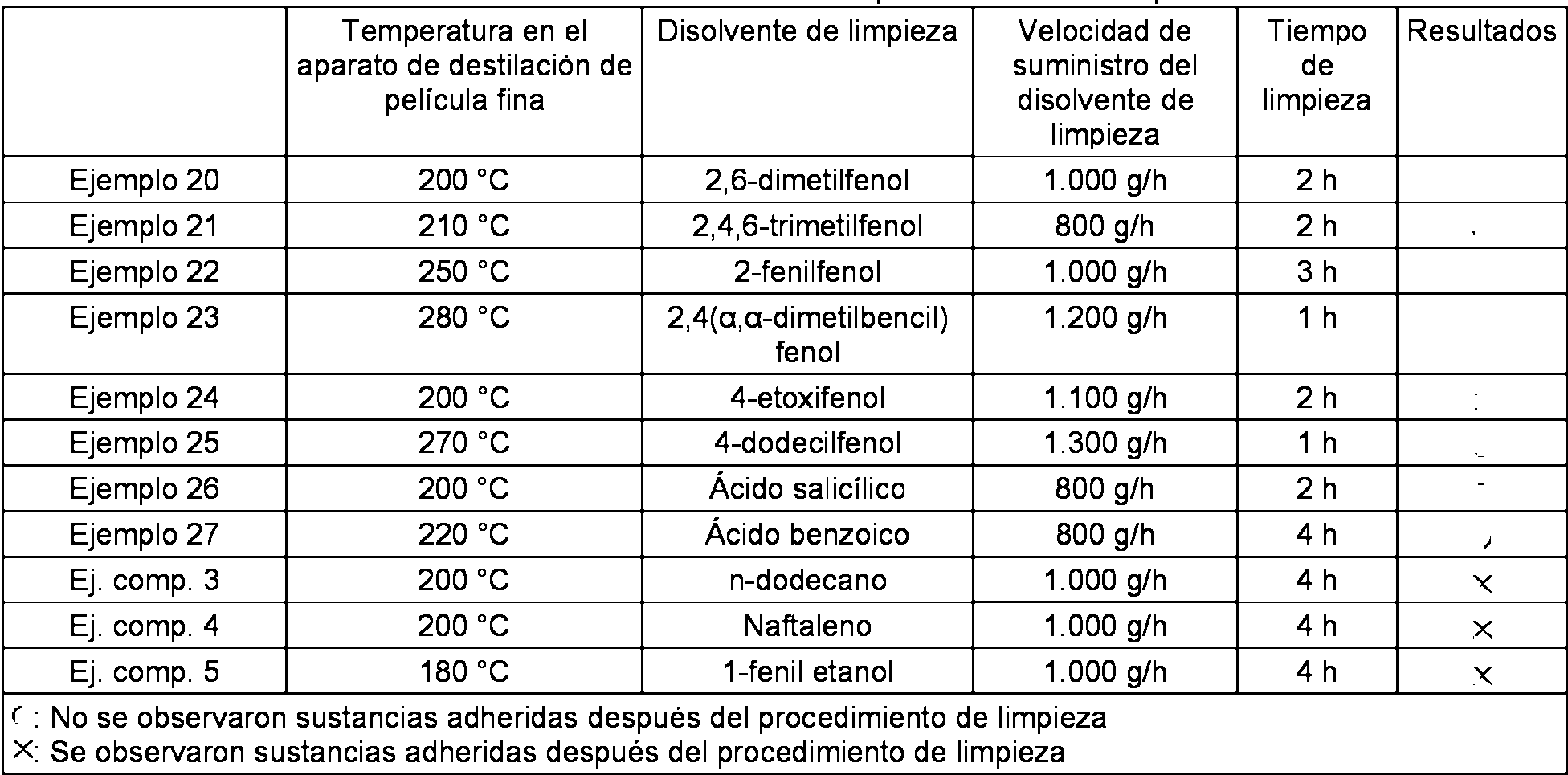
Aplicabilidad industrialIndustrial applicability
Puesto que el proceso de produccion de isocianato de acuerdo con la presente invencion permite que el isocianato se produzca de manera eficaz sin usar fosgeno altamente toxico, el proceso de produccion de la presente invencion resulta altamente util a escala industrial y tiene alto valor comercial. Since the isocyanate production process according to the present invention allows the isocyanate to be produced efficiently without using highly toxic phosgene, the production process of the present invention is highly useful on an industrial scale and has high commercial value.
Claims (27)

Applications Claiming Priority (1)
| Application Number | Priority Date | Filing Date | Title |
|---|---|---|---|
| PCT/JP2008/058952 WO2009139062A1 (en) | 2008-05-15 | 2008-05-15 | Process for producing isocyanate |
Publications (1)
| Publication Number | Publication Date |
|---|---|
| ES2710177T3 true ES2710177T3 (en) | 2019-04-23 |
Family
ID=41318444
Family Applications (1)
| Application Number | Title | Priority Date | Filing Date |
|---|---|---|---|
| ES08752810T Active ES2710177T3 (en) | 2008-05-15 | 2008-05-15 | Process for the production of isocyanate |
Country Status (10)
| Country | Link |
|---|---|
| US (1) | US9233918B2 (en) |
| EP (1) | EP2275406B1 (en) |
| JP (1) | JP5592786B2 (en) |
| KR (2) | KR20130127550A (en) |
| CN (1) | CN102026965B (en) |
| BR (1) | BRPI0822694B1 (en) |
| CA (1) | CA2721359C (en) |
| ES (1) | ES2710177T3 (en) |
| RU (1) | RU2483058C2 (en) |
| WO (1) | WO2009139062A1 (en) |
Families Citing this family (18)
| Publication number | Priority date | Publication date | Assignee | Title |
|---|---|---|---|---|
| TW200844080A (en) * | 2007-01-11 | 2008-11-16 | Asahi Kasei Chemicals Corp | Process for producing isocyanate |
| KR20130127550A (en) | 2008-05-15 | 2013-11-22 | 아사히 가세이 케미칼즈 가부시키가이샤 | Process for producing isocyanate |
| US8895774B2 (en) * | 2008-05-15 | 2014-11-25 | Asahi Kasei Chemicals Corporation | Process for producing isocyanates using diaryl carbonate |
| ES2331505B2 (en) * | 2008-07-04 | 2010-09-20 | Universidad Politecnica De Valencia | CARBAMATE PREPARATION WITH SOLID CATALYSTS. |
| EP2491011A1 (en) * | 2009-10-21 | 2012-08-29 | Basf Se | Method for producing urethanes |
| WO2012108453A1 (en) * | 2011-02-09 | 2012-08-16 | 宇部興産株式会社 | Process for producing isocyanate compound |
| CN102896103B (en) * | 2011-07-25 | 2014-12-03 | 中国石油天然气股份有限公司 | A method for cleaning carbamate pyrolysis reactor coking |
| KR101348229B1 (en) * | 2011-12-14 | 2014-01-08 | 경희대학교 산학협력단 | Method for Preparing Aliphatic Diisocyanates |
| CA2857821C (en) | 2012-01-25 | 2015-09-08 | Asahi Kasei Chemicals Corporation | A method of separation |
| EP2864392A4 (en) * | 2012-06-22 | 2015-12-23 | Invista Technologies Srl | IMPROVED ALKANOLYSIS METHOD AND METHOD FOR SEPARATING CATALYST FROM MIXTURE OF PRODUCTS, AND APPARATUS THEREFOR |
| CN103848758A (en) * | 2012-12-06 | 2014-06-11 | 中国科学院成都有机化学有限公司 | Method for preparing isocyanate by catalytic thermal decomposition |
| KR101745229B1 (en) * | 2013-04-03 | 2017-06-08 | 미쓰이 가가쿠 가부시키가이샤 | Method for producing xylylene diisocyanate and system for producing xylylene diisocyanate |
| EP3626705B1 (en) * | 2017-05-15 | 2021-03-24 | Asahi Kasei Kabushiki Kaisha | Isocyanate production method |
| RU2655386C1 (en) * | 2017-05-19 | 2018-05-28 | Федеральное государственное бюджетное образовательное учреждение высшего образования "Российский химико-технологический университет имени Д.И. Менделеева" | Method for producing alkylisocyanates |
| CN111183131B (en) | 2017-12-27 | 2022-06-28 | 旭化成株式会社 | Recovery method of organic amines |
| CN110256296A (en) * | 2019-05-20 | 2019-09-20 | 江苏蓝丰生物化工股份有限公司 | The synthetic method of 1,5- naphthalene diisocyanate |
| JP7597038B2 (en) | 2019-12-10 | 2024-12-10 | 株式会社レゾナック | N-vinylacetamide production method and thermal decomposition apparatus |
| KR102839456B1 (en) * | 2020-12-30 | 2025-07-25 | 한화솔루션 주식회사 | Method for preparing isocyanate compound |
Family Cites Families (86)
| Publication number | Priority date | Publication date | Assignee | Title |
|---|---|---|---|---|
| DE925496C (en) | 1943-03-27 | 1955-03-24 | Dehydag Gmbh | Process for making super polymeric compounds |
| US2692275A (en) | 1953-01-23 | 1954-10-19 | Rohm & Haas | Preparation of 1, 8-diisocyanato-p-menthane |
| BE585318A (en) | 1958-12-06 | |||
| US3382289A (en) | 1963-04-01 | 1968-05-07 | Exxon Research Engineering Co | Preparation of isoprene feedstock |
| FR1601198A (en) | 1968-01-17 | 1970-08-10 | ||
| US3734941A (en) | 1968-09-06 | 1973-05-22 | American Cyanamid Co | Process for converting urethanes to isocyanates |
| JPS5219624A (en) | 1975-08-07 | 1977-02-15 | Mitsui Toatsu Chem Inc | Process for preparation of isocyanates |
| US3992430A (en) | 1975-09-11 | 1976-11-16 | Chevron Research Company | Process for preparing aromatic isocyanates |
| IT1051034B (en) | 1975-12-03 | 1981-04-21 | Snam Progetti | PROCEDURE FOR THE PREPARATION OF AROMATIC URETANS |
| JPS6024096B2 (en) | 1976-05-10 | 1985-06-11 | 日本ポリウレタン工業株式会社 | Method for producing carbamate compounds |
| JPS5439002A (en) | 1977-08-30 | 1979-03-24 | Mitsubishi Chem Ind Ltd | Preparation of isocyanates |
| US4123450A (en) * | 1977-09-22 | 1978-10-31 | Fmc Corporation | Process for preparing alkyl isocyanates |
| DE2917490A1 (en) | 1979-04-30 | 1980-11-13 | Basf Ag | METHOD FOR PRODUCING ALIPHATIC AND CYCLOALIPHATIC DI- AND POLYURETHANES |
| DE2942503A1 (en) | 1979-10-20 | 1981-05-07 | Basf Ag, 6700 Ludwigshafen | METHOD FOR PRODUCING AROMATIC DI- AND / OR POLYISOCYANATES |
| DE2943551A1 (en) | 1979-10-27 | 1981-05-07 | Bayer Ag, 5090 Leverkusen | METHOD FOR PRODUCING N, O-DISUBSTITUTED URETHANES AND THEIR USE FOR PRODUCING ISOCYANATES |
| DE2943550A1 (en) | 1979-10-27 | 1981-05-14 | Bayer Ag, 5090 Leverkusen | METHOD FOR THE PRODUCTION OF URETHANES AND THE USE THEREOF AS THE STARTING MATERIAL FOR THE PRODUCTION OF ISOCYANATES |
| DE2943480A1 (en) | 1979-10-27 | 1981-05-07 | Bayer Ag, 5090 Leverkusen | METHOD FOR THE PRODUCTION OF N, O-DISUBSTITUTED URETHANES, AND THEIR USE AS STARTING MATERIAL FOR THE PRODUCTION OF ISOCYANATES |
| DE3035354A1 (en) | 1980-09-19 | 1982-04-29 | Bayer Ag, 5090 Leverkusen | METHOD FOR THE PRODUCTION OF N, O-DISUBSTITUTED URETHANES AND THE USE THEREOF AS THE STARTING MATERIAL FOR THE PRODUCTION OF ORGANIC ISOCYANATES |
| DE3040692A1 (en) | 1980-10-29 | 1982-06-03 | Basf Ag, 6700 Ludwigshafen | METHOD FOR PRODUCING ALIPHATIC ISOCYANATES |
| DE3047898A1 (en) * | 1980-12-19 | 1982-07-15 | Bayer Ag, 5090 Leverkusen | METHOD FOR THE CONTINUOUS THERMAL CLEAVING OF CARBAMID ACID ESTERS AND THE USE OF MIXTURES MIXTURES CONTAINING IN THESE ISOCYANATES AND CARBAMID ACID ESTERS FOR THE PRODUCTION OF ISOCYANATES |
| DE3108990A1 (en) | 1981-03-10 | 1982-09-23 | Bayer Ag, 5090 Leverkusen | METHOD FOR PRODUCING POLYISOCYANATES |
| US4388426A (en) | 1981-06-26 | 1983-06-14 | Eschem Inc. | Stabilization of epoxy systems in non-flammable solvents |
| DE3142627A1 (en) | 1981-10-28 | 1983-05-05 | Basf Ag, 6700 Ludwigshafen | METHOD FOR PRODUCING ISOCYANATES BY THERMAL CLEAVING OF URETHANES |
| DE3215591A1 (en) | 1982-04-27 | 1983-10-27 | Bayer Ag, 5090 Leverkusen | METHOD FOR CONTINUOUS THERMAL CLEAVING OF CARBAMID ACID ESTERS |
| DE3362121D1 (en) | 1982-07-24 | 1986-03-27 | Basf Ag | Process for the preparation of hexamethylene diisocyanate-1,6 and/or of the isomeric diisocyanates with 6 carbon atoms in the alkyl group |
| JPH0645586B2 (en) | 1982-12-13 | 1994-06-15 | 三菱化成株式会社 | Pyrolysis of aromatic urethane |
| DE3314788A1 (en) | 1983-04-23 | 1984-10-25 | Basf Ag, 6700 Ludwigshafen | MULTI-STAGE PROCESS FOR PRODUCING HEXAMETHYLENE DIISOCYANATE-1,6 AND / OR ISOMERIC ALIPHATIC DIISOCYANATES WITH 6 CARBON ATOMS IN THE ALKYLENE RESIDUE |
| DE3314790A1 (en) | 1983-04-23 | 1984-10-25 | Basf Ag, 6700 Ludwigshafen | MULTI-STAGE PROCESS FOR PRODUCING 3-ISOCYANATOMETHYL-3,5,5-TRIMETHYL-CYCLOHEXYLISOCYANATE |
| IT1164223B (en) | 1983-05-13 | 1987-04-08 | Anic Spa | PROCESS PERFECTED FOR THE PRODUCTION OF ALCHYL ISOCYANATES |
| JPS60231640A (en) * | 1984-05-02 | 1985-11-18 | Asahi Chem Ind Co Ltd | Continuous production of isocyanate |
| IT1183332B (en) | 1985-02-08 | 1987-10-22 | Enichem Sintesi | PROCEDURE FOR THE PRODUCTION OF N-METHYL CARBAMATES |
| JPH0627593B2 (en) | 1985-09-12 | 1994-04-13 | 鐘紡株式会社 | Adsorption type heat pump |
| US4925971A (en) | 1987-12-08 | 1990-05-15 | Asahi Kasei Kogyo Kabushiki Kaisha | Method for producing aliphatic o-arylurethanes |
| JPH01230550A (en) | 1988-03-11 | 1989-09-14 | Asahi Chem Ind Co Ltd | Production of aryl alkylpolycarbamate |
| JPH026665A (en) | 1988-06-10 | 1990-01-10 | Kao Corp | Softening and finishing agent for cloth |
| DE3828033A1 (en) | 1988-08-18 | 1990-03-08 | Huels Chemische Werke Ag | CIRCUIT PROCESS FOR PRODUCING (CYCLO) ALIPHATIC DIISOCYANATES |
| DE69001071T2 (en) | 1990-03-16 | 1993-06-17 | Council Scient Ind Res | METHOD FOR THE PRODUCTION OF N-ALKYL-CARBAMINIC ACID ESTERES. |
| JPH0426665A (en) * | 1990-05-23 | 1992-01-29 | Asahi Chem Ind Co Ltd | Pyrolysis of carbamic acid ester |
| SU1836336A3 (en) * | 1991-01-22 | 1993-08-23 | Yurij A Nechaj | Method for obtaining isocyanates |
| DE4113156A1 (en) * | 1991-04-23 | 1993-01-14 | Bayer Ag | METHOD FOR PRODUCING POLY (O-ALKYLURETHANES) OF THE DIPHENYLMETHANE SERIES |
| DE4124671A1 (en) | 1991-07-25 | 1993-01-28 | Basf Ag | REACTOR AND METHOD FOR THERMALLY CLEAVING CARBAMID ACID ESTERS |
| DE4213099A1 (en) * | 1992-04-21 | 1993-10-28 | Basf Ag | Multi-stage process for the continuous production of organic polyisocyanates |
| DE4231417A1 (en) * | 1992-05-05 | 1993-11-11 | Huels Chemische Werke Ag | Continuous multi-stage process for the production of (cyclo) aliphatic diisocyanates |
| IT1255763B (en) | 1992-05-15 | 1995-11-15 | Franco Rivetti | PROCEDURE FOR THE PREPARATION OF ALCHYL ISOCYANATES |
| JP3100008B2 (en) | 1992-08-07 | 2000-10-16 | 旭化成工業株式会社 | Manufacturing method of aromatic polycarbonate |
| JP3226997B2 (en) | 1992-12-28 | 2001-11-12 | 旭化成株式会社 | Pyrolysis method of polycarbamic acid ester compound |
| US5498319A (en) | 1993-06-29 | 1996-03-12 | General Electric Company | Process for purifying diaryl carbonates |
| JPH0725830A (en) | 1993-07-08 | 1995-01-27 | Daicel Chem Ind Ltd | Method for purifying carbonic acid diester and polycarbonate produced by using carbonic acid diester obtained by the same method for purification |
| US5457732A (en) | 1994-02-28 | 1995-10-10 | Motorola, Inc. | Method and apparatus for delivery of a response in a messaging system |
| JP3083039B2 (en) | 1994-03-18 | 2000-09-04 | 三菱瓦斯化学株式会社 | Method for producing isocyanates |
| IT1282022B1 (en) | 1995-07-06 | 1998-03-06 | Mini Ricerca Scient Tecnolog | PROCEDURE FOR THE PRODUCTION OF AROMATIC CARBAMATES |
| IT1282023B1 (en) | 1995-07-06 | 1998-03-06 | Mini Ricerca Scient Tecnolog | PROCEDURE FOR THE PRODUCTION OF AROMATIC URETANS |
| JP3674642B2 (en) | 1995-09-22 | 2005-07-20 | 三菱瓦斯化学株式会社 | Process for producing isocyanates |
| DE59705128D1 (en) * | 1996-03-15 | 2001-12-06 | Bayer Ag | Process for the thermal cleavage of carbamic acid esters |
| JP4462644B2 (en) | 1997-05-20 | 2010-05-12 | 宇部興産株式会社 | Carbamate production method |
| WO1998035936A1 (en) | 1997-02-14 | 1998-08-20 | Ube Industries, Ltd. | Process for producing aryl carbamates |
| IT1292030B1 (en) | 1997-05-29 | 1999-01-25 | Mini Ricerca Scient Tecnolog | PROCEDURE FOR THE SYNTHESIS OF AROMATIC URETANS |
| HUP0002197A2 (en) | 1997-05-31 | 2000-10-28 | HUNTSMAN ICI CHEMICALS LLC, The Corporation Trust Company | Process for the production of organic polyisocyanates |
| JP4029225B2 (en) | 1997-06-17 | 2008-01-09 | 三菱瓦斯化学株式会社 | Method for producing isocyanate compound |
| EP0957073A1 (en) | 1998-05-12 | 1999-11-17 | Schwarz Pharma Ag | Novel derivatives of 3,3-diphenylpropylamines |
| JP2000344730A (en) | 1999-06-03 | 2000-12-12 | Mitsubishi Gas Chem Co Inc | Method for producing 1,5-naphthylene diisocyanate |
| JP2001031639A (en) | 1999-07-15 | 2001-02-06 | Mitsubishi Gas Chem Co Inc | Method for producing 1,5-naphthylene diisocyanate |
| JP2001048855A (en) | 1999-08-11 | 2001-02-20 | Takeda Chem Ind Ltd | Production of isocyanate group-containing compound, isocyanate group-containing compound and isocyanate group-containing polysiloxane compound |
| IT1317756B1 (en) * | 2000-02-03 | 2003-07-15 | Eni Spa | INTEGRATED PROCEDURE FOR THE PREPARATION OF AROMATIC ISOCYANATES AND PROCESSES FOR THE REALIZATION OF THE RELATIVE INTERMEDIATE PHASES. |
| ES2245685T3 (en) | 2000-02-29 | 2006-01-16 | Huntsman International Llc | PROCEDURE FOR THE PREPARATION OF ORGANIC POLYISOCIANATES. |
| JP4458620B2 (en) | 2000-05-12 | 2010-04-28 | 株式会社Adeka | Light resistance imparting agent for color filter and photosensitive resin composition for color filter using the same |
| JP4993827B2 (en) * | 2001-08-17 | 2012-08-08 | 日本曹達株式会社 | Sample introduction tube blockage prevention method |
| CN1329364C (en) * | 2001-12-27 | 2007-08-01 | 旭化成化学株式会社 | Process for producing carbonic ester |
| JP3992178B2 (en) * | 2001-12-27 | 2007-10-17 | 旭化成ケミカルズ株式会社 | Method for producing carbonate ester |
| SG115512A1 (en) * | 2001-12-28 | 2005-10-28 | Mitsui Takeda Chemicals Inc | Method for producing carbamates and method for producing isocyanates |
| JP2003201275A (en) | 2001-12-28 | 2003-07-18 | Mitsui Chemicals Inc | Method of producing aromatic urethane |
| WO2004014840A1 (en) | 2002-08-07 | 2004-02-19 | Asahi Kasei Chemicals Corporation | Process for producing carbonic ester |
| JP4299020B2 (en) * | 2003-02-13 | 2009-07-22 | 三井化学ポリウレタン株式会社 | Method for producing alkyl carbamate |
| JP2004262834A (en) | 2003-02-28 | 2004-09-24 | Mitsui Chemicals Inc | Method for producing aromatic urethane compound |
| JP2004262835A (en) | 2003-02-28 | 2004-09-24 | Mitsui Chemicals Inc | Method for producing aromatic isocyanate |
| TW200524855A (en) | 2003-06-27 | 2005-08-01 | Asahi Kasei Chemicals Corp | Method for producing aromatic carbonate |
| DE102004022626A1 (en) * | 2004-05-07 | 2005-12-15 | Degussa Ag | Multi-stage process for the continuous preparation of cycloaliphatic diisocyanates |
| ES2451495T3 (en) | 2004-05-19 | 2014-03-27 | Asahi Kasei Chemicals Corporation | Procedure for the production of alkyl tin alkoxides |
| JP2006069941A (en) | 2004-09-01 | 2006-03-16 | Kagawa Industry Support Foundation | Method for decomposing and recovering isocyanate compounds |
| CN1324007C (en) * | 2004-09-17 | 2007-07-04 | 中国科学院成都有机化学有限公司 | Synthetic method for carbamate |
| TWI361179B (en) | 2006-11-17 | 2012-04-01 | Asahi Kasei Chemicals Corp | A process for producing isocyanates |
| TW200844080A (en) | 2007-01-11 | 2008-11-16 | Asahi Kasei Chemicals Corp | Process for producing isocyanate |
| CN101652344B (en) | 2007-03-30 | 2014-06-04 | 旭化成化学株式会社 | Method for production of isocyanate using composition comprising carbamic acid ester and aromatic hydroxy compound, and composition for transport or storage of carbamic acid ester |
| JP5313164B2 (en) | 2007-11-19 | 2013-10-09 | 旭化成ケミカルズ株式会社 | Method for producing isocyanate and aromatic hydroxy compound |
| KR20130127550A (en) | 2008-05-15 | 2013-11-22 | 아사히 가세이 케미칼즈 가부시키가이샤 | Process for producing isocyanate |
| US8895774B2 (en) | 2008-05-15 | 2014-11-25 | Asahi Kasei Chemicals Corporation | Process for producing isocyanates using diaryl carbonate |
-
2008
- 2008-05-15 KR KR1020137028708A patent/KR20130127550A/en not_active Ceased
- 2008-05-15 JP JP2010511823A patent/JP5592786B2/en not_active Expired - Fee Related
- 2008-05-15 CA CA2721359A patent/CA2721359C/en not_active Expired - Fee Related
- 2008-05-15 RU RU2010146085/04A patent/RU2483058C2/en not_active IP Right Cessation
- 2008-05-15 EP EP08752810.5A patent/EP2275406B1/en not_active Not-in-force
- 2008-05-15 WO PCT/JP2008/058952 patent/WO2009139062A1/en not_active Ceased
- 2008-05-15 BR BRPI0822694A patent/BRPI0822694B1/en not_active IP Right Cessation
- 2008-05-15 KR KR1020107023854A patent/KR101525641B1/en not_active Expired - Fee Related
- 2008-05-15 US US12/991,625 patent/US9233918B2/en active Active
- 2008-05-15 ES ES08752810T patent/ES2710177T3/en active Active
- 2008-05-15 CN CN200880129186.3A patent/CN102026965B/en not_active Expired - Fee Related
Also Published As
| Publication number | Publication date |
|---|---|
| BRPI0822694A2 (en) | 2015-07-07 |
| KR20100139076A (en) | 2010-12-31 |
| RU2010146085A (en) | 2012-05-20 |
| WO2009139062A1 (en) | 2009-11-19 |
| CN102026965B (en) | 2014-02-26 |
| EP2275406A4 (en) | 2015-10-14 |
| JPWO2009139062A1 (en) | 2011-09-15 |
| BRPI0822694B1 (en) | 2018-11-27 |
| US20110092731A1 (en) | 2011-04-21 |
| KR101525641B1 (en) | 2015-06-03 |
| KR20130127550A (en) | 2013-11-22 |
| EP2275406A1 (en) | 2011-01-19 |
| CA2721359C (en) | 2014-05-06 |
| CA2721359A1 (en) | 2009-11-19 |
| EP2275406B1 (en) | 2018-11-28 |
| US9233918B2 (en) | 2016-01-12 |
| RU2483058C2 (en) | 2013-05-27 |
| JP5592786B2 (en) | 2014-09-17 |
| CN102026965A (en) | 2011-04-20 |
Similar Documents
| Publication | Publication Date | Title |
|---|---|---|
| US9233918B2 (en) | Isocyanate production process | |
| JP5116109B2 (en) | Isocyanate production method | |
| US8895774B2 (en) | Process for producing isocyanates using diaryl carbonate | |
| JP4958971B2 (en) | Method for producing isocyanate using composition containing carbamate and aromatic hydroxy compound, and composition for transporting and storing carbamate | |
| US8053595B2 (en) | Process for producing isocyanates | |
| US20110133121A1 (en) | N-Substituted Carbamic Acid Ester Production Method, Isocyanate Production Method Using Such N-Substituted Carbamic Acid Ester, And Composition For Transfer And Storage Of N-Substituted Carbamic Acid Ester Comprising N-Substituted Carbamic Acid Ester and Aromatic Hydroxy Compound | |
| TWI496763B (en) | Preparation of isocyanates |