ES2714130T3 - Detergent composition - Google Patents
Detergent composition Download PDFInfo
- Publication number
- ES2714130T3 ES2714130T3 ES15153513T ES15153513T ES2714130T3 ES 2714130 T3 ES2714130 T3 ES 2714130T3 ES 15153513 T ES15153513 T ES 15153513T ES 15153513 T ES15153513 T ES 15153513T ES 2714130 T3 ES2714130 T3 ES 2714130T3
- Authority
- ES
- Spain
- Prior art keywords
- acid
- composition
- composition according
- grams
- salts
- Prior art date
- Legal status (The legal status is an assumption and is not a legal conclusion. Google has not performed a legal analysis and makes no representation as to the accuracy of the status listed.)
- Active
Links
Classifications
-
- C—CHEMISTRY; METALLURGY
- C11—ANIMAL OR VEGETABLE OILS, FATS, FATTY SUBSTANCES OR WAXES; FATTY ACIDS THEREFROM; DETERGENTS; CANDLES
- C11D—DETERGENT COMPOSITIONS; USE OF SINGLE SUBSTANCES AS DETERGENTS; SOAP OR SOAP-MAKING; RESIN SOAPS; RECOVERY OF GLYCEROL
- C11D3/00—Other compounding ingredients of detergent compositions covered in group C11D1/00
- C11D3/39—Organic or inorganic per-compounds
- C11D3/3942—Inorganic per-compounds
-
- C—CHEMISTRY; METALLURGY
- C11—ANIMAL OR VEGETABLE OILS, FATS, FATTY SUBSTANCES OR WAXES; FATTY ACIDS THEREFROM; DETERGENTS; CANDLES
- C11D—DETERGENT COMPOSITIONS; USE OF SINGLE SUBSTANCES AS DETERGENTS; SOAP OR SOAP-MAKING; RESIN SOAPS; RECOVERY OF GLYCEROL
- C11D17/00—Detergent materials or soaps characterised by their shape or physical properties
- C11D17/0047—Detergents in the form of bars or tablets
- C11D17/0065—Solid detergents containing builders
- C11D17/0073—Tablets
- C11D17/0091—Dishwashing tablets
-
- C—CHEMISTRY; METALLURGY
- C11—ANIMAL OR VEGETABLE OILS, FATS, FATTY SUBSTANCES OR WAXES; FATTY ACIDS THEREFROM; DETERGENTS; CANDLES
- C11D—DETERGENT COMPOSITIONS; USE OF SINGLE SUBSTANCES AS DETERGENTS; SOAP OR SOAP-MAKING; RESIN SOAPS; RECOVERY OF GLYCEROL
- C11D17/00—Detergent materials or soaps characterised by their shape or physical properties
- C11D17/04—Detergent materials or soaps characterised by their shape or physical properties combined with or containing other objects
- C11D17/041—Compositions releasably affixed on a substrate or incorporated into a dispensing means
- C11D17/042—Water soluble or water disintegrable containers or substrates containing cleaning compositions or additives for cleaning compositions
-
- C—CHEMISTRY; METALLURGY
- C11—ANIMAL OR VEGETABLE OILS, FATS, FATTY SUBSTANCES OR WAXES; FATTY ACIDS THEREFROM; DETERGENTS; CANDLES
- C11D—DETERGENT COMPOSITIONS; USE OF SINGLE SUBSTANCES AS DETERGENTS; SOAP OR SOAP-MAKING; RESIN SOAPS; RECOVERY OF GLYCEROL
- C11D17/00—Detergent materials or soaps characterised by their shape or physical properties
- C11D17/04—Detergent materials or soaps characterised by their shape or physical properties combined with or containing other objects
- C11D17/041—Compositions releasably affixed on a substrate or incorporated into a dispensing means
- C11D17/042—Water soluble or water disintegrable containers or substrates containing cleaning compositions or additives for cleaning compositions
- C11D17/045—Multi-compartment
-
- C—CHEMISTRY; METALLURGY
- C11—ANIMAL OR VEGETABLE OILS, FATS, FATTY SUBSTANCES OR WAXES; FATTY ACIDS THEREFROM; DETERGENTS; CANDLES
- C11D—DETERGENT COMPOSITIONS; USE OF SINGLE SUBSTANCES AS DETERGENTS; SOAP OR SOAP-MAKING; RESIN SOAPS; RECOVERY OF GLYCEROL
- C11D3/00—Other compounding ingredients of detergent compositions covered in group C11D1/00
- C11D3/16—Organic compounds
- C11D3/20—Organic compounds containing oxygen
- C11D3/22—Carbohydrates or derivatives thereof
- C11D3/222—Natural or synthetic polysaccharides, e.g. cellulose, starch, gum, alginic acid or cyclodextrin
- C11D3/225—Natural or synthetic polysaccharides, e.g. cellulose, starch, gum, alginic acid or cyclodextrin etherified, e.g. CMC
-
- C—CHEMISTRY; METALLURGY
- C11—ANIMAL OR VEGETABLE OILS, FATS, FATTY SUBSTANCES OR WAXES; FATTY ACIDS THEREFROM; DETERGENTS; CANDLES
- C11D—DETERGENT COMPOSITIONS; USE OF SINGLE SUBSTANCES AS DETERGENTS; SOAP OR SOAP-MAKING; RESIN SOAPS; RECOVERY OF GLYCEROL
- C11D3/00—Other compounding ingredients of detergent compositions covered in group C11D1/00
- C11D3/16—Organic compounds
- C11D3/26—Organic compounds containing nitrogen
- C11D3/33—Amino carboxylic acids
-
- C—CHEMISTRY; METALLURGY
- C11—ANIMAL OR VEGETABLE OILS, FATS, FATTY SUBSTANCES OR WAXES; FATTY ACIDS THEREFROM; DETERGENTS; CANDLES
- C11D—DETERGENT COMPOSITIONS; USE OF SINGLE SUBSTANCES AS DETERGENTS; SOAP OR SOAP-MAKING; RESIN SOAPS; RECOVERY OF GLYCEROL
- C11D3/00—Other compounding ingredients of detergent compositions covered in group C11D1/00
- C11D3/16—Organic compounds
- C11D3/37—Polymers
- C11D3/3746—Macromolecular compounds obtained by reactions only involving carbon-to-carbon unsaturated bonds
- C11D3/3757—(Co)polymerised carboxylic acids, -anhydrides, -esters in solid and liquid compositions
- C11D3/3761—(Co)polymerised carboxylic acids, -anhydrides, -esters in solid and liquid compositions in solid compositions
-
- C—CHEMISTRY; METALLURGY
- C11—ANIMAL OR VEGETABLE OILS, FATS, FATTY SUBSTANCES OR WAXES; FATTY ACIDS THEREFROM; DETERGENTS; CANDLES
- C11D—DETERGENT COMPOSITIONS; USE OF SINGLE SUBSTANCES AS DETERGENTS; SOAP OR SOAP-MAKING; RESIN SOAPS; RECOVERY OF GLYCEROL
- C11D3/00—Other compounding ingredients of detergent compositions covered in group C11D1/00
- C11D3/16—Organic compounds
- C11D3/37—Polymers
- C11D3/3746—Macromolecular compounds obtained by reactions only involving carbon-to-carbon unsaturated bonds
- C11D3/378—(Co)polymerised monomers containing sulfur, e.g. sulfonate
-
- C—CHEMISTRY; METALLURGY
- C11—ANIMAL OR VEGETABLE OILS, FATS, FATTY SUBSTANCES OR WAXES; FATTY ACIDS THEREFROM; DETERGENTS; CANDLES
- C11D—DETERGENT COMPOSITIONS; USE OF SINGLE SUBSTANCES AS DETERGENTS; SOAP OR SOAP-MAKING; RESIN SOAPS; RECOVERY OF GLYCEROL
- C11D3/00—Other compounding ingredients of detergent compositions covered in group C11D1/00
- C11D3/16—Organic compounds
- C11D3/38—Products with no well-defined composition, e.g. natural products
- C11D3/386—Preparations containing enzymes, e.g. protease or amylase
-
- C—CHEMISTRY; METALLURGY
- C11—ANIMAL OR VEGETABLE OILS, FATS, FATTY SUBSTANCES OR WAXES; FATTY ACIDS THEREFROM; DETERGENTS; CANDLES
- C11D—DETERGENT COMPOSITIONS; USE OF SINGLE SUBSTANCES AS DETERGENTS; SOAP OR SOAP-MAKING; RESIN SOAPS; RECOVERY OF GLYCEROL
- C11D3/00—Other compounding ingredients of detergent compositions covered in group C11D1/00
- C11D3/39—Organic or inorganic per-compounds
- C11D3/3902—Organic or inorganic per-compounds combined with specific additives
- C11D3/3905—Bleach activators or bleach catalysts
-
- C—CHEMISTRY; METALLURGY
- C11—ANIMAL OR VEGETABLE OILS, FATS, FATTY SUBSTANCES OR WAXES; FATTY ACIDS THEREFROM; DETERGENTS; CANDLES
- C11D—DETERGENT COMPOSITIONS; USE OF SINGLE SUBSTANCES AS DETERGENTS; SOAP OR SOAP-MAKING; RESIN SOAPS; RECOVERY OF GLYCEROL
- C11D3/00—Other compounding ingredients of detergent compositions covered in group C11D1/00
- C11D3/39—Organic or inorganic per-compounds
- C11D3/3902—Organic or inorganic per-compounds combined with specific additives
- C11D3/3905—Bleach activators or bleach catalysts
- C11D3/3907—Organic compounds
-
- C—CHEMISTRY; METALLURGY
- C11—ANIMAL OR VEGETABLE OILS, FATS, FATTY SUBSTANCES OR WAXES; FATTY ACIDS THEREFROM; DETERGENTS; CANDLES
- C11D—DETERGENT COMPOSITIONS; USE OF SINGLE SUBSTANCES AS DETERGENTS; SOAP OR SOAP-MAKING; RESIN SOAPS; RECOVERY OF GLYCEROL
- C11D3/00—Other compounding ingredients of detergent compositions covered in group C11D1/00
- C11D3/39—Organic or inorganic per-compounds
- C11D3/3902—Organic or inorganic per-compounds combined with specific additives
- C11D3/3905—Bleach activators or bleach catalysts
- C11D3/3932—Inorganic compounds or complexes
Landscapes
- Chemical & Material Sciences (AREA)
- Life Sciences & Earth Sciences (AREA)
- Organic Chemistry (AREA)
- Engineering & Computer Science (AREA)
- Chemical Kinetics & Catalysis (AREA)
- Oil, Petroleum & Natural Gas (AREA)
- Wood Science & Technology (AREA)
- Inorganic Chemistry (AREA)
- Health & Medical Sciences (AREA)
- Emergency Medicine (AREA)
- Molecular Biology (AREA)
- Detergent Compositions (AREA)
- Washing And Drying Of Tableware (AREA)
Abstract
Una composición detergente para lavavajillas exenta de fosfato en forma de dosis unitaria que tiene un peso de 8 a 25 gramos, comprendiendo la composición: i) más de 5 a 8 gramos de un agente complejante orgánico seleccionado del grupo que consiste en ácido metilglicinadiacético, sus sales y derivados de los mismos, ácido N,Ndiacéticoglutámico, sus sales y derivados de los mismos, ácido iminodisuccínico, sus sales y derivados de los mismos, carboximetilinulina, sus sales y derivados de los mismos, y mezclas de los mismos; ii) un polímero dispersante; iii) de 1 a 3 gramos de blanqueador y en donde el agente complejante y el polímero dispersante están en una relación de peso de 10:1 a 20:1.A phosphate-free dishwashing detergent composition in unit dose form having a weight of 8 to 25 grams, the composition comprising: i) more than 5 to 8 grams of an organic complexing agent selected from the group consisting of methylglycinate acid, its salts and derivatives thereof, N, N-diacetic glutamic acid, its salts and derivatives thereof, iminodisuccinic acid, its salts and derivatives thereof, carboxymethylinulin, its salts and derivatives thereof, and mixtures thereof; ii) a dispersing polymer; iii) 1 to 3 grams of bleach and wherein the complexing agent and the dispersing polymer are in a weight ratio of 10: 1 to 20: 1.
Description
DESCRIPCIONDESCRIPTION
Composicion detergenteDetergent composition
Campo tecnicoTechnical field
La presente invencion se refiere al sector de la limpieza. Se refiere a un producto de limpieza, en particular a una composicion detergente para lavavajillas exenta de fosfato que comprende un alto nivel de un agente complejante y un bajo nivel de un polimero. La composicion proporciona buena limpieza, acabado, cuidado y presenta un buen perfil ambiental.The present invention relates to the cleaning sector. It refers to a cleaning product, in particular a phosphate-free detergent dishwashing composition comprising a high level of a complexing agent and a low level of a polymer. The composition provides good cleaning, finishing, care and presents a good environmental profile.
Antecedentes de la invencionBackground of the invention
Los detergentes para lavavajillas en forma de dosis unitaria son cada vez mas populares. Una de las restricciones de los productos en forma de dosis unitaria es que presentan un volumen limitado determinado por el tamano del dispensador de producto en el lavavajillas, limitando la cantidad de sustancia activa que el detergente puede contener. Tradicionalmente, los detergentes para lavavajillas eran de tipo fosfato; sin embargo, debido a problemas ambientales, se evita el uso de fosfato.Dishwashing detergents in unit dose form are becoming increasingly popular. One of the restrictions of the products in unit dose form is that they have a limited volume determined by the size of the product dispenser in the dishwasher, limiting the amount of active substance that the detergent may contain. Traditionally, dishwashing detergents were phosphate type; However, due to environmental problems, the use of phosphate is avoided.
El formulador de detergentes para lavavajillas esta buscando continuamente formas para mejorar el rendimiento y el perfil ambiental de las composiciones detergentes. A veces, existen interacciones negativas entre los ingredientes de los productos y/o durante el lavado, por ejemplo, altos niveles de agentes complejantes pueden tener un impacto negativo en el rendimiento de las enzimas, en particular en el rendimiento de las proteasas. The dishwashing detergent formulator is continuously looking for ways to improve the performance and environmental profile of detergent compositions. Sometimes, there are negative interactions between the ingredients of the products and / or during washing, for example, high levels of complexing agents can have a negative impact on the performance of enzymes, in particular on the performance of proteases.
Las manchas horneadas, quemadas, y blanqueables se encuentran entre las suciedades y manchas mas dificiles de eliminar. El detergente para lavavajillas no solo debe proporcionar una buena limpieza, sino tambien un buen acabado (ausencia de formacion de peliculas y manchas y proporcionar brillo) y cuidado.Baked, burned, and bleachable stains are among the most difficult soils and stains to remove. The dishwashing detergent should not only provide a good cleaning, but also a good finish (absence of film and stain formation and provide shine) and care.
US-2010/0041575 A1 propone una manera de formular detergentes exentos de fosfato; sin embargo, la limpieza proporcionada por las composiciones de US-2010/0041575 puede mejorarse aun mas.US-2010/0041575 A1 proposes a way to formulate phosphate-free detergents; however, the cleanliness provided by the compositions of US-2010/0041575 can be further improved.
El objetivo de la presente invencion es proporcionar una composicion detergente para lavavajillas con un buen perfil ambiental que proporcione: i) buena limpieza, incluso manchas dificiles de eliminar tales como manchas horneadas, quemadas, y blanqueables, ii) buen acabado, es decir, dejar los articulos lavados sin peliculas ni manchas y brillantes, y iii) buen cuidado, en especial de los objetos de vidrio que son propensos al deterioro durante el lavado en lavavajillas y evitar la formacion de manchas en articulos de acero inoxidable.The aim of the present invention is to provide a dishwashing detergent composition with a good environmental profile that provides: i) good cleaning, even difficult to remove stains such as baked, burned, and bleachable stains, ii) good finish, that is, leaving items washed without films or stains and shiny, and iii) good care, especially of glass objects that are prone to deterioration during dishwashing and avoid the formation of stains on stainless steel items.
Sumario de la invencionSummary of the invention
Segun el primer aspecto de la invencion, se proporciona una composicion detergente para lavavajillas exenta de fosfato. Por “exenta de fosfato” se entiende en la presente memoria que la composicion comprende menos de 1 %, preferiblemente, menos de 0,1 % en peso de la composicion de fosfato. La composicion comprende blanqueador, un alto nivel de agente complejante y un bajo nivel de polimero. La composicion proporciona una buena limpieza, que incluye: i) la eliminacion de manchas blanqueables, en particular manchas de te; ii) la retirada de suciedad proteica, especialmente de las manchas que contienen huevo y carne; iii) la eliminacion de manchas horneadas, quemadas. La composicion tambien proporciona buen brillo, evitando la formacion de peliculas y manchas. Tambien proporciona un buen cuidado evitando especialmente la formacion de una pelicula coloreada sobre articulos de acero inoxidable. La composicion es compatible con el medio ambiente debido a la biodegradabilidad del agente complejante y el bajo nivel de polimero utilizado.According to the first aspect of the invention, a phosphate-free dishwashing detergent composition is provided. By "phosphate free" is meant herein that the composition comprises less than 1%, preferably, less than 0.1% by weight of the phosphate composition. The composition comprises bleach, a high level of complexing agent and a low level of polymer. The composition provides a good cleaning, which includes: i) the removal of bleachable spots, in particular tea spots; ii) the removal of protein dirt, especially stains containing egg and meat; iii) the removal of baked, burned spots. The composition also provides good shine, preventing the formation of films and spots. It also provides good care, especially avoiding the formation of a colored film on stainless steel items. The composition is compatible with the environment due to the biodegradability of the complexing agent and the low level of polymer used.
La composicion de la invencion esta en forma de dosis unitaria. Por “forma de dosis unitaria” se entiende en la presente memoria que la composicion se proporciona en una forma suficiente para proporcionar bastante detergente para un lavado. Formas de dosis unitarias adecuadas incluyen pastillas, bolsitas, capsulas, bolsas, etc. Para su uso en la presente memoria, se prefieren composiciones en forma de dosis unitaria envueltas en material soluble en agua, por ejemplo poli(alcohol vinilico). Son especialmente preferidas las composiciones en forma de dosis unitaria envueltas en una pelicula de poli(alcohol vinilico) que tiene un espesor de menos de 100 pm. La composicion detergente de la invencion pesa de 8 a 25 gramos, preferiblemente de aproximadamente 10 a aproximadamente 20 gramos. Este intervalo de peso se ajusta comodamente en un dispensador de lavavajillas. Incluso aunque este intervalo suponga una cantidad baja de detergente, el detergente se ha formulado de manera que proporcione todas las ventajas mencionadas anteriormente en la presente memoria. The composition of the invention is in the form of a unit dose. By "unit dose form" it is understood herein that the composition is provided in a form sufficient to provide enough detergent for washing. Suitable unit dosage forms include pills, sachets, capsules, bags, etc. For use herein, compositions in unit dose form wrapped in water soluble material, for example polyvinyl alcohol, are preferred. Especially preferred are compositions in unit dose form wrapped in a polyvinyl alcohol film having a thickness of less than 100 pm. The detergent composition of the invention weighs from 8 to 25 grams, preferably from about 10 to about 20 grams. This weight range fits comfortably in a dishwasher dispenser. Even if this range involves a low amount of detergent, the detergent has been formulated so as to provide all the advantages mentioned hereinbefore.
La composicion de la invencion comprende un nivel alto de un agente complejante organico. Este comprende mas de 5, preferiblemente mas de 5,8 y especialmente igual o mas de 6 a 8 gramos de agente complejante. Para los fines de esta invencion, un “agente complejante” es un compuesto capaz de unir iones polivalentes tales como calcio, magnesio, plomo, cobre, zinc, cadmio, mercurio, manganeso, hierro, aluminio y otros iones polivalentes cationicos para formar un complejo soluble en agua. El agente complejante tiene una constante de estabilidad logaritmica ([log K]) para Ca2 de al menos 5, preferiblemente al menos 6. La constante de estabilidad, log K se mide en una solucion de fuerza ionica de 0,1, a una temperatura de 25 0C.The composition of the invention comprises a high level of an organic complexing agent. This comprises more than 5, preferably more than 5.8 and especially the same or more than 6 to 8 grams of complexing agent. For the purposes of this invention, a "complexing agent" is a compound capable of bonding polyvalent ions such as calcium, magnesium, lead, copper, zinc, cadmium, mercury, manganese, iron, aluminum and other cationic polyvalent ions to form a complex. soluble in water. The complexing agent has a stability constant Logarithmic ([log K]) for Ca2 of at least 5, preferably at least 6. The stability constant, log K is measured in an ionic strength solution of 0.1, at a temperature of 25 ° C.
El agente complejante se selecciona del grupo que consiste en methyl-glycine-diacetic acid (acido metil glicina diacetico -MGDA), sus sales y derivados de los mismos, glutamic-N,N- diacetic acid (acido glutamico N,N-diacetico - GLDA), sus sales y derivados de los mismos, iminodisuccinic acid (acido iminodisuccinico - IDS), sus sales y derivados de los mismos, carboximetilinulina, sus sales y derivados y mezclas de los mismos. Un agente de complejacion especialmente preferido para su uso en la presente memoria se selecciona del grupo que consiste en MGDA y sales de los mismos, especialmente preferida para su uso en la presente memoria es la sal trisodica de MGDA.The complexing agent is selected from the group consisting of methyl-glycine-diacetic acid, its salts and derivatives thereof, glutamic-N, N-diacetic acid (N, N-diacetic glutamic acid - GLDA), its salts and derivatives thereof, iminodisuccinic acid (iminodisuccinic acid - IDS), its salts and derivatives thereof, carboxymethylinulin, its salts and derivatives and mixtures thereof. An especially preferred complexing agent for use herein is selected from the group consisting of MGDA and salts thereof, especially preferred for use herein is the MGDA trisodium salt.
La composicion de la invencion tambien comprende un polimero dispersante. Un polimero dispersante es un polimero capaz de: i) dispersar sales inorganicas tales como las que proceden de la dureza del agua y de ingredientes detergentes tales como carbonato; y/o ii) dispersar los residuos de alimentos organicos que se encuentran en la vajilla sucia.The composition of the invention also comprises a dispersing polymer. A dispersing polymer is a polymer capable of: i) dispersing inorganic salts such as those derived from the hardness of water and detergent ingredients such as carbonate; and / or ii) disperse organic food waste found in dirty dishes.
Para los fines de esta invencion, el termino “vajilla” abarca articulos de mesa y utensilios de cocina y todo lo que habitualmente se lava en un lavavajillas.For the purposes of this invention, the term "crockery" encompasses tableware and kitchen utensils and everything usually washed in a dishwasher.
El agente complejante y el polimero estan en una relacion de peso de 10:1 a 20:1, mas preferiblemente de aproximadamente 12:1 a aproximadamente 18:1. Sorprendentemente, se ha descubierto que las composiciones con esta relacion proporcionan buena limpieza, falta de formacion de peliculas y una falta de formacion de manchas inesperadamente mejoradas.The complexing agent and polymer are in a weight ratio of 10: 1 to 20: 1, more preferably from about 12: 1 to about 18: 1. Surprisingly, it has been found that the compositions with this relationship provide good cleaning, lack of film formation and a lack of unexpectedly improved spot formation.
Preferiblemente, el polimero dispersante se selecciona del grupo que consiste en polialquileniminas alcoxiladas, policarboxilatos polimericos, incluidos policarboxilatos alcoxilados, polimeros de acidos monomericos insaturados, polietilenglicoles, copolimeros de estireno, esteres de sulfato de celulosa, polisacaridos carboxilados, copolimeros anfifilicos injertados, polimeros sulfonados y mezclas de los mismos. Preferiblemente el polimero dispersante es un polimero sulfonado. Para los fines de la presente invencion, un “polimero sulfonado” es un polimero que comprende azufre en cualquiera de sus formas. El “polimero sulfonado” de la invencion comprende preferiblemente grupos carboxilo. Preferiblemente, el agente complejante es la sal trisodica de MGDA y el agente dispersante es un polimero sulfonado, que comprende mas preferiblemente acido 2-acrilamido-2-metilpropanosulfonico, monomero.Preferably, the dispersing polymer is selected from the group consisting of alkoxylated polyalkyleneimines, polymeric polycarboxylates, including alkoxylated polycarboxylates, polymers of unsaturated monomeric acids, polyethylene glycols, styrene copolymers, cellulose sulfate esters, carboxylated polysaccharides, sulfonated copolymer polymers mixtures thereof. Preferably the dispersing polymer is a sulfonated polymer. For the purposes of the present invention, a "sulfonated polymer" is a polymer that comprises sulfur in any of its forms. The "sulfonated polymer" of the invention preferably comprises carboxyl groups. Preferably, the complexing agent is the trisodium salt of MGDA and the dispersing agent is a sulfonated polymer, which more preferably comprises 2-acrylamido-2-methylpropanesulfonic acid, monomer.
Se ha observado que algunas composiciones para lavavajillas exentas de fosfato pueden dejar una pelicula coloreada sobre articulos de acero inoxidable. Este problema se mejora o incluso se evita cuando la composicion de la invencion esta exenta de citrato.It has been observed that some phosphate-free dishwashing compositions may leave a colored film on stainless steel items. This problem is improved or even avoided when the composition of the invention is free of citrate.
Tambien se ha observado que las composiciones que comprenden un alto nivel de agentes complejantes pueden afectar negativamente el rendimiento de las enzimas, en particular el rendimiento de las proteasas y si el nivel de agente complejante es mayor, el rendimiento de la amilasa tambien puede verse afectado negativamente. Se ha descubierto sorprendentemente que la composicion de la invencion proporciona muy buena eliminacion de manchas proteicas.It has also been observed that compositions comprising a high level of complexing agents can negatively affect the yield of enzymes, in particular the yield of proteases and if the level of complexing agent is higher, the yield of amylase can also be affected. negatively. It has been surprisingly discovered that the composition of the invention provides very good removal of protein stains.
Preferiblemente, la composicion de la invencion comprende un bajo nivel de un inhibidor del crecimiento cristalino, con mayor preferencia, acido 1 -hidroxietiliden1,1 -difosfonico (HEDP).Preferably, the composition of the invention comprises a low level of a crystalline growth inhibitor, more preferably, 1-hydroxyethylidene 1,1-diphosphonic acid (HEDP).
Preferiblemente, la composicion de la invencion tiene un pH de 9 a 12, mas preferiblemente de aproximadamente 10 a aproximadamente 11,5, medido en una solucion acuosa al 1 % en peso/volumen en agua destilada a 20 0C. Preferiblemente la composicion de la presente invencion tiene una alcalinidad de reserva de 10 o superior, preferiblemente 12 o superior, con maxima preferencia de 14 o superior. “ Reserva de alcalinidad” en la presente memoria se refiere a la capacidad de una composicion para lavavajillas para mantener un pH alcalino en presencia de acido. Esto esta relacionado con la capacidad de una composicion para lavavajillas para tener suficiente alcali de reserva para tratar cualquier acido anadido -procedente del agua y/o la suciedad de la vajilla- manteniendo el pH. De manera mas especifica, se define como los gramos de NaOH por 100 cc, con pH superior a 9,5, en un producto. La reserva de alcalinidad de una solucion se determina de la siguiente manera.Preferably, the composition of the invention has a pH of 9 to 12, more preferably about 10 to about 11.5, measured in a 1% aqueous solution by weight / volume in distilled water at 20 ° C. Preferably the composition of the present invention has a reserve alkalinity of 10 or higher, preferably 12 or higher, most preferably 14 or higher. "Alkalinity reserve" herein refers to the ability of a dishwasher composition to maintain an alkaline pH in the presence of acid. This is related to the ability of a dishwasher composition to have enough reserve alkali to treat any added acid - from water and / or tableware - maintaining the pH. More specifically, it is defined as the grams of NaOH per 100 cc, with a pH greater than 9.5, in a product. The alkalinity reserve of a solution is determined as follows.
Se calibra un medidor de pH (por ejemplo un Orion modelo 720A) con un electrodo de Ag/AgCl (por ejemplo un electrodo de flujo seguro Orion modelo 9172BN) utilizando tampones patron de pH 7 y pH 10. Se prepara una solucion al 1 % de la composicion que se va a analizar en agua destilada. Se anota el peso de la muestra. Se mide el pH de la solucion al 1 % y se valora volumetricamente la solucion a un pH de 9,5 utilizando una solucion de HCL 0,2 N. La reserva de alcalinidad (RA) se calcula de la siguiente manera:A pH meter (for example an Orion model 720A) is calibrated with an Ag / AgCl electrode (for example a safe flow electrode Orion model 9172BN) using standard 7 and pH 10 buffer buffers. A 1% solution is prepared of the composition to be analyzed in distilled water. Sample weight is noted. The pH of the solution is measured at 1% and the solution is titrated volumetrically at a pH of 9.5 using a 0.2 N HCL solution. The alkalinity reserve (RA) is calculated as follows:
Alcalinidad de reserva = % NaOH x densidad relativa.Reserve alkalinity =% NaOH x relative density.
% NaOH=ml HCl x Normalidad del HClx4'/ peso de la alicuota de muestra valorada volumetricamente * Peso equivalente de NaOH en la ecuacion del % NaOH, % NaOH = ml HCl x Normality of HClx4 '/ weight of the sample aliquot valued volumetrically * Equivalent weight of NaOH in the equation of% NaOH,
derivado de:derived from:
% NaOH=ml HCl x Normalidad de HCl x Equiv. Peso NaOH x 100 / 1000 x peso de la alicuota de muestra valorada volumetricamente% NaOH = ml HCl x Normal HCl x Equiv. NaOH weight x 100/1000 x sample aliquot weight volumetrically
La limpieza utilizando agua dura es especialmente un desafio. Segun un segundo aspecto de la invencion se proporciona un metodo para lavado de vajilla en lavavajillas utilizando la composicion de la invencion. Incluso en condiciones de agua dura, la composicion de la invencion proporciona muy buenos resultados de limpieza, acabado y cuidado. Por “ agua dura” se entiende en la presente memoria agua que tiene una dureza igual o superior a 100 ppm, preferiblemente 200 ppm y especialmente 300 ppm de CaCO3.Cleaning using hard water is especially a challenge. According to a second aspect of the invention there is provided a method for dishwashing dishwashing using the composition of the invention. Even in hard water conditions, the composition of the invention provides very good cleaning, finishing and care results. By "hard water" is meant herein water having a hardness equal to or greater than 100 ppm, preferably 200 ppm and especially 300 ppm of CaCO 3 .
Segun un tercer aspecto de la invencion, se proporciona el uso de la composicion de la invencion para eliminar manchas que contienen proteinas, en particular manchas que contienen huevo y/o leche en agua dura.According to a third aspect of the invention, the use of the composition of the invention is provided to remove stains containing proteins, in particular stains containing eggs and / or milk in hard water.
Los elementos de la composicion de la invencion descritos con respecto al primer aspecto de la invencion se aplican, cambiando lo necesario, al segundo y tercer aspectos de la invencion.The elements of the composition of the invention described with respect to the first aspect of the invention are applied, changing what is necessary, to the second and third aspects of the invention.
Sumario de la invencionSummary of the invention
La presente invencion abarca una composicion detergente para lavavajillas. La composicion comprende un alto nivel de un agente complejante organico (preferiblemente una sal de MGDA, mas preferiblemente la sal trisodica), un nivel bajo de polimero (preferiblemente un polimero sulfonado, mas preferiblemente un polimero sulfonado que comprende monomeros de acido 2-acrilamido-2-metilpropanosulfonico) y blanqueador (preferiblemente percarbonato sodico). La composicion proporciona excelente limpieza, acabado, cuidado y no dana el medio ambiente. Tambien se proporciona un metodo para lavado de vajillas en lavavajillas utilizando la composicion de la invencion y un metodo para lavado de vajillas en lavavajillas en agua dura. La composicion se comporta realmente bien incluso en condiciones de agua dura. La invencion tambien abarca el uso de la composicion, preferiblemente en agua dura, para eliminar manchas que contienen proteinas, preferiblemente suciedad de huevo y leche.The present invention encompasses a dishwashing detergent composition. The composition comprises a high level of an organic complexing agent (preferably an MGDA salt, more preferably the trisodium salt), a low level of polymer (preferably a sulfonated polymer, more preferably a sulfonated polymer comprising 2-acrylamido acid monomers) 2-methylpropanesulfonic) and bleach (preferably sodium percarbonate). The composition provides excellent cleaning, finishing, care and does not harm the environment. A method for dishwashing in dishwashers is also provided using the composition of the invention and a method for dishwashing in dishwashing in hard water. The composition behaves really well even in hard water conditions. The invention also encompasses the use of the composition, preferably in hard water, to remove stains containing proteins, preferably egg dirt and milk.
Forma de dosis unitariaUnit dose form
La composicion de la invencion se presenta en forma de dosis unitaria. Los productos en forma de dosis unitaria incluyen pastillas, capsulas, bolsitas, bolsas, recipientes moldeados por inyeccion, etc. Preferiblemente, la composicion esta en un envase hecho de material soluble en agua. Los envases preferidos son bolsas, donde la composicion detergente esta recubierta por una pelicula soluble en agua y recipientes moldeados por inyeccion, en donde la composicion detergente se coloca en un recipiente de material soluble en agua fabricado por moldeo por inyeccion. Tanto la composicion detergente como el material envolvente son solubles en agua. Se disuelven facilmente cuando se exponen al agua en un proceso de lavado en lavavajillas, preferiblemente durante el lavado principal. El envase puede tener un solo compartimento o una pluralidad de compartimentos. Los compartimentos pueden comprender una composicion en forma liquida o solida.The composition of the invention is presented as a unit dose. Products in unit dose form include pills, capsules, sachets, bags, injection molded containers, etc. Preferably, the composition is in a container made of water soluble material. Preferred packages are bags, where the detergent composition is coated by a water soluble film and injection molded containers, wherein the detergent composition is placed in a container of water soluble material manufactured by injection molding. Both the detergent composition and the wrapping material are soluble in water. They dissolve easily when exposed to water in a dishwashing process, preferably during the main wash. The package may have a single compartment or a plurality of compartments. The compartments may comprise a composition in liquid or solid form.
Preferiblemente, el detergente en dosis unitaria puede estar en forma de un envase multicompartimental. Por “envase multicompartimental” se entiende en la presente memoria un envase que tiene al menos dos compartimentos, preferiblemente al menos tres compartimentos, donde cada compartimento contiene una composicion rodeada por un material envolvente, preferiblemente poli(alcohol vinilico). Los compartimentos pueden estar en cualquier disposicion geometrica. Los diferentes compartimentos pueden ser adyacentes entre si, preferiblemente estando en contacto entre si. Las configuraciones especialmente preferidas para su uso en la presente memoria incluyen compartimentos superpuestos (es decir, uno encima del otro), compartimentos cara-a-cara, etc. Desde un punto de vista del ajuste del dispensador del lavavajillas, la estabilidad y la reduccion del material envolvente, son especialmente preferidas las bolsas o envases multicompartimentales que tienen algunos compartimentos superpuestos y/o algunos compartimentos paralelos. Preferably, the unit dose detergent may be in the form of a multi-compartment container. By "multi-compartment package" is meant herein a package that has at least two compartments, preferably at least three compartments, where each compartment contains a composition surrounded by a wrapping material, preferably polyvinyl alcohol. The compartments can be in any geometric arrangement. The different compartments may be adjacent to each other, preferably being in contact with each other. Especially preferred configurations for use herein include overlapping compartments (i.e. one on top of the other), face-to-face compartments, etc. From the point of view of the adjustment of the dishwasher dispenser, the stability and the reduction of the wrapping material, multi-compartment bags or packages having some overlapping compartments and / or some parallel compartments are especially preferred.
Material envolventeWraparound material
El material envolvente es soluble en agua. “Soluble en agua” significa en la presente memoria que el material tiene una solubilidad en agua de al menos 50 %, preferiblemente de al menos 75 % o incluso de al menos 95 %, medida mediante el metodo descrito en la presente memoria utilizando un filtro de vidrio con un tamano de poro maximo de 20 micrometros. The wrapping material is soluble in water. "Water soluble" means herein that the material has a water solubility of at least 50%, preferably at least 75% or even at least 95%, measured by the method described herein using a filter glass with a maximum pore size of 20 micrometers.
Se anaden 50 gramos ± 0,1 gramos de material envolvente en un vaso de precipitados de 400 ml pesado previamente y 245 ml ± 1 ml de agua destilada. Este se agita vigorosamente en un agitador magnetico ajustado a 600 rpm, durante 30 minutos a 20 0C. A continuacion, la mezcla se filtra a traves de un filtro de vidrio sinterizado con papel plegado para analisis con un tamano de poro como el definido anteriormente (max. 20 micrometros). El agua se elimina del filtrado recogido mediante cualquier metodo convencional y se determina el peso del material restante (el cual es la fraccion disuelta o dispersa). A continuacion, puede calcularse el % de solubilidad.50 grams ± 0.1 grams of wrapping material are added in a 400 ml beaker previously weighed and 245 ml ± 1 ml of distilled water. This is vigorously stirred on a magnetic stirrer set at 600 rpm, for 30 minutes at 20 ° C. The mixture is then filtered through a sintered glass filter with folded paper for analysis with a pore size as defined above (max. 20 micrometers). Water is removed from the collected filtrate by any conventional method and the weight of the remaining material is determined (which is the dissolved or dispersed fraction). Then, the% solubility can be calculated.
El material envolvente es cualquier material soluble en agua capaz de encerrar la composicion limpiadora del producto de la invencion. El material envolvente puede ser un polimero que se haya moldeado por inyeccion para proporcionar una envoltura o puede ser una pelicula. Preferiblemente, el material envolvente es de poli(alcohol vinilico). Preferiblemente, el material envolvente es una pelicula de poli(alcohol vinilico) soluble en agua.The wrapping material is any water soluble material capable of enclosing the cleaning composition of the product of the invention. The wrapping material may be a polymer that has been injection molded to Provide a wrap or it can be a movie. Preferably, the wrapping material is polyvinyl alcohol. Preferably, the wrapping material is a water-soluble polyvinyl alcohol film.
La bolsa puede, por ejemplo, ser obtenida mediante moldeado por inyeccion o creando compartimentos utilizando una pelicula. El material envolvente es habitualmente permeable a la humedad. La bolsa de la invencion es estable incluso cuando el material envolvente es permeable a la humedad. La composicion liquida confiere estabilidad a la bolsa, en terminos tanto de interaccion entre las diferentes composiciones como de interaccion con el entorno circundante.The bag can, for example, be obtained by injection molding or by creating compartments using a film. The wrapping material is usually moisture permeable. The bag of the invention is stable even when the wrapping material is moisture permeable. The liquid composition confers stability to the bag, in terms of both interaction between the different compositions and interaction with the surrounding environment.
Las sustancias preferidas para fabricar el material envolvente incluyen polimeros, copolimeros o derivados de los mismos seleccionados de poli(alcoholes vinilicos), polivinilpirrolidona, poli(oxidos de alquileno), acrilamida, acido acrilico, celulosa, eteres de celulosa, esteres de celulosa, amidas de celulosa, poli(acetatos de vinilo), acidos y sales policarboxilicos, poliaminoacidos o peptidos, poliamidas, poliacrilamida, copolimeros de acido maleico/acido acrilico, polisacaridos incluidos almidon y gelatina, gomas naturales tales como xantano y carragenato. Mas preferiblemente, los polimeros se seleccionan de poliacrilatos y copolimeros de acrilato solubles en agua, metilcelulosa, carboximetilcelulosa sodica, dextrina, etilcelulosa, hidroxietilcelulosa, hidroxi-propil-metilcelulosa, maltodextrina, polimetacrilatos y con maxima preferencia se seleccionan de poli(alcoholes vinilicos), copolimeros de poli(alcohol vinilico) e hidroxi-propil-metilcelulosa (HPMC) y combinaciones de los mismos. Es especialmente preferido para su uso en la presente memoria el poli(alcohol vinilico) y aun mas preferidas son las peliculas de poli(alcohol vinilico). Preferred substances for manufacturing the wrapping material include polymers, copolymers or derivatives thereof selected from polyvinyl alcohols, polyvinyl pyrrolidone, poly (alkylene oxides), acrylamide, acrylic acid, cellulose, cellulose ethers, cellulose esters, amides of cellulose, polyvinyl acetates, polycarboxylic acids and salts, polyamino acids or peptides, polyamides, polyacrylamide, maleic acid / acrylic acid copolymers, including starch and gelatin polysaccharides, natural gums such as xanthan and carrageenan. More preferably, the polymers are selected from water-soluble acrylate polyacrylates and copolymers, methyl cellulose, sodium carboxymethyl cellulose, dextrin, ethyl cellulose, hydroxyethyl cellulose, hydroxypropyl methylcellulose, maltodextrin, polymethacrylates and most preferably are selected from poly (alkoxy) vinyl copolymers of polyvinyl alcohol and hydroxypropyl methylcellulose (HPMC) and combinations thereof. Polyvinyl alcohol is especially preferred for use herein and even more preferred are polyvinyl alcohol films.
Los materiales de envoltura mas preferidos son peliculas de PVA conocidas con la referencia de MonoSol M8630, comercializados por Kuraray y peliculas de PVA con las correspondientes caracteristicas de solubilidad y deformabilidad. Otras peliculas adecuadas para utilizar en la presente invencion incluyen peliculas conocidas con la referencia comercial pelicula PT o la serie K de las peliculas suministradas por Aicello o la pelicula VF-HP suministrada por Kuraray.The most preferred wrapping materials are PVA films known as MonoSol M8630, marketed by Kuraray and PVA films with the corresponding solubility and deformability characteristics. Other films suitable for use in the present invention include films known by the commercial reference PT film or the K series of films supplied by Aicello or the VF-HP film supplied by Kuraray.
El material envolvente de la presente memoria puede comprender otros ingredientes aditivos distintos del polimero o material de polimero y agua. Por ejemplo, puede ser ventajoso anadir plastificantes, por ejemplo, glicerol, etilenglicol, dietilenglicol, propilenglicol, dipropilenglicol, sorbitol y mezclas de los mismos. Preferiblemente el material envolvente comprende glicerol como plastificantes. Otros aditivos utiles incluyen coadyuvantes de la disgregacion. The wrapping material herein may comprise other additive ingredients other than the polymer or polymer material and water. For example, it may be advantageous to add plasticizers, for example, glycerol, ethylene glycol, diethylene glycol, propylene glycol, dipropylene glycol, sorbitol and mixtures thereof. Preferably the wrapping material comprises glycerol as plasticizers. Other useful additives include disintegration aids.
Composicion detergenteDetergent composition
La composicion detergente de la invencion se presenta en forma de dosis unitaria y puede estar en cualquier forma fisica incluyendo solida, liquida y en forma de gel. La composicion de la invencion es muy adecuada para su presentacion en forma de un envase multicompartimental, mas en particular un envase multicompartimental que comprende compartimentos con composiciones en formas fisicas diferentes, por ejemplo, un compartimento que comprende una composicion en forma solida y otro compartimento que comprende una composicion en forma liquida. La composicion esta preferiblemente envuelta por una pelicula soluble en agua tal como poli(alcohol vinilico). La composicion comprende un agente complejante organico, preferiblemente la sal trisodica de MGDA, un polimero dispersante, preferiblemente un polimero sulfonado que comprende monomeros de acido 2-acrilamido-2 metilpropanosulfonico, un blanqueador, preferiblemente percarbonato sodico, y preferiblemente un aditivo reforzante de la detergencia inorganico, mas preferiblemente, carbonato, un activador del blanqueador, un catalizador del blanqueador, enzimas proteasa y amilasa, tensioactivo no ionico, un inhibidor del crecimiento cristalino, mas preferiblemente HEDP. Las composiciones estan preferiblemente exentas de citrato.The detergent composition of the invention is presented in unit dosage form and can be in any physical form including solid, liquid and gel form. The composition of the invention is very suitable for presentation in the form of a multi-compartment package, more particularly a multi-compartment package comprising compartments with compositions in different physical forms, for example, a compartment comprising a solid-shaped composition and another compartment that It comprises a composition in liquid form. The composition is preferably wrapped by a water soluble film such as polyvinyl alcohol. The composition comprises an organic complexing agent, preferably the MGDA trisodium salt, a dispersing polymer, preferably a sulfonated polymer comprising monomers of 2-acrylamido-2 methylpropanesulfonic acid, a bleach, preferably sodium percarbonate, and preferably a detergent builder inorganic, more preferably, carbonate, a bleach activator, a bleach catalyst, protease and amylase enzymes, non-ionic surfactant, a crystalline growth inhibitor, more preferably HEDP. The compositions are preferably free of citrate.
La composicion de la invencion preferiblemente tiene un pH medido en una solucion acuosa de 1 % en peso/volumen en agua destilada a 20 °C de aproximadamente 9 a aproximadamente 12, mas preferiblemente de aproximadamente 10 a menos de aproximadamente 11,5 y especialmente de aproximadamente 10,5 a aproximadamente 11,5.The composition of the invention preferably has a pH measured in an aqueous solution of 1% by weight / volume in distilled water at 20 ° C from about 9 to about 12, more preferably from about 10 to less than about 11.5 and especially of about 10.5 to about 11.5.
La composicion de la invencion preferiblemente tiene una alcalinidad de reserva de aproximadamente 10 a aproximadamente 20, mas preferiblemente de aproximadamente 12 a aproximadamente 18 a un pH de 9,5 medido en NaOH con 100 ml de producto a 20 0C.The composition of the invention preferably has a reserve alkalinity of about 10 to about 20, more preferably about 12 to about 18 at a pH of 9.5 measured in NaOH with 100 ml of product at 20 ° C.
Agente complejanteComplexing agent
Un agente complejante es un material capaz de secuestrar iones de dureza, en particular calcio y/o magnesio. La composicion de la invencion comprende un alto nivel de agente complejante; sin embargo, el nivel no debe ser demasiado alto debido a la interaccion negativa con las enzimas. Un nivel demasiado alto puede tambien tener problemas de cuidado del vidrio asociados.A complexing agent is a material capable of sequestering hardness ions, in particular calcium and / or magnesium. The composition of the invention comprises a high level of complexing agent; however, the level should not be too high due to the negative interaction with enzymes. Too high a level may also have associated glass care problems.
La composicion de la invencion comprende mas de aproximadamente 5 a aproximadamente 10 gramos, preferiblemente mas de aproximadamente 5,5 a aproximadamente 8 gramos, mas preferiblemente mas de aproximadamente 5,5 a aproximadamente 8 gramos de un agente complejante. El agente complejante se selecciona del grupo que consiste en acido metilglicinadiacetico, sus sales y derivados de los mismos, acido glutamico-N,N-diacetico, sus sales y derivados de los mismos, acido iminodisuccinico, sus sales y derivados de los mismos, carboximetilinulina, sus sales y derivados de los mismos y mezclas de los mismos. El agente complejante especialmente preferido para su uso en la presente memoria es una sal de MGDA, en particular la sal trisodica de MGDA. The composition of the invention comprises more than about 5 to about 10 grams, preferably more than about 5.5 to about 8 grams, more preferably more than about 5.5 to about 8 grams of a complexing agent. The complexing agent is selected from the group consisting of methylglycinadiacetic acid, its salts and derivatives thereof, glutamic acid-N, N-diacetic acid, its salts and derivatives thereof, iminodisuccinic acid, its salts and derivatives thereof, carboxymethylinulin , its salts and derivatives thereof and mixtures thereof. The especially preferred complexing agent for use herein is an MGDA salt, in particular the trisodium MGDA salt.
Polimero dispersanteDispersant polymer
La composicion de la invencion comprende un bajo nivel de polimero dispersante, preferiblemente de aproximadamente 0,1 a aproximadamente 1, mas preferiblemente de aproximadamente 0,2 a aproximadamente 0,9 y especialmente de 0,3 a 0,6 gramos, preferiblemente el polimero dispersante es un polimero sulfonado, mas preferiblemente un polimero sulfonado que comprende monomeros de acido 2-acrilamido-2-metilpropanosulfonico y monomeros de carboxilo.The composition of the invention comprises a low level of dispersant polymer, preferably from about 0.1 to about 1, more preferably from about 0.2 to about 0.9 and especially from 0.3 to 0.6 grams, preferably the polymer Dispersant is a sulfonated polymer, more preferably a sulfonated polymer comprising 2-acrylamido-2-methylpropanesulfonic acid monomers and carboxyl monomers.
Polimero de policarboxilatoPolycarboxylate Polymer
Por ejemplo, una amplia variedad de poliacrilatos modificados o no modificados, poliacrilato/maleatos o poliacrilato/metacrilatos son muy utiles. Se cree que estos polimeros son excelentes agentes dispersantes y mejoran el rendimiento global del detergente, especialmente cuando se usan en la composicion de la invencion. For example, a wide variety of modified or unmodified polyacrylates, polyacrylate / maleates or polyacrylate / methacrylates are very useful. It is believed that these polymers are excellent dispersing agents and improve the overall performance of the detergent, especially when used in the composition of the invention.
Los polimeros de tipo policarboxilato adecuados incluyen polimeros de policarboxilato que pueden tener pesos moleculares promedio de aproximadamente 500 Da a aproximadamente 500.000 Da, o de aproximadamente 1000 Da a aproximadamente 100.000 Da o incluso de aproximadamente 3000 Da a aproximadamente 80.000 Da. Los policarboxilatos adecuados se pueden seleccionar del grupo que comprende polimeros que comprenden acido acrilico tales como Sokalan PA30, PA20, PA15, PA10 y Sokalan CP10 (BASF GmbH, Ludwigshafen, Alemania), Acusol™ 45N, 480N, 460N y 820 (comercializados por Rohm y Haas, Filadelfia, Pensilvania, EE. UU.) acidos poliacrilicos, tales como Acusol™ 445 y Acusol™ 420 (comercializados por Rohm y Haas, Filadelfia, Pensilvania, e E. UU.) copolimeros de acrilico/maleico, tales como Acusol™ 425N y copolimeros de acrilico/acido metacrilico.Suitable polycarboxylate type polymers include polycarboxylate polymers that can have average molecular weights of about 500 Da to about 500,000 Da, or about 1000 Da to about 100,000 Da or even about 3000 Da to about 80,000 Da. Suitable polycarboxylates can be selected from the group comprising polymers comprising acrylic acid such as Sokalan PA30, PA20, PA15, PA10 and Sokalan CP10 (BASF GmbH, Ludwigshafen, Germany), Acusol ™ 45N, 480N, 460N and 820 (marketed by Rohm and Haas, Philadelphia, Pennsylvania, USA) polyacrylic acids, such as Acusol ™ 445 and Acusol ™ 420 (marketed by Rohm and Haas, Philadelphia, Pennsylvania, and the U.S.) acrylic / maleic copolymers, such as Acusol ™ 425N and acrylic / methacrylic acid copolymers.
Los policarboxilatos alcoxilados, tales como los preparados a partir de poliacrilatos, son utiles en la presente memoria y pueden proporcionar una suspension de grasa adicional. Quimicamente, estos materiales comprenden poliacrilatos que tienen una cadena lateral etoxi por cada 7-8 unidades acrilato. Las cadenas secundarias estan unidas mediante ester a una “estructura principal” de poliacrilato para proporcionar una estructura de tipo polimero “comb” . El peso molecular puede variar, pero puede estar comprendido en el intervalo de aproximadamente 2000 a aproximadamente 50.000.Alkoxylated polycarboxylates, such as those prepared from polyacrylates, are useful herein and can provide an additional fat suspension. Chemically, these materials comprise polyacrylates that have an ethoxy side chain for every 7-8 acrylate units. The secondary chains are linked by ester to a "main structure" of polyacrylate to provide a "comb" polymer type structure. The molecular weight may vary, but may be in the range of about 2000 to about 50,000.
Los acidos monomericos insaturados que se pueden polimerizar para formar polimeros dispersantes adecuados incluyen acido acrilico, acido maleico (o anhidrido maleico), acido fumarico, acido itaconico, acido aconitico, acido mesaconico, acido citraconico y acido metilen malonico. La presencia de segmentos monomericos que no contienen radicales carboxilato tales como eter metilvinilico, estireno, etileno, etc., es adecuada siempre que estos segmentos no constituyan mas de aproximadamente 50 % en peso del polimero dispersante.Unsaturated monomeric acids that can be polymerized to form suitable dispersing polymers include acrylic acid, maleic acid (or maleic anhydride), smoking acid, itaconic acid, aconitic acid, mesaconic acid, citraconic acid and methylene malonic acid. The presence of monomeric segments that do not contain carboxylate radicals such as methyl vinyl ether, styrene, ethylene, etc., is appropriate provided that these segments do not constitute more than about 50% by weight of the dispersing polymer.
Tambien pueden utilizarse copolimeros de acrilamida y acrilato con un peso molecular de aproximadamente 3000 a aproximadamente 100.000, preferiblemente de aproximadamente 4000 a aproximadamente 20.000 y un contenido de acrilamida inferior a aproximadamente 50 %, preferiblemente menos de aproximadamente 20 % en peso de polimero dispersante. Con maxima preferencia, dicho polimero dispersante tiene un peso molecular de aproximadamente 4000 a aproximadamente 20.000 y un contenido de acrilamida de aproximadamente 0 % a aproximadamente 15 %, en peso del polimero.Acrylamide and acrylate copolymers with a molecular weight of from about 3000 to about 100,000, preferably from about 4000 to about 20,000 and an acrylamide content of less than about 50%, preferably less than about 20% by weight of dispersant polymer can also be used. Most preferably, said dispersant polymer has a molecular weight of about 4000 to about 20,000 and an acrylamide content of about 0% to about 15%, by weight of the polymer.
Polimeros sulfonadosSulfonated polymers
Los polimeros sulfonados adecuados descritos en la presente memoria pueden tener un peso molecular promedio en peso menor o igual a aproximadamente 100.000 Da, preferiblemente menor o igual a aproximadamente 75.000 Da, mas preferiblemente menor o igual a aproximadamente 50.000 Da, mas preferiblemente de aproximadamente 3000 Da a aproximadamente 50.000 Da, y especialmente de aproximadamente 5000 Da a aproximadamente 45.000 Da.Suitable sulfonated polymers described herein may have a weight average molecular weight of less than or equal to about 100,000 Da, preferably less than or equal to about 75,000 Da, more preferably less than or equal to about 50,000 Da, more preferably about 3000 Da to about 50,000 Da, and especially from about 5000 Da to about 45,000 Da.
Los polimeros sulfonados comprenden preferiblemente monomeros de acidos carboxilicos y monomeros sulfonados. Los monomeros de acido carboxilico preferidos incluyen uno o mas de los siguientes: acido acrilico, acido maleico, acido itaconico, acido metacrilico, o esteres etoxilados de acidos acrilicos, siendo mas preferidos los acidos acrilico y metacrilico. Los monomeros sulfonados preferidos incluyen uno o mas de los siguientes: (met)alilsulfonato de sodio, sulfonato de vinilo, fenil(met)aliletersulfonato de sodio, o acido 2-acrilamido-metilpropanosulfonico. Los monomeros no ionicos preferidos incluyen uno o mas de los siguientes: (met)acrilato de metilo, (met)acrilato de etilo, (met)acrilato de t-butilo, metil(met)acrilamida, etil(met)acrilamida, t-butil(met)acrilamida, estireno, o a-metilestireno. The sulfonated polymers preferably comprise carboxylic acid monomers and sulfonated monomers. Preferred carboxylic acid monomers include one or more of the following: acrylic acid, maleic acid, itaconic acid, methacrylic acid, or ethoxylated esters of acrylic acids, with acrylic and methacrylic acids being more preferred. Preferred sulfonated monomers include one or more of the following: sodium (meth) allylsulfonate, vinyl sulphonate, sodium phenyl (meth) allylsulfonate, or 2-acrylamido-methylpropanesulfonic acid. Preferred non-ionic monomers include one or more of the following: (meth) methyl acrylate, (meth) ethyl acrylate, (meth) t-butyl acrylate, methyl (meth) acrylamide, ethyl (meth) acrylamide, t- butyl (meth) acrylamide, styrene, or a-methylstyrene.
Los polimeros sulfonados especialmente preferidos para usar en la presente memoria son los que comprenden monomeros de acido acrilico y monomeros de acido 2-acrilamido-metilpropanosulfonico.Especially preferred sulfonated polymers for use herein are those comprising acrylic acid monomers and 2-acrylamido-methylpropanesulfonic acid monomers.
En los polimeros, todos o alguno de los grupos acido carboxilico o acido sulfonico pueden estar presentes en forma neutralizada, es decir, el atomo de hidrogeno acido del grupo acido carboxilico y/o sulfonico en alguno o en todos los grupos acidos puede estar sustituido con iones de metal, preferiblemente iones de metales alcalinos y, en particular, con iones de sodio. In the polymers, all or some of the carboxylic acid or sulfonic acid groups may be present in neutralized form, that is, the hydrogen atom atom of the carboxylic and / or sulfonic acid group in some or all of the acidic groups may be substituted with metal ions, preferably alkali metal ions and, in particular, with sodium ions.
Los polimeros comerciales preferidos incluyen: Alcosperse 240, Aquatreat AR 540 y Aquatreat MPS comercializados por Alco Chemical; Acumer 3100, Acumer 2000, Acusol 587G y Acusol 588G comercializados por Rohm & Haas; Goodrich IK-798, K-775 y K-797 comercializados por BF Goodrich; y ACP 1042 suministrado por ISP Technologies Inc. Los polimeros especialmente preferidos son Acusol 587G y Acusol 588G suministrados por Rohm & Haas, Versaflex Si™ (comercializados por Alco Chemical, Tennessee, EE. UU.) y los descritos en USP 5.308.532 y en WO 2005/090541. Los copolimeros de estireno adecuados se pueden seleccionar del grupo que comprende copolimeros de estireno con acido acrilico y opcionalmente grupos sulfonato, que tienen pesos moleculares medios en el intervalo de 1000 -50.000, o incluso de 2000 - 10.000 tales como los suministrados por Alco Chemical Tennessee, EE. UU., con los nombres comerciales Alcosperse®747 y 729.Preferred commercial polymers include: Alcosperse 240, Aquatreat AR 540 and Aquatreat MPS marketed by Alco Chemical; Acumer 3100, Acumer 2000, Acusol 587G and Acusol 588G marketed by Rohm &Haas; Goodrich IK-798, K-775 and K-797 marketed by BF Goodrich; and ACP 1042 supplied by ISP Technologies Inc. Especially preferred polymers are Acusol 587G and Acusol 588G supplied by Rohm & Haas, Versaflex Si ™ (marketed by Alco Chemical, Tennessee, USA) and those described in USP 5,308,532 and in WO 2005/090541. Suitable styrene copolymers can be selected from the group comprising styrene copolymers with acrylic acid and optionally sulfonate groups, which have average molecular weights in the range of 1000-50,000, or even 2000-10,000 such as those supplied by Alco Chemical Tennessee , USA UU., With the trade names Alcosperse®747 and 729.
Otros polimeros dispersantes utiles en la presente invencion incluyen los esteres de sulfato de celulosa tales como acetato de sulfato de celulosa, sulfato de celulosa, hidroxietilsulfato de celulosa, metilsulfato de celulosa, e hidroxipropilsulfato de celulosa. El sulfato sodico de celulosa es el polimero de este grupo mas preferido.Other dispersant polymers useful in the present invention include cellulose sulfate esters such as cellulose sulfate acetate, cellulose sulfate, cellulose hydroxyethyl sulfate, cellulose methyl sulfate, and cellulose hydroxypropyl sulfate. Sodium cellulose sulfate is the polymer of this most preferred group.
Otros polimeros dispersantes adecuados son los polisacaridos carboxilados, especialmente almidones, celulosas y alginatos. Los polimeros dispersantes derivados de celulosa preferidos son las carboximetilcelulosas.Other suitable dispersant polymers are carboxylated polysaccharides, especially starches, celluloses and alginates. Preferred cellulose-derived dispersant polymers are carboxymethyl celluloses.
Otro grupo de agentes dispersantes aceptables es el de los polimeros dispersantes organicos tales como poliaspartos. Los copolimeros de injerto anfifilicos son utiles para usar en la presente memoria. El copolimero de injerto anfifilico adecuado comprende (i) una cadena principal de polietilenglicol; y (ii) al menos un resto colgante seleccionado de poli(acetato de vinilo), poli(alcohol vinilico) y mezclas de los mismos. En otros ejemplos, el copolimero de injerto anfifilico preferido es Sokalan HP22, suministrado por BASF.Another group of acceptable dispersing agents is that of organic dispersing polymers such as polyaspartos. Amphiphilic graft copolymers are useful for use herein. The suitable amphiphilic graft copolymer comprises (i) a main chain of polyethylene glycol; and (ii) at least one pendant moiety selected from polyvinyl acetate, polyvinyl alcohol and mixtures thereof. In other examples, the preferred amphiphilic graft copolymer is Sokalan HP22, supplied by BASF.
BlanqueadorBleach
La composicion de la invencion comprende preferiblemente de 1, preferiblemente de 1,2 a 3 y especialmente de 1,5 a 2,5 gramos de blanqueador.The composition of the invention preferably comprises 1, preferably 1.2 to 3 and especially 1.5 to 2.5 grams of bleach.
Los blanqueadores inorganicos y organicos son adecuados para su uso en la presente memoria. Los blanqueadores inorganicos incluyen sales perhidratadas tales como sales de perborato, percarbonato, perfosfato, persulfato y persilicato. Las sales inorganicas perhidratadas son normalmente sales de metales alcalinos. La sal inorganica de perhidrato puede incluirse como solido cristalino sin ninguna otra proteccion adicional. De forma alternativa, la sal puede estar recubierta. Los recubrimientos adecuados incluyen sulfato sodico, carbonato sodico, silicato sodico y mezclas de los mismos. Dichos recubrimientos pueden aplicarse como una mezcla aplicada a la superficie o secuencialmente en capas.Inorganic and organic bleaches are suitable for use herein. Inorganic bleaches include perhydrated salts such as perborate, percarbonate, perfosphate, persulfate and persilicate salts. Perhydrated inorganic salts are normally alkali metal salts. The inorganic salt of perhydrate can be included as a crystalline solid without any additional protection. Alternatively, the salt may be coated. Suitable coatings include sodium sulfate, sodium carbonate, sodium silicate and mixtures thereof. Such coatings can be applied as a mixture applied to the surface or sequentially in layers.
Los percarbonatos de metal alcalino, especialmente el percarbonato sodico, es el blanqueador preferido para su uso en la presente memoria. El percarbonato se incorpora con maxima preferencia a los productos en una forma recubierta que proporciona estabilidad al producto.Alkali metal percarbonates, especially sodium percarbonate, is the preferred bleach for use herein. The percarbonate is incorporated with maximum preference to the products in a coated form that provides stability to the product.
El peroximonopersulfato de potasio es otra sal perhidratada inorganica de utilidad en la presente memoria.Potassium peroximonopersulfate is another inorganic perhydrated salt useful herein.
Los blanqueadores organicos tipicos son los peroxiacidos organicos, especialmente el acido diperoxidodecanodioco, el acido diperoxitetradecanodioico y el acido diperoxihexadecanodioico. El acido monodiperazelaico y el acido diperazelaico y el acido monodiperbrasilico y el acido diperbrasilico son tambien adecuados en la presente memoria. Los diacilperoxidos y tetracilperoxidos, por ejemplo, el peroxido de dibenzoilo y el peroxido de dilauroilo, son otros peroxidos organicos que se pueden utilizar en el contexto de esta invencion. Otros blanqueadores organicos tipicos incluyen los peroxiacidos, siendo ejemplos concretos los alquilperoxiacidos y los arilperoxiacidos. Los representantes preferidos son (a) acido peroxibenzoico y sus derivados de anillo sustituido, como los acidos alquilperoxibenzoicos, pero tambien acido peroxi-a-naftoico y monoperftalato de magnesio, (b) los peroxiacidos alifaticos o alifaticos sustituidos, tales como acido peroxilaurico, acido peroxiestearico, acido £-ftalimidoperoxicaproico, acido [ftaloiminoperoxihexanoico (PAP)], acido o-carboxibenzamidoperoxicaproico, acido N-nonenilamidoperadipico, y N-nonenilamidopersuccinatos, y (c) acidos peroxidicarbonilicos alifaticos y aralifaticos, tales como acido 1,12-diperoxicarboxilico, acido 1,9-diperoxiazelaico, acido diperoxisebacico, acido diperoxibrasilico, los acidos diperoxiftalicos, acido 2-decildiperoxibutano-1,4-dioico, N,N-tereftaloildi(acido 6-aminopercaproico).Typical organic bleaches are organic peroxyacids, especially diperoxidedecanedioic acid, diperoxytetradecanedioic acid and diperoxyhexadecanedioic acid. Monodiperazelaic acid and diperazelaic acid and monodiperbrasilic acid and diperbrasilic acid are also suitable herein. Diacylperoxides and tetracylperoxides, for example, dibenzoyl peroxide and dilauroyl peroxide, are other organic peroxides that can be used in the context of this invention. Other typical organic bleaches include peroxyacids, with concrete examples being alkylperoxyacids and arylperoxyacids. Preferred representatives are (a) peroxybenzoic acid and its substituted ring derivatives, such as alkylperoxybenzoic acids, but also peroxy-a-naphthoic acid and magnesium monoperphthalate, (b) substituted aliphatic or aliphatic peroxyacids, such as peroxylauric acid, acid peroxystearic acid,--phthalimidoperoxycaproic acid, [phthaloiminoperoxyhexanoic acid (PAP)], o-carboxybenzamidoperoxicaroproic acid, N-nonenylamidoperadipic acid, and N-nonenylamidopersuccinates, and (c) peroxydicarbonic acid, aliphatic carboxylic acid, aliphatic, aliphatic acid, 1,1 1,9-diperoxyazelaic, diperoxisebacic acid, diperoxibrasilic acid, diperoxyphthalic acids, 2-decyldiperoxybutane-1,4-dioic acid, N, N-terephthaloyldi (6-aminopercaproic acid).
Activadores del blanqueadorBleach Activators
Los activadores del blanqueador son de forma tipica precursores de peracidos organicos que potencian la accion blanqueadora durante el lavado a temperaturas de 60 e inferiores. Los activadores del blanqueador adecuados para su uso en la presente memoria incluyen compuestos que, en condiciones de perhidrolisis, proporcionan acidos peroxicarboxilicos alifaticos que tienen preferiblemente de 1 a 12 atomos de carbono, en particular de 2 a 10 atomos de carbono, y/o acido perbenzoico opcionalmente sustituido. Las sustancias adecuadas contienen grupos O-acilo y/o N-acilo del numero de atomos de carbono especificado y/o grupos benzoilo opcionalmente sustituidos. Se da preferencia a aliquilendiaminas poliaciladas, en particular tetraacetiletilendiamina (TAED), derivados acilados de triazina, en particular 1,5-diacetil-2,4-dioxohexahidro-1,3,5-triazina (DADHT), glicolurilos acilados, en particular tetraacetilglicolurilo (TAGU), N-acilimidas, en particular N-nonanoilsuccinimida (NOSI), fenolsulfonatos acilados, en particular n-nonanoil o isononanoiloxibenzenosulfonato (n-NOBS o iso-NOBS), acido decanoiloxibenzoico (DOBA), anhidridos carboxilicos, en particular anhidrido ftalico, alcoholes polihidroxilados acilados, en particular triacetina, diacetato de etilenglicol y 2,5-diacetoxi-2,5-dihidrofurano y tambien citrato de trietilacetilo (TEAC). Si esta presente, la composicion de la invencion comprende de 0,1 a 2, preferiblemente de 0,2 a 1 gramo de activador del blanqueador, preferiblemente TAED.Bleach activators are typically precursors of organic peraids that enhance the bleaching action during washing at temperatures of 60 and below. Bleach activators suitable for use herein include compounds that, under perhydrolysis conditions, provide aliphatic peroxycarboxylic acids preferably having 1 to 12 carbon atoms, in particular 2 to 10 carbon atoms, and / or acid optionally substituted perbenzoic. Suitable substances contain O-acyl and / or N-acyl groups of the number of specified carbon atoms and / or optionally substituted benzoyl groups. Preference is given to polycylated alkylenediamines, in particular tetraacetylethylenediamine (TAED), acylated derivatives of triazine, in particular 1,5-diacetyl-2,4-dioxohexahydro-1,3,5-triazine (DADHT), acylated glycoluryls, in particular tetraacetylglycoluril (TAGU), N-acylimides, in particular N-nonanoylsuccinimide (NOSI), acylated phenolsulfonates, in particular n-nonanoyl or isononanoyloxybenzenesulfonate (n-NOBS or iso-NOBS), decanoyloxybenzoic acid (DOBA), carboxylic anhydrides, in particular phthalic acyloxy anhydride , in particular triacetin, ethylene glycol diacetate and 2,5-diacetoxy-2,5-dihydrofuran and also triethylacetyl citrate (TEAC). If present, the composition of the invention comprises 0.1 to 2, preferably 0.2 to 1 gram of bleach activator, preferably TAED.
Catalizador del blanqueadorBleach Catalyst
La composicion de la presente memoria preferiblemente contiene un catalizador del blanqueador, preferiblemente un catalizador del blanqueador que contiene metal. Mas preferiblemente, el catalizador del blanqueador que contiene metal es un catalizador del blanqueador que contiene un metal de transicion, especialmente un catalizador del blanqueador que contiene manganeso o cobalto.The composition herein preferably contains a bleach catalyst, preferably a metal containing bleach catalyst. More preferably, the metal containing bleach catalyst is a bleach catalyst containing a transition metal, especially a bleach catalyst containing manganese or cobalt.
Los catalizadores del blanqueador preferidos para su uso en la presente memoria incluyen el triazaciclononano de manganeso y complejos relacionados (US-A-4246612, US-A-5227084); bispiridilamina de Co, Cu, Mn y Fe y complejos relacionados (US-A-5114611); y pentaminacetato de cobalto(III) y complejos relacionados (US-A-4810410). Una descripcion completa de los catalizadores del blanqueador adecuados para su uso en la presente memoria se puede encontrar en WO 99/06521, pagina 34, linea 26 a pagina 40, linea 16.Preferred bleach catalysts for use herein include manganese triazacyclononane and related complexes (US-A-4246612, US-A-5227084); Co, Cu, Mn and Fe bispyridylamine and related complexes (US-A-5114611); and cobalt (III) pentamine acetate and related complexes (US-A-4810410). A complete description of the bleach catalysts suitable for use herein can be found in WO 99/06521, page 34, line 26 to page 40, line 16.
Los catalizadores del blanqueador de manganeso son preferidos para usar en la composicion de la invencion. Es un catalizador especialmente preferido para usar en la presente invencion un complejo de manganeso dinuclear que tiene la formula general:Manganese bleach catalysts are preferred for use in the composition of the invention. It is an especially preferred catalyst for using in the present invention a dinuclear manganese complex having the general formula:

en donde Mn es manganeso que puede estar de forma individual en el estado de oxidacion III o IV; cada x representa una especie de coordination o con puente seleccionada del grupo que consiste en H2O, O22-, O2-, OH-, HO2-, SH-, S2-, >SO, Cl-, N3-, SCN-, RCOO-, NH2- y NR3, siendo R = H, alquilo o arilo, (opcionalmente sustituido); L es un ligando, el cual es una molecula organica que contiene una determinada cantidad de atomos de nitrogeno que se coordina mediante todos o algunos de dichos atomos de nitrogeno a los centros de manganeso; z indica la carga del complejo y es un numero entero que puede ser positivo o negativo; Y es un contraion monovalente o multivalente, que da lugar a neutralidad de carga, que es dependiente de la carga z del complejo; y q = z/[carga Y] wherein Mn is manganese which can be individually in the oxidation state III or IV; each x represents a kind of coordination or bridge selected from the group consisting of H2O, O22-, O2-, OH-, HO2-, SH-, S2-,> SO, Cl-, N3-, SCN-, RCOO- , NH2- and NR3, where R = H, alkyl or aryl, (optionally substituted); L is a ligand, which is an organic molecule that contains a certain amount of nitrogen atoms that is coordinated by all or some of said nitrogen atoms to manganese centers; z indicates the charge of the complex and is an integer that can be positive or negative; And it is a monovalent or multivalent counterion, which results in charge neutrality, which is dependent on the z-charge of the complex; and q = z / [load Y]
Los complejos de manganeso preferidos son aquellos en donde x es CH3COO- o bien O2 , o mezclas de los mismos, con maxima preferencia en donde el manganeso esta en el estado de oxidacion IV y x es O2-. Los ligandos preferidos son aquellos que se coordinan a traves de tres atomos de nitrogeno a uno de los centros de manganeso, siendo preferiblemente de naturaleza macrociclica. Son especialmente preferidos:Preferred manganese complexes are those where x is CH 3 COO- or O 2 , or mixtures thereof, most preferably where manganese is in the oxidation state IV and x is O2-. Preferred ligands are those that coordinate through three nitrogen atoms to one of the manganese centers, preferably being macrocyclic in nature. They are especially preferred:
(1) 1,4,7-trimetil-1,4,7-triazaciclononano, (Me-TACN); y(1) 1,4,7-trimethyl-1,4,7-triazacyclononane, (Me-TACN); Y
(2 ) 1,2,4,7-tetrametil-1,4,7-triazaciclononano, (Me-Me TACN).( 2 ) 1,2,4,7-tetramethyl-1,4,7-triazacyclononane, (Me-Me TACN).
El tipo de contraion Y para neutralizar la carga no es decisivo en terminos de la actividad del complejo y se puede seleccionar, por ejemplo, de cualquiera de los siguientes contraiones: cloruro; sulfato; nitrato; metilsulfato; aniones tensioactivos tales como alquilsulfatos de cadena larga, alquilsulfonatos, alquilbencenosulfonatos, tosilato, trifluorometilsulfonato, perclorato (ClO4-), BPhY, y PFe-' si bien algunos contraiones son mas preferidos que otros por motivos de propiedad y seguridad del producto.The type of counterion Y to neutralize the charge is not decisive in terms of the activity of the complex and can be selected, for example, from any of the following counterions: chloride; sulfate; nitrate; methylsulfate; surfactant anions such as long chain alkyl sulfates, alkyl sulfonates, alkylbenzenesulfonates, tosylate, trifluoromethyl sulphonate, perchlorate (ClO 4 -), BPhY, and PFe - although some counterions are more preferred than others for reasons of product ownership and safety.
Por consiguiente, los complejos de manganeso preferidos utiles en la presente invencion son:Accordingly, the preferred manganese complexes useful in the present invention are:
(I) [(Me-TACN)MnIV(Au-0)3MnIV(Me-TACN)]2+(PF6-)2 (I) [(Me-TACN) MnIV (Au-0) 3 MnIV (Me-TACN)] 2+ (PF 6-) 2
(II) [(Me-MeTACN)MnIV(Ap-0)3MnIV(Me-MeTACN)r(PF6-)2 (II) [(Me-MeTACN) MnIV (Ap-0) 3 MnIV (Me-MeTACN) r (PF 6 -) 2
(III) [(Me-TACN)MnIII(Au-0)(Ap-OAc)2MnIII(Me-TACN)]2+(PF6-)2 (III) [(Me-TACN) MnIII (Au-0) (Ap-OAc) 2 MnIII (Me-TACN)] 2+ (PF 6 -) 2
(IV) [(Me-MeTACN)MnIlI(Au-0)(Au-OAc)2MnIII(Me-MeTACN)]2+(PF6-)2 (IV) [(Me-MeTACN) MnIlI (Au-0) (Au-OAc) 2 MnIII (Me-MeTACN)] 2+ (PF 6 -) 2
que en adelante se pueden tambien abreviar como:which in future can also be abbreviated as:
(I) [MnIV2(Au-0)3(Me-TACN)2] (P F ^(I) [MnIV2 (Au-0) 3 (Me-TACN) 2] (P F ^
(II) [MnIV2(Au-0)3(Me-MeTACN)2] (PF6)2 (II) [MnIV2 (Au-0) 3 (Me-MeTACN) 2] (PF 6 ) 2
(III) [MnIII2(Au-0) (Au-OAc)2(Me-TACN)2] (PF6)2 (III) [MnIII2 (Au-0) (Au-OAc) 2 (Me-TACN) 2 ] (PF 6 ) 2
(IV) [MnIN2(A|j-0) (A|>OAc)2(Me-TACN) 2](PFe)2 (IV) [MnIN2 (A | j-0) (A |> OAc) 2 (Me-TACN) 2 ] (PFe) 2
La estructura de I se presenta a continuacion:The structure of I is presented below:

abreviada como [MnIV2(A|-0)3(Me-TACN)2] (PFa) 2-La estructura de II se presenta a continuacion:abbreviated as [MnIV2 (A | -0) 3 (Me-TACN) 2] (PFa) 2 -The structure of II is presented below:

abreviada como [MnIV2(A|-0)3(Me-MeTACN)2] (PFa)2-Cabe senalar que los complejos de manganeso tambien se describen en EP-A-0458397 y EP-A-0458398 como catalizadores del blanqueador y de oxidacion inusualmente eficaces. En la siguiente descripcion de esta invencion tambien se denominaran simplemente “catalizador” . abbreviated as [MnIV2 (A | -0) 3 (Me-MeTACN) 2] (PFa) 2 -It should be noted that manganese complexes are also described in EP-A-0458397 and EP-A-0458398 as bleach catalysts and of unusually effective oxidation. In the following description of this invention they will also simply be called "catalyst."
Preferiblemente la composicion de la invencion comprende de 0,001 a 1, mas preferiblemente de 0,002 a 0,01 gramos de catalizador del blanqueador. Preferiblemente, el catalizador del blanqueador es un catalizador del blanqueador de manganeso.Preferably the composition of the invention comprises from 0.001 to 1, more preferably from 0.002 to 0.01 grams of bleach catalyst. Preferably, the bleach catalyst is a manganese bleach catalyst.
Aditivo reforzante de la detergencia inorganicoInorganic detergent builder
La composicion de la invencion preferiblemente comprende un aditivo reforzante de la detergencia inorganico. Los aditivos reforzantes de la detergencia inorganicos adecuados se seleccionan del grupo que consiste en carbonato, silicato y mezclas de los mismos. El carbonato sodico es especialmente preferido para su uso en la presente memoria. Preferiblemente la composicion de la invencion comprende de 1 a 8, mas preferiblemente de 2 a 6 y especialmente de 3 a 5 gramos de carbonato de calcio.The composition of the invention preferably comprises an inorganic detergent builder additive. Suitable inorganic detergency builder additives are selected from the group consisting of carbonate, silicate and mixtures thereof. Sodium carbonate is especially preferred for use herein. Preferably the composition of the invention comprises from 1 to 8, more preferably from 2 to 6 and especially from 3 to 5 grams of calcium carbonate.
TensioactivoSurfactant
Los tensioactivos adecuados para su uso en la presente memoria incluyen tensioactivos no ionicos, preferiblemente las composiciones estan exentas de otros tensioactivos. Tradicionalmente, los tensioactivos no ionicos se han utilizado en lavavajillas con fines de modificacion de superficie, en particular para el descolgamiento para evitar la formacion de peliculas y cercos, y para mejorar el brillo. Se ha descubierto que los tensioactivos no ionicos pueden tambien ayudar a evitar la redeposicion de la suciedad.Surfactants suitable for use herein include non-ionic surfactants, preferably the compositions are free of other surfactants. Traditionally, non-ionic surfactants have been used in dishwashers for surface modification purposes, in particular for sagging to prevent the formation of films and fences, and to improve gloss. It has been discovered that non-ionic surfactants can also help prevent redeposition of dirt.
Preferiblemente, la composicion de la invencion comprende un tensioactivo no ionico o un sistema tensioactivo no ionico, mas preferiblemente el tensioactivo no ionico o el sistema tensioactivo no ionico tiene una temperatura de inversion de fase, medida a una concentracion de 1 % en agua destilada, entre 40 0C y 70 0C, preferiblemente entre 45 0C y 65 0C. Por “ sistema tensioactivo no ionico” se entiende en la presente memoria una mezcla de dos o mas tensioactivos no ionicos. Son preferidos para su uso en la presente memoria los sistemas de tensioactivos no ionicos. Parece que presentan propiedades de limpieza y acabado mejoradas, y una mejor estabilidad en el producto que los tensioactivos no ionicos individuales.Preferably, the composition of the invention comprises a non-ionic surfactant or a non-ionic surfactant system, more preferably the non-ionic surfactant or the non-ionic surfactant system has a phase inversion temperature, measured at a concentration of 1% in distilled water, between 40 0C and 70 0C, preferably between 45 0C and 65 0C. By "non-ionic surfactant system" is meant herein a mixture of two or more non-ionic surfactants. Non-ionic surfactant systems are preferred for use herein. They appear to have improved cleaning and finishing properties, and better product stability than individual non-ionic surfactants.
La temperatura de inversion de fase es la temperatura por debajo de la cual un tensioactivo, o una mezcla de los mismos, se reparte preferiblemente en la fase acuosa como micelas hinchadas de aceite, y por encima de la cual se reparte preferiblemente en la fase oleosa como micelas inversas hinchadas de agua. La temperatura de inversion de fase se puede determinar visualmente identificando la temperatura a la que aparece la turbidez. The phase inversion temperature is the temperature below which a surfactant, or a mixture thereof, is preferably distributed in the aqueous phase as swollen micelles of oil, and above which it is preferably distributed in the oil phase. like water-swollen reverse micelles. The phase inversion temperature can be determined visually by identifying the temperature at which the turbidity appears.
La temperatura de inversion de fase de un tensioactivo o sistema no ionico puede determinarse del siguiente modo: se prepara una solucion que contiene 1 % del tensioactivo o mezcla correspondiente en peso de la solucion en agua destilada. La solucion se agita suavemente antes del analisis de la temperatura de inversion de fase para garantizar que el proceso se lleva a cabo en equilibrio quimico. La temperatura de inversion de fase se toma en un bano termostatico sumergiendo las soluciones en tubos de ensayo de vidrio precintados de 75 mm. Para garantizar la ausencia de escapes, el tubo de ensayo se pesa antes y despues de la medida de la temperatura de inversion de fase. La temperatura aumenta gradualmente a una velocidad inferior a 10C por minuto, hasta que la temperatura alcanza unos pocos grados por debajo de la temperatura de inversion de fase previamente estimada. La temperatura de inversion de fase se determina visualmente en el primer indicio de turbidez.The phase inversion temperature of a non-ionic surfactant or system can be determined as follows: a solution is prepared containing 1% of the corresponding surfactant or mixture by weight of the solution in distilled water. The solution is gently shaken before the phase inversion temperature analysis to ensure that the process is carried out in chemical equilibrium. The phase inversion temperature is taken in a thermostatic bath by immersing the solutions in 75 mm sealed glass test tubes. To ensure the absence of leaks, the test tube is weighed before and after the phase inversion temperature measurement. The temperature gradually increases at a rate below 10C per minute, until the temperature reaches a few degrees below the previously estimated phase inversion temperature. The phase inversion temperature is determined visually at the first indication of turbidity.
Los tensioactivos no ionicos adecuados incluyen: i) tensioactivos no ionicos etoxilados, preparados por reaccion de un monohidroxialcanol o alquilfenol con de 6 a 20 atomos de carbono con preferiblemente al menos 12 moles especialmente preferido al menos 16 moles, y aun mas preferido al menos 20 moles de oxido de etileno por mol de alcohol o alquilfenol; ii) tensioactivos de alcohol alcoxilado que tienen de 6 a 20 atomos de carbono y al menos un grupo etoxilo y un grupo propoxilo. Para su uso en la presente memoria se prefieren las mezclas de tensioactivos i) y ii). Suitable non-ionic surfactants include: i) ethoxylated non-ionic surfactants, prepared by reacting a monohydroxyalkanol or alkylphenol with 6 to 20 carbon atoms with preferably at least 12 moles especially preferred at least 16 moles, and even more preferred at least 20 moles of ethylene oxide per mole of alcohol or alkylphenol; ii) alkoxylated alcohol surfactants having 6 to 20 carbon atoms and at least one ethoxy group and a propoxy group. For use herein, mixtures of surfactants i) and ii) are preferred.
Otros tensioactivos no ionicos adecuados son los polialcoholes oxialquilados terminalmente protegidos con grupos epoxi representados por la formula:Other suitable non-ionic surfactants are oxyalkylated polyalcohols terminally protected with epoxy groups represented by the formula:
R1 O[CH2CH(CH3)O]x[CH2CH2O]y[CH2CH(OH)R2] (I)R1 O [CH2CH (CH3) O] x [CH2CH2O] and [CH2CH (OH) R2] (I)
en donde R1 es un radical hidrocarburo alifatico lineal o ramificado que tiene de 4 a 18 atomos de carbono; R2 es un radical hidrocarburo alifatico lineal o ramificado que tiene de 2 a 26 atomos de carbono; x es un numero entero con un valor medio de 0,5 a 1,5 y mas preferiblemente de aproximadamente 1; e y es un numero entero con un valor de al menos 15, mas preferiblemente de al menos 20.wherein R1 is a linear or branched aliphatic hydrocarbon radical having 4 to 18 carbon atoms; R2 is a linear or branched aliphatic hydrocarbon radical having 2 to 26 carbon atoms; x is an integer with an average value of 0.5 to 1.5 and more preferably about 1; e y is an integer with a value of at least 15, more preferably at least 20.
Preferiblemente, el tensioactivo de la Formula I, tiene al menos aproximadamente 10 atomos de carbono en la unidad epoxido terminal [CH2CH(OH)R2]. Los tensioactivos de Formula I adecuados, segun la presente invencion, son los tensioactivos no ionicos poli-TERGENT® SLF-18B de Olin Corporation, como los descritos, por ejemplo, en la solicitud WO 94/22800, presentada el 13 de octubre de 1994 por Olin Corporation.Preferably, the surfactant of Formula I has at least about 10 carbon atoms in the terminal epoxide unit [CH2CH (OH) R2]. Suitable formula I surfactants, according to the present invention, are the poly-TERGENT® SLF-18B non-ionic surfactants of Olin Corporation, such as those described, for example, in WO application 94/22800, filed October 13, 1994 by Olin Corporation.
Los tensioactivos de tipo oxido de amina son utiles en la composicion de la invencion. Se prefieren el oxido de alquil C10-C18 dimetilamina, y el oxido de acilamido C10-18 alquil dimetilamina. Amine oxide type surfactants are useful in the composition of the invention. C10-C18 alkyl dimethylamine oxide, and C10-18 alkyl dimethylamine acyl oxide are preferred.
Los tensioactivos pueden estar presentes en cantidades de 0,1 a 10, mas preferiblemente de 0,5 a 5 y especialmente de 0,8 a 3 gramos.Surfactants may be present in amounts of 0.1 to 10, more preferably 0.5 to 5 and especially 0.8 to 3 grams.
EnzimasEnzymes
Para facilitar la referencia, se va a utilizar en la presente memoria la siguiente nomenclatura para describir las variantes enzimaticas: Aminoacido(s) original(es):posicion (posiciones) del (de los) aminoacido(s) sustituido(s). Se utilizan codigos de una letra IUPAC de enzima estandar para los aminoacidos.For ease of reference, the following nomenclature will be used herein to describe the enzyme variants: Original amino acid (s): position (positions) of the substituted amino acid (s). IUPAC letter codes of standard enzyme for amino acids are used.
ProteasasProteases
Las proteasas adecuadas incluyen metaloproteasas y serina proteasas, incluidas serina proteasas neutras o alcalinas, tales como subtilisinas (EC 3.4.21.62), asi como mutantes quimicamente o geneticamente modificados de las mismas. Las proteasas adecuadas incluyen subtilisinas (EC 3.4.21.62), incluidas las derivadas de Bacillus, tales como Bacillus lentus, B. alkalophilus, B. subtilis, B. amiloliquefaciens, Bacillus pumilus y Bacillus gibsonii. Suitable proteases include metalloproteases and serine proteases, including neutral or alkaline serine proteases, such as subtilisins (EC 3.4.21.62), as well as chemically or genetically modified mutants thereof. Suitable proteases include subtilisins (EC 3.4.21.62), including those derived from Bacillus, such as Bacillus lentus, B. alkalophilus, B. subtilis, B. amiloliquefaciens, Bacillus pumilus and Bacillus gibsonii.
Las proteasas especialmente preferidas para el detergente de la invencion son polipeptidos que muestran al menos 90 %, preferiblemente al menos 95 %, mas preferiblemente al menos 98 %, aun mas preferiblemente al menos 99 % y especialmente 100 % de identidad con la enzima natural procedente de Bacillus lentus, que comprenden mutaciones en una o mas, preferiblemente en dos o mas, y mas preferiblemente en tres o mas de las siguientes posiciones, usando el sistema de numeracion de la BPN, y las abreviaturas de aminoacidos mostradas en WO00/37627, que se incorporan como referencia en la presente memoria: V68A, N87S, S99D, S99SD, S99A, S101G, S101M, S103A, V104N/I, G118V, G118R, S128L, P129Q, S130A, Y167A, R170S, A194P, V205I y/o M222S. Especially preferred proteases for the detergent of the invention are polypeptides showing at least 90%, preferably at least 95%, more preferably at least 98%, even more preferably at least 99% and especially 100% identity with the natural enzyme from of Bacillus lentus, which comprise mutations in one or more, preferably in two or more, and more preferably in three or more of the following positions, using the BPN numbering system, and the amino acid abbreviations shown in WO00 / 37627, which are incorporated herein by reference: V68A, N87S, S99D, S99SD, S99A, S101G, S101M, S103A, V104N / I, G118V, G118R, S128L, P129Q, S130A, Y167A, R170S, A194 / V205I, V205I or V205I M222S
Con maxima preferencia, la proteasa se selecciona del grupo que comprende las mutaciones siguientes (sistema de numeracion BPN) frente a cualquiera de PB92 natural (Id. de sec. n.°: 2 en el documento WO 08/010925) o la subtilisina 309 natural (secuencia segun la cadena principal de PB92, excepto que comprende una variacion natural de N87S). (i) G118V S128L P129Q S130AWith maximum preference, the protease is selected from the group comprising the following mutations (BPN numbering system) against any of natural PB92 (seq. ID no .: 2 in WO 08/010925) or subtilisin 309 natural (sequence according to the main chain of PB92, except that it comprises a natural variation of N87S). (i) G118V S128L P129Q S130A
(ii) S101M G118V S128L P129Q S130A(ii) S101M G118V S128L P129Q S130A
(iii) N76D N87R G118R S128L P129Q S130A S188D N248R(iii) N76D N87R G118R S128L P129Q S130A S188D N248R
(iv) N76D N87R G118R S128L P129Q S130A S188D V244R(iv) N76D N87R G118R S128L P129Q S130A S188D V244R
(v) N76D N87R G118R S128L P129Q S130A(v) N76D N87R G118R S128L P129Q S130A
(vi) V68A N87S S101G V104N(vi) V68A N87S S101G V104N
Las enzimas proteasas comerciales adecuadas incluyen las comercializadas con los nombres comerciales Savinase®, Polarzyme®, Kannase®, Ovozyme®, Everlase® y Esperase® de Novozymes A/S (Dinamarca), las comercializadas con los nombres comerciales Properase®, Purafect®, Purafect Prime®, Purafect Ox®, FN3®, FN4®, Excellase®, Ultimase® y Purafect OXP® de Genencor International, las comercializadas con los nombres comerciales Opticlean® y Optimase® de Solvay Enzyme, las comercializadas por Henkel/Kemira, especialmente BLAP.Suitable commercial protease enzymes include those marketed under the trade names Savinase®, Polarzyme®, Kannase®, Ovozyme®, Everlase® and Esperase® from Novozymes A / S (Denmark), those marketed under the trade names Properase®, Purafect®, Purafect Prime®, Purafect Ox®, FN3®, FN4®, Excellase®, Ultimase® and Purafect OXP® from Genencor International, those marketed under the trade names Opticlean® and Optimase® from Solvay Enzyme, those marketed by Henkel / Kemira, especially BLAP
Los niveles preferidos de proteasa en el producto de la invencion incluyen de aproximadamente 0,1 a aproximadamente 10, mas preferiblemente de aproximadamente 0,5 a aproximadamente 7 y especialmente de aproximadamente 1 a aproximadamente 6 mg de proteasa activa.Preferred levels of protease in the product of the invention include from about 0.1 to about 10, more preferably from about 0.5 to about 7 and especially from about 1 to about 6 mg of active protease.
AmilasasAmylases
La enzima preferida para su uso en la presente memoria incluye alfa-amilasas, incluidas las de origen bacteriano o fungico. Se incluyen los mutantes modificados quimica o geneticamente (variantes). Una alfa-amilasa alcalina preferida se deriva de una cepa de Bacillus, como Bacillus licheniformis, Bacillus amyloliquefaciens, Bacillus stearothermophilus, Bacillus subtilis, u otro Bacillus sp., tal como Bacillus sp. NCIB 12289, NCIB 12512, NCIB 12513, DSM 9375 (USP 7.153.818) DSM 12368, DSMZ n.° 12649, KSM AP1378 (WO 97/00324), KSM K36 o KSM K38 (EP 1.022.334). Las amilasas preferidas incluyen:The preferred enzyme for use herein includes alpha-amylases, including those of bacterial or fungal origin. Chemically or genetically modified mutants (variants) are included. A preferred alkaline alpha-amylase is derived from a strain of Bacillus, such as Bacillus licheniformis, Bacillus amyloliquefaciens, Bacillus stearothermophilus, Bacillus subtilis, or other Bacillus sp., Such as Bacillus sp. NCIB 12289, NCIB 12512, NCIB 12513, DSM 9375 (USP 7,153,818) DSM 12368, DSMZ No. 12649, KSM AP1378 (WO 97/00324), KSM K36 or KSM K38 (EP 1,022,334). Preferred amylases include:
(a) las variantes descritas en US-5.856.164 y WO99/23211, WO 96/23873, WO00/60060 y WO 06/002643, especialmente las variantes con una o mas sustituciones en las siguientes posiciones respecto de la enzima AA560 listada como Id. de sec. n.° 12 en WO 06/002643:(a) the variants described in US-5,856,164 and WO99 / 23211, WO 96/23873, WO00 / 60060 and WO 06/002643, especially the variants with one or more substitutions at the following positions with respect to the AA560 enzyme listed as Sec. No. 12 in WO 06/002643:
9, 26, 30, 33, 82, 37, 106, 118, 128, 133, 149, 150, 160, 178, 182, 186, 193, 195, 202, 214, 231, 256, 257, 258, 269, 270, 272, 283, 295, 296, 298, 299, 303, 304, 305, 311, 314, 315, 318, 319, 320, 323, 339, 345, 361, 378, 383, 419, 421, 437, 441, 444, 445, 446, 447, 450, 458, 461, 471, 482, 484, preferiblemente que contienen tambien las deleciones de D183* y G184*.9, 26, 30, 33, 82, 37, 106, 118, 128, 133, 149, 150, 160, 178, 182, 186, 193, 195, 202, 214, 231, 256, 257, 258, 269, 270, 272, 283, 295, 296, 298, 299, 303, 304, 305, 311, 314, 315, 318, 319, 320, 323, 339, 345, 361, 378, 383, 419, 421, 437, 441, 444, 445, 446, 447, 450, 458, 461, 471, 482, 484, preferably also containing the deletions of D183 * and G184 *.
(b) variantes que muestran al menos 95 % de identidad con la enzima natural procedente de Bacillus sp.707 (Id. de sec. n.°: 7 en el documento US-6.093.562), especialmente las que comprenden una o mas de las siguientes mutaciones M202, M208, S255, R172, y/o M261. Preferiblemente, dicha amilasa comprende una de las mutaciones M202L o M202T. (b) variants that show at least 95% identity with the natural enzyme from Bacillus sp. 707 (seq. ID no .: 7 in US 6,093,562), especially those comprising one or more of the following mutations M202, M208, S255, R172, and / or M261. Preferably, said amylase comprises one of the M202L or M202T mutations.
Las alfa-amilasas adecuadas comerciales incluyen DURAMYL®, LIQUEZYME®, TERMAMYL®, TERMAMYL ULTRA®, NATALASE®, SUPRAMYL®, STAINZYME®, STAINZYME PLUS®, POWERASE®, FUNGAMYL® y BAN® (Novozymes A/S, Bagsvaerd, Dinamarca), KEMZYM® AT 9000 Biozym Biotech Trading GmbH Wehlistrasse 27b A-1200 Viena Austria, RAPIDASE®, PURASTAR®, ENZYSIZE®, OPTISIZE HT PLUS® y PURASTAR OXAM® (Genencor International Inc., Palo Alto, California) y KAM® (Kao, 14-10 Nihonbashi Kayabacho, 1-chome, Chuo-ku Tokio 103-8210, Japon). Las amilasas especialmente preferidas para su uso en la presente memoria incluyen NATALASE®, STAINZYME®, STAINZYME PLUS®, POWERASE® y mezclas de las mismas.Suitable commercial alpha-amylases include DURAMYL®, LIQUEZYME®, TERMAMYL®, TERMAMYL ULTRA®, NATALASE®, SUPRAMYL®, STAINZYME®, STAINZYME PLUS®, POWERASE®, FUNGAMYL® and BAN® (Novozymes A / S, Bagsvaerd, Denmark), KEMZYM® AT 9000 Biozym Biotech Trading GmbH Wehlistrasse 27b A-1200 Vienna Austria, RAPIDASE®, PURASTAR®, ENZYSIZE®, OPTISIZE HT PLUS® and PURASTAR OXAM® (Genencor International Inc ., Palo Alto, California) and KAM® (Kao, 14-10 Nihonbashi Kayabacho, 1-chome, Chuo-ku Tokyo 103-8210, Japan). Especially preferred amylases for use herein include NATALASE®, STAINZYME®, STAINZYME PLUS®, POWERASE® and mixtures thereof.
Preferiblemente, el producto de la invencion comprende al menos 0,01 mg, preferiblemente de aproximadamente 0,05 a aproximadamente 10, mas preferiblemente de aproximadamente 0,1 a aproximadamente 6, especialmente de aproximadamente 0,2 a aproximadamente 5 mg de amilasa activa.Preferably, the product of the invention comprises at least 0.01 mg, preferably from about 0.05 to about 10, more preferably from about 0.1 to about 6, especially from about 0.2 to about 5 mg of active amylase.
Enzimas adicionalesAdditional Enzymes
Las enzimas adicionales adecuadas para usar en el producto de la invencion pueden comprender una o mas enzimas seleccionadas del grupo que comprende hemicelulasas, celulasas, celobiosa dehidrogenasas, peroxidasas, proteasas, xilanasas, lipasas, fosfolipasas, esterasas, cutinasas, pectinasas, mananasas, pectato liasas, queratinasas, reductasas, oxidasas, fenoloxidasas, lipoxigenasas, ligninasas, pululanasas, tannasas, pentosanasas, malanasas, B-glucanasas, arabinosidasas, hialuronidasa, condroitinasa, lacasa, amilasas, y mezclas de las mismas. Preferiblemente, la proteasa y/o amilasa del producto de la invencion estan en forma de granulados, los granulados comprenden menos de 29 % de sulfato de sodio en peso del granulado o del sulfato de sodio y la enzima activa (proteasa y/o amilasa) estan en una relacion de peso inferior a 4:1.Additional enzymes suitable for use in the product of the invention may comprise one or more enzymes selected from the group comprising hemicellulases, cellulases, cellobiose dehydrogenases, peroxidases, proteases, xylanases, lipases, phospholipases, esterases, cutinases, pectinases, mannases, pectate lyases , keratinases, reductases, oxidases, phenoloxidases, lipoxygenases, ligninases, pululanases, tannases, pentosanasas, malanases, B-glucanases, arabinosidases, hyaluronidase, chondroitinases, laccase, amylases, and mixtures thereof. Preferably, the protease and / or amylase of the product of the invention are in the form of granules, the granules comprise less than 29% sodium sulfate by weight of the granulate or sodium sulfate and the active enzyme (protease and / or amylase) They are in a weight ratio of less than 4: 1.
Inhibidor del crecimiento cristalinoCrystal Growth Inhibitor
Los inhibidores del crecimiento cristalino son materiales que se pueden unir a los cristales de carbonato de calcio y evitar el crecimiento adicional de especies tales como aragonito y calcita.Crystal growth inhibitors are materials that can bind calcium carbonate crystals and prevent further growth of species such as aragonite and calcite.
Un inhibidor del crecimiento cristalino especialmente preferido para su uso en la presente memoria es HEDP (acido 1-hidroxietiliden-1,1 -difosfonico). Preferiblemente, la composicion de la invencion comprende de 0,01 a 1, mas preferiblemente de 0,05 a 0,8 gramos de un inhibidor del crecimiento cristalino, preferiblemente HEDP. Agentes para el cuidado de los metalesAn especially preferred crystalline growth inhibitor for use herein is HEDP (1-hydroxyethylidene-1,1-diphosphonic acid). Preferably, the composition of the invention comprises 0.01 to 1, more preferably 0.05 to 0.8 grams of a crystalline growth inhibitor, preferably HEDP. Agents for the care of metals
Los agentes para el cuidado de los metales pueden evitar o reducir el deslustre, la corrosion u oxidacion de los metales, incluidos aluminio, acero inoxidable y metales no ferrosos, tales como plata y cobre. Preferiblemente, la composicion de la invencion comprende de 0,001 a 0,01, mas preferiblemente de 0,002 a aproximadamente 0,009 gramos; preferiblemente, el agente para el cuidado de metales es benzotriazol (BTA).Metal care agents can prevent or reduce tarnish, corrosion or oxidation of metals, including aluminum, stainless steel and non-ferrous metals, such as silver and copper. Preferably, the composition of the invention comprises from 0.001 to 0.01, more preferably from 0.002 to about 0.009 grams; preferably, the metal care agent is benzotriazole (BTA).
Agentes para el cuidado del vidrioAgents for glass care
Los agentes para el cuidado del vidrio protegen el aspecto de los articulos de vidrio durante el proceso de lavado en lavavajillas. Preferiblemente, la composicion de la invencion comprende de 0,001 a 1, mas preferiblemente de 0,002 a 0,5 gramos de un agente para el cuidado del vidrio; preferiblemente el agente para el cuidado del vidrio es una sal de cinc. EjemplosGlass care agents protect the appearance of glassware during the dishwashing process. Preferably, the composition of the invention comprises 0.001 to 1, more preferably 0.002 to 0.5 grams of a glass care agent; preferably the glass care agent is a zinc salt. Examples
Se fabricaron dos bolsas de dos compartimentos para lavavajillas que comprenden los ingredientes a continuacion en la presente memoria (Composicion 1 (comparativa) y Composicion 2 (segun la invencion)). Las bolsas se fabricaron de poli(alcohol vinilico) (Monosol 8630 comercializado por Kuraray) con los componentes solido y liquido en diferentes compartimentos.Two bags of two compartments for dishwashers were made comprising the ingredients hereinbelow (Composition 1 (comparative) and Composition 2 (according to the invention)). The bags were made of polyvinyl alcohol (Monosol 8630 marketed by Kuraray) with solid and liquid components in different compartments.
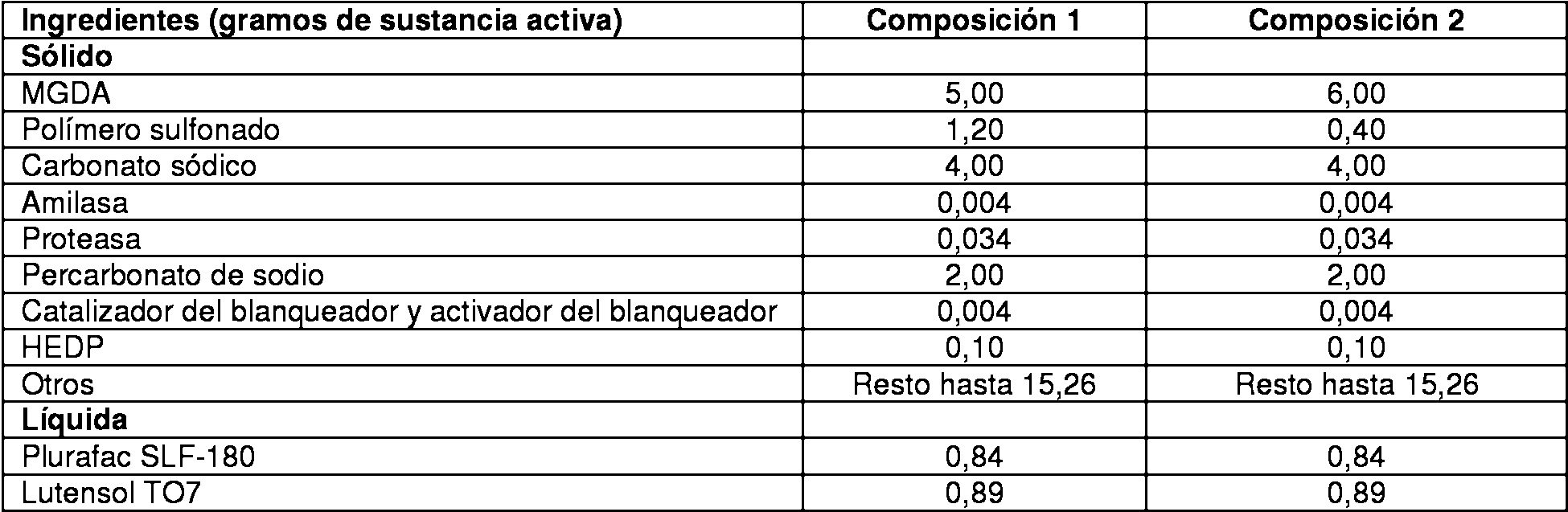

MGDA Sal trisodica del acido metilglicina diacetico.MGDA Trisodium salt of diacetic methylglycine acid.
Amilasa Stainzyme plus x® comercializado por NovozymesStainzyme plus x® amylase marketed by Novozymes
Proteasa Ultimase® comercializado por DuPontUltimase® protease marketed by DuPont
Activador del blanqueador TAED (Tetraacetiletilenediamina)TAED bleach activator (Tetraacetylethylenediamine)
Catalizador del blanqueador Catalizador del blanqueador de manganesoBleach Catalyst Manganese Bleach Catalyst
HEDP Acido 1 -hidroxietiliden-1, 1 -difosfonicoHEDP 1-Hydroxyethylidene-1,1,1-diphosphonic acid
Plurafac SLF-180 Tensioactivo no ionico suministrado por BASFPlurafac SLF-180 Non-ionic surfactant supplied by BASF
Lutensol TO7 Tensioactivo no ionico suministrado por BASFLutensol TO7 Non-ionic surfactant supplied by BASF
RA Alcalinidad de reservaRA Reserve Alkalinity
Ensayo de eliminacion de manchas de teTea stain removal test
Se tineron ocho tazas por grupo de ensayo utilizando te negro (Assam) preparado en agua artificialmente dura con sulfato ferrico segun el metodo de ensayo IKW (detergentes para lavavajillas del grupo de trabajo IKW. “ Methods for Ascertaining the Cleaning Performance of Dishwasher Detergents (Parte B, actualizado en 2005)” . SOFW-Journal, 132, 8 -2006 pags.Eight cups were poured per test group using black tea (Assam) prepared in artificially hard water with ferric sulfate according to the IKW test method (dishwashing detergents of the IKW working group. “Methods for Ascertaining the Cleaning Performance of Dishwasher Detergents (Part B, updated in 2005). ”SOFW-Journal, 132, 8-2006 pages.
35). Para cada composicion, se colocaron dos tazas en el estante superior de un lavavajillas, se cargaron con platos de carga, y se lavaron utilizando las Composiciones 1 y 2. El agua de entrada tenia una dureza de 360 ppm de CaCO3. 35). For each composition, two cups were placed on the top shelf of a dishwasher, loaded with loading plates, and washed using Compositions 1 and 2. The inlet water had a hardness of 360 ppm CaCO 3 .
Como carga artificial, se anadieron 100 g de suciedad IKW y 36 g de carne picada procedente de congelado. La suciedad artificial IKW se preparo segun el procedimiento IKW y la suciedad de carne se preparo mezclando 225 g de carne picada (50 % de cerdo y 50 % ternera), 75 g de huevos (clara y yema) y 80 g de agua (dureza de 350 ppm de CaCOs), y se mezclo hasta formar una pasta, a continuacion se dividio en recipientes que contenian 36 g de la pasta de carne picada y se almaceno en un congelador.As an artificial load, 100 g of IKW dirt and 36 g of minced meat from frozen were added. The IKW artificial dirt was prepared according to the IKW procedure and the meat dirt was prepared by mixing 225 g of minced meat (50% pork and 50% veal), 75 g of eggs (white and yolk) and 80 g of water (hardness 350 ppm of CaCOs), and mixed to form a paste, then divided into containers containing 36 g of the ground beef paste and stored in a freezer.
El ensayo se realizo en un lavavajillas Miele GSL con un ciclo normal de R-50 0C (sin prelavado). El detergente se anade al lavavajillas cuando se abre la puerta del dispensador. El ensayo se repitio tres veces mas con el resto de tazas, una vez lavadas todas, las ocho tazas se clasificaron por tres jueces independientes, usando una escala visual de 1 a 10 que va desde sucio a completamente limpio.The test was carried out in a Miele GSL dishwasher with a normal cycle of R-50 0C (without prewash). The detergent is added to the dishwasher when the dispenser door is opened. The rehearsal was repeated three more times with the rest of the cups, once all were washed, the eight cups were classified by three independent judges, using a visual scale of 1 to 10 ranging from dirty to completely clean.

La Composicion 2, segun la invencion, proporciona mucho mejor limpieza del te que la Composicion 1, fuera del ambito de la invencion.Composition 2, according to the invention, provides much better cleaning of the tea than Composition 1, outside the scope of the invention.
Ensayos de formacion de pelicula y de manchas en multiples ciclosFilm and stain formation tests in multiple cycles
Se llevo a cabo un “ Ensayo de la eficacia de enjuague y prevencion de residuos calcareos” en (1140 Rue Andre Ampere, 13851 Aix-en-Provence, Francia); el ensayo consistio en evaluar la capacidad de enjuague y la prevencion de residuos calcareos del producto, es decir, dejar los platos lavados con las menos manchas, vetas y formacion de peliculas posibles, restaurando su brillo inicial. Condiciones del ensayo: 30 ciclos de lavado a 55 0C, ciclo Universal en lavavajillas Miele -, dureza del agua 350 ppm de CaCO3. Se introdujo suciedad de IKS Artificial (segun el metodo IKW) al comienzo de cada ciclo, para reproducir un ciclo en condiciones manchadas.A “Test of the effectiveness of rinsing and prevention of calcareous residues” was carried out in (1140 Rue Andre Ampere, 13851 Aix-en-Provence, France); The trial consisted of evaluating the rinse capacity and the prevention of calcareous residues of the product, that is, leaving the dishes washed with the least possible spots, streaks and film formation, restoring their initial brightness. Test conditions: 30 wash cycles at 55 ° C, Universal cycle in Miele dishwasher -, water hardness 350 ppm of CaCO 3 . Artificial IKS dirt (according to the IKW method) was introduced at the beginning of each cycle, to reproduce a cycle in stained conditions.
Se utilizaron diferentes materiales que representan lo que habitualmente se lava en un lavavajillas: platos de ceramica, vasos, plasticos, cubiertos de acero inoxidable. Los materiales se valoraron visualmente con dos tipos de luces diurnas para detectar anomalias graves y con luz artificial mas intensa para detectar fallos de menor importancia. Cada articulo se examino bajo los dos tipos de luces y se puntuo segun las siguientes escalas:Different materials were used that represent what is usually washed in a dishwasher: ceramic plates, glasses, plastics, stainless steel cutlery. The materials were assessed visually with two types of daytime running lights to detect serious anomalies and with more intense artificial light to detect minor faults. Each article was examined under the two types of lights and scored according to the following scales:
• Pelicula: de 1 a 4 (1 es considerablemente peliculado y 4 sin pelicula en absoluto)• Movie: from 1 to 4 (1 is considerably movie and 4 without movie at all)
• Manchas y vetas: de 0 a 8 (0 es considerablemente manchado y 8 no hay manchas en absoluto)• Stains and streaks: from 0 to 8 (0 is considerably stained and 8 there are no stains at all)
La evaluacion de la formacion de pelicula se llevo a cabo despues de treinta ciclos de lavado, mientras que la evaluacion de la formacion de manchas se llevo a cabo solo despues de cinco ciclos porque mas alla de este numero de ciclos, los depositos de pelicula alteran e inhiben el desarrollo de manchas.The evaluation of the film formation was carried out after thirty washing cycles, while the evaluation of the formation of spots was carried out only after five cycles because beyond this number of cycles, the film deposits alter and inhibit the development of spots.
Las Composiciones 1 y 2 mostraron un rendimiento equivalente de formacion de peliculas. La Composicion 2, segun la invencion, indica una mejor capacidad de prevencion de manchas. Esto fue sorprendente dado que el nivel de polimero fue considerablemente inferior en la composicion de la invencion que en la composicion comparativa

Ensayos de limpiezaCleaning tests
Las Composiciones 1 y 2 tambien se compararon segun su capacidad limpiadora utilizando baldosas CFT, (Center For Testmaterials BV. Stoomloggerweg 11, 3133 KT Vlaardingen, Pafses Bajos), que son monitores para lavavajillas de melamina manchada que discriminan el rendimiento del producto para eliminar manchas sensibles a enzimas entre otras. Compositions 1 and 2 were also compared according to their cleaning capacity using CFT tiles, (Center For Testmaterials BV. Stoomloggerweg 11, 3133 KT Vlaardingen, Netherlands), which are monitors for stained melamine dishwashers that discriminate product performance to remove stains sensitive to enzymes among others.
Se colocan dos baldosas por lavado de cada mancha en el estante superior de un lavavajillas Miele 1022, se anaden 50 g adicionales de carga IKW congelada al principio del lavado. El agua de entrada tenfa una dureza de agua de 376 ppm de CaCO3 y el ciclo utilizado fue R-50 0C a (sin prelavado). El ensayo se repitio tres veces mas utilizando baldosas nuevas cada vez. Al final, las baldosas se evaluaron usando un analisis de imagen asistido por ordenador para asignar un fndice de eliminacion de manchas, que tiene una escala continua de 0 a 100, donde 0 % es sin lavar o 100 % es una eliminacion completa de la mancha.Two tiles are placed by washing each stain on the top shelf of a Miele 1022 dishwasher, adding an additional 50 g of frozen IKW load at the beginning of the wash. The inlet water had a water hardness of 376 ppm of CaCO 3 and the cycle used was R-50 0C a (without prewash). The test was repeated three more times using new tiles each time. In the end, the tiles were evaluated using a computer-assisted image analysis to assign a stain removal rate, which has a continuous scale of 0 to 100, where 0% is unwashed or 100% is a complete stain removal .

Composicion 2, segun la invencion, proporciona una mejor retirada proteica que la Composicion comparativa 1. Composition 2, according to the invention, provides a better protein withdrawal than Comparative Composition 1.
Claims (14)
Applications Claiming Priority (1)
| Application Number | Priority Date | Filing Date | Title |
|---|---|---|---|
| EP15153513.5A EP3050953B1 (en) | 2015-02-02 | 2015-02-02 | Detergent composition |
Publications (1)
| Publication Number | Publication Date |
|---|---|
| ES2714130T3 true ES2714130T3 (en) | 2019-05-27 |
Family
ID=52440600
Family Applications (1)
| Application Number | Title | Priority Date | Filing Date |
|---|---|---|---|
| ES15153513T Active ES2714130T3 (en) | 2015-02-02 | 2015-02-02 | Detergent composition |
Country Status (8)
| Country | Link |
|---|---|
| US (1) | US10047323B2 (en) |
| EP (1) | EP3050953B1 (en) |
| JP (2) | JP2018505941A (en) |
| AU (1) | AU2016215559A1 (en) |
| CA (1) | CA2975118C (en) |
| ES (1) | ES2714130T3 (en) |
| PL (1) | PL3050953T3 (en) |
| WO (1) | WO2016126566A1 (en) |
Families Citing this family (21)
| Publication number | Priority date | Publication date | Assignee | Title |
|---|---|---|---|---|
| EP3228686B1 (en) * | 2016-04-08 | 2021-10-27 | The Procter & Gamble Company | Automatic dishwashing |
| EP3266860B1 (en) * | 2016-07-08 | 2020-04-08 | The Procter and Gamble Company | Process for making a particle |
| EP3290503A3 (en) * | 2016-09-01 | 2018-05-30 | The Procter & Gamble Company | Automatic dishwashing cleaning composition |
| DK3293249T3 (en) * | 2016-09-08 | 2019-04-23 | Chemische Fabrik Dr Weigert Gmbh & Co Kg | HOT DRINK MACHINE CLEANER |
| EP3418365A1 (en) * | 2017-06-19 | 2018-12-26 | The Procter & Gamble Company | Automatic dishwashing cleaning composition |
| CN112553210B (en) * | 2017-10-03 | 2024-09-24 | 普利维尔治疗公司 | Gene therapy for lysosomal disorders |
| ES2874024T3 (en) | 2017-10-05 | 2021-11-04 | Procter & Gamble | Cleaning composition for dishwashing |
| EP3760699A1 (en) * | 2019-07-02 | 2021-01-06 | The Procter & Gamble Company | Automatic dishwashing detergent composition |
| JP7724208B2 (en) * | 2019-09-06 | 2025-08-15 | ビーエル テクノロジーズ、インコーポレイテッド | Silica scale inhibitor composition and method for inhibiting silica scale in membrane applications |
| US12252673B2 (en) * | 2020-01-23 | 2025-03-18 | Korex Canada Company | Concentrated glass cleaning compositions in unit dose packets or pouches |
| WO2021170398A1 (en) * | 2020-02-28 | 2021-09-02 | Unilever Ip Holdings B.V. | Dishwash detergent product |
| ES3014633T3 (en) | 2020-02-28 | 2025-04-23 | Unilever Ip Holdings B V | Dishwash detergent product |
| DE102020212091A1 (en) * | 2020-09-25 | 2022-03-31 | Henkel Ag & Co. Kgaa | Concentrated flowable detergent preparation with improved properties |
| EP4001388A1 (en) * | 2020-11-17 | 2022-05-25 | The Procter & Gamble Company | Automatic dishwashing method with amphiphilic graft polymer in the rinse |
| EP4001387A1 (en) * | 2020-11-17 | 2022-05-25 | The Procter & Gamble Company | Automatic dishwashing composition commprising amphiphilic graft polymer |
| WO2022200053A1 (en) | 2021-03-26 | 2022-09-29 | Unilever Ip Holdings B.V. | Product for machine dishwashing in the form of a capsule with multiple compartments |
| WO2023014663A1 (en) | 2021-08-02 | 2023-02-09 | Ecolab Usa Inc. | Booster composition for cleaning fermentation equipment and methods of use |
| EP4269548A1 (en) | 2022-04-27 | 2023-11-01 | Dalli-Werke GmbH & Co. KG | Detergent composition with antiscalants |
| WO2024088608A1 (en) | 2022-10-27 | 2024-05-02 | Brenntag Holding Gmbh | Builder combination for liquid detergent compositions |
| AU2024286516A1 (en) | 2023-06-07 | 2025-10-23 | The Procter & Gamble Company | An automatic dishwashing detergent water-soluble pouch |
| EP4474457A1 (en) * | 2023-06-07 | 2024-12-11 | The Procter & Gamble Company | An automatic dishwashing detergent water-soluble pouch comprising builder |
Family Cites Families (72)
| Publication number | Priority date | Publication date | Assignee | Title |
|---|---|---|---|---|
| GB2048606B (en) | 1979-02-28 | 1983-03-16 | Barr & Stroud Ltd | Optical scanning system |
| GB8629837D0 (en) | 1986-12-13 | 1987-01-21 | Interox Chemicals Ltd | Bleach activation |
| GB8908416D0 (en) | 1989-04-13 | 1989-06-01 | Unilever Plc | Bleach activation |
| DE69125310T2 (en) | 1990-05-21 | 1997-07-03 | Unilever Nv | Bleach activation |
| GB9108136D0 (en) | 1991-04-17 | 1991-06-05 | Unilever Plc | Concentrated detergent powder compositions |
| US5308532A (en) | 1992-03-10 | 1994-05-03 | Rohm And Haas Company | Aminoacryloyl-containing terpolymers |
| US5576281A (en) | 1993-04-05 | 1996-11-19 | Olin Corporation | Biogradable low foaming surfactants as a rinse aid for autodish applications |
| CA2186592C (en) | 1994-03-29 | 2008-02-19 | Helle Outtrup | Alkaline bacillus amylase |
| GB9407535D0 (en) | 1994-04-13 | 1994-06-08 | Procter & Gamble | Detergent compositions |
| US6093562A (en) | 1996-02-05 | 2000-07-25 | Novo Nordisk A/S | Amylase variants |
| AR000862A1 (en) | 1995-02-03 | 1997-08-06 | Novozymes As | VARIANTS OF A MOTHER-AMYLASE, A METHOD TO PRODUCE THE SAME, A DNA STRUCTURE AND A VECTOR OF EXPRESSION, A CELL TRANSFORMED BY SUCH A DNA STRUCTURE AND VECTOR, A DETERGENT ADDITIVE, DETERGENT COMPOSITION, A COMPOSITION FOR AND A COMPOSITION FOR THE ELIMINATION OF |
| DE19518695A1 (en) | 1995-05-22 | 1996-11-28 | Henkel Kgaa | Acid granules containing redox-active substances |
| JP3025627B2 (en) | 1995-06-14 | 2000-03-27 | 花王株式会社 | Liquefied alkaline α-amylase gene |
| JP3290382B2 (en) | 1997-07-18 | 2002-06-10 | 花王株式会社 | Powder detergent composition |
| GB2327947A (en) | 1997-08-02 | 1999-02-10 | Procter & Gamble | Detergent tablet |
| EP2386568B1 (en) | 1997-10-30 | 2014-08-06 | Novozymes A/S | Alpha-amylase mutants |
| US6403355B1 (en) | 1998-12-21 | 2002-06-11 | Kao Corporation | Amylases |
| ES2532606T3 (en) | 1999-03-31 | 2015-03-30 | Novozymes A/S | Polypeptides with alkaline alpha-amylase activity and nucleic acids encoding them |
| HUP0300840A2 (en) | 2000-07-28 | 2003-07-28 | Henkel Kommanditgesellschaft Auf Aktien | Novel, amylolytic enzyme ectracted from bacillus sp. a 7-7 (dsm 12368) and washing and cleaning agents containing this novel amylolytic enzyme |
| BR0115018A (en) | 2000-10-31 | 2003-12-23 | Procter & Gamble | Detergent Compositions |
| WO2002092751A2 (en) | 2001-05-14 | 2002-11-21 | The Procter & Gamble Company | Cleaning product |
| CA2463613C (en) * | 2001-11-14 | 2009-04-07 | The Procter & Gamble Company | Automatic dishwashing composition in unit dose form comprising an anti-scaling polymer |
| GB0128946D0 (en) | 2001-12-03 | 2002-01-23 | Unilever Plc | Package for a water-soluble capsule |
| US20050202995A1 (en) | 2004-03-15 | 2005-09-15 | The Procter & Gamble Company | Methods of treating surfaces using surface-treating compositions containing sulfonated/carboxylated polymers |
| DE102004032320A1 (en) | 2004-07-02 | 2006-01-19 | Basf Ag | Mixed powder or mixed granules based on MGDA |
| EP3620523A3 (en) | 2004-07-05 | 2020-08-19 | Novozymes A/S | Alpha-amylase variants with altered properties |
| EP1721962B1 (en) * | 2005-05-11 | 2008-08-13 | Unilever N.V. | Dishwashing composition and process for washing dishes |
| WO2008010925A2 (en) | 2006-07-18 | 2008-01-24 | Danisco Us, Inc., Genencor Division | Protease variants active over a broad temperature range |
| ES2338582T5 (en) | 2006-09-28 | 2014-12-19 | The Procter & Gamble Company | Detergent container |
| GB0700920D0 (en) * | 2007-01-18 | 2007-02-28 | Reckitt Benckiser Nv | Dosage element and a method of manufacturing a dosage element |
| GB0700929D0 (en) * | 2007-01-18 | 2007-02-28 | Reckitt Benckiser Nv | Dosage element and a method of manufacturing a dosage element |
| GB0700931D0 (en) | 2007-01-18 | 2007-02-28 | Reckitt Benckiser Nv | Dosage element and a method of manufacturing a dosage element |
| DE102007006628A1 (en) | 2007-02-06 | 2008-08-07 | Henkel Ag & Co. Kgaa | cleaning supplies |
| DE102007019458A1 (en) * | 2007-04-25 | 2008-10-30 | Basf Se | Phosphate-free machine dishwashing detergent with excellent rinse performance |
| GB0717988D0 (en) | 2007-09-14 | 2007-10-24 | Reckitt Benckiser Nv | Composition |
| GB0718944D0 (en) | 2007-09-28 | 2007-11-07 | Reckitt Benckiser Nv | Detergent composition |
| UA103760C2 (en) * | 2008-01-24 | 2013-11-25 | Юнилевер Н.В. | Machine dishwash detergent composition |
| US20090209447A1 (en) * | 2008-02-15 | 2009-08-20 | Michelle Meek | Cleaning compositions |
| EP2166075A1 (en) * | 2008-09-23 | 2010-03-24 | The Procter and Gamble Company | Cleaning composition |
| GB0906281D0 (en) | 2009-04-09 | 2009-05-20 | Reckitt Benckiser Nv | Detergent compositions |
| DE102009017722A1 (en) | 2009-04-11 | 2010-10-14 | Clariant International Limited | Bleach granules with active coating |
| DE102009017724A1 (en) | 2009-04-11 | 2010-10-14 | Clariant International Limited | Bleach granules |
| GB0915572D0 (en) * | 2009-09-07 | 2009-10-07 | Reckitt Benckiser Nv | Detergent composition |
| JP5464755B2 (en) * | 2010-03-09 | 2014-04-09 | ローム アンド ハース カンパニー | Scale reducing additives for automatic dishwashing systems |
| US20120067373A1 (en) * | 2010-04-15 | 2012-03-22 | Philip Frank Souter | Automatic Dishwashing Detergent Composition |
| ES2682051T3 (en) * | 2010-04-23 | 2018-09-18 | The Procter & Gamble Company | Detergent composition |
| WO2012000914A1 (en) | 2010-06-28 | 2012-01-05 | Akzo Nobel Chemicals International B.V. | Particles coated with vinyl alcohol (co) polymer and polysaccharide |
| GB201014328D0 (en) * | 2010-08-27 | 2010-10-13 | Reckitt Benckiser Nv | Detergent composition comprising manganese-oxalate |
| GB201019628D0 (en) * | 2010-11-19 | 2010-12-29 | Reckitt Benckiser Nv | Dyed coated bleach materials |
| GB201021541D0 (en) | 2010-12-21 | 2011-02-02 | Reckitt Benckiser Nv | Bleach catalyst particle |
| EP2794836B1 (en) * | 2011-12-22 | 2016-06-01 | Unilever N.V. | Detergent composition comprising glutamic-n,n-diacetate, water and bleaching agent |
| US20130284637A1 (en) * | 2012-04-30 | 2013-10-31 | Danisco Us Inc. | Unit-dose format perhydrolase systems |
| EP2662436B1 (en) * | 2012-05-11 | 2017-08-23 | The Procter & Gamble Company | Detergent composition |
| US20140018278A1 (en) | 2012-07-11 | 2014-01-16 | Xinbei Song | Dishwashing composition with improved protection against aluminum corrosion |
| US10179891B2 (en) * | 2012-07-25 | 2019-01-15 | Basf Se | Use of branched polyesters based on citric acid as additive in washing compositions, detergents or a formulation for water treatment |
| GB201214558D0 (en) | 2012-08-15 | 2012-09-26 | Reckitt Benckiser Nv | Detergent granule |
| AU2013337255A1 (en) * | 2012-11-05 | 2015-04-02 | Danisco Us Inc. | Compositions and methods comprising thermolysin protease variants |
| US9902946B2 (en) * | 2013-01-03 | 2018-02-27 | Novozymes A/S | Alpha-amylase variants and polynucleotides encoding same |
| CN105026540A (en) * | 2013-01-03 | 2015-11-04 | 巴斯夫欧洲公司 | Homogeneous detergent composition |
| WO2014139653A2 (en) * | 2013-03-14 | 2014-09-18 | Clariant International Ltd | Automatic dishwashing detergent compositons comprising ethercarboxylic acids or their salts and nonionic surfactants with a high cloud point |
| US20140261561A1 (en) * | 2013-03-14 | 2014-09-18 | Clariant International Ltd. | Automatic Dishwashing Detergent Compositions Comprising Ethercarboxylic Acids Or Their Salts, Which Are Free Of Nonionic Surfactants |
| PL2997121T3 (en) | 2013-05-17 | 2019-05-31 | Unilever Nv | Machine dishwash detergent composition |
| DE102013010150A1 (en) | 2013-06-15 | 2014-12-18 | Clariant International Ltd. | Bleach catalyst granules |
| DE102013010549A1 (en) | 2013-06-15 | 2014-12-18 | Clariant International Ltd. | Bleach co-granules |
| KR20160030256A (en) * | 2013-07-04 | 2016-03-16 | 바스프 에스이 | Process for cleaning dishware |
| JP6691478B2 (en) | 2013-10-07 | 2020-04-28 | モノソル リミテッド ライアビリティ カンパニー | Water-soluble delayed release capsules, related methods and related articles |
| US20160348036A1 (en) | 2014-02-20 | 2016-12-01 | Conopco, Inc., D/B/A Unilever | Machine dishwash composition |
| CN106163928A (en) * | 2014-05-21 | 2016-11-23 | 宝洁公司 | Methods and systems for dispensing compositions |
| EP3050952A1 (en) | 2015-02-02 | 2016-08-03 | The Procter and Gamble Company | Method of dishwashing |
| EP3050955B2 (en) | 2015-02-02 | 2023-11-08 | The Procter & Gamble Company | Detergent pack |
| EP3050947A1 (en) | 2015-02-02 | 2016-08-03 | The Procter and Gamble Company | Detergent pack |
| EP3050951A1 (en) | 2015-02-02 | 2016-08-03 | The Procter and Gamble Company | Method of dishwashing |
-
2015
- 2015-02-02 ES ES15153513T patent/ES2714130T3/en active Active
- 2015-02-02 PL PL15153513T patent/PL3050953T3/en unknown
- 2015-02-02 EP EP15153513.5A patent/EP3050953B1/en active Active
-
2016
- 2016-01-28 US US15/008,472 patent/US10047323B2/en active Active
- 2016-02-01 AU AU2016215559A patent/AU2016215559A1/en not_active Abandoned
- 2016-02-01 WO PCT/US2016/015875 patent/WO2016126566A1/en not_active Ceased
- 2016-02-01 JP JP2017540840A patent/JP2018505941A/en active Pending
- 2016-02-01 CA CA2975118A patent/CA2975118C/en active Active
-
2019
- 2019-11-18 JP JP2019207992A patent/JP2020029567A/en active Pending
Also Published As
| Publication number | Publication date |
|---|---|
| AU2016215559A1 (en) | 2017-08-03 |
| US10047323B2 (en) | 2018-08-14 |
| JP2020029567A (en) | 2020-02-27 |
| EP3050953A1 (en) | 2016-08-03 |
| JP2018505941A (en) | 2018-03-01 |
| CA2975118C (en) | 2020-08-25 |
| PL3050953T3 (en) | 2019-07-31 |
| US20160222325A1 (en) | 2016-08-04 |
| EP3050953B1 (en) | 2018-12-26 |
| CA2975118A1 (en) | 2016-08-11 |
| WO2016126566A1 (en) | 2016-08-11 |
Similar Documents
| Publication | Publication Date | Title |
|---|---|---|
| CA2975118C (en) | Detergent composition | |
| ES2690335T3 (en) | Cleaning bag | |
| ES2444922T3 (en) | Dishwashing detergent composition in dishwasher | |
| ES2646416T3 (en) | Detergent composition | |
| ES2714084T3 (en) | Cleaning bag | |
| ES2733300T3 (en) | Detergent composition | |
| ES2690336T3 (en) | Cleaning bag | |
| ES2399311T5 (en) | Detergent composition | |
| EP3050948B1 (en) | New use of complexing agent | |
| ES2802454T3 (en) | Dishwasher cleaning composition | |
| ES2678543T3 (en) | Dishwashing method | |
| JP2018509495A (en) | Detergent pack | |
| ES2677702T3 (en) | Dishwashing method | |
| ES2728108T3 (en) | Multistage cleaning product in unit dose | |
| WO2017105825A1 (en) | Automatic dishwashing detergent composition | |
| US20180105770A1 (en) | Detergent composition | |
| AU2016215575B2 (en) | Detergent pack | |
| ES3023210T3 (en) | Automatic dishwashing detergent composition | |
| ES2855023T3 (en) | Cleaning bag | |
| ES2990037T3 (en) | Dishwashing detergent composition | |
| EP3050950B1 (en) | New use of sulfonated polymers | |
| ES2668504T3 (en) | Process for recycling detergent bags | |
| ES3036958T3 (en) | Automatic dishwashing detergent composition | |
| ES2999112T3 (en) | A method of treating dishware in a domestic automatic dishwashing machine | |
| WO2016126567A1 (en) | New use of sulfonated polymers |