ES2717436T3 - Novel compounds - Google Patents
Novel compounds Download PDFInfo
- Publication number
- ES2717436T3 ES2717436T3 ES14734147T ES14734147T ES2717436T3 ES 2717436 T3 ES2717436 T3 ES 2717436T3 ES 14734147 T ES14734147 T ES 14734147T ES 14734147 T ES14734147 T ES 14734147T ES 2717436 T3 ES2717436 T3 ES 2717436T3
- Authority
- ES
- Spain
- Prior art keywords
- compound
- pharmaceutically acceptable
- treatment
- formula
- agents
- Prior art date
- Legal status (The legal status is an assumption and is not a legal conclusion. Google has not performed a legal analysis and makes no representation as to the accuracy of the status listed.)
- Active
Links
- GGOYPZXHENWDBT-SQNIBIBYSA-N CC(C)[C@@H](C(N(C[C@@H](C1)O)[C@@H]1C(NCc(cc1)ccc1-c1c(C)nc[s]1)=O)=O)N Chemical compound CC(C)[C@@H](C(N(C[C@@H](C1)O)[C@@H]1C(NCc(cc1)ccc1-c1c(C)nc[s]1)=O)=O)N GGOYPZXHENWDBT-SQNIBIBYSA-N 0.000 description 1
Classifications
-
- A—HUMAN NECESSITIES
- A61—MEDICAL OR VETERINARY SCIENCE; HYGIENE
- A61K—PREPARATIONS FOR MEDICAL, DENTAL OR TOILETRY PURPOSES
- A61K38/00—Medicinal preparations containing peptides
- A61K38/04—Peptides having up to 20 amino acids in a fully defined sequence; Derivatives thereof
- A61K38/06—Tripeptides
-
- A—HUMAN NECESSITIES
- A61—MEDICAL OR VETERINARY SCIENCE; HYGIENE
- A61K—PREPARATIONS FOR MEDICAL, DENTAL OR TOILETRY PURPOSES
- A61K45/00—Medicinal preparations containing active ingredients not provided for in groups A61K31/00 - A61K41/00
- A61K45/06—Mixtures of active ingredients without chemical characterisation, e.g. antiphlogistics and cardiaca
-
- A—HUMAN NECESSITIES
- A61—MEDICAL OR VETERINARY SCIENCE; HYGIENE
- A61K—PREPARATIONS FOR MEDICAL, DENTAL OR TOILETRY PURPOSES
- A61K47/00—Medicinal preparations characterised by the non-active ingredients used, e.g. carriers or inert additives; Targeting or modifying agents chemically bound to the active ingredient
- A61K47/50—Medicinal preparations characterised by the non-active ingredients used, e.g. carriers or inert additives; Targeting or modifying agents chemically bound to the active ingredient the non-active ingredient being chemically bound to the active ingredient, e.g. polymer-drug conjugates
- A61K47/51—Medicinal preparations characterised by the non-active ingredients used, e.g. carriers or inert additives; Targeting or modifying agents chemically bound to the active ingredient the non-active ingredient being chemically bound to the active ingredient, e.g. polymer-drug conjugates the non-active ingredient being a modifying agent
- A61K47/54—Medicinal preparations characterised by the non-active ingredients used, e.g. carriers or inert additives; Targeting or modifying agents chemically bound to the active ingredient the non-active ingredient being chemically bound to the active ingredient, e.g. polymer-drug conjugates the non-active ingredient being a modifying agent the modifying agent being an organic compound
- A61K47/55—Medicinal preparations characterised by the non-active ingredients used, e.g. carriers or inert additives; Targeting or modifying agents chemically bound to the active ingredient the non-active ingredient being chemically bound to the active ingredient, e.g. polymer-drug conjugates the non-active ingredient being a modifying agent the modifying agent being an organic compound the modifying agent being also a pharmacologically or therapeutically active agent, i.e. the entire conjugate being a codrug
-
- A—HUMAN NECESSITIES
- A61—MEDICAL OR VETERINARY SCIENCE; HYGIENE
- A61P—SPECIFIC THERAPEUTIC ACTIVITY OF CHEMICAL COMPOUNDS OR MEDICINAL PREPARATIONS
- A61P35/00—Antineoplastic agents
-
- C—CHEMISTRY; METALLURGY
- C07—ORGANIC CHEMISTRY
- C07K—PEPTIDES
- C07K5/00—Peptides containing up to four amino acids in a fully defined sequence; Derivatives thereof
- C07K5/04—Peptides containing up to four amino acids in a fully defined sequence; Derivatives thereof containing only normal peptide links
- C07K5/06—Dipeptides
- C07K5/06008—Dipeptides with the first amino acid being neutral
- C07K5/06017—Dipeptides with the first amino acid being neutral and aliphatic
-
- C—CHEMISTRY; METALLURGY
- C07—ORGANIC CHEMISTRY
- C07K—PEPTIDES
- C07K5/00—Peptides containing up to four amino acids in a fully defined sequence; Derivatives thereof
- C07K5/04—Peptides containing up to four amino acids in a fully defined sequence; Derivatives thereof containing only normal peptide links
- C07K5/06—Dipeptides
- C07K5/06008—Dipeptides with the first amino acid being neutral
- C07K5/06017—Dipeptides with the first amino acid being neutral and aliphatic
- C07K5/06034—Dipeptides with the first amino acid being neutral and aliphatic the side chain containing 2 to 4 carbon atoms
- C07K5/06043—Leu-amino acid
-
- C—CHEMISTRY; METALLURGY
- C07—ORGANIC CHEMISTRY
- C07K—PEPTIDES
- C07K5/00—Peptides containing up to four amino acids in a fully defined sequence; Derivatives thereof
- C07K5/04—Peptides containing up to four amino acids in a fully defined sequence; Derivatives thereof containing only normal peptide links
- C07K5/06—Dipeptides
- C07K5/06008—Dipeptides with the first amino acid being neutral
- C07K5/06078—Dipeptides with the first amino acid being neutral and aromatic or cycloaliphatic
-
- C—CHEMISTRY; METALLURGY
- C07—ORGANIC CHEMISTRY
- C07K—PEPTIDES
- C07K5/00—Peptides containing up to four amino acids in a fully defined sequence; Derivatives thereof
- C07K5/04—Peptides containing up to four amino acids in a fully defined sequence; Derivatives thereof containing only normal peptide links
- C07K5/08—Tripeptides
- C07K5/0802—Tripeptides with the first amino acid being neutral
- C07K5/0812—Tripeptides with the first amino acid being neutral and aromatic or cycloaliphatic
Landscapes
- Chemical & Material Sciences (AREA)
- Health & Medical Sciences (AREA)
- Life Sciences & Earth Sciences (AREA)
- Organic Chemistry (AREA)
- Medicinal Chemistry (AREA)
- General Health & Medical Sciences (AREA)
- Proteomics, Peptides & Aminoacids (AREA)
- Molecular Biology (AREA)
- Genetics & Genomics (AREA)
- Biophysics (AREA)
- Biochemistry (AREA)
- Veterinary Medicine (AREA)
- Animal Behavior & Ethology (AREA)
- Pharmacology & Pharmacy (AREA)
- Public Health (AREA)
- Engineering & Computer Science (AREA)
- Bioinformatics & Cheminformatics (AREA)
- Epidemiology (AREA)
- Immunology (AREA)
- Gastroenterology & Hepatology (AREA)
- Chemical Kinetics & Catalysis (AREA)
- General Chemical & Material Sciences (AREA)
- Nuclear Medicine, Radiotherapy & Molecular Imaging (AREA)
- Pharmaceuticals Containing Other Organic And Inorganic Compounds (AREA)
- Organic Low-Molecular-Weight Compounds And Preparation Thereof (AREA)
- Acyclic And Carbocyclic Compounds In Medicinal Compositions (AREA)
Description
DESCRIPCIÓNDESCRIPTION
Compuestos novedososNovel compounds
Campo de la invenciónField of the invention
La presente invención se refiere a compuestos, composiciones, combinaciones y medicamentos que contienen dichos compuestos y procesos para su preparación. La invención también se refiere a dichos compuestos, combinaciones, composiciones y medicamentos, por ejemplo, como inhibidores de la actividad del receptor de estrógeno, por ejemplo, degradando el receptor de estrógeno, para su uso en el tratamiento de enfermedades y afecciones mediadas por el receptor de estrógeno, en particular, para su uso en el tratamiento de cáncer de mama.The present invention relates to compounds, compositions, combinations and medicaments containing said compounds and processes for their preparation. The invention also relates to said compounds, combinations, compositions and medicaments, for example, as inhibitors of estrogen receptor activity, for example, by degrading the estrogen receptor, for use in the treatment of diseases and conditions mediated by the estrogen receptor, in particular, for use in the treatment of breast cancer.
Antecedentes de la invenciónBACKGROUND OF THE INVENTION
El receptor de estrógeno (ER) es un miembro de la familia del receptor de hormonas nucleares y funciona como un factor de transcripción activado por ligando implicado con la regulación positiva y negativa de la expresión génica. La hormona natural para el receptor de estrógeno es el B17-estradiol (E2) y metabolitos estrechamente relacionados. La unión de estradiol al receptor de estrógenos provoca una dimerización del receptor y el dímero, a su vez, se une a elementos de respuesta de estrógeno (ERE) sobre el ADN. El complejo ERADN recluta otros factores de transcripción responsables de la transcripción de ADN corriente abajo desde el ERE en ARNm que finalmente se traduce en proteína. De forma alternativa, la interacción de ER con ADN puede ser indirecta a través de la intermediación de otros factores de transcripción, a saber, fos y jun. Puesto que la expresión de una gran cantidad de genes está regulada por el receptor de estrógenos y puesto que el receptor de estrógenos está expresado en muchos tipos de células, la modulación del receptor de estrógenos a través de la unión de o bien hormonas naturales o bien ligandos ER sintéticos puede tener efectos productos sobre la fisiología y patofisiología del organismo.The estrogen receptor (ER) is a member of the nuclear hormone receptor family and functions as a ligand-activated transcription factor involved in the up-regulation and down-regulation of gene expression. The natural hormone for the estrogen receptor is B17-estradiol (E2) and closely related metabolites. The binding of estradiol to the estrogen receptor causes a dimerization of the receptor and the dimer, in turn, binds to estrogen response elements (ERE) on the DNA. The ERADN complex recruits other transcription factors responsible for the transcription of DNA downstream from the ERE into mRNA that ultimately results in protein. Alternatively, the interaction of ER with DNA can be indirect through the intermediation of other transcription factors, namely fos and jun. Since the expression of a large number of genes is regulated by the estrogen receptor and since the estrogen receptor is expressed in many types of cells, the modulation of the estrogen receptor through the binding of either natural hormones or Synthetic ER ligands may have product effects on the physiology and pathophysiology of the organism.
Varias enfermedades tienen su etiología y/o patología mediada por el ER. De forma colectiva, estas enfermedades se denominan enfermedades dependientes de estrógenos. Los estrógenos son importantes para el desarrollo sexual en hembras. Además, los estrógenos tienen un papel importante en mantener la densidad ósea, regulación de niveles de lípidos en sangre y parece que tienen efectos neuroprotectores. Por consiguiente, una producción de estrógenos reducida en mujeres post-menopáusicas está asociada con una cantidad de enfermedades tales como osteoporosis, ateroesclerosis, depresión y trastornos cognitivos. En cambio, determinadas enfermedades proliferativas tales como cáncer de mama y de útero y endometriosis están estimuladas por los estrógenos y, por lo tanto, los antiestrógenos (es decir, antagonistas de estrógenos) tiene utilidad en la prevención y tratamiento de estos tipos de trastornos. Existen dos formas distintas del receptor de estrógenos, normalmente denominado como a y p, cada una codificada por un gen separado [ESR1 y ESR2, respectivamente).Several diseases have their etiology and / or pathology mediated by the ER. Collectively, these diseases are called estrogen-dependent diseases. Estrogens are important for sexual development in females. In addition, estrogens play an important role in maintaining bone density, regulating blood lipid levels and appear to have neuroprotective effects. Accordingly, a reduced estrogen production in post-menopausal women is associated with a number of diseases such as osteoporosis, atherosclerosis, depression and cognitive disorders. In contrast, certain proliferative diseases such as breast and uterine cancer and endometriosis are stimulated by estrogens and, therefore, antiestrogens (ie, estrogen antagonists) have utility in the prevention and treatment of these types of disorders. There are two distinct forms of the estrogen receptor, usually referred to as a and p, each encoded by a separate gene [ESR1 and ESR2, respectively).
Ambos ER se expresan ampliamente en distintos tipos de tejidos, sin embargo, existen algunas diferencias notables en sus patrones de expresión. El ERa se encuentra en el endometrio, células de cáncer de mama, células de estroma de ovario y el hipotálamo. En machos, la proteína ERa se encuentra en el epitelio de los distintos conductos. La expresión de la proteína ERp se ha documentado en riñón, cerebro, hueso, corazón, pulmones, mucosa intestinal, próstata y células endoteliales. Por lo tanto, el desarrollo de ligandos selectivos puede, por lo tanto, preservar los aspectos beneficiosos del estrógeno.Both ERs are widely expressed in different types of tissues, however, there are some notable differences in their expression patterns. The ERa is found in the endometrium, breast cancer cells, ovarian stromal cells and the hypothalamus. In males, the ERa protein is found in the epithelium of the different ducts. The expression of the ERp protein has been documented in kidney, brain, bone, heart, lungs, intestinal mucosa, prostate and endothelial cells. Therefore, the development of selective ligands can, therefore, preserve the beneficial aspects of estrogen.
El cáncer de mama es la neoplasia más común que afecta a mujeres en el mundo entero, y la incidencia de la enfermedad va en aumento. Los estrógenos, en particular, actúan como factores de crecimiento endocrino para al menos un tercio de los cánceres de mama, y privar al tumor de este estímulo es una terapia reconocida para la enfermedad avanzada. En mujeres premenopáusicas, esto se logra mediante la ablación de la función del ovario a través de medios quirúrgicos, radioterapéuticos o médicos y, en mujeres postmenopáusicas, mediante el uso de inhibidores de la aromatasa.Breast cancer is the most common neoplasm affecting women worldwide, and the incidence of the disease is increasing. Estrogens, in particular, act as endocrine growth factors for at least a third of breast cancers, and depriving the tumor of this stimulus is a recognized therapy for advanced disease. In premenopausal women, this is achieved by ablation of ovarian function through surgical, radiotherapeutic or medical means and, in postmenopausal women, by the use of aromatase inhibitors.
Un enfoque alternativo a la retiración de estrógenos es antagonizar estrógenos con antiestrógenos. Estos son fármacos que se unen y compiten por los receptores de estrógenos (ER) presentes en tejido sensible a estrógenos. Antiestrógenos no esteroideos convencionales, tales como tamoxifeno, compiten eficazmente por la unión de ER pero su eficacia se ve a menudo limitada por el agonismo parcial que muestran, que da como resultado, un bloqueo incompleto de la actividad mediada por estrógenos. Un antiestrógeno específico o "puro" con alta afinidad para Er y sin ningún efecto agonista, puede tener ventajas sobre los antiestrógenos no esteroideos convencionales en el tratamiento de enfermedades dependientes de estrógenos. El Fulvestrant es el primero de una nueva clase de antiestrógenos puros potentes y está completamente libre del agonista parcial, actividad tipo estrógenos, asociada con antiestrógenos actualmente disponibles como el tamoxifeno.An alternative approach to estrogen withdrawal is to antagonize estrogens with antiestrogens. These are drugs that bind and compete for the estrogen receptors (ER) present in estrogen-sensitive tissue. Conventional nonsteroidal anti-estrogens, such as tamoxifen, compete effectively for ER binding but their effectiveness is often limited by the partial agonism they show, which results in incomplete blockade of estrogen-mediated activity. A specific or "pure" antiestrogen with high affinity for Er and without any agonist effect, may have advantages over conventional non-steroidal antiestrogens in the treatment of estrogen-dependent diseases. Fulvestrant is the first of a new class of purely powerful antiestrogens and is completely free of the partial agonist, estrogen-like activity, associated with currently available antiestrogens such as tamoxifen.
Sería deseable investigar otros enfoques para antagonizas el receptor ER.It would be desirable to investigate other approaches to antagonize the ER receptor.
Un enfoque sería desarrollar reguladores negativos de ER o degradadores que den como resultado la reducción de la expresión de ER o bien en el nivel de transcripción o bien en el nivel proteico.One approach would be to develop negative ER regulators or degraders that result in the reduction of ER expression either at the level of transcription or at the protein level.
Hay disponibles varios métodos para la manipulación de niveles proteicos, incluidas moléculas quiméricas dirigidas a la proteólisis (PROTAC) que contienen un ligando que reconoce la proteína diana unida a un ligando que se une a una ligasa de ubiquitina E3 específica. Sería deseable tener una molécula pequeña que pueda unirse simultáneamente a ER y una ligasa de ubiquitina E3 específica y que promueva la ubiquitinación de ER y conduzca a la degradación de ER mediante el Proteosoma. Una ligasa de ubiquitina E3 específica adecuada es el supresor tumoral de von Hippel-Lindau (VHL). Cyrus et al., ChemMedChem. 2010; 5(7): 979-985 describe la optimización del emplazamiento del enlazador en el diseño de PROTAC dirigidas al receptor de estrógenos. Burke et al., J. Med. Chem., 2004, 47(5): 1193-1206 describe conjugados de doxorubicina-formaldehído dirigidos al cáncer de mama. Willson et al., J. Med. Chem., 1994, 37(11): 1550-1552 describe un estrógeno no esteroideo. El documento WO 2013/106643 describe compuestos para la degradación potenciada de proteínas dirigidas mediante una ligasa de ubiquitina E3.Various methods are available for the manipulation of protein levels, including chimeric molecules directed to proteolysis (PROTAC) that contain a ligand that recognizes the target protein bound to a ligand that binds to a specific E3 ubiquitin ligase. It would be desirable to have a small molecule that can bind simultaneously to ER and a specific ubiquitin E3 ligase and that promotes the ubiquitination of ER and leads to the degradation of ER through the Proteosome. A suitable specific ubiquitin E3 ligase is the von Hippel-Lindau tumor suppressor (VHL). Cyrus et al., ChemMedChem. 2010; 5 (7): 979-985 describes the optimization of the linker site in the design of PROTAC targeted to the estrogen receptor. Burke et al., J. Med. Chem., 2004, 47 (5): 1193-1206 discloses doxorubicin-formaldehyde conjugates directed at breast cancer. Willson et al., J. Med. Chem., 1994, 37 (11): 1550-1552 describes a non-steroidal estrogen. WO 2013/106643 describes compounds for the enhanced degradation of proteins directed by an E3 ubiquitin ligase.
Los presentes inventores han identificado compuestos que son capaces de inhibir la función receptores de estrógenos incluidos compuestos que degradan el receptor de estrógenos.The present inventors have identified compounds that are capable of inhibiting estrogen receptor function including compounds that degrade the estrogen receptor.
Sumario de la invenciónSummary of the invention
En un aspecto se proporciona un compuesto de fórmula (I):In one aspect a compound of formula (I) is provided:

En la queIn which
L es un grupo de unión, en donde el grupo de unión es un grupo alquileno de cadena lineal de 8-16 átomos de carbono en donde uno o más átomos de carbono en el grupo de unión se sustituye por un miembro del grupo seleccionado independientemente de -O-, -NH-, -N(CH3)-,L is a linking group, wherein the linking group is a straight chain alkylene group of 8-16 carbon atoms wherein one or more carbon atoms in the linking group is replaced by a member of the selected group independently of -O-, -NH-, -N (CH3) -,

R1 es alquilo Ci -6 lineal o ramificado o cicloalquilo C3-6 R1 is linear or branched Ci-6 alkyl or C 3-6 cycloalkyl
R2 es 4-metiltiazol-5-il, oxazol-5-il o una sal farmacéuticamente aceptable de los mismos.R 2 is 4-methylthiazol-5-yl, oxazol-5-yl or a pharmaceutically acceptable salt thereof.
En un aspecto adicional de la presente invención, se proporciona un compuesto de fórmula (I), o una sal farmacéuticamente aceptable del mismo para su uso en la terapia, en particular en el tratamiento de enfermedades y afecciones mediadas por el receptor de estrógeno.In a further aspect of the present invention, there is provided a compound of formula (I), or a pharmaceutically acceptable salt thereof for use in therapy, in particular in the treatment of diseases and conditions mediated by the estrogen receptor.
En un aspecto adicional de la presente invención, se proporciona una composición farmacéutica que comprende un compuesto de fórmula (I) o una sal farmacéuticamente aceptable del mismo y uno o más vehículos, diluyentes y excipientes farmacéuticamente aceptables.In a further aspect of the present invention, there is provided a pharmaceutical composition comprising a compound of formula (I) or a pharmaceutically acceptable salt thereof and one or more pharmaceutically acceptable carriers, diluents and excipients.
En general, descrito en el presente documento, se proporciona un método de tratamiento de enfermedades y afecciones mediadas por el receptor de estrógeno en un sujeto que comprende la administración de una cantidad terapéuticamente eficaz de un compuesto de fórmula (I) o una sal farmacéuticamente aceptable del mismo.In general, described herein, there is provided a method of treating diseases and conditions mediated by the estrogen receptor in a subject comprising the administration of a therapeutically effective amount of a compound of formula (I) or a pharmaceutically acceptable salt. of the same.
En general, descrito en el presente documento, se proporciona el uso de un compuesto de fórmula (I) o una sal farmacéuticamente aceptable del mismo en la fabricación de un medicamento para su uso en el tratamiento de enfermedades y afecciones mediadas por el receptor de estrógeno.In general, described herein, the use of a compound of formula (I) or a pharmaceutically acceptable salt thereof in the manufacture of a medicament for use in the treatment of diseases and conditions mediated by the estrogen receptor is provided. .
En un aspecto adicional, se proporciona una combinación que comprende un compuesto de fórmula (I) o una sal farmacéuticamente aceptable del mismo y al menos un agente terapéutico adicional.In a further aspect, a combination comprising a compound of formula (I) or a salt is provided pharmaceutically acceptable thereof and at least one additional therapeutic agent.
En un aspecto adicional se proporciona una combinación que comprende compuesto de fórmula (I) o una sal farmacéuticamente aceptable del mismo y al menos un agente terapéutico adicional para su uso en la terapia, en particular, para su uso en el tratamiento de enfermedades y afecciones mediadas por el receptor de estrógeno. In a further aspect there is provided a combination comprising a compound of formula (I) or a pharmaceutically acceptable salt thereof and at least one additional therapeutic agent for use in therapy, in particular, for use in the treatment of diseases and conditions. mediated by the estrogen receptor.
En un aspecto adicional de la invención, se proporciona una combinación que comprende compuesto de fórmula (I), o una sal farmacéuticamente aceptable del mismo y al menos un agente terapéutico adicional para su uso en el tratamiento de enfermedades y afecciones mediadas por el receptor de estrógeno.In a further aspect of the invention, there is provided a combination comprising compound of formula (I), or a pharmaceutically acceptable salt thereof and at least one additional therapeutic agent for use in the treatment of diseases and conditions mediated by the recipient of estrogen
En general, descrito en el presente documento, se proporciona un método de tratamiento de enfermedades y afecciones mediadas por el receptor de estrógeno que comprende la administración a un ser humano que lo necesita una cantidad terapéuticamente eficaz de una combinación que comprende compuesto de fórmula (I) o una sal farmacéuticamente aceptable del mismo y al menos un agente terapéutico adicional.In general, described herein, there is provided a method of treating diseases and conditions mediated by the estrogen receptor comprising administering to a human in need thereof a therapeutically effective amount of a combination comprising a compound of formula (I). ) or a pharmaceutically acceptable salt thereof and at least one additional therapeutic agent.
En general, descrito en el presente documento, se proporciona el uso de una combinación que comprende compuesto de fórmula (I) o una sal farmacéuticamente aceptable del mismo y al menos un agente terapéutico adicional en la fabricación de un medicamento el tratamiento de enfermedades y afecciones mediadas por el receptor de estrógeno. In general, described herein, the use of a combination comprising a compound of formula (I) or a pharmaceutically acceptable salt thereof and at least one additional therapeutic agent in the manufacture of a medicament for the treatment of diseases and conditions is provided. mediated by the estrogen receptor.
En un aspecto adicional, se proporciona una combinación que comprende un compuesto de fórmula (I) o una sal farmacéuticamente aceptable del mismo y al menos un agente antineoplásico.In a further aspect, there is provided a combination comprising a compound of formula (I) or a pharmaceutically acceptable salt thereof and at least one antineoplastic agent.
En un aspecto adicional se proporciona una combinación que comprende compuesto de fórmula (I) o una sal farmacéuticamente aceptable del mismo y al menos un agente antineoplásico para su uso en la terapia, en particular, para el tratamiento de enfermedades y afecciones mediadas por el receptor de estrógeno.In a further aspect there is provided a combination comprising a compound of formula (I) or a pharmaceutically acceptable salt thereof and at least one antineoplastic agent for use in therapy, in particular, for the treatment of diseases and conditions mediated by the recipient. of estrogen.
En un aspecto adicional, se proporciona una combinación que comprende un compuesto de fórmula (I), o sal farmacéuticamente aceptable del mismo y al menos un agente antineoplásico para su uso en el tratamiento de enfermedades y afecciones mediadas por el receptor de estrógeno.In a further aspect, there is provided a combination comprising a compound of formula (I), or pharmaceutically acceptable salt thereof and at least one antineoplastic agent for use in the treatment of diseases and conditions mediated by the estrogen receptor.
En general, descrito en el presente documento, se proporciona el uso de una combinación que comprende un compuesto de fórmula (I) o una sal farmacéuticamente aceptable del mismo y al menos un agente antineoplásico en la fabricación de un medicamento el tratamiento de enfermedades y afecciones mediadas por el receptor de estrógeno. En general, descrito en el presente documento, se proporciona un método de tratamiento de enfermedades y afecciones mediadas por el receptor de estrógeno que comprende la administración a un ser humano que lo necesita una cantidad terapéuticamente eficaz de una combinación que comprende compuesto de fórmula (I) o una sal farmacéuticamente aceptable del mismo y al menos un agente antineoplásico.In general, described herein, the use of a combination comprising a compound of formula (I) or a pharmaceutically acceptable salt thereof and at least one antineoplastic agent in the manufacture of a medicament for the treatment of diseases and conditions is provided. mediated by the estrogen receptor. In general, described herein, there is provided a method of treating diseases and conditions mediated by the estrogen receptor comprising administering to a human in need thereof a therapeutically effective amount of a combination comprising a compound of formula (I). ) or a pharmaceutically acceptable salt thereof and at least one antineoplastic agent.
En un aspecto adicional se proporciona una composición farmacéutica que comprende una combinación que comprende un compuesto de fórmula (I) o una sal farmacéuticamente aceptable de la misma y al menos un agente terapéutico adicional, en particular, al menos un agente antineoplásico y uno o más vehículos, diluyentes y excipientes farmacéuticamente aceptables.In a further aspect there is provided a pharmaceutical composition comprising a combination comprising a compound of formula (I) or a pharmaceutically acceptable salt thereof and at least one additional therapeutic agent, in particular, at least one antineoplastic agent and one or more pharmaceutically acceptable carriers, diluents and excipients.
En general, descrito en el presente documento, se proporciona un método de degradación del receptor de estrógeno que comprende la administración a un ser humano que lo necesita una cantidad terapéuticamente eficaz de un compuesto de Fórmula (I) o una sal farmacéuticamente aceptable del mismo.In general, described herein, a method of estrogen receptor degradation comprising administering to a human in need thereof a therapeutically effective amount of a compound of Formula (I) or a pharmaceutically acceptable salt thereof is provided.
Descripción detallada de la invenciónDetailed description of the invention
Tal como se usa en el presente documento "un compuesto de la invención" incluye todos los solvatos, complejos, polimorfos, derivados radiomarcados, estereoisómeros e isómeros ópticos de los compuestos de fórmula (I) y sales del mismo.As used herein "a compound of the invention" includes all solvates, complexes, polymorphs, radiolabeled derivatives, stereoisomers and optical isomers of the compounds of formula (I) and salts thereof.
Tal como se usa en el presente documento "halo" significa fluoro (-F), cloro (-Cl), bromo (-Br) o yodo (-I).As used herein, "halo" means fluoro (-F), chloro (-Cl), bromine (-Br) or iodine (-I).
Tal como se usa en el presente documento, el término "cantidad eficaz" significa que la cantidad de un fármaco o agente farmacéutico que provocará la respuesta biológica o médica de un tejido, sistema, animal o ser humano que se busca, por ejemplo, por un investigador o clínico. Además, el término "cantidad terapéuticamente eficaz" significa que cualquier cantidad que, en comparación con un sujeto correspondiente que no ha recibido tal cantidad, da como resultado un tratamiento, cura, prevención o mejora aumentada de una enfermedad, trastorno o efecto secundario o una disminución en la tasa de avance de una enfermedad o un trastorno. La expresión también incluye dentro de su alcance cantidades eficaces para potenciar la función fisiológica normal.As used herein, the term "effective amount" means the amount of a drug or pharmaceutical agent that will elicit the biological or medical response of a tissue, system, animal or human being that is sought, for example, by a researcher or clinician. In addition, the term "therapeutically effective amount" means any amount that, as compared to a corresponding subject that has not received such an amount, results in an increased treatment, cure, prevention or improvement of a disease, disorder or side effect or a decrease in the rate of progression of a disease or disorder. The expression also includes within its scope effective amounts to enhance normal physiological function.
Tal como se usa en el presente documento, el término "farmacéuticamente aceptable" se refiere a aquellos compuestos, materiales, composiciones y formas de dosificación que se encuentran, dentro del alcance del juicio médico, adecuado para su uso en contacto con los tejidos de seres humanos y animales sin una toxicidad, irritación u otro problema o complicación excesiva, proporcional con una relación beneficio/riesgo razonable. As used herein, the term "pharmaceutically acceptable" refers to those compounds, materials, compositions and dosage forms that are within the scope of medical judgment, suitable for use in contact with the tissues of human beings. humans and animals without toxicity, irritation or other problem or excessive complication, proportional with a reasonable benefit / risk ratio.
Los compuestos de la invención pueden existir en la forma sólida o líquida. En forma sólida, el compuesto de la invención puede existir en un continuo de estados sólidos que varían desde completamente amorfo a completamente cristalino. El término "amorfo" se refiere a un estado en el que el material carece de un intervalo de orden largo al nivel molecular y, dependiendo de la temperatura, puede presentar las propiedades físicas de un sólido o un líquido. Normalmente dichos materiales no proporcionan modelos de difracción de rayos X distintivos y, aunque presentan las propiedades de un sólido, se describen más formalmente como un líquido. Tras calentamiento, se produce un cambio de las propiedades de sólido a líquido que se caracteriza por un cambio de estado, normalmente de segundo orden (‘transición vítrea'). El término "cristalino" se refiere a una fase sólida en la que el material tiene una estructura interna ordenada de manera regular al nivel molecular y proporciona un modelo de difracción de rayos X distintivo con picos definidos. Dichos materiales, cuando se calienten de forma suficiente presentarán también las propiedades de un líquido, pero el cambio de sólido a líquido se caracteriza por un cambio de fase, normalmente de primer orden (‘punto de fusión').The compounds of the invention can exist in the solid or liquid form. In solid form, the compound of the invention can exist in a continuum of solid states ranging from completely amorphous to fully crystalline. The term "amorphous" refers to a state in which the material lacks a long order range at the molecular level and, depending on the temperature, may exhibit the physical properties of a solid or a liquid. Normally said materials do not provide distinctive X-ray diffraction patterns and, although they exhibit the properties of a solid, they are more formally described as a liquid. After heating, a change of the properties from solid to liquid occurs which is characterized by a change of state, usually of second order ('glass transition'). The term "crystalline" refers to a solid phase in which the material has an internal structure ordinarily arranged at the molecular level and provides a distinctive X-ray diffraction pattern with defined peaks. Such materials, when sufficiently heated, will also exhibit the properties of a liquid, but the change from solid to liquid is characterized by a phase change, usually of the first order ('melting point').
El compuesto de fórmula (I) puede existir también en formas solvatadas y no solvatadas. Tal como se usa en el presente documento, el término "solvato" se refiere a un complejo de estequiometría variable formado por un soluto (en esta invención, un compuesto de fórmula (I) o una sal] y un disolvente. Dichos disolventes con los fines de la invención no pueden interferir con la actividad biológica del soluto. El experto en la materia apreciará que se pueden formar solvatos farmacéuticamente aceptables para compuestos cristalinos en los que se incorporan moléculas de disolvente en la red cristalina durante la cristalización. Las moléculas de disolvente incorporadas pueden ser moléculas de agua o no acuosas tales como etanol, isopropanol, DMSO, ácido acético, etanolamina y moléculas de acetato de etilo. Las redes cristalinas incorporadas con moléculas de agua se denominan normalmente como "hidratos". Los hidratos incluyen hidratos estequiométricos así como composiciones que contienen cantidades variables de agua. La presente invención incluye todos tales solvatos.The compound of formula (I) can also exist in solvated and unsolvated forms. As used herein, the term "solvate" refers to a complex of variable stoichiometry formed by a solute (in this invention, a compound of formula (I) or a salt) and a solvent. purposes of the invention can not interfere with the biological activity of the solute The person skilled in the art will appreciate that pharmaceutically acceptable solvates can be formed for crystalline compounds in which solvent molecules are incorporated into the crystal lattice during crystallization. incorporated can be water or non-aqueous molecules such as ethanol, isopropanol, DMSO, acetic acid, ethanolamine and ethyl acetate molecules.Crystal networks incorporated with water molecules are commonly referred to as "hydrates." Hydrates include stoichiometric hydrates as well as compositions containing varying amounts of water The present invention includes all such sol vatos.
Los compuestos de la invención pueden tener la capacidad de cristalizarse en más de una forma, una característica, que se conoce como polimorfismo, y se entiende que tales formas polimórficas ("polimorfos") se encuentran dentro del alcance de la invención. El polimorfismo, en general, se puede producir como una respueta a cambios en la temperatura o presión o ambos y también puede resultar de variaciones en el proceso de cristalización. Los polimorfos pueden distinguirse por diversas características físicas conocidas en la técnica, tales como patrones de difracción de rayos X, solubilidad y punto de fusión.The compounds of the invention may have the ability to crystallize in more than one form, a characteristic, which is known as polymorphism, and it is understood that such polymorphic forms ("polymorphs") are within the scope of the invention. Polymorphism, in general, can occur as a response to changes in temperature or pressure or both and can also result from variations in the crystallization process. The polymorphs can be distinguished by various physical characteristics known in the art, such as X-ray diffraction patterns, solubility and melting point.
También cabe destacar que los compuestos de fórmula (I) pueden formar tautómeros. Se entiende que todos los tautómeros y mezclas de tautómeros de los compuestos de la presente invención están incluidos dentro del alcance de los compuestos de la presente invención.It should also be noted that the compounds of formula (I) can form tautomers. It is understood that all tautomers and tautomer mixtures of the compounds of the present invention are included within the scope of the compounds of the present invention.
Tal como se usa en el presente documento, el término "inhibidor de recetor de estrógeno" o "inhibidor" se refiere a cualquier compuesto o tratamiento capaz de inhibir o reducir la expresión o actividad del receptor de estrógeno. El inhibidor es preferentemente selectivo.As used herein, the term "estrogen receptor inhibitor" or "inhibitor" refers to any compound or treatment capable of inhibiting or reducing the expression or activity of the estrogen receptor. The inhibitor is preferably selective.
En un aspecto R2 es 4-metiltiazol-5-il, oxazol-5-il.In one aspect R2 is 4-methylthiazol-5-yl, oxazol-5-yl.
En un aspecto R2 es 4-metiltiazol-5-il;In one aspect R2 is 4-methylthiazol-5-yl;
El grupo de unión es un grupo alquileno de cadena lineal de 8-16 átomos de carbono en donde uno o más átomos se sustituye por un grupo cada uno seleccionado independientemente de -O-, -NH-, -N(CH3)-,The linking group is a straight chain alkylene group of 8-16 carbon atoms wherein one or more atoms is replaced by a group each independently selected from -O-, -NH-, -N (CH3) -,

En un aspecto, el grupo de unión es de fórmula (ii)In one aspect, the linking group is of formula (ii)
-(R3CH2CH2)x OCH2 (ii)- (R3CH2CH2) x OCH 2 (ii)
En la que cada R3 se selecciona independientemente entre -O-, -NH-, -N(CH3)- oWherein each R3 is independently selected from -O-, -NH-, -N (CH3) - or

y x es 2-4. En un aspecto al menos un R3 es N(CH)and x is 2-4. In one aspect at least one R3 is N (CH)
Mientras que los aspectos para cada variable se han enumerado, en general, anteriormente por separado para cada variable, la presente invención incluye aquellos compuestos en los que varios o cada aspecto en fórmula (I) se selecciona de cada uno de los aspectos enumerados anteriormente. Por lo tanto, la presente invención está prevista para que incluya todas las combinaciones de aspectos para cada variable.While aspects for each variable have been listed, in general, previously separately for each variable, the present invention includes those compounds in which several or each aspect in formula (I) is selected from each of the aspects listed above. Therefore, the present invention is provided so that it includes all the combinations of aspects for each variable.
Ejemplos de compuestos de la presente invención incluyen los siguientes:Examples of compounds of the present invention include the following:
(2S,4R)-1-((S)-17-(4-((Z)-1,2-Difenilbut-1 -en-1-il)fenoxi)-2-isopropil-15-metil-4-oxo-6,9,12-trioxa-3,15-diazaheptadecan-1-oil)-4-hidroxi-N-(4-(4-metiltiazol-5-il)bencil)pirrolidina-2-carboxamida(2S, 4R) -1 - ((S) -17- (4 - ((Z) -1,2-Diphenylbut-1-en-1-yl) phenoxy) -2-isopropyl-15-methyl-4- oxo-6,9,12-trioxa-3,15-diazaheptadecan-1-oil) -4-hydroxy-N- (4- (4-methylthiazol-5-yl) benzyl) pyrrolidine-2-carboxamide

(2S,4R)-1 -((S)-2-(ferc-ButM)-17-(4-((Z]-1,2-difenilbut-1 -en-1 -il)fenoxi)-15-metil-4-oxo-6,9,12-trioxa-3,15-diazaheptadecan-1-oil)-4-hidroxi-N-(4-(4-metiltiazol-5-il)bencil)pirrolidina-2-carboxamida(2S, 4R) -1 - ((S) -2- (ferc-ButM) -17- (4 - ((Z) -1,2-diphenylbut-1-en-1-yl) phenoxy) -15- methyl-4-oxo-6,9,12-trioxa-3,15-diazaheptadecan-1-oil) -4-hydroxy-N- (4- (4-methylthiazol-5-yl) benzyl) pyrrolidine-2-carboxamide

Los compuestos de Fórmula (I) pueden estar en la forma de una sal. Normalmente, las sales de la presente invención son sales farmacéuticamente aceptables. Las sales abarcadas dentro de la expresión "sales farmacéuticamente aceptables" se refieren a sales no tóxicas de los compuestos de esta invención. Para una revisión de las sales adecuadas véase Berge et al., J. Pharm. Sci. 1977, 66,1-19.The compounds of Formula (I) may be in the form of a salt. Normally, the salts of the present invention are pharmaceutically acceptable salts. Salts encompassed within the term "pharmaceutically acceptable salts" refer to non-toxic salts of the compounds of this invention. For a review of suitable salts see Berge et al., J. Pharm. Sci. 1977, 66,1-19.
Sales farmacéuticamente aceptables pueden incluir sales de adición ácida. Una sal de adición de ácido farmacéuticamente aceptable se puede formar mediante la reacción de un compuesto de fórmula (I) con un ácido inorgánico u orgánico (tal como bromhídrico, clorhídrico, sulfúrico, nítrico, fosfórico, p-toluenosulfónico, bencenosulfónico, metanosulfónico, etanosulfónico, naftalenosulfónico tal como 2-naftalenosulfónico), opcionalmente en un disolvente adecuado tal como un disolvente orgánico, para proporcionar la sal que se aísla normalmente, por ejemplo, mediante cristalización y filtración. Una sal de adición de ácido farmacéuticamente aceptable de un compuesto de fórmula (I) puede comprender o ser, por ejemplo, una sal de hidrobromuro, hidrocloruro, sulfato, nitrato, fosfato, p-toluenosulfonato, bencenosulfonato, metanosulfonato, etanosulfonato, naftalenosulfonato (por ejemplo, 2-naftalenosulfonato).Pharmaceutically acceptable salts may include acid addition salts. A pharmaceutically acceptable acid addition salt can be formed by the reaction of a compound of formula (I) with an inorganic or organic acid (such as hydrobromic, hydrochloric, sulfuric, nitric, phosphoric, p-toluenesulfonic, benzenesulfonic, methanesulfonic, ethanesulfonic , naphthalenesulfonic such as 2-naphthalenesulfonic acid), optionally in a suitable solvent such as an organic solvent, to provide the salt which is normally isolated, for example, by crystallization and filtration. A pharmaceutically acceptable acid addition salt of a compound of formula (I) may comprise or be, for example, a salt of hydrobromide, hydrochloride, sulfate, nitrate, phosphate, p-toluenesulfonate, benzenesulfonate, methanesulfonate, ethanesulfonate, naphthalenesulfonate (by example, 2-naphthalenesulfonate).
Se pueden usar otras sales no farmacéuticamente aceptables, por ejemplo, trifluoroacetato, por ejemplo, en el aislamiento de compuestos de la invención y se incluyen dentro del alcance de la presente invención.Other non-pharmaceutically acceptable salts, for example, trifluoroacetate, can be used, for example, in the isolation of compounds of the invention and are included within the scope of the present invention.
La invención incluye dentro de su alcance todas las formas estequiométricas y no estequiométricas posibles de los compuestos de fórmula (I).The invention includes within its scope all possible stoichiometric and non-stoichiometric forms of the compounds of formula (I).
Mientras que es posible que, durante su uso en la terapia, el compuesto de la invención se pueda administrar como un químico puro, es posible presentar el ingrediente activo como una composición farmacéutica. Por consiguiente, la invención proporciona adicionalmente composiciones farmacéuticas que comprenden un compuesto de la invención y uno o más vehículos, diluyentes o excipientes farmacéuticamente aceptables. El/los vehículo(s), diluyente(s) o excipiente(s) ha(n) de ser aceptable(s) en el sentido de ser compatible(s) con los demás ingredientes de la composición y no perjudicial(es) para el receptor del mismo/de los mismos. De acuerdo con otro aspecto de la invención, también se proporciona un proceso para la preparación de una composición farmacéutica que incluye el agente, o sales farmacéuticamente aceptables del mismo, con uno o más vehículos, diluyentes o excipientes farmacéuticamente aceptables. La composición farmacéutica puede ser para su uso en el tratamiento y/o profilaxis de cualquiera de las afecciones que se describen en el presente documento.While it is possible that, during its use in therapy, the compound of the invention can be administered as a pure chemical, it is possible to present the active ingredient as a pharmaceutical composition. Accordingly, the invention further provides pharmaceutical compositions comprising a compound of the invention and one or more pharmaceutically acceptable carriers, diluents or excipients. The vehicle (s), diluent (s) or excipient (s) must be acceptable in the sense of being compatible with the other ingredients of the composition and not harmful (s) for the receiver of the same. In accordance with another aspect of the invention, there is also provided a process for the preparation of a pharmaceutical composition that includes the agent, or pharmaceutically acceptable salts thereof, with one or more pharmaceutically acceptable carriers, diluents or excipients. acceptable The pharmaceutical composition may be for use in the treatment and / or prophylaxis of any of the conditions described herein.
Las composiciones farmacéuticas pueden presentarse en formas farmacéuticas unitarias que contienen una cantidad predeterminada de principio activo por dosis unitaria. Composiciones de dosificación unitaria preferentes son aquellas que contienen una dosis diaria o sub-dosis o una fracción adecuada de las mismas de un principio activo. Tales dosis unitarias pueden administrarse, por lo tanto, una o más de una vez al día. Tales composiciones farmacéuticas pueden prepararse mediante cualquier método bien conocido en la materia de la farmacia.The pharmaceutical compositions can be presented in unit dosage forms containing a predetermined amount of active ingredient per unit dose. Preferred unit dosage compositions are those containing a daily dose or sub-dose or a suitable fraction thereof of an active principle. Such unit doses can be administered, therefore, once or more than once a day. Such pharmaceutical compositions can be prepared by any method well known in the art of pharmacy.
Las composiciones farmacéuticas se pueden adaptar para su administración mediante cualquier vía adecuada, por ejemplo, mediante la vía oral (incluida bucal o sublingual), rectal, inhalada, intranasal, tópica (incluida bucal, sublingual o transdérmica), vaginal o parenteral (incluida subcutánea, intramuscular, intravenosa o intradérmica). Tales composiciones pueden prepararse mediante cualquier método conocido en la materia de la farmacia, por ejemplo, poniendo en asociación el principio activo con el/los vehículo(s) o excipiente(s).The pharmaceutical compositions may be adapted for administration by any suitable route, for example, orally (including buccal or sublingual), rectal, inhaled, intranasal, topical (including buccal, sublingual or transdermal), vaginal or parenteral (including subcutaneous) , intramuscular, intravenous or intradermal). Such compositions can be prepared by any method known in the art of pharmacy, for example, by associating the active ingredient with the carrier (s) or excipient (s).
Las composiciones farmacéuticas adaptadas para su administración oral pueden presentarse como unidades por separado tales como cápsulas o comprimidos; polvos o gránulos; soluciones o suspensiones en líquidos acuosos o no acuosos; espumas comestibles o batidos; o emulsiones líquidas de aceite en agua o emulsiones líquidas de agua en aceite.Pharmaceutical compositions adapted for oral administration may be presented as separate units such as capsules or tablets; powders or granules; solutions or suspensions in aqueous or non-aqueous liquids; edible foams or shakes; or liquid emulsions of oil in water or liquid emulsions of water in oil.
Por ejemplo, para una administración oral en forma de comprimido o cápsula, el componente de fármaco activo se puede combinar con un vehículo inerte no tóxico farmacéuticamente aceptable oral, tal como etanol, glicerol, agua y similares. Los polvos se preparan triturando el compuesto hasta un tamaño fino adecuado y mezclando con un vehículo triturado de manera similar, tal como un hidrato de carbono comestible como, por ejemplo, almidón o manitol. También pueden estar presentes aromatizantes, conservantes, dispersantes y un agente colorante.For example, for oral administration in the form of a tablet or capsule, the active drug component can be combined with an oral non-toxic pharmaceutically acceptable inert carrier, such as ethanol, glycerol, water and the like. The powders are prepared by grinding the compound to a suitable fine size and mixing with a similarly comminuted vehicle, such as an edible carbohydrate such as, for example, starch or mannitol. Flavors, preservatives, dispersants and a coloring agent may also be present.
Las cápsulas se fabrican mediante la preparación de una mezcla en polvo, como se ha descrito anteriormente, y el llenado de cubiertas de gelatina formadas. Pueden añadirse a la mezcla en polvo emolientes y lubricantes, tales como sílice coloidal, talco, estearato de magnesio, estearato de calcio o polietilenglicol sólido antes de la operación de relleno. Se puede añadir también un agente disgregante o solubilizante tal como agar-agar, carbonato de calcio, o carbonato de sodio para mejorar la disponibilidad del medicamento cuando se ingiere la cápsula.The capsules are manufactured by preparing a powder mix, as described above, and filling gelatin shells formed. Emollients and lubricants, such as colloidal silica, talc, magnesium stearate, calcium stearate or solid polyethylene glycol can be added to the powder mixture before the filling operation. A disintegrating or solubilizing agent such as agar-agar, calcium carbonate, or sodium carbonate may also be added to improve the availability of the medicament when the capsule is ingested.
Además, cuando se desee o sea necesario, también se pueden incorporar a la mezcla aglutinantes, lubricantes, agentes disgregantes y agentes colorantes. Los aglutinantes adecuados incluyen almidón, gelatina, azúcares naturales tales como glucosa o beta-lactosa, edulcorantes de maíz, gomas naturales y sintéticas, tales como acacia, tragacanto o alginato de sodio, carboximetilcelulosa, polietilenglicol, ceras y similares. Los lubricantes usados en estas formas de dosificación incluyen oleato de sodio, estearato de sodio, estearato de magnesio, benzoato de sodio, acetato de sodio, cloruro sódico y similares. Los desintegrantes incluyen, sin limitación, almidón, metilcelulosa, agar, bentonita, goma xantana y similares. Los comprimidos se formulan, por ejemplo, mediante la preparación de una mezcla en polvo, la granulación o el pegado, añadiendo un lubricante y un disgregante, y el prensado en comprimidos. Se prepara una mezcla en polvo mezclando el compuesto, convenientemente triturado, con un diluyente o una base según lo descrito anteriormente y, opcionalmente, con un aglutinante tal como carboximetilcelulosa, un alginato, gelatina, pirrolidona polivinílica, un retardante de soluciones, tal como parafina, un acelerador de la reabsorción, tal como una sal cuaternaria y/o un agente de absorción, tal como bentonita, caolín o fosfato dicálcico. La mezcla en polvo se puede granular mediante la humectación con un aglutinante tal como jarabe, pasta de almidón, mucílago de acacia o soluciones de materiales celulósicos o poliméricos, y el prensado a través de un tamiz. Como una alternativa a la granulación, la mezcla en polvo puede procesarse en la máquina para formar comprimidos y el resultado son aglomerados formados de manera imperfecta que se rompen en gránulos. Los gránulos pueden lubricarse para impedir que se adhieran a los moldes para la formación de comprimidos mediante la adición de ácido esteárico, una sal de estearato, talco o aceite mineral. A continuación, la mezcla lubricada se comprime formando comprimidos. Los compuestos de la presente invención también pueden combinarse con un vehículo inerte de flujo libre y se comprimen en forma de comprimidos directamente sin pasar por los pasos de granulación o aglomeración. Se puede proporcionar un revestimiento protector transparente u opaco que consiste de un revestimiento sellador de shellac, un revestimiento de azúcar o material polimérico, y un revestimiento de cera pulida. Se pueden añadir colorantes a estos revestimientos para distinguir diferentes dosificaciones unitarias.In addition, when desired or necessary, binders, lubricants, disintegrating agents and coloring agents may also be incorporated into the mixture. Suitable binders include starch, gelatin, natural sugars such as glucose or beta-lactose, corn sweeteners, natural and synthetic gums, such as acacia, tragacanth or sodium alginate, carboxymethylcellulose, polyethylene glycol, waxes and the like. The lubricants used in these dosage forms include sodium oleate, sodium stearate, magnesium stearate, sodium benzoate, sodium acetate, sodium chloride and the like. Disintegrants include, without limitation, starch, methylcellulose, agar, bentonite, xanthan gum, and the like. The tablets are formulated, for example, by preparing a powder mixture, granulating or sticking, adding a lubricant and a disintegrant, and compressing into tablets. A powder mixture is prepared by mixing the compound, conveniently ground, with a diluent or a base as described above and, optionally, with a binder such as carboxymethylcellulose, an alginate, gelatin, polyvinyl pyrrolidone, a solution retarder, such as paraffin , an accelerator of the resorption, such as a quaternary salt and / or an absorption agent, such as bentonite, kaolin or dicalcium phosphate. The powder mixture can be granulated by wetting with a binder such as syrup, starch paste, acacia mucilage or solutions of cellulosic or polymeric materials, and pressing through a screen. As an alternative to granulation, the powder mixture can be processed in the machine to form tablets and the result is imperfectly formed agglomerates that break into granules. The granules can be lubricated to prevent them from adhering to the molds for the formation of tablets by the addition of stearic acid, a stearate salt, talc or mineral oil. Then, the lubricated mixture is compressed into tablets. The compounds of the present invention can also be combined with a free flowing inert carrier and compressed into tablets directly without going through the granulation or agglomeration steps. A transparent or opaque protective coating consisting of a shellac sealant coating, a sugar coating or polymeric material, and a polished wax coating may be provided. Dyes can be added to these coatings to distinguish different unit dosages.
Se pueden preparar fluidos orales tales como soluciones, jarabes, y elixires en formas farmacéuticas unitarias de tal manera que una cantidad dada contiene una cantidad predeterminada del compuesto. Se pueden preparar jarabes disolviendo el compuesto en una solución acuosa con sabor adecuada, mientras que los elixires se preparan mediante el uso de un vehículo alcohólico no tóxico. Las suspensiones se pueden formular dispersando el compuesto en un vehículo no tóxico. También pueden añadirse solubilizantes y emulsionantes, tales como alcoholes isoestearílicos etoxilados y éteres de polioxietileno sorbitol, conservantes, aditivos aromatizantes, tales como aceite de menta o edulcorantes naturales o sacarina u otros edulcorantes artificiales y similares.Oral fluids such as solutions, syrups, and elixirs may be prepared in unit dosage forms such that a given amount contains a predetermined amount of the compound. Syrups can be prepared by dissolving the compound in an aqueous solution with suitable flavor, while the elixirs are prepared by the use of a non-toxic alcoholic vehicle. Suspensions can be formulated by dispersing the compound in a non-toxic vehicle. Solubilizers and emulsifiers may also be added, such as ethoxylated isostearyl alcohols and polyoxyethylene sorbitol ethers, preservatives, flavoring additives, such as peppermint oil or natural sweeteners or saccharin or other artificial sweeteners and the like.
Cuando sea apropiado, las formulaciones de dosis unitarias para una administración oral pueden estar microencapsuladas. La composición también se puede preparar para prolongar o mantener la liberación como, por ejemplo, mediante el revestimiento o la introducción de material particulado en polímeros, cera o similares.When appropriate, unit dose formulations for oral administration may be microencapsulated. The composition can also be prepared to prolong or maintain the release as, for example, by coating or introducing particulate material into polymers, wax or the like.
Los compuestos de fórmula (I) y las sales, los solvatos y sus derivados fisiológicamente funcionales también se pueden administrar en forma de sistemas de liberación de liposomas tales como pequeñas vesículas unilamelares, grandes vesículas unilamelares y vesículas multilamelares. Los liposomas se pueden formar a partir de varios fosfolípidos tales como colesterol, estearilamina o fosfatidilcolinas.The compounds of formula (I) and salts, solvates and their physiologically functional derivatives can also be administered in the form of liposome delivery systems such as small unilamellar vesicles, large unilamellar vesicles and multilamellar vesicles. Liposomes can be formed from various phospholipids such as cholesterol, stearylamine or phosphatidylcholines.
Las composiciones farmacéuticas adaptadas para administración transdérmica pueden presentarse como parches individuales previstos para permanecer en contacto íntimo con la epidermis del receptor durante un periodo prolongado de tiempo.Pharmaceutical compositions adapted for transdermal administration may be presented as individual patches intended to remain in intimate contact with the epidermis of the recipient for a prolonged period of time.
Las composiciones farmacéuticas adaptadas a la administración tópica pueden formularse como pomadas, cremas, suspensiones, lociones, polvos, soluciones, pastas, geles, pulverizados, aerosoles o aceites.The pharmaceutical compositions adapted for topical administration can be formulated as ointments, creams, suspensions, lotions, powders, solutions, pastes, gels, powders, aerosols or oils.
Para los tratamientos oculares o de otros tejidos externos, por ejemplo, la boca y piel, las formulaciones se aplican preferentemente como una pomada o crema tópica. Cuando se formulan en forma de pomada, el principio activo se puede emplear con una base bien de parafina o de pomada hidromiscible. De modo alternativo, el principio activo puede formularse en una crema con una base de crema de aceite en agua o como una base de agua en aceite. For eye treatments or other external tissues, for example, the mouth and skin, the formulations are preferably applied as an ointment or topical cream. When formulated in the form of an ointment, the active principle can be used with a base either paraffin or hydromiscible ointment. Alternatively, the active ingredient can be formulated in a cream with an oil-in-water cream base or as a water-in-oil base.
Las composiciones farmacéuticas adaptadas para administraciones tópicas al ojo incluyen gotas oculares, en las que el principio activo se disuelve o suspende en un vehículo adecuado, especialmente un disolvente acuoso.Pharmaceutical compositions adapted for topical administrations to the eye include eye drops, in which the active ingredient is dissolved or suspended in a suitable vehicle, especially an aqueous solvent.
Las formulaciones farmacéuticas adaptadas a la administración tópica en la boca incluyen grageas, pastillas y enjuagues bucales.Pharmaceutical formulations adapted to topical administration in the mouth include dragees, lozenges and mouth rinses.
Las composiciones farmacéuticas adaptadas para administración rectal pueden presentarse como supositorios o como enemas.Pharmaceutical compositions adapted for rectal administration may be presented as suppositories or as enemas.
Las formas de dosificación para su administración nasal o mediante inhalación se pueden preparar convenientemente como aerosoles, soluciones, suspensiones, gotas o polvos secos.Dosage forms for nasal administration or by inhalation can be conveniently prepared as aerosols, solutions, suspensions, drops or dry powders.
Las formulaciones farmacéuticas adaptadas a la administración vaginal se pueden presentar como pesarios, tampones, cremas, geles, pastas, espumas o formulaciones en pulverizado.Pharmaceutical formulations adapted for vaginal administration can be presented as pessaries, tampons, creams, gels, pastes, foams or spray formulations.
Las formulaciones farmacéuticas adaptadas a la administración parenteral incluyen soluciones inyectables estériles acuosas y no acuosas que pueden contener antioxidantes, tampones, bacteriostatos y solutos que convierten la formulación en isotónica con la sangre del receptor deseado; y suspensiones estériles acuosas y no acuosas que pueden incluir agentes de suspensión y agentes espesantes. Las composiciones se pueden presentar en recipientes de una sola dosis o de múltiples dosis, por ejemplo, en ampollas selladas y viales, y se pueden almacenar en un estado criodesecado (liofilizado) que únicamente requiera la adición del vehículo líquido estéril, por ejemplo, de agua para inyecciones inmediatamente antes de su uso. Se pueden preparar soluciones y suspensiones para inyección extemporáneas a partir de polvos, gránulos y comprimidos estériles.Pharmaceutical formulations adapted for parenteral administration include sterile aqueous and non-aqueous injectable solutions which may contain anti-oxidants, buffers, bacteriostats and solutes which render the formulation isotonic with the blood of the desired recipient; and aqueous and non-aqueous sterile suspensions which may include suspending agents and thickening agents. The compositions can be presented in single-dose or multi-dose containers, for example, in sealed ampoules and vials, and can be stored in a cryo-dried (lyophilized) state that only requires the addition of the sterile liquid carrier, for example, from water for injections immediately before use. Solutions and suspensions for extemporaneous injection can be prepared from sterile powders, granules and tablets.
Se debe entender que además de los ingredientes mencionados anteriormente en particular, las formulaciones pueden incluir otros agentes convencionales en la técnica, teniendo en cuenta el tipo de formulación en cuestión, por ejemplo, aquéllas adecuadas para una administración oral pueden incluir agentes aromatizantes.It should be understood that in addition to the ingredients mentioned above in particular, the formulations may include other agents conventional in the art, taking into account the type of formulation in question, for example, those suitable for oral administration may include flavoring agents.
Una cantidad terapéuticamente eficaz de un compuesto de la presente invención dependerá de un número de factores incluyendo, por ejemplo, la edad y el peso del sujeto, la afección exacta que requiere tratamiento y su gravedad, la naturaleza de la formulación y la vía de administración y, finalmente, se hará según el criterio del médico o veterinario. En particular, el sujeto a tratar es un mamífero, en particular, un ser humano.A therapeutically effective amount of a compound of the present invention will depend on a number of factors including, for example, the age and weight of the subject, the exact condition requiring treatment and its severity, the nature of the formulation and the route of administration. and, finally, it will be done according to the criteria of the doctor or veterinarian. In particular, the subject to be treated is a mammal, in particular, a human being.
El agente se puede administrar en una dosis diaria. Esta cantidad se puede proporcionar en una única dosis al día o en cualquier cantidad (tla como, dos, tres, cuatro, cinco o seis) sub-dosis al día de modo que la dosis diaria total sea la misma.The agent can be administered in a daily dose. This amount can be provided in a single dose per day or in any amount (such as, two, three, four, five or six) sub-doses per day so that the total daily dose is the same.
De modo adecuado, la cantidad del compuesto de la invención administrado de acuerdo con la presente invención será una cantidad seleccionada de 0,01 mg a 1 g al día (calculado como el compuesto libre o sin sal).Suitably, the amount of the compound of the invention administered according to the present invention will be a selected amount of 0.01 mg to 1 g per day (calculated as the free or salt-free compound).
Hemos encontrado que los compuestos definidos en la presente invención, o sal farmacéuticamente aceptable de los mismos, o composiciones farmacéuticas que los contienen, son capaces de degradar el receptor de estrógeno. We have found that the compounds defined in the present invention, or pharmaceutically acceptable salt thereof, or pharmaceutical compositions containing them, are capable of degrading the estrogen receptor.
Por consiguiente, los compuestos de la presente invención se espera que sean agentes potencialmente útiles en el tratamiento de enfermedades o afecciones médicas mediadas solo o en parte por el receptor de estrógeno. Accordingly, the compounds of the present invention are expected to be potentially useful agents in the treatment of diseases or medical conditions mediated only or in part by the estrogen receptor.
En general, se describen en el presente documento métodos de tratamiento o prevención de enfermedades, trastornos o afecciones mediadas por el receptor de estrógenos. El método puede comprender la administración a un sujeto, por ejemplo, un sujeto que lo necesite, una cantidad terapéuticamente eficaz de un compuesto de la invención.In general, methods of treatment or prevention of diseases, disorders or conditions mediated by the estrogen receptor are described herein. The method may comprise administering to a subject, for example, a subject in need, a therapeutically effective amount of a compound of the invention.
De este modo, en un aspecto se proporciona un compuesto de la invención para su uso en terapia.Thus, in one aspect, a compound of the invention is provided for use in therapy.
De este modo, en un aspecto se proporciona un compuesot de la invención para su uso en el tratamiento de enfermedades, trastornos o condiciones mediadas por el receptor de estrógeno.Thus, in one aspect a compound of the invention is provided for use in the treatment of diseases, disorders or conditions mediated by the estrogen receptor.
En general, descrito en el presente documento, se proporciona el uso de un compuesto de la invención en la fabricación de un medicamento para el tratamiento de enfermedades, trastornos o afecciones mediadas por el receptor de estrógeno.In general, described herein, the use of a compound of the invention is provided in the manufacture of a medicament for the treatment of diseases, disorders or conditions mediated by the estrogen receptor.
En general, descrito en el presente documento, se proporciona un método de tratamiento de enfermedades, trastornos o afecciones mediadas por el receptor de estrógeno en un mamífero que comprende la administración de una cantidad terapéuticamente eficaz de un compuesto de la invención.In general, described herein, there is provided a method of treating diseases, disorders or conditions mediated by the estrogen receptor in a mammal comprising administering a therapeutically effective amount of a compound of the invention.
El compuesto de la invención es útil en el tratamiento de afecciones asociadas con el receptor de estrógeno. Una "afección asociada con el receptor de estrógeno", tal como se usa en el presente documento, denota una afección o trastorno que puede tratarse modulando la función o actividad de un receptor de estrógeno en un sujeto, en el que el tratamiento comprende la prevención, alivio parcial o cura de la afección o trastorno. La modulación se puede producir localmente, por ejemplo, dentro de determinados tejidos del sujeto o más ampliamente por todo un sujeto que está siendo tratado de tal afección o trastorno.The compound of the invention is useful in the treatment of conditions associated with the estrogen receptor. A "condition associated with the estrogen receptor", as used herein, denotes a condition or disorder that can be treated by modulating the function or activity of an estrogen receptor in a subject, wherein the treatment comprises prevention , partial relief or cure of the condition or disorder. Modulation may occur locally, for example, within certain tissues of the subject or more broadly throughout a subject being treated for such a condition or disorder.
En un aspecto la enfermedad o afección mediada por estrógeno es cáncer de mama.In one aspect the disease or condition mediated by estrogen is breast cancer.
Los compuestos de la presente invención pueden usarse en combinación con o incluir uno o más otros agentes terapéuticos y se pueden administrar o bien secuencialmente o bien simultáneamente a través de cualquier vía conveniente en composiciones farmacéuticas combinadas o por separado. La cantidad terapéuticamente eficaz de los agentes terapéuticos adicionales de la presente invención dependerá de una cantidad de factores entre los que se incluye, por ejemplo, la edad y peso del mamífero, la afección exacta que requiere el tratamiento, la gravedad de la afección, la naturaleza de la formulación y la vía de administración. Finalmente, la cantidad terapéuticamente eficaz será según el criterio del médico o veterinario que lo atienda. Los tiempos relativos de administración se seleccionarán para conseguir el efecto terapéutico combinado deseado.The compounds of the present invention can be used in combination with or include one or more other therapeutic agents and can be administered either sequentially or simultaneously through any convenient route in combined pharmaceutical compositions or separately. The therapeutically effective amount of the additional therapeutic agents of the present invention will depend on a number of factors including, for example, the age and weight of the mammal, the exact condition requiring treatment, the severity of the condition, the nature of the formulation and the route of administration. Finally, the therapeutically effective amount will be at the discretion of the attending physician or veterinarian. The relative times of administration will be selected to achieve the desired combined therapeutic effect.
Los compuestos de la presente invención y agente(s) terapéutico(s) adicional(es) se puede(n) emplear en combinación mediante la administración simultánea en una composición farmacéutica unitaria que incluye ambos compuestos. De modo alternativo, la combinación se puede administrar por separado en composiciones farmacéuticas por separado, incluyendo cada una uno de los compuestos de un modo secuencial en el que, por ejemplo, el compuesto de la invención se administrar en primer lugar y el otro, en segundo lugar, y viceversa. Tal administrar secuencial puede ser en un tiempo cercano (por ejemplo, simultáneamente) o en un tiempo distante. Además, no importa si los compuestos se administran en la misma forma de dosificación, por ejemplo, un compuesto se puede administrar por vía tópica y el otro compuesto se puede administrar por vía oral. De forma adecuada, ambos compuestos se administrar por vía oral. The compounds of the present invention and additional therapeutic agent (s) can be used in combination by simultaneous administration in a unitary pharmaceutical composition that includes both compounds. Alternatively, the combination can be administered separately in separate pharmaceutical compositions, each including one of the compounds in a sequential manner in which, for example, the compound of the invention is administered first and the other, in second place, and vice versa. Such sequential administration can be in a close time (for example, simultaneously) or at a distant time. Furthermore, it does not matter whether the compounds are administered in the same dosage form, for example, one compound can be administered topically and the other compound can be administered orally. Suitably, both compounds are administered orally.
Las combinaciones se pueden presentar como un kit de combinación. Por el término "kit de combinación" o "partes de kit" tal como se usa en el presente documento se refiere a la composición o composiciones farmacéutica(s) que se usa(n) para administrar la combinación de acuerdo con la invención. Cuando ambos compuestos se administran simultáneamente, el kit de combinación puede contener ambos compuestos en una única composición farmacéutica, tal como un comprimido, o en composiciones farmacéuticas por separado. Cuando los compuestos no se administran simultáneamente, el kit de combinación contendrá cada compuesto en composiciones farmacéuticas por separado o bien en un envase individual o en composiciones farmacéuticas por separado en envases separados.The combinations can be presented as a combination kit. By the term "combination kit" or "kit parts" as used herein refers to the pharmaceutical composition (s) that is (are) used to administer the combination according to the invention. When both compounds are administered simultaneously, the combination kit may contain both compounds in a single pharmaceutical composition, such as a tablet, or in separate pharmaceutical compositions. When the compounds are not administered simultaneously, the combination kit will contain each compound in pharmaceutical compositions separately either in a single container or in separate pharmaceutical compositions in separate containers.
El kit de combinación también se puede proporcionar mediante instrucción, tal como dosificación e instrucciones de administración. Tales instrucciones de dosificación y administración pueden ser del tipo que se proporcionan a un doctor, por ejemplo, mediante una etiqueta de producto de fármaco o pueden ser del tipo que se proporcionan a un doctor tales como instrucciones a un paciente.The combination kit can also be provided by instruction, such as dosage and administration instructions. Such dosing and administration instructions may be of the type that are provided to a doctor, for example, by a drug product label or may be of the type that is provided to a doctor such as instructions to a patient.
Cuando la combinación se administra por separado de un modo secuencial en la que una se administra en primer lugar y la otra en segundo lugar, o viceversa, tal administración secuencial puede ser cercana en el tiempo o distante en el tiempo. Por ejemplo, se incluye la administración del otro agente de varios minutos a varias docenas de minutos después de la administración del primer agente, y la administración del otro agente de varias horas a varios días después de la administración del primer agente, en el que el lapso de tiempo no queda limitado, por ejemplo, un agente se puede administrar una vez al día y, el otro agente, se puede administrar 2 o 3 veces al día, o un agente se puede administrar una vez a la semana y el otro agente se puede administrar una vez al día y similares.When the combination is administered separately in a sequential manner in which one is administered first and the other second, or vice versa, such sequential administration may be close in time or distant in time. For example, the administration of the other agent is included from several minutes to several dozens of minutes after the administration of the first agent, and the administration of the other agent from several hours to several days after the administration of the first agent, wherein the Time lapse is not limited, for example, an agent can be administered once a day and, the other agent, can be administered 2 or 3 times a day, or an agent can be administered once a week and the other agent It can be administered once a day and the like.
Resultará claro a un experto en la materia que, cuando sea necesario, el/los otro(s) agente(s) terapéutico(s) se puede(n) usar en forma de sales, por ejemplo, como sales de metal alcalino o amina como sales de adición de ácido, o profármacos, o como ésteres, por ejemplo, ésteres de alquilo inferior, o como solvatos, por ejemplo, hidratos, para optimizar la actividad y/o estabilidad y/o características físicas, tales como solubilidad o el ingrediente terapéutico. También resultará claro que, cuando sea necesario, los ingredientes terapéuticos se pueden usar en forma ópticamente pura.It will be clear to one skilled in the art that, when necessary, the other therapeutic agent (s) can be used in the form of salts, for example, as alkali metal or amine salts as acid addition salts, or prodrugs, or as esters, for example, lower alkyl esters, or as solvates, for example, hydrates, for optimize the activity and / or stability and / or physical characteristics, such as solubility or the therapeutic ingredient. It will also be clear that, when necessary, the therapeutic ingredients can be used in optically pure form.
Cuando se combina en la misma composición se apreciará que los dos compuestos deben ser estables y compatibles entre sí y los otros componentes de la composición y se puedan formular para su administración. Cuando se formula por separado, se pueden proporcionar en cualquier composición adecuada, convenientemente, de tal modo como se conoce para tales compuestos en la materia.When combined in the same composition it will be appreciated that the two compounds must be stable and compatible with each other and the other components of the composition and can be formulated for administration. When formulated separately, they may be provided in any suitable composition, conveniently, in such manner as is known for such compounds in the art.
Cuando el compuesto de fórmula (I) se usa en combinación con un segundo agente terapéutico activo frente a la misma enfermedad, afección o trastorno, la dosificación de cada compuesto puede diferir de cuando el compuesto se usa solo. Se apreciarán fácilmente dosis adecuadas por los expertos en la materia.When the compound of formula (I) is used in combination with a second therapeutic agent active against the same disease, condition or disorder, the dosage of each compound may differ from when the compound is used alone. Doses suitable for those skilled in the art will be readily appreciated.
En una realización, el compuesto de compuesto de fórmula (I) o una sal farmacéuticamente aceptable del mismo se puede emplear con otros métodos terapéuticos de tratamiento del cáncer. En particular, en terapia neoplásica, se prevé la terapia combinada con otros agente quimioterapéuticos, hormonales, agentes de anticuerpos así como tratamiento quirúrgicos y/o radiación distintos de los mencionados anteriormente.In one embodiment, the compound of formula (I) or a pharmaceutically acceptable salt thereof can be used with other therapeutic methods of cancer treatment. In particular, in neoplastic therapy, combined therapy with other chemotherapeutic, hormonal agents, antibody agents as well as surgical treatment and / or radiation other than those mentioned above is envisaged.
En una realización, la terapia anticáncer adicional es la cirugía y/o la radioterapia.In one embodiment, the additional anticancer therapy is surgery and / or radiotherapy.
En una realización, la terapia contra el cáncer adicional es al menos un agente antineoplásico adicional.In one embodiment, the additional cancer therapy is at least one additional antineoplastic agent.
Puede utilizarse en la combinación cualquier agente antineoplásico que tenga actividad frente a un tumor susceptible de tratarse. Los agentes antineoplásicos típicos útiles en la presente invención incluyen, pero sin limitación, agentes antimicrotúbulos tales como diterpenoides y alcaloides de la vinca; complejos de coordinación de platino; agentes alquilantes tales como mostazas nitrogenadas, oxazafosforinas, alquilsulfonatos, nitrosoureas, y triazenos; agentes antibióticos tales como antraciclinas, actinomicinas y bleomicinas; inhibidores de la topoisomerasa II, tales como epipodofilotoxinas; antimetabolitos tales como análogos de purina y pirimidina y compuestos antifolato; inhibidores de la topoisomerasa I tales como camptotecinas; hormonas y análogos hormonales; inhibidores de la vía de transducción de señales; inhibidores de la angiogénesis de la tirosina quinasa no receptor; agentes inmunoterapéuticos; agentes proapoptóticos e inhibidores de la señalización del ciclo celular.Any antineoplastic agent that has activity against a tumor susceptible to being treated can be used in the combination. Typical antineoplastic agents useful in the present invention include, but are not limited to, antimicrotubule agents such as diterpenoids and vinca alkaloids; platinum coordination complexes; alkylating agents such as nitrogenous mustards, oxazaphosphorins, alkylsulfonates, nitrosoureas, and triazenes; antibiotic agents such as anthracyclines, actinomycins and bleomycins; topoisomerase II inhibitors, such as epipodophyllotoxins; antimetabolites such as purine and pyrimidine analogs and antifolate compounds; Topoisomerase I inhibitors such as camptothecins; Hormones and hormone analogues; inhibitors of the signal transduction pathway; inhibitors of the angiogenesis of the non-receptor tyrosine kinase; immunotherapeutic agents; proapoptotic agents and inhibitors of cell cycle signaling.
Agentes antimicrotúbulos o antimitóticos:Antimicrotubule or antimitotic agents:
Los agentes antimicrotúbulos o antimitóticos son agentes específicos de fase activos frente a los microtúbulos de las células tumorales durante la fase M o de la mitosis del ciclo celular. Los ejemplos de agentes antimicrotúbulos incluyen, pero sin limitación, diterpenoides y alcaloides de la vinca.Antimicrotubule or antimitotic agents are phase-specific agents active against microtubules of tumor cells during the M phase or mitosis of the cell cycle. Examples of antimicrotubule agents include, but are not limited to, diterpenoids and vinca alkaloids.
Los diterpenoides, que se derivan de fuentes naturales, son agentes anticancerígenos específicos de fase que actúan en las fases G2/M del ciclo celular. Se considera que los diterpenoides estabilizan la subunidad p-tubulina de los microtúbulos, mediante la unión con esta proteína. Entonces, el desensamblaje de las proteínas parece estar inhibido, la mitosis detenida, siguiendo la muerte celular. Los ejemplos de diterpenoides incluyen, pero sin limitación, paclitaxel y su análogo docetaxel.The diterpenoids, which are derived from natural sources, are phase-specific anticancer agents that act in the G 2 / M phases of the cell cycle. It is considered that diterpenoids stabilize the p-tubulin subunit of microtubules, by binding with this protein. Then, the disassembly of the proteins seems to be inhibited, the mitosis stopped, following cell death. Examples of diterpenoids include, but are not limited to, paclitaxel and its analogue docetaxel.
Paclitaxel, 5p,20epoxi-1,2a,4,7p,10p,13a-hexa-hidroxitax-11-en-9-ona 4,10-diacetato 2-benzoato 13-éster con (2R,3S)-N-benzoil-3-fenilisoserina; es un producto diterpeno natural aislado del tejo del Pacífico Taxus brevifolia y está disponible en el comercio como una solución inyectable TAXOL®. Es un miembro de la familia de taxanos de los terpenos. Paclitaxel se ha aprobado en los Estados Unidos para el uso clínico en el tratamiento del cáncer de ovario resistente (Markman et al., Yale Journal of Biology and Medicine, 64:583, 1991; McGuire et al., Ann. Intern, Med., 111:273,1989) y para el tratamiento de cáncer de mama (Holmes et al., J. Nat. Cancer Inst, 83:1797,1991.) Es un candidato potencial para el tratamiento de las neoplasias en la piel (Einzig et. al., Proc. Am. Soc. Clin. Oncol., 20:46) y los carcinomas de cabeza y cuello (Forastire et. al., Sem. Oncol., 20:56, 1990). El compuesto también muestra potencial para el tratamiento de la poliquistosis renal (Woo et. al., Nature, 368:750. 1994), el cáncer de pulmón y la malaria. El tratamiento de los pacientes con paclitaxel produce la supresión de la médula ósea (múltiples linajes celulares, Ignoff, RJ et. al, Cancer Chemotherapy Pocket Guide, 1998) relacionado con la duración de la dosificación por encima de una concentración umbral (50 nM) (Kearns, C.M. et. al., Seminars in Oncology, 3(6) p.16-23,1995). Paclitaxel, 5p, 20epoxy-1,2a, 4,7p, 10p, 13a-hexa-hydroxitax-11-en-9-one 4,10-diacetate 2-benzoate 13-ester with (2R, 3S) -N-benzoyl -3-phenylisoserine; is a natural diterpene product isolated from the Pacific yew Taxus brevifolia and commercially available as a TAXOL® injectable solution. It is a member of the terpene taxane family. Paclitaxel has been approved in the United States for clinical use in the treatment of resistant ovarian cancer (Markman et al., Yale Journal of Biology and Medicine, 64: 583, 1991; McGuire et al., Ann. Intern, Med. , 111: 273, 1989) and for the treatment of breast cancer (Holmes et al., J. Nat. Cancer Inst, 83: 1797, 1991). It is a potential candidate for the treatment of neoplasms in the skin (Einzig et al., Proc. Am. Soc. Clin. Oncol., 20:46) and carcinomas of the head and neck (Forastire et al., Sem. Oncol., 20:56, 1990). The compound also shows potential for the treatment of polycystic kidney disease (Woo et al., Nature, 368: 750, 1994), lung cancer and malaria. Treatment of patients with paclitaxel causes suppression of the bone marrow (multiple cell lineages, Ignoff, RJ et al., Cancer Chemotherapy Pocket Guide, 1998) related to the duration of the dosage above a threshold concentration (50 nM) (Kearns, CM et al., Seminars in Oncology, 3 (6) p.16-23,1995).
El docetaxel, (2R,3S)-N-carboxi-3-fenilisoserina, N-terc-butil éster, 13-éster con 4-acetato de 2-benzoato de 5p-20-epoxi-1,2a,4,7p,10p,13a-hexahidroxitax-11-en-9-ona, trihidrato; está disponible en el comercio como una solución inyectable como TAXOTERE®. Docetaxel está indicado para el tratamiento del cáncer de mama. El docetaxel es un derivado semisintético de paclitaxel q.v, preparado usando un precursor natural, 10-desacetil-bacatina III, extraído de la aguja del árbol del tejo europeo.Docetaxel, (2R, 3S) -N-carboxy-3-phenylisoserine, N-tert-butyl ester, 13-ester with 2-benzoate 4-acetate 5p-20-epoxy-1,2a, 4,7p, 10p, 13a-hexahydroxitax-11-en-9-one, trihydrate; It is available commercially as an injectable solution such as TAXOTERE®. Docetaxel is indicated for the treatment of breast cancer. Docetaxel is a semi-synthetic derivative of paclitaxel q.v, prepared using a natural precursor, 10-desacetyl-baccatin III, extracted from the needle of the European yew tree.
Los alcaloides de la vinca son agentes antineoplásicos específicos de fase obtenidos de la vinca. Los alcaloides de la vinca actúan en la fase M (mitosis) del ciclo celular uniéndose de forma específica a la tubulina. Por consiguiente, la molécula de tubulina unida no es capaz de polimerizar a microtúbulos. Se cree que la mitosis está detenida en la metafase con la posterior muerte celular. Los ejemplos de alcaloides de la vinca incluyen, pero sin limitación, vinblastina, vincristina, y vinorelbina.Vinca alkaloids are phase specific antineoplastic agents obtained from vinca. The vinca alkaloids act in the M phase (mitosis) of the cell cycle, binding specifically to tubulin. Accordingly, the bound tubulin molecule is not capable of polymerizing to microtubules. It is believed that mitosis is stopped in the metaphase with subsequent cell death. Examples of vinca alkaloids include, but are not limited to, vinblastine, vincristine, and vinorelbine.
La vinblastina, sulfato de vincaleucoblastina, está disponible en el comercio como Velban® como una solución inyectable. Si bien, tiene una posible indicación como terapia de segunda línea de diversos tumores sólidos, está indicada principalmente para el tratamiento de cáncer testicular y diversos linfomas que incluyen enfermedad de Hodgkin y linfomas linfocíticos e histiocíticos. La mielosupresión es el efecto secundario limitante de la dosis de la vinblastina.Vinblastine, vincaleucoblastine sulfate, is available commercially as Velban® as an injectable solution. Although, it has a possible indication as second-line therapy of various solid tumors, it is indicated mainly for the treatment of testicular cancer and various lymphomas that include Hodgkin's disease and lymphocytic and histiocytic lymphomas. Myelosuppression is the dose-limiting side effect of vinblastine.
La vincristina, vincaleucoblastina, 22-oxo-, sulfato, está disponible en el mercado como ONCOVIN® como una solución inyectable. La vincristina está indicada para el tratamiento de las leucemias agudas y también ha encontrado uso en los regímenes de tratamiento de los linfomas malignos de Hodgkin y no Hodgkin. La alopecia y los efectos neurológicos son los efectos secundarios más comunes de la vincristina y, en un menor grado, pueden producirse efectos de mielosupresión y mucositis gastrointestinal.Vincristine, vincaleucoblastine, 22-oxo-, sulfate, is available commercially as ONCOVIN® as an injectable solution. Vincristine is indicated for the treatment of acute leukemias and has also found use in the treatment regimens of malignant Hodgkin and non-Hodgkin lymphomas. Alopecia and neurological effects are the most common side effects of vincristine and, to a lesser degree, effects of myelosuppression and gastrointestinal mucositis may occur.
La vinorelbina 3',4'-dideshidro-4'-desoxi-C'-norvincaleucoblastina [ R-(R*,R*)-2,3-dihidroxibutanodioato (1:2) (sal)], disponible en el comercio como una solución inyectable de tartrato de vinorelbina (NAVELBINE®), es un alcaloide de la vinca semisintético. La vinorelbina está indicada como agente único o en combinación con otros agentes quimioterapéuticos, tales como cisplatino, en el tratamiento de diversos tumores sólidos, en particularmente cáncer pulmonar de pulmón de células no pequeñas, mamario avanzado y prostático refractario a hormonas. La mielosupresión es el efecto secundario limitante de la dosis más común de la vinorelbina.Vinorelbine 3 ', 4'-dideshydro-4'-deoxy-C'-norvincaleucoblastine [R- (R *, R *) - 2,3-dihydroxybutanedioate (1: 2) (salt)], commercially available as An injectable solution of vinorelbine tartrate (NAVELBINE®), is a semi-synthetic vinca alkaloid. Vinorelbine is indicated as a single agent or in combination with other chemotherapeutic agents, such as cisplatin, in the treatment of various solid tumors, in particular non-small cell lung cancer, advanced mammary and hormone-refractory prostate. Myelosuppression is the limiting side effect of the most common dose of vinorelbine.
Complejos de coordinación de platino:Platinum coordination complexes:
Los complejos de coordinación de platino son agentes contra el cáncer no específicos de fase, que son interactivos con el ADN. Los complejos de platino entran en las células tumorales, incorporan agua y forman entrecruzamientos intra e intercatenarios con el ADN, provocando efectos biológicos adversos para el tumor. Los ejemplos de complejos de coordinación de platino incluyen, pero sin limitación, cisplatino y carboplatino.The platinum coordination complexes are non-phase specific cancer agents, which are interactive with the DNA. The platinum complexes enter the tumor cells, incorporate water and form intra- and inter-chain cross-links with the DNA, causing adverse biological effects for the tumor. Examples of platinum coordination complexes include, but are not limited to, cisplatin and carboplatin.
El cisplatino, cis-diaminodicloroplatino, está disponible en el comercio como Platinol® como una solución inyectable. El cisplatino está indicado principalmente en el tratamiento del cáncer testicular y ovárico metastásico, y el cáncer de vejiga avanzado.Cisplatin, cis-diaminodichloroplatinum, is commercially available as Platinol® as an injectable solution. Cisplatin is indicated primarily in the treatment of metastatic testicular and ovarian cancer, and advanced bladder cancer.
El carboplatino, platino, diamina [1,1-ciclobutano-dicarboxilato de dimetilo (2-)-0,0'], está disponible en el comercio como PARAPLATIN® como una solución inyectable. El carboplatino está indicado principalmente en el tratamiento de primera y segunda línea del carcinoma ovárico avanzado.Carboplatin, platinum, diamine [1,1-cyclobutane-dicarboxylate dimethyl (2 -) - 0.0 '] is commercially available as PARAPLATIN® as an injectable solution. Carboplatin is indicated mainly in the first and second line treatment of advanced ovarian carcinoma.
Agentes alquilantes:Alkylating agents:
Los agentes alquilantes son agentes específicos contra el cáncer no de fase y son fuertes electrófilos. Típicamente, los agentes alquilantes forman enlaces covalentes, mediante alquilación, al ADN a través de restos nucleófilos de la molécula de a Dn tales como grupos fosfato, amino, sulfhidrilo, hidroxilo, carboxilo e imidazol. Tal alquilación altera las funciones del ácido nucleico, conduciendo a la muerte celular. Los ejemplos de agentes alquilantes incluyen, pero no se limitan a, mostazas de nitrógeno tales como ciclofosfamida, melfalán y clorambucilo; sulfonatos de alquilo tales como busulfán; nitrosoureas tales como carmustina; y triazenos tales como dacarbazina.Alkylating agents are specific non-phase cancer agents and are strong electrophiles. Typically, the alkylating agents form covalent bonds, by alkylation, to DNA through nucleophilic moieties of the a Dn molecule such as phosphate, amino, sulfhydryl, hydroxyl, carboxyl and imidazole groups. Such alkylation alters the functions of the nucleic acid, leading to cell death. Examples of alkylating agents include, but are not limited to, nitrogen mustards such as cyclophosphamide, melphalan and chlorambucil; alkyl sulfonates such as busulfan; nitrosoureas such as carmustine; and triazenes such as dacarbazine.
El ciclofosfamida, 2-[bis(2-cloroetil)amino]tetrahidro-2H-1,3,2-oxazafosforina 2-óxido monohidrato, está disponible comercialmente como una solución inyectable o como comprimidos como CYTOXAN®. La ciclofosfamida está indicada como un agente individual o en combinación con otros agentes quimioterapéuticos, en el tratamiento de linfomas malignos, mieloma múltiple y leucemias.Cyclophosphamide, 2- [bis (2-chloroethyl) amino] tetrahydro-2H-1,3,2-oxazaphosphorine 2-oxide monohydrate, is commercially available as an injectable solution or as tablets such as CYTOXAN®. Cyclophosphamide is indicated as a single agent or in combination with other chemotherapeutic agents, in the treatment of malignant lymphomas, multiple myeloma and leukemias.
El melfalan, 4-[bis(2-cloroetil)amino]-L-fenilalanina, está disponible comercialmente como una solución inyectable o como comprimidos como ALKERAN®. El melfalán está indicado para el tratamiento paliativo del mieloma múltiple y del carcinoma de ovario epitelial no resecable. La supresión de la médula ósea es el efecto secundario limitante de la dosis más común del melfalán.Melphalan, 4- [bis (2-chloroethyl) amino] -L-phenylalanine, is commercially available as an injectable solution or as tablets such as ALKERAN®. Melphalan is indicated for the palliative treatment of multiple myeloma and unresectable epithelial ovarian carcinoma. The suppression of the bone marrow is the limiting side effect of the most common dose of melphalan.
El clorambucil, ácido 4-[bis(2-cloroetil)amino]bencenobutanoico, está disponible comercialmente como comprimidos LEUKERAN®. Clorambucil está indicado para el tratamiento paliativo de la leucemia linfática crónica, y linfomas malignos tales como el linfosarcoma, el linfoma folicular gigante y la enfermedad de Hodgkin.Chlorambucil, 4- [bis (2-chloroethyl) amino] benzenebutanoic acid, is commercially available as LEUKERAN® tablets. Chlorambucil is indicated for the palliative treatment of chronic lymphatic leukemia, and malignant lymphomas such as lymphosarcoma, giant follicular lymphoma and Hodgkin's disease.
El busulfán, dimetanosulfonato de 1,4-butanodiol, está disponible comercialmente como comprimidos MYLERAN®. El busulfán está indicado para el tratamiento paliativo de la leucemia mielógena crónica.Busulfan, 1,4-butanediol dimethanesulfonate, is commercially available as MYLERAN® tablets. Busulfan is indicated for the palliative treatment of chronic myelogenous leukemia.
La carmustina, 1,3-[bis(2-cloroetil)-1-nitrosourea, está disponible comercialmente como viales individuales de material liofilizado como BiCNU®. La carmustina está indicada para el tratamiento paliativo como agente individual o en combinación con otros agentes para tumores cerebrales, mieloma múltiple, enfermedad de Hodgkin y linfomas no Hodgkin.Carmustine, 1,3- [bis (2-chloroethyl) -1-nitrosourea, is commercially available as individual vials of lyophilized material such as BiCNU®. Carmustine is indicated for palliative treatment as an individual agent or in combination with other agents for brain tumors, multiple myeloma, Hodgkin's disease and non-cancerous lymphomas. Hodgkin
La dacarbazina, 5-(3,3-dimetil-1-triazeno)-imidazol-4-carboxamida, está disponible comercialmente como viales individuales de material como DTIC-Dome®. La dicarbazina está indicada para el tratamiento del melanoma maligno metastásico y, en combinación con otros agentes, para el tratamiento de segunda línea de la enfermedad de Hodgkin.Dacarbazine, 5- (3,3-dimethyl-1-triazene) -imidazole-4-carboxamide, is commercially available as individual vials of material such as DTIC-Dome®. Dicarbazine is indicated for the treatment of metastatic malignant melanoma and, in combination with other agents, for the second-line treatment of Hodgkin's disease.
Antibióticos anti-neoplásicos:Anti-neoplastic antibiotics:
Los antibióticos anti-neoplásicos son agentes no específicos de fase, que se unen o intercalan con el ADN. Típicamente, dicha acción resulta en complejos de ADN estables o en rotura de hebra, lo que interrumpe la función normal de los ácidos nucleicos conduciendo a la muerte celular. Los ejemplos de agentes antibióticos antineoplásicos incluyen, pero no se limitan a, actinomicinas tales como dactinomicina, antrociclinas tales como daunorrubicina y doxorrubicina; y bleomicinas.Anti-neoplastic antibiotics are non-specific phase agents, which bind or interspersed with DNA. Typically, such action results in stable DNA complexes or strand breaks, disrupting the normal function of nucleic acids leading to cell death. Examples of antineoplastic antibiotic agents include, but are not limited to, actinomycins such as dactinomycin, antrocyclines such as daunorubicin and doxorubicin; and bleomycins.
La dactinomicina, conocida también como actinomicina D, está disponible comercialmente en forma inyectable como COSMEGEN®. La dactinomicina está indicada para el tratamiento del tumor de Wilm y el rabdomiosarcoma.Dactinomycin, also known as actinomycin D, is commercially available in injectable form as COSMEGEN®. Dactinomycin is indicated for the treatment of Wilm's tumor and rhabdomyosarcoma.
La daunorubicina, clorhidrato de (8S-cis-)-8-acetil-10-[(3-amino-2,3,6-trideoxi-a-L-lixohexopiranosil)oxi]-7,8,9,10-tetrahidro-6,8,11-trihidroxi-1-metoxi-5,12 naftacediona, está disponible comercialmente como una forma inyectable liposomal como DAUNOXOME® o como un inyectable como CERUBIDINE®. La doxorrubicina está indicada para la inducción de la remisión en el tratamiento de la leucemia no linfocítica aguda y el sarcoma de Kaposi asociado con el VIH avanzado.Daunorubicin, (8S-cis -) - 8-acetyl-10 - [(3-amino-2,3,6-trideoxy-aL-lixohexopyranosyl) oxy] -7,8,9,10-tetrahydro-6 hydrochloride , 8,11-trihydroxy-1-methoxy-5,12 naphtacedione, is commercially available as a liposomal injectable form such as DAUNOXOME® or as an injectable such as CERUBIDINE®. Doxorubicin is indicated for the induction of remission in the treatment of acute non-lymphocytic leukemia and Kaposi's sarcoma associated with advanced HIV.
La doxorubicina, clorhidrato de (8S, 10S)-10-[(3-amino-2,3,6-trideoxi-a-L-lixohexopiranosil)oxi]-8-glicoloil,7,8,9,10-tetrahidro-6,8,11-trihidroxi-1-metoxi-5,12 naftacenediona, está disponible comercialmente como una forma inyectablecomo RUBEX® o ADRIAMYCIN RDF®. La doxorrubicina está indicada principalmente para el tratamiento de la leucemia linfoblástica aguda y la leucemia mieloblástica aguda, pero también es un componente útil en el tratamiento de algunos tumores sólidos y linfomas.Doxorubicin, (8S, 10S) -10 - [(3-amino-2,3,6-trideoxy-aL-lixohexopyranosyl) oxy] -8-glycolyl hydrochloride, 7,8,9,10-tetrahydro-6, 8,11-trihydroxy-1-methoxy-5,12 naphthanetenedione is commercially available as an injectable form such as RUBEX® or ADRIAMYCIN RDF®. Doxorubicin is indicated mainly for the treatment of acute lymphoblastic leukemia and acute myeloblastic leukemia, but is also a useful component in the treatment of some solid tumors and lymphomas.
La bleomicina, una mezcla de antibióticos glicopeptídicos citotóxicos aislados a partir de una cepa de Streptomyces veiticillus, está disponible comercialmente como BLENOXANE®. La bleomicina está indicada como un tratamiento paliativo, como un agente individual o en combinación con otros agentes, de carcinoma de células escamosas, linfomas y carcinomas testiculares.Bleomycin, a mixture of cytotoxic glycopeptide antibiotics isolated from a strain of Streptomyces veiticillus, is commercially available as BLENOXANE®. Bleomycin is indicated as a palliative treatment, as an individual agent or in combination with other agents, of squamous cell carcinoma, lymphomas and testicular carcinomas.
Inhibidores de la topoisomerasa II:Topoisomerase II inhibitors:
Los inhibidores de la topoisomerasa II incluyen, pero no se limitan a, epipodofilotoxinas.Topoisomerase II inhibitors include, but are not limited to, epipodophyllotoxins.
Las epipodofilotoxinas son agentes antineoplásicos específicos de fase obtenidos de la mandrágora. Normalmente, las epipodofilotoxinas afectan a las células en las fases S y G2 del ciclo celular mediante la formación de un complejo ternario con la topoisomerasa II y el ADN, provocando rupturas de las cadenas de ADN. Las rupturas de las cadenas se acumulan y lo siguiente es la muerte celular. Los ejemplos de epipodofilotoxinas incluyen, pero no se limitan a, etopósido y tenipósido.Epipodophyllotoxins are phase specific antineoplastic agents obtained from the mandrake. Normally, epipodophyllotoxins affect cells in the S and G 2 phases of the cell cycle by forming a ternary complex with topoisomerase II and DNA, causing breaks in the DNA strands. The ruptures of the chains accumulate and the next thing is cell death. Examples of epipodophyllotoxins include, but are not limited to, etoposide and teniposide.
El etopósido, 4'-desmetil-epipodofilotoxina 9[4,6-0-(R)-etiliden-p-D-glucopiranósido], está disponible comercialmente como una solución inyectable o cápsulas como VePESID® y es conocido comúnmente como VP-16. El etopósido está indicado como único agente o en combinación con otros agentes quimioterapéuticos en el tratamiento de los cánceres testiculares y de pulmón no microcítico.Etoposide, 4'-demethyl-epipodophyllotoxin 9 [4,6-0- (R) -ethylidene-p-D-glucopyranoside], is commercially available as an injectable solution or capsules such as VePESID® and is commonly known as VP-16. Etoposide is indicated as the sole agent or in combination with other chemotherapeutic agents in the treatment of testicular and non-small cell lung cancers.
El tenipósido, 4-desmetil-epipodofilotoxina 9[4,6-0-(R)-tieniliden-p-D-glucopiranósido], está disponible comercialmente como una solución inyectable como VUMON® y es conocido comúnmente como VM-26. El tenipósido está indicado como único agente o en combinación con otros agentes quimioterapéuticos en el tratamiento de la leucemia aguda en niños.Teniposide, 4-demethyl-epipodophyllotoxin 9 [4,6-0- (R) -thienylidene-p-D-glucopyranoside], is commercially available as an injectable solution such as VUMON® and is commonly known as VM-26. Teniposide is indicated as the sole agent or in combination with other chemotherapeutic agents in the treatment of acute leukemia in children.
Agentes neoplásicos antimetábolitos:Antimetabolite neoplastic agents:
Los agentes neoplásicos de antimetabolito son agentes antineoplásicos específicos de fase que actúan en la fase S (síntesis de ADN) del ciclo celular, inhibiendo la síntesis de ADN o inhibiendo la síntesis de bases purínicas o pirimidínicas y, por lo tanto, limitando la síntesis de ADN. Por consiguiente, la fase S no avanza y sigue la muerte celular. Los ejemplos de agentes antineoplásicos antimetabolitos incluyen, pero no se limitan a, fluorouracilo, metotrexato, citarabina, mecaptopurina, tioguanina y gemcitabina.Antimetabolite neoplastic agents are phase-specific antineoplastic agents that act in the S phase (DNA synthesis) of the cell cycle, inhibiting DNA synthesis or inhibiting the synthesis of purine or pyrimidine bases and, therefore, limiting the synthesis of DNA Therefore, the S phase does not progress and cell death follows. Examples of antimetabolite antineoplastic agents include, but are not limited to, fluorouracil, methotrexate, cytarabine, mecaptopurine, thioguanine, and gemcitabine.
El 5-fluorouracilo, 5-fluoro-2,4-(1H,3H)pirimidinodiona, está disponible comercialmente como fluorouracilo. La administración de 5-fluorouracilo conduce a la inhibición de la síntesis de timidilato y también se incorpora tanto en el ARN como el ADN. Normalmente el resultado es la muerte celular. El 5-fluorouracilo está indicado como agente único o en combinación con otros agentes quimioterapéuticos en el tratamiento de carcinomas de mama, colon, recto, estómago y páncreas. Otros análogos de fluoropirimidina incluyen 5-fluoro desoxiuridina (floxuridina) y 5-fluorodesoxiuridina monofosfato.5-Fluorouracil, 5-fluoro-2,4- (1H, 3H) pyrimidinedione, is commercially available as fluorouracil. Administration of 5-fluorouracil leads to the inhibition of thymidylate synthesis and is also incorporated into both RNA and DNA. Normally the result is cell death. 5-Fluorouracil is indicated as a single agent or in combination with other chemotherapeutic agents in the treatment of carcinomas of the breast, colon, rectum, stomach and pancreas. Other fluoropyrimidine analogs include 5-fluoro deoxyuridine (floxuridine) and 5-fluorodeoxyuridine monophosphate.
La citarabina, 4-amino-1-p-D-arabinofuranosil-2 (IH)-pirimidinona, está disponible en el mercado como CYTOSAR-U® y se lo conoce comúnmente como Ara-C. Se cree que la citarabina presenta especificidad de fase celular en la fase S, inhibiendo la elongación de la cadena de ADN mediante la incorporación terminal de citarabina en la cadena de ADN que se está sintetizando. La citarabina está indicada como único agente o en combinación con otros agentes quimioterapéuticos en el tratamiento de la leucemia aguda. Otros análogos de citidina incluyen 5-azacitidina y 2',2'-difluorodesoxicitidina (gemcitabina).Cytarabine, 4-amino-1-p-D-arabinofuranosyl-2 (IH) -pyrimidinone, is commercially available as CYTOSAR-U® and is commonly referred to as Ara-C. It is believed that cytarabine exhibits cell phase specificity in the S phase, inhibiting the elongation of the DNA strand by the terminal incorporation of cytarabine in the DNA strand that is being synthesized. Cytarabine is indicated as the sole agent or in combination with other chemotherapeutic agents in the treatment of acute leukemia. Other cytidine analogues include 5-azacytidine and 2 ', 2'-difluorodeoxycytidine (gemcitabine).
La mercaptopurina, 1,7-dihidro-6H-purina-6-tiona monohidrato, está disponible comercialmente como PURINETHOL®. La mercaptopurina presenta especificidad de fase celular en la fase S inhibiendo la síntesis de ADN mediante un mecanismo aún no especificado. La mercaptopurina está indicada como único agente o en combinación con otros agentes quimioterapéuticos en el tratamiento de la leucemia aguda. Un análogo de la mercaptopurina útil es la azatioprina.Mercaptopurine, 1,7-dihydro-6H-purine-6-thione monohydrate, is commercially available as PURINETHOL®. Mercaptopurine presents cell phase specificity in S phase by inhibiting DNA synthesis by a mechanism not yet specified. Mercaptopurine is indicated as the sole agent or in combination with other chemotherapeutic agents in the treatment of acute leukemia. A useful analog of mercaptopurine is azathioprine.
La tioguanina, 2-amino-1,7-dihidro-6H-purina-6-tiona, está disponible comercialmente como TABLOID®. La tioguanina presenta especificidad de fase celular en la fase S inhibiendo la síntesis de ADN mediante un mecanismo todavía no especificado. La tioguanina está indicada como único agente o en combinación con otros agentes quimioterapéuticos en el tratamiento de la leucemia aguda. Otros análogos de purina incluyen pentostatina, eritrohidroxinoniladenina, fosfato de fludarabina y cladribina.Thioguanine, 2-amino-1,7-dihydro-6H-purine-6-thione, is commercially available as TABLOID®. Thioguanine presents cell phase specificity in the S phase by inhibiting DNA synthesis by a mechanism not yet specified. Thioguanine is indicated as the sole agent or in combination with other chemotherapeutic agents in the treatment of acute leukemia. Other purine analogs include pentostatin, erythrohydroxyinilaydenine, fludarabine phosphate and cladribine.
La gemcitabina, monoclorhidrato de 2'-desoxi-2',2'-difluorocitidina (isómero p), está disponible comercialmente como GEMZAR®. La gemcitabina presenta especificidad de fase celular en la fase S y por bloqueo de la progresión de las células a través del límite G1/S. La gemcitabina está indicada en combinación con cisplatino en el tratamiento del cáncer de pulmón no microcítico localmente avanzado y sola en el tratamiento del cáncer de páncreas localmente avanzado.Gemcitabine, 2'-deoxy-2 ', 2'-difluorocytidine monohydrochloride (p-isomer), is commercially available as GEMZAR®. The gemcitabine presents specificity of cellular phase in the S phase and by blocking the progression of the cells through the G1 / S limit. Gemcitabine is indicated in combination with cisplatin in the treatment of locally advanced non-small cell lung cancer and alone in the treatment of locally advanced pancreatic cancer.
El metotrexato, ácido N-[4[[(2,4-diamino-6-pteridinil)metil]metilamino]benzoil]-L-glutámico, está disponible comercialmente como metotrexato sódico. El metotrexato exhibe efectos de fase celular específicamente en la fase S mediante la inhibición de la síntesis, reparación y/o replicación de ADN a través de la inhibición de la reductasa de ácido dihidrofólico que es necesario para la síntesis de nucleótidos de purina y timidilato. El metotrexato está indicado como un agente individual o en combinación con otros agentes de quimioterapia en el tratamiento de coriocarcinoma, leucemia meníngea, linfoma no Hodgkin y carcinomas de mama, cabeza, cuello, ovario y vejiga.Methotrexate, N- [4 - [[(2,4-diamino-6-pteridinyl) methyl] methylamino] benzoyl] -L-glutamic acid, is commercially available as sodium methotrexate. Methotrexate exhibits cell phase effects specifically in the S phase by inhibiting the synthesis, repair and / or replication of DNA through the inhibition of dihydrofolic acid reductase that is necessary for the synthesis of purine and thymidylate nucleotides. Methotrexate is indicated as a single agent or in combination with other chemotherapy agents in the treatment of choriocarcinoma, meningeal leukemia, non-Hodgkin's lymphoma, and carcinomas of the breast, head, neck, ovary, and bladder.
Inhibidores de la topoisomerasa I:Inhibitors of topoisomerase I:
Las camptotecinas, incluidos la camptotecina y los derivados de camptotecina, están disponibles o en desarrollo como inhibidores de la Topoisomerasa I. Se cree que la actividad citotóxica de las camptotecinas está relacionada con su actividad inhibidora de la Topoisomerasa I. Los ejemplos de camptotecinas incluyen, pero no se limitan a, irinotecán, topotecán y las diversas formas ópticas de 7-(4-metilpiperazino-metileno)-10,11-etilendioxi-20-camptotecina descritas a continuación.Camptothecins, including camptothecin and camptothecin derivatives, are available or in development as inhibitors of Topoisomerase I. It is believed that the cytotoxic activity of camptothecins is related to their inhibitory activity on Topoisomerase I. Examples of camptothecins include, but are not limited to, irinotecan, topotecan and the various optical forms of 7- (4-methylpiperazine-methylene) -10,11-ethylenedioxy-20-camptothecin described below.
El irinotecán HCl, clorhidrato de (4S]-4,11-dietil-4-hidroxi-9-[(4-piperidinopiperidino)carboniloxi]-1H-pirano[3',4',6,7]indolizino[1,2-b]quinolina-3,14(4H,l2H)-diona, está disponible comercialmente como la solución inyectable CAMPTOSAR®. El irinotecán es un derivado de la camptotecina que se une, junto con su metabolito activo s N-38, al complejo topoisomerasa I-ADN. Se cree que la citotoxicidad se produce como resultado de rupturas irreparables de la doble cadena provocadas por la interacción con el complejo ternario topoisomerasa I: ADN:irintecan o complejo ternario SN-38 con enzimas de replicación. El irinotecán está indicado para el tratamiento del cáncer metastásico del colon o el recto.Irinotecan HCl, (4S) -4,11-diethyl-4-hydroxy-9 - [(4-piperidinopiperidino) carbonyloxy] -1H-pyran [3 ', 4', 6,7] indolizine hydrochloride [1,2 -b] quinoline-3,14 (4H, 12H) -dione, is commercially available as the injectable solution CAMPTOSAR® Irinotecan is a derivative of camptothecin that binds, together with its active metabolite s N-38, to the complex Topoisomerase I-DNA It is believed that cytotoxicity occurs as a result of irreparable double-strand breaks caused by the interaction with the ternary topoisomerase I complex: DNA: irintecan or ternary complex SN-38 with replication enzymes Irinotecan is indicated for the treatment of metastatic cancer of the colon or rectum.
El topotecán HCl, (S)-10-[(dimetilamino)metil]-4-etil-4,9-dihidroxi-1H-pirano[3',4',6,7]indolizino[1,2-b]quinolina-3,14-(4H,12H)-dionemonoclorhidrato, está disponible comercialmente como la solución inyectable HYCAMTIN®. El topotecán es un derivado de la camptotecina que se une al complejo topoisomerasa I-ADN e impide el religamiento de las rupturas monocatenarias provocadas por la Topoisomerasa I en respuesta a la tensión torsional de la molécula de ADN. El topotecán está indicado para el tratamiento de segunda línea del carcinoma metastásico de ovario y el cáncer de pulmón microcítico.Topotecan HCl, (S) -10 - [(dimethylamino) methyl] -4-ethyl-4,9-dihydroxy-1H-pyran [3 ', 4', 6,7] indolizino [1,2-b] quinoline -3,14- (4H, 12H) -dionemonoclorhydrate, is commercially available as the injectable solution HYCAMTIN®. Topotecan is a derivative of camptothecin that binds to the topoisomerase I-DNA complex and prevents the religation of the single-strand breaks caused by Topoisomerase I in response to the torsional stress of the DNA molecule. Topotecan is indicated for the second-line treatment of metastatic ovarian carcinoma and small cell lung cancer.
Hormonas y análogos hormonales:Hormones and hormone analogues:
Las hormonas y los análogos hormonales son compuestos útiles para el tratamiento de cánceres en los que existe una relación entre la hormona (u hormonas) y el crecimiento, y/o la falta de crecimiento del cáncer. Ejemplos de hormonas y análogos hormonales útiles en el tratamiento del cáncer incluyen, aunque no de forma limitante a, adrenocorticoesteroides tales como prednisona y prednisolona que son útiles en el tratamiento de linfoma maligno y leucemia aguda en niños; aminoglutetimida y otros inhibidores de la aromatasa tales como anastrozol, letrazol, vorazol, y exemestano útiles en el tratamiento del carcinoma adrenocortical y carcinoma de mama dependiente de hormonas que contiene receptores de estrógenos; progestinas tales como acetato de megestrol útiles en el tratamiento de cáncer de mama dependiente de hormonas y carcinoma de endometrio; estrógenos, andrógenos, y antiandrógenos tales como flutamida, nilutamida, bicalutamida, acetato de ciproterona y 5a-reductasas tales como finasterida y dutasterida, útiles en el tratamiento de carcinoma prostático y la hipertrofia benigna de próstata; anti-estrógenos tales como tamoxifeno, torremifeno, raloxifeno, droloxifeno, yodoxifeno, así como moduladores selectivos de los receptores estrogénicos (SERM) como los descritos en las Patentes de los EE.UU. n.° 5.681.835, 5.877.219, y 6.207.716, útiles en el tratamiento del carcinoma de mama dependiente de hormonas y otros cánceres susceptibles, y la hormona liberadora de gonadotropina (GnRH) y sus análogos que estimulan la liberación de la hormona luteinizante (LH) y/o la hormona folículo estimulante (FSH) para el tratamiento de carcinoma prostático, por ejemplo, agonistas y antagonistas de LHRH tales como acetato de goserelina y luprolida.Hormones and hormone analogs are useful compounds for the treatment of cancers in which there is a relationship between the hormone (or hormones) and growth, and / or the lack of growth of the cancer. Examples of hormones and hormone analogs useful in the treatment of cancer include, but are not limited to, adrenocorticosteroids such as prednisone and prednisolone which are useful in the treatment of malignant lymphoma and acute leukemia in children; aminoglutethimide and other aromatase inhibitors such as anastrozole, letrazole, vorazole, and exemestane useful in the treatment of adrenocortical carcinoma and hormone-dependent breast carcinoma which contains estrogen receptors; progestins such as megestrol acetate useful in the treatment of hormone-dependent breast cancer and endometrial carcinoma; estrogens, androgens, and antiandrogens such as flutamide, nilutamide, bicalutamide, cyproterone acetate and 5a-reductases such as finasteride and dutasteride, useful in the treatment of prostatic carcinoma and benign prostatic hypertrophy; anti-estrogens such as tamoxifen, torremifene, raloxifene, droloxifene, iodoxifene, as well as selective modulators of estrogen receptors (SERM) such as those described in U.S. Pat. Nos. 5,681,835, 5,877,219, and 6,207,716, useful in the treatment of breast carcinoma dependent on hormones and other susceptible cancers, and gonadotropin-releasing hormone (GnRH) and its analogues that stimulate the release of luteinizing hormone (LH) and / or follicle stimulating hormone (FSH) for the treatment of prostatic carcinoma, for example, LHRH agonists and antagonists such as goserelin acetate and luprolide.
Inhibidores de la vía de transducción de señales:Inhibitors of the signal transduction pathway:
Los inhibidores de la vía de transducción de señales son aquellos inhibidores que bloquean o inhiben un proceso químico que evoca un cambio intracelular. Como se usa en el presente documento, este cambio es proliferación celular o diferenciación. Los inhibidores de la vía de transducción de señales útiles en la presente invención incluyen, pero no se limitan a, inhibidores de tirosina quinasas receptoras, tirosina quinasas no receptoras, bloqueadores de dominios SH2/SH3, serina/treonina quinasas, fosfatidil inositol-3-OH quinasas, señalización de mioinositol y oncogenes Ras. Inhibitors of the signal transduction pathway are those inhibitors that block or inhibit a chemical process that evokes an intracellular change. As used herein, this change is cell proliferation or differentiation. Inhibitors of the signal transduction pathway useful in the present invention include, but are not limited to, receptor tyrosine kinase inhibitors, non-receptor tyrosine kinases, SH2 / SH3 domain blockers, serine / threonine kinases, phosphatidyl inositol-3 OH kinases, myoinositol signaling and Ras oncogenes.
Varias proteína tirosina quinasas catalizan la fosforilación de restos tirosil específicos en diversas proteínas implicadas en la regulación del crecimiento celular. Tales proteína tirosina quinasas pueden clasificarse en líneas generales como quinasas receptoras o no receptoras.Several protein tyrosine kinases catalyze the phosphorylation of specific tyrosyl residues in various proteins involved in the regulation of cell growth. Such protein tyrosine kinases can be roughly classified as receptor or non-receptor kinases.
Los receptores de tirosina quinasa son proteínas de transmembrana que tienen un dominio de unión al ligando extracelular, un dominio de transmembrana, y un dominio tirosina quinasa. Las tirosina quinasas receptoras están implicadas en la regulación del crecimiento celular y en general se denominan receptores de factores de crecimiento. Se ha demostrado que una activación inapropiada o descontrolada de muchas de estas quinasas, es decir, la actividad quinasa anómala del receptor de factores de crecimiento, por ejemplo mediante la expresión aumentada o la mutación, da como resultado el crecimiento celular descontrolado. Por consiguiente, la actividad anómala de tales quinasas se ha vinculado al crecimiento de tejidos malignos. Por consiguiente, los inhibidores de tales quinasas podrían proporcionar métodos de tratamiento para el cáncer. Los receptores del factor de crecimiento incluyen, por ejemplo, receptor de factor de crecimiento epidérmico (EGFr), receptor del factor de crecimiento derivado de las plaquetas (PDGFr), erbB2, erbB4, receptor del factor de crecimiento endotelial vascular (VEGFr), tirosina quinasa con dominios de homología de factores de crecimiento tipo inmunoglobulina y epidérmico (TIE-2), receptor del factor de crecimiento de insulina-I (IGF-I), factor estimulante de colonias de macrófagos (cfms), BTK, ckit, cmet, receptores de factor de crecimiento de fibroblastos (FGF), receptores Trk (TrkA, TrkB, y TrkC), receptores de efrina (eph) y el protooncogén RET. Varios inhibidores de receptores de crecimiento están en desarrollo e incluyen antagonistas de ligandos, anticuerpos, inhibidores de tirosina quinasa y oligonucleótidos anti-sentido. Los receptores del factor de crecimiento y agentes que inhiben la función del receptor del factor de crecimiento se describen, por ejemplo, Kath, John C., Exp. Opin. Opin. Ther. Patents (2000) 10(6):803-818; Shawver et at DDT Vol 2, No. 2 February 1997; and Lofts, F. J. et al,”Growth factor receptors as targets", New Molecular Targets for Cancer Chemotherapy, ed. Workman, Paul and Kerr, David, CRC press 1994, Londres.Tyrosine kinase receptors are transmembrane proteins that have an extracellular ligand binding domain, a transmembrane domain, and a tyrosine kinase domain. The receptor tyrosine kinases are involved in the regulation of cell growth and are generally referred to as growth factor receptors. It has been shown that an inappropriate or uncontrolled activation of many of these kinases, ie the abnormal kinase activity of the growth factor receptor, for example by increased expression or mutation, results in uncontrolled cell growth. Consequently, the abnormal activity of such kinases has been linked to the growth of malignant tissues. Accordingly, inhibitors of such kinases could provide treatment methods for cancer. Growth factor receptors include, for example, epidermal growth factor receptor (EGFr), platelet derived growth factor receptor (PDGFr), erbB2, erbB4, vascular endothelial growth factor receptor (VEGFr), tyrosine. kinase with immunoglobulin and epidermal growth factor homology domains (TIE-2), insulin-1 growth factor receptor (IGF-I), macrophage colony stimulating factor (cfms), BTK, ckit, cmet, fibroblast growth factor receptors (FGF), Trk receptors (TrkA, TrkB, and TrkC), ephrin receptors (eph) and the RET protooncogene. Several inhibitors of growth receptors are in development and include ligand antagonists, antibodies, tyrosine kinase inhibitors and anti-sense oligonucleotides. Growth factor receptors and agents that inhibit growth factor receptor function are described, for example, Kath, John C., Exp. Opin. Opin. Ther. Patents (2000) 10 (6): 803-818; Shawver et at DDT Vol 2, No. 2 February 1997; and Lofts, F. J. et al, "Growth factor receptors as targets", New Molecular Targets for Cancer Chemotherapy, ed. Workman, Paul and Kerr, David, CRC press 1994, London.
Las tirosina quinasas, que no son quinasas del receptor del factor de crecimiento se denominan tirosina quinasas no receptor. Las tirosina quinasas no receptor para usar en la presente invención, que son blancos o blancos potenciales de fármacos anticáncer, incluyen cSrc, Lek, Fyn, Yes, Jak, cAbI, FAK (quinasa de adhesión focal), tirosina quinasa de Brutons y Bcr-Abl. Tales quinasas no receptoras y agentes que inhiben la función de tirosina quinasa no receptor se describen en Sinh, S. and Corey, S.J., (1999) Journal of Hematotherapy and Stem Cell Research 8 (5): 465 - 80; and Bolen, J.B., Brugge, J.S., (1997) Annual review of Immunology. 15: 371-404.Tyrosine kinases, which are not kinases of the growth factor receptor, are called non-receptor tyrosine kinases. Non-receptor tyrosine kinases for use in the present invention, which are potential targets or targets of anti-cancer drugs, include cSrc, Lek, Fyn, Yes, Jak, cAbI, FAK (focal adhesion kinase), Brutons tyrosine kinase and Bcr- Abl. Such non-receptor kinases and agents that inhibit non-receptor tyrosine kinase function are described in Sinh, S. and Corey, S.J., (1999) Journal of Hematology and Stem Cell Research 8 (5): 465-80; and Bolen, J.B., Brugge, J.S., (1997) Annual review of Immunology. 15: 371-404.
Los bloqueadores de dominio SH2/SH3 son agentes que alteran el dominio de unión de SH2 o SH3 en varias enzimas o proteínas adaptadoras que incluyen, subunidad p85 de PI3-K, quinasas de la familia Src, moléculas adaptadoras (Shc, Crk, Nck, Grb2) y Ras-GAP. Los dominios SH2/SH3 son dianas para fármacos contra el cáncer y se discuten en Smithgall, T.E. (1995), Journal of Pharmacological and Toxicological Methods. 34(3) 125-32.SH2 / SH3 domain blockers are agents that alter the binding domain of SH2 or SH3 in various enzymes or adapter proteins that include, p85 subunit of PI3-K, kinases of the Src family, adapter molecules (Shc, Crk, Nck, Grb2) and Ras-GAP. SH2 / SH3 domains are targets for anti-cancer drugs and are discussed in Smithgall, T.E. (1995), Journal of Pharmacological and Toxicological Methods. 34 (3) 125-32.
Los inhibidores de la serina/treonina quinasa que incluyen bloqueadores de la cascada de MAP quinasa, que incluyen bloqueadores de Raf quinasas (rafk), quinasa regulada por mitógenos o en forma extracelular (MEK), y quinasas reguladas en forma extracelular (ERK), y bloqueadores de los miembros de la familia de proteína quinasa C que incluye bloqueadores de PKC (alfa, beta, gamma, épsilon, mu, lambda, iota, zeta). Familia de las quinasas IkB (IKKa, IKKb), quinasas de la familia PKB, miembros de la familia quinasa akt, y quinasas del receptor de TGF beta. Tales serina/treonina quinasas y sus inhibidores se describen en Yamamoto, T., Taya, S., Kaibuchi, K., (1999), Journal of Biochemistry. 126 (5) 799-803; Brodt, P, Samani, A., and Navab, R. (2000), Biochemical Pharmacology, 60. 1101 1107; Massague, J., Weis-Garcia, F. (1996) Cancer Surveys. 27:41-64; Philip, P.A., and Harris, A.L. (1995), Cancer Treatment and Research. 78: 3-27, Lackey, K. et at Bioorganic and Medicinal Chemistry Letters, (10), 2000, 223-226; U.S. Patent No. 6.268.391; and Martínez-llacaci, L., et al, Int. J. Cancer (2000), 88(1), 44-52. Serine / threonine kinase inhibitors that include blockers of the MAP kinase cascade, which include Raf kinases (rafk) blockers, mitogen-regulated kinase or extracellular (MEK), and extracellularly regulated kinases (ERK), and blockers of members of the protein kinase C family that includes PKC blockers (alpha, beta, gamma, epsilon, mu, lambda, iota, zeta). Family of IkB kinases (IKKa, IKKb), kinases of the PKB family, members of the akt kinase family, and TGF beta receptor kinases. Such serine / threonine kinases and their inhibitors are described in Yamamoto, T., Taya, S., Kaibuchi, K., (1999), Journal of Biochemistry. 126 (5) 799-803; Brodt, P, Samani, A., and Navab, R. (2000), Biochemical Pharmacology, 60. 1101 1107; Massague, J., Weis-Garcia, F. (1996) Cancer Surveys. 27: 41-64; Philip, PA, and Harris, AL (1995), Cancer Treatment and Research. 78: 3-27, Lackey, K. et al Bioorganic and Medicinal Chemistry Letters, (10), 2000, 223-226; US Patent No. 6,268,391; and Martínez-llacaci, L., et al, Int. J. Cancer (2000), 88 (1), 44-52.
Los inhibidores de los miembros de la familia de fosfatidilinositol-3 quinasa que incluyen bloqueadores de PI3-quinasa, ATM, ADN-PK, y Ku también pueden ser útiles en la presente invención. Tales quinasas se analizan en Abraham, R.T. (1996), Current Opinion in Immunology. 8 (3) 412-8; Canman, C.E., Lim, D.S. (1998), Oncogene 17 (25) 3301-3308; Jackson, S.P. (1997), International Journal of Biochemistry and Cell Biology. 29 (7):935-8; and Zhong, H. et al, Cancer Res, (2000) 60(6), 1541-1545.Inhibitors of the phosphatidylinositol-3 kinase family members that include PI3-kinase, ATM, DNA-PK, and Ku blockers may also be useful in the present invention. Such kinases are discussed in Abraham, R.T. (1996), Current Opinion in Immunology. 8 (3) 412-8; Canman, C.E., Lim, D.S. (1998), Oncogene 17 (25) 3301-3308; Jackson, S.P. (1997), International Journal of Biochemistry and Cell Biology. 29 (7): 935-8; and Zhong, H. et al, Cancer Res, (2000) 60 (6), 1541-1545.
También son útiles en la presente invención los inhibidores de la señalización de Mio-inositol tales como los bloqueantes de la fosfolipasa C y los análogos de Mioinositol. Tales inhibidores de señal se describen en Powis, G., and Kozikowski A., (1994) New Molecular Targets for Cancer. Chemotherapy ed., Paul Workman and David Kerr, CRC press 1994, Londres.Myo-inositol signaling inhibitors such as phospholipase C blockers and Mioinositol analogs are also useful in the present invention. Such signal inhibitors are described in Powis, G., and Kozikowski A., (1994) New Molecular Targets for Cancer. Chemotherapy ed., Paul Workman and David Kerr, CRC press 1994, London.
Otro grupo de inhibidores de las rutas de transducción de señales son los inhibidores del oncogén Ras. Tales inhibidores incluyen los inhibidores de farnesiltransferasa, geranio-geranil transferasa, y CAAX proteasas así como oligonucleótidos antisentido, ribozimas e inmunoterapia. Se ha demostrado que tales inhibidores bloquean la activación de ras en células que contienen ras mutante tipo silvestre, de este modo actúan como agentes antiproliferación. La inhibición del oncogén Ras se analiza en Scharovsky, O.G., Rozados, V.R., Gervasoni, S.I. Motor, P. (2000), Journal of Biomedical Science. 7(4) 292-8; Ashby, M.N. (1998), Current Opinion in Lipidology. 9 (2) 99 - 102; and BioChim. Biophys. Acta, (19899) 1423(3):19-30.Another group of inhibitors of the signal transduction pathways are the Ras oncogene inhibitors. Such inhibitors include the inhibitors of farnesyltransferase, geranium-geranyl transferase, and CAAX proteases as well as antisense oligonucleotides, ribozymes, and immunotherapy. It has been shown that such inhibitors block the activation of ras in cells containing wild-type mutant ras, thus acting as antiproliferation agents. The inhibition of the Ras oncogene is analyzed in Scharovsky, O.G., Rozados, V.R., Gervasoni, S.I. Motor, P. (2000), Journal of Biomedical Science. 7 (4) 292-8; Ashby, M.N. (1998), Current Opinion in Lipidology. 9 (2) 99-102; and BioChim. Biophys. Acta, (19899) 1423 (3): 19-30.
Tal como se ha mencionado anteriormente, los antagonistas de anticuerpo para la unión de ligando de la quinasa receptora también pueden servir como inhibidores de la transducción de señales. Este grupo de inhibidores de las rutas de transducción de señales incluyen el uso de anticuerpos humanizados frente al dominio de unión a ligando extracelular del receptor de tirosina quinasas. Por ejemplo anticuerpo específico EGFR Imclone C225 (véase, Green, M.G. et al, Monoclonal Antibody Therapy for Solid Tumors, Cancer Treat. Rev., (2000), 26(4), 269-286); anticuerpo erbB2 Herceptin® (ver Tyrosine Kinase Signalling in Breast cancer:erbB Family Receptor Tyrosine Kniases, Breast cancer Res., 2000, 2(3), 176-183); y anticuerpo específico 2CB VEGFR2 (véase, Brekken, R.A. et al, Selective Inhibition of VEGFR2 Activity by a monoclonal Anti-VEGF antibody blocks tumor growth in mice, Cancer Res. (2000) 60, 5117-5124).As mentioned above, antibody antagonists for ligand binding of the receptor kinase can also serve as inhibitors of signal transduction. This group of inhibitors of signal transduction pathways include the use of humanized antibodies against the extracellular ligand binding domain of the tyrosine kinase receptor. For example, EGFR Imclone C225 specific antibody (see, Green, M.G. et al, Monoclonal Antibody Therapy for Solid Tumors, Cancer Treat, Rev., (2000), 26 (4), 269-286); erbB2 antibody Herceptin® (see Tyrosine Kinase Signaling in Breast Cancer: erbB Family Receptor Tyrosine Kniases, Breast Cancer Res., 2000, 2 (3), 176-183); and 2CB specific antibody VEGFR2 (see, Brekken, R.A. et al, Selective Inhibition of VEGFR2 Activity by a monoclonal Anti-VEGF antibody blocks tumor growth in mice, Cancer Res. (2000) 60, 5117-5124).
Agentes antiangiogénicos:Anti-angiogenic agents:
(i) También pueden ser útiles los agentes antiangiogénicos, incluyendo los inhibidores de la angiogénesis MEK de no receptor. Los agentes antiangiogénicos como los que inhiben los efectos del factor del crecimiento endotelial vascular, (por ejemplo, el anticuerpo de factor de crecimiento celular endotelial antivascular bevacizumab [Avastin™], y compuestos que trabajan mediante otros mecanismos (por ejemplo, linomida, inhibidores de la función la integrina avp3, endostatina y angiostatina);(i) Antiangiogenic agents, including inhibitors of non-receptor MEK angiogenesis, may also be useful. Antiangiogenic agents such as those that inhibit the effects of vascular endothelial growth factor, (e.g., the anti-vascular endothelial cell growth factor antibody bevacizumab [Avastin ™], and compounds that work by other mechanisms (e.g., linomide, inhibitors of function integrin avp3, endostatin and angiostatin);
Agentes inmunoterapéuticos:Immunotherapeutic agents:
También pueden ser útiles en combinación con los compuestos de fórmula (I) los agentes utilizados en los regímenes inmunoterapéuticos. Los enfoques inmunoterapéuticos, incluidos, por ejemplo, los enfoques ex-vivo e in-vivo para aumentar la inmunogenicidad de células tumorales del paciente, tales como transfección con citoquinas tales como interleucina 2, interleucina 4 o factor de estimulación de granulocito-macrófago, enfoques para disminuir la anergía de linfocitos T, enfoques que usan células inmunes transfectadas tales como células dentríticas transfectadas por citoquinas, enfoques que usan líneas de células tumorales transfectadas por citoquinas y enfoques que usan anticuerpos antiidiotípicosAlso useful in combination with the compounds of formula (I) are agents used in immunotherapeutic regimens. Immunotherapeutic approaches, including, for example, ex-vivo and in-vivo approaches to increase the immunogenicity of patient tumor cells, such as transfection with cytokines such as interleukin-2, interleukin-4 or granulocyte-macrophage stimulation factor, approaches for decreasing T-cell anergy, approaches using transfected immune cells such as dendritic cells transfected by cytokines, approaches using tumor cell lines transfected by cytokines and approaches using anti-idiotypic antibodies
Agentes proapoptóticos:Proapoptotic agents:
Los agentes usados en regímenes proapoptóticos (por ejemplo, oligonucleótidos antisentido bcI-2) también se pueden utilizar en la combinación de la presente invención.Agents used in proapoptotic regimens (e.g., antisense oligonucleotides bcI-2) may also be used in the combination of the present invention.
Inhibidores de la señalización del ciclo celularInhibitors of cell cycle signaling
Los inhibidores de la señalización del ciclo celular inhiben moléculas implicadas en el control del ciclo celular. Una familia de proteína quinasas llamada quinasas dependientes de ciclina (las CDK) y su interacción con una familia de proteínas denominadas ciclinas, controla la progresión a través del ciclo celular eucariota. La activación coordinada y la inactivación de distintos complejos ciclina/CDK son necesarias para la progresión normal a través del ciclo celular. Están en desarrollo varios inhibidores de la señalización del ciclo celular. Por ejemplo, ejemplos de quinasas dependientes de ciclina, que incluye CDK2, CDK4, y CDK6 e inhibidores de estos se describen, por ejemplo, Rosania et al, Exp. Opin. Ther. Patents (2000) 10(2):215- 230.Inhibitors of cell cycle signaling inhibit molecules involved in the control of the cell cycle. A family of protein kinases called cyclin-dependent kinases (CDKs) and their interaction with a family of proteins called cyclins, controls progression through the eukaryotic cell cycle. Coordinated activation and inactivation of different cyclin / CDK complexes are necessary for normal progression through the cell cycle. Several inhibitors of cell cycle signaling are in development. For example, examples of cyclin dependent kinases, including CDK2, CDK4, and CDK6 and inhibitors thereof are described, for example, Rosania et al, Exp. Opin. Ther. Patents (2000) 10 (2): 215-230.
En una realización, la combinación de la presente invención comprende un compuesto de fórmula I o sal o solvato de la misma y al menos un agente antineoplásico seleccionado entre agentes antimicrotúbulos, complejos de coordinación de platino, agentes alquilantes, agentes antibióticos, inhibidores de la topoisomerasa II, antimetabolitos, inhibidores de la topoisomerasa I, hormonas y análogos hormonales, inhibidores de la vía de transducción de señales, inhibidores de la angiogénesis MEK de tirosina no receptor, agentes inmunoterapéuticos, agentes proapoptóticos e inhibidores de la señalización del ciclo celular.In one embodiment, the combination of the present invention comprises a compound of formula I or salt or solvate thereof and at least one antineoplastic agent selected from antimicrotubule agents, platinum coordination complexes, alkylating agents, antibiotic agents, topoisomerase inhibitors. II, antimetabolites, topoisomerase I inhibitors, hormones and hormone analogs, inhibitors of the signal transduction pathway, inhibitors of non-receptor tyrosine angiogenesis MEK, immunotherapeutic agents, proapoptotic agents and inhibitors of cell cycle signaling.
En una realización, la combinación de la presente invención comprende un compuesto de fórmula I o una sal o solvato de la misma y al menos un agente antineoplásico que es un agente antimicrotúbulos seleccionado entre diterpenoides y alcaloides de vinca.In one embodiment, the combination of the present invention comprises a compound of formula I or a salt or solvate thereof and at least one antineoplastic agent which is an antimicrotubule agent selected from diterpenoids and vinca alkaloids.
En una realización adicional, al menos un agente antineoplásico es 
En una realización adicional, al menos un agente antineoplásico es
En una realización, la combinación de la presente invención comprende un compuesto de fórmula I o una sal o solvato de la misma y al menos un agente antineoplásico, que es un complejo de coordinación de platino.In one embodiment, the combination of the present invention comprises a compound of formula I or a salt or solvate thereof and at least one antineoplastic agent, which is a platinum coordination complex.
En una realización adicional, al menos un agente antineoplásico es paclitaxel, carboplatin, o vinorelbine.In a further embodiment, at least one antineoplastic agent is paclitaxel, carboplatin, or vinorelbine.
En una realización adicional, al menos un agente antineoplásico es
En una realización adicional, al menos un agente antineoplásico es
En una realización adicional, al menos un agente antineoplásico es paclitaxel.In a further embodiment, at least one antineoplastic agent is paclitaxel.
En una realización, la combinación de la presente invención comprende un compuesto de fórmula I y sales o solvatos de la misma y al menos un agente antineoplásico, que es un inhibidor de la vía de transducción de señales.In one embodiment, the combination of the present invention comprises a compound of formula I and salts or solvates thereof and at least one antineoplastic agent, which is an inhibitor of the signal transduction pathway.
En una realización adicional, el inhibidor de la vía de transducción de señales es un inhibidor de una quinasa de receptor de factor de crecimiento VEGFR2, TIE2, PDGFR, BTK, erbB2, EGFr, IGFR-1, TrkA, TrkB, TrkC, o c-fms. En una realización adicional el inhibidor de la vía de transducción de señales es un inhibidor de una serina/treonina quinasas de rafk, akt, o PKC-zeta.In a further embodiment, the inhibitor of the signal transduction pathway is an inhibitor of a growth factor receptor kinase VEGFR2, TIE2, PDGFR, BTK, erbB2, EGFr, IGFR-1, TrkA, TrkB, TrkC, or c -fms. In a further embodiment the inhibitor of the signal transduction pathway is an inhibitor of a serine / threonine kinase of rafk, akt, or PKC-zeta.
En una realización adicional, el inhibidor de la vía de transducción de señales es un inhibidor de una treonina quinasas de no receptor seleccionada entre la familia src de quinasas.In a further embodiment, the inhibitor of the signal transduction pathway is an inhibitor of a non-receptor threonine kinases selected from the src family of kinases.
En una realización adicional, el inhibidor de la vía de transducción de señales es un inhibidor de c-src.In a further embodiment, the inhibitor of the signal transduction pathway is an inhibitor of c-src.
En una realización adicional el inhibidor de la vía de transducción de señales es un inhibidor de oncogen Ras seleccionado entre inhibidores de la fernesil transferasa y geranilgeranil transferasa.In a further embodiment the inhibitor of the signal transduction pathway is a Ras oncogene inhibitor selected from inhibitors of fernesyl transferase and geranylgeranyl transferase.
En una realización adicional, el inhibidor de la vía de transducción de señales es un inhibidor de una serina/treonina quinasa de no receptor seleccionada entre el grupo que consiste en PI3K.In a further embodiment, the inhibitor of the signal transduction pathway is an inhibitor of a non-receptor serine / threonine kinase selected from the group consisting of PI3K.
En una realización adicional el inhibidor de la vía de transducción de señales es un inhibidor EGFr/erbB2 dual, por ejemplo, N-{3-Cloro-4-[(3-fluorobencil)oxi]fenil}-6-[5-({[2-(metanesulfonil) etil]amino}metil)-2-furil]-4-quinazolinamina (estructura a continuación):In a further embodiment the inhibitor of the signal transduction pathway is a dual EGFr / erbB2 inhibitor, for example, N- {3-Chloro-4 - [(3-fluorobenzyl) oxy] phenyl} -6- [5- ( {[2- (methanesulfonyl) ethyl] amino} methyl) -2-furyl] -4-quinazolinamine (structure below):

En una realización, la combinación de la presente invención comprende un compuesto de fórmula I o una sal o solvato de la misma y al menos un agente antineoplásico, que es un inhibidor de la señalización del ciclo celular.In one embodiment, the combination of the present invention comprises a compound of formula I or a salt or solvate thereof and at least one antineoplastic agent, which is an inhibitor of cell cycle signaling.
En una realización adicional, el inhibidor de la señalización del ciclo celular es un inhibidor de CDK2, CDK4 o CDK6. Componentes particulares de terapia de combinación incluyen combinaciones con otros antiestrógenos que incluyen tamoxifen y/o fulvestrant. In a further embodiment, the inhibitor of cell cycle signaling is an inhibitor of CDK2, CDK4 or CDK6. Particular components of combination therapy include combinations with other antiestrogens including tamoxifen and / or fulvestrant.
En una realización, el mamífero en los métodos y usos de la presente invención es un ser humano.In one embodiment, the mammal in the methods and uses of the present invention is a human being.
Métodos de síntesis generalesGeneral synthesis methods
Los compuestos de fórmula general (I) se pueden preparar mediante métodos conocidos en la técnica de síntesis orgánica tal como se indica en los Ejemplos específicos descritos a continuación. En todos los métodos, se comprende bien que se pueden emplear grupos protectores para grupos sensibles o reactivos cuando sea necesario de acuerdo con los principios generales de la química. Los grupos protectores se manipulan según procedimientos estándar de síntesis orgánica (T. W. Green y P. G. M. Wuts (1999) Protective Groups in Organic Synthesis, 3a edición, John Wiley & Sons). Estos grupos se eliminan en una etapa conveniente de la síntesis del compuesto usando procedimientos que son fácilmente evidentes para las personas con conocimientos en la técnica. La selección de los procedimientos, así como las condiciones de reacción y el orden de su ejecución, deberán ser consistentes con la preparación de los compuestos de Fórmula (I).The compounds of general formula (I) can be prepared by methods known in the art of organic synthesis as indicated in the specific Examples described below. In all methods, it is well understood that protective groups can be used for sensitive or reactive groups when necessary according to the general principles of chemistry. Protective groups are manipulated according to standard procedures of organic synthesis (T. W. Green and P. G. Wuts (1999) Protective Groups in Organic Synthesis, 3rd edition, John Wiley & Sons). These groups are removed at a convenient stage of compound synthesis using methods that are readily apparent to those skilled in the art. The selection of the procedures, as well as the reaction conditions and the order of their execution, should be consistent with the preparation of the compounds of Formula (I).
Parte experimentalExperimental part
Abreviaturas:Abbreviations:
DCM: diclorometano.DCM: dichloromethane.
DIPEA: N, N-diisopropiletilamina. DIPEA: N, N-diisopropylethylamine.
DMF: N,N-dimetilformamida. h: hora. DMF: N, N-dimethylformamide. h: hour
HATU: hexafluorofosfato de 2-(7-aza-1H-benzotriazol-1-il)-1,1,3,3-tetrametiluronio. HATU: 2- (7-aza-1H-benzotriazol-1-yl) -1,1,3,3-tetramethyluronium hexafluorophosphate.
HPLC: cromatografía líquida de alto rendimiento. HPLC: high performance liquid chromatography.
LCMS: cromatografía líquida-espectroscopia de masasLCMS: liquid chromatography-mass spectroscopy
min: minutos.min: minutes
RMN: Resonancia magnética nuclear.NMR: Nuclear magnetic resonance.
TR: tiempo de retención.TR: retention time.
tBu: terc-butóxido.tBu: tert-butoxide.
TFA: ácido trifluoroacético.TFA: trifluoroacetic acid.
THF: tetrahidrofurano.THF: tetrahydrofuran.
Método A de LCMS:Method A of LCMS:
El análisis se llevó a cabo en una columna Acquity UPLC BEH C18 [50 mm x 2,1 mm diámetro interior 1,7 |jm diámetro de empaquetado) a 40 °C.The analysis was carried out on an Acquity UPLC BEH C18 column [50 mm x 2.1 mm inner diameter 1.7 | jm packaging diameter) at 40 ° C.
Los disolventes empleados fueron:The solvents used were:
A = 0,1 % v/v solución de ácido fórmico en agua.A = 0.1% v / v formic acid solution in water.
B = 0,1 % v/v solución de ácido fórmico en acetonitrilo.B = 0.1% v / v formic acid solution in acetonitrile.
El gradiente se empleó de la siguiente manera:The gradient was used as follows:

La detección UV fue una señal promedio de la longitud de onda de 210 nm a 350 nm y los espectros de masas se registraron en un espectrómetro de masas usando ionización por electropulverización de barrido alterno en modo positivo y negativo.The UV detection was an average wavelength signal from 210 nm to 350 nm and the mass spectra were recorded on a mass spectrometer using alternate scanning electrospray ionization in positive and negative mode.
Método B de LCMS:Method B of LCMS:
El análisis se llevó a cabo en una columna Acquity UPLC BEH C18 (50 mm x 2,1 mm diámetro interior 1,7 jm diámetro de empaquetado) a 40 °C.The analysis was carried out on an Acquity UPLC BEH C18 column (50 mm x 2.1 mm internal diameter 1.7 jm packaging diameter) at 40 ° C.
Los disolventes empleados fueron:The solvents used were:
A = 10 mM de bicarbonato de amonio en agua ajustado a pH 10 con solución de amoníaco.A = 10 mM of ammonium bicarbonate in water adjusted to pH 10 with ammonia solution.
B = acetonitrilo.B = acetonitrile.
El gradiente se empleó de la siguiente manera: The gradient was used as follows:

La detección UV fue una señal promedio de la longitud de onda de 210 nm a 350 nm y los espectros de masas se registraron en un espectrómetro de masas usando ionización por electropulverización de barrido alterno en modo positivo y negativo.The UV detection was an average wavelength signal from 210 nm to 350 nm and the mass spectra were recorded on a mass spectrometer using alternate scanning electrospray ionization in positive and negative mode.
Lo que sigue ilustra las fases móviles y gradientes usados cuando los compuestos se sometieron a purificación mediante HPLC autopreparativa dirigida por masa.The following illustrates the mobile phases and gradients used when the compounds were subjected to purification by mass directed self-preparative HPLC.
HPLC autopreparativa dirigida por masa (Modificador de ácido fórmico)Mass-directed self-preparative HPLC (Formic acid modifier)
El análisis se llevó a cabo en una columna Sunfire C18 (150 mm x 30 mm diámetro interior, 5 |jm diámetro de empaquetado) a temperatura ambiente.The analysis was carried out on a Sunfire C18 column (150 mm x 30 mm inner diameter, 5 | jm packaging diameter) at room temperature.
Los disolventes empleados fueron:The solvents used were:
A = 0,1 % v/v solución de ácido fórmico en agua.A = 0.1% v / v formic acid solution in water.
B = 0,1 % v/v solución de ácido fórmico en acetonitrilo.B = 0.1% v / v formic acid solution in acetonitrile.
HPLC autopreparativa dirigida por masa (Modificador de ácido trifluoroacético)Mass-directed self-preparative HPLC (Trifluoroacetic acid modifier)
El análisis se llevó a cabo en una columna Sunfire C18 (150 mm x 30 mm diámetro interior, 5 jm diámetro de empaquetado) a temperatura ambiente.The analysis was carried out on a Sunfire C18 column (150 mm x 30 mm inner diameter, 5 jm packaging diameter) at room temperature.
Los disolventes empleados fueron:The solvents used were:
A = 0,1 % v/v solución de ácido trifluoroacético.A = 0.1% v / v trifluoroacetic acid solution.
B = 0,1 % v/v solución de ácido trifluoroacético en acetonitrilo.B = 0.1% v / v solution of trifluoroacetic acid in acetonitrile.
HPLC autopreparativa dirigida por masa (Modificador de bicarbonato de amonio)Mass-directed self-preparative HPLC (Ammonium bicarbonate modifier)
El análisis se llevó a cabo en una columna XBridge C18 (150 mm x 30 mm diámetro interior, 5 jm diámetro de empaquetado) a temperatura ambiente.The analysis was carried out on a XBridge C18 column (150 mm x 30 mm inner diameter, 5 jm packed diameter) at room temperature.
Los disolventes empleados fueron:The solvents used were:
A = 10 mM de bicarbonato de amonio en agua ajustado a pH 10 con solución de amoníaco.A = 10 mM of ammonium bicarbonate in water adjusted to pH 10 with ammonia solution.
B = acetonitrilo.B = acetonitrile.
Para cada una de las purificaciones autopreparativas dirigidas por masa, independientemente del modificador usado, el gradiente empleado dependió del tiempo de retención del compuesto particular que se estuviera sometiendo a purificación tal como se registró en la LCMS analítica y fue del siguiente modo:For each of the mass-directed self-preparative purifications, regardless of the modifier used, the gradient employed depended on the retention time of the particular compound being subjected to purification as recorded in the analytical LCMS and was as follows:
Para los compuestos con un tiempo de retención de LCMS analítico inferior a 0,6 minutos se usó el siguiente gradiente:For compounds with an analytical LCMS retention time of less than 0.6 minutes, the following gradient was used:

Para compuestos con un tiempo de retención de LCMS analítico de entre 0,6 y 0,9 minutos se usó el siguiente gradiente:For compounds with an analytical LCMS retention time between 0.6 and 0.9 minutes, the following gradient was used:
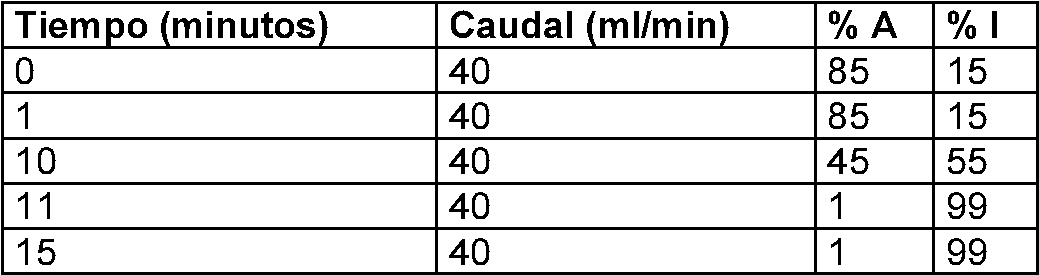
Para compuestos con un tiempo de retención de LCMS analítico de entre 0,9 y 1,2 minutos se usó el siguiente gradiente:For compounds with an analytical LCMS retention time between 0.9 and 1.2 minutes, the following gradient was used:

Para compuestos con un tiempo de retención de LCMS analítico de entre 1,2 y 1,4 minutos se usó el siguiente gradiente:For compounds with an analytical LCMS retention time between 1.2 and 1.4 minutes, the following gradient was used:

Para compuestos con un tiempo de retención de LCMS analítico superior a 1,4 minutos (LCMS método A) o superior a 3,6 minutos (LCMS método B) se usó el siguiente gradiente:For compounds with an analytical LCMS retention time greater than 1.4 minutes (LCMS method A) or greater than 3.6 minutes (LCMS method B) the following gradient was used:

La detección UV fue una señal promedio de la longitud de onda de 210 nm a 350 nm y los espectros de masas se registraron en un espectrómetro de masas usando ionización por electropulverización de barrido alterno en modo positivo y negativo.The UV detection was an average wavelength signal from 210 nm to 350 nm and the mass spectra were recorded on a mass spectrometer using alternate scanning electrospray ionization in positive and negative mode.
Los nombres químicos se generaron usando ACD Name Pro versión 6.02 de Advanced Chemistry Development, Inc.The chemical names were generated using ACD Name Pro version 6.02 of Advanced Chemistry Development, Inc.

Se puede preparar (Z)-2-(4-(1,2-Difenilbut-1-en-1-il)fenoxi)-N-metiletanamina de acuerdo con el proceso descrito por Dreaden, Erik C. et al. Bioconjugate Chem. 2009, 20, 2247-2253.(Z) -2- (4- (1,2-Diphenylbut-1-en-1-yl) phenoxy) -N-methylethanamine can be prepared according to the process described by Dreaden, Erik C. et al. Bioconjugate Chem. 2009, 20, 2247-2253.
1-fenil-2,5,8,11-tetraoxatridecan-13-oato de ferc-ButiloFerric Butyl 1-phenyl-2,5,8,11-tetraoxatridecan-13-oate

Se añadió terc-butóxido de potasio (disponible en el mercado, por ejemplo, en Aldrich) (7,71 g, 68,7 mmol) a una solución agitada de 2-(2-(2-(benciloxi)etoxi)etoxi)etanol (disponible en el mercado, por ejemplo, en Fluorochem) (15 g, 62,4 mmol) en terc-butanol (200 ml) y la mezcla de reacción se agitó a temperatura ambiente durante 2 h. La mezcla de reacción se enfrió a 0 °C, se añadió 2-bromoacetato de terc-butilo (disponible en el mercado, por ejemplo, por Aldrich) (16,59 ml, 112 mmol) y la mezcla se agitó a temperatura ambiente durante la noche. Se añadió d Cm (300 ml) y se lavó la fase orgánica con agua (300 ml) y, a continuación, salmuera (2 x 200 ml). El extracto orgánico se secó usando una frita hidrófoba y se concentró a presión reducida para proporcionar el producto crudo como un aceite de color amarillo. El producto se purificó mediante cromatografía sobre sílice usando una elución de gradiente del 0 % al 100 % de metil terc-butil éter en ciclohexano para proporcionar el compuesto de título (13,3 g, 37,5 mmol, 60 % de rendimiento). LCMS (Método A) TR= 1,10 min, ES+ve m/z 372,4 [M+NH4]+.Potassium tert-butoxide (commercially available, for example, from Aldrich) (7.71 g, 68.7 mmol) was added to a stirred solution of 2- (2- (2- (benzyloxy) ethoxy) ethoxy) ethanol (commercially available, for example, from Fluorochem) (15 g, 62.4 mmol) in tert-butanol (200 ml) and the reaction mixture was stirred at room temperature for 2 h. The reaction mixture was cooled to 0 ° C, tert-butyl 2-bromoacetate (commercially available, for example, by Aldrich) (16.59 ml, 112 mmol) was added and the mixture was stirred at room temperature for the night. D Cm (300 ml) was added and the organic phase was washed with water (300 ml) and then brine (2 x 200 ml). The organic extract was dried using a hydrophobic frit and concentrated under reduced pressure to provide the crude product as a yellow oil. The product was purified by chromatography on silica using gradient elution from 0% to 100% of methyl tert-butyl ether in cyclohexane to give the title compound (13.3 g, 37.5 mmol, 60% yield). LCMS (Method A) RT = 1.10 min, ES + ve m / z 372.4 [M + NH4] +.
2-(2-(2-(2-hidroxietoxi) etoxi) etoxi)acetato de ferc-Butilo2- (2- (2- (2-hydroxyethoxy) ethoxy) ethoxy) ferric butyl acetate

Se agitó una mezcla de 1-fenil-2,5,8,11-tetraoxatridecan-13-oato de terc-butilo (13,3 g, 37,5 mmol) y paladio sobre carbono (10 % p/p, 11,38 g, 10,69 mmol) en etanol (200 ml) a temperatura ambiente con una atmósfera de hidrógeno durante 1,5 h. El paladio sobre carbono se filtró a través de celita y el filtrado se evaporó a presión reducida para proporcionar el compuesto de título (9,74 g, 36,8 mmol, 98 % de rendimiento) como un aceite de color amarillo. RMN de 1H (400 MHz, DMSO-ds) 5 = 4,54 (s, 1h ), 3,99 (s, 2H), 3,60 - 3,40 (m, 12H), 1,43 (s, 9H).A mixture of tert-butyl 1-phenyl-2,5,8,11-tetraoxatridecan-13-oate (13.3 g, 37.5 mmol) and palladium on carbon (10% w / w, 11%) was stirred. 38 g, 10.69 mmol) in ethanol (200 ml) at room temperature under a hydrogen atmosphere for 1.5 h. The palladium on carbon was filtered through celite and the filtrate was evaporated under reduced pressure to give the title compound (9.74 g, 36.8 mmol, 98% yield) as a yellow oil. 1 H NMR (400 MHz, DMSO-ds) 5 = 4.54 (s, 1 h), 3.99 (s, 2 H), 3.60 - 3.40 (m, 12 H), 1.43 (s, 9H).
2-(2-(2-(2-(tosiloxi)etoxi)etoxi)etoxi)acetato de terc-Butilo2- (2- (2- (2- (tosyloxy) ethoxy) ethoxy) ethoxy) tert-Butyl acetate

Se añadió tosilcloruro (diponible en el mercado, por ejemplo, por Aldrich) (11,94 g, 62,6 mmol) a una solución enfriada (0° C) de 2-(2-(2-(2-hidroxietoxi)etioxi)etoxi)acetato de terc-butilo (9,74 g, 36,8 mmol) en piridina (150 ml). La reacción se agitó a temperatura ambiente durante 16 h. La mezcla de reacción se dividió entre acetato de etilo (300 ml) y HCI acuoso (2M, 300 ml). El extracto orgánico se lavó co HCI acuoso adicional (2M, 300 ml), K2CO3 saturado (100 ml) y salmuera (100 ml). El extracto orgánico se secó usando MgSO4 y se concentró a presión reducida para proporcionar el compuesto de título (10,3 g, 24,6 mmol, 67 % de rendimiento) como un aceite de color amarillo. Lc m S (Método A) TR= 1,14 min, ES+ve 436,2 [M+NH4]+.Tosylchloride (commercially available, for example, from Aldrich) (11.94 g, 62.6 mmol) was added to a cooled (0 ° C) solution of 2- (2- (2- (2-hydroxyethoxy) ethoxy) ) ethoxy) tert-butyl acetate (9.74 g, 36.8 mmol) in pyridine (150 ml). The reaction was stirred at room temperature for 16 h. The reaction mixture was partitioned between ethyl acetate (300 ml) and aqueous HCl (2M, 300 ml). The organic extract was washed with additional aqueous HCl (2M, 300 ml), saturated K 2 CO 3 (100 ml) and brine (100 ml). The organic extract was dried using MgSO 4 and concentrated under reduced pressure to provide the title compound (10.3 g, 24.6 mmol, 67% yield) as a yellow oil. Lc m S (Method A) RT = 1.14 min, ES + ve 436.2 [M + NH4] +.
(Z)-ferc-Butil 1 -(4-(1,2-difenilbut-1 -en-1 -il)fenoxi)-3-metil-6,9,12-trioxa-3-azatotradecan-14-oato(Z) -ferc-Butyl 1 - (4- (1,2-diphenylbut-1-en-1 -yl) phenoxy) -3-methyl-6,9,12-trioxa-3-azatotradecan-14-oato

Se calentó una mezcla de (Z)-2-(4-(1,2-difenilbut-1-en-1-il)fenoxi)-N-metiletanamina (141 mg, 0,394 mmol), 2-(2-(2-(2-(tosiloxi)etoxi)etoxi)etoxi)acetato de terc-butilo (0,187 ml, 0,592 mmol) y K2CO3 (545 mg, 3,94 mmol) en DMF (5 ml) a 85 °C durante 16 h. La reacción se enfrió a temperatura ambiente y se dividió entre EtOAc (30 ml) y agua (30 ml). El extracto orgánico se secó usando una frita hidrófoba y se concentró a presión reducida. El producto se purificó mediante cromatografía sobre sílice usando una elución de gradiente del 0 % al 100 % de EtOAc en ciclohexano seguido por un 0 % a 25 % de metanol en diclorometano para proporcionar el compuesto de título (141 mg, 0,234 mmol, 59 % de rendimiento) como un vidrio incoloro. LCMS (Método B) TR= 1,63 min, ES+ve m/z 604,2 [M+H]+. A mixture of (Z) -2- (4- (1,2-diphenylbut-1-en-1-yl) phenoxy) -N-methylethanamine (141 mg, 0.394 mmol), 2- (2- (2 - (tert-butyl 2- (tosyloxy) ethoxy) ethoxy) ethoxy) acetate (0.187 ml, 0.592 mmol) and K 2 CO 3 (545 mg, 3.94 mmol) in DMF (5 ml) at 85 ° C during 16 h. The reaction was cooled to room temperature and partitioned between EtOAc (30 ml) and water (30 ml). The organic extract was dried using a hydrophobic frit and concentrated under reduced pressure. The product was purified by chromatography on silica using gradient elution from 0% to 100% EtOAc in cyclohexane followed by 0% to 25% methanol in dichloromethane to give the title compound (141 mg, 0.234 mmol, 59% of performance) as a colorless glass. LCMS (Method B) RT = 1.63 min, ES + ve m / z 604.2 [M + H] +.
Ácido (Z)-1 -(4-(1,2-Difenilbut-1 -en-1 -il)fenoxi)-3-metil-6,9,12-trioxa-3-azatotradecan-14-oicoAcid (Z) -1 - (4- (1,2-Diphenylbut-1-en-1-yl) phenoxy) -3-methyl-6,9,12-trioxa-3-azatotradecan-14-oic acid

Se agitó una mezcla de (Z)-terc-butil 1-(4-(1,2-difenilbut-1-en-1-il)fenoxi)-3-metil-6,9,12-trioxa-3-azatotradecan-14-oato (141 mg, 0,234 mmol), y TFA (1 ml, 12.98 mmol) in DCM (1 ml) a temperatura ambiente durante 1,5 h. La mezcla de reacción se evaporó a presión reducida y el resto se sometió, a continuación, a purificación mediante HPLC preparativa automática dirigida por masa (modificador de carbonato de amonio) para proporcionar el compuesto de título (81 mg, 0,148 mmol, 63 % de rendimiento) como un vidrio incoloro. LCMS (Método b ) TR= 1,14 min, ES+ve m/z 548,2 [M+H]+.A mixture of (Z) -tert -butyl 1- (4- (1,2-diphenylbut-1-en-1-yl) phenoxy) -3-methyl-6,9,12-trioxa-3-azototradecan was stirred. -14-oate (141 mg, 0.234 mmol), and TFA (1 mL, 12.98 mmol) in DCM (1 mL) at room temperature for 1.5 h. The reaction mixture was evaporated under reduced pressure and the remainder was then subjected to purification by mass directed automatic preparative HPLC (ammonium carbonate modifier) to provide the title compound (81 mg, 0.148 mmol, 63% yield). performance) as a colorless glass. LCMS (Method b) RT = 1.14 min, ES + ve m / z 548.2 [M + H] +.
(2S,4R}-terc- Butil 2-((4-bromobencil)carbamoil)-4-hidroxipirrolidina-1-carboxilato (2S, 4R} -ter- Butyl 2 - ((4-bromobenzyl) carbamoyl) -4-hydroxypyrrolidine-1-carboxylate
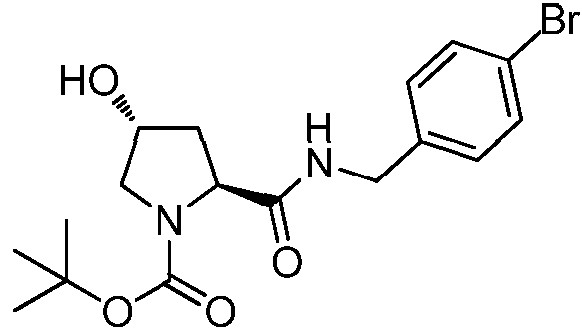
Se trató una mezcla enfriada en hielo de ácido (2S,4R)-1-(terc-butoxicarbonil)-4-hidroxipirrolidina-2-carboxilico (disponible en el mercado, por ejemplo, por Aldrich) (7,95 g, 34,4 mmol) y (4-bromofenil)metanamina (disponible en el mercado, por ejemplo, por FluroChem) (6,4 g, 34,4 mmol) en DMF (200 ml) con DIPEA (18,02 ml, 103 mmol) y, a continuación con HATU (14,39 g, 37,8 mmol) y la mezcla se agitó a temperatura ambiente durante 30 minutos. La reacción se inactivó con agua (200 ml) y se extrajo con acetato de etilo (2 x 200 ml). Las capas orgánicas combinadas se lavaron con bicarboanto de socio acuoso saturado (2 x 300 ml), agua (100 ml), salmuera (200 ml), se secó sobre sulfato de magnesio y se evaporó hasta sequedad. El producto se purificó mediante cromatografía sobre sílice usando una elución de gradiente del 0 % al 10 % de metanol en DCM para proporcionar el compuesto de título (12,9 g, 32,3 mmol, 94 % de rendimiento). LCMS (Método A) TR= 0,87 min, ES+ve m/z 399,2/401,2 [M+H]+.An ice-cooled mixture of (2S, 4R) -1- (tert-butoxycarbonyl) -4-hydroxypyrrolidine-2-carboxylic acid (commercially available, for example, from Aldrich) was treated (7.95 g, 34, 4 mmol) and (4-bromophenyl) methanamine (commercially available, for example, by FluroChem) (6.4 g, 34.4 mmol) in DMF (200 ml) with DIPEA (18.02 ml, 103 mmol) and then with HATU (14.39 g, 37.8 mmol) and the mixture was stirred at room temperature for 30 minutes. The reaction was quenched with water (200 ml) and extracted with ethyl acetate (2 x 200 ml). The combined organic layers were washed with saturated aqueous partner bicarbonate (2 x 300 ml), water (100 ml), brine (200 ml), dried over magnesium sulfate and evaporated to dryness. The product was purified by chromatography on silica using gradient elution from 0% to 10% methanol in DCM to give the title compound (12.9 g, 32.3 mmol, 94% yield). LCMS (Method A) RT = 0.87 min, ES + ve m / z 399.2 / 401.2 [M + H] +.
(2S,4R)-terc-butil4-hidroxi-2-((4-(4-metiltiazol-5-il)bencil)carbamoil)pirrolidina-1-carboxilato(2S, 4R) -tert -butyl-4-hydroxy-2 - ((4- (4-methylthiazol-5-yl) benzyl) carbamoyl) pyrrolidine-1-carboxylate

Se agitó una mezcla de (2S,4R)-terc-butil 2-((4-bromobencil)carbamoil)-4-hidroxipirrolidina-1-carboxilato (12,9 g, 32,3 mmol), 4-metiltiazol (disponible en el mercado, por ejemplo, por Aldrich) (5,88 ml, 64,6 mmol), acetato de paladio (II) (disponible en el mercado, por ejemplo, por Aldrich) (0,145 g, 0,646 mmol) y acetato de potasio (6,34 g, 64,6 mmol) en N-metil-2- pirrolidona (80 ml) a 120 °C con nitrógeno durante 18 horas. Se añadió agua (100 ml) y el producto se extrajo con acetato de etilo (4 x 300 ml). La fase orgánica combinada se lavó con salmuera (5 x 200 ml), se secó sobre sulfato de magnesio y se evaporó a sequedad. El producto se purificó mediante cromatografía sobre sílice usando una elución de gradiente del 0 % al 10 % de metanol en DCM para proporcionar el compuesto de título (8 g, 19,2 mmol, 59 % de rendimiento). LCMS (Método A) TR - 0,75 min, ES+ve m/z 418,4 [M+H]+. A mixture of (2S, 4R) -tert -butyl 2 - ((4-bromobenzyl) carbamoyl) -4-hydroxypyrrolidine-1-carboxylate (12.9 g, 32.3 mmol), 4-methylthiazole (available in US Pat. the market, for example, by Aldrich) (5.88 ml, 64.6 mmol), palladium (II) acetate (commercially available, for example, from Aldrich) (0.145 g, 0.646 mmol) and potassium acetate (6.34 g, 64.6 mmol) in N-methyl-2-pyrrolidone (80 ml) at 120 ° C under nitrogen for 18 hours. Water (100 ml) was added and the product was extracted with ethyl acetate (4 x 300 ml). The combined organic phase was washed with brine (5 x 200 ml), dried over magnesium sulfate and evaporated to dryness. The product was purified by chromatography on silica using gradient elution from 0% to 10% methanol in DCM to provide the title compound (8 g, 19.2 mmol, 59% yield). LCMS (Method A) TR - 0.75 min, ES + ve m / z 418.4 [M + H] +.
(2S,4R)-4-Hidroxi-N-(4-(4-metMtMazol-5-M)bencM)pirroMdma-2-carboxamida, hidrocloruro(2S, 4R) -4-Hydroxy-N- (4- (4-metMtMazol-5-M) benzM) pyrroMdma-2-carboxamide, hydrochloride

Se disolvió (2S,4R)-terc-Butil 4-hidroxi-2-((4-(4-metiltiazol-5-il)bencil)carbamoil)pirrolidina-1-carboxilato (8 g, 19,16 mmol) en metanol (30 ml) y DCM (20 ml) y se trató con HC1 en dioxano (4M, 8,08 ml, 32,3 mmol). La mezcla de reacción se agitó a temperatura ambiente durante 2 horas. Se retiró el disolvente en presión reducida y el resto se trituró con DCM, filtró y secó a presión reducida para producir el compuesto de título (6,7 g, 18,9 mmol, 99 % de rendimiento). LCMS (Método A) TR= 0,49 min, ES+ve m/z 318,3 [M+H]+.(2S, 4R) -tert -Butyl 4-hydroxy-2 - ((4- (4-methylthiazol-5-yl) benzyl) carbamoyl) pyrrolidine-1-carboxylate (8 g, 19.16 mmol) was dissolved in methanol (30 ml) and DCM (20 ml) and treated with HC1 in dioxane (4M, 8.08 ml, 32.3 mmol). The reaction mixture was stirred at room temperature for 2 hours. The solvent was removed under reduced pressure and the remainder was triturated with DCM, filtered and dried under reduced pressure to yield the title compound (6.7 g, 18.9 mmol, 99% yield). LCMS (Method A) RT = 0.49 min, ES + ve m / z 318.3 [M + H] +.
ferc-Butil((S)-1-((2S,4R)-4-hidroxi-2-((4-(4-metiltiazol-5-il)bencil)carbamoil)pirrolidin-1-il)-3-metil-1-oxobutan-2-il)carbamatoferc-Butyl ((S) -1 - ((2S, 4R) -4-hydroxy-2 - ((4- (4-methylthiazol-5-yl) benzyl) carbamoyl) pyrrolidin-1-yl) -3-methyl -1-oxobutan-2-yl) carbamate

Se trató una mezcla agitada de (2S,4R)-4-hidroxi-N-(4-(4-metiltiazol-5-il)bencil)pirrolidina-2-carboxamida, hidrocloruro (125 mg, 0,35 mmol) y ácido (S)-2-((terc-butoxicarbonil)amino)-3- metilbutanoico (disponible en el mercado, por ejemplo, por Aldrich) (77 mg, 0,35 mmol) en DMF (0,9 ml) con DIPEA (0,22 ml, 1,3 mmol) y, a continuación con HATU (134 mg, 0,35 mmol) y la mezcla se agitó a temperatura ambiente durante 1 hora. La mezcla de reacción se sometió directamente a purificación por HPLC preparativa automática dirigida por masa (modificador de ácido fórmico) para proporcionar el compuesto de título (120 mg, 0,232 mmol, 72 % de rendimiento). LCMS (Método A) TR= 0,87 min, ES+ve m/z 517,3 [M+H]+.A stirred mixture of (2S, 4R) -4-hydroxy-N- (4- (4-methylthiazol-5-yl) benzyl) pyrrolidine-2-carboxamide, hydrochloride (125 mg, 0.35 mmol) and acid was treated. (S) -2 - ((tert-butoxycarbonyl) amino) -3-methylbutanoic (commercially available, for example, from Aldrich) (77 mg, 0.35 mmol) in DMF (0.9 ml) with DIPEA ( 0.22 ml, 1.3 mmol) and then with HATU (134 mg, 0.35 mmol) and the mixture was stirred at room temperature for 1 hour. The reaction mixture was subjected directly to purification by mass directed automatic preparative HPLC (formic acid modifier) to provide the title compound (120 mg, 0.232 mmol, 72% yield). LCMS (Method A) RT = 0.87 min, ES + ve m / z 517.3 [M + H] +.
(25,4R)-1 -((S)-2-Amino-3-metilbutanoil)-4-hidroxi-N-(4-(4-metiltiazol-5-il)bencil)pirrolidina-2-carboxamida, hidrocloruro(25.4R) -1 - ((S) -2-Amino-3-methylbutanoyl) -4-hydroxy-N- (4- (4-methylthiazol-5-yl) benzyl) pyrrolidine-2-carboxamide, hydrochloride

Se trató una solución de terc-butil((S)-1-((2S,4R)-4-hidroxi-2-((4-(4-metiltiazol-5-il)bencil)carbamoil)pirrolidin-l-il)-3-metil-l-oxobutan-2-il)carbamato (287 mg, 0,56 mmol) en THF (5 ml) con HCl en 1,4-dioxan (4M, 10 ml, 40 mmol) y se agitó a temperatura ambiente durante 2 horas. La mezcla se evaporó a sequedad para proporcionar el compuesto del título (224 mg, 0,49 mmol, cuantiativo). LCMS (Método A) TR= 0,55 min, ES+ve m/z 417,3 [M+H]+. A solution of tert -butyl ((S) -1 - ((2S, 4R) -4-hydroxy-2 - ((4- (4-methylthiazol-5-yl) benzyl) carbamoyl) pyrrolidin-1-yl was treated. ) -3-methyl-l-oxobutan-2-yl) carbamate (287 mg, 0.56 mmol) in THF (5 ml) with HCl in 1,4-dioxane (4M, 10 ml, 40 mmol) and stirred at room temperature for 2 hours. The mixture was evaporated to dryness to give the title compound (224 mg, 0.49 mmol, quantitative). LCMS (Method A) RT = 0.55 min, ES + ve m / z 417.3 [M + H] +.
(2S,4R)-1 -((S)-2-Amino-3,3-dimetilbutanoil)-4-hidroxi-IV-(4-(4-metiltiazol-5-il)bencil)pirrolidina-2-carboxamida, hidrocloruro(2S, 4R) -1 - ((S) -2-Amino-3,3-dimethylbutanoyl) -4-hydroxy-IV- (4- (4-methylthiazol-5-yl) benzyl) pyrrolidine-2-carboxamide, hydrochloride

Se trató una mezcla agitada de (2S,4R)-4-hidroxi-N-(4-(4-metiltiazol-5-il)bencil)pirrolidina-2-carboxamida, hidrocloruro (70 mg, 0,20 mmol) y ácido (S)-2-((terc-butoxicarbonil)amino)-3,3- dimetilbutanoico (disponible en el mercado, por ejemplo, por Fluka) (50 mg, 0,22 mmol) en DMF (1 ml) con DIPEA (0,14 ml, 0,79 mmol) y, a continuación con HATU (90 mg, 0,24 mmol) y se agitó a temperatura ambiente durante 30 minutos. La mezcla de reacción se sometió directamente a purificación por HPLC preparativa automática dirigida por masa (modificador de ácido fórmico) para proporcionar el producto protegido por boc intermediario. A continuación, el intermediario se disolvió en una mezcla de diclorometano (0,5 ml) y metanol (0,1 ml) y se trató con HCI en 1,4-dioxano (4M, 0,25 ml, 1,0 mmol). Después de agitar a temperatura ambiente durante 1 hora, la mezcla de reacción se evaporó a sequedad y el resto se trituró a un sólido con diclorometano y se secó al vacío para proporcionar el compuesto de título (76 mg, 0,163 mmol, 82 % de rendimiento). LCMS (Método A) TR= 0,58 min, ES+ve m/z 431,2 [M+h ]+.A stirred mixture of (2S, 4R) -4-hydroxy-N- (4- (4-methylthiazol-5-yl) benzyl) pyrrolidine-2-carboxamide, hydrochloride (70 mg, 0.20 mmol) and acid was treated. (S) -2 - ((tert-butoxycarbonyl) amino) -3,3-dimethylbutanoic (commercially available, for example, from Fluka) (50 mg, 0.22 mmol) in DMF (1 ml) with DIPEA ( 0.14 ml, 0.79 mmol) and then HATU (90 mg, 0.24 mmol) and stirred at room temperature for 30 minutes. The reaction mixture was directly subjected to purification by mass directed automatic preparative HPLC (formic acid modifier) to provide the product protected by intermediate boc. The intermediate was then dissolved in a mixture of dichloromethane (0.5 ml) and methanol (0.1 ml) and treated with HCl in 1,4-dioxane (4M, 0.25 ml, 1.0 mmol). . After stirring at room temperature for 1 hour, the reaction mixture was evaporated to dryness and the remainder was triturated to a solid with dichloromethane and dried under vacuum to provide the title compound (76 mg, 0.163 mmol, 82% yield). ). LCMS (Method A) RT = 0.58 min, ES + ve m / z 431.2 [M + h] +.
Ejemplo 1Example 1
(2S,4R)-1 -((S)-17-(4-((Z)2-Difenilbut-1-en-I-il)fenoxi)-2-isopropil-15-metil-4-oxo-6,9,12-trioxa-3,15-diazaheptadecan-I-oil)-4-hidroxi-N-(4-(4-metiltiazol-5-il)bencil)pirrolidina-2-carboxamida N26699-42(2S, 4R) -1 - ((S) -17- (4 - ((Z) 2-Diphenylbut-1-en-I-yl) phenoxy) -2-isopropyl-15-methyl-4-oxo-6 , 9,12-trioxa-3,15-diazaheptadecan-I-oil) -4-hydroxy-N- (4- (4-methylthiazol-5-yl) benzyl) pyrrolidine-2-carboxamide N26699-42

Se añadió HATU (26 mg, 0,068 mmol) a una mezcla de (2S,4R)-1-((S)-2-amino-3-metilbutanoil)- 4-hidroxi-N-(4-(4-metiltiazol-5-il)bencil)pirrolidina-2-carboxamida, hidrocloruro, (25 mg, 0,055 mmol), ácido (Z)-1-(4-(l,2-difenilbut-1-en-1-il)fenoxi)-3-metil-6,9,12-trioxa-3-azatetradecan-14-oico (27 mg, 0,049 mmol) y DIPEA (0,05 ml, 0,286 mmol) en DMF (0,8 ml). La reacción se agitó a temperatura ambiente durante 10 minutos. La solución se sometió directamente a purificación por HPLC preparativa automática dirigida por masa (modificador de carbonato de amonio) para proporcionar el compuesto de título (36 mg, 0,038 mmol, 77 % de rendimiento). LCMS (Método B) TR= 1,44 min, ES+ve m/z 946,2 [M+H]+.HATU (26 mg, 0.068 mmol) was added to a mixture of (2S, 4R) -1 - ((S) -2-amino-3-methylbutanoyl) -4-hydroxy-N- (4- (4-methylthiazole- 5-yl) benzyl) pyrrolidine-2-carboxamide, hydrochloride, (25 mg, 0.055 mmol), (Z) -1- (4- (1, 2-diphenylbut-1-en-1-yl) phenoxy) - 3-Methyl-6,9,12-trioxa-3-azatetradecan-14-oico (27 mg, 0.049 mmol) and DIPEA (0.05 mL, 0.286 mmol) in DMF (0.8 mL). The reaction was stirred at room temperature for 10 minutes. The solution was directly subjected to purification by mass-directed automatic preparative HPLC (ammonium carbonate modifier) to provide the title compound (36 mg, 0.038 mmol, 77% yield). LCMS (Method B) RT = 1.44 min, ES + ve m / z 946.2 [M + H] +.
Ejemplo 2Example 2
(25,4R)-1 -((S)-2-(terc-Butil)-17-(4-((Z)-1,2-difenilbut-1 -en-1 -il)fenoxi)-15-metil-4-oxo-6,9,12-trioxa-3,15-diazaheptadecan-I-oil)-4-hidroxi-M-(4-(4-metiltiazol-5-il)bencil)pirrolidina-2-carboxamida N26699-42(25.4R) -1 - ((S) -2- (tert -Butyl) -17- (4 - ((Z) -1,2-diphenylbut-1-en-1-yl) phenoxy) -15- methyl-4-oxo-6,9,12-trioxa-3,15-diazaheptadecan-I-oil) -4-hydroxy-M- (4- (4-methylthiazol-5-yl) benzyl) pyrrolidine-2-carboxamide N26699-42

Se añadió HATU (26 mg, 0,068 mmol) a una mezcla de (2S,4R)-1-((S)-2-amino-3,3- dimetilbutanoil)-4-hidroxi-N-(4-(4-metiltiazol-5-il)bencil)pirrolidina-2-carboxamida, hidrocloruro (25 mg, 0,054 mmol), ácido (Z)-1-(4-(1,2-difenilbut-1-en-1-il)fenoxi)-3-metil-6,9,12-trioxa-3-azatetradecan-14-oico (27 mg, 0,049 mmol) y DIPEA (0,05 ml, 0,286 mmol) en DMF (0,8 ml). La reacción se agitó a temperatura ambiente durante 10 minutos. La solución se sometió directamente a purificación por HPLC preparativa automática dirigida por masa (modificador de carbonato de amonio) para proporcionar el compuesto de título (14 mg, 0,014 mmol, 30 % de rendimiento). LCMS (Método B) TR= 1,48 min, ES+ve m/z 960,2 [M+H]+.HATU (26 mg, 0.068 mmol) was added to a mixture of (2S, 4R) -1 - ((S) -2-amino-3,3-dimethylbutanoyl) -4-hydroxy-N- (4- (4- methylthiazol-5-yl) benzyl) pyrrolidine-2-carboxamide, hydrochloride (25 mg, 0.054 mmol), acid (Z) -1- (4- (1,2-diphenylbut-1-en-1-yl) phenoxy) 3-methyl-6,9,12-trioxa-3-azatetradecan-14-oico (27 mg, 0.049 mmol) and DIPEA (0.05 mL, 0.286 mmol) in DMF (0.8 mL). The reaction was stirred at room temperature for 10 minutes. The solution was directly subjected to purification by mass directed automatic preparative HPLC (ammonium carbonate modifier) to provide the title compound (14 mg, 0.014 mmol, 30% yield). LCMS (Method B) RT = 1.48 min, ES + ve m / z 960.2 [M + H] +.
Degradación de receptor de estrógeno alfa (Era) y ensayo de formación de imágenes de recuento celular Degradation of estrogen alpha receptor (Era) and cell count imaging assay
Se evaluaron compuestos para su degradación de Era y los efectos de recuento celular en una línea celular de MCF-7 usando una formación de imágenes de alto contenido. Se dispensaron 50ul de MCF-7 de suspensión celular en medio a cada pocillo de pared negra, con fondo claro, placas recubiertas con PDL, que contenían una concentración definida de compuesto de ensayo disuelto en DMSO que cubría un intervalo de concentración de 0,03uM a 30uM. Se incubaron células en presencia del compuesto durante 24 horas a 37 °C, 5 % de CO2 antes de que se fijaran las células. Después de su incubación con la solución fijadora (4 % de formaldehído) las paredes se aspiraron y se añadió una solución que contenía detergente para permeabilizar las células seguido por la adición de solución de bloqueo que contenía un 1 % de BSA (albúmina de suero bovino) para bloquear los sitios de unión no específicos. Después de una incubación adicional durante 1 hora esta solución se aspiró de los pocillos y se añadió el anticuerpo específico de Era diluido en solución de bloqueo a una concentración de 1ug/ml (anti ERa, cat no sc-543, Santa Cruz). Después de la incubación con el anticuerpo durante 2 horas, las células se lavaron con una solución a base de PBS antes de la adición de un anticuerpo de cabra fosfoespecífico Alexa fluor 488 anti-conejo secundario a una concentración de 2ug/ml (cat no11008, Invitrogen) y una colocación de tinte nuclear Floechst33342 a una concentración de lug/ml (cat no FI3570, invitrogen). Después de una incubación adicional durante 1 hora, las células se volvieron a lavar con solución a base de PBS. Las placas se sometieron a formación de imágenes, a continuación y la intensidad de la teinción de Era en el núcleo y se midió el recuento celular. Se expresó la actividad de degradación de Era con respecto a DMSO, proporcionando un 0 % de degradación y una molécula de degradador interno clasificadas como que proporcionan un 100 % de actividad. Se expresó la reducción de recuento celular con respecto a DMSO, clasificada como un 0 % de reducción.Compounds were evaluated for Era degradation and the effects of cell counting on an MCF-7 cell line using high content imaging. 50ul of MCF-7 cell suspension was dispensed in medium to each well of black wall, with clear bottom, plates coated with PDL, containing a defined concentration of test compound dissolved in DMSO covering a concentration range of 0.03uM at 30uM. Cells were incubated in the presence of the compound for 24 hours at 37 ° C, 5% CO 2 before the cells were fixed. After incubation with the fixing solution (4 % formaldehyde) the walls were aspirated and a solution containing detergent was added to permeabilize the cells followed by the addition of blocking solution containing 1% BSA (bovine serum albumin). ) to block non-specific binding sites. After an additional incubation for 1 hour this solution was aspirated from the wells and the specific antibody of Era was added diluted in blocking solution at a concentration of 1ug / ml (anti ERa, cat no sc-543, Santa Cruz). After incubation with the antibody for 2 hours, the cells were washed with a PBS-based solution before the addition of an anti-rabbit secondary phospho-specific goat antibody Alexa 488 at a concentration of 2ug / ml (cat no11008, Invitrogen) and a Floechst33342 nuclear dye placement at a concentration of lug / ml (cat no FI3570, invitrogen). After an additional incubation for 1 hour, the cells were again washed with PBS-based solution. The plates were subjected to imaging, then the intensity of the Teinción de Era in the nucleus and the cell count was measured. The degradation activity of Era was expressed with respect to DMSO, providing 0% degradation and an internal degrader molecule classified as providing 100% activity. The reduction in cell count was expressed with respect to DMSO, classified as a 0% reduction.
Los ejemplos mostraron evidencia de degradación de Era en este ensayo con respecto al control de DMSO a una concentración de 1uM. The examples showed evidence of Era degradation in this test with respect to the control of DMSO at a concentration of 1uM.
Claims (15)


Applications Claiming Priority (2)
| Application Number | Priority Date | Filing Date | Title |
|---|---|---|---|
| GBGB1311891.4A GB201311891D0 (en) | 2013-07-03 | 2013-07-03 | Novel compound |
| PCT/EP2014/063901 WO2015000868A1 (en) | 2013-07-03 | 2014-07-01 | Novel compounds |
Publications (1)
| Publication Number | Publication Date |
|---|---|
| ES2717436T3 true ES2717436T3 (en) | 2019-06-21 |
Family
ID=48999421
Family Applications (1)
| Application Number | Title | Priority Date | Filing Date |
|---|---|---|---|
| ES14734147T Active ES2717436T3 (en) | 2013-07-03 | 2014-07-01 | Novel compounds |
Country Status (6)
| Country | Link |
|---|---|
| US (1) | US9993514B2 (en) |
| EP (1) | EP3016967B1 (en) |
| ES (1) | ES2717436T3 (en) |
| GB (1) | GB201311891D0 (en) |
| TR (1) | TR201904340T4 (en) |
| WO (1) | WO2015000868A1 (en) |
Families Citing this family (64)
| Publication number | Priority date | Publication date | Assignee | Title |
|---|---|---|---|---|
| CA2861066C (en) | 2012-01-12 | 2024-01-02 | Yale University | Compounds and methods for the enhanced degradation of targeted proteins and other polypeptides by an e3 ubiquitin ligase |
| GB201311888D0 (en) | 2013-07-03 | 2013-08-14 | Glaxosmithkline Ip Dev Ltd | Novel compounds |
| GB201311891D0 (en) | 2013-07-03 | 2013-08-14 | Glaxosmithkline Ip Dev Ltd | Novel compound |
| US20180228907A1 (en) | 2014-04-14 | 2018-08-16 | Arvinas, Inc. | Cereblon ligands and bifunctional compounds comprising the same |
| US10071164B2 (en) | 2014-08-11 | 2018-09-11 | Yale University | Estrogen-related receptor alpha based protac compounds and associated methods of use |
| JP6817962B2 (en) | 2015-01-20 | 2021-01-20 | アルビナス・オペレーションズ・インコーポレイテッドArvinas Operations, Inc. | Compounds and methods for targeted androgen receptor degradation |
| US12312316B2 (en) | 2015-01-20 | 2025-05-27 | Arvinas Operations, Inc. | Compounds and methods for the targeted degradation of androgen receptor |
| GB201504314D0 (en) * | 2015-03-13 | 2015-04-29 | Univ Dundee | Small molecules |
| US10730870B2 (en) | 2015-03-18 | 2020-08-04 | Arvinas Operations, Inc. | Compounds and methods for the enhanced degradation of targeted proteins |
| JP6792256B2 (en) * | 2015-05-27 | 2020-11-25 | 学校法人関西文理総合学園 | peptide |
| CN107847498B (en) | 2015-05-29 | 2021-04-13 | 卫材R&D管理有限公司 | Tetrasubstituted olefin compounds and their uses |
| WO2016197114A1 (en) | 2015-06-05 | 2016-12-08 | Arvinas, Inc. | Tank-binding kinase-1 protacs and associated methods of use |
| WO2017011371A1 (en) | 2015-07-10 | 2017-01-19 | Arvinas, Inc | Mdm2-based modulators of proteolysis and associated methods of use |
| EP3337476A4 (en) | 2015-08-19 | 2019-09-04 | Arvinas, Inc. | COMPOUNDS AND METHODS FOR THE TARGETED REMOVAL OF BROMO-DOMAIN-CONTAINING PROTEINS |
| AU2016349781A1 (en) | 2015-11-02 | 2018-05-10 | Yale University | Proteolysis targeting chimera compounds and methods of preparing and using same |
| US20170281784A1 (en) | 2016-04-05 | 2017-10-05 | Arvinas, Inc. | Protein-protein interaction inducing technology |
| CA3020792A1 (en) * | 2016-04-20 | 2017-10-26 | Glaxosmithkline Intellectual Property Development Limited | Conjugates comprising ripk2 inhibitors |
| GB201610156D0 (en) | 2016-06-10 | 2016-07-27 | Otsuka Pharma Co Ltd | Cliptac compositions |
| HK1257296A1 (en) | 2016-07-12 | 2019-10-18 | Accutar Biotechnology Inc. | New compounds and their uses |
| GB2554071A (en) * | 2016-09-14 | 2018-03-28 | Univ Dundee | Small molecules |
| WO2018053354A1 (en) * | 2016-09-15 | 2018-03-22 | Arvinas, Inc. | Indole derivatives as estrogen receptor degraders |
| JP6899993B2 (en) * | 2016-10-04 | 2021-07-07 | 国立医薬品食品衛生研究所長 | Heterocyclic compound |
| WO2018071606A1 (en) | 2016-10-11 | 2018-04-19 | Arvinas, Inc. | Compounds and methods for the targeted degradation of androgen receptor |
| IL290809B2 (en) | 2016-11-01 | 2024-01-01 | Arvinas Operations Inc | PROTACS Targeted Tau-Protein and Related Methods of Use |
| CN110267940A (en) * | 2016-11-24 | 2019-09-20 | 卫材 R&D 管理有限公司 | Tetrasubstituted olefin compounds and their uses |
| CA3041986A1 (en) | 2016-11-28 | 2018-05-31 | Eisai R&D Management Co., Ltd. | Salts of indazole derivative and crystals thereof |
| KR102674902B1 (en) | 2016-12-01 | 2024-06-14 | 아비나스 오퍼레이션스, 인코포레이티드 | Tetrahydronaphthalene and tetrahydroisoquinoline derivatives as estrogen receptor degraders |
| US11173211B2 (en) | 2016-12-23 | 2021-11-16 | Arvinas Operations, Inc. | Compounds and methods for the targeted degradation of rapidly accelerated Fibrosarcoma polypeptides |
| US10806737B2 (en) | 2016-12-23 | 2020-10-20 | Arvinas Operations, Inc. | Compounds and methods for the targeted degradation of fetal liver kinase polypeptides |
| CN117510491A (en) | 2016-12-23 | 2024-02-06 | 阿尔维纳斯运营股份有限公司 | Compounds and methods for targeted degradation of rapidly accelerating fibrosarcoma polypeptides |
| MX2019007646A (en) | 2016-12-23 | 2019-09-06 | Arvinas Operations Inc | Egfr proteolysis targeting chimeric molecules and associated methods of use. |
| US11191741B2 (en) | 2016-12-24 | 2021-12-07 | Arvinas Operations, Inc. | Compounds and methods for the targeted degradation of enhancer of zeste homolog 2 polypeptide |
| AU2018211975B2 (en) | 2017-01-26 | 2022-05-26 | Arvinas Operations, Inc. | Modulators of estrogen receptor proteolysis and associated methods of use |
| BR112019015484A2 (en) | 2017-01-31 | 2020-04-28 | Arvinas Operations Inc | cereblon ligands and bifunctional compounds comprising the same |
| EP3700901A1 (en) | 2017-10-24 | 2020-09-02 | Genentech, Inc. | (4-hydroxypyrrolidin-2-yl)-heterocyclic compounds and methods of use thereof |
| US11065231B2 (en) | 2017-11-17 | 2021-07-20 | Arvinas Operations, Inc. | Compounds and methods for the targeted degradation of interleukin-1 receptor- associated kinase 4 polypeptides |
| US10519152B2 (en) | 2017-12-21 | 2019-12-31 | Astrazeneca Ab | Compounds and their use in treating cancer |
| US11220515B2 (en) | 2018-01-26 | 2022-01-11 | Yale University | Imide-based modulators of proteolysis and associated methods of use |
| US12539292B2 (en) | 2018-04-01 | 2026-02-03 | Arvinas Operations, Inc. | BRM targeting compounds and associated methods of use |
| KR20210006356A (en) | 2018-04-04 | 2021-01-18 | 아비나스 오퍼레이션스, 인코포레이티드 | Proteolysis modulators and related methods of use |
| WO2020027225A1 (en) | 2018-07-31 | 2020-02-06 | ファイメクス株式会社 | Heterocyclic compound |
| EP3841100A1 (en) | 2018-08-20 | 2021-06-30 | Arvinas Operations, Inc. | Proteolysis targeting chimeric (protac) compound with e3 ubiquitin ligase binding activity and targeting alpha-synuclein protein for treating neurodegenerative diseases |
| US10696659B2 (en) * | 2018-11-21 | 2020-06-30 | Accutar Biotechnology Inc. | Compounds having estrogen receptor alpha degradation activity and uses thereof |
| CN111205282B (en) * | 2018-11-21 | 2023-12-01 | 上海科技大学 | ER protein modulators and their applications |
| AU2019418416A1 (en) * | 2019-01-03 | 2021-07-22 | The Regents Of The University Of Michigan | Estrogen receptor protein degraders |
| JP7555938B2 (en) | 2019-01-30 | 2024-09-25 | モンテリノ・セラピューティクス・インコーポレイテッド | Bifunctional compounds and methods for targeted ubiquitination of the androgen receptor |
| US11547759B2 (en) | 2019-01-30 | 2023-01-10 | Montelino Therapeutics, Inc. | Bi-functional compounds and methods for targeted ubiquitination of androgen receptor |
| EP3932922A4 (en) | 2019-02-25 | 2022-05-11 | ShanghaiTech University | GLUTARIMIDE SKELETON SULFUR-CONTAINING COMPOUND AND USE THEREOF |
| CN119954801A (en) | 2019-07-17 | 2025-05-09 | 阿尔维纳斯运营股份有限公司 | TAU protein targeting compounds and related methods of use |
| WO2021023233A1 (en) * | 2019-08-05 | 2021-02-11 | 上海科技大学 | Egfr protein degradant and anti-tumor application thereof |
| IL320609A (en) | 2019-08-26 | 2025-07-01 | Arvinas Operations Inc | Methods of treating breast cancer with tetrahydronaphthalene derivatives as estrogen receptor degraders |
| CN115397821B (en) | 2019-10-17 | 2024-09-03 | 阿尔维纳斯运营股份有限公司 | Bifunctional molecules comprising an E3 ubiquitin ligase binding moiety linked to a BCL6 targeting moiety |
| JP2023508891A (en) * | 2019-12-17 | 2023-03-06 | オリオニス バイオサイエンシズ,インコーポレイテッド | Bifunctional Agents for Protein Mobilization and/or Degradation |
| CA3165168A1 (en) | 2019-12-19 | 2021-06-24 | Arvinas Operations, Inc. | Compounds and methods for the targeted degradation of androgen receptor |
| WO2021133886A1 (en) | 2019-12-23 | 2021-07-01 | Accutar Biotechnology | Combinations of estrogen receptor degraders and cyclin-dependent kinase inhibitors for treating cancer |
| CN115996918A (en) | 2020-05-09 | 2023-04-21 | 阿尔维纳斯运营股份有限公司 | Process for the manufacture of bifunctional compounds, ultrapure forms of bifunctional compounds, and dosage forms comprising said bifunctional compounds |
| JP7834721B2 (en) | 2020-08-28 | 2026-03-24 | アルビナス・オペレーションズ・インコーポレイテッド | Rapidly Progressive Fibrosarcoma Proteolytic Compounds and Related Methods of Use |
| AR123492A1 (en) | 2020-09-14 | 2022-12-07 | Arvinas Operations Inc | CRYSTALLINE AND AMORPHOUS FORMS OF A COMPOUND FOR TARGETED DEGRADATION OF THE ESTROGEN RECEPTOR |
| CN117279910A (en) | 2021-04-16 | 2023-12-22 | 阿尔维纳斯运营股份有限公司 | Modulators of BCL6 proteolysis and related methods of use |
| US11981672B2 (en) | 2021-09-13 | 2024-05-14 | Montelino Therapeutics Inc. | Bi-functional compounds and methods for targeted ubiquitination of androgen receptor |
| CN115028679B (en) * | 2022-08-11 | 2022-11-15 | 深圳湾实验室 | PROTAC compound with Cyclophilin A degradation activity and preparation method and application thereof |
| EP4584258A1 (en) | 2022-09-07 | 2025-07-16 | Arvinas Operations, Inc. | Rapidly accelerated fibrosarcoma (raf) degrading compounds and associated methods of use |
| CN121419983A (en) | 2023-01-26 | 2026-01-27 | 阿尔维纳斯运营股份有限公司 | cerebellar protein-based KRAS degradation PROTAC and its related applications |
| US12496301B2 (en) | 2023-12-08 | 2025-12-16 | Arvinas Operations, Inc. | Use of androgen receptor degrader for the treatment of spinal and bulbar muscular atrophy |
Family Cites Families (229)
| Publication number | Priority date | Publication date | Assignee | Title |
|---|---|---|---|---|
| US4256108A (en) | 1977-04-07 | 1981-03-17 | Alza Corporation | Microporous-semipermeable laminated osmotic system |
| US4160452A (en) | 1977-04-07 | 1979-07-10 | Alza Corporation | Osmotic system having laminated wall comprising semipermeable lamina and microporous lamina |
| US4265874A (en) | 1980-04-25 | 1981-05-05 | Alza Corporation | Method of delivering drug with aid of effervescent activity generated in environment of use |
| US4522811A (en) | 1982-07-08 | 1985-06-11 | Syntex (U.S.A.) Inc. | Serial injection of muramyldipeptides and liposomes enhances the anti-infective activity of muramyldipeptides |
| US5007790A (en) | 1989-04-11 | 1991-04-16 | Depomed Systems, Inc. | Sustained-release oral drug dosage form |
| US5169645A (en) | 1989-10-31 | 1992-12-08 | Duquesne University Of The Holy Ghost | Directly compressible granules having improved flow properties |
| US6316003B1 (en) | 1989-12-21 | 2001-11-13 | Whitehead Institute For Biomedical Research | Tat-derived transport polypeptides |
| US5292638A (en) | 1990-12-07 | 1994-03-08 | The Regents Of The University Of California | Method of determining functional estrogen receptors for prognosis of cancer |
| ATE173159T1 (en) | 1992-03-25 | 1998-11-15 | Depomed Systems Inc | ORAL MEDICINAL DOSAGE FORMS BASED ON HYDROXYETHYL CELLULOSE WITH DELAYED RELEASE |
| US5582837A (en) | 1992-03-25 | 1996-12-10 | Depomed, Inc. | Alkyl-substituted cellulose-based sustained-release oral drug dosage forms |
| ES2116591T3 (en) | 1993-04-07 | 1998-07-16 | Pfizer | CICLOALQUILHIDROXIUREAS AND ITS USE AS LIPOXIGENASA INHIBITORS. |
| US5681835A (en) | 1994-04-25 | 1997-10-28 | Glaxo Wellcome Inc. | Non-steroidal ligands for the estrogen receptor |
| US20030036654A1 (en) | 1994-08-18 | 2003-02-20 | Holt Dennis A. | Synthetic multimerizing agents |
| US5510357A (en) | 1995-02-28 | 1996-04-23 | Eli Lilly And Company | Benzothiophene compounds as anti-estrogenic agents |
| GB9603095D0 (en) | 1996-02-14 | 1996-04-10 | Zeneca Ltd | Quinazoline derivatives |
| CA2252408A1 (en) | 1996-04-24 | 1997-11-13 | Peptide Therapeutics Limited | Auto-deconvoluting combinatorial libraries |
| CA2204082A1 (en) | 1996-05-03 | 1997-11-03 | Michael William John Urquhart | Pharmaceutical compounds |
| WO1997047285A1 (en) | 1996-06-10 | 1997-12-18 | Depomed, Inc. | Gastric-retentive oral controlled drug delivery system with enhanced retention properties |
| US5972389A (en) | 1996-09-19 | 1999-10-26 | Depomed, Inc. | Gastric-retentive, oral drug dosage forms for the controlled-release of sparingly soluble drugs and insoluble matter |
| HRP970566A2 (en) | 1996-10-30 | 1998-08-31 | Jones Deborah Defeo | Conjugates useful in the treatment of prostate canser |
| ZA982877B (en) | 1997-04-09 | 1999-10-04 | Lilly Co Eli | Treatment of central nervous system disorders with selective estrogen receptor modulators. |
| CA2287387C (en) | 1997-05-14 | 2010-02-16 | Sloan-Kettering Institute For Cancer Research | Methods and compositions for destruction of selected proteins |
| CA2290624C (en) | 1997-06-06 | 2006-12-05 | John W. Shell | Gastric-retentive oral drug dosage forms for controlled release of highly soluble drugs |
| US6635280B2 (en) | 1997-06-06 | 2003-10-21 | Depomed, Inc. | Extending the duration of drug release within the stomach during the fed mode |
| EP1009420B1 (en) | 1997-07-10 | 2003-12-17 | Merck & Co., Inc. | Conjugates useful in the treatment of prostate cancer |
| AU744986B2 (en) | 1997-07-12 | 2002-03-07 | Cancer Research Technology Limited | Cyclin dependent kinase inhibiting purine derivatives |
| GB9716557D0 (en) | 1997-08-06 | 1997-10-08 | Glaxo Group Ltd | Benzylidene-1,3-dihydro-indol-2-one derivatives having anti-cancer activity |
| AU9386198A (en) | 1997-09-10 | 1999-03-29 | President And Fellows Of Harvard College | Inducible methods for repressing gene function |
| US6323219B1 (en) | 1998-04-02 | 2001-11-27 | Ortho-Mcneil Pharmaceutical, Inc. | Methods for treating immunomediated inflammatory disorders |
| ES2347027T3 (en) | 1998-05-22 | 2010-10-22 | The Board Of Trustees Of The Leland Stanford Junior University | BIFUNCTIONAL MOLECULES AND THERAPIES BASED ON THE SAME. |
| US7223556B1 (en) | 1998-10-09 | 2007-05-29 | President And Fellows Of Harvard College | Targeted proteolysis by recruitment to ubiquitin protein ligases |
| US6306663B1 (en) | 1999-02-12 | 2001-10-23 | Proteinex, Inc. | Controlling protein levels in eucaryotic organisms |
| CA2362520A1 (en) | 1999-02-26 | 2000-08-31 | Joan W. Conaway | Novel component of von hippel-lindau tumor suppressor complex and scf ubiquitin ligase |
| US6858709B1 (en) | 1999-02-26 | 2005-02-22 | Oklahoma Medical Research Foundation | Component of von Hippel-Lindau tumor suppressor complex and SCF ubiquitin ligase |
| US6333344B1 (en) | 1999-05-05 | 2001-12-25 | Merck & Co. | Prolines as antimicrobial agents |
| US7087386B2 (en) | 1999-06-11 | 2006-08-08 | The Burnham Institute | Nucleic acid encoding proteins involved in protein degradation, products and methods related thereto |
| US6921763B2 (en) | 1999-09-17 | 2005-07-26 | Abbott Laboratories | Pyrazolopyrimidines as therapeutic agents |
| WO2001028593A2 (en) | 1999-10-19 | 2001-04-26 | Merck & Co., Inc. | Conjugates useful in the treatment of prostate cancer |
| CA2389236A1 (en) | 1999-11-02 | 2001-05-10 | Depomed, Inc. | Pharmacological inducement of the fed mode for enhanced drug administration to the stomach |
| ES2270982T3 (en) | 2000-02-04 | 2007-04-16 | Depomed, Inc. | DOSAGE FORM OF NUCLEO AND CARCASA THAT IS APPROXIMATE TO A RELEASE OF THE ZERO ORDER PHARMACO. |
| US6740495B1 (en) | 2000-04-03 | 2004-05-25 | Rigel Pharmaceuticals, Inc. | Ubiquitin ligase assay |
| US6488962B1 (en) | 2000-06-20 | 2002-12-03 | Depomed, Inc. | Tablet shapes to enhance gastric retention of swellable controlled-release oral dosage forms |
| PE20020354A1 (en) | 2000-09-01 | 2002-06-12 | Novartis Ag | HYDROXAMATE COMPOUNDS AS HISTONE-DESACETILASE (HDA) INHIBITORS |
| US7208157B2 (en) | 2000-09-08 | 2007-04-24 | California Institute Of Technology | Proteolysis targeting chimeric pharmaceutical |
| US7041298B2 (en) | 2000-09-08 | 2006-05-09 | California Institute Of Technology | Proteolysis targeting chimeric pharmaceutical |
| US6451808B1 (en) | 2000-10-17 | 2002-09-17 | Depomed, Inc. | Inhibition of emetic effect of metformin with 5-HT3 receptor antagonists |
| CA2432932A1 (en) | 2001-02-16 | 2002-08-29 | Mark A. Scialdone | Angiogenesis-inhibitory tripeptides, compositions and their methods of use |
| GB0106953D0 (en) | 2001-03-20 | 2001-05-09 | Univ Aberdeen | Neufofibrillary labels |
| MXPA03008560A (en) | 2001-03-22 | 2004-06-30 | Abbot Gmbh & Co Kg | Single-stage pfc + ballast control circuit/general purpose power converter. |
| JP2004532259A (en) | 2001-05-29 | 2004-10-21 | デポメッド ディベロップメント リミティド | Treatment of gastroesophageal reflux disease and recovery of gastric acid secretion at night |
| HN2002000136A (en) | 2001-06-11 | 2003-07-31 | Basf Ag | INHIBITORS OF THE PROTEASE OF HIV VIRUS, COMPOUNDS CONTAINING THEMSELVES, THEIR PHARMACEUTICAL USES AND THE MATERIALS FOR SYNTHESIS |
| ATE491701T1 (en) | 2001-08-03 | 2011-01-15 | Vertex Pharma | PYRAZOLE-DERIVED KINAS INHIBITORS AND THEIR USE |
| GB0119249D0 (en) | 2001-08-07 | 2001-10-03 | Novartis Ag | Organic compounds |
| ES2367422T3 (en) | 2001-10-09 | 2011-11-03 | Amgen Inc. | IMIDAZOL DERIVATIVES AS ANTI-INFLAMMATORY AGENTS. |
| US20030133927A1 (en) | 2001-10-10 | 2003-07-17 | Defeo-Jones Deborah | Conjugates useful in the treatment of prostate cancer |
| TWI312285B (en) | 2001-10-25 | 2009-07-21 | Depomed Inc | Methods of treatment using a gastric retained gabapentin dosage |
| JP2005508358A (en) | 2001-10-25 | 2005-03-31 | デポメド・インコーポレイテッド | Method of treatment using gastric retention type losartan dosage |
| US6723340B2 (en) | 2001-10-25 | 2004-04-20 | Depomed, Inc. | Optimal polymer mixtures for gastric retentive tablets |
| US20030091630A1 (en) | 2001-10-25 | 2003-05-15 | Jenny Louie-Helm | Formulation of an erodible, gastric retentive oral dosage form using in vitro disintegration test data |
| CA2409552A1 (en) | 2001-10-25 | 2003-04-25 | Depomed, Inc. | Gastric retentive oral dosage form with restricted drug release in the lower gastrointestinal tract |
| US7053046B2 (en) | 2001-12-21 | 2006-05-30 | Mcgrath Kevin | Peptide activators of VEGF |
| US6682759B2 (en) | 2002-02-01 | 2004-01-27 | Depomed, Inc. | Manufacture of oral dosage forms delivering both immediate-release and sustained-release drugs |
| WO2004005248A1 (en) | 2002-07-02 | 2004-01-15 | Novartis Ag | Peptide inhibitors of smac protein binding to inhibitor of apoptosis proteins (iap) |
| US20040053324A1 (en) | 2002-08-30 | 2004-03-18 | Brian Wong | Assays and compositions for identifying agents that modulate the activity of deubiquitinating agents |
| US20040114258A1 (en) | 2002-12-17 | 2004-06-17 | Harris Richard Alexander | Device and method for combining dynamic mathematical expressions and other multimedia objects within a document |
| EP1577285A4 (en) | 2002-12-25 | 2006-04-12 | Idemitsu Kosan Co | ADAMANTANE DERIVATIVE AND METHOD FOR PRODUCING THE SAME |
| WO2004094409A1 (en) | 2003-03-27 | 2004-11-04 | Lankenau Institute For Medical Research | Novel ido inhibitors and methods of use |
| WO2004100868A2 (en) | 2003-04-23 | 2004-11-25 | Abbott Laboratories | Method of treating transplant rejection |
| US7915293B2 (en) | 2003-05-30 | 2011-03-29 | Rigel Pharmaceuticals, Inc. | Ubiquitin ligase inhibitors |
| US20070281907A1 (en) | 2003-12-22 | 2007-12-06 | Watkins William J | Kinase Inhibitor Phosphonate Conjugates |
| US7932382B2 (en) | 2004-01-16 | 2011-04-26 | The Regents Of The University Of Michigan | Conformationally constrained Smac mimetics and the uses thereof |
| WO2005094818A1 (en) | 2004-03-23 | 2005-10-13 | Genentech, Inc. | Azabicyclo-octane inhibitors of iap |
| RS52545B (en) | 2004-04-07 | 2013-04-30 | Novartis Ag | INHIBITORI PROTEIN APOPTOZE (IAP) |
| WO2005118588A1 (en) | 2004-06-02 | 2005-12-15 | Takeda Pharmaceutical Company Limited | Fused heterocyclic compound |
| BRPI0511350A (en) | 2004-07-02 | 2007-12-04 | Genentech Inc | compound, methods for inducing apoptosis in a cell, sensitizing a cell to an apoptotic signal, inhibiting the binding of an iap protein, and treating a disease and cancer, and using a compound. |
| EP1781598A1 (en) | 2004-07-08 | 2007-05-09 | Warner-Lambert Company LLC | Androgen modulators |
| CN103251953A (en) | 2004-07-19 | 2013-08-21 | 约翰·霍普金斯大学 | Flt3 inhibitors for immune suppression |
| US7294748B2 (en) | 2004-10-19 | 2007-11-13 | Wake Forest University Health Sciences | Sulfenic acid-reactive compounds and their methods of synthesis |
| WO2006062685A2 (en) | 2004-11-11 | 2006-06-15 | Affymax, Inc. | Novel peptides that bind to the erythropoietin receptor |
| GB0426661D0 (en) * | 2004-12-06 | 2005-01-05 | Isis Innovation | Pyrrolidine compounds |
| MX2007007195A (en) | 2004-12-20 | 2007-10-08 | Genentech Inc | Pyrrolidine inhibitors of iap. |
| ES2456671T3 (en) | 2005-02-25 | 2014-04-23 | Tetralogic Pharmaceuticals Corporation | IAP dimeric inhibitors |
| CN100383139C (en) | 2005-04-07 | 2008-04-23 | 天津和美生物技术有限公司 | Piperidine-2,6-dione derivatives that can inhibit the release of tumor necrosis factor from cells |
| WO2006113942A2 (en) | 2005-04-20 | 2006-10-26 | Schering Corporation | Method of inhibiting cathepsin activity |
| PL1879573T3 (en) | 2005-05-10 | 2013-05-31 | Incyte Holdings Corp | Modulators of indoleamine 2,3-dioxygenase and methods of using the same |
| FR2885904B1 (en) | 2005-05-19 | 2007-07-06 | Aventis Pharma Sa | NOVEL FLUORENE DERIVATIVES, COMPOSITIONS CONTAINING SAME AND USE THEREOF |
| EP1940805A4 (en) | 2005-08-26 | 2009-11-11 | Methylgene Inc | Benzodiazepine and benzopiperazine analog inhibitors of histone deacetylase |
| CA2620566A1 (en) | 2005-08-30 | 2007-03-08 | Boehringer Ingelheim International Gmbh | Glucopyranosyl-substituted benzyl-benzene derivatives, medicaments containing such compounds, their use and process for their manufacture |
| KR101443651B1 (en) | 2005-10-18 | 2014-09-23 | 얀센 파마슈티카 엔.브이. | Method of inhibiting flt-3 kinase |
| US7705022B2 (en) | 2005-10-27 | 2010-04-27 | Lankenau Institute For Medical Research | IDO inhibitors and methods of use thereof |
| BRPI0708524A2 (en) | 2006-03-03 | 2011-05-31 | Novartis Ag | n-formyl hydroxylamine compounds |
| WO2007101347A1 (en) | 2006-03-07 | 2007-09-13 | Aegera Therapeutics Inc. | Bir domain binding compounds |
| KR101456722B1 (en) | 2006-03-29 | 2014-10-31 | 더 리전트 오브 더 유니버시티 오브 캘리포니아 | Diarylthiohydantoin compounds |
| CA2648518C (en) | 2006-04-11 | 2012-06-26 | Ramot At Tel Aviv University Ltd. | Treatment of hematological malignancies with fts and a bcr-abl tyrosine kinase inhibitor |
| CA2651072A1 (en) | 2006-05-01 | 2007-11-08 | Pfizer Products Inc. | Substituted 2-amino-fused heterocyclic compounds |
| WO2007129195A2 (en) | 2006-05-04 | 2007-11-15 | Pfizer Products Inc. | 4-pyrimidine-5-amino-pyrazole compounds |
| JP5230610B2 (en) | 2006-05-05 | 2013-07-10 | ザ リージェンツ オブ ザ ユニバーシティ オブ ミシガン | Bivalent SMAC mimics and uses thereof |
| JP2009544620A (en) | 2006-07-20 | 2009-12-17 | リガンド・ファーマシューティカルズ・インコーポレイテッド | Prolineurea CCR1 antagonists for autoimmune diseases and inflammation |
| US20100056495A1 (en) | 2006-07-24 | 2010-03-04 | Tetralogic Pharmaceuticals Corporation | Dimeric iap inhibitors |
| CA2668286C (en) | 2006-11-03 | 2014-09-16 | Pharmacyclics, Inc. | Bruton's tyrosine kinase activity probe and method of using |
| WO2008067495A2 (en) | 2006-11-29 | 2008-06-05 | Rutgers, The State University Of New Jersey | Chemotherapeutic conjugates and methods of use |
| TW200902508A (en) | 2007-03-07 | 2009-01-16 | Janssen Pharmaceutica Nv | Substituted phenoxy thiazolidinediones as estrogen related receptor-α modulators |
| ATE537157T1 (en) | 2007-03-07 | 2011-12-15 | Janssen Pharmaceutica Nv | SUBSTITUTED PHENOXY-N-ALKYLATED THIAZOLEDINDIONES AS ESTROGEN-ASSOCIATED RECEPTOR ALPHA MODULATORS |
| US8389568B2 (en) | 2007-03-16 | 2013-03-05 | Lankenau Institute For Medical Research | IDO inhibitors and methods of use thereof |
| US20080233850A1 (en) | 2007-03-20 | 2008-09-25 | 3M Innovative Properties Company | Abrasive article and method of making and using the same |
| JP5454943B2 (en) | 2007-04-12 | 2014-03-26 | ジョイアント ファーマスーティカルズ、インク. | SMAC mimetic dimers and trimers useful as anticancer agents |
| WO2008128171A2 (en) | 2007-04-13 | 2008-10-23 | The Regents Of The University Of Michigan | Diazo bicyclic smac mimetics and the uses thereof |
| PE20130150A1 (en) | 2007-04-30 | 2013-02-27 | Genentech Inc | INHIBITORS OF IAP |
| WO2008144925A1 (en) | 2007-05-30 | 2008-12-04 | Aegera Therapeutics Inc. | Iap bir domain binding compounds |
| KR20100038108A (en) | 2007-07-25 | 2010-04-12 | 브리스톨-마이어스 스큅 컴퍼니 | Triazine kinase inhibitors |
| CN101820765A (en) | 2007-07-31 | 2010-09-01 | 安德鲁科技有限公司 | Compositions including androgen receptor degradation (ard) enhancers and methods of prophylactic or therapeutic treatment of skin disorders and hair loss |
| EP2058312A1 (en) | 2007-11-09 | 2009-05-13 | Universita' degli Studi di Milano | SMAC mimetic compounds as apoptosis inducers |
| WO2009122180A1 (en) | 2008-04-02 | 2009-10-08 | Medical Research Council | Pyrimidine derivatives capable of inhibiting one or more kinases |
| US20120135089A1 (en) | 2009-03-17 | 2012-05-31 | Stockwell Brent R | E3 ligase inhibitors |
| US8691187B2 (en) | 2009-03-23 | 2014-04-08 | Eli Lilly And Company | Imaging agents for detecting neurological disorders |
| WO2010141805A1 (en) | 2009-06-05 | 2010-12-09 | Janssen Pharmaceutica Nv | Heterocyclic amides as modulators of trpa1 |
| WO2011005510A2 (en) | 2009-06-22 | 2011-01-13 | Cerapedics, Inc. | Peptide conjugates and uses thereof |
| JP2012532929A (en) | 2009-07-13 | 2012-12-20 | プレジデント アンド フェロウズ オブ ハーバード カレッジ | Bifunctional stapled polypeptides and their use |
| JP2012254939A (en) | 2009-10-07 | 2012-12-27 | Astellas Pharma Inc | Oxazole compound |
| EP2784076A1 (en) | 2009-10-28 | 2014-10-01 | Joyant Pharmaceuticals, Inc. | Dimeric SMAC mimetics |
| US20110164191A1 (en) | 2010-01-04 | 2011-07-07 | Microvision, Inc. | Interactive Projection Method, Apparatus and System |
| US8198300B2 (en) | 2010-04-29 | 2012-06-12 | Universidad De Chile | Method for preventing tau protein aggregation and treating Alzheimer's disease with a quinoline derivative compound |
| MX354217B (en) | 2010-05-14 | 2018-02-19 | Dana Farber Cancer Inst Inc | Compositions and methods for treating leukemia. |
| PL2902030T3 (en) | 2010-05-14 | 2017-07-31 | Dana-Farber Cancer Institute, Inc. | Thienotriazolodiazepine compounds for treating neoplasia |
| WO2011160016A2 (en) | 2010-06-17 | 2011-12-22 | The Trustees Of Columbia University In The City Of New York | E3 binding pockets and identification and use of e3 ligase inhibitors |
| SG186389A1 (en) | 2010-06-30 | 2013-01-30 | Univ Brandeis | Small-molecule-targeted protein degradation |
| JP5823514B2 (en) | 2010-07-07 | 2015-11-25 | アーデリクス,インコーポレーテッド | Compounds and methods for inhibiting phosphate transport |
| JP5985473B2 (en) | 2010-07-13 | 2016-09-06 | エフ.ホフマン−ラ ロシュ アーゲーF. Hoffmann−La Roche Aktiengesellschaft | Pyrazolo [1,5a] pyrimidine and thieno [3,2b] pyrimidine derivatives as IRAK4 modulators |
| EP2592933B1 (en) | 2010-07-16 | 2017-04-05 | Anderson Gaweco | Mif inhibitors and their uses |
| EP2619184B1 (en) | 2010-09-24 | 2018-05-23 | The Regents of the University of Michigan | Deubiquitinase inhibitors and methods for use of the same |
| MX382354B (en) | 2010-11-01 | 2025-03-13 | Celgene Car Llc | HETEROCYCLIC COMPOUNDS AND THEIR USES. |
| CN102477033A (en) | 2010-11-23 | 2012-05-30 | 苏州波锐生物医药科技有限公司 | Benzothiophene compound and application thereof in preparing medicine for preventing and/or treating breast cancer osteoporosis |
| AR084070A1 (en) | 2010-12-02 | 2013-04-17 | Constellation Pharmaceuticals Inc | BROMODOMINIUM INHIBITORS AND USES OF THE SAME |
| AU2011338615B2 (en) | 2010-12-07 | 2017-07-27 | Yale University | Small-molecule hydrophobic tagging of fusion proteins and induced degradation of same |
| US20140243282A1 (en) | 2010-12-31 | 2014-08-28 | Satish Reddy Kallam | Methods and compositions for designing novel conjugate therapeutics |
| WO2012129258A1 (en) | 2011-03-22 | 2012-09-27 | Merck Sharp & Dohme Corp. | Amidopyrazole inhibitors of interleukin receptor-associated kinases |
| US9133164B2 (en) | 2011-04-13 | 2015-09-15 | Innov88 Llc | MIF inhibitors and their uses |
| NO2694640T3 (en) | 2011-04-15 | 2018-03-17 | ||
| AU2012255275B2 (en) | 2011-05-17 | 2016-01-28 | Plexxikon Inc. | Kinase modulation and indications therefor |
| US20140161720A1 (en) | 2011-05-26 | 2014-06-12 | The General Hospital Corporation | Treatment of angiogenic- or vascular-associated diseases |
| EP2721031B1 (en) | 2011-06-17 | 2016-01-20 | Constellation Pharmaceuticals, Inc. | Bromodomain inhibitors and uses thereof |
| WO2013042137A1 (en) | 2011-09-19 | 2013-03-28 | Aurigene Discovery Technologies Limited | Bicyclic heterocycles as irak4 inhibitors |
| MX352672B (en) | 2011-09-27 | 2017-12-04 | Amgen Inc | Heterocyclic compounds as mdm2 inhibitors for the treatment of cancer. |
| WO2013066729A1 (en) | 2011-10-31 | 2013-05-10 | Merck Sharp & Dohme Corp. | Aminopyrimidinones as interleukin receptor-associated kinase inhibitors |
| WO2013071035A1 (en) | 2011-11-09 | 2013-05-16 | Ensemble Therapeutics | Macrocyclic compounds for inhibition of inhibitors of apoptosis |
| WO2013071039A1 (en) | 2011-11-09 | 2013-05-16 | Ensemble Therapeutics | Macrocyclic compounds for inhibition of inhibitors of apoptosis |
| CN103172648B (en) | 2011-12-20 | 2016-05-25 | 上海迪诺医药科技有限公司 | Three Hete rocyclic derivatives, preparation method and application |
| CN104582705A (en) | 2012-01-10 | 2015-04-29 | 林伯士艾瑞斯公司 | IRAK inhibitors and uses thereof |
| CA2861066C (en) * | 2012-01-12 | 2024-01-02 | Yale University | Compounds and methods for the enhanced degradation of targeted proteins and other polypeptides by an e3 ubiquitin ligase |
| WO2013106646A2 (en) | 2012-01-12 | 2013-07-18 | Yale University | Compounds and methods for the inhibition of vcb e3 ubiquitin ligase |
| EP2802576B1 (en) | 2012-01-13 | 2018-06-27 | Bristol-Myers Squibb Company | Heterocyclic-substituted pyridyl compounds useful as kinase inhibitors |
| CN104254533B (en) | 2012-01-13 | 2017-09-08 | 百时美施贵宝公司 | The pyridinyl compounds of thiazole or thiadiazoles substitution as kinase inhibitor |
| WO2013106614A1 (en) | 2012-01-13 | 2013-07-18 | Bristol-Myers Squibb Company | Triazolyl-substituted pyridyl compounds useful as kinase inhibitors |
| PT2840080T (en) | 2012-04-17 | 2018-02-06 | Fujifilm Corp | HETEROCYCLIC COMPOUND CONTAINING NITROGEN OR SALT THEREOF |
| US20150119435A1 (en) | 2012-05-11 | 2015-04-30 | Yale University | Compounds useful for promoting protein degradation and methods using same |
| EP2855483B1 (en) | 2012-05-24 | 2017-10-25 | Novartis AG | Pyrrolopyrrolidinone compounds |
| NZ631477A (en) | 2012-05-30 | 2016-12-23 | Hoffmann La Roche | Substituted pyrrolidine-2-carboxamides |
| US9345740B2 (en) | 2012-07-10 | 2016-05-24 | Bristol-Myers Squibb Company | IAP antagonists |
| US9371568B2 (en) | 2012-07-31 | 2016-06-21 | Novartis Ag | Markers associated with human double minute 2 inhibitors |
| WO2014025759A1 (en) | 2012-08-09 | 2014-02-13 | Bristol-Myers Squibb Company | Iap antagonists |
| TWI586668B (en) | 2012-09-06 | 2017-06-11 | 第一三共股份有限公司 | Crystals of dispiropyrrolidine derivative |
| WO2014047024A1 (en) | 2012-09-18 | 2014-03-27 | Bristol-Myers Squibb Company | Iap antagonists |
| JP6407504B2 (en) | 2012-09-21 | 2018-10-17 | アログ・ファーマシューティカルズ・インコーポレイテッドArog Pharmaceuticals,Inc. | Method for inhibiting constitutively active phosphorylated FLT3 kinase |
| US9603889B2 (en) | 2012-10-02 | 2017-03-28 | Bristol-Myers Squibb Company | IAP antagonists |
| WO2014058691A1 (en) | 2012-10-08 | 2014-04-17 | Merck Sharp & Dohme Corp. | Inhibitors of irak4 activity |
| CA2889182A1 (en) | 2012-10-26 | 2014-05-01 | The University Of Chicago | Synergistic combination of immunologic inhibitors for the treatment of cancer |
| TW201428002A (en) | 2012-11-09 | 2014-07-16 | 必治妥美雅史谷比公司 | Macrocyclic compounds for inhibition of inhibitors of apoptosis |
| TW201429969A (en) | 2012-12-20 | 2014-08-01 | Merck Sharp & Dohme | Substituted imidazolium as an HDM2 inhibitor |
| US9637493B2 (en) | 2012-12-20 | 2017-05-02 | Merck Sharp & Dohme Corp. | Substituted pyrrolopyrimidines as HDM2 inhibitors |
| EP2752191A1 (en) | 2013-01-07 | 2014-07-09 | Sanofi | Compositions and methods using hdm2 antagonist and mek inhibitor |
| BR112015016282A2 (en) | 2013-01-07 | 2017-07-11 | Arog Pharmaceuticals, Inc. | crenolanib for treatment of mutated flt3 proliferative disorders |
| GB201311910D0 (en) | 2013-07-03 | 2013-08-14 | Glaxosmithkline Ip Dev Ltd | Novel Compounds |
| NL2011274C2 (en) | 2013-08-06 | 2015-02-09 | Illumicare Ip B V 51 | Groundbreaking platform technology for specific binding to necrotic cells. |
| CA2902856C (en) | 2013-02-28 | 2021-02-16 | Amgen Inc. | A benzoic acid derivative mdm2 inhibitor for the treatment of cancer |
| AU2014236812B2 (en) | 2013-03-14 | 2018-03-01 | Amgen Inc. | Heteroaryl acid morpholinone compounds as MDM2 inhibitors for the treatment of cancer |
| EP2970334B1 (en) | 2013-03-15 | 2018-05-23 | Biogen MA Inc. | Macrocyclic compounds as irak4 inhibitors for the treatment of inflammatory diseases |
| RS57462B1 (en) | 2013-03-15 | 2018-09-28 | Bristol Myers Squibb Co | Inhibitors of indoleamine 2,3-dioxygenase (ido) |
| EA029126B1 (en) | 2013-07-01 | 2018-02-28 | Бристол-Майерс Сквибб Компани | Ido inhibitors |
| GB201311888D0 (en) | 2013-07-03 | 2013-08-14 | Glaxosmithkline Ip Dev Ltd | Novel compounds |
| GB201311891D0 (en) | 2013-07-03 | 2013-08-14 | Glaxosmithkline Ip Dev Ltd | Novel compound |
| ES2707961T3 (en) | 2013-07-11 | 2019-04-08 | Bristol Myers Squibb Co | IDO inhibitors |
| EP3019517A1 (en) | 2013-07-12 | 2016-05-18 | Bristol-Myers Squibb Company | Iap antagonists |
| CN103570726B (en) | 2013-07-15 | 2016-04-06 | 上海天慈生物谷生物工程有限公司 | N-alkyl couroupitine A derivative and its preparation method and application |
| WO2015011084A1 (en) | 2013-07-23 | 2015-01-29 | Bayer Pharma Aktiengesellschaft | Substituted dihydropyrido[3,4-b]pyrazinones as dual inhibitors of bet proteins and polo-like kinases |
| JP6542212B2 (en) | 2013-07-31 | 2019-07-10 | ゼニス・エピジェネティクス・リミテッドZenith Epigenetics Ltd. | Novel quinazolinones as bromodomain inhibitors |
| US20150051208A1 (en) | 2013-08-14 | 2015-02-19 | Boehringer Ingelheim International Gmbh | Pyridinones |
| CA2921199A1 (en) | 2013-08-27 | 2015-03-05 | Bristol-Myers Squibb Company | Ido inhibitors |
| US10463658B2 (en) | 2013-10-25 | 2019-11-05 | Videra Pharmaceuticals, Llc | Method of inhibiting FLT3 kinase |
| US9428513B2 (en) | 2013-11-07 | 2016-08-30 | Boehringer Ingelheim International Gmbh | Triazolopyrazine |
| DK3066085T3 (en) | 2013-11-08 | 2020-06-02 | Incyte Holdings Corp | PROCEDURE FOR THE SYNTHESIS OF AN INDOLAMIN-2,3-DIOXYGENASE INHIBITOR |
| CN105899505B (en) | 2013-11-08 | 2018-08-28 | 武田药品工业株式会社 | Pyrazoles for the treatment of autoimmune disorders |
| CN103570727B (en) | 2013-11-12 | 2015-08-19 | 复旦大学 | A kind of N-benzyl couroupitine A derivative and its preparation method and application |
| JP6553632B2 (en) | 2013-11-18 | 2019-07-31 | フォーマ セラピューティクス,インコーポレイテッド | Tetrahydroquinoline compositions as BET bromodomain inhibitors |
| UA115388C2 (en) | 2013-11-21 | 2017-10-25 | Пфайзер Інк. | 2,6-substituted purine derivatives and their use in the treatment of proliferative disorders |
| US9399640B2 (en) | 2013-11-26 | 2016-07-26 | Incyte Corporation | Substituted pyrrolo[2,3-c]pyridines and pyrazolo[3,4-c]pyridines as BET protein inhibitors |
| US9458156B2 (en) | 2014-12-23 | 2016-10-04 | Bristol-Myers Squibb Company | Tricyclic compounds as anticancer agents |
| TW201609693A (en) | 2014-01-03 | 2016-03-16 | 必治妥美雅史谷比公司 | Heteroaryl substituted incotinamide compounds |
| SG11201605408RA (en) | 2014-01-10 | 2016-07-28 | Aurigene Discovery Tech Ltd | Indazole compounds as irak4 inhibitors |
| FI3805233T3 (en) | 2014-01-13 | 2024-04-17 | Aurigene Oncology Ltd | N-(5-(3-HYDROXYPYRROLIDIN-1-YL)-2-MORPHOLINOXAZOLO[4,5-B]PYRIDIN-6-YL)-2-(2-METHYLYPYRIDIN-4-YL)OCAZOLE-CARBOXAMIDE (R)- (S)-ENANTIOMERES AS IRAK4 INHIBITORS FOR THE TREATMENT OF CANCER |
| JP6351306B2 (en) | 2014-03-06 | 2018-07-04 | キヤノン株式会社 | Image processing apparatus, image processing apparatus control method, and program |
| US20150259288A1 (en) | 2014-03-14 | 2015-09-17 | City Of Hope | 5-bromo-indirubins |
| MA39838B1 (en) | 2014-04-04 | 2019-05-31 | Pfizer | Bicyclic heteroaryl or fused aryl compounds and their use as irak4 inhibitors |
| US20160058872A1 (en) | 2014-04-14 | 2016-03-03 | Arvinas, Inc. | Imide-based modulators of proteolysis and associated methods of use |
| AU2015247817C1 (en) | 2014-04-14 | 2022-02-10 | Arvinas Operations, Inc. | Imide-based modulators of proteolysis and associated methods of use |
| EP3143015B1 (en) | 2014-05-13 | 2019-02-20 | ARIAD Pharmaceuticals, Inc. | Heteroaryl compounds for kinase inhibition |
| PE20170247A1 (en) | 2014-05-15 | 2017-03-29 | Iteos Therapeutics | PYRROLIDINE-2,5-DIONA DERIVATIVES, PHARMACEUTICAL COMPOSITIONS AND METHODS TO USE AS IDO1 INHIBITORS |
| TW201613916A (en) | 2014-06-03 | 2016-04-16 | Gilead Sciences Inc | TANK-binding kinase inhibitor compounds |
| US10246456B2 (en) | 2014-07-18 | 2019-04-02 | Biogen Ma Inc. | IRAK4 inhibiting agents |
| US10071164B2 (en) | 2014-08-11 | 2018-09-11 | Yale University | Estrogen-related receptor alpha based protac compounds and associated methods of use |
| SG10201804868PA (en) | 2014-09-05 | 2018-07-30 | Merck Patent Gmbh | Compounds for the inhibition of indoleamine-2,3-dioxygenase |
| US9926330B2 (en) | 2014-09-30 | 2018-03-27 | Merck Sharp & Dohme Corp. | Inhibitors of IRAK4 activity |
| EP3200790B1 (en) | 2014-09-30 | 2020-08-26 | Merck Sharp & Dohme Corp. | Inhibitors of irak4 activity |
| US9932350B2 (en) | 2014-09-30 | 2018-04-03 | Merck Sharp & Dohme Corp. | Inhibitors of IRAK4 activity |
| US9969749B2 (en) | 2014-09-30 | 2018-05-15 | Merck Sharp & Dohme Corp. | Inhibitors of IRAK4 activity |
| UY36391A (en) | 2014-11-05 | 2016-06-01 | Flexus Biosciences Inc | MODULATING COMPOUNDS OF INDOLAMINE ENZYME 2,3-DIOXYGENASE (IDO1), ITS SYNTHESIS METHODS AND PHARMACEUTICAL COMPOSITIONS CONTAINING THEM |
| UY36390A (en) | 2014-11-05 | 2016-06-01 | Flexus Biosciences Inc | MODULATING COMPOUNDS OF INDOLAMINE ENZYME 2,3-DIOXYGENASE (IDO), ITS SYNTHESIS METHODS AND PHARMACEUTICAL COMPOSITIONS CONTAINING THEM |
| JP6817962B2 (en) | 2015-01-20 | 2021-01-20 | アルビナス・オペレーションズ・インコーポレイテッドArvinas Operations, Inc. | Compounds and methods for targeted androgen receptor degradation |
| MA41598A (en) | 2015-02-25 | 2018-01-02 | Constellation Pharmaceuticals Inc | PYRIDAZINE THERAPEUTIC COMPOUNDS AND THEIR USES |
| US10040798B2 (en) | 2015-03-12 | 2018-08-07 | Merck Sharp & Dohme Corp. | Pyrrolopyridazine inhibitors of IRAK4 activity |
| WO2016144848A1 (en) | 2015-03-12 | 2016-09-15 | Merck Sharp & Dohme Corp. | Pyrrolotriazine inhibitors of irak4 activity |
| EP3268003B1 (en) | 2015-03-12 | 2020-07-29 | Merck Sharp & Dohme Corp. | Thienopyrazine inhibitors of irak4 activity |
| EP3267996B1 (en) | 2015-03-12 | 2020-11-11 | Merck Sharp & Dohme Corp. | Pyrazolopyrimidine inhibitors of irak4 activity |
| US10155765B2 (en) | 2015-03-12 | 2018-12-18 | Merck Sharp & Dohme Corp. | Carboxamide inhibitors of IRAK4 activity |
| GB201504314D0 (en) | 2015-03-13 | 2015-04-29 | Univ Dundee | Small molecules |
| US10730870B2 (en) | 2015-03-18 | 2020-08-04 | Arvinas Operations, Inc. | Compounds and methods for the enhanced degradation of targeted proteins |
| BR112017024331A2 (en) | 2015-05-15 | 2018-07-24 | Gilead Sciences, Inc. | compound, pharmaceutical composition, method of treating a human, methods for inhibiting the activity of an acid1 protein, the growth or proliferation of cancer cells, and immunosuppression in a patient, and treating a disease, and, using a compound |
| WO2017011371A1 (en) | 2015-07-10 | 2017-01-19 | Arvinas, Inc | Mdm2-based modulators of proteolysis and associated methods of use |
| CA2988436A1 (en) | 2015-07-13 | 2017-01-19 | Arvinas, Inc. | Alanine-based modulators of proteolysis and associated methods of use |
| EP3337476A4 (en) | 2015-08-19 | 2019-09-04 | Arvinas, Inc. | COMPOUNDS AND METHODS FOR THE TARGETED REMOVAL OF BROMO-DOMAIN-CONTAINING PROTEINS |
-
2013
- 2013-07-03 GB GBGB1311891.4A patent/GB201311891D0/en not_active Ceased
-
2014
- 2014-07-01 WO PCT/EP2014/063901 patent/WO2015000868A1/en not_active Ceased
- 2014-07-01 TR TR2019/04340T patent/TR201904340T4/en unknown
- 2014-07-01 US US14/898,832 patent/US9993514B2/en active Active
- 2014-07-01 EP EP14734147.3A patent/EP3016967B1/en active Active
- 2014-07-01 ES ES14734147T patent/ES2717436T3/en active Active
Also Published As
| Publication number | Publication date |
|---|---|
| WO2015000868A1 (en) | 2015-01-08 |
| HK1224312A1 (en) | 2017-08-18 |
| US20160136230A1 (en) | 2016-05-19 |
| TR201904340T4 (en) | 2019-05-21 |
| US9993514B2 (en) | 2018-06-12 |
| EP3016967A1 (en) | 2016-05-11 |
| GB201311891D0 (en) | 2013-08-14 |
| EP3016967B1 (en) | 2019-02-06 |
Similar Documents
| Publication | Publication Date | Title |
|---|---|---|
| ES2717436T3 (en) | Novel compounds | |
| ES2697686T3 (en) | Benzothiophene derivatives as estrogen receptor inhibitors | |
| US10336744B2 (en) | 1AP E3 ligase directed proteolysis targeting chimeric molecules | |
| ES2930157T3 (en) | Combination comprising a MEK inhibitor and a B-Raf inhibitor | |
| JP4458746B2 (en) | How to treat cancer | |
| ES2432414T3 (en) | Chemical compounds | |
| WO2014108452A1 (en) | Proteolysis targeting chimeras (protacs) directed to the modulation of the estrogen receptor | |
| JP2014515345A (en) | Pyrimidinone derivatives as fatty acid synthase inhibitors | |
| ES2608053T3 (en) | Fatty acid synthase inhibitors | |
| JP6355724B2 (en) | Enzalutamide in combination with afreseltiv to treat cancer | |
| JP6563558B2 (en) | Combination drug therapy | |
| JP2016531884A (en) | Combination | |
| ES2651331T3 (en) | Fatty acid synthase inhibitors | |
| JP2017507963A (en) | A combination comprising a BTK inhibitor and an AKT inhibitor | |
| HK1224312B (en) | Novel compounds | |
| HK1224670A1 (en) | Benzothiophene derivatives as estrogen receptor inhibitors | |
| HK1224670B (en) | Benzothiophene derivatives as estrogen receptor inhibitors |